Greatest COP OUT Ever is Jammed

Climate change deal struck at Paris Summit

Bangkok Post brings word that the Paris Accord is falling apart.  It’s coming down to the many  “Developing” nations saying: “Show us the money!” The few “Developed” nations are responding: “We don’t write blank checks.”  The article is US, allies roasted as UN climate talks end in Bangkok  Excerpts in italics with my bolds.

Experts from around the world have been locked in discussions this week in Bangkok, aiming to reach a comprehensive rulebook for countries to implement the landmark Paris Accord on climate change.

But talks have foundered over the key issue of how efforts to limit climate change are funded and how contributions are reported.

Delegates representing some of Earth’s poorest and smallest nations said on the final day of the summit that the US and other Western economies were failing to live up to their green spending commitments.

The Paris deal, struck in 2015, aims to limit global temperature rises to less than two degrees Celsius and to below 1.5C if possible by the end of the century.

To do this, countries agreed to a set of promises, including to establish an annual $100-billion fund to help developing nations react to our heating planet.

The US and other developed economies want less oversight on how their funding is gathered and more flexibility over how future funding is structured.

But developing nations insist they need predictable and open funding in order to effectively plan their fight against the fallout from climate change.

The Bangkok talks were organised as an emergency negotiating session after little progress was made at previous rounds towards a final rulebook.

Under the timeframe set in Paris, the guidelines for nations must be finalised by the COP 24 climate summit in Poland in December.

While delegates have made some progress on areas such as new technology and carbon markets, activists said the US — with Western acquiesence — had stonewalled any momentum on the key funding issue.

Background:  Definition of Cop Out

n. An excuse designed to shirk responsibility;
n. Refers to taking the easy way out of a sticky situation. Placing blame on something else to make things easier for yourself is a cop out

Synonyms: pretense, dodge, pretext, fraud, alibi

Within the thousands of laudatory media reports of the Paris climate agreement, there are frequently embedded paragraphs such as this:

Scientists who closely monitored the talks in Paris said it was not the agreement that humanity really needed. By itself, it will not save the planet. The great ice sheets remain imperiled, the oceans are still rising, forests and reefs are under stress, people are dying by tens of thousands in heatwaves and floods, and the agriculture system that feeds 7 billion human beings is still at risk. here

I was struck by the list of calamities that used to be labeled as “Acts of God.”

Definition of Act of God
n. a natural catastrophe which no one can prevent such as an earthquake, a tidal wave, a volcanic eruption, or a tornado. Acts of God are significant for two reasons: 1) for the havoc and damage they wreak, and 2) because often contracts state that “acts of God” are an excuse for delay or failure to fulfill a commitment or to complete a construction project. Many insurance policies exempt coverage for damage caused by acts of God, which is one time an insurance company gets religion. here

Now insurance companies have been well-served by that excellent cop out. My father-in-law always said insurance policies were like umbrellas that won’t open when it rains. Probably that bit of folk wisdom prompted one insurer to come up with this logo:

What Paris Agreement Means

With the momentous agreement in Paris, there is now a universal cop out for all elected officials at every level of government. Why wouldn’t they all sign up? It’s a get-out-of-accountability card. Because whatever bad thing happens on your watch, it’s the result of “climate change”.

Having a drought in California? The climate did it, caused by everyone burning fossil fuels, so not the government’s fault. Never mind the lack of attention and funding for the water storage infrastructure, including the neglect by first time elected Gov. Jerry Brown of his father’s, Pat Brown’s California Water Project to provide water security. No, in his second mandate, Jerry Brown addresses the problem by setting up a carbon market, so they can sit back and collect indulgences carbon offsets while waiting for El Nino to come through.

Worried about flooding in Florida or New Jersey? Climate change causes it, so everyone is guilty and no one is accountable. Never mind that people foolishly build on flood plains, or on subsiding coastlines, or locate New Orleans below sea level between the Gulf of Mexico and Lake Pontchartrain. If only we reduce our CO2 emissions, these disasters will never happen again.

Should I go on? Wildfires in old growth forests where people have built homes so that controlled burning of underbrush is not done. It’s climate change, not bad forestry practices.

No wonder such rejoicing at the conclusion of COP 21. Raise your glasses of kool-aid and recite together the IPCC Creed:

We claim for ourselves the authority,
On behalf of all needy countries,
To collect Other People’s Money,
For a solution that won’t work,
To solve a problem that doesn’t exist.
If we keep the Fear alive,
We will surely meet again and again.

Truly, Paris Accord is the Greatest COP OUT Ever.

Countries claiming compensation from users of fossil fuels.

Footnote: 

French Mathematicians spoke out prior to COP21 in Paris, and their words provide a rational briefing for subsequent COP gatherings.  In a nutshell:

Fighting Global Warming is Absurd, Costly and Pointless.

  • Absurd because of no reliable evidence that anything unusual is happening in our climate.
  • Costly because trillions of dollars are wasted on immature, inefficient technologies that serve only to make cheap, reliable energy expensive and intermittent.
  • Pointless because we do not control the weather anyway.

Details at Bonn COP23 Briefing for Realists


Cold Summer in Nunavut


A previous post explored the claim that “Nunavut is melting” and is reproduced below.  On September 6 Jane George posted at the Northwest Passage blog declaring the opposite:  As ice and snow return, summer’s over in Nunavut  “It was a cold summer.”  Excerpts below in italics with my bolds.
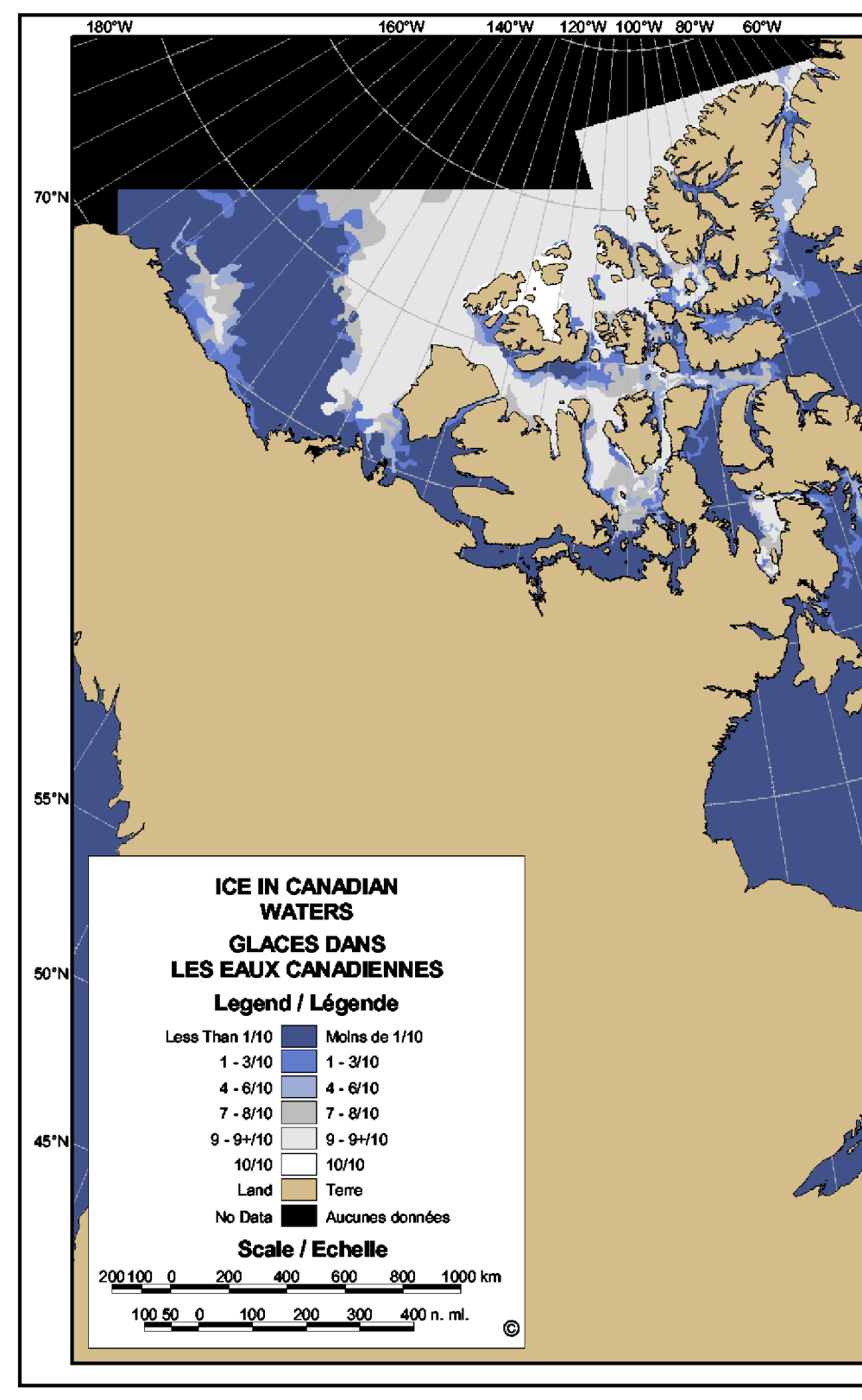
CanIce 20180908

This map from the Canadian Ice Service shows sea ice conditions in the western part of High Arctic islands on Sept. 8. The dark blue shows a low concentration (less than 10 per cent) of ice, while white shows a high concentration (100 per cent). At this time of the year, the Arctic ice cover is the highest it has been since 2014, the National Snow and Ice Data Center said Sept. 5.

Snow has now fallen across Nunavut’s more northerly communities, from Kugluktuk to Qikiqtarjuaq, after a summer that also brought cool temperatures and heavy ice conditions to some parts of Nunavut.

“if you’re trying to get somewhere, and ice is in the way, it’s been a very bad year,” said Gilles Langis, a senior ice forecaster with the Canadian Ice Service.

It remains unclear if ice played a role in the grounding of the Ioffe Akademik on Aug. 24. The cruise ship was not sailing where it was supposed to be due to ice, according to an account by the journalist and author Ed Struzik, who was on board.

And, earlier this week, operators of the cruise vessel Hanseatic turned around and headed back east through the Northwest Passage, having decided that ice conditions were too bad to continue on to western Nunavut.

The Canadian Coast Guard also recently rescued two sailors from a smaller vessel that had run into bad ice conditions in the Bellot Strait.

Summing up the summer ice conditions in 2018, Langis said that in many areas it was “very challenging”—in parts of Hudson Bay, Hudson Strait, Baffin Bay and at various choke points in the Northwest Passage where the ice pushed in.

Ice conditions are not likely to improve.  And as for the weather, it’s not likely not to be warming up either.

“It was a cold summer,” said Brian Proctor from Environment Canada. As well, northern Canada saw above normal precipitation in many communities because of a low pressure front stalled over the North.

Iqaluit experienced its 13th coldest and 14th wettest year in 73 years, he said.

In Qikiqtarjuaq, where snow also came early, it was the seventh coldest summer in 22 years.

Previous post:  Nunavut is Melting!  Or not.

From Yale Climate Connections we heard last week about Nunavut melting and a theatrical production to spread news and concerns about this dangerous development.

“I come from a place of rugged mountains, imperial glaciers and tender-covered permafrost. But Nunavut, our land, is only as rich as it is cold, and today most of it is melting.”That’s Chantal Bilodeau, reading a passage from “Sila,” a play about the effects of climate change in the Arctic.

The characters in her play include polar bears, an Inuit goddess, scientists, and coast guard officers – all working together to save their land.

No doubt her personal experience and feelings for her Nunavut are sincere and profound. (Originally I thought it was her homeland, but in fact she is a New York playwright and translator, born in Montreal.) And there will be a large audience receptive to her concerns about global warming. (Bilodeau has writen six plays about the Arctic and founded the international network Artists And Climate Change.) But I wonder if scientific measurements support her belief that Nunavut is melting.

After all, we have learned from medical research that individual life experiences (anecdotes) may not be true more generally. That is why drugs are tested on population samples with double-blind studies: neither the patient nor the doctor knows who gets the medicine and who gets the placebo.

So I went looking for weather station records to see what is the warming trend in that region. As curiosity does so often, it led me on a journey of discovery, learning some new things, and relearning old ones with fresh implications.

Where are temperatures measured in Nunavut?

It is by far the Northernmost territory of Canada, just off the coast of Northern Greenland.

According to Environment Canada, weather is reported at 29 places in Nunavut. So I went to look at the record at Iqaluit, the capital of the territory. You get monthly normals for the period 1981 to 2010. Historical data (daily averages) can be accessed only 1 individual month/year at a time, the menu stops at 2004. Even then, some months are filled with “M” for missing. Historical data from which trends can be analyzed is hard to come by.

Disappearing Weather Records

It turns out that Nunavut also suffered from the great purging of weather station records that was noticed by skeptics years ago.

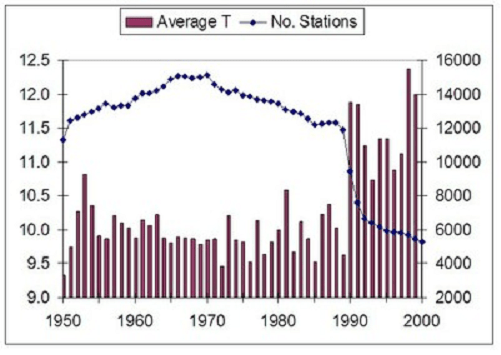
Ave. T vs. No. Stations

Graph showing the correlation between Global Mean Temperature (Average T) and the number of stations included in the global database. Source: Ross McKitrick, U of Guelph

I was aware of this because of a recent study looking at trends at stations around the Arctic circle. Arctic Warming Unalarming.  That study included graphs that showed the dramatic removal of station records in the North.  Though the depletion was not limited to the far North, many Canadian and Russian records disappeared from the global database.

arctic-europe-paper-2015_fig6annual

Fig. 6 Temperature change for annual Arctic averages relative to the temperature during 1961 to 1990 for stations in Europe having more than 150 years of observations. The red curve is the moving 5-year average while the blue curve shows the number of stations reporting in each year. 118 stations contributed to the study. W. A. van Wijngaarden, Theoretical & Applied Climatology (2015)

Eureka, Nunavut, Canada “Last Station above latitude 65N”

Eureka got considerable attention in 2010 due to its surviving the dying out of weather stations. The phrase in quotes above reflects an observation that GISS uses Eureka data to infill across the whole Arctic Circle. That single station record is hugely magnified in its global impact in that temperature reconstruction product. Somewhat like the influence of a single tree in Yamal upon the infamous hockey stick graph.

The first High Arctic Weather Station in history, Eureka was established in April 1947 at 80-degrees north latitude in the vicinity of two rivers, which provided fresh water to the six-man United States Army Air Force team that parachuted in. They erected Jamesway huts to shelter themselves and their equipment until August, when an icebreaker reached Eureka – as it has every year since – and brought permanent buildings and supplies. For decades after that, small, all-male crews would hunker down for entire winters, going a little stir-crazy from the isolation. WUWT 2010

GHCN Records for Nunavut

It turns out that in addition to Eureka, GCHN has data for Alert and Clyde (River), but the latter two histories end in 2004 and 2010, respectively. The adjusted files have a few differences in details, but little change from the unadjusted files. The chart below shows the temperatures measured at Eureka, Nunavut, Canada 79° 98’ N, 85° 93’ W.  The other two stations tell the same story as Eureka, though temperatures at Clyde are warmer in absolute terms due to its more Southerly location.

Eureka temps4

The chart shows Annual, July and January averages along with the lifetime averages of Eureka station from 1948 through 2015.  There is slight variability, and a few years higher than average, but nothing alarming or even enough for people to sense any change.  Note also that annual averages are well below freezing, because only 3 months are above 0° C.  I suppose that someone could play with anomalies and generate a chart that looked scary, but the numbers in the record do not support fears of global warming and melting in Nunavut.

Conclusion

Once again we see media announcements that confuse subjective beliefs with empirical observations of objective reality.  And unfortunately, those observations are less and less available to counter the herd instincts of fearing the future and blaming someone.


Arctic Ice Hockey Stick Reappears

ArcticIce20180906

No one knows if day 243 will turn out to be the annual minimum, but for now 2018 Arctic ice extent again resembles an hockey stick.  Presently the ice is 135k km2 below 2007 and the 11 year average (2007 to 2017 inclusive).  MASIE  shows increasing ice the first six days of September, while SII is hovering around 4.8 M km2, 200k km2 higher.

ims2492007to2018

The image above shows ice extents on day 249 (September 6) for years since 2007. Note this year ice is strong in both East Siberian basin and in Canadian Archipelago.  The exceptional 2012 low extent is also visible (Great Cyclone in August).

The Canadian ice chart below shows why the Northwest Passage is not passable this year.  Brown indicates old ice, and green first year ice.  In the last two days, Canadian Archipelago has added 38k km2 from its lowest extent on day 247.
20180903180000_wis56sd_0010215556

The bottle neck even for small yachts is Franklin strait where even first year ice is not going away.  Small vessels need less than 4/10 ice conditions indicated by the green spaces.
20180906180000_wis38ct_0010217357


Securing Pipelines Against Disrupters

Native American protestors were confronted by security and armed law enforcement during demonstrations in 2016 against the Dakota Access Pipeline. Credit: Robyn Beck/AFP/Getty Images

Keystone XL pipeline is expected to draw protests from indigenous and environmental activists when construction begins, and many activists are worried law enforcement agencies may be planning surveillance and a militarized response. Now, the American Civil Liberties Union is accusing federal agencies of trying to hide the extent of these preparations, which the group says are clearly underway.

The story comes comes from Inside Climate News, who support leaving fossil fuels in the ground. ACLU Fears Protest Crackdowns, Surveillance Already Being Planned for Keystone XL Excerpts in italics with my bolds.

As more states consider harsh anti-protest laws, law enforcement trainings are raising red flags. The group accuses U.S. agencies of trying to hide the extent of it.

The ACLU and its Montana affiliate sued several federal agencies this week, including the Departments of Justice, Defense and Homeland Security, saying the agencies are withholding documents that discuss planning for the expected protests and any coordination among state and local authorities and private security contractors.

Fears about the law enforcement response follow the 2016 armed crackdown on people protesting the Dakota Access Pipeline, where authorities used tear gas and turned water cannons on protesters in freezing temperatures. Since then, dozens of bills and executive orders have been introduced in at least 31 states to clamp down on protests. Activists say the bills are part of a concerted campaign by energy companies and their allies in government to suppress these protests by increasing criminal penalties for minor violations and in some cases trying to use anti-terrorism laws against activists.

The ACLU says documents it obtained from state agencies in Montana suggest law enforcement agencies have begun extensive trainings in preparation for the Keystone XL project, and that federal agencies are involved.

Documents that have been released suggest federal and state agencies have created an interagency team and have been conducting trainings for local law enforcement on how to handle the protests. One email from an intelligence specialist in the U.S. Attorney’s Office in Montana to a state official said the office would be hosting an anti-terrorism training event in August.

A January email from David Loewen, head of the law enforcement division of Montana Fish, Wildlife and Parks, said the state’s Division of Criminal Investigations had been in touch with officials in North Dakota “to learn what worked and what didn’t” at Standing Rock during the Dakota Access Pipeline protests. The email noted that while “man-camps” to house workers would come along with pipeline construction and bring law enforcement challenges, “the primary enforcement focus is protest activity.”

In an interview, Loewen said the ACLU’s concerns about law enforcement agencies suppressing protests were “a bit silly.

Our job is to prepare and train, that’s what law enforcement does all the time,” he said. “If we have a protest coming, chances are things are going to be peaceful and fine and dandy. But on the outside chance that they’re not, we want to be prepared.”

The Department of Justice did not respond to questions about the records or the anti-terrorism training.

Environmental and indigenous activists have describe harsh treatment by law enforcement and security officers in Louisiana, where at least 13 people have been arrested under a new law since it went into effect on Aug. 1, including four activists who were detained on Tuesday.  The law created a felony charge with up to five years in prison for anyone who trespasses on a pipeline easement.

The records obtained by the ACLU in Montana echo others in Oklahoma, Louisiana, Virginia and other states that have shown law enforcement agencies focusing anti-terrorism resources on environmental activists and, in some cases, cooperating with private security companies employed by pipeline companies to surveil and arrest protesters.

In a blog post announcing the organization’s lawsuit, Jacob Hutt of the ACLU said the organization hopes to determine from the documents its requested how and whether federal agencies are “thwarting, surveilling, and otherwise engaging with indigenous and environmental activists” opposed to Keystone XL.

“The First Amendment protects political speech from the threat of undue government scrutiny, and the extent of such scrutiny is currently unknown,” he wrote. “If the government is planning to prevent or monitor indigenous and environmental protests, the activists involved have a right to know about it.”

Summary

OMG! Law enforcers are actually preparing for an orderly construction of a vital energy infrastructure project and are not giving their plans to disrupters. Even more alarming, the states affected are passing laws with felony penalties for trespassing and vandalism.  Moreover, public and private agencies responsible for pipeline security are collaborating and coordinating their efforts in advance.

It all seems like an organized effort to build and operate a pipeline to provide reliable affordable energy to people who want and need it.  Taking note that some crackpots have declared war against fossil fuels, they are putting defenses in place.  I call that “Good Governance”

Why Climatists Fear Kavanaugh

blinders

If Senators were not blinded by ideology, they would welcome the opportunity for an originalist Supreme Court to restore their congressional power, currently usurped by numerous executive branch agencies. Or maybe those opposed to Kavanaugh are happy to be derelict in their duties, feeling their progressive agenda has been well served by lawmakers’ acquiescence.  One estimate came to the number of 300,000 for criminal behaviors and penalties created by regulators and not by Congress.

Brett Kananaugh said yesterday in the first day of Q&A at his nomination hearing:  “I’m not a skeptic of regulation at all,” he said. “I am a skeptic of unauthorized regulation, of illegal regulation, of regulation that’s outside the bounds of what the laws passed by Congress have said.”

A ruling written by Justice Kavanaugh at DC Court of Appeals shows what that means for environmental law, and more specifically for climate activism.

A Majority Kavanaugh EPA Opinion

Last year DC Court of Appeals struck down EPA rules regarding HFCs and Judge Kavanaugh wrote the majority opinion:

“EPA’s novel reading of Section 612 is inconsistent with the statute as written. Section 612 does not require (or give EPA authority to require) manufacturers to replace non ozone-depleting substances such as HFCs,” said the opinion, written by Judge Brett Kavanaugh.

“In any event, the legislative history strongly supports our conclusion that Section 612(c) does not grant EPA continuing authority to require replacement of non-ozone-depleting substitutes.. . In short, although Congress contemplated giving EPA broad authority under Title VI to regulate the replacement of substances that contribute to climate change, Congress ultimately declined.”

“However, EPA’s authority to regulate ozone-depleting substances under Section 612 and other statutes does not give EPA authority to order the replacement of substances that are not ozone depleting but that contribute to climate change. Congress has not yet enacted general climate change legislation. Although we understand and respect EPA’s overarching effort to fill that legislative void and regulate HFCs, EPA may act only as authorized by Congress. Here, EPA has tried to jam a square peg (regulating non-ozone depleting substances that may contribute to climate change) into a round hole (the existing statutory landscape).”

More at Gamechanger: DC Appeals Court Denies EPA Climate Rules


Adam J. White wrote in Real Clear Policy July 31, 2018 Brett Kavanaugh’s Past Opinions Endorsed by Supreme Court  Excerpts below in italics with my bolds.

If all goes according to plan, Brett Kavanaugh will soon join the Supreme Court. But his ideas arrived at the Court well before him.

For 12 years, Judge Kavanaugh has served on the U.S. Court of Appeals for the D.C. Circuit, often considered the “second-highest court in the land” because of its heavy portion of constitutional and regulatory cases. On those issues, Kavanaugh has become the intellectual leader of his generation of judges on the lower courts. And the best evidence of this are those cases in which Judge Kavanaugh’s analysis was adopted by the Supreme Court even after Kavanaugh’s colleagues on the D.C. Circuit rejected it.

Through eloquent judicial opinions and nuanced law review articles, Kavanaugh has challenged, in particular, today’s increasingly unaccountable administrative state. His uncanny ability to identify fundamental threats to our Constitution’s republican institutions, and to anticipate the Supreme Court’s own eventual response, is exemplified by three cases.

The first involved so-called “independent” agencies. Since the New Deal, the Supreme Court has recognized Congress’s discretion to create agencies with a measure of insulation against day-to-day presidential control. But when Congress attempted to layer one independent agency within another — i.e., the Sarbanes-Oxley Act’s creation of the Public Company Accounting Oversight Board, inside the SEC — Kavanaugh recognized that a line must be drawn.

“By restricting the President’s authority over the Board,” he wrote in a 2008 case, “the Act renders this Executive Branch agency unaccountable and divorced from Presidential control to a degree not previously countenanced in our constitutional structure.” Recognizing that “upholding the PCAOB here would green-light Congress to create a host of similar entities,” Kavanaugh dissented from his colleagues’ decision affirming the agency. The Supreme Court then reversed the D.C. Circuit, largely adopting Kavanaugh’s approach.

The second case involved an agency’s assertion of immense power in lieu of — or even contrary to — the laws enacted by Congress. When the Environmental Protection Agency imposed its initial suite of regulations for greenhouse gas emissions, the agency attempted to “tailor” the Clean Air Act to suit its climate policy. The EPA recognized that applying various parts of the Act to GHG emissions would lead to “absurd” results that Congress specifically sought to avoid when it created the Act in the first place. So the agency attempted simply to nullify those parts of the Act in order to maintain its climate policy.

As Kavanaugh explained in a dissenting opinion, the EPA was putting the regulatory cart before the legislative horse. If the EPA’s climate policy didn’t fit the Clean Air Act, then the EPA needed to change its policy, not the Act. Once again, Kavanaugh’s colleagues disagreed — and once again, the Supreme Court reversed the D.C. Circuit, largely adopting his approach in a 2014 case.

The third case involves judicial deference to an agency’s implausible and self-serving statutory interpretation. The Clean Air Act allows the EPA to impose certain air quality regulations when the agency concludes that such regulations are “appropriate.” When the EPA created new mercury restrictions for utilities, it refused to consider the enormous cost of those rules, claiming that such costs have no bearing on whether the rules are “appropriate.” Citing many scholars and judges, Kavanaugh concluded that it “is entirely unreasonable for EPA to exclude consideration of costs in determining whether” the regulation is “appropriate.” His colleagues rejected his approach and deferred instead to the agency. But in 2015 the Supreme Court reversed the D.C. Circuit and followed Kavanaugh.

In each of these cases, Kavanaugh sensed that the administrative state was pushing matters to a breaking point. Each time, his circuit colleagues rejected his approach, but the Supreme Court embraced it.

If Kavanaugh’s nomination succeeds and he winds up joining the Court, where his ideas already have had such influence, there are at least three places where he will likely have significant impact in reforming and modernizing the judicial doctrines surrounding the administrative state.

First, Kavanaugh has expressed reservations about the degree of “deference” that courts now give agencies’ legal interpretations. (The best example of this is his 2016 article in the Harvard Law Review.) This is an increasingly common theme among conservative judges — indeed, the justice whom Kavanaugh would replace (and for whom he once clerked), Justice Kennedy, raised the same concerns in one of his own last judicial opinions.

Second, and relatedly, Kavanaugh has been called on courts to be more skeptical of agencies’ assertions of power over the most significant economic and political issues of our times. In an opinion dissenting from the D.C. Circuit’s deference to the Obama FCC’s “net neutrality” rules, Kavanaugh argued that courts should presume that Congress did not commit such vast regulatory powers to bureaucratic agencies, absent a clear statement to the contrary. In this respect, Kavanaugh echoes Chief Justice Roberts’s own un-deferential opinion in one of the Affordable Care Act cases, where Roberts — joined by the Court’s four liberal justices — agreed with the Obama administration but expressly refused to approach the case with any interpretive “deference” to the agencies’ claims of authority.

Finally, Kavanaugh raises serious questions about novel forms of agency “independence.” In a case involving the Consumer Financial Protection Bureau, Kavanaugh wrote a majority opinion holding the CFPB’s structure unconstitutional. The reason? The Dodd-Frank Act gave the CFPB an unprecedented measure of independence without the usual multimember agency structure that disperses in independent agency’s power among more deliberative body (as in the Federal Trade Commission). Kavanaugh’s majority opinion — which echoed themes raised by Chief Justice Roberts in an earlier Supreme Court cases — was eventually vacated by the full D.C. Circuit, where Democratic appointees enjoy a strong majority. But even then, Kavanaugh’s intellectual influence among other judges was made evident when his approach to the CFPB case was adopted by the federal district court in Manhattan in a different challenge to the CFPB. Even more recently, the U.S. Court of Appeals for the Fifth Circuit applied a similar analysis to the Federal Housing Finance Agency, holding the FHFA’s structure unconstitutional with a judicial opinion replete with citations to Kavanaugh.

At the Scalia Law School, I direct the Center for the Study of the Administrative State. It is no exaggeration to say that for the past decade, to study the administrative state has been, in no small part, to study Judge Kavanaugh’s D.C. Circuit opinions. With an appointment to the Supreme Court, his official title will finally match his real-world influence.

Adam J. White is research fellow at the Hoover Institution, and director of the C. Boyden Gray Center for the Study of the Administrative State. Previously, as a lawyer, he participated in some of the mentioned cases.

Footnote:

More and more likely we are witnessing a return to Constitutional separation of powers.


Fear and Loathing of Climate Dissent


Alarmists are circling the wagons against any and all who raise questions about their beliefs, or who dare to take a different view of earth’s climate system and future weather trends. The latest example comes from Portugal as reported approvingly by DesmogUK Santander Forced To Distance Itself From Climate Science Denial Conference  Excerpts in italics with my bolds

Santander has been forced to distance itself from a climate science denial conference after its logo was published on the event’s website without the bank’s knowledge.

The bank, which is one of the world’s biggest, told DeSmog UK it was not a sponsor of the climate science denial conference taking place in Porto, Portugal, at the end of this week.

However, Santander admitted giving money to the University of Porto, where the conference is being held, to “support investigation and research” but added that it did not oversee how the money was spent.

The conference, called “Basic science of a changing climate: How processes in the sun, atmosphere and ocean affect weather and climate” says it is “open to different opinions and interpretations of changing climate”.

Held at the University of Porto’s Faculty of Humanities, the conference has been organised by Maria Assunção Araújo, a professor at the geography department, who is due to address the conference on sea level rise in Portugal and ice retreat in Greenland.

Speakers include prominent climate science deniers Piers Corbyn, Philip Foster, Christopher Essex, Nils-Axel Mörner and Christopher Monckton, who will give the two-day conference closing speech before participants are invited to take part in a “cheese and port mingle”.

The conference also includes a session for students to ask speakers questions.

Santander’s logo is featured on the conference’s website, alongside the University of Porto’s logo.

A spokesman for the Univeristy of Porto told DeSmog UK that the conference was not organised by the university despite being held on its premises and that views expressed at the conference “do not refelect the official position of the University of Porto about the subject”.

He added that the conference had been organised at the initiative of one of the faculty’s professors who applied to a programme sponsored by Santander aimed at supporting international events being held at the university.

The spokesman said the programme “demands that such events exhibit the source of funding, which explains the presence of the Santander logo on the website”.

“It is our conviction that the universities should be a space of open debate and discussion, where the presentation of conflicting ideas and perspectives should be valued. We also believe that censorship of opinions — even the ones that we do not agree with — should not be part of the activities of any university and it is in this context that the University of Porto will host this conference,” he said, adding that this “does not conflict with the university’s commitment to fight against climate change”.

In an email to DeSmog UK, Santander said it supported the University of Porto as part of its universities programme but that it was not aware that its logo had been used on the conference’s website.

“Santander is not a sponsor of this conference,” a spokeswoman told DeSmog UK.

“Santander has always and continues to do all it can to support sustainable growth and combat the impact of climate change, which is undoubtedly one of the greatest challenges we face.”

She added that the money Santander gave the university could be used in any way the university saw fit.

“We do not instruct Porto University how to use funds it receives from Santander. It can use funding resources to support investigation and research at their sole discretion and decision, to respect the university’s academic independence,” she said.

In its climate change policy, Banco Santander — the parent company of the Santander group — states that “climate change and resource scarcity are two of the biggest challenges faced by society”.

It adds that the group’s efforts to protect the environment were based on the Paris Agreement and the United Nations Framework Conventions on Climate Change (UNFCCC) now re-branded as the UN Climate Change.

Summary

Increasingly climate alarmists/activists employ religious tactics of denunciation, censorship, shunning and excommunication to ward off any unorthodox views of climate and weather. This extends to compelling people like corporate spokespersons to say the party line, or face defamation.  In this case, the University is brave enough to host the conference, even while declaring their institutional orthodoxy. Let’s see if SJWs attempt to prevent the event.  Let’s also see how well such tactics are viewed by the public if and when cooling sets in. BTW Scientific American is already reminding us that the coming winter is to be regarded as weather and not climate change (unlike the summer now ending).


EU Sub Committee Aims to Open Closed Climate Minds

It wasn’t supposed to be this way.  The EU bureaucratic wheels were turning and needed a routine submission from the Committee on Agriculture and Rural Development as input for the Committee on the Environment, Public Health and Food Safety regarding a programme rule change.

The Rapporteur for opinion happened to be UKIP member John Stuart Agnew, who actually knows something about climate matters and agriculture, and drafted a submission accordingly.  The full document is here,( H/T WUWT)  and his case is put admirably.  Excerpts below in italics with my bolds.

The LIFE program is due for renewal in 2020. It has hitherto used its funding to act as a test bed for small projects which are expected to improve the environment. Examples have included management techniques to improve numbers of wild species or maintenance of wetlands. The success of such innovations can be quantified and demonstrated. The funding comes direct from Brussels.

If such projects are successful, they become popular with farmers who then make these investments using the Pillar 2 grants from their member states. The addition of the words ‘Climate Action’ in the present LIFE regime has added an entirely new concept to the way that taxpayer’s money should be used. The term has also occurred in the latest proposal from Commissioner Hogan on CAP reform. The addition of the term ‘Climate Action’ coincides with a 60% increase to the budget of the LIFE Programme. What is conspicuously missing are definitions of the actions required and the outcomes that are desired.

If the words ‘Climate Action’ had been substituted with the words ‘Pollution Action’, then it would be possible to measure air, soil and water pollution and measure the effectiveness of strategies to alleviate these problems, against a target figure for each of the three elements. A war to reduce pollution can be won, using the weapons of technology and legislation. A war against the world’s weather will never end, because ‘victory’ cannot be defined.

The Rapporteur has met the team of four from the Commission who between them have had varying levels of input into this proposal. The Rapporteur asked them what outcome would be considered desirable, as a consequence of financial investment. The answer was – ‘a reduction in CO2 emissions’.

By mentioning the concept that reducing CO2 levels will serve to take action against an unsatisfactory climate, the Commission is ignoring the factors that really do change our climate.
1. The galaxy: in the form of Cosmic Ray fluctuations. Can induce changes of 10 o C over millions of years.
2. The solar system: Gravitational pulls can induce changes of 2-3 o C.
3. The sun: Its variations of orbit and tilt along with its five separate documented cycles can the cause earth’s temperature to vary by up to 5o C.
4. Ocean Currents.
5. The ‘Greenhouse’ gas: Water Vapour, in the form of cloud cover.

The other Greenhouse gases, CO2, Methane and Nitrous Oxide have a negligible effect on our climate. CO2 is, however, an irreplaceable plant food. Methane degrades into CO2 and H2O; NOx gases eventually change into Nitrates.

If the effect of CO2 levels on our climate is negligible, the effect of human activity on changing those CO2 levels is also negligible.

The two world maps below perfectly demonstrate this.

Calculated areas of higher CO2 concentrations due to human emissions

– Actual areas of higher CO2 concentration
– SCIAMACHY observations on the ENVISAT satellite (agree with Japan’s IBUKU data)

The predictions of the experts and the measurements by satellite are contradictory. The total absence of CO2 hotspots over Europe indicates there is no problem for the Commission to solve. The only potential risk of a major CO2 event in Europe is an erupting volcano.

The naturally high concentrations of CO2 above our natural rainforests create an interesting dilemma for those who want one without the other. This is not made any easier when it is realised that rainforests are also major emitters of methane and water vapour.

Ever since the Rapporteur joined the Parliament in 2009, it has been fashionable for MEPs in AGRI and ENVI to work the phrase “tackling Climate Change” into their speeches. It sounds worthy and virtuous. It is based on predictions made in the 1980s of rapidly rising world temperatures and sea levels that never ultimately occurred. The Commission has listened to these speeches as opposed to observing the reality. At some stage somebody has to say “The king isn’t wearing an invisible suit, he’s just not wearing any clothes!” The Rapporteur is presenting this opportunity to his colleagues.

Some MEPs have been elected solely because of their antipathy to CO2. They will not change their views.

The Rapporteur urges other colleagues though to reflect on the fact that the precedent of ‘Climate Action’ in the LIFE Programme is setting the stage for ‘Climate Action’ in agriculture, where 40% of future budgets is destined to be spent fighting CO2, one of agriculture’s greatest friends.

The Rapporteur has amended the proposal to delete all references to “clean energy” as this implies “CO2 free” energy, as well as the references to ‘climate change mitigation’ but incorporated the term ‘climate change adaptation’ into the text of the legislative proposal. There is a big difference. We need to prepare for the next ‘Maunder Minimum’ or mini ice age – which might last 200-300 years. Some solar physicists believe this cycle has technically already started.

Footnote Regarding Future Cooling

Both the Pacific (PDO) and the Atlantic (AMO) are due for a cooling phase. If that happens coincidental with diminished solar input (indicated by the lower sunspot proxy), we are looking at planetary cooling as suggested by some solar physicists.

The situation reminds of governmental failure in North America to manage the educational system to match demographic shifts. The bureaucratic response comes too late to cope with the current reality. After WWII came the baby boom, and many schools became overcrowded and new ones built. Then the sexual revolution and female liberation produced a baby bust due to smaller families, so schools emptied with surplus capacity. Just as the government got serious about closing schools came the baby echo, unanticipated by the authorities. Despite smaller families, there were many more of them, these being the married adult boomers. Echo babies were a new pulse of children hitting a school system undergoing downsizing in response to the previous baby bust.

Similarly, the climatists would have us assume endless warming and require cessation of reliable affordable energy just as we enter a mini ice age.

Arctic NW Passage Not Passable

August 23, 2018 . At least 22 vessels are affected and several have turned back to Greenland.

Update September 3, 2018

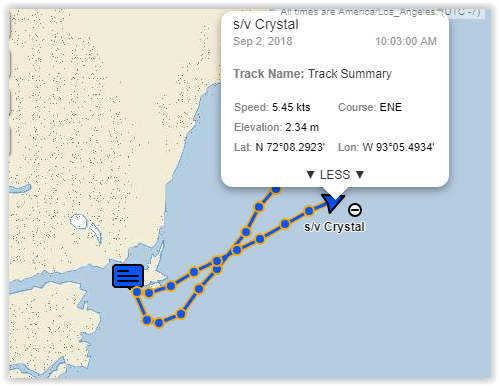
News today from the Northwest Passage blog that S/V CRYSTAL has given up after hanging around Fort Ross hoping for a storm or melting to break the ice barrier blocking their way west.
20180902-1025_crystal

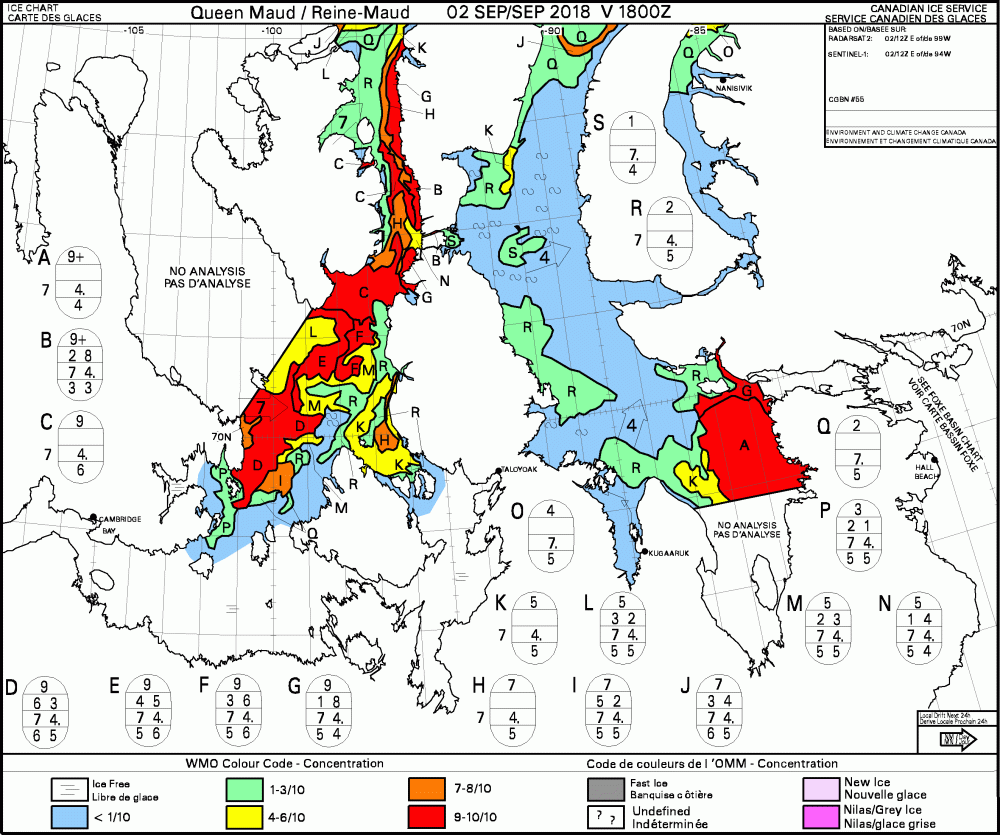
As the vessel tracker shows, they have been forced to Plan C, which is returning to Greenland and accept that the NW Passage is closed this year. The latest ice chart gave them no hope for getting through.
20180902180000_wis38ct_0010210949

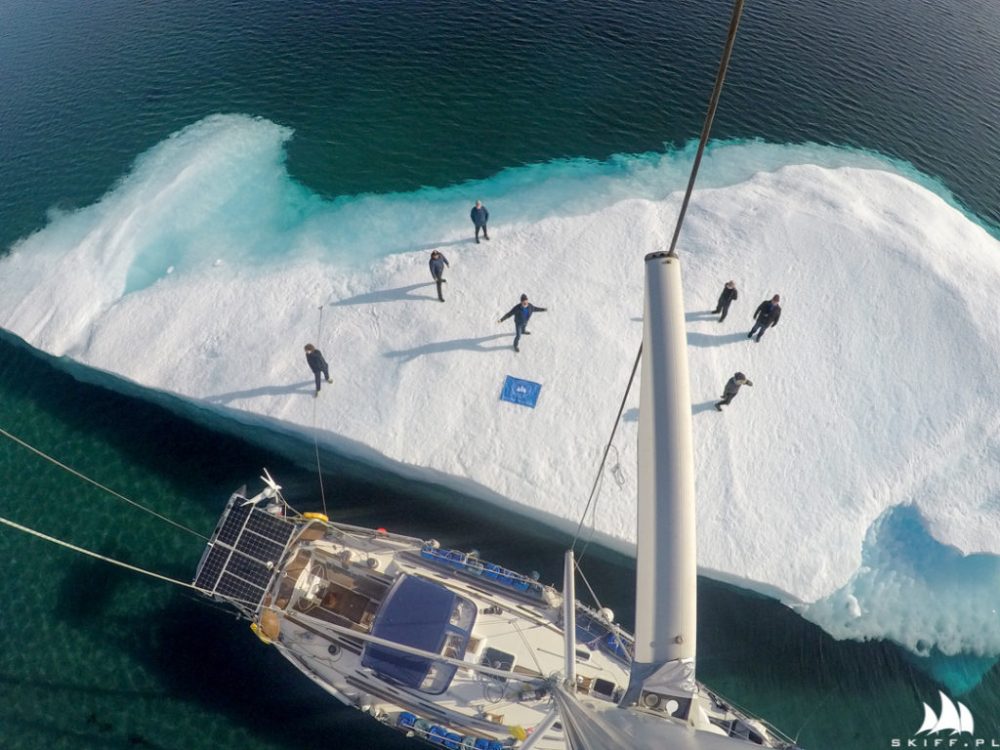
The image below shows the ice with which they were coping.
DCIM100GOPROGOPR5778.

More details at NW Passage blog 20180902 S/V CRYSTAL and S/V ATKA give up and retreat back to Greenland – Score ICE 3 vs YACHTS 0

Update August 28, 2018

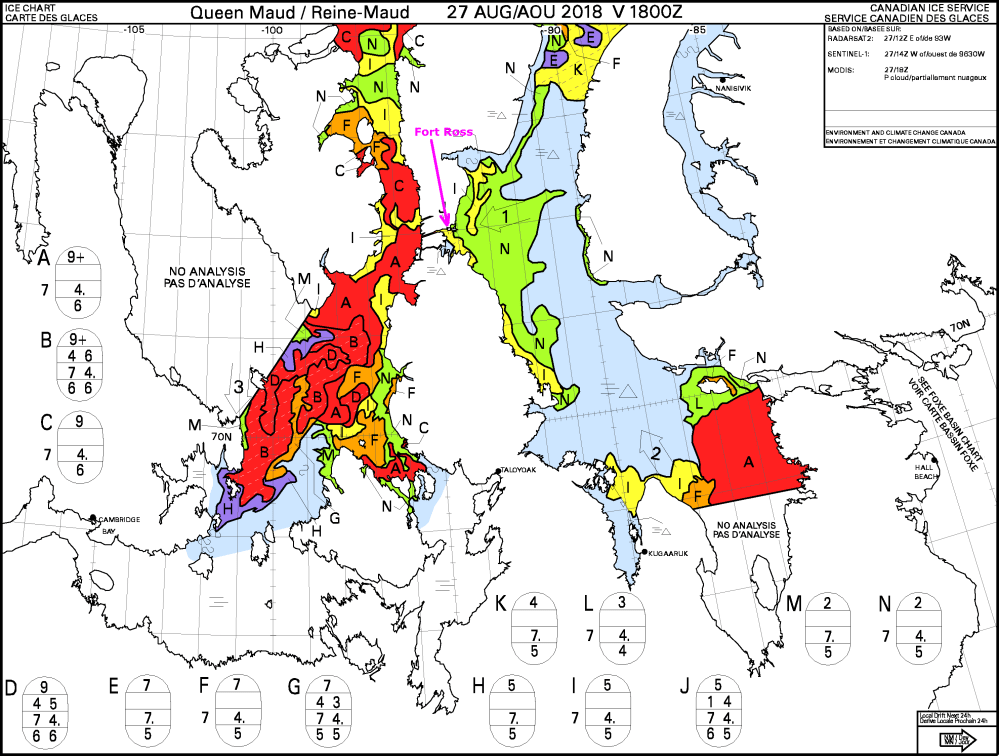
S/V CRYSTAL (Polish Crew) at Fort Ross Nunavut waiting Franklin ice and weather window to dash westward toward Nome Alaska.
QM20180827w Ft. Ross

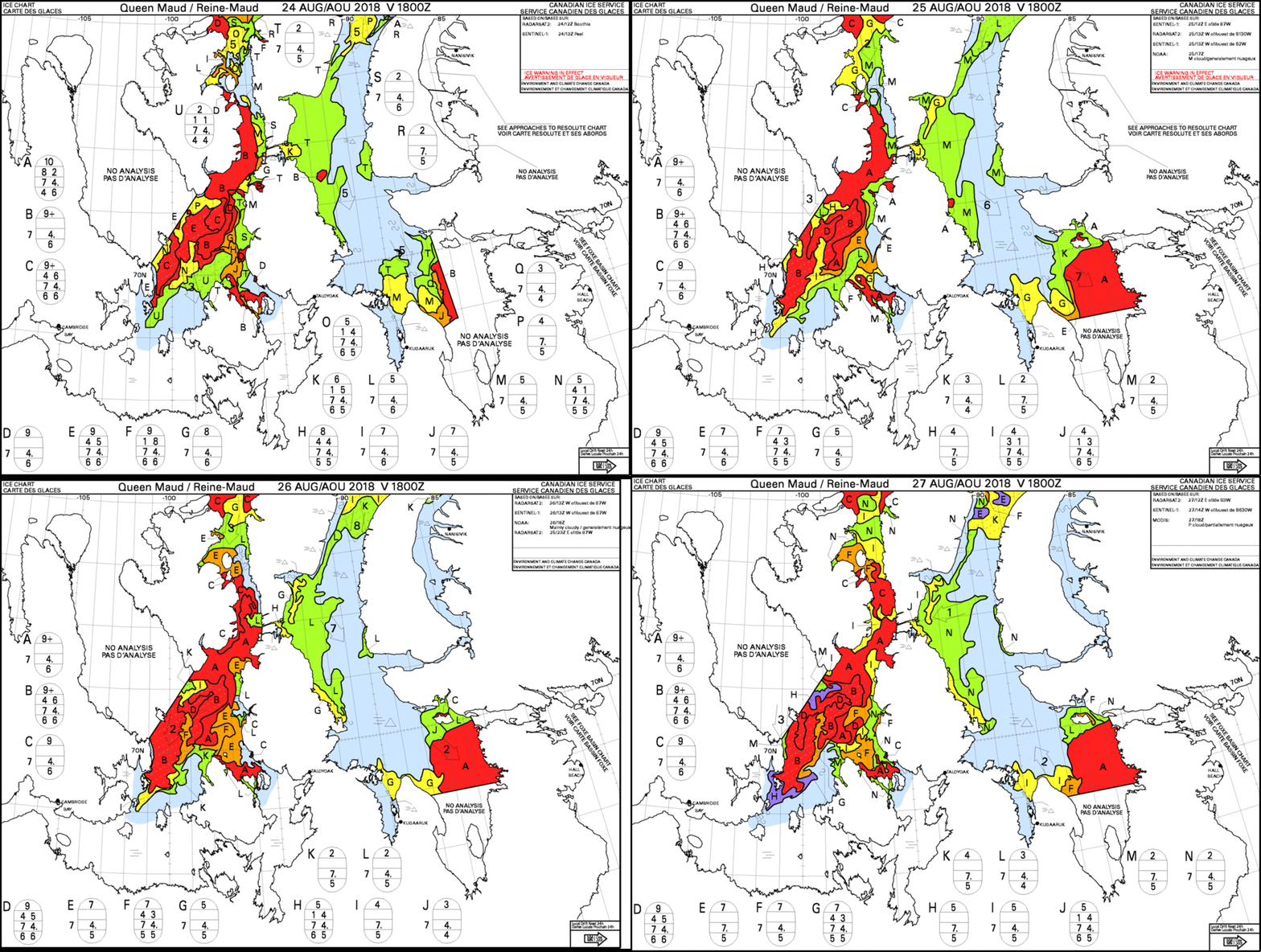
Note yachts can sail through green (3/10), so the hope is for red to yellow to green.  But here are the last four days:
They are hoping for a storm Sept. 1-2 to open Franklin Strait where is the thick red ice.  Plan B is to wait another week for a wider weather window and more ice disintegration.  Plan C is to escape to the east.

From the Northwest Passage Blog (Aug. 22, 2018):
Good morning,
Due to heavier than normal ice concentrations in the Canadian arctic waters north of 70 degrees, the Canadian Coast Guard, recommends that pleasure craft do not navigate in the Beaufort Sea, Barrow, Peel Sound, Franklin Strait and Prince Regent. CCG icebreakers cannot safely escort pleasure craft. Operators of pleasure craft considering a northwest passage should also consider the risk of having to winter in a safe haven in the Arctic, or in the case of an emergency, be evacuated from beset vessels. Safety of mariners is our primary concern.
REGARDS,
NORDREG CANADA

August 26:  FRANKLIN continues to improve with less ice and could be open by the first full week of September.


Earth’s “Big Freeze” Looms

Earth’s “Big Freeze” Looms As Sun Remains Devoid Of Sunspots For Most Of 2018 is an article from Zero Hedge. Excerpts in italics.


Scientists are reporting that the sun has been free of sunspots for a total of 133 days this year, according to The Express UK. With only 241 days of 2018 passing, that means the sun has been blank for the majority of the year. Experts continue to warn that this is a sign that the solar minimum is on its way.

“The sun is spotless again. For the 133rd day this year, the face of the sun is blank,” wrote the website Space Weather.

“Solar minimum has returned, bringing extra cosmic rays, long-lasting holes in the sun’s atmosphere, and strangely pink auroras,” the website continued.

The sun follows a cycle of roughly 11 years where it reaches a solar maximum and then a solar minimum.

During a solar maximum, the sun gives off more heat and solar particles and is littered with sunspots. Less heat in a solar minimum is due to a decrease in the sun’s magnetic waves. Our sun was not expected to head into a solar minimum until around 2020, but it appears to be heading in that direction a little early which could prove to be bad news for warm weather lovers.


But a prolonged solar minimum could mean a “mini ice age.” The last time there was a prolonged solar minimum, it did, in fact, lead to a mini ice-age which was scientifically known as the Maunder minimum. That little cold snap lasted for 70 years between the years 1645 and 1715. During this period, temperatures dropped globally by 1.3 degrees Celsius leading to shorter seasons and ultimately food shortages.

“Low solar activity is known to have consequences on Earth’s weather and climate and it also is well correlated with an increase in cosmic rays that reach the upper part of the atmosphere. The blank sun is a sign that the next solar minimum is approaching and there will be an increasing number of spotless days over the next few years,” wrote a meteorological website called Vencore Weather.