Ontario has to Launder $1B in cap-and-trade money

CBC has the story: Ford government sitting on $1B in cap-and-trade money
Excerpts in italics with my bolds.

Environmental commissioner says by law it can only be spent on reducing greenhouse gases

Context: No one is talking about the reason Ford canceled cap and trade the first day on the job. It was to eliminate the 4.3 cents/liter gasoline tax. At the same time, spending on schemes to “fight climate change” was stopped.  By skimming a few cents off every liter sold, pretty soon you have billions of dollars in the pot. The law ending cap and trade did not reimburse gasoline retailers who had bought carbon allowances in the past, because they already passed on the cost to customers. Those who bought in advance to avoid higher carbon prices later are now caught and want the government to reimburse them, since they lost the opportunity to stick it to their customers. What a great idea is cap and trade: A market to sell a non-good at arbitrary prices paid by other people’s money. What could go wrong?

As much as $1 billion in Ontario’s cap-and-trade fund is sitting unspent, and questions are swirling about what Premier Doug Ford’s government will do with it.

The money was brought into provincial coffers under a law that says it can only be spent on measures that reduce greenhouse gas emissions. However, Ford has dismissed the money as a “slush fund,” and his government is pushing forward legislation to use some of it to cover the costs of cancelling the cap-and-trade program.

The dedicated fund for reducing greenhouse gases had a balance of $553 million at the end of March, when the last fiscal year ended, according to the province’s newly released public accounts. Another $476 million was added in May from the final cap-and-trade auction of carbon allowances, before Ford’s PCs won the election and quickly scrapped the Liberals’ climate-change plan.

That would put the account at more than $1 billion. What remains unclear is how much of that has been spent in the past six months, and how much will be used to wind up cap-and-trade.

CBC News asked the Environment Ministry for the current balance of the greenhouse gas fund, but officials did not provide an answer.

Ontario’s environmental commissioner Dianne Saxe believes there’s still $1 billion in the account because she has seen no evidence that money has been dispersed since the end of March.

Saxe — an independent officer of the Legislature like the auditor general and ombudsman — says the costs of winding up cap-and-trade ought to be small enough that the bulk of the $1 billion will remain.

“They will have quite a bit of money left,” said Saxe in an interview. “That can be money they can use to invest in [climate-change] solutions.”

She is warning the government that it cannot spend the money however it wishes, but only on initiatives to reduce carbon emissions. “That was the legal basis on which the money was collected, and that remains the law,” she said.

Liberal MPP Nathalie Des Rosiers said Monday she fears the government will not spend the money on cutting greenhouse gases but on lawsuits arising from cancelling cap-and-trade.

That fear is unfounded, said Environment Minister Rod Phillips.

“The money will be used for the purpose it was collected,” said Phillips in an interview Monday at Queen’s Park.

He declined to estimate how much of the $1 billion will remain in the fund once the cap-and-trade program is wound up. Nor did he agree that the figure will be in the hundreds of millions of dollars.

“I don’t think it would be fair to speculate at this point,” said Phillips. “We will make it clear how much money was spent and where it was spent.”

Ford made cancelling the cap-and-trade program a central election promise, calling it the “cap-and-trade carbon tax” during and after the campaign. Within days of taking power, his government shut down rebates to homeowners for making energy efficiency improvements, such as installing new windows, and ended rebates for buying electric cars. Those rebates came from the greenhouse gas reduction fund.

The government won’t be able to say how much remains in the greenhouse gas fund until all the programs wind up, said Phillips. He also said the government is allocating $5 million to compensate companies that bought cap-and-trade allowances, which are now worthless.

Phillips is promising a plan to tackle climate change this fall, including an “emissions-reductions fund” but says it will not come from a carbon-tax model.

The province is challenging Ottawa in court over the Trudeau government’s plan to impose a carbon tax on Ontario in the absence of a provincial carbon-pricing program.

Meanwhile, environmental groups led by Greenpeace are suing the province over cancelling cap-and-trade, alleging that the Ford government broke the law by failing to consult Ontarians on the move.

No Mention of climate or warming in New NA Trade Accord 

Hats off to all for arriving at an agreement for economic transactions unburdened by obsessions with CO2 and unfounded claims of humans controlling the weather. A survey of the text shows the terms “climate” and “warming” do not appear even once. Good job!

Of course, greens are up in arms. Imagine signing a trade agreement that does nothing to destroy our economies in order to save the planet from CO2.

The deal does have a chapter on the environment, but critics such as the Council of Canadians call it weak and unenforceable.

It mentions pollution, marine traffic, endangered animals and ozone, but ignores what many call the world’s largest environmental challenge.

“The deal doesn’t even mention climate change,” Stewart said.

What has been thrown out is a provision in the old North American Free Trade Agreement that allowed corporations to sue governments for lost profits if they were injured by public-interest regulations such as environmental laws. The Council of Canadians pointed out that Canada was sued 37 times, mostly by American companies, under the old clause.

Update October 2, 2018

The new NA trade accord also strengthens energy security and trade. From offshore-technology.com:

The US oil and gas industry has urged Congress to approve the Trump administration’s renegotiated North American Free Trade Agreement (NAFTA), saying that the deal will support US oil and gas exports across North and South America.

American Petroleum Institute president and CEO Mike Sommers said: “We urge Congress to approve the United States-Mexico-Canada-Agreement (USMCA). Having Canada as a trading partner and a party to this agreement is critical for North American energy security and US consumers. Retaining a trade agreement for North America will help ensure the US energy revolution continues into the future.”

There were concerns in the industry that Trump would scrap the NAFTA, which was pivotal in making Mexico the largest exporter of US oil, transportation fuel, and natural gas.

Meanwhile, with support from the trade agreement, Canada is the largest supplier of foreign oil and a significant exporter of electricity to the US.

The deal also makes Canada’s heavier crude oil more attractive to refiners in the Mexican Gulf, especially at a time when Venezuela’s production has reduced amid political and financial worries. Fracked US crude oil is lighter, and refineries in the Gulf, which traditionally deal with heavier crude, are still adjusting their processing practices.

The new NAFTA deal ensures a ‘zero-tariff’ on energy products traded between the US, Mexico and Canada.


Try to Remember: There’s Ice in September

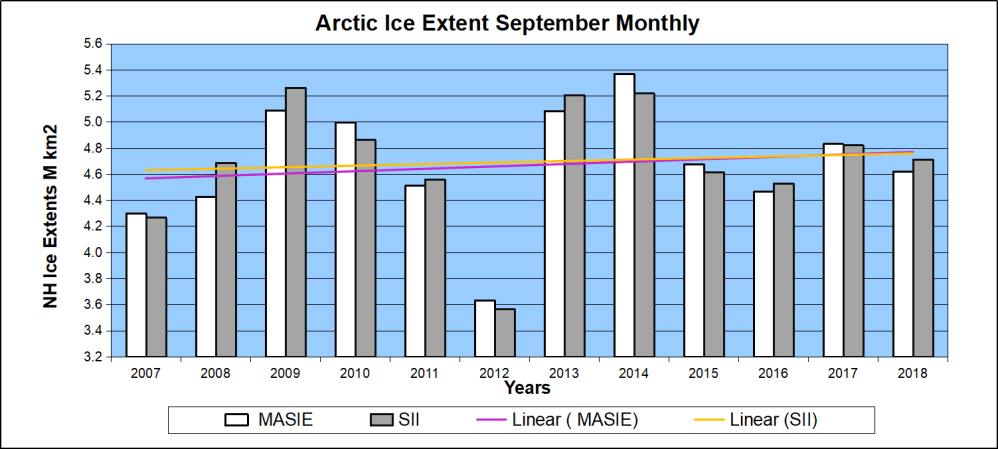
Arctic Sept 2007 to 2018

With ten years of hyped claims about Arctic sea ice declining, it takes effort to remember that ice in the Northern Hemisphere isn’t going away.  This year’s monthly average for September (the annual minimum) is slightly lower than 2017, but still well above 2007.  MASIE shows a surplus of 300k km2 and SII shows 450k km2.  As a result, both linear trends are slightly positive, though I would call it a “plateau, ” as opposed to a “death spiral.”

CA2018261to273

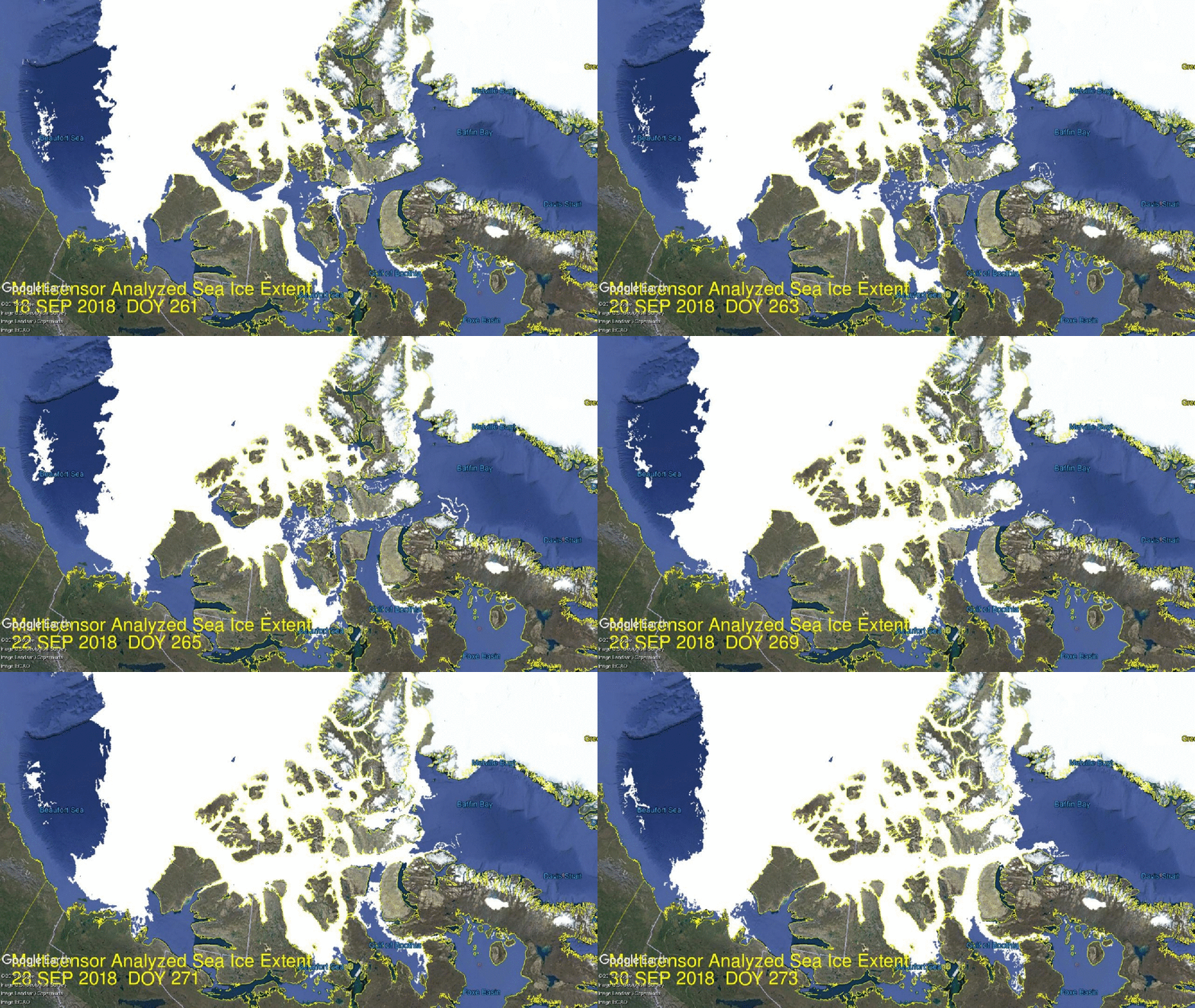
Twelve Days in Nunavut

Previous posts described how the Northwest Passage was treacherously laden with ice this year.  The image above shows the flash freezing in this region over the last twelve days.  Sept. 18 the CAA ice extent (Canadian Arctic Archipelago) was 321k km2, close to its annual minimum.  Yesterday MASIE showed 606k km2,  a increase of 90% in that region.

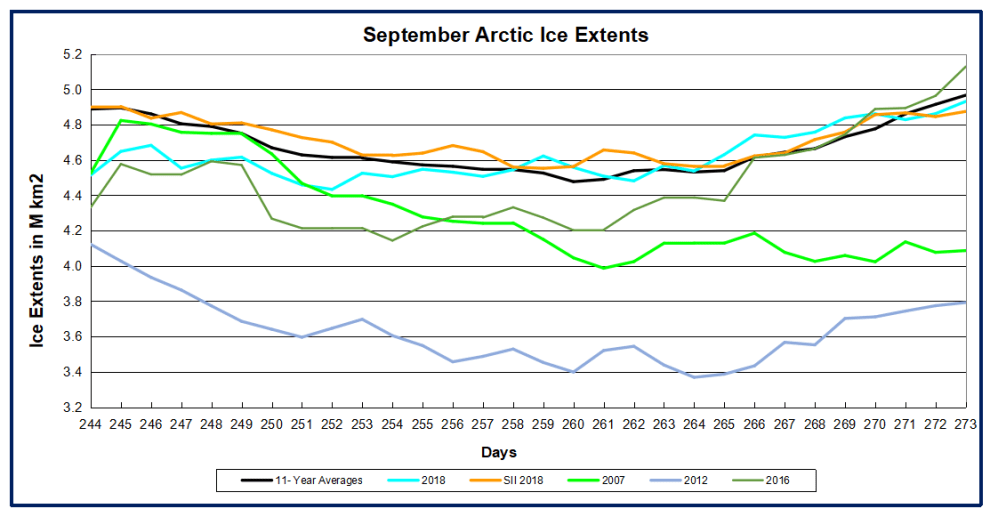
Arctic2018273

The graph shows MASIE reporting Arctic ice extents totalling 4.93M km2 yesterday,  35k km2 below the 11 year average (2007 to 2017 inclusive).  NOAA’s Sea Ice Index is the same as MASIE, 2007 was 845k km2 lower, and 2012 1.1M km2 less ice extent.  A dip on day 252 to  4.43M km2 was an early daily minimum for the year.  As shown in the first graph, the September monthly average exceeded 2007 by 300k in MASIE and  400k km2 in SII.

The table below shows ice extents in the regions comprising the Arctic in September.

Region 2018273 Day 273 
Average
2018-Ave. 2007273 2018-2007
 (0) Northern_Hemisphere 4931836 4966893 -35057 4086883 844953
 (1) Beaufort_Sea 622520 527098 95422 498743 123777
 (2) Chukchi_Sea 134120 210769 -76649 51 134069
 (3) East_Siberian_Sea 378263 329380 48884 311 377952
 (4) Laptev_Sea 19790 186004 -166214 235245 -215455
 (5) Kara_Sea 235 30387 -30152 15367 -15132
 (6) Barents_Sea 0 18890 -18890 4851 -4851
 (7) Greenland_Sea 242190 235559 6631 353210 -111020
 (8) Baffin_Bay_Gulf_of_St._Lawrence 70138 51991 18148 42247 27891
 (9) Canadian_Archipelago 606394 367879 238515 307135 299259
 (10) Hudson_Bay 4611 4458 153 1936 2674
 (11) Central_Arctic 2852432 3003376 -150944 2626511 225921

The total extent is down 35k km2 (less than 1%) below the 11 year average.  The deficit in Chuckchi is more than offset by surpluses in Beaufort and East Siberian.  On the European side are deficits in Laptev, Kara and Central Arctic, almost covered by the huge surplus in Canadian Arctic Archipelago (CAA).

It’s all good.  It’s natural.

Try To Remember lyrics by Tom Jones from “The Fantasticks”  1960

algore_ice_gone_by_2013