Why the “Great Awokening” Now?

screen-shot-2020-06-03-at-4.43.37-pmDamon Linker seeks to understand what is driving the woke madness in his The Week article What the woke revolution is — and isn’t.  Excerpts in italics with my bolds and images.

The surge of censoriousness isn’t just taking place in the worlds of journalism, media, and publishing. It’s also leaving lasting marks on a wide range of universities, producing anger at elite prep schools, inspiring sweeping decisions by public school boards, and having a strong influence on how corporate departments of human resources and government agencies lay down expectations for employees and otherwise deal with members of their staff.

How should we explain this wildly proliferating trend? Where did it come from? And where might it be going?

As you’d expect from a huge story having a big impact on the lives and livelihoods of writers, we don’t lack for explanations. Though most of them fall short of the mark.

The most common one takes its cue from academic champions of the woke trend who describe their scholarship as “critical race theory.” That has led critics, especially conservative ones, to treat the woke movement as a form of “critical theory,” which is itself derived from the Marxism developed and promulgated by thinkers affiliated during the middle decades of the 20th century with the Frankfurt School for Social Research. Critical theorist Herbert Marcuse is frequently named as a popular progenitor of woke progressivism.

The problem with this account is that social change doesn’t work this way, with ideas spreading like a viral contagion that infects (and corrupts) large swaths of a culture once it is unleashed. (Indeed, some champions of woke ideas make precisely this assumption about the viral character of ideas they don’t like, using it to justify “cancelling” people who supposedly make politically dangerous arguments.) Yes, authors can exert a powerful influence on the world, but the way their ideas are received, interpreted, and deployed is always a function of a complex interaction between those ideas and other influences in the culture’s present and past.

This isn’t to deny certain family resemblances among the ideas of Karl Marx, Marcuse, Kimberlé Crenshaw, Richard Delgado, Ibram X. Kendi, and Robin DiAngelo, But it is to say that pointing to those resemblances doesn’t tell us very much about why the ideas contained in their writings (which were first formulated in the mid-19th century and first revised for a modern American audience 56 years ago) have caught on now.

What we need above all is an account of the reception of ideas — why an argument or assertion that falls on deaf ears in one time and place ignites a cultural firestorm in another.

Where does that leave us in trying to come to grips with the woke revolution going on around us? With a lot of work to do, I’m afraid. But that doesn’t mean tentative intellectual advances haven’t been made. I’m especially fond of author Wesley Yang’s evocative description of woke ideas and arguments as liberalism’s “successor ideology.” That’s because the phrase manages to capture the trend’s origins in liberal ideas of meritocratic fairness, while also signaling that in decisive respects it has moved beyond (and turned against) liberal assumptions and aspirations to become a distinct ideology the precise contours of which remain undetermined.

Beyond that, I can see three potentially fruitful paths for further exploration of where the successor ideology comes from and where it might be going.

e409a5d0b4cc5a6fd22fa9bc83a4ed25
Religion

It’s become an interpretive cliché to describe impassioned social movements as forms of “secular religion.” But in this case, there’s something to it. The very name “woke” is a play on the Christian Great Awakenings that swept across the United States at various times in our past, revitalizing old faiths and giving birth to new ones. And as Yang and other thoughtful critics of the trend have noted, there are important sociological and moral connections linking the political sensibility of the woke activists, ensconced within elite institutions of American culture, to the old liberal Protestant mainline, and from there all the way back to the officially sanctioned moral rectitude of Puritan New England.

In many respects, the successor ideology isn’t a political movement at all.

It eschews policy positions in favor of a call to individual moral purification. It proposes to achieve this end through denunciation of sinners who are invited to confess and give public testimony of their transgressions, with punishment taking the form of social ostracism. The purity of the accusers, meanwhile, is demonstrated by the severity of their denunciations and by their refusal to countenance mercy or forgiveness. The social dynamic has reminded some critics of the “struggle sessions” of China’s cultural revolution, but there’s no need to invoke secular totalitarianism and mass murder. The comparatively smaller-scale terror of the Salem witch trials is a more apt analogy.

Business

In a pair of highly suggestive essays for City Journal, Jacob Howland, an emeritus professor of philosophy at the University of Tulsa, has explained how the school has been remade in recent years, with its commitment to the liberal arts abandoned in favor of an outlook of “corporatist progressivism.” Shuttering humanities majors in favor of technical training, mandating “woke” reforms of the remaining curriculum, and pursuing profits for the wealthy financiers bankrolling the university — these moves have reinforced one another, with the embrace of outspoken left-wing anti-liberalism allowing those bulldozing the liberal arts to claim the moral high ground. Much more work remains to be done in analyzing the rise of “woke capital” and the part it plays in fostering and encouraging current trends, but Howland’s writing gives us a good start.

An International Crusade for Justice

The successor ideology is no longer simply an American phenomenon. When French President Emmanuel Macron blames the spread of woke ideas in his country on the insidious influence of professors in the United States, he is reproducing the error of American conservatives who cast aspersions on German philosophers. But just as it is incumbent upon us to come up with an alternative theory of its spread at home, the rise of cancel culture abroad demands its own explanation.

What can account for the appeal of these ideas in other cultural contexts? One possibility is that the successor ideology answers a longing among idealistic young people around the world to devote themselves to a grand spiritual crusade in the name of a transcendent ideal of justice — and it does so at a moment when the only political ideal on offer is democracy and its moral corollary: equality or egalitarianism.
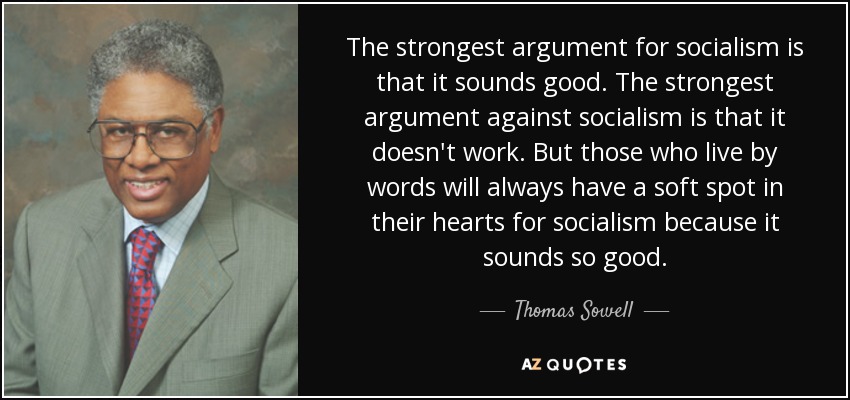
quote-the-strongest-argument-for-socialism-is-that-it-sounds-good-the-strongest-argument-against-thomas-sowell-141-57-35

Whereas liberalism treats equality as one valuable ideal among many (including liberty, solidarity, and piety) and seeks a pluralistic balance among them, those in the grip of the successor ideology find this aspiration toward equanimity an intolerable compromise with moral evil. Moreover, they view their own privileges — their own part in contributing to liberalism’s failure to achieve an egalitarian ideal — as a source of disgust, guilt, shame, and self-loathing. Those emotions are notoriously volatile because they’re so painful to endure. That can lead those suffering from them to create a scapegoat who can become an alternative object of ire — a person or group in the world who can be made to take the blame and suffer just punishment, allowing the sins of the punisher and the punished alike to be expiated.

That’s just the barest sketch of what might be behind the Great Awokening roiling our politics and culture. Until we make more progress in coming to terms with its deepest motives and ultimate aims, we will find ourselves at a loss in how to respond.

e0651d0fb5f99a2eb47ac4b7447b440e

See also Encountering Thomas Sowell at Law & Liberty

In this season of racial reckoning and pseudo-religious panic over identity, it is genuinely shocking to realize that Sowell not only anticipated these same debates several decades ago—he refuted many of the positions now in ascendance.

Wokeness Perverting Science Institutions

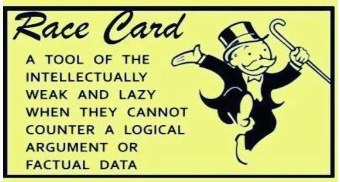
Race Card

Lawrence M. Krauss explains in his Quillette article Science Goes Rogue.  Excerpts in italics with my bolds.

Social justice activists have been arguing for some time that scientific societies and institutions need to address systemic sexism and racism in STEM disciplines. However, their rationale is often anything but scientific. For example, whenever percentages in faculty positions, test scores, or grant recipients in various disciplines do not match percentages of national average populations, racism or sexism is generally said to be the cause. This is in spite of the fact that no explicit examples of racism or sexism generally accompany the statistics. Correlation, after all, is not causation.

Without some underlying mechanism or independent evidence to explain a correlation of observed outcomes with population statistics, inferring racism or sexism in academia as the cause is inappropriate.

One might have hoped for more rigor from the leadership of scientific societies and research institutions. Alas, this has not been the case. In the current climate, many have simply adopted popular rhetoric and the jargon of critical theory has begun to dominate communications by these institutions. Pandering and virtue signalling have begun to generate proactive initiatives by the highest levels of the scientific community, often replacing the focus on science itself. Here are a few examples from the past few weeks alone.

American Physical Society (APS)

In December, the American Physical Society (APS), the largest society of physicists in the world, sent out a letter to its membership arguing that Trump’s Presidential Executive Order 13950 on Combatting Race and Sex Stereotyping was “in direct opposition to the core values of the American Physical Society.” The order therefore needed to be rescinded in order to “strengthen America’s scientific enterprise.” The order (since rescinded by Biden) quoted Martin Luther King, stating that in government-supported scientific institutions people should “not be judged by the color of their skin but by the content of their character.” The order argued that materials from places like Argonne National Laboratories that equate “color blindness” and “meritocracy” with “actions of bias,” or from Sandia National Laboratories which state that an emphasis on “rationality over emotionality” is a characteristic of “white male[s],” were inappropriate training materials for government-supported science institutions.

The rescinded order concluded that “it shall be the policy of the United States not to promote race or sex stereotyping or scapegoating in the Federal workforce.”

APS did not stop there.  .  . This week it was announced that the American Physical Society will examine the demographic information associated with police behavior and the use of force in the cities considered. No criteria have been provided according to which these statistics will be scientifically evaluated. Poor areas afflicted by high crime may see racial minorities disproportionately reflected in arrest statistics. Will they now be disqualified, even though those very areas might benefit from the economic influx associated with huge scientific meetings? Possible evidence of systemic racism in police conduct—as opposed to the existence of isolated racist police officers—remains hotly debated with different studies reaching divergent conclusions.

Nevertheless, the APS appears to have embraced the ad hoc assumption that a police force may be deemed racist if its arrest rate or use of deadly force does not mimic population percentages for different racial groups.  

National Institutes of Health (NIH)

Scientific societies like the APS are, for practical purposes, often managed by functionaries rather than scientists, so perhaps this kind of development is not all that surprising. More surprising, however, was a statement from Francis Collins, Director of the National Institutes of Health, the largest single agency supporting scientific research in the country. Collins apologized for existing “structural racism in biomedical research” and pledged to address the problem with sweeping changes. He did so at the behest of an Advisory Committee to the Director working group report that called on the NIH to “acknowledge the prevalence of racism and anti-Blackness in the scientific workforce.” And what evidence is provided of this alleged racism and anti-blackness? In 2011, a study found that black investigators had research funding rates 11 percent lower than white researchers, although by 2020 the success rate of black investigators had doubled to 24 percent, compared with 31 percent for white investigators.

Disparities in outcomes are, however, not themselves evidence of racism within the NIH. There is no evidence that the grant committees adjudicating these applications judged the proposals on anything but merit. Equality of opportunity is necessary to counter racism. While such equality did not exist in the past, recent gains suggest that the situation has changed. Assertions of structural racism and anti-blackness within the NIH community today are unwarranted based on this data alone. For the NIH leadership to take actions based on this unscientific conclusion is even more inappropriate.

Nonsensical Educational Initiatives

These actions at the APS and NIH, while scientifically questionable, are nevertheless understandable, given societal pressures to address what are undoubtedly real sources of racism that exist in society. Other recent actions, however, make neither scientific nor logical sense. Some examples would seem comical were it not for their sinister implications.

A California initiative entitled “A Pathway to Equitable Math Instruction,” funded by the Bill and Melinda Gates Foundation, with partners including Lawrence Hall of Science at UC Berkeley among others, was recently sent to Oregon teachers by my state’s department of education. It identifies mathematics education as a potential source of racism. It is hard to imagine a field of intellectual inquiry more removed from human foibles than mathematics, but this 82-page document is largely devoid of mathematical concepts. Instead, its authors’ design was to “deconstruct racism in mathematics education.” To this end, various teaching methods are presented as characteristic of white supremacy, including an emphasis on getting the “right” answer, a requirement that students “show their work,” and an adherence to state standards. [For more on this see Why Progressives Hate Math ]

Meanwhile, a Canadian academic initiative entitled “Decolonizing Light” and sponsored by the “New Frontiers in Research” fund announced its commitment to studying “the reproduction of colonialism in and through physics” and examining “how colonial scientific knowledge authority was and is still reproduced in the context of light.” The description of the program on their website is as muddled as one might imagine: “Physics is considered as ‘hard’ and objective science, disconnected from social life and geopolitical history. This narrative both constitutes and reproduces inequality.”

This week, Scientific American, once a rigorous scientific publication, published an opinion column by several young scientists known for their campaign to call a “scientific strike” against racism following the death of George Floyd. The authors advocate changing the name of the James Webb Space Telescope because Webb, a former NASA administrator, was administrator when the federal government did not adequately respect LGBTQ rights. Webb is not incriminated as a racist or bigot, but as a servant of bigots. So who do the authors suggest that the telescope be named for? If encouraging diversity is the issue, perhaps it should be named the Vera Rubin Space Telescope, after the deceased astronomer who in the 1960s and ’70s provided some of the first compelling evidence of dark matter in our galaxy. Or perhaps the Jocelyn Bell Burnell Space Telescope, after the astrophysicist who, as a graduate student, help discover the first pulsars in 1967 and who some claim was overlooked when the Nobel Prize was awarded to her supervisor. Instead, the proposal is to rename the telescope the Harriet Tubman Space Telescope. Why? Not because Tubman might have made any contributions to astronomy, but because she was a conductor on the Underground Railroad that helped free black slaves in the South, during which she “likely used the North Star” to navigate to freedom.

In a more subtle way, reasonable advocates for greater diversity in science have also recently begun to suggest that racism in science at higher education institutions might explain existing group disparities. Shirley Malcom is a scientist and educator I know and admire for her tireless efforts at improving diversity. The American Association for the Advancement of Science recently named her to help lead their SEA (STEM Equity Achievement) Change effort, aimed at addressing “systemic problems of sexism and racism in STEM.” Malcom noted that the distinguished higher education institutions from which she earned degrees did not set out to serve black women. As she put it, “How do you begin to identify and support people like me?” I find this statement troubling. What identification is she seeking? Surely it shouldn’t be her race, but rather the talent she clearly possesses. Such universities are there to serve all talented students and help them fulfil their potential, independent of race, gender, or religion. When I first arrived at MIT I felt lucky. It was made quite clear to me what a privilege it was to be there. It was not a right, and I certainly never felt they had any obligation to serve me on the basis of my self-identification.

Backlash Against Racism Posing as Anti-Racism

In the face of this transformation, there has been little organized outcry from the scientific community. However, some are now speaking out. The Princeton mathematician Sergiu Klainerman has spoken out strongly against these intrusions of activism into science in particular and academia more generally. Most recently, Jeffrey Burl, an associate professor of Electrical and Computer Engineering at Michigan Technological University bravely wrote an open letter demanding an apology for what he called the “racist sentiments” expressed in his university’s Senate Resolution, which condemned white supremacy and racially motivated intolerance at his institution. He argued that these sentiments constituted a hostile work environment for white male scientists like himself, and that he had seen no signs of discrimination against women and people of color in his 28 years at the university. Instead, he argued that “I, as a white male, have been systematically discriminated against for 40 years.” He referred to the fact that when he was hired, there were two job openings, one of which was available to anyone, and one of which was only open to women. Since only a small percentage of the candidates were women, he argued that this hiring was clearly discriminatory. Needless to say, Burl now faces a petition demanding that he be fired.

Whatever one thinks of his interpretation of his experience, Burl was openly stating what many male scientists are afraid to discuss—that there is no clear evidence of systemic discrimination on the basis of race in academia, and that any examples of gender discrimination in recent decades have not involved discrimination against females. Rather, there has been a concerted effort at universities for at least 25 years to attempt to achieve gender equity in faculty ranks, often using affirmative action techniques that Burl suggests are discriminatory.

Science as a discipline is supposed to be based on empirical evidence. But if repeating a falsehood often enough makes it true, then science now risks creating a false reality, with grave implications for the future of research and for society more generally.

Lawrence M. Krauss is a theoretical physicist who has also written about science and public policy and about how science confronts religious dogma. He is president of The Origins Project Foundation and his newest book is The Physics of Climate Change.

Postscript No Wonder the French are Worried about American Institutions

From the Daily Mail:

‘Out-of-control woke leftism and cancel culture’ from the U.S is a threat to FRANCE because it ‘attacks’ the nation’s heritage and identity, 

  • French politicians, prominent intellectuals, and academics are arguing against the influence of America’s ‘out-of-control leftism and cancel culture’
  • They claim it is undermining French society and an attack on French heritage
  • French President Emmanuel Macron in October cautioned against ‘certain social science theories entirely imported from the United States’
  • His Education Minister also warned of a ‘battle to wage against an intellectual matrix from American universities’

mc_pepecanceled_web20210310010000

Mid March Arctic Ice Update

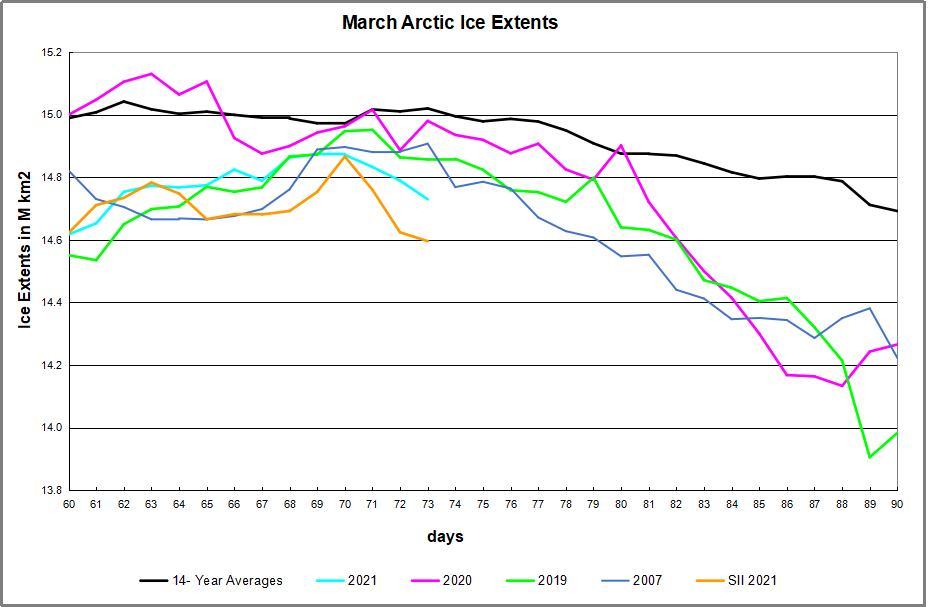
As anticipated in the previous post reprinted below, Arctic ice extent appears to have peaked under the 15M km2 threshold.  An earlier discussion at 2020 year end noted that March actually ends up with less ice extent than end of February, so the rest of the month is not likely to add any more ice.  Here is the graph for March including yesterday.

Arctic2021073

The graph shows this year did recover from a 400k km2 deficit to the 14-year average, to about 100k by day 70, and has now fallen back to almost 300k km2 down (2%).  It is also apparent that extent will likely decline in the next two weeks, by about 300k km2 on average, already matched by 2021.  Climatology uses SII March monthly average as the annual maximum, so that will come out lower as well.

Interestingly, both Okhotsk and Barents Seas peaked well above 2020, and are now starting to retreat, along with other marginal basins.  The central Arctic, Siberian and Canadian regions remain solidly frozen.

Background previous post Arctic Ice Moment of Truth 2021

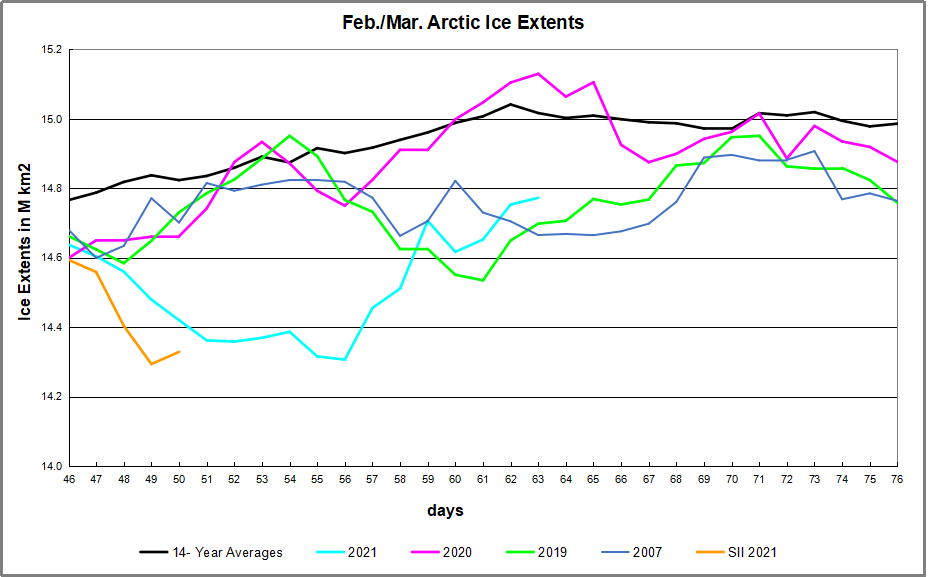
For ice extent in the Arctic, the bar is set at 15M km2. The average peak in the last 14 years occurs on day 62 at 15.04M km2 before descending, though the average can still be above 15M at late as day 73.  Nine of the last 14 years were able to clear 15M, but recently only 2016 and 2020 ice extents cleared the bar at 15M km2; the others came up short. The actual annual peak ice extent day varied between day 59 (2016) to day 82 (2012).

The animation shows in two weeks how this year’s ice extents contracted and then regrew greater than before, coincidental with the wavy Polar Vortex (PV) first admitting warmer southern air and then keeping the cold air in.

As reported previously, most of the action was firstly in the Pacific, especially Sea of Okhotsk upper left, ice shrinking one week by 200k km2 and rapidly growing back 210k km2 ice extent the next.  Okhotsk ice is now 1.1M km2, 96% of 2020 max.  On the Atlantic side, Barents sea upper right lost 100k km2 retreating from Svalbard, then gained 120k km2 back.  Greenland Sea ice middle right lost 100k km2, and then gained 150k km2.  Barents now has 3% more ice than 2020 max, while Greenland sea ice is 85% of last year’s max.

All of this means that 2021 will be hard pressed to pass the 15M km2 threshold.  The graph below shows the situation evolving over the last two weeks anticipating the annual maximum to appear within the fortnight.

Note that Sea Ice Index (SII) went offline day 51 so the MASIE record alone shows the loss of ice extent ending day 56 and climbing up to the present.  The NH ice extent gap is at 244k km2, or 1.6%.  Since the 14 year average has already peaked, further growth will narrow the margin.  (Note that ice extent is affected also by winds piling up drift ice, as well as melting from intrusions of warmer air or water.)

Last year surpassed the average while other recent years were lower.  We shall see what this year does with only 10 days or so to make a difference.

Region 2021063 Day 063 Average 2021-Ave. 2007063 2021-2007
 (0) Northern_Hemisphere 14772617 15016830 -244214 14665491 107126
 (1) Beaufort_Sea 1070689 1070254 435 1069711 978
 (2) Chukchi_Sea 966006 964118 1888 966006 0
 (3) East_Siberian_Sea 1087120 1087134 -14 1087137 -17
 (4) Laptev_Sea 897827 897842 -15 897845 -18
 (5) Kara_Sea 935006 929650 5356 932067 2939
 (6) Barents_Sea 805710 649490 156220 626044 179666
 (7) Greenland_Sea 669651 625085 44566 616841 52809
 (8) Baffin_Bay_Gulf_of_St._Lawrence 1224508 1553901 -329393 1220513 3995
 (9) Canadian_Archipelago 854597 853148 1450 852767 1830
 (10) Hudson_Bay 1260471 1260567 -96 1256718 3753
 (11) Central_Arctic 3197627 3222365 -24738 3229824 -32197
 (12) Bering_Sea 631115 686765 -55650 660726 -29612
 (13) Baltic_Sea 65146 97873 -32727 104884 -39738
 (14) Sea_of_Okhotsk 1090295 1084593 5703 1129107 -38812

The main deficit to average is in Baffin Bay, partly offset by a surplus in Barents.  Smaller pluses and minuses are found in other regions.

Typically, Arctic ice extent loses 67 to 70% of the March maximum by mid September, before recovering the ice in building toward the next March.

What will the ice do this year?  Where will 2020 rank in the annual Arctic Ice High Jump competition?

Drift ice in Okhotsk Sea at sunrise.

For more on the Pacific basins see post Meet Bering and Okhotsk Seas

Revolution: Sentiment Now Overrules Sense

election-meddling-meghan-markle-all-but-endorses-joe-biden-crossing-political-line-that-is-off

Dominic Green describes the sociopolitical coup in his Spectator article Meghan ’n’ Joe’s empire of the sentiments.  Excerpts in italics with my bolds.

Biden dispenses serotonin the way Barack Obama dispensed drone strikes

If your facts don’t care about my feelings, then my feelings aren’t obliged to care about your facts. The facts in Joe Biden’s energetic, inspiring and exhilarating address to the nation last night were frequently as unsteady as the speaker. But the feelings that Biden expressed were, unlike the previous president who must not be named, unimpeachable.

He knows how it feels, he said with that now-customary surge of anger, as if he’s not fully in control of his frontal cortex. And we know how it feels when someone says they know how we feel. Consider everything fixed: COVID, racism, opioids, deficits, the collapse of the schools, the children at the border. The Therapeute-in-Chief is here, dispensing serotonin the way Barack Obama dispensed drone strikes.

It doesn’t matter whether Biden means what he says, any more that it matters whether Meghan Markle told the truth when she implied that her son was denied a prince’s title because he might have dark skin. It’s the feelings that matter: feelings of security, empathy and contentment, and especially the feeling that Nietzsche correctly foresaw as the root feeling of modern life, resentment.

quote-resentment-is-like-drinking-poison-and-then-hoping-it-will-kill-your-enemies-nelson-mandela-38-6-0685

The result is the rule of sentiment over thought and symbols over reality. The Biden administration didn’t invent the moral and humanitarian disaster at the southern border. But it has produced a new crisis by altering the laws to satisfy sentiment.

It feels cruel to return unaccompanied minors, as the Trump administration did, and to hold them in prison-like conditions, as both the Obama and Trump administrations did. But the fact is, Biden’s policies have fostered a greater cruelty.

Biden has created new incentives for human trafficking and the worse kinds of child exploitation.

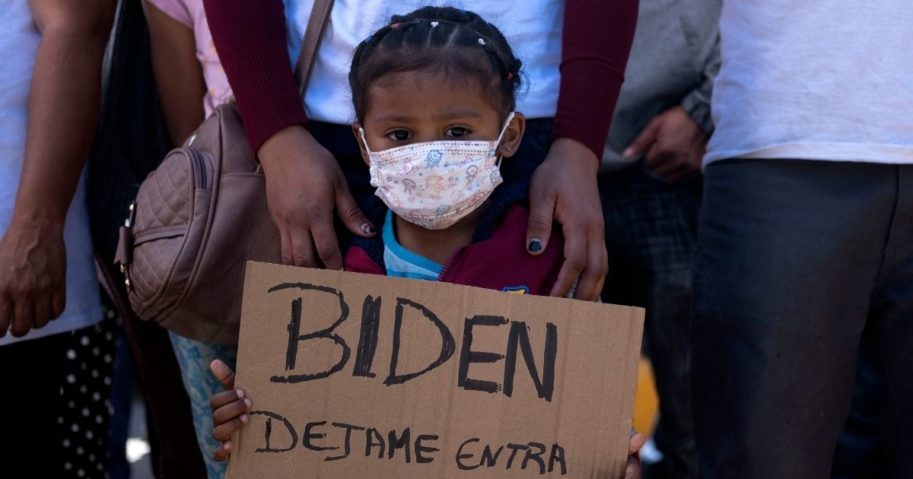
The result is a surge in border crossings that even a professional euphemist like secretary of Homeland Security Alejandro Mayorkas calls ‘overwhelming’, and the spectacle of would-be illegal immigrants kneeling at the border while wearing t-shirts reading ‘Biden let us in’.

kid-migrants-913x479-1

This is what Biden gets for taking a knee as a craven genuflection to BLM. This is what he gets for accusing Donald Trump of being a racist and sadist for caging unaccompanied minors — even though Biden was vice president when the cages were built, and even though Biden now presides over a greater influx. And this is what we get: a theater of the sentiments, in which the actors and audience are so jaded that their senses and check books can only be stimulated by that reliable and obscene soap-opera trick, putting children’s lives in the balance.

Asked if the word ‘crisis’ applied, the President’s spokeswoman, Jennifer Psaki, refuses to call it anything at all — because she would feel bad, and we would feel bad, and Biden would look bad, if we called it for what it is. It is easier for the administration to resent the Mexican children for putting us in this moral bind, and resent the Republicans, who aren’t short of their own resentments when it comes to immigration, for making hay with it.

bg031121dapr20210311014503

The fact is that this is a crisis. It reflects the corrupt failure of Washington DC and the cold self-interest of corporations who want cheap labor, unions who don’t want it, and, in the middle, the upper-middle-class donors who dislike foreigners who don’t speak English, but need them to bus their tables, do their lawns and wipe their children’s backsides.

Given the complexities of the facts and the appeal of a flight into sentiment, it’s no wonder that this week the administration and media did direct us to pity the children. Meghan and Harry, that is.

Jennifer Psaki commends Meghan and Harry for the ‘courage’ it took to sit down with Oprah and make unsubstantiated allegations against his family. Their kind of fact-light, sentiment-heavy self-promotion and self-therapy was, Psaki told us, one of the areas that Biden is ‘committed to in the future’.

alg031221dapr20210312044519

Biden’s increasingly vague routines of empathy are the symbolic face and velvet glove of a bureaucracy of the sentiments whose offices run from government to the media.

Biden is very old. After him, the gloves will be off and the face will be hardened with more than Botox. We’ll get this decayed form of democracy good and hard, and we’ll be told it should feel good. And that’s a fact.

sentiments over sense

See also Head, Heart and Science

Biden’s Bogus Climate Report

scc-working-group

The latest criticism comes from James Broughel writing at Real Clear Politics Biden’s Climate Report Is Based on Personal Values, Not Science. Excerpts in italics with my bolds.

Late last month, the Biden administration quietly released an update of the government’s “social cost of carbon” (SCC) estimate, a metric used to value the benefits of global warming policies, especially regulations. The update hasn’t received much attention yet, but it will be important in justifying the administration’s climate agenda in the months ahead.

There are numerous shortcomings with the Biden team’s calculations. Some may be due to the report being rushed, but others reflect misunderstanding of economic principles, and, more simply, poor judgment.

Biden’s People Get the Units Wrong

First, numerous tables in the document released by the administration are mislabeled. The interagency working group that produced the update claims its primary estimate of the SCC is 51 dollars per ton. But the models the working group uses calculate the figure in terms of social welfare — not dollars. Thus, 51 is a measure of the amount that the current generation’s “welfare” is reduced by carbon pollution. Even assuming that number is credible (and measuring welfare is no easy task), the administration doesn’t get the units right.,

This is a big deal because the numbers in the new report shouldn’t be used in cost-benefit analysis unless further adjustments are made. Cost-benefit analysis is supposed to measure impacts in dollars, not the Biden administration’s social welfare units. So any analysis that tries to compare these numbers to financial costs will be nonsensical. These problems with units extend to estimates of the social cost of methane and of nitrous oxide, which also appear in last month’s report.

Misleading Social Discount Rate

There are other misleading parts of the document. For example, there is extensive discussion about the correct “social discount rate” to use in cost-benefit analysis. The social discount rate describes how much less a future benefit from a policy should count relative to a present benefit. For example, many economists generally assume a life saved in 100 years is far less valuable than a life saved today — which is, of course, controversial and has implications beyond economics.

The report makes a number of dubious claims about the social discount rate, but here are just a few worth highlighting.

First, Biden’s team argues that risk-free market interest rates have declined in recent years, and that this provides a basis for using a lower social discount rate. However, claims like this reflect a misunderstanding of the discounting concept.

The decision of how much to weight future health, wellbeing, and lives saved is an ethical choice. One cannot find the correct social discount rate by opening up the Wall Street Journal and turning to the page on interest rates. Ultimately, we need some philosophical compass to guide our choice. Yes, one could choose to base an ethical decision on market criteria, but one could just as easily choose an alternative paradigm, like introspection. Nor should this issue be conflated with the rate of return on capital, which is a separate issue that is sometimes confused with social discounting.

In fact, it would be just as legitimate to pick any plausible number out of a hat (you might laugh, but some approaches do draw a discount rate from a distribution of rates based on surveys of economists). Whatever method is chosen, the choice of the social discount rate is inevitably a value judgment.

Similarly, the report tries to justify lower discount rates in the future by pointing to “Ramsey discounting,” a method named after the early 20th century mathematician Frank Ramsey. Under this approach, analysts assume a benevolent dictator — a proxy for our whole generation’s social welfare — centrally plans the economy. Economists have concocted various mathematical schemes to estimate how the dictator discounts the future.

Again, because the choice is an ethical one, there is no particular reason to believe this Ramsey discounting approach is wrong. But there’s no reason to believe it’s right, either.

Personal Preferences, Not Science

The problem with the government’s report is that it presents these various approaches as somehow scientific. In fact, they conceal what is fundamentally a question about values and make it appear as though the answer can come from technical measurement.

Perhaps most concerning is that the administration is already violating its own principles of social justice. In a memo signed by President Biden on his first day in office, he identified promoting the interests of future generations as a top priority, which is a noble goal, to be sure.

But the SCC is calculated using a version of the Ramsey model. In it, the present generation functions as the dictator whose welfare is measured, while the welfare of future generations counts for basically nothing. Present citizens may display some empathy for future generations — for example, the administration’s climate policy is probably motivated by their concern for the future — but the analysis doesn’t consider the welfare of future generations in a direct way.

The new social cost of carbon report comes across like an attempt by experts to ram through a political agenda, while trying to pass off their efforts as scientific. But the public should not be fooled. What’s behind the updated numbers is the administration’s personal values, for better or worse, not science.

Background from Previous Post Biden’s Arbitrary Social Cost of Carbon: What You Need to Know

The news on Friday was Biden signing another order, this one restoring the so-called “Social Cost of Carbon” to Obama’s $51 a ton, along with threats to raise it up to $125 a ton.  The whole notion is an exercise in imagination for the sake of adding regulatory costs to everything involving energy,  that is to everything.  A background post below describes the history of how this ruse started and the manipulations and arbitrary assumptions to gin up a number high enough to hobble the economy.

Background from 2018 post: US House Votes Down Social Cost of Carbon

The House GOP on Friday took a step forward in reining in the Obama administration’s method of assessing the cost of carbon dioxide pollution when developing regulations.

The House voted 212-201, along party lines, to include a rider blocking the use of the climate change cost metric to an energy and water spending bill.

The amendment offered by Texas Republican Rep. Louie Gohmert bars any and all funds from being used under the bill to “prepare, propose, or promulgate any regulation that relies on the Social Carbon analysis” devised under the Obama administration on how to value the cost of carbon. (Source Washington Examiner, here)

To clarify: the amendment in question defunds any regulation or guidance from the federal government concerning the social costs of carbon.

Background: 
The Obama administration created and increased its estimates of the “Social Cost of Carbon,” invented by Michael Greenstone, who commented on the EPA Proposed Repeal of CO2 emissions regulations.  A Washington Post article, October 11, 2017, included this:

“My read is that the political decision to repeal the Clean Power Plan was made and then they did whatever was necessary to make the numbers work,” added Michael Greenstone, a professor of economics at the University of Chicago who worked on climate policy during the Obama years.

Activists are frightened about the Clean Power Plan under serious attack along three lines:
1. No federal law governs CO2 emissions.
2. EPA regulates sites, not the Energy Sector.
3. CPP costs are huge, while benefits are marginal.

Complete discussion at CPP has Three Fatal Flaws.

Read below how Greenstone and a colleague did exactly what he now complains about.

Social Cost of Carbon: Origins and Prospects

The Obama administration has been fighting climate change with a rogue wave of regulations whose legality comes from a very small base: The Social Cost of Carbon.

The purpose of the “social cost of carbon” (SCC) estimates presented here is to allow agencies to incorporate the social benefits of reducing carbon dioxide (CO2) emissions into cost-benefit analyses of regulatory actions that impact cumulative global emissions. The SCC is an estimate of the monetized damages associated with an incremental increase in carbon emissions in a given year. It is intended to include (but is not limited to) changes in net agricultural productivity, human health, property damages from increased flood risk, and the value of ecosystem services due to climate change. From the Technical Support Document: -Technical Update of the Social Cost of Carbon for Regulatory Impact Analysis -Under Executive Order 12866

A recent Bloomberg article informs on how the SCC notion was invented, its importance and how it might change under the Trump administration.
How Climate Rules Might Fade Away; Obama used an arcane number to craft his regulations. Trump could use it to undo them. (here). Excerpts below with my bolds.

In February 2009, a month after Barack Obama took office, two academics sat across from each other in the White House mess hall. Over a club sandwich, Michael Greenstone, a White House economist, and Cass Sunstein, Obama’s top regulatory officer, decided that the executive branch needed to figure out how to estimate the economic damage from climate change. With the recession in full swing, they were rightly skeptical about the chances that Congress would pass a nationwide cap-and-trade bill. Greenstone and Sunstein knew they needed a Plan B: a way to regulate carbon emissions without going through Congress.

Over the next year, a team of economists, scientists, and lawyers from across the federal government convened to come up with a dollar amount for the economic cost of carbon emissions. Whatever value they hit upon would be used to determine the scope of regulations aimed at reducing the damage from climate change. The bigger the estimate, the more costly the rules meant to address it could be. After a year of modeling different scenarios, the team came up with a central estimate of $21 per metric ton, which is to say that by their calculations, every ton of carbon emitted into the atmosphere imposed $21 of economic cost. It has since been raised to around $40 a ton.

Trump can’t undo the SCC by fiat. There is established case law requiring the government to account for the impact of carbon, and if he just repealed it, environmentalists would almost certainly sue.

There are other ways for Trump to undercut the SCC. By tweaking some of the assumptions and calculations that are baked into its model, the Trump administration could pretty much render it irrelevant, or even skew it to the point that carbon emissions come out as a benefit instead of a cost.

The SCC models rely on a “discount rate” to state the harm from global warming in today’s dollars. The higher the discount rate, the lower the estimate of harm. That’s because the costs incurred by burning carbon lie mostly in the distant future, while the benefits (heat, electricity, etc.) are enjoyed today. A high discount rate shrinks the estimates of future costs but doesn’t affect present-day benefits. The team put together by Greenstone and Sunstein used a discount rate of 3 percent to come up with its central estimate of $21 a ton for damage inflicted by carbon. But changing that discount just slightly produces big swings in the overall cost of carbon, turning a number that’s pushing broad changes in everything from appliances to coal leasing decisions into one that would have little or no impact on policy.

According to a 2013 government update on the SCC, by applying a discount rate of 5 percent, the cost of carbon in 2020 comes out to $12 a ton; using a 2.5 percent rate, it’s $65. A 7 percent discount rate, which has been used by the EPA for other regulatory analysis, could actually lead to a negative carbon cost, which would seem to imply that carbon emissions are beneficial. “Once you start to dig into how the numbers are constructed, I cannot fathom how anyone could think it has any basis in reality,” says Daniel Simmons, vice president for policy at the American Energy Alliance and a member of the Trump transition team focusing on the Energy Department.

David Kreutzer, a senior research fellow in energy economics and climate change at Heritage and a member of Trump’s EPA transition team, laid out one of the primary arguments against the SCC. “Believe it or not, these models look out to the year 2300. That’s like effectively asking, ‘If you turn your light switch on today, how much damage will that do in 2300?’ That’s way beyond when any macroeconomic model can be trusted.”

Another issue for those who question the Obama administration’s SCC: It estimates the global costs and benefits of carbon emissions, rather than just focusing on the impact to the U.S. Critics argue that this pushes the cost of carbon much higher and that the calculation should instead be limited to the U.S.; that would lower the cost by more than 70 percent, says the CEI’s Mario Lewis.

Still, by narrowing the calculation to the U.S., Trump could certainly produce a lower cost of carbon. Asked in an e-mail whether the new administration would raise the discount rate or narrow the scope of the SCC to the U.S., one person shaping Trump energy and environmental policy replied, “What prevents us from doing both?”

See Also:

Six Reasons to Rescind Social Cost of Carbon

SBC: Social Benefits of Carbon

drain-the-swamp

Rx: Get the Vaccine, Wait a Month, Return to Normal

5f695f18c485b349a7b7a579_o_u_v2

Marty Makary writes at Wall Street Journal Covid Prescription: Get the Vaccine, Wait a Month, Return to Normal. Excerpts in italics with my bolds.

The CDC claims to be ‘following the science,’ but its advice suggests it’s still paralyzed by fear.

The Centers for Disease Control and Prevention has lost a lot of credibility during the Covid-19 pandemic by being late or wrong on testing, masks, vaccine allocation and school reopening. Staying consistent with that pattern, this week—three months after the vaccine rollout began—the CDC finally started telling vaccinated people that they can have normal interactions with other vaccinated people—but only in highly limited circumstances. Given the impressive effectiveness of the vaccine, that should have been immediately obvious by applying scientific inference and common sense.

Parts of the new guidelines are absurdly restrictive. For example, the CDC didn’t withdraw its advice to avoid air travel after vaccination. A year of prevaccine experience has demonstrated that airplanes aren’t a source of spread. A study conducted for the defense department found that commercial planes have HEPA filtration and airflow that exceed the standards of a hospital operating room.

The guidelines do approve of vaccinated people meeting with low-risk unvaccinated ones—but only with people from the same household and in a small private setting. So much for restaurants, birthday parties and weddings.

An unpublished study conducted by the Israeli Health Ministry and Pfizer showed that vaccination reduced transmission by 89% to 94% and almost totally prevented hospitalization and death, according to press reports. Immunity kicks in fully about four weeks after the first vaccine dose, and then you are essentially bulletproof. With the added safety of wearing a mask indoors for a few more weeks or months—a practical necessity in public places even if not a medical one, since you can’t tell on sight if someone’s immune—there is little a vaccinated person should be discouraged from doing.

On a positive note, the CDC did say that fully vaccinated people who are asymptomatic don’t need to be tested. But that obvious recommendation should have come two months ago, before wasting so many tests on people who have high levels of circulating antibodies from vaccination.

In its guidance the CDC says the risks of infection in vaccinated people “cannot be completely eliminated.” True, we don’t have conclusive data that guarantees vaccination reduces risk to zero. We never will. We are operating in the realm of medical discretion based on the best available data, as practicing physicians have always done. The CDC highlights the vaccines’ stunning success but is ridiculously cautious about its implications. Public-health officials focus myopically on transmission risk while all but ignoring the broader health crisis stemming from isolation. The CDC acknowledges “potential” risks of isolation, but doesn’t go into details.

It’s time to liberate vaccinated people to restore their relationships and rebuild their lives. That would encourage vaccination by giving hesitant people a vivid incentive to have the shots.

Throughout the pandemic, authorities have missed the mark on precautions. Hospitals blocked family members from being with their loved ones as they gasped for air, gagging on a ventilator tube—what some patients describe as the worst feeling in the world. In addition to the power of holding a hand, family members coordinate care and serve as a valuable safety net, a partnership that was badly needed when many hospitals had staffing shortages. Separating family members was excessive and cruel, driven by narrow thinking that focused singularly on reducing viral transmission risk, heedless of the harm to the quality of human life.

As people yearn to be with their loved ones and rebuild communities, we shouldn’t repeat that mistake. We cannot exaggerate the public-health threat, as we did with hospital visitation rules, and keep crushing the human spirit with overly restrictive policies for vaccinated Americans.

Loneliness has become a public-health crisis. In pre-Covid times, it was estimated that 20% of American’s struggled with loneliness, a figure that has surely multiplied faster than research has been able to measure. We were reminded of this last week in a FAIR Health study that revealed self-harm among kids increased as much as 300% last year in some parts of the country. Future research will likely find that the harms of isolation are greater than is understood today.

Some experts selectively appeal to common sense when it comes to using discretion. Anthony Fauci said it was “common sense” to wear two masks at once. I too will invoke “common sense” to answer the big question so many are asking: What am I allowed to do after I’ve been vaccinated? Once a month has passed after your first shot, go back to normal.

Dr. Makary is a professor at the Johns Hopkins School of Medicine and Bloomberg School of Public Health. He is chief medical advisor to Sesame Care and author of “The Price We Pay.”

60496cc6b2bd3f37a594852f_o_u_v2

https://finance.yahoo.com/video/wsj-opinion-coronavirus-hell-010416656.html


Down With Woke Newspeak

megaphone-protest-1060x530-1

Scott Yoner exposes how wokeness has debased our civic language to confuse and subvert traditional American values.  His article at Law & Liberty is Translating Social Justice Newspeak.  Excerpts in italics with my bolds.

We must re-train our ears to hear what social justice ideology peddles.

Americans, after all, value diversity, inclusion, and equity. Diversity of faculties and talents produces inequalities—and protecting such diversity was, as Madison writes in Federalist 10, “the first purpose of government.” Inclusion reflects the universality of the rights of man, though certain people would enjoy them sooner and others later as enlightenment spread. Equity is a characteristic of impartial laws, derived from English common law, that protects and recognizes all equally before them; it provides predictable rules and doctrines for settling disputes.

Diversity, inclusion, and equity produce inequalities that serve the public good: they reward productivity, expand opportunities for individuals, and provide a basis for stable common life under equal laws.

Our regnant social justice ideology redefines these words, taking advantage of their sweet sounding civic bent. This co-option represents a thoroughly new civic education. Social justice advocates have won no small ground in American political debate by seeming to adhere to the words and ideas of the old civic education, while importing a new, pernicious vision. We must re-train our ears to hear what social justice ideology peddles.

Opponents of this movement can best grasp social justice newspeak through an analysis of its public documents. What follows is based on my analysis of the state of Washington’s 2020 Office of Equity Task Force’s Final Proposal. The same word salad is served everywhere critical race theory is taught—in university task forces (like Boise State’s), in corporate trainings, even in K-12 curriculum.

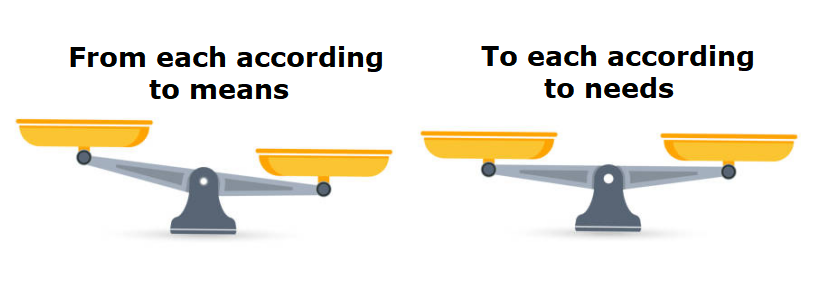
Means Needs

Equity. Social justice ideology starts with equity.

Susan Rice, lead of the White House Domestic Policy Council, has made achieving equity the centerpiece of the new administration. Equity means creating equality of outcome among recognized identity groups. This is accomplished through the redistribution of society’s resources and honors as a means to correct real historical injustices (e.g., slavery) and inequalities traceable to what are perceived society’s implicit oppressive infrastructure. As the Washington report has it, “equity achieves procedural and outcome fairness” by distributing and prioritizing “resources to those who have been historically and currently marginalized.” Inequalities that seem to reflect a disadvantage to a protected identity group are ipso facto evidence of the need for remedy. “Outcome fairness” is equal outcomes.

When advocates say “equity,” one must retrain one’s ears to hear the following: all disparities are traceable to discrimination (or institutional racism, etc.) and must be remedied by re-distribution (such as reparations) or other actions (like abolishing meritocratic standards that produce disparities or abolishing the police). As Washington’s Equity Task Force defines it, Equity requires “transformative work to disrupt and dismantle historical systems.”

A far cry from English common law indeed, where equity was a basis for a stable execution of the rule of law.

Diversity2

Diversity. The social justice dispensation famously “celebrates diversity.”

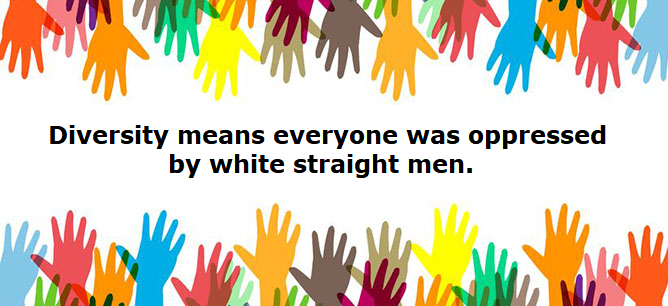
It considers diversity a strength. Its definitions of diversity are long, meandering, and self-contradictory. Diversity refers to different racial or cultural identities, rooted, perhaps, in physical difference. Different identities are products of power structures that make men and women or blacks and whites different. What sits in front of us are not people with different skin colors or of different sexes but rather products of power structures that pigeonhole aggrieved minorities into this or that different identity. Women are made women by patriarchal control; black men made subordinate through white supremacy; black women victims of both. When the people who are shaped by all these power structures are all present for conversations, the power structures themselves are broken down. White, male social-engineering represents a power structure that excludes and dominates. Debate is not about discovering the truth, but about the representation of power structures.

One must go further. Equity is only a step on the road to diversity. Achieving diversity is about maximizing the presence of aggrieved minorities (e.g., blacks, women), while minimizing the presence of the dominant group (e.g., white, heterosexual men). As David Azerrad relates, the Institute for Diversity and Ethics in Sports judges the National Basketball Association the most diverse sports league. Its rosters are 82% people of color, though people of color make up at most 40% of the American population. The representation of historically oppressed groups count for diversity, even when it is not demographically representative. In contrast, baseball has rosters with only 41%. This makes it count as less diverse than the NBA, even though it is more in line with the country as a whole.

When advocates demand diversity, one should hear the following: privileging the supposedly marginalized and marginalizing or punishing the supposedly privileged through intentional practices. The fewer of the privileged group (i.e., white, males, straights, cis-), the better. To where? All the way to zero?

Correct Wrong

Inclusion. Diversity policy requires “inclusive” practices.

All identities must be “respected” or nurtured in “a safe, positive environment” or a “welcoming environment,” which must after all be created, maintained, and policed.

As the Washington Task Force defines it, “inclusion refers to how groups show that people are valued as respected members of the group, team, organization, or community. Inclusion is often created through progressive, consistent, actions to expand, include, and share.” Inclusion includes! What does this mean? Creating a welcoming environment for supposedly marginalized groups entails singling them out for “welcoming” treatment and protecting them from what they consider unwelcoming. The dominant culture is already “welcomed.” On university campuses it begins with establishing safe spaces like an LGTQ+ Center or a Women’s Center, where the special needs of supposedly disfavored groups can be provided (whether counselling or meals). In health care, it requires special outreach for aggrieved minorities (singling them out for getting a vaccine, perhaps).

Inclusion demands more. What does not affirm their identity as a member of the marginalized group also compromises a welcoming environment. Even the presence of the dominant culture and its symbols can be unwelcoming. Some of this agenda deserves universal support, like stigmatizing racial epithets. But inclusivity policies can also proscribe criticism and allow the supposedly marginalized group to define what makes for an “unwelcome” environment. SAT, unwelcoming. Grades, unwelcoming. A thin blue line flag? Exclusive! Black power fist. Inclusive!

Hate speech codes arrive, when they do, in the name of inclusion. Anyone wearing a MAGA hat violates the dictates of “inclusivity,” while a BLM shirt affirms and confirms the status of marginalized groups.

Ideas of meritocracy and even kind words on behalf of traditional marriage are, on this definition, violations of inclusion.

The infamous incident at Evergreen State, where whites were ordered off campus for a “Day of Absence”, was done in the name of inclusivity. Black-only spaces on campus or Rainbow graduations are safe, affirming, inclusive spaces where the marginalized will be affirmed, though these practices appear exclusive on the old definition. A white, male graduation space would be exclusive and prohibited. Orwell called this blackwhite in 1984, since who is saying the thing determines its truth and justice, not the actual content of the saying.

When advocates demand inclusivity, one should hear: the virtue of purportedly marginalized groups as well as their victim status must be affirmed and cannot be questioned, while privileged groups must confess both their privilege and their guilt. It may not start there, but it goes there.

Instead of recovering these words they must be ruthlessly attacked. This involves retraining our ears and lips.

mc_public_square_massacre_web20210112010000

Together these new words—diversity, equity, and inclusion—point toward the formation of tyranny.

The idea that people freely associate or can rise and fall based on their own merits is considered dangerous and false. One’s place must be determined and allocated; one’s environment constructed to match this ideology. This new ideology never imagines individuals apart from their identity group, nor identity groups apart from power structures. It empowers the state and elite institutions to un-make invisible structures of supposed oppression and to re-make an environment that is supposedly welcoming.

The ideology of the new diversity, inclusion, and equity infiltrated our language and put opponents of this revolution at a rhetorical disadvantage. It is probably necessary to stigmatize and jettison these corrupted words, because their double-meaning paralyzes those who would oppose social justice ideology.

This is unsubtle, of course. So instead of recovering these words they must be ruthlessly attacked. This involves retraining our ears and lips. For our ears, I recommend the following:

  • Equity now means equality of result;
  • Diversity now means “anti-white” and “anti-male”; and
  • Inclusion now means social engineering to favor aggrieved minorities.
  • When Americans hear Diversity, Equity, and Inclusion, they should hear tyranny.

In the face of this rhetoric, we need to find new ways for our lips to speak old truths. This hard teaching should not send opponents of social justice ideology to extremes. It must point to a revival, a new appreciation of the old civic education. The old concept of diversity is valuable—and we should call it pluralism, whether it is a pluralism of talents or opinions. The old inclusion is valuable—and we should call it the protection of individual rights. The old equity is valuable—and we should call it the rule of law.

stg072220dapr20200721034602

Beware Woke Financiers Gambling with Your Money

atlantic-casino

Andrew Stuttaford explains how the Biden regime encourages capitalists to spend investors’ wealth on projects favored by progressives for virtue rather than profit. His National Review article is Rule by Regulation. Excerpts in italics with my bolds.

The fondness of the Biden administration for rule by regulation is hardly a secret by now, and, when it comes to telling corporations that they should run themselves according to the precepts of stakeholder capitalism, the regulatory route comes with an added advantage.

To be sure, many companies, particularly larger ones, are already falling into line without any pressure from the state, because it suits the interests of managers (shareholders can be such a demanding bunch) and/or because they have been pushed to do so by a handful of large investment managers who can see the opportunity that “socially responsible” investing (SRI), an investment philosophy intertwined with stakeholder capitalism, represents for them, if not for their clients.

Other managements, however, would prefer to continue to run their businesses for the benefit of the shareholders (a stance, incidentally, that is rather more sophisticated than the usual Gekko caricature). Forcing such businesspeople to change their ways through legislation might be tricky, even in the current political environment. While SRI will continue to spread through the private sector, many in Washington, D.C., would like this “progress” to move forward at a faster clip. If that is to happen, regulation will have to play a central role. Key regulators seem only too happy to oblige. The last few months have seen a “greening” of the Fed that shows little sign of slowing down.

From the Financial Times last month:

After years of silence on the topic, the Fed has started to put climate issues centre stage. Shortly after Biden won the election, the central bank highlighted climate change as a threat to financial stability and moved to join the Network for Greening the Financial System, a consortium of central banks dedicated to supporting the goals of the Paris climate accord.

Now with Trump out of office and the Biden administration pushing hard to make up lost ground in the climate fight, Fed officials are speaking out more explicitly about climate risk and how they intend to take action.

“Financial institutions that do not put in place frameworks to measure, monitor, and manage climate-related risks could face outsized losses on climate-sensitive assets caused by environmental shifts, by a disorderly transition to a low-carbon economy, or by a combination of both,” said Federal Reserve governor Lael Brainard, at the Institute of International Finance’s inaugural climate finance summit yesterday.

Brainard is wrong, but in two different ways. The idea that climate change represents a material risk to the financial system at any time in the reasonably near future is laughable. I will turn, as I so often do, to the talk given by economist John Cochrane to a conference organized by the European Central Bank (ECB) last fall:

Let me point out the unclothed emperor: climate change does not pose any financial risk at the one-, five-, or even ten-year horizon at which one can conceivably assess the risk to bank assets. Repeating the contrary in speeches does not make it so.

Risk means variance, unforeseen events. We know exactly where the climate is going in the next five to ten years. Hurricanes and floods, though influenced by climate change, are well modeled for the next five to ten years. Advanced economies and financial systems are remarkably impervious to weather. Relative market demand for fossil vs. alternative energy is as easy or hard to forecast as anything else in the economy. Exxon bonds are factually safer, financially, than Tesla bonds, and easier to value. The main risk to fossil fuel companies is that regulators will destroy them, as the ECB proposes to do, a risk regulators themselves control. And political risk is a standard part of bond valuation.

That banks are risky because of exposure to carbon-emitting companies; that carbon-emitting company debt is financially risky because of unexpected changes in climate, in ways that conventional risk measures do not capture; that banks need to be regulated away from that exposure because of risk to the financial system—all this is nonsense. (And even if it were not nonsense, regulating bank liabilities away from short term debt and towards more equity would be a more effective solution to the financial problem.) [More on Cochrane’s thinking in linked post at end.]

The real aim of the emerging central-bank game is two-fold. Firstly, to increase the cost of capital for climate sinners by “discouraging” banks from lending to them and secondly, by mandating disclosure of such risks (and you can be sure that claims that they are minimal will not be acceptable) as a means to give climate warriors information that they can then use as a cudgel against financial institutions lending to the wrong sort of clients.

Such a disclosure regime would be designed to help activists, not shareholders. It would have nothing to do with “risk.”

The biggest risk to those climate sinners (specifically the fossil-fuel companies) may well come from the steps that regulators may take against them, a fact with more than a hint of a circular argument about it.

To the extent that they apply to all companies, the underlying aim will be to use disclosure not for the purposes of investor protection, but, one way or another, to ensure that every public company is browbeaten into ideological conformity.

Beyond that, it is easy to see that mandated disclosure of what companies are doing might well become, in time, the basis for setting standards for what they should be doing. And the more that the ability to impose that requirement is within the power of regulators alone (as opposed to having to involve legislators), the greater the likelihood that this will take place.

Then there’s Brainard’s reference to the risk posed by a “disorderly” transition to a low-carbon economy, whatever she means by that. If there is to be a transition to a low-carbon economy it would best be achieved in (so to speak) a “disorderly” fashion, without the command-and-control measures that much of the establishment now appear to favor, measures that are almost guaranteed to prove immensely destructive. Those who think otherwise should take a look at California or Germany’s disastrous Energiewende. The contribution of government should consist of some support for basic research, the odd legislative nudge, and the big bucks should go toward infrastructure programs to toughen our resilience to “weather,” whatever the climate may do: sea defenses for low-lying cities, winterizing the Texas grid, and so on. Much of the spending in that last category would likely pay for itself within a relatively short time.

All in all, this does not look like good news for those shareholders who prefer to focus on profitability, return on capital and other such ancient metrics.

And it won’t be too great for the economy either.

Resources:  John Cochrane’s Central Banking Presentation at post Bankers Should Mind Their Own Business, not the Climate

esg-smoke-and-mirrors

See also:  Financiers Failed Us: Focused on Fake Crisis


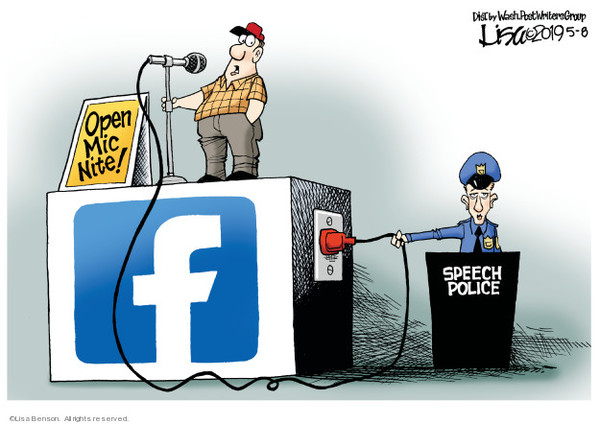
Facebook Warns Against Covid Good News

From the Daily Mail Facebook slaps ‘fake news’ warning on WSJ column claiming herd immunity for the US by April penned by Johns Hopkins professor.  Excerpts in italics with my bolds.

  • Johns Hopkins professor Dr Marty Makary penned Wall Street Journal op-ed in February claiming US will be achieve herd immunity by April
  • But his op-ed was recently flagged by Facebook fact-checker, the Journal said
  • In a March 5 article written by the Journal’s editorial board, they claimed Facebook was relying on ‘counter-opinion masquerading as fact checking’
  • They said Makary was simply making a projection that ‘was only flagged by ‘progressive health clerisy’ who ‘worry it could lead to fewer virus restrictions

The Wall Street Journal has claimed that Facebook fact-checkers relied on ‘opinion and not facts’ after an op-d written by Johns Hopkins professor Dr Marty Makary (pictured) was flagged last week.

‘Independent fact-checkers say this information could mislead people,’ the label against Makary’s story reads.

The board wrote: ‘According to Facebook, “Once we have a rating from a fact-checking partner, we take action by ensuring that fewer people see that misinformation.”‘

In addition, the Facebook label links to Health Feedback, which is a World Health Organization-led vaccine project and an affiliate of the nonprofit Science Feedback that ‘verifies scientific claims in the media’.

The board noted that the ‘fact-check’ from Health Feedback says: ‘Misleading Wall Street Journal opinion piece makes the unsubstantiated claim that the US will have herd immunity by April 2021. Three scientists analyzed the article and estimate its overall scientific credibility to be very low.’

The Wall Street Journal’s board said Makary simply made a ‘projection’ that was only flagged by the ‘progressive health clerisy’ who ‘worry it could lead to fewer virus restrictions’.

The board said that Facebook’s fact-checkers ‘cherry-pick’ studies ‘to support their own opinions, which they present as fact’.

At the time Makary’s article noted that new daily infections declined 77 per cent over a six-week period, equating this decrease to a ‘miracle pill’.

See also Fact-Checking Facebook’s Fact Checkers

The media giant is employing left-wing vetters to limit  scientific debate.

https://video-api.wsj.com/api-video/player/v3/iframe.html?guid=743047DF-A5B6-4042-BA2A-8A8221C958E5

Background from Previous Post:  Path Out of Covid Nightmare

WSJ posted an interview with Dr. Makary at a post The Perpetual Covid Crisis.  Some comments in italics wtih my bolds.

The lockdown lobby persists despite the vaccine rollout.

https://au.tv.yahoo.com/embed/wall-street-journal/wsj-opinion-path-covid-nightmare-204330227.html

Link goes to video of interview.  Closed Captions provide text.

Vaccination rates in Texas and other states have been increasing while hospitalizations are plunging. About one in five adults in Texas has received at least one dose of the Pfizer or Moderna vaccine. Most are seniors and people with health conditions who are at highest risk of severe illness. Hospitalizations in Texas have fallen more than 60% since a mid-January peak.

Politicians created a box canyon with lockdowns last spring that were originally intended to “flatten the curve.” But then every time governors loosened restrictions and cases ticked up, Democrats would demand lockdowns. Not that lockdowns (or mask mandates) much helped California or New York, which experienced bigger surges this winter than Florida did with neither.

Background from Previous Post  Immunity by Easter?

Could it be that doors and societies will open and life be reborn as early as Easter 2021?  That depends upon lockdown politicians and scientists who advise them.  One such is Dr. Makary, a professor at the Johns Hopkins School of Medicine and Bloomberg School of Public Health, chief medical adviser to Sesame Care, and author of “The Price We Pay.”.  His article at Wall Street Journal is We’ll Have Herd Immunity by April.  Excerpts in italics with my bolds.

Covid cases have dropped 77% in six weeks. Experts should level with the public about the good news.

Amid the dire Covid warnings, one crucial fact has been largely ignored: Cases are down 77% over the past six weeks. If a medication slashed cases by 77%, we’d call it a miracle pill. Why is the number of cases plummeting much faster than experts predicted?

In large part because natural immunity from prior infection is far more common than can be measured by testing.

Testing has been capturing only from 10% to 25% of infections, depending on when during the pandemic someone got the virus. Applying a time-weighted case capture average of 1 in 6.5 to the cumulative 28 million confirmed cases would mean about 55% of Americans have natural immunity.

Now add people getting vaccinated. As of this week, 15% of Americans have received the vaccine, and the figure is rising fast. Former Food and Drug Commissioner Scott Gottlieb estimates 250 million doses will have been delivered to some 150 million people by the end of March.

There is reason to think the country is racing toward an extremely low level of infection. As more people have been infected, most of whom have mild or no symptoms, there are fewer Americans left to be infected. At the current trajectory, I expect Covid will be mostly gone by April, allowing Americans to resume normal life.

Antibody studies almost certainly underestimate natural immunity. Antibody testing doesn’t capture antigen-specific T-cells, which develop “memory” once they are activated by the virus. Survivors of the 1918 Spanish flu were found in 2008—90 years later—to have memory cells still able to produce neutralizing antibodies.

Researchers at Sweden’s Karolinska Institute found that the percentage of people mounting a T-cell response after mild or asymptomatic Covid-19 infection consistently exceeded the percentage with detectable antibodies. T-cell immunity was even present in people who were exposed to infected family members but never developed symptoms. A group of U.K. scientists in September pointed out that the medical community may be under-appreciating the prevalence of immunity from activated T-cells.

Covid-19 deaths in the U.S. would also suggest much broader immunity than recognized. About 1 in 600 Americans has died of Covid-19, which translates to a population fatality rate of about 0.15%. The Covid-19 infection fatality rate is about 0.23%. These numbers indicate that roughly two-thirds of the U.S. population has had the infection.

In my own conversations with medical experts, I have noticed that they too often dismiss natural immunity, arguing that we don’t have data. The data certainly doesn’t fit the classic randomized-controlled-trial model of the old-guard medical establishment. There’s no control group. But the observational data is compelling.

I have argued for months that we could save more American lives if those with prior Covid-19 infection forgo vaccines until all vulnerable seniors get their first dose. Several studies demonstrate that natural immunity should protect those who had Covid-19 until more vaccines are available. Half my friends in the medical community told me: Good idea. The other half said there isn’t enough data on natural immunity, despite the fact that reinfections have occurred in less than 1% of people—and when they do occur, the cases are mild.

But the consistent and rapid decline in daily cases since Jan. 8 can be explained only by natural immunity. Behavior didn’t suddenly improve over the holidays; Americans traveled more over Christmas than they had since March. Vaccines also don’t explain the steep decline in January. Vaccination rates were low and they take weeks to kick in.

My prediction that Covid-19 will be mostly gone by April is based on laboratory data, mathematical data, published literature and conversations with experts. But it’s also based on direct observation of how hard testing has been to get, especially for the poor. If you live in a wealthy community where worried people are vigilant about getting tested, you might think that most infections are captured by testing. But if you have seen the many barriers to testing for low-income Americans, you might think that very few infections have been captured at testing centers. Keep in mind that most infections are asymptomatic, which still triggers natural immunity.

Many experts, along with politicians and journalists, are afraid to talk about herd immunity. The term has political overtones because some suggested the U.S. simply let Covid rip to achieve herd immunity. That was a reckless idea. But herd immunity is the inevitable result of viral spread and vaccination. When the chain of virus transmission has been broken in multiple places, it’s harder for it to spread—and that includes the new strains.

Herd immunity has been well-documented in the Brazilian city of Manaus, where researchers in the Lancet reported the prevalence of prior Covid-19 infection to be 76%, resulting in a significant slowing of the infection. Doctors are watching a new strain that threatens to evade prior immunity. But countries where new variants have emerged, such as the U.K., South Africa and Brazil, are also seeing significant declines in daily new cases. The risk of new variants mutating around the prior vaccinated or natural immunity should be a reminder that Covid-19 will persist for decades after the pandemic is over. It should also instill a sense of urgency to develop, authorize and administer a vaccine targeted to new variants.

Some medical experts privately agreed with my prediction that there may be very little Covid-19 by April but suggested that I not to talk publicly about herd immunity because people might become complacent and fail to take precautions or might decline the vaccine. But scientists shouldn’t try to manipulate the public by hiding the truth. As we encourage everyone to get a vaccine, we also need to reopen schools and society to limit the damage of closures and prolonged isolation. Contingency planning for an open economy by April can deliver hope to those in despair and to those who have made large personal sacrifices.

Don’t Fence Me In!

Path Out of Covid Nightmare

WSJ posted an interview with Dr. Makary at a post The Perpetual Covid Crisis.  Some comments in italics wtih my bolds.

The lockdown lobby persists despite the vaccine rollout.

https://au.tv.yahoo.com/embed/wall-street-journal/wsj-opinion-path-covid-nightmare-204330227.html

Link goes to video of interview.  Closed Captions provide text.

Vaccination rates in Texas and other states have been increasing while hospitalizations are plunging. About one in five adults in Texas has received at least one dose of the Pfizer or Moderna vaccine. Most are seniors and people with health conditions who are at highest risk of severe illness. Hospitalizations in Texas have fallen more than 60% since a mid-January peak.

Politicians created a box canyon with lockdowns last spring that were originally intended to “flatten the curve.” But then every time governors loosened restrictions and cases ticked up, Democrats would demand lockdowns. Not that lockdowns (or mask mandates) much helped California or New York, which experienced bigger surges this winter than Florida did with neither.

Background from Previous Post  Immunity by Easter?

Could it be that doors and societies will open and life be reborn as early as Easter 2021?  That depends upon lockdown politicians and scientists who advise them.  One such is Dr. Makary, a professor at the Johns Hopkins School of Medicine and Bloomberg School of Public Health, chief medical adviser to Sesame Care, and author of “The Price We Pay.”.  His article at Wall Street Journal is We’ll Have Herd Immunity by April.  Excerpts in italics with my bolds.

Covid cases have dropped 77% in six weeks. Experts should level with the public about the good news.

Amid the dire Covid warnings, one crucial fact has been largely ignored: Cases are down 77% over the past six weeks. If a medication slashed cases by 77%, we’d call it a miracle pill. Why is the number of cases plummeting much faster than experts predicted?

In large part because natural immunity from prior infection is far more common than can be measured by testing.

Testing has been capturing only from 10% to 25% of infections, depending on when during the pandemic someone got the virus. Applying a time-weighted case capture average of 1 in 6.5 to the cumulative 28 million confirmed cases would mean about 55% of Americans have natural immunity.

Now add people getting vaccinated. As of this week, 15% of Americans have received the vaccine, and the figure is rising fast. Former Food and Drug Commissioner Scott Gottlieb estimates 250 million doses will have been delivered to some 150 million people by the end of March.

There is reason to think the country is racing toward an extremely low level of infection. As more people have been infected, most of whom have mild or no symptoms, there are fewer Americans left to be infected. At the current trajectory, I expect Covid will be mostly gone by April, allowing Americans to resume normal life.

Antibody studies almost certainly underestimate natural immunity. Antibody testing doesn’t capture antigen-specific T-cells, which develop “memory” once they are activated by the virus. Survivors of the 1918 Spanish flu were found in 2008—90 years later—to have memory cells still able to produce neutralizing antibodies.

Researchers at Sweden’s Karolinska Institute found that the percentage of people mounting a T-cell response after mild or asymptomatic Covid-19 infection consistently exceeded the percentage with detectable antibodies. T-cell immunity was even present in people who were exposed to infected family members but never developed symptoms. A group of U.K. scientists in September pointed out that the medical community may be under-appreciating the prevalence of immunity from activated T-cells.

Covid-19 deaths in the U.S. would also suggest much broader immunity than recognized. About 1 in 600 Americans has died of Covid-19, which translates to a population fatality rate of about 0.15%. The Covid-19 infection fatality rate is about 0.23%. These numbers indicate that roughly two-thirds of the U.S. population has had the infection.

In my own conversations with medical experts, I have noticed that they too often dismiss natural immunity, arguing that we don’t have data. The data certainly doesn’t fit the classic randomized-controlled-trial model of the old-guard medical establishment. There’s no control group. But the observational data is compelling.

I have argued for months that we could save more American lives if those with prior Covid-19 infection forgo vaccines until all vulnerable seniors get their first dose. Several studies demonstrate that natural immunity should protect those who had Covid-19 until more vaccines are available. Half my friends in the medical community told me: Good idea. The other half said there isn’t enough data on natural immunity, despite the fact that reinfections have occurred in less than 1% of people—and when they do occur, the cases are mild.

But the consistent and rapid decline in daily cases since Jan. 8 can be explained only by natural immunity. Behavior didn’t suddenly improve over the holidays; Americans traveled more over Christmas than they had since March. Vaccines also don’t explain the steep decline in January. Vaccination rates were low and they take weeks to kick in.

My prediction that Covid-19 will be mostly gone by April is based on laboratory data, mathematical data, published literature and conversations with experts. But it’s also based on direct observation of how hard testing has been to get, especially for the poor. If you live in a wealthy community where worried people are vigilant about getting tested, you might think that most infections are captured by testing. But if you have seen the many barriers to testing for low-income Americans, you might think that very few infections have been captured at testing centers. Keep in mind that most infections are asymptomatic, which still triggers natural immunity.

Many experts, along with politicians and journalists, are afraid to talk about herd immunity. The term has political overtones because some suggested the U.S. simply let Covid rip to achieve herd immunity. That was a reckless idea. But herd immunity is the inevitable result of viral spread and vaccination. When the chain of virus transmission has been broken in multiple places, it’s harder for it to spread—and that includes the new strains.

Herd immunity has been well-documented in the Brazilian city of Manaus, where researchers in the Lancet reported the prevalence of prior Covid-19 infection to be 76%, resulting in a significant slowing of the infection. Doctors are watching a new strain that threatens to evade prior immunity. But countries where new variants have emerged, such as the U.K., South Africa and Brazil, are also seeing significant declines in daily new cases. The risk of new variants mutating around the prior vaccinated or natural immunity should be a reminder that Covid-19 will persist for decades after the pandemic is over. It should also instill a sense of urgency to develop, authorize and administer a vaccine targeted to new variants.

Some medical experts privately agreed with my prediction that there may be very little Covid-19 by April but suggested that I not to talk publicly about herd immunity because people might become complacent and fail to take precautions or might decline the vaccine. But scientists shouldn’t try to manipulate the public by hiding the truth. As we encourage everyone to get a vaccine, we also need to reopen schools and society to limit the damage of closures and prolonged isolation. Contingency planning for an open economy by April can deliver hope to those in despair and to those who have made large personal sacrifices.

Don’t Fence Me In!