March 2021 Ocean Chill Deepens

banner-blog

With apologies to Paul Revere, this post is on the lookout for cooler weather with an eye on both the Land and the Sea.  While you will hear a lot about 2020 temperatures matching 2016 as the highest ever, that spin ignores how fast is the cooling setting in.  The UAH data analyzed below shows that warming from the last El Nino is now fully dissipated with chilly temperatures setting in all regions.  Last month it was the ocean cooling off dramatically.

UAH has updated their tlt (temperatures in lower troposphere) dataset for March.  Previously I have done posts on their reading of ocean air temps as a prelude to updated records from HADSST3. This month also has a separate graph of land air temps because the comparisons and contrasts are interesting as we contemplate possible cooling in coming months and years. Unusually, last month showed air over land remained cool, while oceans dropped down further.

Note:  UAH has shifted their baseline from 1981-2010 to 1991-2020 beginning with January 2021.  In the charts below, the trends and fluctuations remain the same but the anomaly values change with the baseline reference shift.

Presently sea surface temperatures (SST) are the best available indicator of heat content gained or lost from earth’s climate system.  Enthalpy is the thermodynamic term for total heat content in a system, and humidity differences in air parcels affect enthalpy.  Measuring water temperature directly avoids distorted impressions from air measurements.  In addition, ocean covers 71% of the planet surface and thus dominates surface temperature estimates.  Eventually we will likely have reliable means of recording water temperatures at depth.

Recently, Dr. Ole Humlum reported from his research that air temperatures lag 2-3 months behind changes in SST.  Thus the cooling oceans now portend cooling land air temperatures to follow.  He also observed that changes in CO2 atmospheric concentrations lag behind SST by 11-12 months.  This latter point is addressed in a previous post Who to Blame for Rising CO2?

After a technical enhancement to HadSST3 delayed updates Spring 2020, May resumed a pattern of HadSST updates toward the following month end.  For comparison we can look at lower troposphere temperatures (TLT) from UAHv6 which are now posted for February. The temperature record is derived from microwave sounding units (MSU) on board satellites like the one pictured above. Recently there was a change in UAH processing of satellite drift corrections, including dropping one platform which can no longer be corrected. The graphs below are taken from the new and current dataset.

The UAH dataset includes temperature results for air above the oceans, and thus should be most comparable to the SSTs. There is the additional feature that ocean air temps avoid Urban Heat Islands (UHI).  The graph below shows monthly anomalies for ocean temps since January 2015.
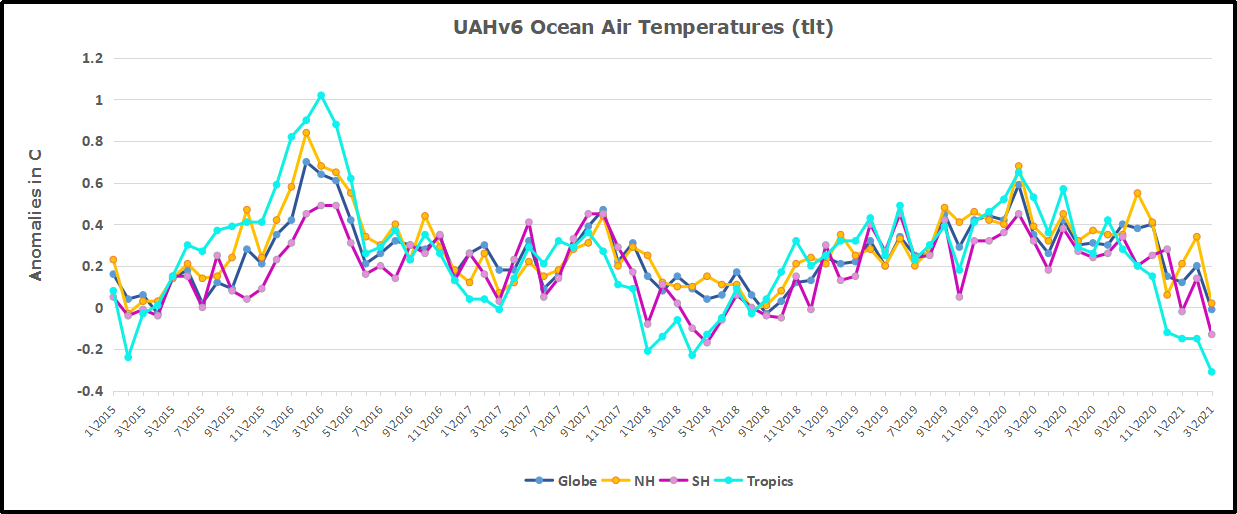
UAH Oceans 202103

Note 2020 was warmed mainly by a spike in February in all regions, and secondarily by an October spike in NH alone. End of 2020 November and December ocean temps plummeted in NH and the Tropics. In January SH dropped sharply, pulling the Global anomaly down despite an upward bump in NH. An additional drop in March has SH matching the coldest in this period. March drops in the Tropics and NH make those regions at their coldest since 01/2015.

Land Air Temperatures Tracking Downward in Seesaw Pattern

We sometimes overlook that in climate temperature records, while the oceans are measured directly with SSTs, land temps are measured only indirectly.  The land temperature records at surface stations sample air temps at 2 meters above ground.  UAH gives tlt anomalies for air over land separately from ocean air temps.  The graph updated for March is below.
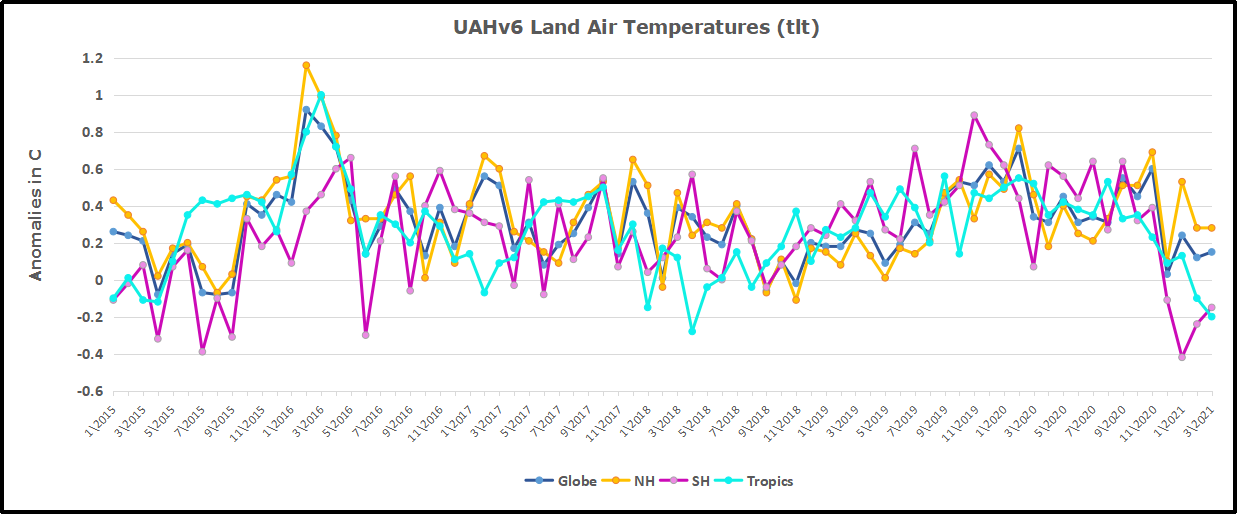
UAH Land 202103Here we have fresh evidence of the greater volatility of the Land temperatures, along with an extraordinary departure by SH land.  Land temps are dominated by NH with a 2020 spike in February, followed by cooling down to July.  Then NH land warmed with a second spike in November.  Note the mid-year spikes in SH winter months.  In December all of that was wiped out. Then January showed a sharp drop in SH, but a rise in NH more than offset, pulling the Global anomaly upward.  In February NH and the Tropics cooled further, pulling down the Global anomaly, despite slight SH land warming.  March continued to show all regions roughly comparable to early 2015, prior to the 2016 El Nino.  With NH having most of the land mass, it’s possible the February Polar Vortex event drove air temps downward last month.

The Bigger Picture UAH Global Since 1995

UAH Global 1995to202103The chart shows monthly anomalies starting 01/1995 to present.  The average anomaly is 0.04, since this period is the same as the new baseline, lacking only the first 4 years.  1995 was chosen as an ENSO neutral year.  The graph shows the 1998 El Nino after which the mean resumed, and again after the smaller 2010 event. The 2016 El Nino matched 1998 peak and in addition NH after effects lasted longer, followed by the NH warming 2019-20, with temps now returning again to the mean.

TLTs include mixing above the oceans and probably some influence from nearby more volatile land temps.  Clearly NH and Global land temps have been dropping in a seesaw pattern, more than 1C lower than the 2016 peak.  Since the ocean has 1000 times the heat capacity as the atmosphere, that cooling is a significant driving force.  TLT measures started the recent cooling later than SSTs from HadSST3, but are now showing the same pattern.  It seems obvious that despite the three El Ninos, their warming has not persisted, and without them it would probably have cooled since 1995.  Of course, the future has not yet been written.
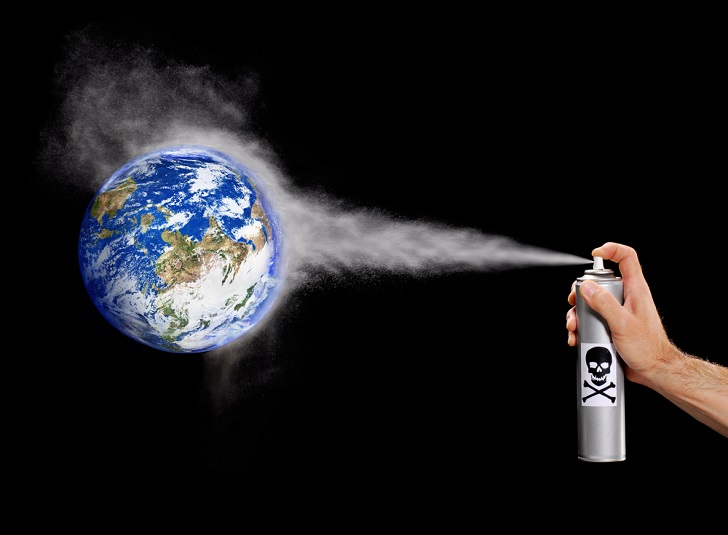
Biden’s EPA Goes Rogue on HFCs

earth_ozone_1
David Wojick writes at CFACT about the reckless move by EPA against vital industrial uses of hydrofluorocarbons  Crazy HFC phaseout is coming Excerpts in italics with my bolds.

In my first article — “Economically destructive cap and trade for HFCs is here” — I looked at the Kigali Amendment part of the American Innovation and Manufacturing Act or AIM. There the big problem is that the HFC cap is based on 8-10 year old data, which is mostly missing and probably inaccurate for today.

However, AIM adds some major rules to Kigali, rules which have their own problems.

In particular AIM singles out 6 industries and applications that use a lot of HFCs for special treatment. They get what are called “mandatory allocations” of allowances. In principle this means they get all the allowances they need for certain uses, for the next five years. Whether this actually happens or not is a serious problem.

The CFACT article goes on to explain how dangerous and reckless is this initiative by Biden’s EPA.  But the intended regulation is also illegal, and may end up in the Supreme Court since the plan is to violate a ruling of the DC Court of Appeals, written by then Judge Brett Kavanaugh.

dc-court-of-appeals

Background from previous post  Gamechanger: DC Appeals Court Denies EPA Climate Rules

A major clarification came today from the DC Court of Appeals ordering EPA (and thus the Executive Branch Bureaucracy) to defer to Congress regarding regulation of substances claimed to cause climate change.  While the issue and arguments are somewhat obscure, the clarity of the ruling is welcome.  Basically, the EPA under Obama attempted to use ozone-depleting authority to regulate HFCs, claiming them as greenhouse gases.  The judges decided that was a stretch too far.

The Court Decision August 8, 2017

The EPA enacted the rule in question in 2015, responding to research showing hydroflourocarbons, or HFCs, contribute to climate change.

The D.C. Circuit Court of Appeals’ 2-1 decision said EPA does not have the authority to enact a 2015 rule-making ending the use of hydrofluorocarbons commonly found in spray cans, automobile air conditioners and refrigerators. The three-judge panel said that because HFCs are not ozone-depleting substances, the EPA could not use a section of the Clean Air Act targeting those chemicals to ban HFCs.

“Indeed, before 2015, EPA itself maintained that Section 612 did not grant authority to require replacement of non ozone-depleting substances such as HFCs,” the court wrote.

“EPA’s novel reading of Section 612 is inconsistent with the statute as written. Section 612 does not require (or give EPA authority to require) manufacturers to replace non ozone-depleting substances such as HFCs,” said the opinion, written by Judge Brett Kavanaugh.

Contextual Background from the Court Document On Petitions for Review of Final Action by the United States Environmental Protection Agency  Excerpts below (my bolds)

In 1987, the United States signed the Montreal Protocol. The Montreal Protocol is an international agreement that has been ratified by every nation that is a member of the United Nations. The Protocol requires nations to regulate the production and use of certain ozone-depleting substances.

As a result, in the 1990s and 2000s, many businesses stopped using ozone-depleting substances in their products. Many businesses replaced those ozone-depleting substances with HFCs. HFCs became prevalent in many products. HFCs have served as propellants in aerosol spray cans, as refrigerants in air conditioners and refrigerators, and as blowing agents that create bubbles in foams.

In 2013, President Obama announced that EPA would seek to reduce emissions of HFCs because HFCs contribute to climate change.

Consistent with the Climate Action Plan, EPA promulgated a Final Rule in 2015 that moved certain HFCs from the list of safe substitutes to the list of prohibited substitutes. . .In doing so, EPA prohibited the use of certain HFCs in aerosols, motor vehicle air conditioners, commercial refrigerators, and foams – even if manufacturers of those products had long since replaced ozonedepleting substances with HFCs. Id. at 42,872-73.

Therefore, under the 2015 Rule, manufacturers that used those HFCs in their products are no longer allowed to do so. Those manufacturers must replace the HFCs with other substances that are on the revised list of safe substitutes.

In the 2015 Rule, EPA relied on Section 612 of the Clean Air Act as its source of statutory authority. EPA said that Section 612 allows EPA to “change the listing status of a particular substitute” based on “new information.” Id. at 42,876. EPA indicated that it had new information about HFCs: Emerging research demonstrated that HFCs were greenhouse gases that contribute to climate change. See id. at 42,879. EPA therefore concluded that it had statutory authority to move HFCs from the list of safe substitutes to the list of prohibited substitutes. Because HFCs are now prohibited substitutes, EPA claimed that it could also require the replacement of HFCs under Section 612(c) of the Clean Air Act even though HFCs are not ozone-depleting substances.

EPA’s current reading stretches the word “replace”  beyond its ordinary meaning. . .
Under EPA’s current interpretation of the word “replace,” manufacturers would continue to “replace” an ozone-depleting substance with a substitute even 100 years or more from now. EPA would thereby have indefinite authority to regulate a manufacturer’s use of that substitute. That boundless interpretation of EPA’s authority under Section 612(c) borders on the absurd.

In any event, the legislative history strongly supports our conclusion that Section 612(c) does not grant EPA continuing authority to require replacement of non-ozone-depleting substitutes.. . In short, although Congress contemplated giving EPA broad authority under Title VI to regulate the replacement of substances that contribute to climate change, Congress ultimately declined.

However, EPA’s authority to regulate ozone-depleting substances under Section 612 and other statutes does not give EPA authority to order the replacement of substances that are not ozone depleting but that contribute to climate change. Congress has not yet enacted general climate change legislation. Although we understand and respect EPA’s overarching effort to fill that legislative void and regulate HFCs, EPA may act only as authorized by Congress. Here, EPA has tried to jam a square peg (regulating non-ozone depleting substances that may contribute to climate change) into a round hole (the existing statutory landscape).

The Supreme Court cases that have dealt with EPA’s efforts to address climate change have taught us two lessons that are worth repeating here. See, e.g., Utility Air Regulatory Group v. EPA, 134 S. Ct. 2427 (2014). First, EPA’s well intentioned policy objectives with respect to climate change do not on their own authorize the agency to regulate. The agency must have statutory authority for the regulations it wants to issue. Second, Congress’s failure to enact general climate change legislation does not authorize EPA to act. Under the Constitution, congressional inaction does not license an agency to take matters into its own hands, even to solve a pressing policy issue such as climate change.

Footnote:  Looks like some judges found their big boy pants and applied US constitutional separation of powers against runaway executive climate actions.  Would such a decision have come without a skeptical President?

Could this be the first breach in the wall of unproven, unwarranted, federally funded climate activism?

Water rushes over damaged primary spillway at Oroville Dam in Northern California

Data Mining for Election Fraud

cb010621dapr20210105104502

Jay Valentine explains in his American Thinker article Election Fraud Hotspots – 10% of the Data are 70% of the Fraud  Jay is an expert in uncovering insurance fraud and points out that the same analyses will disclose fraudulent ballot patterns. Excerpts in italics with my bolds and images.

The more our team looked at the 2020 election fraud from publicly available records, the more it appeared to have similar characteristics to property casualty insurance fraud.

Beginning in November, like many citizens, we witnessed election fraud possibilities any sentient person would investigate. Having backgrounds in fraud detection, particularly in the property casualty insurance business, Medicaid fraud, and cyber fraud, gave us a curiosity that never dissipated.

Our interest is 100% in data analysis. That means looking at the actual votes, the addresses, the information about ballots reported to Secretaries of State. While there are all kinds of other fraud, the best way to light it up is with data analysis.

Not just the statistical stuff with the graphs and Greek symbols, but old fashioned rows and columns. Nothing illegal, just the same public data Google uses to profile someone for new running shoes.

sk040121dapc20210401124505

If Jesse Morgan did drive a tractor trailer truck with 100,000 ballots from New York to Pennsylvania, how can we find out? Chris Wray and our hardy pals at the FBI may not want to open that truck’s back door, but we do – with database analysis.

Every one of those ballots has a person’s name and address. The ballot is cast, illegally for sure, and counted. The local government is involved as well as the U.S. Postal Service officials at that particular location. That makes this sovereign, industrial election fraud.

They can hide the truck. They can claim it never happened. They cannot hide the record of the ballot.

Imagine yourself trying to fake 100,000 ballots. Even with some of your pals, lots of them, sitting around tables with pizza and Cokes and #2 pencils, it’s daunting. Every ballot needs to tie to an address. Each ties to a name. This is fraud infrastructure.

While you and your friends are filling out 100,000 ballots with Biden circles, do you think you took the time to use a different, real address for every one of them? Or, more likely, did you use a small group of addresses over and over? You get the picture.

If you filled out birth dates, did you use a different one every time you thought about it? How about those surnames? They are tied to real people and they better live in Pennsylvania.

We are getting reports some Secretaries of State are modifying mail-in ballot data to hide the tens of thousands of ballots received before they were sent.

This is a very bad idea.

Fraud data is like the world’s messiest crime scene.

Think of your worst nightmare crime scene with blood, bullet casings, broken furniture, spatterings, and that is how complex a fraud database is. If a criminal alters a crime scene, they always make things worse for themselves. They leave traces of who they were. More troublesome, they leave traces of what they are trying to hide.

We are thrilled people are trying to alter data after the fact.
They are leaving tracks like a dinosaur walking through a field of peanut butter for database tracking.

Citizen election fraud investigators are coalescing across multiple states sharing information, fraud profiles and actual data. We are helping with fraud investigative expertise and search technology beyond anything commercially available.

Our thesis is that 70% of all 2020 election fraud will be tied to 10% of the records. Like insurance fraud, election fraud has cultural affinities. It also has geographic patterns and links to a small number of people who deliver the overwhelming amount of fraud.

Cultural affinities?

We broke a major insurance fraud ring showing a group of Somali immigrants, living in the same building, driving the same car, had scammed a major insurance company. Sure they did, they knew each other. This happens all the time; the data show it.

Election fraud is no different. People who hang out together may have similar world views. If they are aggressive enough to join in an election fraud conspiracy, they don’t bring in strangers, they bring in friends and family. This kind of relationship shows up as a hot spot in data visualization.

Data visualization shows hotspots – like red wine stains on a white tablecloth.

Isn’t it interesting that 634 people with the same birthday, including the year, live at these seven addresses? Digging deeper, look, the address is not a physical location, it is a UPS store with mailboxes. That’s a crowded P.O. Box!

Look here, different family members live in different mailboxes with the same surname. The mailboxes are consecutive numbers, too! That’s so convenient for Thanksgiving dinner!

This is what industrial fraud starts to look like and there are plenty of data from December Secretary of State data files to prove this.

In fraud analysis, connections count big time. Industrial fraud is by definition a connected enterprise with a few actors driving lots of transactions. As we build a likely fraud database, think more of Ancestry.com rather than those rows and columns.

mrz033021dapr20210330044511

Ancestry.com allows you to build a family tree. As you build it, your family connects to other families. Those families add their long lost relatives you did not know existed enriching the tree. Connections count.

That is what an organic election fraud database starts to look like. Here, let’s do one!

Billy X has 239 people living in his one-bedroom Pennsylvania house and they all voted. All public information. Billy should be proud of his diligence.

We connect Billy via 100 social media posts floating on the internet using a web crawler. Look, Billy is a steward for the local trade union. He hates Trump.

Data visualization indicates Billy corresponds with Sally B. and Mortimer W. They live in Virginia. They too, hate Trump; so says social media. Our new friends in Virginia interested in election fraud start adding their data about Sally and Mort. Here are two addresses for Sally and they tie to over 600 registered voters. Mort has over 150 living in his one bedroom flat.

This is how it looks, folks. This is just the surface of what can be found from current, available, public records, social media and internet communication. We can go hundreds of layers deeper and it is delivered in the blink of an eye.

So when you freak out about H.R. 1, which is terrible, remember, they may have Marc Elias in their corner but the Patriots have data, technology, and adversaries who leave dinosaur tracks.

My Comment:  Those of us who watched the 2020 election go off the rails are waiting and hoping for the perps to be caught.  Forensic audits with competent analysts are under way in Arizona  with Maricopa officials trying to block it.  Ballot audits in Montana and New Hampshire turned up irregularities large enough to change the results.  The ‘Scan the Ballots’ Effort Is Moving Forward In Georgia Involving Jovan Pulitizer’s Technique of Forensically Reviewing Ballots from the 2020 Election (here).  The Georgia exercise shows what is a proper election forensic audit.  A 2020 audit will review all the ballots, not just a sample. Every ballot will be reviewed for the paper the ballot is on, the ink used, the shape of the circles being filled in, the sequence of the ballots, the creases in ballots, etc. This type of physical review, just of the ballots, will identify invalid ballots. These ballots can then be reviewed and eliminated if no proper excuses for their oddities are available. This can be done for every ballot in every audit.

A random thought:  What if Pelosi dropped her idea of contesting the Iowa seat won by a Republican by six votes because she was warned what an in depth analysis would show?  And another: What if Biden’s handlers are in such a rush to overturn everything because they know what kind of dirt will be coming out in coming months?

filtering_the_biden_fauset_small20210331015603

March 2021 Arctic Ice Persists

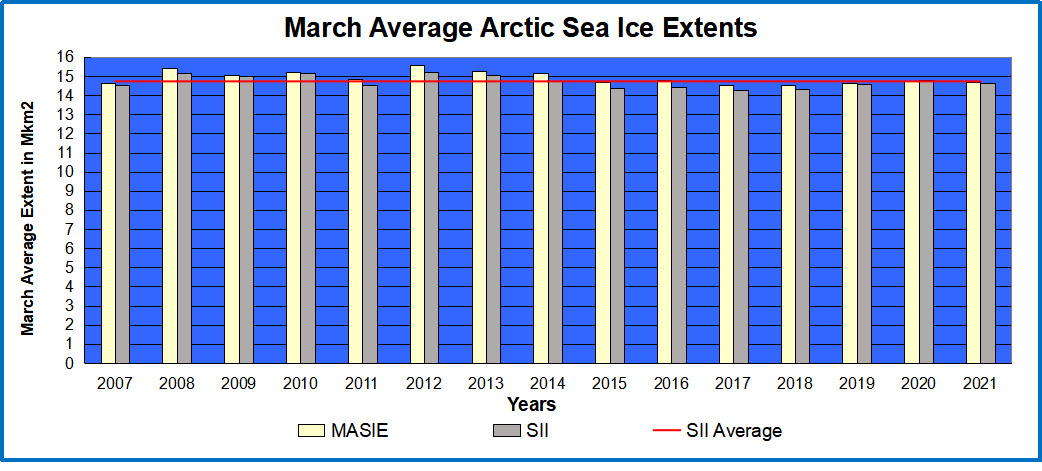
March Arctic ice 2007 to 2021

Previous posts showed 2021 Arctic Ice fell short of breaking the 15M km2 ceiling mid March due to a February Polar Vortex disruption.  As we shall see below, another smaller PV disruption is now occurring accelerating the normal spring melting season.  The graph above shows that the March monthly average has varied little since 2007, typically around the SII average of 14.7 M km2.  Of course there are regional differences as described later on.

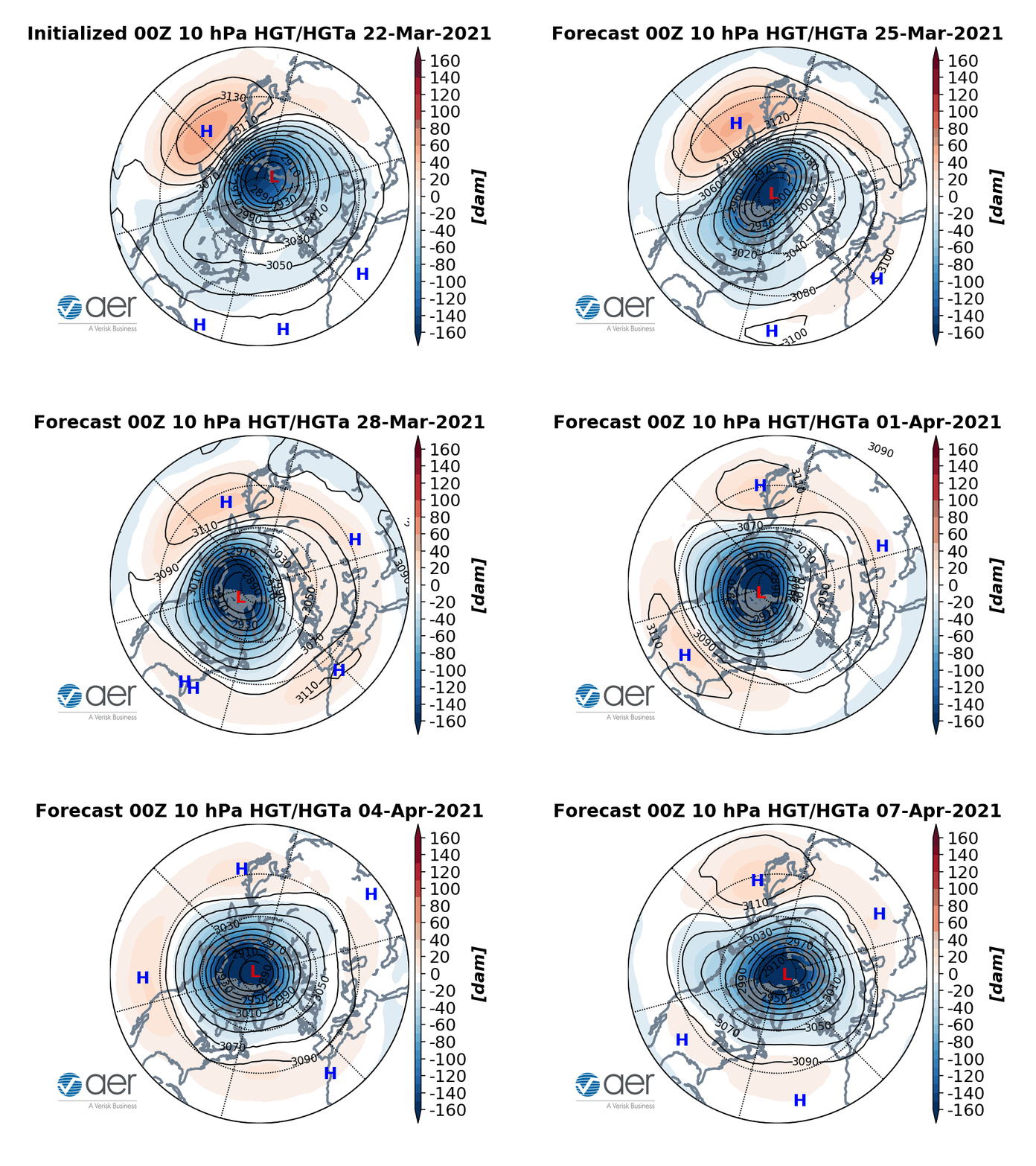
Dr. Judah Cohen at AER provides an image of how this latest PV disruption appears:

gfs_animation_010hpa_20210322_20210407

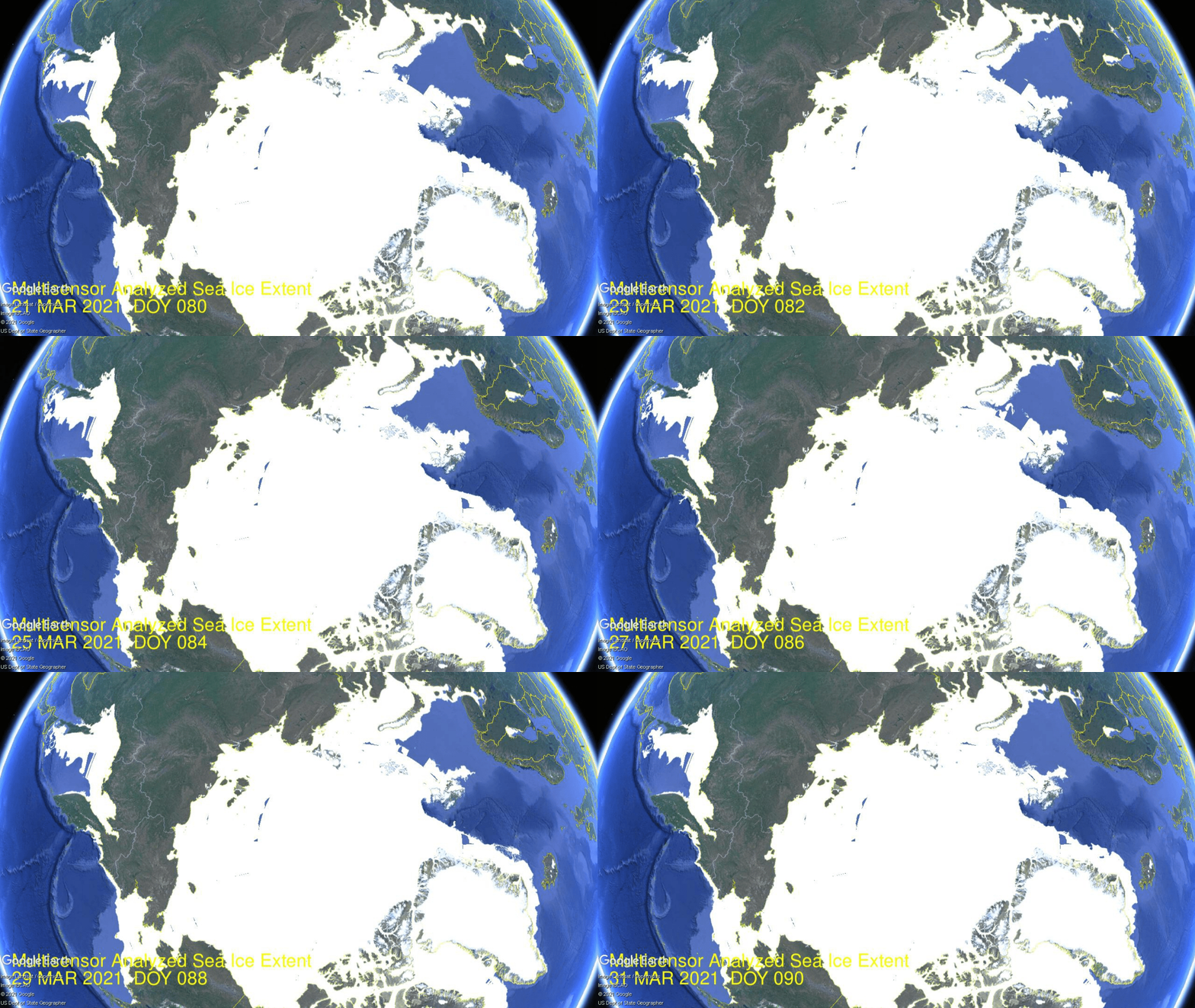
The High pressure areas were forecast to warm over the Pacific Arctic basins, and extending over to the European side, while the cold Low area is presently extending down into North America, bringing some snow on April 1 in Montreal (no joke).  The effect on Arctic Ice is shown in the animation below:

ArcticMarch2021 080 to 090

Over the last 10 days, Okhotsk upper left lost 180k km2 while Bering lower left lost half that with a slight recovery yesterday.  Barents Sea upper right lost 145k km2 over the same period.  The effect on NH total ice extents is presented in the graph below.

Arctic2021090

The graph above shows ice extent through March comparing 2021 MASIE reports with the 14-year average, other recent years and with SII.  After drawing close to average by day 80, 2021 ice extents dropped sharply and at March end matched both 2020 and 2007.  Despite losses from this PV event, the 2020 March monthly average ended up comparable to other years, as seen in the chart at the top.  In fact, the SII dataset of monthly gains and losses shows March 2021 gained slightly over end of February, compared to a 200k km2 loss for the average March.


The table below shows the distribution of sea ice across the Arctic regions.

Region 2021090 Day 090 Average 2021-Ave. 2007090 2021-2007
 (0) Northern_Hemisphere 14266634 14692014  -425380  14222916 43718 
 (1) Beaufort_Sea 1070689 1070177  512  1069711 978 
 (2) Chukchi_Sea 966006 964100  1907  966006
 (3) East_Siberian_Sea 1087137 1086134  1003  1074908 12229 
 (4) Laptev_Sea 897827 896838  989  884340 13487 
 (5) Kara_Sea 935023 916581  18442  892157 42866 
 (6) Barents_Sea 602392 649566  -47174  441970 160422 
 (7) Greenland_Sea 620574 658050  -37476  686312 -65739 
 (8) Baffin_Bay_Gulf_of_St._Lawrence 1243739 1438412  -194673  1217467 26272 
 (9) Canadian_Archipelago 854597 852959  1638  850127 4470 
 (10) Hudson_Bay 1260903 1254727  6176  1229995 30908 
 (11) Central_Arctic 3192844 3234463  -41619  3242237 -49393 
 (12) Bering_Sea 549939 736829  -186890  814788 -264849 
 (13) Baltic_Sea 33543 608741 -27331  45897 -12354 
 (14) Sea_of_Okhotsk 942085 861234  80850  794657 147428 

Overall NH extent March 31 was below average by 425k km2, or 3%.  The bulk of the deficit is seen in Bering and Baffin, along with Barents Sea.  Okhotsk remains above average in spite of recent losses.  The onset of spring melt is as usual in most regions.