
Andy Kessler writes at WSJ Can the Climate Heal Itself? Excerpts in italics with my bolds and added images.
Dissenters from the catastrophe consensus on warming are worth listening to.
Stop with all the existential-crisis talk. President Biden said, “Climate change is literally an existential threat to our nation and to the world.” Defense Secretary Lloyd Austin also talks about the “existential threat” of climate change. National security adviser Jake Sullivan identifies an “accelerating climate crisis” as one reason for a “new consensus” for government picking winners and losers in the economy. Be wary of those touting consensus.
But what if the entire premise is wrong? What if the Earth is self-healing? Before you hurl the “climate denier” invective at me, let’s think this through. Earth has been around for 4.5 billion years— living organisms for 3.7 billion. Surely, an enlightened engineer might think, the planet’s creator built in a mechanism to regulate heat, or we wouldn’t still be here to worry about it.
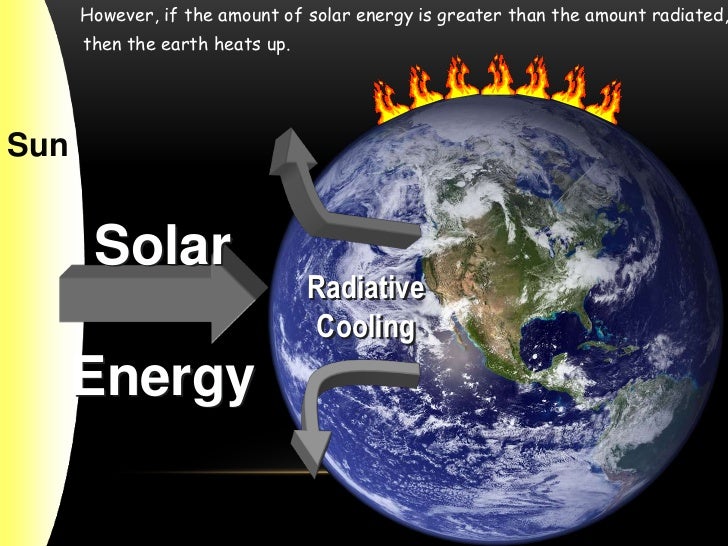
The theory of climate change is that excess carbon dioxide and methane trap the sun’s radiation in the atmosphere, and these man-made greenhouse gases reflect more of that heat back to Earth, warming the planet. Pretty simple. Eventually, we reach a tipping point when positive feedback loops form—less ice to reflect sunlight, warm oceans that can no longer absorb carbon dioxide—and then we fry, existentially. So lose those gas stoves and carbon spewing Suburbans.
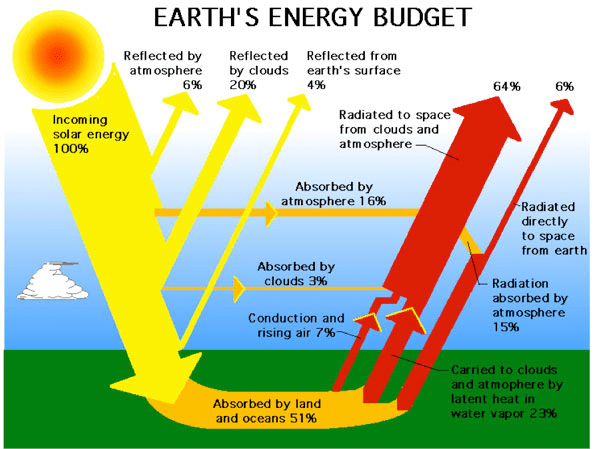
Note nearly half incoming solar energy is not absorbed by Earth’s surface.
But nothing is simple. What about negative feedback loops? Examples: human sweat and its cooling condensation or our irises dilating or constricting based on the amount of light coming in. Clouds, which can block the sun or trap its radiation, are rarely mentioned in climate talk.

Why? Because clouds are notoriously difficult to model in climate simulations. Steven Koonin, a New York University professor and author of “Unsettled,” tells me that today’s computing power can typically model the Earth’s atmosphere in grids 60 miles on a side. Pretty coarse. So, Mr. Koonin says, “the properties of clouds in climate models are often adjusted or ‘tuned’ to match observations.” Tuned!
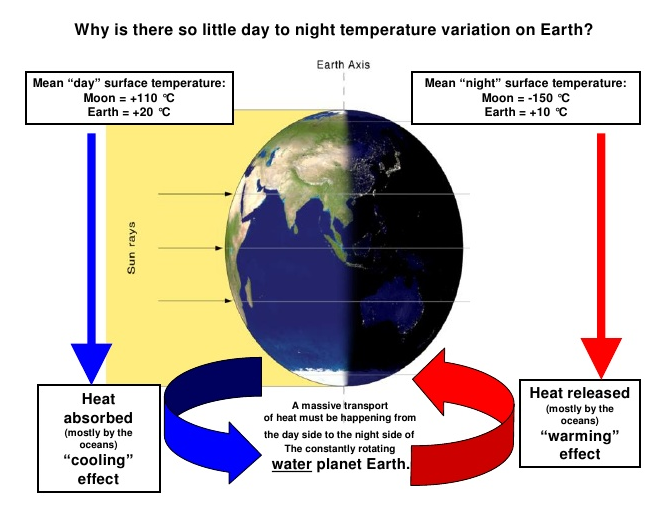
Last month the coddling modelers at the United Nations’ World Meteorological Organization stated that “warming El Niño” and “human-induced climate change” mean there is a “66% likelihood that annual average global temperatures will exceed the threshold of 1.5 degrees Celsius above preindustrial levels by 2027.” Notice that El Niño is mentioned first.

To enlarge open image in new tab.
Richard Lindzen, a professor at the Massachusetts Institute of Technology and lead author of an early Intergovernmental Panel on Climate Change report, told me, “Temperatures in the tropics remain relatively constant compared with changes in the tropics-to-pole temperatures. The tropics-polar difference is about 40 degrees Celsius today but was 20 degrees during the warm Eocene Epoch and 60 degrees during Ice Ages.” This difference has more to do with changes in the Earth’s rotation, like wobbling, than anything else. According to Mr. Lindzen, this effect is some 70 times as great as human-made greenhouse gases.

OK, back to clouds. Cumulus clouds, the puffy ones often called thunderclouds, are an important convection element, carrying heat from the Earth’s surface to the upper atmosphere. Above them are high-altitude cirrus clouds, which can reflect heat back toward the surface. A 2001 Lindzen paper, however, suggests that high-level cirrus clouds in the tropics dissipate as temperatures rise. These thinning cirrus clouds allow more heat to escape. It’s called the Iris Effect, like a temperature-controlled vent opener for an actual greenhouse so you don’t (existentially) fry your plants. Yes, Earth has a safety valve.
Mr. Lindzen says, “This more than offsets the effect of greenhouse gases.” As you can imagine, theories debunking the climate consensus are met with rebuttals and more papers. Often, Mr. Lindzen points out, critics, “to maintain the warming narrative, adjust their models, especially coverage and reflection or albedo of clouds in the tropics.” More tuning.
A 2021 paper co-authored by Mr. Lindzen shows strong support for an Iris Effect. Maybe Earth really was built by an engineer. Proof? None other than astronomer Carl Sagan described the Faint Young Sun Paradox that, 2.5 billion years ago, the sun’s energy was 30% less, but Earth’s climate was basically the same as today. Cirrus clouds likely formed to trap heat—a closed Iris and a negative feedback loop at work.

Figure 2: At higher temperatures there are more thunderstorms over the ocean and the area without high level clouds (dry and clear) expands further and thus allows more heat to radiate off into space (strong OLR) than when temperatures are lower, i.e. when the iris is smaller. Source: Figure 1 from MS15.
In a 2015 Nature Geoscience paper, Thorsten Mauritsen and Bjorn Stephen at the Max Planck Institute for Meteorology reran climate models using the Iris Effect and found them better at modeling historic observations. No need for tuning. Wouldn’t it be nice if the U.N. used realistic cloud and climate models?
Earth has warmed, but I’m convinced negative feedback loops will save us. Dismissing the Iris Effect or detuning it isn’t science. Sadly, climate science has morphed into climate rhetoric. And note, Treasury Secretary Janet Yellen explained in April that green spending “is, at its core, about turning the climate crisis into an economic opportunity.” Hmmm. “Catastrophic,” “existential” and “crisis” are cloudy thinking. Negative feedback is welcome. Dissenters from the catastrophe consensus on warming are worth listening to.
Footnote–Phanerozoic Temperatures
Maurice Lavigne commented that the best evidence of our self-regulating climate is found in the Phanerozoic temperature record. I had to find out what he meant, which led me to discover this:
The PhanSST global database of Phanerozoic sea surface temperature proxy data
And this graph from Nir Shaviv and Jan Veizer:
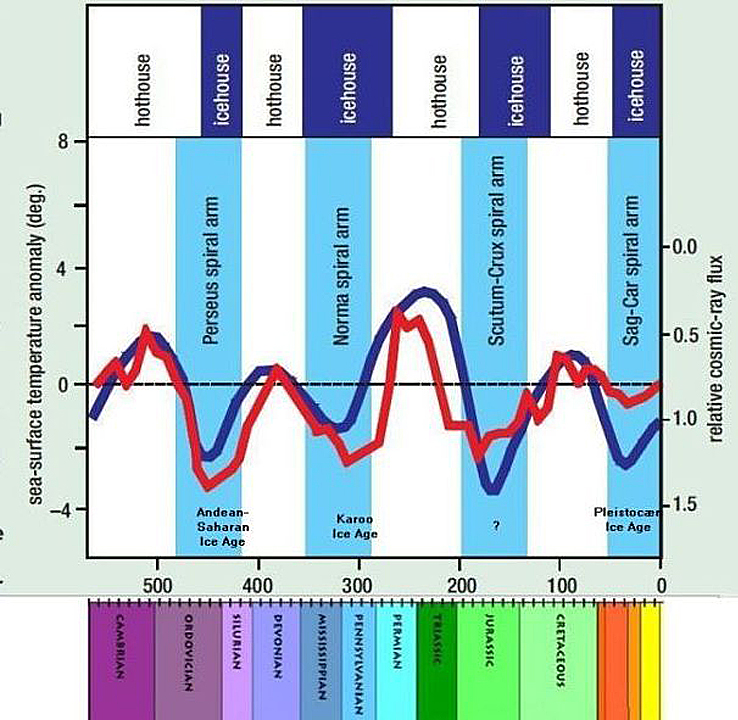
Cosmic radiation and temperature through Phanerozoic according to Nir Shaviv and Jan Veizer. The vertical axis on the left represents the temperature as deviations from present temperature. The vertical axis on the right shows the cosmic radiation as multiples of radiation today – today’s radiation is set to 1. Note that the right scale is inverted so that strong radiation can be compared to low temperature. The red curve represents the temperature and the blue radiation. Temperature and cosmic radiation appear to have a very good correlation. The horizontal axis represents time through Phanerozoic’s more than 500 million years. Note that the Carboniferous is divided into “Missisipian” and “Pennsylvanian”, that is an American custom, referring to different types of coal from the coal mines.
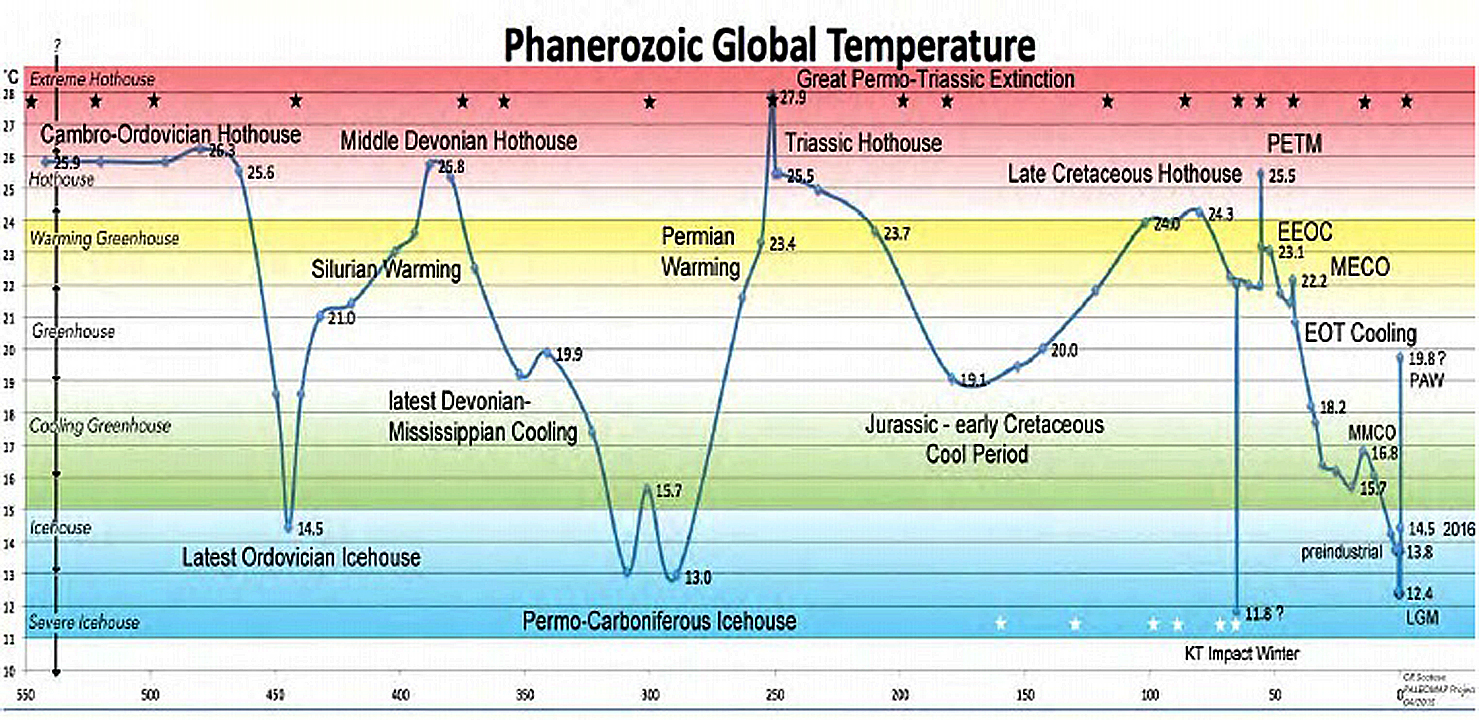
The image above comes from Christopher Scotese PaleoMAP project, showing the dramatic temperature and climate shifts, hothouse to icehouse and everything in between. Finally, a graph showing these temperature cycles unrelated to CO2 concentrations.

See Also More Evidence of Nature’s Sunscreen

Greenhouse with adjustable sun screens to control warming.
 Science Matters
At last! I’ve been waiting for this one for a long time.
It’s not that climate is self-healing. Climate is not sick or injured, so there’s nothing to heal. Climate variability is not a problem with a solution. It cannot be fixed, stopped or even directed.
All natural systems in this universe we inhabit are dominated by cyclic variability. There is no “normal,” there is no stable state, there is no balance, there is no equilibrium. There are only chaotic, complex adaptive systems that exist in variable states far from equilibrium, with stochastic emergent phenomena.
If you push something hard enough, it may not fall over, it may sprout wings and fly away.
LikeLike
Thanks Michael. Well said.
LikeLike
Reblogged this on Tallbloke's Talkshop and commented:
‘Sadly, climate science has morphed into climate rhetoric.’ — That’s what happens when a one-variable theory is proposed for a multi-variable system.
LikeLike
if one remembers that climate change is political science not real science as we understand it it all makes sense, they know they are lying and we know they are lying (but many believe these lies and that is where the trouble starts). this is a propaganda machine in over drive to get some agenda forwards that will means bad things for us the enviroment, and for morality. so logic doesn not make inroads in the believers.
LikeLike
The best evidence for a self regulating climate is the temperature record of the phanerozoic which has a long term plateau at 4 degrees warmer than today. That is the optimum temperature needed to support our biosphere.
LikeLike
Thanks for the comment Maurice, It led me to learn something new, which I will add as a footnote to the post.
LikeLike
The Greenhouse theory claims to explain the surface temperatures on Earth by the heattrapping effect of the atmosphere. If this was realistic, one has to believe that our atmosphere has warmed the deep oceans, since their temperatures are ~270K and higher. This is already 15K above the infamous 255K and, more relevant, ~75K above the average lunar surface temperature.
Deep oceans are so warm for the same reason deep mines in eg South Africa are so hot: geothermal energy.
Solar only warms the shallow surface layer, and this energy is lost again to the atmosphere/space during the night and during winter time. Below ~500m no more solar warming measurable.
The atmosphere prevents around 50% of solar energy to reach the surface. Furthermore it reduces the energy loss of the surface to space from ~400 W/m^2 on average to around 240 W/m^2 on average.
The understand the high temperatures some 85 mya, just look at the Ontong-Java event, some 80 million km^3 magma (yes, that is cubic kilometres) erupting in the deep oceans.
Also realize that the small geothermal flux that explains the deep mines temperatures is capable of warming the average oceanic column 1K every ~5000 year.
(flux through oceanic crust ~100 mW/m^2, through continental crust ~65 mW/m^2)
LikeLike