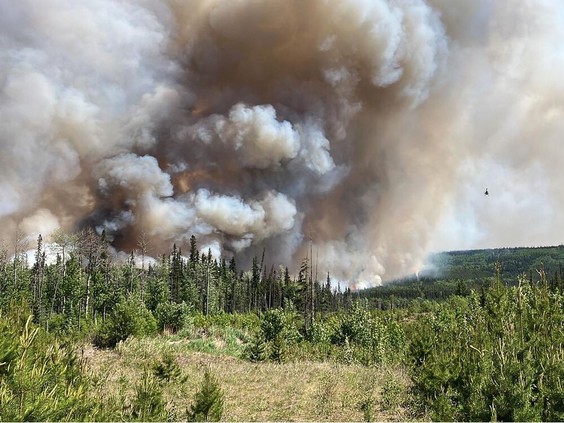
Smoke from the West Kiskatinaw River and Peavine Creek wildfires in the Dawson Creek Zone. PHOTO BY – /BC Wildfire Service/AFP via Getty
Jesse Zeman explains the overdue choice in his Vancouver Sun article A long, destructive summer is coming to B.C. forests. Excerpts in italics with my bolds.
Until we overhaul forest management, wildfires and smoky skies will become the norm.
B.C. is poised to suffer an historically ruinous fire season, and we have only ourselves to blame.
Warm, dry weather early in the season is part of the problem, to be sure. Climate change is likely making things worse. But B.C.’s history of fire suppression and outdated forest management has turned our forests into a tinderbox that grows more dangerous every year.
At this moment, 23 wildfires are burning out of control in B.C., with dozens more in various stages of being extinguished. Campfire prohibitions are either in effect or planned across the province.
All this nearly a month before Canada Day weekend. It could be a long, hot, destructive summer. Decades of fire suppression have resulted in huge amounts of fuel littering the forest floor, crowding out biodiversity and putting people at risk.
By putting out every fire on the landscape, we are creating forests
that are bristling with fuel just waiting for a spark.
Fire naturally occurs every five to 200 years in much of B.C. In the central Interior, many areas historically burn every five to 30 years. Under the right circumstances, fire is good. Fire is part of a natural process that rejuvenates grasslands and promotes biodiversity.
In much of the Interior, fire is an integral component of functioning and productive habitat for grizzly bears, moose, elk, mule deer, and sheep, creating food for wildlife by regenerating the soil and letting in sunlight, which creates ideal conditions for new plants and berries to grow.
Broadleaf trees are nature’s fuel break, slowing and reducing the intensity of fires; they also support biodiversity and provide moose with food. Unfortunately, B.C.’s outdated forest policies treat broadleaf trees like weeds in order to promote the growth of merchantable timber.
In parts of B.C., we spray broadleaf trees with the herbicide
glyphosate to kill them off on a massive scale.
What we do after a fire is vital. A post-fire landscape left untouched creates a natural fire break. As new plants and trees grow in, the burned trees that we leave standing are critical for moisture retention and temperature regulation in the soil. In as little as a year, burned areas sound like a symphony, teeming with life from bugs to birds to bears. But our forest practices typically prevent natural succession. Instead, we often log areas burned by fire as quickly as possible, because burned trees are harder to cut at the mill after a couple of years.
Logging after wildfire often leaves behind a barren landscape, with stunted native plants due to a lack of temperature regulation and moisture retention in the soil. Roads for logging invite invasive weeds. The lack of vegetation can also exacerbate erosion, flooding and sedimentation in our watersheds.
B.C. has been so focused on cutting down and selling trees, it has failed to account for the costs of fire suppression, loss of biodiversity, food security, and tourism. Forestry could play a critical role in mitigating the effects of wildfire by reducing fuel loads and thinning forests.
But that will require a new way of thinking. Until we overhaul forest management, wildfires and smoky skies will become the norm. We need to forge a new relationship with our forests, watersheds and wildlife, focusing on sustainability and resiliency.
We have important choices to make: Keep putting fires out and treating native tree species, such as aspen, like weeds until the fuel loading is so bad that the ensuing wildfires are virtually uncontrollable. Or we can invest in our landscapes, have controlled burns in the spring and fall, and let some fires burn to create a natural diverse landscape that mitigates high-intensity wildfires.
National Perspective from National Post Blame Forestry Management, Not CO2 Emissions
Alternative theories as to the source of the 2023 fires have largely cropped up in response to progressive politicians fingering them as irrefutable evidence of the impacts of climate change — and a clarion call for stronger emissions policies.
“We’re seeing more and more of these fires because of climate change … We’ll keep working — here at home and with partners around the world — to tackle climate change and address its impacts,” reads one recent statement by Canadian Prime Minister Justin Trudeau.
Environment Minister Steven Guilbeault rather explicitly used the wildfires as justification for higher carbon taxes, arguing that they’re still far lower than the “social cost of carbon.”
But there is a way to critique this line of reasoning without relying on tenuous evidence of a vast enviro-conspiracy to light Canada on fire for political gain.
Even wildfire specialists have been noting that while hotter, drier summers can supercharge a bad fire season, the immense scale of the 2023 fires is due in part to Canada and the United States dropping the ball on proper forestry management.
A recent Washington Post op-ed by Colorado wildfire scientist Jennifer K. Balch, for instance, suggested that the best way for governments to fight wildfires is a tighter focus on controlled burning in cooler years, and building residential developments away from high-risk areas.
“We have flood plain maps, but we don’t have maps that assess future fire risk to help set insurance costs and direct developers away from vulnerable areas,” she wrote.
The B.C. Wildlife Federation has similarly critiqued the notion that emissions reduction is the most immediate solution to increasingly damaging wildfire seasons. In a lengthy statement, (above) executive director Jesse Zeman outlined how B.C. forestry policy discourages the growth of broad-leafed trees and immediately logs post-fire landscapes; both of which eliminate what would otherwise be natural fire breaks.
“Until we overhaul forest management, wildfires and smoky skies will become the norm,” he wrote.
 Science Matters
Reblogged this on Climate Collections and commented:
Log it, graze it, or watch it burn.
LikeLike