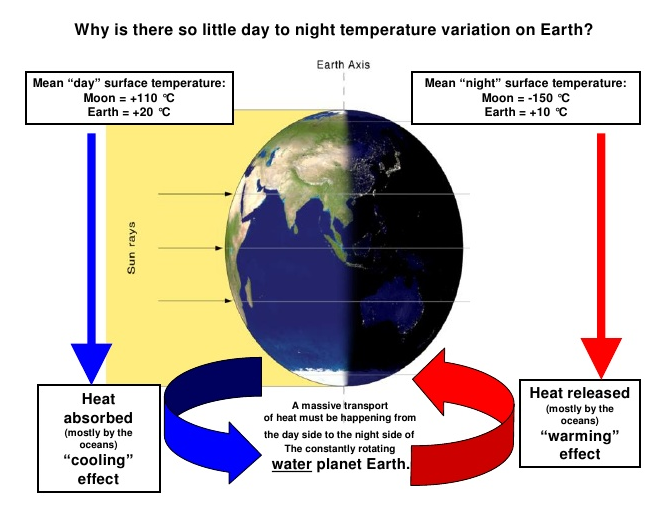
El Nino Ocean Warming Abates May 2023
The best context for understanding decadal temperature changes comes from the world’s sea surface temperatures (SST), for several reasons:

  • The ocean covers 71% of the globe and drives average temperatures;
  • SSTs have a constant water content, (unlike air temperatures), so give a better reading of heat content variations;
  • A major El Nino was the dominant climate feature in recent years.

HadSST is generally regarded as the best of the global SST data sets, and so the temperature story here comes from that source. Previously I used HadSST3 for these reports, but Hadley Centre has made HadSST4 the priority, and v.3 will no longer be updated.  HadSST4 is the same as v.3, except that the older data from ship water intake was re-estimated to be generally lower temperatures than shown in v.3.  The effect is that v.4 has lower average anomalies for the baseline period 1961-1990, thereby showing higher current anomalies than v.3. This analysis concerns more recent time periods and depends on very similar differentials as those from v.3 despite higher absolute anomaly values in v.4.  More on what distinguishes HadSST3 and 4 from other SST products at the end. The user guide for HadSST4 is here.

The Current Context

The chart below shows SST monthly anomalies as reported in HadSST4 starting in 2015 through May 2023.  A global cooling pattern is seen clearly in the Tropics since its peak in 2016, joined by NH and SH cycling downward since 2016. 

Note that in 2015-2016 the Tropics and SH peaked in between two summer NH spikes.  That pattern repeated in 2019-2020 with a lesser Tropics peak and SH bump, but with higher NH spikes. By end of 2020, cooler SSTs in all regions took the Global anomaly well below the mean for this period.  In 2021 the summer NH summer spike was joined by warming in the Tropics but offset by a drop in SH SSTs, which raised the Global anomaly slightly over the mean.

Then in 2022, another strong NH summer spike peaked in August, but this time both the Tropic and SH were countervailing, resulting in only slight Global warming, later receding to the mean.   Oct./Nov. temps dropped  in NH and the Tropics took the Global anomaly below the average for this period. After an uptick in December, temps in January 2023 dropped everywhere, strongest in NH, with the Global anomaly further below the mean since 2015.

Now comes El Nino as shown by the upward spike in the Tropics since January, the anomaly nearly doubling from 0.45C to 0.83C.  SH stayed the same as March, but NH also increased 0.13, resulting in a Global anomaly of 0.85C.  However, in May 2023, both the Tropics and SH temps dropped down, reducing the Global anomaly to 0.82C dispite an upward bump in NH.

A longer view of SSTs

To enlarge, open in new tab.

The graph above is noisy, but the density is needed to see the seasonal patterns in the oceanic fluctuations.  Previous posts focused on the rise and fall of the last El Nino starting in 2015.  This post adds a longer view, encompassing the significant 1998 El Nino and since.  The color schemes are retained for Global, Tropics, NH and SH anomalies.  Despite the longer time frame, I have kept the monthly data (rather than yearly averages) because of interesting shifts between January and July.1995 is a reasonable (ENSO neutral) starting point prior to the first El Nino. 

The sharp Tropical rise peaking in 1998 is dominant in the record, starting Jan. ’97 to pull up SSTs uniformly before returning to the same level Jan. ’99. There were strong cool periods before and after the 1998 El Nino event. Then SSTs in all regions returned to the mean in 2001-2. 

SSTS fluctuate around the mean until 2007, when another, smaller ENSO event occurs. There is cooling 2007-8,  a lower peak warming in 2009-10, following by cooling in 2011-12.  Again SSTs are average 2013-14.

Now a different pattern appears.  The Tropics cooled sharply to Jan 11, then rise steadily for 4 years to Jan 15, at which point the most recent major El Nino takes off.  But this time in contrast to ’97-’99, the Northern Hemisphere produces peaks every summer pulling up the Global average.  In fact, these NH peaks appear every July starting in 2003, growing stronger to produce 3 massive highs in 2014, 15 and 16.  NH July 2017 was only slightly lower, and a fifth NH peak still lower in Sept. 2018.

The highest summer NH peaks came in 2019 and 2020, only this time the Tropics and SH were offsetting rather adding to the warming. (Note: these are high anomalies on top of the highest absolute temps in the NH.)  Since 2014 SH has played a moderating role, offsetting the NH warming pulses. After September 2020 temps dropped off down until February 2021.  In 2021-22 there were again summer NH spikes, but in 2022 moderated first by cooling Tropics and SH SSTs, then in October to January 2023 by deeper cooling in NH and Tropics.  

Now in 2023 the Tropics flip from below to above average, and NH starts building up for a summer peak comparable to previous years. In May warming in the Tropics and SH abated, while NH showed a typical upward bump.

What to make of all this? The patterns suggest that in addition to El Ninos in the Pacific driving the Tropic SSTs, something else is going on in the NH.  The obvious culprit is the North Atlantic, since I have seen this sort of pulsing before.  After reading some papers by David Dilley, I confirmed his observation of Atlantic pulses into the Arctic every 8 to 10 years.

Contemporary AMO Observations

Through January 2023 I depended on the Kaplan AMO Index (not smoothed, not detrended) for N. Atlantic observations. But it is no longer being updated, and NOAA says they don’t know its future.  So I find only the Hadsst AMO dataset has data through April.  It differs from Kaplan, which reported average absolute temps measured in N. Atlantic.  “Hadsst AMO  follows Trenberth and Shea (2006) proposal to use the NA region EQ-60°N, 0°-80°W and subtract the global rise of SST 60°S-60°N to obtain a measure of the internal variability, arguing that the effect of external forcing on the North Atlantic should be similar to the effect on the other oceans.”  So the values represent differences between the N. Atlantic and the Global ocean.
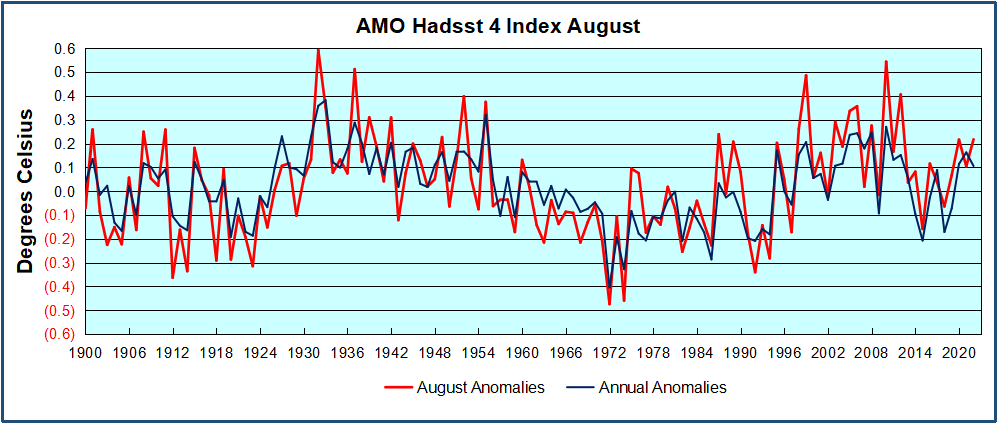
The chart above confirms what Kaplan also showed.  As August is the hottest month for the N. Atlantic, its varibility, high and low, drives the annual results for this basin.  Note also the peaks in 2010, lows after 2014, and a rise in 2021. An annual chart below is informative:

Note the difference between blue/green years, beige/brown, and purple/red years.  2010, 2021, 2022 all peaked strongly in August or September.  1998 and 2007 were mildly warm.  2016 and 2018 were matching or cooler than the global average.  2023 is starting out slightly warm.

Summary

The oceans are driving the warming this century.  SSTs took a step up with the 1998 El Nino and have stayed there with help from the North Atlantic, and more recently the Pacific northern “Blob.”  The ocean surfaces are releasing a lot of energy, warming the air, but eventually will have a cooling effect.  The decline after 1937 was rapid by comparison, so one wonders: How long can the oceans keep this up? 

Footnote: Why Rely on HadSST4

HadSST is distinguished from other SST products because HadCRU (Hadley Climatic Research Unit) does not engage in SST interpolation, i.e. infilling estimated anomalies into grid cells lacking sufficient sampling in a given month. From reading the documentation and from queries to Met Office, this is their procedure.

HadSST4 imports data from gridcells containing ocean, excluding land cells. From past records, they have calculated daily and monthly average readings for each grid cell for the period 1961 to 1990. Those temperatures form the baseline from which anomalies are calculated.

In a given month, each gridcell with sufficient sampling is averaged for the month and then the baseline value for that cell and that month is subtracted, resulting in the monthly anomaly for that cell. All cells with monthly anomalies are averaged to produce global, hemispheric and tropical anomalies for the month, based on the cells in those locations. For example, Tropics averages include ocean grid cells lying between latitudes 20N and 20S.

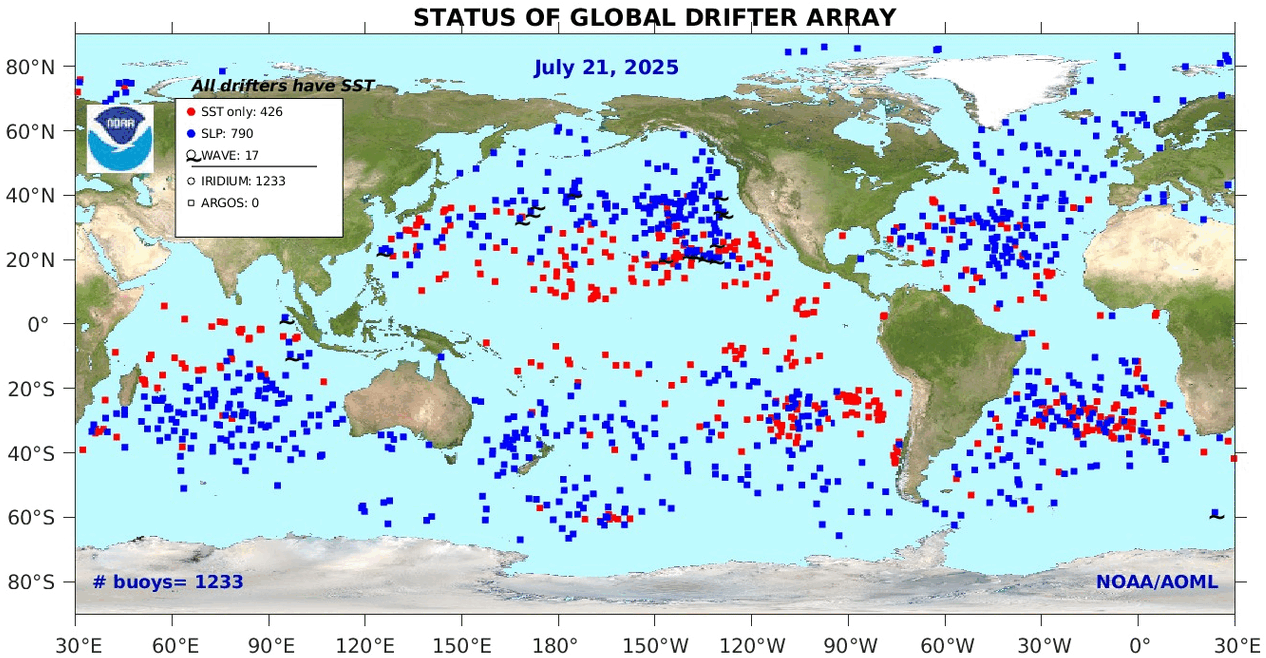
Gridcells lacking sufficient sampling that month are left out of the averaging, and the uncertainty from such missing data is estimated. IMO that is more reasonable than inventing data to infill. And it seems that the Global Drifter Array displayed in the top image is providing more uniform coverage of the oceans than in the past.

uss-pearl-harbor-deploys-global-drifter-buoys-in-pacific-ocean

USS Pearl Harbor deploys Global Drifter Buoys in Pacific Ocean


Climate Refugees Imagined Statistics

Any talk about climate (change, crisis, emergency, whatever) will include large numbers, scary enough to raise concern and support for the carbon crusade,  Of course, the implements of mass delusion are math models running on computers.  This is true of the ever-increasing range of climate sensitivity (how much warming from doubling atmospheric CO2), as well as the arbitrary choice of 1.5C warming as the tipping point into damnation.  And as this post explains, there are plenty of bogus numbers regarding climate “refugees.”

Disha Shetty challenges one common claim in her Undark article: Do Women Really Make Up 80 Percent of All Climate Migrants? Excerpts in italics with my bolds and added images.

The figure is frequently cited by activists, policymakers, and the media,
but it is a dubious statistic of murky origin.

Although climate change affects all people, women often bear the brunt in places where the impacts of climate change are already being felt. Christiana Figueres CNN

It is an alarming and evocative statistic: An estimated 80 percent of climate migrants are women. The figure has been used by the United Nations in its official communication. It has been repeated in the media and by human rights groups. But it stands on shaky scientific ground — and most likely is wildly off the mark. 

To begin with, the 80 percent figure fails the basic smell test. As someone who has reported on climate change and migration across India, it is clear to me that men are typically the first to move in the face of environmental pressures, often in search of seasonal income or jobs in cities. Women and children tend to be the last to go, if they leave at all.

Perhaps more importantly, there are currently no comprehensive datasets that can tell us how climate migrant populations break down along gender lines. In fact, experts say there isn’t even a consensus on the definition of who counts as a climate migrant.  When people migrate, it is often due to a combination of factors.  Environment, when it comes into play, is just one of them.

Where, then, does the 80 percent figure come from?

Lawrence Huang, an analyst at Washington, D.C.-based Migration Policy Institute, has fielded questions from the media on this number, and he says the earliest reference he can find to it is in a 2010 report by a nonprofit called Women’s Environmental Network. The report — which has been cited by the World Trade Organization, the Organization for Economic Co-operation and Development, and numerous other groups — states that “it has been estimated that women constitute up to 80% of global refugee and displaced populations.” It then infers, based in part on that figure, “that of the current 26 million climate refugees, up to 20 million are female.”

But the estimate seems to contain two big mistakes. First, it assumes that the gender breakdown of climate migrants mirrors that of populations displaced for other reasons, such as political unrest, economic collapse, and other disasters. In actuality, the demographics of a migrant group can depend on what’s driving their displacement. Studies suggest, for example, that refugees fleeing from armed conflict are especially likely to be women and children, with men often staying behind as combatants. By contrast, women made up the vast majority of people who remained in New Orleans in the wake of Hurricane Katrina, mainly because they didn’t have the means to flee.

That brings us to the report’s second big mistake. Its claim that women constitute up to 80 percent of refugee and displaced populations is attributed to a 2004 fact sheet on climate change and disaster mitigation, produced by the International Union for Conservation of Nature. That fact sheet doesn’t clearly specify a source, but its phrasing of the statistic bears resemblance to an often-repeated assertion, published in a 1999 report by the U.N.’s Inter-Agency Standing Committee, that “up to eighty percent of the internally displaced persons and refugees around the world are women and children.”

When people migrate, it is often due to a combination of factors.
Environment, when it comes into play, is just one of them.

Crucially, the 2004 fact sheet omitted “and children” from its phrasing of the statistic — as did the Women’s Environmental Network report that first applied the number in the context of climate change. It’s unclear whether the omission was intentional. (I was unable to reach the fact sheet’s author, Lorena Aguilar, despite multiple email attempts.) But what is clear, according to Huang, at least, is that the 80 percent figure “does not have a scientific basis” — especially not in the context of climate change.

“People just ran with the number,” Huang told me, noting that the statistic is used by some but not all U.N. organizations. On its website, UNHCR, the U.N. refugee agency, says that “[w]omen and girls make up around 50 per cent of any refugee, internally displaced or stateless population,” a classification that includes people migrating for reasons other than climate. Likewise, data from the U.S. Census Bureau indicate that women represent around 51 percent of people displaced by natural disasters. And yet the 80 percent figure has gained traction in the media and among policymakers and activists.

The potential consequences of this misinformation are many. First, by steering attention and resources toward women climate migrants, it could distract from the needs of women who haven’t been displaced but are impacted by climate change nonetheless. These women are affected in small and big ways. They often must take over agricultural and head-of-household duties from men who have moved in search of work, which places increased demand on their time and labor. Understanding the needs of these women is critical to crafting an effective response to climate change, but their narratives are often missing from media coverage.

Global warming could create 150 million ‘climate refugees’ by 2050. The Guardian (2009)

 Comment: 

The author is not skeptical enough to dig into the underlying claim that as of 2010 there are 26 million “cimate refugees.”

From NewScientist

When diplomats and military strategists gathered for a meeting of the council in July 2011 they asked a simple question: how many refugees can we expect as regions and countries become uninhabitable due to climate change? A clear-cut answer could spur politicians to do something about this problem. If only one could be found.

The first stab at an answer came in 1995 when British academic Norman Myers calculated there were 25 million environmental refugees, mostly in drought-hit parts of Africa. He predicted that numbers would swell to 50 million by 2010 and 200 million by mid-century. However, he did warn that his figures were “a first-cut assessment… to ‘get a handle’, however preliminary and exploratory, on an emergent problem of exceptional significance”. That was either foolhardy or heroic, according to your point of view.

The scandal is that those old figures still turn up in IPCC reports, the UK’s Stern review of the economics of climate change, and statements from the UN High Commissioner for Refugees (UNHCR). They do so because, as far as New Scientist can establish, nobody has attempted to improve on Myers’s “first cut” calculations. 

Important Finding, Nature Communications (2021) Climatic conditions are weak predictors of asylum migration

Recent research suggests that climate variability and change significantly affect forced migration, within and across borders. Yet, migration is also informed by a range of non-climatic factors, and current assessments are impeded by a poor understanding of the relative importance of these determinants.

Here, we evaluate the eligibility of climatic conditions relative to economic, political, and contextual factors for predicting bilateral asylum migration to the European Union—a form of forced migration that has been causally linked to climate variability.

Results from a machine-learning prediction framework reveal that drought and temperature anomalies are weak predictors of asylum migration, challenging simplistic notions of climate-driven refugee flows. Instead, core contextual characteristics shape latent migration potential whereas political violence and repression are the most powerful predictors of time-varying migration flows.

Future asylum migration flows are likely to respond much more
to political changes in vulnerable societies than to climate change.

Note: This is consistent with previous studies claiming climate causing displacement in Africa.  See

Food, Conflict and Climate

Climate Primer for Misguided Kids Suing Montana

Jack Hellner explains the basics in his American Thinker article This is some of the garbage we can expect with indoctrinated kids and greedy lawyers.  Excerpts in italics with my bolds and added images.

These children say that their lives have been destroyed because of coal and oil so they are suing Montana.

A group of Montana youth who say their lives are already being affected by climate change and that state government is failing to protect them are the first of dozens of such efforts to get their lawsuit to trial Monday. They will try to persuade a judge that the state’s allegiance to fossil fuel development endangers their health and livelihoods and those of future generations.

Lawsuits and policies should be based on the truth and scientific facts, not on easily manipulated computer models and made up predictions which have consistently been wrong, like this lawsuit and the radical green policies which are being forced on the American people. 

Maybe the state should take the kids to underdeveloped countries that haven’t developed and used their natural resources to see how lucky they are. Then the state should send them a bill for greatly improving their quality and length of life. 

The line of defense against this nuisance lawsuit is long because it is based on factual scientific data.  They can have it presented in the simplest form since they have been taught not to ask questions or do research. 

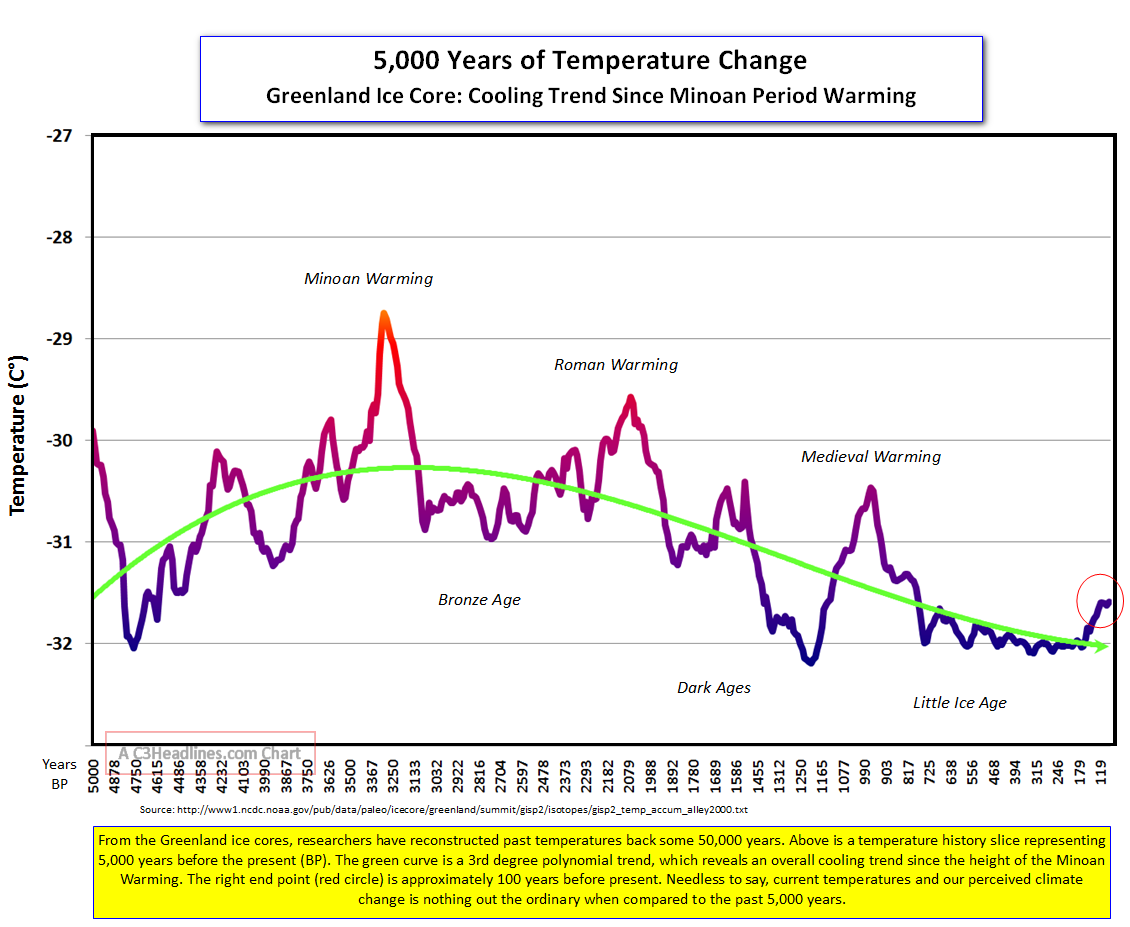
They should be told that the Earth was just as warm 1,000 years ago as it is today. 

Then they should have the scientific fact pointed out to them that a Little Ice Age occurred from around 1300 to 1860 where the Earth cooled a little. 

Dr. Syun Akasofu 2009 diagram from his paper Two Natural Components of Recent Warming.

Then they should be shown that the Earth has only warmed a little in the last 160 years since the Little Ice Age ended, and they should be able to comprehend that the Earth always warms a little after an ice age ends. 

They should be told that although there has been one or two degrees of warming the last 160 years, we also had a 35-year period of cooling from 1940-1975 where the public was warned that a catastrophic ice age was coming. 

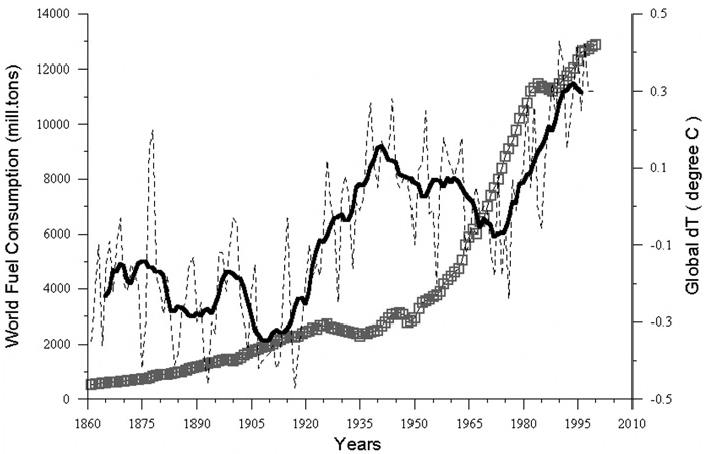
It should be possible for the youth to understand, even as journalists, politicians, and bureaucrats can’t seem to, that if temperatures sometimes rise and sometimes fall while crude oil use and coal use are constantly rising rapidly, that there is no correlation between our use of natural resources and temperatures, nor climate change. 

Figure 5.1. Comparative dynamics of the World Fuel Consumption (WFC) and Global Surface Air Temperature Anomaly (ΔT), 1861-2000. The thin dashed line represents annual ΔT, the bold line—its 13-year smoothing, and the line constructed from rectangles—WFC (in millions of tons of nominal fuel) (Klyashtorin and Lyubushin, 2003). Source: Frolov et al. 2009

They should be able to understand the simple scientific concept that if there is no correlation, there can be no causation. 

They should also be taught that CO2 is a clear, innocuous, non-pollutant gas that makes plants thrive and allows the World to be fed. There is also no correlation between the rise to a small 420-parts-per-million in the atmosphere and temperatures or sea levels. 

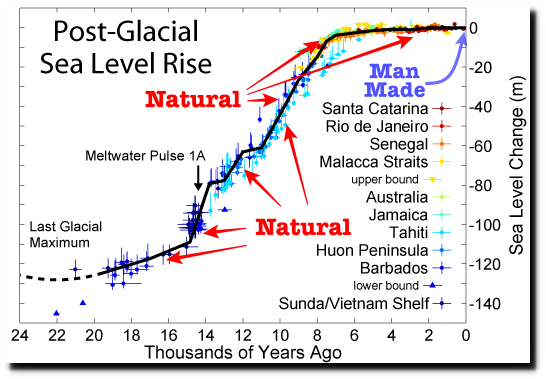
Oceans, which average over 12,000 feet deep, have risen a miniscule 9 inches in 140 years, which is essentially immeasurable, let alone be attributed to CO2, oil, humans or anything else. There are thousands of natural variables.

It would help if children were shown the truth as to how life expectancy has almost doubled since we started using coal and oil and people in countries that don’t use oil and coal live shorter lives. 

Maybe it would help to inform them of all the products that are derived from crude oil and ask them if their lives would be better off without them. 

A Partial list of the over 6,000 products made from one barrel of oil (after creating 19 gallons of gasoline) 

Maybe the children should be shown how all of the previous dire predictions have been wrong including one from over 100 years ago that predicted the ice would soon be gone, that oceans were dying, and coastal cities would soon disappear. 

“The Arctic Ocean is warming up, icebergs are growing scarcer, and in some places the seals are finding the water too hot. Reports from fishermen, seal hunters, and explorers all point to a radical change in climate conditions and hitherto unheard‐of temperatures in the Arctic zone. Exploration expeditions report that scarcely any ice has been met as far north as 81 degrees 29 minutes. Within a few years it is predicted that due to the ice melt the sea will rise and make most coastal cities uninhabitable.” — from an Associated Press report published in The Washington Post on November 2, 1922

It is a true shame that most of the media along with educators spend their time scaring children that we are destroying the Earth and that we don’t have much time left instead of doing their job to educate and inform them and to teach them to ask questions and do research. It is no wonder so many young people are suicidal and don’t want children. 

We get extremely destructive government policies when people
are indoctrinated instead of told the truth.

We should count our blessings that the Earth has such an abundance of natural resources and that humans were given a brain that allowed them to develop them.


Update on Zombie Kids Climate Lawsuits: (Juliana vs. US) (Held vs Montana)

Jonathan H. Adler reports on the astonishing attempt to revive the climate lawsuit at Reason District Court Judge Revives Kids Climate Case.  Excerpts in italics with my bolds and added images.

Years after the Ninth Circuit ordered the case dismissed,
it is brought back to life with a surprising trial court order.

This afternoon (June 1, 2023), Judge Aiken on the U.S. District Court for the District of Oregon revived  Juliana v. United States, aka the “Kids Climate Case,” by granting the plaintiffs’ motion to amend their complaint, some two years after the motion was filed.

This is a remarkable order because the U.S. Court of Appeals for the Ninth Circuit previously ordered the case dismissed due to a lack of standing. The original Ninth Circuit panel ruling was in January 2020, and the court denied en banc rehearing in February 2021. The plaintiffs filed a motion to amend in March 2021, which was opposed by the Department of Justice on the grounds that “the mandate rule requires [the district] court to dismiss the case.” Despite the DOJ’s opposition, the district court further ordered a settlement conference, and whatever jurisdiction the district court may have retained over the case should have expired when the plaintiffs failed to petition for certiorari.

Judge Aiken clearly sees things differently.  As for how the proposed amendments address the standing problems identified by the Ninth Circuit, Judge Aiken wrote:

Plaintiffs assert that their proposed amendments cure the defects the Ninth Circuit identified and that they should be given opportunity to amend. Plaintiffs explain that the amended allegations demonstrate that relief under the Declaratory Judgment Act alone would be substantially likely to provide partial redress of asserted and ongoing concrete injuries, and that partial redress is sufficient, even if further relief is later found unavailable. . . .

Plaintiffs’ Second Amended Complaint thus requests this Court to:
(1) declare that the United States’ national energy system violates and continues to violate the Fifth Amendment of the U.S. Constitution and Plaintiffs’ constitutional rights to substantive due process and equal protection of the law;
(2) enter a judgment declaring the United States’ national energy system has violated and continues to violate the public trust doctrine; and
(3) enter a judgment declaring that § 201 of the Energy Policy Act has violated and continues to violate the Fifth Amendment of the U.S. Constitution and plaintiffs’ constitutional rights to substantive due process and equal protection of the law. . . .

Here, plaintiffs seek declaratory relief that “the United States’ national energy system that creates the harmful conditions described herein has violated and continues to violate the Fifth Amendment of the U.S. Constitution and Plaintiffs’ constitutional rights to substantive due process and equal protection of the law.” (Doc. 514-1 ¶ 1). This relief is squarely within the constitutional and statutory power of Article III courts to grant. Such relief would at least partially, and perhaps wholly, redress plaintiffs’ ongoing injuries caused by federal defendants’ ongoing policies and practices. Last, but not least, the declaration that plaintiffs seek would by itself guide the independent actions of the other branches of our government and cures the standing deficiencies identified by the Ninth Circuit. This Court finds that the complaint can be saved by amendment. See Corinthian Colleges, 655 F.3d at 995.

The Ninth Circuit’s initial decision dismissing the Juliana case was likely the best outcome the plaintiffs could have hoped for, as it avoided substantive Supreme Court intervention (after the justices had indicated their concern about the case). By reviving the case, Judge Aiken is tempting fate—and risking a broader legal judgment that could preclude a broader array of climate-related suits.

Comment:

The Ninth Circuit Court in Juliana observed that there was no explicit right to a stable climate system in the United States Constitution,  and held that, even if such a right existed, the issue was not justiciable because the Court could not grant an effective remedy.

What’s at Stake in Held vs. Montana

From Montana Free Press:  In a 2011 Montana lawsuit, Our Children’s Trust directly petitioned the Montana Supreme Court to declare that Montana has a duty to protect and preserve the atmosphere. The court rejected the petition, stating that there was no reason the youth plaintiffs couldn’t follow the normal channels of litigation through a lower court, followed by an appeal to the Supreme Court. To that end, Held was filed in Montana’s First Judicial District Court with the intent of establishing a court record that can, if needed, be appealed to the Montana Supreme Court, according to attorneys for the plaintiffs.

Filed in March 2020, the lawsuit, Held v. Montana, was brought by 16 youth plaintiffs from across Montana who allege the state has violated their constitutional right to a clean and healthful environment. The complaint focuses on two statutes — provisions of Montana’s state energy policy, which explicitly promotes the use of fossil fuels, and an amendment to the Montana Environmental Policy Act (MEPA), which prevents the state from considering how the state’s energy economy contributes to climate change.

But on May 23, Lewis and Clark County District Court Judge Kathy Seeley agreed with the state, writing that the only relief she could have offered would have rolled back the statute, which the Legislature already did.

However, Seeley stayed firm on her decision to allow the case to proceed to trial, which was a landmark victory for climate change advocates when she initially set a bench trial in 2021.  In the recent court filing, Seeley wrote there are five facts in dispute to be taken up at trial, including “whether climate impacts and effects in Montana can be attributed to Montana’s fossil fuel activities.”

In the judgment of the Court, the following material facts are in dispute:
1. Whether Plaintiffs’ injuries are mischaracterized or inaccurate.
2. Whether Montana’s GHG emissions can be measured incrementally.
3. Whether climate change impacts to Montana’s environment can be measured incrementally.
4. Whether climate impacts and effects in Montana can be attributed to Montana’s fossil fuel activities.
5. Whether a favorable judgment will influence the State’s conduct and alleviate Plaintiffs’ injuries or prevent further injury.

Comment:

HvM raises the issue whether it is the appropriate role of the Court to endorse and compel what it may view as a desirable policy. The majority in Juliana acknowledged that based on the evidence, it would be good for the government to adopt “a comprehensive scheme to decrease fossil fuel emissions and combat climate change, both as a policy matter in general and a matter of national survival in particular.” The majority, however, explained that responsibility for the myriad decisions that go into formulating such a comprehensive policy is allocated to the legislative and executive branches of government, not the courts. Even though the details of implementation of the policy would be left to the discretion of the government, the Court would inevitably be called upon to “pass judgment on the sufficiency of the government’s response to the order, which necessarily would entail a broad range of policymaking.”  Further, “given the complexity and long-lasting nature of global climate change, the court would be required to supervise the government’s compliance with any suggested plan for many decades.”

Comment: 

Readers likely know that this is one of the few times that the substance of climate alarm claims is on trial, and that the skeptical case against them can be made persuasively.  In 2011 Dr. Ed Berry of Montana made the case against the petition to the state supreme court.  But he has been left out of this one, and doubts the strength of the defense that will be presented. The proceedings began on June 12, 2023, and you can follow them along with his commentary.

Montana’s AG censored the science he needed  to defeat Held v Montana


Choices Usurped by Self Righteous Tyrants

William Watson writes at Financial Post Self-righteous totalitarian tinkering and the end of gas-powered cars.  Excerpts in italics with my bolds and added images.

Canadians often get to vote on important local projects.
When did we all vote on abolishing gas engines?

I am happy to report that democracy is alive and well in the Montreal suburb where I live and by all appearances completely uninfluenced by the Chinese Communist Party.

My evidence is purely anecdotal: the steady stream of voters arriving at the advance poll held Sunday at the almost 60-year-old town arena to cast their ballot in a referendum on whether we should replace that self-same arena — famous as being the coldest in all of Montreal — with a new almost $40-million sports complex that would include a new arena. The federal and provincial governments have pledged $12.5 million and private fundraising has brought in a few million more but the bulk of the money would be provided by the town, partly through new debt issue.

Getting citizen approval (or rejection) of that issue was the purpose of the referendum,
which was called after the requisite number of voters registered their request for it.

My guess is the new arena won’t pass. It has been discussed for several years and the amount that was always mentioned was at most $20 million so when this spring the lowest contractor bid came in at $38 million, that was a shock. There has been lots of back and forth at various meetings and a flurry of flyers in the mail debating pros and cons, including what the effect on property taxes will be. I suspect the strong turnout means people don’t want to pay more to service the higher debt. But we’ll know when the final vote takes place next week. What’s most important is that there seems to be widespread agreement that the vote is the final word — though in this litigious age it’s not inconceivable that whichever side loses may try their luck in the courts.

Whatever the outcome, it has been a great exercise in democracy. And it has left me feeling I’d like to have a direct say in other decisions that will have an important effect on my life. One that comes to mind immediately is Ottawa’s decision to do away with gasoline-powered cars.

By 2035, ministers Steven Guilbeault and Jonathan Wilkinson decreed in 2021,
the “mandatory target,” i.e., the requirement, for all new
“light-duty cars and passenger trucks” is that they be zero-emission.

Thus will end, in this country at least, the widespread use of the internal-combustion engine for personal transportation, a technology that since its first commercially successful use in the 19th century, has brought unprecedented prosperity and freedom of movement to literally billions of people around the world and largely made possible the much-decried suburban lifestyle that is currently under all-out attack from car-less urban sophisticates. It has also over the decades undergone continuous and considerable refinement in terms of efficiency, noise and exhaust, so that modern combustion engines are barely recognizable compared to early versions.

In 2021, Statistics Canada tells us, more than 26.2 million “road motor vehicles” were registered in this country, which works out to not quite one car per adult Canadian (depending where you draw the age line for adult, of course).

Of those 26.2 million registered motor vehicles, 303,073 were hybrid-electric, 152,685 battery-electric and 95,896 plug-in electric — so some 551,000 in total, or a little over two per cent, were low or no emissions. Except that net-zero absolutists really don’t like hybrid vehicles, which run part of the time on fossil fuels, so the true proportion of elite-acceptable net-zero vehicles was under one per cent. And we’re now in 2023, which means 2035 is just 12 years away. What contortions will the car industry, not to mention the economy, have to be put through so that in those 12 short years all new cars are net-zero? The hubris of people willing to impose such contortions is breathtaking.

Whether or not my town gets a new arena will in fact have much less impact on my life than whether in 12 years we Canadians will be forbidden from acquiring a newly produced internal combustion engine car. Yet while my opinion on the arena is being sought and respected nobody ever asked my opinion about whether or not to ban gas cars.

As Lionel Shriver, one of my favourite columnists, put it in London’s Spectator magazine last week: “We’ve entered an era of unaccountable bureaucratic imposition that’s only going to get worseBans on the sale of new petrol cars by 2030 and gas boilers in new homes by 2025 that no one voted for are just the beginning of a self-righteous totalitarian tinkering with our daily lives that makes a mockery of the notion that democracies are governed by consent.”

She was writing about Britain and in particular London’s “ultra-low emissions zone,” in which non-complying cars pay a charge of £12.50 a day. But she could have been writing about this country or indeed any western democracy, in all of which officials seem firmly in control and voters essentially powerless.

“Self-righteous totalitarian tinkering” is a phrase that
these days echoes familiarly in Canada.

Absurd Climate Blame Game

Lorrie Goldstein explains.at Toronto Sun in above video Guilbeault  Plays Absurd Blame Game–Attacks Conservatives, but not China, on climate change.  Transcript from closed captions in italics with my bolds and added images.

PM Trudeau: We will raise Canada’s price on carbon pollution Rising by 15 a ton starting in 2023 and rising to 170 Canadian dollars per ton by 2030.

Federal environment Minister Stephen Guilbeault says the Trudeau government could be more effective in fighting climate change were it not for the opposition of the federal conservatives. He told CTV news that he would like to do things like, for example, speeding up Canada’s goal of net zero emissions, possibly lowering it to 2040 instead of the current 2050.

Now his argument is absurd on a number of fronts. First of all Stephen Guilbeault and the Trudeau government don’t need the permission of the conservatives to lower our emissions targets to 2040 instead of 2050. He didn’t need them to set the 2050 Target; why would he need them for the 2040 Target?

And in terms of keeping in power to fight climate change, his government doesn’t need the support of the federal conservatives. So far the NDP are supporting him. And if anything they want the government to go faster in fighting climate change.

But the more important issue is that it doesn’t matter what Canada’s Target is. It also doesn’t matter how much we pay in carbon taxes or clean fuel regulations or subsidies to corporate green companies. None of that matters, the reason being Canada’s emissions are a rounding error in terms of global emissions.

Nothing Canada does on its own is going to slow the rate of wildfires or floods
or wind storms or severe weather in Canada. Zero Effect.

Why? Here’s a few numbers according to the federal government. In 2019 our emissions were 724 million tons of greenhouse gas emissions. The global total is 48,000 million tons. China’s total, as the largest single emitter in the world, was about 12,700 million tons. Tony Keller in the Globe and Mail made a good analogy about this. He said to think of the world’s greenhouse gas emissions as water in a swimming pool. What’s happening is that in Canada we’re trying to lower the level of the water using a soup spoon, and meanwhile China and other countries are filling up the pool using a fire hose.

Now if Stephen Guilbeault and Trudeau really want to be more effective in fighting climate change, they shouldn’t be attacking the conservatives; they should be attacking China’s dictators.

Now we’re always accused, even by our own government, that Canadians are wanton wasters of energy because we are the highest per capita emitters in the world. That’s an absurd metric to use particularly for Canada. Because we are the second coldest country on Earth, the second largest country on Earth, and we have a relatively small population.

Use another metric that has been used, emissions per square kilometer. Lo and behold Canada becomes one of the lowest emitters in the developed world. It’s true that what you get always depends on what you measure.

The only practical effect of our emission targets and paying more for oil and gas to heat our homes and everything else is: In theory it gives Justin Trudeau the moral authority to attempt to use moral persuasion on countries like China to lower their emissions.

Of course we already know from experience how well Canada’s
moral influence works on China’s dictators.

Postscript:  A Voice from Silent Canadians


Our Chaotic Climate System


Foucault’s pendulum in the Panthéon, Paris

h/t tom0mason for inspiring this post, including his comment below

The Pendulum is Settled Science

I attended North Phoenix High School (Go Mustangs!) where students took their required physics class from a wild and crazy guy. Decades later alumni who don’t remember his name still reminisce about “the crazy science teacher with the bowling ball.”

To demonstrate the law of conservation of energy, he required each and every student to stand on a ladder in one corner of the classroom. Attached to a hook in the center of the rather high ceiling was a rope with a bowling ball on the other end. The student held the ball to his/her nose and then released it, being careful to hold still afterwards.

The 16 pound ball traveled majestically diagonally across the room and equally impressively returned along the same path. The proof of concept was established when the ball stopped before hitting your nose (though not by much).  In those days we learned to trust science and didn’t need to go out marching to signal some abstract virtue.

The equations for pendulums are centuries old and can predict the position of the ball at any point in time based on the mass of the object, length of the rope and starting position.

Pictured above is the currently operating Foucault pendulum that exactly follows these equations. While it had long been known that the Earth rotates, the introduction of the Foucault pendulum in 1851 was the first simple proof of the rotation in an easy-to-see experiment. Today, Foucault pendulums are popular displays in science museums and universities.

What About the Double Pendulum?

Trajectories of a double pendulum

A comment by tom0mason at alerted me to the science demonstrated by the double compound pendulum, that is, a second pendulum attached to the ball of the first one. It consists entirely of two simple objects functioning as pendulums, only now each is influenced by the behavior of the other.

Lo and behold, you observe that a double pendulum in motion produces chaotic behavior. In a remarkable achievement, complex equations have been developed that can and do predict the positions of the two balls over time, so in fact the movements are not truly chaotic, but with considerable effort can be determined. The equations and descriptions are at Wikipedia Double Pendulum

Long exposure of double pendulum exhibiting chaotic motion (tracked with an LED)

But here is the kicker, as described in tomomason’s comment:

If you arrive to observe the double pendulum at an arbitrary time after the motion has started from an unknown condition (unknown height, initial force, etc) you will be very taxed mathematically to predict where in space the pendulum will move to next, on a second to second basis. Indeed it would take considerable time and many iterative calculations (preferably on a super-computer) to be able to perform this feat. And all this on a very basic system of known elementary mechanics.

And What about the Climate?

This is a simple example of chaotic motion and its unpredictability. How predictable is our climate with so many variables and feedbacks, some known some unknown? Consider that this planet’s weather/climate system is chaotic in nature with many thousands (millions?) of loosely coupled variables and dependencies, and many of these variables have very complex feedback features within them.

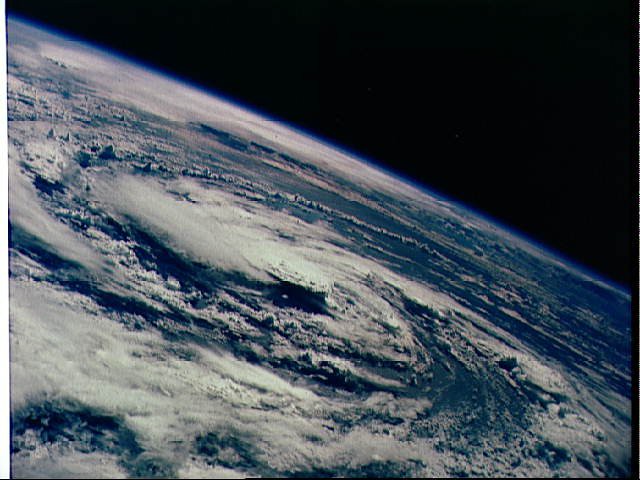
Hurricane Gladys, photographed from orbit by Apollo 7 in 1968 (Photo: NASA)

Summary

To quote the IPCC:

The climate system is a coupled non-linear chaotic system, and therefore the long-term prediction of future climate states is not possible. Rather the focus must be upon the prediction of the probability distribution of the system’s future possible states by the generation of ensembles of model solutions.

A recent National Review article draws the implications:
The range of predicted future warming is enormous — apocalyptism is unwarranted.

But as the IPCC emphasizes, the range for future projections remains enormous. The central question is “climate sensitivity” — the amount of warming that accompanies a doubling of carbon dioxide in the atmosphere. As of its Fifth Assessment Report in 2013, the IPCC could estimate only that this sensitivity is somewhere between 1.5 and 4.5°C. Nor is science narrowing that range. The 2013 assessment actually widened it on the low end, from a 2.0–4.5°C range in the prior assessment. And remember, for any specific level of warming, forecasts vary widely on the subsequent environmental and economic implications.

For now, though, navigating the climate debate will require translating the phrase “climate denier” to mean “anyone unsympathetic to the most aggressive activists’ claims.” This apparently includes anyone who acknowledges meaningful uncertainty in climate models, adopts a less-than-catastrophic outlook about the consequences of future warming, or opposes any facet of the activist policy agenda. The activists will be identifiable as the small group continuing to shout “Denier!” The “deniers” will be identifiable as everyone else.

Climate System Summation

Esteemed climate scientist Richard Lindzen ends a very fine recent presentation (here) with this description of the climate system:

I haven’t spent much time on the details of the science, but there is one thing that should spark skepticism in any intelligent reader. The system we are looking at consists in two turbulent fluids interacting with each other. They are on a rotating planet that is differentially heated by the sun. A vital constituent of the atmospheric component is water in the liquid, solid and vapor phases, and the changes in phase have vast energetic ramifications. The energy budget of this system involves the absorption and reemission of about 200 watts per square meter. Doubling CO2 involves a 2% perturbation to this budget. So do minor changes in clouds and other features, and such changes are common. In this complex multifactor system, what is the likelihood of the climate (which, itself, consists in many variables and not just globally averaged temperature anomaly) is controlled by this 2% perturbation in a single variable? Believing this is pretty close to believing in magic. Instead, you are told that it is believing in ‘science.’ Such a claim should be a tip-off that something is amiss. After all, science is a mode of inquiry rather than a belief structure.

Flow Diagram for Climate Modeling, Showing Feedback Loops

Social Cost of Carbon Game

Ross McKitrick writes at Financial Post Junk Science Week —The Social Cost of Carbon game.  H/T John Ray Excerpts in italics with my bolds.

Estimates of the SCC championed by Guilbeault are not science

Environment Minister Steven Guilbeault recently announced that the Social Cost of Carbon (SCC), or the dollar value of supposed damages associated with each tonne of carbon dioxide emissions, is about $247, nearly five times higher than the old estimate of $54. He made it sound like a discovery, as if a bunch of experts had finally been able to measure something they previously only guessed at.

Like when scientists were finally able to measure the mass of an electron or the age
of the Earth, now finally we can measure the SCC.

But in reality there has been no breakthrough in economics comparable to those physics breakthroughs. Countless SCC estimates already exist ranging from small negative amounts (i.e. carbon dioxide emissions are beneficial) to many thousands of dollars per tonne. Every such estimate is like a complex “if-then” statement: if the following assumptions hold, then the SCC is $X. Yale economist William Nordhaus won the 2018 Nobel Memorial Prize in economics for developing some of the first methods for combining all the “if” statements into systems called Integrated Assessment Models or IAMs. And using conventional economic and climate modelling methods, he tended to get pretty low SCC values over the years, which has long been a sore point among climate activists and the politicians who share their agenda.

But economists are on the case. The $247 figure referenced by Guilbeault comes from a new report from the Biden administration that tossed out all the previous models, including Nordhaus’s, and instead cobbled together a set of new models that when run together yield much higher SCC values.

In many ways the new models are just like the old ones.

For example they persist in using an Equilibrium Climate Sensitivity of 3 degrees C. This refers to the warming expected from doubling the amount of CO2 in the atmosphere. The authors cite the Sixth Assessment Report of the Intergovernmental Panel on Climate Change as the basis for this decision, apparently unaware that that estimate has already been shown in the climate literature to be flawed. Using the IPCC’s own method on updated data yields a sensitivity estimate of about 2.2 C or less, and as I have shown in a recent publication this is enough to cause the SCC estimate in a standard model to drop to nearly zero.

The biggest boosts to the new SCC figure hailed by Guilbeault come from revisions to agricultural productivity impacts and mortality costs from climate warming. The evidence for large negative agricultural impacts comes from a 2017 article by Frances Moore and co-authors that looked at the combined effects of CO2 fertilization and warming, concluding the net effect would harm global agriculture. Oddly, they used the same data as a 2014 study by Andrew Challinor and co-authors who had found the opposite: the combination of increased CO2 and warming would have much more benign, and in some cases even beneficial, results.

How did Moore et al. get different results from the same data? They used a different statistical model but unfortunately didn’t provide evidence showing it is better than the one Challinor used, so it’s unclear whose results are stronger. But we know whose are more popular. The Biden administration team referred only to the Moore study and left out any mention of the Challinor one, and it is a safe assumption that the reviewers didn’t notice the omission. See how the game is played?

Regarding the mortality effect, the report relies on evidence innew study that apparently shows that warming will mean fewer deaths from cold and more from heat, and the combined effect globally is a much larger overall death toll than previously thought. The study is by an impressive team led by economist Tamma Carleton and 15 co-authors. In their preface they thank 17 research assistants, four project managers, 13 reviewers and seminar participants at 20 prestigious academic institutions around the world. It’s a high-quality piece of work, but like tens of thousands of other splashy climate impacts studies it relies for its headline conclusions on the discredited RCP8.5 emissions scenario.

How did all those prestigious researchers and reviewers miss this flaw?

The authors compiled mortality data from selected countries around the world and matched them to temperature records, then built a statistical model to extrapolate over the entire world. They used some clever economic modelling to estimate the beneficial effects of adaptive behaviour (like installing air conditioning) as well as the costs. Then they estimated a “mortality function” that spits out the number of additional deaths between now and the year 2300 attributable to each additional tonne of emissions, both from warming itself and the costs of adaptation. To compute this number the authors needed emissions and income projections out to 2300.

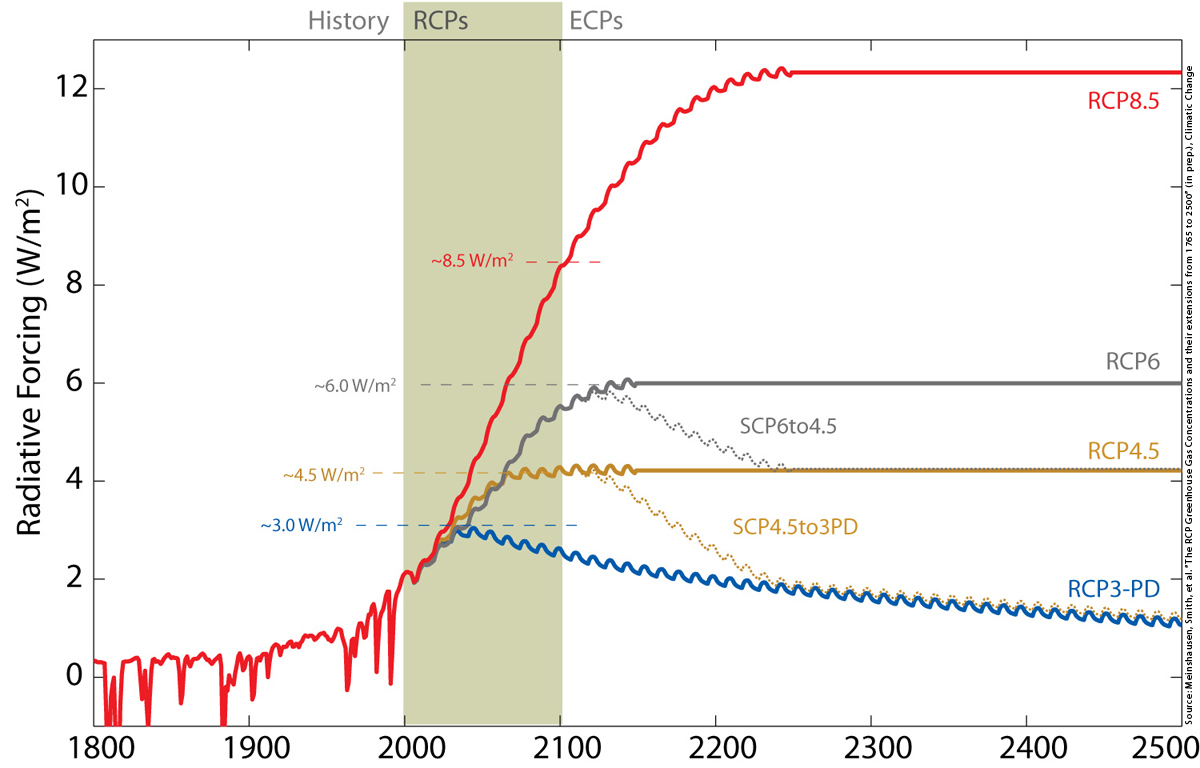
No uncertainty ranges are shown and reported, as for creating the recommendation datasets for CMIP5, central estimates have been assumed closely in line with central estimates in IPCC AR4. (SCP45to3PD). No uncertainty ranges are shown and reported, as for creating the recommendation datasets for CMIP5, central estimates have been assumed closely in line with central estimates in IPCC AR4. https://www.pik-potsdam.de/~mmalte/rcps/

For this they used two scenarios: the extreme, coal-blackened Dickensian fiction called RCP8.5, and a mid-range emissions projection called RCP4.5. In my 2020 JSW column I discussed the efforts of climate analysts to convince their colleagues to stop using the RCP8.5 scenario because of its unrealistic assumptions. Interestingly the Biden administration report moves away from both RCP scenarios and focuses on a new one from Resources for the Future (RFF) which, through most of the rest of this century, projects emissions even below RCP4.5.

But in the main text of the Carleton paper it highlights mortality estimates associated with an RCP8.5 future. Basically we all die a fiery death. If you want to know what the results are using RCP4.5, you will need to track down the 113-page online-only appendix and navigate to page A75, then transfer a table full of numbers to a spreadsheet so you can compare the outcomes.

The two figures on this page summarize what they show. With no adaptation, under the RCP8.5 emissions scenario each tonne of CO2 kills 221 people per hundred thousand (100k) between now and 2300, with the uncertainty range shown by the whisker line. Under RCP4.5 each tonne kills 40 people per 100k. I estimated what their model would yield using the RFF scenario: the effect drops further to 18 people per 100k, and the number is not significantly different from zero.

The second figure reports results if adaptive behaviour is assumed. Under RCP8.5 the mortality rate per 100k drops to 85 people, under RCP4.5 it drops to 14 and under the RFF scenario it drops to five, and the latter two estimates are not significantly different from zero, which means that there is no statistically valid reason to add the mortality effect to an SCC model.

Another step in the analysis is to place a value on these deaths, which depends on things like age and income in every place. Digging further into the online appendix (p. A100), if they stick with RCP4.5 but use a variant that predicts higher income growth the value of the mortality effect goes negative, which means taking account of the lives saved or lost due to warming leads to a lower SCC.

No mention of this in Guilbeault’s announcement.

Thus I reiterate that SCC estimates are if-then statements. They are not intrinsically true or false: what matters is the credibility of the assumptions.

♦  If emissions follow the RCP8.5 scenario (which they won’t), and
♦  if people don’t adapt to climate change (which they will), and
♦  if CO2 and warm weather stop being good for plants (which is unlikely),
    then the SCC could be five times larger than previously thought.

More likely it isn’t, and very well could be much smaller.

See Also Biden’s Arbitrary Social Cost of Carbon: What You Need to Know


El Nino Warms UAH Air Temps in May 2023

The post below updates the UAH record of air temperatures over land and ocean. Each month and year exposes again the growing disconnect between the real world and the Zero Carbon zealots.  It is as though the anti-hydrocarbon band wagon hopes to drown out the data contradicting their justification for the Great Energy Transition.  Yes there is warming from an El Nino buildup but no basis to blame it on CO2.  

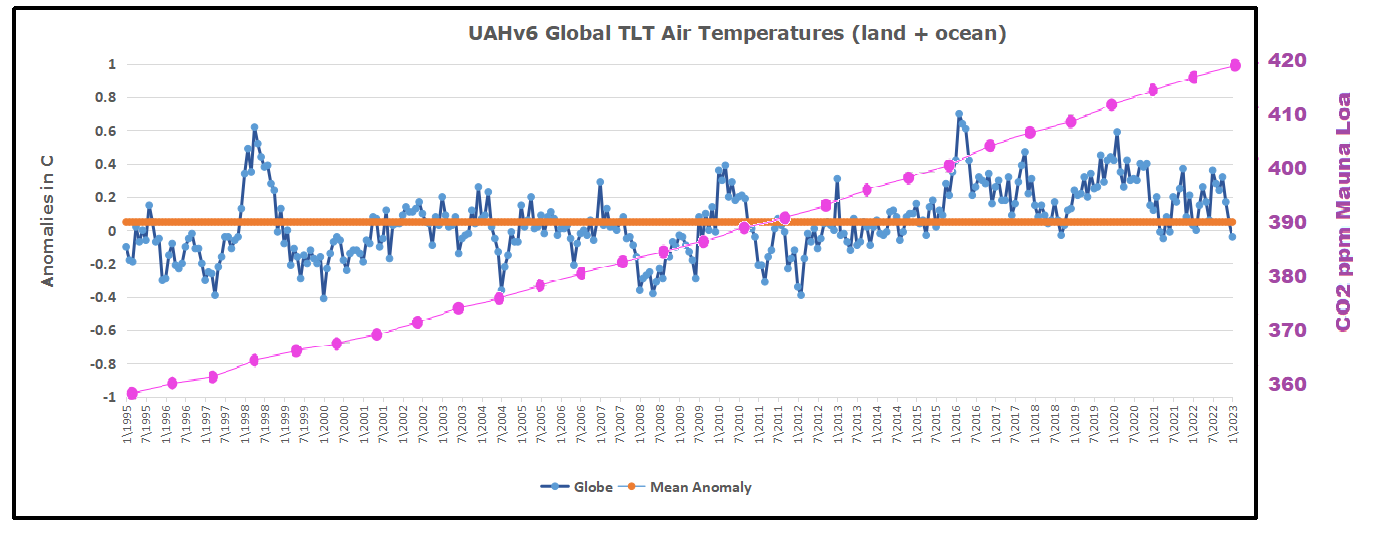
As an overview consider how recent rapid cooling  completely overcame the warming from the last 3 El Ninos (1998, 2010 and 2016).  The UAH record shows that the effects of the last one were gone as of April 2021, again in November 2021, and in February and June 2022  Now at year end 2022 and continuing into 2023 global temp anomaly is matching or lower than average since 1995, an ENSO neutral year. (UAH baseline is now 1991-2020).

For reference I added an overlay of CO2 annual concentrations as measured at Mauna Loa.  While temperatures fluctuated up and down ending flat, CO2 went up steadily by ~60 ppm, a 15% increase.

Furthermore, going back to previous warmings prior to the satellite record shows that the entire rise of 0.8C since 1947 is due to oceanic, not human activity.

gmt-warming-events

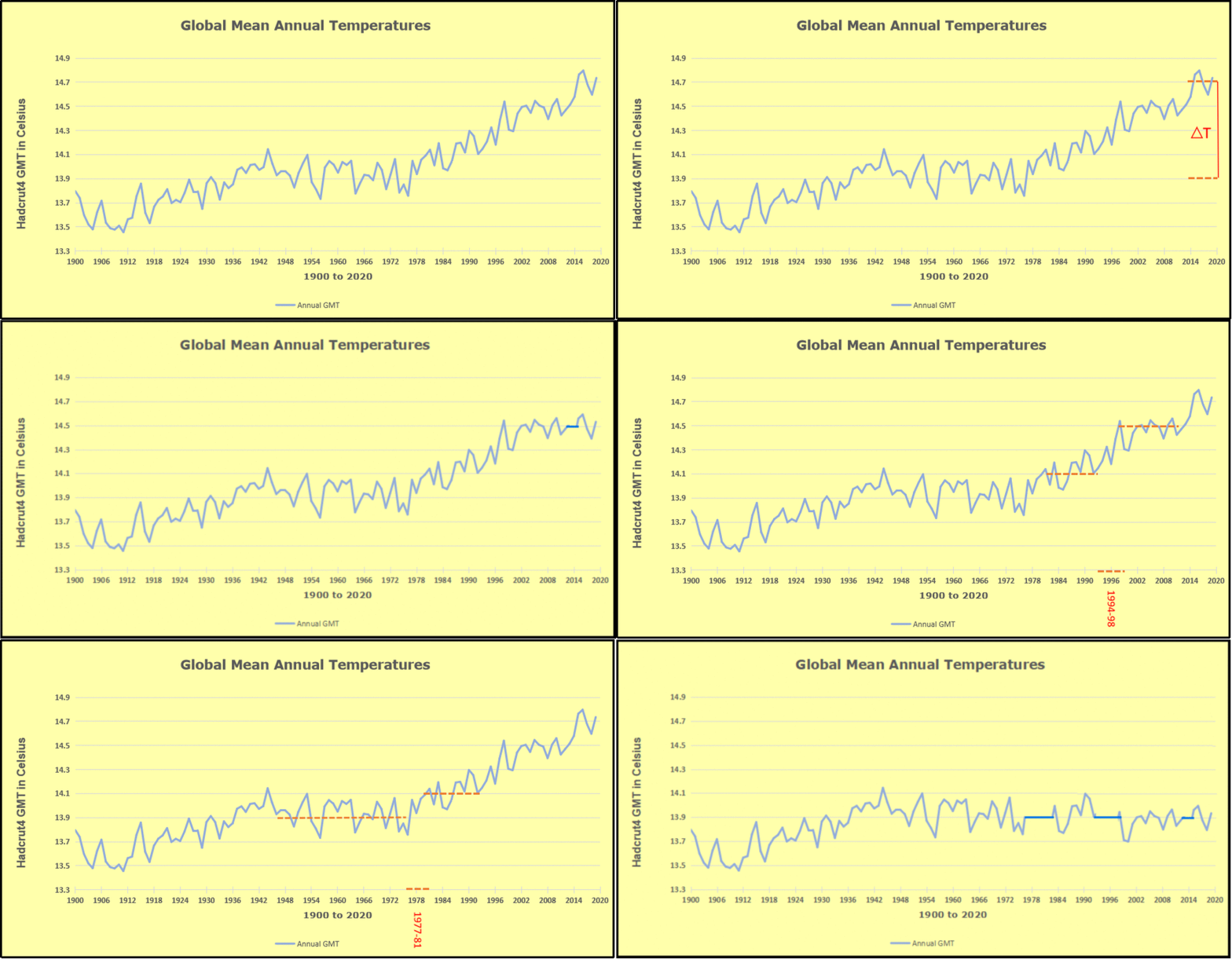
The animation is an update of a previous analysis from Dr. Murry Salby.  These graphs use Hadcrut4 and include the 2016 El Nino warming event.  The exhibit shows since 1947 GMT warmed by 0.8 C, from 13.9 to 14.7, as estimated by Hadcrut4.  This resulted from three natural warming events involving ocean cycles. The most recent rise 2013-16 lifted temperatures by 0.2C.  Previously the 1997-98 El Nino produced a plateau increase of 0.4C.  Before that, a rise from 1977-81 added 0.2C to start the warming since 1947.
Importantly, the theory of human-caused global warming asserts that increasing CO2 in the atmosphere changes the baseline and causes systemic warming in our climate.  On the contrary, all of the warming since 1947 was episodic, coming from three brief events associated with oceanic cycles. 

Update August 3, 2021

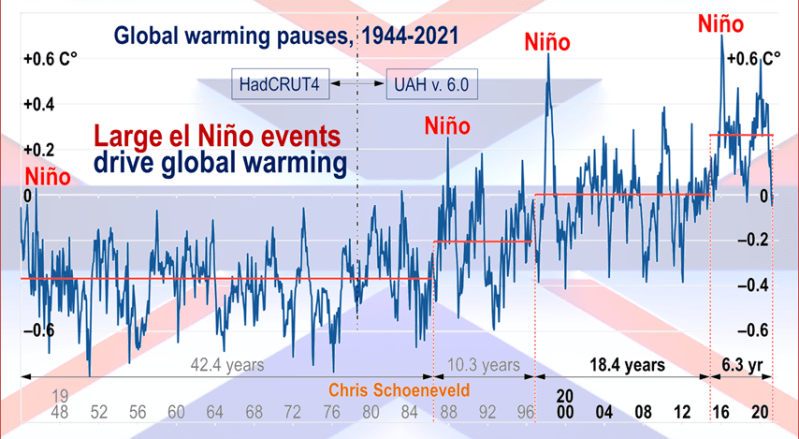
Chris Schoeneveld has produced a similar graph to the animation above, with a temperature series combining HadCRUT4 and UAH6. H/T WUWT

image-8


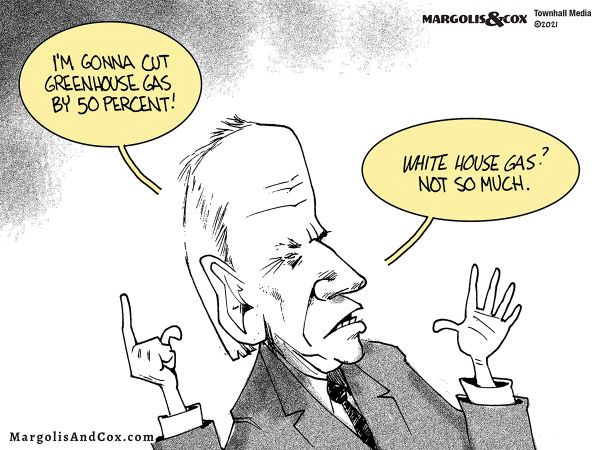
mc_wh_gas_web20210423124932

See Also Worst Threat: Greenhouse Gas or Quiet Sun?

May 2023 Update  El Nino Shows Up In Warming Spike

banner-blog

With apologies to Paul Revere, this post is on the lookout for cooler weather with an eye on both the Land and the Sea.  While you will hear a lot about 2020-21 temperatures matching 2016 as the highest ever, that spin ignores how fast the cooling set in.  The UAH data analyzed below shows that warming from the last El Nino Had fully dissipated with chilly temperatures in all regions. After a warming blip in 2022, land and ocean temps dropped again with 2023 starting below the mean since 1995.  Now in March to May EL Nino appears in a Tropical ocean Spike.
UAH has updated their tlt (temperatures in lower troposphere) dataset for May 2023. Posts on their reading of ocean air temps this month preceded updated records from HadSST4.  I last posted on SSTs using HadSST4 El Nino Comes to Save Global Warming April 2023 This month also has a separate graph of land air temps because the comparisons and contrasts are interesting as we contemplate possible cooling in coming months and years. Sometimes air temps over land diverge from ocean air changes.  For example in February, Tropical ocean temps alone moved upward, while temps in all land regions rebounded after hitting bottom. In May, as shown later on, ocean air everywhere warmed, led by a Tropics spike, while land air temps also rose sharply, despite cooling in SH.  Thus a Global uptick in UAH temperature record.

Note:  UAH has shifted their baseline from 1981-2010 to 1991-2020 beginning with January 2021.  In the charts below, the trends and fluctuations remain the same but the anomaly values change with the baseline reference shift.

Presently sea surface temperatures (SST) are the best available indicator of heat content gained or lost from earth’s climate system.  Enthalpy is the thermodynamic term for total heat content in a system, and humidity differences in air parcels affect enthalpy.  Measuring water temperature directly avoids distorted impressions from air measurements.  In addition, ocean covers 71% of the planet surface and thus dominates surface temperature estimates.  Eventually we will likely have reliable means of recording water temperatures at depth.

Recently, Dr. Ole Humlum reported from his research that air temperatures lag 2-3 months behind changes in SST.  Thus the cooling oceans now portend cooling land air temperatures to follow.  He also observed that changes in CO2 atmospheric concentrations lag behind SST by 11-12 months.  This latter point is addressed in a previous post Who to Blame for Rising CO2?

After a change in priorities, updates are now exclusive to HadSST4.  For comparison we can also look at lower troposphere temperatures (TLT) from UAHv6 which are now posted for May.  The temperature record is derived from microwave sounding units (MSU) on board satellites like the one pictured above. Recently there was a change in UAH processing of satellite drift corrections, including dropping one platform which can no longer be corrected. The graphs below are taken from the revised and current dataset.

The UAH dataset includes temperature results for air above the oceans, and thus should be most comparable to the SSTs. There is the additional feature that ocean air temps avoid Urban Heat Islands (UHI).  The graph below shows monthly anomalies for ocean air temps since January 2015.

Note 2020 was warmed mainly by a spike in February in all regions, and secondarily by an October spike in NH alone. In 2021, SH and the Tropics both pulled the Global anomaly down to a new low in April. Then SH and Tropics upward spikes, along with NH warming brought Global temps to a peak in October.  That warmth was gone as November 2021 ocean temps plummeted everywhere. After an upward bump 01/2022 temps reversed and plunged downward in June.  After an upward spike in July, ocean air everywhere cooled in August and also in September.   

After sharp cooling everywhere in January 2023, all regions were into negative territory. Note the Tropics matched the lowest, followed since by spiking upward +0.7C, with the largest increase in May 2023.  Warming in both NH and SH added to a higher Global temp.  The SSTs are comparable to May 2015 and May 2017, with another peak like 2016 possible.  

Land Air Temperatures Tracking Downward in Seesaw Pattern

We sometimes overlook that in climate temperature records, while the oceans are measured directly with SSTs, land temps are measured only indirectly.  The land temperature records at surface stations sample air temps at 2 meters above ground.  UAH gives tlt anomalies for air over land separately from ocean air temps.  The graph updated for May is below.

Here we have fresh evidence of the greater volatility of the Land temperatures, along with extraordinary departures by SH land.  Land temps are dominated by NH with a 2021 spike in January,  then dropping before rising in the summer to peak in October 2021. As with the ocean air temps, all that was erased in November with a sharp cooling everywhere.  After a summer 2022 NH spike, land temps dropped everywhere, and in January, further cooling in SH and Tropics offset by an uptick in NH. 

Remarkably, in 2023, SH land air anomaly shot up 1.2C, from  -0.56C in January to +0.67 in April. Now in May, rising Tropical and NH Land air temps rose, pulling up the Global land anomaly, despite a drop in SH land temps.

The Bigger Picture UAH Global Since 1980

The chart shows monthly Global anomalies starting 01/1980 to present.  The average monthly anomaly is -0.06, for this period of more than four decades.  The graph shows the 1998 El Nino after which the mean resumed, and again after the smaller 2010 event. The 2016 El Nino matched 1998 peak and in addition NH after effects lasted longer, followed by the NH warming 2019-20.   An upward bump in 2021 was reversed with temps having returned close to the mean as of 2/2022.  March and April brought warmer Global temps, later reversed, and with the sharp drops in Nov., Dec. and January 2023 temps, there was no increase over 1980. Now in 2023 the May peak matches the two previous Julys.  Where it goes from here, up or down, remains to be seen.

TLTs include mixing above the oceans and probably some influence from nearby more volatile land temps.  Clearly NH and Global land temps have been dropping in a seesaw pattern, nearly 1C lower than the 2016 peak.  Since the ocean has 1000 times the heat capacity as the atmosphere, that cooling is a significant driving force.  TLT measures started the recent cooling later than SSTs from HadSST3, but are now showing the same pattern.  It seems obvious that despite the three El Ninos, their warming has not persisted, and without them it would probably have cooled since 1995.  Of course, the future has not yet been written.


What If Climate is Self-Regulating?

Andy Kessler writes at WSJ Can the Climate Heal Itself?  Excerpts in italics with my bolds and added images.

Dissenters from the catastrophe consensus on warming are worth listening to.

Stop with all the existential-crisis talk. President Biden said, “Climate change is literally an existential threat to our nation and to the world.” Defense Secretary Lloyd Austin also talks about the “existential threat” of climate change. National security adviser Jake Sullivan identifies an “accelerating climate crisis” as one reason for a “new consensus” for government picking winners and losers in the economy. Be wary of those touting consensus.

But what if the entire premise is wrong? What if the Earth is self-healing? Before you hurl the “climate denier” invective at me, let’s think this through. Earth has been around for 4.5 billion years— living organisms for 3.7 billion. Surely, an enlightened engineer might think, the planet’s creator built in a mechanism to regulate heat, or we wouldn’t still be here to worry about it.

The theory of climate change is that excess carbon dioxide and methane trap the sun’s radiation in the atmosphere, and these man-made greenhouse gases reflect more of that heat back to Earth, warming the planet. Pretty simple. Eventually, we reach a tipping point when positive feedback loops form—less ice to reflect sunlight, warm oceans that can no longer absorb carbon dioxide—and then we fry, existentially. So lose those gas stoves and carbon spewing Suburbans.

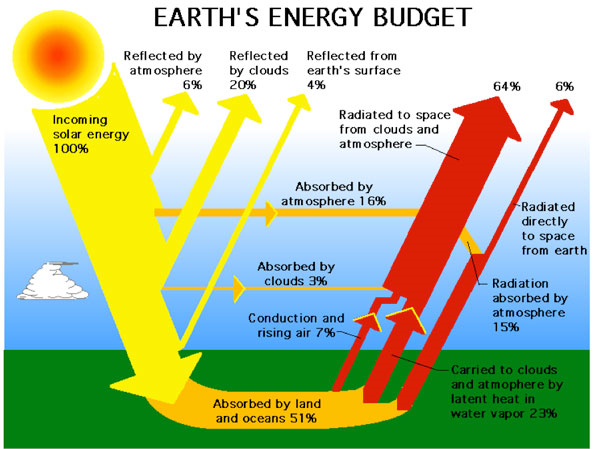
Note nearly half incoming solar energy is not absorbed by Earth’s surface.

But nothing is simple. What about negative feedback loops? Examples: human sweat and its cooling condensation or our irises dilating or constricting based on the amount of light coming in. Clouds, which can block the sun or trap its radiation, are rarely mentioned in climate talk.

Why? Because clouds are notoriously difficult to model in climate simulations. Steven Koonin, a New York University professor and author of “Unsettled,” tells me that today’s computing power can typically model the Earth’s atmosphere in grids 60 miles on a side. Pretty coarse. So, Mr. Koonin says, “the properties of clouds in climate models are often adjusted or ‘tuned’ to match observations.” Tuned!

Last month the coddling modelers at the United Nations’ World Meteorological Organization stated that “warming El Niño” and “human-induced climate change” mean there is a “66% likelihood that annual average global temperatures will exceed the threshold of 1.5 degrees Celsius above preindustrial levels by 2027.” Notice that El Niño is mentioned first.

To enlarge open image in new tab.

Richard Lindzen, a professor at the Massachusetts Institute of Technology and lead author of an early Intergovernmental Panel on Climate Change report, told me, “Temperatures in the tropics remain relatively constant compared with changes in the tropics-to-pole temperatures. The tropics-polar difference is about 40 degrees Celsius today but was 20 degrees during the warm Eocene Epoch and 60 degrees during Ice Ages.” This difference has more to do with changes in the Earth’s rotation, like wobbling, than anything else. According to Mr. Lindzen, this effect is some 70 times as great as human-made greenhouse gases.

OK, back to clouds. Cumulus clouds, the puffy ones often called thunderclouds, are an important convection element, carrying heat from the Earth’s surface to the upper atmosphere. Above them are high-altitude cirrus clouds, which can reflect heat back toward the surface. A 2001 Lindzen paper, however, suggests that high-level cirrus clouds in the tropics dissipate as temperatures rise. These thinning cirrus clouds allow more heat to escape. It’s called the Iris Effect, like a temperature-controlled vent opener for an actual greenhouse so you don’t (existentially) fry your plants. Yes, Earth has a safety valve.

Mr. Lindzen says, “This more than offsets the effect of greenhouse gases.” As you can imagine, theories debunking the climate consensus are met with rebuttals and more papers. Often, Mr. Lindzen points out, critics, “to maintain the warming narrative, adjust their models, especially coverage and reflection or albedo of clouds in the tropics.” More tuning.

A 2021 paper co-authored by Mr. Lindzen shows strong support for an Iris Effect.  Maybe Earth really was built by an engineer. Proof? None other than astronomer Carl Sagan described the Faint Young Sun Paradox that, 2.5 billion years ago, the sun’s energy was 30% less, but Earth’s climate was basically the same as today. Cirrus clouds likely formed to trap heat—a closed Iris and a negative feedback loop at work.

Figure 2: At higher temperatures there are more thunderstorms over the ocean and the area without high level clouds (dry and clear) expands further and thus allows more heat to radiate off into space (strong OLR) than when temperatures are lower, i.e. when the iris is smaller. Source: Figure 1 from MS15.

In a 2015 Nature Geoscience paper, Thorsten Mauritsen and Bjorn Stephen at the Max Planck Institute for Meteorology reran climate models using the Iris Effect and found them better at modeling historic observations. No need for tuning. Wouldn’t it be nice if the U.N. used realistic cloud and climate models?

Earth has warmed, but I’m convinced negative feedback loops will save us. Dismissing the Iris Effect or detuning it isn’t science. Sadly, climate science has morphed into climate rhetoric. And note, Treasury Secretary Janet Yellen explained in April that green spending “is, at its core, about turning the climate crisis into an economic opportunity.” Hmmm. “Catastrophic,” “existential” and “crisis” are cloudy thinking. Negative feedback is welcome. Dissenters from the catastrophe consensus on warming are worth listening to.

Footnote–Phanerozoic Temperatures

Maurice Lavigne commented that the best evidence of our self-regulating climate is found in the Phanerozoic temperature record.  I had to find out what he meant, which led me to discover this:

The PhanSST global database of Phanerozoic sea surface temperature proxy data

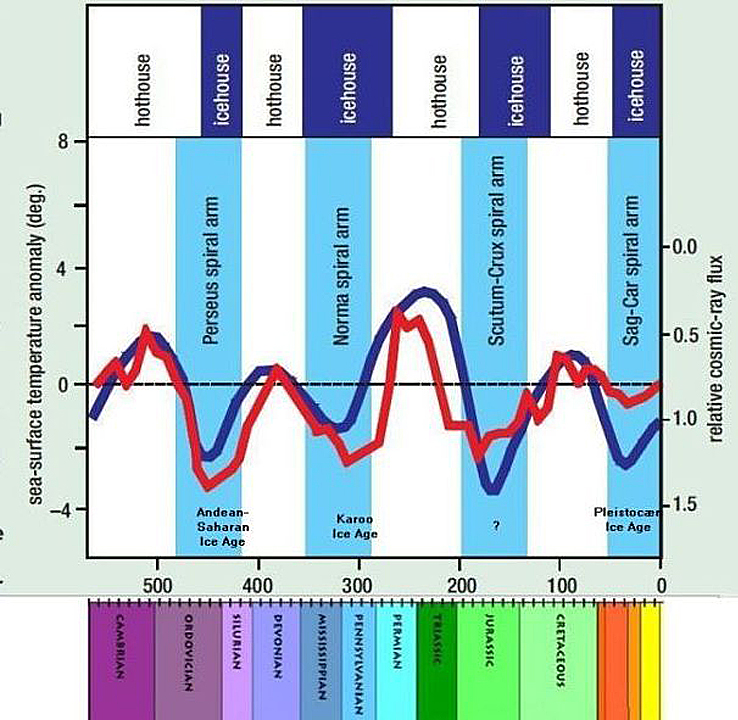
And this graph from Nir Shaviv and Jan Veizer:

Cosmic radiation and temperature through Phanerozoic according to Nir Shaviv and Jan Veizer. The vertical axis on the left represents the temperature as deviations from present temperature. The vertical axis on the right shows the cosmic radiation as multiples of radiation today – today’s radiation is set to 1. Note that the right scale is inverted so that strong radiation can be compared to low temperature. The red curve represents the temperature and the blue radiation. Temperature and cosmic radiation appear to have a very good correlation. The horizontal axis represents time through Phanerozoic’s more than 500 million years. Note that the Carboniferous is divided into “Missisipian” and “Pennsylvanian”, that is an American custom, referring to different types of coal from the coal mines.

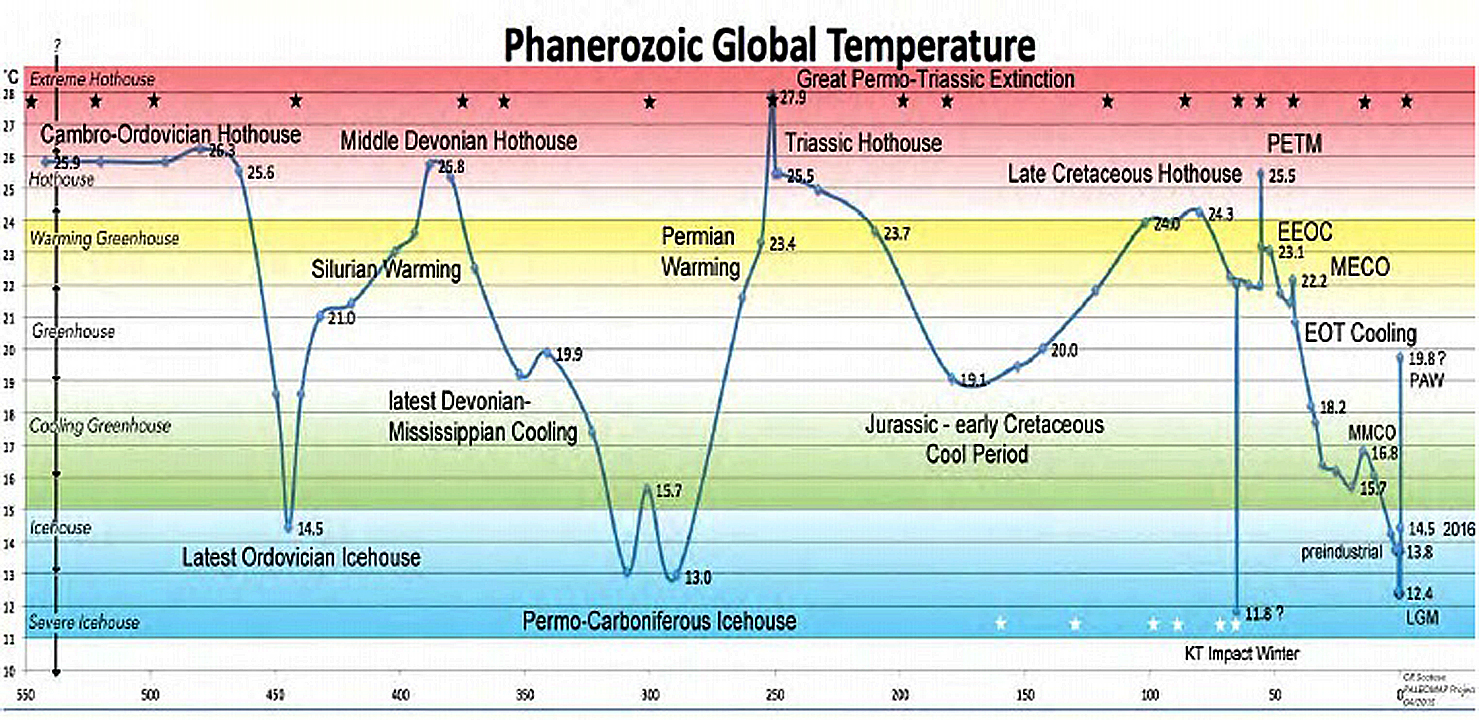
The image above comes from Christopher Scotese PaleoMAP project, showing the dramatic temperature and climate shifts, hothouse to icehouse and everything in between.  Finally, a graph showing these temperature cycles unrelated to CO2 concentrations.

See Also More Evidence of Nature’s Sunscreen

Greenhouse with adjustable sun screens to control warming.