In Defence of Non-IPCC CO2 Science
Currently some Zero Carbon zealots are trying to discredit and disappear a peer reviewed study of CO2 atmospheric concentrations because its findings contradict IPCC dogma.  The paper is World Atmospheric CO2, Its 14C Specific Activity, Non-fossil Component, Anthropogenic Fossil Component, and Emissions (1750–2018). by Skrable et al. (2022).  The link is to the paper and also shows the comments recently addressed to the authors and the editor of the journal, as well as responses by both.

This came to my attention by way of a comment by one of the attackers on my 2022 post regarding this study.  Text is below in italics with my bolds.

D. Andrews 10/7/2023

This post is over a year old, but in the interest of correcting the record, please note the following:
1. Skrable et al. have conceded that the data they “guesstimated” bore little resemblance to actual atmospheric radiocarbon data.

2. In a reanalysis using good data, they still find that the present atmosphere contains more 14C than if the entire atmospheric carbon increase since 1750 was 14C -free fossil fuel carbon. But that is no surprise. Atmospheric carbon and carbon from ocean/land reservoirs is continually mixing, with the result that net 14C moves to the 14C depleted atmosphere. Because of this mixing, one cannot infer the source of the atmospheric carbon increase from its present radiocarbon content.

3. One can conclude from the atmospheric increase being but half of human emissions, that ocean /land reservoirs are net sinks of carbon, nor sources. The increase is clearly on us, not natural processes.

4.Because this paper was made open access by the Health Physics editor, while numerous rebuttals and the partial retraction were kept behind a paywall, it got far more attention than it deserved. Health Physics has now removed the paywall, making the rebuttals available from their website (for a limited time). See in particular the letters from Schwartz et al. and Andrews (myself).

Skrable et al. Respond:

None of the four letters to the editor in the June 2022 issue of Health Physics include any specific criticism of the assumptions, methodologies, and simple equations that we use in our paper to estimate the anthropogenic fossil and non-fossil components present each year in the atmosphere. We have estimated from the “No bombs” curve, modeled in the absence of the perturbation due to nuclear weapons testing, an approximation fitting function of annual expected specific activities.

Annual mean concentrations of CO2 in our paper are used along with our revised expected specific activities to calculate values of the anthropogenic fossil and non-fossil components of CO2. These values are presented in revisions of Table 2a, Table 2, and figures in our paper. They are included here in a revised supporting document for our paper, which provides a detailed discussion of the assumptions, methodology, equations, and example calculations of the two components of CO2 in 2018.

Our revised results support our original conclusions and produce an even smaller anthropogenic fraction of CO2 in the atmosphere. The file for the revised supporting document, including Table 2, is available at the link: (Supplemental Digital Content link, https://links.lww.com/HP/A230 provided by HPJ).

With respect to the elements of our paper (Skrable et al. 2022), our responses to this lengthy letter to the Health Physics Journal, which mostly contains extraneous comments and critiques that are wrong, are as follows:

    1. Assumptions: No specific critique of our assumptions is given in the letter. Other related criticisms include the value of S(0), the specific activity in 1750, and the assumption that bomb- produced 14C being released from reservoirs was not significant. Our use of the likely elevated S(0) value is explained and justified in the paper. Regarding the use of bomb-produced 14C recycling from reservoirs to the atmosphere, we did express our belief that this influence would be small because most of it remains in the oceans, and the entire bomb 14C represents a small fraction of all 14C present in the world.
    2. Methodology: No specific critique of our methodology is given in the letter. The major thrust of our paper was to describe a simple methodology for determining the anthropogenic portion of CO2 in the atmosphere, based on the dilution of naturally occurring 14CO2 by the anthropogenic fossil-derived CO2, the well-known Suess effect as acknowledged by Andrews and Tans.
    3. Equations: Our D14C equation expressed in per mil was obtained from the Δ14C equation reported by Miller et.al referenced in our paper. Our D14C equation is the same as NOAA’s Δ14C equation, and it does not agree with that in the letter. Our equation was not used to calculate D14C values. Rather, we extracted annual mean D14 values directly from a file provided by NOAA and used them to calculate annual mean values of the specific activity. The annual mean D14C values in our paper are consistent with those displayed in a figure by NOAA  (https://gml.noaa.gov/ccgg/isotopes/c14tellsus.html).
    4. Results: As a consequence of our disagreement in (3) above, many of the comments, criticisms, and suggestions of why we did certain things are wrong in paragraph 3 and others.
    5. Technical Merits: The letter does not have any specific comments or criticisms of the simple equations used to estimate all components of CO2 by either of two independent pathways, which rely on the estimation of the annual changes since 1750 in either the 14C activity per unit volume or the 14C activity per gram of carbon in the atmosphere.
    6. Practical Significance: Andrews and Tans do not agree with our conclusion (10) on page 303 of our paper, which includes the practical significance of our paper that is not recognized by Andrews and Tans.

We stand by our methodology, results, and conclusions.

HPJ Editor Brant Ulsh Responds

The commentors argued that the Skrable paper is outside the scope of Health Physics. I disagree. The journal’s scope is clearly articulated in our Instructions for Authors (https://edmgr.ovid.com/hpj/accounts/ifauth.htm):   . . . The Skrable et al. paper is solidly within our scope and adds to a body of similar research previously published in Health Physics.

The commentors asserted that the authors should have submitted their paper to a more relevant (in their opinion) journal (e.g., Journal of Geophysical Research or Geophysical Research Letters). It is not clear to me how the commentors could know what journals the authors submitted their manuscript to prior to submitting it to Health Physics. In their response to this criticism in this issue, Skrable and his co-authors revealed that they had indeed previously submitted a similar version of this manuscript to the Journal of Geophysical Research, but that journal was unable to secure two qualified peer-reviewers. I am assuming—though the authors did not state so—that part of the difficulty in securing peer-reviewers stemmed from the interdisciplinary nature of their work, which straddles radiation and atmospheric sciences. This leads to the last criticism I will address.

The commentors stated that the peer-reviewers selected by the Journal are unqualified to review Skrable et al. (2022) due to a lack of expertise in atmospheric sciences. Again, as Health Physics employs double-blind peer-review, and the identities of reviewers are kept confidential, it is not at all clear how the commentors could have known who reviewed this paper and their qualifications to do so. Regardless, this claim is without foundation. In fact, both peer-reviewers were selected specifically for their expertise in atmospheric science/meteorology/climate science.

In closing, I stand behind my decision to publish Skrable et al. (2022) in Health Physics. I invite our readers to examine the original paper, the criticisms in the Letters in this issue, and the authors’ responses to these criticisms and come to their own informed conclusions of this work.

Full Defence in Previous Post:  By the Numbers: CO2 Mostly Natural

This post compiles several independent proofs which refute those reasserting the “consensus” view attributing all additional atmospheric CO2 to humans burning fossil fuels.

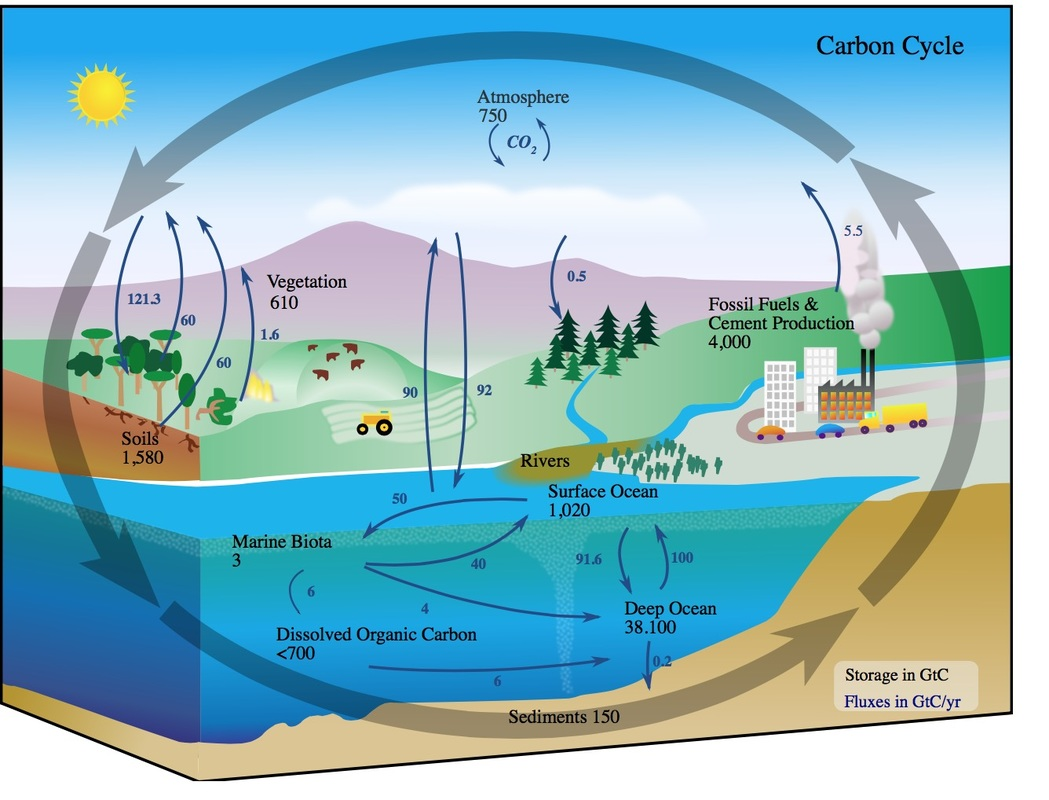
The IPCC doctrine which has long been promoted goes as follows. We have a number over here for monthly fossil fuel CO2 emissions, and a number over there for monthly atmospheric CO2. We don’t have good numbers for the rest of it-oceans, soils, biosphere–though rough estimates are orders of magnitude higher, dwarfing human CO2. So we ignore nature and assume it is always a sink, explaining the difference between the two numbers we do have. Easy peasy, science settled.

The non-IPCC paradigm is that atmospheric CO2 levels are a function of two very different fluxes. FF CO2 changes rapidly and increases steadily, while Natural CO2 changes slowly over time, and fluctuates up and down from temperature changes. The implications are that human CO2 is a simple addition, while natural CO2 comes from the integral of previous fluctuations.

1.  History of Atmospheric CO2 Mostly Natural

This proof is based on the 2021 paper World Atmospheric CO2, Its 14C Specific Activity, Non-fossil Component, Anthropogenic Fossil Component, and Emissions (1750–2018) by Kenneth Skrable, George Chabot, and Clayton French at University of Massachusetts Lowell.

The analysis employs ratios of carbon isotopes to calculate the relative proportions of atmospheric CO2 from natural sources and from fossil fuel emissions. 

The specific activity of 14C in the atmosphere gets reduced by a dilution effect when fossil CO2, which is devoid of 14C, enters the atmosphere. We have used the results of this effect to quantify the two components: the anthropogenic fossil component and the non-fossil component.  All results covering the period from 1750 through 2018 are listed in a table and plotted in figures.

These results negate claims that the increase in total atmospheric CO2 concentration C(t) since 1800 has been dominated by the increase of the anthropogenic fossil component. We determined that in 2018, atmospheric anthropogenic fossil COrepresented 23% of the total emissions since 1750 with the remaining 77% in the exchange reservoirs. Our results show that the percentage of the total CO2 due to the use of fossil fuels from 1750 to 2018 increased from 0% in 1750 to 12% in 2018, much too low to be the cause of global warming.

The graph above is produced from Skrable et al. dataset Table 2. World atmospheric CO2, its C‐14 specific activity, anthropogenic‐fossil component, non fossil component, and emissions (1750 ‐ 2018).  The purple line shows reported annual concentrations of atmospheric CO2 from Energy Information Administration (EIA)  The starting value in 1750 is 276 ppm and the final value in this study is 406 ppm in 2018, a gain of 130 ppm.

The red line is based on EIA estimates of human fossil fuel CO2 emissions starting from zero in 1750 and the sum slowly accumulating over the first 200 years.  The estimate of annual CO2 emitted from FF increases from 0.75 ppm in 1950 up to 4.69 ppm in 2018. The sum of all these annual emissions rises from 29.3 ppm in 1950 (from the previous 200 years) up to 204.9 ppm (from 268 years).  These are estimates of historical FF CO2 emitted into the atmosphere, not the amount of FF CO2 found in the air.

Atmospheric CO2 is constantly in two-way fluxes between multiple natural sinks/sources, principally the ocean, soil and biosphere. The annual dilution of carbon 14 proportion is used to calculate the fractions of atmospheric FF CO2 and Natural CO2 remaining in a given year. The blue line shows the FF CO2 fraction rising from 4.03 ppm in 1950 to 46.84 ppm in 2018.  The cyan line shows Natural CO2 fraction rising from 307.51 in 1950 to 358.56 in 2018.

The details of these calculations from observations are presented in the two links above, and the logic of the analysis is summarized in my previous post On CO2 Sources and Isotopes.  The table below illustrates the factors applied in the analysis.

C(t) is total atm CO2, S(t) is Seuss 14C effect, CF(t) is FF atm CO2, CNF(t) is atm non-FF CO2, DE(t) is FF CO2 emissions

Summary

Despite an estimated 205 ppm of FF CO2 emitted since 1750, only 46.84 ppm (23%) of FF CO2 remains, while the other 77% is distributed into natural sinks/sources. As of 2018 atmospheric CO2 was 405, of which 12% (47 ppm) originated from FF.   And the other 88% (358 ppm) came from natural sources: 276 prior to 1750, and 82 ppm since.  Natural CO2 sources/sinks continue to drive rising atmospheric CO2, presently at a rate of 2 to 1 over FF CO2.

2.  Analysis of CO2 Flows Confirms Natural Dominance
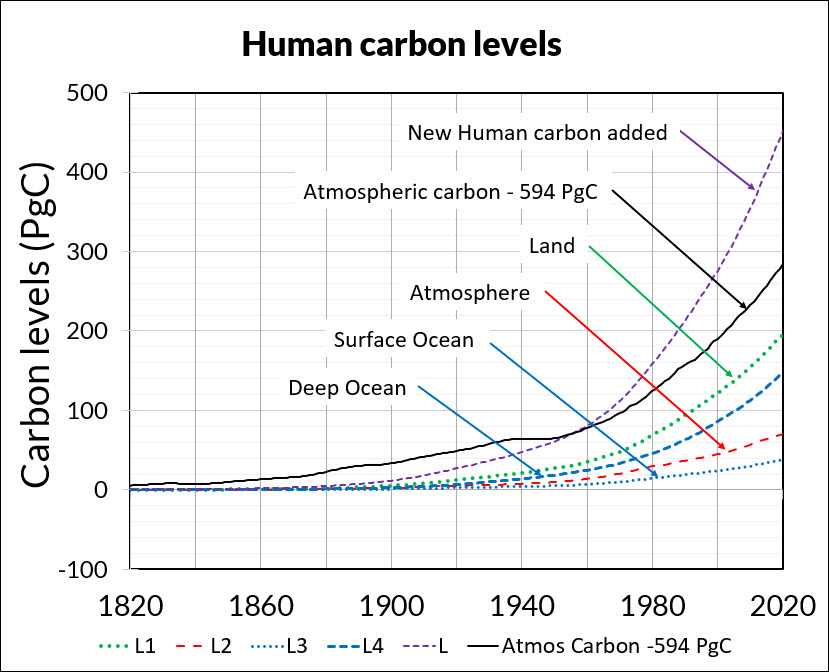
Figure 3. How human carbon levels change with time.

Independent research by Dr. Ed Berry focused on studying flows and level of CO2 sources and sinks.  The above summary chart from his published work presents a very similar result.

The graph above summarizes Dr. Berry’s findings. The lines represent CO2 added into the atmosphere since the 1750 level of 280 ppm. Based on IPCC data regarding CO2 natural sources and sinks, the black dots show the CO2 data. The small blue dots show the sum of all human CO2 emissions since they became measurable, irrespective of transfers of that CO2 from the atmosphere to land or to ocean.

Notice the CO2 data is greater than the sum of all human CO2 until 1960. That means nature caused the CO2 level to increase prior to 1960, with no reason to stop adding CO2 since. In fact, the analysis shows that in the year 2020, the human contribution to atmospheric CO2 level is 33 ppm, which means that from a 2020 total of 413 ppm, 280 is pre-industrial and 100 is added from land and ocean during the industrial era.

My synopsis of his work is IPCC Data: Rising CO2 is 75% Natural

A new carbon cycle model shows human emissions cause 25% and nature 75% of the CO2 increase is the title (and link) for Dr. Edwin Berry’s paper accepted in the journal Atmosphere August 12, 2021.

3. Nature Erases Pulses of Human CO2 Emissions  

Those committed to blaming humans for rising atmospheric CO2 sometimes admit that emitted CO2 (from any source) only stays in the air about 5 years (20% removed each year)  being absorbed into natural sinks.  But they then save their belief by theorizing that human emissions are “pulses” of additional CO2 which persist even when particular molecules are removed, resulting in higher CO2 concentrations.  The analogy would be a traffic jam on the freeway which persists long after the blockage is removed.

A recent study by Bud Bromley puts the fork in this theory.  His paper is A conservative calculation of specific impulse for CO2.  The title links to his text which goes through the math in detail.  Excerpts are in italics here with my bolds.

In the 2 years following the June 15, 1991 eruption of the Pinatubo volcano, the natural environment removed more CO2 than the entire increase in CO2 concentration due to all sources, human and natural, during the entire measured daily record of the Global Monitoring Laboratory of NOAA/Scripps Oceanographic Institute (MLO) May 17, 1974 to June 15, 1991. Then, in the 2 years after that, that CO2 was replaced plus an additional increment of CO2.

The data and graphs produced by MLO also show a reduction in slope of total CO2 concentration following the June 1991 eruption of Pinatubo, and also show the more rapid recovery of total CO2 concentration that began about 2 years after the 1991 eruption. This graph is the annual rate of change (i.e., velocity or slope) of total atmosphere CO2 concentration. This graph is not human CO2.

More recently is his study Scaling the size of the CO2 error in Friedlingstein et al.  Excerpts in italics with my bolds.

Since net human emissions would be a cumulative net of two fluxes, if there were a method to measure it, and since net global average CO2 concentration (i.e., NOAA Mauna Loa) is the net of two fluxes, then we should compare these data as integral areas. That is still an apples and oranges comparison because we only have the estimate of human emissions, not net human emissions. But at least the comparison would be in the right order of magnitude.

That comparison would look something like the above graphic. We would be comparing the entire area of the orange quadrangle to the entire blue area, understanding that the tiny blue area shown is much larger than actually is because the amount shown is human emissions only, not net human emissions. Human CO2 absorptions have not been subtracted. Nevertheless, it should be obvious that (1) B is not causing A, and (2) the orange area is enormously larger than the blue area.

Human emissions cannot be driving the growth rate (slope) observed in net global average CO2 concentration.

4.  Setting realistic proportions for the carbon cycle.

Hermann Harde applies a comparable perspective to consider the carbon cycle dynamics. His paper is Scrutinizing the carbon cycle and CO2 residence time in the atmosphere. Excerpts with my bolds.

Different to the IPCC we start with a rate equation for the emission and absorption processes, where the uptake is not assumed to be saturated but scales proportional with the actual CO2 concentration in the atmosphere (see also Essenhigh, 2009; Salby, 2016). This is justified by the observation of an exponential decay of 14C. A fractional saturation, as assumed by the IPCC, can directly be expressed by a larger residence time of CO2 in the atmosphere and makes a distinction between a turnover time and adjustment time needless.

Based on this approach and as solution of the rate equation we derive a concentration at steady state, which is only determined by the product of the total emission rate and the residence time. Under present conditions the natural emissions contribute 373 ppm and anthropogenic emissions 17 ppm to the total concentration of 390 ppm (2012). For the average residence time we only find 4 years.

The stronger increase of the concentration over the Industrial Era up to present times can be explained by introducing a temperature dependent natural emission rate as well as a temperature affected residence time. With this approach not only the exponential increase with the onset of the Industrial Era but also the concentrations at glacial and cooler interglacial times can well be reproduced in full agreement with all observations.

So, different to the IPCC’s interpretation the steep increase of the concentration since 1850 finds its natural explanation in the self accelerating processes on the one hand by stronger degassing of the oceans as well as a faster plant growth and decomposition, on the other hand by an increasing residence time at reduced solubility of CO2 in oceans. Together this results in a dominating temperature controlled natural gain, which contributes about 85% to the 110 ppm CO2 increase over the Industrial Era, whereas the actual anthropogenic emissions of 4.3% only donate 15%. These results indicate that almost all of the observed change of CO2 during the Industrial Era followed, not from anthropogenic emission, but from changes of natural emission. The results are consistent with the observed lag of CO2 changes behind temperature changes (Humlum et al., 2013; Salby, 2013), a signature of cause and effect. Our analysis of the carbon cycle, which exclusively uses data for the CO2 concentrations and fluxes as published in AR5, shows that also a completely different interpretation of these data is possible, this in complete conformity with all observations and natural causalities.

5.  More CO2 Is Not a Problem But a Blessing

William Happer provides a framework for thinking about climate, based on his expertise regarding atmospheric radiation (the “greenhouse” mechanism).  But he uses plain language accessible to all.  The Independent Institute published the transcript for those like myself who prefer reading for full comprehension.  Source: How to Think about Climate Change  

His presentation boils down to two main points:  More CO2 will result in very little additional global warming. But it will increase productivity of the biosphere.  My synopsis is: Climate Change and CO2 Not a Problem  Brief excerpts in italics with my bolds.
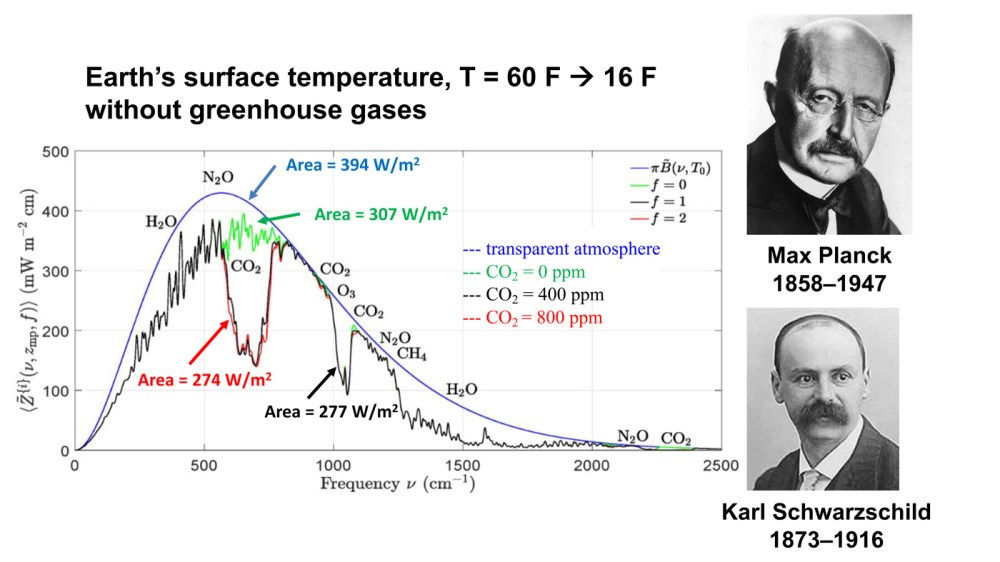
This is an important slide. There is a lot of history here and so there are two historical pictures. The top picture is Max Planck, the great German physicist who discovered quantum mechanics. Amazingly, quantum mechanics got its start from greenhouse gas-physics and thermal radiation, just what we are talking about today. Most climate fanatics do not understand the basic physics. But Planck understood it very well and he was the first to show why the spectrum of radiation from warm bodies has the shape shown on this picture, to the left of Planck. Below is a smooth blue curve. The horizontal scale, left to right is the “spatial frequency” (wave peaks per cm) of thermal radiation. The vertical scale is the thermal power that is going out to space. If there were no greenhouse gases, the radiation going to space would be the area under the blue Planck curve. This would be the thermal radiation that balances the heating of Earth by sunlight.

In fact, you never observe the Planck curve if you look down from a satellite. We have lots of satellite measurements now. What you see is something that looks a lot like the black curve, with lots of jags and wiggles in it. That curve was first calculated by Karl Schwarzschild, who first figured out how the real Earth, including the greenhouse gases in its atmosphere, radiates to space. That is described by the jagged black line. The important point here is the red line. This is what Earth would radiate to space if you were to double the CO2 concentration from today’s value. Right in the middle of these curves, you can see a gap in spectrum. The gap is caused by CO2 absorbing radiation that would otherwise cool the Earth. If you double the amount of CO2, you don’t double the size of that gap. You just go from the black curve to the red curve, and you can barely see the difference. The gap hardly changes.

The message I want you to understand, which practically no one really understands, is that doubling CO2 makes almost no difference.

The alleged harm from CO2 is from warming, and the warming observed is much, much less than predictions. In fact, warming as small as we are observing is almost certainly beneficial. It gives slightly longer growing seasons. You can ripen crops a little bit further north than you could before. So, there is completely good news in terms of the temperature directly. But there is even better news. By standards of geological history, plants have been living in a CO2 famine during our current geological period.

So, the takeaway message is that policies that slow CO2 emissions are based on flawed computer models which exaggerate warming by factors of two or three, probably more. That is message number one. So, why do we give up our freedoms, why do we give up our automobiles, why do we give up a beefsteak because of this model that does not work?

Takeaway message number two is that if you really look into it, more CO2 actually benefits the world. So, why are we demonizing this beneficial molecule that is making plants grow better, that is giving us slightly less harsh winters, a slightly longer growing season? Why is that a pollutant? It is not a pollutant at all, and we should have the courage to do nothing about CO2 emissions. Nothing needs to be done.

See Also Peter Stallinga 2023 Study  CO2 Fluxes Not What IPCC Telling You

Footnote:  The Core of the CO2 Issue Update July 15

An adversarial comment below goes to the heart of the issue:

“The increase of the CO2 level since 1850 are more than accounted for by manmade emissions.  Nature remains a net CO2 sink, not a net emitter.”

The data show otherwise.  Warming temperatures favor natural sources/sinks emitting more CO2 into the atmosphere, while previously captured CO2 shifts over time into long term storage as bicarbonates.  In fact, rising temperatures are predictive of rising CO2, as shown mathematically.

02/2025 Update–Temperature Changes, CO2 Follows

It is the ongoing natural contribution to atmospheric CO2 that is being denied.

Govt. Green Rules Make Appliances Cost More and Do Less

NYC going after pizza oven emissions. You’d have to burn a pizza stove 849 years to equal one year of John Kerry’s private jet

In his Master Resource article Energy Appliance Victory! (DC Circuit vs. DOE), Mark Krebs explains the DOE agency machinations targeting boilers as a case in point of government bureaucrats attacking everyone’s economic well-being in the name of saving the planet.  First, a contextual piece describes the game plan behind all this.  Later on, a synopsis of Kreb’s analysis of the tactics on the ground.

Background:  Why This Judgment Matters 
Biden’s Green Rules Make Appliances Cost More and Do Less

Authored by Kevin Stocklin at The Epoch Times, published at Planet Today.  Excerpts in italics with my bolds and added images.

The Biden administration announced in December 2022 its pledge to take “more than 100 actions” to impose significantly tighter environmental standards on consumer goods is now becoming reality.  And consumer groups are predicting a future in which Americans pay more for products that do less, while manufacturers warn of shortages and supply chain breakdowns.

“You’re seeing, just in the last few months, new rules from the Biden administration about clothes washers, dishwashers, and other kinds of kitchen appliances, and in every case, you’re talking about a tightening of already very, very tight standards,” O.H. Skinner, executive director of the Alliance for Consumers, told The Epoch Times. “That will make it so that nearly the majority of the current products on the market don’t meet the standards and have to be redesigned or removed from the market,” Skinner said.

“Everyday things that people actually want are going to get more expensive
or disappear, and the products that will be available will be more expensive
but not better. People are going to wonder why life is worse.”

The announcement touted 110 new regulations enacted by federal agencies on “everything from air conditioners and furnaces, to clothes washers and dryers, to kitchen appliances and water heaters—as well as commercial and industrial equipment.” According to the Biden administration: “Once finalized, these standards will reduce greenhouse gas emissions by an estimated 2.4 billion metric tons, equivalent to the carbon emissions from 10 million homes, 17 million gas cars, or 21 coal-fired power plants over 30 years. The projected consumer savings from these standards would be $570 billion cumulatively, and for an average household this will mean at least $100 in annual savings.”

The stoves are just the thin end of the wedge.

These actions follow a familiar pattern: rumors of new directives, followed by official denials, followed by draconian diktats.   For example, reports that the Consumer Product Safety Commission would ban gas stoves over alleged safety concerns sparked a public outcry in January, which was met with denials by the Commission, together with media ridicule, that any such thing was being contemplated. This was then followed by new environmental standards from the DOE that would ban the manufacturing of 50 percent of the gas stoves available on the market today.
Case in Point: DOE Rule on Boilers Vacated by DC Circuit Court

Mark Krebs explains the agency machinations in his Master Resource article Energy Appliance Victory! (DC Circuit vs. DOE).  Excerpts in italics with my bolds.

“The ‘wheels of justice turn slowly,’ but they indeed turned, even within the District of Columbia’s ‘uni-party.’ As for holding on to this victory, it is far from a slam-dunk for preserving consumer choice and free markets. I expect the struggle to escalate in Biden’s all-of-government war against natural gas and other fossil fuels.”

Beleaguered energy consumers were just handed a far-reaching victory by the United States Court of Appeals for the District of Columbia (DC Circuit). The ruling vacated a Final Rule from the U.S, Department of Energy (DOE) that would have banned the manufacture and sale of non-condensing boilers for use in commercial applications. DOE’s rule was challenged several years ago by natural gas interests–and later joined with a separate but similar case brought by the Air-Conditioning, Heating, and Refrigeration Institute (AHRI).

DOE’s failures were major and numerous. Previously, the Court had afforded DOE ample opportunities to rectify them, but they didn’t. Ultimately (reading in between the lines), it appears that the Court lost its patience with “the Agency” (DOE). One of the far-reaching results of this victory is that it undermines a veritable super-weapon of the administrative state: the Chevron Deference. This aspect will be discussed in more detail further down.

DC Circuit has set a precedent that illustrates how DOE routinely bends the rules to achieve its “administrative state” objectives. Consequently, DOE should exercise more care and transparency going forward with both present and future developments of appliance minimum efficiency standards.  However, it is probably more likely that DOE will find ways to get around it; perhaps drastically.

The end-result of this (amid many other analytical biases discussed in the Court ruling) is fatally skewed economic “determinations” that almost always favor stricter standards, regardless of the true economics.. As a result of this Court Order, such routine biases are now on public display to demonstrate the full intent of regulatory failures that occur within the intentionally opaque bureaucratic processes to ostensibly overcome so-called market failures.

Most important of all, fossil fuel industries should exploit this victory to illustrate just how fallible government agencies can be.  This decision goes far beyond the particulars of packaged commercial boilers. It goes to the heart of the question of government agency standing relative to actual stakeholders.

Ever since the “Chevron Deference” was put in place in 1984, federal courts have deferred to an agency’s ostensibly unique “subject matter expertise” for interpretating ambiguous statutes. Such is clearly the case when reviewing regulatory actions like promulgating rulemaking for mandating minimum energy efficiency standards for appliances. On May 1, 2023, the U.S. Supreme Court granted review in Loper Bright Enterprises v. Raimondo, No. 22-451, on whether to overturn or limit Chevron Deference.

Subsequently, perhaps the most important victory in this case is that it becomes a “poster child” for why the administrative state’s abuse of the Chevron Deference should end. At least in this instance, the Courts found DOE to be not worthy of deference. Perhaps SCOTUS will follow their lead.


Canada Road to Ruin Paved with Trudeau’s CO2 Intentions

Bill Bewick explains in his National Post article Federal climate policy makes us poorer.  Excerpts in italics wtih my bolds and added images.

The clean fuel standard on top of an escalating carbon tax and onerous emissions
targets will make everything more expensive

Canada is in an affordability crisis. Despite the pain felt by Canadians every day at the till or the gas pump, the federal government’s passion for world-leading carbon taxes and regulations is driving up the cost of everything while making us collectively poorer.

Tax advocates say it is a small % of GDP. But it is still $10 Billion extracted from Canadian households.

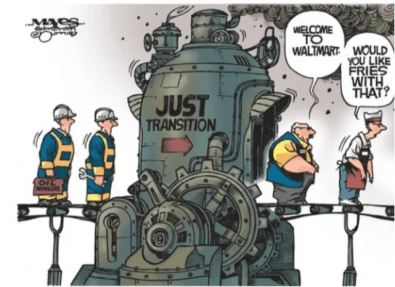
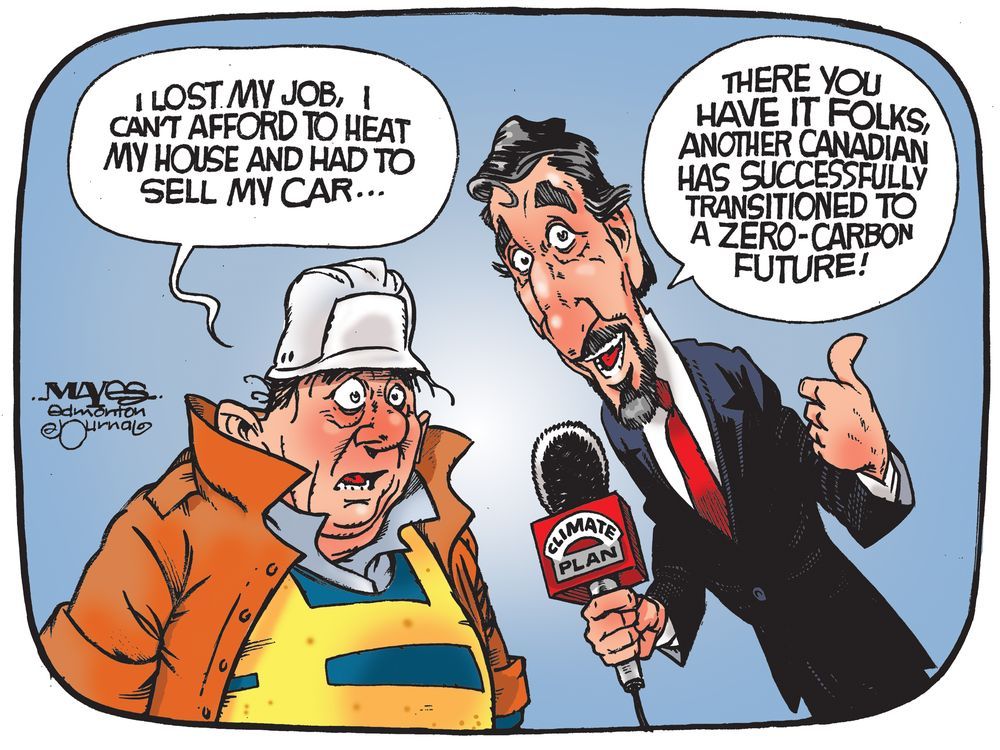
Canada Day saw the Clean Fuel Standards (CFS) regulation come into effect. A week earlier they passed a “Sustainable Jobs Act” that seeks to help transition workers away from highly productive jobs in oil, gas and related industries despite growing global demand for these energy sources.

The Parliamentary Budget Officer projects that by 2030 the net CFS cost will be over $1,100 per household in Alberta and Saskatchewan. While it will add roughly 17 cents on a litre of fuel (in addition to the carbon tax, of course) most of the costs will be on Canadian businesses, which means less jobs, less tax revenue and higher prices, making life more expensive with less ability to pay for it.

The fact is the world will need oil for the next 20-30 years at least. Canada is the responsible, reliable supplier many in the world would already prefer to get their energy from. With Canadian oilsands producers aggressively pursuing net zero operations by 2050, there is no better place to get oil from.

The demand for Liquefied Natural Gas (LNG) is booming globally. It should be vocally supported by anyone concerned with emissions since Canadian exports off our west coast would drive down the need for all the coal plants being built and planned in China and India. It also features an unprecedented level of Indigenous partnerships, offering an unparalleled opportunity for the economic self-sufficiency of countless communities.

Why would we “transition” these high-paying, unsubsidized jobs?
And transition them to what?

Well, the federal government seems to know that our oil and gas sector will have to shrink despite growing world demand. This is because in addition to steadily rising carbon taxes and the new CFS, they’ve arbitrarily demanded a 42 per cent reduction in emissions for the oil and gas sector in seven short years.

Requiring this drastic reduction by 2030 will force hasty and frantic changes as well as production cuts that will drive up energy prices for everyone while decreasing jobs and government revenues. That means more debt and more tax burden for Canadians, while hurting our economy and increasing our reliance on foreign oil.

An escalating carbon tax was supposed to let the economy decarbonize in an efficient way, but the federal government keeps piling on. This is crushing Canada’s competitiveness generally, especially after our American neighbours decided to go along with most of the rest of the world and not implement a carbon tax at all.

The fact that every manufacturer, farmer, trucker, and even commercial business owner on this side of the border has to pay these taxes on their fuel, heat, and power means everything is more expensive and will keep going up. Lower wages and job opportunities means we will be less and less able to afford it.

The government either says we must make these sacrifices for the planet, or that the green jobs they will transition to will be just as profitable and more sustainable. Their most recent example: the Volkswagen battery plant. There will be 3,000 jobs created, but the government will subsidize the plant with an estimated $13 billion. Does $4.3 million in taxpayer dollars per job sound sustainable to you?

As for our sacrifices saving the planet, carbon emissions are global. As Asia grows its economy, emissions are steadily rising. Canada can certainly “do its part” but other than massive LNG export to Asia, nothing we do with our declining 1.6 per cent share can meaningfully reduce overall global emissions.

There’s one more major federal policy being pursued that might be the most expensive of them all: the demand that every province’s electrical grid get to net zero by 2035. Canadian ratepayers spent billions to convert coal plants to gas and subsidize solar and wind projects. Now they are forcing us to get off natural gas entirely — a fuel source even the EU considers green.

Trying to do this in 12 years will cost an estimated $52 billion to achieve in Alberta alone, driving up power bills by 40 per cent. Nothing complements renewables like natural gas. If we want to keep the lights on when there’s no sun or wind, the only technology right now up to the task is natural gas plants — but the government seems to think higher power bills and less reliability is the way to go.

Canadians care about reducing emissions and it is happening. Canadians also care about affordability. We need to demand our governments find a balance between the two. If Canada recalibrates our carbon policies to be part of the global parade instead of driving off an economic cliff, we can have both.


See Also Canada Budget Officer Quashes Climate Alarm

The “Born That Way” Identity Lie

In June, my son’s teacher asked his class, “What does transgender mean?”  A student answered, “A transgender is someone who decided to change their gender.”  The teacher said:

That’s not true.  They were always that gender, but now they are able to express themselves and are taking certain actions to be the gender they always were.

The words above are from Gamaliel Isaac writing at American Thinker The Identity Lie.  Excerpts in italics with my bolds and added images.

The current travesty of giving estrogen to boys and testosterone to girls and of cutting off their genitalia has its roots in a lie that was promoted by the homosexual community. It is the identity lie. It is the lie that people are born gay, that they have no choice, and that they are not responsible for their behavior. This lie is told by the media. It is told in our schools. It is everywhere.

Robin Goodspeed is an ex-lesbian. She wrote the following:

I was not born a homosexual. I was not ‘born that way.’ There is no scientific proof, or proof of any kind, that there is a homosexual gene or that homosexuals are ‘born that way.’ I was sexually molested at the age of 2 and I began making choices at that age that led to a life of homosexuality. I chose that life and I clung desperately to the lie that I was ‘born that way’ so I would never be held accountable for my choices.

Walt Heyer, a former transgender, was asked if transgenders are born that way. He answered:

There is no evidence that transgenders are born that way. There is, however, evidence that they are suffering from untreated mental disorders such as bipolar disorder, dissociative disorder, separation anxiety, schizophrenia, and personality disorder.

There is a popular TV show called Say Yes to the Dress. With the help of experts, brides search for the perfect dress. On October 26, 2012, there was an episode in which the woman getting married was heterosexual, and her bridesmaid was a lesbian. What was unusual was that the bridesmaid was her identical twin. How can one be born a lesbian and the other be born a heterosexual if they are identical twins?   There are other examples of identical twins in which one is gay and one is not.

The fact that there are many ex-homosexuals also speaks against the genetic argument. If they were born homosexual, and they can’t help being homosexual, then how did they stop being homosexual?

The blogger John Aravosis was one of many critics who pounced on Nixon. “Every religious right hatemonger is now going to quote this woman every single time they want to deny us our civil rights.” Aravosis leveled the same accusations against Brandon Ambrosino in 2014, when Brandon wrote a piece for The New Republic saying his gay behavior was a choice. Calling Brandon “idiotic” and “patently absurd,” Aravosis wrote, “The gay haters at the religious right couldn’t have written it any better.”

John Aravosis is showing us why many gays insist that they are born that way. They believe that if they don’t say that gays are born that way, it helps make the case of people who disapprove of homosexual behavior. The idea is that people who disapprove of homosexuals can’t fault them if homosexuals can’t help it and are born that way, but if gays have a choice, then they are responsible for their actions.

Jane Ward, a professor of feminist studies at UCAL Santa Barbara, wrote:

People who challenge the Born This Way narrative are often cast as homophobic, and their thinking is considered backward — even if they are themselves gay.

That’s why so few have had the courage to speak the truth the way Cynthia Nixon and Brandon Ambrosino did. Ex-homosexuals who have suggested that gays are not born that way have even been threatened by homosexual activists.

Although promotion of the identity lie has not helped homosexuals, it has hurt a lot of people, and that number is increasing. According to the 2020 Plastic Surgery Statistics provided by the American Society of Plastic Surgeons, females had 6,368 “gender confirmation surgeries” performed in the US in 2020 compared to 5,616 in 2019.

Are transgender people individuals with another gender trapped in the wrong body? Do they have a different identity? In June, my son’s teacher asked his class, “What does transgender mean?” A student answered, “A transgender is someone who decided to change their gender.” The teacher said:

That’s not true. They were always that gender, but now they are able to express themselves and are taking certain actions to be the gender they always were.

There are many people who “de-transitioned” who have testified that they were persuaded by teachers, peers, and social media that they were a different gender and that they would be a lot happier if they transitioned. Then reality hit, and they de-transitioned. They were able to stop taking hormones, but they couldn’t undo the damage or get the organs back that “gender-affirming” surgeons had cut off.

People who have nothing to do with the identity lie pay a price with higher insurance premiums, because if insurance doesn’t pay for transgender surgery, that is considered discrimination and so is illegal. Women and young girls are forced to share bathrooms and locker rooms with males. Women locked up in prison are locked up with male criminals who claim to be female. Innocent children are brainwashed into ruining their lives.

And all this because they were persuaded to believe the identity lie.

See Also Messing Up Child Identities

Ten minute video here: http://www.comprehensivesexualityeducation.org/act-now-2/stop-cse-petition/


Finally, a Legal Rebuttal on the Merits of Kids’ Climate Lawsuit

As reported last month, the Oregon activist judge invited the plaintiffs in Juliana vs US to reopen that case even after the Ninth Circuit shot it down.  Now we have a complete and thorough Motion from the defendant (US government) to dismiss this newest amended complaint.  Most interesting is the section under the heading starting on page 30.  Excerpts in italics with my bolds and added images.

Plaintiffs’ Claims Fail on the Merits

Because Plaintiffs’ action fails at the jurisdictional threshold, the Ninth Circuit never reached—and this Court need not reach—the merits of the claims. . . Plaintiffs’ second amended complaint, which supersedes the first amended complaint, asserts the same claims that were brought in the first amended complaint, which this Court addressed in orders that the Ninth Circuit reversed. Defendants thus renew their objection that Plaintiffs’ claims fail on the merits and should be dismissed pursuant to Fed. R. Civ. P. 12(b)(6).

A. There is no constitutional right to a stable climate system.

The Supreme Court has repeatedly instructed courts considering novel due process claims
to “‘exercise the utmost care whenever . . . asked to break new ground in this field,’… lest the liberty protected by the Due Process Clause be subtly transformed” into judicial policy preferences. More specifically, the Supreme Court has “regularly observed that the Due Process Clause specially protects those fundamental rights and liberties which are, objectively, ‘deeply rooted in this Nation’s history and tradition.’”  Plaintiffs’ request that this Court recognize an implied fundamental right to a stable climate system contradicts that directive, because such a purported right is without basis in the Nation’s history or tradition.

The proposed right to a “stable climate system” is nothing like any fundamental right ever recognized by the Supreme Court. The state of the climate is a public and generalized issue, and so interests in the climate are unlike the particularized personal liberty or personal privacy interests of individuals the Supreme Court has previously recognized as being protected by fundamental rights.  “[W]henever federal courts have faced assertions of fundamental rights to a ‘healthful environment’ or to freedom from harmful contaminants, they have invariably rejected those claims.”. Plaintiffs’ First Claim for Relief must be dismissed.

B.  Plaintiffs fail to allege a cognizable state-created danger claim.

The First Claim for Relief must also be dismissed because the Constitution does not impose an affirmative duty to protect individuals, and Plaintiffs have failed to allege a cognizable claim under the “state-created danger” exception to that rule.
As a general matter:

[The Due Process Clause] is phrased as a limitation on the State’s power to act, not as a guarantee of certain minimal levels of safety and security. It forbids the State itself to deprive individuals of life, liberty, or property without “due process of law,” but its language cannot fairly be extended to impose an affirmative obligation on the State to ensure that those interests do not come to harm through other means.

Thus, the Due Process Clause imposes no duty on the government to protect persons from harm inflicted by third parties that would violate due process if inflicted by the government.

Plaintiffs contend that the government’s “deliberate actions” and “deliberate indifference” with regard to the dangers of climate change amount to a due process violation under the state-created danger exception.

First, Plaintiffs have identified no harms to their “personal security or bodily integrity” of the kind and immediacy that qualify for the state-created danger exception. . . But here, Plaintiffs allege that general degradation of the global climate has harmed their “dignity, including their capacity to provide for their basic human needs, safely raise families, practice their religious and spiritual beliefs, [and] maintain their bodily integrity” and has prevented them from “lead[ing] lives with access to clean air, water, shelter, and food.”  Those types of harm are unlike the immediate, direct, physical, and personal harms at issue in the above-cited cases.

Second, Plaintiffs identify no specific government actions—much less government actors—that put them in such danger. Instead, Plaintiffs contend that a number of (mostly unspecified) agency actions and inactions spanning the last several decades have exposed them to harm. This allegation of slowly-recognized, long-incubating, and generalized harm by itself conclusively distinguishes their claim from all other state-created danger cases recognized by the Ninth Circuit.

Third, Plaintiffs do not allege that government actions endangered Plaintiffs in particular. . . As explained above, Plaintiffs’ asserted injuries arise from a diffuse, global phenomenon that affects every other person in their communities, in the United States, and throughout the world.

For all these reasons, there is no basis for finding a violation of Plaintiffs’ due process right under the state-created danger doctrine, and Plaintiffs’ corresponding claim must be dismissed.

C. No federal public trust doctrine creates a right to a stable climate system.

Plaintiffs’ Fourth Claim for Relief, asserting public trust claims, should be dismissed for two independent reasons. First, any public trust doctrine is a creature of state law that applies narrowly and exclusively to particular types of state-owned property not at issue here. That doctrine has no application to federal property, the use and management of which is entrusted exclusively to Congress. . .Consequently, there is no basis for Plaintiffs’ public trust claim against the federal government under federal law.

Second, the “climate system” or atmosphere is not within any conceivable federal public trust.

1. No public trust doctrine binds the federal government.

Plaintiffs rely on an asserted public trust doctrine for the proposition that the federal government must “take affirmative steps to protect” “our country’s life-sustaining climate system,” which they assert the government holds in trust for their benefit.  But because any public trust doctrine is a matter of state law only, public trust claims may not be asserted against the federal government under federal law. . . The Supreme Court has without exception treated public trust doctrine as a matter of state law with no basis in the United States Constitution.

2. Any public trust doctrine would not apply to the “climate system” or the atmosphere.

Independently, any asserted public trust doctrine does not help Plaintiffs here. Public trust cases have historically involved state ownership of specific types of natural resources, usually limited to submerged and submersible lands, tidelands, and waterways. . . The climate system or atmosphere is unlike any resource previously deemed subject to a public trust. It cannot be owned and, due to its ephemeral nature, cannot remain within the jurisdiction of any single government. No court has held that the climate system or atmosphere is protected by a public trust doctrine. Indeed, the concept has been widely rejected.

For all these reasons, the Court should dismiss Plaintiffs’ Fourth Claim for Relief.

Background Post Update on Zombie Kids Climate Lawsuits: (Juliana vs. US) (Held vs Montana)


Little Warming in June 2023 UAH Air Temps

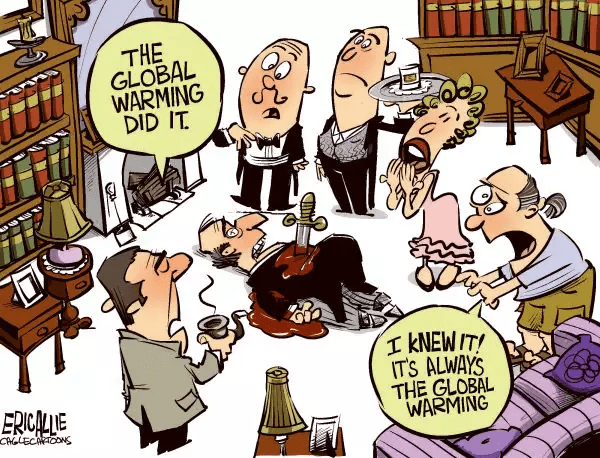
The post below updates the UAH record of air temperatures over land and ocean. Each month and year exposes again the growing disconnect between the real world and the Zero Carbon zealots.  It is as though the anti-hydrocarbon band wagon hopes to drown out the data contradicting their justification for the Great Energy Transition.  Yes there is warming from an El Nino buildup but no basis to blame it on CO2.  

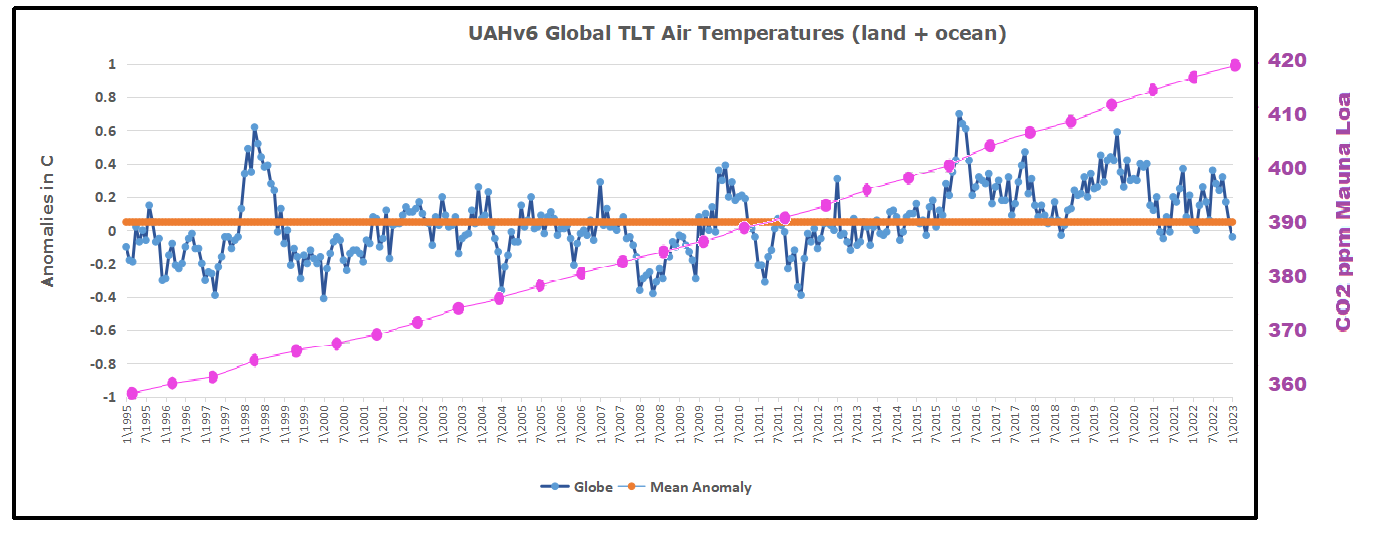
As an overview consider how recent rapid cooling  completely overcame the warming from the last 3 El Ninos (1998, 2010 and 2016).  The UAH record shows that the effects of the last one were gone as of April 2021, again in November 2021, and in February and June 2022  Now at year end 2022 and continuing into 2023 global temp anomaly is matching or lower than average since 1995, an ENSO neutral year. (UAH baseline is now 1991-2020).

For reference I added an overlay of CO2 annual concentrations as measured at Mauna Loa.  While temperatures fluctuated up and down ending flat, CO2 went up steadily by ~60 ppm, a 15% increase.

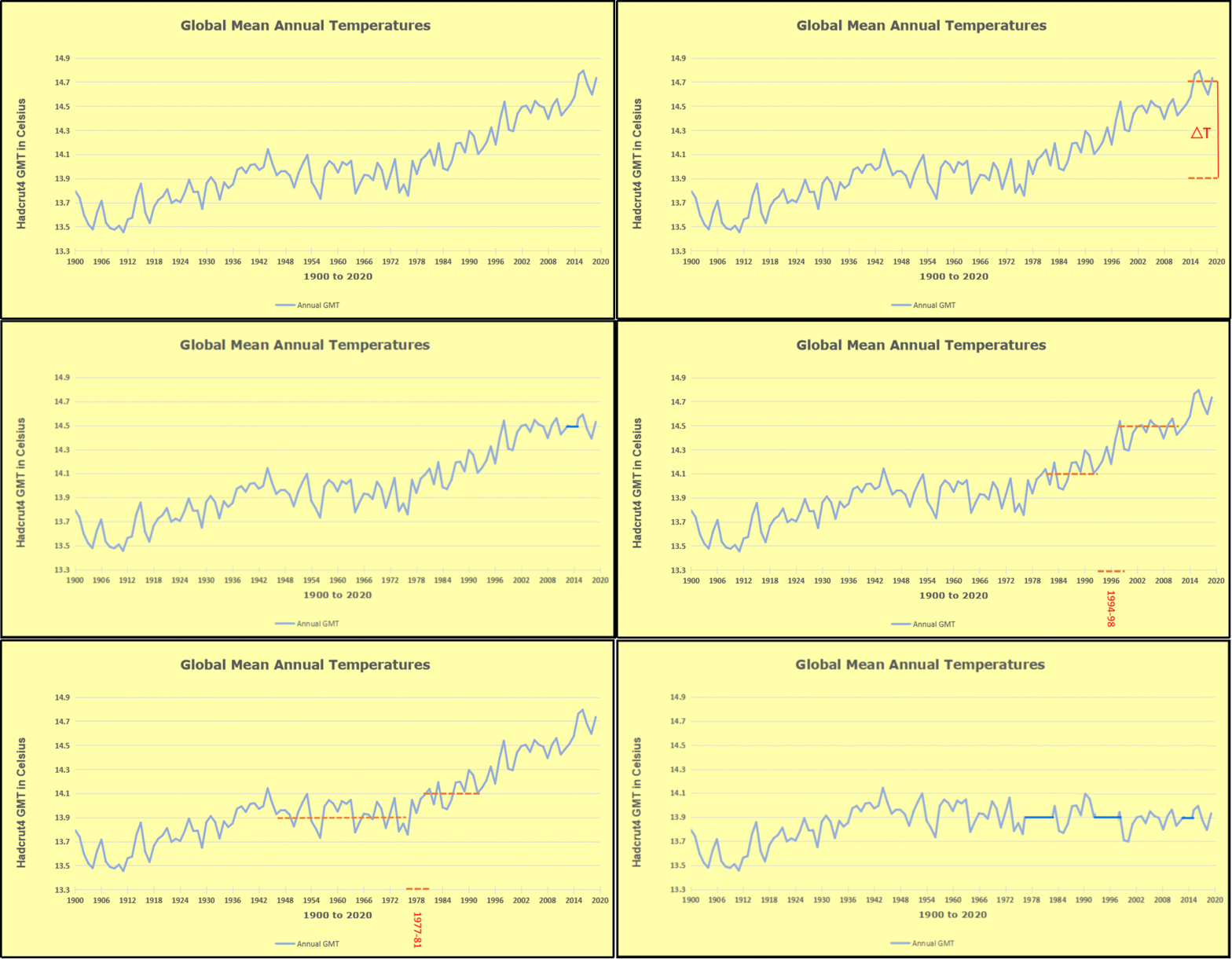
Furthermore, going back to previous warmings prior to the satellite record shows that the entire rise of 0.8C since 1947 is due to oceanic, not human activity.

gmt-warming-events

The animation is an update of a previous analysis from Dr. Murry Salby.  These graphs use Hadcrut4 and include the 2016 El Nino warming event.  The exhibit shows since 1947 GMT warmed by 0.8 C, from 13.9 to 14.7, as estimated by Hadcrut4.  This resulted from three natural warming events involving ocean cycles. The most recent rise 2013-16 lifted temperatures by 0.2C.  Previously the 1997-98 El Nino produced a plateau increase of 0.4C.  Before that, a rise from 1977-81 added 0.2C to start the warming since 1947.

Importantly, the theory of human-caused global warming asserts that increasing CO2 in the atmosphere changes the baseline and causes systemic warming in our climate.  On the contrary, all of the warming since 1947 was episodic, coming from three brief events associated with oceanic cycles. 

Update August 3, 2021

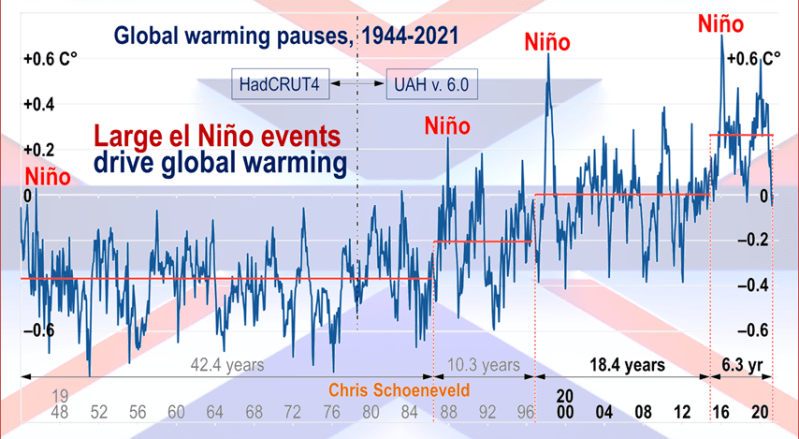
Chris Schoeneveld has produced a similar graph to the animation above, with a temperature series combining HadCRUT4 and UAH6. H/T WUWT

image-8


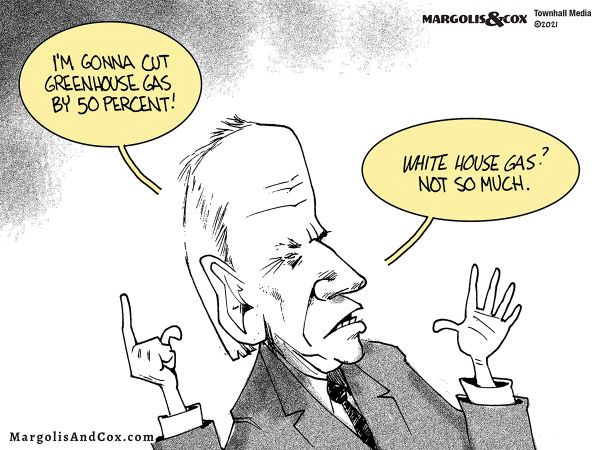
mc_wh_gas_web20210423124932

See Also Worst Threat: Greenhouse Gas or Quiet Sun?

June 2023 Update Little Warming Added After May El Nino Spike

banner-blog

With apologies to Paul Revere, this post is on the lookout for cooler weather with an eye on both the Land and the Sea.  While you will hear a lot about 2020-21 temperatures matching 2016 as the highest ever, that spin ignores how fast the cooling set in.  The UAH data analyzed below shows that warming from the last El Nino Had fully dissipated with chilly temperatures in all regions. After a warming blip in 2022, land and ocean temps dropped again with 2023 starting below the mean since 1995.  Now in March to May EL Nino appears in a Tropical ocean Spike.

UAH has updated their tlt (temperatures in lower troposphere) dataset for June 2023. Posts on their reading of ocean air temps this month preceded updated records from HadSST4.  I last posted on SSTs using HadSST4 El Nino Ocean Warming Abates May 2023. This month also has a separate graph of land air temps because the comparisons and contrasts are interesting as we contemplate possible cooling in coming months and years. Sometimes air temps over land diverge from ocean air changes.  For example in February, Tropical ocean temps alone moved upward, while temps in all land regions rebounded after hitting bottom.

In June, as shown later on, Global ocean air cooled led by dropping SH temps, despite continued warming in the Tropics and NH.  OTOH Global land air temps rose in both NH and SH with Tropical land little changed.  Thus the land + ocean Global UAH temperature record remained the same.

Note:  UAH has shifted their baseline from 1981-2010 to 1991-2020 beginning with January 2021.  In the charts below, the trends and fluctuations remain the same but the anomaly values change with the baseline reference shift.

Presently sea surface temperatures (SST) are the best available indicator of heat content gained or lost from earth’s climate system.  Enthalpy is the thermodynamic term for total heat content in a system, and humidity differences in air parcels affect enthalpy.  Measuring water temperature directly avoids distorted impressions from air measurements.  In addition, ocean covers 71% of the planet surface and thus dominates surface temperature estimates.  Eventually we will likely have reliable means of recording water temperatures at depth.

Recently, Dr. Ole Humlum reported from his research that air temperatures lag 2-3 months behind changes in SST.  Thus the cooling oceans now portend cooling land air temperatures to follow.  He also observed that changes in CO2 atmospheric concentrations lag behind SST by 11-12 months.  This latter point is addressed in a previous post Who to Blame for Rising CO2?

After a change in priorities, updates are now exclusive to HadSST4.  For comparison we can also look at lower troposphere temperatures (TLT) from UAHv6 which are now posted for June.  The temperature record is derived from microwave sounding units (MSU) on board satellites like the one pictured above. Recently there was a change in UAH processing of satellite drift corrections, including dropping one platform which can no longer be corrected. The graphs below are taken from the revised and current dataset.

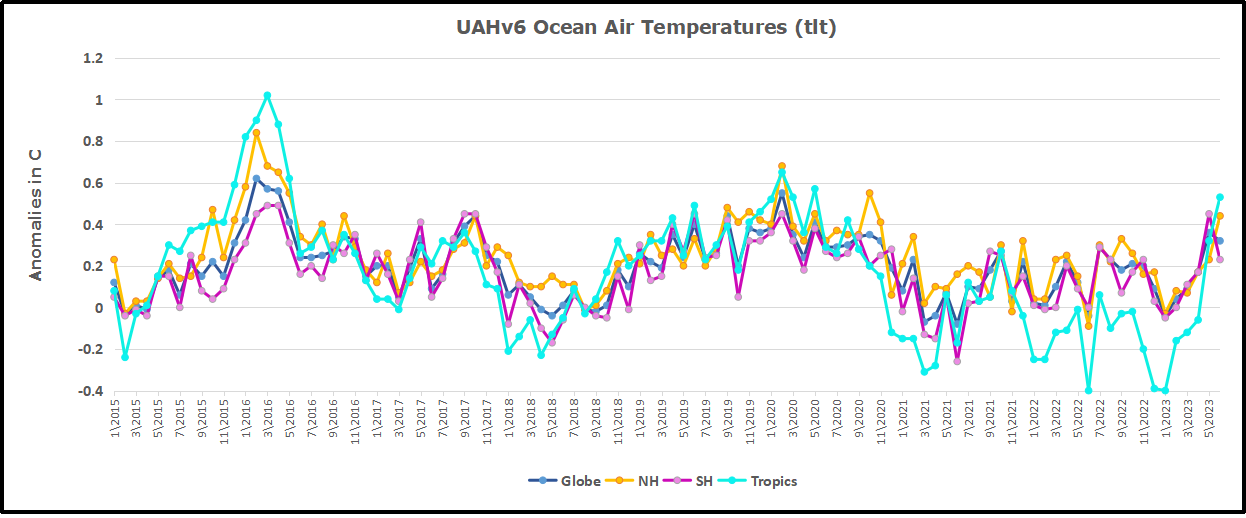
The UAH dataset includes temperature results for air above the oceans, and thus should be most comparable to the SSTs. There is the additional feature that ocean air temps avoid Urban Heat Islands (UHI).  The graph below shows monthly anomalies for ocean air temps since January 2015.


Note 2020 was warmed mainly by a spike in February in all regions, and secondarily by an October spike in NH alone. In 2021, SH and the Tropics both pulled the Global anomaly down to a new low in April. Then SH and Tropics upward spikes, along with NH warming brought Global temps to a peak in October.  That warmth was gone as November 2021 ocean temps plummeted everywhere. After an upward bump 01/2022 temps reversed and plunged downward in June.  After an upward spike in July, ocean air everywhere cooled in August and also in September.   

After sharp cooling everywhere in January 2023, all regions were into negative territory. Note the Tropics matched the lowest, but since  have spiked sharply upward +0.9C, with the largest increase in May and June 2023.  NH also warmed, but SH ocean air was cooler by 0.23C, resulting in Global Ocean air cooling slightly. Mid-year 2023 looks similar to both 2021 and 2022, which also had summer peaks followed by cooling.  The strength of the El Nino will determine the latter half of this year.

Land Air Temperatures Tracking Downward in Seesaw Pattern

We sometimes overlook that in climate temperature records, while the oceans are measured directly with SSTs, land temps are measured only indirectly.  The land temperature records at surface stations sample air temps at 2 meters above ground.  UAH gives tlt anomalies for air over land separately from ocean air temps.  The graph updated for June is below.


Here we have fresh evidence of the greater volatility of the Land temperatures, along with extraordinary departures by SH land.  Land temps are dominated by NH with a 2021 spike in January,  then dropping before rising in the summer to peak in October 2021. As with the ocean air temps, all that was erased in November with a sharp cooling everywhere.  After a summer 2022 NH spike, land temps dropped everywhere, and in January, further cooling in SH and Tropics offset by an uptick in NH. 

Remarkably, in 2023, SH land air anomaly shot up 1.2C, from  -0.56C in January to +0.67 in April. Now in June, rising SH and NH Land air temps rose, pulling up the Global land anomaly by 0.13C.

The Bigger Picture UAH Global Since 1980


The chart shows monthly Global anomalies starting 01/1980 to present.  The average monthly anomaly is -0.06, for this period of more than four decades.  The graph shows the 1998 El Nino after which the mean resumed, and again after the smaller 2010 event. The 2016 El Nino matched 1998 peak and in addition NH after effects lasted longer, followed by the NH warming 2019-20.   An upward bump in 2021 was reversed with temps having returned close to the mean as of 2/2022.  March and April brought warmer Global temps, later reversed, and with the sharp drops in Nov., Dec. and January 2023 temps, there was no increase over 1980. Now in 2023 the May and June peak matches the two previous Julys.  Where it goes from here, up or down, remains to be seen.

TLTs include mixing above the oceans and probably some influence from nearby more volatile land temps.  Clearly NH and Global land temps have been dropping in a seesaw pattern, nearly 1C lower than the 2016 peak.  Since the ocean has 1000 times the heat capacity as the atmosphere, that cooling is a significant driving force.  TLT measures started the recent cooling later than SSTs from HadSST3, but are now showing the same pattern.  It seems obvious that despite the three El Ninos, their warming has not persisted, and without them it would probably have cooled since 1995.  Of course, the future has not yet been written.


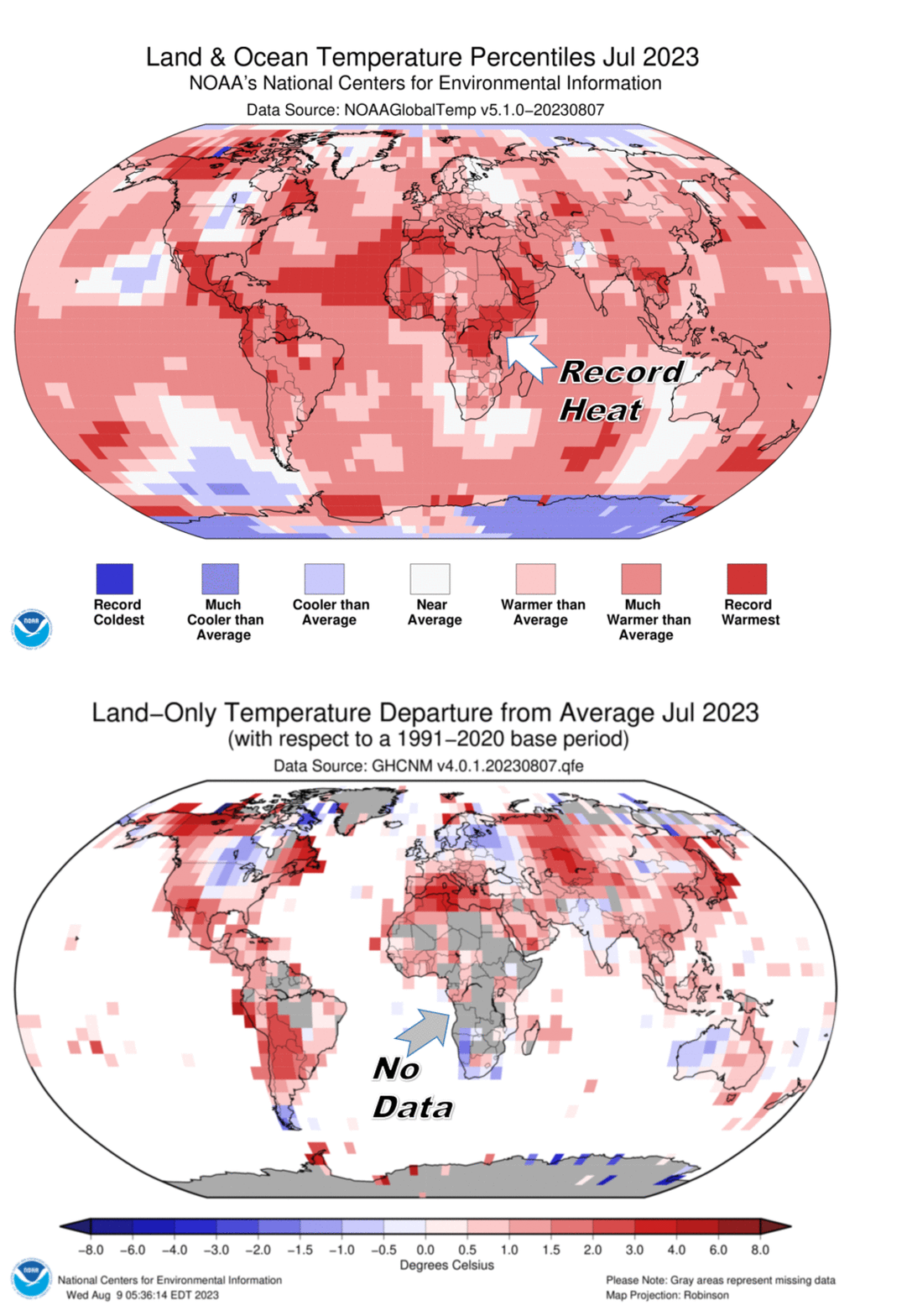
June 2023 the Hottest Ever? Not So Fast!

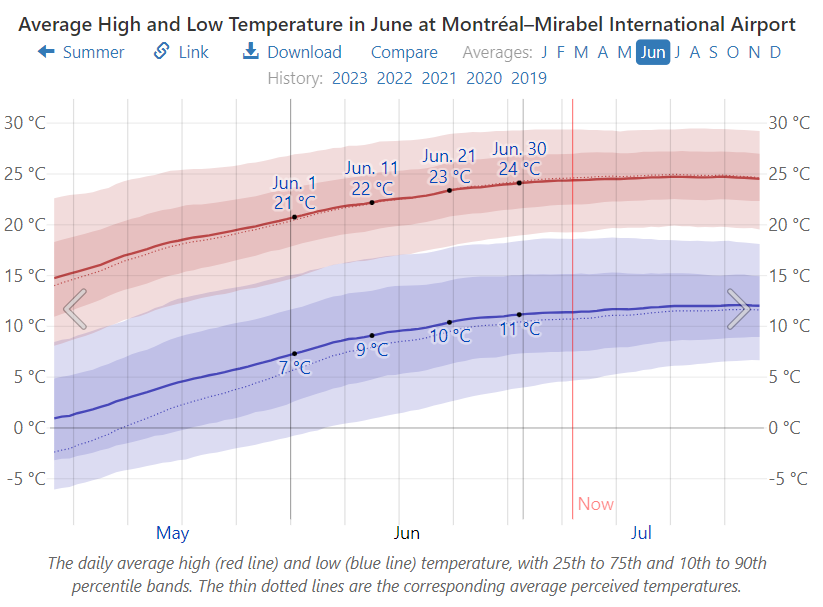
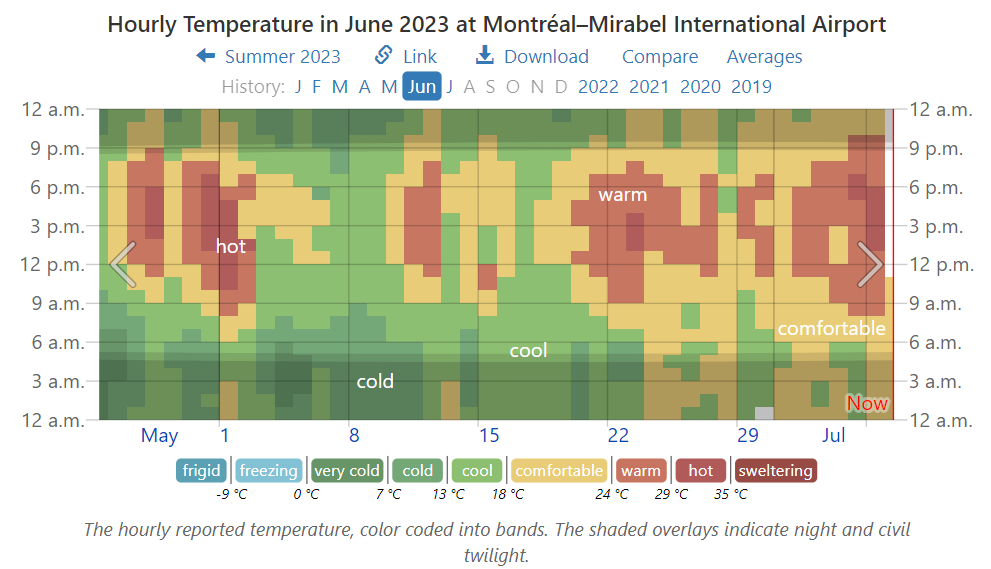
For sure you’ve seen the headlines declaring June 2023 the Hottest month ever.  If you’re like me, your response is: That’s not the way June went down where I live.  Fortunately there is a website that allows anyone to check their personal experience with the weather station data nearby.  weatherspark.com provides data summaries for you to judge what’s going on in weather history where you live.  In my case a modern weather station is a few miles away  June 2023 Weather History at Montréal–Mirabel International Airport.  The story about June 2023 is evident below in charts and graphs from this site.  There’s a map that allows you to find your locale.

First, consider above the norms for June from the period 1980 to 2016.

Then, there’s June 2023 compared to the normal observations.

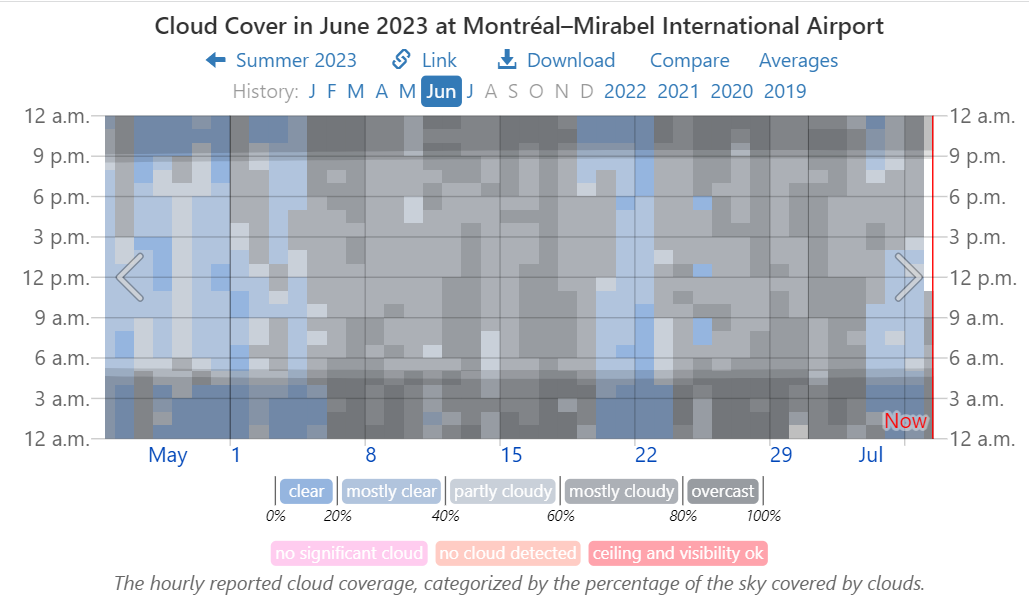
The graph shows May was warm, but not so much during June, pretty normal in fact.  But since climate is more than temperature, consider cloudiness.

Woah!  Most of the month was cloudy, which in summer means blocking the hot sun from hitting the surface.   And with all those clouds, let’s look at precipitation:

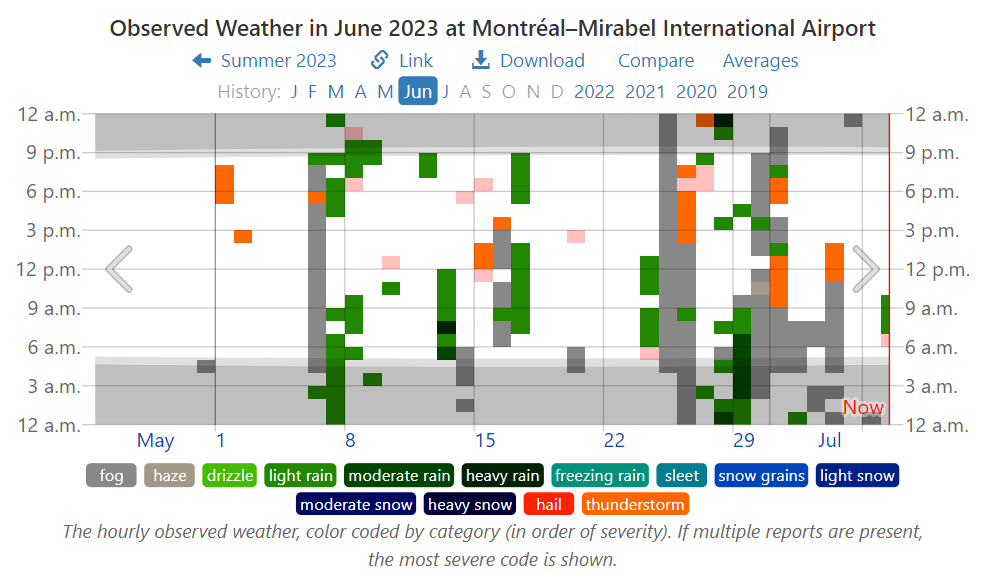
So, 19 days when it rained, including heavy rain, and sometimes thunderstorms, especially toward month end.  Given what we know about the hydrology cycles, that means a lot of heat removed upward from the surface.

So the implications for June temperatures in my locale.

There you have it before your eyes.  One Hot day, then cold, cool, warm
and ending comfortable.  Hottest June Ever!
Maybe in some imaginary world,  but not in the real one.

Summary:

Claims of hottest this or that month or year are based on averages of averages of temperatures, which in principle is an intrinsic quality and distinctive to a locale.  The claim involves selecting some places and time periods where warming appears, while ignoring other places where it has been cooling.

Remember:  They want you to panic.  Before doing so, check out what the data says in your neck of the woods.


EV Revolution Winding Down

An article from John Ray explains how the Electric Vehicle movement is losing steam The electric car ‘revolution’ is a disaster before it’s begun.  Excerpts in italics with my bolds and added images. (The UK references are due to the original article appearing in The Telegraph.)

The electric car revolution is stalling, of that there can no longer be any doubt. It has left the big global carmakers floundering, uncertain of how to proceed in a race they reluctantly entered in the first place.

Electrification was initially met with fierce resistance. But once politicians held a gun to the heads of company bosses with a series of cliff-edge deadlines for phasing out the combustion engine, carmakers had little choice but to go all-in.

Century-old business models were declared dead and ambitious plans hurriedly drawn up to electrify entire portfolios from small city run-arounds to family saloons and SUVs, at astronomical cost. Even Ferrari has embraced the movement – much to the consternation of petrolheads everywhere.

But with electrification barely off the starting grid, one by one the big carmakers
are already pulling back as demand badly falters.

Volkswagen is so concerned about flagging sales that it has taken the extraordinary decision of halting electric vehicle production at one of its biggest plants. Assembly lines for electric models will be paused for six weeks at the Emden factory in northwest Germany and 300 of its 1,500 staff laid off after sales fell 30pc short of forecasts.

This means production of the new VW ID.7 electric model, which had been due to commence in July will be pushed back until the end of the year. The ID.4 electric SUV and the upcoming ID.7 electric sedan will also be delayed.

“We are experiencing strong customer reluctance in the electric vehicle sector,”
plant boss Manfred Wulff said.

That is remarkably plain language from the largest car manufacturer on the planet, and a company that recently announced plans to invest €120bn (£103bn) over the next five years in “electrification and digitalisation”.

It comes months after Ford poured cold water on the shift to electric
with thousands of job losses in Europe.

Electric vehicle production is unable to support anything like the same number of jobs that petrol and diesel models are able to sustain, it said. Boss Jim Farley estimates that 40pc fewer staff will be needed to develop battery versions.

A generation of pure electric vehicle makers has hardly fared any better. On Tuesday, Lordstown Motors, the US electric truck specialist that Donald Trump once heralded as the saviour of a depressed Ohio town, filed for bankruptcy protection.

Even Elon Musk has been forced to repeatedly cut the price of Teslas in a desperate effort to prop up demand and protect market share.

But it’s the setback at VW that stands out, raising serious questions about whether politicians are making the catastrophic mistake of forcing electric cars on a public that doesn’t want them. Indeed, the decision to impose strict deadlines for the phase out of petrol cars could turn out to be one of the most ruinous policy decisions of our lifetimes.

Think about it for a second: an entire industry not only forced to abandon a product that the vast majority of people still want and use, but also bullied into channelling all its resources into making something on a colossal level that there simply isn’t the market for – at least not within the horrendously short timeframe that is being imposed on car manufacturers.

It’s industrial self-sabotage and a commercial, economic and social catastrophe in the making. But what’s worse is that the damage risks being far greater in the UK than anywhere else in the Western world thanks to the Government’s myopic obsession with arbitrary net zero targets.

While the rest of the industrial world seems to have largely settled on a 2035 deadline for petrol and diesel phase out, ministers, for reasons destined to remain a mystery, have decided Britain needs to hit this milestone five years earlier than everyone else.

It makes no sense at all, and yet the ramifications threaten to be huge. By diverting capital into something that lots of people essentially don’t want, it risks inflicting massive losses on an already fragile UK car industry.

It is pure fantasy to imagine that Britain – with a dearth of battery factories (consultants Alix Partners estimates as much as a third of Britain’s battery requirements will need to be imported), a paucity of chargers and dramatically higher energy costs – will be in any position to go fully electric in the next seven years. And the Government simply isn’t capable of solving any of these challenges in time, if at all.

The UK risks becoming the unfortunate guinea pig in a costly and dangerous experiment that persuades the rest of the world to push their own deadlines out even further, turning this country into an example of how not to become a nation of electric car owners.


Election Fraud is Weaponized Identity Theft

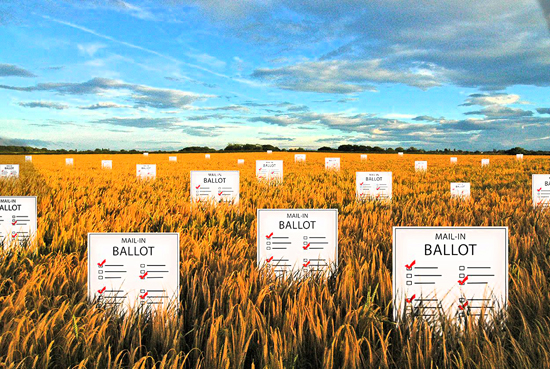
Jay Valentine explains how ballot harvesting depends on industrial scale identity thefts, and only the Left is willing and organized to do that.  There is an antidote to restore free and fair elections, but it won’t happen by trying to out-harvest the Left’s machine.  Note this is not about voter turnout but the opposite.  It’s stealing votes from people on the voter rolls by sending their ballots to invalid addresses where they will be collected and filled in, when and where they will make victory for favored candidates.  His American Thinker article is A Line of Defense Against Mail-in Ballot Fraud.  Excerpts in italics with my bolds and added images.

The RNC, the Trump Campaign, almost every Republican state party chairperson believes the road to 2024 electoral victory is to “out-ballot-harvest the left.” It’s hard to argue with absolute nonsense.  To the rescue, however, comes a retired mail carrier who sent the following message:

Message: I am a retired mail man.

I just saw your War Room interview.
I now know where the mules got their ballots. Straight from the post office in returned/undeliverable mail.
While I have zero proof of where they ended up, I had those ballots you were talking about in my mail bag with wrong addresses or lacking apartment numbers or even people that moved and still had ballots delivered to their old apartment.
We put those ballots in a basket and someone came by and picked them up.
Hundreds or even thousands of ballots.
Who picked them up, where did they go?
Now we know why signature match was removed…
Someone needs to investigate the post office and their democratic union run activities.

Tell us, RNC, how are you going to beat this? 

The only way to stop the government, in particular the United States Post Office, from gathering hundreds of thousands of loose ballots, all of which go somewhere other than to Republican candidates — is to stop those ballots in the first place.

We know, from numerous sources, that the Post Office is one of several ballot-gathering apparatuses of the Left.  How much ballot harvesting at evangelical churches is needed to make up for government-sponsored ballot harvesting — industrial scale?

A key to winning in 2024 is to identify every, or as close to every as technology and diligent work can enable — every ballot being sent out that will land in that “basket” that “somebody” later picked up.

What are the addresses on those ballots?
  • Ballots mailed to vacant lots — or in Arizona, street corners.
  • Ballots sent to apartment buildings without the unit or APT number.
  • Ballots sent to college dorms for students registered there for decades.
  • Ballots sent to fraternities with a 105-year-old student.
  • Ballots sent to churches — which have no bedrooms, thus cannot be someone’s domicile.
  • Ballots for the person who moved — over a year ago.
  • Ballots mailed to hotels and casinos.
  • Ballots where the address was modified — by the voter commission (as in Arizona) — the week those ballots went out, thus missing the recipient.
  • Ballots sent to Manchurian restaurants, laundromats, banks, and 7-Elevens — all of which are not valid addresses for voters.
  • Ballots sent to UPS and FedEx boxes — sometimes to a dozen people living in that little box.
  • Ballots sent to the apartment building — but the address is the clubhouse — which has no bedrooms.
  • Ballots sent to the 22,000 new voters in a single county entered just days before the election — who were invisible to Arizona Republican candidates in 2022.
  • Ballots sent to Mr. Gonzales, Mr. Gonzalez, Mr. Gonzalles, all at the same address with the same date of birth.
  • Ballots sent to the Wisconsin college dorm that has 1,000 registered voters but can house only 250 adults.
  • Ballots sent to the 11 adults at the single-family Houston home that is 823 square feet with one bedroom and one bathroom.
  • Ballots mailed to people registered at an address in 2020 but the building was not built until 2022.
  • Ballots sent to the rehab facility for dozens of people who claim it as a residence for years.  (Rehab is not a “years” thing.)

Welcome to the Undeliverable Ballot Database.

A simple mail carrier, supported by other mail carriers we interviewed in person, shows how completely useless is the GOP campaign to “out-ballot-harvest” the Left.

Ballots — which will not land in an eligible recipient’s hand – must be identified,
months in advance of being mailed
.

Most of those ballots, using super-compute technology, can be identified, shown to be illegitimate, and brought to everyone’s attention 6 months before election day.

When Harris County (Houston) floods the zone six months before early voting with 240,000 new voters, each needs to be instantly checked, verified, validated, and if necessary challenged — before the 2024 election.  Wake up, Ted Cruz!

When Arizona and Wisconsin counties change identifiers the week mail-in ballots
go out, then change them back, real time compute needs to flag it and ask “why?”

Here, let’s do it.

Two state legislatures invited the Fractal team to do a “proof of concept” for their state voter rolls.  So, that’s what we’re doing.

We ingest multiple copies of the voter rolls.  We want at least three dates but in one of the states, we will probably do a dozen.  Multiple copies of voter rolls shows movement, lights up changes made to the voter rolls that make you say hmm.

We compare every copy of the voter roll with every other copy — every cell against all corresponding cells.  If someone’s zip code was changed, we flag it.  Might be no big deal, but then, might be Arizona where 33,000 zips were changed days before the election.

In a state rep election, for a Republican candidate, a primary, we found 212 people who moved from all over the state to this guy’s district.  They all voted.  Then about a month after the election, they all moved out of the district.  Where do you think they moved?  Back to their original houses!  He won!

We ingest the personal property tax rolls for the county.  Those show the type of building, if it is a business, the number of bedrooms, baths, units, year built, square footage of living space, and about 40 other useful attributes.  In Austin, Texas, we add the construction/permit rolls, giving us a closer to real time view of every property improvement.

For these two state legislatures, we want something for the Attorney General.

We bring in the FEC (Federal Election Commission) contribution rolls.  With a single click, the AG can see every “contribution mule” in the state.  If that’s not enough, we bring in the massive Medicaid rolls — all claims, all providers, all recipients for dozens of years.  At this point, we are in the tens of billions record level — and guess what we find?

Some of those same sketchy voter addresses — fake people living in UPS boxes correspond to Medicaid providers — who are likely fake.  We migrated from just cleaning voter rolls to making a state some real dough — identifying Medicaid fraud.

This is the power of real time super-compute.

Our thesis to state governments is that it isn’t just voter fraud.  It’s identity fraud and
not just in their voter rolls, identity fraud permeates every state government roll.

While we developed the Undeliverable Ballot Database to identify every address where a ballot will be sent yet not find an eligible recipient, we also created an address and identity database for people who claim one identity in Medicaid, another in WIC and another on the voter roll.

Vast government databases are virtually invisible to current SQL/relational technology.  Fractal and other super-computes are delivering real-time visibility to identity fraud lasting decades.

One of the first benefits is the Undeliverable Ballot Database — saving the mail carrier all those fake ballots.

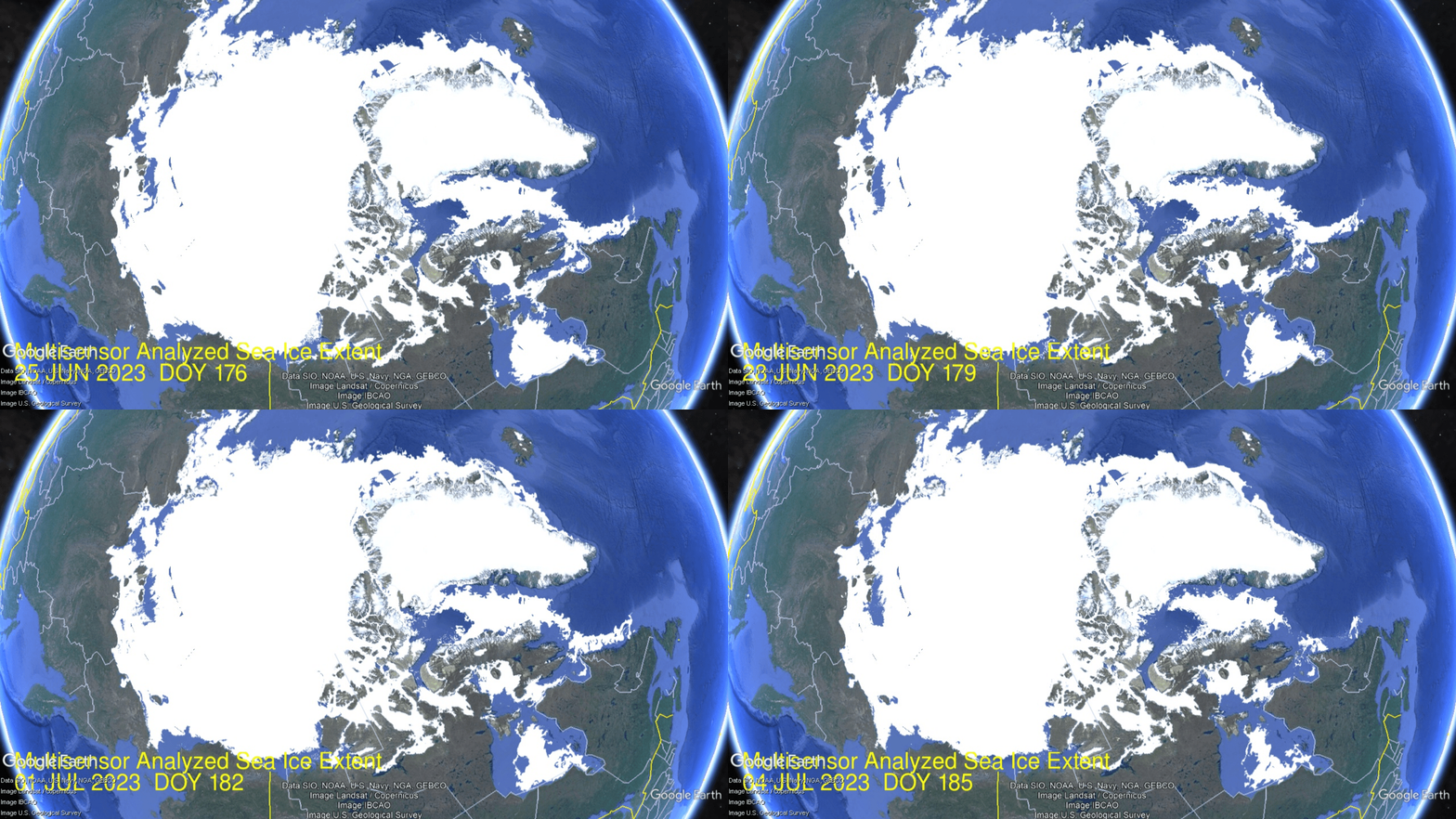
Ten Days Melt in Hudson & Baffin Bays


The previous June Arctic ice update suggested that shallow basins on the Atlantic side will now lose their ice rapidly.  The animation above shows in the last 10 days how much open water has appeared in Hudson Bay (bottom right) and Baffin Bay (center right).  Just those two regions combined lost ~500k km2 of ice in 1.5 weeks and are now holding ~30% of their maximums.  The images also show little change elsewhere.  This is all normal melting of Arctic drift ice, presently at 63% ( 9.5 M km2) of last March maximum, heading toward the September minimum.


Illustration by Eleanor Lutz shows Earth’s seasonal climate changes. If played in full screen, the four corners present views from top, bottom and sides. It is a visual representation of scientific datasets measuring Arctic ice extents and snow cover.