
From the geniuses who brought you the missnamed IRA spending spree, a new push to suck plant food (CO2) out of the air to “fight global warming.” The insanity is doubled: Billions are wasted in an effort to deprive the biosphere of essential CO2. LA Times How the Biden administration is pouring billions into technology that sucks carbon from the air. Excerpts in italics with my bolds.

The Biden adminstration is funding projects by Occidental Petroleum and Climeworks that will remove carbon dioxide from the air. The Climeworks plant in Hinwil, Switzerland, above, filters carbon dioxide from the air above a garbage incineration plant. (Climeworks)
Some Might Call it a Ruse
The technology is “essentially a giant vacuum that can suck decades of old carbon pollution straight out of the sky,” Energy Secretary Jennifer M. Granholm told reporters. “If we deploy this at scale, this technology can help us make serious headway toward our net-zero emission goals.”
Once operational, the hubs are expected to remove more than 2 million metric tons of carbon dioxide a year from the atmosphere, the equivalent of taking nearly half a million gas-powered cars off the road, Granholm said. Additional projects are expected to be announced next year, the Energy Department said.
Critics worry that carbon capture is too untested to be a reliable tool in fighting climate change. And some opponents see carbon capture efforts as a way to extend the life of facilities that produce or use fossil fuels.

Background: Wasting Money on Carbon Capture
Robert Bryce explains in his Real Clear Energy article Carbon Capture Didn’t Make Sense 12 Years Ago And It Doesn’t Make Sense Now. Excerpts in italics with my bolds and added images.
It appears the reconciliation bill that includes some $370 billion in energy-related spending is going to become law. The measure includes a panoply of tax credits for alternative energy technologies, including incentives for electric vehicles, hydrogen, energy storage, and of course, billions of dollars in tax credits for wind and solar energy.
The measure also includes, according to the Congressional Budget Office, some $3.2 billion in tax credits for carbon capture and sequestration, a technology that has plenty of supporters but precious little in the way of commercially successful projects. Back in 2018, Al Gore blasted CCS, calling it “nonsense” and an “extremely improbable solution.”
The new tax credits for CCS remind me that I published a piece in the New York Times on May 12, 2010, about the technology. In looking back, the piece is still relevant today. In fact, I wouldn’t change a word of it. Furthermore, my prediction about the difficulty of siting the pipelines needed to move the CO2 has already come true. For proof, see this August 6, Wall Street Journal article about the opposition to a proposed CO2 pipeline in Iowa.
In any case here’s my 12-year-old take on why CCS is a bad bet:
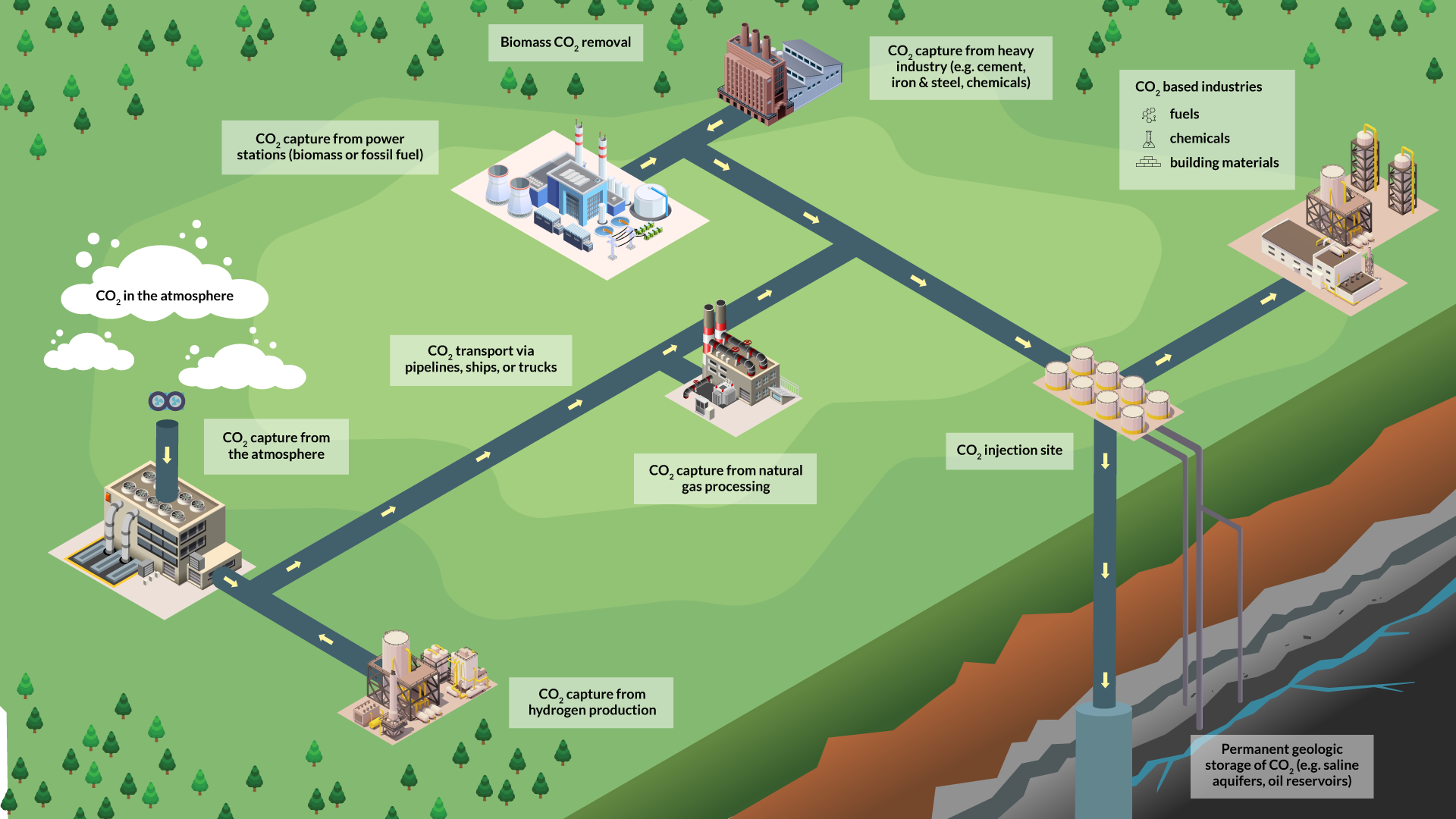
On Wednesday, John Kerry and Joseph Lieberman introduced their long-awaited Senate energy bill, which includes incentives of $2 billion per year for carbon capture and sequestration, the technology that removes carbon dioxide from the smokestack at power plants and forces it into underground storage. This significant allocation would come on top of the $2.4 billion for carbon capture projects that appeared in last year’s stimulus package.
That’s a lot of money for a technology whose adoption faces three potentially insurmountable hurdles: it greatly reduces the output of power plants; pipeline capacity to move the newly captured carbon dioxide is woefully insufficient; and the volume of waste material is staggering. Lawmakers should stop perpetuating the hope that the technology can help make huge cuts in the United States’ carbon dioxide emissions.
1. An Energy Intensive Process
Let’s take the first problem. Capturing carbon dioxide from the flue gas of a coal-fired electric generation plant is an energy-intensive process. Analysts estimate that capturing the carbon dioxide cuts the output of a typical plant by as much as 28 percent.
Given that the global energy sector is already straining to meet booming demand for electricity, it’s hard to believe that the United States, or any other country that relies on coal-fired generation, will agree to reduce the output of its coal-fired plants by almost a third in order to attempt carbon capture and sequestration.
2. Costly Pipelines for a Waste Gas
Here’s the second problem. The Pacific Northwest National Laboratory has estimated that up to 23,000 miles of new pipeline will be needed to carry the captured carbon dioxide to the still-undesignated underground sequestration sites. That doesn’t sound like much when you consider that America’s gas pipeline system sprawls over some 2.3 million miles. But those natural gas pipelines carry a valuable, marketable, useful commodity.
By contrast, carbon dioxide is a worthless waste product, so taxpayers would likely end up shouldering most of the cost. Yes, some of that waste gas could be used for enhanced oil recovery projects; flooding depleted oil reservoirs with carbon dioxide is a proven technology that can increase production and extend the life of existing oilfields. But the process would be useful in only a limited number of oilfields — probably less than 10 percent of the waste carbon dioxide captured from coal-fired power plants could actually be injected into American oilfields.
3. Impossibly Massive Scale
The third, and most vexing, problem has to do with scale. In 2009, carbon dioxide emissions in the United States totaled 5.4 billion tons. Let’s assume that policymakers want to use carbon capture to get rid of half of those emissions — say, 3 billion tons per year. That works out to about 8.2 million tons of carbon dioxide per day, which would have to be collected and compressed to about 1,000 pounds per square inch (that compressed volume of carbon dioxide would be roughly equivalent to the volume of daily global oil production).
In other words, we would need to find an underground location (or locations) able to swallow a volume equal to the contents of 41 oil supertankers each day, 365 days a year.
There will also be considerable public resistance to carbon dioxide pipelines and sequestration projects — local outcry has already stalled proposed carbon capture projects in Germany and Denmark. The fact is, few landowners are eager to have pipelines built across their property. And because of the possibility of deadly leaks, few people will want to live near a pipeline or an underground storage cavern. This leads to the obvious question: which members of the House and Senate are going to volunteer their states to be dumping grounds for all that carbon dioxide?
For some, carbon capture and sequestration will remain the Holy Grail of carbon-reduction strategies. But before Congress throws yet more money at the procedure, lawmakers need to take a closer look at the issues that hamstring nearly every new energy-related technology: cost and scale.

Footnote: The project is not only impractical, its deluded objective is to deprive the biosphere of plant food.
See also: Carbon Capture Boondoggle

 Science Matters
4. Henry’s Law. The oceans will “adjust” if the vulcanos are not capable to produce enough carbon dioxide. There’s a balance between the carbon dioxide levels in the atmosphere and the oceans, which cannot be easily changed, due to the vast volumes involved. Hubris and greed believes differently …
LikeLike
Agree Sasjal. And we have empirical evidence demonstrating the power of the ocean sink from the case of Pinatubo volcano eruption.
LikeLiked by 1 person
Ron,
Thank you and I agree. I followed the AEP Mountaineer Carbon Capture project which was done about 2010-2013. As I recall, it used about 30% of the electricity production for parasitic power to run the CO2 capture equipment. On the other hand, about 2012 there was a study completed that about 3 million barrels per day could be produced using CO2 from existing coal plants in Ohio to capture the CO2 for enhanced oil recovery in old, abandoned oil wells in Ohio. I was fascinated by this possibility. Nothing ever became of it but if anyone is interested, I can dig up the link to the report. I saw the presentation at a National Coal Council meeting, think it was 2012
LikeLike
Dick, I am trying to get a straight story on the Saskpower carbon capture project running since 2014. There are both performance and cost problems papered over in order to virtue signal.
Example:
https://globalnews.ca/news/5250015/saskatchewan-carbon-capture-facility-likely-to-fall-short-of-annual-target-ceo/
https://www.cbc.ca/news/canada/saskatchewan/saskpower-looking-for-help-to-fix-high-cost-boundary-dam-carbon-capture-flaw-1.4680993
https://globalnews.ca/news/4100577/carbon-capture-operation-and-maintenance-costs-grow-by-nearly-15m-in-four-years/
LikeLike
Here’s a more recent report on Boundary Dam carbon capture project:
https://www.vice.com/en/article/g5q573/the-worlds-only-coal-carbon-capture-plant-is-regularly-breaking
“But for critics like Jones, Boundary Dam’s underwhelming performance is a foreboding sign of broader issues with CCS technology in general. In May, 2021 a team of researchers studied 263 CCS projects undertaken between 1995 and 2018 and found that the majority failed, while 78 percent of the largest projects were cancelled or put on hold. A few months later, the only other coal plant with a CCS attachment in the world, Petra Nova, shuttered after facing 367 outages in its three years of operation and falling short of its emissions reduction goals by 17 percent.”
The position of activists against carbon fuels is to end use of coal, so they are critical of CCUS lest it allow coal power plants to remain open. The underlying insanity is to call CO2 a pollutant in the first place.
And there are also politics in play. By having its own plan to reduce emisisions, Saskatchewan claims exemption from federal carbon taxation.
https://www.saskpower.com/about-us/our-company/blog/2023/reaching-net-zero-in-saskatchewan
LikeLike