Biden’s Desperate Wartime Climate Policy

 

Mark Krebs writes at Master Resource “Wartime” Climate Policy vs. Natural Gas: Biden Gets Desperate.  Excerpts in italics with my bolds and added images.

“While gas appliances may presently be losing some market share to electricity due to Green New Deal discrimination, there are also increasing indications that the public is both weary and wary of such ‘watermelon’ policies. It’s not about saving the planet from the ravages of fossil fuels; it’s about enslaving the planet by banning fossil fuels.”

Yes, the President of the United States has pulled out a Korean War authority (Defense Production Act) to fight against American energy that Americans prefer. It is an overreach that is being noted widely, as outlined below as well as here and here.

The American Gas Association (AGA) started this latest flurry with a press release November 17, 2023. The same day, Reuters and Fox News published their articles. Epoch Times published its article (and video) on November 20, 2023. The Reuters article most noteworthy contribution is that it names recipients of the Biden Administration’s [mis]appropriations of DPA funding. Both the Reuters article and Fox News article cite the AGA’s press release.
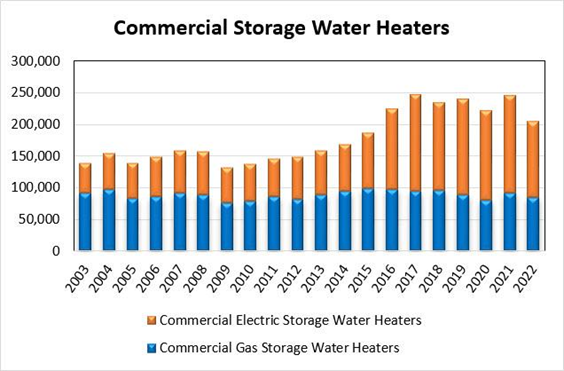
The AHRI data clearly shows that gas appliances are losing at least some ground to electric equivalents as evidenced by the above graphs. Moreover, this trend appears to have accelerated under the Biden Administration. AHRI’s discussion of the IRA and DPA is non-committal advocacy (an oxymoron?).

Conclusions

“While gas appliances may presently be losing some market share to electricity due to Green New Deal discrimination, there are also increasing indications that the public is both weary and wary of such ‘watermelon’ policies. It’s not about saving the planet from the ravages of fossil fuels; it’s about enslaving the planet by banning fossil fuels.”

The eighteenth-century naval hero John Paul Jones was doing battle with a British ship when his own ship was badly damaged, and the British commander called over to ask whether Jones had surrendered. He answered, “I have not yet begun to fight.” He and his crew then captured the British ship. While regulatory capture of the “administrative state” appears to be the rule and not the exception at present, this bit of history should be remembered so we do repeat it and recapture a government “for the people” as our Founding Fathers intended.

Washington Examiner reports Biden’s war on energy: President invokes wartime powers to speed up end to gas-powered home appliance.  Excerpts in italics with my bolds and added images.

President Joe Biden allotted $169 million for electric heat pump projects with his emergency authority on the basis of climate change.

This is the first time a president classified climate change as an emergency by utilizing the Defense Production Act, which was established during the Cold War. Now, the money stemming from the Inflation Reduction Act will be divided among 15 sites dedicated to manufacturing the necessary parts and entire units of a variety of heat pumps.

“The President is using his wartime emergency powers under the Defense Production Act to turbocharge U.S. manufacturing of clean technologies and strengthen our energy security,” Biden’s National Climate Advisor Ali Zaidi said in a statement.

John Podesta, senior adviser to the president for clean energy innovation and implementation, similarly celebrated the move, applauding the president for “treating climate change as the crisis it is.”

However, American Gas Association President and CEO Karen Harbert disagreed with the recent move from the White House, writing in a statement, “We are deeply disappointed to see the Defense Production Act, which is intended as a vital tool for advancing national security against serious outside threats, being used as an instrument to advance a policy agenda contradictory to our nation’s strong energy position.”

“Increased use of natural gas has been responsible for 60% of the electrical grid’s CO2 emissions reductions. This vital tool for emissions reductions and energy system resilience should not be unfairly undermined through misuse of the Defense Production Act.”

Among the facilities, two new factories will be constructed: a Treau, Inc. DBA Gradient plant in Michigan and a Mitsubishi Electric plant in Kentucky. Neither company has announced exact locations yet. Treau will receive over $17 million, and Mitsubishi will receive $50 million toward construction.

The Energy Department predicts roughly 1,700 jobs will be created in the various projects to promote more heat pump products. All the sites are centered in “disadvantaged communities” for their benefit.

Last year, the Energy Information Administration reported that natural gas was the water and space heating source of about 42% of U.S. residential spaces. The residential sector makes up 15% of overall natural gas consumption. However, heating and cooling across residential and commercial buildings drive more than 35% of the country’s energy consumption.

Footnote on Declaring Climate Emergency for Spending Purposes

This report on the German High Court ruling on this matter Europe Plunges Into Chaos After Germany Freezes Public Spending Following Shock Top Court Decision.  Excerpts in italiics with my bolds.

Germany’s economy, Europe’s largest, is contracting as surging energy prices and trade tensions cast doubt on its export-oriented business model. Chancellor Olaf Scholz’s government had been counting on that old virtue signaling switcheroo – a flood of spending on “green-energy projects and technology”, from chips to batteries, to revive the old model. That way, if anyone asks why Germany is deficit-spending its way to mercantilist utopia, Berlin could always lie and say it was doing the right thing for the world and wasn’t interested in a debt-funded stimulus. Alas, now the “Cardinals of Karlsruhe” have made this impossible.

Berlin’s decision to freeze all federal spending for the rest of the year came after the court defunded the government’s €60 billion —the equivalent of more than $65 billion—green-transition project. The court said Berlin couldn’t repurpose unspent credits originally earmarked to tackle the Covid-19 pandemic to fund environmental and energy projects. It said Berlin was bound by the country’s constitutionally enshrined fiscal rules that limit budget deficits to 0.35% of gross domestic product in normal times.

Senior government officials said one option under consideration would be to retroactively declare a state of budgetary emergency for 2023, invoking a clause in the fiscal rules that allows for a suspension of the spending limits in exceptional circumstances. Previous governments invoked the exception during the pandemic.

Unfortunately, for Germany’s stimmy-starved politicians, the plan is fraught with legal difficulties, in part because the constitutional court prepared for just this eventuality when it raised the bar for declaring such emergencies, according to Lars Feld, an economist who advises the government.

Strengthening resilience and transforming the economy amid geopolitical crises and climate change was seen as a necessity that required taking on debt, but the court ruling has challenged those assumptions, Feld wrote in the Frankfurter Allgemeine newspaper.

Hilariously, the court said that unlike war and natural disasters, climate change was a foreseeable crisis that had been long in the making and could no longer justify emergency spending. Which, however, means that all Germany will have to do is politely request that the CIA start a new war… or that Fauci mail orders a new virus from Wuhan.

COP28 Mind-Boggling Numbers

The Green Mirage recedes as you approach it.

Robert Lyman exposes the freakish math swirling around Dubai COP this fortnight in his Financial Post article COP28 by the (very big) numbers.  Excerpts in italics with my bolds and added images.

This weekend’s climate meeting will discuss trillions of dollars.
No one will mention its chance of success is zero.

Neuroscience tells us the human brain is very bad at interpreting large numbers. Most people know that million, billion and trillion are all big numbers but can’t really understand what the difference between them is. Answer: it’s big. A million seconds is 12 days. A billion seconds is 31 years. A trillion seconds is 31,688 years, which is a lot more than 12 days.

Our cognitive difficulties with large numbers will be a problem when reading the news from the COP28 climate conference that convenes in Dubai on Thursday.

The conference has a wide-ranging agenda. It also will be attended by a large number of people — over 70,000 at last count. There’s the first large-number problem for COP28. How does a group of 70,000 people possibly discuss anything in a coherent way?

The organizers have identified five themes on which they would like to see agreement among the almost 190 governments that will be represented. When you’re talking governments, 190 is yet another brain-challenging number.

To oversimplify, there are four main themes:

♦  how to accelerate all countries’ efforts to reduce greenhouse gas emissions so as to meet a proposed 2050 “net-zero” target (zero not being a large number);
♦  how to induce wealthier countries to give much more money to poorer countries to help them both mitigate and adapt to climate change;
♦  how to persuade all countries to phase out production of fossil fuels by 2050; and, finally,
♦  how to increase the UN’s role as central coordinator and global regulator of climate efforts.

Most discussions behind closed doors will be about money. Rich countries are now paying about US$70 billion in climate aid, mostly to help finance GHG emissions reduction. The developing countries want this raised to at least US$1.4 trillion per year by 2026, 20 times higher. Twenty is not actually that large a number, except when talking about multiplying already very big dollar amounts by it. Developing countries have also demanded that funding for adaptation rise to at least US$600 billion per year. At last year’s COP27 in Egypt, they got agreement in principle for a new fund to pay for the “loss and damages” they will incur from adverse weather events they attribute to the historic GHG emissions of the industrialized countries, though no dollar amounts were agreed to. Finally, developing countries are pushing for a new Global Biodiversity Fund, to which developed countries would donate a mere US$20 billion per year.

Round numbers: rich countries would be on the hook for US$2 trillion per year. If allocations were based on GDP, Canada would owe three per cent of the total — or US$60 billion per year. In Canadian dollars, that’s roughly 78 billion CAN$. There are about 16 million households in Canada so (do the math) each household would owe $4,875. Per year. That’s a number the average person can easily understand. He or she can also understand there is absolutely no way the Canadian public or voters in any other OECD country would ever agree to such a thing. Not even if they didn’t know (but they do) that China, producer of 30 per cent of the world’s GHG emissions, not only would not be contributing but might well qualify as a recipient.

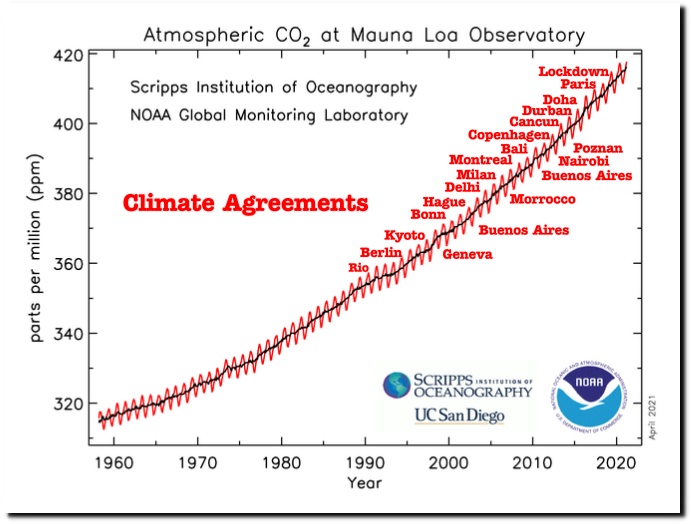
The previous 27 COPs (for Conference of the Parties) have all promoted ever-more ambitious emissions reductions. But since the first COP global emissions have risen 60 per cent, driven by developing countries’ relentless efforts to achieve more economic development for their burgeoning populations. There is no evidence that trend will change. China, India, Russia, Saudi Arabia, Iran, Iraq and others all see fossil fuel production as key to their economic development and energy security. They are unlikely to commit to production declines even if a few OECD countries do.

The United Nations secretariat will lobby hard at COP28 to expand the role of existing institutions, including even more climate summits to place even more political pressure on leaders, and they may succeed in this (though many of us feel just one a year is already more than enough). How difficult can it be to convince tens of thousands of climate stakeholders to travel to exotic conference locales each year? Especially if the general public cannot grasp the numbers they’re playing with.

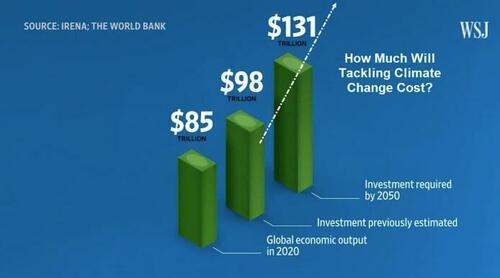
Yes, those are trillions of dollars in the projection.

This weekend the media in general will report in glowing terms on the energy and enthusiasm of conference participants, especially those representing environmental NGOs. The communiqué will note every new commitment made yet entirely ignore that the probability the entire process will meet its objectives is a very, very small number not significantly different from zero.


Trudeau Climate Crusade Hits Alberta Wall

Tyler Durden has the story at zerohedge Alberta Premier Defies Trudeau Carbon Agenda – Invokes Sovereignty Act.  Excerpts in italics with my bolds and added images.

It is an action which multiple red states in the US undertaken: Blocking carbon controls ingrained in “green power” initiatives conjured by the federal government.

Now it appears the momentum has spread to Canada through Alberta’s conservative leadership as Premier Danielle Smith defies the Trudeau regime by invoking the province’s recently drafted Sovereignty Act.

The Sovereignty Act is designed to give Alberta’s legislative assembly the power to identify any federal programs or actions that violate Alberta’s constitution, the government would then refuse to implement those programs.  The implementation of the act means that finally, an open dialogue on the existential threat of the UN’s “sustainable development goals” and Agenda 2030 has begun in Canada.  

The reasons for opposition to “Net Zero” objectives have been repeated over and over again by political critics, economic critics and scientific critics alike. 

1.  Net zero as the UN defines it is impossible using existing green technologies with inefficient and costly power generation.

2.  Net zero proponents refuse in most cases to acknowledge the usefulness of nuclear power as a means to reduce reliance on oil and gas.

3.  Net zero would require perpetual authoritarian oversight of individual carbon emissions and probably population reduction in the near term.

4.  None of the above even matters because there’s no concrete evidence whatsoever man-made carbon causes global warming.

In other words, the supposed crisis is a fraud and there’s no reason
for any nation, province or state to sacrifice their power grids.

Beyond the big con, stagflation has made carbon controls economically impossible. Aggressive price spikes since 2020 make gas, oil and coal more important than ever in maintaining basic services for the populace along with the needs of industry. Reducing available supply in the face of desperate demand would only fuel the fires of inflation further. Even Europe has been reverting back to “villainous” energy sources like coal to keep things running.

When people face the possibility of freezing or starving there is little chance they are going to listen to unfounded claims of climate doomsday from a bunch of ultra-rich yacht sailing private jet-setting carbon-spewing hypocrite elites.

See Also Hydrocarbons Are the Greenest Fuels


Yellow Brick Road to Green Dystopia

J. Peder Zane warns us that green dreamers will destroy social wellbeing in his Real Clear Investigations article Let’s Count the Ways RCI Has Exposed the Green Pipe Dream.  Excerpts in italics wtih my bolds and added images.

While brandishing the moral cudgel with full force – President Biden describes climate change as “an existential crisis,” i.e., every person and puppy will die if we don’t submit to his agenda – the left also suggests the transition will be easy-peasy: Just build some windmills, install some solar panels, and swap out your car, stove, and lightbulbs for cleaner and cheaper alternatives.

The up front gold is clear and costly, the end of the road in shadows.

Though much of the cheerleading media downplays this fact, it is already clear that Biden’s enormously expensive, massively disruptive goal is a pipe dream. In a recent series of articles, my colleagues at RealClearInvestigations have reported on several of the seemingly intractable problems that the administration and its eco-allies are trying to wish away.

The dishonesty begins with the engine of the green economy – the vast array of wind and solar farms that must be constructed to replace the coal and gas facilities that power our economy. James Varney reported for RCI that the Department of Energy’s official line is that the installations required to meet Biden’s goal of “100% clean electricity” by 2035 will require “less than one-half of one percent of the contiguous U.S. land area” – or roughly 15,000 of the lower 48’s roughly 3 million square miles. However, Varney noted,the government report that furnished those estimates also notes that the wind farm footprint alone could require an expanse nine times as large: 134,000 square miles. That is equivalent to the land mass of Ohio, Indiana, and Kentucky combined – plus all of New England.

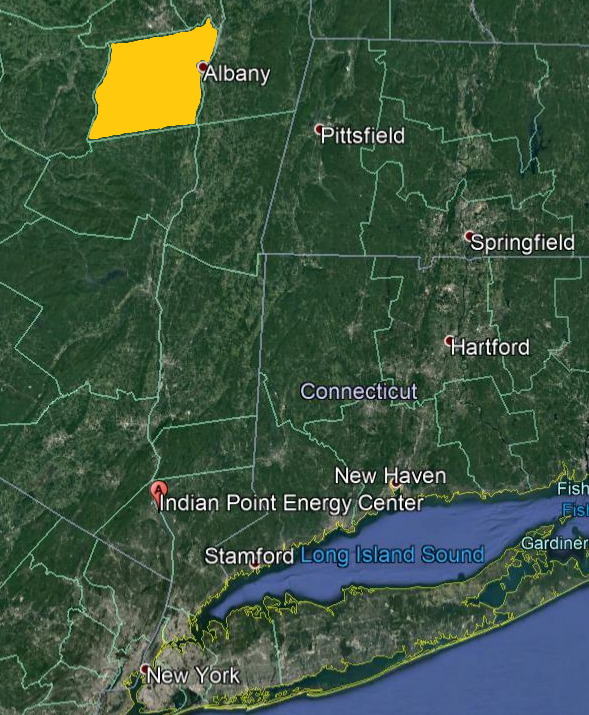
Convert Albany county New York into a wind farm required just to replace the now shuttered Indian Point nuclear power plant.

Echoing the 19th century adage that figures don’t lie, but liars figure, the discrepancy mostly involves estimates of what can be built around the windmills. Each turbine’s footprint is relatively small, but they have to be spaced far apart. The DOE’s smaller number is based on the fanciful assumption that all the surrounding land can be used for agriculture and other purposes, while the larger figure assumes none of it will. The truth probably is somewhere in between. That the government is trumpeting the impossibly small number – while ignoring the additional land needed to build transmission lines which will carry the current to end users – is telling and troubling.

Given Biden’s aggressive timeframes for the build-out – 2035 is a mere dozen years from now – one might expect that the administration has a master plan detailing where and when these green farms will be constructed. It does not. And, as Steve Miller reported for RCI, this challenge already seems insurmountable given the “grassroots resistance … coalescing in varied new state laws and local ordinances that threaten to bog down solar and wind development in a multi-front legal and regulatory war on a scale not seen before.”

In a stinging irony, opponents are routinely invoking arguments regarding
endangered species and wetlands that environmentalists have long deployed
to kneecap pipelines, gas fields, and other fossil fuel projects.

Another largely ignored problem area is charging stations for electric vehicles. John Murawski reported for RCI that California’s first-in-the-nation move to ban the sale of new gas-powered cars after 2035 is highlighting an array of challenges and dislocations. To keep electric cars rolling, the state “may need to install at least 20 electric chargers for every gas pump now in service to create a reliable, seamless network” – or more than 2 million new stations during the next decade, which is about 10 times as many EV ports as gas station nozzles.

It might be hard to convince private businesses to house the chargers, because, as a 2022 report from the California Energy Commission noted, “Revenue from electricity sales alone is often not enough today for chargers to be profitable, especially for stations with lower utilization.” That’s why California is investing at least $14 billion to subsidize this fantasy.

Even if the EV infrastructure gets built, it will require a massive change in behavior. The days of fill ’er up once or twice a week will likely become a distant memory. Most public stations will only be able to provide between five and 60 miles of range for an hour hook-up. Private citizens will need to pony up for their own charging infrastructure at home, while renters and low-income drivers will have to rely on employer and municipal largesse to supply chargers.

The green dream also involves knotty geo-politico issues. Ben Weingarten reported for RCI that America’s transition to renewables is empowering its most formidable economic adversary. “China currently holds a commanding position in the clean energy industry, controlling the natural resources and manufacturing the components essential to the Biden administration’s desired alternative energy transition,” Weingarten wrote. “Energy experts believe that its dominance will become more entrenched in the years ahead because of domestic environmentalist opposition to perceived ‘dirty’ mining and refining operations, and the Biden administration’s ‘clean energy’ spending blitz – which could provide Chinese companies and subsidiaries billions in subsidies.”

What’s more, if the U.S. slows its production of oil and gas in the coming years, hostile or problematic nations that continue to drill – including Iran, Russia, Saudi Arabia, Qatar, and Venezuela – will reap the benefits should renewables fail to become a reliable source of power.

Finally, the systematic erasure of these and other consequential questions
is part of a broad effort to quell dissenting views.

While climate action advocates in the government, media, and academia argue that the science is settled, Murawski reported for RCI that a growing number of experts are courageously challenging this orthodoxy. In August, for example, “more than 1,600 scientists, including two Nobel physics laureates, signed a declaration stating that there is no climate emergency, and that climate advocacy has devolved into mass hysteria,” Murawski wrote. “The skeptics say the radical transformation of entire societies is marching forth without a full debate, based on dubious scientific claims amplified by knee-jerk journalism.”

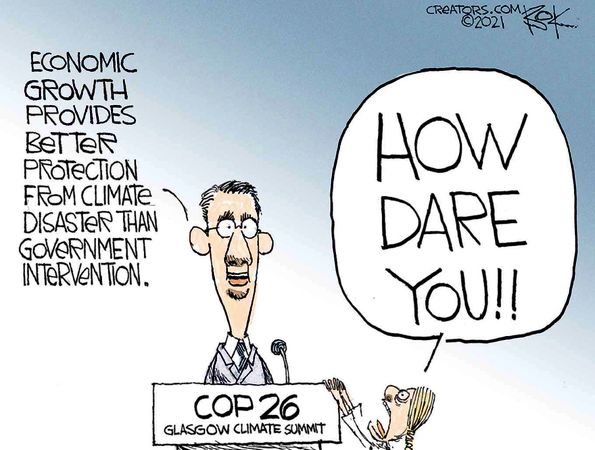
In detailing the central arguments of these skeptics, Murawski reported that few fall into the camp of “climate deniers” – itself a shameful label used to equate climate change with the Holocaust. They acknowledge the Earth is warming. Some, however, question whether human activity is to blame and, if it is, whether the massive human interventions being demanded can make much difference. Others say that the money spent retooling the economy would be better spent spurring economic growth that will allow people to adapt to a changing world.

Murawski reported that many dissenters believe that “[S]logans such as ‘follow the science’ and scientific consensus’ are misleading and disingenuous. There is no consensus on many key questions, such as the urgency to cease and desist burning fossil fuels, or the accuracy of computer modeling predictions of future global temperatures. The apparent consensus of imminent disaster is manufactured through peer pressure, intimidation, and research funding priorities, based on the conviction that ‘noble lies,’ ‘consensus entrepreneurship,’ and ‘stealth advocacy’ are necessary to save humanity from itself.”

A lie is rarely noble. It is almost always evidence of a weak argument and contempt for those it seeks to influence. Those who see climate change as an urgent danger and believe they know how to counter the threat should make their case forthrightly instead of recycling tired myths. Our democracy faces an existential threat when the will of the people gives way to the coercion of the masses.

Biden’s EV Boondoggle Enriches Himself

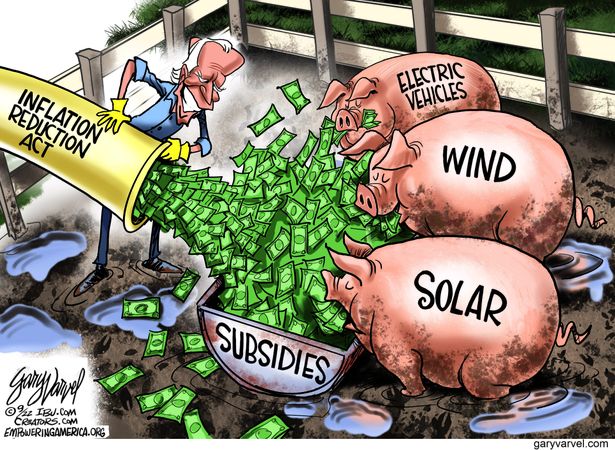
The Greenest thing about the New Green Deal is the Money.

The spending on “Green Energy Projects” is enormous and uncontrolled.  Larry Behrens explains at Real Clear Energy Too Favored to Fail:” Taxpayers Bailout Biden’s Green Friends.  Excerpts in italics wtih my bolds.

While America struggles to buy groceries, President Joe Biden has a
green slush fund worth billions of dollars, and he’s not afraid to use it.

Billions Disappear with Rivian Bankruptcy

Recent revelations uncovered that the CEO and lobbyists of Rivian, an electric vehicle manufacturer, held a quiet meeting at the White House with Biden’s Climate Czar, John Podesta. That’s right, the same John Podesta who served as chairman of Hillary Clinton’s ill-fated 2016 presidential campaign before being pulled from the ranks of profitable green consulting to oversee distribution of $369 billion from the Inflation Reduction Act (IRA). Biden selected a political operative with green company ties to dole out the goodies from one of the largest slush funds in history. Now green CEOs who are hemorrhaging cash are beating a path to his White House office, presumedly with hat in hand.

According to media reports, Rivian is deep in the red. Last year, they lost $6.8 billion. In 2021, it was $4.7 billion, which is in addition to the $1 billion lost in 2020. These massive losses happened as EV manufacturers enjoyed large subsidies both to build and sell their vehicles. In fact, President Biden went out of his way to praise Rivian in early 2022, even though their stock had already lost half its value on its way to losing 87% of its value since 2021. Losing over $12 billion in less than three years would normally be a problem in the business world, but in the upside-down reality of Biden’s green agenda, that gets you a meeting at the White House.

Tax dollars are flowing from the IRA so quickly that the Department
of Energy’s Inspector General (IG) may be running out of adjectives.

Earlier this month in testimony before the Senate, the IG said, “the current situation brings tremendous risk to the taxpayers.” Red flags about American dollars flowing to foreign companies or just being wasted here at home are going up, yet according to budget watchdogs, their concerns are met with deaf ears by senior Biden Administration officials. The IG notes there were “billions and billions of dollars lost or stolen” from federal Covid funds, and Biden’s slush fund is even bigger. To put it bluntly, the green vault is wide open and the grifters are lining up.

“Green Banks” Dole Out Taxpayer Cash

Here’s a particular galling example. One little known aspect of the IRA are so-called “green banks.” For greenies, the scheme is simple: regular banks will not fund their boondoggles, so they need a taxpayer backed entity to dole out cash. Unlike regular banks, these green banks do not need to make a profit to stay afloat because the government is their funder.

New Mexico Governor Michelle Lujan Grisham was caught trying to set up a green bank without the trouble of going through the elected legislature. The board of the bank will be green non-profits who will be in charge because as the New Mexico climate czar put it, “We’re talking about hundreds of millions of dollars…This greenhouse gas reduction fund is a remarkable little beast.” Recently, Grisham announced the green bank anyway. The slush fund is open for business, and everyone has their hand out.

Congress is watching the “green bank” scheme because they know it is ripe for abuse. The problem is clear: The White House put a political operative in charge of what is nothing more than a political fund. For Barack Obama, they were too big to fail, but Joe Biden is taking it further. When it comes to his failed agenda, his green boondoggles are “too favored to fail.”

Biden’s Wasted EV Subsidies Eclipse Solyndra

Helen Raleigh reports at The Federalist The Biden Administration’s Electric Vehicle Subsidies Are Becoming Another Solyndra.  Excerpts in italics wtih my bolds.

Energy Secretary Jennifer Granholm made $1.6 million from
an electric car company the Biden administration boosted
that just went bankrupt.

Proterra, an electric bus and battery company that President Joe Biden touted as a success of his green energy initiative, filed for bankruptcy in August. Last week, it finally sold its embattled battery business at a rock-bottom price as part of the bankruptcy proceeding. The rise and fall of Proterra demonstrates once again that politicians should refrain from betting taxpayers’ money on business ventures to advance their political agenda.

According to the Wall Street Journal, Proterra has sold only 550 electric transit buses since its founding in 2004. Most of the sales were underwritten by government agencies with federal grants. Proterra’s electric buses were plagued with mechanical defects and other performance issues, such as limited range and long charging times. Besides government subsidies, the company only survived as long as it had due to powerful political connections. Former Michigan governor Jennifer Granholm, Biden’s energy secretary, served on its board.

Despite all the quality issues of its EV buses, Proterra went public in January 2021 and raised $650 million, more than three times its annual revenue. A month after the company’s IPO, Biden tapped Granholm as his energy secretary. Proterra’s political connection to the Biden administration paid off in many ways.

Surviving on Grants and Tax Credits

In April 2021, Biden took a virtual tour of a Proterra facility to promote his infrastructure plan. The proposal included $6.5 billion in grants to help replace diesel-powered school and transit buses with electric ones. During the tour, Biden lauded Proterra for “getting us in the game.” He predicted that Proterra and other electric vehicle companies would “end up owning the future.”

Biden’s 2022 Inflation Reduction Act further enriched Proterra’s coffer. The law had little to do with reducing inflation, but it gave massive government handouts to the green energy sector. For instance, IRA includes a $40,000 per vehicle tax credit for purchasing electric commercial vehicles and an additional tax credit for EV batteries.

Proterra admitted in its quarterly report that “the availability of this new unprecedented level of government funding for our customers, suppliers, and competitors to help fund purchases of commercial electric vehicles and battery systems will remain an important factor in our company’s growth prospects.” Proterra’s political profile rose even more after Biden appointed Gareth Joyce, CEO of Proterra, to serve on the President’s Export Council in February this year.

Backed by Biden, Buried by Biden

Excessive government spending under Biden has sparked high inflation rates that were last seen in the 1970s. To bring inflation rates down, the Federal Reserve has aggressively raised interest rates. Higher rates increased production and operations costs for many companies. As legendary investor Warren Buffett famously said, “Only when the tide goes out do you learn who has been swimming naked.” Proterra was one of those companies that had been caught “swimming naked” in this new environment.

The company struggled because it had difficulty passing rising costs on to its existing customers, since most were government agencies with little budget flexibility. Nor could Proterra outsource its production overseas or import components at lower costs. Receiving government grants comes with strings attached. One requirement is that companies like Proterra must produce at least 70 percent of their EV components in America. Proterra couldn’t afford to cut the prices of its EVs to drum up sales.

Finally, Proterra filed for bankruptcy in August. Government subsidies could not offset the financial pressure of rising inflation, higher interest rates, and falling sales. Last week, a Swedish automobile manufacturer, Volvo, bought Proterra’s battery business for $210 million, a great deal considering Proterra was valued at $1.6 billion a year ago.

Another party who got an excellent deal was Granholm. She sold her Proterra shares for $1.6 million last year. They would have been worth nothing if she had held on to her Proterra shares until this

August. The biggest loser of the whole Proterra saga is American taxpayers.

No Good News for Electric Vehicles

Proterra was not the only EV company that went under. Michigan-based Electric Last Mile declared bankruptcy in June 2022. Ohio-based Lordstown Motors went bankrupt a year later. Ironically, these companies benefited from the Biden administration’s climate handouts, but the economic consequences of the same policies eventually doomed them. Even large automobile companies’ EV units are struggling. Ford estimates it will lose $3 billion this year on its EV business. The company relies on sales of gas-powered vehicles and government subsidies to keep the EV business afloat. 

What’s In This for the Bidens?

Fred Lucas explain in his Daily Signal article Hunter Biden’s Cobalt Deal With China Increases Cost of His Father’s Push for Electric Cars.  Excerpts in italics with my bolds.

Presidential son Hunter Biden’s most recent controversy—assisting a Chinese company’s purchase of a large cobalt mine—is linked directly to a top Biden administration policy of promoting electric vehicles.

Cobalt, a relatively rare and expensive mineral, is an essential part of batteries used to power electric automobiles. The COVID-19 pandemic also made U.S. officials and the public much more aware of Communist China’s control of the supply chain for drugs and other products.

The younger Biden, 51, is a one-time partner in China-based Bohai Harvest RST, known as BHR, and reportedly remains a stakeholder

The New York Times first reported over the weekend that BHR facilitated mining company China Molybdenum’s $2.65 billion purchase of a cobalt and copper mine from an American company, Freeport-McMoRan. 

Rep. Ken Buck, R-Colo. told The Daily Signal,

The latest news [that] he assisted a Chinese company purchase one of the largest cobalt mines is another example of Hunter Biden using his influence to line his pockets and help a foreign adversary. Conducting oversight of Hunter Biden’s questionable ethics and dealings that undermine our national security will continue to be a top priority for Oversight [Committee] Republicans.

The committee’s ranking Republican, Rep. James Comer, R-Ky., tweeted: “By helping Chinese companies mine rare minerals in Congo, Hunter Biden is helping Communist China corner the Electric Vehicle market that @POTUS is subsidizing here at home.” 

Summary:

The campaign is to force electric vehicles upon Americans who otherwise do not want them.  And why?  It’s not about climate change, not about the environment.  It’s about greed not green.


October 2023 Ocean Cooling Off

The best context for understanding decadal temperature changes comes from the world’s sea surface temperatures (SST), for several reasons:

  • The ocean covers 71% of the globe and drives average temperatures;
  • SSTs have a constant water content, (unlike air temperatures), so give a better reading of heat content variations;
  • Major El Ninos have been the dominant climate feature in recent years.

HadSST is generally regarded as the best of the global SST data sets, and so the temperature story here comes from that source. Previously I used HadSST3 for these reports, but Hadley Centre has made HadSST4 the priority, and v.3 will no longer be updated.  HadSST4 is the same as v.3, except that the older data from ship water intake was re-estimated to be generally lower temperatures than shown in v.3.  The effect is that v.4 has lower average anomalies for the baseline period 1961-1990, thereby showing higher current anomalies than v.3. This analysis concerns more recent time periods and depends on very similar differentials as those from v.3 despite higher absolute anomaly values in v.4.  More on what distinguishes HadSST3 and 4 from other SST products at the end. The user guide for HadSST4 is here.

The Current Context

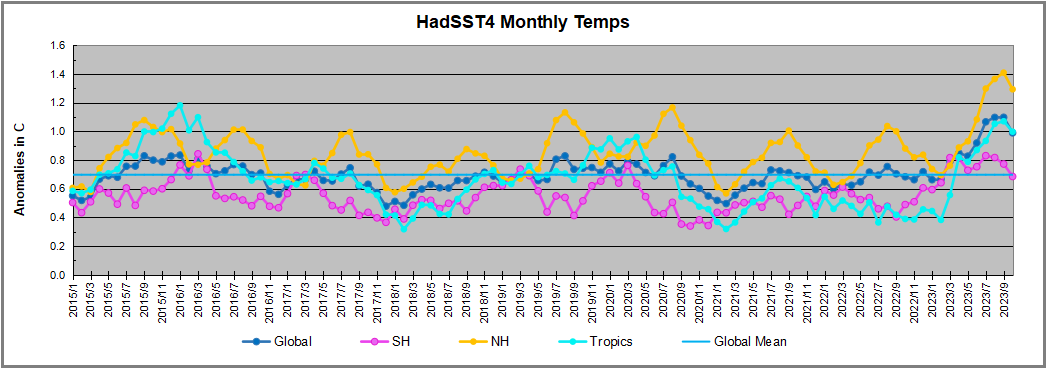
The chart below shows SST monthly anomalies as reported in HadSST4 starting in 2015 through October 2023.  A global cooling pattern is seen clearly in the Tropics since its peak in 2016, joined by NH and SH cycling downward since 2016. 

Note that in 2015-2016 the Tropics and SH peaked in between two summer NH spikes.  That pattern repeated in 2019-2020 with a lesser Tropics peak and SH bump, but with higher NH spikes. By end of 2020, cooler SSTs in all regions took the Global anomaly well below the mean for this period.  In 2021 the summer NH summer spike was joined by warming in the Tropics but offset by a drop in SH SSTs, which raised the Global anomaly slightly over the mean.

Then in 2022, another strong NH summer spike peaked in August, but this time both the Tropic and SH were countervailing, resulting in only slight Global warming, later receding to the mean.   Oct./Nov. temps dropped  in NH and the Tropics took the Global anomaly below the average for this period. After an uptick in December, temps in January 2023 dropped everywhere, strongest in NH, with the Global anomaly further below the mean since 2015.

Now comes El Nino as shown by the upward spike in the Tropics since January, the anomaly nearly tripling from 0.38C to 1.07C.  In August 2023, all regions rose, especially NH up from 0.70C to 1.37C, pulling up the global anomaly to a new high for this period. September showed a new peak for NH at 1.41, but now in October anomalies in all regions have dropped down 0.1C to bring the Global anomaly back down.

Comment:

The climatists have seized on this unusual warming as proof of their Zero Carbon agenda, without addressing how impossible it would be for CO2 warming the air to raise ocean temperatures.  It is the ocean that warms the air, not the other way around.  Recently Steven Koonin had this to say about the phonomenon confirmed in the graph above:

El Nino is a phenomenon in the climate system that happens once every four or five years.  Heat builds up in the equatorial Pacific to the west of Indonesia and so on.  Then when enough of it builds up it surges across the Pacific and changes the currents and the winds.  As it surges toward South America it was discovered and named in the 19th century  It is well understood at this point that the phenomenon has nothing to do with CO2.

Now people talk about changes in that phenomena as a result of CO2 but it’s there in the climate system already and when it happens it influences weather all over the world.   We feel it when it gets rainier in Southern California for example.  So for the last 3 years we have been in the opposite of an El Nino, a La Nina, part of the reason people think the West Coast has been in drought.

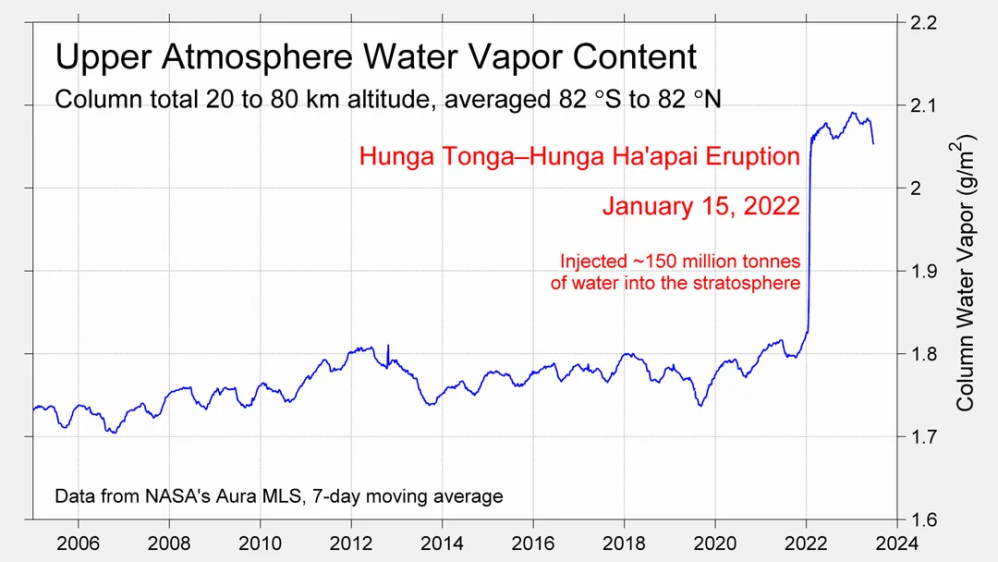
It has now shifted in the last months to an El Nino condition that warms the globe and is thought to contribute to this Spike we have seen. But there are other contributions as well.  One of the most surprising ones is that back in January of 2022 an enormous underwater volcano went off in Tonga and it put up a lot of water vapor into the upper atmosphere. It increased the upper atmosphere of water vapor by about 10 percent, and that’s a warming effect, and it may be that is contributing to why the spike is so high.

A longer view of SSTs

To enlarge, open image in new tab.

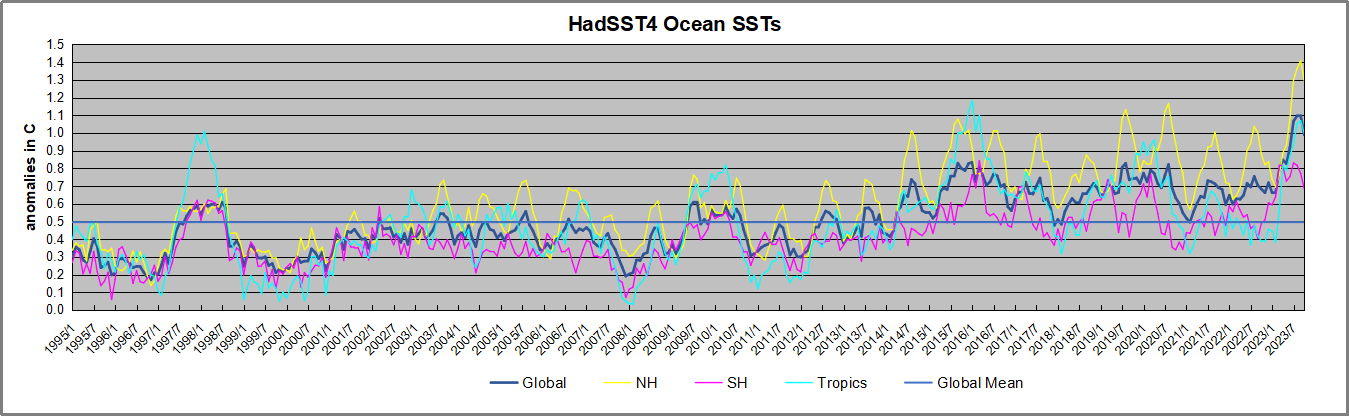
The graph above is noisy, but the density is needed to see the seasonal patterns in the oceanic fluctuations.  Previous posts focused on the rise and fall of the last El Nino starting in 2015.  This post adds a longer view, encompassing the significant 1998 El Nino and since.  The color schemes are retained for Global, Tropics, NH and SH anomalies.  Despite the longer time frame, I have kept the monthly data (rather than yearly averages) because of interesting shifts between January and July.1995 is a reasonable (ENSO neutral) starting point prior to the first El Nino. 

The sharp Tropical rise peaking in 1998 is dominant in the record, starting Jan. ’97 to pull up SSTs uniformly before returning to the same level Jan. ’99. There were strong cool periods before and after the 1998 El Nino event. Then SSTs in all regions returned to the mean in 2001-2. 

SSTS fluctuate around the mean until 2007, when another, smaller ENSO event occurs. There is cooling 2007-8,  a lower peak warming in 2009-10, following by cooling in 2011-12.  Again SSTs are average 2013-14.

Now a different pattern appears.  The Tropics cooled sharply to Jan 11, then rise steadily for 4 years to Jan 15, at which point the most recent major El Nino takes off.  But this time in contrast to ’97-’99, the Northern Hemisphere produces peaks every summer pulling up the Global average.  In fact, these NH peaks appear every July starting in 2003, growing stronger to produce 3 massive highs in 2014, 15 and 16.  NH July 2017 was only slightly lower, and a fifth NH peak still lower in Sept. 2018.

The highest summer NH peaks came in 2019 and 2020, only this time the Tropics and SH were offsetting rather adding to the warming. (Note: these are high anomalies on top of the highest absolute temps in the NH.)  Since 2014 SH has played a moderating role, offsetting the NH warming pulses. After September 2020 temps dropped off down until February 2021.  In 2021-22 there were again summer NH spikes, but in 2022 moderated first by cooling Tropics and SH SSTs, then in October to January 2023 by deeper cooling in NH and Tropics.  

Now in 2023 the Tropics flipped from below to well above average, while NH has produced a summer peak extending into September higher than any previous year. In fact, October is now showing that this number is likely the crest.

What to make of all this? The patterns suggest that in addition to El Ninos in the Pacific driving the Tropic SSTs, something else is going on in the NH.  The obvious culprit is the North Atlantic, since I have seen this sort of pulsing before.  After reading some papers by David Dilley, I confirmed his observation of Atlantic pulses into the Arctic every 8 to 10 years.

Contemporary AMO Observations

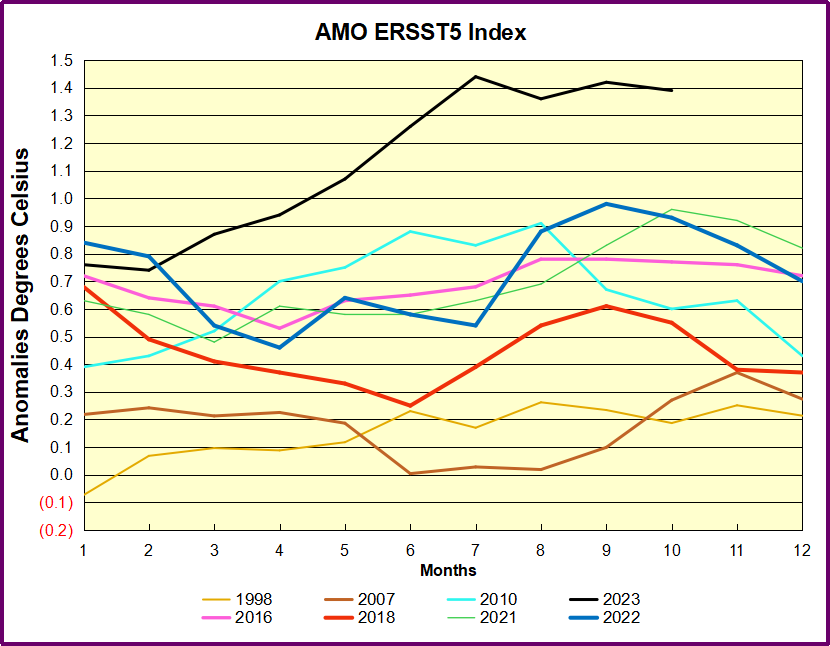
Through January 2023 I depended on the Kaplan AMO Index (not smoothed, not detrended) for N. Atlantic observations. But it is no longer being updated, and NOAA says they don’t know its future.  So I find that ERSSTv5 AMO dataset has data through October.  It differs from Kaplan, which reported average absolute temps measured in N. Atlantic.  “ERSST5 AMO  follows Trenberth and Shea (2006) proposal to use the NA region EQ-60°N, 0°-80°W and subtract the global rise of SST 60°S-60°N to obtain a measure of the internal variability, arguing that the effect of external forcing on the North Atlantic should be similar to the effect on the other oceans.”  So the values represent sst anomaly differences between the N. Atlantic and the Global ocean.

The chart above confirms what Kaplan also showed.  As August is the hottest month for the N. Atlantic, its varibility, high and low, drives the annual results for this basin.  Note also the peaks in 2010, lows after 2014, and a rise in 2021. Now in 2023 the peak is holding at 1.4C.  An annual chart below is informative:


Note the difference between blue/green years, beige/brown, and purple/red years.  2010, 2021, 2022 all peaked strongly in August or September.  1998 and 2007 were mildly warm.  2016 and 2018 were matching or cooler than the global average.  2023 started out slightly warm, then in May and June spiked to match 2010. Now there is an  extraordinary peak in July, with August to October only slightly lower.

The pattern suggests the ocean may be demonstrating a stairstep pattern like that we have also seen in HadCRUT4. 

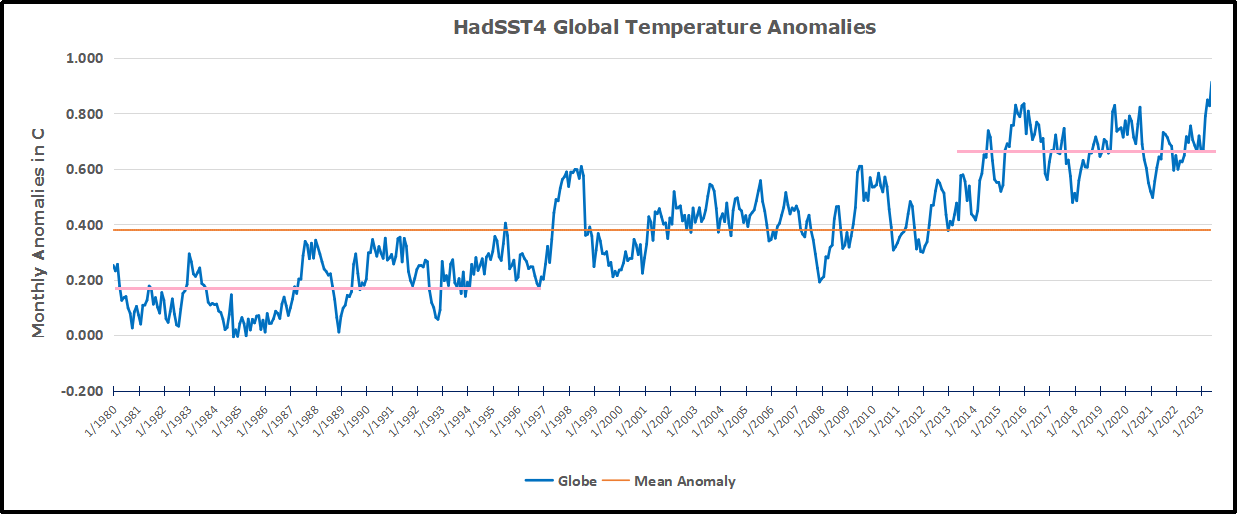
The purple line is the average anomaly 1980-1996 inclusive, value 0.18.  The orange line the average 1980-202306, value 0.38, also for the period 1997-2012. The red line is 2013-202306, value 0.64. As noted above, these rising stages are driven by the combined warming in the Tropics and NH, including both Pacific and Atlantic basins.

Curiosity:  Solar Coincidence?

The news about our current solar cycle 25 is that the solar activity is hitting peak numbers now and higher  than expected 1-2 years in the future.  As livescience put it:  Solar maximum could hit us harder and sooner than we thought. How dangerous will the sun’s chaotic peak be?  Some charts from spaceweatherlive look familar to these sea surface temperature charts.

Summary

The oceans are driving the warming this century.  SSTs took a step up with the 1998 El Nino and have stayed there with help from the North Atlantic, and more recently the Pacific northern “Blob.”  The ocean surfaces are releasing a lot of energy, warming the air, but eventually will have a cooling effect.  The decline after 1937 was rapid by comparison, so one wonders: How long can the oceans keep this up? And is the sun adding forcing to this process?

Space weather impacts the ionosphere in this animation. Credits: NASA/GSFC/CIL/Krystofer Kim

Footnote: Why Rely on HadSST4

HadSST is distinguished from other SST products because HadCRU (Hadley Climatic Research Unit) does not engage in SST interpolation, i.e. infilling estimated anomalies into grid cells lacking sufficient sampling in a given month. From reading the documentation and from queries to Met Office, this is their procedure.

HadSST4 imports data from gridcells containing ocean, excluding land cells. From past records, they have calculated daily and monthly average readings for each grid cell for the period 1961 to 1990. Those temperatures form the baseline from which anomalies are calculated.

In a given month, each gridcell with sufficient sampling is averaged for the month and then the baseline value for that cell and that month is subtracted, resulting in the monthly anomaly for that cell. All cells with monthly anomalies are averaged to produce global, hemispheric and tropical anomalies for the month, based on the cells in those locations. For example, Tropics averages include ocean grid cells lying between latitudes 20N and 20S.

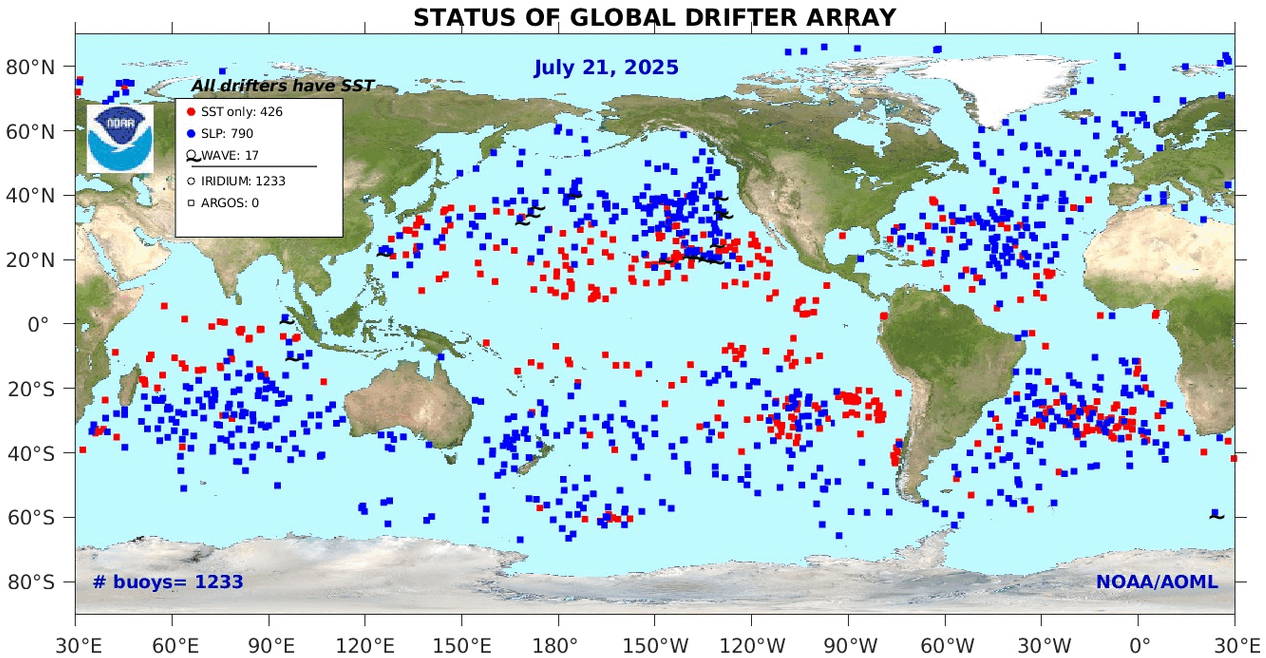
Gridcells lacking sufficient sampling that month are left out of the averaging, and the uncertainty from such missing data is estimated. IMO that is more reasonable than inventing data to infill. And it seems that the Global Drifter Array displayed in the top image is providing more uniform coverage of the oceans than in the past.

uss-pearl-harbor-deploys-global-drifter-buoys-in-pacific-ocean

USS Pearl Harbor deploys Global Drifter Buoys in Pacific Ocean


Why Milei is Argentina’s Last, Best Hope

Finally, an intelligent explanation of why Argentines chose Milei as their champion.  G. Patrick Lynch cuts through the smoke and mirrors in his Law and Liberty article Misunderstanding Milei.  Excerpts in italics with my bolds and added images.

It took almost 80 years. That’s how long Argentina’s economy and society have been in free fall. In some ways, it’s a testament to our greatest fears about democracy and self-government that no political leader had the political incentives and simple nerve to buck the status quo. Eighty years of relentless, grinding inflation and spiraling deficits, followed by defaults, currency devaluations, and restarts before November 19. But finally, the people of Argentina have rejected a failed status quo. Javier Milei publicly won a near landslide by Argentinian standards, and when one considers the probability of Peronist cheating at approximately 100%, the margin was likely much higher. Whether or not the alternative Argentinians have chosen will “fix the situation” is for now beside the point.

They have exercised the one option they have—rejecting the incumbents
for the promise of something different. That’s all that democracy promises.

Javier MIlei, who today is being called “far right,” “radical,” and (by the very lazy) a “far-right libertarian,” is now the president-elect of one of the greatest failed states of our lifetimes. It’s hard to fully explain how badly governed Argentina has been by its long line of Peronist governments distinguished for their lavish spending, stunning corruption, autocratic tendencies, and economic nationalism. The economic statistics are mind-boggling. Defaults, regular annual inflation rates in excess of 100%, a resulting enormous welfare state, parasitic public sector unions, and largely complicit “centrist” politicians: all these are now the depressing landscape of the Argentine political economy.

Indeed, it was the world’s 10th-richest country when Perón took over. And Hong Kong was relatively poor. But look at what’s happened over time. Perón’s statist policies produced a steady decline while Hong Kong’s laissez-faire approach has now made it one of the richest jurisdictions on the planet.

However, if one did not live this reality but were to simply draw conclusions about the election and Milei from the international (particularly American) press, one might think Argentina had fallen into a state of collective delusion, choosing an insane, sideburn-covered Latin American version of Trump without any reason other than some vague references to inflation and debt payments. As the saying goes, the international press has buried the lede.

Milei is trying to address the disastrous situation in Argentina, but outlets such as Reuters described it as “shock therapy” in a not-so-subtle reference to Naomi Klein’s book Shock Doctrine. Klein argues that nature or war can create disasters and give opportunities for “capitalism,” (anthropomorphized through Milton Friedman) to engage in exploitation by establishing extremist policies like private property rights and markets. In this case, however, it’s the legacy of the exact policies that Klein and her ilk support that has created the unmitigated disaster.

Money printing, a bloated welfare state, an emphasis on economic “independence”
and other prominent leftwing economic prescriptions have made this disaster,
but the irony is lost on the folks at Reuters.

Milei’s main, nay fundamental, policy proposals are all in the context of this backdrop. His firm commitment to abolishing Argentine central banking and cutting social spending is straight out of Ludwig von Mises and Milton Friedman, and it is completely appropriate given the circumstances. The only way that an “anarcho-capitalist” could be elected was in a situation of failed governance and welfare statism so dire that he could crack the door open slightly and introduce ideas unknown by the mainstream intelligentsia, let alone the average Argentine on the street.

The language used by the international media, the gigantic “blob” of interests in the World Bank and international aid community, and the mainstream economists who oppose him is designed to delegitimize Milei. They don’t want another success story like Chile in the region. Two nations that adopt “neoliberal” policies that work mean their jobs and narratives are at risk. They are and should be terrified.

The problem is their terms are like insults thrown around in a schoolyard. They are neither coherent nor consistent. Consider the three most prominent politicians to be given the “far right” treatment by the mainstream press, El Salvador’s Nayib Bukele, Italy’s Giorgia Meloni, and now Milei. What do they have in common? Substantively the answer is very little. Bukele is engaged in a crackdown on gangs and crime that involves widespread violations of due process and civil rights, but has led to a plummeting of crime rates. Meloni is known as an anti-immigrant crusader, but she also supports the Ukraine war and like Bukele has sky-high approval ratings. Milei wants to abolish central banking, and while he’s pro-life, he’s also a bachelor who brags about his sex life and argues for open markets and trade with the United States of all places. Yet to a journalist in the legacy media, they are all part of what has become known as the “far right.” Not satisfied that describing politicians as “conservative” or “right” is enough to scare their readers, the network news, national newspapers, and news services have decided to add a qualifier to the term. 

The growth in the use of the term “far right” is yet another example
how intellectual honesty, philosophical consistency, and respect
for liberal discourse are completely absent from our public debates.

But when we see the media force these politicians into a two-dimensional straightjacket, it doesn’t just present a problem of categories. It’s also about the limits of elite background and education. As David Brooks’ recent New York Times column rightly noted, the national news media are very much alike in background and education. The educational institutions that produced these figures support consensus views and expert policy creation, which accord with their own preferences. Briefly, that means government solutions to government problems. Those solutions involve hiring policy people to “fix” things. But what about when the consensus is wrong? What if the theory doesn’t fit the reality? What happens when crime runs rampant in El Salvador despite the best intentions of Western policymakers? What happens when Argentina’s central bank drives inflation to unimaginable levels at immense social cost? Unconventional answers emerge and democracy gives it energy.

The press and policy elites cannot address who Milei is or what he’s proposing on the merits because it does not fit their world view. Hyperinflation is not caused by climate change, racism, or opposition to gender displacement. It is not a social construct or a random event, particularly when it happens continuously for almost 80 years and destroys a largely upper-middle-class society. It is the political and economic failure that results from political exploitation and central planning. The Argentine bureaucracy and the chattering classes have failed citizens for decades. We know the cause, and so does Milei. His opponents wanted to make things a little less bad, possibly for a few years until they once again made things much worse.

Peronism is the abusive relationship, the addiction, the concept
that no responsibility is necessary after years of irresponsibility.
Milei is the medicine, and he will not be an easy pill to swallow.

The possibility of Galt’s Gulch in Argentina is basically zero. He faces nearly intractable political challenges in achieving even a small percentage of his legislative agenda. And yet if he can achieve one goal he might allow Argentina to start down a different path. Dollarizing the economy might force the state into fiscal responsibility and end the monetary insanity that currently reigns. It will be painful, but perhaps not as painful as decades more of the numbing effect of more stimulus that ultimately debases the currency.

There are no easy solutions here, which is part of the reason the media
and its stale-minded intellectual influences have no solutions to offer.

They are left with nothing but vague language, scare tactics, and labeling. What took 80 years to destroy will take decades, perhaps centuries to recreate. Well before he won the first round of voting back in September, Milei was asked what his model for Argentina was. He replied, Ireland. Ireland of course famously cut taxes and regulation, freeing its economy and spurring rapid economic growth.

Argentina could do worse than Ireland, but anything
different than its current path will be an improvement.


Assessing Risk and Climate Science (Quora Discussion)

Excerpted below is a Quora discussion with illuminating commentary from  Aaron Brown, former asset risk manager. AB responds to Topic Question and related comments, text in italics with my bolds and added images.

Quora? What will make conservatives accept climate change as real science?

AB: There are scientists who study cloud formation, ocean currents, rainfall patterns and other aspects of climate. Some are good, some not so much. Most people, liberal or conservative, accept that much of this is science.

Then there are scientists who build climate models and make predictions about things like global average temperature from 2081 to 2100 under different assumptions about human emissions and other factors. The people doing this work are considered scientists, but the conclusions are not science in the sense of empirically verifiable facts or consensus theories with strong empirical confirmation.

It’s a semantic game whether you call the conclusions “science” or not, but either way they are not as certain as scientific laws about gravity or momentum. People who like the predictions will embrace them, people who don’t like the predictions will resist them.

Liberals tend to be open to new ideas, conservatives tend to be more skeptical. That means many liberals are more willing to take strong action based on model predictions than are most conservatives. Skeptics tend to accept models if they make useful, non-obvious predictions that turn out to be true. Unfortunately it will take at least a century to gather that kind of evidence for climate models.

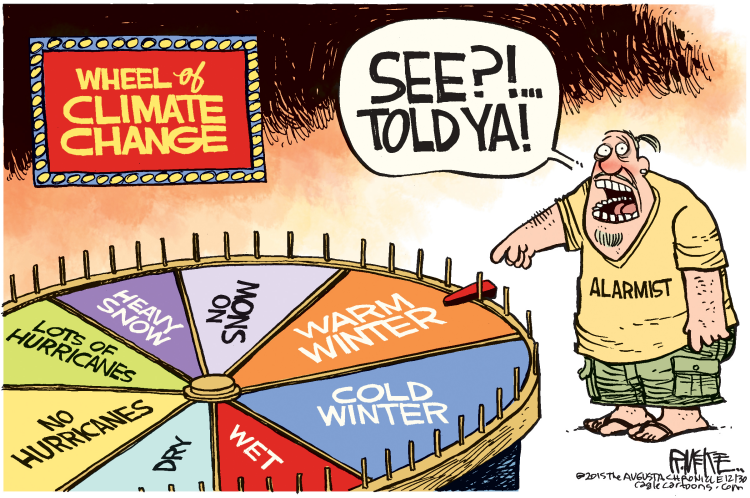
One possible breakthrough would be improvements in forecasting weather. You can prove a weather model in months rather than decades or centuries. But the fundamental claim of climate science is that it’s easier to predict global decadal averages in fifty years than next month’s weather in New York’s Central Park. That kind of claim—”I can’t predict the stuff you can check but trust me on stuff you can’t check”—makes skeptics skeptical.

A more likely breakthrough would be the the people making climate predictions proving their modeling ability by making useful, non-obvious predictions in other fields that can be validated. So far we have not seen this—successful modelers in other fields moving to climate science, or climate modelers proving success in other fields. This is a major point of skepticism for skeptics.

Finally, many conservatives are skeptical due to the big money involved in climate change combined with intense government interest and possibilities for vast wealth from subsidies and other programs. This is called Big Science and it’s often been dead wrong in the past, not to mention occasionally threatening all life on Earth. There are some successes of Big Science as well but skeptics will note the temptation to skew climate science for money or to push policies the advocates wanted before any climate support showed up.

None of this is relevant for policy decisions. If we somehow knew for certain today what the global mean temperature would be from 2081 – 2100, it wouldn’t tell us whether it was a good idea to ban coal or impose a carbon tax today. Conservatives are apt to assume any legislation will be written by lobbyists paid by cronies and empire-building bureaucrats rather than any kind of scientist. The laws will have unintended consequences, and send the economy and technology down unpredictable novel paths. We can’t estimate the effect on the human environmental footprint, we have only limited ability to relate the human environmental footprint to climate, and even less to relate climate to human welfare.

In such circumstances, the conservative inclination is to wait until you’re sure you’re helping things before spending a lot of money and writing a bunch of rules. The liberal tendency is to use your best judgement today, and expand the stuff that works tomorrow, while fixing or abandoning the stuff that doesn’t. This choice has nothing to do with climate science.

Comment: A model is just a theory put into numbers.

AB: Agreed, but the problem is lack of data. You can’t check 80 year in the future predictions with 30 years of data; and the global climate is so complex you need far more data even than we have with current measurements.

The data from more than 150 years or so is local data averaged over centuries or longer, useless for predicting global shorter-term data. Prior to 1990 we have very noisy data that is broader and available daily or sometimes even more often, but only since 1990 do we have anything like reliable, consistent global data.

People do calibrate their models to be consistent with the past, sometimes with more success than others. But there are so many parameters to global climate that this is not a useful check.

Comment: The required accuracy of your data and models grows exponentially with the amount of time you are predicting. It’s practically impossible to improve weather models beyond a certain point, so it’s not fair to consider this a failing of climate science.

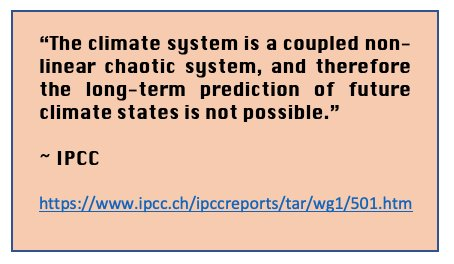
AB: This is the central claim of climate science, but it remains unproven. Chaotic systems are not inherently unpredictable—for example the multibody solar system—and three or more bodies under gravity are chaotic—appears to have remained stable and pretty easy to predict for billions of years.

Attempts to predict weather in the most straightforward way, breaking the atmosphere down into small parts and applying rules of physics, have not succeeded in precise or long-range predictions—but there clearly are weather patterns that repeat often enough they must have some explanation. Modern weather prediction relies mainly on observed regularities without firm theoretic explanations.

You may be right that weather prediction will always be intractable, but perhaps some out-of-the-box idea will change that. If it did, we’d probably understand a lot more about climate.

It’s not obvious that long-term averages are more stable and predictable than shorter-term ones. In the stock market, for example, prices are pretty close to a random walk and uncertainty increases pretty steadily with the square root of time interval.

If you look at actual temperature measurements over local areas or global, over time scales from days to millions of years, uncertainty seems to increase with time, but slower than the square root. The unit of most certainty seems to be a year—predicting the average temperature over the next year has less uncertainty than predicting tomorrow’s temperature, but also less uncertainty than predicting the average temperature over the next decade or century.

Trajectories of a double pendulum. The simple predictable behavior of a pendulum appears chaotic when a second pendulum is attached. How many factors interact in our climate system?

This is a pure statistical observation, ignoring all climate science. The claim of climate science is models that incorporate things like solar variation, volcanoes, human emissions and so forth can make long-range averages less uncertain than annual averages. But we’ll need a lot of examples of long-range predictions—centuries of data—to confirm that directly, without resorting to climate theory; meaning that’s unlikely to convince skeptics in this century.

Of course you’re right that there seem to be physical limits that cause climate to move in cycles rather than drifting off to entirely new regimes—but regimes do change, and on planets other than Earth perhaps to extremes like losing the atmosphere.

Long exposure of double pendulum exhibiting chaotic motion (tracked with an LED)

But conservation of energy, for example, does not necessarily impose a constraint. There are many ways for energy to be removed from or added to global temperatures. It’s not necessarily true that, say, reducing incoming solar radiation cools the planet. In a simple system, reducing heat input lowers temperature. But in a complex system you could touch off any number of positive and negative feedback effects that could lead to any outcome.

Comment: I think this group is under valuing the large amount of research that has been predicting increases in global temperatures and the effects it will cause. There is ample data on the rate of increase in green house gases [CO2 and Methane] caused by humans lately.

AB: Are you saying that the predictions will convince skeptics? I disagree for several reasons.

1. There have been many predictions, many of which were spectacularly wrong, none of which were spectacularly right. The more catastrophic the prediction, the more often it turned out to be spectacularly wrong. Now you can go back after-the-fact and say the people making the worst predictions were nuts and other people made predictions that were not spectacularly wrong, but skeptics will find this unconvincing—like someone sifting through horoscope predictions to find some that seemed to come true.

2. The more sober predictions have merely been extrapolations of the recent past, too obvious to convince skeptics. Every time anything happens lots of people claim to have predicted it, and that it will continue in the future until disaster. Skeptics think that if temperatures started falling tomorrow, the predictions would quickly shift to predicting global cooling.

3.  Yes, atmospheric CO2 levels have gone up, and those could cause temperature increases, and humans are emitting CO2, and there’s no other obvious explanation for the increases in CO2. But those are simple observations. To convince skeptics of your explanations and predictions, you have to do more. If temperature increases tracked CO2 increases—rather than CO2 going up steadily and temperature bouncing up and down with more down months than up months—but an overall increase, the connection is not obvious.

4. Videos like the one you posted that tell us what things will be like decades in the future, something we cannot check, will not convince skeptics.

I think I outlined the main things likely to convince skeptics in my answer.

Comment: Many of the inter related factors determining climate have non linear relationships so modeling is extremely challenging and in order to produce sensible sounding outputs, tuning software is used to produce an answer deemed politically correct. If funding agencies would ban the use of tuning software the model funding would soon stop because of the self evident garbage answers.

AB: I agree and would go even further. I think climate is chaotic, and cannot be usefully modeled.

Everyone agrees that weather is chaotic, so only tentative short-term predictions are useful. But the defining claim of climate science is that if you average parameters like temperature over the entire globe over 20-year periods, it becomes predictable.

But if you check that assumption by comparing the standard deviation of temperature changes over larger regions and longer periods, you see it hits a minimum at single locations over one year. You can predict the average temperature in Central Park over the next year more accurately than tomorrow’s average temperature over New York State, or 20-years’ average temperature in Central Park.

It’s possible that casual models driven entirely by physics could surmount that issue, but so far these have been entirely unsuccessful without statistical tuning—tuning that does not improve ability for future predictions. Moreover you would expect such a model to predict weather better than climate, and no models can do that—they can only claim successful predictions over periods too long for practical testing.

That doesn’t mean climate models are worthless, but they are less reliable than weather reports, not more reliable.

Comment: In the case of climate, it’s the case that a large chunk of conservatives are still conservationists, who don’t get counted as environmentalists because of the heavy left (Marxist, even) bent of the green movement over the last several decades. Why not appeal to this perspective?

AB: I think you’re focusing on the wrong issue. You don’t have to convince anyone that protecting the environment is important, you have to convince them you have a plan that will do more good than harm.

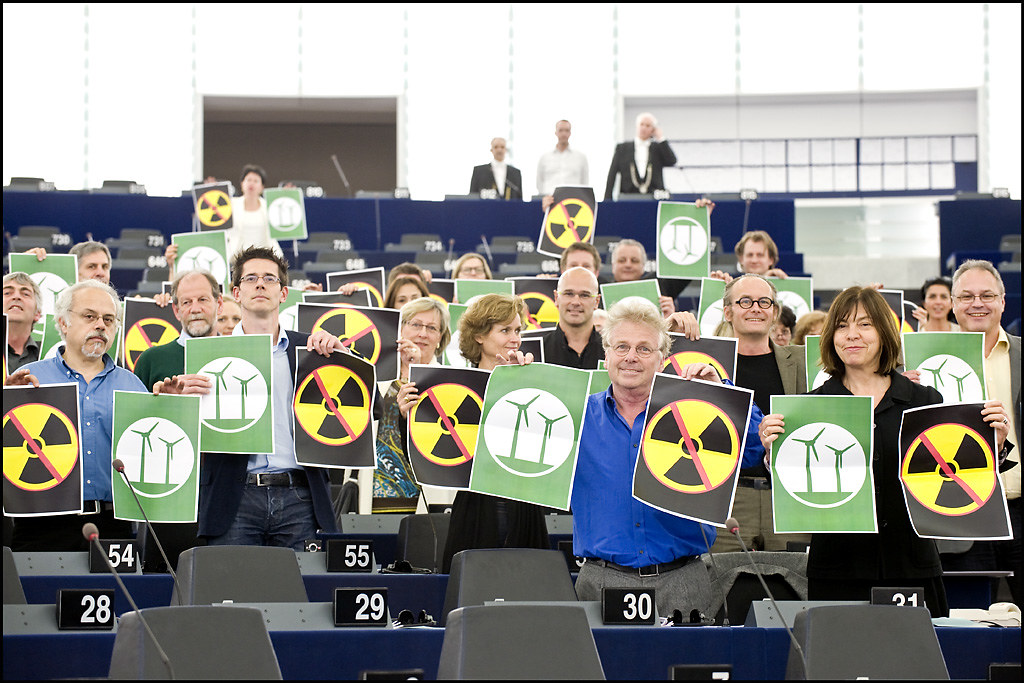
Nuclear power is a great example. It reduces CO2, but also other forms of pollution. It doesn’t require decades and trillions of dollars to build a new power-grid infrastructure, it’s plug-and-play with the existing system (almost, anyway). The technology is well-understood, safe and efficient. You won’t find opposition from conservatives, only from some liberals.

Several MEPs (mainly Greens) hold up anti-nuclear posters at the debate.

But other tactics will require more argument. A carbon tax, for example, would send technology and the economy down an entirely new path, with entirely unpredictable consequences. It would seem to increase uncertainty about future climate rather than decrease it. It has other issues as well. To gain support for one from skeptics, you’ll have to convince them that you can predict the effects of such a tax on human welfare in 2100 well enough to make it a good bet.

Geoengineering is the cheapest and surest way to reduce global temperatures, but it controversial on both left and right for its possible unintended consequences. Here you have to convince people the gain is worth the risk.

The single best no-brainer solution is to work for world peace and cooperation. War is the biggest threat to the environment and climate. Solutions to climate change and dozens of equally consequential global issues will require cooperation—or at least less conflict—among nations. Redirecting military spending to climate research and mitigation would do tremendous good. Best of all, world peace and global cooperation have many direct advantages, not just vastly improving our ability to respond rationally to issues like climate change.

Biden Declares National Emergency for War on Energy

Washington Examiner reports Biden’s war on energy: President invokes wartime powers to speed up end to gas-powered home appliance.  Excerpts in italics with my bolds and added images.

President Joe Biden allotted $169 million for electric heat pump projects with his emergency authority on the basis of climate change.

This is the first time a president classified climate change as an emergency by utilizing the Defense Production Act, which was established during the Cold War. Now, the money stemming from the Inflation Reduction Act will be divided among 15 sites dedicated to manufacturing the necessary parts and entire units of a variety of heat pumps.

“The President is using his wartime emergency powers under the Defense Production Act to turbocharge U.S. manufacturing of clean technologies and strengthen our energy security,” Biden’s National Climate Advisor Ali Zaidi said in a statement.

John Podesta, senior adviser to the president for clean energy innovation and implementation, similarly celebrated the move, applauding the president for “treating climate change as the crisis it is.”

However, American Gas Association President and CEO Karen Harbert disagreed with the recent move from the White House, writing in a statement, “We are deeply disappointed to see the Defense Production Act, which is intended as a vital tool for advancing national security against serious outside threats, being used as an instrument to advance a policy agenda contradictory to our nation’s strong energy position.”

“Increased use of natural gas has been responsible for 60% of the electrical grid’s CO2 emissions reductions. This vital tool for emissions reductions and energy system resilience should not be unfairly undermined through misuse of the Defense Production Act.”

Among the facilities, two new factories will be constructed: a Treau, Inc. DBA Gradient plant in Michigan and a Mitsubishi Electric plant in Kentucky. Neither company has announced exact locations yet. Treau will receive over $17 million, and Mitsubishi will receive $50 million toward construction.

The Energy Department predicts roughly 1,700 jobs will be created in the various projects to promote more heat pump products. All the sites are centered in “disadvantaged communities” for their benefit.

Last year, the Energy Information Administration reported that natural gas was the water and space heating source of about 42% of U.S. residential spaces. The residential sector makes up 15% of overall natural gas consumption. However, heating and cooling across residential and commercial buildings drive more than 35% of the country’s energy consumption.

Footnote on Declaring Climate Emergency for Spending Purposes

This report on the German High Court ruling on this matter Europe Plunges Into Chaos After Germany Freezes Public Spending Following Shock Top Court Decision.  Excerpts in italiics with my bolds.

Germany’s economy, Europe’s largest, is contracting as surging energy prices and trade tensions cast doubt on its export-oriented business model. Chancellor Olaf Scholz’s government had been counting on that old virtue signaling switcheroo – a flood of spending on “green-energy projects and technology”, from chips to batteries, to revive the old model. That way, if anyone asks why Germany is deficit-spending its way to mercantilist utopia, Berlin could always lie and say it was doing the right thing for the world and wasn’t interested in a debt-funded stimulus. Alas, now the “Cardinals of Karlsruhe” have made this impossible.

Berlin’s decision to freeze all federal spending for the rest of the year came after the court defunded the government’s €60 billion —the equivalent of more than $65 billion—green-transition project. The court said Berlin couldn’t repurpose unspent credits originally earmarked to tackle the Covid-19 pandemic to fund environmental and energy projects. It said Berlin was bound by the country’s constitutionally enshrined fiscal rules that limit budget deficits to 0.35% of gross domestic product in normal times.

Senior government officials said one option under consideration would be to retroactively declare a state of budgetary emergency for 2023, invoking a clause in the fiscal rules that allows for a suspension of the spending limits in exceptional circumstances. Previous governments invoked the exception during the pandemic.

Unfortunately, for Germany’s stimmy-starved politicians, the plan is fraught with legal difficulties, in part because the constitutional court prepared for just this eventuality when it raised the bar for declaring such emergencies, according to Lars Feld, an economist who advises the government.

Strengthening resilience and transforming the economy amid geopolitical crises and climate change was seen as a necessity that required taking on debt, but the court ruling has challenged those assumptions, Feld wrote in the Frankfurter Allgemeine newspaper.

Hilariously, the court said that unlike war and natural disasters, climate change was a foreseeable crisis that had been long in the making and could no longer justify emergency spending. Which, however, means that all Germany will have to do is politely request that the CIA start a new war… or that Fauci mail orders a new virus from Wuhan.


Climate Tipping Points Are Fantasy, Not Science

Sahara has been shrinking over the past decades. Image: NASA

P Gosselin provides an english translation for an interview with prominent German geologist and Sahara expert Dr. Stefan Kröpelin.  The NoTricksZone article is Sahara Expert Says Desert Shrinking, Calls Alarmist Tipping Points “Complete Nonsense”.  Excerpts in italics with my bolds.

Climate tipping points are much more fantasy than science

Dr. Kröpelin is an award-wining geologist and climate researcher at the University of Cologne and specializes in studying the eastern Sahara desert and its climatic history. He’s been active out in the field there for more than 40 years.

In the Auf 1 interview, Dr. Kröpelin contradicts the alarmist claims of growing deserts and rapidly approaching climate tipping points. He says that already in the late 1980s rains had begun spreading into northern Sudan and have since indeed developed into a trend. Since then, rains have increased and vegetation has spread northwards. “The desert is shrinking; it is not growing.”

Kröpelin confirms that when the last ice age ended some 12,000 years ago, the eastern Sahara turned green with vegetation, teemed with wildlife and had numerous bodies of water 5000 – 10,000 years ago (more here).

Later in the interview Kröpelin explains how the eastern Sahara climate was reconstructed using a vast multitude of sediment cores and the proxy data they yielded. According to the German geology expert: “The most important studies that we conducted all show that after the ice age, when global temperatures rose, the Sahara greened”…”the monsoon rains increased, the ground water rose”. This all led to vegetation and wildlife taking hold over thousands of year.

Then over the past few thousands of years, the region dried out. It didn’t happen all of a sudden like climate models suggest.

Modelers don’t understand climate complexity

When asked about dramatic tipping points (8:00) such as those claimed to be approaching by the Potsdam Institute (PIK), Kröpelin says he’s very skeptical and doesn’t believe crisis scenarios such as those proposed by former PIK head, Hans-Joachim Schellnhuber. He says people making such claims “never did any studies themselves in any climate zone on the earth and they don’t understand how complex climate change is.”

Except for catastrophic geological events, “it’s not how nature works,” Kröpelin says. “Things change gradually.”

The claims that “we have to be careful that things
don’t get half a degree warmer, otherwise everything will collapse,
is of course complete nonsense.

“I would say this concept [tipping points] is baseless. Much more indicates that they won’t happen than that they will happen.”

Late last year in Munich, he called the notion of CO2-induced climate tipping points scientifically outlandish. He also called the prospect of the Sahara spreading into Europe preposterous.

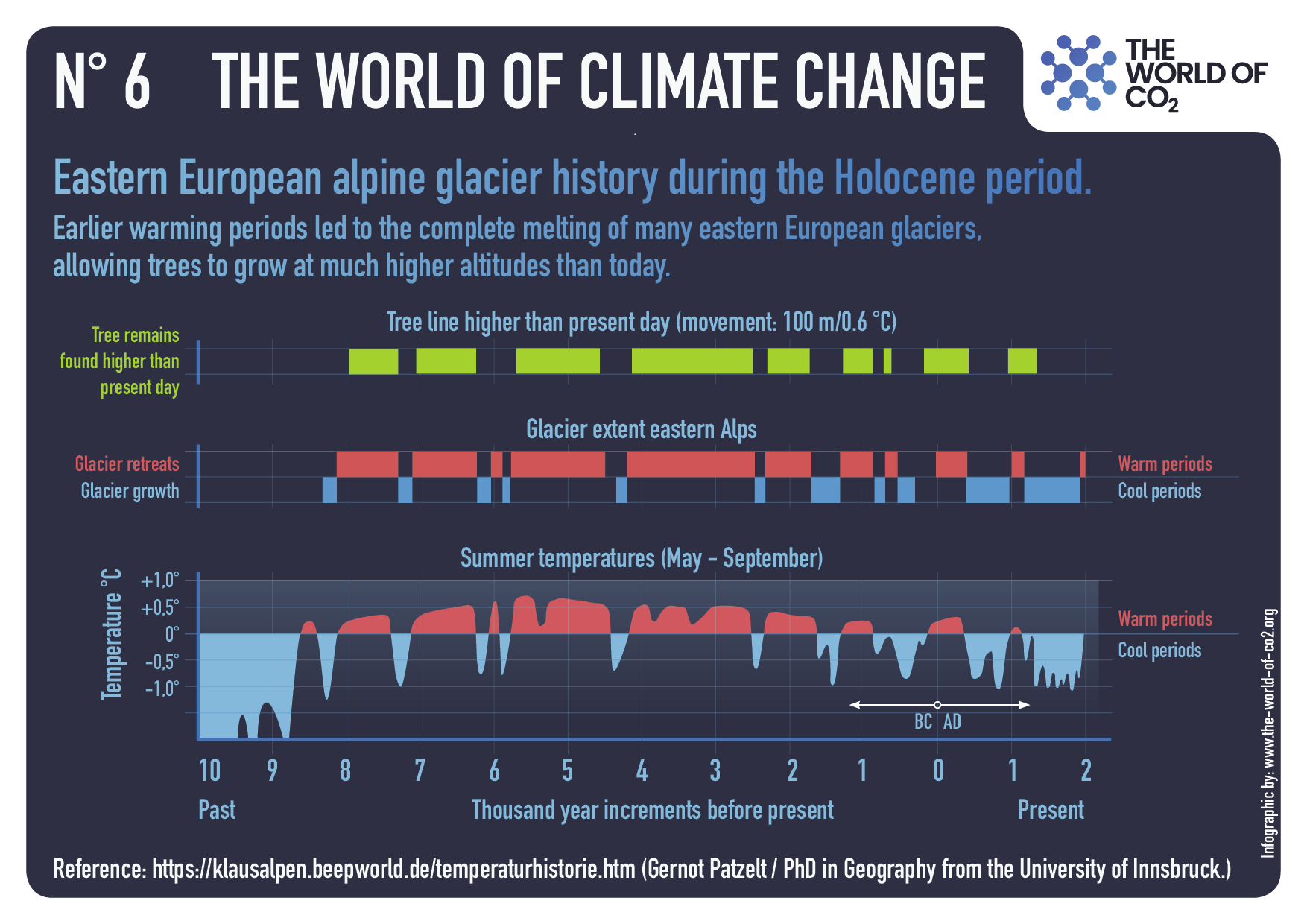
Another example is the fluctuating cycles of Alpine glaciers, waxing and waning over periods of time.

Background Post

Bogus Talk about Climate Tipping Points

Finally, as the critique shows, tipping points are like climate change itself: Applying labels to something that has already happened, with no predictive utility.