
John Green writes at American Thinker Why are we studying the sun, if the science is settled? Excerpts in italics with my bolds and added images.
NASA’s Parker solar probe just completed one of its primary multi-year mission objectives, with the closest ever approach to the Sun. On Christmas Eve, the probe flew through the Sun’s corona at a blistering (literally and figuratively) 430,000 mph. For aircraft buffs, that’s Mach 560 — fast enough to circle the earth in about 3 minutes!
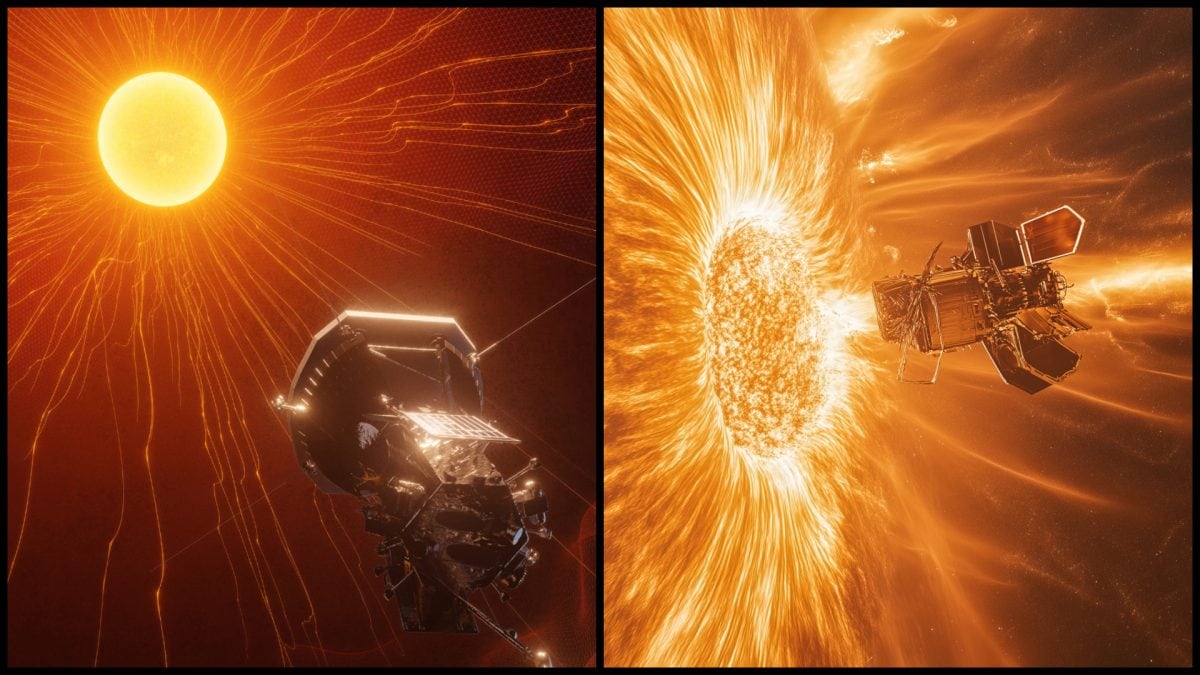
NASA’s Closest Approach to the Sun’s Fiery Surface Achieved by Parker Probe
A faint signal from Parker indicates that it survived its scorching flyby, and scientists are expecting it to download a treasure trove of data later this month. It turns out there’s a lot the guys with the PhDs don’t understand about the sun. As NASA states:
The NASA Parker Solar Probe mission is a mission designed to help humanity better understand the Sun, where changing conditions can propagate out into the solar system, affecting Earth and other worlds. As such, the primary goals are to examine the acceleration of solar wind through the movement of heat and energy in the Sun’s corona in addition to study solar energetic particles.
They’re hoping data collected while flying through the Sun’s corona will provide a few answers and make it a bit more predictable.
I confess I’m just a lowly engineer, and many of the mysteries they’re trying to unravel are well beyond my college physics courses. But reading about the Parker probe got me wondering: Doesn’t the Sun have something to do with our weather? I mean it’s warm on sunny days, and plants grow better when the earth’s surface is the closest to the Sun.
Those observations may sound obtuse, but they’re no more obtuse than “experts” saying that “climate science is settled” — when they don’t understand how the freaking Sun works! (Looking at you “Science Guy” Bill Nye.)

The science can only be settled when the smart guys understand all the factors that affect our climate — and how they interact — well enough to predict outcomes. The Sun imparts about 342 watts of energy on every square meter of the earth’s surface (according to NASA). That’s the equivalent of 44 million average electric power plants (700 times what the world has) — yet we don’t understand its fluctuations.
That’s a rather big unpredictable factor for this supposedly “settled science” — no?
One can only conclude that when highly educated people — who should know better — claim climate science is settled, they’re lying. Perhaps that’s why multiple predictions that the polar bears would be extinct and New York would be underwater by now have all been wrong. It might also explain why the greenies avoid discussion of ice ages and interglacial periods when assuring us that our cars are delivering planetary doom – while their private jets are perfectly fine.

Given what little we know about the Sun, the anthropogenic climate change “experts” are either:
- Ignorant men, succumbing to irrational fears — placing superstition above science, or
- Evil men — profiting by scaring us into irrational behavior.
We should keep that in mind when they insist that we halt progress, live in destitution, and scare our children that apocalypse is imminent. Our only rational response is to ignore them … and cut off their funding.

Yes, IPCC, Our Climate Responds to Our Sun
John Gideon Hartnett writes at Spectator Australia The sun is in control of our oceans. Text is from John Ray at his blog, excerpts in italics with my bolds and added images.
In recent years, there has been observed an increase in ocean temperature. Those who adhere to the Climate Change version of events say that the oceans are getting warmer because of trapped carbon dioxide (CO2) in the atmosphere causing a massive greenhouse effect leading to boiling oceans.

Well, anyone who has a brain knows that the oceans are not boiling, but let’s assume that is just hyperbole. When actual research – when actual measurements were taken – reality turns out to be the exact opposite.
New research shows that the temperature of our oceans are controlled by incident radiation from the Sun. Who would have guessed?
And as a consequence of the oceans warming, dissolved carbon dioxide gas is released due to reduced is solubility in ocean water. This means the warming of the oceans would lead (or cause) an increase in CO2 concentration in the atmosphere. One of the researchers in the study wrote on X.com:
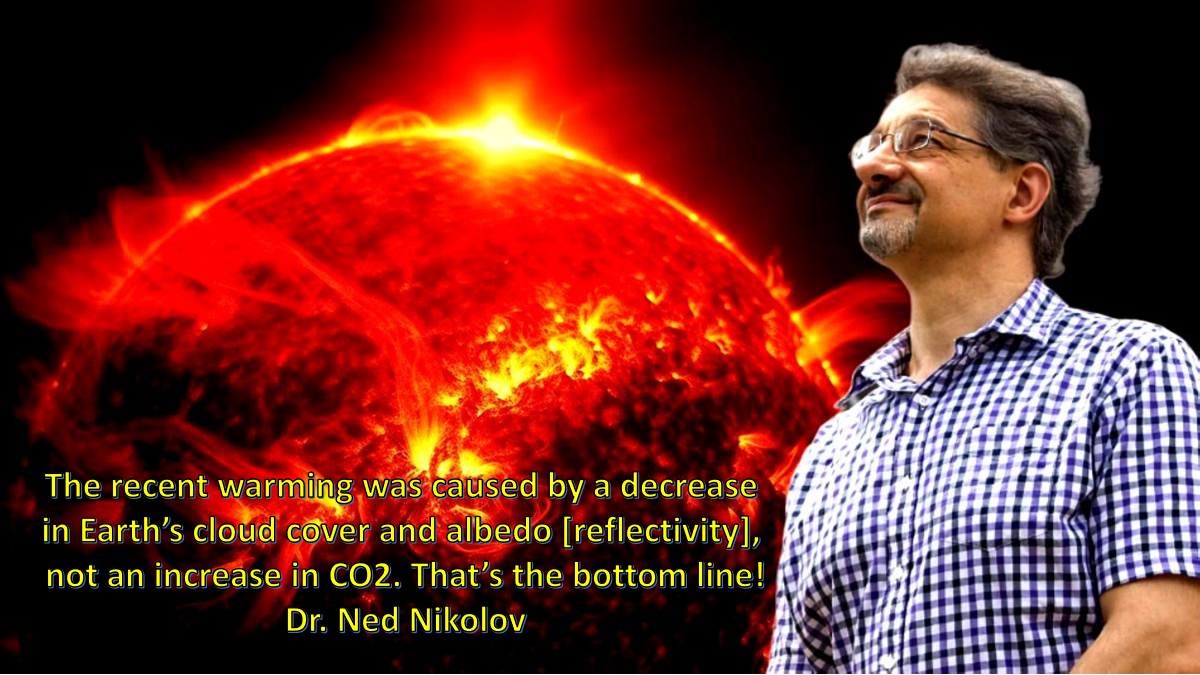
A decrease in cloud cover and albedo means more short wavelength (SW) solar radiation reaches the oceans. Albedo is the reflectivity of the Earth. Lower albedo means more sunlight reaching the land and oceans and more warming by the Sun.
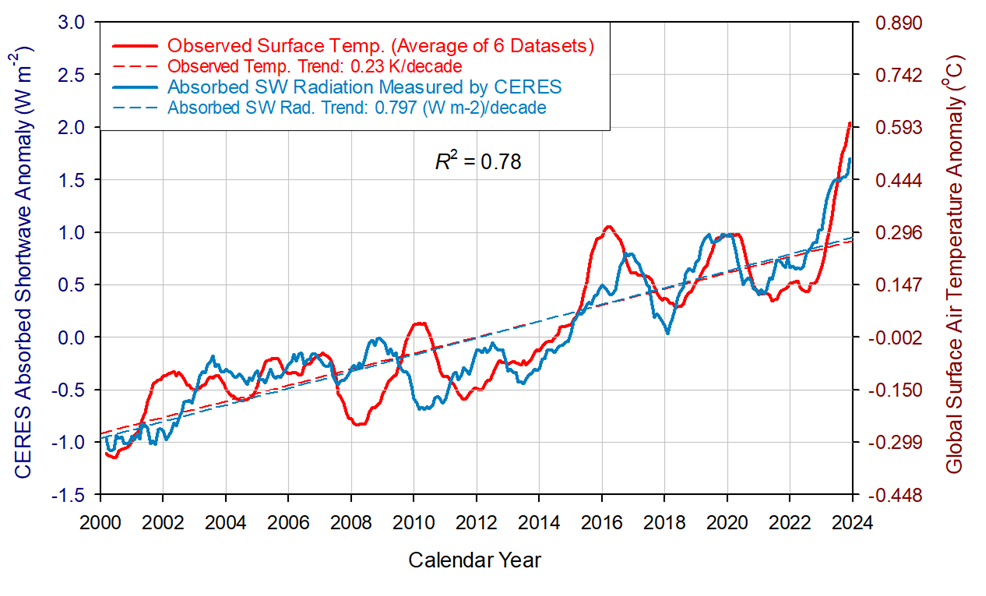
Figure 8. Comparison between observed global temperature anomalies and CERES-reported changes in the Earth’s absorbed solar flux. The two data series representing 13-month running means are highly correlated with the absorbed SW flux explaining 78% of the temperature variation (R2 = 0.78). The global temperature lags the absorbed solar radiation between 0 and 9 months, which indicates that climate change in the 21st Century was driven by solar forcing.
I mean to say that this is so obvious. The Sun heats Earth’s surface of which 71% is covered by the oceans! Basic physics!
The energy from the Sun powers all life on the planet and causes all Earth changes. Every second, the Earth receives the equivalent energy of 42 megatons of TNT in radiation from the Sun. That cannot be ignored.
Climate Change, the ideological movement which I prefer to call a cult, views all evidence through the lens of their religious belief that the Earth is warmed by human activity. That activity releases carbon dioxide gas, which has been observed to be increasing. Their belief is that CO2 traps heat in a giant greenhouse effect. That is the dogma anyway. And I must add, we all are the carbon they want to eliminate.
But how much of that observed increase in CO2 is actually from natural causes and not from human activity? At least 94 per cent is. This new evidence now suggests it could be even more than that.
If the oceans emit CO2 gas following changes in the water temperature, which this research shows is due to the amount (flux) of solar radiation reaching the surface, then more CO2 comes from natural causes.
It is basic physics that as you heat water the dissolved gases are released due to a decrease in gas solubility. This means as the solar flux increases CO2 gas is released from the warmer ocean water.
Thus an ocean temperature increase leads to an increase in CO2 in the atmosphere, and not the other way around.

Space weather impacts the ionosphere in this animation. Credits: NASA/GSFC/CIL/Krystofer Kim
 Science Matters
Average temperatures as an indicator of warming OR cooling on the earth are about as useful for determining the actual conditions as the average height of K-12 school children is in determining the size of their graduation gowns. Statistics have a usefulness in painting a generalized picture of conditions within the scope of the context in which the statistics are applied. They are useless in making precise predictions, especially when the cause and effect relationship of the specific phenomena are not clear-cut and irrefutable.
This is, in part, why the long-range climate prediction models have consistently and completely failed to accurately predict real world conditions. We are unable to reduce the multiple factors that power the engine of climate to a manageable and comprehensible quantity. The interactions of separate drivers which may amplify or attenuate the results of a given chain of events are beyond any qualitative or quantitative certainty.
Influencers of “climate” are most likely effective in relation to the magnitude of their energy. This clearly indicates that the sun is the chief driver of earth’s weather, creating geographic zones that are then influenced in part by local conditions, such as geological forms, vegetation, and the presence or absence of bodies of water. In fact, there is no “global climate”. There is an assemblage of microclimates spread around the globe and created primarily by the solar energy available to that zone. There is no climate crisis due to anthropogenic influence; all we have to fear are the cosmic forces beyond our control. Why worry?
LikeLike
Thanks for your comment Stephen, especially the point about “no global climate.” Unfortunately a cabal intends to reap trillions of dollars which requires all of us to be afraid, very afraid.
LikeLike