Spain and Portugal Achieve Net Zero Accidently
Analysis of the blackout in Spain and Portugal comes in EurAsia Daily article Solar generation fell, and then the Spanish power grid collapsed: details of the blackout. Excerpts in italics with my bolds and added images.

New details are emerging why a large-scale blackout occurred in Spain, which lasted more than 10 hours and hit millions of Spaniards. The statements of the operator of the country’s energy system differ from the original version of EADaily, but point to the same reason — green energy, which failed in a crisis situation.

“The first major power outage in the era of green electricity,” Bloomberg columnist Javier Blas wrote on Twitter. He published a brief transcript of the teleconference held by the operator of the Spanish power grid Red Electrica on the blackout, from which the country is still recovering.

So, Red Electrica ruled out a cyber attack or weather as a reason. The operator presented the following course of events. At 12.33 pm, the Spanish power grid experienced a loss of generation in the south-west of the country. Most likely, these were solar power plants, but the operator is not sure yet. Indeed, most of Spain’s solar generation is located in the south-west of the country.
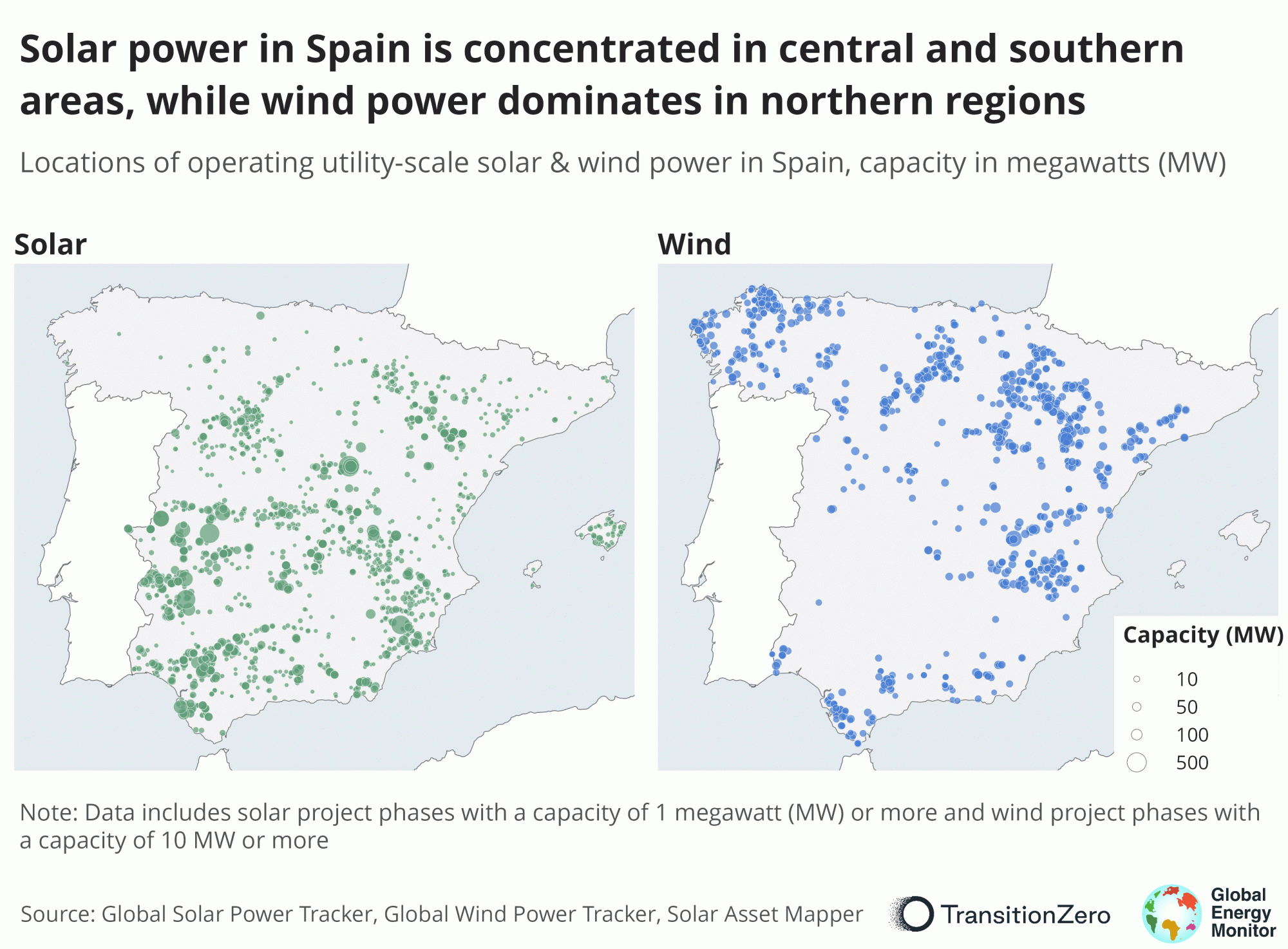
Location and concentration of solar power plants in Spain (left).

After milliseconds, the power system self-stabilized and began to recover. However, after a second and a half, a second wave of generation power loss occurred. Representatives of the operator did not specify whether the first wave provoked the second.

Three and a half seconds later, the instability of the energy system of the Iberian Peninsula reached a level that led to a malfunction at the interconnector with France, the power supply capacity of which was then 1 GW.

Immediately after that, another power loss of green power plants hit the power grid. The operator did not specify why this happened.

Further, the cascading power drop further destabilized the Spanish power grid, forcing every remaining power plant to be disconnected from the grid — nuclear power plants, gas and hydroelectric power plants. As a result, the generation in Spain entering the network has dropped to zero. The data shows that out of 25 GW, 10 GW remained, but the operator reported that for a brief moment the power dropped to zero.

Red Electrica stated that the presented series of events is preliminary, and so far the operator cannot make a final conclusion due to a lack of data.

This information is confirmed by the data of the operator itself and the European ENTSO-E platform. The capacity of solar power plants at 12.25−12.30 amounted to 17.8 GW — 55% of the total generation in the country. And by 12.40 it had almost tripled to 6 GW. At the same time, from 11.00 the capacity of solar power plants changed dramatically and one-time fluctuations reached 700 MW.
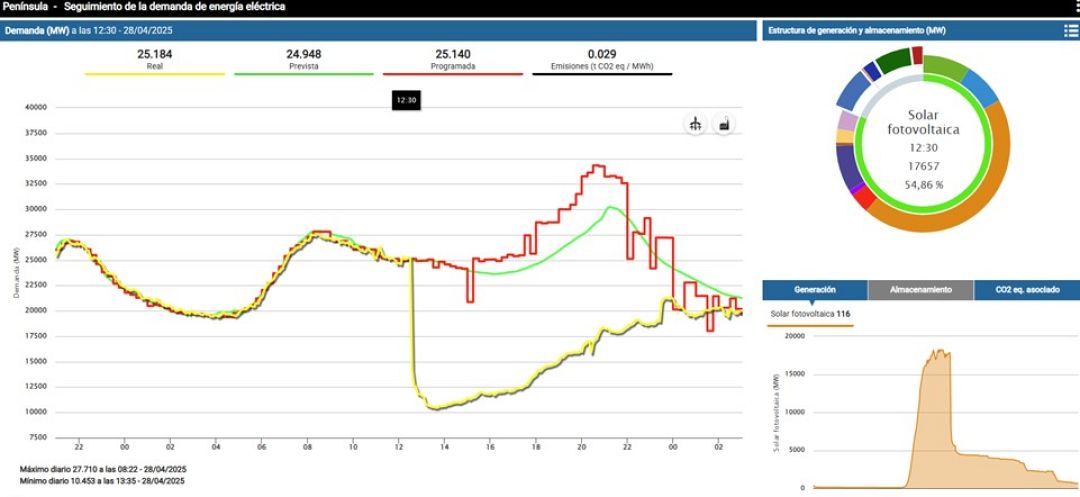
TSO data shows the point just after 12:30 on Monday 28 April when Spain’s electricity grid collapsed. When the collapse occurred, the Spanish electrical grid had almost 80% renewable generation, 11% nuclear, and only 3% natural gas. There was practically no base generation or physical inertia to absorb the shock that was generated. Source: Red Eléctrica

The operator’s data differ from the original version of EADaily about the failure of the interconnector with France and temperature changes, but coincide with the key reason for the blackout — green energy.

The problem of solar and wind power plants is that, unlike coal and gas generation, they do not provide synchronous inertia that stabilizes the frequency in the network. And when the frequency in the network dropped, solar power plants could not compensate for the imbalance. Their operation depends on inverters, which automatically turn off when the frequency deviates from the norm, aggravating the collapse.

The electrical system obeys the laws of physics. This obvious fact was not always taken into account when politicians took measures affecting the country’s electricity generation and transport networks. In Spain, for example, over the past decade there has been a revolution in electricity generation, which has led to the fact that renewable technologies (primarily photovoltaic and wind) now occupy a large part of the energy balance,” wrote former president of Red Electrica Jordi Sevilla in El Pais.

He noted that there is a technical problem: solar and wind energy are not synchronous energy sources, while transmission and distribution networks are designed to operate only with minimal voltage in the energy they transmit. Therefore, a sudden jump in the production of renewable generation can lead to sharp voltage fluctuations in the network, which will lead to a loss of generation and, as a result, to power outages.

“Our energy system needs investments to adapt to the technical realities of the new generation, which, in turn, should also continue to improve its own technologies and storage systems. This is a requirement of the sector (and the system operator), to which the government does not listen. The PNIEC project was developed in the office with excessive messianism regarding renewable energy sources and without taking into account the technical problems associated with such a significant change in the Spanish energy balance and its compliance with the energy system,” concluded the ex—head of the Spanish energy system operator.

Meanwhile, the Spanish Prime Minister made a new statement about the blackout.

“In his third speech in 24 hours, Pedro Sanchez clearly pointed out the ‘responsibility of private operators’ for the largest power outage in the history of Spain. He did not name names because the investigation is still ongoing, but the chief executive has thus taken the first step in a huge legal and economic battle that will begin in the coming months,” El Pais writes.

As the building notes, Pedro Sanchez seeks to neutralize attempts by the People’s Party (PP) and other conservative circles to blame the blackout on renewable energy sources.

“Sanchez claims that there is nothing to indicate that this is an explanation for what happened, and even more so that nuclear energy is the solution. Other right-wing European countries are returning to nuclear power, but Sanchez and Ogesen insist on the opposite,” El Pais noted.

At the same time, Prime Minister Sanchez himself still does not completely rule out the cyberattack version, and the government turned to Incibe (Cybersecurity Institute).

“Doubts remain. The government is not sure, but Sanchez still claims that the system is one of the best in the world, and adds that the public has behaved exemplary. At the moment, the system, restored to 99%, will work according to a safe formula, and if everything goes well, the usual formula will start working tomorrow,” El Pais writes.

Javier Blas  @JavierBlas comments:
Let’s see if I understood Spanish PM:
– we should not eliminate any hypothesis, but he has unilaterally ruled out any link to renewables;
– nuclear power plants are bad;
– we should wait to expert reports, but he contradicts the preliminary findings from the experts at the grid.
As reported by EADaily, after noon on April 28, millions of Spaniards faced problems that they did not even know about. The blackout stopped trains, planes and even buses. The extinguished traffic lights provoked chaos on the roads, and the lack of electricity in stores led to the fact that bank cards were not accepted and supermarkets were closed. Mobile communications disappeared, and hospitals served only patients in critical condition. 30 thousand police officers were brought into the capital of the country to ensure order. Spain could not even imagine such a thing.


Battle to Open Closed-Minded Universities

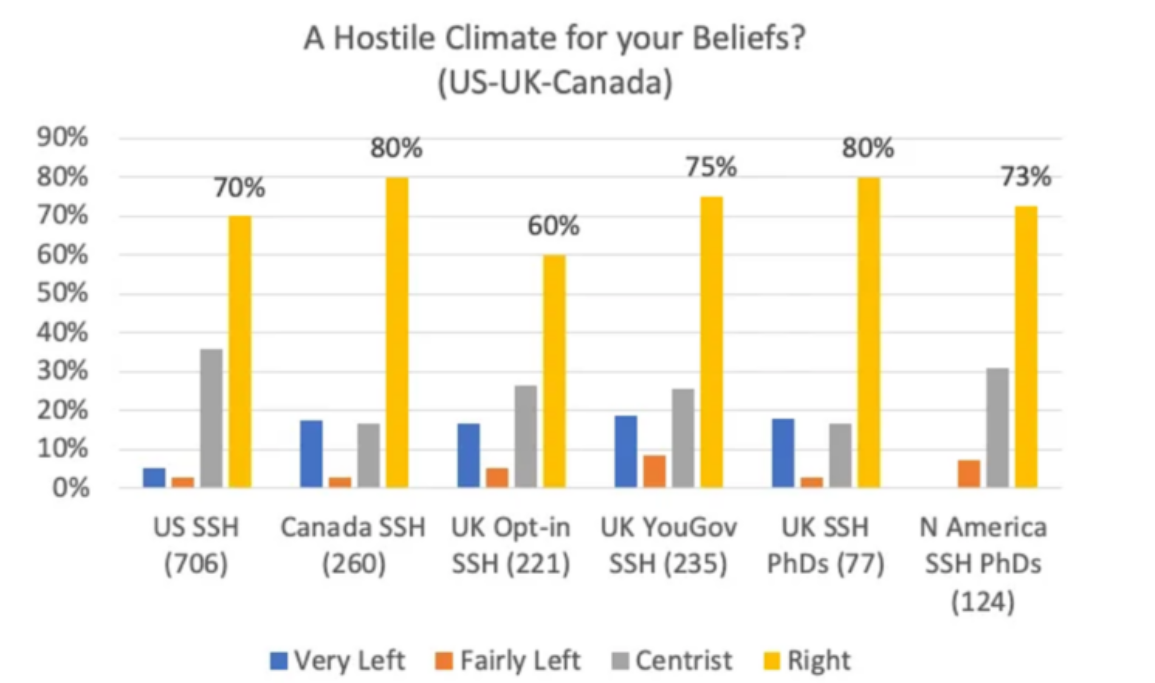
Research by U.K. politics professor Eric Kaufmann (top left) showed that 80 percent of Canada’s right-leaning academics report a hostile environment for their beliefs. The proportion was the same in the UK and was 70 percent in the U.S. In all three countries, the percentage of “very left” academics reporting hostility towards their beliefs was less than 20 percent.

James Piereson writes at City Journal Trump Is Likely to Win His Fight with Universities.  Excerpts in italics with my bolds and added images.

The administration holds many cards,
and it seems determined to play them all.

The universities have compromised themselves with the alliance they have formed with the Democratic Party and their dependency on taxpayer funds provided by Democrats, Independents, and Republicans alike. Universities should not have let themselves become so attached to any political party or ideological point of view, lest they compromise the intellectual integrity of their institutions or jeopardize the taxpayer funding that they badly need. But that is precisely what has happened at Harvard, Columbia, Northwestern, and other leading institutions. It is something the Trump administration hopes to change.

Trump has said that he wants to use the lever of federal funding to force university leaders to confront several issues: the lack of intellectual diversity on their campuses, with upward of 80 percent of faculty members identifying as liberals or progressives, and less than 2 percent as conservatives; the refusal to enforce race- and gender-blind civil rights laws, and the continued use of preferences in admissions and employment, in violation of the 2023 Supreme Court decision in Students for Fair Admissions v. Harvard University; the failure to protect the rights of Jewish students amid demonstrations on campus of anti-Semitism and hatred of Israel; administrative “bloat,” reflected in how college campuses today employ more administrators than professors teaching courses; tuition increases that far outpace inflation, leading to ever more student borrowing and debt underwritten by federal loan programs; and the continued presence of ideological departments and programs on campuses that do not allow for diversity of intellectual approaches.

The Trump administration has tried to influence institutions by freezing payment of federal funds, but there is a more effective way to do this—one less likely to cause mayhem in scientific programs and medical schools and less prone to being overturned by the courts: Trump should use the leverage of prospective grants to induce institutions to abide by federal law and begin reforming their internal operations.

These institutions will come back to the federal government every year with proposals for new funding. The Trump administration is not required to make new awards to these institutions. These can be made on the condition that the institutions are taking concrete steps to reform themselves. If they thumb their noses at Trump, then the administration can decide that grants and contracts that have gone to Harvard, Columbia, and Johns Hopkins in the past might be given in the future to the University of Alabama, Ohio State, or the University of Montana. Such a redistribution of federal funds might even bring about a useful realignment in the scientific prestige of American universities, as some move down and others move up the reputational ladder.

Some of Trump’s goals in regard to higher-education reform are already subsumed under grant participation agreements that institutional representatives must sign before federal departments can sign off on grants and awards. Those agreements oblige recipients to comply with provisions of the Civil Rights Act (1964), the Title IX educational amendments (1972), and other regulations in regard to discrimination by age and handicap status. In light of the Supreme Court decision in the SFFA  v.  Harvard case, along with Trump’s executive orders in regard to civil rights, those agreements oblige recipient institutions to abandon all preference programs, including DEI programs created to advance preferences in university life. More than a few institutional representatives will have a hard time signing these agreements going forward because of lingering preference programs on their campuses. In any case, the administration can supplement those agreements with addenda that include other issues it wants universities to address.

The questions asked of institutional representatives might include:

Does the institution pledge to abide by federal civil rights laws that forbid group preferences in admissions and employment?

Has the institution taken steps to guarantee the rights of Jewish students against attacks arising out of anti-Semitism or hatred of Israel?

What steps has the institution taken to create greater intellectual diversity on its campus?

Has the institution adopted measures to reduce the number of administrators on campus and to eliminate administrative departments that try to enforce group preferences in violation of federal law?

Has the institution limited tuition increases to the level of inflation in order to reduce expenses for students?

These questions should clarify the choice Trump is asking these institutions to make:
either change current practices or forgo federal research funds
.

Over the four years of this second Trump administration, such an approach might have genuine and constructive consequences for the operation of American universities. Will Johns Hopkins University spurn $3.3 billion in federal grants next year in order to preserve its DEI bureaucracy? Will NYU give up $879 million in research grants next year in order to maintain its gender studies programs, or programs in the law school that advocate for group preferences? Universities may have to make hard choices between future federal funding and ideological programs currently in place.

This is precisely what liberals, feminists, and other activists did in the 1970s when they forced universities to sign “affirmative action” pledges, which soon turned into agreements to enforce group preferences in faculty hiring and employment. That approach evolved into the campaign for diversity later in that decade, when the Supreme Court ruled that preferences might be used to advance diversity in colleges and universities, and more recently into the DEI crusade that emerged in the wake of the George Floyd incident. That crusade proved to many that the entire enterprise had gone way too far. After five decades, with much academic mischief to show for it, the approach has hit a wall with the Trump administration.

Harvard and other universities are likely to find that they
are fighting a losing battle against the federal government.

Harvard has an endowment of $53 billion, by far the largest among the nation’s universities, but that’s little more than a rounding error in the government’s $7 trillion budget. Here the government negotiates from a strong position because, while federal grants loom large in university budgets, they are only a small fraction of the government’s budget.

The government has other weapons at its disposal. There is the tax exemption, for starters, which, if lost, will mean that schools cannot receive tax-deductible donations.. The government can stop the flow of international students to the schools, a move that would be costly in terms of foregone tuition payments. Trump can also ask Congress to slap a hefty tax on university endowments, another step his administration is already considering. At some point, Harvard and other elite institutions will have to sue for peace rather than continue an argument they cannot win.

In any case, the Trump administration holds many cards in this showdown with the universities, and it seems ready to play them all.

It’s the Sun Warming Us, Dummy

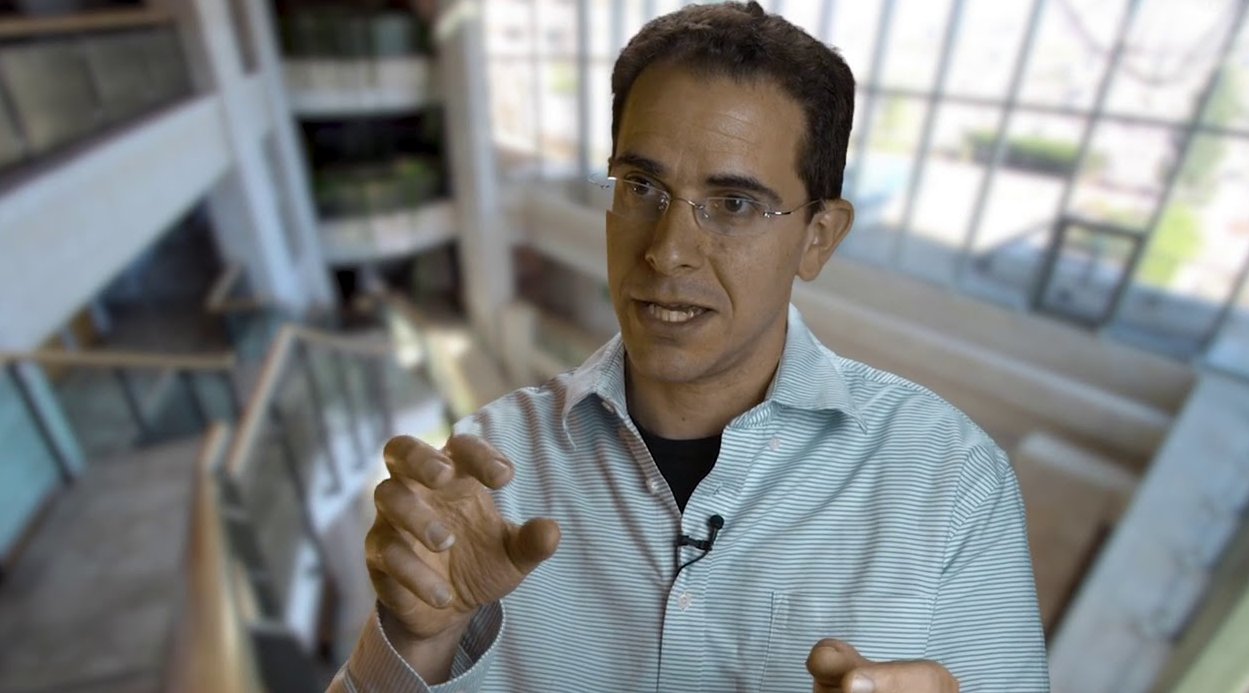
Nir Shaviv makes sense in his Daily Sceptic article Global Warming is Mostly Caused By the Sun, Not Humans, Says Astrophysics Professor.  Excerpts in italics with my bolds and added images.

“There’s no such thing as a scientific consensus,” Nir Shaviv, a Professor at the Racah Institute of Physics at the Hebrew University of Jerusalem says in response to a question about what he thinks of the widespread claim that there is a scientific consensus on the anthropogenic nature of climate change. “In science, we deal with open questions and I think that the question of climate change is an open question. There are a lot of things which many scientists are still arguing about,” he explains.

Indeed, there are scientists who say that climate change is caused entirely by humans and the situation is very dire. But then there are those who say that although humans are causing much of the warming, the situation is not as bad as we are being told by politicians and activists through the media. Some think that CO2 plays an important part in the current warming trend and some believe its role is insignificant.

Although Shaviv assesses that some of the warming in the 20th century is indeed the result of increasing atmospheric CO2 concentrations, most of the change is a natural phenomenon. “My research has led me to strongly believe that based on all the evidence that’s accumulated over the past around 25 years, a large part of the warming is actually not because of humans, but because of the solar effect,” he says.

Up to two-thirds of the warming comes from the Sun

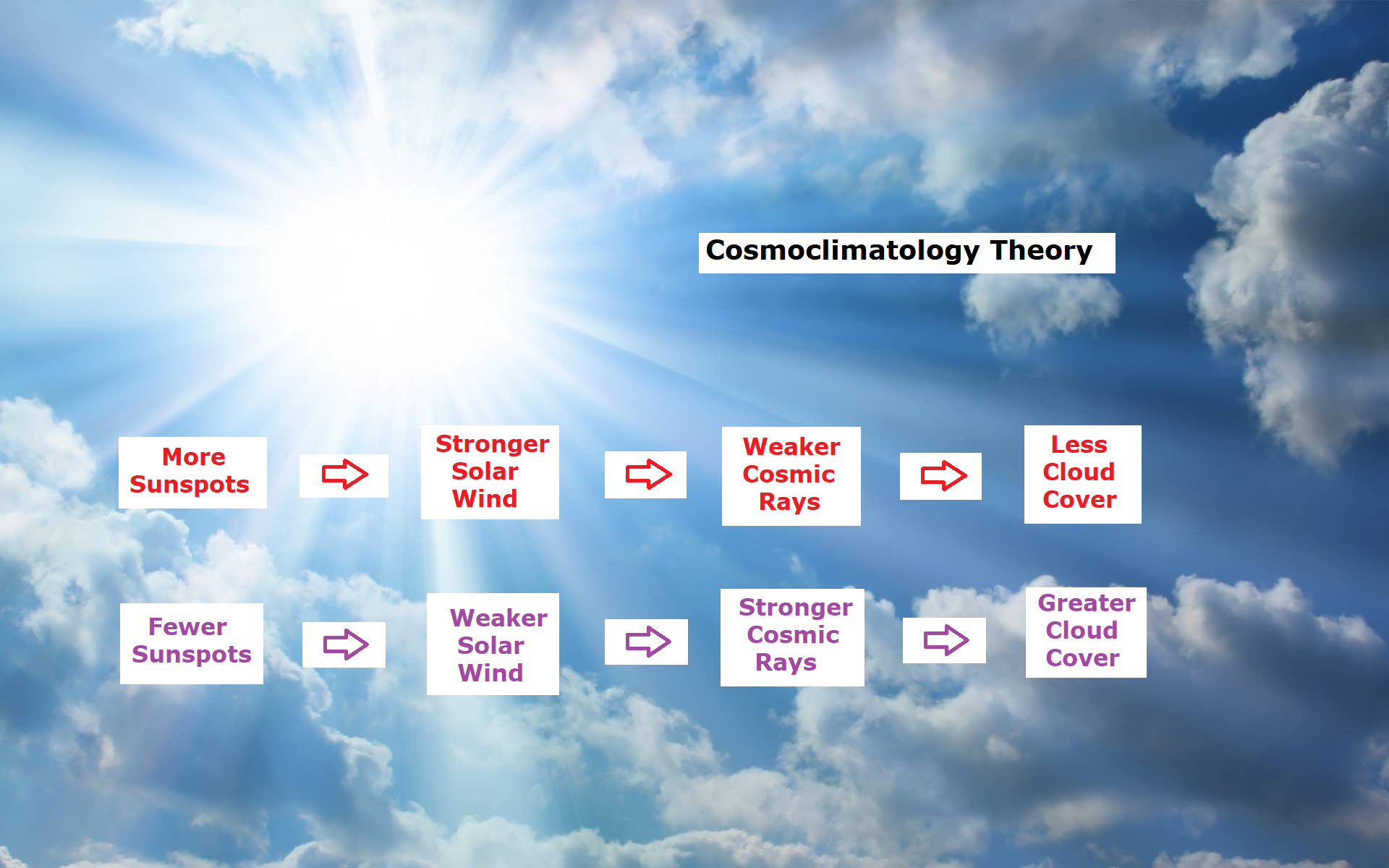
As an astrophysicist, Shaviv’s research has largely focused on understanding how solar activity and the Earth’s climate are linked. In fact, he says, at least half, and possibly two-thirds, of the 20th century’s warming is related to increased solar activity. Shaviv has also shown that cosmic rays and their activity influence cloud cover formation, also causing the climate to change. He has been working on this issue together with Danish astrophysicist Dr Henrik Svensmark.

In any case, Shaviv says, if solar activity and cosmic ray effects are taken into account, the climate sensitivity remains relatively low, or simply put – an increase in the proportion of CO2 in the atmosphere cannot cause much warming. Scientists have long attempted to calculate how much a doubling of atmospheric CO2 would raise the temperature of the Earth. The first attempt was made more than 100 years ago by the Swedish chemist Svante Arrhenius, who suggested an answer of up to six degrees Celsius. Since then, this number has been revised downwards, but not enough, according to Shaviv. “If you open the IPCC [Intergovernmental Panel on Climate Change] reports, then the canonical range is anywhere between one and a half or two, depending on which report you look at, to maybe four and a half degrees increase for CO2 doubling. What I find is that climate sensitivity is somewhere between one and one and a half degree increase per CO2 doubling,” Shaviv says, adding that he does not expect the temperature rise in the 21st century to be very high.

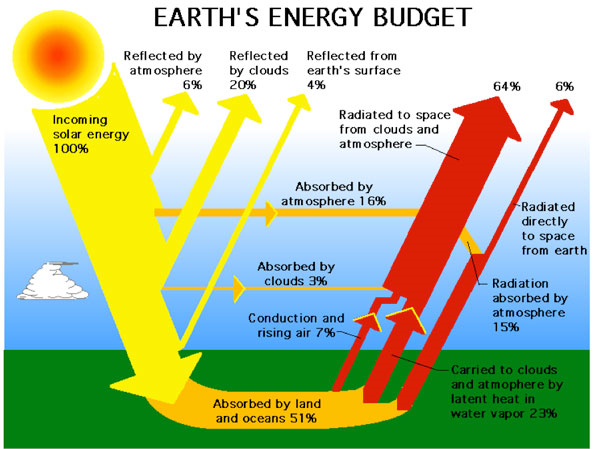
On average, half of sunlight is either absorbed in the atmosphere or reflected before it can be absorbed by the surface land and ocean. Any shift in the reflectivity (albedo) impacts greatly on the solar energy warming the planet.

Explaining the warming that has happened primarily with CO2 is where the IPCC’s scientific reports err, Shaviv says, by failing to account for the solar effect. And because they do not account for it, but there is still a need to explain the temperature rise, the rise in CO2 levels in the atmosphere, which has been attributed to human influences, has been used to explain it. Shaviv explains that this is the wrong answer as it fails to take into account all the contributing factors.

Is the planet boiling?

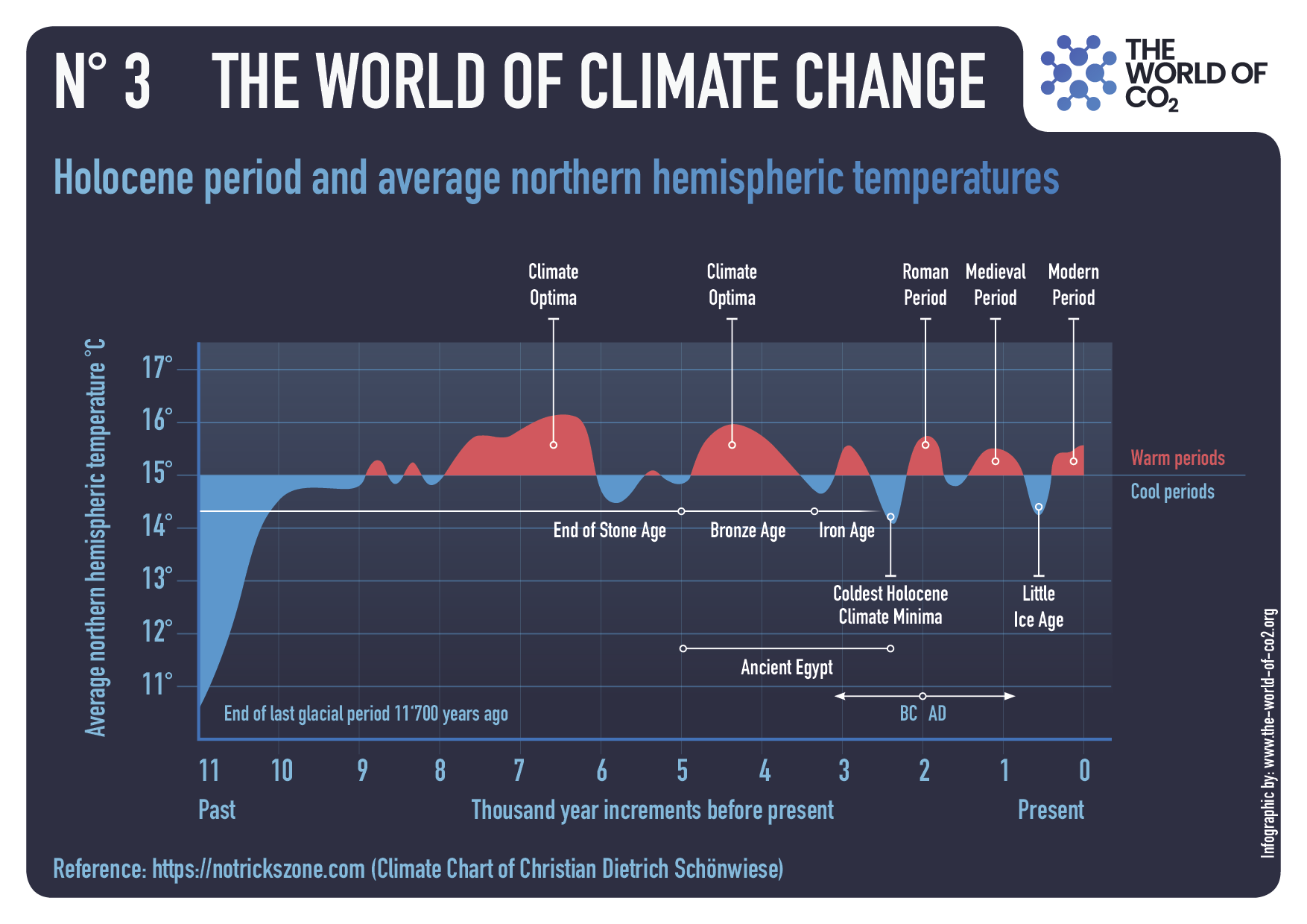
But is this temperature rise causing a climate crisis? Shaviv’s answer to the question is simple and clear: “No.” He explains that the average temperature on the planet has risen by one degree Celsius since about 1900, but this is not unprecedented. We are familiar, for example, with the Medieval Warm Period, when the Vikings charted the coast of Greenland, including its northern part, which today is covered with ice even in summer. “This kind of climate variation has always happened. Some of the warming now is anthropogenic, but it’s not a crisis in the sense that the temperature is going to increase by five degrees in a century and we’re all doomed. We just have to adapt to changes. Some of them are natural and some are not, but they’re not large,” Shaviv explains.

It has been widely reported that both 2023 and 2024 were the warmest years on record. Referring to this rise in temperatures, UN Secretary-General António Guterres already in July 2023 declared that we have entered an “era of global boiling”. Shaviv says that of course, we can have average surface temperatures that are highest if we only look back 100 or 150 years. “If you go back a thousand years it was just as warm. If you go back 5,000 years it was definitely warmer. So, It doesn’t mean much,” he explains.

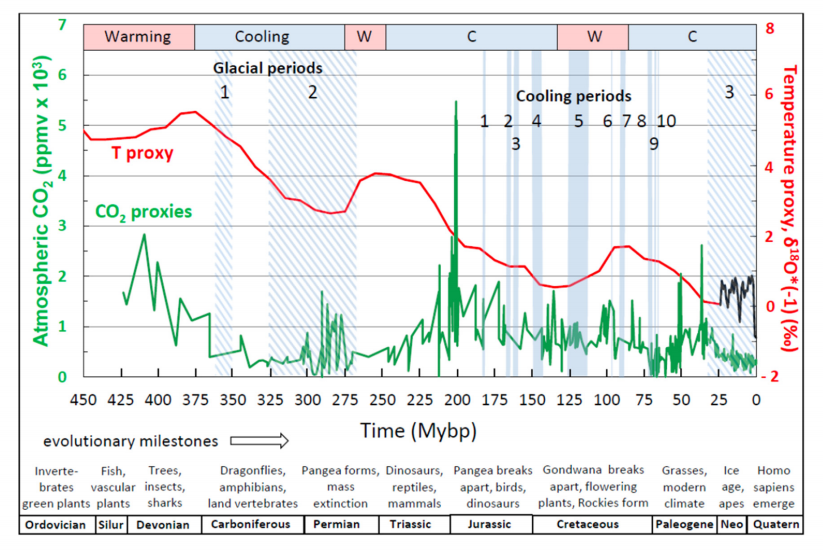
And if you look at a longer time scale, warmer periods have alternated with colder periods throughout. Also, over the last 100,000 years, the Earth has been in an ice age for most of that time, and the retreat of the ice in Europe and North America happened about 12,000 years ago.

Do extreme weather events prove a climate crisis?

However, it is often claimed in the media that we are in an unprecedented and critical climatic situation and all the reported extreme weather events are said to be proving it.

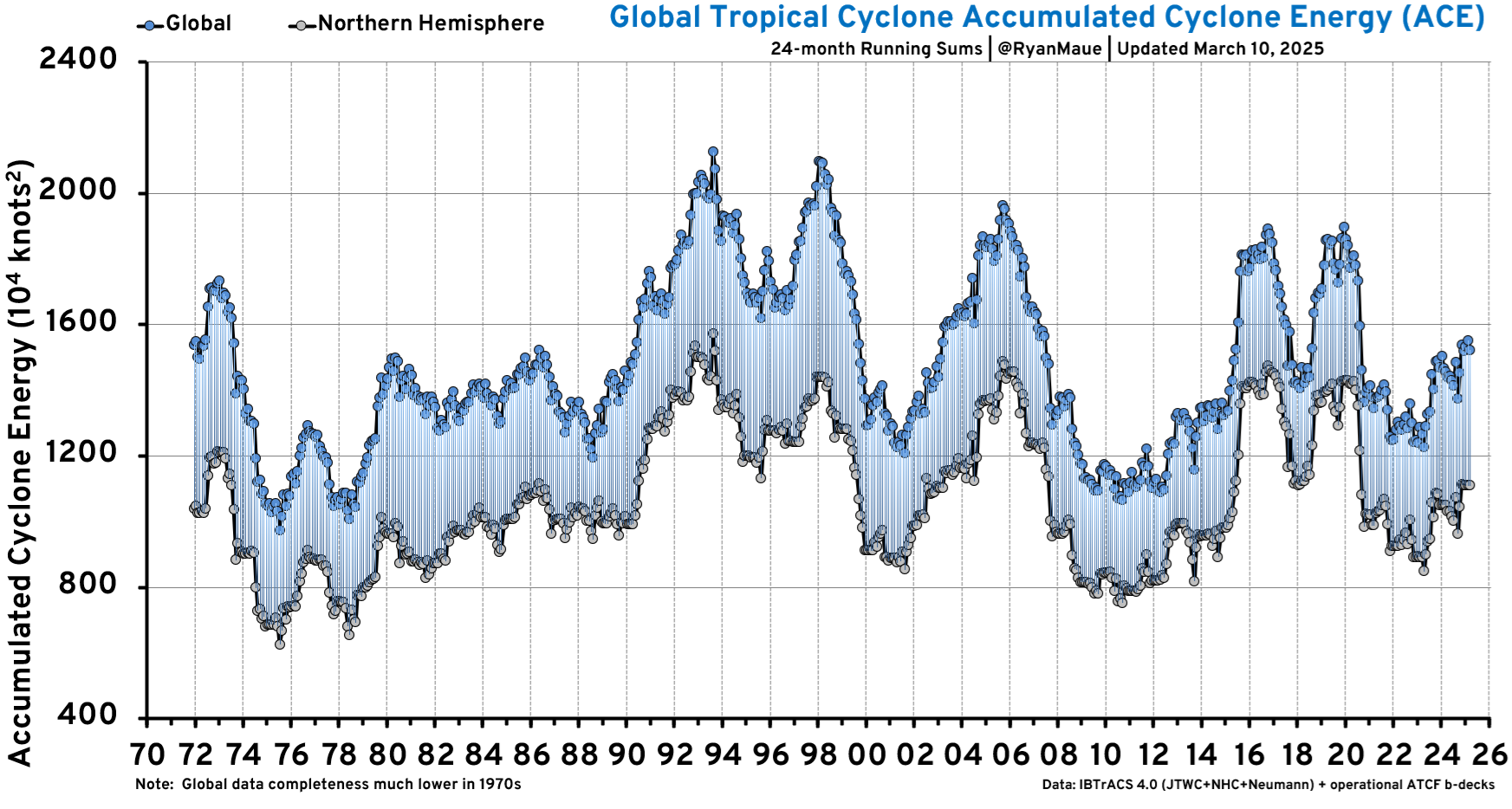
In reality, there is no indication that most extreme weather events are more frequent or in any way more severe than in the past. Take hurricanes, for example. It’s true that the damage they cause has increased over time, but Shaviv says that’s because more people live near the coast. “If you look at the statistics of hurricanes making landfall in the US, which is a relatively reliable record, then you see that there is no significant change,” he says. Shaviv adds that, in reality, there is not even any reason to expect a warming climate to bring more hurricanes. “Sure, you need hotter waters to generate hurricanes, but you also need the gradient, you need the temperature difference between the equator and the subtropics in order to drive the hurricanes. And warmer Earth actually has a smaller temperature difference. So it’s not even clear ab initio whether you’re going to have more hurricanes or less,” Shaviv explains.

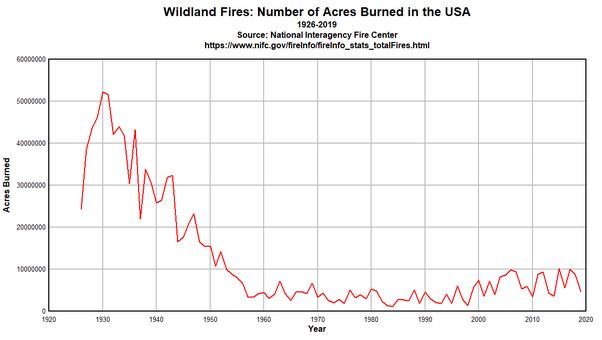
Large wildfires, for example, are also associated with climate warming, but Shaviv says there is no reason for this either. “In the US in the 1930s the annual amount of area which was burnt a year was way larger than what it is today,” he says, adding that the reality is that a large proportion of fires are caused by poor forest management, which fails to clear the forest floor of flammable material.

Towards nuclear energy

In the light of the above, climate change does not make it necessary to abandon fossil fuels. However, Shaviv says we should still move towards cleaner energy. Firstly, burning fossil fuels causes real environmental pollution – in particular coal, which is still on the rise worldwide. Secondly, fossil fuels will run out one day.

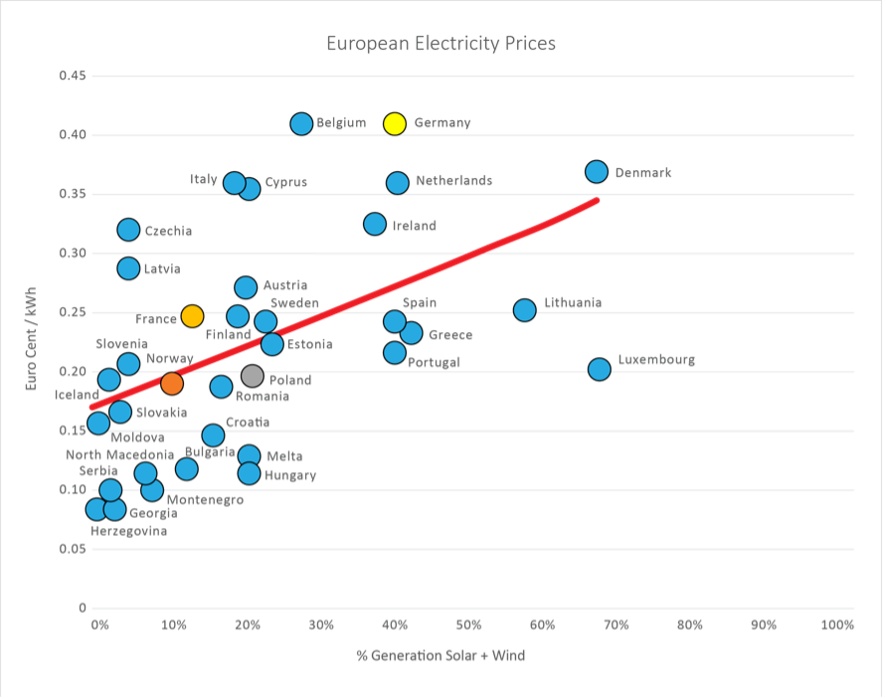
But mankind cannot replace these fuels with wind and solar power. “First of all, it’s very expensive. You can see that any country that has a lot of any of those, they pay much more for electricity,” Shaviv says. He suggests looking at electricity prices in countries such as Germany or Denmark, where wind and solar have been developed with billions of euros of government aid, and comparing them with, for example, France which uses nuclear power. What makes this form of energy so expensive is its intermittent nature – generation takes place when the sun shines and the wind blows. So to guarantee electricity supply, either huge storage capacity or backup systems, such as gas-fired power stations, are needed.

Shaviv believes that in the future, much more reliance should be placed on nuclear power, which does not have the pollution problems of fossil fuels and, unlike wind and solar, can provide a stable energy supply. However, the critics of this plan remind us of past nuclear accidents – Chernobyl in Ukraine, Three Mile Island in the USA and Fukushima in Japan. Each of these accidents had its own causes – in the case of Chernobyl and Three Mile Island, technical defects mixed with human error, and in the case of Fukushima, natural forces, in other words, the earthquake and tsunami. In the case of Fukushima in 2011, however, no one died as a direct result of the accident at the nuclear power plant (though thousands of people died as a result of the tsunami that devastated the coastline).

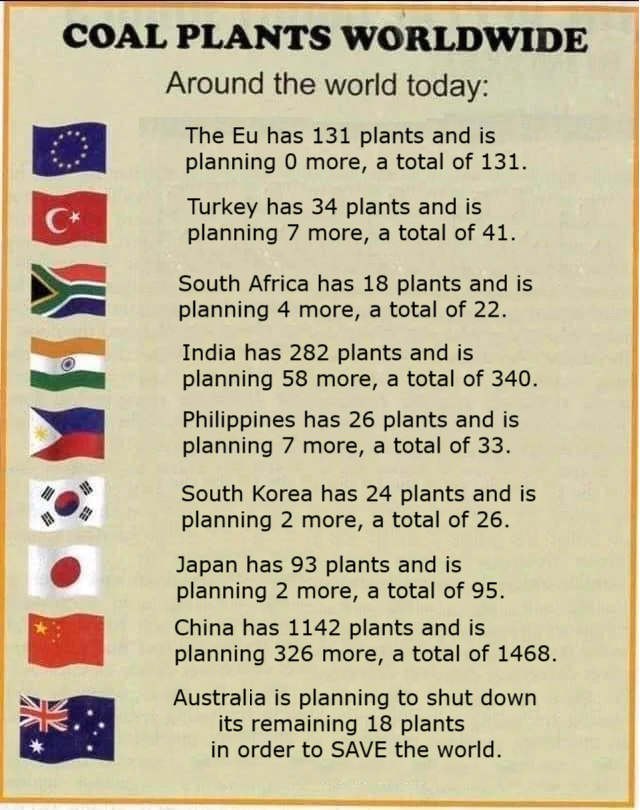
Shaviv says there is no point in comparing the safety of nuclear plants that have suffered accidents in the past with today’s technology. “I don’t think it’s going to be a problem in the sense that we can have an extremely safe design,” he says, adding that the wider deployment of nuclear power will happen whether the West joins in or not. “If you look at China, which is energy-hungry, they don’t care about public opinion as much as we do in the West. And they don’t have as much problem with regulation. So they’re just going to run forward and instead of building or opening a coal power plant every few weeks, in a few years, they’re going to be opening a nuclear power plant every few weeks,” Shaviv says. He adds that the West would also be wise to participate in this development, rather than moving in the opposite direction.

Kerry’s Climate Czar Office Abolished

John Kerry speaking in Dublin June 11, 2019: “World leaders are lying to the public about the climate crisis and dismissing scientific evidence.” The climate activist failed to recognize his own speculative and exaggerated statements.

Thomas Catenacci reports at Washington Free Beacon:  Trump Admin Axes Biden-Era Climate Office John Kerry Used To Assault Fossil Fuels.  Excerpts in italics with my bolds and added images.

State Department official says climate office was ‘captured by ideology’

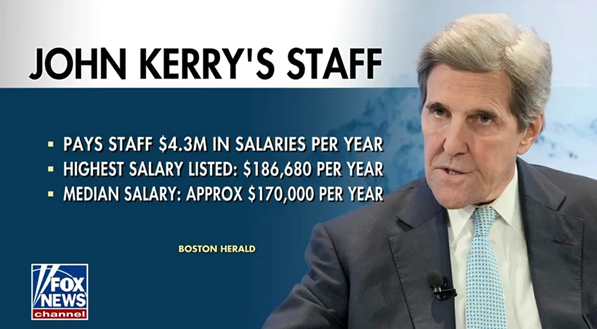
The State Department is formally removing the Office of the Special Presidential Envoy for Climate, the office former president Joe Biden created and appointed John Kerry to lead as part of his aggressive agenda to combat global warming, the Washington Free Beacon has learned.

Overall, the Office of the Special Presidential Envoy for Climate
was given an annual budget of nearly $17 million and
a staff of about 30 officials during the Biden administration.

In a statement to the Free Beacon, a senior State Department official confirmed the office has been shuttered, noting that its mission did not align with the Trump administration’s agenda. Webpages for both Office of the Special Presidential Envoy for Climate and the State Department’s initiatives relating to the environment were recently deleted.

“This climate office has long been captured by ideology instead of common sense policy. The new chapter of the State Department will not include this office,” the official told the Free Beacon. “This is part of a broader effort to empower regional bureaus and embassies to effectively carry out diplomacy.”

The action is part of a broader effort the sprawling agency announced Tuesday morning to streamline its operations, save taxpayers money, and ensure it is capable of delivering on President Donald Trump’s foreign policy agenda. “In its current form, the department is bloated, bureaucratic, and unable to perform its essential diplomatic mission,” Secretary of State Marco Rubio said, adding that the agency has become “beholden to radical political ideology.”

And it signals the Trump administration’s continued departure from the Biden-era approach to foreign policy that made climate change a centerpiece of its engagements with foreign nations. In one of his first actions leading the State Department, for example, Rubio initiated the immediate withdrawal of the United States from the 2015 Paris Climate Agreement, which he said undercut the nation’s intention to become the world’s most dominant energy producer.

“The Trump Administration is focused on reducing the everyday cost of living for the American worker, not apologizing to foreign governments for unleashing America’s energy dominance,” a senior White House official told the Free Beacon.

In naming Kerry the first-ever special presidential envoy for climate, Biden gave him a seat on both the White House cabinet and National Security Council, and empowered him to spearhead international negotiations, engage directly with foreign heads of state, and lead American delegations at numerous global climate conferences.

Kerry—who served in the role for three years between January 2021 and early 2024—used the position to wage an all-out assault on fossil fuels and aggressively push a transition to green alternatives like solar panels. Kerry also targeted the agricultural industry for its carbon footprint, leading to calls from dozens of lawmakers for Biden and then-agriculture secretary Tom Vilsack to disavow the comments.

The Free Beacon previously reported that Kerry’s office regularly consulted with far-left environmental organizations as he pursued his green agenda.

Kerry also faced criticism from Republican lawmakers and energy experts for lambasting fossil fuel reliance in the West, but seemingly looking the other way as China rapidly expanded its reliance on coal power to sustain its growing manufacturing sector. The House Oversight Committee opened a probe into Kerry’s talks with his Chinese counterparts in 2023 and later threatened to subpoena him after his office failed to hand over requested documents.

Despite its high-level role in American foreign policy, the Special Presidential Envoy for Climate Office remained tight-lipped about its staff and operations throughout the Biden administration.

The Free Press first reported Rubio’s actions to streamline the State Department’s structure. The outlet cited internal documents showing the agency’s plans to close 132 offices, including those launched to further human rights, counter extremism, and prevent war crimes.

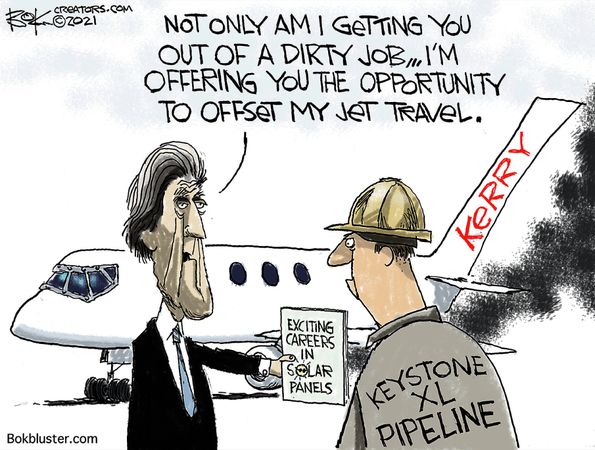
Kerry was also accused of hypocrisy—the climate conferences he attended were often hosted at upscale resorts and he racked up tens of thousands of flight miles on gas-guzzling jets. Kerry’s family also owned its own private jet for much of his tenure as special presidential envoy for climate.

Footnote:  Yes, Prime Minister foresaw this saga.

A humorous look at why the global warming campaign and the triumphal Paris COP make sense. Yes Minister explains it all in an episode from 2013. (The final episode of the TV series was The Climate Czar) Transcription from captions is here: Yes PM Pokes Fun at Climatism


March 2025 Oceans Cooling Persists

The best context for understanding decadal temperature changes comes from the world’s sea surface temperatures (SST), for several reasons:

  • The ocean covers 71% of the globe and drives average temperatures;
  • SSTs have a constant water content, (unlike air temperatures), so give a better reading of heat content variations;
  • A major El Nino was the dominant climate feature in recent years.

HadSST is generally regarded as the best of the global SST data sets, and so the temperature story here comes from that source. Previously I used HadSST3 for these reports, but Hadley Centre has made HadSST4 the priority, and v.3 will no longer be updated.  HadSST4 is the same as v.3, except that the older data from ship water intake was re-estimated to be generally lower temperatures than shown in v.3.  The effect is that v.4 has lower average anomalies for the baseline period 1961-1990, thereby showing higher current anomalies than v.3. This analysis concerns more recent time periods and depends on very similar differentials as those from v.3 despite higher absolute anomaly values in v.4.  More on what distinguishes HadSST3 and 4 from other SST products at the end. The user guide for the current version HadSST4.1.1.0 is here.   The charts and analysis below is produced from the current data.

The Current Context

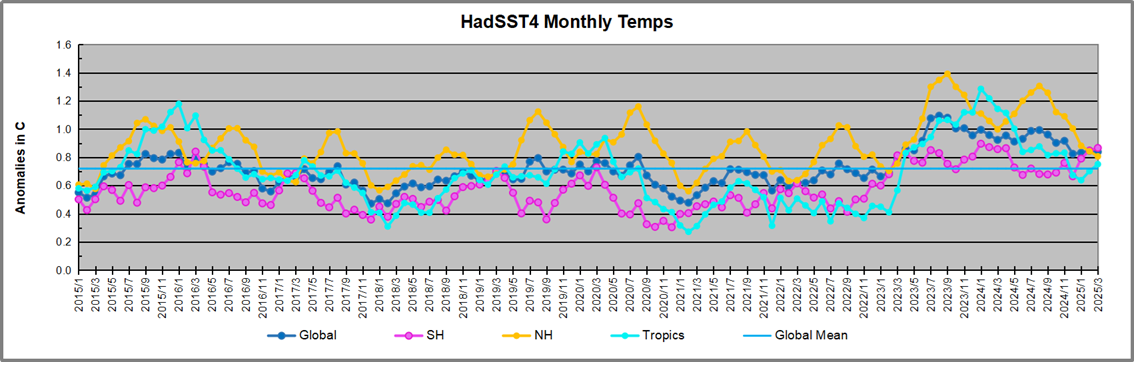
The chart below shows SST monthly anomalies as reported in HadSST4 starting in 2015 through February 2025. A global cooling pattern is seen clearly in the Tropics since its peak in 2016, joined by NH and SH cycling downward since 2016, followed by rising temperatures in 2023 and 2024.

Note that in 2015-2016 the Tropics and SH peaked in between two summer NH spikes.  That pattern repeated in 2019-2020 with a lesser Tropics peak and SH bump, but with higher NH spikes. By end of 2020, cooler SSTs in all regions took the Global anomaly well below the mean for this period.  A small warming was driven by NH summer peaks in 2021-22, but offset by cooling in SH and the tropics, By January 2023 the global anomaly was again below the mean.

Then in 2023-24 came an event resembling 2015-16 with a Tropical spike and two NH spikes alongside, all higher than 2015-16. There was also a coinciding rise in SH, and the Global anomaly was pulled up to 1.1°C last year, ~0.3° higher than the 2015 peak.  Then NH started down autumn 2023, followed by Tropics and SH descending 2024 to the present. After 12 months of cooling in SH and the Tropics, the Global anomaly came back down, led by NH cooling the last 8 months from its 1.3C peak in August, down to 0.8C in March. With some recent warming in the Tropics and SH, all regions are now close together nearly at the global anomaly, about 0.1C higher than the average for this period.

Comment:

The climatists have seized on this unusual warming as proof their Zero Carbon agenda is needed, without addressing how impossible it would be for CO2 warming the air to raise ocean temperatures.  It is the ocean that warms the air, not the other way around.  Recently Steven Koonin had this to say about the phonomenon confirmed in the graph above:

El Nino is a phenomenon in the climate system that happens once every four or five years.  Heat builds up in the equatorial Pacific to the west of Indonesia and so on.  Then when enough of it builds up it surges across the Pacific and changes the currents and the winds.  As it surges toward South America it was discovered and named in the 19th century  It iswell understood at this point that the phenomenon has nothing to do with CO2.

Now people talk about changes in that phenomena as a result of CO2 but it’s there in the climate system already and when it happens it influences weather all over the world.   We feel it when it gets rainier in Southern California for example.  So for the last 3 years we have been in the opposite of an El Nino, a La Nina, part of the reason people think the West Coast has been in drought.

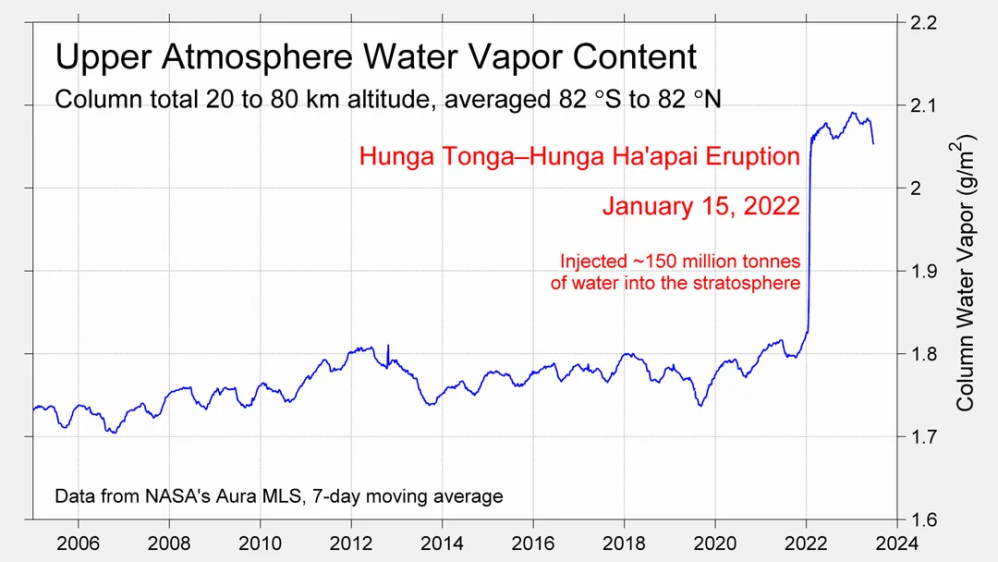
It has now shifted in the last months to an El Nino condition that warms the globe and is thought to contribute to this Spike we have seen. But there are other contributions as well.  One of the most surprising ones is that back in January of 2022 an enormous underwater volcano went off in Tonga and it put up a lot of water vapor into the upper atmosphere. It increased the upper atmosphere of water vapor by about 10 percent, and that’s a warming effect, and it may be that is contributing to why the spike is so high.

A longer view of SSTs

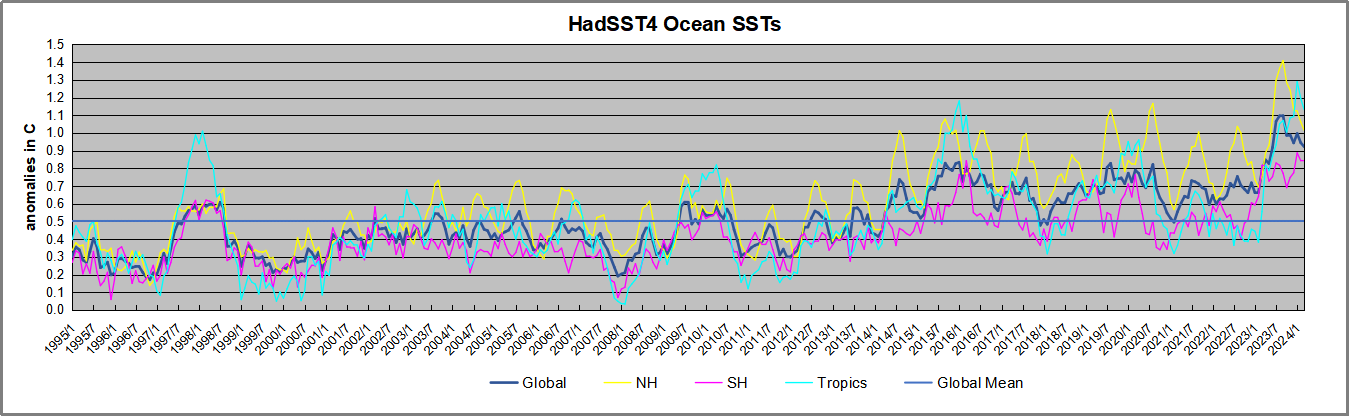
The graph below  is noisy, but the density is needed to see the seasonal patterns in the oceanic fluctuations.  Previous posts focused on the rise and fall of the last El Nino starting in 2015.  This post adds a longer view, encompassing the significant 1998 El Nino and since.  The color schemes are retained for Global, Tropics, NH and SH anomalies.  Despite the longer time frame, I have kept the monthly data (rather than yearly averages) because of interesting shifts between January and July.

To enlarge image, open in new tab.

The graph above is noisy, but the density is needed to see the seasonal patterns in the oceanic fluctuations.  Previous posts focused on the rise and fall of the last El Nino starting in 2015.  This post adds a longer view, encompassing the significant 1998 El Nino and since.  The color schemes are retained for Global, Tropics, NH and SH anomalies.  Despite the longer time frame, I have kept the monthly data (rather than yearly averages) because of interesting shifts between January and July. 1995 is a reasonable (ENSO neutral) starting point prior to the first El Nino.

The sharp Tropical rise peaking in 1998 is dominant in the record, starting Jan. ’97 to pull up SSTs uniformly before returning to the same level Jan. ’99. There were strong cool periods before and after the 1998 El Nino event. Then SSTs in all regions returned to the mean in 2001-2.

SSTS fluctuate around the mean until 2007, when another, smaller ENSO event occurs. There is cooling 2007-8,  a lower peak warming in 2009-10, following by cooling in 2011-12.  Again SSTs are average 2013-14.

Now a different pattern appears.  The Tropics cooled sharply to Jan 11, then rise steadily for 4 years to Jan 15, at which point the most recent major El Nino takes off.  But this time in contrast to ’97-’99, the Northern Hemisphere produces peaks every summer pulling up the Global average.  In fact, these NH peaks appear every July starting in 2003, growing stronger to produce 3 massive highs in 2014, 15 and 16.  NH July 2017 was only slightly lower, and a fifth NH peak still lower in Sept. 2018.

The highest summer NH peaks came in 2019 and 2020, only this time the Tropics and SH were offsetting rather adding to the warming. (Note: these are high anomalies on top of the highest absolute temps in the NH.)  Since 2014 SH has played a moderating role, offsetting the NH warming pulses. After September 2020 temps dropped off down until February 2021.  In 2021-22 there were again summer NH spikes, but in 2022 moderated first by cooling Tropics and SH SSTs, then in October to January 2023 by deeper cooling in NH and Tropics.

Then in 2023 the Tropics flipped from below to well above average, while NH produced a summer peak extending into September higher than any previous year.  Despite El Nino driving the Tropics January 2024 anomaly higher than 1998 and 2016 peaks, following months cooled in all regions, and the Tropics continued cooling in April, May and June along with SH dropping.  After July and August NH warming again pulled the global anomaly higher, September through January 2025 resumed cooling in all regions, with a slight upward bump in February-March 2025.

What to make of all this? The patterns suggest that in addition to El Ninos in the Pacific driving the Tropic SSTs, something else is going on in the NH.  The obvious culprit is the North Atlantic, since I have seen this sort of pulsing before.  After reading some papers by David Dilley, I confirmed his observation of Atlantic pulses into the Arctic every 8 to 10 years.

Contemporary AMO Observations

Through January 2023 I depended on the Kaplan AMO Index (not smoothed, not detrended) for N. Atlantic observations. But it is no longer being updated, and NOAA says they don’t know its future.  So I find that ERSSTv5 AMO dataset has current data.  It differs from Kaplan, which reported average absolute temps measured in N. Atlantic.  “ERSST5 AMO  follows Trenberth and Shea (2006) proposal to use the NA region EQ-60°N, 0°-80°W and subtract the global rise of SST 60°S-60°N to obtain a measure of the internal variability, arguing that the effect of external forcing on the North Atlantic should be similar to the effect on the other oceans.”  So the values represent SST anomaly differences between the N. Atlantic and the Global ocean.

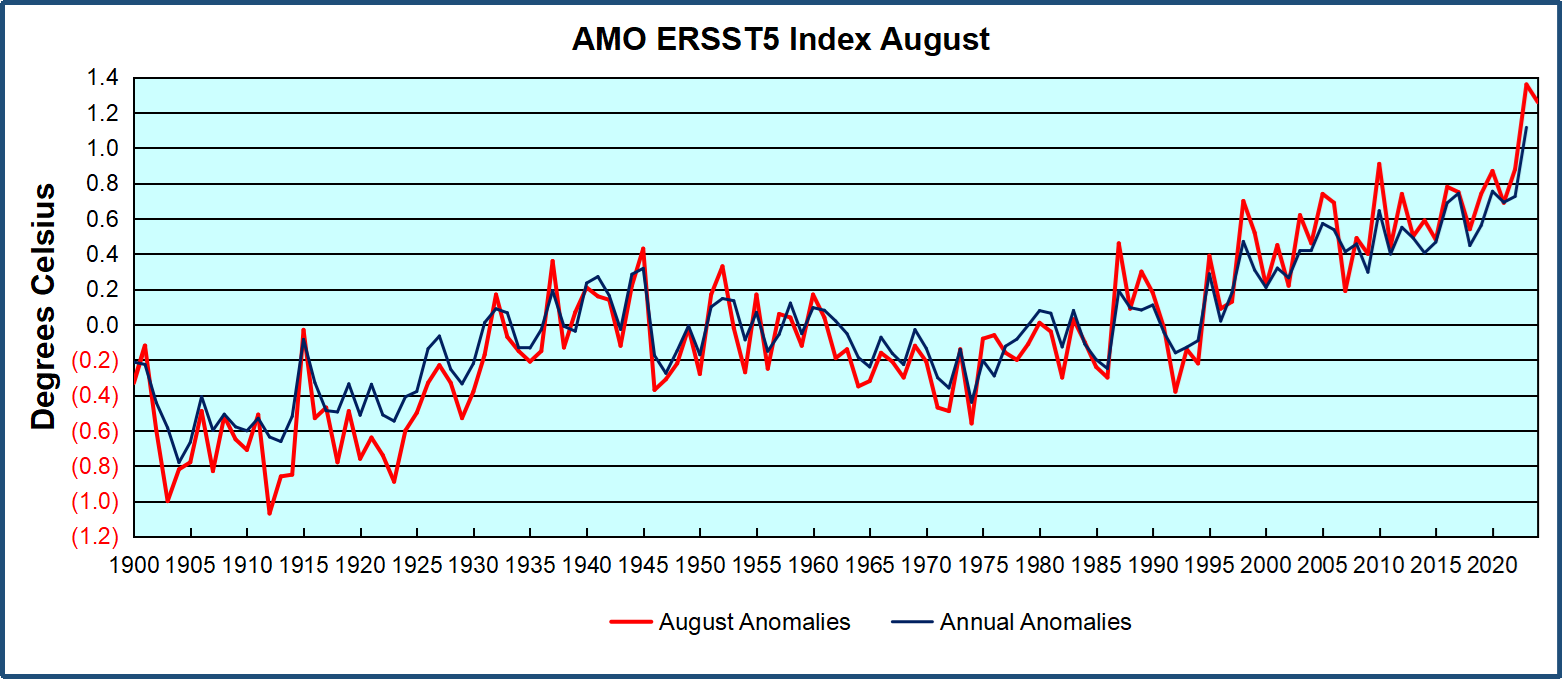
The chart above confirms what Kaplan also showed.  As August is the hottest month for the N. Atlantic, its variability, high and low, drives the annual results for this basin.  Note also the peaks in 2010, lows after 2014, and a rise in 2021. Then in 2023 the peak was holding at 1.4C before declining.  An annual chart below is informative:

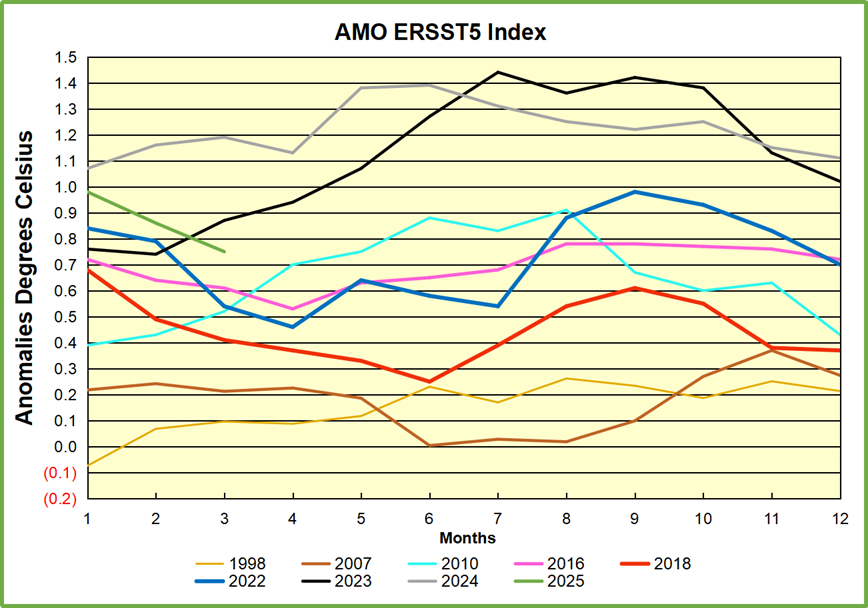
Note the difference between blue/green years, beige/brown, and purple/red years.  2010, 2021, 2022 all peaked strongly in August or September.  1998 and 2007 were mildly warm.  2016 and 2018 were matching or cooler than the global average.  2023 started out slightly warm, then rose steadily to an  extraordinary peak in July.  August to October were only slightly lower, but by December cooled by ~0.4C.

Then in 2024 the AMO anomaly started higher than any previous year, then leveled off for two months declining slightly into April.  Remarkably, May showed an upward leap putting this on a higher track than 2023, and rising slightly higher in June.  In July, August and September 2024 the anomaly declined, and despite a small rise in October, ended close to where it began.  Now 2025 started much lower than the previous year and is headed sharply downward.

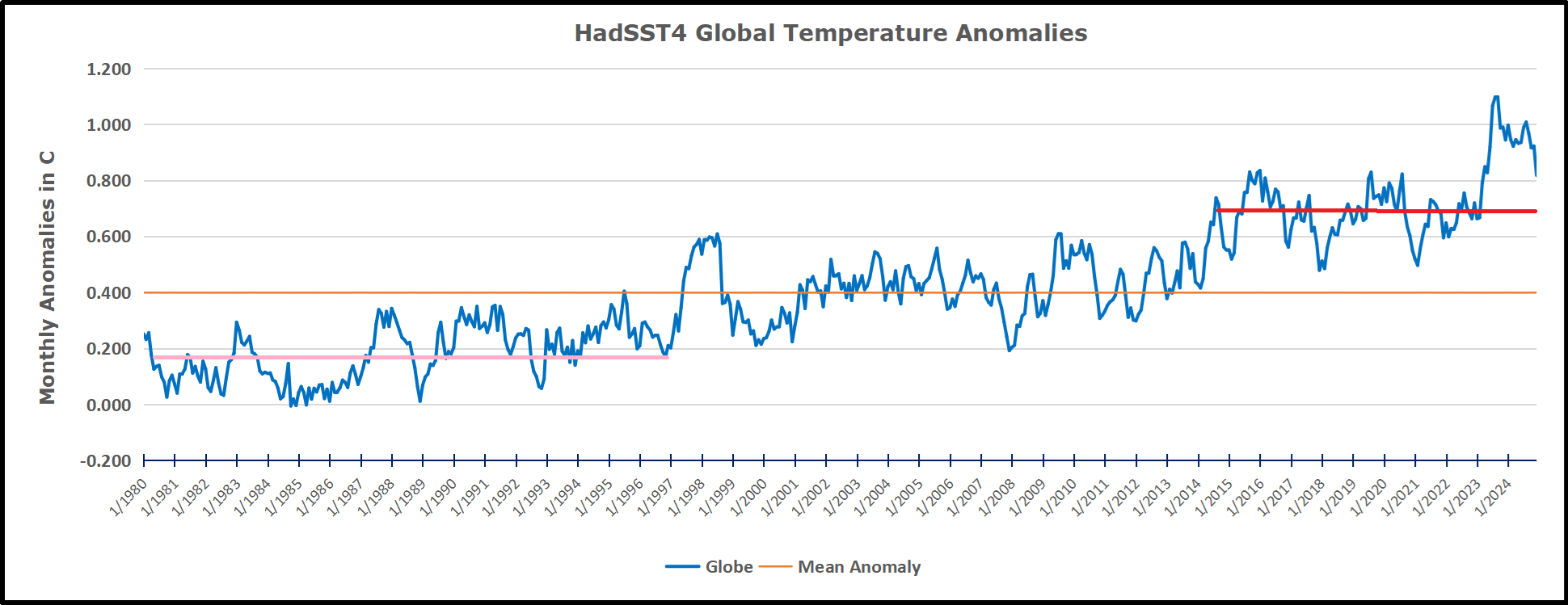
The pattern suggests the ocean may be demonstrating a stairstep pattern like that we have also seen in HadCRUT4.

The purple line is the average anomaly 1980-1996 inclusive, value 0.17.  The orange line the average 1980-2024, value 0.38, also for the period 1997-2012. The red line is 2013-2024, value 0.67. As noted above, these rising stages are driven by the combined warming in the Tropics and NH, including both Pacific and Atlantic basins.

Curiosity:  Solar Coincidence?

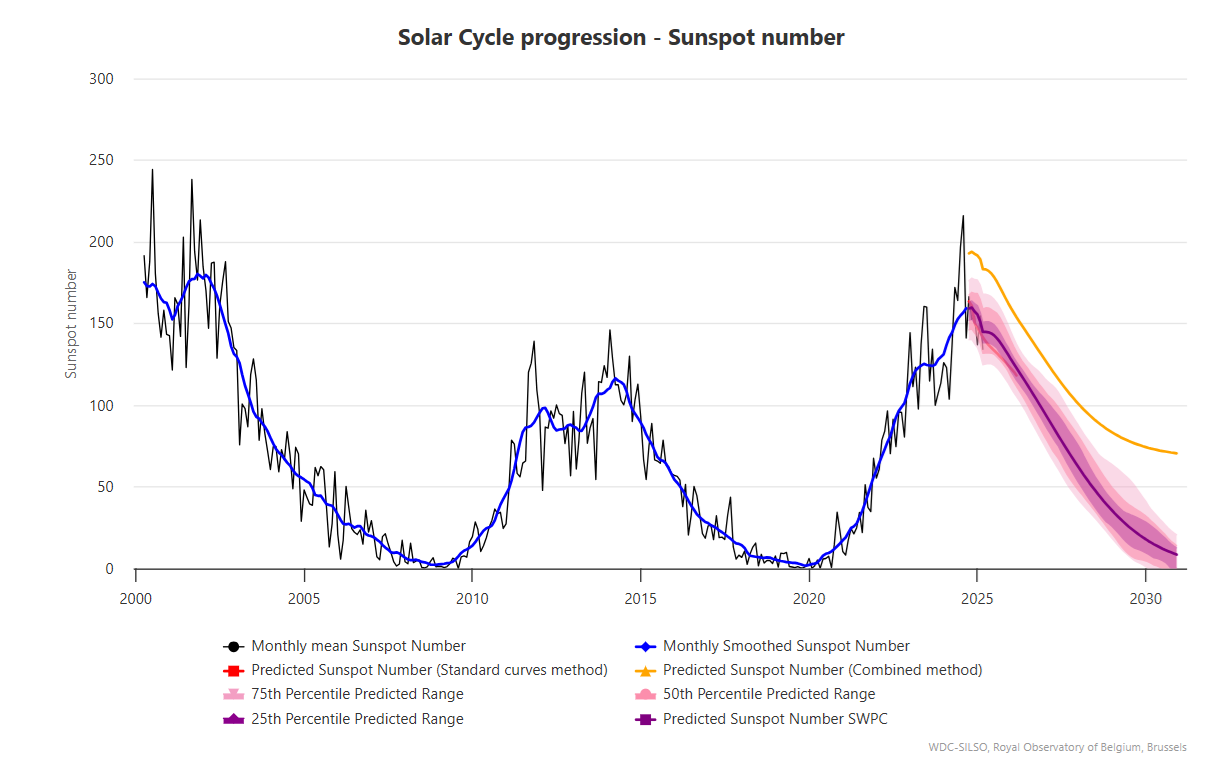
The news about our current solar cycle 25 is that the solar activity is hitting peak numbers now and higher  than expected 1-2 years in the future.  As livescience put it:  Solar maximum could hit us harder and sooner than we thought. How dangerous will the sun’s chaotic peak be?  Some charts from spaceweatherlive look familar to these sea surface temperature charts.

Summary

The oceans are driving the warming this century.  SSTs took a step up with the 1998 El Nino and have stayed there with help from the North Atlantic, and more recently the Pacific northern “Blob.”  The ocean surfaces are releasing a lot of energy, warming the air, but eventually will have a cooling effect.  The decline after 1937 was rapid by comparison, so one wonders: How long can the oceans keep this up? And is the sun adding forcing to this process?

Footnote: Why Rely on HadSST4

HadSST is distinguished from other SST products because HadCRU (Hadley Climatic Research Unit) does not engage in SST interpolation, i.e. infilling estimated anomalies into grid cells lacking sufficient sampling in a given month. From reading the documentation and from queries to Met Office, this is their procedure.

HadSST4 imports data from gridcells containing ocean, excluding land cells. From past records, they have calculated daily and monthly average readings for each grid cell for the period 1961 to 1990. Those temperatures form the baseline from which anomalies are calculated.

In a given month, each gridcell with sufficient sampling is averaged for the month and then the baseline value for that cell and that month is subtracted, resulting in the monthly anomaly for that cell. All cells with monthly anomalies are averaged to produce global, hemispheric and tropical anomalies for the month, based on the cells in those locations. For example, Tropics averages include ocean grid cells lying between latitudes 20N and 20S.

Gridcells lacking sufficient sampling that month are left out of the averaging, and the uncertainty from such missing data is estimated. IMO that is more reasonable than inventing data to infill. And it seems that the Global Drifter Array displayed in the top image is providing more uniform coverage of the oceans than in the past.

uss-pearl-harbor-deploys-global-drifter-buoys-in-pacific-ocean

USS Pearl Harbor deploys Global Drifter Buoys in Pacific Ocean


Abolishing the Climate Politico-Legal-Media Complex

Linnea Lueken describes the nullification in her Town Hall article The Savaging of the Climate Politico-Legal-Media Complex.  Excerpts in italics with my bolds and added images.

The Trump administration’s crackdown on waste and harmful
policies has given so-called “green” politics a rude awakening.
 

The administration is savaging the climate complex of lobbyists and NGOs, politically connected profiteering companies, and virtue signaling politicians bent on ending fossil fuel use. The greens are on the defensive and have yet been unable to form a cohesive response. For the good of humanity and the planet, let’s hope the disarray continues.

I almost hesitate to talk about this, lest the climate grifters in the media suddenly realize they are spending too much time focusing on tariffs and immigration and are forgetting one of the pillars of the globalist secular religion: climate alarmism. They still seem to be reeling, and it is amazing to see.

Note: The $$$ in the diagram are in 2010 $, not including consultancies and a plethora of NGOs. Likely it is today a multi-trillion dollar industry.

The Trump administration has been systematically ripping apart the politico-legal elements of what Michael Crichton once dubbed the climate “politico-legal-media” complex. This climate-focused approach to environmental extremism was meticulously constructed over the course of decades by previous Republican and Democrat administrations alike. No one else has taken the green scam to task the way Trump is.

Trump immediately rescinded Biden’s EV targets, as well as mandates for solar and wind and heat pumps. He removed the USDA’s website pages dedicated to climate change. He took an axe to Department of Energy (DOE) funding of climate-focused university research, which is still being battled in the courts (maybe this will end the apparent trend of scientists tying everything to climate just to get those grants).

Trump also got rid of the mandated use of paper straws in federal buildings, which is pretty funny.

While the climate-obsessed media were busy bleating about those insults to climate orthodoxy, DOGE tackled the climate slush fund known as USAID. USAID, it turns out, was sending billions of dollars for climate pet projects. Who knows how much of that went to overhead and graft with nothing to show in terms of mitigating climate change.

Interestingly, the extremist group Just Stop Oil closed shop shortly after cuts to USAID began. They claim it is because they have been victorious in keeping UK oil in the ground, but it is likely no coincidence that climate activists and protestors are increasingly finding themselves behind bars as the public tires of disruption and destruction and funding is drying up from governments, sometimes funneled through NGOs.

EPA Administrator Lee Zeldin also announced that the administration is considering eliminating the greenhouse gas reporting requirements for power plants, and then hit the greens with another major blow. He reiterated to Breitbart News that he intends to look at the carbon dioxide Endangerment Finding – which has been used to craft regulations based on the idea that carbon dioxide and other greenhouse gasses represent a significant threat to human health… despite the fact that they are necessary for life on Earth. This comes after Trump signed an executive order asking the EPA to review the finding. Eliminating it would undercut the basis for all climate related regulations, from restrictions on power plants, to vehicle restrictions and mandates, to appliance restrictions, and beyond.

The end of the Endangerment Finding would be a big blow against
climate alarmism and an even bigger win for freedom.

I could almost feel bad for the greens, except that they have done nothing but suck up our hard-earned cash and increase human misery in the United States and abroad by pushing suicidal and stagnating policies. They fund programs aimed at stopping poorer countries from developing their own resources. They attack farming and endorse restrictions on the kind of appliances and cars average people can buy. They push policies limiting what one can eat and how food is grown, and restrictions on electric power production, all in the name of changing future weather.

This is not to say the Trump administration is anti-environment; to the contrary, under his first term, the EPA focused heavily on streamlining the clean-up of superfund sites. Zeldin is already putting cleanups of superfunds on an accelerated timeline. Trump and his team have reiterated that they are interested in maintaining clean air and water, and preventing wildfires that Democrat policies have worsened.
Time will tell if these attacks on the climate cult will prove fatal,
but thus far it has been incredible to witness.

Oh yeah; Happy Earth Day.


Time to Axe the Climate-Industrial Complex

Kevin Mooney makes the urgency case in his Real Clear Energy article Celebrating American Independence With an All-Out Assault on Anti-Constitutional Climate Measures.  Excerpts in italics with my bolds and added images.

Now is the time to double down against the “Climate-Industrial Complex” with accelerated regulatory reforms that will hopefully endure beyond Donald Trump’s second term. Since day one of his new administration, the president has moved quickly to keep his promise to unleash American energy.

This means unraveling climate policies based on specious, unscientific findings that reached an apex with whatever leftist committee was in charge of the Biden White House. The American Energy Alliance, a Washington-based free market advocacy group, has put together a list of 50 Actions the Trump administration and congressional Republicans have taken to maximize America’s energy potential.

Some of the more significant items include EPA Administrator Lee Zeldin’s decision to revisit the phony 2009 Endangerment Finding that identified CO2 as a pollutant. The finding came about in the aftermath of the U.S. Supreme Court 2007 ruling in Massachusetts v EPA where the high court determined that the agency had the authority to regulate greenhouse gases under the Clean Air Act (CAA). The ruling opened the way for the Obama and Biden administrations to lock in a long list of regulations restricting American energy.

The term “Climate-Industrial Complex” is an apt description some commentators have affixed to the vast network of activist groups and unelected administrative agents who have erected an extra-constitutional fourth branch of government all in the name of climate. Only by attacking the very premise of the climate lobby’s regulatory schemes can Team Trump achieve lasting change. Overturning the Endangerment Finding is a big part of that process since it would mean yanking out the edifice of regulations that raise energy prices for consumers and limit their choices. The CO2 Coalition, which includes scientists and researchers from across the globe, has a long list of “Climate Facts” highlighting the benefits of CO2, and it’s role in sustaining life on Earth, while debunking exaggerated claims about global warming. The attack on CO2 is an attack on humanity itself.

Another component of the Trump agenda included in the AEA list is the president’s abrupt move to once again withdraw from the U.N. Paris Climate Agreement and to revoke any financial commitments to the U.S. under the United Nations Framework Convention on Climate Change (UNFCC).

Under the agreement, participating countries pledge to reduce their CO2 emissions through “nationally determined contributions” or NDCs for the ostensible purpose of reducing “global warming.” Trump has long maintained that the international climate agreement “handicaps the U.S. economy” without producing any benefits for the climate or the environment. Right from the beginning, the agreement was crafted with an eye toward constraining America’s economic and military power while giving adversaries like China a free pass. Trump instinctively knew this was case. In his first term, Trump made the critical point that he was “elected to represent the citizens of Pittsburgh, not Paris.” There’s an undeniable link between Trump’s restoration of an “America First” energy policy and the concept of “No Taxation Without Representation.” Why should U.N. bureaucrats be permitted to raise energy costs on the American people without a straight up and down vote in Congress?

Other notable actions on the AEA list include efforts to eliminate taxpayer funded subsidies for unworkable green energy, and the resumption of export permit applications for new liquefied natural gas (LNG) projects.

Tom Pyle, the AEA president, sums the early days of the Trump’s second term of very nicely in a press statement:

“President Trump has wasted no time fulfilling his promise to unleash our country’s vast resources and undo the reckless policies of his predecessor, beginning with a flurry of executive orders and spending reductions. More recently, his agencies – especially the EPA – have formalized the process of rewriting or eliminating a host of harmful regulations. Congress has also acted with haste by nullifying a host of rules using the Congressional Review Act and has begun the process of eliminating the wasteful Inflation Reduction Act subsidies through the budget and reconciliation process.”

That part about the Congressional Review Act (CRA) deserves some extra attention since the climate lobby is just as potent here domestically in California as it is within the United Nations. In fact, the CRA may be the most viable tool available to prevent Gavin Newsom, the state’s Democratic governor, and likely presidential candidate, from superimposing his climate policy goals on the rest of the country. The CRA is a law passed in the 1990s that enables Congress to overturn final rules issued by federal agencies. Members have 60 days to introduce a joint resolution disapproving of the rule after an agency’s rule is reported to Congress. On the House side, Rep. Kevin Kiley, R-CA, has taken the critical step of introducing a CRA resolution of disapproval to repeal the Biden EPA’s 11th hour move to grant California a waiver for its Advanced Clean Cars II program, which would prohibit the sale of new gas-powered cars by 2035.

Under a provision of the Clean Air Act, the EPA is authorized to establish emission standards for new motor vehicles. The agency also has latitude to grant Californiaspecial waiver to impose even more onerous regulations. That’s where the assault on consumer choice comes into play.

Other states are permitted to adopt the California standards and put gas powered cars on the path to extinction. This process is already well underway with 11 states and Washington D.C. adopting the California standards. The CRA could and should be used as a tool to reverse what is essentially a nationwide electrical vehicle mandate compliments of California. But there’s a problem.

Elizabeth MacDonough, the Senate parliamentarian, has joined with the Government Accountability Office (GAO), to make the case that the CRA should not be used to overturn the waiver because it is their view that it is an adjudicatory order, not a rule.

Pyle cuts through the legal gibberish.

“Despite misleading reports, the Congressional Review Act is crystal clear: once an agency action is submitted to Congress, it is Congress—and Congress alone—that holds the unassailable power to approve or disapprove that action,” Pyle said in a release:

“The GAO’s role is purely advisory, with no legal authority to block Congress from exercising its constitutional duty. The California waiver, which seeks to impose a nationwide electric vehicle mandate, is a prime example of why the CRA exists: to ensure that Congress retains control over regulatory actions that significantly affect the American public. It is time for Congress to step in and put a stop to California’s electric vehicle mandate. Doing so will protect consumer choice and prevent unelected agencies from dictating the future of American transportation.”
With the 250th anniversary of American independence fast approaching, there is no better way to mark that occasion than by caging the climate lobby’s administrative beast, uprooting California mandates, and restoring Congress to its proper station as a lawmaking body.

Arctic Ice Normal Mid-April 2025

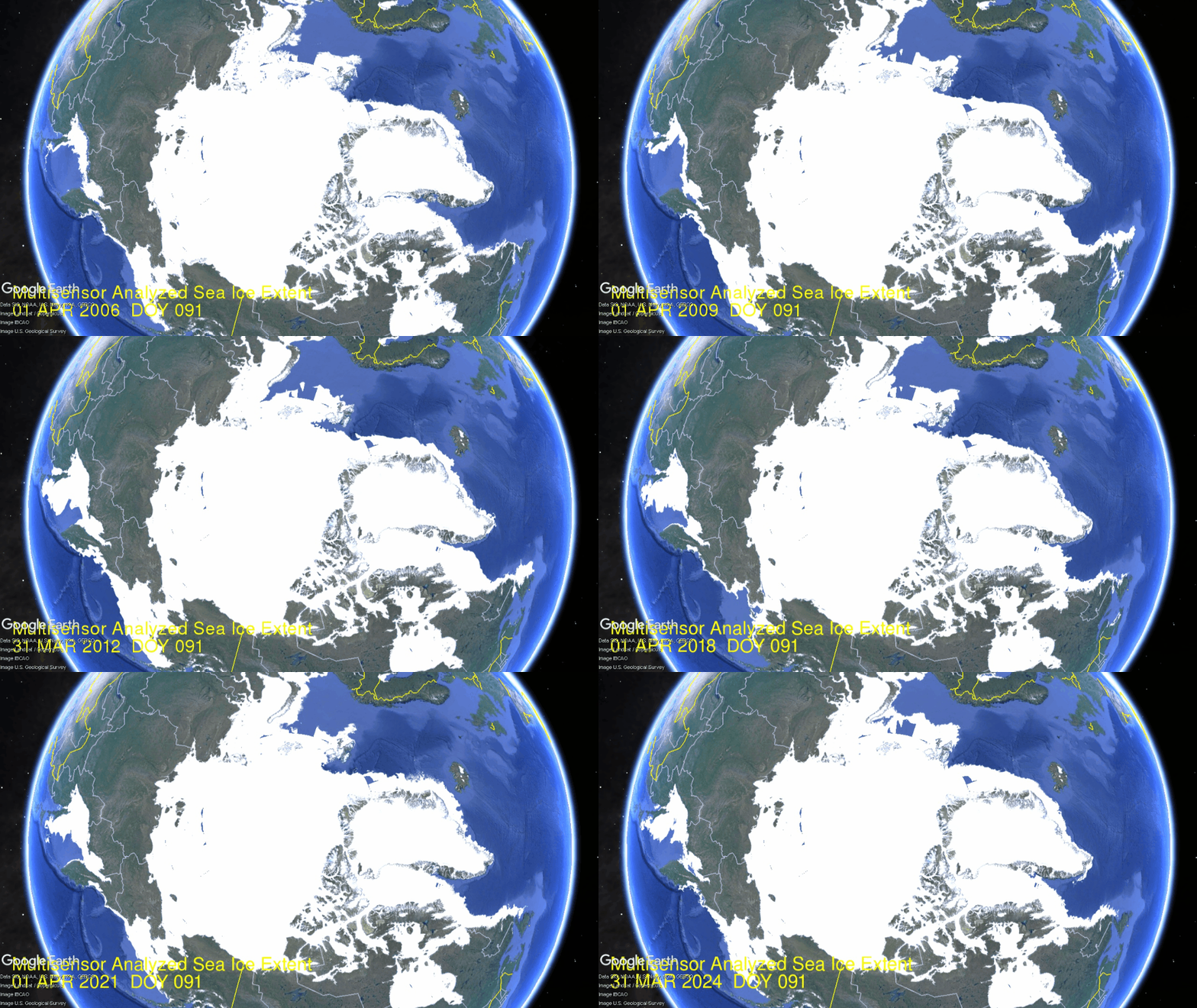
The animation shows end of March Arctic ice extents on day 91 over the last 19 years (length of MASIE dataset). Of course central Arctic basins are frozen solid, and the fluctuations are visible on the marginal basins both the Atlantic side (right) and the Pacific (left). Note the higher extents in 2012, followed by lesser ice, then overcome by 2024.

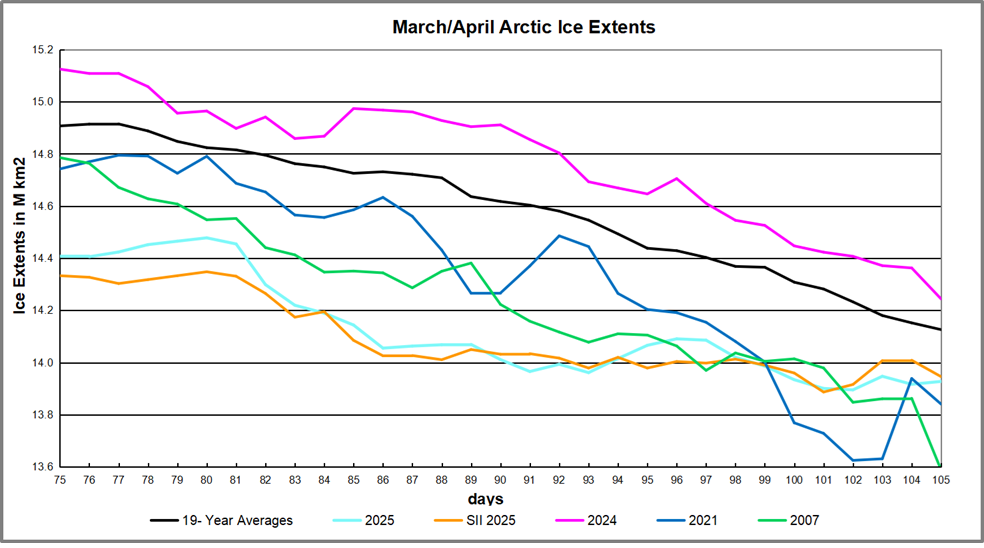
After a sub-par March maximum, now in mid-April, 2025 Arctic ice has mostly closed the gap with the 19-year average.

Day 75 is mid-March, typically near the highest daily extents of the year.  At that time 2025 was ~500k km2 below average, or Half a Wadham in deficit. By end of March this year the gap below average reached 600k km2.  However, note that over these 30 days MASIE shows an average ice extent loss of 781k km2, while 2025 lost almost no ice in April, hanging around the 14M km2 mark.  Both MASIE and SII showed the same resilience pattern in April 2025, well above 2021 and especially 2007.  The regional distribution of ice extents is particularly revealing.

Region 2025105 Day 105 Ave. 2025-Ave. 2007105 2025-2007
 (0) Northern_Hemisphere 13927695 14126275 -198580 13588722 338973
 (1) Beaufort_Sea 1071001 1069881 1119 1068692 2309
 (2) Chukchi_Sea 965989 964751 1238 961638 4352
 (3) East_Siberian_Sea 1087137 1085653 1484 1078666 8471
 (4) Laptev_Sea 897845 893756 4089 843501 54344
 (5) Kara_Sea 921800 923592 -1792 890594 31206
 (6) Barents_Sea 517245 621900 -104655 439904 77341
 (7) Greenland_Sea 710333 661040 49293 673585 36749
 (8) Baffin_Bay_Gulf_of_St._Lawrence 1306106 1274576 31530 1215526 90580
 (9) Canadian_Archipelago 854878 853052 1826 848812 6066
 (10) Hudson_Bay 1248738 1246317 2422 1208588 40150
 (11) Central_Arctic 3246240 3234033 12206 3235648.34 10591
 (12) Bering_Sea 657229 646796 10433 600281.22 56948
 (13) Baltic_Sea 13278 43789 -30511 23534.37 -10256
 (14) Sea_of_Okhotsk 427895 601889 -173994 491121 -63226

The table shows only two significant deficits to average; Okhotsk alone is -174k km2, nearly matching the overall total of -199k km2, which is 1.4% below average.  The other deficit in Barents is mostly offset by surpluses in nearly every other Arctic basin with the exception of Baltic Sea. Clearly the core Arctic ocean is solidly frozen, with a few fringe seas going to open water slightly ahead of schedule.

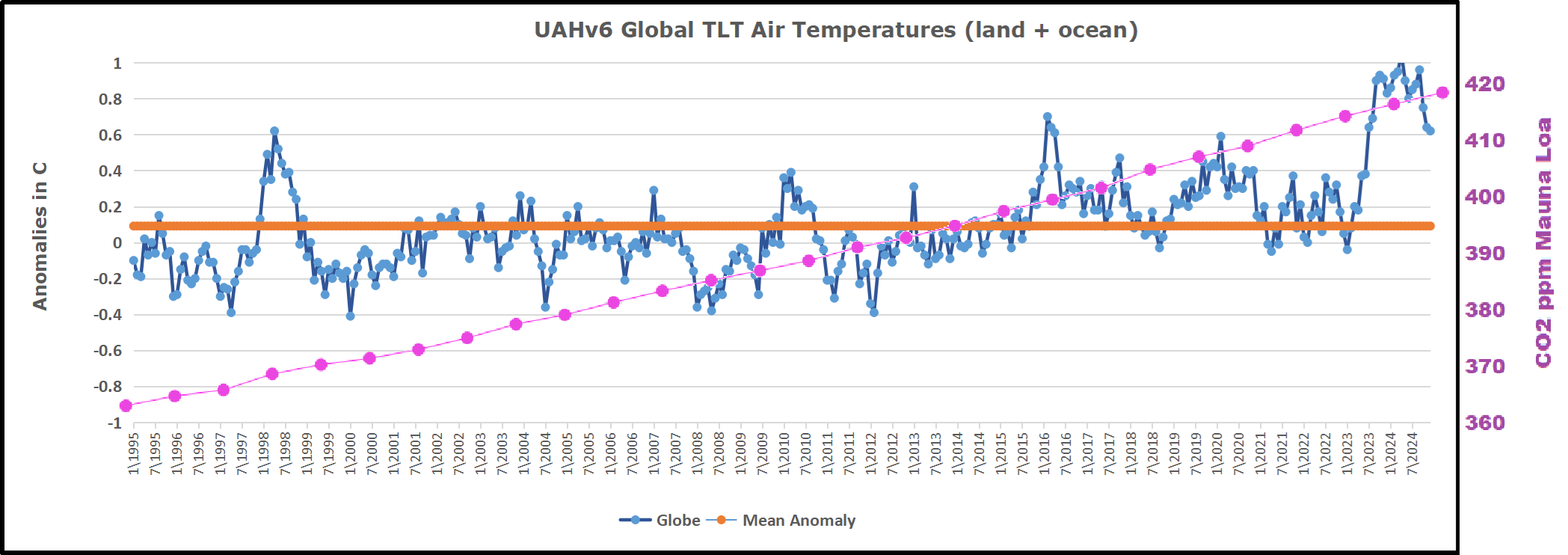
Why is this important?  All the claims of global climate emergency depend on dangerously higher temperatures, lower sea ice, and rising sea levels.  The lack of additional warming prior to 2023 El Nino is documented in a post Ocean Warms, Land Cools UAH February 2025.

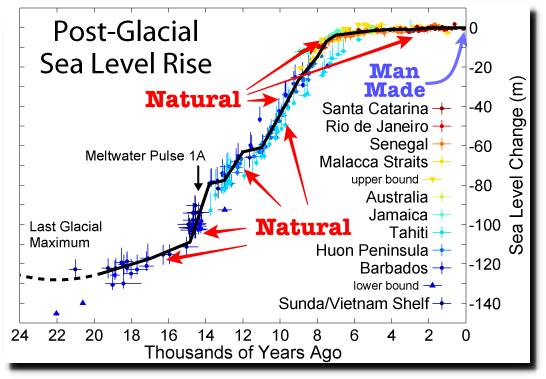
The lack of acceleration in sea levels along coastlines has been discussed also.  See Observed vs. Imagined Sea Levels 2023 Update

Also, a longer term perspective is informative:

post-glacial_sea_level

Why Must Repeal Biden’s IRA

Frank Lasee explains why Republicans Must End Democrats’ IRA Caused Inflation.  Excerpts in italics with my bolds and added images.

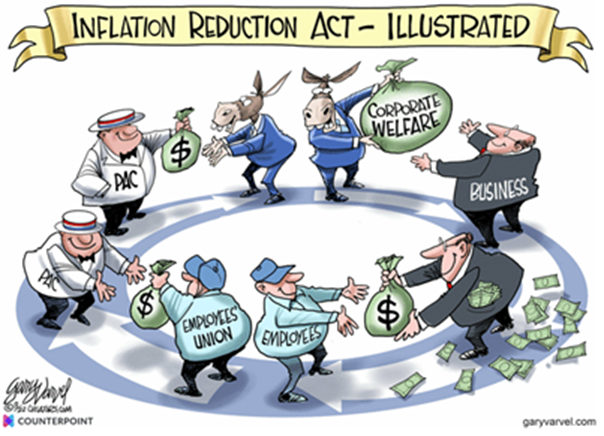
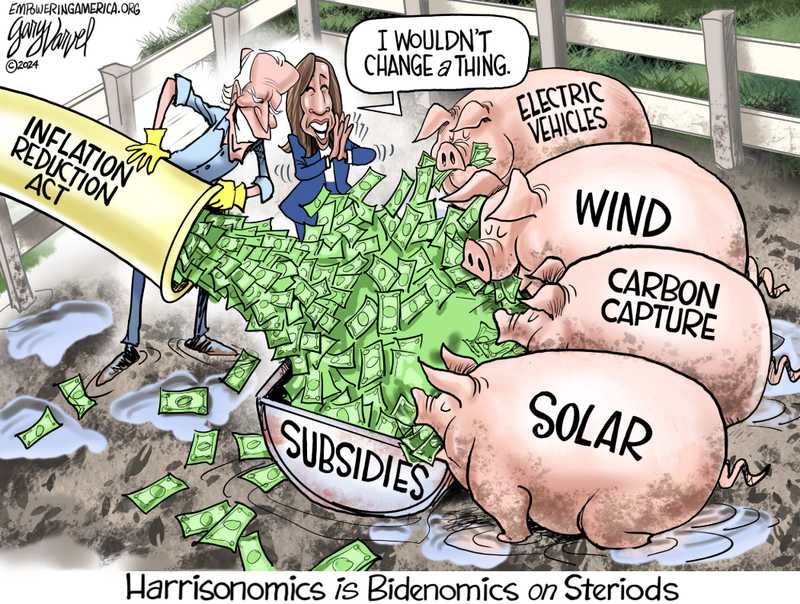
The Democrats passed the Orwellian named inflation Reduction Act (IRA) without a single Republican vote. They told us that it would be a $369 billion spending package. In fact, it could cost nearly $5 trillion adding to our debt.

The United States now has a $36.5 trillion national debt,
with a trillion dollars in annual interest payments.

The money for the IRA is all borrowed money. It causes more unnecessary energy spending, driving up electric rates and increasing inflation. This overspending is unsustainable and harmful to the United States; inflation is putting pressure on families’ budgets.

The subsidies in the IRA are incredible. Wind and solar get a 50 percent tax credit to build and a 30 percent subsidy for the electricity they produce. Trump and Congress need to end these subsidies. Not only for wind and solar, but for all the other supposedly green initiatives, like battery factories, electric vehicle manufacturing components, and hydrogen. We simply can’t afford it. 

This “green” borrowing is driving up our electric rates. Because wind and solar power are part-time and intermittent, they cannot provide full-time, keep the lights on all the time electricity generation. They do not replace any natural gas, coal, or nuclear power they just add costs.

It is like a household that has two on demand gas cars that serve their needs. They think they can save money with another car. Because of the 50 percent tax subsidies and propaganda they buy a solar car. 

They find that the solar car doesn’t work the first and last hour of the day, or when it is raining, or cloudy and not at night. The sun isn’t powerful enough. They learn they cannot replace any of their gas cars with the solar car.

So, they buy a wind car that only works the 30 percent of the time the wind blows. They find they can’t get home from their kids’ soccer game or from work because the wind stopped blowing.

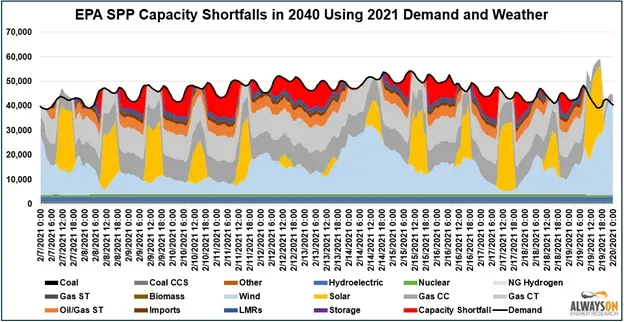
Capacity shortfall events – or blackouts – in Southwest Power Pool (SPP) when we modeled EPA’s proposal for carbon mandates, stemming from the agency’s use of 80% or higher capacity values for solar energy.

They are now paying for four cars instead of two. This is exactly what is happening to our electric grid. We are paying for a full-time and part-time electricity production. 

To make matters worse, the way that regional transmission organizations (RTOs) pay for our electricity doesn’t allow us to realize any savings from the heavily subsidized wind and solar generation. 

The industry calls it take and pay. The most expensive form of electricity the RTO purchases is what they pay all electricity providers. This means that there is no savings from wind and solar for electric consumers, only increased costs.

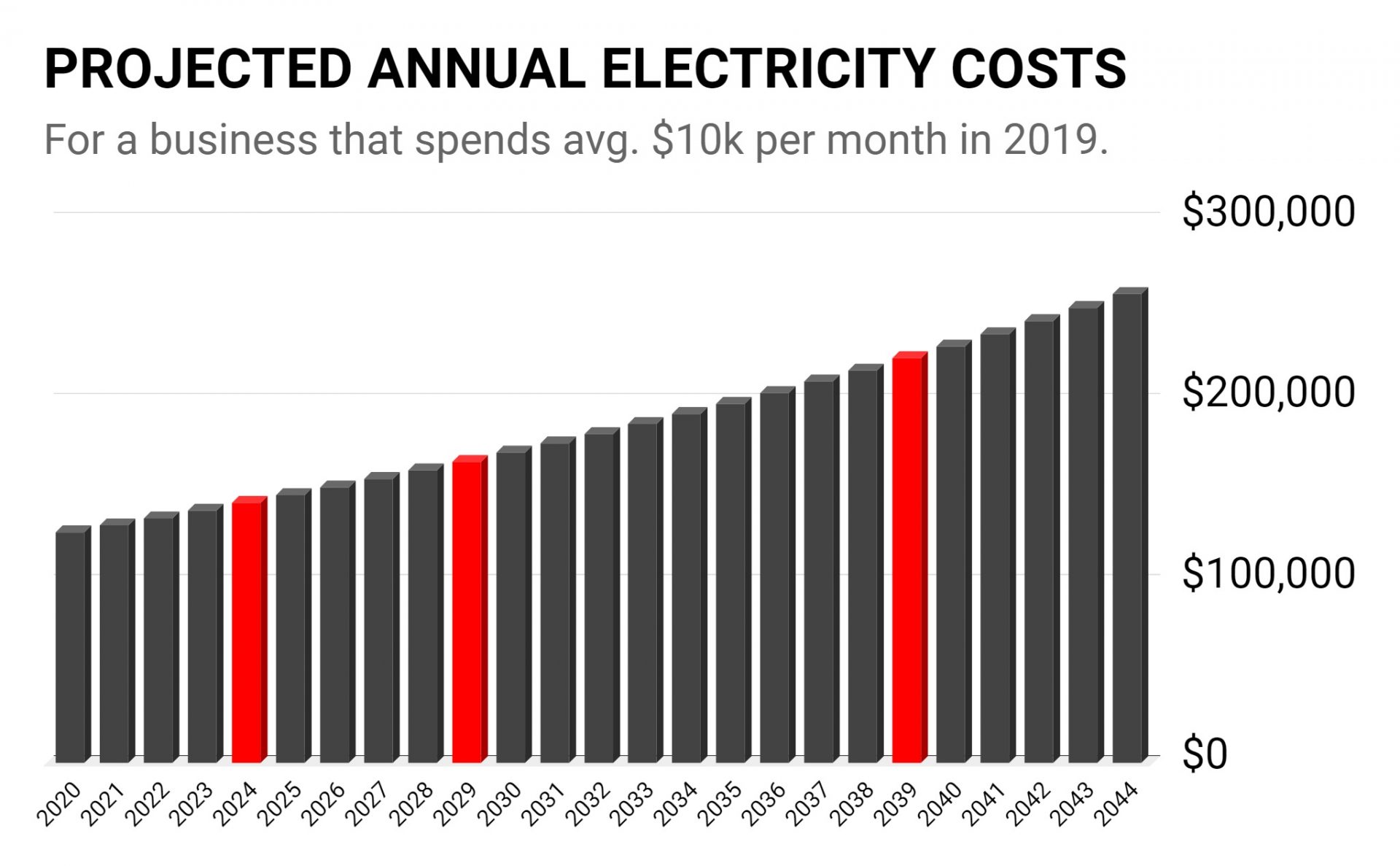
Projected Business Electricity Expenses in California based on increasing commercial rates.

No other industry pays the highest bid price to all suppliers, regardless of what they bid. But that’s what they do in the electric world. We are paying higher electricity rates because of this practice.

This begs for state legislative action to correct this expensive payment scheme. 

Wind and solar further drive up the price of electricity because they require many miles of expensive transmission wires and displace full-time electric generation. Forcing it to run less than it would if they were not on the electric grid.

As natural gas and coal power plants run more part-time, every electron they sell must have a higher price to cover their costs. Their maintenance costs will only increase, too, because they were never designed to run intermittently.

Trump understands that wind and solar drive up the cost of our electricity, particularly offshore wind, which costs five times more than natural gas electricity, and are built in hurricane alley. What could go wrong? The simple answer is to stop subsidizing all electric generation with our borrowed inflation causing tax dollars. And states should end favorable regulations that require the purchase of wind and solar first. 

There are 21 House Republicans that have signed a letter saying they don’t want to repeal the IRA, even though they didn’t vote for it. Because it is fostering wasteful pretend “green” spending in their districts. Clever Democrats have the bulk of the spending going into these Republican districts in order to preserve this green slush fund.

President Trump needs to use his considerable persuasion and political muscle to end this Democrat boondoggle, which adds to our $36.5 trillion national debt.

Frank Lasee is a former Wisconsin state senator and former member of Governor Scott Walker’s administration. The district he represented had two nuclear power plants, a biomass plant and numerous wind towers. He has experience with energy, the environment, and the climate. You can read more energy and climate information at www.truthinenergyandclimate.com which Frank leads.