




No, Stanford, Decarbonized Energy is Not More Secure

Suddenly, climate media activists are proclaiming that doing away with hydrocarbon fuels will increase energy security for most nations.  Headlines like these abound:

Decarbonization improves energy security for most countries, study finds,  Phys.org

Ditching fossil fuels would improve energy security for most countries, new research finds, Euronews (English)

Decarbonization improves energy security for most countries, Science Daily

Decarbonization improves energy security for most countries, study finds, Stanford Report

The last one comes from Stanford, the source of the study being Stanford professor Steve Davis. The paper is Trade risks to energy security in net-zero emissions energy scenarios.  The overview is:

Researchers analyzed trade-related risks to energy security across 1,092 scenarios for cutting carbon emissions by 2060. They found that shifting from dependence on imported fossil fuels to increased dependence on critical minerals for clean energy can improve security for most nations – including the U.S., if it cultivates new trade partners.

From Stanford Report:

As a first step, lead author Jing Cheng, a postdoctoral scholar in Davis’s Sustainable Solutions Lab at Stanford, built a database of countries with reserves of oil, gas, coal, uranium, biofuels, and any of 16 materials that are critical for clean energy technologies, along with the trade flows of these resources between countries.

The researchers calculated how much of these resources would be required to meet energy demand in each of 236 countries in 1,092 different scenarios for reaching net-zero carbon emissions globally by 2060. Modeled by the Intergovernmental Panel on Climate Change, or IPCC, the scenarios span a broad range of possible changes to the energy mix across the globe and within individual countries. Some are more dependent on nuclear energy, for example, while others incorporate more solar or wind power.

For the thousands of combinations of trade relationships and resource needs, the team estimated the level of risk in each country’s transportation and electricity sectors, and overall energy system. They quantified these risks using a new “trade risk index” based on the availability of domestic reserves, the share of demand for a given fuel or material met by imports, the economic value of the imports, and a measure of market concentration widely used to quantify energy security.

The researchers found that if all countries maintain their current networks, trade-related risks to energy security would decline on average by 19% in net-zero scenarios. If countries expand their networks and trade with all resource owners, then trade risks on average would fall by half.

Reducing the need for imported virgin materials – whether by making technologies last longer, ramping up recycling, or developing less material-intensive designs – is another way for mineral-poor countries to minimize trade risks while eliminating fossil fuels. According to the study, trade risks fall on average by 17% – and by more than 50% for the U.S. – with a quadrupling of today’s meager recycling rates for critical minerals such as lithium, nickel, and indium.

“Most people are focused on the new stuff that could be a problem, and not really considering the security benefits of moving away from fossil fuels.”  Steve Davis, Professor of Earth System Science

A Look at the Realities that Refute the Imagined Security Benefits

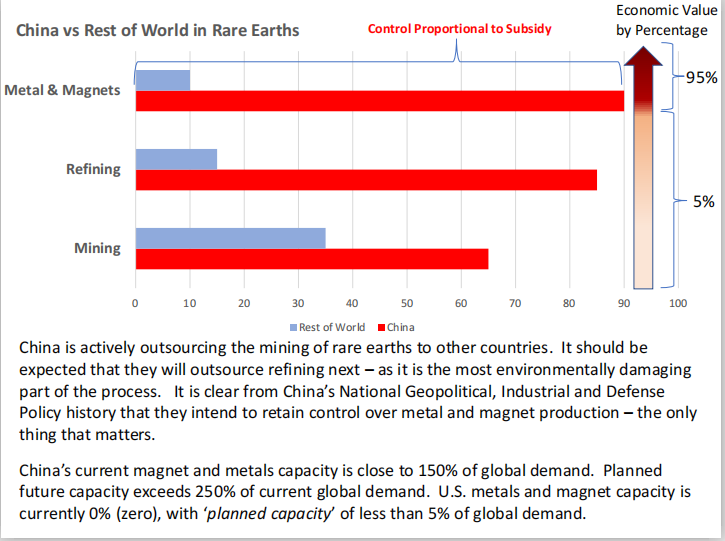
1.  Hydrocarbon fuels are available through a long established world-wide production and supply network.  Renewables are dependent on critical minerals from a few sources, dominated by China.

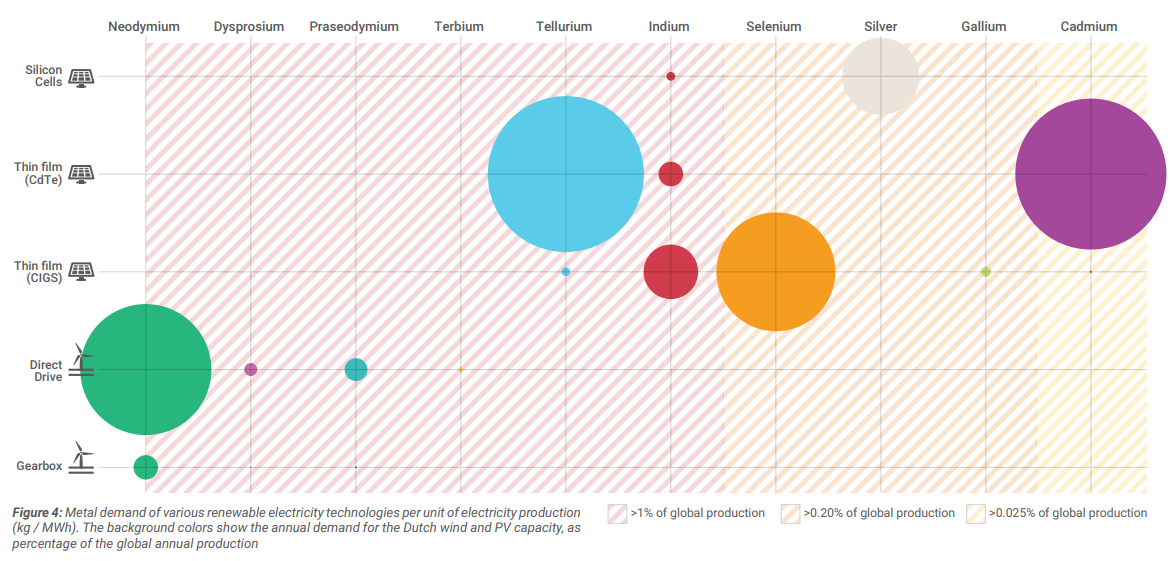
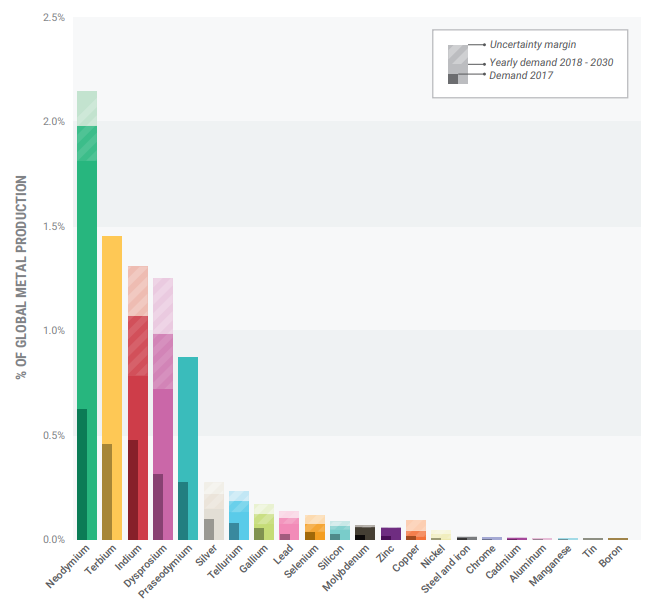
Metal demand per technology

There are various technologies available for the production of electricity through wind and solar. Each technology requires different amounts of critical metals. This figure shows the metal demand for the five most common technologies.

Metal demand for Dutch renewable electricity production

This chart shows the average annual metal demand (for 22 metals) required for the installation of new solar panels and wind turbines. This assumes a linear installation of capacity.

The annual metal demand is compared to the annual global production of these specific metals, resulting in an indicator for the share of Dutch demands for renewables in global production.

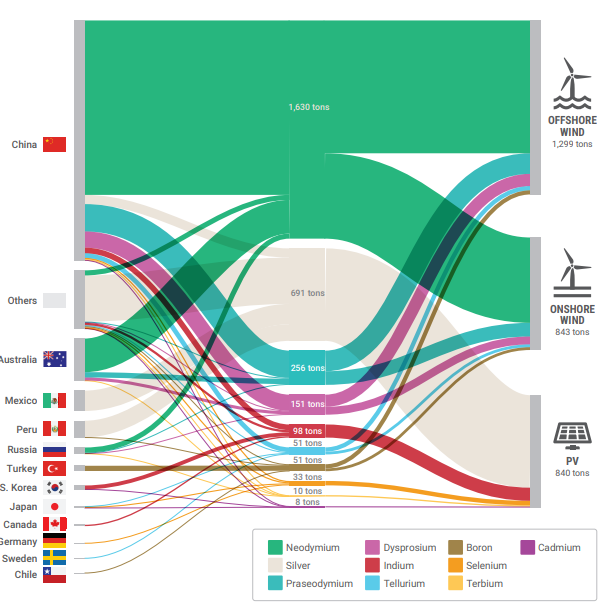
Origin of critical metals

This diagram shows the origin of the metals required for meeting the 2030 goals. The left side of the diagram shows the origin, based on today’s global production of metals. The right side shows the cumulative metal demand for wind and solar technologies until 2030.

And there is another precious resource required for wind and solar power plants:  Land in proximity to human settlements

Land required for wind turbines to power London UK.

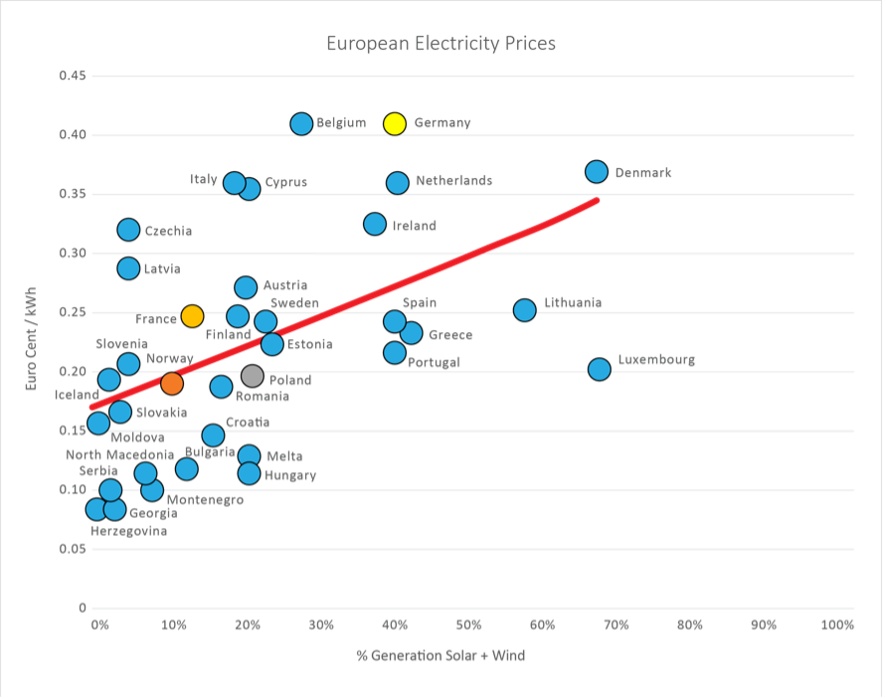
2.  Renewable Energy from Wind and Solar is Intermittent and Expensive

The high price of wind and solar deployed at society-scale illustrates an important cost of supply principle. Because everyone needs reliable energy—whether electricity, gasoline, or heating fuel—the higher the overall costs, the more damaging it is proportionally for those who can least afford it. High-cost energy policies are what economists call regressive. Ironically, some of the most “progressive” energy policies—i.e., incentivising and mandating solar, wind, and batteries, and forcing fossil fuels from the market—result in regressive economic impacts. Governments can subsidise such costs for the most disadvantaged, but such subsidies are unsustainable at society scales. A diverse portfolio of energy options, including primary use of conventional generation, is much healthier to meet the range and scales of demands. (Source: The Choices We Face | Energy for the 21st Century: A Declaration of Guiding Principles.)

3.  What about all the other essentials we get from hydrocarbons, not from renewables?

See Also: World of Hurt from Climate Policies (four-part series)

World of Hurt from Climate Policies-Part 1

This is a beginning post toward infographics exposing the damaging effects of Climate Policies upon the lives of ordinary people. And all of the pain is for naught in fighting against global warming/climate change, as shown clearly in the image above. This post presents graphics to illustrate the first of four themes:

  • Zero Carbon Means Killing Real Jobs with Promises of Green Jobs
  • Reducing Carbon Emissions Means High Cost Energy Imports and Social Degradation
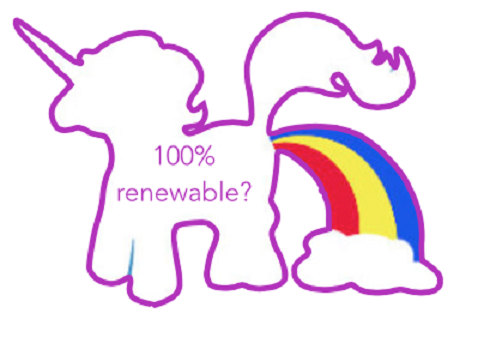
  • 100% Renewable Energy Means Sourcing Rare Metals Off-Planet
  • Leave it in the Ground Means Perpetual Poverty

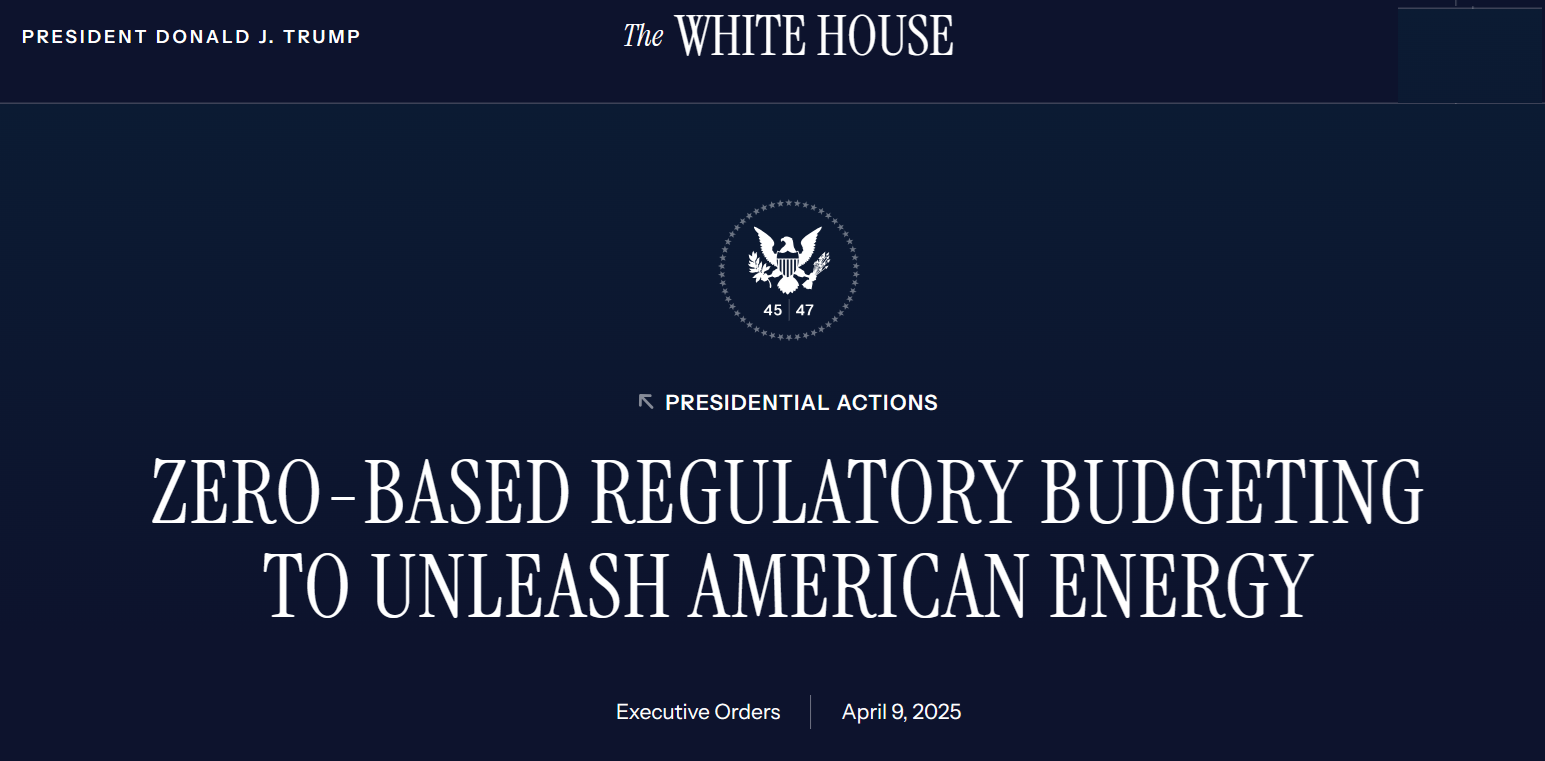
Trump EO Puts Federal Budgeting on a Zero Base

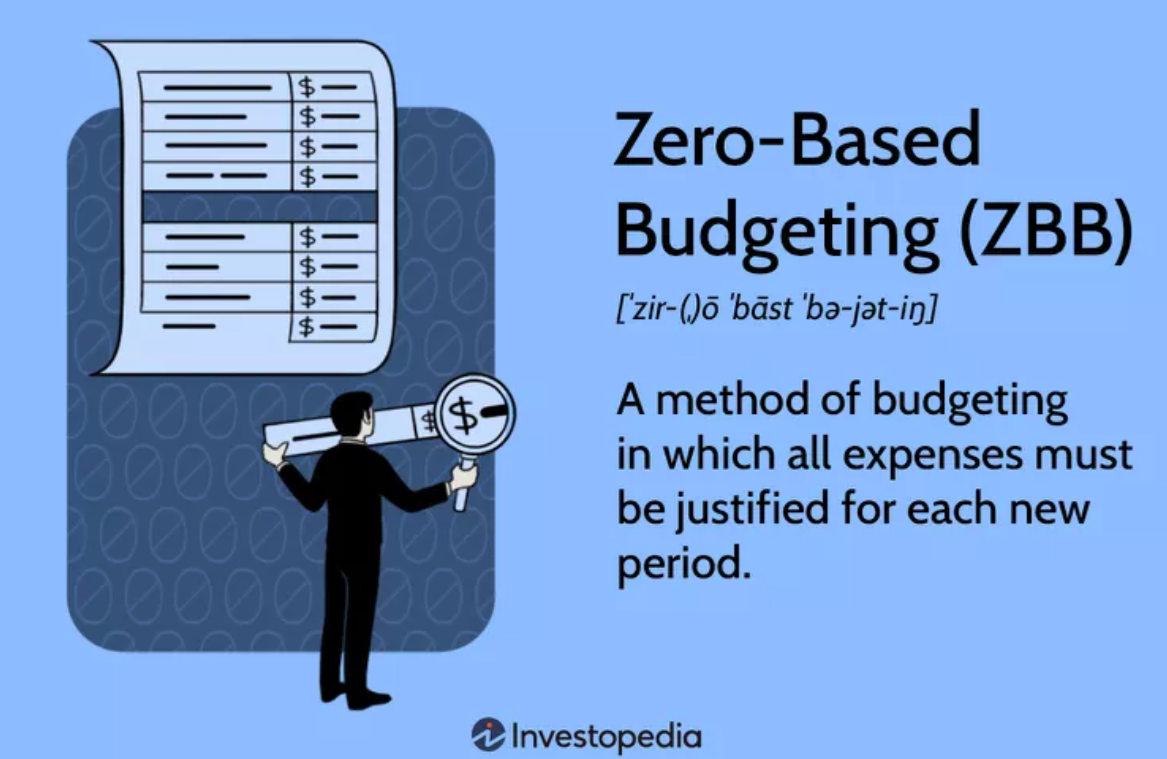
Zero-Based Budgeting (ZBB) is a particular approach to managing organizational resources which I have known from previous consulting experience. It doesn’t take a rocket scientist (although Doge has at least one of them) to know that branches of a bureaucracy grow like topsy driven by internal incentives. The game is played by finding a new territory to regulate and add it to the mission scope to justify the added people, dollars and facilities. Managers increase their power, prestige and salaries by adding staff and resources, the bigger the agency budget the better.  As one Doge leader put it, government only ratchets upward, nothing is ever taken away.

Now that the US is the nation with world’s largest debt, there is no option other than to ratchet downward by streamlining and rightsizing focusing on the essentials, and discarding the rest.

What is ZBB method for meeting the desperate need to trim the US federal government. (Source: Investopedia)

How Zero-Based Budgeting (ZBB) Works

ZBB allows top-level strategic goals to be implemented into the budgeting process by tying them to specific functional areas of the organization. Costs can then be first grouped and then measured against previous results and current expectations.

Zero-Based Budgeting vs. Traditional Budgeting
Traditional budgeting calls for incremental increases over previous budgets such as a 2% increase in spending. Zero-based budgeting requires a justification of both old and new expenses.

Traditional budgeting also only analyzes new expenditures. ZBB starts from zero and calls for a justification of old, recurring expenses in addition to new expenditures. Zero-based budgeting aims to put the onus on managers to justify expenses. It drives value for an organization by optimizing costs, not just revenue.

What Are the Advantages of Zero-Based Budgeting?

Zero-based budgeting starts from scratch, analyzing each granular need of the company instead of using the incremental budgeting increases found in traditional budgeting. This essentially allows for a strategic, top-down approach to analyze the performance of a given project

Zero-based budgeting offers several advantages, including focused operations, lower costs, budget flexibility, and strategic execution. The highest revenue-generating operations come into greater focus when managers think about how each dollar is spent. Lowered costs may result because zero-based budgeting may prevent the misallocation of resources that can happen over time when a budget grows incrementally.

The way forward is explained in the Executive Order issued April 9, 2025, with this intent:

Section 1. Purpose

In our country, laws are supposed to provide the certainty and order necessary to foster liberty and innovation. Instead, our vast regulatory structure often serves to constrict ordered liberty, not promote it. The United States Code itself is more than 60,000 pages. But unelected agency officials write most of the complex, legally binding rules on top of that, often stretching these statutory provisions beyond what the Congress enacted.

In particular, the previous administration added more pages to the Federal Register than any other in history, with the result that the Code of Federal Regulations now approaches a staggering 200,000 pages. These regulations linger in such volume that serious reexamination seldom occurs.  This regime of governance-by-regulator has imposed particularly severe costs on energy production, where innovation is critical. The net result is an energy landscape perpetually trapped in the 1970s. By rescinding outdated regulations that serve as a drag on progress, we can stimulate innovation and deliver prosperity to everyday Americans.

This order directs certain agencies to incorporate a sunset provision into their regulations governing energy production to the extent permitted by law, thus compelling those agencies to reexamine their regulations periodically to ensure that those rules serve the public good.

How Trump Tariffs Make Economic Sense

Van A. Mobley explains in his Federalist article Why Comparing Trump’s Tariffs To The Smoot-Hawley Act Is Dishonest.  Excerpts in italics with my bolds and added images.

Trump’s tariffs will work — but they’ll work
even better with the Federal Reserve’s help.

Trump’s tariffs are not designed to encourage Americans to borrow money and maximize their consumption. Nor are they designed to encourage participation in speculative stock market or real estate bubbles. America’s free trade policies encouraged such excesses after the end of the Cold War, and we can’t stand a repeat of the folly. While his critics wrongly invoke the Smoot-Hawley tariff failures of 1930, Trump’s emerging tariff policies, particularly if combined with the appropriate monetary policy, will have much better results and Make America Great Again. 

As Trump’s tariffs are implemented, they will generate revenue for the federal government and encourage investment in atrophied as well as cutting-edge sectors of the American economy. In addition, they will increase the quantity and quality of jobs available for Americans as a whole, will persuade (and are already persuading) our trading partners to adopt fairer and less predatory trading regimes, will arrest a possible slide into recession, and will get our economy moving toward our long-term growth potential of 3 percent (or more) GDP growth per year.

President Trump says “tariff” is one of his favorite words, and historical evidence indicates tariffs work. They worked for the Chinese this century, they worked for the Japanese after World War II, and they worked for the U.S. and Germany in the late 19th century. Back then, American and German growth rates and economic vibrancy radically outstripped the growth rates and economic vibrancy of a free-trading Britain, which, after abandoning its early 19th-century tariffs, adopted the free trade nostrums of David Ricardo and slipped into decline. 


One of the few instances when tariffs failed was during the Smoot-Hawley tariff episode at the beginning of the Great Depression. But there are special circumstances surrounding the imposition of the Smoot-Hawley tariffs that the free-traders hesitate to mention. When the United States raised the Smoot-Hawley tariffs, the U.S. was the world’s greatest creditor, and by raising the tariffs, we prevented others from selling us things so they could make money and pay us back. When they didn’t pay us back, it collapsed the global financial system and helped usher in the Great Depression.

Obviously, today the circumstances are reversed. The United States is now the world’s largest debtor. If we can’t pay back our debts, the global financial system will collapse, which would be disastrous for the entire world. 

Trump’s tariff medicine will put us on a diet, help us produce more,
diminish inflation, and position us to manage and decrease our debt.

Thus, Trump’s tariffs are not only good for Americans, but they are also good for everybody else across the world. While the Smoot-Hawley tariffs were bad, Trump’s tariffs are good because the relative financial position of the U.S. vis-à-vis the rest of the world is now reversed. This fact must not be overlooked when assessing the wisdom of Trump’s tariffs versus the folly of Smoot-Hawley. 

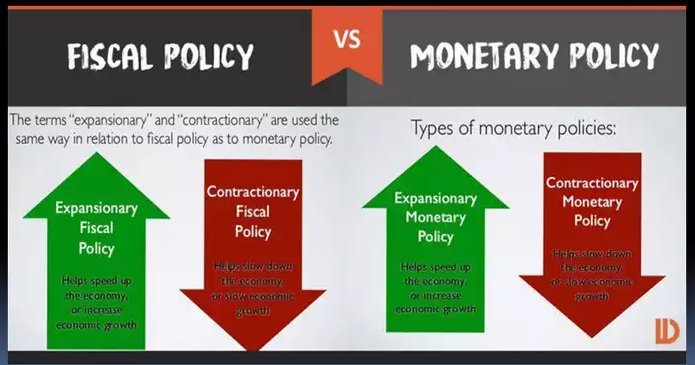
Furthermore, as Ben Bernanke, the former chairman of the Federal Reserve, taught us, at root, it was not the Smoot-Hawley tariffs that sparked the Great Depression. It was a monstrous policy misstep on the part of the Federal Reserve Open Market Committee. On the eve of the Great Depression, the Fed raised rates and pursued a contractionary monetary policy when it should have cut rates and pursued an expansionary monetary policy. 

Trump’s trade policies are necessary and on target.
The uncertainty lies with the Fed.

How long until Jerome Powell and his companions stop gazing in the rearview mirror and look through the windshield instead? When they do, they will see that inflationary pressures are subsiding and that circumstances call for rate cuts and other expansionary monetary policies. They will cease fighting the last economic war and join the fray in fighting the current one. 

With Trump’s tariffs, America’s future is bright. Realistically, the path forward will be more pleasant if the Fed cuts rates sooner rather than later. 

Van Mobley is a professor at Concordia University Wisconsin.


Politicized Science Case Study: National Climate Assessment

This post incorporates two dimensions of climate science reporting: firstly what and who are involved in the production, and secondly what the Trump administration might do to achieve a more balanced result. A recent article exposes the process by which the US National Climate Assessment (NCA) has been produced while ensuring that true believers control the content. Brent Scher writes at Daily Wire  Meet The Government Consultants Raking In Millions To Spread Climate Doom.  Excerpts in italics with my bolds and added images.

The government is outsourcing the ‘crown jewel’ of
climate change research to liberal climate consultants.

More than three decades ago, Congress launched an initiative called the U.S. Global Change Research Program. Today, it spends billions of dollars a year empowering liberal climate scientists to spread climate change doom. 

The government group says its role is to provide the “scientific foundation to support informed decision-making across the United States” on climate change. It’s done so by producing five National Climate Assessment reports, which are considered the “crown jewel” of climate research.

Despite taking funding from at least ten separate government agencies, producing the report seems to be the group’s sole function. The most recent iteration — published in 2023 and still prominently showcased on its government website — warns that “severe climate risks to the United States will continue to grow.” The next report is due out in the next couple of years, according to E&E News.

The National Climate Assessment is not simply an intellectual exercise, but rather one that carries real policy might. Congress and agencies use it to justify regulations and funding decisions, and states and cities across the country lean on it as the non-partisan scientific foundation for their own climate action plans. In summary, it is the scientific bedrock for directing policy at all levels of government towards liberal climate change goals.

While the U.S. Global Change Research Program states on its website that it has a budget of $4.95 billion in 2025, it only lists two full-time employees. So, who’s getting paid to put the massive and consequential report together?

Sources familiar with past iterations of the National Climate Assessment say the work is largely outsourced to a group called ICF, a massive government contractor that has an active contract to work on the report. The Daily Wire identified at least one active contract from NASA for ICF to “support” the U.S. Global Change Research Program. ICF is set to be paid millions of dollars during the Trump administration to “assist the nation and the world to understand, assess, predict, and respond to human-induced and natural processes of global change.”

The contract was first announced in June 2021, and described as a $34 million, five-year contract to help with the National Climate Assessments. Only $18 million has been paid out, according to the government spending database. But with another assessment on deck and ICF under contract for another year, the additional $16 million could be disbursed in the next year.

A climate scientist who has worked on the National Climate Assessment
in the past says ICF runs the show, virtually controlling
the entire U.S. Global Change Research Program.

“By providing all staff for the USGCRP, a federal agency, the ICF exerts undue influence over the global change narrative and priorities presented by the federal government,” said the official, who requested anonymity to discuss the work. “The ICF, through the USGCRP, exerts an undue influence on the production of the National Climate Assessment every four years. With the exception of its Executive Director and the Director of the National Climate Assessment, the ICF supplies all staff associated with the USGCRP.”

ICF takes in far more in government contracts than its active $34 million from NASA. An analysis of federal spending data found that the consulting firm rakes in hundreds of millions of dollars each year through federal contracts, and took in over $2 billion during the Biden administration.

The consulting firm is likely aware that the scope of its government work could be slashed during Trump’s term, and so are investors. Its stock price was at $171 a share days ahead of last November’s election, but has since cratered to just $77 a share, the lowest it had been since the last time Trump was president.  (Yes, the stock price fell before the current market volatility caused by tariffs).

Houston Keene, a former journalist who now leads a government transparency organization, argues that unnamed government consultants shouldn’t be paid millions to chart the nation’s climate policy.

“The public deserves an honest assessment from the government on the state of climate science,” Keene said. “That requires an objective, nonpartisan author who does not have financial interests in the outcome. ICF appears to be none of these things.”

“There can be no proper assessment with scientific integrity when a clearly partisan and financially conflicted activist organization is holding the pen,” he said.

A top Trump administration official, Russell Vought, has signaled that he wanted to exert more oversight over the next climate assessment. Vought runs the powerful Office of Management and Budget, and has openly stated that he wants to make deep cuts to “woke and weaponized” spending.

Vought has specifically called out the U.S. Global Change Research Program’s report, arguing that the bureaucrats who write it end up with outsized power over government action. He’s called for an investigation of the political leanings of the contractors that assemble the report.

A March 2025 report at SciAm provides background on recent developments regarding the NCA: Trump Official Who Tried to Downplay Major Climate Report Now Will Oversee It.  Excerpts in italics with my bolds and added images.

Stuart Levenbach alarmed scientists years ago when he attempted
to meddle with a congressionally mandated climate report

Stuart Levenbach was tapped last month by administration officials to serve as associate director for natural resources, energy, science, and water in the Office of Management and Budget.

The previous time President Donald Trump was in the White House, Levenbach attempted to tone down the summary conclusions of the National Climate Assessment, a wide-ranging report that relies on the contributions of hundreds of researchers to assess how global warming is transforming the United States.

Scientists say Levenbach tried to downplay climate risks in the fourth installment of the report, which comes out every four years or so. In that edition, Levenbach was concerned especially with the higher greenhouse gas emissions assumptions the report partially relied on and sought to soften the language of the report’s summary, the scientists say.

He was the one that tried to slow it down to the point of it not coming out,” said Don Wuebbles, a climate scientist at the University of Illinois who has worked on all five previous National Climate Assessments.

Levenbach’s delay tactics were ultimately unsuccessful, and the fourth installment of the report was released in 2018 on the day after Thanksgiving.

In response to questions from Politico’s E&E News, a Trump administration official with the Office of Management and Budget described the scientists’ concerns as “fake news.”

The National Climate Assessment is based on a range of emissions scenarios, including those that are not worst-case scenarios. The fourth version of the report concluded the country was not on track to cut carbon dioxide emissions at a pace to avoid some of the worst consequences of climate change.

At the time, Levenbach’s role at NOAA carried more weight than usual because the agency was operating without a permanent administrator, and did so for the entire first Trump presidency.  Reached for comment, OMB spokeswoman Rachel Cauley did not deny that Levenbach tried to alter the report, but she criticized how it was put together.

“The assessment was riddled with the worst case scenario and
the authors weren’t transparent about it,” she said in a statement.”

Levenbach is joining OMB at a time when its director, Russ Vought, wants to suppress climate science throughout the federal government and increase Trump White House oversight over the next installment of the National Climate Assessment, which is due out in 2026 or 2027.

Levenbach’s appointment to a powerful White House role with oversight of the nation’s scientific endeavors comes at a time when the administration is preparing a possible challenge to the endangerment finding, a bedrock ruling which considers greenhouse gases a danger to public health and is a foundation of climate regulations.


Media’s at Fault for Liberals’ Climate Anxiety


Linnea Lueken explains in her Climate Realism article Liberals May Be Suffering from Climate Anxiety, but if So, It’s The Media’s Fault. Excerpts in italics with my bolds and added images.

A recent article at the Washington Free Beacon, titled “Great News for Humanity: Depressed Liberals Are Increasingly Suicidal Due to ‘Climate Anxiety,’ Study Finds,” takes a humorous approach (black humor, to be sure) to discussing a study that found liberals are increasingly suffering from climate anxiety and depression, leading the climate-anxious to refrain from having children and even contemplating and, in some cases, committing suicide. The article makes light of it, but it is a widely reported trend. Since climate change does not threaten human existence or flourishing, and extreme weather is not worsening, their fears and anxiety are unjustified by the actual state of the climate. Unfortunately, climate alarm has been foisted upon people, especially on children and mentally unwell adults, despite evidence indicating climate change is not anything to be alarmed about.

The Washington Free Beacon reports:

“Negative psychological responses related to the observed and anticipated impacts of climate change, such as climate anxiety, eco-anxiety and climate-related guilt have … emerged as a potential risk factor for poor mental health and suicide-related behaviors,” the authors wrote last month in Nature Medicine. “International surveys show that concern about climate change is associated with feelings of despair, hopelessness, anger, frustration and guilt, especially among younger populations.”

The findings of this study, published in Nature, are not unique. Other research has come to similar conclusions: a study conducted by Save the Children found that 70 percent of kids they surveyed struggle with what they dubbed “climate anxiety,” as discussed in this Climate Realism post. Other surveys show similarly sad results.

Each time these results are presented, the media and the researchers involved frame the story as climate change and its impacts are causing fear and anxiety, and the lack of action is causing deep feelings of hopelessness and despair for people worried about climate change. Yet it is the false tales that the media, politicians, and green interest groups are telling about climate change motivating anxiety and mental distress, not the actual conditions of the planet.

For instance, in the media coverage of the Save the Children survey, the UK website Future Net Zero implies that without immediate societal scale action, the present generation of children “stand to inherit a deeply unequal world,” and that their terror is “warranted.”

Likewise, articles from The Hill and The Conversation discussing a study attributing adult PTSD to climate change assert that climate change is impacting people through increased wildfires and other disasters. This is false, the framing of their research is built on falsehoods.

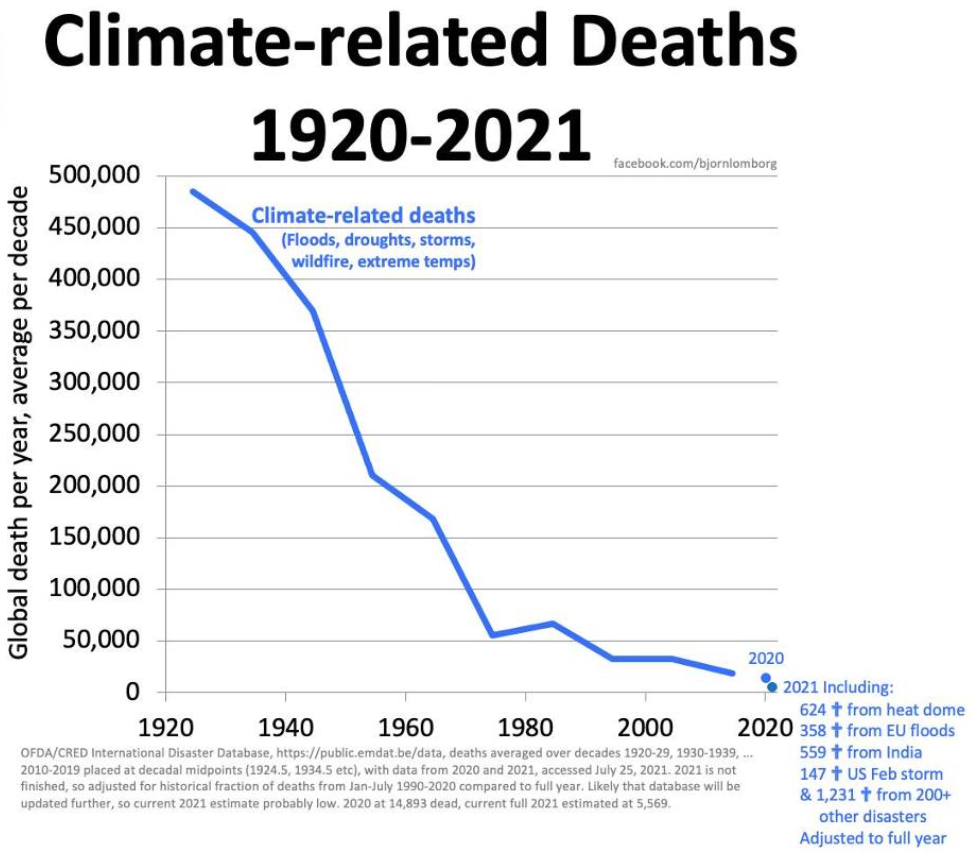
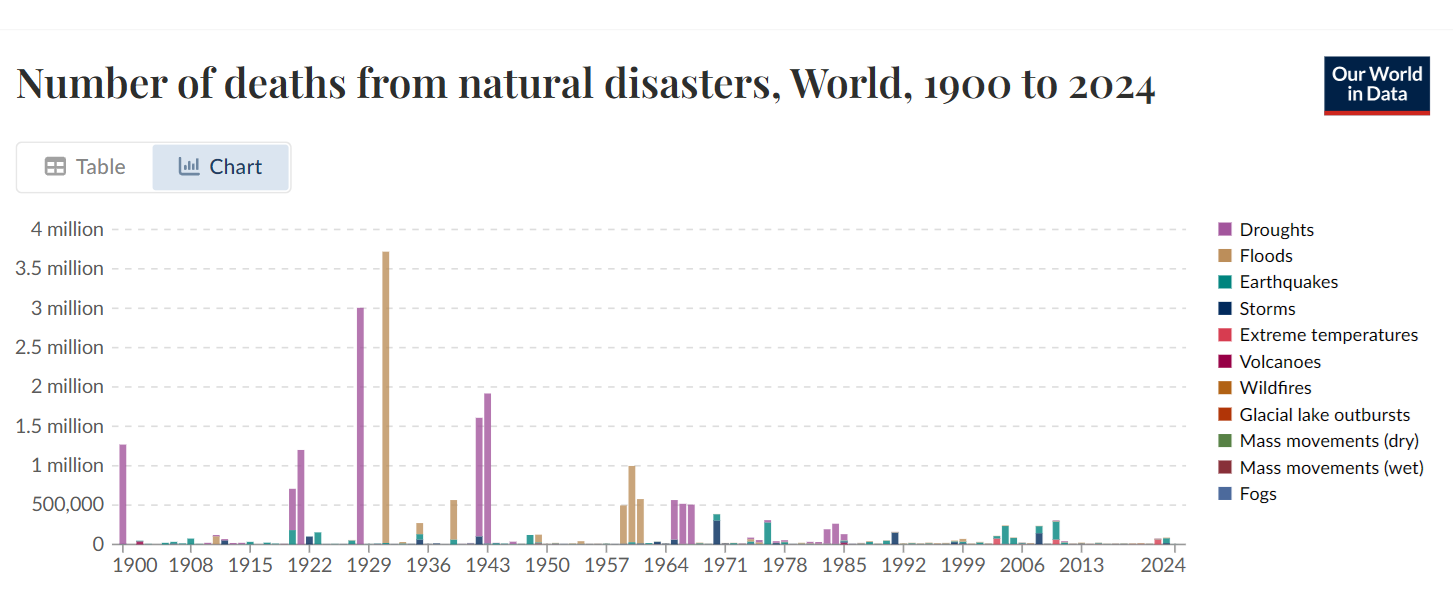
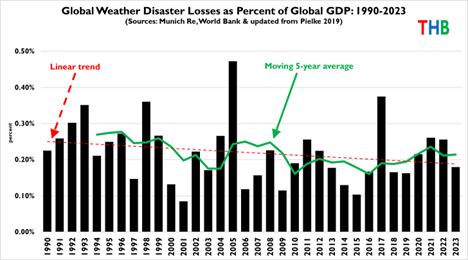
Climate change is not causing worsening weather disasters. Data show that not only are events like wildfires not increasing, but the number of all climate-related deaths are declining because of improvements to infrastructure, healthcare, technology, and yes, better climatic conditions. (See figure below)

The real reason so many impressionable people are depressed and anxious about climate change is because the media and governments relentlessly push and promote false and alarming misinformation and fake news about extreme weather and climate change. It is no wonder that children are afraid, when their teachers are telling them that the world will end in short order unless dramatic global reforms are made. When people don’t see the supposedly climate saving reforms being made, they are left hopeless and despondent. But it is an unnecessary misery – there has never been a safer time period for humans to live in.

The Washington Free Beacon made light of the situation, but it is no laughing matter. Children in particular are being traumatized by adults in their lives over the climate issue. Climate change is not harming mental health, but climate alarmism, built on falsehoods, hysteria, and hyperbole, certainly is.

Deceptive Climate Alarmist Rants on Trump Energy Policies

Linnea Lueken and H. Sterling Burnett expose the unfounded claims in their Climate Realism article The Hill Misleads, Trump’s Energy Policy Won’t Damage the Climate and Will Advance American Interests.  Excerpts in italics with my bolds and added images.

A recent post by The Hill, “Disaster as Trump’s energy policy totally disregards climate change,” claims that President Donald Trump is implementing “irrational and profoundly destabilizing energy policies” by prioritizing traditional energy and deprioritizing renewables, leading to increases in weather disasters. This is false on all fronts.

♦  Data show that weather is not becoming more extreme.
♦  There is no evidence that the growth in wind and solar power has done or can do anything to alter the course of climate change.
♦  Trump’s America First agenda promotes energy dominance, focusing energy reliability and abundant, secure, domestic supplies. Trump’s energy plan is a stabilizing factor in energy costs.

William Becker, a former regional director at the U.S. Department of Energy during the Obama administration, makes many false claims in a rapid-fire fashion in his post in The Hill. For brevity’s sake and as a matter of focus, this Climate Realism post focuses on one segment of his article:

While we can thank fossil fuels for the lifestyles and conveniences most Americans enjoy today, the legacy of their long dominance is the destabilization and degradation of environmental systems critical to life. The atmosphere is one of those systems. Unprecedented weather extremes are the result of dumping fossil-fuel pollution into it. As the dumping continues, weather disasters become more frequent and destructive. The American people have been hit by an average of 23 major weather disasters (those with damages exceeding $1 billion) annually over the last five years, compared to only nine in the previous 45.

Every point Becker made in this statement after the opening clause of the first sentence is false. It is true that we can thank fossil fuels for our lifestyles and not just conveniences but essentials for modern life.

It is false that fossil fuel use is causing unprecedented weather extremes, and that they are becoming more frequent and destructive.

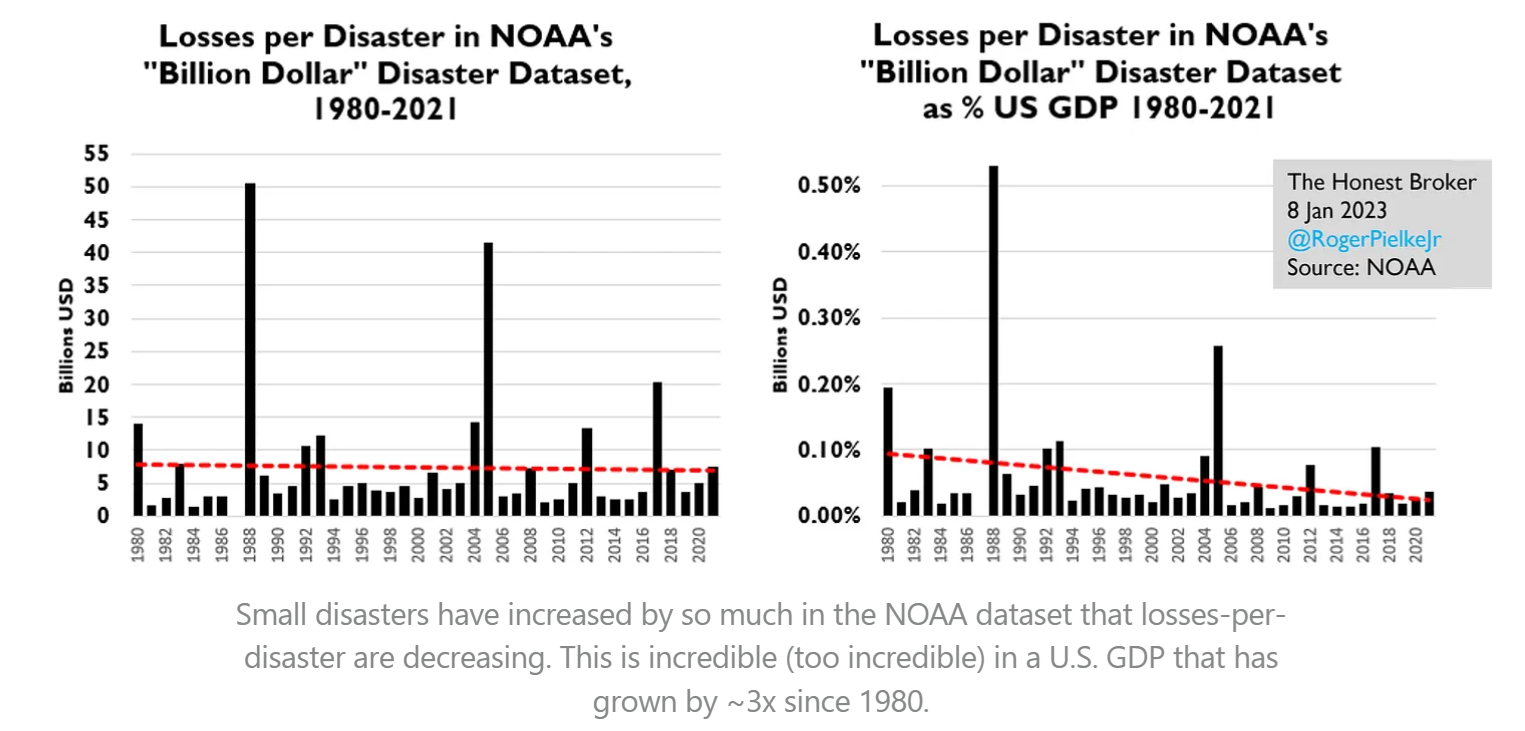
Becker, who currently runs a climate policy lobbying organization, uses a deceptive metric for calculating increasing weather disasters, which looks at the monetary value of losses due to weather. Becker does not attempt to claim that these weather events are becoming more frequent or extreme themselves – because they aren’t.   Data on the most common weather extremes like hurricanes and wildfires show no increase, as Climate Realism has covered dozens of times. Instead, Becker cites misleading calculations of billion-dollar price tags from weather damage.

Scientist Roger Pielke, Jr., a professor emeritus at the University of Colorado Boulder, explains the misuse of the “billion dollar disaster” metric as a proof for dangerous climate change. He has called the U.S. National Climate Assessment (NCA) is “a national embarrassment,” for using that misleading metric, explaining that the NCA overestimated the number of disasters by a factor of three by re-counting individual events when they struck multiple states. So, if a hurricane passed through Florida, then into Georgia and South Carolina, the NCA would count this as three separate “billion dollar disasters” – even if the hurricane did not cause a billion dollar in of losses in each state it struck.

In reality, populations have increased in states like California and Florida, which are prone to extreme weather. More infrastructure has been built in susceptible areas, so there is more to annihilate when a storm strikes. To the extent that there has been any rise in billion dollar costs attributable to extreme weather events, as estimated by Becker and the sources he uses, it is due, not to changes in weather, but rather a well-known phenomenon labeled the “expanding bulls-eye effect,” which Climate Realism has discussed dozens of times previously, such as here.

Going further, an analysis from Pielke, Jr. of insurance data presented in another Climate Realism post disputes the claim that the costs of natural disasters, when measured fairly, have risen. Relative to global GDP, the trend in property losses has declined as the Earth has modestly warmed over the last several decades. (See the graph, below)

Graph: Global disaster losses as a proportion of global GDP.

Becker’s additional claim that Trump’s focus on reliable energy rather than intermittent renewables will raise costs and result in less energy security, is as false as his claims about worsening disaster costs. The wind and solar technologies that Becker promotes rely heavily on materials and technologies produced by foreign powers that are not friendly to the United States, like China.

A grid powered by wind and solar is not cheaper than gas, it isn’t even cheaper than nuclear. A study by energy modelers at Always On Energy Research found that wind and solar both suffer from massive costs associated with the overbuilding necessary to overcome the intermittency issue. Load balancing, using battery storage, carries very high costs, as well. These make nuclear less expensive per megawatt hour than existing wind or solar, despite high upfront costs.

Similarly for fossil fuels, full system LCOE show that wind and solar in Texas costs far more per megawatt hour than nuclear, coal (of which the United States has hundreds of years of domestic supply that isn’t dependent on foreign sources), or the cheapest source – natural gas, which is also sourced domestically.

Grid stability is damaged by high penetration of solar and wind and the closure of traditional energyaccording to utility companies and federal energy regulators.

Almost every claim made in Becker’s article in The Hill is provably wrong. The post is long on hyperbole and misinformation, but short on facts and data. Real world weather data shows no increase in extreme weather, incidences of weather disasters, or weather disaster costs as a percentage of economic growth. Trump’s reliability focused, America First, energy policy will not harm our energy security or the planet, but it will buttress the United States against the hostile intentions of any foreign government that might use our dependence on them for renewable energy materials and technology to extort economic or geopolitical concessions. It will also allow the U.S. to become energy dominant, a force for good in the world by supplying our abundant domestic energy supplies to allies, especially to developing countries in need of reliable energy sources to bring their populations out of energy poverty.

March 2025 UAH Yo-yo Temps

The post below updates the UAH record of air temperatures over land and ocean. Each month and year exposes again the growing disconnect between the real world and the Zero Carbon zealots.  It is as though the anti-hydrocarbon band wagon hopes to drown out the data contradicting their justification for the Great Energy Transition.  Yes, there was warming from an El Nino buildup coincidental with North Atlantic warming, but no basis to blame it on CO2.

As an overview consider how recent rapid cooling  completely overcame the warming from the last 3 El Ninos (1998, 2010 and 2016).  The UAH record shows that the effects of the last one were gone as of April 2021, again in November 2021, and in February and June 2022  At year end 2022 and continuing into 2023 global temp anomaly matched or went lower than average since 1995, an ENSO neutral year. (UAH baseline is now 1991-2020). Then there was an usual El Nino warming spike of uncertain cause, unrelated to steadily rising CO2 and now dropping steadily.
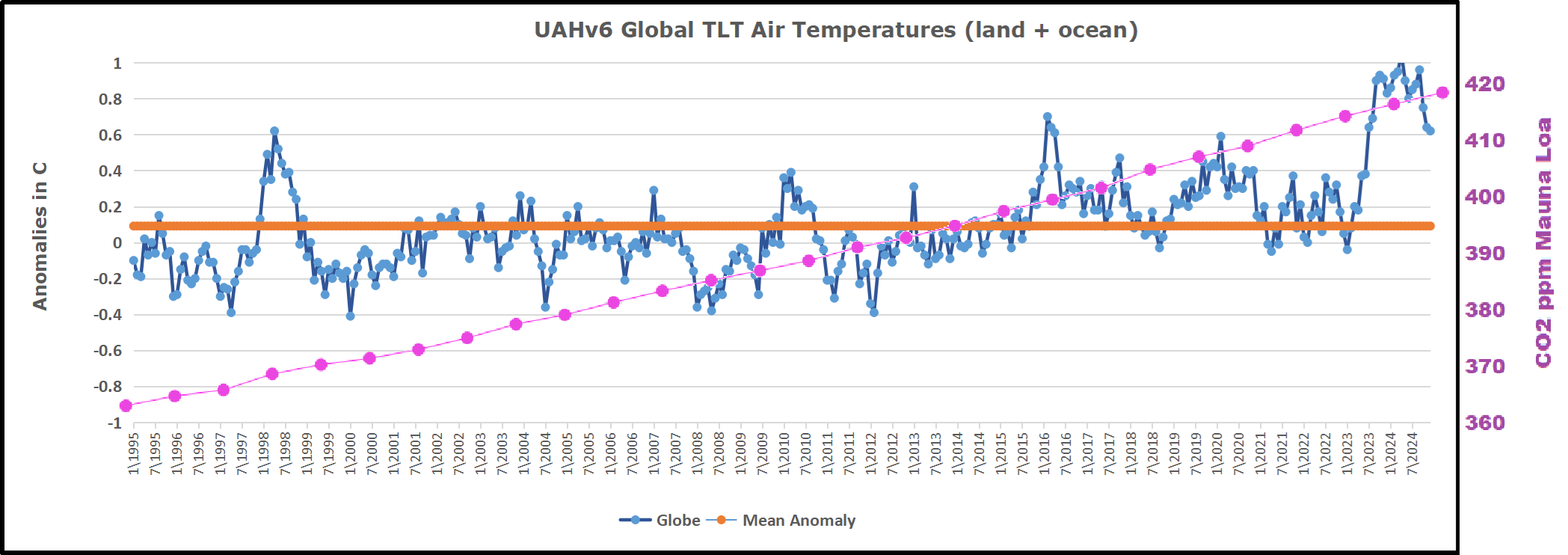
For reference I added an overlay of CO2 annual concentrations as measured at Mauna Loa.  While temperatures fluctuated up and down ending flat, CO2 went up steadily by ~60 ppm, a 15% increase.

Furthermore, going back to previous warmings prior to the satellite record shows that the entire rise of 0.8C since 1947 is due to oceanic, not human activity.
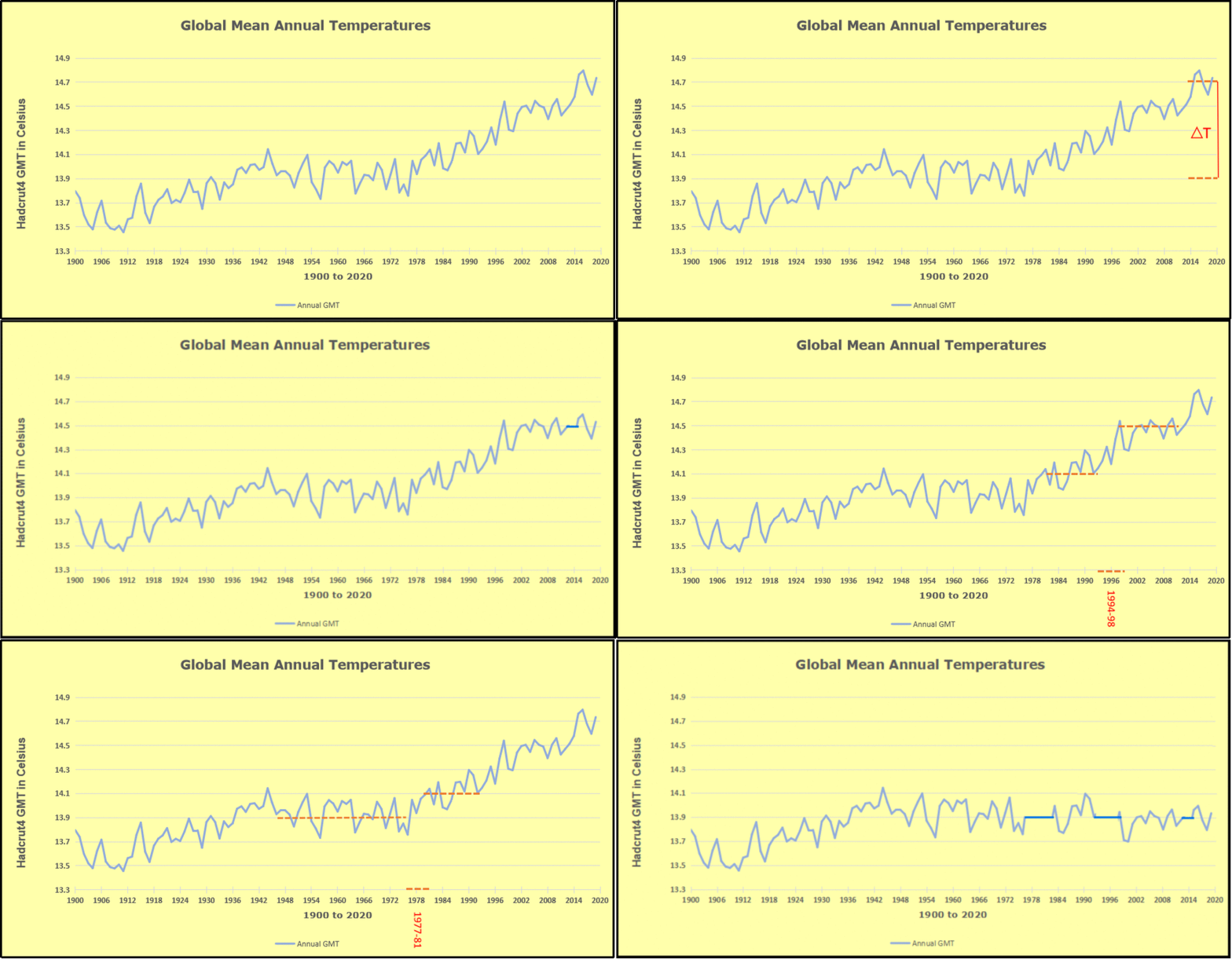
gmt-warming-events

The animation is an update of a previous analysis from Dr. Murry Salby.  These graphs use Hadcrut4 and include the 2016 El Nino warming event.  The exhibit shows since 1947 GMT warmed by 0.8 C, from 13.9 to 14.7, as estimated by Hadcrut4.  This resulted from three natural warming events involving ocean cycles. The most recent rise 2013-16 lifted temperatures by 0.2C.  Previously the 1997-98 El Nino produced a plateau increase of 0.4C.  Before that, a rise from 1977-81 added 0.2C to start the warming since 1947.

Importantly, the theory of human-caused global warming asserts that increasing CO2 in the atmosphere changes the baseline and causes systemic warming in our climate.  On the contrary, all of the warming since 1947 was episodic, coming from three brief events associated with oceanic cycles. And in 2024 we saw an amazing episode with a temperature spike driven by ocean air warming in all regions, along with rising NH land temperatures, now dropping below its peak.

Chris Schoeneveld has produced a similar graph to the animation above, with a temperature series combining HadCRUT4 and UAH6. H/T WUWT
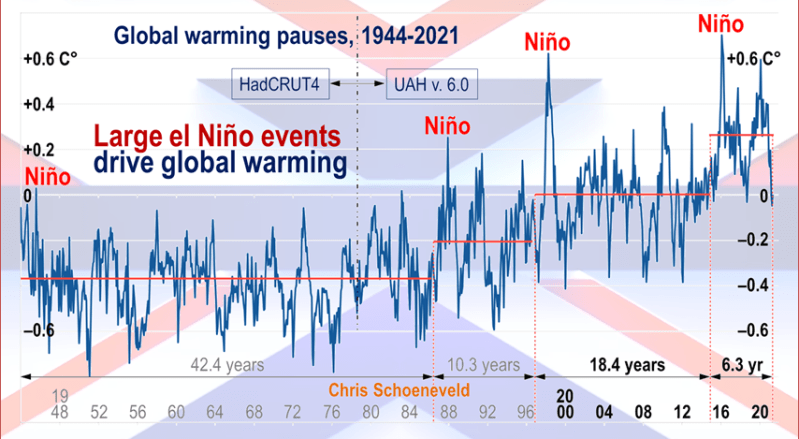
image-8

See Also Worst Threat: Greenhouse Gas or Quiet Sun?

March 2025 UAH Temps Yo-yo, Ocean First, Then Land banner-blog

With apologies to Paul Revere, this post is on the lookout for cooler weather with an eye on both the Land and the Sea.  While you heard a lot about 2020-21 temperatures matching 2016 as the highest ever, that spin ignores how fast the cooling set in.  The UAH data analyzed below shows that warming from the last El Nino had fully dissipated with chilly temperatures in all regions. After a warming blip in 2022, land and ocean temps dropped again with 2023 starting below the mean since 1995.  Spring and Summer 2023 saw a series of warmings, continuing into 2024 peaking in April, then cooling off to the present.

UAH has updated their TLT (temperatures in lower troposphere) dataset for March 2025. Due to one satellite drifting more than can be corrected, the dataset has been recalibrated and retitled as version 6.1 Graphs here contain this updated 6.1 data.  Posts on their reading of ocean air temps this month are ahead of the update from HadSST4.  I posted recently on SSTs February 2025 Oceans Keep Cool.  These posts have a separate graph of land air temps because the comparisons and contrasts are interesting as we contemplate possible cooling in coming months and years.

Sometimes air temps over land diverge from ocean air changes. In July 2024 all oceans were unchanged except for Tropical warming, while all land regions rose slightly. In August we saw a warming leap in SH land, slight Land cooling elsewhere, a dip in Tropical Ocean temp and slightly elsewhere.  September showed a dramatic drop in SH land, overcome by a greater NH land increase. 2025 has shown a sharp contrast between land and sea, first with ocean air temps falling in January recovering in February.  Then land air temps, especially NH, dropped in February and recovered in March.

Note:  UAH has shifted their baseline from 1981-2010 to 1991-2020 beginning with January 2021.   v6.1 data was recalibrated also starting with 2021. In the charts below, the trends and fluctuations remain the same but the anomaly values changed with the baseline reference shift.

Presently sea surface temperatures (SST) are the best available indicator of heat content gained or lost from earth’s climate system.  Enthalpy is the thermodynamic term for total heat content in a system, and humidity differences in air parcels affect enthalpy.  Measuring water temperature directly avoids distorted impressions from air measurements.  In addition, ocean covers 71% of the planet surface and thus dominates surface temperature estimates.  Eventually we will likely have reliable means of recording water temperatures at depth.

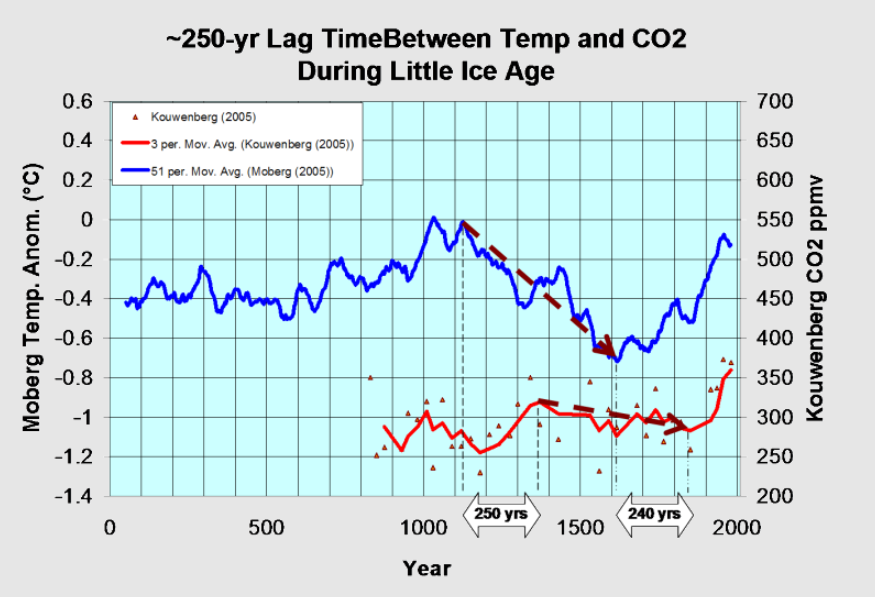
Recently, Dr. Ole Humlum reported from his research that air temperatures lag 2-3 months behind changes in SST.  Thus cooling oceans portend cooling land air temperatures to follow.  He also observed that changes in CO2 atmospheric concentrations lag behind SST by 11-12 months.  This latter point is addressed in a previous post Who to Blame for Rising CO2?

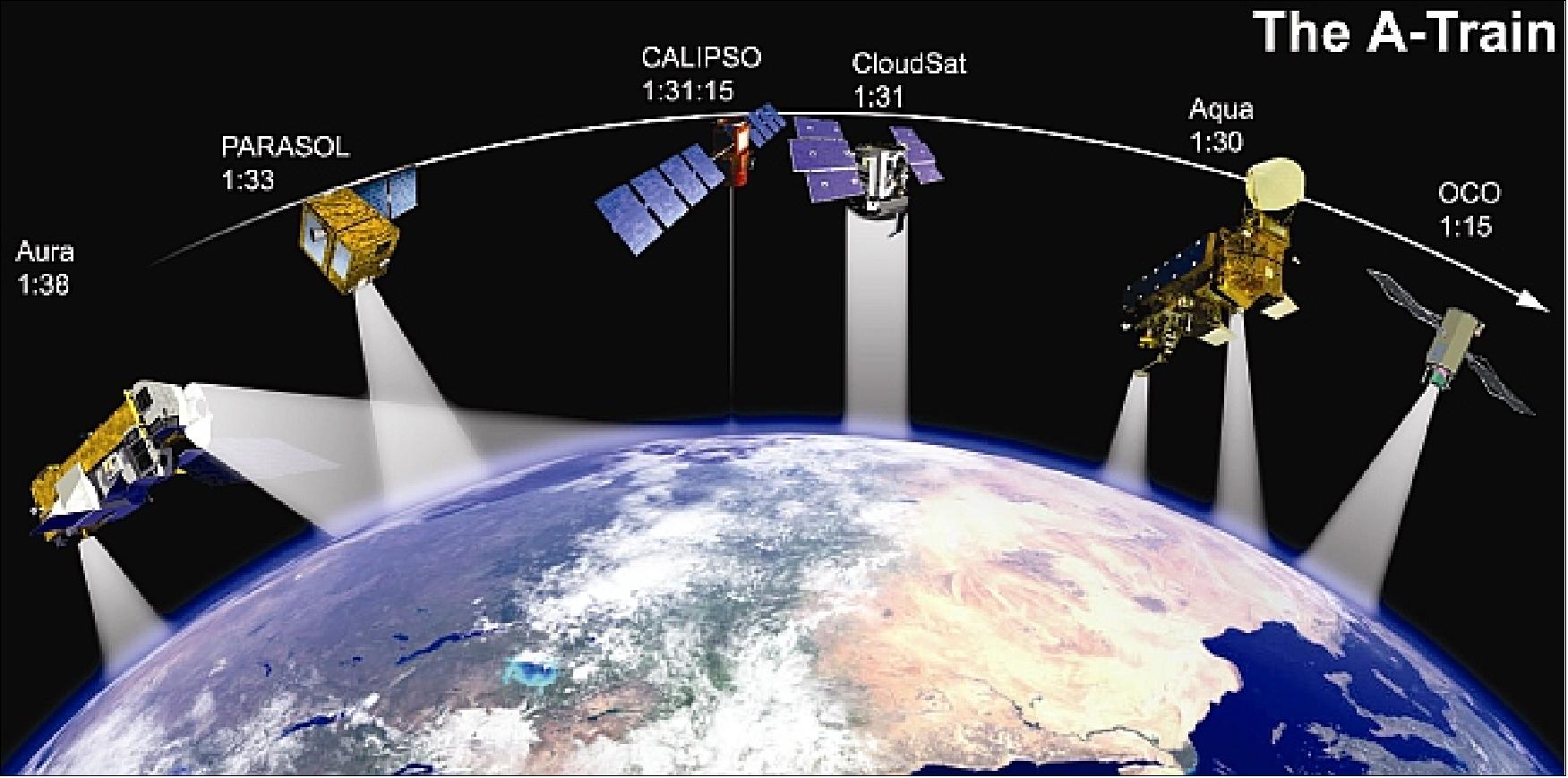
After a change in priorities, updates are now exclusive to HadSST4.  For comparison we can also look at lower troposphere temperatures (TLT) from UAHv6.1 which are now posted for March 2025.  The temperature record is derived from microwave sounding units (MSU) on board satellites like the one pictured above. Recently there was a change in UAH processing of satellite drift corrections, including dropping one platform which can no longer be corrected. The graphs below are taken from the revised and current dataset.

The UAH dataset includes temperature results for air above the oceans, and thus should be most comparable to the SSTs. There is the additional feature that ocean air temps avoid Urban Heat Islands (UHI).  The graph below shows monthly anomalies for ocean air temps since January 2015.
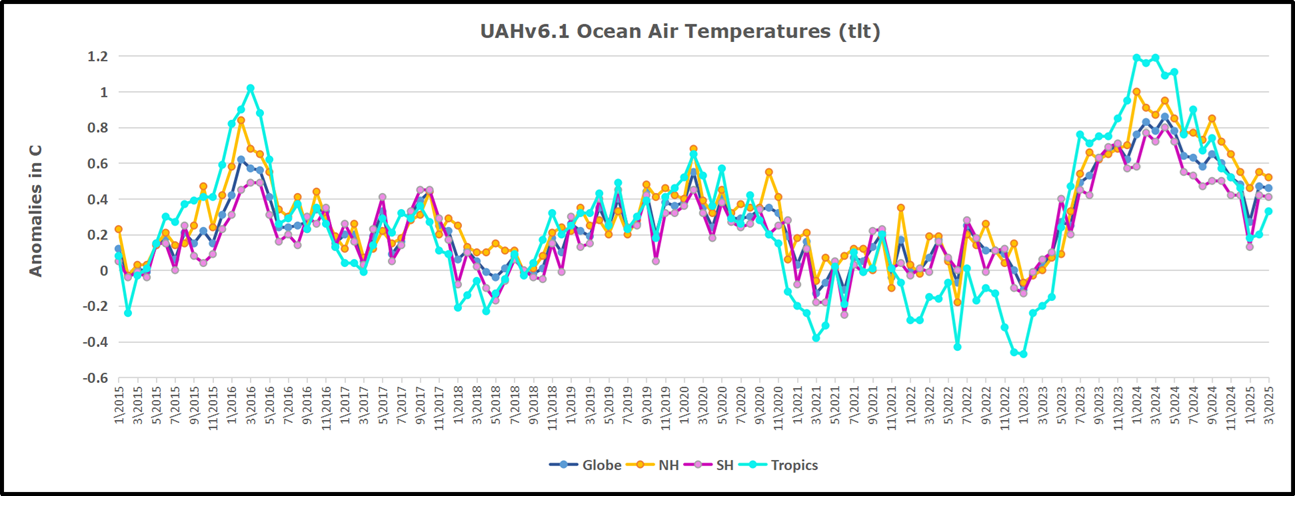
In 2021-22, SH and NH showed spikes up and down while the Tropics cooled dramatically, with some ups and downs, but hitting a new low in January 2023. At that point all regions were more or less in negative territory.

After sharp cooling everywhere in January 2023, there was a remarkable spiking of Tropical ocean temps from -0.5C up to + 1.2C in January 2024.  The rise was matched by other regions in 2024, such that the Global anomaly peaked at 0.86C in April. Since then all regions have cooled down sharply to a low of 0.27C in January.  In February 2025, SH rose from 0.1C to 0.4C pulling the Global ocean air anomaly up to 0.47C, where it stayed in March.

Land Air Temperatures Tracking in Seesaw Pattern

We sometimes overlook that in climate temperature records, while the oceans are measured directly with SSTs, land temps are measured only indirectly.  The land temperature records at surface stations sample air temps at 2 meters above ground.  UAH gives tlt anomalies for air over land separately from ocean air temps.  The graph updated for March is below.
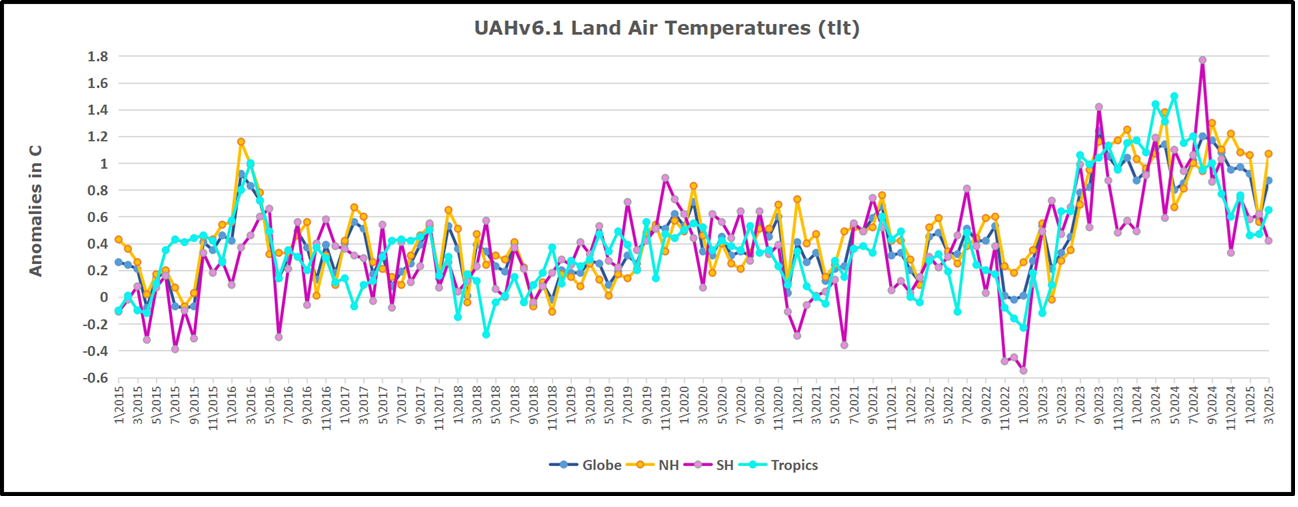
Here we have fresh evidence of the greater volatility of the Land temperatures, along with extraordinary departures by SH land.  The seesaw pattern in Land temps is similar to ocean temps 2021-22, except that SH is the outlier, hitting bottom in January 2023. Then exceptionally SH goes from -0.6C up to 1.4C in September 2023 and 1.8C in  August 2024, with a large drop in between.  In November, SH and the Tropics pulled the Global Land anomaly further down despite a bump in NH land temps. February showed a sharp drop in NH land air temps from 1.07C down to 0.56C, pulling the Global land anomaly downward from 0.9C to 0.6C. Now that drop is reversed in March with both NH and Global land back to January values, despite another drop in SH land air temps.

The Bigger Picture UAH Global Since 1980
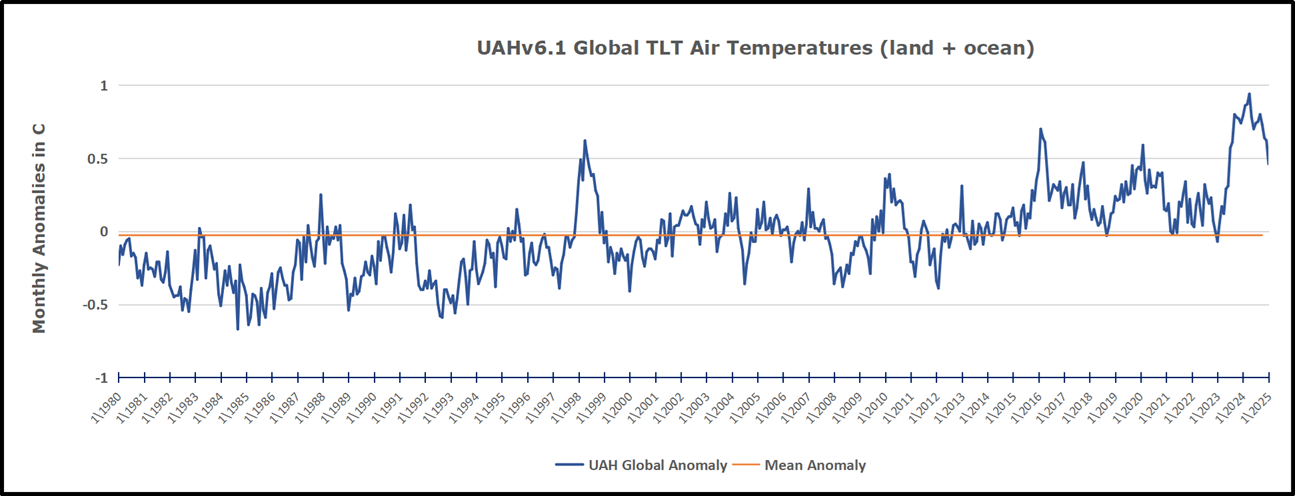
The chart shows monthly Global Land and Ocean anomalies starting 01/1980 to present.  The average monthly anomaly is -0.03, for this period of more than four decades.  The graph shows the 1998 El Nino after which the mean resumed, and again after the smaller 2010 event. The 2016 El Nino matched 1998 peak and in addition NH after effects lasted longer, followed by the NH warming 2019-20.   An upward bump in 2021 was reversed with temps having returned close to the mean as of 2/2022.  March and April brought warmer Global temps, later reversed

With the sharp drops in Nov., Dec. and January 2023 temps, there was no increase over 1980. Then in 2023 the buildup to the October/November peak exceeded the sharp April peak of the El Nino 1998 event. It also surpassed the February peak in 2016. In 2024 March and April took the Global anomaly to a new peak of 0.94C.  The cool down started with May dropping to 0.9C, and in June a further decline to 0.8C.  October went down to 0.7C,  November and December dropped to 0.6C. February went down to 0.5C, now back up to 0.6C driven by the bounce in NH land air temps.

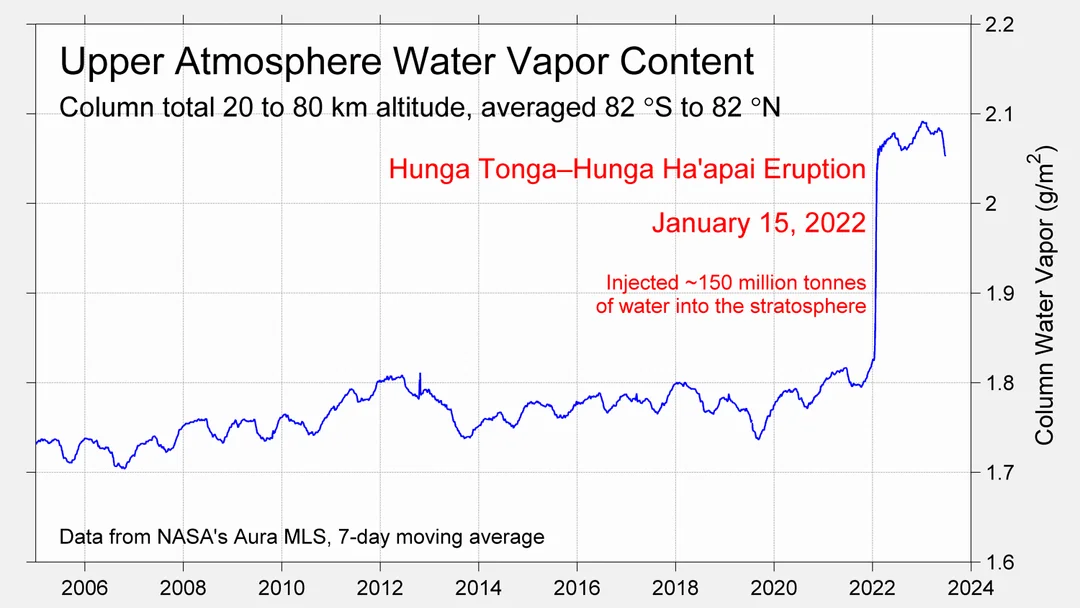
The graph reminds of another chart showing the abrupt ejection of humid air from Hunga Tonga eruption.
TLTs include mixing above the oceans and probably some influence from nearby more volatile land temps.  Clearly NH and Global land temps have been dropping in a seesaw pattern, nearly 1C lower than the 2016 peak.  Since the ocean has 1000 times the heat capacity as the atmosphere, that cooling is a significant driving force.  TLT measures started the recent cooling later than SSTs from HadSST4, but are now showing the same pattern. Despite the three El Ninos, their warming had not persisted prior to 2023, and without them it would probably have cooled since 1995.  Of course, the future has not yet been written.
The Right Climate Stuff

Not everyone is aware that the scientists and engineers who made the NASA space program successful disputed the global warming/climate change narrative promoted at the agency by people like James Hansen.

After all the slogan in the NASA workplace was that of Edward Deming, and they were only convinced by the facts rather than feelings or opinions about the future.  Many of them formed the Right Climate Stuff Foundation.

In particular Walter Cunningham explained his reasoning in an article In Science, Ignorance is not Bliss. Excerpts in italics with my bolds and added images.

NASA has played a key role in one of the greatest periods of scientific progress in history. It is uniquely positioned to collect the most comprehensive data on our biosphere.   For example, recently generated NASA data enabled scientists to finally understand the Gulf Stream warming mechanism and its effect on European weather. Such data will allow us to improve our models, resulting in better seasonal forecasts.

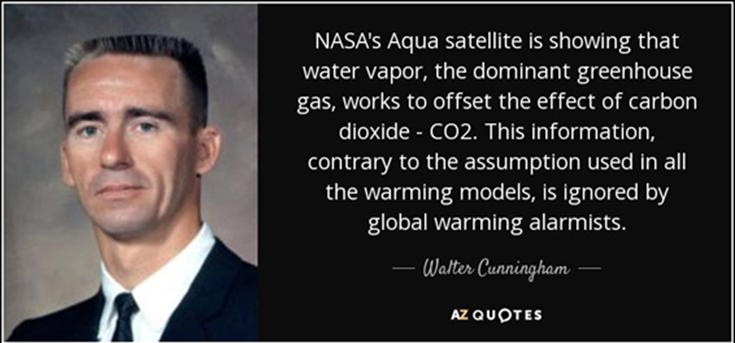
NASA’s Aqua satellite is showing that water vapor, the dominant greenhouse gas, works to offset the effect of carbon dioxide (CO2). This information, contrary to the assumption used in all the warming models, is ignored by global warming alarmists.

Climate understanding and critical decision making require
comprehensive data about our planet’s land, sea, and atmosphere.

Without an adequate satellite system to provide such data, policy efforts and monitoring international environmental agreements are doomed to failure. Our satellite monitoring capability is being crippled by interagency wrangling and federal budget issues. As much as a third of our satellites need replacing in the next couple of years.

NASA should be at the forefront in the collection of scientific evidence and debunking the current hysteria over human-caused, or Anthropogenic Global Warming (AGW). Unfortunately, it is becoming just another agency caught up in the politics of global warming, or worse, politicized science.

Advocacy is replacing objective evaluation of data, while
scientific data is being ignored in favor of emotions and politics.

There are excellent correlations between the regular fluctuations of the Sun and the Earth’s temperature, while scientists can not find a relationship between industrial activity, energy consumption, and global temperatures. But global warming is an issue no longer being decided in the scientific arena.

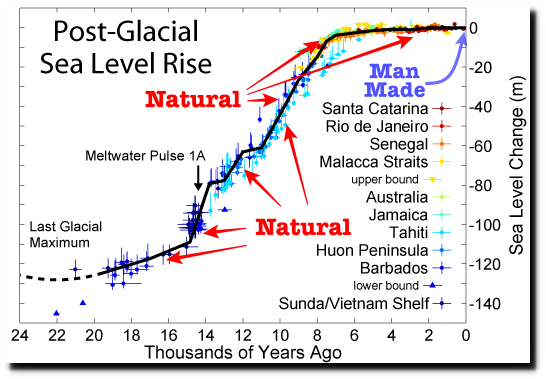
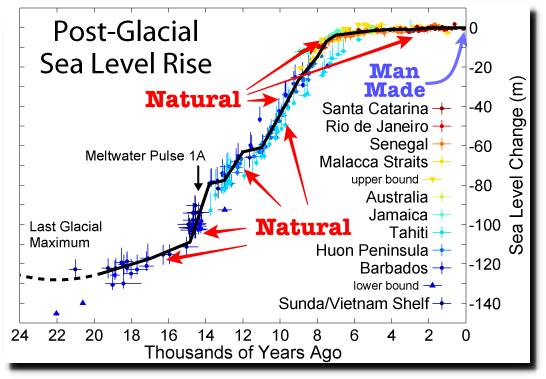
Saying the Earth is warming is to state the obvious. Since the end of the ice age, the Earth’s temperature has increased approximately 16 degrees Fahrenheit and sea levels have risen a total of 300 feet. That is certain and measurable evidence of warming, but it is not evidence of AGW—human-caused warming.

We can track the temperature of the Earth back for millennia. Knowing the temperature of the Earth, past or present, is a matter of collecting data, analyzing it, and coming up with the best answer to account for the data. Collecting such data on a global basis is a NASA forte. I believe in global climate change, but there is no way that humans can influence the temperature of our planet to any measurable degree with the tools currently at their disposal. Any human contribution to global temperature change is lost in the noise of terrestrial and cosmic factors.

Our beautiful home planet has been warming and cooling for the last 4.8 billion years. Most recently, it has been warming—be it ever so slightly—but there is nothing unusual about it! The changes and rates of change in the Earth’s temperature, just since the Industrial Revolution, have occurred many times in our climatic history. While climate scientists generally agree that the Earth’s temperature is always changing, not many of them would say that humans are responsible for those changes.

None of this is to say there are not legitimate reasons to restrict emissions of any number of chemicals into the atmosphere. We should just not fool ourselves into thinking we will change the temperature of the Earth by doing so.

In a December 2007 Senate report, 400 prominent scientists signed a letter pointing out that climate change was a well-known natural phenomenon, and that adapting to it is far more sensible than attempting to prevent it. Their ranks included experts in climatology, geology, oceanography, biology, glaciology, biogeography, meteorology, economics, chemistry, mathematics, environmental sciences, engineering, physics, and paleo-climatology.

Their message: When changes are gradual, man has
an almost infinite ability to adapt and evolve.

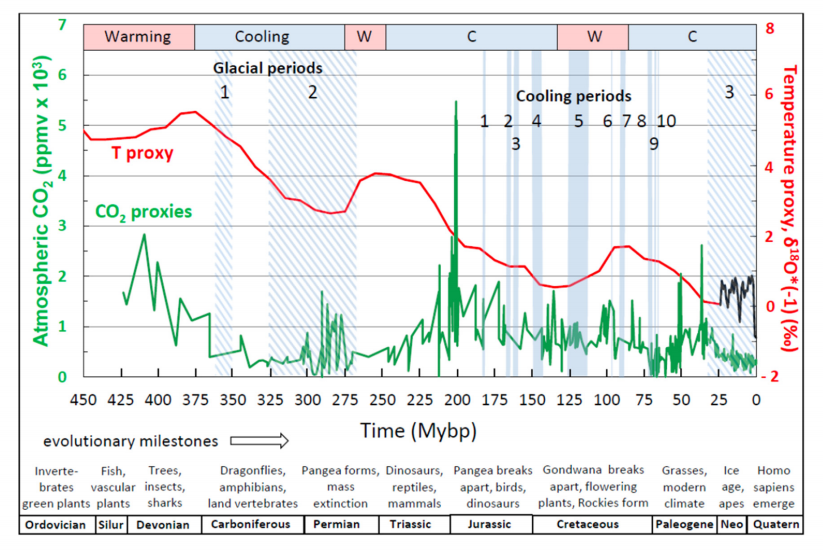
The fearmongers of global warming base their case on the correlation between CO2 and global temperature, even though we cannot be sure which is cause and which is effect. Historically, temperature increases have preceded high CO2 levels, and there have been periods when atmospheric CO2 levels were as much as 16 times what they are now, periods characterized not by warming but by glaciation. You might have to go back half a million years to match our current level of atmospheric CO2, but you only have to go back to the Medieval Warming Period, from the 10th to the 14th Century, to find an intense global warming episode, followed immediately by the drastic cooling of the Little Ice Age. Neither of these events were caused by variations in CO2 levels.

Even though CO2 is a relatively minor constituent of “greenhouse gases,” alarmists have made it the whipping boy for global warming (probably because they know how fruitless it would be to propose controlling other principal constituents, H2O, CH4, and N2O). Since human activity does contribute a tiny portion of atmospheric CO2, they blame us for global warming.

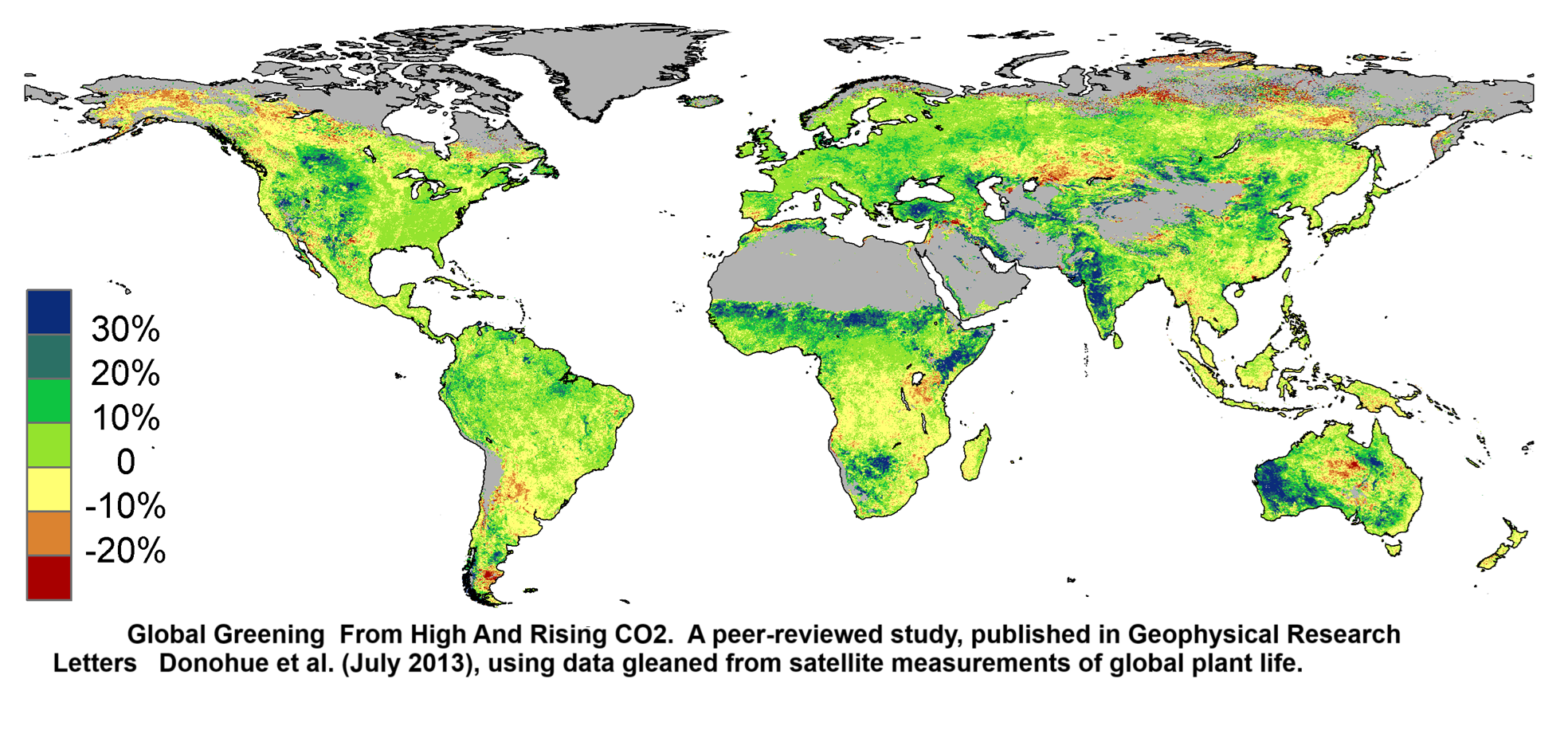
Other inconvenient facts ignored by the activists: Carbon dioxide is a nonpolluting gas, essential for plant photosynthesis. Higher concentrations of CO2 in the atmosphere produce bigger harvests.

In spite of warnings of severe consequences from rising seas, droughts, severe weather, species extinction, and other disasters, the U.S. has not been stampeded into going along with the recommendations of the UN Panel on Climate Change (IPCC)—so far. Even though evidence supports the American position, we have begun to show signs of caving in to the alarmists.

With scientific evidence going out of style,
emotional arguments and anecdotal data are ruling the day.

The media subjects us to one frightening image of environmental nightmare after another, linking each to global warming. Journalists and activist scientists use hurricanes, wildfires, and starving polar bears to appeal to our emotions, not to our reason. They are far more concerned with anecdotal observations, such as the frozen sea ice inside the Arctic Circle, than they are with understanding why it is happening and how frequently it has occurred in the past.

After warnings that 2007 would be the hottest year on record and a record year for hurricanes, what we experienced was the coolest year since 2001 and, by some measures, the most benign hurricane season in the Northern Hemisphere in three decades.

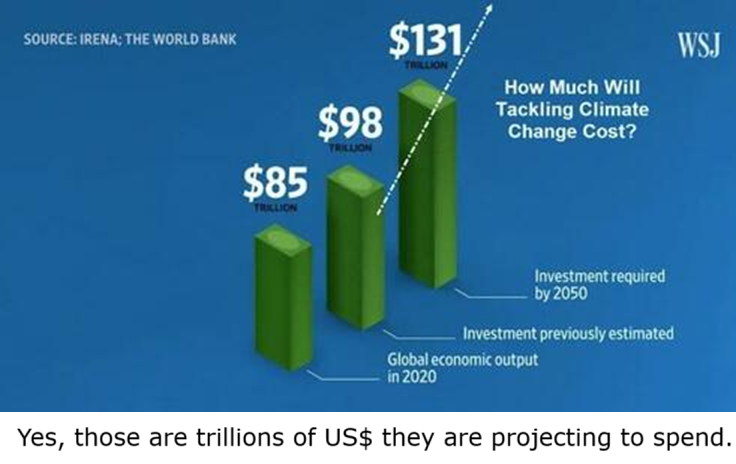
Even though recent changes in our atmosphere are all within the bounds of the Earth’s natural variability, a growing number of people are willing to throw away trillions of dollars on fruitless solutions. Why do we allow emotional appeals and anecdotal data to shape our conclusions and influence our expenditures with the science and technology we have available at our fingertips?

The situation is complex, but the sad state of scientific literacy in America today is partially to blame for belief in AGW. When a 2006 National Science Foundation survey found 25 percent of Americans not knowing the Earth revolves around the Sun, you know that science education is at a new low and society is vulnerable to the emotional appeal of AGW.

And don’t underestimate the role of politics and political correctness.

The public debate should focus on the real cause of global temperature change and whether we can do anything about it. Is global warming a natural inevitability, or is it AGW—human caused?

The conflict over AGW has deteriorated into a religious war; a war between true believers in human-caused global warming and nonbelievers; between those who accept AGW on faith and those who consider themselves more sensible and better informed. “True believers” are beyond being interested in evidence; it is impossible to reason a person out of positions they have not been reasoned into.

It doesn’t help that NASA scientist James Hansen was one of the early alarmists claiming humans caused global warming. Hansen is a political activist who spreads fear even when NASA’s own data contradict him.

Warming in the upper atmosphere should occur before any surface warming effect, but NASA’s own data show that has not been happening. Global temperature readings—accurate to 0.1 degree Celsius—are gathered by orbiting satellites. Interestingly, in the 18 years those satellites have been recording global temperatures, they have actually shown a slight decrease in average temperatures.

Hansen is currently calling for a reduction of atmospheric CO2 by 10 percent and a moratorium on coal-fired power plants, while claiming the Bush administration is censoring him. Other so-called scientists are saying the world must bring carbon emissions to near zero to keep temperatures from rising.

In today’s politically correct environment, many are reluctant to dispute the popular wisdom; when they do, they are frequently ignored. When NASA Administrator Michael Griffin, Hansen’s boss and a distinguished scientist in his own right, attempted to draw a distinction between Hansen’s personal and political views and the science conducted by his agency, he was soon forced to back off.

It is the true believers who, when they have no facts on their side, try to silence their critics. When former NASA mathematician Ferenc Miskolczi pointed out that “greenhouse warming” may be mathematically impossible, NASA would not allow him to publish his work. Miskolczi dared to question the simplifying assumption in the warming model that the atmosphere is infinitely thick. He pointed out that when you use the correct thickness—about 65 miles—the greenhouse effect disappears! Ergo: no AGW. Miskolczi resigned in disgust and published his proof in the peer reviewed Hungarian journal Weather. [See: The Curious Case of Dr. Miskolczi]

For nearly a decade now, there has been no global warming. Even though atmospheric CO2 has continued to accumulate—up about 4 percent in the last 10 years—the global mean temperature has remained flat. That should raise obvious questions about CO2 being the cause of climate change.

Instead, AGW enthusiasts are embracing more regulation, greater government spending, and higher taxes in a futile attempt to control what is beyond our control—the Earth’s temperature. One of their political objectives, unstated of course, is the transfer of wealth from rich nations to poor nations or, as the social engineers put it, from the North to the South, which may be their real agenda.

Climate Lemmings

In the face of overwhelming evidence for natural temperature variation, proponents of AGW are resorting to a precautionary argument: “We must do something just in case we are responsible, because the consequences are too terrible if we are to blame and do nothing.” They hope to stampede government entities into committing huge amounts of money before their fraud is completely exposed—before science and truth save the day.

Politicians think they can reverse global warming by stabilizing CO2 emissions with a cockamamie scheme of “cap and trade.” A government entity would sell CO2 allocations to those industries producing it. The trillions of dollars in new taxes and devastation to the economy would be justified by claiming it will lower the temperature of the Earth. This rationalization is dependent on two assumptions: (1) that CO2 is responsible for the cause of changes in the Earth’s temperature, and (2) a warmer Earth would be bad for humanity.

The reality is that atmospheric CO2 has a minimal impact on greenhouse gases and world temperature. Water vapor is responsible for 95 percent of the greenhouse effect. CO2 contributes just 3.6 percent, with human activity responsible for only 3.2 percent of that. That is why some studies claim CO2 levels are largely irrelevant to global warming.

Without the greenhouse effect to keep our world warm, the planet would have an average temperature of minus 18 degrees Celsius. Because we do have it, the temperature is a comfortable plus 15 degrees Celsius. Based on the seasonal and geographic distribution of any projected warming, a good case can be made that a warmer average temperature would be even more beneficial for humans.

For a tiny fraction of the trillions of dollars a cap-and-trade system would eventually cost the United States, we could pay for development of clean coal, oil-shale recovery systems, and nuclear power, and have enough left over to pay for exploration of our solar system.

By law, NASA cannot involve itself in politics, but it can surely champion the role of science to inform politicians. With so many uninformed and misguided politicians ignoring the available science, NASA should fill the void. NASA is synonymous with science. Allowing our priorities to drift away from hard science is tantamount to embracing decadence. NASA will surely suffer; and politicizing science is killing it.

I do see hopeful signs that some true believers are beginning to harbor doubts about AGW. Let’s hope that NASA can focus the global warming discussion back on scientific evidence before we perpetrate an economic disaster on ourselves.

Walter Cunningham, (1932–2023) geophysicist, fighter pilot and Apollo 7 astronaut, who flew the first test flight of the Apollo Program, Apollo 7.  In 2010, Cunningham published a short book titled “Global Warming: Facts versus Faith” His editorial was published in the Houston Chronicle on August 15, 2010,  Climate change alarmists ignore scientific methods.  (When You Don’t Have the Facts, Appeal to Public Opinion).  In 2012, he and other former astronauts and NASA employees sent a letter to the agency criticizing its role advocating a high degree of certainty that man-made CO2 is a major cause of climate change while neglecting empirical evidence that calls the theory into question.

Arctic Ice March Maximum 2025 in Perspective

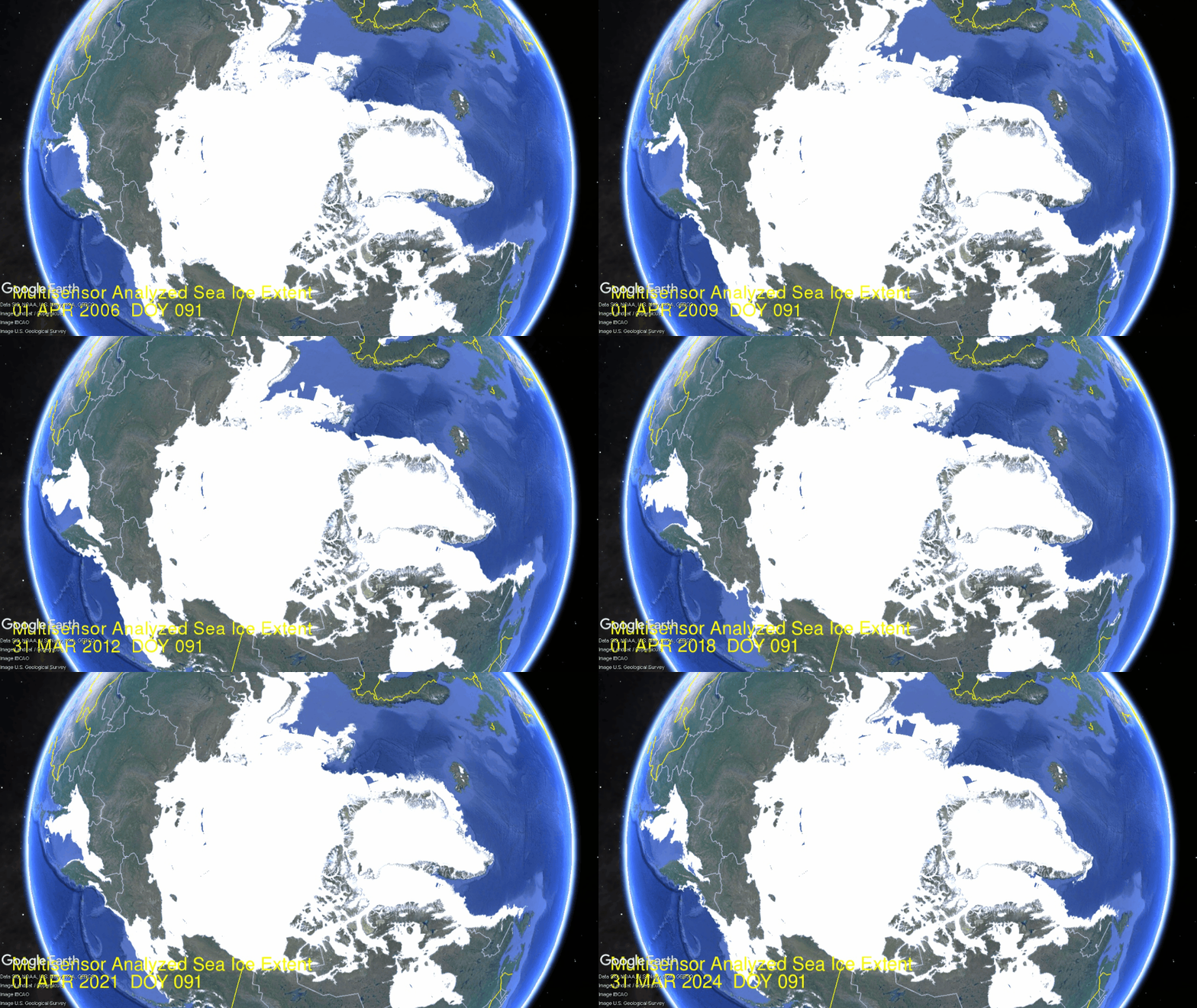
The animation shows end of March Arctic ice extents on day 91 over the last 19 years (length of MASIE dataset). Of course central Arctic basins are frozen solid, and the fluctuations are visible on the marginal basins both the Atlantic side (right) and the Pacific (left). Note the higher extents in 2012, followed by lesser ice, then overcome by 2024.

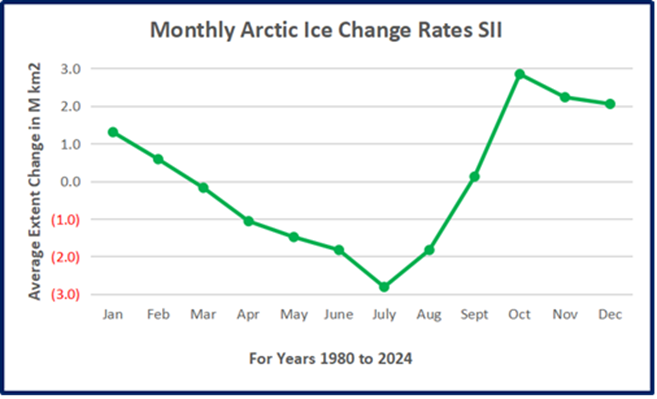
Climatology takes the March monthly average to indicate the annual maximum and September average as the minimum.  Dynamically, the Arctic gains and loses ice extents in this pattern:

The values in the chart are the month ending ice extents (last five days average) minus the ice extents at end of the previous month.  Thus positive numbers show ice gained each month, negative numbers ice lost in a given month.  SII (Sea Ice Index) provides a data file calculating and updating these results since 1980. Note that the peak month of March on average declines very slightly, while the minimum month of September on average gains a little ice extent.  Also the greatest average gain of ice is in October and the greatest loss of extent is in July.

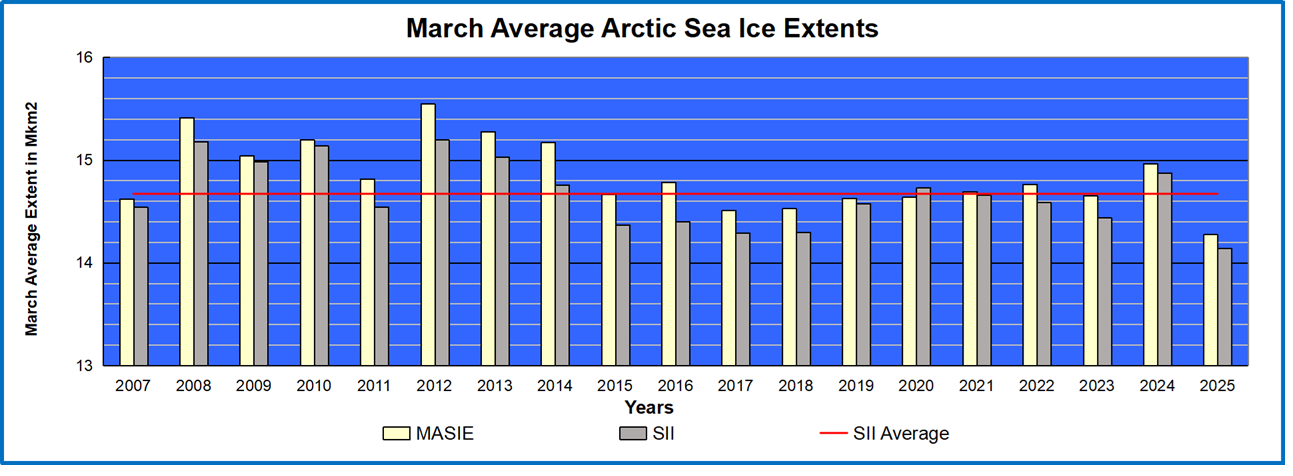
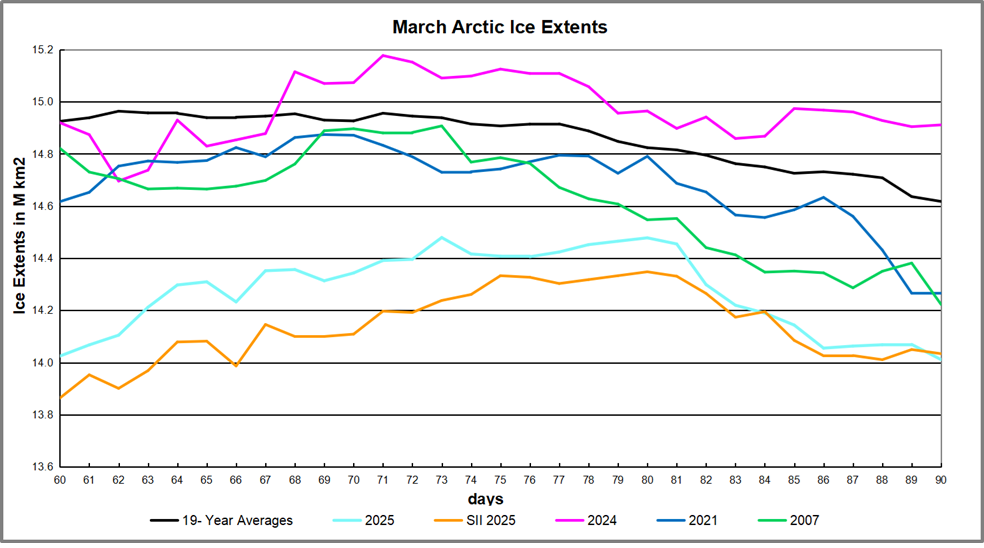
Above is a chart of March Monthly averages since 2007. The variability shows, including 2024 well above the 19-year average and 2025 well below.

This graph shows variations of ice extents during March, on average and for some recent years along with 2007.  The exceptional extents in 2024 stand out, along with the more typical 2021 and 2007.  On average during March the Arctic loses about 400k km2 of ice.  2025 started March at 14M km2, about 900k km2 in deficit, and ended virtually the same 14M, 600k km2 below average on day 90. SII was slightly lower than MASIE for three weeks, then ended about the same.

The table below shows the distribution of ice extents across the Arctic regions.

Region 2025090 Ave Day 090 2025-Ave. 2007090 2025-2007
 (0) Northern_Hemisphere 14011379 14617665 -606287 14222916 -211537
 (1) Beaufort_Sea 1071001 1070241 760 1069711 1290
 (2) Chukchi_Sea 965989 964237 1752 966006 -17
 (3) East_Siberian_Sea 1087137 1086266 871 1074908 12229
 (4) Laptev_Sea 897845 897098 747 884340 13505
 (5) Kara_Sea 885597 920703 -35106 892157 -6560
 (6) Barents_Sea 450824 664324 -213500 441970 8854
 (7) Greenland_Sea 703578 665146 38433 686312 17266
 (8) Baffin_Bay_Gulf_of_St._Lawrence 1350818 1386137 -35320 1217467 133351
 (9) Canadian_Archipelago 854878 853269 1609 850127 4751
 (10) Hudson_Bay 1260903 1255273 5631 1229995 30908
 (11) Central_Arctic 3237488 3234612 2876 3242236.7 -4749
 (12) Bering_Sea 593465 711340 -117875 814787.71 -221323
 (13) Baltic_Sea 20341 62183 -41842 45896.93 -25556
 (14) Sea_of_Okhotsk 628758 836750 -207992 794657 -165899

Overall 2025 Arctic ice is 4% below the 19 year average and 1% below 2007.  About half of the 606k km2 deficit is in the Pacific basins of Bering and Okhotsk, typically the first to go to open water. The other major case of early melting is in the Atlantic Barents Sea.

Why is this important?  All the claims of global climate emergency depend on dangerously higher temperatures, lower sea ice, and rising sea levels.  The lack of additional warming prior to 2023 El Nino is documented in a post Ocean Warms, Land Cools UAH February 2025.


The lack of acceleration in sea levels along coastlines has been discussed also.  See Observed vs. Imagined Sea Levels 2023 Update

Also, a longer term perspective is informative:

post-glacial_sea_level