Wacky New Climate Lawsuit: Wrongful Death from Heat Wave

David Zaruk reports at Real Climate Science Climate Activists Sue Oil Industry for Wrongful Death.  Excerpts in italics with my bolds and added images.

Climate activists employing tort law firms have lost one lawsuit after another in their misguided crusade to bankrupt energy companies by blaming them for the effects of climate change. This isn’t about justice, for victims deserving or otherwise, but instead a nakedly unscrupulous effort to achieve progressive policy ends by ulterior means. 

But it hasn’t panned out, as a growing number of “public nuisance” cases–tried in liberal and conservative jurisdictions and adjudicated by Democrat- and Republican-appointed judges alike–have been dismissed or lost for abusing law, science, and common sense.

Rather than admit defeat and abandon this strategy, however, the lawyers and activists are trying a new approach: wrongful death suits. No longer are oil companies only at fault for statewide climate damages caused by everyone’s CO2 emissions—now the tactic is to make them responsible for specific, individual fatalities. At least that’s the fantastical argument they’re hoping to present in court.

The first such case was filed last month when Washington resident Misti Leon brought a wrongful death complaint in state court against seven major energy companies and a subsidiary pipeline firm claiming the greenhouse emissions from their products contributed to a 2021 heat wave that killed her mother, Juliana Leon. The victim was found dead after a long drive in a car without air conditioning during a record-breaking 108°F day in Seattle.

The lawsuit alleges these companies knowingly altered the climate,
failed to warn the public, and are liable for Juliana’s death by hyperthermia. 

While the tragedy of Juliana’s death is undeniable, this lawsuit is a scientifically preposterous and ideologically driven attempt to exploit personal loss for political gain, masquerading as a quest for justice. 

A flawed premise

The premise of the lawsuit—that oil companies’ emissions directly caused a specific heat wave and, by extension, an individual’s death—is a leap that collapses under even the slightest scrutiny. Climate science cannot pinpoint a single weather event as the direct result of any one company’s actions. CO2 emissions are a global, cumulative phenomenon, with contributions from countless sources—industrial, agricultural, and individual. Furthermore, there are so many other factors beyond CO2 emissions that could affect particular weather events.

When global warming skeptics employ this curious logic in the opposite direction, using specific weather events like heavy snowfall to debunk climate change, environmental activists rightly highlight the flawed logic: you can’t deny a global phenomenon based on regional weather events. “… [W]hat happens locally, or over short periods of time, is not necessarily representative of what’s happening nationally and globally,” Yale University’s Center for Environmental Communication explains.

Yet when Leon claims that “each Defendant is transacting or has transacted substantial business in Washington,” she is committing the same fallacy by trying to tie global phenomena to company-specific operations in a single state. As judges presiding over previous climate cases have concluded, the plaintiffs can’t have it both ways.

It’s simply untenable to allege a global corporate conspiracy
while demanding restitution for a local tragedy. 

The lawsuit’s reliance on attribution science, which estimates the likelihood that climate change made an event more probable, underscores this problem. It’s widely recognized within mainstream climatology that “Event attribution is not ready for a major role in loss and damage” claims, as a recent article in the prestigious journal Nature Climate Change observed. One of the key reasons for this conservative stance toward attribution science is that it’s based on complex models built on myriad assumptions about the atmospheric conditions across entire countries–and around the world.

Legitimate wrongful death claims require clear causation and foreseeability. Here, the chain is impossibly attenuated: emissions from multiple companies, mixed globally over decades, allegedly intensified a heat wave, which, combined with Juliana’s tragic personal circumstances (a long drive with no air conditioning, diagnosed comorbidities, and recovering from major surgery), led to her death. There is simply no reasonable way to leap from existing attribution studies to that conclusion. 

Rehashing “Exxon Knew”

The lawsuit’s narrative hinges on the claim that these companies “knew” their products would cause “catastrophic climate disasters” yet misled the public. “Defendants have concealed their knowledge of and deceived the public about these risks,” Leon’s complaint alleges, “hooking consumers on fossil fuels without their understanding or consent to the risk of harm to themselves, others, and the planet.”

The gaping flaw in this logic was recently exposed by a Delaware judge presiding over a related climate suit, which also blamed specific damages in the state on the oil industry. As Firebreak’s analysis of that case pointed out, the “Exxon Knew” trope is based on the assumption that the effects of climate change have been “open and obvious” for decades. The plaintiffs, Ms. Leon included, are desperately trying to accuse the energy industry of successfully denying a phenomenon that everyone has been aware of for decades. The plaintiffs’ response to this criticism? Dead silence. As the Delaware judge observed in her decision

“There were reports and stories in The Washington Post and The New York Times that warned the public about global warming and the deception used by oil and coal industries … Defendants have provided evidence showing that the general public had knowledge of or had access to information about the disputes, regarding the existence of climate change and effects, decades prior …This information and evidence is unrefuted by the State.”

While it’s true that energy companies conducted internal research on the potential environmental impacts of their products–as all companies do as part of basic risk management scenario building–so did governments, universities, and other industries. What all of these groups have in common is that they wanted more information about the potential risks, and tradeoffs, of an extremely useful and civilizationally pivotal source of energy. 

Combined, these knowledge seekers built a gradual, evolving scientific consensus on global warming—which is far less alarmist than the public has been told. For instance, it’s now widely recognized by many experts (even if with a degree of disappointment) that a runaway warming scenario is highly unlikely.

The fact that energy companies contributed to this consensus about climate change isn’t scandalous—and it’s certainly no justification for a wrongful death suit. Internal industry documents from decades ago confirm that oil companies were studying long-term climate trends, but they certainly didn’t have a crystal ball that predicted the effects of warming half a century later.

Thanks for the cheap energy, see you in court 

The overarching problem with Ms. Leon’s claim is that fossil fuels power modern civilization with the literal and figurative “buy-in” of governments, businesses, and citizens. As willing consumers of abundant food, affordable electricity, life-sustaining and life-saving tools, and medical devices, we are, all of us, undeniably contributors to the effects of climate change, whatever they turn out to be. 

The lawsuit’s accusation of a grand conspiracy sidesteps this shared responsibility for social choices, painting oil companies as singular villains. We can’t build a sprawling, global civilization powered by oil and gas and then turn around and sue the industry that supplied us with so much inexpensive energy. Quite literally every plaintiff in these climate damage suits–every city, state, and now individual–has been and continues to be a longtime customer of the fossil fuel industry. The hypocrisy is off the charts.

Demand for justice or ideological crusade?

And while Leon’s complaint frames the suit as a quest for justice, her demands expose just how disingenuous the case is. Beyond unspecified damages, Misti Leon seeks to force these companies to fund “a public education campaign to rectify Defendants’ decades of misinformation.” This smacks of activism, not justice. It suggests the goal is less about compensating a loss than about scoring points in the culture war over climate policy. 

The Center for Climate Integrity, an advocacy group backing the case, frames it as a landmark effort to hold “Big Oil” accountable. Yet, their rhetoric—calling the lawsuit the first to tie an individual death to a “climate disaster”—reveals a strategy of emotional manipulation, leveraging Juliana’s death to galvanize public sentiment rather than establish legal merit. 

Ultimately, this lawsuit cheapens a genuine tragedy. Juliana Leon’s death should be mourned, not exploited. Climate change is a real challenge, but addressing it demands rigorous science, honest policy, and collective action. Frivolous lawsuits that clog courts don’t aid in those efforts. This case, like many before it, will likely falter under its own weight, a cautionary tale of zeal outpacing reason. 

NH and Tropics Lead UAH Temps Lower May 2025

The post below updates the UAH record of air temperatures over land and ocean. Each month and year exposes again the growing disconnect between the real world and the Zero Carbon zealots.  It is as though the anti-hydrocarbon band wagon hopes to drown out the data contradicting their justification for the Great Energy Transition.  Yes, there was warming from an El Nino buildup coincidental with North Atlantic warming, but no basis to blame it on CO2.

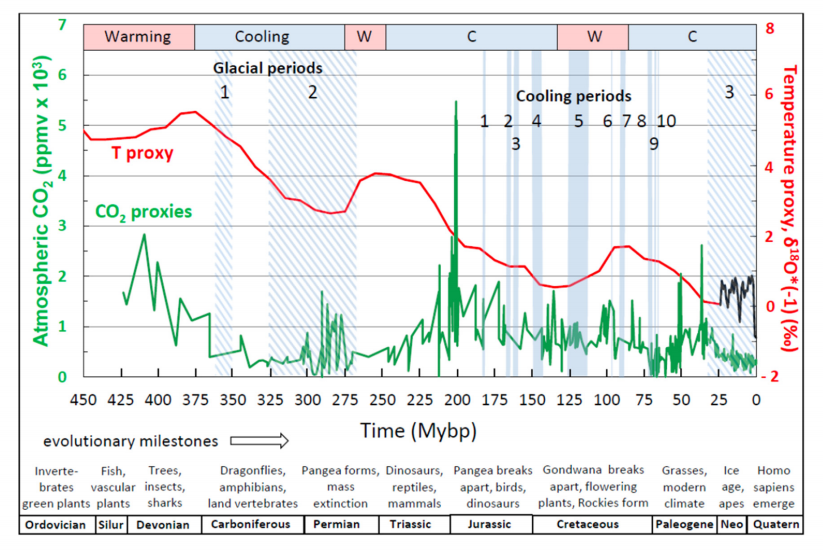
As an overview consider how recent rapid cooling  completely overcame the warming from the last 3 El Ninos (1998, 2010 and 2016).  The UAH record shows that the effects of the last one were gone as of April 2021, again in November 2021, and in February and June 2022  At year end 2022 and continuing into 2023 global temp anomaly matched or went lower than average since 1995, an ENSO neutral year. (UAH baseline is now 1991-2020). Then there was an usual El Nino warming spike of uncertain cause, unrelated to steadily rising CO2 and now dropping steadily.
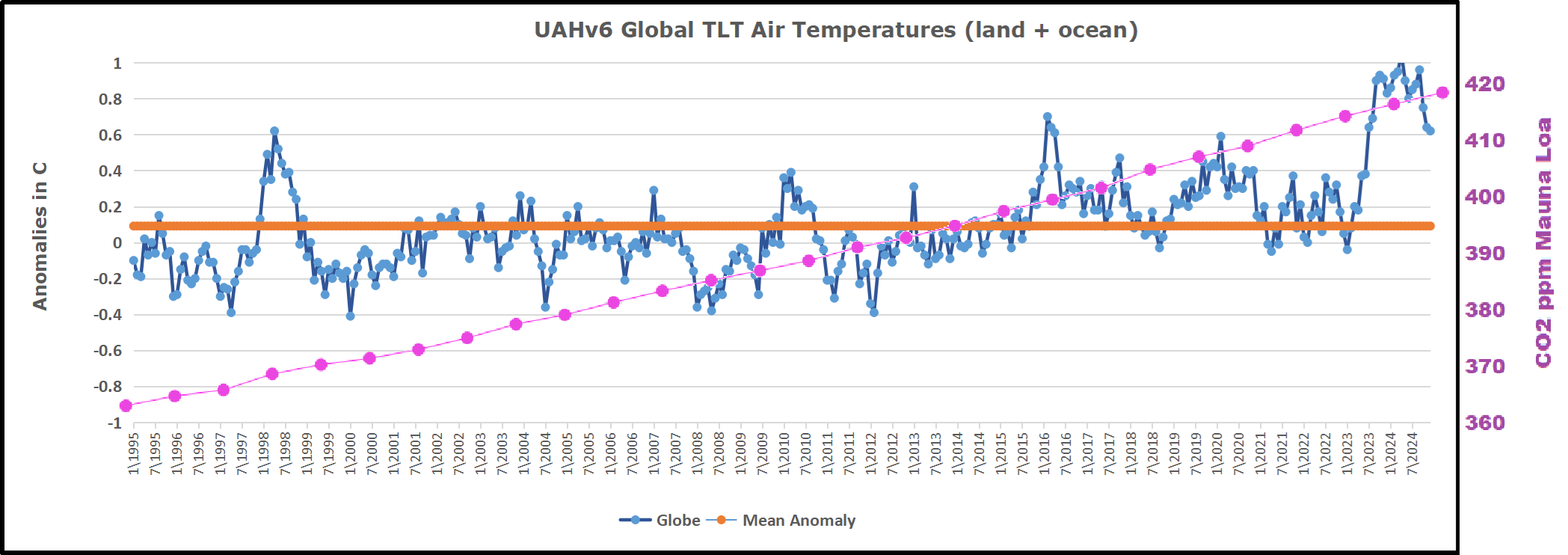
For reference I added an overlay of CO2 annual concentrations as measured at Mauna Loa.  While temperatures fluctuated up and down ending flat, CO2 went up steadily by ~60 ppm, a 15% increase.

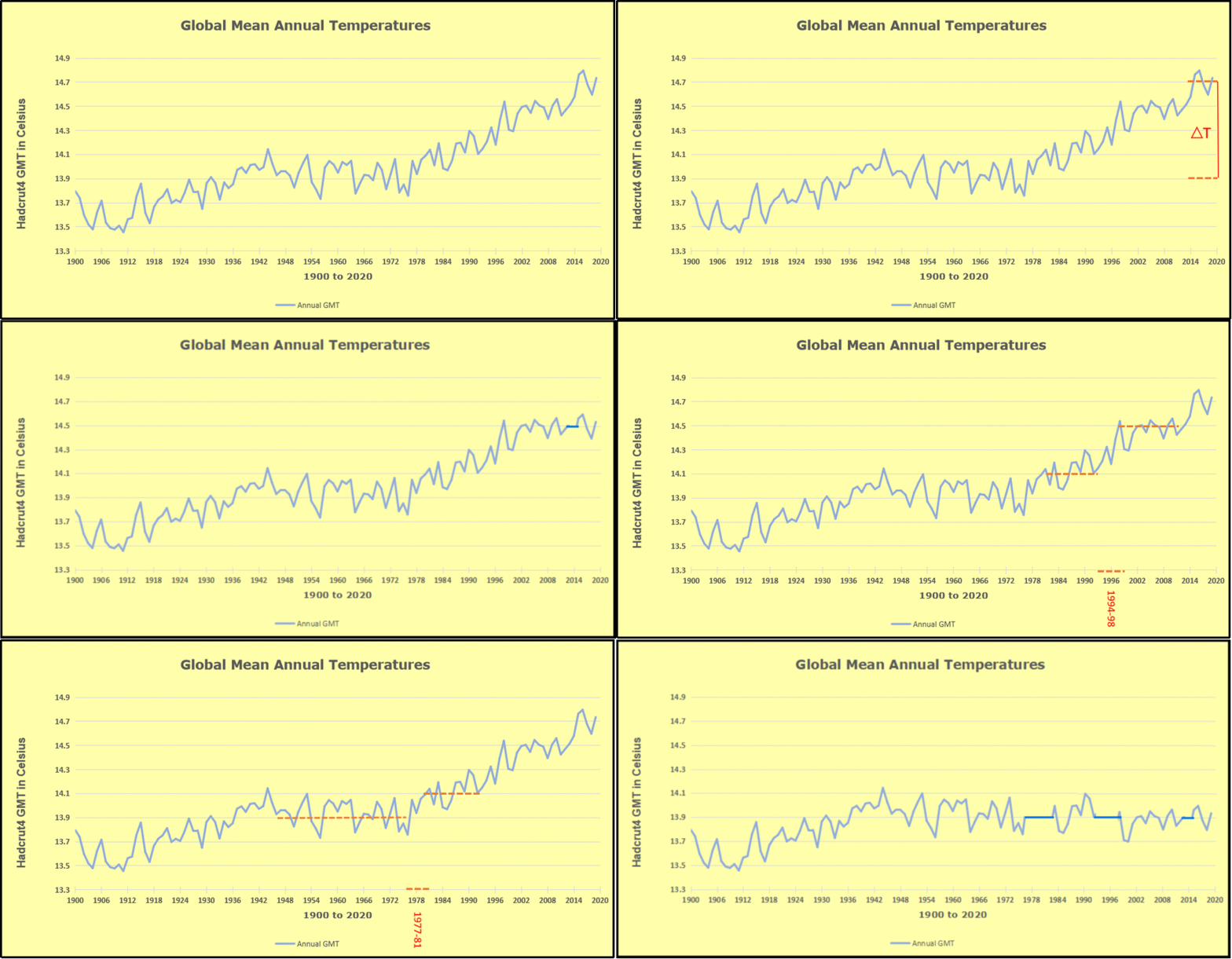
Furthermore, going back to previous warmings prior to the satellite record shows that the entire rise of 0.8C since 1947 is due to oceanic, not human activity.
gmt-warming-events

The animation is an update of a previous analysis from Dr. Murry Salby.  These graphs use Hadcrut4 and include the 2016 El Nino warming event.  The exhibit shows since 1947 GMT warmed by 0.8 C, from 13.9 to 14.7, as estimated by Hadcrut4.  This resulted from three natural warming events involving ocean cycles. The most recent rise 2013-16 lifted temperatures by 0.2C.  Previously the 1997-98 El Nino produced a plateau increase of 0.4C.  Before that, a rise from 1977-81 added 0.2C to start the warming since 1947.

Importantly, the theory of human-caused global warming asserts that increasing CO2 in the atmosphere changes the baseline and causes systemic warming in our climate.  On the contrary, all of the warming since 1947 was episodic, coming from three brief events associated with oceanic cycles. And in 2024 we saw an amazing episode with a temperature spike driven by ocean air warming in all regions, along with rising NH land temperatures, now dropping below its peak.

Chris Schoeneveld has produced a similar graph to the animation above, with a temperature series combining HadCRUT4 and UAH6. H/T WUWT
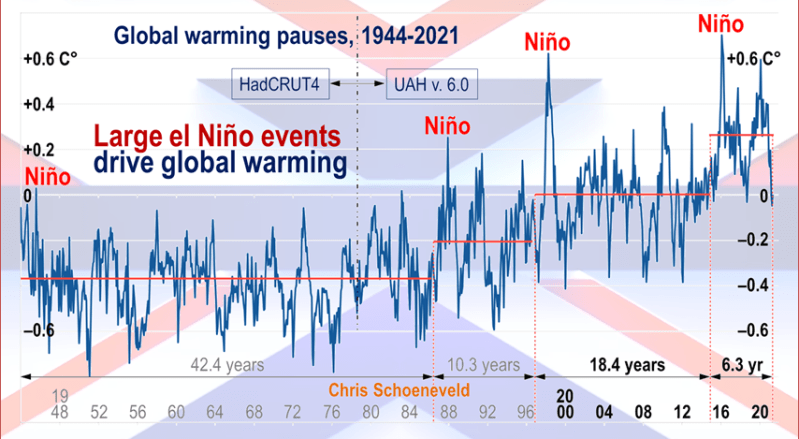
image-8

See Also Worst Threat: Greenhouse Gas or Quiet Sun?

May 2025 NH and Tropics Lead UAH Temps Lower banner-blog

With apologies to Paul Revere, this post is on the lookout for cooler weather with an eye on both the Land and the Sea.  While you heard a lot about 2020-21 temperatures matching 2016 as the highest ever, that spin ignores how fast the cooling set in.  The UAH data analyzed below shows that warming from the last El Nino had fully dissipated with chilly temperatures in all regions. After a warming blip in 2022, land and ocean temps dropped again with 2023 starting below the mean since 1995.  Spring and Summer 2023 saw a series of warmings, continuing into 2024 peaking in April, then cooling off to the present.

UAH has updated their TLT (temperatures in lower troposphere) dataset for May 2025. Due to one satellite drifting more than can be corrected, the dataset has been recalibrated and retitled as version 6.1 Graphs here contain this updated 6.1 data.  Posts on their reading of ocean air temps this month are ahead of the update from HadSST4.  I posted recently on SSTs April 2025 Two Years Ocean Warming Gone These posts have a separate graph of land air temps because the comparisons and contrasts are interesting as we contemplate possible cooling in coming months and years.

Sometimes air temps over land diverge from ocean air changes. In July 2024 all oceans were unchanged except for Tropical warming, while all land regions rose slightly. In August we saw a warming leap in SH land, slight Land cooling elsewhere, a dip in Tropical Ocean temp and slightly elsewhere.  September showed a dramatic drop in SH land, overcome by a greater NH land increase. 2025 has shown a sharp contrast between land and sea, first with ocean air temps falling in January recovering in February.  Then land air temps, especially NH, dropped in February and recovered in March. Now in May both land and sea temps are down in NH and Tropics, overwhelming slight rises of both in SH.

Note:  UAH has shifted their baseline from 1981-2010 to 1991-2020 beginning with January 2021.   v6.1 data was recalibrated also starting with 2021. In the charts below, the trends and fluctuations remain the same but the anomaly values changed with the baseline reference shift.

Presently sea surface temperatures (SST) are the best available indicator of heat content gained or lost from earth’s climate system.  Enthalpy is the thermodynamic term for total heat content in a system, and humidity differences in air parcels affect enthalpy.  Measuring water temperature directly avoids distorted impressions from air measurements.  In addition, ocean covers 71% of the planet surface and thus dominates surface temperature estimates.  Eventually we will likely have reliable means of recording water temperatures at depth.

Recently, Dr. Ole Humlum reported from his research that air temperatures lag 2-3 months behind changes in SST.  Thus cooling oceans portend cooling land air temperatures to follow.  He also observed that changes in CO2 atmospheric concentrations lag behind SST by 11-12 months.  This latter point is addressed in a previous post Who to Blame for Rising CO2?

After a change in priorities, updates are now exclusive to HadSST4.  For comparison we can also look at lower troposphere temperatures (TLT) from UAHv6.1 which are now posted for May 2025.  The temperature record is derived from microwave sounding units (MSU) on board satellites like the one pictured above. Recently there was a change in UAH processing of satellite drift corrections, including dropping one platform which can no longer be corrected. The graphs below are taken from the revised and current dataset.

The UAH dataset includes temperature results for air above the oceans, and thus should be most comparable to the SSTs. There is the additional feature that ocean air temps avoid Urban Heat Islands (UHI).  The graph below shows monthly anomalies for ocean air temps since January 2015.
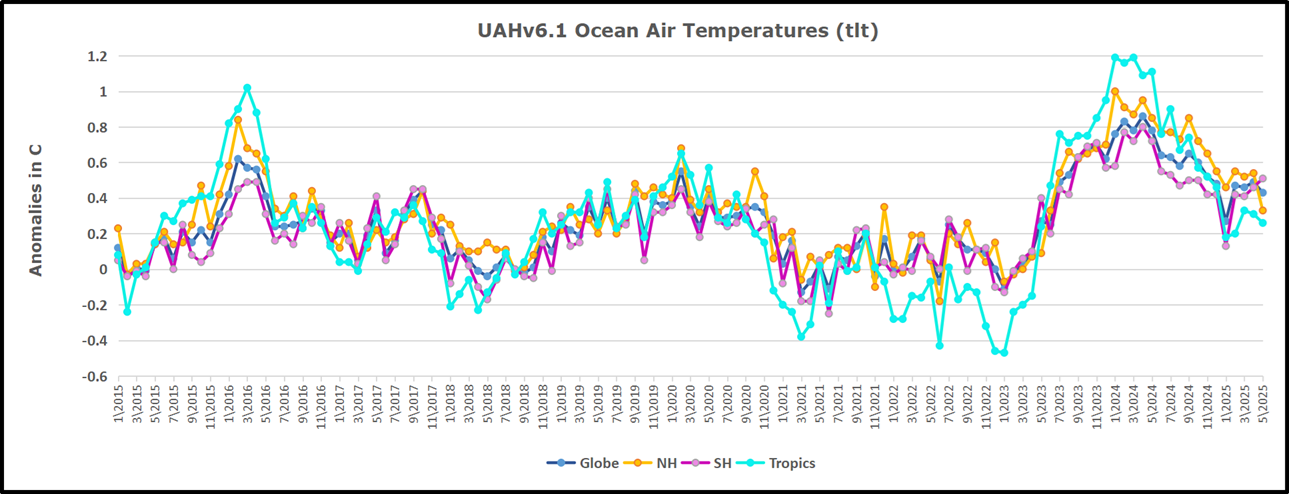
In 2021-22, SH and NH showed spikes up and down while the Tropics cooled dramatically, with some ups and downs, but hitting a new low in January 2023. At that point all regions were more or less in negative territory.

After sharp cooling everywhere in January 2023, there was a remarkable spiking of Tropical ocean temps from -0.5C up to + 1.2C in January 2024.  The rise was matched by other regions in 2024, such that the Global anomaly peaked at 0.86C in April. Since then all regions have cooled down sharply to a low of 0.27C in January.  In February 2025, SH rose from 0.1C to 0.4C pulling the Global ocean air anomaly up to 0.47C, where it stayed in March and April. Now in May drops in NH and Tropics pulled the air temps over oceans down despite an uptick in SH. At 0.43C, ocean air temps are similar to May 2020, albeit with higher SH anomalies.

Land Air Temperatures Tracking in Seesaw Pattern

We sometimes overlook that in climate temperature records, while the oceans are measured directly with SSTs, land temps are measured only indirectly.  The land temperature records at surface stations sample air temps at 2 meters above ground.  UAH gives tlt anomalies for air over land separately from ocean air temps.  The graph updated for May is below.
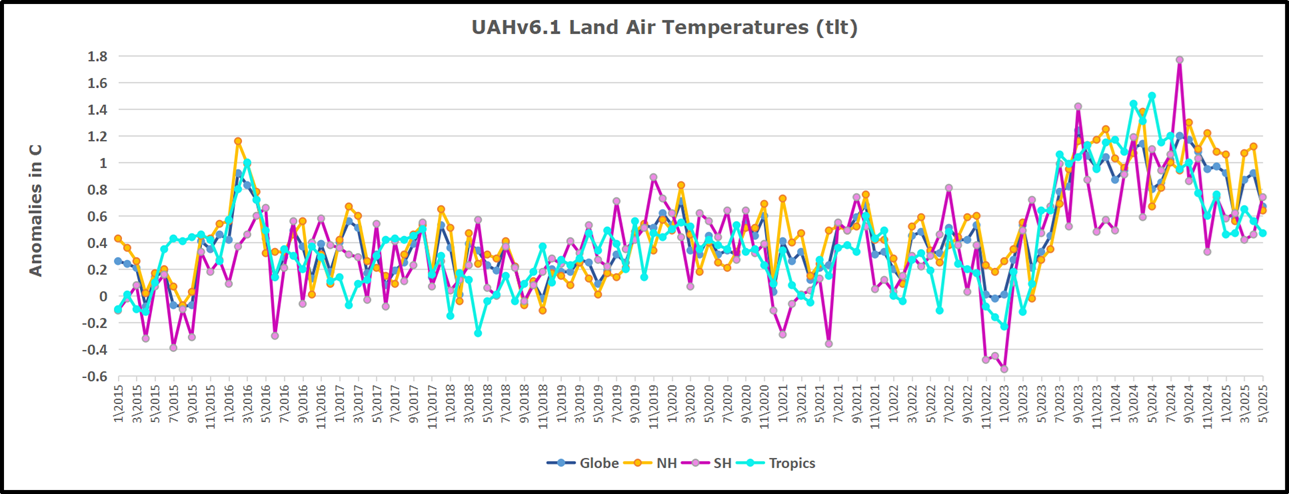
 Here we have fresh evidence of the greater volatility of the Land temperatures, along with extraordinary departures by SH land.  The seesaw pattern in Land temps is similar to ocean temps 2021-22, except that SH is the outlier, hitting bottom in January 2023. Then exceptionally SH goes from -0.6C up to 1.4C in September 2023 and 1.8C in  August 2024, with a large drop in between.  In November, SH and the Tropics pulled the Global Land anomaly further down despite a bump in NH land temps. February showed a sharp drop in NH land air temps from 1.07C down to 0.56C, pulling the Global land anomaly downward from 0.9C to 0.6C. In March that drop reversed with both NH and Global land back to January values, holding there in April.  Now in May, sharp drops in NH and Tropics land air temps pulled the Global land air temps back down close to February value.

The Bigger Picture UAH Global Since 1980
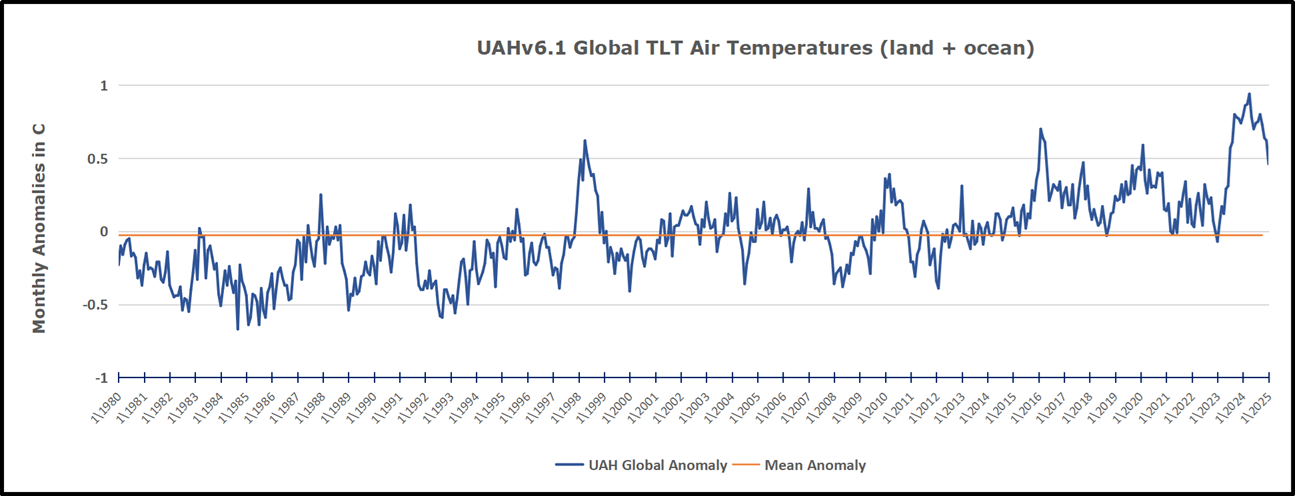
The chart shows monthly Global Land and Ocean anomalies starting 01/1980 to present.  The average monthly anomaly is -0.03, for this period of more than four decades.  The graph shows the 1998 El Nino after which the mean resumed, and again after the smaller 2010 event. The 2016 El Nino matched 1998 peak and in addition NH after effects lasted longer, followed by the NH warming 2019-20.   An upward bump in 2021 was reversed with temps having returned close to the mean as of 2/2022.  March and April brought warmer Global temps, later reversed

With the sharp drops in Nov., Dec. and January 2023 temps, there was no increase over 1980. Then in 2023 the buildup to the October/November peak exceeded the sharp April peak of the El Nino 1998 event. It also surpassed the February peak in 2016. In 2024 March and April took the Global anomaly to a new peak of 0.94C.  The cool down started with May dropping to 0.9C, and in June a further decline to 0.8C.  October went down to 0.7C,  November and December dropped to 0.6C. February went down to 0.5C, then back up to 0.6C in March and April driven by the bounce in NH land air temps, followed by May’s return to 0.5C.

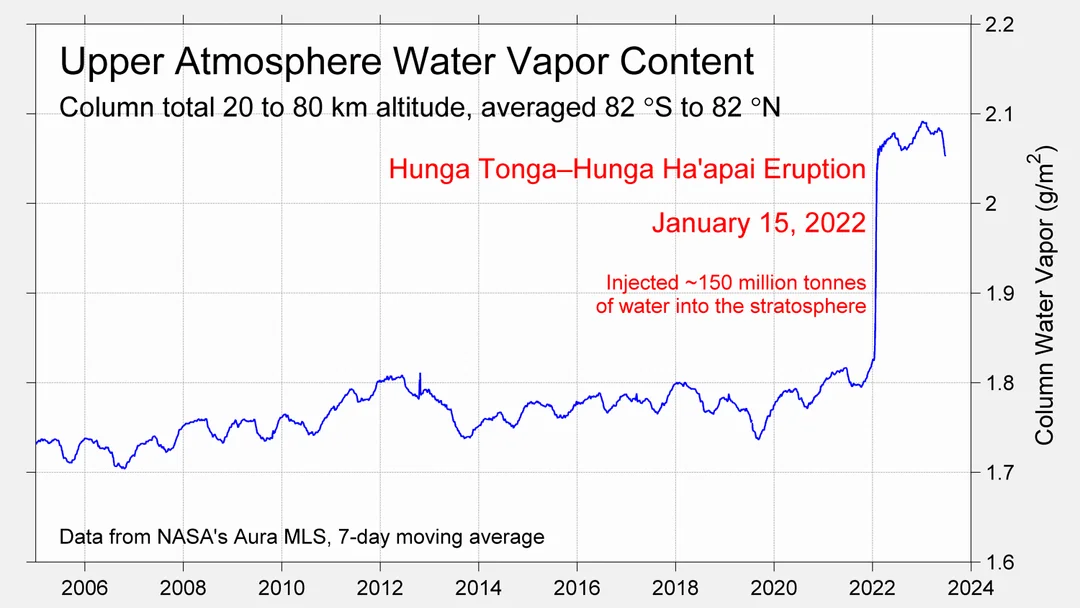
The graph reminds of another chart showing the abrupt ejection of humid air from Hunga Tonga eruption.
Note on Ocean Cooling Not Yet Fully Appearing in UAH Dataset
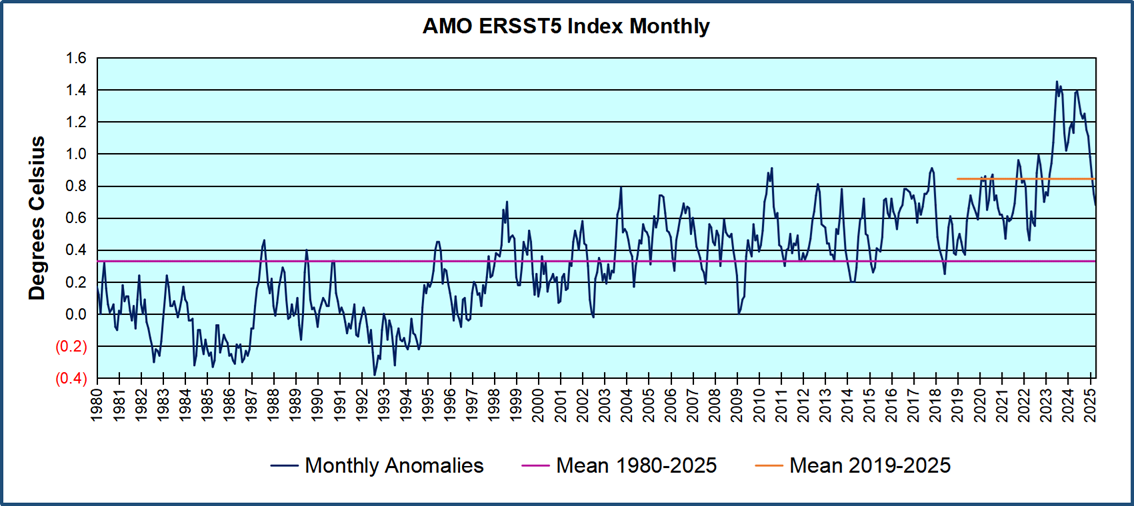
The above chart shows sea surface temperature anomalies (SSTA)  in the North Atlantic 0 to 60N.  The index is derived from ERSSTv.5 by subtracting the global anomalies from the North Atlantic anomalies, the differences as shown in the chart. The baseline of  0.0C is the average for the years 1951 to 1980.  The mean anomaly since 1980 is in purple at 0.33C, and persisted throughout up to 2018. The orange line is the average anomaly in the the last six years, 2019 to 04/2025 inclusive, at 0.84C. The remarkable spikes in 2023 and 2024 drove that rise to exceed 1.4C, which has been cut in half over the last 10 months.  As Dr. Humlum observed, such oceanic changes usually portend air temperature changes later on.

TLTs include mixing above the oceans and probably some influence from nearby more volatile land temps.  Clearly NH and Global land temps have been dropping in a seesaw pattern, nearly 1C lower than the 2016 peak.  Since the ocean has 1000 times the heat capacity as the atmosphere, that cooling is a significant driving force.  TLT measures started the recent cooling later than SSTs from HadSST4, but are now showing the same pattern. Despite the three El Ninos, their warming had not persisted prior to 2023, and without them it would probably have cooled since 1995.  Of course, the future has not yet been written.

Climate Policies to What End?

Oren Cass writes at Commonplace Who Is Climate Policy For?  Not workers. Excerpts in italics with my bolds and added images.

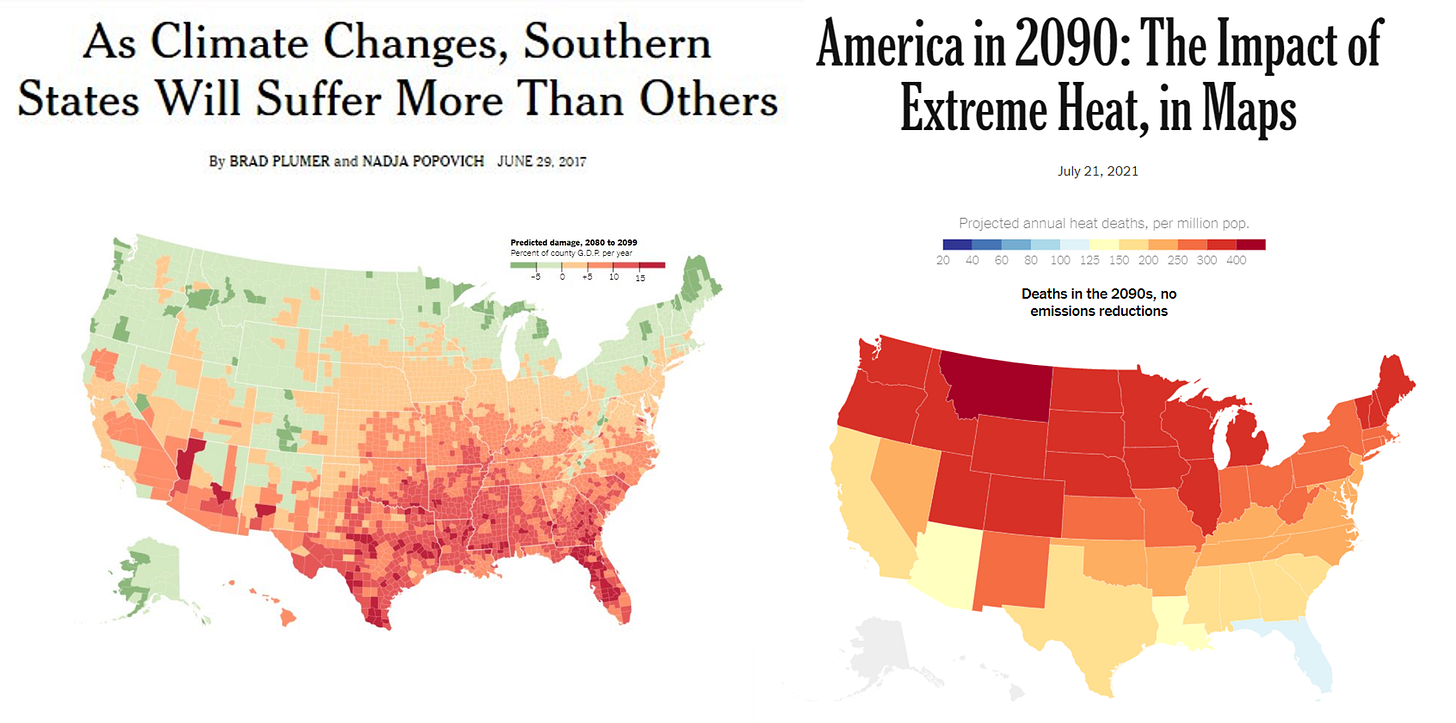
I mostly stopped writing about climate change in 2018, when actual analysis lost all relevance to the increasingly unmoored claims of climate activists. The frequently cited estimates of catastrophic cost, I showed in published reports and congressional testimony, were simply nonsensical. One prominent model relied upon by the EPA predicted that heat deaths in northern cities in the year 2100 would be 50 times higher than they had been in southern cities in the year 2000, despite the northern cities never reaching the temperatures that the southern cities were already experiencing. Another study, published in Nature, predicted that warming would boost Mongolia’s GDP per capita to more than four times America’s. But no one cared; no one was held accountable.

When subsequent research flipped the claims on their head, no one even flinched. Here’s the New York Times, four years apart:

(Technically, the first chart is GDP loss, while the second is heat deaths. But as the Times explained, the main driver of GDP loss in that first chart is heat deaths: “The greatest economic impact would come from a projected increase in heat wave deaths as temperatures soared, which is why states like Alabama and Georgia would face higher risks while the cooler Northeast would not.”) [Note:  Observations actually show a “warming hole” in Southeast US, perhaps due in part to reforestation efforts.]

Discussion of solutions, meanwhile, became entirely performative. So many climate agreements were signed, none had the prospect of substantially shifting the trajectory of global emissions, which is driven overwhelmingly by growth in the developing world. The Biden administration spent four years trumpeting unprecedented investment in fighting climate change. Try to find a comment linking that action to a downward shift in future temperatures or a reduction in any of the purportedly existential harms repeated ad nauseum as the basis for the action. I’ll wait.

The climate lectures had become the equivalent of the parent telling his children to eat their vegetables, because children in Africa are starving.

So now I encounter climate change mostly in the context of discussions about how best to build a policy agenda that serves the interests of American workers, and the working class broadly. Along with the refusal to enforce immigration law and the passion for shoveling hundreds of billions of dollars into a higher education system that fails most young people, the obsession with fighting climate change is a quintessential tradeoff preferred by progressives that they are of course welcome to make, but that cannot be squared with a commitment to working-class interests.

Progressives tend not to appreciate this observation,
or the cognitive dissonance that it triggers.

As I wrote in The Once and Future Worker, “People know how they want society ordered and wish desperately for that same thing to be good for everyone else.” Our 20-year-old texter feels this strongly. Fighting the climate crisis and providing for working families are not mutually exclusive. But the belief in a mythological crisis goes forever unsubstantiated. What is the ongoing devastation of communities that Biden-style policy action will mitigate?

To be clear, when I say mythological crisis, I don’t mean that climate change is a myth. I think climate change is a very serious challenge with which the United States, and the world, must find ways to cope. I’d also like to see us pursuing aggressive public investment in next-generation nuclear technology, and in the industrial precursors to strong electric vehicle supply chains—both of which are smart industrial policy regardless of climate implications.

But in the broader scheme of a century of economic, technological,
and geopolitical changes and challenges, the gradual increase
in global temperatures does not rank high.

This is not my opinion, it is the conclusion of the climate models, the UN’s Intergovernmental Panel on Climate Change, and the analyses that attempt to translate these forecasts into economic impacts. Climate change is not one of the top challenges facing working families in America. Solving it, if we could, which we can’t, would do little to move the needle in helping them achieve middle-class security.

But what about the “Green New Deal”? It has “New Deal” right in the title, suggesting a clear commitment to improving economic opportunity! That’s true, as far as it goes. Indeed, we could launch a “Purple New Deal” dedicated to knocking down all buildings that are not purple and replacing them with purple ones, which would also have many jobs associated with it.  Unfortunately, that’s not good economic policy.

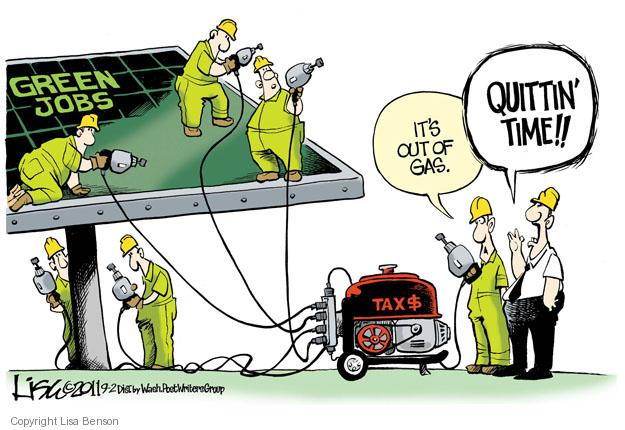
What the Green New Deal—and climate policy, generally—attempts to do is shut down the existing energy industry and much of the industrial economy that relies on cheap and reliable energy, and replace it all with new “green” jobs. This should not require saying, but apparently does: Supplanting an existing, robust energy sector and industrial economy that provides a lot of very good jobs outside of our knowledge economy and superstar cities, with a new set of industries that hopes to do the same, does not in fact deliver economic gains.

The stated goal of climate policy is to replace things we already have. Anything new it creates is an attempt to climb back out of a hole it has dug itself. And unfortunately, the new tends to be less good, economically speaking, than the old. That reality in the auto industry is what drove the UAW strike last year.

The best way to understand all this is with a simple hypothetical: Let’s say we didn’t have to worry about climate change. A neat little box sucked greenhouse gases out of the atmosphere for free; problem solved. Would anyone still propose the Green New Deal? No climate change to worry about, you need to propose an agenda to support working families, how high on the list is “spend trillions of dollars shutting down the industrial economy and attempting to replace it with a set of less efficient and unproven technologies in which the United States has a much weaker position”?

It’s nowhere on the list.
Because climate policy does not help the working class.

For whatever reason, the project of decarbonizing the economy captures the progressive mind like no other. Ezra Klein and Derek Thompson’s Abundanceopens with a paragraph about waking up in the year 2050 in a cool bedroom powered by clean energy sources—a bedroom no cooler than the one you would wake up in today. Their abundant future is, first and foremost, not a more abundant one at all—merely one whose energy system they have transformed. Discussing scarcities, they start with, “We say that we want to save the planet from climate change.” When they enthuse that “new technologies create new possibilities and allow us to solve once-impossible problems,” they are thinking first of greenhouse gas emissions. “We worry,” first, “over climate change.” And “this book is motivated in no small part by our belief that we need to decarbonize the global economy.”

In my podcast with Klein, I asked him whether combatting climate change might represent a tradeoff in his agenda, rather than item one for bringing abundance to America. “For most, certainly, liberals who think about this and have studied this,” he responded, “the decarbonization is just central to the idea of what it would mean for our descendants to live a flourishing life.” Pitched this way, it fits perfectly the ideological template of most neoliberal missteps of the past 30 years: a purported win-win that serves the priorities of highly educated, high-income elites, who then instruct everyone else that the same thing should be their priority too. Like globalization, and unrestricted immigration, and free college.

Fool me once… Climate policy imposes massive costs, and damages the industrial economy, in pursuit of a specific goal: reducing carbon dioxide emissions. And if that’s your goal, that’s fine. Fight for it! Make the case for the tradeoff. But don’t pretend there’s no tradeoff, and certainly don’t tell the people you’re trading off that you’re really doing it for them.


See Also 

Eco-Loons War on Productive Working Class


Net Zero Now Elephant in Corporate World

Irina Slav explains the shift away from climate virtue in her Oil Price article Corporate World Goes Quiet on Climate Pledges.  Excerpts in italics with my bolds and added images.

♦  Major companies are quietly scaling back climate language in reports, with firms like American Airlines, GM, and Coca-Cola reducing or removing net-zero and emissions-related content.
♦  Profitability and political headwinds are driving the retreat.
♦  Corporate climate messaging is becoming more cautious, with 80% of executives adjusting their transition narratives and half avoiding net-zero talk entirely.

Companies in various industries are removing climate change and net zero language from their reports, the Wall Street Journal reported this month, lamenting the fact that corporates were “watering down” their commitments in the area. It may be temporaryor it may be the natural thing.

Analysis of the proxy statements of a number of large businesses conducted by the WSJ showed that many of them were, it seems, less willing to discuss climate change and their response to it in as much detail as they were a few years ago. The WSJ suggested it was an about-turn prompted by the energy policies of the Trump administration and the axing of the Inflation Reduction Act.

Companies “implicated” in watering down their climate change language included American Airlines, Kroger, American Eagle Outfitters, and e.l.f. Beauty. Their crime was either reducing the amount of text dedicated to climate change and the respective company’s efforts to counter it or entirely removing such text.

The above are not the only ones that have gone rather general on climate change. Coca-Cola only mentions climate and emissions in general terms and briefly in its latest proxy statement. GM also does not go into a lot of detail on its net-zero efforts, and neither does United Airlines.

Yet there are perfectly respectable reasons for this,
even from a climate activist perspective.

Most of these companies produce separate reports regarding climate change and emission reduction because it is the done thing these days. Indeed, one of them told the WSJ as much. “We periodically adjust the copy used in the company’s external messaging and communications,” a spokesperson for American Eagle Outfitters told the publication. “AEO’s commitment to reducing greenhouse-gas emissions remains unchanged.”

Other comments from the mentioned companies follow the same lines: these businesses have already internalized emission-cutting language and action, and no longer feel the need to talk loudly about it.

And, of course, there’s the Trump factor at work.

The current administration axed billions on subsidies for transition-related businesses. As a result, these businesses are suffering a fate even worse than theirs already was because of:

♦  raw material inflation;
♦  higher borrowing costs that had nothing to do with the Trump admin, and, notably,
♦  pullback from investors that realized they had grossly overestimated the speed, at which their investment in net zero would be returned.

Trump’s policies certainly hurt the coolness aspect of net-zero pledges and pronouncements but it was the lack of promised profits that likely played a bigger part and led to companies toning down these pledges and pronouncements.

“The whole sector — solar, wind, hydrogen, fuel cells — anything clean is dead for now,” one energy transition-focused hedge fund manager told Bloomberg earlier this year. “The fundamentals are very poor,” Gupta, who manages some $100 million, told Bloomberg, adding, “I’m not talking about long term. I’m talking about where I see weakness right now.” Apparently, the long-term outlook for net zero remains bright, but the short term is more problematic.

Yet considerable problems abound not just in the industries directly related to the energy transition, such as it is. Even companies in other industries, such as air travel and cosmetics, are finding it difficult to stick to their pledges—at least without losing a lot of money. Tracking and reporting Scope 3 emissions, for instance, requires substantial resources and carries equally substantial costs. After all, it involves tracking the emissions of an entire supply chain from suppliers to consumers. Many corporations are realizing investing the money, time, and effort in this endeavor may not be worth it, especially with a federal government that does not care about any sort of energy transition at all.

Another thing they are realizing is that, put crudely, emission tracking does not pay—not without a solid subsidy back that is at present absent. It was the Wall Street Journal again that reported how transition-focused startups were folding as Trump axed those subsidies. EV batteries, direct air capture, and even solar power, which was supposed to have become well established, are now suffering the consequences of overhyping. With the benefits that were promised to come from net zero never materializing, unlike costs related to the transition push, could anyone really blame corporate leaderships for removing net-zero language from their reports?

Indeed, a recent survey from the Conference Board that the WSJ cited in its report found that as much as 80% of corporate executives said their companies were “adjusting” their transition narrative—for fear of backlash that has prompted 50% of the respondents to entirely stop talking about net zero. That backlash can hardly be blamed on Trump. It is a natural consequence of the overhyping that never delivered on the promises made. What is happening, then, is a natural process that, one might argue, was even late in coming.


Our Atmospheric Heat Engine

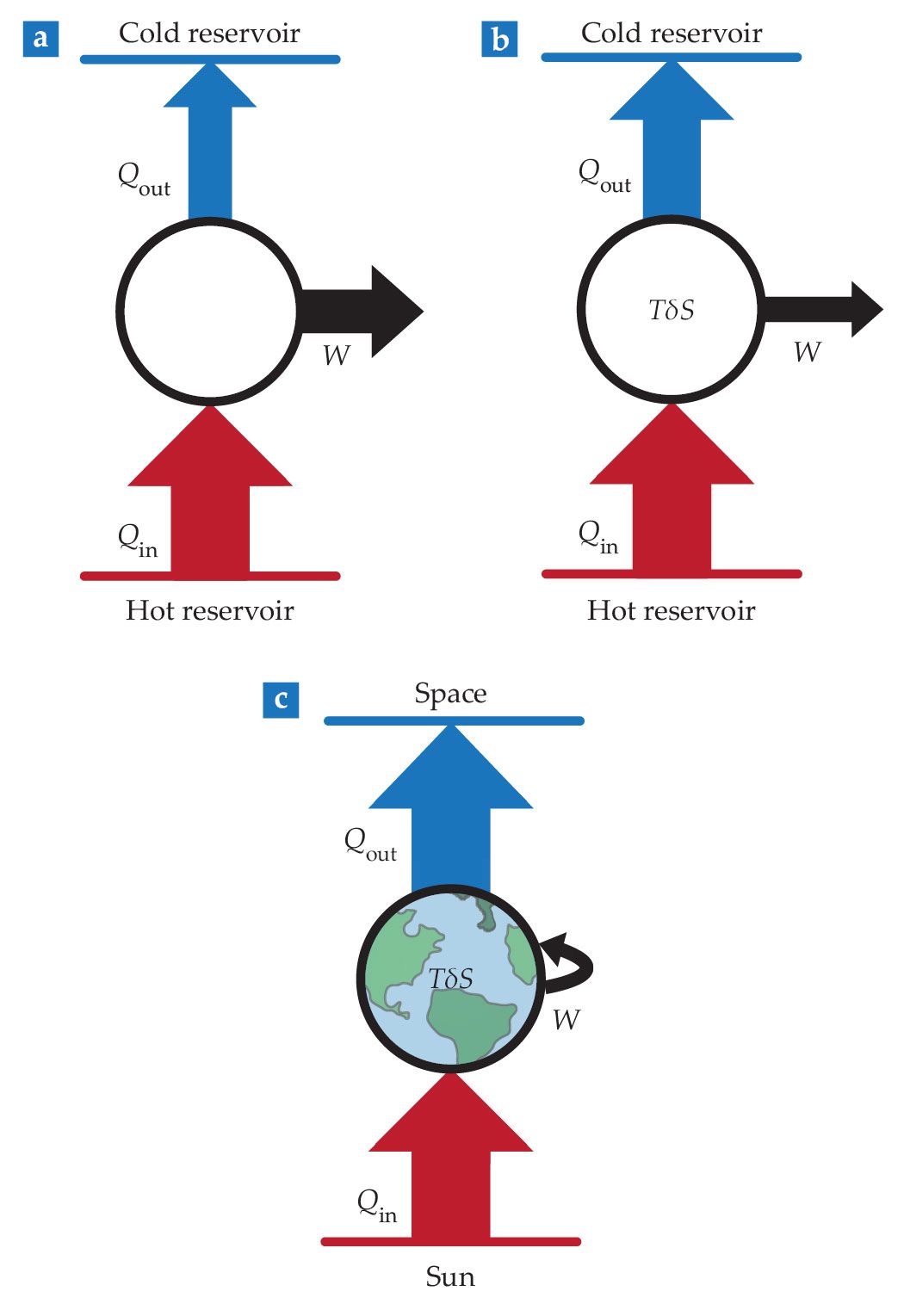
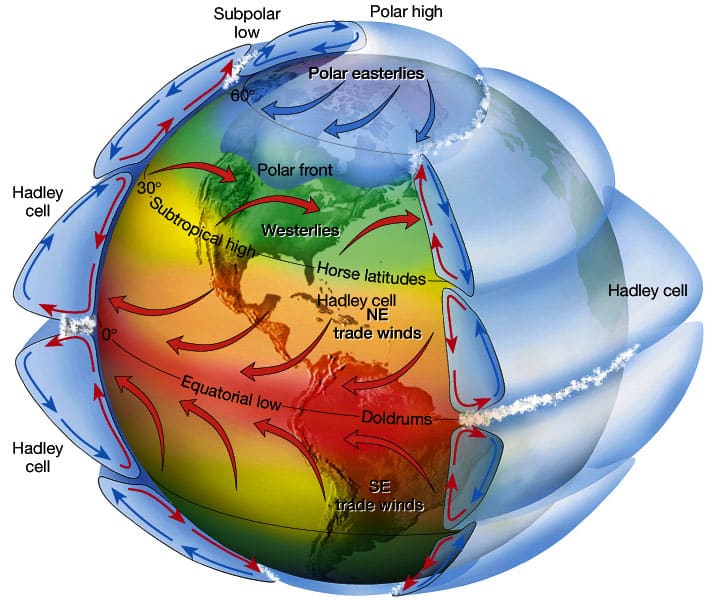
Climate as heat engine. A heat engine produces mechanical energy in the form of work W by absorbing an amount of heat Qin from a hot reservoir (the source) and depositing a smaller amount Qout into a cold reservoir (the sink). (a) An ideal Carnot heat engine does the job with the maximum possible efficiency. (b) Real heat engines are irreversible, and some work is lost via irreversible entropy production TδS. (c) For the climate system, the ultimate source is the Sun, with outer space acting as the sink. The work is performed internally and produces winds and ocean currents. As a result, Qin = Qout.

A previous post presented Michel Thizon’s description of gravity’s effect on the mass of air functioning as a climate thermostat. Some years ago Dr. Murry Salby wrote in detail about the troposphere operating as an heat engine and the stratosphere as a refrigerator. This post consists of excerpts from Salby’s textbook entitled Physics of the Atmosphere and Climate. The title is a link to pdf version of the book Salby (2012). Text in italics with my bolds and added images.

A closed system that performs work through a conversion of heat that is absorbed by it is a heat engine. Conversely, a system that rejects heat through a conversion of work that is performed on it is a refrigerator. In Chap. 6, we will see that individual air parcels comprising the circulation of the troposphere behave as a heat engine.  By absorbing heat at the Earth’s surface, through transfers of radiative, sensible, and latent heat, individual parcels perform net work as they evolve through a thermodynamic cycle (2.13). Ultimately realized as kinetic energy, the heat absorbed maintains the circulation against frictional dissipation. It makes the circulation of the troposphere thermally driven.
In contrast, the circulation of the stratosphere behaves as a radiative refrigerator.  For motion to occur, individual air parcels must have work performed on them. The kinetic energy produced is eventually converted to heat and rejected to space through LW cooling. It makes the circulation of the stratosphere mechanically driven. Gravity waves and planetary waves that propagate upward from the troposphere are dissipated in the stratosphere. Their absorption exerts an influence on the stratosphere analogous to paddle work. By forcing motion that rearranges air, it drives the stratospheric circulation out of radiative equilibrium, which results in net LW cooling to space. Salby (2012) p. 83.
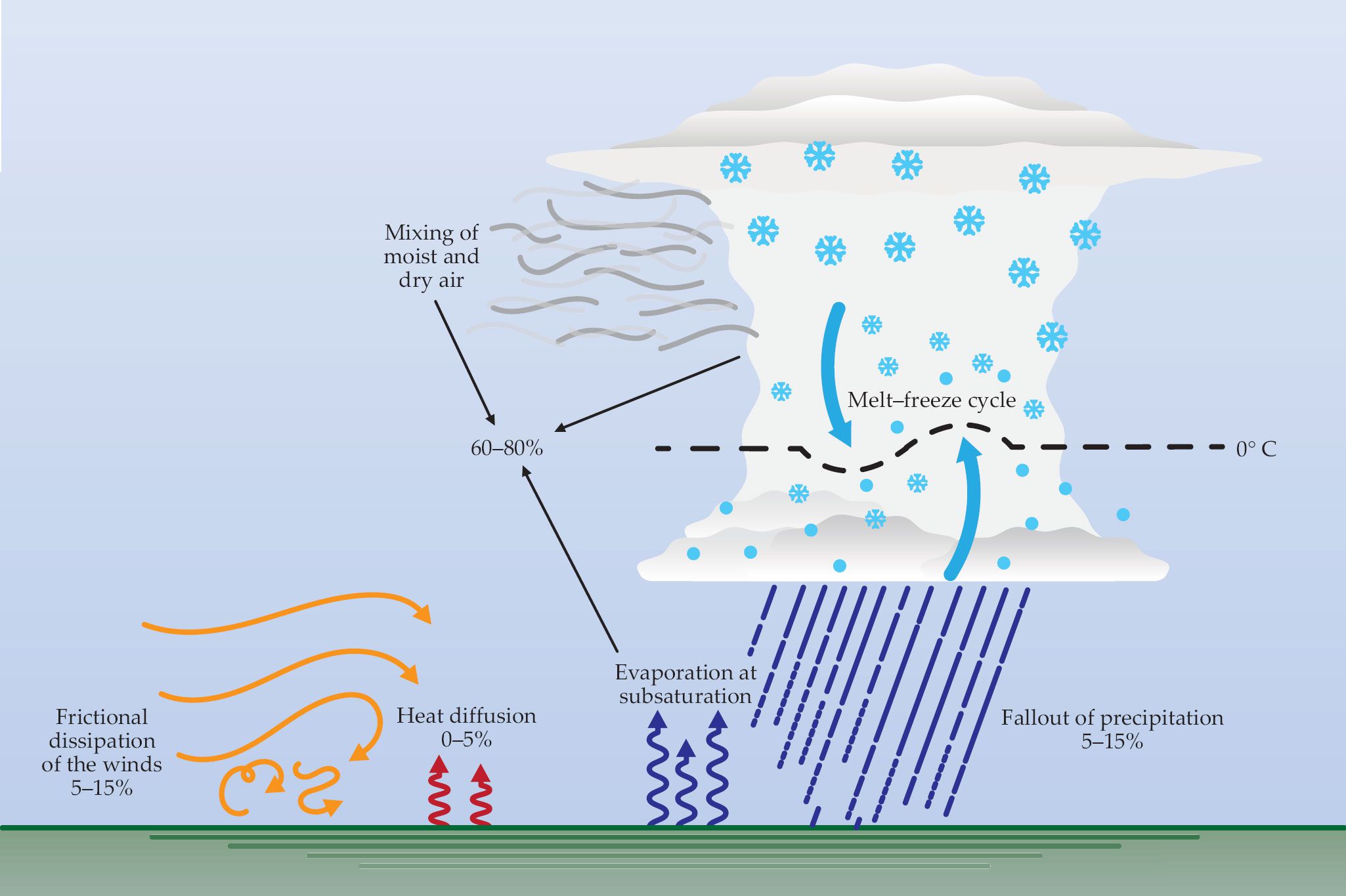
Irreversible processes in the atmosphere. Neglecting radiative processes (not shown here), the largest sources of irreversibility in the atmosphere are those associated with the hydrologic cycle: evaporation, the mixing of moist and dry air, and the melt–freeze cycle (60–80% collectively), and the fallout of precipitation (5–15%). Those contributions limit the entropy generated by frictional dissipation of the winds (5–15%), which ultimately places a limit on the work performed by the atmospheric heat engine in generating circulations. Percentages are estimated based on global climate simulations12 and idealized high-resolution simulations.8

Changes of thermodynamic state that accompany vertical motion follow from the distribution of atmospheric mass, which is determined ultimately by gravity. In the absence of motion, Newton’s second law applied to the vertical reduces to a statement of hydrostatic equilibrium (1.16). Gravity is then balanced by the vertical pressure gradient force. This simple form of mechanical equilibrium is accurate even in the presence of motion because the acceleration of gravity is, almost invariably, much greater than vertical acceleration of individual air parcels. Only inside deep convective towers and other small-scale phenomena is vertical acceleration large enough to invalidate hydrostatic equilibrium.

Because it is such a strong body force, gravity must be treated with some care. Complications arise from the fact that the gravitational acceleration experienced by an air parcel does not act purely in the vertical. It also varies with location. According to the preceding discussion, gravity is large enough to overwhelm other contributions in the balance of vertical forces. The same holds for the balance of horizontal forces. Horizontal components of gravity that are introduced by the Earth’s rotation and other sources must be balanced by additional horizontal forces. Unrelated to air motion, those additional forces unnecessarily complicate the description of atmospheric motion.  Salby (2012) p. 150.

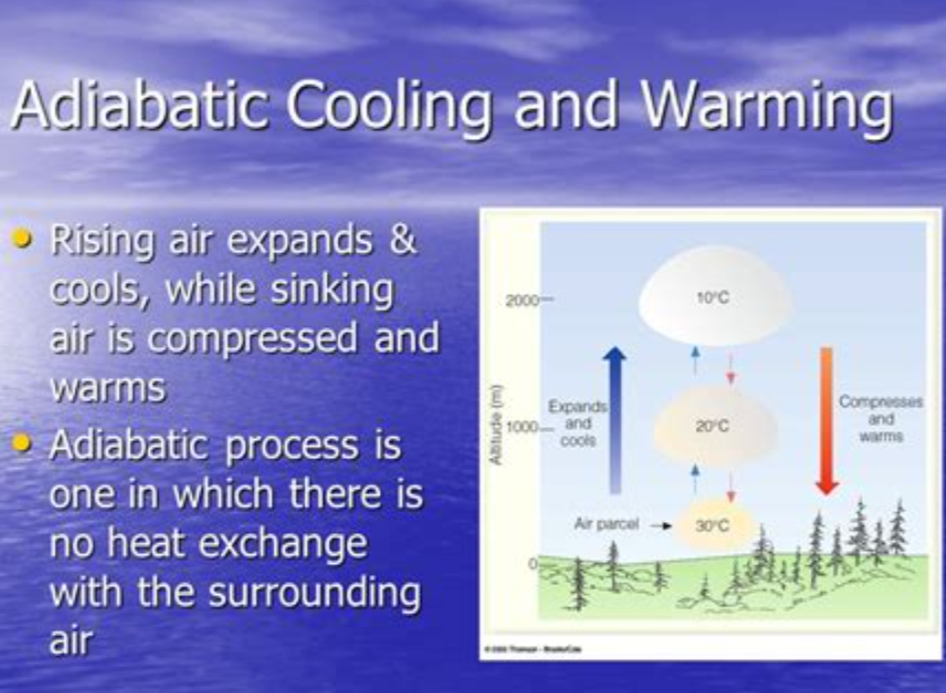
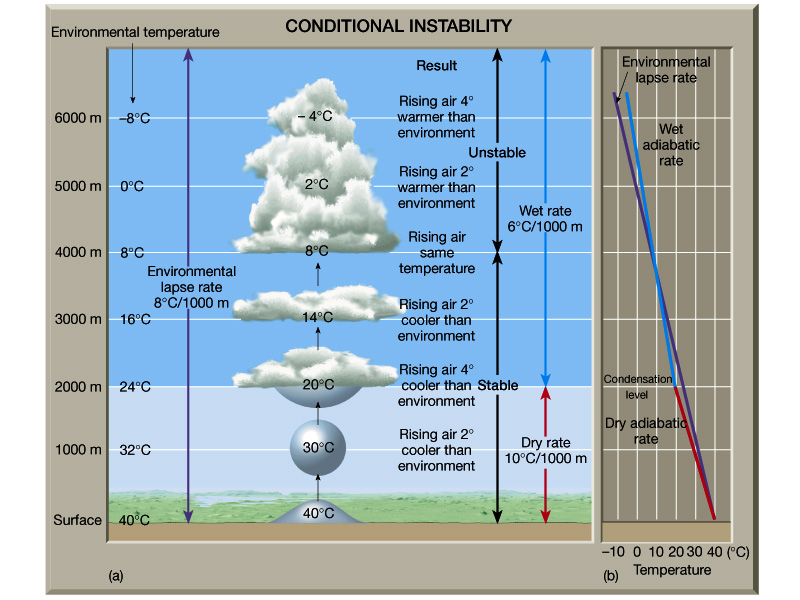
The temperature of a dry air parcel decreases with its altitude at the dry adiabatic lapse rate. To a good approximation, the same holds for a moist air parcel under unsaturated conditions – because the trace abundance of water vapor modifies thermal properties of air only slightly. Under saturated conditions, the adiabatic description of air breaks down due to the release of latent heat that accompanies the transformation of water from one phase to another. Latent heat exchanged with the gas phase then offsets adiabatic cooling and warming, which accompany ascending and descending motion. Salby (2012) p. 162

Net heat absorption and work performed by individual air parcels make the general circulation of the troposphere behave as a heat engine, one that is driven thermally by heat transfer at its lower and upper boundaries. Work performed by individual parcels is associated with a redistribution of mass: Air that is effectively warmer and lighter at the lower boundary is exchanged with air that is effectively cooler and heavier at the upper boundary. This redistribution of mass represents a conversion of potential energy into kinetic energy. The conversion of energy maintains the general circulation against frictional dissipation. Salby (2012) p. 163

The idealized behavior just described relies on heat transfer being confined to the lower and upper boundaries of the layer, where an air parcel resides long enough for diabatic influences to become important. Between the boundaries, the time scale of motion is short. For motion that operates on longer time scales, typical of the stratosphere, the evolution of an individual air parcel is not adiabatic.

Radiative transfer is the primary diabatic influence outside the boundary layer and cloud. It is characterized by cooling rates of order 1 K day−1 in the troposphere (see Fig. 8.24). Cooling rates as large as 10 K day−1 occur in the stratosphere and near cloud (Fig. 9.36). (2012) p. 164

Unlike the troposphere, buoyancy in the stratosphere opposes vertical motion because, invariably, warm (high-θ) air overlies cool (low-θ) air. To exchange effectively-heavier air at lower levels with effectively-lighter air at upper levels, work must be performed against the opposition of buoyancy. The rearrangement of mass represents a conversion of kinetic energy (that of the waves driving the motion) into potential energy. Manifest in temperature, the potential energy is dissipated thermally through LW emission to space. (2012) p. 168

See Also

Fearless Physics from Dr. Salby

In reading the textbook, I found two main reasons why Salby is skeptical of AGW (anthropogenic global warming) alarm. This knowledgeable book is an antidote to myopic and lop-sided understandings of our climate system.

  1. CO2 Alarm is Myopic: Claiming CO2 causes dangerous global warming is too simplistic. CO2 is but one factor among many other forces and processes interacting to make weather and climate.

Myopia is a failure of perception by focusing on one near thing to the exclusion of the other realities present, thus missing the big picture. For example: “Not seeing the forest for the trees.”  AKA “tunnel vision.”

2. CO2 Alarm is Lopsided: CO2 forcing is too small to have the overblown effect claimed for it. Other factors are orders of magnitude larger than the potential of CO2 to influence the climate system.


Lop-sided refers to a failure in judging values, whereby someone lacking in sense of proportion, places great weight on a factor which actually has a minor influence compared to other forces. For example: “Making a mountain out of a mole hill.”

Gravity-induced Atmospheric Thermostat

Michel Thizon published in 2024 a paper explaining why earth’s always variable climate is constrained within a narrow range.  Influence of Adiabatic Gravitational Compression of Atmospheric Mass on the Temperature of the Troposphere.  Excerpts in italics with my bolds and added images

ABSTRACT

The temperature that the Earth’s surface would have without the greenhouse effect, with an atmosphere completely transparent to infrared radiation, or even without an atmosphere at all, is generally estimated at -18°C. The greenhouse effect is estimated to induce a warming of 33°C to justify the surface temperature of +15°C.

To explain this discrepancy, we examine, with the ideal gas law, to which the Earth’s atmosphere obeys with its normal conditions of pressure and temperature, the role that the adiabatic compression of the atmospheric mass subjected to gravity can play. The dimensional analysis of the ideal gas law demonstrates that compression of the atmosphere produces energy, which can be calculated in Joules.

The temperature of the atmosphere near the Earth’s surface is influenced by
its invariable atmospheric mass, solar irradiation and the greenhouse effect.

This calls into question the commonly established Earth’s energy budgets which consider almost exclusively radiative effects, and which deduce a back radiation attributed to the greenhouse effect which is abnormally high.

Earth temperature without atmosphere or greenhouse effects

Goody et al., estimated the solar energy available to heat, both directly and indirectly, the earth and its atmosphere at an average of 224 W/m-2 [1]. Applying the Stefan-Boltzmann law they assumed that the Earth radiates as a perfect black body in the infrared band at a temperature of 255.5 K (or min 17.6°C) for the effective emission temperature [2]. These authors noted that this temperature is lower than the average temperature of the Earth’s surface and indicated that much of the radiation to space must come from the atmosphere rather than from the surface. Goody et al., arbitrarily assigned a value of 1 to the emissivity ε for the calculation, while Jacquemoud assigned a value of 0.98 [3].

According to Hansen, a solar irradiance of 1367 W/m-2 or generally accepted today 1361 W/m-2, but varying with solar fluctuations, leads to a surface temperature of 255 K (or min 18°C), which induces a greenhouse effect of +33°C [4]  Cotton reported that the emission temperature is -19°C and the earth temperature is +14°C, which corresponds to a global greenhouse effect of +33°C [5]. The global greenhouse effect is also estimated at +33°C [6-8]
.
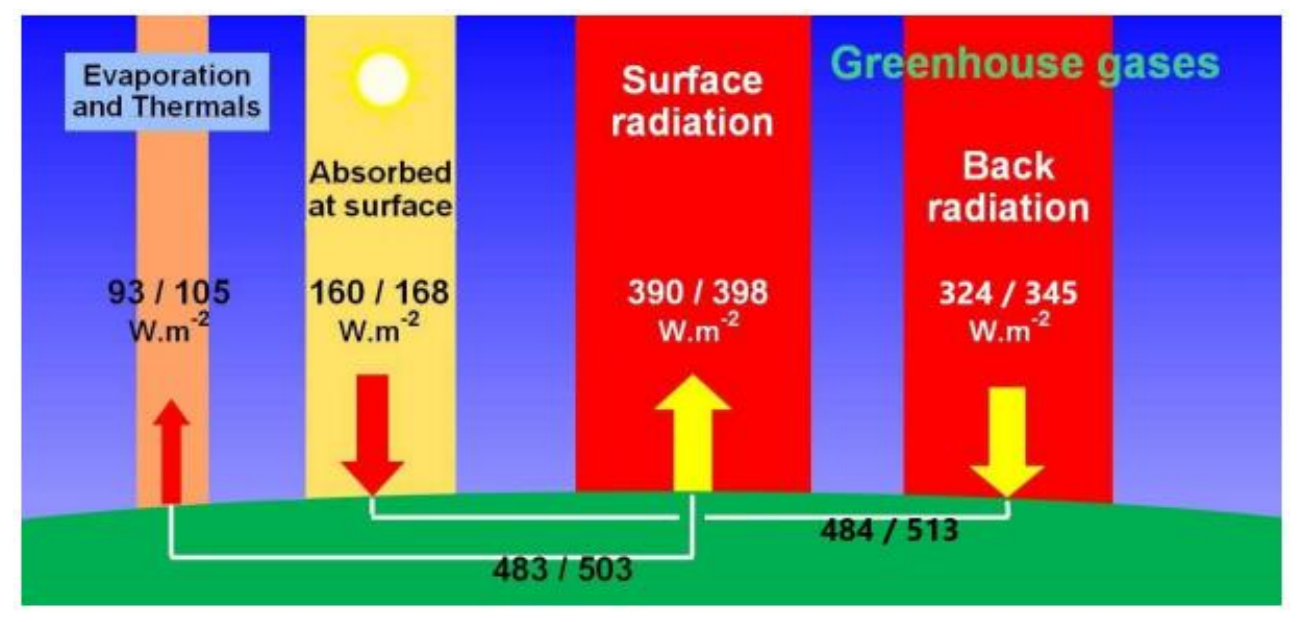
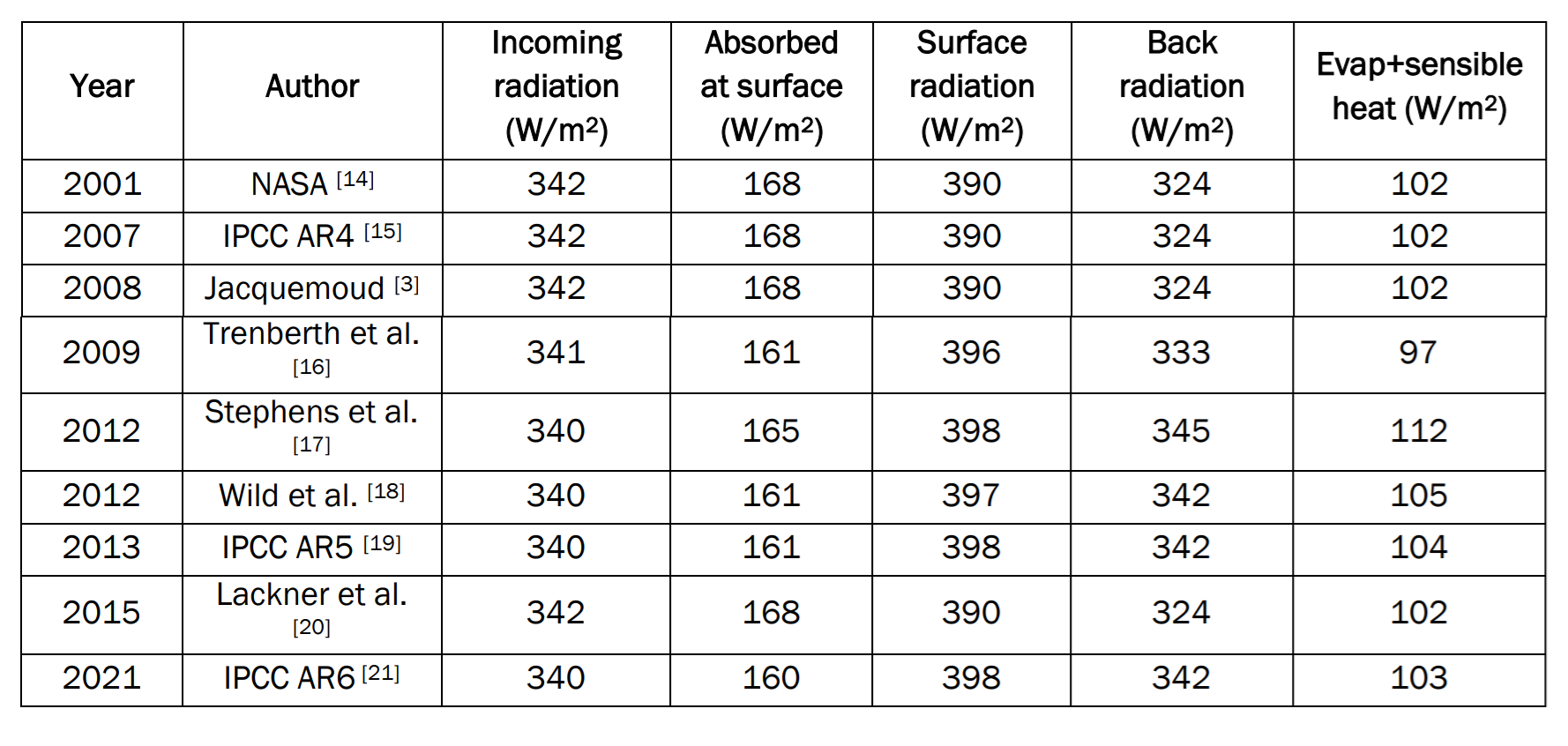
Logically, at -18°C the surface of the earth without an atmosphere or with an atmosphere totally transparent to longwave radiation and that plays no physical role, without any greenhouse effect, should be entirely frozen and covered with frost over its entire surface. This would result in a high Albedo which could be on the order of 0.5 to 0.9 instead of an albedo of 0.30 or 0.29 generally accepted in its current state. In this situation, instead of the solar energy absorbed by the surface reaching approximately 160 to 168 W/m-2 (Figure 1) this energy could be on the order of 70 W/m-2 [9-11]. The Stefan-Boltzmann formula yields a potential surface temperature of approximately -85°C [2]. Note that at these temperatures the water vapor pressure above ice is infinitesimal and could only generate an infinitesimal greenhouse effect. However, according to Nikolov et al., the effects linked to the atmosphere would bring approximately 90°C and not 33°C to the surface at a temperature of 15°C [12,13]. This would suggest that the global  natural effect of atmosphere could be on the order of 90°C rather than the 33°C of the traditional purely radiative approach as reported by almost all the authors.

Global mean energy budget of the Earth

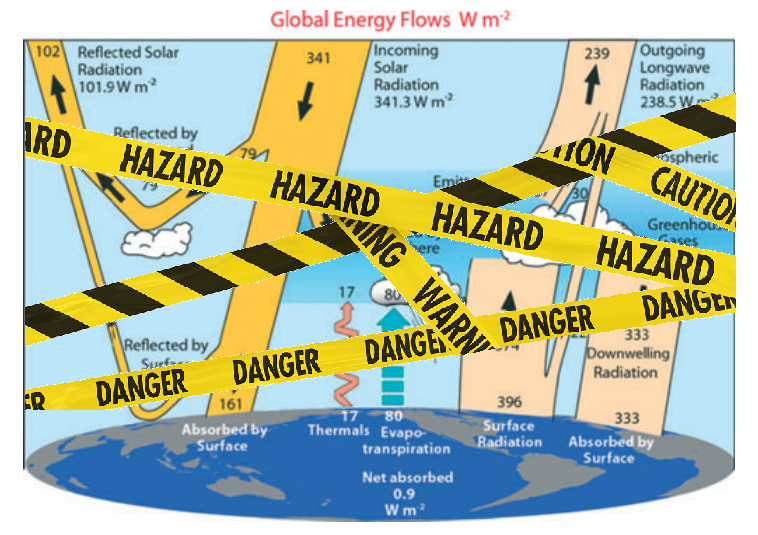
Many authors have endeavored to establish an overall assessment of the energy flows to which the earth is subjected to justify the surface temperature in an essentially radiative system. The Intergovernmental Panel on Climate Change (IPCC) itself places great emphasis on this in each of its reports. The Figure 1 summarizes the values and differences obtained while Table 1 summarizes the main authors who evaluated this earth assessment over a period of approximatively twenty years.

Figure 1. Range of nine energy balances (minimum/maximum according to the authors).

Table 1. Global energy balance of the Earth according to the authors.

The dispersion and imprecision of the results do not allow the effect on surface temperature to be deduced with sufficient accuracy. These budgets must be improved as noted by Lupo et al. [22]

Effect of atmospheric pressure

Few authors have mentioned the role that an atmospheric mass subject to gravity could play in temperature. We can nevertheless cite Leroux [23] Jelbring [24], and Chilingar [25] but these authors evoke a potential role of atmospheric pressure on a qualitative level without seeking to calculate and quantify the effects, probably given the difficulty of integrating the atmosphere as a whole. Nikolov et al. clarify the role of atmospheric pressure for several planets through a complex semiempirical iterative approach [11]

Dimensional analysis of the ideal gas law PV=nRT

The ideal gas law PV=nRT is one of the most fundamental laws of physics and applies entirely to the lower troposphere under its usual conditions of pressure and temperature. This universally accepted law, established in 1834 by Émile Clapeyron, has been perfectly stable for nearly 200 years, which is the case for very few physical laws.

  • P is the pressure (Pa);
  • V is the volume of the gas (m3);
  • n is the quantity of material (mol);
  • T is the absolute temperature (K);
  • R is the universal constant of ideal gases (8.314 J K−1 mol−1);

Dimensional analysis leads to:
R=PV/nT i.e., J K−1 mol−1=Pa.m3 K−1 mol−1, Hence J=Pa.m3=energy

The volume of air multiplied by the pressure to which it is subjected is considered energy (Joules). The atmosphere is heated by compression due to the gravitational field to which it is subjected. Isolated in space, the Earth can only exchange energy with space by radiation, but the atmospheric mass cannot radiate spontaneously since its homonuclear constituents O2, N2, and Ar are passive and cannot radiate.

The earth’s surface is warmer and the atmosphere cannot cool down on contact with it. The compression is thus adiabatic. The greenhouse gases contained in the atmosphere at low levels, mainly H2O and CO2, are capable of radiating at long wavelengths but do not interact radiatively with O2 and N2; additionally, they are under the influence of permanent terrestrial infrared radiation, which they are capable of absorbing, and which is generated continuously from the solar energy received by the Earth’s surface.

The process includes the upward expansion, toward vacuum of the agitated molecules whose kinetic energy decreases and therefore the pressure, which causes cooling with altitude. It is not due to a  decrease in gravity which decreases by less than 3/1000 at a 10 km altitude but of a struggle between gravity and the suction of the vacuum, until the equilibrium which defines an adiabatic thermal gradient. Gravity nevertheless prevents air molecules from escaping into space. Only some H2 molecules can reach the release speed.

RESULTS  Heating of the atmosphere in °K by adiabatic compression

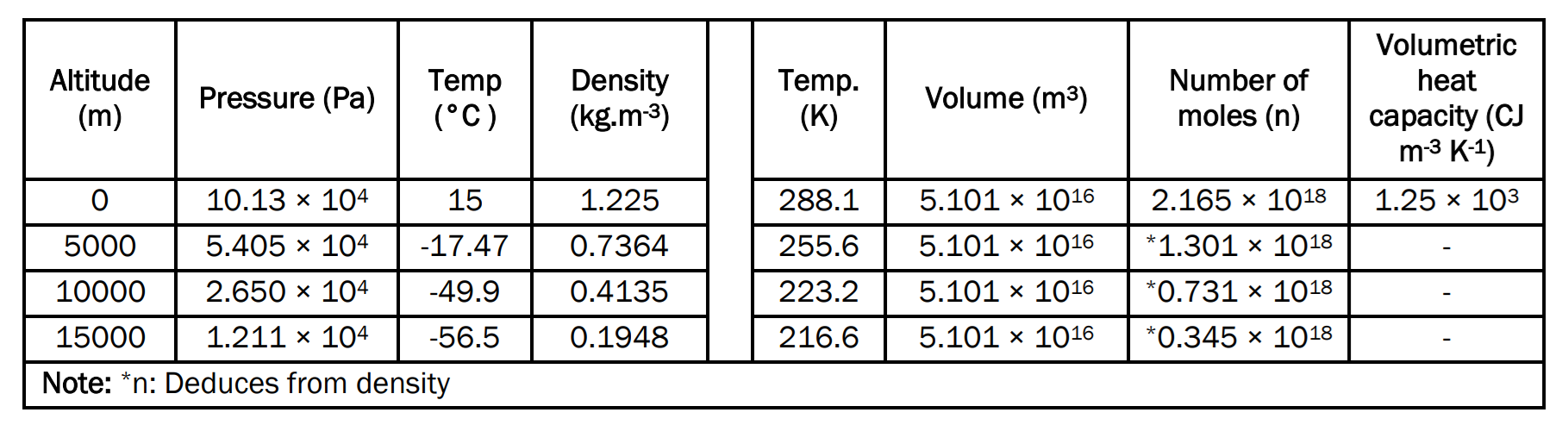
Table 2. Data for an air layer 100 m thick. The left part is from U.S. Standard Atmosphere, according to The EngineeringToolBox [26]

As a tight approximation, for 100 m of atmospheric thickness
Altitude 0 m

  • PV=(10.13 × 10⁴ Pa) (5.101 × 10¹⁶ m3)=5.167 × 10²¹ J
  • Volumetric heat capacity of air C=1256 J m−3 K−1 (at 0 m, 15°C)
  • For 5.101 × 10¹⁶ m3 of air; +1°K requires 1256 × 5.101 × 1016 J=6.41 × 10¹⁹ J
  • 5.167 × 10²¹ J/6.41 × 1019 J=80.7
  • +80.7 K overheating due to pressure

Note: With an air layer of 200 m the precision is lower and leads to an overheating of 80.6 K

Gravity compression results, to the Earth’s surface, in 80.7°C of natural greenhouse energy equivalence, which means that to reach 15°C the initial temperature without atmosphere would be -65.7°C, very different from the -18°C admitted by radiative approaches for an inactive atmosphere.

Direct application of the ideal gas law T=PV/nR

  • Altitude 0 m T=(10.13 × 104 × 5.10 × 1016)/(2.165 × 1018 × 8.314)=287.1 K (+14.0°C)
  • Altitude 5,000 m T=254.9 K (-18.2°C)
  • Altitude 10,000 m T=222.4 K (-50.7°C)
  • Altitude 15,000 m T=215.3 K (-57.8°C)

The standard thermal gradient from 0 to 10 km is -6.49°C/km. The ideal gas law explains phenomena linked to temperatures up to 10,000 m in altitude. Beyond that, the results diverge, and other factors and phenomena are involved, like ozone and UV influence.

CONCLUSION

The temperature on the surface of the earth is mainly determined by the action of gravity on the atmospheric mass, which is an immutable fact on a scale of millennia. Climatic variations are the result of lesser phenomena. The solar influence is felt during the day by the direct radiation received, mainly when the sun is at its zenith, and the balance is modified by direct thermal exchanges between the sunny surface and the air in contact. The earth’s surface and the upper layers of the atmosphere radiate permanently towards space by emitting infrared radiation day and night, thus restoring the overall balance.

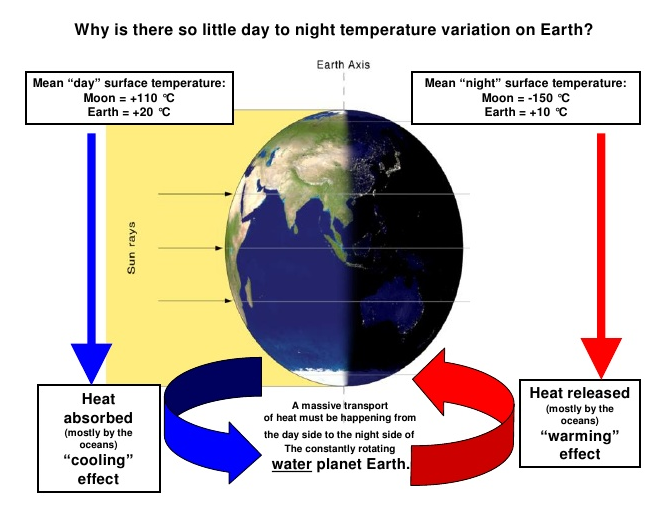
Surface infrared radiation is probably less intercepted in the lower troposphere by greenhouse molecules than is usually thought, thus explaining the surface temperature. However, there is an atmospheric dynamic, in particular through the water cycle, by evaporation-condensation, but whose overall energy balance is zero. Air mass movements and convection contribute to the overall dynamics, mainly due to the rotation of the Earth and the alternations between the presence and absence of solar radiation.

Astronomical fluctuations in sunshine, surface phenomena such as ocean currents, El Niño or La Niña phenomena, extreme weather phenomena or even volcanic eruptions, as well as other factors that are probably poorly characterized, lead to variations in surface temperature that nevertheless remain relatively damped due to the stabilizing effect of the invariable atmospheric mass subject to gravity.

See Also

Planetary Warming: Back to Basics


More Lying About Carbon Capture

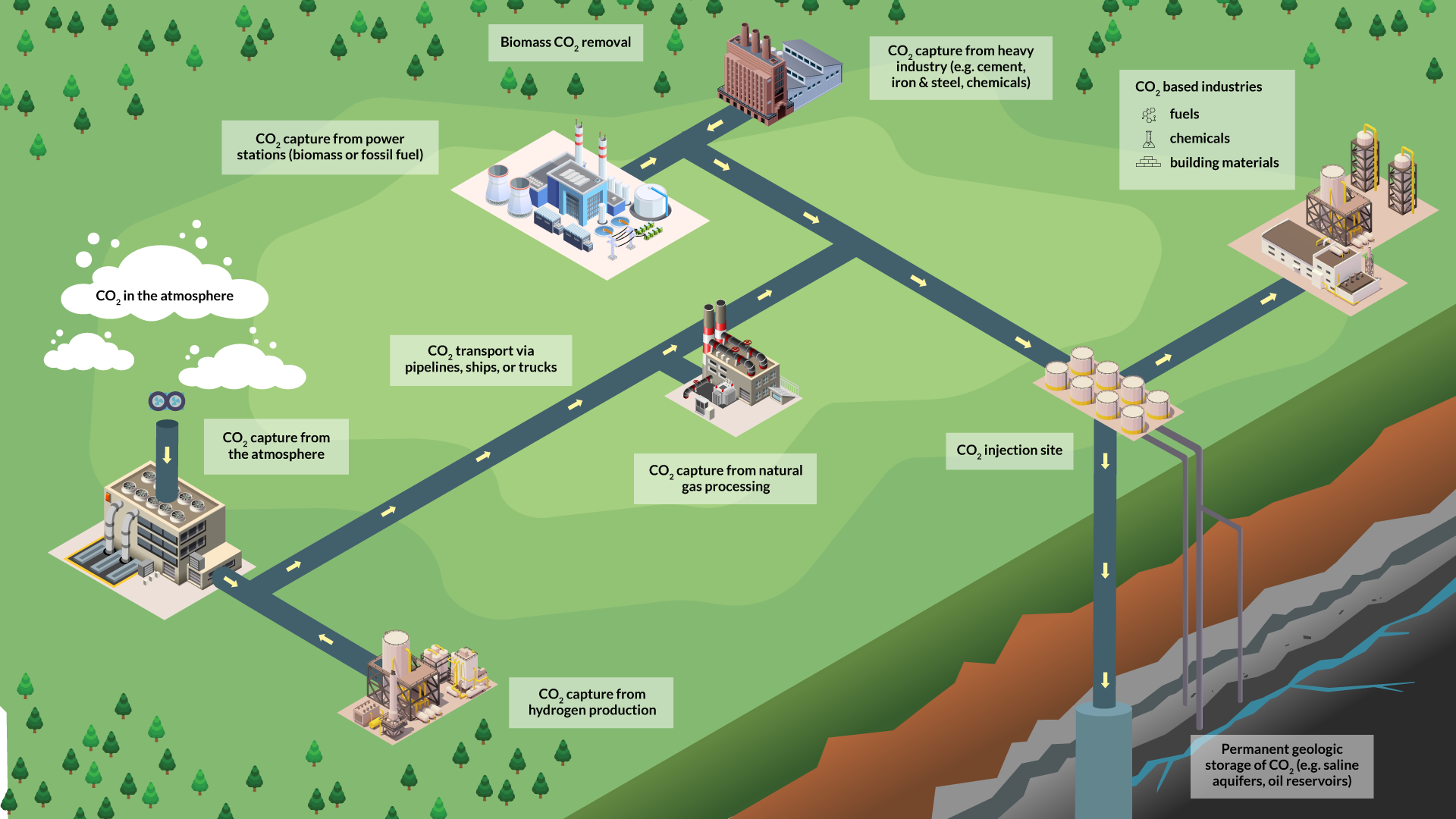
Carbon capture tech is pie-in-sky impractical, but was weaponized against coal-fired power plants by requiring CCUS as though it were proven effective and profitable.  Just The News reports Biden’s EPA hid comments from Dept. of Energy that undermined key part of EPA power plant rule.  Excerpts in italics with my bolds and added images.

The Clean Power Plan 2.0 was supported by a finding that carbon capture
technology had been “adequately demonstrated.” The EPA sought and
got comments from the DOE, which disputed that “demonstration.”
Somehow those comments never made it into the administrative record.

It appears that the Biden-Harris administration hid comments that would have undermined its Clean Power Plan 2.0 rule (CPP2), which the Trump administration is currently reviewing. The EPA had sought comments from the Department of Energy’s National Energy Technology Lab (NETL) on the efficacy of carbon capture technology prior to proposing the rule. These comments, which were somehow scrubbed from the administrative record, disputed a key claim the rule is based on. Those missing comments, a legal expert says, could provide a basis for the rule’s repeal.

The CCP2 requires all coal plants to install carbon capture technology by 2039, which captures and stores emissions in underground geological formations. It also requires new natural gas-fired power plants to install the technology, with requirements starting in 2032. Experts warned the rules would drive up electricity costs and destabilize the grid by disincentivizing reliable power from coal and natural gas in favor of intermittent wind and solar power.

The Clean Air Act authorizes the EPA to develop new emissions standards, but those standards must be achievable at a reasonable cost. The technology required for compliance must also be adequately demonstrated. Documents obtained by Just the News show that the EPA formally sought comments from NETL in March 2023 on its soon-to-be proposed rule, which was put out for public comment the following May.

The proposed rule allowed for two technologies — hydrogen and carbon capture and underground storage (CCUS) — to meet the emissions standards on fossil fuel-burning power plants. Comer’s letter quotes two unnamed authors expressing that neither technology was viable.

Hydrogen was removed from the rule when it was finalized in April 2024. Carbon capture technology, however, was part of the final rule, even though the comments from one unnamed NETL author stated that:

“CCUS remains prohibitively expensive even after use of funds or tax credits made available through the Inflation Reduction Act.”

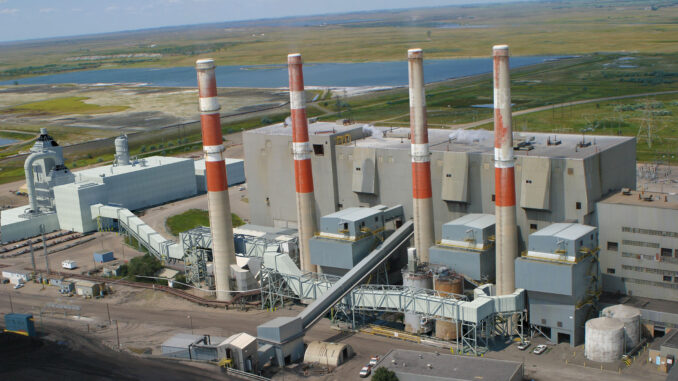
The EPA based its determination that CCUS was “adequately demonstrated” on the performance of the Boundary Dam Unit #3 (BD3), which is a Canadian coal-fired power plant fitted with carbon capture technology. An April 2024 report by the Institute for Energy Economics and Financial Analysis called the project an “under-performing failure.” Despite $1 billion CAD spent on the project, it was, as of April 2024, capturing far less than the 90% originally promised. Its capture rate through the end of 2023 was just 57%, which was 63% of the 90% promised, the report found.

Comments from NETL engineers, according to the GOA’s records request, state that “the ongoing operating performance of the same BD3 demonstration project is being, once again, misconstrued as having provided sufficient justification for claiming satisfactory performance to allow the technology to be considered ‘adequately demonstrated.’”

Carbon capture at Boundary Dam 3 still an underperforming failure

To be considered a success, a carbon capture project must capture all or almost all CO2 produced by the facility (power or industrial plant) to which it is attached and must do so for decades. Stantec photo by Kevin Ross.

Another comment states that BD3 only approached the 90% promised target for two months over a period of 8 years and three months. Another comment states that after 8 years and three months “of demonstration, such failure to meet negligible standards for emissions limitations, over a full-year period ending less than one year ago, argues strongly for not considering BD3 as a credible basis for Best System of Emissions Reduction and ‘adequate demonstration’ of the related technology.”

“These comments were sanitized at some point in this process and were not included in NETL’s and/or DoE’s comments to EPA, which made their way into the administrative record,” according to the GOA’s record request.

An EPA spokesperson told Just the News that the EPA, as part of its reconsideration of the CCP2, is developing a proposed rule, which will be published once it has completed an inter-agency review and been signed by EPA Administrator Lee Zeldin.

“Many have voiced concerns that the last administration’s replacement for that rule is similarly overreaching and an attempt to shut down affordable and reliable electricity generation in the United States, raising prices for American families, and increasing the country’s reliance on foreign forms of energy,” the spokesperson said.

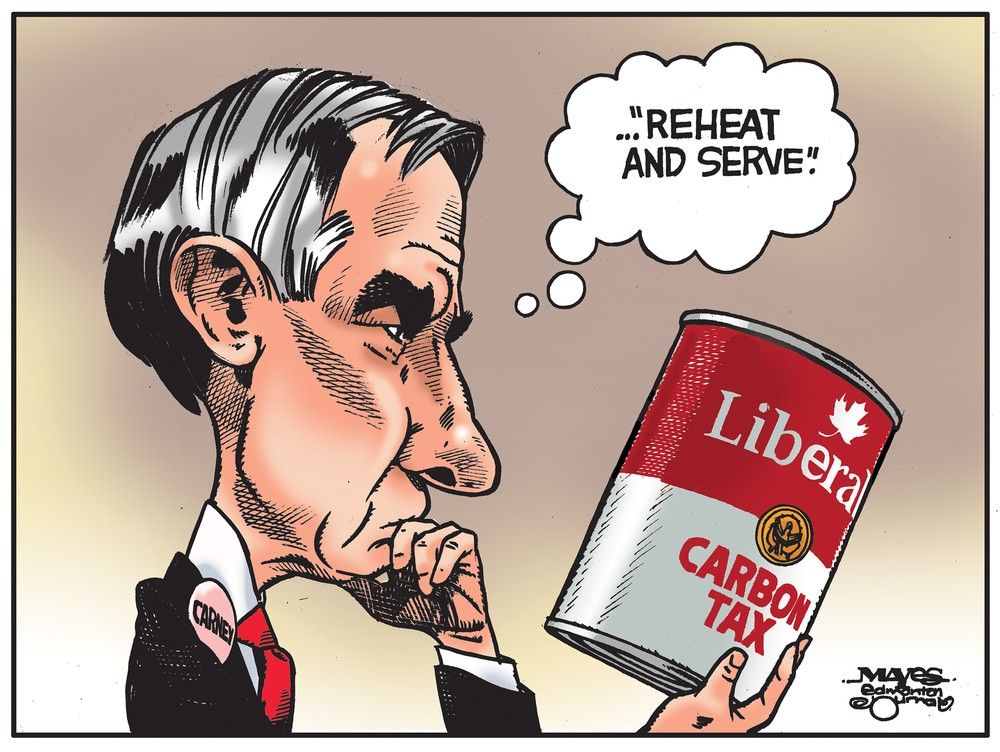
Canada PM Carney Floats Imaginary “Decarbonized Oil” Pipeline

Reality intrudes in National Post article Alberta and Ottawa tout a grand bargain on ‘decarbonized’ oil but some are skeptical.  Excerpts in italics with my bolds.

Carney said he’d consider fast-tracking a new oil pipeline
to the West Coast if it shipped ‘decarbonized barrels’

OTTAWA — “Grand bargain” was the phrase of the day on Parliament Hill after Prime Minister Mark Carney and his provincial counterparts found common ground on oil and gas development.  “If (the Conservatives) were listening to yesterday, there is a grand bargain,” Energy Minister Tim Hodgson boasted to the Opposition benches.

“There is a bargain that the Premier of Alberta has signed onto.”  Alberta Premier Danielle Smith left Monday’s first ministers’ meeting with a new deal exchanging oil sands access to coastal waters for massive investments in decarbonization technologies, but experts warn this could be a costly pipe dream. 

“I’m worried we’re seeing (the first ministers) fall into a trap of wanting to have their cake and eat it too,” said Tim McMillan, a partner at Garrison Strategy and the former head of the Canadian Association of Petroleum Producers.

“There’s real potential there (and), if further developed, the federal government will look to advance it,” said Carney.  But McMillan says the devil could be in the details.

“I don’t know exactly what they’re talking about with decarbonization, but… it may be linked to carbon capture, which does not increase our exports (or) investability,” said McMillan.  “If (carbon capture) becomes a long-term requirement for new projects, it will likely have a negative effect on future investments in Canada’s upstream oil and gas sector.”

The Calgary-based Pathways Alliance, a group of six major oil sands producers, has put forward a $16.5-billion decarbonization network that would reroute carbon emissions from nearly two dozen facilities to an underground hub near Cold Lake, Alta.  The big-ticket project has been at a standstill for years over government funding.

Smith said Monday that the financial windfall of a new West Coast bitumen pipeline serving markets in Asia could help make the economics of the Pathways project work.  “If we had a million barrel a day pipeline going to the northwest (British Columbia) coast, that would generate about $20 billion a year in revenues… that seems like a pretty good value proposition if both of those projects can proceed at once,” said Smith.

Carney and Hodgson have both paid lip service to the Pathways project in recent weeks, but the venture still faces an uphill battle.  A recent independent analysis found the project was likely to lose money due to the limited recyclability of captured carbon.

“Even under optimal conditions, the Pathways project may struggle to break even, and real-world operations are rarely optimal,” read the study, prepared by the Institute for Energy Economics and Financial Analysis.  “The Canadian federal government and the province of Alberta may be pressured to make up the likely shortfall,” it continued.

“An unprofitable carbon capture project will struggle to bring lasting positive economic benefits to host communities and become dependent on external financial subsidies to maintain operations.”

McMillan also noted that Canada’s two biggest competitors in the heavy oil industry, Mexico and Venezuela, are unlikely to follow suit with large-scale carbon capture projects of their own, giving each an edge over Canada on a per-barrel basis.

Footnote:  “Some are skeptical” understates the case.  “Decarbonized Oil” is a Ruinous Farce.

The Study is Financial risks of carbon capture and storage in Canada: Concerns about the Pathways Project and Public Energy Policy.  Highlights in italics with my bolds and added images.

Cost challenges threaten the ability of a large, planned carbon capture project to achieve financial sustainability. The Pathways Alliance plans to capture carbon dioxide (CO2) generated at 13 oil sand processing facilities, compress the gas and send it by pipeline to a storage hub near the Cold Lake region in Alberta. Publicly available financial information on the Pathways project is scant. It is instructive, however, to analyze the experiences of two existing commercial carbon capture facilities in Alberta—the Alberta Carbon Trunk (ACTL) line facility and Shell’s Quest facility.

The Institute for Energy Economics and Financial Analysis (IEEFA) examined the two currently operating CCS projects, together with current policy and provincial carbon market dynamics. The resulting report identified troubling cost implications for the Pathways CO2 transport and storage project and raises the concern that the Canadian federal government and the province of Alberta may be pressured to make up the likely shortfall.

  • We find total costs including interest, insurance, depreciation and taxes for existing commercial-scale carbon capture plants in Alberta are approaching thresholds that threaten profitability.
  • Rising project costs are not being offset by commensurate increases in CO2 capture volumes and associated revenue. Operating costs are growing at twice the rate of CO2 captured volumes.
  • CCS operating revenue is uncertain. An effective cap on emission performance credit (EPC) pricing of CAD$170 per tonne limits project revenue potential, while a looming oversupply of carbon EPCs is an example of risks to project cash flows. The option to combine Clean Fuel Regulation credits with EPCs is available to ACTL, but this significant financial benefit is not available to the Pathways project.
  • Performance risk is financial risk. Without substantial efficiency improvements, the cost per tonne of CO2 captured is likely to exceed the revenue that the project can generate for each tonne captured. 
  • An unprofitable carbon capture project will struggle to bring lasting positive economic benefits to host communities and become dependent on external financial subsidies to maintain operations.

Even under optimal conditions, the Pathways project may struggle
to break even, and real-world operations are rarely optimal.

Large-scale public investment in CCS is misguided. The technology has struggled to achieve meaningful emissions reductions or prove its long-term viability. The lack of demonstrated success and heightened financial risks indicate public investments are unlikely to yield the desired environmental or economic benefits.


Green Schemes Hidden by Greenhushing

Transcript excerpted from captions of  Interview with Bjorn Lomborg What is behind business ‘greenhushing’? [FN refers to comments from FOx News interviewers, BL to Bjorn Lomborg]

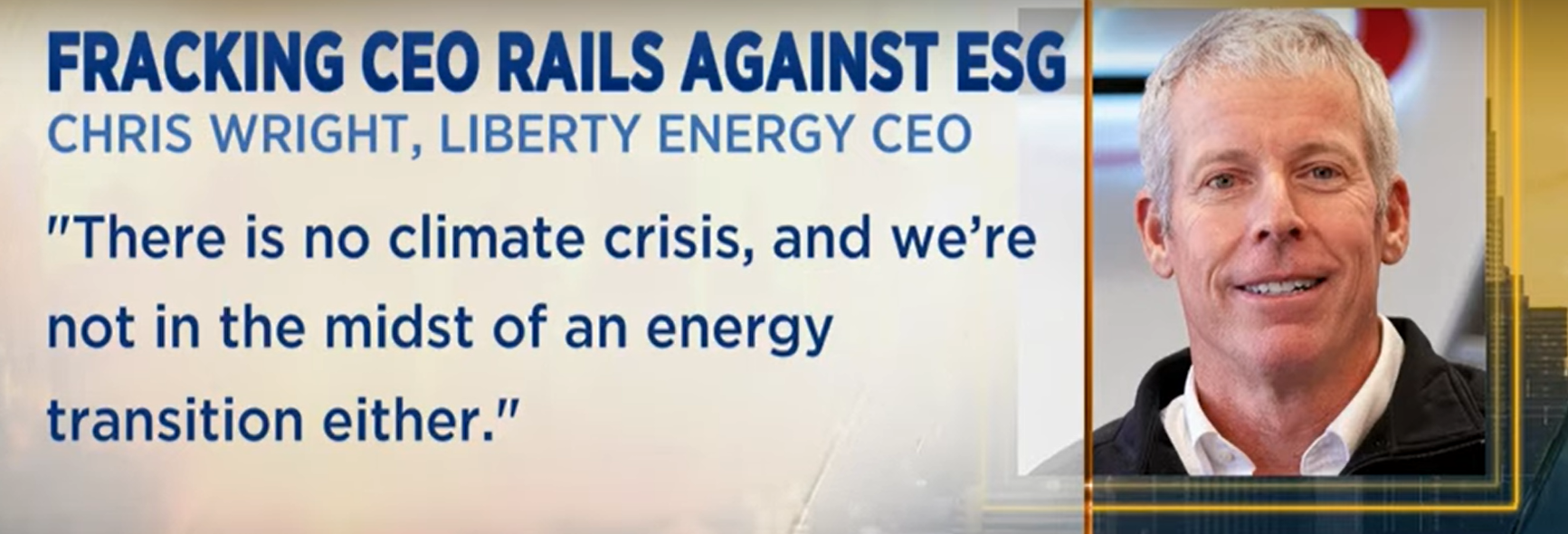
FN: From Climate Talk to climate realism. As energy secretary Chris Wright says climate change is a side effect of building the modern world. Banks and businesses seem to be finally getting on board with this. But moving from unrealistic promises, greenwashing lies and environmental fear-mongering, risks some engaging in greenhushing, purposely keeping quiet about sustainability actions.

Our next guest says climate solutions come with their own set of costs [you can read his op-ed excerpted later in this post]. And joining us now, and Brian and I are both huge fans of Bjorn Lomborg’s work. He’s Copenhagen Consensus President. Bjorn, so great to see you.

What are you concerned with in terms of going from greenwashing to then kind of burying what these corporations are doing now?

BL: Well the real problem is for a long time corporations have been saying “Oh we’re going to be so green,” and they got lots of applause and everybody said “Oh this is great in Davos and stuff.” And of course it’s not what businesses mostly should be doing. But now with Trump and everything else, people are realizing, “Oh wait, this is not a good idea.” So they’ve stopped talking about it but they’re still doing a lot of it. And actually a new survey of of about 4,000 sustainability people in these big corporations said, “Yeah we’re going to talk a lot less about it, but we’re still going to do it. We’re actually going to do a little more.”

And that’s troublesome because this is not what businesses should be doing.
They should be in the business of making great products and high profits
.

FN: So there’s a debate out there. You’ve got the CEOs of these companies and the question is: Do they really believe in the green thing or were they just doing it because the social pressure was so strong? And now they’re pulling back because really at the end of the day they agree with you, they just want to run their businesses.

What I hear you saying is in fact the guys running these businesses really are bought into the green agenda and they will do it again when the political environment lets them speak more freely. Is that what you’re saying?

BL: It’s hard to know. I think you’re right a lot of the CEOs are saying, I actually want my business to run and drive a profit. But now they’ve hired so many other people, sustainability experts and everybody else. Of course if that’s your job, you’re pushing for doing more of that. So I think it’s important for businesses to rein in and say:

“Look we’re not going to be doing this anymore, we’re actually going to go back and focus on what we’re good at, namely servicing customers.”

FN: This goes to something else that you’ve written about, that corporations need to focus on creating things profitably, because the environment improves as nations prosper. And the greatest polluter is poverty. We saw with John Kerry here in the United States and him talking to subsaharan Africa about cutting off any funding and financing for them to extract fossil fuels from the earth and thereby bring their nations out of poverty. Keeping nations poor makes the environment worse, rather than allowing them to develop into modern societies.

BL: Absolutely. I wrote two things for Earth Day. First we have to recognize there are environmental problems. And it’s great that we get a better environment, and fundamentally when you get rich you can actually afford to do a lot of this. And as you point out poverty is the biggest polluter, because if you’re poor, you quite frankly have other important issues. So you’ll cut down your rainforest or whatever else you need to do.

Secondly, it also emphasizes as you just pointed out that most nations and especially poor nations need to get out of poverty by doing what we’ve done. They want to have access for a lot more energy and mostly that is going to be fossil fuels. Remember when Russia invaded Ukraine, Europe decided to say “All right we’re not going to go and get any energy from Russia.” But they didn’t say “Oh so we’re going to go all green.” They actually went to Africa to buy up their fossil fuels because we want to keep our living standards. But they simultaneously told the Africans, “But you shouldn’t be using it, you should actually go all green.” That’s just hypocrisy absolutely.

Excerpts from Lomborg op-ed Time to pull the plug on corporate virtue-signaling

The era of being cheered on for every green promise and vow
– regardless of how silly or self-defeating – has come to an end

Climate change is undeniably a real problem which has tangible economic impacts. However, climate solutions also come with their own set of costs, often demanding that businesses and individuals rely on pricier, less dependable energy sources. The decision to balance the expenses of climate policies with the advantages of climate action falls rightly under the responsibility of governments, not profit-driven businesses.

Yet over the past decade, even major contributors to climate change – such as the fossil fuel industry itself – invested in extraordinary green policies. Five years ago, BP made an astonishing promise to slash its oil and gas production by 40% by 2030, while increasing green energy generation twentyfold and becoming net-zero.

Now, along with other big, Western oil companies,
it has abandoned those farcical green promises and
recommitted to its primary activity: fossil fuels.

No doubt, this U-turn will be lamented by green activists. But the truth is that these promises were always an inefficient way of helping the planet, and very shortsighted for fossil fuel companies. Even after the world has spent $14 trillion on climate policy, more than four-fifths of global energy remains supplied by fossil fuels.

Over the past half-century, fossil fuel energy has more than doubled, with 2023 again setting a new record. Consumers and businesses are crying out for more energy, while competitor state-owned oil companies from the Middle East have continued to provide more fossil fuels. It is a foolish energy company that declares it will supply less energy.

Banks also had a fling with green policies, and have now dumped them, with the six largest U.S. banks leaving the Net-Zero Banking Alliance, and Wells Fargo officially abandoning its goal of achieving net-zero emissions across its financial portfolio by 2050.

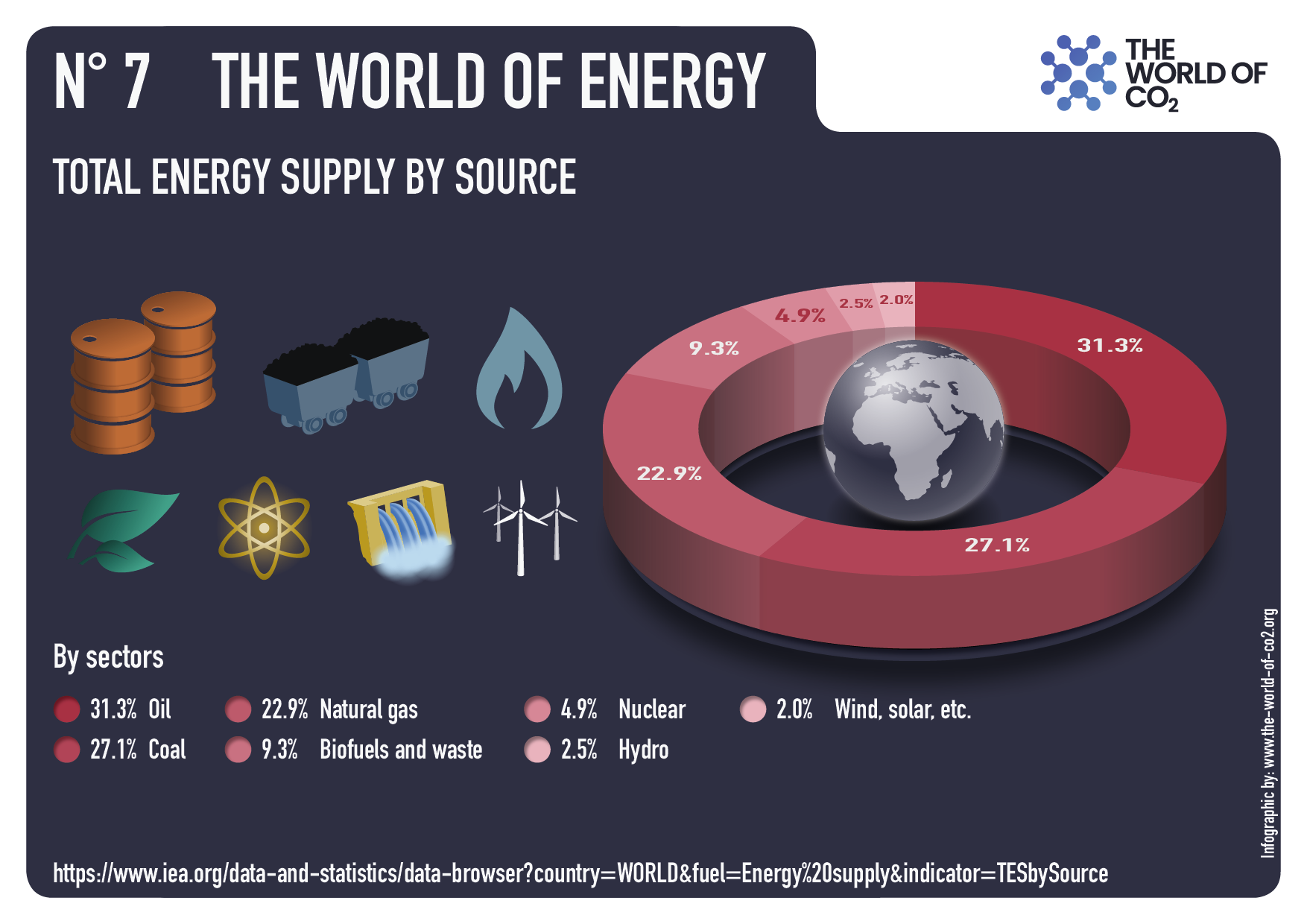
In the peer-reviewed journal of the American Association for the Advancement of Science, a study finds that of 1,500 “climate” policies announced around the world, a mere 63, or 4%, produce any reduction in emissions.

While some industries are moving faster than others, there are signs that many companies will just change their language, and not their inefficient climate policies.

As leaders of international organizations and corporations scramble to adapt to an entirely new world, it’s important they go further than just shifts in rhetoric. The era of being cheered on for every green promise and vow – regardless of how silly or self-defeating – has come to an end. Now it’s time for those leaders to get back to business.

Sea Level Rise Hype from Climatists Lying by Omission Again

From Inside Climate News comes this example, New Study Projects Climate-Driven Flooding for Thousands of New Jersey Homes.
Sea-level rise threatens coastal communities even if global emissions drop.

Of course the alarm is picked up everywhere:

As Summer Approaches, New Jersey’s Shore Towns Confront an Unrelenting Foe: Sea Level Rise Inside Climate News

US East Coast faces rising seas as crucial Atlantic current slows, New Scientist

Sea level rise creates a crisis at US coasts: What to know, USA Today

Map Shows US Cities Where Sea Level Rise Is Accelerating, Newsweek

Global sea levels are rising faster and faster. It spells catastrophe for coastal towns and cities, CNN

Etc., Etc., Etc.

Climatists Make Their Case by Omitting Facts

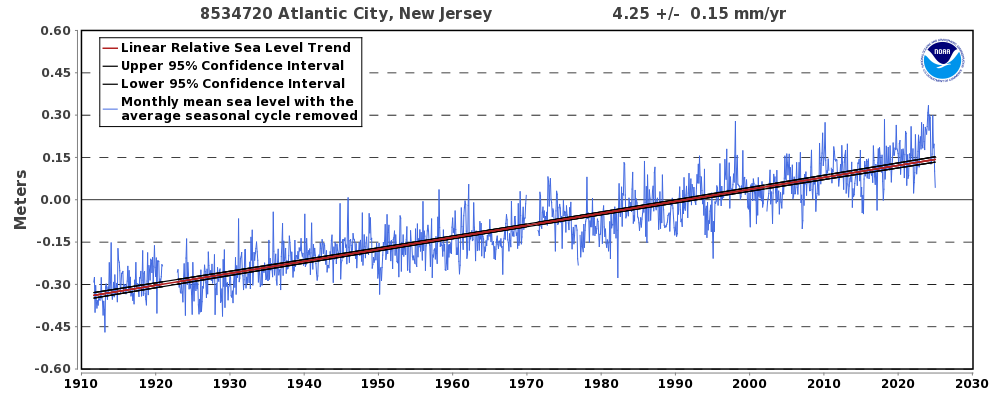
A previous post documented this pattern, of which we have this fresh example.  Let’s start with the tidal gauge at Atlantic City, New Jersey.

It presents a long record of steadily rising levels for more than a century.  The rate is 4.25 mm per year, or a rise of about 1 inch every six years.  The lie is in attributing all of that to sea level rising, and adding in burning of hydrocarbons as the cause.  What’s left out is the well known and documented subsidence of land along the US Eastern seaboard.

Vertical land motion (VLM) across the US Atlantic coast (a) Estimated VLM rate. The circles show the location of GNSS validation observations color-coded with their respective vertical velocities. (b) Histogram comparing GNSS vertical rates with estimated VLM rates. The standard deviation (SD) of the difference between the two datasets is 1.3 mm per year. (c) Land subsidence (representing negative VLM) across the US Atlantic Coast.

The black rectangles indicate the extent of study areas for Chesapeake Bay area and Georgia, South Carolina, and North Carolina (GA-SC-NC) area shown in Fig. 4. State Codes: ME Maine, NH New Hampshire, VT Vermont, MA Massachusetts, RI Rhode Island, NY New York, PA Pennsylvania, NJ New Jersey, WV West Virginia, OH Ohio, DE Delaware, VA Virginia, NC North Carolina, SC South Carolina, GA Georgia, and FL Florida. National, state, and great lakes boundaries in a, c are based on public domain vector data by World DataBank (https://data.worldbank.org/) generated in MATLAB.

Abstract from paper Hidden vulnerability of US Atlantic coast to sea-level rise due to vertical land motion

The vulnerability of coastal environments to sea-level rise varies spatially, particularly due to local land subsidence. However, high-resolution observations and models of coastal subsidence are scarce, hindering an accurate vulnerability assessment. We use satellite data from 2007 to 2020 to create high-resolution map of subsidence rate at mm-level accuracy for different land covers along the ~3,500 km long US Atlantic coast. Here, we show that subsidence rate exceeding 3 mm per year affects most coastal areas, including wetlands, forests, agricultural areas, and developed regions. Coastal marshes represent the dominant land cover type along the US Atlantic coast and are particularly vulnerable to subsidence. We estimate that 58 to 100% of coastal marshes are losing elevation relative to sea level and show that previous studies substantially underestimate marsh vulnerability by not fully accounting for subsidence.

A further reference to causes of land subsidence:

Land subsidence, in particular, deserves special attention because it can significantly magnify the relative sea-level rise (RSLR) to several times beyond the global average sea-level rise, which usually amounts to just a few mm/yr on its own (Shirzaei et al. 2021). Land subsidence results from various factors encompassing both natural processes and human activities that operate at local or regional scales (Ohenhen et al., 2023). Globally, groundwater extraction is the primary cause of land subsidence (Coplin and Galloway, 1999;Shastri et al., 2023).

Finally, we can observe that the Atlantic City sea level rise of 4.25 mm per year measured at the gauge is close to the subsidence rate shown in the right hand panel.  So yes, authorities in that area need to address the problem with hydro engineering and zoning laws.  But no, reducing CO2 emissions is not the solution.

See Also:

Observed vs. Imagined Sea Levels 2023 Update