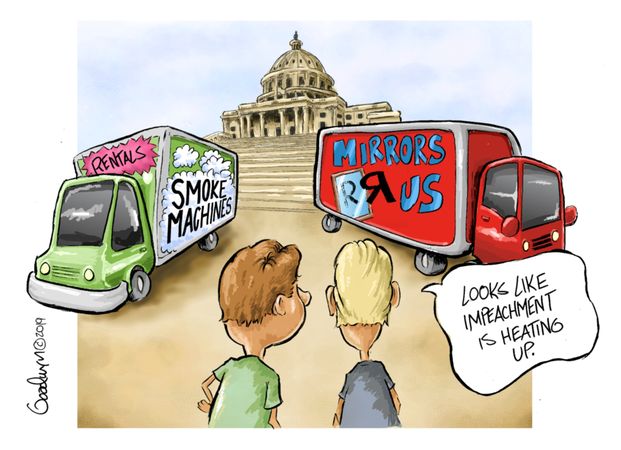
Impeachers Deaf to Turley’s Voice of Reason

The biased PC media in the US, Canada, and elsewhere took their sound bites from the leftist law professors whose opinion on Trump’s impeachment is: No Problem. High time. Completely unreported were the reasonable words from the fourth expert. Jonathan Turley wrote a 52 page brief providing the factual basis and historical context for assessing this present process. His advice is sound and wise, and still falls upon deaf ears. His written testimony is available in pdf format here

The synopsis below consists of some of his pointed paragraphs in italics with my bolds.

Twenty-one years ago, I sat here before you, Chairman Nadler, and other members of the Judiciary Committee to testify on the history and meaning of the constitutional impeachment standard as part of the impeachment of President William Jefferson Clinton. I never thought that I would have to appear a second time to address the same question with regard to another sitting president. Yet, here we are. Some elements are strikingly similar. The intense rancor and rage of the public debate is the same. It was an atmosphere that the Framers anticipated. Alexander Hamilton warned that charges of impeachable conduct “will seldom fail to agitate the passions of the whole community, and to divide it into parties more or less friendly or inimical to the accused.”

As with the Clinton impeachment, the Trump impeachment has again proven Hamilton’s words to be prophetic. The stifling intolerance for opposing views is the same. As was the case two decades ago, it is a perilous environment for a legal scholar who wants to explore the technical and arcane issues normally involved in an academic examination of a legal standard ratified 234 years ago. In truth, the Clinton impeachment hearing proved to be an exception to the tenor of the overall public debate. The testimony from witnesses, ranging from Arthur Schlesinger Jr. to Laurence Tribe to Cass Sunstein,contained divergent views and disciplines. Yet the hearing remained respectful and substantive as we all grappled with this difficult matter. I appear today in the hope that we can achieve that same objective of civil and meaningful discourse despite our good-faith differences on the impeachment standard and its application to the conduct of President Donald J. Trump.

I would like to start, perhaps incongruously, with a statement of three irrelevant facts. First, I am not a supporter of President Trump. I voted against him in 2016 and I have previously voted for Presidents Clinton and Obama. Second, I have been highly critical of President Trump, his policies, and his rhetoric, in dozens of columns. Third, I have repeatedly criticized his raising of the investigation of the Hunter Biden matter withthe Ukrainian president. These points are not meant to curry favor or approval. Rather they are meant to drive home a simple point: one can oppose President Trump’s policies or actions but still conclude that the current legal case for impeachment is not just woefully inadequate, but in some respects, dangerous, as the basis for the impeachment of an American president.

To put it simply, I hold no brief for President Trump. My personal and political views of President Trump, however, are irrelevant to my impeachment testimony, as they should be to your impeachment vote. Today, my only concern is the integrity and coherence of the constitutional standard and process of impeachment. President Trump will not be our last president and what we leave in the wake of this scandal will shape our democracy for generations to come. I am concerned about lowering impeachment standards to fit a paucity of evidence and an abundance of anger. If the House proceeds solely on the Ukrainian allegations, this impeachment would stand out among modern impeachments as the shortest proceeding, with the thinnest evidentiary record, and the narrowest grounds ever used to impeach a president.

That does not bode well for future presidents who are working in a country often sharply and, at times, bitterly divided. Although I am citing a wide body of my relevant academic work on these questions, I will not repeat that work in this testimony. Instead, I will focus on the history and cases that bear most directly on the questions facing this Committee. My testimony will first address relevant elements of the history and meaning of the impeachment standard. Second, I will discuss the past presidential impeachments and inquiries in the context of this controversy. Finally, I will address some of the specific alleged impeachable offenses raised in this process. In the end, I believe that this process has raised serious and legitimate issues for investigation. Indeed, I have previously stated that a quid pro quo to force the investigation of a political rival in exchange for military aid can be impeachable, if proven. Yet moving forward primarily or exclusively with the Ukraine controversy on this record would be as precarious as it would premature.

We have too many happy warriors in this impeachment on both sides. What we need are more objective noncombatants, members willing to set aside political passion in favor of constitutional circumspection. Despite our differences of opinion, I believe that this esteemed panel can offer a foundation for such reasoned and civil discourse. If we are to impeach a president for only the third time in our history, we will need to rise above this age of rage and genuinely engage in a civil and substantive discussion. It is to that end that my testimony is offered today.

II. A BRIEF OVERVIEW OF THE HISTORY AND MEANING OF THE IMPEACHMENT STANDARD

For the purposes of this hearing, it is Article II, Section 4 that is the focus of our attention and, specifically, the meaning of “Treason, Bribery, or other high Crimes and Misdemeanors.” It is telling that the actual constitutional standard is contained in Article II (defining executive powers and obligations) rather than Article I (defining legislative powers and obligations). The location of that standard in Article II serves as a critical check on service as a president, qualifying the considerable powers bestowed upon the Chief Executive with the express limitations of that office. It is in this sense an executive, not legislative, standard set by the Framers. For presidents, it is essential that this condition be clear and consistent so that they are not subject to the whim of shifting majorities in Congress. That was a stated concern of the Framers and led to the adoption of the current standard and, equally probative, the express rejection of other standards.

Colonial impeachments did occur with the same dubious standards and procedures that marked the English impeachments. Indeed, impeachments were used in the absence of direct political power. Much like parliamentary impeachments, thecolonial impeachments became a way of contesting Crown governance. . . Given this history, when the Framers met in Philadelphia to craft the Constitution, impeachment was understandably raised, including the Hastings impeachment, which had yet to go to trial in England. However, there was a contingent of Framers that viewed any impeachment of a president as unnecessary and even dangerous. Charles Pinckney of South Carolina, Gouverneur Morris of Pennsylvania, and Rufus King of Massachusettsopposed such a provision.

In the end, the Framers would reject various prior standards including “corruption,”“obtaining office by improper means”, betraying his trust to a foreign power,“negligence,” “perfidy,” “peculation,” and “oppression.” Perfidy (or lying) and peculation (self-dealing) are particularly interesting in the current controversy given similar accusations against President Trump in his Ukrainian comments and conduct.

However, the Framers clearly stated they adopted the current standard to avoid a vague and fluid definition of a core impeachable offense. The structure of the critical line cannot be ignored. The Framers cited two criminal offenses—treason and bribery—followed by a reference to“other high crimes and misdemeanors.” This is in contrast to when the Framers included“Treason, Felony, or other Crime” rather than “high crime” in the Extradition Clause ofArticle IV, Section 2. The word “other” reflects an obvious intent to convey that the impeachable acts other than bribery and treason were meant to reach a similar level of gravity and seriousness (even if they are not technically criminal acts). This was clearly adeparture from the English model, which was abused because of the dangerous fluidity of the standard used to accuse officials. Thus, the core of American impeachments was intended to remain more defined and limited. It is a discussion that should weigh heavily on the decision facing members of this House.

III. PRIOR PRESIDENTIAL IMPEACHMENTS AND THEIR RELEVANCE TO THE CURRENT INQUIRY

As I have stressed, it is possible to establish a case for impeachment based on a non-criminal allegation of abuse of power. However, although criminality is not required in such a case, clarity is necessary. That comes from a complete and comprehensive record that eliminates exculpatory motivations or explanations. The problem is that this is an exceptionally narrow impeachment resting on the thinnest possible evidentiary record. During the House Intelligence Committee proceedings, Democratic leaders indicated that they wanted to proceed exclusively or primarily on the Ukrainian allegations and wanted a vote by the end of December. I previously wrote that the current incomplete record is insufficient to sustain an impeachment case, a view recently voiced by the New York Times and other sources.

The problem is not simply that the record does not contain direct evidence of the President stating a quid pro quo, as Chairman Schiff has suggested. The problem is that the House has not bothered to subpoena the key witnesses who would have such direct knowledge. This alone sets a dangerous precedent. A House in the future could avoid countervailing evidence by simply relying on tailored records with testimony from people who offer damning presumptions or speculation. It is not enough to simply shrug and say this is “close enough for jazz” in an impeachment. The expectation, as shown by dozens of failed English impeachments, was that the lower house must offer a complete and compelling record. That is not to say that the final record must have a confession or incriminating statement from the accused. Rather, it was meant to be a complete record of the key witnesses that establishes the full range of material evidence. Only then could the body reach a conclusion on the true weight of the evidence—a conclusion that carries sufficient legitimacy with the public to justify the remedy of removal.

The history of American presidential impeachment shows the same restraint even when there were substantive complaints against the conduct of presidents. Indeed, some of our greatest presidents could have been impeached for acts in direct violation of their constitutional oaths of office. . . These efforts reflect the long history of impeachment being used as a way to amplify political differences and grievances. Such legislative throat clearing has been stopped by the House by more circumspect members before articles were drafted or passed. This misuse of impeachment has been plain during the Trump Administration.

I have known many of these members and commentators for years on a professional or personal basis. I do not question their sincere beliefs on the grounds for such impeachments, but we have fundamental differences in the meaning and proper use of this rarely used constitutional device. As I have previously written, such misuses of impeachment would convert our process into a type of no-confidence vote of Parliament. Impeachment has become an impulse buy item in our raging political environment. Slate has even featured a running “Impeach-O-Meter.” Despite my disagreement with many of President Trump’s policies and statements, impeachment was never intended to be used as a mid-term corrective option for a divisive or unpopular leader. To its credit, the House has, in all but one case, arrested such impulsive moves before the transmittal of actual articles of impeachment to the Senate. Indeed, only two cases have warranted submission to the Senate and one was a demonstrative failure on the part of the House in adhering to the impeachment standard. Those two impeachments—and the third near-impeachment of Richard Nixon—warrant closer examination and comparison in the current environment.

Comparison with Three Previous Presidential Impeachments

A comparison of the current impeachment inquiry with the three prior presidential inquiries puts a few facts into sharp relief. First, this is a case without a clear criminal act and would be the first such case in history if the House proceeds without further evidence. In all three impeachment inquiries, the commission of criminal acts by Johnson, Nixon, and Clinton were clear and established. With Johnson, the House effectively created a trapdoor crime and Johnson knowingly jumped through it. The problem was that the law—the Tenure in Office Act—was presumptively unconstitutional and the impeachment was narrowly built around that dubious criminal act. With Nixon, there were a host of alleged criminal acts and dozens of officials who would be convicted of felonies. With Clinton, there was an act of perjury that even his supporters acknowledged was a felony, leaving them to argue that some felonies “do not rise to the level” of an impeachment. Despite clear and established allegations of criminal acts committed by the president, narrow impeachments like Johnson and Clinton have fared badly. As will be discussed further below, the recently suggested criminal acts related to the Ukrainian controversy are worse off, being highly questionable from a legal standpoint and far from established from an evidentiary standpoint.

Second, the abbreviated period of investigation into this controversy is both problematic and puzzling. Although the Johnson impeachment progressed quickly after the firing of the Secretary of War, that controversy had been building for over a year and was actually the fourth attempted impeachment. Moreover, Johnson fell into the trap laid a year before in the Tenure of Office Act. The formal termination was the event that triggered the statutory language of the act and thus there was no dispute as to the critical facts. We have never seen a controversy arise for the first time and move to impeachment in such a short period. Nixon and Clinton developed over many months of investigation and a wide array of witness testimony and grand jury proceedings. In the current matter, much remains unknown in terms of key witnesses and underlying documents. There is no explanation why the matter must be completed by December. After two years of endless talk of impeachable and criminal acts, little movement occurred toward an impeachment. Suddenly the House appears adamant that this impeachment must be completed by the end of December. To be blunt, if the schedule is being accelerated by the approach of the Iowa caucuses, it would be both an artificial and inimical element to introduce into the process. This is not the first impeachment occurring during a political season. In the Johnson impeachment, the vote on the articles was interrupted by the need for some Senators to go to the Republican National Convention. The bifurcated vote occurred in May 1868 and the election was held just six months later.

Finally, the difference in the record is striking. Again, Johnson’s impeachment must be set aside as an outlier since it was based on a manufactured trap-door crime. Yet,even with Johnson, there was over a year of investigations and proceedings related to his alleged usurpation and defiance of the federal law. The Ukrainian matter is largely built around a handful of witnesses and a schedule that reportedly set the matter for a vote within weeks of the underlying presidential act. Such a wafer-thin record only magnifies the problems already present in a narrowly constructed impeachment. The question for the House remains whether it is seeking simply to secure an impeachment or actually trying to build a case for removal. If it is the latter, this is not the schedule or the process needed to build a viable case. The House should not assume that the Republican control of the Senate makes any serious effort at impeachment impractical or naïve. All four impeachment inquiries have occurred during rabid political periods. However, politicians can on occasion rise to the moment and chose principle over politics. Indeed, in the Johnson trial, senators knowingly sacrificed their careers to fulfill their constitutional oaths. If the House wants to make a serious effort at impeachment, it should focus on building the record to raise these allegations to the level of impeachable offenses and leave to the Senate the question of whether members will themselves rise to the moment that follows.

IV. THE CURRENT THEORIES OF IMPEACHABLE CONDUCT AGAINST PRESIDENT DONALD J. TRUMP

While all three acts in the impeachment standard refer to criminal acts in modern parlance, it is clear that “high crimes and misdemeanors” can encompass non-criminal conduct. It is also true that Congress has always looked to the criminal code in the fashioning of articles of impeachment. The reason is obvious. Criminal allegations not only represent the most serious forms of conduct under our laws, but they also offer an objective source for measuring and proving such conduct. We have never had a presidential impeachment proceed solely or primarily on an abuse of power allegation, though such allegations have been raised in the context of violations of federal or criminal law. Perhaps for that reason, there has been a recent shift away from a pure abuse of power allegation toward direct allegations of criminal conduct. That shift, however, has taken the impeachment process far outside of the relevant definitions and case law on these crimes.

It is to those allegations that I would now like to turn. At the outset, however, two threshold issues are worth noting. First, this hearing is being held before any specific articles have been proposed. During the Clinton impeachment hearing, we were given a clear idea of the expected articles of impeachment and far greater time to prepare analysis of those allegations. The House leadership has repeatedly indicated that they are proceeding on the Ukrainian controversy and not the various alleged violations or crimes alleged during the Russian investigation. Recently, however, Chairman Schiff indicated that there might be additional allegations raised while continuing to reference the end of December as the working date for an impeachment vote. Thus, we are being asked to offer a sincere analysis on the grounds for impeachment while being left in the dark. My testimony is based on the public statements regarding the Ukrainian matter, which contain references to four alleged crimes and, most recently, a possible compromise proposal for censure.

Second, the crimes discussed below were recently raised as part of the House Intelligence Committee hearings as alternatives to the initial framework as an abuse of power. There may be a desire to refashion these facts into crimes with higher resonance with voters, such as bribery. In any case, Chairman Schiff and committee members began to specifically ask witnesses about elements that were pulled from criminal cases. When some of us noted that courts have rejected these broader interpretations or that there are missing elements for these crimes, advocates immediately shifted to a position that it really does not matter because “this is an impeachment.” This allows members to claim criminal acts while dismissing the need to actually support such allegations. If that were the case, members could simply claim any crime from treason to genocide. While impeachment does encompass non-crimes, including abuse of power, past impeachments have largely been structured around criminal definitions. The reason is simple and obvious. The impeachment standard was designed to be a high bar and felonies often were treated as inherently grave and serious. Legal definitions and case law also offer an objective and reliable point of reference for judging the conduct of judicial and executive officers. It is unfair to claim there is a clear case of a crime like bribery and simultaneously dismiss any need to substantiate such a claim under the controlling definitions and meaning of that crime. After all, the common mantra that “no one is above the law” is a reference to the law applied to all citizens, even presidents. If the House does not have the evidence to support a claim of a criminal act, it should either develop such evidence or abandon the claim. As noted below, abandoning such claims would still leave abuse of power as a viable ground for impeachment. It just must be proven.

A. Bribery

While the House Intelligence Committee hearings began with references to“abuse of power” in the imposition of a quid pro quo with Ukraine, it ended with repeated references to the elements of bribery. After hearing only two witnesses, House Speaker Nancy Pelosi declared witnesses offered “devastating” evidence that“corroborated” bribery. This view was developed further by House Intelligence Committee Chairman Adam Schiff who repeatedly returned to the definition of bribery while adding the caveat that, even if this did not meet the legal definition of bribery, it might meet a prior definition under an uncharacteristically originalist view: “As the founders understood bribery, it was not as we understand it in law today. It was much broader. It connoted the breach of the public trust in a way where you’re offering official acts for some personal or political reason, not in the nation’s interest.” The premise of the bribery allegations is that President Trump was soliciting a bribe from Ukraine when he withheld either a visit at the White House or military aid in order to secure investigations into the 2016 election meddling and the Hunter Biden contract by Ukraine. On its face, the bribery theory is undermined by the fact that Trump released the aid without the alleged pre-conditions.

However, the legal flaws in this theory are more significant than such factual conflicts. As I have previously written, this record does not support a bribery charge in either century. Before we address this bribery theory, it is important to note that any criminal allegation in an impeachment must be sufficiently clear and recognized to serve two purposes. First, it must put presidents on notice of where a line exists in the range of permissible comments or conduct in office. Second, it must be sufficiently clear to assure the public that an impeachment is not simply an exercise of partisan creativity in rationalizing a removal of a president. Neither of these purposes was satisfied in the Johnson impeachment where the crime was manufactured by Congress. This is why past impeachments focused on establishing criminal acts with reference to the criminal code and controlling case law. Moreover, when alleging bribery, it is the modern definition that is the most critical since presidents (and voters) expect clarity in the standards applied to presidential conduct. Rather than founding these allegations on clear and recognized definitions, the House has advanced a capacious and novel view of bribery to fit the limited facts. If impeachment is reduced to a test of creative redefinitions of crimes, no president will be confident in theirability to operate without the threat of removal. Finally, as noted earlier, dismissing the need to establish criminal conduct by arguing an act is “close enough for impeachment,”is a transparent and opportunistic spin. This is not improvisational jazz. “Close enough”is not nearly enough for a credible case of impeachment.

Under the common law definition, bribery remains relatively narrow and consistently defined among the states. “The core of the concept of a bribe is an inducement improperly influencing the performance of a public function meant to be gratuitously exercised.”

The definition does not lend itself to the current controversy. President Trump can argue military and other aid is often used to influence other countries in taking domestic or international actions. It might be a vote in the United Nations or an anti-corruption investigation within a nation. Aid is not assumed to be“gratuitously exercised” but rather it is used as part of foreign policy discussions and international relations. Moreover, discussing visits to the White House is hardly the stuff of bribery under any of these common law sources. Ambassador Sondland testified that the President expressly denied there was a quid pro quo and that he was never told of such preconditions. However, he also testified that he came to believe there was a quid pro quo, not for military aid, but rather for the visit to the White House: “Was there a‘quid pro quo? With regard to the requested White House call and White House meeting, the answer is yes.” Such visits are routinely used as bargaining chips and not“gratuitously exercised.” As for the military aid, the withholding of the aid is difficult to fit into any common law definition of a bribe, particularly when it was ultimately provided without the satisfaction of the alleged pre-conditions.

Various public corruption and bribery provisions are currently on the books, but the standard provision is found in 18 U.S.C. § 201 which allows for prosecution when “[a] public official or person selected to be a public official, directly or indirectly, corruptly demands, seeks, receives, accepts, or agrees to receive or acceptanything of value personally or for any other person or entity, in return for … beinginfluenced in the performance of any official act.” While seemingly sweeping in its scope, the definition contains narrowing elements on the definition of what constitutes “a thing of value,” an “official act,” and “corrupt intent.” The Supreme Court has repeatedly narrowed the scope of the statutory definition of bribery, including distinctions with direct relevance to the current controversy.

In McDonnell v. United States, the Court overturned the conviction of former Virginia governor Robert McDonnell. McDonnell and his wife were prosecuted for bribery under the Hobbs Act, applying the same elements as found in Section 201(a)(3). They were accused of accepting an array of loans, gifts, and other benefits from a businessman in return for McDonnell facilitating key meetings, hosting events, and contacting government officials on behalf of the businessman who ran a company called Star Scientific. The benefits exceeded $175,000 and the alleged official acts were completed. Nevertheless, the Supreme Court unanimously overturned the conviction. As explained by Chief Justice Roberts:

“[O]ur concern is not with tawdry tales of Ferraris, Rolexes, and ballgowns. It is instead with the broader legal implications of the Government’s boundless intrepretation of the federal bribery statute. A more limited interpretation of the term ‘official act’ leaves ample room for prosecuting corruption, while comporting with the text of the statute andthe precedent of this Court.”

The opinion is rife with references that have a direct bearing on the current controversy. This includes the dismissal of meetings as insufficient acts. It also included the allegations that “recommending that senior government officials in the [Governor’sOffice] meet with Star Scientific executives to discuss ways that the company’s products could lower health care costs.” While the meeting and contacts discussed by Ambassador Sondland as a quid pro quo are not entirely the same, the Court refused to recognize that “nearly anything a public official does—from arranging a meeting to inviting a guest toan event—counts as a quo.”

Applying McDonnell and other cases to the current controversy undermines the bribery claims being raised. The Court noted that an “official act” is a decision or action on a ‘question, matter, cause, suit, proceeding or controversy.’ The ‘question, matter, cause, suit, proceeding or controversy’ must involve a formal exercise of governmental power that is similar in nature to a lawsuit before a court, a determination before an agency, or a hearing before a committee. It must also be something specific and focused that is ‘pending’ or ‘may by law be brought’ before a public official.”

The discussion of a visit to the White House is facially inadequate for this task, as it is not a formal exercise of governmental power. However, withholding of military aid certainly does smack of a “determination before an agency.” Yet, that “quo” breaks down on closer scrutiny, even before getting to the question of a “corrupt intent.” Consider the specific act in this case. As the Ukrainians knew, Congress appropriated the $391 millionin military aid for Ukraine and the money was in the process of being apportioned. Witnesses before the House Intelligence Committee stated that it was not uncommon to have delays in such apportionment or for an Administration to hold back money for a period longer than the 55 days involved in these circumstances. Acting Chief of Staff Mike Mulvaney stated that the White House understood it was required to release the money by a certain date absent a lawful reason barring apportionment. That day was the end of September for the White House. Under the 1974 Impoundment Control Act (ICA),reserving the funds requires notice to Congress. This process has always been marked by administrative and diplomatic delays. As the witnesses indicated, it is not always clear why aid is delayed. Arguably, by the middle of October, the apportionment of the aid was effectively guaranteed. It is not contested that the Administration could delay the apportionment to resolve concerns over how the funds would be effectively used or apportioned.

It is certainly fair to question the non-budgetary reasons for the delay in the release of the funds. Yet, the White House was largely locked into the statutory andregulatory process for obligating the funds by the end of September. Even if the President sought to mislead the Ukrainians on his ability to deny the funding, there is no evidence of such a direct statement in the record. Indeed, Ambassador Taylor testified that he believed the Ukrainians first raised their concerns over a pre-condition on August 31 withthe publication of the Politico article on the withholding of the funds. The aid was released roughly ten days later, and no conditions were actually met. The question remains what the “official act” was for this theory given the deadline for aid release. Indeed, had a challenge been filed over the delay before the end of September, it would have most certainly been dismissed by a federal court as premature, if not frivolous.Even if the “official act” were clear, any bribery case would collapse on the current lack of evidence of a corrupt intent.

Finally, the “boundless interpretations of the bribery statutes” rejected in McDonnell pale in comparison to the effort to twist these facts into the elements of that crime. I am not privy to conversations between heads of state, but I expect many prove to be fairly freewheeling and informal at points. I am confident that such leaders often discuss politics and the timing of actions in their respective countries.

If this conversation is a case of bribery, we could have marched every living president off to the penitentiary.

Presidents often use aid as leverage and seek to advance their administrations in the timing or content of actions. The media often discusses how foreign visits are used for political purposes, particularly as elections approach. The common reference to an “October surprise” reflects this suspicion that presidents often use their offices, and foreign policy, to improve their image. If these conversations are now going to be reviewed under sweeping definitions of bribery, the chilling effect on future presidents would be perfectly glacial. The reference to the Hunter Biden deal with Burisma should never have occurred and is worthy of the criticism of President Trump that it has unleashed. However, it is not a case of bribery, whether you are adopting the view of an eighteenth century, or of a twenty-first century prosecutor. As a criminal defense attorney, I would view such an allegation from a prosecutor to be dubious to the point of being meritless.

B. Obstruction of Justice

Another crime that was sporadically mentioned during the House Intelligence hearings was obstruction of justice or obstruction of Congress.

Once again, with only a few days to prepare this testimony and with no public report on the specific allegations, my analysis remains mired in uncertainty as to any plan to bring such a claim to the foundational evidence for the charge. Most of the references to obstruction have been part of a Ukraine-based impeachment plan that does not include any past alleged crimes from the Russian investigation. I will therefore address the possibility of a Ukraine-related obstruction article of impeachment. However, as I have previously written, I believe an obstruction claim based on the Mueller Report would equally at odds with the record and the controlling case law.

The use of an obstruction theory from the Mueller Report would be unsupportable in the House and unsustainable in the Senate. Once again, the lack of information (just weeks before an expected impeachment vote) on the grounds for impeachment is both concerning and challenging. It is akin to being asked to diagnose a patient’s survivability without knowing his specific illness. Obstruction of justice is a more broadly defined crime than bribery and often overlaps with other crimes like witness tampering, subornation, or specific acts designed to obstruct a given proceeding. There are many federal provisions raising forms o fobstruction that reference parallel crimes. Thus, influencing a witness is a standalone crime and also a form of obstruction under 18 U.S.C. 1504. In conventional criminal cases, prosecutions can be relatively straightforward, such as cases of witness intimidation under 18 U.S. 1503.

Of course, this is no conventional case. The obstruction claims leveled against President Trump in the Ukrainian context have centered on two main allegations. First, there was considerable discussion of the moving of the transcript of the call with President Zelensky to a classified server as a possible premeditated effort to hide evidence. Second, there have been repeated references to the “obstruction” of President Trump by invoking executive privileges or immunities to withhold witnesses and documents from congressional committees.

In my view, neither of these general allegations establishes a plausible case of criminal obstruction or a viable impeachable offense. The various obstruction provisions generally share common elements. 18 U.S.C. §1503, for example, broadly defines the crime of “corruptly” endeavoring “to influence, obstruct or impede the due administration of justice.” This “omnibus” provision, however, is most properly used for judicial proceedings such as grand jury investigations,and the Supreme Court has narrowly construed its reach. There is also 18 U.S.C. §1512(c), which contains a “residual clause” in subsection (c)(2), which reads:(c) Whoever corruptly– (1) alters, destroys, mutilates, or conceals arecord, document, or other object, or attempts to do so, with the intent toimpair the object’s integrity or availability for use in an official proceeding; or (2) otherwise obstructs, influences, or impedes any official proceeding, or attempts to do so [is guilty of the crime of obstruction].[emphasis added].

There is no evidence that President Trump acted with the corrupt intent required for obstruction of justice on the record created by the House Intelligence Committee.

Let us start with the transfer of the file. The transfer of the transcript of the file was raised as a possible act of obstruction to hide evidence of a quid pro quo. However, the nefarious allegations behind the transfer were directly contradicted by Tim Morrison, the former Deputy Assistant to the President and Senior Director for Europe and Russia on the National Security Council. Morrison testified that he was the one who recommended that the transcript be restricted after questions were raised about President Trump’srequest for investigations.

Absent additional testimony or proof that Morrison has perjured himself, the allegation concerning the transfer of the transcript would seem entirely without factual support, let alone legal support, as a criminal obstructive act. Most recently, the members have focused on an obstruction allegation centering on the instructions of the White House to current and former officials not to testify due to the expected assertions of executive privilege and immunity. Notably, the House has elected not to subpoena core witnesses with first-hand evidence on any quid pro quo in the Ukraine controversy. Democratic leaders have explained that they want a vote by the end of December, and they are not willing to wait for a decision from the court system as to the merits of these disputes.

In my view, that position is entirely untenable and abusive in an impeachment. Essentially, these members are suggesting a president can be impeached for seeking a judicial review of a conflict over the testimony of high-ranking advisers to the President over direct communications with the President. The position is tragically ironic. The Democrats have at times legitimately criticized the President for treating Article II as a font of unilateral authority. Yet, they are now doing the very same thing in claiming Congress can demand any testimony or documents and then impeach any president who dares to go to the courts. Magnifying the flaws in this logic is the fact that the House has set out one of the shortest periods in history for this investigation—a virtual rocket docket for impeachment. House leaders are suggesting that they will move from notice of an alleged impeachable act at the beginning of September and adopt articles of impeachment based on controversy roughly 14 weeks later.

On this logic, the House could give a president a week to produce his entire staff for testimony and then impeach him when he seeks review by a federal judge.

With such review, the courts stand with Congress on the issue of disclosure and ultimately obstruction in congressional investigations. Moreover, such cases can be expedited in the courts. In the Nixon litigation, courts moved those cases quickly to the Supreme Court. In contrast, the House leaderships have allowed two months to slip away without using its subpoena authority to secure the testimony of critical witnesses. The decision to adopt an abbreviated schedule for the investigation and not to seek to compel such testimony is a strategic choice of the House leadership. It is not the grounds for an impeachment. If the House moves forward with this impeachment basis, it would be repeating the very same abusive tactics used against President Andrew Johnson.

The obstruction allegation is also undermined by the fact that many officials opted to testify, despite the orders from the President that they should decline. These include core witnesses in the impeachment hearings, like National Security Council Director of European Affairs Alexander Vindman, Ambassador William Taylor, Ambassador Gordon Sondland, Deputy Assistant Secretary of State George Kent, Acting Assistant Secretary of State Philip Reeker, Under Secretary of State David Hale, Deputy Associate Director of the Office of Management and Budget Mark Sandy, and Foreign Service Officer David Holmes. All remain in federal service in good standing. Thus, the President has sought judicial review without taking disciplinary actions against those who defied his instruction not to testify.

C. Extortion.

As noted earlier, extortion and bribery cases share a common law lineage. Under laws like the Hobbs Act, prosecutors can allege different forms of extortion. The classic form of extortion is coercive extortion to secure property “by violence, force, or fear.” Even if one were to claim the loss of military aid could instill fear in a country, that is obviously not a case of coercive extortion as that crime has previously been defined. Instead, it would presumably be alleged as extortion “under color of official right.”

Clearly, both forms of extortion have a coercive element, but the suggestion is that Trump was “trying to extort” the Ukrainians by withholding aid until they agreed to open investigations. The problem is that this allegation is no closer to the actual crime of extortion than it is to its close cousin bribery. The Hobbs Act defines extortion as “the obtaining of property from another, with his consent, induced by wrongful use of actual or threatened force, violence, or fear or under color of official right.” The use of anything “of value” today would be instantly rejected. Extortion cases involve tangible property, not possible political advantage.

In this case, Trump asked for cooperation with the Justice Department in its investigation into the origins of the FBI investigation on the 2016 election. As noted before, that would make a poor basis for any criminal or impeachment theory. The Biden investigation may have tangible political benefits, but it is not a form of property. Indeed, Trump did not know when such an investigation would be completed or what it might find. Thus, the request was for an investigation that might not even benefit Trump.

D. Campaign Finance Violation

Some individuals have claimed that the request for investigations also constitutes a felony violation of the election finance laws. Given the clear language of that law and the controlling case law, there are no good-faith grounds for such an argument. To put it simply, this dog won’t hunt as either a criminal or impeachment matter. U.S.C. section30121 of Title 52 states: “It shall be unlawful for a foreign national, directly or indirectly,to make a contribution or donation of money or other thing of value, or to make an express or implied promise to make a contribution or donation, in connection with a federal, state, or local election.”

However, the Justice Department already reviewed the call and correctly concluded it was not a federal election violation.

This determination was made by the prosecutors who make the decisions on whether to bring such cases. The Justice Department concluded that the call did not involve a request for a “thing of value”under the federal law. Congress would be alleging a crime that has been declared not to be a crime by career prosecutors. Such a decision would highlight the danger of claiming criminal acts, while insisting that impeachment does not require actual crimes.

There is also the towering problem of using federal campaign laws to regulate communications between the heads of state. Any conversation between heads of state are inherently political. Every American president facing reelection schedules foreign trips and actions to advance their political standing. Indeed, such trips and signing ceremonies are often discussed as transparently political decisions by incumbents. Under the logic of this theory, any request that could benefit a president is suddenly an unlawful campaign finance violation valued arbitrarily at $25,000 or more. Such a charge would have no chance of surviving a threshold of motion to dismiss.

E. Abuse of Power

The Ukraine controversy was originally characterized not as one of these forced criminal allegations, but as a simple abuse of power. As I stated from the outset of this controversy, a president can be impeached for abuses of power. In Federalist #65,Alexander Hamilton referred to impeachable offenses as “those offences which proceed from the misconduct of public men, or, in other words, from the abuse or violation of some public trust.”

The problem is that we have never impeached a president solely or even largely on the basis of a non-criminal abuse of power allegation. There is good reason for that unbroken record. Abuses of power tend to be even less defined and more debatable as a basis for impeachment than some of the crimes already mentioned. Again, while a crime is not required to impeach, clarity is necessary. In this case, there needs to be clear and unequivocal proof of a quid pro quo. That is why I have been critical of how this impeachment has unfolded. I am particularly concerned about the abbreviated schedule and thin record that will be submitted to the full house. Unlike the other dubious criminal allegations, the problem with the abuse of power allegation is its lack of foundation. As I have previously discussed, there remain core witnesses and documents that have not been sought through the courts. The failure to seek this foundation seems to stem from an arbitrary deadline at the end of December. Meeting that deadline appears more important than building a viable case for impeachment. Two months have been wasted that should have been put toward litigating access to this missing evidence.

The choice remains with the House. It must decide if it wants a real or recreational impeachment. 

Moreover, presidents often discuss political issues with their counterparts and make comments that are troubling or inappropriate. However,contemptible is not synonymous with impeachable. Impeachment is not a vehicle to monitor presidential communications for such transgressions. That is why making the case of a quid pro quo is so important – a case made on proof, not presumptions. While critics have insisted that there is no alternative explanation, it is willful blindness to ignore the obvious defense. Trump can argue that he believed the Obama Administration failed to investigate a corrupt contract between Burisma and Hunter Biden. He publicly called for the investigation into the Ukraine matters. Requesting an investigation is not illegal any more than a leader asking for actions from their counterparts during election years.

It is certainly true that both criminal and impeachment cases can be based on circumstantial evidence, but that is less common when direct evidence is available but unsecured in the investigation. Proceeding to a vote on this incomplete record is a dangerous precedent to set for this country. Removing a sitting President is not supposed to be easy or fast. It is meant to be thorough and complete. This is neither.

F.The Censure Option

Finally, there is one recurring option that was also raised during the Clinton impeachment: censure. I have been a long critic of censure as a part of impeachment inquiries and I will not attempt to hide my disdain for this option. It is not a creature of impeachment and indeed is often used by members as an impeachment-lite alternative for those who do not want the full constitutional caloric load of an actual impeachment. Censure has no constitutional foundation or significance. Noting the use of censure in a couple of prior cases does not make it precedent any more than Senator Arlen Specter’s invocation of the Scottish “Not Proven” in the Clinton trial means that we now have a third option in Senate voting. If the question is whether Congress can pass a resolution with censure in its title, the answer is clearly yes. However, having half of Congress express their condemnation for this president with the other half opposing such a condemnation will hardly be news to most voters. I am agnostic about such extra-constitutional options except to caution that members should be honest and not call such resolutions part of the impeachment process.

V. CONCLUSION

Allow me to be candid in my closing remarks. I get it. You are mad. The President is mad. My Democratic friends are mad. My Republican friends are mad. My wife is mad. My kids are mad. Even my dog is mad . . .and Luna is a golden doodle and they are never mad. We are all mad and where has it taken us?

Will a slipshod impeachment make us less mad or will it only give an invitation for the madness to follow in every future administration?

That is why this is wrong. It is not wrong because President Trump is right. His call was anything but “perfect” and his reference to the Bidens was highly inappropriate. It is not wrong because the House has no legitimate reason to investigate the Ukrainian controversy. The use of military aid for a quid pro quo to investigate one’s political opponent, if proven, can be an impeachable offense. It is not wrong because we are in an election year. There is no good time for an impeachment, but this process concerns the constitutional right to hold office in this term,not the next.

No, it is wrong because this is not how an American president should be impeached. For two years, members of this Committee have declared that criminal and impeachable acts were established for everything from treason to conspiracy to obstruction. However, no action was taken to impeach. Suddenly, just a few weeks ago, the House announced it would begin an impeachment inquiry and push for a final vote in just a matter of weeks. To do so, the House Intelligence Committee declared that it would not subpoena a host of witnesses who have direct knowledge of any quid pro quo. Instead, it will proceed on a record composed of a relatively small number of witnesses with largely second-hand knowledge of the position. The only three direct conversations with President Trump do not contain a statement of a quid pro quo and two expressly deny such a pre-condition. The House has offered compelling arguments why those two calls can be discounted by the fact that President Trump had knowledge of the underlying whistleblower complaint.

However, this does not change the fact that it is moving forward based on conjecture, assuming what the evidence would show if there existed the time or inclination to establish it. 

This is not a case of the unknowable. It is a case of the peripheral. The House testimony is replete with references to witnesses like John Bolton, Rudy Giuliani, and Mike Mulvaney who clearly hold material information. To impeach a president on such a record would be to expose every future president to the same type of inchoate impeachment. Principle often takes us to a place where we would prefer not to be. That was the place the “Republican Recusants” found themselves in 1868 when sitting in judgment of a president they loathed and despised. However, they took an oath not to Andrew Johnson, but to the Constitution. One of the greatest among them, Lyman Trumbull (R-Ill.) explained his fateful decision to vote against Johnson’s impeachment charges even at the cost of his own career: “Once set the example of impeaching a President for what, when the excitement of the hour shall have subsided, will be regarded as insufficient causes … no future President will be safe who happens to differ with the majority of the House and two-thirds of the Senate …I tremble for the future of my country. I cannot be an instrument to produce such a result; and at the hazard of the ties even of friendship and affection,till calmer times shall do justice to my motives, no alternative is left me…”

Trumbull acted in the same type of age of rage that we have today. He knew that raising a question about the underlying crime or the supporting evidence would instantly be condemned as approving of the underlying conduct of a president. In an age of rage, there seems to be no room for nuance or reservation. Yet, that is what the Constitution expects of us. Expects of you. For generations, the seven Republicans who defected to save President Johnson from removal have been heralded as profiles of courage. In recalling the moment he was called to vote, Senator Edmund Ross of Kansas said he “almost literally looked downinto my open grave.” He jumped because the price was too great not to.

Such moments are easy to celebrate from a distance of time and circumstance. However, that is precisely the moment in which you now find yourself. “When the excitement of the hour [has] subsided” and “calmer times” prevail, I do not believe that this impeachment will be viewed as bringing credit upon this body. It is possible that a case for impeachment could be made, but it cannot be made on this record. To return to Wordsworth, the Constitution is not a call to arms for the “Happy Warriors.” The Constitution calls for circumspection, not celebration, at the prospect of the removal of an American president. It is easy to allow one’s “judgment [to be] affected by your moral approval of the lines” in an impeachment narrative. But your oath demands more, even personal and political sacrifice, in deciding whether to impeach a president for only the third time in the history of this Republic.

In this age of rage, many are appealing for us to simply put the law aside and “just do it” like this is some impulse-buy Nike sneaker. You can certainly do that. You can declare the definitions of crimes alleged are immaterial and this is an exercise of politics, not law. However, the legal definitions and standards that I have addressed in my testimony are the very thing dividing rage from reason. . .Both sides in this controversy have demonized the other to justify any measure in defense. Perhaps that is the saddest part of all of this. We have forgotten the common article of faith that binds each of us to each other in our Constitution. However, before we cut down the trees so carefully planted by the Framers, I hope you consider what you will do when the wind blows again . . . perhaps for a Democratic president. Where will you stand then “the laws all being flat?”

Thank you again for the honor of testifying before you today. I am happy to answer any questions that you may have.

Postscript: Turley’s balanced and reasonable advice has also been met with condemnation and distortion. He responds with an article at The Hill Democrats offering passion over proof in Trump impeachment. Excerpt.

In my testimony Wednesday, I lamented that, as in the impeachment of President Clinton from 1998 to 1999, there is an intense “rancor and rage” and “stifling intolerance” that blinds people to opposing views. My call for greater civility and dialogue may have been the least successful argument I made to the committee. Before I finished my testimony, my home and office were inundated with threatening messages and demands that I be fired from George Washington University for arguing that, while a case for impeachment can be made, it has not been made on this record.

In my testimony Wednesday, I stated repeatedly, as I did 21 years ago, that a president can be impeached for noncriminal acts, including abuse of power. I made that point no fewer that a dozen times in analyzing the case against Trump and, from the first day of the Ukraine scandal, I have made that argument both on air and in print. Yet various news publications still excitedly reported that, in an opinion piece I wrote for the Washington Post five years ago, I said, “While there is a high bar for what constitutes grounds for impeachment, an offense does not have to be indictable,” and it could include “serious misconduct or a violation of public trust.”

That is precisely what I have said regarding Trump. You just need to prove abuse of power. My objection is not that you cannot impeach Trump for abuse of power but that this record is comparably thin compared to past impeachments and contains conflicts, contradictions, and gaps including various witnesses not subpoenaed. I suggested that Democrats drop the arbitrary schedule of a vote by the end of December and complete their case and this record before voting on any articles of impeachment. In my view, they have not proven abuse of power in this incomplete record.

As I said 21 years ago, a president can still be impeached for abuse of power without a crime, and that includes Trump. But that makes it more important to complete and strengthen the record of such an offense, as well as other possible offenses. I remain concerned that we are lowering impeachment standards to fit a paucity of evidence and an abundance of anger. Trump will not be our last president. What we leave in the wake of this scandal will shape our democracy for generations to come. These “agitated passions” will not be a substitute for proof in an impeachment. We currently have too much of the former and too little of the latter.
Tipping Points Confuse Social and Earth Science

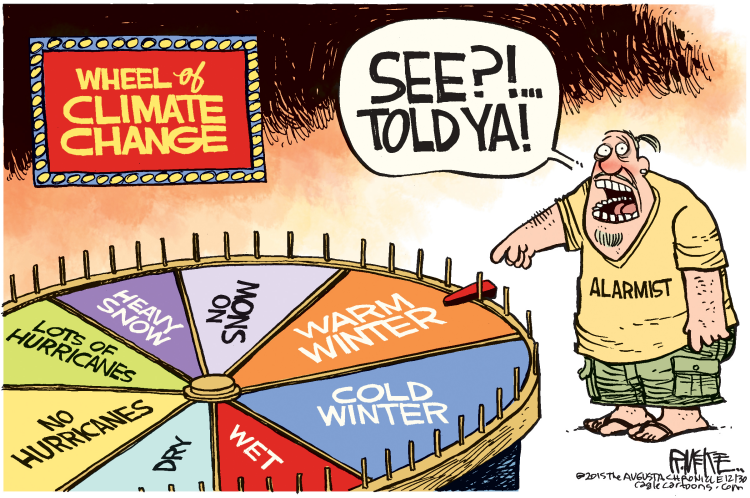
In the drive to push public opinion over the top regarding global warming/climate change, the media is increasingly filled with references to climate “tipping points.”  For example, some months ago an IPCC spokesperson claimed a climate disaster is now happening each and every week.  And the media abounds with reports to press home the point. Here are some of the current disasters caused by climate change, ripped (as they say) from the headlines.

Birds are shrinking as the climate warms

Climate change-related deaths and damage on the rise

Europe Could Face Annual Extreme Heat Waves Due to Climate Change

Food Prices Expected To Jump Next Year Due To Climate Change

Climate change taking serious toll on human health: WHO report

Climate Crisis Causing Hunger for Millions of Africans

How climate change is causing more premature births

Et cetera, et cetera. (A complete list would provide more than one disaster for every week of the year.)

IOW, as Pys.org reported, all this hype may make this year the tipping point: The year the world woke up to the climate emergency.

Background on the Use of “Tipping Points”

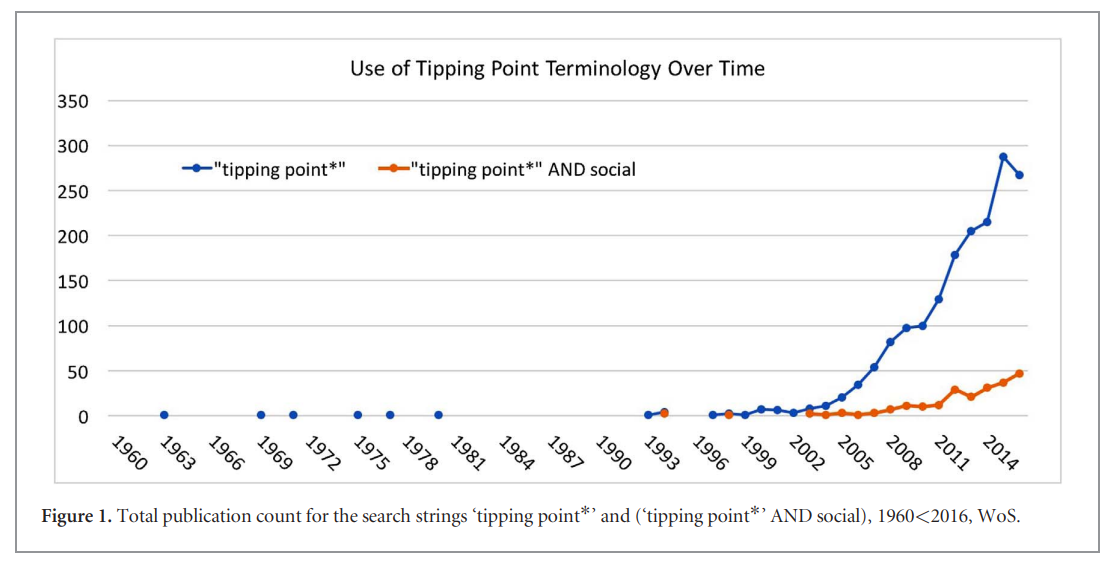
The context for understanding the rise of the “tipping point” notion is provided by a 2018 paper in Environmental Research Letters Defining tipping points for social-ecological systems scholarship—an interdisciplinary literature review. As the title suggests the researchers are not studying the earth, but rather people’s perceptions about the earth. This growing field of environmental psychology confirms how “climate change” muddles social and physical sciences. Excerpts in italics with my bolds

Abstract

The term tipping point has experienced explosive popularity across multiple disciplines over the last decade. Research on social-ecological systems (SES) has contributed to the growth and diversity of the term’s use. The diverse uses of the term obscure potential differences between tipping behavior in natural and social systems, and issues of causality across natural and social system components in SES. This paper aims to create the foundation for a discussion within the SES research community about the appropriate use of the term tipping point, especially the relatively novel term ‘social tipping point.’

We review existing literature on tipping points and similar concepts (e.g. regime shifts, critical transitions) across all spheres of science published between 1960 and 2016 with a special focus on a recent and still small body of work on social tipping points. We combine quantitative and qualitative analyses in a bibliometric approach, rooted in an expert elicitation process.

Historical Analysis and Concerns

We find that the term tipping point became popular after the year 2000—long after the terms regime shift and critical transition—across all spheres of science. We identify 23 distinct features of tipping point definitions and their prevalence across disciplines, but find no clear taxonomy of discipline-specific definitions. Building on the most frequently used features, we propose definitions for tipping points in general and social tipping points in SES in particular.

Being located at the intersection between the social and natural sciences, SES researchers need to tread carefully when borrowing concepts from other disciplines. Such a move often involves the crossing of ontological boundaries, where the metaphorical use of a concept can mask important differences between two objects of study. The two phenomena included in the analogy should be similar in the sense that they can be characterized by common laws or principles. The success of the analogy depends on whether attributes of tipping points in the target domain can be tested and assessed similar to the one in the source domain (Daniel 1955, Gentner 1983). However, SES research pays little attention to whether the presumed observation of tipping behavior in a social system is conceptually equal or (partly) different than tipping processes in an ecological system. It remains unknown whether tipping points in natural systems, such as a lake or the climate, display the same underlying mechanisms as tipping points in social systems, such as in financial markets or political institutions.

The tipping point concept traces its origins back to scientific papers in chemistry (Hoadley 1884) and mathematics (Poincare´ 1885), which refer to a qualitative change in a system described mathematically as a bifurcation. Bifurcation theory is still used today in mathematics, physics, complex systems science, and related fields.

In the social sciences, tipping points originated much later to address neighborhood dynamics of racial segregation in political science (Grodzins 1957), sociology/urban planning (Wolf 1963), and economics (Schelling 1978). Social scientists began to develop similar concepts of social change without the tipping point language. For example, sociologist Mark Granovetter (1978) uses the term threshold to understand the differences in individuals’ decisions to engage in a collective behavior, such as rioting.

Whether or not it can be attributed to Malcolm Gladwell’s book The Tipping Point (2000), starting around 2005, the term was widely adopted among climate scientists (Russill and Nyssa 2009, Kopp et al 2016) to describe rapid, non-linear change in parts of the climate system. Previously this phenomenon had been referred to with different terminology, such as critical points, but now climate scientists embraced tipping point language, with three papers using tipping point terminology to focus on ice sheet dynamics in the Arctic (Holland et al 2006, Lindsay and Zhang 2005, Winton 2006). A 2008 paper introduced the idea of tipping elements in the climate system, defined as subsystems of the climate system that can experience abrupt change,‘triggering a transition to a new state.’

The historical account of the movement of the concept from its origins in mathematics and chemistry to the social sciences, popular discourse and back to mathematical modeling in the climate sciences raises important scientific questions.

The increasingly frequent use of the concept of tipping points in both the natural and social sciences could be scientifically questionable: sociological and political tipping points might be very different phenomena than climatic tipping points, even if both natural and social systems may be subject to rapid qualitative change. If institutional tipping and ecosystem tipping are different ‘things in nature’— different ontological entities—scientific language should not treat them as the same. Scientific language should clarify rather than veil potential differences between tipping points in different fields.

Phenomena in nature—the objects of tipping point research Different fields of science deploy tipping point terminology to study vastly different real-world phenomena. In the natural sciences (Ecology, Climate and Earth System Science), scholars are primarily interested in the tipping of ecological systems, e.g. the eutrophication of lakes, and of larger Earth System components, also called climate tipping elements (e.g. Arctic ice sheets). This research crosses multiple scales of interest, but focuses on a shared mechanism of change: positive, self-reinforcing feedbacks moving a system into a different stability domain. Key research challenges include the limited reversibility of a system to its previous state and significant predictive challenges related to tipping points.

Conclusions

To conclude, we have proposed a unifying definition for tipping points, building on the most frequent themes identified in our analysis: a tipping point is a threshold at which small quantitative changes in the system trigger a non-linear change process that is driven by system-internal feedback mechanisms and inevitably leads to a qualitatively different state of the system, which is often irreversible.  This definition establishes a minimum set of four constitutive features of tipping points that apply across disciplines:

    • multiple stable states;
    • non-linear change;
    • feedbacks as driving mechanism; 
    • limited reversibility. 

If these four essential characteristics are given, the use of the term tipping point is justified.  However, whether it is possible to apply these tools to social and social-ecological change phenomena remains unclear and is a subject that requires future research.

Our research found that the tipping point concept is applied to a vast array of change processes, ranging from ice sheet dynamics to societal transformations, which might mask ontological differences between these diverse phenomena. Concerned about the pattern of terminological replacement—the use of tipping point language instead of previously existing terms—and its potential effects on the quality of science, we encourage researchers to critically assess their terminological choices and avoid ‘conceptual amnesia’.

My Comment

Besides the issue of confusing natural and social processes, the paper only touched tangentially on three related problems applying this terminology to global warming/climate change.  Firstly, in the natural world there are shifts between multiple stable states, in some cases reversing back and forth in cyclical patterns.  For example, paleoclimatologists have mapped the earth’s oscillations between “hot house” and “ice house.”

Secondly, headlines like those above always portray change as negative and destructive.  In both natural and social tipping points there can be desirable, transformative shifts, not just adverse, gloomy results.
Thirdly, as Brothers Judd warn, there is less than meets the eye in claims of tipping points.  From their review of Gladwell’s book:

As a general matter Gladwell’s Tipping Point idea, like Darwin’s idea of Evolution, is grounded more in literary metaphor than in science. If you ask, as Gladwell does, why Hush Puppies suddenly became fashionable again after years of declining or stagnant sales, the answer must be that they hit a Tipping Point. If you ask why they stayed unpopular for so long, the answer must be there were no Tipping Points during that time. Why did the book Divine Secrets of the Ya-Ya Sisterhood become a best seller, while Rebecca Wells’s previous books hadn’t, or other (better) novels didn’t ? One hit a Tipping Point, the others didn’t. But this doesn’t really add anything to our understanding of the human behavior and desires that fueled the crazes nor does it help us to determine how to tip other products and processes in the future. Gladwell’s argument, like all pseudoscience, is a closed loop–if something tips then it hit a Tipping Point; if it doesn’t, then it didn’t. Rather than explaining what happened, the metaphor, once accepted, stifles intelligent analysis. The fact that something happened comes to seem a sufficient explanation and a justification for saying that the process occurred; the actual elements of this theoretical process need never be demonstrated, nor tested; it’s as if the circular beauty of the metaphor precludes questioning its validity.

Finally, as the critique shows, tipping points are like climate change itself:  Applying labels to something that has already happened, with no predictive utility.

November UAH Land Temps Cool, with a Puzzle

banner-blog

With apologies to Paul Revere, this post is on the lookout for cooler weather with an eye on both the Land and the Sea.  UAH has updated their tlt (temperatures in lower troposphere) dataset for November.  Previously I have done posts on their reading of ocean air temps as a prelude to updated records from HADSST3. This month also has a separate graph of land air temps because the comparisons and contrasts are interesting as we contemplate possible cooling in coming months and years.

Presently sea surface temperatures (SST) are the best available indicator of heat content gained or lost from earth’s climate system.  Enthalpy is the thermodynamic term for total heat content in a system, and humidity differences in air parcels affect enthalpy.  Measuring water temperature directly avoids distorted impressions from air measurements.  In addition, ocean covers 71% of the planet surface and thus dominates surface temperature estimates.  Eventually we will likely have reliable means of recording water temperatures at depth.

Recently, Dr. Ole Humlum reported from his research that air temperatures lag 2-3 months behind changes in SST.  He also observed that changes in CO2 atmospheric concentrations lag behind SST by 11-12 months.  This latter point is addressed in a previous post Who to Blame for Rising CO2?

After a technical enhancement to HadSST3 delayed March and April updates, May resumed a pattern of HadSST updates mid month.  For comparison we can look at lower troposphere temperatures (TLT) from UAHv6 which are now posted for November. The temperature record is derived from microwave sounding units (MSU) on board satellites like the one pictured above. Recently there was a change in UAH processing of satellite drift corrections, including dropping one platform which can no longer be corrected. The graphs below are taken from the new and current dataset.

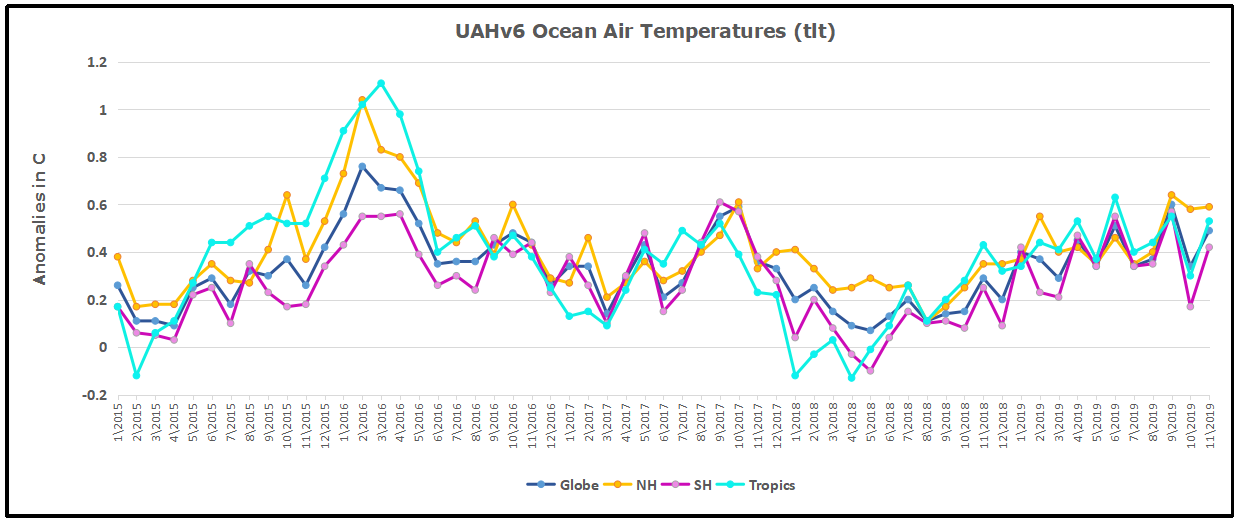
The UAH dataset includes temperature results for air above the oceans, and thus should be most comparable to the SSTs. There is the additional feature that ocean air temps avoid Urban Heat Islands (UHI).  The graph below shows monthly anomalies for ocean temps since January 2015.

After a June rise in ocean air temps, all regions dropped back down to May levels in July and August.  A spike occured in September, followed by plummenting October ocean air temps in the Tropics and SH. Now that drop has partly warmed back, leaving all regions in November slightly lower than September.

Land Air Temperatures Tracking Downward in Seesaw Pattern

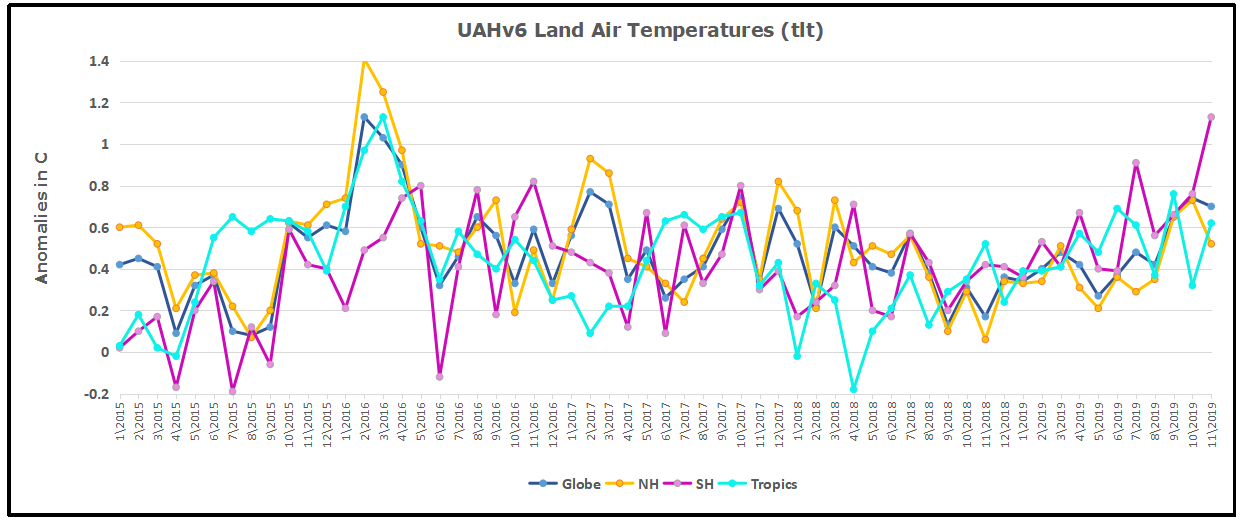
We sometimes overlook that in climate temperature records, while the oceans are measured directly with SSTs, land temps are measured only indirectly.  The land temperature records at surface stations sample air temps at 2 meters above ground.  UAH gives tlt anomalies for air over land separately from ocean air temps.  The graph updated for October is below.
Here we have freash evidence of the greater volatility of the Land temperatures, along with an extraordinary departure by SH land.  Despite the small amount of SH land, it spiked in July, then dropped in August so sharply along with the Tropics that it pulled the global average downward against slight warming in NH.  Now again in November SH has jumped up beyond any month in this period.  Despite this spike along with a rise in the Tropics, NH land temps dropped sharply.  The larger NH land area pulled the Global average downward.  The behavior of SH land temps is puzzling, to say the least.

The longer term picture from UAH is a return to the mean for the period starting with 1995:

TLTs include mixing above the oceans and probably some influence from nearby more volatile land temps.  Clearly NH and Global land temps have been dropping in a seesaw pattern, more than 1C lower than the 2016 peak, prior to these last 2 months. TLT measures started the recent cooling later than SSTs from HadSST3, but are now showing the same pattern.  It seems obvious that despite the three El Ninos, their warming has not persisted, and without them it would probably have cooled since 1995.  Of course, the future has not yet been written.

The Courage to Do Nothing about Climate Change

At Human Events, Gregory Wrightstone writes Principled Inaction in the Face of Climate Change Extremism. Excerpts in italics with my bolds.

President Trump’s courageous commitment to America first on the issue of energy emissions.

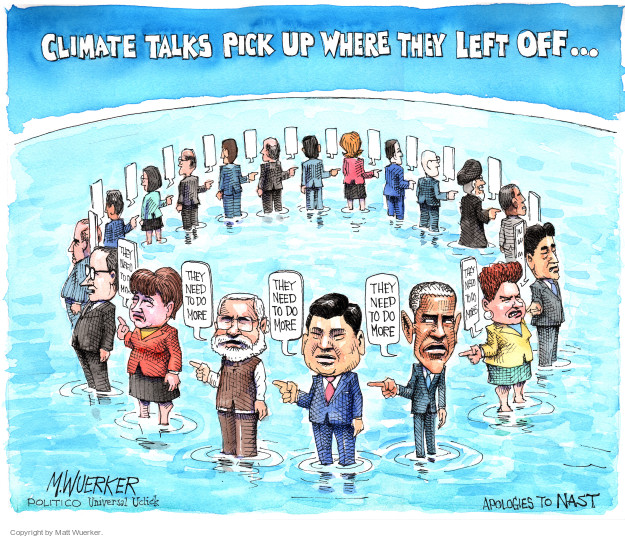
The 2019 United Nations Climate Change Conference, “COP25,” began with a cryptic address by U.N. Secretary-General António Guterres: “By the end of the coming decade we will be on one of two paths, one of which is sleepwalking past the point of no return … Do we want to be remembered as the generation that buried its head in the sand and fiddled as the planet burned?”

According to Guterres, “What is still lacking is political will.” And yet, despite all this “lack of political will,” some 70 countries have pledged carbon neutrality by 2050. Conspicuously absent from the proceedings, however, is the Trump Administration. No senior member of President Trump’s administration is in attendance at COP25.

But despite what Greta Thunberg or António Guterres would have you believe, it isn’t a lack of political will that explains our absence—quite the opposite.

President Trump’s refusal to cosign radical climate extremism is a courageous gesture of principled inaction.

America First on Carbon Emissions

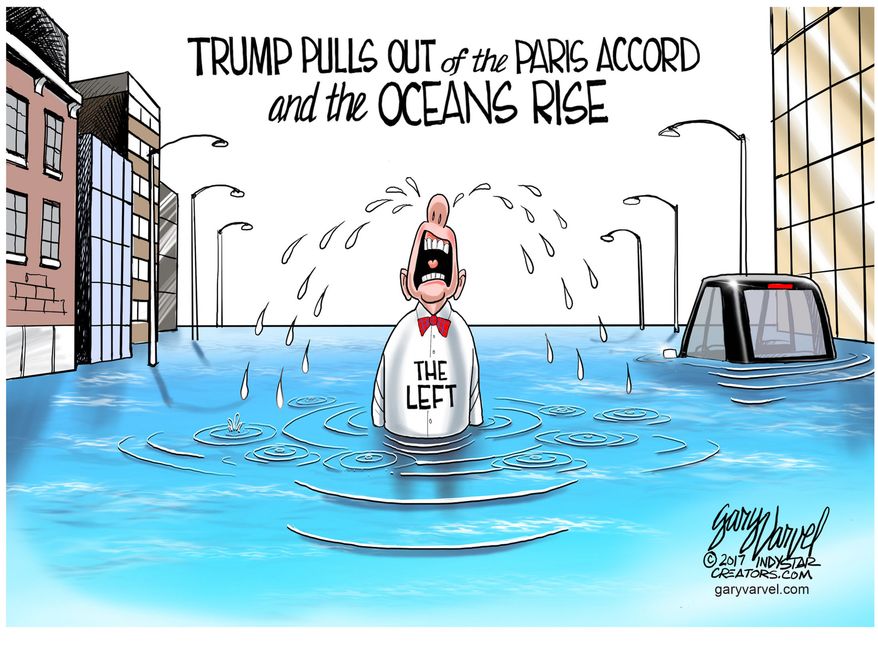
The main reason behind the administration’s absence from the Madrid summit is that the key objective of the program is to negotiate the finer details of the Paris Climate Accord—the agreement that President Trump has withdrawn us from in the name of American interests.

“[T]o fulfill my solemn duty to protect America and its citizens, the United States will withdraw from the Paris Climate Accord,” the President announced in June 2017, voicing an interest in negotiating an “entirely new transaction on terms that are fair to the United States, its businesses, its workers, its people, its taxpayers.”

“I was elected to represent the citizens of Pittsburgh, not Paris,” he retorted, critically appraising that the Paris Accords:

“[C]alls for developed countries to send $100 billion to developing countries all on top of America’s existing and massive foreign aid payments. So we’re going to be paying billions and billions and billions of dollars, and we’re already way ahead of anybody else. Many of the other countries haven’t spent anything, and many of them will never pay one dime.”

Earlier last month, Secretary of State Mike Pompeo said the administration sent an official notification of its plans to exit the Paris Agreement. This was the first step in the year-long process to leave the agreement that allegedly aims to reduce emissions of greenhouse gases. The full withdrawal is scheduled for November 4, 2020, a day after the next presidential election.

The media, often enthusiastic contributors to climate catastrophizing, has presented the administration’s decision to withdraw from the Paris Agreement as an indication that the world’s environmental health has somehow been derailed. “[F]or us to be the exception on this issue is holding the world back,” NPR reports Andrew Light saying, a former climate official in the State Department who helped develop the Paris Agreement.

But that’s not remotely accurate.

In positioning America first, the President is refusing to sacrifice the immediate economic needs of everyday Americans in the face of an inflated threat. The Paris Agreement would have Americans dole out millions of dollars to the so-called developing world—countries like China and India—who refuse to take accountability for their own catastrophic environmental policies.

President Trump will not capitulate to this kind of climate bullying, especially if it compromises our global leadership as energy providers—both traditional and renewable.

Climate Extremism in the Face of Thriving Ecological Growth

It’s not just the technical negotiations over how climate policy will affect American industry; it’s the facticity of climate catastrophe itself that the Trump administration has bravely called into question.

For leaders supporting the Paris agreement, the specter of catastrophic warming provides the moral justification for ever-higher taxation, ever-tighter regulation, ever-greater state interference, ever-larger slush funds for big-spending politicians, and ever-diminished individual freedom to use, acquire, and consume at will.

Several other historical eras—Minoan (2900 to 1100 BC), the Roman Empire (27 BC to 476 AD), and the Medieval warm periods (950 to 1250 AD)—experienced warmer temperatures than we face today. These periods coincided with significant expansions of civilizations, bountiful harvests, and vast improvements in the human condition.

Historical periods of warm global temperature, often higher than our current climate, were commonly referred to as “climate optima” because of the higher temperature and their associated benefits to Earth’s ecosystems. The terminology has fallen into disfavor, however, in recent years, due to a media and scientific blacklisting of any mention of benefits owing to higher temperature. But before climate science became politicized, these past warm periods were associated with a thriving, prospering planet, and human civilization benefited in tandem.

The inconvenient facts, at least to the climate catastrophe crowd, is that the bulk of their predictions are errant speculations about what may or may not occur, 50 or 80 years in the future, based on climate models that substantially overestimate temperature rise.

In reality, by nearly every metric, we see that humans are thriving in the changing ecosystem. The current changing climate has led to increasing food production, soil moisture, crop growth, and a “greening” of the Earth. All the while droughts, forest fires, heatwaves and, temperature-related deaths have declined substantially.

Yes, there is such a thing as the greenhouse effect. Yes, there has been some warming. Yes, some of the warming is likely man-made. Yes, some further man-made warming is to be expected. On all these matters, few would disagree; they are all self-evident.

But no, past and future anthropogenic warming do not mean that catastrophe will follow, or that measures to prevent global warming are scientifically and economically justified. Only the radical worldview of environmental catastrophizing could ignore benefits being accrued from atmospheric changes—while embracing harmful economic policies based on fallacious climate models.

What the “crisis narrative” is achieving, however, is extreme regulation and expropriation of profits from the energy sector. For leaders supporting the Paris agreement, the specter of catastrophic warming provides the moral justification for ever-higher taxation, ever-tighter regulation, ever-greater state interference, ever-larger slush funds for big-spending politicians, and ever-diminished individual freedom to use, acquire, and consume at will.

President Trump is bravely taking a stance against environmental extremism.

“What we won’t do is punish the American people while enriching foreign polluters,” President Trump said during a keynote to natural gas executives and employees at the Shale Insight conference in October of 2017. Pointing to the rising U.S. oil and gas production, and his efforts to deregulate the industry in the name of ending the “war on energy,” President Trump applauded his audience: “With unmatched skill, grit and devotion, you’re making America the greatest energy superpower in the history of the world.”

The Non-Problem of Man-made “Thermageddon”

It takes a lot of courage to do nothing.

Imagine the enormous pressure on President Trump to keep the United States in the Paris climate accord. Worldwide indignation and scorn were heaped on him after his decision to withdraw from the agreement. But it was the correct and principled one to make.

Thanks to near-total control of the news media by proponents of a pending Thermageddon, critical truths are poorly understood and even derided. The truth that there is no “consensus” among climate scientists and that “consensus” would not matter even if it existed. The truth is that global warming will be small, and largely beneficial ecological event, and preventing it would be orders of magnitude costlier than adapting to it. The truth that the correct policy is to have the courage to do nothing.

Like it or not, the truth is the truth. Policy should, in the end, be based on objective reality, and not on the back of a lavishly-funded and elaborate international campaigns of crafty and lucrative falsehoods promoted by the political, financial, corporate, bureaucratic and media establishments.

This is your brain on Climate Alarm

Just Say No!

Mastering Methane Mania

Methane alarm is one of the moles continually popping up in the media Climate Whack-A-Mole game. An antidote to methane madness is now available to those inquiring minds who want to know reality without the hype.

Methane and Climate is a paper by W. A. van Wijngaarden (Department of Physics and Astronomy, York University, Canada) and W. Happer (Department of Physics, Princeton University, USA) published at CO2 Coalition November 22, 2019. It is a summary in advance of a more detailed publication to come. Excerpts in italics with my bolds.

Overview

Atmospheric methane (CH4) contributes to the radiative forcing of Earth’s atmosphere. Radiative forcing is the difference in the net upward thermal radiation from the Earth through a transparent atmosphere and radiation through an otherwise identical atmosphere with greenhouse gases. Radiative forcing, normally specified in units of W m−2 , depends on latitude, longitude and altitude, but it is often quoted for a representative temperate latitude, and for the altitude of the tropopause, or for the top of the atmosphere.

For current concentrations of greenhouse gases, the radiative forcing at the tropopause, per added CH4 molecule, is about 30 times larger than the forcing per added carbon-dioxide (CO2) molecule. This is due to the heavy saturation of the absorption band of the abundant greenhouse gas, CO2. But the rate of increase of CO2 molecules, about 2.3 ppm/year (ppm = part per million by mole), is about 300 times larger than the rate of increase of CH4 molecules, which has been around 0.0076 ppm/year since the year 2008.

So the contribution of methane to the annual increase in forcing is one tenth (30/300) that of carbon dioxide. The net forcing increase from CH4 and CO2 increases is about 0.05 W m−2 year−1 . Other things being equal, this will cause a temperature increase of about 0.012 C year−1 . Proposals to place harsh restrictions on methane emissions because of warming fears are not justified by facts.

The paper is focused on the greenhouse effects of atmospheric methane, since there have recently been proposals to put harsh restrictions on any human activities that release methane. The basic radiation-transfer physics outlined in this paper gives no support to the idea that greenhouse gases like methane, CH4, carbon dioxide, CO2 or nitrous oxide, N2O are contributing to a climate crisis. Given the huge benefits of more CO2 to agriculture, to forestry, and to primary photosynthetic productivity in general, more CO2 is almost certainly benefitting the world. And radiative effects of CH4 and N2O, another greenhouse gas produced by human activities, are so small that they are irrelevant to climate.

Transmission of shortwave solar irradiation and long wavelength radiation from the Earth’s surface through atmosphere, as permitted by Rohde [2]. Note absorption wavelengths of CH4 are already covered by H2O and CO2.

Radiative Properties of Earth Atmosphere

On the left of Fig. 2 we have indicated the three most important atmospheric layers for radiative heat transfer. The lowest atmospheric layer is the troposphere, where parcels of air, warmed by contact with the solar-heated surface, float upward, much like hot-air balloons. As they expand into the surrounding air, the parcels do work at the expense of internal thermal energy. This causes the parcels to cool with increasing altitude, since heat flow in or out of parcels is usually slow compared to the velocities of ascent of descent.

Figure 2: Left. A standard atmospheric temperature profile[9], T = T (z). The surface temperature is T (0) = 288.7 K . Right. Standard concentrations[10], C {i} = N {i}/N for greenhouse molecules versus altitude z. The total number density of atmospheric molecules is N . At sea level the concentrations are 7750 ppm of H2O, 1.8 ppm of CH4 and 0.32 ppm of N2O. The O3 concentration peaks at 7.8 ppm at an altitude of 35 km, and the CO2 concentration was approximated by 400 ppm at all altitudes. The data is based on experimental observations.

If the parcels consisted of dry air, the cooling rate would be 9.8 C km−1 the dry adiabatic lapse rate[12]. But rising air has usually picked up water vapor from the land or ocean. The condensation of water vapor to droplets of liquid or to ice crystallites in clouds, releases so much latent heat that the lapse rates are less than 9.8 C km−1 in the lower troposphere. A representative lapse rate for mid latitudes is dT/dz = 6.5 K km−1 as shown in Fig. 2.

The tropospheric lapse rate is familiar to vacationers who leave hot areas near sea level for cool vacation homes at higher altitudesin the mountains. On average, the temperature lapse rates are small enough to keep the troposphere buoyantly stable[13]. Tropospheric air parcels that are displaced in altitude will oscillate up and down around their original position with periods of a few minutes. However, at any given time, large regions of the troposphere (particularly in the tropics) are unstable to moist convection because of exceptionally large temperature lapse rates.

The vertical radiation flux Z, which is discussed below, can change rapidly in the troposphere and stratosphere. There can be a further small change of Z in the mesosphere. Changes in Z above the mesopause are small enough to be neglected, so we will often refer to the mesopause as “the top of the atmosphere” (TOA), with respect to radiation transfer. As shown in Fig. 2, the most abundant greenhouse gas at the surface is water vapor, H2O. However, the concentration of water vapor drops by a factor of a thousand or more between the surface and the tropopause. This is because of condensation of water vapor into clouds and eventual removal by precipitation. Carbon dioxide, CO2, the most abundant greenhouse gas after water vapor, is also the most uniformly mixed because of its chemical stability. Methane, the main topic of this discussion is much less abundant than CO2 and it has somewhat higher concentrations in the troposphere than in the stratosphere where it is oxidized by OH radicals and ozone, O3. The oxidation of methane[8] is the main source of the stratospheric water vapor shown in Fig. 2.

Fluxes and Forcings

How greenhouse gases affect energy transfer through Earth’s atmosphere is quantitatively determined by the radiative forcing, F, the difference between the flux σT4 of thermal radiant energy from a black surface through a hypothetical, transparent atmosphere, and the flux Z through an atmosphere with greenhouse gases, particulates and clouds, but with the same surface temperature, T0.

Figure 3: Left: The altitude dependence of temperature from Fig. 2. Right The flux Z increases with increasing altitude as a result net upward energy radiation from the greenhouse gases H2O, O3, N2O and CH4, and CO2.

The forcing F and the flux Z are usually specified in units of W m−2. The radiative heating rate, dF R = , (3) dz is equal to the rate of change of the forcing with increasing altitude z. Over most of the atmosphere, R < 0, so thermal infrared radiation is a cooling mechanism that transfers internal energy of atmospheric molecules to space or to the Earth’s surface. Forcing depends on latitude, longitude and on the altitude, z. The right panel of Fig. 3 shows the altitude dependence of the net upward flux Z and the forcing F for the greenhouse gas concentrations of Fig. 2. The temperature profile of Fig 2 is reproduced in the left panel. The altitude-independent flux, σT 4 = 394 W m−2, from the surface with a temperature T0 = 288.7 K, through a hypothetical transparent atmosphere, is shown as the vertical dashed line in panel on the right. The fluxes for current concentrations of CO2 and for doubled or halved concentrations are shown as the continuous green line, the dashed red line and dotted blue line.

At current greenhouse gas concentrations the surface flux, 142 W m−2, is less than half the surface flux of 394 W m−2 for a transparent atmosphere because of downwelling radiation from greenhouse gases above. The surface flux has nearly doubled to 257 W m−2 at the tropopause altitude, 11 km in this example. The 115 W m−2 increase in flux from the surface to the tropopause has been radiated by greenhouse gases in the troposphere. Most of the energy needed to replace the radiated power comes from convection of moist air. Direct absorption of sunlight in the troposphere makes a much smaller contribution.

Spectral Forcings

Planck’s formula (7) for the spectral intensity of thermal radiation is one of the most famous equations of physics. It finally resolved the paradox that classical physics predicted infinite fluxes of heat radiation, in clear contradiction to observations, and it gave birth to quantum mechanics [16].  As one can see from Fig. 3, the flux at the top of the atmosphere, 277 W m−2 is only 70.3% of the flux σT 2 = 394 W m−2 emitted by a black surface at a temperature of T0 = 288.7 K. So without greenhouse gases, the surface would only need to radiate 70.3% of its current value to balance the same amount of solar heating. Since the Stefan-Boltzman flux is proportional to the fourth power of the surface temperature, without greenhouse gases the surface temperature could be smaller by a factor of (0.703)1/4 = 0.916. For this example, the greenhouse warming of the surface by all the greenhouse gases of Fig. 2 is ∆T = (1 0.916)T0 = 24.3 K. The warming would be different at different latitudes and longitudes, or in summer or winter, or if clouds are taken into account. But 20 C to 30 C is a reasonable estimate of how much warming is caused by current concentrations of greenhouse gases, compared to a completely transparent atmosphere.

Instantaneous forcing changes due to changes in the concentrations of greenhouse gases, but with no other changes to the atmosphere, can be calculated accurately for a given temperature profile. The next step, using instantaneous forcing changes to calculate temperature changes, is fraught with difficulties and is a major reason that climate models predict much more warming than observed[18]. As shown in Fig. 3, increasing the concentration of greenhouse gases (doubling the CO2 concentration for the example in the figure) slightly decreases the radiation flux through the atmosphere. In response, the atmosphere will slightly change − its properties to ensure that the average energy absorbed from sunlight is returned to space as thermal radiation. Since both the surface and greenhouse molecules radiate more intensely at higher temperatures, temperature increases are an obvious way to restore the equality of incoming and outgoing energy.

But the amount of water vapor and clouds in the atmosphere will also change, since water vapor is evaporated from the oceans and from moist land. Water is also precipitated from clouds as condensed rain or snow. Low, warm clouds reflect more sunlight and reduce solar heating, with little hindrance of thermal radiation to space. High, cold cirrus clouds reduce the thermal radiation to space, but are wispy and do little to hinder solar heating of the Earth.

The simplest response to changes in radiative forcing would be a uniform temperature increase dT , at every altitude and at the surface. The rate of increase of top-of-the atmosphere flux with a uniform temperature is then [1] dZ = 3.9 W m−2 K −1. (9) dT For a uniform temperature increase, the forcing increase ∆F = 0.23 W m−2 after 50 years, that would result if methane concentrations continued to rise at the rate of the previous 10 years as shown in Fig. 9, would cause a surface-temperature increase of ∆T = ∆F/(dZ/dT ) = 0.05 C. The forcing increase ∆F = 2.2 W m−2 after 50 years, if carbon dioxide concentrations continued to rise at the rate of the previous 10 years, would cause a surface-temperature increase of ∆T = ∆F/(dZ/dT ) = 0.59 C.

Both temperature increments are small and probably beneficial.

But there are persuasive reasons to expect that the temperature changes will be altitude dependent, like the forcing changes shown in Fig. 3, and that the water-vapor concentrations and cloud cover will change in response to changes in the surface temperature. Fig. 6 illustrates a more complicated “feedback” calculation.

Figure 6: Left. An initial temperature profile T (continuous blue line), the mid latitude profile of Fig. 3. The dashed red line is the adjusted temperature profile T ′ , after a doubling of the CO2 concentration. Right. The continuous blue line is the altitude profile of the “instantaneous” flux change ∆Z, caused by doubling CO2 concentrations.

On the left panel of Fig. 6, the continuous blue line labeled T is the midlatitude temperature profile of Fig. 3. The dashed red line labeled T ′ is the adjustment of the temperature profile in response to doubling the concentration of CO2, with a simultaneous increase in the concentration of water vapor in the troposphere The right panel of Fig. 6 summarizes forcing increments, with and without feedbacks. The continuous blue line is the instantaneous flux change from doubling CO2 concentrations, with no other changes to the atmosphere. It is the difference between the dashed red curve and the continuous green curve on the right of Fig. 3, but plotted on an expanded scale. The instantaneous forcing, ∆F = ∆Z, is 5.5 W m−2 at the tropopause altitude of 11 km, and 3.0 W m−2 at the 86 km altitude of the top of the atmosphere. The dashed red curve on the right of Fig. 6, labeled δZ is the “residual forcing” for the dashed-red temperature profile T ′ on the left, for doubled CO2 concentrations, and for the same relative humidity as before doubling CO2.

The same lapse rate, dT/dz = 6.5 K km−1, was used before and after doubling CO2 concentrations, as proposed by Manabe and Wetherald[19] in their model of “radiative-convective equilibrium.” This feedback prescription approximately doubles the surface warming, compared to a uniform temperature adjustment and no change in water vapor concentration. There is stratospheric cooling and surface warming. Variants of the radiative-convective equilibrium recipes illustrated in Fig. 6 are widely used in climate models. Unlike forcing calculations, which can be uniquely and reliably calculated, there is lots of room for subjective adjustments of the temperature changes caused by forcing changes.

Future Forcings of CH4 and CO2

Methane levels in Earth’s atmosphere are slowly increasing.  If the current rate of increase, about 0.007 ppm/year for the past decade or so, were to continue unchanged it would take about 270 years to double the current concentration of C {i} = 1.8 ppm. But, as one can see from Fig.7, methane levels have stopped increasing for years at a time, so it is hard to be confident about future concentrations. Methane concentrations may never double, but if they do, WH[1] show that this would only increase the forcing by 0.8 W m−2. This is a tiny fraction of representative total forcings at midlatitudes of about 140 W m−2 at the tropopause and 120 W m−2 at the top of the atmosphere.

Figure 9: Projected mid-latitude forcing increments at the tropopause from continued increases of CO2 and CH4 at the rates of Fig. 7 and Fig. 8 for the next 50 years. The projected forcings are very small, especially for methane, compared to the current tropospheric forcing of 137 W m−2.

The per-molecule forcings P {i} of (13) and (14) have been used with the column density Nˆ of (12) and the concentration increase rates dC¯{i}/dt, noted in Fig. 7 and Fig. 8, to evaluate the future forcing (15), which is plotted in Fig. 9. Even after 50 years, the forcing increments from increased concentrations of methane (∆F = 0.23 W m−2), or the roughly ten times larger forcing from increased carbon dioxide (∆F = 2.2 W m−2) are very small compared to the total forcing, ∆F = 137 W m−2, shown in Fig. 3. The reason that the per-molecule forcing of methane is some 30 times larger than that of carbon dioxide for current concentrations is “saturation” of the absorption bands. The current density of CO2 molecules is some 200 times greater than that of CH4 molecules, so the absorption bands of CO2 are much more saturated than those of CH4. In the dilute“optically thin” limit, WH[1] show that the tropospheric forcing power per molecule is P {i} = 0.15 × 10⁻²² W for CH4, and P {i} = 2.73 × 10⁻²² W for CO2. Each CO2 molecule in the dilute limit causes about 5 times more forcing increase than an additional molecule of CH4, which is only a ”super greenhouse gas” because there is so little in the atmosphere, compared to CO2.

Footnote: On Playing Climate Whack-A-Mole

Dealing with alarmist claims is like playing whack-a-mole. Every time you beat down one bogeyman, another one pops up in another field, and later the first one returns, needing to be confronted again. I have been playing Climate Whack-A-Mole for a while, and if you are interested, there are some hammers supplied at the link above.

The alarmist methodology is repetitive, only the subject changes. First, create a computer model, purporting to be a physical or statistical representation of the real world. Then play with the parameters until fears are supported by the model outputs. Disregard or discount divergences from empirical observations. This pattern is described in more detail at Chameleon Climate Models

A series of posts apply reality filters to attest climate models.


Justice Alito Finds Chinks in Mann’s Legal Armor

US Supreme Justice Alito dissented from the majority opinion leaving alone a lower court ruling to allow Mann’s free speech lawsuit to proceed (after seven years).  Background on the case history is later on.  This post provides Alito’s opinion and perspective why the Supreme Court should take up the case, if not now then later after an outcome is reached.  The text comes from the US Supreme Court Orders November 25, 2019.  Excerpts in italics with my bolds.

SUPREME COURT OF THE UNITED STATES NATIONAL REVIEW, INC. 18–1451 v. MICHAEL E. MANN COMPETITIVE ENTERPRISE INSTITUTE, ET AL. 18–1477 v. MICHAEL E. MANN ON PETITIONS FOR WRITS OF CERTIORARI TO THE DISTRICT OF COLUMBIA COURT OF APPEALS Nos. 18–1451 and 18–1477. Decided November 25, 2019 The motions of Southeastern Legal Foundation for leave to file briefs as amicus curiae are granted. The petitions for writs of certiorari are denied.

JUSTICE ALITO, dissenting from the denial of certiorari. The petition in this case presents questions that go to the very heart of the constitutional guarantee of freedom of speech and freedom of the press: the protection afforded to journalists and others who use harsh language in criticizing opposing advocacy on one of the most important public issues of the day. If the Court is serious about protecting freedom of expression, we should grant review.

I.  Penn State professor Michael Mann is internationally known for his academic work and advocacy on the contentious subject of climate change. As part of this work, Mann and two colleagues produced what has been dubbed the “hockey stick” graph, which depicts a slight dip in temperatures between the years 1050 and 1900, followed by a sharp rise in temperature over the last century. Because thermometer readings for most of this period are not available, Mann attempted to ascertain temperatures for the earlier years based on other data such as growth rings of ancient trees and corals, ice cores from glaciers, and cave sediment cores. The hockey stick graph has been prominently cited as proof that human activity has led to global warming. Particularly after e-mails from the University of East Anglia’s Climate Research Unit were made public, the quality of Mann’s work was called into question in some quarters.

Columnists Rand Simberg and Mark Steyn criticized Mann, the hockey stick graph, and an investigation conducted by Penn State into allegations of wrongdoing by Mann. Simberg’s and Steyn’s comments, which appeared in blogs hosted by the Competitive Enterprise Institute and National Review Online, employed pungent language, accusing Mann of, among other things, “misconduct,” “wrongdoing,” and the “manipulation” and “tortur[e]” of data. App. to Pet. for Cert. in No. 18–1451, pp. 94a, 98a (App.).

Mann responded by filing a defamation suit in the District of Columbia’s Superior Court. Petitioners moved for dismissal, relying in part on the District’s anti-SLAPP statute, D. C. Code §16–5502(b) (2012), which requires dismissal of a defamation claim if it is based on speech made “in furtherance of the right of advocacy on issues of public interest” and the plaintiff cannot show that the claim is likely to succeed on the merits. The Superior Court denied the motion, and the D. C. Court of Appeals affirmed. 150 A. 3d 1213, 1247, 1249 (2016). The petition now before us presents two questions:

(1) whether a court or jury must determine if a factual connotation is “provably false” and

(2) whether the First Amendment permits defamation liability for expressing a subjective opinion about a matter of scientific or political controversy. Both questions merit our review.

II.  The first question is important and has divided the lower courts. See 1 R. Smolla, Law of Defamation §§6.61, 6.62, 6.63 (2d ed. 2019); 1 R. Sack, Defamation §4:3.7 (5th ed. 2019). Federal courts have held that “[w]hether a communication is actionable because it contained a provably false statement of fact is a question of law.” Chambers v. Travelers Cos., 668 F. 3d 559, 564 (CA8 2012); see also, e.g., Madison v. Frazier, 539 F. 3d 646, 654 (CA7 2008); Gray v. St. Martin’s Press, Inc., 221 F. 3d 243, 248 (CA1 2000); Moldea v. New York Times Co., 15 F. 3d 1137, 1142 (CADC 1994). Some state courts, on the other hand, have held that “it is for the jury to determine whether an ordinary reader would have understood [expression] as a factual assertion.” Good Govt. Group of Seal Beach, Inc. v. Superior Ct. of Los Angeles Cty., 22 Cal. 3d 672, 682, 586 P. 2d 572, 576 (1978); see also, e.g., Aldoupolis v. Globe Newspaper Co., 398 Mass. 731, 734, 500 N. E. 2d 794, 797 (2014); Caron v. Bangor Publishing Co., 470 A. 2d 782, 784 (Me. 1984). In this case, it appears that the D. C. Court of Appeals has joined the latter camp, leaving it for a jury to decide whether it can be proved as a matter of fact that Mann improperly treated the data in question. See App. 29a, 52a–53a, 65a, n. 46.

Respondent does not deny the existence of a conflict in the decisions of the lower courts. See Brief in Opposition at 30. Nor does he dispute the importance of the question. Instead, he argues that the D. C. Court of Appeals followed the federal rule,* but the D. C. Court of Appeals’ opinion repeatedly stated otherwise. See App. 29a (asking what “a jury properly instructed on the applicable legal and constitutional standards could reasonably find”); id., at 52a–53a (repeatedly describing what a jury “could find”); id., at 65a, —————— *Respondent’s lead argument in opposition to certiorari is that we lack jurisdiction under 28 U. S. C. §1257, see Brief in Opposition 27–30, but petitioners have a strong argument that we have jurisdiction under Cox Broadcasting Corp. v. Cohn, 420 U. S. 469 (1975). If the Court has doubts on this score, the question of jurisdiction can be considered together with the merits. 4 NATIONAL REVIEW, INC. v. MANN ALITO, J., dissenting n. 46 (stating that in a case like this one, involving what it characterized as a claim of “‘ordinary libel,’” “the standard is ‘whether a reasonable jury could find that the challenged statements were false’” (emphasis in original)). This last statement is especially revealing because it appears in a footnote that was revised in response to petitioners’ petition for rehearing, see id., at 1a, n. *, which disputed the correctness of the standard that asks what a jury could find, see id., at 65a, n. 46. We therefore have before us a decision on an indisputably important question of constitutional law on which there is an acknowledged split in the decisions of the lower courts. A question of this nature deserves a place on our docket.

This question—whether the courts or juries should decide whether an allegedly defamatory statement can be shown to be untrue—is delicate and sensitive and has serious implications for the right to freedom of expression. And two factors make the question especially important in the present case.

First, the question that the jury will apparently be asked to decide—whether petitioners’ assertions about Mann’s use of scientific data can be shown to be factually false—is highly technical. Whether an academic’s use and presentation of data falls within the range deemed reasonable by those in the field is not an easy matter for lay jurors to assess.

Second, the controversial nature of the whole subject of climate change exacerbates the risk that the jurors’ determination will be colored by their preconceptions on the matter. When allegedly defamatory speech concerns a political or social issue that arouses intense feelings, selecting an impartial jury presents special difficulties. And when, as is often the case, allegedly defamatory speech is disseminated nationally, a plaintiff may be able to bring suit in whichever jurisdiction seems likely to have the highest percentage of jurors who are sympathetic to the plaintiff ’s point of view.  See Keeton v. Hustler Magazine, Inc., 465 U. S. 770, 781 (1984) (regular circulation of magazines in forum State sufficient to support jurisdiction in defamation action). For these reasons, the first question presented in the petition calls out for review.

III.   The second question may be even more important. The constitutional guarantee of freedom of expression serves many purposes, but its most important role is protection of robust and uninhibited debate on important political and social issues. See Snyder v. Phelps, 562 U. S. 443, 451–452 (2011); New York Times Co. v. Sullivan, 376 U. S. 254, 270 (1964). If citizens cannot speak freely and without fear about the most important issues of the day, real selfgovernment is not possible. See Garrison v. Louisiana, 379 U. S. 64, 74–75 (1964) (“[S]peech concerning public affairs is more than self-expression; it is the essence of selfgovernment”). To ensure that our democracy is preserved and is permitted to flourish, this Court must closely scrutinize any restrictions on the statements that can be made on important public policy issues. Otherwise, such restrictions can easily be used to silence the expression of unpopular views.

At issue in this case is the line between, on the one hand, a pungently phrased expression of opinion regarding one of the most hotly debated issues of the day and, on the other, a statement that is worded as an expression of opinion but actually asserts a fact that can be proven in court to be false. Milkovich v. Lorain Journal Co., 497 U. S. 1 (1990). Under Milkovich, statements in the first category are protected by the First Amendment, but those in the latter are not. Id., at 19–20, 22. And Milkovich provided examples of statements that fall into each category. As explained by the Court, a defamation claim could be asserted based on the statement: “In my opinion John Jones is a liar.” Id., at 18. 6 NATIONAL REVIEW, INC. v. MANN ALITO, J., dissenting This statement, the Court noted, implied knowledge that Jones had made particular factual statements that could be shown to be false. Ibid. As for a statement that could not provide the basis for a valid defamation claim, the Court gave this example: “In my opinion Mayor Jones shows his abysmal ignorance by accepting the teachings of Marx and Lenin.” Id., at 20.

When an allegedly defamatory statement is couched as an expression of opinion on the quality of a work of scholarship relating to an issue of public concern, on which side of the Milkovich line does it fall? This is a very important question that would greatly benefit from clarification by this Court. Although Milkovich asserted that its hypothetical statement about the teachings of Marx and Lenin would not be actionable, it did not explain precisely why this was so. Was it the lack of specificity or the nature of statements about economic theories or all scholarly theories or perhaps something else?

In recent years, the Court has made a point of vigilantly enforcing the Free Speech Clause even when the speech at issue made no great contribution to public debate. For example, last Term, in Iancu v. Brunetti, 588 U. S. ___ (2019), we upheld the right of a manufacturer of jeans to register the trademark “F-U-C-T.” Two years before, in Matal v. Tam, 582 U. S. ___ (2017), we held that a rock group called “The Slants” had the right to register its name.

In earlier cases, the Court went even further. In United States v. Alvarez, 567 U. S. 709 (2012), the Court held that the First Amendment protected a man’s false claim that he had won the Congressional Medal of Honor. In Snyder, the successful party had viciously denigrated a deceased soldier outside a church during his funeral. 562 U. S., at 448–449. In United States v. Stevens, 559 U. S. 460, 466 (2010), the First Amendment claimant had sold videos of dog fights.

If the speech in all these cases had been held to be unprotected, our Nation’s system of self-government would not have been seriously threatened. But as I noted in Brunetti, 588 U. S., at ___ (slip op., at 1) (concurring opinion), the protection of even speech as trivial as a naughty trademark for jeans can serve an important purpose: It can demonstrate that this Court is deadly serious about protecting freedom of speech. Our decisions protecting the speech at issue in that case and the others just noted can serve as a promise that we will be vigilant when the freedom of speech and the press are most seriously implicated, that is, in cases involving disfavored speech on important political or social issues.

This is just such a case. Climate change has staked a place at the very center of this Nation’s public discourse. Politicians, journalists, academics, and ordinary Americans discuss and debate various aspects of climate change daily—its causes, extent, urgency, consequences, and the appropriate policies for addressing it. The core purpose of the constitutional protection of freedom of expression is to ensure that all opinions on such issues have a chance to be heard and considered.

I do not suggest that speech that touches on an important and controversial issue is always immune from challenge under state defamation law, and I express no opinion on whether the speech at issue in this case is or is not entitled to First Amendment protection. But the standard to be applied in a case like this is immensely important. Political debate frequently involves claims and counterclaims about the validity of academic studies, and today it is something of an understatement to say that our public discourse is often “uninhibited, robust, and wide-open.” New York Times Co., 376 U. S., at 270.

I recognize that the decision now before us is interlocutory and that the case may be reviewed later if the ultimate outcome below is adverse to petitioners. But requiring a free speech claimant to undergo a trial after a ruling that may be constitutionally flawed is no small burden. See Cox 8 NATIONAL REVIEW, INC. v. MANN ALITO, J., dissenting Broadcasting Corp. v. Cohn, 420 U. S. 469, 485 (1975) (observing that “there should be no trial at all” if the statute at issue offended the First Amendment). A journalist who prevails after trial in a defamation case will still have been required to shoulder all the burdens of difficult litigation and may be faced with hefty attorney’s fees. Those prospects may deter the uninhibited expression of views that would contribute to healthy public debate. For these reasons, I would grant the petition in this case, and I respectfully dissent from the denial of certiorari

From Previous Post: Courts Shielding MIchael Mann from Climate Exposure

An editorial from National Review summarizing how the courts function as Michael Mann’s protective shield  NR Won’t Be Cowed by a Litigious Michael Mann  December 21, 2018.  Excerpts below with my bolds.

At this rate, Jarndyce v. Jarndyce will be replaced in the Western canon as the go-to example of the court case that never ends by National Review, Inc. v. Michael E. Mann, which is now well into its seventh year as a live proposition and, alas, showing no end in sight.

For those who have forgotten, this is the 2012 case in which Mann sued National Review for libel over a 270-word blog post that criticized his infamous “hockey stick” graph portraying global warming, in response to which National Review refused to acquiesce to what was, and remains, nothing less than an attempt to use the law to bully the press into submission. That this case is both frivolous in nature and clear-cut in National Review’s favor seems to be obvious to everyone except for Michael Mann and the D.C. Court of Appeals. Indeed, in the years since Mann made his play, National Review has been joined by a veritable Who’s Who of American media organizations — including, but not limited to, the ACLU, the National Press Club, Comcast, the Cato Institute, the Washington Post, Time Inc., Reporters Committee for Freedom of the Press, and the Electronic Frontier Foundation, all of which have filed amicus briefs on NR’s side. Tellingly, National Review has also been supported by the City of Washington, D.C., in which jurisdiction the case was brought. And yet, inexplicably, the D.C. Court of Appeals continues to drag its feet.

This is extraordinary, especially given that at stake here is the integrity of the First Amendment. It is extraordinary foremost because National Review’s case is both straightforward and strong: that it is not, and it has never been, the role of the courts to settle literary or scientific disputes. But it is also extraordinary because National Review’s case is being heard under rules laid out by Washington, D.C.’s robust “anti-SLAPP” law, the explicit purpose of which is to make it more difficult to harass people and organizations with frivolous libel threats and thereby to protect a sturdy culture of free speech. How, we ask, can this be reconciled with a case such as ours, in which, among other inexplicable delays, the court has taken two years to add a single footnote to the records (and modify another)? That a slam-dunk case that is being examined under an expedited process should have yielded so many years of expensive radio static is a genuine national disgrace, and should be widely regarded as such.

National Review neither encourages nor enjoys protracted, expensive, tedious litigation. Indeed, it is our resolute view that questions such as these must be resolved outside of the courtroom. But we will be cowed neither by pressure nor by the passage of time, and we are proud of our role as a champion of the First Amendment. To those who would abridge, undermine, or attempt to circumvent that bulwark of free expression, our response is, as it ever was: Get Lost.

See also:  Rise and Fall of the Modern Warming Spike

US Federal Agency Lawmaking Out of Bounds

A previous post reprinted below discussed how US Supreme Justices appear ready to challenge regulatory lawmaking beyond Legislative boundaries.  This is of course at the heart of climate change overreach, as well as intrusion of Political Correctness into many other areas such as environment, health, education, immigration and so on.  Most recently Justice Kavanaugh highlighted the constitutional concern in his opinion included in US Supreme Court Orders November 25, 2019.  Excerpts in italics with my bolds.

SUPREME COURT OF THE UNITED STATES RONALD W. PAUL v. UNITED STATES ON PETITION FOR WRIT OF CERTIORARI TO THE UNITED STATES COURT OF APPEALS FOR THE SIXTH CIRCUIT No. 17–8830. Decided November 25, 2019 The petition for a writ of certiorari is denied.

Statement of JUSTICE KAVANAUGH respecting the denial of certiorari. I agree with the denial of certiorari because this case ultimately raises the same statutory interpretation issue that the Court resolved last Term in Gundy v. United States, 588 U. S. ___ (2019). I write separately because JUSTICE GORSUCH’s scholarly analysis of the Constitution’s nondelegation doctrine in his Gundy dissent may warrant further consideration in future cases. JUSTICE GORSUCH’s opinion built on views expressed by then-Justice Rehnquist some 40 years ago in Industrial Union Dept., AFL–CIO v. American Petroleum Institute, 448 U. S. 607, 685–686 (1980) (Rehnquist, J., concurring in judgment). In that case, Justice Rehnquist opined that major national policy decisions must be made by Congress and the President in the legislative process, not delegated by Congress to the Executive Branch.

In the wake of Justice Rehnquist’s opinion, the Court has not adopted a nondelegation principle for major questions. But the Court has applied a closely related statutory interpretation doctrine: In order for an executive or independent agency to exercise regulatory authority over a major policy question of great economic and political importance, Congress must either: (i) expressly and specifically decide the major policy question itself and delegate to the agency the authority to regulate and enforce; or (ii) expressly and specifically delegate to the agency the authority both to decide the major policy question and to regulate and enforce. See, e.g., Utility Air Regulatory Group v. EPA, 573 U. S. 302 (2014); FDA v. Brown & Williamson Tobacco Corp., 529 U. S. 120 (2000); MCI Telecommunications Corp. v. American Telephone & Telegraph Co., 512 U. S. 218 (1994); Breyer, Judicial Review of Questions of Law and Policy, 38 Admin. L. Rev. 363, 370 (1986).

The opinions of Justice Rehnquist and JUSTICE GORSUCH would not allow that second category—congressional delegations to agencies of authority to decide major policy questions—even if Congress expressly and specifically delegates that authority. Under their approach, Congress could delegate to agencies the authority to decide less-major or fillup-the-details decisions. Like Justice Rehnquist’s opinion 40 years ago, JUSTICE GORSUCH’s thoughtful Gundy opinion raised important points that may warrant further consideration in future cases.

Previous Post:  Supremes May Rein In Agency Lawmaking

This post consists of a legal discussion regarding undesirable outcomes from some Supreme Court rulings that gave excessive deference to Executive Branch Agency regulators. Relying on the so called “Chevron Deference” can result in regulations going beyond what congress intended by their laws.

Professor Mike Rappaport writes at Law and Liberty Replacing Chevron with a Sounder Interpretive Regime. Excerpts in italics with my bolds

The Issue

The need for a new interpretive arrangement to replace Chevron is demonstrated by a climate change example cited at the end.

Importantly, this new arrangement would significantly limit agencies from using their legal discretion to modify agency statutes to combat new problems never envisioned by the enacting Congress. For example, when the Clean Air Act was passed, no one had in mind it would be addressed to anything like climate change. Yet, the EPA has used Chevron deference to change the meaning of the statute so that it can regulate greenhouse gases without Congress having to decide whether and in what way that makes sense.

Such discretion gives the EPA enormous power to pursue its own agenda without having to secure the approval of the legislative or judicial branches.

Background and Proposals

One of the most important questions within administrative law is whether the Supreme Court will eliminate Chevron deference. But if Chevron deference is eliminated, as I believe it should be, a key question is what should replace it. In my view, there is a ready alternative which makes sense as a matter of law and policy. Courts should not give agencies Chevron deference, but should provide additional weight to agency interpretations that are adopted close to the enactment of a statute or that have been followed for a significant period of time.

Chevron deference is the doctrine that provides deference to an administrative agency when it interprets a statute that it administers. In short, the agency’s interpretation will only be reversed if a court deems the interpretation unreasonable rather than simply wrong. Such deference means that the agency can select among the (often numerous) “reasonable” interpretations of a statute to pursue its agenda. Moreover, the agency is permitted to change from one reasonable interpretation to another over time based on its policy views. In conjunction with the other authorities given to agencies, such as the delegation of legislative power, Chevron deference constitutes a key part of agency power.

There is, however, a significant chance that the Supreme Court may eliminate Chevron deference. Two of the leaders of this movement are Justices Thomas and Gorsuch. But Chief Justice Roberts as well as Justices Alito and Kavanaugh have also indicated that they might be amenable to overturning Chevron. For example, in the Kisor case from this past term, which cut back on but declined to overturn the related doctrine of Auer deference, these three justices all joined opinions that explicitly stated that they thought Chevron deference was different from Auer deference, suggesting that Chevron might still be subject to overruling.

But if Chevron deference is eliminated, what should replace it? The best substitute for Chevron deference would be the system of interpretation employed in the several generations prior to the enactment of the Administrative Procedure Act. Under that system, as explained by Aditya Bamzai in his path-breaking article, judges would interpret the statute based on traditional canons of interpretation, including two—contemporaneous exposition and customary practice—that provide weight to certain agency interpretations.

Under the canon of contemporaneous exposition, an official governmental act would be entitled to weight as an interpretation of a statute (or of the Constitution) if it were taken close to the period of the enactment of the provision. This would apply to government acts by the judiciary and the legislature as well as those by administrative agencies. Thus, agency interpretations of statutes would be entitled to some additional weight if taken at the time of the statute’s enactment.

This canon has several attractive aspects. First, it has a clear connection to originalism. Contemporaneous interpretations are given added weight because they were adopted at the time of the law’s enactment and therefore are thought to be more likely to offer the correct interpretation—that is, one attuned to the original meaning. Second, this canon also promotes the rule of law by both providing notice to the public of the meaning of the statute and limiting the ability of the agency to change its interpretation of the law.

The second canon is that of customary practice or usage. Under this framework, an interpretation of a government actor in its official capacity would be entitled to weight if it were consistently followed over a period of time. Thus, the agency interpretation would receive additional weight if it became a regular practice, even if were not adopted at the time of statutory enactment.

The canon of customary practice has a number of desirable features. While it does not have a connection to originalism, it does, like contemporaneous exposition, promote the rule of law. Once a customary interpretation has taken hold, the public is better able to rely on the existing interpretation and the government is more likely to follow that interpretation.

Second, the customary interpretation may also be an attractive interpretation. That the interpretation has existed over a period of time suggests that it has not created serious problems of implementation that have led courts or the agency to depart from it. While the customary interpretation may not be the most desirable one as a matter of policy, it is unlikely to be very undesirable.

This traditional interpretive approach also responds to one of the principal criticisms of eliminating Chevron deference: that it will give significant power to a judiciary that lacks expertise and can abuse its authority. I don’t agree with this criticism, since I believe that judges are expert at interpreting statutes and are subject to less bias than agencies that exercise not merely executive power, but also judicial and legislative authority.

But even if one believed that the courts were problematic, this arrangement would leave the judiciary with much less power than a regime that provides no weight to agency interpretations. The courts would often be limited by agency interpretations that accorded with the canons—interpretations adopted when the statute was enacted or that were customarily followed. Since those interpretations would be given weight, the courts would often follow them. But while these interpretations would limit the courts, they would not risk the worst dangers of Chevron deference. This interpretive approach would not allow an agency essentially free reign to change its interpretation over time in order to pursue new programs or objectives. Once the interpretation is in place, the agency would not be able to secure judicial deference if it changed the interpretation.

Importantly, this new arrangement would significantly limit agencies from using their legal discretion to modify agency statutes to combat new problems never envisioned by the enacting Congress. For example, when the Clean Air Act was passed, no one had in mind it would be addressed to anything like climate change. Yet, the EPA has used Chevron deference to change the meaning of the statute so that it can regulate greenhouse gases without Congress having to decide whether and in what way that makes sense. Such discretion gives the EPA enormous power to pursue its own agenda without having to secure the approval of the legislative or judicial branches.

In short, if Chevron deference is eliminated, there is a traditional and attractive interpretive approach that can replace it. Hopefully, the Supreme Court will take the step it refused to take in Kisor and eliminate an unwarranted form of deference.

Not Too Cold for Nuclear Power

James Conca writes at Forbes Bitter Cold Stops Coal, While Nuclear Power Excels. Excerpts in italics with my bolds.

As I woke up to Thanksgiving yesterday, I realized we in the Pacific Northwest had been cyclone bombed for the holiday.

The Columbia Generating Station nuclear power plant just north of Richland, WA puts out maximum … [+]ENERGY NORTHWEST

A Bomb Cyclone is when the barometric pressure drops by at least 24 millibars in 24 hours. The winds were wicked last night and kept us awake a good part of the time.

But looking out over the snow, I was thankful for the comforting plume of pure water vapor rising beyond from our nearby nuclear power plant. Judith and the kitties were, too.

Through thick and thin, extreme hot or extreme cold, the nuclear plant never seems to stop producing over 9 billion kWhs of energy every year, enough to power Seattle. The same with all other nuclear plants in America.

Whether it’s coal, gas or renewables, cold weather seems to hurt them like grandpa with a bum knee. And it doesn’t help that our aging energy infrastructure keeps getting a D+ from the American Society of Civil Engineers.

Most generation systems suffer outages during extreme weather, but most of those involved fossil fuel systems. Coal stacks are frozen and diesel generators simply can’t function in such low temperatures. Gas chokes up – its pipelines can’t keep up with demand – and prices skyrocket.

Wind also suffers because the hottest and coldest months are usually the least windy.

This was seen again last week, when record-breaking cold engulfed Illinois. But Exelon Generation’s 10 operating nuclear plants kept putting out their maximum power without a hitch. Coal and gas struggled.

“Even during this unseasonably cold weather, our Illinois fleet’s performance further demonstrates the reliability and resiliency of nuclear power in any kind of weather,” Bryan Hanson, Exelon’s Chief Nuclear Officer, said. “We are dedicated to being online when customers need us most, no matter what Mother Nature throws at us at any time of year.”

The problem with widespread cold or heat starts because there is a spike in electricity and gas demand, since everyone is re-adjusting their thermostats and it takes a lot more energy to keep us at comfortable temperatures during these extremes.

Interestingly, nuclear prices do not go up – the reactors just keep running. They don’t have to worry about fuel supply – they have enough on hand for years – and they don’t have to do anything special to deal with the extreme weather.

In recent years, the cost of electricity from the nearby Columbia Generating Station has fallen to 4.2¢/kWh, regardless of weather. Many gas plants increase their prices during bad weather, as much as ten-fold in New York and New England.

A diverse energy mix is really, really important. Whether it’s massive liquid-gel batteries that would maximize renewable capacity, small modular nuclear reactors, keeping and uprating existing nuclear, better pipeline technology and monitoring, better coordination among renewables – in the coming decades, whatever we can do, we should do.

But nuclear is clearly the big guy you want to walk down the street with on a cold winter’s night.

Madrid COP25 Briefing for Realists

The upcoming COP25 will be hosted by Chile, but held in Madrid because of the backlash in Santiago against damaging effects of costly climate policies.  The gathering had been previously cancelled by a newly elected skeptical Brazilian president. The change of venue has led to “a scale down of expectations” and participation from the Chilean side, said Mónica Araya, a former lead negotiator for Costa Rica, but the presidency’s priorities are unchanged. In the wings of the Cop25 talks, hosts Spain and Chile will push governments to join a coalition of progressive nations pledging to raise their targets in response to the 2018 over-the-top IPCC SR15 climate horror movie.  See UN Horror Show

Of course Spain is the setting for the adventures of Don Quixote ( “don key-ho-tee” ) in Cervantes’ famous novel.  The somewhat factually challenged hero charged at some windmills claiming they were enemies, and is celebrated in the English language by two idioms:

Tilting at Windmills–meaning attacking imaginary enemies, and

Quixotic (“quick-sottic”)–meaning striving for visionary ideals.

It is clear that COP climateers are similary engaged in some kind of heroic quest, like modern-day Don Quixotes. The only differences: They imagine a trace gas in the air is the enemy, and that windmills are our saviors.  See Climateers Tilting at Windmills

Four years ago French Mathematicians spoke out prior to COP21 in Paris, and their words provide a rational briefing for COP25 beginning in Madrid this weekend. In a nutshell:

Fighting Global Warming is Absurd, Costly and Pointless.

  • Absurd because of no reliable evidence that anything unusual is happening in our climate.
  • Costly because trillions of dollars are wasted on immature, inefficient technologies that serve only to make cheap, reliable energy expensive and intermittent.
  • Pointless because we do not control the weather anyway.

The prestigious Société de Calcul Mathématique (Society for Mathematical Calculation) issued a detailed 195-page White Paper that presents a blistering point-by-point critique of the key dogmas of global warming. The synopsis is blunt and extremely well documented.  Here are extracts from the opening statements of the first three chapters of the SCM White Paper with my bolds and images.

Sisyphus at work.

Chapter 1: The crusade is absurd
There is not a single fact, figure or observation that leads us to conclude that the world‘s climate is in any way ‘disturbed.’ It is variable, as it has always been, but rather less so now than during certain periods or geological eras. Modern methods are far from being able to accurately measure the planet‘s global temperature even today, so measurements made 50 or 100 years ago are even less reliable. Concentrations of CO2 vary, as they always have done; the figures that are being released are biased and dishonest. Rising sea levels are a normal phenomenon linked to upthrust buoyancy; they are nothing to do with so-called global warming. As for extreme weather events — they are no more frequent now than they have been in the past. We ourselves have processed the raw data on hurricanes….

Chapter 2: The crusade is costly
Direct aid for industries that are completely unviable (such as photovoltaics and wind turbines) but presented as ‘virtuous’ runs into billions of euros, according to recent reports published by the Cour des Comptes (French Audit Office) in 2013. But the highest cost lies in the principle of ‘energy saving,’ which is presented as especially virtuous. Since no civilization can develop when it is saving energy, ours has stopped developing: France now has more than three million people unemployed — it is the price we have to pay for our virtue….

Chapter 3: The crusade is pointless
Human beings cannot, in any event, change the climate. If we in France were to stop all industrial activity (let’s not talk about our intellectual activity, which ceased long ago), if we were to eradicate all trace of animal life, the composition of the atmosphere would not alter in any measurable, perceptible way. To explain this, let us make a comparison with the rotation of the planet: it is slowing down. To address that, we might be tempted to ask the entire population of China to run in an easterly direction. But, no matter how big China and its population are, this would have no measurable impact on the Earth‘s rotation.

cg565e788a82606

Full text in pdf format is available in English at link below:

The battle against global warming: an absurd, costly and pointless crusade
White Paper drawn up by the Société de Calcul Mathématique SA
(Mathematical Modelling Company, Corp.)

societe-de-calcul-mathematique-logo-485x174-1

A Second report was published in 2016 entitled: Global Warming and Employment, which analyzes in depth the economic destruction from ill-advised climate change policies.

The two principal themes are that jobs are disappearing and that the destructive forces are embedded in our societies.

Jobs are Disappearing discusses issues such as:

The State is incapable of devising and implementing an industrial policy.

The fundamental absurdity of the concept of sustainable development

Biofuels an especially absurd policy leading to ridiculous taxes and job losses.

EU policy to reduce greenhouse gas emissions by 40% drives jobs elsewhere while being pointless: the planet has never asked for it, is completely unaware of it, and will never notice it!

The War against the Car and Road Maintenance undercuts economic mobility while destroying transportation sector jobs.

Solar and wind energy are weak, diffuse, and inconsistent, inadequate to power modern civilization.

Food production activities are attacked as being “bad for the planet.”

So-called Green jobs are entirely financed by subsidies.

The Brutalizing Whip discusses the damages to public finances and to social wealth and well-being, including these topics:

Taxes have never been so high

The Government is borrowing more and more

Dilapidated infrastructure

Instead of job creation, Relocations and Losses

The wastefulness associated with the new forms of energy

Return to the economy of an underdeveloped country

What is our predicament?
Four Horsemen are bringing down our societies:

  • The Ministry of Ecology (climate and environment);
  • Journalists;
  • Scientists;
  • Corporation Environmentalist Departments.

Steps required to recover from this demise:

  • Go back to the basic rules of research.
  • Go back to the basic rules of law
  • Do not trust international organizations
  • Leave the planet alone
  • Beware of any premature optimism

Conclusion

Climate lemmings

The real question is this: how have policymakers managed to make such absurd decisions, to blinker themselves to such a degree, when so many means of scientific investigation are available? The answer is simple: as soon as something is seen as being green, as being good for the planet, all discussion comes to an end and any scientific analysis becomes pointless or counterproductive. The policymakers will not listen to anyone or anything; they take all sorts of hasty, contradictory, damaging and absurd decisions. When will they finally be held to account?

Footnote:

The above cartoon image of climate talks includes water rising over politicians’ feet.  But actual observations made in Fiji (presiding over 2017 talks in Bonn) show sea levels are stable (link below).

Fear Not For Fiji

In 2016 SCM issued a report Global Temperatures Available data and critical analysis

It is a valuable description of the temperature metrics and issues regarding climate analysis.   They conclude:

None of the information on global temperatures is of any scientific value, and it should not
be used as a basis for any policy decisions. It is perfectly clear that:

  • there are far too few temperature sensors to give us a picture of the planet’s temperature;
  • we do not know what such a temperature might mean because nobody has given it
    any specific physical significance;
  • the data have been subject to much dissimulation and manipulation. There is a
    clear will not to mention anything that might be reassuring, and to highlight things
    that are presented as worrying;
  • despite all this, direct use of the available figures does not indicate any genuine
    trend towards global warming!