Cosmic Evil: Peterson’s Pearls (4)

This is the fourth in a series of five posts based upon Jordan Peterson’s book Maps of Meaning, published in 1999 after 17 years of research and writing. It is rich in description and insight with many references and quotations from original sources. Reading it I began to copy passages that struck me as especially lucid and pertinent. Those paragraphs of his text are provided below in italics as excerpts selected to explain five themes emerging in my reflections while pondering his book. Cosmic Dichotomy: Peterson’s Pearls (1) provides an overview explaining why this is important to me and perhaps to others.

[Note: I use the word “cosmic” since each individual’s world is at risk, and as we see in the agitation over climate change, entire social groups can also fear for their collective world.]

Jordan Peterson on Cosmic Evil (Excerpts from Maps of Meaning: The Architecture of Belief Title is link to pdf)

No discussion of the architecture of belief can possibly be considered complete, in the absence of reference to evil. Evil is no longer a popular word, so to speak—the term is generally considered old-fashioned, not applicable in a society that has theoretically dispensed with its religious preoccupations. Acts once defined as evil are now merely considered the consequence of unjust familial, social or economic structures (although this view is not as widespread as it once was). Alternatively, the commission of incomprehensible acts of cruelty and destruction are viewed as symptomatic of some physiological weakness or disease. Seldom are acts of evil considered voluntary or purposeful—committed by someone possessed by an aesthetic that makes art of terror and pain.

Evil, like good, is not something static: it does not merely mean breaking the rules, for example, and is not simply aggression, anger, force, pain, disappointment, anxiety or horror. Life is of course endlessly complicated by the fact that what is bad in one circumstance is positively necessary in the next.

Evil is rejection of and sworn opposition to the process of creative exploration. Evil is proud repudiation of the unknown, and willful failure to understand, transcend and transform the social world. Evil is, in addition—and in consequence—hatred of the virtuous and courageous, precisely on account of their virtue and courage. Evil is the desire to disseminate darkness, for the love of darkness, where there could be light. The spirit of evil underlies all actions that speed along the decrepitude of the world, that foster God’s desire to inundate and destroy everything that exists.

Many kings are tyrants, or moral decadents, because they are people—and many people are tyrants, or moral decadents. We cannot say “never again” as a consequence of the memory of the Holocaust, because we do not understand the Holocaust, and it is impossible to remember what has not been understood. We do not understand the Holocaust because we do not comprehend ourselves. Human beings, very much like ourselves, produced the moral catastrophes of the Second World War (and of Stalin’s Soviet Union, and of Pol Pot’s Cambodia…). “Never forget” means “know thyself”: recognize and understand that evil twin, that mortal enemy, who is part and parcel of every individual.

The heroic tendency—the archetypal savior—is an eternal spirit, which is to say, a central and permanent aspect of human being. The same is true, precisely, of the “adversarial” tendency: the capacity for endless denial, and the desire to make everything suffer for the outrage of its existence, is an ineradicable intrapsychic element of the individual. The great dramatists and religious thinkers of the world have been able to grasp this fact, at least implicitly, and to transmit it in story and image; modern analytic thinkers and existential theorists have attempted to abstract these ideas upward into “higher consciousness,” and to present them in logical and purely semantic form. Sufficient material has been gathered to present a compelling portrait of evil.

2-18-1-29-12-11-1m

The image of the devil is the form that the idea of evil has taken, for better or worse, at least in the West. We have not yet developed an explicit model of evil that would allow us to forget, transcend or otherwise dispense with this mythological representation. We rationalize our lack of such understanding by presuming that the very notion of evil is archaic. This is a truly ridiculous presumption, in this century of indescribable horror. In our ignorance and complacency, we deride ancient stories about the nature of evil, equating them half-consciously with childish things best put away. This is an exceedingly arrogant position. There is no evidence whatsoever that we understand the nature of evil any better than our forebears, despite our psychology, even though our expanded technological power has made us much more dangerous when we are possessed.

It is reason’s belief in its own omniscience—manifest in procedure and image, if not in word—that “unconsciously” underlies totalitarianism in its many destructive guises. . . It is not that easy to understand why the act of presuming omniscience is reasonably construed as precisely opposite to the act of creative exploration (as the adversary is opposite to the hero). What “knowing everything” means, however—at least in practice—is that the unknown no longer exists, and that further exploration has therefore been rendered superfluous (even treacherous).

Rally organized for Nicolae Ceausescu in 1978. Photo source: fototeca.iiccr.ro

The arrogance of the totalitarian stance is ineradicably opposed to the “humility” of creative exploration. [Humility—it is only constant admission of error and capacity for error (admission of “sinful and ignorant nature”) that allows for recognition of the unknown, and then for update of knowledge and adaptation in behavior. Such humility is, somewhat paradoxically, courageous—as admission of error and possibility for error constitutes the necessary precondition for confrontation with the unknown. This makes genuine cowardice the “underground” motivation for the totalitarian presumption: the true authoritarian wants everything unpredictable to vanish. The authoritarian protects himself from knowledge of this cowardice by a show of patriotic advocacy, often at apparent cost to himself.]

It has taken mankind thousands of years of work to develop dawning awareness of the nature of evil—to produce a detailed dramatic representation of the process that makes up the core of human maladaptation and voluntarily produced misery. It seems premature to throw away the fruit of that labor or to presume that it is something other than what it appears before we understand what it signifies.
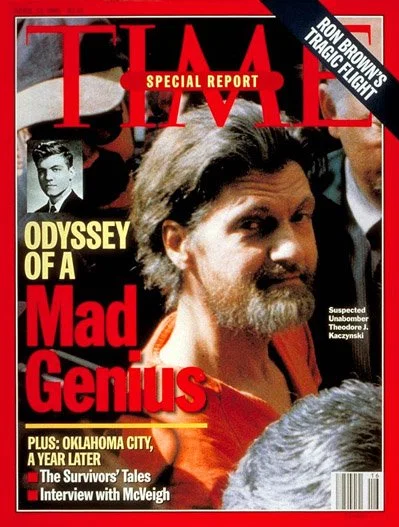
Unabomber Time

The fact of mortal vulnerability—that defining characteristic of the individual, and the “reason” for his emergent disgust with life—may be rendered even more “unjust” and “intolerable” by the specific manifestations of such vulnerability. Some are poorer than others, some weaker, some unsightlier—all less able, in some regard (and some apparently less able in all regards). Recognition of the seemingly arbitrary distribution of skill and advantage adds additional rationally “justifiable” grounds for the development of a philosophy based on resentment and antipathy—sometimes, “on behalf” of an entire class, other times, sheerly for the purposes of a specific individual. Under such circumstances, the desire for revenge on life itself may become paramount above all else, particularly for the “unfairly oppressed.”

Riots in Watts, Los Angeles 1965.

Evil is voluntary rejection of the process that makes life tolerable, justified by observation of life’s terrible difficulty. This rejection is presumptious, premature, because it is based on acceptance of a provisional judgment as final: “everything is insufficient, and is therefore without worth, and nothing whatsoever can be done to rectify the situation.” Judgment of this sort precludes all hope of cure.

The development of the adversary therefore follows a predictable path, from pride (“Pride and worse Ambition threw me down”), through envy, to revenge—to the ultimate construction of a character possessed by infinite hatred and envy.

Tolstoy’s nihilism—disgust with the individual and human society, combined with the desire for the eradication of existence—is one logical “evil” consequence of heightened self-consciousness. It is not, however, the only consequence, and may not even be the most subtle. Far more efficient—far more hidden from the perpetrator himself, and from his closest observers—is heightened identification with tradition and custom. This is envelopment in the guise of patriotism, to facilitate the turning of state power toward destruction.

Group membership, social being, represents a necessary advance over childish dependence, but the spirit of the group requires its pound of flesh. Absolute identification with the group means rejection of individual difference: means rejection of “deviation,” even “weakness,” from the group viewpoint; means repression of individuality, sacrifice of the mythic fool; means abandonment of the simple and insufficient “younger brother.” The group, of course, merely feels that it is doing its duty by insisting upon such sacrifice; it believes, with sufficient justification, that it is merely protecting its structure.

Denial of unique individuality turns the wise traditions of the past into the blind ruts of the present. Application of the letter of the law when the spirit of the law is necessary makes a mockery of culture. Following in the footsteps of others seems safe, and requires no thought—but it is useless to follow a well-trodden trail when the terrain itself has changed. The individual who fails to modify his habits and presumptions as a consequence of change is deluding himself—is denying the world—is trying to replace reality itself with his own feeble wish. By pretending things are other than they are, he undermines his own stability, destabilizes his future, and transforms the past from shelter to prison.

The Mausoleum of Dead Presidents in Pyongyang.

The individual embodiment of collective past wisdom is turned into the personification of inflexible stupidity by means of the lie. The lie is straightforward, voluntary rejection of what is currently known to be true. Nobody knows what is finally true, by definition, but honest people make the best possible use of their experience. The moral theories of the truthful, however incomplete from some hypothetical transcendent perspective, account for what they have seen and for who they are, insofar as that has been determined in the course of diligent effort.

This is to say, merely, that the truth of children and adults differs, because their experience—their reality—differs. The truthful child does not think like an adult: he thinks like a child, with his eyes open. The adult, however, who still uses the morality of the child—despite his adult capacities—he is lying, and he knows it.

The lie is willful adherence to a previously functional schema of action and interpretation—a moral paradigm—despite new experience that cannot be comprehended in terms of that schema; despite new desire, which cannot find fulfillment within that framework. The lie is willful rejection of information apprehended as anomalous on terms defined and valued by the individual doing the rejecting. That is to say: the liar chooses his own game, sets his own rules and then cheats. This cheating is failure to grow, to mature; it is rejection of the process of consciousness itself.

The unknown has to be “mined” for precise significance, before it can be said to have been experienced, let alone comprehended; has to be transformed, laboriously, from pure affect into revision of presumption and action (into “psyche” or “personality”). “Not doing” is therefore the simplest and most common lie: the individual can just “not act,” “not investigate,” and the pitfalls of error will remain unmanifest, at least temporarily. This rejection of the process of creative exploration means lack of effortful update of procedural and declarative memory, adaptation to the present as if it still were the past, refusal to think.

The identity of the individual with his culture protects him from the terrible unknown, and allows him to function as an acceptable member of society. This slavish function strengthens the group. But the group states that certain ways of thinking and acting are all that are acceptable, and these particular ways do not exhaust the unknown and necessary capabilities of the human being. The rigid, grinning social mask is the individual’s pretence that he is “the same person” as everyone else (that is, the same dead person)— that he is not a natural disaster, not a stranger, not strange—that he is not deviant, weak, cowardly, inferior and vengeful. The true individual, however—the honest fool—stands outside the protective enclave of acceptance, unredeemed—the personification of weakness, inferiority, vengefulness, cowardice, difference. He cannot make the cut, and because he cannot make the cut, he is the target of the tyranny of the group (and of his own judgment, insofar as he is that group). But man as a fool, weak, ignorant and vulnerable, is what the group is not: a true individual, truly existing, truly experiencing, truly suffering (if it could only be admitted).

The adversarial position, deceit, is predicated on the belief that the knowledge of the present comprises all necessary knowledge—is predicated on the belief that the unknown has finally been conquered. This belief is equivalent to denial of vulnerability, equivalent to the adoption of omniscience—“what I do is all there is to do, what I know is all there is to know.” Inextricably associated with the adoption of such a stance is denial, implicit or explicit, of the existence, the possibility, and the necessity of the heroic—as everything worthwhile has already been done, as all problems have been solved, as paradise has already been spread before us.
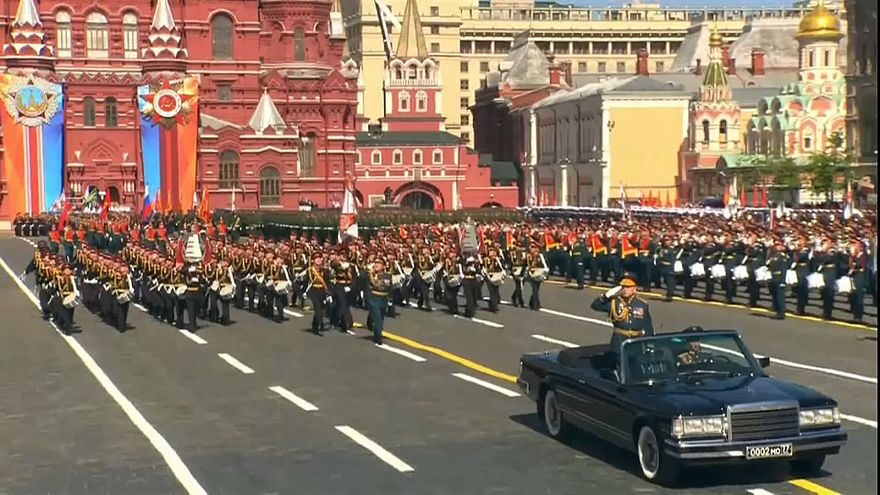
Denial of the heroic promotes fascism, absolute identification with the cultural canon. Everything that is known, is known within a particular historically determined framework, predicated upon mythologically expressed assumptions. Denial or avoidance of the unknown therefore concomitantly necessitates deification of a particular previously established viewpoint.

Denial of the heroic promotes decadence, equally—absolute rejection of the order of tradition; absolute rejection of order itself. This pattern of apprehension and behavior seems far removed from that of the fascist, but the decadent is just as arrogant as his evidently more rigid peer. He has merely identified himself absolutely with no thing, rather than with one thing. He is rigidly convinced of the belief that nothing matters— convinced that nothing is of value, despite the opinions of (clearly deluded, weak and despicable) others; convinced that nothing is worth the effort. The decadent functions in this manner like an anti-Midas—everything he touches turns to ashes.

Imelda Marcos in Manila among her 3000 pairs of shoes.

The normal individual solves his problem of adaptation to the unknown by joining a group. A group, by definition, is composed of those who have adopted a central structure of value, and who therefore behave, in the presence of other group members, identically—and if not identically, at least predictably. The fascist adapts to the group with a vengeance. He builds stronger and stronger walls around himself and those who are “like him,” in an ever more futile attempt to keep the threatening unknown at bay. He does this because his worldview is incomplete.

The decadent, by contrast, sees nothing but the tyranny of the state. Since the adversarial aspect of the individual remains conveniently hidden from his view, he cannot perceive that his “rebellion” is nothing but avoidance of discipline. He views chaos as a beneficial home, seeing the source of human evil in social regulation. . . The decadent looks to subvert the process of maturation—looks for a “way out” of group affiliation. Group membership requires adoption of at least adolescent responsibility, and this burden may seem too much to bear, as a consequence of prolonged immaturity of outlook.

The fascist and the decadent regard each other as opposites, as mortal enemies. They are in actuality two sides of the same bent coin.

This “theory of the genesis of social psychopathology”—this theory of a direct relationship obtaining between personal choice and fascistic or decadent personality and social movement—finds its precise echo in Taoist philosophy, and can be more thoroughly comprehended through application of that perspective. . . Much of ancient Chinese philosophy (cosmology, medicine, political theory, religious thinking) is predicated on the idea that pathology is caused by a relative excess of one primordial “substance” or the other. The goal of the Chinese sage—physician, spiritual leader or social administrator—is to establish or re-establish harmony between the fundamental “feminine” and “masculine” principles, and to diagnose and cure the faulty action or irresponsible inactions that led to their original discord. The schematic representation of Yin and Yang, portrayed below, utilizes the image of a circle to represent totality; the paisleys that make up that circle are opposed but balanced.
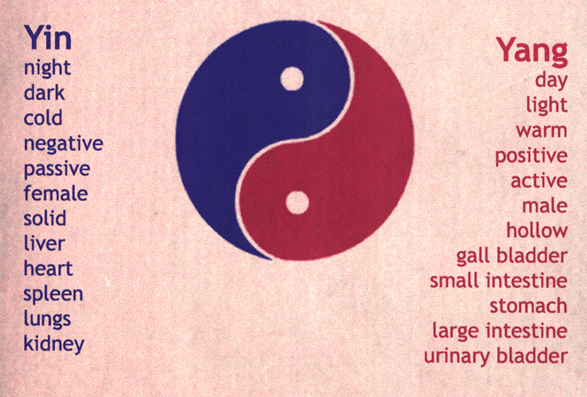
The fascist, who will not face the reality and necessity of the unknown, hides his vulnerable face in a “pathological excess of order.” The decadent, who refuses to see that existence is not possible without order, hides his immaturity from himself and others in a “pathological excess of chaos.” The fascist is willing to sacrifice painful freedom for order, and to pretend that his unredeemed misery is meaningless, so that he does not have to do anything for himself. The decadent believes that freedom can be attained without discipline and responsibility, because he is ignorant of the terrible nature of “the undifferentiated ground of reality” and is unwilling to bear the burden of order. When he starts to suffer, as he certainly will, he will not allow the reality of his suffering to prove to him that some things are real, because acceptance of that proof would force him to believe and to act (would force him as well toward painful realization of the counterproductive and wasteful stupidity of his previous position).

The decadent says, “there is no such thing as to know”—and never attempts to accomplish anything. Like his authoritarian counterpart, he makes himself “immune from error,” since mistakes are always made with regard to some valued, fixed and desired end. The decadent says, “look, here is something new, something inexplicable; that is evidence, is it not, that everything that I have been told is wrong. History is unreliable; rules are arbitrary; accomplishment is illusory. Why do anything, under such circumstances?” But he is living on borrowed time—feeding, like a parasite, on the uncomprehended body of the past.

The invention, establishment and perfection of the concentration camp, the efficient genocidal machine, might be regarded as the crowning achievement of human technological and cultural endeavor, motivated by resentment and loathing for life. Invented by the English, rendered efficient by the Germans, applied on a massive scale by the Soviets and the Chinese, revivified by the Balkan conflict—perfection of the factory whose sole product is death has required truly multinational enterprise. Such enterprise constitutes, perhaps, the prime accomplishment of the cooperative bureaucratization of hatred, cowardice and deceit.  Tens of millions of innocent people have been dehumanized, enslaved and sacrificed in these efficient disassembly lines, in the course of the last century, to help their oppressors maintain pathological stability and consistency of moral presumption, enforced through terror, motivated by adherence to the lie.

The Rwandan massacres, the killing fields in Cambodia, the tens of millions dead (by Solzhenitsyn’s estimate) as a consequence of internal repression in the Soviet Union, the untold legions butchered during China‘s Cultural Revolution [the Great Leap Forward (!), another black joke, accompanied upon occasion, in the particular, by devouring of the victim], the planned humiliation and rape of hundreds of Muslim women in Yugoslavia, the holocaust of the Nazis, the carnage perpetrated by the Japanese in mainland China— such events are not attributable to human kinship with the animal, the innocent animal, or even by the desire to protect territory, interpersonal and intrapsychic, but by a deep-rooted spiritual sickness, endemic to mankind, the consequence of unbearable self-consciousness, apprehension of destiny in suffering and limitation, and pathological refusal to face the consequences thereof.

The fact, regardless of content, is not evil; it is mere (terrible) actuality. It is the attitude to the fact that has a moral or immoral nature. There are no evil facts—although there are facts about evil; it is denial of the unacceptable fact that constitutes evil—at least insofar as human control extends. The suppression of unbearable fact transforms the conservative tendency to preserve into the authoritarian tendency to crush; transforms the liberal wish to transform into the decadent desire to subvert. Confusing evil with the unbearable fact, rather than with the tendency to deny the fact, is like equating the good with the static product of heroism, rather than with the dynamic act of heroism itself. Confusion of evil with the fact—the act of blaming the messenger—merely provides rationale for the act of denial, justification for savage repression, and mask of morality for decadence and authoritarianism.
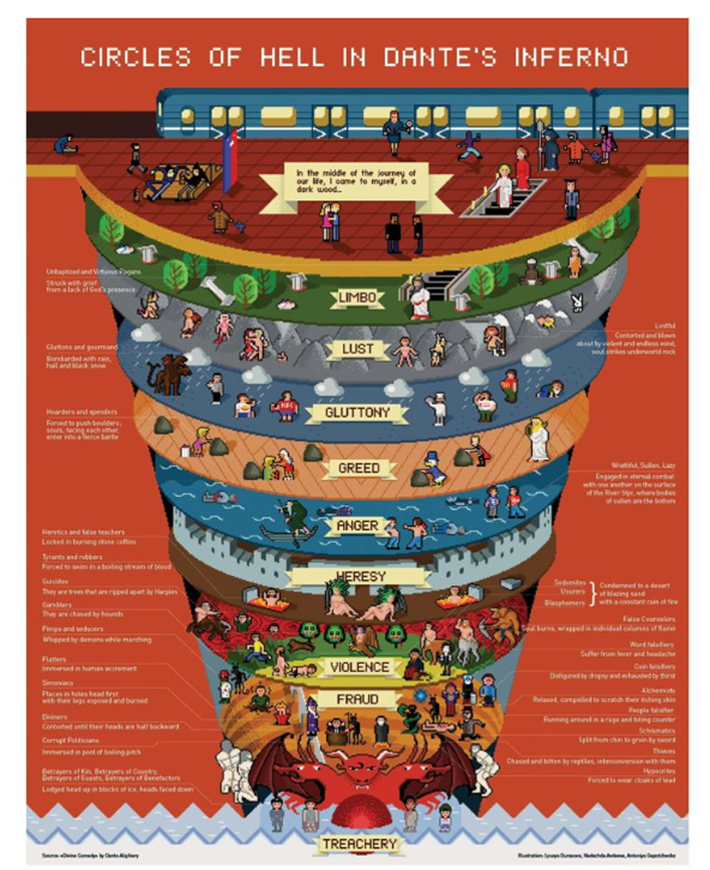
 

The highest value toward which effort is devoted determines what will become elevated, and what subjugated, in the course of individual and social existence. If security or power is valued above all else, then all will become subject to the philosophy of expedience. In the long term, adoption of such a policy leads to development of rigid, weak personality (or social environment) or intrapsychic dissociation and social chaos.

The personality of this adversary comes in two forms, so to speak—although these two forms are inseparably linked. The fascist sacrifices his soul, which would enable him to confront change on his own, to the group, which promises to protect him from everything unknown. The decadent, by contrast, refuses to join the social world, and clings rigidly to his own ideas—merely because he is too undisciplined to serve as an apprentice. The fascist wants to crush everything different, and then everything; the decadent immolates himself, and builds the fascist from his ashes. The bloody excesses of the twentieth century, manifest most evidently in the culture of the concentration camp, stand as testimony to the desires of the adversary and as monument to his power.
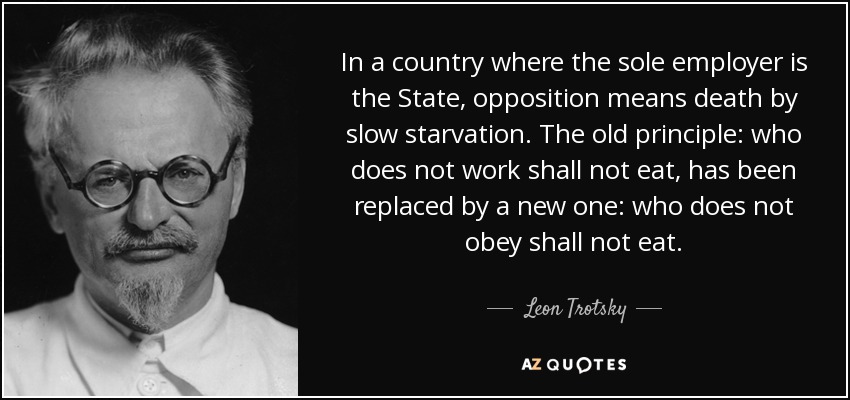
Trotsky refers to the old principle which St. Paul states in 2 Thessalonians chapter 3:10 “We gave you this rule: if a man will not work, he shall not eat.” And before that Deuteronomy 25:4: “Do not muzzle an ox while it is treading out the grain.”

The pitfalls of fascism and decadence may be avoided through identification with the hero, the true individual. The hero organizes the demands of social being and the responsibilities of his own soul into a coherent, hierarchically arranged unit. He stands on the border between order and chaos, and serves the group as creator and agent of renewal. The hero’s voluntary contact with the unknown transforms it into something benevolent—into the eternal source, in fact, of strength and ability. Development of such strength—attendant upon faith in the conditions of experience— enables him to stand outside the group, when necessary, and to use it as a tool, rather than as armor. The hero rejects identification with the group as the ideal of life, preferring to follow the dictates of his conscience and his heart. His identification with meaning—and his refusal to sacrifice meaning for security—renders existence acceptable, despite its tragedy.
Cosmic Heroes: Peterson’s Pearls (3)

This is the third in a series of posts based upon Jordan Peterson’s book Maps of Meaning, published in 1999 after 17 years of research and writing. It is rich in description and insight with many references and quotations from original sources. Reading it I began to copy passages that struck me as especially lucid and pertinent. Those paragraphs of his text are provided below in italics as excerpts selected to explain five themes emerging in my reflections while pondering his book. Cosmic Dichotomy: Peterson’s Pearls (1) provides an overview explaining why this is important to me and perhaps to others.

[Note: I use the word “cosmic” since each individual’s world is at risk, and as we see in the agitation over climate change, entire social groups can also fear for their collective world.]

Jordan Peterson on Cosmic Heroes (Excerpts from Maps of Meaning: The Architecture of Belief Title is link to pdf)

Before the emergence of empirical methodology, which allowed for methodical separation of subject and object in description, the world-model contained abstracted inferences about the nature of existence, derived primarily from observations of human behavior. This means, in essence, that pre-experimental man observed “morality” in his behavior and inferred (through the process described previously) the existence of a source or rationale for that morality in the structure of the “universe” itself. Of course, this “universe” is the experiential field—affect, imagination and all—and not the “objective” world constructed by the post-empirical mind. This prescientific “model of reality” primarily consisted of narrative representations of behavioral patterns (and of the contexts that surround them), and was concerned primarily with the motivational significance of events and processes. As this model became more abstract—as the semantic system analyzed the information presented in narrative format, but not understood—man generated imaginative hypotheses about the nature of the ideal human behavior, in the archetypal environment.

The phenomena that we would now describe as emotions or motive forces, from the perspective of our modern, comparatively differentiated and acute self-consciousness, do not appear to have been experienced precisely as “internal” in their original form. Rather, they made their appearance as part and parcel of the experience (the event, or sequence of events) that gave rise to them, and adopted initial representational form in imaginative embodiment. The modern idea of the “stimulus” might be regarded as a vestigial remnant of this form of thinking—a form that grants the power of affective and behavioral control to the object (or which cannot distinguish between that which elicits a response, and the response itself). We no longer think “animistically” as adults, except in our weaker or more playful moments, because we attribute motivation and emotion to our own agency, and not (generally) to the stimulus that gives proximal rise to them. We can separate the thing from the implication of the thing, because we are students and beneficiaries of empirical thinking and experimental method. We can remove attribution of motive and affective power from the “object,” and leave it standing in its purely sensory and consensual aspect; can distinguish between what is us and what is world. The pre-experimental mind could not (cannot) do this, at least not consistently; could not reliably discriminate between the object and its effect on behavior. It is that object and effect which, in totality, constitute a god (more accurately, it is a class of objects and their effects that constitute a god).

Transpersonal motive forces do wage war with one another over vast spans of time; are each forced to come to terms with their powerful “opponents” in the intrapsychic hierarchy. The battles between the different “ways of life” (or different philosophies) that eternally characterize human societies can usefully be visualized as combat undertaken by different standards of value (and, therefore, by different hierarchies of motivation). The “forces” involved in such wars do not die, as they are “immortal”: the human beings acting as “pawns of the gods” during such times are not so fortunate.
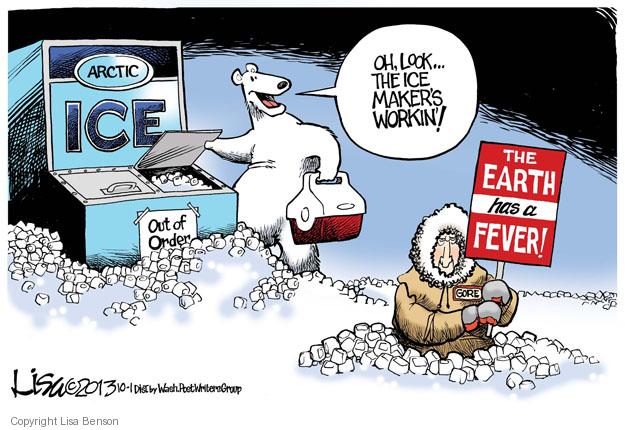
Everything we know, we know because someone explored something they did not understand—explored something they were afraid of, in awe of. Everything we know, we know because someone generated something valuable in the course of an encounter with the unexpected. . . “Civilization advances by extending the number of important operations which we can perform without thinking about them.” All things that we know no longer demand our attention. To know something is to do it automatically, without thinking, to categorize it at a glance (or less than a glance), or to ignore it entirely.

The nervous system is “designed” to eliminate predictability from consideration, and to focus limited analytical resources where focus would produce useful results. We attend to the places where change is occurring; where something is happening that has not yet been modeled, where something is happening that has not yet had behaviors erected around it—where something is happening that is not yet understood. Consciousness itself might be considered as that organ which specializes in the analysis and classification of unpredictable events. Attention and concentration naturally gravitate to those elements in the experiential field that contain the highest concentration of novelty, or that are the least expected, prior to what might normally be considered higher cognitive processing. The nervous system responds to irregular change and eliminates regularity. There is limited information, positive and negative, in the predictable. The novel occurrence, by contrast, might be considered a window into the “transcendent space” where reward and punishment exist in eternal and unlimited potential.

Empirical (classical) “objects” are either one thing or another. Nature, by contrast— the great unknown—is one thing and its (affective) opposite at the same time, and in the same place. The novel, primeval experience was (and remains) much too complex to be gripped, initially, by rational understanding, as understood in the present day. Mythic imagination, “willing” to sacrifice discriminatory clarity for inclusive phenomenological accuracy, provided the necessary developmental bridge. The earliest embodiments of nature are therefore symbolic combinations of rationally irreconcilable attributes; monsters, essentially feminine, who represent animal and human, creation and destruction, birth and cessation of experience.

In the case of broader society: the “meaning” of an object—that is, the significance of that object for emotional regulation and behavioral output—is determined by the social consequences of behaviors undertaken and inferences drawn in its presence. Thus internal motivational forces vie for predominance under the influence of social control. The valence of erotic advances made by a given woman, for example—which is to say, whether her behavior invokes the “goddess of love” or the “god of fear”—will depend on her current position in a given social hierarchy. If she is single and acting in context, she may be considered desirable; if she is the intoxicated wife of a large and dangerous man, by contrast, she may be placed in the category of “something best run away from quickly.”

The culturally determined meaning of an object—apprehended, originally, as an aspect of the object—is in fact in large part implicit information about the nature of the current dominance hierarchy, which has been partially transformed into an abstract hypothesis about the relative value of things (including the self and others). Who owns what, for example, determines what things signify, and who owns what is dominance-hierarchy dependent. What an object signifies is determined by the value placed upon it, manifested in terms of the (socially determined) system of promises, rewards, threats and punishments associated with exposure to, contact with, and use or misuse of that object. This is in turn determined by the affective significance of the object (its relevance, or lack thereof, to the attainment of a particular goal), in combination with its scarcity or prevalence, and the power (or lack thereof) of those who judge its nature.

The (necessary) meaning-constraint typical of a given culture is a consequence of uniformity of behavior, imposed by that culture, toward objects and situations. The push toward uniformity is a primary characteristic of the “patriarchal” state (as everyone who acts in the same situation-specific manner has been rendered comfortably “predictable”). The state becomes increasingly tyrannical, however, as the pressure for uniformity increases. As the drive toward similarity becomes extreme, everyone becomes the “same” person—that is, imitation of the past becomes total. All behavioral and conceptual variability is thereby forced from the body politic. The state then becomes truly static: paralyzed or deadened, turned to stone, in mythological language. Lack of variability in action and ideation renders society and the individuals who compose it increasingly vulnerable to precipitous “environmental” transformation (that is, to an involuntary influx of “chaotic” changes). It is possible to engender a complete social collapse by constantly resisting incremental change. It is in this manner that the gods become displeased with their creation, man—and his willful stupidity—and wash away the world. The necessity for interchange of information between “known” and “unknown” means that the state risks its own death by requiring an excess of uniformity.

The story is making a point: when you don’t know where you are going, it is counterproductive to assume that you know how to get there. This point is a specific example of a more general moral: Arrogant (“prideful”) individuals presume they know who and what is important. This makes them too haughty to pay attention when they are in trouble—too haughty, in particular, to attend to those things or people whom they habitually hold in contempt. The “drying up of the environment” or the “senescence of the king” is a consequence of a too rigid, too arrogant value hierarchy. (“What or who can reasonably be ignored” is as much a part of such a hierarchy as “who or what must be attended too.”) When trouble arrives, the traditional value hierarchy must be revised. This means that the formerly humble and despised may suddenly hold the secret to continued life—and that those who refuse to admit to their error, like the “elder brothers,” will inevitably encounter trouble.

Anything that protects and fosters (and that is therefore predictable and powerful) necessarily has the capacity to smother and oppress (and may manifest those capacities, unpredictably, in any given situation). No static political utopia is therefore possible—and the kingdom of God remains spiritual, not worldly. Recognition of the essentially ambivalent nature of the predictable—stultifying but secure—means discarding simplistic theories which attribute the existence of human suffering and evil purely to the state, or which presume that the state is all that is good, and that the individual should exist merely as subordinate or slave.

The unknown never disappears; it is a permanent constituent element of experience. The ability to represent the terrible aspects of the unknown allow us to conceptualize what has not yet been encountered, and to practice adopting the proper attitude toward what we do not understand.

Redemptive knowledge itself springs from the generative encounter with the unknown, from exploration of aspects of novel things and novel situations; is part of the potential of things, implicit in them, intrinsic to their nature. This redemptive knowledge is wisdom, knowledge of how to act, generated as a consequence of proper relationship established with the positive aspect of the unknown, the source of all things.

Wisdom may be personified as a spirit who eternally gives, who provides to her adherents unfailing riches. She is to be valued higher than status or material possessions, as the source of all things. With the categorical inexactitude characteristic of metaphoric thought and its attendant richness of connotation, the act of valuing this spirit is also Wisdom. So the matrix itself becomes conflated with—that is, grouped into the same category as—the attitude that makes of that matrix something beneficial. This conflation occurs because primal generative capacity characterizes both the “source of all things” and the exploratory/hopeful attitudes and actions that make of that source determinate things. We would only regard the latter—the “subjective stance”—as something clearly psychological (as something akin to “wisdom” in the modern sense). The former is more likely to be considered “external,” from our perspective—something beyond subjective intervention. But it is the case that without the appropriate attitude (Ask, and it shall be given you; seek, and ye shall find; knock, and it shall be opened unto you: For every one that asketh receiveth; and he that seeketh findeth; and to him that knocketh it shall be opened” [Matthew 7:7–8].) the unknown is a sterile wasteland.

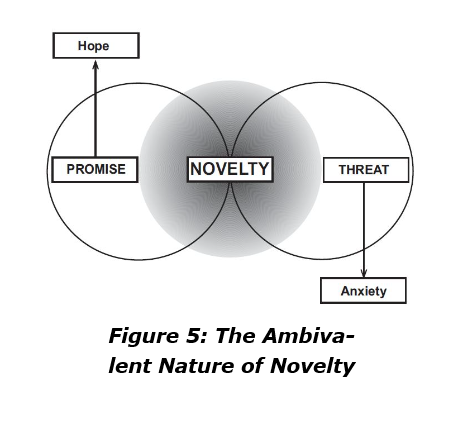
If the unknown is approached voluntarily (which is to say, “as if” it is beneficial), then its promising aspect is likely to appear more salient. If the unknown makes its appearance despite our desire, then it is likely to appear more purely in its aspect of threat. This means that if we are willing to admit to the existence of those things that we do not understand, those things are more likely to adopt a positive face. Rejection of the unknown, conversely, increases the likelihood that it will wear a terrifying visage when it inevitably manifests itself. It seems to me that this is one of the essential messages of the New Testament, with its express (although difficult-to-interpret) insistence that God should be regarded as all-good.

The beneficial aspect of the unknown is something unavailable to the “unworthy,” something eternal and pure; something that enters into relationship with those who are willing, from age to age; and something that makes friends of God.

The terrible unknown compels representation; likewise, the beneficial unknown. We are driven to represent the fact that possibility resides in every uncertain event, that promise beckons from the depths of every mystery. Transformation, attendant upon the emergence of change, means the death of everything old and decayed—means the death of everything whose continued existence would merely mean additional suffering on the part of those still striving to survive. The terrible unknown, which paralyzes when it appears, is also succour for the suffering, calm for the troubled, peace for the warrior, insight and discovery for the perplexed and curious.

Modern treatment for disorders of anxiety, to take a specific example— “desensitization”—involves exposing an individual, “ritualistically” (that is, under circumstances rendered predictable by authority), to novel or otherwise threatening stimuli (with appropriate reaction modeled by that authority. Such desensitization theoretically induces “habituation”; what is actually happening is that guided exploration, in the course of behavior therapy, produces reclassification and behavioral adjustment [such that the once terrifying thing or once again terrifying thing is turned (back) into something controllable, familiar, and known]. Voluntary exposure additionally teaches the previously anxiety-ridden individual the nontrivial lesson that he or she is capable of facing the “place of fear” and prevailing. The process of guided voluntary exposure appears to produce therapeutic benefits even when the “thing being avoided” is traumatic—when it might appear cruel, from a superficially “empathic” perspective, to insist upon exposure and “processing.”

“Fearless Felix” Baumgartner ascended to the stratosphere and stepped into the void from 24.2 miles above the Earth. His speed during the fall reached Mach 1.24, and the Austrian adventurer nailed the landing. October 14, 2012

Analysis of the much more dramatic, very widespread, but metaphorically equivalent phenomena of the sacrifical ritual—a rite whose very existence compelled one insightful author to argue for the essential insanity of man— provides additional insight into the nature of the ability to transform threat into promise. We have already discussed the fact that the valence of an object switches with context of interpretation. It is knowledge of this idea that allows for comprehension of the meaning of the sacrificial attitude. The beautiful countenance of the beneficial mother is the face the unknown adopts when approached from the proper perspective. Everything unknown is simultaneously horrifying and promising; it is courage and genius (and the grace of God) that determines which aspect dominates.

Primary religious rituals, serving a key adaptive purpose, “predicated” upon knowledge of proper approach mechanisms, evolved to suit the space surrounding the primary deity, embodiment of the unknown. The ubiquitous drama of human sacrifice, (proto)typical of primordial religious practice, enacted the idea that the essence of man was something to be offered up voluntarily to the ravages of nature—something to be juxtaposed into creative encounter with the terrible unknown. The offering, in ritual, was often devoured, in reality or symbolically, as aid to embodiment of the immortal human spirit, as aid to incorporation of the heroic process. Such rituals were abstracted and altered, as they developed—with the nature of the sacrificial entity changing (with constancy of underlying “ideation”).

The mysterious and seemingly irrational “sacrificial” ritual actually dramatizes or acts out two critically important and related ideas: first, that the essence of man—that is, the divine aspect—must constantly be “offered up” to the unknown, must present itself voluntarily to the destructive/creative power that constitutes the Great Mother, incarnation of the unpredictable (as we have seen); and second, that the “thing that is loved best” must be destroyed—that is, sacrificed—in order for the positive aspect of the unknown to manifest itself.

The former idea is “predicated” on the notion that the unknown must be encountered, voluntarily, for new information to be generated, for new behavioral patterns to be constructed; the latter idea is “predicated” on the observation that an improper or outdated or otherwise invalid attachment—such as the attachment to an inappropriate pattern of behavior or belief—turns the world into waste, by interfering with the process of adaptation itself. Rigid, inflexible attachment to “inappropriate things of value”— indicative of dominance by a pathological hierarchy of values (a “dead god”)—is tantamount to denial of the hero. Someone miserable and useless in the midst of plenty— just for the sake of illustration—is unhappy because of his or her attachments to the wrong “things.”

Unhappiness is frequently the consequence of immature or rigid thinking—a consequence of the overvaluation of phenomena that are in fact trivial. The neurotic clings to the things that make her unhappy, while devaluing the processes, opportunities and ideas that would free her, if she adopted them. The sacrifice of the “thing loved best” to “appease the gods” is the embodiment in procedure of the idea that the benevolent aspect of the unknown will return if the present schema of adaptation (the “ruling king”) is sufficiently altered (that is, destroyed and regenerated). An individual stripped of his “identification” with what he previously valued is simultaneously someone facing the unknown—and is, therefore, someone “unconsciously” imitating the hero.

The intimate relationship between clinging to the past, rejection of heroism, and denial of the unknown is most frequently explicated in narrative form (perhaps because the association is so complex that it has not yet been made explicit).

The spirit forever willing to risk personal (more abstractly, intrapsychic) destruction to gain redemptive knowledge might be considered the archetypal representative of the adaptive process as such. The pre-experimental mind considered traumatic union of this “masculine” representative with the destructive and procreative feminine unknown a necessary precedent to continual renewal and rebirth of the individual and community. This is an idea precisely as magnificent as that contained in the Osiris/Horus myth; an idea which adds additional depth to the brilliant “moral hypotheses” contained in that myth. The exploratory hero, divine son of the known and unknown, courageously faces the unknown, unites with it creatively—abandoning all pretence of pre-existent “absolute knowledge”—garners new information, returns to the community, and revitalizes his tradition.

The fundamental act of creativity in the human realm, in the concrete case, is the construction of a pattern of behavior which produces emotionally desirable results in a situation that previously reeked of unpredictability, danger and promise. Creative acts, despite their unique particulars, have an eternally identifiable structure, because they always takes place under the same conditions: what is known is “extracted,” eternally, from the unknown. In consequence, it is perpetually possible to derive and re-derive the central features of the metapattern of behavior which always and necessarily means human advancement.

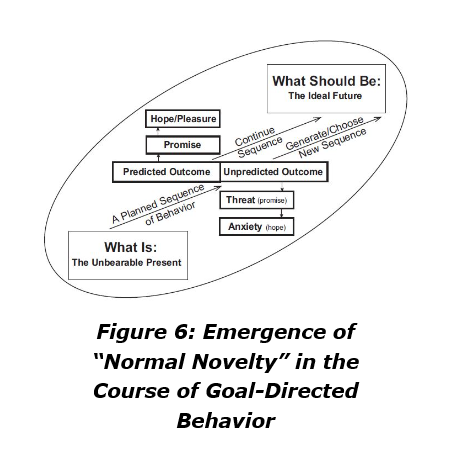
During exploration, behavior and representational schema are modified in an experimental fashion, in the hopes of bringing about by ingenious means whatever outcome is currently envisioned. Such exploration also produces alteration of the sensory world—since that world changes with shift in motor output and physical locale. Exploration produces transformation in assumption guiding behavior, and in expectation of behavioral outcome: produces learning in knowing how and knowing what mode. Most generally, new learning means the application of a new means to the same end, which means that the pattern of presumptions underlying the internal model of the present and the desired future remain essentially intact. This form of readaptation might be described as normal creativity, and constitutes the bulk of human thought. However, on rare occasions, ongoing activity (specifically goal-directed or exploratory) produces more profound and unsettling mismatch. This is more stressful (and more promising), and necessitates more radical update of modeling—necessitates exploration-guided reprogramming of fundamental behavioral assumption and associated episodic or semantic representation. Such reprogramming also constitutes creativity, but of the revolutionary type, generally associated with genius. Exploration is therefore creation and re-creation of the world.

Every unmapped territory—that is, every place where what to do has not been specified—also constitutes the battleground for ancestral kings. The learned patterns of action and interpretation that vie for application when a new situation arises can be usefully regarded, metaphorically, as the current embodiments of adaptive strategies formulated as a consequence of past exploratory behavior—as adaptive strategies invented and constructed by the heroes of the past, “unconsciously” mimicked and duplicated by those currently alive.

Adaptation to new territory—that is, to the unexpected—therefore also means successful mediation of archaic or habitual strategies competing, in the new situation, for dominance over behavioral output.

We act appropriately before we understand how we act—just as children learn to behave before they can describe the reasons for their behavior. It is only through the observation of our actions, accumulated and distilled over centuries, that we come to understand our own motivations, and the patterns of behavior that characterize our cultures (and these are changing as we model them). Active adaptation precedes abstracted comprehension of the basis for such adaptation. This is necessarily the case, because we are more complex than we can understand, as is the world to which we must adjust ourselves.

First we act. Afterward, we envision the pattern that constitutes our actions. Then we use that pattern to guide our actions. It is establishment of conscious (declarative) connection between behavior and consequences of that behavior (which means establishment of a new feedback process) that enables us to abstractly posit a desired future, to act in such a way as to bring that future about, and to judge the relevance of emergent phenomena themselves on the basis of their apparent relevance to that future.

The myth of the hero has come to represent the essential nature of human possibility, as manifested in adaptive behavior, as a consequence of observation and rerepresentation of such behavior, conducted cumulatively over the course of thousands of years. The hero myth provides the structure that governs, but does not determine, the general course of history; expresses one fundamental preconception in a thousand different ways. This idea (analogous in structure to the modern hypothesis, although not explicitly formulated, nor rationally constructed in the same manner) renders individual creativity socially acceptable and provides the precondition for change. The most fundamental presumption of the myth of the hero is that the nature of human experience can be (should be) improved by voluntary alteration in individual human attitude and action. This statement—the historical hypothesis—is an expression of faith in human possibility itself and constitutes the truly revolutionary idea of historical man.

All specific adaptive behaviors (which are acts that restrict the destructive or enhance the beneficial potential of the unknown) follow a general pattern. This “pattern”—which at least produces the results intended (and therefore desired)—inevitably attracts social interest. “Interesting” or “admirable” behaviors engender imitation and description. Such imitation and description might first be of an interesting or admirable behavior, but is later of the class of interesting and admirable behaviors. The class is then imitated as a general guide to specific actions; is redescribed, redistilled and imitated once again. The image of the hero, step by step, becomes ever clearer, and ever more broadly applicable. The pattern of behavior characteristic of the hero—that is, voluntary advance in the face of the dangerous and promising unknown, generation of something of value as a consequence and, simultaneously, dissolution and reconstruction of current knowledge, of current morality—comes to form the kernel for the good story, cross-culturally. That story—which is what to do, when you no longer know what to do—defines the central pattern of behavior embedded in all genuinely religious systems (furthermore, provides the basis for the “respect due the individual” undergirding our conception of natural rights).

The hero’s quest or journey has been represented in mythology and ritual in numerous ways, but the manifold representations appear in accordance with the myth of the way, as previously described: a harmonious community or way of life, predictable and stable in structure and function, is unexpectedly threatened by the emergence of (previously harnessed) unknown and dangerous forces. An individual of humble and princely origins rises, by free choice, to counter this threat. This individual is exposed to great personal trials and risks or experiences physical and psychological dissolution. Nonetheless, he overcomes the threat, is magically restored (frequently improved) and receives a great reward, in consequence. He returns to his community with the reward, and (re)establishes social order (sometimes after a crisis engendered by his return).

We use stories to regulate our emotions and govern our behavior. They provide the present we inhabit with a determinate point of reference—the desired future. The optimal “desired future” is not a state, however, but a process: the (intrinsically compelling) process of mediating between order and chaos; the process of the incarnation of Logos—the Word— which is the world-creating principle. Identification with this process, rather than with any of its determinate outcomes (that is, with any “idols” or fixed frames of reference or ideologies) ensures that emotion will stay optimally regulated and action remain possible no matter how the environment shifts, and no matter when. In consequence of such identification, respect for belief comes to take second place to respect for the process by which belief is generated.

The “stories” by which individuals live (which comprise their schemas of interpretation, which guide their actions, which regulate their emotions) are therefore emergent structures shaped by the necessity of organizing competing internal biological demands, over variable spans of time, in the presence of others, faced with the same fate. This similarity of demand (constrained by physiological structure) and context (constrained by social reality) produces similarity of response. It is this similarity of response, in turn, that is at the base of the emergent “shared moral viewpoint” that accounts for cross-cultural similarity in myth. This means, by the way, that such “shared viewpoints” refer to something real, at least insofar as emergent properties are granted reality (and most of the things that we regard without question as real are precisely such emergent properties).

The reactions of a hypothetical firstborn child to his or her newborn sibling may serve as concrete illustration of the interactions between the individual, the interpersonal and the social. The elder sibling may be drawn positively to the newborn by natural affiliative tendencies and curiosity. At the same time, however, the new arrival may be receiving a substantial amount of parental attention, sometimes in preference to the older child.

How is the child to resolve his conflicts? He must build himself a personality to deal with his new sibling (must become a proper big brother). This means that he might subordinate his aggression to the fear, guilt and shame produced by parental adjudication on behalf of the baby. This will mean that he will at least “act like a human being” around the baby, in the direct presence of his parents. He might also learn to act as if the aggressive reaction motivated by his shift in status is less desirable, in total, than the affiliative response. His as if stance may easily be bolstered by intelligent shift in interpretation: he may reasonably gain from his younger sibling some of the attention he is no longer paid by parents—if he is diligent and genuine in his attempts to be friendly. He might also develop some more independent interests, suitable to his new position as relatively mature family member.


Although the “battle for predominance” that characterizes exchange of morally relevant information can easily be imagined as a war (and is often fought out in the guise of genuine war), it is more frequently the case that it manifests itself as a struggle between “beliefs.” In the latter case, it loss of faith, rather than life, that determines the outcome of the battle. Human beings can substitute loss of faith for death partly because they are capable of abstractly constructing their “territories” (making beliefs out of them) and of abstractly abandoning those territories once they are no longer tenable. Animals, less capable of abstraction, are also able to lose face, rather than life, although they “act out” this loss, in behavioral routines, rather than in verbal or imagistic battles (rather than through argument). It is the capacity to “symbolically capitulate” and to “symbolically destroy” that in large part underlies the ability of individual animals to organize themselves into social groups (which require a hierarchical organization) and to maintain and update those groups once established. Much the same can be said for human beings (who also engage in abstract war, at the procedural level, as well as in real war and argumentation).

The capacity to maintain territorial position when challenged is therefore indicative of the degree to which intrapsychic state is integrated with regard to current motivation (which means, indicative of how “convinced” a given animal is that it can [should] hold its ground). This integration constitutes power—charisma, in the human realm—made most evident in behavioral display. The certainty with which a position is held (whether it is a territorial position, dominance hierarchy niche, or abstract notion)— insofar as this can be inferred from observable behavior, such as absence of fear— constitutes a valid indication of the potential integrative potency of that position. . . Hence the power of the martyr, and the unwillingness of even modern totalitarians to allow their enemies to make public sacrifices of themselves.

Over the course of centuries, the actions of ancestral heroes, imitated directly and then represented in myth, become transformed, simplified, streamlined and quickened— reduced as it were ever more precisely to their “Platonic” forms. Culture is therefore the sum total of surviving historically determined hierarchically arranged behaviors and second- and third-order abstract representations, and more: it is the integration of these, in the course of endless social and intrapsychic conflict, into a single pattern of behavior—a single system of morality, simultaneously governing personal conduct, interpersonal interaction and imagistic/semantic description of such.

This pattern is the “corporeal ideal” of the culture, its mode of transforming the unbearable present into the desired future, its guiding force, its central personality. This personality, expressed in behavior, is first embodied in the king or emperor, socially (where it forms the basis for “sovereignty”). Abstractly represented—imitated, played, ritualized, and storied—it becomes something ever more psychological. This embodied and represented “cultural character” is transmitted through the generations, transmuting in form, but not in essence—transmitted by direct instruction, through imitation, and as a consequence of the human ability to incorporate personality features temporarily disembodied in narrative.

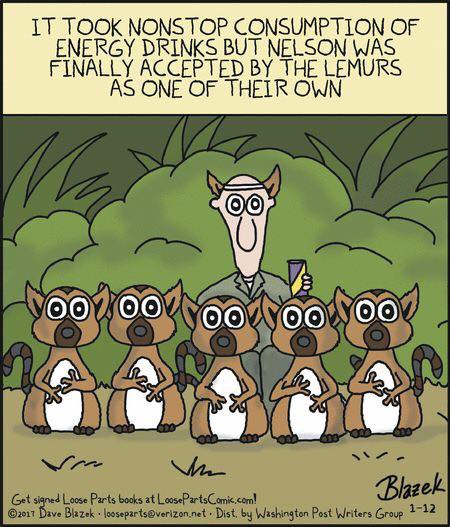
Footnote: The point about “doing things without thinking about them” reminded me of this:

On Sea Ice Thickness

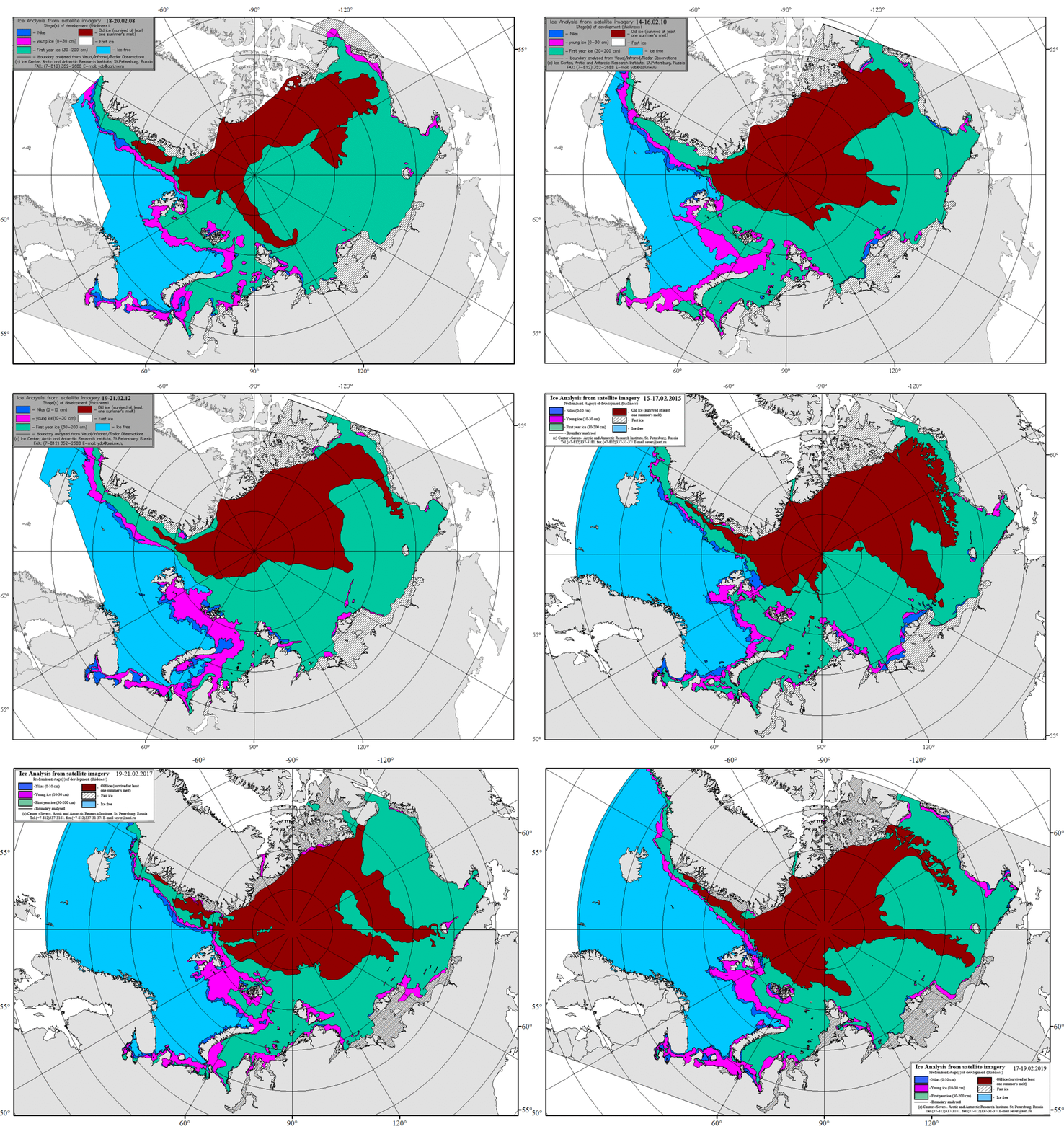
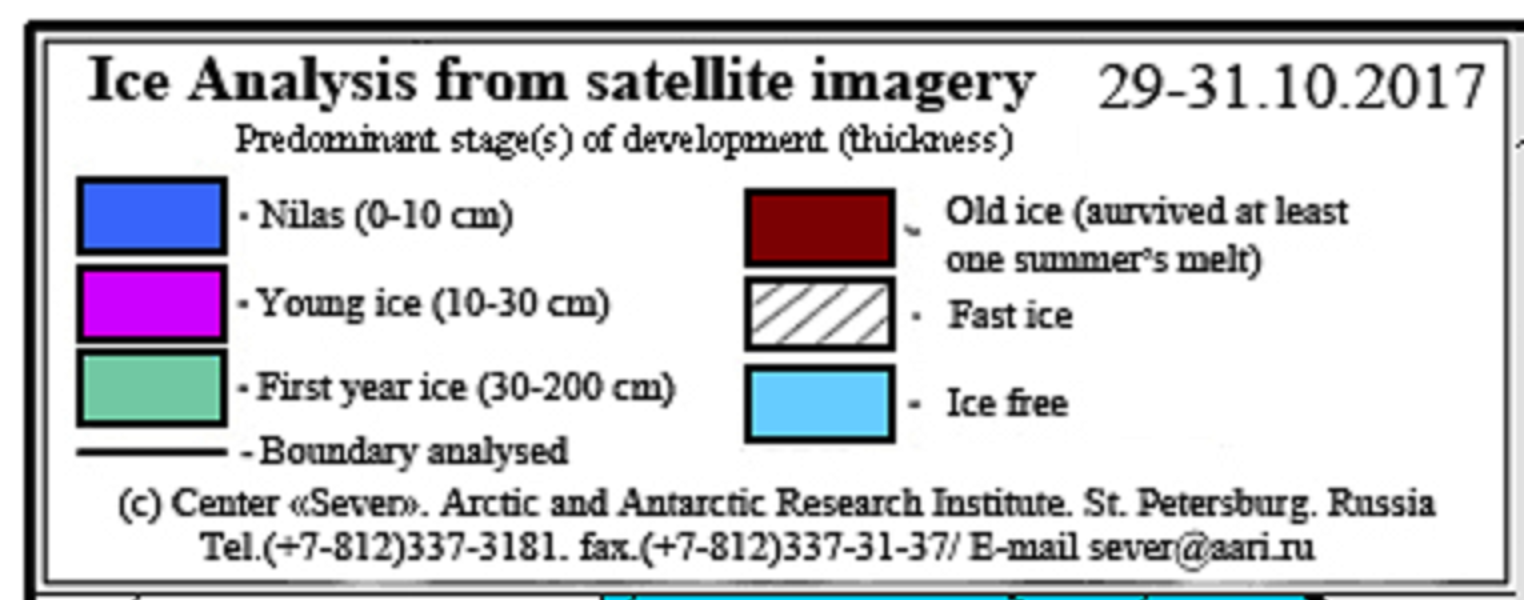
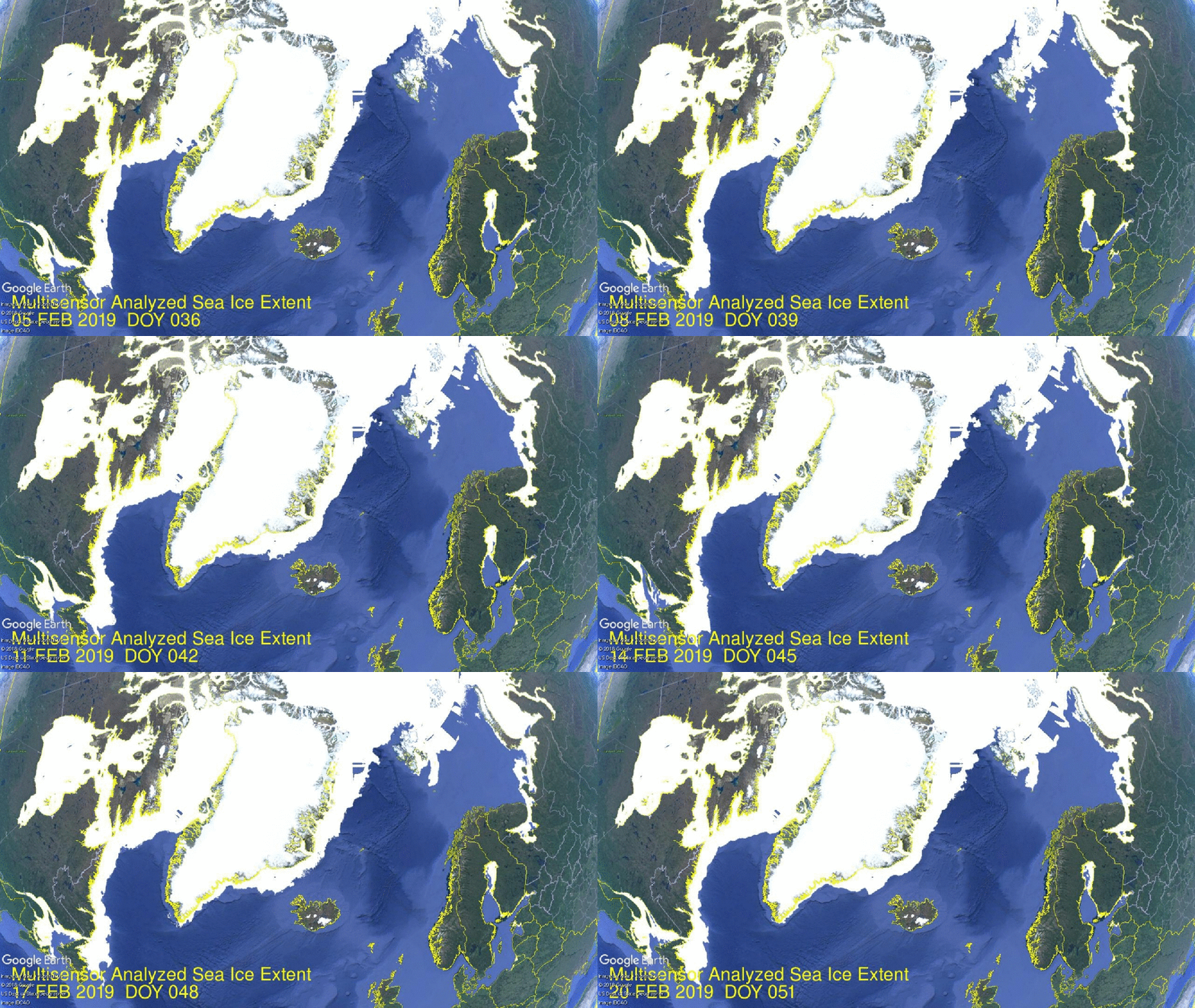
ice Charts from AARI showing ice extents by duration. Appearing in brown is Multi-year ice (surviving at least one melt season).

At the recent post Arctic Ice Surpasses 2018 Maximum, I was asked about measures of sea ice thickness and estimates of volume, combining extents (or concentrations) with thickness.  My response:

Agencies like DMI produce model-driven estimates of Arctic sea ice thickness. I limit my analysis to extents because they are observation-driven.

DMI says this:  “The figures are based on calculations using the DMI operational coupled ocean- and sea-ice model HYCOM-CICE. The total sea-ice volume is a product of the sea-ice concentration and its thickness.”

“Today, the sea-ice concentration is in general well estimated using satellite products, while the sea-ice thickness is poorly known. The model gives a realistic estimate of the total amount of sea-ice within the Arctic.” (concentration means extent). FWIW, DMI estimates of Arctic thickness have increased over the last decade.

It’s a complicated business to get remote signals of thickness, which varies with drifting and compaction from storms and currents.  Another way to get at the issue appears in the animation above with AARI ice charts.  They are derived from satellite imagery, configured so that the brown color represents multi-year ice that survived at least one melt season.   The animation shows the last 11 years had some low years, especially 2008, 2009 and 2013, with higher years since.  And obviously the locations of older ice are variable.

Of course there are other sea ice volume modelled products such PIOMAS.  For an insight into how complicated is estimating sea ice thickness from remote sensors see this article Estimating Arctic sea ice thickness and volume using CryoSat-2 radar altimeter data

Cosmic Arena: Peterson’s Pearls (2)

This is the second in a series of posts based upon Jordan Peterson’s book Maps of Meaning, published in 1999 after 17 years of research and writing. It is rich in description and insight with many references and quotations from original sources. Reading it I began to copy passages that struck me as especially lucid and pertinent. Those paragraphs of his text are provided below in italics as excerpts selected to explain five themes emerging in my reflections while pondering his book. Cosmic Dichotomy: Peterson’s Pearls (1) provides an overview explaining why this is important to me and perhaps to others.

[Note: I use the word “cosmic” since each individual’s world is at risk, and as we see in the agitation over climate change, entire social groups can also fear for their collective world.]

Jordan Peterson on the Cosmic Arena (Excerpts from Maps of Meaning: The Architecture of Belief Title is link to pdf)

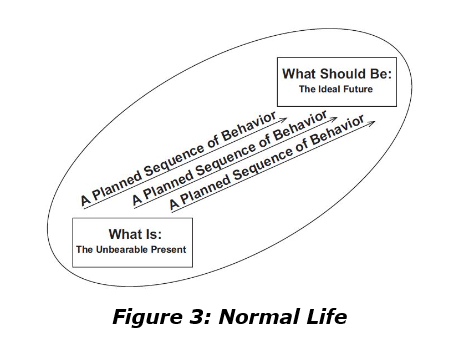
Along with our animal cousins, we devote ourselves to fundamentals: will this (new) thing eat me? Can I eat it? Will it chase me? Should I chase it? Can I mate with it? We may construct models of “objective reality,” and it is no doubt useful to do so. We must model meanings, however, in order to survive. Our most fundamental maps of meaning—maps which have a narrative structure—portray the motivational value of our current state, conceived of in contrast to a hypothetical ideal, accompanied by plans of action, which are our pragmatic notions about how to get what we want.

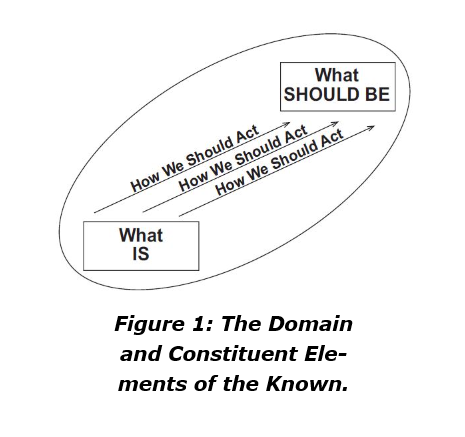
Description of these three elements—current state, ideal future state, and means of active mediation—constitute the necessary and sufficient preconditions for the weaving of the most simple narrative, which is a means for describing the valence of a given environment, in reference to a temporally and spatially bounded set of action patterns. Getting to point “b” presupposes that you are at point “a”—you can’t plan movement in the absence of an initial position. The fact that point “b” constitutes the end goal means that it is valenced more highly than point “a”—that it is a place more desirable, when considered against the necessary contrast of the current position. It is the perceived improvement of point “b” that makes the whole map meaningful or affect-laden; it is the capacity to construct hypothetical or abstract end points, such as “b”—and to contrast them against “the present”—that makes human beings capable of using their cognitive systems to modulate their affective reactions.

We know how to act in some places, and not in others. The plans we put into action sometimes work, and sometimes do not work. The experiential domains we inhabit—our “environments,” so to speak—are therefore permanently characterized by the fact of the predictable and controllable, in juxtaposition with the unpredictable and uncontrollable. The universe is composed of “order” and “chaos”—at least from the metaphorical perspective. Oddly enough, however, it is to this “metaphorical” universe that our nervous system appears to have adapted.

The unknown is, of course, defined in contradistinction to the known. Everything not understood or not explored is unknown. The relationship between the oft- (and unfairly) separated domains of “cognition” and “emotion” can be more clearly comprehended in light of this rather obvious fact. It is the absence of an expected satisfaction, for example, that is punishing, hurtful—the emotion is generated as a default response to sudden and unpredictable alteration in the theoretically comprehended structure of the world. It is the man expecting a raise because of his outstanding work—the man configuring a desired future on the basis of his understanding of the present—who is hurt when someone “less deserving” is promoted before him (“one is best punished,” after all, “for one’s virtues”). The man whose expectations have been dashed—who has been threatened and hurt—is likely to work less hard in the future, with more resentment and anger. Conversely, the child who has not completed her homework is thrilled when the bell signaling class end rings, before she is called upon. The bell signals the absence of an expected punishment, and therefore induces positive affect, relief, happiness.

The maps that configure our motivated behavior have a certain comprehensible structure. They contain two fundamental and mutually interdependent poles, one present, the other future. The present is sensory experience as it is currently manifested to us—as we currently understand it—granted motivational significance according to our current knowledge and desires. The future is an image or partial image of perfection, to which we compare the present, insofar as we understand its significance. Wherever there exists a mismatch between the two, the unexpected or novel occurs (by definition), grips our attention, and activates the intrapsychic systems that govern fear and hope.

We strive to bring novel occurrences back into the realm of predictability or to exploit them for previously unconsidered potential by altering our behavior or our patterns of representation. We conceive of a path connecting present to future. This path is “composed” of the behaviors required to produce the transformations we desire— required to turn the (eternally) insufficient present into the (ever-receding) paradisal future. This path is normally conceived of as linear, so to speak, as something analogous to Thomas Kuhn’s notion of normal science, wherein known patterns of behavior operate.

What is the a priori motivational significance of the unknown? Can such a question even be asked? After all, the unknown by definition has not yet been explored. Nothing can be said, by the dictates of standard logic, about something that has not yet been encountered. We are not concerned with sensory information, however—nor with particular material attributes—but with valence. Valence, in and of itself, might be most simply considered as bipolar: negative or positive (or, of course, as neither). We are familiar enough with the ultimate potential range of valence, negative and positive, to place provisional borders around possibility. The worst the unknown could be, in general, is death (or, perhaps, lengthy suffering followed by death); the fact of our vulnerable mortality provides the limiting case. The best the unknown could be is more difficult to specify, but some generalizations might prove acceptable. We would like to be wealthy (or at least free from want), possessed of good health, wise and well-loved. The greatest good the unknown might confer, then, might be regarded as that which would allow us to transcend our innate limitations (poverty, ignorance, vulnerability), rather than to remain miserably subject to them. The emotional “area” covered by the unknown is therefore very large, ranging from that which we fear most to that which we desire most intently.

It appears, therefore, that the image of a goal (a fantasy about the nature of the desired future, conceived of in relationship to a model of the significance of the present) provides much of the framework determining the motivational significance of ongoing current events. The individual uses his or her knowledge to construct a hypothetical state of affairs, where the motivational balance of ongoing events is optimized: where there is sufficient satisfaction, minimal punishment, tolerable threat and abundant hope, all balanced together properly over the short and longer terms. This optimal state of affairs might be conceptualized as a pattern of career advancement, with a long-term state in mind, signifying perfection, as it might be attained profanely (richest drug dealer, happily married matron, chief executive officer of a large corporation, tenured Harvard professor).

Alternatively, perfection might be regarded as the absence of all unnecessary things, and the pleasures of an ascetic life. The point is that some desirable future state of affairs is conceptualized in fantasy and used as a target point for operation in the present. Such operations may be conceived of as links in a chain (with the end of the chain anchored to the desirable future state).

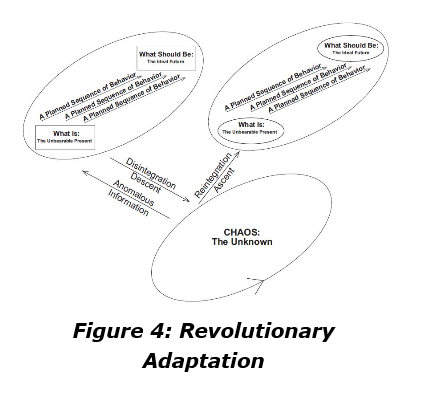
[Imagine this predicament] Your encounter with the terrible unknown has shaken the foundations of your worldview. You have been exposed, involuntarily, to the unexpected and revolutionary. Chaos has eaten your soul. This means that your long-term goals have to be reconstructed, and the motivational significance of events in your current environment reevaluated—literally revalued. This capacity for complete revaluation, in the light of new information, is even more particularly human than the aforementioned capability for exploration of the unknown and generation of new information. Sometimes, in the course of our actions, we elicit phenomena whose very existence is impossible, according to our standard methods of construal (which are at base a mode of attributing motivational significance to events). Exploration of these new phenomena, and integration of our findings into our knowledge, occasionally means reconceptualization of that knowledge (and consequent re-exposure to the unknown, no longer inhibited by our mode of classification). This means that simple movement from present to future is occasionally interrupted by a complete breakdown and reformulation, a reconstitution of what the present is and what the future should be. The ascent of the individual, so to speak, is punctuated by periods of dissolution and rebirth. The more general model of human adaptation—conceptualized most simply as steady state, breach, crisis, redress—therefore ends up looking like Figure 4: Revolutionary Adaptation.

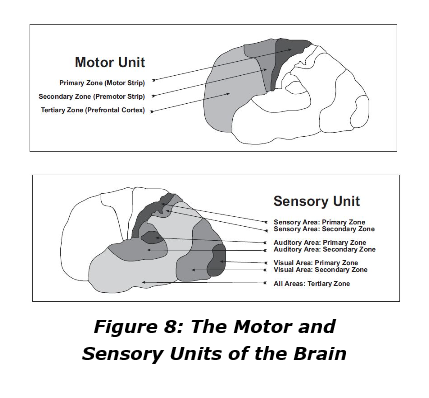
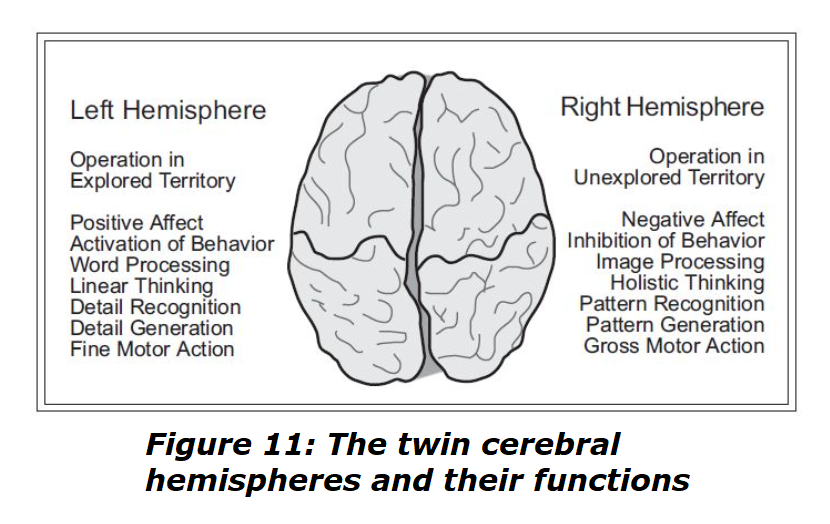
It is reasonable to regard the world, as forum for action, as a “place”—a place made up of the familiar, and the unfamiliar, in eternal juxtaposition. The brain is actually composed, in large part, of two subsystems, adapted for action in that place. The right hemisphere, broadly speaking, responds to novelty with caution, and rapid, global hypothesis formation. The left hemisphere, by contrast, tends to remain in charge when things—that is, explicitly categorized things—are unfolding according to plan. The right hemisphere draws rapid, global, valence-based, metaphorical pictures of novel things; the left, with its greater capacity for detail, makes such pictures explicit and verbal. Thus the exploratory capacity of the brain “builds” the world of the familiar (the known), from the world of the unfamiliar (the unknown).

When the world remains known and familiar—that is, when our beliefs maintain their validity—our emotions remain under control. When the world suddenly transforms itself into something new, however, our emotions are dysregulated, in keeping with the relative novelty of that transformation, and we are forced to retreat or to explore once again.

The essential similarities of our judgments of meaning can easily lead us to conclude that the goodness or badness of things or situations is something more or less fixed. However, the fact of subjective interpretation—and its effects on evaluation and behavior—complicate this simple picture. We will work, expend energy and overcome obstacles to gain a good (or to avoid something bad). But we won’t work for food, at least not very hard, if we have enough food; we won’t work for sex, if we are satisfied with our present levels of sexual activity; and we might be very pleased to go hungry, if that means our enemy will starve. Our predictions, expectations and desires condition our evaluations to a finally unspecifiable degree. Things have no absolutely fixed significance, despite our ability to generalize about their value. It is our personal preferences, therefore, that determine the import of the world (but these preferences have constraints!).

It is not possible to finally determine how or whether something is meaningful by observing the objective features of that thing. Value is not invariant, in contrast to objective reality; furthermore, it is not possible to derive an ought from an is (this is the “naturalistic fallacy” of David Hume). It is possible, however, to determine the conditional meaning of something, by observing how behavior (one’s own behavior, or someone else’s) is conducted in the presence of that thing (or in its absence). “Things” (objects, processes) emerge—into subjective experience, at least—as a consequence of behaviors.

Past experience—learning—does not merely condition; rather, such experience determines the precise nature of the framework of reference or context that will be brought to bear on the analysis of a given situation. This cognitive frame of reference acts as the intermediary between past learning, present experience and future desire. This intermediary is a valid object of scientific exploration—a phenomenon as real as anything abstracted is real—and is far more parsimonious and accessible, as such a phenomenon, than the simple noninterpreted (and nonmeasurable, in any case) sum total of reinforcement history. Frameworks of reference, influenced in their structure by learning, specify the valence of ongoing experience; determine what might be regarded, in a given time and place, as good, bad or indifferent. Furthermore, inferences about the nature of the framework of reference governing the behavior of others (that is, looking at the world through the eyes of another) may produce results that are more useful, more broadly generalizable (as “insights” into the “personality” of another), and less demanding of cognitive resources than attempts to understand the details of a given reinforcement history.

Our actual situations, however, are almost always more complex. If things or situations were straightforwardly or simply positive or negative, good or bad, we would not have to make judgments regarding them, would not have to think about our behavior, and how and when it should be modified—indeed, would not have to think at all. We are faced, however, with the constant problem of ambivalence in meaning, which is to say that a thing or situation might be bad and good simultaneously (or good in two conflicting manners; or bad, in two conflicting manners).

Nothing comes without a cost, and the cost has to be factored in, when the meaning of something is evaluated. Meaning depends on context; contexts—stories, in a word—constitute goals, desires, wishes. It is unfortunate, from the perspective of conflict-free adaptation, that we have many goals—many stories, many visions of the ideal future—and that the pursuit of one often interferes with our chances (or someone else’s chances) of obtaining another.

The plans we formulate are mechanisms designed to bring the envisioned perfect future into being. Once formulated, plans govern our behavior—until we make a mistake. A mistake, which is the appearance of a thing or situation not envisioned, provides evidence for the incomplete nature of our plans—indicates that those plans and the presumptions upon which they are erected are in error and must be updated (or, heaven forbid, abandoned). As long as everything is proceeding according to plan, we remain on familiar ground—but when we err, we enter unexplored territory.

Deviations from desired outcome constitute (relatively) novel events, indicative of errors in presumption, either at the level of analysis of current state, process or ideal future. Such mismatches—unpredictable, nonredundant or novel occurrences—constantly comprise the most intrinsically meaningful, interesting elements of the human experiential field. This interest and meaning signifies the presence of new information and constitutes a prepotent stimulus for human (and animal) action. It is where the unpredictable emerges that the possibility for all new and useful information exists. It is during the process of exploration of the unpredictable or unexpected that all knowledge and wisdom is generated, all boundaries of adaptive competence extended, all foreign territory explored, mapped and mastered.

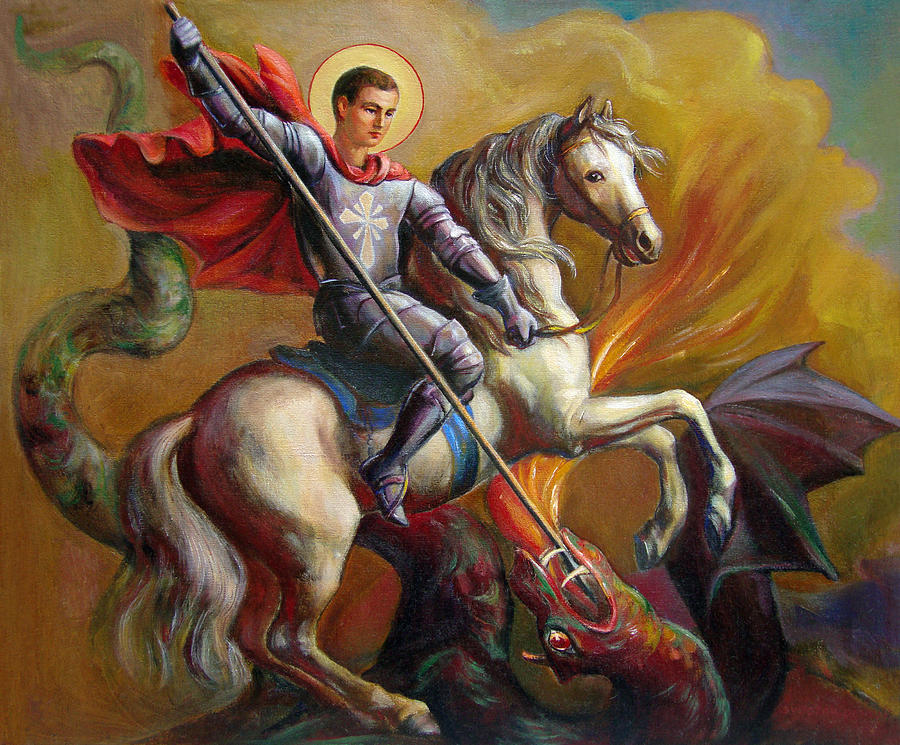
St. George slaying the dragon.

Everything presently known to each, everything rendered predictable, was at one time unknown to all, and had to be rendered predictable—beneficial at best, irrelevant at worst—as a consequence of active exploration-driven adaptation. The matrix is of indeterminable breadth: despite our great storehouse of culture, despite the wisdom bequeathed to us by our ancestors, we are still fundamentally ignorant, and will remain so, no matter how much we learn. The domain of the unknown surrounds us like an ocean surrounds an island. We can increase the area of the island, but we never take away much from the sea.

The constant and universal presence of the incomprehensible in the world has elicited adaptive response from us and from all other creatures with highly developed nervous systems. We have evolved to operate successfully in a world eternally composed of the predictable, in paradoxical juxtaposition with the unpredictable. The combination of what we have explored and what we have still to evaluate actually comprises our environment, insofar as its nature can be broadly specified—and it is to that environment that our physiological structure has become matched. One set of the systems that comprise our brain and mind governs activity, when we are guided by our plans—when we are in the domain of the known. Another appears to operate when we face something unexpected— when we have entered the realm of the unknown.

The consequence of exploration that allows for emotional regulation (that generates security, essentially) is not objective description, as the scientist might have it, but categorization of the implications of an unexpected occurrence for specification of means and ends. Such categorization is what an object “is,” from the perspective of archaic affect and subjective experience. The orienting reflex, and the exploratory behavior following its manifestation, also allows for the differentiation of the unknown into the familiar categories of objective reality. However, this ability is a late development, emerging only four hundred years ago, and cannot be considered basic to “thinking.”

The “higher” cortex controls behavior until the unknown emerges—until it makes a mistake in judgment, until memory no longer serves—until the activity it governs produces a mismatch between what is desired and what actually occurs. When such a mismatch occurs, appropriate affect (fear and curiosity) emerges.

It is the amygdala, at bottom, that appears responsible for the (disinhibited) generation of this a priori meaning—terror and curiosity. The amygdala appears to automatically respond to all things or situations, unless told not to. It is told not to—is functionally inhibited—when ongoing goal-directed behaviors produce the desired (intended) results. When an error occurs, however—indicating that current memory-guided motivated plans and goals are insufficient—the amygdala is released from inhibition and labels the unpredictable occurrence with meaning. Anything unknown is dangerous and promising, simultaneously: evokes anxiety, curiosity, excitement and hope automatically and prior to what we would normally regard as exploration or as (more context-specific) classification. The operations of the amygdala are responsible for ensuring that the unknown is regarded with respect, as the default decision.

The desired output of behavior (what should be) is initially posited; if the current strategy fails, the approach and exploration system is activated, although it remains under the governance of anxiety.

Classical behavioral psychology is wrong in the same manner our folk presumptions are wrong: fear is not secondary, not learned; security is secondary, learned. Everything not explored is tainted, a priori, with apprehension. Any thing or situation that undermines the foundations of the familiar and secure is therefore to be feared.

It might be said, with a certain amount of justification, that we devote our entire lives to making sure that we never have to face anything unknown, in the revolutionary sense—at least not accidentally. Our success in doing so deludes us about the true nature, power and intensity of our potential emotional responses. As civilized people, we are secure. We can predict the behaviors of others (that is, if they share our stories); furthermore, we can control our environments well enough to ensure that our subjection to threat and punishment remains at a minimum. It is the cumulative consequences of our adaptive struggle—our cultures—which enable this prediction and control. The existence of our cultures, however, blinds us to the nature of our true (emotional) natures—at least to the range of that nature, and to the consequences of its emergence.

Our emotional regulation depends as much (or more) on the stability and predictability of the social environment (on the maintenance of our cultures) as on “interior” processes, classically related to the strength of the ego or the personality. Social order is a necessary precondition for psychological stability: it is primarily our companions and their actions (or inactions) that stabilize or destabilize our emotions.

Modern experimental psychologists have begun to examine the response of animals to natural sources of mystery and threat. They allow the animals to set up their own environments, realistic environments, and then expose them to the kinds of surprising circumstances they might encounter in real life. The appearance of a predator in previously safe space (space previously explored, that is, and mapped as useful or irrelevant) constitutes one type of realistic surprise.

It is just as illuminating to consider the responses of rats to their kin, who constitute “explored territory,” in contrast to their attitude toward “strangers,” whose behavior is not predictable. Rats are highly social animals, perfectly capable of living with their familiar compatriots in peace. They do not like members of other kin groups, however; they will hunt them down and kill them. Accidental or purposeful intruders are dealt with in the same manner. Rats identify one another by smell. If an experimenter removes a well-loved rat from its familial surroundings, scrubs it down, provides it with a new odor, and returns it to its peers, it will be promptly dispatched by those who once loved it. The “new” rat constitutes “unexplored territory”; his presence is regarded as a threat (not unreasonably) to everything currently secure.

Chimpanzees, perfectly capable of killing “foreign devils” (even those who were once familiar), act in much the same manner.

More sophistication in development of the prefrontal centers means, in part, heightened capability for abstract exploration, which means investigation in the absence of actual movement, which means the capacity to learn from the observation of others and through consideration of potential actions before they emerge in behavior. This means increasing capability for thought, considered as abstracted action and representation. Action and thought produce phenomena. Novel acts and thoughts necessarily produce new phenomena. Creative exploration, concrete and abstract, is therefore linked in a direct sense to being. Increased capacity for exploration means existence in a qualitatively different—even new—world. This entire argument implies, of course, that more complex and behaviorally flexible animals inhabit (“construct,” if you will) a more complex universe.

Combination of hand and eye enabled Homo sapiens to manipulate things in ways qualitatively different from those of any other animal. The individual can discover what things are like under various, voluntarily produced or accidentally encountered (yet considered) conditions— upside down, flying through the air, hit against other things, broken into pieces, heated in fire, and so on. The combination of hand and eye allowed human beings to experience and analyze the (emergent) nature of things. This ability, revolutionary as it was, was dramatically extended by application of hand-mediated, spoken (and written) language.

Simple animals perform simple operations and inhabit a world whose properties are equally constrained (a world where most “information” remains “latent”). Human beings can manipulate—take apart and put together—with far more facility than any other creature. Furthermore, our capacity for communication, both verbal and nonverbal, has meant almost unbelievable facilitation of exploration, and subsequent diversity of adaptation.

Thinking might in many cases be regarded as the abstracted form of exploration—as the capacity to investigate, without the necessity of direct motoric action. Abstract analysis (verbal and nonverbal) of the unexpected or novel plays a much greater role for humans than for animals—a role that generally takes primacy over action. It is only when this capacity fails partially or completely in humans—or when it plays a paradoxical role (amplifying the significance or potential danger of the unknown through definitive but “false” negative labeling)—that active exploration (or active avoidance), with its limitations and dangers, becomes necessary.

The capacity to create novel behaviors and categories of interpretation in response to the emergence of the unknown might be regarded as the primary hallmark of human consciousness—indeed, of human being. Our engagement in this process literally allows us to carve the world out of the undifferentiated mass of unobserved and unencountered “existence” (a form of existence that exists only hypothetically, as a necessary fiction; a form about which nothing can be experienced, and less accurately stated).

It is certainly the case that many of our skills and our automatized strategies of classification are “opaque” to explicit consciousness. The fact of our multiple memory systems, and their qualitatively different modes of representation—described later— ensures that such is the case. This opaqueness means, essentially, that we “understand” more than we “know”; it is for this reason that psychologists continue to depend on notions of the “unconscious” to provide explanations for behavior. This unconsciousness—the psychoanalytic god—is our capacity for the implicit storage of information about the nature and valence of things. This information is generated in the course of active exploration, and modified, often unrecognizably, by constant, multigenerational, interpersonal communication.

We know that the right hemisphere—at least its frontal portion—is specialized for response to punishment and threat. We also know that damage to the right hemisphere impairs our ability to detect patterns and to understand the meaning of stories. Is it too much to suggest that the emotional, imagistic and narrative capabilities of the right hemisphere play a key role in the initial stages of transforming something novel and complex, such as the behaviors of others (or ourselves) and the valence of new things, into something thoroughly understood?

The uniquely specialized capacities of the right hemisphere appear to allow it to derive from repeated observations of behavior images of action patterns that the verbal left can arrange, with increasingly logic and detail, into stories. A story is a map of meaning, a “strategy” for emotional regulation and behavioral output—a description of how to act in a circumstance, to ensure that the circumstance retains its positive motivational salience (or at least has its negative qualities reduced to the greatest possible degree).

The right hemisphere has the ability to decode the nonverbal and melodic aspects of speech, to empathize (or to engage, more generally, in interpersonal relationships), and the capacity to comprehend imagery, metaphor and analogy. The left-hemisphere “linguistic” systems “finish” the story, adding logic, proper temporal order, internal consistency, verbal representation, and possibility for rapid abstract explicit communication. In this way, our explicit knowledge of value is expanded, through the analysis of our own “dreams.” Interpretations that “work”—that is, that improve our capacity to regulate our own emotions (to turn the current world into the desired world, to say it differently)— qualify as valid. It is in this manner that we verify the accuracy of our increasingly abstracted presumptions.

Knowing-how information, described alternatively as procedural, habitual, dispositional, or skilled, and knowing-what information, described alternatively as declarative, episodic, factual, autobiographical, or representational, appear physiologically distinct in their material basis, and separable in course of phylo- and ontogenetic development.

Procedural knowledge develops long before declarative knowledge, in evolution and individual development, and appears represented in “unconscious” form, expressible purely in performance. Declarative knowledge, by contrast—knowledge of what—simultaneously constitutes consciously accessible and communicable episodic imagination (the world in fantasy) and subsumes even more recently developed semantic (linguistically mediated) knowledge, whose operations, in large part, allow for abstract representation and communication of the contents of the imagination.

It is only after behavioral (procedural) wisdom has become “represented” in episodic memory and portrayed in drama and narrative that it becomes accessible to “conscious” verbal formulation and potential modification in abstraction. Procedural knowledge is not representational, in its basic form. Knowing-how information, generated in the course of exploratory activity, can nonetheless be transferred from individual to individual, in the social community, through means of imitation.

Explicit (moral) philosophy arises from the mythos of culture, grounded in procedure, rendered progressively more abstract and episodic through ritual action and observation of that action. The process of increasing abstraction has allowed the knowing what “system” to generate a representation, in imagination, of the “implicit predicates” of behavior governed by the knowing how this faith.

kabuki-performance-osaka-japan-tips-averypartyof2

Kabuki performance in Japan.

Each developmental “stage”—action, imitation, play, ritual, drama, narrative, myth, religion, philosophy, rationality—offers an increasingly abstracted, generalized and detailed representation of the behavioral wisdom embedded in and established during the previous stage.

The fact that the many “stories” we live by can be coded and transmitted at different levels of “abstraction,” ranging from the purely motoric or procedural (transmitted through imitation) to the more purely semantic (transmitted through the medium of explicit ethical philosophy, say) makes comprehension of their structure and interrelationships conceptually difficult. This difficulty is compounded by the fact that different stories have different spatial-temporal “resolutions”—that is, we may be governed at one moment by short-term, simple considerations and at the next by longer term, more complex considerations.

Our stories are nested (one thing leads to another) and hierarchically arranged [pursuit “a” is superordinate to pursuit “b” (love is more important than money)]. Within this nested hierarchy, our consciousness—our apperception—appears to have a “natural” level of resolution, or categorization. This default resolution is reflected in the fact, as alluded to previously, of the basic object level. We “see” some things naturally; that is, in Roger Brown’s terminology, at a level that gives us “maximal information with minimal cognitive effort.” I don’t know what drives the mechanism that determines the appropriate level of analysis. Elements of probability and predictability must play a role. It is, after all, increasingly useless to speculate over increasingly large spatial-temporal areas, as the number of variables that must be considered increases rapidly, even exponentially (and the probability of accurate prediction, therefore, decreases). Perhaps the answer is something along the lines of “the simplest solution that does not generate additional evident problems wins,” which I suppose is a variant of Occam’s razor. So the simplest cognitive/exploratory maneuver that renders an unpredictable occurrence conditionally predictable or familiar is most likely to be adopted. This is another example of proof through utility—if a solution “works” (serves to further progress toward a given goal), then it is “right.”

Footnote:  The discussion about rats and chimps reminded me of this.


Arctic Ice Surpasses 2018 Maximum

Atlan2019036to051
Sea Ice Extends on the Atlantic Side: 
The animation above shows the last two weeks on the Atlantic side, with Kara achieving its annual maximum and Barents growing ice up to 86% of its max last March. In the upper right the ice solidifies down to Svalbard and fast ice forms along the mainland.  On the left, Baffin ice thickens along the Labrador coast and  a large mass forms along Newfoundland. The Gulf of St. Lawrence is nearly iced over.  Below is the ice recovery on the Pacific side.

BerOk2019036to051

Bering on the right retreats and then recovers to stay at 95% of its 2018 maximum.  Meanwhile Okhotsk on the left shows a surge of sea ice, gaining almost 400k km2 over these two weeks.  Bering is well below the 12 year average, while Okhotsk has already passed its 2018 maximum and is 22% above the 12 year average.

The graph below shows February progress in ice extent recovery.
ArcticIce2019051

2019 ice extents declined slightly to start the month, then grew rapidly in the last two weeks to nearly match the 12-year average (2007 to 2018 inclusive).  SII lags MASIE by 100k km2 at this date. 2019 is presently matching 2017, and has nearly 500k km2 more ice than 2018.

Interestingly, 2019 extent has already surpassed 14.75 M km2, the 2018 maximum reached on day 74.  Note in the graph that 2017 peaks on day 53, the maximum extent that year.  The average maximum is 15.07 M km2 on day 62, so 2019 has 11 days more to reach that level.

The table below shows the distribution of ice in the various Arctic basins.

Region 2019051 Day 051 
Average
2019-Ave. 2018051 2019-2018
 (0) Northern_Hemisphere 14785938 14847524 -61587 14303929 482009
 (1) Beaufort_Sea 1070498 1070200 297 1070445 53
 (2) Chukchi_Sea 965972 964755 1217 955104 10868
 (3) East_Siberian_Sea 1087137 1087133 4 1087120 18
 (4) Laptev_Sea 897845 897842 3 897845 0
 (5) Kara_Sea 934970 920340 14629 917650 17319
 (6) Barents_Sea 685511 606250 79261 537870 147642
 (7) Greenland_Sea 564543 619655 -55112 440813 123730
 (8) Baffin_Bay_Gulf_of_St._Lawrence 1527391 1487134 40257 1731868 -204477
 (9) Canadian_Archipelago 853337 853036 302 853109 229
 (10) Hudson_Bay 1260903 1260717 186 1260838 66
 (11) Central_Arctic 3239858 3210652 29205 3154998 84860
 (12) Bering_Sea 428805 724586 -295781 211528 217277
 (13) Baltic_Sea 54788 107524 -52735 85965 -31177
 (14) Sea_of_Okhotsk 1194028 977205 216823 1059514 134514

The table shows how 2019 is matching the 12-year average almost everywhere.  Barents has edged 13% ahead of average, and is much higher than last year.  The slight overall deficit is mainly due to Bering ice down nearly 300k km2 to average, only partly offset by the surplus in Okhotsk and Central Arctic.

cg524a47d218458

Footnote:  At his AER blog  Arctic Oscillation and Polar Vortex Analysis and Forecasts Dr. Judah Cohen writes on February 18 regarding this cold winter in the Arctic and NH.  Excerpts in italics with my bolds.

screen-shot-2019-02-18-at-1.21.38-pm

Figure ii. Analysis of surface temperature anomalies ffrom 18 November 2018 until 15 February 2019. Taken from https://www.esrl.noaa.gov/psd/map/clim/glbcir_rnl.shtml.

This winter once again we had what I would refer to as a highly anomalous stratospheric PV split but not as extreme as 2009 and the temperature anomalies for the winter, or certainly post the PV split are probably not going to look that terribly different from 2009. The largest negative departures are likely to be in western North America and Siberia. I will show the winter temperature anomalies with the AER forecast posted in November and from the dynamical models but for today’s blog a quick and dirty surface temperature plot from NOAA will do (Figure ii). The most striking temperature anomalies are what I would consider as a couplet – strong positive temperature anomalies in the Barents-Kara Seas and strong negative temperature anomalies in Siberia. This temperature couplet has been the most consistent feature of Northern Hemisphere winters of probably the past 15-20 years. This gets to the heart of the debate does Arctic change influence mid-latitude weather. I think I have been as emphatic as anybody on the planet that the answer is yes, and this winter will only strengthen my conviction. The other continental region that is likely to have negative departures is Canada and since the PV spit the largest negative departures are centered in Western Canada.

figureiii_02182019

Since November, I have consistently stated that the largest sea ice anomalies and consequently the largest positive atmospheric temperature anomalies will be in the Barents-Kara Seas. I have also discussed how surprising I find it how cold the remainder of the Arctic has been this winter. As an example, I show in Figure iii the global temperature anomalies from yesterday February 17th the https://climatereanalyzer.org/. The Arctic positive temperature departure is 0.9°C equal to the NH and global temperature departure. This is a far cry from recent winters when the Arctic has warmed at a rate six times the rate of the remainder of the globe. Ironically the globe is currently experiencing Antarctic amplification and not Arctic amplification contrary to expectations.

My thoughts about March haven’t changed much since last week. The stratosphere has worked well as a predictor of North American temperature anomalies and for the most part they seem to support a continuation of cold temperatures focused in western North America. Despite this it is my own experience that cold air focused in western North America tends to shift east with time especially in the late winter. Therefore, based on this empirical observation I was expecting possibly a return to more sustained cold in the eastern US as winter winds down. This is now being predicted by both the GFS and ECMWF models. It is my experience that models may be too quick to predict a pattern change but they are often correct in anticipating the pattern change. But even assuming the eastern US turns colder, will it persist for more than just a few days? My confidence in such an outcome would increase if the Arctic finally warms something that has not really happened so far this winter.


Climate Legal Lucidity At Last!

This looks more like the end of the climate litigation tunnel than an oncoming train.

Finally a federal district court judge puts on his big boy pants and calls a halt to the children’s climate crusade against the legal system.  Climate Liability News has the story Judge Tosses Penn. Case, Says Kids Climate Cases Have No Legal Merit  Excerpts in italics with my bolds.

A federal judge in Pennsylvania dismissed a climate lawsuit brought by an environmental organization and two children against the federal government. The lawsuit, Clean Air Council v. United States, claimed that Trump administration rollbacks of environmental regulations and other “anti-science” decisions violate Constitutional rights and the public trust.

In dismissing the claims on Tuesday, U.S. District Judge Paul Diamond scoffed at what he interpreted as a request that he “supervise any actions the President and his appointees take that might touch on ‘the environment.’”

Beyond ruling on this case, however, Diamond went further to rebuke U.S. District Judge Ann Aiken for her ruling in Juliana v. United States that the young plaintiffs had a Constitutional right to a livable climate. When Aiken ordered that lawsuit to trial in 2016, she said “the right to a climate system capable of sustaining human life is fundamental to a free and ordered society,” becoming the first U.S. judge to recognize that right.

Diamond said that ruling is at odds with previous court decisions and “the Juliana Court certainly contravened or ignored longstanding authority.”

He also took issue with what guaranteeing a stable climate would entail, calling it “without apparent limit.”

In dismissing the case before him, Diamond said the Pennsylvania plaintiffs, who filed the suit in 2017, lacked standing. The two boys said their serious allergies and asthma were directly linked to the impacts of climate change, but Diamond said they failed to directly tie their injuries to government actions. Diamond said he interpreted this case as a political dispute. “Plaintiffs’ disagreement with Defendants is a policy debate best left to the political process,” he wrote.

Diamond was appointed to his post by President George W. Bush in 2004.

The Clean Air Council said in a statement it “respectfully disagrees with the decision” and is discussing the next steps with its counsel.

“The Trump administration continues to rely on junk science to implement reckless climate change policies in the face of indisputable U.S. and international scientific consensus. For decades, the U.S. government has acknowledged that climate change presents a clear and present danger to life, and represents an urgent and potentially irreversible threat to human societies and the planet. These acts of deliberate indifference are increasing U.S. contributions to climate change, thereby increasing the frequency and intensity of its life-threatening effects, and violating our constitutional rights,” said Joseph Otis Minott, executive director and chief counsel of the Clean Air Council.

“We are troubled that the opinion states the federal government ‘do[es] not produce greenhouse gases’ and that ‘climate change is the creation of those that pollute the air, not the Government,’” he added. “These statements are both irrelevant to our claims and factually incorrect.”

Diamond made clear he does not see a role for the judiciary in climate policy and argued that Aiken’s recognition of the public trust claims in Juliana was an incorrect expansion of that doctrine beyond its traditional concept governing only navigable waters.

“Plaintiffs seek to create an entirely new doctrine—investing the Federal Government with an affirmative duty to protect all land and resources within the United States,” Diamond wrote. “The Juliana Court alone has recognized this new doctrine. Again, that Court’s reasoning is less than persuasive.”


Climate Red Team Forming

Reuters has the story White House readies panel to question security risks of climate by Timothy Gardner.  Excerpts below with my bolds.

The White House is readying a presidential panel that would question U.S. military and intelligence reports showing human-driven climate change poses risks to national security, according to a document seen by Reuters on Wednesday.

The effort comes as President Donald Trump seeks to expand U.S. production of crude oil, natural gas, and coal, and unwind regulatory hurdles on doing so.

The panel, to be formed by an executive order by Trump, would be headed by William Happer, a retired Princeton University physics professor currently on the White House’s National Security Council.

Happer disagrees with mainstream climate science and believes that emissions of the main greenhouse gas that scientists blame for climate change – carbon dioxide – benefits the planet by helping plants grow.

The document calls into question U.S. government reports that say climate change poses risks to national security, including the 2019 Worldwide Threat Assessment from the office of the Director of National Intelligence (DNI), Dan Coats.

“These scientific and national security judgments have not undergone a rigorous independent and adversarial scientific peer review to examine the certainties and uncertainties of climate science, as well as implications for national security,” the document said.

The annual DNI report, issued in January, said droughts, floods, wildfires and rising seas made worse by climate change and environmental degradation pose global threats to infrastructure and security.

In January, the Department of Defense said climate change was a national security issue and listed 79 domestic bases at risk from floods, drought, encroaching deserts, wildfires and in Alaska, thawing permafrost.

Rhode Island is home to three military bases, threatened by computer model sea level projections.

U.S. officials have also said that climate change can burden the military by increasing the number of global humanitarian missions in which it participates.

The White House is holding a meeting on Feb. 22 in the situation room to discuss an upcoming executive order by Trump to set up the committee, made up of 12 or fewer people, said the document, dated Feb. 14. The document was first reported by the Washington Post.

Trump has repeatedly cast doubt on the science of climate change, arguing that the causes and impacts are not yet settled. As a temporary blast of frigid cold hit the Midwest last month he said on Twitter “What the Hell is going on with Global Wa(r)ming. Please come back fast, we need you!”

Happer, who does not have a background in climate, has served on the NSC since 2018 as deputy assistant to the president for emerging technologies, and complained that carbon dioxide emissions have been maligned, a position strongly opposed by a vast majority of climate scientists. [Gardner misleads and betrays his own ignorance with this editorial comment.  In fact Happer is a radiative energy expert]

Happer said on CNBC in 2014 that the “demonization of carbon dioxide is just like the demonization of the poor Jews under Hitler.”

Francesco Femia, the co-founder of the Center for Climate & Security, a non-profit research and policy group, called the panel a “sham committee” that could put a chill on further analysis of climate risks from some members of military and intelligence agencies.

“I am worried there will be a reticence among some in the future to include those risks in their public reports for fear of having to deal with this political committee in the White House, because ultimately the heads of departments and agencies serve at the pleasure of the president,” Femia said.

Gardner quotes someone concerned that people might become accountable for their repeating climate nostrums unsupported by facts. Had Gardner done his homework he would have been informed by this William Happer Interview where his expertise is obvious, though contrary to Gardner’s beliefs.

Climatists have long operated their “rapid response” network to denigrate any and all who questioned the climate catechism.  No doubt they will not resist countering the panel’s pronouncements.  Let the games begin.

January Ocean SSTs Cooling

volvo_globpopThe best context for understanding decadal temperature changes comes from the world’s sea surface temperatures (SST), for several reasons:
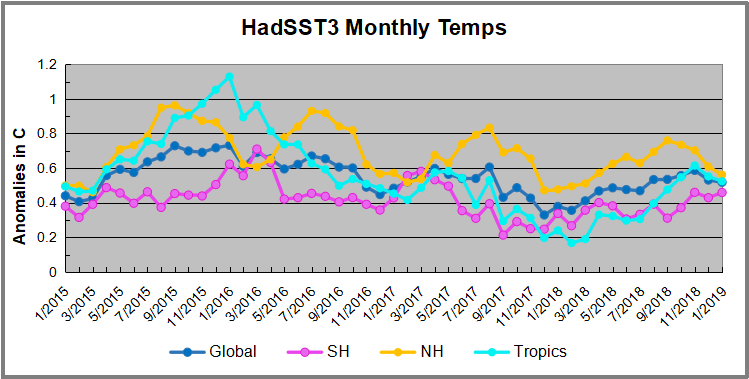
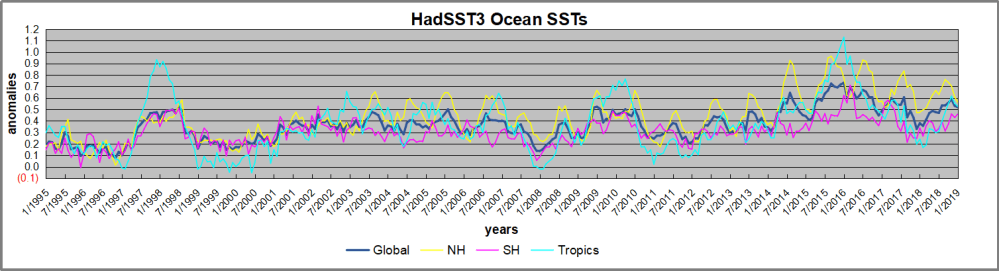
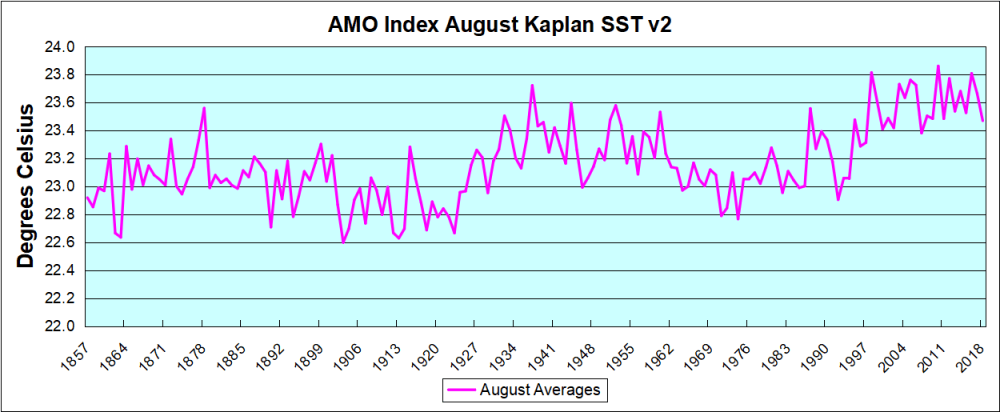
  • The ocean covers 71% of the globe and drives average temperatures;
  • SSTs have a constant water content, (unlike air temperatures), so give a better reading of heat content variations;
  • A major El Nino was the dominant climate feature in recent years.

HadSST is generally regarded as the best of the global SST data sets, and so the temperature story here comes from that source, the latest version being HadSST3.  More on what distinguishes HadSST3 from other SST products at the end.

The Current Context

The chart below shows SST monthly anomalies as reported in HadSST3 starting in 2015 through January 2019.

Hadsst012019

A global cooling pattern is seen clearly in the Tropics since its peak in 2016, joined by NH and SH cycling downward since 2016.  2018 started with slow warming after the low point of December 2017, led by steadily rising NH, which peaked in September and cooled the last 4 months.  The Tropics rose steadily until November, and are now cooling as well.  With little change in SH, the Global anomaly cooled further.

All regions are slightly warmer than 01/2015, but much cooler than 01/2016.  The January Global anomaly is 0.2 lower than 2016;  NH is 0.22 lower, SH is 0.16 lower and the Tropics  are down 0.52 from 01/2016. The rise in the Tropics had suggested a possible El Nino, but is now cooling down.

Note that higher temps in 2015 and 2016 were first of all due to a sharp rise in Tropical SST, beginning in March 2015, peaking in January 2016, and steadily declining back below its beginning level. Secondly, the Northern Hemisphere added three bumps on the shoulders of Tropical warming, with peaks in August of each year.  A fourth NH bump was lower and peaked in September 2018.  Also, note that the global release of heat was not dramatic, due to the Southern Hemisphere offsetting the Northern one.

The annual SSTs for the last five years are as follows:

Annual SSTs Global NH SH  Tropics
2014 0.477 0.617 0.335 0.451
2015 0.592 0.737 0.425 0.717
2016 0.613 0.746 0.486 0.708
2017 0.505 0.650 0.385 0.424
2018 0.480 0.620 0.362 0.369

2018 annual average SSTs across the regions are close to 2014, slightly higher in SH and much lower in the Tropics.  The SST rise from the global ocean was remarkable, peaking in 2016, higher than 2011 by 0.32C.

A longer view of SSTs

The graph below  is noisy, but the density is needed to see the seasonal patterns in the oceanic fluctuations.  Previous posts focused on the rise and fall of the last El Nino starting in 2015.  This post adds a longer view, encompassing the significant 1998 El Nino and since.  The color schemes are retained for Global, Tropics, NH and SH anomalies.  Despite the longer time frame, I have kept the monthly data (rather than yearly averages) because of interesting shifts between January and July.

Hadsst1995 to 012019

Open image in new tab to enlarge.

1995 is a reasonable starting point prior to the first El Nino.  The sharp Tropical rise peaking in 1998 is dominant in the record, starting Jan. ’97 to pull up SSTs uniformly before returning to the same level Jan. ’99.  For the next 2 years, the Tropics stayed down, and the world’s oceans held steady around 0.2C above 1961 to 1990 average.

Then comes a steady rise over two years to a lesser peak Jan. 2003, but again uniformly pulling all oceans up around 0.4C.  Something changes at this point, with more hemispheric divergence than before. Over the 4 years until Jan 2007, the Tropics go through ups and downs, NH a series of ups and SH mostly downs.  As a result the Global average fluctuates around that same 0.4C, which also turns out to be the average for the entire record since 1995.

2007 stands out with a sharp drop in temperatures so that Jan.08 matches the low in Jan. ’99, but starting from a lower high. The oceans all decline as well, until temps build peaking in 2010.

Now again a different pattern appears.  The Tropics cool sharply to Jan 11, then rise steadily for 4 years to Jan 15, at which point the most recent major El Nino takes off.  But this time in contrast to ’97-’99, the Northern Hemisphere produces peaks every summer pulling up the Global average.  In fact, these NH peaks appear every July starting in 2003, growing stronger to produce 3 massive highs in 2014, 15 and 16.  NH July 2017 was only slightly lower, and a fifth NH peak still lower in Sept. 2018.  Note also that starting in 2014 SH plays a moderating role, offsetting the NH warming pulses. (Note: these are high anomalies on top of the highest absolute temps in the NH.)

What to make of all this? The patterns suggest that in addition to El Ninos in the Pacific driving the Tropic SSTs, something else is going on in the NH.  The obvious culprit is the North Atlantic, since I have seen this sort of pulsing before.  After reading some papers by David Dilley, I confirmed his observation of Atlantic pulses into the Arctic every 8 to 10 years.

But the peaks coming nearly every summer in HadSST require a different picture.  Let’s look at August, the hottest month in the North Atlantic from the Kaplan dataset.
AMO August 2018

The AMO Index is from from Kaplan SST v2, the unaltered and not detrended dataset. By definition, the data are monthly average SSTs interpolated to a 5×5 grid over the North Atlantic basically 0 to 70N. The graph shows warming began after 1992 up to 1998, with a series of matching years since. Because the N. Atlantic has partnered with the Pacific ENSO recently, let’s take a closer look at some AMO years in the last 2 decades.

amo-decade-122018

This graph shows monthly AMO temps for some important years. The Peak years were 1998, 2010 and 2016, with the latter emphasized as the most recent. The other years show lesser warming, with 2007 emphasized as the coolest in the last 20 years. Note the red 2018 line is at the bottom of all these tracks. Most recently December 2018 is 0.4C lower than December 2016, and is the coolest December since 2000.

Summary

The oceans are driving the warming this century.  SSTs took a step up with the 1998 El Nino and have stayed there with help from the North Atlantic, and more recently the Pacific northern “Blob.”  The ocean surfaces are releasing a lot of energy, warming the air, but eventually will have a cooling effect.  The decline after 1937 was rapid by comparison, so one wonders: How long can the oceans keep this up? If the pattern of recent years continues, NH SST anomalies will likely cool in coming months.  Once again, ENSO will probably determine the outcome.

Postscript:

In the most recent GWPF 2017 State of the Climate report, Dr. Humlum made this observation:

“It is instructive to consider the variation of the annual change rate of atmospheric CO2 together with the annual change rates for the global air temperature and global sea surface temperature (Figure 16). All three change rates clearly vary in concert, but with sea surface temperature rates leading the global temperature rates by a few months and atmospheric CO2 rates lagging 11–12 months behind the sea surface temperature rates.”

Footnote: Why Rely on HadSST3

HadSST3 is distinguished from other SST products because HadCRU (Hadley Climatic Research Unit) does not engage in SST interpolation, i.e. infilling estimated anomalies into grid cells lacking sufficient sampling in a given month. From reading the documentation and from queries to Met Office, this is their procedure.

HadSST3 imports data from gridcells containing ocean, excluding land cells. From past records, they have calculated daily and monthly average readings for each grid cell for the period 1961 to 1990. Those temperatures form the baseline from which anomalies are calculated.

In a given month, each gridcell with sufficient sampling is averaged for the month and then the baseline value for that cell and that month is subtracted, resulting in the monthly anomaly for that cell. All cells with monthly anomalies are averaged to produce global, hemispheric and tropical anomalies for the month, based on the cells in those locations. For example, Tropics averages include ocean grid cells lying between latitudes 20N and 20S.

Gridcells lacking sufficient sampling that month are left out of the averaging, and the uncertainty from such missing data is estimated. IMO that is more reasonable than inventing data to infill. And it seems that the Global Drifter Array displayed in the top image is providing more uniform coverage of the oceans than in the past.

uss-pearl-harbor-deploys-global-drifter-buoys-in-pacific-ocean

USS Pearl Harbor deploys Global Drifter Buoys in Pacific Ocean


Cosmic Dichotomy: Peterson’s Pearls (1)

This is the first of a series of posts based upon Jordan Peterson’s book Maps of Meaning, published in 1999 after 17 years of research and writing. It is rich in description and insight with many references and quotations from original sources. Reading it I began to copy passages that struck me as especially lucid and pertinent. Those paragraphs of his text are provided below in italics as excerpts selected to explain five themes emerging in my reflections while pondering his book. This post explores one of those themes. Before that is an overview to explain why this is important to me and perhaps to others.

Introduction, Context and My Reflections

I have long been interested in the interface between science and religion, since my education includes degrees in both Organic Chemistry and Theology. The interaction between faith and fact is brought to heightened awareness by Jordan Peterson’s book Maps of Meaning bringing recent psychology and neurology insights to bear on the interrelation. As usual, Peterson surprises by staking out a position honoring and balancing seemingly contrary perspectives. The history of science is replete with examples of how observations and and discoveries were motivated by flashes of inspiration coming from hidden places. One guru I admired used to say he went to sleep with questions and in the morning he could comb the answers out of his hair. The structure of benzene was revealed long ago in just that way.

Peterson provides a framework for understanding and appreciating how myth and science serve us, how we operate in a zone between known and unknown, between what is and what should be. And he reminds us that mythological thinking is primordial for both individuals and societies. Reading this book reminded me of experiences working in community development when I would lead workshop discussions with people wanting to improve their neighborhoods or villages. At the round-table brainstorming we asked them to say what things in their community they would change to make it better. And as Peterson notes, the responses most often came out of the ideal, their community as it should be. For instance, someone might say, “There is a lack of community services.” My job as facilitator was to press that participant to describe the specific existing condition of concern. The interchange might end with a statement: “The streets are full of junk people just throw away. It just stays there and the place is mess.” Now we have an actionable item: A definite gap between “what is” and “what should be.” After an hour or more, we have a list of dozens of items that can be categorized into targets for improvement programs. In management and organizational consulting there is a saying: “A problem well-defined is halfway solved.” The next step is making a plan to get from a to b.

So the ideal or mythological provides a value set from which we choose things to study and to bring under our control either by understanding (reducing the fear of the unknown), or by actually manipulating the thing to serve our purpose. Ancient stargazers designed constellations and gave them mythological identities to make them familiar and less menacing. Astrologers provided guidance how to take advantage or precaution in our actions considering the stars and planets influences. With advances in telescopes astronomers could map the orbits, and events like eclipses could be predicted, making them them occasions of wonder rather than terror.

The field of climate is in a rudimentary state. The ancients made sacrifices to assure favorable weather for agriculture and for safety from storms. Climatology was and is the documenting of weather observations to discern patterns over seasons, years and longer. Weather forecasting makes use of such patterns and enhanced observations from airplanes, drones and satellites to give us warnings and time to prepare for destructive events. The mythological is honored by giving human names to storms, originally only female designations, respecting the unpredictable nature of the timing and location of destruction. (Q: Why is a woman like a hurricane? A: She comes in hot and steamy, and she leaves with your house and car.)

Nowadays, weather forecasts are improved but still are increasingly uncertain after a few days, being SWAGs after a week. (Scientific Wild-Ass Guess). Storms may now have male names, since men can also be out of control. Gender-neutral names are the latest development, to the point where some PC parents name a child “Storm” not to limit its gender options. If this suggests that a new mythology has overtaken the science, then you have got my drift. The whole notion that our computer models can predict future surface temperatures up to a century from now shows that climatology is closer to astrology than to astronomy.

Those who claim “The Science is Settled” are actually giving up on our understanding climate. As Peterson says, unexplored territory is approached with fear and any approach is made under anxiety, which is exactly what global warming doomsayers are manifesting. Many of these are urban dwellers who fear that nature is out of control, and they default to a mindset typical of pre-experimental people. In a primitive way they think that cities can be spared by sacrificing fossil fuels like a sacrificial lamb. In olden days people made idols in their own images and worshiped them to ensure favorable weather. Today people bow before computer models they have made, whose predictions are sure to scare the bejesus out of us.

[Note: I use the word “cosmic” since each individual’s world is at risk, and as we see in the agitation over climate change, entire social groups can also fear for their collective world.]

Jordan Peterson on the Cosmic Dichotomy (Excerpts from Maps of Meaning: The Architecture of Belief Title is link to pdf)

My religious convictions, ill-formed to begin with, disappeared when I was very young. My confidence in socialism (that is, in political utopia) vanished when I realized that the world was not merely a place of economics. My faith in ideology departed, when I began to see that ideological identification itself posed a profound and mysterious problem. I could not accept the theoretical explanations my chosen field of study had to offer, and no longer had any practical reasons to continue in my original direction. I finished my three-year bachelor’s degree, and left university. All my beliefs—which had lent order to the chaos of my existence, at least temporarily—had proved illusory; I could no longer see the sense in things. I was cast adrift; I did not know what to do or what to think.

The people I knew well were no more resolutely goal-directed or satisfied than I was. Their beliefs and modes of being seemed merely to disguise frequent doubt and profound disquietude. More disturbingly, on the more general plane, something truly insane was taking place. The great societies of the world were feverishly constructing a nuclear machine, with unimaginably destructive capabilities. Someone or something was making terrible plans. Why? Theoretically normal and well-adapted people were going about their business prosaically, as if nothing were the matter. Why weren’t they disturbed? Weren’t they paying attention? Wasn’t I?

My concern with the general social and political insanity and evil of the world— sublimated by temporary infatuation with utopian socialism and political machination— returned with a vengeance. The mysterious fact of the Cold War increasingly occupied the forefront of my consciousness. How could things have come to such ah point?

All the things I “believed” were things I thought sounded good, admirable, respectable, courageous. They weren’t my things, however—I had stolen them. Most of them I had taken from books. Having “understood” them, abstractly, I presumed I had a right to them—presumed that I could adopt them, as if they were mine: presumed that they were me. My head was stuffed full of the ideas of others; stuffed full of arguments I could not logically refute. I did not know then that an irrefutable argument is not necessarily true, nor that the right to identify with certain ideas had to be earned.

The study of “comparative mythological material” in fact made my horrible dreams disappear. The cure wrought by this study, however, was purchased at the price of complete and often painful transformation: what I believe about the world, now—and how I act, in consequence—is so much at variance with what I believed when I was younger that I might as well be a completely different person.

I discovered that beliefs make the world, in a very real way—that beliefs are the world, in a more than metaphysical sense. This discovery has not turned me into a moral relativist, however: quite the contrary. I have become convinced that the world-that-is-belief is orderly; that there are universal moral absolutes (although these are structured such that a diverse range of human opinion remains both possible and beneficial). I believe that individuals and societies who flout these absolutes—in ignorance or in willful opposition—are doomed to misery and eventual dissolution.

I hope that I can bring those who read this book to the same conclusions, without demanding any unreasonable “suspension of critical judgment”—excepting that necessary to initially encounter and consider the arguments I present.

The world can be validly construed as a forum for action, as well as a place of things. We describe the world as a place of things, using the formal methods of science. The techniques of narrative, however—myth, literature and drama—portray the world as a forum for action. The two forms of representation have been unnecessarily set at odds, because we have not yet formed a clear picture of their respective domains. The domain of the former is the objective world—what is, from the perspective of intersubjective perception. The domain of the latter is the world of value—what is and what should be, from the perspective of emotion and action.

The former manner of interpretation-more primordial, and less clearly understood-finds its expression in the arts or humanities, in ritual, drama, literature and mythology. The world as forum for action is a place of value, a place where all things have meaning. This meaning, which is shaped as a consequence of social interaction, is implication for action, or-at a higher level of analysisimplication for the configuration of the interpretive schema that produces or guides action.

The latter manner of interpretation-the world as place of things-finds its formal expression in the methods and theories of science. Science allows for increasingly precise determination of the consensually validatable properties of things, and for efficient utilization of precisely determined things as tools (once the direction such use is to take has been determined, through application of more fundamental narrative processes).

No complete world-picture can be generated without use of both modes of construal. The fact that one mode is generally set at odds with the other means only that the nature of their respective domains remains insufficiently discriminated. Adherents of the mythological worldview tend to regard the statements of their creeds as indistinguishable from empirical “fact,” even though such statements were generally formulated long before the notion of objective reality emerged. Those who, by contrast, accept the scientific perspective—who assume that it is, or might become, complete—forget that an impassable gulf currently divides what is from what should be.

We need to know four things:
what there is,
what to do about what there is,
that there is a difference between knowing what there is, and knowing what to do about what there is
and what that difference is.

Imagine that a baby girl, toddling around in the course of her initial tentative investigations, reaches up onto a countertop to touch a fragile and expensive glass sculpture. She observes its color, sees its shine, feels that it is smooth and cold and heavy to the touch. Suddenly her mother interferes, grasps her hand, tells her not to ever touch that object. The child has just learned a number of specifically consequential things about the sculpture—has identified its sensory properties, certainly. More importantly, however, she has determined that approached in the wrong manner, the sculpture is dangerous (at least in the presence of mother); has discovered as well that the sculpture is regarded more highly, in its present unaltered configuration, than the exploratory tendency—at least (once again) by mother. The baby girl has simultaneously encountered an object, from the empirical perspective, and its socioculturally determined status. The empirical object might be regarded as those sensory properties “intrinsic” to the object. The status of the object, by contrast, consists of its meaning—consists of its implication for behavior. Everything a child encounters has this dual nature, experienced by the child as part of a unified totality. Everything is something, and means something—and the distinction between essence and significance is not necessarily drawn.

The automatic attribution of meaning to things—or the failure to distinguish between them initially—is a characteristic of narrative, of myth, not of scientific thought. Narrative accurately captures the nature of raw experience. Things are scary, people are irritating, events are promising, food is satisfying—at least in terms of our basic experience. The modern mind, which regards itself as having transcended the domain of the magical, is nonetheless still endlessly capable of “irrational” (read motivated) reactions. We fall under the spell of experience whenever we attribute our frustration, aggression, devotion or lust to the person or situation that exists as the proximal “cause” of such agitation. We are not yet “objective,” even in our most clear-headed moments (and thank God for that). We become immediately immersed in a motion picture or a novel, and willingly suspend disbelief. We become impressed or terrified, despite ourselves, in the presence of a sufficiently powerful cultural figurehead (an intellectual idol, a sports superstar, a movie actor, a political leader, the pope, a famous beauty, even our superior at work)—in the presence, that is, of anyone who sufficiently embodies the oft-implicit values and ideals that protect us from disorder and lead us on.

The “natural,” pre-experimental, or mythical mind is in fact primarily concerned with meaning—which is essentially implication for action—and not with “objective” nature. . .And, in truth—in real life—to know what something is still means to know two things about it: its motivational relevance, and the specific nature of its sensory qualities. The two forms of knowing are not identical; furthermore, experience and registration of the former necessarily precedes development of the latter. Something must have emotional impact before it will attract enough attention to be explored and mapped in accordance with its sensory properties.

How, precisely, did people think, not so very long ago, before they were experimentalists? What were things before they were objective things? These are very difficult questions. The “things” that existed prior to the development of experimental science do not appear valid either as things or as the meaning of things to the modern mind.

The alchemist could not separate his subjective ideas about the nature of things—that is, his hypotheses—from the things themselves. His hypotheses, in turn—products of his imagination—were derived from the unquestioned and unrecognized “explanatory” presuppositions that made up his culture. The medieval man lived, for example, in a universe that was moral—where everything, even ores and metals, strived above all for perfection. Things, for the alchemical mind, were therefore characterized in large part by their moral nature—by their impact on what we would describe as affect, emotion or motivation; were therefore characterized by their relevance or value (which is impact on affect). Description of this relevance took narrative form, mythic form—as in the example drawn from Jung, where the sulphuric aspect of the sun’s substance is attributed negative, demonic characteristics. It was the great feat of science to strip affect from perception, so to speak, and to allow for the description of experiences purely in terms of their consensually apprehensible features. However, it is the case that the affects generated by experiences are real, as well.

We have lost the mythic universe of the pre-experimental mind, or have at least ceased to further its development. That loss has left our increased technological power ever more dangerously at the mercy of our still unconscious systems of valuation.

Prior to the time of Descartes, Bacon and Newton, man lived in an animated, spiritual world, saturated with meaning, imbued with moral purpose. The nature of this purpose was revealed in the stories people told each other—stories about the structure of the cosmos and the place of man. But now we think empirically (at least we think we think empirically), and the spirits that once inhabited the universe have vanished.

Furthermore—and more importantly—the new theories that arose to make sense of empirical reality posed a severe threat to the integrity of traditional models of reality, which had provided the world with determinate meaning. The mythological cosmos had man at its midpoint; the objective universe was heliocentric at first, and less than that later. Man no longer occupies center stage. The world is, in consequence, a completely different place.

The mythological perspective has been overthrown by the empirical; or so it appears. This should mean that the morality predicated upon such myth should have disappeared, as well, as belief in comfortable illusion vanished.

If the presuppositions of a theory have been invalidated, argues Nietzsche, then the theory has been invalidated. But in this case the “theory” survives. The fundamental tenets of the Judeo-Christian moral tradition continue to govern every aspect of the actual individual behavior and basic values of the typical Westerner—even if he is atheistic and well-educated, even if his abstract notions and utterances appear iconoclastic.

Our systems of post-experimental thought and our systems of motivation and action therefore co-exist in paradoxical union. One is “up-to-date”; the other, archaic. One is scientific; the other, traditional, even superstitious. We have become atheistic in our description, but remain evidently religious—that is, moral—in our disposition.

We have become trapped by our own capacity for abstraction: it provides us with accurate descriptive information but also undermines our belief in the utility and meaning of existence. This problem has frequently been regarded as tragic (it seems to me, at least, ridiculous)—and has been thoroughly explored in existential philosophy and literature.

Our behavior is shaped (at least in the ideal) by the same mythic rules—thou shalt not kill, thou shalt not covet—that guided our ancestors for the thousands of years they lived without benefit of formal empirical thought. This means that those rules are so powerful—so necessary, at least—that they maintain their existence (and expand their domain) even in the presence of explicit theories that undermine their validity. That is a mystery. And here is another:

How is it that complex and admirable ancient civilizations could have developed and flourished, initially, if they were predicated upon nonsense? If a culture survives, and grows, does that not indicate in some profound way that the ideas it is based upon are valid?

Our great rationalist ideologies, after all—fascist, say, or communist— demonstrated their essential uselessness within the space of mere generations, despite their intellectually compelling nature. Traditional societies, predicated on religious notions, have survived—essentially unchanged, in some cases, for tens of thousands of years. How can this longevity be understood?

We do not understand pre-experimental thinking, so we try to explain it in terms that we do understand—which means that we explain it away, define it as nonsense. After all, we think scientifically—so we believe—and we think we know what that means (since scientific thinking can in principle be defined). We are familiar with scientific thinking and value it highly—so we tend to presume that it is all there is to thinking (presume that all other “forms of thought” are approximations, at best, to the ideal of scientific thought). But this is not accurate. Thinking also and more fundamentally is specification of value, specification of implication for behavior.

The painstaking empirical process of identification, communication and comparison has proved to be a strikingly effective means for specifying the nature of the relatively invariant features of the collectively apprehensible world. Unfortunately, this useful methodology cannot be applied to determination of value—to consideration of what should be, to specification of the direction that things should take (which means, to description of the future we should construct, as a consequence of our actions). Such acts of valuation necessarily constitute moral decisions. We can use information generated in consequence of the application of science to guide those decisions, but not to tell us if they are correct. We lack a process of verification, in the moral domain, that is as powerful or as universally acceptable as the experimental (empirical) method in the realm of description.

This absence does not allow us to sidestep the problem. No functioning society or individual can avoid rendering moral judgment, regardless of what might be said or imagined about the necessity of such judgment. Action presupposes valuation, or its implicit or “unconscious” equivalent. To act is literally to manifest preference about one set of possibilities, contrasted with an infinite set of alternatives. If we wish to live, we must act. Acting, we value. Lacking omniscience, painfully, we must make decisions, in the absence of sufficient information. It is, traditionally speaking, our knowledge of good and evil, our moral sensibility, that allows us this ability. It is our mythological conventions, operating implicitly or explicitly, that guide our choices. But what are these conventions? How are we to understand the fact of their existence? How are we to understand them?

Our constant cross-cultural interchanges and our capacity for critical reasoning have undermined our faith in the traditions of our forebears, perhaps for good reason. However, the individual cannot live without belief—without action and valuation—and science cannot provide that belief. We must nonetheless put our faith into something. Are the myths we have turned to since the rise of science more sophisticated, less dangerous, and more complete than those we rejected?

The ideological structures that dominated social relations in the twentieth century appear no less absurd, on the face of it, than the older belief systems they supplanted; they lacked, in addition, any of the incomprehensible mystery that necessarily remains part of genuinely artistic and creative production. The fundamental propositions of fascism and communism were rational, logical, statable, comprehensible—and terribly wrong.

No great ideological struggle presently tears at the soul of the world, but it is difficult to believe that we have outgrown our gullibility. The rise of the New Age movement in the West, for example—as compensation for the decline of traditional spirituality—provides sufficient evidence for our continued ability to swallow a camel, while straining at a gnat.

Could we do better? Is it possible to understand what might reasonably, even admirably, be believed, after understanding that we must believe? Our vast power makes self-control (and, perhaps, self-comprehension) a necessity—so we have the motivation, at least in principle. Furthermore, the time is auspicious. The third Christian millennium is dawning—at the end of an era when we have demonstrated, to the apparent satisfaction of everyone, that certain forms of social regulation just do not work (even when judged by their own criteria for success).

Footnote: Navajos and Prairie Dogs

The intersection of folk and scientific wisdom is demonstrated in a case regarding an Arizona Navajo reservation.

Government officials in the 1950’s proposed to get rid of prairie dogs on some parts of the reservation in order to protect the roots of the sparse desert grass and thereby maintain at least marginal grazing for sheep.

Navajos objected strongly, insisting, “If you kill off all the prairie dogs, there will be no one to cry for the rain.” Of course they were assured by the amused government men that there was no conceivable connection between rain and prairie dogs, a fact that could be proven easily by a simple scientific experiment: a specific area would be set aside and all the burrowing animals there would be exterminated.

The experiment was carried out, over the continued objections of the Navajos, and its outcome was surprising only to the white scientists. Today, the area […] has become a virtual wasteland with very little grass. Apparently, without the ground-turning processes of the little burrowing animals, the sand in the area becomes solidly packed, causing a fierce runoff whenever it rains.

It would be incautious to suggest in this instance that the Navajos were possessed of a clear, conscious objective theory about water retention and absorption in packed sand. On the other hand, it would be difficult to ignore the fact that the Navajo myth system, which insists on delicate reciprocal responsibilities among elements of nature, dramatized more accurately than our science the results of an imbalance between principals in the rain process. (Barre Toelken here p. 21)

But folk wisdom is an unreliable, inconsistent kind of wisdom. For one thing, most proverbs coexist with their exact opposites, or at least with proverbs that give somewhat different advice. Now that climate change has passed into social discourse, proverbs and unsubstantiated claims are voiced among like-minded people, thereby reinforcing shared beliefs without any critical analysis to verify an objective reality to the sayings.

Disney’s portrayal of the Sorcerer’s Apprentice in over his head.

The moral of the story pertains to the arrogance of scientists who think they have empirical understanding of a natural system, and can predict its behavior. The deeper truth is that even when knowledge is added by experiment, life and the world contain other mysteries yet to be explored. Each new answer raises many new questions, if we are brave and curious enough to investigate. In later posts, Peterson gets into the perversion of turning a present scientific understanding into an ideology, i.e. freezing a relative, incomplete known into a myth, thus discouraging further analysis in order to protect the status quo.

Congressional Climate Resolution

The current world political climate is shame-and-blame in order to gain approvals for drastic reduction of CO2. Thus pressure is applied to political officials at every level to show their colors on acting to “fight climate change.”  The so-called Green New Deal will apparently be put as a resolution for the House to vote its approval of the concept.  It seems timely to propose an alternative resolution.

There is no place to hide these days, and politicians who have a rational position on climate science had better legislate on the issue. A common sense legislative motion could read something like this (followed by supporting documentation and references).


Whereas, Extent of global sea ice is within the range of historical variability;

Whereas, Populations of polar bears are generally growing;

Whereas, Sea levels have been slowly rising at the same rate since the Little Ice Age ended 150 years ago;

Whereas, Oceans will not become acidic due to buffering from extensive mineral deposits and marine life is well adapted to pH fluctuations that do occur;

Whereas, Extreme weather events have not increased in recent decades and such events are more associated to periods of cooling rather than warming;

Whereas, Cold spells, not heat waves, are the greater threat to human life and prosperity;

Therefore, This chamber agrees that climate is variable and prudent public officials should plan for future periods both colder and warmer than the present. Two principle objectives will be robust infrastructure and reliable, affordable energy.

Comment:

The underlying issue is the assumption that the future can only be warmer than the present. Once you accept the notion that CO2 makes the earth’s surface warmer (an unproven conjecture), then temperatures can only go higher since CO2 keeps rising. The present plateau in temperatures is inconvenient, but actual cooling would directly contradict the CO2 doctrine. Some excuses can be fabricated for a time, but an extended period of cooling undermines the whole global warming mantra.

It’s not a matter of fearing a new ice age. That will come eventually, according to our planet’s history, but the warning will come from increasing ice extent in the Northern Hemisphere. Presently infrastructures in many places are not ready to meet a return of 1950s weather, let alone something unprecedented.

Public policy must include preparations for cooling since that is the greater hazard. Cold harms the biosphere: plants, animals and humans. And it is expensive and energy intensive to protect life from the ravages of cold. Society can not afford to be in denial about the prospect of the current temperature plateau ending with cooling.

Footnote:

The Trudeau initiative is an example of the alternative to legislating a rational position. It is virtue-signalling by adopting a token carbon price, which will not lower CO2 concentrations, nor reduce temperatures. The tax will enrich government coffers, which is a key motivation for politicians hiding behind this noble cause.

In 2015, gasoline taxes in Canada represented on average 38.5 cents per litre, which is approximately 35% of the pump price. That includes 10¢/litre federal tax, provincial fuel taxes ranging from 6 to 19 ¢/litre, plus sales taxes. Taxing at $10 a tonne starting in 2018 would add a carbon tax on top as shown below:

Fuel Type UNITS FOR TAX 2018 Added Tax
Gasoline ¢/litre 2.22
Diesel (light fuel oil) ¢/litre 2.56
Jet Fuel ¢/litre 2.61
Natural Gas ¢/litre 1.90
Propane ¢/litre 1.54
Coal – high heat value $/tonne 20.77
Coal – low heat value $/tonne 17.77

These pennies added on top will not change behavior, but millions of consumers’ dollars will be skimmed in a hidden way, including rising transportation costs of everything.

If this was anything other than a tax grab, they would do one or both of two things:

  • Make the tax revenue neutral by paying the monies collected back to consumers; and
  • Make the increases in the carbon tax rate conditional upon rising temperatures as measured by satellites. (as proposed by economist Ross McKitrick)

fuel-tax