Kangaroo Klimate Kourt Ruling

A kangaroo court is a court that ignores recognized standards of law or justice, and often carries little or no official standing in the territory within which it resides. The term may also apply to a court held by a legitimate judicial authority who intentionally disregards the court’s legal or ethical obligations. (Wikipedia)

The latest example is provided last month by Chief Justice Preston of the New South Wales Land and Environment Court  dismissing on appeal the proposal to construct a new open-cut coal mine in the state’s Hunter Valley.  His ruling rested on dubious suppositions.

The Chief Justice found that “all anthropogenic GHG emissions contribute to climate change”.

The Chief Judge invented a “wrong time test”. To pass that test, a fossil fuel proponent must now establish why their project should be allowed to proceed at this time in history, when it is clearly recognized that there is an urgent need for rapid and deep decreases in greenhouse gas emissions. To achieve this, most fossil fuel reserves need to remain in the ground unburned.  The test asserts that a practical consequence of reaching the emission reductions required by the Paris Accord to achieve the 1.5 to 2°C goal is that coal production needs to reduce rather than expand.

So we have come to this.  A sitting judge declares a prevalent social opinion regarding the future is the law of the land.  A legal business venture is blocked on ideological grounds, because some believe now is the “wrong time” in history for such an undertaking.  Kangaroos are hopping around like crazy.

It is fortunate indeed that this judge is not hearing the Juliana vs. US case.  But then that is actually a legal proceeding where kangaroos or unicorns do not have standing.  The precedents and body of law stacked against these climate cases is summarized in the most recent brief by the appellants (US Govt.) arguing against the claims of activists/alarmists (plaintiffs).

APPELLANTS’ OPPOSITION TO MOTION FOR PRELIMINARY INJUNCTION PENDING APPEAL  February 19,2019 Some points of climate caselaw excerpted in italics.

“the unprecedented nature of this ambitious attempt to throttle important government functions superintending broad swaths of the national economy”

“The injuries identified by Plaintiffs arise from a diffuse, global phenomenon that affects every other person in their communities, in the United States, and throughout the world.”

“Plaintiffs “simply ignore that Defendant agencies and officers do not produce greenhouse gases, but act to regulate those third parties that do: innumerable businesses and private industries.”

“Plaintiffs have not even begun to articulate a remedy within a federal court’s authority to award that could meaningfully address global climate change as the claimed cause of their injuries.”

“Plaintiffs ask the district court to review and assess the entirety of the representative branches’ decisions relating to climate change and then to pass on the comprehensive constitutionality of those policies, programs, and inaction in the aggregate and then enter and enforce a sweeping decree against the government writ large.”

“Thus, the Due Process Clause imposes no duty on the government to protect persons from harm inflicted by third parties that would violate due process if inflicted by the government.”

“Every instance” in which this Court has “permitted a state-created danger theory to proceed has involved an act by a government official that created an obvious, immediate, and particularized danger to a specific person known to that official.”

“Plaintiffs seek to remedy carbon emissions, myopically attributing them to the U.S. government and ignoring that the global mix of carbon levels is (even on their own theory) predominantly the product of the actions of foreign actors the world over.”

“All of Plaintiffs’ claimed harms result from what they allege is the government’s general failure to protect the environment. Yet Plaintiffs have no constitutional right to particular climate conditions, and they may not resort to the state-created danger exception to circumvent that limitation.”

“This allegation of slowly-recognized, long-incubating, and generalized harm by itself distinguishes their claim from all other state-created danger cases on which they and the district court relied.”

“First, there is no fundamental right to a “climate system capable of sustaining human life.”

“The Supreme Court definitively rejected an attempt to use the federal common law of nuisance to centralize the management of carbon dioxide emissions in a single district court, operating outside the purview of the comprehensive Clean Air Act.”

“It is not clear how much of this sea level rise can be avoided by slowing down climate warming or even cooling the planet again.”

“Plaintiffs’ reliance on their self-described “deep anger, frustration, depression, and feeling of betrayal,” Motion 23-25, is likewise insufficient to establish irreparable harm. First, if this Court were to recognize feelings as irreparable injury, then every plaintiff who passionately disagrees with government action — i.e., most if not all plaintiffs — would satisfy the injury requirement.”

“Because Plaintiffs cannot demonstrate that their requested relief pending appeal would concretely impact climate change, the balance of equities tips heavily in favor of denying Plaintiffs’ motion.”


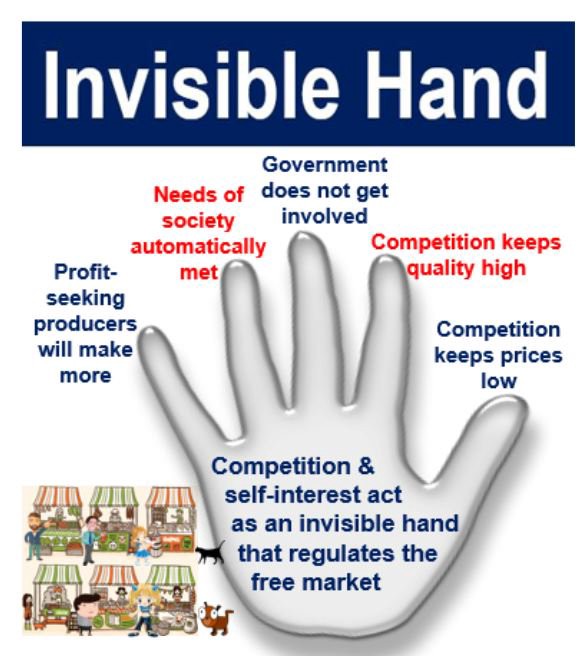
The Heavy Hand vs. The Hidden Hand

Context: Living Under the Heavy Hand

We have discussed before how the administrative state has grown like topsy under so-called progressive politicians.

The Obama administration issued a record number of new regulations on its way out the door in 2016, leaving an administrative state that saps the economy of nearly $2 trillion a year, according to a report being released in May 2017. 3,853 federal rules that were finalized in 2016 — the most for any year since 2005.

The government itself spent $63 billion in 2016 to administer and enforce all of its own regulations, the Competitive Enterprise Institute said.

Since President Obama assumed office in 2009, the EPA alone published over 3,900 rules, averaging almost 500 annually, and amounting to over 33,000 new pages in the Federal Register. The compliance costs associated with EPA regulations under Obama number in the hundreds of billions and have grown by more than $50 billion in annual costs since Obama took office.

Under climate crusading Governor Inslee of Washington State, in just 60 days last year, 300 bills were passed regulating everything from school breakfasts to workplace sexual misconduct and teenage voting rights.

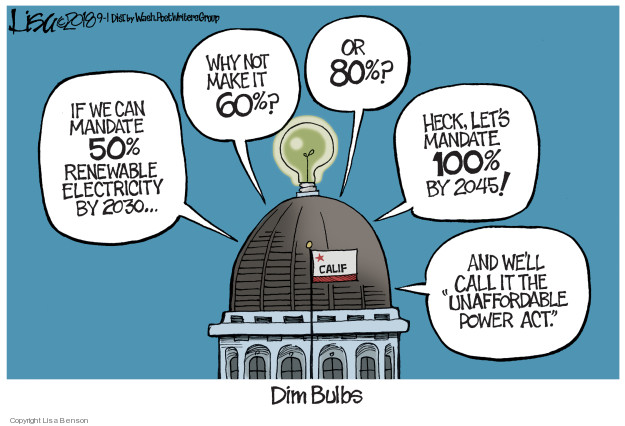
California out did them by passing 1000 bills by the end of Jerry Brown’s 16th and last year as Governor. Laws included requiring 100% renewable energy by 2045, bans on sugary drinks on school menus and offering plastic straws in restaurants.

California governor-elect Gavin Newsom promised that he, after his inauguration on January 7, 2019 and with the huge Democrat majorities elected in both houses of the state Legislature, will pass a much broader social justice agenda. Newsom’s top agenda goals include “Guaranteed Health Care for All,” an affordable housing “Marshall Plan,” a “Master Plan for Aging with Dignity,” free college tuition, ending child poverty, and middle-class workforce strategy.

Methane Shows the Market’s Hidden Hand Works, Government’s Heavy Hand Fails

Present Trump made it a priority to cut deeply into the red tape, and claims his administration has killed 22 regulations for every new one approved. The recent action to rescind the EPA methane rule illustrates why this is the better approach. Paul Gessing writes at RealClearEnergy ‘Green Activists’ Opposing Trump’s Methane Rollback Are Full of It Excerpts in italics with my bolds

The Trump administration recently rolled back an Obama-era environmental rule that restricted oil and natural gas drilling. Almost immediately, the Environmental Defense Fund, California, and New Mexico sued to block the move. California Attorney General Xavier Becerra warned the administration’s rollback “risks the air our children breathe.”

Children can breathe easy — and so can adults, for that matter. The old “Waste Prevention Rule” governing methane emissions was counterproductive. Forcing energy firms to comply with its onerous red tape would have harmed workers and discouraged natural gas production, which benefits the environment.

Energy companies often capture methane, the main component in natural gas, when they’re drilling for crude oil. This methane byproduct is valuable, so companies try to sell it whenever possible.

But sometimes, safety concerns or a lack of available pipeline capacity compels firms to burn the gas instead. This practice, known as “flaring,” prevents dangerous gas buildups in wells. Similarly, firms sometimes have to release the gas, a practice known as “venting.”

The Waste Prevention Rule, which was finalized by the Bureau of Land Management in 2016 but delayed by the Trump administration, aimed to discourage venting and flaring. It forced energy companies on public and Indian lands to upgrade their equipment and pay royalties on any flared or vented gas.

According to the U.S. Energy Information Administration, the technology and infrastructure upgrades required by the old rule would have been prohibitively expensive for many producers. This is especially true of those operating so-called “marginal” wells — which produce no more than 90,000 cubic feet of gas per day, and thus aren’t as profitable.

More than 70 percent of oil and gas wells on federal land are classed as “marginal.” If the rule had forced these wells to close, America’s natural gas production would fall and unemployment would rise. If all marginal wells were shut down, over 240,000 Americans could have lost their jobs.

Ironically, the environment would suffer from such shutdowns. Thanks to new technologies such as fracking and horizontal drilling, America’s natural gas production has soared in the past decade. We’re now the world’s largest producer of the fuel.

This surge in natural gas supplies has caused prices to plummet. As a result, many utility companies have transitioned from using dirty, more expensive coal to cheaper, cleaner-burning natural gas to generate electricity. Thanks to this shift, domestic carbon dioxide emissions recently hit their lowest levels in 25 years.

In other words, by limiting natural gas production, the Waste Production Rule would have incentivized utilities to continue relying on dirty coal, thereby harming the environment.

The rule was also unnecessary. Controlling methane emissions is already a priority for oil and gas companies — and has been for years. Methane emissions have dropped 16 percent over the past quarter-century even as natural gas production has increased 50 percent.

In 2017, The Environmental Partnership, composed of nearly 30 domestic oil and gas companies, launched a comprehensive methane reduction program based on EPA guidelines. Similarly, the international Oil and Gas Climate Initiative, which includes BP, Shell, and Saudi Aramco, recently committed to reducing methane emissions in line with the Paris Agreement.

In short, the Trump administration is rolling back a rule that threatened our economy and our environment without delivering any significant benefits to the planet. The green activists fighting this much-needed reform need to calm down and take some deep breaths. And they needn’t worry — the air will be just as clean as before.

Paul Gessing is president of the Rio Grande Foundation, an independent, nonpartisan, tax-exempt research and educational organization dedicated to promoting liberty, opportunity and prosperity for New Mexico.

Summary: Progressive politics long ago ceased being liberal, i.e. concerned about individual freedom of choice and speech.  Progressives are increasingly a coalition of drama queens, know-it-alls, and control freaks.

See also:  MORE CALIFORNIA CRAZY LAWS

5bc132d50674d.image_

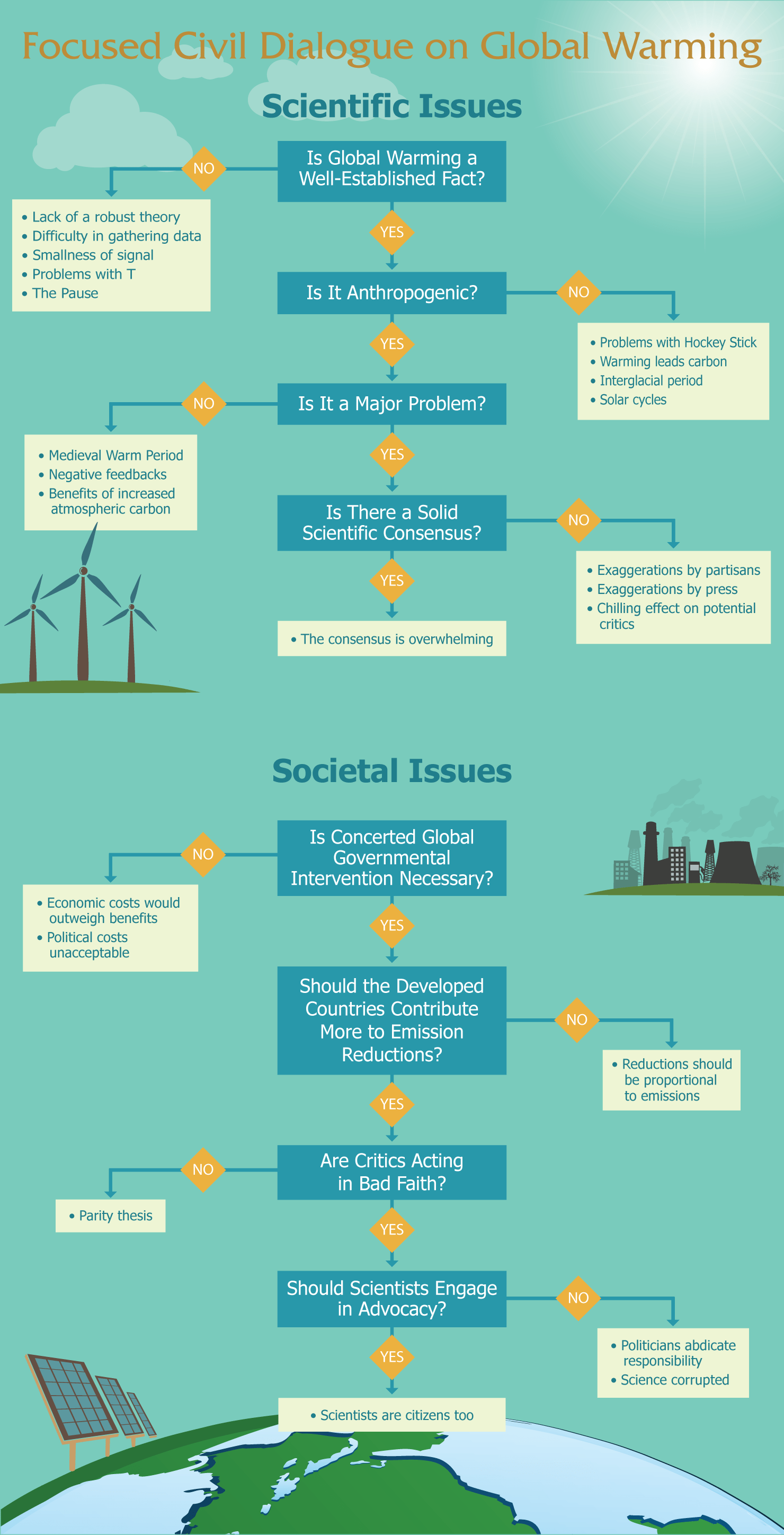
A Critical Framework For Climate Change

This dialogue framework was proposed for a debate between William Happer and David Karoly sponsored by The Best Schools.  As you can see it reads like an high hurdle course for alarmists/activists.  There are significant objections at every leap in connecting the beliefs.

Happer’s Statement: CO₂ will be a major benefit to the Earth

Earth does better with more CO2.  CO2 levels are increasing

Atmospheric transmission of radiation: Tyndall correctly recognized in 1861 that the most important greenhouse gas of the Earth’s atmosphere is water vapor. CO2 was a modest supporting actor, then as now.

Radiative cooling of the Earth: Clouds are one of the most potent factors controlling Earth’ s surface temperature.

The Schwarzschild equation:  The observed intensity I of upwelling radiation comes from the radiation emitted by the surface and by greenhouse gases in the atmosphere above the surface. The rate of change of the intensity with altitude is given by the Schwarzschild equation.

Logarithmic forcing by CO2:  The intensity for a doubling of CO2 concentrations from the present value of 400 ppm to 800 ppm makes little difference, and simply leads to a slight broadening of the width of the band.

Convection:  Radiation, which we have discussed above, is an important part of the energy transfer budget of the earth, but not the only part.

Numerical Modeling:  Predictions about what more CO2 will do to the Earth’s climate are based on numerical modeling of the fluid flows in the atmosphere and oceans.  Including water vapor, clouds, and precipitation further complicates the modeling considerations outlined above. Climate model builders have a hard job.

Equilibrium Climate Sensitivity: If increasing CO2 causes very large warming, harm can indeed be done. But most studies suggest that warmings of up to 2 K will be good for the planet.  More than a century after Arrhenius, and after the expenditure of many tens of billions of dollars on climate science, the official value of S still differs little from the guess that Arrhenius made in 1912: S = 4 K. Could it be that the climate establishment does not want to work itself out of a job?

Overestimate of S:  Contrary to the predictions of most climate models, there has been very little warming of the Earth’s surface over the last two decades.  If one assumes negligible feedback, where other properties of the atmosphere change little in response to additions of CO2, the doubling efficiency can be estimated to be about S = 1 K. The much larger doubling sensitivities claimed by the IPCC, which look increasingly dubious with each passing year, are due to “positive feedbacks.”

Benefits of CO2:  More CO2 in the atmosphere will be good for life on planet earth. Few realize that the world has been in a CO2 famine for millions of years — a long time for us, but a passing moment in geological history.

More bogeymen: The earth has stubbornly refused to warm nearly as much as demanded by computer models. To cope with this threat to full employment, the climate establishment has invented a host of bogeymen, other supposed threats from more CO2.  One of the bogeymen is that more CO2 will lead to, and already has led to, more extreme weather, But extreme weather is not increasing.  We also hear that more CO2 will cause rising sea levels to flood coastal cities, large parts of Florida, tropical island paradises, etc.

Climate Science:  Too much “climate research” money is pouring into very questionable efforts, like mitigation of the made-up horrors mentioned above. It reminds me of Gresham’s Law: “Bad money drives out good.”

Summary

The Earth is in no danger from increasing levels of CO2. More CO2 will be a major benefit to the biosphere and to humanity.

Karoly’s Statement: Climate change is harming nature and humanity

1. Observed global warming is beyond reasonable doubt

2. Increases in greenhouse gases are due to human activity

3. Most of the observed global warming since the mid-twentieth century is due to human activity

4. Global warming will continue over the twenty-first century

5. Many adverse impacts result from global warming

6. Substantial reductions in greenhouse gas emissions are needed to minimize dangerous global warming

Summary

The key points presented above are just a small fraction of the vast body of evidence that support the scientific conclusions on global warming accepted by all the scientific Academies and by all the governments around the world.

Science has established that it is virtually certain that increases of atmospheric CO2 due to burning of fossil fuels will cause climate change that will have substantial adverse impacts on humanity and on natural systems. Therefore, immediate stringent measures to suppress the burning of fossil fuels are both justified and necessary.

Happer’s detailed response to Karoly on climate change

Dr. Karoly begins his Statement, not with evidence to support the title, “Climate change is harming nature and humanity,” but with a summary of what happened in the “21st Conference of Parties to the United Nations Framework Convention on Climate Change in December of 2015.” What a mouthful!

As I pointed out in my Interview and Statement, there is no scientific evidence that global greenhouse gas emissions will have a harmful effect on climate. Quite the contrary, there is very good evidence that the modest increase in atmospheric CO2 since the start of the Industrial Age has already been good for the Earth and that more will be better.

Some climate scientists, including Dr. Karoly, are doing praiseworthy work. I especially admire high-quality, year-by-year measurements of properties of the atmosphere and oceans. But if they have doubts about climate hysteria, most practicing climate scientists keep these to themselves because of the ferocity of the attacks they know will come to those who question the party line.

In my Interview, I mentioned the attacks on me by Greenpeace. No wonder there is a consensus of climate scientists, or that few scientists from other fields are willing to question the established dogma!  Even though creative scientists are not greatly impressed by them, claims of consensus work wonders with educated elites.

A brief discussion of those key points of Dr. Karoly’s Statement with which I disagree:

3. “The observed large-scale increase in surface temperature across the globe since the mid-twentieth century is primarily due to human activity, the increase of greenhouse gases in the atmosphere, and other impacts on the human climate system.”  This statement is based on excessive faith in computer models.

Trends in global mean surface temperature. a. 1993-2012. b. 1998-2012. Histograms of observed trends (red hatching) are from 100 reconstructions of the HadCRUT4 dataset. Histograms of model trends (grey bars) are based on 117 simulations of the models, and black curves are smoothed versions of the model trends. The ranges of observed trends reflect observational uncertainty, whereas the ranges of model trends reflect forcing uncertainty, as well as differences in individuals model responses to external forcings and uncertainty arising from internal climate variability.

4. “There will continue to be significant global warming over the 21st century with its magnitude depending on the emissions of greenhouse gases from human activities.”  Again, this is a statement based on computer models. No one knows how the temperature of the Earth will change over the twenty-first century. It is just as likely that the Earth will cool, since whatever mechanism caused the Little Ice Age could act again and could overwhelm the small warming expected from increased CO2. In both my Statement and my Interview, I pointed out how much most models overestimated the warming of the Earth since the year 2000, when there was a hiatus or pause in warming, which may not be over yet.

5. “There are substantial adverse impacts on human and natural systems from global warming.” I disagree. I don’t know of a single adverse impact that can be confidently ascribed to more CO2. There are plenty of phony claims of damage, which quickly fall apart when scrutinized.

6. “Rapid, substantial, and sustained reductions in greenhouse gas emissions from human activities are needed to slow global warming and stabilize global temperature at a level that would minimize dangerous human influence on the climate system.”  I disagree. We are being exhorted to “reduce our carbon footprint,” although to Dr. Karoly’s credit, he does not use this silly slogan. To the extent that “carbon footprint” includes soot (small particles of elemental carbon), and CO, carbon monoxide molecules, I would be glad to be part of the crusade.

General Comments

My Statement had 64 citations. I, too, cited many government reports, including those of the IPCC, but I also cited at least 16 peer-reviewed papers by independent scientific researchers. Dr. Karoly’s overwhelming focus on government reports looks like fully developed groupthink. Or maybe it is better described by the old Russian proverb:

Сила есть, ума не надо.

We have power, no need for intelligence.

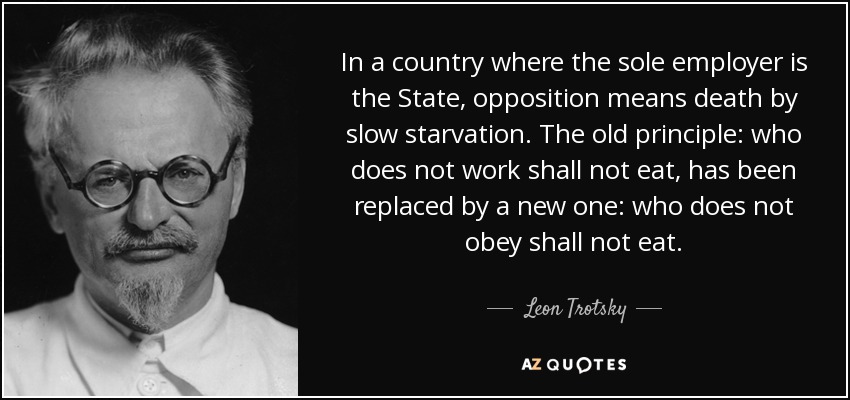
Trotsky refers to the old principle which St. Paul states in 2 Thessalonians chapter 3:10 “We gave you this rule: if a man will not work, he shall not eat.” And before that Deuteronomy 25:4: “Do not muzzle an ox while it is treading out the grain.”

Enormous imagination has gone into showing that increasing concentrations of CO2 will be catastrophic. Cities will be flooded by sea-level rises that are 10 or more times bigger than even the IPCC predicts. There will be mass extinctions of species; billions of people will die; “tipping points” will render the planet a desert.

If you wrote down all the ills attributed to global warming, you would fill up a very thick book. And all of this despite the fact that in the history of higher life forms on Earth (the Phanerozoic), CO2 levels were four or more times higher than today, but life nevertheless flourished at least as abundantly on land and in the sea as it does today. It’s an ill wind, indeed, that blows no good.

In summary, Dr. Karoly is a good scientist who means well. But he lives in an echo chamber of like-minded people who are convinced that they are saving the world.

The scholars of the floating island of Laputa had much in common with many promoters of global-­warming alarmism


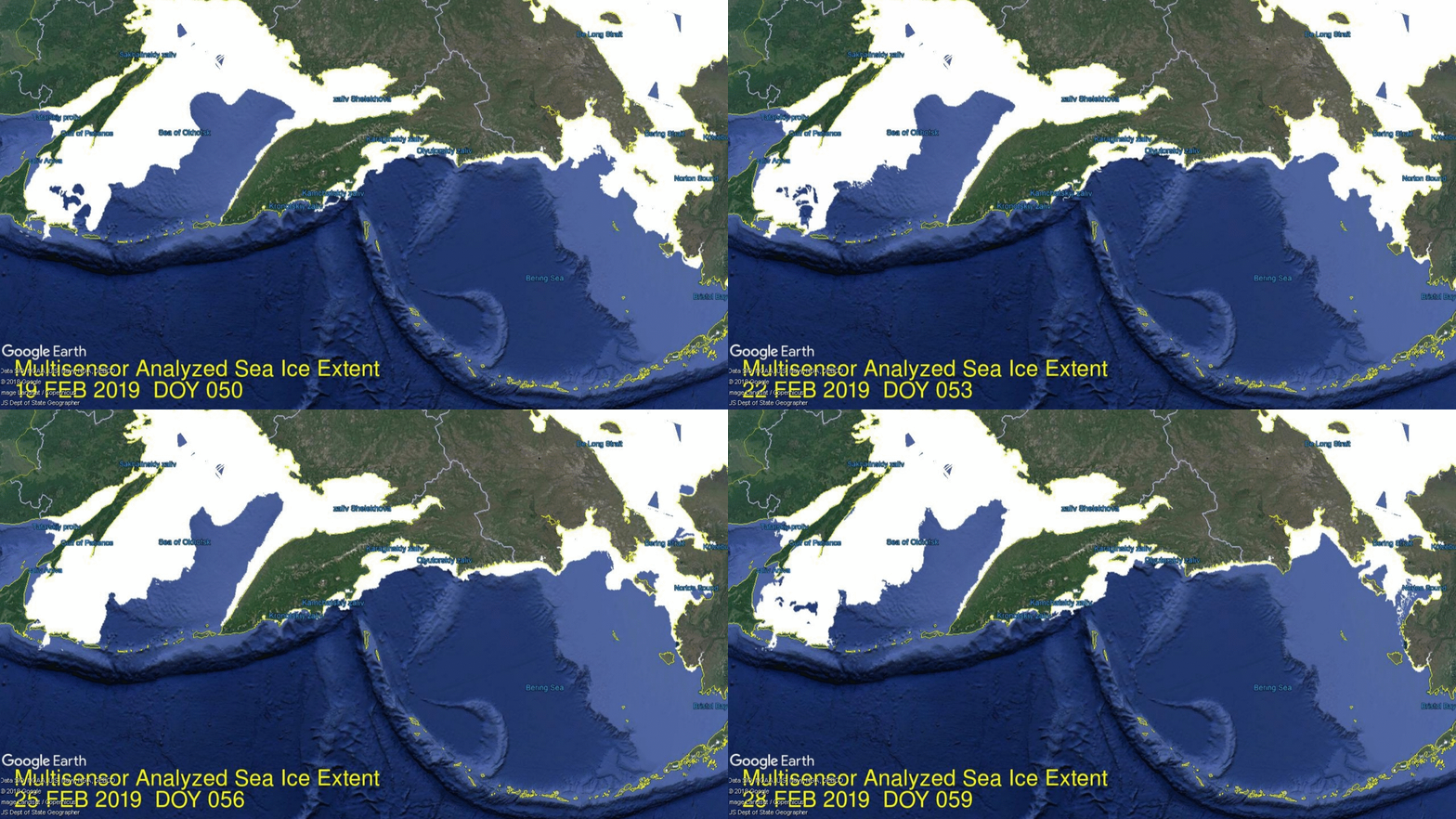
Pacific Ice Seesaw Feb. 2019


10 Days in Pacific Arctic:
The above image shows the pacific ice seesaw returning at the end of February.  Bering Sea on the right was at 95% of 2018 maximum and then lost  180k km2 in ten days, now at 65 % of max.  Meanwhile on the left Okhotsk Sea gained 70k km2, and is now 106% of 2018 maximum.

The graph below shows February progress in ice extent recovery.As noted before, the month started with a slight decline, then ice grew rapidly for 18 days peaking on day 54 above the 12 yr. average, and above the previous two years.  Then ice retreated the last five days with the February monthly average ending  240k km2 or 2% below average. SII lags MASIE by ~100k km2 for the month.

The next two weeks will show whether 2019 is maxed out, or whether the ice extent catches up to the average which flatlines over that period.

The table below shows the distribution of ice in the various Arctic basins.

Region 2019059 Day 059 
Average
2019-Ave. 2018059 2019-2018
 (0) Northern_Hemisphere 14625288 15006867 -381579 14485052 140236
 (1) Beaufort_Sea 1070498 1070200 297 1070445 53
 (2) Chukchi_Sea 960221 965872 -5651 965971 -5750
 (3) East_Siberian_Sea 1087137 1087133 4 1087120 18
 (4) Laptev_Sea 897845 897842 3 897845 0
 (5) Kara_Sea 931672 929289 2383 922905 8767
 (6) Barents_Sea 684894 625620 59274 544938 139956
 (7) Greenland_Sea 513404 628938 -115534 473064 40340
 (8) Baffin_Bay_Gulf_of_St._Lawrence 1570308 1539346 30962 1786606 -216298
 (9) Canadian_Archipelago 853337 853036 302 853109 229
 (10) Hudson_Bay 1260903 1260611 293 1260838 66
 (11) Central_Arctic 3231172 3213214 17958 3065181 165991
 (12) Bering_Sea 250169 710647 -460479 336065 -85896
 (13) Baltic_Sea 39687 110466 -70780 123280 -83594
 (14) Sea_of_Okhotsk 1260392 1067746 192646 1069898 190494

The table shows how 2019 is matching the 12-year average almost everywhere.  Barents Sea has caught up and edged ahead of average, and much higher than last year.  Greenland Sea is below average but higher than 2018.  The overall deficit is due to Bering ice down 460k km2 to average, only partially offset by a surplus of 193k km2 in Okhotsk.

cg524a47d218458

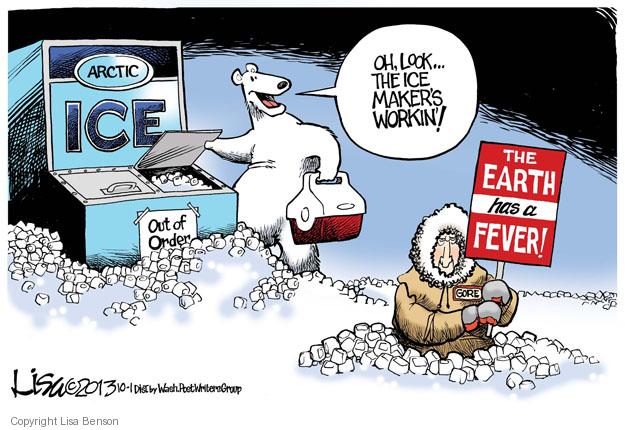
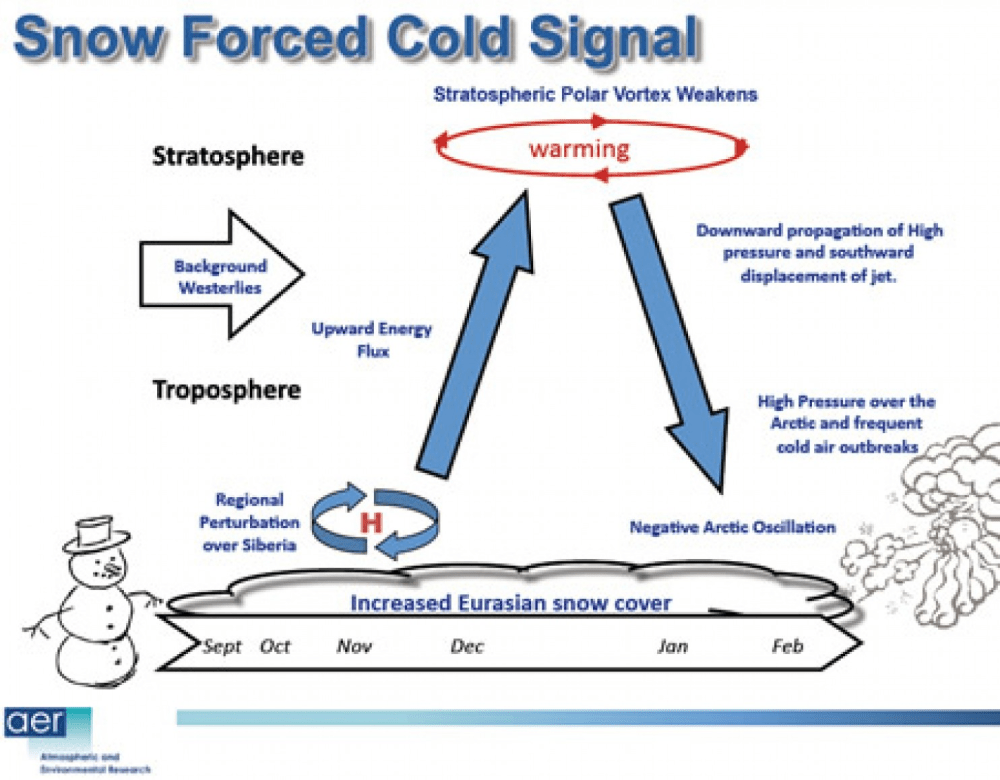
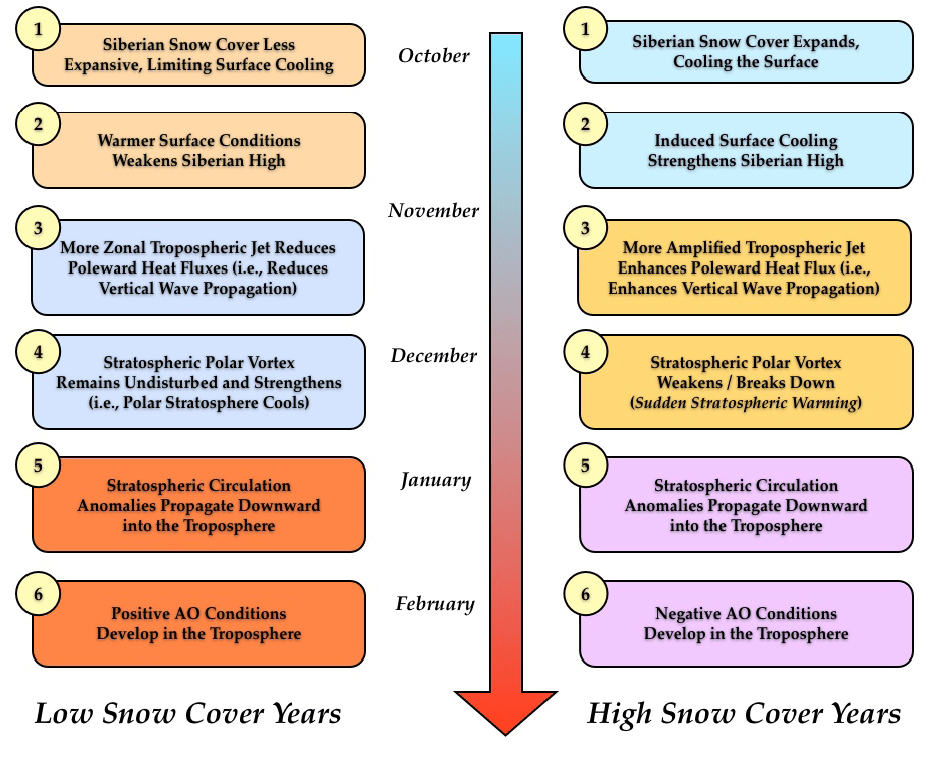
Footnote:  At his AER blog  Arctic Oscillation and Polar Vortex Analysis and Forecasts Dr. Judah Cohen writes on Feb. 25 regarding this cold winter in the Arctic. Excerpts in italics with my bolds.

As I have written many times in the blog this fall and winter season the influence of a significant stratospheric PV disruption typically lasts on the order of four to eight weeks. It certainly looks like the PV split from early January has gone the distance and has persisted for a full eight weeks or possibly even a little longer. Based on the latest polar cap geopotential heights (PCHs) forecast the whole event is winding down over the next week or so. Therefore, I think that we can start to draft the obituary for this event.

The stratosphere-troposphere coupling differed from last year’s PV split and other previous similar events but certainly not all. Though the “dripping” of warm PCHs occurred periodically, there were long gaps between “drips” where the tropospheric PCHs even turned cold for an appreciable period. Also, the AO and NAO never turned strongly negative nor was there any persistent period where both indices remained in negative territory. This is in strong contrast to last winter. As I wrote in last week’s blog, I think at least part of the reason might be the relatively cold central Arctic this winter compared with the last several winters where the Arctic was near or at record warm.

Though despite what could be considered atypical or less traditional stratosphere-troposphere coupling following the stratospheric PV split, I would argue there were still some impressive impacts on the weather. Maybe those impacts were more discernable and more impressive across North America than Eurasia, but both continents had record cold and snow.

So, what to expect as the stratosphere-troposphere coupling event wraps up. For Europe, temperatures are already mild and with the AO predicted to remain positive and could potentially turn even more strongly positive if the cold PCHs couple all the way to the surface, it is hard for me to see a return to any kind of prolonged cold this month. Across North America it is more complicated. Cold temperatures are predicted to be expansive across the continent and even record cold is possible over the next week or so. In addition, snow cover is relatively extensive and, in many locations, unusually deep especially on either side of the US-Canadian border. I don’t expect the cold air across in North America to simply disappear anytime soon, but if the if the cold PCHs couple all the way to the surface, this would favor the cold temperatures being mostly confined to western North America. I also feel that circulation and temperature anomalies in the stratosphere suggest a relatively cold western North America and relatively mild eastern North America especially Eastern US. And despite the cold start to March in the Eastern US the models are predicting a return to mild conditions by the middle of March.


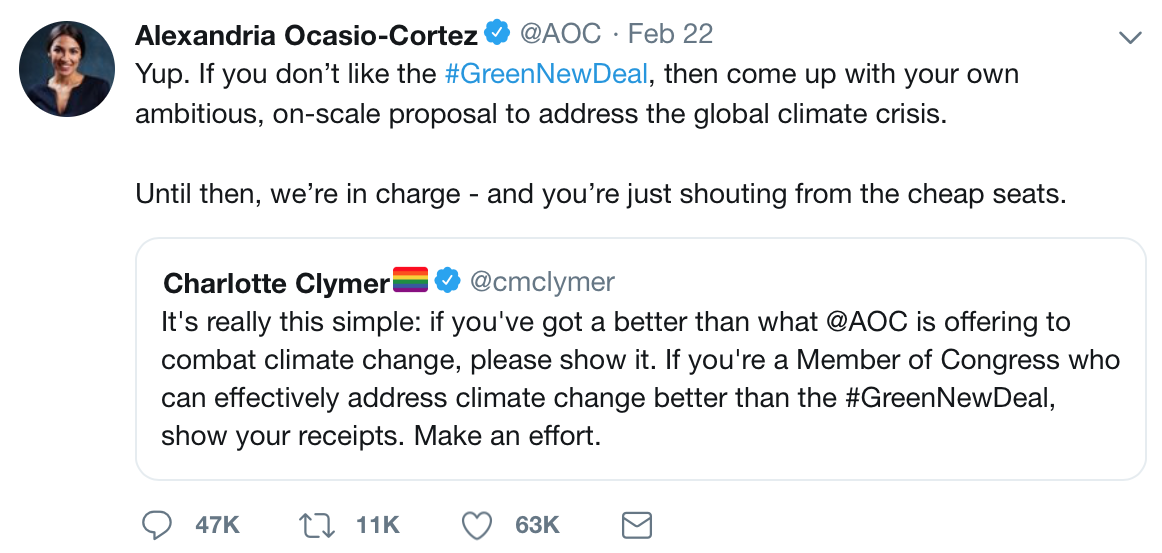
Realistic Alternative to Green New Deal


Alex Berezow takes up the challenge from factually-challenged AOC in his article at American Council on Science and Health Okay, Alexandria Ocasio-Cortez. Here’s An Alternative To Green New Deal Excerpts in italics with my bolds.

Does all that sound ridiculously arrogant and scientifically illiterate? Of course it does. Yet, that’s basically how new Congresswoman Alexandria Ocasio-Cortez (AOC) has responded to the critics of her Green New Deal. We’re all idiots. She’s a visionary.  

AOC’s remark to “come up with your own ambitious, on-scale proposal” is precisely the sort of uneducated statement a person who knows literally nothing about a topic says. It’s reminiscent of the anti-vaxxers who say, “If vaccines are so safe, show me the evidence!” There are entire research papers and books dedicated to energy policy. AOC just hasn’t bothered to read any of them.

As it turns out, the solution to climate change isn’t all that complicated. It won’t be accomplished in 12 years; we couldn’t even rebuild the World Trade Center in 12 years. But it can be done. I wrote a brief, 550-word article that gives a general outline. If even that’s too long, here’s the TL;DR version. [ I had to look it up; TL:DR means Too Long; Didn’t Read]

  1. Start building Generation IV nuclear power plants right now. Not next year. Not tomorrow. Right now. They are meltdown-proof and the best source of carbon-free energy on the planet. Research suggests that the entire world could be on nuclear power within 25 years.
  2. In the meantime, phase out coal while embracing natural gas. Natural gas burns cleaner than coal. If you object to this, then do #1 faster.
  3. Upgrade our energy infrastructure with a smart grid, smart meters, better capacitors, and better transmission lines. All of this is necessary if we want to rely at least in part on solar and wind. (But solar and wind aren’t really necessary; see #1.)
  4. Invest in solar and fusion power research. Current solar technology is too inefficient. The breakthrough we’ve been seeking in solar hasn’t happened yet, but it could. Similarly, fusion is theoretically the best source of energy (even better than nuclear), but scientists haven’t figured this one out yet. It turns out that recreating the sun on earth is kind of hard.
  5. As our energy infrastructure improves, electric car technology will improve along with it, making fossil fuels largely obsolete. (Airplanes might always need fossil fuels, though, much to AOC’s chagrin.)

That’s it. It’s not a sexy plan, but it’s a realistic one. We could actually accomplish this, but so far, there has been no political will whatsoever to do it. Oddly, the biggest opponents are environmentalists, people like Alexandria Ocasio-Cortez.

Climate Science: “Heads, We Win. Tails, You Lose.”

Another display of monotonic Climate Science is the uproar over a proposed White House panel of scientists to review and advise on statements about climate change appearing in various and sundry Federal Executive Branch organizations. Witness the sanctimonious John Kerry: Disband Your Climate Denial Panel, Mr. President.

Like spoiled children thwarted, warmists are throwing a tantrum at the prospect of being held accountable for parroting climate nostrums. After all, before now they have had no challenges to anything they say.  So they are outraged; Outraged, I say! Sen. Schumer says he pledges to defund the panel to silence them

Lost in the uproar over forming a red team to peer review climate science pronouncements on behalf of the WH is the existence of the Climate Blue Team operating uncontested for many years at NOAA Climate.gov. Having had the field to themselves for so long, the idea of another viewpoint seems unthinkable and wrong.

Introducing the Climate Blue Team (formed in 2010)

The Leaders

The Team General Manager is Thomas Karl, infamous for his hurried adjustment of the NOAA sea surface temperature dataset in order to erase the inconvenient “pause” this century. For the background on his actions prior to retiring see Bob Tisdale’s Open Letter to Tom Karl of NOAA/NCEI Regarding “Hiatus Busting” Data

Karl is joined by Richard Rosen who pushed for a NOAA press release to challenge Chris Landsea’s study on the issue of hurricane intensity and climate change, since it “takes a position that is supportive of the Bush administration’s view on the issue.” He also published a paper The economics of mitigating climate change: What can we know?, which concluded:  “Because of these serious technical problems, policymakers should not base climate change mitigation policy on the estimated net economic impacts computed by integrated assessment models. Rather, mitigation policies must be forcefully implemented anyway given the actual physical climate change crisis, in spite of the many uncertainties involved in trying to predict the net economics of doing so.”

Wayne Higgins heads up NOAA’s Program Office and is on the record attributing extreme weather events to man-made global warming: “So where we’ve looked forward decades, even out to a century and using those climate models with scenarios in which we actually ramp up the levels of greenhouse gases, we are able to confirm that human-induced climate change is something that is occurring now and that is actually likely to continue in the future,” he said.

Eileen Shea led NOAA’s Climate Services program and sings from the same hymnbook:
“No scientist worth their salt will blame any individual event on climate change, but these storms are certainly being exacerbated by climate change, partly because hurricanes, especially, take their energy from the ocean, their energy and their moisture from the ocean, and the warm the water, the stronger the hurricane can grow. And the more expansive the warm water, the further the hurricane can go and stay strong.” Shea is one of the many climate scientists working in Asheville, sometimes referred to as “climate city.” For them, the debate over climate change has been long-settled.

Ko Barrett is Deputy Director of NOAA’s Office of Oceanic and Atmospheric Research Office and also a Vice Chair of the IPCC. In the latter role, she led the effort to produce SR15, the call to prevent 1.5C of warming. “This is the first time the IPCC has undertaken a focused report on the processes that drive change and the resulting impacts to oceans and the frozen parts of our planet,” said IPCC Vice-Chair Ko Barrett. “There is a huge volume of scientific information for us to assess, which can help policy makers to better understand the changes we are seeing and the risks to lives and livelihoods that may occur with future change.”

Louisa Koch is NOAA Director of Education. “Not only does such coordination minimize duplication among these programs, but the overall effort is enhanced also because each agency brings a complementary mission-driven focus to this complex, large-scale issue,” added Louisa Koch, director of education for NOAA. Why should the public care? Put simply, climate change affects everyone on Earth. Climate is “changing in ways that are going to impact society across the board,” said Louisa Koch, the director of NOAA’s Office of Education. “Communities need to understand what changes they are going to experience most intensely and how that’s going to impact them.”

The Blue Team Panel of Players

NOAA has a science panel comprising the players that review papers and articles, and ensure the warmist viewpoint is protected and reinforced. The Head Coach appears to be Wayne Higgins (above)

Jessica Blunden: Even though it was a relatively quiet hurricane year in the Atlantic, there were 36 major tropical cyclones worldwide – 15 more than average, said NOAA climate scientist Jessica Blunden, co-editor of the report published Tuesday in the Bulletin of the American Meteorological Society. And at the heart of the records is that all three major heat-trapping greenhouse gases – carbon dioxide, methane and nitrous oxide – hit record highs in 2015, Blunden said. “This impacts people. This is real life,” Blunden said.  ‘Earth’s fever rises’: New report shows many symptoms of climate change

Tim Boyer: “From this [study] we can better understand the effects of natural and man-made variability to the climate system,” said co-author Tim Boyer of NOAA’s Ocean Climate Laboratory. “Decision-makers can gauge what needs to be done to ameliorate the situation, or, if not that, to plan for the consequences of the excess heat.” The study was published in the journal Science Advances. The findings are important because the world’s oceans provide one of the best records of the excess energy trapped on Earth by increased greenhouse gases, largely from the burning of fossil fuels. As the seas heat up from climate change, the water expands and rises, causing coastal flooding and, in Antarctica, ice shelves to disintegrate.

Christopher Burt is a lucky man. As with others fascinated by weather records, his once obscure passion has been thrust into one of the central conversations of our time. Burt’s audience is surprisingly large. On average, 10,000 people a day read his postings on Weather Underground. Though he writes about all sorts of weather extremes, heat records are one of his greatest passions.

In 2010, two climate-change researchers using computer modeling and calculations of human cooling capacities predicted that large parts of the earth may become uninhabitable during heat waves in future centuries. The study was based on a scenario of rapid global warming and was probably a bit shrill in its view of the consequences—mass migrations and war—but the science was solid and easy to believe. After all, large parts of the planet are already uninhabitable, at least for some percentage of the population some percentage of the time. And the heat waves are hitting harder, and coming more frequently than ever before.

Leo Donner: Donner has also served as a reviewer for the Intergovernmental Panel on Climate Change, whose reports help world leaders make decisions on dealing with the issue. The research scientist will discuss some IPCC conclusions, such as how humans have increased greenhouse gases through agricultural activity, burning fossil fuels and decimating forests in the Amazon. “One conclusion of the IPCC is that most of the observed change in global temperature is the result of human activity,” Donner said.

NOAA Scientist David Fahey in Boulder: a Lead Author of National Climate Assessment: The government’s National Climate Assessment cited human influence as the “dominant cause of the observed warming since the mid-20th century.” The report affirms that climate change is driven almost entirely by human action, warns of a worst-case scenario where seas could rise as high as eight feet by the year 2100, and details climate-related damage across the United States that is already unfolding as a result of an average global temperature increase of 1.8 degrees Fahrenheit since 1900. When it comes to rapidly escalating levels of greenhouse gases in the atmosphere, the report states, “there is no climate analog for this century at any time in at least the last 50 million years.”

Alarmist All Star Katharine Hayhoe is a professor in the department of political science at Texas Tech University and director of its Climate Science Center. She was a lead author on the Climate Science Special Report, part of the fourth US National Climate Assessment. She writes books, produces videos, documentaries and gives interviews to raise awareness of climate change concerns. Katherine Hayhoe: “The most important thing is to accelerate the realization that we have to act. This means connecting the dots to show that the impacts are not distant any more. They are here and they affect our lives. It means weaning ourselves off fossil fuels, which is challenged by the fact that the majority of the world’s richest companies have made their money from the fossil fuel economy, so the majority of the wealth and power remains in their hands.” “Climate change is a long term trend superimposed over natural variability. There will be good and bad years, just like there are for a patient with a long term illness, but it isn’t going away. To stabilize climate change, we have to eliminate our carbon emissions. And we’re still a long way away from that.”

Sarah Kapnick is a scientists at NOAA’s Geophysical Fluid Dynamics Laboratory.
Global warming is going to steal away some of those postcard-perfect weather days in the future, according to a first-of-its-kind projection of nice weather. “The changes are more dramatic in parts of the developing world, where you have high concentrations of populations,” said NOAA climate scientist and co-author Sarah Kapnick.

Rick Lumpkin, director of NOAA’s Global Drifter Program: “Because the drifters provide a ground-truth of currents, they are great for combining with satellite observations to study climate-scale problems.” The oceans, the true keepers of climate change, may meet our grimmest estimates.

High Scoring Meteorologist Jeff Masters co-founded Weather Underground: “The Climate Has Shifted to a New State Capable of Delivering Rare & Unprecedented Weather Events.” Stronger hurricanes, bigger floods, more intense heat waves, and sea level rise have been getting many of the headlines with regards to potential climate change impacts, but drought should be our main concern. Drought is capable of crashing a civilization. We’ve set in motion a dangerous boulder of climate change that is rolling downhill, and it is too late to avoid major damage when it hits full-force several decades from now. However, we can reduce the ultimate severity of the damage with strong and rapid action.

Richard Rood is a Professor in the Department of Atmospheric, Oceanic and Space Sciences at the University of Michigan where he teaches atmospheric science and climate dynamics.
If we stop our emissions today, we won’t go back to the past. The Earth will warm. And since the response to warming is more warming through feedbacks associated with melting ice and increased atmospheric water vapor, our job becomes one of limiting the warming. If greenhouse gas emissions are eliminated quickly enough, within a small number of decades, it will keep the warming manageable and the Paris Agreement goals could be met. It will slow the change – and allow us to adapt. Rather than trying to recover the past, we need to be thinking about best possible futures.”

Scott Weaver is a Research Meteorologist at NOAA.s Climate Prediction Center and member of the Environmental Defense Fund (EDF).  “Today’s Climate Science Special Report is our most comprehensive and definitive look yet at the massive amount of sound scientific research on climate change, and it’s conclusions are inescapable – climate change is happening right now, it’s hurting American families, and it will get worse unless we act,” said EDF Senior Climate Scientist Scott Weaver. “This report should put any doubts about the existence or the severity of climate change to rest. We cannot afford to ignore this threat.”

Kandis Wyatt, Designated Federal Officer for US Climate Change Impact Reports, eg. 2014:
“Climate change, once considered an issue for a distant future, has moved firmly into the present. Corn producers in Iowa, oyster growers in Washington State, and maple syrup producers in Vermont are all observing climate-related changes that are outside of recent experience. So, too, are coastal planners in Florida, water managers in the arid Southwest, city dwellers from Phoenix to New York, and Native Peoples on tribal lands from Louisiana to Alaska. This National Climate Assessment concludes that the evidence of human-induced climate change continues to strengthen and that impacts are increasing across the country.”

Summary

What hypocrisy to criticize skeptics for finally attempting to organize and claim a bit of airtime to tell the other side of the story. Apparently the case for man-made global warming is so weak, no objections can be allowed.

Not much of a game without an opponent.

See Also Kelly Craft Vs. Monotonic Climate Science

No “Gold Standard” Climate Science

Claims this week that climate scientists have “5-sigma” certainty for their findings are pure hype and extremely false adverrtising.  Lubos Motl explains at his website Reference Frame “Five-sigma proof” of man-made climate change is complete nonsense  Excerpts in italics with my bolds.

Notorious climate fearmonger Gavin Schmidt tweeted the following:

40 years since:
– the Charney report
– Hasselmann’s paper on detection & attribution
– the satellite erahttps://rdcu.be/bowzn @NatureClimate

Put it together and what have you got?
Greater than 5σ detection of anthropogenic climate change.

Lubos Motl:

He picks about 3 scientific teams and praises them for reaching the “gold standard” of science (which is how the journalists hype it) – a five-sigma proof of man-made global warming. The signal-to-noise ratio has reached some critical threshold, it’s those five sigma, so the man-made climate change is proven at the same level at which we needed e.g. the Higgs boson to be discovered by CERN’s particle physicists.

It sounds great except it’s complete nonsense. When we discover something at five sigma, it means something that clearly cannot be the case in climatology. When we discover new physics at five sigma, it means that we experimentally rule out a well-defined null hypothesis at the p-level of 99.9999% or so. Note that a “well-defined null hypothesis” is always needed to talk about “five sigma”.

In the case of the man-made climate change discussion, there is clearly no such “well-defined null hypothesis”. In particular, when Schmidt and others discuss the “signal-to-noise ratio”, they don’t really know what part of the observed data is “noise” and how strong it should be. The assumption must be that the “noise” is some natural variability of the climate. But we don’t really have any precise enough and canonical enough model of the natural variability. The natural variability is undoubtedly very complex and has contributions from lots of natural and statistical phenomena and their mixtures. Cloud variations, irregular seasons, solar variability, volcanoes, even earthquakes, annual ocean cycles, decadal ocean cycles, centennial ocean cycles, 1500-year ocean cycles, irregularities in tropical cyclones, plants’ albedo variations, residuals from a way to compute the average, butterfly wings in China, and tons of other things.

So we can’t really separate the measured data to the “signal” and “noise”. Even if we knew the relevant definition of the natural noise, we just don’t know how large it was before the industrialization began. The arguments about the “hockey stick graph” are the greatest tangible proof of this statement. Some papers show the variability in 1000-1900 AD as 5 times larger than others – so “5 signa” could very well be “1 sigma” or something else.

Just like before Schmidt’s tweet, it is perfectly possible that all the data we observe may be labeled “noise” and attributed to some natural causes. There may obviously be natural causes whose effect n the global mean temperature and other quantities is virtually indistinguishable from the effected expected from the man-made global warming.

If the people observed some amazing high-frequency correlation between the changes of CO2 and the temperature, a great agreement between these two functions of time could become strong evidence of the anthropogenic greenhouse effect. But it’s clearly impossible because we surely can’t measure the effect of the tiny seasonal variations of the CO2 concentration – these variations are just a few ppm while the observed changes, seasons, are hugely pronounced and affected mostly by other things than CO2 (especially by the Sun directly).

So the growth of the CO2 was almost monotonic – and in recent decades, almost precisely linear. Nature may also add lots of contributions that change almost monotonically or linearly for a few decades. So the summary is that Gavin Schmidt and his fellow fearmongers are trying to make the man-made climate science look like a hard science – perhaps even as particle physics – but it is not really possible for the climate science to be analogous to a hard science. The reason is that particle physics and hard sciences have nicely understood, unique, and unbelievably precise null hypotheses that may be supported by the data or refuted; while the climate science doesn’t have any very precise null hypotheses.

At most, the attribution of the climate change is as messy a problem as the attribution of the discrepancies between Hubble’s constant obtained from various sources. It’s just not possible to make any reliable enough attribution because the amount of parameters that we may adjust in our explanations is larger than the number of unequivalent values that are helpful for the attribution and that we may obtain from observations. In effect, the task to “attribute” is an underdetermined set of equations: the number of unknowns is larger than the number of known conditions or constraints that they obey (i.e. than the number of observed relevant data).

Gavin Schmidt and everyone else who tries to paint hysterical climatology as a hard science analogous to particle physics is simply lying. Particle physics is a hard science and “five sigma proofs” are possible in it, climatology is a soft science and “five sigma proofs” in it are just marketing scams, and cosmology is somewhere in between. We all hope that cosmology will return closer to particle physics but we can’t be sure.

Update March 1, 2019

Ross Mckitrick posted at Climate Etc. Critique of the new Santer et al. (2019) paper
H/T Philip Dean

“I will discuss four aspects of this study which I think weaken the conclusions considerably: (a) the difference between the existence of a signal and the magnitude of the effect; (b) the confounded nature of their experimental design; (c) the invalid design of the natural-only comparator; and (d) problems relating “sigma” boundaries to probabilities.”

“The authors’ conclusions depend critically on the assumption that their “natural” model variability estimate is a plausible representation of what 1979-2018 would have looked like without greenhouse gases. The authors note the importance of this assumption in their Supplement.”

“Thus, it seems to me that the lines in Figure 1 are based on comparing an artificially exaggerated resemblance between observations and tuned models versus an artificially worsened counterfactual. This is not a gold standard of proof.”

“I’ll just point out that if time series data have unit roots they are nonstationary and you can’t use them in an autoregression because the t-statistics follow a nonstandard distribution and Gaussian (or even Student’s t) tables will give seriously biased probability values.”

“I ran Phillips-Perron unit root tests and found that anthro is nonstationary, while Temp and natural are stationary.  .  . A possible remedy is to construct the model in first differences.  .  .  The coefficient magnitudes remain comparable but—oh dear—the t-statistic on anthro has collapsed from 8.56 to 1.32, while those on natural and lagged temperature are now larger. “

Conclusion

“The fact that in my example the t-statistic on anthro falls to a low level does not “prove” that anthropogenic forcing has no effect on tropospheric temperatures. It does show that in the framework of my model the effects are not statistically significant.”

“In the same way, since I have reason to doubt the validity of the Santer et al. model I don’t accept their conclusions. They haven’t shown what they say they showed. In particular they have not identified a unique anthropogenic fingerprint, or provided a credible control for natural variability over the sample period. Nor have they justified the use of Gaussian p-values. Their claim to have attained a “gold standard” of proof are unwarranted, in part because statistical modeling can never do that, and in part because of the specific problems in their model.”


See also: The Limitations of Climate Science

Clouding the Climate Issue


The alarmist media are promoting a new scare this week: “OMG, the warmer it gets, the fewer clouds blocking the sunshine, still warmer it gets, ad infinitum.” That is the narrative beneath headlines like these from the usual suspects (in alphabetical order for Monday, Feb. 25, 2019)

A World Without Clouds Quanta Magazine11:08 Mon, 25 Feb

‘A World Without Clouds. Think About That a Minute’: New Study Details Possibility of Devastating Climate Feedback Loop Common Dreams17:11 Mon, 25 Feb

At High Enough CO2 Levels, Clouds Will Start to Physically Break Apart ScienceAlert01:40

Atmospheric Carbon Dioxide Could Make Clouds Vanish Newsweek11:28 Mon, 25 Feb

Low-level clouds that cover the oceans could disappear as a result of rising CO2 Daily Mail18:17 Mon,

Carbon dioxide ‘could destroy clouds’ and turn our planet into a ‘Hothouse Earth’ Yahoo! UK & Ireland07:15

Climate change kills off clouds over the ocean in new simulation TechCrunch18:16 Mon, 25 Feb

Climate Change Could Make These Super-Common Clouds Extinct, Which Would Scorch the Planet Live Science17:32 Mon, 25 Feb

Climate Change Is Eliminating Clouds. Without Them, Earth Burns Futurism16:32 Mon, 25 Feb

Cloud break-up linked to high CO2 levels (Nature Geoscience) Nature Asia04:53

Cloud Loss Due To High Carbon Dioxide Levels Could Make Earth 14 Degrees Hotter, Climate Change … Tech Times09:42

Cloudy, with a chance of fewer clouds Cosmos11:08 Mon, 25 Feb

Clouds’ cooling effect could vanish in a warmer world Nature.com15:32 Mon, 25 Feb

Extreme CO2 levels could trigger clouds ‘tipping point’ and 8C of global warming Carbon Brief11:11 Mon, 25 Feb

Fluffy clouds may disappear by 2100, causing 8 degree warming i News06:12

Global warming imperils clouds that deter hothouse Earth GMA News02:46

Global warming imperils stratocumulus clouds that deter hothouse Earth: scientists The Japan Times14:30 Mon, 25 Feb

High CO2 levels can destabilize marine layer clouds Phys.org11:01 Mon, 25 Feb

If climate change makes the clouds disappear, we’re screwed Grist Magazine19:07 Mon, 25 Feb

If Carbon Dioxide Levels Get High Enough, They’ll Break Up Planet-Cooling Clouds IFLScience11:05 Mon, 25 Feb

I’ve Got to Admit I Didn’t See the Death of Clouds Coming Esquire14:39 Mon, 25 Feb

Striking study finds a climate tipping point in clouds Ars Technica18:16 Mon, 25 Feb

Study finds increasing carbon dioxide levels threaten marine stratus clouds Slashgear09:13

The loss of clouds could add another 8°C to global warming MIT Technology Review07:43

Very high carbon dioxide could suppress cooling clouds, climate change model warns The Washington Post11:12 Mon, 25 Feb

We Could Be On The Verge Of Killing Off Clouds And Returning To A ‘Hothouse Earth’ Forbes16:24 Mon, 25 Feb

Isn’t it impressive how Climate Crisis Central can blanket the world with a scary message, with enough variety in titles to disguise the robotic repetition? Yet just reading the headlines already suggests to anyone with critical intelligence what is false about this alarm. Let me list some of the obvious flaws before digging into this issue.

1. It’s a projection from a climate model, not a finding from observations.

2. It is based on highly uncertain supposed mechanisms.

3. It presupposes CO2 concentrations 3 times the present level.

4. The possible effect will occur after almost all readers will be dead of natural causes.

5. It claims a runaway warming “tipping point” which the earth has suppressed until now.

6. It contradicts the logic of a warmer world increasing the hydrology cycle with more clouds and precipitation.

7. It stokes fear of “hothouse earth” when presently we are slowly emerging from “severe icehouse earth.”

The above image comes from esteemed paleoclimatologist Christopher Scotese.  It shows the range of earth’s climate history, and that we are presently slowly emerging from Severe Icehouse.  It also shows that the world warms by rising temperatures at higher latitudes toward the poles, while the equator remains the same, thus reducing the gradient.  Tossing around the word “Hothouse” is nonsensical in today’s situation. See also: Fact: Future Will be Flatter Not Hotter

As it happens, the first article in the list is the most informative: A World Without Clouds Excerpts in italics with my bolds

A state-of-the-art supercomputer simulation indicates that a feedback loop between global warming and cloud loss can push Earth’s climate past a disastrous tipping point in as little as a century.

Clouds currently cover about two-thirds of the planet at any moment. But computer simulations of clouds have begun to suggest that as the Earth warms, clouds become scarcer. With fewer white surfaces reflecting sunlight back to space, the Earth gets even warmer, leading to more cloud loss. This feedback loop causes warming to spiral out of control.

Climate physicists at the California Institute of Technology performed a state-of-the-art simulation of stratocumulus clouds, the low-lying, blankety kind that have by far the largest cooling effect on the planet. The simulation revealed a tipping point: a level of warming at which stratocumulus clouds break up altogether. The disappearance occurs when the concentration of CO2 in the simulated atmosphere reaches 1,200 parts per million — a level that fossil fuel burning could push us past in about a century, under “business-as-usual” emissions scenarios. In the simulation, when the tipping point is breached, Earth’s temperature soars 8 degrees Celsius, in addition to the 4 degrees of warming or more caused by the CO2 directly.

The huge range in the models’ predictions chiefly comes down to whether they see clouds blocking more or less sunlight in the future. As Marvel put it, “You can fairly confidently say that the model spread in climate sensitivity is basically just a model spread in what clouds are going to do.”

The problem is that, in computer simulations of the global climate, today’s supercomputers cannot resolve grid cells that are smaller than about 100 kilometers by 100 kilometers in area. But clouds are often no more than a few kilometers across. Physicists therefore have to simplify or “parameterize” clouds in their global models, assigning an overall level of cloudiness to each grid cell based on other properties, like temperature and humidity.

But clouds involve the interplay of so many mechanisms that it’s not obvious how best to parameterize them. The warming of the Earth and sky strengthens some mechanisms involved in cloud formation, while also fueling other forces that break clouds up. Global climate models that predict 2 degrees of warming in response to doubling CO2 generally also see little or no change in cloudiness. Models that project a rise of 4 or more degrees forecast fewer clouds in the coming decades.

But vastly more important and more challenging than high clouds are the low, thick, turbulent ones — especially the stratocumulus variety. Bright-white sheets of stratocumulus cover a quarter of the ocean, reflecting 30 to 70 percent of the sunlight that would otherwise be absorbed by the dark waves below. 

Suppositions:  First, when higher CO2 levels make Earth’s surface and sky hotter, the extra heat drives stronger turbulence inside the clouds. The turbulence mixes moist air near the top of the cloud, pushing it up and out through an important boundary layer that caps stratocumulus clouds, while drawing dry air in from above. Entrainment, as this is called, works to break up the cloud.

Secondly, as the greenhouse effect makes the upper atmosphere warmer and thus more humid, the cooling of the tops of stratocumulus clouds from above becomes less efficient. This cooling is essential, because it causes globs of cold, moist air at the top of the cloud to sink, making room for warm, moist air near Earth’s surface to rise into the cloud and become it. When cooling gets less effective, stratocumulus clouds grow thin.

On the Other Hand:

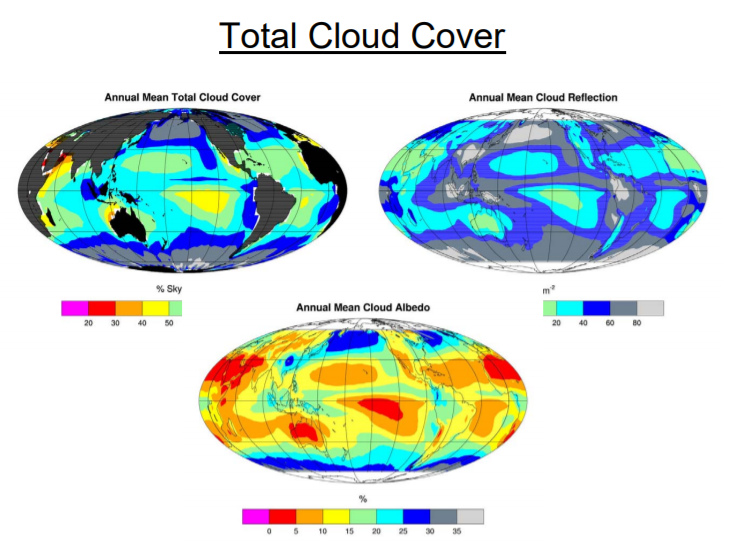
Joel Norris is one of the world experts in studying clouds in relation to climate, and he has published findings in partnerships with Martin Wild of ETH Zurich, where the global dimming and brightening database is located. See: Nature’s Sunscreen for background.

Norris provides an informative context in this pdf presentation Observed Cloud Cover Trends and Global Climate Change

He notes these Uncertainties in Feedbacks

• general theories do not exist for quantifying most individual climate feedbacks

• observations lack sufficient detail and comprehensiveness

• competing climate processes cannot be distinguished using observations

• global climate models have insufficient spatial resolution to simulate climate processes

From analyzing the data, Norris concludes that Total Cloud Cover has been Net Cooling:

• satellite radiation and surface cloud data have been combined to produce the first-ever multidecadal estimation of radiation variability due to clouds

• the role of clouds in the climate system is one of the biggest uncertainties in understanding future climate change

• upper-level cloud cover has decreased and outgoing LW radiation has increased over most of the global ocean

• low-level stratiform cloud cover and reflected SW radiation have increased over midlatitude oceans

• cloud changes since 1952 have had a net cooling effect on the Earth

See also: No GHG Warming Fingerprints in the Sky

Cosmic Rebirth: Peterson’s Pearls (5)

This is the fifth and final post in a series based upon Jordan Peterson’s book Maps of Meaning, published in 1999 after 17 years of research and writing. It is rich in description and insight with many references and quotations from original sources. Reading it I began to copy passages that struck me as especially lucid and pertinent. Those paragraphs of his text are provided below in italics as excerpts selected to explain five themes emerging in my reflections while pondering his book. Cosmic Dichotomy: Peterson’s Pearls (1) provides an overview explaining why this is important to me and perhaps to others.

[Note: I use the word “cosmic” since each individual’s world is at risk, and as we see in the agitation over climate change, entire social groups can also fear for their collective world.]

Jordan Peterson on Cosmic Rebirth (Excerpts from Maps of Meaning: The Architecture of Belief Title is link to pdf)

Ideologies may be regarded as incomplete myths—as partial stories, whose compelling nature is a consequence of the appropriation of mythological ideas. The philosophy attributing individual evil to the pathology of social force constitutes one such partial story. Although society, the Great Father, has a tyrannical aspect, he also shelters, protects, trains and disciplines the developing individual—and places necessary constraints on his thought, emotion and behavior.

Subjugation to lawful authority might more reasonably be considered in light of the metaphor of the apprenticeship. Childhood dependency must be replaced by group membership, prior to the development of full maturity. Such membership provides society with another individual to utilize as a “tool,” and provides the maturing but still vulnerable individual with necessary protection (with a group-fostered “identity”). The capacity to abide by social rules, regardless of the specifics of the discipline, can therefore be regarded as a necessary transitional stage in the movement from childhood to adulthood.

Discipline should therefore be regarded as a skill that may be developed through adherence to strict ritual, or by immersion within a strict belief system or hierarchy of values. Once such discipline has been attained, it may escape the bounds of its developmental precursor. It is in this manner that true freedom is attained.

Apprenticeship is necessary, but should not on that account be glamorized. Dogmatic systems make harsh and unreasonable masters. Systems of belief and moral action—and those people who are identified with them—are concerned above all with self-maintenance and preservation of predictability and order. The (necessarily) conservative tendencies of great systems makes them tyrannical, and more than willing to crush the spirit of those they “serve.” Apprenticeship is a precursor to freedom, however, and nothing necessary and worthwhile is without danger.

We are all familiar with the story of benevolent nature, threatened by the rapacious forces of the corrupt individual and the society of the machine. The plot is solid, the characters believable, but Mother Nature is also malarial mosquitoes, parasitical worms, cancer and Sudden Infant Death Syndrome. The story of peaceful and orderly tradition, undermined by the incautious and decadent (with the ever-present threat of chaos lurking in the background) is also familiar, and compelling, and true—except that the forces of tradition, however protective, tend to be blind, and to concern themselves more with their own stability than with the well-being of those subject to them.

These stories are all ideologies (and there are many more of them). Ideologies are attractive, not least to the educated modern mind—credulous, despite its skepticism— particularly if those who embody or otherwise promote them allow the listener every opportunity to identify with the creative and positive characters of the story, and to deny their association with the negative. Ideologies are powerful and dangerous. Their power stems from their incomplete but effective appropriation of mythological ideas. Their danger stems from their attractiveness, in combination with their incompleteness. Ideologies tell only part of the story, but tell that part as if it were complete. This means that they do not take into account vast domains of the world. It is incautious to act in the world as if only a set of its constituent elements exist. The ignored elements conspire, so to speak, as a consequence of their repression, and make their existence known, inevitably, in some undesirable manner.

Anyway, the fervent hope of every undisciplined person (even an undisciplined genius) is that his current worthlessness and stupidity is someone else’s fault. If—in the best of cases—it is society’s fault, then society can be made to pay. This sleight-of-hand maneuver transforms the undisciplined into the admirable rebel, at least in his own eyes, and allows him to seek unjustified revenge in the disguise of the revolutionary hero. A more absurd parody of heroic behavior can hardly be imagined.

The maturing individual necessarily (tragically, heroically) expands past the domain of paradisal maternal protection, in the course of development; necessarily attains an apprehension whose desire for danger and need for life exceeds the capability of maternal shelter. This means that the growing child eventually comes to face problems—how to get along with peers in peer-only play groups; how to select a mate from among a myriad of potential mates—that cannot be solved (indeed, may be made more difficult) by involvement of the beneficial maternal.

A thirteen-year-old cannot use a seven-year-old’s personality—no matter how healthy—to solve the problems endemic to adolescence. The group steps in—most evidently, at the point of adolescence—and provides “permeable” protective shelter to the child too old for the mother but not old enough to stand alone. The universally disseminated rituals of initiation—induced “spiritual” death and subsequent rebirth—catalyzes the development of adult personality; follows the fundamental pattern of the cyclic, circular cosmogonic myth of the way.

Ritual initiation, for example—a ubiquitous formal feature of pre-experimental culture—takes place at or about the onset of puberty, when it is critical for further psychological development and continued tribal security that boys transcend their dependency upon their mothers. This separation often takes place under purposefully frightening and violent conditions. In the general initation pattern, the men, acting as a unit (as the embodiment of social history), separate the initiates from their mothers, who offer a certain amount of more or less dramatized resistance and some genuine sorrow (at the “death” of their children).

When the rite is successfully completed, the initiated are no longer children, dependent upon the arbitrary beneficience of nature—in the guise of their mothers—but are members of the tribe of men, active standard-bearers of their particular culture, who have had their previously personality destroyed, so to speak, by fire. They have successfully faced the worst trial they are likely ever to encounter in their lives.

That new environment is the society of men, where women are sexual partners and equals instead of sources of dependent comfort; where the provision of food and shelter is a responsibility, and not a given; where security—final authority, in the form of parent—no longer exists. As the childhood “personality” is destroyed, the adult personality—a manifestation of transmitted culture—is inculcated.

Groups are individuals, uniform in their acceptance of a collective historically determined behavioral pattern and schema of value. Internalization of this pattern, and the description thereof (the myths—and philosophies, in more abstracted cultures—which accompany it), simultaneously produces ability to act in a given (social) environment, to predict the outcomes of such action, and to determine the meaning of general events (meaning inextricably associated with behavioral outcome). Such internalization culminates in the erection of implicit procedural and explicit declarable structures of “personality,” which are more or less isomorphic in nature, which simultaneously constitute habit and moral knowledge.

The group is the historical structure that humanity has erected between the individual and the terrible unknown. Intrapsychic representation of culture— establishment of group identity—protects individuals from overwhelming fear of their own experience; from contact with the a priori meaning of things and situations.

The historical structure “protects itself” and its structure in two related manners. First, it inhibits intrinsically rewarding but “antisocial” behaviors (those which might upset the stability of the group culture) by associating them with certain punishment (or at least with the threat thereof). This punishment might include actual application of undesirable penalties or, more “subtly”—removal of “right to serve as recognized representative of the social structure.”

University of Kentucky Graduating Dentists, Class of 2018

The culturally-determined historical structure protects and maintains itself secondly by actively promoting individual participation in behavioral strategies that satisfy individual demand, and that simultaneously increase the stability of the group. The socially constructed way of a profession, for example, allows the individual who incarnates that profession opportunity for meaningful activity in a manner that supports or at least does not undermine the stability of the historically determined structure which regulates the function of his or her threat-response system. Adoption of a socially sanctioned “professional personality” therefore provides the initiated and identified individual with peer-approved opportunity for intrinsic goal-derived pleasure, and with relative freedom from punishment, shame and guilt.

The construction of a successful group, the most difficult of feats, means establishment of a society composed of individuals who act in their own interest (at least enough to render their life bearable) and who, in doing so, simultaneously maintain and advance their culture. The “demand to satisfy, protect and adapt, individually and socially”—and to do so over vast and variable stretches of time—places severe intrinsic constraints on the manner in which successful human societies can operate. It might be said that such constraints provide universal boundaries for acceptable human morality.

Balinese Trance Dance performed by male choir.

A culture is, to a large degree, a shared moral code, and deviations from that code are generally easily identified, at least post-hoc. It is still the case, however, that description of the domain of morality tends to exceed the capability of declarative thought, and that the nature of much of what we think of as moral behavior is still, therefore, embedded in unconscious procedure. As a consequence, it is easy for us to become confused about the nature of morality, and to draw inappropriate, untimely and dangerous “fixed” conclusions.

The conservative worships his culture, appropriately, as the creation of that which deserves primary allegiance, remembrance and respect. This creation is the concrete solution to the problem of adaptation: “how to behave?” (and how can that be represented and communicated?). It is very easy, in consequence, to err in attribution of value, and to worship the specific solution itself, rather than the source of that solution.

As such, a given cultural structure necessarily must meet a number of stringent and severely constrained requirements: (1) it must be self-maintaining (in that it promotes activities that allow it to retain its central form); (2) it must be sufficiently flexible to allow for constant adaptation to constantly shifting environmental circumstances; and (3) it must acquire the allegiance of the individuals who compose it. . . The second requirement—flexibility—is more difficult to fulfill, particularly in combination with the first (self-maintenance). A culture must promote activity that supports itself, but must simultaneously allow for enough innovation so that essentially unpredictable alteration in “environmental” circumstance can be met with appropriate change in behavioral activity. Cultures that attempt to maintain themselves through promotion of absolute adherence to traditional principles tend rapidly to fail the second requirement, and to collapse precipitously. Cultures that allow for unrestricted change, by contrast, tend to fail the first, and collapse equally rapidly. The third requirement (allegiance of the populace) might be considered a prerequisite for the first two.

Freemasons celebrate 150th anniversary of the Grand Lodge in Newfoundland and Labrador.

Every culture maintains certain key beliefs that are centrally important to that culture, upon which all secondary beliefs are predicated. These key beliefs cannot be easily given up, because if they are, everything falls, and the unknown once again rules. Western morality and behavior, for example, are predicated on the assumption that every individual is sacred. This belief was already extant in its nascent form among the ancient Egyptians, and provides the very cornerstone of Judeo-Christian civilization. Successful challenge to this idea would invalidate the actions and goals of the Western individual; would destroy the Western dominance hierarchy, the social context for individual action. In the absence of this central assumption, the body of Western law—formalized myth, codified morality—erodes and falls. There are no individual rights, no individual value— and the foundation of the Western social (and psychological) structure dissolves. The Second World War and Cold War were fought largely to eliminate such a challenge.

The group provides the protective structure—conditional meaning and behavioral pattern—that enables the individual to cast off the dependence of childhood, to make the transition from the maternal to the social, patriarchal world. The group is not the individual, however. Psychological development that ceases with group identification—held up as the highest attainable good by every ideologue—severely constricts individual and social potential, and dooms the group, inevitably, to sudden and catastrophic dissolution. Failure to transcend group identification is, in the final analysis, as pathological as failure to leave childhood.

Movement from the group to the individual—like that from childhood to group—follows the archetypal transformative pattern of the heroic (paradise, breach, fall, redemption; stability, incorporation, dissolution, reconstruction). Such transformation must be undertaken voluntarily, through conscious exposure to the unknown—although it may be catalyzed by sufficiently unique or traumatic experience. Failure to initiate and/or successfully complete the process of secondary maturation heightens risk for intrapsychic and social decadence, and consequent experiential chaos, depression and anxiety (including suicidal ideation), or enhances tendency toward fanaticism, and consequent intrapsychic and group aggression.

The “third mode” of adaptation—alternative to decadence and fascism—is heroic. Heroism is comparatively rare, because it requires voluntary sacrifice of group-fostered certainty, and indefinite acceptance of consequent psychological chaos, attendant upon (re)exposure to the unknown. This is nonetheless the creative path, leading to new discovery or reconfiguration, comprising the living element of culture.

Christ’s replies signified transition of morality from reliance on tradition to reliance on individual conscience—from rule of law to rule of spirit—from prohibition to exhortation. To love God means to listen to the voice of truth and to act in accordance with its messages; to love thy neighbour, as thy self. This means, not merely to be pleasant, polite and friendly, but to attribute to the other a value equivalent to the value of the self—which, despite outward appearances, is a representative of God—and to act in consequence of this valuation.
What principle is rule of spirit, rather than law, predicated upon? Respect for the innately heroic nature of man. The “unconscious” archaic man mimics particular adaptive behaviors—integrated, however, into a procedural structure containing all other adaptive behaviors, capable of compelling imitation, and accompanied by episodic/semantic representation, in myth. Pre-experimental cultures regard the act of initial establishment of adaptive behavior as divine first because it follows an archetypal and therefore transpersonal pattern—that governing creative exploration—and second because it compels imitation, and therefore appears possessed of power. All behaviors that change history, and compel imitation, follow the same pattern—that of the divine hero, the embodiment of creative human potential.

Law is a necessary precondition to salvation, so to speak; necessary, but insufficient. Law provides the borders that limit chaos, and allows for the protected maturation of the individual. Law disciplines possibility, and allows the disciplined individual to bring his or her potentialities—those intrapsychic spirits—under voluntary control. The law allows for the application of such potentiality to the task of creative and courageous existence— allows spiritual water controlled flow into the valley of the shadow of death. Law held as absolute, however, puts man in the position of the eternal adolescent, dependent upon the father for every vital decision; removes the responsibility for action from the individual, and therefore prevents him or her from discovering the potential grandeur of the soul. Life without law remains chaotic, affectively intolerable. Life that is pure law becomes sterile, equally unbearable. The domination of chaos or sterility equally breeds murderous resentment and hatred.

Christ said, put truth and regard for the divine in humanity above all else, and everything you need will follow—not everything you think you need, as such thought is fallible, and cannot serve as an accurate guide, but everything actually necessary to render acutely (self) conscious life bearable, without protection of delusion and necessary recourse to deceit, avoidance or suppression, and violence.

Existence characterized by such essence takes place, from the Oriental viewpoint, on the path of meaning, in Tao, balanced on the razor’s edge between mythic masculine and mythic feminine—balanced between the potentially stultifying safety of order, and the inherently destructive possibility of chaos. Such existence allows for introduction of sufficiently bearable meaning into blessed security; makes every individual a stalwart guardian of tradition and an intrepid explorer of the unknown; ensures simultaneous advancement and maintenance of stable, dynamic social existence; and places the individual firmly on the path to intrapsychic integrity and spiritual peace.

The late physicist, Professor Wolfgang Pauli, frequently demonstrated the extent to which modern physical sciences are in a way rooted in archetypal ideas. For instance, the idea of causality as formulated by Descartes is responsible for enormous progress in the investigation of light, of biological phenomena, and so on, but that thing which promotes knowledge becomes its prison. Great discoveries in natural sciences are generally due to the appearance of a new archetypal model by which reality can be described; that usually precedes big developments, for there is now a model which enables a much fuller explanation than was hitherto possible.

So science has progressed, but still, any model becomes a cage, for if one comes across phenomena difficult to explain, then instead of being adaptable and saying that the phenomena do not conform to the model and that a new hypothesis must be found, one clings to one’s hypotheses with a kind of emotional conviction, and cannot be objective.

The idea of projection—that is, the idea that systems of thought have “unconscious” axioms—is clearly related to the notion of “paradigmatic thinking,” as outlined by Kuhn, to wide general acclaim. Jung described the psychological consequences of paradigmatic thinking in great detail as well.

Acceptance of anomalous information brings terror and possibility, revolution and transformation. Rejection of unbearable fact stifles adaptation and strangles life. We choose one path or another at every decision point in our lives, and emerge as the sum total of our choices. In rejecting our errors, we gain short-term security—but throw away our identity with the process that allows us to transcend our weaknesses and tolerate our painfully limited lives.
Our psychology and psychiatry—our “sciences of the mind“—are devoted, at least in theory, to “empirical” evaluation and treatment of mental “disorders.” But this is mostly smoke and screen. We are aiming, always, at an ideal. We currently prefer to leave the nature of that ideal “implicit,” because that helps us sidestep any number of issues that would immediately become of overwhelming difficulty, if they were clearly apprehended. So we “define” health as that state consisting of an absence of “diseases” or “disorders” and leave it at that—as if the notion of disease or disorder (or of the absence thereof) is not by necessity a medieval concatenation of moral philosophy and empirical description. It is our implicit theory that a state of “non-anxiety” is possible, however—and desirable— that leads us to define dominance by that state as “disordered.” The same might be said for depression, for schizophrenia, for personality “disorders,” and so on. Lurking in the background is an “implicit” (that is, unconscious) ideal, against which all “insufficient” present states are necessarily and detrimentally compared. We do not know how to make that ideal explicit, either methodologically or practically (that is, without causing immense dissent in the ranks); we know, however, that we must have a concept of “not ideal” in order to begin and to justify “necessary” treatment. Sooner or later, however, we will have to come to terms with the fact that we are in fact attempting to produce the ideal man—and will have to define explicitly what that means. It would be surprising, indeed, if the ideal we come to posit bore no relationship to those constructed painstakingly, over the course of centuries of effort, in the past.

It took thousands of years of cultural development to formulate the twin notions that empirical reality existed (independent of the motivational significance of things) and that it should be systematically studied (and these ideas only emerged, initially, in the complex societies of the Orient and Europe).

The purpose of scientific methodology is, in large part, to separate the empirical facts from the motivational presumption. In the absence of such methodology, the intermingling of the two domains is inevitable.

It is thus that awareness of death, the grim reaper—the terrible face of God—compels us inexorably upwards, toward a consciousness sufficiently heightened to bear the thought of death. The point of our limitations is not suffering; it is existence itself. We have been granted the capacity to voluntarily bear the terrible weight of our mortality. We turn from that capacity and degrade ourselves because we are afraid of responsibility. In this manner, the necessarily tragic preconditions of existence are made intolerable.

It seems to me that it is not the earthquake, the flood or the cancer that makes life unbearable, horrible as those events appear. We seem capable of withstanding natural disaster, even of responding to that disaster in an honorable and decent manner. It is rather the pointless suffering that we inflict upon each other—our evil—that makes life appear corrupt beyond acceptability; that undermines our ability to manifest faith in our central natures.

The truth seems painfully simple—so simple that it is a miracle, of sorts, that it can every be forgotten. Love God, with all thy mind, and all thy acts, and all thy heart. This means, serve truth above all else, and treat your fellow man as if he were yourself—not with the pity that undermines his self-respect, and not with the justice that elevates you above him, but as a divinity, heavily burdened, who could yet see the light.

Who can believe that it is the little choices we make, every day, between good and evil, that turn the world to waste and hope to despair? But it is the case. We see our immense capacity for evil, constantly realized before us, in great things and in small, but can never seem to realize our infinite capacity for good. Who can argue with a Solzhenitsyn when he states: “One man who stops lying can bring down a tyranny”?

Christ said, the kingdom of heaven is spread out upon the earth, but men do not see it. What if it was nothing but our self-deceit, our cowardice, hatred and fear, that pollutes our experience and turns the world into hell? This is a hypothesis, at least—as good as any other, admirable and capable of generating hope. Why can’t we make the experiment, and find out if it is true?

guy-fawkes-masks-644x455-1
It has been almost twelve years since I first grasped the essence of the paradox that lies at the bottom of human motivation for evil: People need their group identification, because that identification protects them, literally, from the terrible forces of the unknown. It is for this reason that every individual who is not decadent will strive to protect his territory, actual and psychological. But the tendency to protect means hatred of the other, and the inevitability of war—and we are now too technologically powerful to engage in war. To allow victory to the other, however—or even continued existence, on his terms—means subjugation, dissolution of protective structure, and exposure to that which is most feared. For me, this meant “damned if you do, damned if you don’t”: belief systems regulate affect, but conflict between belief systems is inevitable.

The great myths of Christianity—the great myths of the past, in general—no longer speak to the majority of Westerners, who regard themselves as educated. The mythic view of history cannot be credited with reality, from the material, empirical point of view. It is nonetheless the case that all of Western ethics, including those explicitly formalized in Western law, are predicated upon a mythological worldview, which specifically attributes divine status to the individual. The modern individual is therefore in a unique position: he no longer believes that the principles upon which all his behaviors are predicated are valid. This might be considered a second fall, in that the destruction of the Western mythological barrier has re-exposed the essential tragedy of individual existence to view.

It is not the pursuit of empirical truth, however, that has wreaked havoc upon the Christian worldview. It is confusion of empirical fact with moral truth that has proved of great detriment to the latter. This has produced what might be described as a secondary gain, which has played an important role in maintaining the confusion. That gain is abdication of the absolute personal responsibility imposed in consequence of recognition of the divine in man. This responsibility means acceptance of the trials and tribulations associated with expression of unique individuality, as well as respect for such expression in others. Such acceptance, expression and respect requires courage in the absence of certainty, and discipline in the smallest matters.

The root of social and individual psychopathology, the “denial,” the “repression” is the lie. The most dangerous lie of all is devoted to denial of individual responsibility—denial of individual divinity.  The idea of the divine individual took thousands of years to fully develop, and is still constantly threatened by direct attack and insidious counter-movement. It is based upon realization that the individual is the locus of experience. All that we can know about reality we know through experience. It is therefore simplest to assume that all there is of reality is experience—its being and progressive unfolding. Furthermore, it is the subjective aspect of individuality—of experience—that is divine, not the objective. Man is an animal, from the objective viewpoint, worthy of no more consideration than the opinion and opportunities of the moment dictate. From the mythic viewpoint, however, every individual is unique—is a new set of experiences, a new universe; has been granted the ability to bring something new into being; is capable of participating in the act of creation itself. It is the expression of this capacity for creative action that makes the tragic conditions of life tolerable, bearable—remarkable, miraculous.

Footnote:
The seminal work on the struggle of individuals to rise above mass delusions was the book Extraordinary Popular Delusions And The Madness Of Crowds by Charles MacKay 1841.  Title is link to full pdf text.  Excerpts below with my bolds.

In the present state of civilization, society has often shown itself very prone to run a career of folly from the last-mentioned cases. This infatuation has seized upon whole nations in a most extraordinary manner. France, with her Mississippi madness, set the first great example, and was very soon imitated by England with her South Sea Bubble. At an earlier period, Holland made herself still more ridiculous in the eyes of the world, by the frenzy which came over her people for the love of Tulips. Melancholy as all these delusions were in their ultimate results, their history is most amusing. A more ludicrous and yet painful spectacle, than that which Holland presented in the years 1635 and 1636, or France in 1719 and 1720, can hardly be imagined.

Some delusions, though notorious to all the world, have subsisted for ages, flourishing as widely among civilized and polished nations as among the early barbarians with whom they originated, — that of duelling, for instance, and the belief in omens and divination of the future, which seem to defy the progress of knowledge to eradicate entirely from the popular mind. Money, again, has often been a cause of the delusion of multitudes. Sober nations have all at once become desperate gamblers, and risked almost their existence upon the turn of a piece of paper. To trace the history of the most prominent of these delusions is the object of the present pages. Men, it has been well said, think in herds; it will be seen that they go mad in herds, while they only recover their senses slowly, and one by one.

MacKay’s study was exhaustive for its time, comprising three volumes;

VOL I. Considered National Delusions, including:
THE MISSISSIPPI SCHEME
THE SOUTH SEA BUBBLE
THE TULIPOMANIA.
RELICS.
MODERN PROPHECIES.
POPULAR ADMIRATION FOR GREAT THIEVES.
INFLUENCE OF POLITICS AND RELIGION ON THE HAIR AND BEARD.
DUELS AND ORDEALS
THE LOVE OF THE MARVELLOUS AND THE DISBELIEF OF THE TRUE.
POPULAR FOLLIES IN GREAT CITIES
THE O.P. MANIA.
THE THUGS, or PHANSIGARS.

VOL. II described Peculiar Follies, including:
THE CRUSADES
THE WITCH MANIA.
THE SLOW POISONERS.
HAUNTED HOUSES.

VOL. III compiled more general popular madnesses under three categories:
BOOK I: Philosophical Delusions, down through history with particular recent attention to Alchemists
BOOK II: Fortune Telling
BOOK III: The Magnetisers, a fad only subsiding when the book was written.

Kelly Craft Vs. Monotonic Climate Science

Update February 24, 2019

Now that Kelly Craft, US Ambassador to Canada is Trump’s nominee for UN Ambassador, let’s return to the interview for which she will again be persecuted by climate alarmists/activists.

The Greek word for “one tone” is monotonia, which is the root for both monotone and the closely-related word monotonous, which means “dull and tedious.” Monotone is a droning, unchanging tone. A continuous sound, especially someone’s voice, that doesn’t rise and fall in pitch, is a monotone. Nothing can put you to sleep quite as effectively as a teacher talking in a monotone.

Monotonic climate science was on full display as journalists, pundits and tweeters freaked out over a comment by the new US ambassador to Canada.  Her offense:  saying there were two sides on the climate issue and she respects them both.

The story from CBC:  The new U.S. ambassador to Canada said Monday that she believes “both sides” of climate change science.

In an interview with Canada’s CBC News, Kelly Knight Craft said that she believes there is “accurate” science on “both sides” but did not specify what sides she was referring to.

“I believe there are sciences on both sides that are accurate,” Craft said. “Both sides have their own results from their studies, and I appreciate and respect both sides of the science.”

President Trump appointed Craft, a prominent GOP fundraiser, to the ambassadorship earlier this year.

Craft told CBC that even though Trump has pledged to pull the United States out of the Paris climate agreement, she thinks the U.S. can “absolutely” fight climate climate change.

“We all have the same goal, and that is to better our environment and to maintain the environment,” she said. “I feel like our administration has been on top of this regardless of whether or not they’d be pulling out.”

It is true Ambassador Craft had the look of a deer in the headlights.  She is from Kentucky where one doesn’t encounter sanctimonious warmists as frequently as in Ottawa, and especially not ones determined to get a “gotcha” quote from her.

All the comments at alarmist websites dissed her for thinking the issue could have two differing points of view. Going further, they repeatedly claim “science” does not have two sides, not now, not ever. And, of course, she offends them by saying she respects people on both sides of the matter. As an Ambassador, she sought common ground by pointedly not mentioning the specifics of how the US is actually reducing its CO2 emissions while Canada has not.

The damage here goes beyond climate science to the degradation of all scientific disciplines.  These smug journalists and their audiences know that on all kinds of issues reasonable people can disagree.  But somehow they have been brainwashed with the notion that science is a catechism with only one right answer.  That idea is false and a threat to modern civilization.

They hear only about Jim Hansen, Al Gore, Mike Mann and their ilk, and think their pronouncements are universally and eternally true.  Many, many scientists see things differently. Hard as it is to go from simplicity to complexity, let us enlighten these folks to some of the other sides of climate science .  First, meet Richard Muller who shares some concerns and not others.  Below in italics is his answer to a question raised on Quora:   What are some widely cited studies in the news that are false?

Answer by Richard Muller, Professor of Physics at UC Berkeley.

That 97% of all climate scientists accept that climate change is real, large, and a threat to the future of humanity. That 97% basically concur with the vast majority of claims made by Vice President Al Gore in his Nobel Peace Prize winning film, An Inconvenient Truth.

The question asked in typical surveys is neither of those. It is this: “Do you believe that humans are affecting climate?” My answer would be yes. Humans are responsible for about a 1 degree Celsius rise in the average temperature in the last 100 years. So I would be included as one of the 97% who believe.

Yet the observed changes that are scientifically established, in my vast survey of the science, are confined to temperature rise and the resulting small (4-inch) rise in sea level. (The huge “sea level rise” seen in Florida is actually subsidence of the land mass, and is not related to global warming.) There is no significant change in the rate of storms, or of violent storms, including hurricanes and volcanoes. The temperature variability is not increasing. There is no scientifically significant increase in floods or droughts. Even the widely reported warming of Alaska (“the canary in the mine”) doesn’t match the pattern of carbon dioxide increase–it may have an explanation in terms of changes in the northern Pacific and Atlantic currents. Moreover, the standard climate models have done a very poor job of predicting the temperature rise in Antarctica, so we must be cautious about the danger of confirmation bias.

My friend Will Happer believes that humans do affect the climate, particularly in cities where concrete and energy use cause what is called the “urban heat island effect.” So he would be included in the 97% who believe that humans affect climate, even though he is usually included among the more intense skeptics of the IPCC. He also feels that humans cause a small amount of global warming (he isn’t convinced it is as large as 1 degree), but he does not think it is heading towards a disaster; he has concluded that the increase in carbon dioxide is good for food production, and has helped mitigate global hunger. Yet he would be included in the 97%.

The problem is not with the survey, which asked a very general question. The problem is that many writers (and scientists!) look at that number and mischaracterize it. The 97% number is typically interpreted to mean that 97% accept the conclusions presented in An Inconvenient Truth by former Vice President Al Gore. That’s certainly not true; even many scientists who are deeply concerned by the small global warming (such as me) reject over 70% of the claims made by Mr. Gore in that movie (as did a judge in the UK; see the following link: Gore climate film’s nine ‘errors‘).

The pollsters aren’t to blame. Well, some of them are; they too can do a good poll and then misrepresent what it means. The real problem is that many people who fear global warming (include me) feel that it is necessary to exaggerate the meaning of the polls in order to get action from the public (don’t include me).

There is another way to misrepresent the results of the polls. Yes, 97% of those polled believe that there is human caused climate change. How did they reach that decision? Was it based on a careful reading of the IPCC report? Was it based on their knowledge of the potential systematic uncertainties inherent in the data? Or was it based on their fear that opponents to action are anti-science, so we scientists have to get together and support each other. There is a real danger in people with Ph.D.s joining a consensus that they haven’t vetted professionally.

I like to ask scientists who “believe” in global warming what they think of the data. Do they believe hurricanes are increasing? Almost never do I get the answer “Yes, I looked at that, and they are.” Of course they don’t say that, because if they did I would show them the actual data! Do they say, “I’ve looked at the temperature record, and I agree that the variability is going up”? No. Sometimes they will say, “There was a paper by Jim Hansen that showed the variability was increasing.” To which I reply, “I’ve written to Jim Hansen about that paper, and he agrees with me that it shows no such thing. He even expressed surprise that his paper has been so misinterpreted.”

A really good question would be: “Have you studied climate change enough that you would put your scientific credentials on the line that most of what is said in An Inconvenient Truth is based on accurate scientific results? My guess is that a large majority of the climate scientists would answer no to that question, and the true percentage of scientists who support the statement I made in the opening paragraph of this comment, that true percentage would be under 30%. That is an unscientific guestimate, based on my experience in asking many scientists about the claims of Al Gore.

Then esteemed climate scientist Richard Lindzen, in a short video introduces you to more sides to the climate change issue:

Summary

Science in general, and climate science in particular is not monotonic, but polyphonic.  There are and have always been differing voices and tones in the search for objective truth.  Only the illiterate think otherwise.