N. Atlantic Finally Cooling?

RAPID Array measuring North Atlantic SSTs.

For the last few years, observers have been speculating about when the North Atlantic will start the next phase shift from warm to cold.
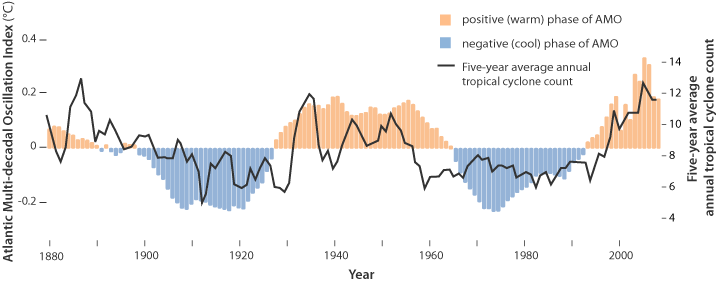
Source: Energy and Education Canada

An example is this report in May 2015 The Atlantic is entering a cool phase that will change the world’s weather by Gerald McCarthy and Evan Haigh of the RAPID Atlantic monitoring project. Excerpts in italics with my bolds.

This is known as the Atlantic Multidecadal Oscillation (AMO), and the transition between its positive and negative phases can be very rapid. For example, Atlantic temperatures declined by 0.1ºC per decade from the 1940s to the 1970s. By comparison, global surface warming is estimated at 0.5ºC per century – a rate twice as slow.

In many parts of the world, the AMO has been linked with decade-long temperature and rainfall trends. Certainly – and perhaps obviously – the mean temperature of islands downwind of the Atlantic such as Britain and Ireland show almost exactly the same temperature fluctuations as the AMO.

Atlantic oscillations are associated with the frequency of hurricanes and droughts. When the AMO is in the warm phase, there are more hurricanes in the Atlantic and droughts in the US Midwest tend to be more frequent and prolonged. In the Pacific Northwest, a positive AMO leads to more rainfall.

A negative AMO (cooler ocean) is associated with reduced rainfall in the vulnerable Sahel region of Africa. The prolonged negative AMO was associated with the infamous Ethiopian famine in the mid-1980s. In the UK it tends to mean reduced summer rainfall – the mythical “barbeque summer”.Our results show that ocean circulation responds to the first mode of Atlantic atmospheric forcing, the North Atlantic Oscillation, through circulation changes between the subtropical and subpolar gyres – the intergyre region. This a major influence on the wind patterns and the heat transferred between the atmosphere and ocean.

The observations that we do have of the Atlantic overturning circulation over the past ten years show that it is declining. As a result, we expect the AMO is moving to a negative (colder surface waters) phase. This is consistent with observations of temperature in the North Atlantic.

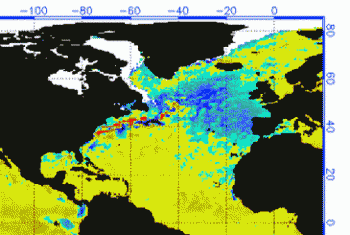
Cold “blobs” in North Atlantic have been reported, but they are usually a winter phenomena. For example in April 2016, the sst anomalies looked like this
But by September, the picture changed to this
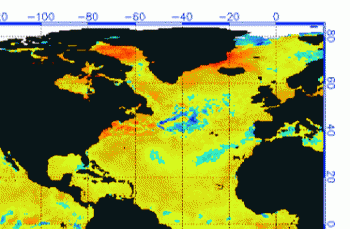
And we know from Kaplan AMO dataset, that 2016 summer SSTs were right up there with 1998 and 2010 as the highest recorded.

As the graph above suggests, this body of water is also important for tropical cyclones, since warmer water provides more energy.  But those are annual averages, and I am interested in the summer pulses of warm water into the Arctic. As I have noted in my monthly HadSST3 reports, most summers since 2003 there have been warm pulses in the north atlantic.
The AMO Index is from from Kaplan SST v2, the unaltered and untrended dataset. By definition, the data are monthly average SSTs interpolated to a 5×5 grid over the North Atlantic basically 0 to 70N.  The graph shows warming began after 1992 up to 1998, with a series of matching years since.  Because McCarthy refers to hints of cooling to come in the N. Atlantic, let’s take a closer look at some AMO years in the last 2 decades.
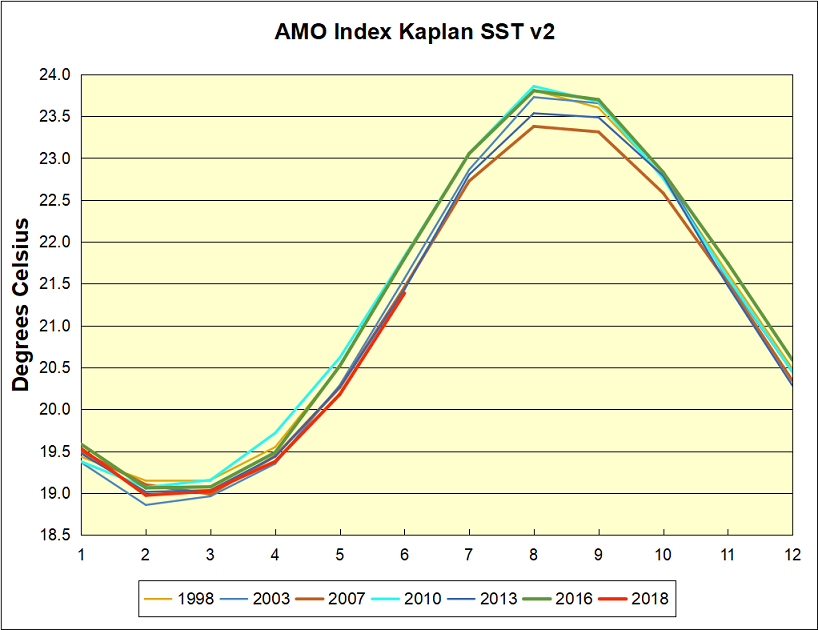
This graph shows monthly AMO temps for some important years. The Peak years were 1998, 2010 and 2016, with the latter emphasized as the most recent. The other years show lesser warming, with 2007 emphasized as the coolest in the last 20 years. Note the red 2018 line is at the bottom of all these tracks.  Most recently June 2018 is 0.4C lower than June 2016.

With all the talk of AMOC slowing down and a phase shift in the North Atlantic, we await SST measurements for July, August and September to confirm if cooling is starting to set in.

Preschool Alarmist Brainwashing


Review from Newsbusters New Magic School Bus to Kids: Use Clean Energy or Monsters Will Eat You Excerpts in italics with my bolds.
The Magic School Bus is back in the new Netflix series The Magic School Bus Rides Again! Overall, it’s still a nice, fun 13-episode series like we remember from when we were kids, but with some left turns. There is a pretty predictable take on climate change propaganda for little kids, but that wasn’t the worst. That dubious honor goes to the episode that teaches kids that a monster will eat them if they don’t use alternative clean energy sources.

Of course, conserving energy is a good thing and we should be kind to the earth, but this climate change hysteria is taking over. Usually, somebody will say that 97 percent of climate scientists agree that humans are causing global warming, and I was surprised that figure didn’t come up in this episode. Could it be that they know how easily debunked that number is? Given the way Dorothy Ann presented man-made climate change as fact, I doubt it.

This issue tends to play incredibly well in the mainstream media, as they use climate change as the universal bad-guy, so I’m sure there were plenty of parents who actually thought this episode was a good idea. I find it hard to believe any parents were happy about this next one, though.

Espisode 12: Monster Power. Click on link below to play short excerpt video.

https://www.mrctv.org/embed/518271

Episode 12, “Monster Power,” teaches kids that a monster will eat them if they don’t use alternative clean energy sources. Albert, one of the students, has seen a movie in which the evil monster loves pollution and is “coming for us next for what we’ve done to this planet!” With the class camping in the woods, Miss Frizzle and the other students help him come up with clean energy alternatives (wind, water, etc) so they won’t be eaten. Instead, Miss Frizzle could tell him that monsters aren’t real, but I guess that didn’t occur to her.

While it makes sense to teach kids the science of pollution and about all kinds of energy (I wouldn’t have minded some talk about oil in the dinosaur episode, to be honest), why would they tell kids that a monster will eat them for using the wrong energy source? I may not have the teaching credentials of Miss Frizzle, but I’m pretty sure that’s not scientifically accurate. They must really hate fossil fuels as much as their friends on the left. Keeping in mind that the TV-Y rating for this series means it’s for kids 2-6, I’m sure there are going to be some parents pretty irked at bedtime when kids are scared of the blot monster.

Overall, this is a cute series and fun bit of nostalgia for those of us who enjoyed the original books (or TV series) as kids, but I could have done without the climate change propaganda, and telling kids that traditional energy sources attract monsters is way over the top. Can’t kids just learn without an anti-scientific social agenda?


Stanford Jumps Suicide Climate Shark

Today’s media feeding frenzy is promoting another scary climate change report from Stanford.  Sample headlines are:

Climate change linked to increase in suicide rates USA Today

Rising heat linked to suicide spikes in U.S. and Mexico Thomson Reuters Foundation News

Climate Change May Cause 26,000 More U.S. Suicides by 2050 The Atlantic

Etc. Etc.

Some points to consider:

1. A suicide is a personal event with many contributing factors, weather and climate being the most peripheral.

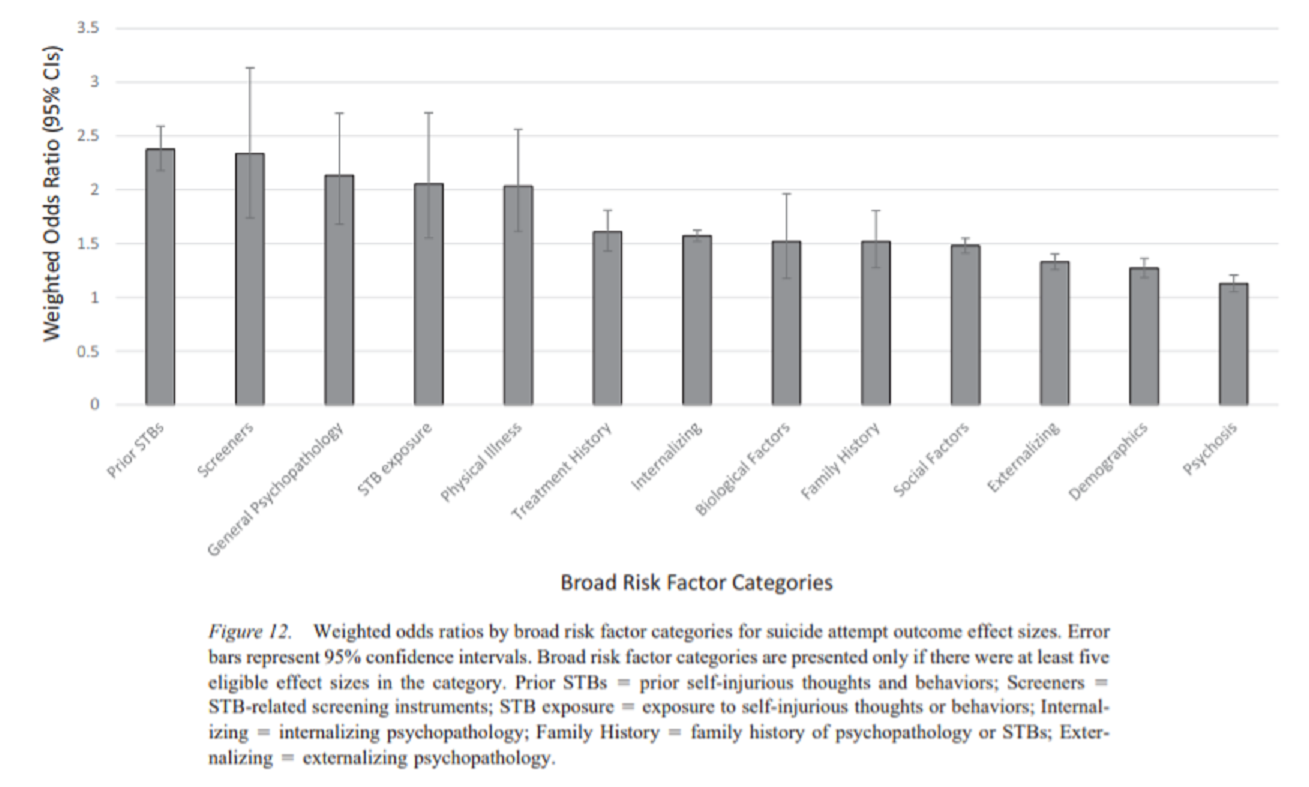
2. Serious suicide researchers have identified risk factors that inform caregivers. Franklin et al. provide this analysis of experience with suicidal incidents Risk Factors for Suicidal Thoughts and Behaviors: A Meta-Analysis of 50 Years of Research

Open image in new tab to enlarge.

With such complexity of influencing factors, putting emphasis on a bit of warming is both myopic and lopsided.  For example, some places report springtime suicides are more frequent, others see more such deaths in Summer or Autumn.  The seasonal relationship is quite mixed in studies with various theories being suggested along with great uncertainty.

3. Suicides occur more frequently in colder climates than in warmer ones. For example, this European study found the highest rates in eastern European nations and lowest rates in Mediterranean countries.

Relationship of suicide rates with climate and economic variables in Europe during 2000–2012 in Annals of General Psychiatry. Excerpt below in italics with my bolds.

It is well known that suicidal rates vary considerably among European countries (Fig.  1) and the reasons for this are unknown although several theories have been proposed. The effect of climate has previously been discussed but has not been investigated in a systematic way across countries.

One of the biggest enigmas is the marked geographic variability in suicide rates found in Europe, with the highest rates being found in Eastern Europe and the lowest in the Mediterranean region

The current study reports that the climatic effect (cold climate) is stronger than the economic one, but both are present. It seems that in Europe suicidality follows the climate/temperature cline which interestingly is not from south to north but from south to north-east. 

4. Preventing suicides is a serious issue, and has nothing to do with reducing CO2.

These New Zealand researchers argue against mixing climate policies with suicide prevention programs.

Will climate change increase or decrease suicide rates? The differing effects of geographical, seasonal, and irregular variation in temperature on suicide incidence Excerpts in italics with my bolds

The effect of environmental temperature on suicide risk is an important issue given the increase in global temperatures expected over the following century. Previous research has produced conflicting findings: Studies concerned with temporal variation in temperature and suicide have tended to find a positive relationship, while those concerned with geographical variation in temperature and suicide have tended to find a negative relationship. In this study, we aimed firstly to estimate the relationship between suicide incidence and three components of variation in temperature: Irregular, seasonal, and geographical. Secondly, we aimed to critically examine what this information can (and cannot) tell us about the likely effects of anthropogenic climate change on suicide rates.

In this study, irregular variation in temperature had a positive relationship with suicide incidence, with approximately 1.8% more suicides for every 1°C increase in temperature. The size of this estimate was fairly consistent with those of previous studies (e.g., Deisenhammer 2003; Kim et al. 2011). We did not find evidence of the non-linear relationship between temperature and suicide incidence reported by Page et al. (2007). We also found no evidence for any substantial lagged effect of irregular variation in temperature, a finding similar to that of Likhvar et al. (2011) and Kim et al. (2011).

On the basis of the apparent positive effect of irregular variation in temperature, it would be tempting to conclude that global warming will increase the incidence of suicides. However, this conclusion is contradicted by our analyses of seasonal and geographical variation in temperature and suicide. Seasonal variation in suicide deaths did roughly follow the pattern generally found in the literature of a peak in spring and a trough in winter (Chew and McCleary 1995), but in accordance with a previous study in New Zealand (Yip et al. 1998), the magnitude of seasonal variation in suicide incidence was very small.

Furthermore, seasonal variation in temperature had a relationship with suicide incidence that was close to zero: That is, hotter times of the year were not consistently associated with higher suicide risk The relationship between geographical variation in temperature and suicide incidence differed even more greatly from that of irregular variation in temperature. While there was little evidence of any relationship at a bivariate level, controlling for age and ethnic differences across regions resulted in the relationship becoming negative: warmer areas had lower suicide rates. This finding was in accordance with prior studies finding a negative relationship between geographical variation in temperature and suicide rates (Rotton 1986; Souêtre et al. 1990; Lester 1999).

Counteracting the potential confounding problem relating to analyses of seasonal and (especially) geographical variation is that these analyses can potentially provide information about how humans adapt to long-term, sustained climatic differences. Indeed, the negative relationship between geographical variation in temperature and suicide incidence hints at the presence of adaptation mechanisms to warmer temperatures that inhibit suicide risk in the long term. At the very least, this finding means that we should be cautious about assuming that the positive effect of irregular variation in temperature on suicide incidence implies that climate change will increase suicide risk. Until the reasons for the apparently conflicting effect of geographical variation in temperature can be identified, such an inference does not seem well justified.

Once again alarmist researchers doing an high wire act. Claims with virtually nothing to support them.

Footnote:

“Jumping the shark” is attempting to draw attention to or create publicity for something that is perceived as not warranting the attention, especially something that is believed to be past its peak in quality or relevance. The phrase originated with the TV series “Happy Days” when an episode had Fonzie doing a water ski jump over a shark. The stunt was intended to perk up the ratings, but it marked the show’s low point ahead of its demise.


Another Crooked Hockey Stick

Update July 22, 2018

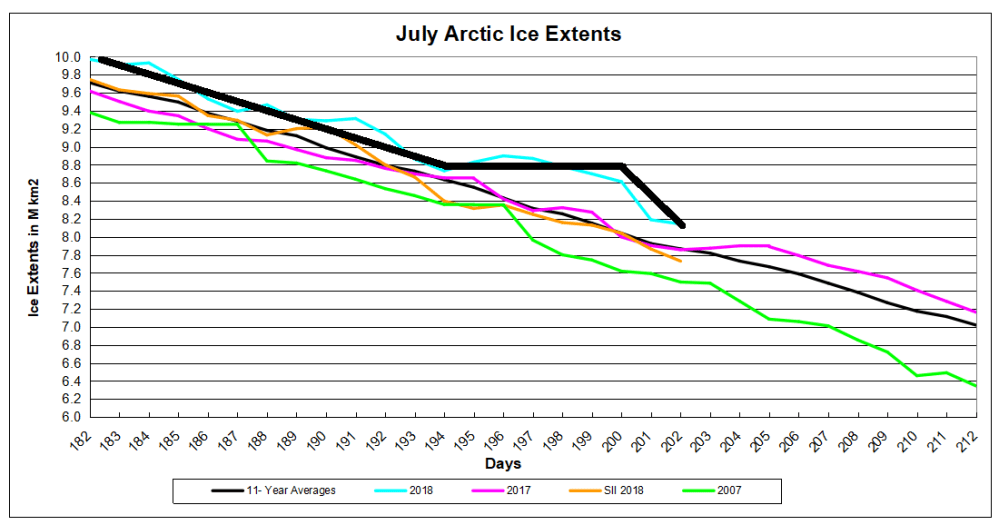
Arctic day 202 hockey

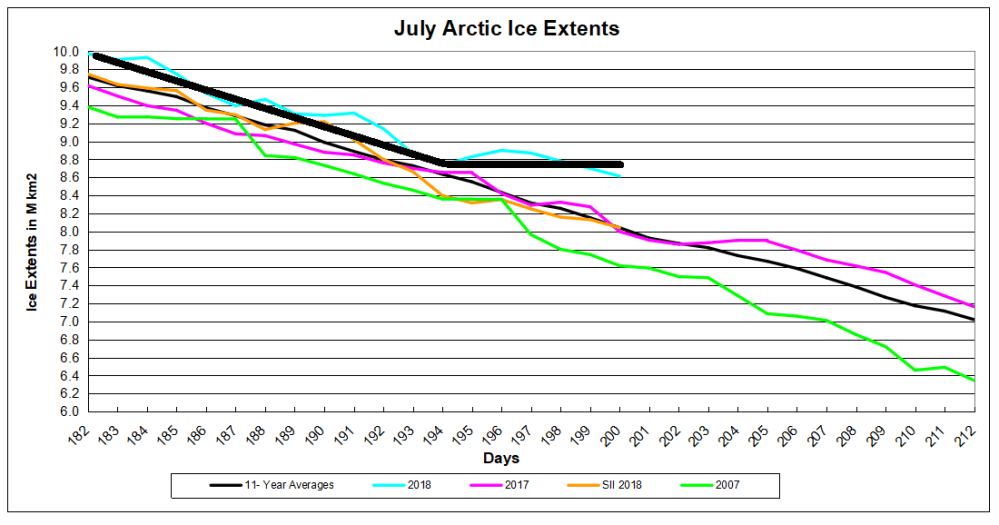
No one knew how long this divergence of surplus ice would persist, but 2018 Arctic ice extent resembled a hockey stick until two days ago.  Through day 200 the gap over 11 year average and 2007 was increasing, but then more than 400k km2 disappeared overnight.  Despite the bent blade, presently the ice is 525k km2 above 11 year average (2007 to 2017 inclusive) and  640k km2 greater than 2007.

Note that 2018 started July well above the 11 year average and other recent years. and remains higher. SII 2018 was tracking close to MASIE last month, but in July SII shows lower extents, a gap of 400k km2 at this point.

ims2022007to2018

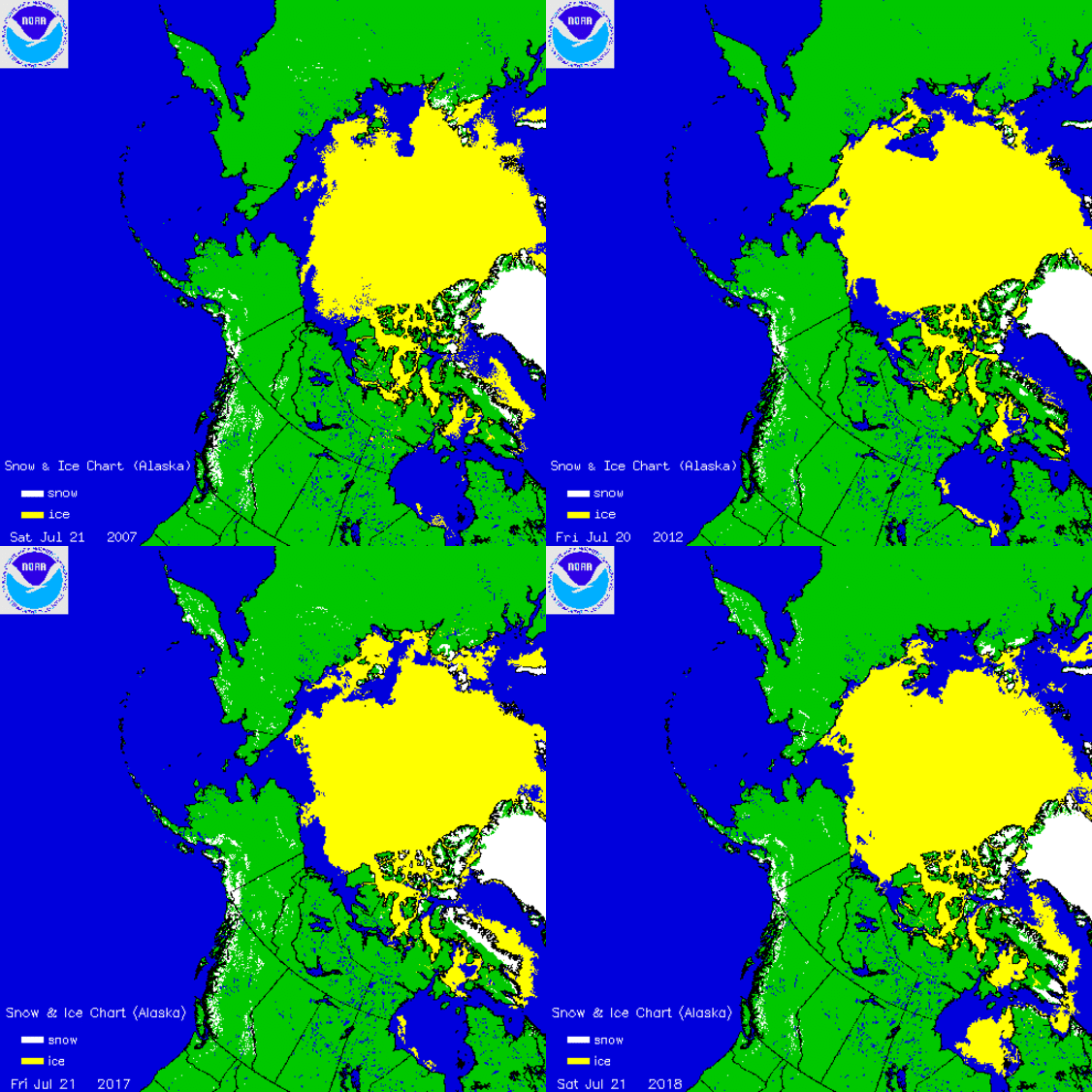
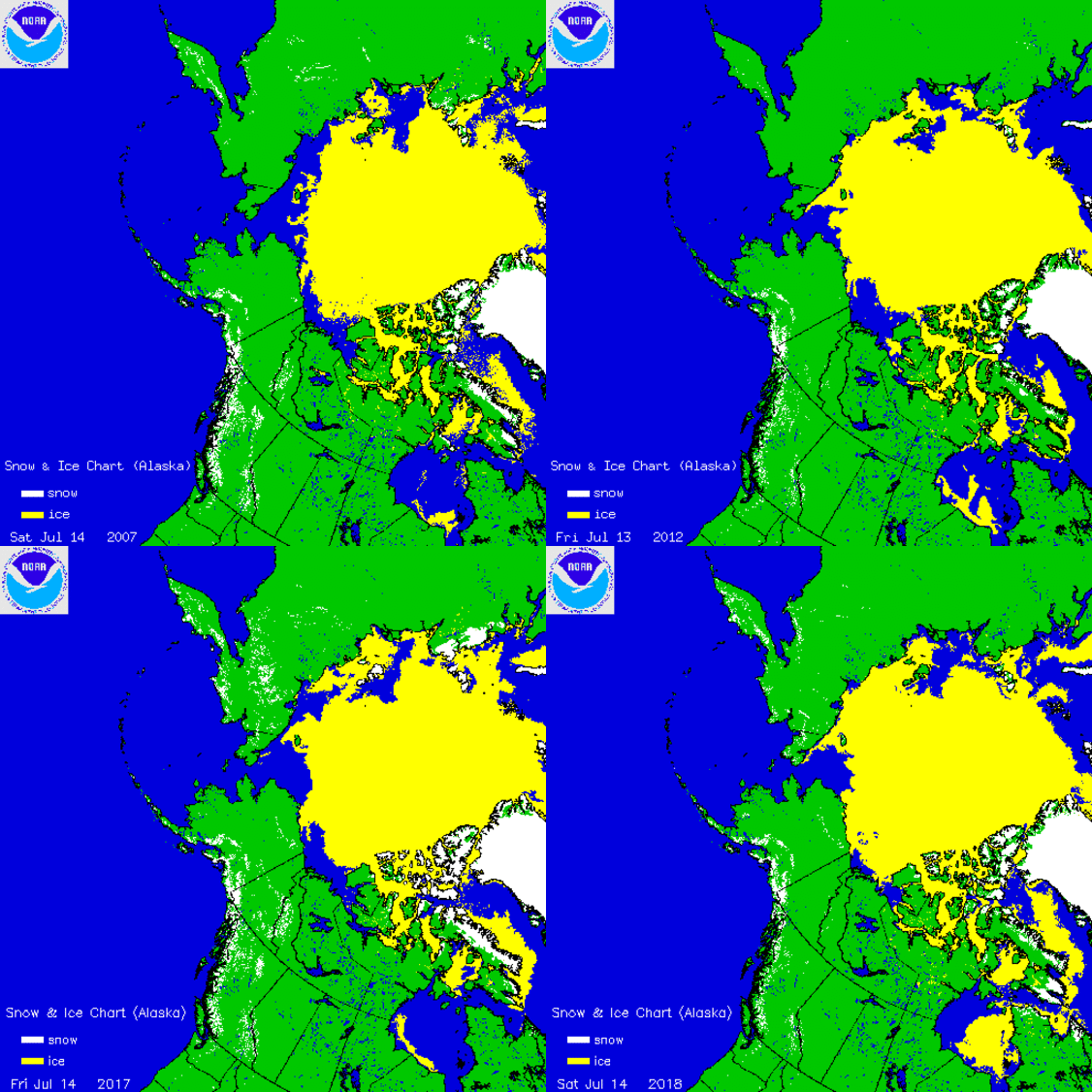
The image above shows ice extents on day 202 (July 21) for years 2007, 2012, 2017 and 2018. Note this year ice is strong on both Russian and N. American sides.  Beaufort Sea and Canadian Archipelago show limited water. E. Siberian and Chukchi Seas are also solid, despite early melting in Bering Sea.  Open water has increased in Laptev, Kara and Greenland seas in recent days. Hudson and Baffin bays still have considerable ice compared to other years, but less than a few days ago.

The table below shows ice extents by regions comparing 2018 with 11-year average (2007 to 2017 inclusive) and 2017.

Region 2018202 Day 202 
Average
2018-Ave. 2007202 2018-2007
 (0) Northern_Hemisphere 8142139 7866163 275976 7497932 644207
 (1) Beaufort_Sea 984569 794601 189968 795440 189129
 (2) Chukchi_Sea 603534 592924 10610 471400 132134
 (3) East_Siberian_Sea 1000229 901222 99007 707427 292802
 (4) Laptev_Sea 394293 562570 -168276 447964 -53670
 (5) Kara_Sea 274538 286359 -11822 347266 -72728
 (6) Barents_Sea 8339 47186 -38847 49639 -41300
 (7) Greenland_Sea 224531 375231 -150700 366856 -142325
 (8) Baffin_Bay_Gulf_of_St._Lawrence 382837 221949 160888 275856 106980
 (9) Canadian_Archipelago 677670 664853 12817 672482 5188
 (10) Hudson_Bay 516787 238389 278398 145395 371392
 (11) Central_Arctic 3073623 3178081 -104458 3216865 -143243

2018 is 276k km2 above average (3.5%), mostly due to Hudson and Baffin bays having surplus ice.   Laptev, Greenland Sea and Central Arctic are down, more than offset by surpluses elsewhere, especially Beaufort and East Siberian seas.  Since the two bays will melt out soon, the eventual annual minimum remains to be seen.

Footnote:

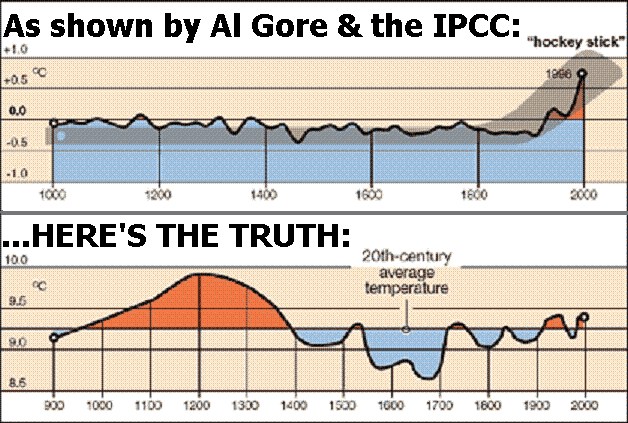
Most readers know of the Mann-made Crooked Hockey Stick, which duped IPCC and Al Gore for awhile.  That story is told in the post Rise and Fall of the Modern Warming Spike


Rehab EPA with a Proper Clean Power Plan

Robert Henneke writes a fine article in Washington Examiner Trump has a chance to rein in Obama’s out-of-control EPA Henneke is is the general counsel and director of the Center for the American Future at the Texas Public Policy Foundation. Excerpts below in italics with my bolds.

The Environmental Protection Agency has sent its replacement for the Clean Power Plan to the White House. We don’t know what’s in it (it won’t be released until the White House has a chance to review it), but we know what should be and what shouldn’t.

The new plan should restore the rule of law to an out-of-control agency. The EPA must abide by the rules set by Congress, particularly in the Clean Air Act, rather than lawlessly assuming authority it doesn’t have, as it did through the Clean Power Plan. The new plan must not repeat the mistakes of the CPP.

Carbon dioxide is the supervillain in the story of global climate change. The EPA declared even naturally-occurring CO2 as a pollutant in 2009, then sought to regulate it in the Clean Power Plan. Fortunately, the plan was stayed by the Supreme Court before it went into effect, and it remains in legal limbo.

But in December of that year, the advance notice of the new rules, the EPA indicated it would repeat some of the same mistakes of the CPP in its new guidelines.

First, EPA is not allowed to regulate greenhouse gas emissions from stationary sources (power plants) under Section 111 of the Clean Air Act. Why not? Because all emissions from such sources are already regulated under Section 112. Regulators don’t get two bites at that apple.

Congress expressly prohibited such overregulation to avoid burdensome, duplicative rules, and it required the EPA to choose only one avenue. But EPA has regulated coal-and-oil-fired electric generation unit emissions under Section 112 since 2000, and in 2012, it began regulating all fossil fuel-fired electric generation unit emissions under that section.

Second, to proceed under Section 111, the EPA is required to make an endangerment finding under the criteria for stationary sources. But there is no endangerment finding – not under the Obama administration and not now. To justify its overreach, the EPA has pointed to the endangerment finding it made in 2009 in connection with mobile source emissions (cars and trucks, etc.) under a different provision of the Clean Air Act (Section 202).

But that endangerment finding simply doesn’t apply. It doesn’t meet the criteria of Section 111, that a pollutant from stationary sources endangers the public health and welfare. Instead, it found that an aggregate of six different greenhouse gases, emitted by mobile sources, is a danger.

Why is this difference important? Section 111 permits regulation only from “a category of sources . . . [which] significantly causes or contributes significantly to air pollution [that endangers health or welfare].” This “significance” requirement is not found in Section 202.

So, the EPA would have an insurmountable task in finding that American power plants “significantly” cause or contribute to the levels of carbon dioxide thought to aggravate climate change. Carbon dioxide is ubiquitous and worldwide in scope, making any such finding fraught with peril. Given emissions of carbon dioxide worldwide, it is highly unlikely that the EPA can specifically point to greenhouse gas emissions from American power plants as a significant cause of endangerment of health or welfare.

Finally, if the EPA is to regulate carbon dioxide emissions from power plants, it must proceed under Section 108 of the Clean Air Act, not Section 111. Section 108 is the regulatory path Congress prescribed for air pollutants in the “ambient air” emitted from “numerous or diverse” sources, while Section 111 is the instrument for emissions from specific source categories that pose local pollution concerns. Carbon dioxide is the very model of a ubiquitous substance emitted into the “ambient air” from “numerous or diverse” sources. EPA cannot short-circuit the regulatory framework hard written into the Clean Air Act under section 108 by jumping to another section of the act.

The Clean Power Plan represents the worst of the regulatory abuses of the Obama administration. Its mistakes must not be repeated.

When it comes to the new plan, less is more. Texas serves as the model for success, where a deregulated electricity market has resulted in abundant energy and cleaner power plants as electricity companies adopt the latest technologies as a way to increase efficiencies and maximize profit, all while resulting in a cleaner environment.

That’s the way forward for the Clean Power Plan’s replacement.


UK High Court Refuses to Set Carbon Targets


ITV reports Environmental campaigners lose High Court battle over carbon target. Excerpts in italics below with my bolds.

Environmental campaigners have lost their High Court challenge against the Government over its policy for tackling climate change.

Charity Plan B Earth brought legal action against the Government’s stance on the 2050 carbon target, set under the Climate Change Act 2008.

The charity and 11 UK citizens aged nine to 79 – including publisher Dame Carmen Callil – wanted to bring a judicial review against Business Secretary Greg Clark over the policy.

But Mr Justice Supperstone rejected Plan B Earth’s case on Friday, saying it was “unarguable”.

Lawyers for the charity previously argued the Government should have, in light of the current scientific consensus, gone further than its original target of reducing carbon levels by 2050 to 80% of those present in 1990.

They said the decision not to amend the 2050 target put the UK in breach of its international obligations under the Paris Agreement on Climate Change and was influenced by the Government’s belief that a “more ambitious target was not feasible”.

At a hearing on July 4, Jonathan Crow QC told the court: “The Secretary of State’s belief that he needs to have regard to what is feasible, rather than what is necessary, betrays a fundamental misunderstanding of the scheme of the 2008 Act and must be quashed.

“All of the individual claimants are deeply concerned about climate change.”

The barrister argued the Secretary of State’s “continuing refusal” to amend the 2050 target means the UK is playing “Russian roulette with two bullets, instead of one”.

But, refusing permission for a full hearing, Mr Justice Supperstone said Plan B Earth’s arguments were based on an “incorrect interpretation” of the Paris Agreement.

He said: “In my view the Secretary of State was plainly entitled … to refuse to change the 2050 target at the present time.

“I do not consider it arguable that the Secretary of State’s refusal to amend the 2050 target is an unlawful exercise of his discretion.”

Plan B Earth director Tim Crosland said the charity was “surprised and disappointed” by the ruling and plans to appeal.

He said: “We consider it clear and widely accepted that the current carbon target is not compatible with the Paris Agreement.

“Neither the Government nor the Committee on Climate Change suggested during our correspondence with them prior to the claim that the target was compatible.

“Indeed, it was only in January of this year that the Committee published a report accepting that the Paris Agreement was ‘likely to require’ a more ambitious 2050 target.

“Moreover the Government acknowledged in these proceedings that it was uncontroversial’ that the 2050 target was insufficient to meet the 1.5C target, one of the key aspects of the Paris commitment.

“As with other legal campaigns confronting powerful vested interests it takes time to break through, and time is not on our side.

“We’ll be doing everything possible to accelerate the process. Wildfires raging in the Arctic Circle must surely be a wake-up call.”

Regarding wildfires in the Arctic, I recommend he read my post Arctic Hockey Stick Extends Lead

Battle Over Climate Bias

As noted before, the left uses social pressure to force value-laden decisions onto other people. This has been going on for awhile regarding investment decisions by wealth managers, including huge pension funds. The politically correct (scientifically corrupt) bias is to divest of fossil fuel companies in hopes of ensuring a future climate favorable to humans. Now comes some push back from actuaries seeing this pressure as narrow and subversive of other important social concerns.

Chris Seekings writes in The Actuary (UK) Pensions and Lifetime Savings Association rejects climate change law for investment decisions Excerpts in italics below with my bolds.

The UK’s pension fund trade body has argued that new regulations governing how trustees invest £1.5trn in assets should exclude explicit reference to climate change.

The Pensions and Lifetime Savings Association (PLSA) said including climate change specifically in a new law could “confuse” trustees by unintentionally narrowing their focus.

This could cause them to disregard other environmental, social and governance (ESG) considerations that may be more relevant to their portfolios, such as resource depletion or human rights.

This is despite the PLSA reiterating its belief that climate change poses a substantial risk to the business models of firms in almost every sector, threatening the stability of the financial system.

“It is important that pension schemes consider risks related to climate change as part of their investment strategies, however, this is clearly not the only ESG factor to consider,” the PLSA said.

“We believe that picking out any one factor as a specific example may lead trustees to assume that is the only, or most important, factor to consider, when others might be more relevant.”

This comes in response to a consultation by the Department for Work and Pensions into new sustainability regulations for workplace pension funds, which closed on 16 July.

The PLSA also rejected proposals that would see trustees prepare a statement outlining how they take account of scheme members’ views, saying they were “neither practical nor purposeful”.

It argued that members should not be expected to be investment experts, and that trustees should invest in the best interest of members even if it “runs counter to strongly-held beliefs”.

Lawyers at ClientEarth, which co-produced a climate risk report with the PLSA in 2017, said rowing back on the “crucial” government proposals would be “hugely irresponsible”.

“Major financial institutions and world experts recognise climate risk as the most significant financial risk to the economy,” said ClientEarth finance lawyer, Alice Garton.

“Human rights abuses and resource depletion are crucial ESG issues, but what the PLSA seems to have overlooked, is that a changing climate underpins and intensifies these risks.”

ClientEarth exemplifies the alamist drive to reduce everything down to their one obsession with CO2.  It is good to see them confronted by other well-intentioned people who understand that important problems and concerns suffer from the extreme (and ineffectual) focus on fossil fuels.  Maybe some are listening to Bjorn Lomborg after all.

The UN IPCC climate train wreck is under way.


Arctic Hockey Stick Extends Lead

Update July 20, 2018

Arctic day 200 hockey

No one knows how long this divergence of surplus ice will persist, but for now 2018 Arctic ice extent resembles a hockey stick.  OK, the blade angle is drooping, but the gap over previous years is increasing.  At day 200 ice extent this year is 572k km2 above 11 year average (2007 to 2017 inclusive), an addition of ~50k km2 in the last  two days.  2018 solidified its lead of 1M km2 greater than 2007.  The gap over 2007 has more than doubled in the past five days.  More detailed report from July 14 below.

ims1952007to2018

In June 2018, Arctic ice extent held up against previous years despite the Pacific basins of Bering and Okhotsk being ice-free.  The Arctic core is showing little change, perhaps due to increased thickness (volume) as reported by DMI.

The image above shows ice extents on day 195 (July 14) for years 2007, 2012, 2017 and 2018. Note this year ice is strong on both Russian and N. American sides.  Beaufort Sea and Canadian Archipelago are solid. E. Siberian and Chukchi Seas are also solid, despite early melting in Bering Sea.  Hudson and Baffin bays still have considerable ice compared to other years.

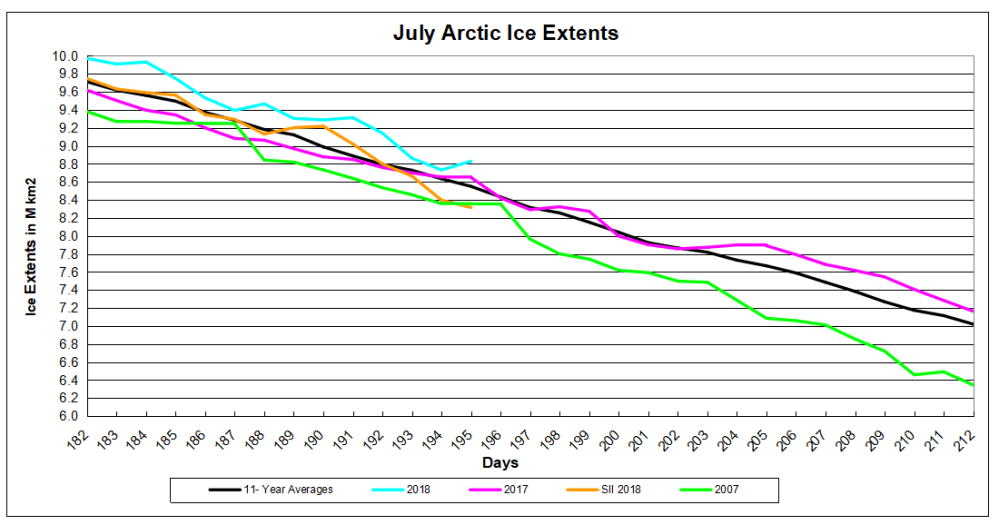
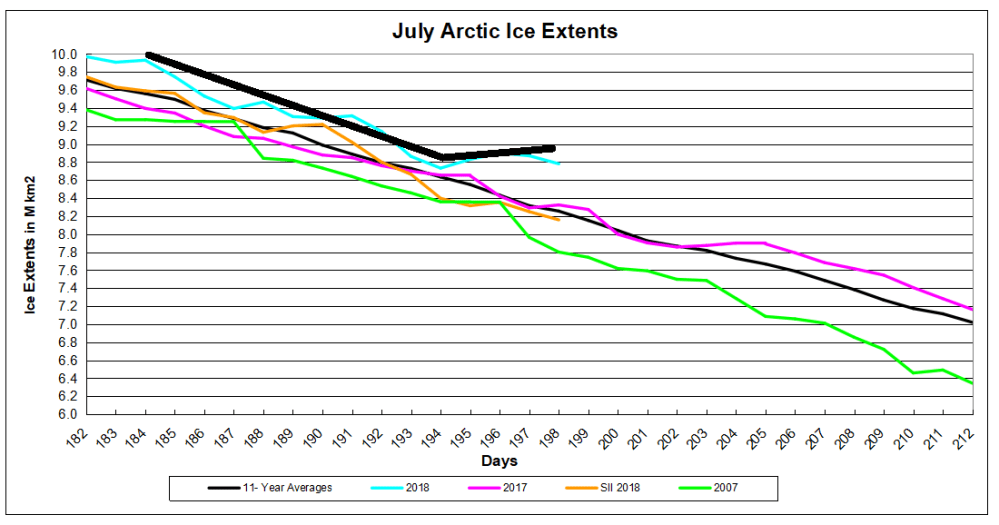
The graph below shows how the Arctic extent has faired in July compared to the 11 year average and to some years of interest.
Arctic day 195
Note that 2018 started July well above the 11 year average and other recent years.  As of day 195 (yesterday) ice extent is still greater than average and the years 2007 and 2017.  SII 2018 is tracking well below MASIE this month, a gap of 500k km2 at this point.

The table below shows ice extents by regions comparing 2018 with 11-year average (2007 to 2017 inclusive) and 2017.

Region 2018195 Day 195 
Average
2018-Ave. 2007195 2018-2007
 (0) Northern_Hemisphere 8828959 8549517 279442 8355280 473679
 (1) Beaufort_Sea 993219 826109 167110 845973 147246
 (2) Chukchi_Sea 644989 636401 8588 576079 68911
 (3) East_Siberian_Sea 1024284 950636 73648 788128 236156
 (4) Laptev_Sea 492172 633149 -140977 575520 -83347
 (5) Kara_Sea 438240 399007 39233 483785 -45545
 (6) Barents_Sea 30629 64124 -33495 75731 -45101
 (7) Greenland_Sea 285428 443318 -157890 472890 -187462
 (8) Baffin_Bay_Gulf_of_St._Lawrence 489193 305230 183963 343396 145797
 (9) Canadian_Archipelago 747737 719112 28626 730629 17109
 (10) Hudson_Bay 619471 381783 237688 248785 370686
 (11) Central_Arctic 3062425 3185383 -122959 3211275 -148850

2018 is 280k km2 above average, mostly due to Hudson and Baffin bays having surplus ice.   Laptev, Greenland Sea and Central Arctic are down, more than offset by surpluses elsewhere.  Since the two bays will melt out soon, the eventual annual minimum remains to be seen.


NYC Lawsuit Against Big Oil: Fugget about it!

Washington Examiner has the story: Federal judge dismisses New York City’s climate change lawsuit against Big Oil Excerpts below in italics with my bolds.

A federal judge Thursday dismissed New York City’s lawsuit against major oil companies for their contribution to climate change, the latest in a string of suits filed by cities to be tossed aside.

“Global warming and solutions thereto must be addressed by the two other branches of government,” U.S. District Court Judge John Keenan ruled in dismissing the city’s climate lawsuit, saying the matter should not be handled by the courts. He added that Congress has already delegated to the Environmental Protection Agency the authority to regulate greenhouse gas emissions, so it’s not the job of the courts.

Keenan, of the U.S. District Court for the Southern District of New York, is an appointee of former President Ronald Reagan, a Republican.

In January, New York City sued Exxon Mobil, Chevron Corp., BP, Shell, and ConocoPhillips to help pay for the costs of climate change, trying to hold them responsible for any damage to the city caused by global warming.

Just last week, U.S. District Court Judge William Alsup dismissed similar lawsuits filed by the cities of San Francisco and Oakland, stating in an order: “No plaintiff has ever succeeded in bringing a nuisance claim based on global warming.”

Alsup, of the U.S. District Court for the Northern District of California, is an appointee of former President Bill Clinton, a Democrat.

The cities have argued that big oil companies have promoted fossil fuel use and deliberately concealed that they knew climate change could harm coastal cities, meaning they should have to pay for seawalls and other infrastructure to protect against rising sea levels.

Oil companies say that courts cannot rule on broad and speculative issues such as the impact of business decisions on climate change.

Despite the setbacks, environmentalists continue to increase the pressure for similar lawsuits, seeing them as a key tactic to publicly criticize the industry for its role in producing energy that exacerbates climate change.

Earlier this month, Rhode Island became the first state to file such a lawsuit. Rhode Island Attorney General Peter F. Kilmartin filed the lawsuit in state court against 21 companies that included Exxon Mobil, Chevron, and BP.

JOHN F. KEENAN, United States District Judge Ruling July 19, 2018 Excerpts below in italics with my bolds give the flavor of the judge’s thinking.

Although the amended complaint contains extensive allegations regarding Defendants’ past attempts to deny or downplay the effects of fossil fuel use on climate change, in their motion to dismiss, Defendants do not dispute the scientific consensus that greenhouse gas emissions from fossil fuel use have contributed to global warming.

The City alleges that Defendants’ ongoing conduct continues to exacerbate global warming and cause recurring injuries to NewYork City. (Id. ¶ 9.) Defendants continue to produce, market, distribute, and sell fossil fuels in massive quantities; to promote fossil fuel consumption in these massive quantities; and to downplay the threat posed by climate change. (Id. ¶ 131.) This ongoing conduct will cause increasingly severe injuries to New York City, including new and more significant encroachments upon and interferences with City property, and increasingly severe threats to public health.

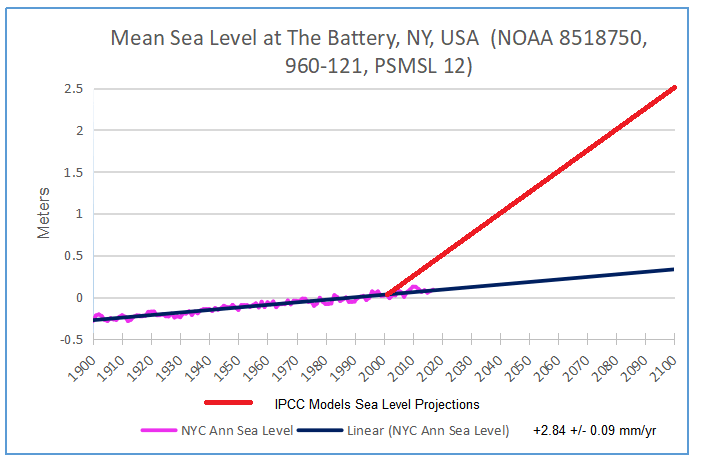
NYC claims of damages rest upon IPCC models projections of sea level rise 8 times beyond what has been observed.

The City requests compensatory damages for past and future costs incurred by the City to protect its infrastructure and property, and to protect the public health, safety, and property of its residents from the impacts of climate change.

However, regardless of the manner in which the City frames its claims in its opposition brief, the amended complaint makes clear that the City is seeking damages for global-warming related injuries resulting from greenhouse gas emissions, and not only the production of Defendants’ fossil fuels.

From BP Brief: If ever a problem cried out for a uniform and comprehensive solution, it is the geophysical problem described by the complaints, a problem centuries in the making (and studying) with causes ranging from volcanoes, to wildfires, to deforestation to stimulation of other greenhouse gases—and, most pertinent here, to the combustion of fossil fuels.

As an initial matter, it is not clear that Defendants’ fossil fuel production and the emissions created therefrom have been an “unlawful invasion” in New York City, as the City benefits from and participates in the use of fossil fuels as a source of power, and has done so for many decades. More importantly, Congress has expressly delegated to the EPA the determination as to what constitutes a reasonable amount of greenhouse gas emission under the Clean Air Act.

The Court recognizes that the City, and many other governmental entities around the United States and in other nations, will be forced to grapple with the harmful impacts of climate change in the coming decades. However, the immense and complicated problem of global warming requires a comprehensive solution that weighs the global benefits of fossil fuel use with the gravity of the impending harms. To litigate such an action for injuries from foreign greenhouse gas emissions in federal court would severely infringe upon the foreign-policy decisions that are squarely within the purview of the political branches of the U.S.Government. Accordingly, the Court will exercise appropriate caution and decline to recognize such a cause of action.

CONCLUSION
For the reasons stated above, the U.S.-based Defendants’ motion to dismiss is GRANTED and the City’s amended complaint is dismissed with prejudice in its entirety.

Note:  With prejudice indicates NYC cannot file an amended complaint again in this court.  They can appeal to a higher court, but that seems unlikely.  OTOH should one federal district court cave in to climate plaintiffs, then an appeal by the oil companies is highly likely.

Arctic Ice Hockey Stick

Update July 18, 2018

Arctic day 198 hockey

No one knows how long this divergence of surplus ice will persist, but for now 2018 Arctic ice extent resembles a hockey stick.  Presently the ice is 525k km2 above 11 year average (2007 to 2017 inclusive) and  ~1M km2 greater than 2007.  More detailed report from July 14 below.

ims1952007to2018

In June 2018, Arctic ice extent held up against previous years despite the Pacific basins of Bering and Okhotsk being ice-free.  The Arctic core is showing little change, perhaps due to increased thickness (volume) as reported by DMI.

The image above shows ice extents on day 195 (July 14) for years 2007, 2012, 2017 and 2018. Note this year ice is strong on both Russian and N. American sides.  Beaufort Sea and Canadian Archipelago are solid. E. Siberian and Chukchi Seas are also solid, despite early melting in Bering Sea.  Hudson and Baffin bays still have considerable ice compared to other years.

The graph below shows how the Arctic extent has faired in July compared to the 11 year average and to some years of interest.
Arctic day 195
Note that 2018 started July well above the 11 year average and other recent years.  As of day 195 (yesterday) ice extent is still greater than average and the years 2007 and 2017.  SII 2018 is tracking well below MASIE this month, a gap of 500k km2 at this point.

The table below shows ice extents by regions comparing 2018 with 11-year average (2007 to 2017 inclusive) and 2017.

Region 2018195 Day 195 
Average
2018-Ave. 2007195 2018-2007
 (0) Northern_Hemisphere 8828959 8549517 279442 8355280 473679
 (1) Beaufort_Sea 993219 826109 167110 845973 147246
 (2) Chukchi_Sea 644989 636401 8588 576079 68911
 (3) East_Siberian_Sea 1024284 950636 73648 788128 236156
 (4) Laptev_Sea 492172 633149 -140977 575520 -83347
 (5) Kara_Sea 438240 399007 39233 483785 -45545
 (6) Barents_Sea 30629 64124 -33495 75731 -45101
 (7) Greenland_Sea 285428 443318 -157890 472890 -187462
 (8) Baffin_Bay_Gulf_of_St._Lawrence 489193 305230 183963 343396 145797
 (9) Canadian_Archipelago 747737 719112 28626 730629 17109
 (10) Hudson_Bay 619471 381783 237688 248785 370686
 (11) Central_Arctic 3062425 3185383 -122959 3211275 -148850

2018 is 280k km2 above average, mostly due to Hudson and Baffin bays having surplus ice.   Laptev, Greenland Sea and Central Arctic are down, more than offset by surpluses elsewhere.  Since the two bays will melt out soon, the eventual annual minimum remains to be seen.