Six Reasons to Rescind Social Cost of Carbon

A consise summary is provided by Paul Driessen and Roger Bezdek
in this article Anti-fossil fuel SCC relies on garbage models, ignores carbon benefits and hurts the poor. Excerpts below.

The UN Development Program also calls energy “central to poverty reduction.” And International Energy Agency Executive Director Dr. Fatih Birol notes that “coal is raising living standards and lifting hundreds of millions of people out of poverty.” In fact, all fossil fuels are doing so.

Indeed, fossil fuels created the modern world and the housing, transportation, other technologies and living standards so many of us take for granted. They are essential for electricity and life, and over the past 250 years they more than doubled average life expectancy in countries that took advantage of them.

But the Obama Administration and radical environmentalists despise fossil fuels and used every tactic they could devise to eliminate them. One of their most important schemes was the “social cost of carbon.”

Six Things Wrong with Social Cost of Carbon

1. Each ton of U.S. emissions averted would initially have prevented a hypothetical $25/ton in global societal costs allegedly resulting from dangerous manmade climate change: less coastal flooding and tropical disease, fewer droughts and extreme weather events, for example. But within three years regulators arbitrarily increased the SCC to around $40/ton.

That made it easier to justify the Clean Power Plan, Paris climate agreement, and countless Obama Era actions on electricity generation, fracking, methane, pipelines, vehicle mileage and appliance efficiency standards, livestock operations, carbon taxes, and wind, solar and biofuel mandates and subsidies.

2. The supposed bedrock for the concept is the now rapidly shifting sands of climate chaos theory. New questions are arising almost daily about data quality and manipulation, the degree to which carbon dioxide affects global temperatures, the complex interplay of solar, cosmic ray, oceanic and other natural forces, and the inability of computer models to predict temperatures, sea level rise or hurricanes.

3. The SCC scheme blames American emissions for supposed costs worldwide (even though U.S. CO2 emissions are actually declining). It incorporates almost every conceivable cost of oil, gas and coal use on crops, forests, coastal cities, property damage, “forced migration,” and human health, nutrition and disease. However, it utterly fails to mention, much less analyze, tremendous and obvious carbon benefits.

4. CC schemes likewise impute only costs to carbon dioxide emissions. However, as thousands of scientific studies verify, rising levels of this miracle molecule are “greening” the Earth – reducing deserts and improving forests, grasslands, drought resistance, crop yields and human nutrition. No matter which government report or discount rate is used, asserted social costs of more CO2 in Earth’s atmosphere are infinitesimal compared to its estimated benefits.

5.  Government officials claim they can accurately forecast damages to the world’s climate, economies, civilizations, populations and ecosystems from U.S. carbon dioxide emissions over the next three centuries. They say we must base today’s energy policies, laws, and regulations on those forecasts. The notion is delusional and dangerous.

6. Finally, the most fundamental issue isn’t even the social cost of carbon. It is the costs inflicted on society by anti-carbon regulations. Those rules replace fossil fuel revenues with renewable energy subsidies; reliable, affordable electricity with unreliable power that costs two to three times as much; and mines, drill holes, cropland and wildlife habitats with tens of millions of acres of wind, solar and biofuel “farms.”

Summary

Anti-carbon rules are designed to drive energy de-carbonization and modern nation de-industrialization. Perhaps worst, their impacts fall hardest on poor, minority and blue-collar families. . . Worldwide, billions of people still do not have electricity – and the SCC would keep them deprived of its benefits.

It’s time to rescind and defund the SCC – and replace it with honest, objective cost-benefit analyses.

shredding-864x540-1Roger Bezdek is an internationally recognized energy analyst and president of Management Information Services, Inc. Paul Driessen is senior policy analyst for the Committee For A Constructive Tomorrow and author of books and articles on energy, climate change and human rights.

Additional posts:

Social Cost of Carbon: Origin and Prospects

The Social Benefits of Carbon

Ocean Surface Temps–How Low Will They Go?


Ocean temperature measurements come from a global array of 3,500 Argo floats and other ocean sensors. Credits: Argo Program, Germany/Ifremer

We have seen lots of claims about the temperature records for 2016 and 2015 proving dangerous man made warming.  At least one senator stated that in a confirmation hearing.  Now that HadSST3 data is complete through February 2017, let’s see how obvious is the ocean’s governing of global average temperatures.

The best context for understanding these last two years comes from the world’s sea surface temperatures (SST), for several reasons:

  • The ocean covers 71% of the globe and drives average temperatures;
  • SSTs have a constant water content, (unlike air temperatures), so give a better reading of heat content variations;
  • A major El Nino was the dominant climate feature the last two years.

HadSST is generally regarded as the best of the global SST data sets, and so the temperature story here comes from that source, the latest version being HadSST3.

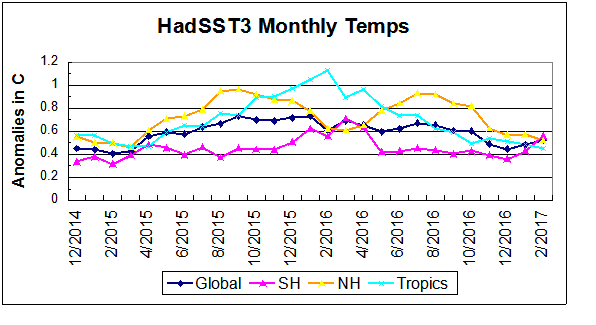
The chart below shows the last two years of SST monthly anomalies as reported in HadSST3, along with the first two months of 2017.

Note that higher temps in 2015 and 2016 are first of all due to a sharp rise in Tropical SST, beginning in March 2015, peaking in February 2016, and steadily declining back to its beginning level. Secondly, the Northern Hemisphere added two bumps on the shoulders of Tropical warming, with peaks in August of each year. Also, note that the global release of heat was not dramatic, due to the Southern Hemisphere offsetting the Northern one.

Finally, the oceans are starting 2017 only slightly lower than a year ago, but this year with much cooler Tropics.  Notice that both the Tropics and also the Northern Hemisphere continue to cool.  The Global average warmed slightly, pulled upward by the Southern Hemisphere which reaches its summer peak at this time.

March may repeat 2016 when NH bottomed and SH peaked, or maybe both will rise or both will drop.  In the latter case, perhaps we will see the long-awaited La Nina.

H/T to Global Warming Policy Forum for adding this informative graphic:
|floatcyclescaled

Much ado has been made of this warming, including claims of human causation, despite the obvious oceanic origin. However, it is unreasonable to claim CO2 functions as a global warming agent, yet the two hemispheres respond so differently.  Moreover, CO2 warming theory expects greater warming in the higher latitudes, while this event was driven by heating in the Tropics, contradicting alarmist warming theory.

Solar energy accumulates massively in the ocean and is variably released during circulation events.


Skeptical Journalist Spotted, Species Feared Extinct

Just spotted this article:

A Skeptic’s View on Climate Models
By Ross Pomeroy January 23, 2017 in Real Clear Science

I like to think that I’m a good skeptic. I’ve read every word of Carl Sagan’s timeless Demon Haunted World. I almost always ask for evidence. I employ the scientific method to guide my actions. I try to think critically. I’m willing to admit when “I don’t know”. I question bold and crazy claims. And most importantly, I try not to let my ideology sway which claims I question. That’s why, as a skeptic, and as a firm advocate of science, I simply cannot accept the following claims without some level of incredulity:

“The next few decades offer a brief window of opportunity to minimize large-scale and potentially catastrophic climate change that will extend longer than the entire history of human civilization thus far.”

“The forest as we know it would effectively be gone.”

“We will have very few humans on the planet because of lack of habitat.”

Each of the preceding statements are bold, apocalyptic claims concerning climate change, and there are many more like them littered across the Internet. But just because they are widespread and originate from respectable, legitimate scientists, that does not mean I can simply switch off my skepticism. I must subject these claims to the same scrutiny that I would acupuncture, chiropractic, or demons. And when I do, I can only conclude that most claims of catastrophic, apocalyptic climate change are bogus.

But when it comes to portending doom and gloom, the tools scientists use — namely atmosphere and oceanic general circulation models — are woefully insufficient to render specific predictions about the future. The Earth is big, with so many moving parts it would make your head spin. Modeling its climate is a monumental task, and frankly, it’s impossible to do so with complete and total accuracy. Climate scientists try their best, taking into account variables such as cloud cover, albedo, water movement, radiation, and surface pressure. Unfortunately, as climate scientists alter their models to take into account more variables, some of which are poorly understood or difficult to measure, they introduce more sources of uncertainty.

To see if their models work, climatologists validate them against past data, figuring that if they match the past, they can predict the future. But there probably has never been a situation in the history of our planet where carbon dioxide has been the primary culprit of climate change. In other situations (most commonly volcanic eruptions) numerous other greenhouse gases also greatly increased the rate of heating. It’s really hard to build a model for a situation for which there is little historical precedent.

What does all of this mean? It means that anyone who says they know that climate change will result in (insert apocalyptic scenario here) is not making claims based on solid evidence.

Summary

The whole article is worth a read. He comes out at the end a lukewarmist while skeptical of climate models and dismissive of alarmist claims.


Steven “Ross” Pomeroy is Chief Editor of RealClearScience. A zoologist and conservation biologist by training, Ross has nurtured a passion for journalism and writing his entire life. Ross weaves his insatiable curiosity and passion for science into regular posts and articles on RealClearScience’s Newton Blog. Additionally, his work has appeared in Science Now and Scientific American.

For more on how climate models work see Climate Models Explained, an extended comment by Dr. R.G. Brown of Duke University.


Honey, I Shrunk the Arctic Ice! Not.

Image is from Honey, I Shrunk the Kids, a 1989 American science fiction family film produced by Walt Disney Pictures.

The notion that man-made global warming causes Arctic ice to melt took a major hit with a recent publication.  The article is Influence of high-latitude atmospheric circulation changes on summertime Arctic sea ice by Qinghua Ding, Axel Schweiger, Michelle L’Heureux, David S. Battisti, Stephen Po-Chedley, Nathaniel C. Johnson, Eduardo Blanchard-Wrigglesworth, Kirstin Harnos, Qin Zhang, Ryan Eastman & Eric J. Steig.  (Warning: Reliability of published papers diminishes as numbers of co-authors increases.)

The paper was published online by Nature Climate Change on 13 March 2017. It is behind a paywall, but the reactions to it are revealing.  The abstract says:

The Arctic has seen rapid sea-ice decline in the past three decades, whilst warming at about twice the global average rate. Yet the relationship between Arctic warming and sea-ice loss is not well understood. Here, we present evidence that trends in summertime atmospheric circulation may have contributed as much as 60% to the September sea-ice extent decline since 1979. A tendency towards a stronger anticyclonic circulation over Greenland and the Arctic Ocean with a barotropic structure in the troposphere increased the downwelling longwave radiation above the ice by warming and moistening the lower troposphere. Model experiments, with reanalysis data constraining atmospheric circulation, replicate the observed thermodynamic response and indicate that the near-surface changes are dominated by circulation changes rather than feedbacks from the changing sea-ice cover. Internal variability dominates the Arctic summer circulation trend and may be responsible for about 30–50% of the overall decline in September sea ice since 1979. (my bolds)

Announcements of the finding were welcomed by skeptics and lukewarmists as an indication that climatologists were taking off their CO2 blinders and at last admitting to natural forces internal to the climate system.  Some responses were:

Arctic Ice Loss Driven by Natural Swings

Arctic ice loss driven by natural swings, not just mankind

Study in journal Nature: HALF of Arctic ice loss driven by natural swings — not ‘global warming’

Arctic Ice Alarmists are finding themselves skating on thin ice, as evidenced by their articles attempting to control the damage.  Some of these titles are:

We Deserve Half the Blame for Declining Arctic Sea Ice (Discover)

Humans to blame for bulk of Arctic sea ice loss: study (Phys.org)

Human activity is driving retreat of Arctic sea ice (from the misnamed Skeptical Science blog)

Why Alarmists are Twisting in the Wind

The full paper is behind a paywall, but we have description of the method and content by the lead author in an article at Popular Science Up to half of the Arctic’s melt might be totally natural–But climate change is still responsible for the rest.  He begins with his profession of faith:

“Anthropogenic forcing is still dominant — it’s still the key player,” said first author Qinghua Ding, a climate scientist at the University of California Santa Barbara. . .”But we found that natural variability has helped to accelerate this melting, especially over the past 20 years.”  A colleague adds:  “The results of Ding et al. do not call into question whether human-induced warming has led to Arctic sea-ice decline – a wide range of evidence shows that it has”.

This is the shibboleth demanded from any and all scientists who do not wish to be called “deniers” and cast into the outer darkness.

Note: A shibboleth is an old belief or saying that is repetitively cited but untrue.  This meaning evolved from its earlier significance as a word or custom whose variations in pronunciation or style are used to distinguish members of ingroups from those of outgroups, with an implicit value judgment based on familiarity with the shibboleth.(Wikipedia)


“The tribe has spoken.  Time for you to go!”

What Ding et al. Studied

Ding goes on to describe the nature of their analysis. (From Popular Science)

“There is a mismatch between the model’s output and the observation,” said lead author Qinghua Ding, a professor in the Geography Department at the University of California Santa Barbara. “Observation shows very fast, very abrupt sea ice melting, whereas the climate model cannot capture the fast melting.”

To understand why, Ding and his team focused on the connection between September sea-ice extent (or how much of the Arctic sea had at least 15 percent sea ice) and the preceding summer’s (June-August) atmospheric circulation. Ding knew from earlier work that tropical circulation can affect seasonal variability of sea ice in the Arctic.

“In the model we turned off all CO2 forcing,” said Ding, or all climate changes that were “forced” by the addition of carbon dioxide into the atmosphere. “And we still got some sea ice melting, that was very similar to the observation.”

“If the circulation changes are caused by anthropogenic greenhouse warming (or other human or natural external forcings such as ozone depletion, aerosol emissions, or solar activity) this pattern of atmospheric change should emerge as a clear signature when averaging together many climate model simulations of this period,” Neil Swart, a Research Scientist with Environment and Climate Change Canada who wasn’t involved in the new study, wrote in an accompanying article.

But when Ding averaged the climate models together, the air circulation changes cancelled each other out—like a balanced equation. They only data that remained in the models was responding to external forcings, like greenhouse gas emissions. In other words, Ding found that between 30-50 percent of the arctic melting is due to these unforced, or non-climate change caused variations—and that with this factored in, the climate models were generally accurate. The increased rapidity of Arctic melting was due to natural variations outside of the scope of the climate change models.

What Can Be Learned from Ding et al.

First note that they are climate modelers studying the behavior of models when parameters are manipulated.  It is encouraging that they notice the incompleteness of their models leads to discrepancies from reality.  This is a step in the right direction.

Second, note that the CO2 forcing is actually their term for all external forcings, including solar, aerosols etc.  They seem to be blind to oceanic multi-decadal and multi-centennial oscillations.  They make a leap of faith when they attribute every factor outside of atmospheric circulation to CO2.

Others more comprehensive in their research have concluded that fluctuations in the ocean water structure drive both ice extent changes and atmospheric circulations. See Arctic Sea Ice: Self-Oscillating System featuring the work of V. F. Zakharov and others at the Arctic and Antarctic Research Institute in St. Petersburg.

Summary

Some climate modelers are undermining core beliefs even while using a flawed methodology based on studying models rather than nature itself. Alarmists are forced into scrambling to continue blaming humans for declining Arctic Sea Ice. When the effects of oceanic circulations are added to atmospheric effects, there is little influence left for CO2.

Spinning the papers to keep the narrative alive.

Footnote:

The abstract mentions downwelling longwave radiation, a theoretical effect that in practice is overwhelmed by massive heat transfers upward into space.

In the Arctic (and also at the South Pole), the air is in direct contact with an infinite heat sink: outer space. The tropopause (where radiative loss upward is optimized) is only 7 km above the surface at the poles in winter, compared to 20 km at the equator. There is no door to open or close; the air is constantly convecting any and all energy away from the surface for radiation into space.

Instead of an open door, Arctic ice melts when the sun climbs over the horizon. Both the water and air are warmed, and the ice cover retreats until sundown in Autumn.

Most people fail to appreciate the huge heat losses at the Arctic pole. Mark Brandon has an excellent post on this at his wonderful blog, Mallemaroking.

By his calculations the sensible heat loss in Arctic winter ranges 200-400 Wm2.

The annual cycle of sensible heat flux from the ocean to the atmosphere for 4 different wind speeds

As the diagram clearly shows, except for a short time in high summer, the energy flow is from the water heating the air.

“Then the heat loss over the 2×10^9 m2 of open water in that image is a massive 600 GW – yes that is Giga Watts – 600 x 10^9 Watts.

If you want to be really inappropriate then in 2 hours, that part of the ocean lost more energy than it takes to run the London Underground for one year.

Remember that is just one component and not the full heat budget – which is partially why it is inappropriate. For the full budget we have to include latent heat flux, long wave radiation, short wave radiation, energy changes through state changes when ice grows and decays, and so on. Also large heat fluxes lead to rapid sea ice growth which then insulates the ocean from further heat loss.”


The Weathermen vs. EPA’s Scott Pruitt

This week the AMS (American Meteorological Society) sent a letter chastising Scott Pruitt for keeping an open mind on the question of man-made global warming/climate change. The letter (here) referred to the AMS institutional statement on the matter, and summarized their position in this paragraph:

In reality, the world’s seven billion people are causing climate to change and our emissions of carbon dioxide and other greenhouse gases are the primary cause. This is a conclusion based on the comprehensive assessment of scientific evidence. It is based on multiple independent lines of evidence that have been affirmed by thousands of independent scientists and numerous scientific institutions around the world. We are not familiar with any scientific institution with relevant subject matter expertise that has reached a different conclusion.

Background on AMS and Climate Science

Firstly, not all the weathermen are contrary to EPA Chief Scott Pruitt.  The statement announced in 2012 can only be seen as a Council Statement resulting from a process initiated and controlled by AMS council.

The Council puts out a call for volunteers for the writing teams, and approves the make-up of those teams. A Council member serves as a liaison to the team. The writing team’s initial draft is put out to the entire membership for a comment period. The writing team responds to those comments and executes a redraft. The Council, meeting in person or in teleconference, may make final edits before voting to approve or disapprove the statements.  With some over-simplification the process is driven by the AMS Council; the resulting products are Council statements.

Secondly, a subsequent survey showed that the views expressed by the AMS Council have mixed support among AMS members. Respondents numbered 1827 and 52% said “Yes, Most of the warming since 1850 is due to humans.” The other responses included: Insufficient Evidence, Equally Human and Natural, Not Sure It is Happening, and Mostly Natural (in order of frequency). Clearly almost half of the membership sample do not agree with the IPCC position endorsed by AMS Council.

A more recent 2016 survey got a higher number of agreeable members (67%), but it is still the case that 47% of 4092 members contacted did not respond to the questionnaire.

Further, these surveys are now being conducted in the context of the Council already committing the society prior to seeking the views of members. Finally, the whole exercise demonstrates that global warming/climate change is clearly a matter of opinion, not knowledge.

Of course, the questionnaires are superficial and geared to produce a “consensus” support for policy action and for project funding. In depth surveys show much more the complexity of the issues and range of opinions.

Climate Etc. Has several posts going into the details of the AMS maneuvers.

AMS Statement on Climate Change

The 52% Consensus

New AMS Survey on Climate Change

For another assessment including a comment and references by Roger Pielke Sr. See:
AMS Letter to Pruitt,How Ideologues Abuse Power in Professional Associations

Spreading Climatephobia


Depression, anxiety, PTSD: The mental impact of climate change is an article from CNN (“All the Fear All the Time”). It starts with a compelling human interest story about a woman suffering emotional problems due to flooding of her home in Shropshire UK.

Two years later, not long after work was completed on their rural home, they got a sign of what it really meant to live in their new village: It was prone to flooding.

They were almost struck by the extreme weather seen in the UK in 2014, which saw major storms hit the country at levels not seen in the country for over 20 years.

The family of four lived in a recreational vehicle on the surrounding farmland for more than a year after the flood, while they dealt with insurers and builders who would eventually restore their home.

Their finances were hit hard, and daily life was a challenge. “All that we had worked for was completely destroyed,” Shepherd said.

According to Shepherd, her village was also flooded in 2001, 2002, 2003 and 2005, though her house was not directly affected in those years. She also now has a flood plan that outlines everything she needs to do if this were to happen again.

“One of the major health effects of flooding seems to be the mental health aspects,” said James Rubin, a psychologist at Kings College London whose recent research looked into the psychological impact of people both directly and indirectly effected by floods. “There are a whole host of stressors around it,” he said.

These types of natural disasters are expected to rise in frequency due to climate change, and Rubin feels that the mental health aspect deserves more attention.  “Preventing (climate change) from happening, from worsening and intervening is really important,” he said.

Climate change is predicted to bring more than just floods: There could be heat waves, sea level rises causing loss of land, and forced migration and droughts affecting agriculture and the farmers producing it. And with these concerns comes a plethora of issues plaguing the human mind, such as depression, worry, anxiety, substance abuse, aggression and even suicide among those who cannot cope.

Climate Activists/Alarmists  Are to Blame for Climatephobia

In their push for “saving the planet” they strive to portray nature in the role of the Big Bad Wolf, who scared the three little pigs by threatening to “Huff and Puff and Blow Your House Down.” Of course in the fable, the adaptive solution was to build a brick house not on a flood plane.

The false claims of future bad weather due to human activity do cause people to be anxious beyond reason.  Natural disasters have always done damage and required efforts to recover. What is new is the added doomsday predictions without a shred of evidence.

Droughts and Floods are not showing any particular trend: Data vs. Models; Droughts and Floods

This is your brain on climate alarm.

Climatephobia is addictive. Just say No!

Footnote: The post Climate Medicine describes the larger effort by medical scientists to cash in on climate funding.

The Limitations of Climate Science

1viw84

Here is a fine exposition of Bob Carter’s thoughts on the field of climate science and why we should not jump to conclusions concerning global warming/climate change.  The text and some illustrations are provided by Russ Swan in his post (here).  I added one at the end.

Have you ever wondered about these people when they are so definite about mankind causing climate change? Have you ever wondered how much of the information is from their own expertise and how much is what they’ve learned from someone else? Are they really passing on real proven scientific facts or just what they believe to be true from information provided by someone else?

Or do you just accept what they are telling you?

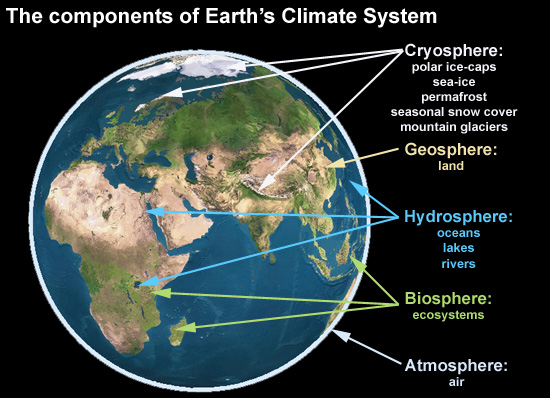
The average person on the street might be forgiven for thinking that climate change scientists are primarily meteorologists or climatologists plus perhaps some others with supporting expertise.  But that would be only partially right.

The subjects relating to climate change actually diverge into more than 100 scientific sub-disciplines, the elements of which can be exceptionally intricate, highly complicated and intertwined.  Just changing one of the many data inputs e.g. the output chemistry of sub-sea volcanoes to a climate change puzzle can flow-on to incorrect or at least misleading changes in the final solution. And the answer will still be a “best probable” result – not fact.

At most there may be a handful of scientists that have mastery of two or three scientific disciplines such as Professor Robert M. Carter (decd) who was a qualified palaeontogist, stratigrapher and marine geologist.  Yet even if a scientist does have expertise in two or more of the climate change elements, he/she still needs to find and use data from other sources to cover the gaps in his/her own knowledge. Such data may in turn only be a “best probable” solution as opposed to fact(s) as will be explained further below.

climate-components

No Such Thing as a Climate Expert

It must therefore be obvious that there can be no such thing as an “expert” simply because no one can fully comprehend the entirety of it all.

This doesn’t stop the media, in particular the TV media in regularly presenting interviewees as experts to lend credibility to their show. But anyone who claims or admits to being an expert in climate change is either kidding themselves, egocentric or is being deceitful.

The bottom line is that when a supposed expert fronts up in the media – watch it guardedly or else switch the channel.   At the end of the day everyone, including the scientists themselves are basically amateurs when a topic is outside their own field of expertise – even if they are an educated amateur.

But having someone with at least some scientific background involved in climate change discussions has got to be far more preferable than pulling celebrities into the debate. These people despite their best intentions, are simply promoting their own views and muddying the waters for the public to make a realistic conclusion in their own minds.

042-decaprio-300x298

Conclusion

Apart from that all three groups of scientists generally DO agree that the Earth’s climate has always changed, that human emissions affect local climates e.g. urban areas and have a summed potential to affect climate globally, and that carbon dioxide is a mild greenhouse house – note the word “mild”.

The real argument then is not about whether the Earth is heating up, but about how relevant is AGW when considered against natural climate change processes.

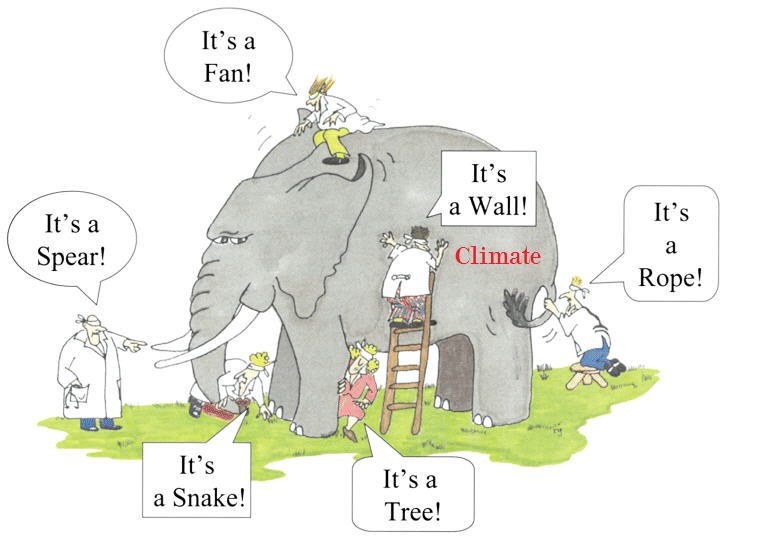
The Blind Men and the Elephant (Indian Fable)

Elephant2

Footnote:  For more on science as knowledge rather than opinion see Yellow Climate Journalism


Arctic Ice High Jump

For ice extent in the Arctic, the bar is set at 15M km2. The average in the last 11 years occurs on day 73 at 15.07M before descending. Most years are able to clear 15M, except for 2006, 2007 and 2015 who topped out below that height.

Yesterday, March 2, 2016 cleared 15M, but will not reach that level again. 2016 will now drop down to 14.6M, rise to day 84 average of 14.9M, then start the descent into spring and summer. Typically, Arctic ice extent loses 67 to 70% of the March maximum by mid September, before recovering the ice in building toward the next March.

arctic-ice-2017061

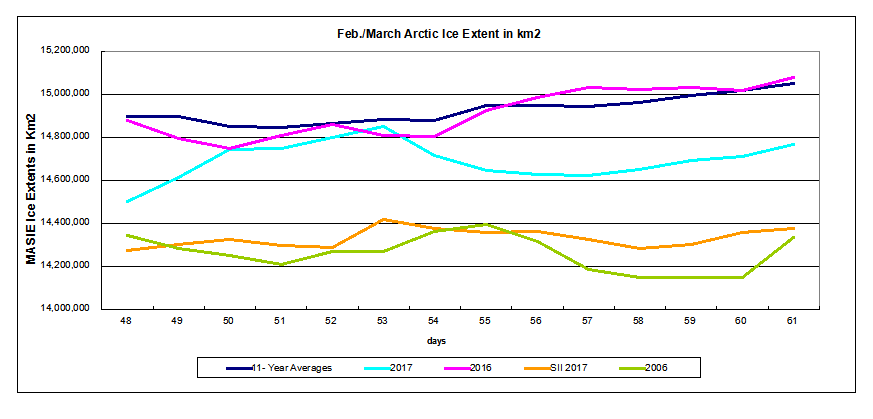
As reported previously, 2017 rose to the average in February, then lost extent for two days and is now increasing again.  The next two weeks will be interesting. The average year in the last eleven gained about 20k km2 from now to mid March. But the variability ranged from 2015 losing 350K while 2010 gained 300k km2. What will the ice do this year?  Where will 2017 rank in the annual Arctic Ice High Jump competition?

Drift ice in Okhotsk Sea at sunrise.

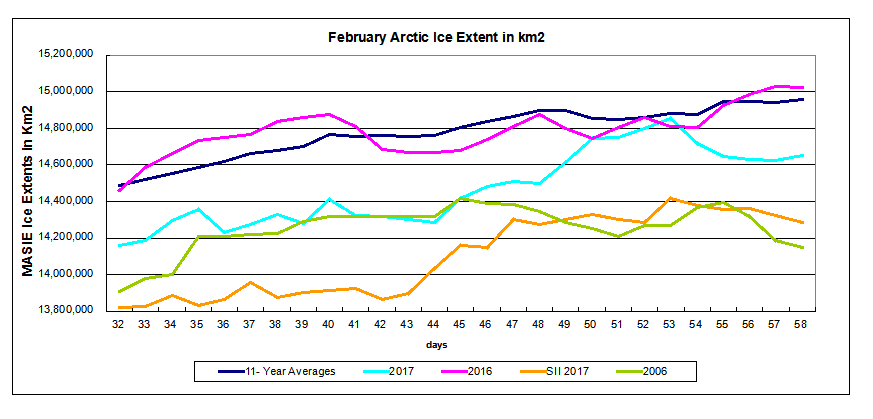
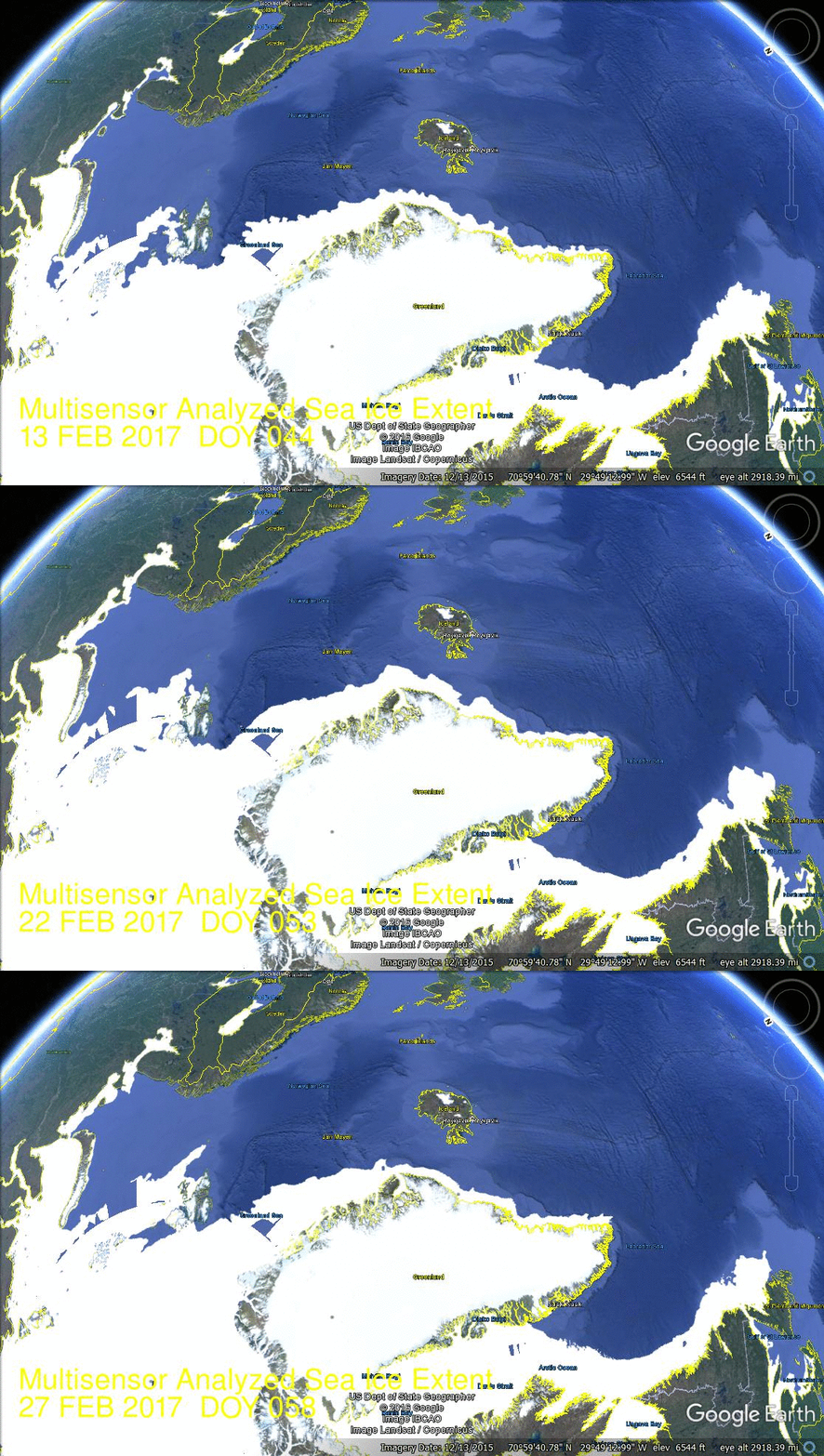
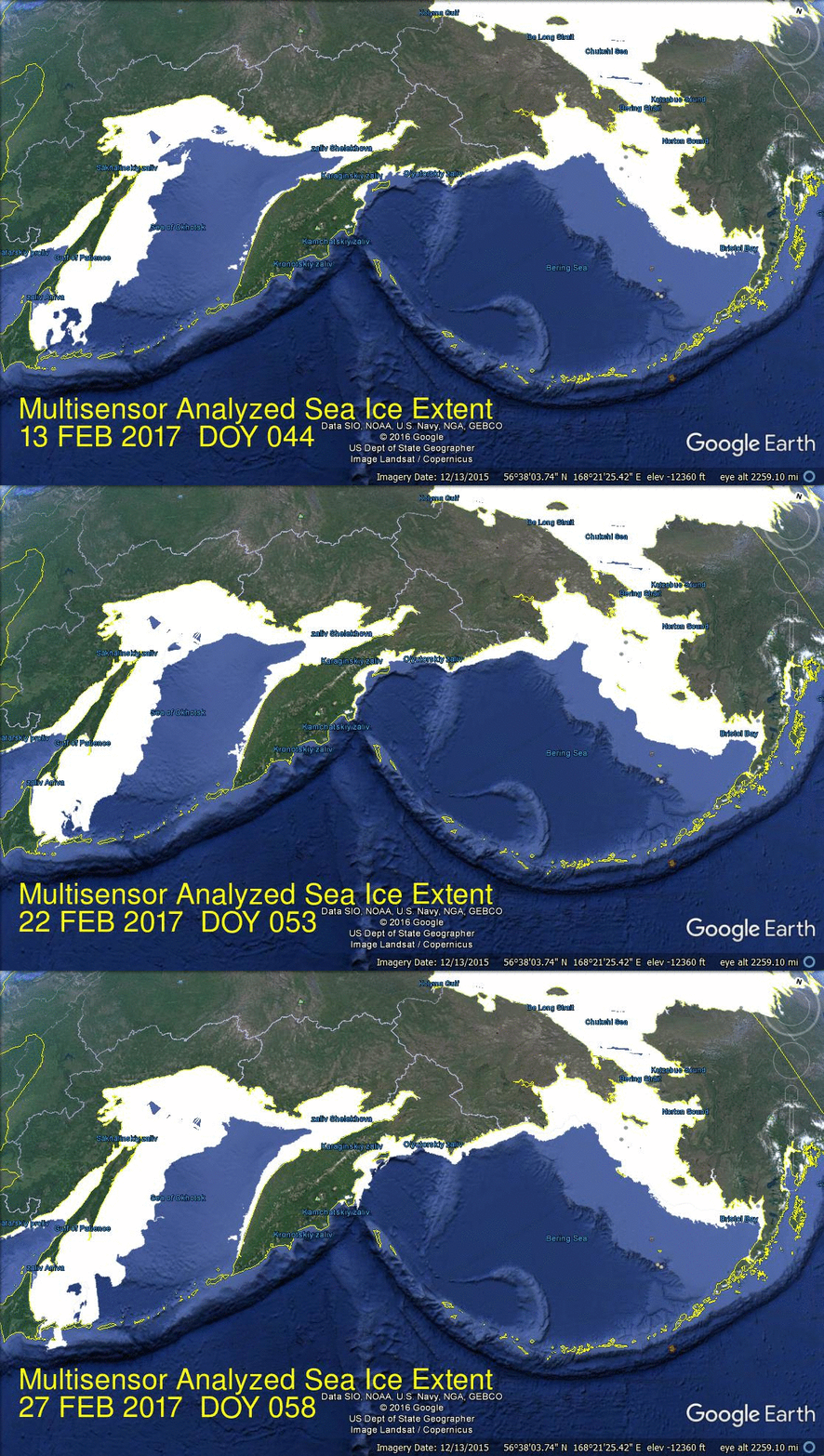
As reported previously, Arctic ice extents are solid in most seas, but continue to fluctuate at the margins. In the latter part of February 2017 there was a great leap upward for nine days, nearly reaching average and surpassing 2016, before falling back after day 53. The surplus over 2006 is now 500k km2. SII reports about 360k km2 less extent than MASIE.

arctic-ice-2017058

The Atlantic upward leap and back in Barents and Baffin.

output_fxzrvq

Note both Barents and Baffin pulled back slightly.

The Pacific shifting up and down in Bering and Okhotsk.

output_xhr2x3Note that Okhotsk continued to gain while Bering pulled back since day 53.

While the seesaws are tilting back and forth on the margins, the bulk of the Arctic is frozen solid. And with limited places where more extent can be added, the pace of overall growth has slowed.

The table below shows ice extents in the seas comprising the Arctic, comparing 2017 day 058 with the same day average over the last 11 years and with 2006.

Region 2017058 Day 058
Average
2017-Ave. 2006058 2017-2006
 (0) Northern_Hemisphere 14652502 14960594 -308093 14148072 504430
 (1) Beaufort_Sea 1070445 1070111 334 1069711 734
 (2) Chukchi_Sea 966006 965342 664 961796 4210
 (3) East_Siberian_Sea 1087137 1087095 43 1086702 435
 (4) Laptev_Sea 897845 897835 10 897773 71
 (5) Kara_Sea 933720 927244 6476 899871 33849
 (6) Barents_Sea 550872 612576 -61704 466622 84251
 (7) Greenland_Sea 595616 638641 -43025 575532 20084
 (8) Baffin_Bay_Gulf_of_St._Lawrence 1496540 1472634 23906 1290424 206116
 (9) Canadian_Archipelago 853214 852984 230 852715 499
 (10) Hudson_Bay 1260903 1260333 571 1257077 3827
 (11) Central_Arctic 3218090 3221265 -3176 3181409 36681
 (12) Bering_Sea 547532 742754 -195222 549141 -1609
 (13) Baltic_Sea 70844 117633 -46789 111391 -40547
 (14) Sea_of_Okhotsk 1048295 1043395 4900 877854 170441
 (15) Yellow_Sea 1420 13921 -12501 8431 -7011
 (16) Cook_Inlet 9940 9665 275 4686 5254

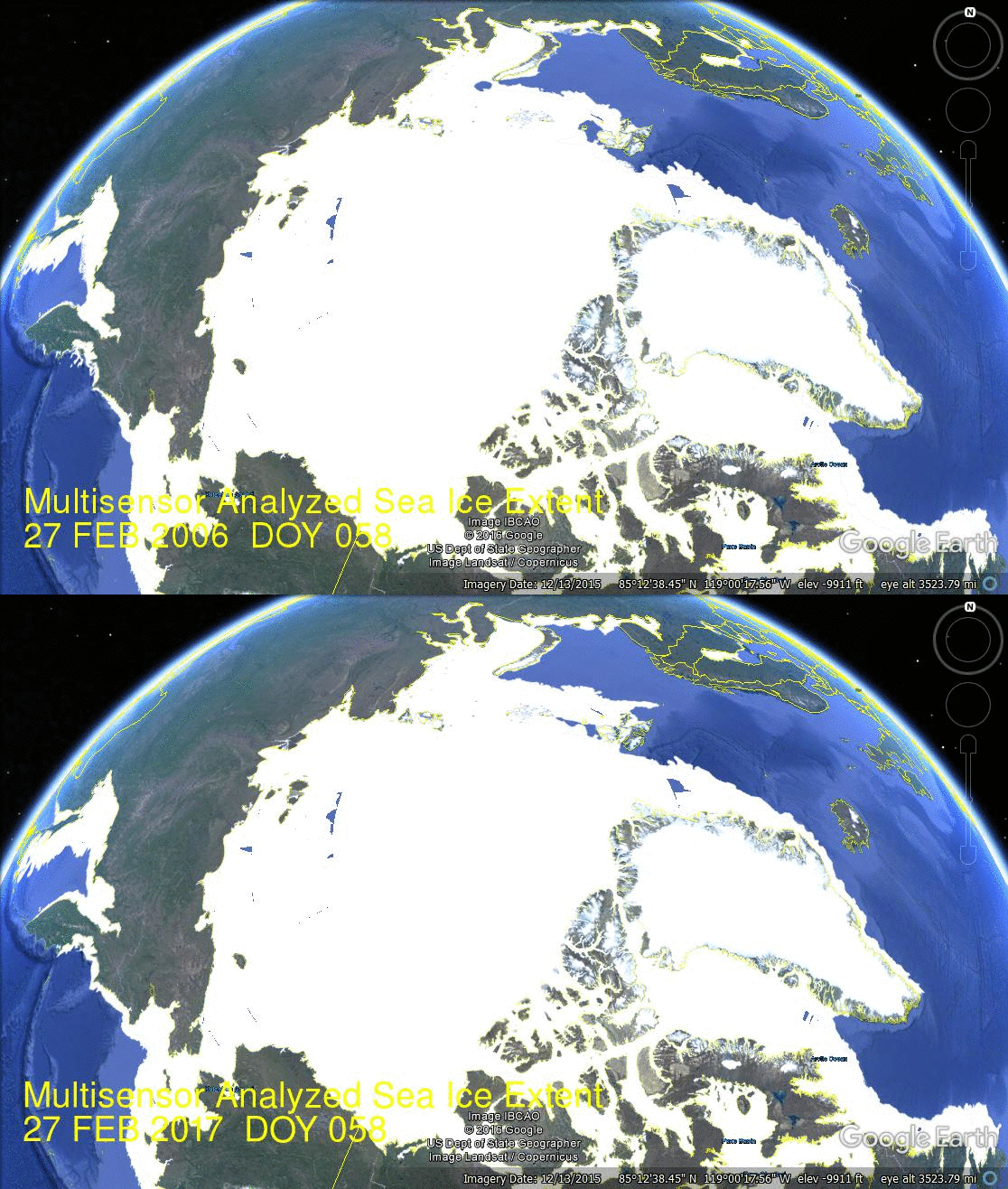
The table shows that 2017 ice extent exceeds 2006 by about 500k km2 at this date. Surpluses are sizeable in Barents, Baffin and Okhotsk, with only the Baltic showing a deficit.  Baffin and Okhotsk are now average, and the 300k km2 deficit to average comes from Bering in the Pacific, and Barents and Greenland Seas on the Atlantic side

The big picture compares this day in 2017 with 2006.  Not much change overall, but a slight increase of 500k km2.

output_4fhczm


Arctic Ice Cresting at Feb. End

Drift ice in Okhotsk Sea at sunrise.

As reported previously, Arctic ice extents are solid in most seas, but continue to fluctuate at the margins. In the latter part of February 2017 there was a great leap upward for nine days, nearly reaching average and surpassing 2016, before falling back after day 53. The surplus over 2006 is now 500k km2. SII reports about 360k km2 less extent than MASIE.

arctic-ice-2017058

The Atlantic upward leap and back in Barents and Baffin.

output_fxzrvq

Note both Barents and Baffin pulled back slightly.

The Pacific shifting up and down in Bering and Okhotsk.

output_xhr2x3Note that Okhotsk continued to gain while Bering pulled back since day 53.

While the seesaws are tilting back and forth on the margins, the bulk of the Arctic is frozen solid. And with limited places where more extent can be added, the pace of overall growth has slowed.

The table below shows ice extents in the seas comprising the Arctic, comparing 2017 day 058 with the same day average over the last 11 years and with 2006.

Region 2017058 Day 058
Average
2017-Ave. 2006058 2017-2006
 (0) Northern_Hemisphere 14652502 14960594 -308093 14148072 504430
 (1) Beaufort_Sea 1070445 1070111 334 1069711 734
 (2) Chukchi_Sea 966006 965342 664 961796 4210
 (3) East_Siberian_Sea 1087137 1087095 43 1086702 435
 (4) Laptev_Sea 897845 897835 10 897773 71
 (5) Kara_Sea 933720 927244 6476 899871 33849
 (6) Barents_Sea 550872 612576 -61704 466622 84251
 (7) Greenland_Sea 595616 638641 -43025 575532 20084
 (8) Baffin_Bay_Gulf_of_St._Lawrence 1496540 1472634 23906 1290424 206116
 (9) Canadian_Archipelago 853214 852984 230 852715 499
 (10) Hudson_Bay 1260903 1260333 571 1257077 3827
 (11) Central_Arctic 3218090 3221265 -3176 3181409 36681
 (12) Bering_Sea 547532 742754 -195222 549141 -1609
 (13) Baltic_Sea 70844 117633 -46789 111391 -40547
 (14) Sea_of_Okhotsk 1048295 1043395 4900 877854 170441
 (15) Yellow_Sea 1420 13921 -12501 8431 -7011
 (16) Cook_Inlet 9940 9665 275 4686 5254

The table shows that 2017 ice extent exceeds 2006 by about 500k km2 at this date. Surpluses are sizeable in Barents, Baffin and Okhotsk, with only the Baltic showing a deficit.  Baffin and Okhotsk are now average, and the 300k km2 deficit to average comes from Bering in the Pacific, and Barents and Greenland Seas on the Atlantic side

The next two weeks will be interesting. The average year in the last eleven gained about 100k km2 from now to mid March. But the variability ranged from 2015 losing 300K while other years gained 400k km2. What will the ice do this year?

The big picture compares this day in 2017 with 2006.  Not much change overall, but a slight increase of 500k km2.

output_4fhczm

Reservoirs and Methane: Facts and Fears


A previous post explained how methane has been hyped in support of climate alarmism/activism. Now we have an additional campaign to disparage hydropower because of methane emissions from dam reservoirs. File this under “They have no shame.”

Here’s a recent example of the claim from Asia Times Global hydropower boom will add to climate change

The study, published in BioScience, looked at the carbon dioxide (CO2), methane (CH4), and nitrous oxide (N2O) emitted from 267 reservoirs across six continents. In total, the reservoirs studied have a surface area of more than 77,287 square kilometers (29,841 square miles). That’s equivalent to about a quarter of the surface area of all reservoirs in the world, which together cover 305,723 sq km – roughly the combined size of the United Kingdom and Ireland.

“The new study confirms that reservoirs are major emitters of methane, a particularly aggressive greenhouse gas,” said Kate Horner, Executive Director of International Rivers, adding that hydropower dams “can no longer be considered a clean and green source of electricity.”

In fact, methane’s effect is 86 times greater than that of CO2 when considered on this two-decade timescale. Importantly, the study found that methane is responsible for 90% of the global warming impact of reservoir emissions over 20 years.

Alarmists are Wrong about Hydropower

Now CH4 is proclaimed the primary culprit held against hydropower. As usual, there is a kernel of truth buried beneath this obsessive campaign: Flooding of biomass does result in decomposition accompanied by some release of CH4 and CO2. From HydroQuebec:  Greenhouse gas emissions and reservoirs

Impoundment of hydroelectric reservoirs induces decomposition of a small fraction of the flooded biomass (forests, peatlands and other soil types) and an increase in the aquatic wildlife and vegetation in the reservoir.

The result is higher greenhouse gas (GHG) emissions after impoundment, mainly CO2 (carbon dioxide) and a small amount of CH4 (methane).

However, these emissions are temporary and peak two to four years after the reservoir is filled.

During the ensuing decade, CO2 emissions gradually diminish and return to the levels given off by neighboring lakes and rivers.

Hydropower generation, on average, emits 50 times less GHGs than a natural gas generating station and about 70 times less than a coal-fired generating station.

The Facts about Tropical Reservoirs

Activists estimate Methane emissions from dams and reservoirs across the planet, including hydropower, are estimated to be significantly larger than previously thought, approximately equal to 1 gigaton per year.

Activists also claim that dams in boreal regions like Quebec are not the problem, but tropical reservoirs are a big threat to the climate. Contradicting that is an intensive study of Brazilian dams and reservoirs, Greenhouse Gas Emissions from Reservoirs: Studying the Issue in Brazil
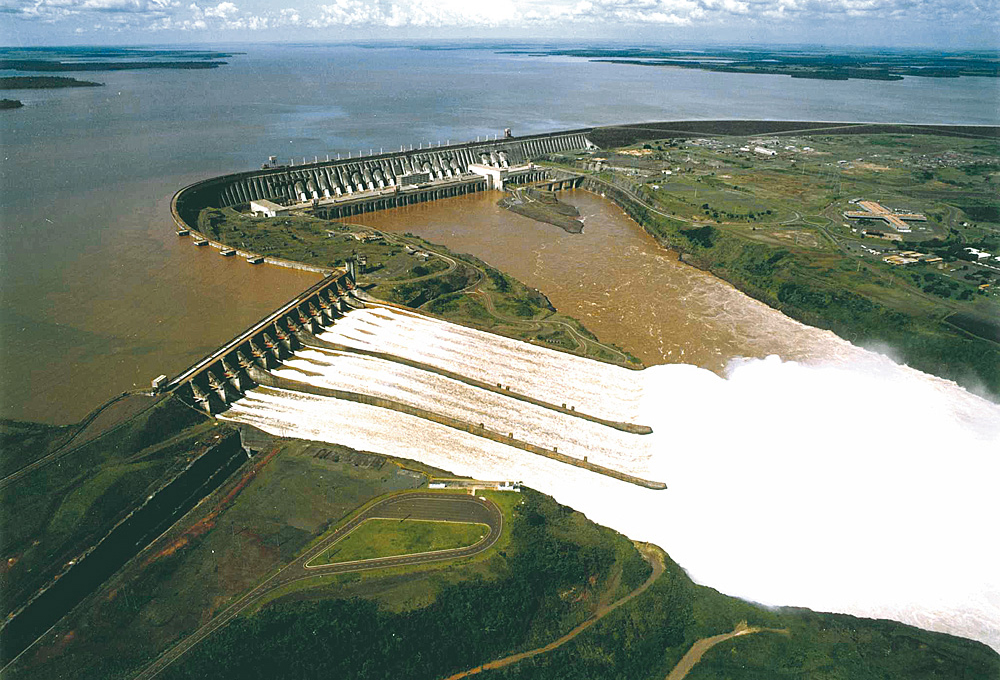
The Itaipu Dam is a hydroelectric dam on the Paraná River located on the border between Brazil and Paraguay. The name “Itaipu” was taken from an isle that existed near the construction site. In the Guarani language, Itaipu means “the sound of a stone”. The American composer Philip Glass has also written a symphonic cantata named Itaipu, in honour of the structure.

Five Conclusions from Studying Brazilian Reservoirs

1) The budget approach is essential for a proper grasp of the processes going on in reservoirs. This approach involves taking into account the ways in which the system exchanged GHGs with the atmosphere before the reservoir was flooded. Older studies measured only the emissions of GHG from the reservoir surface or, more recently, from downstream de-gassing. But without the measurement of the inputs of carbon to the system, no conclusions can be drawn from surface measurements alone.

2) When you consider the total budgets, most reservoirs acted as sinks of carbon in the short run (our measurements covered one year in each reservoir). In other words, they received more carbon than they exported to the atmosphere and to downstream.

3) Smaller reservoirs are more efficient as carbon traps than the larger ones.

4) As for the GHG impact, in order to determine it, we should add the methane (CH4) emissions to the fraction of carbon dioxide (CO2) emissions which comes from the flooded biomass and organic carbon in the flooded (terrestrial) soil. The other CO2 emissions, arising from the respiration of aquatic organisms or from the decomposition of terrestrial detritus that flows into the reservoir (including domestic sewage), are not impacts of the reservoir. From this sum, we should deduct the amount of carbon that is stored in the sediment and which will be kept there for at least the life of the reservoir (usually more than 80 years). This “stored carbon” ranges from as little as 2 percent of the total carbon output to more than 25 percent, depending on the reservoirs.

5) When we assess the GHG impacts following the guidelines just described, all of FURNAS’s reservoirs have lower emissions than the cleanest European oil plant. The worst case – Manso, which was sampled only three years after the impoundment, and therefore in a time in which the contribution from the flooded biomass was still very significant – emitted about half as much carbon dioxide equivalents (CO2 eq) as the average oil plant from the United States (CO2 eq is a metric measure used to compare the emissions from various greenhouse gases based upon their global warming potential, GWP. CO2 eq for a gas is derived by multiplying the tons of the gas by the associated GWP.) We also observed a very good correlation between GHG emissions and the age of the reservoirs. The reservoirs older than 30 years had negligible emissions, and some of them had a net absorption of CO2eq.

Keeping Methane in Perspective

Over the last 30 years, CH4 in the atmosphere increased from 1.6 ppm to 1.8 ppm, compared to CO2, presently at 400 ppm. So all the dam building over 3 decades, along with all other land use was part of a miniscule increase of a microscopic gas, 200 times smaller than the trace gas, CO2.


Background Facts on Methane and Climate Change

The US Senate is considering an act to repeal with prejudice an Obama anti-methane regulation. The story from activist source Climate Central is
Senate Mulls ‘Kill Switch’ for Obama Methane Rule

The U.S. Senate is expected to vote soon on whether to use the Congressional Review Act to kill an Obama administration climate regulation that cuts methane emissions from oil and gas wells on federal land. The rule was designed to reduce oil and gas wells’ contribution to climate change and to stop energy companies from wasting natural gas.

The Congressional Review Act is rarely invoked. It was used this month to reverse a regulation for the first time in 16 years and it’s a particularly lethal way to kill a regulation as it would take an act of Congress to approve a similar regulation. Federal agencies cannot propose similar regulations on their own.

The Claim Against Methane

Now some Republican senators are hesitant to take this step because of claims like this one in the article:

Methane is 86 times more potent as a greenhouse gas than carbon dioxide over a period of 20 years and is a significant contributor to climate change. It warms the climate much more than other greenhouse gases over a period of decades before eventually losing its potency. Atmospheric carbon dioxide remains a potent greenhouse gas for thousands of years.

Essentially the journalist is saying: As afraid as you are about CO2, you should be 86 times more afraid of methane. Which also means, if CO2 is not a warming problem, your fear of methane is 86 times zero. The thousands of years claim is also bogus, but that is beside the point of this post, which is Methane.

IPCC Methane Scare

The article helpfully provides a link referring to Chapter 8 of IPCC AR5 report by Working Group 1 Anthropogenic and Natural Radiative Forcing.

The document is full of sophistry and creative accounting in order to produce as scary a number as possible. Table 8.7 provides the number for CH4 potency of 86 times that of CO2.  They note they were able to increase the Global Warming Potential (GWP) of CH4 by 20% over the estimate in AR4. The increase comes from adding in more indirect effects and feedbacks, as well as from increased concentration in the atmosphere.

In the details are some qualifying notes like these:

Uncertainties related to the climate–carbon feedback are large, comparable in magnitude to the strength of the feedback for a single gas.

For CH4 GWP we estimate an uncertainty of ±30% and ±40% for 20- and 100-year time horizons, respectively (for 5 to 95% uncertainty range).

Methane Facts from the Real World
From Sea Friends (here):

Methane is natural gas CH4 which burns cleanly to carbon dioxide and water. Methane is eagerly sought after as fuel for electric power plants because of its ease of transport and because it produces the least carbon dioxide for the most power. Also cars can be powered with compressed natural gas (CNG) for short distances.

In many countries CNG has been widely distributed as the main home heating fuel. As a consequence, methane has leaked to the atmosphere in large quantities, now firmly controlled. Grazing animals also produce methane in their complicated stomachs and methane escapes from rice paddies and peat bogs like the Siberian permafrost.

It is thought that methane is a very potent greenhouse gas because it absorbs some infrared wavelengths 7 times more effectively than CO2, molecule for molecule, and by weight even 20 times. As we have seen previously, this also means that within a distance of metres, its effect has saturated, and further transmission of heat occurs by convection and conduction rather than by radiation.

Note that when H20 is present in the lower troposphere, there are few photons left for CH4 to absorb:

Even if the IPCC radiative greenhouse theory were true, methane occurs only in minute quantities in air, 1.8ppm versus CO2 of 390ppm. By weight, CH4 is only 5.24Gt versus CO2 3140Gt (on this assumption). If it truly were twenty times more potent, it would amount to an equivalent of 105Gt CO2 or one thirtieth that of CO2. A doubling in methane would thus have no noticeable effect on world temperature.

However, the factor of 20 is entirely misleading because absorption is proportional to the number of molecules (=volume), so the factor of 7 (7.3) is correct and 20 is wrong. With this in mind, the perceived threat from methane becomes even less.

Further still, methane has been rising from 1.6ppm to 1.8ppm in 30 years (1980-2010), assuming that it has not stopped rising, this amounts to a doubling in 2-3 centuries. In other words, methane can never have any measurable effect on temperature, even if the IPCC radiative cooling theory were right.

Because only a small fraction in the rise of methane in air can be attributed to farm animals, it is ludicrous to worry about this aspect or to try to farm with smaller emissions of methane, or to tax it or to trade credits.

The fact that methane in air has been leveling off in the past two decades, even though we do not know why, implies that it plays absolutely no role as a greenhouse gas.

More information at THE METHANE MISCONCEPTIONS by Dr Wilson Flood (UK) here

Summary:

Natural Gas (75% methane) burns the cleanest with the least CO2 for the energy produced.

Leakage of methane is already addressed by efficiency improvements for its economic recovery, and will apparently be subject to even more regulations.

The atmosphere is a methane sink where the compound is oxidized through a series of reactions producing 1 CO2 and 2H20 after a few years.

GWP (Global Warming Potential) is CO2 equivalent heat trapping based on laboratory, not real world effects.

Any IR absorption by methane is limited by H2O absorbing in the same low energy LW bands.

There is no danger this century from natural or man-made methane emissions.

Conclusion

Senators and the public are being bamboozled by opaque scientific bafflegab. The plain truth is much different. The atmosphere is a methane sink in which CH4 is oxidized in the first few meters. The amount of CH4 available in the air is miniscule, even compared to the trace gas CO2, and it is not accelerating. Methane is the obvious choice to signal virtue on the climate issue since governmental actions will not make a bit of difference anyway, except perhaps to do some economic harm.

Give a daisy a break (h/t Derek here)

Daisy methane

Footnote:

For a more thorough and realistic description of atmospheric warming see:

Fearless Physics from Dr. Salby