Carbon Sense and Nonsense


This diagram of the fast carbon cycle shows the movement of carbon between land, atmosphere, and oceans in billions of tons per year. Yellow numbers are natural fluxes, red are human contributions, white indicate stored carbon.

Instead of delusions about CO2 as the planet’s climate “control knob”, Viv Forbes provides us a wise, sane view how the carbon cycle works, and what we know and don’t know about it. And rather than exaggerate the effects of humans recycling fossil fuels, he puts the carbon cycling sources and sinks into a sensible perspective. His recent article is entitled: Carbon Delusions and Limited Models

The IPCC models misread the positive and negative temperature feedbacks from water vapour (the main greenhouse gas) and their accounting for natural processes in the carbon cycle is based on very incomplete knowledge and numerous unproven assumptions.

The dreaded “greenhouse gases” (carbon dioxide and methane) are natural gases. Man did not create them — they occur naturally in comets and planets, and have been far more plentiful in previous atmospheres on Earth. They are abundant in the oceans and the atmosphere, and are buried in deposits of gas, oil, coal, shale, methane clathrates and vast beds of limestone. Land and sea plants absorb CO2 and micro-organisms absorb methane in the deep ocean.

Earth emits natural carbon-bearing gases in huge and largely unknown and unpredictable quantities. Carbon dioxide, carbon monoxide and various hydrocarbons such as ethane, methane and propane bubble out of the ocean floor, seep out of swamps, bubble naturally out of rivers, are released in oil seeps, water wells and bores, and are sometimes delivered via water pipes into drinking water. They are also released whenever carbon-bearing rocks such as coal and shale are eroded naturally, catch fire or are disturbed by earthquakes, construction activities or mining. The vast offshore deposits of frozen methane are released naturally when geothermal heat or volcanic intrusions melt the ice containing the methane.

Earth also entombs carbon in sediments and organic matter transported from the land by rivers and buried in swamps and deltas or swept from the land into the oceans by typhoons and tsunamis. These will eventually become limestone, shale and coal deposits, probably containing fossil evidence of a long-gone human era.

Earth’s total supply of carbon does not change, it just moves continually around the great carbon cycle residing temporarily as gases, liquids or solids in the atmosphere, oceans, biosphere and lithosphere.

Currently the supplies of carbon dioxide in the atmosphere are recovering gently from record lows. No one knows exactly where it is all coming from but limited measurements and extrapolations indicate that about 96% of the CO2 added annually to the atmosphere is from nature. The only part of the carbon cycle that is measured with reasonable accuracy is the remaining 4% of atmospheric CO2 produced through man’s recycling of coal, oil and gas.

Summary:

Note in the diagram above (from Wikipedia), that despite the huge natural fluxes of CO2 (amounts only guesstimated), a net annual increase of 4 Gt is blithely attributed to humans. Once again humans imagine that their activity is decisive and somehow more important than massive natural processes.

I think it is a kind “urban myth” adopted by people living in cities, with little experience of nature beyond green spaces within an artificial environment. Additionally, many spend their time in the virtual reality of cyberspace.

At some level nature has become the “other” to be feared.  Natural forces are presently restrained by bricks and mortar, but are always a risk to break through. Naively some think nature can be placated if we change our ways, another egoistic delusion.

Footnote from Chapter 6 IPCC WGI Fifth Assessment Report:

“The change of gross terrestrial fluxes (red arrows of Gross Photosynthesis and Total Respiration and Fires) has been estimated from CMIP5 model results (Section 6.4). The change in air-sea exchange fluxes (red arrows of ocean atmosphere gas exchange) have been estimated from the difference in atmospheric partial pressure of CO 2 since 1750 (Sarmiento and Gruber, 2006). Individual gross fluxes and their changes since the beginning of the Industrial Era have typical uncertainties of more than 20%.”
From Table 6.1 Chapter 6 IPCC WGI Fifth Assessment Report

Ocean-to-atmosphere flux  –155 ± 30
Land-to-atmosphere flux      30 ± 45
Partitioned as follows:
Net land use change     180 ± 80
Residual terrestrial flux   –150 ± 90


Climate Science Was Broken

Natural scientists have sought to understand the workings of the climate system and its various parts. But in recent decades the process of discovery has been subverted, and the science is going in circles. Richard Lindzen tells how it came to this in his essay: Climate Science: Is it Currently Designed to Answer Questions?

As you might guess, the title is a rhetorical question. From his long and deep experience with the field, Richard Lindzen can and does describe in detail how and why climatology is failing as a natural science. The machinations and convolutions bring to mind the quotation:
Laws are like sausages, it is better not to see them being made.
– Otto von Bismarck

Perhaps because the field was contaminated with political aims early on, the whole enterprise has come to resemble a legislative process:


Lindzen sets the record straight with names and maneuvers which have crippled efforts to answer questions about the functioning of earth’s climate system.

When an issue becomes a vital part of a political agenda, as is the case with climate, then the politically desired position becomes a goal rather than a consequence of scientific research. This paper will deal with the origin of the cultural changes and with specific examples of the operation and interaction of these factors. In particular, we will show how political bodies act to control scientific institutions, how scientists adjust both data and even theory to accommodate politically correct positions, and how opposition to these positions is disposed of.

By taking a few minutes to read his text (here), you can learn from Lindzen some important truths:

  • How science was perverted from a successful mode of enquiry into a source of authority;
  • What are the consequences when fear is perceived to be the basis for scientific support rather than from gratitude and the trust associated with it;
  • How incentives are skewed in favor of perpetuating problems rather than solving them;
  • Why simulation and large programs replaced theory and observation as the basis of scientific investigation;
  • How specific institutions and scientific societies were infiltrated and overtaken by political activists;
  • Specific examples where data and analyses have been manipulated to achieve desired conclusions;
  • Specific cases of concealing such truths as may call into question gobal warming alarmism;
  • Examples of the remarkable process of “discreditation” by which attack papers are quickly solicited and published against an undesirable finding;
  • Cases of Global Warming Revisionism, by which skeptical positions of prominent people are altered after they are dead;
  • Dangers to societies and populations from governments, NGOs and corporations exploiting climate change.

Summary:

Thanks to Richard Lindzen and others for putting on the record how broken is the field of climate science. It is dangerous in itself, and it also extends into other domains, threatening the scientific basis of modern civilization. Fixing such scientific perversions will be difficult and lengthy, but it can only start with acknowledging how bad it is. It truly is worse than we thought.

No matter that these contortions extend back for some years; there is no statute of limitations on crimes against science. And the bad behavior is unabated: witness the fresh Revisionism of attacks in 2016 against Exxon and other oil companies for not proclaiming warming alarms in the 1970’s.

Was there ever a field of knowledge so abused, corrupted and corrosive? Who will drain the swamp of Climate Science and contend with the alligators there?

Climate Change is a Social Science

The post What is Climate? Is it changing? explained how “Climate Change” is a double abstraction: it refers to the derivative (change) in our expectations (patterns) of weather. Thus studies of “Climate Change” are a branch of social science, not physical science.

For example, here is a typical study, without the pretense or claim to be doing physical science.

Extreme weather perceptions in your neighbourhood and beyond, Published in Environmental Sociology, by Dr Matthew J. Cutler of the University of New Hampshire, USA. (here)

The author of the study, Dr Cutler, found that although higher household earnings were negatively associated with perceptions of extreme weather, homeownership was indeed a contributing factor – stating that “homeownership and lower incomes appear to independently increase perceptions.” Age, gender, education and political persuasion were also significantly related to extreme weather perceptions. Odds were higher among younger, female, more educated, and Democratic respondents to perceive effects from extreme weather than older, male, less educated, and Republican respondents.

Summary:

Climate Science is properly identified as a branch of Environmental Sociology. Its focus on “Climate Change” aims to understand how and why people perceive weather patterns to be changing or dangerous.

For the sake of human health and prosperity, all studies pertaining to Climate Change should be appreciated as social science investigations, having nothing to do with natural science or physics. Needless to say, any public policy proposals regarding Climate Change can not be evaluated as having any beneficial effect upon the physical world. They are solely motivated by social perceptions and concerns, and should be assessed on the costs and impacts required to reduce levels of concern.

Climate Science Culture War

Climate Science Culture War


Look in the Past for Extreme Weather

Recently I posted X-Weathermen are Back on news stories claiming that extreme weather events can be tied to global warming.  As Mike Hulme explained, the methods do not support those attributions.

Now we have a study looking at extreme weather in the past and concluding: Climate data since Vikings cast doubt on more wet, dry extremes.  It seems that our weather today is quite tame by comparison. There are the usual comments assuring readers that this in no way contradicts global warming doctrine.  But the conclusions say otherwise:

Climate records back to Viking times show the 20th century was unexceptional for rainfall and droughts despite assumptions that global warming would trigger more wet and dry extremes, a study showed on Wednesday.

Stretching back 1,200 years, written accounts of climate and data from tree rings, ice cores and marine sediments in the northern hemisphere indicated that variations in the extremes in the 20th century were less than in some past centuries.

“Several other centuries show stronger and more widespread extremes,” lead author Fredrik Ljungqvist of Stockholm University told Reuters of findings published in the journal Nature. “We can’t say it’s more extreme now.”

Ljungqvist said many existing scientific models of climate change over-estimated assumptions that rising temperatures would make dry areas drier and wet areas wetter, with more extreme heatwaves, droughts, downpours and droughts.

The 10th century, when the Vikings were carrying out raids across Europe and the Song dynasty took power in China, was the wettest in the records ahead of the 20th, according to the researchers in Sweden, Germany, Greece and Switzerland.

And the warm 12th century and the cool 15th centuries, for instance, were the driest, according to the report, based on 196 climate records. Variations in the sun’s output were among factors driving natural shifts in the climate in past centuries.

“This paper adds to the growing evidence that the simple paradigm of ‘wet-gets-wetter, dry-gets-drier’ under a warming climate does not apply over land areas,” said Ted Shepherd, a professor at the University of Reading.

For more on how rainfall is distributed across the globe see Here Comes the Rain Again

Rainbow signifying the promise of safety from global flooding


Daily Doom and Gloom

joe-btfsplk

Today doom-saying dominates. Remember when Science Fiction combined possibility and danger, with more on the upside? Contemporary pessimism about the future is part of a larger and deeper malaise in societies, and one that differs across the globe. It’s the West (US and Europe) driven by Fear, while in the East Hope is more abundant, and the Middle East is acting out its sense of historical humiliation.

From Geopolitical analyst Dominique Moïsi:

Moïsi contends that both the United States and Europe have been dominated by fears of the “other” and of their loss of a national identity and purpose. Instead of being united by their fears, the twin pillars of the West are more often divided by them—or, rather, by bitter debates over how best to confront or transcend them. For Muslims and Arabs, the combination of historical grievances, exclusion from the economic boon of globalization, and civil and religious conflicts extending from their homelands to the Muslim diaspora have created a culture of humiliation that is quickly devolving into a culture of hatred. Meanwhile, Asia has been able to concentrate on building a better future and seizing the economic initiative from the American-dominated West and so creating a new culture of hope.

The European culture of fear is dominated by the interrogation “Who are we?” Unlike Europeans, Americans are not preoccupied by the ghost of their past. America has always seen itself as a future, a project more than a history. Three key questions contribute to the current American identity crisis. Have we lost our soul – that is, our ethical superiority? Have we lost our purpose – that is, our sense of a unique national mission? Finally, have we lost our place in the world – that is, are we in decline? In other words, if Europeans are asking, “Who are we?” Americans are wondering, “What have we done to ourselves?”

https://www.goodreads.com/book/show/2575587-the-geopolitics-of-emotion

An extended review of Moïsi’s book is here.  Interview with Moïsi here.


ignorance

The purveyors of climate doom are part of a larger culture in the West, and their prophecies fall on people already primed to believe the worst.  Their only power comes from the weakness of listening and failing to add lots of salt to the pronouncements.

Just say No!

And remember this:

If you can keep your wits about you while all others are losing theirs, and blaming you. The world will be yours and everything in it, what’s more, you’ll be a man, my son.
Rudyard Kipling


LEAVE A REPLY

Environmentalist Manifesto


Obama and other Western political leaders keep saying that Climate Change is the biggest threat to modern society. I am coming around to agree with him, but not in the way he is thinking. I mean there is fresh evidence that we can defeat radical Islam, but we are already losing to radical environmentalism.

The Environmentalist Game Plan

Mission: Deindustrialize Civilization

Goal: Drive industrial corporations into Bankruptcy

Strategy: Cut off the Supply of Cheap, Reliable Energy

Tactics:

  • Raise the price of fossil fuels
  • Force the power grid to use expensive, unreliable renewables
  • Demonize Nuclear energy
  • Spread fear of extraction technologies such as fracking
  • Increase regulatory costs on energy production
  • Scare investors away from carbon energy companies
  • Stop pipelines because they are too safe and efficient
  • Force all companies to account for carbon usage and risk

Progress:

  • UK steel plants closing their doors.
  • UK coal production scheduled to cease this year.
  • US coal giant Peabody close to shutting down.
  • Smaller US oil companies going bankrupt in record numbers.
  • Etc.

Collateral Damage:

  • 27,000 extra deaths in UK from energy poverty.
  • Resource companies in Canada cut 17,000 jobs last month.
  • Etc.

For more info on progress see: http://business.financialpost.com/fp-comment/terence-corcoran-clean-green-and-catastrophic

Summary:

Radical environmentalism is playing the endgame while others are sleeping, or discussing the holes in the science. Truly, the debate is over (not ever having happened) now that all nations are signing up to the Paris COP doctrine. Political leaders are willing, even enthusiastic dupes, while environmentalist tactics erode the foundations of industrial society.  Deaths and unemployment are unavoidable, but then the planet already has too many people anyway.

ISIS is an immediate threat, but there is a deeper and present danger already doing damage to the underpinnings of Life As We Know It. It is the belief in Climate Change and the activists executing their game plan.  Make no mistake: they are well-funded, well-organized and mean business.

A Tale of Two Indices


n_daily_extent

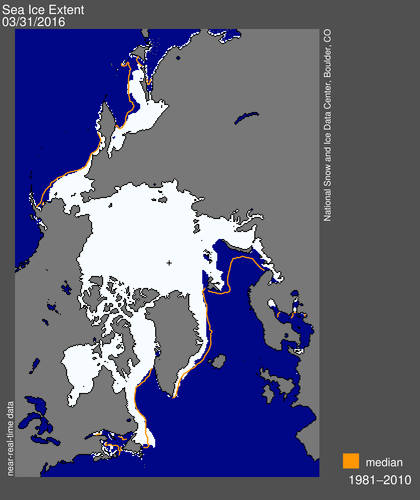
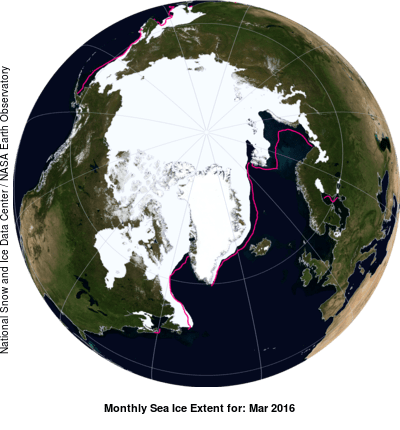
Sorry to be serious on April 1.  I am not a fan of ice charts restricted to one month, for reasons illustrated in the post Ice House of Mirrors (some humor there in honor of this day.) But March monthly average sets the baseline for the year’s melt season, and so there is considerable attention and significance attached to the month just concluded.

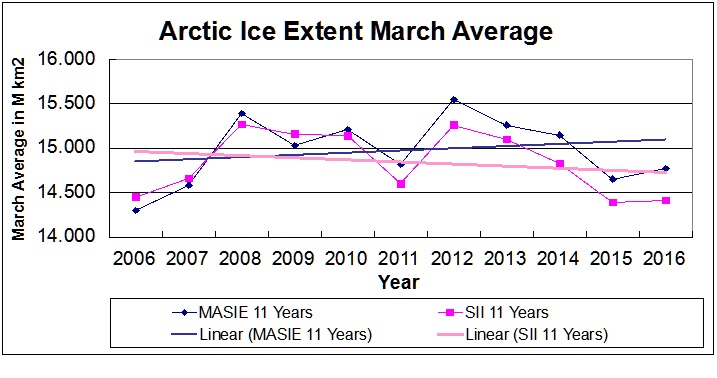
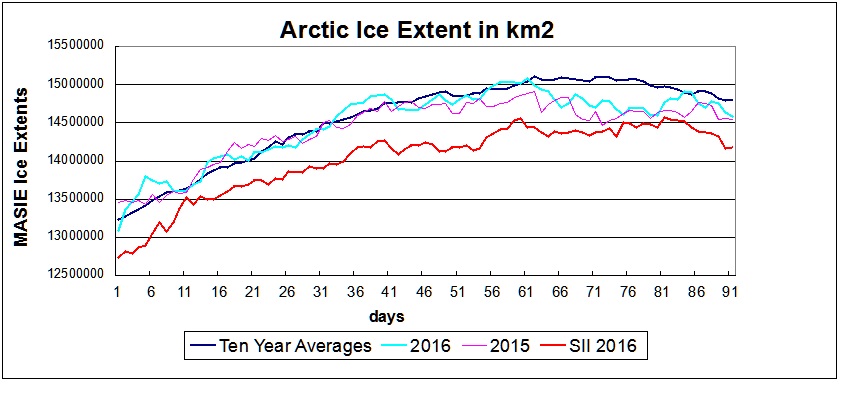
Here is a chart showing March 2016 compared to the previous ten Marches according to two different indices of Sea Ice Extent: MASIE (Multisensor Analyzed Sea Ice Extent) produced by the National Ice Center and SII (Sea Ice Index) produced by NOAA (both accessed at NSIDC).

MASIE and SII March

It is evident that the March annual maximum is trending slightly upward in MASIE and slightly downward in SII. Note that the indices were quite similar the first five years. Then since 2010, SII has declined quite strongly.

Note on Sea Ice Resolution:

Northern Hemisphere Spatial Coverage

Sea Ice Index from NOAA is based on 25 km cells and 15% ice coverage. That means if a grid cell 25X25, or 625 km2 is estimated to have at least 15% ice, then 625 km2 is added to the total extent. In the mapping details, grid cells vary between 382 to 664 km2 with latitudes.  And the satellites’ Field of View (FOV) is actually an ellipsoid ranging from 486 to 3330 km2 depending on the channel and frequency.  More info is here.

MASIE is based on 4 km cells and 40% ice coverage. Thus, for MASIE estimates, if a grid cell is deemed to have at least 40% ice, then 16 km2 is added to the total extent.

The significantly higher resolution in MASIE means that any error in detecting ice cover at the threshold level affects only 16 km2 in the MASIE total, versus at least 600 km2 variation in SII.  A few dozen SII cells falling below the 15% threshold is reported as a sizeable loss of ice in the Arctic.

Putting NOAA Reports in Context

With the background above, we can interpret NOAA`s meaning when they report (here) that 2016 winter ice extent is the smallest on record. That refers to the annual maximum daily extent they observed on March 24. Climatology usually uses the March average to indicate the year’s maximum (given the volatility of daily readings). As we can see, 2016 March average was higher than 2015, virtually tied with 2006 and just below 2011. SII showed March ice to be 364k km2 less than MASIE.

NOAA: “The extent in 2016 was 431,000 square miles (1.12 million square kilometers) below the 1981–2010 average, which is like carving away an area of ice the combined size of Texas, Oklahoma, Arkansas, and most of Louisiana.”

In other words, 2016 is below average by about the size of 2000 grid cells in their system, or 1.5% out of 136,192.  

For more background on the two datasets see here.

2016 in Perspective

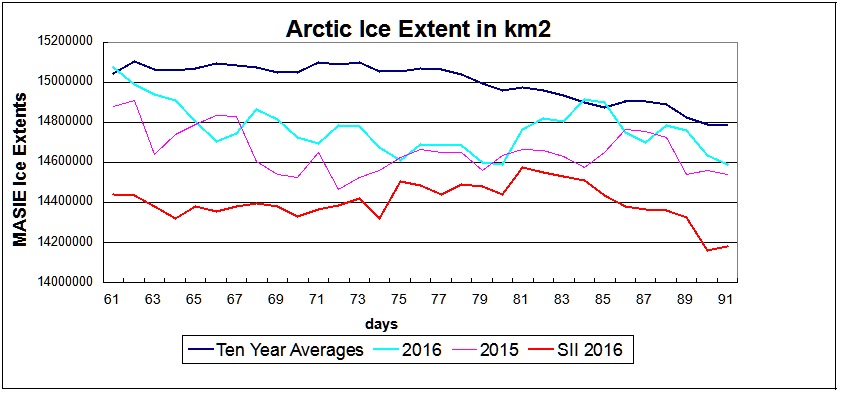
As an example, consider how this March compares in the two indices.

In the graph MASIE shows 2016 starting the month at average extent, then declining and then recovering.  2016 ended below average in extent and comparable to 2015.  Meanwhile SII showed much less extent, rising to a late maximum and then declining sharply to be 400k km2 less at day 91.

OLYMPUS DIGITAL CAMERA

Results for the first quarter of the year show the large differences between the two indices. SII portrays this winter as abnormally low, while MASIE shows an average year, slightly higher than 2015.

Looking at the extents in the various seas making up the NH Sea Ice, it is clear that all are typical, with three exceptions.  Compared to 2015, Barents and Baffin Bay are down (Barents lost 100k km2 in the last five days), while Okhotsk surplus more than offsets the losses elsewhere.

Summary:

As the divergence of SII increases, it becomes less clear what it is really measuring.

The tables below give the reported ice extents in M km2:

Month 2016 2016 MASIE SII SII Deficit
Averages MASIE SII 2016-2015 2016-2015 SII-MASIE
Jan 13.922 13.472 -0.019 -0.131 -0.450
Feb 14.804 14.210 0.121 -0.199 -0.593
Mar 14.769 14.405 0.101 0.038 -0.364

n_monthly_bm_extent_web

ns_Yamal

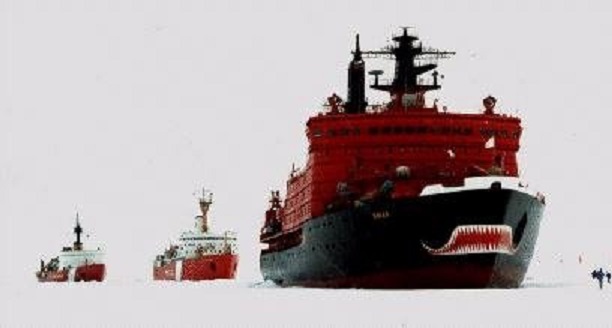
New Russian Nuclear Icebreaker “Yamal”, sharing the name of the infamous hockey stick tree.


Climate Peer Pressure

Jo Nova has a great post pushing back on claims women care more about climate change than men do. Money quote:

“It’s not a sign that they “care more than men”. It’s a sign that they are less willing to take risks and speak against the current predominant meme. Who wants to be called a “denier”? As I’ve been pointing out for years, the reason there are not more women on the skeptical sensible side of the climate debate is because the belief is maintained with social pressure, not logic and reason. Where is the open debate and polite discussion that would allow women to be more involved in the decisions? Manners everyone — they were invented for a reason.”

http://joannenova.com.au/2016/03/heres-why-women-are-more-likely-to-care-about-the-climate/

Man Made Mild Weather (MMMW)

For some relief from the relentless stories of Catastrophic Anthropogenic Global Warming (CAGW), we turn today to a study of Man Made Mild Weather (MMMW).  CAGW also stands for Citizens Against Government Waste, not to be confused with the first acronym.  Oh wait.  (sarc/off)

Specifically this post concerns work by Dr. Arnd Bernaerts on human activities contributing to mild winters in Europe.

To start with, he is analyzing “climate” properly. Climates are plural, not singular; the term is a human construct referring to distinctly local and regional patterns and expectations of future weather. Secondly, he addresses changes observed in one particular season as a way to identify inter annual variation. Thirdly, he is well aware of oceanic fluctuations, and seeks to understand human effects in addition to natural variability.

Specifically Dr. Bernaerts studies the linkage between the Baltic and North Seas and winters in Northern Europe. His article (here) is entitled “Northern Europe’s Mild Winters. Contributions from Offshore Industry, Ships, Fishery, et cetera?”

From the Abstract:
The marine environment of North Sea and Baltic is one of the most heavily strained by numerous human activities. Simultaneously water and air temperatures increase more than elsewhere in Europe and globally, which cannot be explained with ‘global warming’.

The climatic change issue would be better understood if this extraordinary regional warming is sufficiently explained. The regional features are unique for in-depth studies due to different summer-winter conditions, shallowness of the seas, geographical structure, and main pathway for maritime weather patterns moving eastwards.

The impact of sea activities on the seasonal sea water profile structure is contributing to stronger regional warming, change in growing season, and less severe sea ice conditions. The impact of the man, whether small or large, should be understood very soon and very thoroughly.

Pay particular attention to the Discussion at the end, which includes this:

Regional seas in Northern Europe are minor from size and volume in global ocean affairs. Weather is “done” elsewhere, but every location contributes to the global picture. In the case of N-Europe it may be more significant as weather can be divided in maritime and continental influence, and due to the global air circulation from West to East, it is a gate. It may support the flow of warm wet air eastward (low pressure), or stem it by dry and cold continental air (high pressure), by diverting low pressure areas– in extreme circumstances – towards the Bering Sea or Mediterranean. In so far the North Sea and Baltic play a crucial role in how to open or close this gate.

Three facts are established: higher warming, a small shift in the seasons, and a decreasing sea ice cover. In each scenario the two sea’s conditions play a decisive role. These conditions are impaired by wind farms, shipping, fishing, off shore drilling, under sea floor gas-pipe line construction and maintenance, naval exercise, diving, yachting, and so on, about little to nothing has been investigated and is understood.

Summary:
The facts are conclusive. ‘Global Climate Change’ cannot cause a special rise in temperatures in Northern Europe, neither in the North Sea nor the Baltic or beyond. Any use of the oceans by mankind has an influence on thermo-haline structures within the water column from a few cm to 10m and more. Noticeable warmer winters in Europe are the logical consequence

Conclusion:

Two of my heroes are Dr. Pielke Sr. for his work showing how human use of the land affects climates in the locales where it occurs, and Dr. Bernaerts for exposing how human use of the ocean impacts on nearby climates.

The Space Frontier Gets Closer

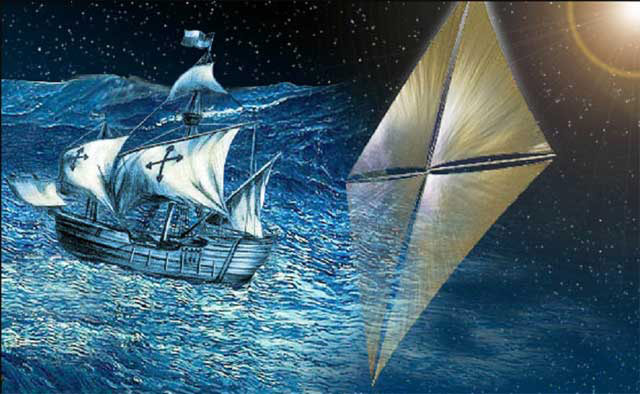
Artistic rendition of a laser driven spacecraft. Pictorial only.

Some NASA people are thinking out the box and see a new way to explore space using laser technology.

So far, NASA spacecraft have made 13 trips to Mars, with seven landings. The most recent — that of the Curiosity rover — took 253 days from launch on Earth to touchdown on Mars. There’s now reason to believe, however, that this journey could be significantly made faster to the point it only takes 3 days, according to a NASA researcher.

This could be possible using a ‘photonic propulsion’ system, says NASA scientist Philip Lubin. A massive laser based on Earth would fire bursts of photons into the ‘sail’ of the spacecraft and accelerated it up to 26% the speed of light (1/4c), which is unheard of in space flight. But that’s only for a tiny object with a 1 meter solar sail. Larger, more practical crafts, would be accelerated to between 1-3% the speed of light, which is still fantastic.

The Abstract:

In the nearly 60 years of spaceflight we have accomplished wonderful feats of exploration and shown the incredible spirit of the human drive to explore and understand our universe. Yet in those 60 years we have barely left our solar system with the Voyager 1 spacecraft launched in 1977 finally leaving the solar system after 37 years of flight at a speed of 17 km/s or less than 0.006% the speed of light.

As remarkable as this we will never reach even the nearest stars with our current propulsion technology in even 10 millennium. We have to radically rethink our strategy or give up our dreams of reaching the stars, or wait for technology that does not exist. While we all dream of human spaceflight to the stars in a way romanticized in books and movies, it is not within our power to do so, nor it is clear that this is the path we should choose.

We posit a technological path forward, that while not simple, it is within our technological reach. We propose a roadmap to a program that will lead to sending relativistic probes to the nearest stars and will open up a vast array of possibilities of flight both within our solar system and far beyond. Spacecraft from gram level complete spacecraft on a wafer (“wafersats”) that reach more than ¼ c and reach the nearest star in 15 years to spacecraft with masses more than 105 kg (100 tons) that can reach speeds of greater than 1000 km/s. These systems can be propelled to speeds currently unimaginable with existing propulsion technologies.

To do so requires a fundamental change in our thinking of both propulsion and in many cases what a spacecraft is. In addition to larger spacecraft, some capable of transporting humans, we consider functional spacecraft on a wafer, including integrated optical communications, optical systems and sensors combined with directed energy propulsion. Since “at home” the costs can be amortized over a very large number of missions.

In addition the same photon driver can be used for planetary defense, beamed energy for distant spacecraft as well as sending power back to Earth as needed, stand-off composition analysis, long range laser communications, SETI searches and even terra forming. The human factor of exploring the nearest stars and exo-planets would be a profound voyage for humanity, one whose non-scientific implications would be enormous. It is time to begin this inevitable journey beyond our home.

Stellar environment of the Sun, maximum distance = 15 Light Years

Source of image: J.-M. Malherbe, Observatoire de Paris

This path opens up our stellar environment, shown above with solar systems within 15 light years of us.  Here is the Roadmap to Interstellar Flight

One of my readers asked if this is for real.  Yes, there are serious people working on this, and Japan has already successfully deployed a solar sail on the JAXA mission to Venus and beyond (here). Actual photo from space below:

Could this be the exploration technology of the future?

090812-solar-sailart-02