Behind the Alarmist Scene

fox-theatre-curtain1

Update May 24, 2016: The shareholder vote is scheduled for tomorrow, May 25, according to this article.

We can look into the climate activist mental frame thanks to documents supporting the current strategy using the legal system to implement actions against fossil fuel consumption.

For example, there is this recent text explaining a shareholder proposal to be tabled at ExxonMobil annual meeting. From Attorney Sanford Lewis:

The Proposal states:

“RESOLVED: Shareholders request that by 2017 ExxonMobil publish an annual assessment of long term portfolio impacts of public climate change policies, at reasonable cost and omitting proprietary information. The assessment can be incorporated into existing reporting and should analyze the impacts on ExxonMobil’s oil and gas reserves and resources under a scenario in which reduction in demand results from carbon restrictions and related rules or commitments adopted by governments consistent with the globally agreed upon 2 degree target. The reporting should assess the resilience of the company’s full portfolio of reserves and resources through 2040 and beyond and address the financial risks associated with such a scenario.

Now let’s unbundle the chain of suppositions that comprise this proposal.

  • Supposition 1: A 2C global warming target is internationally agreed.
  • Supposition 2: Carbon Restrictions are enacted by governments to comply with the target.
  • Supposition 3: Demand for oil and gas products is reduced due to restrictions
  • Supposition 4: Oil and gas assets become uneconomic for lack of demand.
  • Supposition 5: Company net worth declines by depressed assets and investors lose value.

1.Suppose an International Agreement to limit global warming to 2C.

From the supporting statement to the above proposal, Sanford Lewis provides these assertions:

Recognizing the severe and pervasive economic and societal risks associated with a warming climate, global governments have agreed that increases in global temperature should be held below 2 degrees Celsius from pre-industrial levels (Cancun Agreement).

Failing to meet the 2 degree goal means, according to scientists, that the world will face massive coastal flooding, increasingly severe weather events, and deepening climate disruption. It will impose billions of dollars in damage on the global economy, and generate an increasing number of climate refugees worldwide.

Climate change and the risks it is generating for companies have become major concerns for investors. These concerns have been magnified by the 21st Session of the Conference of the Parties (COP 21) in Paris, where 195 global governments agreed to restrict greenhouse gas (GHG) emissions to no more than 2 degrees Celsius from pre-industrial levels and submitted plans to begin achieving the necessary GHG emission reductions. In the agreement, signatories also acknowledged the need to strive to keep global warming to 1.5 degrees, recognizing current and projected harms to low lying islands.

Yet a careful reading of UN agreements shows commitment is exaggerated:
David Campbell (here):

Neither 2°C nor any other specific target has ever been agreed at the UN climate change negotiations.

Article 2 of the Paris Agreement in fact provides only that it ‘aims to strengthen the global response to the threat of climate change … including by the holding the increase to well below 2°C’. This is an expression, not of setting a concrete limit, but merely of an aspiration to set such a limit. It is true that Article 2 is expressed in a deplorably equivocatory and convoluted language which fails to convey this vital point, indeed it obscures it. But nevertheless that is what Article 2 means.

Dieter Helm (here):

Nothing of substance has been achieved in the last quarter of a century despite all the efforts and political capital that has been applied. The Paris Agreement follows on from Kyoto. The pledges – in the unlikely event they are met – will not meet the 2C target, shipping and aviation are excluded, and the key developing countries (China and India) are not committed to capping their emission for at least another decade and a half (or longer in India’s case)

None of the pledges is, in any event, legally binding. For this reason, the Paris Agreement can be regarded as the point at which the UN negotiating approach turned effectively away from a top down approach, and instead started to rely on a more country driven and hence bottom up one.

Paul Spedding:

The international community is unlikely to agree any time soon on a global mechanism for putting a price on carbon emissions.

2: Suppose Governments enact restrictions that limit use of fossil fuels.

Despite the wishful thinking in the first supposition, the activists proceed on the basis of aspirations and reporting accountability. Sanford Lewis:

Although the reduction goals are not set forth in an enforceable agreement, the parties put mechanisms in place for transparent reporting by countries and a ratcheting mechanism every five years to create accountability for achieving these goals. U.N. Secretary General Ban Ki-moon summarized the Paris Agreement as follows: “The once Unthinkable [global action on climate change] has become the Unstoppable.”

Now we come to an interesting bait and switch. Since Cancun, IPCC is asserting that global warming is capped at 2C by keeping CO2 concentration below 450 ppm. From Summary for Policymakers (SPM) AR5

Emissions scenarios leading to CO2-equivalent concentrations in 2100 of about 450 ppm or lower are likely to maintain warming below 2°C over the 21st century relative to pre-industrial levels. These scenarios are characterized by 40 to 70% global anthropogenic GHG emissions reductions by 2050 compared to 2010, and emissions levels near zero or below in 2100.

Thus is born the “450 Scenario” by which governments can be focused upon reducing emissions without any reference to temperature measurements, which are troublesome and inconvenient.

Sanford Lewis:

Within the international expert community, “2 degree” is generally used as shorthand for a low carbon scenario under which CO2 concentrations in the earth’s atmosphere are stabilized at a level of 450 parts per million (ppm) or lower, representing approximately an 80% reduction in greenhouse gas emissions from current levels, which according to certain computer simulations would be likely to limit warming to 2 degrees Celsius above pre-industrial levels and is considered by some to reduce the likelihood of significant adverse impacts based on analyses of historical climate variability. Company Letter, page 4.

Clever as it is to substitute a 450 ppm target for 2C, the mathematics are daunting. Joe Romm:

We’re at 30 billion tons of carbon dioxide emissions a year — rising 3.3% per year — and we have to average below 18 billion tons a year for the entire century if we’re going to stabilize at 450 ppm. We need to peak around 2015 to 2020 at the latest, then drop at least 60% by 2050 to 15 billion tons (4 billion tons of carbon), and then go to near zero net carbon emissions by 2100.

And the presumed climate sensitivity to CO2 is hypothetical and unsupported by observations:

3.Suppose that demand for oil and gas products is reduced by the high costs imposed on such fuels.

Sanford Lewis:

ExxonMobil recognized in its 2014 10-K that “a number of countries have adopted, or are considering adoption of, regulatory frameworks to reduce greenhouse gas emissions,” and that such policies, regulations, and actions could make its “products more expensive, lengthen project implementation timelines and reduce demand for hydrocarbons,” but ExxonMobil has not presented any analysis of how its portfolio performs under a 2 degree scenario.

Moreover, the Company’s current use of a carbon proxy price, which it asserts as its means of calculating climate policy impacts, merely amplifies and reflects its optimistic assessments of national and global climate policies. The Company Letter notes that ExxonMobil is setting an internal price as high as $80 per ton; in contrast, the 2014 Report notes a carbon price of $1000 per ton to achieve the 450 ppm (2 degree scenario) and the Company reportedly stated during the recent Paris climate talks that a 1.5 degree scenario would require a carbon price as high as $2000 per ton within the next hundred years.

Peter Trelenberg, manager of environmental policy and planning at Exxon Mobil reportedly told the Houston Chronicle editorial board: Trimming carbon emissions to the point that average temperatures would rise roughly 1.6 degrees Celsius – enabling the planet to avoid dangerous symptoms of carbon pollution – would bring costs up to $2,000 a ton of CO2. That translates to a $20 a gallon boost to pump prices by the end of this century… .

Even those who think emissions should be capped somehow see through the wishful thinking in these numbers. Dieter Helm:

The combination of the shale revolution and the ending of the commodity super cycle probably point to a period of low prices for sometime to come. This is unfortunate timing for current decarbonisation policies, many of which are predicated on precisely the opposite happening – high and rising prices, rendering current renewables economic. Low oil prices, cheap coal, and falling gas prices, and their impacts on driving down wholesale electricity prices, are the new baseline against which to consider policy interventions.

With existing technologies, it is a matter of political will, and the ability to bring the main polluters on board, as to whether the envelope will be breached. There are good reasons to doubt that any top down agreement will work sufficiently well to achieve it.

The end of fossil fuels is not about to happen anytime soon, and will not be caused by running out of any of them. There is more than enough to fry the planet several times over, and technological progress in the extraction of fossil fuels has recently been at least as fast as for renewables. We live in an age of fossil fuel abundance.

We also live in a world where fossil fuel prices have fallen, and where the common assumption that prices will bounce back, and that the cycle of fossil fuel prices will not only reassert itself but also continue on a rising trend, may be seriously misguided. It is plausible to at least argue that the oil price may never regain its peaks in 1979 and 2008 again.

A world with stable or falling fossil fuel prices turns the policy assumptions of the last decade or so on their heads. Instead of assuming that rising prices would ease the transition to low carbon alternatives, many of the existing technologies will probably need permanent subsidies. Once the full system costs are incorporated, current generation wind (especially offshore) and current generation solar may be out of the market except in special locations for the foreseeable future. In any event, neither can do much to address the sheer scale of global emissions.

Primary Energy Demand Projection

4.Suppose oil and gas reserves are stranded for lack of demand.

Sanford Lewis:

Achievement of even a 2 degree goal requires net zero global emissions to be attained by 2100. Achieving net zero emissions this century means that the vast majority of fossil fuel reserves cannot be burned. As noted by Mark Carney, the President of the Bank of England, the carbon budget associated with meeting the 2 degree goal will “render the vast majority of reserves ‘stranded’ – oil, gas, and coal that will be literally unburnable without expensive carbon capture technology, which itself alters fossil fuel economics.”

A concern expressed by some of our stakeholders is whether such a “low carbon scenario” could impact ExxonMobil’s reserves and operations – i.e., whether this would result in unburnable proved reserves of oil and natural gas.

Decisions to abandon reserves are not as simple or have the effects as desired by activists.

Financial Post (here):

The 450 Scenario is not the IEA’s central scenario. At this point, government policies to limit GHG emissions are not stringent enough to stimulate this level of change. However, for discussion purposes let’s use the IEA’s 450 Scenario to examine the question of stranded assets in crude oil investing. Would some oil reserves be “stranded” under the IEA’s scenario of demand reversal?

A considerable amount of new oil projects must be developed to offset the almost 80 per cent loss in legacy production by 2040. This continued need for new oil projects for the next few decades and beyond means that the majority of the value of oil reserves on the books of public companies must be realized, and will not be “stranded”.

While most of these reserves will be developed, could any portion be stranded in this scenario? The answer is surely “yes.” In any industry a subset of the inventory that is comprised of inferior products will be susceptible to being marginalized when there is declining demand for goods. In a 450 ppm world, inferior products in the oil business will be defined by higher cost and higher carbon intensity.

5.Suppose shareholders fear declining company net worth.

Now we come to the underlying rationale for this initiative.

Paul Spedding:

Commodity markets have repeatedly proved vulnerable to expectations that prices will fall. Given the political pressure to mitigate the impact of climate change, smart investors will be watching closely for indications of policies that will lead to a drop in demand and the possibility that their assets will become financially stranded.

Equity markets are famously irrational, and if energy company shareholders can be spooked into selling off, a death spiral can be instigated. So far though, investors are smarter than they are given credit.

Bloomberg:

Fossil-fuel divestment has been a popular issue in recent years among college students, who have protested at campuses around the country. Yet even with the movement spreading to more than 1,000 campuses, only a few dozen schools have placed some restrictions on their commitments to the energy sector. Cornell University, Massachusetts Institute of Technology and Harvard University are among the largest endowments to reject demands to divest.

Stanford Board of Trustees even said:

As trustees, we are convinced that the global community must develop effective alternatives to fossil fuels at sufficient scale, so that fossil fuels will not continue to be extracted and used at the present rate. Stanford is deeply engaged in finding alternatives through its research. However, despite the progress being made, at the present moment oil and gas remain integral components of the global economy, essential to the daily lives of billions of people in both developed and emerging economies. Moreover, some oil and gas companies are themselves working to advance alternative energy sources and develop other solutions to climate change. The complexity of this picture does not allow us to conclude that the conditions for divestment outlined in the Statement on Investment Responsibility have been met.

Update:  Universities are not the exception in finding the alarmist case unconvincing, according to a survey:

Almost half of the world’s top 500 investors are failing to act on climate change — an increase of 6 percent from 236 in 2014, according to a report Monday by the Asset Owners Disclosure Project, which surveys global companies on their climate change risk and management.

The Abu Dhabi Investment Authority, Japan Post Insurance Co Ltd., Kuwait Investment Authority and China’s SAFE Investment Company, are the four biggest funds that scored zero in the survey. The 246 “laggards” identified as not acting hold $14 trillion in assets, the report said.

Summary

Alarmists have failed to achieve their goals through political persuasion and elections. So they are turning to legal and financial tactics. Their wishful thinking appears as an improbable chain of events built upon a Paris agreement without substance.

Last word to David Campbell:

International policy has so far been based on the premise that mitigation is the wisest course, but it is time for those committed to environmental intervention to abandon the idea of mitigation in favour of adaptation to climate change’s effects.

For more on adapting vs. mitigating, see Adapting Works, Mitigating Fails
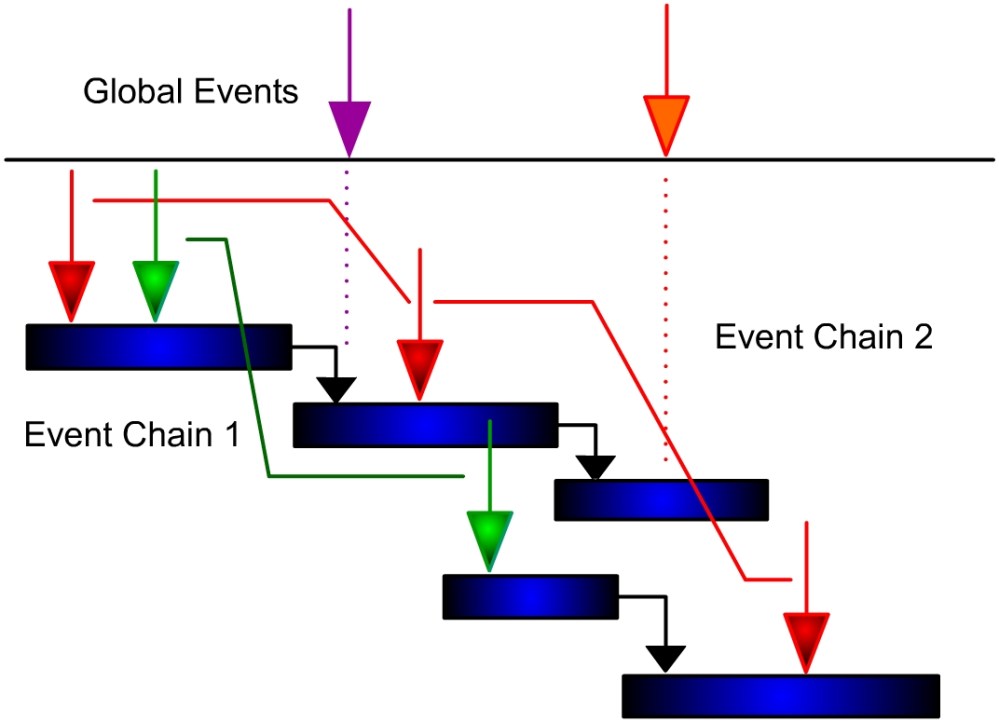
EventChain

Atlantic Ocean Cooling

Most oceanographers have noted quasi-60-year cycles in warming and cooling of the oceans, with offsets between Pacific and Atlantic.  Thus it has been expected that early this century the oceanic temperature regime should shift from the warming phase that dominated the 1980s to 2000.

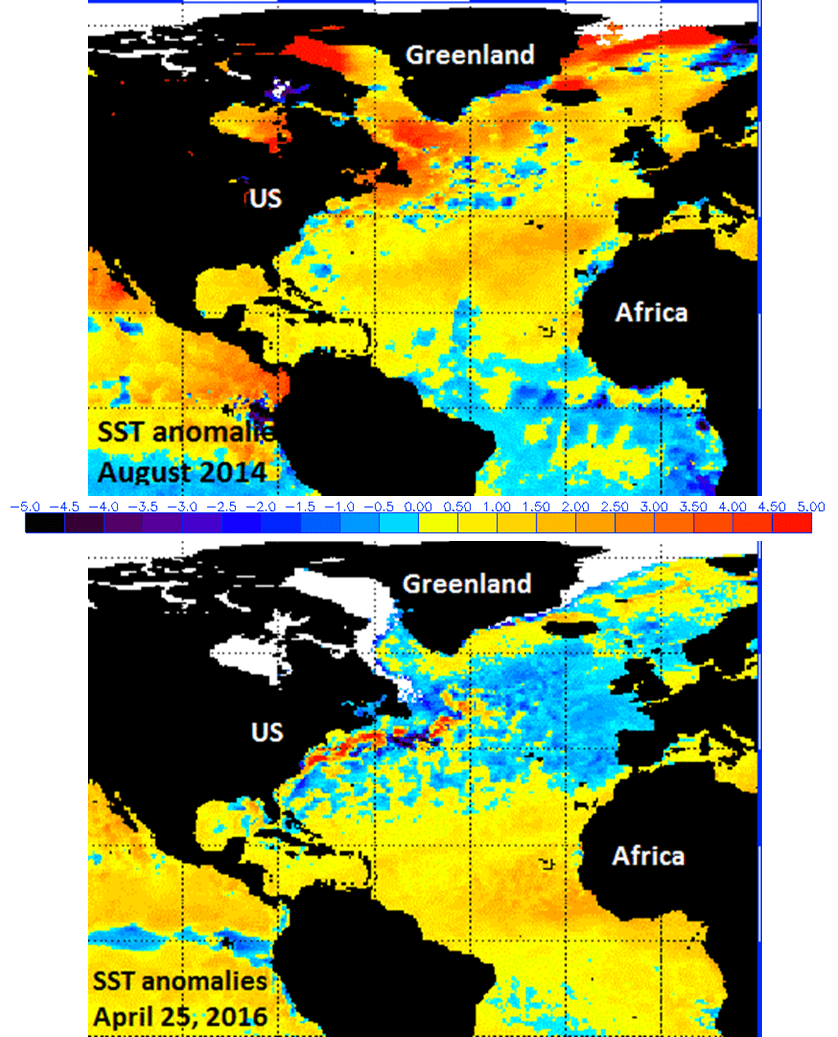
Paul Dorian at Vencore Weather has an excellent post (here) showing how this cooling regime is in process in the Atlantic.  By several measures, the cooling is evident and likely to be a long term (decadal or more) phenomenon.

From his Overview:

In general, the Atlantic Ocean experienced a cold phase from the early 1960’s to the mid 1990’s at which time it flipped to a warm phase and that has continued for the most part ever since. The current warm phase; however, is now showing signs of a possible long-term shift back to colder-than-normal sea surface temperatures (SST) and this could have serious implications on US climate and sea ice areal extent in the Northern Hemisphere.

His charts show the transition is underway, with the warming peak around 2007.

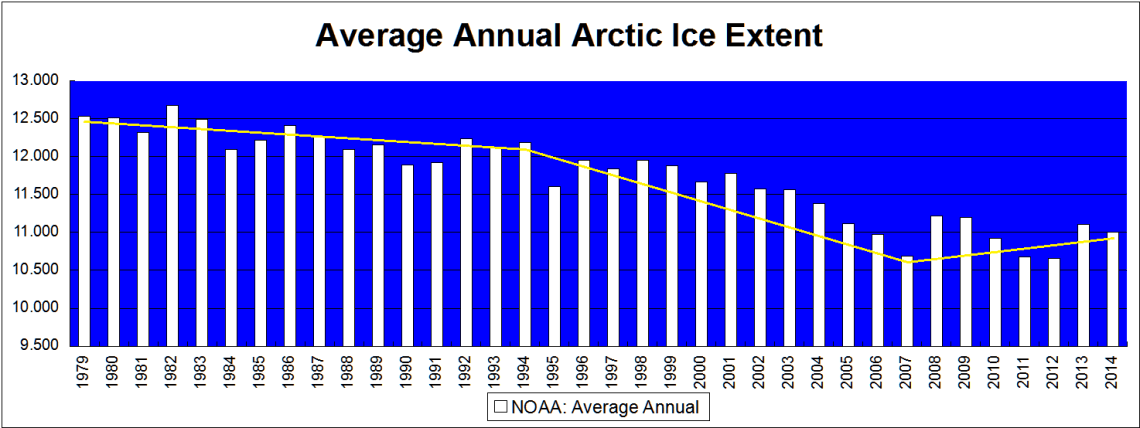
And as has been noted on this blog (here) regarding Arctic sea ice, the decline went flat after 2007.

Summary

The oceans make climate, and the future looks more like cooling than warming.


Climate Smoke and Mirrors

(C) SERGEJ SVERDELOV sm7@rambler.ru

What really went down at the Paris climate conference? What are countries signing up to at the UN HQ since April 22? What is actually in the Paris agreement?

Let’s hear from a Professor of Contract Law, David Campbell of Lancaster University Law School, U.K.

Excerpted from his post at GWPF

Neither 2°C nor any other specific target has ever been agreed at the UN climate change negotiations.

Article 2 of the Paris Agreement in fact provides only that it ‘aims to strengthen the global response to the threat of climate change … including by the holding the increase to well below 2°C’. This is an expression, not of setting a concrete limit, but merely of an aspiration to set such a limit. It is true that Article 2 is expressed in a deplorably equivocatory and convoluted language which fails to convey this vital point, indeed it obscures it. But nevertheless that is what Article 2 means.

Far from being an agreement to reduce global emissions, it was an agreement to allow their unbounded increase.

No emissions caps have ever been, are, or can be set on the developing countries, for the good reasons that this is what the Framework Convention, the Kyoto Protocol and now the Paris Agreement provide.

In the Paris Agreement, this disastrous position is actually strengthened by being made explicit. . . Article 4(4) of the Paris Agreement confines ‘absolute emissions reduction targets’ to the developed countries and distinguishes them from the ‘mitigation efforts’ the developing countries might undertake, which will not involve absolute reductions. This provides an explicitly legal permission for developing countries not to make any CO2 reductions and will be the legal basis of continued immense increase in China’s and India’s CO2 emissions.

Only developed countries are expected to limit absolute emissions. All others expect to grow economically to reduce their carbon intensities.

Carbon intensity is a measure of the amount of CO2 which must be emitted to obtain a certain increase in GDP. Broadly speaking, absolute emissions and economic growth are strongly correlated, but, with increasing sophistication of technology, the rate at which growth requires emissions, that is to say, carbon intensity, falls.

China’s growth targets, stated as its ‘strategic goals’ in the INDC, are such that Chinese reductions in carbon intensity will be made, not despite but because of a growth in absolute emissions. China will not retire existing generating capacity and replace it only with an equivalent or smaller capacity generated by lower intensity plant. It will retire older capacity in the course of an immense expansion of overall capacity. China’s extremely ambitious and apparently positive intensity targets actually represent a statement that the increase in its emissions will be vast.

Summary

Those committed to environmental intervention and those who believe Global Warming has been exaggerated can agree on one thing:

Stop wasting time and energy on treaties to mitigate CO2 emissions, and put the resources into adapting to effects of future climate and weather.

Campbell provides more context here:

The major industrialising countries (MICs), such as China and India, are classified as developing countries, which has effectively made global reductions impossible.

Article 4(7) of the UNFCCC provides that ‘the extent to which developing country parties will effectively implement … the Convention … will take fully into account that economic and social development and poverty eradication are the first and overriding priorities of the developing country parties.’ Since emissions reductions involve immense economic costs, this essentially means that no limits can be placed on the emissions of developing countries. Their responsibility to reduce emissions isn’t ‘differentiated’ so much as non-existent. Subsequent climate change negotiations have reinforced this position, and it is stated as forthrightly as it ever has been in China’s INDC. When the MICs’ refusal to adopt reductions targets became clear at the Copenhagen conference in 2009, people began to realise that directing criticism solely at the developed countries, particularly the US, as a result of its failure to ratify the Kyoto Protocol, was fruitless. But all the MICs have done is stick to what was agreed in 1992.

By insisting once again that they don’t have a responsibility to reduce emissions, China and India have ensured that the Paris conference will not reach the hoped-for agreement. Global emissions reductions have been impossible for more than a quarter-century and will continue to be impossible, for the very good reason that this is what was agreed in the original convention. Numerous near irrelevant agreements and declarations of intent will no doubt be made in Paris, obscuring the failure to reach any agreement on global reductions. International policy has so far been based on the premise that mitigation is the wisest course, but it is time for those committed to environmental intervention to abandon the idea of mitigation in favour of adaptation to climate change’s effects.


Stanford Sanity

Stanford University is a bastion of liberalism, which used to mean open-minded and tolerant when I studied there and graduated cum laude.  Having seen little rationality from there concerning climate change, I was pleased to hear about this:

“It is not clear that the social injury caused by oil and gas companies outweighs the social benefit of providing energy to billions of people around the world.” Stanford University Board of Trustees

The full statement is here. It provides extensive evidence of how committed they are to sustainability and other green values. Their consideration of energy investments is far from simple-minded:

As trustees, we are convinced that the global community must develop effective alternatives to fossil fuels at sufficient scale, so that fossil fuels will not continue to be extracted and used at the present rate. Stanford is deeply engaged in finding alternatives through its research. However, despite the progress being made, at the present moment oil and gas remain integral components of the global economy, essential to the daily lives of billions of people in both developed and emerging economies. Moreover, some oil and gas companies are themselves working to advance alternative energy sources and develop other solutions to climate change. The complexity of this picture does not allow us to conclude that the conditions for divestment outlined in the Statement on Investment Responsibility have been met.

We believe the long-term solution is for all of us to reduce our consumption of fossil fuel resources and develop effective alternatives. Because achieving these goals will take time, and given how integral oil and gas are to the global economy, the trustees do not believe that a credible case can be made for divesting from the fossil fuel industry until there are competitive and readily available alternatives. Stanford will remain a leader in developing such alternatives.

As an alumnus, I applaud their reasonable and considered position to not divest of oil and gas holdings. They are doing due diligence carefully weighing benefits along with risks, all the while knowing they will be attacked by green bigots no matter what they say.

Stanford Climate Activists Slam University Over Fossil Fuel Vote New York Times

Definition Bigot: a person who is utterly intolerant of any differing creed, belief, or opinion.

Denying other people the same rights that you claim for yourself is the essence of bigotry. People who call themselves environmentalists could more accurately be called green bigots.

Selfishness is never a pretty thing but it is at its ugliest when it masquerades as some kind of lofty nobility. That pose not only gets the green bigots good press, it also helps recruit the young and uninformed to their movement — especially the young who have been misinformed on college and university campuses.  Thomas Sowell

Thomas Sowell is a Senior Fellow of the The Hoover Institution at Stanford University and author of Wealth, Poverty and Politics, An International Perspective

Footnote:

Other universities are also rejecting green bigotry.  From Bloomberg:

Fossil-fuel divestment has been a popular issue in recent years among college students, who have protested at campuses around the country. Yet even with the movement spreading to more than 1,000 campuses, only a few dozen schools have placed some restrictions on their commitments to the energy sector. Cornell University, Massachusetts Institute of Technology and Harvard University are among the largest endowments to reject demands to divest.

Head, Heart and Science

A man who has not been a socialist before 25 has no heart. If he remains one after 25 he has no head.—King Oscar II of Sweden

Recently I had an interchange with a friend from high school days, and he got quite upset with this video by Richard Lindzen. So much so, that he looked up attack pieces in order to dismiss Lindzen as a source.  This experience impressed some things upon me.

Climate Change is Now Mostly a Political Football (at least in USA)

My friend attributed his ill humor to the current political environment. He readily bought into slanderous claims, and references to being bought and paid for by the Koch brothers. At this point, Bernie and Hilliary only disagree about who is the truest believer in Global Warming. Once we get into the general election process, “Fighting Climate Change” will intensify as a wedge issue, wielded by smug righteous believers on the left against the anti-science neanderthals on the right.

So it is a hot label for social-media driven types to identify who is in the tribe (who can be trusted) and the others who can not.  For many, it is not any deeper than that.

The Warming Consensus is a Timesaver

My friend acknowledged that his mind was made up on the issue because 95+% of scientists agreed. It was extremely important for him to discredit Lindzen as untrustworthy to maintain the unanimity. When a Warmist uses: “The Scientists say: ______” , it is much the same as a Christian reference: “The Bible says: _______.” In both cases, you can fill in the blank with whatever you like, and attribute your idea to the Authority. And most importantly, you can keep the issue safely parked in a No Thinking Zone. There are plenty of confusing things going on around us, and no one wants one more ambiguity requiring time and energy.

Science Could Lose the Delicate Balance Between Head and Heart

Decades ago Arthur Eddington wrote about the tension between attitudes of artists and scientists in their regarding nature. On the one hand are people filled with the human impulse to respect, adore and celebrate the beauty of life and the world. On the other are people driven by the equally human need to analyze, understand and know what to expect from the world. These are Yin and Yang, not mutually exclusive, and all of us have some of each.

Most of us can recall the visceral response in the high school biology lab when assigned to dissect a frog. Later on, crayfish were preferred (less disturbing to artistic sensibilities). For all I know, recent generations have been spared this right of passage, to their detriment. For in the conflict between appreciating things as they are, and the need to know why and how they are, we are exposed to deeper reaches of the human experience. If you have ever witnessed, as I have, a human body laid open on an autopsy table, then you know what I mean.

Anyone, scientist or artist, can find awe in contemplating the mysteries of life. There was a time when it was feared that the march of science was so advancing the boundaries of knowledge that the shrinking domain of the unexplained left ever less room for God and religion. Practicing scientists knew better. Knowing more leads to discovering more unknowns; answers produce cascades of new questions. The mystery abounds, and the discovery continues. Eddington:

It is pertinent to remember that the concept of substance has disappeared from fundamental physics; what we ultimately come down to is form. Waves! Waves!! Waves!!! Or for a change — if we turn to relativity theory — curvature! Energy which, since it is conserved, might be looked upon as the modern successor of substance, is in relativity theory a curvature of space-time, and in quantum theory a periodicity of waves. I do not suggest that either the curvature or the waves are to be taken in a literal objective sense; but the two great theories, in their efforts to reduce what is known about energy to a comprehensible picture, both find what they require in a conception of “form”.

What do we really observe? Relativity theory has returned one answer — we only observe relations. Quantum theory returns another answer — we only observe probabilities.

It is impossible to trap modern physics into predicting anything with perfect determinism because it deals with probabilities from the outset.
― Arthur Stanley Eddington

Works by Eddington on Science and the Natural World are here.

Summary

The science problem today is not the scientists themselves, but with those attempting to halt its progress for the sake of political power and wealth.

Eddington:
Religious creeds are a great obstacle to any full sympathy between the outlook of the scientist and the outlook which religion is so often supposed to require … The spirit of seeking which animates us refuses to regard any kind of creed as its goal. It would be a shock to come across a university where it was the practice of the students to recite adherence to Newton’s laws of motion, to Maxwell’s equations and to the electromagnetic theory of light. We should not deplore it the less if our own pet theory happened to be included, or if the list were brought up to date every few years. We should say that the students cannot possibly realise the intention of scientific training if they are taught to look on these results as things to be recited and subscribed to. Science may fall short of its ideal, and although the peril scarcely takes this extreme form, it is not always easy, particularly in popular science, to maintain our stand against creed and dogma.
― Arthur Stanley Eddington

But enough about science. It’s politicians we need to worry about:

Footnote:

“Asked in 1919 whether it was true that only three people in the world understood the theory of general relativity, [Eddington] allegedly replied: ‘Who’s the third?”

Dr. Arnd Bernaerts Disappeared

As happened in Soviet Russia, Climate revisionists are rewriting history. Judith Curry was one of 20 leading climate scientists according to the “Climate Council” based in Australia. But in March 2016, the list was reduced to 19, and Dr Curry disappeared (here).

Now the biography of Arnd Bernaerts has disappeared from Wikipedia, despite his obvious contributions to ocean science and law. UN Undersecretary-General Satya N. Nandan: “Mr Bernaerts has given to the international community an invaluable guide to the understanding and implementation of the 1982 United Nations Convention on the Law of the Sea.” (1988).

Most likely the revisionists are unhappy with Bernaerts’ coining of phrases such as these:

Climate is the continuation of oceans by other means.

Oceans govern climate.

And his writings are extensive and contemporary, as noted on this blog under the category Oceans Make Climate, inspired by my discovery of his work:
https://rclutz.wordpress.com/2015/04/07/oceans-matter-reflecting-on-writings-by-dr-arnd-bernaerts/

You can do something against the efforts of alarmists such as William Connolley by responding to Dr. Bernaerts here.

The Deleted Biography is here.

Premature Reports of Ice Death

“The reports of my death are greatly exaggerated.” Mark Twain

Lots of stories predicting (hoping) that Arctic ice will go lower than 2012 and resuscitate the  Arctic “death spiral”.  And we can surely predict that Peter Wadhams will predict a September Arctic minimum of 1M km2, as he does every year.

But there’s a long way to go before then, and some historical context is in order.

September Minimum Outlook
Historically, where will ice be remaining when Arctic melting stops? Over the last 10 years, on average MASIE shows the annual minimum occurring about day 260. Of course in a given year, the daily minimum varies slightly a few days +/- from that.

For comparison, here are sea ice extents reported from 2007, 2012, 2014 and 2015 for day 260:

Arctic Regions 2007 2012 2014 2015
Central Arctic Sea 2.67 2.64 2.98 2.93
BCE 0.50 0.31 1.38 0.89
Greenland & CAA 0.56 0.41 0.55 0.46
Bits & Pieces 0.32 0.04 0.22 0.15
NH Total 4.05 3.40 5.13 4.44

Notes: Extents are in M km2.  BCE region includes Beaufort, Chukchi and Eastern Siberian seas. Greenland Sea (not the ice sheet). Canadian Arctic Archipelago (CAA).  Locations of the Bits and Pieces vary.

As the table shows, low NH extents come mainly from ice losses in Central Arctic and BCE.  The great 2012 cyclone hit both in order to set the recent record. The recovery since 2012 shows in 2014, with some dropoff last year, mostly in BCE.

Summary

We are only beginning the melt season, and the resulting minimum will depend upon the vagaries of weather between now and September.  At the moment, 2016 was slightly higher than 2015 in March and is trending toward a similar April extent.  Also 2016 melt season is starting without the Blob, with a declining El Nino, and a cold blob in the North Atlantic.  It is too early to put Arctic Ice on life support. Meanwhile we can watch and appreciate the beauty of the changing ice conditions.

The Climate Fuss

Definition Fussbudget:  A person who fusses over trifles. Also called fusspot.

In the last week, Richard Lindzen has a new youtube video which explains briefly and clearly who is making a fuss about climate and why. (Hint: It is not primarily from climate physicists). The video deserves to go viral, since the presentation is brief, informative and accessible to anyone.

Why are so many people worried, indeed panic-stricken about this issue?
It’s due not so much to climate physicists, as to politicians, environmentalists and media. Global warming alarmism provides the things they most want:

  • For politicians, it’s money and power;
  • For environmentalists, it’s money for their organizations and confirmation of their near-religious devotion to the idea that man is a destructive force acting upon nature;
  • For the media, it’s ideology, money and headlines.
  • And crony capitalists have eagerly grabbed for the subsidies that governments have so lavishly provided.

Beyond the Lindzen video, we can also include lawyers who want to make money off the climate fuss. The legal attack on Big Oil (ExxonMobil, and others to follow) is modeled after the Big Tobacco campaign, and is intended to apply a defacto tax on consumers of fossil fuels. That’s what happened with the settlements by Tobacco companies, with an immediate jump in cigarette prices.

Not only is this an end run around the legislative branch, a lot of the money will be paid to lawyers working on contingency for the state AGs who are prosecuting this. To activists, lining the pockets of class-action lawyers is not a problem, as long as fossil fuels cost more, and thus will be used less. The tactic and the players are exposed here:
The Climate Change Inquisition, Part II—The Scandal Unfolds
Margaret A. Little April 20, 2016

Summary: How can we let the hot air out of the Global Warming balloon when they have so much to gain by inflating it?


Usual Suspects in Arctic Melting April 15

The melt season is under way, and ice extents are shrinking in the usual places: Barents, Bering, Baffin Bay and Okhotsk. Nothing much is happening elsewhere.

As of day 2016  106 km2 max lost %  loss sea max
 (0) Northern_Hemisphere 1039707 6.9%
 (1) Beaufort_Sea 5246 0.5%
 (2) Chukchi_Sea 949 0.1%
 (3) East_Siberian_Sea 0 0.0%
 (4) Laptev_Sea 0 0.0%
 (5) Kara_Sea 9892 1.1%
 (6) Barents_Sea 141054 23.5%
 (7) Greenland_Sea 0 0.0%
 (8) Baffin_Bay_Gulf_of_St._Lawrence 370444 22.5%
 (9) Canadian_Archipelago 2532 0.3%
 (10) Hudson_Bay 2945 0.2%
 (11) Central_Arctic 8171 0.3%
 (12) Bering_Sea 144767 18.8%
 (13) Baltic_Sea 75572 77.4%
 (14) Sea_of_Okhotsk 596646 45.6%
 (15) Yellow_Sea 55182 100.0%
 (16) Cook_Inlet 5150 100.0%

It should be noted that Greenland Sea set a new max yesterday, and Central Arctic has risen lately near to its max on January 6.  Those seas are more likely to sustain ice extent through the September minimum.

OLYMPUS DIGITAL CAMERA

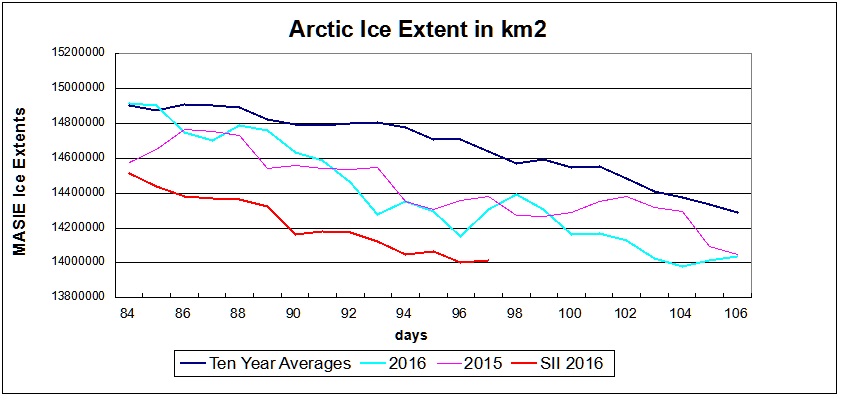
The graph of MASIE data shows 2016 is virtually tied with 2015 and both are below the ten-year average.  SII started to be unreliable after day 97.

Looking at specific seas comparing this year and last:

Ice Extents 2015 2016 Ice Extent
Region 2015106 2016106 km2 Diff.
 (0) Northern_Hemisphere 14049007 14037892 -11115
 (1) Beaufort_Sea 1070445 1065199 -5246
 (2) Chukchi_Sea 966006 965040 -966
 (3) East_Siberian_Sea 1087137 1087120 -17
 (4) Laptev_Sea 897845 897809 -36
 (5) Kara_Sea 918774 925096 6323
 (6) Barents_Sea 391374 458325 66951
 (7) Greenland_Sea 579909 659712 79804
 (8) Baffin_Bay_Gulf_of_St._Lawrence 1570273 1274139 -296134
 (9) Canadian_Archipelago 853214 850646 -2568
 (10) Hudson_Bay 1258284 1257926 -358
 (11) Central_Arctic 3219523 3237378 17855
 (12) Bering_Sea 649827 623466 -26361
 (13) Baltic_Sea 9568 22011 12443
 (14) Sea_of_Okhotsk 574873 712050 137177

Clearly the main difference in 2016 is more rapid melting in Baffin Bay, and Bering Sea down slightly.  Many seas are similar, and some are higher including Barents, Greenland and Okhotsk (a lot).

Summary:

Fasten your seat belts–Arctic melt season is underway.  Alarmists are rooting for more water, less ice, thinking that proves fossil fuels are warming the planet (it doesn’t).  Normal people figure some ice loss is a good thing, because it means the next ice age is another year further away.  Too much ice loss is bad because it may lead ignorant politicians to make stupid energy policies.

Anyway, the melt season is always entertaining and unpredictable, with unforeseen weather events overturning expected results.  Stay tuned.

Note:

On another thread I was asked about some recent scary reports about Greenland’s ice sheet. Since that is land ice, it is not included in sea ice measurements.  There is a balanced and informative article on DMI’s observations:
http://www.csmonitor.com/Science/2016/0414/Greenland-s-early-ice-melt-breaks-records.-What-s-behind-the-thaw

They refer to extent of 1 mm melting of the surface, and note an event in 2012 where 95% of the sheet had 1 mm or more melt water. Snow fall accumulates into ice, and also as the sheet grows, there is some calving of the surplus, also resulting in losses, but not in reducing the total ice.

I am skeptical of alarms about Greenland, as I posted in Greenland is Melting. Really?

The point is, Greenland ice sheet is also dynamic, meaning there is annually both ice melting and ice forming; the net is what matters.


Strange Days

Re-enactment of Renfrewshire Witch Hunt of 1697

Contrary to conventional wisdom, witch hunting did not happen much during the Middle Ages, since in most places it was illegal  to believe witches existed. Most of the witch hunts occurred during what’s called “the Renaissance.” Witch hunting continued though the “Age of Rationalism” and for the most part ended about in the middle of the “Age of Enlightenment” (in Europe at least).

As a general rule, witches were not hunted as witches, instead it fell under the larger banner of “heresy.” Pretty much what is going on now in targeting climatism unbelievers. Since suspected witches were tried as heretics instead of as witches, it makes getting exact numbers impossible. And so much for modern reasonable people being adverse to condemning and destroying others with differing beliefs.

Strange days have found us
Strange days have tracked us down
They’re going to destroy our casual joys
Lyrics from song “Strange Days”, The Doors 1967

The lyrics from the Doors classic song “Strange Days” seem (strangely) appropriate today with all of the lashing out of the climate alarmist movement. There are subpoenas flying around and multiple accusations against corporations, contrarian scientists, think tanks and even the federal government for not thinking and acting correctly to “fight climate change.”

As well, there is some kind of enchantment going on with the Arctic ice records. In a previous post (here) I pointed out some strangeness lurking in the measurements of Arctic ice. This post updates with some fresh weirdness from the Sea Ice Index produced by NOAA.

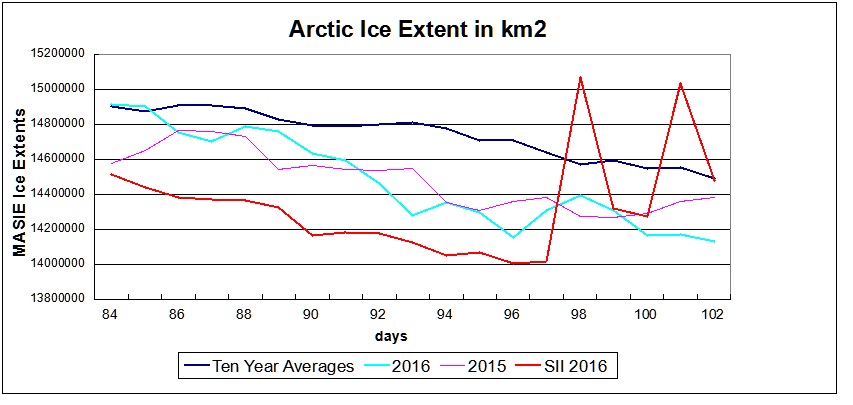
Here’s how April is proceeding according to MASIE and SII.

I can clearly see two witches in the SII record.  Look how SII in one week caught up to MASIE ten year average, including two days of nearly 1M km2 spikes, totally unbelievable. NOAA produces this index, and normally applies quality control revisions within one or two days later. Not so this time.

Update: As of today, April 13 (not a Friday, thank God) SII daily dataset no longer shows any April stats.

There is some history here. SII has been underestimating Arctic ice for three months, and these strange reports will likely overcome the deficit, resulting in an April average comparable to MASIE. That same scenario has happened on average in the last ten years.

Some journalists are even saying Arctic ice is recovering with the demise of El Nino. Don’t base anything on SII reports these days.  MASIE is not only the most accurate report of Arctic ice extent day in and day out; at the moment it is the only report, period.

Summary:

As climate alarmists continue to amp up the fear factor to achieve their political aims, they risk unleashing the heart of darkness hidden under the surface of civil society.