How About That Blob? (June 13 Update)

June 13, 2015

As hoped for by Paris COP promoters, and by Californians looking for El Nino precipitation, the Blob in the North Pacific has intensified and may at least partly fulfill both expectations.

HADSST3 results for May are now in, and the sea surface temperature warming anomaly is up:

Global +0.12C over last May,
NH +0.16C over last May.

That will show up also in air temperature estimates, since 71% of the earth’s surface is covered by oceans. For example, UAH TLT anomalies show Global oceans +0.06C over last May, but Global land -0.1C, so Global UAH is only up +0.02C over May 2014. (Note: UAH uses satellites to measure air temperatures many meters above land or ocean, while surface datasets like HADCRUT, BEST, GISTEMP use the measured SSTs in their global mean temperature estimates).

The Blob difference shows up in UAH in the NH results: NH anomaly is +0.07 over last year, with the same increase showing over land and ocean.  Interestingly, UAH shows the North Pole cooler than a year ago, the TLT over the Arctic being -0.06 less than a year ago.  The South Pole land air temps are a whopping -0.2C colder than last May.

As far as Arctic Ice is concerned, the Blob probably caused the Bering Sea to melt out more than one month earlier than last year.  About 10% of the water entering the Arctic Ocean comes from Bering, so there should be some impact on ice melting the immediate BCE region (Beaufort, Chukchi, East Siberian Seas). So far, in that region, 2015 is tracking last year’s melt at a slightly lower extent -4%, not yet a significant effect from the Blob.

More on Arctic Ice melt season here:

https://rclutz.wordpress.com/2015/06/02/arctic-ice-watch-june-daily/

Background on the Blob

Many have noticed the warm water anomaly in the Northern Pacific, which shows up as a weak El Nino, but somewhat unexpected and out of the ordinary pattern. The warm Pacific SST last year almost pushed 2014 to a new record average surface temperature, and fossil fuel activists are pinning their Paris hopes on this year.

So it is timely for the Meteorologist who named this event to provide a clear explanation of the natural causes of the Blob phenomenon.

From Nicholas Bond (excerpted from post linked below):

Blob 101
The development of the blob of unusually warm water can be attributed largely to an unusual weather pattern that set up shop over a large region extending from the North Pacific Ocean across North America from October 2013 into February 2014.

This pattern featured a strong and long-lasting weather pattern with higher-than-normal pressure – called a ridge – over the ocean centered offshore of the Pacific Northwest. This ridge of high pressure reduced the number and intensity of storms making landfall, leading to reduced precipitation west of the Continental Divide compared to seasonal norms.

In a study published earlier this month, my colleagues and I fingered the stubborn high-pressure ridge mentioned above, and in particular the weak winds associated with it. The result was a lower-than-normal rate in how quickly heat is transferred from the ocean to the atmosphere, and slower movement of cooler water into the formation region of the blob.
In other words, the unusual atmospheric conditions produced less cooling than typical for the season from fall 2013 through much of the following winter, yielding the sea surface temperature anomaly pattern. So we can essentially blame the ridge for the blob, but what caused the ridge in the first place?

The ocean circulation – that is, the currents – and the weather during the past year, which was unusual in its own right, combined to cause the blob to evolve into a wide strip of relatively warm water along the entire West Coast of North America (see image, below).

This happens to be a pattern that has occurred before in association with decades-long shifts in ocean temperature known as the Pacific Decadal Oscillation (PDO). Previous expressions of the PDO have had major and wide-ranging impacts on the marine ecosystem including salmon and other species of fish; recent developments are receiving a great deal of attention from fishery-oceanographers along the West Coast.

http://theconversation.com/what-is-the-warm-blob-in-the-pacific-and-what-can-it-tell-us-about-our-future-climate-40140

In Praise of Michael Crichton

I am grateful for Michael Crichton speaking out so forcefully and effectively on global warming before he died in 2008. His novel “State of Fear” presaged the media circus of the last decade since the book appeared in 2004. In particular, the attitudes and behavior of climate fear mongers in the novel seemed incredible at the time, but were validated in spades by the Climategate revelations.

To be honest, I was not that thrilled reading the story in 2005, lacking any awareness that such a campaign was underway. I was reading anything Crichton wrote because of my interest in science and technology, and his focus on the near future effects. His other novels were much more compelling: Jurassic Park, Congo, Disclosure, Air Frame, to name a few.

But State of Fear included not only a novel, but many pages of graphs and analyses that showed the weaknesses in alarmist claims. And there were transcripts of Crichton speeches that laid waste to climate claims. The appendices got into my awareness much more than did the story itself.

Judging by what others have said on blogs, I was not the only one for whom this book triggered a skeptical stance toward global warming alarm. It was a wake up call for some, and for others, like myself, it was an inoculation against the viral media onslaught to come.

Let me explain with a brief tangent

Edward De Bono wrote extensively some decades ago on the subject of lateral thinking, or “thinking outside of the box.” His studies of human problem solving showed emphatically that everything depends on the sequence in which information enters a person’s awareness.

Thus, on a topic where I have no opinion, my mind is open to various perspectives. Fairly soon, however, I am likely to form a gestalt, or paradigm that makes sense of what I know, which involves discounting or dismissing facts that don’t fit. This occurs because uncertainly and ambiguity is uncomfortable, even painful if the matter is of great consequence.

Over time, I accept any and all information that reinforces my gestalt, and become increasingly resistant to facts that challenge or contradict my paradigm. This occurs because it is even more painful to discard a gestalt that I used to organize my thinking, since I now become disoriented, unable to process new information that comes to me.

This is background to understand how serious is the educational propagation of the man-made climate change notion. I went through this process regarding global warming starting in 2009 as an adult with a background of a degree in organic chemistry, and I came out skeptical of the IPCC consensus perspective. That outcome would be less likely if I were a young student today.

And the critical event was Crichton’s novel, evidence and speeches that preceded my exposure to the alarms, and predisposed me to question and examine critically. My takeaway message from Crichton had been: “When you hear scary things about the climate, don’t take them at face value–investigate and get a second or third opinion.”

In fact that experience regarding climate science led me to the slogan of this blog: Reading between the lines and underneath the hype.

Michael Crichton had two principle concerns concerning science and society, which led to his criticism of global warming. First, he warned against governments capturing science as a tool to cow the population into funding and submitting to politicians’ policies. Second, he thought scientists in many fields were far too certain and trusting of their knowledge and tools, especially computerized systems.

Some Quotes:

On Rampant Media Speculation (2002):

But just in terms of the general emotional tenor of life, I often think people are nervous, jittery in this media climate of what if, what if, maybe, perhaps, could be…when there is usually no sensible reason to feel nervous.

Like a bearded nut in robes on the sidewalk proclaiming the end of the world is near, the media is just doing what makes it feel good, not reporting hard facts. We need to start seeing the media as a bearded nut on the sidewalk, shouting out false fears. It’s not sensible to listen to it.

On Enivronmentalism (2003)

Today, one of the most powerful religions in the Western World is environmentalism. Environmentalism seems to be the religion of choice for urban atheists. Why do I say it’s a religion? Well, if you look carefully at the core beliefs, you will see that environmentalism is in fact a perfect 21st century remapping of traditional Judeo-Christian beliefs and myths.

And so, sadly, with environmentalism it ncreasingly seems facts aren’t necessary, because the tenets of environmentalism are all about belief. It’s about whether you are going to be a sinner or be saved, whether you are going to be on the side of salvation or on the side of doom, whether you are going to be one of us or one of them.

Am I exaggerating to make a point? I am afraid not. Because we know a lot more about the world than we did forty or fifty years ago. And what we know now is no longer supportive of many core environmental myths, yet the myths do not die. Let’s examine some of those beliefs. . .

I want to argue that it is now time for us to make a major shift in our thinking about the environment, similar to the shift that occurred around the first Earth Day in 1970, when this awareness was first heightened. But this time around, we need to get environmentalism out of the sphere of religion. We need to stop the mythic fantasies, and we need to stop the doomsday predictions. We need to start doing hard science instead.

On Politicized Science (2003):

Finally, I would remind you to notice where the claim of consensus is invoked. Nobody says the consensus of scientists agrees that E=mc2. Nobody says the consensus is that the sun is 93 million miles away. It would never occur to anyone to speak that way. Consensus is invoked only in situations where the science is not solid enough. Which means, in turn, that if somebody tells you the consensus of scientists believes something or other, you should be immediately suspicious.

Once you abandon strict adherence to what science tells us, once you start arranging the truth in a press conference, then anything is possible. In one context, perhaps you will get mobilization against nuclear war. But in another context, you get Lysenkoism. In another, you get Nazi euthanasia. The danger is always there, if you subvert science to political ends.

That is why it is so important for the future of science that the line between what science can say with certainty, and what it cannot, be drawn clearly—and defended.

What, then, can we say were the lessons of Nuclear Winter? I believe the lesson was that given a catchy name, a strong policy position, and an aggressive media campaign, nobody will dare to criticize the science, and in short order, a terminally weak thesis can be established as fact. After that, any criticism becomes beside the point. The war is already over, without a shot being fired. That was the lesson, and we had a textbook application soon afterward, with second hand smoke.

And so, in this elastic anything-goes world where science—or nonscience—is the handmaiden of questionable public policy, we arrive at last at global warming. It is not my purpose here to rehash the details of this most magnificent of the demons haunting the world. I would just remind you of the now-familiar pattern by which these things are established. Dramatic announcements are carefully contrived. Evidentiary uncertainties are glossed over in the unseemly rush for an overarching policy, and for grants to support the policy by delivering findings that are desired by the patron. Next, the isolation of those scientists who won’t get with the program, and the characterization of those scientists as outsiders and “skeptics” in quotation marks—suspect individuals with suspect motives, industry flunkies, reactionaries, or simply anti-environmental nutcases. In short order, debate ends, even though prominent scientists in many fields are uncomfortable about how things are being done.

To an outsider, the most significant innovation in the global warming controversy is the overt reliance that is being placed on models. Back in the days of nuclear winter, computer models were invoked to add weight to a conclusion: “These results are derived with the help of a computer model.” But now, large-scale computer models are seen as generating data in themselves. No longer are models judged by how well they reproduce data from the real world—increasingly, models provide the data. As if they were themselves a reality. And indeed they are, when we are projecting forward. There can be no observational data about the year 2100. There are only model runs.

Stepping back, I have to say the arrogance of the model makers is breathtaking. There have been, in every century, scientists who say they know it all. Since climate may be a chaotic system—no one is sure about
that—these predictions are inherently doubtful, to be polite. But more to the point, even if the models get the science spot-on, they can never get the sociology. To predict anything about the world a hundred years
from now is simply absurd.
Wow. Talk about hitting the nail on the head a decade in advance.

For those who want to read more (highly recommended):

State of Fear pdf is here:

Click to access 0060820640.pdf

State of Fear ebook is here:
http://books4all.cc:8080/mobile?num=100000

And a final word from the novel:

Our planet is five billion years old, and it has been changing constantly all during that time. […] Our atmosphere is as violent as the land beneath it. At any moment there are one thousand five hundred electrical storms across the planet. Eleven lightning bolts strike the ground each second. A tornado tears across the surface every six hours. And every four days, a giant cyclonic storm, hundreds of miles in diameter, spins over the ocean and wreaks havoc on the land.

The nasty little apes that call themselves human beings can do nothing except run and hide. For these same apes to imagine they can stabilize this atmosphere is arrogant beyond belief. They can’t control the climate.

The reality is, they run from the storms.

Thank you Michael Crichton. I hope we can still pull the plug on the present day State of Fear.

Climate Models Explained

A comment by Dr. R.G. Brown of Duke University posted on June 11 at WUWT.

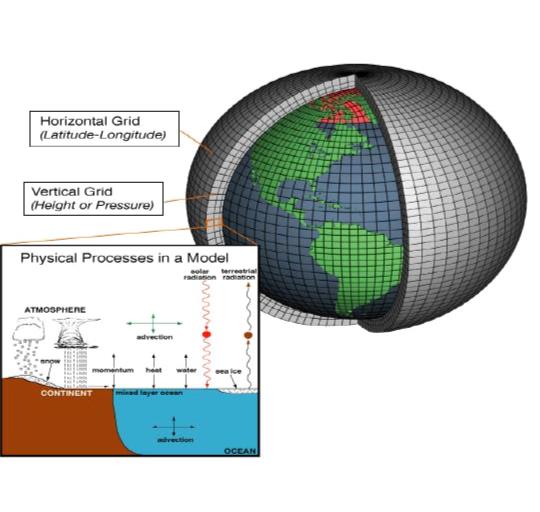
noaa climate model

Overview of the structure of a state-of-the-art climate model. From the NOAA website http://www.research.noaa.gov/climate/t_modeling.html

First about the way weather models work

That is not quite what they do in GCMs. There are two reasons for this. One is that a global grid of 2 million temperatures sounds like a lot, but it’s not. Remember the atmosphere has depth, and they have to initialize at least to the top of the troposphere, and if they use 1 km thick cells there are 9 or 10 layers. Say 10. Then they have 500 million square kilometers of area to cover. Even if the grid itself has two million cells, that is still cells that contain 250 square km. This isn’t terrible — 16x16x1 km cells (20 million of them assuming they follow the usual practice of slabs 1 km thick) are small enough that they can actually resolve largish individual thunderstorms — but is still orders of magnitude larger than distinct weather features like individual clouds or smaller storms or tornadoes or land features (lakes, individual hills and mountains) that can affect the weather.

There is also substantial error in their initial conditions — as you say, they smooth temperatures sampled at a lot fewer than 2 million points to cover vast tracts of the grid where there simply are no thermometers, and even where they have surface thermometers they do not generally have soundings (temperature measurements from e.g. balloons that ride up the air column at a location) so they do not know the temperature in depth. The model initialization has to do things like take the surface temperature guess (from a smoothing model) and guess the temperature profile overhead using things like the adiabatic lapse rate, a comparative handful of soundings, knowledge of the cloudiness or whatever of the cell obtained from satellite or radar (where available) or just plain rules of thumb (all built into a model to initialize the model.

Then there is the ocean. Sea surface temperatures matter a great deal, but so do temperatures down to some depth (more for climate than for weather, but when large scale phenomena like hurricanes come along, the heat content of the ocean down to some depth very much plays a role in their development) so they have to model that, and the better models often contain at least one if not more layers down into the dynamic ocean. The Gulf Stream, for example, is a river in the Atlantic that transports heat and salinity and moves around 200 kilometers in a day on the surface, less at depth, which means that fluctuations in surface temperature, fed back or altered by precipitation or cloudiness or wind, move across many cells over the course of a day.  (My Bold)

Even with all of the care I describe above and then some, weather models computed at close to the limits of our ability to compute (and get a decent answer faster than nature “computes” it by making it actually happen) track the weather accurately for a comparatively short time — days — before small variations between the heavily modeled, heavily under-sampled model initial conditions and the actual initial state of the weather plus errors in the computation due to many things — discrete arithmetic, the finite grid size, errors in the implementation of the climate dynamics at the grid resolution used (which have to be approximated in various ways to “mimic” the neglected internal smaller scaled dynamics that they cannot afford to compute) cause the models to systematically diverge from the actual weather.

If they run the model many times with small tweaks of the initial conditions, they have learned empirically that the distribution of final states they obtain can be reasonably compared to the climate for a few days more in an increasingly improbable way, until around a week or ten days out the variation is so great that they are just as well off predicting the weather by using the average weather for a date over the last 100 years and a bit of sense, just as is done in almanacs.

In other words, the models, no matter how many times they are run or how carefully they are initialized, produce results with no “lift” over ordinary statistics at around 10 days. (My bold)

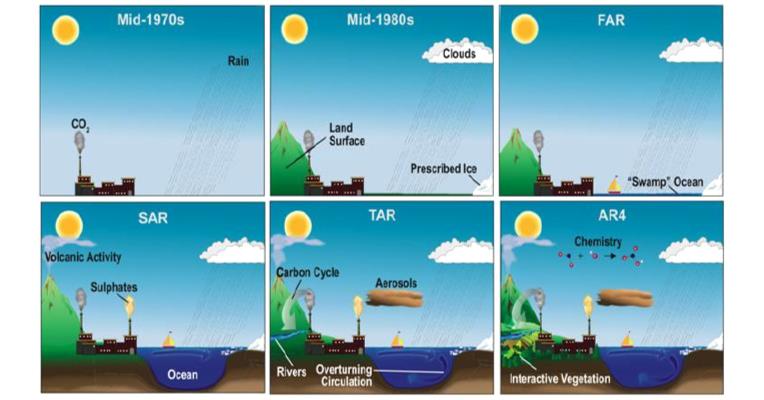
Evolution of state-of-the-art Climate Models from the mid 70s to the mid 00s. From IPCC (2007)

Evolution of state-of-the-art Climate Models from the mid 70s to the mid 00s. From IPCC (2007)

Now How Climate Models Work:

Then here is the interesting point. Climate models are just weather models run in exactly this way, with one exception. Since they know that the model will produce results indistinguishable from ordinary static statistics two weeks in, they don’t bother initializing them all that carefully. The idea is that no matter how then initialize them, after running them out to weeks or months the bundle of trajectories they produce from small perturbations will statistically “converge” at any given time to what is supposed to be the long time statistical average, which is what they are trying to predict.

This assumption is itself dubious, as neither the weather nor the climate is stationary and it is most definitely non-Markovian so that the neglected details in the initial state do matter in the evolution of both, and there is also no theorem of which I am aware that states that the average or statistical distribution of a bundle of trajectories generated from a nonlinear chaotic model of this sort will in even the medium run be an accurate representation of the nonstationary statistical distribution of possible future climates. But it’s the only game in town, so they give it a try.

They then run this re-purposed, badly initialized weather model out until they think it has had time to become a “sample” for the weather for some stationary initial condition (fixed date, sunlight, atmosphere, etc) and then they vary things like CO_2 systematically over time while integrating and see how the run evolves over future decades. The bundle of future climate trajectories thus generated from many tweaks of initial conditions and sometimes the physical parameters as well is then statistically analyzed, and its mean becomes the central prediction of the model and the variance or envelope of all of the trajectories become confidence intervals of its predictions.

The problem is that they aren’t really confidence intervals because we don’t really have any good reason to think that the integration of the weather ten years into the future at an inadequate grid size, with all of the accumulation of error along the way, is actually a sample from the same statistical distribution that the real weather is being drawn from subject to tiny perturbations in its initial state. The climate integrates itself down to the molecular level, not on a 16×16 km grid, and climate models can’t use that small a grid size and run in less than infinite time, so the highest resolution I’ve heard of is 100×100 km^2 cells (10^4 square km, which is around 50,000 cells, not two million).

At this grid size they cannot see individual thunderstorms at all. Indeed, many extremely dynamic features of heat transport in weather have to be modeled by some sort of empirical “mean field” approximation of the internal cell dynamics — “average thunderstormicity” or the like as thunderstorms in particular cause rapid vertical transport of a lot of heat up from the surface and rapid transport of chilled/chilling water down to the surface, among other things. The same is true of snowpack — even small errors in average snowpack coverage make big differences in total heat received in any given winter and this can feed back to kick a model well off of the real climate in a matter of years.

So far, it looks like (not unlike the circumstance with weather) climate models can sometimes track the climate for a decade or so before they diverge from it.   (My Bold)

They suffer from many other ailments as well — if one examines the actual month to month or year to year variance of the “weather” they predict, it has the wrong amplitude and decay times compared to the actual climate, which is basically saying (via the fluctuation-dissipation theorem) that they have the physics of the open system wrong. The models heavily exaggerate the effect of aerosols and tend to overreact to things like volcanic eruptions that dump aerosols into the atmosphere.

The models are tuned to cancel the exaggerated effect of aerosols with an exaggerated feedback on top of CO_2 driven warming to make them “work” to track the climate over a 20 year reference period. Sadly, this 20 year reference period was chosen to be the single strongest warming stretch of the 20th century, ignoring cooling periods and warming periods that preceded it and (probably as a consequence) diverging from the flat-to-slightly cooling period we’ve been in for the last 16 or so years (or more, or less, depending on who you are talking to, but even the IPCC formally recognizes “the pause, the hiatus”, the lack of warming for this interval, in AR5. It is a serious problem for the models and everybody knows it.

The IPCC then takes the results of many GCMs and compounds all errors by super-averaging their results (which has the effect of hiding the fluctuation problem from inquiring eyes), ignoring the fact that some models in particular truly suck in all respects at predicting the climate and that others do much better, because the ones that do better predict less long run warming and that isn’t the message they want to convey to policy makers, and transform its envelope into a completely unjustifiable assertion of “statistical confidence”.

This is a simple lie. Each model one at a time can have the confidence interval produced by the spread in long-run trajectories produced by the perturbation of its initial conditions compared to the actual trajectory of the climate and turned into a p-value. The p-value is a measure of the probability of the truth of the null hypothesis — “This climate model is a perfect model in that its bundle of trajectories is a representation of the actual distribution of future climates”. This permits the estimation of the probability of getting our particular real climate given this distribution, and if the probability is low, especially if it is very low, we under ordinary circumstances would reject the huge bundle of assumptions tied up in as “the hypothesis” represented by the model itself and call the model “failed”, back to the drawing board.

One cannot do anything with the super-average of 36 odd non-independent grand average per-model results. To even try to apply statistics to this shotgun blast of assumptions one has to use something called the Bonferroni correction, which basically makes the p-value for failure of individual models in the shotgun blast much, much larger (because they have 36 chances to get it right, which means that even if all 36 are wrong pure chance can — no, probably will — make a bad model come out within a p = 0.05 cutoff as long as the models aren’t too wrong yet.

By this standard, “the set of models in CMIP5″ has long since failed. There isn’t the slightest doubt that their collective prediction is statistical nonsense. It remains to be seen if individual models in the collection deserve to be kept in the running as not failed yet, because even applying the Bonferroni correction to the “ensemble” of CMIP5 is not good statistical practice. Each model should really be evaluated on its own merits as one doesn’t expect the “mean” or “distribution” of individual model results to have any meaning in statistics (note that this is NOT like perturbing the initial conditions of ONE model, which is a form of Monte Carlo statistical sampling and is something that has some actual meaning).

Hope this helps.

rgb
http://wattsupwiththat.com/2015/06/09/huge-divergence-between-latest-uah-and-hadcrut4-revisions-now-includes-april-data/#comment-1960561

In the conclusion of a recent paper, Valerio Lucarini adds:

We have briefly recapitulated some of the scientific challenges and epistemological issues related to climate science. We have discussed the formulation and testing of theories and numerical models, which, given the presence of unavoidable uncertainties in observational data, the nonrepeatability of world-experiments, and the fact that relevant processes occur in a large variety of spatial and temporal scales, require a rather different approach than in other scientific contexts.

In particular, we have clarified the presence of two different levels of unavoidable uncertainties when dealing with climate models, related to the complexity and chaoticity of the system under investigation. The first is related to the imperfect knowledge of the initial conditions, the second is related to the imperfect representation of the processes of the system, which can be referred to as structural uncertainties of the model. We have discussed how Monte Carlo methods provide partial but very popular solutions to these problems. A third level of uncertainty is related to the need for a, definitely non-trivial, definition of the appropriate metrics in the process of validation of the climate models. We have highlighted the difference between metrics aimed at providing information of great relevance for the end-user from those more focused on the audit of the most important physical processes of the climate system.

It is becoming clearer and clearer that the current strategy of incremental improvements of climate models is failing to produce a qualitative change in our ability to describe the climate system, also because the gap between the simulation and the understanding of the climate system is widening (Held 2005, Lucarini 2008a). Therefore, the pursuit of a “quantum leap” in climate modeling – which definitely requires new scientific ideas rather than just faster supercomputers – is becoming more and more of a key issue in the climate community (Shukla et al. 2009).

Lucarini goes further: Our proposal: a Thermodynamic perspective

While acknowledging the scientific achievements obtained along the above mentioned line, we propose a different approach for addressing the big picture of a complex system like climate is. An alternative way for providing a new, satisfactory theory of climate dynamics able to tackle simultaneously balances of physical quantities and dynamical instabilities is to adopt a thermodynamic perspective, along the lines proposed by Lorenz (1967). We consider simultaneously two closely related approaches, a phenomenological outlook based on the macroscopic theory of non-equilibrium thermodynamics (see e.g., de Groot and Mazur 1962), and, a more fundamental outlook, based on the paradigm of ergodic theory (Eckmann and Ruelle 1985) and more recent developments of the non-equilibrium statistical mechanics (Ruelle 1998, 2009).

The concept of the energy cycle of the atmosphere introduced by Lorenz (1967) allowed for defining an effective climate machine such that the atmospheric and oceanic motions simultaneously result from the mechanical work (then dissipated in a turbulent cascade) produced by the engine, and re-equilibrate the energy balance of the climate system. One of the fundamental reasons why a comprehensive understanding of climate dynamics is hard to achieve lies on the presence of such a nonlinear closure. Recently, Johnson (2000) introduced a Carnot engine–equivalent picture of the climate system by defining effective warm and the cold reservoirs and their temperatures.

From Modelling Complexity: the case of Climate Science, V. Lucarini

Click to access 1106.1265.pdf

For more on Climate models see:

https://rclutz.wordpress.com/2015/03/24/temperatures-according-to-climate-models/

https://rclutz.wordpress.com/2015/03/25/climate-thinking-out-of-the-box/

Spitsbergen Triangle: Ground Zero for Climate Mysteries

Credit to Dr. Bernaerts for his writings on this subject, excerpts of which appear below.

The Island Nexus for Ocean Currents

From the Dutch: spits – pointed, bergen – mountains

The largest and only permanently populated island of the Svalbard archipelago in northern Norway. Constituting the westernmost bulk of the archipelago, it borders the Arctic Ocean, the Norwegian Sea, and the Greenland Sea. Spitsbergen covers an area of 39,044 km2 (15,075 sq mi), making it the largest island in Norway and the 36th-largest in the world.

The fact is that the winter temperatures made a jump of more than eight degrees Celsius at the gate of the Arctic Basin, after 1918. Nowadays, one century later, the event is still regarded as “one of the most puzzling climate anomalies of the 20th century”.

Dr. Bernaerts:

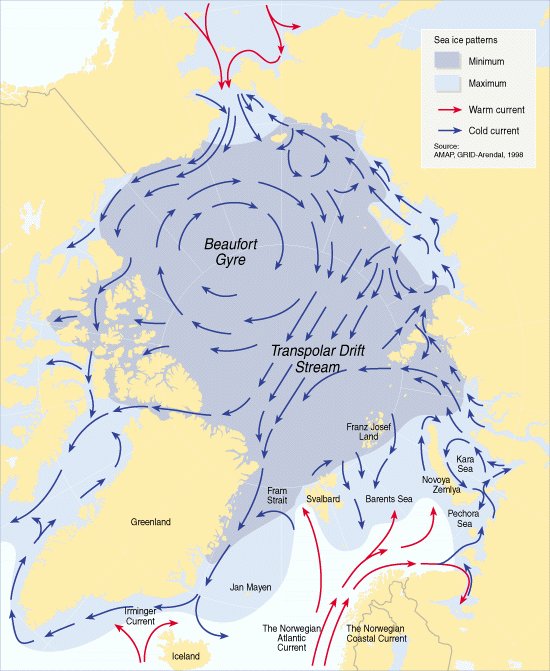
The overriding aspect of the location is the sea; the sea around Spitsbergen, the sea between particularly the Norwegian, the Greenland, and the Barents Seas (Nordic Sea). The Norwegian Sea is a huge, 3000 metres deep basin. This huge water mass stores a great amount of energy, which can transfer warmth into the atmosphere for a long time. In contrast the Barents Sea, in the southeast of Spitsbergen has an average depth of just around 230 metres. In- and outflow are so high that the whole water body is completely renewed in less than 5 years. However, both sea areas are strongly influenced by the water masses coming from the South. The most important element is a separate branch of the North Atlantic Gulf Current, which brings very warm and very salty water into the Norwegian Sea and into the Spitsbergen region. Water temperature and degree of saltiness play a decisive role in the internal dynamics of the sea body. And what might be the role of the huge basin of the Arctic Ocean, 3000 meters depth and a size of about 15 million square kilometers?

The difference towards the other seas mentioned is tremendous. The Arctic Ocean used to be widely ice covered in the first half of the 20th Century, the other seas only partly on a seasonal basis. Only between the open sea and the atmosphere an intensive heat transfer is permanently taking place. Compact sea ice reduces this transfer about 90% and more, broken or floating ice may change the proportion marginally. In this respect an ice covered Arctic Ocean has not an oceanic but ‘continental’ impact on the climate.

The Arctic Ocean is permanently supplied with new water from the Gulf Current, which enters the sea close at the surface near Spitsbergen. This current is called the West Spitsbergen current. The arriving water is relatively warm (6 to 8°C) and salty (35.1 to 35.3%) and has a mean speed of ca. 30 cm/sec-1. The warm Atlantic water represents almost 90% of all water masses the Arctic receives. The other ~10% comes via the Bering Strait or rivers. Due to the fact that the warm Atlantic water reaches usually the edge of the Arctic Ocean at Spitsbergen in open water, the cooling process starts well before entering the Polar Sea.

A further highly significant climate aspect of global dimension is the water masses the Arctic releases back to oceans. Actually, the outflow occurs mainly via the Fram Strait between Northeast Greenland and Spitsbergen, and together with very cold water from the Norwegian Sea basin the deep water spreads below the permanent thermocline into the three oceans.

http://www.arctic-heats-up.com/pdf/chapter_2.pdf

The Spitsbergen Event 1918-1919

Beginning around 1850 the Little Ice Age ended and the climate began warming. Before that, at least since 1650 marked the first climatic minimum after a Medieval warm period, the Little Ice Age brought bitterly cold winters to many parts of the world, most thoroughly documented in the Northern Hemisphere in Europe and North America. The decreased solar activity and the increased volcanic activity are considered as causes. However, the temperature increase was remote and once again effected by the last major volcanic eruption of the Krakatoa in 1883. Up to the 1910s the warming of the world was modest.

Suddenly that changed. In the Arctic the temperatures literally exploded in winter 1918/19. The extraordinary event lasted from 1918 to 1939 is clearly demonstrated in the graph showing the ‘Arctic Annual Mean Temperature Anomalies 1880 – 2004’. But this extraordinary event has a number of facets, which could have been researched and explained. Meanwhile almost a full century has passed, and what do we know about this event today? Very little!

Studies considering the causation of the warming offer sketchy rather than well founded ideas. Here are a few examples:
• Natural variability is the most likely cause (Bengtsson, 2004);
• We theorize that the Arctic warming in the 1920s/1930s was due to natural fluctuations internal to the climate system (Johannessen, 2004).
• The low Arctic temperatures before 1920 had been caused by volcanic aerosol loading and solar radiation, but since 1920 increasing greenhouse gas concentration dominated the temperatures (Overpeck, 1997).
• The earlier warming shows large region-to-region, month-to-month, and year-to-year variability, which suggests that these composite temperature anomalies are due primarily to natural variability in weather systems (Overland, 2004).
• A combination of a global warming signal and fortuitous phasing of intrinsic climate patterns (Overland, 2008).

Arctic Regime Change

These explanations (and others such as CO2 or the AMOC) do not come to grips with how extreme and abrupt was this event. In the Spring of 1917, sea ice reached all the way to Spitsbergen, the only time in a century.

And the next year, temperatures rocketed upward, as shown by the weather station there:

A look at the SST history shows clearly an event as dramatic as a super El Nino causing a regime change. But this is the Atlantic, not the Pacific. Cooling followed, but temperatures stayed at a higher level than before.

Summary

The warming at Spitsbergen is one of the most outstanding climatic events since the volcanic eruption of Krakatoa, in 1883. The dramatic warming at Spitsbergen may hold key aspects for understanding how climate ticks. The following elaboration intends to approach the matter from different angles, but on a straight line of thoughts, namely:

  • WHERE: the warming was caused and sustained by the northern part of the Nordic Sea in the sea area of West Spitsbergen the pass way of the Spitsbergen Current.
  • WHEN: The date of the commencement of warming can be established with high precision of few months, and which was definitely in place by January 1919.
  • WHY: the sudden and significant temperature deviation around the winter of 1918/19 was with considerable probability caused, at least partly, by a devastating naval war which took place around  the British Isles, between 1914 and 1918.

There is much more evidence and analysis supporting Dr. Bernaerts’ conclusions here:

http://climate-ocean.com/arctic-book/index.html


Conclusion:  Unless your theory of climate change can make sense of the Spitsbergen Event, then it cannot inspire confidence. You may not be entirely convinced by Dr. Bernaerts’ explanation, but he at least has one–nobody else  has even tried.

Evidence is Mounting: Oceans Make Climate

Update May 28, 2015, with additional detail from Dr. McCarthy

Update May 29, 2015, with additional context from Bob Tisdale

The RAPID moorings being deployed. Credit: National Oceanography Centre

A new study, by scientists from the University of Southampton and National Oceanography Centre (NOC), implies that the global climate is on the verge of broad-scale change that could last for a number of decades. This new climatic phase could be half a degree cooler.

The change to the new set of climatic conditions is associated with a cooling of the Atlantic, and is likely to bring drier summers in Britain and Ireland, accelerated sea-level rise along the northeast coast of the United States, and drought in the developing countries of the Sahel region. Since this new climatic phase could be half a degree cooler, it may well offer a brief reprise from the rise of global temperatures, as well as resulting in fewer hurricanes hitting the United States.

The study, published in Nature, proves that ocean circulation is the link between weather and decadal scale climatic change. It is based on observational evidence of the link between ocean circulation and the decadal variability of sea surface temperatures in the Atlantic Ocean.

Lead author Dr Gerard McCarthy, from the NOC, said: “Sea-surface temperatures in the Atlantic vary between warm and cold over time-scales of many decades. These variations have been shown to influence temperature, rainfall, drought and even the frequency of hurricanes in many regions of the world. This decadal variability, called the Atlantic Multi-decadal Oscillation (AMO), is a notable feature of the Atlantic Ocean and the climate of the regions it influences.”

The strength of ocean currents has been measured by a network of sensors, called the RAPID array, which have been collecting data on the flow rate of the Atlantic meridonal overturning circulation (AMOC) for a decade.

Dr David Smeed, from the NOC and lead scientist of the RAPID project, adds: “The observations of AMOC from the RAPID array, over the past ten years, show that it is declining. As a result, we expect the AMO is moving to a negative phase, which will result in cooler surface waters. This is consistent with observations of temperature in the North Atlantic.”

http://www.sciencedaily.com/releases/2015/05/150527133932.htm

Some additional detail from Dr. McCarthy:

Results from the RAPID array

Gerard McCarthy, David Smeed, Darren Rayner, Eleanor Frajka-Williams, Aurélie Duchez, Bill Johns, Molly Baringer, Chris Meinen, Adam Blaker, Stuart Cunningham and Harry Bryden

“The RAPID/MOCHA/WBTS mooring array at 26ºN in the Atlantic has been delivering twice daily estimates of the strength of the AMOC since 2004. A unique array, the observations have revolutionised our understanding of the variability of the AMOC on sub-annual, seasonal and, most recently, interannual timescales. An update to the AMOC timeseries has recently been produced.   As well as extending the data, the timeseries to October 2012 contains several improvements to the calculation.

A dramatic low in the AMOC was observed in winter 2009/10, where the AMOC declined by 30%. This has been shown to have resulted in a sustained reduction in heat content of the North Atlantic. The 2009/10 dip in AMOC strength was followed by a second dramatic low in 2010/11. Historical analogues of double minima in successive winters have been identified in NEMO runs where they are associated with extreme negative values of the Arctic oscillation and have been linked with ocean re-emergence. Interestingly, there is also a link with surface air temperatures and, consequently, European wintertime conditions.

The latest update of the AMOC time series to October 2012 shows a continuing trend in the circulation at 26ºN switching from an overturning to a gyre circulation. This leads to weakened southward transport of lower North Atlantic Deep Water, the strength of which from 2004-2012 is weaker than in historical measurements. The IPCC report in 2007 reported that the AMOC was ‘very likely’ to weaken in the 21st century. Maintaining the sustained observations of the RAPID array is key to observing this climate metric.”

Rapid Project Webpage is here: http://www.rapid.ac.uk/rapidmoc/

Figure 1:Ten-day (colours) and three month low-pass (black) timeseries of Florida Straits transport (blue), Ekman transport (black), upper mid-ocean transport (magenta), and overturning transport (red) for the period 2nd April 2004 to mid- March 2014. Florida Straits transport is based on electromagnetic cable measurements; Ekman transport is based on ERA winds. The upper mid-ocean transport, based on the RAPID time series, is the vertical integral of the transport per unit depth down to the deepest northward velocity (~1100 m) on each day. Overturning transport is then the sum of the Florida Straits, Ekman, and upper mid-ocean transports and represents the maximum northward transport of upper-layer waters on each day. Positive transports correspond to northward flow.

Additional info here: http://www.livescience.com/50998-jet-stream-controls-atlantic-climate-cycles.html

Footnote:

Getting a reprieve from the dangers of global warming would be good news, but these facts were not well received by everyone last month at a conference in Vienna, as tweeted by Dr. McCarthy:

Bob Tisdale provides additional context on the AMO and on this paper, as well as critiques of some other papers here: https://bobtisdale.wordpress.com/2015/05/29/new-paper-confirms-the-drivers-of-and-processes-behind-the-atlantic-multidecadal-oscillation/

For more on this topic see:

https://rclutz.wordpress.com/2015/05/10/empirical-evidence-oceans-make-climate/

https://rclutz.wordpress.com/2015/04/13/climate-pacemaker-the-amoc/

Climate on Ice: Ocean-Ice Dynamics

Update May 30, 2015 Longer term context by E.M. Smith added below

Sea ice is not simple. Some Background is in order.

When white men started to explore the north of America, they first encountered the Crees. Hudson Bay posts were established to trade goods for pelts, especially the beavers used for making those top hats worn by every gentleman of the day.

The Crees told the whites that further on toward the Arctic Circle there were others they called “eskimos”. The Cree word means “eaters of raw meat” and it is derogatory. The Inuit (as they call themselves) were found to have dozens of words for snow, a necessary vocabulary for surviving in the Arctic world.

A recent lexicon of sea ice terminology in Nunavik (Appendix A of the collective work Siku: Knowing our Ice, 2008) comprises no fewer than 93 different words. These include general appellations such as siku, but also terms as specialized as qautsaulittuq, ice that breaks after its strength has been tested with a harpoon; kiviniq, a depression in shore ice caused by the weight of the water that passed over and accumulated on its surface during the tide; or iniruvik, ice that cracked because of tide changes and that the cold weather refroze.

http://www.thecanadianencyclopedia.ca/en/article/inuit-words-for-snow-and-ice/

With such complexity of ice conditions, we must recognize that any general understanding of ocean-ice dynamics will not be descriptive of all micro-scale effects on local or regional circumstances.

Short Term Sea Ice Freezing and Melting Cycle

Alarmists only mention positive feedbacks from ice melting, so one is left to wonder why there is any Arctic ice left so many years since the Little Ice Age ended around 1850. Actually there are both positive and negative feedbacks, with one or the other dominating at different times and places.

Of course, the basic cycle is the seasonality of sunless winters and sunlit summers.

Remember that ice grows because of a transfer of heat from the relatively warm ocean to the cold air above. Also remember that ice insulates the ocean from the atmosphere and inhibits this heat transfer. The amount of insulation depends on the thickness of the ice; thicker ice allows less heat transfer. If the ice becomes thick enough that no heat from the ocean can be conducted through the ice, then ice stops growing. This is called the thermodynamic equilibrium thickness. It may take several years of growth and melt for ice to reach the equilibrium thickness. In the Arctic, the thermodynamic equilibrium thickness of sea ice is approximately 3 meters (9 feet). However, dynamics can yield sea ice thicknesses of 10 meters (30 feet) or more. Equilibrium thickness of sea ice is much lower in Antarctica, typically ranging from 1 to 2 meters (3 to 6 feet).

Snow has an even higher albedo than sea ice, and so thick sea ice covered with snow reflects as much as 90 percent of the incoming solar radiation. This serves to insulate the sea ice, maintaining cold temperatures and delaying ice melt in the summer. After the snow does begin to melt, and because shallow melt ponds have an albedo of approximately 0.2 to 0.4, the surface albedo drops to about 0.75. As melt ponds grow and deepen, the surface albedo can drop to 0.15. As a result, melt ponds are associated with higher energy absorption and a more rapid ice melt.

https://nsidc.org/cryosphere/seaice/processes/growth_melt_cycle.html

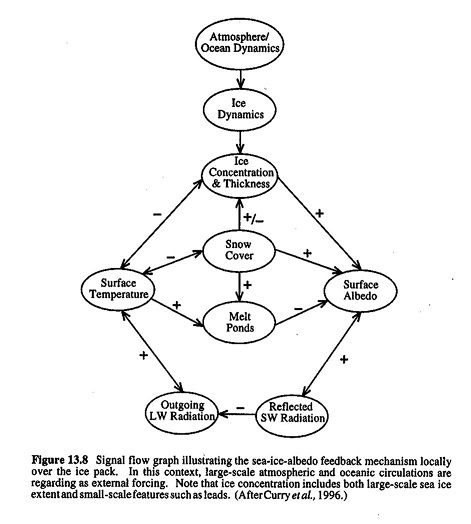
The short-term dynamics of sea ice freezing and melting can be summarized in this diagram from Dr. Judith Curry:

sea-ice-climate-dynamics_Image_5

Dr. Curry has written extensively on sea ice, and an introduction to her sources is here:

http://judithcurry.com/2014/10/15/new-presentations-on-sea-ice/

Decadal Variability in Sea Ice Extent

Medium term sea ice variations are well described by Lawrence A. Mysak and Silvia A. Venegas of the Centre for Climate and Global Change Research and Department of Atmospheric and Oceanic
Sciences, McGill University, Montreal, Quebec, Canada.

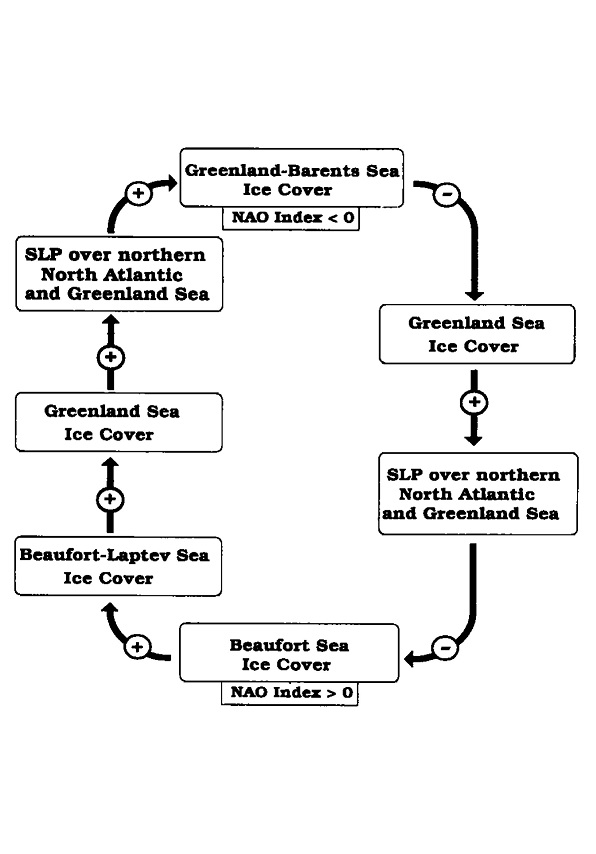
Abstract: A combined complex empirical orthogonal function analysis of 40 years of annual sea ice concentration (SIC) and winter sea level pressure (SLP) data reveals the existence of an approximately 10-year climate cycle in the Arctic and subarctic.

paper_ice_Mysak1998

“Starting at the top of the loop in Figure 4, we propose that large SIC (Sea Ice Concentration) positive anomalies are created in the Greenland Sea by a combination of anomalous northerly winds and a relatively small northward transport of warm air (sensible heat) [Higuchi et al., 1991] associated with a negative NAO pattern. The relationship between severe sea ice conditions in the Greenland Sea and a weak atmospheric circulation (negative NAO) was previously noticed by Power and Mysak [1992]. Over the Barents Sea, on the other hand, the formation of the large positive SIC anomalies may be mainly due to weaker-than-normal advection of warm water by the northward branch of the North Atlantic Current when the NAO index is negative (R. R. Dickson, pets.comm., 1998).”

“These SIC anomalies are then advected into the Labrador Sea by the local mean ocean circulation over a 3-4 year period. When the southern part of the Greenland Sea thus becomes relatively ice free (as implied by the minus sign at the upper-right corner of the loop), strong heating of the atmosphere during winter occurs, which is hypothesized to cause the Icelandic Low to deepen at that time (hence the plus sign on the right-hand side of the loop). This may help change the polarity of the NAO. When the NAO index is positive (deep Icelandic Low), the wind anomalies create positive SIC anomalies in the Beaufort Sea (see bottom of the loop), which are then slowly advected out of the Arctic via the Beaufort Gyre and Transpolar Drift Stream over a 3-4 year period (see lower-left corner and left-hand side of loop).”

“As a consequence, the Greenland Sea becomes extensively ice covered, which suddenly cuts off the heat flux to the atmosphere during winter and hence is likely to cause the Icelandic Low to weaken at that time, which may contribute to changing the NAO polarity. This brings us back to the beginning of the cycle (top of Figure 4) after about 10 years.”

Click to access paper_ice_Mysak1998.pdf

Multi-Decadal Sea Ice Dynamics

In a 2005 publication Mysak presents additional empirical evidence for these ocean-ice mechanisms:

“In this paper we have shown that an intermediate complexity climate model consisting of a 3-D ocean component, a state-of-the-art sea-ice model (with elastic-viscous-plastic rheology) and an atmospheric energy-moisture balance model can successfully simulate a large number of observed changes in the Arctic Ocean and sea-ice cover during the past half-century.”

“Morison et al. (1998) found an increase in both the temperature and salinity at depths of 200–300 m in the eastern Arctic. . .This increase in salinity is also supported by the work of Steele and Boyd (1998) who found that the winter mixed layer in the Eurasian Basin had higher salinity values in the early 1990s compared with the 40-year record of the Environmental Working Group (EWG) Joint US-Russian Arctic Atlas. Morison et al. (1998) argue that the increase in salinity represents a westward advance into the Arctic of the front between the waters of the eastern and western Arctic. The aforementioned temperature and salinity changes support the hypothesis that the warm and salty Atlantic water penetrated further into the central Arctic Basin during the 1990s, and thus has pushed the front between Atlantic derived and Pacific derived waters westward.”

Click to access Mysak_et_al_2005.pdf

Summary: Sea Ice Impacts Climate Strongly, this century and beyond.

“Sea ice is a key player in the climate system, affecting local, and to some degree remote regions, via its albedo effect. Sea ice also strongly reduces air-sea heat and moisture fluxes (Ruddiman and McIntyre 1981; Gildor and Tziperman 2000), and thus may cause the air overlying it to be cooler and drier compare to air overlying ice-free ocean (Chiang and Bitz 2005). A significant part (*33 %) of the precipitation over the northern hemisphere (NH) ice sheets is believed to have originated locally from the Norwegian, Greenland and the Arctic seas (Charles et al. 1994;Colleoni et al. 2011). Lastly, sea ice affects the location of the storm track and therefore indirectly also the patterns of precipitation (e.g. Laine et al. 2009; Li and Battisti 2008).”

“Its effect on the hydrological cycle makes sea ice a potentially significant player in the temperature-precipitation feedback (Le-Treut and Ghil 1983), according to which increase in temperature intensifies the hydrological cycle and thus the snow accumulation over ice sheets. This feedback is an important part of the sea-ice switch mechanism for glacial cycles, for example Gildor and Tziperman (2000). Indeed, proxy records show drastic increase in accumulation rate during interstadial periods (Cuffey and Clow 1997; Alley et al. 1993; Lorius et al. 1979), when the sea-ice retreats from its maximal extent.”

The largest ice cap in the Eurasian Arctic – Austfonna in Svalbard – is 150 miles long with a thousand waterfalls in the summer

“We find that in a cold, glacial climate snowfall rate over the ice sheets is reduced as a result of increasing sea-ice extent (compare LGM and PDSI experiments). An increased sea-ice extent cools the climate even more, the precipitation belt is pushed southward and the hydrological cycle weakens.

We find that the albedo feedback of an extended sea-ice cover in an LGM-like climate only weakly affects the reduction of snowfall rate.

indicating that the insulating feedback is responsible for a large part of the suppression of precipitation by sea ice. It follows that the hydrological cycle is more sensitive to the insulating effect of sea ice than to its albedo. There are two reasons to the larger contribution of the insulating effect to the temperature-precipitation feedback. First, the overall cooling of the insulating effect is about twice than that of the albedo. This by itself is expected to lead to a more significant change in precipitation. In addition, the insulation effect not only reduce air-sea heat flux, it also directly prevents evaporation from ice-covered regions, which are a major source of precipitation over the NH ice sheets (Charles et al. 1994).

Click to access tziperman_sea.pdf

Conclusion: It’s the Ice and the Water

Regardless of the uncertainties in the underlying principal mechanisms of the sea ice-AMO-AMOC linkages, it is clear that multidecadal sea-ice variability is directly or indirectly related to natural fluctuations in the North Atlantic. This study provides strong, long-term evidence to support modeling results that have suggested linkages between Arctic sea ice and Atlantic multidecadal variability [Holland et al., 2001; Jungclaus et al., 2005; Mahajan et al., 2011].

Here we present observational evidence for pervasive and persistent multidecadal sea ice variability, based on time-frequency analysis of a comprehensive set of several long historical and paleoproxy sea ice records from multiple regions. Moreover, through explicit comparisons with instrumental and proxy records, we demonstrate covariability with the Atlantic Multidecadal Oscillation (AMO).

Click to access Gildor-Ashkenazy-Tziperman-Lev-2014.pdf

Update May 30,2015 From E.M. Smith and Salvatore Del Prete

I think I can take a crack as answering some of the questions and pointing at a likely structure for some of the other bits.

Why is it whenever the climate changes the climate does not stray indefinitely from it’s mean in either a positive or negative direction? Why or rather what ALWAYS brings the climate back toward it’s mean value ? Why does the climate never go in the same direction once it heads in that direction?

IMHO the answer is that there is a hysteresis from water that limits the excursions. On one end, freezing tends to cut down heat dumping as frozen ice does not radiate as much heat to space. On the other end, tropical storm formation limits heat in the equatorial oceans as you get more water evaporation / rise / precipitation cycles and more radiation to space from the tropopause / stratosphere. So we don’t get ‘brought back to the mean’, but rather switch from an ice ball (most of the time) to a warm & wet (10% of the time). This switching is the Malankovitch cycle, and it is driven by changes in the orbital roundness, precession of the equinox, and changes of tilt of the planet (that are not really changes of tilt, they are changes in position relative to the celestial equator.

Much more here:

https://chiefio.wordpress.com/2015/05/29/salvatore-del-prete-thesis/


An Alternate Climate Encyclical

With the Vatican preparing to declare UN IPCC science as Christian Truth, I am reminded of Aristotle (384 to 322 BC) who said:

“Give me a child until he is 7 and I will show you the man.”

If Aristotle knew what we know today about how oceans make the climate, how might he convey that meaning to one of his young Greek students?

Perhaps he would tell the story this way.

Poseidon, Lord of the Oceans

I am Poseidon and I rule the oceans, and with them I make the climate what it is.

I store the sun’s energy in my ocean water so that our world is neither too hot nor too cold.

I add water and energy into the air and together we spread warmth from the tropics to the poles. There are many obstacles and delays along the way, and there are clashes between hot and cold, which you know as storms.

The land masses make basins to collect water and energy and I send heat to each basin to form its own climate. Water heat is transported slowly, between basins and from equator to pole and back again.

The water in the air returns as rain falling on land and sea. Near the poles the water freezes and stays, sometimes for many years, until rejoining the ocean. Always the water returns and the cycles continue.

Do not be afraid of the future. Respect the oceans, take care of the land and each other, and all will be well.

The Climate According to Poseidon

Dynamic Duo: The Ocean-Air Partnership

Update May 19, 2015 text added at end.

Earlier I wrote an essay about our living on a water world. Then an essay described the role of oceans as a climate flywheel, storing massive amounts of solar energy and thereby stabilizing fluctuations in temperature and climate. A recent post about oceans making global temperature changes drew some comments about downplaying the role of the atmosphere in climate change. So I want to clarify some things.

The Dynamic Duo

Climate change is a coupled ocean-air dynamic, stimulated by ocean heat transfers into the air, and involving the two fluids (air and water) feeding off each other.

To maintain an approximate steady state climate the ocean and atmosphere must move excess heat from the tropics to the heat deficit polar regions. Additionally the ocean and atmosphere must move freshwater to balance regions with excess dryness with those of excess rainfall. The movement of freshwater in its vapor, liquid and solid state is referred to as the hydrological cycle.

In low latitudes the ocean moves more heat poleward than does the atmosphere, but at higher latitudes the atmosphere becomes the big carrier. The wind driven ocean circulation moves heat mainly on the horizontal plane. For example, in the North Atlantic, warm surface water move northward within the Gulf Stream on the western side of the ocean, to be balanced by cold surface water moving southward within the Canary Current on the eastern side of the ocean.  The thermohaline circulation moves heat mainly in the vertical plane. For example, North Atlantic Deep Water with a temperature of about 2°C flows towards the south in the depth range 2000 to 4000 meters to be balanced by warmer water (greater than 4°C) flowing northward within the upper 1000 meters.

The ocean role in climate would be zero if there were an impervious lid over the ocean, but there is not, across the sea surface pass heat, water, momentum, gases and other materials. The wind exerts a stress on the sea surface that induces the Ekman transport and wind driven circulation.

http://eesc.columbia.edu/courses/ees/climate/lectures/o_atm.html

A lot of factors affect heat transfers from oceans to atmosphere, but the main ones are advection (heat in water flowing horizontally), mixing (vertical upwelling and downwelling of warmer and colder waters) and surface evaporation (latent heat rising with water vapor converted from liquid). The latter is greatly affected by wind which adds to the complexity of the process. For this essay, I will leave on the side the issue of sea ice dynamics, including the latent heat released in its freezing.

Ocean-atmosphere Interactions

The ocean can warm or cool the air in a number of different ways. For example, when the air is at a lower temperature than seawater, the ocean transfers heat to the lower atmosphere, which becomes less dense as the heat causes molecules in the air to move farther apart. As a result, a low-pressure air mass forms over that part of the ocean. (Conversely, cool or cold waters lead to the formation of high-pressure air masses as air molecules move closer together.) Because air always flows from areas of higher pressure to those of lower pressure, winds are diverted toward the low-pressure area.

Among winds that are affected by such pressure changes are the jet streams, bands of fast-moving, high-altitude air currents. Jet streams supply energy to developing storms at lower altitudes and then influence their movement. In this way, the ocean alters the direction of storm tracks. Some storms even reverse direction as the result of ocean-influenced air-pressure changes.

The ocean’s currents make it possible for these weather effects to be widely distributed. Some currents carry warm water from tropical and subtropical regions toward the poles, while other currents move cool water in the opposite direction. The Gulf Stream is a current that transports warm water across the North Atlantic Ocean from Florida toward Europe. Before reaching Europe, the Gulf Stream breaks up into several other currents, one of which flows to the British Isles and Norway. The heat carried in this current warms the winds that blow over these regions, helping to keep winters there from becoming bitterly cold.

In this way, the ocean’s circulation compensates somewhat for the sun’s unequal heating of the Earth, in which the tropics receive more energy from the sun than the poles. Were it not for the moderating effects of ocean currents on air temperatures, the tropics would be much hotter than they are and the polar regions even colder.

Besides transferring heat to the atmosphere, the ocean also adds water to the air through evaporation. When the sun’s heat causes surface water to evaporate, warm water vapor rises into the atmosphere. As the water vapor rises higher, it cools into tiny water droplets and ice crystals, which collect together to form large clouds. The clouds soon return their moisture to the surface as rain, snow, sleet, or hail. Most evaporation occurs in the warm waters of the tropics and subtropics, providing moisture for tropical storms.

Virtually all rain comes from the evaporation of seawater. Though this may seem surprising, it makes sense when one considers that about 97 percent of all water on Earth is in the ocean. The Earth’s water cycle, or hydrologic cycle, consists largely of the never-ending circulation of water from the ocean to the atmosphere and then back to the ocean.

http://science.howstuffworks.com/how-the-ocean-affects-climate-info1.htm

Oceanic Oscillations

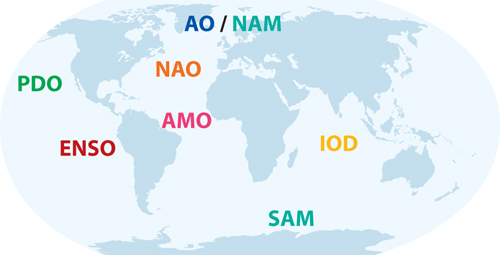
World_map

Most widely known is the El Nino Southern Oscillation, or ENSO. Many other naturally occurring ocean-atmosphere oscillations in the Pacific, Atlantic, and Indian Oceans have been recognized and named. Some of them have much more of an impact on climate and weather patterns in the U.S. and elsewhere than ENSO. As during ENSO, in many of these ocean and atmosphere interact as a coupled system, with ocean conditions influencing the atmosphere and atmospheric conditions influencing the ocean. However, not all exert as strong an influence on global weather patterns, and some are even less regular than ENSO.

Many oscillations are under study:

Antarctic Oscillation (AAO), also referred to as the Southern Annular Mode (SAM).

Arctic Oscillation (AO)

The AO and the North Atlantic Oscillation (see below) are collectively referred to as the Northern Annular Mode (NAM).

Atlantic Multidecadal Oscillation (AMO)

Indian Ocean Dipole (IOD)

Madden-Julian Oscillation (MJO)

North Atlantic Oscillation (NAO)

North Pacific Gyre Oscillation (NPGO)

North Pacific Oscillation (NPO)

Pacific Decadal Oscillation (PDO)

Pacific-North American (PNA) Pattern

http://www.whoi.edu/main/topic/el-nino-other-oscillations

Each of these patterns has its distinctive qualities, ranging from phases lasting a month or so to multi-decadal phases. Some fundamental features can be seen in all of them:
3 factors

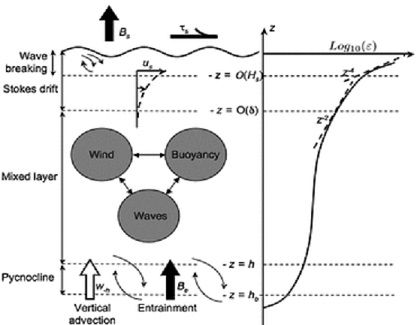
The diagram shows the vertical structure of the ocean surface boundary layer (OSBL) and the processes that deepen. The three sources of turbulence are: wind, buoyancy and waves.

The bulk of the OSBL can be termed the mixed layer, where the temperature and salinity are approximately uniform with depth, and which is often capped below, at the mixed layer depth, by a sharp pycnocline, which extends deeper into the ocean. Three sources of turbulence, namely wind, buoyancy and waves, drive turbulence in this mixed layer, which then deepens the OSBL. Hence a quantitative understanding of these turbulent processes in the OSBL is likely to be the key to understanding the shallow biases in mixed layer depth.

Deepening of the OSBL implies an increase in potential energy, and hence requires an energy source, such as turbulent kinetic energy (TKE).

Belcher, S. E., et al. (2012), A global perspective on Langmuir turbulence in the ocean surface boundary
layer, Geophys. Res. Lett., 39, L18605, doi:10.1029/2012GL052932.
http://onlinelibrary.wiley.com/doi/10.1029/2012GL052932/full

The Madden-Julian Oscillation is one of the simpler oscillations to understand, partly because of its short 30-60 day cycle.

Even so, you can see there is a lot going on, and a lot of variables affecting both strength and timing. But the same dynamic plays out in all the oscillations, including ENSO.
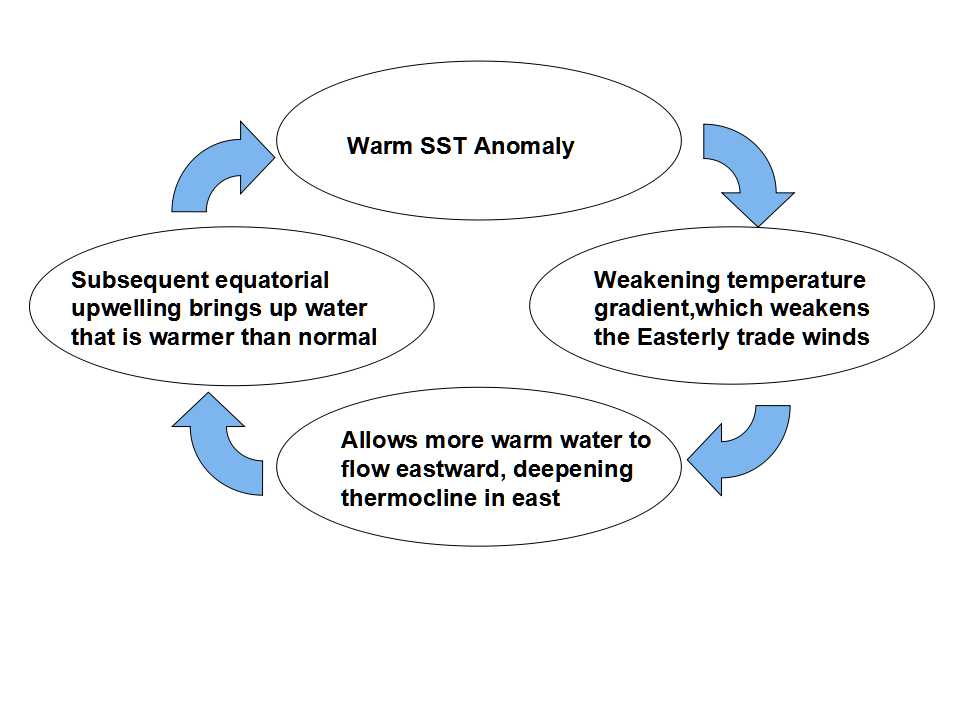
ENSO Cycle 4

First, the atmosphere responds to the ocean: the atmospheric fluctuations manifested as the Southern Oscillation are mostly an atmospheric response to the changed lower boundary conditions associated with El Nino SST fluctuations.

Second, the ocean responds to the atmosphere: the oceanic fluctuations manifested as El Nino seem to be an oceanic response to the changed wind stress distribution associated with the Southern Oscillation.

Third, the El Nino-Southern Oscillation phenomenon arises spontaneously as an oscillation of the coupled ocean-atmosphere system.

Once the El Nino event is fully developed, negative feedbacks begin to dominate the Bjerknes positive feedback, lowering the SST and bringing the event to its end after several months.

Schematic of the feedback inherent in the Pacific Ocean-atmosphere interaction. This has become known as the Bjerknes feedback.

When ocean and atmospheric conditions in one part of the world change as a result of ENSO or any other oscillation, the effects are often felt around the world. The rearrangement of atmospheric pressure, which governs wind patterns, and sea-surface temperature, which affects both atmospheric pressure and precipitation patterns, can drastically rearrange regional weather patterns, occasionally with devastating results.

Because it affects ocean circulation and weather, an El Niño or La Niña event can potentially lead to economic hardships and disaster. The potential is made worse when these combine with another, often overlooked environmental problem. For example, overfishing combined with the cessation of upwelling during an El Niño event in 1972 led to the collapse of the Peruvian anchovy fishery.

Extreme climate events are often associated with positive and negative ENSO events. Severe storms and flooding have been known to ravage areas of South America and Africa, while intense droughts and fires have occurred in Australia and Indonesia during El Niño events.

http://faculty.washington.edu/kessler/occasionally-asked-questions.html

Summary

The picture that emerges from this analysis is that the wind-driven meridional overturning circulation in the upper Pacific Ocean has been slowing down since the 1970s. This slowdown can account for the recent anomalous surface warming in the tropical Pacific, as the supply of cold pycnocline water originating at higher latitudes to feed equatorial upwelling has decreased. The Southern Hemisphere is responsible for about half of the observed decrease in equatorward pycnocline transport. Thus, perspectives on decadal variability limited to the Northern Hemisphere alone are incomplete. The fact that few studies have considered a role for the Southern Hemisphere ocean is presumably a consequence of limited data availability rather than a lack of decadal signal in the southern tropics and Subtropics.

The oceanic and atmospheric processes that we have described work together so as to reinforce each other, similar to the positive feedbacks that occur during ENSO events. For example, weaker easterly trade winds in the equatorial Pacific would result in reduced Ekman and geostrophic meridional transports, reduced equatorial upwelling, and warmer equatorial sea surface temperatures. Warmer surface temperatures in turn would alter patterns of deep atmospheric convection so as to favour weaker trade winds. If the system is to oscillate on decadal timescales, then delayed negative feedback mechanisms, one candidate for which involves planetary scale ocean waves, must also be important.

Similarities in the spatial structures of the PDO and ENSO (both, for example, have phases that are characterized by warm tropics and a cool central North Pacific, and vice versa) have raised questions about the possible interaction between interannual- and decadal timescale phenomena in the Pacific. In particular, since 1976±77 there have been fewer La Nina events, and more frequent, stronger, and longer-lasting El Nino events.

Whether this recent change in the character of the ENSO cycle is a consequence or a cause of underlying decadal-timescale variability is unknown. It could be that the decadal changes in circulation described here operate independently from those that affect the ENSO cycle. If so, they would modify the background state on which ENSO develops, and thereby precondition interannual fluctuations to preferred modes of
behaviour. Alternatively, the observed decadal changes may simply be the low-frequency residual of random or chaotic fluctuations in tropical ocean±atmosphere interactions that give rise to the ENSO cycle itself. In either case, a complete understanding of climate variability spanning interannual to decadal timescales in the Pacific basin will need to account for the slowly varying meridional overturning circulation between the tropics and subtropics.

Click to access mcphaden+zhang_nature_2002.pdf

Conclusion

Ocean oscillations are profoundly uncertain, not only because each one is erratic in the timing and strength of phase changes, but also because they have interactive effects upon each other. And with time cycles differing from 1-2 months to 30-60 years the complexity of movements is enormous.

Even today, after many years of study by highly intelligent people, the factors are murky enough that coupled ocean-atmospheric models still lack skill to forecast the patterns. And so, in 2015, we find advocates for reducing use of fossil fuels hoping and praying for a warm water blob in the Northern Pacific to intensify or endure so that the average global temperature will trend higher than last year.

Of course, the satellite records have 1998 as the warmest year by a wide margin. And why was that year so warm? It was a super El Nino. This is Oceans making climate, no mistake about it.

Update May 19, 2015

Dr. William Gray adds the longer term context to these oscillations in his 2012 paper:

“The global surface warming of about 0.7°C that has been experienced over the last 150 years and the multi-decadal up-and-down global temperature changes of 0.3-0.4°C that have been observed over this period are hypothesized to be driven by a combination of multi-century and multi-decadal ocean circulation changes. These ocean changes are due to naturally occurring upper ocean salinity variations. Changes in CO2 play little role in these salinity driven ocean climate forcings. “

Many ocean-climate dynamics are explained in Dr. Gray’s paper:

http://tropical.atmos.colostate.edu/Includes/Documents/Publications/gray2012.pdf

Included are excellent diagrams and charts, such as these:
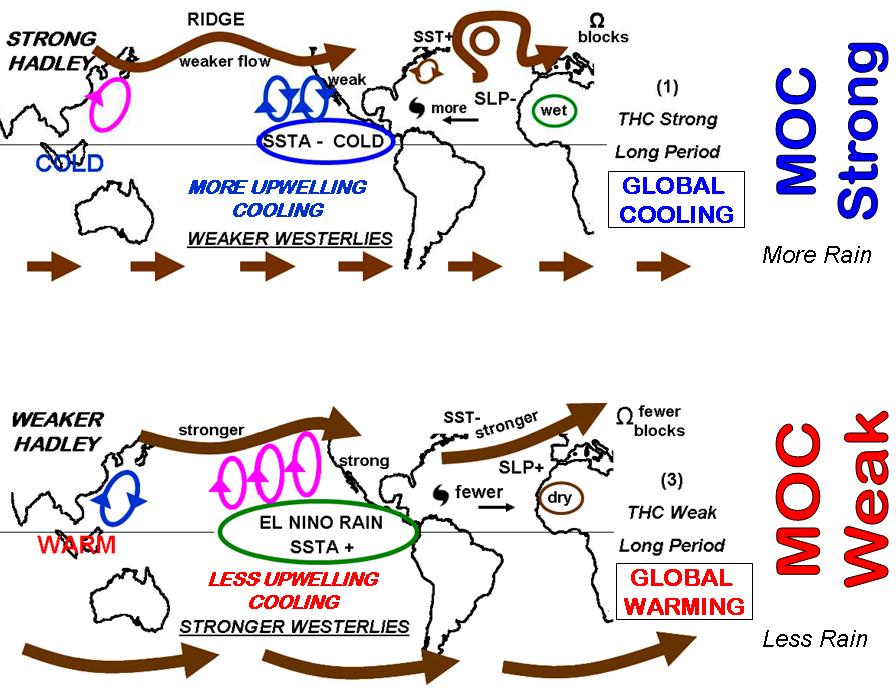
gray2012MOC

gray2012multi-decadal

The Dynamic Duo: Ocean and Air

Oceans make climate is by partnering with the atmosphere. It’s a match made in heaven: Ocean is dense, powerful, slow and constrained; Atmosphere is thin, light, fast and free. Ocean has solar heat locked in its Abyss, Atmosphere is open to the cold of space. Together they take on the mission of spreading energy far and wide from the equator to the poles, and into space, the final frontier.

Here’s how it goes. Working together as companion fluids, and feeding off each other, they make winds, waves, weather and climate.

But make no mistake: Ocean is Batman, Atmosphere is Robin; Ocean is Captain Kirk, Atmosphere is Spock; Ocean the dog, Atmosphere the tail.

As for the villainous CO2, that does not rise to the level of Joker or Penguin; CO2 is probably best cast as the Riddler:

dba30533152d168f33338b68c5974f15-the-riddler-music-artists

Empirical Evidence: Oceans Make Climate

Updated May 11,18 and 19 with text added at the end.

Further update on May 27 at the end.

You only have to compare Sea Surface Temperatures (SST) from HADSST3 with estimates of Global Mean Surface Temperatures (GMST) from Hadcrut4 and RSS.


This first graph shows how global SST has varied since 1850. There are obvious changepoints where the warming or cooling periods have occurred.

This graph shows in green Hadcrut4 estimates of global surface temperature, including ocean SST, and near surface air temperatures over land. The blue line from RSS tracks lower tropospheric air temperatures measured by satellites, not near the surface but many meters higher. Finally, the red line is again Hadsst3 global SST All lines use 30-month averages to reduce annual noise and display longer term patterns.

Strikingly, SST and GMST are almost synonymous from the beginning until about 1980. Then GMST diverges with more warming than global SST. Satellite TLT shows the same patterns but with less warming than the surface. Curious as to the post 1980s patterns, I looked into HADSST3 and found NH SST warmed much more strongly during that period.

This graph shows how warming from circulations in the Northern Pacific and Northern Atlantic drove GMST since 1980. And it suggests that since 2005 NH SST is no longer increasing, and may turn toward cooling.

Surface Heat Flux from Ocean to Air

Now one can read convoluted explanations about how rising CO2 in the atmosphere can cause land surface heating which is then transported over the ocean and causes higher SST. But the interface between ocean and air is well described and measured. Not surprisingly it is the warmer ocean water sending heat into the atmosphere, and not the other way around.

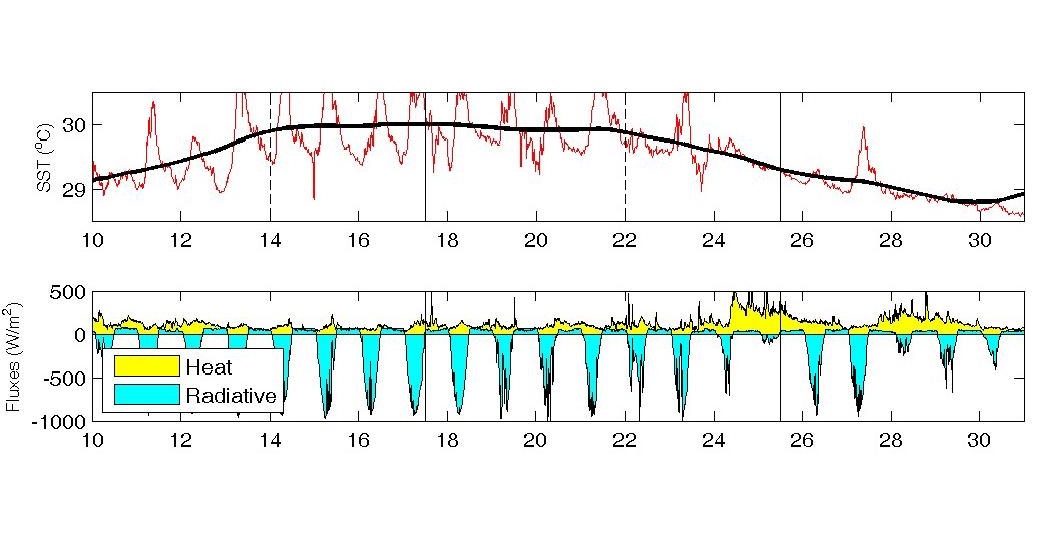
The graph displays measures of heat flux in the sub-tropics during a 21-day period in November. Shortwave solar energy shown above in green labeled radiative is stored in the upper 200 meters of the ocean. The upper panel shows the rise in SST (Sea Surface Temperature) due to net incoming energy. The yellow shows latent heat cooling the ocean, (lowering SST) and transferring heat upward, driving convection.

From
An Investigation of Turbulent Heat Exchange in the Subtropics
James B. Edson

“One can think of the ocean as a capacitor for the MJO (Madden-Julian Oscillation), where the energy is being accumulated when there is a net heat flux into the ocean (here occurring to approximately November 24) after which it is released to the atmosphere during the active phase of the MJO under high winds and large latent heat exchange.”

Click to access mmedson.pdf

Conclusion

As we see in the graphs ocean circulations change sea surface temperatures which then cause global land and sea temperatures to change. Thus, oceans make climate by making temperature changes.

On another post I describe how oceans also drive precipitation, the other main determinant of climate. Oceans make rain, and the processes for distributing rain over land are shown here: https://rclutz.wordpress.com/2015/04/30/here-comes-the-rain-again/

And a word from Dr. William Gray:

“Changes in the ocean’s deep circulation currents appears to be, by far, the best physical explanation for the observed global surface temperature changes (see Gray 2009, 2011, 2012, 2012). It seems ridiculous to me for both the AGW advocates and us skeptics to so closely monitor current weather and short-time climate change as indication of CO2’s influence on our climate. This assumes that the much more dominant natural climate changes that have always occurred are no longer in operation or have relevance.”

http://www.icecap.us/

Indeed, Oceans Make Climate, or as Dr. Arnd Bernaerts put it:
“Climate is the continuation of oceans by other means.”

Update 1 May 11, 2015

Kenneth Richards provided some supporting references in a comment at Paul Homewood’s site. They are certainly on point especially this one:
“Examining data sets of surface heat flux during the last few decades for the same region, we find that the SST warming was not a consequence of atmospheric heat flux forcing. Conversely, we suggest that long-term SST warming drives changes in atmosphere parameters at the sea surface, most notably an increase in latent heat flux, and that an acceleration of the hydrological cycle induces a strengthening of the trade winds and an acceleration of the Hadley circulation.”

That quote is from Servain et al, unfortunately behind a paywall.  The paper is discussed here:

http://hockeyschtick.blogspot.ca/2014/09/new-paper-finds-climate-of-tropical.html

Full comment from Richards:

http://journals.ametsoc.org/doi/abs/10.1175/JCLI-D-13-00651.1
The surface of the world’s oceans has been warming since the beginning of industrialization. In addition to this, multidecadal sea surface temperature (SST) variations of internal [natural] origin exist. Evidence suggests that the North Atlantic Ocean exhibits the strongest multidecadal SST variations and that these variations are connected to the overturning circulation. This work investigates the extent to which these internal multidecadal variations have contributed to enhancing or diminishing the trend induced by the external radiative forcing, globally and in the North Atlantic. A model study is carried out wherein the analyses of a long control simulation with constant radiative forcing at preindustrial level and of an ensemble of simulations with historical forcing from 1850 until 2005 are combined. First, it is noted that global SST trends calculated from the different historical simulations are similar, while there is a large disagreement between the North Atlantic SST trends. Then the control simulation is analyzed, where a relationship between SST anomalies and anomalies in the Atlantic meridional overturning circulation (AMOC) for multidecadal and longer time scales is identified. This relationship enables the extraction of the AMOC-related SST variability from each individual member of the ensemble of historical simulations and then the calculation of the SST trends with the AMOC-related variability excluded. For the global SST trends this causes only a little difference while SST trends with AMOC-related variability excluded for the North Atlantic show closer agreement than with the AMOC-related variability included. From this it is concluded that AMOC [Atlantic meridional overturning circulation] variability has contributed significantly to North Atlantic SST trends since the mid nineteenth century.
—–
http://link.springer.com/article/10.1007%2Fs00382-014-2168-7
After a decrease of SST by about 1 °C during 1964–1975, most apparent in the northern tropical region, the entire tropical basin warmed up. That warming was the most substantial (>1 °C) in the eastern tropical ocean and in the longitudinal band of the intertropical convergence zone. Examining data sets of surface heat flux during the last few decades for the same region, we find that the SST [sea surface temperature] warming was not a consequence of atmospheric heat flux forcing [greenhouse gases]. Conversely, we suggest that long-term SST warming drives changes in atmosphere parameters at the sea surface, most notably an increase in latent heat flux, and that an acceleration of the hydrological cycle induces a strengthening of the trade winds and an acceleration of the Hadley circulation. These trends are also accompanied by rising sea levels and upper ocean heat content over similar multi-decadal time scales in the tropical Atlantic. Though more work is needed to fully understand these long term trends, especially what happens from the mid-1970’s, it is likely that changes in ocean circulation involving some combination of the Atlantic meridional overtuning circulation [AMOC] and the subtropical cells are required to explain the observations.
—–
http://www.nature.com/ncomms/2014/141208/ncomms6752/full/ncomms6752.html
The Atlantic Meridional Overturning Circulation (AMOC) is a key component of the global climate system, responsible for a large fraction of the 1.3 PW northward heat transport in the Atlantic basin. Numerical modelling experiments suggest that without a vigorous AMOC, surface air temperature in the North Atlantic region would cool by around 1–3 °C, with enhanced local cooling of up to 8 °C in regions with large sea-ice changes. Substantial weakening of the AMOC would also cause a southward shift of the inter-tropical convergence zone, encouraging Sahelian drought, and dynamic changes in sea level of up to 80 cm along the coasts of North America and Europe.

Update 2 May 18, 2015

This graph from Mike at climategrog shows more empirical evidence for ocean climate making, this time the relation to CO2 concentrations. The chart shows a high correlation between rates of change, not comparing directly the temperature or CO2 values or anomalies. Thus, a positive datapoint in the graph means an increase in the rate of change, negative being the rate changing downward.

The correlation is clear. There is no credible case for claiming that changes in CO2 cause changes in SST. Plenty of evidence that SST is the cause and CO2 the effect.

Update 3 May 19, 2015

On the ocean-air heat flux

Summary from
http://eesc.columbia.edu/courses/ees/climate/lectures/o_atm.html

Much of the direct and diffuse solar short wave (less than 2 micros, mostly in the visible range) electromagnetic radiation that reaches the sea surface penetrates the ocean heating the sea water down to about 100 to 200 meters. Solar heating of the ocean on a global average is 168 watts per square meter

The infrared radiation emitted from the ocean is quickly absorbed and re-emitted by water vapor and carbon dioxide and other greenhouse gases residing in the lower atmosphere. Much of the radiation from the atmospheric gases, also in the infrared range, is transmitted back to the ocean, reducing the net long wave radiation heat loss of the ocean. Net back radiation cools the ocean, on a global average by 66 watts per square meter.

When air is contact with the ocean is at a different temperature than that the sea surface, heat transfer by conduction takes place. On average the ocean is about 1 or 2 degrees warmer than the atmosphere so on average ocean heat is transferred from ocean to atmosphere by conduction.

If the ocean were colder than the atmosphere (which of course happens) the air in contact with the ocean cools, becoming denser and hence more stable, more stratified. As such the conduction process does a poor job of carrying the atmosphere heat into the cool ocean. On global average the oceanic heat loss by conduction is only 24 watts per square meter.

The largest heat loss for the ocean is due to evaporation, which links heat exchange with hydrological cycle (Fig. 4). On global average the heat loss by evaporation is 78 watts per square meter.

Update 4 May 19, 2015

Dr. William Gray in his 2012 paper:
“The global surface warming of about 0.7°C that has been experienced over the last 150 years and the multi-decadal up-and-down global temperature changes of 0.3-0.4°C that have been observed over this period are hypothesized to be driven by a combination of multi-century and multi-decadal ocean circulation changes. These ocean changes are due to naturally occurring upper ocean salinity variations. Changes in CO2 play little role in these salinity driven ocean climate forcings. “

Click to access gray2012.pdf

Update 5 May 27, 2015

The RAPID moorings being deployed. Credit: National Oceanography Centre

A new study, by scientists from the University of Southampton and National Oceanography Centre (NOC), implies that the global climate is on the verge of broad-scale change that could last for a number of decades. This new climatic phase could be half a degree cooler.

The change to the new set of climatic conditions is associated with a cooling of the Atlantic, and is likely to bring drier summers in Britain and Ireland, accelerated sea-level rise along the northeast coast of the United States, and drought in the developing countries of the Sahel region. Since this new climatic phase could be half a degree cooler, it may well offer a brief reprise from the rise of global temperatures, as well as resulting in fewer hurricanes hitting the United States.

The study, published in Nature, proves that ocean circulation is the link between weather and decadal scale climatic change. It is based on observational evidence of the link between ocean circulation and the decadal variability of sea surface temperatures in the Atlantic Ocean.

Lead author Dr Gerard McCarthy, from the NOC, said: “Sea-surface temperatures in the Atlantic vary between warm and cold over time-scales of many decades. These variations have been shown to influence temperature, rainfall, drought and even the frequency of hurricanes in many regions of the world. This decadal variability, called the Atlantic Multi-decadal Oscillation (AMO), is a notable feature of the Atlantic Ocean and the climate of the regions it influences.”

The strength of ocean currents has been measured by a network of sensors, called the RAPID array, which have been collecting data on the flow rate of the Atlantic meridonal overturning circulation (AMOC) for a decade.

Dr David Smeed, from the NOC and lead scientist of the RAPID project, adds: “The observations of AMOC from the RAPID array, over the past ten years, show that it is declining. As a result, we expect the AMO is moving to a negative phase, which will result in cooler surface waters. This is consistent with observations of temperature in the North Atlantic.”

http://www.sciencedaily.com/releases/2015/05/150527133932.htm

And an observation from Dr. Robert E. Stevenson:

“The atmosphere cannot warm until the underlying surface warms first. The lower atmosphere is transparent to direct solar radiation, preventing it from being significantly warmed by sunlight alone. The surface atmosphere thus gets its warmth in three ways: from direct contact with the oceans; from infrared radiation off the ocean surface; and, from the removal of latent heat from the ocean by evaporation. Consequently, the temperature of the lower atmosphere is largely determined by the temperature of the ocean.”

http://www.21stcenturysciencetech.com/articles/ocean.html


Here Comes the Rain Again

In climate discussions, someone is bound to say: Climate is a lot more than temperatures. And of course, they are right. So let’s consider the other major determinant of climate, precipitation.

The global story on rain is straightforward:

“Precipitation is a major component of the water cycle, and is responsible for depositing the fresh water on the planet. Approximately 505,000 cubic kilometres (121,000 cu mi) of water falls as precipitation each year; 398,000 cubic kilometres (95,000 cu mi) of it over the oceans. Given the Earth’s surface area, that means the globally averaged annual precipitation is 990 millimetres (39 in). Climate classification systems such as the Köppen climate classification system use average annual rainfall to help differentiate between differing climate regimes.

http://en.wikipedia.org/wiki/Precipitation_(meteorology)

Globally, average precipitation can vary from +/-5% yearly, but there is no particular trend in the history of observations. But rain is one of those things where averages don’t tell you much. For starters, look at where it’s coming down:

So about 1 meter a year is the nominal average of all rain over all surfaces. Some places get up to 10 meters of rain (about 400 inches ) and others get near none. 47% of the earth is considered dryland, defined as anyplace where the rate of evaporation/transpiration exceeds the rate of precipitation. A desert is defined as a dryland with less than 25 cm of precipitation. In the image above, polar deserts are remarkably defined. It just does not have much hope of precipitation as there is little heat to move the water. More heat in, more water movement. Less heat in, less water movement.

Then there’s the seasonal patterns. The band of maximum rains moves with the sun: More north in June, more south in December. More sun, more heating, more rain. Movement in sync with the sun, little time delay. Equatorial max solar heat has max rains. Polar zones minimal heating, minimal precipitation. It’s a very tightly coupled system with low time lags.

The other obvious thing is how central land areas get dry desert conditions if they are not in the equatorial band nor near a warm water current. Brazil, in particular, benefits from warm coastal waters and near equatorial rains. The Gulf Stream rescues Europe from a much drier climate, but I fear the Gulf Stream shifting of zones also puts parts of Saharan Africa out of the equatorial wet. (In some times during history it DOES get a load of water, though…)
From E.M. Smith
https://chiefio.wordpress.com/2011/11/01/what-does-precipitation-say-about-heat-flow/

How do Oceans Make Rain

Here I am taking direction from A. M Makarieva and her colleagues. She explains:

“Water vapor originating by evaporation sustained by solar radiation represents a source of ordered potential energy that is available for generation of atmospheric circulation, including the biotic pump. We will further consider details of this process.

As we can see, early in its life the cloud expands in all directions, meanwhile the air continues to converge towards the (growing) condensation area. This process is at the core of condensation-induced dynamics: as condensation occurs and local pressure drops, this initiates convergence and ascent. They, in their turn, feedback positively on condensation intensity, such that the air pressure lowers further, convergence becomes more extensive and so on — as long as there is enough water vapor around to feed the process.

And where does the water vapor come from? Ocean evaporation, 87%, Plant transpiration 10% , Other evaporation, lakes, rivers, etc. 3%.

Air circulation without condensation (A) and with condensation (B). Gray squares are the air volumes, which in case (B) contain water vapor shown by small blue squares inside gray ones. White squares indicate those air volumes that have lost their water vapor owing to condensation. Blue arrows at the Earth’s surface represent evaporation that replenishes the store of water vapor in the circulating air.

On Fig. B we can see a circulation accompanied by water vapor condensation (water vapor is shown by blue squares). At a certain height water vapor condenses leaving the gaseous phase, while the remaining air continues to circulate deprived of water vapor (this depletion is shown by empty white squares): it first rises and then descends. As one can see, in such a circulation total mass of the rising air would be larger than total mass of the descending air (cf. an escalator transporting people up). The motor driving such a circulation would not only have to compensate the friction losses, but also have to work against gravity that is acting on the ascending air.

One can see from Fig. B that the difference between the cumulative masses of the ascending and descending air parcels grows with increasing height where condensation occurs. This difference also grows with increasing amount of water vapor in the air (i.e. with increasing size of the blue squares). The dynamic power of condensation, on the other hand, is also proportional to the amount of water vapor, but it is practically independent of condensation height.

Condensation height (a proxy for precipitation pathlength) grows with increasing temperature of the Earth’s surface. It is shown in the paper that power losses associated with precipitation of condensate particles become equal to the total dynamic power of condensation at surface temperatures around 50 degrees Celsius. Since the observed power of condensation-driven winds is equal to the total dynamic power of condensation (the “motor”) minus the power spent on compensating precipitation, at such temperatures the observed circulation power becomes zero and the circulation must stop. For commonly observed values of surface temperature these losses do no exceed 40% of condensation power and cannot arrest the condensation-induced circulation. Over 60% of condensation power is spent on friction at the Earth’s surface.

Why Some Places Get More Rain Than Others

This figure shows the “tug-of-war” between the forest and the ocean for the right to become a predominant condensation zone. In Fig. a: on average the Amazon and Congo forests win this war: annual precipitation over forests is two to three times larger than the precipitation over the Atlantic Ocean at the same latitude. Note the logarithmic scale on the vertical axis: “1” means that the land/ocean precipitation ratio is equal to e = 2.718, “2” means it is equal to e2 ≈ 7.4; “0” means that this ratio is unity (equal precipitation on land and the ocean); “-1” means this ratio is 1/e ≈ 0.4; and so on.
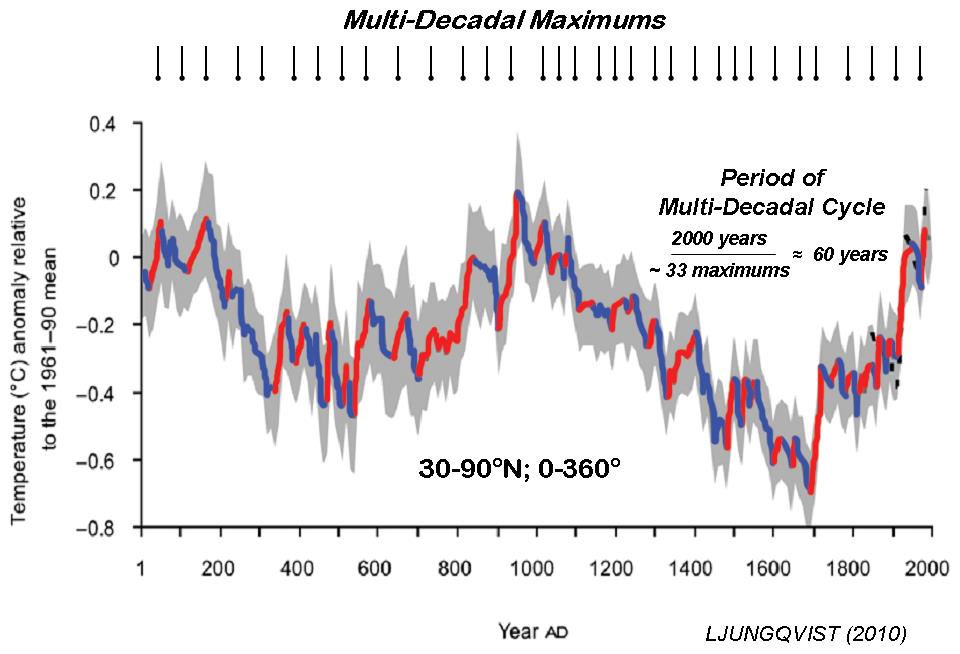
In Fig. b: the Eurasian biotic pump. In winter the forest sleeps, so the ocean wins, and all moisture remains over the ocean and precipitates there. In summer, when trees are active, moisture is taken from the ocean and distributed regularly over seven thousand kilometers. The forest wins! (compare the red and black lines) As a result, precipitation over the ocean in summer is lower than it is in winter, despite the temperature in summer is higher.

Finally, in panel (c): an unforested Australia. One can often hear that Australia is so dry because it is situated in the descending branch of the Hadley cell. But this figure shows that such an interpretation does not hold. Both in wet and dry seasons precipitation over Australia is four to six times lower than over the ocean. There is no biotic pump there. Being unforested, oceanic moisture cannot penetrate to the Australian continent irrespective of how much moisture there is over the ocean; during the wet season it precipitates in the coastal zones causing floods. Gradually restoring natural forests in Australia from coast to interior will recover the hydrological cycle on the continent.

http://www.bioticregulation.ru/pump/pump9.php

biotic pump

The Biotic Pump A. M Makarieva et al

Water cycle on land owes itself to the atmospheric moisture transport from the ocean. Properties of the aerial rivers that ensure the “run-in” of water vapor inland to compensate for the gravitational “run-off” of liquid water from land to the ocean are of direct relevance for the regional water availability. The biotic pump concept clarifies why the moist aerial rivers flow readily from ocean to land when the latter gives home to a large forest — and why they are reluctant to do so when the forest is absent.

While it is increasingly common to blame global change for any regional water cycle disruption, the biotic pump evidence suggests that the burden of responsibility rather rests with the regional land use practices. On large areas on both sides of the Atlantic Ocean, temperate and boreal forests are intensely harvested for timber and biofuel. These forests are artificially maintained in the early successional stages and are never allowed to recover to the natural climax state. The water regulation potential of such forests is low, while their susceptibility to fires and pests is high.

https://2s3c.wordpress.com/2012/04/22/taac/

Conclusion

So the oceans make rain, and together with the forests the land receives its necessary fresh water. There is a threat from human activity, but it has nothing to do with CO2. Land use practices leading to deforestation have the potential to disrupt this process. Without trees attracting the moist air from the ocean there is desert.

Ironically, modern societies burn fossil fuels instead of burning the forests as in the past.