Edge Research Topics for Climatologists

A number of studies will apparently be undertaken by seasoned climatologists in new fields tangential to global warming. The objective will be to settle the science on issues that have long been controversial. Climatologists are the logical choice to branch into these questions, given their demonstrated creativity regarding causes and effects of climate change.

One Pressing Research Issue:

Initiatives can address many other puzzling issues, such as these:

Very topical these days:

The study could recommend ways to build on the obvious successes of the War on Poverty, War on Drugs, and the War on Terrorism.

And, of course the big picture issue:

For other research grant opportunities, see here:

https://www.distractify.com/insanely-brilliant-science-questions-1197777368.html

The Inconvenient Truth About Climate Policy

A succinct summary accessible to anyone.  Reading it is like watching the claIms building up to make the house of cards climate policy really is.

See it here at US News and World Report

http://www.usnews.com/opinion/economic-intelligence/2015/07/16/climate-change-policy-wont-change-global-temperatures

“Let’s use our imagination and assume that China reduces its emissions by 20 percent by 2030. That gets us two tenths of a degree. Throw in a 30 percent reduction by Europe and Japan and the rest of the industrialized world, also by 2030. That’s another two tenths of a degree, for a grand total of 0.425 degrees, under a “climate sensitivity” (loosely, the effectiveness of greenhouse gas reductions) assumption 50 percent greater than that adopted by the Intergovernmental Panel on Climate Change in its latest assessment report. Is an effect that small worth 1 percent of global GDP, or roughly $600 billion to $750 billion per year, inflicted disproportionately upon the world’s poor?”

“Such propaganda terms as “carbon pollution” are useful as tools toward that end, as they are designed to end debate before it begins by assuming the answer to the underlying policy question. Carbon dioxide is not “carbon” and it is not a pollutant, as a minimum atmospheric concentration of it is necessary for life itself. By far the most important greenhouse gas in terms of the radiative (warming) properties of the atmosphere is water vapor; why does no one call it a “pollutant”? Presumably it is because ocean evaporation is a natural process. Well, so are volcanic eruptions, but no one argues that the massive amounts of particulates and toxins emitted by volcanoes are not pollutants. The climate debate is desperately in need of honesty and seriousness, two conditions characteristic of neither the Beltway nor the climate industry.”

Arctic Sea Ice Uncertainties

The largest ice cap in the Eurasian Arctic – Austfonna in Svalbard – is 150 miles long with a thousand waterfalls in the summer.

About NOAA and MASIE Ice Extent Statistics

As we approach the serious Arctic melting season toward the September minimum, it is important to have a context to interpret various upcoming media reports.

Two factors are paramount: 1) The Sea Ice Prediction Network (SIPN) uses the September Monthly Average as reported by NOAA; and 2) This year NOAA adjusted its measurement system, resulting in a difference in extent statistics.

NOAA says this:

March 2015
The Sea Ice Index processing was updated to use the smaller SSMIS pole hole instead of the SMM/I pole hole, and the erroneous use of the SMMR pole hole in SSM/I and SSMIS data was also corrected. In addition, a new residual weather climatology mask was applied to the Northern Hemisphere that better represents where ice will and will not be, and the extent values in the daily extent data files have been rounded to three decimal places instead of six because that is the precision of the data. The entire time series was reprocessed and now reflects these changes.

http://nsidc.org/data/docs/noaa/g02135_seaice_index/#mar-2015

As many are aware, NOAA numbers come entirely from passive microwave sensors on satellites, while MASIE ice charts are prepared by the National Ice Center based on multiple sources, including the microwave results, but also satellite imagery and field reports. More of the difference in methodologies and historical results is described here:
https://rclutz.wordpress.com/2015/03/31/comparing-noaa-and-masie-arctic-ice-extent/

Something Different This Year

At the moment we are seeing that NOAA is now reporting ice extent figures that are much closer to MASIE than previously. The following table shows the comparison.

Monthly 2015 2015 2015 2014 2014 2014
Averages MASIE NOAA MASIE-NOAA MASIE NOAA MASIE-NOAA
February 15.032 14.498 0.534
March 15.170 14.758 0.413
April 13.650 13.954 -0.304 14.318 14.088 0.230
May 12.646 12.485 0.161 12.916 12.701 0.215
June 10.841 10.889 -0.049 11.324 11.033 0.292
July 9.573 9.473 0.100 8.482 8.108 0.374
August 6.353 6.078 0.275
September 5.364 5.220 0.144
October 7.697 7.232 0.464

All figures are in M km2. MASIE results stopped last year after October and did not resume until April 2015. The July 2015 average includes only the first 12 days, so it can not be compared to July 2014 30-day average.

Note that last year MASIE showed higher extents in all months, ranging higher by 200-500k km2, except for the September minimum. However, in 2015 NOAA changes show results much closer to MASIE, at times even larger extents. June was almost the same, something that didn’t happen in the past.

Summary

In some charts showing Arctic daily ice extent from several years, NOAA 2015 results exceed 2014 partly because of an adjusted system. The newer numbers are more in synch with MASIE results.

So far 2015 monthly averages are running slightly below last year when comparing MASIE to itself, or NOAA to itself. And SIPN median prediction is for a slightly lower minimum.

However, in the last 2 weeks 2015 is showing higher extent than the same period last year, presently an increase of ~ 500k km2.  Will that trend continue?

What will NOAA show in September? In addition to natural uncertainty, some differences may arise from system changes. At least this time, the adjustments are not in an alarming direction.

NOAA data is here:

ftp://sidads.colorado.edu/DATASETS/NOAA/G02135/north/daily/data/

MASIE Update July 13, 2015

2015 retains 2% lead over 2014 in BCE Region

Some Arctic ice watchers are focused on the BCE region: Beaufort, Chukchi and East Siberian Seas. It seems that when multi-year ice collects in this region, the Arctic Sea ice margin is protected, and the melting is reduced, resulting in a higher September minimum. Thus an early melting in BCE region can signal a lower summer minimum for NH ice extent, and vice-versa.

To monitor this, I have added a BCE index, being the total 2015 ice extent in BCE as a % of total 2014 extent in the same region. All figures from MASIE.

Note that the BCE maximum ice extent is comparable in size to Arctic Sea max. Historically BCE melts much more than the Arctic Sea; for example, in 2014 BCE lost 58% of its max compared to only 10% for Arctic Sea.

BCE Index recent results:

Day BCE 2015 % of 2014
187 2597170 100.2%
188 2594289 99.8%
189 2593287 99.2%
190 2538316 99.1%
191 2540197 100.6%
192 2534781 102.8%
193 2529403 102.6%

Part of the interest in BCE this year comes from the warm water blob in the N. Pacific, that may add melting to this region located on the Asian side. The two years were virtually identical with little melting prior to day 130. Daily losses since then have been similar and the 2 years were tied on day 146. For 3 days 2015 took some losses while 2014 held on to gains. Since day 150 the gap has been ~3-4%, until recently.

The Blob may have melted out Bering Sea early, and that may now be causing Chukchi to have lower extent than last year.  Yet the BCE region had more ice than 2014 for 13 days until slipping behind for 3 days, then recovering to again lead by 2%.

For more on the Blob:  https://rclutz.wordpress.com/2015/06/13/how-about-that-blob-june-13-update/

July 13, 2015

Day 193, July 12 results from MASIE. Arctic ice extent lead over 2014 dips to 471k km2: A day when 2014 regains ice while 2015 has a small loss. .

2014 gained 58k on this day while 2015 lost 21k, reaching a new seasonal minimum of 9.13M km2. The loss is now 37.2% from NH max on day 93.

2014 extent now trails 2015 by 5.4%, which is about 471k km2 difference.

2015 losses were spread, the largest being 10k in Chukchi.

The seas that have lost ice are: (% lost from each sea’s max)

Baltic 100%
Bering 100%
Okhotsk 99.2%
Barents 87.8%
Baffin Bay 73.7%
Kara 71.1%
Hudson Bay 49.6%
Chukchi 39.2%
Greenland 27.8%
Laptev 19.2%
Beaufort 13.3%
Can Archipelago 12.4%
East Siberian 6.7%

The other seas have lost less than 5% from their maximums.

The seas contributing most to the total NH ice extent loss:

(5) Kara_Sea 12.0%
(6) Barents_Sea 9.6%
(8) Baffin_Bay_Gulf_of_St._L 23.4%
(10) Hudson_Bay 11.3%
(12) Bering_Sea 12.2%
(14) Sea_of_Okhotsk 11.4%

2015 melt still trails 2014 by 5 days.

masie day 193

Outlook:

At this point, the median outlook for NH ice extent average for September 2015 is about 5M km2, slightly below last year. That seems reasonable to me, given the lower March max, but also considering the higher ice thickness. Of course, there is no predicting what weather events will affect the ice melting and compacting between now and October.

What’s at stake this year? If September average is higher than last year, then it supports the recovery narrative. Slightly lower than 2014 (the consensus prediction) and the generally declining trend is supported. A major fall off in ice extent would be followed by mass media alarm bells.

Warmists and Rococo Marxists.

This post will not be interesting to everyone. Because it is not so much about science as about the corruption of science by today’s academic establishment. It was inspired by several things including a discussion at WUWT recently regarding Lewandowsky’s latest salvo against those who dispute the consensus view of global warming and impending catastrophe. He and Oreskes were railing against the “seepage” of the “pause” notion into the alarmist narrative, thereby diluting the message in advance of the Paris COP.

That reminded me of a Tom Wolfe book in which he skillfully dissected the descent of rationality and objectivity at the hands of modern academia. And I began to see the connection to climate change hysteria. The ruling force is “political correctness”, which translates into going along to get along in your tribe. And in the extreme, it means subordinating science and rationality to instincts of the herd, their fears, disappointments and desires to rule the day.

A recent development is the admission, consciously or not, that climate change is not a scientific matter; it is rather a competition between narratives as to where we are as a civilization and what will be our future. When Jane Fonda or the Pope or Naomi Klein says that climate change is the defining issue of our time, they are appealing to one narrative, the environmentalist story of humanity despoiling the Eden granted to us. And in order to save the planet and all life forms from extinction, the capitalist, consumer society has to be unplugged and abandoned.

The damage to science is extreme: the premise of knowing objective reality is overturned by modern scholarship. All is relative, and in the end it is simply a matter of opinion: consensus.


The back story to all this is a development over several decades: the entrenchment in western universities of “post-normal” ideology. And this is what Tom Wolfe describes when he talks of the rise of Rococo Marxism.

What are Rococo Marxists? Wolfe refers to a peculiar development among American intellectuals who wanted to join European leftists in fighting tyranny, but found no obvious villains in American society.

“After World War I, American writers and scholars had the chance to go to Europe in large numbers for the first time. They got an eyeful of the Intellectual up close. That sneer, that high-minded aloofness from the mob, those long immaculate alabaster forefingers with which he pointed down at the rubble of a botched civilization—it was irresistible. The only problem was that when our neophyte intellectuals came back to the United States to strike the pose, there was no rubble to point at. Far from being a civilization in ruins, the United States had emerged from the war as the new star occupying the center of the world stage. Far from reeking of decadence, the United States had the glow of a young giant: brave, robust, innocent, and unsophisticated.”


“The country turned into what the Utopian socialists of the nineteenth century, the Saint-Simons and Fouriers, had dreamed about: an El Dorado where the average workingman would have the political freedom, the personal freedom, the money, and the free time to fulfill his potential in any way he saw fit. It got to the point where if you couldn’t reach your tile mason or your pool cleaner, it was because he was off on a Royal Caribbean cruise with his third wife. And as soon as American immigration restrictions were relaxed in the 1960s, people of every land, every color, every religion, people from Africa, Asia, South America, and the Caribbean, began pouring into the United States.”

“But our intellectuals dug in like terriers. Just as they had after World War I, they refused to buckle under to … circumstances. They saw through El Dorado and produced the most inspired adjectival catchups of the twentieth century. Real fascism and genocide were finished after World War II, but the intellectuals used the Rosenberg case, the Hiss case, McCarthyism—the whole Communist Witch Hunt—and, above all, the war in Vietnam to come up with … “incipient fascism”, “preventive fascism”, “local fascism” , “brink of” fascism, “informal Fascism” , “latent fascism” , not to mention the most inspired catch-up of all: “cultural genocide.” Cultural genocide referred to the refusal of American universities to have open admissions policies, so that any minority applicant could enroll without regard to GPAs and SATs and other instruments of latent-incipient-brink-of-fascist repression.”

So the intelligensia focused not on fundamental social and economic injustice, but upon the cultural trappings: gender equality, sexual orientation, reproductive rights, and the grandest manifestation, climate change.

“Today the humanities faculties are hives of abstruse doctrines such as structuralism, poststructuralism, postmodernism, deconstruction, reader-response theory, commodification theory … The names vary, but the subtext is always the same: Marxism may be dead, and the proletariat has proved to be hopeless. They’re all at sea with their third wives. But we can find new proletariats whose ideological benefactors we can be—women, non-whites, put-upon white ethnics, homosexuals, transsexuals, the polymorphously perverse, pornographers, prostitutes (sex workers), hardwood trees—which we can use to express our indignation toward the powers that be and our aloofness to their bourgeois stooges, to keep the flame of skepticism, cynicism, irony, and contempt burning. This will not be Vulgar Marxism; it will be … Rococo Marxism, elegant as a Fragonard, sly as a Watteau.”

“As any Fool sociologist could tell you, there are only two objectively detectable social classes in America: people above the bachelor’s-degree line—i.e., people who have graduated from four-year colleges—and people below it, who haven’t. By now people above it have learned to shrug and acquiesce to “political correctness,” to Rococo Marxism, because they know that to oppose it out loud is in poor taste. It is a … breach of the etiquette you must observe to establish yourself as an educated person.”

Conclusion

What a strange twist. Marx gave us the notion of ideology, which he understood to be the system of beliefs and values that the ruling class used to control the working class and ensure continued power and privileges. Today’s Marxist wannabes who are mostly in the entitled class are employing the ideology of environmentalism to mount an anti-capitalist crusade under the banner of Climate Change, advocating policies which will further the misery of the downtrodden.

Update May 4, 2016

More on academic ideology from Nicholas Kristoff NYT (here):

In a column a few weeks ago, I offered “a confession of liberal intolerance,” criticizing my fellow progressives for promoting all kinds of diversity on campuses — except ideological. I argued that universities risk becoming liberal echo chambers and hostile environments for conservatives, and especially for evangelical Christians.

As I see it, we are hypocritical: We welcome people who don’t look like us, as long as they think like us.

Footnote:

Matt Ridley is also concerned about the future of science:

http://rationaloptimist.com/blog/what-the-climate-wars-did-to-science.aspx

Tom Wolfe essay in pdf can be downloaded here:

In the Land of the Rococo Marxists by Tom Wolfe

When is it Warming?–The Real Reason for the Pause

June 21 E.M. Smith made an intriguing comment on the occasion of Summer Solstice (NH) and Winter Solstice (SH):

“This is the time when the sun stops the apparent drift in the sky toward one pole, reverses, and heads toward the other. For about 2 more months, temperatures lag this change of trend. That is the total heat storage capacity of the planet. Heat is not stored beyond that point and there can not be any persistent warming as long as winter brings a return to cold.

I’d actually assert that there are only two measurements needed to show the existence or absence of global warming. Highs in the hottest month must get hotter and lows in the coldest month must get warmer. BOTH must happen, and no other months matter as they are just transitional.

I’m also pretty sure that the comparison of dates of peaks between locations could also be interesting. If one hemisphere is having a drift to, say, longer springs while the other is having longer falls, that’s more orbital mechanics than CO2 driven and ought to be reflected in different temperature trends / rates of drift.”

https://chiefio.wordpress.com/2015/06/21/summer-solstice-is-here/

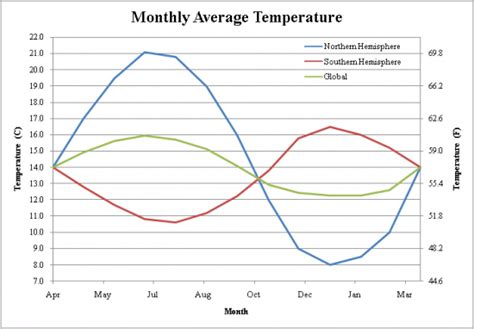
Notice that the global temperature tracks with the seasons of the NH. The reason for this is simple. The NH has twice as much land as the Southern Hemisphere (SH). Oceans have greater heat capacity and do not change temperatures as much as land does. So every year when there is almost a 4 °C swing in the temperature of the Earth, it follows the seasons of the NH. This is especially interesting because the Earth gets the most energy from the sun in January right now. That is because of the orbit of the Earth. The perihelion is when the Earth is closest to the sun and that currently takes place in January.

http://theinconvenientskeptic.com/2010/10/how-the-northern-hemisphere-drives-the-modern-climate/

Observations and Analysis:

My curiosity piqued by Chiefio’s comment, I went looking for data to analyze to test his proposition. As it happens, Berkeley Earth provides data tables for monthly Tmax and Tmin by hemisphere (NH and SH), from land station records. Setting aside any concerns about adjustments or infilling I did the analysis taking the BEST data tables at face value. Since land surface temperatures are more variable than sea surface temps, it seems like a reasonable dataset to analyze for the mentioned patterns.

Tmax Records

NH and SH long-term trends are the same 0.07C/decade, and in both there was cooling before 1979 and above average warming since. However, since 1950 NH warmed more strongly, and mostly prior to 1998, while SH has warmed strongly since 1998. (Trends below are in C/yr.)

 Tmax Trends NH Tmax SH Tmax
All years 0.007 0.007
1998-2013 0.018 0.030
1979-1998 0.029 0.017
1950-1979 -0.003 -0.003
1950-2013 0.020 0.014

Summer Comparisons:

NH summer months are June, July, August, (6-8) and SH summer is December, January, February (12-2). The trends for each of those months were computed and the annual trends subtracted to show if summer months were warming more than the rest of the year (Trends below are in C/yr.).

Month less Annual NH
Tmax
NH Tmax NH Tmax SH Tmax SH Tmax SH Tmax
Summer Trends

6

7 8 12 1

2

All years -0.002 -0.004 -0.004 0.000 0.003 0.002
1998-2013 0.026 0.002 0.006 0.022 0.004 -0.029
1979-1998 0.003 -0.004 -0.003 -0.014 -0.029 0.001
1950-1979 -0.002 -0.002 -0.005 0.004 0.005 -0.005
1950-2013 -0.002 -0.003 -0.002 -0.002 -0.002 -0.002

NH summer months are cooler than average overall and since 1950. Warming does appear since 1998 with a large anomaly in June and also warming in August.SH shows no strong pattern of Tmax warming in summer months. A hot December trend since 1998 is offset by a cold February. Overall SH summers are just above average, and since 1950 have been slightly cooler.

Tmin Records

Both NH and SH show Tmin rising 0.12C/decade, much more strongly warming than Tmax. SH show that average warming persisting throughout the record, slightly higher prior to 1979. NH Tmin is more variable, showing a large jump 1979-1998, a rate of 0.25 C/decade (Trends below are in C/yr.).

 Trends NH Tmin SH Tmin
All years 0.012 0.012
1998-2013 0.010 0.010
1979-1998 0.025 0.011
1950-1979 0.006 0.014
1950-2013 0.022 0.014

Winter Comparisons:

SH winter months are June, July, August, (6-8) and NH winter is December, January, February (12-2). The trends for each of those months were computed and the annual trends subtracted to show if winter months were warming more than the rest of the year (Trends below are in C/yr.).

Month less Annual NH Tmin NH Tmin NH Tmin SH Tmin SH Tmin SH Tmin
Winter Trends

12

1 2 6 7

8

All years 0.007 0.008 0.007 0.005 0.003 0.004
1998-2013 -0.045 -0.035 -0.076 -0.043 -0.024 -0.019
1979-1998 -0.018 -0.005 0.024 0.034 0.008 -0.008
1950-1979 0.008 0.005 0.007 0.008 0.012 0.013
1950-2013 0.001 0.007 0.008 -0.001 -0.002 0.002

NH winter Tmin warming is stronger than SH Tmin trends, but shows quite strong cooling since 1998. An anomalously warm February is the exception in the period 1979-1998.Both NH and SH show higher Tmin warming in winter months, with some irregularities. Most of the SH Tmin warming was before 1979, with strong cooling since 1998. June was anomalously warming in the period 1979 to 1998.

Summary

Tmin did trend higher in winter months but not consistently. Mostly winter Tmin warmed 1950 to 1979, and was much cooler than other months since 1998.

Tmax has not warmed in summer more than in other months, with the exception of two anomalous months since 1998: NH June and SH December.

Conclusion:

I find no convincing pattern of summer Tmax warming carrying over into winter Tmin warming. In other words, summers are not adding warming more than other seasons. There is no support for concerns over summer heat waves increasing as a pattern.

It is interesting to note that the plateau in temperatures since the 1998 El Nino is matched by winter months cooler than average during that period, leading to my discovering the real reason for lack of warming recently.

The Real Reason for the Pause in Global Warming

These data suggest warming trends are coming from less cold overnight temperatures as measured at land weather stations. Since stations exposed to urban heat sources typically show higher minimums overnight and in winter months, this pattern is likely an artifact of human settlement activity rather than CO2 from fossil fuels.

Thus the Pause (more correctly the Plateau) in global warming is caused by end of the century completion of urbanization around most surface stations. With no additional warming from additional urban heat sources, temperatures have remained flat for more than 15 years.


Data is here:
http://berkeleyearth.lbl.gov/regions/northern-hemisphere
http://berkeleyearth.lbl.gov/regions/southern-hemisphere

Ecomodernist Critiques the Encyclical

Updated June 30, 2015  New GWPF paper by Indur M. Goklany linked below.

Mark Lynas Responds to the papal encyclical

“While the Pope bemoans the burning of coal, oil and gas he does so without recognizing that increasing energy consumption in developing countries is a precondition for poverty reduction. He seems to have no understanding of trade-offs — or the fact that pretty much all the projected future carbon emissions increases will come from the developing world.

Consider that while the coal boom creates global warming, it also frees people from burning wood — the toxic smoke of which killed four million people last year. And as Europe, the US and China have gotten richer, all have stepped up efforts to replace coal with solar, wind, natural gas and nuclear.”

Laudato Si is very relevant to the emerging ecomodernist movement because it makes explicit the ascetisism, romanticism and reactionary paternalism inherent in many aspects of traditional environmentalist thinking. It also helpfully draws out the religiously-originated narratives that underpin a lot of green themes of sinfulness/redemption and end-times doomsaying on issues like climate change.”

By Mark Lynas, Ted Nordhaus and Michael Shellenberger – See more at: http://www.marklynas.org/2015/06/a-pope-against-progress/#sthash.IKnWQMrm.dpuf

Mitigation is Bad for Us and the Planet

In the excitement over the Pope’s encyclical and upcoming Paris conference, people are not talking about how CO2 mitigation (treaties, carbon pricing or regulations), if successful, would put civilization onto an unsustainable path.

Fortunately, Matt Ridley is shining some light in this direction:

Until now, green thinking has wanted us to go back to nature: to reject innovations such as genetically modified food, give up commerce and consumption and energy and materials and live simpler lives so that nature is not abused and the climate is not wrecked. The eco-modernists, who include the veteran Californian green pioneer Stewart Brand and the British green campaigner Mark Lynas, say this is a mistake. “Absent a massive human die-off, any large-scale attempt at recoupling human societies to nature using these [ancestral] technologies would result in an unmitigated ecological and human disaster.”

The Ecomodernist Manifesto promises a much needed reformation in the green movement. Its 95 theses should be nailed to the door of the Vatican when the pope’s green-tinged encyclical comes out next month, because unlike the typical eco-wail, it contains good news for the poor. It says: no, we are not going to stop you getting rich and adopting new technologies and leaving behind the misery of cooking over wood fires in smoky huts with no artificial light. No, we do not want you to stay as subsistence farmers. Indeed, the quicker we can get you into a city apartment with a car, a phone, a fridge and a laptop, the better. Because then you won’t be taking wood and bushmeat from the forest.

http://www.rationaloptimist.com/blog/eco-modernism-and-sustainable-intensification.aspx

Now, I am not thrilled with using the term “manifesto” or with references to the “anthropocene” era, but there is a positive direction in this.

“We offer this statement in the belief that both human prosperity and an ecologically vibrant planet are not only possible, but also inseparable. By committing to the real processes, already underway, that have begun to decouple human well-being from environmental destruction, we believe that such a future might be achieved. As such, we embrace an optimistic view toward human capacities and the future.”

These folks are saying we can use fossil fuels in a way that benefits both humans and nature, and in fact, if we don’t do so, our civilization is not sustainable.  Using fossil fuels is good for people and the planet and is the only sustainable way forward.

Strong stuff, but it doesn’t fit into the usual boxes.

More on Ecomodernism here:

http://thebreakthrough.org/index.php/voices/michael-shellenberger-and-ted-nordhaus/an

From Indur M. Goklany in The Pontifical Academies’ BROKEN MORAL COMPASS

But the statement is fatally flawed. It is riddled with sins of omission and commission bolstered by wishful thinking. For instance, it ignores decades of well documented empirical data that show that human wellbeing has advanced throughout the world and that the terrestrial biosphere’s productivity has increased above preindustrial levels, allowing it to support more biomass, in no small part because of carbon dioxide emissions from humanity’s use of fossil fuels. The advances in human wellbeing include reductions in poverty, hunger, malnutrition, death and disease, and increases in life expectancy and the standard of living across the world. The poor have been major beneficiaries of these advances.

http://www.thegwpf.org/content/uploads/2015/06/Vatican-compass.pdf

Dueling Encyclicals

With the Vatican declaring UN IPCC science as Christian Truth, I am reminded of Aristotle (384 to 322 BC) who said:

“Give me a child until he is 7 and I will show you the man.”

If Aristotle knew what we know today about how oceans make the climate, how might he convey that meaning to one of his young Greek students?

Perhaps he would tell the story this way.

Poseidon, Lord of the Oceans

I am Poseidon and I rule the oceans, and with them I make the climate what it is.

I store the sun’s energy in my ocean water so that our world is neither too hot nor too cold.

I add water and energy into the air and together we spread warmth from the tropics to the poles. There are many obstacles and delays along the way, and there are clashes between hot and cold, which you know as storms.

The land masses make basins to collect water and energy and I send heat to each basin to form its own climate. Water heat is transported slowly, between basins and from equator to pole and back again.

The water in the air returns as rain falling on land and sea. Near the poles the water freezes and stays, sometimes for many years, until rejoining the ocean. Always the water returns and the cycles continue.

Do not be afraid of the future. Respect the oceans, take care of the land and each other, and all will be well.

The Climate According to Poseidon

Basics of Ocean Acidification

Updates added below June 20 and 24, 2015

Update below July 2, 2015: Ocean pH is actually trending alkaline

Update below September 15, 2015: Extensive discussion of ocean chemistry

If surface temperatures don’t skyrocket soon, expect to hear a lot in the coming months about “ocean acidification.”  This sounds scary, and that is the point of emphasizing it in the runup to Paris COP.

So here’s the basic chemistry of CO2 and H20:

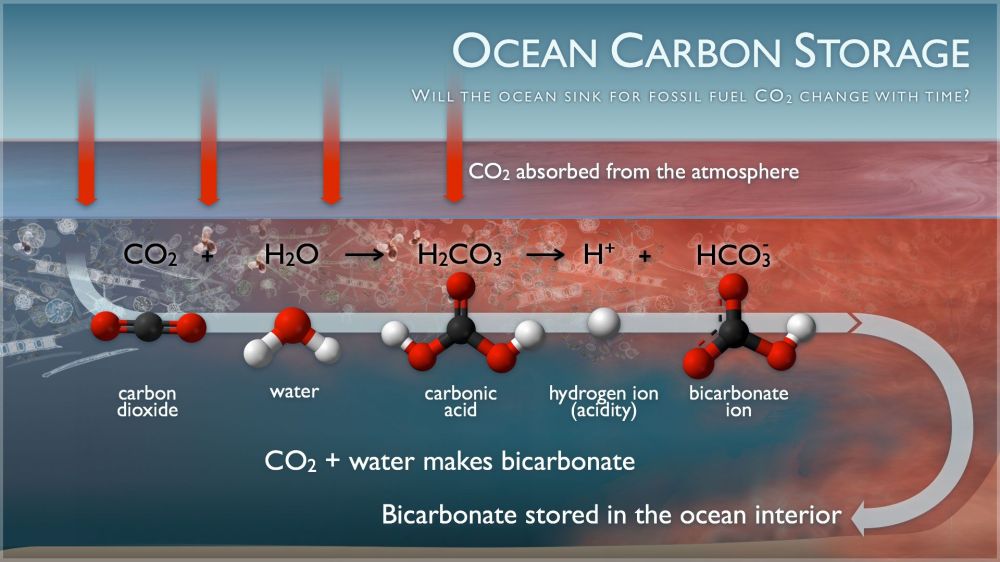
8lrtxibuouhqy8limppbfwkc76e5k_rxa9xbrm8mssw

That seems straight forward,  So what is the problem?

That looks fairly serious.  So what does the IPCC have to say about this issue?

What does it say in the SPM (Summary for Policy Makers)?

For this issue, I looked at the topic of ocean acidification and fish productivity. The SPM asserts on Page 17 that fish habitats and production will fall and that ocean acidification threatens marine ecosystems.

“Open-ocean net primary production is projected to redistribute and, by 2100, fall globally under all RCP scenarios. Climate change adds to the threats of over-fishing and other non-climatic stressors, thus complicating marine management regimes (high confidence).” Pg 17 SPM

“For medium- to high-emission scenarios (RCP4.5, 6.0, and 8.5), ocean acidification poses substantial risks to marine ecosystems, especially polar ecosystems and coral reefs, associated with impacts on the physiology, behavior, and population dynamics of individual species from phytoplankton to animals (medium to high confidence).” Pg 17 SPM

So, the IPCC agrees that ocean acidification is a serious problem due to rising CO2 emissions from burning fossil fuels.

What does it say in the Working Group Reports?

But wait a minute.  Let’s see what is in the working group reports that are written by scientists, not politicians.
WGII Report, Chapter 6 covers Ocean Systems. There we find a different story with more nuance and objectivity:

“Few field observations conducted in the last decade demonstrate biotic responses attributable to anthropogenic ocean acidification” pg 4

“Due to contradictory observations there is currently uncertainty about the future trends of major upwelling systems and how their drivers (enhanced productivity, acidification, and hypoxia) will shape ecosystem characteristics (low confidence).” Pg 5

“Both acclimatization and adaptation will shift sensitivity thresholds but the capacity and limits of species to acclimatize or adapt remain largely unknown” Pg 23

“Production, growth, and recruitment of most but not all non-calcifying
seaweeds also increased at CO2 levels from 700 to 900 µatm Pg 25

“Contributions of anthropogenic ocean acidification to climate-induced alterations in the field have rarely been established and are limited to observations in individual species” Pg. 27

“To date, very few ecosystem-level changes in the field have been attributed to anthropogenic or local ocean acidification.” Pg 39

Ocean Chemistry on the Record

Contrast the IPCC headlines with the the Senate Testimony of John T. Everett, in which he said:

“There is no reliable observational evidence of negative trends that can be traced definitively to lowered pH of the water. . . Papers that herald findings that show negative impacts need to be dismissed if they used acids rather than CO2 to reduce alkalinity, if they simulated CO2 values beyond triple those of today, while not reporting results at concentrations of half, present, double and triple, or as pointed out in several studies, they did not investigate adaptations over many generations.”

“In the oceans, major climate warming and cooling and pH (ocean pH about 8.1) changes are a fact of life, whether it is over a few years as in an El Niño, over decades as in the Pacific Decadal Oscillation or the North Atlantic Oscillation, or over a few hours as a burst of upwelling (pH about 7.59-7.8) appears or a storm brings acidic rainwater (pH about 4-6) into an estuary.”
http://www.epw.senate.gov/public/index.cfm?FuseAction=Files.View&FileStore_id=db302137-13f6-40cc-8968-3c9aac133b16

Many organisms benefit from less alkaline water.

(Added in thanks to David A.’s comment below)

In addition, IPCC has ignored extensive research showing positive impacts on marine life from lower pH. These studies are catalogued at CO2 Science with this summary:

There are numerous observations of improvement in calcification of disparate marine life in realistic rates of PH change due to increased CO2.

“In the final graphical representations of the information contained in our Ocean Acidification Database, we have plotted the averages of all responses to seawater acidification (produced by additions of both HCl and CO2) for all five of the life characteristics of the various marine organisms that we have analyzed over the five pH reduction ranges that we discuss in our Description of the Ocean Acidification Database Tables, which pH ranges we illustrate in the figure below.”

“The most striking feature of Figure 11 is the great preponderance of data located in positive territory, which suggests that, on the whole, marine organisms likely will not be harmed to any significant degree by the expected decline in oceanic pH. If anything, in fact, the results suggest that the world’s marine life may actually slightly benefit from the pH decline, which latter possibility is further borne out by the scatter plot of all the experimental data pertaining to all life characteristic categories over the same pH decline range, as shown below in Figure 12.”

At PH decline from control of .125, calcification, metabolism, fertility, growth and survival all moved into positive territory.

http://www.co2science.org/data/acidification/acidification.php

Summary

The oceans are buffered by extensive mineral deposits and will never become acidic. Marine life is well-adapted to the fluctuations in pH that occur all the time.

This is another example of climate fear-mongering:  It never happened before, it’s not happening now, but it surely will happen if we don’t DO SOMETHING!.

Conclusion

Many know of the Latin phrase “caveat emptor,” meaning “Let the buyer beware”.

When it comes to climate science, remember also “caveat lector”–”Let the reader beware”.

Update added June 20, 2015

For additional commentary on ocean acidification:

http://www.newsmax.com/FastFeatures/ocean-acidification-global-warming-quotes-debate/2015/05/06/id/642876/

Update added June 24, 2015

Patrick Moore also provides a thorough debunking here:

“It is a fact that people who have saltwater aquariums sometimes add CO2 to the water in order to increase coral growth and to increase plant growth. The truth is CO2 is the most important food for all life on Earth, including marine life. It is the main food for photosynthetic plankton (algae), which in turn is the food for the entire food chain in the sea.”

http://news.heartland.org/editorial/2015/05/27/why-coral-reefs-and-shellfish-will-not-die-ocean-acidification

Update added July 2, 2015

Scientists have had pH meters and measurements of the oceans for one hundred years. But experts decided that computer simulations in 2014 were better at measuring the pH in 1910 than the pH meters were. The red line (below) is the models recreation of ocean pH. The blue stars are the data points — the empirical evidence.

What we have here is one of the basic foundations of the climate change scare, that is falling ocean pH levels with increased atmospheric CO2 content, being completely dismissed by the empirical ocean pH data the alarmist climate scientists didn’t want to show anyone because it contradicted their ‘increasing ocean acidity’ narrative.

http://joannenova.com.au/2015/01/oceans-not-acidifying-scientists-hid-80-years-of-ph-data/

Update added September 15, 2015

In summary, recent research publications are using a term (OA) that is technically incorrect, misleading, and pejorative; it could not be found in the oceanography literature before about 15 years ago. . .

The claim that the surface-water of the oceans has declined in pH from 8.2 to 8.1, since the industrial revolution, is based on sparse, contradictory evidence, at least some of which is problematic computer modeling. Some areas of the oceans, not subject to algal blooms or upwelling, may be experiencing slightly lower pH values than were common before the industrial revolution. However, forecasts for ‘average’ future pH values are likely exaggerated and of debatable consequences. The effects of alkaline buffering and stabilizing biological feedback loops seem to be underappreciated by those who carelessly throw around the inaccurate term “ocean acidification.”

http://wattsupwiththat.com/2015/09/15/are-the-oceans-becoming-more-acidic/
Mitigation is Bad for Us and the Planet

Updated June 30, 2015  New GWPF paper by Indur M. Goklany linked below.

In the excitement over the Pope’s encyclical and upcoming Paris conference, people are not talking about how CO2 mitigation (treaties, carbon pricing or regulations), if successful, would put civilization onto an unsustainable path.

Fortunately, Matt Ridley is shining some light in this direction:

Until now, green thinking has wanted us to go back to nature: to reject innovations such as genetically modified food, give up commerce and consumption and energy and materials and live simpler lives so that nature is not abused and the climate is not wrecked. The eco-modernists, who include the veteran Californian green pioneer Stewart Brand and the British green campaigner Mark Lynas, say this is a mistake. “Absent a massive human die-off, any large-scale attempt at recoupling human societies to nature using these [ancestral] technologies would result in an unmitigated ecological and human disaster.”

The Ecomodernist Manifesto promises a much needed reformation in the green movement. Its 95 theses should be nailed to the door of the Vatican when the pope’s green-tinged encyclical comes out next month, because unlike the typical eco-wail, it contains good news for the poor. It says: no, we are not going to stop you getting rich and adopting new technologies and leaving behind the misery of cooking over wood fires in smoky huts with no artificial light. No, we do not want you to stay as subsistence farmers. Indeed, the quicker we can get you into a city apartment with a car, a phone, a fridge and a laptop, the better. Because then you won’t be taking wood and bushmeat from the forest.

http://www.rationaloptimist.com/blog/eco-modernism-and-sustainable-intensification.aspx

Now, I am not thrilled with using the term “manifesto” or with references to the “anthropocene” era, but there is a positive direction in this.

“We offer this statement in the belief that both human prosperity and an ecologically vibrant planet are not only possible, but also inseparable. By committing to the real processes, already underway, that have begun to decouple human well-being from environmental destruction, we believe that such a future might be achieved. As such, we embrace an optimistic view toward human capacities and the future.”

These folks are saying we can use fossil fuels in a way that benefits both humans and nature, and in fact, if we don’t do so, our civilization is not sustainable.  Using fossil fuels is good for people and the planet and is the only sustainable way forward.

Strong stuff, but it doesn’t fit into the usual boxes.

More on Ecomodernism here:

http://thebreakthrough.org/index.php/voices/michael-shellenberger-and-ted-nordhaus/an

From Indur M. Goklany in The Pontifical Academies’ BROKEN MORAL COMPASS

But the statement is fatally flawed. It is riddled with sins of omission and commission bolstered by wishful thinking. For instance, it ignores decades of well documented empirical data that show that human wellbeing has advanced throughout the world and that the terrestrial biosphere’s productivity has increased above preindustrial levels, allowing it to support more biomass, in no small part because of carbon dioxide emissions from humanity’s use of fossil fuels. The advances in human wellbeing include reductions in poverty, hunger, malnutrition, death and disease, and increases in life expectancy and the standard of living across the world. The poor have been major beneficiaries of these advances.

Click to access Vatican-compass.pdf

Comet Lander Wakes Up!

In Nov. 2014, In a stunning historical achievement the European Space Agency succeeded not only to put the Rosetta probe into orbit around a comet, but amazingly to place the Philae lander on the comet’s surface.

Subsequently the batteries died, and signals stopped for 7 months, but have now resumed.

Philae is best known for transmitting startling images such as these:

OK, I’m not so sure about that last one.