Zero Warming: Chilling UAH Temps December 2022

The post below updates the UAH record of air temperatures over land and ocean.  But as an overview consider how recent rapid cooling  completely overcame the warming from the last 3 El Ninos (1998, 2010 and 2016).  The UAH record shows that the effects of the last one were gone as of April 2021, again in November 2021, and in February and June 2022  Now at year end 2022, we have again global temp anomaly matching zero warming since 1995. (UAH baseline is now 1991-2020).

For reference I added an overlay of CO2 annual concentrations as measured at Mauna Loa.  While temperatures fluctuated up and down ending flat, CO2 went up steadily by ~55 ppm, a 15% increase.

Furthermore, going back to previous warmings prior to the satellite record shows that the entire rise of 0.8C since 1947 is due to oceanic, not human activity.
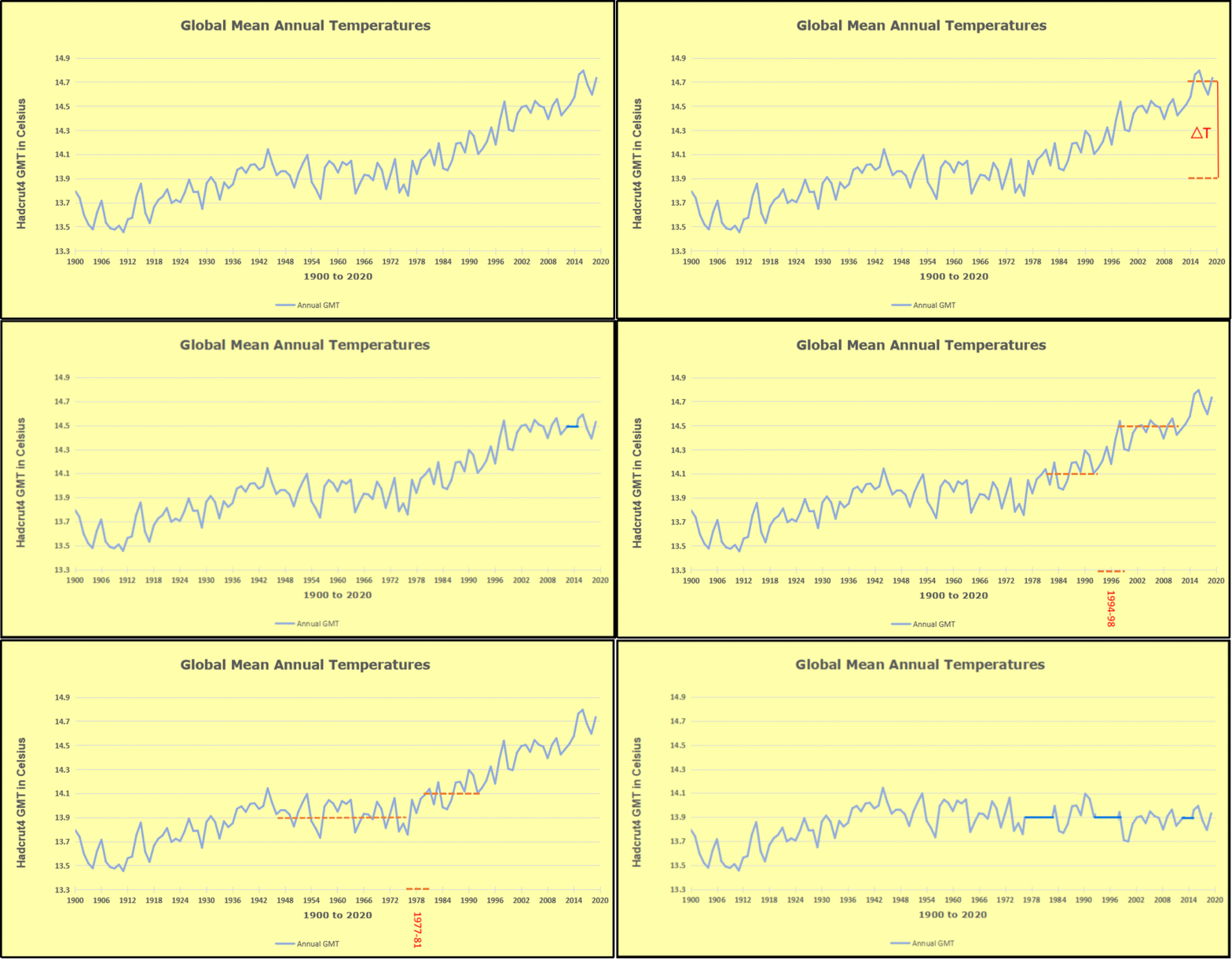
gmt-warming-events

The animation is an update of a previous analysis from Dr. Murry Salby.  These graphs use Hadcrut4 and include the 2016 El Nino warming event.  The exhibit shows since 1947 GMT warmed by 0.8 C, from 13.9 to 14.7, as estimated by Hadcrut4.  This resulted from three natural warming events involving ocean cycles. The most recent rise 2013-16 lifted temperatures by 0.2C.  Previously the 1997-98 El Nino produced a plateau increase of 0.4C.  Before that, a rise from 1977-81 added 0.2C to start the warming since 1947.

Importantly, the theory of human-caused global warming asserts that increasing CO2 in the atmosphere changes the baseline and causes systemic warming in our climate.  On the contrary, all of the warming since 1947 was episodic, coming from three brief events associated with oceanic cycles. 

Update August 3, 2021

Chris Schoeneveld has produced a similar graph to the animation above, with a temperature series combining HadCRUT4 and UAH6. H/T WUWT
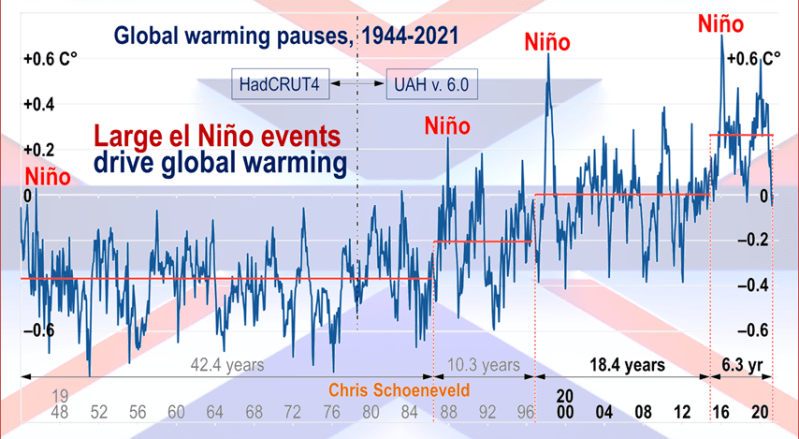
image-8


mc_wh_gas_web20210423124932

See Also Worst Threat: Greenhouse Gas or Quiet Sun?

December Update Big Chilling of Land and Sea 

banner-blog

With apologies to Paul Revere, this post is on the lookout for cooler weather with an eye on both the Land and the Sea.  While you will hear a lot about 2020-21 temperatures matching 2016 as the highest ever, that spin ignores how fast the cooling set in.  The UAH data analyzed below shows that warming from the last El Nino was fully dissipated with chilly temperatures in all regions. May NH land and SH ocean showed temps matching March, reversing an upward blip in April, and then June was virtually the mean since 1995.

UAH has updated their tlt (temperatures in lower troposphere) dataset for December 2022. Posts on their reading of ocean air temps this month came ahead of updated records from HadSST4.  I have previously posted on SSTs using HadSST4 Ocean Temps Dropping November 2022 This month also has a separate graph of land air temps because the comparisons and contrasts are interesting as we contemplate possible cooling in coming months and years. Sometimes air temps over land diverge from ocean air changes.  However, in December temps in all land and ocean regions dropped sharply.

Note:  UAH has shifted their baseline from 1981-2010 to 1991-2020 beginning with January 2021.  In the charts below, the trends and fluctuations remain the same but the anomaly values change with the baseline reference shift.

Presently sea surface temperatures (SST) are the best available indicator of heat content gained or lost from earth’s climate system.  Enthalpy is the thermodynamic term for total heat content in a system, and humidity differences in air parcels affect enthalpy.  Measuring water temperature directly avoids distorted impressions from air measurements.  In addition, ocean covers 71% of the planet surface and thus dominates surface temperature estimates.  Eventually we will likely have reliable means of recording water temperatures at depth.

Recently, Dr. Ole Humlum reported from his research that air temperatures lag 2-3 months behind changes in SST.  Thus the cooling oceans now portend cooling land air temperatures to follow.  He also observed that changes in CO2 atmospheric concentrations lag behind SST by 11-12 months.  This latter point is addressed in a previous post Who to Blame for Rising CO2?

After a change in priorities, updates are now exclusive to HadSST4.  For comparison we can also look at lower troposphere temperatures (TLT) from UAHv6 which are now posted for December.  The temperature record is derived from microwave sounding units (MSU) on board satellites like the one pictured above. Recently there was a change in UAH processing of satellite drift corrections, including dropping one platform which can no longer be corrected. The graphs below are taken from the revised and current dataset.

The UAH dataset includes temperature results for air above the oceans, and thus should be most comparable to the SSTs. There is the additional feature that ocean air temps avoid Urban Heat Islands (UHI).  The graph below shows monthly anomalies for ocean air temps since January 2015.

Note 2020 was warmed mainly by a spike in February in all regions, and secondarily by an October spike in NH alone. In 2021, SH and the Tropics both pulled the Global anomaly down to a new low in April. Then SH and Tropics upward spikes, along with NH warming brought Global temps to a peak in October.  That warmth was gone as November 2021 ocean temps plummeted everywhere. After an upward bump 01/2022 temps reversed and plunged downward in June.  After an upward spike in July, ocean air everywhere cooled in August and also in September.   Now in December 2022, sharp cooling everywhere brings the global anomaly to zero.

Land Air Temperatures Tracking Downward in Seesaw Pattern

We sometimes overlook that in climate temperature records, while the oceans are measured directly with SSTs, land temps are measured only indirectly.  The land temperature records at surface stations sample air temps at 2 meters above ground.  UAH gives tlt anomalies for air over land separately from ocean air temps.  The graph updated for December is below.

Here we have fresh evidence of the greater volatility of the Land temperatures, along with extraordinary departures by SH land.  Land temps are dominated by NH with a 2021 spike in January,  then dropping before rising in the summer to peak in October 2021. As with the ocean air temps, all that was erased in November with a sharp cooling everywhere. Land temps dropped sharply for four months, even more than did the Oceans. March and April 2022 saw some warming, reversed In May when all land regions cooled pulling down the global anomaly. In July, Tropics and SH land rose sharply, NH slightly, pulling up the Global land anomaly. Note the sharp drop in SH land temps in August and September, while NH Land rose, leaving the Global anomaly unchanged. Nov. and Dec. saw steep declines in air temps over land.

The Bigger Picture UAH Global Since 1980

The chart shows monthly Global anomalies starting 01/1980 to present.  The average monthly anomaly is -0.06, for this period of more than four decades.  The graph shows the 1998 El Nino after which the mean resumed, and again after the smaller 2010 event. The 2016 El Nino matched 1998 peak and in addition NH after effects lasted longer, followed by the NH warming 2019-20.   A small upward bump in 2021 has been reversed with temps having returned close to the mean as of 2/2022.  March and April brought warmer Global temps, reversed in May and the June anomaly was almost zero. With the sharp drop in Nov. and Dec. temps, there is only about 0.1C increase since 1980.

TLTs include mixing above the oceans and probably some influence from nearby more volatile land temps.  Clearly NH and Global land temps have been dropping in a seesaw pattern, nearly 1C lower than the 2016 peak.  Since the ocean has 1000 times the heat capacity as the atmosphere, that cooling is a significant driving force.  TLT measures started the recent cooling later than SSTs from HadSST3, but are now showing the same pattern.  It seems obvious that despite the three El Ninos, their warming has not persisted, and without them it would probably have cooled since 1995.  Of course, the future has not yet been written.


Arctic Ice In Perspective 2022

When Arctic ice is melting in summer until mid-September, warmists stoke fears about ice disappearing in the North. In fact, the pattern of Arctic ice seen in historical perspective is not alarming. People are over-thinking and over-analyzing Arctic Ice extents, and getting wrapped around the axle (or should I say axis).  So let’s keep it simple and we can all readily understand what is happening up North.

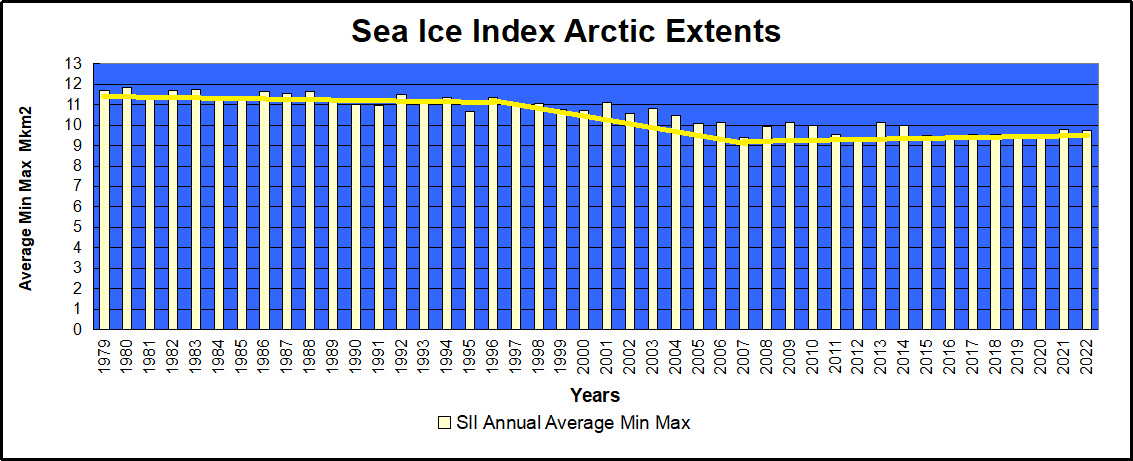
I have noticed at some other blogs people complain about my monthly Arctic ice updates focusing on extents starting in 2007. This post will show why that time period is entirely reasonable as a subject for analysis. I will use the ever popular NOAA dataset derived from satellite passive microwave sensors.  It sometimes understates the ice extents, but everyone refers to it and it is complete from 1979 to present.  Here’s what NOAA reports (in M km2):

We are frequently told that only the March maximums and the September minimums matter, since the other months are only transitional between the two.  So the graph above shows the mean ice extent, averaging the two months March and September.

If I were adding this to the Ice House of Mirrors, the name would be The X-Ray Ice Mirror, because it looks into the structure of the time series.   For even more clarity and simplicity, here is the table:

NOAA NH Annual Average Ice Extents (in M km2).  Sea Ice Index v3.0 (here)

Year Average Change Rate of Change
1979 11.697
1996 11.353 -0.344 -0.020 per year
2007 9.405 -1.949 -0.177 per year
2022 9.728  +0.323 +0.022 per year

The satellites involve rocket science, but this does not.  There was a small loss of ice extent over the first 17 years, then a dramatic downturn for 11 years, 9 times the rate as before. That was followed by the current 15-year plateau with a slight gain comparable to the beginning loss.  All the fuss is over that middle period, and we know what caused it.  A lot of multi-year ice was flushed out through the Fram Strait, leaving behind more easily melted younger ice. The effects from that natural occurrence bottomed out in 2007.

Kwok et al say this about the Variability of Fram Strait ice flux:

The average winter area flux over the 18-year record (1978–1996) is 670,000 km2, 7% of the area of the Arctic Ocean. The winter area flux ranges from a minimum of 450,000 km2 in 1984 to a maximum of 906,000 km2 in 1995. . .The average winter volume flux over the winters of October 1990 through May 1995 is 1745 km3 ranging from a low of 1375 km3 in the 1990 flux to a high of 2791 km3 in 1994.

https://www.researchgate.net/publication/261010602/download

Conclusion:

Some complain it is too soon to say Arctic Ice is recovering, or that 2007 is a true change point.  The same people were quick to jump on a declining period after 1996 as evidence of a “Death Spiral.”

Footnote:

No one knows what will happen to Arctic ice.

Except maybe the polar bears.

And they are not talking.

Except, of course, to the admen from Coca-Cola


Fear Not for Arctic Ice New Year 2023

Impressive Arctic ice recovery continued in December as seen in the animation below:

The month of December 2022 shows Hudson Bay (lower right) starting with some western shore ice and ending ice covered, adding in that basin 1.25M km2. Just above Hudson, you can see the Gulf of St. Lawrence icing over, and Baffin Bay adding ice as well, now up to 49% of its annual maximum.

At the extreme left Okhotsk Sea also starts with little shore ice and grows from 53k km2 up to 393k km2, reaching down to Japan.  At the top Kara freezes over and Barents and Greenland Seas add ice to their margins. The graph below shows the December ice recovery.

Note the average year adds 2M km2 and 2022 was matching that until the last week or so.  Not surprising when the polar vortex pushed freezing Arctic air as far south as Texas and Florida, incursion of warm southern air into the Arctic inhibited further ice growth.  SII tracked MASIE with somewhat lower extent toward the end.

The table below shows year-end ice extents in the various Arctic basins compared to the 16-year averages and some recent years.

Region 2022365 Day 365 Average 2022-Ave. 2020365 2022-2020
 (0) Northern_Hemisphere 12864130 13071346  -207216  12765491 98639 
 (1) Beaufort_Sea 1070966 1070354  612  1070689 277 
 (2) Chukchi_Sea 966006 964526  1481  966006
 (3) East_Siberian_Sea 1087137 1087133  1087120 17 
 (4) Laptev_Sea 897845 897840  897827 18 
 (5) Kara_Sea 864832 886899  -22067  879232 -14400 
 (6) Barents_Sea 270677 438702  -168025  371122 -100445 
 (7) Greenland_Sea 674210 582086  92124  592839 81371 
 (8) Baffin_Bay_Gulf_of_St._Lawrence 889961 994988  -105027  867509 22452 
 (9) Canadian_Archipelago 854843 853370  1473  854597 245 
 (10) Hudson_Bay 1254256 1237220  17036  1257919 -3663 
 (11) Central_Arctic 3222361 3204794  17567  3159881 62481 
 (12) Bering_Sea 373249 405344  -32095  249522 123727 
 (13) Baltic_Sea 22409 32724  -10315  7986 14423 
(14) Sea_of_Okhotsk 393473 388636  4837  479972 -86498 

This year’s ice extent is 207k km2 or 1.6% below average.  Only Baffin Bay and Barents Sea have sizeable deficits to average, while Greenland Sea shows a surplus.  Other Arctic basins are already maxed out or are near their average for this date.

Comparing Arctic Ice at End of Years

At  the bottom is a discussion of statistics on year-end Arctic Sea Ice extents.  The values are averages of the last five days of each year.  End of December is a neutral point in the melting-freezing cycle, midway between September minimum and March maximum extents.

Background from Previous Post Updated to Year-End 2022

Some years ago reading a thread on global warming at WUWT, I was struck by one person’s comment: “I’m an actuary with limited knowledge of climate metrics, but it seems to me if you want to understand temperature changes, you should analyze the changes, not the temperatures.” That rang bells for me, and I applied that insight in a series of Temperature Trend Analysis studies of surface station temperature records. Those posts are available under this heading. Climate Compilation Part I Temperatures

This post seeks to understand Arctic Sea Ice fluctuations using a similar approach: Focusing on the rates of extent changes rather than the usual study of the ice extents themselves. Fortunately, Sea Ice Index (SII) from NOAA provides a suitable dataset for this project. As many know, SII relies on satellite passive microwave sensors to produce charts of Arctic Ice extents going back to 1979.  The current Version 3 has become more closely aligned with MASIE, the modern form of Naval ice charting in support of Arctic navigation. The SII User Guide is here.

There are statistical analyses available, and the one of interest (table below) is called Sea Ice Index Rates of Change (here). As indicated by the title, this spreadsheet consists not of monthly extents, but changes of extents from the previous month. Specifically, a monthly value is calculated by subtracting the average of the last five days of the previous month from this month’s average of final five days. So the value presents the amount of ice gained or lost during the present month.

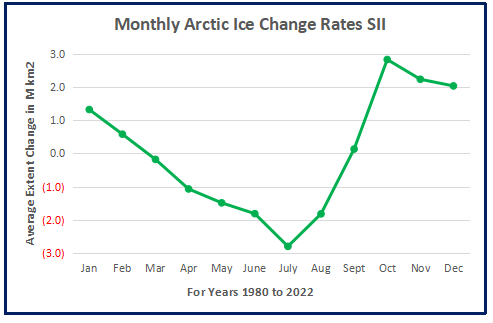
These monthly rates of change have been compiled into a baseline for the period 1980 to 2010, which shows the fluctuations of Arctic ice extents over the course of a calendar year. Below is a graph of those averages of monthly changes up to and including this year. Those familiar with Arctic Ice studies will not be surprised at the sine wave form. December end is a relatively neutral point in the cycle, midway between the September Minimum and March Maximum.

The graph makes evident the six spring/summer months of melting and the six autumn/winter months of freezing.  Note that June-August produce the bulk of losses, while October-December show the bulk of gains. Also the peak and valley months of March and September show very little change in extent from beginning to end.

The table of monthly data reveals the variability of ice extents over the last 4 decades.

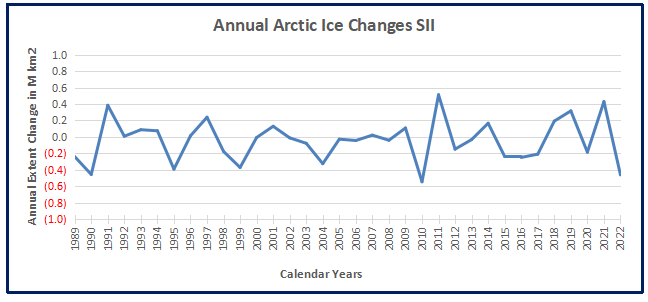
The values in January show changes from the end of the previous December, and by summing twelve consecutive months we can calculate an annual rate of change for the years 1979 to 2022.

As many know, there has been a decline of Arctic ice extent over these 40 years, averaging 70k km2 per year. But year over year, the changes shift constantly between gains and losses, ranging up to +/- 500k km2.

Moreover, it seems random as to which months are determinative for a given year. For example, much ado was printed about June and July 2021 melting faster than expected resulting in higher losses of ice extents. But then the final 3 months of 2021 more than made up for those summer losses

As it happens in this dataset, October has the highest rate of adding ice. The table below shows the variety of monthly rates in the record as anomalies from the 1980-2010 baseline. In this exhibit a red cell is a negative anomaly (less than baseline for that month) and blue is positive (higher than baseline).


Note that the  +/ –  rate anomalies are distributed all across the grid, sequences of different months in different years, with gains and losses offsetting one another.  For example in 2022 the outlier months were June and September where unusual amounts of ice were lost.  Despite above average gains Oct.–Dec., the year ended with a large negative anomaly.  June 2021 lost more ice than the baseline, but about the same as 2017, and not as much as 2012. The gains in Oct.-Dec. 2021 were ~1M km2 above baseline, but were exceeded by the same months in 2019 and 2020.  The bottom line presents the average anomalies for each month over the period 1979-2021.  Note the rates of gains and losses mostly offset, and the average of all months in the bottom right cell is virtually zero.

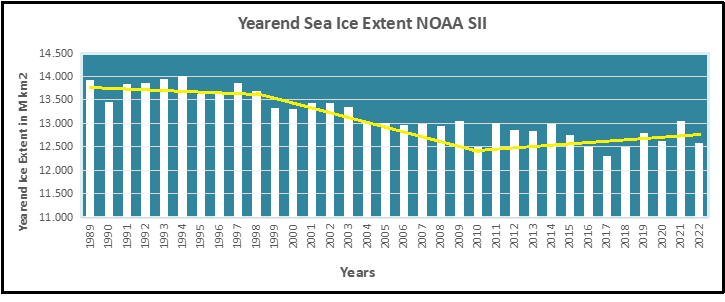
A final observation: The graph below shows the Yearend Arctic Ice Extents for the last 32 years.

Year-end Arctic ice extents (last 5 days of December) show three distinct regimes: 1988-1998, 1998-2010, 2010-2022. The average year-end extent 1989-2010 is 13.4M km2. In the last decade, 2011 was 13.0M km2, and six years later, 2017 was 12.3M km2. 2021 rose back to 13.06  2022 slipped back to 12.6M. So for all the the fluctuations, the net is zero, or a slight gain from 2010. Talk of an Arctic ice death spiral is fanciful.

These data show a noisy, highly variable natural phenomenon. Clearly, unpredictable factors are in play, principally water structure and circulation, atmospheric circulation regimes, and also incursions and storms. And in the longer view, today’s extents are not unusual.


Illustration by Eleanor Lutz shows Earth’s seasonal climate changes. If played in full screen, the four corners present views from top, bottom and sides. It is a visual representation of scientific datasets measuring Arctic ice extents.


Update National Hysteria in Canada

Canadian flag flying at half-mast on the West Block of Parliament Hill in Ottawa on June 2, 2021. (The Canadian Press/Sean Kilpatrick)

Brian Giesbrecht writes at Epoch Times Canada’s National Hysteria in the 21st Century.  Excerpts in italics with my bolds and added images.

Mass hysteria is the spontaneous manifestation of a particular behaviour by many people. There are numerous historical examples: Middle Age nuns at a convent in France spontaneously began to meow like cats; at another convent, nuns began biting one another. In 13th-century Germany, spontaneous dancing broke out and entire city populations danced until exhausted. But perhaps the best-known mass hysteria was the Salem Witch Trials, where people, seized by visions, accused others of bewitching them. Many were executed.

But hysteria episodes are not only historical. They have occurred in modern times as well. Remember the daycare panic of the 1980s, when daycare workers were accused of horrible crimes against children, including satanic abuse. Many falsely accused spent years in jail. Lives were ruined. The strangest thing about that mass hysteria is that it spanned continents. It started in California, but then moved through Canada, Europe, and even New Zealand, before it burned itself out.

Obviously, those caught up in mass hysteria do not realize at the time that they are not seeing things clearly.

Could it be that some of us are even now victims of self-induced mass hysterias?

For example, what are we to make of the insistence that a man who chooses to live as a woman actually becomes a woman? To most of the world this claim is nonsensical. It is neither scientific nor factual. A woman has XX chromosomes, while a man has XY. Case closed. But to others, a man actually becomes a woman simply by stating that s/he is one. In the future, will this strange thinking be considered a mass hysteria?

Or what about the odd response that most Western nations took to the COVID-19 pandemic?

For reasons that remain unclear, most Western countries decided to copy communist China’s lockdown strategy, which was a radical approach that had hitherto been rejected by all Western scientists and emergency planners. The misery we see playing out in China, as they finally abandon it, is absolute proof of its absurdity. Yet even today, many still insist that we were right to lock down. And some say that we should do it again! Is this an example of a mass hysteria?

And are the most extreme of today’s anti-fossil fuel exponents caught up in some version of a mass hysteria? I’m not referring to people with legitimate concerns about global warming and the need to find cost-effective, non-polluting energy. I mean those who insist that everyone must give up all fossil fuels by a date they invent. Will history judge this to be a hysteria?

But perhaps the strangest ongoing episode of mass hysteria might be playing out in Canada. That is the claim that 215 indigenous children were secretly killed at the former Kamloops Indian Residential School and then covertly buried at night, with the forced help of children “as young as six.”

If true, this would easily be the biggest crime in Canadian history. The very idea that the nuns and priests running the school would be responsible for the deaths of 215 children, and then force other children to bury their comrades, never made sense. For one thing, there was not one single historical record of any indigenous parent in Kamloops—or anywhere else—reporting that their child had disappeared after attending Kamloops IRS. But more to the point, there was never any factual reason to believe that the nuns and priests who operated the school were the ghouls that the accusation demanded.

But then the strange accusations multiplied. Other indigenous leaders chimed in, with claims that there were “thousands, tens of thousands” of such intentionally killed and secretly buried residential school students all over the country. The prime minister ordered flags to be flown at half mast for months, hundreds of millions of dollars were committed to search for these phantom children, and a cabinet minister, Marc Miller, called anyone who even dared to question these bizarre claims a “ghoul.”

The country went into a panic. A new national holiday honouring these “missing children”
(who were never missing) was declared.

But there was never any credible evidence to support any of these claims. The only information that could even be loosely termed “scientific” was an embargoed report by a junior archaeologist that she had detected 215 “soil disturbances” that might be graves. It now appears that it is much more likely that those soil disturbances are clay pipes from a 1924 septic field.

We do know that the bizarre stories of priests killing and secretly burying indigenous children have gained more prominence since the 1990s, when a defrocked minister began spreading conspiracy theories. But how is it that ordinary, sensible Canadians seemed willing to accept these same preposterous, and deeply anti-Catholic, stories?

Will future historians see this strange episode as some kind of mass hysteria?

Footnote: Toronto Temperature History

H/T greyfalcon

Facebook is Constantly Telling Me to Check Temperature Rise in My Area — This is Factual Data For It: The Temperature in Toronto Canada Has Not Been Breaking Records. In 1936 It Reached 40.6°C, 2.4°C Hotter Than the Hottest It’s Been This Century. Source: Meteorological Service of Canada

Woke Comes Out of the Shadows

Auguste Meyrat writes at American Mind Shadows on the Wall.  Excerpts in italics with my bolds and added images.

The “Twitter Files” remind us how wokeness has infected the tech elites.

With each new batch of the “Twitter Files,” it’s becoming increasingly apparent that Twitter censors were not only duplicitous scoundrels aiming to advance an agenda but also incompetents who failed to see the consequences of their actions. Whether it was suppressing the Hunter Biden storyshadow banning and de-amplifying popular conservative figures and certain medical professionals, and removing a sitting president of the United States from the platform, they convinced themselves that they were making the world a better place.

At no point did they seriously question themselves beyond violating their own rules. It never dawned on them that their constant gaslighting jeopardizes the freedom, health, and safety of all Americans. It seemed to matter little that they oversaw a platform that promised open public discourse but degenerated into a leftist propaganda outlet infested with bots and child pornography.

Not only did these censors do real damage at the bidding of a corrupt FBI but they ruined a potentially successful business.

Before Elon Musk bought Twitter, there were few real conversations happening on the platform, and Twitter was relatively small compared to other social media platforms. For the great majority of users, scrolling through one’s Twitter feed was never an enlightening, connective, or even fun experience but more a mindless habit to pass the time.

Seeing that this is the case, it’s fair to ask what really drove the moderators to do what they did. They could have easily let the First Amendment be their standard for content moderation and sipped their lattes while attending useless meetings. Why did they feel the need to risk their cushy careers by setting into motion a hostile takeover by Elon Musk and an incoming onslaught of lawsuits from users?

From any angle, this seems utterly foolish—that is, except from the woke angle. While rational actors would have understood the sheer destructiveness of censoring users without cause, facilitating the rigging of elections, and endangering the public by denying them important information on a pandemic, woke actors lack this capacity. They operate on feelings and self-regard, not evidence and logic.

Elon Musk famously called wokeness a “mind virus.”

It infects people’s mental faculties and drives them to act and express themselves irrationally. Gad Saad expounds upon this in his book The Parasitic Mind. He bemoans the decline of academic scholarship and intellectual debate at today’s universities all in the name of establishing social justice. Of course, rather than create a more equitable and just world, the woke swarm only achieves the opposite—a world of unforgiving hierarchy and hypocrisy. But instead of learning from their failure, they double down and become ever more unreasonable.

For Saad, this is less an ideology and more an “idea pathogen.” In his scientific opinion, victims of wokeness specifically suffer from “Ostrich Parasitic Syndrome (OPS),” substituting for reality a fiction in which “science, reason, rules of causality, evidentiary thresholds, a near-infinite amount of data, data analytic procedures, inferential statistics, the epistemological rules inherent to the scientific method, rules of logic, historical patterns, daily patterns, and common sense are all rejected.”

Unfortunately it’s still an open question of how to “defeat wokeness,” as Elon Musk recently declared. Anyone who has experienced an encounter with the woke infected knows that exposing their falsehoods and contradictions (“sunlight is the best disinfectant,” or, in the new favored expression, “democracy dies in darkness”) only makes them sicker and more dangerous. This is why the “Twitter Files” have mostly elicited silence from the corporate media. Maybe a few of them are pleading the Fifth and hoping the story goes away, but it’s more likely that most don’t understand what these revelations mean, nor do they really care.

So does that mean that releasing and discussing the “Twitter Files” is worthless? Not at all. Even if it doesn’t cure the woke censors or their woke supporters, it fortifies the intellectual immune system of everyone else. Americans now know that they are not crazy; in truth, they are living throughnew kind of totalitarianism where Big Tech platforms control speech, impose a social credit system, and fabricate overarching narratives out of thin air.

While this is not exactly a consoling thought, it’s at least the beginning of a solution. The problem has now been identified, and there are now enough informed members of society to have a constructive conversation about the issue. This in turn could lead to finding a cure to the woke pandemic. If these problems continue going ignored and unchecked, the civilized world will surely crumble into ruin, adopting the same chaos, stupidity, and hypocrisy inherent in today’s woke culture.


Decolonizing Attack on Science

Update Dec. 30 at end

Rex Murphy writes at National Post Science does not need to be ‘decolonized’.  Excerpts in italics with my bolds and added images.

Does Concordia University wish to be an instrument of learning, or a funnel for wokeness?

Scholars at Montreal’s Concordia University are planning to trace and counter what they say is colonialism in physics, which they describe as a “social field” rather than one of “pure knowledge.” — True North, Campus Watch

How would a person decolonize penicillin? Or anesthesia? Or open-heart surgery? Or the miracle advances the past century gave the world through the understandings — still not complete — of quantum physics?

First of all, you would have to ask the question: what could “decolonize” even mean in these miracle domains?

(I use miracle here only as metaphor, or in its now weaker and more normal usage as an advance scarcely dreamed of but brought on by science, science which is the application of mind, of intellect — not politics — to the understanding of nature.)

Scientific truth is the truth of bare fact. The only reverence science knows is the genuflection before hard, physical reality. Science wears no ribbons of fealty to causes, colours or the predispositions of any mentality or ideology, other than the asking of questions and the submission to the answers provided by absolutely neutral inquiry — answers always tentative, always open to revision or correction; science is never final.

Short form: Science does not wear badges.

There have been instances where science has been forced to wear a political coat. A certain regime in Germany during the 1930s, under the tenure of a racist madman, declared that there was no such a thing as “Jewish” science. And, therefore, it was innately false, to be banned, alas along with the great Jewish scientists.

That Einstein was Jewish, therefore he was wrong,
has to have been the most warped equation ever.

There was in Hitler’s imperium, room for only “Aryan” science. And there was the deadly flaw. Science allows no qualifying epithets, no qualificatory precedent adjectives.

(I dare say Whoopi Goldberg doesn’t know this, but then, there is much that Whoopi Goldberg doesn’t know. That’s why she’s on The View.)

Communism in the hard days of ruthless Stalin also had a Marxist “line” on what science had to be. In both cases, radical and totalitarian regimes tried to subdue thought itself, the functioning of intellect, to their grim, idiotic and malign ideologies.

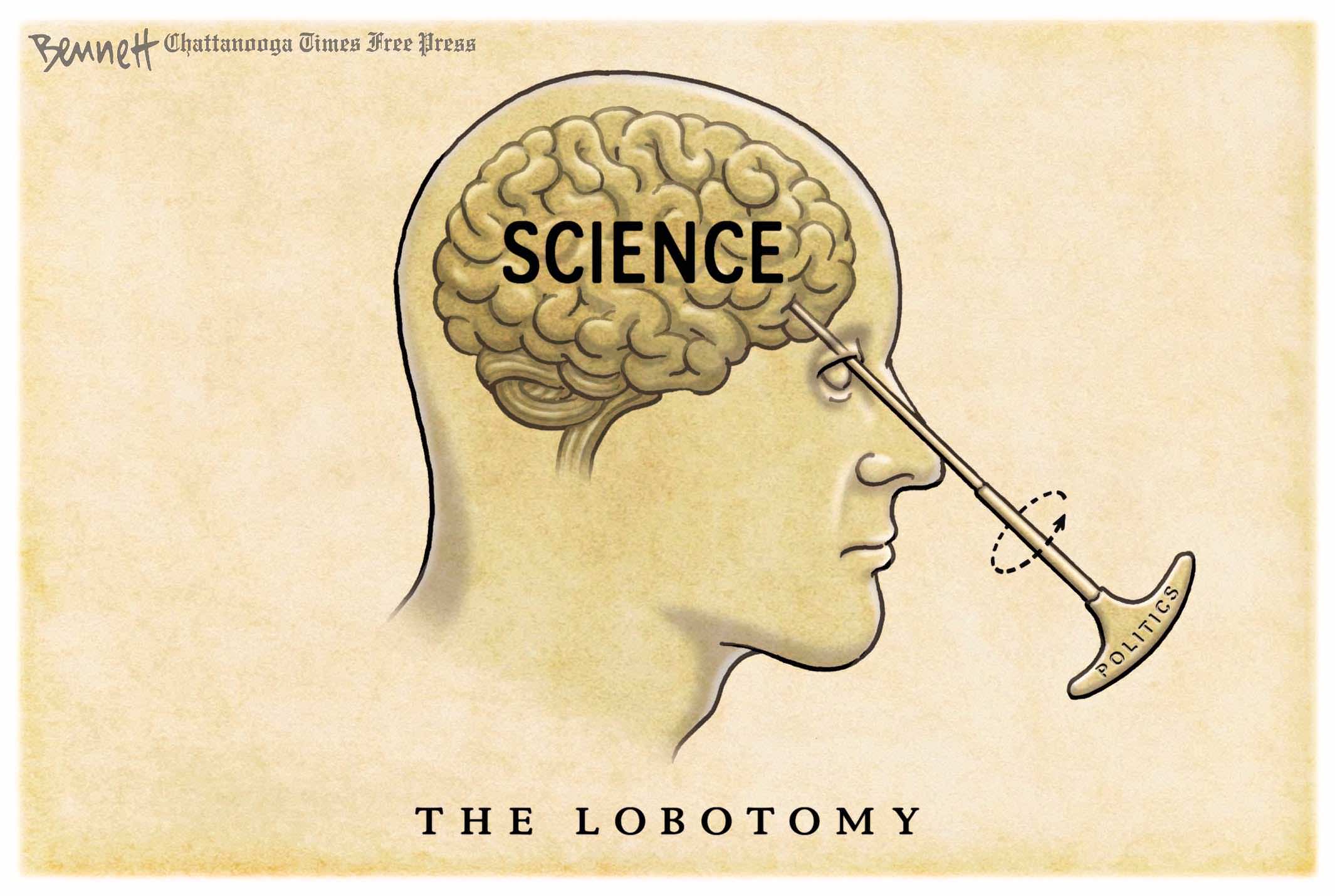
Science is science, and it is only science, or it is not science: with any limiting descriptive it is just a rigged machine for producing approved results. Politics acts on science as an acid to truth: it distorts inquiry and banishes rigour and dispassion — the core qualities of science.

So let me curl back to the otiose question of “decolonizing” science. What can Concordia possibly mean by such a project?

Is the university, directly or indirectly, saying that the manifold revelations brought about by adherence to scientific methodology, since the days of Isaac Newton — the premier figure in the advance of empirical thought — are wrong? Is Concordia saying Western science is bent by racial considerations and thereby should be dismissed? Side-stepped? Layered over?

Does the university agree with the judgment that since science is “colonized,” it must be “corrected?” That E = mc², perhaps the most basic equation of the whole universe, proceeds from a “colonialist” mentality?Is it saying that because much, but by no means all, of the science came from people with a certain colour of skin — that would be white — it is therefore not only fallible but an imposition of “colonial” understanding on young minds, whatever that ridiculous phrase may be taken to mean?

Concordia has a fairly well known project called Decolonizing light. And what could that mean? Does it challenge the speed limit of the universe, that light travels at 186,000 miles per second? What alternative measurement is it offering from its decolonized science?

And most pertinently how can it be that a university — an institution for the transmission of knowledge and truth — would bend to the woke notions of our over-politicized times and offer that the progress of scientific truth is but one more unfolding of “imperialist,” “colonizing” white thought?

Speak up Concordia. Or trim your fees.

There are few things that offer more despair in these fad-ridden times than the easy, cowardly concessions to racial and ethic politicization by (once) prestigious institutions.

Penicillin works. Anesthesias have saved millions from pain. The second law of thermodynamics has no reference to race or creed. The scientific method is the very closest attempt in all of history to remove all prejudice, of any kind, from the attempt to answer any question. Its kernel, its very ultimate idea, is submission to what is really seen, what is really there, what is really to be understood.

Most important of all, the colour of the skin of a discoverer has no bearing on the discovery.

You cannot “decolonize” science, because science has no colonies, it wishes none, and would lose all verity if it owed any allegiance except to cold observation, relentless questioning, and the utter exclusion of secondary impulses, most particularly those of race and activism.

Concordia has a choice to make, a choice many other universities must also face. Does it wish to be an instrument of learning, or a funnel for the trite obsessions of a very particular moment?

Update Dec. 30

I am prompted to add a clarification to this post.  By attacking historic findings of scientists, the aim is to discredit the scientific process.  That is, the real threat to institutional power over individuals is “sciencing”, the activity of asking skeptical questions and independently thinking and seeking answers.  When people on the left say we should trust the “science,” they mean trust the institutional authorities who approve and disapprove the ideas and conclusions.

If  literate people are allowed to do “sciencing”,  they can and do arrive at ideas and findings not approved, or even disapproved by the authorities.  We have seen how this works in the censorship of highly qualified immunologists who disagreed with rationales for Covid poliicies.  Also highly credentialed climate scientists have been demeaned and demonized for contradicting the global warming/climate change narrative.

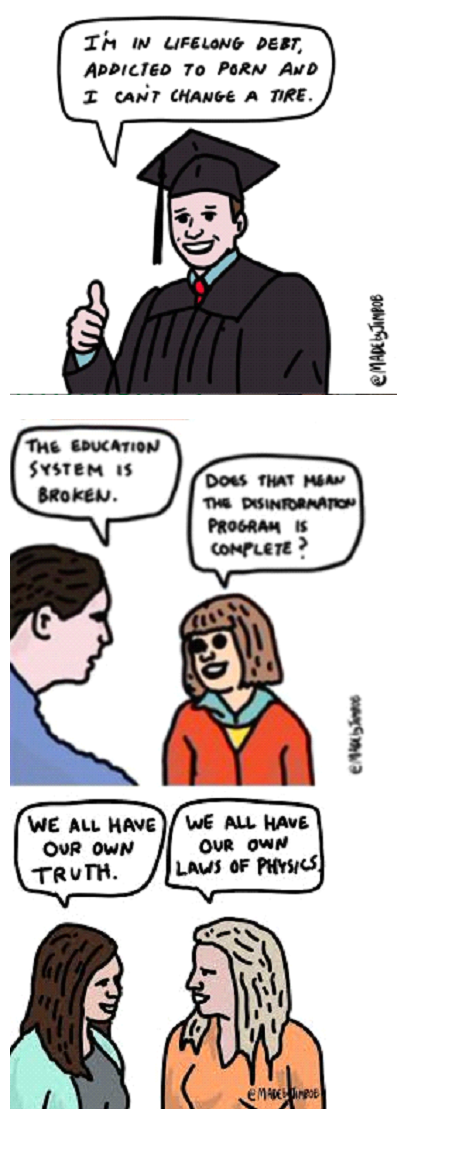
Instead of “sciencing,” here is their idea of “research”

See also Sciencing Vs. Scientism

Male Swimmers Break Glass Ceiling

The fight for social justice began decades ago when these two intrepid souls set out to end their exclusion from the sport of synchronized swimming.  The victory is not yet complete as we can read below, but progress has now come to light.

Leah Barkoukis reports the breakthrough in her article Why One Sport Will See a Major Change at the 2024 Olympics.  Excerpts in italics with my bolds.

One sport is going to look very different at the 2024 Paris Olympics—that’s because the traditionally all-female synchronized swimming, now known as artistic swimming—will have men competing at the highest level due to a recent decision by the International Olympic Committee.

According to an announcement from World Aquatics, formerly FINA,

Men were locked out of Olympic synchronized swimming competition for four decades. The embargo started to lift in 2015, when swimming’s world championships included a mixed duet event for the first time, but the Olympic barrier had remained firm.

The notion of men competing in synchronized swimming was memorably sent up in a “Saturday Night Live” sketch that aired in 1984, the same year the competition debuted at the Los Angeles Olympics. Many people associated the sport with the “water ballet” and elaborate formations of women in the MGM films of the 1940s and ‘50s starring Esther Williams.

Yet some female swimmers told The Wall Street Journal at the 2016 Olympic Games in Rio that they thought it would help their sport by drawing more attention, and potentially making it possible for teams to perform bigger lifts. The World Aquatics announcement drew emotional responses from some campaigners, above all Bill May, the now 43-year-old swimmer who had pushed for it for most of his life, and who described it as “the impossible dream.”

“This proves that we should all dream big,” he said in a statement released through World Aquatics.

Just as notions of the Olympic sports women could compete in have expanded to include competitions like boxing and wrestling, societal norms in some countries have shifted to expand the acceptable sports and roles for men.

Ashley Johnson, USA Artistic Swimming’s vice president for diversity, equity and inclusion, said she read the announcement five times until she could believe what she was seeing—a ban that appeared increasingly anachronistic to her would finally lift. 

“It’s going to be a game-changer,” she said, seeing it as an important message for the sport: “Just do your passion, and forget your gender and your race.”

Johnson said that all of the top federations in artistic swimming had a pool of male swimmers to draw on, some of whom had already competed in the world championships mixed duet event. “You’re a world champion, but you can’t go to the Olympics because you’re a male?” she said of the situation until Thursday. (WSJ)

According to the announcement from World Aquatics, formerly FINA, the IOC gave the green light to a maximum of two men competing on eight-member teams. Duets, however, will remain all-female. So the ceiling has not been fully breeched.  [Disclaimer: The video is a skit from back in the day when SNL was all about laughter rather than scoring lefitst points.}

Eco-Terrorists Suspected Vandals of Tacoma Power Stations


Gateway Pundit’s report was Thousands Lose Power After Three Substations Sabotaged in Tacoma, Included were quotes from Seattle Times.

Deputies arrived on scene and saw there was forced entry into the fenced area. Nothing had been taken from the substation, but the suspect vandalized the equipment causing a power outage in the area. 

Deputies were notified of a second burglary to the TPU substation at 8820 224th St E which also had forced entry with damage to the equipment. Nothing was taken from this site either.

At 11:25 we were notified by Puget Sound Energy that they too had a power outage this morning at 02:39 am. Deputies are currently on scene at this facility where the fenced area was broken into and the equipment vandalized.

At this time deputies are conducting the initial investigation. We do not have any suspects in custody. It is unknown if there are any motives or if this was a coordinated attack on the power systems.

In total, three sites were vandalized, two TPU and one PSE, with more than 14K customers effected

One tweet said: “Not yet clear who did this, but there have been a lot of attacks on the power grid lately and it is something domestic terrorists, especially white supremacists eco-terrorists,  are obsessed with (and several have been convicted in connection with recent attacks/plots).”

I applied the correction based on the consensus of commenters who suspect eco-terrorists of a new tactic replacing their previous valve-turning exploits.

Biodiversity Unwisely Aims to be Eden

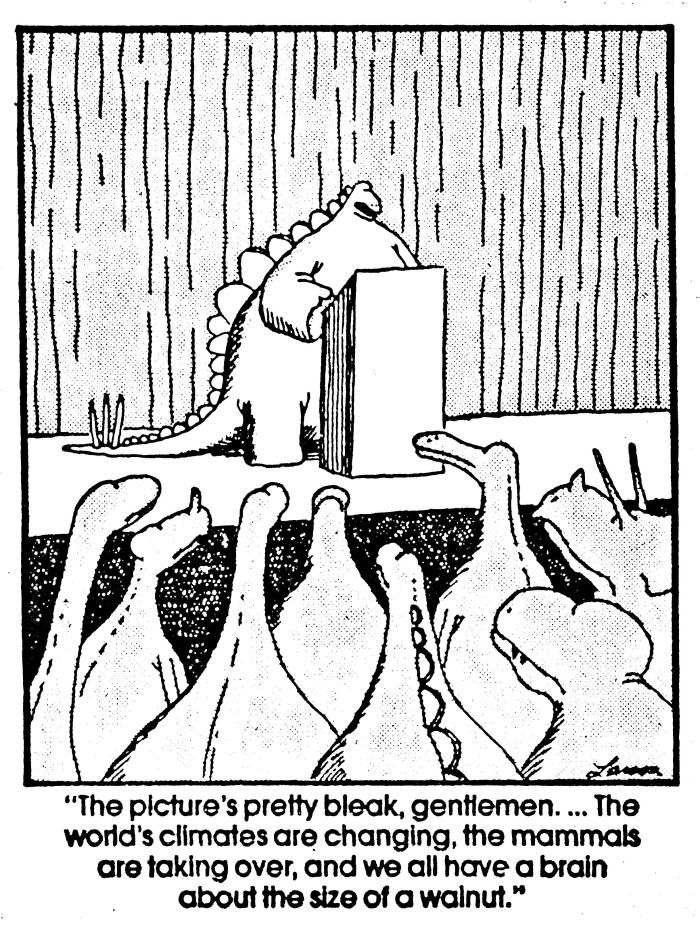
More realistic is to take on Noah’s responsibility selecting species to survive on the ark.

Ronald Bailey’s article at Reason is The Myth of Wild Nature and Creating a New Form of Paradise.  Excerpts in italics with my bolds and added images.

A review of the new book Tickets For The Ark, by Rebecca Nesbit

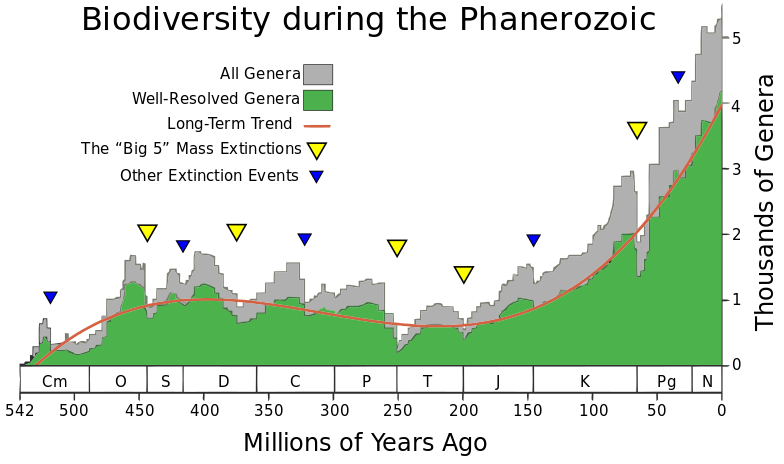
Earlier this month, a “landmark U.N. biodiversity agreement” was adopted by delegates from 190 countries at the Fifteenth Conference of Parties (COP15) of the U.N. Convention on Biological Diversity in Montreal. The chief goal of the new Global Biodiversity Framework (GBF) is that “the integrity, connectivity and resilience of all ecosystems are maintained, enhanced, or restored, substantially increasing the area of natural ecosystems by 2050.” The GBF asserts that around 25 percent of assessed plant and animal species are threatened, suggesting that around 1 million species may already face eventual extinction unless action is taken.

The GBF specifies that by 2030, 30 percent of Earth’s lands, oceans, coastal areas, and inland waters are “effectively conserved” and that restoration be completed or underway on at least 30 percent of degraded terrestrial, inland waters, and coastal and marine ecosystems. Currently, 17 percent and 10 percent of the world’s terrestrial and marine areas respectively are under protection. In addition, the GBF aims to reduce annual subsidies harmful to biodiversity (e.g., biofuels, fisheries, fossil fuels) by $500 billion; and to cut food waste in half by 2030.

Ecologist Rebecca Nesbit in her new book, Tickets For The Ark: From Wasps to Whales – How Do We Choose What To Save?, launches a sustained frontal attack on the “myth of wild nature.”

Nesbit hammers home the absolutely correct point that there is no objective scientific standard providing some kind of value-neutral ecological baseline toward which conservation should aim. Since there is no goal or end state toward which any particular ecosystem is heading, who is to say that landscapes and ecosystems modified by human activities are somehow inferior?

“Ideas about pristine nature invoke a state that nature was in before humans affected it,” Nesbit notes. “The trouble is that humans have played a role in shaping nature for roughly 2.5 million years.” She explains that species and ecosystems do not have intrinsic value. Instead, humans confer value on them. This realization “should be liberating,” she argues, because it makes us “free to discuss logically what we should save and why, and not just fight an anti-extinction battle that is doomed to failure.” Nesbit notes that “The resources we dedicate to conservation will never be enough to prevent all extinctions, and we are forced to choose our priorities.” As she makes plain, it’s tradeoffs all of the way down.

Consequently, her goal isn’t to tell readers how we should choose what to save. Instead, she provides a series of case studies showing that human choices guided by our ethical and aesthetic values are inevitable regarding biological conservation.

Let’s take a look at a few of the conservation tradeoffs that Nesbit highlights. For example, due to centuries of sheep grazing, the prehistoric birch forests that once covered Norway’s craggy mountains have been replaced by meadows. Many Norwegians prefer the hiking and skiing opportunities and magnificent views made possible by sheep meadows to dense birch forests. “This recent baseline for what the natural world should look like has no more moral relevance than a prehistoric baseline, yet it is the form of nature that Norway now aspires to protect,” she notes.

Another example is the effort to preserve the flightless brown and white striped Guam rail. That bird was driven to near extinction by introducing brown tree snakes to the island, which ate its chicks and eggs. In 1987, the 22 remaining rails were put in a captive breeding facility. The good news is that rails from the captive breeding project have now been released on snake-free islands near Guam where they have established self-sustaining populations.

Nesbit, however, asked the biologists overseeing rail conservation what happened to the Guam rail louse that lived only on that species. As standard practice, the conservationists had cleared the captured birds of their parasites, thus bringing about the extinction of that parasitic insect. Is the rail more valuable than the louse? And who says so? Conservationists cannot avoid such questions as they choose among species to try to save some from extinction.

Conflicts of values are inherent in conservation.

“The people who benefit from wildlife protection are seldom the ones who pay the price,” Nesbit observes. “Different people and wildlife benefit from different management, so inevitably there will be opposing outlooks. But it’s an advance if, at least, we recognize that there is no historic baseline to aspire towards.” She illustrates how opposing outlooks played out in with the case of seals versus salmon in Scotland’s Moray Firth.

Seals compete with local fishers for the salmon, so fishers were licensed by the Scottish government to kill seals. On the other hand, tour operators argued for protecting the seals that thousands of visitors came to see in the wild. While no one side was entirely happy, a series of stakeholder discussions led to an agreement in which fishers could cull “rogue” seals.

“Dispensing with the idea that there is an objective ‘natural’ state of nature opens up huge possibilities for what conservation can achieve,” she argues.

Among the possibilities is using biotechnology to install a blight-resistant wheat gene in American chestnuts. Literally, billions of these forest giants succumbed to an introduced fungus in the 20th century. The new blight-resistant trees could be restored to their native range in the Appalachian Mountains. Even more ambitiously, biotechnology could combine the recently decoded genetics of extinct wooly mammoths with those of Asian elephants to restore them to the Arctic.

Also, Nesbit urges us to free “ourselves from the shackle of believing that species ‘belong’ only in their past ranges” so that we can “open up possibilities for assisted colonizations.” Conservationists could move creatures threatened with extinction in their home ranges to others where they would be protected and allowed to thrive. For example, Nesbit notes that Chinese water deer are declining in their native Asian range but are expanding in various parts of Europe.

Nesbit also stands firmly against eco-colonialism.

The GBF’s goal of protecting 30 percent of the world’s landscapes and seascapes must not become instances of what Nesbit calls “fortress conservation,” in which local people are banished from their lands and livelihoods. “With Indigenous lands representing about a quarter of the Earth’s land surface, there is huge potential for synergy between wildlife conservation and upholding Indigenous rights,” argues Nesbit. She cites a recent World Bank study that found community-managed forests are more effective at reducing deforestation than strictly protected areas. Hopefully, the signatories to the GBF will uphold its commitments toward “recognizing and respecting the rights of indigenous peoples and local communities, including over their traditional territories.”

Nesbit concludes, “Now that we have shaken off the idea of an unobtainable ‘pure’ nature, we can embrace the possibilities that come from celebrating nature in its many forms. We’re not doomed to simply mourn a paradise lost, we’re free to create a new form of paradise.” Let’s get at it.

See also Extinction Hype and Dubious Biodiversity COP15 in Montreal

Source: Phanerozoic_Biodiversity.png Author: SVG version by Albert Mestre

Footnote: A Sample of Math Humor

After Noah sent out the dove that returned, and landed the ark, he released the animals two by two and told them: “Go forth and multiply.”  Noah checked on the progress of the various species, and discovered that two snakes had not reproduced.  When confronted, the snakes responded:  “We can’t multiply.  We’re adders.”

Noah pondered the dilemma, then went to cut trees in the forest.  After building a table with the wood, he again addressed the snakes.  ”  You no longer have an excuse.  Even adders can multiply on a log table.”

LOL

Hey Princeton, On climate change, as on all else, hear both sides

Masthead of the student newspaper at Princeton University.

Lord Monckton has written a reply to the juveniles at the Princetonian.  H/T John Ray

On climate change, as on all else, hear both sides

By Christopher Monckton of Brenchley, special to The Daily Princetonian.  Excerpts in italics with my bolds.

The English-speaking jurisdictions recognize just two principles of natural law. One of these is audiatur et altera pars: let both sides be heard. On the climate question, though, the promoters of the official narrative are strikingly – and revealingly – intolerant of dissent.

Recently, in this column, two climate campaigners were allowed to attack three eminent Princeton-bred professors, the late Fred Singer, the late Fred Seitz and Professor Will Happer. I had the honor to know Professor Fred Singer, an exceptional rocket scientist and founder of the U.S. Satellite Weather Service. I had the further honor of working with him on a paper discussing the intersection between chaos theory and climate prediction. It was one of the last papers he wrote.

And I have the honor to know Will Happer, a formidable radiation physicist, exceptionally well qualified to write about the influence of heteroatomic molecules on global temperature. Will has published a string of distinguished papers on the subject in recent years.

The climate fanatics described the three professors as having used Princeton’s “name and prestige” to “open doors, grab headlines, mislead the public and grant legitimacy to their climate-denial claims … helping put us on the pathway to today’s existential global crisis”. Oh, pur-leaze!

The editors of this journal should in future eschew such hate-speech terms
as “climate denial” or “denier” or “denialist”.

None of the three professors denies that there is a climate, or even that we are capable of influencing it. Fred Singer’s paper on chaos theory pointed out that, precisely because the climate behaves as a mathematically-chaotic system, even a small perturbation, whether natural or anthropogenic, might cause unforeseeable effects. But it is the property of a chaotic object that, unless the initial conditions are known to a precision that is and will aye be unattainable in climate, the long-term prediction of future climate states is not possible. In this, Professor Singer swam in the mainstream: IPCC says the same.

Will Happer’s recent detailed paper studying the radiative effects of greenhouse-gas enrichment, far from “climate denial”, powerfully endorsed the conclusion that that enrichment – beneficial though it is for the net primary productivity of plants (their total global green biomass has increased by 15-30% in recent decades thanks to CO2 fertilization detectable from space as chlorophyll fluorescence) – will cause about 2 degrees’ global warming per doubling of concentration, a value within the official uncertainty interval.

All three professors were and are right to point out that the mildly warmer worldwide weather that is occurring does not and will not pose any “global existential threat”.

Such childish, anti-scientific slogans, bandied about by the extremist classes, are devoid of meaning and should be forsworn forthwith and for aye. The OFDA/CRED international disaster database shows that, despite a tripling of global population, weather-related deaths have plummeted throughout the past 100 years. And a string of learned papers in the medical journal The Lancet establishes that in all regions deaths from cold outstrip deaths from heat tenfold.

Finally, let us hear no more nonsense about such towering professors as these “preventing climate action”. For such action would expensively do far more harm than good. Since 1990 our influence on climate has increased linearly at 1 unit per decade, driving 0.4 degrees’ warming.

Even if the whole world were to move linearly to net zero emissions by 2050, only half the next unit would be abated by then, preventing just 0.2 degrees’ warming.

The cost of global net zero, according to McKinsey Consulting, will be $275 trillion in capex alone. Even ignoring opex, typically at least twice capex, and even allowing for no price increases in the desperately scarce techno-metals needed to reach net zero (one would need 67,000 years’ worth of the entire 2019 global annual production of vanadium, for instance, so good luck with that), each $1 billion spent on attempted mitigation would prevent less than a millionth of a degree of future warming. Value for money it isn’t. And the climate won’t notice either way.

Like it or not, it is legitimate for men of learning gently to correct the moralizing screechers by drawing their attention to elementary, verifiable facts such as these. As it is, only the West is making any attempt to attain net zero. But the net effect of our supererogatory sacrifice of our own workers’ jobs is to price our energy-intensive manufacturing industries out to far Eastern nations whose emissions per unit of production are considerably above ours. Climate campaigners, then, are adding to the very non-problem they are clamoring to solve. Making things in China rather than Chattanooga is good for Communism but bad for the planet.

So let the skeptical scientists be fairly heard, and let us cease to turn
universities like Princeton into mere pietistic indoctrinators.

Learning advances not by cloying “consensus”, roundly and rightly rejected by Aristotle 4500 years ago, but by diligent research, free publication and open debate. It is only those who know they would lose a debate who seek to silence their opponents. The hysterical malevolence of the screaming campaigners shows the world they know full well that they would lose. Indeed, they have already lost.

Christopher Monckton of Brenchley, a Cambridge alumnus and former adviser to Margaret Thatcher, is the author of two dozen learned papers on climate sensitivity and mitigation economics.

Footnote:  The writers of the article critiqued by Christopher Monckton should attend to this presentation by William Happer Climate Change Thinking for Open or Locked-Down Minds