Arctic Ice Watch January 31

Click on image to enlarge.

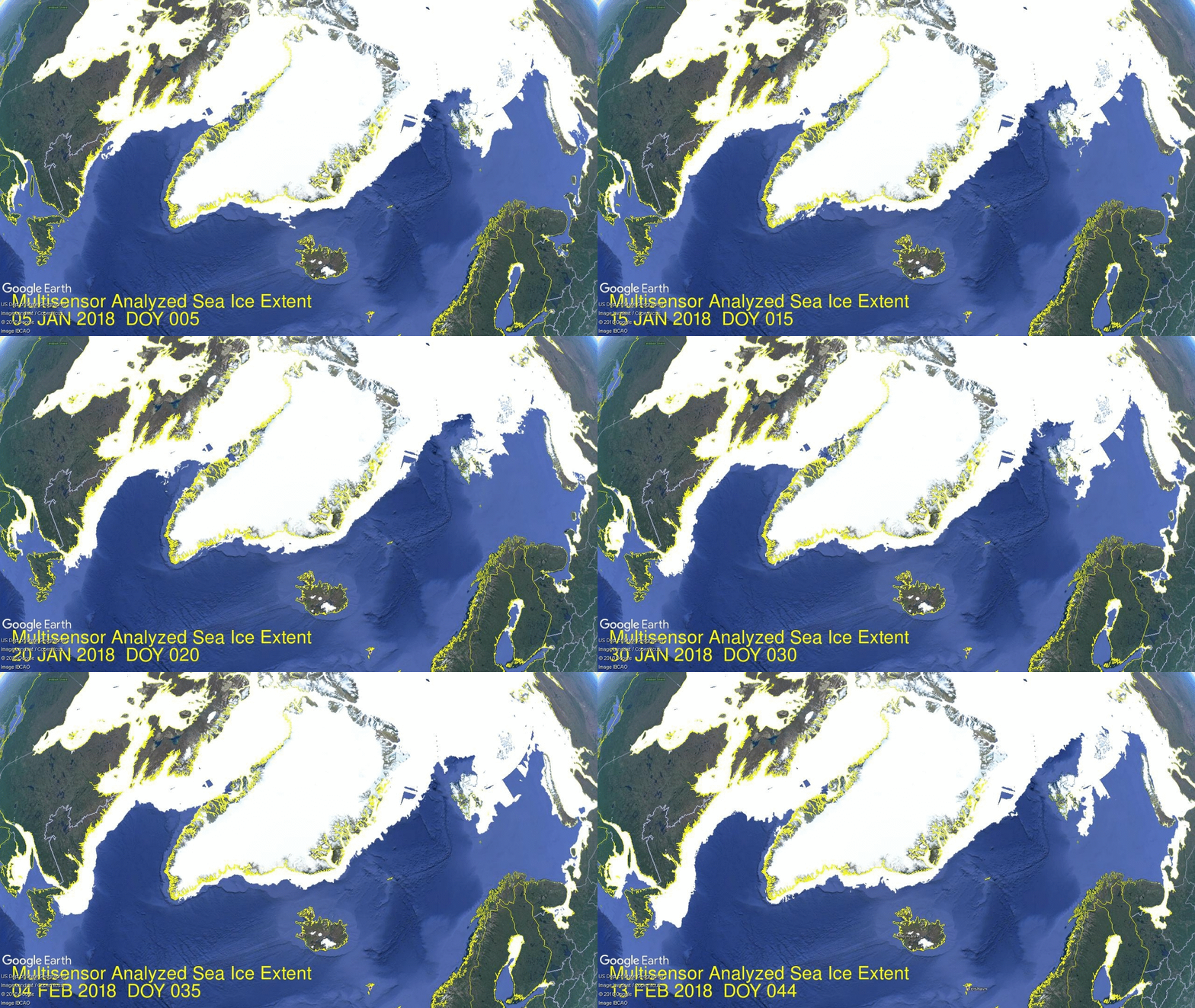
Arctic ice is growing extents slowly to approach 14M km2 with about six weeks left to reach annual maximum.  The meandering polar vortex brings warmer air north to replace the cold air sent into Canada and USA.

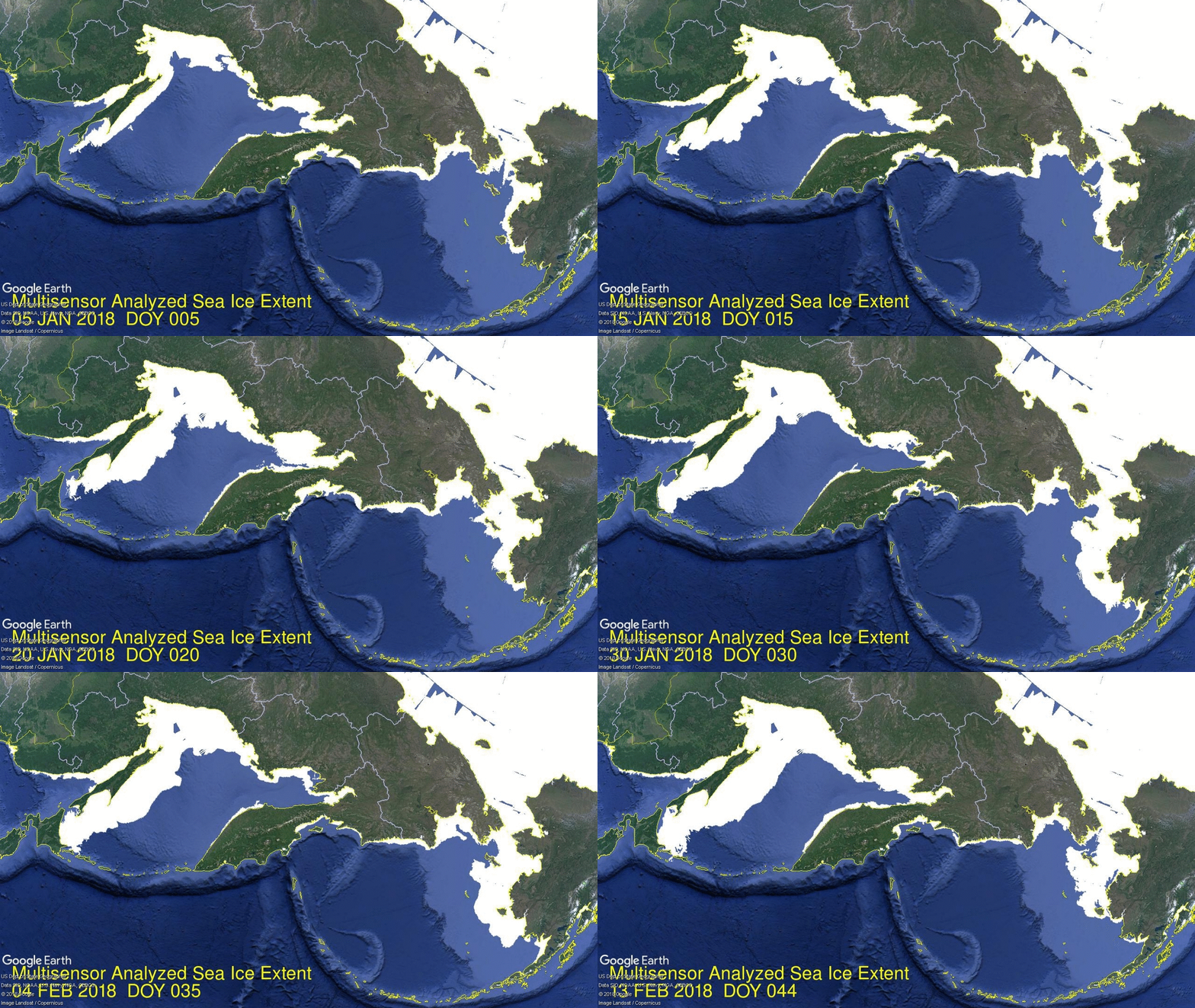
The image above shows Barents on the right is finally adding extent, growing 200k km2 in two weeks to reach 76% of last year’s maximum. The image below shows the ice see-saw in the Pacific.  First Okhotsk grows 100k km2 to reach average (63% of maximum) while Bering dithers.  Then Bering adds 100k km2 to reach 53% of maximum (still below average), while Okhotsk retreats, giving back its 100k.

Click on image to enlarge.

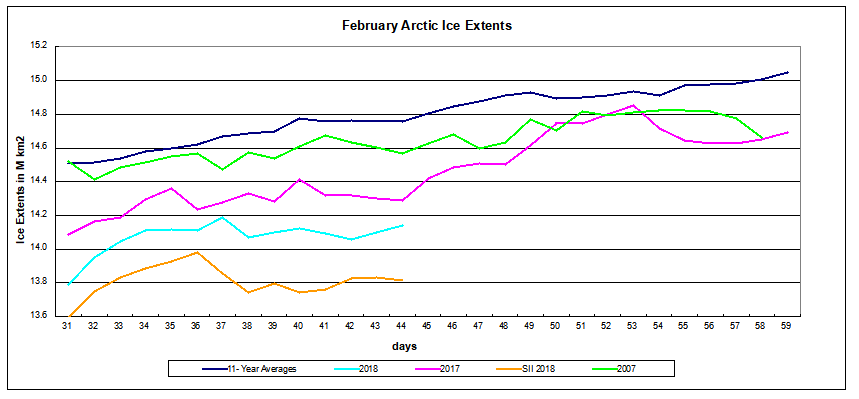
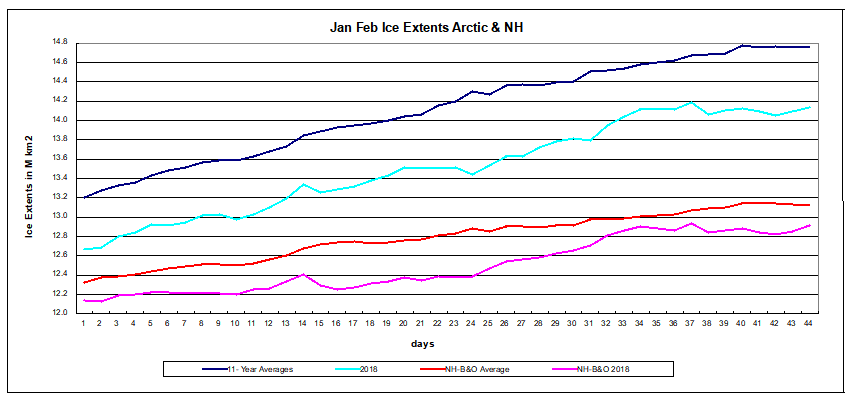
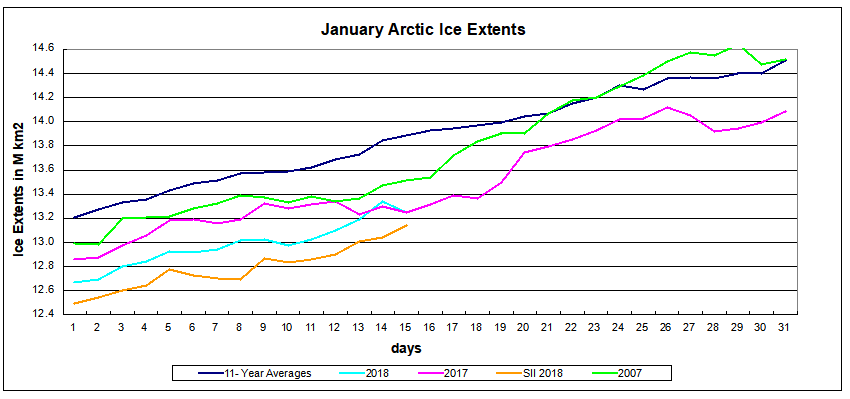
Ice extents for January appear in the graph below; 11 year average is 2007 to 2017 inclusive.

Note that 2007 caught and exceeded the 11 year average ending the month tied.  2018 is now ~300k km2 below 2017 and both lag behind average having started the year in deficit. SII 2018 is running about 200k km2 less than MASIE for the month.

Below is the analysis of regions on day 031.  Average is for 2007 to 2017 inclusive.

Region 2018031 Day 031 
Average
2018-Ave. 2017031 2018-2017
 (0) Northern_Hemisphere 13792271 14504082 -711811 14086396 -294125
 (1) Beaufort_Sea 1070445 1070210 235 1070445 0
 (2) Chukchi_Sea 965971 965960 11 966006 -35
 (3) East_Siberian_Sea 1087120 1087023 97 1087137 -18
 (4) Laptev_Sea 897845 897820 24 897845 0
 (5) Kara_Sea 895363 915975 -20612 862890 32473
 (6) Barents_Sea 481947 578898 -96950 421776 60171
 (7) Greenland_Sea 501411 622550 -121139 549359 -47948
 (8) Baffin_Bay_Gulf_of_St._Lawrence 1406903 1362611 44292 1299268 107634
 (9) Canadian_Archipelago 853109 853066 43 853214 -106
 (10) Hudson_Bay 1260838 1260818 19 1260903 -66
 (11) Central_Arctic 3184817 3219924 -35107 3232583 -47766
 (12) Bering_Sea 382207 685972 -303766 509369 -127162
 (13) Baltic_Sea 41714 76231 -34517 31706 10008
 (14) Sea_of_Okhotsk 704398 836881 -132483 1006706 -302308

The core of the Arctic is frozen solid and for the date 2018 is ~5% below average.  The difference is mainly due to Bering Sea 44% below average, Greenland 20% down, Barents 17% less, and Okhotsk 16% lower. 

Postscript:

Check out the action in Kara Sea near the mouth of the Yenisei River, as a nuclear ice breaker comes within meters of a car expedition on the ice, temperatures at -50C. January 26, 2018


Arctic Wonder

I am excerpting from Dr. Cohen’s latest post because of his refreshing candor sharing his thought processes regarding arctic weather patterns. Arctic Oscillation and Polar Vortex Analysis and Forecasts  January 29, 2018 Dr. Judah Cohen.  (my bolds and images added)

I have really struggled with what to discuss in today’s Impacts section and in the end decided to focus on a feature that gets no respect and to elaborate on last week’s discussion. One big problem has been large model uncertainty and lack of reliable guidance. I think it should be obvious to anyone reading the blog that I am focused on the behavior of the stratospheric polar vortex (SPV) and using variability in that behavior to anticipate large scale climate anomalies across the Northern Hemisphere (NH) on the timescale of days to weeks and even months.

The weather models (I spend most of my time analyzing the global forecast system (GFS) but I do not think that it is limited to the GFS) have been predicting some wild and highly anomalous behavior in the SPV. First the GFS was predicting a SPV displacement into North America (why this is highly anomalous is a good question and not something that I fully understand). Then the GFS predicted a strong warming in the polar stratosphere centered over Scandinavia of the magnitude that is only observed over East Asia and Alaska. The GFS has mostly backed off of these forecasts or at least predicting events of much smaller magnitudes (though it is back in the 12z run).

And looking back at the behavior of the SPV for the winter it can be summed up as unremarkable in many ways. My sense is that the SPV has been stronger than normal for the winter characterized a mostly positive stratospheric AO and cold/below normal PCHS in the stratosphere. Based on that alone one would expect an overwhelmingly mild winter across the NH mid-latitudes. However that would not be an accurate description of the winter.

But in the atmosphere you cannot have low pressure without high pressure. And as we head into the final third or half of winter, I don’t think that one can understand or explain this winter’s temperature variability without focusing on anomalous high pressure in the polar stratosphere. So in the end I have decided to discuss what I like to call the “Rodney Dangerfield” of weather- high pressure because it doesn’t seem to get the respect it deserves certainly compared to low pressure.

My passion for weather began with my love for snow and I couldn’t wait for the next snow opportunity. I grew up in New York City (NYC) where it snows every winter but to get a good snowfall is always challenging and predicted snowfalls more often than not did not materialize because of too much dry air or too much warm air or the storm being too far out to sea…. It became apparent to me having an area of low pressure passing near NYC rarely translated to a snowstorm.

Instead a better predictor of snowfall was the position of high pressure. If Arctic high pressure settled to the north of NYC across Quebec or even Northern New England the likelihood of snowfall greatly increased despite model predicted storm tracks. With high pressure entrenched to the north, good things (as far as snow falling in NYC) happened. So even though meteorologists like to focus on storms and low pressure, in my opinion the key player in whether it would snow or not was the high pressure.

This recognition of the importance of high pressure that began with my passion for weather followed me to my studies. On the regional scale of snowfall in NYC it was the storms that got all the attention and high pressure was neglected (at least that was my impression). Similarly when I began studying winter climate variability on a large scale again my impression was that the focus was on the two semi-permanent large scale low pressures the Icelandic and the Aleutian lows.

There was a third semi-permanent feature that seemed to get scant attention – the Siberian high. When my own research demonstrated a relationship between Eurasian snow cover and winter climate including in the Eastern US to me the obvious link or pathway was the Siberian high. It took many years and many studies to come to the understanding I have today (which remains incomplete) but it is my opinion that the Siberian high is the single most important large scale synoptic feature that influences the variability of the SPV (other climate scientists may disagree with me).

My own empirical observations are that when the Siberian high is shifted to the northwest over the Urals and Scandinavia region, this will inevitably produce increased energy transfer from the troposphere to the stratosphere and more often than not disrupt the SPV. The likelihood of a disruption will increase if the Ural blocking is coupled with downstream troughing across East Asia and the North Pacific or a deeper than normal Aleutian low.

Through the blog I advocate for the importance of SPV variability on sensible weather and whether the SPV is “still” or “disrupted” can have important and large implications for surface weather. As I discussed last week, from the blog it has become obvious to me thinking of the SPV as weak and strong only, or even compositing based on the absence or existence of zonal wind reversals at 60°N and 10 hPa was overly simplistic and probably missed most of the coupling with the troposphere. Instead the position of the SPV and the flow around the SPV were important regardless of the speed of the zonal winds at 60°N and 10 hPa.

But this winter makes me believe that it might even be more nuanced than even the wind flow around the SPV. The precursor to the historic cold in the Eastern US in late December and early January was a Canadian warming/high pressure in the polar stratosphere the third week of December. But as it turns out the most impressive cold anomalies during the month of January are not in North America but Asia. A second warming/high pressure near Eastern Siberia in mid-January accompanied near record cold in Siberia and large parts of Asia.

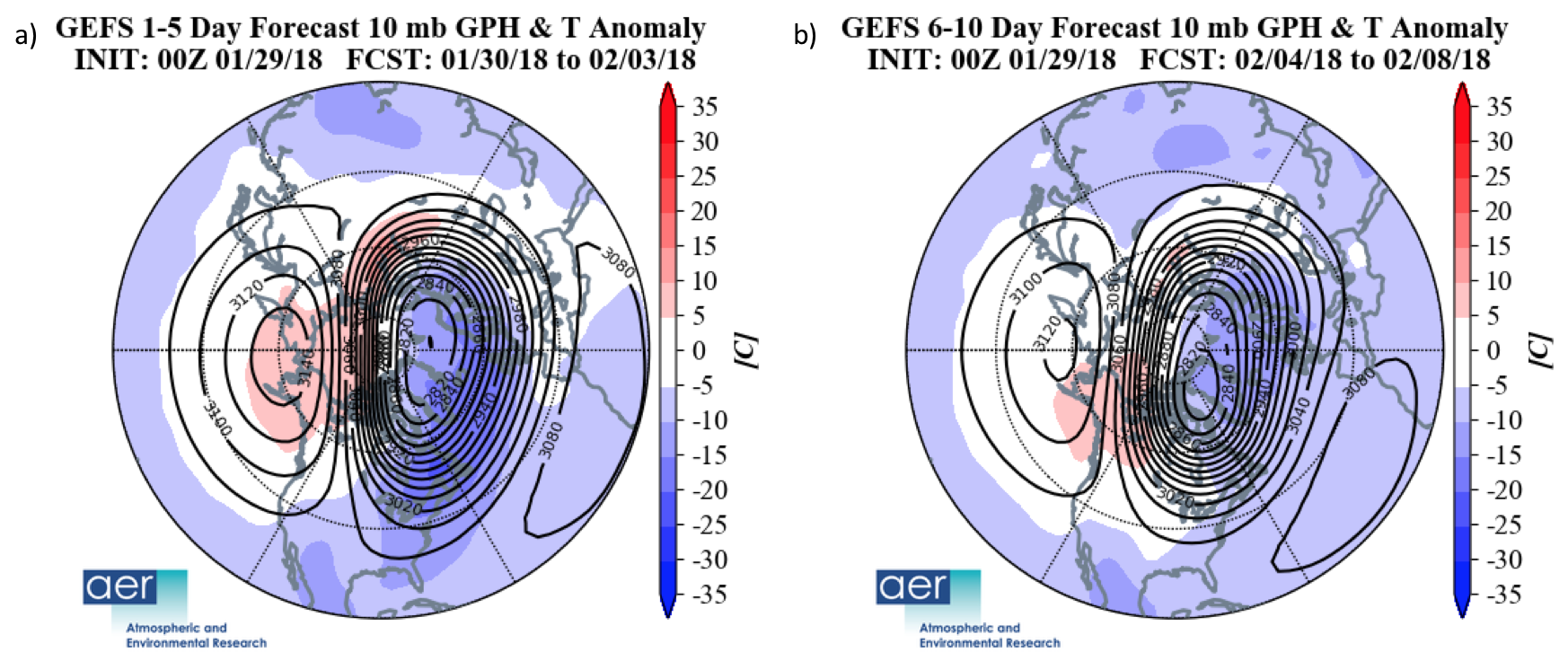
Figure 12. (a) Forecasted 10 mb geopotential heights (dam; contours) and temperature anomalies (°C; shading) across the Northern Hemisphere for 30 January – 3 February 2018. (b) Same as (a) except averaged from 4 – 8 February 2018. The forecasts are from the 29 January 2018 00z GFS ensemble.

Now a third warming/high pressure predicted back in the western hemisphere across Alaska and Northwest Canada is again a precursor for a return of cold temperatures to the Eastern US and Eastern Canada starting this week (see Figure 12). The location of high pressure/heating in the polar stratosphere is the best explanation that I have for the placement and timing of the dominant cold anomalies across the NH. I have a hard time making the same explanation based on the location of the SPV or the flow around the SPV.

Of course my reasoning is overly simplistic and the resultant weather anomalies are not limited to one factor or influence but rather a combination of many different influences or forcings. As I discussed in last week’s blog an alternative explanation being offered for the return of cold weather to eastern North America is the Madden Julian Oscillation (MJO). 

Originally the models and meteorologists relying on MJO forcing predicted a mild first half of February and a colder second half of February. That forecast has changed mostly to a cold February from start to finish. I don’t think that change in the forecast can be ignored or glossed over with the change in timing as an inconsequential detail. The forecast for this week across the US is western ridge and warm with eastern trough and cold, though admittedly the cold is not overly impressive.

Based purely on the MJO the next two weeks should feature a cold Western US and a warm Eastern US opposite of the most recent forecasts. If it is cold in the Eastern US over the next two weeks it is not because of the MJO but in spite of the MJO. Currently the models are not quite sure if the MJO will make it to phase 8 but that phase is related to a warm Western US and cold Eastern US. If the cold persists until the third week of February then the MJO forcing could constructively interfere with the already cold pattern.

If the early arrival of the cold cannot be attributed to MJO forcing then what could be the reason? My explanation is something that I have discussed many times before – the models fail to correctly “propagate down” circulation anomalies from the stratosphere to the troposphere until the changes can’t be ignored. At longer leads the models did not correctly predict the return of Alaska ridging related to SPV variability but corrected at shorter leads.

Thanks Dr. Cohen for illuminating the art and science of studying the weather in its fascinating complexity.  More on his forecasting paradigm at Warm is Cold, and Down is Up

Ten January Days in Baffin Bay


Sea ice forming in Baffin Bay.

Slowly but surely ice is building up on the Arctic Ocean fringes.  Baffin Bay in the center is shown growing ice the last ten days, while Gulf of St. Lawrence fills in on the left.

Click on image to enlarge.

Meanwhile on the Pacific side, Okhotsk on the left is filling in normally, while Bering is starting to catch up.

Click on image to enlarge.

Overall 2018 Arctic ice has reached 13.5M km2, about 500k km2 or 4% below average. The deficit comes half each from Barents and Bering Seas. Two months remain to reach annual maximum with the standard this decade being about 15M km2.


Drift ice in Okhotsk Sea at sunrise.

This is the January of our ice extent

Click on image to enlarge

Apologies to Shakespeare and Richard III for the title to this post.

The Arctic ice beast is slouching toward mid-March maximum with some peculiarities from the meandering polar vortex.  More on that from Dr. Judah Cohen later on.

A week ago the ice watch post noted the recovery in Okhotsk which has continued and is now above average for the date.  Bering sea ice is below normal and the main reason for lower overall extent this year.

Ice extents for January appear in the graph below; 2018 is shown to January 15, other years for the full month.  11 year average is 2007 to 2017 inclusive.

Click on image to enlarge.

Note that 2007 caught and exceeded the 11 year average ending the month tied.  2018 has now matched 2017 though both lag behind average having started the year in deficit. SII 2018 is running about 200k km2 less than MASIE for the month.

Below is the analysis of regions on day 015.  Average is for 2007 to 2017 inclusive.

Region 2018015 Day 015 
Average
2018-Ave. 2017015 2018-2017
 (0) Northern_Hemisphere 13250556 13887982 -637426 13250750 -194
 (1) Beaufort_Sea 1070445 1070178 267 1070445 0
 (2) Chukchi_Sea 965971 965842 129 964251 1720
 (3) East_Siberian_Sea 1087120 1087134 -14 1087137 -18
 (4) Laptev_Sea 897845 897842 3 897845 0
 (5) Kara_Sea 918904 911229 7675 866224 52680
 (6) Barents_Sea 329631 545176 -215546 334131 -4500
 (7) Greenland_Sea 492704 625241 -132536 544015 -51311
 (8) Baffin_Bay_Gulf_of_St._Lawrence 1181843 1184801 -2957 1284241 -102397
 (9) Canadian_Archipelago 853109 853028 81 853214 -106
 (10) Hudson_Bay 1260838 1252263 8575 1260887 -49
 (11) Central_Arctic 3182898 3216678 -33780 3164223 18676
 (12) Bering_Sea 256467 558895 -302428 253648 2819
 (13) Baltic_Sea 18186 51436 -33249 29954 -11768
 (14) Sea_of_Okhotsk 701953 615696 86257 617141 84813

The core of the Arctic is frozen solid and for the date 2018 is 4.6% below average.  The difference is mainly due to Bering Sea 64% below average and Barents 40% down. The recovering ice in Okhotsk is now above both the average and the extent last year at this time.

Background:  Updated Winter Forecast by Dr. Judah Cohen, January 15, 2018

Dr. Judah Cohen of AER published his current Arctic Oscillation and Polar Vortex Analysis and Forecast on January 15, 2018. His comments are always enlightening, and particularly so this time. Excerpts in italics with my bolds.

In previous blogs, I have often discussed winter 2013/14 as possibly the best analog for this winter so far. I do believe that the stratospheric PV disruption that occurred in late December and the subsequent response in the tropospheric circulation are similar to what occurred repeatedly in winter 2013/14. However, I think the two winters are now diverging. The single large-scale weather feature that signals to me a divergence from this winter and 2013/14 is the widespread area of below normal temperatures across northern Eurasia beginning this week but predicted to become dominant across the continent next week. The last winter where persistent extensive below normal temperatures where observed across Northern Eurasia was winter 2012/13. That is also the last winter that a mid-winter major warming was observed (where the mean zonal wind reverses at 60°N and at 10hPa), which occurred the second week in January. I do consider that a major warming occurred in 2015/16 but that was in March and subsequently dovetailed into a final warming.

There are signs that a disruption of the stratospheric PV will occur but the timing and magnitude remains uncertain. But based on the anticipated widespread area of below normal temperatures across Northern Eurasia I do believe that the most significant stratospheric PV disruption of the winter is likely in the coming weeks. Our polar vortex forecast model predicts that the PV disruption will peak the second week of February. The model is speculative but a marker to watch. This anticipated stratospheric disruption is likely to differ from the stratospheric PV disruption in late December where the resultant below normal temperatures were focused across North America while much of Eurasia remained relatively mild. If I am correct that a subsequent stratospheric PV disruption will be more significant than the one in December, then I expect the focus of the resultant cold temperatures to be across northern Eurasia, especially Siberia. Temperatures would likely average below normal across much of Siberia and likely elsewhere across northern Eurasia, possibly through the end of February.

The impacts of a more significant stratospheric PV disruption would be less certain across North America. Still I would consider such a PV disruption to increase the probability of cold temperatures following the disruption across eastern North America. Following the mid-winter major warming in January 2013 temperatures initially turned cold across the Western US but the core of below normal temperatures migrated east as the winter progressed. The Global Forecast System (GFS) is predicting the core of below normal temperatures to be focused in Western Canada during the second half of January. However, my expectation would be for the core of the below normal temperatures to slowly migrate southeastward with time and as of now I favor a relatively cold February in southeastern Canada and the Eastern US.

A wild card in North American weather all winter has been ridging/blocking in the North Pacific. For the first half of the winter it was centered in the Gulf of Alaska and along the west coast of North America, contributing to warm temperatures in western North America but cold temperatures in eastern North America. Latest weather model runs are predicting a westward retrogression of this blocking closer to the Aleutians. This position favors cold temperatures in western North America but warm temperatures in eastern North America. And cold temperatures may be focused in western North America for the remainder of the winter if the ridging remains near the Aleutians but I expect that an eventual PV disruption will at least partially offset or cancel warming forced by the central North Pacific ridging.


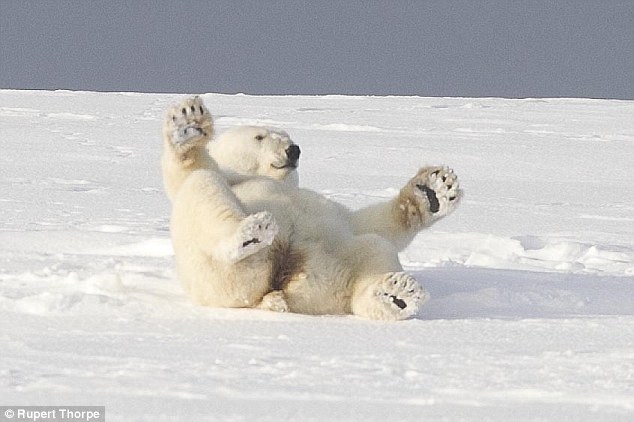
Whichever fork of the road the ice takes, the Polar Bears had a very happy New Years Day.


Okhotsk Shuffle Jan. 9

Click on image to enlarge.

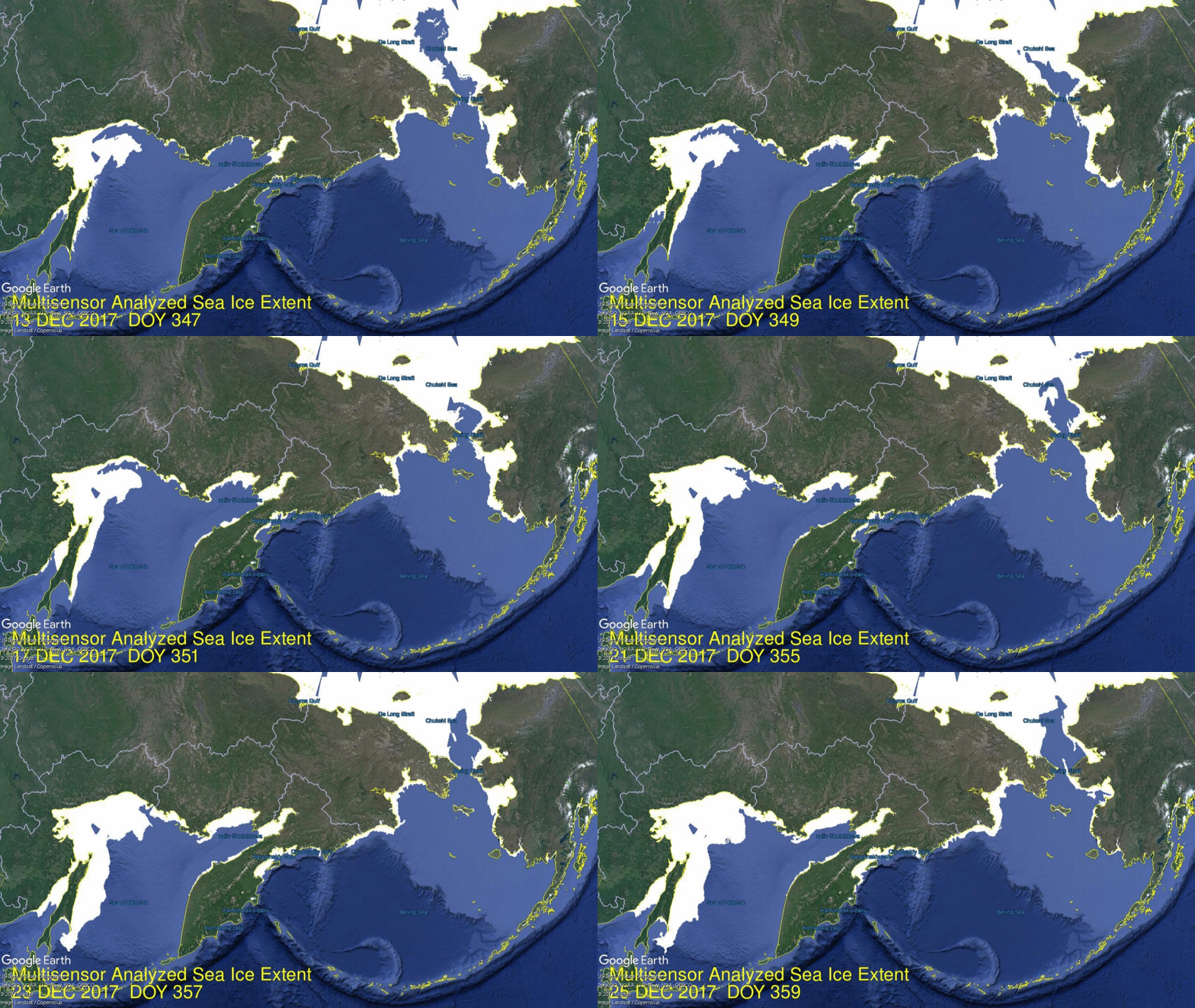
Coinciding with the Siberian air freezing Niagara Falls and extending frigid temperatures as far south as Carolina, Arctic ice extent got quite variable in the North Pacific, especially in Okhotsk on the left.  The image above shows how ice in that basin shuffled forward, backward and forward again.

Mid-December Okhotsk Sea on the left began growing ice steadily to reach half of 2017 March max, then inexplicably lost over 300k km2 of ice in just four days. In the last nine days it more than gained back the loss.  Meanwhile, Chukchi (upper right) was frozen completely, then retreated, and now closed again.  Bering Sea on the right has been advancing steadily but more slowly than average.

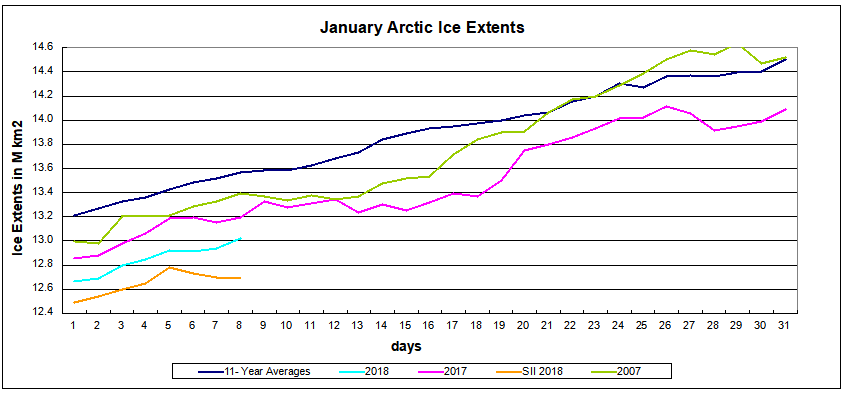
Ice extents for January appear in the graph below; 2018 is shown to date, other years for the full month.  11 year average is 2007 to 2017 inclusive.

Note that 2007 catches and exceeds the 11 year average ending the month tied.  2017 and 2018 are adding ice at nearly average rate but started with deficits to average. SII 2018 has fallen further behind.

Below is the analysis of regions on day 008.  Average is for 2007 to 2017 inclusive.

Region 2018008 Day 008 
Average
2017-Ave. 2017008 2018-2017
 (0) Northern_Hemisphere 13019244 13560397 -541153 13194225 -174981
 (1) Beaufort_Sea 1070445 1070178 267 1070445 0
 (2) Chukchi_Sea 965971 966005 -34 966006 -35
 (3) East_Siberian_Sea 1087120 1087136 -16 1087137 -18
 (4) Laptev_Sea 897845 897842 3 897845 0
 (5) Kara_Sea 888549 920916 -32367 917704 -29156
 (6) Barents_Sea 343580 486463 -142883 306884 36696
 (7) Greenland_Sea 551915 599604 -47690 518372 33543
 (8) Baffin_Bay_Gulf_of_St._Lawrence 1044045 1063947 -19902 1199200 -155154
 (9) Canadian_Archipelago 853109 853040 69 853214 -106
 (10) Hudson_Bay 1260838 1241598 19240 1260887 -49
 (11) Central_Arctic 3202818 3207336 -4518 3125131 77687
 (12) Bering_Sea 212150 544302 -332152 165702 46449
 (13) Baltic_Sea 18026 42662 -24636 22885 -4859
 (14) Sea_of_Okhotsk 593649 537888 55760 783663 -190014

Note that 2018 deficit to average comes mostly from Bering and Barents Seas. The recovering ice in Okhotsk is now above average but still below last year, when Okhotsk accounts for the difference.

Background:  Updated Winter Forecast by Dr. Judah Cohen, January 8, 2018

Dr. Judah Cohen of AER published his current Arctic Oscillation and Polar Vortex Analysis and Forecast on January 8, 2018. His comments are always enlightening, and particularly so this time. Excerpts in italics with my bolds.

A minor but regionally very impactful stratospheric PV disruption promoted persistent cross polar flow that emptied Siberia of its cold air and carried it on a direct route to Southeastern Canada and the Northeastern US over the past two weeks. The historic cold of the past two weeks has placed the Eastern US in a position to finish with a cold winter but in no way, has guaranteed the outcome. I am of the opinion that for the winter in the Eastern US to finish with an overall cold solution then at least one other stratospheric PV is necessary but still may not be sufficient. Given the magnitude of the most recent cold air outbreak either a minor or major PV disruption could be enough to ensure a cold winter in aggregate over the three months from December through February.

I would argue that whether the winter will finish in the warm or cold column is science vs. art (at least my own artistic rendition). The science says that the second half of winter will be warm across the Eastern US including the remainder of January and all of February. All dynamical forecasts including most climate forecast system (CFS) forecasts, the national multi-model ensemble (NMME) and the European models all forecast warm see Figure i).

My own instinct tells me the winter will end in the cold column. Of course, the AER winter forecast predicts a cold winter based on Siberian snow cover, Arctic sea ice and tropospheric precursors. But my instinct or gut feeling is based on different metrics – the period of cold, northeastern snowfall and temperature records.

There have been some famously cold Decembers followed by a relatively mild remainder of winter. The two that most readily come to my mind are winters 1983/84 and 1989/90. One more recent but not as dramatic was winter 2005/06. And if my recollection is correct, those cold Decembers transitioned from cold to mild around the holiday season. I cannot recall a mild winter when the cold from December extended into January.

The second is significant snowfall in the I95 corridor. Again, I can’t recall a snowstorm this early in the season of the magnitude of this week’s blizzard occurring during mild winters. I certainly can’t recall any in 1983/84, 1989/90 or 2005/06, though in that last winter there was significant snowfall in February.

Finally, are record temperatures mostly in January. It seems to me that record cold or warm temperatures are an early indication of the overall winter anomaly. Record warm temperatures occur in an overall warm winters and record cold temperatures in an overall cold winter and less so vice versa. I do believe fairly strongly that Nature likes to foreshadow and those are some of the foreshadowing markers that I follow.

Interestingly below normal or convergence of vertical Wave Activity Flux (WAFz) is predicted in the troposphere for next week. This actually favors increased high latitude blocking and may explain the return of strong Alaska ridging with downstream eastern North America troughing and cold weather. But rather than a committed turn to the cold path this appears to be more of a head fake and more mild weather is predicted for the third week of January. Therefore, the return to mild weather in the Eastern US makes me believe we still remain situated at the fork in the road without a full commitment to either the mild or warm path. Though if the GFS forecast of cold reloading in Canada is correct, I think that it is almost inevitable for that cold to slide down into the lower 48 with time.

Put in other words the fork can be represented by the divergence in the polar cap geopotential heights (PCHs) between the troposphere and the stratosphere. PCHs are overall warm/positive in the troposphere while PCHs are overall cold/negative in the stratosphere. In probably overly simplistic terms I am waiting for convergence of either warm or cold PCHs throughout the troposphere and the stratosphere before claiming winter has fully committed to a cold (universal warm PCHs) or mild (universal cold PCHs) winter.

Whichever fork the ice takes, the Polar Bears had a very happy New Years Day.


Arctic Ice Mixed Signals

Click on image to enlarge.

With 2017 ice extent estimates complete we can look at the year in perspective.  Above is a graph showing the annual average extents since 2007, comparing MASIE and SII (v3.0).  Obviously, the trend in MASIE could not be flatter, while SII shows a decline.  The first five years the two indices were nearly the same, and since then SII shows less ice, about 260k km2 each year.  Note also how small is the variance year over year: Standard deviation is +/- 260k km2, or about 2.5% of the average annual extent.  This holds for both indices.  Note also a pattern of three higher years followed by two lower years.

A previous post Sea Ice Index Updates to v.3.0 reported on the newest SII version, and we can see how it compares with MASIE over this last year.

Click on image to enlarge.

The first four months show more diversity, both in the 10 year averages and in 2017 results. From May on MASIE 2017 tracks closely to its average, while SII shows 2017 below its average every month. For those who want to see the numbers a table is provided below.

Units 2007
to 2016
2017 2007
to 2016
2017
M km2 MASIE MASIE SII SII
Jan 13.921 13.503 13.686 13.174
Feb 14.841 14.478 14.553 14.112
Mar 15.053 14.509 14.815 14.273
Apr 14.353 13.941 14.206 13.760
May 12.763 12.838 12.757 12.618
June 10.906 10.975 10.938 10.720
July 8.359 8.383 8.107 7.901
Aug 5.955 6.006 5.657 5.472
Sept 4.663 4.832 4.676 4.797
Oct 6.630 6.804 6.734 6.715
Nov 9.897 9.697 9.718 9.458
Dec 12.235 11.972 12.063 11.752
Annual Ave. 10.798  10.661  10.659  10.396 

Some are proclaiming dire warnings about melting ice and imagining various dangerous impacts. Some fluctuations do appear but not very large and somewhat cyclical. Since 2007 it resembles a plateau more than anything else.

Background on MASIE Data Sources

MASIE reports are generated by National Ice Center from the Interactive Multisensor Snow and Ice Mapping System (IMS). From the documentation, the multiple sources feeding IMS are:

Platform(s) AQUA, DMSP, DMSP 5D-3/F17, GOES-10, GOES-11, GOES-13, GOES-9, METEOSAT, MSG, MTSAT-1R, MTSAT-2, NOAA-14, NOAA-15, NOAA-16, NOAA-17, NOAA-18, NOAA-N, RADARSAT-2, SUOMI-NPP, TERRA

Sensor(s): AMSU-A, ATMS, AVHRR, GOES I-M IMAGER, MODIS, MTSAT 1R Imager, MTSAT 2 Imager, MVIRI, SAR, SEVIRI, SSM/I, SSMIS, VIIRS

Summary: IMS Daily Northern Hemisphere Snow and Ice Analysis

The National Oceanic and Atmospheric Administration / National Environmental Satellite, Data, and Information Service (NOAA/NESDIS) has an extensive history of monitoring snow and ice coverage.Accurate monitoring of global snow/ice cover is a key component in the study of climate and global change as well as daily weather forecasting.

The Polar and Geostationary Operational Environmental Satellite programs (POES/GOES) operated by NESDIS provide invaluable visible and infrared spectral data in support of these efforts. Clear-sky imagery from both the POES and the GOES sensors show snow/ice boundaries very well; however, the visible and infrared techniques may suffer from persistent cloud cover near the snowline, making observations difficult (Ramsay, 1995). The microwave products (DMSP and AMSR-E) are unobstructed by clouds and thus can be used as another observational platform in most regions. Synthetic Aperture Radar (SAR) imagery also provides all-weather, near daily capacities to discriminate sea and lake ice. With several other derived snow/ice products of varying accuracy, such as those from NCEP and the NWS NOHRSC, it is highly desirable for analysts to be able to interactively compare and contrast the products so that a more accurate composite map can be produced.

The Satellite Analysis Branch (SAB) of NESDIS first began generating Northern Hemisphere Weekly Snow and Ice Cover analysis charts derived from the visible satellite imagery in November, 1966. The spatial and temporal resolutions of the analysis (190 km and 7 days, respectively) remained unchanged for the product’s 33-year lifespan.

As a result of increasing customer needs and expectations, it was decided that an efficient, interactive workstation application should be constructed which would enable SAB to produce snow/ice analyses at a higher resolution and on a daily basis (~25 km / 1024 x 1024 grid and once per day) using a consolidated array of new as well as existing satellite and surface imagery products. The Daily Northern Hemisphere Snow and Ice Cover chart has been produced since February, 1997 by SAB meteorologists on the IMS.

Another large resolution improvement began in early 2004, when improved technology allowed the SAB to begin creation of a daily ~4 km (6144×6144) grid. At this time, both the ~4 km and ~24 km products are available from NSIDC with a slight delay. Near real-time gridded data is available in ASCII format by request.

In March 2008, the product was migrated from SAB to the National Ice Center (NIC) of NESDIS. The production system and methodology was preserved during the migration. Improved access to DMSP, SAR, and modeled data sources is expected as a short-term from the migration, with longer term plans of twice daily production, GRIB2 output format, a Southern Hemisphere analysis, and an expanded suite of integrated snow and ice variable on horizon.

http://www.natice.noaa.gov/ims/ims_1.html

Footnote

Some people unhappy with the higher amounts of ice extent shown by MASIE continue to claim that Sea Ice Index is the only dataset that can be used. This is false in fact and in logic. Why should anyone accept that the highest quality picture of ice day to day has no shelf life, that one year’s charts can not be compared with another year? Researchers do this, including Walt Meier in charge of Sea Ice Index. That said, I understand his interest in directing people to use his product rather than one he does not control. As I have said before:

MASIE is rigorous, reliable, serves as calibration for satellite products, and continues the long and honorable tradition of naval ice charting using modern technologies. More on this at my post Support MASIE Arctic Ice Dataset

Arctic Year End: Okhotsk Surprise.

Arctic ice extent grows slowly this time of year since many regions are already covered completely.  In recent days 2017 reached 84% of the maximum last March, but dropped below the 10 year average.  As we can see, most of the action was a dramatic seesaw in Okhotsk Sea, a Siberian basin in the North Pacific.

Mid-December Okhotsk Sea on the left began growing ice steadily to reach half of 2017 March max, then inexplicably lost over 300k km2 of ice in just four days.  Meanwhile, Chukchi (upper right) froze completely, then retreated somewhat.  Bering Sea on the right has been advancing steadily but more slowly than average.

The overall effect in December is shown in the graph below:
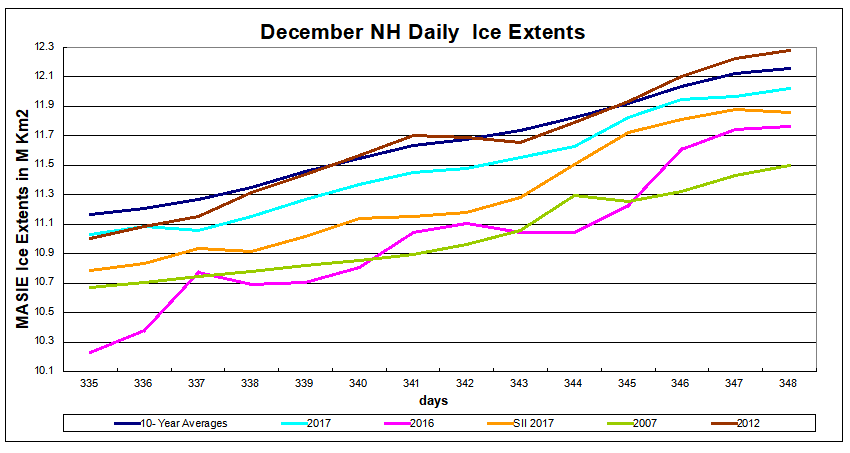
Note that 2007 matches the 10 year average, while 2012 is well above.  Lagging behind are 2016, 2017 and SII 2017.  This year’s deficit to average appears in the last 11 days, mostly due to Bering and the Okhotsk year end surprise.
Most of the month combined Bering and Okhotsk (B&O) extents were average, until the inexplicable drop starting day 361. Except for those two seas, the month was unremarkable.
At year end, 2017 NH ice, excluding B&O, is down about 200k km2, or 2% of average.  Below is the analysis of regions on day 365.

Region 2017365 Day 365
Average
2017-Ave. 2007364 2017-2007
 (0) Northern_Hemisphere 12628187 13148939 -520752 13049737 -421550
 (1) Beaufort_Sea 1070445 1070225 220 1069711 734
 (2) Chukchi_Sea 943883 966001 -22118 965971 -22089
 (3) East_Siberian_Sea 1087120 1087134 -14 1087120 0
 (4) Laptev_Sea 897845 897841 4 897845 0
 (5) Kara_Sea 892689 888842 3848 871851 20839
 (6) Barents_Sea 331819 448769 -116950 334577 -2758
 (7) Greenland_Sea 555757 584649 -28892 666135 -110378
 (8) Baffin_Bay_Gulf_of_St._Lawrence 978074 1025197 -47123 1074827 -96753
 (9) Canadian_Archipelago 853109 853054 55 852556 553
 (10) Hudson_Bay 1260838 1227587 33251 1260856 -19
 (11) Central_Arctic 3191526 3207659 -16133 3199726 -8200
 (12) Bering_Sea 194350 446066 -251716 373942 -179592
 (13) Baltic_Sea 13345 34329 -20984 9972 3374
 (14) Sea_of_Okhotsk 336595 387522 -50928 371241 -34646

Most of 2017 deficit is in Bering and Barents, less so in Okhotsk with yesterday’s recovery.  Perhaps the Polar Vortex sent frigid air into the US and Canada and replaced it with warmer southern air, and ice receded as a result.  I have reported on Arctic incursions in a post Arctic Inversions and Intrusions but the speed of the effect on ice (if that is the phenomenon) is still surprising.  We shall see if it persists or not.

Background:  Winter Forecast by Dr. Judah Cohen, Dec. 25

On Christmas Day Dr. Judah Cohen published his updated Arctic Oscillation and Polar Vortex Analysis and Forecast  Excerpts below

As I have been discussing the past two blog posts I continue to believe that this is the most critical period of the winter and will ultimately determine the character of the winter. In my opinion, we have approached a fork in the road and the atmosphere can take two possible paths one is a path where the rest of the winter is relatively mild across the mid-latitudes of the NH and the second is a colder path or solution. The tropospheric polar vortex has been relatively weak for much of the month of December as illustrated by the relatively warm polar cap geopotential heights (PCHs) for the first half of December that then boomeranged off the mid-stratosphere and after a short respite with colder tropospheric PCHs, warmer PCHs in the troposphere are predicted through the end of the month and into early January.

Based on the easterly phase of the Quasi-Biennial Oscillation (QBO) I have been favoring a significant PV disruption most likely in January for much of the fall.  A significant stratospheric PV disruption would then be followed by an extended period of severe winter weather across the mid-latitudes of the NH.  However, I have to admit as of yet there are no signs of this scenario.  There is still time but not much.  However, there is another scenario that could still yield a relatively cold winter and that is one analogous to what happened in the winter of 2013/14 where no significant disruptions of the stratospheric occurred but rather repeated minor disruptions that yielded a cold winter for central and eastern North America. Though at first, I acknowledged this possibility I was hesitant to favor this scenario.  However, the longer the delay in a major disruption of the stratospheric PV the more I favor this scenario.

The Arctic Oscillation (AO) is currently slightly positive and is predicted to trend slowly negative through the end of the week towards neutral. The forecast is for the AO to remain close to neutral next week, likely a sign of uncertainty.

Figure 7. Forecasted snowfall anomalies (mm/day; shading) from 31 December 2017 – 4 January 2018. The forecasts are from the 00Z 18 December 2017 GFS ensemble. Note the new projection to provide finer resolution.

The current positive AO is reflective of mixed pressure/geopotential height anomalies across the Arctic and mostly positive pressure/geopotential height anomalies across the mid-latitudes. The North Atlantic Oscillation (NAO) is also currently slightly positive with weak pressure/geopotential height anomalies across Greenland and Iceland and positive pressure/geopotential height anomalies across the mid-latitudes of the North Atlantic.

A return to Ural ridging/blocking at the turn of the calendar year favors active energy transfer from the troposphere to the stratosphere. Another pulse is predicted to commence this week and peak the first few days of January. The pulse itself is likely related to relaxation of the pattern and mild temperatures across North America. However, the predicted resultant perturbation to the stratospheric polar vortex (PV) especially the building of heights over northwestern North America in my opinion could once again favor the return of cold temperatures across eastern North America later in January.

Figure 9. Forecasted snowfall anomalies (mm/day; shading) from 5 – 9 January 2018. The forecasts are from the 00Z 25 December 2017 GFS ensemble. Troughing and/or cold temperatures will support the potential of additional snowfall across Eastern Europe, Siberia, West and East Asia, Alaska, Canada and the Northwestern US. Despite below normal temperatures, temperatures warm sufficiently to support snowmelt across the Eastern US (Figure 9).

Ice did not grow this past week on the North Pacific side of the Arctic basin, still I expect the negative ice anomalies in the region to shrink.  Sea ice is below normal in the Barents-Kara Seas as well and with time the greatest negative sea ice anomalies will likely reside in this region.  As I have been writing for much of the fall I do believe that the record low sea ice anomalies in the Chukchi and Bering Seas has focused ridging/blocking in this region.  Though model forecasts do not predict a return of the blocking in the foreseeable future.

Recent research has shown that regional anomalies are important and the sea ice region most highly correlated with the winter AO is the Barents-Kara Seas region where low Arctic sea ice favors a negative winter AO and a cold Eurasia.  Below normal sea ice in this region may be contributing to more active Wave Activity Flux/poleward heat transport predicted in the models that eventually could result in a negative AO.

As we have seen, the Polar Vortex did indeed return to North America, freezing Niagara Falls in the process.

Whichever fork the ice takes, the Polar Bears had a Merry Christmas


Arctic Fork in the Road Dec. 25

On Christmas Day Dr. Judah Cohen published his updated Arctic Oscillation and Polar Vortex Analysis and Forecast  Excerpts below

As I have been discussing the past two blog posts I continue to believe that this is the most critical period of the winter and will ultimately determine the character of the winter. In my opinion, we have approached a fork in the road and the atmosphere can take two possible paths one is a path where the rest of the winter is relatively mild across the mid-latitudes of the NH and the second is a colder path or solution. The tropospheric polar vortex has been relatively weak for much of the month of December as illustrated by the relatively warm polar cap geopotential heights (PCHs) for the first half of December that then boomeranged off the mid-stratosphere and after a short respite with colder tropospheric PCHs, warmer PCHs in the troposphere are predicted through the end of the month and into early January.

Based on the easterly phase of the Quasi-Biennial Oscillation (QBO) I have been favoring a significant PV disruption most likely in January for much of the fall.  A significant stratospheric PV disruption would then be followed by an extended period of severe winter weather across the mid-latitudes of the NH.  However, I have to admit as of yet there are no signs of this scenario.  There is still time but not much.  However, there is another scenario that could still yield a relatively cold winter and that is one analogous to what happened in the winter of 2013/14 where no significant disruptions of the stratospheric occurred but rather repeated minor disruptions that yielded a cold winter for central and eastern North America. Though at first, I acknowledged this possibility I was hesitant to favor this scenario.  However, the longer the delay in a major disruption of the stratospheric PV the more I favor this scenario.

The Arctic Oscillation (AO) is currently slightly positive and is predicted to trend slowly negative through the end of the week towards neutral. The forecast is for the AO to remain close to neutral next week, likely a sign of uncertainty.

Figure 7. Forecasted snowfall anomalies (mm/day; shading) from 31 December 2017 – 4 January 2018. The forecasts are from the 00Z 18 December 2017 GFS ensemble. Note the new projection to provide finer resolution.

The current positive AO is reflective of mixed pressure/geopotential height anomalies across the Arctic and mostly positive pressure/geopotential height anomalies across the mid-latitudes. The North Atlantic Oscillation (NAO) is also currently slightly positive with weak pressure/geopotential height anomalies across Greenland and Iceland and positive pressure/geopotential height anomalies across the mid-latitudes of the North Atlantic.

A return to Ural ridging/blocking at the turn of the calendar year favors active energy transfer from the troposphere to the stratosphere. Another pulse is predicted to commence this week and peak the first few days of January. The pulse itself is likely related to relaxation of the pattern and mild temperatures across North America. However, the predicted resultant perturbation to the stratospheric polar vortex (PV) especially the building of heights over northwestern North America in my opinion could once again favor the return of cold temperatures across eastern North America later in January.

Figure 9. Forecasted snowfall anomalies (mm/day; shading) from 5 – 9 January 2018. The forecasts are from the 00Z 25 December 2017 GFS ensemble. Troughing and/or cold temperatures will support the potential of additional snowfall across Eastern Europe, Siberia, West and East Asia, Alaska, Canada and the Northwestern US. Despite below normal temperatures, temperatures warm sufficiently to support snowmelt across the Eastern US (Figure 9).

Ice did not grow this past week on the North Pacific side of the Arctic basin, still I expect the negative ice anomalies in the region to shrink.  Sea ice is below normal in the Barents-Kara Seas as well and with time the greatest negative sea ice anomalies will likely reside in this region.  As I have been writing for much of the fall I do believe that the record low sea ice anomalies in the Chukchi and Bering Seas has focused ridging/blocking in this region.  Though model forecasts do not predict a return of the blocking in the foreseeable future.

Recent research has shown that regional anomalies are important and the sea ice region most highly correlated with the winter AO is the Barents-Kara Seas region where low Arctic sea ice favors a negative winter AO and a cold Eurasia.  Below normal sea ice in this region may be contributing to more active Wave Activity Flux/poleward heat transport predicted in the models that eventually could result in a negative AO.

Okhotsk Doubles in 12 Days

While the refreezing rate slowed in recent days, we again see contrast in the Pacific Basins.

Mid month, Chukchi (top right) refroze almost completely, then reversed in the last week.  Meanwhile, Okhotsk (Left) grew ice fairly steadily doubling in 12 days to cover nearly half of the annual maximum.  At the moment the Arctic is slightly below the 10 year average, due to the slowdown.

Whichever fork the ice takes, the Polar Bears had a Merry Christmas


Arctic Ice December 14

Click on image to enlarge.

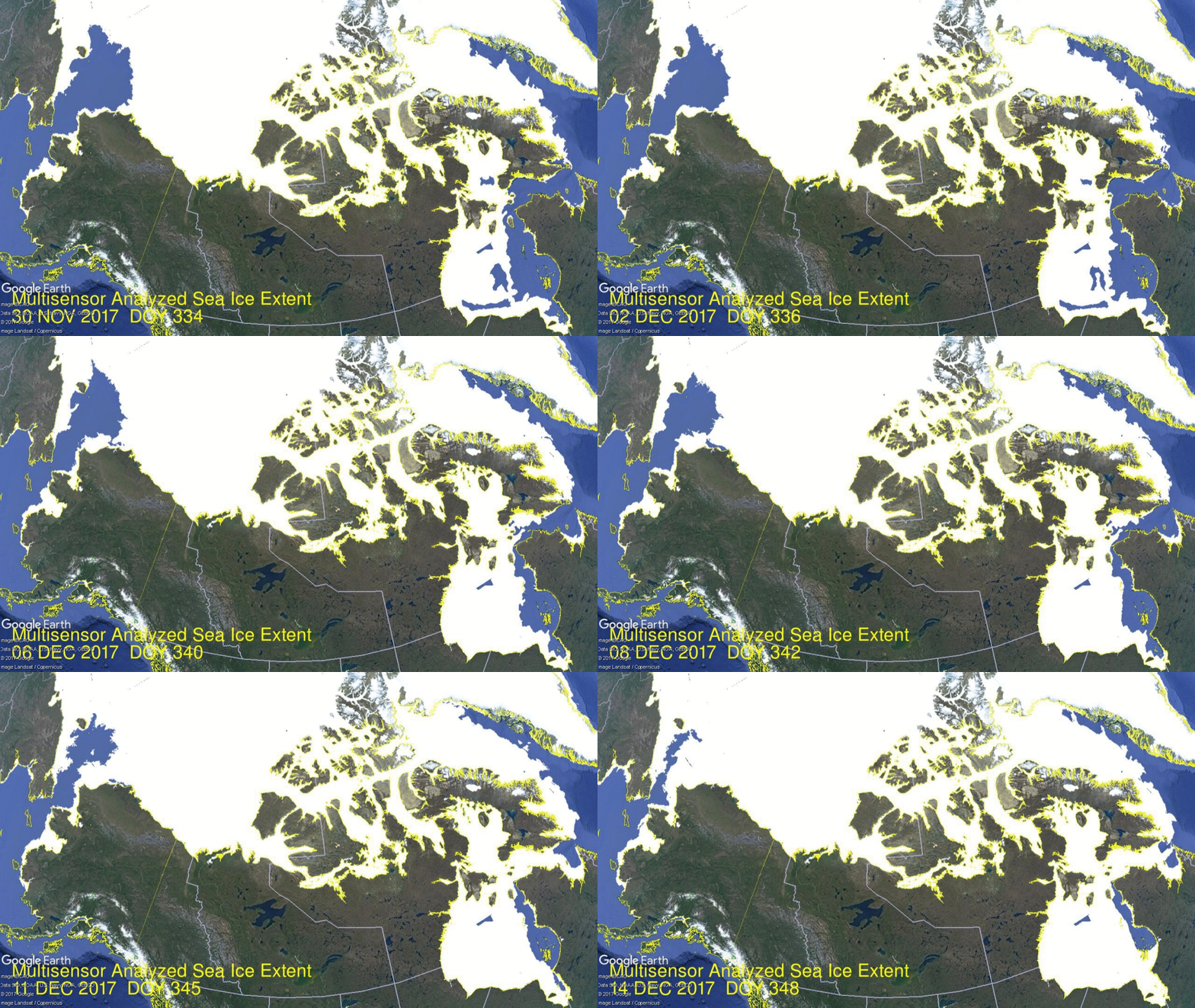
In the first two weeks of December we can see Chukchi at the left filling in with only 8% open water remaining, and Bering starting to freeze. On the right,  Hudson bay is almost fully iced, while Baffin is freezing toward Greenland.  Maximum ice is showing in CAA (Canadian Archipelago), Beaufort, East Siberian, Central Arctic, Laptev and Kara.

Arctic Ice Extents have reached 12M km2, up from 4.6M km2 at Sept. minimum.  This means 50% of the annual maximum has been gained, with 20% of ice cover to be added in the three months before mid March.

The graph compares extents over the first 14 days of December.

2017 has reached 12M km2, close to the 10 year average, while 2012 has recovered with a surplus.  2016 is about 260k km2 behind and 2007 lags by 520k km2.  At this point MASIE and SII are both tracking the 10-year average, with SII about 200k km2 lower.

The Table below shows where ice is located on day 348 in regions of the Arctic ocean. 10 year average comes from 2007 through 2016 inclusive.

Region 2017348 Day 348
Average
2017-Ave. 2007348 2017-2007
 (0) Northern_Hemisphere 12022146 12157670 -135524 11501915 520231
 (1) Beaufort_Sea 1070445 1069521 924 1062676 7769
 (2) Chukchi_Sea 885792 936900 -51108 725062 160730
 (3) East_Siberian_Sea 1087120 1083777 3343 1053584 33536
 (4) Laptev_Sea 897845 897832 12 897845 0
 (5) Kara_Sea 910407 848042 62365 800920 109487
 (6) Barents_Sea 229984 354383 -124399 236964 -6980
 (7) Greenland_Sea 523005 558656 -35652 488595 34409
 (8) Baffin_Bay_Gulf_of_St._Lawrence 835323 825678 9645 793616 41707
 (9) Canadian_Archipelago 853109 853052 57 852556 553
 (10) Hudson_Bay 1168358 1072919 95439 1217263 -48905
 (11) Central_Arctic 3169716 3212523 -42808 3186190 -16475
 (12) Bering_Sea 128315 248645 -120329 54836 73479
 (13) Baltic_Sea 3933 10542 -6609 2898 1035
 (14) Sea_of_Okhotsk 245912 178060 67853 127576 118336


The deficits to average are primarily in Barents and Bering Seas. Surpluses are large in Hudson Bay, Okhotsk and Kara Seas.  Compared to 2007, most seas are in surplus, with only Hudson Bay slightly late.

Footnote

Some people unhappy with the higher amounts of ice extent shown by MASIE continue to claim that Sea Ice Index is the only dataset that can be used. This is false in fact and in logic. Why should anyone accept that the highest quality picture of ice day to day has no shelf life, that one year’s charts can not be compared with another year? Researchers do this analysis, including Walt Meier in charge of Sea Ice Index. That said, I understand his interest in directing people to use his product rather than one he does not control. As I have said before:

MASIE is rigorous, reliable, serves as calibration for satellite products, and uses modern technologies to continue the long and honorable tradition of naval ice charting.  More on this at my post Support MASIE Arctic Ice Dataset
when-al-gore-was-born-there-were-7000-polar-bears