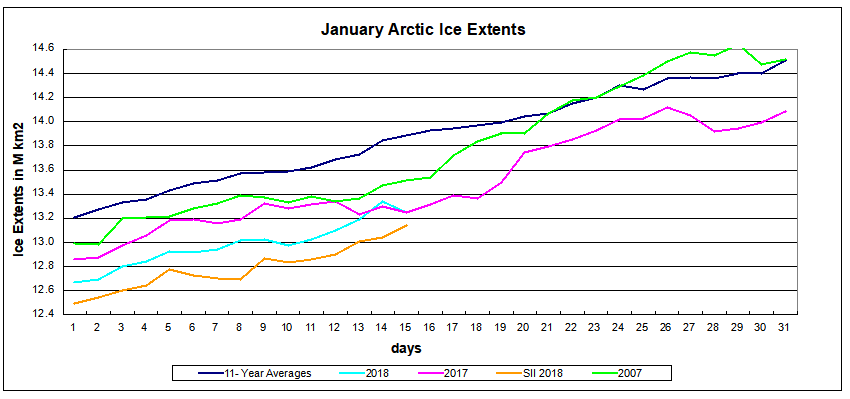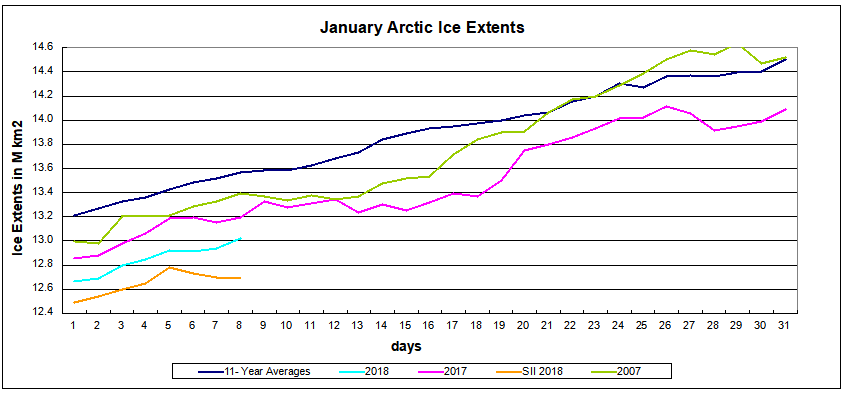
Arctic Ice Mixed Signals

Click on image to enlarge.

With 2017 ice extent estimates complete we can look at the year in perspective.  Above is a graph showing the annual average extents since 2007, comparing MASIE and SII (v3.0).  Obviously, the trend in MASIE could not be flatter, while SII shows a decline.  The first five years the two indices were nearly the same, and since then SII shows less ice, about 260k km2 each year.  Note also how small is the variance year over year: Standard deviation is +/- 260k km2, or about 2.5% of the average annual extent.  This holds for both indices.  Note also a pattern of three higher years followed by two lower years.

A previous post Sea Ice Index Updates to v.3.0 reported on the newest SII version, and we can see how it compares with MASIE over this last year.

Click on image to enlarge.

The first four months show more diversity, both in the 10 year averages and in 2017 results. From May on MASIE 2017 tracks closely to its average, while SII shows 2017 below its average every month. For those who want to see the numbers a table is provided below.

Units 2007
to 2016
2017 2007
to 2016
2017
M km2 MASIE MASIE SII SII
Jan 13.921 13.503 13.686 13.174
Feb 14.841 14.478 14.553 14.112
Mar 15.053 14.509 14.815 14.273
Apr 14.353 13.941 14.206 13.760
May 12.763 12.838 12.757 12.618
June 10.906 10.975 10.938 10.720
July 8.359 8.383 8.107 7.901
Aug 5.955 6.006 5.657 5.472
Sept 4.663 4.832 4.676 4.797
Oct 6.630 6.804 6.734 6.715
Nov 9.897 9.697 9.718 9.458
Dec 12.235 11.972 12.063 11.752
Annual Ave. 10.798  10.661  10.659  10.396 

Some are proclaiming dire warnings about melting ice and imagining various dangerous impacts. Some fluctuations do appear but not very large and somewhat cyclical. Since 2007 it resembles a plateau more than anything else.

Background on MASIE Data Sources

MASIE reports are generated by National Ice Center from the Interactive Multisensor Snow and Ice Mapping System (IMS). From the documentation, the multiple sources feeding IMS are:

Platform(s) AQUA, DMSP, DMSP 5D-3/F17, GOES-10, GOES-11, GOES-13, GOES-9, METEOSAT, MSG, MTSAT-1R, MTSAT-2, NOAA-14, NOAA-15, NOAA-16, NOAA-17, NOAA-18, NOAA-N, RADARSAT-2, SUOMI-NPP, TERRA

Sensor(s): AMSU-A, ATMS, AVHRR, GOES I-M IMAGER, MODIS, MTSAT 1R Imager, MTSAT 2 Imager, MVIRI, SAR, SEVIRI, SSM/I, SSMIS, VIIRS

Summary: IMS Daily Northern Hemisphere Snow and Ice Analysis

The National Oceanic and Atmospheric Administration / National Environmental Satellite, Data, and Information Service (NOAA/NESDIS) has an extensive history of monitoring snow and ice coverage.Accurate monitoring of global snow/ice cover is a key component in the study of climate and global change as well as daily weather forecasting.

The Polar and Geostationary Operational Environmental Satellite programs (POES/GOES) operated by NESDIS provide invaluable visible and infrared spectral data in support of these efforts. Clear-sky imagery from both the POES and the GOES sensors show snow/ice boundaries very well; however, the visible and infrared techniques may suffer from persistent cloud cover near the snowline, making observations difficult (Ramsay, 1995). The microwave products (DMSP and AMSR-E) are unobstructed by clouds and thus can be used as another observational platform in most regions. Synthetic Aperture Radar (SAR) imagery also provides all-weather, near daily capacities to discriminate sea and lake ice. With several other derived snow/ice products of varying accuracy, such as those from NCEP and the NWS NOHRSC, it is highly desirable for analysts to be able to interactively compare and contrast the products so that a more accurate composite map can be produced.

The Satellite Analysis Branch (SAB) of NESDIS first began generating Northern Hemisphere Weekly Snow and Ice Cover analysis charts derived from the visible satellite imagery in November, 1966. The spatial and temporal resolutions of the analysis (190 km and 7 days, respectively) remained unchanged for the product’s 33-year lifespan.

As a result of increasing customer needs and expectations, it was decided that an efficient, interactive workstation application should be constructed which would enable SAB to produce snow/ice analyses at a higher resolution and on a daily basis (~25 km / 1024 x 1024 grid and once per day) using a consolidated array of new as well as existing satellite and surface imagery products. The Daily Northern Hemisphere Snow and Ice Cover chart has been produced since February, 1997 by SAB meteorologists on the IMS.

Another large resolution improvement began in early 2004, when improved technology allowed the SAB to begin creation of a daily ~4 km (6144×6144) grid. At this time, both the ~4 km and ~24 km products are available from NSIDC with a slight delay. Near real-time gridded data is available in ASCII format by request.

In March 2008, the product was migrated from SAB to the National Ice Center (NIC) of NESDIS. The production system and methodology was preserved during the migration. Improved access to DMSP, SAR, and modeled data sources is expected as a short-term from the migration, with longer term plans of twice daily production, GRIB2 output format, a Southern Hemisphere analysis, and an expanded suite of integrated snow and ice variable on horizon.

http://www.natice.noaa.gov/ims/ims_1.html

Footnote

Some people unhappy with the higher amounts of ice extent shown by MASIE continue to claim that Sea Ice Index is the only dataset that can be used. This is false in fact and in logic. Why should anyone accept that the highest quality picture of ice day to day has no shelf life, that one year’s charts can not be compared with another year? Researchers do this, including Walt Meier in charge of Sea Ice Index. That said, I understand his interest in directing people to use his product rather than one he does not control. As I have said before:

MASIE is rigorous, reliable, serves as calibration for satellite products, and continues the long and honorable tradition of naval ice charting using modern technologies. More on this at my post Support MASIE Arctic Ice Dataset

Arctic Year End: Okhotsk Surprise.

Arctic ice extent grows slowly this time of year since many regions are already covered completely.  In recent days 2017 reached 84% of the maximum last March, but dropped below the 10 year average.  As we can see, most of the action was a dramatic seesaw in Okhotsk Sea, a Siberian basin in the North Pacific.

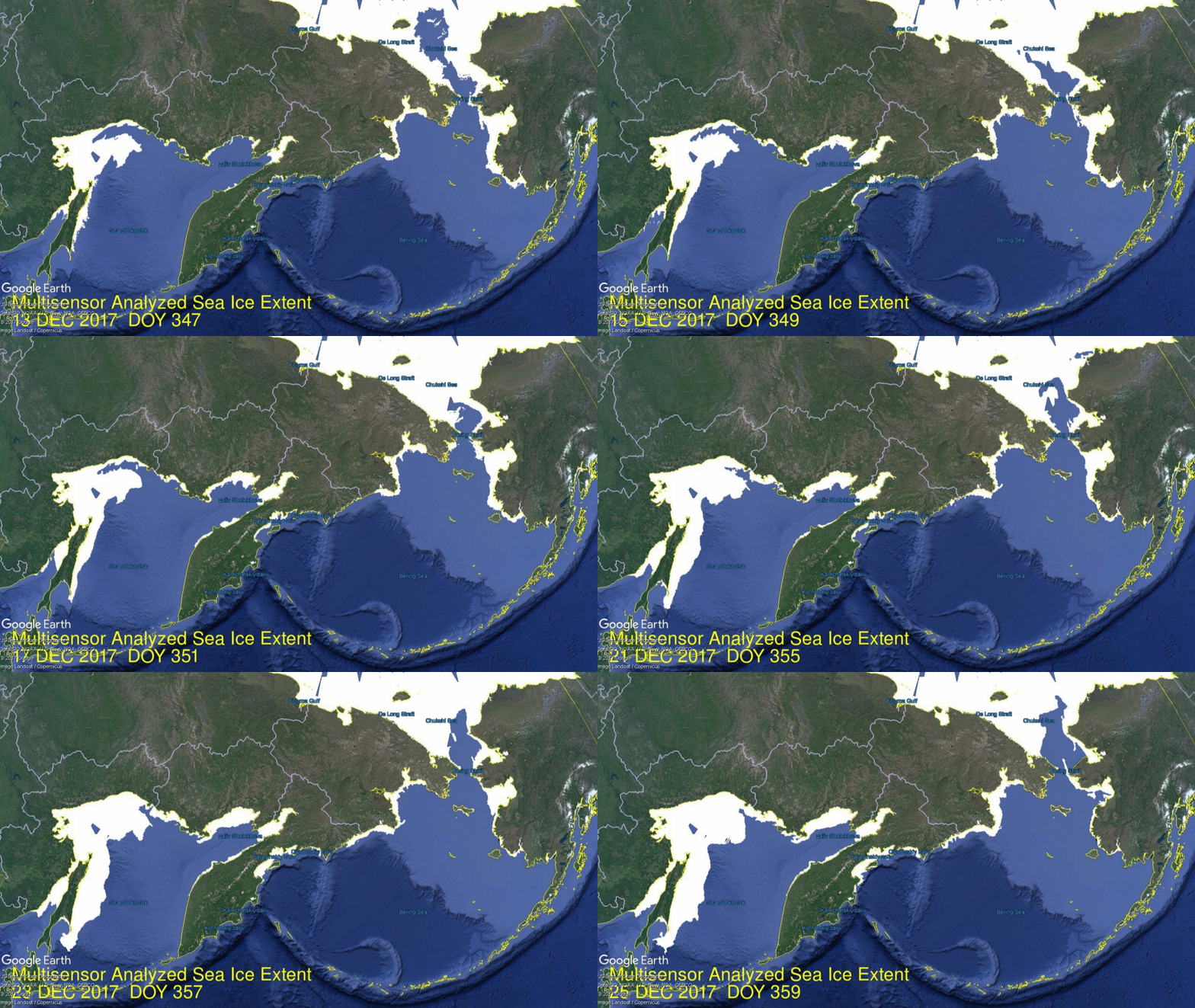
Mid-December Okhotsk Sea on the left began growing ice steadily to reach half of 2017 March max, then inexplicably lost over 300k km2 of ice in just four days.  Meanwhile, Chukchi (upper right) froze completely, then retreated somewhat.  Bering Sea on the right has been advancing steadily but more slowly than average.

The overall effect in December is shown in the graph below:
Note that 2007 matches the 10 year average, while 2012 is well above.  Lagging behind are 2016, 2017 and SII 2017.  This year’s deficit to average appears in the last 11 days, mostly due to Bering and the Okhotsk year end surprise.
Most of the month combined Bering and Okhotsk (B&O) extents were average, until the inexplicable drop starting day 361. Except for those two seas, the month was unremarkable.
At year end, 2017 NH ice, excluding B&O, is down about 200k km2, or 2% of average.  Below is the analysis of regions on day 365.

Region 2017365 Day 365
Average
2017-Ave. 2007364 2017-2007
 (0) Northern_Hemisphere 12628187 13148939 -520752 13049737 -421550
 (1) Beaufort_Sea 1070445 1070225 220 1069711 734
 (2) Chukchi_Sea 943883 966001 -22118 965971 -22089
 (3) East_Siberian_Sea 1087120 1087134 -14 1087120 0
 (4) Laptev_Sea 897845 897841 4 897845 0
 (5) Kara_Sea 892689 888842 3848 871851 20839
 (6) Barents_Sea 331819 448769 -116950 334577 -2758
 (7) Greenland_Sea 555757 584649 -28892 666135 -110378
 (8) Baffin_Bay_Gulf_of_St._Lawrence 978074 1025197 -47123 1074827 -96753
 (9) Canadian_Archipelago 853109 853054 55 852556 553
 (10) Hudson_Bay 1260838 1227587 33251 1260856 -19
 (11) Central_Arctic 3191526 3207659 -16133 3199726 -8200
 (12) Bering_Sea 194350 446066 -251716 373942 -179592
 (13) Baltic_Sea 13345 34329 -20984 9972 3374
 (14) Sea_of_Okhotsk 336595 387522 -50928 371241 -34646

Most of 2017 deficit is in Bering and Barents, less so in Okhotsk with yesterday’s recovery.  Perhaps the Polar Vortex sent frigid air into the US and Canada and replaced it with warmer southern air, and ice receded as a result.  I have reported on Arctic incursions in a post Arctic Inversions and Intrusions but the speed of the effect on ice (if that is the phenomenon) is still surprising.  We shall see if it persists or not.

Background:  Winter Forecast by Dr. Judah Cohen, Dec. 25

On Christmas Day Dr. Judah Cohen published his updated Arctic Oscillation and Polar Vortex Analysis and Forecast  Excerpts below

As I have been discussing the past two blog posts I continue to believe that this is the most critical period of the winter and will ultimately determine the character of the winter. In my opinion, we have approached a fork in the road and the atmosphere can take two possible paths one is a path where the rest of the winter is relatively mild across the mid-latitudes of the NH and the second is a colder path or solution. The tropospheric polar vortex has been relatively weak for much of the month of December as illustrated by the relatively warm polar cap geopotential heights (PCHs) for the first half of December that then boomeranged off the mid-stratosphere and after a short respite with colder tropospheric PCHs, warmer PCHs in the troposphere are predicted through the end of the month and into early January.

Based on the easterly phase of the Quasi-Biennial Oscillation (QBO) I have been favoring a significant PV disruption most likely in January for much of the fall.  A significant stratospheric PV disruption would then be followed by an extended period of severe winter weather across the mid-latitudes of the NH.  However, I have to admit as of yet there are no signs of this scenario.  There is still time but not much.  However, there is another scenario that could still yield a relatively cold winter and that is one analogous to what happened in the winter of 2013/14 where no significant disruptions of the stratospheric occurred but rather repeated minor disruptions that yielded a cold winter for central and eastern North America. Though at first, I acknowledged this possibility I was hesitant to favor this scenario.  However, the longer the delay in a major disruption of the stratospheric PV the more I favor this scenario.

The Arctic Oscillation (AO) is currently slightly positive and is predicted to trend slowly negative through the end of the week towards neutral. The forecast is for the AO to remain close to neutral next week, likely a sign of uncertainty.

Figure 7. Forecasted snowfall anomalies (mm/day; shading) from 31 December 2017 – 4 January 2018. The forecasts are from the 00Z 18 December 2017 GFS ensemble. Note the new projection to provide finer resolution.

The current positive AO is reflective of mixed pressure/geopotential height anomalies across the Arctic and mostly positive pressure/geopotential height anomalies across the mid-latitudes. The North Atlantic Oscillation (NAO) is also currently slightly positive with weak pressure/geopotential height anomalies across Greenland and Iceland and positive pressure/geopotential height anomalies across the mid-latitudes of the North Atlantic.

A return to Ural ridging/blocking at the turn of the calendar year favors active energy transfer from the troposphere to the stratosphere. Another pulse is predicted to commence this week and peak the first few days of January. The pulse itself is likely related to relaxation of the pattern and mild temperatures across North America. However, the predicted resultant perturbation to the stratospheric polar vortex (PV) especially the building of heights over northwestern North America in my opinion could once again favor the return of cold temperatures across eastern North America later in January.

Figure 9. Forecasted snowfall anomalies (mm/day; shading) from 5 – 9 January 2018. The forecasts are from the 00Z 25 December 2017 GFS ensemble. Troughing and/or cold temperatures will support the potential of additional snowfall across Eastern Europe, Siberia, West and East Asia, Alaska, Canada and the Northwestern US. Despite below normal temperatures, temperatures warm sufficiently to support snowmelt across the Eastern US (Figure 9).

Ice did not grow this past week on the North Pacific side of the Arctic basin, still I expect the negative ice anomalies in the region to shrink.  Sea ice is below normal in the Barents-Kara Seas as well and with time the greatest negative sea ice anomalies will likely reside in this region.  As I have been writing for much of the fall I do believe that the record low sea ice anomalies in the Chukchi and Bering Seas has focused ridging/blocking in this region.  Though model forecasts do not predict a return of the blocking in the foreseeable future.

Recent research has shown that regional anomalies are important and the sea ice region most highly correlated with the winter AO is the Barents-Kara Seas region where low Arctic sea ice favors a negative winter AO and a cold Eurasia.  Below normal sea ice in this region may be contributing to more active Wave Activity Flux/poleward heat transport predicted in the models that eventually could result in a negative AO.

As we have seen, the Polar Vortex did indeed return to North America, freezing Niagara Falls in the process.

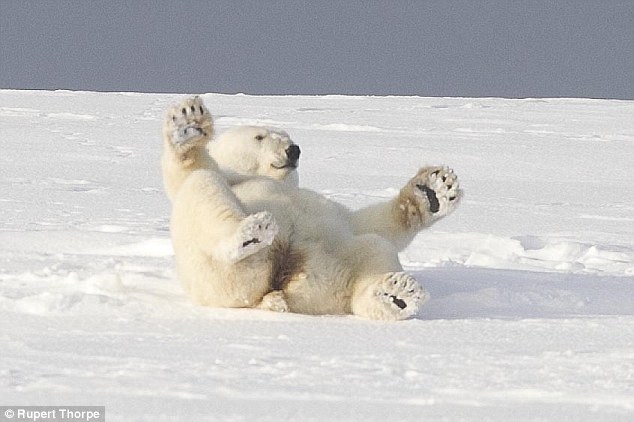
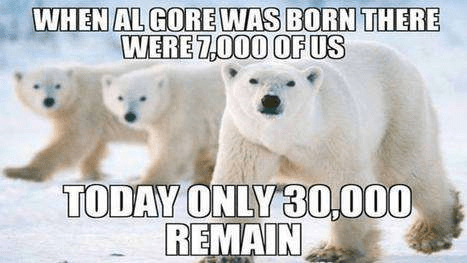
Whichever fork the ice takes, the Polar Bears had a Merry Christmas


Arctic Fork in the Road Dec. 25

On Christmas Day Dr. Judah Cohen published his updated Arctic Oscillation and Polar Vortex Analysis and Forecast  Excerpts below

As I have been discussing the past two blog posts I continue to believe that this is the most critical period of the winter and will ultimately determine the character of the winter. In my opinion, we have approached a fork in the road and the atmosphere can take two possible paths one is a path where the rest of the winter is relatively mild across the mid-latitudes of the NH and the second is a colder path or solution. The tropospheric polar vortex has been relatively weak for much of the month of December as illustrated by the relatively warm polar cap geopotential heights (PCHs) for the first half of December that then boomeranged off the mid-stratosphere and after a short respite with colder tropospheric PCHs, warmer PCHs in the troposphere are predicted through the end of the month and into early January.

Based on the easterly phase of the Quasi-Biennial Oscillation (QBO) I have been favoring a significant PV disruption most likely in January for much of the fall.  A significant stratospheric PV disruption would then be followed by an extended period of severe winter weather across the mid-latitudes of the NH.  However, I have to admit as of yet there are no signs of this scenario.  There is still time but not much.  However, there is another scenario that could still yield a relatively cold winter and that is one analogous to what happened in the winter of 2013/14 where no significant disruptions of the stratospheric occurred but rather repeated minor disruptions that yielded a cold winter for central and eastern North America. Though at first, I acknowledged this possibility I was hesitant to favor this scenario.  However, the longer the delay in a major disruption of the stratospheric PV the more I favor this scenario.

The Arctic Oscillation (AO) is currently slightly positive and is predicted to trend slowly negative through the end of the week towards neutral. The forecast is for the AO to remain close to neutral next week, likely a sign of uncertainty.

Figure 7. Forecasted snowfall anomalies (mm/day; shading) from 31 December 2017 – 4 January 2018. The forecasts are from the 00Z 18 December 2017 GFS ensemble. Note the new projection to provide finer resolution.

The current positive AO is reflective of mixed pressure/geopotential height anomalies across the Arctic and mostly positive pressure/geopotential height anomalies across the mid-latitudes. The North Atlantic Oscillation (NAO) is also currently slightly positive with weak pressure/geopotential height anomalies across Greenland and Iceland and positive pressure/geopotential height anomalies across the mid-latitudes of the North Atlantic.

A return to Ural ridging/blocking at the turn of the calendar year favors active energy transfer from the troposphere to the stratosphere. Another pulse is predicted to commence this week and peak the first few days of January. The pulse itself is likely related to relaxation of the pattern and mild temperatures across North America. However, the predicted resultant perturbation to the stratospheric polar vortex (PV) especially the building of heights over northwestern North America in my opinion could once again favor the return of cold temperatures across eastern North America later in January.

Figure 9. Forecasted snowfall anomalies (mm/day; shading) from 5 – 9 January 2018. The forecasts are from the 00Z 25 December 2017 GFS ensemble. Troughing and/or cold temperatures will support the potential of additional snowfall across Eastern Europe, Siberia, West and East Asia, Alaska, Canada and the Northwestern US. Despite below normal temperatures, temperatures warm sufficiently to support snowmelt across the Eastern US (Figure 9).

Ice did not grow this past week on the North Pacific side of the Arctic basin, still I expect the negative ice anomalies in the region to shrink.  Sea ice is below normal in the Barents-Kara Seas as well and with time the greatest negative sea ice anomalies will likely reside in this region.  As I have been writing for much of the fall I do believe that the record low sea ice anomalies in the Chukchi and Bering Seas has focused ridging/blocking in this region.  Though model forecasts do not predict a return of the blocking in the foreseeable future.

Recent research has shown that regional anomalies are important and the sea ice region most highly correlated with the winter AO is the Barents-Kara Seas region where low Arctic sea ice favors a negative winter AO and a cold Eurasia.  Below normal sea ice in this region may be contributing to more active Wave Activity Flux/poleward heat transport predicted in the models that eventually could result in a negative AO.

Okhotsk Doubles in 12 Days

While the refreezing rate slowed in recent days, we again see contrast in the Pacific Basins.

Mid month, Chukchi (top right) refroze almost completely, then reversed in the last week.  Meanwhile, Okhotsk (Left) grew ice fairly steadily doubling in 12 days to cover nearly half of the annual maximum.  At the moment the Arctic is slightly below the 10 year average, due to the slowdown.

Whichever fork the ice takes, the Polar Bears had a Merry Christmas


Arctic Ice December 14

Click on image to enlarge.

In the first two weeks of December we can see Chukchi at the left filling in with only 8% open water remaining, and Bering starting to freeze. On the right,  Hudson bay is almost fully iced, while Baffin is freezing toward Greenland.  Maximum ice is showing in CAA (Canadian Archipelago), Beaufort, East Siberian, Central Arctic, Laptev and Kara.

Arctic Ice Extents have reached 12M km2, up from 4.6M km2 at Sept. minimum.  This means 50% of the annual maximum has been gained, with 20% of ice cover to be added in the three months before mid March.

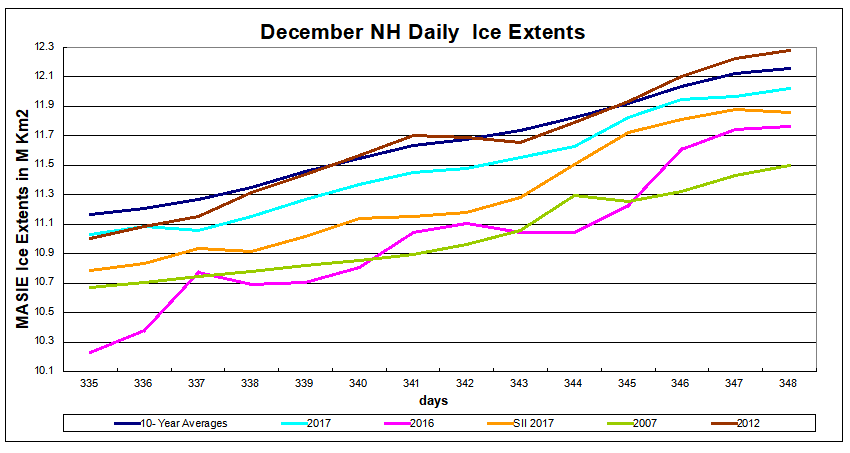
The graph compares extents over the first 14 days of December.

2017 has reached 12M km2, close to the 10 year average, while 2012 has recovered with a surplus.  2016 is about 260k km2 behind and 2007 lags by 520k km2.  At this point MASIE and SII are both tracking the 10-year average, with SII about 200k km2 lower.

The Table below shows where ice is located on day 348 in regions of the Arctic ocean. 10 year average comes from 2007 through 2016 inclusive.

Region 2017348 Day 348
Average
2017-Ave. 2007348 2017-2007
 (0) Northern_Hemisphere 12022146 12157670 -135524 11501915 520231
 (1) Beaufort_Sea 1070445 1069521 924 1062676 7769
 (2) Chukchi_Sea 885792 936900 -51108 725062 160730
 (3) East_Siberian_Sea 1087120 1083777 3343 1053584 33536
 (4) Laptev_Sea 897845 897832 12 897845 0
 (5) Kara_Sea 910407 848042 62365 800920 109487
 (6) Barents_Sea 229984 354383 -124399 236964 -6980
 (7) Greenland_Sea 523005 558656 -35652 488595 34409
 (8) Baffin_Bay_Gulf_of_St._Lawrence 835323 825678 9645 793616 41707
 (9) Canadian_Archipelago 853109 853052 57 852556 553
 (10) Hudson_Bay 1168358 1072919 95439 1217263 -48905
 (11) Central_Arctic 3169716 3212523 -42808 3186190 -16475
 (12) Bering_Sea 128315 248645 -120329 54836 73479
 (13) Baltic_Sea 3933 10542 -6609 2898 1035
 (14) Sea_of_Okhotsk 245912 178060 67853 127576 118336


The deficits to average are primarily in Barents and Bering Seas. Surpluses are large in Hudson Bay, Okhotsk and Kara Seas.  Compared to 2007, most seas are in surplus, with only Hudson Bay slightly late.

Footnote

Some people unhappy with the higher amounts of ice extent shown by MASIE continue to claim that Sea Ice Index is the only dataset that can be used. This is false in fact and in logic. Why should anyone accept that the highest quality picture of ice day to day has no shelf life, that one year’s charts can not be compared with another year? Researchers do this analysis, including Walt Meier in charge of Sea Ice Index. That said, I understand his interest in directing people to use his product rather than one he does not control. As I have said before:

MASIE is rigorous, reliable, serves as calibration for satellite products, and uses modern technologies to continue the long and honorable tradition of naval ice charting.  More on this at my post Support MASIE Arctic Ice Dataset

when-al-gore-was-born-there-were-7000-polar-bears

November Arctic Refreezing

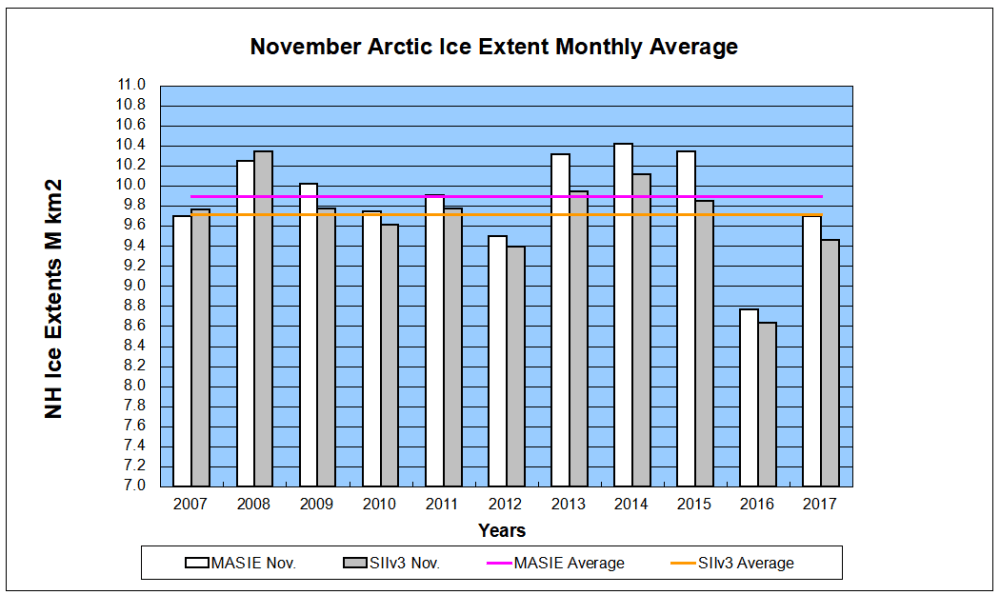
Given the fluctuations in daily sea ice measurements, climatology typically relies on monthly averages. November daily extents are now fully reported and the 2017 November monthly results can be compared with years of the previous decade.  MASIE showed 2017 reached 9.7M km2, 0.2M below the 9.9M November 10 year average.  SII was slightly lower at 9.5M for the month.  The 10 year average for SII is about 200k km2 lower than MASIE, with a similar differential appearing in 2017.  In either case, one can easily see the Arctic ice extents have not declined in the last decade.  MASIE shows 2017  matching 2007, higher than 2012 by 200k km2, and 844k km2 more than 2016.

Sea Ice Index statistics are from recently released SIIv.3.0,  as reported in Sea Ice Index Updates to v.3.0.

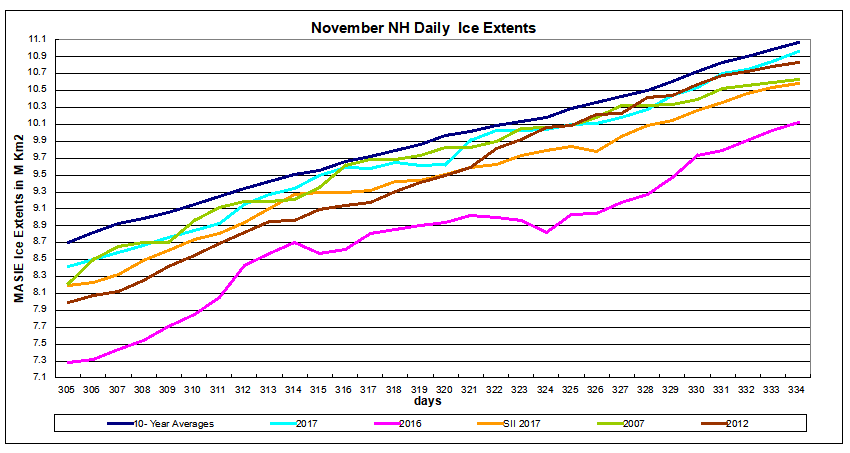
The graph below shows November comparisons through day 334 (Nov. 30).

Note that 2017 in both MASIE and SII tracked the 10 year average, slightly lower throughout.  SII is now about 240k km2 less than MASIE. 2012 grew strongly to approach the 10 year average, recovering after being decimated by the August Great Arctic Cyclone. 2007 lags behind, and the lackluster 2016 recovery is also evident.

The narrative from activist ice watchers is along these lines:  2017 minimum was not especially low, but it is very thin.  “The Arctic is on thin ice.”  They are basing that notion on PIOMAS, a model-based estimate of ice volumes, combining extents with estimated thickness.  That technology is not mature, with only a decade or so of remote sensing. The image below from AARI shows widespread thick ice at end of November 2017.

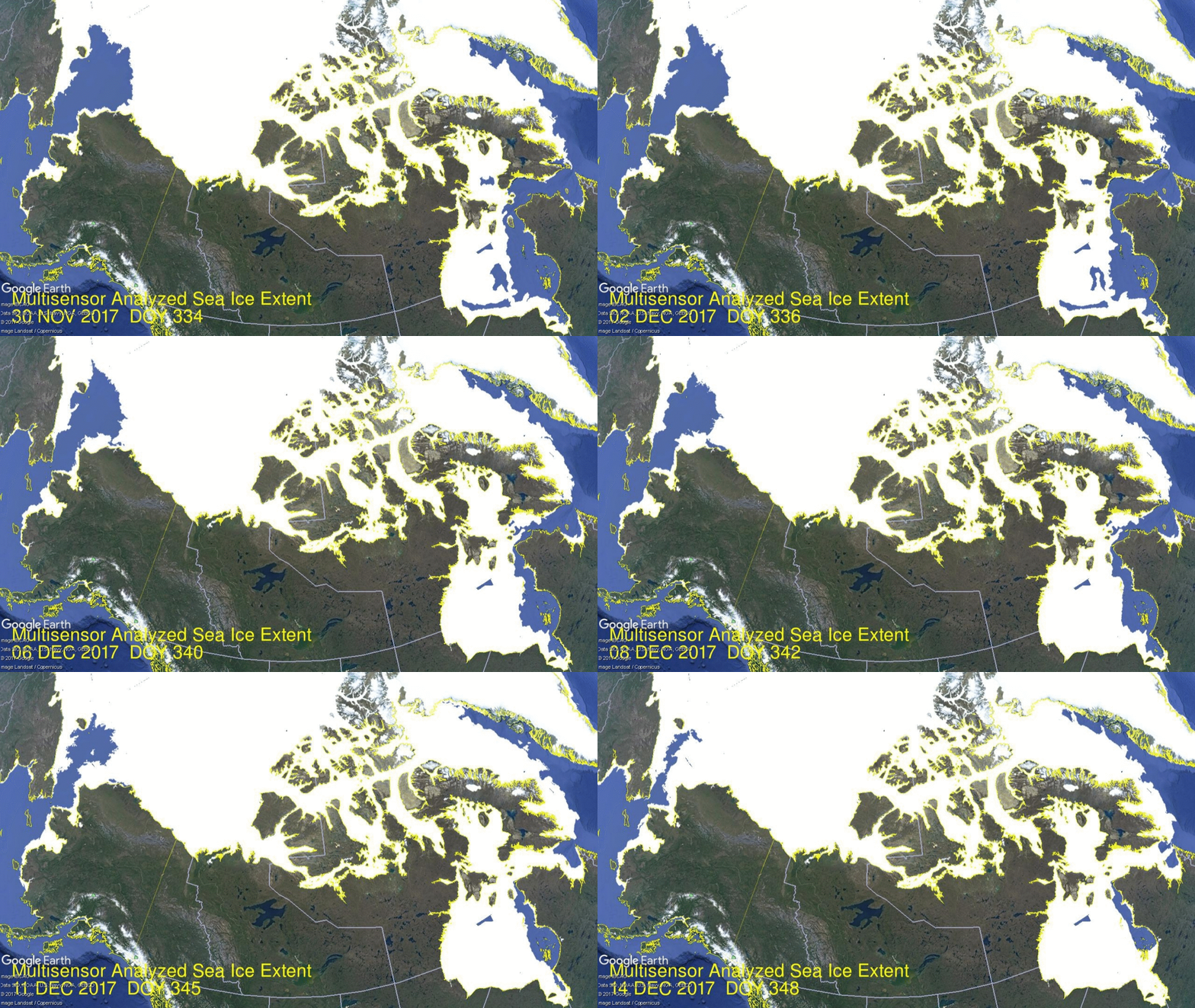
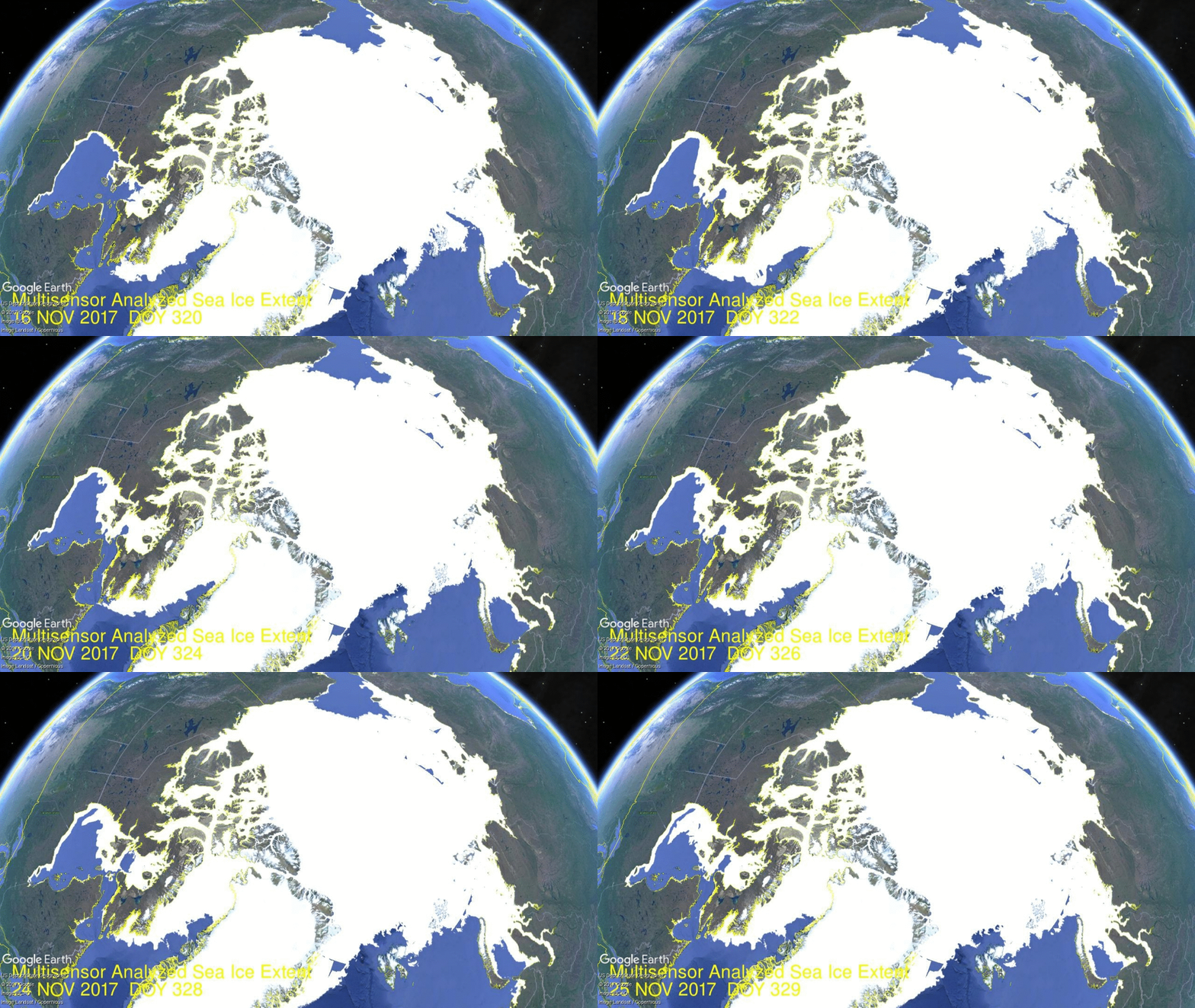
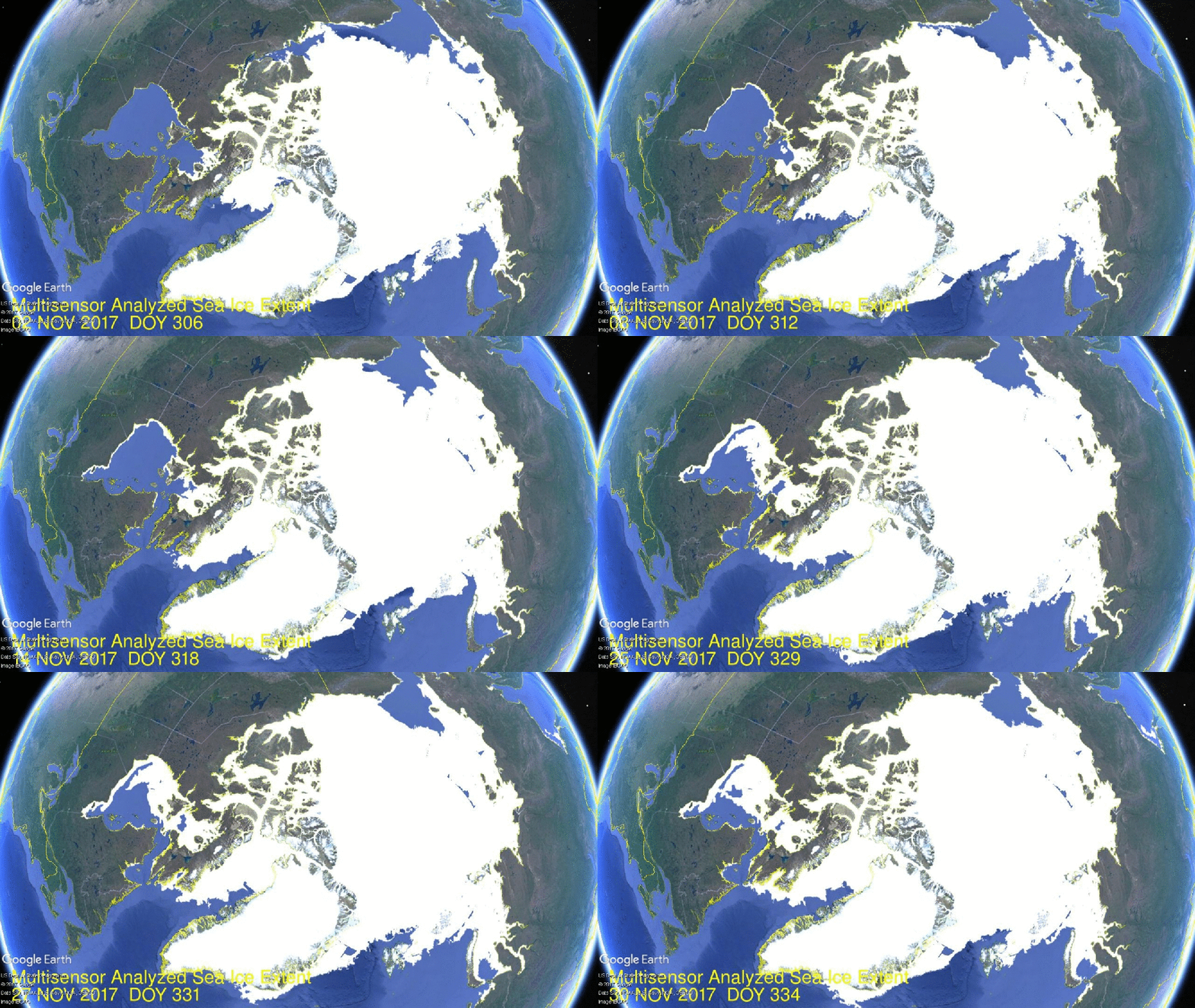
The formation of ice this year shows solid concentrations in the central Arctic.  Watch the November refreezing of Arctic marginal seas from the center outward.
Click on image to enlarge.

At the top, open water in Chukchi is shrinking while neighboring Beaufort and East Siberian seas freeze completely. On the left, Hudson Bay starts with fast ice on the western shore, now growing extent strongly.  On the right, Kara ice cover is 90% complete.

The table shows ice extents in the regions for 2017, 10 year averages and 2016 for day 334. Decadal averages refer to 2007 through 2016 inclusive.

Region 2017334 Day 334
Average
2017-Ave. 2016334 2017-2016
 (0) Northern_Hemisphere 10966755 11073358 -106603 10123083 843672
 (1) Beaufort_Sea 1070445 1069141 1304 1070445 0
 (2) Chukchi_Sea 560938 852508 -291570 720442 -159503
 (3) East_Siberian_Sea 1068113 1085310 -17197 1087137 -19024
 (4) Laptev_Sea 897845 897809 36 897845 0
 (5) Kara_Sea 843397 794994 48403 486630 356767
 (6) Barents_Sea 248423 266718 -18295 56217 192206
 (7) Greenland_Sea 512025 546103 -34078 434402 77623
 (8) Baffin_Bay_Gulf_of_St._Lawrence 728933 695198 33735 722702 6231
 (9) Canadian_Archipelago 853109 852805 303 853180 -71
 (10) Hudson_Bay 774499 561038 213460 331472 443027
 (11) Central_Arctic 3189555 3205221 -15667 3144344 45210

NH extent is close to average with the only large deficit in Chukchi.  Most seas are nearly average with a large surplus in Hudson offsetting Chukchi.  Both seas are now refreezing strongly.

Summary

Earlier observations showed that Arctic ice extents were low in the 1940s, grew thereafter up to a peak in 1977, before declining.  That decline was gentle until 1994 which started a decade of multi-year ice loss through the Fram Strait.  There was also a major earthquake under the north pole in that period.  In any case, the effects and the decline ceased in 2007, 30 years after the previous peak.  Now we have a plateau in ice extents, which could be the precursor of a growing phase of the quasi-60 year Arctic ice oscillation.

Background on MASIE Data Sources

MASIE reports are generated by National Ice Center from the Interactive Multisensor Snow and Ice Mapping System (IMS). From the documentation, the multiple sources feeding IMS are:

Platform(s) AQUA, DMSP, DMSP 5D-3/F17, GOES-10, GOES-11, GOES-13, GOES-9, METEOSAT, MSG, MTSAT-1R, MTSAT-2, NOAA-14, NOAA-15, NOAA-16, NOAA-17, NOAA-18, NOAA-N, RADARSAT-2, SUOMI-NPP, TERRA

Sensor(s): AMSU-A, ATMS, AVHRR, GOES I-M IMAGER, MODIS, MTSAT 1R Imager, MTSAT 2 Imager, MVIRI, SAR, SEVIRI, SSM/I, SSMIS, VIIRS

Summary: IMS Daily Northern Hemisphere Snow and Ice Analysis

The National Oceanic and Atmospheric Administration / National Environmental Satellite, Data, and Information Service (NOAA/NESDIS) has an extensive history of monitoring snow and ice coverage.Accurate monitoring of global snow/ice cover is a key component in the study of climate and global change as well as daily weather forecasting.

The Polar and Geostationary Operational Environmental Satellite programs (POES/GOES) operated by NESDIS provide invaluable visible and infrared spectral data in support of these efforts. Clear-sky imagery from both the POES and the GOES sensors show snow/ice boundaries very well; however, the visible and infrared techniques may suffer from persistent cloud cover near the snowline, making observations difficult (Ramsay, 1995). The microwave products (DMSP and AMSR-E) are unobstructed by clouds and thus can be used as another observational platform in most regions. Synthetic Aperture Radar (SAR) imagery also provides all-weather, near daily capacities to discriminate sea and lake ice. With several other derived snow/ice products of varying accuracy, such as those from NCEP and the NWS NOHRSC, it is highly desirable for analysts to be able to interactively compare and contrast the products so that a more accurate composite map can be produced.

The Satellite Analysis Branch (SAB) of NESDIS first began generating Northern Hemisphere Weekly Snow and Ice Cover analysis charts derived from the visible satellite imagery in November, 1966. The spatial and temporal resolutions of the analysis (190 km and 7 days, respectively) remained unchanged for the product’s 33-year lifespan.

As a result of increasing customer needs and expectations, it was decided that an efficient, interactive workstation application should be constructed which would enable SAB to produce snow/ice analyses at a higher resolution and on a daily basis (~25 km / 1024 x 1024 grid and once per day) using a consolidated array of new as well as existing satellite and surface imagery products. The Daily Northern Hemisphere Snow and Ice Cover chart has been produced since February, 1997 by SAB meteorologists on the IMS.

Another large resolution improvement began in early 2004, when improved technology allowed the SAB to begin creation of a daily ~4 km (6144×6144) grid. At this time, both the ~4 km and ~24 km products are available from NSIDC with a slight delay. Near real-time gridded data is available in ASCII format by request.

In March 2008, the product was migrated from SAB to the National Ice Center (NIC) of NESDIS. The production system and methodology was preserved during the migration. Improved access to DMSP, SAR, and modeled data sources is expected as a short-term from the migration, with longer term plans of twice daily production, GRIB2 output format, a Southern Hemisphere analysis, and an expanded suite of integrated snow and ice variable on horizon.

http://www.natice.noaa.gov/ims/ims_1.html

Footnote

Some people unhappy with the higher amounts of ice extent shown by MASIE continue to claim that Sea Ice Index is the only dataset that can be used. This is false in fact and in logic. Why should anyone accept that the highest quality picture of ice day to day has no shelf life, that one year’s charts can not be compared with another year? Researchers do this, including Walt Meier in charge of Sea Ice Index. That said, I understand his interest in directing people to use his product rather than one he does not control. As I have said before:

MASIE is rigorous, reliable, serves as calibration for satellite products, and continues the long and honorable tradition of naval ice charting using modern technologies. More on this at my post Support MASIE Arctic Ice Dataset


Arctic Ice Grows in Movember

Click on image to enlarge.

Arctic Ice Extents have more than doubled since the Sept. minimum and are now up to 10.4M km2.  The last 30% of maximum will take until March, principally because several basins are frozen over and cannot add coverage.  To date, Beaufort and CAA (Canadian Archipelago) are full, as are Laptev and East Siberian on the Russian side.  Kara is 88% covered and the Central Arctic will add only 2% from here.

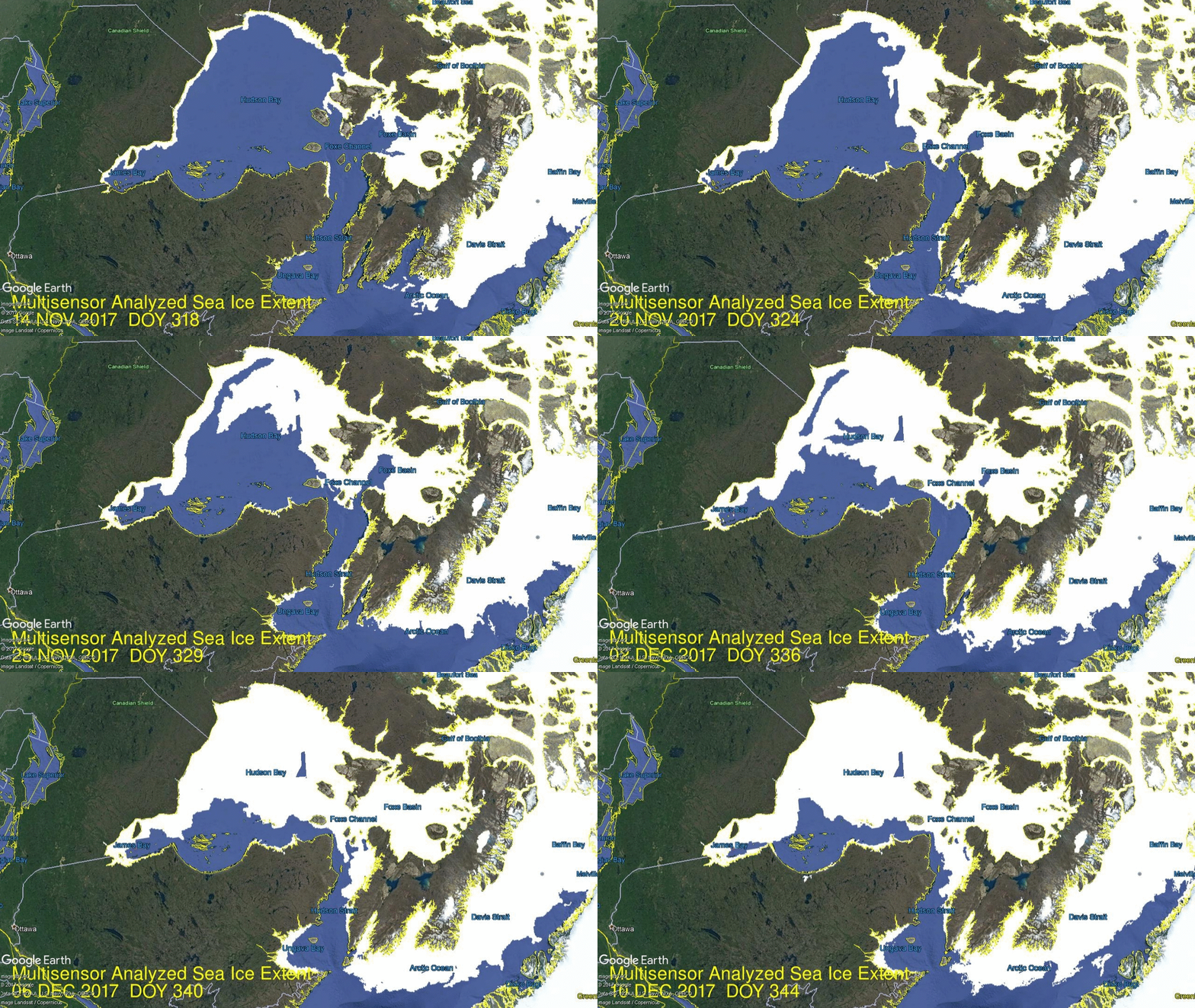
In the last nine days of November we can see Chukchi at the top adding ice up to 50% of maximum with Beaufort  and East Siberian already frozen.  On the left, Baffin and especially Hudson bay are now growing more strongly.  On the right is Kara filling in with Barents freezing more slowly.

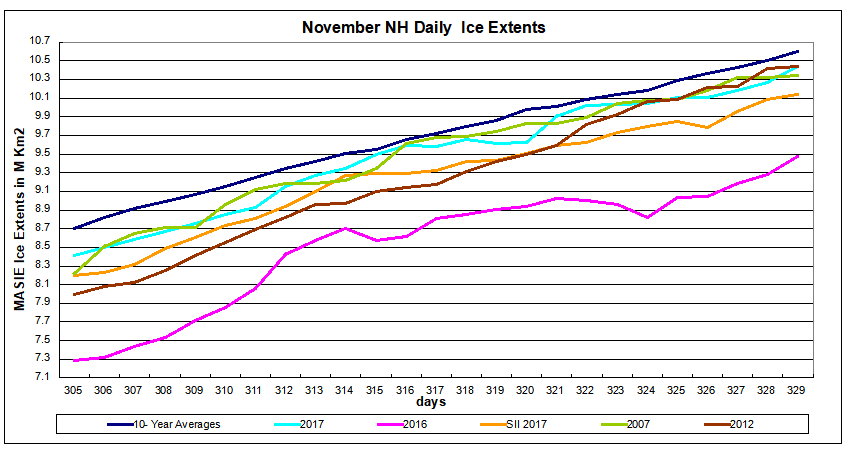
The graph compares extents over the first 25 days of November.

2017 has reached 10.4M km2, 2007 and 2012 nearly the same, and all are close to the 10 year average of 10.6M km2.  2016 is about 1M km2 behind.  At this point MASIE and SII are both tracking the 10-year average, with SII about 200k km2 lower.

The Table below shows where ice is located on day 329 in regions of the Arctic ocean. 10 year average comes from 2007 through 2016 inclusive.

Region 2017329 Day 329
Average
2017-Ave. 2016329 2017-2016
 (0) Northern_Hemisphere 10438529 10596102 -157573 9474596 963933
 (1) Beaufort_Sea 1070410 1068478 1932 1070445 -35
 (2) Chukchi_Sea 516620 793296 -276676 653560 -136940
 (3) East_Siberian_Sea 1065427 1082091 -16665 1087137 -21711
 (4) Laptev_Sea 897845 897451 394 897211 634
 (5) Kara_Sea 826360 732408 93952 328154 498207
 (6) Barents_Sea 191448 209544 -18096 31173 160275
 (7) Greenland_Sea 414638 542031 -127393 419401 -4763
 (8) Baffin_Bay_Gulf_of_St._Lawrence 701761 637760 64001 651237 50524
 (9) Canadian_Archipelago 852553 851808 745 853180 -628
 (10) Hudson_Bay 632312 422809 209504 267718 364594
 (11) Central_Arctic 3182452 3192004 -9552 3082022 100430

The deficits to average are primarily in Chukchi and Greenland Seas. Surpluses are large in Hudson and Baffin Bays, along with Kara Sea.  Compared to last year, Kara, Barents and Hudson Bay all have much greater ice extents.

Footnote

Some people unhappy with the higher amounts of ice extent shown by MASIE continue to claim that Sea Ice Index is the only dataset that can be used. This is false in fact and in logic. Why should anyone accept that the highest quality picture of ice day to day has no shelf life, that one year’s charts can not be compared with another year? Researchers do this analysis, including Walt Meier in charge of Sea Ice Index. That said, I understand his interest in directing people to use his product rather than one he does not control. As I have said before:

MASIE is rigorous, reliable, serves as calibration for satellite products, and uses modern technologies to continue the long and honorable tradition of naval ice charting.  More on this at my post Support MASIE Arctic Ice Dataset

Movember Foundation encourages growing mustaches in support of men’s health and fitness.


Arctic Ice Movember Update

Click on image to enlarge

Arctic Ice Extents have roughly doubled since the Sept. minimum and are now up to 10M km2.  The last 1/3 of maximum will take until March, principally because several basins are frozen over and cannot add coverage.  To date, Beaufort and CAA (Canadian Archipelago) are full, as are Laptev and East Siberian on the Russian side.  Kara is 3/4 covered and the Central Arctic wil add only 3% from here.

During the first half of November we can see at the bottom Beaufort  and East Siberian filling in, leaving only Chukchi with open water.  On the right, Both Baffin and Hudson bays are now growing more strongly.   At the top Kara ice extent has reached 75% of its March maximum.

The graph compares extents over the first 17 days of November.
NHday321

2017 has reached 9.9M km2, 2007 nearly the same, and both are close to the 10 year average of 10M km2.  2012 lags 300k km2 lower than 2017, while 2016 is 877k km2 behind.  At this point MASIE and SII are tracking the 10-year average, with SII about 200k km2 lower.

The Table below shows where ice is located on day 321 in regions of the Arctic ocean. 10 year average comes from 2007 through 2016 inclusive.

Region 2017321 Day 321
Average
2017-Ave. 2016304 2017-2016
 (0) Northern_Hemisphere 9904268 10013895 -109626 9026577 877691
 (1) Beaufort_Sea 1052982 1067181 -14199 1056304 -3322
 (2) Chukchi_Sea 449182 702958 -253776 616755 -167573
 (3) East_Siberian_Sea 1076201 1077799 -1598 1087137 -10936
 (4) Laptev_Sea 897845 897517 328 896732 1113
 (5) Kara_Sea 696550 649727 46822 254492 442058
 (6) Barents_Sea 68869 174077 -105208 25907 42962
 (7) Greenland_Sea 394494 499069 -104575 390593 3901
 (8) Baffin_Bay_Gulf_of_St._Lawrence 761453 552922 208531 524708 236745
 (9) Canadian_Archipelago 852865 851728 1137 853180 -315
 (10) Hudson_Bay 460631 273706 186925 185679 274952
 (11) Central_Arctic 3158068 3183076 -25008 3077808 80260

The deficits to average are primarily in Chukchi, also Barents and Greenland Seas. Surpluses are large in Hudson and Baffin Bays, along with Kara Sea.

Footnote

Some people unhappy with the higher amounts of ice extent shown by MASIE continue to claim that Sea Ice Index is the only dataset that can be used. This is false in fact and in logic. Why should anyone accept that the highest quality picture of ice day to day has no shelf life, that one year’s charts can not be compared with another year? Researchers do this analysis, including Walt Meier in charge of Sea Ice Index. That said, I understand his interest in directing people to use his product rather than one he does not control. As I have said before:

MASIE is rigorous, reliable, serves as calibration for satellite products, and uses modern technologies to continue the long and honorable tradition of naval ice charting.  More on this at my post Support MASIE Arctic Ice Dataset

Movember Foundation encourages growing mustaches in support of men’s health and fitness.


Like Your Arctic with Ice?

An imposing panorama of an ice-fjord floating along the bone-chilling water in Svalbard. From Daily Mail

Arctic ice extent went over 9M km2 yesterday, or about 60% of annual maximum.  Several seas are already maxed out:  Laptev, East Siberian, Canadian Archipelago.  The image below shows the refreezing this month.

Click on image to enlarge.

At the bottom watch Beaufort Sea filling in.  On the middle right Baffin Bay steadily adds ice, while Hudson bay starts from its top, but also gets fast ice way down the western coastline into James Bay.  At the top center is Svalbard with Greenland Sea growing on its right, and Kara and Barents filling in on its left.

Dr. Judah Cohen from Atmospheric and Environmental Research (AER) saw this coming.  From his blog November 6 2017:

The forecast for November (Figure 13a) shows cold temperatures in Canada that extend into the Eastern US. The cold temperatures in Canada seem likely but the cold temperatures in the Eastern US will likely depend on the strength of Greenland blocking. The forecast for Eurasia is relatively mild and I think that the forecast is likely to be wrong. In my opinion the predicted blocking across northern Eurasia favors more widespread cold than predicted by the CFS especially across Siberia and East Asia.

My thoughts on the weather pattern over the next several weeks  By Brett Anderson, AccuWeather senior meteorologist  11/08/2017, 4:30:48 PM

Interesting weather pattern setting up across North America as we progress through November and get into early December.

–A series of potent, Pacific storms will likely impact southern BC and the U.S. Pacific Northwest between Nov. 13 and 23. Expect several rounds of heavier rain and gusty winds for Vancouver Island and the mainland coast. Heavy snowfall for the Coastal Range and Rockies should help set the ski season off on a good start.

–A strong Arctic, cold front will press southward through Ontario and Quebec on Thursday. Behind the front, rain showers will quickly change to snow showers and a brief, heavier snow squall. There is the potential for brief whiteout conditions with any squall from southern and eastern Ontario through southern Quebec late Thursday afternoon and into the night. These squalls can quickly drop visibility making travel dangerous for motorists, especially on highways. Roads will generally be wet Thursday afternoon, but untreated roads may briefly get snow covered and icy Thursday evening and night as temperatures rapidly fall below the freezing mark.

In addition to the cold, northwesterly winds will be quite strong Thursday night into early Friday with gusts in the 60- to 80-km/h range from eastern Ontario through Quebec and into western New Brunswick.

Dr. Cohen’s view of the winter Arctic climate system is posted in Snowing and Freezing in the Arctic

Old Arctic Ice Recovers

Click on image to enlarge.

Update November 5 at end of post

These charts come from the Arctic and Antarctic Research Institute, St. Petersburg, Russia. I downloaded the images from 2008 through 2017 without collusion from their publicly accessible website (here).

The brown blob in the middle is older ice surviving at least one summer’s melt, with the colors for first year and young ice shown in the enlarged legend above.

The 2007 chart is in a different format so appears separately.  The 2007 coverage is limited on the North American side, but it does show how much of the Central Arctic multi-year ice was gone in 2007. The subsequent charts show recovery with a decline in 2012 (Great Arctic Cyclone year), followed by increases, especially this year.

As discussed in previous posts, the technology for remotely sensing ice thickness is immature, so multi-year ice serves as a proxy.

Update: Background in response to Caleb’s query

Caleb asked about Russian satellite data sources possibly substituting for US ones going out of service.

I found a 2009 presentation in English which answers most of this. Russian Space Infrastructure applied in the Arctic: sea ice application within Roshydromet  by Vasily Smolyanitsky, Arctic and Antarctic Research Institute (AARI). Excerpts and images below.  Read the full report to appreciate the scale of their efforts.

Data acquisition
Coastal weather polar stations of Roshydromet make daily visual and instrumental ice observations on sea ice concentration and stages of ice development, ice thickness, forms of ice, ice drift and other phenomena. Icebreakers and icebreaking vessels on the NSR routes routinely (commonly once a day) report the main ice parameters describing ice navigation. Before 1994 aircraft ice reconnaissance flights were conducted in the Arctic usually on a monthly basis from November to April and on a 10-day internal during the summer navigation period.

Since 1995 aircraft (mostly helicopter) ice reconnaissance flights are conducted only occasionally during tailored hydrometeorological support of applied and scientific activities in the Eurasian Arctic. The scope of ice information collected during air ice reconnaissance includes visual observations on a full scope of sea ice parameters essential for navigation and marine safety (egg-code, icebergs, openings, dynamics, surface features). Though being nowadays not the prime sources, the stated information (coastal, aircraft) is continuously used for validation of the sea ice analysis and prognostic products at the ice centers.

The AARI and Planet satellite reception stations provide operational optical imagery for the Arctic Ocean and North Pacific from a series of satellites (NOAA, EOS TERRA, Aqua, Suomi NPP, FY3, Meteor, Ocean). Information for other regions (e.g. Antarctic), from other satellites and ranges (Sentinel-1,2,3, Radarsat-2, TerraSar-X, etc.) is received via Internet from corresponding data portals directly or from commercial satellite data providers. All data are further processed within ice information systems and utilized for regional, pan-Arctic or pan-Antarctic sea-ice analysis. Sample satellite products are available via the AARI and Planet web pages.

Most of the mentioned satellites are accessed by others with the exception of Meteor, operated by Russia.  Yes, they have numerous meteorological satellites as shown in this image:

According to the presentation, their plans called for additional Electro and Meteor platforms, as well as a new satellite type called Arctica.   It is not clear to what extent the sensors on these birds replicate the microwave data.