October Arctic Ice is Back

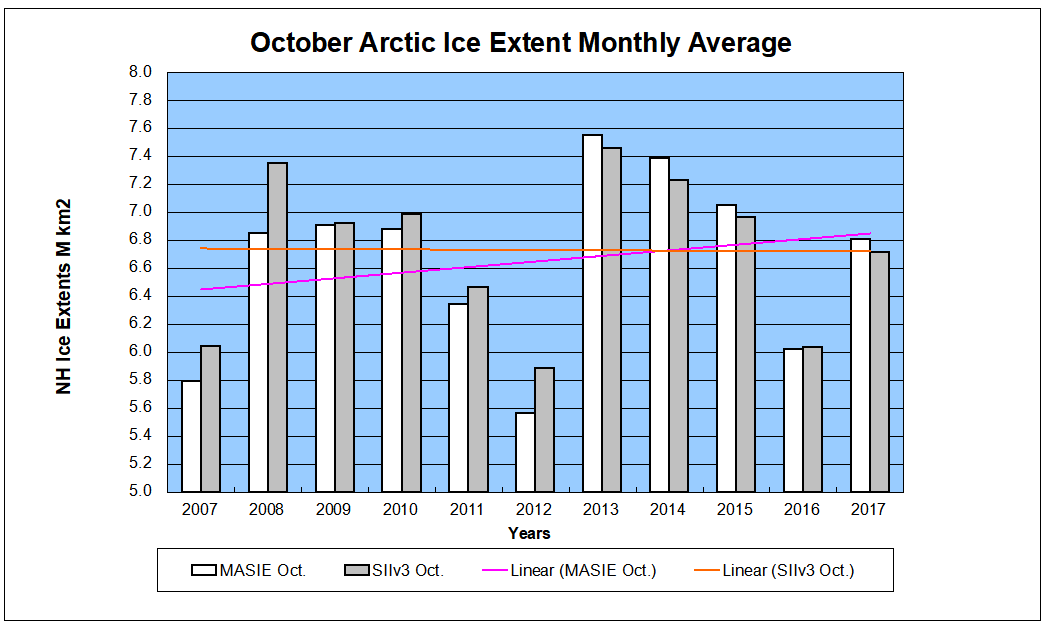
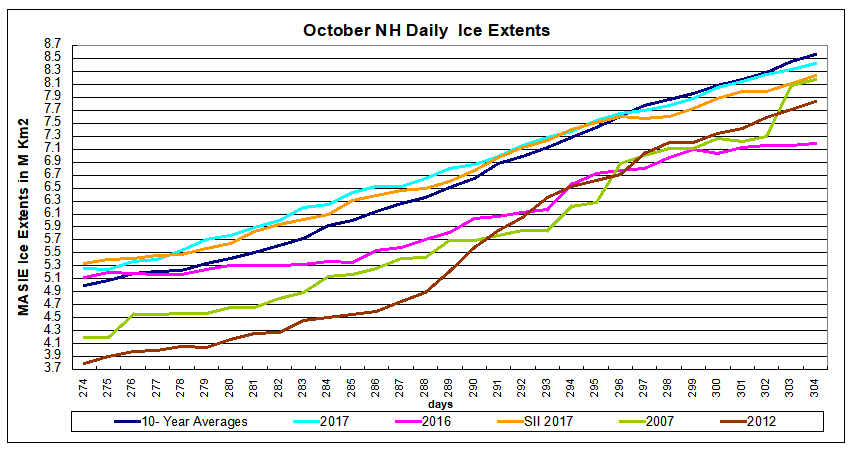
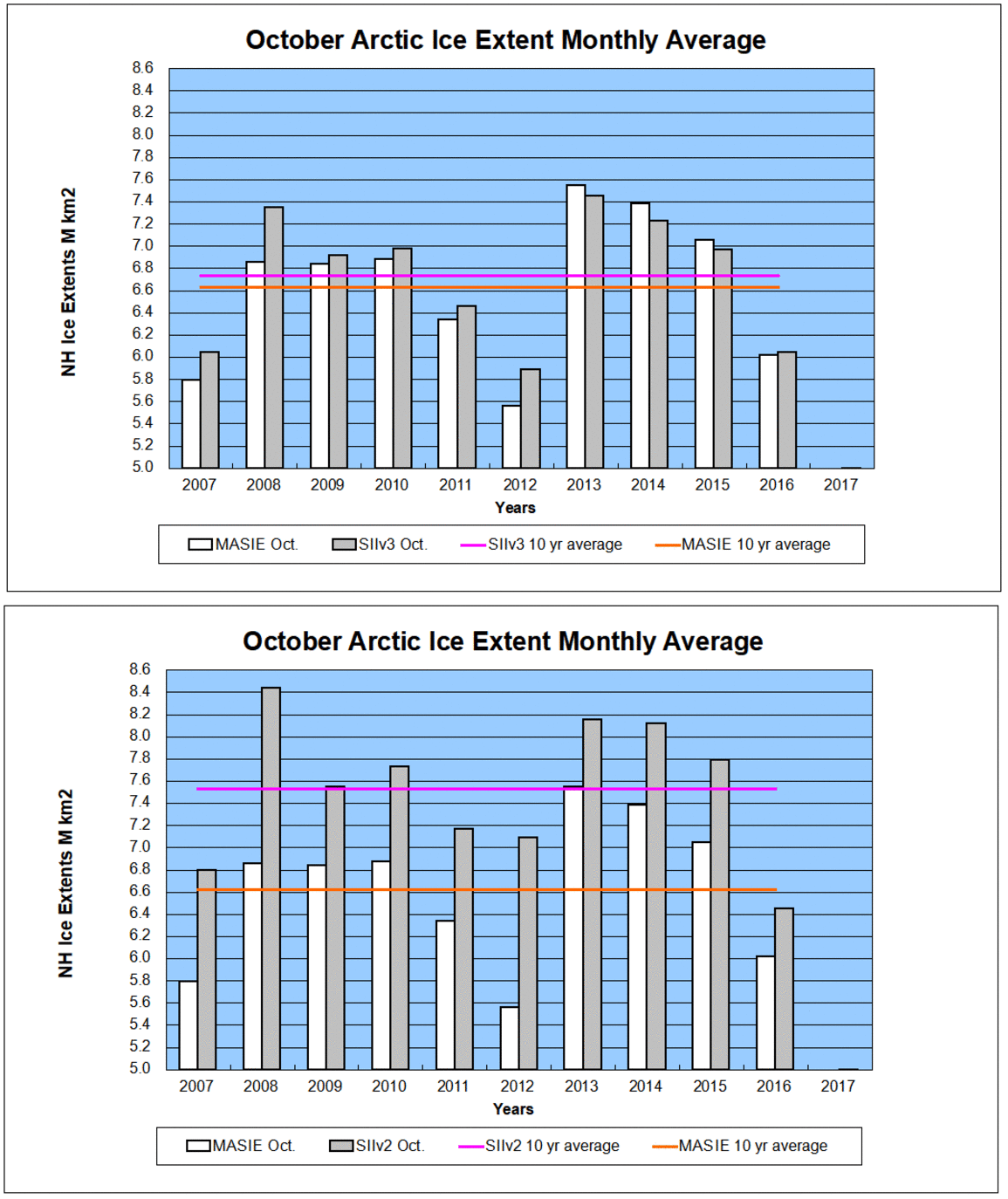
Given the fluctuations in daily sea ice measurements, climatology typically relies on monthly averages. October daily extents are now fully reported and the 2017 October monthly results can be compared with years of the previous decade.  MASIE showed 2017 reached 6.8M km2, exceeding the 6.6M October 10 year average.  SII was close behind at 6.7M for the month.  The 11 year linear trend is more upward for MASIE, mainly due to early years, especially 2007 and 2008 reported higher in SII.  In either case, one can easily see the Arctic ice extents have not declined; MASIE shows 2017  higher than 2016 by 800k km2, and more than 2007 by 1M km2.

Sea Ice Index statistics are from newly released SIIv.3.0,  as reported in Sea Ice Index Updates to v.3.0.

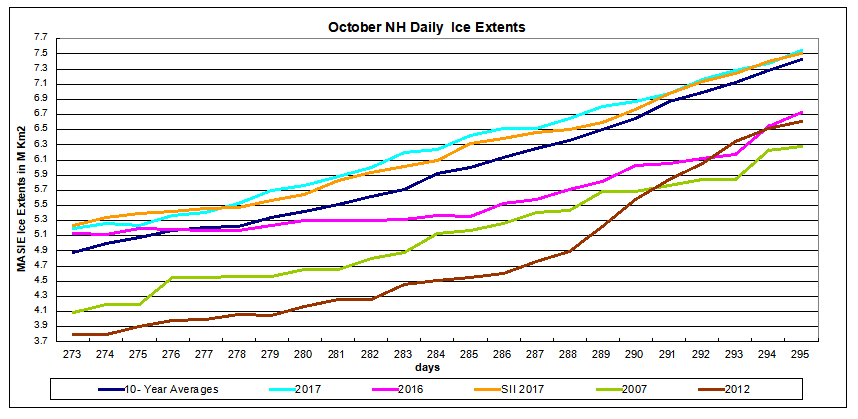
The graph below shows October comparisons through day 304 (Oct. 31).

Note that 2017 in both MASIE and SII tracked the 10 year average, higher most of the month, and slipping behind toward the end.  SII is now about 200k km2 less than MASIE. 2012 recovered strongly, doubling in extent after being decimated by the August Great Arctic Cyclone. 2007 shows a inexplicable one-day jump, taking it close to average.  The lackluster 2016 recovery is also evident.

The narrative from activist ice watchers is along these lines:  2017 minimum was not especially low, but it is very thin.  “The Arctic is on thin ice.”  They are basing that notion on PIOMAS, a model-based estimate of ice volumes, combining extents with estimated thickness.  That technology is not mature, with only a decade or so of remote sensing.

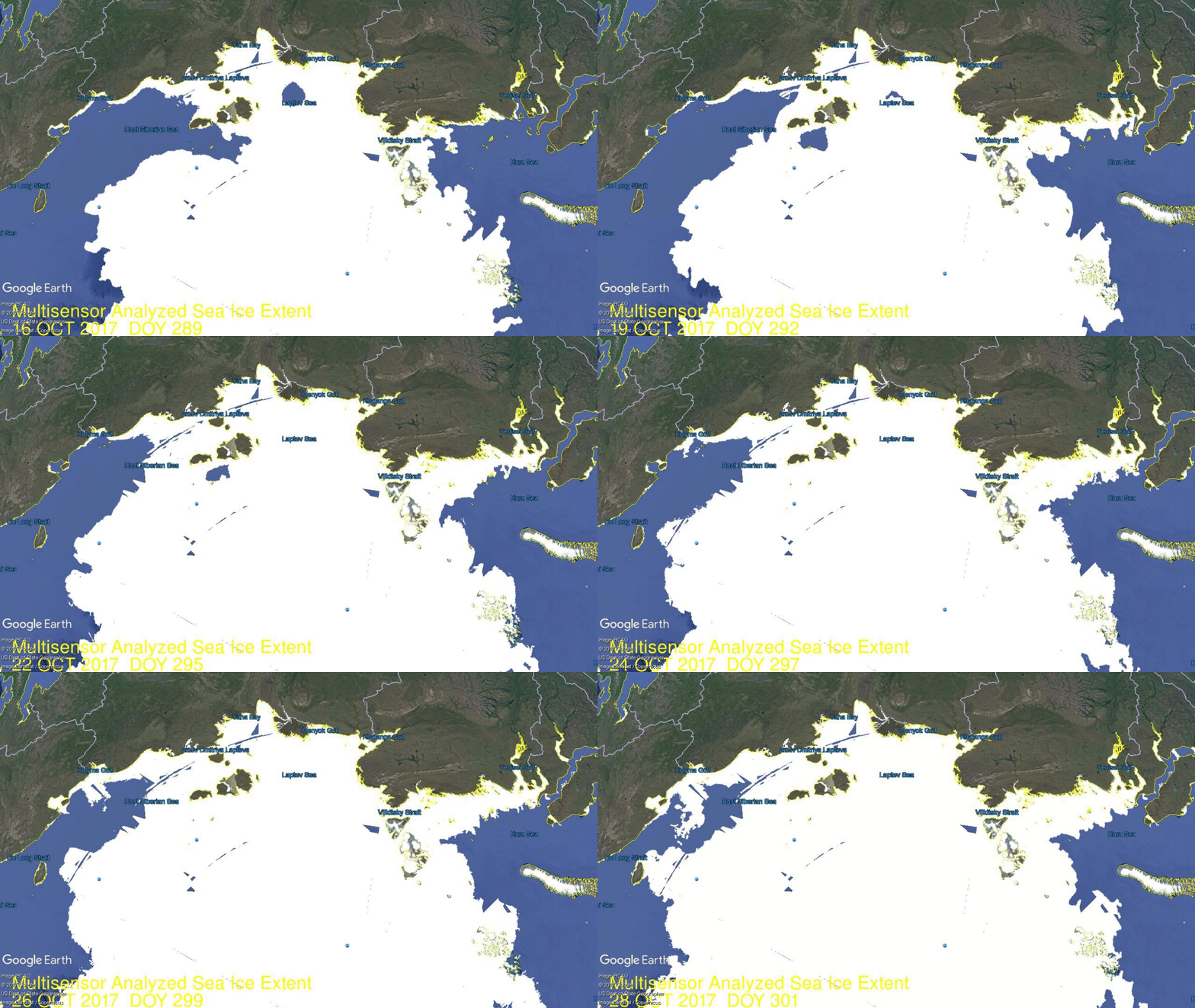
The formation of ice this year does not appear thin, since it is concentrated in the central Arctic.  Watch the October refreezing of the Arctic from the center outward.
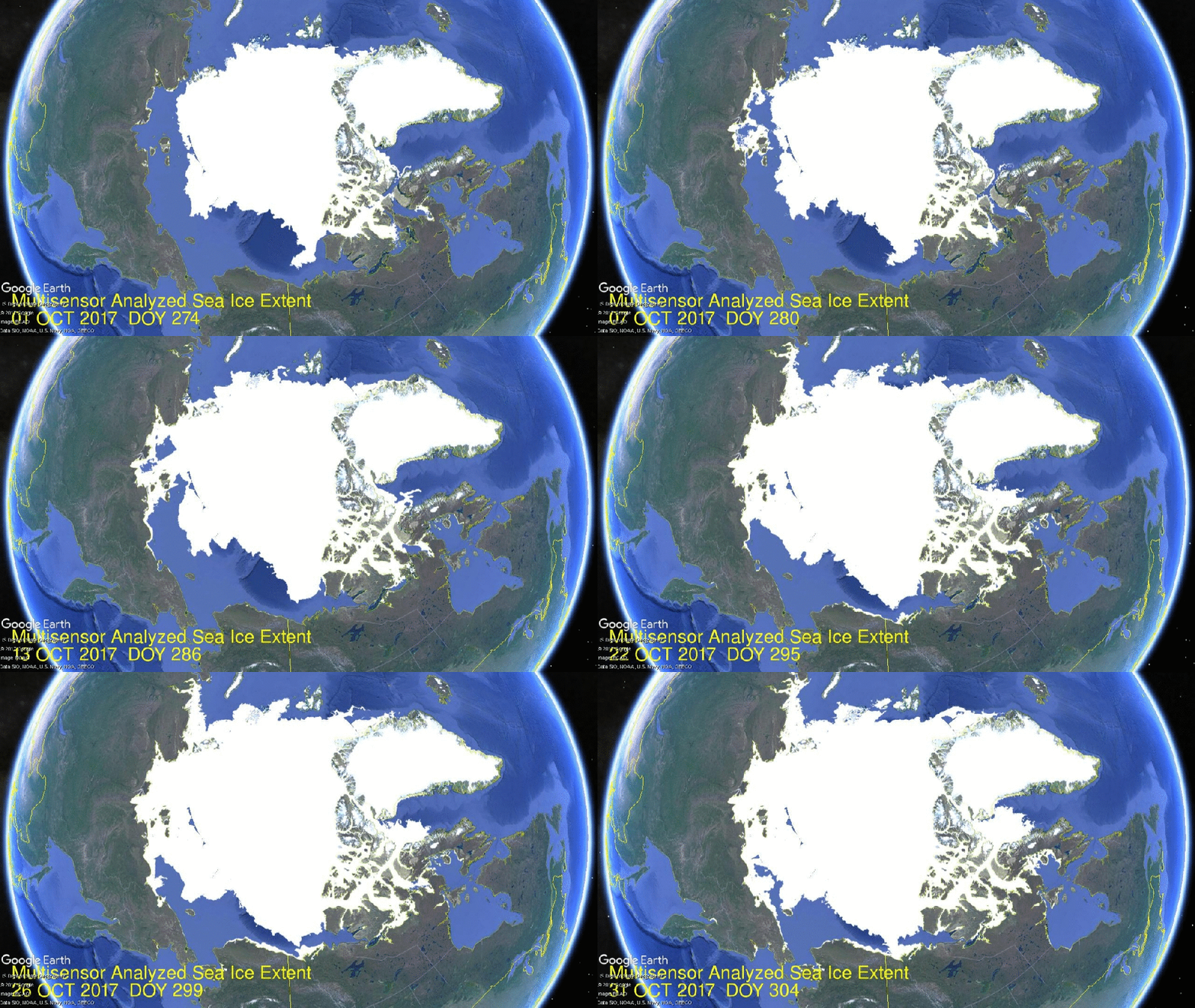
Click on image to enlarge.

The table shows ice extents in the regions for 2017, 10 year averages and 2016 for day 304. Decadal averages refer to 2007 through 2016 inclusive.

Region 2017304 Day 304
Average
2017-Ave. 2016304 2017-2016
 (0) Northern_Hemisphere 8428497 8573788 -145291 7185945 1242552
 (1) Beaufort_Sea 887831 951687 -63856 783272 104559
 (2) Chukchi_Sea 417848 482569 -64721 302185 115663
 (3) East_Siberian_Sea 983865 951426 32439 594464 389401
 (4) Laptev_Sea 897755 895915 1840 897039 717
 (5) Kara_Sea 444222 480151 -35929 129998 314224
 (6) Barents_Sea 70256 87612 -17355 13373 56883
 (7) Greenland_Sea 311020 418465 -107445 317193 -6173
 (8) Baffin_Bay_Gulf_of_St._Lawrence 359489 254836 104653 195003 164486
 (9) Canadian_Archipelago 777359 782350 -4990 728887 48473
 (10) Hudson_Bay 94614 76344 18270 71839 22775
 (11) Central_Arctic 3166490 3180626 -14136 3143363 23127

NH extent is slightly below average due to deficits in Beaufort and Chukchi.  East Siberian is growing while Laptev is maxed out. Other seas are around average except for Greenland Sea down, offset by Baffin Bay being up.

Summary

Earlier observations showed that Arctic ice extents were low in the 1940s, grew thereafter up to a peak in 1977, before declining.  That decline was gentle until 1994 which started a decade of multi-year ice loss through the Fram Strait.  There was also a major earthquake under the north pole in that period.  In any case, the effects and the decline ceased in 2007, 30 years after the previous peak.  Now we have a plateau in ice extents, which could be the precursor of a growing phase of the quasi-60 year Arctic ice oscillation.

Background on MASIE Data Sources

MASIE reports are generated by National Ice Center from the Interactive Multisensor Snow and Ice Mapping System (IMS). From the documentation, the multiple sources feeding IMS are:

Platform(s) AQUA, DMSP, DMSP 5D-3/F17, GOES-10, GOES-11, GOES-13, GOES-9, METEOSAT, MSG, MTSAT-1R, MTSAT-2, NOAA-14, NOAA-15, NOAA-16, NOAA-17, NOAA-18, NOAA-N, RADARSAT-2, SUOMI-NPP, TERRA

Sensor(s): AMSU-A, ATMS, AVHRR, GOES I-M IMAGER, MODIS, MTSAT 1R Imager, MTSAT 2 Imager, MVIRI, SAR, SEVIRI, SSM/I, SSMIS, VIIRS

Summary: IMS Daily Northern Hemisphere Snow and Ice Analysis

The National Oceanic and Atmospheric Administration / National Environmental Satellite, Data, and Information Service (NOAA/NESDIS) has an extensive history of monitoring snow and ice coverage.Accurate monitoring of global snow/ice cover is a key component in the study of climate and global change as well as daily weather forecasting.

The Polar and Geostationary Operational Environmental Satellite programs (POES/GOES) operated by NESDIS provide invaluable visible and infrared spectral data in support of these efforts. Clear-sky imagery from both the POES and the GOES sensors show snow/ice boundaries very well; however, the visible and infrared techniques may suffer from persistent cloud cover near the snowline, making observations difficult (Ramsay, 1995). The microwave products (DMSP and AMSR-E) are unobstructed by clouds and thus can be used as another observational platform in most regions. Synthetic Aperture Radar (SAR) imagery also provides all-weather, near daily capacities to discriminate sea and lake ice. With several other derived snow/ice products of varying accuracy, such as those from NCEP and the NWS NOHRSC, it is highly desirable for analysts to be able to interactively compare and contrast the products so that a more accurate composite map can be produced.

The Satellite Analysis Branch (SAB) of NESDIS first began generating Northern Hemisphere Weekly Snow and Ice Cover analysis charts derived from the visible satellite imagery in November, 1966. The spatial and temporal resolutions of the analysis (190 km and 7 days, respectively) remained unchanged for the product’s 33-year lifespan.

As a result of increasing customer needs and expectations, it was decided that an efficient, interactive workstation application should be constructed which would enable SAB to produce snow/ice analyses at a higher resolution and on a daily basis (~25 km / 1024 x 1024 grid and once per day) using a consolidated array of new as well as existing satellite and surface imagery products. The Daily Northern Hemisphere Snow and Ice Cover chart has been produced since February, 1997 by SAB meteorologists on the IMS.

Another large resolution improvement began in early 2004, when improved technology allowed the SAB to begin creation of a daily ~4 km (6144×6144) grid. At this time, both the ~4 km and ~24 km products are available from NSIDC with a slight delay. Near real-time gridded data is available in ASCII format by request.

In March 2008, the product was migrated from SAB to the National Ice Center (NIC) of NESDIS. The production system and methodology was preserved during the migration. Improved access to DMSP, SAR, and modeled data sources is expected as a short-term from the migration, with longer term plans of twice daily production, GRIB2 output format, a Southern Hemisphere analysis, and an expanded suite of integrated snow and ice variable on horizon.

http://www.natice.noaa.gov/ims/ims_1.html

Footnote

Some people unhappy with the higher amounts of ice extent shown by MASIE continue to claim that Sea Ice Index is the only dataset that can be used. This is false in fact and in logic. Why should anyone accept that the highest quality picture of ice day to day has no shelf life, that one year’s charts can not be compared with another year? Researchers do this, including Walt Meier in charge of Sea Ice Index. That said, I understand his interest in directing people to use his product rather than one he does not control. As I have said before:

MASIE is rigorous, reliable, serves as calibration for satellite products, and continues the long and honorable tradition of naval ice charting using modern technologies. More on this at my post Support MASIE Arctic Ice Dataset

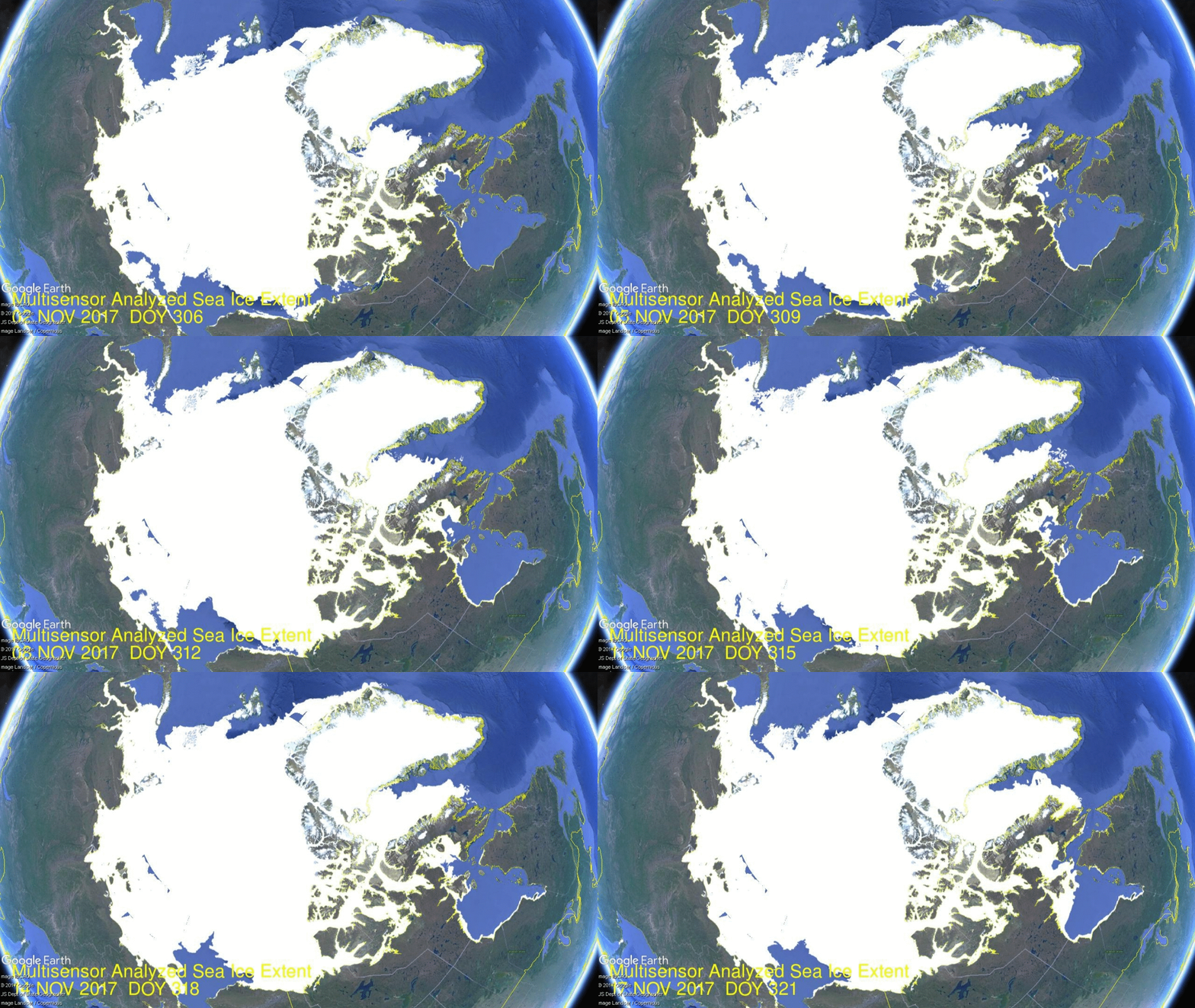
 

Arctic Seas Filling with Ice

click on image to enlarge.

Extents expanded rapidly during the last 12 days of October through yesterday, especially on the Eurasian side.   At the top center Laptev Sea fills in completely, and to the left East Siberian Sea is also growing solid ice toward East Asia. Kara sea on the right is growing fast ice from the shore outward, while Barents Sea fills in from the central Arctic.

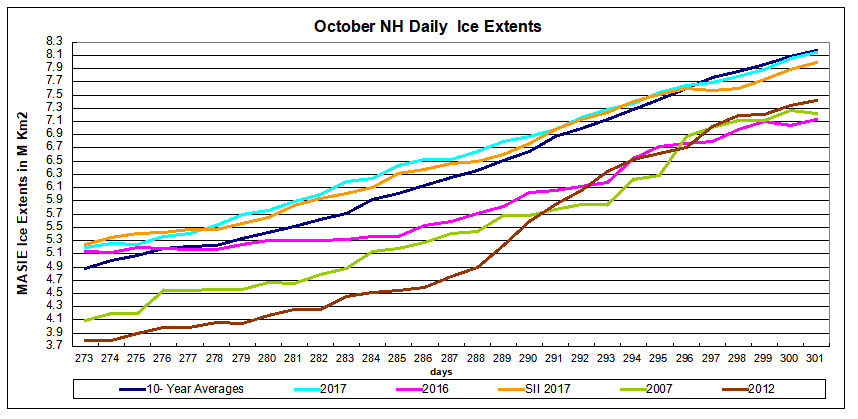
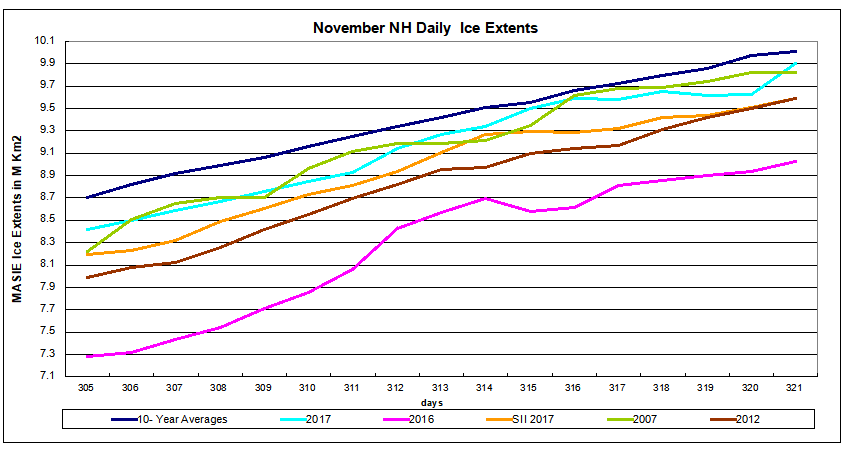
The graph compares extents over the 28 days of October.
2017 has surpassed 8.1M km2, close to the 10 year average, and 700k km2 more than 2012.  2007 lags 925k km2 lower than 2017, while 2016 is 1M km2 behind.  At this point MASIE and SII are showing similar ice gains in October, tracking the 10-year average.

The Table below shows where ice is located on day 301 in regions of the Arctic ocean. 10 year average comes from 2007 through 2016 inclusive.

Region 2017301 Day 301
Average
2017-Ave. 2007301 2017-2007
 (0) Northern_Hemisphere 8144166 8170174 -26008 7217625 926541
 (1) Beaufort_Sea 866727 897500 -30773 933022 -66295
 (2) Chukchi_Sea 374051 451466 -77415 202567 171484
 (3) East_Siberian_Sea 915679 872509 43170 327344 588336
 (4) Laptev_Sea 897755 876350 21406 885761 11995
 (5) Kara_Sea 444927 384807 60120 243253 201674
 (6) Barents_Sea 99229 59612 39617 27244 71985
 (7) Greenland_Sea 280222 416824 -136602 433620 -153398
 (8) Baffin_Bay_Gulf_of_St._Lawrence 284534 221179 63355 179395 105139
 (9) Canadian_Archipelago 763764 754817 8947 739551 24213
 (10) Hudson_Bay 36124 66028 -29904 54271 -18147
 (11) Central_Arctic 3169661 3160785 8876 3190324 -20663

The deficits to average are mainly in Chukchi and Greenland Seas, while surpluses are large on Eurasian side from East Siberian, through Laptev, Kara and Barents.  Baffin Bay is also ahead of average.

Halloween is Coming!

Footnote

Some people unhappy with the higher amounts of ice extent shown by MASIE continue to claim that Sea Ice Index is the only dataset that can be used. This is false in fact and in logic. Why should anyone accept that the highest quality picture of ice day to day has no shelf life, that one year’s charts can not be compared with another year? Researchers do this analysis, including Walt Meier in charge of Sea Ice Index. That said, I understand his interest in directing people to use his product rather than one he does not control. As I have said before:

MASIE is rigorous, reliable, serves as calibration for satellite products, and uses modern technologies to continue the long and honorable tradition of naval ice charting.  More on this at my post Support MASIE Arctic Ice Dataset
Note:  Sea Ice Index (SII) is reporting extents according to version 3.0 as of October 20, 2017. Details at:
Sea Ice Index Updates to v.3.0

Footnote on MASIE Data Sources: 

National Ice Center (NIC) produces ice charts using the Interactive Multisensor Snow and Ice Mapping System (IMS). From the documentation, the multiple sources feeding IMS are:

Platform(s) AQUA, DMSP, DMSP 5D-3/F17, GOES-10, GOES-11, GOES-13, GOES-9, METEOSAT, MSG, MTSAT-1R, MTSAT-2, NOAA-14, NOAA-15, NOAA-16, NOAA-17, NOAA-18, NOAA-N, RADARSAT-2, SUOMI-NPP, TERRA

Sensor(s): AMSU-A, ATMS, AVHRR, GOES I-M IMAGER, MODIS, MTSAT 1R Imager, MTSAT 2 Imager, MVIRI, SAR, SEVIRI, SSM/I, SSMIS, VIIRS

Historical Summary: IMS Daily Northern Hemisphere Snow and Ice Analysis

The National Oceanic and Atmospheric Administration / National Environmental Satellite, Data, and Information Service (NOAA/NESDIS) has an extensive history of monitoring snow and ice coverage.Accurate monitoring of global snow/ice cover is a key component in the study of climate and global change as well as daily weather forecasting.

The Polar and Geostationary Operational Environmental Satellite programs (POES/GOES) operated by NESDIS provide invaluable visible and infrared spectral data in support of these efforts. Clear-sky imagery from both the POES and the GOES sensors show snow/ice boundaries very well; however, the visible and infrared techniques may suffer from persistent cloud cover near the snowline, making observations difficult (Ramsay, 1995). The microwave products (DMSP and AMSR-E) are unobstructed by clouds and thus can be used as another observational platform in most regions. Synthetic Aperture Radar (SAR) imagery also provides all-weather, near daily capacities to discriminate sea and lake ice. With several other derived snow/ice products of varying accuracy, such as those from NCEP and the NWS NOHRSC, it is highly desirable for analysts to be able to interactively compare and contrast the products so that a more accurate composite map can be produced.

The Satellite Analysis Branch (SAB) of NESDIS first began generating Northern Hemisphere Weekly Snow and Ice Cover analysis charts derived from the visible satellite imagery in November, 1966. The spatial and temporal resolutions of the analysis (190 km and 7 days, respectively) remained unchanged for the product’s 33-year lifespan.

As a result of increasing customer needs and expectations, it was decided that an efficient, interactive workstation application should be constructed which would enable SAB to produce snow/ice analyses at a higher resolution and on a daily basis (~25 km / 1024 x 1024 grid and once per day) using a consolidated array of new as well as existing satellite and surface imagery products. The Daily Northern Hemisphere Snow and Ice Cover chart has been produced since February, 1997 by SAB meteorologists on the IMS.

Another large resolution improvement began in early 2004, when improved technology allowed the SAB to begin creation of a daily ~4 km (6144×6144) grid. At this time, both the ~4 km and ~24 km products are available from NSIDC with a slight delay. Near real-time gridded data is available in ASCII format by request.

In March 2008, the product was migrated from SAB to the National Ice Center (NIC) of NESDIS. The production system and methodology was preserved during the migration. Improved access to DMSP, SAR, and modeled data sources is expected as a short-term from the migration, with longer term plans of twice daily production, GRIB2 output format, a Southern Hemisphere analysis, and an expanded suite of integrated snow and ice variable on horizon.

http://www.natice.noaa.gov/ims/ims_1.html


Snowing and Freezing in the Arctic

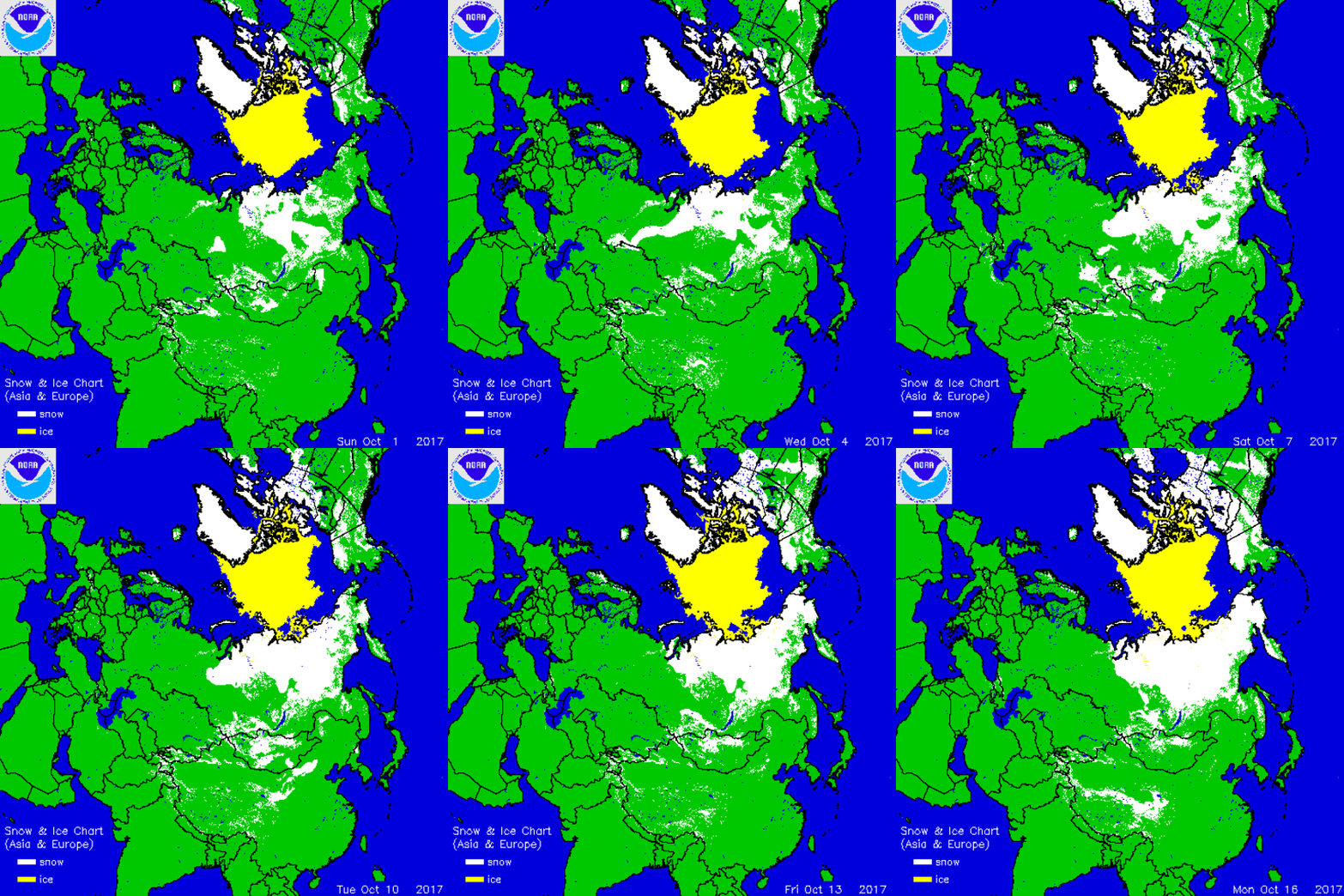
The image from IMS shows snow and ice on day 296 (yesterday) 2007 to 2017, with focus on Eurasia but also showing Canada and Alaska.  You can see that low Arctic ice years, like 2007, 2012 and 2016 have a smaller snow extent on both sides of the Arctic.  Conversely, higher Arctic ice years like 2013, 2014 and 2015 show snow spreading into northern Europe, as well as Alaska.  The pattern appears as gaining snow and ice 2008 to 10, losing 2011 and 2012, then regaining 2013 to 15, before retreating in 2016.  So far 2017 is looking more like 2013 to 15.

From Post Natural Climate Factors: Snow 

Previously I posted an explanation by Dr. Judah Cohen regarding a correlation between autumn Siberian snow cover and the following winter conditions, not only in the Arctic but extending across the Northern Hemisphere. More recently, in looking into Climate Model Upgraded: INMCM5, I noticed some of the scientists were also involved in confirming the importance of snow cover for climate forecasting. Since the poles function as the primary vents for global cooling, what happens in the Arctic in no way stays in the Arctic. This post explores data suggesting changes in snow cover drive some climate changes.

The Snow Cover Climate Factor

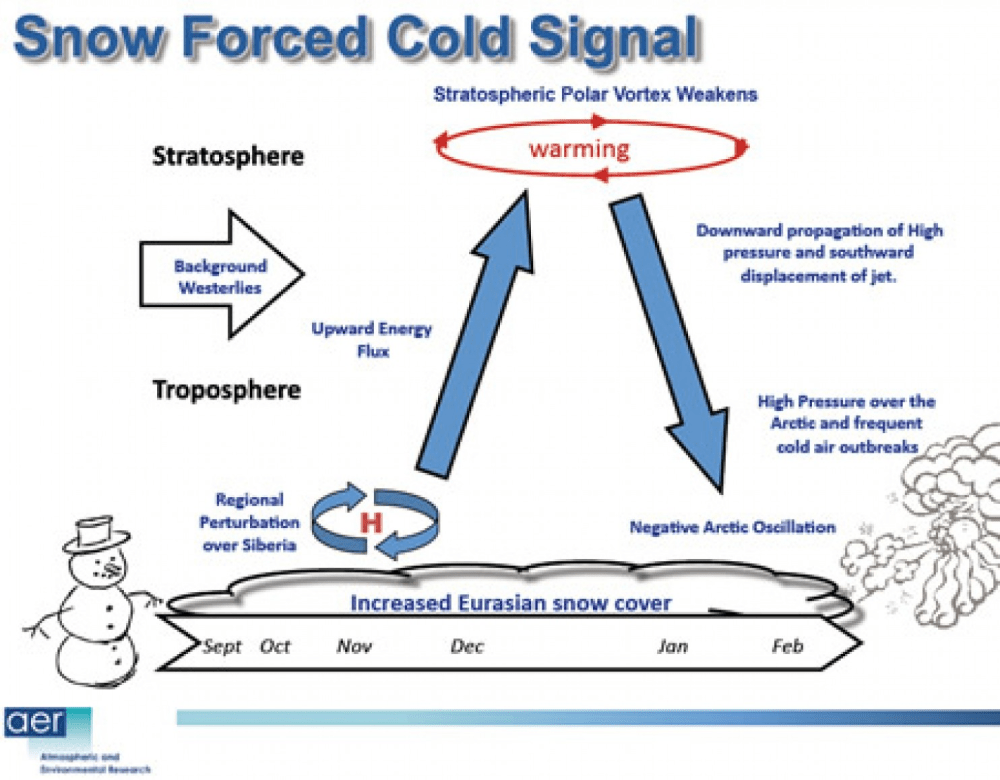
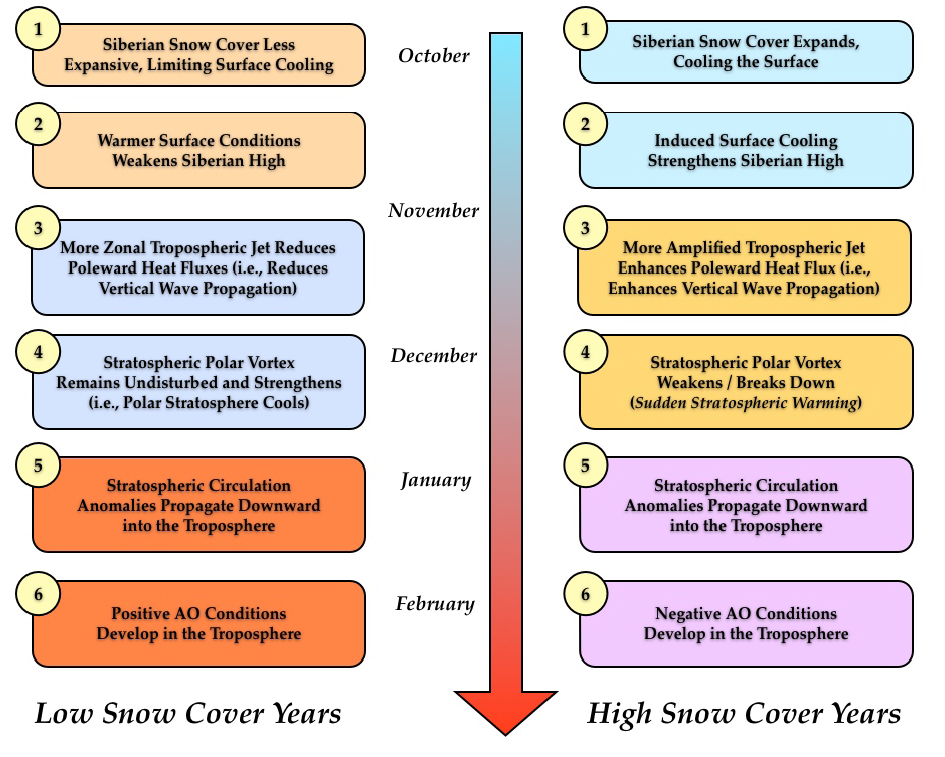
The diagram represents how Dr. judah Cohen pictures the Northern Hemisphere wintertime climate system.  He leads research regarding Arctic and NH weather patterns for AER.

cohen-schematic2

Dr. Cohen explains the mechanism in this diagram.

Conceptual model for how fall snow cover modifies winter circulation in both the stratosphere and the troposphere–The case for low snow cover on left; the case for extensive snow cover on right.

1. Snow cover increases rapidly in the fall across Siberia, when snow cover is above normal diabatic cooling helps to;
2. Strengthen the Siberian high and leads to below normal temperatures.
3. Snow forced diabatic cooling in proximity to high topography of Asia increases upward flux of energy in the troposphere, which is absorbed in the stratosphere.
4. Strong convergence of WAF (Wave Activity Flux) indicates higher geopotential heights.
5. A weakened polar vortex and warmer down from the stratosphere into the troposphere all the way to the surface.
6. Dynamic pathway culminates with strong negative phase of the Arctic Oscillation at the surface.

From Eurasian Snow Cover Variability and Links with Stratosphere-Troposphere
Coupling and Their Potential Use in Seasonal to Decadal Climate Predictions by Judah Cohen.

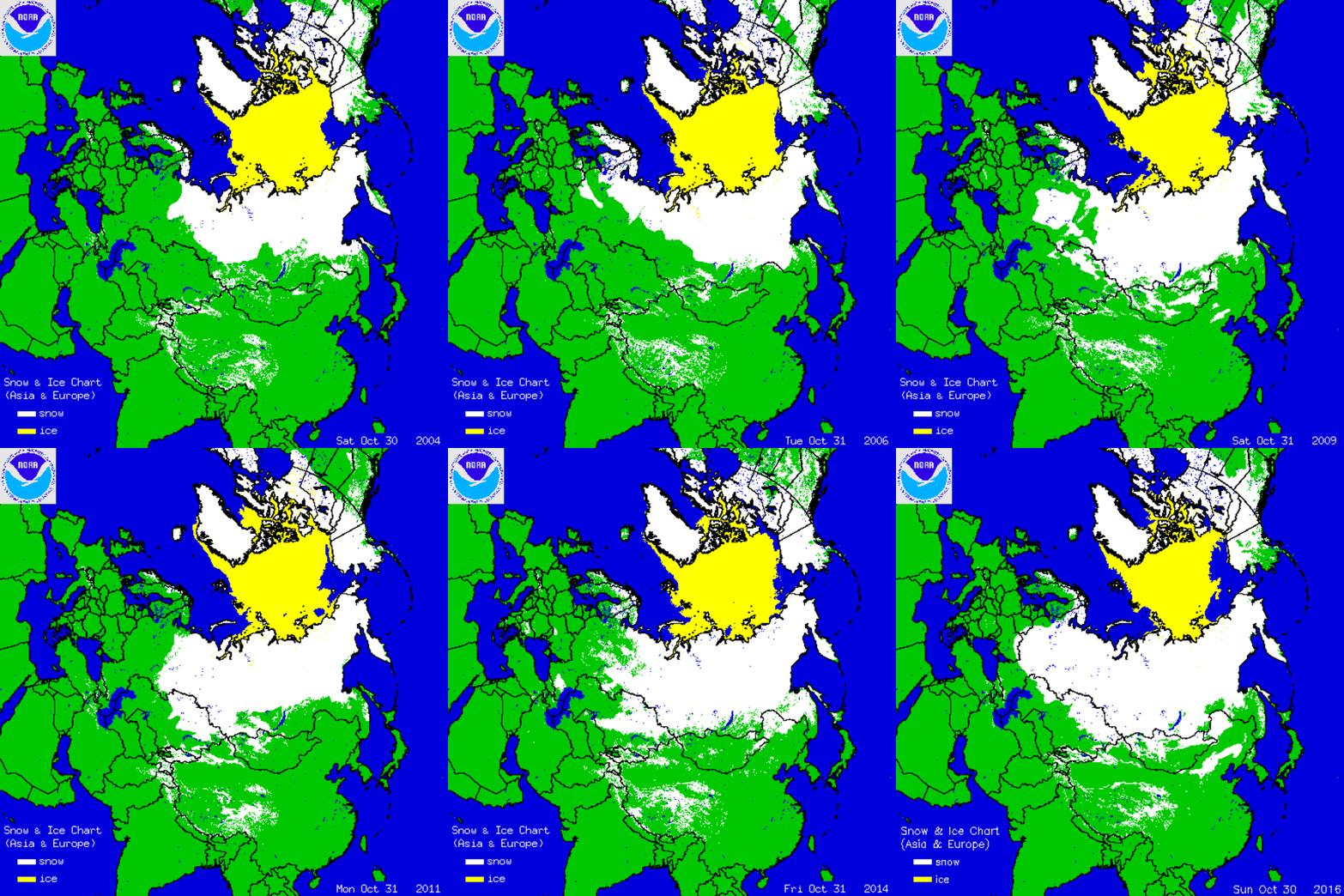
Variations in Siberian snow cover October (day 304) 2004 to 2016. Eurasian snow charts from IMS.

Observations of the Snow Climate Factor

For several decades the IMS snow cover images have been digitized to produce a numerical database for NH snow cover, including area extents for Eurasia. The NOAA climate data record of Northern Hemisphere snow cover extent, Version 1, is archived and distributed by NCDC’s satellite Climate Data Record Program. The CDR is forward processed operationally every month, along with figures and tables made available at Rutgers University Global Snow Lab.

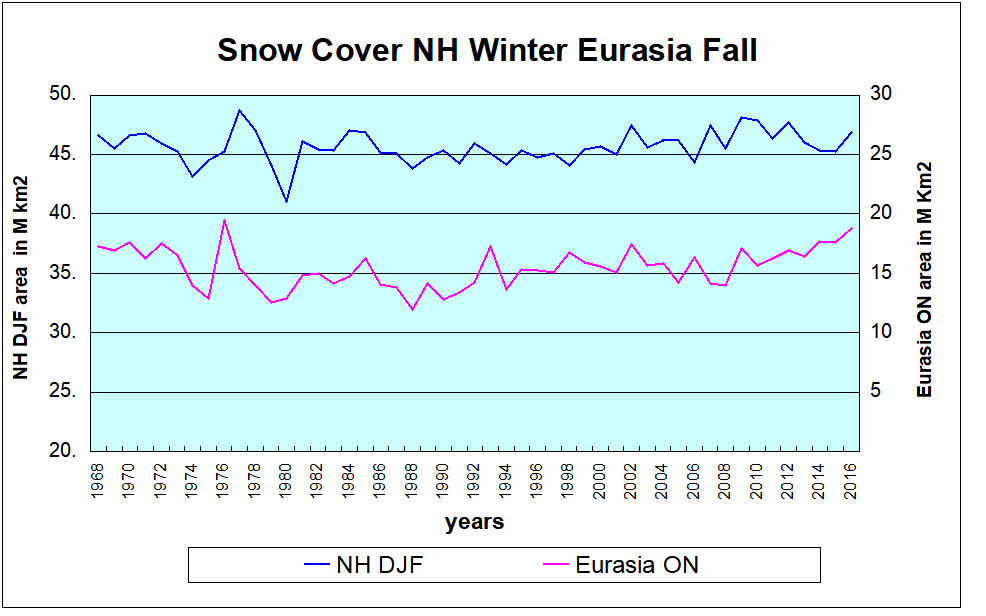
This first graph shows the snow extents of interest in Dr. Cohen’s paradigm. The Autumn snow area in Siberia is represented by the annual Eurasian averages of the months of October and November (ON). The following NH Winter is shown as the average snow area for December, January and February (DJF). Thus the year designates the December of that year plus the first two months of the next year.

Notes: NH snow cover minimum was 1981, trending upward since.  Siberian autumn snow cover was lowest in 1989, increasing since then.  Autumn Eurasian snow cover is about 1/3 of Winter NH snow area. Note also that fluctuations are sizable and correlated.

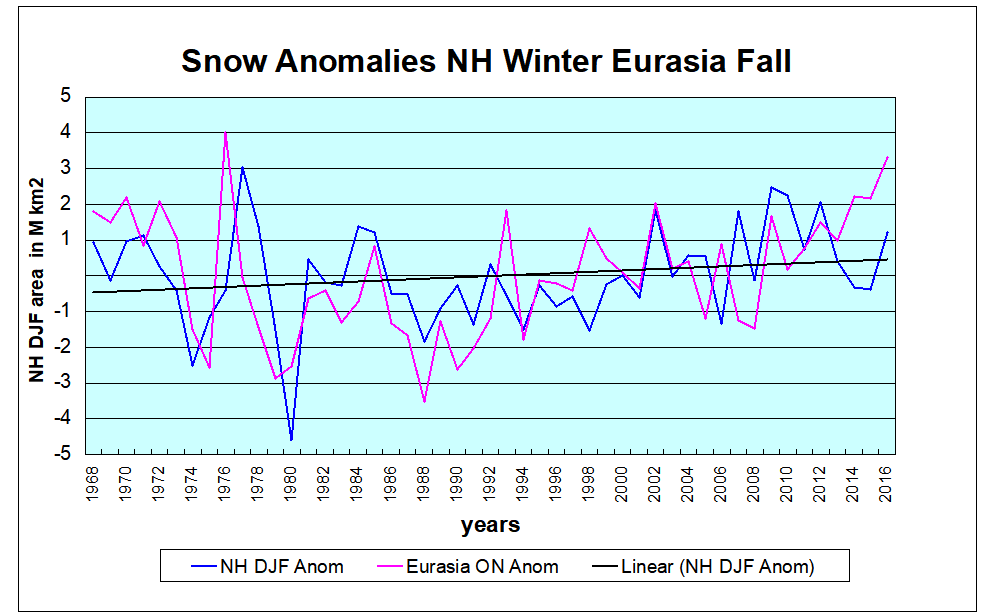
The second graph presents annual anomalies for the two series, each calculated as the deviation from the mean of its entire time series. Strikingly, the Eurasian Autumn flux is on the same scale as total NH flux, and closely aligned. While NH snow cover declined a few years prior to 2016, Eurasian snow is trending upward strongly.  If Dr. Cohen is correct, NH snowfall will follow. The linear trend is slightly positive, suggesting that fears of children never seeing snowfall have been exaggerated. The Eurasian trend line (not shown) is almost the same.

What About Winter 2017-2018?

These data confirm that Dr. Cohen and colleagues are onto something. Here are excerpts from his October 2 outlook for the upcoming season AER. (my bolds)

The main block/high pressure feature influencing Eurasian weather is currently centered over the Barents-Kara Seas and is predicted to first weaken and then strengthen over the next two weeks.

Blocking in the Barents-Kara Seas favors troughing/negative geopotential height anomalies and cool temperatures downstream over Eurasia but especially Central and East Asia. The forecast for the next two weeks across Central Asia is for continuation of overall below normal temperatures and new snowfall.

Currently the largest negative anomalies in sea ice extent are in the Chukchi and Beaufort Seas but that will change over the next month or so during the critical months of November-February. In my opinion low Arctic sea ice favors a more severe winter but not necessarily hemisphere-wide and depends on the regions of the strongest anomalies. Strong negative departures in the Barents-Kara Seas favors cold temperatures in Asia while strong negative departures near Greenland and/or the Beaufort Sea favor cold temperatures in eastern North America.

Siberian snow cover is advancing quickly relative to climatology and is on a pace similar to last year at this time. My, along with my colleagues and others, research has shown that extensive Siberian snow cover in the fall favors a trough across East Asia with a ridge to the west near the Urals. The atmospheric circulation pattern favors more active poleward heat flux, a weaker PV and cold temperatures across the NH. It is very early in the snow season but recent falls have been snowy across Siberia and therefore I do expect another upcoming snowy fall across Siberia.

Summary

In summary the three main predictors that I follow in the fall months most closely, the presence or absence of high latitude blocking, Arctic sea ice extent and Siberian snow cover extent all point towards a more severe winter across the continents of the NH.

Uh oh.  Now where did I put away my long johns?

Arctic October Chill Continues

Extents expanded rapidly during the last 13 days of October through yesterday, already gaining back to  reach 50% of March maximum.   On the right side Laptev Sea has filled in completely, and just above it East Siberian Sea is also growing solid ice toward East Asia. Kara sea just below Laptev is growing fast ice from the shore outward. On the left, Canadian Archipelago is now full of ice, with Beaufort spreading toward shore and next to Greenland, Baffin Bay is extending southward.

The graph compares extents over the first 22 days of October.
2017 has reached 7.5 M km2, 100k km2 above the 10 year average, 800k km2 more than 2016 and more than 2012.  2007 lags 1.3M km2 lower than 2017.  At this point MASIE and SII are showing similar ice gains in October, tracking the 10-year average.

The Table below shows where ice is located on day 295 in regions of the Arctic ocean. 10 year average comes from 2007 through 2016 inclusive.

Region 2017295 Day 295
Average
2017-Ave. 2007295 2017-2007
 (0) Northern_Hemisphere 7543438 7431370 112068 6284693 1258745
 (1) Beaufort_Sea 764794 801247 -36453 806764 -41970
 (2) Chukchi_Sea 297001 378182 -81180 135321 161680
 (3) East_Siberian_Sea 737817 777926 -40109 133466 604351
 (4) Laptev_Sea 895187 725836 169351 690628 204559
 (5) Kara_Sea 365187 292669 72518 283333 81854
 (6) Barents_Sea 67973 47903 20070 25377 42597
 (7) Greenland_Sea 243447 401693 -158246 446006 -202559
 (8) Baffin_Bay_Gulf_of_St._Lawrence 224104 145178 78926 90620 133484
 (9) Canadian_Archipelago 747134 680155 66980 576142 170992
 (10) Hudson_Bay 39910 25325 14585 1954 37957
 (11) Central_Arctic 3158019 3151075 6944 3093807 64212

The important deficits to average are in Chukchi and Greenland Seas, while larger surpluses appear in Laptev, Kara, Baffin Bay and Canadian Archipelago. If ice extents continue to grow at the present rate to month end, the October 2017 monthly average will exceed the 10 year October average by several 100k km2.

Halloween is Coming!

Footnote

Some people unhappy with the higher amounts of ice extent shown by MASIE continue to claim that Sea Ice Index is the only dataset that can be used. This is false in fact and in logic. Why should anyone accept that the highest quality picture of ice day to day has no shelf life, that one year’s charts can not be compared with another year? Researchers do this analysis, including Walt Meier in charge of Sea Ice Index. That said, I understand his interest in directing people to use his product rather than one he does not control. As I have said before:

MASIE is rigorous, reliable, serves as calibration for satellite products, and uses modern technologies to continue the long and honorable tradition of naval ice charting.  More on this at my post Support MASIE Arctic Ice Dataset
Note:  Sea Ice Index (SII) is reporting extents according to version 3.0 as of October 20, 2017. Details at:
Sea Ice Index Updates to v.3.0

Footnote on MASIE Data Sources: 

National Ice Center (NIC) produces ice charts using the Interactive Multisensor Snow and Ice Mapping System (IMS). From the documentation, the multiple sources feeding IMS are:

Platform(s) AQUA, DMSP, DMSP 5D-3/F17, GOES-10, GOES-11, GOES-13, GOES-9, METEOSAT, MSG, MTSAT-1R, MTSAT-2, NOAA-14, NOAA-15, NOAA-16, NOAA-17, NOAA-18, NOAA-N, RADARSAT-2, SUOMI-NPP, TERRA

Sensor(s): AMSU-A, ATMS, AVHRR, GOES I-M IMAGER, MODIS, MTSAT 1R Imager, MTSAT 2 Imager, MVIRI, SAR, SEVIRI, SSM/I, SSMIS, VIIRS

Historical Summary: IMS Daily Northern Hemisphere Snow and Ice Analysis

The National Oceanic and Atmospheric Administration / National Environmental Satellite, Data, and Information Service (NOAA/NESDIS) has an extensive history of monitoring snow and ice coverage.Accurate monitoring of global snow/ice cover is a key component in the study of climate and global change as well as daily weather forecasting.

The Polar and Geostationary Operational Environmental Satellite programs (POES/GOES) operated by NESDIS provide invaluable visible and infrared spectral data in support of these efforts. Clear-sky imagery from both the POES and the GOES sensors show snow/ice boundaries very well; however, the visible and infrared techniques may suffer from persistent cloud cover near the snowline, making observations difficult (Ramsay, 1995). The microwave products (DMSP and AMSR-E) are unobstructed by clouds and thus can be used as another observational platform in most regions. Synthetic Aperture Radar (SAR) imagery also provides all-weather, near daily capacities to discriminate sea and lake ice. With several other derived snow/ice products of varying accuracy, such as those from NCEP and the NWS NOHRSC, it is highly desirable for analysts to be able to interactively compare and contrast the products so that a more accurate composite map can be produced.

The Satellite Analysis Branch (SAB) of NESDIS first began generating Northern Hemisphere Weekly Snow and Ice Cover analysis charts derived from the visible satellite imagery in November, 1966. The spatial and temporal resolutions of the analysis (190 km and 7 days, respectively) remained unchanged for the product’s 33-year lifespan.

As a result of increasing customer needs and expectations, it was decided that an efficient, interactive workstation application should be constructed which would enable SAB to produce snow/ice analyses at a higher resolution and on a daily basis (~25 km / 1024 x 1024 grid and once per day) using a consolidated array of new as well as existing satellite and surface imagery products. The Daily Northern Hemisphere Snow and Ice Cover chart has been produced since February, 1997 by SAB meteorologists on the IMS.

Another large resolution improvement began in early 2004, when improved technology allowed the SAB to begin creation of a daily ~4 km (6144×6144) grid. At this time, both the ~4 km and ~24 km products are available from NSIDC with a slight delay. Near real-time gridded data is available in ASCII format by request.

In March 2008, the product was migrated from SAB to the National Ice Center (NIC) of NESDIS. The production system and methodology was preserved during the migration. Improved access to DMSP, SAR, and modeled data sources is expected as a short-term from the migration, with longer term plans of twice daily production, GRIB2 output format, a Southern Hemisphere analysis, and an expanded suite of integrated snow and ice variable on horizon.

http://www.natice.noaa.gov/ims/ims_1.html


Sea Ice Index Updates to v.3.0

In October 2012 Arctic sea ice doubled in extent.

As of October 20, 2017, NOAA@NSIDC Releases Sea Ice Index, Version 3.0

Text below from SII webpage explains the changes in versions.

NOAA@NSIDC is pleased to announce the release of Sea Ice Index Version 3 (V3). V3 changes the way the monthly average area and extent data values are calculated. The way monthly average area and extent images are created remains the same as in V2. All daily data remain the same as in V2.

The V3 method simply averages daily extent values, while the V2 method derived monthly average values from the gridded monthly-average concentration field. The change is in response to questions about what seemed to be an inconsistency between daily and monthly values. When users summed daily values, and then divided by number of days in a month to get a monthly average value, that number was different, and sometimes quite different, from the monthly average numbers we presented. Both the V2 and V3 methodologies are valid and defensible ways of representing passive microwave-derived sea ice concentration data, but the goal of this change is to better match the understanding of the user community as the product evolves through time.

Values will change slightly. V3 monthly average areas are slightly greater than those from V2. Conversely, V3 monthly average extents are slightly less than V2. Trends will change slightly as well. These are small changes, as the following images for March, over the entire time series, illustrate. Extent is on the left and area is on the right. Windnagel et al. (2017) offers additional analysis on why V3 areas are higher than V2 and V3 extents are lower than V2, along with a simple example. With the update to V3, there are no considerable differences in conclusions that can be made about the overall trends in sea ice area or extent.

Details are in this report: Sea Ice Index Version 3 Analysis. NSIDC Special Report 19.

The Sea Ice Index version 3 dataset is available here

Background:

Several posts at this blog compare results from MASIE and SII. Walt Meier, head of Sea Ice Index (SII) and colleagues did a comparison of the two datasets, published in October 2015. SII went from version 1 to v.2 in 2016, and then in January 2017 from v.2.0 to v.2.1, with some changes in past values.

One of the biggest discrepancies in the past with previous SII versions arose in the Month of October, and it is timely that version 3.0 appears now. The dataset is now available with past calculations according to v3, and the past can be compared in advance of 2017 monthly results.

For comparison, the graphs below show October monthly averages for MASIE compared to SII v.2 and SII v.3., 2007 through 2016.

Click on image to enlarge.

It seems clear that SIIv.3 is a big improvement relative to MASIE. And as well, October 2017 results are coming in with the two datasets tracking quite closely.

MASIE: “high-resolution, accurate charts of ice conditions”
Walt Meier, NSIDC, October 2015 article in Annals of Glaciology.

Laptev Refreezes in 13 Days

Click on image to enlarge.

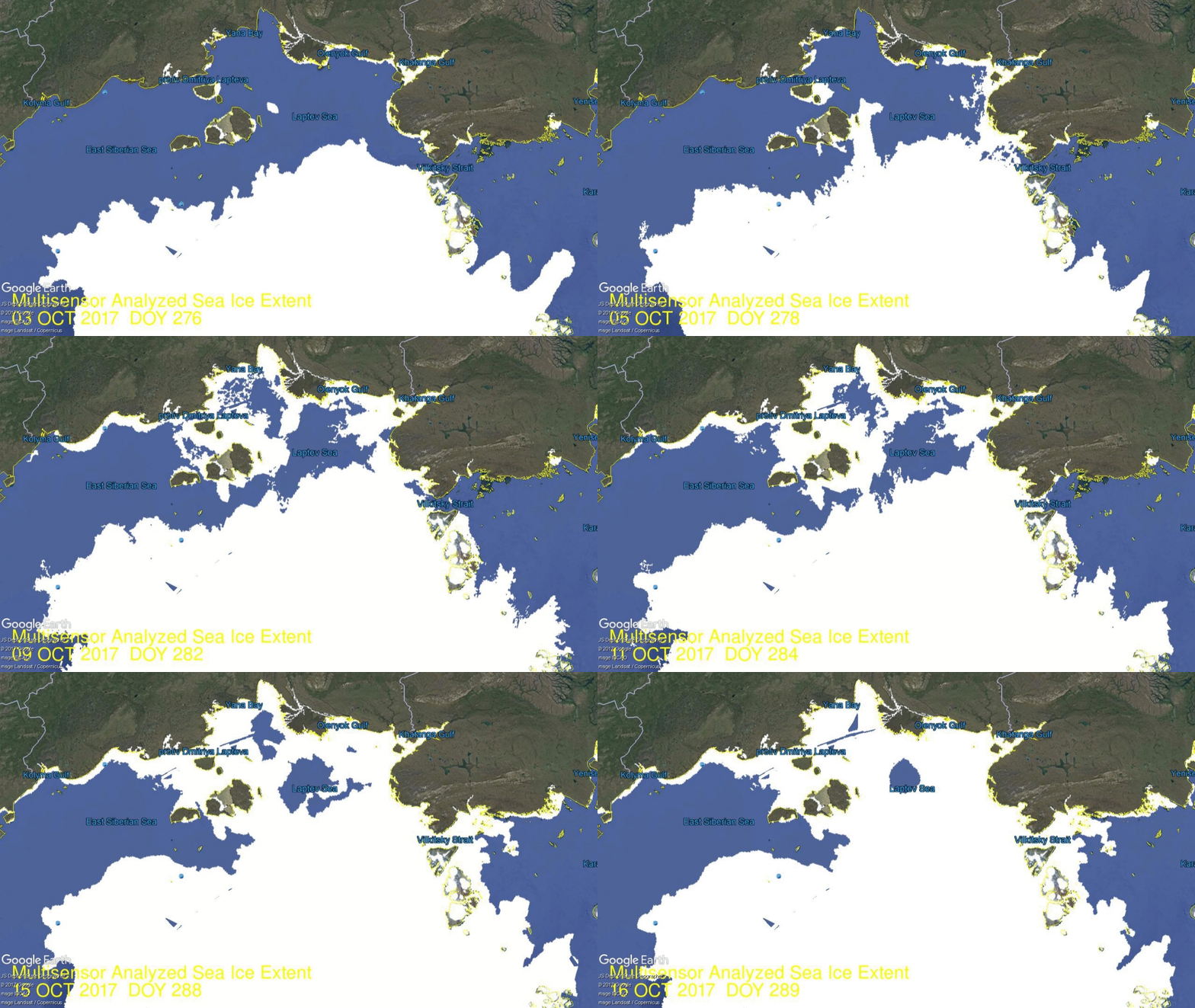
Is Arctic Ice recovering?  Let us count the ways.  In just the last 13 days, Laptev Sea doubled its ice extent from 400k km2 to 870k km2.  That is 97% of its March maximum, leaving only 30k km2 to fill in absolutely.

Then we can observe the Canadian Arctic Archipelago (CAA) adding 200k km2 over the same time frame.

Click on image to enlarge.

The Laptev wall of ice is in place, and the Northwest Passage is full of ice.  The Arctic ocean is now effectively divided into two parts, Pacific and Atlantic sides, with refreezing underway independently.

Update: October 16 Snow and Ice

Yesterday at AER Dr. Judah Cohen provided his Arctic Oscillation and Polar Vortex Analysis and Forecasts biweekly report and outlook regarding the arctic oscillation and the coming winter in Northern Hemisphere. Excerpts with my bolds.

  • As is often the case, the current positive AO is associated with a relatively mild weather pattern across the NH continents including Europe and much of North America.
  • However over the next two weeks with the predicted overall negative trend in the AO a concomitant cooling trend is predicted across the NH continents including the British Isles and Western Europe but especially the Eastern United States (US).
  • Across East Asia troughing will allow a series of fronts to swing through the region keeping temperatures variable but overall close to seasonable.
  • Looking ahead to this upcoming winter, in my opinion both below normal Arctic sea ice and above normal Siberian snow cover so far this month favor more severe winter weather especially mid and late winter across the NH mid-latitudes. Though it is still early and there is much uncertainty in predictions of winter weather.

The flow across the NH is currently mostly zonal especially across North America and this is resulting in an overall mild weather pattern including Europe and the US. The exception to the zonal flow is a block over the Laptev Sea resulting in troughing/negative geopotential height anomalies over both Western and Eastern Asia and colder temperatures.

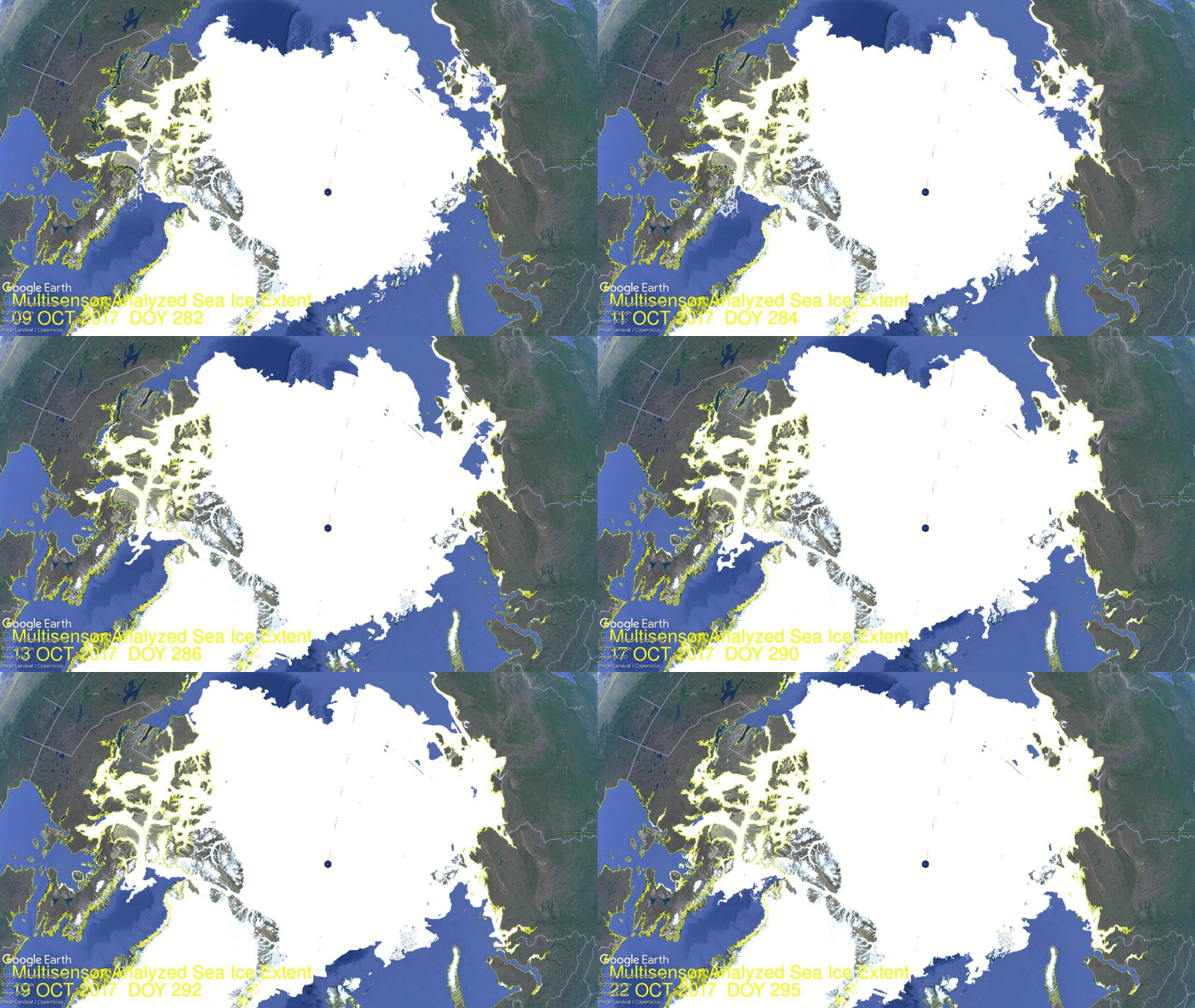
Expanding Eurasian snow cover and Arctic ice extent October 1 to 16, 2017. Watch the ice growing toward the Siberian snow. Also at the top note ice growing toward Canadian snow cover.

Siberian snow cover has advanced at a relatively rapid pace so far this fall, which has been the recent trend. However snow cover extent this October is so far lagging the pace of last October. My, along with my colleagues and others, research have shown that extensive Siberian snow cover in the fall favors a trough across East Asia with a ridge to the west near the Urals. This atmospheric circulation pattern favors more active poleward heat flux, a weaker PV and cold temperatures across the NH.

Strong negative departures in the Barents-Kara Seas favors cold temperatures in Asia while strong negative departures near Greenland and/or the Beaufort Sea favor cold temperatures in eastern North America. However sea ice is currently more extensive in the Barents-Kara-Laptev Seas than last year at this time and even more than two years ago. I believe that low sea ice in the Barents Kara sea the past two winters helped anchor blocking in the region that favored cold temperatures in Eurasia relative to North America. That same forcing may not be as strong for the upcoming winter.

I would conclude that the three factors that I consider favorable for severe winter weather increased atmospheric blocking in the fall, more extensive Siberian snow cover and low Arctic sea ice have become the norm more than the exception over the past decade. I do believe that the lack of variability in these three factors, likely reduces their utility in winter predictions.

From Post Natural Climate Factors: Snow 

Previously I posted an explanation by Dr. Judah Cohen regarding a correlation between autumn Siberian snow cover and the following winter conditions, not only in the Arctic but extending across the Northern Hemisphere. More recently, in looking into Climate Model Upgraded: INMCM5, I noticed some of the scientists were also involved in confirming the importance of snow cover for climate forecasting. Since the poles function as the primary vents for global cooling, what happens in the Arctic in no way stays in the Arctic. This post explores data suggesting changes in snow cover drive some climate changes.

The Snow Cover Climate Factor

The diagram represents how Dr. judah Cohen pictures the Northern Hemisphere wintertime climate system.  He leads research regarding Arctic and NH weather patterns for AER.

cohen-schematic2

Dr. Cohen explains the mechanism in this diagram.

Conceptual model for how fall snow cover modifies winter circulation in both the stratosphere and the troposphere–The case for low snow cover on left; the case for extensive snow cover on right.

1. Snow cover increases rapidly in the fall across Siberia, when snow cover is above normal diabatic cooling helps to;
2. Strengthen the Siberian high and leads to below normal temperatures.
3. Snow forced diabatic cooling in proximity to high topography of Asia increases upward flux of energy in the troposphere, which is absorbed in the stratosphere.
4. Strong convergence of WAF (Wave Activity Flux) indicates higher geopotential heights.
5. A weakened polar vortex and warmer down from the stratosphere into the troposphere all the way to the surface.
6. Dynamic pathway culminates with strong negative phase of the Arctic Oscillation at the surface.

From Eurasian Snow Cover Variability and Links with Stratosphere-Troposphere
Coupling and Their Potential Use in Seasonal to Decadal Climate Predictions by Judah Cohen.

Variations in Siberian snow cover October (day 304) 2004 to 2016. Eurasian snow charts from IMS.

Observations of the Snow Climate Factor

The animation above shows from remote sensing that Eurasian snow cover fluctuates significantly from year to year, taking the end of October as a key indicator. Snowfall in 2016 was especially early and extensive, 2017 similar but slightly less at this point.

For several decades the IMS snow cover images have been digitized to produce a numerical database for NH snow cover, including area extents for Eurasia. The NOAA climate data record of Northern Hemisphere snow cover extent, Version 1, is archived and distributed by NCDC’s satellite Climate Data Record Program. The CDR is forward processed operationally every month, along with figures and tables made available at Rutgers University Global Snow Lab.

This first graph shows the snow extents of interest in Dr. Cohen’s paradigm. The Autumn snow area in Siberia is represented by the annual Eurasian averages of the months of October and November (ON). The following NH Winter is shown as the average snow area for December, January and February (DJF). Thus the year designates the December of that year plus the first two months of the next year.

Notes: NH snow cover minimum was 1981, trending upward since.  Siberian autumn snow cover was lowest in 1989, increasing since then.  Autumn Eurasian snow cover is about 1/3 of Winter NH snow area. Note also that fluctuations are sizable and correlated.

The second graph presents annual anomalies for the two series, each calculated as the deviation from the mean of its entire time series. Strikingly, the Eurasian Autumn flux is on the same scale as total NH flux, and closely aligned. While NH snow cover declined a few years prior to 2016, Eurasian snow is trending upward strongly.  If Dr. Cohen is correct, NH snowfall will follow. The linear trend is slightly positive, suggesting that fears of children never seeing snowfall have been exaggerated. The Eurasian trend line (not shown) is almost the same.

What About Winter 2017-2018?

These data confirm that Dr. Cohen and colleagues are onto something. Here are excerpts from his October 2 outlook for the upcoming season AER. (my bolds)

The main block/high pressure feature influencing Eurasian weather is currently centered over the Barents-Kara Seas and is predicted to first weaken and then strengthen over the next two weeks.

Blocking in the Barents-Kara Seas favors troughing/negative geopotential height anomalies and cool temperatures downstream over Eurasia but especially Central and East Asia. The forecast for the next two weeks across Central Asia is for continuation of overall below normal temperatures and new snowfall.

Currently the largest negative anomalies in sea ice extent are in the Chukchi and Beaufort Seas but that will change over the next month or so during the critical months of November-February. In my opinion low Arctic sea ice favors a more severe winter but not necessarily hemisphere-wide and depends on the regions of the strongest anomalies. Strong negative departures in the Barents-Kara Seas favors cold temperatures in Asia while strong negative departures near Greenland and/or the Beaufort Sea favor cold temperatures in eastern North America.

Siberian snow cover is advancing quickly relative to climatology and is on a pace similar to last year at this time. My, along with my colleagues and others, research has shown that extensive Siberian snow cover in the fall favors a trough across East Asia with a ridge to the west near the Urals. The atmospheric circulation pattern favors more active poleward heat flux, a weaker PV and cold temperatures across the NH. It is very early in the snow season but recent falls have been snowy across Siberia and therefore I do expect another upcoming snowy fall across Siberia.

Summary

In summary the three main predictors that I follow in the fall months most closely, the presence or absence of high latitude blocking, Arctic sea ice extent and Siberian snow cover extent all point towards a more severe winter across the continents of the NH.

Uh oh.  Now where did I put away my long johns?

Arctic Ice Surges Mid October

Click on image to enlarge.

Consider the refreezing during the first half of October through yesterday, adding an average of 96k km2 per day.   On the left side Laptev Sea has filled in, and just below it East Siberian Sea is also growing fast ice from the shore to meet refreezing drift ice. At the top Kara, Barents and Greenland seas are all growing ice.  At the bottom, Canadian Archipelago is now full of ice.

The graph compares extents over the first 15 days of October.
2017 has reached 6.6 M km2, 300k km2 above the 10 year average, 930k km2 more than 2016.  2007 lags 1.2M km2 behind, and 2012 remains 1.8M km2 lower than 2017.  SII is showing similar ice gains in October.

The Table below shows where ice is located on day 288 in regions of the Arctic ocean. 10 year average comes from 2007 through 2016 inclusive.

Region 2017288 Day 288
Average
2017-Ave. 2007288 2017-2007
 (0) Northern_Hemisphere 6645242 6352329 292913 5431350 1213892
 (1) Beaufort_Sea 622905 719153 -96249 796103 -173198
 (2) Chukchi_Sea 180459 295507 -115048 83354 97105
 (3) East_Siberian_Sea 520320 561740 -41420 30003 490317
 (4) Laptev_Sea 812165 456507 355658 512495 299671
 (5) Kara_Sea 234367 147704 86664 152144 82223
 (6) Barents_Sea 31340 46071 -14731 21459 9881
 (7) Greenland_Sea 212483 354693 -142209 431989 -219506
 (8) Baffin_Bay_Gulf_of_St._Lawrence 148173 85149 63024 86610 61563
 (9) Canadian_Archipelago 714792 570585 144207 447438 267354
 (10) Hudson_Bay 13452 11416 2036 1936 11515
 (11) Central_Arctic 3153628 3102335 51292 2866544 287084

On the Pacific side are deficits to average in BCE (Barents, Chukchi, East Siberian), more than offset by a massive surplus in Laptev, plus Kara next door.  Greenland Sea ice is below average, but again offset by surpluses in CAA, Baffin Bay and Central Arctic.

In recent years, October has seen some rapid recoveries of Arctic ice extents.  But this year may become something special.  With the early onset of Siberian snow cover and the resulting surface cooling, ice is roaring back, especially on the Asian side.

Halloween is Coming!

Footnote

Some people unhappy with the higher amounts of ice extent shown by MASIE continue to claim that Sea Ice Index is the only dataset that can be used. This is false in fact and in logic. Why should anyone accept that the highest quality picture of ice day to day has no shelf life, that one year’s charts can not be compared with another year? Researchers do this analysis, including Walt Meier in charge of Sea Ice Index. That said, I understand his interest in directing people to use his product rather than one he does not control. As I have said before:

MASIE is rigorous, reliable, serves as calibration for satellite products, and uses modern technologies to continue the long and honorable tradition of naval ice charting.  More on this at my post Support MASIE Arctic Ice Dataset

Footnote on MASIE Data Sources: 

National Ice Center (NIC) produces ice charts using the Interactive Multisensor Snow and Ice Mapping System (IMS). From the documentation, the multiple sources feeding IMS are:

Platform(s) AQUA, DMSP, DMSP 5D-3/F17, GOES-10, GOES-11, GOES-13, GOES-9, METEOSAT, MSG, MTSAT-1R, MTSAT-2, NOAA-14, NOAA-15, NOAA-16, NOAA-17, NOAA-18, NOAA-N, RADARSAT-2, SUOMI-NPP, TERRA

Sensor(s): AMSU-A, ATMS, AVHRR, GOES I-M IMAGER, MODIS, MTSAT 1R Imager, MTSAT 2 Imager, MVIRI, SAR, SEVIRI, SSM/I, SSMIS, VIIRS

Historical Summary: IMS Daily Northern Hemisphere Snow and Ice Analysis

The National Oceanic and Atmospheric Administration / National Environmental Satellite, Data, and Information Service (NOAA/NESDIS) has an extensive history of monitoring snow and ice coverage.Accurate monitoring of global snow/ice cover is a key component in the study of climate and global change as well as daily weather forecasting.

The Polar and Geostationary Operational Environmental Satellite programs (POES/GOES) operated by NESDIS provide invaluable visible and infrared spectral data in support of these efforts. Clear-sky imagery from both the POES and the GOES sensors show snow/ice boundaries very well; however, the visible and infrared techniques may suffer from persistent cloud cover near the snowline, making observations difficult (Ramsay, 1995). The microwave products (DMSP and AMSR-E) are unobstructed by clouds and thus can be used as another observational platform in most regions. Synthetic Aperture Radar (SAR) imagery also provides all-weather, near daily capacities to discriminate sea and lake ice. With several other derived snow/ice products of varying accuracy, such as those from NCEP and the NWS NOHRSC, it is highly desirable for analysts to be able to interactively compare and contrast the products so that a more accurate composite map can be produced.

The Satellite Analysis Branch (SAB) of NESDIS first began generating Northern Hemisphere Weekly Snow and Ice Cover analysis charts derived from the visible satellite imagery in November, 1966. The spatial and temporal resolutions of the analysis (190 km and 7 days, respectively) remained unchanged for the product’s 33-year lifespan.

As a result of increasing customer needs and expectations, it was decided that an efficient, interactive workstation application should be constructed which would enable SAB to produce snow/ice analyses at a higher resolution and on a daily basis (~25 km / 1024 x 1024 grid and once per day) using a consolidated array of new as well as existing satellite and surface imagery products. The Daily Northern Hemisphere Snow and Ice Cover chart has been produced since February, 1997 by SAB meteorologists on the IMS.

Another large resolution improvement began in early 2004, when improved technology allowed the SAB to begin creation of a daily ~4 km (6144×6144) grid. At this time, both the ~4 km and ~24 km products are available from NSIDC with a slight delay. Near real-time gridded data is available in ASCII format by request.

In March 2008, the product was migrated from SAB to the National Ice Center (NIC) of NESDIS. The production system and methodology was preserved during the migration. Improved access to DMSP, SAR, and modeled data sources is expected as a short-term from the migration, with longer term plans of twice daily production, GRIB2 output format, a Southern Hemisphere analysis, and an expanded suite of integrated snow and ice variable on horizon.

http://www.natice.noaa.gov/ims/ims_1.html


Arctic Ice 1M km2 Added in 10 days

Click on image to enlarge.

Consider the refreezing during the first 10 days of October through yesterday, adding an average of 100k km2 per day.   On the left side Laptev Sea is filling in, and just below it East Siberian Sea is also growing fast ice from the shore to meet refreezing drift ice. At the top Kara, Barents and Greenland seas are all growing ice.  At the bottom, Canadian Archipelago is now full of ice.

In recent years, October has seen some rapid recoveries of Arctic ice extents.  But this year may become something special.  With the early onset of Siberian snow cover and the resulting surface cooling, ice is roaring back, especially on the Asian side.  From the last decade, only 2013 and 2014 had higher ice extents on day 283.  2017 has matched the refreezing rate of those two years, but started the month lower.

The graph compares extents over the first 10 days of October.
2017 has reached 6.2 M km2, 480k km2 above the 10 year average, 830k km2 more than 2016.  2007 falls 1.3M km2 behind, and 2012 remains 1.7M km2 less than 2017.  SII is showing similar ice gains in October.

Halloween is Coming!

Footnote

Some people unhappy with the higher amounts of ice extent shown by MASIE continue to claim that Sea Ice Index is the only dataset that can be used. This is false in fact and in logic. Why should anyone accept that the highest quality picture of ice day to day has no shelf life, that one year’s charts can not be compared with another year? Researchers do this analysis, including Walt Meier in charge of Sea Ice Index. That said, I understand his interest in directing people to use his product rather than one he does not control. As I have said before:

MASIE is rigorous, reliable, serves as calibration for satellite products, and uses modern technologies to continue the long and honorable tradition of naval ice charting.  More on this at my post Support MASIE Arctic Ice Dataset

Footnote on MASIE Data Sources: 

National Ice Center (NIC) produces ice charts using the Interactive Multisensor Snow and Ice Mapping System (IMS). From the documentation, the multiple sources feeding IMS are:

Platform(s) AQUA, DMSP, DMSP 5D-3/F17, GOES-10, GOES-11, GOES-13, GOES-9, METEOSAT, MSG, MTSAT-1R, MTSAT-2, NOAA-14, NOAA-15, NOAA-16, NOAA-17, NOAA-18, NOAA-N, RADARSAT-2, SUOMI-NPP, TERRA

Sensor(s): AMSU-A, ATMS, AVHRR, GOES I-M IMAGER, MODIS, MTSAT 1R Imager, MTSAT 2 Imager, MVIRI, SAR, SEVIRI, SSM/I, SSMIS, VIIRS

Historical Summary: IMS Daily Northern Hemisphere Snow and Ice Analysis

The National Oceanic and Atmospheric Administration / National Environmental Satellite, Data, and Information Service (NOAA/NESDIS) has an extensive history of monitoring snow and ice coverage.Accurate monitoring of global snow/ice cover is a key component in the study of climate and global change as well as daily weather forecasting.

The Polar and Geostationary Operational Environmental Satellite programs (POES/GOES) operated by NESDIS provide invaluable visible and infrared spectral data in support of these efforts. Clear-sky imagery from both the POES and the GOES sensors show snow/ice boundaries very well; however, the visible and infrared techniques may suffer from persistent cloud cover near the snowline, making observations difficult (Ramsay, 1995). The microwave products (DMSP and AMSR-E) are unobstructed by clouds and thus can be used as another observational platform in most regions. Synthetic Aperture Radar (SAR) imagery also provides all-weather, near daily capacities to discriminate sea and lake ice. With several other derived snow/ice products of varying accuracy, such as those from NCEP and the NWS NOHRSC, it is highly desirable for analysts to be able to interactively compare and contrast the products so that a more accurate composite map can be produced.

The Satellite Analysis Branch (SAB) of NESDIS first began generating Northern Hemisphere Weekly Snow and Ice Cover analysis charts derived from the visible satellite imagery in November, 1966. The spatial and temporal resolutions of the analysis (190 km and 7 days, respectively) remained unchanged for the product’s 33-year lifespan.

As a result of increasing customer needs and expectations, it was decided that an efficient, interactive workstation application should be constructed which would enable SAB to produce snow/ice analyses at a higher resolution and on a daily basis (~25 km / 1024 x 1024 grid and once per day) using a consolidated array of new as well as existing satellite and surface imagery products. The Daily Northern Hemisphere Snow and Ice Cover chart has been produced since February, 1997 by SAB meteorologists on the IMS.

Another large resolution improvement began in early 2004, when improved technology allowed the SAB to begin creation of a daily ~4 km (6144×6144) grid. At this time, both the ~4 km and ~24 km products are available from NSIDC with a slight delay. Near real-time gridded data is available in ASCII format by request.

In March 2008, the product was migrated from SAB to the National Ice Center (NIC) of NESDIS. The production system and methodology was preserved during the migration. Improved access to DMSP, SAR, and modeled data sources is expected as a short-term from the migration, with longer term plans of twice daily production, GRIB2 output format, a Southern Hemisphere analysis, and an expanded suite of integrated snow and ice variable on horizon.

http://www.natice.noaa.gov/ims/ims_1.html


October Arctic Surprise

Click on image to enlarge.

In recent years, October has seen some rapid recoveries of Arctic ice extents.  But this year may become something special.  With the early onset of Siberian snow cover and the resulting surface cooling, ice is roaring back, especially on the Asian side.  Consider the refreezing during the last 11 days through yesterday.

The graph compares extents over the last 10 days.

2017 has reached 5.7M km2, 460k km2 more than the strong 2016 recovery, now tracking the 10 year average.  2007 remains 1.1M km2 behind, and 2012 is 1.7M km2 less than 2017.  SII is showing similar ice gains in October.

Halloween is Coming!

Footnote

Some people unhappy with the higher amounts of ice extent shown by MASIE continue to claim that Sea Ice Index is the only dataset that can be used. This is false in fact and in logic. Why should anyone accept that the highest quality picture of ice day to day has no shelf life, that one year’s charts can not be compared with another year? Researchers do this analysis, including Walt Meier in charge of Sea Ice Index. That said, I understand his interest in directing people to use his product rather than one he does not control. As I have said before:

MASIE is rigorous, reliable, serves as calibration for satellite products, and uses modern technologies to continue the long and honorable tradition of naval ice charting.  More on this at my post Support MASIE Arctic Ice Dataset