Natural Climate Factors: Snow

Variations in Siberian snow cover October (day 304) 2004 to 2016. Eurasian snow charts from IMS.

Previously I posted an explanation by Dr. Judah Cohen regarding a correlation between autumn Siberian snow cover and the following winter conditions, not only in the Arctic but extending across the Northern Hemisphere. More recently, in looking into Climate Model Upgraded: INMCM5, I noticed some of the scientists were also involved in confirming the importance of snow cover for climate forecasting. Since the poles function as the primary vents for global cooling, what happens in the Arctic in no way stays in the Arctic. This post explores data suggesting changes in snow cover drive some climate changes.

The Snow Cover Climate Factor

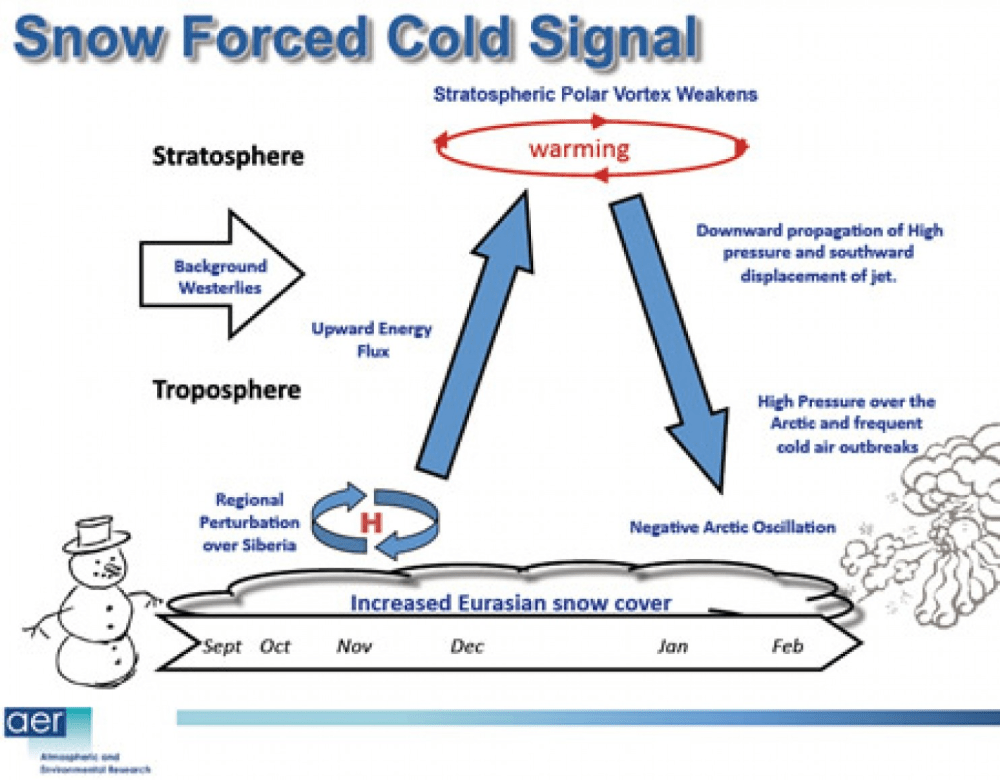
The diagram represents how Dr. judah Cohen pictures the Northern Hemisphere wintertime climate system.  He leads research regarding Arctic and NH weather patterns for AER.

cohen-schematic2

Dr. Cohen explains the mechanism in this diagram.

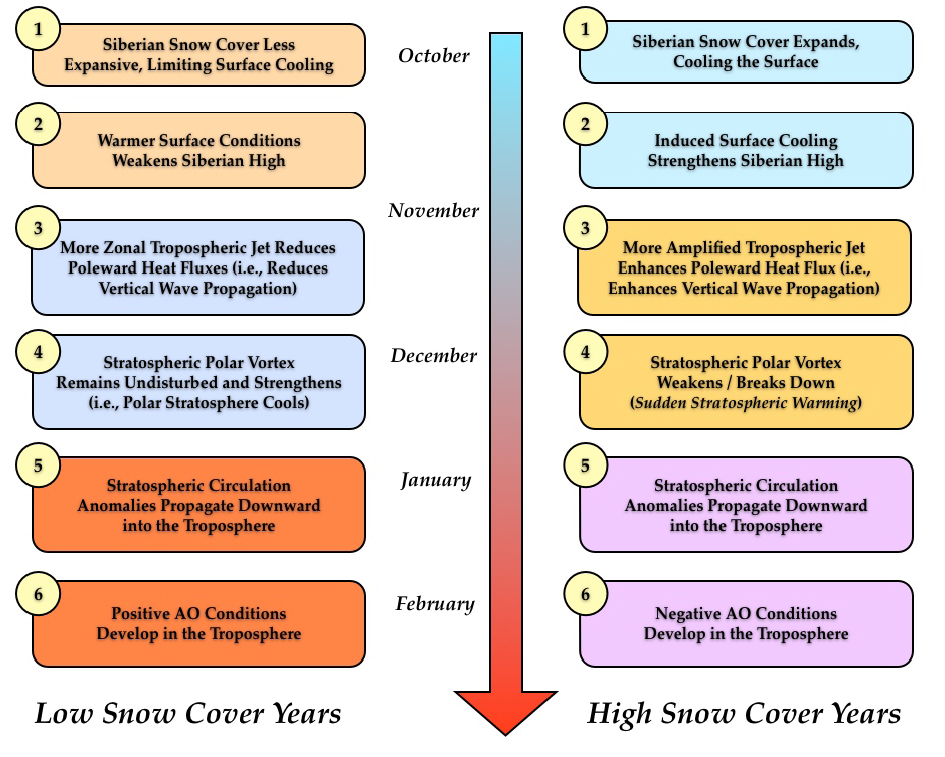
Conceptual model for how fall snow cover modifies winter circulation in both the stratosphere and the troposphere–The case for low snow cover on left; the case for extensive snow cover on right.

1. Snow cover increases rapidly in the fall across Siberia, when snow cover is above normal diabatic cooling helps to;
2. Strengthen the Siberian high and leads to below normal temperatures.
3. Snow forced diabatic cooling in proximity to high topography of Asia increases upward flux of energy in the troposphere, which is absorbed in the stratosphere.
4. Strong convergence of WAF (Wave Activity Flux) indicates higher geopotential heights.
5. A weakened polar vortex and warmer down from the stratosphere into the troposphere all the way to the surface.
6. Dynamic pathway culminates with strong negative phase of the Arctic Oscillation at the surface.

From Eurasian Snow Cover Variability and Links with Stratosphere-Troposphere
Coupling and Their Potential Use in Seasonal to Decadal Climate Predictions by Judah Cohen.

Observations of the Snow Climate Factor

The animation at the top shows from remote sensing that Eurasian snow cover fluctuates significantly from year to year, taking the end of October as a key indicator.

For several decades the IMS snow cover images have been digitized to produce a numerical database for NH snow cover, including area extents for Eurasia. The NOAA climate data record of Northern Hemisphere snow cover extent, Version 1, is archived and distributed by NCDC’s satellite Climate Data Record Program. The CDR is forward processed operationally every month, along with figures and tables made available at Rutgers University Global Snow Lab.

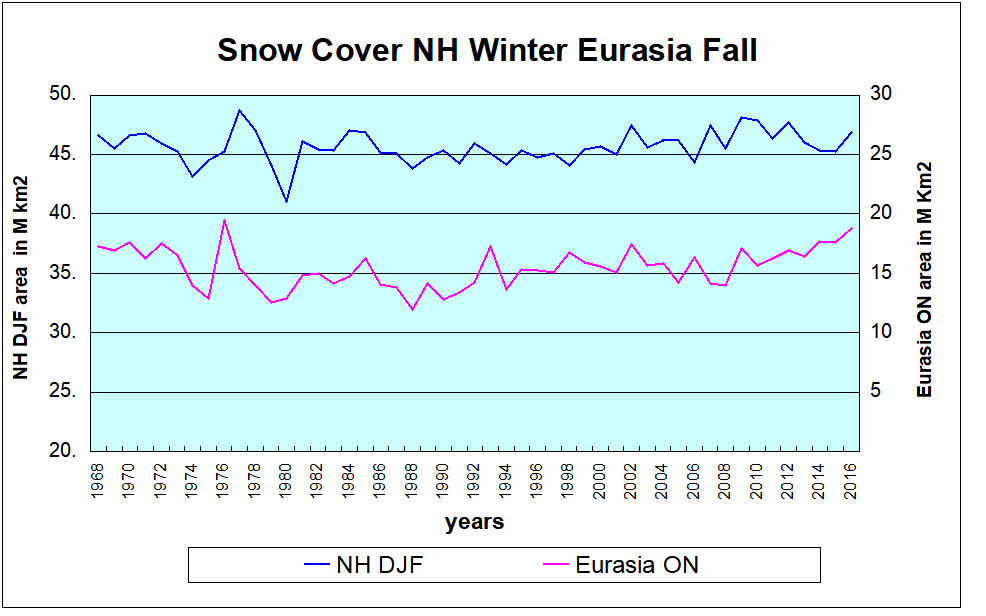
This first graph shows the snow extents of interest in Dr. Cohen’s paradigm. The Autumn snow area in Siberia is represented by the annual Eurasian averages of the months of October and November (ON). The following NH Winter is shown as the average snow area for December, January and February (DJF). Thus the year designates the December of that year plus the first two months of the next year.

Notes: NH snow cover minimum was 1981, trending upward since.  Siberian autumn snow cover was lowest in 1989, increasing since then.  Autumn Eurasian snow cover is about 1/3 of Winter NH snow area. Note also that fluctuations are sizable and correlated.

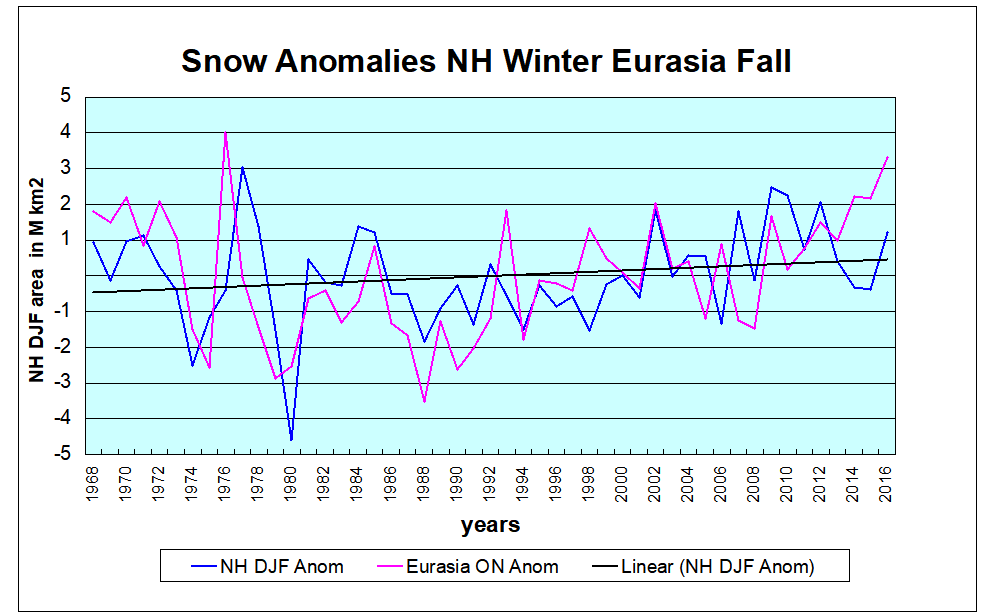
The second graph presents annual anomalies for the two series, each calculated as the deviation from the mean of its entire time series. Strikingly, the Eurasian Autumn flux is on the same scale as total NH flux, and closely aligned. While NH snow cover declined a few years prior to 2016, Eurasian snow is trending upward strongly.  If Dr. Cohen is correct, NH snowfall will follow. The linear trend is slightly positive, suggesting that fears of children never seeing snowfall have been exaggerated. The Eurasian trend line (not shown) is almost the same.

What About Winter 2017-2018?

These data confirm that Dr. Cohen and colleagues are onto something. Here are excerpts from his October 2 outlook for the upcoming season AER. (my bolds)

The main block/high pressure feature influencing Eurasian weather is currently centered over the Barents-Kara Seas and is predicted to first weaken and then strengthen over the next two weeks.

Blocking in the Barents-Kara Seas favors troughing/negative geopotential height anomalies and cool temperatures downstream over Eurasia but especially Central and East Asia. The forecast for the next two weeks across Central Asia is for continuation of overall below normal temperatures and new snowfall.

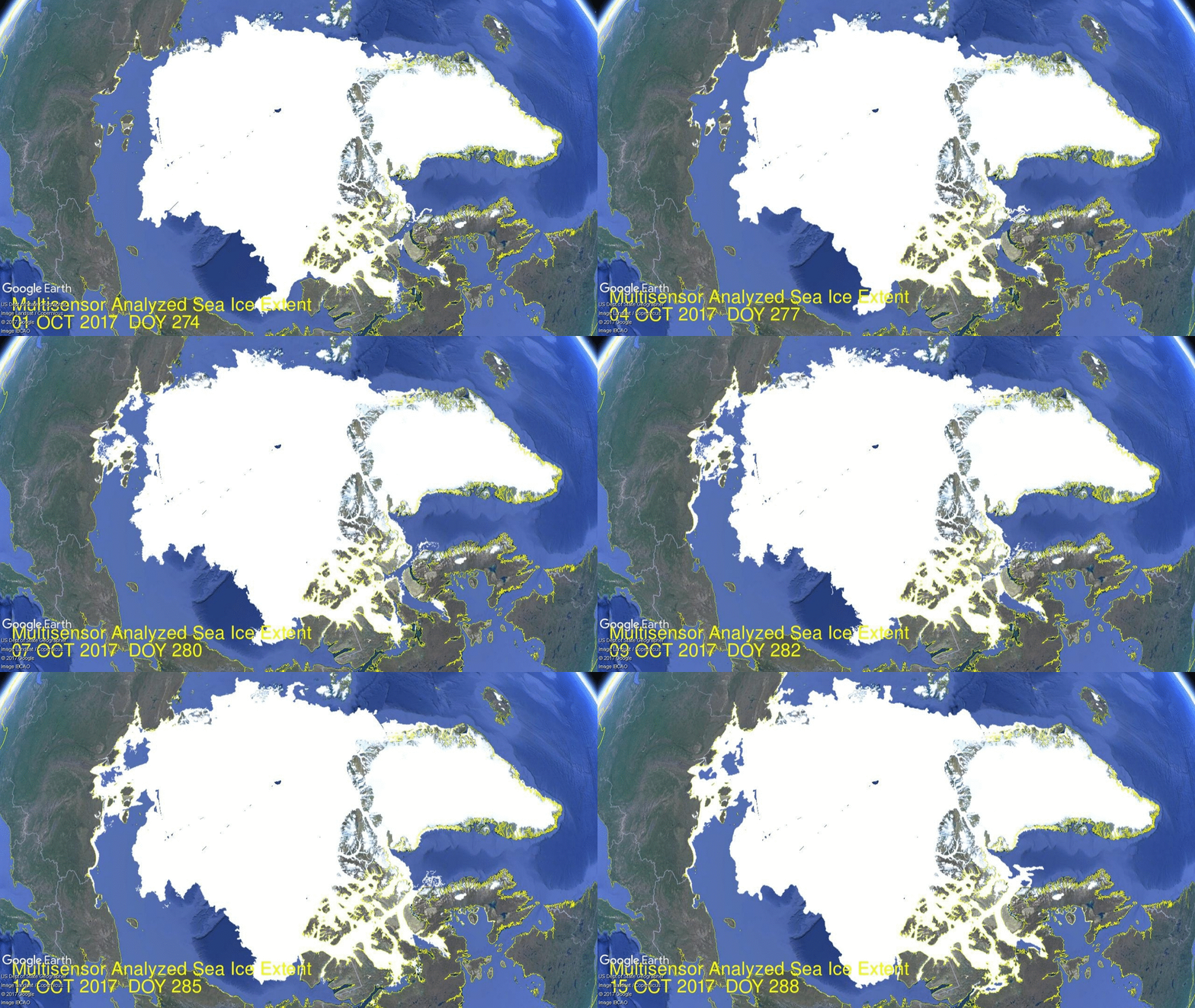
Currently the largest negative anomalies in sea ice extent are in the Chukchi and Beaufort Seas but that will change over the next month or so during the critical months of November-February. In my opinion low Arctic sea ice favors a more severe winter but not necessarily hemisphere-wide and depends on the regions of the strongest anomalies. Strong negative departures in the Barents-Kara Seas favors cold temperatures in Asia while strong negative departures near Greenland and/or the Beaufort Sea favor cold temperatures in eastern North America.

Siberian snow cover is advancing quickly relative to climatology and is on a pace similar to last year at this time. My, along with my colleagues and others, research has shown that extensive Siberian snow cover in the fall favors a trough across East Asia with a ridge to the west near the Urals. The atmospheric circulation pattern favors more active poleward heat flux, a weaker PV and cold temperatures across the NH. It is very early in the snow season but recent falls have been snowy across Siberia and therefore I do expect another upcoming snowy fall across Siberia.

Summary

In summary the three main predictors that I follow in the fall months most closely, the presence or absence of high latitude blocking, Arctic sea ice extent and Siberian snow cover extent all point towards a more severe winter across the continents of the NH.

Uh oh.  Now where did I put away my long johns?

Overachieving September Arctic Ice

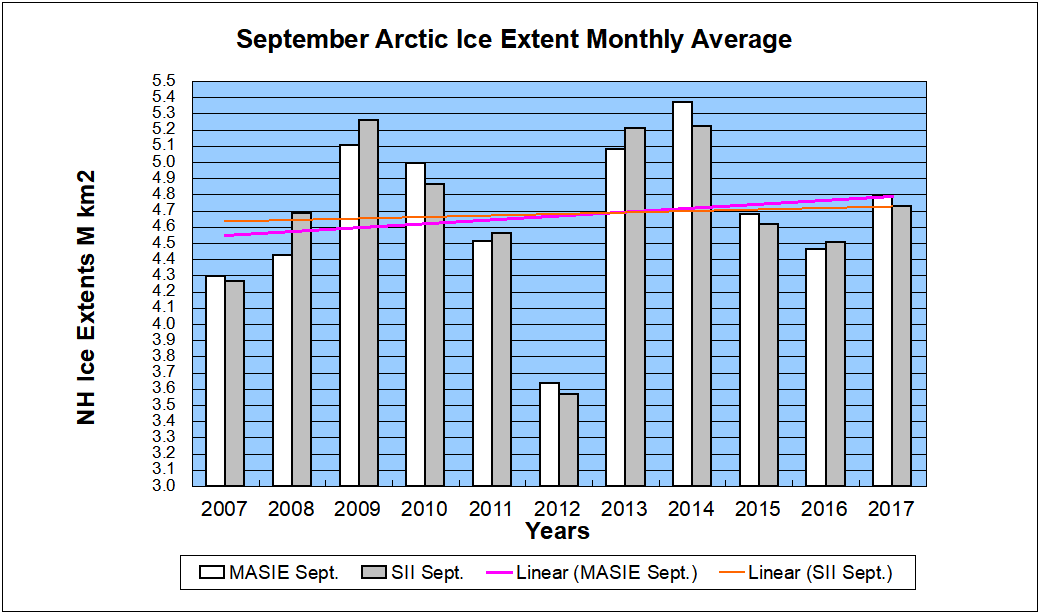
September daily extents are now fully reported and the 2017 September monthly results can be compared with years of the previous decade.  MASIE showed 2017 exceeded 4.8M km2  and SII was close behind, also reaching 4.8M for the month.  The 11 year linear trend is more upward for MASIE, mainly due to 2008 and 2009 reported higher in SII.  In either case, one can easily see the Arctic ice extents since 2007 have not declined and are now 500k km2 higher.

In August, 4.5M km2 was the median estimate of the September monthly average extent from the SIPN (Sea Ice Prediction Network) who use the reports from SII (Sea Ice Index), the NASA team satellite product from passive microwave sensors.

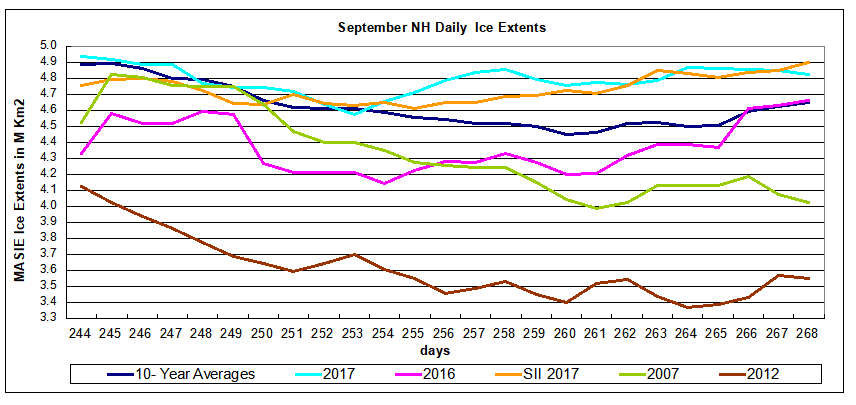
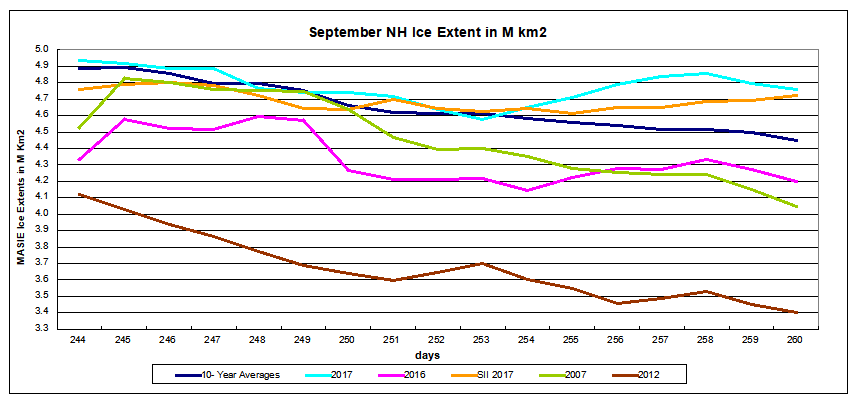
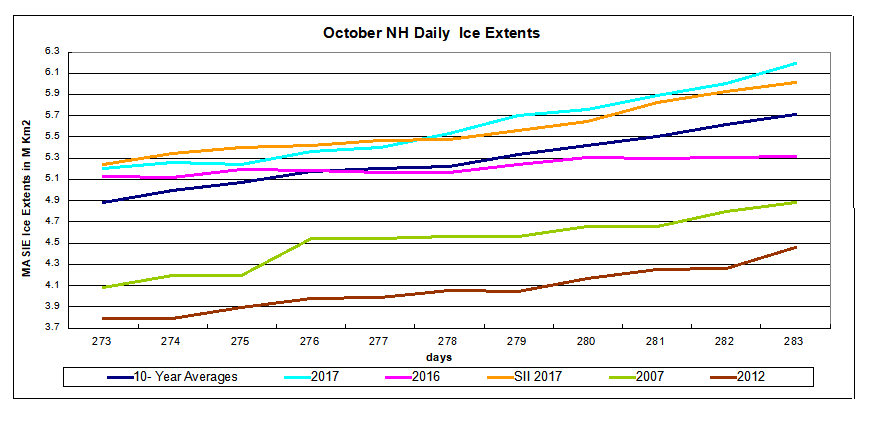
The graph below shows September comparisons through day 273 (Sept. 30).Note that starting day 260 2016 had begun its remarkable recovery, and is now well above the 10 year average, nearly matching 2017. Meanwhile 2007 is 1.1M km2 behind and the Great Arctic Cyclone year of 2012 is 1.4M km2 less than 2017.  Note also that SII is currently matching MASIE.

The narrative from activist ice watchers is along these lines:  2017 minimum is not especially low, but it is very thin.  “The Arctic is on thin ice.”  They are basing that notion on PIOMAS, a model-based estimate of ice volumes, combining extents with estimated thickness.  That technology is not mature, and in any case refers to the satellite era baseline, which began in 1979.

The formation of ice this year does not appear thin, since it is concentrated in the central Arctic.  For example, Consider how Laptev and East Siberian seas together added 180k km2 in the just the last ten days:

Click on image to enlarge.

The table shows ice extents in the regions for 2017, 10 year averages and 2007 for day 273. Decadal averages refer to 2007 through 2016 inclusive.

Region 2017273 Day 273
Average
2017-Ave. 2007273 2017-2007
 (0) Northern_Hemisphere 5200394 4944703 255690 4086883 1113511
 (1) Beaufort_Sea 397521 540936 -143415 498743 -101222
 (2) Chukchi_Sea 141983 217113 -75130 51 141932
 (3) East_Siberian_Sea 369289 326398 42891 311 368978
 (4) Laptev_Sea 377166 166604 210562 235245 141922
 (5) Kara_Sea 46667 28503 18164 15367 31300
 (6) Barents_Sea 2010 20562 -18552 4851 -2841
 (7) Greenland_Sea 134724 245771 -111046 353210 -218486
 (8) Baffin_Bay_Gulf_of_St._Lawrence 85755 48614 37141 42247 43508
 (9) Canadian_Archipelago 498801 356144 142657 307135 191666
 (10) Hudson_Bay 1621 4741 -3121 1936 -316
 (11) Central_Arctic 3143698 2988219 155479 2626511 517187

Deficits in Beaufort and Chukchi are more than offset by surpluses in East Siberian and Laptev. Kara and Barents together are average.  Greenland Sea is down but note the strong surpluses in Canadian Archipelago and the Central Arctic, which is already at 95% of its March maximum.

Summary

Earlier observations showed that Arctic ice extents were low in the 1940s, grew thereafter up to a peak in 1977, before declining.  That decline was gentle until 1994 which started a decade of multi-year ice loss through the Fram Strait.  There was also a major earthquake under the north pole in that period.  In any case, the effects and the decline ceased in 2007, 30 years after the previous peak.  Now we have a plateau in ice extents, which could be the precursor of a growing phase of the quasi-60 year Arctic ice oscillation.

For context, note that the average maximum has been 15M, so on average the extent shrinks to 30% of the March high before growing back the following winter.  In 2017 about 33% of the March maximum was retained, so the melt season losses were considerably less than in the past.

Background from Sept. 20

Dave Burton asked a great question in his previous comment, and triggered this response:

Dave, thanks for asking a great question. All queries are good, but a great one forces me to dig and learn something new, in this case a more detailed knowledge of what goes into MASIE reports.

You asked, where do they get their data? The answer is primarily from NIC’s Interactive Multisensor Snow and Ice Mapping System (IMS). From the documentation, the multiple sources feeding IMS are:

Platform(s) AQUA, DMSP, DMSP 5D-3/F17, GOES-10, GOES-11, GOES-13, GOES-9, METEOSAT, MSG, MTSAT-1R, MTSAT-2, NOAA-14, NOAA-15, NOAA-16, NOAA-17, NOAA-18, NOAA-N, RADARSAT-2, SUOMI-NPP, TERRA

Sensor(s): AMSU-A, ATMS, AVHRR, GOES I-M IMAGER, MODIS, MTSAT 1R Imager, MTSAT 2 Imager, MVIRI, SAR, SEVIRI, SSM/I, SSMIS, VIIRS

Summary: IMS Daily Northern Hemisphere Snow and Ice Analysis

The National Oceanic and Atmospheric Administration / National Environmental Satellite, Data, and Information Service (NOAA/NESDIS) has an extensive history of monitoring snow and ice coverage.Accurate monitoring of global snow/ice cover is a key component in the study of climate and global change as well as daily weather forecasting.

The Polar and Geostationary Operational Environmental Satellite programs (POES/GOES) operated by NESDIS provide invaluable visible and infrared spectral data in support of these efforts. Clear-sky imagery from both the POES and the GOES sensors show snow/ice boundaries very well; however, the visible and infrared techniques may suffer from persistent cloud cover near the snowline, making observations difficult (Ramsay, 1995). The microwave products (DMSP and AMSR-E) are unobstructed by clouds and thus can be used as another observational platform in most regions. Synthetic Aperture Radar (SAR) imagery also provides all-weather, near daily capacities to discriminate sea and lake ice. With several other derived snow/ice products of varying accuracy, such as those from NCEP and the NWS NOHRSC, it is highly desirable for analysts to be able to interactively compare and contrast the products so that a more accurate composite map can be produced.

The Satellite Analysis Branch (SAB) of NESDIS first began generating Northern Hemisphere Weekly Snow and Ice Cover analysis charts derived from the visible satellite imagery in November, 1966. The spatial and temporal resolutions of the analysis (190 km and 7 days, respectively) remained unchanged for the product’s 33-year lifespan.

As a result of increasing customer needs and expectations, it was decided that an efficient, interactive workstation application should be constructed which would enable SAB to produce snow/ice analyses at a higher resolution and on a daily basis (~25 km / 1024 x 1024 grid and once per day) using a consolidated array of new as well as existing satellite and surface imagery products. The Daily Northern Hemisphere Snow and Ice Cover chart has been produced since February, 1997 by SAB meteorologists on the IMS.

Another large resolution improvement began in early 2004, when improved technology allowed the SAB to begin creation of a daily ~4 km (6144×6144) grid. At this time, both the ~4 km and ~24 km products are available from NSIDC with a slight delay. Near real-time gridded data is available in ASCII format by request.

In March 2008, the product was migrated from SAB to the National Ice Center (NIC) of NESDIS. The production system and methodology was preserved during the migration. Improved access to DMSP, SAR, and modeled data sources is expected as a short-term from the migration, with longer term plans of twice daily production, GRIB2 output format, a Southern Hemisphere analysis, and an expanded suite of integrated snow and ice variable on horizon.

http://www.natice.noaa.gov/ims/ims_1.html

Footnote

Some people unhappy with the higher amounts of ice extent shown by MASIE continue to claim that Sea Ice Index is the only dataset that can be used. This is false in fact and in logic. Why should anyone accept that the highest quality picture of ice day to day has no shelf life, that one year’s charts can not be compared with another year? Researchers do this, including Walt Meier in charge of Sea Ice Index. That said, I understand his interest in directing people to use his product rather than one he does not control. As I have said before:

MASIE is rigorous, reliable, serves as calibration for satellite products, and continues the long and honorable tradition of naval ice charting using modern technologies. More on this at my post Support MASIE Arctic Ice Dataset


Barents Sea Ice-Free. How Come?

Might maritime activities, such as shipping, oil extraction, fishing etc. be having an effect on Barents Sea ice extents?  Arnd Bernaerts has an informative post up at his blog: They warm-up the Arctic! Shipping, Off-Shore, Science etc.!

Dr. Bernaerts explains:

It is not known which alterations shipping, naval forces, research vessels and off-shore industry cause in the Arctic Ocean sea-body structure, whether ice covered or not, and the subsequent impact on the annual sea ice and the polar-weather, called climate change. Bad that science has no idea about this human Arctic warming aspect. Worse, science has never rose, or ever been willing to raise and investigate the subject. At least you will face a hard time to find anything in this respect.

When considering the possible impact of ocean uses on climate change, any activities at sea north of the Polar Circle is a multifold higher than in any other Ocean region. Between the Arctic Ocean and the Equator the climatic impact of human activities the difference could be several hundred, if not thousand times, due to extreme narrow structure margin concerning water temperature and salinity. The temperature range in the upper 150 meter sea surface level is minus 2° to plus 4°C. Arctic salinity is down to 30ppt in places, while the oceans vary between 34ppt and 36ppt. So far it is statistics, and they are ‘wrong’ if not properly applied.

Navigating and other ocean uses in Arctic sea areas without knowing the impact is irresponsible. Navigating through compact ice is even worse, as the force of ship screws may travel over long distances, with significant changes to sea temperatures and salinity.

Summary

The whole article is informative and raises important questions (and not for the first time).  Time to stop obsessing over CO2, the “magic” gas, and try to understand real human impacts.

A Russian liquid gas tanker (LNG) “Christophe de Margerie” just set two Arctic records few weeks ago (Details). The ship not only traveled through the Arctic in record time, but has done so without the use of an icebreaker escort. She is the first of a total of 15 planned LNG carriers that will be gradually deployed.


Steady September Arctic Ice


With five days left in the month, we can project the likely 2017 September results and compare with years of the previous decade.  2017 is provisional depending on the next five days, but MASIE is averaging 4.8M km2 and the daily extents are over that amount.  SII is 60k km2 lower, but just went over 4.9M, so has a chance to also reach 4.8M.

In August, 4.5M km2 was the median estimate of the September monthly average extent from the SIPN (Sea Ice Prediction Network) who use the reports from SII (Sea Ice Index), the NASA team satellite product from passive microwave sensors.

The graph below shows September comparisons through day 268.Note that as of day 260, 2016 had begun its remarkable recovery, now matching the 10 year average, nearly 200k km2 below 2017. Meanwhile 2007 is 800k km2 behind and the Great Arctic Cyclone year of 2012 is 1.3M km2 less than 2017.  Note also that SII is currently showing slightly more ice than MASIE.

The narrative from activist ice watchers is along these lines:  2017 minimum is not especially low, but it is very thin.  “The Arctic is on thin ice.”  They are basing that notion on PIOMAS, a model-based estimate of ice volumes, combining extents with estimated thickness.  That technology is not mature, and in any case refers to the satellite era baseline, which began in 1979.

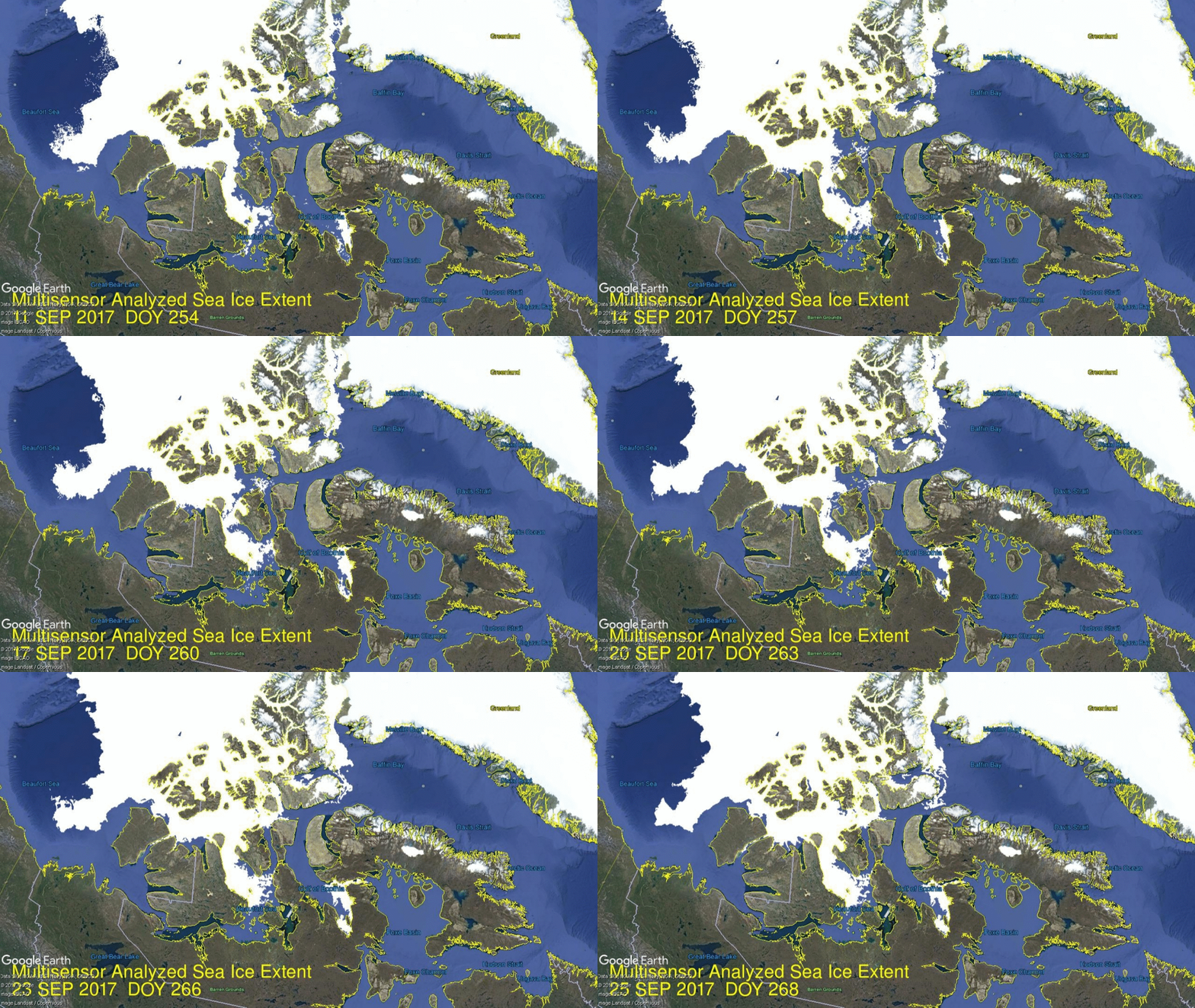
The formation of ice this year does not appear thin, since it is concentrated in the central Arctic.  Consider how CAA (Canadian Arctic Archipelago added 100k km2 in the last two weeks:

Click on image to enlarge.

The table shows ice extents in the regions for 2017, 10 year averages and 2007 for day 268. Decadal averages refer to 2007 through 2016 inclusive.

Region 2017268 Day 268
Average
2017-Ave. 2007268 2017-2007
 (0) Northern_Hemisphere 4824033 4648420 175613 4025906 798128
 (1) Beaufort_Sea 358982 488920 -129937 466599 -107617
 (2) Chukchi_Sea 71545 180769 -109224 3054 68491
 (3) East_Siberian_Sea 259179 276825 -17646 311 258868
 (4) Laptev_Sea 275826 138290 137536 222968 52858
 (5) Kara_Sea 42802 22613 20189 18246 24556
 (6) Barents_Sea 6112 20560 -14448 4851 1261
 (7) Greenland_Sea 111111 229228 -118116 335161 -224050
 (8) Baffin_Bay_Gulf_of_St._Lawrence 74169 36672 37497 41385 32784
 (9) Canadian_Archipelago 472601 293992 178610 274334 198267
 (10) Hudson_Bay 1276 3154 -1878 1936 -661
 (11) Central_Arctic 3149271 2956302 192969 2655784 493487

Note the strong surpluses in Canadian Archipelago and the Central Arctic, which is already at 95% of its March maximum.  On the Russian side, Laptev and Kara are surplus to average, while East Siberian has grown to approach average.

Summary

Earlier observations showed that Arctic ice extents were low in the 1940s, grew thereafter up to a peak in 1977, before declining.  That decline was gentle until 1994 which started a decade of multi-year ice loss through the Fram Strait.  There was also a major earthquake under the north pole in that period.  In any case, the effects and the decline ceased in 2007, 30 years after the previous peak.  Now we have a plateau in ice extents, which could be the precursor of a growing phase of the quasi-60 year Arctic ice oscillation.

For context, note that the average maximum has been 15M, so on average the extent shrinks to 30% of the March high before growing back the following winter.  In 2017 about 33% of the March maximum was retained, so the melt season losses were considerably less than in the past.

Background from Sept. 20

Dave Burton asked a great question in his previous comment, and triggered this response:

Dave, thanks for asking a great question. All queries are good, but a great one forces me to dig and learn something new, in this case a more detailed knowledge of what goes into MASIE reports.

You asked, where do they get their data? The answer is primarily from NIC’s Interactive Multisensor Snow and Ice Mapping System (IMS). From the documentation, the multiple sources feeding IMS are:

Platform(s) AQUA, DMSP, DMSP 5D-3/F17, GOES-10, GOES-11, GOES-13, GOES-9, METEOSAT, MSG, MTSAT-1R, MTSAT-2, NOAA-14, NOAA-15, NOAA-16, NOAA-17, NOAA-18, NOAA-N, RADARSAT-2, SUOMI-NPP, TERRA

Sensor(s): AMSU-A, ATMS, AVHRR, GOES I-M IMAGER, MODIS, MTSAT 1R Imager, MTSAT 2 Imager, MVIRI, SAR, SEVIRI, SSM/I, SSMIS, VIIRS

Summary: IMS Daily Northern Hemisphere Snow and Ice Analysis

The National Oceanic and Atmospheric Administration / National Environmental Satellite, Data, and Information Service (NOAA/NESDIS) has an extensive history of monitoring snow and ice coverage.Accurate monitoring of global snow/ice cover is a key component in the study of climate and global change as well as daily weather forecasting.

The Polar and Geostationary Operational Environmental Satellite programs (POES/GOES) operated by NESDIS provide invaluable visible and infrared spectral data in support of these efforts. Clear-sky imagery from both the POES and the GOES sensors show snow/ice boundaries very well; however, the visible and infrared techniques may suffer from persistent cloud cover near the snowline, making observations difficult (Ramsay, 1995). The microwave products (DMSP and AMSR-E) are unobstructed by clouds and thus can be used as another observational platform in most regions. Synthetic Aperture Radar (SAR) imagery also provides all-weather, near daily capacities to discriminate sea and lake ice. With several other derived snow/ice products of varying accuracy, such as those from NCEP and the NWS NOHRSC, it is highly desirable for analysts to be able to interactively compare and contrast the products so that a more accurate composite map can be produced.

The Satellite Analysis Branch (SAB) of NESDIS first began generating Northern Hemisphere Weekly Snow and Ice Cover analysis charts derived from the visible satellite imagery in November, 1966. The spatial and temporal resolutions of the analysis (190 km and 7 days, respectively) remained unchanged for the product’s 33-year lifespan.

As a result of increasing customer needs and expectations, it was decided that an efficient, interactive workstation application should be constructed which would enable SAB to produce snow/ice analyses at a higher resolution and on a daily basis (~25 km / 1024 x 1024 grid and once per day) using a consolidated array of new as well as existing satellite and surface imagery products. The Daily Northern Hemisphere Snow and Ice Cover chart has been produced since February, 1997 by SAB meteorologists on the IMS.

Another large resolution improvement began in early 2004, when improved technology allowed the SAB to begin creation of a daily ~4 km (6144×6144) grid. At this time, both the ~4 km and ~24 km products are available from NSIDC with a slight delay. Near real-time gridded data is available in ASCII format by request.

In March 2008, the product was migrated from SAB to the National Ice Center (NIC) of NESDIS. The production system and methodology was preserved during the migration. Improved access to DMSP, SAR, and modeled data sources is expected as a short-term from the migration, with longer term plans of twice daily production, GRIB2 output format, a Southern Hemisphere analysis, and an expanded suite of integrated snow and ice variable on horizon.

http://www.natice.noaa.gov/ims/ims_1.html
Footnote

Some people unhappy with the higher amounts of ice extent shown by MASIE continue to claim that Sea Ice Index is the only dataset that can be used. This is false in fact and in logic. Why should anyone accept that the highest quality picture of ice day to day has no shelf life, that one year’s charts can not be compared with another year? Researchers do this, including Walt Meier in charge of Sea Ice Index. That said, I understand his interest in directing people to use his product rather than one he does not control. As I have said before:

MASIE is rigorous, reliable, serves as calibration for satellite products, and continues the long and honorable tradition of naval ice charting using modern technologies. More on this at my post Support MASIE Arctic Ice Dataset


Overview Winter Climate for NH

cohen-schematic2

The diagram represents how Dr. judah Cohen pictures the Northern Hemisphere wintertime climate system.  He leads research regarding Arctic and NH weather patterns for AER.  He explains the dynamics in an interview at Washington Post (here):

My colleagues, at AER and at selected universities, and I have found a robust relationship between two October Eurasian snow indices and the large-scale winter hemispheric circulation pattern known as the North Atlantic or Arctic Oscillation pattern (N/AO).

The N/AO is more highly correlated with or explains the highest variance of winter temperatures in eastern North America, Europe and East Asia than any other single or combination of atmospheric or coupled ocean-atmosphere patterns that we know of. Therefore, if we can predict the winter N/AO (whether it will be negative or positive) that provides the best chance for a successful winter temperature forecast in North America but certainly does not guarantee it.

[Of the two indices we’ve analyzed], the first and longer [more data points] index is simply the monthly mean snow cover extent (SCE) for the entire month [of October] as measured from satellites. This record dates back to at least 1972 and is available on the Rutger’s Global Snow Lab website.

The second index that we developed last year, with the support of NSF and NOAA grants, measures the daily rate of change of Eurasian snow cover extent also during the entire month of October, which we refer to as the Snow Advance Index or SAI.

There have been recent modeling studies that demonstrate that El Nino modulates the strength and position of the Aleutian Low that then favors stratospheric warmings and subsequently a negative winter N/AO that are consistent with our own research on the relationship between snow cover and stratospheric warmings. So the influence of ENSO on winter temperatures in the Mid-Atlantic and the Northeast may be greater than I acknowledge or that is represented in our seasonal forecast model.

How It Works

Conceptual model for how fall snow cover modifies winter circulation in both the stratosphere and the troposphere–The case for low snow cover on left; the case for extensive snow cover on right.

1. Snow cover increases rapidly in the fall across Siberia, when snow cover is above normal diabatic cooling helps to;
2. Strengthen the Siberian high and leads to below normal temperatures.
3. Snow forced diabatic cooling in proximity to high topography of Asia increases upward flux of energy in the troposphere, which is absorbed in the stratosphere.
4. Strong convergence of WAF (Wave Activity Flux) indicates higher geopotential heights.
5. A weakened polar vortex and warmer down from the stratosphere into the troposphere all the way to the surface.
6. Dynamic pathway culminates with strong negative phase of the Arctic Oscillation at the surface.

From Eurasian Snow Cover Variability and Links with Stratosphere-Troposphere
Coupling and Their Potential Use in Seasonal to Decadal Climate Predictions by Judah Cohen

Extensive 2016 Siberian snowfall led to unusually rapid recovery of Arctic sea ice following relatively low September 2016 minimum.

What About Winter 2017-2018?

Dr. Cohen’s Winter Outlook for NH  September 18, 2017

Many important markers are currently being set indicating the atmosphere is beginning in earnest the transition from summer to winter. There are four features that I am monitoring closely over the coming weeks and months to gauge the evolving atmospheric circulation pattern and resultant weather across the NH.

The first is the nascent stratospheric polar vortex (PV). The PV has returned to the NH polar stratosphere. Much recent research including my own has shown that the relative strength of the PV if not forces, certainly leads prolonged periods of temperature anomalies across key regions of the NH. A strong PV is related to relatively milder temperatures across the mid-latitudes of the NH while a weak PV is related to relatively colder temperatures across the mid-latitudes of the NH. This relationship is strongest in mid-winter. Early signs are that the PV will start off relatively weak similar to last fall. This is somewhat surprising because increasing greenhouse gases favor colder stratospheric temperatures and hence a stronger PV. Poleward heat flux or vertical wave activity flux is predicted to be unusually active in the coming two weeks, which is likely the reason for the predicted relatively weak start to the PV.  (my bolds)

The active poleward heat flux is also likely related to the second feature that I will be following – high latitude blocking. The negative AO state is often a manifestation of strong high latitude blocking while the positive AO often reflects a lack of high latitude blocking. The predicted negative AO in the coming two weeks is a result of predicted strong high latitude blocking with the dominant block predicted to reside in the region of Scandinavia and the Barents-Kara seas. In the near term this will lead to a cold and snowy period across most of Siberia. Blocking in this region is favorable for weakening the stratospheric polar vortex and will likely lead to weakening of the PV over the next two weeks. If similar blocking occurs later on during the late fall and early winter it will favor a sudden stratospheric warming (SSW). SSW in the winter often precedes extended periods of severe winter weather across the continents of the NH. (my bolds)

The third feature is Arctic sea ice extent. The minimum in Arctic sea ice extent is achieved this time of year and if the minimum has not already been reached it should occur relatively soon. The past two blogs I suggested the possibility that the sea ice minimum could be similar to the years 2008 and 2010 and that is looking likely. Sea ice extent is extremely low compared to climatology but will not be a new record low. The largest anomalies are in the North Pacific side of the Arctic in the Beaufort Sea. This pattern matches recent Septembers. Typically, the largest anomalies migrate with the progression of fall to the North Atlantic side of the Arctic. It is my opinion that low sea ice favors high latitude blocking but the nature of the blocking is regionally dependent. For example, low sea ice in the Barents-Kara Seas favors blocking in the northwest Eurasia sector resulting in cold temperatures in parts of Asia. (my bolds)

The fourth feature is Siberian snow cover. My, along with my colleagues and others, research has shown that extensive Siberian snow cover in the fall favors a trough across East Asia with a ridge to the west near the Urals. The atmospheric circulation pattern favors more active poleward heat flux, a weaker PV and cold temperatures across the NH. With a predicted strong negative AO in the coming weeks, snow cover is likely to advance relatively quickly heading into October. It is very early in the snow season but recent falls have been snowy across Siberia and therefore I do expect another upcoming snowy fall across Siberia. Though admittedly, recent Siberian snow cover as a predictor of winter temperatures has been mixed.

Summary

Uh oh.  Now where did I put away my long johns?

Arctic Ice Exceeds at Minimum

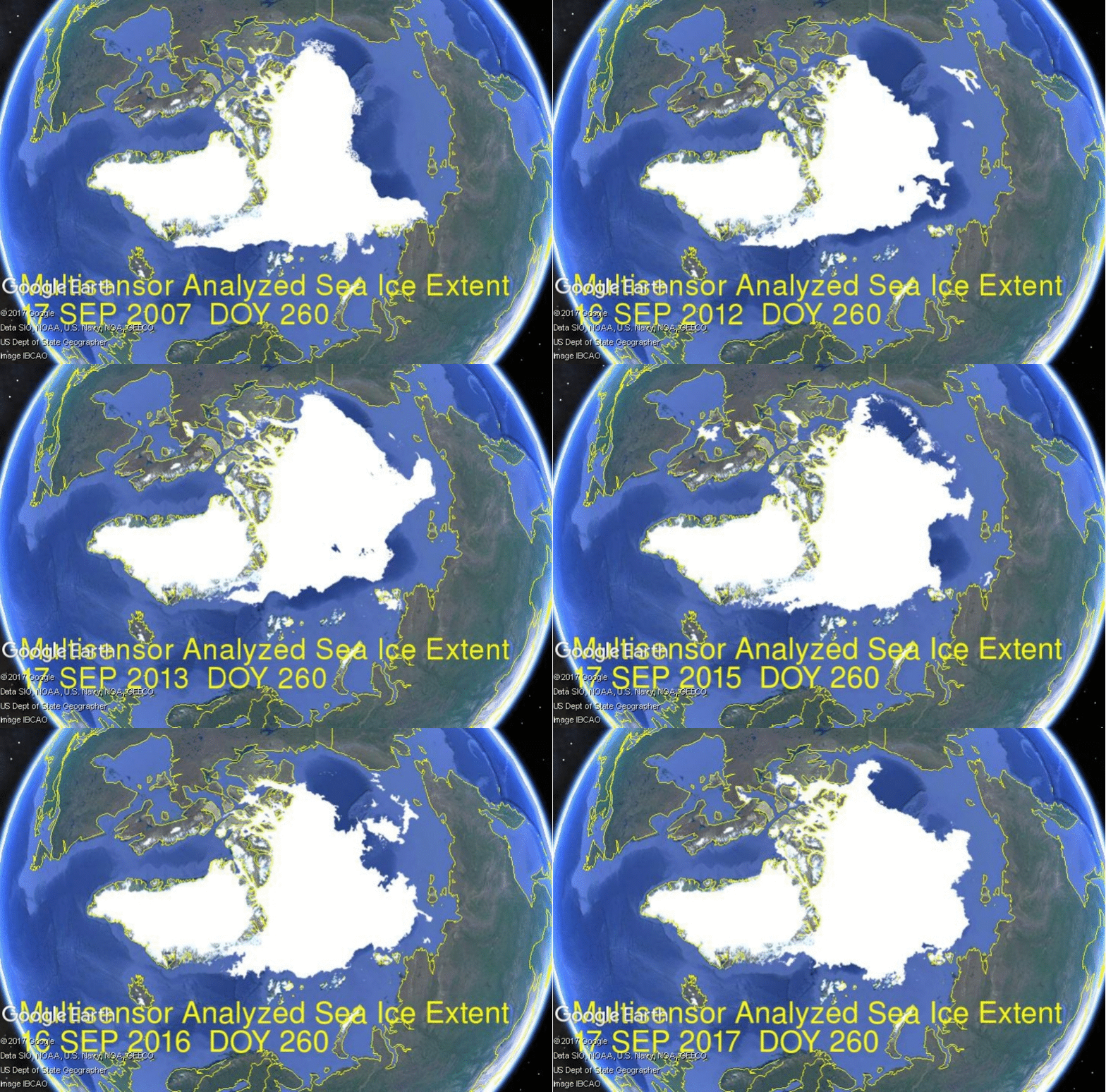
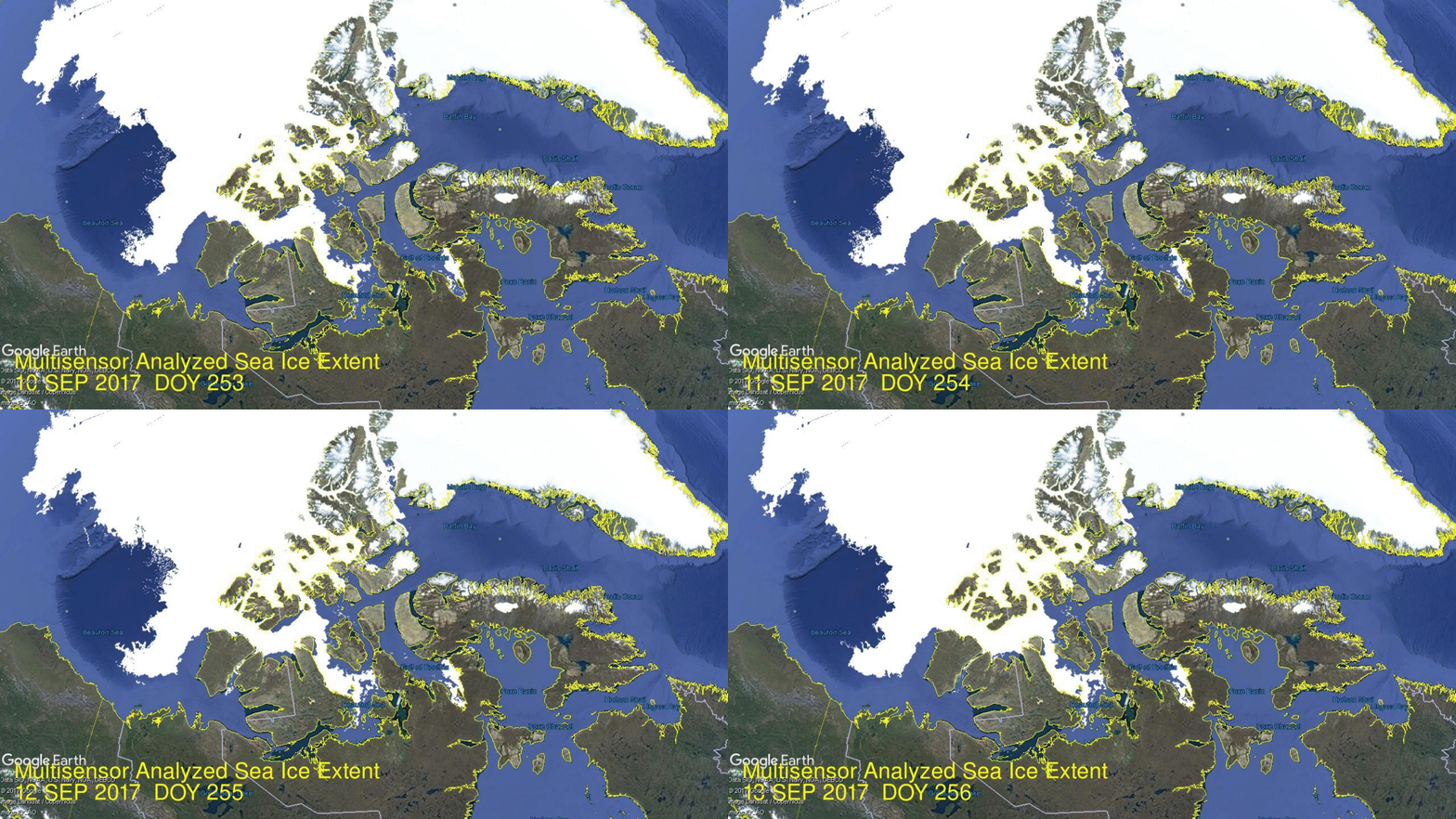
It is the most typical day this decade for the annual Arctic ice extent minimum. Some take any year’s slightly lower minimum as proof that Arctic ice is dying, but the image below shows extents from 2007, mostly smaller than 2017.

While the daily average extent for the last 10 years bottomed out on day 260, years like 2016 and 2009 hit minimum on day 254.  This year’s extent was at 4.7M km2 for a week, hit bottom at 4.6M on day 253, then rose up and over 4.8M km2.  SII (Sea Ice Index) 2017 is similar to MASIE, though a bit lower lately. The graph below shows September comparisons through day 260.
Note that as of day 260, 2017 has gone 300k km2 above average, 500k km2 more than 2016, 700k km2 higher than 2007, and 1400k km2 greater than 2012.  All regions have added ice, with Central Arctic the only exception.  That is likely due to Central Arctic sea already full of ice at 3.1M km2.

The table shows ice extents in the regions for 2017, 10 year averages and 2007 for day 260.

Region 2017260 Day 260
Average
2017-Ave. 2007260 2017-2007
 (0) Northern_Hemisphere 4757445 4449204 308241 4045776 711669
 (1) Beaufort_Sea 411648 468835 -57187 481384 -69736
 (2) Chukchi_Sea 106342 145834 -39492 22527 83815
 (3) East_Siberian_Sea 320193 257482 62711 311 319882
 (4) Laptev_Sea 241780 123163 118617 235869 5912
 (5) Kara_Sea 21251 20846 405 44067 -22816
 (6) Barents_Sea 1664 24778 -23114 7420 -5756
 (7) Greenland_Sea 90072 213695 -123622 333181 -243109
 (8) Baffin_Bay_Gulf_of_St._Lawrence 65653 26566 39086 26703 38950
 (9) Canadian_Archipelago 430824 247034 183790 225526 205299
 (10) Hudson_Bay 1932 6975 -5042 2270 -338
 (11) Central_Arctic 3071252 2912912 158339 2665244 406008

The largest deficits to average are in BCE and Greenland Sea, more than offset by huge surpluses in Central Arctice, CAA and Laptev.  Note the strong growth in East Siberian offsetting the Beaufort deficit.

Over this decade, the Arctic ice minimum has not declined, but looks like fluctuations around a plateau since 2007. By mid-September, all the peripheral seas have turned to water, and the residual ice shows up in a few places. The table below indicates where  ice is found in September. (Shows day 260 amounts with 10 year averages)

Arctic Regions 2007 2010 2012 2014 2015 2016 2017 Average
Central Arctic Sea 2.67 3.16 2.64 2.98 2.93 2.92 3.07 2.91
BCE 0.50 1.08 0.31 1.38 0.89 0.52 0.84 0.87
LKB 0.29 0.24 0.02 0.19 0.05 0.28 0.26 0.17
Greenland & CAA 0.56 0.41 0.41 0.55 0.46 0.45 0.52 0.46
B&H Bays 0.03 0.03 0.02 0.02 0.10 0.03 0.07 0.03
NH Total 4.05 4.91 3.40 5.13 4.44 4.20 4.76 4.45

BCE (Beaufort, Chukchi and East Siberian) on the Asian side are quite variable as the largest source of ice other than the Central Arctic itself.   Greenland Sea and CAA (Canadian Arctic Archipelago) together hold almost 0.5M km2 of ice at minimum, fairly consistently.   LKB are the European seas of Laptev, Kara and Barents, a smaller source of ice, but a difference maker some years, as Laptev was in 2016 and 2017.  Baffin and Hudson Bays are almost inconsequential.  The biggest contributors to 2017 success are Central Arctic, Canadian Archipelago and Laptev.

For context, note that the average maximum has been 15M, so on average the extent shrinks to 30% of the March high before growing back the following winter.

Update Sept. 20

Dave Burton asked a great question in his comment below, and triggered this response:

Dave, thanks for asking a great question. All queries are good, but a great one forces me to dig and learn something new, in this case a more detailed knowledge of what goes into MASIE reports. My answer above refers only to a sub-product which combines MASIE with JAXA.

You asked, where do they get their data? The answer is primarily from NIC’s Interactive Multisensor Snow and Ice Mapping System (IMS). From the documentation, the multiple sources feeding IMS are:

Platform(s) AQUA, DMSP, DMSP 5D-3/F17, GOES-10, GOES-11, GOES-13, GOES-9, METEOSAT, MSG, MTSAT-1R, MTSAT-2, NOAA-14, NOAA-15, NOAA-16, NOAA-17, NOAA-18, NOAA-N, RADARSAT-2, SUOMI-NPP, TERRA

Sensor(s): AMSU-A, ATMS, AVHRR, GOES I-M IMAGER, MODIS, MTSAT 1R Imager, MTSAT 2 Imager, MVIRI, SAR, SEVIRI, SSM/I, SSMIS, VIIRS

Summary: IMS Daily Northern Hemisphere Snow and Ice Analysis

The National Oceanic and Atmospheric Administration / National Environmental Satellite, Data, and Information Service (NOAA/NESDIS) has an extensive history of monitoring snow and ice coverage.Accurate monitoring of global snow/ice cover is a key component in the study of climate and global change as well as daily weather forecasting.

The Polar and Geostationary Operational Environmental Satellite programs (POES/GOES) operated by NESDIS provide invaluable visible and infrared spectral data in support of these efforts. Clear-sky imagery from both the POES and the GOES sensors show snow/ice boundaries very well; however, the visible and infrared techniques may suffer from persistent cloud cover near the snowline, making observations difficult (Ramsay, 1995). The microwave products (DMSP and AMSR-E) are unobstructed by clouds and thus can be used as another observational platform in most regions. Synthetic Aperture Radar (SAR) imagery also provides all-weather, near daily capacities to discriminate sea and lake ice. With several other derived snow/ice products of varying accuracy, such as those from NCEP and the NWS NOHRSC, it is highly desirable for analysts to be able to interactively compare and contrast the products so that a more accurate composite map can be produced.

The Satellite Analysis Branch (SAB) of NESDIS first began generating Northern Hemisphere Weekly Snow and Ice Cover analysis charts derived from the visible satellite imagery in November, 1966. The spatial and temporal resolutions of the analysis (190 km and 7 days, respectively) remained unchanged for the product’s 33-year lifespan.

As a result of increasing customer needs and expectations, it was decided that an efficient, interactive workstation application should be constructed which would enable SAB to produce snow/ice analyses at a higher resolution and on a daily basis (~25 km / 1024 x 1024 grid and once per day) using a consolidated array of new as well as existing satellite and surface imagery products. The Daily Northern Hemisphere Snow and Ice Cover chart has been produced since February, 1997 by SAB meteorologists on the IMS.

Another large resolution improvement began in early 2004, when improved technology allowed the SAB to begin creation of a daily ~4 km (6144×6144) grid. At this time, both the ~4 km and ~24 km products are available from NSIDC with a slight delay. Near real-time gridded data is available in ASCII format by request.

In March 2008, the product was migrated from SAB to the National Ice Center (NIC) of NESDIS. The production system and methodology was preserved during the migration. Improved access to DMSP, SAR, and modeled data sources is expected as a short-term from the migration, with longer term plans of twice daily production, GRIB2 output format, a Southern Hemisphere analysis, and an expanded suite of integrated snow and ice variable on horizon.

http://www.natice.noaa.gov/ims/ims_1.html

Footnote

Some people unhappy with the higher amounts of ice extent shown by MASIE continue to claim that Sea Ice Index is the only dataset that can be used. This is false in fact and in logic. Why should anyone accept that the highest quality picture of ice day to day has no shelf life, that one year’s charts can not be compared with another year? Researchers do this, including Walt Meier in charge of Sea Ice Index. That said, I understand his interest in directing people to use his product rather than one he does not control. As I have said before:

MASIE is rigorous, reliable, serves as calibration for satellite products, and continues the long and honorable tradition of naval ice charting using modern technologies. More on this at my post Support MASIE Arctic Ice Dataset


Arctic Ice Refreezing

We are about 4 days away from the annual Arctic ice extent minimum, which typically occurs on or about day 260 (mid September). Some take any year’s slightly lower minimum as proof that Arctic ice is dying, but the image below shows day 260 over the last 10 years. The Arctic heart is beating clear and strong.

Click on image to enlarge.

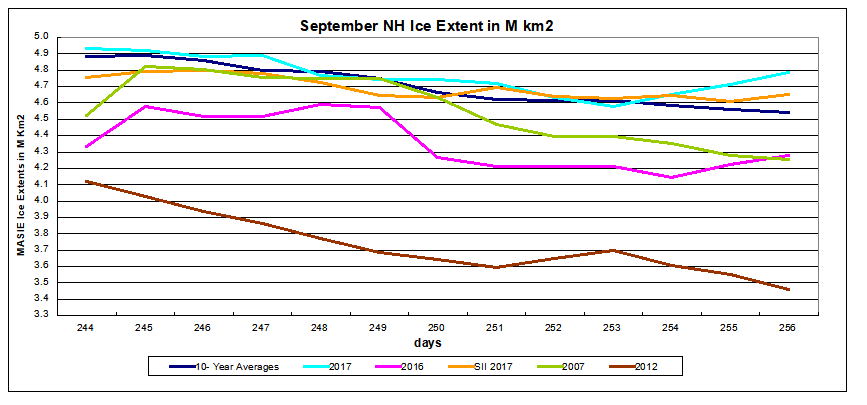
Recent posts noted that 2017 Arctic ice extents were stabilizing and then coasting to a halt.  Now we are seeing a reversal with ice growing in all but one region.  While the daily average extent over the last 10 years bottomed out on day 260, years like 2016 and 2009 hit minimum on day 254.  This year’s extent was at 4.7M km2 for a week, hit bottom at 4.6M on day 253, and 3 days later is now up to 4.8M km2.  SII (Sea Ice Index) 2017 is similar to MASIE, though a bit lower lately. The graph below shows September comparisons.
Note that as of day 256, 2017 has gone 250k km2 above average, 500k km2 above 2007 and 2016, and 1300k km2 greater than 2012.  All regions are adding ice, with Central Arctic the only exception.  That is likely due to Central Arctic sea already full of ice at 3.1M km2.  The image below shows impressive refreezing in the Canadian Archipelago.

Click on image to enlarge.

Over this decade, the Arctic ice minimum has not declined, but looks like fluctuations around a plateau since 2007. By mid-September, all the peripheral seas have turned to water, and the residual ice shows up in a few places. The table below indicates where we can expect to find ice this September. (Shows day 260 amounts with 10 year averages)

Arctic Regions 2007 2010 2012 2014 2015 2016 Average
Central Arctic Sea 2.67 3.16 2.64 2.98 2.93 2.92 2.91
BCE 0.50 1.08 0.31 1.38 0.89 0.52 0.87
LKB 0.29 0.24 0.02 0.19 0.05 0.28 0.17
Greenland & CAA 0.56 0.41 0.41 0.55 0.46 0.45 0.46
B&H Bays 0.03 0.03 0.02 0.02 0.10 0.03 0.03
NH Total 4.05 4.91 3.40 5.13 4.44 4.20 4.45

BCE (Beaufort, Chukchi and East Siberian) on the Asian side are quite variable as the largest source of ice other than the Central Arctic itself.   Greenland Sea and CAA (Canadian Arctic Archipelago) together hold almost 0.5M km2 of ice at minimum, fairly consistently.   LKB are the European seas of Laptev, Kara and Barents, a smaller source of ice, but a difference maker some years, as Laptev was in 2016.  Baffin and Hudson Bays are almost inconsequential.

For context, note that the average maximum has been 15M, so on average the extent shrinks to 30% of the March high before growing back the following winter.

Footnote

Some people unhappy with the higher amounts of ice extent shown by MASIE continue to claim that Sea Ice Index is the only dataset that can be used. This is false in fact and in logic. Why should anyone accept that the highest quality picture of ice day to day has no shelf life, that one year’s charts can not be compared with another year? Researchers do this, including Walt Meier in charge of Sea Ice Index. That said, I understand his interest in directing people to use his product rather than one he does not control. As I have said before:

MASIE is rigorous, reliable, serves as calibration for satellite products, and continues the long and honorable tradition of naval ice charting using modern technologies. More on this at my post Support MASIE Arctic Ice Dataset


Arctic Ice Coasting Sept. 12

Crystal Serenity touring in the Arctic Northwest Passage 2016 and 2017.

With the most typical day for annual minimum a week away, watching Arctic ice is like watching an ocean liner coasting to a halt before reversing engines.  A recent post reported that ice extents  are stabilizing around 4.7M km2 in recent days, and more importantly, some refreezing in the central seas.  As discussed in Arctic Heart Beat, the marginal shelf seas seldom have ice at annual minimum, typically on or about day 260.  The image below shows the progression of ice extents from 2007 to 2017 on day 254 with six days to go.

Click on image to enlarge.


Yesterday was day 254 and the graph below shows 2017 compared with other years and the decadal average during the last 3 weeks.

For the last week MASIE and SII are showing the same extent, now about 70k km2 above the 10 year average.  Only four years in the decade had more ice on this day.  2007 is 300k km2 lower, 2016 500k km2 lower, and at the bottom is 2012 1.1M km2 below 2017.  A recent post on August storms discussed the dramatic impact on 2012 and 2016, which is evident as well in the chart.  The table compares 2017, decadal average and 2007 for the regions containing ice at this time.

Region 2017254 Day 254
Average
2017-Ave. 2007254 2017-2007
 (0) Northern_Hemisphere 4652293 4583359 68934 4349612 302681
 (1) Beaufort_Sea 393863 480306 -86443 599679 -205815
 (2) Chukchi_Sea 131705 173275 -41570 74733 56973
 (3) East_Siberian_Sea 279268 286737 -7468 311 278957
 (4) Laptev_Sea 205794 149612 56182 247496 -41702
 (5) Kara_Sea 18486 29190 -10705 62274 -43788
 (6) Barents_Sea 4313 25209 -20896 7384 -3071
 (7) Greenland_Sea 107969 211322 -103353 324789 -216820
 (8) Baffin_Bay_Gulf_of_St._Lawrence 45146 22235 22911 21406 23740
 (9) Canadian_Archipelago 370958 262283 108675 210083 160875
 (10) Hudson_Bay 1432 11057 -9625 16552 -15120
 (11) Central_Arctic 3092201 2931173 161028 2783651 308551

The deficits continue to be on the Pacific side, especially Beaufort, and also Greenland Sea is down this year.  These are more than offset by large surpluses in the Central Arctic and Canadian Archipelago, and also Laptev.  East Siberian sea also has surplus ice this year compared to 2007.

aer Atmospheric and Environmental Research

September 5, 2017 Dr. Judah Cohen of AER posted his monthly forecast for the Arctic and NH based on the Arctic Oscillation (AO) and North Atlantic Oscillation (NAO).  Excerpts below.

The AO is currently slightly negative (Figure 1), reflective of mostly positive geopotential height anomalies across the Arctic and mixed geopotential height anomalies across the mid-latitudes of the NH (Figure 2). Geopotential height anomalies are mostly negative across Greenland and Iceland (Figure 2), and therefore the NAO is slightly positive.
Figure 1. (a) The predicted daily-mean near-surface AO from the 00Z 5 September 2017 GFS ensemble. Gray lines indicate the AO index from each individual ensemble member, with the ensemble-mean AO index given by the red line with squares.

The AO is predicted to straddle neutral next week as geopotential height anomalies remain mixed across the Arctic. Similarly, with mixed geopotential height anomalies stretching across Greenland and Iceland, the NAO will likely be near neutral as well.  

(Note: AO and NAO are signed differently than one might expect; the reference point is outside the Arctic itself.  Thus negative phases of these indices mean higher pressures in the Arctic and lower outside, while positive phases indicate lower pressures in the Arctic.  Now that the Arctic sun is setting, the main issue for ice extent is storminess which requires low Arctic pressures.)

Impacts

It is the first week of fall, a season of transition from summer to winter. One important sign IMO of this seasonal transition is the return of the polar vortex in the stratosphere. The models predict the possible formation of the polar vortex sometime next week. Starting in October, I will be watching variability in the polar vortex for signs of pattern changes in the weather across the NH.

Another sign of the seasonal transition is the minimum in Arctic sea ice extent, which will be achieved in the coming days and/or weeks. The trajectory of sea ice melt has slowed since early August. In my last blog I suggested the possibility that the sea ice minimum could be similar to the years 2008 and 2010 and that is looking more likely but is difficult to predict. Over the coming months, I will be following Arctic sea ice variability for signs of the severity of the upcoming winter. Our understanding for how anomalies in sea ice extent influence the weather in the mid-latitudes is still immature IMO but I do think that important progress has been made recently.

Another sign of the transition from summer to winter is the return of snowfall to the NH. Snowfall over the sea ice in August probably helped retard the melt of sea ice and snowfall is now even occurring over Siberia and Alaska but is still very regionalized. Again I will be monitoring the advance of snow cover extent across the continents for signs of the strength of the polar vortex and the possible resultant weather.

Finally I find it interesting that while the atmospheric circulation has transitioned from the dominant summer pattern across Eurasia it has not across North America. The dominant summer pattern across Eurasia was ridging across Europe (with the exception of Northern Europe) and East Asia but with troughing in Western Asia. The forecast for the coming weeks is the opposite with troughs across Europe and East Asia but ridging in Western Asia. This is an overall cooler pattern than the dominant summer pattern. However across North America there are no similar signs of transition. The dominant summer pattern was strong ridging across western North America and troughing in eastern North America and at least for now that pattern looks to continue for much of the month of September. I don’t know the reason behind the persistent western ridge/eastern trough pattern across North America but how long this pattern can persist will obviously have important implications for the weather across North America in the coming months.

Summary

Bottom line, looks like September weather will be ordinary in the Arctic with seasonal cooling in the NH.  Dr. Cohen also thinks the annual ice extent minimum will be near average for the decade.  While the monthly average is final only at September end, this week will set the tone and likely result.


Early Arctic Minimum?

It is a few days earlier than usual, but MASIE shows ice extents  stabilizing near 4.7M km2 in recent days, and more importantly, some refreezing in the central seas.  As discussed in Arctic Heart Beat, the marginal shelf seas seldom have ice at annual minimum, typically on or about day 260.  The image below shows the progression of ice extents from 2007 to 2017.

Yesterday was day 251 and the graph below shows 2017 compared with other years and the decadal average during the last 3 weeks.

At this point MASIE and SII are showing the same extent, about 100k km2 above the 10 year average.  2007 is 250k km2 lower, 2016 500k km2 lower, and at the bottom is 2012 1.1M km2 below 2017.  The table compares 2017, decadal average and 2007 for the regions containing ice at this time.

Region 2017251 Day 251
Average
2017-Ave. 2007251 2017-2007
 (0) Northern_Hemisphere 4716948 4619900 97048 4467771 249177
 (1) Beaufort_Sea 409067 492365 -83298 643868 -234801
 (2) Chukchi_Sea 133345 185601 -52257 95240 38105
 (3) East_Siberian_Sea 279966 301146 -21180 311 279655
 (4) Laptev_Sea 196236 152840 43396 252479 -56243
 (5) Kara_Sea 22449 30277 -7828 59593 -37144
 (6) Barents_Sea 23123 20028 3095 5882 17240
 (7) Greenland_Sea 116132 196719 -80586 315125 -198993
 (8) Baffin_Bay_Gulf_of_St._Lawrence 46799 21575 25224 17173 29626
 (9) Canadian_Archipelago 374084 268736 105348 236583 137501
 (10) Hudson_Bay 1191 11933 -10743 22646 -21455
 (11) Central_Arctic 3113399 2937746 175653 2817614 295785

The deficits continue to be on the Pacific side, especially Beaufort, and also Greenland Sea is down this year.  These are more than offset by large surpluses in the Central Arctic and Canadian Archipelago, and also Laptev.  East Siberian sea also has surplus ice this year compared to 2007.

aer Atmospheric and Environmental Research

September 5, 2017 Dr. Judah Cohen of AER posted his monthly forecast for the Arctic and NH based on the Arctic Oscillation (AO) and North Atlantic Oscillation (NAO).  Excerpts below.

The AO is currently slightly negative (Figure 1), reflective of mostly positive geopotential height anomalies across the Arctic and mixed geopotential height anomalies across the mid-latitudes of the NH (Figure 2). Geopotential height anomalies are mostly negative across Greenland and Iceland (Figure 2), and therefore the NAO is slightly positive.
Figure 1. (a) The predicted daily-mean near-surface AO from the 00Z 5 September 2017 GFS ensemble. Gray lines indicate the AO index from each individual ensemble member, with the ensemble-mean AO index given by the red line with squares.

The AO is predicted to straddle neutral next week as geopotential height anomalies remain mixed across the Arctic. Similarly, with mixed geopotential height anomalies stretching across Greenland and Iceland, the NAO will likely be near neutral as well.  

(Note: AO and NAO are signed differently than one might expect; the reference point is outside the Arctic itself.  Thus negative phases of these indices mean higher pressures in the Arctic and lower outside, while positive phases indicate lower pressures in the Arctic.  Now that the Arctic sun is setting, the main issue for ice extent is storminess which requires low Arctic pressures.)

Impacts

It is the first week of fall, a season of transition from summer to winter. One important sign IMO of this seasonal transition is the return of the polar vortex in the stratosphere. The models predict the possible formation of the polar vortex sometime next week. Starting in October, I will be watching variability in the polar vortex for signs of pattern changes in the weather across the NH.

Another sign of the seasonal transition is the minimum in Arctic sea ice extent, which will be achieved in the coming days and/or weeks. The trajectory of sea ice melt has slowed since early August. In my last blog I suggested the possibility that the sea ice minimum could be similar to the years 2008 and 2010 and that is looking more likely but is difficult to predict. Over the coming months, I will be following Arctic sea ice variability for signs of the severity of the upcoming winter. Our understanding for how anomalies in sea ice extent influence the weather in the mid-latitudes is still immature IMO but I do think that important progress has been made recently.

Another sign of the transition from summer to winter is the return of snowfall to the NH. Snowfall over the sea ice in August probably helped retard the melt of sea ice and snowfall is now even occurring over Siberia and Alaska but is still very regionalized. Again I will be monitoring the advance of snow cover extent across the continents for signs of the strength of the polar vortex and the possible resultant weather.

Finally I find it interesting that while the atmospheric circulation has transitioned from the dominant summer pattern across Eurasia it has not across North America. The dominant summer pattern across Eurasia was ridging across Europe (with the exception of Northern Europe) and East Asia but with troughing in Western Asia. The forecast for the coming weeks is the opposite with troughs across Europe and East Asia but ridging in Western Asia. This is an overall cooler pattern than the dominant summer pattern. However across North America there are no similar signs of transition. The dominant summer pattern was strong ridging across western North America and troughing in eastern North America and at least for now that pattern looks to continue for much of the month of September. I don’t know the reason behind the persistent western ridge/eastern trough pattern across North America but how long this pattern can persist will obviously have important implications for the weather across North America in the coming months.

Summary

Bottom line, looks like September weather will be ordinary in the Arctic with seasonal cooling in the NH.  Dr. Cohen also thinks the annual ice extent minimum will be near average for the decade.  While the monthly average is final only at September end, the next week will set the tone and likely result.


Sept. Weather Forecast Arctic & NH

aer Atmospheric and Environmental Research

September 5, 2017 Dr. Judah Cohen of AER posted his monthly forecast for the Arctic and NH based on the Arctic Oscillation (AO) and North Atlantic Oscillation (NAO).  Excerpts below.

The AO is currently slightly negative (Figure 1), reflective of mostly positive geopotential height anomalies across the Arctic and mixed geopotential height anomalies across the mid-latitudes of the NH (Figure 2). Geopotential height anomalies are mostly negative across Greenland and Iceland (Figure 2), and therefore the NAO is slightly positive.
Figure 1. (a) The predicted daily-mean near-surface AO from the 00Z 5 September 2017 GFS ensemble. Gray lines indicate the AO index from each individual ensemble member, with the ensemble-mean AO index given by the red line with squares.

The AO is predicted to straddle neutral next week as geopotential height anomalies remain mixed across the Arctic. Similarly, with mixed geopotential height anomalies stretching across Greenland and Iceland, the NAO will likely be near neutral as well.  

(Note: AO and NAO are signed differently than one might expect; the reference point is outside the Arctic itself.  Thus negative phases of these indices mean higher pressures in the Arctic and lower outside, while positive phases indicate lower pressures in the Arctic.  Now that the Arctic sun is setting, the main issue for ice extent is storminess which requires low Arctic pressures.)

Impacts

It is the first week of fall, a season of transition from summer to winter. One important sign IMO of this seasonal transition is the return of the polar vortex in the stratosphere. The models predict the possible formation of the polar vortex sometime next week. Starting in October, I will be watching variability in the polar vortex for signs of pattern changes in the weather across the NH.

Another sign of the seasonal transition is the minimum in Arctic sea ice extent, which will be achieved in the coming days and/or weeks. The trajectory of sea ice melt has slowed since early August. In my last blog I suggested the possibility that the sea ice minimum could be similar to the years 2008 and 2010 and that is looking more likely but is difficult to predict. Over the coming months, I will be following Arctic sea ice variability for signs of the severity of the upcoming winter. Our understanding for how anomalies in sea ice extent influence the weather in the mid-latitudes is still immature IMO but I do think that important progress has been made recently.

Another sign of the transition from summer to winter is the return of snowfall to the NH. Snowfall over the sea ice in August probably helped retard the melt of sea ice and snowfall is now even occurring over Siberia and Alaska but is still very regionalized. Again I will be monitoring the advance of snow cover extent across the continents for signs of the strength of the polar vortex and the possible resultant weather.

Finally I find it interesting that while the atmospheric circulation has transitioned from the dominant summer pattern across Eurasia it has not across North America. The dominant summer pattern across Eurasia was ridging across Europe (with the exception of Northern Europe) and East Asia but with troughing in Western Asia. The forecast for the coming weeks is the opposite with troughs across Europe and East Asia but ridging in Western Asia. This is an overall cooler pattern than the dominant summer pattern. However across North America there are no similar signs of transition. The dominant summer pattern was strong ridging across western North America and troughing in eastern North America and at least for now that pattern looks to continue for much of the month of September. I don’t know the reason behind the persistent western ridge/eastern trough pattern across North America but how long this pattern can persist will obviously have important implications for the weather across North America in the coming months.

Summary

Bottom line, looks like September weather will be ordinary in the Arctic with seasonal cooling in the NH.  Dr. Cohen also thinks the annual ice extent minimum will be near average for the decade.