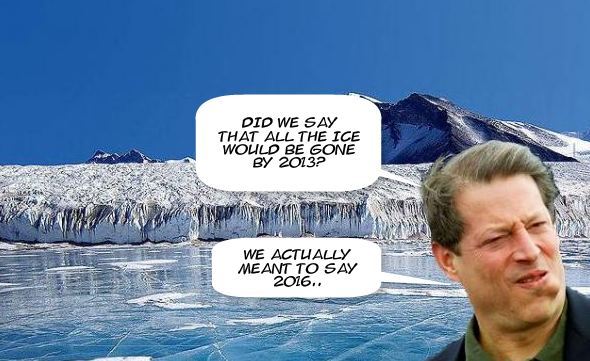
February Arctic Ice Jumps Over 15 Wadhams a Month Early

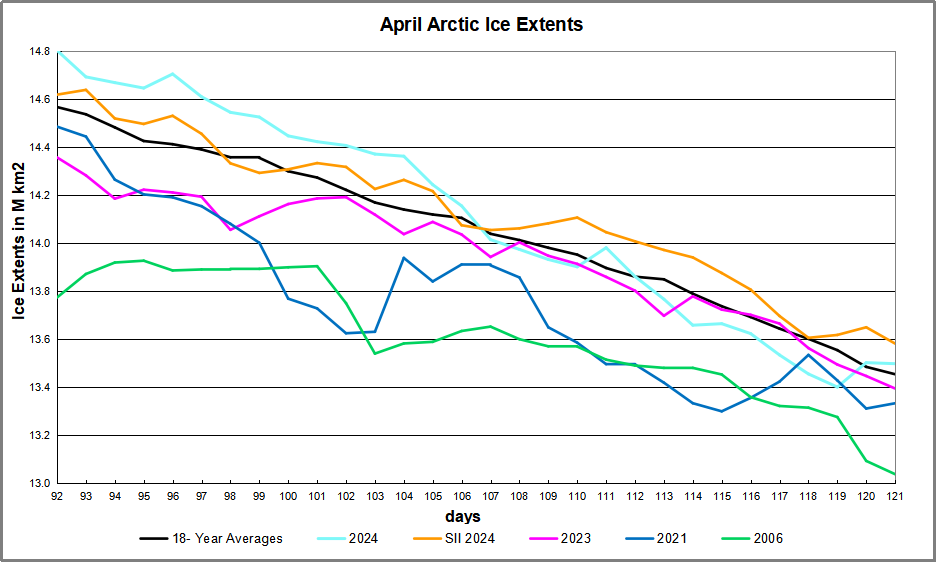
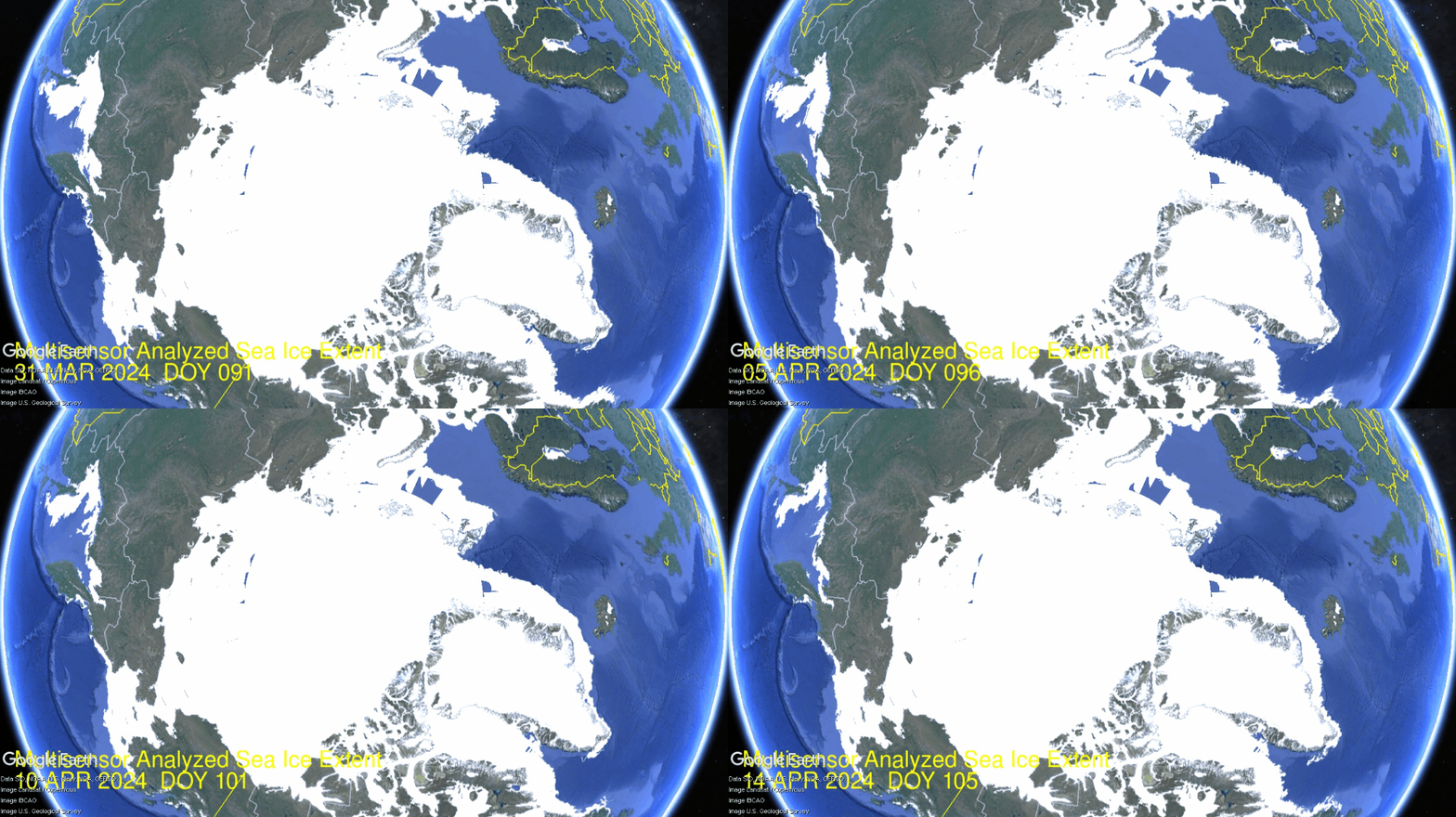
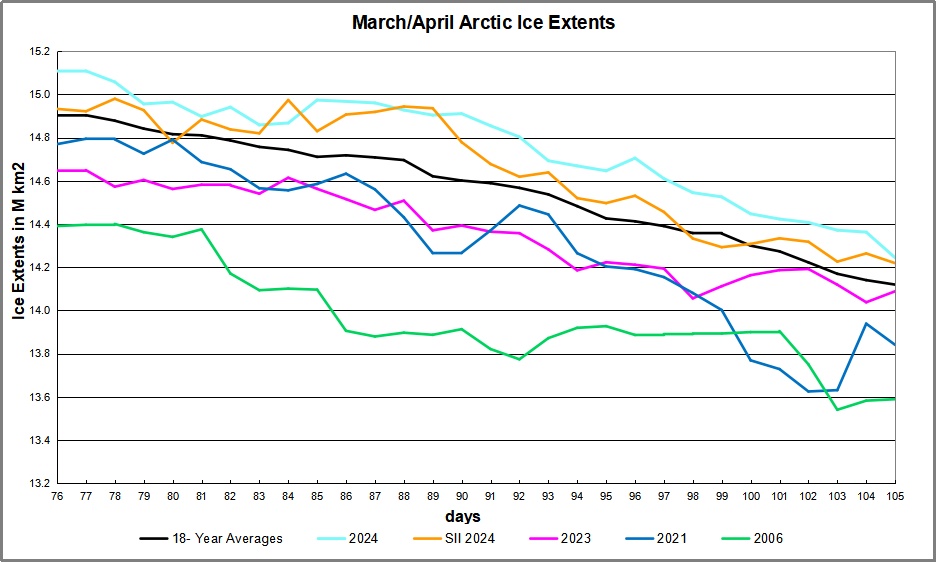
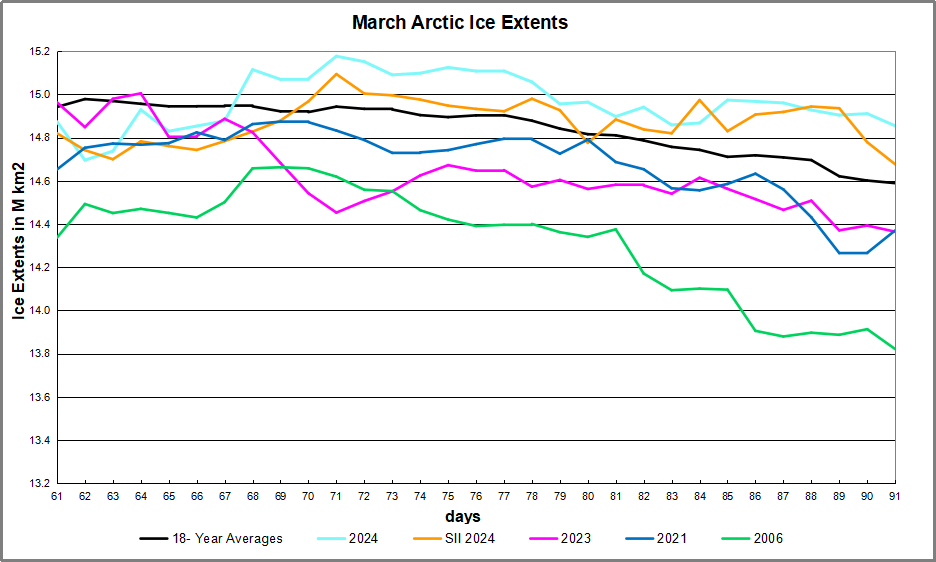
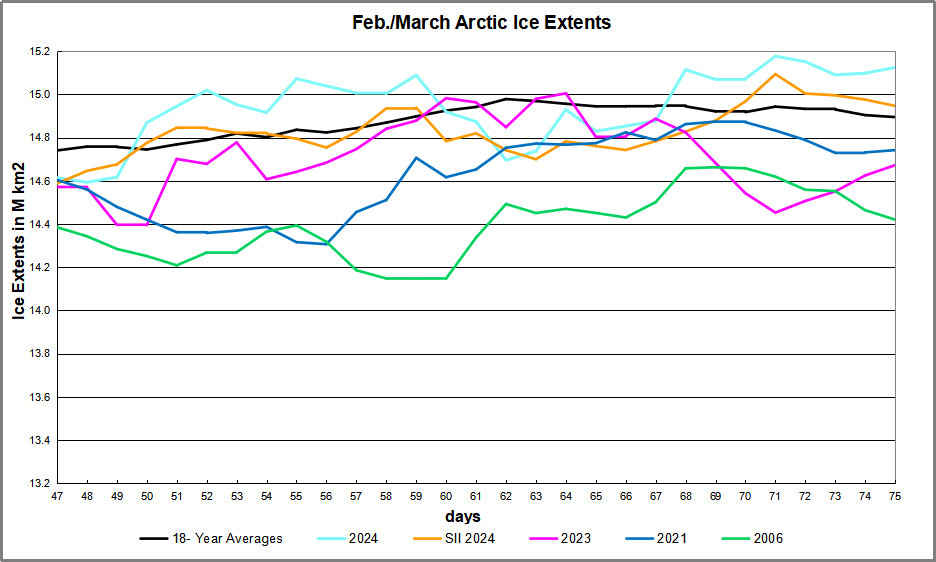
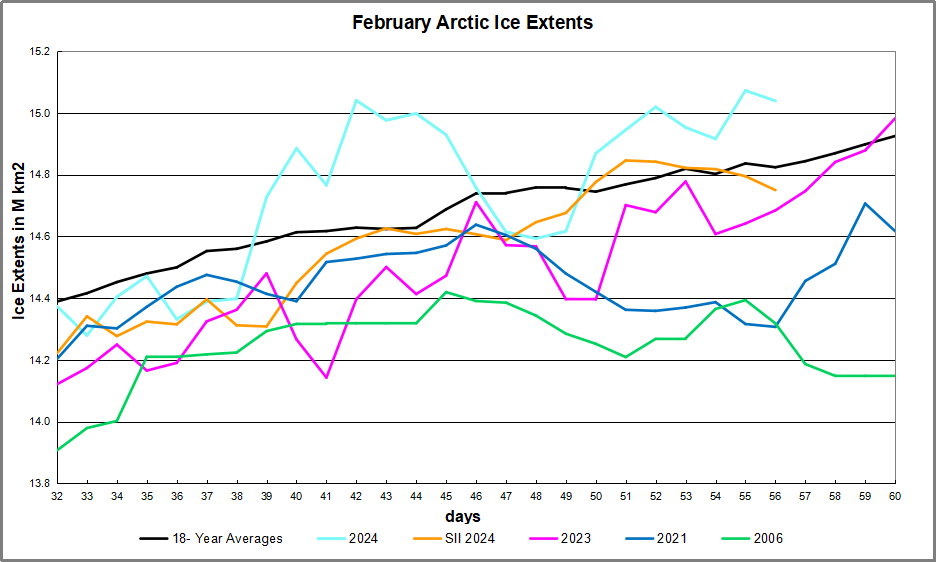
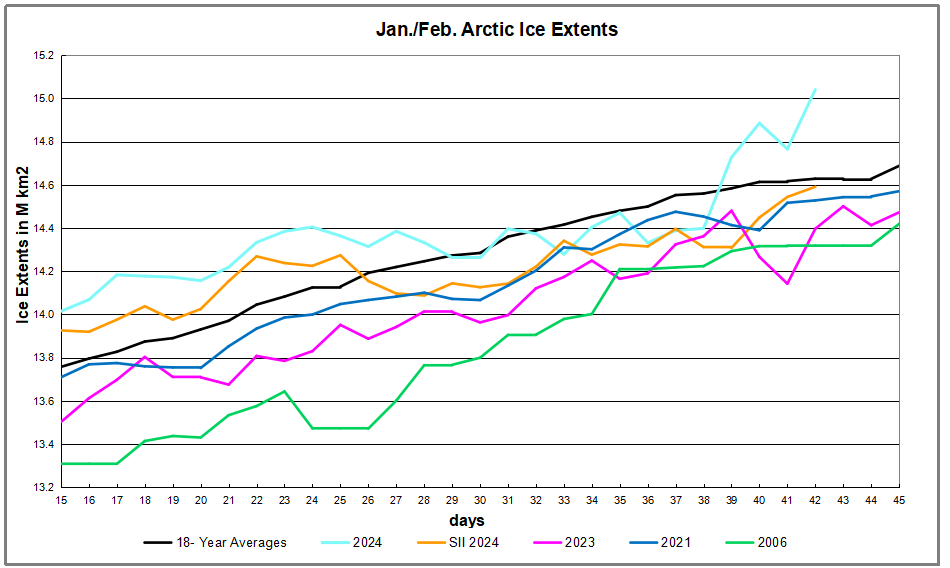
For ice extent in the Arctic, the bar is set at 15M km2. The highest daily average in the last 18 years occurs on day 61 at 15.08M before descending. Most years are able to clear 15M, but in recent previous years, 2017, 2018, 2019 and 2021 ice extents failed to clear the bar at 15M km2.  Now on February 11, 2024 (day 42) Arctic ice extent has already leaped over that bar 20 days early.

All years including averages are from MASIE, except for SII 2024.

The graph shows how rapidly the Arctic froze this year, reaching 14.4M km2 extent already on January 24.  Then the extent waffled around that level, until suddenly a Hockey Stick shape appeared when 600k km2 of ice was added in just the last four days. That is 400k km2 above average, and well above many other years, including 2006.  SII is also lagging at 400k km2 lower.

The table shows the distribution of ice compared to day 45 averages and other years on that day.

Region 2024042 Day 45 Ave. 2024-Ave. 2006045 2024-2006
 (0) Northern_Hemisphere 15040629 14687838 352791 14419407 621223
 (1) Beaufort_Sea 1070983 1070317 667 1069711 1273
 (2) Chukchi_Sea 966006 965761 245 966006 0
 (3) East_Siberian_Sea 1087137 1087131 6 1087103 35
 (4) Laptev_Sea 897845 897837 8 897773 71
 (5) Kara_Sea 934647 908486 26161 932726 1920
 (6) Barents_Sea 662793 582078 80715 530801 131992
 (7) Greenland_Sea 825638 622774 202864 579677 245961
 (8) Baffin_Bay_Gulf_of_St._Lawrence 1340370 1456370 -115999 1227497 112873
 (9) Canadian_Archipelago 854860 853383 1478 852715 2145
 (10) Hudson_Bay 1260903 1260579 325 1257433 3470
 (11) Central_Arctic 3233243 3208074 25168 3198987 34255
 (12) Bering_Sea 631508 700745 -69237 889518 -258010
 (13) Baltic_Sea 136308 90991 45317 79904 56404
 (14) Sea_of_Okhotsk 1101713 923694 178019 759197 342516

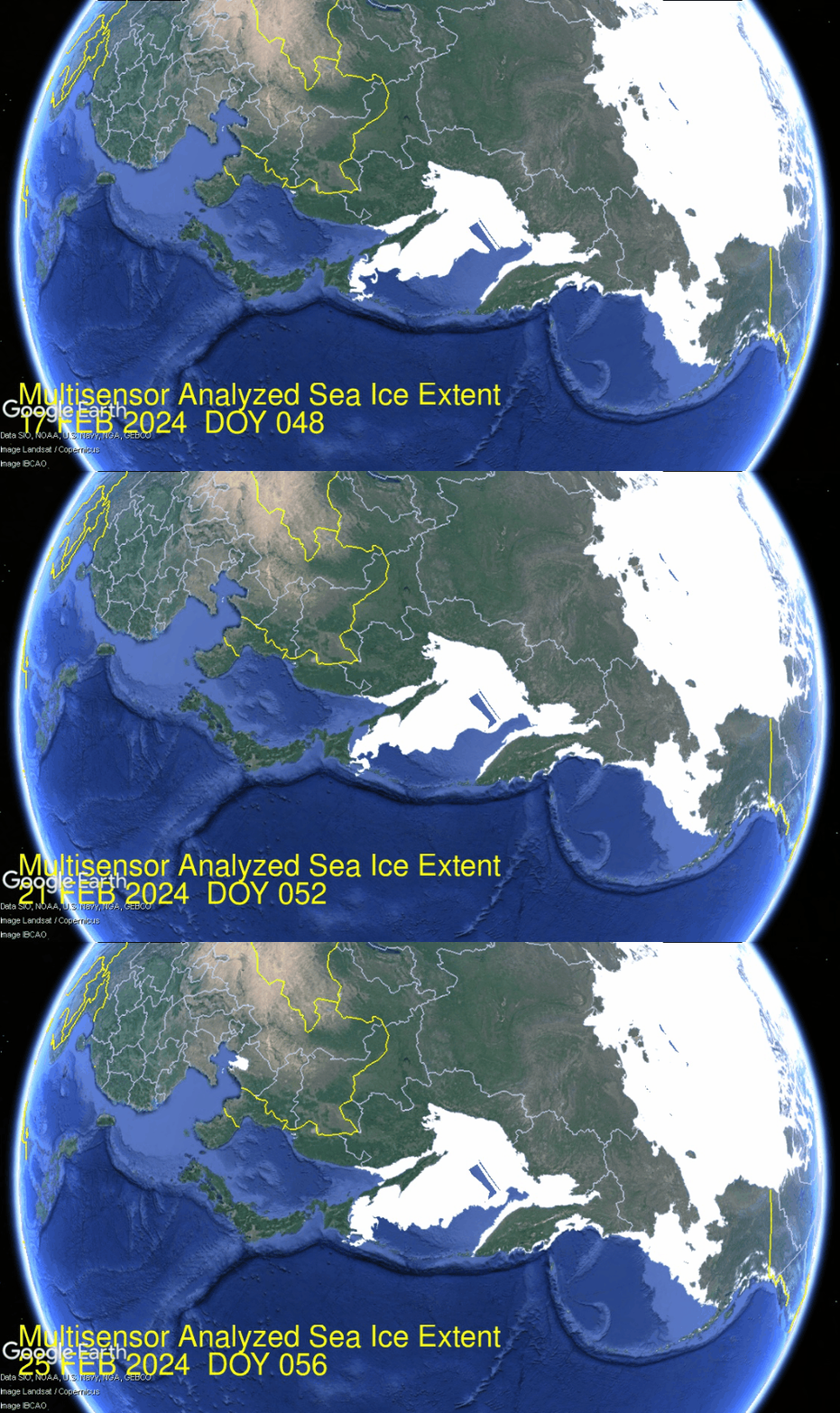
The Pacific basins show a moderate deficit in Bering Sea offset by a large 178k km2 surplus in Okhotsk.  Baffin Bay is down 120k km2, offset by Greenland Sea over 200k km2 and Barents up 81k km2.

These results fly in the face of those claiming for years that Arctic ice is in a “death spiral.”  More sober and clear-eyed observers have called out the alarmists for their exaggerations.  A recent example comes from Allan Alsup Jensen at Nordic Institute of Product Sustainability, Environmental Chemistry and Toxicology, Denmark.  His December 2023 paper is Time Trend of the Arctic Sea Ice Extent.  Excerpts in italics with my bolds and added images.

Since 2007 no significant decline has been observed

Abstract

The NSIDC website, IPCC’s reports and some scientific papers have announced that the Arctic Sea ice extent, when it is lowest in September month, in recent years has declined dramatically, and in few decades the sea ice is supposed to disappear completely in the summer. In that way new and shorter ships routes will open up north of the continents.

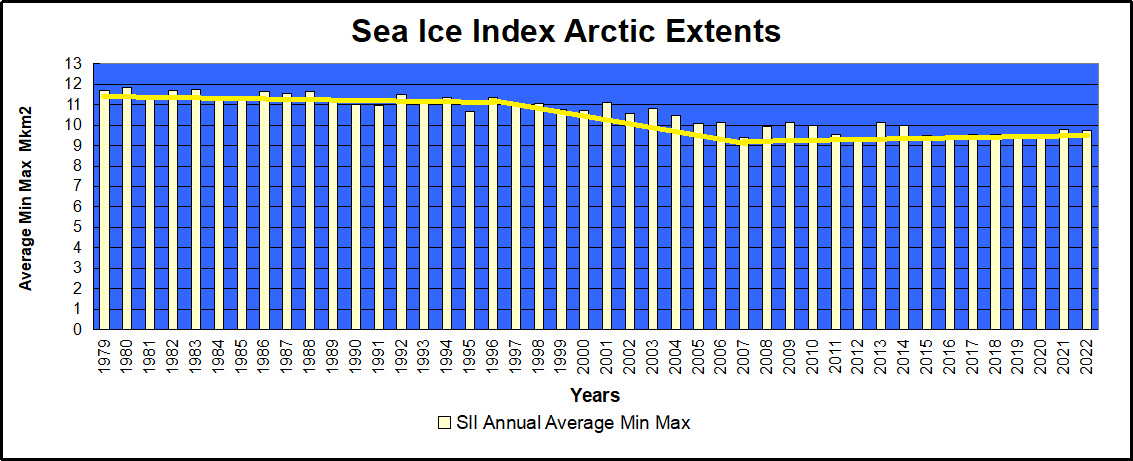
The facts are, that the Arctic Sea ice extent measured by satellites since 1978 expresses annual variations and it has declined considerably from 1997 to 2007. However, before that time period, from 1978 to 1996, the downward trend was minimal, and in the last 17 years from 2007 to 2023 the downward trend has also been about zero. Therefore, there is no indication that we should expect the Arctic Sea summer ice to disappear completely, as predicted, in one or two decades.

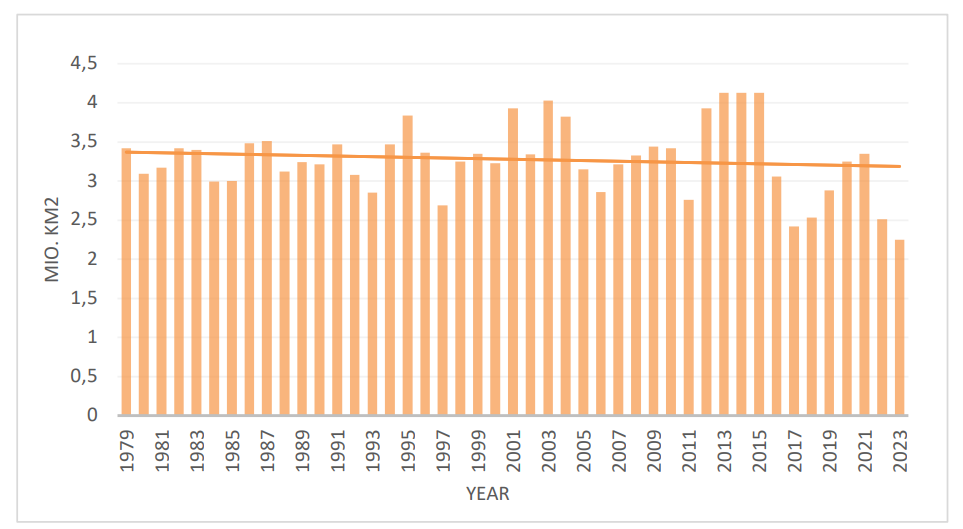
Regarding the extent of the summer (February) sea ice at the Antarctic, the downward trend during the years 1979-2021 was very small but in 2022 and 2023 a considerable decline was observed, and a decline was also clearly observed for the whole period of 2007- 2023. That was in contradiction to what happened in the Arctic. The pattern of the annual levels was not the same for the Arctic and Antarctic, indicating different drivers in the North and the South.

Figure 4: The minimum extent of the sea ice at Antarctic
in February month 1979-2023 (data
from NSIDC.org)

These data show that there is no apparent correlation between the variable extent of the Arctic and the Antarctic Sea ice and the gradually increasing CO2-concentrations in the atmosphere as proposed by NSIDC, IPCC and others, also for these areas of cold climate.

Postscript Feb. 14

Some seek to deny the current plateau in Arctic Sea Ice by saying that extent measure is only surface, while volume would be a truer metric.  That is true in theory, but in practice obtaining accurate and consistent data on sea ice thickness is a challenge yet to be reached.  As you can imagine, detecting a depth dimension from satellites is fraught with errors, especially with drift ice not land anchored, moving around, sometimes piling up from winds.  The scientific effort to measure volume has a short history and several uncertainties to ovecome before it can be trusted.

Unfortunately for those wanting an ice free Arctic (well, no more than 1 Wadham they say), the volume record so far shows the same plateau:

“Satellite derived sea ice thickness (CryoSat 2, AWI algorithm v2.6) shows an anomaly thickness pattern very similar to that from PIOMAS, but CS2 shows negative anomalies propagating north of the Canadian Archipelago into the central Arctic while PIOMAS has neutral conditions there. A positive thickness anomaly around Wrangle Island is spatially more extensive in CS2. January 2024 adds another month to the record of CS2 data which now spans 13 years. Neither CS2 nor PIOMAS show any discernible trend over that time period underlining the importance of internal variability at decadal timescales.”  Source: Polar Science Center


2024 Arctic Ice Seesaw

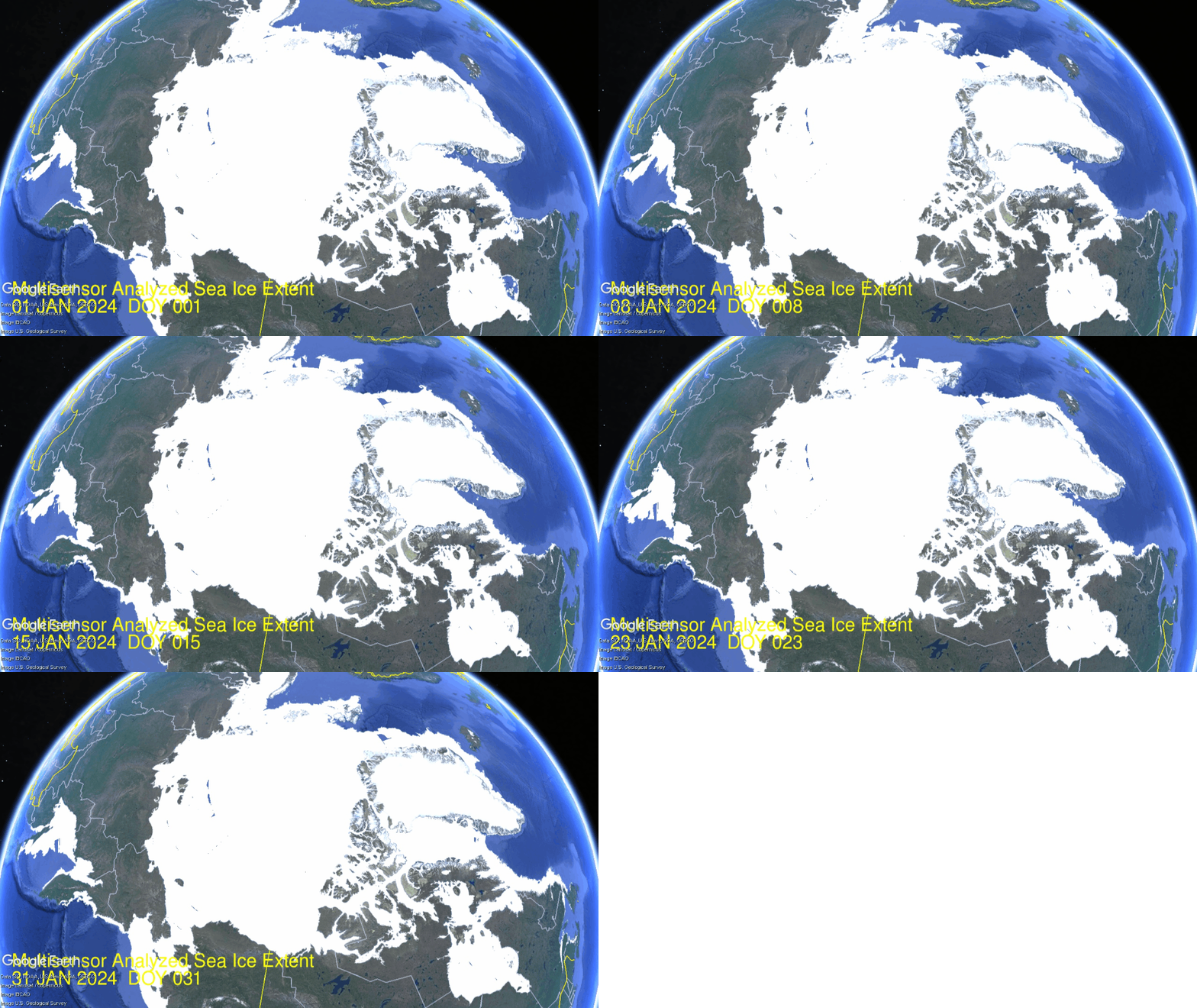
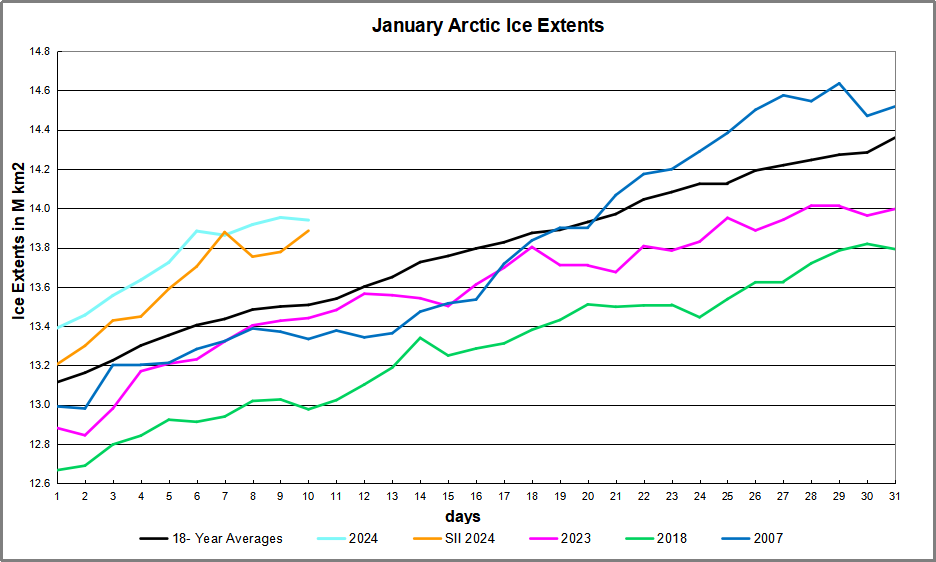
In January, most of the Arctic ocean basins are frozen over, and so the growth of ice extent slows down.  According to MASIE January on average adds 1.2M km2, and this month it was 1.1M. However, 2024 started above average and quickly grew to 14M km2 (14 Wadhams), before slowing down and ending January slightly above the 18 year average.   The few basins that can grow ice this time of year tend to fluctuate and alternate waxing and waning, which appears as a see saw pattern in these images.

On the left is the Pacific seesaw with Bering below and Okhotsk above.  This year Okotsk added ice steadily, and slowed at the end, while Bering waffled up and down mid month before gaining ice at the end. The Atlantic seesaw is Barents top center and Baffin on the right below Greenland.  Barents grew ice steadily until mid January, then gave almost all of it back by the end. Baffin added ice slowly all month, then accelerated the last two weeks.

While the seesaws are tilting back and forth on the margins, the bulk of the Arctic is frozen solid. And with limited places where more extent can be added, the pace of overall growth has slowed. Note that at 14.4M km2 Arctic ice extent now has about six weeks to break the 15M km2 annual ceiling mid March.

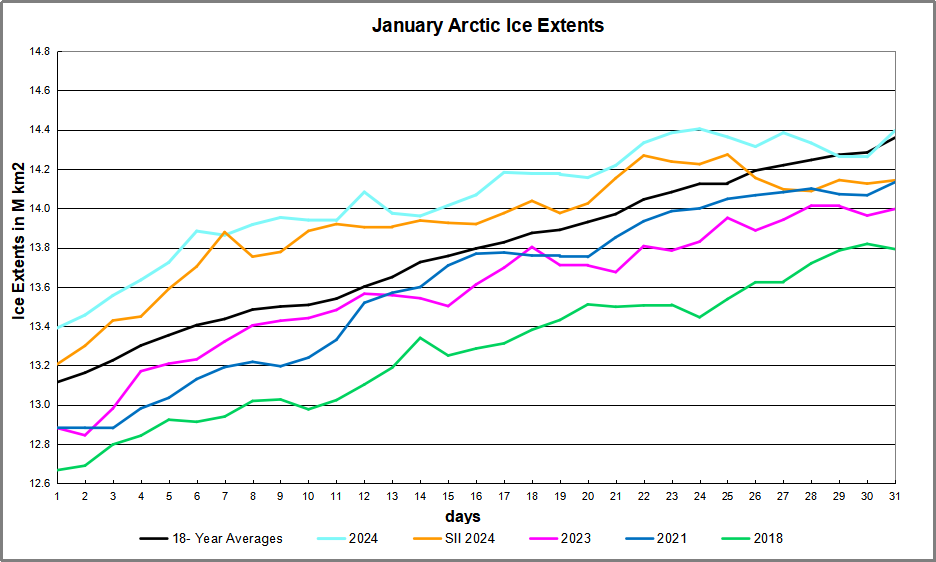
The graph shows the 18-year average gain for January is 1.2M km2.  2024 started with 275k km2 surplus ice extent and ended slightly above average, while and other recent years were lower.  SII showed lower extents most of the month  with a 253k km2 deficit to MASIE at the end.

Region 2024031 Day 31 2024-Ave. 2018031 2024-2018
 (0) Northern_Hemisphere 14396470 14360118 36352 13792271 604199
 (1) Beaufort_Sea 1070983 1070351 632 1070445 538
 (2) Chukchi_Sea 966006 965973 34 965971 35
 (3) East_Siberian_Sea 1087137 1087059 78 1087120 18
 (4) Laptev_Sea 897845 897823 22 897845 0
 (5) Kara_Sea 894933 918701 -23769 895363 -430
 (6) Barents_Sea 473076 569199 -96123 481947 -8872
 (7) Greenland_Sea 711708 607586 104122 501411 210297
 (8) Baffin_Bay_Gulf_of_St._Lawrence 1272213 1331684 -59471 1406903 -134690
 (9) Canadian_Archipelago 854860 853430 1430 853109 1752
 (10) Hudson_Bay 1260903 1260770 133 1260838 66
 (11) Central_Arctic 3214505 3210272 4233 3184817 29688
 (12) Bering_Sea 665225 647841 17384 382207 283018
 (13) Baltic_Sea 71817 62350 9467 41714 30103
 (14) Sea_of_Okhotsk 910937 818756 92181 704398 206539

The table shows regional ice extents in km2.  The few deficits are in Baffin Bay and Barents, offset by sizeable surpluses in Greenland and Okhotsk seas.  Everywhere else is close to maximum for the year.

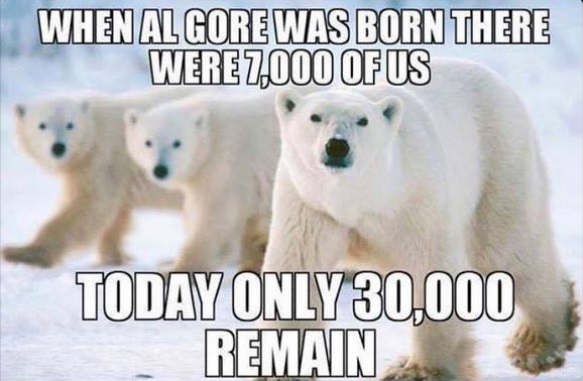
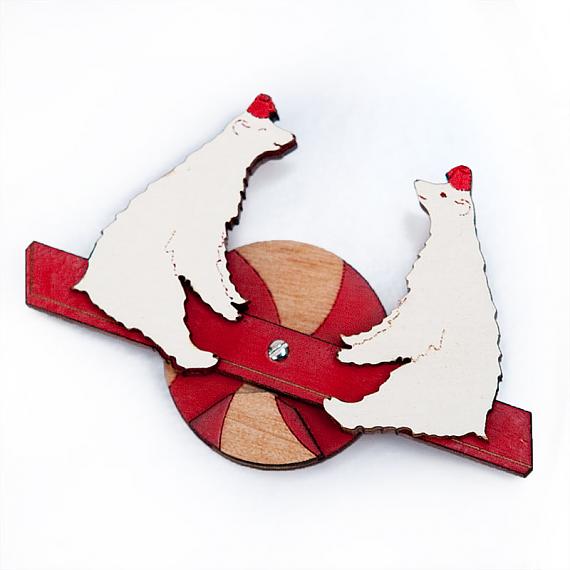
The polar bears have a Valentine Day’s wish for Arctic Ice.

welovearcticicefinal

And Arctic Ice loves them back, returning every year so the bears can roam and hunt for seals.

Footnote:

Seesaw accurately describes Arctic ice in another sense:  The ice we see now is not the same ice we saw previously.  It is better to think of the Arctic as an ice blender than as an ice cap, explained in the post The Great Arctic Ice Exchange.

Arctic Grows a Month of Ice in 3 Weeks January 2024

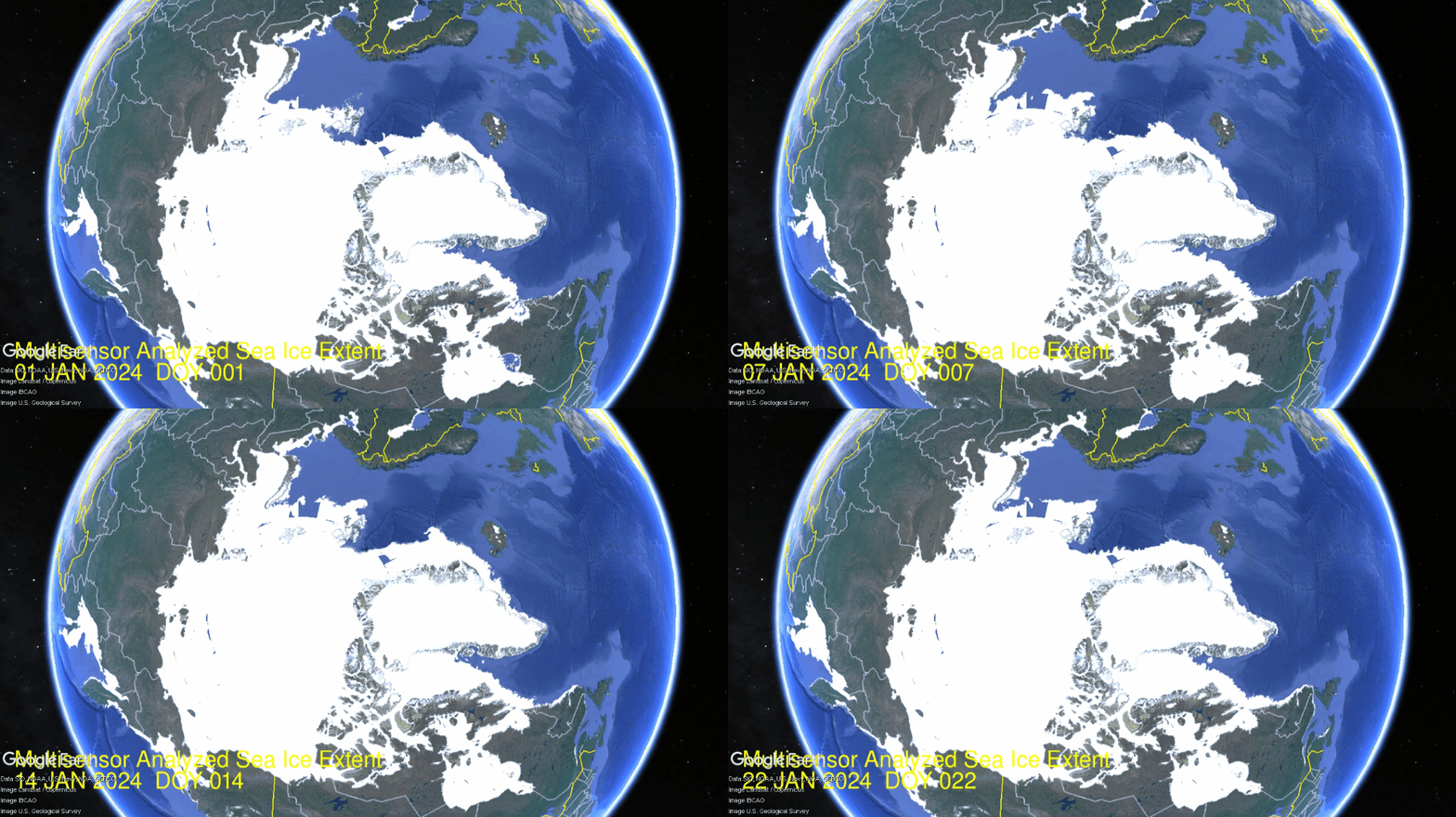
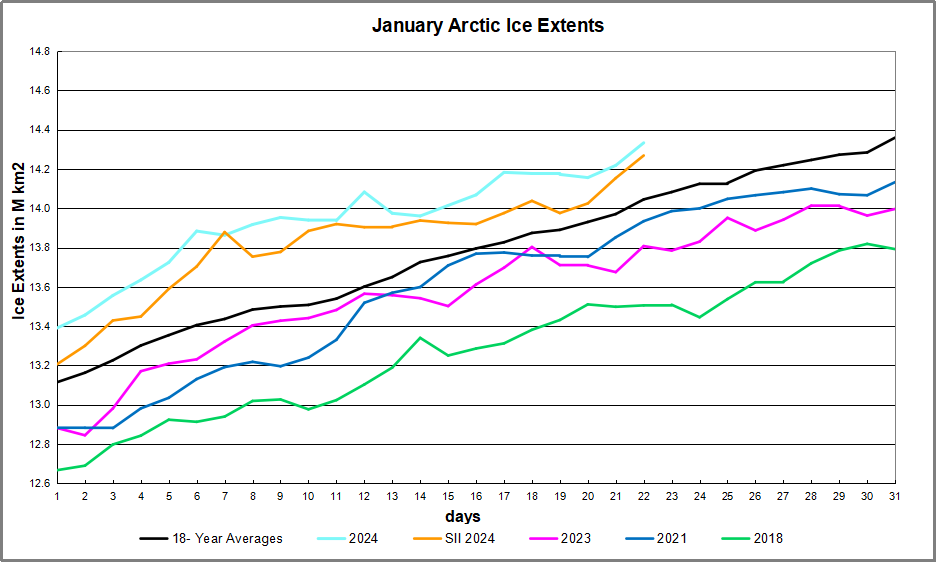
Impressive Arctic ice recovery continued in January, growing a month’s worth in just three weeks, as seen in the animation below:

In three weeks of January 2024, the Arctic added nearly a full Wadham of ice (1M km2). The animation shows Hudson Bay (lower right) freezing completely.  Just above Hudson, you can see the Gulf of St. Lawrence icing over, and Baffin Bay adding ice, extending fast ice all the way to Newfoundland, now up to 64% of its annual maximum.

At the extreme and lower left, Okhotsk and Bering Seas also grow rapidly. Okhotsk grew ice extent up to 914k, 81% of its max last March.  Bering grew up to 514k km2, 68% of its max.  At the top Kara freezes over and Barents and Greenland Seas add ice to their margins.The graph below shows the January ice recovery.

Note the average January ends at 14.36 km2 while 2024 has already reached 14.33 km2, up from 13.39 km2 at the start, and presently  288k km2 above average. SII started slightly lower than MASIE and tracked quite closely since. Note that other recent years have varied below the 18-year average at month end.

The table below shows year-end ice extents in the various Arctic basins compared to the 18-year averages and some recent years.

Region 2024022 Day 22 2024-Ave. 2018022 2024-2018
 (0) Northern_Hemisphere 14333601 14045488  288112  13505957 827644 
 (1) Beaufort_Sea 1070983 1070317  667  1070445 538 
 (2) Chukchi_Sea 966006 965999  965971 35 
 (3) East_Siberian_Sea 1087137 1087131  1087120 18 
 (4) Laptev_Sea 897845 897837  897845
 (5) Kara_Sea 932571 910022  22549  891776 40795 
 (6) Barents_Sea 712531 530554  181977  322465 390067 
 (7) Greenland_Sea 703581 601855  101726  465828 237753 
 (8) Baffin_Bay_Gulf_of_St._Lawrence 1050488 1239519  -189031  1330666 -280179 
 (9) Canadian_Archipelago 854860 853382  1479  853109 1752 
 (10) Hudson_Bay 1260903 1260695  209  1260838 66 
 (11) Central_Arctic 3230107 3203377  26730  3165195 64912 
 (12) Bering_Sea 513853 600796  -86943  343164 170689 
 (13) Baltic_Sea 93892 56072  37820  44364 49528 
 (14) Sea_of_Okhotsk 914275 720482  193793  782100 132175 

This year’s ice extent is 288k km2 or 2.1% above average.  Only Baffin Bay and Bering have deficits to average, more than offset by surpluses elsewhere, espcially Greenland, Barents and Okhotsk seas. Many of the others are already maxed out.


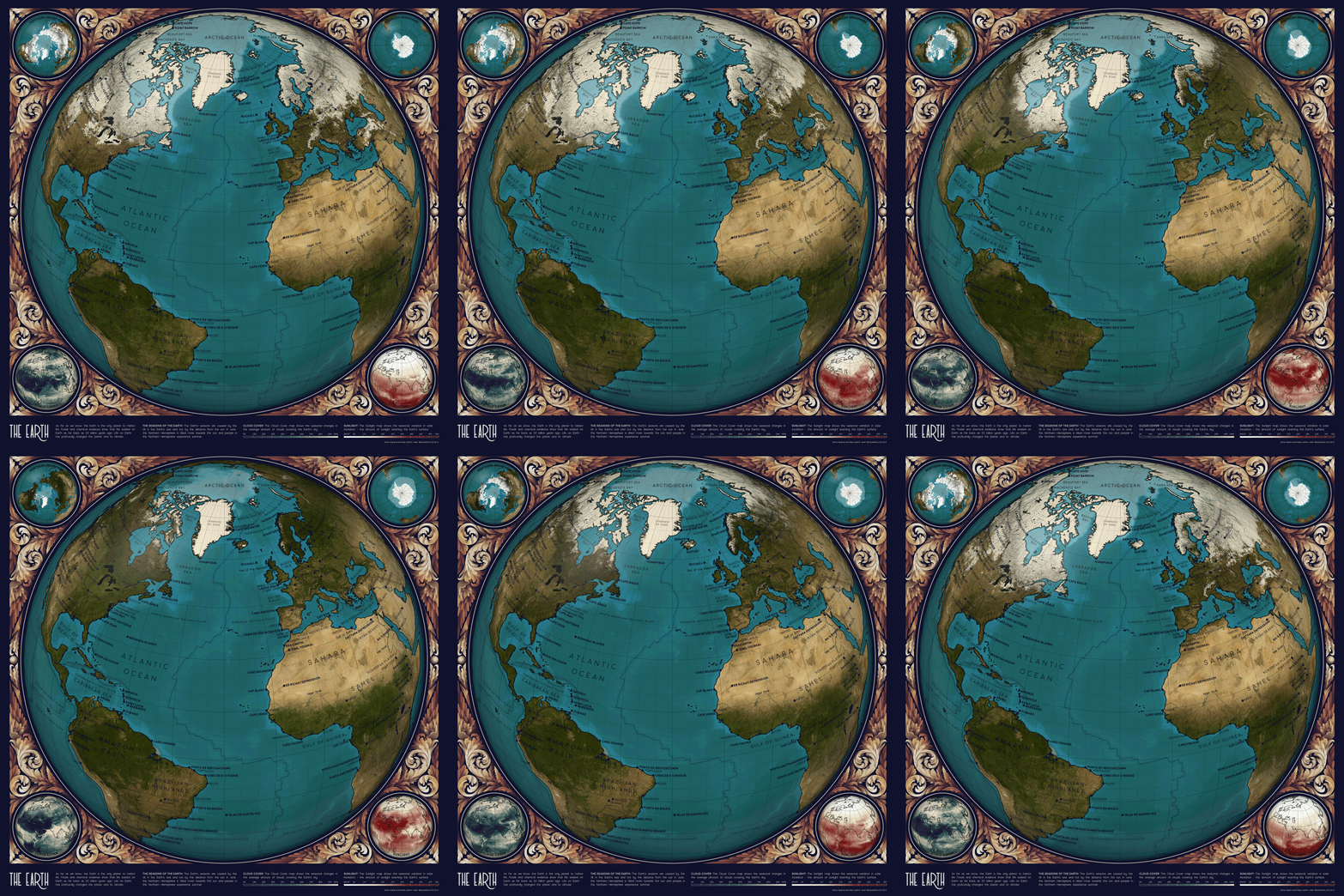
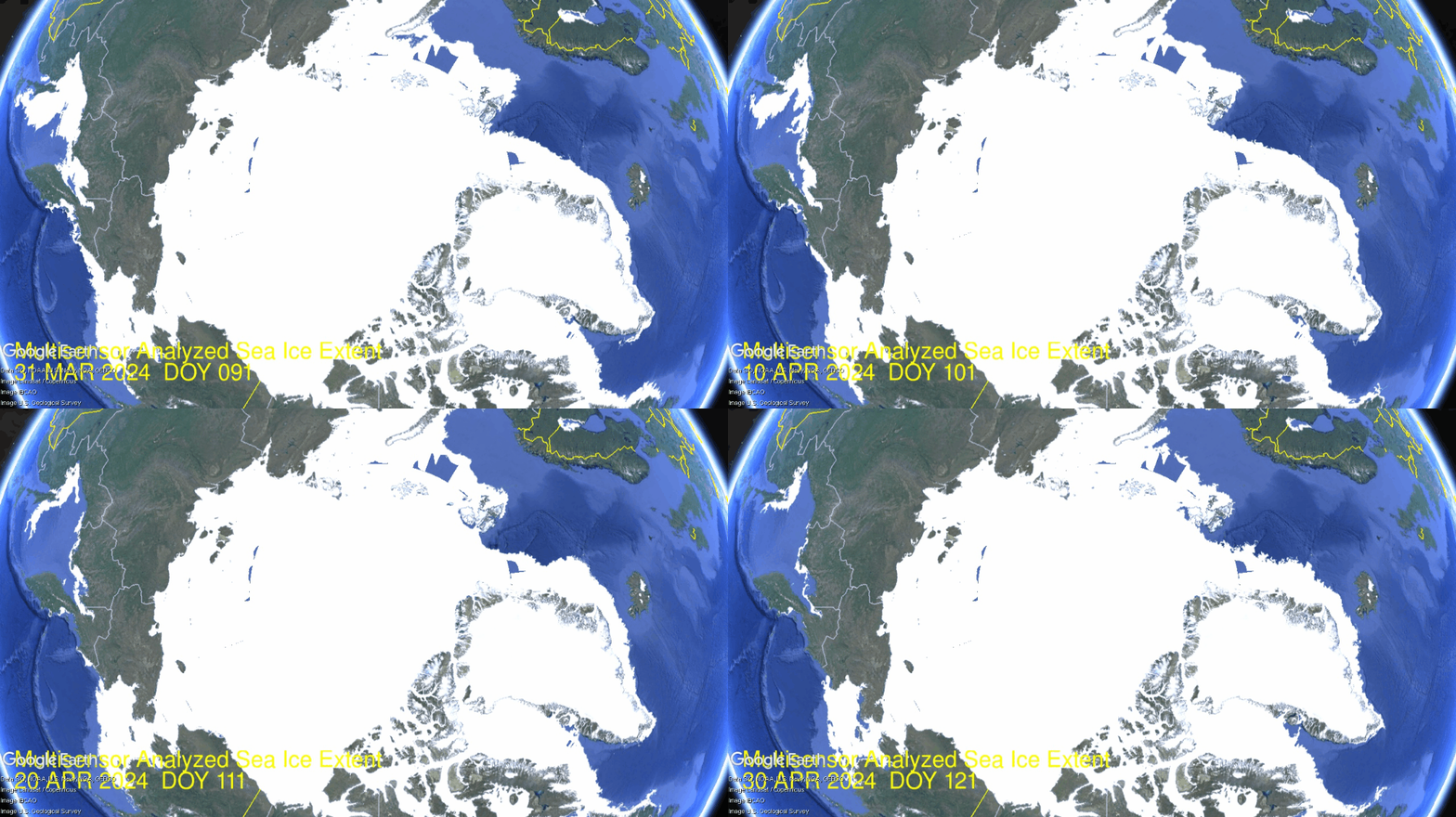
Illustration by Eleanor Lutz shows Earth’s seasonal climate changes. If played in full screen, the four corners present views from top, bottom and sides. It is a visual representation of scientific datasets measuring Arctic ice extents and NH snow cover.


Arctic Flash Freezing Start to 2024

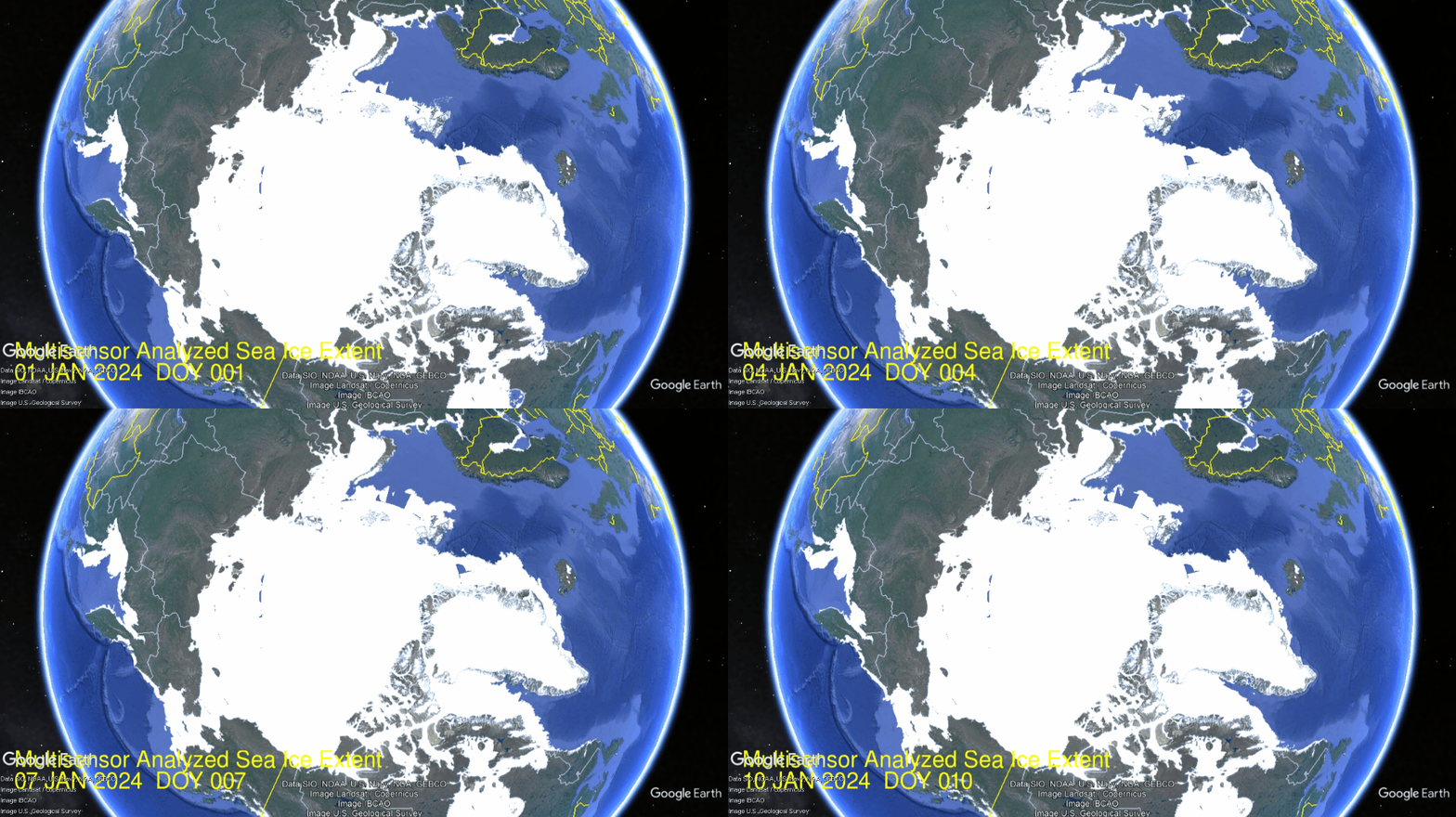
Many noticed the Gore effect during COP28 when Arctic ice extents grew rapidly to catch up and exceed normal. Now in the first 10 days of January Arctic ice is growing way faster than normal. On the left, both Bering and Okhotsk seas are now ~65% of their maxes. Kara at top is 100% of max and Barents next to Kara is 83% of max. Overall, the Arctic has already reached 93% of last year’s Mid March maximum.

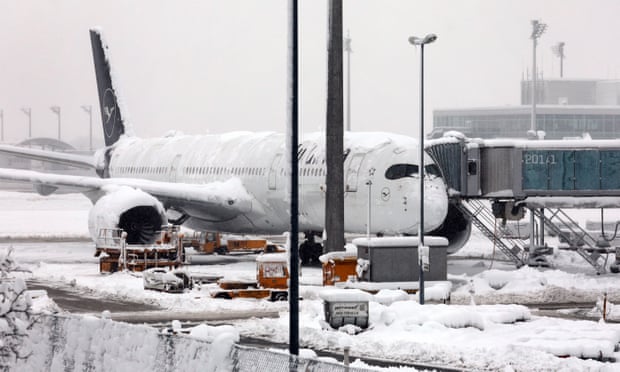
A Lufthansa aircraft at the snow-covered Munich airport on Saturday. Photograph: Karl-Josef Hildenbrand/AP

Coincidently, COP28 also triggered heavy snow bringing chaos to southern Germany causing Munich to suspend flights to anywhere, including Dubai. Now January is breaking the glazed ceiling outstriping past conditions.

The graph below shows the gains in ice extent the first 10 days of January 2024, the 18 year average and some other recent years, as well as SII (Sea Ice Index).

MASIE and SII are both well above the 18 year average, and almost 10 days ahead of it. 2024 is on the verge of breaking 14M km2, just 400k km2 short of normal extents at end of January.  

The table below shows the distribution of ice in the Arctic Ocean basins.

Region 2024010 Day 10 2024-Ave. 2007010 2024-2007
 (0) Northern_Hemisphere 13940138 13508235  431903  13334598 605540 
 (1) Beaufort_Sea 1070966 1070352  614  1069711 1255 
 (2) Chukchi_Sea 966006 965221  785  966006
 (3) East_Siberian_Sea 1087137 1087131  1087137
 (4) Laptev_Sea 897845 897836  897845
 (5) Kara_Sea 934227 914139  20088  909703 24524 
 (6) Barents_Sea 593194 463310  129884  363027 230166 
 (7) Greenland_Sea 722914 577267  145647  576959 145955 
 (8) Baffin_Bay_Gulf_of_St._Lawrence 941219 1088951  -147732  934564 6655 
 (9) Canadian_Archipelago 854860 853418  1442  852767 2094 
 (10) Hudson_Bay 1260903 1249501  11402  1260839 65 
 (11) Central_Arctic 3233482 3202675  30807  3204750 28732 
 (12) Bering_Sea 492428 503203  -10775  606863 -114435 
 (13) Baltic_Sea 128886 33634  95252  3303 125582 
 (14) Sea_of_Okhotsk 729537 565328  164209  585350 144187 

Note that Arctic ice now nearly 14M km2 and  432k km2 above average, or 3.2%.  As shown in the table above, the only deficit to average is in Baffin Bay,  Offsetting are surpluses elsewhere, especially in Greenland sea, along with Barents and Okhotsk seas. Really, the only regions left to grow much up to max are Baffin Bay, Bering and Okhotsk seas.


Fear Not for Arctic Ice New Year 2024

Impressive Arctic ice recovery continued in December as seen in the animation below:
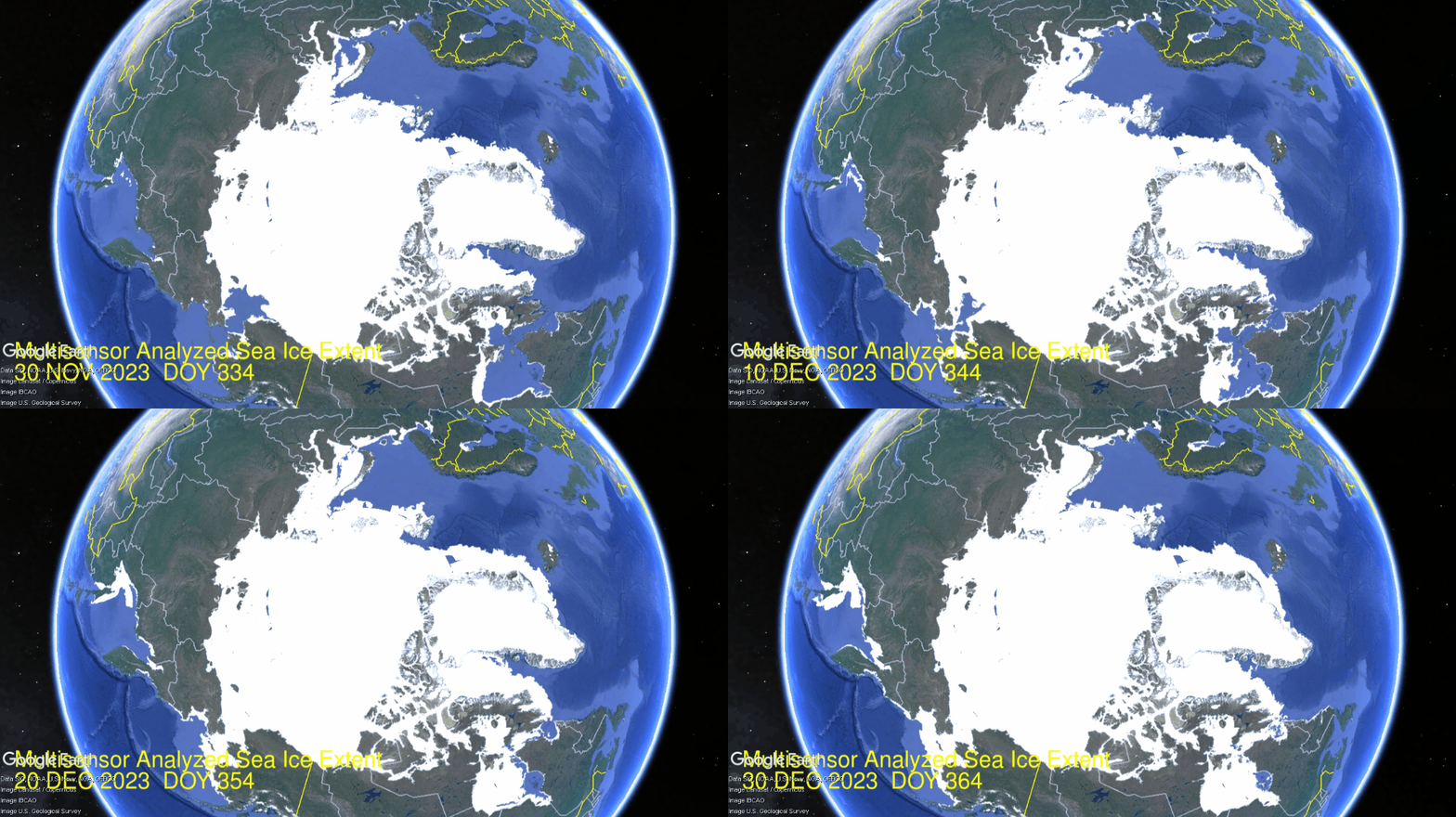
The month of December 2023 shows Hudson Bay (lower right) starting with some western shore ice and ending 92% ice covered, adding in that basin ~800k km2. Just above Hudson, you can see the Gulf of St. Lawrence icing over, and Baffin Bay adding ice as well, now up to 50% of its annual maximum.

At the extreme and lower left, Okhotsk and Bering Seas also start with little shore ice. Okhotsk grew ice extent from 57k km2 up to 530k, 62% of its max last March.  Bering grew from 48k up to 478k km2, 56% of its max.  At the top Kara freezes over and Barents and Greenland Seas add ice to their margins. The graph below shows the December ice recovery. (Day 365 coming, and may be delayed by holiday.)
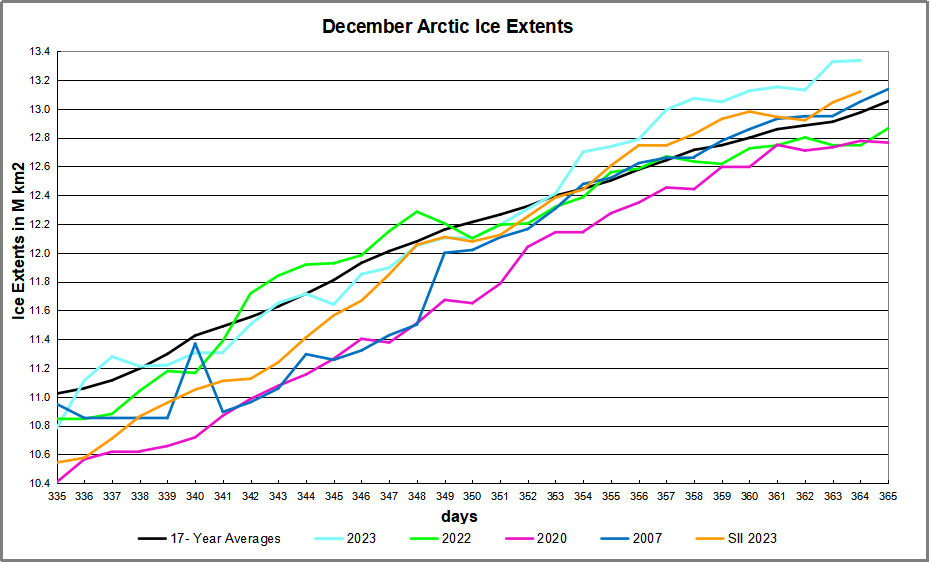
Note the average year adds 2M km2 while 2023 added ~2.5M, now 361k km2 above average. SII started 200k km2 lower than MASIE and ended up with the same deficit. Note that the other years are not far from the 17-year average at year end.

The table below shows year-end ice extents in the various Arctic basins compared to the 17-year averages and some recent years.

Region 2023364 Day 364 2023-Ave. 2007364 2023-2007
 (0) Northern_Hemisphere 13335688 12974817  360871  13049737 285951 
 (1) Beaufort_Sea 1070966 1070352  614  1069711 1255 
 (2) Chukchi_Sea 966006 963344  2662  965971 35 
 (3) East_Siberian_Sea 1087137 1087133  1087120 17 
 (4) Laptev_Sea 897845 897841  897845
 (5) Kara_Sea 923106 880831  42275  871851 51255 
 (6) Barents_Sea 423772 415592  8179  334577 89194 
 (7) Greenland_Sea 739662 579776  159886  666135 73528 
 (8) Baffin_Bay_Gulf_of_St._Lawrence 911691 965051  -53360  1074827 -163136 
 (9) Canadian_Archipelago 854860 853421  1439  852556 2304 
 (10) Hudson_Bay 1165656 1234412  -68757  1260856 -95201 
 (11) Central_Arctic 3218074 3205662  12412  3199726 18348 
 (12) Bering_Sea 472476 391321  81155  373942 98534 
 (13) Baltic_Sea 44969 27442  17527  9972 34997 
 (14) Sea_of_Okhotsk 530117 377911  152206  371241 158876 

This year’s ice extent is 361k km2 or 2.8% above average.  Only Baffin Bay and Hudson have deficits to average, more than offset by surpluses elsewhere, espcially Greenland, Bering and Okhotsk seas. Many of the others are already maxed out.

Comparing Arctic Ice at End of Years

At  the bottom is a discussion of statistics on year-end Arctic Sea Ice extents.  The values are averages of the last five days of each year.  End of December is a neutral point in the melting-freezing cycle, midway between September minimum and March maximum extents.
Background from Previous Post Updated to Year-End 2023

Some years ago reading a thread on global warming at WUWT, I was struck by one person’s comment: “I’m an actuary with limited knowledge of climate metrics, but it seems to me if you want to understand temperature changes, you should analyze the changes, not the temperatures.” That rang bells for me, and I applied that insight in a series of Temperature Trend Analysis studies of surface station temperature records. Those posts are available under this heading. Climate Compilation Part I Temperatures

This post seeks to understand Arctic Sea Ice fluctuations using a similar approach: Focusing on the rates of extent changes rather than the usual study of the ice extents themselves. Fortunately, Sea Ice Index (SII) from NOAA provides a suitable dataset for this project. As many know, SII relies on satellite passive microwave sensors to produce charts of Arctic Ice extents going back to 1979.  The current Version 3 has become more closely aligned with MASIE, the modern form of Naval ice charting in support of Arctic navigation. The SII User Guide is here.

There are statistical analyses available, and the one of interest (table below) is called Sea Ice Index Rates of Change (here). As indicated by the title, this spreadsheet consists not of monthly extents, but changes of extents from the previous month. Specifically, a monthly value is calculated by subtracting the average of the last five days of the previous month from this month’s average of final five days. So the value presents the amount of ice gained or lost during the present month.

These monthly rates of change have been compiled into a baseline for the period 1980 to 2010, which shows the fluctuations of Arctic ice extents over the course of a calendar year. Below is a graph of those averages of monthly changes up to and including this year. Those familiar with Arctic Ice studies will not be surprised at the sine wave form. December end is a relatively neutral point in the cycle, midway between the September Minimum and March Maximum.
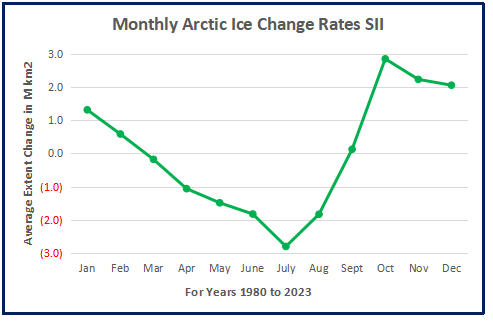
The graph makes evident the six spring/summer months of melting and the six autumn/winter months of freezing.  Note that June-August produce the bulk of losses, while October-December show the bulk of gains. Also the peak and valley months of March and September show very little change in extent from beginning to end.

The table of monthly data reveals the variability of ice extents over the last 4 decades.
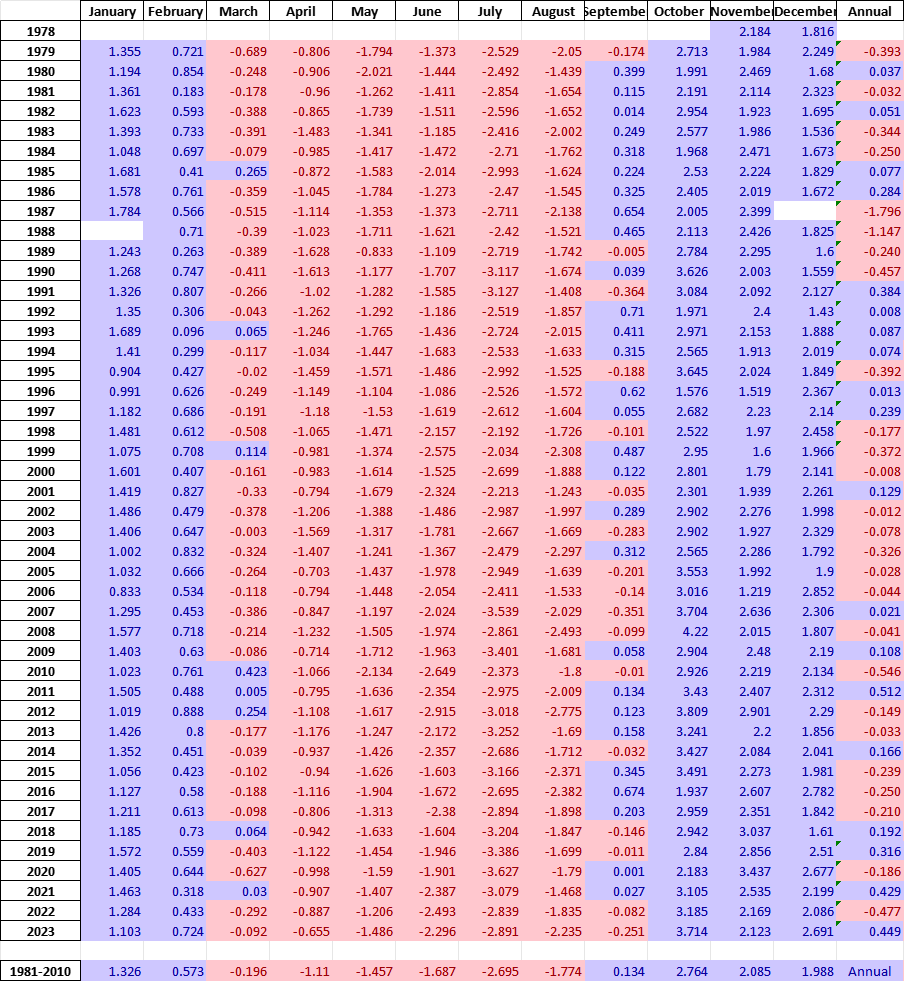
The values in January show changes from the end of the previous December, and by summing twelve consecutive months we can calculate an annual rate of change for the years 1979 to 2023.
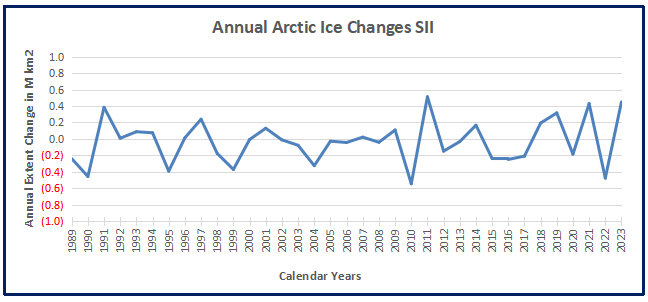
As many know, there has been a decline of Arctic ice extent over these 40 years, averaging 70k km2 per year. But year over year, the changes shift constantly between gains and losses, ranging up to +/- 500k km2.  Since 1989 the average yearend gain/loss is nearly zero, -0.033k km2 to be exact.

Moreover, it seems random as to which months are determinative for a given year. For example, much ado was printed about 2023 losing more ice than usual June through September. But then the final 3 months of 2023 more than made up for those summer losses, resulting in a sizeable gain for the year.

As it happens in this dataset, October has the highest rate of adding ice. The table below shows the variety of monthly rates in the record as anomalies from the 1980-2010 baseline. In this exhibit a red cell is a negative anomaly (less than baseline for that month) and blue is positive (higher than baseline).
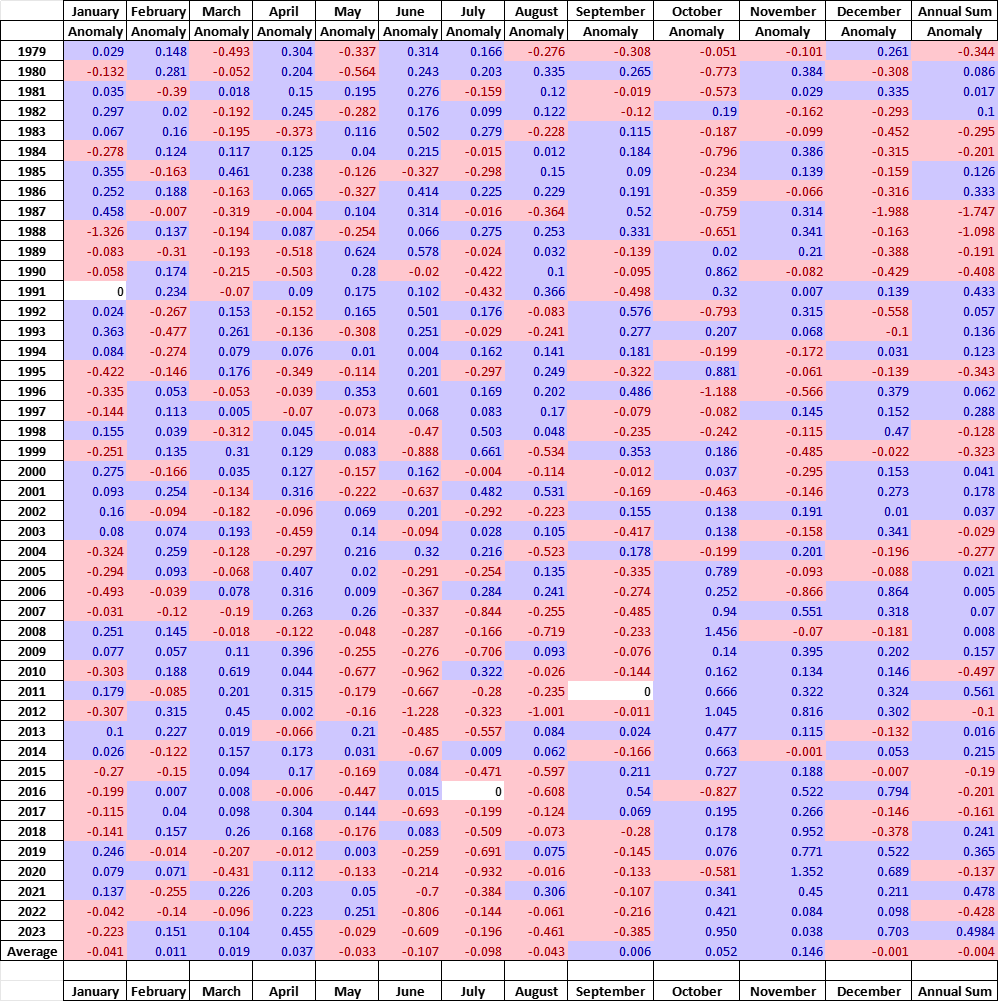
Note that the  +/ –  rate anomalies are distributed all across the grid, sequences of different months in different years, with gains and losses offsetting one another.  As noted earlier,  in 2023 the outlier negative months were June through September where unusual amounts of ice were lost.  Then unusally strong gains in October and December resulted in a large annual gain, compared to the baseline. The bottom line presents the average anomalies for each month over the period 1979-2021.  Note the rates of gains and losses mostly offset, and the average of all months in the bottom right cell is virtually zero.

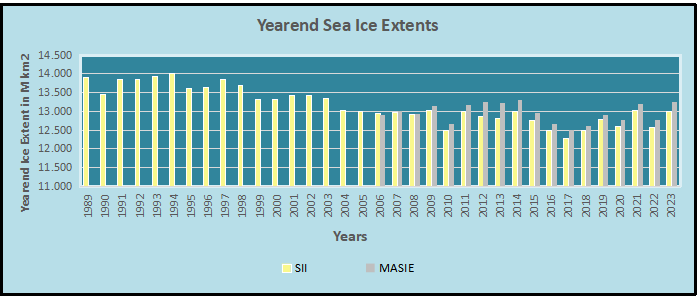
A final observation: The graph below shows the Yearend Arctic Ice Extents for the last 34 years.
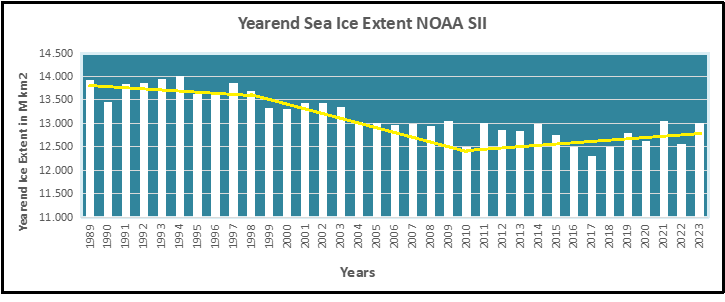
Year-end Arctic ice extents (last 5 days of December) show three distinct regimes: 1988-1998, 1998-2010, 2010-2022. The average year-end extent 1989-2010 is 13.4M km2. In the last decade, 2011 was 13.0M km2, and six years later, 2017 was 12.3M km2. 2021 rose back to 13.06  2022 slipped back to 12.6M, and 2023 is back up to 13.0M. So for all the the fluctuations, the net is zero, or a gain of half a Wadham (0.5M) from 2010. Talk of an Arctic ice death spiral is fanciful.

These data show a noisy, highly variable natural phenomenon. Clearly, unpredictable factors are in play, principally water structure and circulation, atmospheric circulation regimes, and also incursions and storms. And in the longer view, today’s extents are not unusual.


Illustration by Eleanor Lutz shows Earth’s seasonal climate changes. If played in full screen, the four corners present views from top, bottom and sides. It is a visual representation of scientific datasets measuring Arctic ice extents.
 

COP28 Stabilizes Mid-Dec. Arctic Ice


As COP28 began, Arctic ice extrent grew rapidly and by its end the Arctic was completely normal. On lower left, Chukchi sea filled in and below Bering sea started serious freezing. Lower right Hudson Bay more than doubled up to 800k km2, 2/3 of its maximum extent.  Center right Baffin Bay grew to 45% of max.

A Lufthansa aircraft at the snow-covered Munich airport on Saturday. Photograph: Karl-Josef Hildenbrand/AP

Coincidently, COP28 also triggered heavy snow bringing chaos to southern Germany causing Munich to suspend flights to anywhere, including Dubai.

The graph below shows the gains in ice extent mid-November to Mid December for 2023, the 17 year average and some other recent years, as well as SII (Sea Ice Index)

MASIE showed 2023 and 2022 tracking the 17 year average and ending very close together.  2007 fluctuated a lot, well below average in December before rising at the end.  SII tracked ~400k km2 lower most of this period, before rising to match MASIE in the last few days.


The table below shows the distribution of ice in the Arctic Ocean basins.

Region 2023349 Day 349 2023-Ave. 2007349 2023-2007
 (0) Northern_Hemisphere 12104311 12162108  -57797  12000124 104187 
 (1) Beaufort_Sea 1070966 1070103  863  1069711 1255 
 (2) Chukchi_Sea 948805 934827  13978  796459 152347 
 (3) East_Siberian_Sea 1087137 1086539  598  1077192 9945 
 (4) Laptev_Sea 897845 897835  897845
 (5) Kara_Sea 826874 847433  -20559  842174 -15300 
 (6) Barents_Sea 370088 335870  34218  285179 84909 
 (7) Greenland_Sea 688238 546548  141690  571916 116322 
 (8) Baffin_Bay_Gulf_of_St._Lawrence 819365 824803  -5438  852443 -33079 
 (9) Canadian_Archipelago 854860 853420  1440  852556 2304 
 (10) Hudson_Bay 800760 1101080  -300320  1248305 -447546 
 (11) Central_Arctic 3212059 3204043  8016  3192331 19728 
 (12) Bering_Sea 226652 236725  -10073  93340 133312 
 (13) Baltic_Sea 55323 11920  43403  10353 44970 
 (14) Sea_of_Okhotsk 231640 200090  31550  206342 25297 

Note that Arctic ice now exceeds 12M km2, or 80% of last March maximum.  As shown in the table above, the main deficit to average is in Hudson Bay, likely to be overcome with the current rapid growth. Offsetting are surpluses elsewhere, mostly in Greenland sea, along with Barents and Baltic seas.


COP28 Triggers Leap in Arctic Ice

The animation shows remarkable growth of Arctic ice extent just since COP28 began.  As noted in the previous Arctic ice post, Hudson Bay (lower right) was a lagging region, but freezing accelerated there. At the top, Barents and Greenland sea added ice. As well, both Bering and Okhotsk seas (far left) added fast ice on coastlines. In all, half a Wadham, 517k km2 of ice extent was added in just three days.

A Lufthansa aircraft at the snow-covered Munich airport on Saturday. Photograph: Karl-Josef Hildenbrand/AP

Coincidently, COP28 also triggered heavy snow bringing chaos to southern Germany causing Munich to suspend flights to anywhere, including Dubai.

The graph below shows the gains in ice extent erasing a brief deficit to average.

MASIE shows a gain of ~0.5M km2 from day 334 to 336, now exceeding average after being lower briefly.  SII (Sea Ice Index) also rose but is still estimating ice extent ~500k km2 lower.

The table below shows the distribution of ice in the Arctic Ocean basins.

Region 2023336 Day 336 2023-Ave. 2007336 2023-2007
 (0) Northern_Hemisphere 11113626 11059843  53782  10853632 259993 
 (1) Beaufort_Sea 1070966 1069301  1665  1054586 16380 
 (2) Chukchi_Sea 765844 797154  -31311  607874 157970 
 (3) East_Siberian_Sea 1087137 1080765  6372  1023256 63882 
 (4) Laptev_Sea 897845 897835  897845
 (5) Kara_Sea 812779 796332  16446  829462 -16683 
 (6) Barents_Sea 350616 259899  90717  222769 127847 
 (7) Greenland_Sea 711570 538651  172919  541176 170393 
 (8) Baffin_Bay_Gulf_of_St._Lawrence 571757 697517  -125760  755390 -183633 
 (9) Canadian_Archipelago 854860 853409  1451  852556 2304 
 (10) Hudson_Bay 553841 636088  -82247  812965 -259124 
 (11) Central_Arctic 3220281 3198662  21619  3177278 43003 
 (12) Bering_Sea 82391 154107  -71716  27916 54475 
 (13) Baltic_Sea 23276 4889  18387  2898 20378 
 (14) Sea_of_Okhotsk 106202 70731  35471  46377 59826 

Note that Arctic ice now exceeds 11M km2, or 74% of last March maximum.  As shown in the table above, the main deficits to average are in Hudson and Baffin Bays, along with less ice in Bering Sea. Offsetting are surpluses elsewhere, especially in Barents and Greenland seas.


November 2023 Arctic Ice Doing Well

The animation shows the continuing growth of Arctic ice extent during November 2023, from day 305 to yesterday, day 334.  For all of the fuss over the September minimum, little is said about Arctic ice growing back rapidly; that’s 4 Wadhams in October, plus another 2,2M in Nov to total 10.6M km2, or 10.6 Wadhams.  The Russian side on the left froze over in October, and now at the center bottom you can see Beaufort sea and Canadian Archipelago icing over completely. At top center Kara and Barents are adding normal ice extents. On the right side are the two lagging basins: Baffin and Hudson Bays, though freezing has started in Hudson bay in the last ten days.  That basin is shallow and likely to freeze over in the next two weeks.

The graph below shows the 30 days of November 2023 compared to the 17 year average (2006 to 2022 inclusive), to SII (Sea Ice Index) and some notable years.


Taking the average extent for the final 5 days of October 2023 compared to same for end of November, the added ice extent is 2.2M km2.  The growth slowed at the end resulting in a 290k km2 deficit to average.  Sea Ice Index (SII) is ~200k km2 lower than MASIE. 

The table below shows the distribution of ice in the Arctic Ocean basins.

Region 2023334 Day 334 2023-Ave. 2007334 2023-2007
 (0) Northern_Hemisphere 10626375 10921303  -294928  11009948 -383574 
 (1) Beaufort_Sea 1070966 1069463  1503  1058872 12094 
 (2) Chukchi_Sea 722477 788533  -66056  687829 34649 
 (3) East_Siberian_Sea 1087137 1083567  3570  1082015 5122 
 (4) Laptev_Sea 897845 897822  23  897613 232 
 (5) Kara_Sea 799640 792930  6710  826319 -26679 
 (6) Barents_Sea 262074 248861  13213  216525 45549 
 (7) Greenland_Sea 607148 533255  73893  618844 -11696 
 (8) Baffin_Bay_Gulf_of_St._Lawrence 591970 671268  -79298  708497 -116527 
 (9) Canadian_Archipelago 854826 853266  1560  850249 4577 
 (10) Hudson_Bay 379047 574308  -195261  751382 -372335 
 (11) Central_Arctic 3220511 3192296  28215  3183073 37438 
 (12) Bering_Sea 47829 145731  -97902  72645 -24816 
 (13) Baltic_Sea 16936 3593  13343  0 16936 
 (14) Sea_of_Okhotsk 63947 62153  1794  53052 10895 

As shown in the table above, the deficit is due to lagging growth in Hudson and Baffin Bays, along with less ice in Chukchi and Bering Seas. Typically these basins are among the last to freeze.


Mid-Nov. 2023 Arctic Ice Grows to 10 Wadhams

The animation shows the rapid growth of Arctic ice extent during November 2023, from day 304 to yesterday, day 319.  For all of the fuss over the September minimum, little is said about Arctic ice growing back rapidly; that’s 4 Wadhams in October, plus another 1.3M in Nov to total 10M km2, or 10 Wadhams.  The Russian side on the left froze over in October, and now at the center bottom you can see Beaufort sea and Canadian Archipelago icing up. Center right is Baffin Bay growing ice as well.

The graph below shows the last 30 days of 2023 compared to the 17 year average (2006 to 2022 inclusive), to SII (Sea Ice Index) and some notable years.


From Mid October to Mid November 2023, MASIE shows NH ice extent growing from 6.3 M km2 to 10M.  That matches 2022 and exceeds the 17 year average by more than 200K km2.   SII (Sea Ice Index) is only slightly lower.

The table below shows the distribution of ice in the Arctic Ocean basins.

Region 2023319 Day 319 Ave. 2023-Ave. 2007319 2023-2007
 (0) Northern_Hemisphere 9997068 9784253  212815  9737614 259454 
 (1) Beaufort_Sea 1051194 1063450  -12257  1053727 -2533 
 (2) Chukchi_Sea 596947 629695  -32748  503783 93164 
 (3) East_Siberian_Sea 1064913 1075985  -11072  1043952 20960 
 (4) Laptev_Sea 897845 897217  628  897845
 (5) Kara_Sea 696199 658489  37710  765376 -69177 
 (6) Barents_Sea 245998 154920  91078  145438 100560 
 (7) Greenland_Sea 613312 460620  152692  527575 85737 
 (8) Baffin_Bay_Gulf_of_St._Lawrence 536576 526706  9870  533931 2645 
 (9) Canadian_Archipelago 841536 850736  -9200  852539 -11003 
 (10) Hudson_Bay 161371 234076  -72704  231544 -70173 
 (11) Central_Arctic 3236821 3174741  62081  3156228 80594 

Overall ice extent has 212k km2 above average or 2%.  The only sizeable deficit is in Hudson Bay,  more than offset by surpluses elsewhere, especiallly in Greenland and Barents seas, along with the Central Arctic.


October 2023 Arctic Ice Grows by Leaps

The animation shows the rapid growth of Arctic ice extent during October 2023, from day 274 to day 304, yesterday.  For all of the fuss over the September minimum, little is said about Arctic ice growing 4M km2, that’s 4 Wadhams in one month!.  Look on the left (Russian side) at the complete closing of the Northern Sea Route for shipping.

The graph below show 2023 compared to the 17 year average (2006 to 2022 inclusive), to SII (Sea Ice Index) and some notable years.

This year October added 3.95M km2 from end of September compared to an average October increase of 3.45M km2.  As of yesterday NH ice extent is 368k km2 above average and nearly 600k km2 greater than 2007.

The table below shows the distribution of ice in the Arctic Ocean basins.

Region 2023304 Ave. Day 304 2023-Ave. 2007304 2023-2007
 (0) Northern_Hemisphere 8768573 8422636  345938  8175072 593501 
 (1) Beaufort_Sea 780946 957189  -176243  1038126 -257180 
 (2) Chukchi_Sea 535578 454974  80604  242685 292894 
 (3) East_Siberian_Sea 1078989 936944  142045  835071 243917 
 (4) Laptev_Sea 897845 842696  55149  887789 10055 
 (5) Kara_Sea 655623 473780  181843  311960 343664 
 (6) Barents_Sea 121748 83466  38282  52823 68925 
 (7) Greenland_Sea 528448 412774  115675  443559 84890 
 (8) Baffin_Bay_Gulf_of_St._Lawrence 243512 256243  -12731  289374 -45861 
 (9) Canadian_Archipelago 629955 762429  -132474  817220 -187265 
 (10) Hudson_Bay 82242 69487  12754  48845 33396 
 (11) Central_Arctic 3207724 3161034  46690  3206345 1379 

Overall ice extent has 346k km2 above average or 4%.  Sizeable deficits are in Beaufort Sea and Canadian Archipelago, more than offset by surpluses in Chukchi, East Siberian, Kara and Greenland seas.