Claim: Fossil Fuels Cause Global Warming


Recently I addressed this claim by referring to this chart produced by scientists from AARI.

Figure 5.1. Comparative dynamics of the World Fuel Consumption (WFC) and Global Surface Air Temperature Anomaly (4T), 1861-2000. The thin dashed line represents annual 4T, the bold line—its 13-year smoothing, and the line constructed from rectangles—WF C (in millions of tons of nominal fuel) (Klyashtorin and Lyubushin, 2003). Source: Frolov et al. 2009

Figure 5.1. Comparative dynamics of the World Fuel Consumption (WFC) and Global Surface Air Temperature Anomaly (ΔT), 1861-2000. The thin dashed line represents annual ΔT, the bold line—its 13-year smoothing, and the line constructed from rectangles—WFC (in millions of tons of nominal fuel) (Klyashtorin and Lyubushin, 2003). Source: Frolov et al. 2009


In their commentary, it is clear why the data does not support claiming fossil fuels cause global warming.  From Frolov et al. 2009:

The WFC curve shows an exponential increase, which doubles approximately every 30 years, increasing 25-fold since the middle of the nineteenth century. The global air temperature anomaly curve shows a positive trend of +0.06°C/10 years (Sonechkin et al., 1997). At the same time, there are cyclic changes with periods of about 60 years. The correlation between these curves changes its sign every 30 years, varying from —0.88 (1940 1970) to +0.94 (1970 2000). Hence, there is no direct linear connection between WFC (which indirectly represents CO2 concentration in the atmosphere) and global air temperature. The authors of this study therefore conclude that the WFC increase is not an obvious cause of the increase in global air temperature.

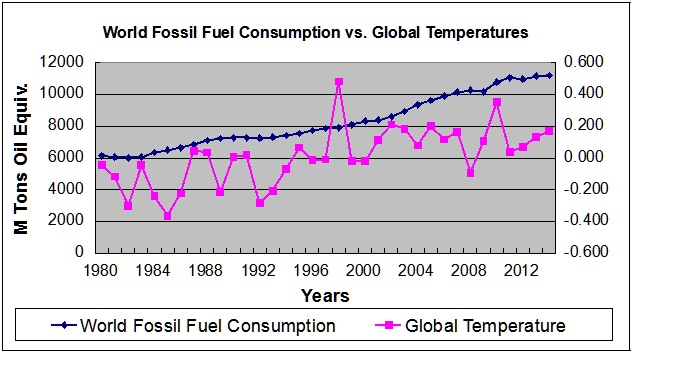
In this post, I am bringing the analysis up to date by showing World Fossil Fuel Consumption (WFFC) compared to Global Temperature Anomalies.
OLYMPUS DIGITAL CAMERA
The WFFC numbers come from US EIA and can be accessed here. I have included only the statistics for coal, oil and gas, which comprise 91% of total energy consumed. The remainder are hydro, nuclear and other renewables. 2015 numbers are not yet available. UAH version 6 provides global temperature anomalies for the lower troposphere.

The correlation overall is moderately positive at 0.60, but the two patterns are markedly different because of the 1998 event. 1980 to 2000 (the period overlapping with the AARI graph) shows a weakly positive 0.48 correlation. From 2000 to 2014 the correlation is almost non-existent at 0.07.

Summary

In the long-term and in the recent short-term, use of fossil fuels is not the obvious cause of temperature changes. The context and background for reaching this conclusion is provided below (From the previous post.)

Legal Test of Global Warming

In a previous post (here), I discussed the Bradford Hill protocol that has become precedent for trials concerning scientific evidence for legal liability.

Bradford Hill was the jurist who brought clarity and  methodology for the courts to consider and rule on accusations such as:

Thalidimide is causing birth defects;
Asbestos dust is causing lung disease;
as well as frequent claims of causal relationships between illness, injury and conditions of work.

The Global Warming Claim

When it comes to Global Warming, the proposition is straightforward:
Rising fossil fuel emissions are causing rising global temperatures.

The procedure to test that claim is described by Nathan Schachtman here.

Proper epidemiological methodology begins with published study results which demonstrate an association between a drug and an unfortunate effect. Once an association has been found, a judgment as whether a real causal relationship between exposure to a drug and a particular birth defect really exists must be made. 

Step 1: Establish an association between two variables.
Proper epidemiological method requires surveying the pertinent published studies that investigate whether there is an association between the medication use and the claimed harm. The expert witnesses must, however, do more than write a bibliography; they must assess any putative associations for “chance, confounding or bias”:

Step 2: Rule out chance as an explanation
The appropriate and generally accepted methodology for accomplishing this step of evaluating a putative association is to consider whether the association is statistically significant at the conventional level.
“Generally accepted methodology considers statistically significant replication of study results in different populations because apparent associations may reflect flaws in methodology.”

Step 3: Rule out bias or confounding factors.
The studies must be structured to analyze and reject other factors or influences, such as non-random sampling, additional intervening variables such as demographic or socio-economic differences.

Step 4: Infer Causation by Applying Accepted Causative Factors
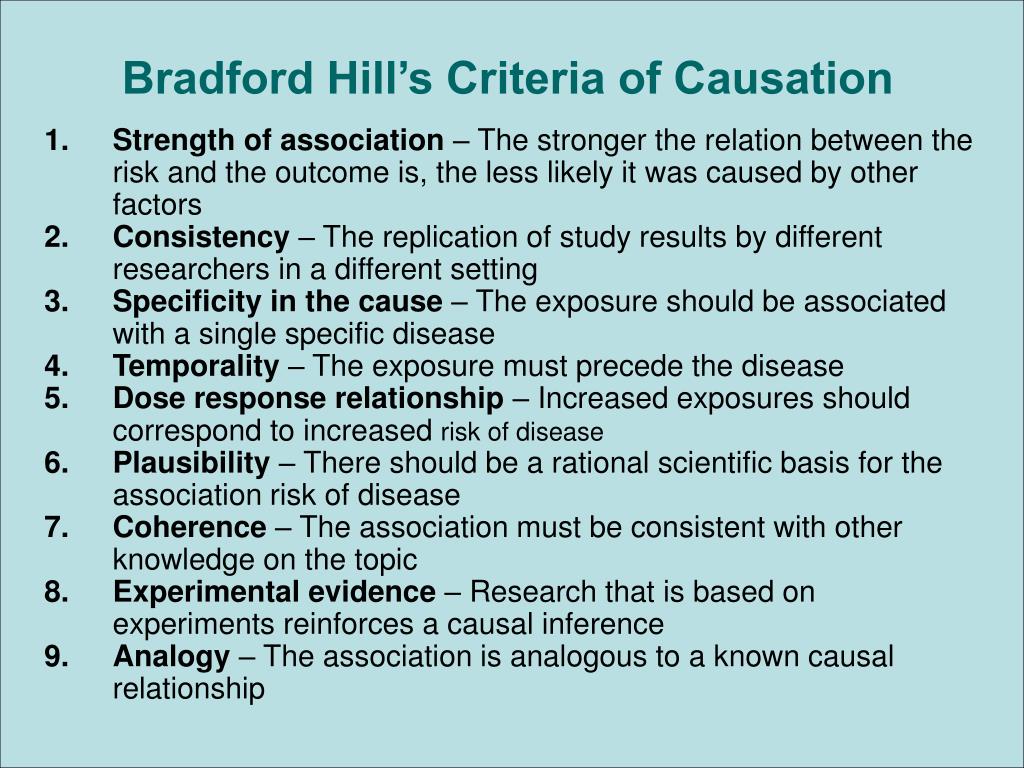
Most often legal proceedings follow the Bradford Hill factors, which are delineated here.

By way of context Bradford Hill says this:

None of my nine viewpoints can bring indisputable evidence for or against the cause-and-effect hypothesis and none can be required as a sine qua non. What they can do, with greater or less strength, is to help us to make up our minds on the fundamental question – is there any other way of explaining the set of facts before us, is there any other answer equally, or more, likely than cause and effect?

Such is the legal terminology for the “null” hypothesis: As long as there is another equally or more likely explanation for the set of facts, the claimed causation is unproven.

The Causative Factors

What aspects of that association should we especially consider before deciding that the most likely interpretation of it is causation?

(1) Strength. First upon my list I would put the strength of the association.

(2) Consistency: Next on my list of features to be specially considered I would place the consistency of the observed association. Has it been repeatedly observed by different persons, in different places, circumstances and times?

To test the Global Warming claim, let’s consider the association between world fuel consumption (WFC) and surface air temperatures (SAT):

Figure 5.1. Comparative dynamics of the World Fuel Consumption (WFC) and Global Surface Air Temperature Anomaly (4T), 1861-2000. The thin dashed line represents annual 4T, the bold line—its 13-year smoothing, and the line constructed from rectangles—WF C (in millions of tons of nominal fuel) (Klyashtorin and Lyubushin, 2003). Source: Frolov et al. 2009

Figure 5.1. Comparative dynamics of the World Fuel Consumption (WFC) and Global Surface Air Temperature Anomaly (ΔT), 1861-2000. The thin dashed line represents annual ΔT, the bold line—its 13-year smoothing, and the line constructed from rectangles—WFC (in millions of tons of nominal fuel) (Klyashtorin and Lyubushin, 2003). Source: Frolov et al. 2009


In Figure 5.1, the dynamics of global air temperature anomalies obtained from instrumental measurements over the last 140 years is compared with changes in world fuel consumption (WFC) (Makarov, 1998). The WFC curve shows an exponential increase, which doubles approximately every 30 years, increasing 25-fold since the middle of the nineteenth century. The global air temperature anomaly curve shows a positive trend of +0.06°C/10 years (Sonechkin et al., 1997). At the same time, there are cyclic changes with periods of about 60 years. The correlation between these curves changes its sign every 30 years, varying from —0.88 (1940 1970) to +0.94 (1970 2000). Hence, there is no direct linear connection between WFC (which indirectly represents CO2 concentration in the atmosphere) and global air temperature. The authors of this study therefore conclude that the WFC increase is not an obvious cause of the increase in global air temperature.

The other causative factors could be applied, but can not add weight against the argument above.

Case Closed

The legal methodology above is used to decide the causal relationship between two variables. Clearly, in Climate Science the starting question is: Do rising fossil fuel emissions cause temperatures to rise? Those who have been following the issue know that there are many arguments underneath: Why do not temperatures always rise along with CO2? Has chance been eliminated? Are not natural factors confounding the association? And so on.

For myself, I will join in the conclusion reached by Frolov et al., who go on to further explain their position:

In general, although climate models are based on physics, they inevitably include a number of adjustable parameters that are fitted to past temperature changes. We are not aware of a single climate model based on fundamental physics without adjustable parameters that has been subjected to a rigorous test against actual climate data. Climate modelers appear to assume that the Earth’s climate would continue without change, were it not for greenhouse gas emissions. They do not take into account the possibility that natural climate cycles are also acting independently of effects induced by buildup of greenhouse gas concentrations. As we have shown in Chapter 4, there is evidence for cyclic variability of Arctic climates. Furthermore, there is considerable evidence for past variability of global climate as expressed in the so-called Medieval Warm Period (900-1100) and the Little Ice Age (1600-1850). These fluctuations appear to be as great as the temperature rise of the 20th century, yet, there was no contribution of greenhouse gases to these climate changes.

A major challenge in climate modeling is to understand the range of natural fluctuations, and separate these from climate changes induced by human activity (greenhouse gas emissions, land clearing, irrigation, …). The models neglect natural fluctuations because they have no means of incorporating them, and put the entire blame for climate changes since the 19th century on human activity. As a result, they appear to project an extreme view of the future that seems unlikely to be reliable.

Again my thanks to Dr. Bernaerts for the copy of this book:


Legal Test of Global Warming

In a previous post (here), I discussed the Bradford Hill protocol that has become precedent for trials concerning scientific evidence for legal liability.

Bradford Hill was the jurist who brought clarity and  methodology for the courts to consider and rule on accusations such as:

Thalidimide is causing birth defects;
Asbestos dust is causing lung disease;
as well as frequent claims of causal relationships between illness, injury and conditions of work.

The Global Warming Claim

When it comes to Global Warming, the proposition is straightforward:
Rising fossil fuel emissions are causing rising global temperatures.

The procedure to test that claim is described by Nathan Schachtman here.

Proper epidemiological methodology begins with published study results which demonstrate an association between a drug and an unfortunate effect. Once an association has been found, a judgment as whether a real causal relationship between exposure to a drug and a particular birth defect really exists must be made. 

Step 1: Establish an association between two variables.
Proper epidemiological method requires surveying the pertinent published studies that investigate whether there is an association between the medication use and the claimed harm. The expert witnesses must, however, do more than write a bibliography; they must assess any putative associations for “chance, confounding or bias”:

Step 2: Rule out chance as an explanation
The appropriate and generally accepted methodology for accomplishing this step of evaluating a putative association is to consider whether the association is statistically significant at the conventional level.
“Generally accepted methodology considers statistically significant replication of study results in different populations because apparent associations may reflect flaws in methodology.”

Step 3: Rule out bias or confounding factors.
The studies must be structured to analyze and reject other factors or influences, such as non-random sampling, additional intervening variables such as demographic or socio-economic differences.

Step 4: Infer Causation by Applying Accepted Causative Factors
Most often legal proceedings follow the Bradford Hill factors, which are delineated here.


By way of context Bradford Hill says this:

None of my nine viewpoints can bring indisputable evidence for or against the cause-and-effect hypothesis and none can be required as a sine qua non. What they can do, with greater or less strength, is to help us to make up our minds on the fundamental question – is there any other way of explaining the set of facts before us, is there any other answer equally, or more, likely than cause and effect?

Such is the legal terminology for the “null” hypothesis: As long as there is another equally or more likely explanation for the set of facts, the claimed causation is unproven.

The Causative Factors

What aspects of that association should we especially consider before deciding that the most likely interpretation of it is causation?

(1) Strength. First upon my list I would put the strength of the association.

(2) Consistency: Next on my list of features to be specially considered I would place the consistency of the observed association. Has it been repeatedly observed by different persons, in different places, circumstances and times?

To test the Global Warming claim, let’s consider the association between world fuel consumption (WFC) and surface air temperatures (SAT):

Figure 5.1. Comparative dynamics of the World Fuel Consumption (WFC) and Global Surface Air Temperature Anomaly (4T), 1861-2000. The thin dashed line represents annual 4T, the bold line—its 13-year smoothing, and the line constructed from rectangles—WF C (in millions of tons of nominal fuel) (Klyashtorin and Lyubushin, 2003). Source: Frolov et al. 2009

Figure 5.1. Comparative dynamics of the World Fuel Consumption (WFC) and Global Surface Air Temperature Anomaly (ΔT), 1861-2000. The thin dashed line represents annual ΔT, the bold line—its 13-year smoothing, and the line constructed from rectangles—WFC (in millions of tons of nominal fuel) (Klyashtorin and Lyubushin, 2003). Source: Frolov et al. 2009


In Figure 5.1, the dynamics of global air temperature anomalies obtained from instrumental measurements over the last 140 years is compared with changes in world fuel consumption (WFC) (Makarov, 1998). The WFC curve shows an exponential increase, which doubles approximately every 30 years, increasing 25-fold since the middle of the nineteenth century. The global air temperature anomaly curve shows a positive trend of +0.06°C/10 years (Sonechkin et al., 1997). At the same time, there are cyclic changes with periods of about 60 years. The correlation between these curves changes its sign every 30 years, varying from —0.88 (1940 1970) to +0.94 (1970 2000). Hence, there is no direct linear connection between WFC (which indirectly represents CO2 concentration in the atmosphere) and global air temperature. The authors of this study therefore conclude that the WFC increase is not an obvious cause of the increase in global air temperature.

The other causative factors could be applied, but can not add weight against the argument above.

Case Closed

The legal methodology above is used to decide the causal relationship between two variables. Clearly, in Climate Science the starting question is: Do rising fossil fuel emissions cause temperatures to rise? Those who have been following the issue know that there are many arguments underneath: Why do not temperatures always rise along with CO2? Has chance been eliminated? Are not natural factors confounding the association? And so on.

For myself, I will join in the conclusion reached by Frolov et al., who go on to further explain their position:

In general, although climate models are based on physics, they inevitably include a number of adjustable parameters that are fitted to past temperature changes. We are not aware of a single climate model based on fundamental physics without adjustable parameters that has been subjected to a rigorous test against actual climate data. Climate modelers appear to assume that the Earth’s climate would continue without change, were it not for greenhouse gas emissions. They do not take into account the possibility that natural climate cycles are also acting independently of effects induced by buildup of greenhouse gas concentrations. As we have shown in Chapter 4, there is evidence for cyclic variability of Arctic climates. Furthermore, there is considerable evidence for past variability of global climate as expressed in the so-called Medieval Warm Period (900-1100) and the Little Ice Age (1600-1850). These fluctuations appear to be as great as the temperature rise of the 20th century, yet, there was no contribution of greenhouse gases to these climate changes.

A major challenge in climate modeling is to understand the range of natural fluctuations, and separate these from climate changes induced by human activity (greenhouse gas emissions, land clearing, irrigation, …). The models neglect natural fluctuations because they have no means of incorporating them, and put the entire blame for climate changes since the 19th century on human activity. As a result, they appear to project an extreme view of the future that seems unlikely to be reliable.

Again my thanks to Dr. Bernaerts for the copy of this book:


Sea Level Rise and Doggerland

CO2 alarmists want to use Doggerland as a morality tale to scare us about rising sea levels in this century and the next. Because it certainly demonstrates the perils of climate change.  As usual though, they fail to put the past into an historical context, because that would destroy their narrative.

First, what is the story of Doggerland?

(From National Geographic)

When signs of a lost world at the bottom of the North Sea first began to appear, no one wanted to believe them. . .A resourceful amateur paleontologist named Dick Mol persuaded the fishermen to bring him the bones and note the coordinates of where they had found them. In 1985 one captain brought Mol a beautifully preserved human jawbone, complete with worn molars. With his friend, fellow amateur Jan Glimmerveen, Mol had the bone radiocarbon-dated. It turned out to be 9,500 years old, meaning the individual lived during the Mesolithic period, which in northern Europe began at the end of the last ice age some 12,000 years ago and lasted until the advent of farming 6,000 years later. “We think it comes from a burial,” says Glimmerveen. “One that has lain undisturbed since that world vanished beneath the waves, about 8,000 years ago.”

The story of that vanished land begins with the waning of the ice. Eighteen thousand years ago, the seas around northern Europe were some 400 feet lower than today. Britain was not an island but the uninhabited northwest corner of Europe, and between it and the rest of the continent stretched frozen tundra. As the world warmed and the ice receded, deer, aurochs, and wild boar headed northward and westward. The hunters followed. Coming off the uplands of what is now continental Europe, they found themselves in a vast, low-lying plain.

Archaeologists call that vanished plain Doggerland, after the North Sea sandbank and occasional shipping hazard Dogger Bank. Once thought of as a largely uninhabited land bridge between modern-day continental Europe and Britain—a place on the way to somewhere else—Doggerland is now believed to have been settled by Mesolithic people, probably in large numbers, until they were forced out of it thousands of years later by the relentlessly rising sea. A period of climatic and social upheaval ensued until, by the end of the Mesolithic, Europe had lost a substantial portion of its landmass and looked much as it does today.

The most rapid rises of sea level were on the order of three to six feet a century, but because of the variable topography of the land, the flooding would not have been even. In areas as flat as modern-day East Anglia, a six-foot rise could have shifted the coast inland by miles; in hillier places, less. Down in low-lying Doggerland, the rising sea turned inland lakes into estuaries. Gaffney’s digital reconstruction shows that one in particular, the Outer Silver Pit, contains massive sandbanks that could only have been created by fierce tidal currents. At some point the currents would have made it dangerous to cross in a log boat, and eventually, created a permanent barrier to once familiar hunting grounds.

Some 8,200 years ago, after millennia of incrementally rising seas, a massive release of meltwater from a giant glacial lake in North America, called Lake Agassiz, caused sea levels to jump by more than two feet. By slowing the circulation of warm water in the North Atlantic, this influx of frigid water triggered a sudden plunge in temperature, causing Doggerland’s coasts—if any remained—to be battered by frigid winds. If that were not enough, around the same time, a landslide on the seafloor off the coast of Norway, called the Storegga slide, triggered a tsunami that flooded the coastlines of northern Europe.

What about our future?

Alarmists like Jim Hansen are calling for sea levels to rise 3 to 6 feet this century, even 10 feet on an especially feverish day.  But when those rates happened, there were no fossil fuel emissions.  Moreover, that amount of rise is not happening any more.

The flooding of Doggerland coincides with the rapid sea level rise up to about 8000 years ago, and the modern farming period beginning about 6000 years ago.  Sea level has been gently rising a few mm/year up to the present, including the recovery from the Little Ice Age.

Of course anything is possible, but without an acceleration unprecedented in the last 6000 years, the rise will be about a foot/century.

In Praise of Richard Lindzen

Earlier this month, atmospheric physicist and professor emeritus at MIT Richard Lindzen was interviewed by radio host William Frezza, and here is a transcript of that interview. Thanks to Alec Cull and Climate Scepticism for the transcript.

Below are some excerpts, but the whole read is worth it.

Update February 24

Another powerful speech by Lindzen just appeared:

Click to access Global_Warming_and_the_Irrelevance_of_Science-Erice-mod1.pdf

On Temperature Data

If you want a daily measurement, do you take a 6 pm minus 6 am or 12 versus 12, or so on? It all makes a difference – doesn’t make a big difference for the purpose for which these measurements were made, which was not climate.

It was for weather forecasting. And if you look at a weather forecast, you don’t care if it changed two tenths of a degree – you couldn’t measure that, you couldn’t feel that. You want to know: did it go up 10 degrees, 20 degrees, you know – is a cold front coming through? So, for those purposes, for weather forecasts and so on, for people’s lives, these measurements were adequate.

On Global Mean Temperature

By definition, if they’re reporting on global mean temperature anomaly, which is what they use, of course it involves adjustments. You have to process this, you have to take the average, you have to move from it. They also do have adjustments – we know that urban areas introduce warmth and they have formulas that they design to quote correct for it. And again, the problem is not that this is illegitimate but that if you’re worried about tenths of a degree, it’s totally inadequate.

The fact of the matter, if you have adjustments of a few tenths of a degree, it means that they weren’t good to that

The virtue of the satellites is of course they have global coverage. The thermometers have very poor coverage over the oceans – 70% of the Earth. They are not measuring exactly the same thing. They are more consistent over time, but even there, there are many things to correct for – the orbital decay, the other things – and so they also have their own corrections. They are more nearly, I would say, corrections than adjustments, but, you know, there’s semantics mixed in.

On Climate Models

You see, the existing models, for instance, if you restrict yourself to this global mean temperature anomaly – one variable, the others may be way off, but let’s take that one – if they predict too much increase in temperature, they have thus far added aerosols and said those cancel it. So they adjust it to look like the period they – it’s a little like taking an exam and being told the answer in advance.

But the bigger test is: run models forward. And if you do that, virtually every model used by the UN, from 1978 to the present, is overestimating the observed change in temperature..

On the “Pause”

Look, you look at the temperature records for the ground, from the satellites, for anything. And what you see is something flopping around a few tenths of a degree, but no obvious trend for at least 18 years. Now, people are then saying “Well, if I take 2015 and it’s a tenth or two higher than ’98, or something like that, now I can draw a trend line through this that makes it look like it went up a tenth or two of a degree.” The problem with that is: if something is flopping around with a zero mean, and you pick your end points selectively, you can get it go up, get it go down… It’s a distraction.

On the Consensus

So all scientists agree that it’s probably warmer now than it was at the end of the Little Ice Age. Almost all scientists agree that adding CO2 should give you some warming, though it might be very little. But it is propagandists who translate that into “It is dangerous – we must reduce CO2”, etc. That doesn’t even come from the IPCC scientific assessment.

On the Climate Debate

But within the science community, the real division is much more subtle. So I would say IPCC Working Group I, which is the scientific assessment – the general position they adopt is that there is warming, it is mostly due to man in recent years – meaning since about 1960, 1970, not before – and it is potentially dangerous. Okay. And the sceptical position is: there are many causes of the change and it doesn’t look like the sensitivity is enough for it to be serious. So, you know, this is a discussable issue. Neither side is saying catastrophe is round the corner.

On the Funding Monopoly

Government has a monopoly. Science in this country is funded by the government, and that has its implications. Dwight Eisenhower picked this up, many many years ago, when he said, you know, one of the dangers of this is a government contract might be a replacement for scientific results. And indeed, you know, when you get letters asking for letters of recommendation for promotion, some things like that, very often the question is “What kind of fund-raising can we expect from this person?” So these are by no means minor considerations, and young people know that, that they have to bring in funds. This becomes even more important in modern universities, where the area of major growth has been administration.

Conclusion

Good Health and Long Life, Dr. Richard Lindzen.  We need your wisdom and character now more than ever.


Sea Level Rise: Just the Facts

The Maldives–Poster Child for rising Sea Levels

The three most mentioned evils of rising CO2 are Rising Temperatures, Declining Sea Ice and Rising Sea Levels.  Plateaus presently appearing in the first two have been discussed a lot here and elsewhere.  This post gives what you need to know about Sea Level alarms.

Sea level rise (according to NASA)

Global sea level rose about 17 centimeters (6.7 inches) in the last century. The rate in the last decade, however, is nearly double that of the last century.

Dave Burton takes us underneath the hype and exposes the facts.  Below is his post originally at Tom Fuller’s website. David Burton puts it all in perspective from his location on the coast of North Carolina.  Much more info on sea levels is available at Dave’s own website linked below.

Sea-level rise is not accelerating, and has not accelerated since the 1920s.

There are about sixty good-quality, 100+ year records of sea-level around the world, and they all show the same thing: there has been no statistically significant acceleration (increase) in the rate of sea-level rise in the last 85 years or more. That means anthropogenic CO2 emissions do not measurably affect sea-level rise, and predictions of wildly accelerated sea-level rise are based on superstition, not science.

Here are two very high quality sea-level measurement records, one from the Pacific and one from the Atlantic:

With atmospheric CO2 at 0.040% by volume, globally averaged sea-level rise at the coasts is just under +1.5 mm/year.

When atmospheric CO2 was at 0.031% by volume, globally averaged sea-level rise at the coasts was just under +1.5 mm/year.

The difference is that climate alarmists think the current +1.5 mm/year is catastrophic and caused by human release of CO2, and the +1.5 mm/year 85 years ago was natural and inconsequential.

However, the similarity between the two numbers — the catastrophic 1.5 mm/yr and the inconsequential 1.5 mm/yr — has confused even some liberals into backing away from the One True Climate Faith. Even President Obama’s former Undersecretary for Science, Steven Koonin, has written that:

“Even though the human influence on climate was much smaller in the past, the models do not account for the fact that the rate of global sea-level rise 70 years ago was as large as what we observe today.”

Sea-level didn’t actually rise 3.39 mm last year, at the coasts.

That 3.39 mm number is from satellite altimetry measurements of the open ocean, inflated by the addition of model-derived GIA estimates. It has little relation to anything that matters.

Most fundamentally, satellite altimeters measure the wrong thing. Their measurements are distorted by “sea-level rise” caused by thermal expansion when the upper layer of the ocean warms. But that is a strictly local effect, which doesn’t affect the quantity of water in the oceans, and doesn’t affect sea-level elsewhere (e.g., at the coasts).

Sea-level rise only matters at the coasts, but satellite altimeters are incapable of measuring sea-level at the coasts. Tide gauges measure sea-level at the coasts, where it matters, and their data is of much higher quality.
The best tide-gauge records of sea-level measurements are nearly ten times as long as the combined satellite measurement record, and twenty times as long as any single satellite measurement record, and the tide-gauge records are trustworthy.

The satellite measurements of sea-level are not. They are subject to a long list of potential distortions, and vary considerably from one satellite to another.

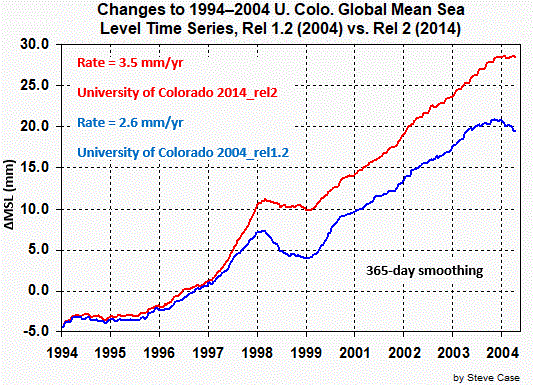
Steve Case has documented how U.Col. has revised their satellite “measurements” of sea-level over the years:

The Envisat numbers were revised even more dramatically. Subsequent revisions to data up to ten years after it was recorded approximately tripled the rate of sea-level rise “measured” by Envisat.

NASA is aware of the problems with satellite measurements, and they’ve proposed a new mission called the Geodetic Reference Antenna in SPace (GRASP) to try to improve matters. However, that mission has not been funded.

References and additional information is here: http://www.sealevel.info/

Footnote February 23, 2016

Dave Burton warned us above about superstitious sea level rises to come.  Prime example comes in Scientific American article gone viral in mass media.  The abstract of the study:

We present the first, to our knowledge, estimate of global sea-level (GSL) change over the last ∼3,000 years that is based upon statistical synthesis of a global database of regional sea-level reconstructions. GSL varied by ∼±8 cm over the pre-Industrial Common Era, with a notable decline over 1000–1400 CE coinciding with ∼0.2 °C of global cooling. The 20th century rise was extremely likely faster than during any of the 27 previous centuries. Semiempirical modeling indicates that, without global warming, GSL in the 20th century very likely would have risen by between −3 cm and +7 cm, rather than the ∼14 cm observed. Semiempirical 21st century projections largely reconcile differences between Intergovernmental Panel on Climate Change projections and semiempirical models.

My bolding is to draw attention to the basis in models not observations.  Further they say half the projected rise is due to thermal expansion which is a local effect not appearing at the coastline or on tidal gauges.

In ancient times people built idols in their own images and worshiped them to ensure more favorable weather and prosperity. Today those icons take the form of computer models whose prophecies are sure to scare the bejesus out of us.


Laughing at Climate Change

Update Aug. 26. 2016

I just realized that BBC has blocked the viewing of the video, so I have added the transcript below.

A humorous look at why the global warming campaign and the triumphal Paris COP make sense.

Yes Minister explains it all in an episode from 2013.

h/t to Peter S.

This is an all-too-realistic portrayal of political climatism today.

https://rclutz.wordpress.com/2015/12/26/post-truth-climatism/

Update Aug. 26

Yesterday I realized that BBC had blocked the viewing of the video.  So I sought and found the subtitles for Yes Prime Minister 2013, Episode 6, “A Tsar is Born”.  That final episode for the series began with the dialogue in yesterday’s post Climate Alarms LOL.

Today I provide the dialogue that formed the episode conclusion, and which was the content of the blocked video.

The Characters are:

Sir Humphrey Appleby
Cabinet Secretary

Jim Hacker
Prime Minister

Claire Sutton
Special Policy Adviser

Bernard Woolley
Principal Private Secretary to the Prime Minister

(Dialogue beginning at 20:16 of “A Tsar is Born”)

Humphrey I have returned with the answer to all your problems.
Global warming.

Jim I thought you were against it?

Humphrey Everybody’s against it, Prime Minister.
I suddenly realised that is the beauty of it.
We can get a unanimous agreement with all of our European partners
to do something about it.

Jim But how can we do something about
something that isn’t happening?

Humphrey It’s much easier to solve an
imaginary problem than a real one.

Jim You believe it’s real?

Humphrey Do you? I don’t know.

Jim Neither do I. Haven’t got the faintest idea!

Humphrey But it doesn’t matter what we think.
If everyone else thinks it’s real, they’ll all want to stop it.
So long as it doesn’t cost too much.
So the question now is, what are we going to do about it?

Jim But if it isn’t happening, what can we do about it?

Humphrey Oh, there’s so much we can do, Prime Minister.
We can impose taxes, we can stiffen European rules about
carbon emissions, rubbish disposal.

We can make massive investments in wind turbines.
We can, in fact, Prime Minister, under your leadership, agree to save the world.

Jim Well, I like that!
But Russia, India, China, Brazil, they’ll never cooperate.

Humphrey They don’t have to. We simply ask them to review their emissions policy.

Jim And will they?

Humphrey Yes. And then they’ll decide not to change it.
So we’ll set up a series of international conferences.
Meanwhile, Prime Minister, you can talk about the future of the planet.

Jim Yes.

Humphrey You can look statesmanlike.
And it’ll be 50 years before anybody can possibly prove you’re wrong.
And you can explain away anything you said before by saying the computer models were flawed.

Jim The voters will love me!

Humphrey You’ll have more government expenditure.

Jim Yes. How will we pay for it? We’re broke.

Humphrey We impose a special global warming tax on fuel now,
but we phase in the actual expenditure gradually. Say, over 50 years?
That will get us out of the hole for now.

Bernard The Germans will be pleased.
They have a big green movement.

Claire And we can even get the progs on board!

Bernard As long as they get more benefits than everyone else.

Jim My broadcast is on Sunday morning.

Humphrey You have a day to get the conference to agree.

Jim That’s not a problem.
The delegates will be desperate for something to announce
when they get home.
There is one problem.
Nothing will have actually been achieved.

Humphrey It will sound as though it has.
So people will think it has.
That’s all that matters!

(Later following the BBC interview, beginning 27:34)

Bernard Oh, magnificent, Prime Minister!

Humphrey I think you got away with it, Jim,
but the cabinet will have been pretty surprised.
We’ll have to square them fast.

Jim Bubbles!

Humphrey We’re not there yet.
After that interview, you’ll need to announce some pretty impressive action.

Jim An initiative.

Humphrey Yes.

Claire A working party?

Humphrey Bit lightweight.

Bernard A taskforce?

Humphrey Not sure.

Jim Do we have enough in the kitty?

Claire It could be one of those initiatives that you announce
but never actually spend the money.

Jim Great. Like the one on child poverty.

Bernard Maybe it should be a government committee?

Jim Well what about a Royal Commission?

Humphrey Yes!
It won’t report for three years, and if we put the right people
on it, they’ll never agree about anything important.

Jim Right! A Royal Commission!
No, wait a minute, that makes it sound as if we think
it’s important but not urgent.

Claire Well, what about a Global Warming Tsar?

Jim Fine! Would that do it?

Humphrey No, I think it might need a bit more than that, Prime Minister.
It’ll mean announcing quite a big unit, and an impressive salary for that Tsar,
to show how much importance you place upon him.

Jim No problem. Who would it be?

Humphrey Ah, well, it can’t be a political figure.
That would be too divisive.
It has to be somebody impartial.

Jim You mean a judge?

Humphrey No, somebody from the real world.
Somebody who knows how to operate the levers of power,
to engage the gears of the Whitehall machine,
to drive the engine of government.

Jim That’s quite a tall order.
Anybody got any ideas?

Humphrey… Could you?

Bernard Oh!

Humphrey Yes, Prime Minister.

The End.

Footnote

CO2 hysteria is addictive. Here’s what it does to your brain:

Just say No!


Revisiting “Pause Deniers Busted”


The original post and updates were done in October 2015.  Now Radford Neal has done a complete deconstruction of the published paper in his post (here): Critique of ‘Debunking the climate hiatus’, by Rajaratnam, Romano, Tsiang, and Diffenbaugh .  Neal says:

Climatic Change appears to be a reputable refereed journal, which is published by Springer, and which is cited in the latest IPCC report. The paper was touted in popular accounts as showing that the whole hiatus thing was mistaken — for instance, by Stanford University itself.

You might therefore be surprised that, as I will discuss below, this paper is completely wrong. Nothing in it is correct. It fails in every imaginable respect.

Original post and updates October 3 and 30 below

With Paris COP drawing near, the lack of warming this century is inconvenient and undermines the cause.

As Dr. Judith Curry said, “I have been expecting to start seeing papers on the ‘hiatus is over.’ Instead I am seeing papers on ‘the hiatus never happened.’”

One that was trumpeted came out of my Alma Mater, Stanford.  They garnered the expected headlines from the usual places:

Global Warming “Hiatus” Never Happened: Eos

There never was any global warming “pause.”:  Washington Post

The text is here: Debunking the climate hiatus

http://download.springer.com/static/pdf/969/art%253A10.1007%252Fs10584-015-1495-y.pdf?originUrl=http%3A%2F%2Flink.springer.com%2Farticle%2F10.1007

The write up has statistical razzle-dazzle and lots of opaque sentences, but let’s not get lost in the weeds.

Let’s not talk about the multiple tamperings to the land records they chose to study.  Let’s even overlook their including the bogus upward adjustments to the SSTs by Karl et al.  Bob Tisdale dissected that here: https://bobtisdale.wordpress.com/2015/06/04/noaancdcs-new-pause-buster-paper-a-laughable-attempt-to-create-warming-by-adjusting-past-data/

We don’t need to get into the technicalities of why they stopped with 2013 data, the suitability of the tests applied or their interpretations of the results.

Here’s what you need to know about this study:

They ignored the satellite records (RSS and UAH), the gold standard of temperature measurements, because the absence of warming there is undeniable.

For the land and ocean datasets they analyzed, they ignored the huge divergence between observations and the predictions (projections) from climate models.

Conclusion:

Natural variability in the climate system has neutralized any warming from increased CO2 this century, and also offset most, if not all of the secular rise in temperature since the Little Ice Age.  The models did not forecast this; they can only project warming, and do so at rates several times higher than observations.  The models fail for three reasons:  high sensitivity to CO2; positive feedback from water vapor; and lack of thermal inertia by the oceans.

For more on climate models and temperature projections:
https://rclutz.wordpress.com/2015/03/24/temperatures-according-to-climate-models/

The Stanford football team was impressive beating highly-rated Southern Cal on their home field last Saturday.  The work of the research team, however, looks like pandering rather than science.  They need to up their game: No cookies.

Update October 3

I found the time to look into the details of this paper and the statistical trick comes to light.

They took as the null hypothesis: “Temperatures are not rising.”  After applying several statistical tests, they conclude that the statement is not supported by the data, so we cannot say with certainty temperatures are not rising.

And what about the other null hypothesis: “Temperatures are rising.”  Silence.

I suspect they didn’t want to admit that the same statistical tests would also disprove that statement.

A reasonable person concludes: When you can not say for sure that temperatures are not rising, or that they are rising, that would surely indicate a plateau in temperatures.

Update October 30–Another classic from Josh

The Climate Story (Illustrated)

The captions and most comments below come from Mike van Biezen in his recent essay published at the Daily Wire (here). To illustrate his points, I added images collected from various internet addresses. Michael van Biezen teaches physics and earth sciences at Loyola Marymount University, Los Angeles, and his many lectures are available on Youtube at his website (here).

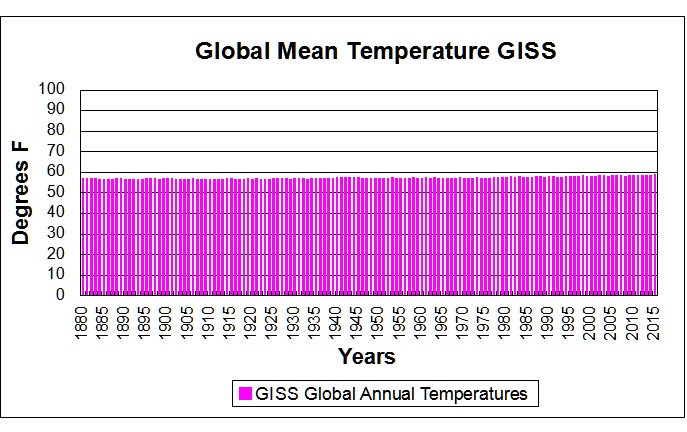
Temperature records from around the world do not support the assumption that today’s temperatures are unusual.

giss-annual-temps4

Global Mean Temperature from land and ocean expressed in absolute degrees F.

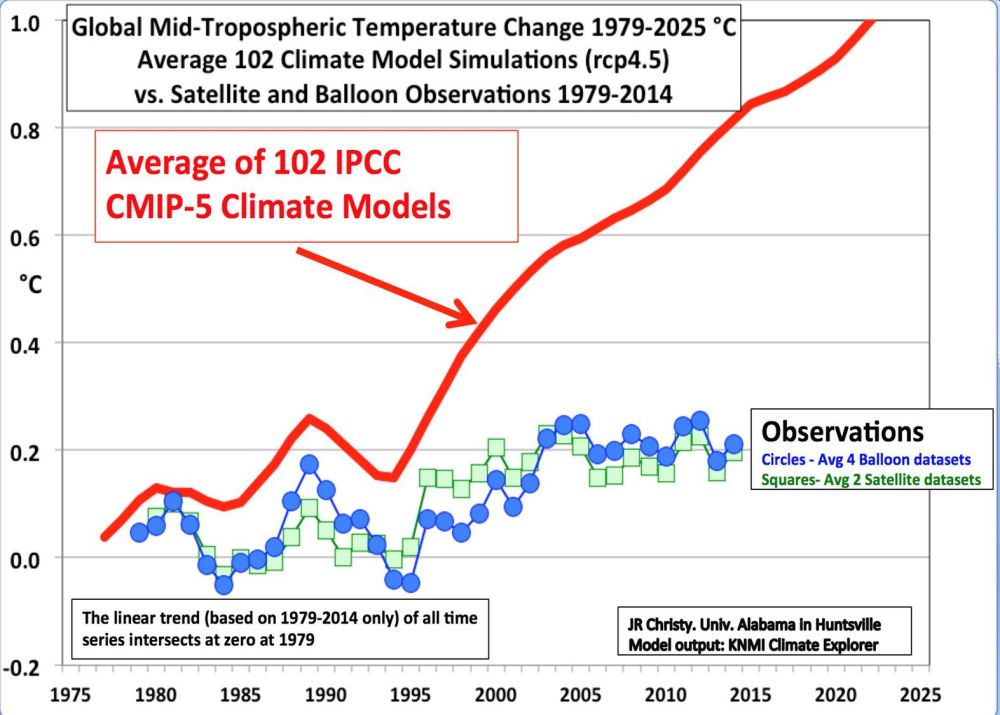
Satellite temperature data do not support the assumption that temperatures are rising rapidly.

john-christy-climate-change-chart-0a201a1637955761

The world experienced a significant cooling trend between 1940 and 1980. CO2 levels do not correlate consistently with temperatures.

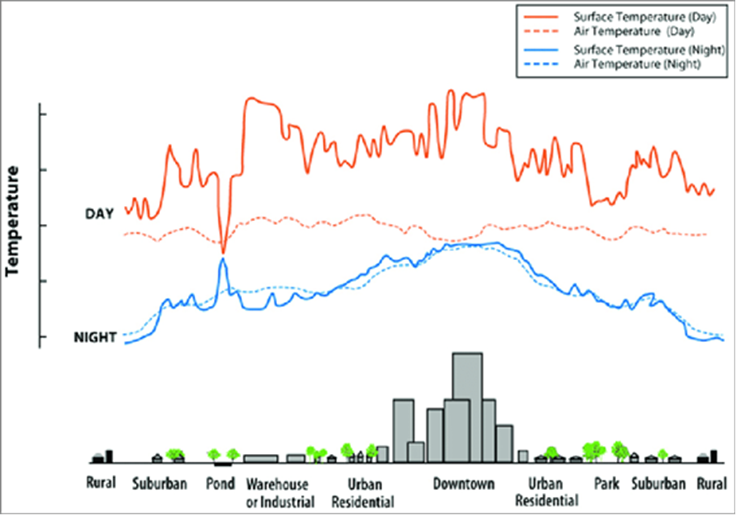
Urban heat island effect skews the temperature data of a significant number of weather stations.

There is a natural inverse relationship between global temperatures and atmospheric CO2 levels.

Higher temperatures increase atmospheric CO2 levels and lower temperatures decrease atmospheric CO2 levels, not the other way around.

The CO2 cannot, from a scientific perspective, be the cause of significant global temperature changes

The H2O molecule which is much more prevalent in the Earth’s atmosphere, and which is a bend molecule, has many more vibrational modes, and absorbs many more frequencies emitted by the Earth, including to some extent the radiation absorbed by CO2. It turns out that between water vapor and CO2, nearly all of the radiation that can be absorbed by CO2 is already being absorbed.

Many periods during our recent history show that a warmer climate was prevalent long before the industrial revolution.

Glaciers have been melting for more than 150 years.

“Data adjustment” is used to continue the perception of global warming.

The Moral of The Climate Story:

Global warming alarm is not supported by temperature data.

Post-Truth Climatism

This particular realization started by clicking on an article discussing how fact-checking has become irrelevant in today’s politics.
The Limits of Fact-Checking: Calling Trump (and others) out for their lies doesn’t seem to make a difference. What’s going on? (Politico here).

Trump is exhibited as the primary example: the more his comments are rated as lies, even pants-on-fire lies, the more popular he becomes. But other politicians, including Hillary, are also cited for saying false things and refusing to renounce them.

A further analysis by Michael Kinsley ( here) suggests that a candidate or an elected leader and his followers know they are playing a game, and winning depends on having the more compelling narrative, never mind the “truth.” In fact, these falsehoods are not even concerned with any “truth,” they are just making up stuff that sounds good to an audience. In other words, they are not lying, they are bullshitting. Insiders know it and are OK with it, while much of the public is naive and therefore gullible.

As it happens Harry Frankfurt of Princeton gets to the heart of the matter in his provocative essay, On Bullshit, he says:

It is impossible for someone to lie unless he thinks he knows the truth. Producing bullshit requires no such conviction.

Someone who lies and someone who tells the truth are playing on opposite sides, so to speak, in the same game.

The bullshitter ignores these demands altogether. He does not reject the authority of the truth, as the liar does, and oppose himself to it. He pays no attention to it at all. By virtue of this, bullshit is a greater enemy of the truth than lies are.

Now the parallel with climatism is obvious. The Paris COP was striking in the sheer volume of claims that were stated as truths without any attempt to provide proof or even admit the need for any. Climatism is now unconnected to facts, evidence or logical argument. It explains why both political and climate fact-checkers are widely ignored.

Frankfurt warns:

The bullshitter may not deceive us, or even intend to do so, either about the facts or about what he takes the facts to be. What he does necessarily attempt to deceive us about is his enterprise. His only indispensably distinctive characteristic is that in a certain way he misrepresents what he is up to.
This is the crux of the distinction between him and the liar.

I believe Science Matters because actual scientific understanding does inform us about the future and what we need to do to prepare. But in the present environment, bullshitting is the order of the day, and we live in the twilight of Post-Truth discourse.

More from Frankfurt:

The contemporary proliferation of bullshit also has deeper sources, in various forms of skepticism which deny that we can have any reliable access to an objective reality and which therefore reject the possibility of knowing how things truly are. These “anti-realist” doctrines undermine confidence in the value of disinterested efforts to determine what is true and what is false, and even in the intelligibility of the notion of objective inquiry.

For more on the degradation of objective truth (AKA the Revenge of the Humanities) see:

https://rclutz.wordpress.com/2015/11/05/objection-asserting-facts-not-in-evidence/

https://rclutz.wordpress.com/2015/07/06/warmists-and-rococo-marxists/