Forget Reason and Science, It’s “Global Boiling” Now

Christopher Lingle explains in his AIER article “Global Boiling”: An Assault On Reason and Science.  Excerpts in italics with my bolds and added images.

An interesting and troubling double standard is applied to the acceptability of individual actions and those of political agents. An individual declaring an emergency when none exists, e.g., shouting “fire” in a crowded cinema, would lead to rightful punishment, yet public officials can do so without attracting the same scrutiny.

According to United Nations Secretary-General António Guterres, “the era of global warming has ended” and “the era of global boiling has arrived.” Of course, this statement was made with little or no sense of perspective or the possibility that any sensible human would challenge or refute it.

This comment is the latest reference relating to what is and has been going on with the weather and climate. After the warming showed a slowdown; climate change became the operative term, but this was found to be insufficiently alarming.
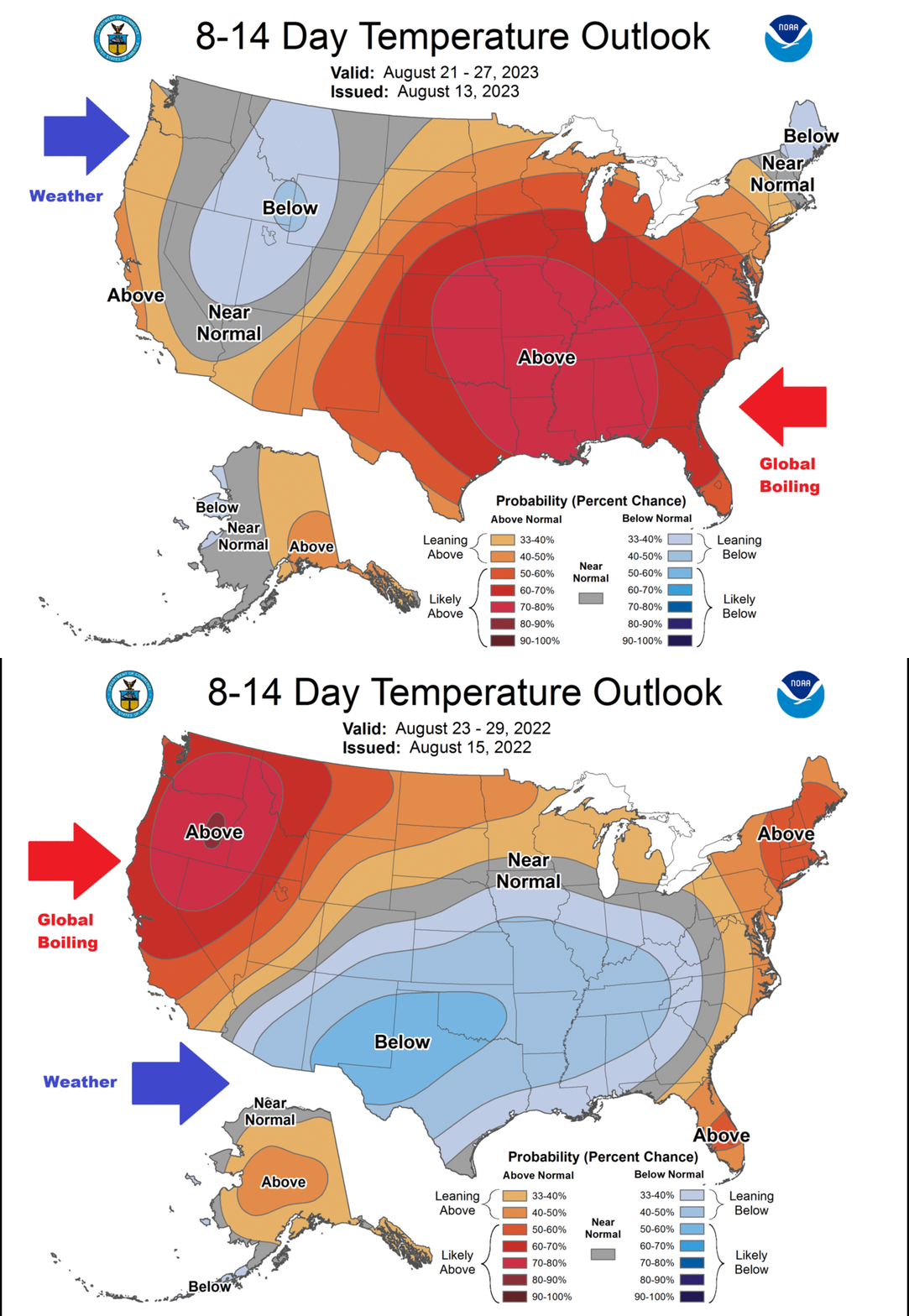
In turn, climate action became the necessary antidote to a “climate emergency” or “climate crisis.” Having gone full circle, with the focus back to the fetish with high temperatures during a seasonal, localized and predictable heatwave, the assertion is that we are in the midst of climate boiling.

Even with no knowledge of science, per se, recipe books point out that “boiling” occurs when water is heated to 212º Fahrenheit (100º Celsius) at sea level. For his part, it may be that the UN Boss knows that water will boil at lower temperatures at higher elevations, but he is unlikely to have been at such altitudes in his native Portugal to observe a boiling point close to recent global averages.

Although it is common for references regarding current weather to be over-stated, it does not necessarily indicate changes or trends in climatic conditions. Besides the notion of “boiling” temperatures, headlines that suggest current temperatures are “scorching” or “scalding” indicate a misunderstanding of what those terms mean.

It might be that using fear and pandering to ignorance is better than coercion to impose a narrative. Persuasion in search of cooperative arrangements is surely what should be expected of a liberal, representative democracy, but this is threatened just as much by “Left” as well as “Right” populism.  It turns out the use of extreme terms in the climate debate is not about either exaggeration or hyperbole, since exaggeration or hyperbole requires there be an element of truth in statements.

Terms used to express the effect of high temperatures on the human body
are misleading, disingenuous, and factually untrue.

Ginning up fear is a well-known technique of propaganda to support a narrative, as is the case of reports of momentary weather conditions as though they presage eventual or irrevocable climatic changes. An example of how an isolated weather event is portrayed as if it were evidence of a generalized view of overall conditions can be seen in a recent report on National Public Radio.

Noting the measurements of a single water temperature sensor in Manatee Bay, near the Everglades National Park, reached 101.1 degrees, the data were declared to be “startling” as if they reflected high average temperatures in the Florida Bay area. It went on to declare that “scorching” temperatures “could” pose a major risk to coral and other marine life.

It is noteworthy that the word “could” in this context has no real content since such conditional expressions provide no insight into or substantiation of the likelihood of the referred event. Supporters of this narrative expect most citizens to be uncurious and to willingly accept assertions of political officials for the purpose of misleading or frightening them, so they submit to whatever remedial public policies are imposed.

In all events, there was no data to support the claim of “startling” water conditions in the rest of Florida Bay. Further, the claim that the temperatures are “scorching” is confusing, at best, since injury from water burns is commonly known as scalding.

Concerning scalding, second degree burns can occur from exposure for 3 seconds to water of 140°F, while a third degree burn requires at least 5 seconds of exposure at same temperature. As it is, the temperature of sea water measured from a single buoy off the Florida coast far from those temperatures and is variable over the course of 24 hours, up to 10 degrees less at night.

Of course, the heat in the ambient air is also far away from what would be “boiling” or “scorching” temperatures. But it turns out that there is no “settled science” on the maximum ambient temperatures that will cause heat distress.

In fact, more is known about the effect of low ambient temperatures on the human body. If the temperature falls below the lower limit, 82.4º Fahrenheit (28º Celsius), more energy is used to hold internal temperature at the optimum, and if temperatures are too low, shivering occurs causing involuntary muscular contractions to generate heat.

Thermoregulation of body temperature is necessary to sustain human life and survival of human cells to thrive rather than to overheat or die. The human body engages in homeostasis to maintain balance by keeping core internal temperature within a safe range, no matter what temperatures are outside the body, otherwise organ failures might occur.

Results of research conducted at the University of Roehampton indicates ambient temperatures exceeding 104º Fahrenheit (40º Celsius) might cause some humans to be unable to shed excessive heat so that body functions become abnormal. It points out that there is a “thermoneutral” zone of temperatures within which the body has no need to increase metabolic rate or use more energy to achieve the normal core temperature of 98.6º Fahrenheit (37º Celsius).

While high temperatures can impact cardiovascular health (e.g., during heatwaves or while fighting fires), it is not a matter of climate change. Blood clotting (i.e., thrombogenesis) can occur from exposure to long and uninterrupted exposure to extreme heat, but it depends on individuals’ physical characteristics and conditions.

Of course, few people are exposed to extremely high temperatures for lengthy periods,
and if so, there are many evasive actions they can undertake to protect themselves.

In all events, it is widely known that the biggest killer from extreme temperatures is from exposure in the low ranges of thermometer readings, even in Africa and Asia.

On the left, Lancet stretched the heat axis to make the numbers look larger in their presentation.

Unfortunately, the promotion of the “climate narrative” has been successful in inducing citizens to ignore how their liberties and rights are in jeopardy from the imposition of repressive public policies that are being answered as a solution. While Germans are being subjected to adopt expensive heat pumps, Americans are beingchided for using gas ranges and the likelihood they might be banned from future installation.

Alas, citizens have lost sight of the original intent behind the move from autocratic monarchy to democracy, which was to secure the rights of all citizens and support private property as the basis for human liberty and personal dignity.

Gas stoves just the thin end of the wedge.

While the American republic was founded to put a brake on political power and limit arbitrary rule, democracy is now presented as an “all-or-nothing” game such that any curbs on democratic governance will lead to its disappearance.

Most recently, governments around the world have found that frightening their citizens would induce them to accept, even applaud, repressive policies in exchange for the promise that individual citizens would be shielded from a single virus. The loss of rights and freedom in response to the fear conjured up during the COVID-19 pandemic is a harbinger of what will be claimed as necessary to avert the existential threat to humanity from extreme weather and changing climate.

 

Barrier Reef Great Again

Last night I watched an extraordinary netflix documentary which took us on a journey discovering the rich variety of reef life, including microscopic creatures not shown in videos before. It was highly educational and thoroughly delightful . . . until suddenly it wasn’t.  Spoiler Alert:  Puff returns as an adult to the reef where he was born after leaving it to mature in a mangrove marsh.  Alas, he finds the coral dead and blackened, and the narrator warns us:  Warming oceans kiiled the reef and we must change the way we live for the sake of Puff and the other reef creatures.  There may have been more to the fire and brimstone ending, but I was so turned off that I turned it off.

Why must nature documentaries resort to doomsday guilt trips to destroy any good feelings about our world?  Chris Morrison provides the antidote in his Daily Sceptic article Coral at the Great Barrier Reef Holds on to Recent Record Gains, Defying All Doomsday Predictions.  Excerpts in italics with my bolds.

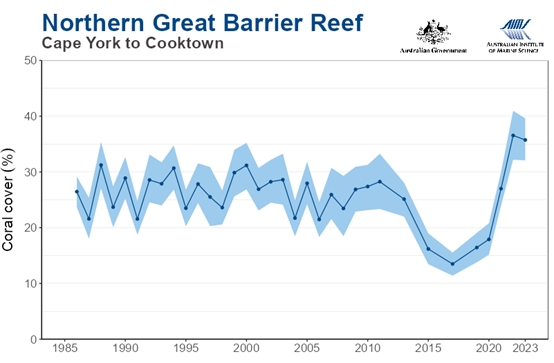
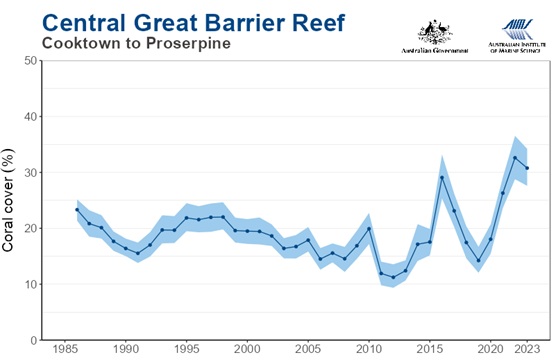
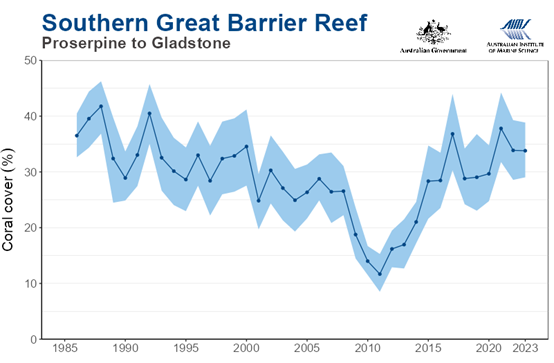
Coral at the Great Barrier Reef (GBR) faces another year of exile from the climate scare headlines with news that the record levels reported in 2021-22 have been sustained in the latest annual period to May 2023. A small drop in the three main areas of the reef was well within margin of error territory, with the Australian Institute of Marine Science (AIMS) reporting that regional average hard coral cover in 2022-2023 was similar to last year at 35.7%. Most reefs underwent little change during the year.

Coral at the reef has been bouncing back sharply for a number of years, with a record 36-year high reported in 2022. But the news of this spectacular recovery has been largely ignored in most media since it had previously been a go-to poster scare story for collectivist Net Zero promoters. But connecting the fate of tropical corals to global warming was always a difficult ask since they grow in waters between 24-32°C. Short boosts in local temperatures can cause temporary bleaching, but it is scientifically impossible to pin it on human-caused climate change, although pseudoscientific ‘attribution’ computer models try very hard.

In the latest year, there was a short local temperature rise,
but little bleaching was reported during the 2023 summer.

No cyclones hit the reef and crown-of thorns starfish attacks were limited. Nevertheless, natural stresses will always affect the eco-system and AIMS states that these paused the growth of hard coral on some of the reefs.

Like most state-funded scientific bodies, The Australian Institute of Marine Science (AIMS) is fully signed up to climate extremism and delivering politically correct messages to promote the Net Zero solution. Despite reporting what is now a substantial multi-year recovery, it notes that the future is predicted to bring more frequent, intense and enduring marine heatwaves, alongside the persistent threat of crown-of thorns starfish outbreaks and tropical cyclones. More frequent mass coral bleaching is a sign that the GBR is experiencing the consequences of climate change, it claims. However, in a different part of its latest report, AIMS accepts that the recent substantial recovery occurred despite two mass coral bleaching events in 2020 and 2022.

There is an acceptance that this underlines that “widespread coral bleaching
does not necessarily lead to extensive coral mortality”.

But pockets of extremist catastrophism remain in the mainstream media, notably in the Guardian, fighting to keep the coral destruction story going. A year ago, the newspaper reported that the GBR still had “some capacity” for recovery, but the window was closing fast as the climate continued to warm. Of course the Guardian has form as long as your arm on this score. Back in 1999, George Monbiot told its readers that the “imminent total destruction of the world’s coral reefs is not a scare story but a fact”.

Coral reefs have been around in one form or another for hundreds of millions of years. Current global temperatures are towards the lower end of the paleoclimatic record. One might wonder how corals manage to survive temperatures up to 10°C higher in the past?

Back in the real world, we can see how the recent solid recovery
was sustained across the three main areas of the GBR.

The recovery in the northern GBR actually started around 2017. Last year the coral declined slightly from 36.5% to 35.7%, and was easily within the margin of error calculated by the AIMS. Typhoon Tiffany passed through at the end of the previous reporting season, and could have been responsible for some loss.

In the centre of the reef, the strong recovery of hard coral cover to 32.6% last year eased slightly, but again, as the AIMS noted, it was within the margin of error.

The southern end of the GBR has generally had higher coral cover than elsewhere, but has shown greater variability over the observed record. Last year’s cover was 33.8%, compared with 33.9% the year before. Some coral was reported to have been lost due to starfish predations.

The GBR is the largest reef system on Earth and runs for
over 1,400 miles down the eastern side of Australia.

It is also the most surveyed reef in the world and the results of scientific endeavour are widely distributed. While this work is often politicised, it is clear that recent evidence shows that temporary spikes in temperature, which occur naturally in the oceans, can cause bleaching. However, this bleaching process can rapidly go into reverse when local conditions stabilise. These findings have been confirmed elsewhere, notably in the remote Palmyra Atoll, 1,200 kms south of Hawaii. A 10-year survey recently observed sudden changes in temperature up to 3°C on two occasions, leading to substantial damage to the coral. A 2015-16 spike led to 90% of the coral bleaching, but the researchers found that within a year only 10% of the coral had died. Within two years, the corals had returned to pre-bleached levels.

The researchers concluded that the coral structures
“show evidence of long-term stability”
– but don’t expect to see that on the front page.

Palmyra Atoll, 1,200 kms south of Hawaii.

UN’s Guterres: Head in Oven, Feet in Freezer

The image is based on a criticism of statisticians:  “If my head is in the oven and my feet are in the freezer, my temperature may be on average normal.”  UN Chief Guterres presumes to speak for the planet when he claims we are experiencing “Global Boiling.”  Apparently, his feet are too numb to register any of the many cold temperatures in places around the world, so he is a victim fearing a runaway average warming.  Let’s inform him and others similarly misled about the facts on the ground they are missing.

Australia

Why Is It So Cold Right Now? A Weather Expert Explains

Temperatures plummeted across southeast Australia this week, with Weatherzone reporting Canberra’s low of -7.2ºC was “its lowest temperature since 2018 and the lowest for June since 1986.”

Sydney experienced its coldest June morning today since 2010, with a temperature of 5.2ºC. In Victoria, temperatures of -7.2ºC were recorded.

Australia just had one of its coolest and wettest summers of the last decade. 

Snow settled on the Stirling Range in WA on Thursday morning after a frigid polar air mass travelled from Antarctica to Australia.

A long fetch of southerly winds has been blowing across the Southern Ocean during the past week, carrying polar air from the ice sheets of Antarctica into unusually low latitudes.

On Thursday morning, this Antarctic air mass reached the Stirling Range in WA and caused snow to settle on Bluff Knoll.

United Kingdom

Met Office explains why the weather is so miserable this May

‘High-pressure systems have been generally located over southern continental Europe and also to the far east of Europe’, they told Metro.co.uk.

The spokesperson continued: ‘As these high-pressure systems interacted through the season, the UK is positioned between them, leading to periods of cool, cloudy, and wet conditions for the UK.  ‘These have generally either swept in from the Atlantic or slipped between the high-pressure systems to reach the UK.

‘Warmer-than-average sea temperatures also provided the necessary fuel for clouds to develop, which has been quite persistent in spring.’

Met Office meteorologist Clare Nasir said: ‘Showers over the next few days could be heavy with the risk of thunder and hail.’   She added that the risk of thunder and hail persist through Wednesday and Thursday.

Where has the UK summer gone

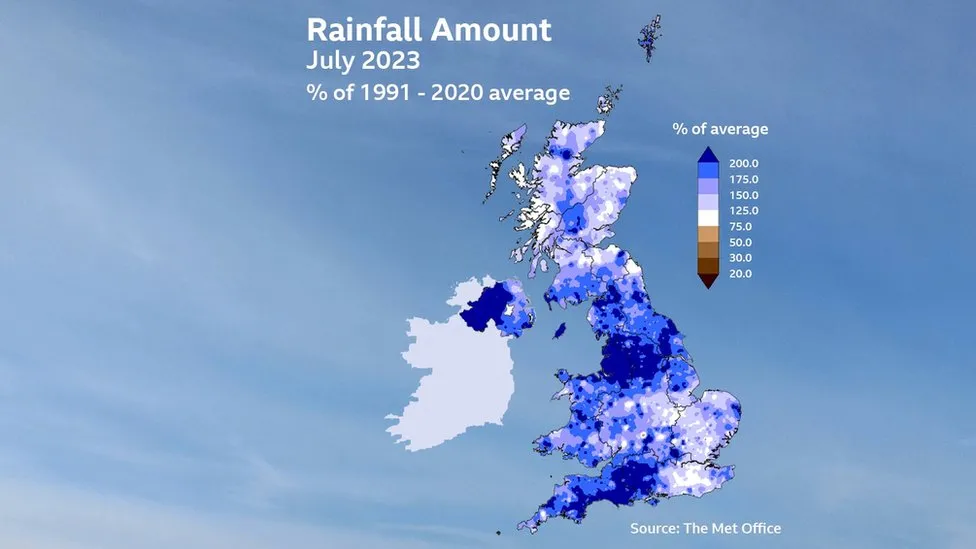
Summer 2023 so far has been one of contrasts – after the warmest June on record we had an exceptionally wet July.  Northern Ireland and much of north-west England had their wettest July on record. Looking ahead there is no immediate end to the distinctly un-summery conditions. So what is going on?

Any spring warmth was hard to come by. After a cool April, very warm weather was distinctly lacking in May. Nowhere reached 24°C until the month was nearly over, on the 27th.

However, that theme changed dramatically in June. Temperatures soared to 32.2°C, with a heatwave being declared in many places and becoming the warmest June on record which, according to the Met Office, bears the “fingerprint of climate change”.

It was all change again in early July with low pressure setting in, and staying put. While much of Europe sweltered in a blistering heatwave the UK sat under cool, wet weather which looks set to stay for the first part of August too.

India

Is January 2023 going to be the coldest year in the 21st century?

There may be no relief from the ongoing spell of cold wave with minimum temperatures hovering below normal limits at most places, reports suggested. If a weather expert is believed, it has been predicted that temperatures in the plains are going to dip as far as -4 degrees Celsius next week.

Large parts of north India are still reeling under numbing cold with the mercury remaining below freezing point at most places in Jammu and Kashmir, while dense fog in the early hours of the morning hit road and rail traffic movement. Cold wave conditions abated in Delhi due to a fresh western disturbance affecting northwest India, even as a dense layer of fog lowered visibility to just 50 metres.

Northern India braces for coldest weather in years as dense fog, poor air quality linger

A new wave of cold weather is headed into northern India and could drop temperatures to levels not seen there in over three years, according to AccuWeather forecasters.

The cold weather shot will be the latest, and perhaps most significant, of many recent waves of chilly weather that have also led to travel-disrupting dense fog and poor air quality over parts of the Indian subcontinent since late December.

The temperature in New Delhi, the capital city of India and home to more than 18 million people, has the potential to drop as low as 2 degrees Celsius (35 degrees Fahrenheit) on Sunday night and Monday morning. While the record low for this coming Monday of 1.3 degrees Celsius below zero (29.7 degrees Fahrenheit) appears safe, it will be well below the average low of 6 degrees Celsius (42 degrees Fahrenheit) for the date.

Temperatures at this level would be the coldest readings in New Delhi since December 2019,” said Nicholls.

Ahead of the cold wave, the IMD has issued a cold wave warning for Sunday and Monday for the northern Indian states of Punjab, Haryana, Chandigarh, Delhi and Rajasthan. The warning was issued to give residents advance notice of a level of cold that could adversely impact human health and property.

Canada

Spring forecast 2023: The La Nina Winter pattern is forecast to extend as we head into Spring despite the breakdown of the cold ocean anomalies

Spring season 2023 is nearing, with forecasts revealing the jet stream pattern over the North Pacific and the Atlantic to be influenced by the diminishing La Nina. A high-pressure system in the Pacific will define the weather patterns over North America, with a potential Stratospheric warming event playing a role early in the season.

The cold ocean phase in the equatorial Pacific is already in breakdown mode. It is expected to decline rapidly towards early Spring.

But, despite the breakdown of these cold ocean anomalies (La Nina), its influence can still persist in global weather circulation. Long-range weather calculations also see this, extending the La Nina jet stream pattern from Winter into Spring 2023.

Spring sits on the sidelines with Winter’s wild ride to the finish line

USA

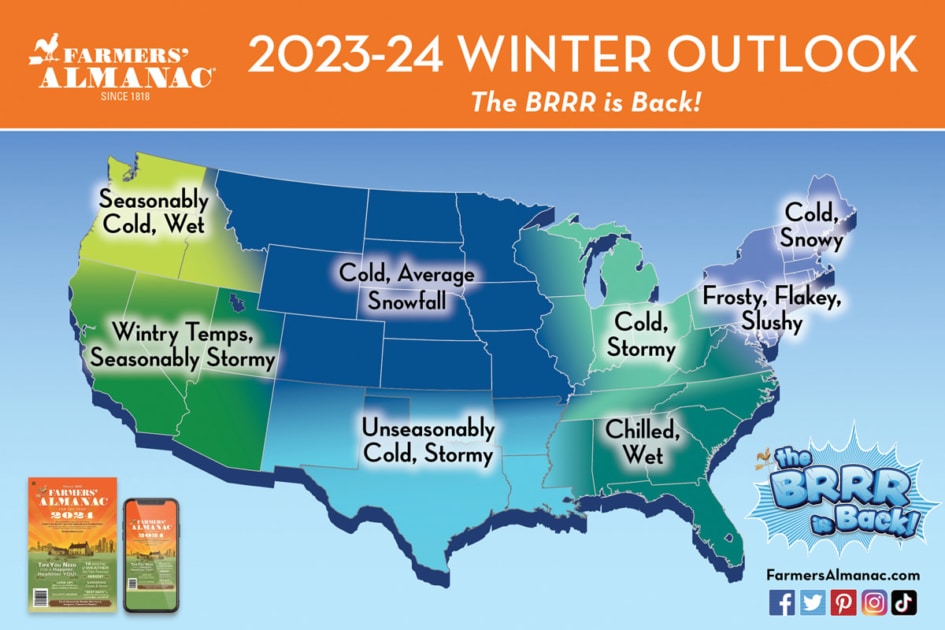
Winter Forecast 2024: The Brrr Is Back

The Brrr is Back!
“After a weird and warm winter season last year, this winter should make cold weather fans rejoice—especially those in the Great Lakes, Midwest, and northern New England areas,” shares editor Pete Geiger, adding “the ‘brrr’ is coming back! We expect more snow and low temperatures nationwide.”

East Coast Snow?
Folks living along the I-95 corridor from Washington to Boston, who saw a lack of wintry precipitation last winter, should experience quite the opposite, with lots of rain/sleet and snowstorms to contend with.

Texans Beware!
According to Farmers’ Almanac 2024, Texans should prepare for an unseasonably cold and stormy winter season ahead

Frosts in Florida?
Winter will be wet in the Southeast region however a few frosts are forecast to bring the “brrrs” to Floridians and its snowbirds.

Asia

As Asian countries hit by extreme cold snap, here’s what life is like at -53C

An intense cold spell is gripping east Asia, with temperatures plunging and hazardous conditions reported across China, the Koreas and Japan.

On Monday one of China’s northern-most cities broke its lowest ever recorded temperature, with the mercury hitting -53C at 7am on the first day of the Lunar New Year in Mohe, Heilongjiang province.

Japan and the Korean peninsula have also issued warnings over freezing temperatures and gales that have killed at least one person, while at least 57 people have been reported dead in Afghanistan as the wintry conditions stretch across into central Asia.

Europe

Record-Challenging Cold Sweeps Europe

It’s been cold — ask a European, ask me…

We’ve enjoyed a ‘comfortably cool’ July here in Central Portugal (thus far), it’s been great. Same with my old haunt, the UK. July 2023 there is on course to be colder-than-average–and vs the historically cool 1961-1990 era that the Met Office still insist on using, no less.

Looking ahead, and particularly at central/eastern nations, those summer chills are about to take another step down.

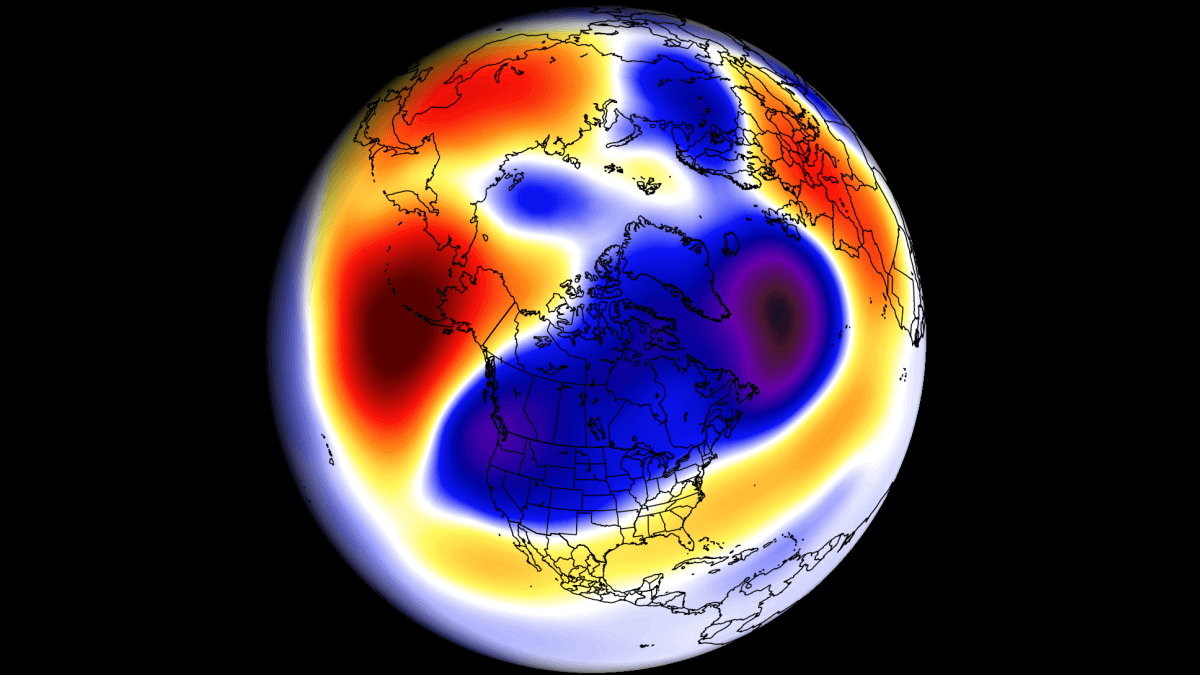
As per the latest GFS run (shown below), ‘pinks’ and ‘purples’ are forecast to engulf the likes of Poland, Slovakia, Hungary, Croatia, Serbia, Albania, Belarus, Ukraine and Romania this week, sending temperatures crashing by as much as 18C below the seasonal norm.

Record summer lows are expected, an unbiased media would report on them (not holding my breath).

Russia

Extreme cold grips Siberia, as temperatures fall to lowest levels since 2002

The coldest air on Earth plunged into Siberia this week, dropping temperatures to as low as 80 degrees Fahrenheit below zero. An expansion of that cold is expected across eastern Asia into early next week and eventually North America, according to AccuWeather forecasters.

The bitter cold not only allowed temperature benchmarks that have not been hit in decades in some parts of Russia, but the extreme weather also created an icy spectacle as firefighters battled a fire in subzero temperatures on Jan. 8 in Ufa, Russia. Massive icicles clung to the home amid the anomalous cold.

The same Arctic blast dropped temperatures in Moscow to their lowest levels in years this past weekend, while even parts of northern India will get a taste of the cold beginning later this weekend.

Antarctica

Antarctica Plunges to -83.2C (-117.8F)–Earth’s Lowest Temperature Since 2017

While the media tricks the dumb and the gullible into believing the world is on fire –with poverty-inducing CO2 reductions their only savior– Antarctica is shivering through an extreme bout of cold, even by South Pole standards.

The Italian-French research station ‘Concordia’ posted a reading of -83.2C (-117.8F) on July 25. This ranks as the fifth coldest daily value in the operational life of the station, bested only by Aug 2010’s -84.7C; July 2010’s -84.6C; and June 2017’s -83.9C and -83.5C.

As discussed recently, Antarctic sea ice’s tough time of it in 2023 isn’t related to temperature, that correlation simply doesn’t exist. The Antarctic continent continues to cool, the data are very clear on that, yet ice is taking a proverbial beating this season.

South America

Fierce frosts have gripped areas of Argentina and Chile

Some of that aforementioned Antarctic cold has been spun northward over Southern Hemisphere land masses.

Fierce frosts have gripped areas of Argentina and Chile of late, as South America’s topsy–turvy ‘meridional jet stream‘-fueled winter drags on. Looking ahead, more of the same is on the cards, too, as we head into August:

Southern Africa

Southern Africa Freezes, Rare Snowfall Hits Johannesburg

Southern Africa is enduring fierce freeze this week as a blast of polar air engulfs the likes of SA, Namibia, Botswana, Zimbabwe, Mozambique, as well as Angola, Zambia and Malawi.

Coastal regions are struggling to climb above 10C (50F), while at higher-elevations and inland, frosts are proving widespread, with reports of rare snowfall coming out of some unusual spots such as Zimbabwe and South Africa, such as Johannesburg.

Several regions of South Africa are enduring a harsh winter this year, according to local media outlets, with this past weekend delivering an intensification. Sub-zero (C) lows struck Johannesburg and surrounding areas over the past few mornings, with daytime highs of just 4C (39.2F) noted–where the July average is closer to 17C (62.6F).

Temperatures also held low enough to keep the snow lying on the ground throughout the morning, bringing joyous scenes to many a school playground — this would have been the first time many children have seen snow (Prof David Viner take note).

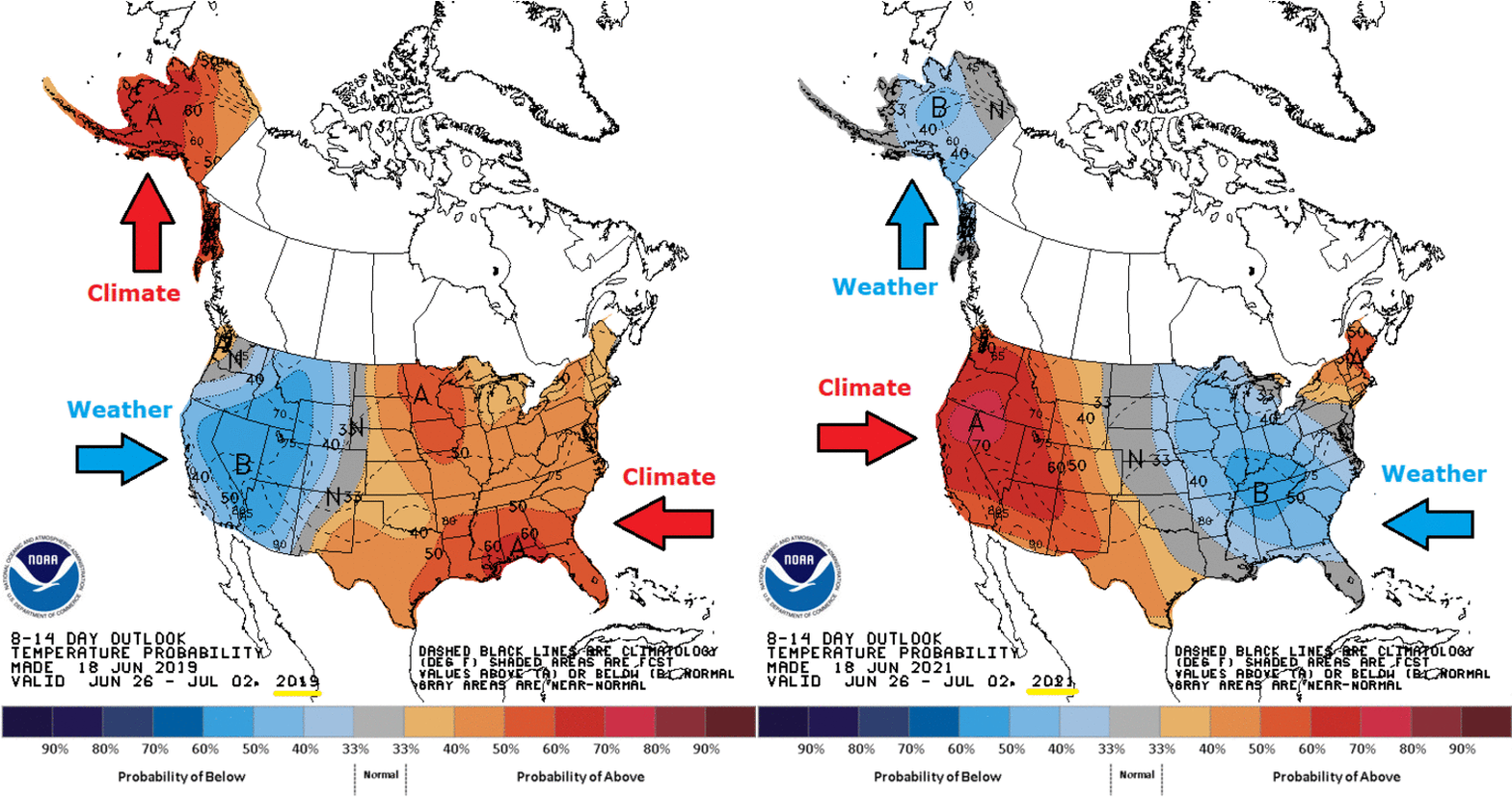
Footnote:  Climate is Dynamic: Hot Today, Cold Tomorrow

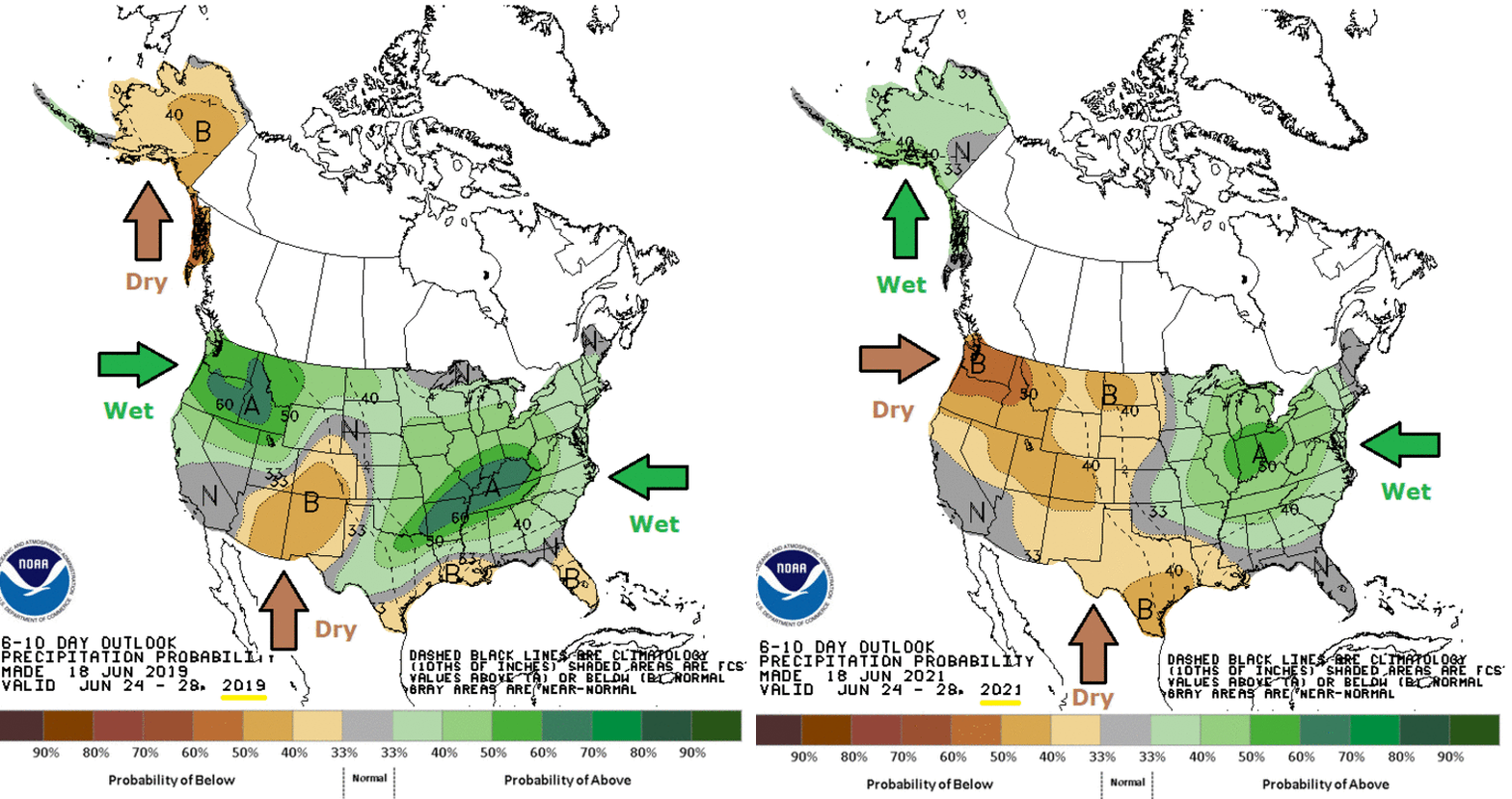
And the same goes for precipitation:


So Many Global Parts Not Boiling

Australia

Why Is It So Cold Right Now? A Weather Expert Explains

Temperatures plummeted across southeast Australia this week, with Weatherzone reporting Canberra’s low of -7.2ºC was “its lowest temperature since 2018 and the lowest for June since 1986.”

Sydney experienced its coldest June morning today since 2010, with a temperature of 5.2ºC. In Victoria, temperatures of -7.2ºC were recorded.

Australia just had one of its coolest and wettest summers of the last decade. 

Snow settled on the Stirling Range in WA on Thursday morning after a frigid polar air mass travelled from Antarctica to Australia.

A long fetch of southerly winds has been blowing across the Southern Ocean during the past week, carrying polar air from the ice sheets of Antarctica into unusually low latitudes.

On Thursday morning, this Antarctic air mass reached the Stirling Range in WA and caused snow to settle on Bluff Knoll.

United Kingdom

Met Office explains why the weather is so miserable this May

‘High-pressure systems have been generally located over southern continental Europe and also to the far east of Europe’, they told Metro.co.uk.

The spokesperson continued: ‘As these high-pressure systems interacted through the season, the UK is positioned between them, leading to periods of cool, cloudy, and wet conditions for the UK.  ‘These have generally either swept in from the Atlantic or slipped between the high-pressure systems to reach the UK.

‘Warmer-than-average sea temperatures also provided the necessary fuel for clouds to develop, which has been quite persistent in spring.’

Met Office meteorologist Clare Nasir said: ‘Showers over the next few days could be heavy with the risk of thunder and hail.’   She added that the risk of thunder and hail persist through Wednesday and Thursday.

Where has the UK summer gone

Summer 2023 so far has been one of contrasts – after the warmest June on record we had an exceptionally wet July.  Northern Ireland and much of north-west England had their wettest July on record. Looking ahead there is no immediate end to the distinctly un-summery conditions. So what is going on?

Any spring warmth was hard to come by. After a cool April, very warm weather was distinctly lacking in May. Nowhere reached 24°C until the month was nearly over, on the 27th.

However, that theme changed dramatically in June. Temperatures soared to 32.2°C, with a heatwave being declared in many places and becoming the warmest June on record which, according to the Met Office, bears the “fingerprint of climate change”.

It was all change again in early July with low pressure setting in, and staying put. While much of Europe sweltered in a blistering heatwave the UK sat under cool, wet weather which looks set to stay for the first part of August too.

India

Is January 2023 going to be the coldest year in the 21st century?

There may be no relief from the ongoing spell of cold wave with minimum temperatures hovering below normal limits at most places, reports suggested. If a weather expert is believed, it has been predicted that temperatures in the plains are going to dip as far as -4 degrees Celsius next week.

Large parts of north India are still reeling under numbing cold with the mercury remaining below freezing point at most places in Jammu and Kashmir, while dense fog in the early hours of the morning hit road and rail traffic movement. Cold wave conditions abated in Delhi due to a fresh western disturbance affecting northwest India, even as a dense layer of fog lowered visibility to just 50 metres.

Northern India braces for coldest weather in years as dense fog, poor air quality linger

A new wave of cold weather is headed into northern India and could drop temperatures to levels not seen there in over three years, according to AccuWeather forecasters.

The cold weather shot will be the latest, and perhaps most significant, of many recent waves of chilly weather that have also led to travel-disrupting dense fog and poor air quality over parts of the Indian subcontinent since late December.

The temperature in New Delhi, the capital city of India and home to more than 18 million people, has the potential to drop as low as 2 degrees Celsius (35 degrees Fahrenheit) on Sunday night and Monday morning. While the record low for this coming Monday of 1.3 degrees Celsius below zero (29.7 degrees Fahrenheit) appears safe, it will be well below the average low of 6 degrees Celsius (42 degrees Fahrenheit) for the date.

Temperatures at this level would be the coldest readings in New Delhi since December 2019,” said Nicholls.

Ahead of the cold wave, the IMD has issued a cold wave warning for Sunday and Monday for the northern Indian states of Punjab, Haryana, Chandigarh, Delhi and Rajasthan. The warning was issued to give residents advance notice of a level of cold that could adversely impact human health and property.

Canada

Spring forecast 2023: The La Nina Winter pattern is forecast to extend as we head into Spring despite the breakdown of the cold ocean anomalies

Spring season 2023 is nearing, with forecasts revealing the jet stream pattern over the North Pacific and the Atlantic to be influenced by the diminishing La Nina. A high-pressure system in the Pacific will define the weather patterns over North America, with a potential Stratospheric warming event playing a role early in the season.

The cold ocean phase in the equatorial Pacific is already in breakdown mode. It is expected to decline rapidly towards early Spring.

But, despite the breakdown of these cold ocean anomalies (La Nina), its influence can still persist in global weather circulation. Long-range weather calculations also see this, extending the La Nina jet stream pattern from Winter into Spring 2023.

Spring sits on the sidelines with Winter’s wild ride to the finish line

USA

Winter Forecast 2024: The Brrr Is Back

The Brrr is Back!
“After a weird and warm winter season last year, this winter should make cold weather fans rejoice—especially those in the Great Lakes, Midwest, and northern New England areas,” shares editor Pete Geiger, adding “the ‘brrr’ is coming back! We expect more snow and low temperatures nationwide.”

East Coast Snow?
Folks living along the I-95 corridor from Washington to Boston, who saw a lack of wintry precipitation last winter, should experience quite the opposite, with lots of rain/sleet and snowstorms to contend with.

Texans Beware!
According to Farmers’ Almanac 2024, Texans should prepare for an unseasonably cold and stormy winter season ahead

Frosts in Florida?
Winter will be wet in the Southeast region however a few frosts are forecast to bring the “brrrs” to Floridians and its snowbirds.

Asia

As Asian countries hit by extreme cold snap, here’s what life is like at -53C

An intense cold spell is gripping east Asia, with temperatures plunging and hazardous conditions reported across China, the Koreas and Japan.

On Monday one of China’s northern-most cities broke its lowest ever recorded temperature, with the mercury hitting -53C at 7am on the first day of the Lunar New Year in Mohe, Heilongjiang province.

Japan and the Korean peninsula have also issued warnings over freezing temperatures and gales that have killed at least one person, while at least 57 people have been reported dead in Afghanistan as the wintry conditions stretch across into central Asia.

Europe

Record-Challenging Cold Sweeps Europe

It’s been cold — ask a European, ask me…

We’ve enjoyed a ‘comfortably cool’ July here in Central Portugal (thus far), it’s been great. Same with my old haunt, the UK. July 2023 there is on course to be colder-than-average–and vs the historically cool 1961-1990 era that the Met Office still insist on using, no less.

Looking ahead, and particularly at central/eastern nations, those summer chills are about to take another step down.

As per the latest GFS run (shown below), ‘pinks’ and ‘purples’ are forecast to engulf the likes of Poland, Slovakia, Hungary, Croatia, Serbia, Albania, Belarus, Ukraine and Romania this week, sending temperatures crashing by as much as 18C below the seasonal norm.

Record summer lows are expected, an unbiased media would report on them (not holding my breath).

Russia

Extreme cold grips Siberia, as temperatures fall to lowest levels since 2002

The coldest air on Earth plunged into Siberia this week, dropping temperatures to as low as 80 degrees Fahrenheit below zero. An expansion of that cold is expected across eastern Asia into early next week and eventually North America, according to AccuWeather forecasters.

The bitter cold not only allowed temperature benchmarks that have not been hit in decades in some parts of Russia, but the extreme weather also created an icy spectacle as firefighters battled a fire in subzero temperatures on Jan. 8 in Ufa, Russia. Massive icicles clung to the home amid the anomalous cold.

The same Arctic blast dropped temperatures in Moscow to their lowest levels in years this past weekend, while even parts of northern India will get a taste of the cold beginning later this weekend.

Antarctica

Antarctica Plunges to -83.2C (-117.8F)–Earth’s Lowest Temperature Since 2017

While the media tricks the dumb and the gullible into believing the world is on fire –with poverty-inducing CO2 reductions their only savior– Antarctica is shivering through an extreme bout of cold, even by South Pole standards.

The Italian-French research station ‘Concordia’ posted a reading of -83.2C (-117.8F) on July 25. This ranks as the fifth coldest daily value in the operational life of the station, bested only by Aug 2010’s -84.7C; July 2010’s -84.6C; and June 2017’s -83.9C and -83.5C.

As discussed recently, Antarctic sea ice’s tough time of it in 2023 isn’t related to temperature, that correlation simply doesn’t exist. The Antarctic continent continues to cool, the data are very clear on that, yet ice is taking a proverbial beating this season.

South America

Fierce frosts have gripped areas of Argentina and Chile

Some of that aforementioned Antarctic cold has been spun northward over Southern Hemisphere land masses.

Fierce frosts have gripped areas of Argentina and Chile of late, as South America’s topsy–turvy ‘meridional jet stream‘-fueled winter drags on. Looking ahead, more of the same is on the cards, too, as we head into August:

Southern Africa

Southern Africa Freezes, Rare Snowfall Hits Johannesburg

Southern Africa is enduring fierce freeze this week as a blast of polar air engulfs the likes of SA, Namibia, Botswana, Zimbabwe, Mozambique, as well as Angola, Zambia and Malawi.

Coastal regions are struggling to climb above 10C (50F), while at higher-elevations and inland, frosts are proving widespread, with reports of rare snowfall coming out of some unusual spots such as Zimbabwe and South Africa, such as Johannesburg.

Several regions of South Africa are enduring a harsh winter this year, according to local media outlets, with this past weekend delivering an intensification. Sub-zero (C) lows struck Johannesburg and surrounding areas over the past few mornings, with daytime highs of just 4C (39.2F) noted–where the July average is closer to 17C (62.6F).

Temperatures also held low enough to keep the snow lying on the ground throughout the morning, bringing joyous scenes to many a school playground — this would have been the first time many children have seen snow (Prof David Viner take note).


Arctic Ice Surplus End July 2023

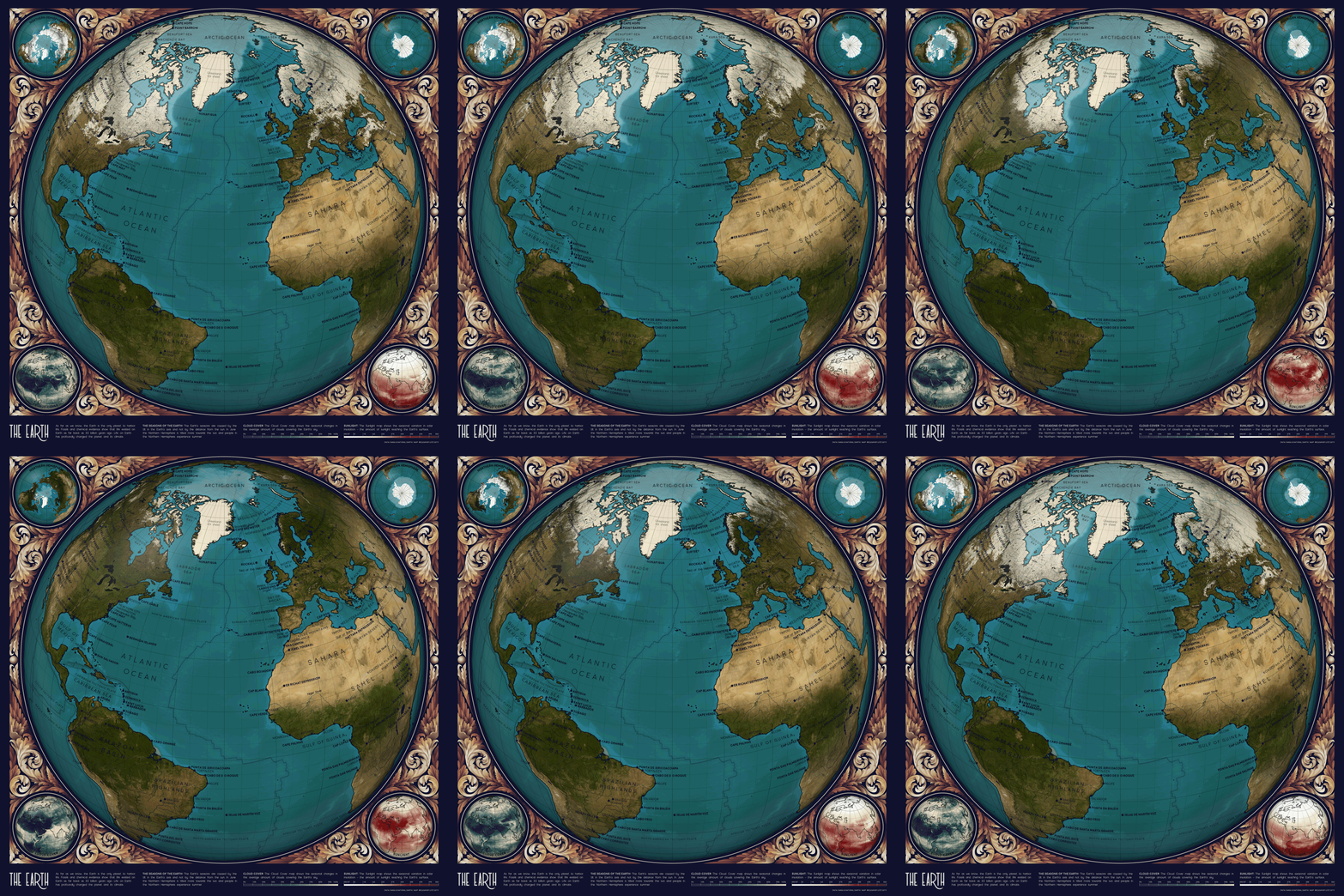
The animation above shows the Arctic sea ice extent on day 212 (end of July) from 2007 to yesterday 2023. Unsurprisingly the distribution varies, most notably there being less open water 2023 along the Russian shelf seas on the left side.  OTOH, Hudson Bay in most years still has some ice, but this year not.  Overall, Arctic ice this year is in surplus to the 17-year average and to 2007.

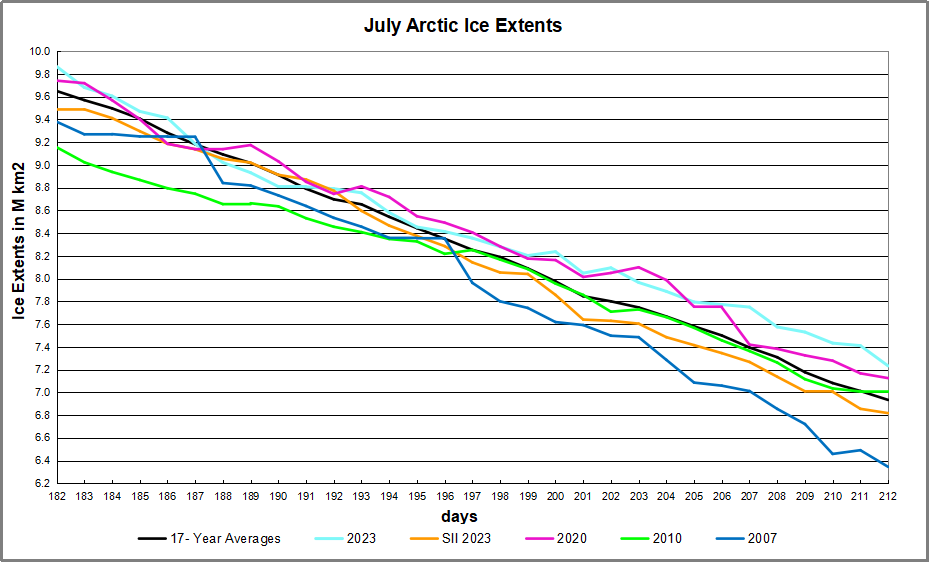
The graph above shows the July monthly average ice extent for the last 17 years for both MASIE and SII datasets.  Most years SII is slightly lower with the MASIE average at 8.279M km2 and SII at 8.033 (not shown).  Note that 2007 was near the lowest in the period and 2023 among the highest.

The graph for the last 30 days shows the normal melt is 2.7M km2 down to 6.9M km2.  2023 was tracking average for 2 weeks, and well above average after that.  SII tracked the MASIE average throughout, and sllghtly lower the second half. 2007 was average mid-July, but dropped much lower toward the end.

The table for day 212 shows how the ice extent is distributed across the Arctic regions, in comparison to 17 year average and 2007.  2023 was ~300k km2 above average, or 4% of total extent.

Region 2023212 Day 212 Average 2023-Ave. 2007212 2023-2007
 (0) Northern_Hemisphere 7232358 6936889  295469  6344860 887498 
 (1) Beaufort_Sea 723443 799968  -76525  760576 -37133 
 (2) Chukchi_Sea 659025 540756  118269  382350 276675 
 (3) East_Siberian_Sea 675190 756025  -80835  445385 229805 
 (4) Laptev_Sea 474071 371485  102587  314382 159689 
 (5) Kara_Sea 265568 161953  103615  239232 26336 
 (6) Barents_Sea 54417 29804  24612  23703 30714 
 (7) Greenland_Sea 328529 296824  31705  324737 3792 
 (8) Baffin_Bay_Gulf_of_St._Lawrence 243516 144525  98991  94179 149337 
 (9) Canadian_Archipelago 514780 555079  -40299  510063 4717 
 (10) Hudson_Bay 79485 143888  -64403  93655 -14170 
 (11) Central_Arctic 3213192 3134907  78285  3154837 58355 

The table shows earlier than average melting in Beaufort and East Siberian seas and Hudson Bay.  Surpluses are everywhere else, especially in Chukchi, Laptev and Kara Seas, as well as Baffin Bay and Central Arctic.  2007 was nearly a full Wadham less than 2023 yesterday.

Illustration by Eleanor Lutz shows Earth’s seasonal climate changes. If played in full screen, the four corners present views from top, bottom and sides. It is a visual representation of scientific datasets measuring Arctic ice extents and snow cover.

Ocean Warming Mystery: Two Natural Factors

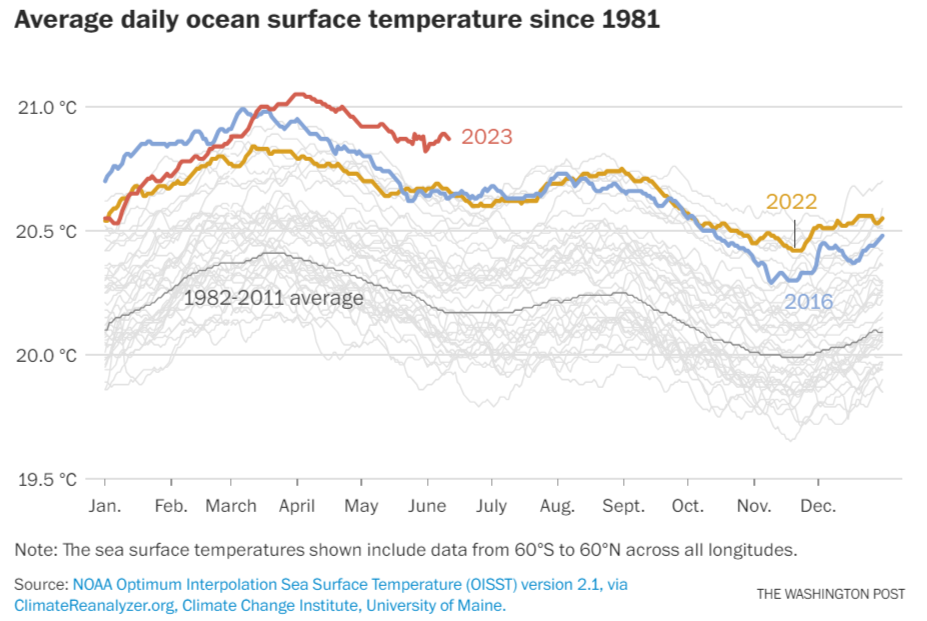
Many have seen the media news splash of ocean warming.  For example, from Washington Post Scientists are baffled why the oceans are warming so fast.  The image above comes from that article, excerpts below with my added bolds.

A steady and remarkable rise in average global ocean temperatures this year is now outpacing anything seen in four decades of satellite observations, causing many scientists to suddenly blare alarm over the risks and realities of climate change. But even those typically aligned on climate science can’t agree on what, exactly, triggered such rapid warming and how alarmed they should be.

Some climate researchers suspect that a drastic reduction in air pollution from ships has allowed more sunlight to radiate into oceans, a conclusion others vigorously criticize. Meteorologists also say a weakening of Atlantic winds may be encouraging warming; normally these winds help cool waters and carry sun-blocking plumes of Saharan dust.

Scientists nonetheless agree on this: Conditions are ever ripening for extreme heat waves, droughts, floods and storms, all of which have proven links to ocean warming.

In the Pacific Ocean, warming temperatures are to be expected during El Niño — its impacts on weather around the world stem from warmer-than-normal surface waters along the equatorial Pacific. But the extreme warmth extends beyond the Pacific. Record warmth is also occurring in the equatorial and northern Atlantic — and in the tropics, where hurricanes form.

“This is totally bonkers and people who look at this stuff routinely can’t believe their eyes,” Brian McNoldy, a hurricane researcher at the University of Miami, wrote on Twitter. “Something very weird is happening.”

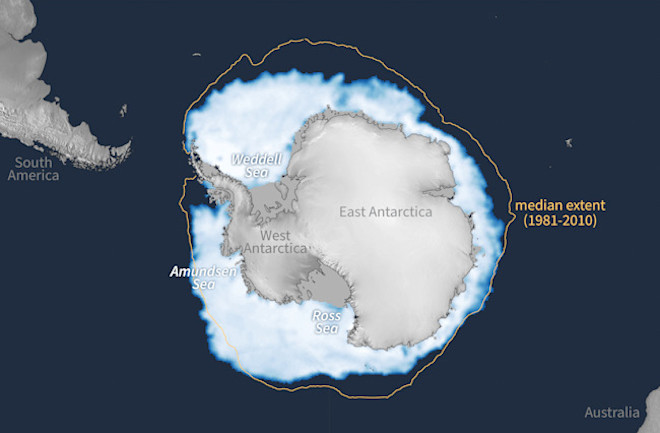
Antarctic sea ice concentration on June 27, 2023, with white representing solid ice and dark blue representing open ocean. The median ice edge for 1981–2010 is drawn in orange. (Credit: Map by NOAA Climate.gov, based on data from the National Snow and Ice Data Center)

And of course there is the added warning about Antarctic sea ice not freezing as rapidly as usual in SH winter.  The media always refers to “climate change” as the causal factor, which is code for rising CO2 and humans to blame.  For a more reasonable discussion, see Antarctic Sea Ice Varies, It’s Complicated.

What About Natural Factors?

Because the power, glory and money comes from CO2 hysteria and taking over the energy industry, the theories are all about the atmosphere.  Realists know that Oceans Make Climate, and look for more direct means by which sea temperatures can warm.

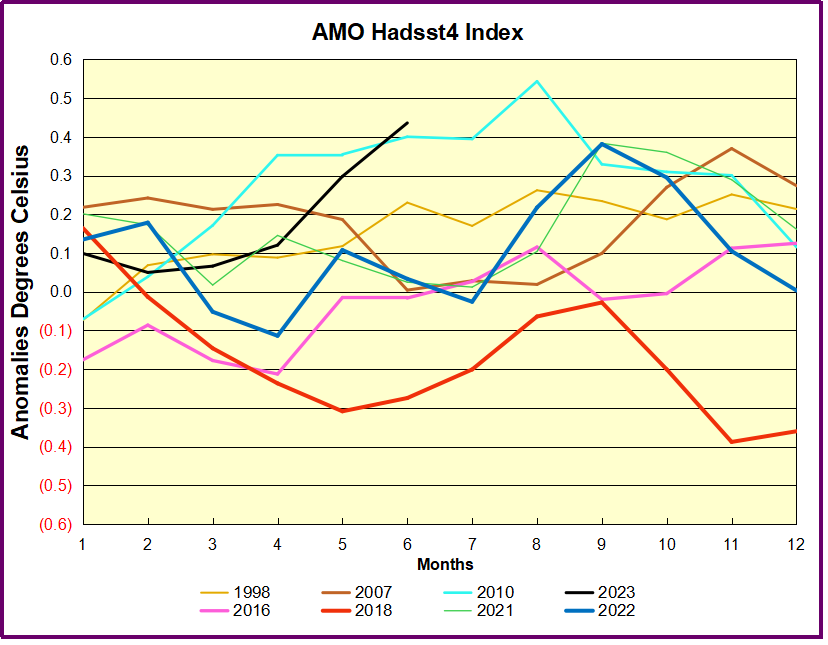
The HadSST4 AMO dataset was finally updated and showed dramatic 2023 warming in the North Atlantic. Let’s consider two possibilities.

1.  The Ocean Warming Could Be Bottom Up

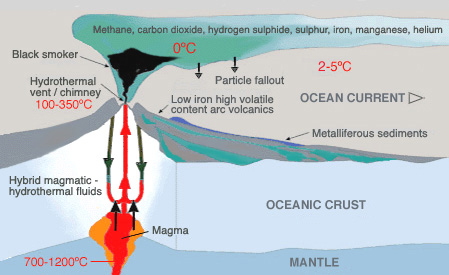
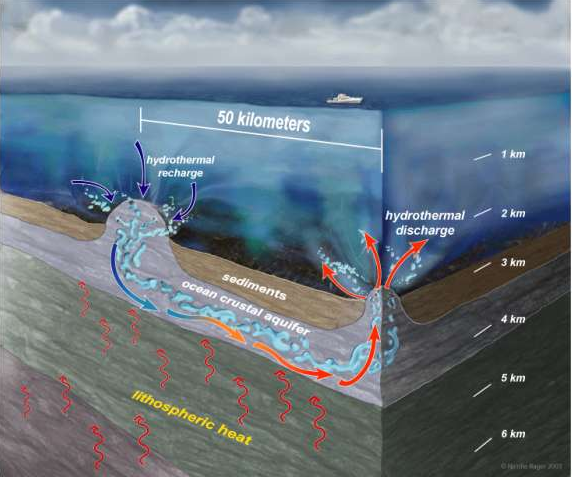
An article from CICOS explains the importance of hydrothermal action on the ocean floor.  Excerpts in italics with my bolds and added images.  Scientists Discover Three New Hydrothermal Vent Fields on Mid-Atlantic Ridge

An international team of scientists led by CICOES researcher David Butterfield
work together to rapidly find and explore large hydrothermal vents
on the world’s longest mountain range.

Sometimes Mid-Atlantic ridge is called the “40,000-mile Volcano”

Scientists have discovered three new hydrothermal vent fields over a 434-mile-long stretch of the Mid-Atlantic Ridge during the first scientific expedition aboard Schmidt Ocean Institute’s recently launched research vessel Falkor (too).

The multidisciplinary science team representing 11 institutions from the United States, Canada, and France used advanced ocean technologies to make the discovery. Scientists used autonomous and remotely operated underwater vehicles resulting in 65 square miles (170 square kilometers) of seafloor mapped at one-meter scale resolution, an area approximately the size of Manhattan Island.

The discovery of the active hydrothermal vents is the first on this section of the world’s longest underwater mountain range, the Mid-Atlantic Ridge, in more than 40 years. One of the discovered vent fields was located at the Puy des Folles volcano and has five active sites over 6.95 square miles (18 square kilometers). High-temperature ‘black smoker’ vents were also found at the Grappe Deux vent system and Kane Fracture Zone.

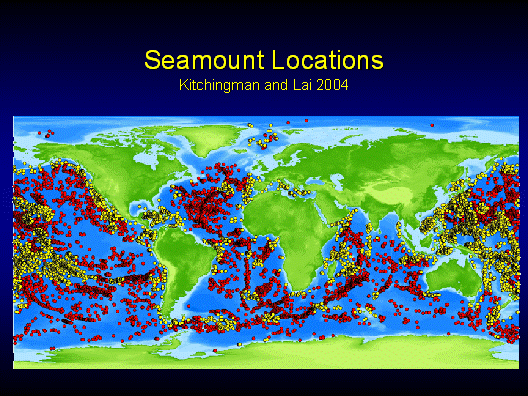
This discovery of new hydrothermal vents under the Atlantic ocean reminds of hundreds of thousands of sea mounts active on the ocean floor, with a high concentration in the North Atlantic  For a more complete discussion of bottom up ocean warming, See Post:

Overview: Seafloor Eruptions and Ocean Warming


2. It May Be the Aftermath of Hunga Tonga Eruption 2022

Khaykin et al. (2023) explan the climate impact in their article Global perturbation of stratospheric water and aerosol burden by Hunga eruption.  Excerpts in italics with my bolds.

The eruption of the submarine Hunga volcano in January 2022 was associated with a powerful blast that injected volcanic material to altitudes up to 58 km. From a combination of various types of satellite and ground-based observations supported by transport modeling, we show evidence for an unprecedented increase in the global stratospheric water mass by 13% relative to climatological levels, and a 5-fold increase of stratospheric aerosol load, the highest in the last three decades. Owing to the extreme injection altitude, the volcanic plume circumnavigated the Earth in only 1 week and dispersed nearly pole-to-pole in three months.The unique nature and magnitude of the global stratospheric perturbation by the Hunga eruption ranks it among the most remarkable climatic events in the modern observation era, with a range of potential long-lasting repercussions for stratospheric composition and climate.
The perturbation of stratospheric water vapour burden by 13% is tremendous and has no frame of comparison in the entire observation record dating back to 1985. As there are no efficient sinks of water vapour in the stratosphere, this perturbation is expected to last over several years. Indeed, in 9 months since the eruption, the water vapour mass anomaly has gradually decreased only by 2.5% (4.3 ± 0.1% annual rate), which should lead to the perturbation timescale of over 3 years, assuming the further linear decay trend. The persistent stratospheric moist anomaly may lead to changes in atmospheric radiative balance; stratospheric dynamics as well as amplification of the polar ozone depletion through wider occurrence of polar stratospheric clouds. The ability to assess the longer-term impacts of the HT eruption on stratospheric chemistry will depend strongly on the quality and availability of global satellite observations such as MLS in the coming years.

In addition to blasting seawater to the stratosphere, the event shook the ocean floor worldwide.  

The massive volcanic blast in the Pacific last year was felt 18,000km away on the other side of the world, on the floor of the Atlantic Ocean.  The cataclysmic eruption of Hunga-Tonga Hunga-Ha’apai on 15 January 2022 sent pressure waves through Earth’s atmosphere that connected with the sea surface and triggered 50 highly sensitive seismometers placed 5,000m under water on the seabed.  It was one of a number of intriguing phenomena picked up by the instrument network in the Azores-Madeira-Canary Islands region. Source:  BBC

Summary

Let’s stop pretending we can alter nature by spending trillions of dollars “fighting climate change.”  Better to solve actual problems we are causing and can fix, rather than obsessing over imaginary ones.


Heatless in Seattle Summer 2023

With all the media noise about “Global Boiling”, they must think we are all frogs in a pot on the stove (electric, no gas permitted).  And yet, what a difference a year makes in the US Northwest, as Cliff Mass reminds at his blog A Summer Without Extreme Heat in the Northwest.  Excerpts in italics with  added images.

With all the talk of heat waves in the media these days, it is fascinating to note that the Pacific Northwest has NOT had extreme heat this summer.  

No major heatwaves.   A lack of warm temperature records.

A really moderate, benign summer regarding high temperatures.  And the temperate weather is not over.

And more surprises…there is really little evidence over the past decades of increases in extreme July heat in our region.

Let me show you some data, to prove the above to you.

Just a reminder….the end of July is climatologically the warmest time of the year (see the climatology of SeaTac Airport, below).   By the end of August, solar radiation has declined so much that the temperatures inevitably decline.


A July Without Extreme Heat

Below you will find plots of the highest temperature in July over many decades for five local stations:  Olympia and Bellingham in western Washington, Wenatchee and Kennewick in eastern Washington, and Portland, Oregon.  I have plotted the July highs for the entire period of record and plotted a linear trend line for your reference.

Really interesting.   The high temperatures in July at these stations have been very average and FAR below record levels.  

Most of you have not needed AC this month.

Perhaps Shocking to Some
Now look at the trend of the extreme July temperatures above (brown lines) and you will notice something that is perhaps surprising:  there are no large increases in record July temperatures over many decades.
About a 1°F increase at Bellingham and Olympia, roughly .5 °F at Portland and Wenatchee, and a DECLINE of roughly 2 F at Kennewick over many decades.
The background global warming of mean temperatures is about 2F.  Our regional extremes are going up LESS than that.  
There is no local amplification of extreme temperatures as the planet slowly warms.
To bring home the message of the lack of extreme temperatures this July, below are the temperatures at Olympia and Wenatchee (blue bars showing observed highs and lows), with record daily highs shown by the red colors.
No daily high-temperature records were broken.  None. Nada. Zippo.

Finally, the moderate temperatures are not over.  

To illustrate, the latest 7-day forecast from the European Center ensemble (shown below) indicates cooler than normal conditions (blue colors) over and west of the Cascade crest (this is for the daily average temperature, NOT the high temperatures).
As noted in my previous blogs, the lack of extreme high temperatures is associated with a persistent atmospheric circulation pattern.  It also helps explain the lack of wildfires over the region.


No CNN, Gulf Stream is Not Collapsing

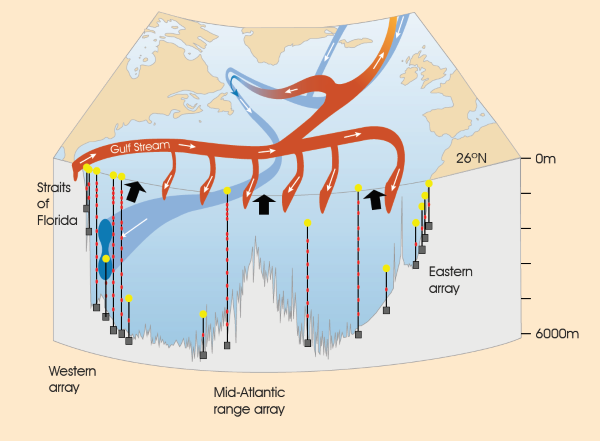
Atlantic Meridional Overturning Circulation (AMOC). Red colours indicate warm, shallow currents and blue colours indicate cold, deep return flows. Modified from Church, 2007, A change in circulation? Science, 317(5840), 908–909. doi:10.1126/science.1147796


Leave it to CNN to jump the shark with scary claims Excerpts in italics with my bolds.

A crucial system of ocean currents is heading for a collapse that ‘would affect every person on the planet’

A new study published Tuesday in the journal Nature, found that the Atlantic Meridional Overturning Current – of which the Gulf Stream is a part – could collapse around the middle of the century, or even as early as 2025.

Scientists uninvolved with this study told CNN the exact tipping point for the critical system is uncertain, and that measurements of the currents have so far showed little trend or change. But they agreed these results are alarming and provide new evidence that the tipping point could occur sooner than previously thought.

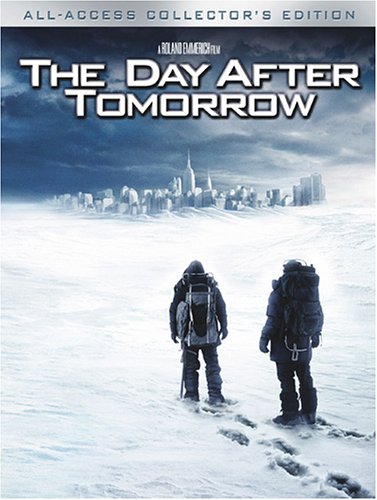
Yikes!  Shades of Day After Tomorrow

Scientists Admonish Against Going Over the Top

Fortunately knowledgable experts in the area have weighed with context and perspective at Science Media Centre Expert reaction to paper warning of a collapse of the Atlantic meridional overturning circulation. 

Of course some commented as cheerleaders, but many cautioned against exaggeration and speculation. The RAPID programme (see diagram at top) measures daily flows of water at several depths between the North Atlantic and Arctic oceans, and its scientific coordinator, Prof Meric Srokosz, National Oceanography Centre, University of Southampton, said:

While the possible collapse of the AMOC with significant climatic impacts is a concern, providing a warning of its collapse is problematic as a long set of observations is required. In this paper the warning depends on using proxy AMOC data (here based on sea surface temperature, SST) as direct continuous AMOC measurements are only available since 2004. The warning comes from applying statistical techniques to a long time series (over a century) of proxy AMOC data, but the warning is only as good as the proxy data are in representing the true AMOC. So, this warning needs to be treated with caution as there is no consensus as to which proxies can accurately capture the behaviour of the AMOC over the long term.”

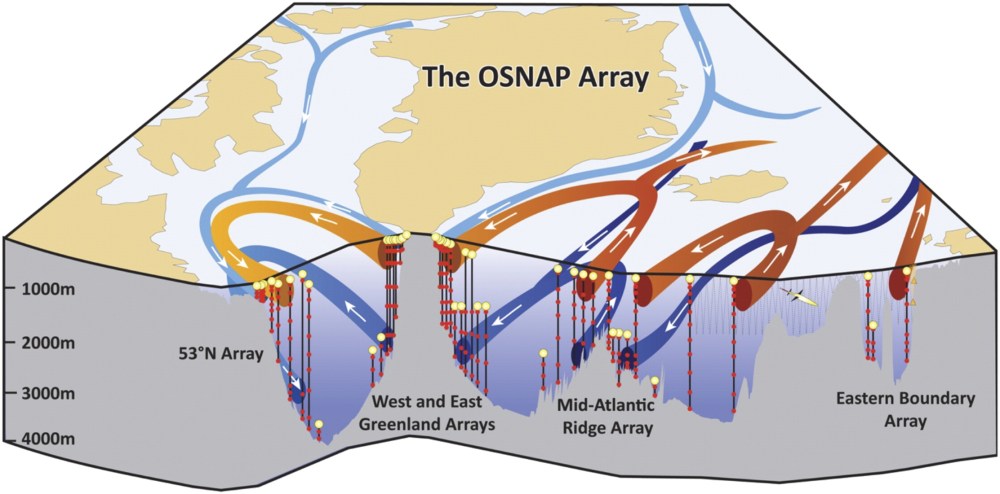
Prof Penny Holliday, Head of Marine Physics and Ocean Circulation at the National Oceanography Centre, and Principal Investigator for OSNAP, an international programme researching AMOC processes, variability and impacts, said:

“Confidence in the validity of the conclusions are undermined by our knowledge that sea surface temperature of the North Atlantic subpolar gyre is not a clear indicator of the state of the AMOC, and that there is no evidence that the AMOC has dramatically weakened in the past 50-75 years. A collapse of the AMOC would profoundly impact every person on Earth but this study overstates the certainly in the likelihood of it taking place within the next few years.”

Does the press release accurately reflect the science?

“On the whole it does – the title of the paper is more sensational than the actual statements within it, and the press release does make that clear. However there are two statements that are not accurate as follows:

‘The strength of the AMOC has only been monitored continuously since 2004 and these observations have shown AMOC to be weakening’

“This is stated in the paper but it is not correct information. The observations since 2004 show that the AMOC goes through fluctuations of being in a stronger or weaker state that last for about 10 years. The observations since 2004 show the subtropical AMOC getting slower from 2004 to 2012, but gradually becoming stronger since then. The only data from AMOC observations shown in the paper are from 5 sparse ship surveys and are used out of context – the authors use them to argue for a severe decline in the AMOC, but that interpretation has long been discredited in the scientific literature (including in the reference they cite for it).

‘The authors found early warning signals of a critical transition of the AMOC system and suggest that it could shut down or collapse as early as 2025 and no later than 2095.’

“This is not quite as the paper states. In the paper the time period of potential collapse depends on choices they have made in how they construct the time series of sea surface temperature which they use as evidence for change. They present three versions of the temperature records, and the three resulting model predictions suggests a collapse is ‘likely’ at any time from 2024 to 2180. The 2025-2095 is the period of time their statistical model predicts that a full or partial collapse is most likely.

How does this work fit with the existing evidence?

“The conclusions are different to the consensus derived from climate projections as described by the IPCC AR6 assessment. The averaged AMOC projections from climate models under all the IPCC emissions scenarios all show an AMOC decline, but not a collapse (a “high confidence” conclusion). Some individual climate model runs do show a future collapse in the AMOC, so the possibility cannot be entirely ruled out.

Are there any important limitations to be aware of?

“There are some questionable assertions and decisions in the methods as follows. The authors state confidently that the sea surface temperature (SST) of the North Atlantic subpolar gyre can be used as a proxy for the strength of the AMOC. The validity of an SST proxy for AMOC strength is a matter of ongoing scientific debate however, because it is based on model behaviour and is not proven using real-world data.

There is solid evidence that there is no such clear relationship,
especially on timescales of less than 30 years.

“I believe the authors have overstated the pattern of subpolar North Atlantic SST change by subtracting two (and three) times the global mean surface temperature trend. This is not the usual approach for highlighting North Atlantic regional temperature trend (instead it is more usual to subtract just 1 x the global trend). The choice means that some of the SST data they use in the statistical model has exaggerated decline since the 1970s when the global SST began to sharply rise. In the version of the statistical model for which the global mean SST trend is removed, the predicted likely time of a partial or complete collapse becomes later and over a wider window of time.

“As mentioned above, the actual observations of AMOC since 2004 have long-since discredited the evidence that the authors are using to validate their modified SST temperature record. The 5 data points they show in the paper were collected several years apart by ship surveys, and it is well known and well established that they give a highly misleading impression of AMOC decline. All the observational evidence we have shows no evidence of dramatic decline in the AMOC over the past 50-75 years.

How uncertain are the uncertainties?

“The authors say that the model’s 95% confidence interval is 2025-2095. This is a measure of statistical uncertainty and they state in the discussion that they cannot rule out slowing rather than a collapse, as well as listing other reservations and caveats. Because of the limitations of their use of modified SST as a proxy for AMOC, the uncertainty in the stated message in the title and abstract is high.

What are the implications in the real world?

“The potential for the AMOC system of currents to collapse under global warming is a high impact, low likelihood scenario, and policymakers and planners do need to be aware of it. NOC and international partners are investing in ongoing observations of the AMOC in order to determine how closely changes in AMOC contribute to changes in SST and consequential climate and social and economic impacts on people. The strength of the out-of-sight ocean currents of the AMOC has surprisingly direct impacts on food, water and energy security, infrastructure risk, biodiversity, and human health. The paper demonstrates that decades of observations are needed to be able to detect a major tipping point in the AMOC, and the authors call for continued measurements of these great Atlantic ocean currents for long enough to do so.

Prof. Dr. Jochem Marotzke, Director of the Department Ocean in the Earth System, Max-Planck-Institute for Meteorology, Hamburg, Germany, said:

“The work provides no reason to change the assessment of the 6th IPCC Assessment Report: ‘There is medium confidence that there will be no abrupt collapse before 2100′. The statement so confidently made in this paper that collapse will occur in the 21st century has feet of clay. The maths are solid, but the starting point is highly dubious: the essential equation – marked with (1) in the paper – relies on the simplified models representing bifurcation – i.e. AMOC collapse – also being correct. But the more comprehensive models do not show this very bifurcation. In this respect, the paper does not live up to its self-imposed claim: ‘The strategy is to infer the evolution of the AMOC solely on observed changes in mean, variance and autocorrelation.’

The interpretation relies to an enormous extent on the authors’ theoretical
understanding being correct, and there are huge doubts about that.

“It must be added that there is considerable doubt as to whether surface temperature measurements are a valid proxy for the AMOC. Again, the paper addresses these uncertainties inadequately.

“When reporting about this study, it is important to include the key aspects in which this paper fails to include the scientific uncertainties.

Prof Niklas Boers, Professor of Earth System Modelling at the Technical University of Munich, said:

“I do not agree with the outcome of this study. While the qualitative statement that the AMOC has been losing stability in the course of the last century is true and supported by the data, uncertainties are too high to reliably estimate a time of tipping. In particular, the uncertainties in the heavily oversimplified model assumptions by the authors are too high. Moreover, the uncertainties in the underlying datasets are huge and would make the extrapolation carried out by the authors far too uncertain to actually report a year or even a decade for the AMOC tipping.”

Background Post 2019 AMOC Update: Oceans Moderate Climate Threat

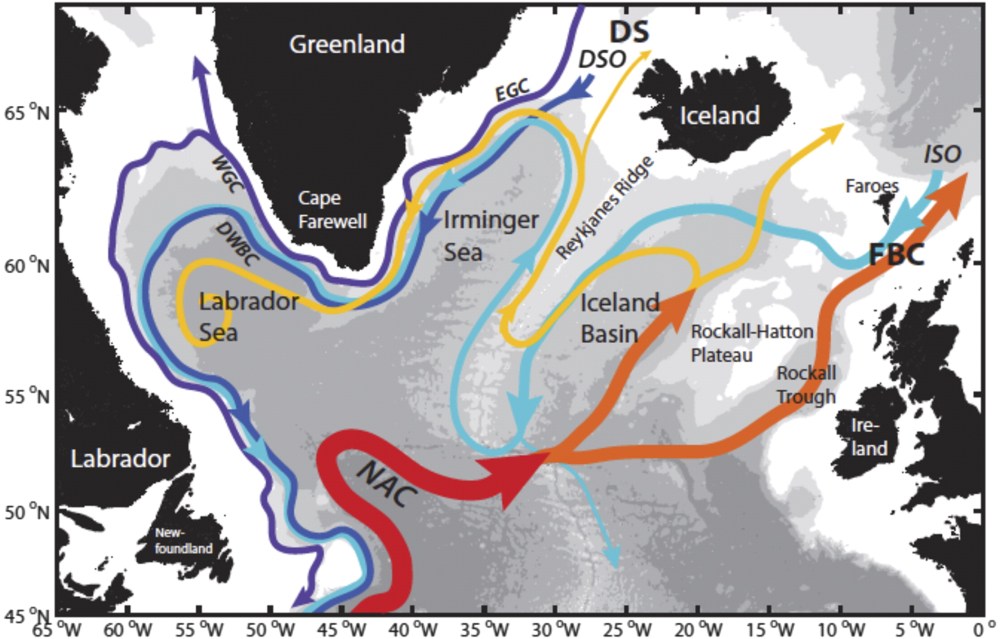
Fig. 1. Schematic of the major warm (red to yellow) and cold (blue to purple) water pathways in the NASPG (North Atlantic subpolar gyre ) credit: H. Furey, Woods Hole Oceanographic Institution): Denmark Strait (DS), Faroe Bank Channel (FBC), East and West Greenland Currents (EGC and WGC, respectively), NAC, DSO, and ISO.

Antarctic Sea Ice Varies, It’s Complicated

Antarctic sea ice concentration on June 27, 2023, with white representing solid ice and dark blue representing open ocean. The median ice edge for 1981–2010 is drawn in orange. (Credit: Map by NOAA Climate.gov, based on data from the National Snow and Ice Data Center)

One of the more measured current reports of Antarctic sea ice is at Discover Antarctic Sea Ice Reaches a “Record-Smashing Low”.  Excerpts in italics with my bolds.

The sea ice extent is nearly a million square miles
below the long-term average for late June.

Some scientists believe that what we’ve seen since 2022 may be signaling a significant and potentially long-lasting change. As Ted Maksym, a climate scientist and polar oceanographer at the Woods Hole Oceanographic Institution, put it in a recent story in Wired:

“Now there’s this question about: Have we got into a regime shift? A few of us are sort of speculating that that may be true, where the variability in Antarctic sea ice has changed and we might see these low sea ice extents for some time.”

But Maksym also says he and his colleagues are “watching with bated breath” to see if things will return to normal — and they could. Scientists just don’t know.

That’s because the Antarctic is a very different environment than the Arctic — in a way that complicates drawing firm conclusions. The latter consists of an ocean surrounded by land, whereas the former is a giant landmass surrounded by oceans.

Sea ice around Antarctica is affected by a host of complex factors,
including shifts in ocean currents and sea and air temperatures.

Given how remote, forbidding and large Antarctica is, observations of these factors have been relatively sparse. Moreover, the record of satellite observations of sea ice dates only to 1979, making it difficult to separate out a human-caused signal from natural variability. And the sparseness of data, and the complexity of myriad factors, have made modeling of Antarctic sea ice very challenging.

Bottom line: Scientists haven’t seen anything like what’s been happening to Antarctic sea ice in the past two years. But it will take time to know whether a dramatic shift truly has occurred, and more research to tease out the role of anthropogenic climate change in what’s happening.

Background Annual Cycle of Antarctic Sea Ice

Firstly, the annual minimum average is ~2.5 M km2 vs. an average maximum of ~17.5 M km2.  So the sea ice extent each year nearly disappears.  Secondly, since 2010, some years were well above the 1981-2010 average, and obviously there were likely many prior years below average.  Which suggests this may be a return to the mean, or not, as the experts say.

Previously, Antarctic Sea Ice Grew Steadily

Robot Sub Finds Surprisingly Thick Antarctic Sea Ice Nov. 24, 2014

Antarctica’s ice paradox has yet another puzzling layer. Not only is the amount of sea ice increasing each year, but an underwater robot now shows the ice is also much thicker than was previously thought, a new study reports.

The discovery adds to the ongoing mystery of Antarctica’s expanding sea ice. According to climate models, the region’s sea ice should be shrinking each year because of global warming. Instead, satellite observations show the ice is expanding, and the continent’s sea ice has set new records for the past three winters. At the same time, Antarctica’s ice sheet (the glacial ice on land) is melting and retreating.

Measuring sea ice thickness is a crucial step in understanding what’s driving the growth of sea ice, said study co-author Ted Maksym, an oceanographer at the Woods Hole Oceanographic Institution in Massachusetts. Climate scientists need to know if the sea ice expansion also includes underwater thickening.

“If we don’t know how much ice is there is, we can’t validate the models we use to understand the global climate,” Maksym told Live Science. “It looks like there are significant areas of thick ice that are probably not accounted for.”

The Antarctic sunlight illuminates the surface of the sea ice, intensifying the effect of the fracture lines, Oct. 2003. (NSIDC, University of Colorado)

Theory:  Climate Change Increases Antarctic Sea Ice Extent

From AP Oct. 10, 2012 Increase in Antarctic ice may be sign of climate change.  Excerpts in italics with my bolds.

While the Arctic is open ocean encircled by land, the Antarctic — about 1.5 times the size of the U.S. — is land circled by ocean, leaving more room for sea ice to spread. That geography makes a dramatic difference in the two polar climates.

The Arctic ice responds more directly to warmth. In the Antarctic, the main driver is wind, Maksym and other scientists say. Changes in the strength and motion of winds are now pushing the ice farther north, extending its reach.

Those changes in wind are tied in a complicated way to climate change from greenhouse gases, Maksym and Scambos say. Climate change has created essentially a wall of wind that keeps cool weather bottled up in Antarctica, NASA’s Abdalati says.

And the wind works in combination with the ozone hole, the huge gap in Earth’s protective ozone layer that usually appears over the South Pole. It’s bigger than North America.

It’s caused by man-made pollutants chlorine and bromine, which are different from the fossil fuel emissions that cause global warming. The hole makes Antarctica even cooler this time of year because the ozone layer usually absorbs solar radiation, working like a blanket to keep the Earth warm.

And that cooling effect makes the winds near the ground stronger and steadier,
pushing the ice outward, Scambos says.

University of Colorado researcher Katherine Leonard, who is on board the ship with Maksym, says in an email that the Antarctic sea ice is also getting snowier because climate change has allowed the air to carry more moisture.

Does Sea Ice Growth or Decline Negate or Confirm Climate Change?  No.

From LA Times August 29, 2014 Does Antarctic sea ice growth negate climate change? Scientists say no.  Excerpts in italics with my bolds.

This year, Antarctic sea ice has expanded its frigid reach with unprecedented speed, setting records in June and July. By the time spring punctures the long Antarctic night, 2014 stands a decent chance of topping 2012 and 2013, which each broke records of maximum total ice extent.

In fact, since scientists started making satellite observations in the late 1970s, they have watched winter sea ice around Antarctica swell slowly but indisputably, despite predictions that it should shrink.

This poses a puzzle that climate scientists struggle to explain:
How can sea ice grow in a warming world?

Climate skeptics have pounced on this apparent discrepancy, citing it as proof that climate change isn’t real, or at least that scientists don’t completely understand it. But those who study Antarctic sea ice say their curious observations shouldn’t shake anyone’s confidence. Dramatic changes in temperature, sea level and extreme weather around the world are proof enough the planet is warming, they say; the only question is how these changes affect the Antarctic as they ripple through the climate system.

“Climate is a complicated thing,” said Ted Maksym, an oceanographer at the Woods Hole Oceanographic Institute in Massachusetts. “Understanding how these kinds of changes play out in different regions is tricky business.”

The westerly winds blow fierce and constant around Antarctica, isolating the continent in a kind of permanent polar vortex. Scientists think they exert the most direct control over the state of Antarctic sea ice.

Ice requires cold temperatures to form, and winds help it grow by blowing it around the polar ocean. When the ice moves, new water is exposed to the chilly air, creating an opportunity to make more ice.

But it’s not quite as simple as more wind, more ice.

“It makes no sense to talk about a circumpolar average,” Stammerjohn said. “There’s so much regional variability.”

The Ross Sea, which faces New Zealand, has seen a dramatic increase in peak ice extent and 80 more days of ice cover since 1979, when satellites began tracking changes. But along the Antarctic Peninsula, which stretches toward the tip of South America, the ice-covered season in the Bellingshausen Sea is three months shorter than it was 35 years ago.

Scientists say sea ice and continental ice are probably responding to the same forces — namely, changes in ocean circulation and winds. However, they also influence each other. Sea ice helps buffer ice shelves, the floating tongues of glacial ice that dam the ice sheets and keep them from spilling irreversibly into the sea. It also keeps warm ocean waters trapped beneath a frozen lid, insulating the ice sheet from their destructive heat.

In the long run, however, scientists expect Antarctic sea ice to decline everywhere.
That it hasn’t done so yet suggests there’s still much to learn about the region
.

Antarctic Sea Ice Grows to All-Time Record High: NSIDC October 09, 2014

Antarctica Heat Hype

Jennifer Marohasy throws cold water on heat hype in her Spectator Australia article Warming in Antarctica? Only using ‘creative’ statistics.  Excerpts in italics with my bolds and added images.

Much has been written in the tabloids, and repeated by the fashionable, about it being very hot through June – even in Antarctica. Really, I wondered. Is Antarctica melting?

The Australian Bureau of Meteorology has measured air temperatures at the Mawson weather station in Antarctica since early 1954 – this is one of the longest continuous surface temperature records for that part of the world. The Russians did not establish the more famous and isolated Vostok weather station until 1957. The satellite temperature record doesn’t begin until 1979.

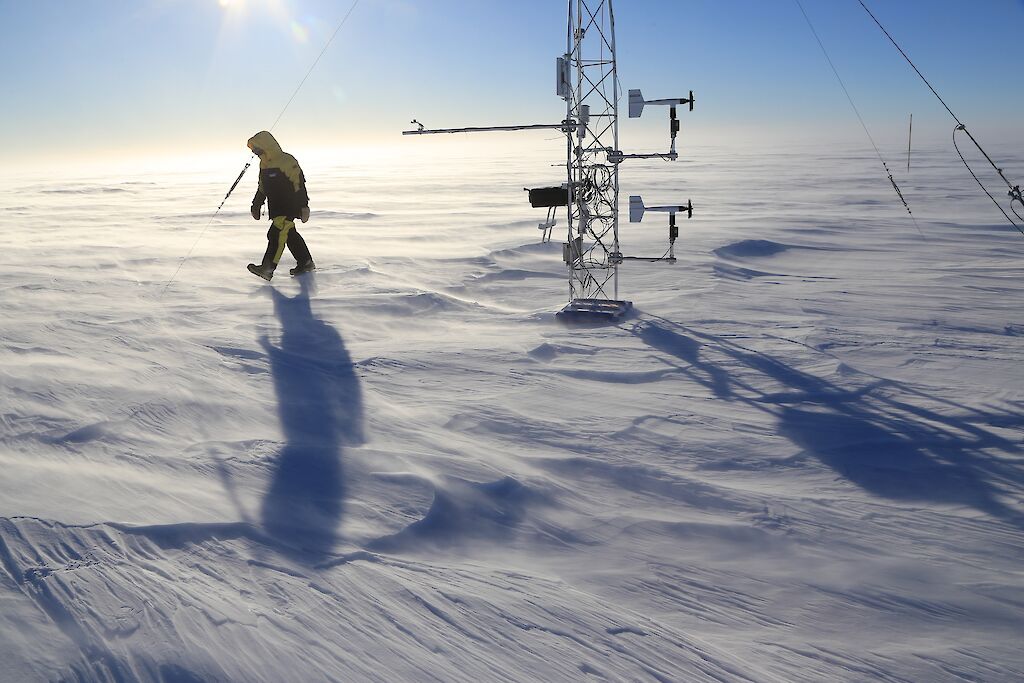
Automatic weather station (AWS) near Mawson. Photo: John Burgess

The Bureau makes very few adjustments to the temperatures as measured at Mawson that oscillate within a band of some few degrees – mostly below freezing. These same temperatures show no statistically significant long-term warming trend, at least not since 1954. There are longer proxy temperature series, based on ice core records, and they show an overall cooling trend, considering the last 1,900 years. Here, again, I am referring to data from published studies, for example, the temperatures of East and West Antarctica were reconstructed by a team led by Barbara Stenni including scientists from the Australian Antarctic Division, British Antarctic Survey, and Russian Antarctic Research Institute. It is only remodelled proxy series that show warming over this same period.

Last month (June 2023), Antarctica was reported as ‘hot’ in various publications including Vox.com. It’s even hot in Antarctica, where it’s winter.  Yet the average maximum temperature for Mawson was minus 12.6 degrees Celsius, which is not quite as cold as the long-term June average for all years since 1954 which is minus 13.5 C. When the June maximum temperatures for Mawson are ranked highest to lowest, June 2023 comes in as the 29th hottest, and 42nd coldest – suggesting temperatures in Antarctica were not particularly newsworthy and rather cold.

Yet the tabloids, and fashionable, are claiming June 2023 as hot – even in Antarctica. It is all nonsense.

Some of these claims have their origin in the University of Maine’s Climate Reanalyzer, a tool that uses satellite data and computer simulations. So, they represent a remodelled average. Indeed, there is not a single place where anyone, can measure the average temperature of the Earth – or Antarctica. Rather, when it is announced that it is the hottest it has ever been, reference is made to a statistic.

This average temperature is necessarily a number
that has been derived from other numbers.

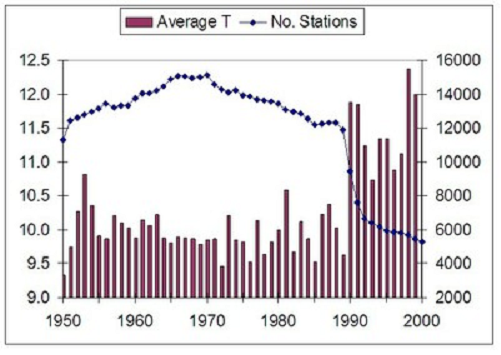
There will perhaps have been some measuring done here and there, and then some adjusting, and then some adding up and some adjusting again. This is how it is with the calculation of regional and global average temperatures – whether from satellites, tree rings, ice cores, or thermometers. To be sure, every year we are told it is getting hotter, and back in the late 1980s, this was achieved for the globally averaged thermometer record by dropping out some of the colder weather stations. This had the effect of increasing the overall average global temperature, at a time when temperatures at many individual sites were dipping somewhat.

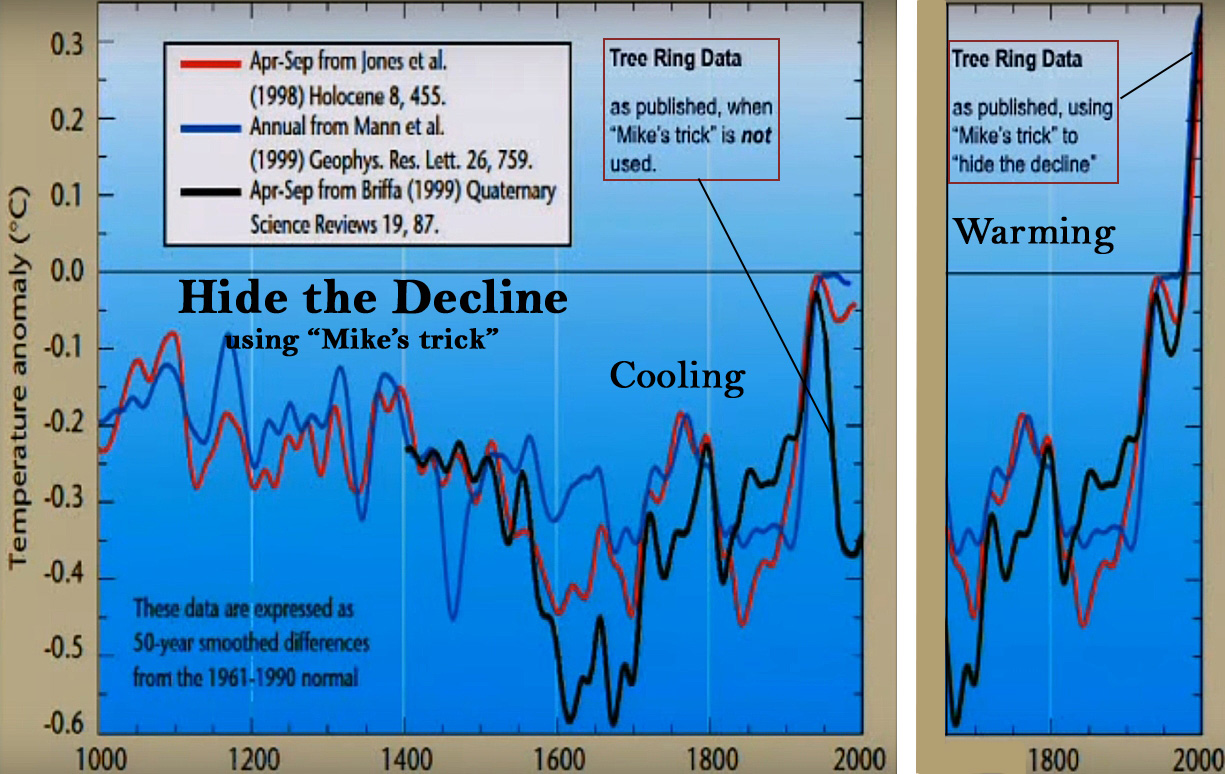
Those who have followed the politics of measuring temperatures may also remember the infamous line in the Climategate emails, whereby the globally averaged temperatures based on tree rings, which also show a decline after 1980, are ‘corrected’ by substituting the globally averaged temperature from thermometer records – never mind that the dip in that record had already been ‘corrected’ by removing data from a great many high latitude Canadian and Russian weather stations.

Drawing from this sordid history of calculating global and regional temperatures, I can think of a large number of ways that the University of Maine’s Climate Reanalyzer could possibly generate a higher-than-average temperature for Antarctica and especially the Earth. Indeed, the larger the geographic area covered, the more opportunity for creative accounting, for which corporates using similar techniques would go to jail, while climate scientists are more usually promoted.

The solution is to perhaps give up on believing the nonsense news headlines, especially when there is no reference to a specific weather station, like Mawson. Or do away with a random selection of weather stations and focus instead on a simple index based on a good sample of well-sited weather stations with long histories, like Mawson.

Such a concept could be based on the Dow Jones Averages or the S&P 500. No one ever tries establishing an impossible-to-define ‘average stock price’ — including many stocks of doubtful provenance — and nobody cares. Rather the solution is to have a pre-selected index of certain representative stocks, that are then followed over a long-time span. So why not have an index of agreed weather stations?

The only problem is, the tabloids and the fashionable, might then have nothing to talk about – should they limit reporting to the same weather stations and with temperatures reliably measured, which will require some modification to current methods and of course, no subsequent adjusting.

There may be no catastrophe to report at least not when it comes to weather as a measure of climate, for which the lack of reliable measures, and the great number of potentially creative solutions, are currently being exploited over and over to justify rather large expenditures on all manner of things.