Updated: Pacific Sea Level Data


PSLMPThis post is about the SEAFRAME network measuring sea levels in the Pacific, and about the difficulty to discern multi-decadal trends of rising or accelerating sea levels as evidence of climate change.

Update July 9, 2018

Asked a question today about sea levels and Pacific islands, I referred to this article.  Realizing it was posted 2 years ago, it seemed important to check the most recent project report.  Thus at the bottom there are now results through May 2018.

Update May 10 below, regarding recent Solomon Islands news

Pacific Sea Level Monitoring Network

The PSLM project was established in response to concerns voiced by Pacific Island countries about the potential effects of climate change. The project aims to provide an accurate long-term record of sea levels in the area for partner countries and the international scientific community, and enable the former to make informed decisions about managing their coastal environments and resources.

In 1991, the National Tidal Facility (NTF) of the Flinders University of South Australia was awarded the contract to undertake the management of the project.  Between July 1991 and December 2000 sea level and meteorological monitoring stations were installed at 11 sites. Between 2001 and 2005 another station was established in the Federated States of Micronesia and continuous global positioning systems (CGPS) were installed in numerous locations to monitor the islands’ vertical movements.

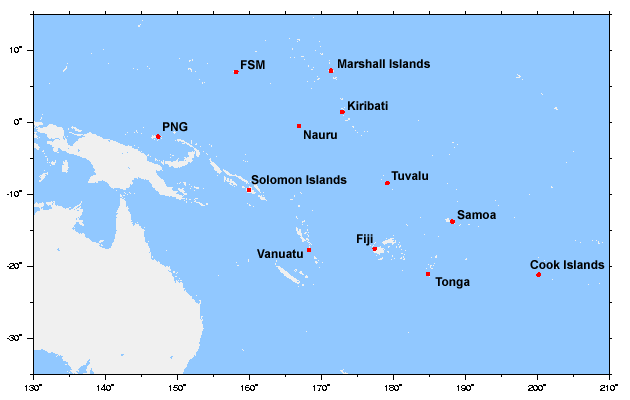
The 14 Pacific Island countries now participating in the project provide a wide coverage across the Pacific Basin: the Cook Islands, Federated States of Micronesia, Fiji, Kiribati, Marshall Islands, Nauru, Niue, Palau, Papua New Guinea, Samoa, Solomon Islands, Tonga, Tuvalu and Vanuatu.

SPSLCM_2008_4_data_report_Image_11

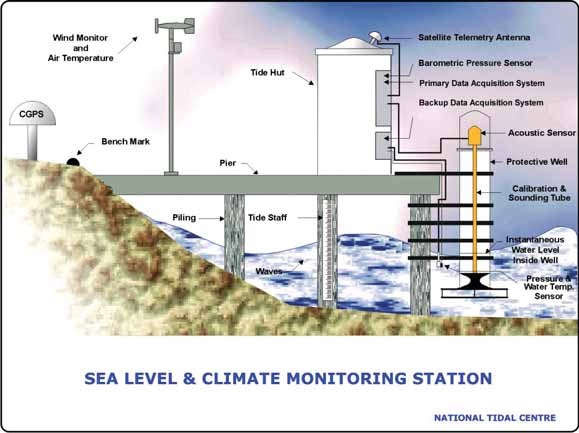
Each of these SEA Level Fine Resolution Acoustic Measuring Equipment (SEAFRAME) stations in the Pacific region are continuously monitoring the Sea Level, Wind Speed and Direction, Wind Gust, Air and Water Temperatures and Atmospheric Pressure.

In addition to its system of tide gauge facilities, the Pacific Sea-Level Monitoring Network also includes a network of earth monitoring stations for geodetic observations, implemented and maintained by Geoscience Australia. The earth monitoring installations provide Global Navigation Satellite System (GNSS) measurements to allow absolute determination of the vertical height of the tide gauges that measure sea level.

Sea Level Datasets from PSLM

Data and reports are here.

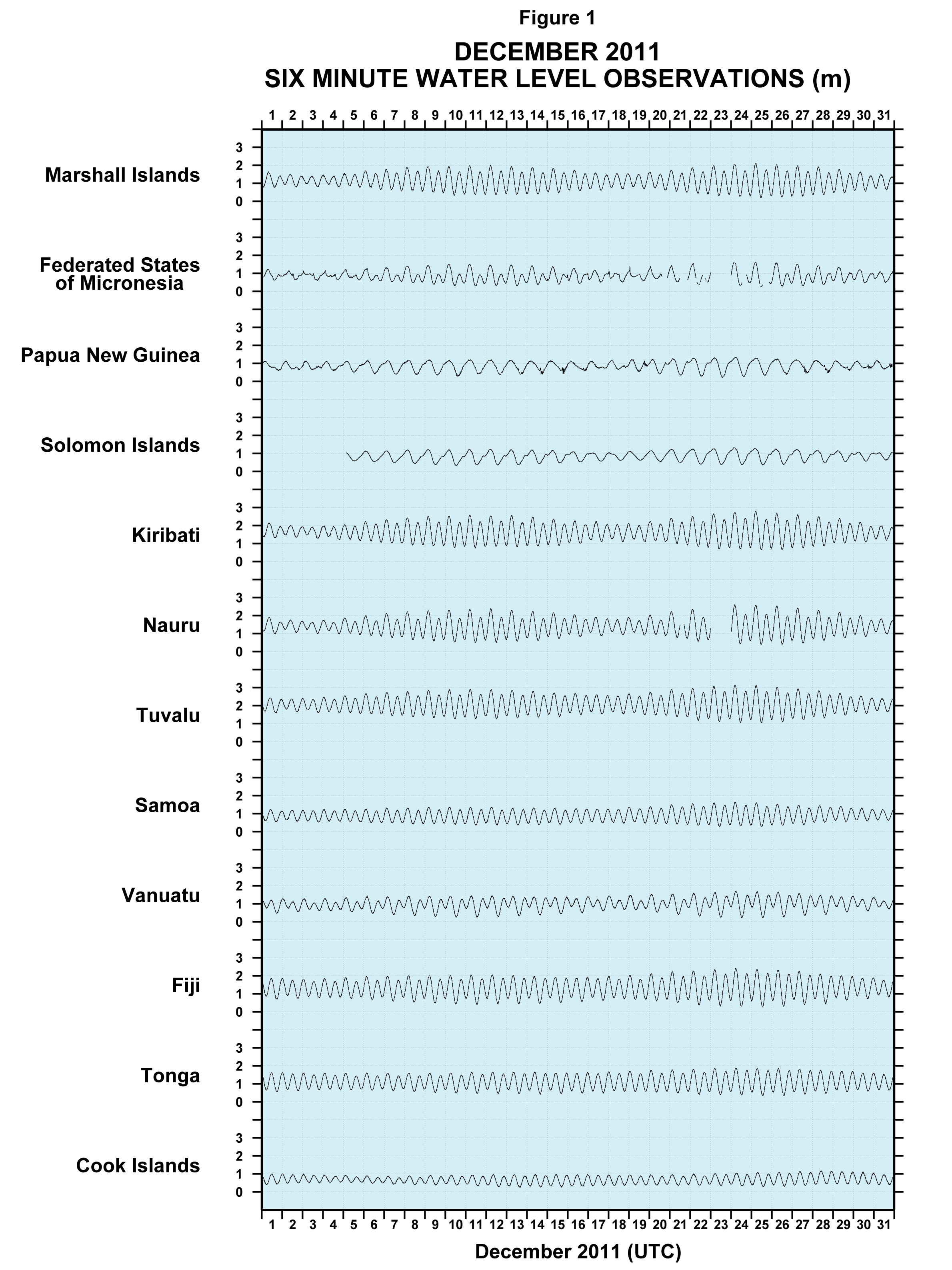
Monthly reports are detailed and informative. At each station water levels are measured every six minutes in order to calculate daily maxs, mins and means, as a basis for monthly averages. So the daily mean sea level value is averaged from 240 readings, and the daily min and max are single readings taken from the 240.


untitled

A typical monthly graph appears above. It shows how tides for these stations range between 1 to 3 meters daily, as well variations during the month.

According to the calibrations, measurement errors are in the range of +/- 1 mm. Vertical movement of the land is monitored relative to a GPS benchmark. So far, land movement at these stations has also been within the +/- 1 mm range (with one exception related to an earthquake).

The PSLM Record

March SL range

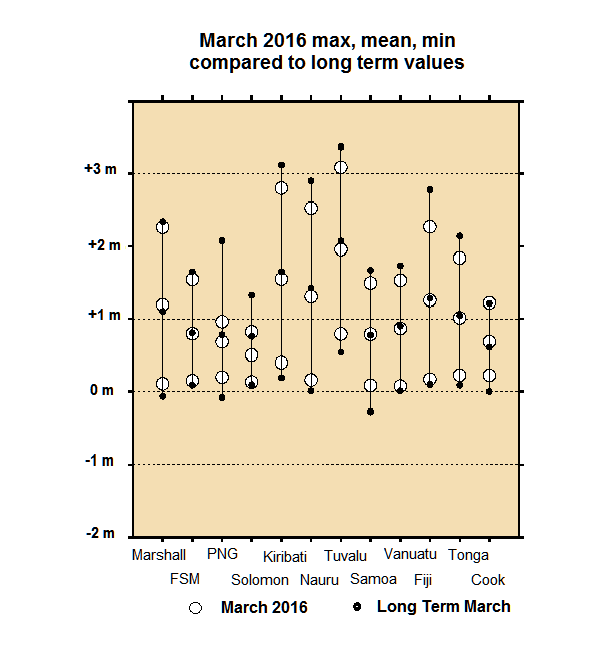
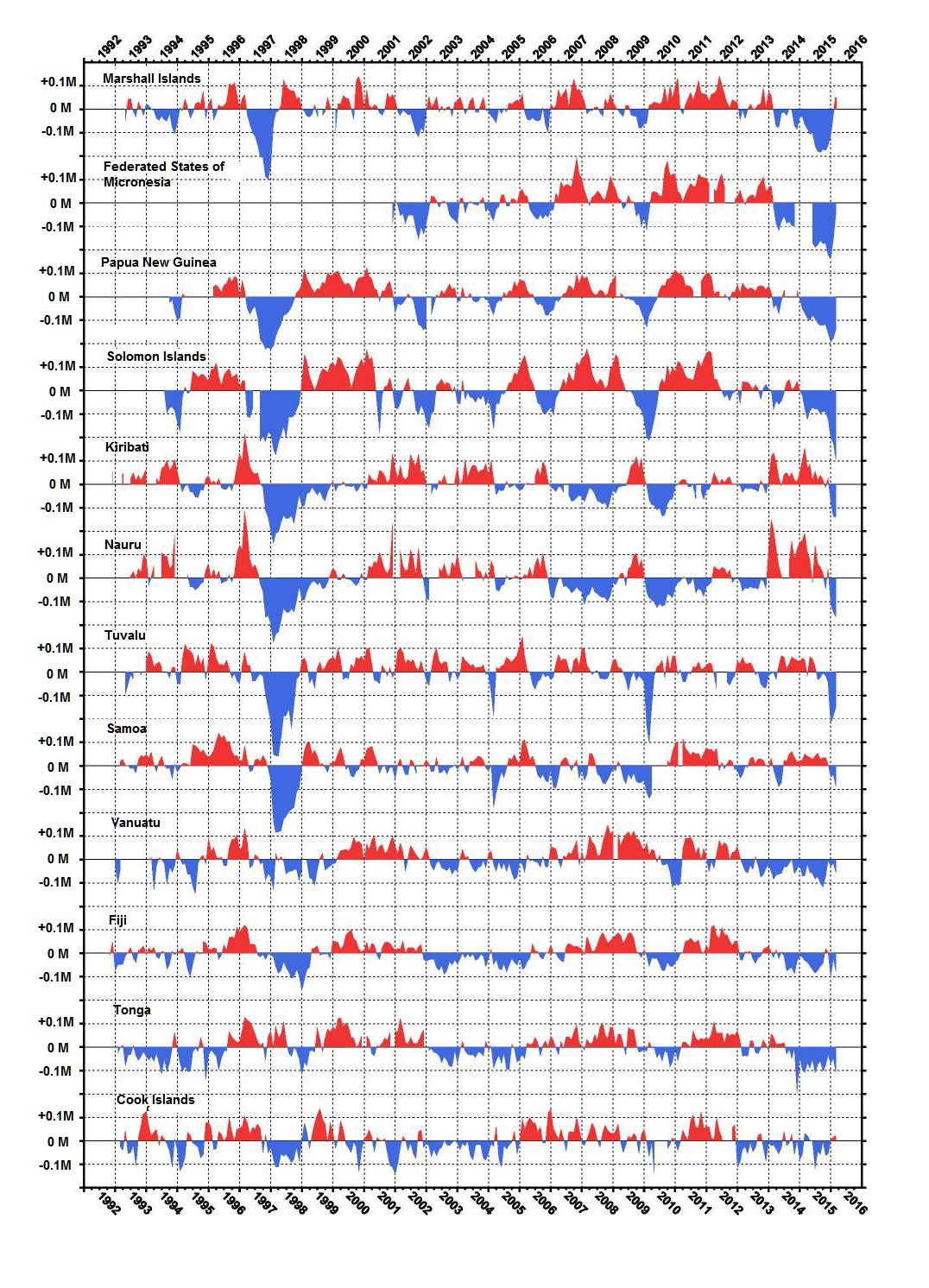
In the Monthly reports are graphs showing results of six minute observations, indicating tidal movements daily over the course of a month.The chart above shows how sea level varied in each location during March 2016 compared to long term March results. Since many stations were installed in 1993, long term means about 22 years of history.

This dataset for Pacific Sea Level Monitoring provides a realistic context for interpreting studies claiming sea level trends and/or acceleration of such trends. Of course, one can draw a line through any scatter of datapoints and assert the existence of a trend. And the error ranges above allow for annual changes of a few mm to be meaningful. Here is a table produced in just that way.

Location Installation date Sea-level trend (mm/yr)
Cook Islands Feb 2003 +5.5
Federated States of Micronesia Dec 2001 +17.7
Fiji Oct 1992 +2.9
Kiribati Dec 1992 +2.9
Marshall Islands May 1993 +5.2
Nauru Jul 1993 +3.6
Papua New Guinea Sept 1994 +8.0
Samoa Feb 1993 +6.9
Solomon Islands Jul 1994 +7.7
Tonga Jan 1993 +8.6
Tuvalu Mar 1993 +4.1
Vanuatu Jan 1993 +5.3

The rising trends range from 2.9 to 8.6 mm/year (FSM is too short to be meaningful).

Looking into the details of the monthly anomalies, it is clear that sea level changes at the mm level are swamped by volatility of movements greater by orders of magnitude.  And there are obvious effects from ENSO events. The 1997-98 El Nino shows up in a dramatic fall of sea levels almost everywhere, and that event alone creates most of the rising trends in the table above.  The 2014-2016 El Nino is also causing sea levels to fall, but is too recent to affect the long term trend.

Picture17revUpdate July 9, 2018

Here are the sea level records updated to May 2018.

Pacific Sea Levels May 2018

The records are dominated by two Major El Nino events in 1997-8 and 2015-6.  When Westerly winds pick up, warm surface water is pushed from western (Asian) Pacific toward eastern (American) Pacific.  Thus sea levels decline temporarily during those periods, as seen in the blue deficits in the charts above.  Below the updated sea level trends.
Seaframe trends May 2018
Summary

Sea Level Rise is another metric for climate change that demonstrates the difficulty discerning a small change of a few millimeters in a dataset where tides vary thousands of millimeters every day. And the record is also subject to irregular fluctuations from storms, currents and oceanic oscillations, such as the ENSO.

On page 8 of its monthly reports (here), PSLM project provides this caution regarding the measurements:

The overall rates of movement are updated every month by calculating the linear slope during the tidal analysis of all the data available at individual stations. The rates are relative to the SEAFRAME sensor benchmark, whose movement relative to inland benchmarks is monitored by Geosciences Australia.
Please exercise caution in interpreting the overall rates of movement of sea level – the records are too short to be inferring long-term trends.

A longer record will bring more insight, but even then sea level trends are a very weak signal inside a noisy dataset. Even with state-of-the-art equipment, it is a fool’s errand to discern any acceleration in sea levels, in order to link it to CO2. Such changes are in fractions of millimeters when the measurement error is +/- 1 mm.

For more on the worldwide network of tidal gauges, as well as satellite systems attempting to measure sea level, sea Dave Burton’s excellent website.

May 10 update Regarding recent news about Solomon Islands.

As the charts above show, there is negligible sea level rise in the West Pacific, and receding a bit lately at Solomon Islands.  So it was curious that the media was declaring those islands inundating because of climate change.

Now the real story is coming out (but don’t wait for the retractions)

A new study published in Environmental Research Letters shows that some low-lying reef islands in the Solomon Islands are being gobbled up by “extreme events, seawalls and inappropriate development, rather than sea level rise alone.” Despite headlines claiming that man-made climate change has caused five Islands (out of nearly a thousand) to disappear from rising sea levels, a closer inspection of the study reveals the true cause is natural, and the report’s lead author says many of the headlines have been ‘exaggerated’ to ill-effect.

http://www.examiner.com/article/sinking-solomon-islands-and-climate-link-exaggerated-admits-study-s-author


Climate Change Induces Biodiversity

Quartz reports Climate change will force species to find new homes. We have to embrace it. Excerpts in italics with my bolds.

During the last Ice Age, species adapted to warmer climes survived in refugia: places that, through some quirk of topography and geography, stayed temperate in a glacial world. By this century’s end, new refugia will emerge—locales where plants and animals will shelter from rising temperatures, protected until such time as they can proliferate again.

For that to happen, though, nature-loving people will need to be open-minded to change. After all, these places will become very different from what they are now.

“The important species turnover expected in northern protected areas emphasizes the hopelessness of trying to preserve a snapshot of today’s biodiversity,” write researchers led by biologist Dominique Berteaux of the Univery of Quebec in Rimouski. “This challenges the traditional paradigm of conserving the ecological integrity of national parks.”

In a study published in the journal Scientific Reports, Berteaux’s team model the likely near-future climate suitability of a 230,000-square-mile network of protected areas in Quebec for 529 species of birds, amphibians, plants, and trees. That’s only a portion of possible biodiversity, but it’s enough to signify larger trends—and by the year 2100, Quebec’s nature could be a jumble of existing and newly-arrived species.

The total number of species living in the region will soar by about 92%. An estimated 24% of species now found there will become locally extinct. Species turnover—a metric used by ecologists to represent these gains and losses—comes in at 55%. Those are just averages: Some places are predicted to experience less change, but others could have far more.

Reality is more complicated than models, of course, and the results are not intended to be exact predictions. Rather, they “provide the best-available indication of the strong pressure that climate change will impose on biodiversity,” write Berteaux and colleagues. There are several implications.

First and foremost, “northern protected areas should ultimately become important refuges for species tracking climate northward”—but only if they can get there. Urbanization and habitat fragmentation could block them, squeezing species between inhospitable climate to the south and impassable landscapes to the north. Protecting migration corridors is vital.

And once new species do arrive, ecological disruption is inevitable. Newcomers may degrade ecosystem function; they may also be necessary to preserve ecosystem function. These are not mutually exclusive propositions. “In this context,” write Berteaux’s team, “deciding which new species should be controlled and which should be tolerated or favored will represent an immense challenge.”

Ultimately it may make more sense to take a big-picture approach, protecting a diversity of habitats rather than worrying about particular species. It may also be sensible, says Berteaux, to be more welcoming of newcomers than conservationists now tend to be.

People tend to “see all the bad things they could bring. We forget that nature is always transient,” said Berteaux when asked about dismay over the northward expansion of beavers into the Arctic—something not discussed in this study, but emblematic of its themes. “Change has to be accepted and conservation must be thought in this context of permanent change.”

Source: Berteaux et al. “Northern protected areas will become important refuges for biodiversity tracking suitable climates.” Scientific Reports, 2018.

Berteaux et al provide a summary of results and a plan for adapting.

The Northern Biodiversity Paradox predicts that, despite its globally negative effects on biodiversity, climate change will increase biodiversity in northern regions where many species are limited by low temperatures. We assessed the potential impacts of climate change on the biodiversity of a northern network of 1,749 protected areas spread over >600,000 km2 in Quebec, Canada. Using ecological niche modeling, we calculated potential changes in the probability of occurrence of 529 species to evaluate the potential impacts of climate change on (1) species gain, loss, turnover, and richness in protected areas, (2) representativity of protected areas, and (3) extent of species ranges located in protected areas.

We predict a major species turnover over time, with 49% of total protected land area potentially experiencing a species turnover >80%. We also predict increases in regional species richness, representativity of protected areas, and species protection provided by protected areas. Although we did not model the likelihood of species colonising habitats that become suitable as a result of climate change, northern protected areas should ultimately become important refuges for species tracking climate northward. This is the first study to examine in such details the potential effects of climate change on a northern protected area network.

Conservation implications
The protected areas of Quebec are poised to becoming biodiversity refuges of continental importance, which has four imbricated conservation implications. First, the efficiency of the Quebec network of protected areas in preserving biodiversity could be compromised by limitations to species dispersal. A biodiversity deficit could occur in some areas of Quebec if many species are trapped for decades or centuries between rapid retreat at their southern edge and slow advance at their northern edge38. Therefore, increasing connectivity between protected areas and preserving and restoring potential immigration corridors are priorities.

Second, colonizing species favour protected over unprotected sites and managers of protected areas in northern regions will have to deal with an increasing number of new immigrant species. Newly arriving species can impact negatively ecosystem structure and function. At the same time, self-sustaining populations of non-native species could become necessary in some protected areas to ensure local ecosystem functions and services if historical communities are deeply modified. In this context, deciding which new species should be controlled and which should be tolerated or favored will represent an immense challenge.

Third, in Canada as in several other high-latitude countries, northern peripheral species are already a significant portion of species at risk. These species can have negative impacts on native communities locally, but from a wider point of view, genetic diversity of leading-edge peripheral populations may help species to cope with climate change. Hence, assigning conservation status to rare and recently naturalized species is a thorny issue, and conservation value of rare new species should be considered in a long-term continental perspective rather than short-term national perspective.

Fourth, the important species turnover expected in northern protected areas emphasizes the hopelessness of trying to preserve a snapshot of today’s biodiversity. This challenges the traditional paradigm of conserving the ecological integrity of National Parks. Designing conservation to preserve site resilience and a diversity of physical features and abiotic conditions that are associated with ecological diversity could be a valuable biodiversity conservation strategy under climate change.

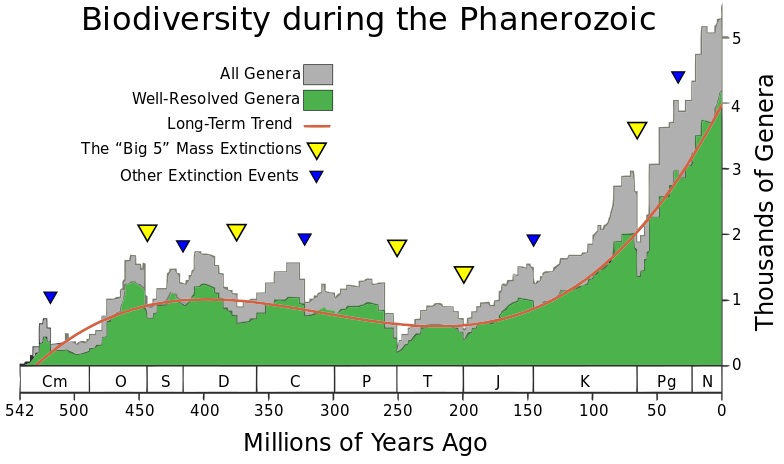
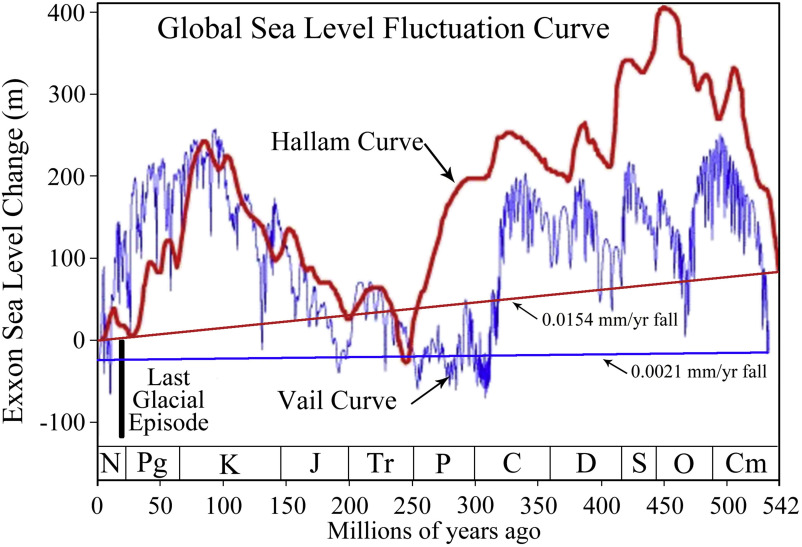
Source: Phanerozoic_Biodiversity.png Author: SVG version by Albert Mestre

See Also:  Sixth Mass Genesis, Not Extinction

Sixth Mass Genesis, Not Extinction

Chris D Thomas Professor of Evolutionary Biology, University of York writes in the Conversation New species are coming into existence faster than ever thanks to humans. Excerpts below in italics with my bolds.

Animals and plants are seemingly disappearing faster than at any time since the dinosaurs died out, 66m years ago. The death knell tolls for life on Earth. Rhinos will soon be gone unless we defend them, Mexico’s final few Vaquita porpoises are drowning in fishing nets, and in America, Franklin trees survive only in parks and gardens.

Yet the survivors are taking advantage of new opportunities created by humans. Many are spreading into new parts of the world, adapting to new conditions, and even evolving into new species. In some respects, diversity is actually increasing in the human epoch, the Anthropocene. It is these biological gains that I contemplate in a new book, Inheritors of the Earth: How Nature is Thriving in an Age of Extinction, in which I argue that it is no longer credible for us to take a loss-only view of the world’s biodiversity.

The beneficiaries surround us all. Glancing out of my study window, I see poppies and camomile plants sprouting in the margins of the adjacent barley field. These plants are southern European “weeds” taking advantage of a new human-created habitat. When I visit London, I see pigeons nesting on human-built cliffs (their ancestors nested on sea cliffs) and I listen out for the cries of skyscraper-dwelling peregrine falcons which hunt them.

Climate change has brought tree bumblebees from continental Europe to my Yorkshire garden in recent years. They are joined by an influx of world travellers, moved by humans as ornamental garden plants, pets, crops, and livestock, or simply by accident, before they escaped into the wild. Neither the hares nor the rabbits in my field are “native” to Britain.

Parakeets from Asia have established themselves in cities across Britain. Alicja Korbinska / shutterstock

Many conservationists and “invasive species biologists” wring their hands at this cavalcade of “aliens”. But it is how the biological world works. Throughout the history of the Earth, species have survived by moving to new locations that permit them to flourish – today, escaped yellow-crested cockatoos are thriving in Hong Kong, while continuing to decline in their Indonesian homeland.

Nonetheless, the rate at which we are transporting species is unprecedented, converting previously separate continents and islands into one biological supercontinent. In effect, we are creating New Pangea, the greatest ecological pile-up in the Earth’s long history. A few of the imported species cause others to become extinct – rats have driven some predator-naïve island birds to extinction, for example. Ground-nesting, flightless pigeons and rails that did not recognise the danger were no match for a deadly combination of rodents and human hunters.

But despite being high-profile, these cases are fairly rare. In general, most of the newcomers fit in, with limited impacts on other species. The net result is that many more species are arriving than are dying out – in Britain alone, nearly 2,000 extra species have established populations in the past couple of thousand years.

Source: Phanerozoic_Biodiversity.png Author: SVG version by Albert Mestre

Extinction and evolution
The processes of evolution also continue, as animals, plants and microbes adjust to the way humans are altering the world around them. Fish have evolved to breed when they are smaller and younger, increasing the chances that they will escape the fisherman’s nets, and butterflies have changed their diets to make used of human-altered habitats.

Entirely new species have even come into existence. The “apple fly” has evolved in North America, thanks to European colonials bringing fruit trees to the New World. And house sparrows mated with Mediterranean “Spanish” sparrows somewhere on an Italian farm. Their descendants represent a brand new species, the Italian sparrow. Life on Earth is no longer the same as it was before humans arrived on the scene.

There is no doubt that the rate at which species are dying out is very high, and we could well be in for a “Big Sixth” mass extinction. This represents a loss of biological diversity. Yet, we also know that the Big Five mass extinctions of the past half billion years ultimately led to increases in diversity. Could this happen again? It seems so, because the current rate at which new animals and plants (such as the apple fly, the Italian sparrow and Oxford ragwort) are coming into existence is unusually high – and it may be the highest ever. We are already on the verge of Genesis Number Six – a million or so years from now, the world could end up supporting more species, not fewer, as a consequence of the evolution of Homo sapiens.

The Italian sparrow only evolved after humans caused its ancestors to meet. Chris Thomas, Author provided

The ongoing ecological and evolutionary success stories of the Anthropocene epoch require us to re-evaluate our relationship with the rest of nature. Change is ultimately the means by which species survive and turn into new species. So, perhaps we should not spend quite so much time bemoaning the losses that have already taken place, and trying to recreate some imagined past world. We cannot rewind history. It might be more effective for us to facilitate future biological gains even if, in so doing, we move further away from how the world used to be.

This does not let us off the hook – species are genuinely dying out – but it does mean that we should not regard change per se as negative. We should perhaps think of ourselves as inmates and moulders of a dynamic, changing world, rather than as despoilers of a formerly pristine land.

Footnote: I dislike the trendy word “Anthropocene”. It strikes me as hubris to claim for ourselves powers comparable to geologic or astronomical forces. I appreciate Chris Thomas pointing out human influences, both positive and negative, upon the natural world, and the responsibilities that follow from our actions. But I also appreciate what Michael Crichton wrote in State of Fear (2004):

Our planet is five billion years old, and it has been changing constantly all during that time. […] Our atmosphere is as violent as the land beneath it. At any moment there are one thousand five hundred electrical storms across the planet. Eleven lightning bolts strike the ground each second. A tornado tears across the surface every six hours. And every four days, a giant cyclonic storm, hundreds of miles in diameter, spins over the ocean and wreaks havoc on the land.

The nasty little apes that call themselves human beings can do nothing except run and hide. For these same apes to imagine they can stabilize this atmosphere is arrogant beyond belief. They can’t control the climate.

The reality is, they run from the storms.

USCS Warnings of Coastal Floodings

Be not Confused. USCS is not the US Coastal Service, but rather stands for the Union of Super Concerned Scientists, or UCS for short. Using their considerable PR skills and budgets, they have plastered warnings in the media targeting major coastal cities, designed to strike terror in anyone holding real estate in those places. Example headlines include:

Sea level rise could put thousands of homes in this SC county at risk, study says The State, South Carolina

Taxpayers in the Hamptons among the most exposed to rising seas Crain’s New York Business

Adapting to Climate Change Will Take More Than Just Seawalls and Levees Scientific American

The Biggest Threat Facing the City of Miami Smithsonian Magazine

What Does Maryland’s Gubernatorial Race Mean For Flood Management? The Real News Network

Study: Thousands of Palm Beach County homes impacted by sea-level rise WPTV, Florida

Sinking Land and Climate Change Are Worsening Tidal Floods on the Texas Coast Texas Observer

Sea Level Rise Will Threaten Thousands of California Homes Scientific American

300,000 coastal homes in US, worth $120 billion, at risk of chronic floods from rising seas USA Today

That last gets the thrust of the UCS study Underwater: Rising Seas, Chronic Floods, and the Implications for US Coastal Real Estate (2018)

Sea levels are rising. Tides are inching higher. High-tide floods are becoming more frequent and reaching farther inland. And hundreds of US coastal communities will soon face chronic, disruptive flooding that directly affects people’s homes, lives, and properties.

Yet property values in most coastal real estate markets do not currently reflect this risk. And most homeowners, communities, and investors are not aware of the financial losses they may soon face.

This analysis looks at what’s at risk for US coastal real estate from sea level rise—and the challenges and choices we face now and in the decades to come.

The report and supporting documents give detailed dire warnings state by state, and even down to counties and townships. As example of the damage projections is this table estimating 2030 impacts:

State  Homes at Risk  Value at Risk Property Tax at Risk  Population in 
at-risk homes 
AL  3,542 $1,230,676,217 $5,918,124  4,367
CA  13,554 $10,312,366,952 $128,270,417  33,430
CT  2,540 $1,921,428,017 $29,273,072  5,690
DC  – $0 $0  –
DE  2,539 $127,620,700 $2,180,222  3,328
FL  20,999 $7,861,230,791 $101,267,251  32,341
GA  4,028 $1,379,638,946 $13,736,791  7,563
LA  26,336 $2,528,283,022 $20,251,201  63,773
MA  3,303 $2,018,914,670 $17,887,931  6,500
MD  8,381 $1,965,882,200 $16,808,488  13,808
ME  788 $330,580,830 $3,933,806  1,047
MS  918 $100,859,844 $1,392,059  1,932
NC  6,376 $1,449,186,258 $9,531,481  10,234
NH  1,034 $376,087,216 $5,129,494  1,659
NJ  26,651 $10,440,814,375 $162,755,196  35,773
NY  6,175 $3,646,706,494 $74,353,809  16,881
OR  677 $110,461,140 $990,850  1,277
PA  138 $18,199,572 $204,111  310
RI  419 $299,462,350 $3,842,996  793
SC  5,779 $2,882,357,415 $22,921,550  8,715
TX  5,505 $1,172,865,533 $19,453,940  9,802
VA  3,849 $838,437,710 $8,296,637  6,086
WA  3,691 $1,392,047,121 $13,440,420  7,320

The methodology, of course is climate models all the way down. They explain:

Three sea level rise scenarios, developed by the National Oceanic and Atmospheric Administration (NOAA) and localized for this analysis, are included:

  • A high scenario that assumes a continued rise in global carbon emissions and an increasing loss of land ice; global average sea level is projected to rise about 2 feet by 2045 and about 6.5 feet by 2100.
  • An intermediate scenario that assumes global carbon emissions rise through the middle of the century then begin to decline, and ice sheets melt at rates in line with historical observations; global average sea level is projected to rise about 1 foot by 2035 and about 4 feet by 2100.
  • A low scenario that assumes nations successfully limit global warming to less than 2 degrees Celsius (the goal set by the Paris Climate Agreement) and ice loss is limited; global average sea level is projected to rise about 1.6 feet by 2100.

Oh, and they did not forget the disclaimer:

Disclaimer
This research is intended to help individuals and communities appreciate when sea level rise may place existing coastal properties (aggregated by community) at risk of tidal flooding. It captures the current value and tax base contribution of those properties (also aggregated by community) and is not intended to project changes in those values, nor in the value of any specific property.

The projections herein are made to the best of our scientific knowledge and comport with our scientific and peer review standards. They are limited by a range of factors, including but not limited to the quality of property-level data, the resolution of coastal elevation models, the potential installment of defensive measures not captured by those models, and uncertainty around the future pace of sea level rise. More information on caveats and limitations can be found at http://www.ucsusa.org/underwater.

Neither the authors nor the Union of Concerned Scientists are responsible or liable for financial or reputational implications or damages to homeowners, insurers, investors, mortgage holders, municipalities, or other any entities. The content of this analysis should not be relied on to make business, real estate or other real world decisions without independent consultation with professional experts with relevant experience. The views expressed by individuals in the quoted text of this report do not represent an endorsement of the analysis or its results.

The need for a disclaimer becomes evident when looking into the details. The NOAA reference is GLOBAL AND REGIONAL SEA LEVEL RISE SCENARIOS FOR THE UNITED STATES NOAA Technical Report NOS CO-OPS 083

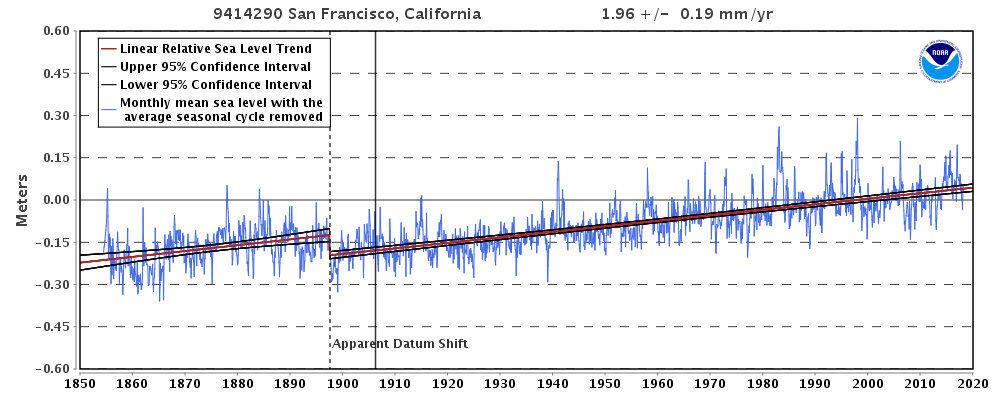
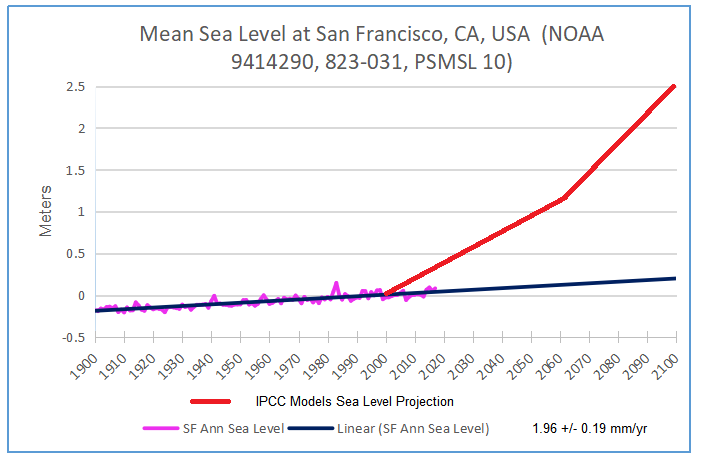
Since the text emphasizes four examples of their scenarios, let’s consider them here. First there is San Francisco, a city currently suing oil companies over sea level rise. From tidesandcurrents comes this tidal gauge record
It’s a solid, long-term record providing a century of measurements from 1900 through 2017.  The graph below compares the present observed trend with climate models projections out to 2100.

Since the record is set at zero in 2000, the difference in 21st century expectation is stark. Instead of  the existing trend out to around 20 cm, models project 2.5 meters rise by 2100.

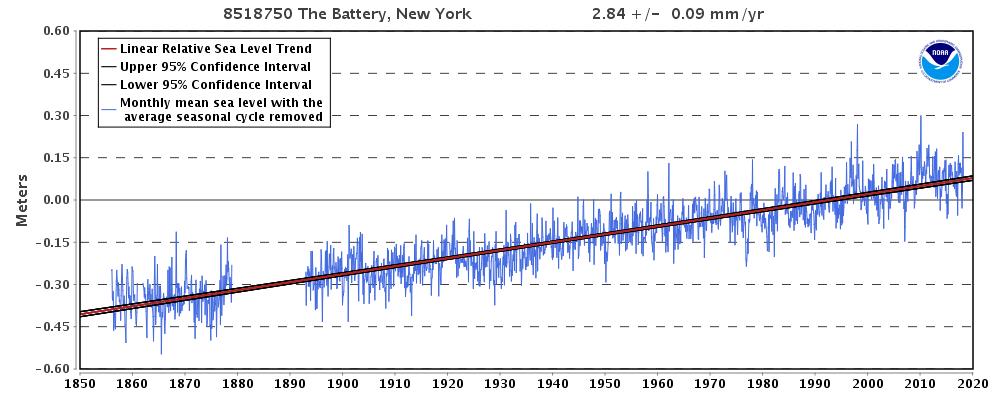
New York City is represented by the Battery tidal gauge:
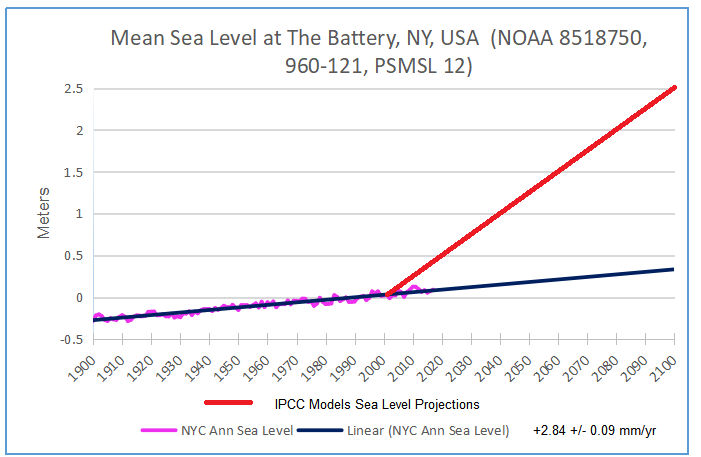
Again, a respectable record with a good 20th century coverage.  And the models say:
The red line projects 2500 mm rise vs. 284 mm, almost a factor of 10 more.  The divergence is evident even in the first 17 years.

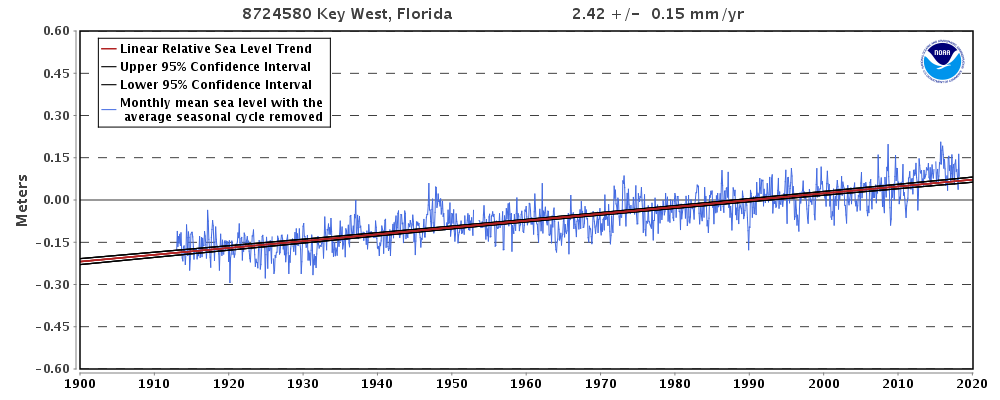
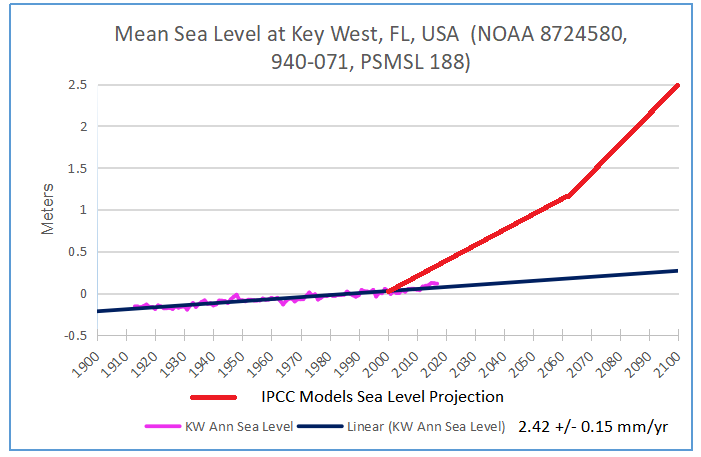
Florida comes in for a lot of attention, especially the keys, so here is Key West:
A similar pattern to NYC Battery gauge, and here is the projection:
The pattern is established: Instead of a rise of about 30 cm, the models project 250 cm.

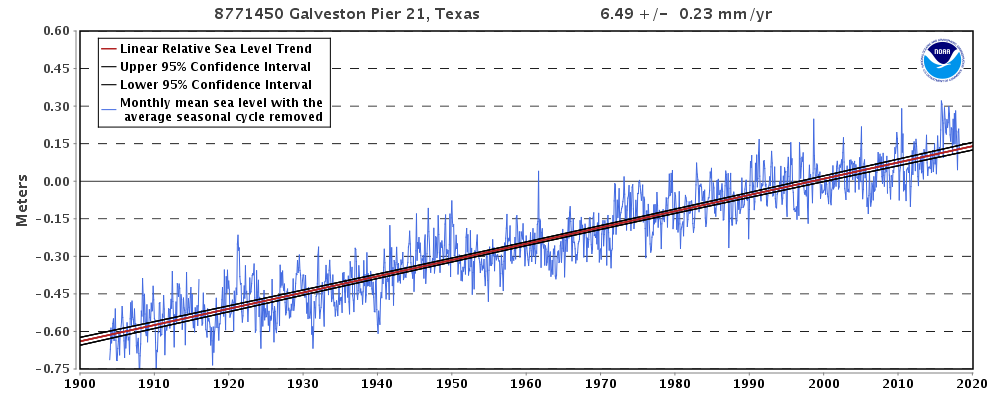
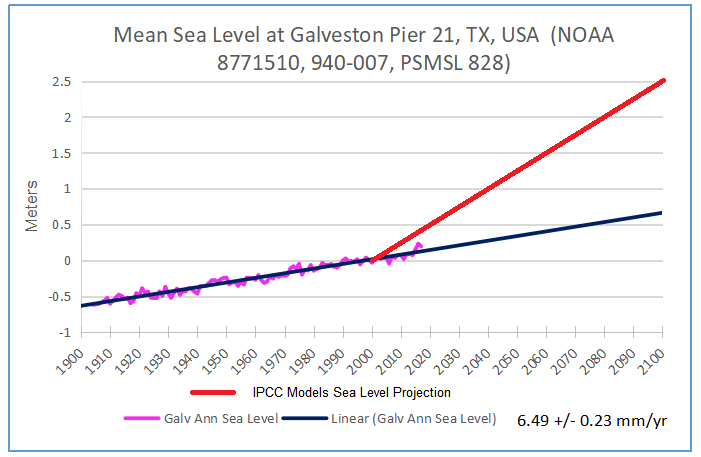
Finally, probably the worst case, and well-known to all already is Galveston, Texas:
The water has been rising there for a long time, so maybe the models got this one close.
Galv past & projectedThe gap is less than the others since the rising trend is much higher, but the projection is still four times the past.  Galveston is at risk, all right, but we didn’t need this analysis to tell us that.

A previous post Unbelievable Climate Models goes into why they are running so hot and so extreme, and why they can not be trusted.

July 16, 2018 Footnote:

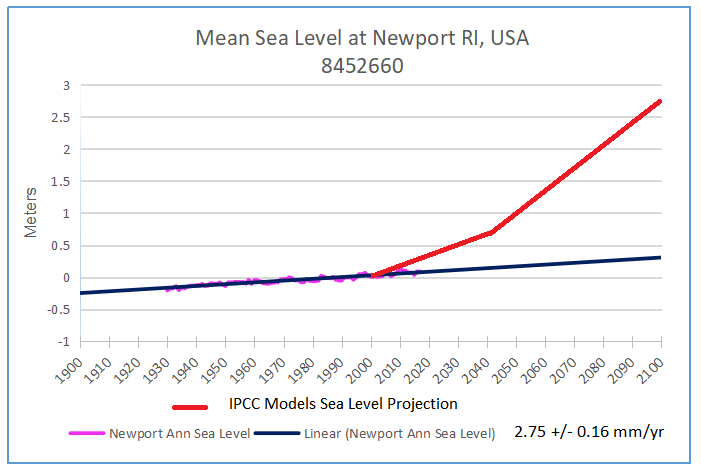
Recently there was a flap over future sea levels at Rhode Island, so I took a look at Newport RI, the best tidal gauge record there.  Same Story:
Newport past & projected

Famine Forecasts Foiled: Climate Increasing Food Production

Gregory Whitestone has the story at CNS Famine Forecasts Foiled: Climate’s Projected Food Production to Increase  Excerpts below with my bolds.

The latest dose of “fake news” about global warming comes from two forecasts of famine due to human activity. Both drew on estimates of extremely high temperatures predicted by the same flawed climate models used by the Intergovernmental Panel on Climate Change (IPCC) to predict other climate calamities. The climate models used in the studies are estimated to overpredict temperature by 2.5 to 3 times as compared to actually measured temperatures, and both rely on the highest estimates of maximum temperature increase.

The first of the reports warned that future production of vegetables and legumes would decrease by more than 30 percent with an expected rise of 4C. Even the alarmist IPCC says that the most likely case is a rise of about half that.

The primary reason for the prediction of famine is a sharp decrease in water availability, even though recent reports indicate that previously arid portions of the Earth are experiencing a significant net increase in soil moisture due to a combination of increasing precipitation and CO2 fertilization — both effects of our changing climate.

Buried in the report is an admission that contradicts the hysteria engendered by the headlines. According to the authors, a 250-ppm increase in CO2, without the exaggerated temperature increase, would boost crop production by an average of 22 percent! That’s correct, more food as a result of increasing CO2.

The second report projects decreases in corn (maize) production due to increasing heat waves. This increase in extreme heat was based on the same exaggerated 4oC increase in temperature as the first study.

According to the USDA, corn is the largest component of the global grain trade, and the United States is the world’s largest producer. Corn is thus one of the country’s most important agricultural products, processed as sweet corn, cornmeal, tortillas and, thankfully, bourbon. It also is the primary feedstock to fatten cattle, chickens and hogs.

Fortunately, despite a continuing rise in temperatures, the world and America have set new corn records on an annual basis. The world’s remarkable ability to increase food production year after year is attributable to mechanization, agricultural innovation, CO2 fertilization and warmer weather. World grain production figures show that crop and food production has steadily increased, with only positive effects from our changing climate.

World grain production, consumption (LHS) and stocks (RHS) IGC (International Grain Council) data, Momagri formatting

Historically, crop growth has ballooned in times of high temperatures and declined drastically during cold periods. Over the last 4,000 years we find that previous periods of much warmer temperatures coincided with increasing food and prosperity leading to the rise of great civilizations that were relatively rich and well fed. Prosperous periods were interrupted by times of great despair as the Earth plunged into global cooling. With names like the Greek Dark Ages, the Dark Ages and the Little Ice Age, intervening cool periods featured crop failure, famine and mass depopulation.

Corn production in the U.S. presents a conundrum for environmental activists. On the one hand, they engage in fear mongering with predictions of famine based on questionable climate models. On the other hand, as enemies of fossil fuels, the activists promote ethanol production to replace our oil-based transportation fuels. Every acre of corn diverted to ethanol production is an acre that is no longer feeding the world’s hungry. In 2008, Herr Jean Ziegler, the United Nations’ Rapporteur for the Right to Food, claimed that “to divert land from food production to biofuels is a crime against humanity.”

In 2000, the United States imposed the first ethanol mandate, dictating the level of ethanol that must be incorporated into American fuels. At that time, 90 percent of corn production was used for food. Today, only 60 percent of corn produced is used for food, driving up the cost of corn as food. The climate alarmists who claim to care about the world’s hungry could improve their lot overnight by simply canceling the ethanol mandate.

Rising temperatures and increasing carbon dioxide are leading to multiple benefits and perhaps the most important of those is increasing crop production. Sleep well users of fossil fuels; you aren’t causing famine.

Gregory Wrightstone is author of the new book, “Inconvenient Facts: The Science That Al Gore Doesn’t Want You To Know.” Wrightstone is a geologist with more than 35 years of experience researching and studying various aspects of the Earth’s processes. He is a member of the American Association for the Advancement of Science and the Geological Society of America.

See also:  Adapting Plants to Feed the World

Blinded by Antarctica Reports

Special snow goggles for protection in polar landscapes.

Someone triggered Antarctica for this week’s media alarm blitz.

Antarctic ice loss increases to 200 billion tonnes a year – Climate Action

Antarctica is now melting three times faster than ever before – Euronews

Antarctica is shedding ice at an accelerating rate – Digital Journal

Al Gore Sounds the Alarm on 0.3 inches of Sea Level Rise from Ice Sheets– Daily Caller

Antarctica is losing an insane amount of ice. Nothing about this is good. – Fox News
Looks like it’s time yet again to play Climate Whack-A-Mole.  That means stepping back to get some perspective on the reports and the interpretations applied by those invested in alarmism.

Antarctic Basics

The Antarctic Ice Sheet extends almost 14 million square kilometers (5.4 million square miles), roughly the area of the contiguous United States and Mexico combined. The Antarctic Ice Sheet contains 30 million cubic kilometers (7.2 million cubic miles) of ice. (Source: NSIDC: Quick Facts Ice Sheets)

The Antarctic Ice Sheet covers an area larger than the U.S. and Mexico combined. This photo shows Mt. Erebus rising above the ice-covered continent. Credit: Ted Scambos & Rob Bauer, NSIDC

The study of ice sheet mass balance underwent two major advances, one during the early 1990s, and again early in the 2000s. At the beginning of the 1990s, scientists were unsure of the sign (positive or negative) of the mass balance of Greenland or Antarctica, and knew only that it could not be changing rapidly relative to the size of the ice sheet.

Advances in glacier ice flow mapping using repeat satellite images, and later using interferometric synthetic aperture radar SAR methods, facilitated the mass budget approach, although this still requires an estimate of snow input and a cross-section of the glacier as it flows out from the continent and becomes floating ice. Satellite radar altimetry mapping and change detection, developed in the early to mid-1990s allowed the research community to finally extract reliable quantitative information regarding the overall growth or reduction of the volume of the ice sheets.

By 2002, publications were able to report that both large ice sheets were losing mass (Rignot and Thomas 2002). Then in 2003 the launch of two new satellites, ICESat and GRACE, led to vast improvements in one of the methods for mass balance determination, volume change, and introduced the ability to conduct gravimetric measurements of ice sheet mass over time. The gravimetric method helped to resolve remaining questions about how and where the ice sheets were losing mass. With this third method, and with continued evolution of mass budget and geodetic methods it was shown that the ice sheets were in fact losing mass at an accelerating rate by the end of the 2000s (Veliconga 2009, Rignot et al. 2011b).

Contradictory Findings

NASA Study: Mass Gains of Antarctic Ice Sheet Greater than Losses

A new 2015 NASA study says that an increase in Antarctic snow accumulation that began 10,000 years ago is currently adding enough ice to the continent to outweigh the increased losses from its thinning glaciers.

The research challenges the conclusions of other studies, including the Intergovernmental Panel on Climate Change’s (IPCC) 2013 report, which says that Antarctica is overall losing land ice.

According to the new analysis of satellite data, the Antarctic ice sheet showed a net gain of 112 billion tons of ice a year from 1992 to 2001. That net gain slowed to 82 billion tons of ice per year between 2003 and 2008.

“We’re essentially in agreement with other studies that show an increase in ice discharge in the Antarctic Peninsula and the Thwaites and Pine Island region of West Antarctica,” said Jay Zwally, a glaciologist with NASA Goddard Space Flight Center in Greenbelt, Maryland, and lead author of the study, which was published on Oct. 30 in the Journal of Glaciology. “Our main disagreement is for East Antarctica and the interior of West Antarctica – there, we see an ice gain that exceeds the losses in the other areas.” Zwally added that his team “measured small height changes over large areas, as well as the large changes observed over smaller areas.”

Scientists calculate how much the ice sheet is growing or shrinking from the changes in surface height that are measured by the satellite altimeters. In locations where the amount of new snowfall accumulating on an ice sheet is not equal to the ice flow downward and outward to the ocean, the surface height changes and the ice-sheet mass grows or shrinks.

Snow covering Antarctic peninsula.

Keeping Things in Perspective

Such reports often include scary graphs like this one and the reader is usually provided no frame of reference or context to interpret the image. First, the chart is showing cumulative loss of mass arising from an average rate of 100 Gt lost per year since 2002. Many years had gains, including 2002, and the cumulative loss went below zero only in 2006.  Also, various methods of measuring and analyzing give different results, as indicated by the earlier section.

Most important is understanding the fluxes in proportion to the Antarctic Ice Sheet.  Let’s do the math.  Above it was stated Antarctica contains ~30 million cubic kilometers of ice volume.  One km3 of water is 1 billion cubic meters and weighs 1 billion tonnes, or 1 gigatonne.  So Antarctica has about 30,000,000 gigatonnes of ice.  Since ice is slightly less dense than water, the total should be adjusted by 0.92 for an estimate of 27.6 M Gts of ice comprising the Antarctic Ice Sheet.

So in the recent decade, an average year went from 27,600,100 Gt to 27,600,000, according to one analysis.  Other studies range from losing 200 Gt/yr to gaining 100 Gt/yr.

Even if Antarctica lost 200 Gt/yr. for the next 1000 years, it would only approach 1% of the ice sheet.

If like Al Gore you are concerned about sea level rise, that calculation starts with the ocean area estimated to be 3.618 x 10^8 km2 (361,800,000 km2). To raise that area 1 mm requires 3.618×10^2 km3 or 361.8 km3 water (1 km3 water=1 Gt.) So 200 Gt./yr is about 0.55mm/yr or 6 mm a decade, or 6 cm/century.

By all means let’s pay attention to things changing in our world, but let’s also notice the scale of the reality and not make mountains out of molehills.

Let’s also respect the scientists who study glaciers and their subtle movements over time (“glacial pace”).  Below is an amazing video showing the challenges and the beauty of working on Greenland Glacier.

From Ice Alive: Uncovering the secrets of Earth’s Ice

For more on the Joys of Playing Climate Whack-A-Mole 

Media Raises False Alarms of Ocean Cooling

The RAPID moorings being deployed. Credit: National Oceanography Centre.

The usual suspects, such as BBC, the Guardian, New York Times, Washington Post etc., are reporting that the Atlantic gulf stream is slowing down due to climate change, threatening an ice age.  That’s right, warmists are now claiming fossil fuels do cooling when they are not warming.  As usual the headlines are not supported by the details.

The AMOC is back in the news following a recent Ocean Sciences meeting.  This update adds to the theme Oceans Make Climate. Background links are at the end, including one where chief alarmist M. Mann claims fossil fuel use will stop the ocean conveyor belt and bring a new ice age.  Actual scientists are working away methodically on this part of the climate system, and are more level-headed.  H/T GWPF for noticing the recent article in Science Ocean array alters view of Atlantic ‘conveyor belt’  By Katherine Kornei Feb. 17, 2018 . Excerpts with my bolds.

The powerful currents in the Atlantic, formally known as the Atlantic meridional overturning circulation (AMOC), are a major engine in Earth’s climate. The AMOC’s shallower limbs—which include the Gulf Stream—transport warm water from the tropics northward, warming Western Europe. In the north, the waters cool and sink, forming deeper limbs that transport the cold water back south—and sequester anthropogenic carbon in the process. This overturning is why the AMOC is sometimes called the Atlantic conveyor belt.

Fig. 1. Schematic of the major warm (red to yellow) and cold (blue to purple) water pathways in the NASPG (North Atlantic subpolar gyre ) credit: H. Furey, Woods Hole Oceanographic Institution): Denmark Strait (DS), Faroe Bank Channel (FBC), East and West Greenland Currents (EGC and WGC, respectively), NAC, DSO, and ISO.

In February at the American Geophysical Union’s (AGU’s) Ocean Sciences meeting, scientists presented the first data from an array of instruments moored in the subpolar North Atlantic. The observations reveal unexpected eddies and strong variability in the AMOC currents. They also show that the currents east of Greenland contribute the most to the total AMOC flow. Climate models, on the other hand, have emphasized the currents west of Greenland in the Labrador Sea. “We’re showing the shortcomings of climate models,” says Susan Lozier, a physical oceanographer at Duke University in Durham, North Carolina, who leads the $35-million, seven-nation project known as the Overturning in the Subpolar North Atlantic Program (OSNAP).

Fig. 2. Schematic of the OSNAP array. The vertical black lines denote the OSNAP moorings with the red dots denoting instrumentation at depth. The thin gray lines indicate the glider survey. The red arrows show pathways for the warm and salty waters of subtropical origin; the light blue arrows show the pathways for the fresh and cold surface waters of polar origin; and the dark blue arrows show the pathways at depth for waters that originate in the high-latitude North Atlantic and Arctic.

The research and analysis is presented by Dr. Lozier et al. in this publication Overturning in the Subpolar North Atlantic Program: A New International Ocean Observing System Images above and text excerpted below with my bolds.

For decades oceanographers have assumed the AMOC to be highly susceptible to changes in the production of deep waters at high latitudes in the North Atlantic. A new ocean observing system is now in place that will test that assumption. Early results from the OSNAP observational program reveal the complexity of the velocity field across the section and the dramatic increase in convective activity during the 2014/15 winter. Early results from the gliders that survey the eastern portion of the OSNAP line have illustrated the importance of these measurements for estimating meridional heat fluxes and for studying the evolution of Subpolar Mode Waters. Finally, numerical modeling data have been used to demonstrate the efficacy of a proxy AMOC measure based on a broader set of observational data, and an adjoint modeling approach has shown that measurements in the OSNAP region will aid our mechanistic understanding of the low-frequency variability of the AMOC in the subtropical North Atlantic.

Fig. 7. (a) Winter [Dec–Mar (DJFM)] mean NAO index. Time series of temperature from the (b) K1 and (c) K9 moorings.

Finally, we note that while a primary motivation for studying AMOC variability comes from its potential impact on the climate system, as mentioned above, additional motivation for the measure of the heat, mass, and freshwater fluxes in the subpolar North Atlantic arises from their potential impact on marine biogeochemistry and the cryosphere. Thus, we hope that this observing system can serve the interests of the broader climate community.

Fig. 10. Linear sensitivity of the AMOC at (d),(e) 25°N and (b),(c) 50°N in Jan to surface heat flux anomalies per unit area. Positive sensitivity indicates that ocean cooling leads to an increased AMOC—e.g., in the upper panels, a unit increase in heat flux out of the ocean at a given location will change the AMOC at (d) 25°N or (e) 50°N 3 yr later by the amount shown in the color bar. The contour intervals are logarithmic. (a) The time series show linear sensitivity of the AMOC at 25°N (blue) and 50°N (green) to heat fluxes integrated over the subpolar gyre (black box with surface area of ∼6.7 × 10 m2) as a function of forcing lead time. The reader is referred to Pillar et al. (2016) for model details and to Heimbach et al. (2011) and Pillar et al. (2016) for a full description of the methodology and discussion relating to the dynamical interpretation of the sensitivity distributions.

In summary, while modeling studies have suggested a linkage between deep-water mass formation and AMOC variability, observations to date have been spatially or temporally compromised and therefore insufficient either to support or to rule out this connection.

Current observational efforts to assess AMOC variability in the North Atlantic.

The U.K.–U.S. Rapid Climate Change–Meridional Overturning Circulation and Heatflux Array (RAPID–MOCHA) program at 26°N successfully measures the AMOC in the subtropical North Atlantic via a transbasin observing system (Cunningham et al. 2007; Kanzow et al. 2007; McCarthy et al. 2015). While this array has fundamentally altered the community’s view of the AMOC, modeling studies over the past few years have suggested that AMOC fluctuations on interannual time scales are coherent only over limited meridional distances. In particular, a break point in coherence may occur at the subpolar–subtropical gyre boundary in the North Atlantic (Bingham et al. 2007; Baehr et al. 2009). Furthermore, a recent modeling study has suggested that the low-frequency variability of the RAPID–MOCHA appears to be an integrated response to buoyancy forcing over the subpolar gyre (Pillar et al. 2016). Thus, a measure of the overturning in the subpolar basin contemporaneous with a measure of the buoyancy forcing in that basin likely offers the best possibility of understanding the mechanisms that underpin AMOC variability. Finally, though it might be expected that the plethora of measurements from the North Atlantic would be sufficient to constrain a measure of the AMOC within the context of an ocean general circulation model, recent studies (Cunningham and Marsh 2010; Karspeck et al. 2015) reveal that there is currently no consensus on the strength or variability of the AMOC in assimilation/reanalysis products.

Atlantic Meridional Overturning Circulation (AMOC). Red colours indicate warm, shallow currents and blue colours indicate cold, deep return flows. Modified from Church, 2007, A change in circulation? Science, 317(5840), 908–909. doi:10.1126/science.1147796

In addition we have a recent report from the United Kingdom Marine Climate Change Impacts Partnership (MCCIP) lead author G.D. McCarthy Atlantic Meridional Overturning Circulation (AMOC) 2017.

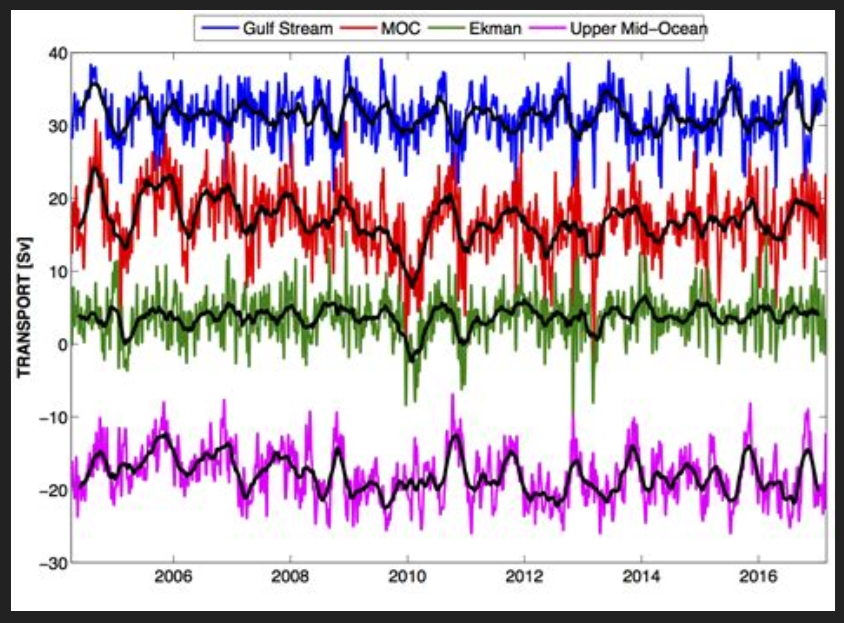
Figure 1: Ten-day (colours) and three month (black) low-pass filtered timeseries of Florida Straits transport (blue), Ekman transport (green), upper mid-ocean transport (magenta), and overturning transport (red) for the period 2nd April 2004 to end- February 2017. Florida Straits transport is based on electromagnetic cable measurements; Ekman transport is based on ERA winds. The upper mid-ocean transport, based on the RAPID mooring data, is the vertical integral of the transport per unit depth down to the deepest northward velocity (~1100 m) on each day. Overturning transport is then the sum of the Florida Straits, Ekman, and upper mid-ocean transports and represents the maximum northward transport of upper-layer waters on each day. Positive transports correspond to northward flow.

The RAPID/MOCHA/WBTS array (hereinafter referred to as the RAPID array) has revolutionized basin scale oceanography by supplying continuous estimates of the meridional overturning transport (McCarthy et al., 2015), and the associated basin-wide transports of heat (Johns et al., 2011) and freshwater (McDonagh et al., 2015) at 10-day temporal resolution. These estimates have been used in a wide variety of studies characterizing temporal variability of the North Atlantic Ocean, for instance establishing a decline in the AMOC between 2004 and 2013.

Summary from RAPID data analysis

MCCIP reported in 2006 that:

  • a 30% decline in the AMOC has been observed since the early 1990s based on a limited number of observations. There is a lack of certainty and consensus concerning the trend;
  • most climate models anticipate some reduction in strength of the AMOC over the 21st century due to increased freshwater influence in high latitudes. The IPCC project a slowdown in the overturning circulation rather than a dramatic collapse.And in 2017 that:
  • a substantial increase in the observations available to estimate the strength of the AMOC indicate, with greater certainty, a decline since the mid 2000s;
  • the AMOC is still expected to decline throughout the 21st century in response to a changing climate. If and when a collapse in the AMOC is possible is still open to debate, but it is not thought likely to happen this century.

And also that:

  • a high level of variability in the AMOC strength has been observed, and short term fluctuations have had unexpected impacts, including severe winters and abrupt sea-level rise;
  • recent changes in the AMOC may be driving the cooling of Atlantic ocean surface waters which could lead to drier summers in the UK.

Conclusions

  • The AMOC is key to maintaining the mild climate of the UK and Europe.
  • The AMOC is predicted to decline in the 21st century in response to a changing climate.
  • Past abrupt changes in the AMOC have had dramatic climate consequences.
  • There is growing evidence that the AMOC has been declining for at least a decade, pushing the Atlantic Multidecadal Variability into a cool phase.
  • Short term fluctuations in the AMOC have proved to have unexpected impacts, including being linked
    with severe winters and abrupt sea-level rise.

Background:

Oceans Make Climate: SST, SSS and Precipitation Linked

Climate Pacemaker: The AMOC

Evidence is Mounting: Oceans Make Climate

Mann-made Global Cooling


2018 Hurricane Prediction – Strongest Cycle in 70 Years

Monday, Sept. 18, 2017, GOES East satellite image provided by NASA shows the eye of Hurricane Maria as it nears Dominica and before it struck Puerto Rico. NASA /AP

This prediction comes from Global Weather Oscillations, the only hurricane forecaster to predict the 2017 season accurately.  The story is from 721News 2018 Hurricane Prediction – Strongest Cycle in 70 Years

Links at the end provide more explanation of GWO’s unique model based upon ocean water pulses linked to solar/lunar activities, nothing to do with CO2.  Text below from 712News with my bolds.

Global Weather Oscillations (GWO) was cited by news media as the only major hurricane prediction organization that correctly predicted the hyperactive 2017 Atlantic hurricane season from beginning to end, and the destructive United States hurricane landfalls.

The media also noted that when the hurricane season began last year, “nearly every major weather agency predicted a normal 2017 hurricane season – but only Global Weather Oscillations Inc. (GWO) had an accurate forecast” – with a prediction for a destructive hurricane season with 16 named storms, eight hurricanes, four major hurricanes – and 2 major impact hurricanes for the United States.

GWO also predicted the United States would have 6 named storms and 3 hurricanes making landfall in 2017 – and where they would occur. Just as predicted, the U.S. ended up with six named storms and 3 hurricanes. GWO predicted that the Florida Peninsula would break out of their 12-year hurricane drought with a major category 3-4 hurricane making landfall on the south tip of Florida. GWO also predicted that Texas could break out of their 8-year hurricane drought with a landfalling hurricane just above Corpus Christi – and a Category 1 hurricane striking the upper Gulf Coast. The 2017 landfalling hurricanes ended up being – Harvey, Irma and Nate.

Professor David Dilley – senior research and prediction scientist for Global Weather Oscillations – prepares hurricane and tropical storm predictions for 11 zones stretching from New England to Texas. By using Climate Pulse Technology developed by Mr. Dilley, GWO can issue accurate zone predictions for release in January – well before the beginning of the hurricane season.

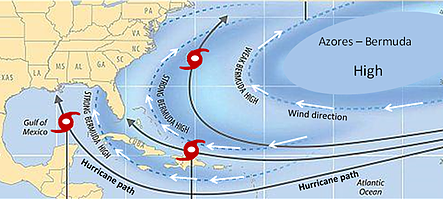
Professor David Dilley, states that the “Climate Pulse Technology Model” is based on natural rhythm cycles that control hurricane landfall cycles and the position of the Bermuda High Pressure Center. By utilizing this technology, GWO has issued the most accurate predictions by any organization during the past 10 years. The preseason zone predictions are so accurate – updates to the forecasts are not required during the hurricane season. Although GWO does offer special weekly hurricane outlook webinars and tracking webinars when a storm may threaten the United States. GWO is a working partner with the International Hurricane Protection Association – INHPA.

Prediction: 2018 Atlantic Basin Hurricane Season — (includes the Caribbean Sea and Gulf of Mexico)

As predicted by Mr. Dilley and GWO – last year (2017) was the costliest year on record for the United States, and one of the most destructive. Mr. Dilley says that “some United States zones are currently in their strongest hurricane landfall cycle in 40 to 70-years.” This is a Natural Climate Pulse Cycle that produced extremely active and dangerous hurricane conditions in some zones back in the 1930s and 1940s – and is now repeating.

Mr. Dilley predicts that 2018 will be somewhat of a repeat of 2017 – and possibly another record breaker. Although it will be strikingly similar to last year- some hurricane landfalls will occur in different locations this year. You can expect 16 named storms, 8 hurricanes, 4 major hurricanes, potential for 4 United States hurricane landfalls – 2 of which will likely be major impact storms. There is the potential for 6 named storms making United States landfalls. On the average, the entire Atlantic Basin has 12 named storms, 6 hurricanes and 2.7 major hurricanes.

The reason for another destructive hurricane season is 3-fold. The ocean water temperatures continue to run warmer than normal across most of the Atlantic Basin (red and orange in the graphic), and especially in the Caribbean region and the Atlantic near the United States. This is very similar to the ocean temperatures of last year, and this will again be conducive for tropical storms and/or hurricanes forming and/or strengthening close to the United States. Mr. Dilley also expects the Bermuda-Azores High Pressure Center will again be in a favorable location – thus allowing more named storms to maintain strength – or strengthen as they move from east to west across the Atlantic toward the United States.

Source: Global Weather Oscillations

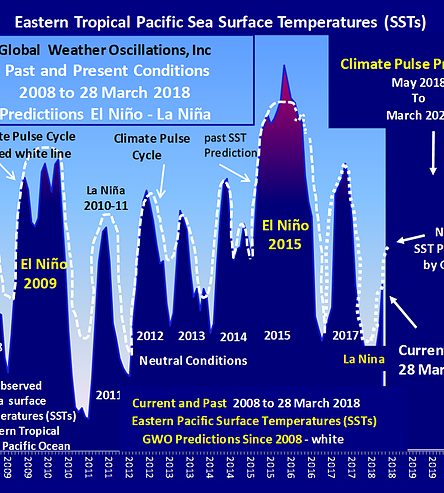
Then we come to the last item – El Niño. GWO’s Climate Pulse Technology model indicates that the Tropical South Pacific Ocean temperatures where El Niño events typically form – will warm significantly during late winter and approach weak El Niño conditions during the spring- much like the El Niño scare of last year. However, all years are not the same – therefore it could mature enough to form a very weak El Niño, but not strong enough to dampen the hurricane season. Historical records indicate that moderate to strong El Nino events dampen hurricane activity – whereas years with very weak El Niño conditions can be associated with active hurricane seasons if a Climate Pulse Hurricane Enhancement Cycle is in place – and it is.

Background

Global Weather Oscillations

AMO: Atlantic Climate Pulse

Hurricane Science, not Fiction

CO2 Rise ≠ Sea Level Rise

1-s2-0-s1674987118300446-gr6

This recent paper is very topical, since several US coastal states are suing oil companies for damages expected from rising sea levels. Some Alaskan teenagers are making similar claims in a separate lawsuit against the US federal government. The study is Why would sea-level rise for global warming and polar ice-melt? By Aftab Alam Khan published in Geoscience Frontiers. Excerpts below with my bolds. H/T to NoTricksZone

IPCC Alarms over Sea Level Rise

Sea Level Change in the Fifth Assessment Report includes detailed explanation of the changes in the global mean sea level, regional sea level, sea level extremes, and waves (Church et al., 2013). Anthropogenic greenhouse gas emissions are causing sea-level rise (SLR) (Church and White, 2006; Jevrejeva et al., 2009). It is also claimed that ocean thermal expansion and glacier melting have been the dominant contributors to 20th century global mean sea level rise. It is further opined that global warming is the main contributor to the rise in global sea level since the Industrial Revolution (Church and White, 2006). According to Cazenave and Llovel (2010) rising of air temperature can warm and expand ocean waters wherein thermal expansion was the main driver of global sea level rise for 75 to 100 years after the start of the Industrial Revolution.

However, the share of thermal expansion in global sea level rise has declined in recent decades as the shrinking of land ice has accelerated (Lombard et al 2005). Lombard et al. (2006) opined that recent investigations based on new ocean temperature data sets indicate that thermal expansion only explains part (about 0.4 mm/yr) of the 1.8 mm/yr observed sea level rise of the past few decades. However, observation claim of 1.8 mm/yr sea level rise is also limited in scope and accuracy.

Fundamentals of Sea Level Variability

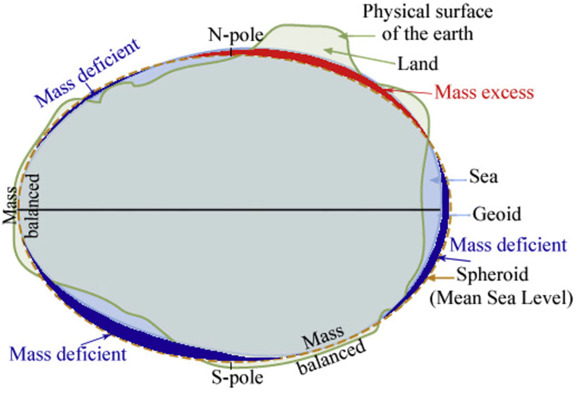
Mean Sea Level (MSL) is defined as the zero elevation for a local area. The zero surface referenced by elevation is called a vertical datum. Since sea surface conforms to the earth’s gravitational field, MSL has also slight hills and valleys that are similar to the land surface but much smoother. The MSL surface is in a state of gravitational equilibrium. It can be regarded as extending under the continents and is a close approximation of geoid. By definition geoid describes the irregular shape of the earth and is the true zero surface for measuring elevations. Because geoid surface cannot directly be observed, heights above or below the geoid surface can’t be directly measured and are inferred by making gravity measurements and modeling the surface mathematically.

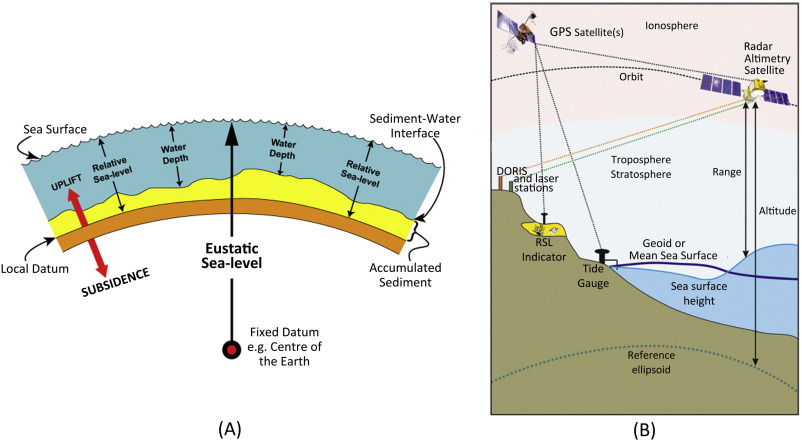
Previously, there was no way to accurately measure geoid so it was roughly approximated by MSL. Although for practical purposes geoid and MSL surfaces are assumed to be essentially the same, but in reality geoid differs from MSL by several meters. Geoid moves above MSL where mass is excess and moves below MSL where mass is deficient. Distribution of mass in the crust in terms of ‘excess’ and ‘deficient’ can cause volume expansion and contraction for relative sea-level change. Height of the ocean surface at any given location, or sea level, is measured either with respect to the surface of the solid Earth i.e., relative sea level (RSL) or a eustatic sea level (ESL) (Fig. 1A).

Relative sea level (RSL) change can differ significantly from global mean sea level (GMSL) because of spatial variability in changes of the sea surface and ocean floor height. RSL change over the ocean surface area gives the change in ocean water volume, which is directly related to the sea level change. Sea level changes can be driven either by variations in the masses or volume of the oceans, or by changes of the land with respect to the sea surface. In the first case, a sea level change is defined ‘eustatic’; otherwise, it is defined ‘relative’ (Rovere et al., 2016). According to Kemp et al. (2015) land uplift or subsidence can result in, respectively, a fall or rise in sea level that cannot be considered eustatic as the volume or mass of water does not change. Any sea level change that is observed with respect to a land-based reference frame is defined a relative sea level (RSL) change. Eustatic Sea Level (ESL) changes also occur when the volume of the ocean basins changes due to tectonic seafloor spreading or sedimentation.
1-s2-0-s1674987118300446-gr1

Figure 1. (A) Definition of sea level i.e., eustatic sea level and relative sea level (B) Different types of sea level observation techniques: satellite altimetry (based on NASA educational material), tide gauge and paleo sea level indicators (see text for details). Modern tide gauges are associated with a GPS station that records land movements.

Sea Level Observations

Changes in sea level can be observed at very different time scales and with different techniques (Fig. 1B). Regardless of the technique used, no observation allows to record purely eustatic sea level changes. At multi-decadal time scales, sea level reconstructions are based on satellite altimetry/gravimetry and landbased tide gauges (Cabanes et al., 2001). At longer time scales (few hundreds, thousands to millions of years), the measurement of sea level changes relies on a wide range of sea level indicators (Shennan and Horton, 2002; Vacchi et al., 2016; Rovere et al., 2016a). One of the most common methods to observe sea level changes at multi-decadal time scales is tide gauges.

Modern tide gauges are associated with a GPS station that records land movements (Fig. 1B). However, tide gauges have three main disadvantages: (i) they are unevenly distributed around the world (Julia Pfeffer and Allemand, 2015); (ii) the sea level signal they record is often characterized by missing data (Hay et al., 2015); and (iii) accounting for ocean dynamic changes and land movements might prove difficult in the absence of independent datasets (Rovere et al., 2016). Since 1992, tide gauge data are complemented by satellite altimetry datasets (Cazenave et al., 2002).

The altitude of the satellite is established with respect to an ellipsoid, which is an arbitrary and fixed surface that approximates the shape of the Earth. The difference between the altitude of the satellite and the range is defined as the sea surface height (SSH) (Fig. 1B). Subtracting from the measured SSH a reference mean sea surface (e.g. the geoid), one can obtain a ‘SSH anomaly’. The global average of all SSH anomalies can be plotted over time to define the global mean sea level change, which can be considered as the eustatic, globally averaged sea level change.

The shape of the geoid is crucial for deriving accurate measurements of seasonal sea level variations (Chambers, 2006). According to Rovere et al. (2016) measurements of paleo eustatic sea level (ESL) changes bear considerable uncertainty. Further, sea level changes on Earth cannot be treated as a rigid container although eustasy is defined in view of Earth as a rigid container. In reality, internal and external processes of the earth such as tectonics, dynamic topography, sediment compaction and melting ice all trigger variations of the container and these ultimately affect any sea level observation.

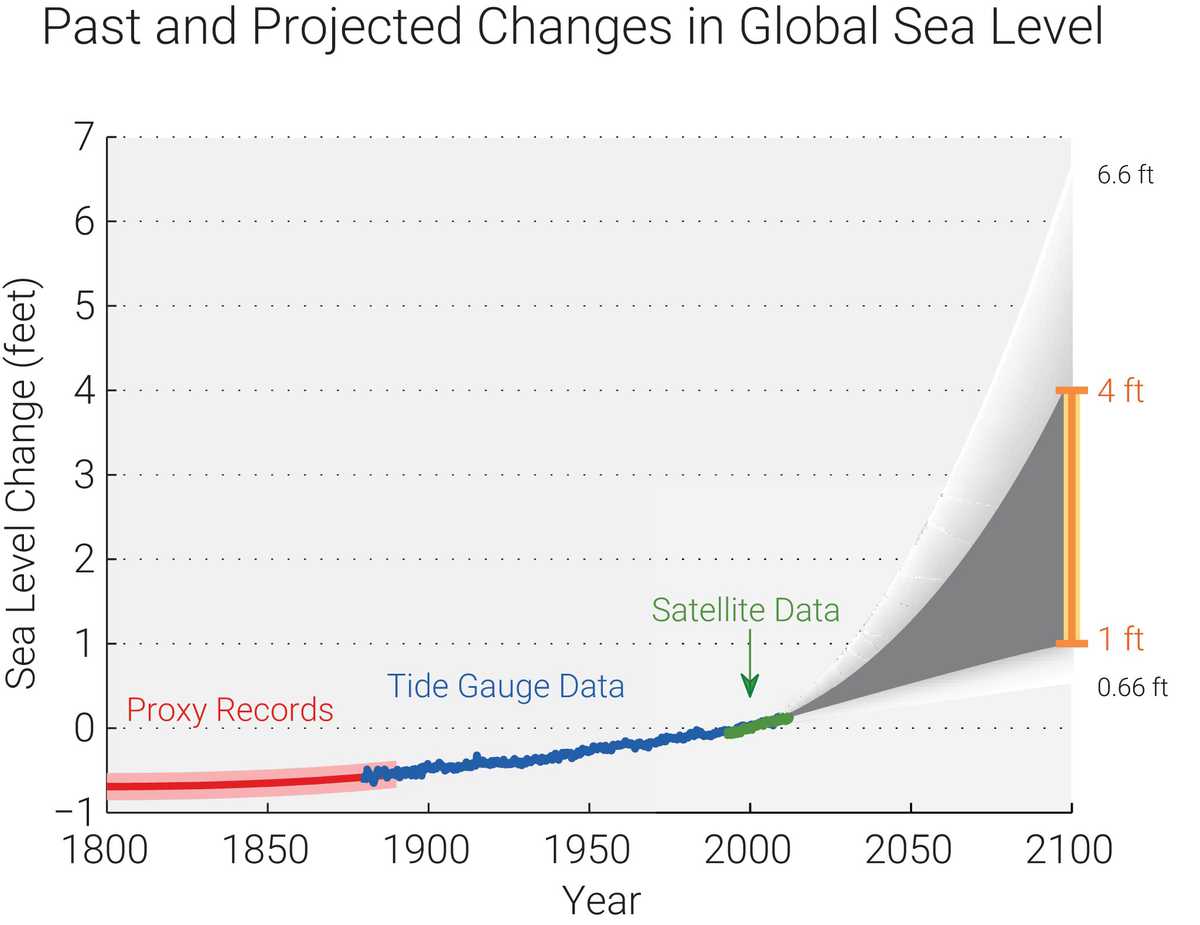
An estimated, observed, and possible future amounts of global sea level rise from 1800 to 2100, relative to the year 2000 has been proposed by Melillo et al. (2014) based on the works of Church and White (2011), Kemp et al. (2011) and Parris et al. (2012) (Fig. 2). The main concern of the predicted future global sea level rise shown in Melillo et al. (2014) is the forecast beyond 2012 up to 2100. Although sea level rise is shown by 0.89 ft in 209 years (between 1800 and 2009) at the rate of 0.0043 ft/yr, the prediction of 4–6 ft at the rate of 0.044 ft/yr and 0.066 ft/yr respectively in 91 years between 2009 and 2100) is highly questionable. An abrupt jump in the sea level rise after 2009 is definitely a conjecture.
ak-figure-7-1200

Figure 2. Estimated, observed, and predicted global sea level rise from 1800 to 2100. Estimates from proxy data are shown in red between 1800 and 1890, pink band shows uncertainty. Tide gauge data is shown in blue for 1880–2009. Satellite observations are shown in green from 1993 to 2012. The future scenarios range from 0.66 ft to 6.6 ft in 2100 (Redrawn from Melillo et al., 2014).

Sea Level Distribution is Determined by the Earth Surface

This study is based on the geophysical aspects of the earth wherein shape of the earth is the fundamental component of global sea level distribution. The physical surface of the earth adjusted to the mathematical surface of the earth is spheroidal. This spheroidal surface always coincides with the global mean sea level (Fig. 3). Having relationship between the shape of the earth and the global sea level, gravitational attraction of the earth plays a dominant role against sea level rise. Gravity is a force that causes earth to form the shape of a sphere by pulling the mass of the earth close to the center of gravity i.e., each mass-particle is attracted perpendicular towards the center of gravity of the earth (Fig. 4A).
1-s2-0-s1674987118300446-gr3

Figure 3. Physical surface (light green undulating line) of the earth adjusted to spheroidal surface (yellow broken line) by removing mass from continent above mean sea level and filling same mass in ocean below mean sea level. Geoid surface (light blue solid line), on the other hand, depends on the internal mass distribution i.e., geoid moves below spheroid where mass is deficient and it moves above spheroid where mass is excess. Where geoid surface and spheroidal surface coincides is accounted for mass balanced. By definition geoid describes the irregular shape of the earth and is the true zero surface for measuring elevations. Because geoid surface cannot be directly observed, heights above or below the geoid surface can’t be directly measured and are inferred by making gravity measurements and modeling the surface mathematically. MSL surfaces are assumed to be essentially the same, at some spots the geoid can actually differ from MSL by several meters.

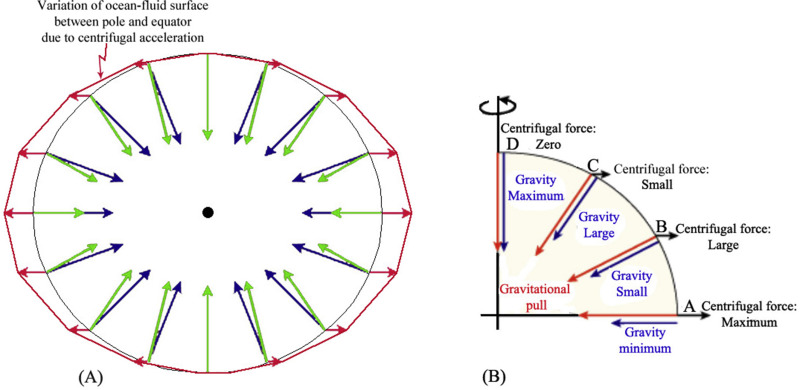
The sphere-like shape of the earth is distorted by (i) greater gravity attraction of the polar region causing polar flattening and lesser gravity attraction of the equatorial region causing equatorial bulging, and (ii) the centrifugal force of its rotation. This force causes the mass of the earth to move away from the center of gravity, which is located at the equator. Ocean-fluid surface takes a outward normal vector due to centrifugal force which is maximum at the equator and zero at the poles (Fig. 4B). Mathematical surface, an imaginary surface coinciding with the mean sea level of the Earth is a spheroidal surface due to its spin, and it is the centrifugal force due to the Earth’s spin caused polar flattening and equatorial bulge. The polar flattening ratio (eccentricity) of 1/298 implied that sea level at the equator is about 21 km further from the center of the Earth than it is at the poles. Water would find its hydrostatic level which is curvilinear, and this level is influenced by the gravity as well as centrifugal force. Centrifugal force acts as much on the oceans as it does on the solid Earth, which is maximum at the equator and minimum at the pole (Fig. 4B). Any addition of water to the oceans is supposed to flow uphill towards equator from the poles causing sea level rise everywhere, but it does not. Hence, although ocean water at the equator makes a level difference of 21 km higher than at the poles, it is the centrifugal force maximum at the equator and zero at the poles would prevent ocean water-column from moving down-hill toward poles effectively restricting sea level rise at the higher latitudes. On the other hand high gravity attraction and zero centrifugal force at the poles and low gravity attraction and maximum centrifugal force at the equator effectively balance sea-level and restrict sea-level rise. While, equatorial ocean-fluid surface always attains relatively higher altitude than that of polar ocean-fluid surface, ocean water column from polar region would not move towards equatorial region.
1-s2-0-s1674987118300446-gr4

Figure 4. The shape of a sphere by pulling the mass of the earth close to the center of gravity. Blue arrows point from Earth’s surface toward its center. Their lengths represent local gravitational field strength. Gravity is strongest at the poles because they are closest to the center of mass. This difference is enhanced by the increasing density toward the center. Red arrows show the direction and magnitude of the centrifugal effect. On the equator, it is large and straight up. Near the poles, it is small and nearly horizontal. Vector addition of the blue and red arrows gives the net result of gravity plus centrifugal effect. This is shown by the green arrows. Rotation of the earth produces more centrifugal force at the equator, less as latitude increases, and zero at pole.

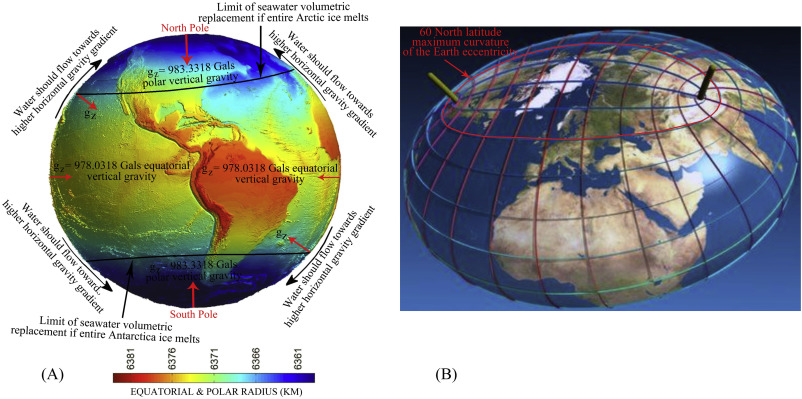
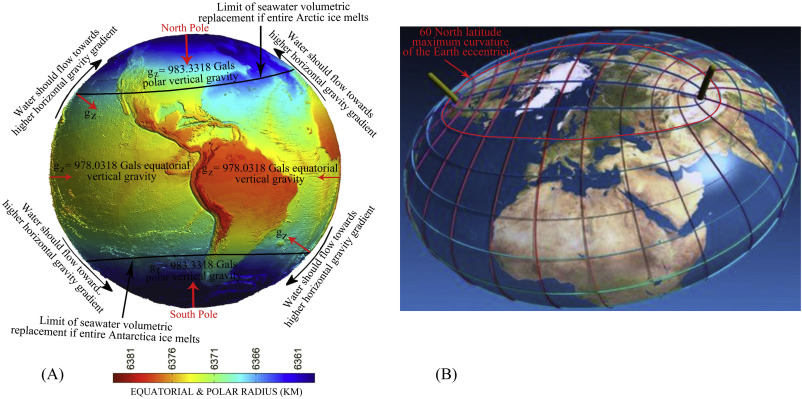
A mass of fluid under the rotation assumes a form such that its external form is an equipotential of its own attraction and the potential of the centripetal acceleration. Above analogy reveals that even if entire polar-ice melts due to the global warming, the melt-water will not flow towards equatorial region where surface has an upward gradient and gravity attraction is also significantly low in comparison to the polar region. However, conditions at both the poles are different. Arctic Ocean in the north is surrounded by the land mass thus can restrict the movement of the floating ice, while, Antarctic in the south is surrounded by open ocean thus floating ice can freely move to the north. But this movement is likely to be limited maximum up to 60°S latitude where spheroidal surface has the maximum curvature (Fig. 6B). As usual, water can not flow from higher gravity attraction to lower gravity attraction rather it is other way around wherein higher gravity attraction of the poles would attract water from moving towards equatorial region and water column would be static at every ‘gz’ direction. Further, greater horizontal gravity gradient toward poles would also help melt-water to remain attracted toward polar region.
1-s2-0-s1674987118300446-gr61

Figure 6. (A) Surface of the earth is defined in terms of gravity values at all surface points known as the reference spheroid. It is related to the mean sea-level (MSL) surface with excess land masses removed and ocean deeps filled. Thus it is an equipotential surface, that is, the force of gravity (gz) (red arrows) is everywhere normal to this surface, or the plumb line is vertical at all points directed to the center of the earth having maximum at the poles and minimum at the equator. Two components work against sea level rise i.e., greater gravity attraction of the polar region and the equatorial bulge (B) Maximum curvature of the spheroidal surface of the Earth coincides with 60oN latitude. Floating ice from Antarctica surrounded by open ocean can freely move to the north likely to be limited maximum upto 60oS latitude where spheroidal surface has the maximum curvature.

A geoid surface thus prepared exhibits bulges and hollows of the order of hundreds of kilometers in diameter and up to hundred meter in elevation occurring in the zone mostly between 60°N and 60°S latitudes. Marked changes in the contour pattern of the geoid height in the zone between 60°N and 60°S suggests maximum curvature along 60°N and 60°S. Hence any change of the global sea level due to the predicted ice melt would not extend beyond 60°N and 60°S. However the reality is that no sea-level rise actually would occur due to ice melt as a result of same volumetric replacement between melt-water and floating ice.

Lindsay and Schweiger (2015) provide a longer-term view of ice thickness, compiling a variety of subsurface, aircraft, and satellite observations. They found that ice thickness over the central Arctic Ocean has declined from an average of 3.59 m (11.78 ft) to only 1.25 m (4.10 ft), a reduction of 65% over the period 1975 to 2012. Map shows sea ice thickness in meters in the Arctic Ocean from March 29, 2015 to April 25, 2015 (Fig. 9B). Total volume of ice-melt water of more than 2,500,000 km3 has been added to ocean water over an area more than 14,500,000 km2 of the central Arctic Ocean (Fig. 9B blue shaded area). By now this additional water should have caused sea level rise more than 178 mm which is much greater than what has been projected and predicted. However there is no record of such sea level rise.

Arctic sea-ice has already reduced its volume due to melting from 33,000 km3 in 1979 to 16,000 km3 in 2016 without showing any sea level rise. Although Arctic sea-ice has reduced its volume, Antarctic has gained (Zhang and Rothrock, 2003) (http://psc.apl.uw.edu). In contrast to the melting of the Arctic sea-ice, sea-ice around Antarctica was expanding as of 2013 (Bintanja et al., 2013). NASA study shows an increase in Antarctic snow accumulation that began 10,000 years ago is currently adding enough ice to the continent to outweigh the increased losses from its thinning glaciers.

From the above statement it is clearly understood that about 23,000 km3 sea-ice of Antarctica can freely float northward into the warmer water where it eventually melts every year without showing any sea level rise in the lower latitudes. Further, melting of such a huge volume of floating sea-ice of Antarctica not only can reoccupy volume of the displaced water but also can cool ocean-water in the lower latitudes of the southern oceans thus can prevent sea level rise due to thermal expansion of the ocean water. According to Zhang (2007) thermal expansion in the lower latitude is unlikely because of the reduced salt rejection and upper-ocean density and the enhanced thermohaline stratification tend to suppress convective overturning, leading to a decrease in the upward ocean heat transport and the ocean heat flux available to melt sea ice. The ice melting from ocean heat flux decreases faster than the ice growth does in the weakly stratified Southern Ocean, leading to an increase in the net ice production and hence an increase in ice mass.

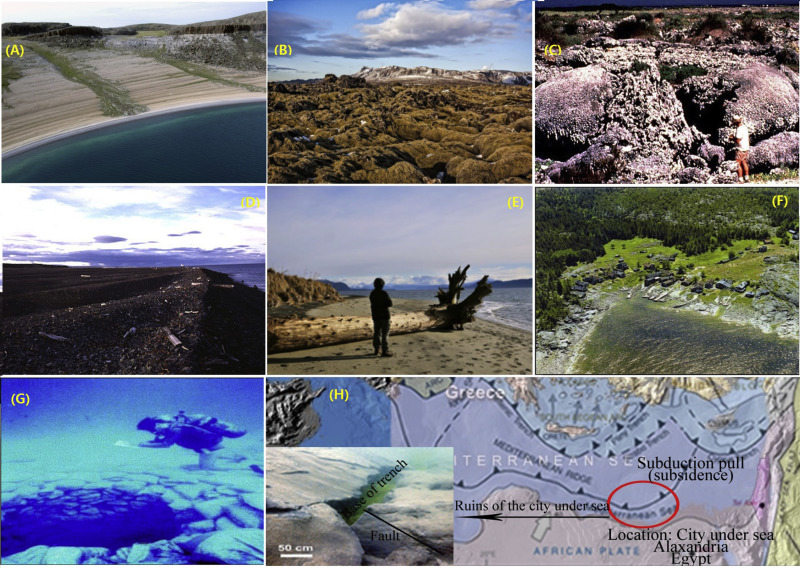
Both the polar regions exhibit reduction in ice-load in the crust due to melting and removal of ice-cover from the continental blocks every year. Reduction of such weight in the continent thus can cause isostasy to come into play and land start to uplift due to elastic rebound to maintain its isostatic equilibrium which is load-dependent and would prevent sea level rise.
1-s2-0-s1674987118300446-gr13

Figure 13. (A) Layered beach at Bathurst Inlet, Nunavut signifying post-glacial isostatic rebound (B) Some of the most dramatic uplift is found in Iceland. Evidence of isostatic rebound (C) Massive coral (Pavona clavus) exposed in 1954 by tectonic uplift in the Galapagos Islands, Ecuador (D) Beach ridges on the coast of Novaya Zemlya in arctic Russia, an example of Holocene glacio-isostatic rebound (E) A beach in Juneau, Alaska where sea level is not rising, but dropping due to glacial isostatic adjustment (F) Boat-houses in Scandinavia now considerably farther away from the water’s edge where they were built demonstrates land uplift (G) An 8000-year old-well off the coast of Israel now submerged, which is a land mark of crustal subsidence (H) The “City beneath the Sea”; Port Alexandria on the Nile delta and the drowned well off the coast of Israe (panel (G), both subsided due to subduction-pull of the downgoing African crustal slab as it enters trench.

Postglacial rebound continues today albeit very slowly wherein the land beneath the former ice sheets around Hudson Bay and central Scandinavia, is still rising by over a centimetre a year, while those regions which had bulged upwards around the ice sheet are subsiding such as the Baltic states and much of the eastern seaboard of North America. Snay et al. (2016) have found large residual vertical velocities, some with values exceeding 30 mm/yr, in southeastern Alaska. The uplift occurring here is due to present-day melting of glaciers and ice fields formed during the Little Ice Age glacial advance that occurred between 1550 A.D. and 1850 A.D.

When the land area shrinks globally, this corresponds to a global rise in sea level. From the curve it is certain that sea level has changed in geologic time scale due to geologic events. Hence, polar ice-melting would not contribute to sea-level rise rather sea-level would drop around the Arctic region as long as isostatic rebound will continue. Claim and prediction of 3 mm/yr rise of sea-level due to global warming and polar ice-melt is definitely a conjecture. Prediction of 4–6.6 ft sea level rise in the next 91 years between 2009 and 2100 is highly erroneous.

1-s2-0-s1674987118300446-gr12

Figure 12. Vail and Hallam curves of global paleo sea level fluctuations from the last 542 million years (Copied and redrawn from https://en.wikipedia.org/wiki/Sea-level_curve).

A negative sea level trend implied that Alaska is being uplifted continuously and corresponding sea level is dropping. However, permanent uplift and corresponding sea level drop of Alaska will occur through ultimate fault rupture between land and sea. Until that time it will continue to show the pattern of sea level as of Fig. 14A.

Conclusion
Geophysical shape of the earth is the fundamental component of the global sea level distribution. Global warming and ice-melt, although a reality, would not contribute to sea-level rise. Gravitational attraction of the earth plays a dominant role against sea level rise. As a result of low gravity attraction in the region of equatorial bulge and high gravity attraction in the region of polar flattening, melt-water would not move from polar region to equatorial region. Further, melt-water of the floating ice-sheets will reoccupy same volume of the displaced water by floating ice-sheets causing no sea-level rise. Arctic Ocean in the north is surrounded by the land mass thus can restrict the movement of the floating ice, while, Antarctic in the south is surrounded by open ocean thus floating ice can freely move to the north. Melting of huge volume of floating sea-ice around Antarctica not only can reoccupy volume of the displaced water but also can cool ocean-water in the region of equatorial bulge thus can prevent thermal expansion of the ocean water. Melting of land ice in both the polar region can substantially reduce load on the crust allowing crust to rebound elastically for isostatic balancing through uplift causing sea level to drop relatively. Palaeo-sea level rise and fall in macro-scale are related to marine transgression and regression in addition to other geologic events like converging and diverging plate tectonics, orogenic uplift of the collision margin, basin subsidence of the extensional crust, volcanic activities in the oceanic region, prograding delta buildup, ocean floor height change and sub-marine mass avalanche.

Summary

This  research paper reads like a tutorial on sea level rise, and explains the geoscience behind fluctuations in observed sea levels over all time scales.  It should be required reading for Judge Alsup, lawyers and litigants in these multiple lawsuits.
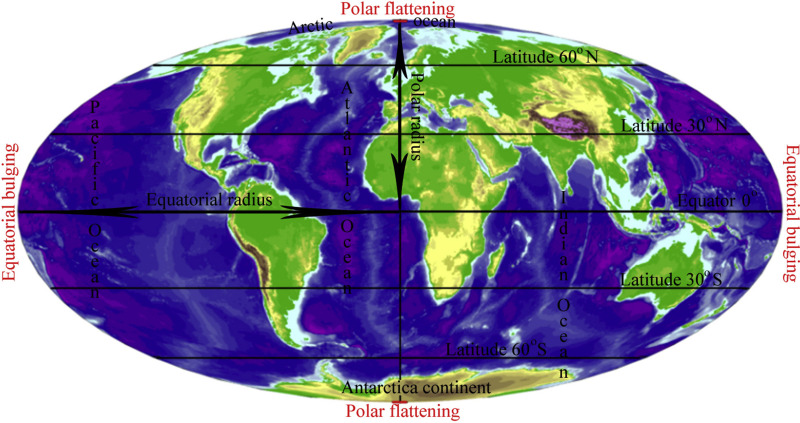
1-s2-0-s1674987118300446-gr5