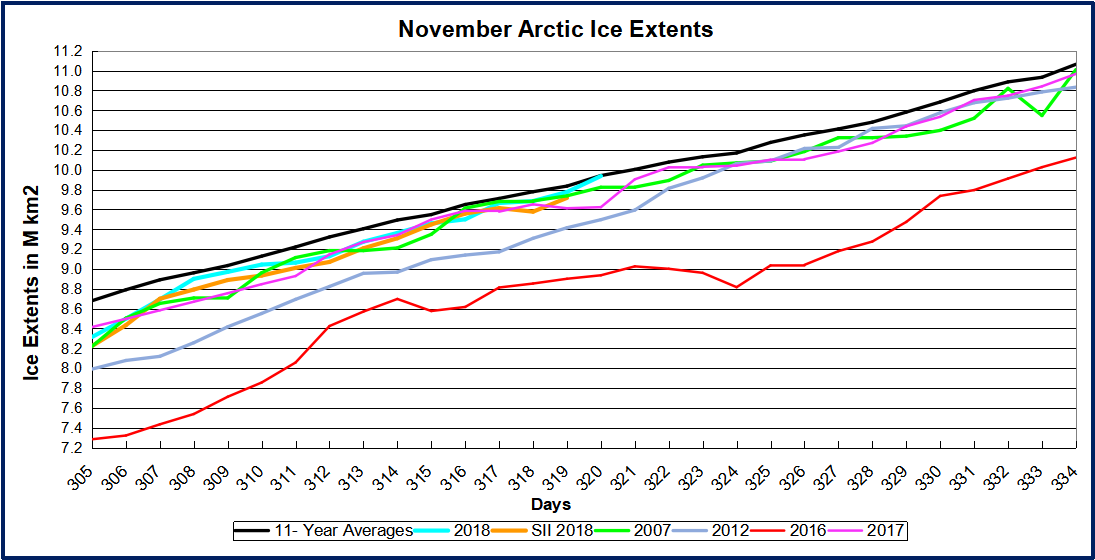
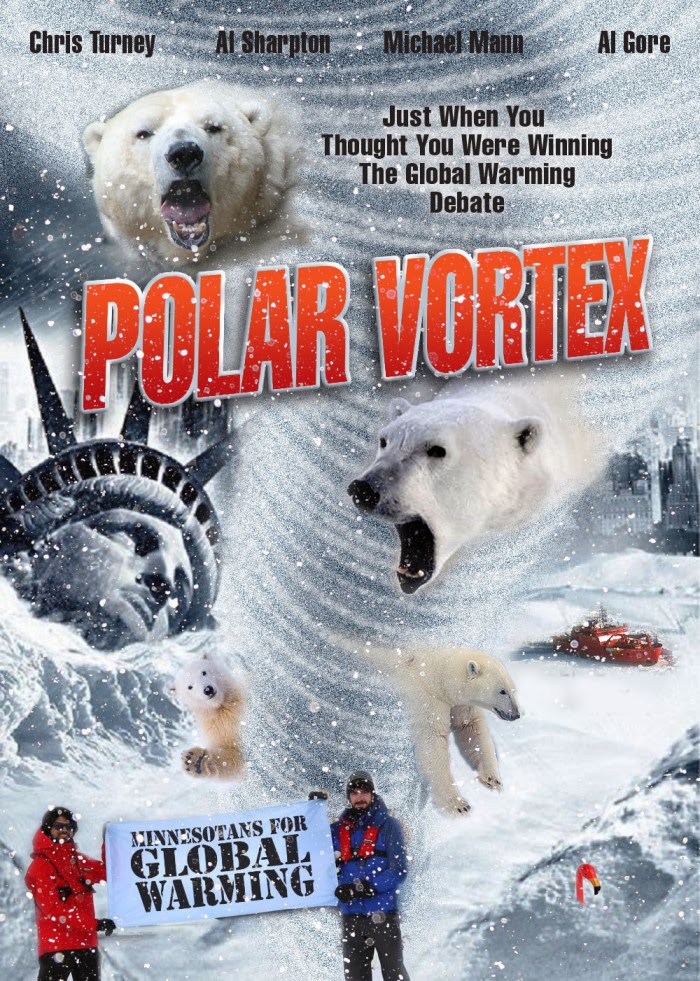
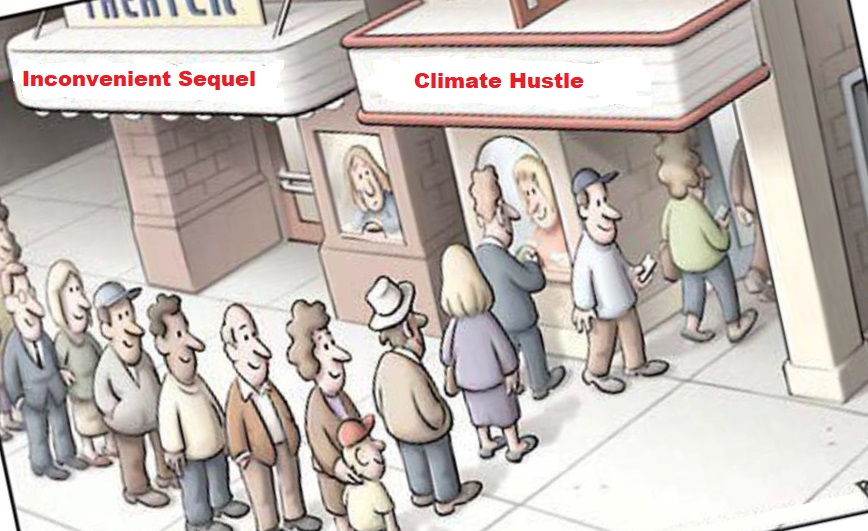
UN Horror Show

Published at RealClearEnergy, Caleb Rossiter offers his review of the recently released UN horror movie The UN’s Terrifying, But Ever-Receding, Human-Caused Climate Catastrophe.  Excerpts below with my bolds.

Just in time for Halloween, the United Nations’ Intergovernmental Panel on Climate Change has released yet another in a 30-year stream of spooky stories: Global Warming of 1.5 Degree Celsius, an IPCC special report on the impacts of global warming of 1.5°C above pre-industrial levels.

Like its five predecessors, it makes terrifying predictions about human-caused climate catastrophes that are always just about to occur, unless governments reduce the level of the harmless trace gas carbon dioxide in the atmosphere from its current four-hundredths of one percent to the three hundredths it was before industrialization.

Notice that the title chosen by the UN gives the game away. It presents correlation as causation by implying that all the warming since pre-industrial times has been caused by industry. There’s no room here for a natural oscillation back from the well-documented lows of the 1700s, which themselves were rebounds from a higher temperature period in the 1400s. (See this NOAA chart).


So how will the UN engender so much fear that the public will agree to stop using fossil-fueled electricity to halt “climate change?” After all, the phrase in itself is benign and natural. With enough repetition as images of hurricanes play on the screen, however, climate change has come to be short-hand for fossil-fueled, civilization-threatening storms, droughts, and destruction of coastal cities and islands, a dubious hypothesis on which we are hilariously told “the debate is over.”

For years I assigned statistics students to pick any apocalyptic climate claim in the media and trace it back through the UN reports to its genesis in a scientific study. I knew they would discover that these reports are not scientific documents based on the peer review process, but political documents “approved by governments” and intended to scare the public into supporting constraints on the production and use of energy.

A powerful publicity machine magnifies the alarm, bombarding citizens with exaggerations and claims of certainty that are proven wrong as you dig down to their underlying scientific studies:

  • Public figures, news editors, and commentators make claims that are more alarmist than what individual IPCC authors say at the release of the report.
  • Individual IPCC authors make claims at the release of the report that are more alarmist than what the official press release says.
  • The official press release makes claims that are more alarmist than what the report’s summary for policy-makers says.
  • The summary for policy-makers makes claims that are more alarmist than the various chapters of the reports.
  • The chapters of the report make claims that are more alarmist than the studies they reference in the footnotes.

The studies referenced in the footnotes are often actually peer-reviewed and generally make cautious claims about a possible trend spotted in one or a small number of locations or in a global computer model.

Both types of studies are more speculative than definitive because, as they always acknowledge in the fine print, they are based on highly-uncertain measurements of highly-complex phenomena with many interacting causes, of which warming gasses generated by human activity are only one, and often a minor component.

For governments to make policy on such a hierarchy of exaggeration brings to mind James Madison’s warning: “A popular Government, without popular information, or the means of acquiring it, is but a Prologue to a Farce or a Tragedy; or perhaps both.”

The serial release of UN reports obscures the fact that the climate catastrophes they predict never occur. As the data contained deep in the bowels of this latest report again acknowledge, Mother Nature is simply not cooperating with the UN There has been no positive trend in hurricanes, floods, and droughts as carbon dioxide levels continue to rise.

Even the average global temperature (whose rise is supposed to increase disasters) has barely budged, only rising a third of the amount that has been repeatedly been predicted by the IPCC computer models.

Sea levels, which are very difficult to measure due to human use of land and even to the natural rise and fall of land itself, chugs along at the same inch-per-decade that it has for thousands of years – not the terrifying 10 feet in a century warned about in previous reports. The islands and polar ice that we were repeatedly told would be gone by now are still there, and no closer to destruction.

The UN’s response to its failed predictions is simply to move the goal-posts, and make new dire predictions for some future date – in this case 2030. There is no reason to believe that this speculation will be any more accurate the ones that predicted human-induced climate catastrophes by certain dates, now passed.

But don’t be too frightened: the same governments who authorize the UN reports never take the steps needed to reduce the supposedly horrifying carbon dioxide level. Hidden behind their teeth-chattering fear of fossil fuels is their awareness that oil, gas, and coal have helped bring dramatic improvements in health, welfare, and life expectancy, and that alternative methods of generating power are currently available only at unacceptable economic (and hence political) cost.

Happy Halloween!

Caleb Rossiter, Ph.D., is the director of the American Exceptionalism Media Project, a fellow at The Texas Public Policy Foundation, and a former professor of statistics at American University.


Arctic Gains Ice in October


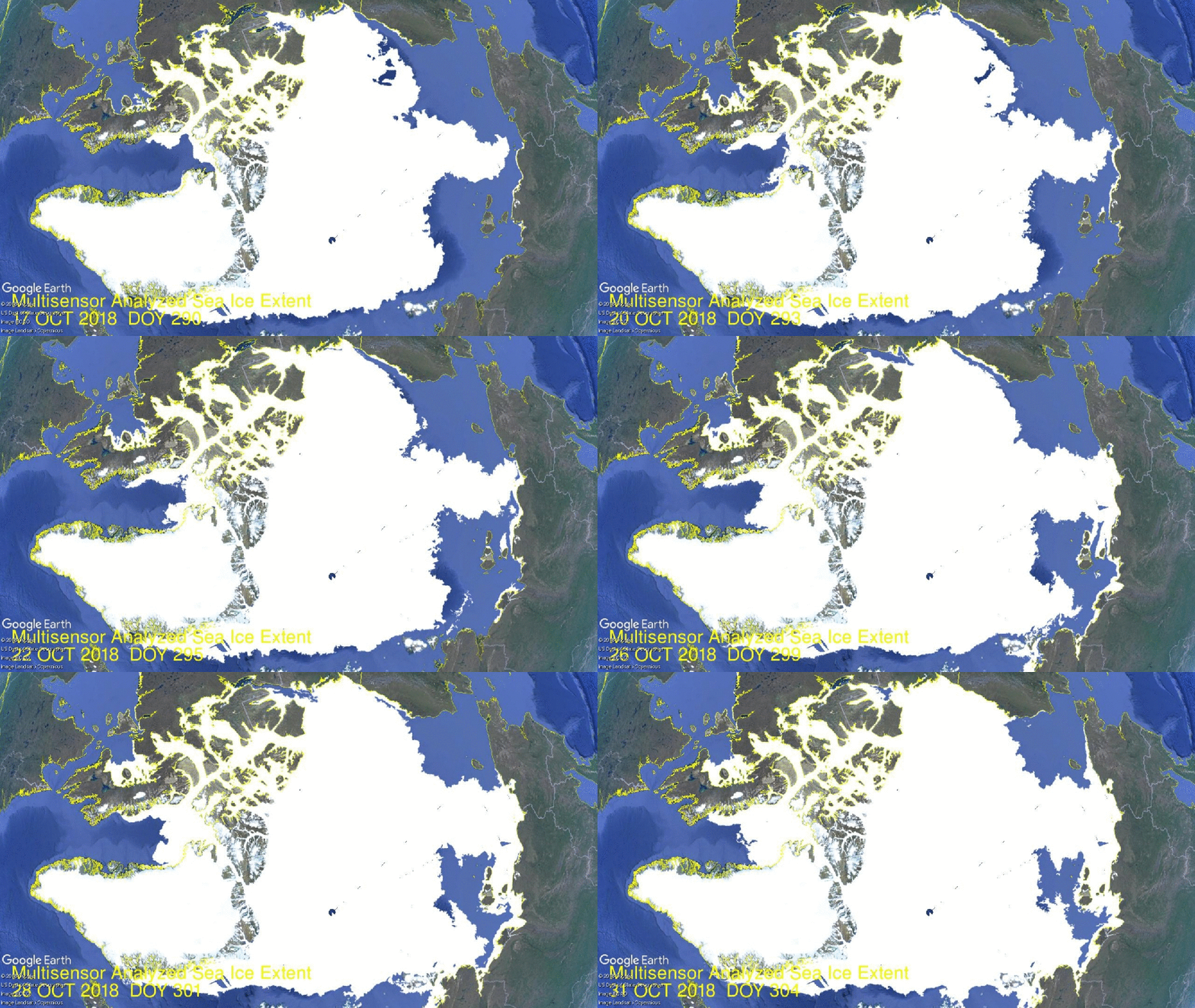
Arc2018290to304Big Chill in last Two Weeks

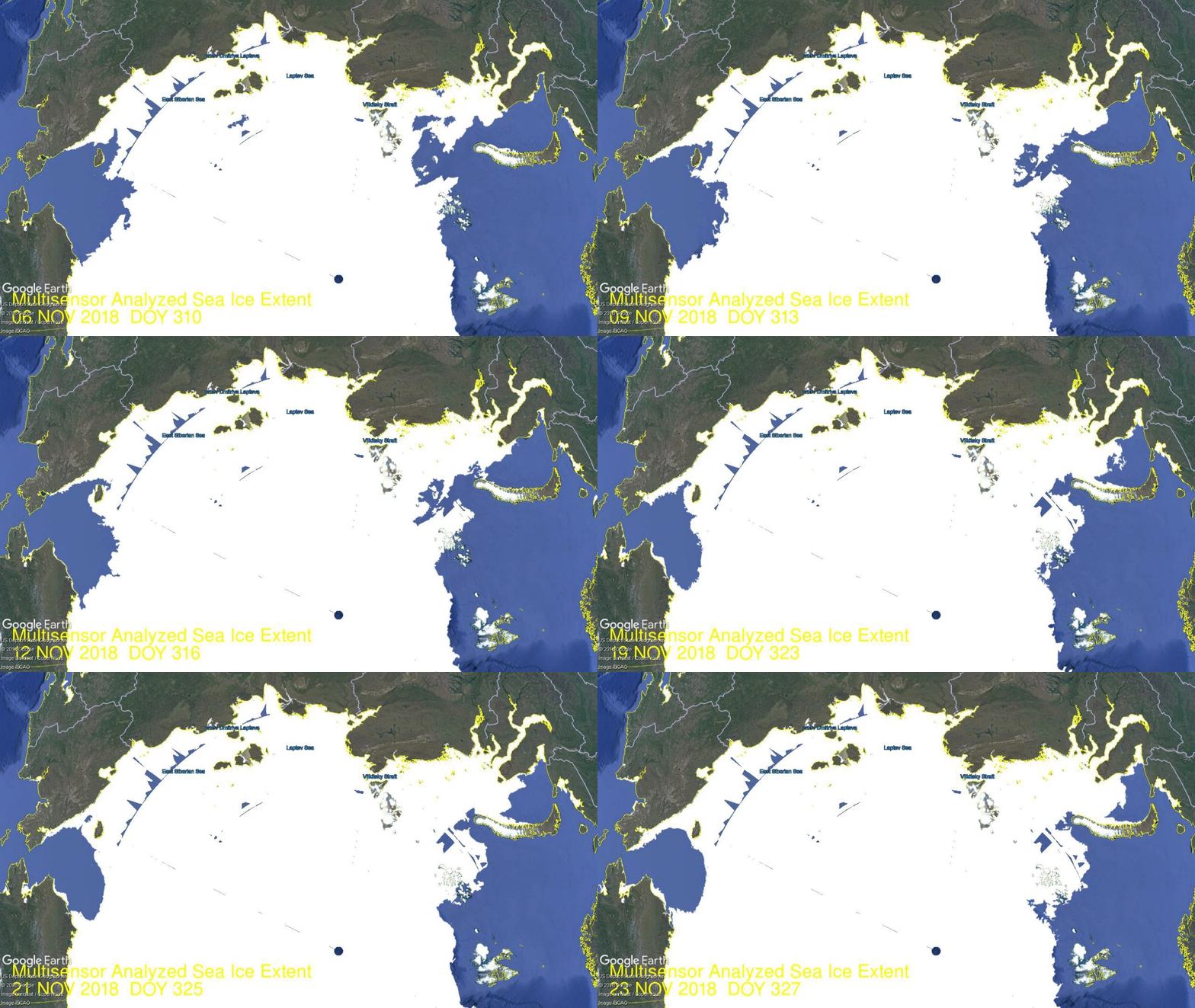
The major growth in ice extent came in the Russian basins (right side).  The image above shows massive gains in ice extent in East Siberian and Laptev seas. East Siberian added 460k km2 for a total of 895, or 82% of last March maximum.  Laptev was mostly open water in September, but added 600k km2 in the last two weeks for a total of 700k km2 or 78% of last March maximum. With the Canadian Arctic on the left already frozen over, the gains were smaller, limited to northern Hudson Bay (top left) and Baffin Bay filling in from the north.

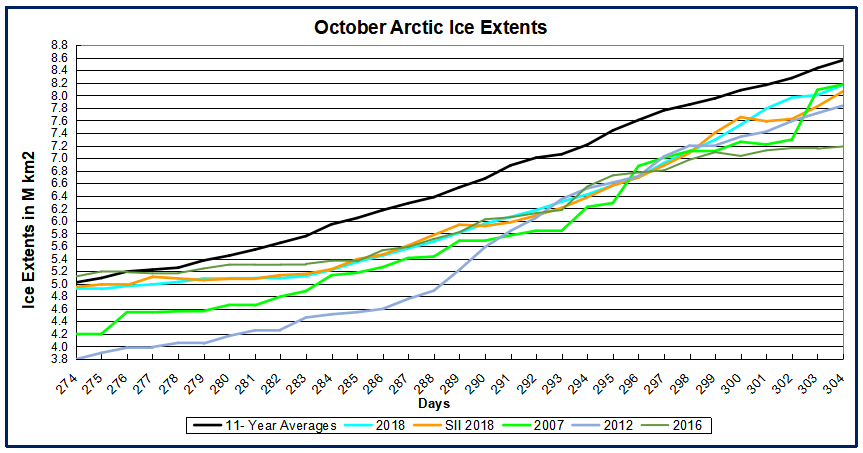
Arctic2018304

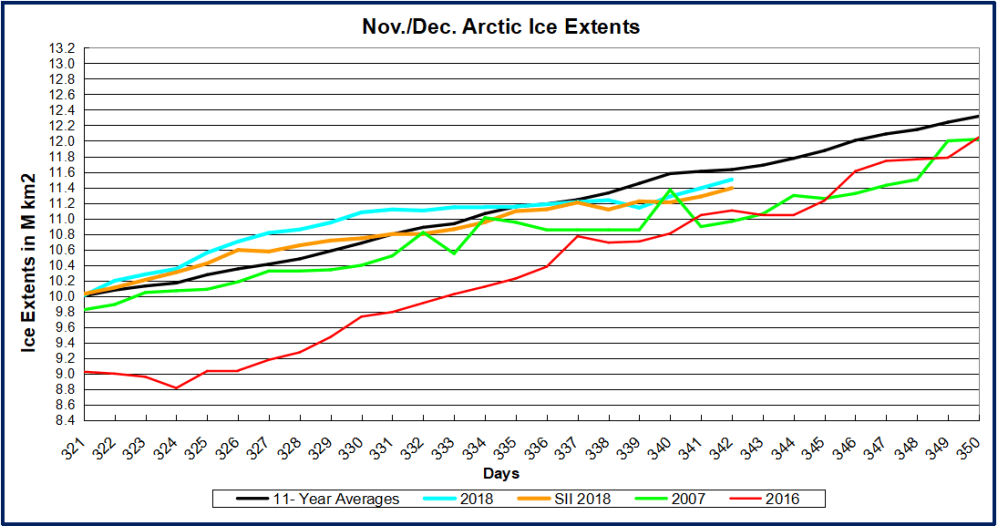
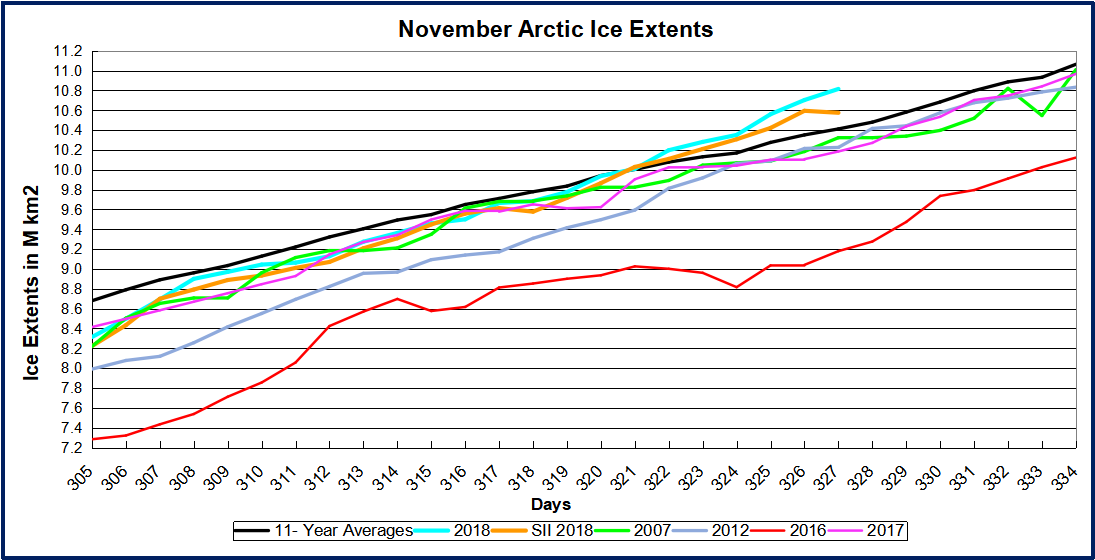
The graph shows MASIE reporting ice extents totaling 8.2M km2 yesterday,  400k km2 below the 11 year average (2007 to 2017 inclusive).  Note how 2018 started October on average, then went fairly flat the first week or so, falling 900k km2 below average.  Recent gains in ice extent exceed average gains, closing the gap.  Presently, 2018 is three days behind the average, matching 2007 and tracking above 2016 and 2012. NOAA’s Sea Ice Index matched MASIE throughout October.

ims2018304_alaska

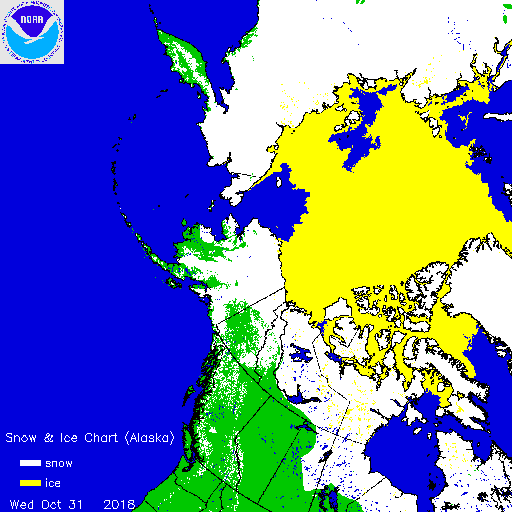
The current IMS Snow and Ice Chart shows how snow is covering Siberia completely, and has spread over northern and eastern canada.

The table below shows the regional distribution of Arctic ice extents.

Region 2018304 Day 304 
Average
2018-Ave. 2007304 2018-2007
 (0) Northern_Hemisphere 8167466 8561136 -393671 8175072 -7606
 (1) Beaufort_Sea 1069285 948751 120534 1038126 31159
 (2) Chukchi_Sea 412073 468794 -56721 242685 169389
 (3) East_Siberian_Sea 894863 954841 -59978 835071 59792
 (4) Laptev_Sea 698238 896167 -197929 887789 -189551
 (5) Kara_Sea 299264 462673 -163409 311960 -12695
 (6) Barents_Sea 4058 81432 -77375 52823 -48765
 (7) Greenland_Sea 341543 416633 -75090 443559 -102016
 (8) Baffin_Bay_Gulf_of_St._Lawrence 427557 271561 155996 289374 138184
 (9) Canadian_Archipelago 823551 789952 33599 817220 6331
 (10) Hudson_Bay 131284 85823 45461 48845 82439
 (11) Central_Arctic 3063891 3173126 -109235 3206345 -142454

The deficits are mainly on the Russian and European seas, only partly offset by surpluses in Beaufort, CAA, Baffin and Hudson Bays.

algore_ice_gone_by_2013


Big Chill in October Arctic


ESL2018290to301Siberian Big Chill in last Ten days

With the Canadian Arctic already frozen over, the action has moved to the Russian side.  The image above shows massive gains in ice extent in East Siberian and Laptev basins. East Siberian added 383k km2 for a total of 821, or 75% of last March maximum.  Laptev was mostly open water in September, but added 550k km2 in the last ten days for a total of 650k km2 or 72% of last March maximum.

Arctic2018301

The graph shows MASIE reporting ice extents totaling 7.8M km2 yesterday,  400k km2 below the 11 year average (2007 to 2017 inclusive).  Note how 2018 started on average, then went fairly flat the first week or so, falling 900k km2 below average.  Recent gains in ice extent exceed average gains, closing the gap.  Presently, 2018 is about four days behind the average, tracking above 2016, 2012 and 2007. NOAA’s Sea Ice Index is matching MASIE through most of October.

ims2018301_alaska

The current IMS Snow and Ice Chart shows how snow is covering Siberia completely, and has spread over northern and eastern canada.


algore_ice_gone_by_2013


Self-Serving Global Warmism


To believe humans are dangerously warming earth’s climate, you have to swallow a bunch of unbelievable notions. You have to think the atmosphere drives temperature, instead of the ocean with 1000 times the heat capacity. You have to disregard the sun despite its obvious effects from summer to winter and longer term. You have to think CO2 drives radiative heat transfers, instead of H2O which does 95% of the radiative work. You have to think rises in CO2 cause temperatures to rise, rather than the other way around. You have to forget it was warmer than now in the Middle Ages, warmer still in the Roman era, and warmest of all during Minoan times.  And on and on. The global warmist narrative is full of ideas upside down and backwards, including many reversals of cause and effect.

It is like a massive hot air balloon, so why doesn’t it deflate? Answer:  It is because so many interests are served by keeping it alive and pumping up public fears. In this brief video, Richard Lindzen explains how it serves politicians, NGOs and the media to be on the global warming bandwagon.

In addition, there are businesses and industries that can and do contribute to global warming fears to further their own interests.  For example,Terence Corcoran explains how the insurance industry benefits by promoting global warming in his Financial Post article Why insurers keep hyping ‘climate risks’ that don’t materialize  Excerpts in italics with my bolds.

Insurers are urging the government to invest in natural, green infrastructure even though engineers call it ineffective

For more than two decades, insurance firms facing rising property damage costs in Canada and abroad have sought some kind of salvation in the environmental movement’s climate change crusade.

The latest insurance industry initiative wanders even deeper into the quagmire of green policy advocacy. Combating Canada’s Rising Flood Costs, a new report from the Insurance Bureau of Canada (IBC), urged governments across the country to adopt “natural infrastructure” to limit escalating climate change risks.

The report continues the insurance industry’s 20-year practice of hyping climate risks. At an industry conference in 1999, one executive warned: “The increase in extreme weather events (in Canada) is part of a global trend in which climate change has played a significant role.”

The evidence was non-existent then, and not much has changed in the interim, despite the industry’s claim that climate-driven flood risk is escalating. According to the insurers, Canada needs all levels of government to turn to natural and “green” infrastructure before installing traditional “grey” infrastructure.

The first priority is to retain existing ponds, streams, trees and other natural infrastructure systems, according to the report. The second is to rebuild and replace natural infrastructure that has been lost. And the third — building new and replacing old sewers, pipes, concrete drainways, diversions, improved building techniques — should be undertaken only on a “build what you must” basis.

However, that’s not what the Ontario Society of Professional Engineers recommends. In an April report for provincial officials it said: “Numerous studies have demonstrated that green infrastructure does not provide a flood risk reduction benefit.” The engineers advised that protective plumbing, pump-station modifications and sanitary-sewer improvements are among the measures that should be taken to control urban flooding.

Insurers have an understandable self-interest in promoting infrastructure spending and government policies, laws and regulations that would protect their businesses from rising insurance claims. But the report reads like a document from the World Wildlife Fund. It was sponsored by the IBC and “generously supported” by Intact Financial Corp., Canada’s largest insurance company. The University of Waterloo-based Intact Centre on Climate Adaptation (funded by Intact, which has given millions to the centre) was also involved.

Despite the heavy corporate involvement, the CBC opened up about 10 minutes of The National, it’s flagship news show, to the industry report when it was released last month. Would The National give the pipeline, mining and telecom companies 10 minutes to promote their views?

The stars of The National that night were Blair Feltmate, head of the Centre on Climate Adaptation, and CBC News meteorologist Johanna Wagstaffe. Both repeated the insurance industry’s 20-year-old claims that climate devastation is ravaging Canada through extreme weather events — and warned the public to look out for rising insurance premiums if nothing is done. Here’s a sample:

Wagstaffe: “Every single extreme weather event is connected to a warming climate because… as we see longer and hotter summers, we see more moisture being held in our atmosphere, we see higher water levels, that means every single event is amplified by climate change.”

Feltmate: “I totally agree. So all the modelling on climate change that’s been done over the last many years by groups like the Intergovernmental Panel on Climate Change, which is a group of several hundred climate scientists… their predictions are that, yes, climate change has happened, is happening and will continue to happen. And we’re seeing the expression of extreme weather events as a result of that.”

Feltmate added the magnitude of flooding, which is the No. 1 cost due to climate change in the country, is increasing.

Such climate warnings have been official insurance industry mantra since the 1990s. Flooding and extreme weather are becoming more frequent, the industry said again and again.

Not true, according to the latest IPCC science report released this month. The impacts chapter said: “There is low confidence due to limited evidence, however, that anthropogenic climate change has affected the frequency and the magnitude of floods.” Furthermore, from 1950 to 2012 “precipitation and (fluvial) runoff have… decreased over most of Africa, East and South Asia, eastern coastal Australia, southeastern and northwestern United States, western and eastern Canada.”

Despite a lack of evidence, the industry recently claimed conditions are so bad in Canada that “weather events that used to occur every 40 years now happen every six years” — a factoid attributed to a 2012 IBC-commissioned report by veteran Western University climatologist and climate-policy activist Gordon McBean. He cited an Environment Canada report to support the 40-to-six claim, but in 2016 Canadian Underwriter magazine published a note quoting an Environment Canada official who said studies “have not shown evidence to support” the 40-to-six year frequency shift. The claim has since been scrubbed from the insurance industry’s communications on climate issues.

The insurers have a newer warning widget in the form of a graphic that appears to show a dramatic rise in catastrophic insurance losses due to climate change. A trend line rises from the mid-1980s to 2017 to a $5-billion peak with the 2016 Fort McMurray fire (see first accompanying chart). The new IBC flood report said these numbers illustrate the financial impacts of climate change and extreme weather events that are being felt by a growing number of homeowners and communities. These losses “averaged $405 million per year between 1983 and 2008, and $1.8 billion between 2009 and 2017.”

The graphic contains three dubious elements as a source for a flood report. First is an inconsistency in the source of data, a problem identified by Robert Muir, a professional engineer and member of in infrastructure task force at the Ontario Society of Professional Engineers. The 1983–2007 data set was collected through informal industry surveys, while the 2008–2017 data are tabulated systematically by an independent agency.

Data inconsistency may explain the bizarre result that the insurance industry had zero losses due to floods, water, rain and storm perils in four of 17 years between 1983 and 2000.

Second, the IBC graph also counts fire losses, including the Fort McMurray fire of 2016 — an event unrelated to flood risk. Removal of fire losses significantly flattens the curve (see the second accompanying chart). If the 2013 floods in Alberta and Toronto are treated as possible one-off freak events, the average insurance losses come to $182 million in the 1990s, $198 million during the 2000s and $268 million over the past nine years, which is not a dramatic shift considering there are many other explanations for insurance losses, including increasing individual wealth beyond mere per capita GDP values, urbanization, failure of governments to maintain decaying ancient water infrastructures, and the risks people take by moving into flood-prone areas.

The insurance industry has an obvious motive in highlighting flood risk. It is part of a concerted climate campaign by NGOs, governments and sustainable development advocates. As one executive put it at a 2016 conference the objective is to “monetize” the flood risk, an idea the IBC is pushing with the help of a relatively new “flood model” that identifies high-risk areas.

When risks are real, people should of course take steps to avoid them or get protection, including taking out insurance. But the industry seems to be heading in a questionable direction by promoting insurance for climate risks that may not exist and at the same time advocating for green protective infrastructure (see below) that will cost more and may — if the engineers are right — increase the risk.

IPCC Freakonomics

The latest unguided missile IPCC report came out of a South Korea meeting, and surprisingly the first media response was silence. Could it be some of them actually considered that these new claims and demands are so over the top that their audiences will guffaw and break with their media masters once and for all?

The graph illustrates the problem very clearly. Since 1992, the UN Framework Convention on Climate Change has met 23 times. These UNFCCC discussions have utterly failed to reduce CO2 emissions. Yet from 2020, emissions have to drop dramatically, if we are to stand a chance of keeping global warming below 1.5°C.

According to IPCC SR15 this will require an annual average investment of around US$2.4 trillion (at 2010 prices) between 2016 and 2035, representing approximately 2.5% of global gross domestic product (GDP). The cost of inaction and delay, however, will be many times greater. (sic).  Note:  This is referring to increasing investments in renewable energy from current US$335B per year to $2.4T.  Present global spending on Climate Crisis Inc. is estimated at nearly US$2T, not limited to renewables.  So this would double the money wasted spent on this hypothetical problem.

After their initial shock, like the lemmings they are, the news and opinion makers filled their pages and screens with end of the world proclamations, and continue to do so.

Elsewhere I have posted on the disconnect between reality and the IPCC scientific claims. The focus in this post is on the appalling economics piled on top. At IER Robert Murphy writes The IPCC Should Heed the Work of Nobel Laureate William Nordhaus. Excerpts in italics with my bolds.

One of the recurring themes of my work on the economics of climate change is that the very people who lecture the world on the dangers of “science denial” don’t actually follow their own advice. The recent announcement of the Nobel Prize in Economics, along with the release of the UN’s latest IPCC (Intergovernmental Panel on Climate Change) report, illustrates my claim perfectly. Specifically, William Nordhaus just won the Nobel for his work on basically inventing the economics of climate change. But while Nordhaus’ model shows that even a ceiling of 2° Celsius is too aggressive—with the costs outweighing the benefits—the media breathlessly tells the world that the latest “science” from the IPCC shows humanity that we have about a decade to implement draconian measures if we are going to achieve the goal of limiting warming to 1.5°Celsius.

The Media Announcements

From the Guardian:  We have 12 years to limit climate change catastrophe, warns UN
Urgent changes needed to cut risk of extreme heat, drought, floods and poverty, says IPCC

The following quotation comes from the New York Times article announcing this year’s joint winners of the Nobel (Memorial) Prize in Economics, namely William Nordhaus and Paul Romer. Note how the piece ties Nordhaus to the virtually simultaneous release of the latest IPCC report:

The 2018 Nobel Memorial Prize in Economic Science was awarded on Monday to the American economists William D. Nordhaus and Paul M. Romer for reshaping the understanding of the long-term determinants of economic growth.

Mr. Nordhaus was cited for his work on the implications of environmental factors, including climate change. Mr. Romer was cited for his work on the importance of technological change.

Mr. Nordhaus, a professor of economics at Yale University, pioneered the economic analysis of climate change. He is also a leading proponent of the use of carbon taxation to reduce emissions, a policy approach preferred by many economists.

The announcement of the award came the same day that a United Nations panel on climate change released a report warning of dire consequences from climate change and urging governments to respond to the problem with greater urgency. The report builds on and cites Mr. Nordhaus’s work. [New York Times, bold added.]

Now, any normal citizen reading the above two samples from our major media—who ostensibly are all up-to-speed on the “consensus” and would never dream of letting ideology get in the way of the empirical evidence—would be quite certain that William Nordhaus’ work supports the IPCC’s call to limit global warming to 1.5°C. And yet, as I’ll show in the next section, this is utterly false. Nordhaus’ work shows that such an ambitious climate change goal is far too aggressive.

Nordhaus on Proper Climate Policy

Now to be clear, I am a critic of Nordhaus’ work on climate change economics. Back in 2009 I wrote a peer-reviewed article criticizing his “DICE” model, and here at IER I’ve written articles (such as this one) arguing that Nordhaus misled the public in one of his popular articles on climate “skeptics.”

However, what I want to do in the current post is simply show that the guy who just won the Nobel Prize for his work on climate change economics does NOT support anything close to the IPCC’s latest announcement. This should show that, far from being “settled science,” the ever-increasing stridency of the calls for global action to combat climate change are more and more based on ideology and/or arbitrary decisions not tied to reasoned analysis.

For starters (and I thank David R. Henderson for reminding me of this salient point), as of DICE-2007 (i.e., Nordhaus’ model back in 2007), the climate goal of limiting global warming to 1.5°C was a horrible policy, which would make humanity $14 trillion (in present-value terms, in 2005 US$) poorer than doing nothing at all. (See Table 4 of my article to see the details.)

Now it’s true that the numbers have changed since 2007, and Nordhaus’ model would no longer give such a pessimistic assessment. However, back in 2013 Nordhaus argued in his then-new book on climate change that the optimal policy (depending on assumptions regarding participation among the world’s governments, etc.) would limit global warming from 2.3°C up to nearly 4°C, as Paul Krugman admits in his review of the book.

Please re-read my last sentence: As of 2013, William Nordhaus—who just won the Nobel Prize for his work on the economics of climate change—was saying the optimal path of global warming would allow for temperature increases of at least 2.3°C and possibly close to 4°C. Yet the IPCC’s media people are telling the world that we should really shoot for 1.5°C of warming to avoid catastrophe, and that the difference between 1.5°C versus 2.0°C is huge.

Chain of suppositions comprising Integrated Assessment Models.

Conclusion

I have serious reservations about the work of William Nordhaus and the other creators of so-called Integrated Assessment Models (IAMs), which are used to calculate the “social cost of carbon.” Yet to the extent that we are going to take IAMs at face value—and the major media touting Nordhaus’ Nobel certainly do—then they should give pause to those clamoring for aggressive government action. Although Nordhaus favors a carbon tax, his work shows that the recent goals announced by the IPCC are ludicrously aggressive, and would likely cause far more damage to economic growth than they would alleviate in terms of climate change.

Footnote:  Robert Murphy has a follow up article with additional analyses at MISES William Nordhaus vs. the U.N. on Climate Change Policy

In this article I will provide more details of just how Orwellian it is, that some pundits and reporters are linking Nordhaus with the IPCC’s latest announcement. More generally, this whole episode underscores the farce of the “social cost of carbon” (SCC) concept. The Obama Administration and academics like Nordhaus go through all of this work to generate estimates of the quantitative damage caused by carbon dioxide emissions, and then the United Nations goes ahead and recommends policies that aren’t even in the same ZIP code as what those “scientific” estimates entail. If anybody in this debate is a “denier,” it is the people claiming the IPCC’s latest pronouncements have anything to do with the peer-reviewed economics literature.

Robert Murphy also has this video clip of a presentation on climate economics (H/T Jim Rose)

October Arctic Ice Catching Up

CA2018274to290.gif

October Days in Nunavut

Previous posts described how the Northwest Passage was treacherously laden with ice this year.  The image above shows how the freezing proceeded in this region over the last 16 days.  Oct. 1 the CAA ice extent (Canadian Arctic Archipelago) was 609k km2, then waffled back and forth until growing sharply the last four days to 786k km2.  On the right, Baffin Bay also doubled in that period up to 150k km2.  On the left and bottom, Beaufort Sea added 324k km2 up to 943k km2, nearly 90% of the maximum last March.

Arctic2018290

The graph shows MASIE reporting ice extents totaling 5.96M km2 yesterday,  700k km2 below the 11 year average (2007 to 2017 inclusive).  Note how 2018 started on average, then went fairly flat the first week or so, and lately is adding extent at the same rate as the average.  Presently, 2018 is about five days behind the average, tracking closely the 2016 ice growth.  NOAA’s Sea Ice Index is matching MASIE,  while 2007 and 2012 are not far behind.

ims2018290_alaska

The current IMS Snow and Ice Chart shows how snow cover is spreading rapidly across both Canada and Siberia.  Dr. Judah Cohen comments on this aspect at his AER blog Arctic Oscillation and Polar Vortex Analysis and Forecasts  Excerpts in italics with my bolds.

I present what is I believe is the latest European Centre for Medium Range Weather Forecasts (ECMWF) winter forecast in Figure i taken from climate.copernicus.eu. The ECMWF model is generally considered the best forecast model on the planet. The first thing that jumps out at me is the predicted classic or text book positive Pacific North American (PNA) pattern with a deep Aleutian Low, ridging or elevated heights across northwestern North America including Alaska and troughing or low heights in the Southeastern US. The ECMWF model is also predicting a quasi-negative NAO with the southern pole or center of action more classically represented than the northern pole. But in regards to the US winter this represents a suppressed storm track along the Eastern Seaboard. A positive PNA should yield an overall cold winter to the Eastern US. The ECMWF model is most confident in a relatively cold winter in the Southeastern US with greater uncertainty in the Northeastern US while the suppressed storm track will bring elevated risks of East Coast snowstorms. And El Niño does tend to focus the greatest snow threat, at least relative to normal, in the Mid-Atlantic. If you are a winter weather enthusiast especially a snow lover living in the Mid-Atlantic this ECMWF winter forecast should have you very excited.

The other feature that jumps out at me is high latitude blocking. I already mentioned the blocking near Alaska but there is a second center near Scandinavia that extends eastward into the Barents-Kara Seas. If the ECMWF was predicting a textbook negative NAO this block would be closer to Greenland. I believe that if the ECMWF forecast is correct and the block sets up near Scandinavia this is not as cold for Europe as the classic negative NAO but would instead focus the cold more in Asia. However I do think some of that cold would likely be drawn eastward underneath the blocking high and could result in a cold, possibly snowy winter for Central and/or Southeastern Europe. The other thing to watch is that a blocking high near Scandinavia and the Barents-Kara Seas coupled with a deep Aleutian Low is ideal for transferring energy from the troposphere into the stratosphere forcing a PV disruption. Now I don’t believe the ECMWF forecast is a consequence of a polar vortex disruption but is strongly suggestive of one. And if one does occur, then I would expect an increased probability of a more classic negative NAO to follow.


algore_ice_gone_by_2013


Control Population, Control the Climate. Not.

Far from being a catastrophe, population growth and carbon fuel-based development are the best means to lift people out of poverty, the authors write.NASA

A recent book explains what’s mistaken about climate alarmists/activists thinking human numbers must be reduced in order to save the planet from us (H/T Master Resource). The Title is Population Bombed! by Pierre Desrochers and Joanna Szurmak who provide an introduction to their assessment in an article at Financial Post For 200 years pessimists have predicted we’d ruin the planet. They’re still wrong.  Excerpts in italics with my bolds.

In Avengers: Infinity War, the villain Thanos said: “If life is left unchecked, life will cease to exist.” Johns Hopkins University philosopher Travis N. Rieder apparently agrees, as he views each new child as an environmental externality putting “irreparable stress on the planet” in a way that “exacerbates … the threat of catastrophic climate change.” Similar ideas have been expressed by the likes of Al Gore, Hillary Clinton and Bill Gates. Feminist icon Gloria Steinem put it best: “What causes climate deprivation is population. If we had not been systematically forcing women to have children … for over the 500 years of patriarchy, we wouldn’t have the climate problems that we have.”

Population-growth catastrophism has been around for centuries. In the English-speaking world it is generally associated with economist Thomas Robert Malthus’ 1798 edition of his Essay on the Problem of Population and U.S. biologist Paul Ehrlich’s 1968 bestseller The Population Bomb. Ehrlich and his co-author and wife Anne predicted imminent environmental collapse followed by mass starvation. What they didn’t see coming was that, to the contrary, hundreds of millions of people would soon be lifted out of grinding poverty while parts of the planet became greener and cleaner in the process.

In our new book Population Bombed! Exploding the Link between Overpopulation and Climate Change we mark the 50th anniversary of the Ehrlichs’ book by explaining that their predictions bombed because their basic assumptions are flawed.

First, the Ehrlichs assume that human numbers cannot exceed the limits set by a finite system. Bacteria in a test tube of food are used to model such a system: Since the levels of food and waste limit bacterial growth, human population growth, by analogy, ultimately cannot exceed the carrying capacity of test tube Earth.

Second, they assume that wealth and development unavoidably come with larger environmental damage. This assumption is still at the core of pessimistic frameworks, which maintain that physical resource throughputs, not outcomes, matter. So, countries such as Haiti where deforestation and wildlife extermination are rampant are inherently more “sustainable” than richer and cleaner countries like Sweden and Switzerland.

Third, Ehrlich does not acknowledge that, unique among this planet’s species, modern humans: transmit information and knowledge between individuals and through time; innovate by combining existing things in new ways; become efficient through specialization; and engage in long-distance trade, thus achieving, to a degree, a decoupling from local limits called the “release from proximity.” And the more brains there are, the more solutions. This is why, over time, people in market economies produce more things while using fewer resources per unit of output. Corn growers now produce five or six times more output on the same plot of land as a century ago while using less fertilizer and pesticide than a few decades ago.

Fourth, the Ehrlichs and other pessimists also fail to understand the uniquely beneficial roles played by prices, profits, and losses in the spontaneous and systematic generation of more sustainable — or less problematic — outcomes. When the supply of key resources fails to meet actual demand, their prices increase. This encourages people to use such resources more efficiently, look for more of them, and develop substitutes. Meanwhile, far from rewarding pollution of the environment, the profit motive encourages people to create useful by-products out of waste (our modern synthetic world is largely made out of former petroleum-refining waste products). True, in some cases dealing with pollution came at a cost — building sewage-treatment plants, for example — but these are the types of solutions only a developed society can afford.

Fifth, pessimists are also oblivious to the benefits of unlocking wealth from underground materials such as coal, petroleum, natural gas and mineral resources. Using these spares vast quantities of land. It should go without saying that even a small population will have a much greater impact on its environment if it must rely on agriculture for food, energy and fibres, raise animals for food and locomotion, and harvest wild animals for everything from meat to whale oil. By replacing resources previously extracted from the biosphere with resources extracted from below the ground, people have reduced their overall environmental impact while increasing their standard of living.

Why is it then that after two centuries of evidence to the contrary, the pessimistic narrative still dominates academic and popular debates? Why are so many authors and academics still focusing on the Malthusian collapse scenario — now bound to come from carbon dioxide emissions and the teeming populations that produce them?

The prevalence of apocalyptic rhetoric may be, arguably, due to factors ranging from financial incentives among academics and activists to behavioural heuristics that dictate why worrying is a motivator, and why even well-meaning people rarely change their mind given new evidence. Short-termism may also take some of the blame: Population control and climate activists take for granted the non-scalable benefits of a carbon-fuel economy in which large numbers of people collaborate and innovate. The cognitive biases at the root of our thinking may shape, and in the end distort, the impulse to question “consensus,” particularly in an intellectual climate lacking the motivation to achieve what social psychologist Jonathan Haidt called “institutional disconfirmation.”

Far from being the catastrophe that Thanos, the Ehrlichs and other pessimists would have us believe, population growth and carbon fuel-based development in the context of human creativity and free enterprise are the best means to lift people out of poverty, to build resilience against any climate damage that increased anthropogenic greenhouse gas emissions might have, and to make possible a sustained reduction of humanity’s impact on the biosphere.

Pierre Desrochers, a geography professor at the University of Toronto Mississauga, and Joanna Szurmak, a doctoral candidate at York University, are the authors of Population Bombed! Exploding the Link Between Overpopulation and Climate Change. The book was launched at an event on Oct. 15th in Toronto.

More at their website: Population Bombed!

Update October 17,2018

Master Resource just posted an interview with Desrochers (here)

What we need in order to fight environmental degradation is to make sure that people in less advanced parts of the world can also be the beneficiaries of these processes. There is no doubt in my mind that these beneficial substitutions will happen more quickly the cheaper carbon fuels are. Of course, the argument is even more powerful when you think of the social consequences of less affordable energy.

Now, as with everything else, bad political institutions in some parts of the world will result in greater pollution as more carbon fuels are burned. The solution, however, is not to ban or tax everything from coal to plastic bags, but rather to improve standards of living and public governance. In my opinion, our guiding principle as far as carbon fuels are concerned should be the creation of lesser problems than those that existed before.

Alarmists: Global Warming Destroys Good Bugs and Multiplies Bad Bugs

Alarmists are now bugging us with a new dire threat of bug populations declining in Puerto Rican rain forests.

‘One of Most Disturbing Articles I Have Ever Read’ Scientist Says of Study Detailing Climate-Driven ‘Bugpocalypse’  from Common Dreams

A truly scary new study finds that insect populations in protected Puerto Rican rainforests have fallen as much as 60-fold. Bill McKibben tweet

But just a few months ago they were warning that global warming would increase bugs and eat our lunch.  As usual they claim both things at the same time, unwilling to notice the contradiction.  This rise of the bad bugs is described in a previous August post reprinted below.

Global Warming Bugastrophe

This week yet another unimaginable calamity if Paris Accord is not fulfilled. That’s right the coordinated reports in the media raise the alarm: The Insects Are Coming For Us (unless we mend our ways!)

Global warming will help insects, hurt crops NBC News

Climate change may boost pests, stress food supplies Axios

Climate Change Will Lead To More Crop-Destroying Insects IFLScience

Global Warming Means More Insects Threatening Food Crops — A Lot More, Study Warns InsideClimate News

Global warming will likely help bugs devour more crops CBC.ca

Global warming could spur more and hungrier crop-eating bugs ABC News

Global warming could spur more crop-eating bugs CTV.ca

Global warming will make insects hungrier, eating up key crops: study AFP

Crop losses due to insects could nearly double in Europe’s bread basket due to climate EurekAlert!

Climate change projected to boost insect activity and crop loss, researchers say EurekAlert!

Rise in insect pests under climate change to hit crop yields, study says Carbon Brief

Swarms of insects will destroy crops across Europe and America by 2050 due to global warming Daily Mail

Global warming: More insects, eating more crops Phys.org

Climate change to accelerate crop losses from insects Cornell Alliance for Science

Climate Change Means Insects Are Coming for Our Food The Atlantic

Well, at least we know who is keen to reprint press releases from Alarmist Central. I am not an entomologist, nor are the journalists who are piling on this story. So let’s hear from some insect experts.

First, a tutorial on Temperature, Effects on Development and Growth (Insects)

Adult insects generally are of smaller body size when larvae are reared at higher temperatures. For example, females of Bicyclus butterflies reared at 20°C were larger than those reared at 27°C. Moreover, females laid larger eggs when they were reared or acclimatized for 10 days at the lower temperature compared to the higher temperature.

LDT: actual lower developmental threshold; T0: predicted lower developmental threshold; UDT: upper developmental threshold; TO: thermal optimum (maximum) for developmental rate. Total optimum for population growth is usually at moderate temperatures, not at such high extremes.

Development time (dt) is the time required to complete specified stage or instar and can be described as dt = SET/(T-T0). SET is the sum of effective temperatures or “thermal constant,” expressed as the number of degree days. T0 is the lower developmental threshold (LDT, or base temperature Tb), the hypothetical temperature at which developmental time would be infinite or developmental rate would be zero. The product of developmental time and the amount to which ambient temperature is above the threshold was found to be constant (= SET), that is, development will take a fixed number of degree days essentially independent of the temperature at which the animal is reared. The thermal parameters are determined in defined conditions (set of constant temperatures, suitable nutrition).

The LDT and SET values are population-specific characteristics. The LDT values are similar for all developmental stages of a given population, even when they develop in diverse seasons and experience disparate temperature fluctuations. The stability of LDT is manifested as developmental rate isometry, that is, the percentage of time spent in a particular stage at any constant physiological temperature is a stable fraction of the entire developmental time.

Tropical species have higher values of LDT than temperate ones. SET decreases as LDT increases. Insects that have spread to temperature zones from the tropical regions often maintain a high LDT and can reproduce and develop only in the hot season, spending most of the year in a state of dormancy.

A general response of insects to temperatures just below their LDT or above their UDT is the cessation of development and reproduction while the insects remain active and feed. The larvae may slowly grow and the adults accumulate reserves. These processes are terminated at more extreme temperatures.

During cooling, motility gradually decreases. At certain temperature, the neural and muscular activities are impaired and the insect lapses into cold stupor (chill coma). The stupor point is as high as 12°C in tropical insects including stored product pests, and in honey bees, around 5°C in many temperate species, near 0°C in most overwintering insects, and even below the freezing point in species living in very cold areas.

Gradual warming above UDT, which is for many species around 35°C but is never sharply delimited, increases the metabolic rate, loss of water, and motility. Around 40°C, the water loss increases sharply: the spiracles are wide open and the melting of cuticular lipids permits evaporation through the body surface. Exhaustion of water and nutrients leads to rapid decrease of motility and a drop of transpiration. At a certain temperature, heat stupor occurs. Survival at temperatures above the threshold is a function of temperature and length of exposure. Warming to the absolute upper lethal temperature, which is usually around 50-55°C, causes fast, irreversible tissue damage and death.

And then from Australia Responses to Climate Change Upper thermal limits in terrestrial ectotherms: how constrained are they?

The data for terrestrial ectotherms discussed previously point to species from mid-latitudes in particular being closest to their thermal maxima. Moreover, although data are still quite scanty, species may have only a limited capacity to deal with changes in upper thermal limits. Under an expected 2–4 °C warming scenario (IPCC 2007), mid-latitude populations near limits are likely to face the threat of extinction because they cannot adapt to new environmental conditions.

There is almost no information on how thermal limits are influenced by combinations of stressors. Changes in the conditions that organisms experience during thermal stress could lead to quite unpredictable upper thermal limits (Terblanche et al. 2011; Overgaard, Kristensen & Sørensen 2012). Moreover, thermal stress can influence susceptibility to other selective agents; tropical Bicyclus anynana butterflies lose immune function as measured by phenoloxidase (PO) activity and haemocyte numbers when exposed to warm conditions, and the effects are particularly marked when adults have a limited food supply.

Summary

These scares always sound plausible, but on closer inspection are simplistic and unrealistic. The above shows that each type of insect has a range of temperatures they can tolerate and allow them to develop. They are stressed and populations decrease when colder than the lower limit and also when hotter than the upper limit. Every species will adapt to changing conditions as they always have. Those at their upper limit will decline, not increase, and their place will be taken by others. Of course, if it gets colder, the opposite occurs. Don’t let them scare you that insects are taking over.

Try to Remember: There’s Ice in September

Arctic Sept 2007 to 2018

With ten years of hyped claims about Arctic sea ice declining, it takes effort to remember that ice in the Northern Hemisphere isn’t going away.  This year’s monthly average for September (the annual minimum) is slightly lower than 2017, but still well above 2007.  MASIE shows a surplus of 300k km2 and SII shows 450k km2.  As a result, both linear trends are slightly positive, though I would call it a “plateau, ” as opposed to a “death spiral.”

CA2018261to273

Twelve Days in Nunavut

Previous posts described how the Northwest Passage was treacherously laden with ice this year.  The image above shows the flash freezing in this region over the last twelve days.  Sept. 18 the CAA ice extent (Canadian Arctic Archipelago) was 321k km2, close to its annual minimum.  Yesterday MASIE showed 606k km2,  a increase of 90% in that region.

Arctic2018273

The graph shows MASIE reporting Arctic ice extents totalling 4.93M km2 yesterday,  35k km2 below the 11 year average (2007 to 2017 inclusive).  NOAA’s Sea Ice Index is the same as MASIE, 2007 was 845k km2 lower, and 2012 1.1M km2 less ice extent.  A dip on day 252 to  4.43M km2 was an early daily minimum for the year.  As shown in the first graph, the September monthly average exceeded 2007 by 300k in MASIE and  400k km2 in SII.

The table below shows ice extents in the regions comprising the Arctic in September.

Region 2018273 Day 273 
Average
2018-Ave. 2007273 2018-2007
 (0) Northern_Hemisphere 4931836 4966893 -35057 4086883 844953
 (1) Beaufort_Sea 622520 527098 95422 498743 123777
 (2) Chukchi_Sea 134120 210769 -76649 51 134069
 (3) East_Siberian_Sea 378263 329380 48884 311 377952
 (4) Laptev_Sea 19790 186004 -166214 235245 -215455
 (5) Kara_Sea 235 30387 -30152 15367 -15132
 (6) Barents_Sea 0 18890 -18890 4851 -4851
 (7) Greenland_Sea 242190 235559 6631 353210 -111020
 (8) Baffin_Bay_Gulf_of_St._Lawrence 70138 51991 18148 42247 27891
 (9) Canadian_Archipelago 606394 367879 238515 307135 299259
 (10) Hudson_Bay 4611 4458 153 1936 2674
 (11) Central_Arctic 2852432 3003376 -150944 2626511 225921

The total extent is down 35k km2 (less than 1%) below the 11 year average.  The deficit in Chuckchi is more than offset by surpluses in Beaufort and East Siberian.  On the European side are deficits in Laptev, Kara and Central Arctic, almost covered by the huge surplus in Canadian Arctic Archipelago (CAA).

It’s all good.  It’s natural.

Try To Remember lyrics by Tom Jones from “The Fantasticks”  1960

algore_ice_gone_by_2013


Honey, I Made the Earth Wobble! Not.


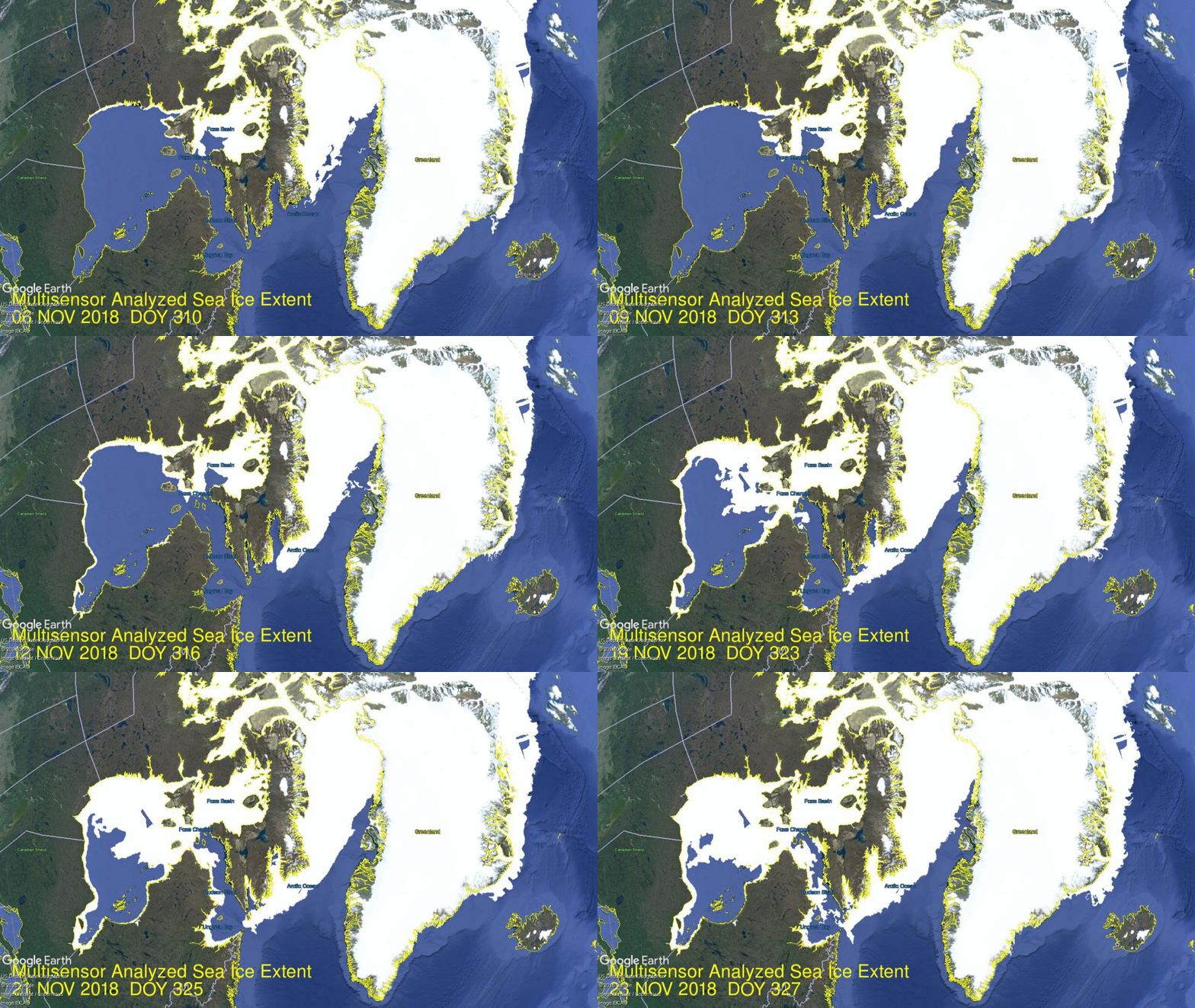
Image is from Honey, I Shrunk the Kids, a 1989 American science fiction family film produced by Walt Disney Pictures.

Repeated robotically by alarmist websites, this week’s climate scare says that burning fossil fuels is causing the earth to wobble in its spin.

Earth is Wobbling and Climate Change is to Blame Newsweek

Humans Are Causing Earth to Wobble Popular Mechanics

Human-Driven Climate Change Is Literally Making Earth ‘Wobble’ Motherboard

Earth’s rotation wobbles. NASA says humans partly to blame. Big Think

Earth’s Axis Is Drifting Inches Every Year In Part Because Of Human-Driven Climate Change IFLScience

Planet Earth Wobbles As It Spins, and Now Scientists Know Why Live Science  The case as made in the Live Science article,

Since 1899, the Earth’s axis of spin has shifted about 34 feet (10.5 meters). Now, research quantifies the reasons why and finds that a third is due to melting ice and rising sea levels, particularly in Greenland — placing the blame on the doorstep of anthropogenic climate change.

Another third of the wobble is due to land masses expanding upward as the glaciers retreat and lighten their load. The final portion is the fault of the slow churn of the mantle, the viscous middle layer of the planet.

Earth wobbles irregularly over time, which means it does not always spin on an axis running through its poles. Its axis has been drifting towards North America during most of the last century (green arrow). That direction has changed dramatically due to changes in water mass on Earth. (Image: NASA/JPS-Caltech)

After a little investigation, there are several reasons not to be alarmed about this finding.

1.The Wobble is ancient.

Scientists have long known that the distribution of mass around the Earth determines its spin, much like how the shape and weight distribution of a spinning top determines how it moves. Also, Earth’s spin isn’t perfectly even, as scientists know thanks to slight wiggles in the movements of the stars across the night sky that have been recorded for thousands of years, said Erik Ivins, a study co-author and a senior research scientist at JPL. Since the 1990s, space-based measurements have also confirmed that the Earth’s axis of rotation drifts by a few centimeters a year, generally toward Hudson Bay in northeastern Canada.

Researchers knew that a proportion of this wobble was caused by glacial isostatic adjustment, an ongoing process since the end of the last ice age 16,000 years ago. As the glaciers retreat, they relieve the land underneath of their mass. Gradually, over thousands of years, the land responds to this relief by rising like bread dough. (In some places on the edges of the ancient ice sheets, the land might also collapse because the ice had forced it to bulge upward.)

2. Wobbling results from multiple causes.

“We have provided evidence for more than one single process that is the key driver” for altering the Earth’s axis, said Surendra Adhikari, an Earth system scientist at NASA’s Jet Propulsion Laboratory in Pasadena, California, and a lead researcher on the new study.

But in the new research, published in the November issue of the journal Earth and Planetary Science Letters, Adhikari and his colleagues found that glacial isostatic adjustment was only responsible for about 1.3 inches (3.5 centimeters) of axis wobble per year. That was only about a third of the wobble — 4 inches (10.5 cm) — observed each year over the 20th century.

To fill in the gap, the research team built a computer model of the physics of Earth’s spin, feeding in data about changes in the balance of land-based ice and ocean waters over the 20th century. The researchers also accounted for other shifts in land and water, such as groundwater depletion and the building of artificial reservoirs, all part of humanity’s terraforming of the planet.

The results revealed that these environmental processes cause another 1.7 inches (4.3 cm) of wobble each year. The melting of the Greenland ice sheet was a particularly important contributor, the researchers found. That’s because Greenland has released a large amount of water that was once locked up on land into the oceans, where its mass has been redistributed, Ivins told Live Science. Mountain glaciers and small ice caps elsewhere have also contributed to sea-level rise, he said; but they aren’t as concentrated, and their effects on the Earth’s rotation often cancel each other out.

3. The mantle itself is always moving.

The glaciers and the ice melt still left a third of the wobble unaccounted for, so Adhikari and his team looked inward. The Earth’s mantle is not static, he said, but moves by the process of convection: Hotter material from closer to the core rises and cooler material sinks in a cycle of vertical motion. By including convection in the model of Earth’s wobble, the researchers had accounted for the last third of the changes in the spin over the 20th century.

4. The Wobble is not menacing.

It’s important to realize that this wobble isn’t the prelude to any sort of environmental calamity, Ivins and Adhikari said. It doesn’t affect agriculture or climate in and of itself, and any small impact on navigational equipment is easy to correct for.

“The amount [of drift] is not a huge amount,” Adhikari said.

5. Greenland ice sheet is affected by many natural factors.

A recent paper looked into unusually extensive melting in 2012. The implication of nonradiative energy fluxes dominating Greenland ice sheet exceptional ablation area surface melt in 2012 by Robert S. Fausto et al. Excerpts in italics with my bolds.

The surface energy budget consists of nonradiative (sensible, latent, rain, and subsurface) and radiative (shortwave and longwave) energy fluxes. Distinguishing the contribution of nonradiative and radiative energy fluxes in melt over the Greenland ice sheet is important to understand ice sheet surface climate sensitivity, especially in the ablation area, where the majority of melt occurs [e.g., Fausto et al., 2012a].

Ablation varies with elevation, but there are also considerable latitudinal differences as the Greenland ice sheet stretches from the upper midlatitudes (~60°N) to the high Arctic (~82°N). The largest total observed ice ablation in 2012 was 8.5 m ice eq. at QAS_L, which was 9% less than the 2010 value. This interannual variability may be attributed to larger winter snow accumulation in 2012, which maintained high surface albedo by delaying bare ice exposure during the melt season.

Given that absorbed solar radiation is the primary energy source of melt on an annual basis, the influence of intra‐annual and interannual variability in air temperature and other variables on ablation is of secondary importance [Van den Broeke et al., 2011]. Yet during the two melt episodes we focus on, which together resulted in ~14% of annual ice ablation (Table 1), the nonradiative (sensible, latent, rain, and subsurface) energy fluxes were the primary control of melt with a contribution of 53 ± 16% and 66 ± 8%, respectively, averaged for the eight western AWSs for episodes E1 and E2, respectively (Tables 1).

During the two episodes, the large longitudinal contrast in nonradiative energy fluxes contribution to surface melt stem from anomalously warm and moist southern air flow being transferred onto the western ice sheet by atmospheric flow (Figure 2b) [Neff et al., 2014; Bonne et al., 2015], while east Greenland was dominated by stable weather with relatively low cloud cover and high solar radiation (Figure 2c) [Fettweis et al., 2013; Tedesco et al., 2013].

More broadly, data from the two episodes presented here demonstrate that exceptional melt can occur during periods characterized by cloudy skies and transient atmospheric flow, with melt being dominated by nonradiative, rather than radiative fluxes in the ablation area.

Conclusions

We find that year 2012 Greenland ice sheet melt was marked not only by widespread interior surface melting [Nghiem et al., 2012] but also by an increased nonradiative (sensible, latent, and rain) energy flux contributing to melt in the ablation area of the southern and western ice sheet. Latent and sensible energy advection governed two exceptional melt episodes in July 2012 [Neff et al., 2014]. The two episodes which lasted just ~6% of the ablation period in June–August were responsible for ~14% of the annual 2012 ablation average for all PROMICE measurement sites (Table 1). At all PROMICE sites during the two exceptional melt episodes the combined sensible, latent, rain, and subsurface energy fluxes (i.e., nonradiative energy fluxes) comprised 60% of the melt energy on average (Figure 1 and Table S1).

Summary

Earth has wobbled a bit in its rotation since the beginning, and continues to do so. The movement is not large or menacing. The three causes appear to be shifting material in the mantle, land rebounding when glaciers retreat, and changes in Greenland ice sheet balance.

The latter is attributed to human activity, even though major melting events result primarily from nonradiative factors: sensible, latent, rain and subsurface energy fluxes. If you buy the notion that burning fossil fuels causes Greenland ice sheet to melt, then please contact me about my bridge in Brooklyn that I am selling.