With These Climate Policies, Doing Nothing is the Good

Matthew Lau writes at Financial post When climate policy is all error, doing nothing could be good.  Excerpts in italics with my bolds and added images.

It may not be a bad thing for Canadians that Pierre Poilievre
has been largely quiet on climate and environmental policy

Conservative leader Pierre Poilievre has not proposed much in the way of climate and environmental policy beyond scrapping the carbon tax, but if he is searching for policy ideas, one place he best not look — except for examples of what not to do — is across the pond to the U.K.’s Conservative government. Its environmental agenda is a shambolic mishmash of impoverishing energy policies, climate alarmism, excess spending, and virtue-signalling regulations that afflict consumers and businesses without any compensating environmental benefit.

If all this sounds familiar, it is because Canadians are already suffering
from the same policy agenda under the Liberals.

The British government’s latest regulatory effort is a ban on plastic utensils, plates and cups. It follows a 2020 ban on plastic straws, stir sticks and cotton swabs. The latest ban applies only to restaurants and cafes, as the government is planning a separate policy for grocery store sales of the same products next year. It is a little inconsistent that people can still buy bulk packages of plastic forks at the grocery store while not being allowed to access a single fork at a restaurant, where they might actually want to use it. But having two sets of policies implemented a year apart lets the government maximize bureaucrat-hours and so keep the public sector happy.

The problems with plastic bans are well documented.

First, plastic pollution is overwhelmingly caused by waste management problems, primarily in Asia, not single-use products in developed countries. As reported in Reason, the U.K. accounts for only 0.05 per cent of global marine plastic waste.

Second, the alternatives to single-use plastics are more expensive and of lower quality.

Third, despite decomposing more quickly, the alternatives are also often worse for the environment overall. A 2018 Danish Environmental Protection Agency study found that in order to be better for the environment than a plastic bag a conventional cotton bag would have to be re-used 7,100 times.

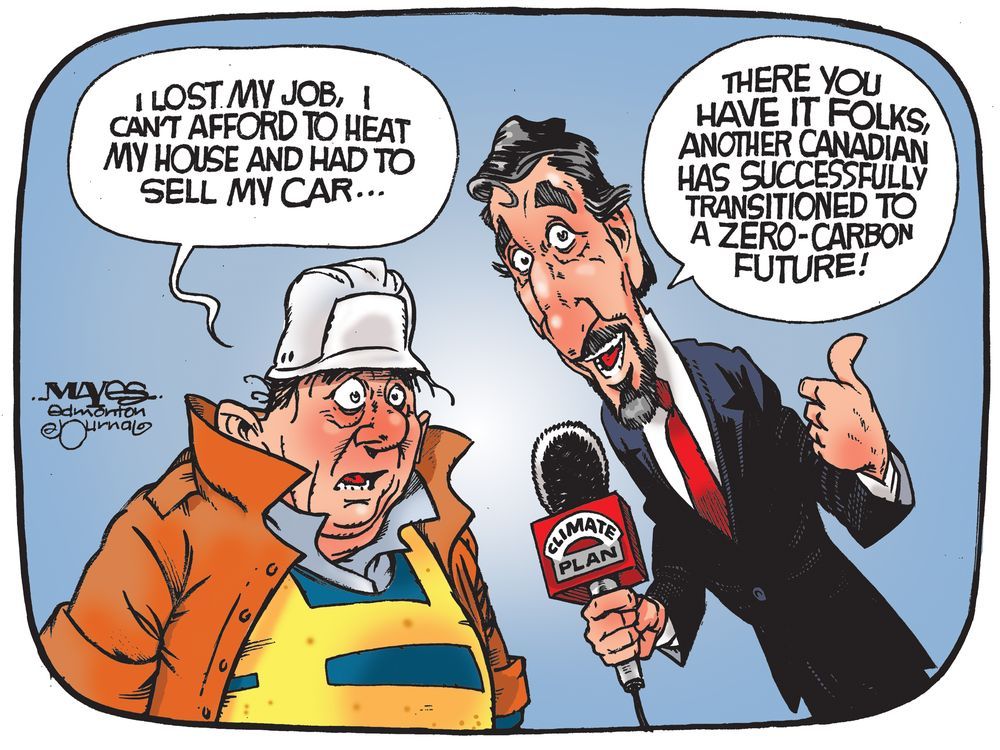
The environmental policy madness pursued by the U.K. Conservatives and similarly hopeless governments, like the Liberals in Canada, extends past the war on plastic to the war on gasoline-powered cars. In Canada, the federal government plans to mandate that at least 60 per cent of new vehicles sold must be electric by 2030, and by 2035 the sale of all new gasoline-powered vehicles will be banned. The U.K.’s mandate is even worse, as in 2020 then-prime minister Boris Johnson, for reasons unknown, decided to advance the date for banning gasoline-powered cars from 2035 (the year selected by the EU) to 2030. Hybrids will be banned by 2035.

As the Telegraph reports, government enthusiasm for switching to electric vehicles is not matched by consumer enthusiasm: higher price tags and rising electricity prices have flattened demand. A green energy group that three months ago forecast 360,000 electric vehicles would be manufactured in the U.K. by 2025 has just slashed its estimate to 280,000. Unfortunately, consumer reluctance has not stopped the government from trying to control motorists’ behaviour in order to achieve its climate ambitions. A report earlier this month from the U.K. Parliament’s Environmental Audit Committee on accelerating the transition away from fossil fuels proposed such measures as a public information campaign to lecture motorists on driving more efficiently, cutting speed limits, imposing “car-free Sundays” in large cities and car-sharing.

Philip Dunne, the Conservative MP who chairs the committee, declared the U.K. needs “a national war effort” to cut greenhouse gas emissions. Thus, in addition to the hassling of motorists there will be many more billions in spending, “green mortgages,” a call for all housing developers to fit solar panels on new houses as standard and other governmental interventions, all in pursuit of the “guiding star” of net-zero emissions by 2050. The 99-page report is not entirely bereft of reason, but as National Review’s Andrew Stuttaford concludes, it appears to be written by people who learned too little “from the economic and geopolitical disaster that Europe’s climate policy-makers have done so much to enable” and its overall direction is to push Britain faster down the path of more poverty and less freedom.

In view of all this, it may not be a bad thing for Canadians that Pierre Poilievre has been largely quiet on climate and environmental policy. A children’s book of Winnie-the-Pooh-inspired wisdom once offered the suggestion, “Don’t underestimate the value of doing nothing.”

Given the climate-policy disasters of governments of all stripes in Europe, the U.K., and Canada seeking to do something, doing nothing may not be bad advice.

Footnote

Fed’s Powell Speaks on Climate with Forked Tongue

Rupert Darwall explains the hypocrisy in his Real Clear Energy article The Fed’s Jay Powell Is Trying to Have It Both Ways on Climate Change.  Excerpts in italics with my bolds.

Fed-speak, Alan Greenspan once explained, was about practicing the art of constructive ambiguity. Testifying to Congress as Fed chairman, Greenspan would resolve a sentence in a deliberately obscure way that made it incomprehensible, “but nobody was quite sure I wasn’t saying something profound when I wasn’t.”

Speaking on Tuesday at a symposium on central bank independence in Sweden, Greenspan’s latest successor avoided ambiguity as he spoke about the Fed’s need to stick to its assigned policy goals of maximizing employment and price stability and not getting diverted to pursuing other objectives. “In a well-functioning democracy, important public policy decisions should be made, in almost all cases, by the elected branches of government,” Chair Jerome Powell declared. “It is essential that we stick to our statutory goals and authorities, and that we resist the temptation to broaden our scope to address other important social issues of the day.”

If that wasn’t clear enough, the current Fed chair noted that climate policies could have significant effects on companies, industries, regions, and nations: “Decisions about policies to directly address climate change should be made by the elected branches of government and thus reflect the public’s will as expressed through elections.” Without explicit congressional authorization, it would not be appropriate for the Fed to use monetary policy or its supervisory tools to promote a greener economy, Powell suggested. “We are not, and will not be a ‘climate policymaker.’”

But before supporters of limited government, separation of powers, and rolling back the administrative state stand up to applaud, they should remember that Powell has an indirect climate-policy tool: as part of its supervisory responsibilities, the Fed will require banks to understand and manage the financial risks of climate change. Yet at the same time, Powell would have us believe that the Fed’s supervisory decisions are “not influenced by political considerations.”

Climate “stress tests” are one of the principal tools used by the European Central Bank in furtherance of what its president Christine Lagarde openly proclaims as part of its mandate. “Our planet is burning and we central bankers could look on our mandate and pretend that it is for others to act and that we should simply be followers. I don’t think so,” Lagarde said at a June 2021 Green Swan conference of central bankers and regulators.

For its climate stress tests, the Bank of England uses the most extreme climate scenario developed by the Intergovernmental Panel on Climate Change. It then takes this projection about climate at the end of this century and telescopes eighty years of extreme climate change into three decades. The result is a physical impossibility. That a central bank believes it necessary to engage in such behavior demonstrates two things: that climate change does not represent a genuine threat to financial stability—if it did, the Bank would have used a plausible climate scenario—and that climate stress tests are indeed a tool of climate policy. Unlike the Fed, the Bank of England does have an explicit climate policy mandate. When he was Chancellor of the Exchequer, Rishi Sunak expanded the Bank’s remit to support the government’s goal of achieving “balanced growth that is also environmentally sustainable and consistent with the transition to a net zero economy.”

The Fed’s lack of a similar climate mandate proved no obstacle to Powell, however, when he spoke at the same Green Swan conference as Lagarde. The conference had been convened by the Network for the Greening of the Financial System (NGFS) to develop proposals for a more sustainable economy, financial sector, and society. “There’s a lot to like about climate stress tests,” Powell told the meeting. Not much constructive ambiguity there.

The NGFS is a club of central banks and financial regulators formed by the Banque de France in December 2017 on the second anniversary of the Paris climate agreement. Its aim is to strengthen “the global response required to meet the goals of the Paris agreement and to enhance the role of the financial system.” It also seeks “to manage risks and to mobilize capital for green and low-carbon investments in the broader context of environmentally sustainable development.” These objectives have no place in the Fed’s formal mandate.

Powell’s notion of an apolitical Fed tightly hewing to its congressional mandate
is belied by the central bank’s decision to join the NGFS.

Even more devastating to Powell’s claim of the Fed eschewing political considerations is the timing of that move: December 15, 2020, six weeks after Joe Biden defeated Donald Trump. The Fed cannot have it both ways. It cannot truthfully claim that its supervisory decisions are untainted by political considerations and remain a member of the NGFS. It was a mistake for the Fed to have joined the NGFS in the first place. If Powell wants to be believed, the Fed should quit the club.

See Also Financial Systems Have Little Risk from Climate

The Gas Stove Gambit

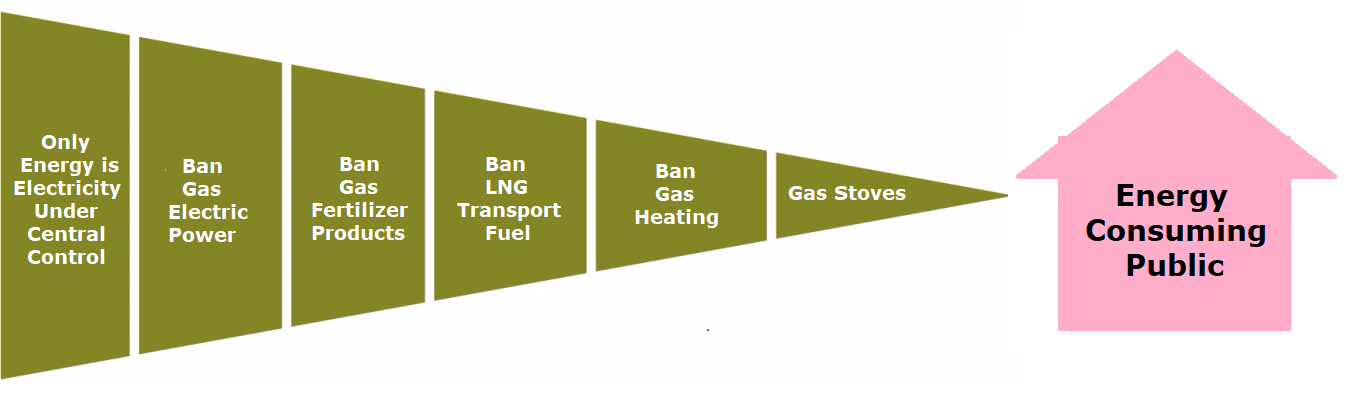
Remembering that natural gas is a fossil fuel, there must be more than meets the eye in the media firestorm over banning gas stoves for safety reasons.  Could it be that the regime along with the media are gaslighting us regarding this maneuver?  Kit Knightly thinks so and explains the gambit in his off-guardian article What is the US “Gas Stove Ban” REALLY about?  Excerpts in italics with my bolds and added images.  H/Y Tyler Durden

What sounds like overreach in itself, is actually a cover
for something potentially far, far worse.

The Biden administration is apparently looking to ban gas stoves, calling them a “hidden danger”. But while that sounds bad enough, a deeper dive shows – as usual – it’s not really about what they say it’s about.

Talk of banning gas stoves and “unregulated indoor air quality” could be a Trojan horse designed to get even more “smart” monitoring technology into your home.

Let’s jump in.

Are Gas Stoves Dangerous?

Well, according to Alexandria Ocasio Cortez, the New Scientist and million other outlets and pundits who started talking about it in the last two days, yes.

Earlier this week near-identical articles from the National Review, Bloomberg and CNN detail how the US Consumer Product Safety Commission will be opening “public comment on the dangers of gas stoves sometime this winter”.

The articles claim:

The emissions have been linked to illness, cardiovascular problems, cancer, and other health conditions. More than 12 percent of current childhood asthma cases are linked to gas stove use, according to peer-reviewed research published in the International Journal of Environmental Research and Public Health last month.

Now would be a good time to talk about the phrase “linked to”. It’s always a good one to look out for in any mainstream publication. Journalists love it because it implies causation without stating it.

Consider, one hundred per cent of serial killers have been linked to the ingestion of water and the wearing of shoes.

If this manipulative use of language were not evidence enough of an agenda, the rather premature deployment of the race card proves it:

Senator Cory Booker (D., N.J.) and Representative Don Beyer (D., Va.) wrote a letter to the agency last month urging the commission to address the issue and calling the harmful emissions a “cumulative burden” on black, Latino and low-income households.

So, Will They Ban Them?

Actually, probably not.

Considering that, according to Bloomberg, some 40% of US homes use gas stoves to cook, an outright ban would be impractical to the point of madness. You can’t criminalise 40% of the country. It would be almost unenforceable.

Perhaps they might try a “phasing out”, as they plan for petrol cars in California.

But most likely of all is that this was never really about banning stoves in the first place.

OK, So What’s IT Really About?

What we’re seeing here looks to be your classic bait-and-switch. Having established a “problem”, the powers that be suggest a solution they have no intention of ever carrying out (the more unreasonable the better).

When this measure is inevitably rejected by the public, the government will then proceed to suggest – or pay an NGO to suggest to them – a “compromise” measure.

The compromise is no compromise at all, of course, but actually what they wanted to do from the beginning. Nevertheless, the whole process is sold in the media as a victory for whichever party happens to be in opposition, and cited as evidence that “the system works”.

Tellingly, as I am writing this, Biden has already “ruled out a ban due to backlash”, and Vox were already using the “compromise” a lot in an article they published yesterday.

However, what that “compromise” would be in this case isn’t clear at first, you have to do a little digging.

One clue is present in the National Review article [emphasis added]:

The Association of Home Appliance Manufacturers argues that cooking produces harmful emissions regardless of the kind of stove used. “Ventilation is really where this discussion should be, rather than banning one particular type of technology,” Jill Notini, a vice president at the association, told Bloomberg. “Banning one type of a cooking appliance is not going to address the concerns about overall indoor air quality. We may need some behavior change, we may need [people] to turn on their hoods when cooking.”

And you’ll find another in the abstract of the original report on “Cooking With Gas, Household Air Pollution, and Asthma: Little Recognized Risk for Children”, published in the Journal of Environmental Science in April 2021:

The impact [of gas stove cooking] on children can be substantial because […] indoor air is unregulated.

“Ventilation is where this discussion should be”, after all “cooking produces harmful emissions regardless of the kind of stove” and a ban wouldn’t address “concerns about overall indoor air quality” which is currently “unregulated”.

Do you see where this is going?

It’s not about gas stoves, and it’s not about asthma – it’s about “indoor air pollution”, and more importantly how they plan on “regulating” it.

In one of those startling coincidences we’ve all got so used to witnessing in modern geopolitics, just as the US is talking about indoor air quality because of gas stoves, other countries around the world are doing the same thing for totally different reasons.

Singapore is considering new regulations on indoor air quality too, but because of formaldahyde.

Last month The Conversation was running articles claiming “indoor air pollution kills”, while Sir Chris Whitty, the UK’s chief medical officer, was “demanding action on indoor air pollution”.

On Monday, in a Guardian lifestyle piece purportedly about scented candles, Svetlana Stevanovic calls indoor air quality a “going concern”.

Two days ago The Tyee, an “independent” Canadian magazine which receives some funding from the Canadian government, ran an op-ed headlined:

We Need a Revolution in Clean Indoor Air

Which attempts to link improving indoor air quality to “ending Covid” (whilst making sure to sufficiently fluff the vaccines, of course).

Just yesterday the Irish Times published an article about the dangers of poor indoor air quality.

In a rather interesting piece of timing, the air hygiene technology company AeroClean and Molekule, a market leader for air purifiers, finalised a public stock merger…also just yesterday.

Two days ago it was announced IKEA would be selling their own smart air monitors, the same day Samsung announced their new “smart air purifier”.

Earlier today Chinese tech giant Xiaomi issued a media release about their new smart air monitoring technology.

recent report expects the global air monitor technology market to swell to nearly 6 billion dollars in the next three years.

But I’m sure this is all just a coincidence.

Where Does This Lead?

Well, if I had to guess I would suggest some new “smart” technology is coming that will monitor air quality and indoor C02 emissions. Like smart electricity and water meters, but for your air.

Interestingly, the World Economic Forum agrees with me, publishing an article on their website last July headlined “Indoor air pollution: What causes it and how to tackle it”, which claims:

indoor air pollutants can now be detected with more precise, efficient, and compact sensors thanks to advances in environmental sensing technology. As a result, intelligent home systems may soon use sensors like these to keep track of indoor air quality and notify the ventilation system before dangerous levels are reached.

As part of “backing down” from the stove ban, they will introduce a new bill which sees “smart air monitors” become mandatory in all new-build houses, hotels and rented accommodation.

Just like smart electricity meters, smart air monitors would almost certainly be used to harvest huge amounts of data and give states or corporations the ability to control your home.

If your “indoor air” isn’t “clean” enough; if you use your stove too much, burn too many scented candles or emit too much co2, expect to get penalized  in some fashion until you learn how to be more responsible.

More smart technology, more monitoring, and ultimately more control.

So, while it’s possible the gas stove ban talk will resolve itself into the cliche new tax or fines or some other petty scheme for bilking the many out of their wages, the signs are certainly there it might be something more sinister.

Meanwhile, expect to keep seeing reports on gas stoves damaging the climate, or stories about poor indoor air quality making covid worse.

The usual bought-and-paid-for columns that support every new normal narrative.

ESG Fell to Earth in 2022

Rupert Darwall writes at Real Clear Energy 2022: The Year ESG Fell to Earth.  Excerpts in italics with my bolds and added images.  H/T Tyler Durden

The year 2022 brings an end to an era of illusions: a year that saw the end of the post–Cold War era and the return of geopolitics; the first energy crisis of the enforced energy transition to net zero; and the year that brought environmental, social, and governance (ESG) investing down to earth with a thump—for the year to date, BlackRock’s ESG Screened S&P 500 ETF lost 22.2% of its value, and the S&P 500 Energy Sector Index rose 54.0%. The three are linked. By restricting investment in production of oil and gas by Western producers, ESG increases the market power of non-Western producers, thereby enabling Putin’s weaponization of energy supplies. Net zero—the holy grail of ESG—has turned out to be Russia’s most potent ally [Note: GOP House members are now advised to refer to Wind and Solar as “Not Green, Not Clean, and Empowering to China and Russia.”]

It wasn’t only a bad year for ESG on the stock market. Earlier this month, Vanguard announced that it was quitting Glasgow Financial Alliance for Net Zero (NZAM), set up by former governor of the Bank of England Mark Carney a little over a year ago. “We have decided to withdraw from NZAM so that we can provide the clarity our investors desire about the role of index funds and about how we think about material risks, including climate-related risks,” the world’s second-largest asset manager said.

Two months ago, Alex Edmans, coauthor of the latest edition of the standard textbook on the principles of corporate finance and professor of finance at the London Business School, published a paper titled “The End of ESG”—without a question mark. Edmans criticizes what has become the primary justification for ESG: the claim that business can generate higher returns for investors by tackling climate change. Since governments are democratically elected by a country’s citizens, they are best placed to address externalities, whereas investors disproportionately represent the elites. “If ESG is pursued for its externalities, companies and investors should be very clear that it may be at the expense of value,” Edmans says.

October also saw the publication of Terrence Keeley’s Sustainable, where the former BlackRock senior executive penned what amounts to a requiem for ESG. Rather than “doing well by doing good,” the logic of Keeley’s case, as I reviewed for RealClear Books, is that investors in conventional ESG investment products are likely to end up not doing very well and leave investors feeling good, not doing good.

It has not all been going one way. In May, HSBC terminated Stuart Kirk, its global head of research at HSBC’s asset-management arm, for voicing some hard truths about ESG. Earlier this month, HSBC announced that it will stop financing new oil and gas fields, putting the West’s third-largest bank on Putin’s side in Russia’s energy war on the West.

What is now a negative factor disadvantaging the West in a world increasingly characterized by East–West geopolitical tensions originated after a period when the United Nations had been fostering a horizontal global division between a rich North and an exploited South. As University of Pennsylvania’s professor Elizabeth Pollman records in her June 2022 paper “The Origins and Consequences of the ESG Moniker,” through the 1970s and early 1980s, the UN promoted the New International Economic Order that called for the regulation of transnational corporations on the alleged grounds that they were widening the gap between developed and developing countries.

The 2008 financial crisis subsequently turbocharged the uptake of ESG. Having caused the financial crisis, Wall Street was going to redeem itself by saving the world from a planetary catastrophe. Without climate change, ESG would have vastly less salience. Although marketed as a climate risk analysis tool, ESG is no such thing.

In reality, it’s about investors and debt providers driving the decarbonization
of Western companies and sunsetting its oil and gas companies.

According to ESG doctrine, there are two types of climate financial risk—physical risk and transition risk—and it’s straightforward to demonstrate that both are spurious. Take the Bank of England. For its climate stress tests, the Bank of England uses a scenario derived from the Intergovernmental Panel on Climate Change’s (IPCC) extreme and physically implausible RCP8.5 climate scenario. Roger Pielke, Jr., professor of environmental studies at the University of Colorado–Boulder, and Justin Ritchie have documented how use of the RCP8.5 scenario represents “a stubborn commitment to error,” with its absurd projection of a sixfold growth in per-capita coal consumption to 2100, based on erroneous reports in the late 1980s of virtually unlimited coal deposits in Siberia and China. The Bank of England compounds implausibility with impossibility by taking the RCP8.5 pathway of 4 degrees by the turn of the century and telescoping it into a 3.3-degree Celsius rise by 2050.

Central banks resorting to these types of games constitutes strong evidence that
climate physical risk is a nonissue for financial stability.

Similarly, climate transition risk and the stranded assets trope defy economic and financial logic. If you restrict the flow of capital into a sector producing stuff that people want and are willing to pay for, the price of the output of a capital-embargoed sector will rise, as will the value of its invested capital. This, in essence, is what has been happening in energy and capital markets over the past year and explains why ESG as an investment strategy does not work. In the absence of draconian government policies to suppress demand for oil and natural gas, ESG policies strangling the supply of capital to Western oil and gas producers have two effects: they push up the price of hydrocarbons; and they displace supply from Western producers to neutral or hostile ones, with major detriment to the economies and security interests of the West.

Although the disintegration of ESG as an investment strategy became unmistakable in 2022, its existence as a political doctrine will continue until it is challenged and defeated politically.

This is already happening in Red states such as Florida, Texas, West Virginia, and Utah. It also requires concerted leadership at a national level to get central bankers and financial regulators to quit playing covert climate policy and to shame banks such as HSBC into switching their support from Russia in the energy wars by dropping their anti–oil and gas financing policies. Defeating ESG not a case of “who cares wins” but “who fights wins.”

See Also

ESG Funds Buy Russian Over Canadian Oil

ESG Movement Threatens Us All


Southwestern Solar: Bright Shining Disappointment

Solar farms in Southwest USA from Solar Energy Maps

D. Dowd. Muska reports in his National Review article A Bright Shining Disappointment.  Excerpts in italics with my bolds and added images.

Solar has failed in the Southwest.  In the ’70s, it all seemed so simple.

President Carter issued a proclamation declaring the sun “an inexhaustible source of clean energy.” A joint resolution of Congress predicted that “the development of solar technologies will provide an abundant, economical, safe, and environmentally compatible energy supply.” Robert Redford assured Americans that “the sun will always work” and “never increase its price on a heating bill.”
But nearly 50 years later, solar’s failure is blindingly clear. The Southwest Public Policy Institute, where I serve as a senior fellow, recently explored the contribution sunshine makes to utility-scale electricity generation in eight states: Oklahoma, Texas, New Mexico, Colorado, Utah, Arizona, Nevada, and California. What we discovered was jarring.

In the Southwest, solar generates a mere 6.4 percent of utility-scale power (power from facilities where total generation capacity is one megawatt or greater), despite the region enjoying the sunniest skies in America. While California (16.7 percent) and Nevada (14.4 percent) had the heaviest solar shares, the drop-off in the other states we studied was profound: Utah (8.1 percent), Arizona (5.5 percent), New Mexico (5.0 percent), Texas (3.1 percent), and Colorado (3.0 percent). Coming in last — and by a country mile — was the Sooner State, at a miniscule 0.1 percent.

These disappointing figures are all the more perplexing when one considers the massive level of government succor that has flowed the solar industry’s way since the late 1970s, the era of Annie Hall, the Bee Gees, and the Star Wars Holiday Special. In 2012, an audit by the Government Accountability Office found that federal agencies have overseen hundreds of “initiatives that support solar energy across the four key federal roles”: R&D; “fleets and facilities,” “commercialization and deployment,” and “regulation, permitting, and compliance.” For decades, wildly generous tax credits have been offered at the federal and state levels. And in the late 1990s, lawmakers began to adopt renewable portfolio standards, which required power suppliers to generate or purchase “green” electricity. In Arizona, 15 percent of power must satisfy these standards by 2025. In Nevada, the rule is 50 percent by 2030. And in New Mexico, all electricity is mandated to be “zero carbon” by 2045.

Enjoying both free fuel and government-conferred advantages, solar power should play a leading role in the Southwest. Yet it doesn’t.

This indicates that solar’s problems are fundamental. As the Institute for Energy Research recently noted, sunlight is “relatively weak because it must first pass through the atmosphere, which protects the Earth from the sun’s intensity.” In 2015, a study by the Massachusetts Institute of Technology described the solar radiation that reaches us as suffering from “low energy density.” In addition, even the most-efficient photovoltaic panels in common use today convert far more solar irradiance to heat than electricity.

Intermittency, in energy journalist Robert Bryce’s opinion, is another “killer drawback” for solar: “Lower power output on cloudy days and during the winter — and zero output at night — means that solar power facilities must be paired with expensive batteries or conventional power plants in order to prevent blackouts or brownouts.”

“Free” fuel, it turns out, isn’t so free. As the Manhattan Institute’s Mark P. Mills explained:

Claims that wind, solar, and EVs have reached cost parity with traditional energy sources or modes of transportation are not based on evidence. Even before the latest period of rising energy prices, Germany and Britain — both further down the grid transition path than the U.S. — have seen average electricity rates rise 60%-110% over the past two decades. The same pattern is visible in Australia and Canada. It’s also apparent in U.S. states and regions where mandates have resulted in grids with a higher share of wind/solar energy. In general, overall U.S. residential electricity costs rose over the past 20 years.

But those rates should have declined because of the collapse in the cost of natural gas and coal — the two energy sources that, together, supplied nearly 70% of electricity in that period. Instead, rates have been pushed higher thanks to elevated spending on the otherwise unneeded infrastructure required to transmit wind/solar-generated electricity, as well as the increased costs to keep lights on during “droughts” of wind and sun that come from also keeping conventional power plants available (like having an extra, fully fueled car parked and ready to go) in effect by spending on two grids.

Then there’s the NIMBYs. Utility-scale solar, in community after community,
faces resistance from locals.

In November, the Roswell Daily Record reported that a New Mexico regulatory agency “voted against three proposed [solar] projects after hearing objections from county residents.” Issues raised included fencing that “will deter from scenic views and hurt property values” and “concerns that the panels contain hazardous substances.” According to The Durango Herald, residents near Hesperus, Colo., have banded together to fight a photovoltaic project, citing concerns about “water runoff” and “direct loss of 1,900 acres of elk habitat.”

In short, solar has not been shining very bright since it came on the scene in the ’70s. Indeed, even in the sun-drenched Southwest, solar has proven inefficient, unreliable, and — when all costs are considered — expensive. That should be a warning:

If it struggles here, in ideal conditions, how well
can it be expected to perform in the rest of the country?

D. Dowd. Muska is a senior fellow at the Southwest Public Policy Institute, a research institute dedicated to improving the quality of life in the American Southwest by formulating, promoting and defending sound public policy solutions.

When it opened in 2014, the Ivanpah Solar Power Facility was the world’s largest solar thermal power station, covering 4000 acres in the Mohave desert. While Ivanpah was supposed to be the future of clean energy, it seems that the rate at which it burns fossil fuel might actually outweigh any environmental benefits of solar power production.