US Conflicted over Green Energy

Joel Kotkin writes at Real Clear Energy Democrats’ Energy Dilemma.  Excerpts in italics with my bolds.

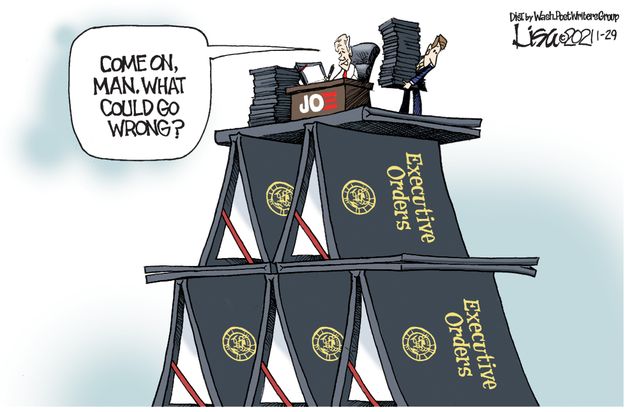
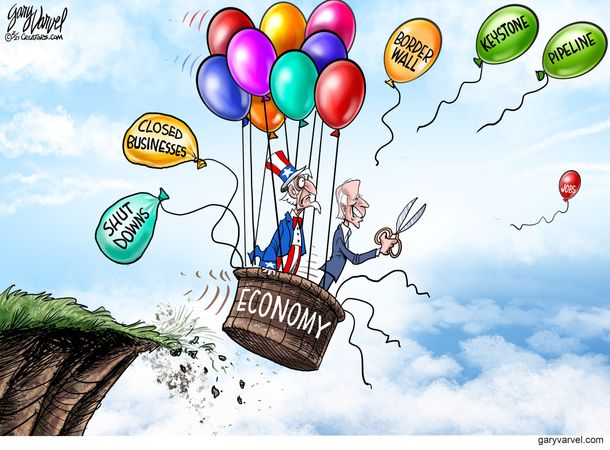
The biggest challenge facing a putative first-term Joe Biden administration and the Democratic Party may lie with energy policy, where gentry and green wishful thinking confront the daily realities of millions of middle- and working-class Americans.

Democrats could choose a climate policy that allows for gradual change – for example, transitioning from coal to natural gas – and consider the feasibility of smaller and safer nuclear plants, while keeping the productive economy afloat. But Biden, despite some wriggling about fracking on private land, just last week committed himself to the gradual eradication of the fossil fuel industry. His running mate, Senator Kamala Harris, is beloved by California’s extremist greens.

Already, in anticipation of a Democratic sweep, utilities are putting some natural gas projects on hold – threatening a powerful growth engine in places like Pennsylvania and Ohio. If Biden continues to embrace the basic thrust of the Green New Deal, if not its full-bore socialist program, the impact could be devastating for manufacturing areas that compete with China, which depend largely on natural gas, coal, and nuclear power to keep costs down. These state economies cannot fantasize, as some do in California, that the resulting social costs will be paid for by the wealthy digerati; lacking sufficient numbers of the rich and famous, these states will be hit hard, and fast.

If, as seems likely, victorious Democrats enact legislation broadly derived from the Green New Deal, major blowback – and economic disruption – seems inevitable. Biden and Harris have been almost comically inconsistent in their statements about fracking, but they’re certainly hostile to it: if they win the White House and pursue a ban, it would likely drive higher prices for energy, reduce national energy self-sufficiency, and cause massive job loss among a large number of Americans, particularly in key states like Ohio and Pennsylvania.

The critical gentry-green alliance

Energy effects so many other things – our daily bills, whether an employer locates in our town, our already-frayed economic mobility – and is thus a far broader issue, in terms of its consequences, than, say, abortion or race reparations, which often appeal to limited, albeit passionate, constituencies. Energy policy is certain to fracture the Democrats along ideological, class, and geographic lines.

In the past, Democrats tried to appeal to workers and communities connected to the oil and gas industries. Over the past decade or so, these constituencies have generally expanded; they tend to be unionized and well-paid. Yet today, organizations like the Oil, Chemical and Atomic Workers, once a militantly left union, have far less influence on Democratic politics, while the Sierra Club and its allies among the tech oligarchs and, increasingly on Wall Street, have much more.

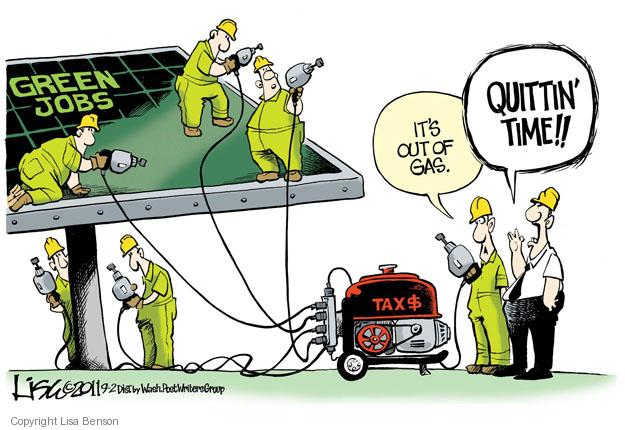
You don’t have to be Karl Marx to see the reasons why financial and tech moguls support a restrictive energy regime despite the challenges posed by the high cost and intermittent nature of renewable energy. Being “green” is great if you make such stupendous profits that a few million more dollars in energy costs won’t make much difference to your bottom line. And besides, both Wall Street and the tech moguls have become heavy investors in “green” energy schemes that, due to subsidies and tax breaks, guarantee virtually assured profits.

The “Brahmin left” – as economist Thomas Picketty puts it – benefits politically and economically from centrally imposed scarcity, under the pretext of “human survival.” These interests – notably the tech elites – have lined up massively behind Biden’s exceedingly well-funded campaign. Long before they settled on Biden, Kamala Harris, as California attorney general, was an aggressive enforcer of California’s often-draconian climate and planning laws.

Class warfare by other means

In adopting an ultra-green perspective, Democrats have made a choice to favor their backers among the fantastically rich and on Wall Street, who can use green investments to correct their increasingly low standing among the masses. Get rich, go green – and preen. Tech elites and their Wall Street allies – as opposed to populists like Bernie Sanders and Elizabeth Warren – were clear winners of the Democratic primaries.

Whatever its derivation, the green energy agenda doesn’t harmonize easily with the notion of Democrats as the “party of the people.” It represents a direct threat to the party’s once-vital working-class base. In the past, Democratic voters came in large part from the working class. Today, Democrats do better among well-educated “knowledge workers” and the prestigious companies that employ them. This leads some progressives to believe that white working-class voters are no longer critical to the party’s chances.

This voting bloc is shrinking, true, but it still constitutes as much as 44 percent of the electorate, Democratic strategist Ruy Teixeira points out. These voters provided a critical boost to President Obama’s electoral success and later to Donald Trump’s. Teixeira argues that the Democratic focus on cultural and green issues, as opposed to more lunch-bucket concerns, has limited appeal to the working class. Certainly extreme environmental policies, as seen in California, hurt poor and minority populations – and electric-car production and solar plants pose their own, though rarely reported, environmental problems.

Middle- and working-class voters may say that they want a cleaner climate – and most do want something done about climate change – but generally, they consider environmental issues low priority, and they tend to be skeptical of the costs associated with ambitious programs like the Green New Deal. Democrats may feel that minorities will support anything the party proposes as long as racism is invoked, but “people of color” are also people with their own economic interests and families to support.

Today, barely 58% of all working-class Americans are white. According to a 2016 Economic Policy Institute study, nonwhites will become the majority of the working class by 2032. In Green New Deal states like California, policies have increased “energy poverty” and taken away good blue-collar jobs, particularly for the heavily Latino working class.

Regional challenge

Energy policy is unlikely to turn California and most coastal states red (unless you’re using the traditional political meaning of that color). The potential havoc is clearer, though, in parts of the country where low energy prices and production are primary elements of the economy. One can only imagine the damage to the Democratic Party when, despite promises to the contrary, Biden and his presumed heir Harris eventually find a way to “ban” through regulations fracking in places like Texas, North Dakota, Ohio, West Virginia, and Pennsylvania. In Texas alone, by some estimates, 1 million jobs would be lost. Overall, according to a Chamber of Commerce report, a full ban would cost 14 million jobs, far more than the 8 million lost in the Great Recession.

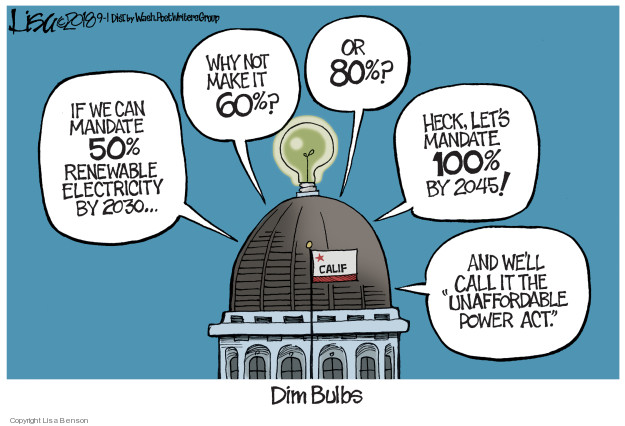
The effects will be particularly severe in the Rust Belt, still the fulcrum of American politics. Trump may be underperforming in high-end suburbs, but he’s still doing well in once-Democratic parts of the Midwest, such as Minnesota’s mining country. Beyond the extractive industries, far bigger sectors – logistics, agriculture, and manufacturing – would face serious problems with intermittent and expensive “green energy,” as a recent MIT report suggests. These policies have already been tied to persistent blackouts in California that forced the Golden State to depend on imported energy and delayed its planned decommissioning of gas plants.

These realities may not be enough to save Donald Trump at the polls, but over time, they could further alienate voters in a broad swath of states that generally determine the country’s political future. Ultimately, the test for Joe Biden, and his party, lies in the old union slogan: “Which side are you on?” If Democrats adhere blindly to California’s Ecotopian absolutism, glasses may clink at Davos, on Wall Street, and in San Francisco, but “the party of the people” will surrender its historic legacy – perhaps permanently.

Solar and Wind Energy Underestimated? Not.

Source: Smil (2012) and IEA

The first part of this post is a report that the IEA is accused of underestimating the amount of solar and wind power in recent years.  The second part presents analyses showing that media hype and misinformation lead the public to routinely overestimate the portion solar and wind contribute to power modern societies.

The IEA is under pressure about their wind and solar energy numbers, as reported at energypost.eu World Energy Outlook 2020: IEA responds to some difficult questions.  Excerpts in italics with my bolds

The IEA has issued an FAQ to try to answer some persistent questions and criticisms about their annual World Energy Outlooks (WEO). How come the growth of solar and wind have been consistently underestimated? When is “peak oil” going to happen? Will the IEA’s Sustainable Development Scenario limit the global temperature rise to 1.5 °C this century? Is it realistic? Why has a “Net Zero Emissions by 2050” (NZE2050) pathway been added this year? Do the IEA scenarios rely too much on carbon capture? In this article the IEA forcefully emphasizes that a WEO “…is not, and has never been, a forecast of where the energy world will end up.” It’s to explore pathways. Only governments and citizens can make any of it a reality.
Regarding the NZE2050, “unparalleled changes across all parts of the energy sector would need to be realized simultaneously, at a time when the world is trying to recover from the Covid-19 pandemic”, something that is clearly not happening, says the IEA.

Q. The WEO has been accused of underestimating the growth of renewable energy technologies such as solar PV and wind. Why is this? And are its latest numbers more accurate?

A. This accusation results from a misunderstanding or mischaracterisation of the WEO’s scenarios, as outlined in the answer above. The spectacular growth of wind and especially solar PV over the past two decades has far outstripped many projections made during the period. This is true for the projections included in past editions of the WEO, which were based on the policies that had been put in place or proposed at the time of publication. Significant new policies that were announced subsequently changed the trajectories of wind and solar by generating new demand and investment, thereby helping foster technological advances and cost declines.

A good example of this is China, where policies and targets for solar strengthened dramatically after 2007, putting China on a path to becoming a driving force for solar worldwide.

The projections in this year’s WEO reflect the continuing technology advances and cost declines of wind and solar. In the STEPS, renewables meet 80% of the growth in global electricity demand to 2030. Solar is the main driver of growth, becoming the new king of electricity markets worldwide as it sets new records for deployment each year after 2022, followed by onshore and offshore wind. The advance of renewable sources of generation, and of solar in particular, is much stronger in the SDS, where solar generates 13 times as much electricity in 2040 as it did in 2019. Growth is even more rapid in the NZE2050.

So IEA answers the criticism by claiming a rosy future for renewables compared to past performance.  Left out is any reference to how small is the baseline, which makes easy impressive growth numbers.  Left out also is any measure of the proportion of total energy supply coming from renewables, specifically wind and solar, despite referring to solar as “the new king of electricity markets worldwide.”  That misleading lack of perspective is addressed in a previous post reprinted below.

Exaggerating Green Energy Supply (previous post)

dave_gangland

As noted here before, public opinion surveys are often “push polls”, raising issues like climate change as part of an effort to promote public concern.  Such surveys also inform activists how successful or not has been the media messaging in generating belief and support for climate policy proposals.

Sometimes the questionnaires are manipulated to show the greatest possible public awareness and support..  For example, see:  The Art of Rigging Climate Polls.

Other times, the survey is used to chide the public for failing to buy into claims and propaganda prominently advanced in the media.  For example, see: “Hottest Year” Misdirection, where mainstream media claims 17 of the last 18 years were the hottest on record, while the public in 37 countries guessed only 9.  After checking the data, the correct answer is more likely 5.

That same survey, Perils of Perceptions, reported that in most countries the public overestimates how much green energy they consume.  That finding is the subject of this post.  As we will see, energy from renewables is perceived to be much higher than numbers from the World Bank. 

And since those numbers are themselves exaggerated, the gap between virtuous green behavior and performance is even greater than stated.

The renewable energy finding from Ipsos (here):

The majority of countries overestimate the amount of energy used that comes from renewable sources in their country. The average guess is 26% when it’s actually only 19%. Malaysia, Saudi Arabia, China and Singapore were the furthest out; some countries, though, actually underestimate how much progress they have made with renewables, such as Sweden and Montenegro.

Now, 19% of energy consumed coming from renewables looks high to me, so let’s explore two of the countries:  Canada and the Netherlands.

First, The Canadian Story on Green Energy Supply

energyuse

Question is Framed to be Misleading

Note that wind and solar power are presented as examples of renewable energy sources, when in reality hydro and nuclear are much larger sources of power (electricity). Note also respondents are led to confuse power with total energy, which is a much larger amount.

What is the Reality of Canadian Energy Supply (Consumption)

World Bank shows 22% of Canada’s total energy consumption was from renewables in 1990 and 2015.

Let’s test that number against the Canadian Energy Fact Book 2016–2017 (which presents 2014 as the latest statistics).  The categories are defined nicely in this diagram:
Energy FlowWorking from the top down, first is the mix of total primary energy supply by source:
Canada Primary Energy Supply
In this fact book, energy supply is equivalent to energy consumed, since it is calculated after adjusting for energy imports and exports. Note that 17.7% is the amount of energy from renewables, and hydro is 11.6%.   Let’s see how much of renewable energy comes from wind and solar:
Canada Renewable EnergySo Canadians actually consume 4.4% of their renewable energy from wind and solar. 92% of Canadian renewable energy comes from the traditional sources:  Hydro dams and burning wood.

Combining the two tables, we see that 80% of the Other Renewables is solid biomass (wood), which leaves at most 1% of Canadian total energy supply coming from wind and solar.

Second, the Netherlands Green Energy Story

According to the Ipsos Perils of Perception survey, respondents from the Netherlands said on average 22% of their energy is Green, while the World Bank says only 6% comes from Green sources.  Last year there was a provocative and entertaining analysis of Dutch perceptions versus green energy realities broadcast on a popular Sunday morning TV show.  The episode was called Green Electrical Shocks, and is provided below for your enjoyment and edification.

Green Electrical Shocks


On Sunday Feb.4, 2018, a weekly news program aired in the Netherlands on the titled subject. H/T Climate Scepticism. The video clip is below with English subtitles. For those who prefer reading, I provide the substantial excerpts from the program with my bolds.

How many of you have Green Electricity? I will estimate 69%
And how much nationally? Oh, 69%!
So we are very average, and in a good way, because the climate is very important.

Let me ask: Green electricity comes from . . .?
Yes, electricity produced from windmills and solar panels.
Nearly 2/3 of the Dutch are using it. That’s the image.

Well I have green news and bad news.
The green news: Well done!
The bad news: It is all one big lie.
Time for the Green Electrical Shocks.

Shock #1: The green electricity from your socket is not green.
When I switched to green electricity I was very proud.
I thought, Yes, well done! The climate is getting warmer, but not any more thanks to me.

Well, that turned out to be untrue.
All producers deliver to one communal grid. Green and grey electricity all mix.
The electricity you use is always a mix of various sources.
OK. It actually makes sense not to have separate green and grey cables for every house.
So it means that of all electricity, 69% is produced in a sustainable way. But then:

Shock #2: Green Electricity is mostly fake.
Most of the green electricity we think we use comes from abroad.
You may think: So what. Green is green.

But that electricity doesn’t come from abroad, it stays abroad.
If you have green electricity at home, it may mean nothing more than that your supplier has bought “green electricity certificates”.

In Europe green electricity gets an official certificate,
Instead of selling on the electricity, they sell on those certificates.
Norway, with its hydro power, has a surplus of certificates.
Dutch suppliers buy them on a massive scale, while the electricity stays in Norway.

The idea was: if countries can sell those certificates, they can make money by producing more green electricity.
But the Norwegians don’t produce more green electricity.
But they do sell certificates.

The Dutch suppliers wave with those certificates, and say Look! Our grey electricity is green.
Only one country has produced green electricity: Norway.
But two countries take the credit.
Norway, because they produce green electricity, and the Netherlands because, on paper, we have green electricity. Get it? That’s a nice deal.

More and more countries sell those certificates. Italy is now the top supplier.
We buy fake green electricity from Italy, like some kind of Karma ham.

Now, let’s look again at the green electricity we all think we use.
So the real picture isn’t 69%. If you cancel the certificates, only 21% of electricity is really green.
Nowadays you can even order it separately if you don’t want to be part of that Norway certificates scam.
You may think: 21% green is still quite a lot. But it is time for:

Shock #3: Not all energy is electricity.
If you talk about the climate, you shouldn’t just consider electricity but all energy.
When you look at all energy, like factories, cars, trains, gas fires, then the share of consumer electricity is virtually nothing.
If you include everything in your calculation, it turns out that only 6% of all the energy we use in the Netherlands is green. It is a comedy, but wait:

Trees converted into pellets by means of petroleum powered machinery.

Shock #4: Most green energy doesn’t come from sun or wind, like you might think.
Even the 6%, our last green hope, is fake. According to the CBS we are using more sun and wind energy, but most of the green energy is produced by the burning of biomass.
Ah, more than half of the 6% green energy is biomass.

Ridiculous. What is biomass really? It is organic materials that we encounter every day.
Like the content of a compost heap. How about maize leaves or hay?
The idea behind burning organic materials is that it will grow up again.
So CO2 is released when you burn it, but it will be absorbed again by new trees.

However, there is one problem. The forest grows very slowly and our power plants burn very fast.
This is the fatal flaw in the thinking about biomass. Power plants burn trees too fast, so my solution: slow fire. Disadvantage: it doesn’t exist. So this is our next shock.

Shock#5: Biomass isn’t all that sustainable.
It’s getting worse. There aren’t enough trees in the Netherlands for biomass.
We can’t do it on our own. We don’t have enough wood, so we get it from America.

In the USA forests are cut at a high rate, Trees are shredded and compressed into pellets.
These are shipped to the Netherlands and end up in the ovens of the coal plants.
It’s a disaster for the American forests, according to environmental groups.

So we transport American forests on diesel ships to Europe.
Then throw them in the oven because it officially counts as green energy.
Only because the CO2 released this way doesn’t count for our total emissions.

In reality biomass emits more CO2 than natural gas and coal.
These are laws of nature, no matter what European laws say.
At the bottom line, how much sustainable energy do we really have in the Netherlands?
Well, the only real green energy from windmills, solar panels etc. Is only 2.2%. of all the energy we use.

In Conclusion
So the fact that 2/3 of the audience and of all Dutch people use green electricity means absolutely nothing. It’s only 2.2%, and crazier still, the government says it should be at 14% by 2020.
They promised: to us, to Europe, to planet Earth: 14 instead of 2.2.

Instead of making a serious attempt to save the climate, they are only working on accounting tricks, like buying pieces of paper in Norway and burning American forests.
They are only saving the climate on paper.

Summary Comment

As the stool above shows, the climate change package sits on three premises. The first is the science bit, consisting of an unproven claim that observed warming is caused by humans burning fossil fuels. The second part rests on impact studies from billions of research dollars spent uncovering any and all possible negatives from warming. And the third leg is climate policies showing how governments can “fight climate change.”

It is refreshing to see more and more articles by people reasoning about climate change/global warming and expressing rational positions. Increasingly, analysts are unbundling the package and questioning not only the science, but also pointing out positives from CO2 and warming.  And as the Dutch telecast shows, ineffective government policies are also fair game.

More on flawed climate policies at Reasoning About Climate


An End to Frivolous Climate Lawsuits?

Craig Richardson writes at Real Clear Energy The Supreme Court Is Taking Critical Step Towards Resolving Frivolous Climate Suits. Excerpts in italics with my bolds.

Sometimes the most important Supreme Court decisions are overlooked because of their technical nature. That is the case with the Supreme Court’s choice to hear jurisdictional claims in B.P. P.L.C., et al. v. Mayor and City Council of Baltimore.

The Court’s ruling will either allow cities to pursue superfluous nuisance claims against energy companies in state courts or limit the suits to federal courts that are less prone to accept broad liability claims.

These jurisdictional claims are significant because they set the appropriate scope of appellate review for these suits. Lawsuits predicated on federal laws and involving federal officers’ actions should be decided at the federal level. By agreeing to hear arguments in the Baltimore case, the Supreme Court is taking a crucial step towards setting a consistent legal playing field.

The Supreme Court will not rule on the merits of Baltimore’s claims. Instead, they will decide whether the defendants can appeal a jurisdictional claim after a federal court rejects it.

Under existing law, it is clear the defendant can appeal aspects of the decision, but not whether the whole claim is fair game. A ruling in favor of the defendants would force multiple Circuit Courts to reevaluate their previous rulings and rehear jurisdictional claims by the energy companies.

Even though the justices won’t decide on the merits, the key is the context of Baltimore’s lawsuit. For years, city and state officials have been – in partnership with trial lawyers and leftist environmental groups – twisting the meaning of public nuisance laws to sue energy companies for their alleged contributions to climate change, even though these companies aren’t breaking the law. In recent months, localities have filed even more suits, making it especially important that lower courts know whether these cases should be resolved at the federal or state level.

These suits aren’t about helping the environment but are filed by leftist politicians and their backers hoping to score political points as they desperately attempt to fill their city or state coffers.

A senior Rhode Island official said the state’s climate lawsuit was designed to create a “sustainable funding stream” for Rhode Island. The state is desperate for funding because decades of big-spending policies have left Rhode Island officials with a budget deficit approaching $160 million.

In another instance, San Mateo County filed a lawsuit claiming there was a 93% risk of deadly floods by 2050 while telling municipal investors they had nothing to worry about. The S.E.C. is now investigating the county for fraud, and it is clear its lawsuit is motivated by politics, not science.

Instead of addressing climate change or working to build a sustainable future, leftist officials are trying to profit off energy companies, which would drive up the cost for all Americans. Given the clear political undertones of these cases, and the potential devastating impact on the U.S. economy, they must receive a fair hearing in a neutral venue.

It shouldn’t be surprising that state and city officials are fighting to have the cases heard in the state courts, the most favorable jurisdictions possible for them. Local officials are confident they can find a state judge who will issue a broad ruling against the energy companies, which would be difficult to overturn on appeal, regardless of the merits.

This outcome would be a disaster for energy companies and their customers, who would have to worry about individual state judges’ whims. These judges could create a mishmash of legal rulings that ends up being totally incoherent. It is easy to imagine a scenario where the defendants prevail in most of these frivolous lawsuits but lose a few in unfriendly jurisdictions and all of us will pay the price monetarily.

Additionally, state courts shouldn’t be addressing national political issues, especially on climate change, an issue that in the past the Supreme Court ruled should be handled by Congress and the president, not state courts. If laws need to be changed, Congress should change them, instead of having individual judges legislate from the bench. Some courts have already dismissed similar climate suits for this very reason.

Allowing state courts to decide debates of global importance is a recipe for disaster.

Generally, federal courts “are far less likely, as a whole and with some exceptions, to be willing to entertain expansive theories of liability than state courts,” according to George Mason University law professor Donald Kochan. This means federal courts are unlikely to perform legal gymnastics to try and hold energy companies accountable when it is clear they are operating within the law and have permits from the government.

Green Trucks May be Fraud

Another Green Energy dream product is looking like a swindle.  Despite California’s declaring an end to fossil fuel vehicles, these trucks are little more than smoke and mirrors.  Stef Schrader explains at The Drive Now the Justice Department Is Looking Into the Nikola Fraud Allegations. Excerpts in italics with my bolds.

The DOJ is joining the Securities and Exchange Commission’s probe into claims that Nikola misled investors with overblown claims about its own tech.

The U.S. Department of Justice has now initiated a probe into the allegations that electric and hydrogen truck startup Nikola made misleading claims about its technology to investors, reports the Wall Street Journal. The Justice Department is working with the Securities and Exchange Commission on the probe, who already started examining these allegations.

Federal prosecutors in the Manhattan U.S. attorney’s office are looking into reports that Nikola misrepresented its progress in developing technology that was key to its upcoming models.

Nikola came out swinging with big promises, including a hydrogen fuel cell semi-truck capable of going 750 miles per fill-up and a 600-mile-range electric pickup that would beat even the recently unveiled EV range queen, the 517-mile Lucid Air.

The company’s initial public offering was in June, which went so well that the company rocketed up to a $26.3 billion market valuation, which made its CEO Trevor Milton the 188th richest person in the world.

Nikola has been in a back-and-forth fight this month with self-proclaimed short seller Hindenberg Research, who published a detailed report claiming that Nikola engaged in “intricate fraud” to inflate its company valuation to incredible heights for a truck company that hasn’t actually sold any trucks yet.

Hindenburg alleged that Nikola used rolling models in promoting the company instead of functional prototypes without defining them as such, made exaggerated claims about its battery technology, and that Milton engaged in nepotism to hire his brother to build out the company’s hydrogen network.

In response, Nikola threatened legal action against Hindenburg and hired an attorney, who contacted the SEC about the report on Friday, according to the Wall Street Journal. (I guess they got what they wanted—sort of?) The company admitted to using non-running but rolling trucks in a 2018 Nikola One advertisement and at the 2016 unveiling of the Nikola One, but notes that the company was privately held at the time, and that it had the necessary components to make the trucks run—albeit still in development.

Nikola lost over 20% of its valuation since Hindenburg’s report dropped last Thursday, the WSJ reports. Securities filings from Monday show that Milton increased his investment in the company to over 41,000 shares for $1.2 million, meaning that Milton now owns a quarter of the company. The company has also hired a crisis management firm, Joele Frank, Wilkinson Brimmer Katcher.

That wasn’t the first allegation that the once-success story wasn’t what it seemed. A Bloomberg report in June claimed that Nikola led the public to believe that a show model of the Nikola One semi-truck was driveable when it was not. Milton also responded with legal threats against Bloomberg.

Even though none of these allegations directly involve any behavior on the part of Nikola partner General Motors, it’s still rather damning, as it insinuates that GM wasn’t able to see through Nikola’s allegedly overblown claims. GM agreed to take an 11% stake in Nikola in exchange for GM building the Badger pickup in one of its factories and GM supplying Nikola with batteries and fuel-cell tech in the near future.

Thus far, GM CEO Mary Barra has defended the company’s decision to partner with Nikola, telling the Wall Street Journal, “Our company has worked with a lot of different partners. We’re a very capable team that has done the appropriate diligence.”

According to the WSJ, Nikola announced Monday that it delayed the delivery of its first prototype truck from later this year to early 2021. That truck is destined to go to Anheuser-Busch, which Nikola says ordered 800 trucks in 2018. The company also claimed to receive an order for 2,500 trucks from waste company Republic Services in August.


EPA Skeptical of Cal Ban on Gas Cars

The federal government is raising legal and practical questions about a recent California executive order attempting to end sales of gas-powered cars in the state by 2035.  Source Microsoft News: Excerpts in italics with my bolds.

Environmental Protection Agency (EPA) Administrator Andrew Wheeler wrote to California Gov. Gavin Newsom (D) on Monday, saying he believes California would need to request a waiver from his agency for the order to be implemented and implying that the state’s electricity infrastructure is insufficient for a shift toward electric vehicles.

While the [executive order] seems to be mostly aspirational and on its own would accomplish very little, any attempt by the California Air Resources Board to implement sections of it may require California to request a waiver to U.S. EPA,” Wheeler wrote.

The EPA last year revoked a waiver that allowed California to set its own vehicle tailpipe emissions standards, so it appears unlikely that the agency would grant one on car sales under the current administration.

California, alongside 22 other states, has sued the agency over that decision, arguing that its standards were achievable and that the EPA’s decision is bad for climate change.

The executive order also comes as California has recently faced rolling blackouts, Wheeler noted.

“California’s record of rolling blackouts – unprecedented in size and scope – coupled with recent requests to neighboring states for power begs the question of how you expect to run an electric car fleet that will come with significant increases in electricity demand, when you can’t even keep the lights on today,” the country’s top environmental official wrote.

“The truth is that if the state were driving 100 percent electric vehicles today, the state would be dealing with even worse power shortages than the ones that have already caused a series of otherwise preventable environmental and public health consequences,” he added.

The Wheeler letter is here.

Red Flag: Ontario’s Green Energy Debacle

Babatunde Williams writes at Spiked Ontario’s green-energy catastrophe.  Excerpts in italics with my bolds

A transition to renewables sent energy prices soaring, pushed thousands into poverty and fueled a populist backlash.

In February 2009, Ontario passed its Green Energy Act (GEA). It was signed a week after Obama’s Economic Recovery and Reinvestment Act in the US, following several months of slow and arduous negotiations. It also had grand plans to start a ‘green’ recovery following the financial crash – although on a more modest scale.

This was the plan: increased integration of wind and solar energy into Ontario’s electricity grid would shut down coal plants and create 50,000 green jobs in the first three years alone.

Additionally, First Nations communities would manage their own electricity supply and distribution – what observers would later call the ‘decolonisation’ of energy – empowering Canada’s indigenous communities who had been disenfranchised by historical trauma. Lawmakers promised that clean and sustainable energy provided by renewables would also reduce costs for poorer citizens. This won an endorsement from Ontario’s Low Income Energy Network – a group which campaigns for universal access to affordable energy.

But on 1 January, 2019, Ontario repealed the GEA, one month before its 10th anniversary. The 50,000 guaranteed jobs never materialised. The ‘decolonisation’ of energy didn’t work out, either. A third of indigenous Ontarians now live in energy poverty. Ontarians watched in dismay as their electricity bills more than doubled during the life of the GEA. Their electricity costs are now among the highest in North America.

To understand how the GEA went irreparably wrong, we must look at Ontario’s contracts with its green-energy suppliers. Today, Ontario’s contracts guarantee to electricity suppliers that they ‘will be paid for each kWh of electricity generated from the renewable energy project’, regardless of whether this electricity is consumed. As preposterous as this may seem, it’s actually an improvement on many of the original contracts the Ontario government locked itself into.

Earlier contracts guaranteed payments that benchmarked close to 100 per cent of the supplier’s capacity, rather than the electricity generated. So if a participating producer supplied only 33 per cent of its capacity in a given year, the state would still pay it as if it had produced 100 per cent.

This was especially alarming in context, as 97 per cent of the applicants to the GEA programme were using wind or solar energy. These are both intermittent forms of energy. In an hour, day or month with little wind or sun, wind and solar farms can’t supply the grid with electricity, and other sources are needed for back-up. As a result, wind and solar electricity providers can only supplement the grid but cannot replace consistently reliable power plants like gas or nuclear.

Many governments, including other Canadian provinces, have used subsidies of all hues to incentivise renewables. But Ontario put this strategy on steroids. For example, the Council for Clean and Reliable Energy found that ‘in 2015, Ontario’s wind farms operated at less than one-third capacity more than half (58 per cent) the time’. Regardless, Ontarians paid multiple contracts as if wind farms had operated at full capacity all year round. To add insult to injury, Ontario’s GEA contracts guaranteed exorbitant prices for renewable energy – often at up to 40 times the cost of conventional power for 20 years.

By 2015, Ontario’s auditor general, Bonnie Lysyk, concluded that citizens had paid ‘a total of $37 billion’ above the market rate for energy. They were even ‘expected to pay another $133 billion from 2015 to 2032’, again, ‘on top of market valuations’. (One steelmaker has taken the Ontarian government to court for these exorbitant energy costs.)

Today, this problem persists.  Furthermore, electricity demand from ratepayers declined between 2011 and 2015, and has continued to fall. Ontarians were forced to pay higher prices for new electricity capacity, even as their consumption was going down.

Ontario’s auditor general in 2015 stated that: ‘The implied cost of using non-hydro renewables to reduce carbon emissions in the electricity sector was quite high: approximately $257 million [£150million] for each megatonne of emissions reduced.’ Per tonne of carbon reduced, the Ontario scheme has cost 48 per cent more than Sweden’s carbon tax – the most expensive carbon tax in the world.

Clearly, bad policy has led to exorbitant waste. This wasn’t the result of corruption or conspiracy – it was sheer incompetence. It’s a meandering story of confusion and gross policy blunders that will fuel energy poverty in Ontario for at least another decade.

As democracies across the West respond to the coronavirus crisis with hastily prepared financial packages for a ‘green recovery’, they should consider the cautionary tale of Ontario.

The GEA’s stubborn defenders refuse to recognise that poor policy, even with the best intentions, discredits future efforts at cutting emissions. ‘Green New Deals’ for the post-pandemic recovery in the US and Europe should learn from the GEA. Clean energy at any cost will be rightfully short-lived and repealed, and its supporters will be unceremoniously booted out of power.

See Also:  Electrical Madness in Green Ontario


Conn AG Adds to Climate Lawsuit Dominos

Climate Dominos

William Allison reports at Energy In Depth Echoes of New York’s Failure:  Connecticut Files Climate Lawsuit.  Excerpts in italics with my bolds.

Four Years In The Making, But The Same Failed Arguments

Back in 2016, Tong’s predecessor, former Attorney General George Jespen, enlisted Connecticut to take part in former New York Attorney General’s Eric Schneiderman’s “AGs United for Clean Power” – a coalition of state attorneys general that aimed to investigate major energy companies over climate change. Not only did Jepsen participate in the March 2016 press conference announcing the coalition, he discussed how it’s formation allowed for easier collaboration between attorneys general.

While the coalition ultimately fell apart, following the withdrawal of several attorneys general and scrutiny over the political motivation behind its formation, the group’s demise (and even New York’s unsuccessful lawsuit) hasn’t stopped Tong. In fact, he’s using many of the same arguments that Schneiderman ineffectively deployed nearly five years ago.

In Monday’s press conference announcing the Connecticut lawsuit, AG Tong said:

“We tried to think long and hard about what our best and most impactful contribution would be. And what we settled on was a single defendant with a very simple claim: Exxon knew, and they lied.” (emphasis added)

Apparently Tong did not get the memo that “Exxon Knew” – the theory pushed by activists and lawyers that the company knew about climate change and hid that knowledge from the public – has been completely debunked. It was this theory that Schneiderman initially built his case against the company around, but he was forced to abandon it because the facts were not on his side. Indeed, after his successor was told to told “to put or shut up” on the accusations, the lawsuit was revised to remove these claims and instead focus on alleged accounting fraud. The case resulted in a resounding defeat for the New York attorney general, with State Supreme Court Justice Barry Ostrager calling the lawsuit “hyperbolic” and “without merit.”

The only other two climate lawsuits that have been decided on their merits were filed by San Francisco and Oakland and then New York City, both of which failed.

Connecticut Has Benefitted From The National Campaign

The Connecticut lawsuit isn’t a standalone effort, but part of a larger national campaign supported and funded by activist and wealthy donors to pursue climate litigation against energy companies.

Tong is still pursing the “Exxon Knew” angle that’s been developed by this campaign despite its previous losses and thinks his lawsuit is the strongest in the nation because Connecticut’s Connecticut Unfair Trade Practices Act doesn’t have a statute of limitations, allowing him to recall ExxonMobil documents from decades ago – even though the company already turned over 3 million documents as part of the New York Attorney General’s failed investigation.

Connecticut was also mentioned in the Pay Up Climate Polluters report, “Climate Costs 2040,” which seems to be a target list of cities to carry out potential litigation, as recent plaintiffs Hoboken, N.J. and Charleston, S.C. were also featured. Pay Up Climate Polluters is a campaign that promotes climate litigation that is sponsored by Center for Climate Integrity, which in turn is a project of Institute for Governance and Sustainable Development (IGSD), which, ironically enough, is paying for the outside counsel in Hoboken’s lawsuit.

IGSD also receives money from a network of Rockefeller groups, which with the help of wealthy donors and activists, have manufactured the entire climate litigation campaign. Tong even filed an amicus brief in support of the climate lawsuit filed by San Francisco and Oakland.

During his press conference, Tong even thanked 350.org and The Sunrise Movement, two other Rockefeller-supported groups that support and actively promote climate litigation.

Conclusion

The lawsuit filed by the Connecticut Attorney General is just the latest case to emerge in the broader, national campaign being pushed by weather donors and activist groups. But while a new lawsuit generates new headlines, it does nothing to change the fact that it’s based on another rehashing of the debunked “Exxon Knew” theory that failed in New York and will do nothing to address climate change.

Background from Previous Post:  Climate Lawsuit Dominos

Posted to Energy March 05, 2020 by Curt Levey writes at InsideSources Climate Change Lawsuits Collapsing Like Dominoes.  Excerpts in italics with my bolds.

Climate change activists went to court in California recently trying to halt a long losing streak in their quest to punish energy companies for aiding and abetting the world’s consumption of fossil fuels.

A handful of California cities — big consumers of fossil fuels themselves — asked the U.S. Court of Appeals for the Ninth Circuit to reverse the predictable dismissal of their public nuisance lawsuit seeking to pin the entire blame for global warming on five energy producers: BP, Chevron, ConocoPhillips, ExxonMobil and Royal Dutch Shell.

The cities hope to soak the companies for billions of dollars of damages, which they claim they’ll use to build sea walls, better sewer systems and the like in anticipation of rising seas and extreme weather that might result from climate change.

But no plaintiff has ever succeeded in bringing a public nuisance lawsuit based on climate change.

To the contrary, these lawsuits are beginning to collapse like dominoes as courts remind the plaintiffs that it is the legislative and executive branches — not the judicial branch — that have the authority and expertise to determine climate policy.

Climate change activists should have gotten the message in 2011 when the Supreme Court ruled against eight states and other plaintiffs who brought nuisance claims for the greenhouse gas emissions produced by electric power plants.

The Court ruled unanimously in American Electric Power v. Connecticut that the federal Clean Air Act, under which such emissions are subject to EPA regulation, preempts such lawsuits.

The Justices emphasized that “Congress designated an expert agency, here, EPA … [that] is surely better equipped to do the job than individual district judges issuing ad hoc, case-by-case injunctions” and better able to weigh “the environmental benefit potentially achievable [against] our Nation’s energy needs and the possibility of economic disruption.”

The Court noted that this was true of “questions of national or international policy” in general, reminding us why the larger trend of misusing public nuisance lawsuits is a problem.

The California cities, led by Oakland and San Francisco, tried to get around this Supreme Court precedent by focusing on the international nature of the emissions at issue.

But that approach backfired in 2018 when federal district judge William Alsup concluded that a worldwide problem “deserves a solution on a more vast scale than can be supplied by a district judge or jury in a public nuisance case.” Alsup, a liberal Clinton appointee, noted that “Without [fossil] fuels, virtually all of our monumental progress would have been impossible.”

In July 2018, a federal judge in Manhattan tossed out a nearly identical lawsuit by New York City on the same grounds. The city is appealing.

Meanwhile, climate lawfare is also being waged against energy companies by Rhode Island and a number of municipal governments, including Baltimore. Like the other failed cases, these governments seek billions of dollars.

Adding to the string of defeats was the Ninth Circuit’s rejection last month of the so-called “children’s” climate suit, which took a somewhat different approach by pitting a bunch of child plaintiffs against the federal government.

The children alleged “psychological harms, others impairment to recreational interests, others exacerbated medical conditions, and others damage to property” and sought an injunction forcing the executive branch to phase out fossil fuel emissions.

Judge Andrew Hurwitz, an Obama appointee, wrote for the majority that “such relief is beyond our constitutional power.” The case for redress, he said, “must be presented to the political branches of government.”

Yet another creative, if disingenuous, litigation strategy was attempted by New York State’s attorney general, who sued ExxonMobil for allegedly deceiving investors about the impact of future climate change regulations on profits by keeping two sets of books.

That lawsuit went down in flames in December when a New York court ruled that the state failed to prove any “material misstatements” to investors.

All these lawsuits fail because they are grounded in politics, virtue signaling and — in most cases — the hope of collecting billions from energy producers, rather than in sound legal theories or a genuine strategy for fighting climate change.

But in the unlikely event these plaintiffs prevail, would they use their billion dollar windfalls to help society cope with global warming?

It’s unlikely if past history is any indication.

State and local governments that have won large damage awards in successful non-climate-related public nuisance lawsuits — tobacco litigation is the most famous example — have notoriously blown most of the money on spending binges unrelated to the original lawsuit or on backfilling irresponsible budget deficits.

The question of what would happen to the award money will likely remain academic. Even sympathetic judges have repeatedly refused to be roped by weak public nuisance or other contorted legal theories into addressing a national or international policy issue — climate change — that is clearly better left to elected officials.

Like anything built on an unsound foundation, these climate lawsuits will continue to collapse.

Curt Levey is a constitutional law attorney and president of the Committee for Justice, a nonprofit organization dedicated to preserving the rule of law.

Update March 10

Honolulu joins the domino lineup with its own MeToo lawsuit: Honolulu Sues Petroleum Companies For Climate Change Damages to City

Honolulu city officials, lashing out at the fossil fuel industry in a climate change lawsuit filed Monday, accused oil producers of concealing the dangers that greenhouse gas emissions from petroleum products would create, while reaping billions in profits.

The lawsuit, against eight oil companies, says climate change already is having damaging effects on the city’s coastline, and lays out a litany of catastrophic public nuisances—including sea level rise, heat waves, flooding and drought caused by the burning of fossil fuels—that are costing the city billions, and putting its residents and property at risk.

“We are seeing in real time coastal erosion and the consequences,” Josh Stanbro, chief resilience officer and executive director for the City and County of Honolulu Office of Climate Change, Sustainability and Resiliency, told InsideClimate News. “It’s an existential threat for what the future looks like for islanders.”  [ I wonder if Stanbro’s salary matches the length of his job title, or if it is contingent on winning the case.]

Oil Demand No End in Sight

Your next car? NURPHOTO VIA GETTY IMAGES

Michael Lynch writes at Forbes  Peak Oil Demand! Again?  Excerpts in italics with my bolds.

Amid stubbornly low prices and lackluster demand we’re now seeing, on cue, a new round of predictions that oil demand has already or is about to peak (including even scenarios published by BP). These cannot be dismissed out of hand — as the peak oil supply arguments could, inasmuch as they were either based on bad math or represented assumptions that the industry couldn’t continue overcoming its age-old problems like depletion. (See my book The Peak Oil Scare if you want the full treatment.)

Now, the news is highlighting various predictions that the pandemic will accelerate the point at which global oil demand peaks, which is certainly much more sexy than business as usual. When groups like Greenpeace or the Sierra Club predict or advocate for peak oil demand, it doesn’t make much news: dog bites man. But, as the newspeople say, when man bites dog it is news. Thus, when oil company execs seem to believe peak oil demand is near, you get headlines like, “BP Says the Era of Oil Demand-Growth is Over,” The Guardian newspaper proclaiming that “Even the Oil Giants Can Now Foresee the End of the Oil Age,” and Reuters in July: “End game for oil? OPEC prepares for an age of dwindling demand.”

Anyone who is familiar with the oil industry knows that a peak in oil production has been predicted many times throughout the decades, never to come true (or deter future predictions of same). But few realize that the end of the industry has been repeatedly predicted as well, including both the demise of an old-fashioned business model, but also replacement of petroleum by newer, better technologies or fuels.

Until the 1970s, few saw an end to the oil business. The automobile boom created a seemingly insatiable demand for oil, one which has only slowed when prices rose and/or economic growth stalled, neither of which has ever proved permanent.

Yet there have been three particular apocalyptic threads put forward for the oil industry: the industry would spiral into decline, demand would peak, and/or a new fuel or technology would displace petroleum.

The oil industry’s business model was challenged as far back as 1977, when Mobil XOM +1.3% CEO Rawleigh Warner tried to diversify out of the oil business for fear that those who didn’t would “go the way of the buggy-whip makers.” Similarly, Mike Bowlin, ARCO’s CEO, declared in 1999 “We’ve embarked on the beginning of the last days of oil.” Enron’s Jeff Skilling (whatever happened to him?) said he “had little use for anything that smacked of a traditional energy company — calling companies like Exxon Mobil ‘dinosaurs’”

Vanishing demand has been another common motif for prognosticators, especially when high prices caused demand to slump. Exxon CEO Rex Tillerson (whatever happened to him?) thought in 2009, when gasoline prices were $4/gallon, that gasoline demand had peaked in 2007. (The figure below shows how that worked out.)

Gasoline demand peaks then recovers U.S. Gasoline Demand (tb/d) THE AUTHOR FROM EIA DATA.

Sheikh Yamani, the former Saudi Oil Minister, warned in 2000 that in thirty years there would be “no buyers” for oil, because fuel cell technology would be commercial by the end of that decade. (From 2000, oil demand increased by 20 mb/d before the pandemic.) The fabled Economist magazine agreed with Yamani in 2003, “Finally, advances in technology are beginning to offer a way for economies, especially those of the developed world, to diversify their supplies of energy and reduce their demand for petroleum…Hydrogen fuel cells and other ways of storing and distributing energy are no longer a distant dream but a foreseeable reality.”

They might have been echoing William Ford, CEO of Ford Motor Company F +0.6%, who said in 2000, “Fuel cells could be the predominant automotive power source in 25 years.” Twenty years later, they are insignificant.

Amory Lovins, whose has probably received more awards than Tom Hanks, has long argued that extremely efficient (and expensive) cars would reduce gasoline demand substantially, including in his (and co-authors) Winning the Oil Endgame, which argued that a combination of efficiency and celluslosic ethanol could replace our imports from the Persian Gulf (then about 2.5 mb/d). (They’ve been replaced, but by shale oil, and demand was unchanged since their prediction.)

He was hardly alone, with Richard Lugar and James Woolsey in a 1999 Foreign Affairs article calling cellulosic ethanol “The New Petroleum.” Perhaps they relied on a 1996 Atlantic article by Charles Curtis and Joseph Room (“Mideast Oil Forever”) which argued that cellulosic ethanol should see its cost fall to about $1/gallon (adjusted for inflation). (In 2017, the National Renewable Energy Laboratory put the cost at $5/gallon.)

One of my persistent themes has been that too much writing is not based on rigorous analysis but superficial ideas, a few anecdotes and footnotes, supposedly supporting Herculean changes.

(See Tom Nichols The Death of Expertise.) Peak oil demand is the flavor of the month and people are rushing to publish predictions, prescriptions, guidelines, and fantastical views of a fantastical future. But petroleum remains by far the fuel of choice in transportation and the pandemic seems unlikely to change that. Sexy should be left for HBO and not energy analysis.

There are many reasons the demand for fossil fuels is strong and growing.  

Footnote:  Shareholder activism against Big Oil is based on a cascade of unlikely suppositions including declining demand and stranded assets.  See: Behind the Alarmist Scene


ESG Investing Fails Both Activists and Pensioners

Robert Armstrong wrote at the Financial Times The Dubious Appeal Of ESG Investing Is For Dupes Only.  Excerpts in italics with my bolds.

Environmental, social and governance investing is ascendant. Its mirror image, stakeholder capitalism, is now the standard mantra on boards and in executive suites. This is not cause for celebration.

Both rest on weak conceptual foundations and should be viewed suspiciously by investors who seek adequate returns, and by citizens who want real rather than cosmetic change.

The business and financial establishments endorse the new consensus. BlackRock, the world’s largest asset manager, released an open letter warning companies that it would “be increasingly disposed” to vote against boards moving too slowly on sustainability. The World Economic Forum in Davos says that companies exist to create value not just for shareholders but “employees, customers, suppliers, local communities and society”. A letter from the Business Roundtable, signed by prominent chief executives, promised to “commit to deliver value to all” stakeholders.

Investors have responded. In the first half of 2020, net inflows into ESG funds hit $21bn, according to Morningstar, almost matching last year’s record total.

But behind ESG and stakeholderism lies a dangerous idea: that shareholders’ economic interests and the social good always harmonise over the long run.

It is true that when companies subordinate everything to maximisation of shareholder value, it backfires. When IBM, a company that long prioritised technological excellence, shifted its focus in 2012 to a target of hitting $20 in earnings per share a few years later, it was the beginning of the end for both IBM’s industry leadership and its rising share price. General Electric has never recovered from its decision to chase “easy” profits by turning into a finance company in the 1990s. The list goes on.  So ESG supporters are right that companies cannot always maximise long-term profit by aiming to do so.

They have to shoot instead to deliver excellent products, which creates profit as a side effect.

In many cases, excellence creates good stakeholder outcomes too, from investment in employees to lower carbon emissions. But this does not mean shareholder returns and the social good can always align. And there is one important way in which the two must come apart.

Part of the justification for ESG investing is that divesting from certain industries (fossil fuels or tobacco, say) creates economic pressure for change, in the way that boycotting a company’s products might. Divestment increases a company’s cost of capital: when fewer investors line up to buy its shares or bonds, it must sell them for less. This makes it more expensive for it to invest in socially destructive projects.

The necessary corollary? ESG-friendly companies’ cost of capital goes down, as dollars are channelled their way instead. Their shares and bonds become more expensive, meaning lower returns. If ESG investors’ returns are not lower, their choices have not affected corporate incentives.

Given that this is so, many ESG advocates take a different tack. They argue that the point is not to change corporate incentives but to invest in companies that will thrive financially precisely because they take ESG seriously.

There may be a distant and ideal future when this will be achieved. But even the best corporate leaders cannot look out to the end of days. They make choices about what they can foresee with a degree of confidence. At that range, it is obvious that shareholders’ and stakeholders’ interests can conflict. If they did not, there would be far fewer lay-offs announced and far fewer oil wells drilled. If stakeholder capitalism means anything, it is that corporate leaders must sometimes make choices that benefit stakeholders at the cost of shareholders.

The financial mandarins’ manifestos ignore such trade-offs, and say nothing about how they might be managed. They merely repeat that, in BlackRock’s phrase, social purpose “is the engine of long-term profitability”.

If corporate leaders are silent it is because they know how they will choose when such conflicts arise. They are paid in stock, and if monetary incentives are not enough, there are legal ones. Most US companies are incorporated in states where the law requires them to put shareholders first. Promises of virtue do not change this. As Aneesh Raghunandan and Shivaram Rajgopal of Columbia Business School point out, corporate signatories to the Business Roundtable letter have worse ESG records than industry peers.

Is the answer, then, a top-to-bottom change in executive pay packages, and indeed corporate law? No. Rewriting the internal rules of corporate capitalism would put at risk a system that has served us well in its remit: to create wealth. At the same time, do we want more of the power and responsibility for solving our most pressing problems, from inequality to climate change, to be pressed into the hands of corporations, which will still be run and owned by the richest among us? No again.

Shareholder capitalism is an excellent way to manage our corporate economy and we should stick with it.

We also have a very good, if presently neglected, set of tools to ensure that everyone shares in the fruits of economic progress. They are democratic action and the rule of law, which allow us to, for example, set minimum wages, tax carbon emissions and change campaign finance laws. Let’s use the right tools for the right purposes.

Anti-fossil fuel activists storm the bastion of Exxon Mobil, here seen without their shareholder disguises.

How Climatism Destroyed California

Ben Pile writes at Spiked The problem in California is poverty, not climate change. Excerpts in italics with my bolds.

The heatwaves and the fires are natural – the electricity blackouts are not.

Events leading up to today’s power cuts follow a bizarre history. The fact that advanced economies need a continuous supply of power is well understood. Yet for three decades, the political agenda, dominated by self-proclaimed ‘progressives’, has put lofty green idealism before security of supply and before the consumer’s interest in reasonable prices. Even if the heatwaves experienced by California were caused by climate change, are their direct effects worse than the loss of electricity supply?

California’s green and tech billionaires, and its business and political elites, certainly seem to think so. But they are largely protected from reality by vast wealth, private security, gated estates, and battery banks. The high cost of property in the state of California means that, despite being the fifth largest economy in the world, and with the sixth highest per capita income in the US, it is the worst US state for poverty. According to the US Census Bureau, around 18 per cent of Californians, some seven million people, lived in poverty between 2016 and 2018 – more than five per cent above the US average.

As well as being the greenest (and most poverty-stricken) state, California can also boast that it is the No1 state for homelessness.

According to the US Interagency Council on Homelessness, there are more than 151,000 homeless people in California – a rise of 28,000 since 2010. That figure is shocking enough, but it masks the reality of many thousands more moving in and out of homelessness. The same agency reports that more than a quarter of a million schoolchildren experienced homelessness over the 2017/18 school year.

It is degenerate politics, not climate change, that presses hardest on the millions of Californians who live in poverty, and the many millions more who live just above the poverty line. The problems of this degenerate politics are visible, on the street, chronic and desperate, whereas climate change, if it is a problem at all, is only detectable through questionable statistical techniques. Yet California’s charismatic governors, since Arnold Schwarzenegger, have made their mark on the global stage as environmental champions.

At the 2017 COP23 UNFCCC conference in Bonn, Germany, then governor Jerry Brown shared a platform with the green billionaire and former New York mayor, Mike Bloomberg, to announce ‘America’s Pledge on Climate’ – a commitment of states and cities to combat climate change – despite President Trump’s decision to withdraw the US from the Paris Agreement earlier that year.

But why not a pledge on homelessness? Why not a pledge to address the problem of property prices? Why not a pledge to tackle poverty? Why not a pledge to secure a supply of energy? The only conceivable answer is that environmentalism is a form of politics that is entirely disinterested in the lives of ordinary people, despite progressive politicians’ claims that environmental and social issues are linked. Clearly they are not in the slightest bit linked.

California was the experiment, and now it is the proof: environmentalism is worse for ‘social justice’ than any degree of climate change is.

What about the wildfires? Aren’t they proof of climate change? It is a constant motif of green histrionics that more warming means more fires. But as has been pointed out before on spiked and elsewhere, places like California have long suffered from huge fires; fire is a part of many types of forests’ natural lifecycle.

What California’s rolling blackouts and its uncontrolled fires tell us is that green politics is completely divorced from any kind of reality. Environmentalism is the indulgent fantasy of remote political elites and their self-serving business backers. If California doesn’t prove this, what would?

Footnote: Bjorn Lomborg tried in 2015 to reason with Arnie Arnold Schwarzenegger Is Wrong On Climate Change Excerpts in italics with my bolds.

But that makes it even more important that those of us talking about global warming and its policy responses are responsible about statistics and data. It’s not good enough to swagger around saying, “I think I’m right and I’m going to ignore the haters.” Schwarzenegger loses me when he declares, “every day, 19,000 people die from pollution from fossil fuels. Do you accept those deaths?”

It’s emotive, but it’s wrong to say that 19,000 people are killed by fossil fuels every day. About 11,000 of these people are killed by burning renewable energy – wood and cow dung mainly – inside their own homes. The actual number of people killed by fossil fuels each day is about 3,900.

This matters for two reasons. First, it is disingenuous to link the world’s biggest environmental problem of air pollution to climate. It is a question of poverty (most indoor air pollution) and lack of technology (scrubbing pollution from smokestacks and catalytic converters) – not about global warming and CO₂. Second, costs and benefits matter.[vi] Tackling indoor air pollution turns out to be very cheap and effective, whereas tackling outdoor air pollution is more expensive and less effective. Your favorite policy of cutting CO₂ is of course even more costly and has a tiny effect even in a hundred years.

Lomborg failed to change Schwarzenegger’s mind since Arnie was so enamored of being a global environmental star as a sequel to his Hollywood movie celebrity.