A Tale of Two Electricities: Cal vs. Texas


This post reblogs  California Vs. Texas In Electricity: Comparing The Two States 1 In 5 Americans Call Home by Chuck Devore in Forbes.  Text in italics with my bolds.

The two most-populous states, California and Texas, are home to one in five Americans. More alike than different in many aspects—diverse population and economy, abundant natural resources—the two states differ in one important respect: policy. With some exceptions, California is progressively liberal while Texas is free market conservative.

These states’ similarities and differences invite comparisons that can be useful in illuminating policy choices among the states and at the national level as well. This essay is one in a series that examines those differences—in this case, electricity and related efficiency.

California policymakers have made aggressive moves towards renewable electricity production and energy efficiency over the past couple of decades. While doing so, they frequently tout the state’s nation-leading electric efficiency and its reduction in carbon dioxide emissions.

California does use the least amount of electricity per capita of any state, at 6,536 kilowatt hours per year in 2016, compared to the average of 11,634 kWh nationally and 14,286 kWh in Texas.

But, that figure overlooks three very important factors.

The first is that more Californians use natural gas for their residential needs (heating their homes and water) than the average American. Thus, on measures of overall home energy efficiency, which takes into account this natural gas usage, California ranks a more average 18th in the nation with Texas coming in 35th.

The second is California’s famously mild climate. With 840 miles of coastline adjacent to the cool waters of the Pacific Ocean, the first few miles of densely populated coastal regions enjoy a temperate and dry environment, allowing many homeowners the luxury of rarely using their air conditioners. And home heating demand is very modest during the winter in Southern California, where the bulk of the population lives.

On the other hand, the farther one lives from the coast, the hotter it gets—an important consideration for the roughly one-third of Californians who don’t live near the ocean.

In contrast, Texas has vast urban areas more than 100 miles from the Gulf Coast, a body of water that, unlike the California’s section of the Pacific, produces heat-trapping humidity.

The third and most ignored reason California doesn’t use much electricity is that their tax and regulatory policies and high costs of doing business have steadily driven out industries that use a lot of energy to manufacture things such as steel and cement.

There’s irony in this, of course, and it’s this: California’s environmentally-minded leaders like to tout the virtue of their post-industrial policies, but in deindustrializing wide swaths of their economy, they have merely outsourced the energy use—and pollution—to other places and then, to add insult to injury, pay to have it shipped to California in carbon-emitting ships, planes, trains, and trucks.

In terms of electric production, California is the nation’s biggest importer of electricity. In the past, this meant a lot of coal-fired power from places such as Arizona and Utah.

But a law passed in 2006 alongside the state’s more famous AB 32, the Global Warming Solutions Act, effectively banned the renewal of power contracts from traditional out-of-state coal-powered generators.

As a result, “electron laundering” has arisen to fill the gap. This occurs when Californians, in the quest for green electrons to power their grid, pay British Columbians for hydropower, which the Canadians are happy sell, as they backfill their own power needs with coal power from Washington State and Alberta. It works out for everyone: California gets higher-priced power that they can claim is green, while the Canadians get American greenbacks to fund their national health care system.

To cover their tracks and keep the green mirage intact, California authorities invented a new category of imported power called “Unspecified Sources of Power” that magically provided 9.25% of California’s electric needs last year. Prior to becoming politically incorrect, these power imports were simply labeled “coal.”

In the meantime, Californians paid an average of 18.41 cents per kilowatt hour for their electricity in July 2018, 67% higher than the national average and more than double the cost of electricity in Texas. In August, California’s rates jumped to 19.08 per kWh, 110% higher than Texas’ rates. In fact, Californians’ July and August electric rates were the highest in the contiguous 48 states.

It wasn’t supposed to be this way. In 2004, before the advent of modern and safe hydraulic fracturing techniques that unlocked huge stores of both natural gas and oil in the continental United States, California policymakers feared a looming natural gas shortage. To address this, they planned on up to nine large liquefied natural gas terminals arrayed along the Pacific Coast from Vancouver, British Columbia to Baja California. In addition, they launched an aggressive effort to boost solar and wind power in California, assuring consumers and industry alike that, when the price of natural gas soared, California would look like geniuses for weaning themselves off of natural gas.

Reality turned out differently. Instead of rising sharply as the result of shortages, the price of natural gas plummeted 70% in the decade following 2005. This drop in the cost of the fuel that still powers more than a third of California’s grid allowed pro-renewable energy policymakers to mask the true cost of their undertaking, with cheap natural gas power more than making up for the periodic renewable power that required prodigious subsidies and costly backup power sources to keep the lights on.

In contrast, Texas pursued a market-based electric policy through deregulation. While liberal consumer advocates were quick to claim failure in the first couple of years after the 2002 electric competition law passed as higher prices signaled more producers to enter the market, in the years since, Texans have seen their retail inflation-adjusted electricity prices decline by 32 percent from 2008 to 2017.

California policymakers have now proclaimed their goal of making their electric grid 100 percent renewable by 2045. In addition, there is serious consideration being given to outlawing the internal combustion engine.

The growing gap in retail electric prices between highly regulated California and its high cost green energy vs. Texas’ competitive electric market ought to be instructive to observe in the years ahead.

Chuck DeVore is Vice President of National Initiatives at the Texas Public Policy Foundation. He was a California Assemblyman and is a Lt. Colonel in the U.S. Army Retired Reserve.

See also:

California: World Leading Climate Hypocrite

Renewables Hypocrisy

The Supreme Court’s Next Climate Change Case?

Phil Goldberg writes at RealClearPolicy The Supreme Court’s Next Climate Change Case?  Excerpts in italics with my bolds.

The U.S. Supreme Court is about to get a look at the latest attempt by environmentalists and their political allies to bypass legislatures and use the courts to enact their climate-change agenda. So far, they have sued America’s energy producers in hopes of having judges, not regulators, set carbon emission limits and making energy producers pay for local infrastructure projects to deal with the impacts of climate change. As the Progressive Policy Institute has explained, selling fossil fuels is not illegal, and sensible people on both sides of the aisle have long agreed that these actions have no foundation in the law.

Indeed, this litigation has already percolated up to the U.S. Supreme Court once. In a unanimous ruling authored by Justice Ruth Bader Ginsburg, the Court made it clear that Congress and the EPA, not the courts, are the appropriate branches of government to regulate greenhouse gas emissions. Justice Ginsburg understood, as have other progressive legal scholars, that suing energy producers over climate change is not the proper way to set American energy policy, which must balance many factors including environmental concerns, energy independence, and affordability.

In this latest case, ExxonMobil is asking the Supreme Court to stop what many have characterized as a politically motivated investigation by the Massachusetts attorney general into what ExxonMobil knew about climate change and when. In the company’s briefing to the Supreme Court, ExxonMobil asserts that Massachusetts Attorney General Maura Healey launched her investigation to make good on her promise to take “quick, aggressive action” in order to “speed our transition to a clean energy future.”

It is certainly understandable that environmentalists are frustrated by the Trump administration’s lack of progress in dealing with climate change, just as they have been with other administrations. Since the 1970s, they have been sounding the alarm and calling for regulations on greenhouse gasses. But, as Judge William Alsup, a Clinton appointee, stated at a hearing in a different climate-change lawsuit in March, it is “hard to say that [energy producers] were secretly aware” of climate change. Judge Alsup later dismissed that lawsuit, which was brought by the City of Oakland.

Meanwhile, the legal issue in ExxonMobil’s case against Attorney General Healey is whether the state even has the jurisdiction to conduct this investigation. Under the Constitution, states have jurisdiction only over certain legal matters. There are two ways a state can get jurisdiction over a private company. Here, ExxonMobil would have to be “at home” (think legal resident) in Massachusetts, which it is not. Or, Massachusetts would have to show that the conduct at issue — the company’s statements and knowledge related to climate change — occurred within Massachusetts or were sufficiently tied to Massachusetts such that the state has “specific jurisdiction” over them.

Andrew Pincus, the Commerce Department’s General Counsel under President Clinton, filed a “friend of the court” brief on behalf of the National Association of Manufacturers and U.S. Chamber of Commerce explaining the importance of these constitutional limits. Pincus writes that if Massachusetts is allowed to exercise jurisdiction to pursue this investigation, “States would be newly empowered to initiate investigations and regulate conduct that occurred entirely outside their borders.” As a result, “[c]ompanies that do business in a large number of States would have no ability to predict where, and to what extent, they might be haled into court or subjected to burdensome investigations.”

Jurisdictional issues aside, sending a civil investigative demand to a private business is a powerful law enforcement tool. It should be reserved for only those situations where there is evidence suggesting a material violation of law. They should not be used for political purposes. Progressives who would cheer General Healey should keep in mind that, if successful, the authority she is asserting could easily be used by conservative attorneys general or conservative judges to impose conservative agendas. That’s why former Clinton Labor Secretary Robert Reich years ago called these types of actions “faux democracy.” The right way to impose a political agenda is to win elections and control Congress and the presidency.

The Supreme Court should consider taking this case. It speaks to foundational issues of our representative democracy.

Phil Goldberg is the Director of the Progressive Policy Institute’s Center for Civil Justice and Office Managing Partner for Shook Hardy & Bacon LLP in Washington, 


Wavering Public Belief in Global Warming

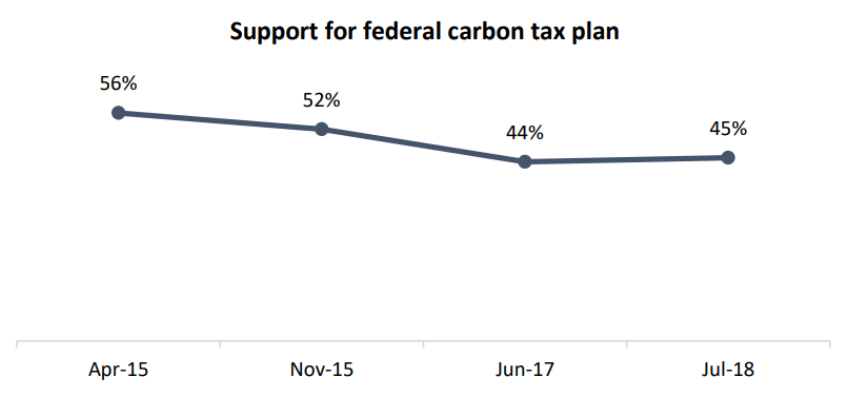
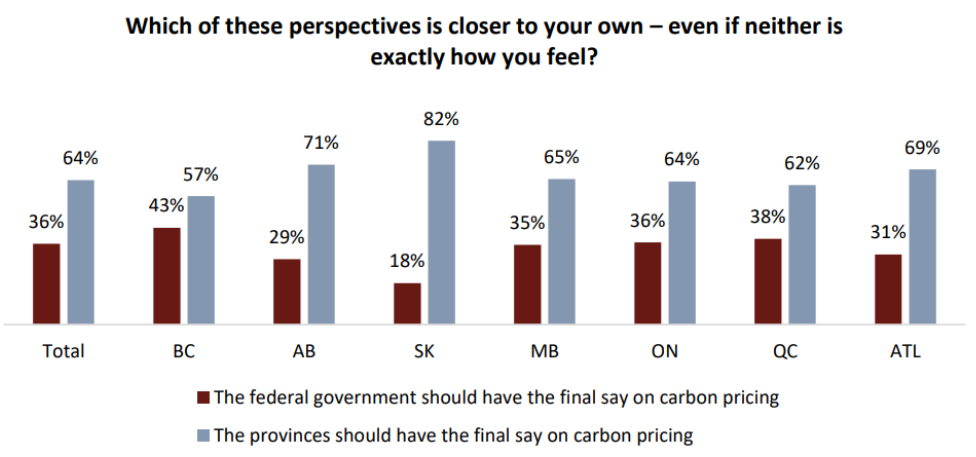
Canadian Prime Minister Justin Trudeau is announcing his national carbon tax even while the Canadian public is having second and third thoughts about global warming and human causation. An Angus Reid poll this summer shows how belief in the need for such a policy is wavering. The report is Carbon conflict: two-thirds of Canadians say provinces should have the final say on pricing

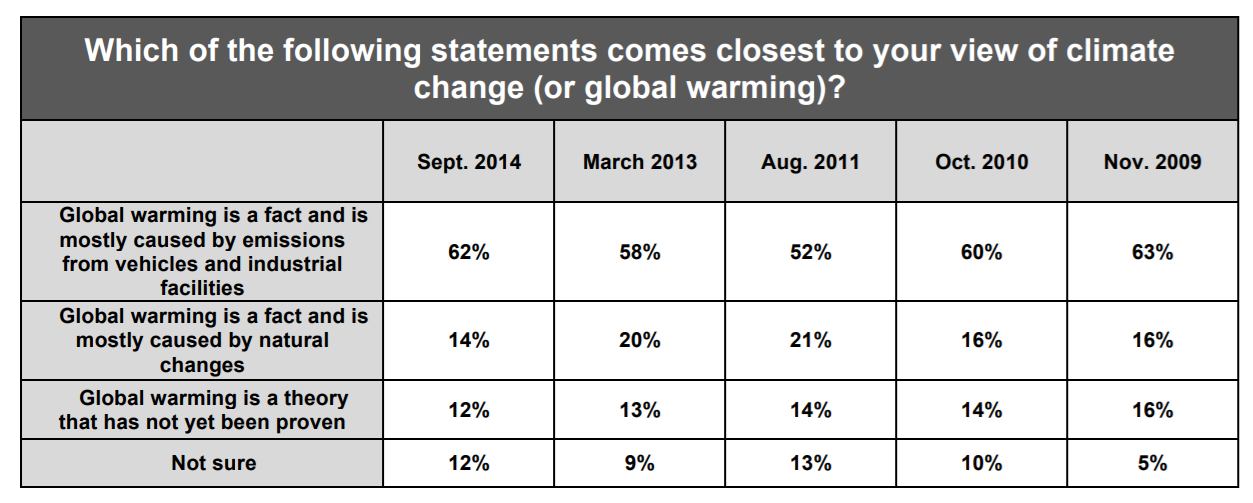
Before getting into the federal/provincial tug of war, let’s consider the basic belief. Angus Reid has been asking Canadians the same question since 2009, with these responses.

Open image in new tab to enlarge.

Note in 2009 63% believed that “global warming is a fact and mostly caused by humans”. That dropped down to 52%, then came back to 62% in 2014 when the Obama administration was beating the climate change drum for all it was worth. In Canada Trudeau’s Liberal party led in the polls on the way to winning power in October 2015.

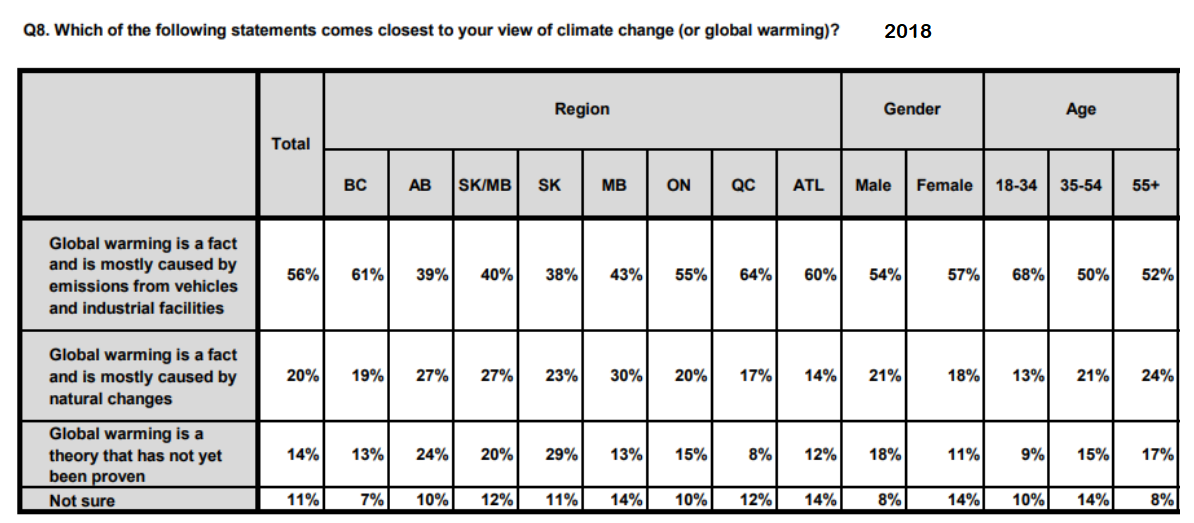
Now let’s consider the polling in July of 2018.
Belief in man-made global warming is back down to 56% in the context of Trump’s skepticism and the Paris Accord proving ineffectual. This first 2018 chart includes regional and age distributions showing that younger people (<35 yrs old) are much more often believers, becoming more skeptical (50/50) with age. Ironically, that young cohort has not witnessed any actual warming in their adult lives.

The three largest cities in Canada are Vancouver, Toronto and Montreal.  Not surprisingly, belief is strongest in the provinces of B.C., Ontario and Quebec, along with Atlantic region. The prairie provinces are definitely not on side.
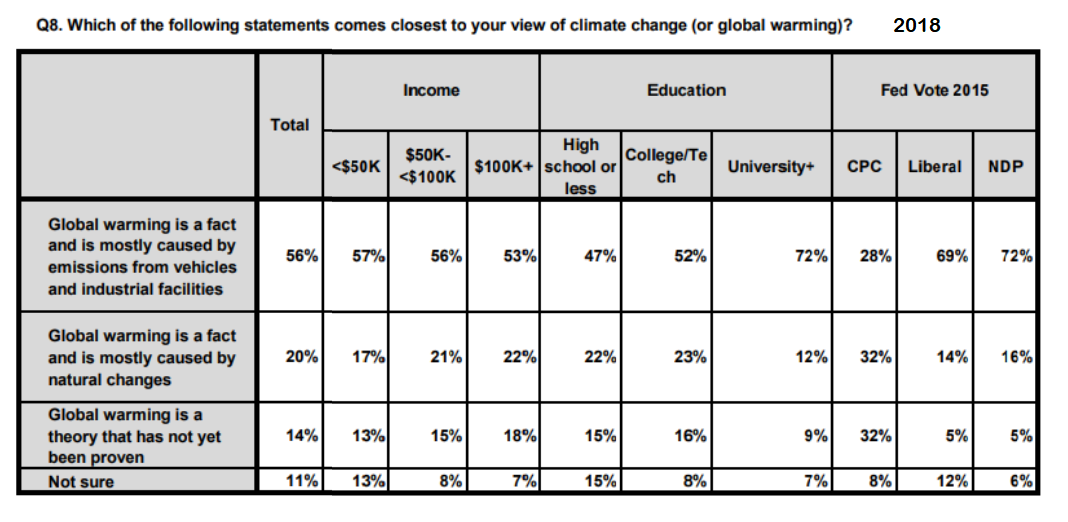
Another table shows that income level is not a driver, except for the more wealthy being somewhat surer of their opinions. However, global warming belief is strongly associated with university education, and with voting for left-wing parties (in Canada Liberal and NDP). It seems the educational system is aligned with left wing views on many things, including the climate.

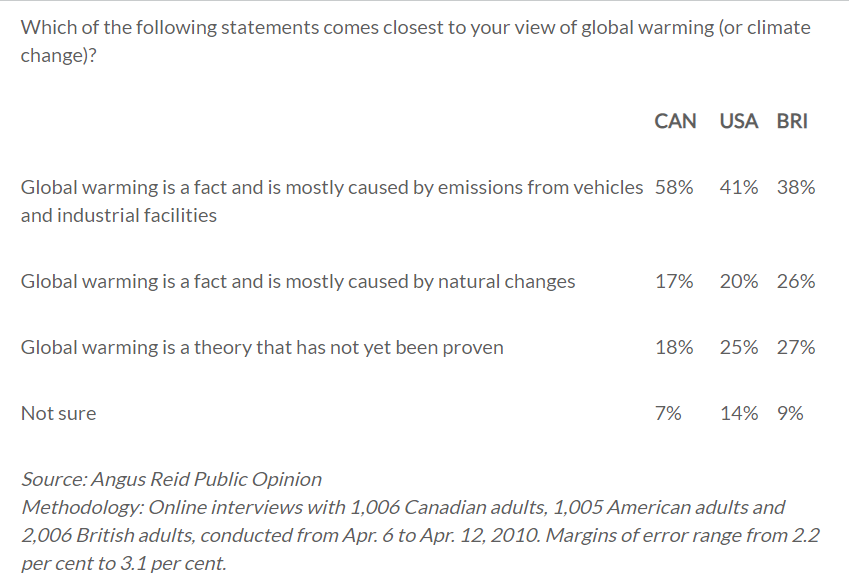
Angus Reid asked the same questions of Canadian, British and American citizens in 2010, with these results in the context of Obama mania and the Copenhagen COP drama.
In 2010 the majority of Americans and Brits were not global warming believers, compared to Canadians.  Note that Americans and Brits are more likely to say global warming is either natural or an unproven theory. More recent polls in those two countries continue to show the same pattern.

Political Implications

As the article title suggested, the landscape is not favorable for the Liberal’s tax plan.  For example
Moreover, both Ontario and Quebec have recently elected business-oriented provincial premiers, with Alberta likely to follow suit in the next election on or before May 31, 2019.  That may explain this result. Angus Reid observed that those who want no tax at all opted for provincial jurisdiction.

Judicial Empathy is Not Justice

We are witnessing the spectacle of a high-ranking Federal District Court Judge twisting the law to suit her empathy for climate activists. This is playing out as a lawsuit brought by Our Children’s Trust with kids as willing human shields in the “fight against climate change.” (Background resources at the end) The proceedings have gone on for several years with no end in sight unless a higher court stops it. The next segment is a long (50 courtroom days) hearing on the merits scheduled to begin October 29, 2018.

The latest filings provide a view into how the legal system is being manipulated to support climatist beliefs and biases. The petition filed by the US is  PETITION FOR A WRIT OF MANDAMUS 

Excerpts in italics with my bolds first from the federal defendants and later from the District Judge’s latest order (Respondents refers to the plaintiffs bringing the lawsuit)

From the US Petition for Dismissal: 

With respect to standing, the district court concluded that respondents had adequately alleged injuries in the form of increased droughts, wildfires, flooding, and other effects of climate change, and that those injuries were caused by the government’s regulation of (and failure to further regulate) fossil fuels. App., infra, 125a-134a. The court further concluded that it could redress respondents’ alleged injuries by granting the relief sought, including ordering the federal government “to cease [its] permitting, authorizing, and subsidizing of fossil fuels and, instead, move to swiftly phase out CO2 emissions” and to “take such other action necessary to ensure that atmospheric CO2 is no more concentrated than 350 ppm by 2100, including to develop a national plan to restore Earth’s energy balance, and implement that national plan so as to stabilize the climate system.” Id. at 137a (citation omitted); see id. at 134a-137a.

On the merits, the district court concluded that respondents had stated a claim under the Fifth Amendment’s Due Process Clause. App., infra, 137a-147a. Relying primarily on this Court’s decision in Obergefell v. Hodges, 135 S. Ct. 2584 (2015), as well as Roe v. Wade, 410 U.S. 113 (1973), and a 1993 decision from the Supreme Court of the Philippines, the district court found in the Fifth Amendment’s protection against the deprivation of “life, liberty, or property, without due process of law,” U.S. Const. Amend. V, a previously unrecognized “fundamental right * * * to a climate system capable of sustaining human life.” App., infra, 142a; see id. at 140a-142a.

The district court further determined that respondents had adequately stated a claim under a federal publictrust theory. App., infra, 147a-167a. The court acknowledged this Court’s statement that “the public trust doctrine remains a matter of state law,” PPL Montana, LLC v. Montana, 565 U.S. 576, 603 (2012), as well as the D.C. Circuit’s rejection of a federal public-trust doctrine, see Alec L. ex rel. Loorz v. McCarthy, 561 Fed. Appx. 7, 8 (per curiam), cert. denied, 135 S. Ct. 774 (2014). But the court nevertheless concluded that a public-trust doctrine imposes a judicially enforceable prohibition on the federal government against “depriving a future legislature of the natural resources necessary to provide for the well-being and survival of its citizens.” App., infra, 148a (citation omitted).

The district court acknowledged the government’s arguments that “recognizing [respondents’] standing to sue, deeming the controversy justiciable, and recognizing a federal public trust and a fundamental right to a climate system capable of sustaining human life would be unprecedented,” but rejected the premise that the unprecedented nature of those decisions “alone requires * * * dismissal.” App., infra, 167a. The court expressed its view that “[f]ederal courts too often have been cautious and overly deferential in the arena of environmental law, and the world has suffered for it.” Id. at 167a-168a. The court invoked the “failure of the legal system to protect humanity from the collapse of finite natural resources by the uncontrolled pursuit of shortterm profits,” and stated that the “third branch can, and should, take another long and careful look at the barriers to litigation created by modern doctrines of subject matter jurisdiction and deference to the legislative and administrative branches.”

Respondents’ position amounts to the astounding assertion that permitting or encouraging the combustion of fossil fuels violates the Due Process Clause of the Constitution and a single district court in a suit brought by a handful of plaintiffs may decree the end of the carbon-based features of the United States’ energy system, without regard to the statutory and regulatory framework Congress enacted to address such issues with broad public input. Months ago, this Court flagged the “striking” breadth of those claims and the “substantial” doubts about their justiciability, reciting the standard for interlocutory certification and thereby indicating that appellate review is warranted before trial. United States v. U.S. Dist. Court, No. 18A65, 2018 WL 3615551, at *1 (July 30, 2018). But the district court nevertheless refused to meaningfully narrow respondents’ claims, to certify its orders for interlocutory appeal, or to halt the trial now set to begin in less than two weeks. The government therefore has no choice but to ask this Court once again to intervene— and to end this profoundly misguided suit.

In its most recent order, the court contemplates some of the “actions” that petitioners could take to redress respondents’ asserted injuries, including drastic measures like phasing out all greenhouse gas emissions “within several decades” or converting the Nation’s entire electricity generation infrastructure to “100 percent clean, renewable wind, water, and sunlight” sources. Id. at 54a (brackets and citation omitted). But neither respondents nor the court has cited any legal authority that would permit such an unprecedented usurpation of legislative and executive authority by an Article III court, essentially placing a single district court in Oregon—acting at the behest of a few plaintiffs having one particular perspective on the complex issues involved—in charge of directing American energy and environmental policy. Nor have respondents or the district court grappled with the fact that the carbon emissions arguably within the control of petitioners “may become an increasingly marginal portion of global emissions” as developing countries increase their own emissions, thereby making it all the more speculative and uncertain that even respondents’ unprecedented remedy would actually redress their asserted injuries.

Respondents’ suit is not a case or controversy cognizable under Article III. Respondents ask the district court to review and assess the entirety of Congress’s and the Executive Branch’s programs and regulatory decisions relating to climate change and then to undertake to pass upon the comprehensive constitutionality of all of those policies, programs, and inaction in the aggregate. See, e.g., Am. Compl. ¶¶ 277-310. No federal court, nor the courts at Westminster, has ever purported to use the “judicial Power” to perform such a sweeping policy review—and for good reason: the Constitution commits to Congress the power to enact comprehensive government-wide measures of the sort respondents seek. And it commits to the President the power to oversee the Executive Branch in its administration of existing law and to draw on its expertise and formulate policy proposals for changing existing law. Such functions are not the province of Article III courts. The district court’s contrary assertion constitutes a “judicial ‘usurpation of power.’”

From District Court Judge Ann Aiken October 15, 2018 Order:

This is no ordinary lawsuit. Plaintiffs challenge the policies, acts, and omissions of the President of the United States, the Council on Environmental Quality, the Office of Management and Budget, the Office of Science and Technology Policy, the Department of Energy, the Department of the Interior, the Department of Transportation (‘‘DOT’’), the Department of Agriculture, the Department of Commerce, the Department of Defense, the Department of State, and the Environmental Protection Agency (‘‘EPA’’). This lawsuit challenges decisions defendants have made across a vast set of topics—decisions like whether and to what extent to regulate CO2 emissions from power plants and vehicles, whether to permit fossil fuel extraction and development to take place on federal lands, how much to charge for use of those lands, whether to give tax breaks to the fossil fuel industry, whether to subsidize or directly fund that industry, whether to fund the construction of fossil fuel infrastructure such as natural gas pipelines at home and abroad, whether to permit the export and import of fossil fuels from and to the United States, and whether to authorize new marine coal terminal projects. Plaintiffs assert defendants’ decisions on these topics have substantially caused the planet to warm and the oceans to rise. They draw a direct causal line between defendants’ policy choices and floods, food shortages, destruction of property, species extinction, and a host of other harms.

This lawsuit is not about proving that climate change is happening or that human activity is driving it. For the purposes of this motion, those facts are undisputed.3 The questions before the Court are whether defendants are responsible for some of the harm caused by climate change, whether plaintiffs may challenge defendants’ climate change policy in court, and whether this Court can direct defendants to change their policy without running afoul of the separation of powers doctrine.

Unlike in the constitutional provisions at issue Nixon and Passman, the constitutional provisions cited here contain nothing approaching a clear reference to the subject matter of this case. The Constitution does not mention environmental policy, atmospheric emissions, or global warming. And unlike in Zivotofksy, climate change policy is not a fundamental power on which any other power allocated exclusively to other branches of government rests.

The question is not whether a case implicates issues that appear in the portions of the Constitution allocating power to the Legislative and Executive Branches—such a test would, by definition, shield nearly all legislative and executive action from legal challenge, Rather, the question is whether adjudicating a claim would require the Judicial Branch to second-guess decisions committed exclusively to another branch of government.

State-Created Danger Theory

Federal defendants urge that plaintiffs’ claims based on the state created danger doctrine must fail. First, they argue that plaintiffs do not show a special relationship between themselves and the government. More importantly, federal defendants argue that plaintiffs cannot show that government conduct proximately caused a dangerous situation in deliberate indifference to plaintiffs’ safety or that harm or loss of life has resulted from such conduct. Plaintiffs contend that they have proffered ample evidence to show genuine issues of material fact as to whether federal defendants have liability for the conduct alleged in their complaint.

Federal defendants’ main argument is that plaintiffs’ allegations regarding the government’s knowledge of the dangers posed to plaintiffs by climate change do not rise to the required level of “deliberate indifference.”Plaintiffs specifically refer to the declaration from their expert Gus Speth, former chairman of the Council on Environmental Quality under President Jimmy Carter. Mr. Speth’s declaration examines a historical record spanning ten presidential administrations and references a number of documents, statements of government officials, and federal policy actions that go directly to the government’s knowledge of the links between fossil fuels and increasing global mean temperature and the dangers associated therein, such as sea level rise to Americans at the time and in future.

For example, in 1969 Daniel Moynihan, then counselor to the President Richard Nixon, wrote to John Ehrlichman, President Nixon’s Assistant for Domestic Affairs, summarizing the climate problem:

The process is a simple one. Carbon dioxide in the atmosphere has the effect of a pane of glass in a greenhouse. The CO2 content is normally in a stable cycle, but recently man has begun to introduce instability through the burning of fossil fuels. At the turn of the century several persons raised the question whether this would change the temperature of the atmosphere. Over the years the hypothesis has been refined, and more evidence has come along to support it. It is now pretty clearly agreed that the CO2 content will rise 25 [percent] by 2000. This could increase the average temperature near the earth’s surface by 7 degrees Fahrenheit. This in turn could raise the level of the sea by 10 feet. Goodbye New York. Goodbye Washington, for that matter.

In 1977, President Jimmy Carter’s science advisor Frank Press wrote to the President explaining: Fossil fuel combustion has increased at an exponential rate over the last 100 years. As a result, the atmospheric concentration of CO2 is now 12 percent above the pre-industrial revolution level and may grow 1.5 to 2.0 times that level within 60 years. Because of the greenhouse effect of atmospheric CO2, the increased concentration will induce a global climatic warming of anywhere from 0.5° to 5° C.

Injuries

Federal defendants argue that these declarations fail to show that plaintiffs’ injuries are concrete and particularized to them; rather federal defendants’ contend that the injuries alleged are generalized widespread environmental phenomena which affect all other humans on the planet, making them nonjusticiable.

The most recent Supreme Court precedent appears to have rejected the notion that injury to all is injury to none for standing purposes.”); Pye v. United States, 269 F.3d 459, 469 (4th Cir. 2001) (“So long as the plaintiff . . . has a concrete and particularized injury, it does not matter that legions of other persons have the same injury.”). Indeed, even if the experience at the root of [the] complaint was shared by virtually every American,” the inquiry remains whether that shared experience caused an injury that is concrete and particular to the plaintiff. Jewel, 673 F.3d at 910.

Causation

Plaintiffs submit evidence that fossil fuel emissions are responsible for most of the increase in atmospheric CO2, and that increasing CO2, in turn, is the main cause of global warming, and that atmospheric concentrations of greenhouse gasses, due to fossil fuel combustion, are increasing quickly such that planetary warming is accelerating at rates never before seen in human history. Hansen Decl. Ex. A, at 38. Further, not only are concentrations of atmospheric CO2 continuing to increase, but the rate of increase has also nearly doubled since measurements began being recorded pushing humanity closer to the “point of no return.” Id. at 29, 38. Estimates show that extreme weather events are likely to continue to increase as the global surface temperature continues to rise. Id. at 35; Trenberth Decl. Ex. 1, at 1, 8, 13. Indeed, the five hottest years in the 123 years of record-keeping in the United States have all occurred in the past decade. Trenberth Decl. Ex. 1, at 3. Plaintiffs present evidence that 2017 saw record setting events such as extreme wildfires in the western United States8 and abnormally strong hurricanes in the southeastern United States and Gulf of Mexico (Hurricanes Harvey, Irma, and Maria), all of which were exacerbated by climate change. Id. at 7-11.

Further, plaintiffs offer that global sea level rise will continue unabated under current conditions. Plaintiffs’ expert Dr. James Hansen has submitted video animations showing how the future impacts of seal level rise will flood or impact the livability of the homes of plaintiffs in Louisiana, Oregon, Washington, Florida,New York, and Hawaii based on current assumptions about carbon emission. Hansen Decl. Ex. E-R. The most recent projections from the National Oceanic and Atmospheric Administration (“NOAA”) provide that global mean sea level will rise between 1.5-2.5 m (5-8.2 ft.) by 2100 and that it is expected to continue to rise and even accelerate more after 2100. Wanless Decl. Ex. 1 at 12.

In sum, the Court is left with plaintiffs’ sworn affidavits attesting to their specific injuries, as well as a swath of extensive expert declarations showing those injuries are linked to fossil fuel-induced climate change and if current conditions remain unchanged, these injuries are likely to continue or worsen.

Here, federal defendants argue again that the association between the conduct of which plaintiffs complain, namely the government’s subsidizing the fossil fuel industry; allowing the transportation, exportation, and importation of fossil fuels; setting of energy and efficiency standards for vehicles, appliances, and buildings; reducing carbon sequestration capacity and expanding areas for fossil fuel extraction and production through federal land leasing policies is tenuous and filled with many intervening actions by third parties. Thus, they argue that plaintiffs have failed to tether their injuries, both direct and indirect, to specific actions of the United States.

However, plaintiffs challenge not only the direct emissions of federal defendants through their use of fossil fuels to power its buildings and vehicles10, but also the emissions that are caused and supported by their policies. Plaintiffs have alleged that federal defendants’ systematic conduct, which includes “government policies practices, and actions, showing how each Defendant permits, licenses, leases, authorizes, and/or incentivizes the extraction, development, processing, combustion, and transportation of fossil fuel” caused plaintiffs’ injuries.

At this stage of the proceedings, the Court finds that plaintiffs have provided sufficient evidence showing that causation for their claims is more than attenuated. Plaintiffs’ “need not connect each molecule” of domestically emitted carbon to their specific injuries to meet the causation standard. Bellon, 732 F.3d 1142-43. The ultimate issue of causation will require perhaps the most extensive evidence to determine at trial, but at this stage of the proceedings, plaintiffs have proffered sufficient evidence to show that genuine issues of material fact remain on this issue. A final ruling on this issue will benefit from a fully developed factual record where the Court can consider and weigh evidence from both parties.

Remedy

Federal defendants contend that there is no possible redress in this case because the remedies sought by plaintiffs are beyond the Court’s authority to provide.12 Further, they argue that even if this Court did find in favor of plaintiffs, any remedy it fashioned would not redress the harms alleged by plaintiffs, because fossil fuel emissions from other entities would still contribute to continuing global warming. Thus, they argue that there is no evidence that any immediate reduction in emissions caused by the United States would manifest in a reduction of climate change induced weather phenomena. As the Court has stated before, whether the Court could guarantee a reduction in greenhouse gas emission is the wrong inquiry because redressability does not require certainty. Rather, at this stage, it only requires a substantial likelihood that the Court could provide meaningful relief. Moreover, the possibility that some other individual or entity might later cause the same injury does not defeat standing; the question remains whether the injury caused by the defendants in this suit can be redressed.

Instead, plaintiffs urge that their request for relief, at its core, is one for a declaration that their constitutional rights have been violated and an order for federal defendants to develop their own plan, using existing resources, capacities, and legal authority, to bring their conduct into constitutional compliance. Plaintiffs point to various statutory authorities by which they claim federal defendants could affect the relief they request.

The Court has considered the summary judgment record regarding traceability and plaintiffs’ experts’ opinions that reducing domestic emissions, which plaintiffs contend are controlled by federal defendants’ actions, could slow or reduce the harm plaintiffs are suffering. The Court concludes, for the purposes of this motion, that plaintiffs have shown an issue of material fact that must be considered at trial on full factual record.

Background

Climate War Human Shields

The Children’s Climate Lawsuit Harms The Children

Does the Constitution Provide a Substantive Due-Process Right to a Stable Climate System?

Judging objectively is not a sexist matter.  Judge Judy proves women judges can be skeptical as well.


Supreme Justice Grants Stay of Kids Lawsuit

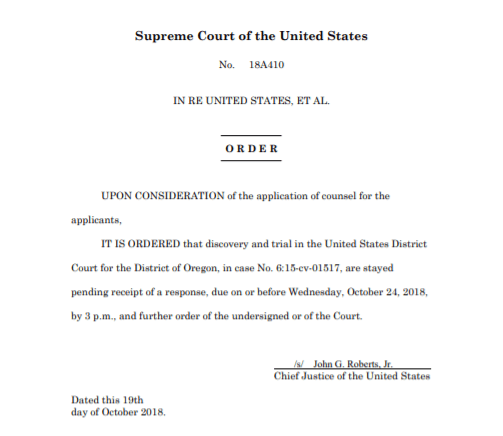
Supreme Stay order

On Friday, Chief Justice Roberts stayed the discovery and trial of Juliana vs. US, pending responses from the plaintiffs to issues raised by the defense.  Report from The News Review in italics with my bolds.

The U.S. Supreme Court on Friday granted a stay in the climate trial, Juliana v. United States, pending a response from the plaintiffs.

The Department of Justice asked the Supreme Court on Tuesday to dismiss the case brought by 21 young plaintiffs Thursday.

In a news release issued Friday afternoon, Meg Ward with Our Children’s Trust said the plaintiff’s legal team is working on its response, which it will file Monday.

The Supreme Court order states a response is due by Oct. 24.

Julia Olson, one of the lawyers representing the young plaintiffs, said the prosecution is confident that once the court receives the response the trial will proceed.

“As the Supreme Court has recognized in innumerable cases, review of constitutional questions is better done on a full record where the evidence is presented and weighed by the trier of fact,” Olson said in a news release.

The lawsuit alleges the federal government has violated young people’s constitutional rights through policies that have caused a dangerous climate.

They have said their generation bears the brunt of climate change and that the government has an obligation to protect natural resources for present and future generations.

The young people say government officials have known for more than 50 years that carbon pollution from fossil fuels was causing climate change and that policies on oil and gas deprive them of life, liberty and property. They also say the government has failed to protect natural resources as a “public trust” for future generations.

The lawsuit wants a court to order the government to stop permitting and authorizing fossil fuels, quickly phase out carbon dioxide emissions to a certain level by 2100 and develop a national climate recovery plan.

The Trump administration got a temporary reprieve on the case after also asking the 9th U.S. Circuit Court of Appeals, which rejected the request in July.

“The latest attempt to get the U.S. Supreme Court to stop the trial does not appear to be based on any new evidence or arguments. The only new element is an additional Supreme Court justice,” said Melissa Scanlan, a professor at Vermont Law School, who is not involved in the case.

Kavanaugh replaced the more moderate Anthony Kennedy.

Scanlan said the Trump administration is trying to avoid “what they’re expecting to be a 50-day trial focused on climate disruption.” The trial in Eugene was expected to wrap up in January.

CNN added this:

Solicitor General Noel Francisco asked the justice to stop any further discovery and the pending trial while the government appeals the lower court opinion.

In his filing, Francisco lambasted the suit, calling it “an attempt to redirect federal environmental and energy policies through the courts rather than through the political process, by asserting a new and unsupported fundamental due process right to certain climate conditions.”

Francisco’s language echoes some of the remarks Attorney General Jeff Sessions made before the conservative Heritage Foundation on Monday. “Judicial activism is therefore a threat to our representative government and the liberty it secures,” Sessions said. “In effect, activist advocates want judges who will do for them what they have been unable to achieve at the ballot box. It is fundamentally undemocratic.”

The filings may be welcomed by some of the justices but they also put others in an uncomfortable position, and there’s a risk of going to the well too often.

“The Supreme Court unquestionably has the authority to provide the extraordinary relief the government is seeking in these cases,” said Steve Vladeck, CNN Supreme Court analyst and professor at the University of Texas School of Law.

“That said, it tends to exercise that authority sparingly,” he added,” and there’s reason to wonder if the government, by repeatedly asking for such unusual relief, might be perceived by at least some of the justices as the boy who cried wolf.”

The text of the  US filing is PETITION FOR A WRIT OF MANDAMUS Contents:

Reasons for granting the petition

A. The government has a clear and indisputable
right to relief from the district court’s refusal to
dismiss this fundamentally misguided suit

1. The district court clearly and indisputably
erred by exercising jurisdiction over the suit
2. The district court clearly and indisputably
erred by allowing the claims to proceed
outside the binding framework of the APA
3. The district court clearly and indisputably
erred by allowing the claims to proceed on the
merits

B. The government has no other adequate means to
attain relief from a fundamentally misguided and
improper trial

C. Mandamus relief is appropriate under the
circumstances

Excerpt from page 26:

Remarkably, the district court rooted its recognition of a fundamental due process right to “a climate system capable of sustaining human life,” App., infra, 141a, in this Court’s recognition of a fundamental right to samesex marriage in Obergefell v. Hodges, 135 S. Ct. 2584 (2015). There is no relationship, however, between a distinctly personal and circumscribed right to same-sex marriage and the alleged right to a climate system capable of sustaining human life that apparently would run indiscriminately to every individual in the United States. The right recognized by the district court has no relationship to any right as “fundamental as a matter of history and tradition” as the right to marry recognized in Obergefell. Id. at 2602.

Background from previous post Supremes Looking at Kids Lawsuit

An Oregon liberal judge is determined to put climate change on trial in Juliana vs US, scheduled to start on October 29, 2018.  But now another pitfall stands in the way.  The Trump administration has asked the Supreme Court to review the legitimacy of the scope of the kids’ claims they have a right to an unchanging favorable climate provided to them by the federal government.  Here is the update from Scotusblog by Amy Howe Government returns in climate change lawsuit  Excerpts in italics with my bolds.

In July, the Supreme Court declined to intervene in a lawsuit filed by a group of 21 children and teenagers who allege that they have a constitutional right to a “climate system capable of sustaining human life.” The justices rejected the federal government’s request to block discovery and a trial until the U.S. Court of Appeals for the 9th Circuit could rule on the government’s petition seeking to have the case dismissed or, at a minimum, to block discovery and the trial temporarily. Today the Trump administration returned to the Supreme Court, asking it once again to put discovery and the trial – now scheduled for the end of October – on hold.

The case was originally filed in 2015 against the Obama administration. The plaintiffs argue that the federal government’s actions are causing a “dangerous climate system,” and they have asked a federal district court in Oregon to order various federal agencies to prepare and implement a remedial plan to phase out fossil-fuel emissions.

When the government asked the justices to step in over the summer, they rejected the request, which they described as “premature.” But the justices also seemed to express some skepticism about the “breadth” of the plaintiffs’ claims, calling them “striking” and observing that there are “substantial grounds for difference of opinion” on whether those claims belong in court at all. The justices instructed the district court to “take these concerns into account in assessing the burdens of discovery and trial, as well as the desirability of a prompt ruling on the” federal government’s other pending motions, which could result in dismissal of some or all of the plaintiffs’ claims.

The government is now back at the court, telling the justices that earlier this week the district court “declined to meaningfully narrow” the plaintiffs’ claims, instead rejecting various government motions that would have ended the case. The government is now asking the court to order the district court to “end this profoundly misguided suit” or, at the very least, review the district court’s rulings allowing the case to go forward; moreover, the government again urges, the Supreme Court should put discovery and the trial on hold while it considers these requests. There would be no real harm to the plaintiffs from doing so, the government stresses, because the plaintiffs are claiming that they have been harmed by the cumulative effects of carbon dioxide emissions over several decades.

The government’s request, signed by U.S. solicitor general Noel Francisco, goes to Chief Justice John Roberts, who currently serves as the circuit justice for the 9th Circuit. Roberts can act on the government’s application immediately or refer it to the full court.

Economist Joseph Stiglitz writes of climate change: “There is a point at which, once this harm occurs, it cannot be undone at any reasonable cost or in any reasonable period of time. Based on the best available science, our country is close to approaching that point.” Credit: Win McNamee/Getty Images

For an insight into the claims being made on behalf of the kids, here is a reprint of a previous post analyzing a brief filed by an IPCC insider.

Climatists Make Their Case by Omitting Facts

One of the world’s top economists has written an expert court report that forcefully supports a group of children and young adults who have sued the federal government for failing to act on climate change. (Source: Inside Climate News  here) Excerpts in italics with my bolds.

Stiglitz, a Columbia University economics professor and former World Bank chief economist, concludes that increasing global warming will have huge costs on society and that a fossil fuel-based system “is causing imminent, significant, and irreparable harm to the Youth Plaintiffs and Affected Children more generally.” He explains in a footnote that his analysis also examines impacts on “as-yet-unborn youth, the so-called future generations.”

But, he says, acting on climate change now—by imposing a carbon tax and cutting fossil fuel subsidies, among other steps—is still manageable and would have net-negative costs. He argues that if the government were to pursue clean energy sources and energy-smart technologies, “the net benefits of a policy change outweigh the net costs of such a policy change.”

“Defendants must act with all deliberate speed and immediately cease the subsidization of fossil fuels and any new fossil fuel projects, and implement policies to rapidly transition the U.S. economy away from fossil fuels,” Stiglitz writes. “This urgent action is not only feasible, the relief requested will benefit the economy.”

Stiglitz has been examining the economic impact of global warming for many years. He was a lead author of the 1995 report of the UN’s Intergovernmental Panel on Climate Change, an authoritative assessment of climate science that won the IPCC the 2007 Nobel Peace Prize, shared with Al Gore.

The Stiglitz expert report submitted to the court is here.

An Example of Intentional Omissions

Since this is a legal proceeding, Stiglitz wrote a brief telling the plaintiffs’ side of the story. In a scientific investigation, parties would assert theories attempting to explain all of the evidence at hand. Legal theories have no such requirement to incorporate all the facts, but rather present conclusions informed by the evidence deemed strongest and most pertinent to one party’s interests.

While the Pope accuses us with the Sin of Emissions, we counter with the Sins of Omissions by him and his fellow activists.

Let’s consider the Stiglitz brief according to the three suppositions comprising the Climatist (Activists and Alarmists) position. Climate change is a bundle that depends on all three assertions to be true.

Supposition 1: Humans make the climate warmer.

As an economist, Stiglitz defers to the IPCC on this scientific point, with references to reports by those deeply involved and committed to Paris Accord and other UN climate programs. In the recent California District Court case (Cities suing Big Oil companies), both sides in a similar vein stipulated their acceptance of IPCC reports as authoritative regarding global warming/climate change.

Skeptical observers must attend to the nuances of what is referenced and what is hidden or omitted in these testimonies. For example, Chevron’s attorney noted that IPCC’s reports express various opinions over time as to human influence on the climate. They noted that even today, the expected temperature effect from doubling CO2 ranges widely from 1.5C to 4.5C. No mention is made that several more recent estimates from empirical data (rather than GCMs) are at the low end or lower.

In addition, there is no mention that GCMs projections are running about twice as hot as observations. Omitted is the fact GCMs correctly replicate tropospheric temperature observations only when CO2 warming is turned off. In the effort to proclaim scientific certainty, neither Stiglitz nor IPCC discuss the lack of warming since the 1998 El Nino, despite two additional El Ninos in 2010 and 2016.

Figure 5. Simplification of IPCC AR5 shown above in Fig. 4. The colored lines represent the range of results for the models and observations. The trends here represent trends at different levels of the tropical atmosphere from the surface up to 50,000 ft. The gray lines are the bounds for the range of observations, the blue for the range of IPCC model results without extra GHGs and the red for IPCC model results with extra GHGs.The key point displayed is the lack of overlap between the GHG model results (red) and the observations (gray). The nonGHG model runs (blue) overlap the observations almost completely.

Further they exclude comparisons between fossil fuel consumption and temperature changes. The legal methodology for discerning causation regarding work environments or medicine side effects insists that the correlation be strong and consistent over time, and there be no confounding additional factors. As long as there is another equally or more likely explanation for a set of facts, the claimed causation is unproven. Such is the null hypothesis in legal terms: Things happen for many reasons unless you can prove one reason is dominant.

Finally, Stiglitz and IPCC are picking on the wrong molecule. The climate is controlled not by CO2 but by H20. Oceans make climate through the massive movement of energy involved in water’s phase changes from solid to liquid to gas and back again. From those heat transfers come all that we call weather and climate: Clouds, Snow, Rain, Winds, and Storms.

Esteemed climate scientist Richard Lindzen ended a very fine recent presentation with this description of the climate system:

I haven’t spent much time on the details of the science, but there is one thing that should spark skepticism in any intelligent reader. The system we are looking at consists in two turbulent fluids interacting with each other. They are on a rotating planet that is differentially heated by the sun. A vital constituent of the atmospheric component is water in the liquid, solid and vapor phases, and the changes in phase have vast energetic ramifications. The energy budget of this system involves the absorption and reemission of about 200 watts per square meter. Doubling CO2 involves a 2% perturbation to this budget. So do minor changes in clouds and other features, and such changes are common. In this complex multifactor system, what is the likelihood of the climate (which, itself, consists in many variables and not just globally averaged temperature anomaly) is controlled by this 2% perturbation in a single variable? Believing this is pretty close to believing in magic. Instead, you are told that it is believing in ‘science.’ Such a claim should be a tip-off that something is amiss. After all, science is a mode of inquiry rather than a belief structure.

Supposition 2: The Warming is Dangerous

Billions of dollars have been spent researching any and all negative effects from a warming world: Everything from Acne to Zika virus. Stiglitz links to a recent Climate Report that repeats the usual litany of calamities to be feared and avoided by submitting to IPCC demands. The evidence does not support these claims.

Stiglitz: It is scientifically established that human activities produce GHG emissions, which accumulate in the atmosphere and the oceans, resulting in warming of Earth’s surface and the oceans, acidification of the oceans, increased variability of climate, with a higher incidence of extreme weather events, and other changes in the climate.

Moreover, leading experts believe that there is already more than enough excess heat in the climate system to do severe damage and that 2C of warming would have very significant adverse effects, including resulting in multi-meter sea level rise.

Experts have observed an increased incidence of climate-related extreme weather events, including increased frequency and intensity of extreme heat and heavy precipitation events and more severe droughts and associated heatwaves. Experts have also observed an increased incidence of large forest fires; and reduced snowpack affecting water resources in the western U.S. The most recent National Climate Assessment projects these climate impacts will continue to worsen in the future as global temperatures increase.

Alarming Weather and Wildfires

But: Weather is not more extreme.
And Wildfires were worse in the past.
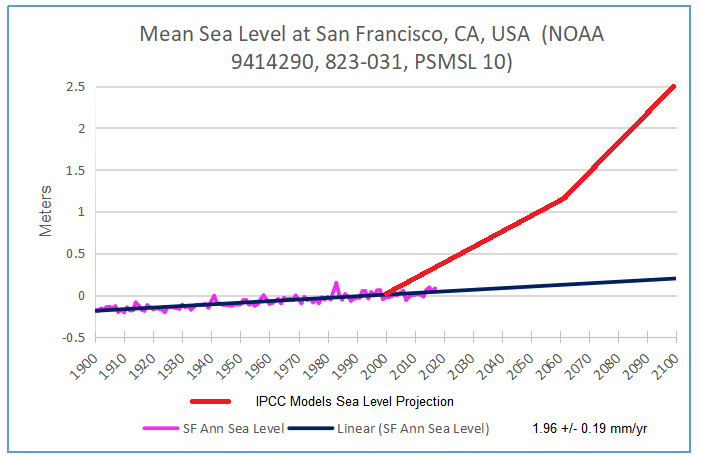
But: Sea Level Rise is not accelerating.
Litany of Changes

Seven of the ten hottest years on record have occurred within the last decade; wildfires are at an all-time high, while Arctic Sea ice is rapidly diminishing.

We are seeing one-in-a-thousand-year floods with astonishing frequency.

When it rains really hard, it’s harder than ever.

We’re seeing glaciers melting, sea level rising.

The length and the intensity of heatwaves has gone up dramatically.

Plants and trees are flowering earlier in the year. Birds are moving polewards.

We’re seeing more intense storms.

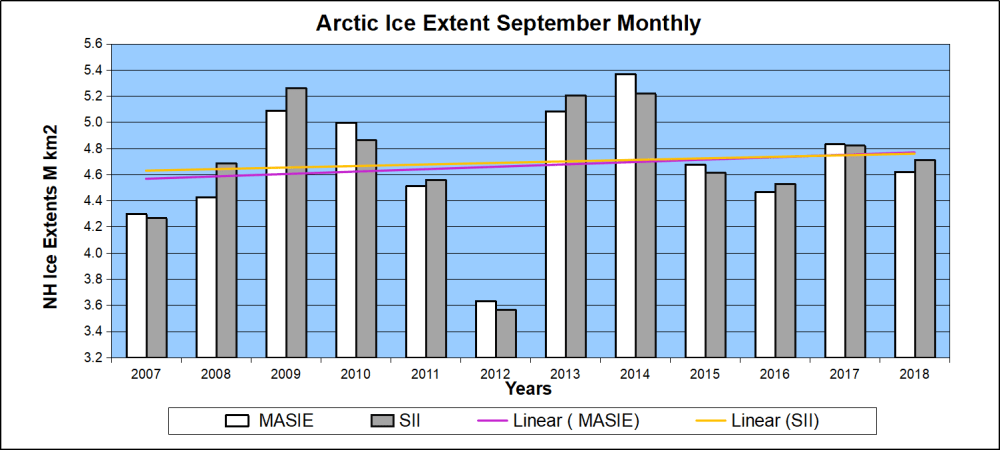
But: Arctic Ice has not declined since 2007.
arctic-sept-2007-to-20181

But: All of these are within the range of past variability.

In fact our climate is remarkably stable.
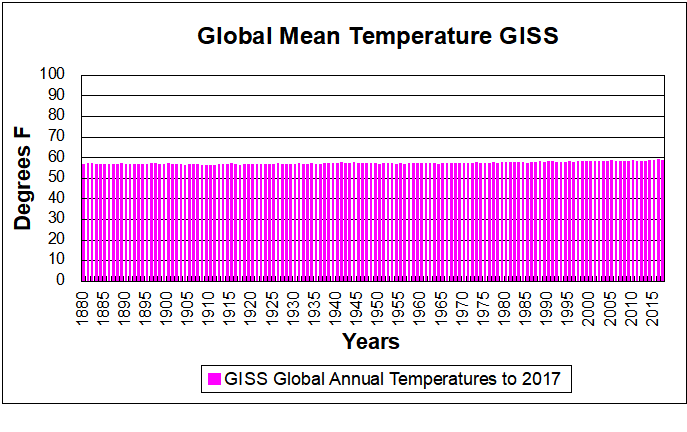
And many aspects follow quasi-60 year cycles.

Climate is Changing the Weather

Stiglitz:  Other potential examples include agricultural losses. Whether or not insurance
reimburses farmers for their crops, there can be food shortages that lead to higher food
prices (that will be borne by consumers, that is, Youth Plaintiffs and Affected Children).
There is a further risk that as our climate and land use pattern changes, disease vectors
may also move (e.g., diseases formerly only in tropical climates move northward).36 This
could lead to material increases in public health costs

But: Actual climate zones are local and regional in scope, and they show little boundary change.


But: Ice cores show that it was warmer in the past, not due to humans.

Supposition 3:  Government Can Stop it!

Here it is blithely assumed that the court can rule the seas to stop rising, heat waves to cease, and Arctic ice to grow (though why we would want that is debatable).  All this will be achieved by leaving fossil fuels in the ground and powering civilization with windmills and solar panels.  While admitting that our way of life depends on fossil fuels, they ignore the inadequacy of renewable energy sources at their present immaturity.

Stiglitz: Conclusion
The choice between incurring manageable costs now and the incalculable, perhaps even
irreparable, burden Youth Plaintiffs and Affected Children will face if Defendants fail to
rapidly transition to a non-fossil fuel economy is clear. While the full costs of the climate
damages that would result from maintaining a fossil fuel-based economy may be
incalculable, there is already ample evidence concerning the lower bound of such costs,
and with these minimum estimates, it is already clear that the cost of transitioning to a
low/no carbon economy are far less than the benefits of such a transition. No rational
calculus could come to an alternative conclusion. Defendants must act with all deliberate
speed and immediately cease the subsidization of fossil fuels and any new fossil fuel
projects, and implement policies to rapidly transition the U.S. economy away from fossil
fuels.

But CO2 relation to Temperature is Inconsistent.

But: The planet is greener because of rising CO2.

But: Modern nations (G20) depend on fossil fuels for nearly 90% of their energy.

But: Renewables are not ready for prime time.

People need to know that adding renewables to an electrical grid presents both technical and economic challenges.  Experience shows that adding intermittent power more than 10% of the baseload makes precarious the reliability of the supply.  South Australia is demonstrating this with a series of blackouts when the grid cannot be balanced.  Germany got to a higher % by dumping its excess renewable generation onto neighboring countries until the EU finally woke up and stopped them. Texas got up to 29% by dumping onto neighboring states, and some like Georgia are having problems.

But more dangerous is the way renewables destroy the economics of electrical power.  Seasoned energy analyst Gail Tverberg writes:

In fact, I have come to the rather astounding conclusion that even if wind turbines and solar PV could be built at zero cost, it would not make sense to continue to add them to the electric grid in the absence of very much better and cheaper electricity storage than we have today. There are too many costs outside building the devices themselves. It is these secondary costs that are problematic. Also, the presence of intermittent electricity disrupts competitive prices, leading to electricity prices that are far too low for other electricity providers, including those providing electricity using nuclear or natural gas. The tiny contribution of wind and solar to grid electricity cannot make up for the loss of more traditional electricity sources due to low prices.

These issues are discussed in more detail in the post Climateers Tilting at Windmills

Footnote regarding mention of “multi-meter” sea level rise.  It is all done with computer models.  For example, below is San Francisco.  More at USCS Warnings of Coastal Floodings
sf-ca-past-projected

dilbert-sins-of-omission-and-comission

Supremes Look at Kids Lawsuit

An Oregon liberal judge is determined to put climate change on trial in Juliana vs US, scheduled to start on October 29, 2018.  But now another pitfall stands in the way.  The Trump administration has asked the Supreme Court to review the legitimacy of the scope of the kids’ claims they have a right to an unchanging favorable climate provided to them by the federal government.  Here is the update from Scotusblog by Amy Howe Government returns in climate change lawsuit  Excerpts in italics with my bolds.

In July, the Supreme Court declined to intervene in a lawsuit filed by a group of 21 children and teenagers who allege that they have a constitutional right to a “climate system capable of sustaining human life.” The justices rejected the federal government’s request to block discovery and a trial until the U.S. Court of Appeals for the 9th Circuit could rule on the government’s petition seeking to have the case dismissed or, at a minimum, to block discovery and the trial temporarily. Today the Trump administration returned to the Supreme Court, asking it once again to put discovery and the trial – now scheduled for the end of October – on hold.

The case was originally filed in 2015 against the Obama administration. The plaintiffs argue that the federal government’s actions are causing a “dangerous climate system,” and they have asked a federal district court in Oregon to order various federal agencies to prepare and implement a remedial plan to phase out fossil-fuel emissions.

When the government asked the justices to step in over the summer, they rejected the request, which they described as “premature.” But the justices also seemed to express some skepticism about the “breadth” of the plaintiffs’ claims, calling them “striking” and observing that there are “substantial grounds for difference of opinion” on whether those claims belong in court at all. The justices instructed the district court to “take these concerns into account in assessing the burdens of discovery and trial, as well as the desirability of a prompt ruling on the” federal government’s other pending motions, which could result in dismissal of some or all of the plaintiffs’ claims.

The government is now back at the court, telling the justices that earlier this week the district court “declined to meaningfully narrow” the plaintiffs’ claims, instead rejecting various government motions that would have ended the case. The government is now asking the court to order the district court to “end this profoundly misguided suit” or, at the very least, review the district court’s rulings allowing the case to go forward; moreover, the government again urges, the Supreme Court should put discovery and the trial on hold while it considers these requests. There would be no real harm to the plaintiffs from doing so, the government stresses, because the plaintiffs are claiming that they have been harmed by the cumulative effects of carbon dioxide emissions over several decades.

The government’s request, signed by U.S. solicitor general Noel Francisco, goes to Chief Justice John Roberts, who currently serves as the circuit justice for the 9th Circuit. Roberts can act on the government’s application immediately or refer it to the full court.

Economist Joseph Stiglitz writes of climate change: “There is a point at which, once this harm occurs, it cannot be undone at any reasonable cost or in any reasonable period of time. Based on the best available science, our country is close to approaching that point.” Credit: Win McNamee/Getty Images

For an insight into the claims being made on behalf of the kids, here is a reprint of a previous post analyzing a brief filed by an IPCC insider.

Climatists Make Their Case by Omitting Facts

One of the world’s top economists has written an expert court report that forcefully supports a group of children and young adults who have sued the federal government for failing to act on climate change. (Source: Inside Climate News  here) Excerpts in italics with my bolds.

Stiglitz, a Columbia University economics professor and former World Bank chief economist, concludes that increasing global warming will have huge costs on society and that a fossil fuel-based system “is causing imminent, significant, and irreparable harm to the Youth Plaintiffs and Affected Children more generally.” He explains in a footnote that his analysis also examines impacts on “as-yet-unborn youth, the so-called future generations.”

But, he says, acting on climate change now—by imposing a carbon tax and cutting fossil fuel subsidies, among other steps—is still manageable and would have net-negative costs. He argues that if the government were to pursue clean energy sources and energy-smart technologies, “the net benefits of a policy change outweigh the net costs of such a policy change.”

“Defendants must act with all deliberate speed and immediately cease the subsidization of fossil fuels and any new fossil fuel projects, and implement policies to rapidly transition the U.S. economy away from fossil fuels,” Stiglitz writes. “This urgent action is not only feasible, the relief requested will benefit the economy.”

Stiglitz has been examining the economic impact of global warming for many years. He was a lead author of the 1995 report of the UN’s Intergovernmental Panel on Climate Change, an authoritative assessment of climate science that won the IPCC the 2007 Nobel Peace Prize, shared with Al Gore.

The Stiglitz expert report submitted to the court is here.

An Example of Intentional Omissions

Since this is a legal proceeding, Stiglitz wrote a brief telling the plaintiffs’ side of the story. In a scientific investigation, parties would assert theories attempting to explain all of the evidence at hand. Legal theories have no such requirement to incorporate all the facts, but rather present conclusions informed by the evidence deemed strongest and most pertinent to one party’s interests.

While the Pope accuses us with the Sin of Emissions, we counter with the Sins of Omissions by him and his fellow activists.

Let’s consider the Stiglitz brief according to the three suppositions comprising the Climatist (Activists and Alarmists) position. Climate change is a bundle that depends on all three assertions to be true.

Supposition 1: Humans make the climate warmer.

As an economist, Stiglitz defers to the IPCC on this scientific point, with references to reports by those deeply involved and committed to Paris Accord and other UN climate programs. In the recent California District Court case (Cities suing Big Oil companies), both sides in a similar vein stipulated their acceptance of IPCC reports as authoritative regarding global warming/climate change.

Skeptical observers must attend to the nuances of what is referenced and what is hidden or omitted in these testimonies. For example, Chevron’s attorney noted that IPCC’s reports express various opinions over time as to human influence on the climate. They noted that even today, the expected temperature effect from doubling CO2 ranges widely from 1.5C to 4.5C. No mention is made that several more recent estimates from empirical data (rather than GCMs) are at the low end or lower.

In addition, there is no mention that GCMs projections are running about twice as hot as observations. Omitted is the fact GCMs correctly replicate tropospheric temperature observations only when CO2 warming is turned off. In the effort to proclaim scientific certainty, neither Stiglitz nor IPCC discuss the lack of warming since the 1998 El Nino, despite two additional El Ninos in 2010 and 2016.

Figure 5. Simplification of IPCC AR5 shown above in Fig. 4. The colored lines represent the range of results for the models and observations. The trends here represent trends at different levels of the tropical atmosphere from the surface up to 50,000 ft. The gray lines are the bounds for the range of observations, the blue for the range of IPCC model results without extra GHGs and the red for IPCC model results with extra GHGs.The key point displayed is the lack of overlap between the GHG model results (red) and the observations (gray). The nonGHG model runs (blue) overlap the observations almost completely.

Further they exclude comparisons between fossil fuel consumption and temperature changes. The legal methodology for discerning causation regarding work environments or medicine side effects insists that the correlation be strong and consistent over time, and there be no confounding additional factors. As long as there is another equally or more likely explanation for a set of facts, the claimed causation is unproven. Such is the null hypothesis in legal terms: Things happen for many reasons unless you can prove one reason is dominant.

Finally, Stiglitz and IPCC are picking on the wrong molecule. The climate is controlled not by CO2 but by H20. Oceans make climate through the massive movement of energy involved in water’s phase changes from solid to liquid to gas and back again. From those heat transfers come all that we call weather and climate: Clouds, Snow, Rain, Winds, and Storms.

Esteemed climate scientist Richard Lindzen ended a very fine recent presentation with this description of the climate system:

I haven’t spent much time on the details of the science, but there is one thing that should spark skepticism in any intelligent reader. The system we are looking at consists in two turbulent fluids interacting with each other. They are on a rotating planet that is differentially heated by the sun. A vital constituent of the atmospheric component is water in the liquid, solid and vapor phases, and the changes in phase have vast energetic ramifications. The energy budget of this system involves the absorption and reemission of about 200 watts per square meter. Doubling CO2 involves a 2% perturbation to this budget. So do minor changes in clouds and other features, and such changes are common. In this complex multifactor system, what is the likelihood of the climate (which, itself, consists in many variables and not just globally averaged temperature anomaly) is controlled by this 2% perturbation in a single variable? Believing this is pretty close to believing in magic. Instead, you are told that it is believing in ‘science.’ Such a claim should be a tip-off that something is amiss. After all, science is a mode of inquiry rather than a belief structure.

Supposition 2: The Warming is Dangerous

Billions of dollars have been spent researching any and all negative effects from a warming world: Everything from Acne to Zika virus. Stiglitz links to a recent Climate Report that repeats the usual litany of calamities to be feared and avoided by submitting to IPCC demands. The evidence does not support these claims.

Stiglitz: It is scientifically established that human activities produce GHG emissions, which accumulate in the atmosphere and the oceans, resulting in warming of Earth’s surface and the oceans, acidification of the oceans, increased variability of climate, with a higher incidence of extreme weather events, and other changes in the climate.

Moreover, leading experts believe that there is already more than enough excess heat in the climate system to do severe damage and that 2C of warming would have very significant adverse effects, including resulting in multi-meter sea level rise.

Experts have observed an increased incidence of climate-related extreme weather events, including increased frequency and intensity of extreme heat and heavy precipitation events and more severe droughts and associated heatwaves. Experts have also observed an increased incidence of large forest fires; and reduced snowpack affecting water resources in the western U.S. The most recent National Climate Assessment projects these climate impacts will continue to worsen in the future as global temperatures increase.

Alarming Weather and Wildfires

But: Weather is not more extreme.
And Wildfires were worse in the past.
But: Sea Level Rise is not accelerating.
Litany of Changes

Seven of the ten hottest years on record have occurred within the last decade; wildfires are at an all-time high, while Arctic Sea ice is rapidly diminishing.

We are seeing one-in-a-thousand-year floods with astonishing frequency.

When it rains really hard, it’s harder than ever.

We’re seeing glaciers melting, sea level rising.

The length and the intensity of heatwaves has gone up dramatically.

Plants and trees are flowering earlier in the year. Birds are moving polewards.

We’re seeing more intense storms.

But: Arctic Ice has not declined since 2007.
arctic-sept-2007-to-20181

But: All of these are within the range of past variability.

In fact our climate is remarkably stable.

And many aspects follow quasi-60 year cycles.

Climate is Changing the Weather

Stiglitz:  Other potential examples include agricultural losses. Whether or not insurance
reimburses farmers for their crops, there can be food shortages that lead to higher food
prices (that will be borne by consumers, that is, Youth Plaintiffs and Affected Children).
There is a further risk that as our climate and land use pattern changes, disease vectors
may also move (e.g., diseases formerly only in tropical climates move northward).36 This
could lead to material increases in public health costs

But: Actual climate zones are local and regional in scope, and they show little boundary change.


But: Ice cores show that it was warmer in the past, not due to humans.

Supposition 3:  Government Can Stop it!

Here it is blithely assumed that the court can rule the seas to stop rising, heat waves to cease, and Arctic ice to grow (though why we would want that is debatable).  All this will be achieved by leaving fossil fuels in the ground and powering civilization with windmills and solar panels.  While admitting that our way of life depends on fossil fuels, they ignore the inadequacy of renewable energy sources at their present immaturity.

Stiglitz: Conclusion
The choice between incurring manageable costs now and the incalculable, perhaps even
irreparable, burden Youth Plaintiffs and Affected Children will face if Defendants fail to
rapidly transition to a non-fossil fuel economy is clear. While the full costs of the climate
damages that would result from maintaining a fossil fuel-based economy may be
incalculable, there is already ample evidence concerning the lower bound of such costs,
and with these minimum estimates, it is already clear that the cost of transitioning to a
low/no carbon economy are far less than the benefits of such a transition. No rational
calculus could come to an alternative conclusion. Defendants must act with all deliberate
speed and immediately cease the subsidization of fossil fuels and any new fossil fuel
projects, and implement policies to rapidly transition the U.S. economy away from fossil
fuels.

But CO2 relation to Temperature is Inconsistent.

But: The planet is greener because of rising CO2.

But: Modern nations (G20) depend on fossil fuels for nearly 90% of their energy.

But: Renewables are not ready for prime time.

People need to know that adding renewables to an electrical grid presents both technical and economic challenges.  Experience shows that adding intermittent power more than 10% of the baseload makes precarious the reliability of the supply.  South Australia is demonstrating this with a series of blackouts when the grid cannot be balanced.  Germany got to a higher % by dumping its excess renewable generation onto neighboring countries until the EU finally woke up and stopped them. Texas got up to 29% by dumping onto neighboring states, and some like Georgia are having problems.

But more dangerous is the way renewables destroy the economics of electrical power.  Seasoned energy analyst Gail Tverberg writes:

In fact, I have come to the rather astounding conclusion that even if wind turbines and solar PV could be built at zero cost, it would not make sense to continue to add them to the electric grid in the absence of very much better and cheaper electricity storage than we have today. There are too many costs outside building the devices themselves. It is these secondary costs that are problematic. Also, the presence of intermittent electricity disrupts competitive prices, leading to electricity prices that are far too low for other electricity providers, including those providing electricity using nuclear or natural gas. The tiny contribution of wind and solar to grid electricity cannot make up for the loss of more traditional electricity sources due to low prices.

These issues are discussed in more detail in the post Climateers Tilting at Windmills

Footnote regarding mention of “multi-meter” sea level rise.  It is all done with computer models.  For example, below is San Francisco.  More at USCS Warnings of Coastal Floodings

sf-ca-past-projected

dilbert-sins-of-omission-and-comission

Putting Down Climate Virtue Signaling

This exchange occurred yesterday in the debate between Arizona Senatorial candidates:

Democrat Kyrsten Sinema: “I do believe that climate change is real.”

Republican Martha McSally: “I can’t believe this is the last question.”

MARIA POLLETTA: Congresswoman Sinema, this comes from one of our readers, viewers. With climate change, number one: Do you believe it is a manmade problem, caused by humans? Number two: What are your plans in terms of combating climate change, particularly with regard to water and possible water shortages?

KYRSTEN SINEMA: Why, I do believe that climate change is real. And I think it doesn’t make a lot of sense for us to spend time debating how we got to the place that we are today. What does make sense is for individuals who have the ability to make a difference moving forward to work together to make that difference. And here in Arizona, water is of grave concern to our state. As a United States senator, I’ll hope to work with Sen. Jon Kyl, who’s been a leader on the issue of water during his time in the United States Senate. It’s our duty to not only preserve our own water supply for the next 100 years, but to partner with states in the region — Colorado, New Mexico, Nevada, and California — to ensure that we have a regional strategy to move forward and protect our state in future years. It’s working together — Republicans and Democrats from these states across the region — that’s how we’ll find the solution to these challenges.

But I firmly believe that as Arizonans, as Americans, we have the resources, we have the tools, we have the skills, and we have the knowledge. We can address issues of climate change together, and do so without harming our business prospects and without harming what makes Arizona so amazing. You know, folks know this about me, but I’m an outdoor enthusiast. So, every morning, I get up and I go outside to either run, hike, bike, swim, every day. And I want to make sure that we can protect that beauty, why we all love Arizona so much, for our future generations.

MARTHA McSALLY (R): Ted and Maria, I can’t believe this is the last question. I mean, we do have to address the issues of climate, and water is so important for Arizona; it’s our lifeline. But I worked for Sen. Jon Kyl when I was a legislative fellow as a major, and it’s so important that we follow his lead — and he is my mentor — to be able to move forward to address these really important issues. But we have to talk about the military. We have to talk about our veterans.

TED SIMONS (MODERATOR): Quickly, please.

McSALLY: We haven’t had any opportunity.

SIMONS: You have it right now.

McSALLY: That’s what brought me to Arizona, like 500,000 of our veterans, for our national security treasures that are here. I fought for to make sure that the A-10 was preserved, that we fight for Luke Air Force Base. My opponent advocated to shut down Luke Air Force Base. While we were in harm’s way, she was protesting our troops in a pink tutu. And I’ll tell you what, if these are not disqualifying enough, Kyrsten, what came out last week, CNN reported that in 2003, when she was on the radio, you said it was OK for Americans to join the Taliban to fight against us. You said you had no problem with that. Kyrsten, I want to ask right now whether you’re going to apologize to the veterans and me for saying it’s OK to commit treason, Kyrsten?

UN’s Broken Climate Policy Machine

The recent UN IPCC climate report is another reminder that the UN, like a broken record,  keeps trumpeting a failed climate policy.  Richard Epstein explains in an essay at the Stanford Hoover Institution Our Latest Global Warming Scare  Excerpts in italics with my bolds.
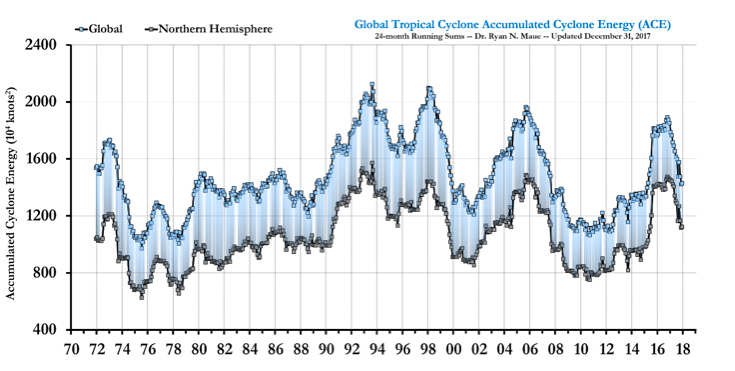
The new alarmist UN report features bad science and worse economics.

The United Nation’s Intergovernmental Panel on Climate Change issued a special report last week predicting apocalyptic environmental consequences if the nations of the world are unable to reduce the amount of warming to 1.5° C above pre-industrial levels in the next 12 years. The IPCC report insists that meeting this target requires “rapid and far-reaching” changes—all unspecified—in a wide range of areas including land, energy, industry, buildings, transportation, and cities. These changes, the report insists, must reduce carbon dioxide emissions to about 45 percent of 2010 levels by 2030 and to a neutral level of no new carbon dioxide emissions by 2050.

Much press coverage has embraced the report’s conclusions. The New Yorker stresses the dire warningls of the IPCC report. The Guardian speaks of the “urgent changes” needed to contain climate change underneath its headline picture of a raging California wildfire. Yet it is here that the story starts to unravel from both a scientific and economic perspective. The unstated narrative behind the picture is that temperature increases due to global warming will cause environmental catastrophes. But in the case of forest fires, this claim is simply untrue: in the United States, the number of forest fires has been down by about 86 percent since 1930, and the current year ranks as the 40th highest on record. To be sure, the risks of fire today remain great but for reasons that are unrelated climate change. Higher levels of CO2 make plants more drought resistant, which increases the amount of burnable material. What matters most, however, is not temperature change, but finding the proper techniques for forest management. Yet one weakness of the IPCC report is that in its discussion of forest fires, it does not mention alternate causes.

The same gap exists with respect to the frequency and severity of hurricanes. From all the recent publicity, one might think that they are rapidly on the rise. But the evidence cuts very much in the opposite direction. It is easy to find reports of major hurricanes that occurred before 1950, as with the record flooding in North Carolina in 1945. But anecdotes never tell the full story. Cato Institute scholars Patrick Michaels and Ryan Maue have demonstrated that hurricane frequency rises and falls in a cyclical manner:

There are a number of clear inferences that can be drawn from just this data set. First, there has been a steady increase in overall levels of CO2 since at least 1950. But whatever its cause, that single variable cannot explain the cyclical pattern of hurricanes. Similar cyclical patterns have been observed in measuring the extent of Arctic ice since at least 1900, including changes during the last 12 years. The same is true of sea levels, which have risen consistently over thousands of years, but not at constant rates; the rates have fluctuated several times in the past 120 years, making it difficult to find a trend. No one is quite sure why there is variability, but the overall levels of sea rise are far lower than feared ranging somewhere between 5 and 8 inches per century. The great vice of the IPCC report is that it attributes all negative environmental phenomena to climate change. It does not acknowledge the data that presents a serious challenge to the dominant orthodoxy that increases in CO2 since the onset of industrialization are the cause of temperature change and the supposed global dislocations.

The larger scientific issue is to develop an expanded theory of climate change that incorporates variables other than carbon dioxide in the equation. Globally, these include the effects of water vapor, also a greenhouse gas, and of aerosols, which tend to lower temperatures. Locally, these include recently discovered volcanic activity under the West Antarctic ice sheet, and the falling of land from the draining of aquifers. MIT climatologist Richard Lindzen recently discussed these issues in his lecture at the Global Warming Policy Foundation—“Global Warming for the Two Cultures”—which calls attention to the deep gap between scientific knowledge and popular culture. Lindzen put the role of CO2 emissions into proper perspective in order to negate the claim that changes in the level of CO2 can drive major climate changes. He pointed out that the total energy flows over the surface of the earth amount to about 200 watts per square meter. The key conclusion is: “Doubling CO2 involves a perturbation of 2% percent to this budget.” The obvious question is how that small change in an energy budget can drive the major changes to the earth’s climate that so many claim. Clearly, other factors have to be at work, including water vapor, whose effects are exceedingly difficult to model. Its distribution is uneven and uncertain over the surface of the earth, and it can take the form of different kinds of clouds with different absorption rates for heat. Water vapor both keeps radiation from the sun from coming in just as it prevents the leakage of radiation out from the system. The wide variation in temperature patterns, sea levels, and plant growth long before modern post-industrial history indicate that these forces are powerful.

At this point, CO2 seems to have a reduced role. But again, matters get more complicated. If the effect of CO2 on temperature is relatively weak, its effect on plant growth is powerful, given that CO2 and water are basic resources that plants require to live. Here the unambiguous effect is that the increase in CO2 has made plant life stronger, and has led to a major amount of global greening over the last 30 years. That increase in CO2 levels tends, moreover, to reduce temperature extremes by making land cooler in the day and warmer at night.

So why is there so much fear about the consequences of climate change? As reported by Marlo Lewis of the Competitive Enterprise Institute total fossil fuel consumption is up 55% since 1950. Total energy-related CO2 emissions is up 500 percent. Total CO2 concentration is up by about one-third. The total temperature increase during that time has been 0.65°C. But in the meantime, global life expectancy has increased from 48 years to 71.4 years. Global malaria infections are down about 37 percent, and global malaria deaths are down by 62 percent. Corn yields per acre are up 25 percent since 2000, 44 percent since 1990, and 88 percent since 1980. Global GDP is sharply up and global poverty is sharply down. And other numbers only reinforce the same trend: as Johan Norberg shows in his book Progress, all major indicators—life expectancy, income, health—are up. As basic levels of technology continue to improve, we will have cheaper production of energy and its more efficient utilization.

Things seem pretty good, so why does the IPCC think that the future is bleak? And why does it think that major transformations are needed to deal with the risks of CO2 emissions? There is no reason to think that all nations can be coaxed into a single coherent central plan to manage emissions, assuming that one even exists. At the very least, China, now the largest emitter of CO2 and India, the third largest, will both sit this one out. Yet at the same time, the United States, which has rightly ditched the Paris Accord, posted in 2017 the largest reduction in CO2 emissions of any nation by relying increasingly on natural gas as a source of energy, even as overall global CO2 levels have moved upward. As Bjorn Lomborg, the head of the Copenhagen Consensus Center, has written, it is not easy to introduce wholesale changes into any economy, and the IPCC presents no evidence that the enormous cuts in fossil fuel consumption it requires to reach its targets can realistically be made.

The first and most simple point is that fossil fuels are here to stay because over the long-haul they are more efficient than either wind or solar energy, especially now that improvements through fracking have reduced the costs of fossil fuel extraction while other improvements in technology have increased the amount of energy extracted per unit of fossil fuels. Even with massive subsidies, the efforts to produce major shifts to wind and solar have proved prohibitively expensive, given their intrinsic unreliability when the wind does not blow and the sun does not shine, and the persistent difficulty of storing such energy in a cost-effective manner. Pull out the subsidies, and these markets may survive in certain niche locations, but they will not displace fossil fuels. The far better path, therefore, is to concentrate on improving yields and reducing externalities from our best energy sources, instead of overlooking the serious externalities that wind and solar themselves can create. The simple path of steady and predictable technological improvement promises far greater returns than the measures suggested by the IPCC report.

Summary

When someone asks me, why don’t you support the fight against climate change, I give the three reasons expressed so well by french mathematicians.

Fighting Global Warming is Absurd, Costly and Pointless.

  • Absurd because of no reliable evidence that anything unusual is happening in our climate.
  • Costly because trillions of dollars are wasted on immature, inefficient technologies that serve only to make cheap, reliable energy expensive and intermittent.
  • Pointless because we do not control the weather anyway.

The prestigious Société de Calcul Mathématique (Society for Mathematical Calculation) issued a detailed 195-page White Paper that presents a blistering point-by-point critique of the key dogmas of global warming. The synopsis is blunt and extremely well documented.

Details and links at Bonn COP23 Briefing for Realists

Footnote:

Epstein’s article refers to a favorite IPCC tactic of omitting information that contradicts their alarmist narrative.  An extensive example of this sin of omission is a legal brief submitted in support of the kids suing the US government for not ensuring them a favorable climate (Juliana vs. US) to be heard later this month.  The document is deconstructed in the post Facts Omitted by Climatists

Minnesota Valve Turners Case Dismissed Without Necessity Defense

“Stunning”: State Court Silences Climate Experts Set to Testify in Valve Turners’ Necessity Defense Trial  “Four days before trial, for no apparent reason, the court eviscerated our defense, and essentially overruled itself.” Excerpts below in italics with my bolds.

Minneapolis October 8, 2018 In an eleventh hour decision, a Minnesota court “eviscerated” the defense of three activists—whose landmark trial began Monday for their 2016 multi-state #ShutItDown action that temporarily disabled tar sands pipelines crossing the U.S.-Canada border—by barring experts from testifying that their civil disobedience was necessary because fossil fuels are driving the global climate crisis.

While all charges against Steve Liptay, who filmed the Minnesota action, have been dropped, valve turners Emily Nesbitt Johnston and Annette Klapstein, along with their support person, Benjamin Joldersma, are still facing felony charges under Minnesota state law. Their legal team will now have to present their “necessity defense” without the slate of experts who had agreed to explain the climate crisis and the impact of civil disobedience to the jury.

This “stunning” reversal came after an appeals court ruled in April that they could present a necessity defense, a decision upheld by the Minnesota Supreme Court in June. The rulings were celebrated by climate activists and experts nationwide as courts in Washington, North Dakota, and Montana blocked requests from fellow valve turners’ on trial for the 2016 action to present such a defense.

“We were looking forward to entrusting this case to a Minnesota jury of our peers to decide after hearing expert scientists and social scientists discuss the facts of climate change and public policy,” said Klapstein, a retired attorney.

“By requiring us to establish the necessity defense, without allowing us to use our planned expert testimony to do so, the court has placed an overwhelming burden on us,” she added. “I’m baffled by the surreal nature of this court’s decision and timing.”

“Four days before trial, for no apparent reason, the court eviscerated our defense, and essentially overruled itself,” said Johnston. “It is impossible for us to properly defend ourselves without expert testimony.”

Experts that had planned to testify include climate scientists Dr. Jim Hansen, Dr. Mark Seeley, and Dr. Peter Reich; public health expert Dr. Bruce Synder; Princeton professor Dr. Martin Gilens; Harvard Law professor Lawrence Lessig; nonviolent direct action historian and Albert Einstein Institution executive director Jamila Raqib; 350.org co-founder Bill McKibben; and oil infrastructure expert Dr. Anthony Ingraffea.

Minnesota District Court Judge Robert Tiffany claimed their testimonies would be confusing to the jury, Climate Direct Action said in a statement on Monday.

“The irony is that the judge may be proving our point—we acted as we did because we know that the paralysis and myopia of the executive and legislative branches with regard to climate change mean that the political system itself must be shaken up if there is to be any hope for all of us,” Johnston noted. “We were hoping that the judiciary might show the way.”

Minnesota judge tosses charges midtrial against 3 activists 
Excerpts in italics with my bolds.

MINNEAPOLIS (AP) October 9, 2018 A Minnesota judge abruptly dismissed charges against three climate change activists during their trial on Tuesday, saying prosecutors failed to prove that the protesters’ attempt to shut down two Enbridge Energy oil pipelines caused any damage.

Clearwater County District Judge Robert Tiffany threw the case out after prosecutors rested their case and before the protesters could use their defense: that the threat of climate change from using crude oil drilled from Canadian tar sands was so imminent that the activists’ actions were not only morally right, but necessary.

The attorneys had long fought to use a “necessity defense” during the trial of the three Seattle-area residents, two of whom admitted turning the emergency shut-off valves on the northwest Minnesota pipelines in 2016 as part of a coordinated action in four states. Such a defense has been used by other activists protesting pipelines.

Their attorney, Lauren Regan, acknowledged outside the courthouse in Bagley that she and her clients were surprised that the judge granted their motion to dismiss the case. The three defendants faced felony charges involving criminal damage to critical public service facilities. They could have faced up to a year in jail, according to prosecutors.

“I’m very relieved the state of Minnesota acknowledged that we did no damage and intended to do no damage,” defendant Emily Johnston said. “I also admit that I am disappointed that we did not get to put on the trial that we hoped for.”

Clearwater County Attorney Alan Rogalla declined to comment afterward.

Climate change activists have increasingly turned to direct actions against oil and gas pipelines, with mixed legal success . Valve-turner cases in other states resulted in convictions that are under appeal. A Massachusetts judge in March cleared 13 gas pipeline protesters who used a necessity defense. While the cases generally have not set binding legal precedents, activists are hoping they help legitimize direct action as a tactic against climate change.

In the Minnesota case, Johnston and Annette Klapstein readily acknowledged turning the emergency shut-off valves on two Enbridge Energy pipelines on Oct. 11, 2016, near Leonard, about 210 miles (338 kilometers) northwest of Minneapolis. A third defendant, Ben Joldersma, called in a warning to Enbridge. Charges were earlier dropped against a fourth defendant.

They did it as part of a coordinated action by Climate Direct Action activists to shut down five Canadian tar sands crude pipelines in Minnesota, North Dakota, Montana and Washington state. A total of 11 activists were charged in the four states.

Calgary, Alberta-based Enbridge temporarily shut down the two pipelines as a precaution before any damage occurred. The company issued a statement Tuesday saying the protest was “reckless and dangerous.”

“The individuals involved in these activities claimed to be protecting the environment, but they did the opposite and put the environment and the safety of people at risk — including themselves, first responders and neighboring communities and landowners,” the company said.

The defendants insisted there was never any danger.

“We did everything in our power to make sure this was a safe action, and we did this to protect our children and all of your children from the devastating effects of climate change,” Klaptstein said at the activists’ news conference afterward.

While the judge took the unusual step of allowing allowed the necessity defense in a ruling last October, he said the defendants had to clear a high legal bar to succeed. He said the defense applies “only in emergency situations where the peril is instant, overwhelming, and leaves no alternative but the conduct in question.”

The valve turners had hoped to put climate change itself on trial by presenting expert witnesses who would have backed up their claims that climate change was making natural disasters worse, and that the threat of climate change from Canadian tar sands crude — which generates more climate-damaging carbon dioxide than other forms of oil — was so imminent that they had no legal alternatives. But they never got the chance.

Summary

I am not sure what to make of this.  The rejection of expert climatists is encouraging since the courts are in no position to judge scientific positions.  The dismissal of the charges in a way avoided a messy situation for the court.  If no damage was done, it was the easy way out to dismiss the charges before going through a show trial before a jury, and as an additional benefit preventing grandstanding by professional activists.

Preview of Minnesota Pipeline Trial

pipeline-sectionalising-valves

Previous posts reported on the series of trials of climate activist “valve turners” who sabotaged pipelines transporting crude oil from Canada.  The last remaining trial proceeds on October 8, 2018 in Minnesota, and it is one where defendants will be allowed to mount a “necessity defense.”  For insight into the implications, here is a timely article Invoking the ‘Necessity Defense’ in Pipeline Sabotage Prosecutions. It was written by Troutman Sanders Pipeline Practice.  Excerpts below in italics with my bolds.

Opposition to new pipeline construction has grown in recent years, moving from public comment to litigation to physical protest and vandalism. In 2016 alone, several coordinated actions led to trespass and vandalism of pipelines and pipeline facilities in multiple states, some of which were prosecuted as felony criminal acts. The defendants in several of these cases have raised a “necessity defense” to their actions, and two courts have now allowed that defense to proceed.

The necessity defense derives from old common law (i.e., not established by statute, although many states have now codified the defense by statute). A necessity defense is not often invoked, in part because the initial element of the defense is to admit that a crime was committed. A defendant must then persuade the court that the otherwise criminal act was required to prevent a greater harm. The requisite showing is typically that (1) there was a significant threat of imminent hazard; (2) there was an immediate need to act; (3) no other alternative was available to prevent the harm; and (4) no greater harm was caused by the prohibited act(s). Examples of successful invocations of the necessity defense include commandeering a private car to carry victims to a hospital, taking food to keep a child from starving, escaping jail because it was on fire, etc. In order to use the defense successfully, the defendant bears a heavy burden to show that no practical alternative to the criminal act was available, and that the criminal act did not create a greater harm.

In a Minnesota case, four individuals were criminally charged for turning valves on a crude oil pipeline, in an attempt to stop the flow of crude oil. The defendants admitted that their acts violated state law, but then claimed the necessity defense. The trial court allowed the defendants to assert the defense and present evidence at trial of the ‘greater harm’ presented by oil pipelines, in the form of climate change. Prosecutors appealed that ruling, and on April 23, 2018, the Minnesota Court of Appeals in a split decision rejected the prosecution’s challenge and agreed that the defendants should be allowed to present the defense. Minnesota v. Klapstein, No. A17-1649 (Minn. Ct. App. Apr. 23, 2018). The dissenting judge stated that ‘there is no direct, causal connection between defendants’ criminal trespass and global warming.’ A court in Massachusetts has similarly allowed defendants who trespassed and/or vandalized pipeline property to present a necessity defense. Other courts in Montana, North Dakota and Washington have rejected the defense. See, e.g., Montana v. Higgins, DC-16-18 (Mont. Dist. Ct. Nov. 22, 2017).

Allowing defendants to present evidence in support of a necessity defense does not mean the defendants have been excused from criminal conduct; they are simply allowed to make that argument at trial. No case has yet accepted the necessity defense to exonerate criminal acts involving pipelines, although some cases have been downgraded to civil fines and resolved after a necessity defense was presented. The burden on the defense remains high, not only to show that no other practical alternative existed, but also to establish a causal connection between a specific pipeline and global climate change. The same week that the Minnesota Court of Appeals allowed a necessity defense to proceed, API and AOPL released their “2018 Annual Liquids Pipeline Report”, documenting the continuing reduction in number and scope of incidents releasing oil to the environment. Similarly, as natural gas pipelines continue to replace coal for electric generation, the amount of greenhouse gas emissions has gone down.

Pipeline opponents have turned to direct acts of vandalism targeting pipelines in the past few years, although those actions present the risk of causing an incident and may result in criminal convictions. Federal law enforcement agencies are monitoring these activities under laws related to Homeland Security and terrorism, beyond state laws for criminal trespass [see prior Pipelaws.com post on November 27, 2017]. In furtherance of that approach, the same week that Minnesota allowed pipeline activists to proceed with a necessity defense, the adjacent State of Iowa signed into law a more strict felony provision applicable to interference with pipelines and other ‘critical energy infrastructure.’ The new law is called the ‘Critical Infrastructure Sabotage’ act, and carries potential penalties of up to 25 years in prison and fines of $100,000.

Sabotage or vandalism of pipelines presents a significant risk of causing substantial harm that could result in killing or injuring people or damaging the environment. Admitting to a crime – particularly a felony criminal act – is a steep price to pay for a defense to those acts. The stakes are high, as are the consequences

Background:  Wheels of Pipeline Justice Grind Slowly.

Wheels of justice grind slow but grind fine — Sun Tzu, Art of War

An update on pipeline disruption cases is provided by Blake Nicholson, Associated Press, January 9, 2018, in Great Falls Tribune: Court cases from coordinated 2016 pipeline protest delayed. Excerpts below with my bolds.

BISMARCK, N.D. — Several court cases stemming from a coordinated pipeline protest in four states have been delayed, including one where an appeals court is deciding whether to allow two women to argue their law-breaking was necessary to prevent a greater harm.

Eleven activists with the group Climate Direct Action were arrested on Oct. 11, 2016, when they tried to either shut down pipelines in North Dakota, Minnesota, Montana and Washington state or film the attempts. The activists said they were protesting fossil fuels and supporting people demonstrating against the Dakota Access oil pipeline, which was still under construction.

The activists broke into private property and turned shutoff valves at five pipelines that moved oil from Canada to the U.S.

In Minnesota, prosecutors have asked a state appeals court to reverse a judge’s ruling that would allow two women to use the so-called necessity defense. The defense is popular among environmental activists who argue that global warming caused by fossil fuels is the greater harm, though legal experts say it’s a long-shot defense.

The appeal delayed the December trial of Seattle-area residents Emily Johnston and Annette Klapstein, who are accused of closing valves on two pipelines in northwestern Minnesota. The trial hasn’t been rescheduled, and their attorney said he doesn’t expect a resolution on the appeal until spring.

Sentencing has been delayed for two men who were barred from using necessity-defense arguments. Leonard Higgins of Portland, Oregon, was convicted in November of criminal mischief and trespassing in Montana; his January sentencing was pushed to March 20 after his attorneys asked for more time, according to court documents. Seattle resident Michael Foster also was set for sentencing this month in North Dakota but the hearing was moved to February because of a timing conflict.

A Washington state case was resolved last year when Ken Ward, of Corbett, Oregon, was convicted of burglary and sentenced to two days in jail plus community supervision and community service. He, too, wasn’t allowed to use the necessity defense.

The six other arrested activists were accused of filming the vandalism. Prosecutors dropped charges against two of them in Washington. Trials are pending for two others in Minnesota and one in Montana, and one activist is to be sentenced in North Dakota the same day as Foster.

Summary

Actually, I don’t mind them taking it slow, so long as they get it right.  Still, putting global warming on trial during this winter weather would have provided at least poetic justice, less so in springtime.

Background:

On civil disobedience by climate activists:

A Valve Turner’s Trial: Mostly guilty

Minnesota judge allows ‘necessity defense’ in pipeline case

On the Judiciary unprepared for such cases: Critical Climate Intelligence for Jurists (and others)