Battle Over Climate Bias

As noted before, the left uses social pressure to force value-laden decisions onto other people. This has been going on for awhile regarding investment decisions by wealth managers, including huge pension funds. The politically correct (scientifically corrupt) bias is to divest of fossil fuel companies in hopes of ensuring a future climate favorable to humans. Now comes some push back from actuaries seeing this pressure as narrow and subversive of other important social concerns.

Chris Seekings writes in The Actuary (UK) Pensions and Lifetime Savings Association rejects climate change law for investment decisions Excerpts in italics below with my bolds.

The UK’s pension fund trade body has argued that new regulations governing how trustees invest £1.5trn in assets should exclude explicit reference to climate change.

The Pensions and Lifetime Savings Association (PLSA) said including climate change specifically in a new law could “confuse” trustees by unintentionally narrowing their focus.

This could cause them to disregard other environmental, social and governance (ESG) considerations that may be more relevant to their portfolios, such as resource depletion or human rights.

This is despite the PLSA reiterating its belief that climate change poses a substantial risk to the business models of firms in almost every sector, threatening the stability of the financial system.

“It is important that pension schemes consider risks related to climate change as part of their investment strategies, however, this is clearly not the only ESG factor to consider,” the PLSA said.

“We believe that picking out any one factor as a specific example may lead trustees to assume that is the only, or most important, factor to consider, when others might be more relevant.”

This comes in response to a consultation by the Department for Work and Pensions into new sustainability regulations for workplace pension funds, which closed on 16 July.

The PLSA also rejected proposals that would see trustees prepare a statement outlining how they take account of scheme members’ views, saying they were “neither practical nor purposeful”.

It argued that members should not be expected to be investment experts, and that trustees should invest in the best interest of members even if it “runs counter to strongly-held beliefs”.

Lawyers at ClientEarth, which co-produced a climate risk report with the PLSA in 2017, said rowing back on the “crucial” government proposals would be “hugely irresponsible”.

“Major financial institutions and world experts recognise climate risk as the most significant financial risk to the economy,” said ClientEarth finance lawyer, Alice Garton.

“Human rights abuses and resource depletion are crucial ESG issues, but what the PLSA seems to have overlooked, is that a changing climate underpins and intensifies these risks.”

ClientEarth exemplifies the alamist drive to reduce everything down to their one obsession with CO2.  It is good to see them confronted by other well-intentioned people who understand that important problems and concerns suffer from the extreme (and ineffectual) focus on fossil fuels.  Maybe some are listening to Bjorn Lomborg after all.

The UN IPCC climate train wreck is under way.


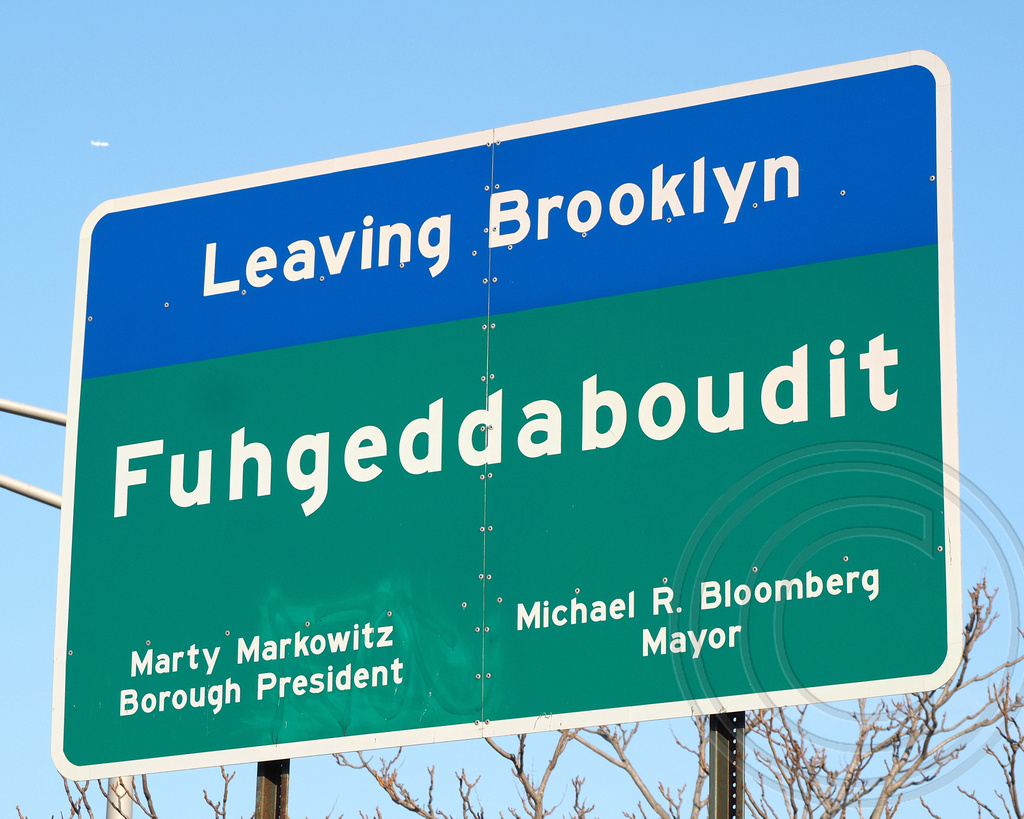
NYC Lawsuit Against Big Oil: Fugget about it!

Washington Examiner has the story: Federal judge dismisses New York City’s climate change lawsuit against Big Oil Excerpts below in italics with my bolds.

A federal judge Thursday dismissed New York City’s lawsuit against major oil companies for their contribution to climate change, the latest in a string of suits filed by cities to be tossed aside.

“Global warming and solutions thereto must be addressed by the two other branches of government,” U.S. District Court Judge John Keenan ruled in dismissing the city’s climate lawsuit, saying the matter should not be handled by the courts. He added that Congress has already delegated to the Environmental Protection Agency the authority to regulate greenhouse gas emissions, so it’s not the job of the courts.

Keenan, of the U.S. District Court for the Southern District of New York, is an appointee of former President Ronald Reagan, a Republican.

In January, New York City sued Exxon Mobil, Chevron Corp., BP, Shell, and ConocoPhillips to help pay for the costs of climate change, trying to hold them responsible for any damage to the city caused by global warming.

Just last week, U.S. District Court Judge William Alsup dismissed similar lawsuits filed by the cities of San Francisco and Oakland, stating in an order: “No plaintiff has ever succeeded in bringing a nuisance claim based on global warming.”

Alsup, of the U.S. District Court for the Northern District of California, is an appointee of former President Bill Clinton, a Democrat.

The cities have argued that big oil companies have promoted fossil fuel use and deliberately concealed that they knew climate change could harm coastal cities, meaning they should have to pay for seawalls and other infrastructure to protect against rising sea levels.

Oil companies say that courts cannot rule on broad and speculative issues such as the impact of business decisions on climate change.

Despite the setbacks, environmentalists continue to increase the pressure for similar lawsuits, seeing them as a key tactic to publicly criticize the industry for its role in producing energy that exacerbates climate change.

Earlier this month, Rhode Island became the first state to file such a lawsuit. Rhode Island Attorney General Peter F. Kilmartin filed the lawsuit in state court against 21 companies that included Exxon Mobil, Chevron, and BP.

JOHN F. KEENAN, United States District Judge Ruling July 19, 2018 Excerpts below in italics with my bolds give the flavor of the judge’s thinking.

Although the amended complaint contains extensive allegations regarding Defendants’ past attempts to deny or downplay the effects of fossil fuel use on climate change, in their motion to dismiss, Defendants do not dispute the scientific consensus that greenhouse gas emissions from fossil fuel use have contributed to global warming.

The City alleges that Defendants’ ongoing conduct continues to exacerbate global warming and cause recurring injuries to NewYork City. (Id. ¶ 9.) Defendants continue to produce, market, distribute, and sell fossil fuels in massive quantities; to promote fossil fuel consumption in these massive quantities; and to downplay the threat posed by climate change. (Id. ¶ 131.) This ongoing conduct will cause increasingly severe injuries to New York City, including new and more significant encroachments upon and interferences with City property, and increasingly severe threats to public health.

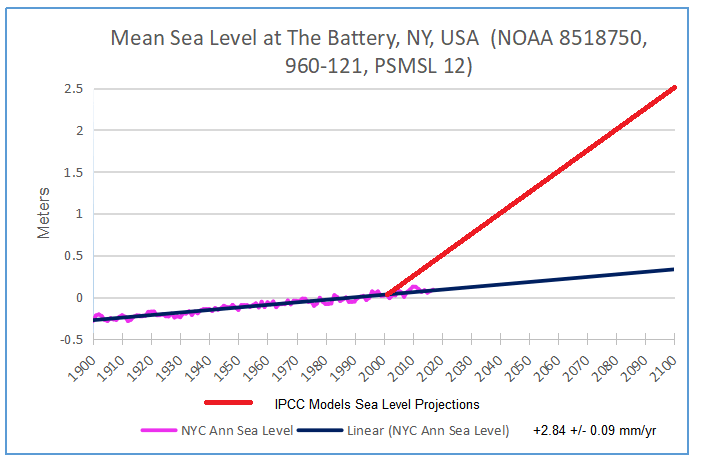
NYC claims of damages rest upon IPCC models projections of sea level rise 8 times beyond what has been observed.

The City requests compensatory damages for past and future costs incurred by the City to protect its infrastructure and property, and to protect the public health, safety, and property of its residents from the impacts of climate change.

However, regardless of the manner in which the City frames its claims in its opposition brief, the amended complaint makes clear that the City is seeking damages for global-warming related injuries resulting from greenhouse gas emissions, and not only the production of Defendants’ fossil fuels.

From BP Brief: If ever a problem cried out for a uniform and comprehensive solution, it is the geophysical problem described by the complaints, a problem centuries in the making (and studying) with causes ranging from volcanoes, to wildfires, to deforestation to stimulation of other greenhouse gases—and, most pertinent here, to the combustion of fossil fuels.

As an initial matter, it is not clear that Defendants’ fossil fuel production and the emissions created therefrom have been an “unlawful invasion” in New York City, as the City benefits from and participates in the use of fossil fuels as a source of power, and has done so for many decades. More importantly, Congress has expressly delegated to the EPA the determination as to what constitutes a reasonable amount of greenhouse gas emission under the Clean Air Act.

The Court recognizes that the City, and many other governmental entities around the United States and in other nations, will be forced to grapple with the harmful impacts of climate change in the coming decades. However, the immense and complicated problem of global warming requires a comprehensive solution that weighs the global benefits of fossil fuel use with the gravity of the impending harms. To litigate such an action for injuries from foreign greenhouse gas emissions in federal court would severely infringe upon the foreign-policy decisions that are squarely within the purview of the political branches of the U.S.Government. Accordingly, the Court will exercise appropriate caution and decline to recognize such a cause of action.

CONCLUSION
For the reasons stated above, the U.S.-based Defendants’ motion to dismiss is GRANTED and the City’s amended complaint is dismissed with prejudice in its entirety.

Note:  With prejudice indicates NYC cannot file an amended complaint again in this court.  They can appeal to a higher court, but that seems unlikely.  OTOH should one federal district court cave in to climate plaintiffs, then an appeal by the oil companies is highly likely.

The Art of Rigging Climate Polls

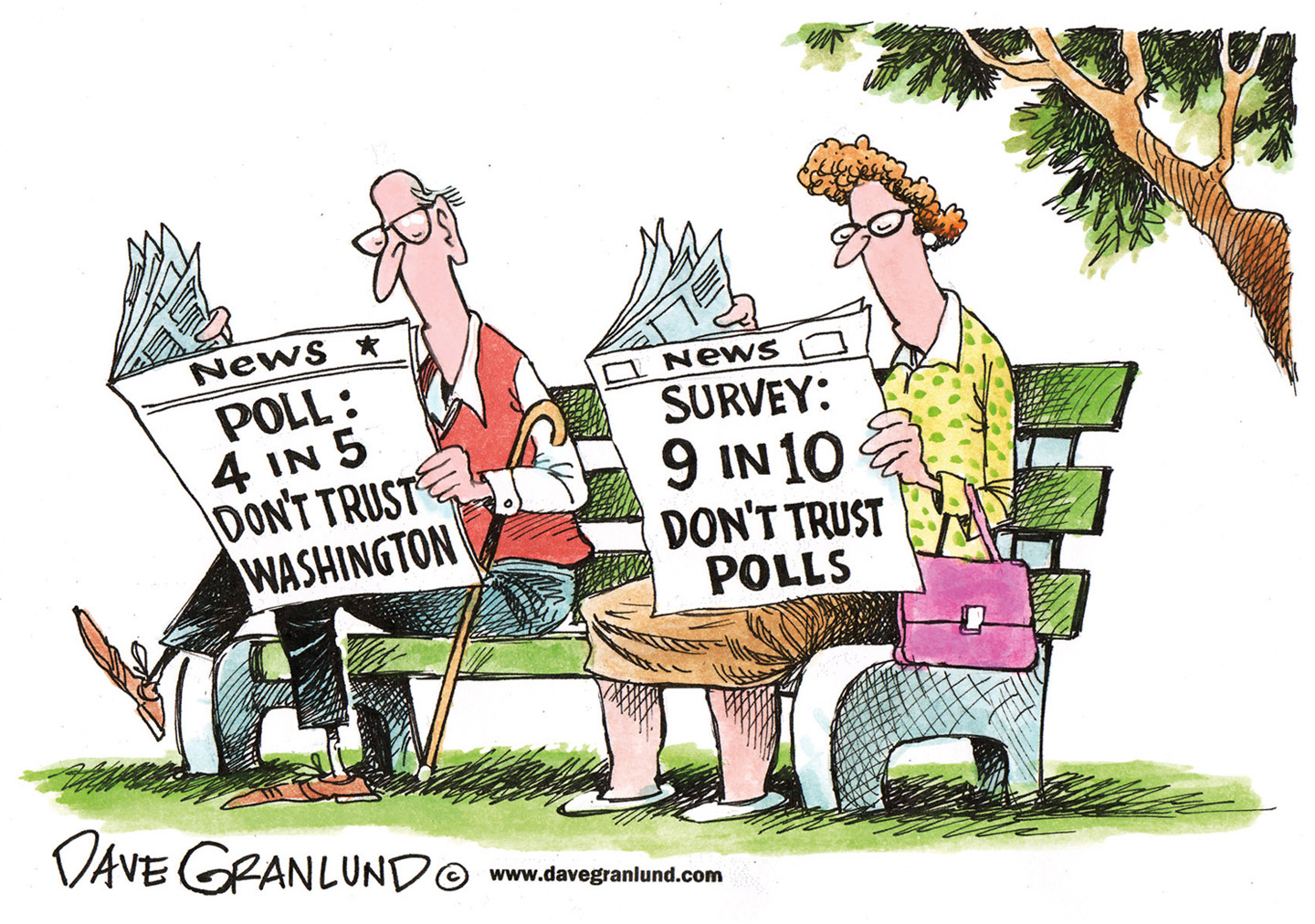
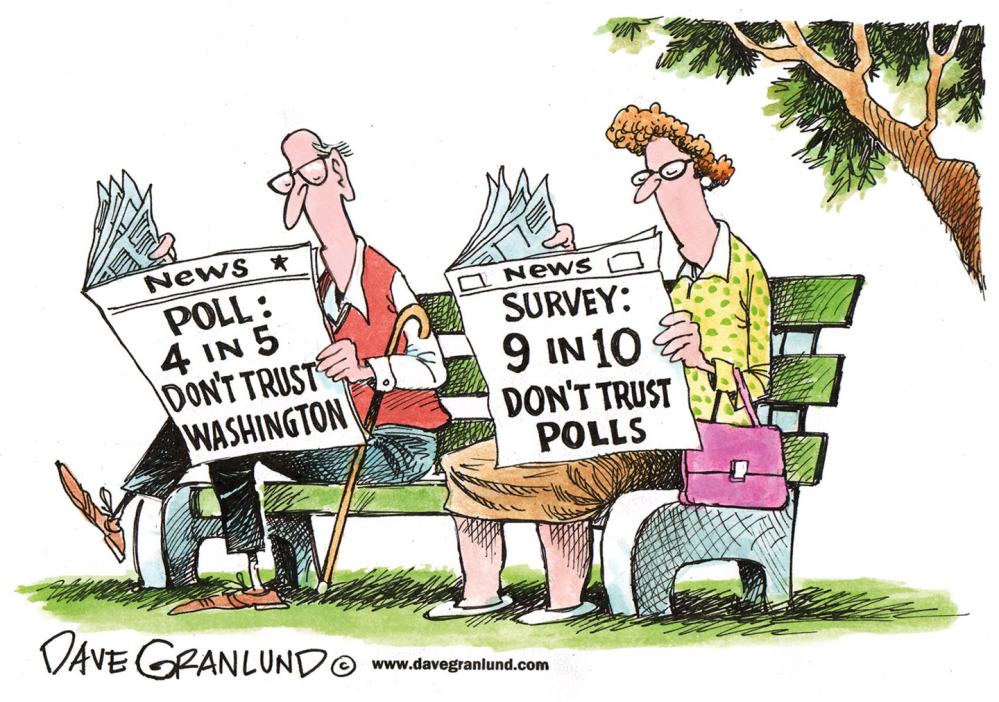
Marketing and social influence makers have used opinion surveys extensively to promote awareness, interest and motivation to engage with their products or preferred policies. I have written before on how this ploy is used regarding global warming/climate change (links at bottom). This post is prompted by a fresh round of climate polls and some further insight into how results are created to support a socio-political agenda.

Of course, any opinion poll on climate as a public policy matter is indicating how much of the blather in the media has penetrated public consciousness, and softened them up for political pitches and financial support. And the continuing samplings and reports need to show progress to keep activist hopes alive.

Just yesterday we had an announcement along these lines. Poll shows consensus for climate policy remains strong is published at Phys.org from Stanford U. (where else, home of the belated Stephen Schneider, among many other leading alarmists). Stanford also happens to be my alma mater, but when I was studying organic chemistry there, we knew life on earth was carbon-based and did not think CO2 was a pollutant.

Climate Public Opinion is a Program of Research by the Stanford Political Psychology Research Group (website link) and has done frequent surveys on the question: What do the residents of the United States believe about global warming?

From psy.org article (excerpts in italics with my bolds):

While the United States is deeply divided on many issues, climate change stands out as one where there is remarkable consensus, according to Stanford research.

“But the American people are vastly underestimating how green the country wants to be,” said Jon Krosnick, a professor of communication and of political science at Stanford, about new findings from a poll he led on American attitudes about climate change.

The study was conducted with ABC News and Resources for the Future, a Washington, D.C.-based research organization. A representative sample of 1,000 American adults nationwide were polled from May 7 to June 11, 2018. The margin of error is +/- 3.5 percentage points.

The poll showed that Americans don’t realize how much they agree about global warming: Despite 74 percent of Americans believing the world’s temperature has been rising, respondents wrongly guessed 57 percent.

“The majority doesn’t realize how many people agree with them,” said Krosnick. “And this may have important implications for politics: If people knew how prevalent green views are in the country, they might be more inclined to demand more government action on the issue.”

Public belief in the existence and threat of global warming has been strikingly consistent over the last 20 years, even in the face of a current administration skeptical about climate change,” said Krosnick, who has been tracking public opinion about global warming since 1995.

Krosnick has learned from his 20 year experience with this topic, and shares with us some of the tricks of the trade. For example, one paper provides their finding regarding the wording of questions.

1. “What do you think is the most important problem facing the country today?”

In this traditional MIP question, about 49 percent answered the economy or unemployment, while only 1 percent mentioned the environment or global warming.

2. “What do you think is the most important problem facing the world today?”

Substituting the word “country” with “world” produced a significant change: 7 percent mentioned environmental issues, while 32 percent named the economy or unemployment.

3. “What do you think will be the most important problem facing the world in the future?”

When asked to consider the future of the planet, 14 percent chose the environment or global warming, while economic issues slipped to 21 percent.

4. “What do you think will be the most serious problem facing the world in the future if nothing is done to stop it?”

This time, 25 percent said the environment or global warming, and only 10 percent picked the economy or unemployment.

“Thus, when asked to name the most serious problem facing the world in the future if nothing is done to stop it, one-quarter of all Americans mentioned either global warming or the environment,” Krosnick said. “In fact, environmental issues were cited more often in response to question 4 than any other category, including terrorism, which was only mentioned by 10 percent of respondents.”

Thus it is that survey results are influenced greatly by the design of the questioning process. Helpfully, the Stanford program provides this history of the questions put to participants over the years. Below are the result categories, some showing the evolving form of questioning, and others just the most recent form for brevity. I will comment on the first few, and leave the others for your reflection (my bolds)

1. Global warming is happening. 2012-2013: What is your personal opinion? Do you think that the world’s temperature probably has been going up over the past 100 years, or do you think this probably has not been happening? 2012: What is your personal opinion? Do you think that the world’s temperature probably has been going up slowly over the past 100 years, or do you think this probably has not been happening? 1997-2011: You may have heard about the idea that the world’s temperature may have been going up slowly over the past 100 years. What is your personal opinion on this? Do you think this has probably been happening, or do you think it probably has not been happening?

Fair question with both responses equally acceptable. The earlier form referred to what they may have heard, but wisely dropped that later on. One does wonder what evidence people use for 100 years of reference.

In a separate study Krosnick tested the effect of asking about “global warming” or “climate change” and concluded:
In the full sample, global warming, climate change, and global climate change were all perceived to be equally serious on average. These findings seem to be inconsistent with the claim that people view climate change or global climate change as less serious than global warming. In addition, the distribution of seriousness ratings were equivalent for global warming, climate change, and global climate change.

IMO it is to his credit that he asks about global warming rather than the vacuous “climate change”.

2.Warming will continue in the future. 2012: If nothing is done to prevent it, do you think the world’s temperature probably will go up slowly over the next 100 years, or do you think the world’s temperature probably will not go up slowly over the next 100 years?

Here comes the phrase:  If nothing is done to prevent it . . . The participant gets the suggestion that rising temperatures have human agency, that we can do something to prevent them. As Krosnick explained above, this phrase will help respondents identify the issue as “environmental” and tap their instinct to protect nature. Implanting this subliminal suggestion sets them up for the next question.

3. Past warming has been caused by humans. 2012: Do you think a rise in the world’s temperature is being caused mostly by things people do, mostly by natural causes, or about equally by things people do and by natural causes? 2012: Assuming it’s happening, do you think a rise in the world’s temperature would be caused mostly by things people do, mostly by natural causes, or about equally by things people do and by natural causes?

Now we have some serious distortions inserted into the findings. The end results will reported as “The % of Americans that believe past warming has been caused by humans.” Note that participants have been primed to think warming is preventable by humans, so obviously humans have caused it (logical connection). Moreover, there are the 50-50 responses that will be counted as human causation. The problem is, people who are mostly uncertain and unwilling to say “don’t know” will fall back to the “equally human, equally nature” response.  It is a soft, not affirmative response.

And a further perversion: Those who have said temperatures are not rising are now told to “Assume it is happening.” What? This is no longer an opinion, it is out-and-out speculation. It appears that “Don’t know” and “Not Happening” are disallowed to force a choice with a 67% chance of getting the right answer: “Caused by Humans.”

4.Warming will be a serious problem for the U.S. 2012: If nothing is done to reduce global warming in the future, how serious of a problem do you think it will be for THE UNITED STATES – very serious, somewhat serious, not so serious, or not serious at all? 2012: Assuming it’s happening, if nothing is done to reduce global warming in the future, how serious of a problem do you think it would be for THE UNITED STATES – very serious, somewhat serious, not so serious, or not serious at all?

Again the phrase “If nothing is done to reduce global warming. . .” signaling participants that this is a serious issue, so don’t come with “not so serious” or (God forbid) “not serious at all.” And again, global warming must be assumed to be happening by anyone still unconvinced of it.

5. Warming will be a serious problem for the world. 2012: If nothing is done to reduce global warming in the future, how serious of a problem do you think it will be for THE WORLD – very serious, somewhat serious, not so serious, or not serious at all? 2012: Assuming it’s happening, if nothing is done to reduce global warming in the future, how serious of a problem do you think it would be for THE WORLD – very serious, somewhat serious, not so serious, or not serious at all?

Same comments regarding #4 apply here, only as Krosnick explained, elevating the issue to a “world problem” triggers even more seriousness in responses.

6. Five degrees of warming in 75 years will be bad. 2011-2012: If the world’s average temperature is about five degrees Fahrenheit higher 75 years from now than it is now, overall, would you say that would be good, bad, or neither good nor bad? 1997-2010: Scientists use the term “global warming” to refer to the idea that the world’s average temperature may be about five degrees Fahrenheit higher in 75 years than it is now. Overall, would you say that if the world’s average temperature is five degrees Fahrenheit higher in 75 years than it is now, would that be good, bad, or neither good nor bad?

In the past, interviewers told participants that global warming is defined as 5 degrees warmer, which triggered “bad” as a response. Fortunately, that obvious bias was dropped, and now people are free to say good, bad or neither. Interestingly, this question is not emphasized in the reports, perhaps because it only gets around 50% “Bad”, even in alarmist places like New York and California.

7. The government should limit greenhouse gas emissions. 2012: As you may have heard, greenhouse gasses are thought to cause global warming. In your opinion, do you think the government should or should not limit the amount of greenhouse gasses that U.S. businesses put out? 2008-2011: Some people believe that the United States government should limit the amount of air pollution that U.S. businesses can produce. Other people believe that the government should not limit air pollution from U.S. businesses. What about you? Do you think the government should or should not limit air pollution from U.S. businesses?

Here the older form of the question was more balanced: Some people believe X, some people believe Y, what do you believe? However, the older question was about air pollution which confuses CO2 (natural plant food) with artificial chemicals. The recent question targets “greenhouse gases”, a term nowhere defined. Now the biased question: Greenhouse gases cause global warming, should the government reduce them? Duh!

8.U.S. federal government should do more to address global warming. 2012: How much do you think the U.S. government should do about global warming? A great deal, quite a bit, some, a little, or nothing? 2009-2011: How much do you think the U.S. government is doing now to deal with global warming? A great deal, quite a bit, some, a little, or nothing? 2008: Do you think the federal government should do more than it’s doing now to try to deal with global warming, should do less than it’s doing now, or is it doing about the right amount?

Note the shift from asking about Whether government should do more than now, to How much is government doing now, to present form: How much more should government do.  Compares with: “Have you stopped beating your wife?”

9. U. S. should take action regardless what other countries do. Do you think the United States should take action on global warming only if other major industrial countries such as China and India agree to do equally effective things, that the United States should take action even if these other countries do less, or that the United States should not take action on this at all?

IOW, Should the US wait for others and be a follower, not a leader? Duh!

Series of Government Policy Questions

The real reason for the survey is to develop support for government officials to impose climate policies upon the population. The flavor of these is below with few comments from me until the end.

10. For the next items, please tell me for each one whether it’s something the government should require by law, encourage with tax breaks but not require, or stay out of entirely. Each of these changes would increase the amount of money that you pay for things you buy.

Reduce greenhouse gas emissions by power plants. Favor lowering the amount of greenhouse gases that power plants are allowed to release into the air?

Favor a national cap and trade program. There’s a proposed system called “cap and trade.” The government would issue permits limiting the amount of greenhouse gases companies can put out. Companies that did not use all their permits could sell them to other companies. Companies that need more permits can buy them, or these companies can pay money to reduce the amount of greenhouse gases that other people or organizations put out. This will cause companies to figure out the cheapest way to reduce greenhouse gas emissions. This type of permit system has worked successfully in the past to reduce the air pollution that companies put out. For example, in 1990, the federal government passed a law like this, called the Clean Air Act, which caused companies to put out a lot less of the air pollution that causes acid rain. Would you favor or oppose a cap and trade system to reduce the amount of greenhouse gases that companies put out?

Tax breaks to produce renewable energy. Do you favor or oppose the federal government giving companies tax breaks to produce more electricity from water, wind, and solar power?

Tax breaks to reduce air pollution from coal. Do you favor or oppose the federal government giving tax breaks to companies that burn coal to make electricity if they use new methods to reduce the air pollution being released from their smokestacks?

Increase CAFE standards for cars. Favor building cars that use less gasoline?
Build electric vehicles. 2012: Building cars that run completely on electricity?

Build appliances that use less electricity. Favor building air conditioners, refrigerators, and other appliances that use less electricity?

Build more energy-efficient buildings. Favor building new homes and offices that use less energy for heating and cooling?

Tax breaks to build nuclear power plants. Do you favor or oppose the federal government giving companies tax breaks to build nuclear power plants?

Who Pays for all this? It is time for the turkeys to face the pilgrim with the hatchet. How willing are you to pay increased taxes to “fight global warming?”

Increase consumption taxes on electricity. Do you favor or oppose the federal government increasing taxes on electricity so people use less of it?

Most places, majorities of respondents were favorable, up to 80% in some states. Perhaps a tribute to relatively cheap electricity in the U. S.  They are blissfully unaware of what can happen to electricity rates, having been spared so far the “Ontario Experience.”

Increase consumption taxes on gasoline. Do you favor or oppose the federal government increasing taxes on gasoline so people either drive less, or buy cars that use less gas?

Nowhere does this get a majority favorable response. It ranges from 15% to 40%, with most places around 30% in favor of higher gasoline taxes.

And finally, how much do you care and how much do you know?

Warming is extremely important personally (and is likely to influence voting). How important is the issue of global warming to you personally – extremely important, very important, somewhat important, not too important, or not at all important?

Less than 17% of people say global warming is personally extremely important, and most places are under 10%

Highly knowledgeable about global warming. How much do you feel you know about global warming – a lot, a moderate amount, a little, or nothing?
Americans rate their global warming knowledge higher than other countries, going up to 60-70% claiming “Highly Knowledgeable.” Other country surveys would report 25% more typically.

Conclusion

An opinion poll is a mirror claiming to show us ourselves. All polls have error margins, and some are purposely bent to a desired distorted outcome.

In modern social democracies, polls and media are used to shape and report public opinions required by ruling elites to impose laws and policies unwanted by the people. A recent example was the distorted Canadian survey on carbon pricing used by Trudeau government to justify a carbon tax. That poll is deconstructed in a post Uncensored: Canadians View Global Warming.

Krosnick said that people taking his climate poll were surprised that the responses were not more skeptical of global warming claims. After seeing how the survey is put together, I am inclined to believe that participants and their neighbors are actually more skeptical than depicted in the results.  This showed up in the low numbers saying global warming is an important personal issue.  Despite agreeing with alarmist talking points, people seem to know this is about virtue signaling and tribal politics.  It is an “everywhere elsewhere” problem.

Finally, in the survey, Americans rate themselves as highly knowledgeable about global warming, up to 60-70% in some states. Other countries doing such climate surveys typically get about 25% of people saying that. For so many to be taken in by such a survey suggests that Americans’ actual knowledge of global warming is highly overrated.

Background:  Another Climate Push Poll

Climate Is a State of Mind
EU Seeks “Populist-Proof” Carbon Reductions

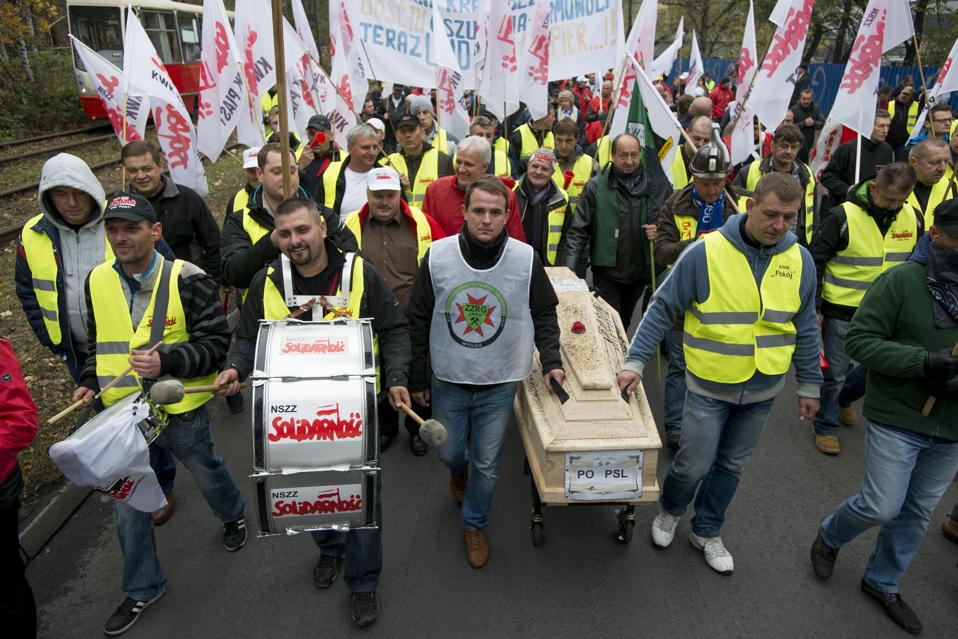
Polish coal miners protest against liquidation of Polish coal mines.

The story July 10, 2018 by Sonja van Renssen EU wants new climate policy to be “populism-proof” [EPW] Excerpts from energypost, who like the idea, with my bolds.

van Renssen: No new targets, gas is in, jobs and growth are key: the EU is designing a new climate and energy strategy for the coming decades that must reflect a new EU identity post-Brexit – and must drive economic opportunity to ensure it is “populism-proof”.

Brussels is usually deserted in summer. The institutions shut down and everyone takes a break. This year, there are two big energy projects that will keep some people busy however.

First, the Austrian EU Presidency, which took over from Bulgaria on 1 July, will lead technical talks on a new electricity market design for Europe. This is part of the EU’s Clean Energy Package. With new laws on renewables, energy efficiency and governance concluded last month, market design is the Package’s last outstanding file. Austria wants to wrap it – and therefore the EU’s climate and energy framework fror 2030 – up by the end of the year.

It organised a first “trilogue” or negotiating session between Member States, the European Parliament and the European Commission on 27 June. This was basically a “meet and greet” session. Work will now get underway at a technical level over the summer ahead of a second trilogue scheduled for 11 September.

The second big topic this summer is a new EU climate and energy strategy for 2050. European heads of state and government called for it by next spring; the European Commission aims to deliver it by November. It is holding a big two-day stakeholder conference on it in Brussels on 10-11 July – in a room big enough for 1000 people, an official said (see programme).

Next week, the Commission will launch a 3-month public consultation on the strategy, ensuring that stakeholders as well as officials are kept busy over the summer months…

Update: Climate Change Theater


Today we can see again a post discussing Chantal Bilodeau’s theatrical productions concerning warming in Arctic Canada.  At Pacific Standard is today’s article  Chantal Bilodeau Brings Climate Change to the Theater.   Thus I am reposting my previous efforts to find scientific validation for the concerns expressed in her plays, and indeed by residents on Nunavut.

Nunavut is Melting! Or not.

From Yale Climate Connections we heard last week about Nunavut melting and a theatrical production to spread news and concerns about this dangerous development.

“I come from a place of rugged mountains, imperial glaciers and tender-covered permafrost. But Nunavut, our land, is only as rich as it is cold, and today most of it is melting.”That’s Chantal Bilodeau, reading a passage from “Sila,” a play about the effects of climate change in the Arctic.

The characters in her play include polar bears, an Inuit goddess, scientists, and coast guard officers – all working together to save their land.

No doubt her personal experience and feelings for her Nunavut are sincere and profound. (Originally I thought it was her homeland, but in fact she is a New York playwright and translator, born in Montreal.) And there will be a large audience receptive to her concerns about global warming. (Bilodeau has writen six plays about the Arctic and founded the international network Artists And Climate Change.) But I wonder if scientific measurements support her belief that Nunavut is melting.

After all, we have learned from medical research that individual life experiences (anecdotes) may not be true more generally. That is why drugs are tested on population samples with double-blind studies: neither the patient nor the doctor knows who gets the medicine and who gets the placebo.  And when it comes to climate change, every weather event is proclaimed as man made global warming rearing its ugly head.

So I went looking for weather station records to see what is the warming trend in that region. As curiosity does so often, it led me on a journey of discovery, learning some new things, and relearning old ones with fresh implications.

Where are temperatures measured in Nunavut?

It is by far the Northernmost territory of Canada, just off the coast of Northern Greenland.

According to Environment Canada, weather is reported at 29 places in Nunavut. So I went to look at the record at Iqaluit, the capital of the territory. You get monthly normals for the period 1981 to 2010. Historical data (daily averages) can be accessed only 1 individual month/year at a time, the menu stops at 2004. Even then, some months are filled with “M” for missing. Historical data from which trends can be analyzed is hard to come by.

Disappearing Weather Records

It turns out that Nunavut also suffered from the great purging of weather station records that was noticed by skeptics years ago.

Graph showing the correlation between Global Mean Temperature (Average T) and the number of stations included in the global database. Source: Ross McKitrick, U of Guelph

I was aware of this because of a recent study looking at trends at stations around the Arctic circle. Arctic Warming Unalarming.  That study included graphs that showed the dramatic removal of station records in the North.  Though the depletion was not limited to the far North, many Canadian and Russian records disappeared from the global database.

arctic-europe-paper-2015_fig6annual

Fig. 6 Temperature change for annual Arctic averages relative to the temperature during 1961 to 1990 for stations in Europe having more than 150 years of observations. The red curve is the moving 5-year average while the blue curve shows the number of stations reporting in each year. 118 stations contributed to the study. W. A. van Wijngaarden, Theoretical & Applied Climatology (2015)

Eureka, Nunavut, Canada “Last Station above latitude 65N”

Eureka got considerable attention in 2010 due to its surviving the dying out of weather stations. The phrase in quotes above reflects an observation that GISS uses Eureka data to infill across the whole Arctic Circle. That single station record is hugely magnified in its global impact in that temperature reconstruction product. Somewhat like the influence of a single tree in Yamal upon the infamous hockey stick graph.

The first High Arctic Weather Station in history, Eureka was established in April 1947 at 80-degrees north latitude in the vicinity of two rivers, which provided fresh water to the six-man United States Army Air Force team that parachuted in. They erected Jamesway huts to shelter themselves and their equipment until August, when an icebreaker reached Eureka – as it has every year since – and brought permanent buildings and supplies. For decades after that, small, all-male crews would hunker down for entire winters, going a little stir-crazy from the isolation. WUWT 2010

GHCN Records for Nunavut

It turns out that in addition to Eureka, GCHN has data for Alert and Clyde (River), but the latter two histories end in 2004 and 2010, respectively. The adjusted files have a few differences in details, but little change from the unadjusted files. The chart below shows the temperatures measured at Eureka, Nunavut, Canada 79° 98’ N, 85° 93’ W.  The other two stations tell the same story as Eureka, though temperatures at Clyde are warmer in absolute terms due to its more Southerly location.

Eureka temps4

The chart shows Annual, July and January averages along with the lifetime averages of Eureka station from 1948 through 2015.  There is slight variability, and a few years higher than average, but nothing alarming or even enough for people to sense any change.  Note also that annual averages are well below freezing, because only 3 months are above 0° C.  I suppose that someone could play with anomalies and generate a chart that looked scary, but the numbers in the record do not support fears of global warming and melting in Nunavut.

Conclusion

Once again we see media announcements that confuse subjective beliefs with empirical observations of objective reality.  And unfortunately, those observations are less and less available to counter the herd instincts of fearing the future and blaming someone.

Footnote

The map at the top shows how crucial is Nunavut to the Polar Ocean Challenge.  If the Northabout  successfuly negotiates the Northern Sea Route (the Russian side), they then must pass from Beaufort Sea through the Parry Channel (or alternative passages) to get to Baffin Bay.  Laptev is the first hurdle, and Nunavut is the last one.

Takeaways from Green Fund Meltdown

From Climate Home is this post today by Megan Darby 8 takeaways from the Green Climate Fund meltdown  Excerpts in italics below with my bolds and images.

The UN’s flagship climate finance initiative had a public setback this week. What went wrong, what are the political implications and what happens next?

The UN’s flagship climate finance initiative had a major setback this week, with the board failing to agree on any big ticket decisions.

Longstanding tensions at the Green Climate Fund came to a head in Songdo, South Korea, as it opened talks on raising a new round of contributions.

On top of that, the head of the secretariat abruptly resigned, adding top level recruitment to the fund’s woes.

As the dust settled, Climate Home News spoke to several participants and observers about what went wrong, the fallout and next steps. Here are eight takeaways.

1. Absent Oquist

The meeting got off to a bad start when the Nicaraguan co-chair failed to show up. Ok, so things were pretty bad back home, with anti-government protests turning violent.

But it was ironic, given Paul Oquist had done a major U-turn to get the job. He notoriously refused to endorse the Paris Agreement in 2015, saying it was too weak. Nicaragua only joined last year when it became apparent Oquist otherwise had no chance at leading the GCF board.

In his absence, developing country board members complained they had not been properly consulted on the agenda, kicking off a protracted procedural dispute.

2. Trump towers

After president Donald Trump made clear he had no plans to put any more money into the GCF, you may wonder why the US still has a seat on the board.

Trump sizes up the benefits were Paris Accord to actually succeed.

Well, the country has already handed over $1 billion and Geoffrey Okamoto is the Trump appointee charged with seeing it is spent wisely. But he can afford to be provocative, having no stake in the fund’s sustainability.

His insistence that the replenishment process should be “donor-driven” did not go down well, on a board deliberately structured to give the developing world an equal say. Nor did his lobbying to end talks on time, while others were trying to salvage some agreement.

3. Fundraising

If there was any doubt on where the talks got stuck, a glance at the video page should dispel it. There are no fewer than six sessions recorded on “matters related to replenishment”, spanning more than 24 hours.

At heart, it is a rich-poor fight of the kind familiar to anyone who follows UN climate negotiations. Donor countries try to attach conditions to funding, while beneficiaries demand they quit stalling and deliver.

In previous meetings, the board has tended to push through some headline outcomes – usually project approvals – at the last minute, while deferring contentious policy decisions. This time round, representatives from Canada and Finland as well as the US were not prepared to just muddle through.

4. Performance review

Before it can raise new money, the fund will need to show donors what it has done with the initial round of contributions. This and other preparatory work is expected to take six months or so.

“If there is one thing we need to decide this time, it is to start a review, because that is a precondition to replenishment processes,” said Germany’s Karsten Sach in the meeting.

The problem was in deciding who should carry out the review. Most saw it as the natural remit of the fund’s independent evaluator Jyotsna Puri, but a handful of developing countries wanted to outsource it. So here too, there was no agreement.

5. Bamsey bails

After a weary-looking chair admitted defeat on replenishment, he dropped a bombshell: the fund’s top executive Howard Bamsey resigned with immediate effect.

Nobody blamed Bamsey for the chaos, which was essentially political, or cast doubt on his explanation the move was for “pressing personal reasons”. The Songdo-based role had kept him away from his family in Australia. (He could not be reached for further comment.)

But the timing took some – including the secretariat’s communications team – by surprise. He had been expected to oversee the replenishment process before leaving. His replacement must take on the heavy lift of fundraising and resolving a backlog of governance issues, while navigating the heated boardroom politics.

6. Projects in limbo

The collapse means a three-month delay for 11 projects bidding for nearly $1 billion of GCF money. Solar panels in Tonga, water management in the Guatemalan highlands and climate finance upscaling across 17 countries are some of the interventions that will just have to wait.

“The people and communities the GCF is meant to support – those who are most vulnerable – are the ones who suffer the most when progress is delayed,” said Action Aid’s Brandon Wu.

It does nothing to help the fund’s reputation for being slow to get money moving. Then again, with a cash crunch looming, the fund cannot afford to make cavalier spending decisions.

7. Political fallout

It comes in a critical year for the UN climate process. Ministers are due to take stock of global action at the Cop24 negotiations in Katowice, Poland this December.

Climate finance is a key part of that. The industrialised world has promised to mobilise $100 billion a year by 2020. Many countries’ climate plans hinge on that support.

The GCF is not expected to deliver all that investment, but is a totem of international cooperation. If it breaks down, it bodes poorly for the Paris Agreement.

8. Optimism

Despite the public meltdown, everyone CHN contacted was hopeful of getting things back on track. There is time for the fund to redeem itself before Cop24, at the next board meeting in October. Behind the scenes, its advocates will knock some heads together in the coming months.

While finance people may be horrified at the inefficiency and game-playing, those coming from a climate negotiations background see the occasional political upset as par for the course.

“Anything about new money is always very thorny,” said Meena Raman of the Third World Network. “I don’t think we have given up on [the GCF] and I don’t think anyone should.”

Footnote:  The last takeaway is wishful thinking from Climate Home, who are desperately hopeful that Paris Accord and the Green Fund succeed, despite the obvious signs of collapse.  Staying hopeful is also a signal of virtue.

California: World Leading Climate Hypocrite

California’s Climate Extremism
Joel Kotkin reports from the Golden State. Excerpts in italics with my bolds.

The pursuit of environmental purity in the Golden State does nothing to reverse global warming—but it’s costing the poor and middle class dearly.

Environmental extremism increasingly dominates California. The state is making a concerted attack on energy companies in the courts; a bill is pending in the legislature to fine waiters $1,000—or jail them—if they offer people plastic straws; and UCLA issued a report describing pets as a climate threat. The state has taken upon itself the mission of limiting the flatulence of cows and other farm animals. As the self-described capital of the anti-Trump resistance, California presents itself as the herald of a green, more socially and racially just society. That view has been utterly devastated by a new report from Chapman University, in which coauthors David Friedman and Jennifer Hernandez demonstrate that California’s draconian anti-climate-change regime has exacerbated economic, geographic, and racial inequality. And to make things worse, California’s efforts to save the planet have actually done little more than divert greenhouse-gas emissions (GHG) to other states and countries.

Jerry Brown’s return to Sacramento in 2011 brought back to power one of the first American politicians to embrace the “limits of growth.” Brown has long worried about resource depletion (including such debunked notions as “peak oil”), taken a Malthusian approach to population growth, and opposed middle-class suburban development. Like many climate-change activists, he has limitless confidence in the possibility for engineering a green socially just society through “the coercive power of the state,” but little faith that humans can find ways to address the challenge of climate change. If Brown’s “era of limits” message in the 1970s failed to catch on with the state’s voters, who promptly elected two Republican governors in his wake, he has found in climate change a more effective rallying cry, albeit one that often teeters at the edge of hysteria. Few politicians can outdo Brown for alarmism; recently, he predicted that climate change will cause 3 to 4 billion deaths, leading eventually to human extinction. To save the planet, he openly endorses a campaign to brainwash the masses.

The result: relentless ratcheting-up of climate-change policies. In 2016, the state committed to reduce greenhouse-gas (GHG) emissions 40 percent below 1990 levels by 2030. In response, the California Air Resource Board (CARB), tasked with making the rules required to achieve the state’s legislated goals, took the opportunity to set policies for an (unlegislated) target of an 80 percent reduction below 1990 levels by 2050.

Brown and his supporters often tout their policies as in line with the 2015 Paris Agreement, note Friedman and Hernandez, but California’s reductions under the agreement require it to make cutbacks double those pledged by Germany and other stalwart climate-committed countries, many of which have actually increased their emissions in recent years, despite their Paris pledges.

Governor Brown has preened in Paris, at the Vatican, in China, in newspapers, and on national television. But few have considered how his policies have worked out in practice. California is unlikely to achieve even its modest 2020 goals; nor is it cutting emissions faster than other states lacking such dramatic legislative mandates. Since 2007, when the Golden State’s “landmark” global-warming legislation was passed, California has accounted for barely 5 percent of the nation’s GHG reductions. The combined total reductions achieved over the past decade by Ohio, Georgia, Pennsylvania, and Indiana are about 5 times greater than California’s. Even Texas, that bogeyman of fossil-fuel excess, has been reducing its per-capita emissions more rapidly.

In fact, virtually nothing that California does will have an impact on global climate. California per-capita emissions have always been relatively low, due to the mild climate along the coast, which reduces the need for much energy consumption on heating and cooling. In 2010, the state accounted for less than 1 percent of global GHG emissions; the disproportionately large reductions sought by state activists and bureaucrats would have no discernible effect on global emissions under the Paris Agreement. “If California ceased to exist in 2030,” Friedman and Hernandez note, “global GHG emissions would be still be 99.54 percent of the Paris Agreement total.”

Many of California’s “green” policies may make matters worse. California, for example, does not encourage biomass energy use, though the state’s vast forested areas—some 33 million acres— could provide renewable energy and reduce the excessive emissions from wildfires caused by years of forest mismanagement. Similarly, California greens have been adamant in shutting down nuclear power plants, which continue to reduce emissions in France, and they refuse to count hydro-electricity as renewable energy. As a result, California now imports roughly one-third of its electricity from other states, the highest percentage of any state, up from 25 percent in 2010. This is part of what Hernandez and Friedman show to be California’s increasing propensity to export energy production and GHG emissions, while maintaining the fiction that the state has reduced its total carbon output.

Overall, California tends to send its “dirty work”—whether for making goods or in the form of fossil fuels—elsewhere. Unwanted middle- and working-class people, driven out by the high cost of California’s green policies, leave, taking their carbon footprints to other places, many of which have much higher per-capita emission rates. Net migration to other, less temperate states and countries has been large enough to offset the annual emissions cuts within the state. Similarly, the state’s regulatory policies make it difficult for industrial firms to expand or even to remain in California. Green-signaling firms like Apple produce most of their tangible products abroad, mainly in high-GHG emitting China, while other companies, like Facebook and Google, tend to place energy-intensive data centers in other, higher GHG emission states. The study estimates that GHG emissions just from California’s international imports in 2015, and not even counting imports from the rest of the U.S., amounted to about 35 percent of the state’s total emissions.

California’s green regulators predict that the implementation of ever-stricter rules related to climate will have a “small” impact on the economy. They point to strong economic and job growth in recent years as evidence that strict regulations are no barrier to prosperity. Though the state’s economic growth is slowing, and now approaches the national average, a superficial look at aggregate performance makes a seemingly plausible case for even the most draconian legislation. California, as the headquarters for three of the nation’s five largest companies by market capitalization—Alphabet, Apple, and Facebook— has enjoyed healthy GDP growth since 2010. But in past recoveries, the state’s job and income growth was widely distributed by region and economic class; since 2007, growth has been uniquely concentrated in one region—the San Francisco Bay Area, where employment has grown by nearly 17 percent, almost three times that of the rest of the state, with growth rates tumbling compared with past decades.

Some of these inequities are tied directly to policies associated with climate change. High electricity prices, and the war on carbon emissions generally, have undermined the state’s blue-collar sectors, traditionally concentrated in Los Angeles and the interior counties. These sectors have all lost jobs since 2007. Manufacturing employment, highly sensitive to energy-related and other regulations, has declined by 160,000 jobs since 2007. California has benefited far less from the national industrial resurgence, particularly this past year. Manufacturing jobs—along with those in construction and logistics, also hurt by high energy prices—have long been key to upward mobility for non-college-educated Californians.

As climate-change policies have become more stringent, California has witnessed an unprecedented level of bifurcation between a growing cadre of high-income earners and a vast, rapidly expanding poor population. Meantime, the state’s percentage of middle-income earners— people making between $75,000 and $125,000—has fallen well below the national average. This decline of the middle class even occurs in the Bay Area, notes a recent report from the California Budget and Policy Center, where in 1989 the middle class accounted for 56 percent of all households in Silicon Valley, but by 2013, only 45.7 percent. Lower-income residents accounted for 30.3 percent of Silicon Valley’s households in 1989, and that number grew to 34.8 percent in 2013.

Perhaps the most egregious impact on middle and working-class residents can be seen in housing, where environmental regulations, often tied directly to climate policies, have discouraged construction, particularly in the suburbs and exurbs. The state’s determination to undo the primarily suburban, single-family development model in order to “save the planet” has succeeded both in raising prices well beyond national norms and creating a shortfall of some 3 million homes.

As shown in a recent UC Berkeley study, even if fully realized, the state’s proposals to force denser housing would only reach about 1 percent of its 2030 emissions goals. Brown and his acolytes ignore the often-unpredictable consequences of their actions, insisting that density will reduce carbon emissions while improving affordability and boosting transit use. Yet, as Los Angeles has densified under its last two mayors, transit ridership has continued to drop, in part, notes a another UC Berkeley report, because incentives for real-estate speculation have driven the area’s predominantly poor transit riders further from trains and buses, forcing many to purchase cars.

Undaunted, California plans to impose even stricter regulations, including the mandatory installation of solar panels on new houses, which could raise prices by roughly $20,000 per home. This is only the latest in a series of actions that undermines the aspirations of people who still seek “the California dream;” since 2007, California homeownership rates have dropped far more than the national average. By 2016, the overall homeownership rate in the state was just under 54 percent, compared with 64 percent in the rest of the country.

The groups most affected by these policies, ironically, are those on whom the ruling progressives rely for electoral majorities. Millennials have seen a more rapid decline in homeownership rates compared with their cohort elsewhere. But the biggest declines have been among historically disadvantaged minorities—Latinos and African-Americans. Latino homeownership rates in California are well below the national average. In 2016, only 31 percent of African-Americans in the Bay Area owned homes, well below the already low rate of 41 percent black homeownership in the rest of nation. Worse yet, the state takes no account of the impact of these policies on poorer Californians. Overall poverty rates in California declined in the decade before 2007, but the state’s poverty numbers have risen during the current boom. Today, 8 million Californians live in poverty, including 2 million children, by far the most of any state. The state’s largest city, Los Angeles, is also now by some measurements America’s poorest big city.

To allay concerns about housing affordability, the state has allocated about $300 million from its cap-and-trade funds for housing, a meager amount given that the cost of building affordable housing in urban areas can exceed $700,000 per unit. These benefits are dwarfed by those that wealthy Californians enjoy for the purchase of electric cars and home solar: Tesla car buyers with average incomes of $320,000 per year got more than $300 million in federal and state subsidies by early 2015 alone. By contrast, in early 2018, state electricity prices were 58 percent higher, and gasoline over 90 cents per gallon higher, than the national average, disproportionately hurting ethnic minorities, the working class, and the poor. Based on cost-of-living estimation tools from the Census Bureau, 28 percent of African-Americans in the state live in poverty, compared with 22 percent nationally. Fully one-third of Latinos, now the state’s largest ethnic group, live in poverty, compared with 21 percent outside the state.

In a normal political environment, such disparities would spark debate, not only among conservatives, but also traditional Democrats. Some, like failed independent candidate and longtime environmentalist Michael Shellenberger, have expressed the view that California’s policies have made it not “the most progressive state” but “the most racist one.” Recently, some 200 veteran civil rights leaders sued CARB, on the basis that state policies are skewed against the poor and minorities. So far, their voices have been largely ignored. The state’s prospective next governor, Gavin Newsom, seems eager to embrace and expand Brown’s policies, and few in the legislature seem likely to challenge them. The Republicans, for now, look incapable of mounting a challenge.

This leaves California on a perilous path toward greater class and racial divides, increasing poverty, and ever-more strenuous regulation. Other ways to reduce greenhouse gases—such as planting trees, more efficient transportation, and making suburbs more sustainable—should be on the table. The Hernandez-Friedman report could be a first step toward addressing these issues, but however it happens, a return to rationality is needed in the Golden State.

Joel Kotkin serves as Presidential Fellow in Urban Futures at Chapman University and executive director of the Center for Opportunity Urbanism (COU).

Canada Convicts Pipeline Outlaws

CBC reports on the trials in BC: First of 202 Trans Mountain pipeline protesters await sentencing Excerpts in italics with my bolds.

Nine pipeline protesters found guilty June 18, 2018 of criminal contempt by a judge in B.C. Supreme Court are facing fines of up to $3,000 or 150 hours of community service. Fines stemming from later arrests will escalate from $500 to $5,000 as trials progress this summer.

The protesters were among the first arrested on Burnaby mountain on March 17. They will be sentenced on June 28.

Earlier this month, more than a dozen protesters arrested on the same day pleaded guilty. They were fined $500 or 25 hours of community service, because they pleaded guilty before the case went to trial.

The expected sentences are based on recommendations put forward by the B.C. Prosecution Service in May, but it will be up to the judge to actually decide the sentences.

Those recommendation include a series of escalating fines and jail time based on when protesters were arrested and how they pleaded to the charges of criminal contempt.

Trials to run all summer

The trial, which wrapped up Monday, is the first in a series of trials scheduled to run over the summer and into the fall. A second trial of four more protesters was expected to get underway Monday afternoon.

In all, about 202 protesters were arrested at Kinder Morgan’s worksite on Burnaby mountain. Those who were arrested after May 8 are facing fines of up to $5,000 or 14 days in jail.

Legal support co-ordinator Kris Hermes says no protesters have been arrested since the Crown raised the sentencing recommendation to seven days in jail for anyone arrested after May 28 even if they plead guilty before trial.

“The Crown is clearly escalating its attack on anyone protesting at the site and it has had an effect of eliminating protests outside the Kinder Morgan worksite,” said Hermes.

About half a dozen protesters are also facing Criminal Code charges of assault, mischief and obstruction of a police officer, said Hermes.

A report in the National Observer gives more details on the proceedings Judge hands down decision in first anti-pipeline protester trial  By Dylan Waisman in News, Energy, Politics | June 18th 2018

Nine anti-pipeline protesters who were trying to blockade the Kinder Morgan tank farm on Burnaby Mountain will be sentenced on June 28 after a B.C. Supreme Court judge found that they were all guilty of criminal contempt of court for violating an injunction on March 17.

Justice Kenneth Afflect said on June 18, 2018 that the BC Prosecution Service proved beyond a reasonable doubt that “the accused disobeyed a court order in a public way, with intent, knowledge or recklessness that the act will tend to depreciate the authority of the court.” He also said he was satisfied that the protesters “openly, flagrantly, and continuously” acted in a way that undermined the court’s authority.

The verdicts follow a week of testimony and cross-examination for the defendants who opted to stand trial, unlike 70 others, among more than 200 people arrested, who opted to plead guilty to avoid a hearing. Federal MPs Elizabeth May and Kennedy Stewart were among the 70 who pleaded guilty and were sentenced to pay fines for violating the injunction.

Many of those who pleaded guilty were persuaded by the court’s practice of awarding lower fines for earlier pleadings. Penalties for early guilty pleas have been as low as $500, with fines for unsuccessful trials as high as $5000, with the option of a corresponding amount of community service hours (ranging 25-240 hours) as an alternative. The court reasons that early guilty pleas take up less court time and resources, and therefore warrant lower fines.

The Crown presented video evidence for each defendant as well as testimony from RCMP and Kinder Morgan security agents. By contrast, self-representing defendants employed both humour, and ethical and environmental considerations to argue their cases, while using friends and each other as witnesses.

Some also chose to put forward largely unconventional legal arguments, cross-examining each other, and telling personal anecdotes in an attempt to sway the court.

Kat Roivas, a defendant who is also on trial for breaking the injunction on two other occasions, advanced several arguments to prove her innocence. Roivas said she had no prior knowledge of the injunction, and explained that due to dyslexia, she was not able to read it when RCMP handed copies out, nor was she able to hear it being read, due to the loud singing and drumming of the other protesters.

Roivas also told the court that she was stationed in front of the gate for spiritual reasons, to support other arrestees.

While she was on the stand during the trial, Monte Ruttan of the Crown Prosecution, was skeptical, referencing RCMP footage and asking “when I see you in the video I don’t see you outwardly doing that [prayer].”

This provoked some laughter from the gallery.

Errol Pova, a friend of Roivas and fellow defendant, cross-examined her afterwards, in an attempt to use humour to “lighten things up,” he told National Observer. He questioned her about an eagle that was in the sky that day, and asked her to provide proof. The stunt was short, but was also met by more laughter in the courtroom.

Affleck ultimately rejected the defence offered by Roivas, agreeing with Ruttan’s arguments that the law does not protect someone who chooses “to remain willfully blind and willfully ignorant” of a court order, despite knowing of its existence.

Chantler also argued that RCMP arrived at the Burnaby terminal already “expecting, and prepared to make arrests.” He added that RCMP had one to two days’ notice of a planned protest in which people would be intending to be arrested, and the RCMP “seemed to accept Trans Mountain’s conclusion that the injunction was being breached, without putting his mind to it,” referencing an affidavit from a RCMP chief constable, Andrew McCauley.

Justice Affleck was not persuaded by either argument, saying that “a higher standard of proof is not required.” He said it was enough that Contable McCauley “had a subjective believe that people were breaking the injunction, I conclude that that belief was objectively justified.”

Following the verdicts, Errol Pova, one of the defendants in the trial, stood up to address Justice Affleck.

“To say that I am disappointed is a major major understatement.”

Affleck replied, “You’re not the first person to be disappointed in the outcome of a trial.”

Estimating Cost of Trudeau’s Carbon Tax

We’re finally told what the carbon tax will cost us. Are you sitting down?
Kenneth Green writes in Financial Post.  Excerpts below in italics with my bolds.
Households in Alberta, Saskatchewan and Nova Scotia will be hit with more than $1,000 of carbon tax per year, while those in British Columbia, Quebec and Manitoba will pay around $650

It took some poking and prodding and (finally) committee testimony, but now we know what the bill will be for a $50-per-tonne carbon tax, similar to one the federal Liberals plan to impose. In a report to the Senate Standing Committee on Energy, the Environment and Natural Resources, University of Calgary economics professor Jennifer Winter revealed the bottom line of a $50-per-tonne carbon price.

Tax advocates say it is a small % of GDP. But it is still $10 Billion extracted from Canadian households.

Using energy-consumption data from Statistics Canada, and imputing prices from average household expenditure on transportation fuels and provincial gasoline prices, Winter calculated the impact of a a $50-per-tonne model of a carbon tax on a typical Canadian household across different provinces. Far from being painless as advertised, the costs to households will be significant.

Three provinces — Alberta, Saskatchewan and Nova Scotia — will be hit with more than $1,000 of carbon tax per year to comply with the $50-per-tonne carbon tax Ottawa has mandated for 2022. Nova Scotia ($1,120) and Alberta ($1,111) will have the highest bills, followed by Saskatchewan ($1,032), New Brunswick ($963), Newfoundland ($859) and Prince Edward Island ($788). The average household in Ontario will pay $707 a year to comply with the carbon tax once its fully implemented.

Who gets the lowest bill? British Columbia ($603 per year), Quebec ($662) and Manitoba ($683). Simply put, households in provinces with the lowest bills will pay just a bit more than half compared to households in the hardest-hit provinces.

But it gets worse, since most experts say carbon prices must continue to increase sharply to effectively lower emissions. At $100 a tonne, for example, households in Alberta will pony up $2,223, in Saskatchewan they’ll pay $2,065 and in Nova Scotia, $2,240. In fact, at $100 a tonne, the average price for households in all provinces is well north of $1,000 per year.

Already across Canada, particularly in the Maritimes, a significant number of households fit the definition of “energy poverty” — that is, 10 per cent or more of household expenditures are spent simply procuring the energy needed to live (to power the home and transportation). In 2016, the Fraser Institute measured energy poverty in Canada and found that when you add up the costs to power the home and cars, 19.4 per cent of Canadian households devoted at least 10 per cent or more of their expenditures to energy.


US District Court grants Chevron’s motion to dismiss climate change case

US District Court grants Chevron’s motion to dismiss climate change case

World Pipelines, Tuesday, 26 June 2018 12:00

The US District Court for the Northern District of California has issued a ruling dismissing the climate change lawsuits filed against Chevron Corporation by the cities of San Francisco and Oakland. The court dismissed the complaint as requiring foreign and domestic policy decisions that are outside the proper purview of the courts.

As the court described, “the scope of plaintiffs’ theory is breathtaking. It would reach the sale of fossil fuels anywhere in the world, including all past and otherwise lawful sales.”

“It is true,” the court continued, “that carbon dioxide released from fossil fuels has caused (and will continue to cause) global warming. But against that negative, we must weigh this positive: our industrial revolution and the development of our modern world has literally been fuelled by oil and coal. Without these fuels, virtually all of our monumental progress would have been impossible. All of us have benefitted. Having reaped the benefit of that historic progress, would it really be fair to now ignore our own responsibility in the use of fossil fuels and place the blame for global warming on those who supplied what we demanded? Is it really fair, in light of those benefits, to say that the sale of fossil fuels was unreasonable?”

The court concluded by dismissing the claims and deferring to the policy judgments of the legislative and executive branches of the federal government: “The dangers raised in the complaints are very real. But those dangers are worldwide. Their causes are worldwide. The benefits of fossil fuels are worldwide. The problem deserves a solution on a more vast scale than can be supplied by a district judge or jury in a public nuisance case. While it remains true that our federal courts have authority to fashion common law remedies for claims based on global warming, courts must also respect and defer to the other co-equal branches of government when the problem at hand clearly deserves a solution best addressed by those branches.”

Reliable, affordable energy is not a public nuisance but a public necessity,” said R. Hewitt Pate, Chevron’s Vice President and General Counsel. “Tackling the difficult international policy issues of climate change requires honest and constructive discussion. Using lawsuits to vilify the men and women who provide the energy we all need is neither honest nor constructive.”

The court’s decision dismisses a lawsuit that the cities of San Francisco and Oakland filed against BP, Chevron, Conoco-Phillips, ExxonMobil and Royal Dutch Shell, seeking to hold a selected group of oil and gas companies responsible for the potential effects of global climate change. The suit, filed in 2017, claims that the production and sale of oil and gas are a public nuisance because they result in greenhouse gas emissions that contribute to worldwide climate change and rising sea levels. The US Supreme Court and other courts around the country have previously rejected similar claims brought by the same lawyers. Those courts – like the court today – found that America’s environmental policies must be determined by national policymakers like the Environmental Protection Agency, not courts of law.

Several other US cities and counties, including New York City and King County, Washington, recently filed nearly identical cases against the same oil and gas companies. Many were filed by the same lawyers. The energy companies have filed motions to dismiss those cases as well. As Chevron has repeatedly emphasised in its court filings, Chevron supports meaningful efforts to address climate change and accepts internationally recognised climate science, but climate change is a global issue that requires global engagement, not lawsuits. Chevron is taking prudent, practical and cost-effective actions to mitigate potential climate change risks, including managing emissions, testing new technologies, and increasing efficiency.

Chevron Corporation is one of the world’s leading integrated energy companies. Through its subsidiaries that conduct business worldwide, the company is involved in virtually every facet of the energy industry. Chevron explores for, produces and transports crude oil and natural gas; refines, markets and distributes transportation fuels and lubricants; manufactures and sells petrochemicals and additives; generates power; and develops and deploys technologies that enhance business value in every aspect of the company’s operations. Chevron is based in San Ramon, California.

Judge Alsup’s Ruling

Footnote:  It will be claimed that the court has confirmed dangerous man made warming.  But IPCC science was stipulated by both plaintiffs and defendants, so there was no disagreement for the court to resolve.  The science was not at issue between the parties.  It doesn’t mean the science holds up under scrutiny, only that such examination was not pertinent here.