Valve Turners Brought to Justice

BISMARCK, N.D. — An environmental activist from Seattle has been sentenced to one year in prison for targeting an oil pipeline in North Dakota.

From the Crime Archives, Bismark ND KVRR Local News  Men Sentenced for Shutting Down Keystone Pipeline The objective facts are provided by Alison Voorhees February 6, 2018

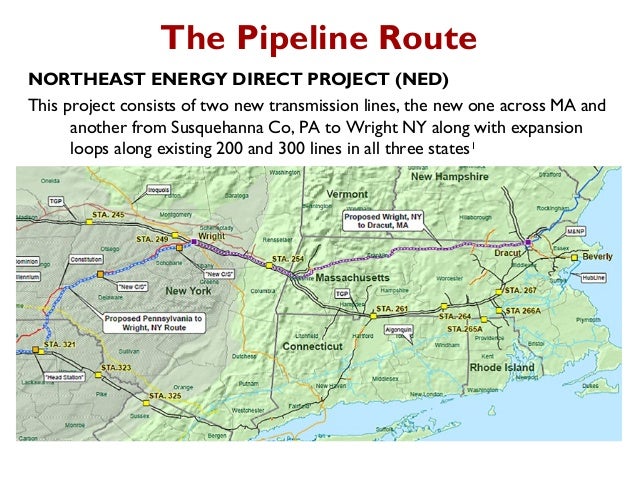
Michael Foster in October 2016 cut through a chain link fence near Walhalla and turned a shut-off valve on the Keystone Pipeline.

He was convicted last October of conspiracy, criminal mischief and trespass but acquitted of reckless endangerment.

Samuel Jessup of Vermont, who filmed Foster’s protest, was sentenced to two years of probation for conspiracy.

A more sympathetic report from Seattle Met Seattle Activist Who Shut Off Keystone Pipeline Sentenced to One Year in Prison  Excerpts below with my bolds.

Foster, along with activists in three other states, in a coordinated effort turned the valves off the tar sands crude pipelines entering the U.S. from Canada. Foster stopped the flow of oil for seven hours, allegedly costing TransCanada $50,000. The pipeline transports an estimated 590,000 barrels of oil a day from Canada to refineries in Texas’s Gulf Coast.

Foster was convicted in October of misdemeanor trespass, felony criminal mischief, and conspiracy to commit criminal mischief. (He was acquitted of the reckless endangerment charge.) The crimes carried a potential maximum penalty of 21 years in prison. TransCanada and the state of North Dakota recommended five in the hopes a harsh sentence would discourage future climate activists.

“It’s gonna suck being a little old vegan in prison,” Foster told Seattle Met months earlier. “But honestly? Living in this system of overconsumption, beside this concrete river of CO2 that is always flowing on I-5—everywhere I go in this town that I love feels like prison. So the idea of living in prison? It doesn’t bother me the way it should.”

The Pembina County Court judge in Cavalier, North Dakota, sentenced Foster to one year in prison and two years deferred. He begins his sentence Tuesday. Sam Jessup of Vermont, who livestreamed Foster turning the North Dakota valve, was sentenced to supervised probation for conspiracy.

Elsewhere we have:  “Michael Foster isn’t a criminal; he’s a hero.” —Dr. James Hansen, climate expert.

What Was Said in Court

Some of the courtroom record is provided by ABC affiliate WDAZ under the category Crime and Courts:

The men and their lawyers brought up everything from slavery to the election in their sentencing hearing — all in an effort to stay out of jail.

“You have not expressed any remorse or any regret ever, any time at all,” said Judge, Laurie Fontaine.

That’s the message from judge Laurie Fontaine to Michael Foster — the man who shut off an emergency pipeline valve two years ago.

“We are not in a democracy today. Because if it was a democracy, Mrs. Clinton would be president. She got 3 million more votes,” said Attorney, William Kirschner.

Their lawyers say majority of people support action on climate change — their voices won’t likely be heard, as, he says, was the case in the last election.

But the judge says turning the valve on the Keystone Pipeline cost the company more than a million dollars — and anxiety for people living in Pembina County.

“Can’t some of these people come up with a marketing plan to convince the population to make a change?” Asked Judge Fontaine.

The County State’s attorney hopes this sentencing serves as a lesson to any would-be valve turners.

“It is very important for everyone to understand if they come here to perpetrate injustice in violation of our laws, it will be dealt with accordingly. And we will pursue it. It is one of a kind and we hope that it remains that way,” said Pembina County States Attorney, Rebecca Flanders.

The state is recommending each of the men pay 20 thousand dollars in restitution, but that will be decided at a later date.

Summary

You do the crime, you do the time.  These are crimes and jail time is what the law requires.  Journalists downplay that the sentence is three years, with two of them deferred.  As posted previously, Iowa state senators are considering a law to increase penalties on such crimes considerably.

See Upping the Stakes for Ecoterrorists


Payback Upon Climate Grasshoppers

Grasshopper begs for food from the ant, but is turned away.

Aesop’s Fable of The Ant and the Grasshopper

In a field one summer’s day a Grasshopper was hopping about, chirping and singing to its heart’s content. An Ant passed by, bearing along with great toil an ear of corn he was taking to the nest.

“Why not come and chat with me,” said the Grasshopper, “instead of toiling and moiling in that way?”

“I am helping to lay up food for the winter,” said the Ant, “and recommend you to do the same.”

“Why bother about winter?” said the Grasshopper; “We have got plenty of food at present.” But the Ant went on its way and continued its toil.

When the winter came the Grasshopper had no food and found itself dying of hunger – while it saw the ants distributing every day corn and grain from the stores they had collected in the summer. Then the Grasshopper knew: It is best to prepare for days of need.

Children are told this story and given the moral truth that warm summer days (good times) don’t last and wise people “make hay while the sun shines.” In the longer version of the story, the starving grasshopper begs for food from the ants and is turned away.

Climate Grasshoppers

Today we are seeing climate alarmists in the role of grasshoppers. They presume future warming is certain and want to stop anyone from storing energy reserves. A post yesterday (NIMBY Wars) reported on west coast grasshoppers in Oregon and British Columbia acting against fossil fuel transport and storage. Today is a report on New England’s energy outlook facing the return of normal winters.

Dean Foreman wrote A Deeper Dive into New England’s Self-Imposed Pipeline Capacity Problem in Energy Tomorrow.  Excerpts below with my bolds.

U.S. infrastructure promises to be a top priority for the Trump administration in 2018. In his State of American Energy keynote address, API President and CEO Jack Gerard highlighted how resistance to infrastructure development has left New Englanders with some of the highest electricity costs in the nation, particularly so through extreme winters.

In December and early January, New England’s wholesale electricity prices averaged nearly three times those of equally-frigid Chicago. Over the past four years, New England’s wholesale electricity prices averaged 24 percent higher than those in Chicago and were nearly three times more volatile.

df20ng20vs20imports20volatility


While price volatility provides signals that are important to the efficiency of wholesale energy markets, the disproportionate rise of the region’s winter prices stems from New York’s beggar-thy-neighbor policies, which blocked planned, much needed and federally approved new pipeline capacity. Politics and policies that accentuate high and volatile natural gas and electricity prices, not only in New York but also in New England, harm consumers and undermine regional investment, jobs and competitiveness. It is high time that New York and New England take a collective and collaborative approach to solve the problems with permitting and incentives that utilities have to contract longer-term for natural gas.

Project abandoned in 2017

In the first week of January, contrasting headlines proclaimed natural gas got bomb-cycloned in the new year with daily New York (Transco Zone 6) prices spiking as high as $140 per million BTU (MMBtu). Yet the U.S. Energy Information Administration (EIA) reduced its 2018 price forecast to $2.88/MMBtu at Henry Hub, Louisiana. The low Henry Hub price represents a major natural gas production region and liquid trading hub. By contrast, the high New York City price reflects a major natural gas production region that could have ample low-cost natural gas, except that it is stymied by a lack of effective political and regulatory mechanisms to enable responsible resource and infrastructure development.

The rise in natural gas prices has reverberated through electricity markets. For example, the chart below compares wholesale electricity prices for December through early January between Boston and equally-frigid Chicago. Chicago is amply supplied by natural gas pipelines that flow from the U.S. Gulf Coast, Appalachia, and Rockies regions plus Canada. Based on data from Bloomberg, wholesale electricity prices between Dec. 1 and Jan. 8 averaged $31.31/MWh and had a standard deviation of more than $35/MWh. By comparison, Boston’s prices averaged $85.36/MWh with a standard deviation of $67.64/MWh over the same period. New England utilities thus paid more than twice as much for electricity and experienced about twice the price volatility.

Project abandoned in April 2016.

The region’s relatively high and volatile energy prices are rooted in the inadequacy of natural gas infrastructure to meet peak seasonal demand and, to a lesser extent, the long-standing shift in market incentives toward utilities’ reliance mainly on spot markets and very short-term contracts for gas. Specifically, natural gas-fired generators set the region’s electricity price about 75 percent of the time. Gas-fired power generation in the Northeast census region rose by 53 percent between 2007 and 2017, according to the EIA short-term energy outlook. Natural gas-fired generation contributed 38.6 percent of the region’s electricity in 2017, compared with 24.3 percent in 2007, and gained market share due to its abundance, low cost and efficient and clean-burning environmental properties.

chart2

However, natural gas pipeline constraints have hampered utilization at peak times. For example, ISO New England recently highlighted that four gigawatts of natural gas-fired generation capacity – 24% of the region’s gas-fired net winter capacity – was at risk of not being able to get fuel when needed. Much of the constraint is due to New York state’s blocking the Constitution and Northern Access Pipeline projects, among others.

To compensate for New York’s un-neighborly policies, ISO New England performed triage for the past five years with its Winter Reliability Program, which has been paying as much as $32 million per year for reserves of oil and liquified natural gas (LNG) as back-up fuels. Beginning this year, ISO New England will change to a Pay for Performance plan that alters how a generation resource’s capacity payments are calculated. These costly plans might not be needed if economic rationality and the overall region’s welfare were top of the New York state of mind.

New York and New England must take a collective and collaborative approach to solve the problems with permitting and incentives that utilities have to contract longer-term for natural gas. Given policy alternatives that provide positive incentives and enable investment and infrastructure development, lower prices, and lessen price volatility, it should be a dominant strategy for the region to pursue outcomes that are less risky, better facilitate market operations and ultimately provide a win for the region’s consumers and economy.

The Bigger Picture: Energy and Human Development

At Forbes, Jude Clemente adds this perspective: More Oil And Natural Gas Invalidates ‘Keep It In The Ground’ Movement

There is a destructive “keep it in the ground” movement arising from environmental groups to block oil and natural gas development and the pipelines required to transport them. The center of this is New York and the New England states, where numerous policymakers seek to artificially constrain energy supply. Yet, despite producing none themselves, their reliance on gas electricity has surged. ISO New England now gets about 50% of its power from gas, versus 10-15% a decade ago. New York sits in the same boat: gas now generates ~45% of the state’s electricity, doubling its market share since 2005.

It’s no wonder then that blocking energy development and pipelines has established home power rates in New England and New York that are at least 50% higher than the national average. Industrial rates are more than double, and encourages companies to leave the area. This is unfortunate and illogical since U.S. natural gas prices have been at historic lows.

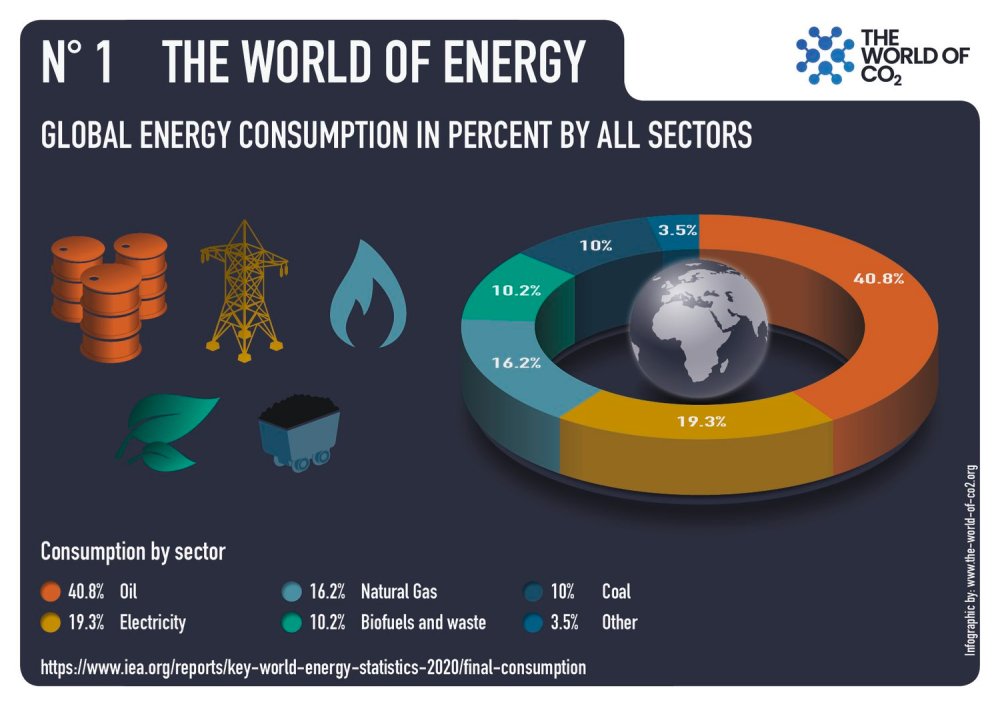
Policies intended to reduce oil and gas consumption are dubious: even if they work in the short-term, over time they just lower oil and gas prices and encourage more usage. I’ve already clearly explained it. Oil and gas are so obviously ingrained in the U.S. and global economies, supplying over 60% of all energy. In the real world, this means that more economic growth ultimately means more oil and gas demand. That’s why year after year demand continues to grow. There is no significant substitute for oil whatsoever. And know that natural gas power plants don’t get retired with more wind and solar power, but get built even more because gas is flexible backup required.

This is also why more oil and gas pipelines are so crucial, not just the most economical way to transport energy but also the safest. The Trump administration calls for a bill that gets at least $1.5 trillion for the new infrastructure investment that our country so desperately needs. It’s safe to assume that much of that would include provisions for oil and gas infrastructure. But it’s increasingly obvious that the approval process for pipelines needs expedited, now taking an average of four years for permits to be issued.

Summary

Climatists are fixated on future warming and blaming fossil fuels, the very energy which society needs to face cold or stormy weather. It is not only New York state at fault, but also obstructionists in states like Massachusetts and Connecticut. Climate change is not the problem, it’s climate policies that threaten our collective security.

NIMBY Wars: Portland Bans Fossils Fuels! Or not.

Mayor Hales and Community Activists Celebrate Unanimous Fossil Fuel Infrastructure Ban.

Lots of cheerleaders celebrated when in 2015, the City of Portland Oregon passed a city ordinance against fossil fuel infrastructure. Resilience.org published today praising Portland as the “First U.S. City to Ban Fossil Fuel Expansion Offers Roadmap for Others”. A year ago the event was proclaimed: Portland Makes History with New Protections from Fossil Fuels Dec. 14, 2016. It was a successful blow by protesters motivated by NIMBY (Not In My Back Yard). Excerpts below with my bolds.

But there’s more to the story. In July 2017 came this story from the Oregonian:

Oregon’s Land Use Board of Appeals (LUBA) on Wednesday rejected Portland’s limits on the expansion of fossil fuel infrastructure in the city, saying the ordinance violated the commerce clause of the U.S. Constitution.

The Portland Business Alliance joined fuel suppliers to appeal to the state Land Use Board of Appeals. They cited a number of grounds for the appeal, but Wednesday’s decision was based on a violation of the commerce clause, which gives the federal government the right to regulate trade between states and other nations.

The city is considering an appeal to the State Court of Appeals.

“This decision is disappointing and goes against the interests of our community,” according to a statement issued by Mayor Ted Wheeler. “It is incumbent upon us to protect our residents from the enormous risks posed by fossil fuels. The City is reviewing the ruling and exploring our options, including an appeal. Additionally, we will continue to work with environmental, energy, and resiliency experts to ensure Portland remains a leader on these issues.”

Then in January 2018 comes a ruling from the Appeals court: Portland Ban On Fossil Fuel Terminals Is Constitutional

The Oregon Court of Appeals ruled Thursday that the Portland City Council did not violate the U.S. Constitution with a 2015 resolution that banned new fossil fuel terminals.

The court reversed a significant portion of an Oregon Land Use Board of Appeals ruling, which found the ban unconstitutional.

Portland’s use of zoning laws to ban the construction and expansion of fossil fuel terminals matters for a couple reasons.

In Oregon, tanks located in North Portland supply about 90 percent of the fossil fuels used statewide.

Nationally, the ordinance also tested a new strategy for left-leaning cities that want to limit fossil fuel use as a way to combat climate change.

“Other cities were looking to the city of Portland and what they had done as a potential model for other ordinances,” said attorney Maura Fahey with the Crag Law Center.

The text of the Oregon Court of Appeal ruling is at Columbia Pacific v. City of Portland

The review concerned the July ruling by Land Use Board of Appeals (LUBA), The arguments revolve around the federal commerce principle that states are not allowed to favor their own merchants by discriminating against out of state suppliers, or favor their consumers over out of state consumers. The court decided that Portland was not guilty of that result, and also considered a precedent from Pike (US Supreme Court case):

“Where the statute regulates even-handedly to effectuate a legitimate local public interest, and its effects on interstate commerce are only incidental, it will be upheld unless the burden on such commerce is clearly excessive in relation to the putative local benefits. If a legitimate local purpose is found, then the question becomes one of degree. And the extent of the burden that will be tolerated will of course depend on the nature of the local interest involved, and on whether it could be promoted as well with a lesser impact on interstate activities.”

LUBA concluded that the amendments impose burdens on interstate commerce that are clearly excessive in relation to the putative local benefits. Columbia Pacific, ___ Or LUBA at ___ (slip op at 92). We disagree and, in contrast, conclude that Columbia Pacific did not meet its burden to demonstrate that the claimed burdens on interstate commerce are clearly excessive in relation to the putative local benefits.

However, the judges left a door open regarding the public detriment due to restricting fossil fuels for consumers.

Before LUBA, Columbia Pacific argued that that finding was essential to the city’s decision not to allow expansion of existing bulk fossil-fuel terminals and that the specific finding that use of fossil fuels may “plateau and decline” with a continued shift to other modes of transportation, more fuel efficient vehicles, electric vehicles, and other carbon reduction strategies was not supported by an adequate factual base as required by Goal 2. Columbia Pacific, ___ Or LUBA at ___ (slip op at 55). LUBA agreed with Columbia Pacific, concluding that Finding 21 was “key support for the prohibition on any expansion of existing terminals to meet * ** local or regional needs” and its conclusion that fossil-fuel use “may plateau and decline” was “not supported by substantial evidence, and hence not supported by an adequate factual base.”

The Appeals court sided with the defendants on this aspect, noting that “the only evidence in the record projecting future fossil-fuel demand cited to us by either party or LUBA are trend-based forecasts indicating that demand will moderately increase over time.”

Will reasonable people come together and set aside irrational fears?  It remains to be seen.  From the Portland Business Journal

The Portland Business Alliance, in a statement to Willamette Week, said it hopes the city sees the ruling as “an opportunity to bring parties back to the table to revisit elements of the ordinance which, as originally adopted, significantly impact fuel access and affordability” throughout the region.

The Western States Petroleum Association, asked via email if it would appeal the new ruling, sent this statement from Oyango Snell, its general counsel:

The Columbia Pacific Building Trades Council and the Western States Petroleum Association and its members are disappointed with the Oregon Court of Appeals’ decision to allow an unconstitutional ban on new fossil fuel infrastructure in Portland. The Fossil Fuel Zoning Ordinance is not only a violation of Oregon and Portland City land use laws, but punishes consumers and businesses in the city and throughout Oregon, who rely on affordable fuel to power their homes, their businesses and the economy.

Here is what they are up against on the other side:


NIMBY in Canada:  Alberta and British Columbia go to war over pipeline expansion

In a similar power struggle, BC province, led by leftist Vancouverites has moved to prevent construction of the expanded Kinder-Morgan pipeline to move bitumen from Alberta to west coast seaports serving Asian customers.  Canadian federal authorities have signed off on this, with PM Trudeau telling the greens that if they liked his carbon tax, they have to swallow this because it is a package deal.

Ironically both provinces are governed by left wing NDP politicos, but despite (or perhaps because of that) the rhetoric is going over the top.  National Post reports
Could Alberta bring B.C. to its knees by shutting off the oil?
If they don’t like pipelines, let’s see if B.C. likes having a main supply of gasoline turned off.  This comes after the Alberta premier earlier threatened to stop importation of BC wines.

Next:  Attacks on energy access on the East Coast (New England) Payback Upon Climate Grasshoppers

For more on climate issues in courts of law:

Judiciary Climate Confusion

Critical Climate Intelligence for Jurists (and others)

Climate Law Alaska Update


Green Electrical Shocks

On Sunday Feb.4, a weekly news program aired in the Netherlands on the titled subject. H/T Climate Scepticism. The video clip is below with English subtitles. For those who prefer reading, I provide the substantial excerpts from the program with my bolds.

How many of you have Green Electricity? I will estimate 69%
And how much nationally? Oh, 69%!
So we are very average, and in a good way, because the climate is very important.

Let me ask: Green electricity comes from . . .?
Yes, electricity produced from windmills and solar panels.
Nearly 2/3 of the Dutch are using it. That’s the image.

Well I have green news and bad news.
The green news: Well done!
The bad news: It is all one big lie.
Time for the Green Electrical Shocks.

Shock #1: The green electricity from your socket is not green.
When I switched to green electricity I was very proud.
I thought, Yes, well done! The climate is getting warmer, but not any more thanks to me.

Well, that turned out to be untrue.
All producers deliver to one communal grid. Green and grey electricity all mix.
The electricity you use is always a mix of various sources.
OK. It actually makes sense not to have separate green and grey cables for every house.
So it means that of all electricity, 69% is produced in a sustainable way. But then:


Shock #2: Green Electricity is mostly fake.
Most of the green electricity we think we use comes from abroad.
You may think: So what. Green is green.

But that electricity doesn’t come from abroad, it stays abroad.
If you have green electricity at home, it may mean nothing more than that your supplier has bought “green electricity certificates”.

In Europe green electricity gets an official certificate,
Instead of selling on the electricity, they sell on those certificates.
Norway, with its hydro power, has a surplus of certificates.
Dutch suppliers buy them on a massive scale, while the electricity stays in Norway.


The idea was: if countries can sell those certificates, they can make money by producing more green electricity.
But the Norwegians don’t produce more green electricity.
But they do sell certificates.

The Dutch suppliers wave with those certificates, and say Look! Our grey electricity is green.
Only one country has produced green electricity: Norway.
But two countries take the credit.
Norway, because they produce green electricity, and the Netherlands because, on paper, we have green electricity. Get it? That’s a nice deal.

More and more countries sell those certificates. Italy is now the top supplier.
We buy fake green electricity from Italy, like some kind of Karma ham.

Now, let’s look again at the green electricity we all think we use.
So the real picture isn’t 69%. If you cancel the certificates, only 21% of electricity is really green.
Nowadays you can even order it separately if you don’t want to be part of that Norway certificates scam.
You may think: 21% green is still quite a lot. But it is time for:


Shock #3: Not all energy is electricity.
If you talk about the climate, you shouldn’t just consider electricity but all energy.
When you look at all energy, like factories, cars, trains, gas fires, then the share of consumer electricity is virtually nothing.
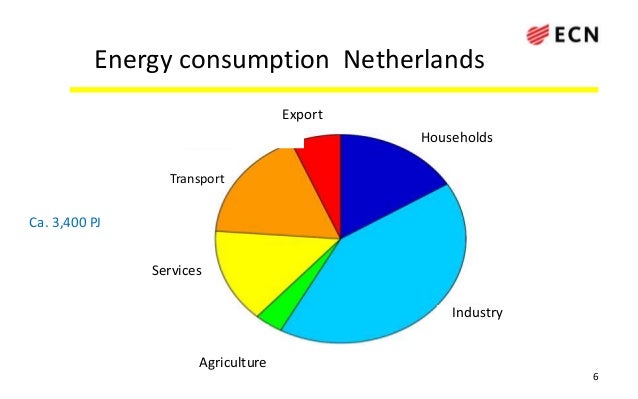
If you include everything in your calculation, it turns out that only 6% of all the energy we use in the Netherlands is green. It is a comedy, but wait:

Trees converted into pellets by means of petroleum powered machinery.

Shock #4: Most green energy doesn’t come from sun or wind, like you might think.
Even the 6%, our last green hope, is fake. According to the CBS we are using more sun and wind energy, but most of the green energy is produced by the burning of biomass.
Ah, more than half of the 6% green energy is biomass.

Ridiculous. What is biomass really? It is organic materials that we encounter every day.
Like the content of a compost heap. How about maize leaves or hay?
The idea behind burning organic materials is that it will grow up again.
So CO2 is released when you burn it, but it will be absorbed again by new trees.

However, there is one problem. The forest grows very slowly and our power plants burn very fast.
This is the fatal flaw in the thinking about biomass. Power plants burn trees too fast, so my solution: slow fire. Disadvantage: it doesn’t exist. So this is our next shock.

Shock#5: Biomass isn’t all that sustainable.
It’s getting worse. There aren’t enough trees in the Netherlands for biomass.
We can’t do it on our own. We don’t have enough wood, so we get it from America.

In the USA forests are cut at a high rate, Trees are shredded and compressed into pellets.
These are shipped to the Netherlands and end up in the ovens of the coal plants.
It’s a disaster for the American forests, according to environmental groups.

So we transport American forests on diesel ships to Europe.
Then throw them in the oven because it officially counts as green energy.
Only because the CO2 released this way doesn’t count for our total emissions.

In reality biomass emits more CO2 than natural gas and coal.
These are laws of nature, no matter what European laws say.
At the bottom line, how much sustainable energy do we really have in the Netherlands?
Well, the only real green energy from windmills, solar panels etc. Is only 2.2%. of all the energy we use.

In Conclusion
So the fact that 2/3 of the audience and of all Dutch people use green electricity means absolutely nothing. It’s only 2.2%, and crazier still, the government says it should be at 14% by 2020.
They promised: to us, to Europe, to planet Earth: 14 instead of 2.2.

Instead of making a serious attempt to save the climate, they are only working on accounting tricks, like buying pieces of paper in Norway and burning American forests.
They are only saving the climate on paper.

Summary Comment

As the stool above shows, the climate change package sits on three premises. The first is the science bit, consisting of an unproven claim that observed warming is caused by humans burning fossil fuels. The second part rests on impact studies from billions of research dollars spent uncovering any and all possible negatives from warming. And the third leg is climate policies showing how governments can “fight climate change.”

It is refreshing to see more and more articles by people reasoning about climate change/global warming and expressing rational positions. Increasingly, analysts are unbundling the package and questioning not only the science, but also pointing out positives from CO2 and warming.  And as the Dutch telecast shows, ineffective government policies are also fair game.

More on flawed climate policies at Reasoning About Climate

Upping the Stakes for Ecoterrorists

Protesters admit to pipeline vandalism before vandalizing IUB

Previous posts have covered the trials of  “valve turners”, showing the legal maneuvers required to bring them to justice.  Now we have a report that Iowa lawmakers intend on raising the stakes for those taking this path to “save the planet” from fossil fuel energy.  From the Des Moines Register Iowa Senate bill would ban sabotage of pipelines, other ‘critical infrastructure’ Excerpts below with my bolds.

Criminal acts against pipelines, telecommunications facilities, water treatment plants, and a long list of other critical infrastructure would result in a long prison sentence and a steep fine under legislation advancing in the Iowa Senate.

Senate Study Bill 3062, proposed by the Iowa Department of Homeland Security and Emergency Management, appears to be a response to millions of dollars in damage inflicted by protesters on Iowa sections of the Dakota Access Pipeline, prior to the crude oil pipeline becoming operational last year across four states.

Explanation of the proposed legislation, Senate Study Bill 3062 from the Iowa Bill book: (full text here)

This bill creates the crime of critical infrastructure sabotage.

The bill defines critical infrastructure property as property and public utility property, both as defined in Code 9 section 716.7, that is considered critical infrastructure. The bill defines critical infrastructure to include electrical critical infrastructure, gas, oil, refined petroleum products, or chemical critical infrastructure, telecommunications or broadband critical infrastructure, wastewater critical infrastructure, and water supply critical infrastructure.

The bill additionally defines critical infrastructure sabotage to mean any unauthorized act that is intended to or does in fact cause a substantial interruption or impairment of service rendered to the public relating to critical infrastructure property. The bill provides that a person who commits critical infrastructure sabotage commits a class “B” felony, punishable by confinement for no more than 25 years. The bill also subjects a person who commits critical infrastructure sabotage to a fine of $100,000.

Jeff Boeyink, a lobbyist for Energy Transfer, the developer of the $3.8 billion Dakota Access Pipeline, told a Senate subcommittee Thursday he considers his company’s project to be the “poster child” of why the legislation is necessary.”This is not only dangerous, but it has huge monetary implications,” Boeyink said.

John Benson, a legislative liaison for the Department of Homeland Security and Emergency Management, said Iowa law currently allows criminal charges for terrorism, arson, burglary and criminal mischief. However, these charges do not specifically include “critical infrastructure,” he said, and operators of these facilities want criminal charges that are appropriate for such actions.

The Senate subcommittee voted 3-0 Thursday to advance the measure to the full Senate Judiciary Committee. Sen. Tom Shipley, R-Nodaway, said the bill needs to be amended, but he believes it’s a step in the right direction.

“There is no question about it that we have people who are looking to do others harm,” Shipley said. That’s evidenced by “terrorist activities on pipelines” and other threats to infrastructure that can damage the nation’s economy and put lives in peril, he remarked.

Hundreds of Iowans protested the construction of the Dakota Access Pipeline, and many were arrested in demonstrations along the pipeline route over the past two years. Most of the protests were peaceful, but in July 2017, two activists with a history of arrests for political dissent claimed responsibility for repeatedly damaging the Dakota Access Pipeline while the project was being built in Iowa.

Ruby Montoya, 27, and Jessica Reznicek, 35, who both resided in Des Moines at the time, described their pipeline sabotage as a “direct action” campaign that began in November 2016. They said their first incident of destruction involved burning at least five pieces of heavy equipment on the pipeline route in northwest Iowa’s Buena Vista County.

The two women said they researched how to pierce the steel pipe used for the pipeline and in March 2017 they began using oxyacetylene cutting torches to damage exposed, empty pipeline valves. They said they started deliberately vandalizing the pipeline in southeast Iowa’s Mahaska County, delaying completion for weeks.

Reznicek and Montoya said they subsequently used torches to cause damage up and down the pipeline throughout Iowa and into part of South Dakota, moving from valve to valve until running out of supplies. They said their actions were rarely reported in the media.

The bill says that a person who sabotages critical infrastructure could be charged with a Class B felony, punishable by no more than 25 years in prison, plus a $100,000 fine.

Postscript:

How Much Energy Do We Need?


Masai warrior with cell phone.

A previous post Adapting Plants to Feed the World explored how much food will be needed for a future population if 3 billion additional middle-class appetites are added? This post discusses the issues regarding the obvious link between energy and poverty. Someone said, observing world life styles: “Where energy is scarce and expensive, people’s labor is cheap and they live in poverty. Where energy is cheap and reliable, people are well paid for their labor and have a higher standard of living.”

So the question of how much energy is important, particularly with the present huge disparity in energy access. Here are excerpts with my bolds from an article by Kris De Decker in Low-Tech Magazine How Much Energy Do We Need?

I appreciate the presentation of the issues, while disagreeing with some of the premises. For example, he assumes that societies using fossil fuels despoil their environments, when the facts contradict that notion. Not only are people more prosperous and live longer by using fossil fuels, they also enjoy cleaner air and sanitary drinking water. The author mistakenly conflates belief in global warming/climate change with environmental stewardship.

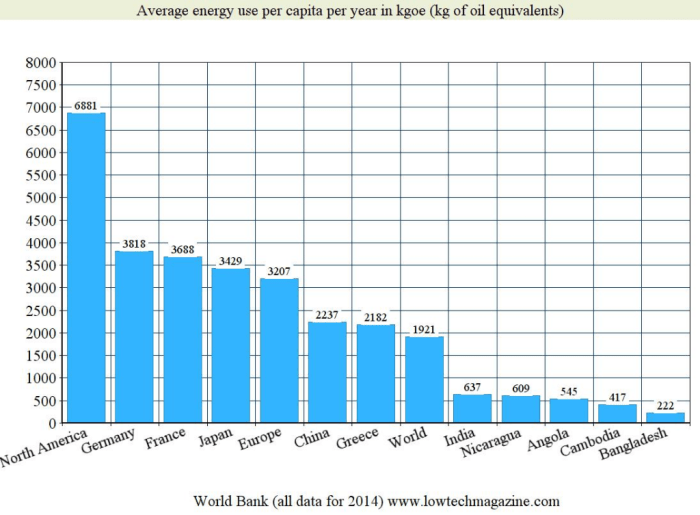
The article provides this graph illustrating the situation of energy disparity:
De Decker:  If we divide total primary energy use per country by population, we see that the average North American uses more than twice the energy of the average European (6,881 kgoe versus 3,207 kgoe, meaning kg of oil equivalent). Within Europe, the average Norwegian (5,818 kgoe) uses almost three times more energy than the average Greek (2,182 kgoe). The latter uses three to five times more energy than the average Angolan (545 kgoe), Cambodian (417 kgoe) or Nicaraguan (609 kgoe), who uses two to three times the energy of the average Bangladeshi (222 kgoe). [

These figures include not only the energy used directly in households, but also energy used in transportation, manufacturing, power production and other sectors. Such a calculation makes more sense than looking at household energy consumption alone, because people consume much more energy outside their homes, for example through the products that they buy.

Inequality not only concerns the quantity of energy, but also its quality. People in industrialised countries have access to a reliable, clean and (seemingly) endless supply of electricity and gas. On the other hand, two in every five people worldwide (3 billion people) rely on wood, charcoal or animal waste to cook their food, and 1.5 billion of them don’t have electric lighting. [6] These fuels cause indoor air pollution, and can be time- and labour-intensive to obtain. If modern fuels are available in these countries, they’re often expensive and/or less reliable.

As a Canadian I am not surprised that Norwegians use more energy than Greeks, considering winters in the two places. But I agree that standards of living are much higher on the left side compared to the right side, and energy access is a large part of the reason, though not the only one (governance?, free enterprise? rule of law?, work ethic? Etc.)

Aside: Henry Kissinger once observed: “If a country is not already a democracy when they discover oil, they stand little chance of becoming one.”

I don’t share the author’s fear of climate change which does permeate his discussion of the issues in raising up impoverished populations.

De Dekker goes on: However, while it’s recognised that part of the global population is using not enough energy, there is not the same discussion of people who are using too much energy. Nevertheless, solving the tension between demand reduction and energy poverty can only happen if those who use ‘too much’ reduce their energy use. Bringing the rest of the world up to the living standards and energy use of rich countries – the implicit aim of ‘human development’ – would solve the problem of inequality, but it’s not compatible with the environmental problems we face.

Between the upper boundary set by the carrying capacity of the planet, and a lower boundary set by decent levels of wellbeing for all lies a band of sustainable energy use, situated somewhere between energy poverty and energy decadence. [14] These boundaries not only imply that the rich lower their energy use, but also that the poor don’t increase their energy use too much. However, there is no guarantee that the maximum levels are in fact higher than the minimum levels.

To make matters worse, defining minimum and maximum levels is fraught with difficulty. On the one hand, when calculating from the top down, there’s no agreement about the carrying capacity of the planet, whether it concerns a safe concentration of carbon in the atmosphere, the remaining fossil fuel reserves, the measurements of ecological damage, or the impact of renewable energy, advances in energy efficiency, and population growth. On the other hand, for those taking a bottom-up approach, defining what constitutes a ‘decent’ life is just as debatable.

Needs and Wants

However, although distributing energy use equally across the global population may sound fair, in fact the opposite is true. The amount of energy that people ‘need’ is not only up to them. It also depends on the climate (people living in cold climates will require more energy for heating than those living in warm climates), the culture (the use of air conditioning in the US versus the siesta in Southern Europe), and the infrastructure (cities that lack public transport and cycling facilities force people into cars).

Differences in energy efficiency can also have a significant impact on the “need” for energy. For example, a traditional three-stone cooking fire is less energy efficient than a modern gas cooking stove, meaning that the use of the latter requires less energy to cook a similar meal. It’s not only the appliances that determine how much energy is needed, but also the infrastructure: if electricity production and transmission have relatively poor efficiency, people need more primary energy, even if they use the same amount of electricity at home.

To account for all these differences, most researchers approach the diagnosis of energy poverty by focusing on ‘energy services’, not on a particular level of energy use. [17] People do not demand energy or fuel per se – what they need are the services that energy provides. For example, when it comes to lighting, people do not need a particular amount of energy but an adequate level of light depending on what they are doing.

Some energy poverty indicators go one step further still. They don’t specify energy services, but basic human needs or capabilities (depending on the theory). In these modes, basic needs or capabilities are considered to be universal, but the means to achieve them are considered geographically and culturally specific. The focus of these needs-based indicators is on measuring the conditions of human well-being, rather than on specifying the requirements for achieving these outcomes. Examples of human basic needs are clean water and nutrition, shelter, thermal comfort, a non-threatening environment, significant relationships, education and healthcare.

Basic needs are considered to be universal, objective, non-substitutable (for example, insufficient food intake cannot be solved by increasing dwelling space, or the other way around), cross-generational (the basic needs of future generations of humans will be the same as those of present generations), and satiable (the contribution of water, calories, or dwelling space to basic needs can be satiated). This means that thresholds can be conceived where serious harm is avoided. ‘Needs’ can be distinguished from ‘wants’, which are subjective, evolving over time, individual, substitutable and insatiable. Focusing on basic needs in this way makes it possible to distinguish between ‘necessities’ and ‘luxuries’, and to argue that human needs, present and future, trump present and future ‘wants’.

Politically Correct Off-grid Electricity.

Focusing on energy services or basic needs can help to specify maximum levels of energy use. Instead of defining minimum energy service levels (such as 300 lumens of light per household), we could define maximum energy services levels (say 2,000 lumens of light per household). These energy service levels could then be combined to calculate maximum energy use levels per capita or household. However, these would be valid only in specific geographical and cultural contexts, such as countries, cities, or neighbourhoods – and not universally applicable. Likewise, we could define basic needs and then calculate the energy that is required to meet them in a specific context.

However, the focus on energy services or basic needs also reveals a fundamental problem. If the goods and services necessary for a decent life free from poverty are seen not as universally applicable, but as relative to the prevailing standards and customs of a particular society, it becomes clear that such standards evolve over time as technology and customary ways of life change. [11] Change over time, especially since the twentieth century, reveals an escalation in conventions and standards that result in increasing energy consumption. The ‘need satisfiers’ have become more and more energy-intensive, which has made meeting basic needs as problematic as fulfilling ‘wants’.

Summary

The author goes on to discuss energy demand reductions from efficiencies and substitutions, but cannot get around his fundamental dilemma: Needs are universal, objective, non-substitutable, cross-generational, and satiable. Wants are subjective, evolving over time, individual, substitutable and insatiable.

Some of the text reminded me of soviet era Romania. At Ceaușescu’s initiative in 1981, a “Rational Eating Programme” began, being a “scientific plan” for limiting the calorie intake for the Romanians, claiming that the Romanians were eating too much. It tried to reduce the calorie intake by 9-15 percent to 2,800-3,000 calories per day. In December 1983, a new dietary programme for 1984 set even lower allowances. That “austerity program” destroyed the economy, bringing down the ruler and regime.

In Biblical days they were wiser: “Do not muzzle an ox when he is treading out the grain.” Deuteronomy 25:4

People and their societies are dynamic, not static, as Matthew Kahn keeps reminding us. When their labor is enhanced with energy from fossil fuels, people are healthier, more productive and inventive in seeking, finding and using natural resources. Club of Rome’s notion of limits to growth failed to understand human resources, and today’s followers are equally blind.

What is Global Temperature? Is it warming or cooling?

H/T graeme for asking a good question.

This blog features a monthly update on ocean SST averages from HadSST3 (latest is Oceans Cool Off Previous 3 Years). Graeme added this comment:
I came across this today. Can you comment as your studies seem to show the reverse! Regards, Graeme Weber
https://www.carbonbrief.org/category/science/temperature/global-temperature

While thinking about a concise, yet complete response, I put together this post. This is how I see it, to the best of my knowledge.

The question could be paraphrased in these words: Why are there differences between various graphs that report changes in global temperatures?

The short answer is: The differences arise both from what is measured and how the measurements are processed.

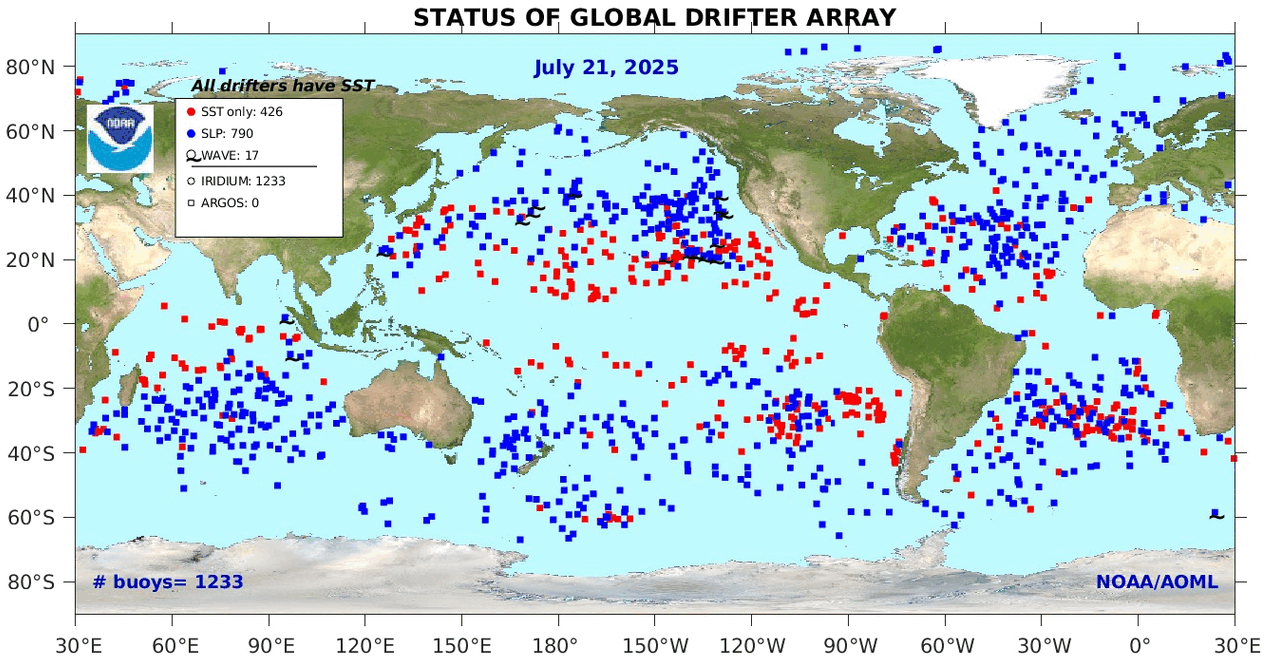
For example, consider HadSST3 as one example and GISTEMP as another. All climate temperature products divide the earth surface into grid cells for analysis. This is necessary because a global average can be biased by some regions being much more heavily sampled, eg. North America or North Atlantic. HadSST takes in measurements only from cells containing ocean, while GISTEMP uses data files from NOAA GHCN v3 (meteorological stations), ERSST v5 (ocean areas), and SCAR (Antarctic stations).

Beyond this, HadSST3 is properly termed a temperature data product, while GISTEMP is a temperature reconstruction product. The distinction goes to how the product team deals with missing data. HadSST3 calculates averages each month from grid cells with sufficient samples of observations, and excludes cells with inadequate samples for the month.

GISTEMP estimates temperature values for cells lacking data by referring to cells that are observed sufficiently. The estimates are a best guess as to what temperatures would have been recorded had there been fully functional sensors operating. This process is called interpolation, resulting in a product combining observations with estimates, ie an admixture of data and guesses.

I rely on HadSST3 because I know their results are based upon observational data. I am doubtful of GISTEMP results because many studies, including some of my own, show that interpolation produces strange and unconvincing results which come to light when you look at changes in the local records themselves.

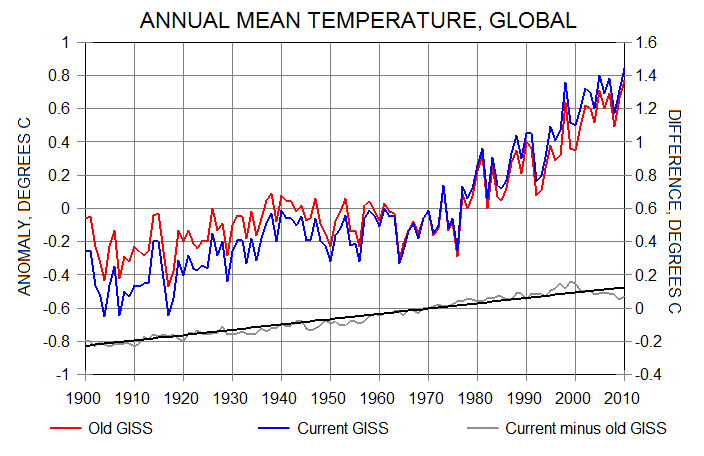
One disturbing thing is that GISTEMP keeps on changing the past, and always in the direction of adding warming.  What you see today differs from yesterday, and tomorrow who knows?

Roger Andrews does a thorough job analyzing the effects of adjustments upon Surface Air Temperature (SAT) datasets. His article at Energy Matters is Adjusting Measurements to Match the Models – Part 1: Surface Air Temperatures.

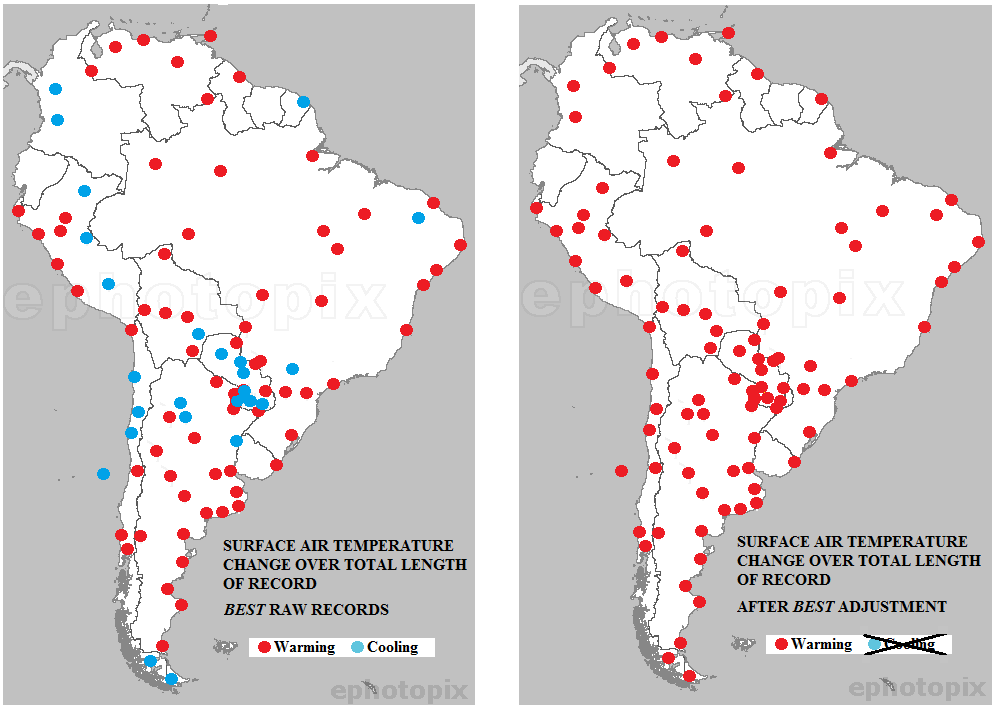
Another thing is that temperature patterns are altered so that places that show cooling trends on their own are converted to warming after processing.

Figure 3: Warming vs. cooling at 86 South American stations before and after BEST homogeneity adjustments  This shows results from BEST, another reconstruction product demonstrating how an entire continent is presented differently by means of processing.

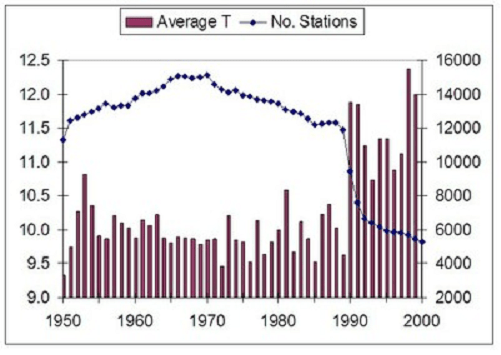
Then there is the problem that more and more places are showing estimates rather than observations. Years ago, Dr. McKitrick noticed that the decreasing number of stations reporting coincided with the rising GMT reports last century.   Below is his graph showing the correlation between Global Mean Temperature (Average T) and the number of stations included in the global database. Source: Ross McKitrick, U of Guelph

Ave. T vs. No. Stations

Currently it is clear that a great many places are estimated, and it is even the case that active station records are ignored in favor of estimates.

For these reasons I am skeptical of these land+ocean temperature reconstructions. HadSST3 deals with the ocean in a reasonable way, without inventing data.

When it comes to land surface stations, it is much more reasonable to compute the change derivative for each station (i.e. slope) and average the slopes as an indication of regional, national or global temperature change. This form of Temperature Trend Analysis deals with missing data in the most direct way: by putting unobserved months at a specific station on the trendline of the months that are observed at that station–no infilling, no homogenization.

Several of my studies using this approach are on this blog under the category Temperature Trend Analysis. A guideline to these resources is at Climate Compilation Part I Temperatures

The method of analysis is demonstrated by a post as Temperature Data Review Project-My Submission.which also confirms the problems noted above.

A peer-reviewed example of this way of analyzing climate temperature change is the paper Arctic temperature trends from the early nineteenth century to the present W. A. van Wijngaarden, Theoretical & Applied Climatology (2015) here

Is the globe warming or cooling?

Despite the difficulties depicting temperature changes noted above, we do observe periods of warming and cooling at different times and places.  Interpreting those fluctuations is a matter of context.  For example, consider GISTEMP estimated global warming in the context of the American experience of temperature change during a typical year.


Adapting Plants to Feed the World

Credit: Edwin Remsberg Getty Images

Writing in the Atlantic, Charles Mann raises an important question: Can Planet Earth Feed 10 Billion People? Humanity has 30 years to find out.  Excerpts below with my images and bolds.

Context

In 1970, when I was in high school, about one out of every four people was hungry—“undernourished,” to use the term preferred today by the United Nations. Today the proportion has fallen to roughly one out of 10. In those four-plus decades, the global average life span has, astoundingly, risen by more than 11 years; most of the increase occurred in poor places. Hundreds of millions of people in Asia, Latin America, and Africa have lifted themselves from destitution into something like the middle class. This enrichment has not occurred evenly or equitably: Millions upon millions are not prosperous. Still, nothing like this surge of well-being has ever happened before. No one knows whether the rise can continue, or whether our current affluence can be sustained.

Today the world has about 7.6 billion inhabitants. Most demographers believe that by about 2050, that number will reach 10 billion or a bit less. Around this time, our population will probably begin to level off. As a species, we will be at about “replacement level”: On average, each couple will have just enough children to replace themselves. All the while, economists say, the world’s development should continue, however unevenly. The implication is that when my daughter is my age, a sizable percentage of the world’s 10 billion people will be middle-class.

Like other parents, I want my children to be comfortable in their adult lives. But in the hospital parking lot, this suddenly seemed unlikely. Ten billion mouths, I thought. Three billion more middle-class appetites. How can they possibly be satisfied? But that is only part of the question. The full question is: How can we provide for everyone without making the planet uninhabitable?

Two Schools of Plant Development: Followers of William Vogt and Norman Borlaug

Both men thought of themselves as using new scientific knowledge to face a planetary crisis. But that is where the similarity ends. For Borlaug, human ingenuity was the solution to our problems. One example: By using the advanced methods of the Green Revolution to increase per-acre yields, he argued, farmers would not have to plant as many acres, an idea researchers now call the “Borlaug hypothesis.” Vogt’s views were the opposite: The solution, he said, was to use ecological knowledge to get smaller. Rather than grow more grain to produce more meat, humankind should, as his followers say, “eat lower on the food chain,” to lighten the burden on Earth’s ecosystems. This is where Vogt differed from his predecessor, Robert Malthus, who famously predicted that societies would inevitably run out of food because they would always have too many children. Vogt, shifting the argument, said that we may be able to grow enough food, but at the cost of wrecking the world’s ecosystems.

I think of the adherents of these two perspectives as “Wizards” and “Prophets.” Wizards, following Borlaug’s model, unveil technological fixes; Prophets, looking to Vogt, decry the consequences of our heedlessness.

Even though the global population in 2050 will be just 25 percent higher than it is now, typical projections claim that farmers will have to boost food output by 50 to 100 percent. The main reason is that increased affluence has always multiplied the demand for animal products such as cheese, dairy, fish, and especially meat—and growing feed for animals requires much more land, water, and energy than producing food simply by growing and eating plants. Exactly how much more meat tomorrow’s billions will want to consume is unpredictable, but if they are anywhere near as carnivorous as today’s Westerners, the task will be huge. And, Prophets warn, so will the planetary disasters that will come of trying to satisfy the world’s desire for burgers and bacon: ravaged landscapes, struggles over water, and land grabs that leave millions of farmers in poor countries with no means of survival.

What to do? Some of the strategies that were available during the first Green Revolution aren’t anymore. Farmers can’t plant much more land, because almost every accessible acre of arable soil is already in use. Nor can the use of fertilizer be increased; it is already being overused everywhere except some parts of Africa, and the runoff is polluting rivers, lakes, and oceans. Irrigation, too, cannot be greatly expanded—most land that can be irrigated already is. Wizards think the best course is to use genetic modification to create more-productive crops. Prophets see that as a route to further overwhelming the planet’s carrying capacity. We must go in the opposite direction, they say: use less land, waste less water, stop pouring chemicals into both.

The Rub is Rubisco

All the while that Wizards were championing synthetic fertilizer and Prophets were denouncing it, they were united in ignorance: Nobody knew why plants were so dependent on nitrogen. Only after the Second World War did scientists discover that plants need nitrogen chiefly to make a protein called rubisco, a prima donna in the dance of interactions that is photosynthesis.

In photosynthesis, as children learn in school, plants use energy from the sun to tear apart carbon dioxide and water, blending their constituents into the compounds necessary to make roots, stems, leaves, and seeds. Rubisco is an enzyme that plays a key role in the process. Enzymes are biological catalysts. Like jaywalking pedestrians who cause automobile accidents but escape untouched, enzymes cause biochemical reactions to occur but are unchanged by those reactions. Rubisco takes carbon dioxide from the air, inserts it into the maelstrom of photosynthesis, then goes back for more. Because these movements are central to the process, photosynthesis walks at the speed of rubisco.

Alas, rubisco is, by biological standards, a sluggard, a lazybones, a couch potato. Whereas typical enzyme molecules catalyze thousands of reactions a second, rubisco molecules deign to involve themselves with just two or three a second. Worse, rubisco is inept. As many as two out of every five times, rubisco fumblingly picks up oxygen instead of carbon dioxide, causing the chain of reactions in photosynthesis to break down and have to restart, wasting energy and water. Years ago I talked with biologists about photosynthesis for a magazine article. Not one had a good word to say about rubisco. “Nearly the world’s worst, most incompetent enzyme,” said one researcher. “Not one of evolution’s finest efforts,” said another. To overcome rubisco’s lassitude and maladroitness, plants make a lot of it, requiring a lot of nitrogen to do so. As much as half of the protein in many plant leaves, by weight, is rubisco—it is often said to be the world’s most abundant protein. One estimate is that plants and microorganisms contain more than 11 pounds of rubisco for every person on Earth.

The Promise of C4 Photosynthesis

Evolution, one would think, should have improved rubisco. No such luck. But it did produce a work-around: C4 photosynthesis (C4 refers to a four-carbon molecule involved in the scheme). At once a biochemical kludge and a clever mechanism for turbocharging plant growth, C4 photosynthesis consists of a wholesale reorganization of leaf anatomy.

When carbon dioxide comes into a C4 leaf, it is initially grabbed not by rubisco but by a different enzyme that uses it to form a compound that is then pumped into special, rubisco-filled cells deep in the leaf. These cells have almost no oxygen, so rubisco can’t bumblingly grab the wrong molecule. The end result is exactly the same sugars, starches, and cellulose that ordinary photosynthesis produces, except much faster. C4 plants need less water and fertilizer than ordinary plants, because they don’t waste water on rubisco’s mistakes. In the sort of convergence that makes biologists snap to attention, C4 photosynthesis has arisen independently more than 60 times. Corn, tumbleweed, crabgrass, sugarcane, and Bermuda grass—all of these very different plants evolved C4 photosynthesis.

jatiluwih2

Balinese Rice Fields

The Rice Consortium Moonshot

In the botanical equivalent of a moonshot, scientists from around the world are trying to convert rice into a C4 plant—one that would grow faster, require less water and fertilizer, and produce more grain. The scope and audacity of the project are hard to overstate. Rice is the world’s most important foodstuff, the staple crop for more than half the global population, a food so embedded in Asian culture that the words rice and meal are variants of each other in both Chinese and Japanese. Nobody can predict with confidence how much more rice farmers will need to grow by 2050, but estimates range up to a 40 percent rise, driven by both increasing population numbers and increasing affluence, which permits formerly poor people to switch to rice from less prestigious staples such as millet and sweet potato.

Funded largely by the Bill & Melinda Gates Foundation, the C4 Rice Consortium is the world’s most ambitious genetic-engineering project. But the term genetic engineering does not capture the project’s scope. The genetic engineering that appears in news reports typically involves big companies sticking individual packets of genetic material, usually from a foreign species, into a crop. The paradigmatic example is Monsanto’s Roundup Ready soybean, which contains a snippet of DNA from a bacterium that was found in a Louisiana waste pond. That snippet makes the plant assemble a chemical compound in its leaves and stems that blocks the effects of Roundup, Monsanto’s widely used herbicide. The foreign gene lets farmers spray Roundup on their soy fields, killing weeds but leaving the crop unharmed. Except for making a single tasteless, odorless, nontoxic protein, Roundup Ready soybeans are otherwise identical to ordinary soybeans.

What the C4 Rice Consortium is trying to do with rice bears the same resemblance to typical genetically modified crops as a Boeing 787 does to a paper airplane. Rather than tinker with individual genes in order to monetize seeds, the scientists are trying to refashion photosynthesis, one of the most fundamental processes of life. Because C4 has evolved in so many different species, scientists believe that most plants must have precursor C4 genes. The hope is that rice is one of these, and that the consortium can identify and awaken its dormant C4 genes—following a path evolution has taken many times before. Ideally, researchers would switch on sleeping chunks of genetic material already in rice (or use very similar genes from related species that are close cousins but easier to work with) to create, in effect, a new and more productive species. Common rice, Oryza sativa, will become something else: Oryza nova, say. No company will profit from the result; the International Rice Research Institute, where much of the research takes place, will give away seeds for the modified grain, as it did with Green Revolution rice.

Directing the C4 Rice Consortium is Jane Langdale, a molecular geneticist at Oxford’s Department of Plant Sciences. Initial research, she told me, suggests that about a dozen genes play a major part in leaf structure, and perhaps another 10 genes have an equivalent role in the biochemistry. All must be activated in a way that does not affect the plant’s existing, desirable qualities and that allows the genes to coordinate their actions. The next, equally arduous step would be breeding rice varieties that can channel the extra growth provided by C4 photosynthesis into additional grains, rather than roots or stalk. All the while, varieties must be disease-resistant, easy to grow, and palatable for their intended audience, in Asia, Africa, and Latin America.

“I think it can all happen, but it might not,” Langdale said. She was quick to point out that even if C4 rice runs into insurmountable obstacles, it is not the only biological moonshot. Self-fertilizing maize, wheat that can grow in salt water, enhanced soil-microbial ecosystems—all are being researched. The odds that any one of these projects will succeed may be small, the idea goes, but the odds that all of them will fail are equally small. The Wizardly process begun by Borlaug is, in Langdale’s view, still going strong.

Summary

To Vogtians, the best agriculture takes care of the soil first and foremost, a goal that entails smaller patches of multiple crops—difficult to accomplish when concentrating on the mass production of a single crop. Truly extending agriculture that does this would require bringing back at least some of the people whose parents and grandparents left the countryside. Providing these workers with a decent living would drive up costs. Some labor-sparing mechanization is possible, but no small farmer I have spoken with thinks that it would be possible to shrink the labor force to the level seen in big industrial operations. The whole system can grow only with a wall-to-wall rewrite of the legal system that encourages the use of labor. Such large shifts in social arrangements are not easily accomplished.

And here is the origin of the decades-long dispute between Wizards and Prophets. Although the argument is couched in terms of calories per acre and ecosystem conservation, the disagreement at bottom is about the nature of agriculture—and, with it, the best form of society. To Borlaugians, farming is a kind of useful drudgery that should be eased and reduced as much as possible to maximize individual liberty. To Vogtians, agriculture is about maintaining a set of communities, ecological and human, that have cradled life since the first agricultural revolution, 10,000-plus years ago. It can be drudgery, but it is also work that reinforces the human connection to the Earth. The two arguments are like skew lines, not on the same plane.

My daughter is 19 now, a sophomore in college. In 2050, she will be middle-aged. It will be up to her generation to set up the institutions, laws, and customs that will provide for basic human needs in the world of 10 billion. Every generation decides the future, but the choices made by my children’s generation will resonate for as long as demographers can foresee. Wizard or Prophet? The choice will be less about what this generation thinks is feasible than what it thinks is good.

Feeding the World Requires Cutting-Edge Science and Institutions


Doomsday was predicted but failed to happen at midnight.

Climatists Exploit Pensioners and Taxpayers

New York city signed up for “Me Too” commitment to Paris Accord, and the city’s pensioners are paying the price as their retirement funds suffer from virtue signaling divestment from oil companies.  Jeff Patch writes in Real Clear Policy End the Political Games With Public Pensions  Excerpts below with my bolds.

There’s a link on New York City Comptroller Scott Stringer’s website to an outline of his office’s Powers and Duties Under New York State Law. The 159-page overview covers an extensive spectrum of legal responsibilities, ranging from arts and cultural affairs to worker compensation. Nowhere does the list reference shareholder activism, directing city environmental policies, or — for that matter — leveraging the $190 billion in pension fund assets his office stewards to pursue a political agenda.

And yet that’s exactly what Mr. Stringer is doing. The professional investment managers of the city’s five public-sector pension funds, their board members, and Stringer himself are all exploiting their positions as custodians of the retirement savings of the city’s workers to promote their own political objectives. Politics seems to pervade every action of the city comptroller’s office, which just last month announced a plan to divest pension holdings from fossil-fuel interests, regardless of the impact on financial performance.

A new report from the American Council for Capital Formation sheds light on how such political machinations have impacted New York’s public pension funds, highlighting the price residents pay for their leaders’ political predilections. Specifically, the report finds that nearly $1 of every $5 of personal income taxes the city collects go to paying down the pension system’s liabilities. Meanwhile, the liabilities continue to grow, with nearly $10 billion from the City’s proposed 2018 budget needed to cover a pension funding shortfall that ranges between $65 billion and $142 billion.

As the person responsible for the management of those funds, one might expect Mr. Stringer to focus on making prudent investments. Fiscal diligence should be the top priority of any comptroller’s office. Instead, Stringer and his staff have continued using public monies as a political tool to pressure social change in corporate boardrooms.

For instance, last year, his office launched the second phase of a project aimed at pressuring public companies on various social issues, including his Boardroom Accountability Project 2.0, which pushes companies to disclose demographics on members, including their sexual orientation. Over the course of 2017, New York City Comptroller’s Office has become one of the nation’s most aggressive sponsors of activist shareholder proposals, submitting close to 100 measures, including a new initiative to divest public funds entirely from fossil fuels by 2020.

The ACCF report uncovers numerous instances of fiduciary irresponsibility. It reveals how fund managers have chosen to systematically increase investments in the Developed Environmental Activist stocks, despite the classes continued underperformance against the rest of the fund. (Those assets now make up 12 percent of the total fund.) And it details how Stringer prioritizes headline-grabbing political appearances ahead of resolving the under-performance of his funds.

Perhaps most concerning point is that a majority of Stringer’s constituents — the teachers, nurses, policemen, and firefighters who dutifully pay into public pension funds every month — remain oblivious to this emerging crisis. Last week, a separate study released by the Spectrum Group revealed that 80 percent of the city’s current and former employees were unaware that their pensions were not fully funded. Two-thirds of all respondents said they wanted their funds’ managers to concentrate on maximizing their returns.

Taken together, these reports make two points abundantly clear. First, there is a very real disconnect between the objectives of the people who own the funds and their professional managers. Second, this disconnect has consequences not just pension fund members, but also for taxpayers across the city. In short, everybody loses — except Stringer and his political supporters.

The city comptroller has a duty to put the financial interests of taxpayers and public employees above his narrow political ambitions. If Mr. Stringer wants to set social policy, he should run for city or state office instead. Until then, he should focus on safeguarding the future of his constituents’ pension funds.

Feel Good Climatism

A recent post by Ace of Spades rang a chord. He was talking about partisan politics but I saw another example in the global warming/climate change issue. I was reminded of an email exchange with a relative after I pointed out that some scientists think we are on the brink of global cooling. She replied: “It is confusing, but we have decided that humans are making it warmer.”

Ace provides some insight into this sort of behavior. His post is in fact a comment triggered by Joe Katzman writing in the Daily Caller(here):

A good friend of mine wrote me recently. He complained about smug leftist neighbors who are “making decisions to ‘feel good’ with virtually no regard for true factual input or testing.”

I get this a lot.

“Feel good” about what?

Not about being right, which is best described as “useful, to a point.” Aristotle noticed over 2,000 years ago that many people aren’t persuadable by logical arguments. So what’s the “feeling good” all about?

So what is going on? Ace summarizes (here).  Excerpts with my bolds.

Short version: The right attempts political persuasion. The left, on the other hand, attempts social persuasion — basically seizing the commanding heights of culture-making institutions and then deciding that espousing some political claims (being pro-gay-marriage) increase social status and that espousing other political claims (being against gay marriage) decrease social status and, indeed, make one a social pariah, fit for ostracism, mass mockery, and internal exile.

The left’s method works much better than the right’s. It always has and it always will. Because most people don’t care about politics all that muchbut nearly everyone (except for the crankiest of contrarians, including some of the current assembled company) cares about their social status.

Having higher social status gets you invites to the Cocktail Party Circuit, which is a real thing, defined broadly (and metaphorically) enough. It makes you datable, it makes you “clubbable,” as the old term went.

It can get you promoted at work, particularly if the sort of job you do is a bit vague as far as definite, tangible outputs and thus advancement depends more on how upper management feels about you.

While the left wing continues winning arguments by not even having arguments at all, instead simply demonizing those who espouse any contrary position, the #SmartSet (citation required) of the establishment right continues believing, apparently earnestly and definitely ridiculously, that if they just out argue their political competitors, they’ll change minds.

They won’t. Or not enough to actually matter. Because most people don’t really care enough about these issues to really engage with them on an intellectual level; they just want to know what to claim to believe so that other people won’t think they’re weird, and deem them unfriendable, undatable, and poor candidates for promotion inside The Corporation.

How This Applies to Global Warming

When it comes to global warming/climate change, of course the alarmist notion is embraced by the left, and skeptics (“deniers”) are banished to associate with others mostly on the right. I recently commented to a friend who won’t discuss this topic with me that I used to be a liberal, but have become a libertarian. (BTW my friend is a successful entrepreneur engineer but does not delve into climate science intentionally. Why pick a family fight over something like that?)

Contemporary socio-political orientations no longer fit traditional liberal/conservative definitions. The left is now committed to “post-modern” philosophy and “progressive” political action, deriving from identity politics and cultural warfare. Traditionalists are now on the far right sideline and “conservatives” are tarred with that same brush. People in the middle are a mix of classical liberals and conservatives who still embrace the western rational, free enterprising democracy frame. Progressives want to overturn that heritage with tactics from social class conflict, supercharged in the age of Internet, social media and 24/7 buzz. The middle alternative on the right is more properly termed “libertarian” since the focus is on individual liberty, free enterprise and limited government. The same concerns motivated those drafting the US Constitution.

Whatever you think of Trump, he is the first libertarian to take the fight to the progressive post-modernists. Anti-Trumpism started in the media beginning with his candidacy, and it has only ramped up since, becoming a kind of derangement. Trump recognized early in his term that the media had become the defacto opposition party, and would be willing and eager to say anything to discredit him. So he responded in kind, resulting in public approval of mass media at an all time low, while his own approval ratings remain stuck in the 40% range. The whole circus is at the same time amusing and dangerous. Like watching a train wreck in slow motion, just try looking away.

Global warming/climate change is a football kicked around in this game. During the campaign I didn’t know what to make of Trump.  If it weren’t for some perceptive and prescient posts by Scott Adams of Dilbert fame,  I would have written off his chances.  As one pundit put it: “His detractors take him literally, and not seriously; while his supporters take him seriously, but not literally.”

As a CAGW skeptic, I do credit Trump for the guts to pull out of Paris and to point out the nakedness of the climate emperor. And at least so far, he seems to use the culture wars to keep his enemies distracted while quietly doing important libertarian things, like deregulating the economy and reforming the judiciary. It seems the left is claiming incompetence to get him out, while actually they really fear him delivering on his promises.

Just for fun, here is a video of his recently released First Annual Fake News Awards: