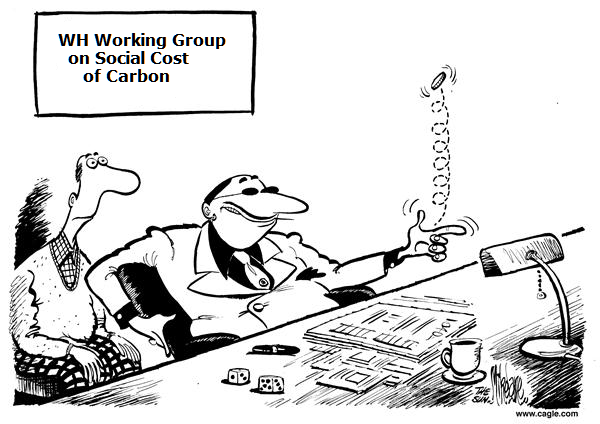
Six Reasons to Rescind Social Cost of Carbon
A consise summary is provided by Paul Driessen and Roger Bezdek
in this article Anti-fossil fuel SCC relies on garbage models, ignores carbon benefits and hurts the poor. Excerpts below.

The UN Development Program also calls energy “central to poverty reduction.” And International Energy Agency Executive Director Dr. Fatih Birol notes that “coal is raising living standards and lifting hundreds of millions of people out of poverty.” In fact, all fossil fuels are doing so.

Indeed, fossil fuels created the modern world and the housing, transportation, other technologies and living standards so many of us take for granted. They are essential for electricity and life, and over the past 250 years they more than doubled average life expectancy in countries that took advantage of them.

But the Obama Administration and radical environmentalists despise fossil fuels and used every tactic they could devise to eliminate them. One of their most important schemes was the “social cost of carbon.”

Six Things Wrong with Social Cost of Carbon

1. Each ton of U.S. emissions averted would initially have prevented a hypothetical $25/ton in global societal costs allegedly resulting from dangerous manmade climate change: less coastal flooding and tropical disease, fewer droughts and extreme weather events, for example. But within three years regulators arbitrarily increased the SCC to around $40/ton.

That made it easier to justify the Clean Power Plan, Paris climate agreement, and countless Obama Era actions on electricity generation, fracking, methane, pipelines, vehicle mileage and appliance efficiency standards, livestock operations, carbon taxes, and wind, solar and biofuel mandates and subsidies.

2. The supposed bedrock for the concept is the now rapidly shifting sands of climate chaos theory. New questions are arising almost daily about data quality and manipulation, the degree to which carbon dioxide affects global temperatures, the complex interplay of solar, cosmic ray, oceanic and other natural forces, and the inability of computer models to predict temperatures, sea level rise or hurricanes.

3. The SCC scheme blames American emissions for supposed costs worldwide (even though U.S. CO2 emissions are actually declining). It incorporates almost every conceivable cost of oil, gas and coal use on crops, forests, coastal cities, property damage, “forced migration,” and human health, nutrition and disease. However, it utterly fails to mention, much less analyze, tremendous and obvious carbon benefits.

4. CC schemes likewise impute only costs to carbon dioxide emissions. However, as thousands of scientific studies verify, rising levels of this miracle molecule are “greening” the Earth – reducing deserts and improving forests, grasslands, drought resistance, crop yields and human nutrition. No matter which government report or discount rate is used, asserted social costs of more CO2 in Earth’s atmosphere are infinitesimal compared to its estimated benefits.

5.  Government officials claim they can accurately forecast damages to the world’s climate, economies, civilizations, populations and ecosystems from U.S. carbon dioxide emissions over the next three centuries. They say we must base today’s energy policies, laws, and regulations on those forecasts. The notion is delusional and dangerous.

6. Finally, the most fundamental issue isn’t even the social cost of carbon. It is the costs inflicted on society by anti-carbon regulations. Those rules replace fossil fuel revenues with renewable energy subsidies; reliable, affordable electricity with unreliable power that costs two to three times as much; and mines, drill holes, cropland and wildlife habitats with tens of millions of acres of wind, solar and biofuel “farms.”

Summary

Anti-carbon rules are designed to drive energy de-carbonization and modern nation de-industrialization. Perhaps worst, their impacts fall hardest on poor, minority and blue-collar families. . . Worldwide, billions of people still do not have electricity – and the SCC would keep them deprived of its benefits.

It’s time to rescind and defund the SCC – and replace it with honest, objective cost-benefit analyses.

shredding-864x540-1Roger Bezdek is an internationally recognized energy analyst and president of Management Information Services, Inc. Paul Driessen is senior policy analyst for the Committee For A Constructive Tomorrow and author of books and articles on energy, climate change and human rights.

Additional posts:

Social Cost of Carbon: Origin and Prospects

The Social Benefits of Carbon

The Weathermen vs. EPA’s Scott Pruitt

This week the AMS (American Meteorological Society) sent a letter chastising Scott Pruitt for keeping an open mind on the question of man-made global warming/climate change. The letter (here) referred to the AMS institutional statement on the matter, and summarized their position in this paragraph:

In reality, the world’s seven billion people are causing climate to change and our emissions of carbon dioxide and other greenhouse gases are the primary cause. This is a conclusion based on the comprehensive assessment of scientific evidence. It is based on multiple independent lines of evidence that have been affirmed by thousands of independent scientists and numerous scientific institutions around the world. We are not familiar with any scientific institution with relevant subject matter expertise that has reached a different conclusion.

Background on AMS and Climate Science

Firstly, not all the weathermen are contrary to EPA Chief Scott Pruitt.  The statement announced in 2012 can only be seen as a Council Statement resulting from a process initiated and controlled by AMS council.

The Council puts out a call for volunteers for the writing teams, and approves the make-up of those teams. A Council member serves as a liaison to the team. The writing team’s initial draft is put out to the entire membership for a comment period. The writing team responds to those comments and executes a redraft. The Council, meeting in person or in teleconference, may make final edits before voting to approve or disapprove the statements.  With some over-simplification the process is driven by the AMS Council; the resulting products are Council statements.

Secondly, a subsequent survey showed that the views expressed by the AMS Council have mixed support among AMS members. Respondents numbered 1827 and 52% said “Yes, Most of the warming since 1850 is due to humans.” The other responses included: Insufficient Evidence, Equally Human and Natural, Not Sure It is Happening, and Mostly Natural (in order of frequency). Clearly almost half of the membership sample do not agree with the IPCC position endorsed by AMS Council.

A more recent 2016 survey got a higher number of agreeable members (67%), but it is still the case that 47% of 4092 members contacted did not respond to the questionnaire.

Further, these surveys are now being conducted in the context of the Council already committing the society prior to seeking the views of members. Finally, the whole exercise demonstrates that global warming/climate change is clearly a matter of opinion, not knowledge.

Of course, the questionnaires are superficial and geared to produce a “consensus” support for policy action and for project funding. In depth surveys show much more the complexity of the issues and range of opinions.

Climate Etc. Has several posts going into the details of the AMS maneuvers.

AMS Statement on Climate Change

The 52% Consensus

New AMS Survey on Climate Change

For another assessment including a comment and references by Roger Pielke Sr. See:
AMS Letter to Pruitt,How Ideologues Abuse Power in Professional Associations

Meet Richard Muller, Lukewarmist

Richard Muller, head of the Berkeley Earth project, makes a fair and balanced response to a question regarding the “97% consensus.”  Are any of the US Senators listening?  Full text below from Forbes 97%: An Inconvenient Truth About The Oft-Cited Polling Of Climate Scientists including a reference to Will Happer, potentially Trump’s science advisor.

Read it and see that he sounds a lot like Richard Lindzen.

What are some widely cited studies in the news that are false?

Answer by Richard Muller, Professor of Physics at UC Berkeley, on Quora:

That 97% of all climate scientists accept that climate change is real, large, and a threat to the future of humanity. That 97% basically concur with the vast majority of claims made by Vice President Al Gore in his Nobel Peace Prize winning film, An Inconvenient Truth.

The question asked in typical surveys is neither of those. It is this: “Do you believe that humans are affecting climate?” My answer would be yes. Humans are responsible for about a 1 degree Celsius rise in the average temperature in the last 100 years. So I would be included as one of the 97% who believe.

Yet the observed changes that are scientifically established, in my vast survey of the science, are confined to temperature rise and the resulting small (4-inch) rise in sea level. (The huge “sea level rise” seen in Florida is actually subsidence of the land mass, and is not related to global warming.) There is no significant change in the rate of storms, or of violent storms, including hurricanes and volcanoes. The temperature variability is not increasing. There is no scientifically significant increase in floods or droughts. Even the widely reported warming of Alaska (“the canary in the mine”) doesn’t match the pattern of carbon dioxide increase–it may have an explanation in terms of changes in the northern Pacific and Atlantic currents. Moreover, the standard climate models have done a very poor job of predicting the temperature rise in Antarctica, so we must be cautious about the danger of confirmation bias.

My friend Will Happer believes that humans do affect the climate, particularly in cities where concrete and energy use cause what is called the “urban heat island effect.” So he would be included in the 97% who believe that humans affect climate, even though he is usually included among the more intense skeptics of the IPCC. He also feels that humans cause a small amount of global warming (he isn’t convinced it is as large as 1 degree), but he does not think it is heading towards a disaster; he has concluded that the increase in carbon dioxide is good for food production, and has helped mitigate global hunger. Yet he would be included in the 97%.

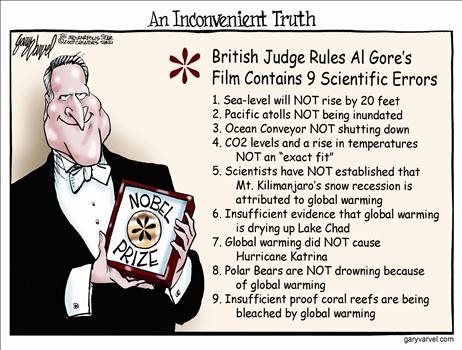
The problem is not with the survey, which asked a very general question. The problem is that many writers (and scientists!) look at that number and mischaracterize it. The 97% number is typically interpreted to mean that 97% accept the conclusions presented in An Inconvenient Truth by former Vice President Al Gore. That’s certainly not true; even many scientists who are deeply concerned by the small global warming (such as me) reject over 70% of the claims made by Mr. Gore in that movie (as did a judge in the UK; see the following link: Gore climate film’s nine ‘errors‘).

varv101407a

The pollsters aren’t to blame. Well, some of them are; they too can do a good poll and then misrepresent what it means. The real problem is that many people who fear global warming (include me) feel that it is necessary to exaggerate the meaning of the polls in order to get action from the public (don’t include me).

There is another way to misrepresent the results of the polls. Yes, 97% of those polled believe that there is human caused climate change. How did they reach that decision? Was it based on a careful reading of the IPCC report? Was it based on their knowledge of the potential systematic uncertainties inherent in the data? Or was it based on their fear that opponents to action are anti-science, so we scientists have to get together and support each other. There is a real danger in people with Ph.D.s joining a consensus that they haven’t vetted professionally.

I like to ask scientists who “believe” in global warming what they think of the data. Do they believe hurricanes are increasing? Almost never do I get the answer “Yes, I looked at that, and they are.” Of course they don’t say that, because if they did I would show them the actual data! Do they say, “I’ve looked at the temperature record, and I agree that the variability is going up”? No. Sometimes they will say, “There was a paper by Jim Hansen that showed the variability was increasing.” To which I reply, “I’ve written to Jim Hansen about that paper, and he agrees with me that it shows no such thing. He even expressed surprise that his paper has been so misinterpreted.”

A really good question would be: “Have you studied climate change enough that you would put your scientific credentials on the line that most of what is said in An Inconvenient Truth is based on accurate scientific results? My guess is that a large majority of the climate scientists would answer no to that question, and the true percentage of scientists who support the statement I made in the opening paragraph of this comment, that true percentage would be under 30%. That is an unscientific guestimate, based on my experience in asking many scientists about the claims of Al Gore.

This question originally appeared on Quora. the place to gain and share knowledge, empowering people to learn from others and better understand the world.

Compare Muller’s statement with a short video by Lindzen.


Update: EU Leads in Climate Blame and Shame

Update February 15, 2017

The EU is already loading climate reporting requirements onto pension funds.

On December 8th, 2016 the EU adopted a new regulation regarding Pension Funds, the IORP II Directive — the successor of the Institutions for Occupational Retirement Provision Directive adopted in 2003.

A key feature of the directive is the consideration of environmental, social and governance (ESG) factors as part of pension providers’ investment. In particular, pension providers are now required to carry out their own risk assessment, including climate change-related risks, as well as risks caused by the use of resources and regulatory changes.

IORP II applies to all the 14,358 registered EU pension funds, among which 160 have cross-border activities.

Member States (EU countries) have until January 13, 2019 to transpose IORP II into their national law, which was published early January in the Official Journal of the European Union. According to current projections, the implementation deadline should therefore fall before Brexit, an important fact considering that the UK accounts for 50 percent of the EU occupational pension fund sector, followed by the Netherlands (33 percent).

New EU Directive Requires Pension Funds to Assess Climate-related Risks

The Climate Disclosure Standards Board provides an insight into the expanding bureaucracy working to impose climatism on financial and business institutions around the world. Since Paris COP agreement is not legally binding, the effort is on forcing reporting on national commitments and pointing fingers at laggards.

At the microeconomic level, the mission is to load regulatory requirements onto corporations and investors to force them into statements of belief and responsibility for mythical changes in future weather and climate.

The Mission is presented in Making Climate Disclosure the New Norm in Business

In short, the Task Force Recommendations report encourages all financial organizations, ranging from banks, insurance companies, to asset managers and asset owners, and companies with public debt or equity, to disclose in a transparent and consistent way their financial risks and opportunities associated with climate change.

Image: Recommendations of the Task Force on Climate-related Financial Disclosures

The report is the result of one year of work by the Task Force on climate-related financial disclosures, a business and investors-led initiative, launched at the COP21 climate negotiations in Paris, and convened by the Financial Stability Board.

The aim of the initiative is to drive the adoption of the recommendations across the G20 countries, as the final version of the report will be released in July and presented to the G20 leaders gathering in Hamburg. Having the support of the governments of the largest economies in the world would be the ultimate step to make climate disclosure the new norm.

The CDSB Board of Directors (all carrying climate activist resumes)

Pankaj Bhatia Director of GHG Protocol Initiative, World Resources Institute

Henry Derwent Honorary Vice President, International Emissions Trading Association

Dr Rodney Irwin Managing Director, Redefining Value & Education, World Business Council for Sustainable Development

Mindy S. Lubber JD, MBA President, Ceres Director, Investor Network on Climate Risk

David Rosenheim Executive Director, The Climate Registry

Damian Ryan Acting CEO, The Climate Group

Richard Samans (Chairman) Managing Director and Member of the Managing Board, World Economic Forum

Paul Simpson Chief Executive Officer, CDP (formerly Carbon Disclosure Project)

Gordon Wilson Senior Manager PwC, Chairman, Technical Working Group, Climate Disclosure Standards Board

Rough seas ahead for Captains of Industry


The Green Energy Money Pit

As we know, politicians are throwing money away on mad green energy schemes in Australia, Germany and Canada.  In the USA, bad examples are found in the left coast states of California and New York.

California Dreaming

From the LA Times: Californians are paying billions for power they don’t need
We’re using less electricity. Some power plants have even shut down. So why do state officials keep approving new ones?

At its 2001 launch, the Sutter Energy Center was hailed as the nation’s cleanest power plant. It generated electricity while using less water and natural gas than older designs.

A year ago, however, the $300-million plant closed indefinitely, just 15 years into an expected 30- to 40-year lifespan. The power it produces is no longer needed — in large part because state regulators approved the construction of a plant just 40 miles away in Colusa that opened in 2010.

Sutter Energy Center has been offline since 2016, after just 15 years of an expected 30- to 40-year lifespan. (David Butow / For The Times)

California has a big — and growing — glut of power, an investigation by the Los Angeles Times has found. The state’s power plants are on track to be able to produce at least 21% more electricity than it needs by 2020, based on official estimates. And that doesn’t even count the soaring production of electricity by rooftop solar panels that has added to the surplus. (my bold)

This translates into a staggering bill. Although California uses 2.6% less electricity annually from the power grid now than in 2008, residential and business customers together pay $6.8 billion more for power than they did then. The added cost to customers will total many billions of dollars over the next two decades, because regulators have approved higher rates for years to come so utilities can recoup the expense of building and maintaining the new plants, transmission lines and related equipment, even if their power isn’t needed. (my bold)

“We overbuilt the system because that was the way we provided that degree of reliability,” explained Michael Picker, president of the California Public Utilities Commission. “Redundancy is important to reliability.”

Some of the excess capacity, he noted, is in preparation for the retirement of older, inefficient power plants over the next several years. The state is building many new plants to try to meet California environmental standards requiring 50% clean energy by 2030, he said. (my bold)

“California has this tradition of astonishingly bad decisions,” said McCullough, the energy consultant. “They build and charge the ratepayers. There’s nothing dishonest about it. There’s nothing complicated. It’s just bad planning.”

Pacific Gas & Electric’s Colusa Generating Station has operated at well below its generating capacity — just 47% in its first five years. (Rich Pedroncelli / AP)

Sutter isn’t alone. Other natural gas plants once heralded as the saviors of California’s energy troubles have found themselves victims of the power glut. Independent power producers have announced plans to sell or close the 14-year-old Moss Landing power plant at Monterey Bay and the 13-year-old La Paloma facility in Kern County.

New York Blowing It in the Wind

From the New York Post: Cash in the Wind: New York’s Wind-power Giveaway

Gov. Cuomo doesn’t like nuclear energy.  Last month, he finalized a deal that will prematurely shutter the Indian Point Energy Center, the twin-reactor facility that supplies about 25 percent of New York City’s electricity.

Cuomo doesn’t like natural gas, either. In 2014, after a years-long moratorium, he banned fracking, the process used to get oil or gas from underground rock formations.

But there’s one thing the governor just loves: wind energy. Indeed, three days after the Indian Point closure was announced, Cuomo’s appointees at the New York State Energy Research and Development Authority provided details on $360 million in subsidies for a handful of renewable-energy projects.

Roughly 80 percent of that money will be doled out to two wind companies: Florida-based NextEra Energy Inc. and Illinois-based Invenergy.

Plus, when the new subsidies are combined with existing federal cash, the amount in subsidies Next­Era and Invenergy will be collecting will exceed the prevailing wholesale price of electricity in the state by nearly $13 per megawatt-hour.

Even more remarkable: those same subsidies, on an energy-equivalent basis — comparing the amount of energy we get from different sources — come to four times the current market price of natural gas. (my bold)

The companies will receive the NYSERDA subsidies over a period of 20 years. Given the size of their wind projects, which are about 101 megawatts and 106 megawatts, respectively, the two companies will likely collect about $286 million from the state over the next two decades. And remember, NextEra and Invenergy will collect those subsidies in addition to the cash they get for actually selling their product. (my bold)

I’ve heard of sweetheart deals, but this one deserves a medal.

It there no bottom to the green energy money pit?

Climate Blame and Shame

Update February 15, 2017

The EU is already loading these reporting requirements onto pension funds.

IORP II applies to all the 14,358 registered EU pension funds, among which 160 have cross-border activities.

Member States (EU countries) have until January 13, 2019 to transpose IORP II into their national law, which was published early January in the Official Journal of the European Union. According to current projections, the implementation deadline should therefore fall before Brexit, an important fact considering that the UK accounts for 50 percent of the EU occupational pension fund sector, followed by the Netherlands (33 percent).

New EU Directive Requires Pension Funds to Assess Climate-related Risks

The Climate Disclosure Standards Board provides an insight into the expanding bureaucracy working to impose climatism on businesses around the world. Since Paris COP agreement is not legally binding, the effort is on forcing reporting on national commitments and pointing fingers at laggards.

At the microeconomic level, the mission is to load regulatory requirements onto corporations to force them into statements of belief and responsibility for mythical changes in future weather and climate.

The Mission is presented in Making Climate Disclosure the New Norm in Business

In short, the Task Force Recommendations report encourages all financial organizations, ranging from banks, insurance companies, to asset managers and asset owners, and companies with public debt or equity, to disclose in a transparent and consistent way their financial risks and opportunities associated with climate change.

Image: Recommendations of the Task Force on Climate-related Financial Disclosures

The report is the result of one year of work by the Task Force on climate-related financial disclosures, a business and investors-led initiative, launched at the COP21 climate negotiations in Paris, and convened by the Financial Stability Board.

The aim of the initiative is to drive the adoption of the recommendations across the G20 countries, as the final version of the report will be released in July and presented to the G20 leaders gathering in Hamburg. Having the support of the governments of the largest economies in the world would be the ultimate step to make climate disclosure the new norm.

The CDSB Board of Directors (all carrying climate activist resumes)

Pankaj Bhatia Director of GHG Protocol Initiative, World Resources Institute

Henry Derwent Honorary Vice President, International Emissions Trading Association

Dr Rodney Irwin Managing Director, Redefining Value & Education, World Business Council for Sustainable Development

Mindy S. Lubber JD, MBA President, Ceres Director, Investor Network on Climate Risk

David Rosenheim Executive Director, The Climate Registry

Damian Ryan Acting CEO, The Climate Group

Richard Samans (Chairman) Managing Director and Member of the Managing Board, World Economic Forum

Paul Simpson Chief Executive Officer, CDP (formerly Carbon Disclosure Project)

Gordon Wilson Senior Manager PwC, Chairman, Technical Working Group, Climate Disclosure Standards Board

Rough seas ahead for Captains of Industry


Jury Hangs Instead of Climate Activist


Sitting in the Skagit County Courthouse in the middle of the so-called “valve turners,” Ken Ward had this to say just hours before a jury decided his fate.

“I’m feeling pretty relaxed,” Ward said.

He testified Tuesday about the day he and four others shut off tar sands oil pipelines across the country.

“It was a fabulous opportunity to explain to the jurors pretty succinctly why I did it. I put up a map of Skagit County, about a third of which will be under water in 2050. That’s why I did it,” Ward said.

“I thought they would just convict me, but they didn’t,” said Ward, who was facing up to 20 years on charges of burglary and sabotage.

“It’s not immediately obvious what a hung jury means,” he said. “But as we were sitting there we realized: Wait a minute. No, this is not just a moment of confusion. This means a jury presented with a video of exactly what I did wasn’t willing to convict. That’s huge.”

“Apparently they cared more about climate cataclysm than enforcing the law. It’s quite astounding.”

Four others involved in the Oct. 11 shutdown of tar-sands oil pipelines still face trial in Montana, North Dakota and Minnesota, Ward said.

Ward said he expects more citizen dissent, and widespread acts of civil disobedience to push back against Trump’s embrace for more mining, drilling and transport of fossil fuels.

On February 9, prosecutors will announce whether or not they will retry the case.

More details from Seattle Times (here)

Conclusion

It is a triumph of fear over facts. We know what a hung jury means. Out of twelve people, one had drunk the same koolaid as Ward and refused to convict him. Do we now have post-normal law (an oxymoron for sure), just as perverted as post-normal science?

Background in Previous Post: Climate Case: Judge Defends Rule of Law

Some time ago, climate activists noticed they were not winning over the American public, whose opinion was deeply divided on global warming/climate change. They turned to legal venues to promote their agenda, including shareholder proposals and legal complaints.

Any jurisdiction, like Massachusetts or the UK, who enacted reductions of fossil fuel emissions will be subject to legal suits for not achieving emission targets. In such court proceedings, global warming/climate change, temperature changes, extreme weather etc. are all of them beside the point. Once such a law is in place, the belief has served only as a cover to compel energy policies no longer needing any reference to climate science or its uncertainties.

Washington state is one of the most liberal in the US, and thus a hotbed of climate alarm and activism. In the November general election, the state was the first to vote on imposing a carbon tax. The measure was defeated, but only because social justice groups and many environmental activists argued it did not go far enough in promoting clean energy.
Washington State Voters Reject Nation’s First Carbon Tax

Last November, children were recruited to bring a case against the federal government for not stopping climate change, and the judge in that case agreed to hear their complaint. Washington Youth Sue Over Climate Change

In this context, we have a brave judge standing up for the rule of law in a case of civil disobedience.  The defendant Ken Ward is an Oregon-based environmental activist who turned off an oil pipeline in Washington state last October 11. He does not dispute his criminal behavior, but claims his actions were necessary to defend the planet.

The 60-year-old Corbett, Ore. man faces three felony charges and one misdemeanor for shutting off a valve on the Trans Mountain Pipeline in Burlington, Wash, which transports Canadian Tar Sands crude oil into the state for refinement.

At a pre-trial hearing on January 24 in Skagit County, Washington, a judge denied Ward’s defense strategy, known as the necessity defense.

Judge Michael E Rickert said: “I don’t know what everybody’s beliefs are on [climate change], but I know that there’s tremendous controversy over the fact whether it even exists. And even if people believe that it does or it doesn’t, the extent of what we’re doing to ourselves and our climate and our planet, there’s great controversy over that.”

There have been some victories for the necessity defense in the UK and in Massachusetts where a prosecutor in 2014 dropped charges against Ward and another activist who blocked a coal shipment, stating that “climate change is one of the gravest crises our planet has ever faced”.

But Rickert, an elected judge in Skagit county, north of Seattle, sided with state prosecutors who argued against the necessity defense and have alleged that Ward, co-founder of Climate Disobedience Center, committed burglary, criminal trespass and sabotage.

While explaining the standards for permitting a necessity defense, Rickert said: “It does need to have some immediacy, some imminence, more so than this particular threat and harm, which is climatic change, global warming, whatever.”

He later added that with climate change, there’s “great controversy” with “over half of our political leaders”. (Critics have slammed the GOP as the “only major party in the advanced world” to deny climate change).

Interestingly, only the report in The Guardian (here) quoted Judge Rickert so that readers might hear what he said (the news). But the journalist’s bias came out in several adjectives and parenthetical asides intended to assert his own opinion (fake news) to undermine the judge’s authority.

Ward’s action was a planned act of protest done in conjunction with other “valve turners” in other states. At the same time in Minnesota, North Dakota and Montana, fellow environmentalists turned off oil pipelines. They broke the law because they believed that the federal government gave them no other choice: by its inaction on climate change issues, they chose to cut off the flow of oil into the country. Williamette Week (here)

Summary

Finally a judge stands up for the rule of law. No religious belief, be it Seventh Day Adventism, or Catastrophic Climatism can be imposed on others, nor be a justification for illegal actions against lawful enterprises. At least the Adventists respect social justice by seeking only to persuade others through discussion rather than by force or violence.

Postscript:

A year ago was another loss in the courts for climate activists on January 15, 2016 in Seattle.

Activists lose criminal case on climate change defense – but judge praises effort

The ‘Delta 5’ had attempted to illegally block trains carrying crude oil near Seattle, and had hoped that their trial would mark the first time that a US jury was allowed to consider the “necessity defense” in a case of climate activism.

But after allowing two days of expert testimony on topics ranging from the Paris climate talks to railway safety standards and the health impacts of particulate matter, Judge Anthony E Howard ruled that the defense had failed to present sufficient evidence to show that the defendants had “no reasonable legal alternative” to trespassing on a private rail yard and blocking trains.

The case is a blow to environmental campaigners but marks the furthest defendants have managed to go in an American courtroom using the so-called “necessity” defense that argues such actions are justified to combat catastrophic climate change.

The activists progressed unusually far because Howard allowed them to call expert witnesses to testify to the harms of climate change, even though he later felt compelled to instruct the jury to disregard their evidence. The judge appeared to do so reluctantly, expressing some sympathy for the activists in a court on Thursday.

“Frankly the court is convinced that the defendants are far from the problem and are part of the solution to the problem of climate change,” Howard said from the bench. But, he added: “I am bound by legal precedent, no matter what my personal beliefs might be.”

That’s two brave judges.  It appears many more courageous judges will be needed.

Ontario Coal Phase-out: All Pain, No Gain


Thanks to Dr. Ross McKitrick for telling the story: It’s official—Ontario’s coal phase-out was all for nothing which appeared in the Financial Post, January 17, 2017.  Excerpts below.

The federal Liberal government plans to impose a national coal phase-out, based on the same faulty arguments used in Ontario, namely that such a move will yield significant environmental benefits and reduce health-care costs. One problem—those arguments never made sense, and now with the Ontario phase-out complete, we can verify not only that they were invalid but that the Ontario government knew it.

First, ample data at the time showed that coal use had little effect on Ontario air quality. Environment Canada’s emissions inventories showed that the Ontario power generation sector was responsible for only a tiny fraction (about one per cent) of provincial particulate emissions, a common measure of air pollution.

Taken together these reports provided a credible basis for predicting that a coal phase-out would only have a small effect on our air quality. They also showed, based on the results of retrofits then underway at the power plants, that the same air quality improvements could be obtained at a fraction of the cost by installing scrubbers on the smokestacks, rather than shutting the coal-fired plants down.

Second, the government’s claims about the health effects of phasing out coal were highly implausible. It stated (and continues to assert) that coal plant emissions cost the province more than $3 billion annually in health-care costs. But this was at a time when the total provincial health-care budget was only about $35 billion annually. In other words, they claimed that nearly one-tenth of all health-care spending was due to illnesses and mortality arising from power plants that, again, were responsible for only about one per cent of annual particulate emissions.

Dr. Aliakbari and I analysed data for the cities of Hamilton, Toronto and Ottawa over the 2002-2014 interval. Our statistical model allowed us to isolate the effects of declining Ontario coal use compared to changing emissions from other Canadian and U.S. sources and effects due to weather. In line with our expectations and the prior evidence, we found that phasing out coal was responsible for only very small changes in Ontario air pollution levels.

We did not look at greenhouse gases because they are not local air pollutants, only matter on a global level, and emissions could be offset by purchasing credits anywhere in the world. The climate issue was, and remains, a red herring in the discussion about the costs and benefits of eliminating coal.

Summary

Ontario is suffering a crisis of high and rising electricity costs that’s causing real, long-lasting damage to households and businesses. The province insists the pain is worth it because of the environmental improvements. The numbers show otherwise. Phasing out coal had almost no effect on Ontario’s air pollution levels—and the government at Queen’s Park knew this was likely to be the case. It has all been for nothing.


Ross McKitrick
Professor of Economics, University of Guelph

Two additional points

Firstly, in both the US and Canada, the real motivation is virtue-signalling, posing as fighters of climate change.  The US EPA is also infamous for bogus estimates of public health and air quality benefits to justify costly and onerous energy regulations.

When Ontario government rejected the anti-pollution scrubbers mentioned in the article above, Energy Minister Dwight Duncan said: “We’re not going to spend $1.6 billion on technology that doesn’t help climate change. That’s just dumb.”

Secondly, the result was worse than nothing. Ontario’s electricity rates are the fastest rising and among the highest in North America. Ratepayers are being mugged by the once friendly Reddy Kilowatt.

Ontario’s Hall of Pain

Ontario Climate Policy Refugees

Ontario Jammed by Rent-seekers and Ratepayers

Electrical Madness in Green Ontario


Climatist Manifesto


Obama and other Western political leaders have been saying that Climate Change is the biggest threat to modern society. I am coming around to agree, but not in the way they are thinking. I mean there is fresh evidence that we can defeat radical Islam, but we are already losing to radical climatism.  I refer to climate alarm and activism, which has come to dominate the environmental movement and impose an agenda for social re-engineering.

The Climatist Game Plan

Mission: Deindustrialize Civilization

Goal: Drive industrial corporations into Bankruptcy

Strategy: Cut off the Supply of Cheap, Reliable Energy

Tactics:

  • Raise the price of fossil fuels
  • Force the power grid to use expensive, unreliable renewables
  • Demonize Nuclear energy
  • Spread fear of extraction technologies such as fracking
  • Increase regulatory costs on energy production
  • Scare investors away from carbon energy companies
  • Stop pipelines because they are too safe and efficient
  • Force all companies to account for carbon usage and risk

Progress:

  • UK steel plants closing their doors.
  • UK coal production scheduled to cease this year.
  • US coal giant Peabody close to shutting down.
  • Smaller US oil companies going bankrupt in record numbers.
  • Etc.

Collateral Damage:

  • 27,000 extra deaths in UK from energy poverty.
  • Resource companies in Canada cut 17,000 jobs in a single month.
  • Etc.

For more info on progress see: http://business.financialpost.com/fp-comment/terence-corcoran-clean-green-and-catastrophic

Summary:

Radical climatism is playing the endgame while others are sleeping, or discussing the holes in the science. Truly, the debate is over (not ever having happened) now that all nations have signed up to the Paris COP doctrine. Political leaders are willing, even enthusiastic dupes, while climatist tactics erode the foundations of industrial society.  Deaths and unemployment are unavoidable, but then the planet already has too many people anyway.

ISIS is an immediate threat, but there is a deeper and present danger already doing damage to the underpinnings of Life As We Know It. It is the belief in Climate Change and the activists executing their game plan.  Make no mistake: they are well-funded, well-organized and mean business.  And the recent behavior of valve-turners, acting illegally to shut off supplies of fossil fuel energy, shows they are willing to go very far to impose their will upon the rest of us.

Note: On an earlier version of this post, I was chastised by a deep environmentalist, Michael Lewis, for tarring him and others dedicated to environmental concerns with the same brush as climate activists.  I take his point, and acknowledge the dismay many environmentalists feel at the damage climatists have done both to science and to efforts to protect the planet from real pollution.

Conclusion

With Trump’s election, there is a new sheriff in town. We can hope for changes, firstly to stop the erosion and secondly to repair the damages to the underpinnings of modern society.  The transition is underway, and it looks like this:

Climate Case: Judge Defends Rule of Law

Some time ago, climate activists noticed they were not winning over the American public, whose opinion was deeply divided on global warming/climate change. They turned to legal venues to promote their agenda, including shareholder proposals and legal complaints.

Any jurisdiction, like Massachusetts or the UK, who enacted reductions of fossil fuel emissions will be subject to legal suits for not achieving emission targets. In such court proceedings, global warming/climate change, temperature changes, extreme weather etc. are all of them beside the point. Once such a law is in place, the belief has served only as a cover to compel energy policies no longer needing any reference to climate science or its uncertainties.

Washington state is one of the most liberal in the US, and thus a hotbed of climate alarm and activism. In the November general election, the state was the first to vote on imposing a carbon tax. The measure was defeated, but only because social justice groups and many environmental activists argued it did not go far enough in promoting clean energy.
Washington State Voters Reject Nation’s First Carbon Tax

Last November, children were recruited to bring a case against the federal government for not stopping climate change, and the judge in that case agreed to hear their complaint. Washington Youth Sue Over Climate Change

In this context, we have a brave judge standing up for the rule of law in a case of civil disobedience.  The defendant Ken Ward is an Oregon-based environmental activist who turned off an oil pipeline in Washington state last October 11. He does not dispute his criminal behavior, but claims his actions were necessary to defend the planet.

The 60-year-old Corbett, Ore. man faces three felony charges and one misdemeanor for shutting off a valve on the Trans Mountain Pipeline in Burlington, Wash, which transports Canadian Tar Sands crude oil into the state for refinement.

At a pre-trial hearing on January 24 in Skagit County, Washington, a judge denied Ward’s defense strategy, known as the necessity defense.

Judge Michael E Rickert said: “I don’t know what everybody’s beliefs are on [climate change], but I know that there’s tremendous controversy over the fact whether it even exists. And even if people believe that it does or it doesn’t, the extent of what we’re doing to ourselves and our climate and our planet, there’s great controversy over that.”

There have been some victories for the necessity defense in the UK and in Massachusetts where a prosecutor in 2014 dropped charges against Ward and another activist who blocked a coal shipment, stating that “climate change is one of the gravest crises our planet has ever faced”.

But Rickert, an elected judge in Skagit county, north of Seattle, sided with state prosecutors who argued against the necessity defense and have alleged that Ward, co-founder of Climate Disobedience Center, committed burglary, criminal trespass and sabotage.

While explaining the standards for permitting a necessity defense, Rickert said: “It does need to have some immediacy, some imminence, more so than this particular threat and harm, which is climatic change, global warming, whatever.”

He later added that with climate change, there’s “great controversy” with “over half of our political leaders”. (Critics have slammed the GOP as the “only major party in the advanced world” to deny climate change).

Interestingly, only the report in The Guardian (here) quoted Judge Rickert so that readers might hear what he said (the news). But the journalist’s bias came out in several adjectives and parenthetical asides intended to assert his own opinion (fake news) to undermine the judge’s authority.

Ward’s action was a planned act of protest done in conjunction with other “valve turners” in other states. At the same time in Minnesota, North Dakota and Montana, fellow environmentalists turned off oil pipelines. They broke the law because they believed that the federal government gave them no other choice: by its inaction on climate change issues, they chose to cut off the flow of oil into the country. Williamette Week (here)

Summary

Finally a judge stands up for the rule of law. No religious belief, be it Seventh Day Adventism, or Catastrophic Climatism can be imposed on others, nor be a justification for illegal actions against lawful enterprises. At least the Adventists respect social justice by seeking only to persuade others through discussion rather than by force or violence.

Postscript:

A year ago was another loss in the courts for climate activists on January 15, 2016 in Seattle.

Activists lose criminal case on climate change defense – but judge praises effort

The ‘Delta 5’ had attempted to illegally block trains carrying crude oil near Seattle, and had hoped that their trial would mark the first time that a US jury was allowed to consider the “necessity defense” in a case of climate activism.

But after allowing two days of expert testimony on topics ranging from the Paris climate talks to railway safety standards and the health impacts of particulate matter, Judge Anthony E Howard ruled that the defense had failed to present sufficient evidence to show that the defendants had “no reasonable legal alternative” to trespassing on a private rail yard and blocking trains.

The case is a blow to environmental campaigners but marks the furthest defendants have managed to go in an American courtroom using the so-called “necessity” defense that argues such actions are justified to combat catastrophic climate change.

The activists progressed unusually far because Howard allowed them to call expert witnesses to testify to the harms of climate change, even though he later felt compelled to instruct the jury to disregard their evidence. The judge appeared to do so reluctantly, expressing some sympathy for the activists in a court on Thursday.

“Frankly the court is convinced that the defendants are far from the problem and are part of the solution to the problem of climate change,” Howard said from the bench. But, he added: “I am bound by legal precedent, no matter what my personal beliefs might be.”

That’s two brave judges.  It appears many more courageous judges will be needed.