Slam Dunk: Δtemp Drives Δco2, Ocean Biochemistry at Work

Peter Smith explains in his Quadrant article Shunned by Sanctitudinous Science.  Excerpts in italics with my bolds and added images.  Synopsis of Ivan Kennedy paper follows later.

When coffeeing with a group of conservative friends as I do on Fridays, one of our number, Professor Emeritus Ivan Kennedy, said something to the effect that there were no scientific alternative theories to the IPCC’s explanation of global warming except for his.

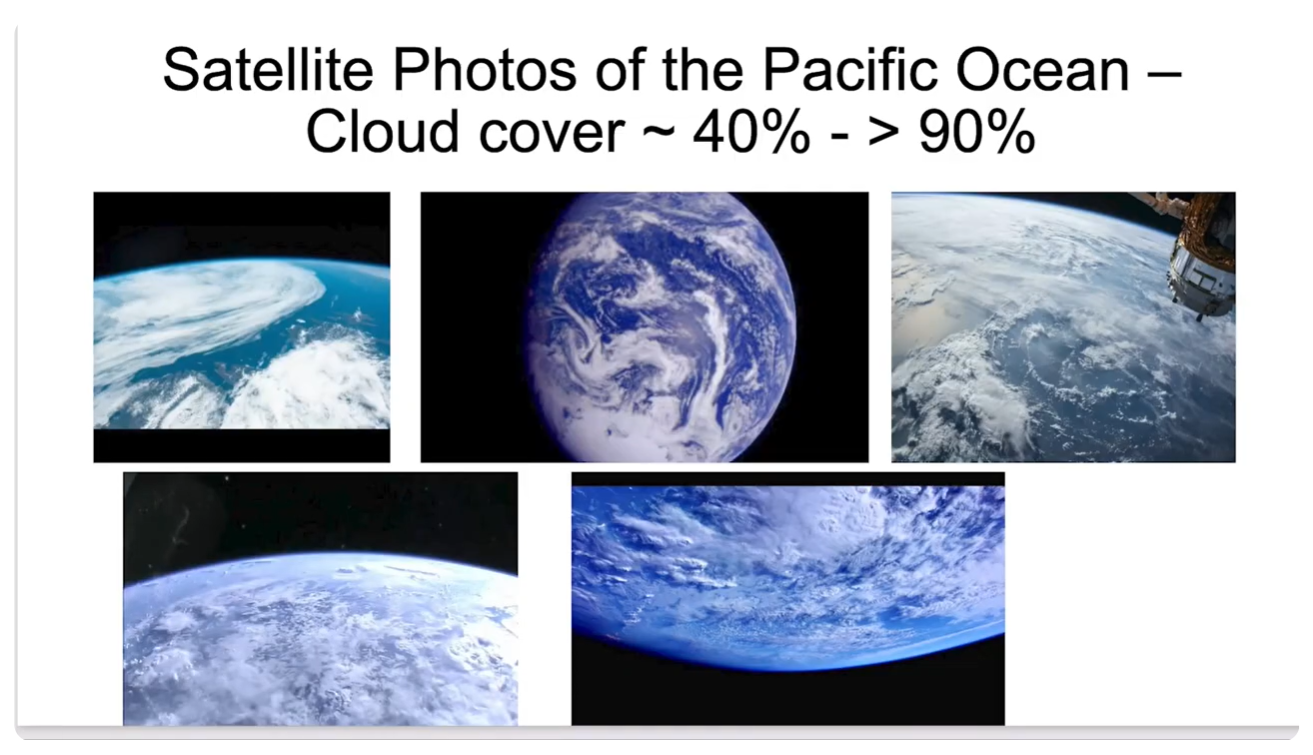
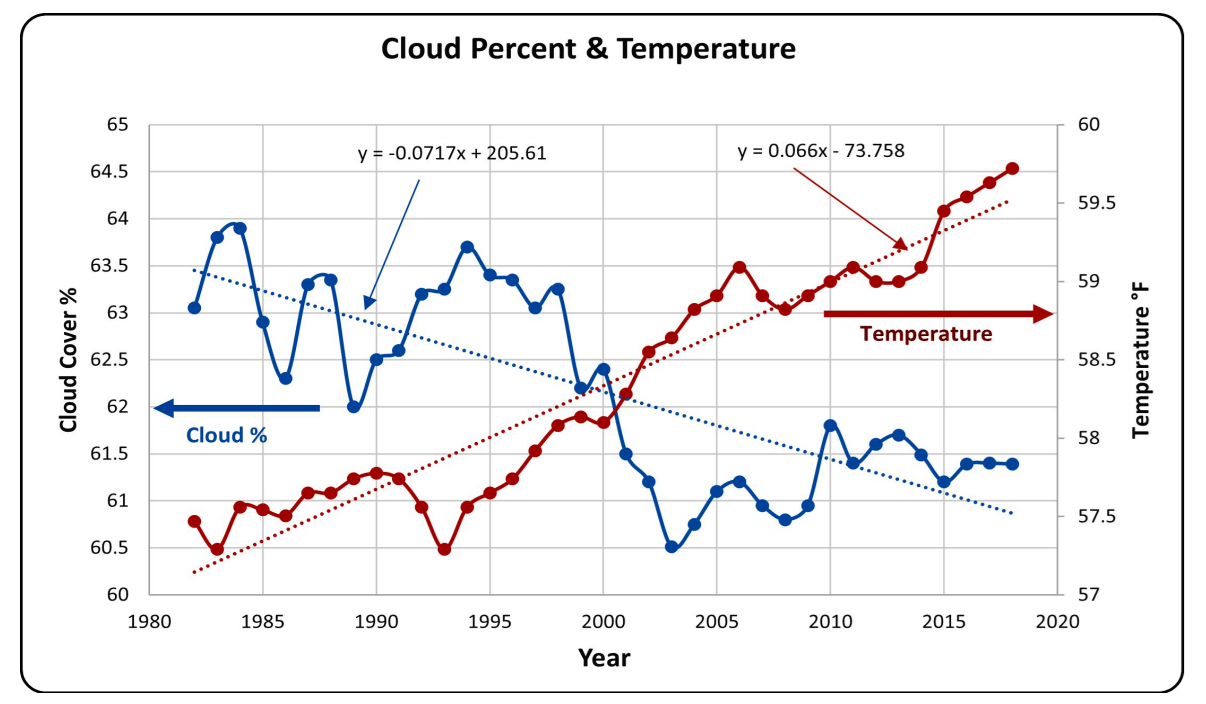
I was taken aback. Surely, even within my limited knowledge, William Happer (Princeton) and Richard Lindzen (MIT) hypothesise that the effect of CO2 on warming progressively declines. Nobel Prize winner Dr John Clauser hypothesises that reflective cumulus clouds created by water vapour, engendered by modest warming, act as a thermostat to keep global temperatures down. You can read about it here if you wish. So what is going on?

Let me start by dismissing the canard that global warming is an invention. Sure, maybe the so-called ‘homogenisation’ of past land and sea temperature data has artificially steepened the warming record since the 1940s. But, for all that, the NOAA satellite data since the end of 1979 shows that the temperature in the sub-troposphere has trended up by about 0.7⁰C between December 1979 and December 2024. As this data has been compiled by Roy Spencer and John Christy (sceptical scientists) at the University of Alamba in Huntsville, we can safely assume it is trustworthy.

So the climate has warmed. Now should come the scientific fun.
Competing theories jostling to best explain the data. No such fun.
Blaming exploitative Western man has proved to be a sacrosanct hypothesis.

Sacrosanctity and science don’t mix. Many past theories propounded by scientific giants have eventually failed the test: Ptolemy’s geocentric theory of the solar system; Aristotle’s theory of gravity, even Newton’s. Yet a tenuous theory of the climate concocted by relative mediocrities, which hasn’t come close to accurately predicting global temperatures, is holy writ. Risible, except that political and celebrity buy-in is undoing progress wherever it results in the replacement of reliable with unreliable energy. Think of Australia as a quintessential case study.

Happily, despite powerful and well-funded forces out to cancel dissenters, maverick scientists keep on stirring the pot. Which brings me back to Prof. Kennedy and his collaborators. Their hypothesis can be found here. In lay terms it goes like this:

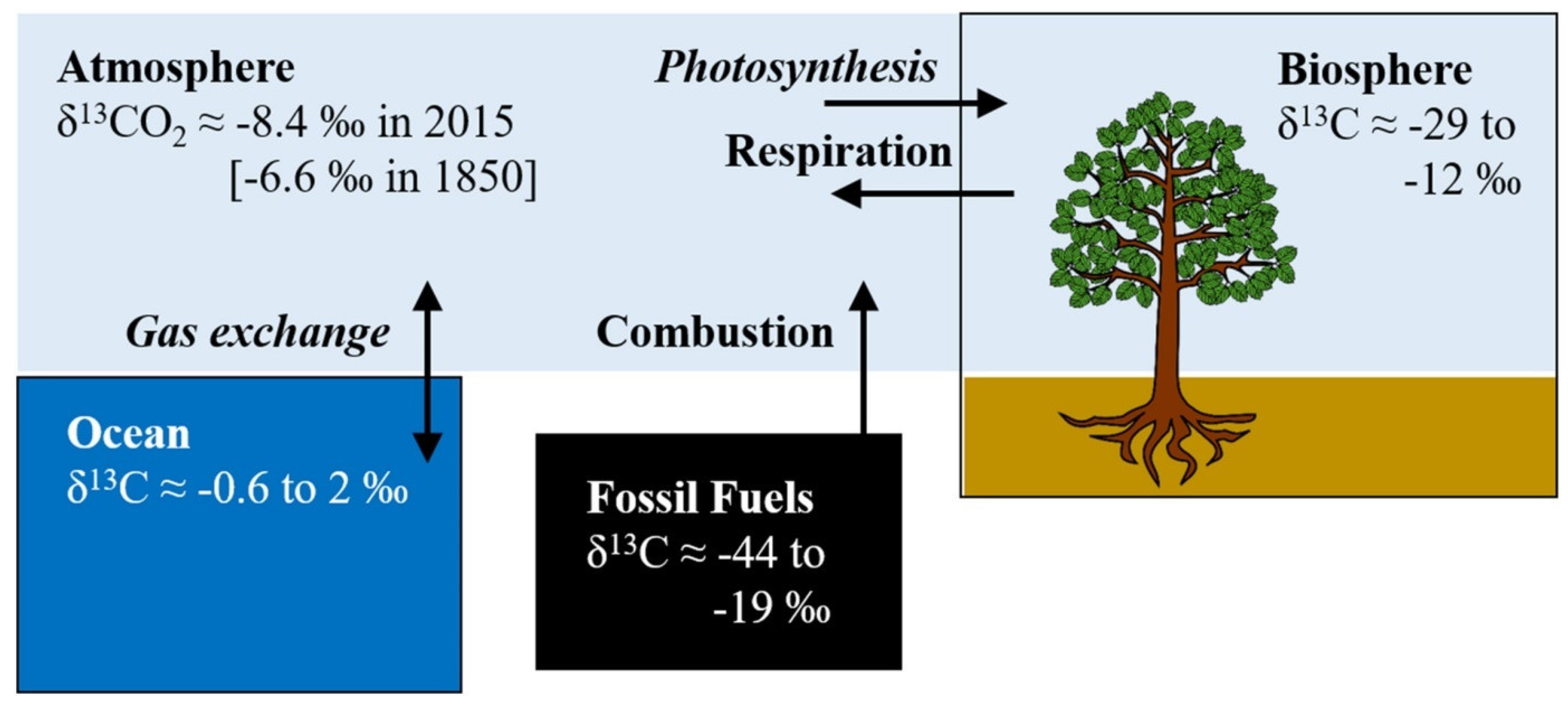
The increased concentration of CO2 in the atmosphere since the 1960s has been caused by warming not the reverse. Other things equal, emissions by mankind of CO2 are all absorbed by the land (hence the greening) and by the oceans. Thus, on this account, there is no material net increase of CO2 in the atmosphere from fossil fuel emissions. Ergo, such emissions cannot be the cause of warming. It is true that warming has occurred, and that atmospheric CO2 has risen. The underlying chain of events is as follows.

Warming, perhaps through solar activity, promotes the precipitation of calcium carbonate (limestone) in surface sea water, absorbing CO2 from the atmosphere in the process. In turn, the absorbed CO2, magnified by calcium carbonate precipitation, acidifies surface sea water. The acidification then results in the emission of CO2 into the atmosphere in autumn and winter. This emission of CO2 is greater than the absorption, precisely because of the continuing acidification in the warming water.

In the end we see increased atmospheric CO2 and warming.
It is easy to draw the wrong conclusion. Indeed, the IPCC has done so.

I see the point about Kennedy’s hypothesis being singularly different from other alternative hypotheses. Lindzen’s and Happer’s hypothesis, and Clauser’s, embrace the foundational proposition of the received theory, albeit in muted form. Namely, that man-made CO2 is adding to atmospheric CO2, thereby having a greenhouse effect. Kennedy’s hypothesis does not embrace that proposition.

Whether Kennedy is right (or Lindzen and Happer or Clauser) is by the way. Alternative hypotheses are in the skeptical scientific tradition of searching for theories which better explain the facts than does the received theory. That is particularly important in this case. The received theory is upending life as we know it, while being shielded from rival theories by money, politics and pseudo-religiosity.

The paper by Ivan Kennedy et al. is A Thermal Acid Calcification Cause for Seasonal Oscillations in the Increasing Keeling Curve . Synopsis below with excerpts in italics with my bolds and added images.

Abstract:

Why do atmospheric carbon dioxide levels rise and fall seasonally measured on Mauna Loa? This study explores the thermal acid-calcification (TAC) hypothesis, suggesting that seasonal temperature shifts in surface seawater trigger acid pH-driven CO₂ emissions caused by calcification. Using oceanographic data, we modeled how temperature affects dissolved inorganic carbon including CO₂, bicarbonate, and carbonate.

Our findings reveal that warming waters absorb atmospheric CO2 by promoting calcium carbonate formation, acidifying seawater and boosting CO₂ release to the atmosphere in late autumn and winter, when atmospheric CO₂ becomes highest. The model predicts a net annual CO₂ rise of 2 ppmv, driven by calcification rather than land-based processes. Seasonal pH swings of 0.04 units corroborate this mechanism. The TAC hypothesis indicates that continued ocean warming, not just fossil fuels, contribute to rising CO₂ levels, calling for deeper investigation into marine carbon dynamics.

The Keeling Curve for atmospheric pCO2 in parts per million by volume

Fig. 1. The Keeling curve of atmospheric CO2 partial pressure at 3200 m on Mauna Loa, Hawaii. Data from Dr. Pieter Tans, NOAA/ESRL and Dr.Ralph Keeling, Scripps Institution of Oceanography.CC BY-SA

The very stuff of plant life on Earth in photosynthesis as well as in the structural basis of all living creatures, we are told by the United Nations Intergovernmental Panel on Climate Change (IPCC) (2) that the continuing rise of CO2 in the Keeling curve shown in Figure 1 now threatens global catastrophe from global warming. Such a paradoxical contrast for good and bad lacks credibility, given the longevity of life on Earth.

Transfers of CO2 out of the ocean surface in winter versus that entering in summer

We propose that a quasi-equilibrium exists between a falling pH value in surface water, favoring CO2 emisssion. Falling pH values in the surface water of the oceans have been an enigma, invisible to scientific view until recently after the year 2000. Our logic is supported in our articles (3, 4) where we describe the basis for the thermal acid-calcification (TAC) hypothesis, also using data cited from others. Acidic calcification is thermodynamically favored in warming surface seawater, particularly in northern oceans in spring and summer with shallow mixing zones and higher temperature ranges. This raises the fugacity or potential pressure of CO2 in seawater to its peak value in summer when the pCO2 in air is minimal, causing its forceful emission into air in the next autumn reaching a maximum pCO2 in late winter (Fig. 1, seasonal variation insert). 

Fig. 2. Thermal acid-calcification model for seasonal and longer-term generation of the Keeling curve. The Thermal model (3), showed calcification is favored by increase in temperature giving decreasing pH values in summer, reversing in cooler conditions to more alkaline pH in winter. Note that precipitation of CaCO3 in spring to summer removes CO32- that is replaced from HCO3 – with more acidity, provided by absorption of CO2 from air up to October. However, as the pH falls the steady state concentration of [CO2} increases favoring photosynthesis.

Acid calcification is essential for phytoplankton

Any process of strong acidification of surface seawater will raise the concentration of carbon dioxide as [CO2] available to phytoplankton for photosynthesis. Bicarbonate cannot be a direct substrate for photosynthesis although the presence of the enzyme carbonic anhydrase speeds up its interconversion with CO2. Our published modeling analysis confirmed that CaCO3 precipitation is strongly favored by warmer temperatures (Table 1). Indeed, all the reaction equilibria in seawater are displaced to the right in Figure 2 acidifying the water, although the equilibrium between CO2 concentration and pCO2 in air favors a lower concentration [CO2} in water in summer, compared to winter, when it is greatest. Our results even confirmed that the formation of CaCO3 as calcite is predicted to increase in summer as water becomes warmer (Table 1b).

Thus, we can expect more limestone formation in summer if the carbonate concentration reaches a sufficient level, favored by added warming. The decline in average pH values in surface seawater to about 8.05 from pH 8.20 could explain the increased pCO2 in the atmosphere of 140 ppmv since 1800 as a matter of dynamic equilibrium. Caused by calcification, this would require a simultaneous equivalent deposition of limestone as sediment, though only an increase of about 10 μmoles per kg of surface seawater, or a net 1 mg per kg each year. This is a key prediction for experimental testing of the TAC hypothesis.

This fully reversible calcification equation moves towards acidification in summer and reverses to alkalinization in winter. The psi factor is a variable function of the range of seasonal changes in temperature. However, the greatest thermodynamic potential to emit CO2 in seawater by acidification of bicarbonate (HCO3-) is when the pH value is lowest, the conversion of bicarbonate to CO2 generating the greatest difference between CO2 fugacity in seawater and that in air in midsummer in northern hemisphere waters. The seasonal variation near Mauna Loa in atmospheric pCO2 is about 6 ppmv whereas the long term increase in the Keeling curve year by year is one third of this, about 2 ppmv suggesting that in spring and summer the CO2 absorbed in about 2 ppmv, less than that emitted in autumn and winter.

Fig. 5. Rates per square meter in global carbon cycling between land water, the atmosphere, and the ocean, illustrating the pH-acidification hypothesis. Emissions and absorptions shown are average moles per square meter of the Earth, for a mixing ratio of 420 ppmv in 2021 shown in the central column bridging land and ocean. The land acidification values are derived elsewhere (11), assuming photosynthesis is equal to respiration. The terrestrial area of Earth is 1.48×10¹⁴ m-2 , the ocean’s area is 3.62×10¹⁴ m2 , 5.101 x10¹⁴ m2 in total., represented as a mean value in the central air column.

Discussion

Limestone as a product of calcification is regarded as a biogeochemical product, given that phytoplankton and other marine organisms enhance its rate of production, if nutrients are available (3). In particular, the extracellular carbonic anhydrase apparently speeds the reversible dehydration of CO2, forming bicarbonate and hydrated hydrogen ions (H+) controlling pH. This article emphasizes that the reversible dehydration of CO2 in surface seawater allowing transfer between aqueous and gaseous phases is most rate limiting of all, that carbonic anhydrase may even assist in autumn and winter, transferring CO2 to the atmosphere.

More significantly for managing climate change, if fossil fuel emissions are being largely absorbed by sequestration into the ocean surface and by ‘greening’ photosynthesis on land and in the ocean (11), the implications of this aspect of the TAC hypothesis for carbon-zero policies and renewable energy are profound.

The thermal acid-calcification hypothesis predicts that global warming
acidifies the ocean surface by increasing calcification causing
pCO2 to increase, independently of fossil emissions.

Furthermore, this represents a striking illustration of the Le Chatelier principle, the carbon cycle on Earth responding intelligently to changing climate. The hope that carbon dioxide removal as sequestration (14), either biologically, chemically or geologically, by burial after capture, will prove futile. 

The uncertainty of the current IPCC paradigm regarding climate change and the role of fossil emissions of CO2 in warming is large, lacking scientific evidence. A plausible alternative hypothesis offered here as the true cause of the increasing Keeling curve needs to be investigated urgently. This new model would still give predictively increasing emissions from the ocean in the complete absence of fossil fuel emissions because the acidification from calcification is purely a function of surface warming, from whatever cause.

See Also

Good News, COP30: Cooling Temperatures Reducing CO2 Rise

Key Point

Changes in CO2 follow changes in global temperatures on all time scales, from last month’s observations to ice core datasets spanning millennia. Since CO2 is the lagging variable, it cannot logically be the cause of temperature, the leading variable. It is folly to imagine that by reducing human emissions of CO2, we can change global temperatures, which are obviously driven by other factors.

Be Grateful for the Warming We Have

A reminder that we are presently in the icy end of the Holocene epoch comes in a CBC story Canada’s High Arctic was once a lush forest where unexpected animals roamed.  Excerpts in italics with my bolds and added images.

Camels and beavers that evolved in ancient forests in the Far North
were perfectly adapted for our world today

Modern camels descend from giant High Arctic camels that lived in Canada’s North before the Ice Age. (Global Mechanic/Courtesy of Handful of Films)

By Niobe Thompson, director of Frozen in Time

When you think of the Canadian High Arctic today, visions of frozen tundra, icefields and polar bears probably come to mind. But rewind the clock a little over two million years to before the last ice age, and that Northern tundra was a lush and vibrant forest paradise. It was also home to some surprising animal life, including one large mammal we now associate with scorching deserts: camels.

In Frozen in Time, a documentary from The Nature of Things, paleobiologist Natalia Rybczynski describes how a head injury in 2011 changed the way she had to live. It also gave her time to think about many fossils she and her team at the Canadian Museum of Nature have uncovered of the animals that once roamed the Far North.

A remarkable discovery

The Pliocene Epoch, spanning from 2.5 to 5 million years ago, was the warm period before the last ice age began. The Pliocene was the last time Earth’s atmosphere contained the same concentration of carbon dioxide that we see today: over 400 parts per million.

At the time, temperatures in the High Arctic were also about 22 C higher than today, Rybczynski says in the documentary — a climate much like we see in modern boreal forest in Canada. As a result, the Arctic was covered in birch, larch, pine and even cedar trees, blanketing the landscape all the way to the northern shores of Ellesmere Island and Greenland.

These dense forests were home to many of the animals we now associate with the Pliocene, such as mammoths and mastodons, but also those found in modern boreal habitats: beavers, bears, geese, horses and caribou.

From 2006 to 2009, a research team led by the Canadian Museum of Nature discovered 30 camel fragments on Ellesmere Island in Nunavut. Scientists dated the remains to 3.5 million years, the mid-Pliocene Epoch, a global warm phase when the region was cloaked in boreal forest. Collagen fingerprinting, a cutting-edge science pioneered at the University of Manchester in England, confirmed that the bones belonged to a camelid.

And in 2013, a team of scientists led by Rybczynski announced a remarkable discovery. At the site of an ancient Pliocene river on Ellesmere Island called Fyles Leaf Beds, they uncovered fragments of a leg bone belonging to a 3.5-million-year-old camel. The find made headlines around the world and suggested that modern camels descended from a High Arctic ancestor.

Evolved in the Arctic, perfect for the desert

High Arctic camels were giant versions of modern camels, and they evolved in a forest world unlike any we know today. Because they lived close to the North Pole, the sun would disappear for nearly half the year, before shining down for nearly 24 hours a day during the polar summer.

Many of the features of the camel that help them survive in deserts today may have originated as adaptations to this punishing environment, Rybczynski says in Frozen in Time.

Their hump — a specialized fat deposit — would have helped them through long, cold winters. Camels have excellent night vision, handy when it is dark for almost half the year. And their wide feet that work so well in sand today would have been perfect in snow 3.5 million years ago.

The desert camel, the habits of beavers, bear hibernation, fall colours — all features of the natural world today that may have evolved in the weird Arctic forest world that came to an end with the encroaching glaciers of the last ice age.

“For me, it’s hard to stop imagining all those natural features of our environment, all passed down from a hotter past when forests could grow in the Arctic,” Rybczynski says in the documentary.

“In so many ways, the lost forests of the High Arctic were kind of like a Garden of Eden — the cradle of our boreal forest ecosystem today.”

See Also

No Right to Stable Climate in Our Holocene Epoch


OISST Updates: Ocean SST Cooling Confirmed

The best context for understanding decadal temperature changes comes from the world’s sea surface temperatures (SST), for several reasons:

  • The ocean covers 71% of the globe and drives average temperatures;
  • SSTs have a constant water content, (unlike air temperatures), so give a better reading of heat content variations;
  • A major El Nino was the dominant climate feature in recent years.

Recently I posted on SST data from HadSST4 since the US shutdown stopped other SST sources. Now OISST is back online, so this report is based on data from OISST2.1.  This dataset uses the same in situ sources as HadSST along with satellite indicators.  Importantly, it produces daily anomalies from baseline period 1991-2020.  The data is available at Climate Reanalyzer (here).  Product guide is (here).  The charts and analysis below is produced from the current data.

The Current Context

The chart below shows SST monthly anomalies as reported in OISST2.1 starting in 2015 through October 2025.  A global cooling pattern is seen clearly in the Tropics since its peak in 2016, joined by NH and SH cycling downward since 2016, followed by rising temperatures in 2023 and 2024 and cooling in 2025.

Note that in 2015-2016 the Tropics and SH peaked in between two summer NH spikes.  That pattern repeated in 2019-2020 with a lesser Tropics peak and SH bump, but with higher NH spikes. By end of 2020, cooler SSTs in all regions took the Global anomaly well below the mean for this period.  A small warming was driven by NH summer peaks in 2021-22, but offset by cooling in SH and the tropics, By January 2023 the global anomaly was again below the mean.

Then in 2023-24 came an event resembling 2015-16 with a Tropical spike and two NH spikes alongside, all higher than 2015-16. There was also a coinciding rise in SH, and the Global anomaly was pulled up to 0.6°C in 2023, ~0.2° higher than the 2015 peak.  Then NH started down autumn 2023, followed by Tropics and SH descending 2024 to the present. During nearly 2 years of cooling in SH and the Tropics, the Global anomaly came back down, led by Tropics cooling the last 22 months from its 0.9°C peak 2024/01 down to 0.26C in October this year. SH and NH also cooled Sept./Oct. pulling the Global anomaly down to 0.42C, just 0.1C above the average for this decadal period.

Comment:

The climatists have seized on this unusual warming as proof their Zero Carbon agenda is needed, without addressing how impossible it would be for CO2 warming the air to raise ocean temperatures.  It is the ocean that warms the air, not the other way around.  Recently Steven Koonin had this to say about the phonomenon confirmed in the graph above:

El Nino is a phenomenon in the climate system that happens once every four or five years.  Heat builds up in the equatorial Pacific to the west of Indonesia and so on.  Then when enough of it builds up it surges across the Pacific and changes the currents and the winds.  As it surges toward South America it was discovered and named in the 19th century  It iswell understood at this point that the phenomenon has nothing to do with CO2.

Now people talk about changes in that phenomena as a result of CO2 but it’s there in the climate system already and when it happens it influences weather all over the world.   We feel it when it gets rainier in Southern California for example.  So for the last 3 years we have been in the opposite of an El Nino, a La Nina, part of the reason people think the West Coast has been in drought.

It has now shifted in the last months to an El Nino condition that warms the globe and is thought to contribute to this Spike we have seen. But there are other contributions as well.  One of the most surprising ones is that back in January of 2022 an enormous underwater volcano went off in Tonga and it put up a lot of water vapor into the upper atmosphere. It increased the upper atmosphere of water vapor by about 10 percent, and that’s a warming effect, and it may be that is contributing to why the spike is so high.

A longer view of SSTs

To enlarge, open image in new tab.

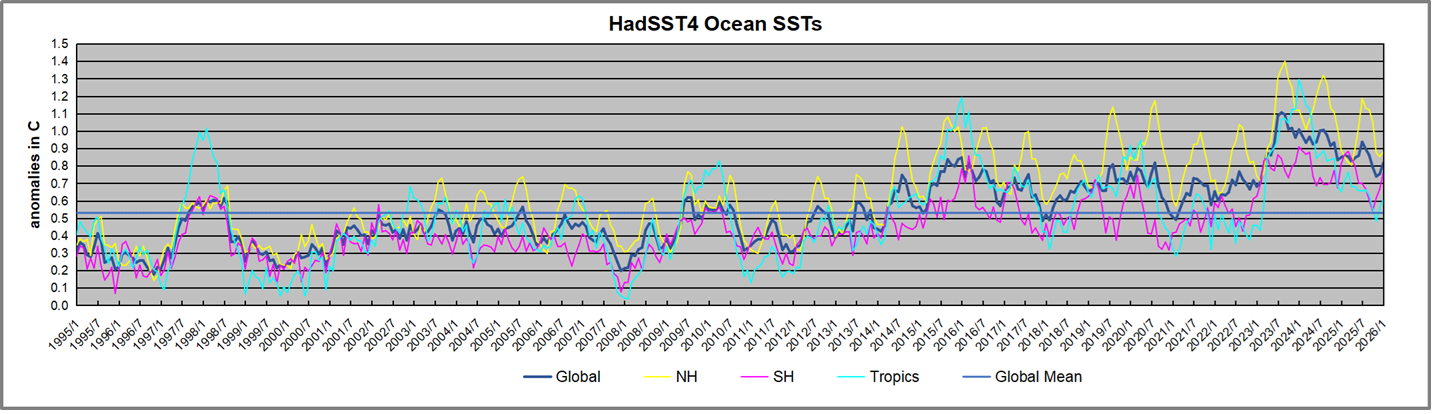
The graph above is noisy, but the density is needed to see the seasonal patterns in the oceanic fluctuations.  Previous posts focused on the rise and fall of the last El Nino starting in 2015.  This post adds a longer view, encompassing the significant 1998 El Nino and since.  The color schemes are retained for Global, Tropics, NH and SH anomalies.  Despite the longer time frame, I have kept the monthly data (rather than yearly averages) because of interesting shifts between January and July. 1995 is a reasonable (ENSO neutral) starting point prior to the first El Nino.

The sharp Tropical rise peaking in 1998 is dominant in the record, starting Jan. ’97 to pull up SSTs uniformly before returning to the same level Jan. ’99. There were strong cool periods before and after the 1998 El Nino event. Then SSTs in all regions returned to the mean in 2001-2.

SSTS fluctuate around the mean until 2007, when another, smaller ENSO event occurs. There is cooling 2007-8,  a lower peak warming in 2009-10, following by cooling in 2011-12.  Again SSTs are average 2013-14.

Now a different pattern appears.  The Tropics cooled sharply to Jan 11, then rise steadily for 4 years to Jan 15, at which point the most recent major El Nino takes off.  But this time in contrast to ’97-’99, the Northern Hemisphere produces peaks every summer pulling up the Global average.  In fact, these NH peaks appear every July starting in 2003, growing stronger to produce 3 massive highs in 2014, 15 and 16.  NH July 2017 was only slightly lower, and a fifth NH peak still lower in Sept. 2018.

The highest summer NH peaks came in 2019 and 2020, only this time the Tropics and SH were offsetting rather adding to the warming. (Note: these are high anomalies on top of the highest absolute temps in the NH.)  Since 2014 SH has played a moderating role, offsetting the NH warming pulses. After September 2020 temps dropped off down until February 2021.  In 2021-22 there were again summer NH spikes, but in 2022 moderated first by cooling Tropics and SH SSTs, then in October to January 2023 by deeper cooling in NH and Tropics.

Then in 2023 the Tropics flipped from below to well above average, while NH produced a summer peak extending into September higher than any previous year.  Despite El Nino driving the Tropics January 2024 anomaly higher than 1998 and 2016 peaks, following months cooled in all regions, and the Tropics continued cooling in April, May and June along with SH dropping.  After July and August NH warming again pulled the global anomaly higher, September through January 2025 resumed cooling in all regions.  The descending sawtooth in all regions continued through Sept./Oct.

What to make of all this? The patterns suggest that in addition to El Ninos in the Pacific driving the Tropic SSTs, something else is going on in the NH.  The obvious culprit is the North Atlantic, since I have seen this sort of pulsing before.  After reading some papers by David Dilley, I confirmed his observation of Atlantic pulses into the Arctic every 8 to 10 years.

Contemporary AMO Observations

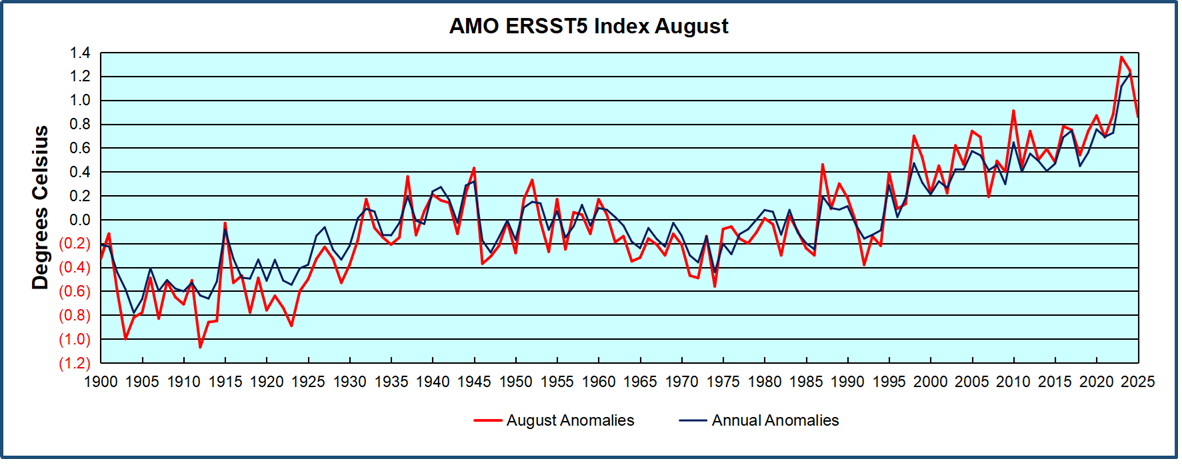
Through January 2023 I depended on the Kaplan AMO Index (not smoothed, not detrended) for N. Atlantic observations. But it is no longer being updated, and NOAA says they don’t know its future.  So I find that ERSSTv5 AMO dataset has current data.  It differs from Kaplan, which reported average absolute temps measured in N. Atlantic.  “ERSST5 AMO  follows Trenberth and Shea (2006) proposal to use the NA region EQ-60°N, 0°-80°W and subtract the global rise of SST 60°S-60°N to obtain a measure of the internal variability, arguing that the effect of external forcing on the North Atlantic should be similar to the effect on the other oceans.”  So the values represent SST anomaly differences between the N. Atlantic and the Global ocean.

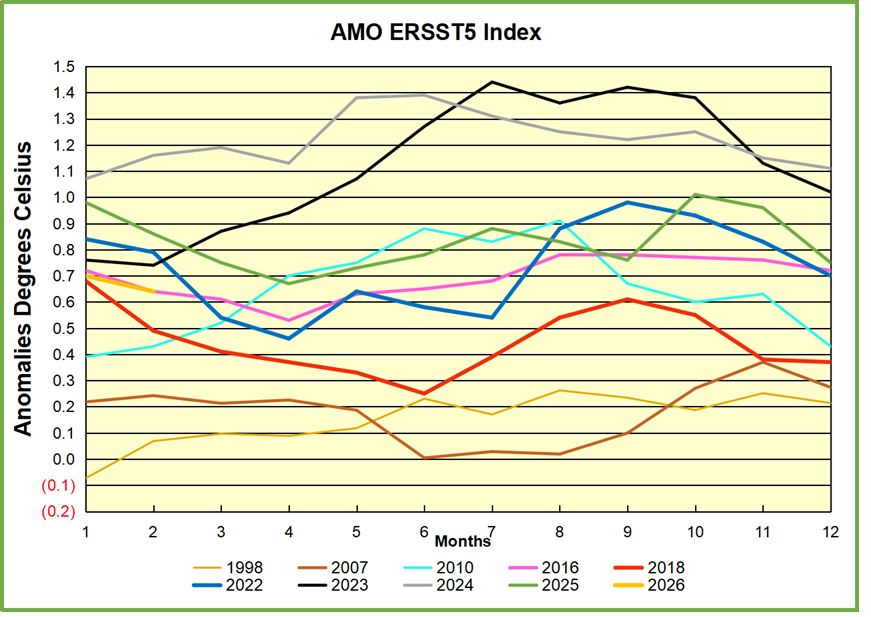
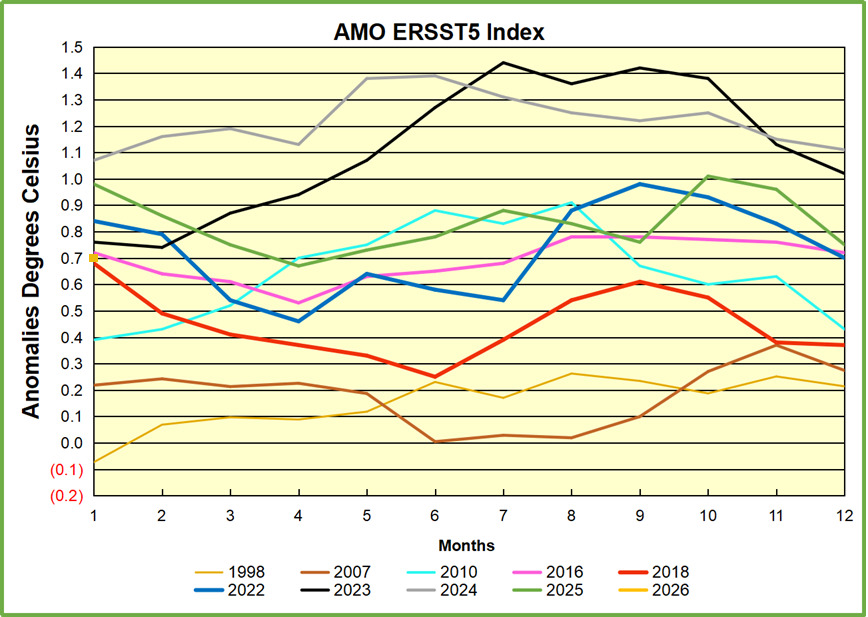
The chart above confirms what Kaplan also showed.  As August is the hottest month for the N. Atlantic, its variability, high and low, drives the annual results for this basin.  Note also the peaks in 2010, lows after 2014, and a rise in 2021. Then in 2023 the peak reached 1.4C before declining to 0.9 last month.  An annual chart below is informative:

Note the difference between blue/green years, beige/brown, and purple/red years.  2010, 2021, 2022 all peaked strongly in August or September.  1998 and 2007 were mildly warm.  2016 and 2018 were matching or cooler than the global average.  2023 started out slightly warm, then rose steadily to an  extraordinary peak in July.  August to October were only slightly lower, but by December cooled by ~0.4C.

Then in 2024 the AMO anomaly started higher than any previous year, then leveled off for two months declining slightly into April.  Remarkably, May showed an upward leap putting this on a higher track than 2023, and rising slightly higher in June.  In July, August and September 2024 the anomaly declined, and despite a small rise in October, ended close to where it began.  Note 2025 started much lower than the previous year and headed sharply downward, well below the previous two years, then since April through September aligning with 2010, with an upward bump in October 2025.

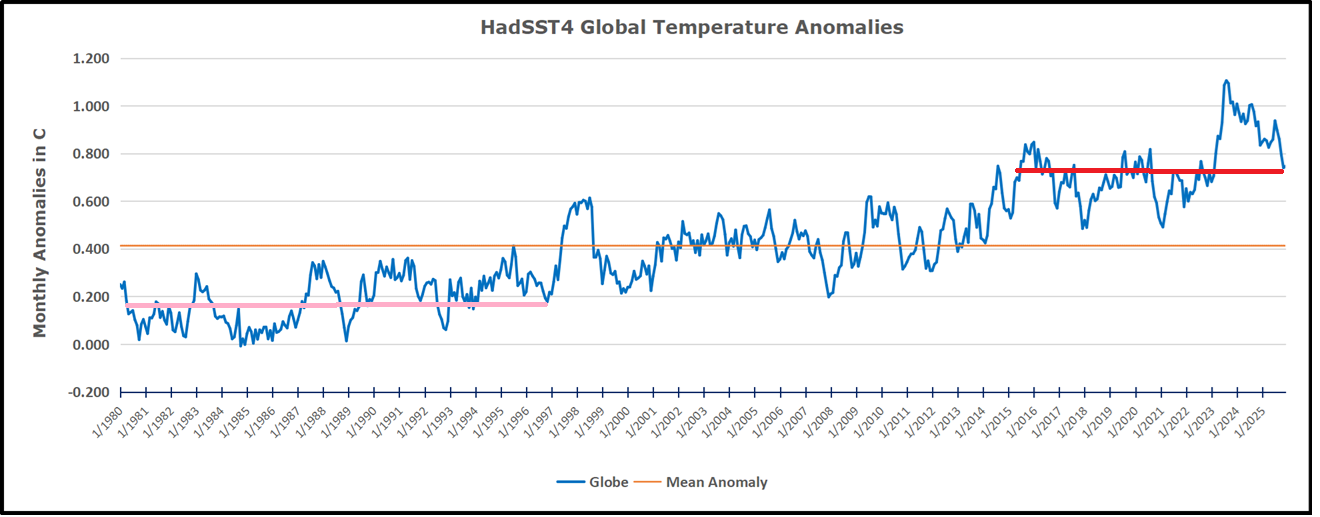
The pattern suggests the ocean may be demonstrating a stairstep pattern like that we have also seen in HadCRUT4.

The rose line is the average anomaly 1982-1996 inclusive, value -0.25.  The orange line the average 1982-2025, value -0.014 also for the period 1997-2012. The red line is 2015-2025, value 0.32. As noted above, these rising stages are driven by the combined warming in the Tropics and NH, including both Pacific and Atlantic basins.

Curiosity:  Solar Coincidence?

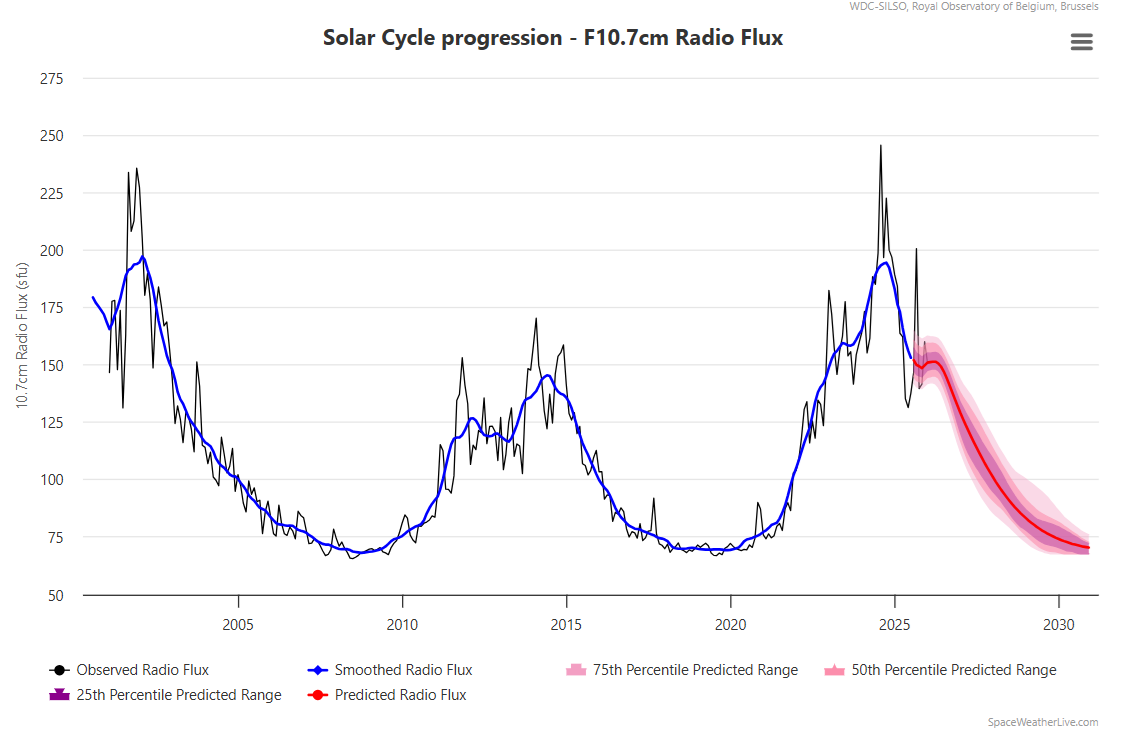
The news about our current solar cycle 25 is that the solar activity is hitting peak numbers now and higher  than expected 1-2 years in the future.  As livescience put it:  Solar maximum could hit us harder and sooner than we thought. How dangerous will the sun’s chaotic peak be?  Some charts from spaceweatherlive look familar to these sea surface temperature charts.

Summary

The oceans are driving the warming this century.  SSTs took a step up with the 1998 El Nino and have stayed there with help from the North Atlantic, and more recently the Pacific northern “Blob.”  The ocean surfaces are releasing a lot of energy, warming the air, but eventually will have a cooling effect.  The decline after 1937 was rapid by comparison, so one wonders: How long can the oceans keep this up? And is the sun adding forcing to this process?

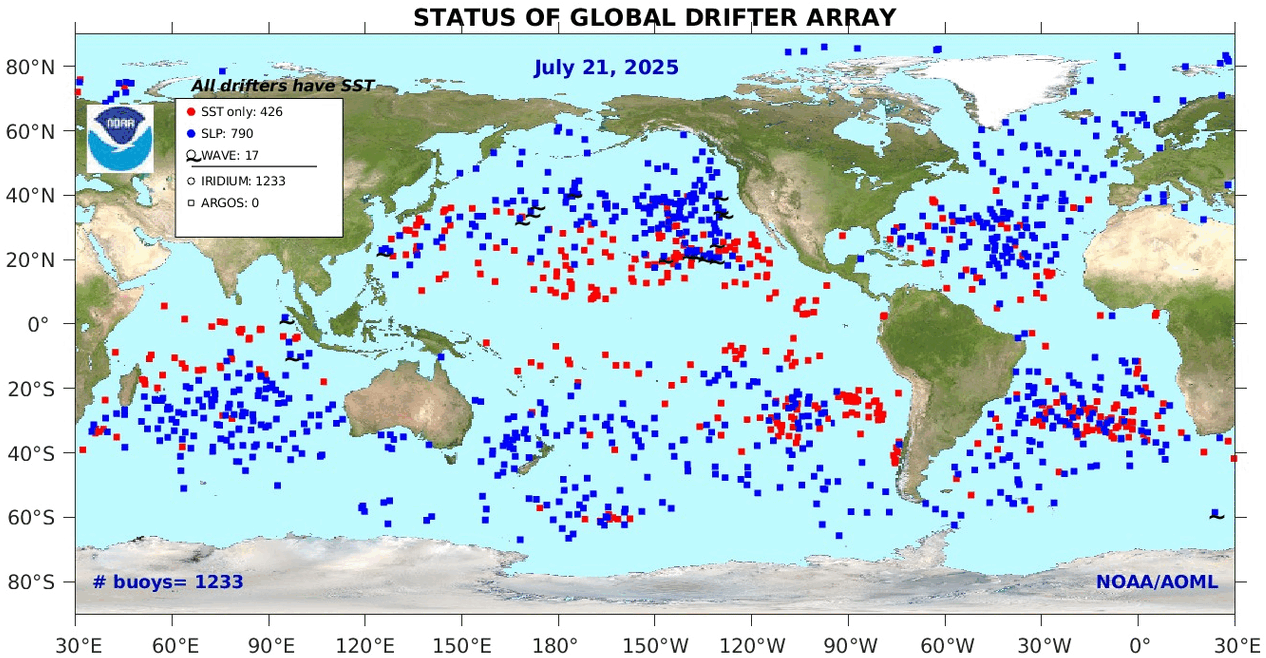
uss-pearl-harbor-deploys-global-drifter-buoys-in-pacific-ocean

USS Pearl Harbor deploys Global Drifter Buoys in Pacific Ocean

Glaciermania Strikes Again–2025 International Year of Glaciers

UN is sounding alarms about glaciers, and media is amplifying as usual.

Climate emergency: 2025 declared international year of glaciers, UN News

Climate change is shrinking glaciers faster than ever, AP

Glaciers Are Melting Twice as Fast as Predicted and We’re Not Ready,  Science News Today

1st glacier declared dead from climate change seen in before and after images, Live Science

Nearly 40% of the world’s glaciers are already doomed, CNN

Nearly Half of Earth’s Glaciers Are Already Doomed, Even Without Future Warming, SciTechDaily

World’s Melting Glaciers Threaten Food and Water Supply for 2 Billion People, Carbon Brief

Glaciers on the Brink: UN Calls for Bold Action, Climate Fact Checks

This short video puts this alarm into perspective. Additional detail is provided by Dr. John Happs in his article Glaciers And Ice Sheets: Here Today And Here Tomorrow.  Dr. Happs comments on many glaciers around the world, this post has only some excerpts in italics with my bolds and added images.

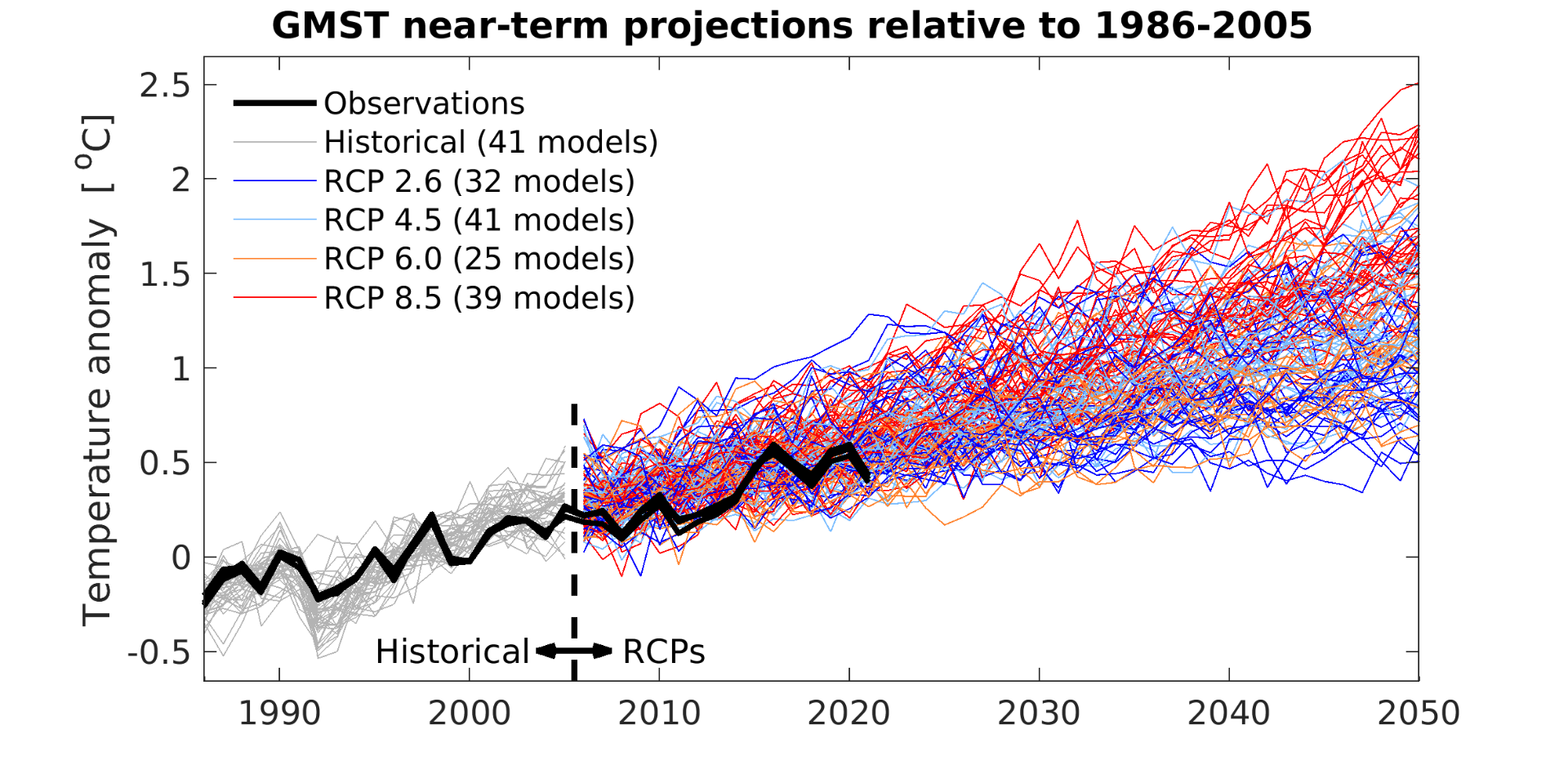
How often do the climate alarmists tell us that few glaciers still exist because of (imaginary) global warming and those that remain are rapidly melting away? Not surprisingly, the alarmists, particularly those from the media and vested interest groups, always point to the Intergovernmental Panel on Climate Change (IPCC) computer model projections, referring to one in particular–the Representative Concentration Pathway (RCP8.5.)

Even the political/ideological IPCC has sensibly branded RCP8.5 as “Highly Unlikely”

So, what are the glacier numbers?

  1. There are more than 200,000 alpine/valley (land-based) glaciers and many others stemming from the ice sheets of Antarctica and Greenland.
  1. Glaciers have advanced, retreated and halted many times over the last 400,000 years being influenced not only by temperature but also by other factors, such as wind, precipitation, altitude, latitude, aspect, topography and slope angle.

Global temperature is often promoted, usually by naïve climate alarmists, as the only important input into glacier formation, growth and retreat yet, in very dry parts of Antarctica, where low temperatures are seemingly ideal for glacier growth, the small amount of net annual precipitation results in glaciers growing very slowly, or even diminishing in size.

Glaciers can also be influenced by sublimation or the transition of a substance directly from the solid to the gas phase. Glaciers can experience this process resulting in the “evaporation” of ice, exacerbated by wind action. Sublimation can be seen in the way that ice cubes left in the freezer will shrink over time.

More than 18,000 glaciers have been identified across 50 World Heritage sites but this represents less than 10% of the Earth’s glaciated area. The media, climate activists and vested interest groups like to argue that all glaciers are receding because global temperature is increasing. Not surprisingly, many glaciers have been retreating since we emerged from the Little Ice Age (1250-1850), a time when many farms and houses across Scandinavia were destroyed by advancing glaciers between the 14th and 19th centuries.

We might expect that glaciers and ice sheets would recede after the Little Ice Age yet we know that glaciers in many parts of the world are advancing, with glaciers growing in the Alps, North America, Patagonia, Antarctica, Alaska, the Himalayas, China, Iceland, Greenland, New Zealand, Norway, Antarctica and Greenland.

Where glaciers reach the sea, the media, and some tour guides, like to promote the dramatic calving-glacier image as pointing to (imaginary) global warming but fail to point out (perhaps they don’t know) that a calving glacier is the sign of an advancing inland glacier and certainly not one that is about to disappear.

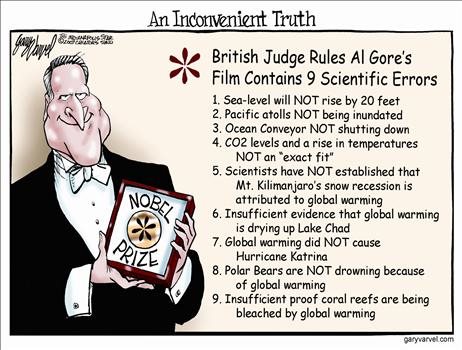
In his silly, but influential, 2005 movie “An Inconvenient Truth” Al Gore said:

“Within the decade, there will be no more snows of Kilimanjaro.”

Mount Kilimanjaro is still covered in snow.  See False Alarm over the Retreat of the Himalayan Glaciers

“The speed and consequences of Himalayan glacial retreat have been grossly exaggerated by the media and environmental activists.”

A significant proportion of Himalayan glaciers are advancing. In fact, 58% of glaciers examined in the westerly Karakoram range, a chain of snowy peaks along the border of India, Pakistan and China, were stable or advancing with annual snowfall increasing. A study of Himalayan glaciers, published in the American Meteorological Society’s Journal of Climate reported that cooler summers are failing to melt winter snows, which are themselves becoming more frequent, resulting in advancing glaciers. Source: Live Science

GLACIERS/ICE SHEETS IN ANTARCTICA

The Antarctic ice sheet is the world’s largest mass of ice covering around 14 million sq. km.

Ice sheets can be described as glaciers that cover very large areas and the most obvious examples are found in Greenland and Antarctica where around two-thirds of the Earth’s fresh water is stored.

Alarming reports that the Antarctic ice sheet is rapidly melting misrepresent the science of a very complex situation. Antarctica has been ice-covered for at least 30 million years. The ice sheet holds over 26 million gigatonnes of water (a gigatonne is a billion metric tons). If it were to melt completely, sea levels would rise 60 metres. Such a change is many millennia in the future, if it happens at all, although climate alarmists will always claim that such a response is just around the corner because of (imaginary) global warming.

Modest ice loss is normal in Antarctica.  Each year in summer, more than 2,000 gigatonnes of ice is discharged in the form of melt and icebergs, while snowfall additions keep the ice mass in equilibrium.

Summary

So it is a familiar story. A complex naturally fluctuating situation, in this case glaciers, is abused by activists to claim support for their agenda. I have a lot of respect for glaciologists; it is a deep, complex subject, and the field work is incredibly challenging. And since “glacial” describes any process where any movement is imperceptible, I can understand their excitement over something happening all of a sudden.

But I do not applaud those pandering to the global warming/climate change crowd. They seem not to realize they debase their own field of study by making exaggerated claims and by “jumping the shark.”
Meanwhile real scientists are doing the heavy lifting and showing restraint and wisdom about the limitations of their knowledge.

Resources:

Redressing Antarctic Glacier Porn

Greenland Ice Varies, Don’t Panic 2023 Update

Climatists’ Childish Reading of Polar Ice

Figure 1. A comparison of presentations of satellite data capturing Greenland’s ice mass loss. The image on the right shows changes in Greenland’s ice mass relative to Greenland’s total ice mass. Sources: The data plotted in these graphs are from the Ice Sheet Mass Balance Inter-Comparison Exercise, a joint exercise by NASA and the European Space Agency.4 Graphs originally by Willis Eschenbach. Adapted and annotated by Anthony Watts.


Good News, COP30: Cooling Temperatures Reducing CO2 Rise

Just in time for COP30 in Belem, Brazil, we have fresh confirmation that cooling temperatures are resulting in lower than expected levels of atmospheric CO2. Historical records show that around 1875 was the coldest time in the last 10,000 years.  That was the end of the Little Ice Age, and since then temperatures have warmed at an average rate of about 0.5C per century.  The recovery of the biosphere and ocean warming resulted in rising levels of CO2 in the atmosphere. At times, there are warming spikes, in the 1930s and 40s for example, and the rate of rising CO2 goes up. At other times, such as 1950s and 60s, temperatures cool, and rising CO2 slows down. More recently, in 2023 and 24, we saw  temperatures spike up before falling back down in 2025.

Previously I have demonstrated that changes in atmospheric CO2 levels follow changes in Global Mean Temperatures (GMT) as shown by satellite measurements from University of Alabama at Huntsville (UAH). That background post is reprinted later below.

My curiosity was piqued by the remarkable GMT spike starting in January 2023 and rising to a peak in April 2024. GMT has declined steadily, and now 18 months later, the anomaly is 0.53C down from 0.94C.  I also became aware that UAH has recalibrated their dataset due to a satellite drift that can no longer be corrected. The values since 2020 have shifted slightly in version 6.1, as shown in my recent report UAH Ocean Stays Cool, SH Land Warms, October 2025, The data here comes from UAH record of temperatures measured in the lower troposphere (TLT).

In this post, I test the premise that temperature changes are predictive of changes in atmospheric CO2 concentrations.  The chart above shows the two monthly datasets: CO2 levels in blue reported at Mauna Loa, and Global temperature anomalies in purple reported by UAHv6.1, both through October 2025. Would such a sharp increase in temperature be reflected in rising CO2 levels, according to the successful mathematical forecasting model? Would CO2 levels decline as temperatures dropped following the peak?

The answer is yes: that temperature spike resulted
in a corresponding CO2 spike as expected.
And lower CO2 levels followed the temperature decline.

Above are UAH temperature anomalies compared to CO2 monthly changes year over year.

Changes in monthly CO2 synchronize with temperature fluctuations, which for UAH are anomalies referenced to the 1991-2020 period. CO2 differentials are calculated for the present month by subtracting the value for the same month in the previous year (for example October 2025 minus October 2024).  Temp anomalies are calculated by comparing the present month with the baseline month. Note the recent CO2 upward spike and drop following the temperature spike and drop.

The final proof that CO2 follows temperature due to stimulation of natural CO2 reservoirs is demonstrated by the ability to calculate CO2 levels since 1979 with a simple mathematical formula:

For each subsequent year, the CO2 level for each month was generated

CO2  this month this year = a + b × Temp this month this year  + CO2 this month last year

The values for a and b are constants applied to all monthly temps, and are chosen to scale the forecasted CO2 level for comparison with the observed value. Here is the result of those calculations.

In the chart calculated CO2 levels correlate with observed CO2 levels at 0.9988 out of 1.0000.  This mathematical generation of CO2 atmospheric levels is only possible if they are driven by temperature-dependent natural sources, and not by human emissions which are small in comparison, rise steadily and monotonically.  For a more detailed look at the recent fluxes, here are the results since 2015, an ENSO neutral year.

For this recent period, the calculated CO2 values match well the annual highs, while some annual generated values of CO2 are slightly higher or lower than observed at other months of the year. Still the correlation for this period is 0.9941.

Key Point

Changes in CO2 follow changes in global temperatures on all time scales, from last month’s observations to ice core datasets spanning millennia. Since CO2 is the lagging variable, it cannot logically be the cause of temperature, the leading variable. It is folly to imagine that by reducing human emissions of CO2, we can change global temperatures, which are obviously driven by other factors.

Background Post Temperature Changes Cause CO2 Changes, Not the Reverse

This post is about proving that CO2 changes in response to temperature changes, not the other way around, as is often claimed.  In order to do  that we need two datasets: one for measurements of changes in atmospheric CO2 concentrations over time and one for estimates of Global Mean Temperature changes over time.

Climate science is unsettling because past data are not fixed, but change later on.  I ran into this previously in 2021 and 2022 when I set out to update an analysis done in 2014 by Jeremy Shiers (discussed in a previous post reprinted at the end).  Jeremy provided a spreadsheet in his essay Murray Salby Showed CO2 Follows Temperature Now You Can Too posted in January 2014. I downloaded his spreadsheet intending to bring the analysis up to the present to see if the results hold up.  The two sources of data were:

Temperature anomalies from RSS here:  http://www.remss.com/missions/amsu

CO2 monthly levels from NOAA (Mauna Loa): https://www.esrl.noaa.gov/gmd/ccgg/trends/data.html

Changes in CO2 (ΔCO2)

Uploading the CO2 dataset showed that many numbers had changed (why?).

The blue line shows annual observed differences in monthly values year over year, e.g. June 2020 minus June 2019 etc.  The first 12 months (1979) provide the observed starting values from which differentials are calculated.  The orange line shows those CO2 values changed slightly in the 2020 dataset vs. the 2014 dataset, on average +0.035 ppm.  But there is no pattern or trend added, and deviations vary randomly between + and -.  So last year I took the 2020 dataset to replace the older one for updating the analysis.

Now I find the NOAA dataset starting in 2021 has almost completely new values due to a method shift in February 2021, requiring a recalibration of all previous measurements.  The new picture of ΔCO2 is graphed below.

The method shift is reported at a NOAA Global Monitoring Laboratory webpage, Carbon Dioxide (CO2) WMO Scale, with a justification for the difference between X2007 results and the new results from X2019 now in force.  The orange line shows that the shift has resulted in higher values, especially early on and a general slightly increasing trend over time.  However, these are small variations at the decimal level on values 340 and above.  Further, the graph shows that yearly differentials month by month are virtually the same as before.  Thus I redid the analysis with the new values.

Global Temperature Anomalies (ΔTemp)

The other time series was the record of global temperature anomalies according to RSS. The current RSS dataset is not at all the same as the past.

Here we see some seriously unsettling science at work.  The purple line is RSS in 2014, and the blue is RSS as of 2020.  Some further increases appear in the gold 2022 rss dataset. The red line shows alterations from the old to the new.  There is a slight cooling of the data in the beginning years, then the three versions mostly match until 1997, when systematic warming enters the record.  From 1997/5 to 2003/12 the average anomaly increases by 0.04C.  After 2004/1 to 2012/8 the average increase is 0.15C.  At the end from 2012/9 to 2013/12, the average anomaly was higher by 0.21. The 2022 version added slight warming over 2020 values.

RSS continues that accelerated warming to the present, but it cannot be trusted.  And who knows what the numbers will be a few years down the line?  As Dr. Ole Humlum said some years ago (regarding Gistemp): “It should however be noted, that a temperature record which keeps on changing the past hardly can qualify as being correct.”

Given the above manipulations, I went instead to the other satellite dataset UAH version 6. UAH has also made a shift by changing its baseline from 1981-2010 to 1991-2020.  This resulted in systematically reducing the anomaly values, but did not alter the pattern of variation over time.  For comparison, here are the two records with measurements through December 2023.

Comparing UAH temperature anomalies to NOAA CO2 changes.

Here are UAH temperature anomalies compared to CO2 monthly changes year over year.

Changes in monthly CO2 synchronize with temperature fluctuations, which for UAH are anomalies now referenced to the 1991-2020 period.  As stated above, CO2 differentials are calculated for the present month by subtracting the value for the same month in the previous year (for example June 2022 minus June 2021).   Temp anomalies are calculated by comparing the present month with the baseline month.

The final proof that CO2 follows temperature due to stimulation of natural CO2 reservoirs is demonstrated by the ability to calculate CO2 levels since 1979 with a simple mathematical formula:

For each subsequent year, the co2 level for each month was generated

CO2  this month this year = a + b × Temp this month this year  + CO2 this month last year

Jeremy used Python to estimate a and b, but I used his spreadsheet to guess values that place for comparison the observed and calculated CO2 levels on top of each other.

In the chart calculated CO2 levels correlate with observed CO2 levels at 0.9986 out of 1.0000.  This mathematical generation of CO2 atmospheric levels is only possible if they are driven by temperature-dependent natural sources, and not by human emissions which are small in comparison, rise steadily and monotonically.

Comment:  UAH dataset reported a sharp warming spike starting mid year, with causes speculated but not proven.  In any case, that surprising peak has not yet driven CO2 higher, though it might,  but only if it persists despite the likely cooling already under way.

Previous Post:  What Causes Rising Atmospheric CO2?

nasa_carbon_cycle_2008-1

This post is prompted by a recent exchange with those reasserting the “consensus” view attributing all additional atmospheric CO2 to humans burning fossil fuels.

The IPCC doctrine which has long been promoted goes as follows. We have a number over here for monthly fossil fuel CO2 emissions, and a number over there for monthly atmospheric CO2. We don’t have good numbers for the rest of it-oceans, soils, biosphere–though rough estimates are orders of magnitude higher, dwarfing human CO2.  So we ignore nature and assume it is always a sink, explaining the difference between the two numbers we do have. Easy peasy, science settled.

What about the fact that nature continues to absorb about half of human emissions, even while FF CO2 increased by 60% over the last 2 decades? What about the fact that in 2020 FF CO2 declined significantly with no discernable impact on rising atmospheric CO2?

These and other issues are raised by Murray Salby and others who conclude that it is not that simple, and the science is not settled. And so these dissenters must be cancelled lest the narrative be weakened.

The non-IPCC paradigm is that atmospheric CO2 levels are a function of two very different fluxes. FF CO2 changes rapidly and increases steadily, while Natural CO2 changes slowly over time, and fluctuates up and down from temperature changes. The implications are that human CO2 is a simple addition, while natural CO2 comes from the integral of previous fluctuations.  Jeremy Shiers has a series of posts at his blog clarifying this paradigm. See Increasing CO2 Raises Global Temperature Or Does Increasing Temperature Raise CO2 Excerpts in italics with my bolds.

The following graph which shows the change in CO2 levels (rather than the levels directly) makes this much clearer.

Note the vertical scale refers to the first differential of the CO2 level not the level itself. The graph depicts that change rate in ppm per year.

There are big swings in the amount of CO2 emitted. Taking the mean as 1.6 ppmv/year (at a guess) there are +/- swings of around 1.2 nearly +/- 100%.

And, surprise surprise, the change in net emissions of CO2 is very strongly correlated with changes in global temperature.

This clearly indicates the net amount of CO2 emitted in any one year is directly linked to global mean temperature in that year.

For any given year the amount of CO2 in the atmosphere will be the sum of

  • all the net annual emissions of CO2
  • in all previous years.

For each year the net annual emission of CO2 is proportional to the annual global mean temperature.

This means the amount of CO2 in the atmosphere will be related to the sum of temperatures in previous years.

So CO2 levels are not directly related to the current temperature but the integral of temperature over previous years.

The following graph again shows observed levels of CO2 and global temperatures but also has calculated levels of CO2 based on sum of previous years temperatures (dotted blue line).

Summary:

The massive fluxes from natural sources dominate the flow of CO2 through the atmosphere.  Human CO2 from burning fossil fuels is around 4% of the annual addition from all sources. Even if rising CO2 could cause rising temperatures (no evidence, only claims), reducing our emissions would have little impact.

Atmospheric CO2 Math

Ins: 4% human, 96% natural
Outs: 0% human, 98% natural.
Atmospheric storage difference: +2%
(so that: Ins = Outs + Atmospheric storage difference)

Balance = Atmospheric storage difference: 2%, of which,
Humans: 2% X 4% = 0.08%
Nature: 2% X 96 % = 1.92%

Ratio Natural : Human =1.92% : 0.08% = 24 : 1

Resources
For a possible explanation of natural warming and CO2 emissions see Little Ice Age Warming Recovery May be Over
Resources:

CO2 Fluxes, Sources and Sinks

Who to Blame for Rising CO2?

Fearless Physics from Dr. Salby

October 2025 Ocean SST Cools to Mean

The best context for understanding decadal temperature changes comes from the world’s sea surface temperatures (SST), for several reasons:

  • The ocean covers 71% of the globe and drives average temperatures;
  • SSTs have a constant water content, (unlike air temperatures), so give a better reading of heat content variations;
  • A major El Nino was the dominant climate feature in recent years.

Previously I used HadSST3 for these reports, but Hadley Centre has made HadSST4 the priority, and v.3 will no longer be updated. I’ve grown weary of waiting each month for HadSST4 updates, so the July and August reports were based on data from OISST2.1.  This dataset uses the same in situ sources as HadSST along with satellite indicators. Now however, the US government is shut down and updates to climate datasets are likely to be delayed.  Reminds of what hospitals do when their budgets are slashed: They close the Maternity Ward to get public attention.

So this October report is based again on HadSST 4, but with a twist. The data is slightly different in the new version, 4.2.0.0 replacing 4.1.1.0. Product page is here.

The Current Context

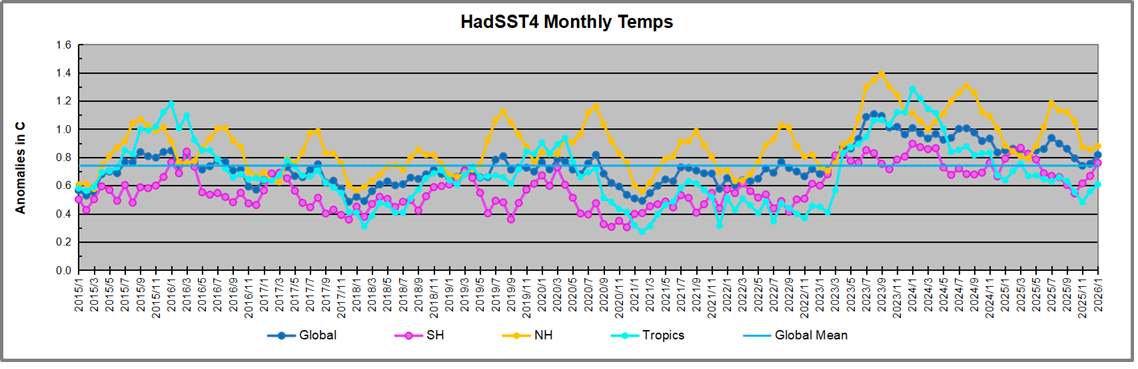
The chart below shows SST monthly anomalies as reported in HadSST 4.2 starting in 2015 through October 2025. A global cooling pattern is seen clearly in the Tropics since its peak in 2016, joined by NH and SH cycling downward since 2016, followed by rising temperatures in 2023 and 2024 and cooling in 2025.

Note that in 2015-2016 the Tropics and SH peaked in between two summer NH spikes.  That pattern repeated in 2019-2020 with a lesser Tropics peak and SH bump, but with higher NH spikes. By end of 2020, cooler SSTs in all regions took the Global anomaly well below the mean for this period.  A small warming was driven by NH summer peaks in 2021-22, but offset by cooling in SH and the tropics, By January 2023 the global anomaly was again below the mean.

Then in 2023-24 came an event resembling 2015-16 with a Tropical spike and two NH spikes alongside, all higher than 2015-16. There was also a coinciding rise in SH, and the Global anomaly was pulled up to 1.1°C in 2023, ~0.3° higher than the 2015 peak.  Then NH started down autumn 2023, followed by Tropics and SH descending 2024 to the present. During 2 years of cooling in SH and the Tropics, the Global anomaly came back down, led by Tropics cooling from its 1.3°C peak 2024/01, down to 0.6C in September this year. Note the smaller peak in NH in July 2025 now declining along with SH and the Global anomaly cooler as well. In October the Global anomaly nearly matched the mean for this period

Comment:

The climatists have seized on this unusual warming as proof their Zero Carbon agenda is needed, without addressing how impossible it would be for CO2 warming the air to raise ocean temperatures.  It is the ocean that warms the air, not the other way around.  Recently Steven Koonin had this to say about the phonomenon confirmed in the graph above:

El Nino is a phenomenon in the climate system that happens once every four or five years.  Heat builds up in the equatorial Pacific to the west of Indonesia and so on.  Then when enough of it builds up it surges across the Pacific and changes the currents and the winds.  As it surges toward South America it was discovered and named in the 19th century  It iswell understood at this point that the phenomenon has nothing to do with CO2.

Now people talk about changes in that phenomena as a result of CO2 but it’s there in the climate system already and when it happens it influences weather all over the world.   We feel it when it gets rainier in Southern California for example.  So for the last 3 years we have been in the opposite of an El Nino, a La Nina, part of the reason people think the West Coast has been in drought.

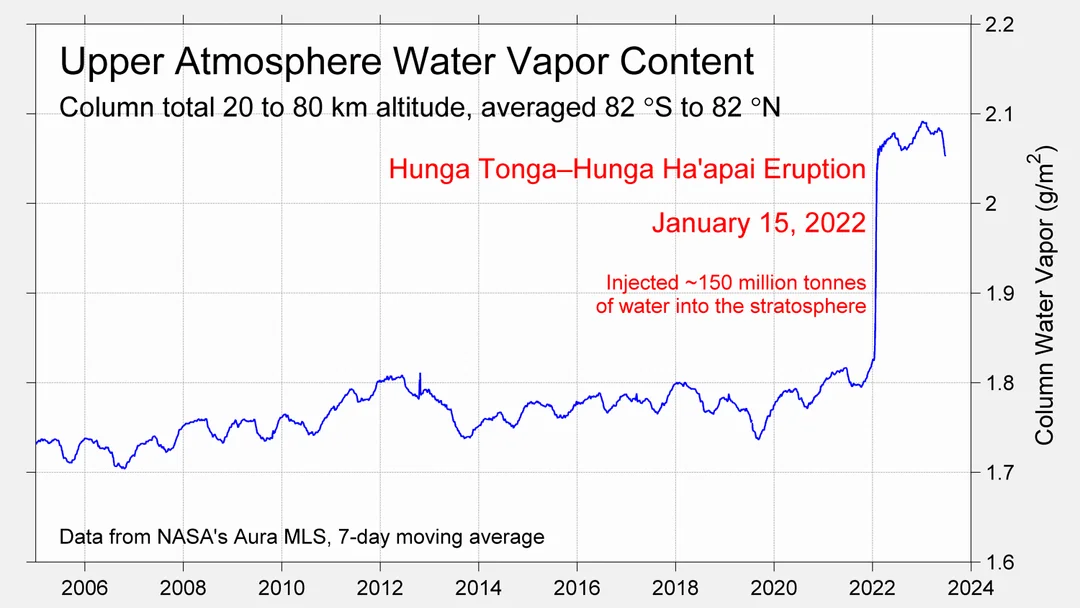
It has now shifted in the last months to an El Nino condition that warms the globe and is thought to contribute to this Spike we have seen. But there are other contributions as well.  One of the most surprising ones is that back in January of 2022 an enormous underwater volcano went off in Tonga and it put up a lot of water vapor into the upper atmosphere. It increased the upper atmosphere of water vapor by about 10 percent, and that’s a warming effect, and it may be that is contributing to why the spike is so high.

A longer view of SSTs

To enlarge, open image in new tab.

The graph above is noisy, but the density is needed to see the seasonal patterns in the oceanic fluctuations.  Previous posts focused on the rise and fall of the last El Nino starting in 2015.  This post adds a longer view, encompassing the significant 1998 El Nino and since.  The color schemes are retained for Global, Tropics, NH and SH anomalies.  Despite the longer time frame, I have kept the monthly data (rather than yearly averages) because of interesting shifts between January and July. 1995 is a reasonable (ENSO neutral) starting point prior to the first El Nino.

The sharp Tropical rise peaking in 1998 is dominant in the record, starting Jan. ’97 to pull up SSTs uniformly before returning to the same level Jan. ’99. There were strong cool periods before and after the 1998 El Nino event. Then SSTs in all regions returned to the mean in 2001-2.

SSTS fluctuate around the mean until 2007, when another, smaller ENSO event occurs. There is cooling 2007-8,  a lower peak warming in 2009-10, following by cooling in 2011-12.  Again SSTs are average 2013-14.

Now a different pattern appears.  The Tropics cooled sharply to Jan 11, then rise steadily for 4 years to Jan 15, at which point the most recent major El Nino takes off.  But this time in contrast to ’97-’99, the Northern Hemisphere produces peaks every summer pulling up the Global average.  In fact, these NH peaks appear every July starting in 2003, growing stronger to produce 3 massive highs in 2014, 15 and 16.  NH July 2017 was only slightly lower, and a fifth NH peak still lower in Sept. 2018.

The highest summer NH peaks came in 2019 and 2020, only this time the Tropics and SH were offsetting rather adding to the warming. (Note: these are high anomalies on top of the highest absolute temps in the NH.)  Since 2014 SH has played a moderating role, offsetting the NH warming pulses. After September 2020 temps dropped off down until February 2021.  In 2021-22 there were again summer NH spikes, but in 2022 moderated first by cooling Tropics and SH SSTs, then in October to January 2023 by deeper cooling in NH and Tropics.

Then in 2023 the Tropics flipped from below to well above average, while NH produced a summer peak extending into September higher than any previous year.  Despite El Nino driving the Tropics January 2024 anomaly higher than 1998 and 2016 peaks, following months cooled in all regions, and the Tropics continued cooling in April, May and June along with SH dropping.  After July and August NH warming again pulled the global anomaly higher, September through January 2025 resumed cooling in all regions, continuing February through April 2025, with little change in May,June and July despite upward bumps in NH. Now temps in all regions are cooling August and September 2025.

What to make of all this? The patterns suggest that in addition to El Ninos in the Pacific driving the Tropic SSTs, something else is going on in the NH.  The obvious culprit is the North Atlantic, since I have seen this sort of pulsing before.  After reading some papers by David Dilley, I confirmed his observation of Atlantic pulses into the Arctic every 8 to 10 years.

Contemporary AMO Observations

Through January 2023 I depended on the Kaplan AMO Index (not smoothed, not detrended) for N. Atlantic observations. But it is no longer being updated, and NOAA says they don’t know its future.  So I find that ERSSTv5 AMO dataset has current data.  It differs from Kaplan, which reported average absolute temps measured in N. Atlantic.  “ERSST5 AMO  follows Trenberth and Shea (2006) proposal to use the NA region EQ-60°N, 0°-80°W and subtract the global rise of SST 60°S-60°N to obtain a measure of the internal variability, arguing that the effect of external forcing on the North Atlantic should be similar to the effect on the other oceans.”  So the values represent SST anomaly differences between the N. Atlantic and the Global ocean.

The chart above confirms what Kaplan also showed.  As August is the hottest month for the N. Atlantic, its variability, high and low, drives the annual results for this basin.  Note also the peaks in 2010, lows after 2014, and a rise in 2021. Then in 2023 the peak reached 1.4C before declining to 0.9 last month.  An annual chart below is informative:

Note the difference between blue/green years, beige/brown, and purple/red years.  2010, 2021, 2022 all peaked strongly in August or September.  1998 and 2007 were mildly warm.  2016 and 2018 were matching or cooler than the global average.  2023 started out slightly warm, then rose steadily to an  extraordinary peak in July.  August to October were only slightly lower, but by December cooled by ~0.4C.

Then in 2024 the AMO anomaly started higher than any previous year, then leveled off for two months declining slightly into April.  Remarkably, May showed an upward leap putting this on a higher track than 2023, and rising slightly higher in June.  In July, August and September 2024 the anomaly declined, and despite a small rise in October, ended close to where it began.  Note 2025 started much lower than the previous year and headed sharply downward, well below the previous two years, then since April through September aligning with 2010. Now in October there was an unusual upward spike.

The pattern suggests the ocean may be demonstrating a stairstep pattern like that we have also seen in HadCRUT4.

The rose line is the average anomaly 1982-1996 inclusive, value 0.18.  The orange line the average 1982-2025, value 0.40 also for the period 1997-2012. The red line is 2015-2025, value 0.68. As noted above, these rising stages are driven by the combined warming in the Tropics and NH, including both Pacific and Atlantic basins.

Curiosity:  Solar Coincidence?

The news about our current solar cycle 25 is that the solar activity is hitting peak numbers now and higher  than expected 1-2 years in the future.  As livescience put it:  Solar maximum could hit us harder and sooner than we thought. How dangerous will the sun’s chaotic peak be?  Some charts from spaceweatherlive look familar to these sea surface temperature charts.

Summary

The oceans are driving the warming this century.  SSTs took a step up with the 1998 El Nino and have stayed there with help from the North Atlantic, and more recently the Pacific northern “Blob.”  The ocean surfaces are releasing a lot of energy, warming the air, but eventually will have a cooling effect.  The decline after 1937 was rapid by comparison, so one wonders: How long can the oceans keep this up? And is the sun adding forcing to this process?

uss-pearl-harbor-deploys-global-drifter-buoys-in-pacific-ocean

USS Pearl Harbor deploys Global Drifter Buoys in Pacific Ocean

UAH Ocean Stays Cool, SH Land Warms, October 2025

The post below updates the UAH record of air temperatures over land and ocean. Each month and year exposes again the growing disconnect between the real world and the Zero Carbon zealots.  It is as though the anti-hydrocarbon band wagon hopes to drown out the data contradicting their justification for the Great Energy Transition.  Yes, there was warming from an El Nino buildup coincidental with North Atlantic warming, but no basis to blame it on CO2.

As an overview consider how recent rapid cooling  completely overcame the warming from the last 3 El Ninos (1998, 2010 and 2016).  The UAH record shows that the effects of the last one were gone as of April 2021, again in November 2021, and in February and June 2022  At year end 2022 and continuing into 2023 global temp anomaly matched or went lower than average since 1995, an ENSO neutral year. (UAH baseline is now 1991-2020). Then there was an usual El Nino warming spike of uncertain cause, unrelated to steadily rising CO2, and now dropping steadily back toward normal values.

For reference I added an overlay of CO2 annual concentrations as measured at Mauna Loa.  While temperatures fluctuated up and down ending flat, CO2 went up steadily by ~65 ppm, an 18% increase.

Furthermore, going back to previous warmings prior to the satellite record shows that the entire rise of 0.8C since 1947 is due to oceanic, not human activity.

gmt-warming-events

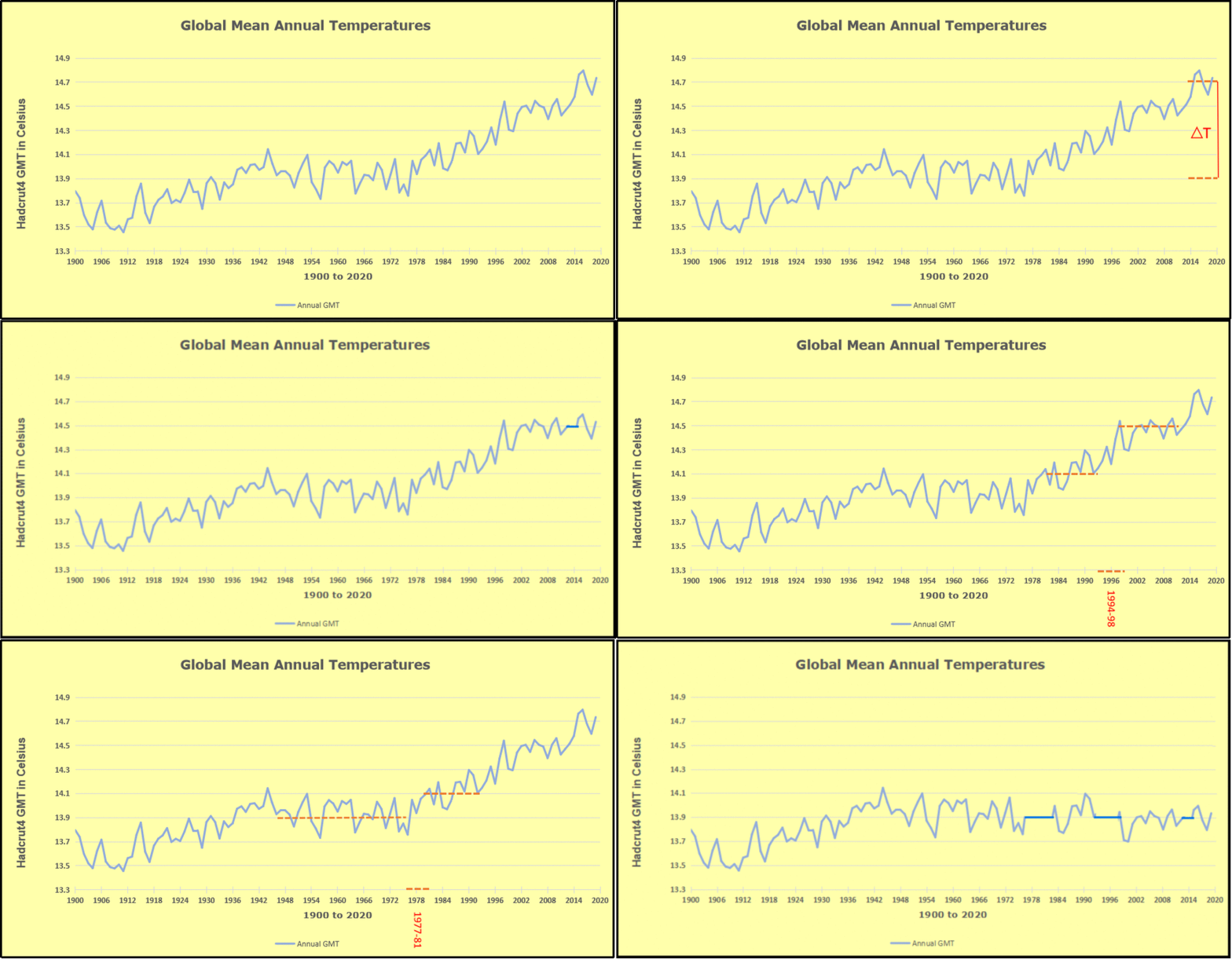
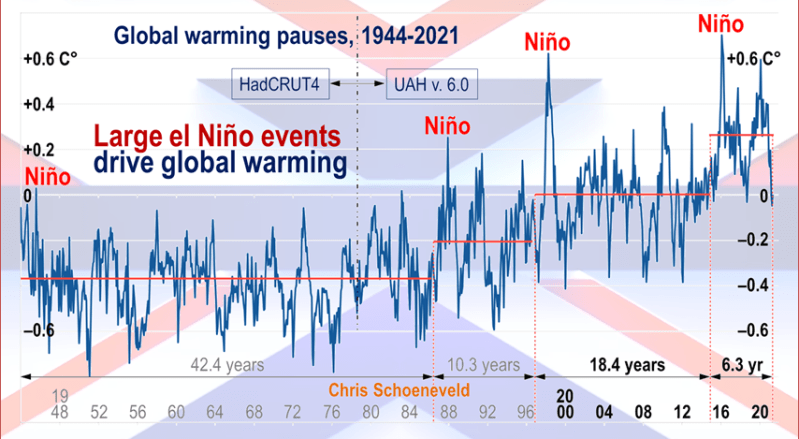
The animation is an update of a previous analysis from Dr. Murry Salby.  These graphs use Hadcrut4 and include the 2016 El Nino warming event.  The exhibit shows since 1947 GMT warmed by 0.8 C, from 13.9 to 14.7, as estimated by Hadcrut4.  This resulted from three natural warming events involving ocean cycles. The most recent rise 2013-16 lifted temperatures by 0.2C.  Previously the 1997-98 El Nino produced a plateau increase of 0.4C.  Before that, a rise from 1977-81 added 0.2C to start the warming since 1947.

Importantly, the theory of human-caused global warming asserts that increasing CO2 in the atmosphere changes the baseline and causes systemic warming in our climate.  On the contrary, all of the warming since 1947 was episodic, coming from three brief events associated with oceanic cycles. And in 2024 we saw an amazing episode with a temperature spike driven by ocean air warming in all regions, along with rising NH land temperatures, now dropping well below its peak.

Chris Schoeneveld has produced a similar graph to the animation above, with a temperature series combining HadCRUT4 and UAH6. H/T WUWT

image-8

See Also Worst Threat: Greenhouse Gas or Quiet Sun?

October 2025 UAH Temps: Cool Ocean, Warm Land  banner-blog

With apologies to Paul Revere, this post is on the lookout for cooler weather with an eye on both the Land and the Sea.  While you heard a lot about 2020-21 temperatures matching 2016 as the highest ever, that spin ignores how fast the cooling set in.  The UAH data analyzed below shows that warming from the last El Nino had fully dissipated with chilly temperatures in all regions. After a warming blip in 2022, land and ocean temps dropped again with 2023 starting below the mean since 1995.  Spring and Summer 2023 saw a series of warmings, continuing into 2024 peaking in April, then cooling off to the present.

UAH has updated their TLT (temperatures in lower troposphere) dataset for October 2025. Due to one satellite drifting more than can be corrected, the dataset has been recalibrated and retitled as version 6.1 Graphs here contain this updated 6.1 data.  Posts on their reading of ocean air temps this month are ahead the update from HadSST4 or OISST2.1.  I posted recently on SSTs September 2025 Ocean SST Cooling These posts have a separate graph of land air temps because the comparisons and contrasts are interesting as we contemplate possible cooling in coming months and years.

Sometimes air temps over land diverge from ocean air changes. In July 2024 all oceans were unchanged except for Tropical warming, while all land regions rose slightly. In August we saw a warming leap in SH land, slight Land cooling elsewhere, a dip in Tropical Ocean temp and slightly elsewhere.  September showed a dramatic drop in SH land, overcome by a greater NH land increase. 2025 has shown a sharp contrast between land and sea, first with ocean air temps falling in January recovering in February.  Now in September and October SH land temps have spiked while ocean temps showed litle change.  As a result of larger ocean surface, Global temps remained cool.

Note:  UAH has shifted their baseline from 1981-2010 to 1991-2020 beginning with January 2021.   v6.1 data was recalibrated also starting with 2021. In the charts below, the trends and fluctuations remain the same but the anomaly values changed with the baseline reference shift.

Presently sea surface temperatures (SST) are the best available indicator of heat content gained or lost from earth’s climate system.  Enthalpy is the thermodynamic term for total heat content in a system, and humidity differences in air parcels affect enthalpy.  Measuring water temperature directly avoids distorted impressions from air measurements.  In addition, ocean covers 71% of the planet surface and thus dominates surface temperature estimates.  Eventually we will likely have reliable means of recording water temperatures at depth.

Recently, Dr. Ole Humlum reported from his research that air temperatures lag 2-3 months behind changes in SST.  Thus cooling oceans portend cooling land air temperatures to follow.  He also observed that changes in CO2 atmospheric concentrations lag behind SST by 11-12 months.  This latter point is addressed in a previous post Who to Blame for Rising CO2?

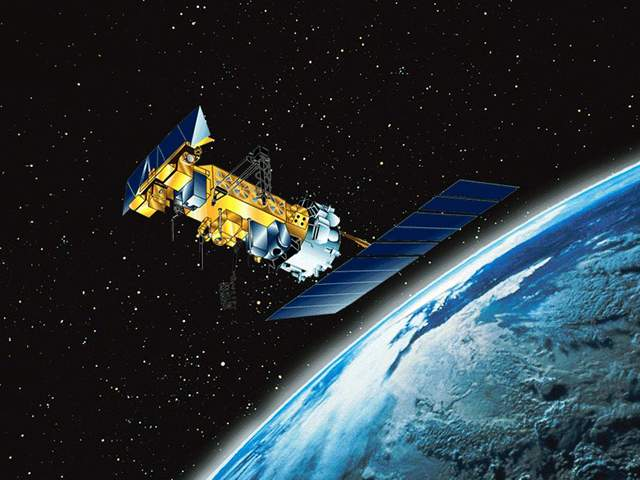
After a change in priorities, updates are now exclusive to HadSST4.  For comparison we can also look at lower troposphere temperatures (TLT) from UAHv6.1 which are now posted for October 2025.  The temperature record is derived from microwave sounding units (MSU) on board satellites like the one pictured above. Recently there was a change in UAH processing of satellite drift corrections, including dropping one platform which can no longer be corrected. The graphs below are taken from the revised and current dataset.

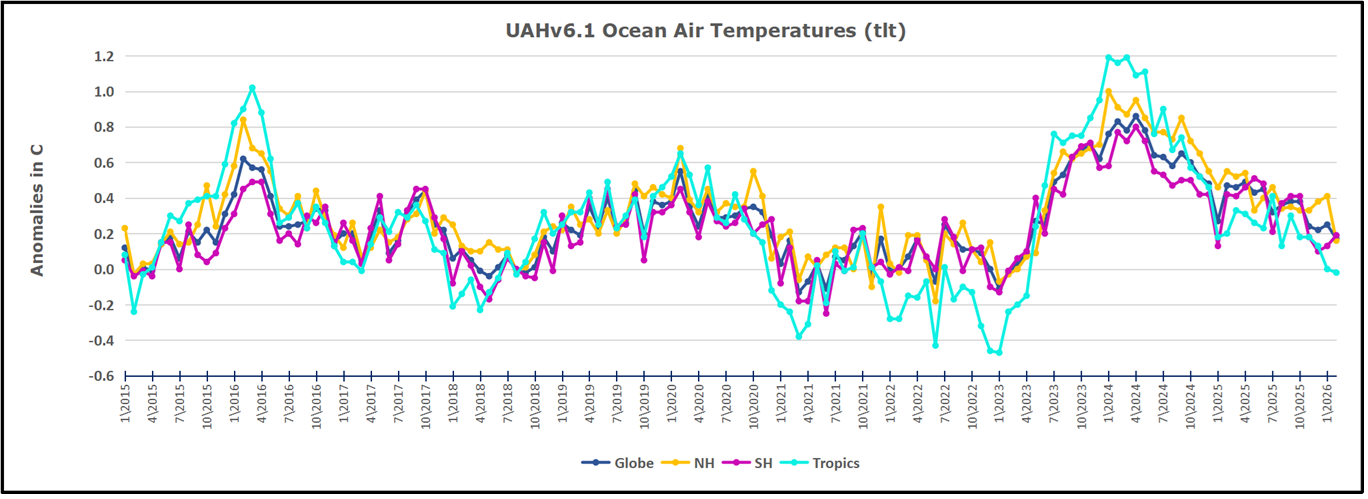
The UAH dataset includes temperature results for air above the oceans, and thus should be most comparable to the SSTs. There is the additional feature that ocean air temps avoid Urban Heat Islands (UHI).  The graph below shows monthly anomalies for ocean air temps since January 2015.

In 2021-22, SH and NH showed spikes up and down while the Tropics cooled dramatically, with some ups and downs, but hitting a new low in January 2023. At that point all regions were more or less in negative territory.

After sharp cooling everywhere in January 2023, there was a remarkable spiking of Tropical ocean temps from -0.5C up to + 1.2C in January 2024.  The rise was matched by other regions in 2024, such that the Global anomaly peaked at 0.86C in April. Since then all regions have cooled down sharply to a low of 0.27C in January.  In February 2025, SH rose from 0.1C to 0.4C pulling the Global ocean air anomaly up to 0.47C, where it stayed in March and April. In May drops in NH and Tropics pulled the air temps over oceans down despite an uptick in SH. At 0.43C, ocean air temps were similar to May 2020, albeit with higher SH anomalies. Now in September/October Global ocean temps are little changed with Tropics dropping again along with NH declining slightly..

Land Air Temperatures Tracking in Seesaw Pattern

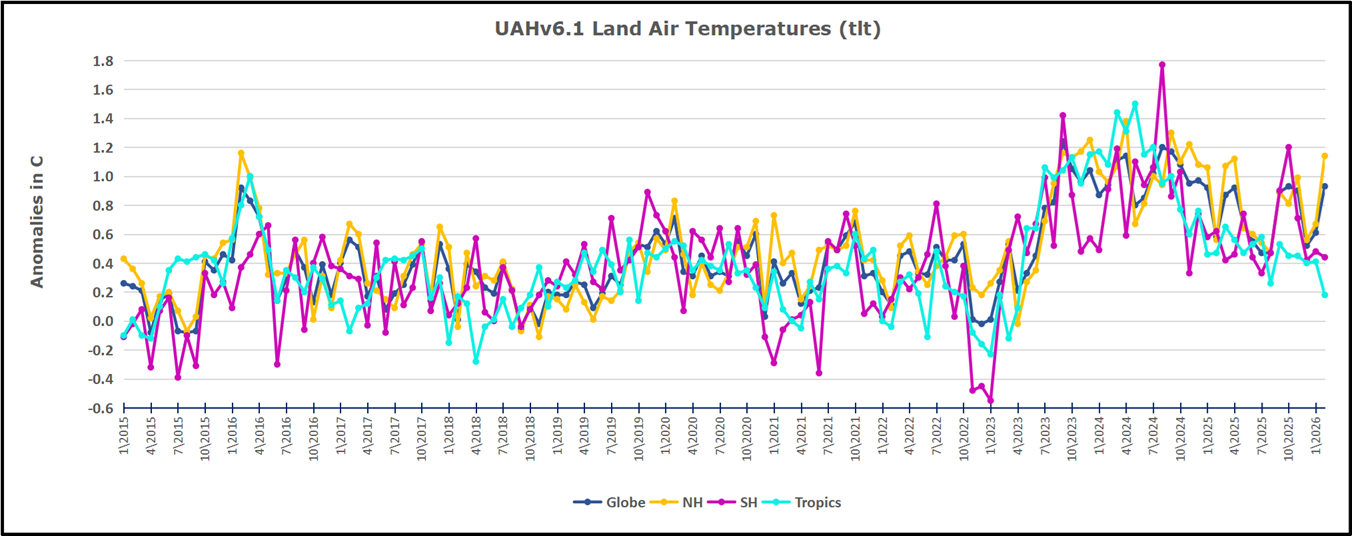
We sometimes overlook that in climate temperature records, while the oceans are measured directly with SSTs, land temps are measured only indirectly.  The land temperature records at surface stations sample air temps at 2 meters above ground.  UAH gives tlt anomalies for air over land separately from ocean air temps.  The graph updated for October is below.

Here we have fresh evidence of the greater volatility of the Land temperatures, along with extraordinary departures by SH land.  The seesaw pattern in Land temps is similar to ocean temps 2021-22, except that SH is the outlier, hitting bottom in January 2023. Then exceptionally SH goes from -0.6C up to 1.4C in September 2023 and 1.8C in  August 2024, with a large drop in between.  In November, SH and the Tropics pulled the Global Land anomaly further down despite a bump in NH land temps. February showed a sharp drop in NH land air temps from 1.07C down to 0.56C, pulling the Global land anomaly downward from 0.9C to 0.6C. Some ups and downs followed with returns close to February values in August.  Now in October we see a remarkable spike in SH land temps, supported by NH and Tropics in September.

The Bigger Picture UAH Global Since 1980

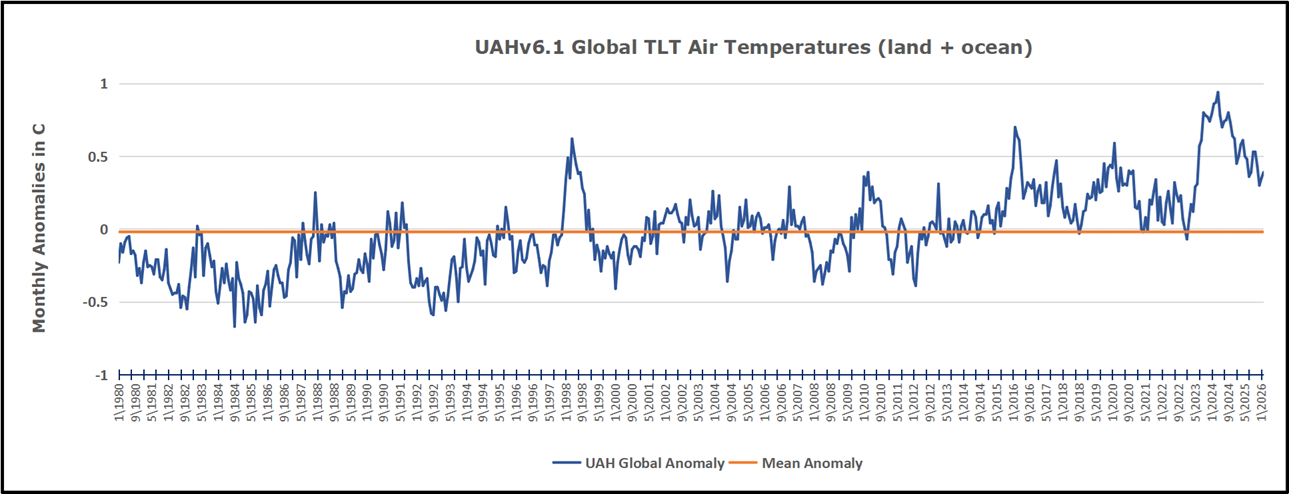
The chart shows monthly Global Land and Ocean anomalies starting 01/1980 to present.  The average monthly anomaly is -0.0, 2for this period of more than four decades.  The graph shows the 1998 El Nino after which the mean resumed, and again after the smaller 2010 event. The 2016 El Nino matched 1998 peak and in addition NH after effects lasted longer, followed by the NH warming 2019-20.   An upward bump in 2021 was reversed with temps having returned close to the mean as of 2/2022.  March and April brought warmer Global temps, later reversed

With the sharp drops in Nov., Dec. and January 2023 temps, there was no increase over 1980. Then in 2023 the buildup to the October/November peak exceeded the sharp April peak of the El Nino 1998 event. It also surpassed the February peak in 2016. In 2024 March and April took the Global anomaly to a new peak of 0.94C.  The cool down started with May dropping to 0.9C, and in June a further decline to 0.8C.  October went down to 0.7C,  November and December dropped to 0.6C.In August Global Land and Ocean went down to 0.39C, then rose slightly to 0.53 in October.

The graph reminds of another chart showing the abrupt ejection of humid air from Hunga Tonga eruption.

TLTs include mixing above the oceans and probably some influence from nearby more volatile land temps.  Clearly NH and Global land temps have been dropping in a seesaw pattern, nearly 1C lower than the 2016 peak.  Since the ocean has 1000 times the heat capacity as the atmosphere, that cooling is a significant driving force.  TLT measures started the recent cooling later than SSTs from HadSST4, but are now showing the same pattern. Despite the three El Ninos, their warming had not persisted prior to 2023, and without them it would probably have cooled since 1995.  Of course, the future has not yet been written.

IPCC Global Warming Claims Not Only Wrong, But Impossible

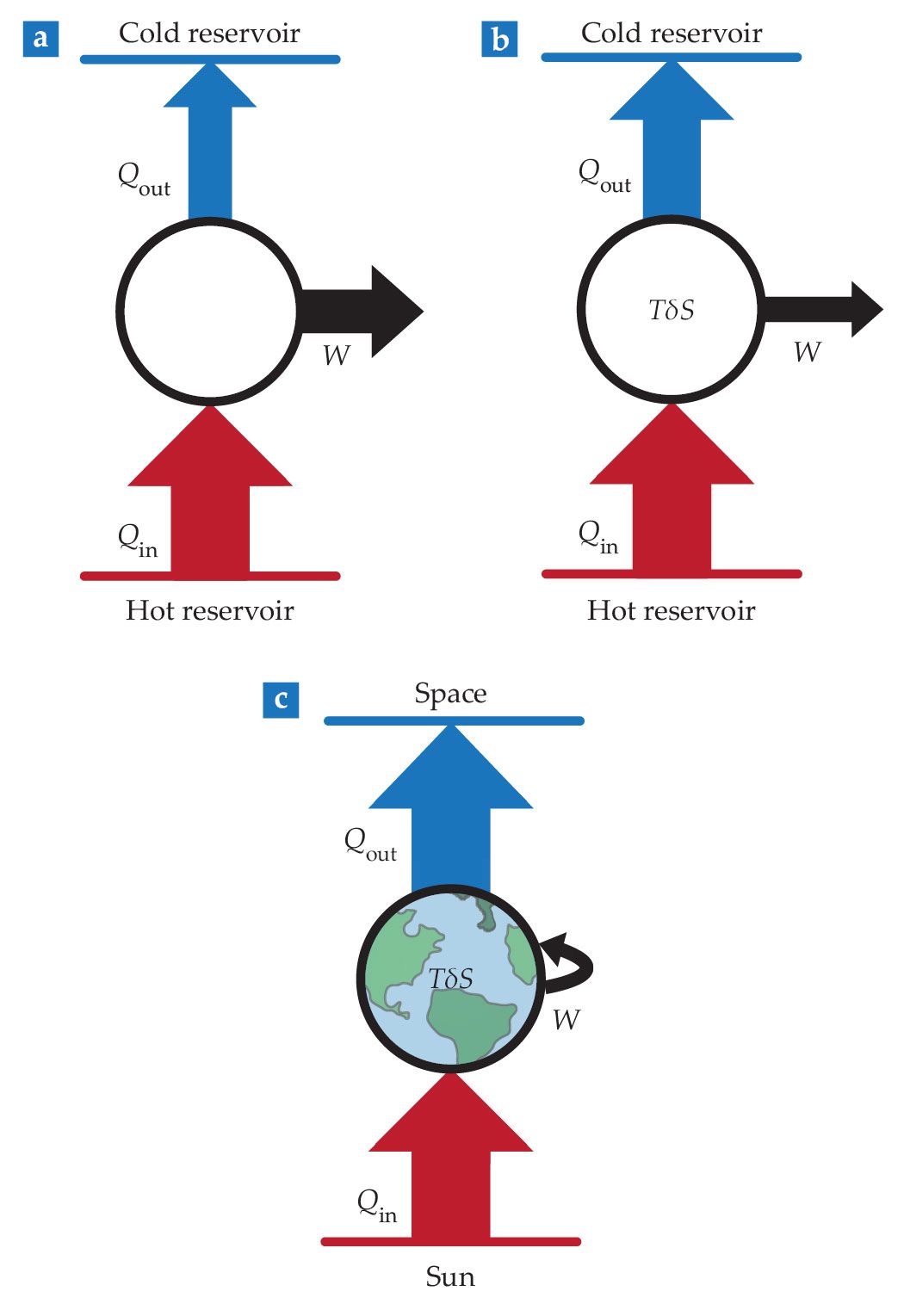
Climate as heat engine. A heat engine produces mechanical energy in the form of work W by absorbing an amount of heat Qin from a hot reservoir (the source) and depositing a smaller amount Qout into a cold reservoir (the sink). (a) An ideal Carnot heat engine does the job with the maximum possible efficiency. (b) Real heat engines are irreversible, and some work is lost via irreversible entropy production TδS. (c) For the climate system, the ultimate source is the Sun, with outer space acting as the sink. The work is performed internally and produces winds and ocean currents. As a result, Qin = Qout.

Ad Huijser recently published a paper explaining why IPCC claims about global warming are contradicted by observations of our Earth thermal system including a number of internal and external subsytems. The title Global Warming and the “impossible” Radiation Imbalance links to the pdf. This post is a synopsis to present the elements of his research findings, based on the rich detail, math and references found in the document. Excerpts in italics with my bolds and added images. H/T Kenneth Richard and No Tricks Zone.

Abstract

Any perturbation in the radiative balance at the top of the atmosphere (TOA) that induces a net energy flux into- or out of Earth’s thermal system will result in a surface temperature response until a new equilibrium is reached. According to the Anthropogenic Global Warming (AGW) hypothesis which attributes global warming solely to rising concentrations of Greenhouse gases (GHGs), the observed increase in Earth’s radiative imbalance is entirely driven by anthropogenic GHG-emissions.

However, a comparison of the observed TOA radiation imbalance with the assumed GHG forcing trend reveals that the latter is insufficient to account for the former. This discrepancy persists even when using the relatively high radiative forcing values for CO2 adopted by the Intergovernmental Panel on Climate Change (IPCC), thereby challenging the validity of attributing recent global warming exclusively to human-caused GHG emissions.
In this paper, Earth’s climate system is analyzed as a subsystem of the broader Earth Thermal System, allowing for the application of a “virtual balance” approach to distinguish between anthropogenic and other, natural contributions to global warming. Satellite-based TOA radiation data from the CERES program (since 2000), in conjunction with Ocean Heat Content (OHC) data from the ARGO float program (since 2004), indicate that natural forcings must also play a significant role. Specifically, the observed warming aligns with the net increase in incoming shortwave solar radiation (SWIN), likely due to changes in cloud cover and surface albedo. Arguments suggesting that the SWIN trend is merely a feedback response to GHG-induced warming are shown to be quantitatively insufficient.

This analysis concludes that approximately two-thirds of the observed global warming must be attributed to natural factors that increase incoming solar radiation, with only one-third attributable to rising GHG-concentrations. Taken together, these findings imply a much lower climate sensitivity than suggested by IPCC-endorsed Global Circulation Models (GCMs).

Introduction

On a global scale and over longer periods of time, the average surface temperature of our climate system reacts similarly to that of a thermal system such as a pot of water on a stove: when the incoming heat is steady and below boiling, the system stabilizes when the heat loss (via radiation and convection) equals the input. Analogously, Earth’s surface-atmosphere interface is the main absorber and emitter of heat. Reducing the “flame” (solar input) leads to cooling, regardless of the total heat already stored in the system. The system’s average temperature will drop as well, as soon as the heating stops. So, no sign of any “warming in the pipeline” for such a simple system.

The two transport mechanisms, air and ocean, operate on different timescales. Air has a low specific heat capacity, but high wind speeds make it a fast medium for heat transfer. Oceans, by contrast, have a high specific heat capacity but move more slowly. The Atlantic Meridional Overturning Circulation (AMOC) with the well-known Gulf Stream carrying warm water from south to north, can reach speeds up to about 3 m/s. But its warm current remains largely confined to surface layers due to limited solar radiation penetration and gravity-induced stratification. With a path-lengths of up to 8,000 km and an average speed of 1.5 m/s, ocean heat takes approximately 2 months to travel from the Gulf of Mexico to the Arctic. This is comparable to the 1 to 2 months delay between solar input and temperature response in the annual cycle, suggesting that oceanic heat transport is part of the climate system’s normal operation. Climate adaptation times from anthropogenic influences are estimated at 3 to 5 years. If “warming in the pipeline” exists, it must be buried in the much colder, deeper ocean layers.

ARGO float data since 2004 show substantial annual increases in Ocean Heat Content (OHC), sometimes expressed in mind-boggling terms such as 10²² joules per year (see Fig.1). While this may sound alarming [1,2], when converted to flux, it represents less than 1 W/m², a mere 0.6% of the average 160 W/m² of absorbed solar energy at the surface. All the rest is via evaporation, convection and ultimately by radiation sent back to space after globally being redistributed by wind and currents.
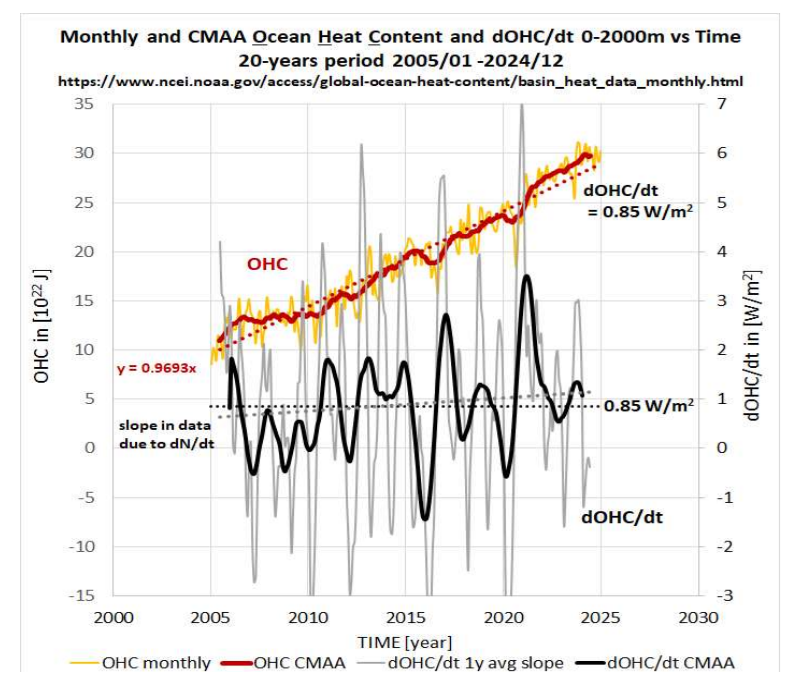
Fig. 1. Ocean Heat Content (OHC) anomaly from 0–2000 meters over time, shown as 3-month and annual moving averages (CMAA), along with their time derivatives. Notable are the relatively large variations, likely reflecting the influence of El Niño events. The average radiative imbalance at the top of the atmosphere (TOA), estimated at 0.85 W/m², corresponds approximately to the midpoint of the time series (around 2015). Data: https://www.ncei.noaa.gov/access/global-ocean-heat-content/basin_heat_data.html [7].

This raises the question: Why would extra GHGs that have only a limited effect on the 99.4% of the outgoing flux, have affected this 0.6% residue during a couple of decennia in such a way that we should be scared about all that “warming in the pipeline” as Hansen et al. [2] are warning us for? In the following sections, we examine data showing that observed trends in the radiation imbalance and OHC are better explained by the internal dynamics of the Earth’s thermal system and natural forcings such as from increasing solar radiation, rather than solely by GHG emissions.

Estimating our climate’s thermal capacity CCL

The rather fast responses of our climate indicates that the thermal capacity of our climate must be much less than the capacity of the entire Earth thermal system. This climate heat capacity CCL depends on how sunlight is being absorbed, how that heat is transferred to the atmosphere and which part of it is being stored in either land or ocean.

At continental land-area, sunlight is absorbed only at the very surface where the generated heat is also in direct contact with the atmosphere. Seasonal temperature variations don’t penetrate more than 1 to 2 meters deep in average and as a consequence, storage of heat is relatively small. Sunlight can penetrate pure water to several hundred meters deep, but in practice, penetration in the oceans is limited by scattering and absorption of organic and inorganic material. A good indication is the depth of the euphotic zone where algae and phytoplankton live, which need light to grow. In clear tropical waters where most of the sunlight hits our planet, this zone is 80 to 100 m deep [12].

Another important factor in our climate’s heat capacity is how this ocean layer of absorbed heat is in contact with the atmosphere. Tides, wind, waves and convection continuously mix the top layer of our oceans, by which heat is easily exchanged with the atmosphere. This mixed-layer is typically in the order of 25 – 100 m, dependent on season, latitude and on the definition of “well mixed” [13]. Below this ~100 m thick top-layer, where hardly any light is being absorbed and the mixing process has stopped, ocean temperatures drop quickly with depth. As the oceans’ vertical temperature gradient at that depth doesn’t support conductive nor convective heat flows going upward, climate processes at the surface will thus become isolated from the rest of the Earth’ thermal system.
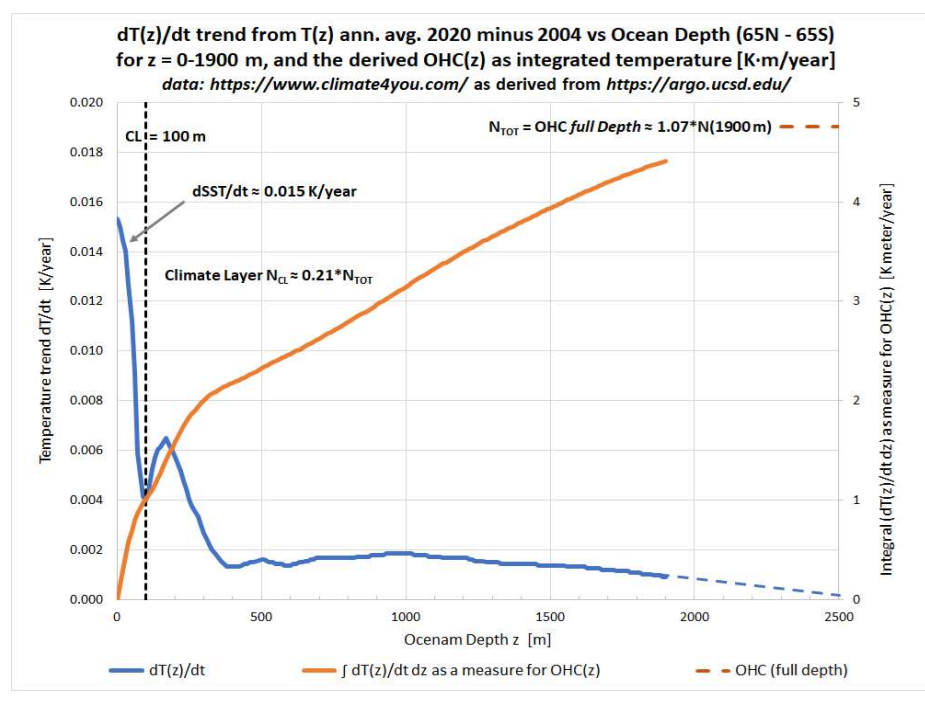
Figure 4 with the Change in Ocean Heat Content vs. Depth over the period 2004 – 2020 obtained via the ARGO-floats [6,14], offers a good indication for the average climate capacity CCL. It shows the top layer with a high surface temperature change according to the observed global warming rate of about 0.015 K/year, and a steep cut off at about 100 m depth in line with the explanation above. Below the top layer, temperature effects are small and difficult to interpret, probably due to averaging over all kinds of temperature/depth profiles in the various oceans ranging from Tropical- to Polar regions.

In case of a “perfect” equilibrium (N = 0, dTS/dt = 0), all of the absorbed sunlight up to about 100 m deep, has to leave on the ocean-atmosphere interface again. However, deep oceans are still very cold with a stable, negative temperature gradient towards the bottom. This gradient will anyhow push some of the absorbed heat downwards. Therefore, even at a climate equilibrium with dTS/dt= 0, we will observe N > 0. With the large heat capacity of the total ocean volume, that situation will not change easily, as it takes about 500 years with today’s N ≈ +1 W/m2 to raise its average temperature just 1°C.

The Earth’s climate system can thus be regarded as a subset of the total Earth’s thermal system (ETS) responding to different relaxation times. The climate relaxes to a new equilibrium within 3–5 years, while the deeper oceans operate on multidecadal or even longer timescales, related to their respective thermal capacities C for the ETS, and CCL for the climate system.

The (near) “steady state” character of current climate change

Despite the ongoing changes in climate, the current state can be considered a “near” steady-state. The GHG forcing trend has been pretty constant for decades. Other forcings, primarily in the SW channel, are also likely to change slowly and can be approximated as having constant trends over decadal timescales. Similarly, despite yearly fluctuations, the surface temperature trend has remained fairly stable since 2000.

This analysis strengthens the conclusion that the increase in both N(t) and N0(t) are not a direct consequence of greenhouse gas emissions, but rather of enhanced forcing in the SW-channel.

The preceding analysis highlights how the IPCC’s assumptions diverge significantly from observed reality. While the IPCC model components may collectively reproduce the observed warming trend, they fail to individually align with key observational data, in particular the Ocean Heat Content.
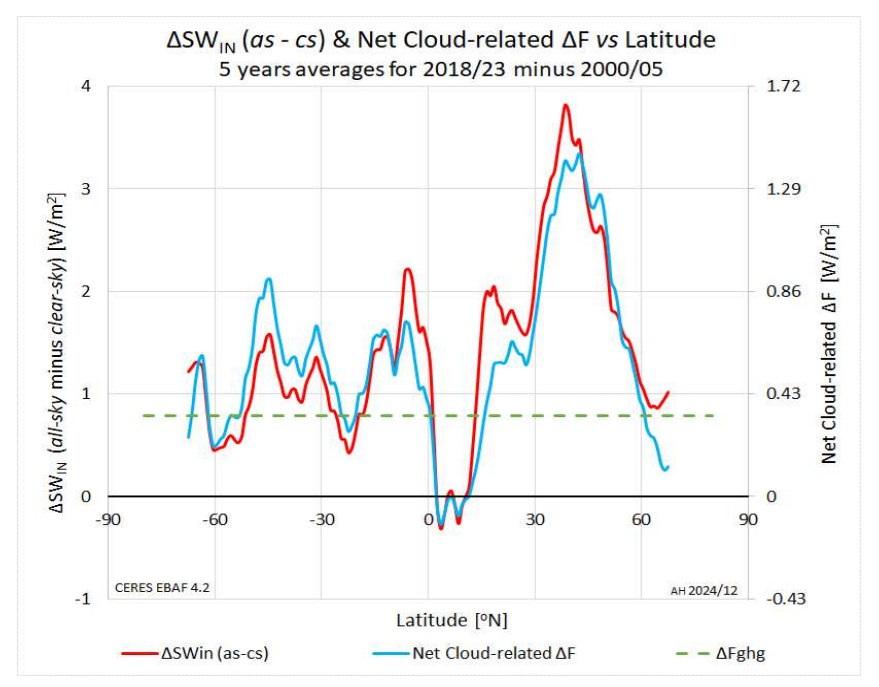
Figure 6 also illustrates that changes in cloudiness are more pronounced on the Northern Hemisphere, especially at mid-latitudes and over Western Europe. For example, the Dutch KNMI weather-station at Cabauw (51.87°N, 4.93oE), where all ground-level radiation components are monitored every 10 minutes, recorded an increase in solar radiation of almost +0.5 W/m²/year since 2000 [26]. Applying the 0.43 net-CRE factor (conservative for this latitude), we estimate a local forcing trend dFSW/dt ≈ 0.2 W/m²/year. This is an order of magnitude larger than the GHG forcing (0.019–0.037 W/m²/year). Even with the IPCC values, GHGs can just account for about 16% of the warming at this station. The average temperature trend for this rural station located in a polder largely covered by grassland, is with ~ +0.043 K/year almost 3x the global average. This, nor the other trends mentioned above can be adequately explained by the IPCC’s GHG-only model.

The IPCC places strong emphasis on the role of climate feedbacks in amplifying the warming effect of greenhouse gases (GHGs) [8]. These feedbacks are considered secondary consequences of Anthropogenic Global Warming, driven by the initial temperature increase from GHGs. Among them, Water-Vapor feedback is the most significant. A warmer atmosphere holds more water vapor (approximately +7%/K) and since water vapor is a potent GHG, even a small warming from CO2 can amplify itself through enhanced evaporation.

Other feedbacks recognized by the IPCC include Lapse Rate, Surface Albedo, and Cloud feedbacks [8], all of which are inherently tied to the presence and behavior of water in its various phases. Therefore, these feedbacks are natural responses to temperature changes, regardless of the original cause of warming, be it GHGs, incoming solar variability, or internal effects. They are not additive components to natural climate sensitivity, as treated by the IPCC, but rather integral parts of it [4].

This analysis reinforces a fundamental point: climate feedbacks are not external modifiers of climate sensitivity; rather, they are inherent to the system. Their combined effect is already embedded in the climate response function. The IPCC’s treatment of feedbacks as additive components used to “explain” high sensitivities in GCMs is conceptually flawed. Physically, Earth’s climate is governed by the mass balance of water in all its phases: ice, snow, liquid, vapor, and clouds. The dynamics between these phases are temperature-sensitive, and they constitute the feedback processes. Feedbacks aren’t just add-ons to the climate system, they are our climate.

Ocean Heat Content increase

In the introduction, the “heat in the pipeline” concept: the idea that heat stored in the deep, cold ocean layers could later resurface to significantly influence surface temperatures, was challenged. Without a substantial decrease in surface temperatures to reverse ocean stratification, this seems highly unlikely. Large and rapid temperature fluctuations during the pre-industrial era with rates up to plus, but also minus 0.05 K/year over several decennia as recorded in the Central England Temperature (CET) series [27], more than three times the rate observed today, further undermine the notion of a slow-release heat mechanism dominating surface temperature trends.
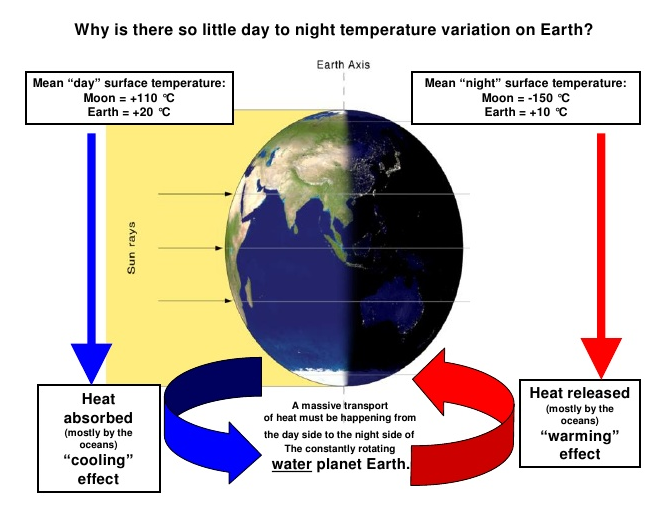
Ocean Heat Content must be related to solar energy. It is the prime source of energy heating the Earth thermal system. Almost 1 W/m2 of that 240 W/m2 solar flux that is in average entering the system, is presently remaining in the oceans. This is an order of magnitude larger than the estimated 0.1 W/m2 of geothermal heat upwelling from the Earth inner core [11]. Extra greenhouse gasses don’t add energy to the system, but just obstruct cooling. As shown in Section 5.3, this accounts for a radiation imbalance offset τ dFGHG/dt, or equivalent to a contribution to dOHC/dt of only about 0.08 W/m2.
.
As redistribution of “heat in the pipeline” will not change the total OHC, roughly 3/4 of the observed positive trend in OHC must at least be attributed to rising solar input. The oceans act in this way as our climate system’s thermal buffer. It will mitigate warming during periods of increased solar input and dampen cooling when solar input declines, underscoring its critical role in Earth’s climate stability.
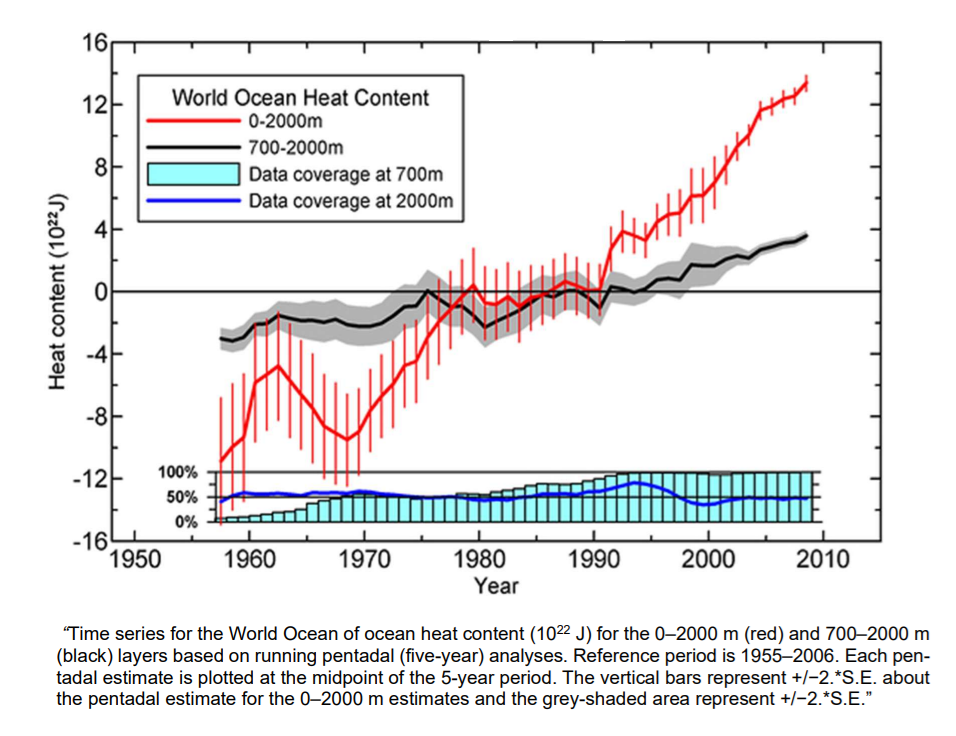
The strong downwards slope in the OHC before 1970 confirms the observation in Section 5.4 and expressed by (12) that around the turning point t = ζ, the forcing trend in the SW-channel had to be negative. Moreover, the rather slowly increasing 700-2000m OHC data in Fig.7 indicate that most of the fluctuations have occurred relatively close to the surface. Heat from e.g. seafloor volcanism as “warming from below”, is expected to show up more pronounced in this 700-2000m OHC-profile. Although we cannot rule out geothermal influences [29], this observation makes them less likely.

ERBE measurements of radiative imbalance.

As the OHC seems to be primarily coupled to SWIN, the most plausible cause would involve rapid changes in SW-forcing. A sudden drop in cloud-cover might explain such changes, but no convincing observations could be found for the 1960-1980 period. Alternatively, changes in the latitudinal distribution of cloud-cover as illustrated by Fig.6, can result in similar radiative impacts due to the stark contrast between a positive radiation imbalance in the Tropics and a very negative imbalance at the Poles. The ENSO-oscillations in the Pacific Ocean around the equator are a typical example for such influences, as also illustrated in Fig.3 [10]. Shifts in cloud distribution are linked to changes in wind patterns and/or ocean currents, reinforcing the idea as indicated in Section 1, that even minor disruptions in horizontal heat transport can trigger major shifts in our climate’s equilibrium [29, 30]. Sharp shifts in Earth’s radiation imbalance like the one around 1970 as inferred from Fig.7, may even represent one of those alleged tipping points. But in this case, certainly not one triggered by GHGs. Ironically, some climate scientists in the early 1970s predicted an impending (Little) Ice Age [31].

While additional data (e.g. radiation measurements) are needed to draw firm conclusions, the available evidence already challenges the prevailing GHG-centric narrative again. GHG emissions, with their near constant forcing rate, cannot account for the timing nor the magnitude of historical OHC trends, as NOAA explicitly suggests [32]. Similarly, claims by KNMI that “accelerations” in radiation imbalance trends are GHG-driven [1], are not supported by data. And finally, the alarms around “heat in the pipeline” must be exaggerated if not totally misplaced. Given the similarities in radiation imbalance and GHG forcing rates around 1970 with today’s situation, we must conclude that this assumed heat manifested itself at that time apparently as “cooling in the pipeline”.

However, warnings for continued warming even if we immediately stop now with emitting GHGs are nevertheless, absolutely justified. Only, it isn’t warming then from that heat in the pipeline due to historical emissions that will boost our temperatures. Warming will continue to go on as long as natural forcings will be acting. These are already today’s dominant drivers behind global temperature trends. And unfortunately, they will not be affected by the illusion of stopping global warming as created by implementing Net-Zero policies.

Summary and conclusions

This analysis demonstrates that a global warming scenario driven solely by greenhouse gases (GHGs) is inconsistent with more than 20 years of observations from space and of Ocean Heat Content. The standard anthropogenic global warming (AGW) hypothesis, which attributes all observed warming to rising GHG concentrations, particularly CO2, cannot explain the observed trends. Instead, natural factors, especially long-term increase in incoming solar radiation, appear to play a significant and likely dominant role in global warming since the mid-1970s.

The observed increase in incoming solar radiation cannot be accounted for by the possible anthropogenic side effects of Albedo- and Cloud-feedback. All evidence points to the conclusion that this “natural” forcing with a trend of about 0.035 W/m2/year is equal to, or even exceeds the greenhouse gas related forcing of about 0.019 W/m2/year. Based on these values, only 1/3rd of the observed temperature trend can be of anthropogenic origin. The remaining 2/3rd must stem from natural changes in our climate system, or more broadly, in our entire Earth’ thermal system.

Moreover, the observed increase in Earth’s radiation imbalance appears to be largely unrelated to GHGs. Instead, it correlates strongly with natural processes driving increased incoming solar radiation. Claims of “acceleration” in the radiation imbalance due to GHG emissions are not supported by the trend in accurately measured GHG concentrations. If any acceleration in global warming is occurring, it is almost certainly driven by the increasing flux of solar energy—an inherently natural phenomenon not induced by greenhouse gases.

In summary, this analysis challenges the notion that GHGs are the primary drivers of recent climate change. It underscores the importance of accounting for natural variability, especially in solar input, when interpreting warming trends and evaluating climate models.

Note: Dr. Ad Huijser, physicist and former CTO of Philips and director of the Philips Laboratories, describes himself as “amateur climatologist”. However his approach to climate physics is quite professional, I think.
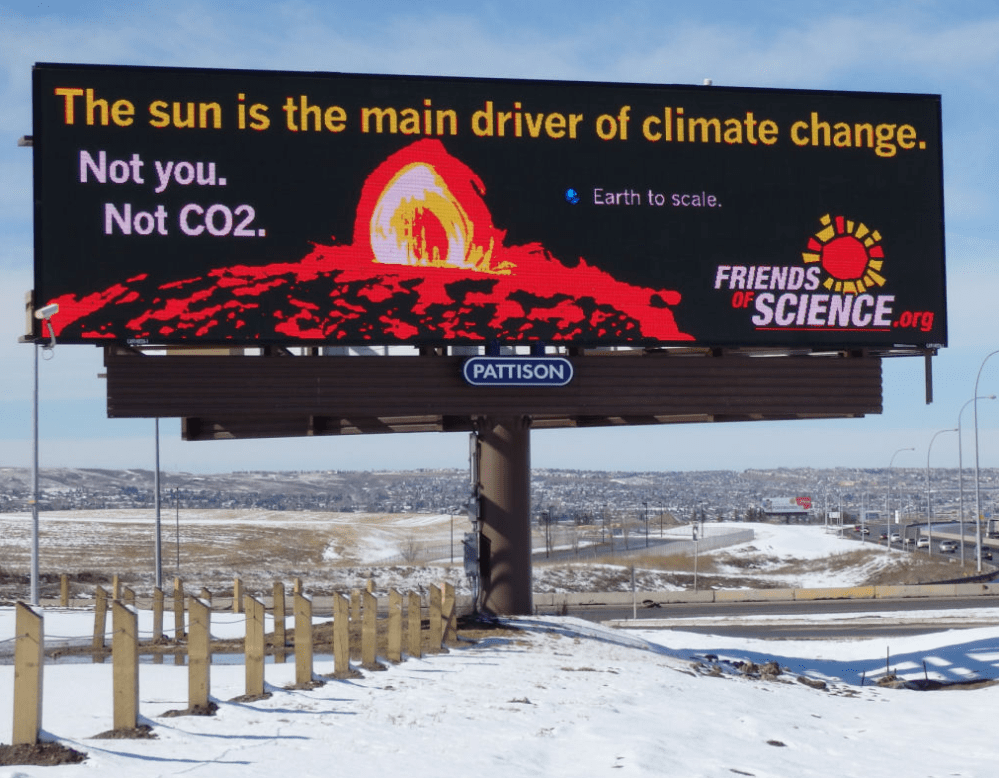
See Also: 

Our Atmospheric Heat Engine



September 2025 Ocean SST Cooling

The best context for understanding decadal temperature changes comes from the world’s sea surface temperatures (SST), for several reasons:
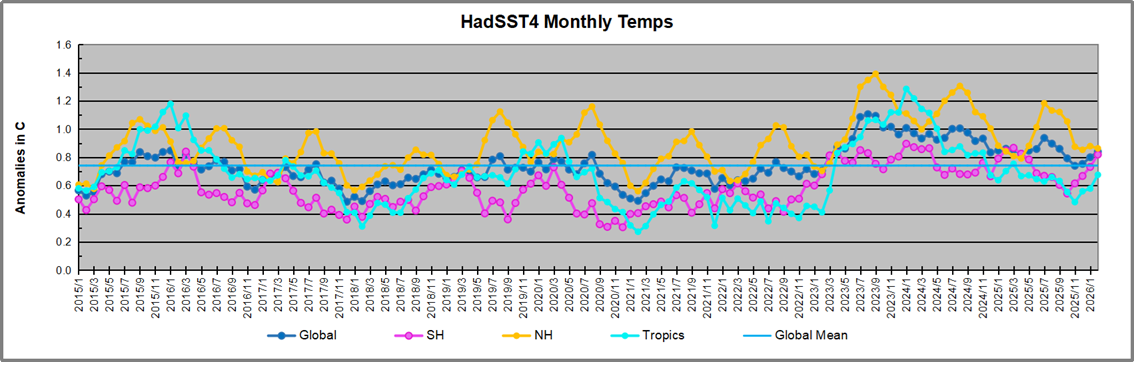
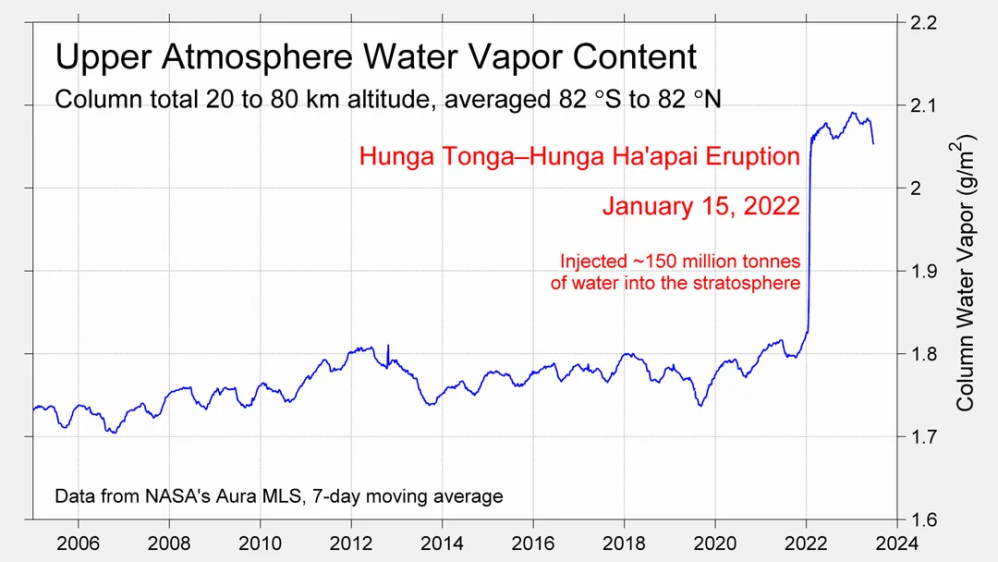
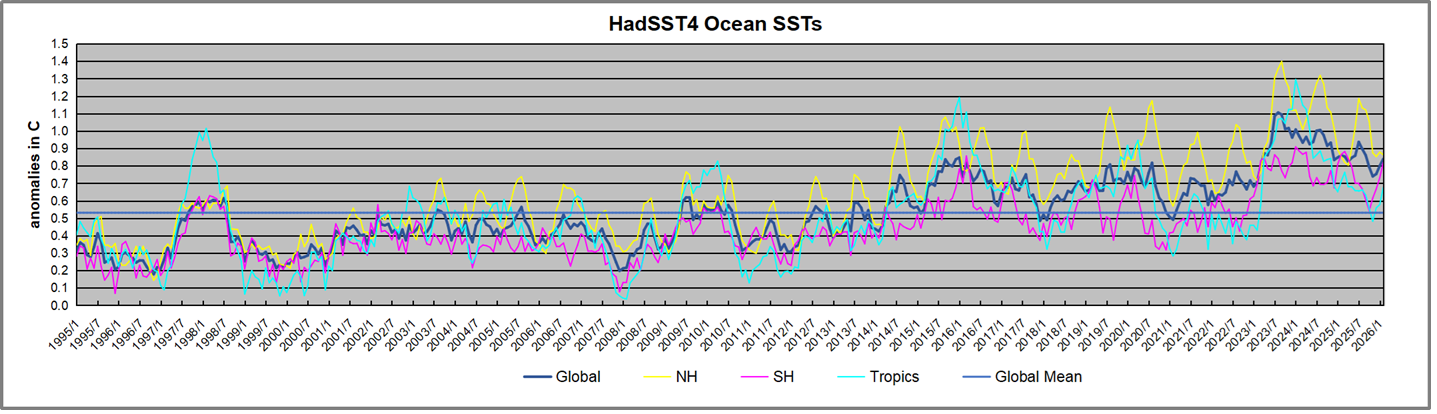
  • The ocean covers 71% of the globe and drives average temperatures;
  • SSTs have a constant water content, (unlike air temperatures), so give a better reading of heat content variations;
  • A major El Nino was the dominant climate feature in recent years.

Previously I used HadSST3 for these reports, but Hadley Centre has made HadSST4 the priority, and v.3 will no longer be updated. I’ve grown weary of waiting each month for HadSST4 updates, so the July and August reports were based on data from OISST2.1.  This dataset uses the same in situ sources as HadSST along with satellite indicators. Now however, the US government is shut down and updates to climate datasets are likely to be delayed.  Reminds of what hospitals do when their budgets are slashed: They close the Maternity Ward to get public attention.

So this September report is based again on HadSST 4, but with a twist. The data is slightly different in the new version, 4.2.0.0 replacing 4.1.1.0. Product page is here.

The Current Context

The chart below shows SST monthly anomalies as reported in HadSST 4.2 starting in 2015 through September 2025. A global cooling pattern is seen clearly in the Tropics since its peak in 2016, joined by NH and SH cycling downward since 2016, followed by rising temperatures in 2023 and 2024 and cooling in 2025.

Note that in 2015-2016 the Tropics and SH peaked in between two summer NH spikes.  That pattern repeated in 2019-2020 with a lesser Tropics peak and SH bump, but with higher NH spikes. By end of 2020, cooler SSTs in all regions took the Global anomaly well below the mean for this period.  A small warming was driven by NH summer peaks in 2021-22, but offset by cooling in SH and the tropics, By January 2023 the global anomaly was again below the mean.

Then in 2023-24 came an event resembling 2015-16 with a Tropical spike and two NH spikes alongside, all higher than 2015-16. There was also a coinciding rise in SH, and the Global anomaly was pulled up to 1.1°C in 2023, ~0.3° higher than the 2015 peak.  Then NH started down autumn 2023, followed by Tropics and SH descending 2024 to the present. During 2 years of cooling in SH and the Tropics, the Global anomaly came back down, led by Tropics cooling from its 1.3°C peak 2024/01, down to 0.6C in September this year. Note the smaller peak in NH in July 2025 now declining along with SH and the Global anomaly cooler as well. Presently the Global anomaly is only slightly above the mean for this period

Comment:

The climatists have seized on this unusual warming as proof their Zero Carbon agenda is needed, without addressing how impossible it would be for CO2 warming the air to raise ocean temperatures.  It is the ocean that warms the air, not the other way around.  Recently Steven Koonin had this to say about the phonomenon confirmed in the graph above:

El Nino is a phenomenon in the climate system that happens once every four or five years.  Heat builds up in the equatorial Pacific to the west of Indonesia and so on.  Then when enough of it builds up it surges across the Pacific and changes the currents and the winds.  As it surges toward South America it was discovered and named in the 19th century  It iswell understood at this point that the phenomenon has nothing to do with CO2.

Now people talk about changes in that phenomena as a result of CO2 but it’s there in the climate system already and when it happens it influences weather all over the world.   We feel it when it gets rainier in Southern California for example.  So for the last 3 years we have been in the opposite of an El Nino, a La Nina, part of the reason people think the West Coast has been in drought.

It has now shifted in the last months to an El Nino condition that warms the globe and is thought to contribute to this Spike we have seen. But there are other contributions as well.  One of the most surprising ones is that back in January of 2022 an enormous underwater volcano went off in Tonga and it put up a lot of water vapor into the upper atmosphere. It increased the upper atmosphere of water vapor by about 10 percent, and that’s a warming effect, and it may be that is contributing to why the spike is so high.

A longer view of SSTs

To enlarge, open image in new tab.

The graph above is noisy, but the density is needed to see the seasonal patterns in the oceanic fluctuations.  Previous posts focused on the rise and fall of the last El Nino starting in 2015.  This post adds a longer view, encompassing the significant 1998 El Nino and since.  The color schemes are retained for Global, Tropics, NH and SH anomalies.  Despite the longer time frame, I have kept the monthly data (rather than yearly averages) because of interesting shifts between January and July. 1995 is a reasonable (ENSO neutral) starting point prior to the first El Nino.

The sharp Tropical rise peaking in 1998 is dominant in the record, starting Jan. ’97 to pull up SSTs uniformly before returning to the same level Jan. ’99. There were strong cool periods before and after the 1998 El Nino event. Then SSTs in all regions returned to the mean in 2001-2.

SSTS fluctuate around the mean until 2007, when another, smaller ENSO event occurs. There is cooling 2007-8,  a lower peak warming in 2009-10, following by cooling in 2011-12.  Again SSTs are average 2013-14.

Now a different pattern appears.  The Tropics cooled sharply to Jan 11, then rise steadily for 4 years to Jan 15, at which point the most recent major El Nino takes off.  But this time in contrast to ’97-’99, the Northern Hemisphere produces peaks every summer pulling up the Global average.  In fact, these NH peaks appear every July starting in 2003, growing stronger to produce 3 massive highs in 2014, 15 and 16.  NH July 2017 was only slightly lower, and a fifth NH peak still lower in Sept. 2018.

The highest summer NH peaks came in 2019 and 2020, only this time the Tropics and SH were offsetting rather adding to the warming. (Note: these are high anomalies on top of the highest absolute temps in the NH.)  Since 2014 SH has played a moderating role, offsetting the NH warming pulses. After September 2020 temps dropped off down until February 2021.  In 2021-22 there were again summer NH spikes, but in 2022 moderated first by cooling Tropics and SH SSTs, then in October to January 2023 by deeper cooling in NH and Tropics.

Then in 2023 the Tropics flipped from below to well above average, while NH produced a summer peak extending into September higher than any previous year.  Despite El Nino driving the Tropics January 2024 anomaly higher than 1998 and 2016 peaks, following months cooled in all regions, and the Tropics continued cooling in April, May and June along with SH dropping.  After July and August NH warming again pulled the global anomaly higher, September through January 2025 resumed cooling in all regions, continuing February through April 2025, with little change in May,June and July despite upward bumps in NH. Now temps in all regions are cooling August and September 2025.

What to make of all this? The patterns suggest that in addition to El Ninos in the Pacific driving the Tropic SSTs, something else is going on in the NH.  The obvious culprit is the North Atlantic, since I have seen this sort of pulsing before.  After reading some papers by David Dilley, I confirmed his observation of Atlantic pulses into the Arctic every 8 to 10 years.

Contemporary AMO Observations

Through January 2023 I depended on the Kaplan AMO Index (not smoothed, not detrended) for N. Atlantic observations. But it is no longer being updated, and NOAA says they don’t know its future.  So I find that ERSSTv5 AMO dataset has current data.  It differs from Kaplan, which reported average absolute temps measured in N. Atlantic.  “ERSST5 AMO  follows Trenberth and Shea (2006) proposal to use the NA region EQ-60°N, 0°-80°W and subtract the global rise of SST 60°S-60°N to obtain a measure of the internal variability, arguing that the effect of external forcing on the North Atlantic should be similar to the effect on the other oceans.”  So the values represent SST anomaly differences between the N. Atlantic and the Global ocean.

The chart above confirms what Kaplan also showed.  As August is the hottest month for the N. Atlantic, its variability, high and low, drives the annual results for this basin.  Note also the peaks in 2010, lows after 2014, and a rise in 2021. Then in 2023 the peak reached 1.4C before declining to 0.9 last month.  An annual chart below is informative:

Note the difference between blue/green years, beige/brown, and purple/red years.  2010, 2021, 2022 all peaked strongly in August or September.  1998 and 2007 were mildly warm.  2016 and 2018 were matching or cooler than the global average.  2023 started out slightly warm, then rose steadily to an  extraordinary peak in July.  August to October were only slightly lower, but by December cooled by ~0.4C.

Then in 2024 the AMO anomaly started higher than any previous year, then leveled off for two months declining slightly into April.  Remarkably, May showed an upward leap putting this on a higher track than 2023, and rising slightly higher in June.  In July, August and September 2024 the anomaly declined, and despite a small rise in October, ended close to where it began.  Note 2025 started much lower than the previous year and headed sharply downward, well below the previous two years, then since April through September aligning with 2010.

The pattern suggests the ocean may be demonstrating a stairstep pattern like that we have also seen in HadCRUT4.

The rose line is the average anomaly 1982-1996 inclusive, value 0.18.  The orange line the average 1982-2025, value 0.41 also for the period 1997-2012. The red line is 2015-2025, value 0.69. As noted above, these rising stages are driven by the combined warming in the Tropics and NH, including both Pacific and Atlantic basins.

Curiosity:  Solar Coincidence?

The news about our current solar cycle 25 is that the solar activity is hitting peak numbers now and higher  than expected 1-2 years in the future.  As livescience put it:  Solar maximum could hit us harder and sooner than we thought. How dangerous will the sun’s chaotic peak be?  Some charts from spaceweatherlive look familar to these sea surface temperature charts.

Summary

The oceans are driving the warming this century.  SSTs took a step up with the 1998 El Nino and have stayed there with help from the North Atlantic, and more recently the Pacific northern “Blob.”  The ocean surfaces are releasing a lot of energy, warming the air, but eventually will have a cooling effect.  The decline after 1937 was rapid by comparison, so one wonders: How long can the oceans keep this up? And is the sun adding forcing to this process?
uss-pearl-harbor-deploys-global-drifter-buoys-in-pacific-ocean

USS Pearl Harbor deploys Global Drifter Buoys in Pacific Ocean

Javier Vinos Finds Missing Climate Puzzle Pieces

Tom Nelson interviews independent researcher Javier Vinos reporting his discoveries of facts and evidence ignored or forgotten in the rush to judgement against humanity for burning hydrocarbon fuels. When these factors are acknowledged they can be integrated into a more wholistic view of Earth’s climate activity.  For those who prefer reading, below is an excerpted transcript with my bolds along with some images and key exhibits included. TN refers to Tom Nelson and JV to Javer Vinos.

JV: For the past ten years I’ve been studying climate quite in depth with a basic focus on natural climate change, on how the climate changes naturally. I did this because I had a science blog and one day I decided I was going to talk about the science of climate and when I started to read the articles and looking for the information I became very surprised because I do molecular biology and Neuroscience that is experimental science. And climate science is not an experimental science and I was very surprised because they were claiming the evidence was there and it was not.

So I began researching it more and more until I became so involved I started writing books and telling other people what I was finding about climate.

The Scientific Method and Climate Science

One of the elementary principles of the scientific method is that establishing a theory before examining all the evidence leads to error and confirmation bias makes us stick to it.  Has the scientific method been forgotten in the postmodern age?  It seems so, at least in climate science.  Climatology is not an experimental science which is a major handicap.  It is also a very young science compared to the mainstream Sciences of physics, chemistry, geology and biology.  The consensus was reached in 1988 almost without data and wholly based on the Greenhouse Effect and The Coincidence of temperature and CO2 during the Pleistocene in Antarctic Ice cores.

Understanding Albedo and Heat Transport

There are two absolutely essential processes in determining climate that are largely unknown.  The first is albedo or the amount of sunlight reflected back into space.  It’s crucial because it determines the amount of energy the Earth receives.  We ignore why it has the value it has, why it varies so little from year to year, why it varies so much from month to month, why both hemispheres have the same albedo and how the albedo has changed in the past.

As a result of our ignorance, models are unable to adequately reproduce the Earth albedo failing to show its small inter-annual variability, its large seasonal variability and its symmetry between the two hemispheres.   Nevertheless many scientists believe that the models are capable of predicting changes in albedo otherwise they will have to admit that the models cannot predict future climates. Small changes in albedo can produce large climate changes of natural origin and this is the basis of several alternative hypotheses to CO2.

ERBE measurements of radiative imbalance.

I have focused my research on a second essential process and this is what my book is about.  The transport of heat from the equator to the poles also known as meridional heat transport because it runs in the direction of the meridians.  There is much evidence that this is the primary cause of natural climate change.  Heat transport is also an enormously neglected process, we do not know how it works and there is no established Theory to explain it.  We also do not know how it is distributed between the atmosphere and the ocean, how it is divided among the different types of ocean currents, how it changes with the seasons, how it changes from year to year, why Antarctica receives less heat than the Arctic although it should receive more or why heat is transported from the colder hemisphere to the warmer hemisphere.

The models do not understand heat transport because no one understands it,
and that is where the evidence for most natural climate change lies.

In fact we can’t even measure it properly and if we don’t know how heat transport works, it’s obvious that the models don’t either.  They fail miserably at reproducing the amount of heat being transported and reflecting transport changes in the atmosphere and ocean, they do not even correctly reproduce the distribution line, the climatic equator where the trade winds from both hemispheres converge.  Nor do they reproduce seasonal changes since the amount of heat entering and leaving the ocean throughout the year is not known.

If no one understands heat transport, then models cannot understand it either. because they are just a product of our minds with no physical connection to reality.  Even if there are other secondary causes of climate change, including increased CO2, the evidence points to changes in heat transport as the primary way in which the climate changes.  In the end it’s like the joke about the drunk who looks under a street lamp for his lost keys because the light is better there than where he thinks he lost them.

Climatologists look for the answer where the knowledge is better in the greenhouse effect. the culprits are certain gases that together make up 1% of the atmosphere.  In this graph we can see the profile of the gases that make up the atmosphere in different colors showing their abundance on the lower axis with respect to altitude on the vertical axis the gases in the squares do not absorb in the infrared.  Note that water vapor with a blue dotted line is very abundant near the surface but a thousand times less abundant in the stratosphere.  The opposite is true for ozone with a purple dust line which is almost entirely in the stratospheric ozone layer.  The thick black line is the temperature profile which in the troposphere has a positive lapse rate, that is the higher we go the colder it gets. This is fundamental to the greenhouse effect.

The Greenhouse Effect and CO2

What is the greenhouse effect?  In order to return all the energy is received from the Sun and maintain stability, the Earth must keep at a temperature of 23 degrees C below zero.

The Greenhouse Effect

Without greenhouse gases this would be the average surface temperature instead of the current 14.5 degrees. The black line in this graph represents the temperature profile of the troposphere and the lapse rate is the slope of that line in the absence of greenhouse gases.  Infrared radiation will be emitted from the surface but greenhouse gases make the atmosphere opaque to infrared radiation, so this radiation is emitted from higher altitudes as shown by The Black Arrow.  Although in reality there is emission from all Heights including the surface the average height of emission is about 6 kilometers. The emission temperature at this height is 23° below zero but the lapse rate of about 6° per kilometer makes the surface about 37° warmer.  If we were to double the CO2 as shown in red, and everything else remains the same, the average emission height would increase by about 150 meters.   As the atmosphere becomes more opaque so the temperature at that height would be 1° cooler it would be necessary for the surface and atmosphere to warm by that degree in order for the earth to return the energy it receives from the sun which is absolutely necessary.

But in the climate system everything is interconnected and when something changes everything changes and nobody knows how much the temperature would change.  So when they tell us that we have to reduce our emissions by a certain amount to avoid some amount of warming they are lying to us because nobody knows that these gases cause the greenhouse effect.  Only the first three are really important. They are trace gases but that does not diminish their importance.  Ozone is a thousand times less abundant than CO2, but its contribution to the greenhouse effect is only five times less.

Greenhouse effect is not uniform across the planet.

Look at water vapor in yellow.  Together with the clouds it forms, it is responsible for 3/4 of the greenhouse effect but it’s abundance varies greatly because it depends on temperature.  When the temperature drops it condenses and falls as water or snow.  Because of this the greenhouse effect is highly variable on the planet.  At the poles there is practically no water vapor or clouds in Winter. These are the places on Earth with the driest atmosphere and a much weaker greenhouse effect.  Not much attention is given to this, but it is very important, and I point out in the book it’s one of the pieces that must be used to solve the puzzle.

Every year has two winters, and heat transport
to the pole in winter is greater

Having such a weak greenhouse effect makes it very easy for heat to escape from the earth through the poles.  The climate works like the internal combustion engine of a car; only instead of one cooling system it has two, one at each pole.  The engine block is the tropics, the hottest part because that is where most of the sun’s energy arrives.  The tropics lose heat by radiation but not enough.  The excess must be transported to the radiators to be radiated to the outside.  And this is done by a fan which is equivalent to the atmosphere and a circuit with a cooling liquid, which is equivalent to the ocean.

Climatologists do not see it this way, but the other way around.  For them heat transport does not change the temperature of the planet but only warms the poles.  But because of this erroneous view they encounter paradoxes that they cannot resolve. in the early Eocene, at the beginning of the age of mammals, the poles were so temperate that palm trees grew in the Arctic and frogs lived in Antarctica, indicating that the average temperature of the coldest mouth was above freezing. Climatologists do not understand how this was possible because the smaller temperature difference made the heat transport much smaller which prevented the poles from warming.

Like all paradoxes it is solved by changing the frame of reference.  It was possible because the smaller heat transport made the planet lose less heat and get warmer, which warmed the poles along with the rest. When it is winter in one hemisphere, the atmosphere transports more heat to that hemisphere.  But the atmosphere also carries angular momentum or rotational inertia since it is a conserved property.  Any change in the angular momentum of the atmosphere must be compensated for by a change in the spin rate of the earth.  Just as ice skaters increases their spin rate rate by bringing their arms closer to the body,  similar to the skater the Earth’s spin rate increases by about 1 millisecond per day as atmospheric circulation and heat transport increase in Winter.  Since 1962 it has been possible to measure this to an accuracy of one microsecond.  Thanks to the invention of the atomic clock and radio astronomy, it is possible to know the exact orientation of the Earth in space, it has been well known since the 1970s.

The Earth spins faster in winter.

The Influence of Solar Activity on Climate

That solar activity affects the Earth’s rotation has been published many times.  The phenomenon is particularly pronounced during the Boreal winter as we can see in the graph above for 2015 a year of high solar activity and 2018 with low activity.  And it is measured by the variation in milliseconds of day length.  In the lower graph we can see the solar activity represented by the sunspot cycle with a red dash line.  The black solid line shows the changes in the Earth’s rotation caused by the Boreal winter.  It shows the same cycle as the sun although the Earth’s rotation is also affected by equatorial stratospheric winds and the El Nino phenomenon.  The dotted line is from a paper published in 2014.

Everyone ignores this phenomenon especially the IPCC which says that the sun does not affect climate.  But if the sun can change the Earth’s rotation speed then it can change the climate.  My research has been like that of Sherlock Holmes looking for clues that have been missed, ignored and forgotten. Studies show the effect of the sun on the rotation of the Earth has been known for 50 years but very few people in the world know about it.

What I have learned about climate science is because I have stood on the shoulder of giants giants like the Canadian atmospheric physicist Colin Hines who explained in a 1974 paper that the sun’s effect on climate could be due to planetary waves.  It was ignored and his theory was forgotten.  Art lovers will recognize the Great Wave print by Hokusai.  Atmospheric waves are like ocean waves except that they move in three directions,  planetary waves are the largest.  Many of you will remember the tsunami that occurred in Indonesia at Christmas 2014.  It reached the coast of Africa 6,000 km away in 8 hours traveling at the speed of an airplane.  Obviously water does not travel, energy travels, and when it is released upon reaching the coast it still causes damage.

Planetary waves are atmospheric tsunamis that hit the wind walls of the polar vortex and weaken them. It worries us when cold air escapes from the interior because it produces very cold waves and storms.  But the climate is more affected by the heat that is exchanged with that cold, because the planet loses it and cannot compensate for it.  Another Giant on Whose shoulders I stood is Karin Labitzke who in 1987 found a correlation between the temperature of the Polar Stratosphere in Winter and the solar cycle. it is an extraordinary finding because in Winter the sun does not shine on the pole, it is a relationship in the dark not based on solar energy.  It is also extraordinary because it is the first proof of a solar effect on the climate after 190 years of a search began in 1800 by William Herschel the discoverer of Uranus and infrared radiation. Instead of giving her the Nobel Prize she deserved for such a fantastic discovery, her finding was ignored and she’s not even mentioned in climate books.

First evidence of the Sun’s effect on climate

Here I show only the data for years of low solar activity 30 Hectopascals is about 20 km in the stratosphere when the tropical Wind Blows from the West as shown by the blue circles.  The polar stratosphere is very cold, but when it blows from the East as shown by the red circles, the polar Stratosphere warms by about 15°.  In years of high solar activity the effect is reversed as I show in the book The El Nino phenomenon also strongly influences this effect.

For many scientists a solar effect that occurs in the dark, reverses depending on equatorial winds and depend on other phenomena is too complicated to understand and they prefer to ignore it.  But not to me because I have studied Hines.  The propagation of planetary waves into the stratosphere depends on several factors that affect the Dynamics of stratospheric circulation.

How does the Sun influence these Dynamics?

We know that solar activity affects the Earth’s rotation, heat transport and Atmospheric circulation. We also know from Labitzke for the last 35 years that it affects the temperature of the Polar Stratosphere.  And it does so as Hines said 50 years ago by affecting the propagation of planetary waves into the stratosphere.  These waves strike the polar vortex.  This is a gigantic tornado that circles the polar regions in winter with sustained wind speeds of 180 km/ hour.

Planetary waves affect climate through the Polar Vortex

Since heat is carried by the wind, the Warm Winds from the South have a hard time getting through this wall of wind creating a strong temperature gradient as shown in the second image. The black line in the graph shows the profile of this gradient which is a real wall that creates a 30° difference between its two sides as shown by the red dash line.  By weakening the vortex planetary waves allow heat to enter and cold to leave, changing the temperature of the polar region.  As we saw at the beginning, the greenhouse effect inside the vortex is very weak causing the planet to lose unrecoverable energy.

This is how the Sun affects the climate as explained by Hines and Labitzke and I am not just alone saying this, It has been shown.  The study of planetary waves in the stratosphere is extremely difficult because they are invisible and the stratosphere is little known but there is already a study based on measurements that proves it. And the intensity of the planetary waves depends on the solar cycle as its authors defend. The sawtooth appearance of the amplitude of the planetary waves is due to the effect of the tropical winds which change direction every one or two years and to the El Nino effect.

Intensity of planetary waves depends on the solar cycle

My contribution to these studies is to put all the pieces together:  the low polar greenhouse effect, and the effect of the sun on the Earth’s rotation heat transport atmospheric circulation, polar temperatures and planetary waves, and to show the effect that all this has not only on climate but also on climate change.

When solar activity is low, the Arctic warms

When there is low solar activity the Arctic warms as is shown in Blue by the temperature of the central Arctic according to data from the Danish meteorological Institute.  Today global warming and Arctic warming are linked in our minds.  We have forgotten that between 1976 and 1997, despite intense global warming, the Arctic not only did not warm but actually experienced a slight Cooling in its central zone.  Just as we have forgotten that the Arctic warmed in a similar way 100 years ago. It was reported at the time and there are scientific studies that support Antarctic warming a century ago similar to today’s in its effect on Greenland’s melting.

When solar activity is high, the rest of the planet warms

Why did this happen.  It is because solar activity has a cycle of about 100 years this graph shows the level of activity of each solar cycle relative to the average and we can appreciate the Centennial solar cycle shortly after 1700 1800 1900 and 2000 solar activity was below average and the Arctic warmed.  When solar activity is high the opposite happens and the Arctic cools but the rest of the planet warms because it becomes more efficient at conserving energy.

Glaciers and proxies show modern warming before CO2 emissions

The IPCC acknowledges that solar activity in the 20th century was in the top 10% of the last 9,000 years.  In the graph we can see the trend line indicating that solar activity has been increasing for the past 300 years and global warming is 200 years old.  we can see it in the behavior of glaciers which began to shrink worldwide in 1820 as shown by the line in the graph. The photos are from the Rome Glacier in Switzerland which melted enormously between 1850 and 1900.  People didn’t care, on the contrary they built hotels for tourists where the glacier used to be.

Climate proxies show the same thing.  The green line is from tree rings and the orange line is from other proxies, both showing a 30-year oscillation on a long-term warming trend.  In stark contrast, our emissions in Gray were nonexistent until 1900 and low until 1950,  the curves clearly do not match.  A much better match is obtained for solar activity shown in annual data with a thin line and a decade long smoothing that shows in red when it was above average and in blue when it was below average.

Global Warming is largely due to the Modern Solar Maximum

The modern solar maximum is the long 70-year period in the 20th century when it was above average, something that has happened only 10% of the time in the last 9,000 years.  We can therefore conclude that a reduction in the transport of heat to the polls during most of the 20th century is responsible for the planet conserving more energy and warming up contributing greatly to global warming.

And as Sherlock Holmes would say the IPCC has made a capital mistake by establishing a consensus Theory without properly examining all the evidence.  A this and much more is explained in my latest book solving the climate puzzle I want to thank three other scientists for reading my book before its publication and providing positive feedback.  They are William Happer professor emeritus of physics at Princeton University who also wrote the forward to the book,  Judith Curry professor emerita of atmospheric physics at Georgia Institute of Technology and Willie Soon research scientist at the Harvard-Smithsonian center for astrophysics.  I also want to thank Andy May, a writer I have collaborated with on many climate science web articles over the years.  The book has been written at several reading levels and divided into a large number of short chapters to make it more accessible to a general audience despite the inherent complexity of the subject.  It has been translated into five languages of which two have been published and three are in the process of being published.  There are plans to publish it in three more languages including Greta Thunberg’s.

My main interest for the past nine years has been to find out why and how the climate changes on our planet.  It is clear from the evidence that we are missing some essential processes because we don’t understand the majority of past climate changes. There are more scientists who agree on this than is usually acknowledge.  Several new theories have been developed including mine and they should be seriously considered by the IPCC because the CO2 Theory lacks sufficient evidence.  I defend my theory as having more support from evidence than the consensus one, but what is important to everybody is that on top of the IPCC’s Capital mistake of reaching a premature consensus, we don’t make the capital mistake of embarking the global economy on a planned experiment of unforeseeable consequences.

TN: You argue that climate change is largely due to natural causes and in particular you attribute a key role to high solar activity in the 20th century.  How does your theory differ from others who also argue for such a role?

JV: Well the mechanism is different. There is a lot of debate about the role of the sun in climate and over the last 30 years there has been a lot of advances in understanding how solar variability affects the stratosphere and how this effect is transmitted to the surface.  What I add is how these effects change the energy content of the climate system and thus produce climate change.  In my book I present evidence that climate is changing due to changes in the amount of heat that is being transported to the poles and the amount of solar energy that changes is not that important.  So in essence I refute the IPCC’s arguments that dismisses a solar effect on climate based on small changes in solar energy and in the trends in solar activity not being the same as temperature Trends

TN: Okay so how does your work fit with other theories like there’s the role of geothermal heat by Viterito and Kamis and the role of cosmic rays by Svensmark and Shaviv.

JV: It is good that there are all these theories because in science we should always discuss several explanations.  The important point is that the climate is always changing and it is a very complex process, so there is not a single cause for for climate change.  Many of these processes may be contributing to climate change including the the increase in CO2 and it is important to determine which ones are the most important in driving climate change.

We should continue researching and debating these processes.  Any viable Theory should provide a mechanism for changing the energy balance at the top of the atmosphere because this is what changes the energy content of the climate system.  And it should be supported by the more evidence the better.  The theory that I propose meets both requirements, while the theory that it is all due to CO2 lacks evidence.

The Role of Water Vapor and Volcanic Eruptions

TN: What do you think of Joe Bastardi’s views about the importance of water vapor in the climate?

JV: I think it is fundamental because water vapor is the main greenhouse gas and what really defines the Earth is that it is a planet that has a lot of water in its three states,  And I believe that the role of water is to provide stability to The Climate system through its thermal inertia.  This is what explains that for the last 540 million years when everything has happened the temperature of planet has remain compatible with Life.  So I think none of the IPCC’s predictions is going to come true because I think the role of the water is misunderstood and it doesn’t behave the way it is expected to.  I don’t think water increases climate change,  I think it actually decreases it

TN: What do you think about the eruption of the hunga Tonga volcano in 2022.  Is that a major reason for the recent temperature Spike?

JV: I think it is very likely.  The volcanic eruption of 2022 was very unusual in that it was underwater so it placed 146,000 tons of water vapor into the stratosphere and the stratosphere is very dry so in a single day the water vapor in the stratosphere increased by 10% and the greenhouse effect is very sensitive to changes in the stratosphere  because it is a lot less opaque to infrared radiation than the troposphere.  So the expected effect from this change as was published in January in natural climate change is a substantial increase in the warming rate so and this is what has been observed. The fact that the onset of this warming has such a delay is normal for volcanic eruptions for example the eruption of the Mount Tambora in April of 1815 produced the year without the summer more than a year later in 1816.   If this explanation is correct we should expect over the next months the warming rate should decrease substantially,  and this increased warming should disappear over the course of four to five years as the extra water vapor leaves the stratosphere.

Concluding Remarks and Future Implications

TN: So if your theory is correct what are the economic implications?

JV: Well if humans are are not primarily responsible for climate change this will have huge implications for the global economy.  We should question the energy transition in the form of urgency that is being made because it is not exempt of risk.  Even if the theory is correct, we should be aware that a lot of people will not be willing to accept it regardless of the evidence.

TN: Other than the economic implications, what are the other consequences if your theory is right?

JV: Well I think people should be very calm.  We are very lucky to be living through a warming period because cooling periods are much worse, usually accompanied by famine and epidemics. Being in a warming period is a lot better. So we should not fear climate and only be concerned when the warming period turns into a cooling period.   That will happen eventually, but we don’t expect it during the 21st century.   So essentially I think we are uh very lucky with respect to climate and as long as the cooling period doesn’t doesn’t start I think the climate is our Ally not our Enemy.