Doctors of the World Unite Against Covid Tyranny
Doctors Uniting Around the World with Integrity and Right Action

More than 30,000 doctors and health care professionals have co-signed an Open letter published at the above website. Excerpts below in italics with my bolds. H/T Stephen Bird.  World Doctors Alliance:

An independent non-profit alliance of doctors, nurses, healthcare professionals and staff around the world who have united in the wake of the Covid-19 response chapter to share experiences with a view to ending all lockdowns and related damaging measures and to re-establish universal health determinance of psychological and physical wellbeing for all humanity. 

Open letter to the UK Government, Governments of the World and the Citizens of the World

We the undersigned call upon the UK government, governments of the World and the Citizens of the World, to stop all lockdown measures immediately.

Introduction

We were told initially that the premise for lockdown was to ‘flatten the curve’ and therefore protect the NHS from being overwhelmed.

It is clear that at no point was the National Health Service (NHS) in any danger of being overwhelmed, and since May 2020 covid wards have been largely empty; and crucially the death toll from covid has remained extremely low.

We now have hundreds of thousands of so-called ‘cases’, ‘infections’ and ‘positive tests’ but hardly any sick people. Recall that four fifths (80%) of ‘infections’ are asymptomatic (1) Covid wards have been by and large empty throughout June, July, August and September 2020. Most importantly covid deaths are at an all-time low. It is clear that these ‘cases’ are in fact not ‘cases’ but rather they are normal healthy people.

So-called asymptomatic cases have never in the history of respiratory disease been the driver for spread of infection. Rather it is symptomatic people who spread respiratory infections – not asymptomatic people.(2)

It is also abundantly clear that the ‘pandemic’ is basically over and has been since June 2020. (3)

We have very highly likely reached herd immunity and therefore have no need for a vaccine.

We have safe and very effective treatments and preventative treatments for covid, we therefore call for an immediate end to all lockdown measures, social distancing, mask wearing, testing of healthy individuals, track and trace, immunity passports, the vaccination program and so on.

There has been a catalogue of unscientific, non-sensical policies enacted which infringe our inalienable rights, such as – freedom of movement, freedom of speech and freedom of assembly. These draconian totalitarian measures must never be repeated.

Lockdown

Covid has proved less deadly than previous influenza seasons – There were 50,100 flu deaths from December 2017 to March 2018 in England and Wales. There were 80,000 flu deaths in 1969. To date we have circa 42,000 covid related deaths in the UK.

We have never locked down society for a respiratory virus before.

The basis for lockdown was a mathematical model by Professor Neil Ferguson. His modelling which predicted half a million deaths in the UK has been roundly condemned as being not fit for purpose. His estimated death figures were clearly wrong by a factor of 10 or 12 times. (1)

Professor Ferguson’s modelling was not even peer reviewed before being acted upon by several nations. Eminent epidemiologists such as Professor Gupta from Oxford University were ignored, they estimated the death count would be far lower in the UK.

Professor Ferguson has a long track record of woeful modelling he was entirely wrong about sars, mers, mad cow’s disease (CJD), and swine flu. Why did the world listen to him again? (2)

Countries which did not lock down Sweden, Japan, Taiwan, South Korea and Belarus have all done significantly better than us in terms of percentage of population deaths. They also have herd immunity and intact economies.

Lockdown did not save lives, and this has been published in the Lancet ‘….in our analysis, full lockdowns and wide-spread COVID-19 testing were not associated with reductions in the number of critical cases or overall mortality.’ (3)

The vast majority of deaths occurred in elderly and very elderly people

The vast majority of deaths occurred in people with pre-existing serious health issues such as cancer, cardiovascular disease, Alzheimer’s, diabetes etc

Covid poses virtually zero risk to the under 45’s who have more chance of being struck by lightning than dying from covid.

Covid poses a very small risk for healthy under 60 year olds who have a greater chance of accidental drowning than dying from covid.

The entire nation was essentially placed under house arrest. We have never isolated the healthy before.

Isolating the sick and those who are immunocompromised makes sense. Isolating the healthy has hampered the establishment of herd immunity and makes no sense.

To put it into perspective we had 115,000 smoking related deaths in the UK in 2015 compared to the 42,000 deaths from covid.

We usually have around 600,000 deaths every year in the UK, roughly 1600 deaths per day.

Collateral Damage: The Cure is Worse than the Virus

Placing the public under virtual house arrest has caused untold damage to both physical and mental health.(1)

Ventilating patients instead of oxygenating patients proved to be a deadly policy and an unwarranted failure. Ventilation resulted in many unnecessary deaths. (2)

Sending infected people from hospitals to care homes placed the elderly and frail under unnecessary risk and resulted in many unnecessary deaths. (3)

Blanket Do Not Resuscitate (DNR) orders were imposed on thousands of people without their consent nor the consent of their families – this is both unlawful and immoral and lead to unnecessary deaths in care homes. (4)

Hospitals became essentially ‘covid only’ centres vast numbers of patients were wilfully neglected, resulting in many thousands of unnecessary deaths. (5)

The government’s own report estimates that some two hundred thousand (200,000) people will die as a direct result of lockdown – not the virus. Hospitals being closed, suicide and poverty will result in more deaths than the virus. (6)

The cure is worse than the disease!

[Other Topics covered in the declaration include:

  • Death Certificates
  • Economic Ruin
  • Censorship
  • Testing–False Positives
  • Hydroxychloroquine
  • Prevention
  • Vaccine
  • Conflicts of Interest
  • Cui Bono?  Who Benefits?
Conclusion

We have effective and safe treatments and preventative medications for covid, therefore there is no need for any lockdown restrictions and associated measures. The pandemic is essentially over as can be seen by the consistent low death rate and hospital admissions over the past four months.

We demand the immediate and permanent ceasing of all lockdown measures.

Lockdowns do not save lives, that is why they have never been used before. Civil liberties and fundamental freedoms have been unnecessarily removed from the public and this must never happen again.

Preventative measures such as Hydroxychloroquine, vitamin C, Vitamin D and zinc must be made readily available to the public.

Isolation must be voluntary. People are perfectly capable of making their own assessment of the risks and must be free to go about their lives as they so choose. People must have the right to choose whether to isolate or not.

Likewise, businesses must have the right to remain open if they so choose.

We demand that doctors, nurses, scientists and healthcare professionals must be permitted free speech and never be censored again.

Professor Mark Woolhouse epidemiologist and specialist in infectious diseases, Edinburgh University Member of the Scientific Pandemic Influenza Group on Behaviours, that advises the Government stated that –

‘…Lockdown was a monumental disaster on a global scale. The cure was worse than the disease.’

‘I never want to see national lockdown again. It was always a temporary measure that simply delayed the stage of the epidemic we see now. It was never going to change anything fundamentally, however low we drove down the number of cases,’

‘We absolutely should never return to a position where children cannot play or go to school.’

I believe the harm lockdown is doing to our education, health care access, and broader aspects of our economy and society will turn out to be at least as great as the harm done by Covid-19.’(1)

The World Doctors Alliance agree fully with Prof Woolhouse’s assertions, he is right! We must never lockdown again!


Florida Covid Winding Down

H/T Tom Woods

Virus hysterics smashed in 3 charts (thanks, Scott Atlas)

Many were wishing the worst upon Florida for opening up to normal life on September 26, but the charts below show how wise were Governor DeSantis and Floridians and how foolish are the lockdown fanatics.

First, here are COVID-19 hospitalization rates by age and month. The first section is for ages 0-44, the second for 45-64, and the third for 65+. The percentages for each group come down pretty consistently, as you can see:

Second, here are hospitalizations over time. Notice that the blue section, which represents COVID hospitalizations, is smaller or stable as you move into the future:

And finally, here’s Florida deaths with Covid by date of death:

Yes, there was a wave in July and August and a few weeks where daily deaths exceeded 200.  But the loss of life has declined steadily to the present.  For context, note that in 2019, there were 567 recorded deaths daily in Florida from all causes.


Covid Cause/Effect Fallacy

Jeffrey A. Tucker writes at AIER American Institute for Economic Research Do the Disease Eradicators Make an Elementary Logical Mistake? Excerpts in italics with my bolds.

I’ve rarely seen it put so bluntly as I have in a recent BBC interview with epidemiologist Paul Elliott. However, I have begun to suspect that this error has crept into the thinking of the lockdowners over the course of the summer.

It seems that certain disease experts genuinely believe that they can game the reproduction rate of the virus to get it below 1, and thereby create a mathematical result that will make the virus go away.

This seems to be their goal and the metric by which they measure whether and to what extent they have achieved it. The problem is that the reproduction rate (very difficult to discern precisely) is an effect – a measurement of an evolved condition – not a cause.

At first it seems crazy that such an elementary logical fallacy could be at the heart of the lockdown ideology. This faulty presumption puts public health officials in the position of being central planners for the whole population, governing how close we get to each other, who we meet and when, where we go, taking control of the whole of our interactions and the whole of our bodies as well, as if they are our owners.

They speak as if they have every confidence that this can happen, and then, like magic, the virus, lacking hosts, goes into deep retirement and leaves everyone alone.  If this sounds like common sense, it is not. So far as I know, this is the first time in the history of the world that anything like this has been attempted.

Is there any virus epidemic in the history of the world in which public health officials successfully manipulated the human population in a way that drives down the infection rate and thereby deletes the pathogen from its presence among us? If it did not entirely go away – and it will not and cannot – wouldn’t the central planners have to lock down every generation in the future too?

The way the infection rate has traditionally been reduced in history is the only way it can be reduced, namely through the achievement of herd immunity, whether through acquired natural immunity or a vaccine (one can learn about this in Cell Biology for Dummies). The virus does not disappear. It becomes endemic; that is, predictable and manageable in every generation.

I asked an old-school epidemiologist about whether there is a simple logical error connected with whether coercive reduction of the R naught is even possible. He confirmed what I had come to suspect: it’s all based on a fallacy that mixes up cause and effect.

Yes, when herd immunity is reached, the R value can eventually be measured to observe that each person infects fewer than 1 other person and it falls and falls until the bug becomes endemic. But you can’t game it in the other direction, forcing an effect to bring about the cause.

Similarly, you can’t scatter leaves on the ground to cause the fall to arrive, or put up sun lamps on snow to speed up the summer.  Can the whole error here really be that simple? Perhaps so. [Note:  Nor can you remove CO2 to lower air temperatures, or raise CO2 to heat the oceans.]

A seemingly simple mistake can have astonishingly radical implications. If you really believe that experts can bludgeon the R naught to determine the fate of a pathogen, all bets are off. There can be no more freedom or rights for anyone.

We see this in economics all the time. During recessions, aggregate demand falls; if we boost aggregate demand, the recession ends: this is the core claim of Keynesian countercyclical policy. We saw this happen in 2008. The fall in real estate prices was regarded as a cause rather than an effect; therefore the goal of policy became to raise them and make the downturn go away.

It’s the same with price controls. People believe that if we can only suppress price levels we make the results of monetary expansion vanish.

Trying to bludgeon effects into existence in order to blot out causes is a conventional mistake within the social sciences, and, apparently among certain naive disease suppressors too.

Is it possible that the same mistake has gone viral in the epidemiological profession?

Footnote: 

In an email sent to Newsweek, one of the petitions co-authors, Dr. Martin Kulldorff wrote, “We are very pleased with the reception that the Great Barrington Declaration has received, with over 75,000 co-signers in less than two days, including over 3,000 Medical and Public Health Scientists and over 4,000 Medical Practitioners.”

“We are not advocating a ‘herd immunity strategy.’ Herd immunity is not a strategy, but a scientifically proven phenomena, just like gravity.

And you would not say that an airplane pilot is using a ‘gravity strategy’ to land a plane. No matter what strategy is used, we will reach herd immunity sooner or later, just as an airplane will reach the ground one way or another,” Kulldorff’s email said. “The key is to minimize the number of deaths until we reach herd immunity and that is what the Great Barrington Declaration is about.”

Footnote from John Tamny:

Along these lines, Holman Jenkins at the Wall Street Journal has reported that the CDC’s website has long indicated that everyone would eventually be infected. AIER’s researchers are merely acknowledging this known. Let people live freely so that the inevitable can be moved up on the way to immunity. If so, broad immunity will reduce the risk for the old who are seen as most at risk.

Crucial about this is that no one is forced to join the “herd.” Those fearful of coming into contact with the infected should be free to isolate themselves accordingly. This includes Paul Krugman.

Freedom is always the answer, including freedom to not join the herd. That’s the view of the great people at AIER. Unknown is why this bothers so many on the left, not to mention why what’s timeless bothers them. It seems they enjoy forcing their values on others, and more than that, they positively revel in being told what to do.

See also: Herd Immunity: Not If But When

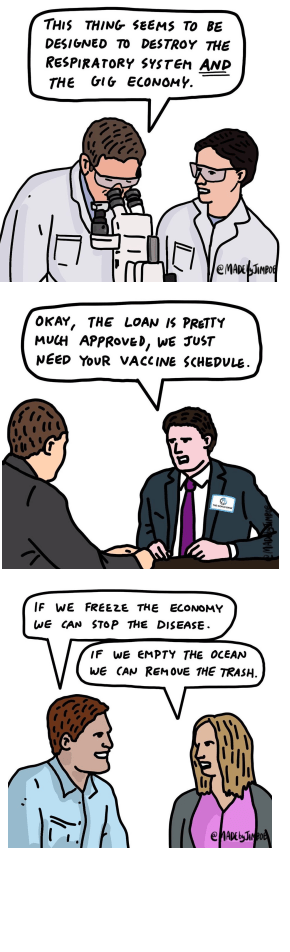
Jimbob Does Coronavirus

Covid-19, the Perfect Hobgoblin

Donald J. Boudreaux writes at AIER, American Institute of Economic Research Why So Gullible About Government in the Face of Covid-19? Excerpts in italics with my bolds and images.

Unwarranted Faith

Among the most frustrating features of the pro-lockdown argument is the blind faith that those who make it place in the politicians who issue the orders and oversee the enforcement. This frustration is hyper-charged when such faith is displayed by classical liberals and libertarians, who normally understand that politicians and their hirelings have neither the knowledge nor the incentives to be trusted with much power. Yet in the face of Covid, executive-branch government officials are assumed somehow to become sufficiently informed and trustworthy to exercise the unbounded discretionary power – that is, the arbitrary power – required to prohibit vast swathes of normal human interaction ranging from the commercial through the educational to the personal (such as prohibiting family gatherings above a certain size).

Why this faith? The proffered answer, of course, is that Covid-19 is unusually dangerous and, therefore, we have no choice but to put faith in government officials. This answer is bizarre, for it insists that we must now trust with unprecedented power people who regularly act in ways that prove them to be unworthy to hold lesser amounts of power. My head explodes….

Moving on, and without pausing to explore just what is meant here by “unusually,” let’s grant that Covid-19 is indeed unusually dangerous. But also unusually dangerous is arbitrary government power. Is it unreasonable for those of us who fear this power to require that proponents of lockdowns meet a higher standard of persuasion before we accede to the exercise of such power? Given that the initial spark for the lockdowns, at least in the United Kingdom and the United States, was Neil Ferguson’s suspect and widely criticized Imperial Model – a model, recall, offered by a man with an awful record of dramatically exaggerating the likely mortality rates of diseases – is it unreasonable to demand that much stronger evidence be offered before we turn silent as governments continue massively to interrupt normal life?

If you’re tempted to answer these questions in the affirmative, recognize that there’s at least one important difference between pathogens and power – a difference that should be, but isn’t, taken into consideration by pro-lockdowners. The difference is this: Population immunity, either through a pathogen’s natural spread or through a vaccine, will at some point significantly reduce that pathogen’s danger;

In contrast, for protection against government power there is no population immunity or vaccine.

When such power expands, the ratchet effect documented by Robert Higgs ensures that that power remains more elevated and widespread than before.  Unlike pathogens, government power continues to nourish itself as it grows into an ever-greater danger. Quaking at the very thought of Covid while discounting the danger that lurks in the immense expansions of government power done in the name of fighting Covid is wholly unreasonable.

Where’s the Perspective?

Several of Café Hayek’s commenters and my email correspondents push back against anti-lockdown arguments by observing that ordinary people support lockdowns because they don’t wish to die, to become severely ill, or to have their loved ones stricken with Covid. This observation is accurate – as is an accompanying observation that Covid is spread from person to person. But as an argument for lockdowns it’s without merit, for it begs several questions.

How many lives are actually saved, on net, by the lockdowns? Obviously, the Covid-induced expansions of government power are not justified if the net number of lives saved is small. And remember, against the lives saved by lockdowns must be counted the lives lost because of the lockdowns – lives lost to suicide, to the reduced health and safety that comes from lower income, and from the failure to diagnose and treat non-Covid illnesses.

Yet those who insist that the desire not to be killed by Covid justifies the lockdowns largely ignore these questions and trade-offs.

It would be as if a sincerely expressed desire not to be killed as a pedestrian by an automobile were taken as justification to prohibit automobiles. Such a prohibition would result in approximately 6,000 fewer pedestrians in America being killed annually by automobiles – itself alone an undeniably happy result. Yet would such a prohibition be justified by this objective fact? Would your answer change if someone with a superficial familiarity with economics declares that the danger posed to pedestrians by automobile traffic is a “negative externality”?

And whose lives are being saved by the lockdowns and for how long? I’m baffled by the ongoing failure in the public discussion to recognize that Covid kills mostly very old or sick people, and is practically of no danger to people under the age of 50. This reality alone should utterly discredit the case for locking down entire economies and life events. (Note, by the way, that I write this essay as a 62-year-old.) Not only does Covid pose no real – and much less no unusual – danger to most people, the group of persons to whom Covid does pose an unusual danger is easily identified.

As the Great Barrington Declaration sensibly argues, preventive efforts should be focused on helping this (relatively small) group of vulnerable persons.

Keeping them isolated or otherwise protected from the coronavirus simply does not require the vast majority of the population to be locked down, “socially distanced” from each other, or saddled with other restrictions. In fact, as the Declaration’s authors note, by delaying population immunity, lockdowns likely increase the long-term threat to old and sick people.

Public Panic

It’s no good response to note that the general public is panicked by Covid. This panic is indeed real. It explains why the public isn’t more resistant to the lockdowns. But this panic does not justify the lockdowns.

Consider: The risk in America of being killed by terrorism is, as Bryan Caplan describes it, “microscopic.” Between 1970 and 2012 the chance that an American would, in any one year, be done in by terrorism was 1 in 4 million – much less than half the chance of being killed by a home appliance. Yet the 9/11-sparked panic over terrorism has resulted in a permanent increase in efforts to protect Americans from this virtual non-threat.

How much prosperity – including increased health and safety – are we failing to produce because we now waste billions of dollars worth of resources on protection from this minuscule risk? Too much.

And don’t forget that government’s response to 9/11 also includes America’s seemingly permanent war stance in the Middle East and a scaling up of government’s violation of our privacy. How much of our freedom has been permanently lost because of excessive fear of terrorism? Much too much.

Rather than accept as given the public’s irrational fear of terrorism, the far better course is to stop stoking this fear and, instead, to calm it by broadcasting accurate information about terrorism’s relative risks. (Aren’t we constantly told that one of the core functions of government is to produce and spread accurate information as a “public good?”) The spread of better information would prompt the public to demand better policies.

The same must be said about Covid. Tamping down the Covid hysteria by making available accurate information about this disease is what well-informed and public-spirited governments would do. Yet such governments are largely mythical. Real-world governments behave quite differently. Most governments, in the U.S. and elsewhere, chose – and continue to choose – a course precisely the opposite of what ‘good’ governments would choose. The reason, alas, isn’t mysterious:

As H.L. Mencken observed, “The whole aim of practical politics is to keep the populace alarmed (and hence clamorous to be led to safety) by menacing it with an endless series of hobgoblins, all of them imaginary.”

Covid-19 is the perfect hobgoblin. And while its dangers are not imaginary, their degree and impact certainly are. Governments’ failure to ensure that their citizens are accurately informed about Covid is itself sufficient reason to distrust governments with the powers they’ve seized over the course of this hellish year.

HCQ is effective for COVID-19 when used early (118 studies)

Article is HCQ is effective for COVID-19 when used early: analysis of 118 studies.  Excerpts in italics with my bolds.

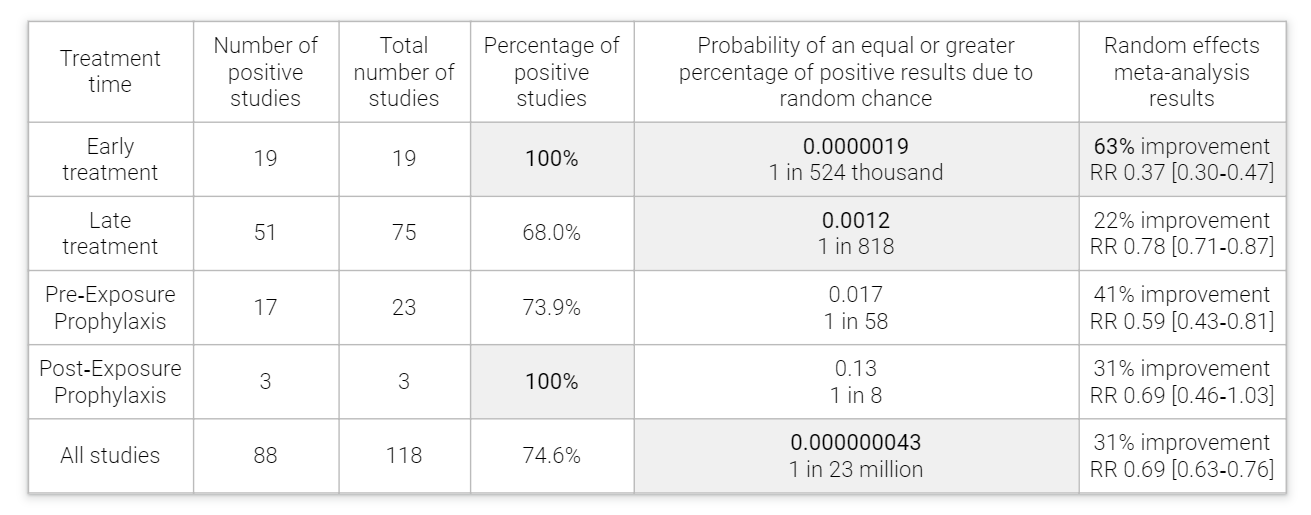
HCQ is an effective treatment for COVID-19. The probability that an ineffective treatment generated results as positive as the 118 studies to date is estimated to be 1 in 23 million (p = 0.000000043).

Early treatment is most successful, with 100% of studies reporting a positive effect and an estimated reduction of 63% in the effect measured (death, hospitalization, etc.) using a random effects meta-analysis, RR 0.37 [0.30-0.47].
100% of Randomized Controlled Trials (RCTs) for early, PrEP, or PEP treatment report positive effects, the probability of this happening for an ineffective treatment is 0.002.
•There is evidence of bias towards publishing negative results. Significantly more retrospective studies report negative results compared to prospective studies, p = 0.04.
•Significantly more studies in North America report negative results compared to the rest of the world, p = 0.002.

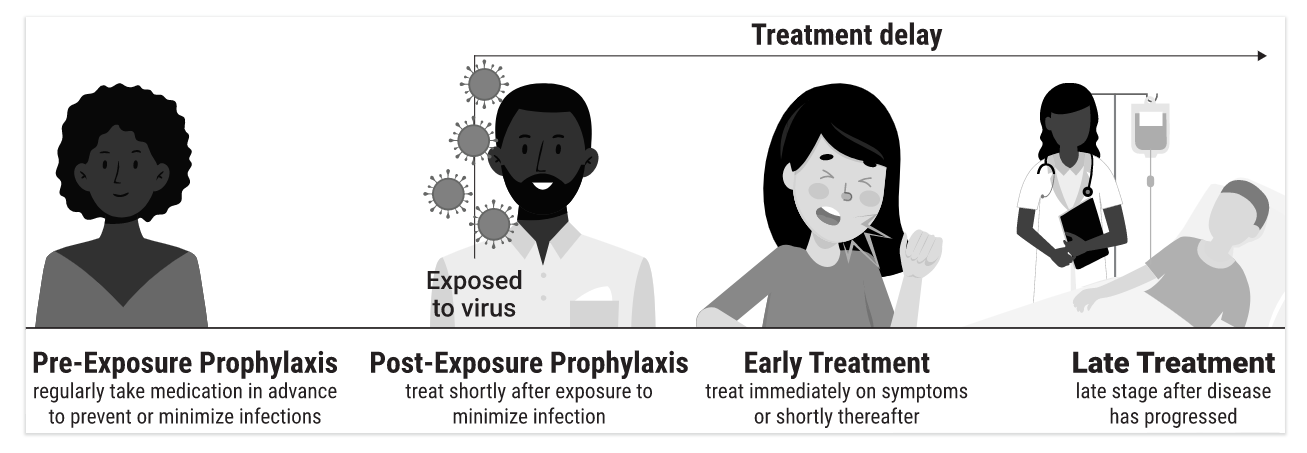
Figure 2: Treatment stages.

Figure 2 shows stages of possible treatment for COVID-19. Pre-Exposure Prophylaxis (PrEP) refers to regularly taking medication before being infected, in order to prevent or minimize infection. In Post-Exposure Prophylaxis (PEP), medication is taken after exposure but before symptoms appear. Early Treatment refers to treatment immediately or soon after symptoms appear, while Late Treatment refers to more delayed treatment.

Table 1. Results by treatment stage. 2 studies report results for a subset with early treatment, these are not included in the overall results.

Publication bias. Publishing is often biased towards positive results, which we would need to adjust for when analyzing the percentage of positive results. Studies that require less effort are considered to be more susceptible to publication bias. Prospective trials that involve significant effort are likely to be published regardless of the result, while retrospective studies are more likely to exhibit bias. For example, researchers may perform preliminary analysis with minimal effort and the results may influence their decision to continue. Retrospective studies also provide more opportunities for the specifics of data extraction and adjustments to influence results.

For HCQ, 87.5% of prospective studies report positive effects, compared to 69.8% of retrospective studies, two-tailed z test 2.07, p = 0.04, indicating a bias toward publishing negative results.

The lack of bias towards positive results is not very surprising. Both negative and positive results are very important given the current use of HCQ for COVID-19 around the world, evidence of which can be found in the studies analyzed here, government protocols, and news reports, for example [AFP, AfricaFeeds, Africanews, Afrik.com, Al Arabia, Al-bab, Anadolu Agency, Anadolu Agency (B), Archyde, Barron’s, Barron’s (B), BBC, Belayneh, A., CBS News, Challenge, Dr. Goldin, Efecto Cocuyo, Expats.cz, Face 2 Face Africa, France 24, France 24 (B), Franceinfo, Global Times, Government of China, Government of India, GulfInsider, Le Nouvel Afrik, LifeSiteNews, Medical World Nigeria, Medical Xpress, Medical Xpress (B), Middle East Eye, Ministerstva Zdravotnictví, Morocco World News, Mosaique Guinee, Nigeria News World, NPR News, Oneindia, Pan African Medical Journal, Parola, Pilot News, Pleno.News, Q Costa Rica, Rathi, Russian Government, Teller Report, The Africa Report, The Australian, The BL, The East African, The Guardian, The Indian Express, The Moscow Times, The North Africa Post, The Tico Times, Ukraine Ministry of Health Care, Ukrinform, Vanguard, Voice of America].

We also note a bias towards publishing negative results by certain journals and press organizations, with scientists reporting difficulty publishing positive results [Boulware, Meneguesso]. Although 88 studies show positive results, The New York Times, for example, has only written articles for studies that claim HCQ is not effective [The New York Times, The New York Times (B), The New York Times (C)]. As of September 10, 2020, The New York Times still claims that there is clear evidence that HCQ is not effective for COVID-19 [The New York Times (D)]. As of October 9, 2020, the United States National Institutes of Health still recommends against HCQ for both hospitalized and non-hospitalized patients [United States National Institutes of Health].

Treatment details. We focus here on the question of whether HCQ is effective or not for COVID-19. Significant differences exist based on treatment stage, with early treatment showing the greatest effectiveness. 100% of early treatment studies report a positive effect, with an estimated reduction of 63% in the effect measured (death, hospitalization, etc.) in the random effects meta-analysis, RR 0.37 [0.30-0.47]. Many factors are likely to influence the degree of effectiveness, including the dosing regimen, concomitant medications such as zinc or azithromycin, precise treatment delay, the initial viral load of patients, and current patient conditions.

News website Panorama.it has launched a petition to get the drug hydroxychloroquine officially reinstated so that Italian doctors can once again use it with patients. If not, some of them will go ahead and use it anyway. The retracted Lancet study and trials using lethal doses(!) of HCQ were enough to get it officially banned in Italy as in other countries. Except the Italian Medicines Agency (AIFA) has not yet reapproved it, despite studies showing its effectiveness. Here are excerpts of the Change.org petition translated from Italian:

At the moment there are no treatments of proven effectiveness to be administered at home. Because the only therapy that AIFA (Italy’s Medicines Agency) had authorized at home, the one based on hydroxychloroquine, has been blocked. It happened on May 26, after the publication of a study in The Lancet, which was withdrawn 13 days later.

Meanwhile, German GPs, who had administered 1,060,000 doses of hydroxychloroquine in March, continued to prescribe it. In the United States, three states lifted the ban on the drug in early August. In China, on August 19, the National Health Commission’s guidelines continued to recommend the active ingredient for Covid 19 patients. And on September 21, The Lancet itself retraced its steps, with a study claiming that hydroxychloroquine reduces mortality.

In order to save lives, we ask AIFA to restore the use of hydroxychloroquine for home patients in the very early stages of the disease, possibly even with an emergency procedure. Otherwise, we invite the Agency to provide shared protocols of treatment practicable in the territory.


Truth and Lies about HCQ Covid Regimen


Dr. Vladimir (Zev) Zelenko writes at The Internet Protocol Choose Truth and Choose Life.  Excerpts in italics with my bolds.

Before Twitter bans it, let me say that we DO NOT need to wait for a vaccine to begin safely and effectively treating Americans. Hydroxychloroquine and other medicines are cheap, safe, and available NOW.

Truth stands the test of time. We are currently engaged in World War III with over 210 countries fighting the same invisible enemy. Regardless of the root causes of the Covid-19 pandemic, the world’s response to this crisis is killing more people than the actual virus. In this response, I see powerful and methodical groups colluding to obstruct the flow of life-saving information and medication. Let me explain.

In early March, I was forced by circumstance to treat my patients with Covid-19 in the out-patient setting. With divine providence, research and a battlefield medicine approach of trial and error, I developed a highly-effective out-patient treatment now referred to as “The Zelenko Protocol.” There are three key components to this protocol: First, risk stratify patients. That is, identify high-risk patients who have a 5%-10% chance of dying from Covid-19. Second, start treatment within the first five days of the onset of symptoms based on clinical suspicion. Yes, perform PCR testing, but don’t withhold treatment pending results. Third, use a three-drug regimen of Zinc, Hydroxychlorochine (HCQ) and Azithromycin. This out-patient, pre-hospital treatment protocol shows an 84% reduction in hospitalization and death if properly followed.

The rationale for risk stratification is because the Covid-19 virus disproportionately harms and kills patients older than 60, and younger patients who have comorbidities such as diabetes, high blood pressure, cancer, heart disease, etc.

The rationale for immediate treatment is because the viral load in a patient remains relatively constant during the first few days of the infection. This is when a patient has mild-flu like symptoms. After five days of having symptoms, however, the Covid-19 virus begins to replicate at an exponential rate. Based on my team’s and my treatment of thousands of patients, it is clear that after five days of symptoms most high-risk patients begin to develop devastating complications such as catastrophic lung injury and blood clots. Therefore, high-risk patients must be treated immediately based on clinical suspicion of Covid-19. Waiting to go to the doctor, or waiting for the results of confirmatory testing before starting treatment, is the very essence of the problem and leads to many unnecessary hospital admissions and deaths.

Therefore, all the studies related to the efficacy of HCQ that were performed on hospitalized and critically-ill patients either missed the boat or were intentionally designed to fail.

The rationale for the three-drug regimen turns out to be elegant and simple. Covid-19 is an RNA virus that enters the cell and hijacks the cell’s resources to replicate itself. Zinc blocks RNA viral replication by inhibiting the function of RNA Dependent RNA Polymerase (RDRP). However, Zinc is a positive cation in solution, it therefore has difficulty crossing through the cell membrane’s phospholipid bilayer to get into the cytoplasm and to inhibit the virus’ replication.

HCQ is a Zinc ionophore, which opens a channel in the cell membrane’s phospholipid bilayer and transports the Zinc into the cell’s cytoplasm where it is able to attack the virus. In other words, both Zinc and HCQ are required in order to kill the virus.

Therefore, all the studies that were performed with HCQ but without Zinc either missed the boat or were intentionally designed to fail.

Azithromycin is a well known and safe antibiotic and most likely prevents the patient from developing secondary opportunistic pneumonia. It has recently been reported that Azithromycin may have antiviral properties as well.

The three drug regimen included in “The Zelenko Protocol” may be administered orally, at home, and costs approximately $20 for the entire treatment. Since April, I have continued to adjust certain aspects of this treatment protocol based on real-world results because I believe that the sanctity of life and the art of medicine requires constant tailoring to find the right treatment for each individual. Please see the comprehensive guide to “The Zelenko Protocol.”

The negative propaganda regarding HCQ and “The Zelenko Protocol” and the fraudulent or poorly designed studies released since this pandemic began have resulted in thousands of unnecessary global deaths from Covid-19. As of 7:50 PM EST on October 15, 2020 there are 1,094,979 recorded deaths from Covid-19. (Source: WHO, CDC, ECDC, NHC) A vast majority of these could have been easily avoided with timely treatment with this three-drug regimen.

The false narrative regarding HCQ has nefariously demonized this life-saving medication. The false safety concerns regarding HCQ have created global panic among patients, physicians, and governments. The truth is that HCQ is one of the safest medications in the world. It has been used by millions of patients for 65 years in the treatment of malaria, malaria prophylaxis, and several rheumatological diseases. It is also given to pregnant women, nursing mothers, and children.

According to Dr. Harvey Risch M.D. PHD, from the Yale School of Medicine, studies from around the world overwhelmingly and statistically prove that early treatment of high-risk patients with HCQ and Zinc works. However, the studies that are used to demonize HCQ, The Zelenko Protocol and other treatment regimens, are seriously flawed and were designed to fail. For example: the Lancet study was retracted for fraud. The Recovery Trial sponsored by Oxford used lethal doses of HCQ. The Veterans Administration study from Virginia used only critically ill and hospitalized patients on respirators. This is just to mention a few.

As everyone knows, the lockdown response to the Covid-19 pandemic has been catastrophic on many levels. The collateral damage of societal closure has resulted in a drastic increase in suicide rates, and a pandemic of child and spousal abuse. Many chronic illnesses and general patient care have been neglected due to people’s lack of access to routine care. The worldwide economic devastation has psychologically traumatized our societies and has sent thousands of families into poverty and businesses into bankruptcy. And the long term consequences of these lockdowns are not yet fully apparent.

My interest is to save lives and end the pandemic, right now. This may easily be accomplished if governments act in the best interests of their people. This means encouraging doctors and patients to treat Covid-19 immediately, making the medications readily available, and removing any governmental obstacles to the use of these medications.

The forces that oppose HCQ and “The Zelenko Protocol” are powerful and numerous: some politicians seeking power for their party if the economy continues into a tailspin; big-pharma executives seeking profit from their expensive medications and vaccines; the WHO pushing its agenda in line with the interests of its funding sources; anarchists seeking anarchy; just to mention a few.

But truth will stand the test of time. In the meanwhile, perhaps if the politicians, big-pharma executives and everyone else were to remember that each of us, including the old and those with comorbidities, are made in the image of God and that life has sanctity, then perhaps thousands more won’t needlessly have to die while the truth struggles to set itself free.

See also HCQ Hit Job by Big Pharma Data Miners


Covid Masquerade

Roger Koops provides needed context and perspective about coronavirus and useless symbolic gestures that have themselves gone viral.  His article is The Year of Disguises.  There is much valuable information at the linked essay, of which only some excerpts are here in italics with my bolds.

2020 is a year of disguises. Some examples include;

  • computer models/modelers disguised as “science/scientists,”
  • Tyrants/Dictators/Totalitarians disguised as “elected officials,”
  • propaganda machines disguised as “news sources,”
  • brainwashing disguised as “information,”
  • censorship disguised as “public health safeguard,”
  • panic and fear disguised as “social responsibility.”

Even the virus itself has been disguised by humans as an “apocalypse.” But, the last part is not the doing of the virus, but the doings of a select number of humans who are responsible for many of the other disguises as well. And if you look at the totality of events in 2020, it is clear that the average citizen has been treated generally less than human, certainly not as adults in any case.

I believe we are in as great a crisis as a species as we have ever been. The crisis is not from some seasonal virus (which is a health issue), but it is from ourselves and what we have devolved into as a species (social, cultural, ideological issues).

I have debated with myself on how to approach the following essay. Under normal circumstances, it would be easy. But, the topic has been so warped and sensationalized into political and social hyperbole, it is difficult to get a handle on it. I could go at it strictly from a scientific perspective, but that would tune many people out.

After about two weeks of my own internal debate and several versions, I have decided to treat the readers of this essay as Human Adults. I will try to not get too technical but rather use rational arguments to approach the issue of a viral infection from the perspective of the virus molecule outside of the host, i.e., the natural environment.

Computer modeling is “a” tool, not “the” tool. The model is only as good as the assumptions put into the model. It has been clear from the start that the modelers have NO idea of how a virus works in the natural world. They have based their modeling on the assumption that the culprit is the human being. The human being must be controlled in order to control the virus. This is completely wrong. I hope to present arguments that illustrate the weaknesses of the modeling concepts.

Human Perception

The natural perceptive abilities, i.e. the physical senses, of human beings are quite poor. For example, we can see only a very, very small part of the electromagnetic spectrum. Smaller things, things we cannot see we have trouble with. We live, and have always lived, in a world with things that are far smaller than our ability to detect without some instrumental aid. For example, when I tell people that their bodies are mostly empty space, they scoff. We have solid substance, they say, we can feel it. I respond that the reason we feel it is solid is because that is how our brain interprets it.

Bacteria and fungi, at the cellular level, exist at the micron scale (see the scale diagram below). But, they have the cellular machinery to grow on their own, i.e., their cells will divide and multiply as long as they have nutrients. We cannot see them normally without a microscope. But, if they keep growing, eventually we can see them (as things such as moldy bread, or mildew on the wall), or even feel them (old vegetables that get a “slimy” feeling actually have a bacterial plaque on their surface). Both bacteria and fungi can form “spores” to protect themselves under harsh conditions. It is a form of hibernation.

We have bacteria and fungi in our bodies constantly. Our immune system usually keeps them at bay, or more accurately, keeps them in balance. However, if our immune system weakens, or if a balance is shifted towards the bacteria/fungi, the balance can tip in their favor and we can experience disease. We tend to have more difficulty with control of bacterial/fungal infections than viral infections.

In fact, the most common cause of a fatal outcome due to viral infection, including coronavirus, is a bacterial infection.

The reason the second week of infection is considered the worry stage is NOT because of the virus; rather this is the time when a weakened immune system, either by exposure or by losing the balance battle cannot prevent the bacteria/fungi from taking off. Most people who die from influenza, coronavirus, even rhinovirus, do so primarily from pneumonia (bacterial infection) or some other systemic bacterial infection.

The Virus: What are we dealing with?

My Doctoral degree is in “organic” chemistry, specifically, chemistry involving carbon-based compounds. Chemistry is about working with problems at a molecular level. Guess what a virus like coronavirus is? It is a complex organic molecule. Organic chemists would call it a “macromolecule” where “macro” means large. It is only considered “large” in comparison to small molecules. I am naturally inclined to look at a virus like coronavirus as an organic molecule.

Coronavirus (CV) and influenza (IF) are very similar at the molecular level. Both are ribonucleic acid (RNA) viruses and both are enveloped helical (meaning that they have a similar 3- dimensional structure with a protein outer part and the RNA inside). CV is a positive strand RNA and IF is a negative strand RNA. This means they have opposite structures much like you have a left hand and a right hand. Their viral class identification is different partly for that reason.

Both CV and IF behave almost the same outside of the body and this is due to their size, structure, and relative chemical similarities. On average, both are about the same size, ranging around 100 ±30 nanometers or nm (CV can range smaller in size than IF). For consistency purposes, I will refer to both of them at the 100 nm size, which is reasonably accurate (nm is 10-9 meter (0.000000001 meter), a micron (μm) is 10-6 meter (0.000001 meter). The meter is about 10% longer than a yard, or 39.37 inches so 1 micron is 0.00003937 inch.

As the chart shows, both CV and IF as a molecule outside of the body are VERY, VERY small. They are undetectable without the use of an electron microscope. We simply cannot detect it in the natural environment. The tip of your finger, maybe 1 square millimeter, can literally pick up tens of millions of virus particles and you could not see any of them.

Most molecules have conditions that can render them either more stable or less stable. Clearly, with an infectious disease molecule, we would want to try and break it apart, or not give it stability. Breaking it apart usually renders it inert; i.e. non-infectious.

In an outdoor environment, we know that the CV/IF molecule will start to break apart within minutes or maybe last an hour or two. The local environmental conditions will determine how fast the molecule breaks up. We know that heat and ultraviolet (UV) radiation are pretty good at breaking it up.

There are things that chemically will help break it up. For example, saline conditions, like in an ocean are good (it may be considered a “natural disinfectant”). There are man-made disinfectants such as bleach. We know that CV/IF are not stable under pH of 3 or over a pH of 10. So if the molecule encounters either natural or man-made conditions that deal with these pHs, the molecule will break up. Common soaps are good for breaking up the molecule. This is why there is the recommendation to wash with soap and water.

Likewise, there are conditions that increase the stability of the molecule. Both CV/IF survive longer under colder conditions. This is probably one reason why they tend to favor winter months and colder climates.

The Virus in Disease Transmission

The “rationale” for lockdowns, masks, distancing, etc. all rest on the assumption that human direct transmission is the greatest risk for disease. Anyone, at any given time, in any place can pass the virus to another. It sort of reminds me of the character “Cofi” in the movie “The Green Mile.” People seem to be convinced that somehow, the only way to catch this virus is because it makes a beeline from person to person. In other words, we are the culprits.

But, is this really the case? In short, “No” and here is why.

Because of the modeler’s view, if we imprison people (“lockdown” – a term used in penal institutions when prisoners become unruly), cover their faces (“masking”), and keep them from doing what people do, i.e. socializing (“distancing”), we can stop the virus. This concept is what “wanna-be” dictators all over the world have embraced.

This is NONSENSE. Certainly, you can get infected that way but that is only one way of many ways. It may not even be the main way. It is “losing sight of the forest for the trees.”

Aerosols and droplets, after leaving the mouth/nose will quickly lose their moisture, i.e. the water base will evaporate. The smaller the particle, the quicker this will happen. With aerosols, it may be within a fraction of a second. Environmental conditions will also affect the timing. Warmer and dryer conditions will speed up evaporation while colder and more humid conditions will slow it down. Studies have indicated that under most normal temperature conditions, aerosols and droplets less than 100 micron in size evaporate before they hit the ground.

What happens to the hitchhiking virus? IT IS STILL THERE! It does not evaporate. It has lost its ride but it is still there.

What happens to it now? It can go anywhere, i.e. it can be dispersed just like the free molecule. It will last as long as it is stable. It can be carried by the wind (outdoors) or by air movements or HVAC (indoors). It can hitch a ride with other carrier things (outdoor examples such as above). It can land on surfaces, any surface, whether indoors or outdoors. Animals or even insects can carry the molecule if it lands on them. If it lands on another person, it can land on their clothes, hair, skin, etc. and be carried by them. If it happens to get sucked into the respiratory tract or absorbed on the eye, it may eventually lead to infection if it can survive the body defenses. The possibilities really are endless.

It should be easy to see why a lockdown is disastrous. A single sick person can spread a virus throughout a whole building and no one would know it until too late. Clearly, air handling, sanitation, people movement, shared items, all will play a significant role in transmission risk.

Further, indoor conditions are better generally for stability and survival of the molecule. Why are meat processing/packing plants at risk? They are refrigerated facilities. There are many people so there is a lot of movement. There are many surfaces for the molecule to sit, like carcasses, that are handled often and routinely.

What Difference do Masks Make?

The idea of “masks” on people did not suddenly appear in March of 2020. The usage of face protection with infectious diseases has been well studied, especially with influenza. Do not forget, the mechanics of these two viruses (CV/IF) are essentially the same so what works or doesn’t work for one is the same for the other.

The understanding has been that a “mask,” and that term usually refers to either a SURGICAL mask or N95 mask, has no benefit in the general population and is only useful in controlled clinical settings. Further, it has been considered a greater transmission risk than a benefit in the general population. If people still have a memory, you may recall that this was still the advice in February 2020. That understanding has not changed and I will explain why.

I could spend time on the viral transmission ineffectiveness of the variety of face coverings and fitted masks based upon the material, pore size, non-fit, etc., as well as the studies. I will say that there has been only ONE type of mask, the SURGICAL mask, which has shown any ability to reduce, not eliminate, virus transmission because it is actually rated to a 100 nanometer pore size AND it is rated for ingress and egress. But, the SURGICAL mask is not intended for use outside of a controlled, sterile hospital surgical field where its use and function can be controlled. It has limitations.

So, the face covering acts as an intermediary in transmission. It can alter the timing of the virus getting into the environment, but it now acts as a contact source and airborne source; virus can still get into the environment. Since we know that the stability is good on most covering and mask materials, it does nothing to break down the virus until the covering is removed and either washed or discarded (appropriately).

Here is an important point, as more virus molecules accumulate, more are expelled. The face covering is not some virus black hole that sucks the virus into oblivion.

This is a common sight with most face coverings, including the “stylish” coverings that people are wearing (I often see the covering moving back and forth against their mouth and nose even as they breathe, like a diaphragm), as well as with the cheaper dust masks and homemade cloth masks. If you inhale, you can become contaminated. If you touch the face covering, such as pulling it up and down, you can become contaminated.

Further, because the surface is contaminated, a person can also expel the virus back out into the environment just as with egress. This can be done by talking, breathing, coughing, etc.

Stopping a *droplet* is NOT the same as stopping the virus!

It boggles my mind when there is some notion that by wearing a face covering you are actually doing a “service” to your neighbor and therefore everyone has to protect everyone by this. Actually, the opposite is true. You are now becoming an additional potential source of environmental contamination. You are now becoming a transmission risk; not only are you increasing your own risk but you are also increasing the risk to others.

I cannot tell people to not wear a face covering. I chose not to wear face coverings for two reasons, the first is all of the above, and the second is that I have experienced this virus. When I see people with them, I think of virus heaven. But, I am also not afraid because this virus does not frighten me.

My view of dealing with the virus is at the molecular level. Do what we can to actually deplete the molecule, not give it stability.

We cannot eliminate this or any other upper respiratory virus.

Maybe someday we can advance our immunological techniques to the point that it might be possible to make it a minor player in humans, but we are not there yet. But, we can defend against it by our immune systems and by trusting those with stronger immune systems to protect the weaker. Despite the propaganda, herd immunity was the standard before March 2020; it is not a “fringe” concept.

What is the Way Forward?

It is time for human beings to be human beings again. Stop trying to lay blame and guilt on people for a natural virus.

If governments want to be helpful in reducing severe disease and deaths, imposing more laws and restrictions is not the answer. Rather, focus on educating people on how to better maintain their immune systems. Encourage healthier lifestyles through education and wellness programs, especially in the less fortunate of our society. Provide or encourage businesses to consider better sick leave alternatives for people in ALL jobs/vocations so that people are not driven by the choice of work to live or stay home and be sick.

The healthy people in our society should not be punished for being healthy, which is exactly what lockdowns, distancing, mask mandates, etc. do. This goes completely against the principles on which the United States of America was founded. We have lost the meaning of “Land of the Free, Home of the Brave” to “Land of the Imprisoned, Home of the Afraid.”

Roger W. Koops holds a Ph.D. in Chemistry from the University of California, Riverside as well as Master and Bachelor degrees from Western Washington University. He worked in the Pharmaceutical and Biotechnology Industry for over 25 years. Before retiring in 2017, he spent 12 years as a Consultant focused on Quality Assurance/Control and issues related to Regulatory Compliance. He has authored or co-authored several papers in the areas of pharmaceutical technology and chemistry.

Health Sciences Polluted by Critical Race Theory

Connor Harris writes at City Journal Fighting Racism Instead of Disease. Excepts in italics with my bolds.

The intrusion of critical race theory into medicine and public health threatens the well-being of all Americans—especially nonwhites.

The Covid-19 pandemic in the West has disproportionately harmed racial minorities, especially those of African descent. According to a United Nations report from June, African-Americans in the United States had twice the death rate from Covid-19 as other races, as did black and South Asian ethnic groups in the U.K. Death rates among black minority groups in France and Brazil were also markedly elevated.

Many have taken it for granted that these differences stem from poverty and racism, which force nonwhites into crowded housing and jobs with high disease exposure. For Michelle Bachelet, the United Nations High Commissioner on Human Rights, Covid-19 “expose[d] what should have been obvious—that unequal access to healthcare, overcrowded housing and pervasive discrimination make our societies less stable, secure and prosperous.”

But a September 10 article in the Journal of the American Medical Association by three doctors at Mount Sinai Hospital in New York identified another possibility: racial differences in levels of TMPRRS2, a protein in cell membranes that many viruses, including coronaviruses, use to gain access to cells. The authors reported that in a sample of 305 patients at Mount Sinai, black patients had stronger expression of the gene that codes for TMPRRS2 in the tissue lining their nostrils than white, Asian, Hispanic, or mixed-race patients.

When JAMA tweeted this study, though, dozens of Twitter users who advertised their academic credentials in medicine and public health accused the journal and the study’s authors—all nonwhite, and one a black woman—of racism. “I can’t with these folks,” said one doctor with a Master of Public Health degree. “This is sounding way too much like blaming and rings of eugenics.”

“Come on @JAMA_current do better. I hope you a) retract this paper and b) invite an editorial on why publishing articles like this in the first place is a terrible idea,” said Josh Mugele, a doctor with over 35,000 Twitter followers. One M.D.–Ph.D. student at the University of Wisconsin asked, “Do you have someone on your editorial board who studies racism in medicine or has a background in critical race theory? Repeatedly publishing articles that use race as biology seems to indicate you could use more expertise in that area.”

Many responses claimed that race was a “socially constructed” concept with no biological meaning.

“Race IS NOT genetic,” said one medical resident at Brigham and Women’s Hospital in Boston and a former researcher with the World Health Organization. Another pediatrician told JAMA, “Attributing genetic variants to race (which is socially constructed) is racist. Stop. And systemic racism is why . . . BIPOC [black, indigenous, and people of color] are disproportionately harmed by COVID-19.” “It is 2020. This is unacceptable. Race is a social NOT biologic construct,” said a researcher at Children’s Hospital Colorado.

Such tweets reflect the penetration of public health by critical race theory (CRT), an intellectual movement that blames racism for every ill that afflicts nonwhites. CRT is hostile to basic scientific norms of skeptical investigation, and it threatens to degrade scholarly standards in the health sciences and worsen the quality of public health—not least for racial minorities.

CRT in public health is founded on the notion that race is a “social construct” without biological meaning, so racial differences must spring from racist social structures. This idea is a corruption of a genuine sociological insight: not that race is illusory or unrelated to genetics, but that delineations of racial categories are somewhat arbitrary and can differ between societies. For example, persons of mixed European and African ancestry usually count as black in the United States, but other societies give them a separate category, such as “coloured” in South Africa and pardo in Brazil. And, to an extent, individuals in liminal racial categories can choose their racial identification: for example, increasing numbers of Hispanics in the United States identify as white.

In any case, though, Americans’ racial self-identifications line up well with genetic clusters.

And even if the genetic divisions between races are fuzzy, they remain meaningful enough that racial differences in medical conditions could stem from genetic differences. To take one clear example, African-Americans suffer Vitamin D deficiency about twice as often as whites—a condition that seems to worsen vulnerability to many respiratory diseases, including Covid-19. On the plus side, though, they contract melanoma at less than 4 percent of the rate among whites. The principal cause of both differences is genetic: dark, melanin-rich skin is less vulnerable to sun damage, conferring a Darwinian advantage in the tropics, but it is also less efficient at synthesizing Vitamin D, a drawback in high-latitude areas with weak sunlight.

Some doctors who object to using race in medicine merely warn that races are crude categories, and that racial averages can obscure within-race variation. For example, the misapprehension that sickle-cell anemia is a uniquely “black” disease, though it is as frequent in some white subgroups such as Greeks and Italians as it is in African-descended populations, has led doctors to overlook many cases among white patients.

But critical race theorists go further. CRT starts from the premise that systemic racism has corrupted the most basic structures and beliefs of society. Ostensibly genetic racial categories, in the CRT view, are themselves tools of racism: they serve to justify mistreatment of nonwhites and pass off the health harms of racism as the consequences of genetic inferiority. Pervasive racism even corrupts the scientific process itself. As Chandra Ford and Collins Airhihenbuwa, two prominent advocates for CRT in public health, put it, “the systematic nature of the scientific method enhances the reliability of empirical findings, but this does not necessarily eliminate the influence of racial bias.” Racism can be overcome, CRT says, only by explicitly race-conscious research methods that amount in practice to assuming from the outset that racism stands behind every racial disparity. Ford and Airhihenbuwa tell researchers to design studies around the assumption that “race is socially constructed [and] is less a risk factor itself than a marker of risk for racism-related exposures.”

The CRT doctrine of omnipresent racism is powerless to explain health discrepancies that disfavor whites, such as their elevated risk of skin cancer or atrial fibrillation, or the consistently lower mortality rates of Hispanics compared with whites. But it is also a severe threat to the health of racial minorities. First, CRT proponents disapprove of efforts to promote healthier behavior among minorities—or, as Boyd and her coauthors put it, “ineffective behaviorist approaches to problems that are actually institutional in nature.” This is a profoundly disempowering message. It would imply, for example, that if African-Americans smoke cigarettes to cope with the stress of racism—a common claim in studies of racism and public health—then it would be futile to persuade black smokers to quit, or to switch to less harmful alternatives such as nicotine gum or vaping, as long as racism lingers.

But more importantly, the no-causes-but-racism doctrine may stymie valuable research and lead doctors to make bad decisions for minority patients. Investigating the biological roots of racial disparities can shed valuable light on the causes of, and possible treatments for, medical problems among nonwhites. If Vitamin D deficiency, for instance, plays a role in higher Covid-19 deaths among blacks, then widespread Vitamin D supplementation could yield immediate benefits for all races and ameliorate ethnic disparities—and far faster than any redoubled effort to eliminate racial socioeconomic gaps could succeed. (One small trial in Spain has suggested that Vitamin D supplementation might virtually eliminate the need to send Covid-19 patients to the ICU.) If recent findings on the role of the TMPRRS2 protein in Covid-19 bear out in larger studies, similarly, drugs targeting that protein might reduce infection and death rates.

Critical race theory in medicine and public health, based on a misunderstanding of the concept of race and an inflexible, unfalsifiable dogma of systemic racism, is a huge obstacle to understanding health problems among racial minorities. A public health and medical profession that follows critical race theory will waste time chasing down phantom racism while overlooking genetic and biological factors that could be addressed immediately. Anyone who cares about public health and improving outcomes for nonwhites should help drive critical race theory out of the health sciences.

Love Of Theory Is The Root Of All Evil
–William M. Briggs, statistician

Fallacies about Herd Immunity


Dr Sunetra Gupta writes at AIER, American Institute for Economic Research Matt Hancock is Wrong about Herd Immunity.  Excerpts in italics with my bolds.
Yesterday in parliament, Matt Hancock explained to the house why, “on the substance”, the central claim of the Great Barrington Declaration was “emphatically not true”.

“Many diseases never reach herd immunity – including measles, malaria, AIDS and flu…” he said. “Herd immunity is a flawed goal – even if we could get to it, which we can’t.”

Let’s have a look at the diseases he mentions. Measles, if it arrives on ‘virgin soil’, can devastate a population. In Tahiti and Moorea and the South-east and North-west Marquesas, between 20% and 70% of the population was lost to the first epidemic. Natural infection with measles provides lifelong immunity, and we now have a vaccine which provides similar solid, durable protection. We have not been able to eliminate the disease, but those who rather selfishly choose not to vaccinate their children are only able make that choice because the risks of infection are kept low by those who are immune — currently, a combination of those, like me, who caught it and recovered and many others for whom it is vaccine induced. The vaccine does not work in babies, which is why you have to wait till they are a year old before they get it. We can do this because herd immunity keeps the risk of infection down, so they are are unlikely to be infected in their first year of life. Without this herd protection, many under ones would die (as they regularly do in sub-Saharan Africa) despite a vaccine being available.

Malaria (a primary focus of my research) is caused by a parasite which carries at least 60 different outfits with which to disguise itself from immune attack. We, nonetheless, typically acquire sufficient immunity upon first infection so as not to suffer severe disease and death upon further attacks. This is a feature it probably has in common with Covid-19. But that is where the similarity ends. It has been difficult to make a malaria vaccine that covers all of its diversity, but fortunately that should not be a problem for Covid-19.

AIDS is caused by the Human Immunodeficiency Virus which also has an extraordinary capacity to change outfits during the course of infection. This, and other mechanisms of subverting the immune response, allow it to persist indefinitely in an infected person. Even so, rates of infection will slow down as the virus runs out of people to infect.

Fortunately, Covid-19 does not possess such an array of immune evasion mechanisms that could seriously compromise any possibility of vaccine development in the next few years.

Like HIV, influenza also has the ability to change its outfit, and periodically a new strain emerges requiring a new vaccine. It is because sufficient immunity accumulates in the population that a radical change of outfit becomes worthwhile. What Mr Hancock means when he says we do not reach herd immunity to flu is that it finds ways around it; it is unlikely, given the nature of coronaviruses that the SARS Cov-2 virus would be capable of doing the same thing.

In a nutshell, the development of immunity through natural infection is a common feature of many pathogens, and it is reasonable to assume that Covid-19 does not have any tricks up its sleeve to prevent this from happening — it would pose a very serious problem for the development of a vaccine if it did. Having said this, the Covid-19 virus belongs to a family of viruses which do not typically give you lifelong immunity against infection. Most of us will never have heard of these other four ‘seasonal’ coronaviruses that are currently circulating in our communities. And yet surveys indicate that at least 3% of the population is infected by any single one of these corona cousins during the winter months. These viruses can cause deaths in high risk groups or require them to receive ICU care or ventilator support, so it is not necessarily true that they are intrinsically milder than the novel Covid-19 virus. And like the Covid-19 virus, they are much less virulent in the healthy elderly and younger people than influenza.

One important reason why these corona cousins do not kill large numbers of people is because even though we lose immunity and can be reinfected, there is still always a decent enough proportion of immune people in the population to keep the risk of infection low to those who might die upon contracting it. Also, all the coronaviruses in circulation — including the Covid-19 virus— have some features in common which means that getting one coronavirus will probably offer some protection against other coronaviruses. This is becoming increasingly clear from work in many labs, including my lab in Oxford. It is against this background of immunity from itself and its close relations that Covid-19 virus has to operate.

So what does Mr Hancock mean by “reaching” herd immunity? Herd immunity is a continuous variable which increases as people become immune and decreases as they lose immunity or die. He is perhaps referring to the threshold of herd immunity at which the rate of new infections starts to decrease. We do not yet have a very clear idea of what this threshold is for Covid-19 as the landscape in which it spreads includes people who are susceptible to it, people who have built up immunity to it, and people who have immunity to other coronaviruses.

Unfortunately, we do not have a good way of telling how many people have actually been exposed to the new virus, or how many people were resistant to start with. We are able to test for antibodies – and my lab in Oxford has been doing so since early April – but, as with other coronaviruses, Covid-19 antibody levels decline after recovery, and some people do not make them at all, and so antibody levels will not give us the answer. More and more evidence is accumulating that other arms of immunity, like T cells, play an important role.

Indications of the herd immunity threshold having been reached are available from the time signatures of epidemics in various parts of the world where death and infection curves tend to “bend” in the absence of intervention or to stay down when interventions were relaxed (in comparison with other locations where the opposite happened). But we do not know how far we are from it in most parts of the UK. It is important to bear in mind that the attainment of the herd immunity threshold does not lead to disease eradication. Instead it corresponds to an equilibrium state in which the infections lingers at low levels in the community. This is the situation we tolerate for most infectious diseases (like flu which kills 650K people every year globally). The situation can be vastly improved through vaccination, but it is very difficult to eliminate the disease even with a good vaccine.

We are of course also able to test for presence of the virus, and there is much attention on this with ‘test and trace’ strategies. However this test, known as the PCR test, is of limited value as it cannot tell us whether someone is infectious and can pass on the disease, whether they have the virus but cannot pass it on, or indeed whether the virus has been destroyed by the immune system and only fragments remain. This means that we need to make public health decisions based on only partial information, and in a changing environment, and is why assumptions of how many people have been infected and are immune are so important.

The Great Barrington Declaration proposes a solution for how we may proceed in the face of such uncertainty. It suggests that we exploit the feature of this virus that does not cause much harm to the large majority of the population to allow them to resume their normal lives, while shielding those who are vulnerable to severe disease and death.

Under these circumstances, immunity will build up in the general population to a level that poses a low enough risk of infection to the vulnerable population that they may resume their normal lives. All of this can happen over a period of six months, and so this Focused Protection plan does not involve the permanent segregation of the vulnerable from the rest of the population.

It is important that any new proposal should receive close scrutiny and constructive criticism. I’ve addressed the short duration of immunity; but another worry is the ‘occult damage‘, or secondary effects sustained by those who are not obviously vulnerable. It is not at all unexpected that some people would suffer post-viral symptoms for extended periods of time (I believe I did!) and that it may be quite debilitating for some. Among the lessons we could learn from this crisis could be a wider recognition of the frequency and intensity of post-viral syndromes and an investment in support (leave of absence from jobs, help with daily activities) of those unfortunate enough to suffer in this way. But it is not a new phenomenon and cannot be a good enough reason to stop the world and potentially let tens of millions of people starve to death.

How such a plan may be put into place is obviously the next step to detail, and it is natural that some people might view with scepticism that it can be achieved other than in theory. Many components of protecting the vulnerable have already been enacted in the process of locking down so we should be discussing how these can be improved rather than dismissing them. Directing efforts at hospitals and care homes is one obvious priority. Other parts of the problem – such as the protection of vulnerable people within family settings – require careful discussion and thought, but it must always be borne in mind that these are temporary measures and in the long run could save more lives than cycling in and out of destructive lockdowns.

One colleague likened the GBD plan to “putting all your antiques in a room while your house is burning and fanning the flames”. A better analogy for the build up of herd immunity would rather be to douse the rest of the house with water (which could damage the Chippendale commode) — but it is hard to see how these could be the terms of a serious discussion.

Since the declaration last week, the Great Barrington Declaration has come under attack across the media, online (including Wikipedia and Google) from fellow academics as being part of a Libertarian conspiracy (my politics are not remotely libertarian) or being based in “pseudoscience”; others attempting to be less defamatory say that our views are “fringe”. The large number of serious scientists from top institutions taking part suggest otherwise. There are genuine good faith disagreements that must be aired and discussed — the impact on the world is too significant for us to fail to have this discussion in a serious way.

Footnote: The chart compares covid deaths in Germany with fatalities prior to covid. The chart plots deaths from all causes by calendar weeks. The green line shows the average death rate in Germany from 2016 to 2019. The yellow line is deaths by weeks in 2020. The red line shows covid deaths. Clearly in April covid deaths contributed to the peak for 2020; which was slightly lower than the March average. However, a second peak in August is not due to covid deaths, but may rather reflect social restrictions imposed upon the public. H/T Virtual Reality


Covid: The Big Picture in 7 Charts

Thanks to Swiss Policy Research for providing perspective on the coronavirus contagion in a few charts.  Their article is Covid: The Big Picture in 7 Charts, updated to October 10, 2020.  Excerpts in italics with my bolds.

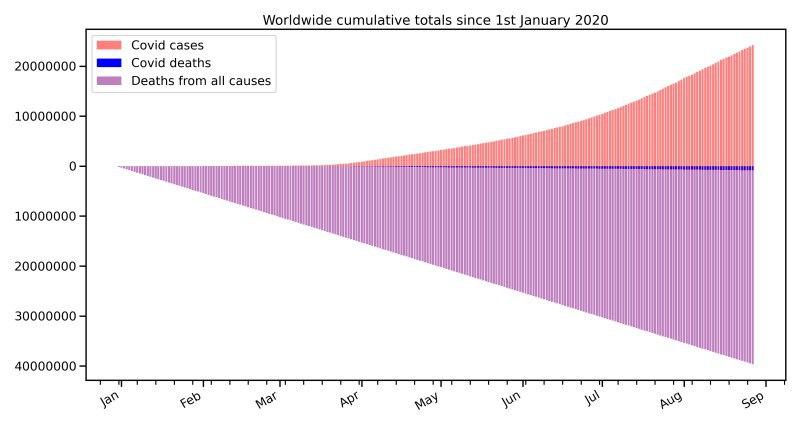
1) Global covid “cases” and deaths vs. all-cause deaths

Chart number one shows global covid deaths by September in blue (about 1 million) versus global all-cause deaths in purple (about 40 million). The chart also shows the cumulative number of global covid “cases” (i.e. positive PCR tests) – the so-called “casedemic” on top of the pandemic.

In contrast, the UN expects that the political reaction to the pandemic may put the livelihood of up to 1.6 billion people at immediate risk and may, by the end of 2020, push an additional 130 million people “to the brink of starvation” and an additional 150 million children into poverty.

Global covid deaths and “cases” vs. all-cause deaths (interpolated data; source: OWD)

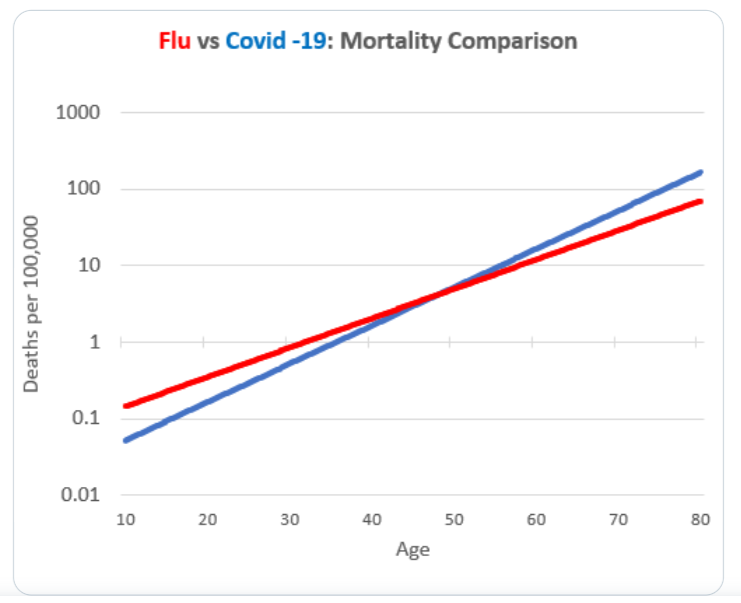
2) Covid mortality vs. flu mortality

Chart number two compares mortality by age for covid and for seasonal influenza (based on US CDC data). Below 50 years, influenza is somewhat deadlier than covid; above 50 years, covid is quickly getting deadlier than seasonal influenza (for which vaccines are available).

This “close to natural” mortality profile explains the very high median age of covid deaths in most Western countries (80 to 85 years in Europe, about 78 years in the US).

Overall, in Western countries a medium pandemic influenza (like 1957 and 1968) remains the best comparison to covid in terms of overall lethality and mortality. In non-Western countries, including Japan and most of Africa, covid mortality appears to be comparable to seasonal influenza.

Flu vs. covid mortality by age (CC/CDC). The chart in log-scale shows that COVID-19 is less lethal than flu up to the age of 48.

3) The role of nursing homes

Chart number three compares covid lethality (IFR) for the entire population (including nursing homes) and the non-nursing home population in Belgium (the hardest hit country in Europe; nevertheless, Belgian peak mortality is comparable to flu waves in the 1950s and 1960s.)

In most Western countries, nursing homes account for about 40% (Germany) to 80% (Canada and some US states) of all covid deaths, but they encompass only about 0.6% of the population; their IFR (ca. 30%) is about 100 times higher than for the general population (ca. 0.3%) and about ten times higher than for people of the same age group (75+) outside of nursing homes (ca. 3%, see below).

When calculating and communicating IFRs, it is therefore crucial to distinguish between the nursing home and the non-nursing home population in order to provide meaningful values. Nursing homes do not require a general lockdown of society, but targeted and humane protection.

Belgium: IFRs in entire population vs. non-nursing home population (Molenberghs)

4) Covid mortality in the USA

Chart number four shows monthly mortality in the USA since 1960. Regarding covid, the US is one of the hardest hit Western countries; nevertheless, its peak monthly mortality (driven by the Northeast region) is comparable to the strong influenza waves of the 1960s.

If covid had hit the US in the 1960s, its impact would have been much lower, due to a younger population, fewer nursing homes (which account for about 50% of US covid deaths), and much lower metabolic disease prevalence (i.e. diabetes, obesity and cardiovascular disease).

However, in much of the US (and Europe), coronavirus antibody prevalence is still below 10% (compared to values between 20 and 50% in global hotspots). It is therefore possible that the new coronavirus will cause additional deaths if high-risk population groups get infected. On the other hand, both intensive and early treatment options have improved in the meantime.

US: Monthly all-cause deaths since 1960 (Whelan/CDC)

5) Covid mortality in Sweden

Chart number five shows monthly mortality in Sweden since 1851. Sweden did not impose a covid lockdown, did not introduce a face mask mandate, and has one of the lowest intensive care bed capacities in Europe (two times lower than Italy). Nevertheless, its peak mortality is comparable to the strong seasonal flu waves of the 1990s. The chart also shows the k of the 1918 influenza pandemic and the nineteenth century cholera and hunger epidemics.

Sweden: Mortality since 1851 (JH/FOHM)

6) Epidemiological models vs. reality

Chart number six shows covid mortality in Sweden predicted by Imperial College London (professor Neil Ferguson) without measures (orange) and with moderate measures (gray), compared to the actual mortality curve (blue). 70% of Swedish deaths occurred in nursing facilities, while mortality in people below 65 remained below the five-year average.

Sweden: Predicted deaths vs. reality (HTY/FOHM)

7) Economic and social impact of political measures

Chart number seven shows US job losses in post-1945 recessions. The political reaction to the new coronavirus, notably lockdowns, has caused the worst employment recession since 1945, putting millions of people out of job and bankrupting tens or hundreds of thousands of businesses.

US recessions in comparison (BLS / CRB)

Conclusions

Covid is a very serious global public health issue, but:

  1. Talking about “cases” as if these were sick people is misguided.
  2. Talking about IFRs (lethality) without distinguishing between the general population and nursing homes, as well as early and late pandemic phase, is misguided.
  3. Saying covid is “worse than the flu”, without saying for whom, is misguided.
  4. Saying the recession is “due to covid”, not the political reaction, is misguided.
  5. Saying epidemiological models have been accurate and helpful, is also misguided.