Ending Government’s Addiction to Junk Science

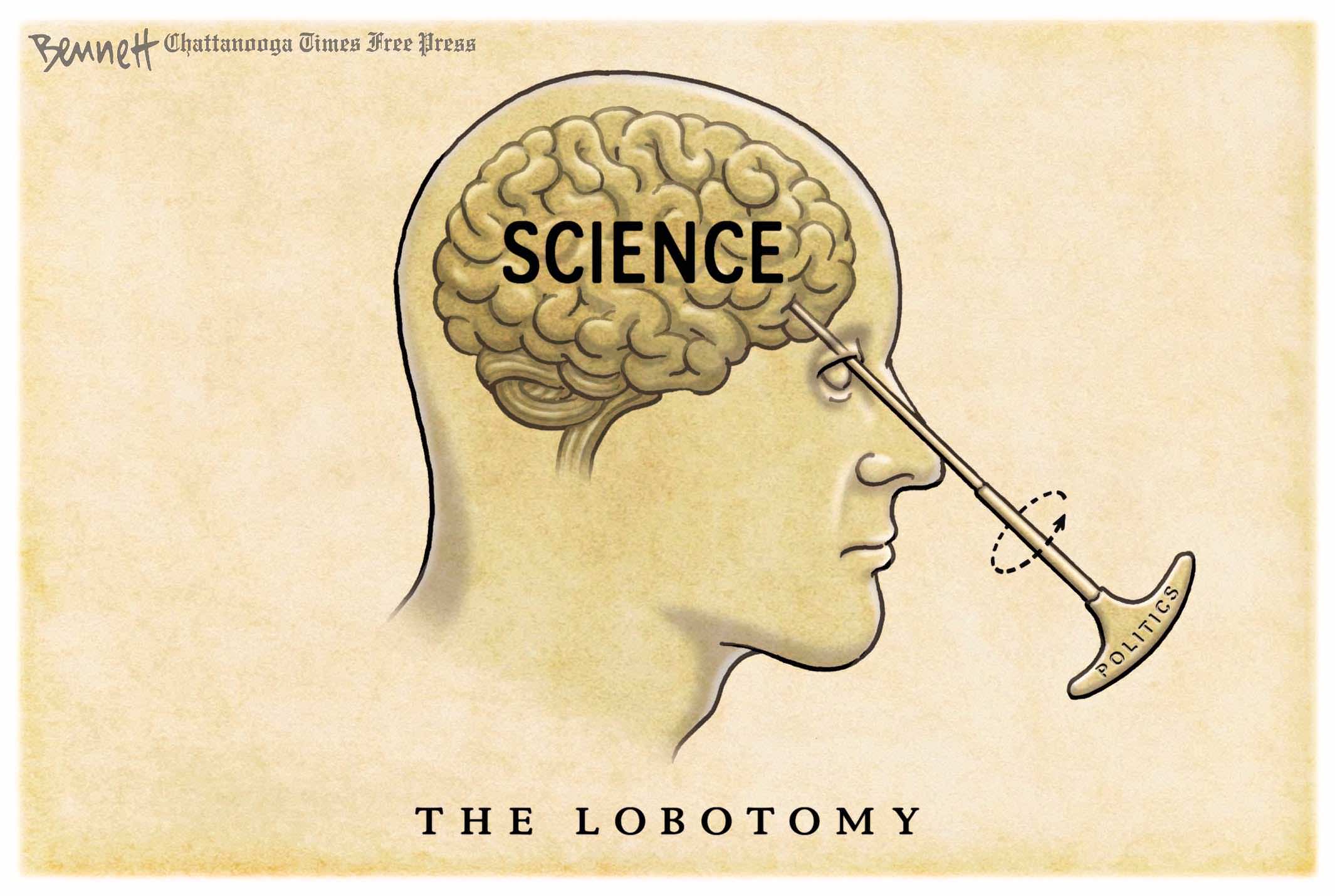
In their American Thinker article Junk science and government,  S. Stanley Young and Warren Kindzierski describe the corruption problem and a solution pathway.  The article includes links to research studies exposing how pseudoscience is employed to promote governmental agendas in fields such as climate, environment, medicine and social policies. Excerpts in italics with my bolds and added images.

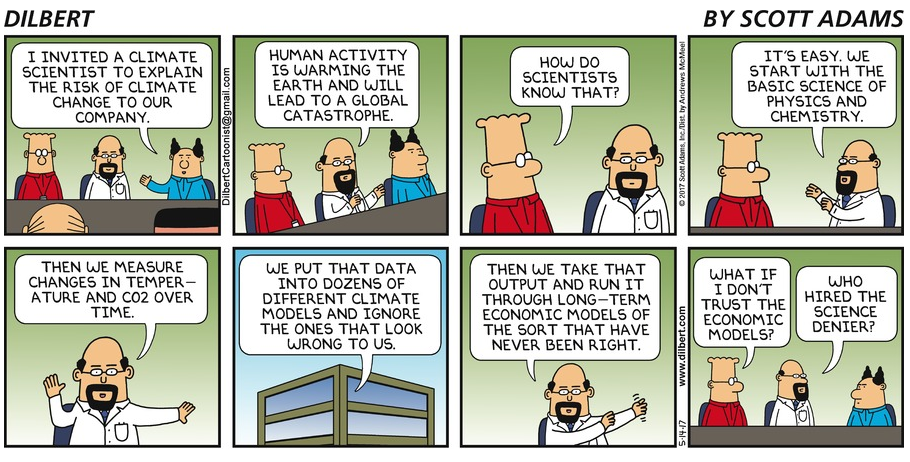
Science controversies have become left-right wars fought on the internet. These days everything exists, from run-of-the-mill issues such as (fake) climate change or extreme numbers of unsafe vaccines children need to receive — up to 80 by age 18, including boosters, and COVID vaccines saving lives (hardly, but anyhow), to the Tylenol-autism dustup.

Even people with life experience and common sense have problems judging such controversies; and the internet is where sound science competes with junk science.

The National Association of Scholars (NAS) spent the past few years examining the methods of four different fields of science that lead to irreproducible (false) evidence used by governments. Flawed methods are big part of what leads to false evidence and junk science. Guess where most of this junk originates? Government-funded academia.

Academic junk science has been allowed to run amuck for decades and with little or no policing from university administrations. Elite universities, e.g., Harvard, seem to be right in there among the infestation. They would have us think they are important for science innovation. They’re wrong: more often than not — key innovations come from private industries and industrial laboratories rather than from universities.

So where does junk science fit in? It works in favor of government policymakers who mostly spend their career on our dime trying to make their jobs more important. They do this by using junk science to create irresponsible polices and regulations that are costly, meaningless, or even harmful to us.

Government policies should be built on transparent and accountable scientific research. Policies (and regulations) developed from research should clear a high barrier of proof. They should be based on reproducible science. Unsurprisingly, too many government science policies fail here.

All this points to a policy crisis in government. The current situation is win/win for government bureaucrats and universities: agency propaganda is supported and universities get grants. The citizens — us — are the ones paying for the loss of freedom.

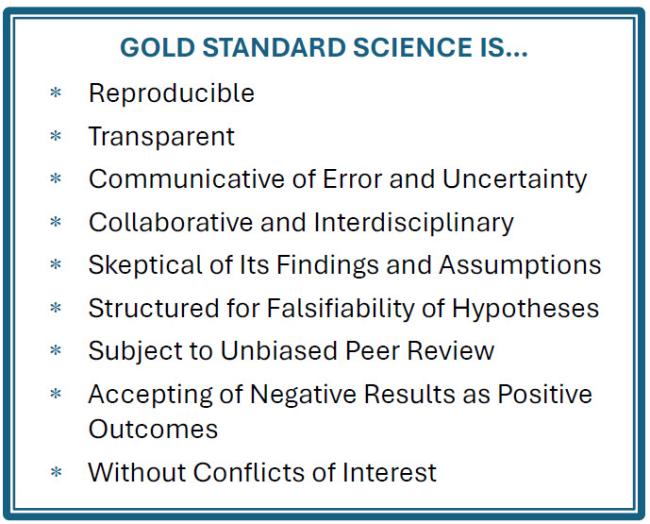
The road to fixing this mess has already started at the top — the White House, with a landmark executive order Restoring Gold Standard Science. This order is a return to foundational scientific principles in government — fostering discovery, innovation, and trust in science. To this end, we offer four reforms to help governments.

Source: NIH Publishes Plan to Drive Gold Standard Science, August 22, 2025

1. Cut the funding of junk science. Federal government agencies need to change their regulatory and funding practices to fix the irreproducibility crisis in academic science and the irresponsibility crisis in our government.

2. Sever the fraudulent relationship between government policymakers and academic junk scientists. Federal and state policymakers need to end the arbitrary procedures of using government-funded scientific research for regulation if it is irreproducible.

3. Fix the process fueling this train wreck. Federal and state policymakers need to change the teaching of undergraduate (and K‒12) science and math to educate properly a new generation of science professionals, policymakers, and informed citizens. They certainly should cover junk science and fossil fuel development, the latter which is linked to our prosperity.

4. Refocus policy institutes to dedicate themselves to sound science policy as a priority. These institutes need to be staffed with people who know the difference between sound and junk science, and the benefits of fossil fuels.

Previous administrations have allowed a cesspit of relationships between government policymakers and academic junk scientists, including radical activists disguised as scientists.

Government experts employed to judge scientific research and academics (whom mostly lean left) are naïve or sly practitioners of political groupthink. They are not our friends.

These reforms will go a long way in reversing the current situation of government bureaucrats and academics jointly using regulation based on junk science to advance corrupt, self-serving policy goals.

S. Stanley Young, PhD, is the CEO of CGStat in Raleigh, North Carolina and is Director of the National Association of Scholars’ Shifting Sands Project. Warren Kindzierski, PhD, is a retired college professor (public health) in St Albert, Alberta.

See Also

Why Federalized Science is Rotten

Government Funding Corrupts Science, How to Stop It

Noble Climate Cause Corruption: PIK exemplar

Thomas Kolbe explains the sordid history in his American Thinker article Potsdam climate researchers under fire. Excerpts in italics with my bolds and added images.

Critics of climate policy have long pointed to the problematic dominance of politics in climate science. A recent study from the Potsdam Institute for Climate Impact Research (PIK), which systematically exaggerated the economic consequences of climate change, has reignited the debate over scientific standards and political manipulation in the field.

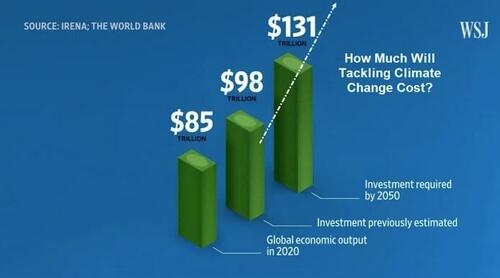
On April 17, 2024, the science journal Nature published a study by PIK researchers Maximilian Kotz, Anders Levermann, and Leonie Wenz. They calculated that global GDP would shrink by 19% by 2050 due to climate change, regardless whether future emissions were reduced. This projection corresponds to an annual output loss of around $38 trillion — an economic apocalypse, given that no society has the resilience to absorb such a dramatic collapse.

A Solution Delivered Alongside the Doom

The authors also provided a ready-made “solution”: according to their math, the costs of climate damage would be at least six times higher than the expenses required to keep global warming below 2°C. The implication is clear:

This was less a scientific exercise than a political directive for policymakers
to accelerate the fight against alleged man-made climate change.

A year later, the material was “corrected” and republished with slightly toned-down results. The timing was not coincidental: peer review — the scientific quality control process — loomed in the background and threatened to spark controversy.

Peer Review Delivers a Devastating Blow

That controversy soon arrived. Three U.S.-based scientists who reviewed the PIK paper identified serious methodological flaws and faulty data — problems that had been known for over a year. According to their report, PIK’s methodology had no scientific foundation. One reviewer wrote: “I have major concerns about the uncertainty and validity of the empirical model they built and used for the forecasts. It would help this study not to follow the often-exaggerated claims found in the literature.” From the Abstract of paper  by Bearpark et al (link in red above):

Kotz, Levermann and Wenz1 (henceforth, KLW) analysed how subnational gross domestic product (GDP) growth responds to year-to-year changes in temperature and precipitation. They reported that if historical relationships continue to hold, global GDP would be lowered by roughly 62% (central estimate) in 2100 under the Representative Concentration Pathway 8.5 ‘high emissions’ scenario, an impact roughly 3 times larger than similar previous estimates,2,3. Here we show that (1) data anomalies arising from one country in KLW’s underlying GDP dataset, Uzbekistan, substantially bias their predicted impacts of climate change, (2) KLW underestimate statistical uncertainty in their future projections of climate impacts, and (3) additional data-quality concerns in KLW’s subnational GDP data warrant further investigation. When Uzbekistan’s data are removed and statistical uncertainty is corrected to account for spatial correlations, KLW’s central estimate aligns closely with previous literature and their results are no longer statistically distinguishable from mitigation costs at any time this century.

Such devastating words cast doubt not just on PIK’s work, but on the broader foundations of climate science itself. Yet papers like this are routinely used to justify green transformation policies, with their web of subsidies, NGOs, regulations, and deep intrusions into economic life.

Finance Dragged Into the Climate Matrix

The significance of this critique lies not only in the study’s flaws but also in the murky financing behind it. These alarmist reports are not just shaping public opinion; they are the cornerstone of a new “climate economy.” The goal is to channel capital flows so that state funds and private wealth are merged into politically favored projects — a carefully orchestrated fusion of financial power and ideology.

International organizations and political institutions amplify these narratives, embedding them into economic governance. The “Network for Greening the Financial System” (NGFS) — closely tied to PIK and consisting of central banks and regulators — projects future climate costs and uses them as a basis for political and financial decisions. The European Central Bank relies on such scenarios for stress tests on banks, forcing higher capital buffers and restricting lending — with direct consequences for growth.

Networks, Obfuscation, and Propaganda

Additional funding flows through organizations like Climate Works, which bankrolls both NGFS and PIK while paying for the calculation of key scenarios. This blurring of lines between sponsor and reviewer, between science and political agenda, opens the door to propaganda. Genuine public debate becomes nearly impossible under such conditions of institutionalized opacity.

The end result is soulless landscapes scarred by wind turbines, the shutdown of modern power plants, and intrusive state regulation extending into private households. The energy sector is sacrificed, home ownership turned into an ideological experiment — all justified by the apocalyptic narrative of man-made climate collapse.

The Origins of CO2 Politics

The roots of this orthodoxy can be traced back to 2009, when the Obama administration declared CO2 a “dangerous pollutant” via the EPA’s Endangerment Finding. This politically-driven decision, made without congressional approval, laid the groundwork for carbon pricing, emissions trading, and sweeping regulatory interventions.

Europe embraced the same model, perhaps even spearheaded it. As an energy-poor continent, the EU saw an opportunity: by making fossil fuels expensive and heavily regulated, it could level the playing field and prevent resource-rich competitors from exploiting their natural energy advantages.

Donald Trump briefly broke with this orthodoxy, scrapping central EPA rules, declassifying CO2 as an existential threat, and freeing coal, gas, and oil. It was a signal to the world: growth and sovereignty take precedence over panic-driven climate politics.

Politicized Science

The PIK case highlights the dangers of academia’s fusion with state agendas. The old saying applies: “Whose bread I eat, his song I sing.” It was only a matter of time before such politically tailored studies surfaced.

Just as with government-influenced modeling during the COVID crisis, climate research now faces the urgent task of disentangling politics from science. On the back of the man-made climate narrative, an entire apparatus of subsidies, NGOs, and Brussels bureaucracy has entrenched itself. Untangling this nexus is no longer just a scientific issue — it is a historic necessity.

Footnote On the Failings of PIK GDP Study

Climate study from Potsdam – how questionable forecasts misled politics and business

A controversial climate study by the Potsdam Institute for Climate Impact Research (PIK) is one of the biggest scientific scandals of recent years. Media outlets like “Tagesschau” and “Spiegel” made it headlines in 2024. “Scientifically completely invalid,” economist Richard Rosen declared. However, politicians and the financial world made far-reaching decisions based on the PIK study. The alleged annual economic damage of $38 trillion shaped global debates. (welt: 25.08.25)

The publication of the PIK study by “Nature” lent its brilliance. But internal documents show that all four reviewers reported serious deficiencies. One expert wrote: “The statistical methodology … [has] no scientific basis whatsoever.” Another emphasized that the forecasts seemed “unintuitively large.”

Roger Pielke Jr. calls it a scandal. Incorrect figures have been known for over a year, yet they continue to shape climate policy and financial decisions. Weinkle criticizes that “Nature” has “turned into a doormat.” This is how science loses credibility.

Just a few weeks after publication, Christof Schötz of the Technical University of Munich presented a detailed critique. He made it clear that the results “do not provide the robust empirical evidence required for climate policy.” Nevertheless, Nature suppressed the analysis for months.

Other researchers from Princeton and the Bank Policy Institute responded. Gregory Hopper describes his unsuccessful attempts to submit comments. Rosen described the PIK study as “completely scientifically invalid.” It has since become clear that while the criticism was suppressed, the NGFS continued to use the data. This resulted in massive economic and political damage.

Under pressure, the PIK researchers published a new version. In this “preprint,” they claimed their core findings remained intact. However, they had to swap methods to produce similar results. For Pielke, this is “a tacit admission… that the original analysis is no longer valid.”

Hopper is even more critical of the new version. “The revised climate damage model is even more flawed,” he explains. The statistical problems persist. This demonstrates that science is serving politics here rather than providing objective results.

Government Funding Corrupts Science, How to Stop It

William Briggs explains in his blog article The Case For Ending Government Funding of Science.  Excerpts in italics with my bolds and added images.

Direct government funding of science has to end.
Here is why, and what should replace it.

Some are making a big deal of a new paper in which “researchers found that between 1994-2023 not one of the 82 ‘climate science’ papers they identified had a financial or non-financial COI disclosure from at least one author.”

For the last decade, or moreI have been waving my arms around like a deranged monkey shouting that scientists, ante-Trump, did not view money from the government as tainted, biased, interested, dirty, suspicious or, especially, obliging. Instead, they thought of it as a natural and expected reward from the god Beneficence, i.e. Government, giving his people what they deserved, and they deserved because they were smart and spoke the right beliefs. They constantly told each other they were smart, anyway. And awarded credentials to each other to verify it.

Point is, when the moola was from Beneficence,
scientists saw NO conflict of interest.

They could not conceive of it existing. They thought their payoff was natural. And that was just as true when the money came from Beneficence’s brother god NGO. From the same source quoted above: “The research also found that:

“funding from NGOs was a significant predictor of studies reporting a positive association between climate change and hurricane behavior.”

No kidding.

How is it scientists claim purity, innocence, and disinterestedness when it is they themselves who hop on the Acela to DC and sit on the government committees that decide who gets the grant money from Beneficence? Of course the government has interest in the outcomes of research! How could they not? They asked for the research done specifically. They culled from consideration all proposals that were deemed hostile, inadequate, or politically incorrect. They, in cooperation with the gift getters, chose who lived and who died by the grant. Then Beneficence paid out! The government also asked for regular updates on the work which they asked and paid for.

I become exasperated every time I discuss this topic because I can’t see how this is not obvious. But it isn’t! We saw last week the (now) 3,400+ scientists who rage-signed a petition purportedly against Musk, but really to signal the scientists’ waning respect and fear over loss of all that free money they felt they so richly deserved.

Every source of money, save exceedingly rare completely
anonymous no-known-source gifts, has an interest.

When the sole source of funding, or near enough, is the government, the government thus has total interest and total control over the course of science. And those scientists who participate in the process, especially those who serve on grants committees, become part of the government, even though they hold no official position.

This system would be wonderful if the government was truly beneficent and wise. It is not. It is neither. I need only say to you DIE, “pregnant men”, “climate change”, “women in STEM”—and these are only a fraction of what has gone wrong—to prove that single-source behemoth control of science funding leads to absurdities.

And arrogance. Scientists in universities grew, as Eisenhower warned, too used to the largess, too hubristic over the “we pay; you do” system. That is not my phrase, but The Atlantic’s. They report on growing alarm over the new administration breathing Reality back into science (purging DIE), and from the loss of funds (like overhead). They say “The government has funded science and then largely left well enough alone.” This is as false as “pregnant men”. The government funded what it wanted! And it got what it wanted. They didn’t just leave pools of money from which scientists came and freely grazed. They controlled who got every cent.

Scientists are right to be frightened.
The new small cuts should only be the start.

 The entire grants apparatus, except perhaps for rare special exceptions (which I am not here prepared to name), ought to be dismantled. There are too many scientists, fed by too much money, which leads to too much bad science, which drags the entire system down. I have written about this scores of times and won’t justify that opinion more here.

Notice I do not say “do not fund science”. I say the government grants system ought to be abolished. Here are some ideas what could replace it.

If every source of money is interested, then spread the interest around so it’s not concentrated to serve one cracked master. This reduces the chance science becomes degraded and cancerous and calcified as it now is.

I’ve already written a good deal of science can be shunted to private interests, who are free to pursue that which interests them. That is the most obvious route. Pharmaceuticals rely on this, and they ain’t hurtin’ (Trump will soon sign an executive order banning p-values). Stop counting on universities to churn ideas which private interests might use. Instead, do it yourself, homegrown. A larger spend up front, but an even larger return on investment at the end.

Patronage is a traditional route. The best off should indulge in noblesse oblige. Which, of course, many do. But they give the money to universities, which are corrupted to the bone, not least because of all the government money, but also because of misguided Equality (too many kids go to university), and managerialism (universities have more administrators than professors). If, and once, universities are restored to their former glory, the rich can return and have buildings named after them.

For now, fund individual scientists,
who can be anywhere and not just campus bound.

Or not just for now, but forever. This is the idea of Jacob Shell. He would give university scientists large salaries, and no grants. See if you’re not crying “Amen!” at the end of this:

Academic freedom of inquiry is the opposite of the grant system. The two cannot cohabitate the same cosmos. Because academic grants exist, nobody in the academy is really intellectually free. If academics were really intellectually free, then there could not be such a thing as an academic grant.

Scientists would use their own money, however obtained, to fund their own research. Which would be whatever they wanted it to be. Or not. Groups of scientists could form bands and pool their money to do more expensive research. If they wanted. Or not.

This brilliant idea results immediately in far fewer scientists, which brings freedom. It instantly reduces publish or perish, since scientists won’t have to grub for grants. The breathing room bought by this is wonderful to imagine. If this is done at universities, the extra money to pay scientists would have to come from firing administrators and asssistants to the asssistant Deans. A giddy thought.

It’s not that scientists won’t have to beg for money from someone. It’s that they will have to beg from someones. It spreads the interest around. The system becomes more adversarial and independent and thus creative. It would indeed result in a reduction of science. That is a blessing.

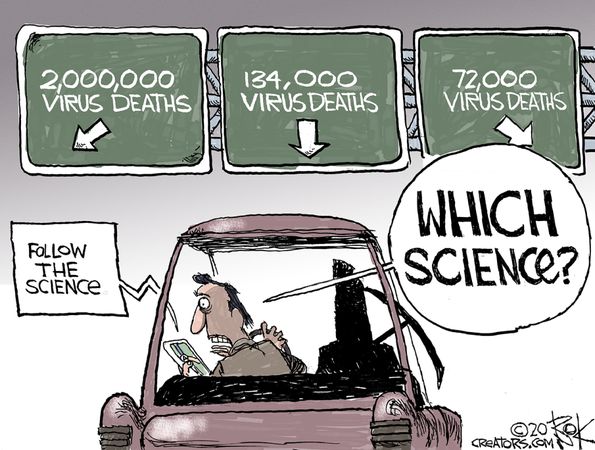
It forces the government, which would be out of the business of funding scientists, to find scientists which support whatever programs the government loves, and convince those who have money to fund these scientists. That requires real work, and will be forever a path to corruption. But a tangled one, which slows the rot. Now, government pays scientists directly to give them the support for The Science, so politicians and announce “Follow The Science!” and pretend there is no taint.

Science needs to feel the pain of hugeous cuts. Pain is necessary to grow.
If anybody reading this has access to our new rulers,
get them not just to cut overhead, but cut it all.

See Also

Why Federalized Science is Rotten

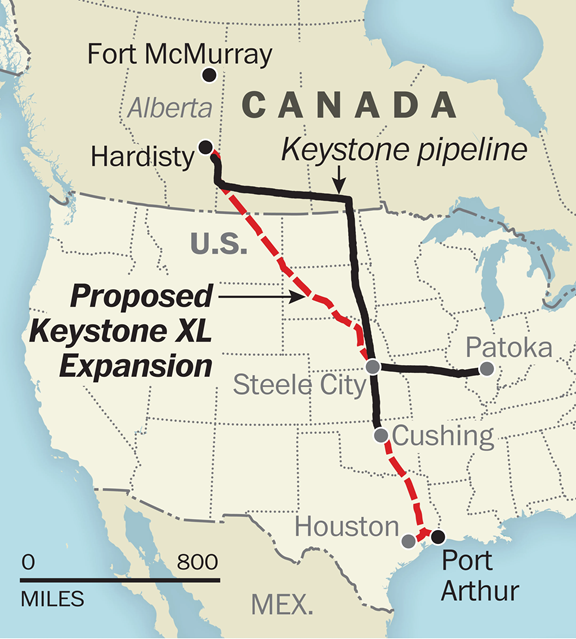
Keystone Pipeline Revival?

The News

Smith backs Trump’s call to build Keystone XL pipeline

Trump revealed on his Truth Social platform that the shelved pipeline project is still on his mind

Background

In 2011, Congress forced then-President Barack Obama to make a decision on Keystone XL by including a provision in an unrelated tax bill that required him to decide the project’s fate within 60 days or determine it wasn’t in the national interest. After several years of turmoil, Obama finally rejected Keystone XL in 2015.

But when President Donald Trump took office in 2017, he invited parent company TC Energy to reapply for a new permit for Keystone XL. They did and were approved.

On the first day of Biden’s presidency, he issued an executive order canceling the Keystone XL pipeline — making good on his promise to the climate activists who helped get him elected, but inviting the lawsuit brought by 21 states who say they will be hurt economically by Biden’s decision.

The Bigger Picture: Br’er Canada and the Tar Baby

Disney animation of “Br’er Rabbit and the Tar Baby” from Songs of the South, a collection of Uncle Remus American folk tales.

On Nov. 6, 2015, President Obama canceled the Keystone XL pipeline. Canada PM Trudeau, just installed and wanting not to offend, politely said he was “disappointed.” Here is the back story that you won’t hear in the media.

background
Americans should know all about tar pits. As the traditional folk tale suggests, there have been many tar pools across the US. A famous one is in Los Angeles: La Brea Tar Pit. Pictured above around 1910, it’s an oil spill produced by Nature.  Notice the many oil derricks nearby.

Tar pits are composed of heavy oil fractions called gilsonite, which seeped from the Earth as oil. In Hancock Park, crude oil seeps up along the 6th Street Fault from the Salt Lake Oil Field, which underlies much of the Fairfax District north of the park.[3] The oil reaches the surface and forms pools at several locations in the park, becoming asphalt as the lighter fractions of the petroleum biodegrade or evaporate.

This seepage has been happening for tens of thousands of years. From time to time, the asphalt would form a deposit thick enough to trap animals, and the surface would be covered with layers of water, dust, or leaves. Animals would wander in, become trapped, and eventually die. Predators would enter to eat the trapped animals and also become stuck.

https://en.wikipedia.org/wiki/La_Brea_Tar_Pits

La Brea Tar Pits and Museum today.

Canada’s Tar Baby

So, as you can see, tar pits are hazardous to animal and plant life. In Canada, we have a much greater problem bestowed on us: the Athabasca tar sands in Alberta. The oil deposits are much too large to put fences around it and open it as a museum, as was done in L.A. No, in Alberta the environmentally responsible thing is to clean up the mess Nature left behind.

The cleanup requires a massive effort, but costs can be offset by processing the tar into petroleum products and shipping them to markets who want to use them.  Using those products from syncrude oil liberates CO2 once trapped in bitumen, and in the air becomes available to plants who grow larger and faster from the increased concentration.  The Japanese would call this a “virtuous cycle.”

Br’er America is a neighbor with the facilities to help, but because of CO2 hysteria, the Obama and the Biden administrations were afraid of getting some tar on their hands. Actually a pipeline is the environmentally friendly way of transporting the crude oil, but now trains will be used instead of the pipeline.

The origin of the Alberta oil sands is a debated subject. Two primary theories are asserted:

1.) These sands are the remnants of a once vast reserve of crude oil that, over extremely long periods of time, has escaped or been destroyed microbiologically; thus leaving behind some bitumen and also converting the lighter crude oil into bitumen through bacterial processes.

2.) The bitumen evolved from highly organic cretaceous shales (similar to oil shale). Underground pressure forced the bitumen out of the kerogen rich shales where it soaked into existing silt grade sediments and sand bodies.

In the first theory, petroleum would be formed in the traditional manner, and then converted to bitumen by some additional process.  More description here.

Summary

So whether Nature created the tar mess by bacteria or by underground pressure, it’s up to us humans to clean it up. Canada is doing the heavy lifting, while the Dem administrations preferred posing as innocent bystanders.  Maybe a Keystone Pipeline Revival will be triggered by Trump to the benefit of energy dependent North Americans.

See Also:

Pipeline Facts vs. Fears

Funding for University Wokism Cut

William M Briggs explains in his blog article Trump Slashing The Cancerous “The Science” Bloat: Cut Cut Cut! Excerpts in italics with my bolds and added images.

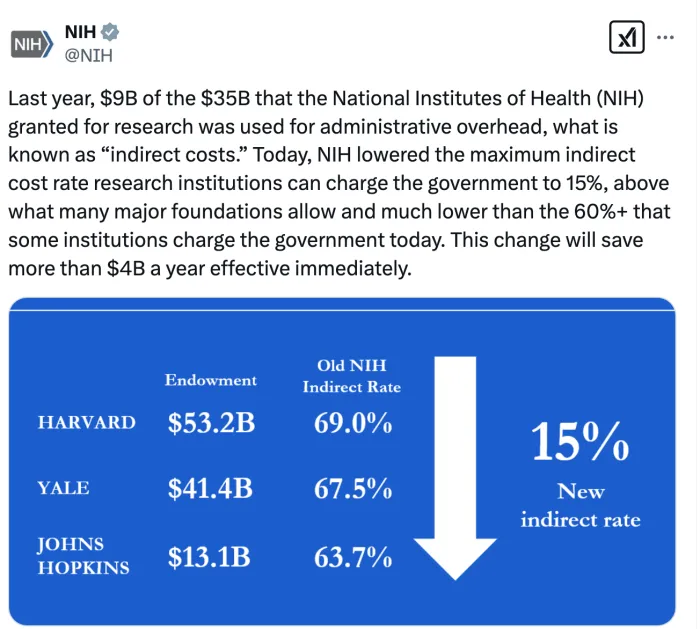
I responded on Twitter (follow me): “You might not know it, but this is a MAJOR VICTORY of outstanding proportions. Overhead is what fed the administrative beast. Overhead paid for DIE. Overhead paid for assistants to the assistants to the assistant Deans for development. Kill the Beast by starving it.”

For those new to grants, the overhead is the amount tacked on by the researchers’ institution to a researcher’s grant. If a Harvard grant is for, say, $1 million, an amount already bloated for all the usual reasons of excess, then the amount NIH pays to Harvard is $1,690,000. That extra $690,000 feeds the Beast. The Beast grows and causes the original grant totals to swell, for reasons not directly related to the research, like increased salaries for all and such like. Bureaucrats are spawned from the overhead funds. They emerge from their pods with gaping maws mewing to be fed—fed—fed! Overhead is a slow-motion monster movie.

(If you want more detail on overhead, this is a good article.)

Now I know this next part will make no sense to you, but not all are taking well the splendiferous news overhead will be treated like a bikinied teenager in a Wes Craven movie. The far-left politics journal Science screamedNIH slashes overhead payments for research, sparking outrage“.

“Outrage”, as we have said many times, is the second of only
two emotions a woke can express. The first being smug self-satisfaction.
They don’t get the first anymore, though.

Or take as representative lead covid panicker Eric Fing-Ding. Through sweet, sweet tears, he tweeted (among other things) that the cuts will “COMPLETELY DECIMATE MEDICAL & PUBLIC HEALTH RESEARCH”.

Bad news, because we’d like the effect to be greater than a mere measly ten percent. We need to whack, with pitiless remorseless brutality, at least half of governmental science funding. The Science article was more hopeful. They said “‘This is a surefire way to cripple lifesaving research and innovation,’ said a statement from the Council on Governmental Relations (COGR)”.

Crippling is much better than decimating.

Bring on the pain. Their pain. Universities have had it good too long. And we’ve had it bad.  It’s not only your old Uncle Sergeant Briggs saying this.

Here’s a ripe pull from “The natural selection of bad science” by Paul E Smaldino and Richard McElreath. These fellas are not critiquing cellar-dwelling simulacra of science, like say sociology, but what’s taken as the good stuff, like medicine.

These are not the only ones on the inside saying these things. The word is out. Science has gone bad: “A 2015 British Academy of Medical Sciences report suggested that the false discovery rate in some areas of biomedicine could be as high as 69 percent.”

Data Republican says: “Universities are among the largest drains on taxpayer money in my dataset. They receive massive funding from NGOs and USAID, and they take more government grants on top of that. Meanwhile, anonymous professors have reported to me that true scientific research is stagnating due to DEI mandates and administrative bloat.”

Understand: universities were ground zero for the DIE zombie invasion. And much worse. A tsunami of bad ideas flowed from universities over the last century. Many of those responsible are still employed there. These people need to be made to go. It’s not only DIE, but the base bloat caused by government micro-managing science. It is government, almost completely, that decided what got funded, and funded to ridiculous levels. This forced consensus-based science upon us. This has stifled much innovation, as we have seen time and again. It must be made to change, for change won’t come from within.

Now that 15% might eventually rise, given the wounded howling coming from universities (an AFMR email said “We have also launched an E-Action Alert to engage the broader scientific community and mobilize support for advocacy efforts to reverse or mitigate these changes.”).  But the rate must fall. The NIH and NSF budgets need to treated like the mess they are.

The only way to rid ourselves of this stuff is to stop feeding those producing it. We need to force a restructuring and rethinking. The old ways need to go. The only way to do this is to cause pain. Minor course corrections are not enough. Cut, cut, and cut some more. Make it sting.

See Also:

Examples of Debased Government Science

Trust Me, I’m a Scientist. Really?

Why Federalized Science is Rotten

Good Reasons to Distrust Climatists

The most recent case of climatists’ bad behavior is the retraction of a peer-reviewed paper analyzing the properties of CO2 as an IR active gas, concluding that additional levels of atmospheric CO2 will have negligible effect on temperatures.  From the Daily Sceptic:

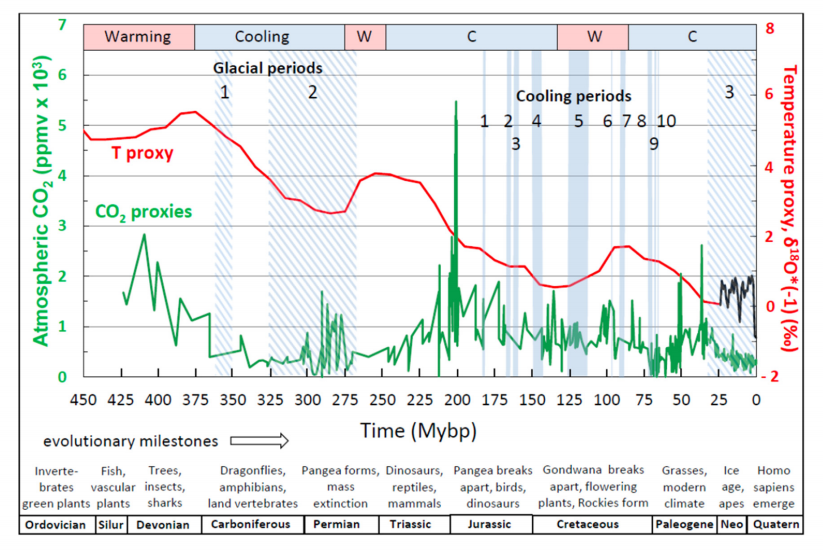
Another important paper taking issue with the ‘settled’ climate narrative has been cancelled following a report in the Daily Sceptic and subsequent reposts that went viral across social media. The paper discussed the atmospheric ‘saturation’ of greenhouse gases such as carbon dioxide and argued that higher levels will not cause temperatures to rise. The work was led by the widely-published Polish scientist Dr. Jan Kubicki and appeared on Elsevier’s ScienceDirect website in December 2023. The paper has been widely discussed on social media since April 2024 when the Daily Sceptic reported on the findings. Interest is growing in the saturation hypothesis not least because it provides a coherent explanation for why life and the biosphere grew and often thrived for 600 million years despite much higher atmospheric levels of greenhouse gases. Alas for control freaks, it also destroys the science backing for the Net Zero fantasy.

Below are some comments responding to a Quora question, text in italics with my bolds and added images:

What are some reasons why some people do not believe in climate change or global warming despite scientific evidence? Is there any additional information that could help us understand their perspective?

Answer from Mike Jonas,  M.A. in Mathematics, Oxford University, UK, 

Good scientists do not lie and cheat to protect their science, they are happy to discuss their evidence and their findings, and they always understand that everything needs to be replicable and verifiable.

When Climategate erupted on the scene, and the climate scientists behind the man-made global warming narrative were found to have lied and cheated, all honest scientists thought that would be the end of it. Instead, what happened was that those climate scientists closed ranks and carried on, supported by a massive amount of government (ie, the public’s) money. One of the first things they did was to deflect Climategate by saying the emails involved had been hacked so should be ignored, but some of the people involved confirmed that all of the emails really were genuine.

It has been about 15 years since Climategate, and study after study has shown virtually all of the components of the man-made global warming narrative to be incorrect, even that none of the computer models used by the IPCC are fit for purpose,

And yet they maintained their closed ranks,
and the government money kept pouring in.

Did you know that the IPCC does not do any research (please do check that, on their web page About – IPCC they state “The IPCC does not conduct its own research”). It is, as its name says, an inter-governmental organisation, and it is run by and for governments. They say lots of persuasive sciency things, but the simple fact is that they cherry-pick and corrupt the science to achieve their ends. Regrettably, almost all the scientific societies are on the gravy train too. This is part of what the highly respected physicist Professor Hal Lewis said in his resignation letter to the American Physical Society (APS):

It is of course, the global warming scam, with the (literally) trillions of dollars driving it, that has corrupted so many scientists, and has carried APS before it like a rogue wave. It is the greatest and most successful pseudoscientific fraud I have seen in my long life as a physicist. Anyone who has the faintest doubt that this is so should force himself to read the ClimateGate documents, which lay it bare.

I don’t believe that any real physicist, nay scientist, can read that stuff without revulsion. I would almost make that revulsion a definition of the word scientist.

So what has the APS, as an organization, done in the face of this challenge?
It has accepted the corruption as the norm, and gone along with it.

If you want to find out more about this “greatest and most successful pseudoscientific fraud”, the website Watts Up With That? is a good place to start (the fraudsters absolutely hate it), and it links to many other good websites. It has the full text of Hal Lewis’ resignation letter at:

Hal Lewis: My Resignation From The American Physical Society – an important moment in science history

Answer from Susannah Moyer

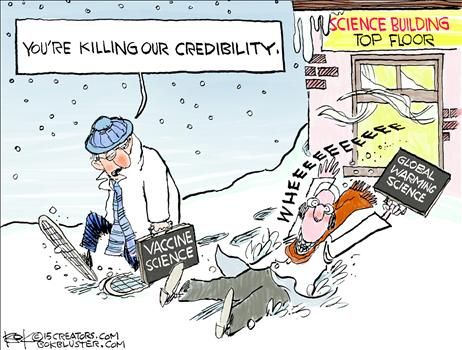
It’s curious that climate science is the rare scientific field where dissenting scientists, those with contrarian views, are unwelcome and even ostracized.

There are some well known climate scientists that have doubts about the role of CO2 and man made global warming as it pertains to global temperature. They have raised the issue that computer generated prediction models have been inaccurate in predicting temperature patterns because the modeling requires assumptions that have not been shown to be accurate.

Here is a contrarian view from climate scientists who have published climate research results in Nature, which is no small feat:

McNider and Christy are professors of atmospheric science at the University of Alabama in Huntsville and fellows of the American Meteorological Society. Mr. Christy was a member of the Intergovernmental Panel on Climate Change that shared the 2007 Nobel Peace Prize with former Vice President Al Gore.

It is not a known fact by how much the Earth’s atmosphere will warm in response to this added carbon dioxide. The warming numbers most commonly advanced are created by climate computer models built almost entirely by scientists who believe in catastrophic global warming. The rate of warming forecast by these models depends on many assumptions and engineering to replicate a complex world in tractable terms, such as how water vapor and clouds will react to the direct heat added by carbon dioxide or the rate of heat uptake, or absorption, by the oceans.

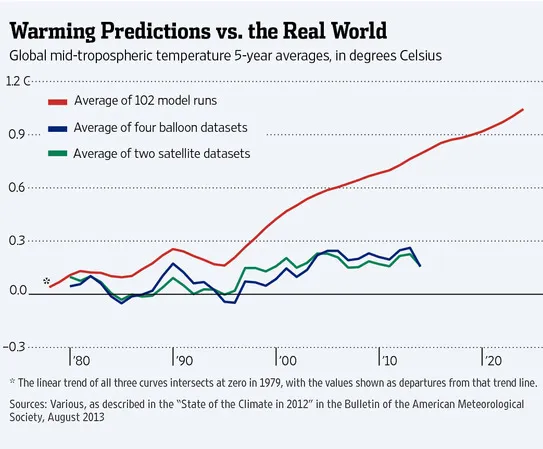
We might forgive these modelers if their forecasts had not been so consistently and spectacularly wrong. From the beginning of climate modeling in the 1980s, these forecasts have, on average, always overstated the degree to which the Earth is warming compared with what we see in the real climate.

For instance, in 1994 we published an article in the journal Nature showing that the actual global temperature trend was “one-quarter of the magnitude of climate model results.” As the nearby graph shows, the disparity between the predicted temperature increases and real-world evidence has only grown in the past 20 years.

“Consensus” science that ignores reality can have tragic consequences if cures are ignored or promising research is abandoned. The climate-change consensus is not endangering lives, but the way it imperils economic growth and warps government policy making has made the future considerably bleaker. The recent Obama administration announcement that it would not provide aid for fossil-fuel energy in developing countries, thereby consigning millions of people to energy poverty, is all too reminiscent of the Sick and Health Board denying fresh fruit to dying British sailors.

Another questioner, Dr. Koonin was undersecretary for science in the Energy Department during President Barack Obama’s first term and is currently director of the Center for Urban Science and Progress at New York University. His previous positions include professor of theoretical physics and provost at Caltech, as well as chief scientist of BP, where his work focused on renewable and low-carbon energy technologies.

But—here’s the catch—those questions are the hardest ones to answer. They challenge, in a fundamental way, what science can tell us about future climates.

Firstly, even though human influences could have serious consequences for the climate, they are physically small in relation to the climate system as a whole. For example, human additions to carbon dioxide in the atmosphere by the middle of the 21st century are expected to directly shift the atmosphere’s natural greenhouse effect by only 1% to 2%. Since the climate system is highly variable on its own, that smallness sets a very high bar for confidently projecting the consequences of human influences.

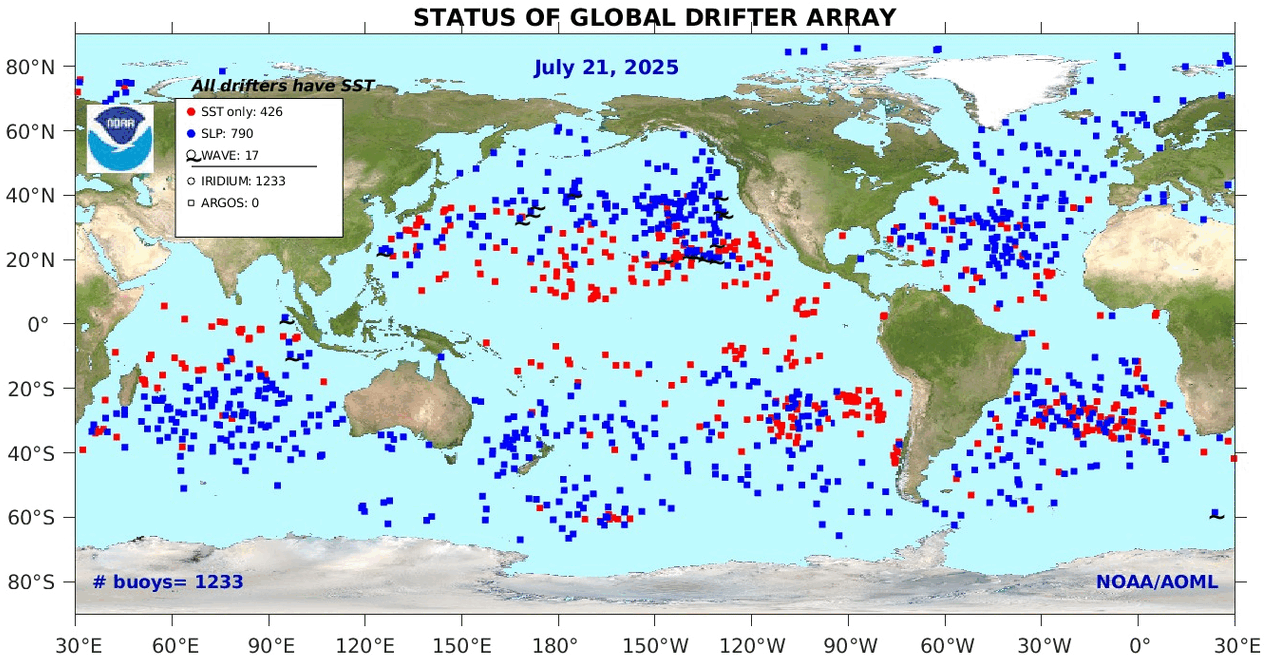
A second challenge to “knowing” future climate is today’s poor understanding of the oceans. The oceans, which change over decades and centuries, hold most of the climate’s heat and strongly influence the atmosphere. Unfortunately, precise, comprehensive observations of the oceans are available only for the past few decades; the reliable record is still far too short to adequately understand how the oceans will change and how that will affect climate.

A third fundamental challenge arises from feedbacks that can dramatically amplify or mute the climate’s response to human and natural influences. One important feedback, which is thought to approximately double the direct heating effect of carbon dioxide, involves water vapor, clouds and temperature.

Climate Science Is Not Settled

Another group questioning what some consider “settled science”:

  • Claude Allegre, former director of the Institute for the Study of the Earth, University of Paris;
  • J. Scott Armstrong, cofounder of the Journal of Forecasting and the International Journal of Forecasting;
  • Jan Breslow, head of the Laboratory of Biochemical Genetics and Metabolism, Rockefeller University;
  • Roger Cohen, fellow, American Physical Society;
  • Edward David, member, National Academy of Engineering and National Academy of Sciences;
  • William Happer, professor of physics, Princeton;
  • Michael Kelly, professor of technology, University of Cambridge, U.K.;
  • William Kininmonth, former head of climate research at the Australian Bureau of Meteorology;
  • Richard Lindzen, professor of atmospheric sciences, MIT;
  • James McGrath, professor of chemistry, Virginia Technical University;
  • Rodney Nichols, former president and CEO of the New York Academy of Sciences;
  • Burt Rutan, aerospace engineer, designer of Voyager and SpaceShipOne;
  • Harrison H. Schmitt, Apollo 17 astronaut and former U.S. senator;
  • Nir Shaviv, professor of astrophysics, Hebrew University, Jerusalem;
  • Henk Tennekes, former director, Royal Dutch Meteorological Service;
  • Antonio Zichichi, president of the World Federation of Scientists, Geneva.

Although the number of publicly dissenting scientists is growing, many young scientists furtively say that while they also have serious doubts about the global-warming message, they are afraid to speak up for fear of not being promoted—or worse. They have good reason to worry. In 2003, Dr. Chris de Freitas, the editor of the journal Climate Research, dared to publish a peer-reviewed article with the politically incorrect (but factually correct) conclusion that the recent warming is not unusual in the context of climate changes over the past thousand years. The international warming establishment quickly mounted a determined campaign to have Dr. de Freitas removed from his editorial job and fired from his university position. Fortunately, Dr. de Freitas was able to keep his university job.

This is not the way science is supposed to work, but we have seen it before—for example, in the frightening period when Trofim Lysenko hijacked biology in the Soviet Union. Soviet biologists who revealed that they believed in genes, which Lysenko maintained were a bourgeois fiction, were fired from their jobs. Many were sent to the gulag and some were condemned to death.

Why is there so much passion about global warming, and why has the issue become so vexing that the American Physical Society (APS), from which Dr. Giaever resigned a few months ago, refused the seemingly reasonable request by many of its members to remove the word “incontrovertible” from its description of a scientific issue?

There are several reasons, but a good place to start is the old question
“cui bono?” Or the modern update, “Follow the money.”


World Institutions Pushing Pseudoscience


Since 1660, Nullius in verba was the Royal Society’s motto.  “Don’t take anyone’s word for it.”

Yesterday’s post showed how American science societies have taken to parroting climatist suppositions rather than applying critical intelligence to claims of a “climate crisis.” That unquestioning attitude betrays the science method expressed in the Royal Society’s motto.  Today presents Tilak Doshi describing how the same pattern appears in international institutions supposed to be objective reporters of natural conditions. His Daily Signal article is The Climate Agenda’s March Through the Institutions: Can It Be Stopped? Excerpts in italics with my bolds and added images.

A spate of stories in the media recently provides a remarkable illustration of how the globalist policy agenda of the climate-industrial complex has captured key international institutions and perverted their original organizational aims. From initially serving broad, laudable objectives for the welfare of their constituents, these institutions have been subverted over the years to serve the insistent pseudoscientific claims of climate alarmists.

The corruption of global institutions has, in turn, led to significant opposition that is becoming apparent. There is the prospect of an incoming Trump administration that is avowedly skeptical of the claims of an alleged climate crisis and is intent on exiting the U.N.’s Paris Agreement and its “net zero by 2050” policy target for a second time. This presents a welcome challenge to these corrupt institutions.

Will President Donald Trump and some of the populist parties in Europe
be capable of countering the entrenched globalist climate agenda?

The World Bank

On Oct. 17, Oxfam published a report that shockingly found that up to $41 billion in World Bank climate finance—nearly 40% of all climate funds disbursed by the World Bank over the past seven years—is “unaccounted for between the time projects were approved and when they closed.” In other words, no one knows how the money was used. There is no paper trail revealing where the money went or what the accomplished results were.

Green cronyism, ranging from the Solyndra debacle—the waste of almost half a billion dollars of taxpayers’ money on a failed solar farm project under President Barack Obama’s watch—to President Joe Biden’s duplicitously-named Inflation Reduction Act, which will unleash an estimated $1 trillion deluge of subsidies on favored “green” industries, is nothing new. But it is instructive to trace the World Bank’s decline from its honorable founding objectives to its current status as yet another institution advocating green causes.

Dr. Jim Yong Kim, reflecting the progressive virtues of Obama, who appointed him as president of the World Bank in 2012, imposed a ban on the financing of coal-fired power stations in 2013. This was followed by a ban on investments in all new upstream oil and gas resource development projects.

The distinguished economist Deepak Lal, a former research administrator of the World Bank, remarked that Kim incredulously “over-ruled the cost-benefit estimates of coal-based power over solar and wind-based power generation produced by his own economic staff, justifying this by reference to a wish to cut global emissions of greenhouse gases.”

The World Bank’s objections to the use of fossil fuels despite their importance to economic growth and poverty alleviation—which constitute its foundational institutional objectives—can be traced to the intellectual evolution of its management under James Wolfensohn during his decade as president (1995-2005).

Wolfensohn traced the arc from the old regime to the new. The old was represented by the “Washington consensus” of free markets, liberal trading regimes, sound money, and entrepreneurship associated with the classical liberalism of Adam Smith.

The new intellectual environment of the World Bank’s management—personified by Joseph Stiglitz, chief economist of the World Bank (1997-2000)—was defined by the theoretical failures of the free market, especially in accounting for the alleged negative climate impacts of fossil fuel use.

Stiglitz, a climate alarmist, wrote in a 2015 court brief for a failed climate lawsuit brought on behalf of a group of children against the U.S. federal government that “fossil fuel-based economies imposed ‘incalculable’ costs on society and shifting to clean energy will pay off.” [See Climatists Make Their Case by Omitting Facts]

Rupert Darwall, a former adviser to the United Kingdom’s chancellor of the exchequer and author of “Green Tyranny,” encapsulates the betrayal of the World Bank to its founding objectives as follows:

The World Bank’s mission has been subverted by green ideologues who assert that a low-carbon world benefits the world’s poor but fail to acknowledge that making energy much more costly increases poverty. The World Bank tags itself as ‘working for a world free of poverty’ … In making its choice between development and sustainability, the World Bank has decided it is going to try and ‘save the planet’ on the backs of the poor.

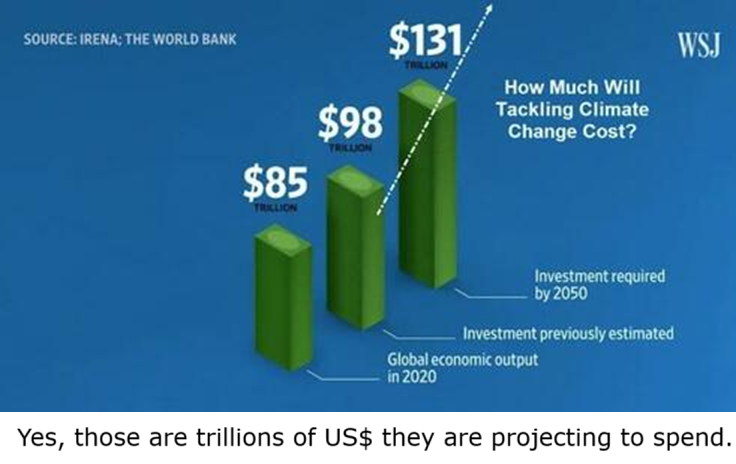
Yes, those are trillions of US$ they want to spend on an imaginary crisis.

By abdicating its founding principles for alleviating global poverty, the World Bank has taken a lead role among multilateral financial institutions in denying vast financial resources to poorer countries. It has hypocritically vetoed the right of developing countries to adopt the path of economic growth and environmental improvement that the now-rich countries had taken up successfully since the Industrial Revolution two centuries ago. The World Bank’s obsessive support for intermittent, low-yield renewable energy such as solar and wind power comes at the cost of its central charter to help the poor, an outcome that can only be described as egregiously unjust.

The UN Intergovernmental Panel on Climate Change

The U.N. IPCC issued a news release on Dec. 6 prior to the start of a “scoping” meeting in Kuala Lumpur of over 230 experts from 70 countries to draft outlines of working group contributions to the U.N. IPCC’s seventh Assessment Report (to be completed in 2029).

In the press release, the IPCC claimed that human combustion of fossil fuels “has resulted in more frequent and more intense extreme weather events that have caused increasingly dangerous impacts on nature and people in every region of the world.” This is contrary to the IPCC’s position hitherto, which is that almost all types of extreme weather events cannot be attributed with confidence to human activity.

The position of the IPCC regarding the lack of any link between climate change and extreme weather events is contrary to the almost daily headlines in the mainstream media attributing specific adverse weather events to “climate change.”

The work of eminent climate policy analysts Steve Koonin and Roger Pielke Jr. has done much to expose the pseudoscientific nature of what has been called “attribution studies.” These typically involve researchers who apply their climate models and historical observations to conclude that any particular weather event (say a hurricane or a drought) was made “more likely” or “more severe” by some magnitude in percentage units due to “human influence” (referring to the combustion of fossil fuels).

Based on the dubious claims of “attribution science,” New York Gov. Kathy Hochul signed a climate law last week that will require companies operating in New York state responsible for large amounts of planet-warming pollution to contribute to climate damage repair efforts. Under the new state law, companies responsible for the bulk of emissions from 2000 to 2018 will be on the hook for some $3 billion a year over the next 25 years.

Koonin cites the World Meteorological Organization that states that “any single event, such as tropical cyclone cannot be attributed to human-induced climate change, given the state of scientific understanding.” The IPCC’s “Special Report on Extreme Events” states that “Many weather and climate extremes are the result of natural climate variability … Even if there were no anthropogenic changes in climate, a wide variety of natural weather and climate extremes would still occur.”

Nonetheless, international organizations such as the World Bank and the IPCC have been increasingly politicized to serve climate hysteria. In this context, Chris Morrison of The Daily Sceptic finds that “[f]ears are growing that the IPCC could water down or even ditch its current finding that almost all types of extreme weather events have little or no sign of past human involvement, or any going forward to 2100.”

International Energy Agency

On Dec. 23, U.S. Sen. John Barrasso, R-Wyo., ranking member of the Senate Committee on Energy and Natural Resources, released a report documenting how the International Energy Agency “has moved away from its energy security mission to become an “energy transition” cheerleader.”

The report finds that “French President [Emmanuel] Macron’s observation that IEA has become the ‘armed wing for implementing the Paris Agreement’ is regrettably true. With the many serious energy security challenges facing the world, however, IEA should not be a partisan cheerleader. What the world needs from IEA—and what it is not receiving now—is sober and unbiased analyses and projections that educate and inform policymakers and investors. IEA needs to remember why it was established and return to its energy security mission.”

The divergence of the IEA away from its original mission to advise policymakers in its member countries with sound analysis of trends in global energy supply and demand to becoming a “cheerleader” for radical net-zero emission policy targets has not gone unnoticed over recent years. I have written on the ideological approach adopted by the IEA in its advocacy for green causes herehere, and here.

When ideological advocacy becomes the measure of achievement for the IEA, the loss of credibility and soundness of its policy advice is only to be expected. The IEA’s messianic fervour for green technologies such as solar and wind power, “green” hydrogen, batteries, and electric vehicles prevents it from asking basic questions.

If it is true that drastically cutting back on fossil fuels is consistent with higher economic growth and increased productive employment, why does the IEA recommend policymakers force countries along “net-zero” pathways? Surely, if replacing fossil fuels with wind and solar energy and electric vehicles promotes growth and employment, then wouldn’t countries such as China and India naturally race toward this best of all possible worlds without expensive green subsidies and punitive anti-fossil fuel policies?

The Trumpian Revolution Looms

Nonprofit organizations reflect the needs of their funding members, and organizations such as the World Bank, IPCC, and IEA are no different. As their funding is primarily from the U.S. and the EU, it is not surprising that they manifest the “climate emergency” predilections of the Biden administration and the largely left-socialist West European governments that see climate change as an existential threat and a national security priority. In taking up the mantle of green advocacy on behalf of their paymasters, these organizations have lost all credibility as independent and objective advisors for their member countries.

The climate-industrial complex fears the prospect of the Trump administration’s pullout of the Paris Agreement for the second time. Politico, a reliable mouthpiece for the climate establishment, expressed these fears soon after Trump’s election victory: “The world is bracing for President-elect Donald Trump to withdraw the U.S. from the Paris climate agreement for the second time—only this time, he could move faster and with less restraint.” In Europe, the emergence of populist parties has been partly propelled by the widespread rejection by EU citizens of the onerous fiscal burdens imposed by green policies.

The seismic change in policy direction that a second term “drill, baby, drill” Trump administration promises for the global climate juggernaut—represented by the three leading international agencies covered here—can only be seen as hopeful as we look forward to positive developments in energy policy in 2025.


Scientific Societies Misstate “Climate Change”

Wallace Manheimer provides examples of the errors needing corrections in his American Thinker article Scientific Societies Err on ‘Climate Change’.  Excerpts in italics with my bolds and added images.

Major scientific organizations’ statements on “climate change” and the conclusions therein form the basis of much of the scientific foundation for governmental, scientific, media, and public concerns on the use of fossil fuels. Trillions of public and private dollars are currently being spent on alternative fuels to “save the planet” from the alleged harm of increasing CO2, a gas which is vital for life on earth. If the evaluations of these societies are erroneous, these measures could impoverish much of the world, to say nothing of wasting trillions. Economic damage and social unrest are already evident in some countries, including the United States.

It is therefore imperative for all that their views be based on sound science,
and if not, these societies should change their statements.

A recent publication and podcast have examined the scientific organization’s climate statements, and have found numerous errors, errors which are easy to find by simply comparing the societies’ statements with data from such reliable sources as NOAA, NASA, and others. These societies are:

♦  American Physical Society (APS),
♦  American Meteorological Society (AMS),
♦  National Academy of Science (NAS),
♦  American Chemical Society (ACS), and
♦  American Geophysical Union (AGU).    

[Manheimer refers to paper Science Societies Climate Statements: Some Concerns]

Here is one example. The AGU states “Greater CO2 concentrations in the atmosphere are also affecting the growth and nutritional value of land plants…” Numerous studies, including measurements of terrestrial plant life from space, and measurements of crop production, have shown that if anything, increasing CO2 has increased both plant life and crop production. After all, CO2 is a vital nutrient for plants, and the slight warming we have experienced, possibly in part due to the increased CO2, has increased the growing seasons in the temperate latitudes.

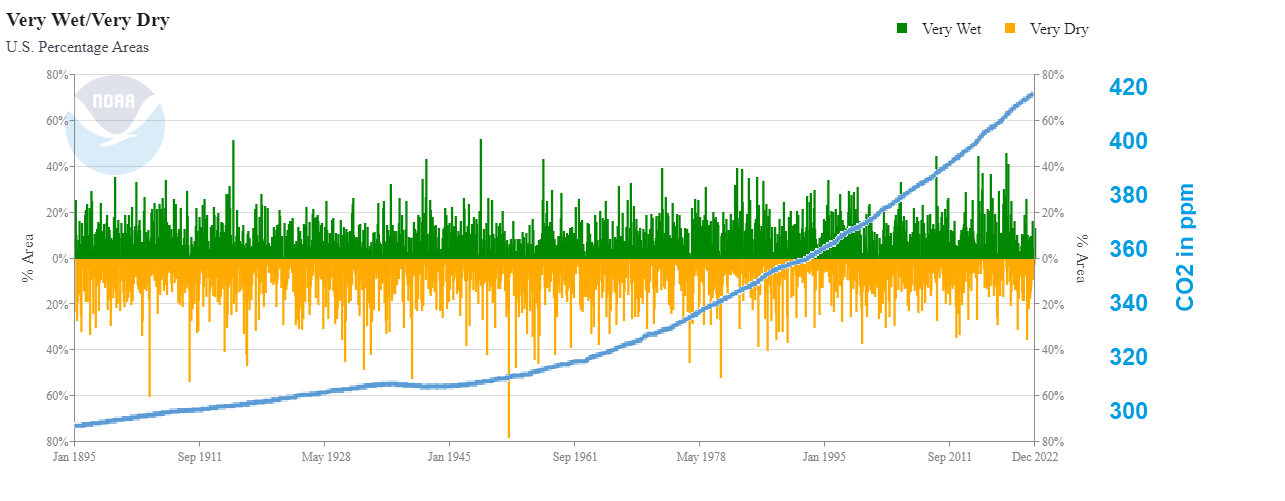
As another example, the ACS statement asserts: “Extreme weather and related events, such as floods, droughts… are increasing in frequency and intensity, threatening Americans’ physical, social, and economic well-being.”. The frequency and intensity of floods and droughts is measured by what is called NOAA’s Palmer drought index and this index is displayed as a graph vs of index versus year. It shows clearly, that in the United States the worst sustained droughts in the U.S. were in the 1930s and 1950s, and the worst sustained floods were in the 1970s through the 1990s.

Tens of thousands of scientists, including over 10,000 with Ph.Ds., have critically examined the evidence, and have concluded that a CO2-induced climate crisis is extremely unlikely. They have willingly and publicly asserted this, by adding their names to document such as, the Oregon petition, Clintel Climate Petition , and the CO2 Coalition. Among other things, the societies should not ignore these, professional conclusions of many of their members.

Accordingly, and with humility, I suggest that these societies do the following:

  1.  Replace their climate statements with ones that say there is most likely an effect humans have on the changing climate, but its importance for humanity is uncertain and it is still being debated.
  2.   Eliminate statements that are demonstrably incorrect, as shown by comparison with easily available and reliable data.
  3. Acknowledge in their statements that fossil fuels cannot be replaced in the next several decades without greatly endangering our civilization.
  4. Acknowledge in their statements that CO2 has obvious obvious benefit for human existence, as well as potential risks.

By changing their statements to ones that are more moderate and scientifically correct, these societies will not only be helping the professions they serve, but more important, will ultimately be aiding humanity. On the other hand, if they keep their statements as they are, they will remain on the wrong side of history, and posterity will not look kindly on them. And posterity may be arriving sooner than they think. With a Republican Congress and President Trump referring to the “green new scam,” these society presidents may find themselves hauled before Congress to receive the university president treatment.

After all, the APS statement says, “Multiple lines of evidence strongly support the finding that anthropogenic greenhouse gases have become the dominant driver of global climate warming observed since the mid-twentieth century.”

    • What will its president say when the congressman puts up a graph showing that for 30 years in the early decades of the 20th century, the warming rate was the same or greater?
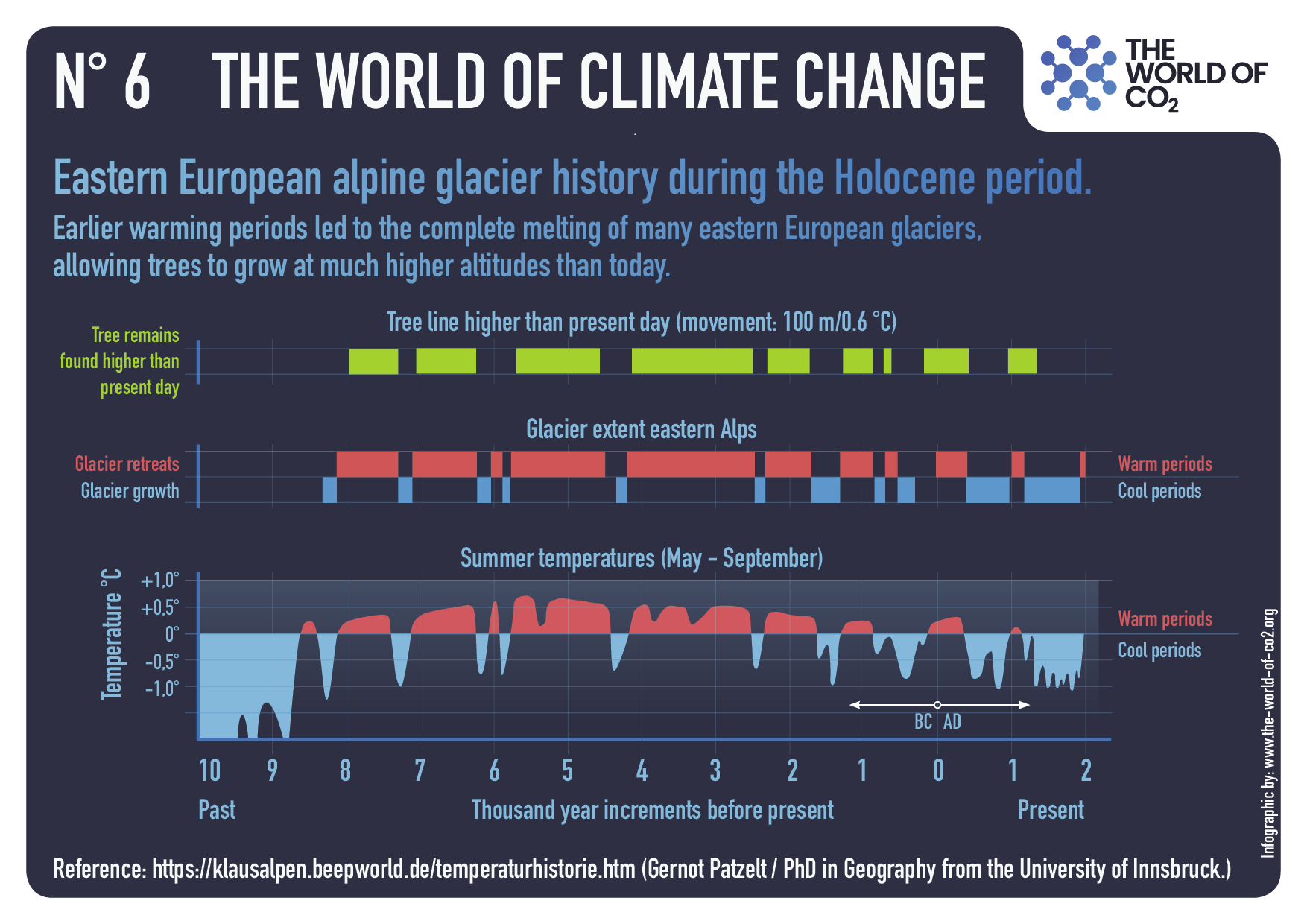
    • Or when he puts up a map proving that the northern forests, 4000 years ago extended about 200 miles further north worldwide than they do today.
    • Or shows that 2000 years ago, the Romans had vineyards in England extending all the way to Hadrian’s wall, millennia before cold weather grapes had been developed.
    • Or when he shows evidence that 1000 years ago the Vikings grew barley in Greenland, something not possible today. Surely this proves that the world had many warmer periods without the help of extra CO2 in the atmosphere.

There are many such statements that Congress can quote, to very publicly humiliate these society presidents. As a committed life fellow of the APS, I hope these societies will change their statements now, before the roof collapses on them.

Background from Richard Lindzen

The above described changes in scientific culture were both the cause and effect of the growth of ‘big science,’ and the concomitant rise in importance of large organizations. However, all such organizations, whether professional societies, research laboratories, advisory bodies (such as the national academies), government departments and agencies (including NASA, NOAA, EPA, NSF, etc.), and even universities are hierarchical structures where positions and policies are determined by small executive councils or even single individuals. This greatly facilitates any conscious effort to politicize science via influence in such bodies where a handful of individuals (often not even scientists) speak on behalf of organizations that include thousands of scientists, and even enforce specific scientific positions and agendas. The temptation to politicize science is overwhelming and longstanding. Public trust in science has always been high, and political organizations have long sought to improve their own credibility by associating their goals with ‘science’ – even if this involves misrepresenting the science.

Professional societies represent a somewhat special case. Originally created to provide a means for communication within professions – organizing meetings and publishing journals – they also provided, in some instances, professional certification, and public outreach. The central offices of such societies were scattered throughout the US, and rarely located in Washington. Increasingly, however, such societies require impressive presences in Washington where they engage in interactions with the federal government. Of course, the nominal interaction involves lobbying for special advantage, but increasingly, the interaction consists in issuing policy and scientific statements on behalf of the society. Such statements, however, hardly represent independent representation of membership positions. For example, the primary spokesman for the American Meteorological Society in Washington is Anthony Socci who is neither an elected official of the AMS nor a contributor to climate science. Rather, he is a former staffer for Al Gore.

Returning to the matter of scientific organizations, we find a variety of patterns of influence. The most obvious to recognize (though frequently kept from public view), consists in prominent individuals within the environmental movement simultaneously holding and using influential positions within the scientific organization. Thus, John Firor long served as administrative director of the National Center for Atmospheric Research in Boulder, Colorado. This position was purely administrative, and Firor did not claim any scientific credentials in the atmospheric sciences at the time I was on the staff of NCAR. However, I noticed that beginning in the 1980’s, Firor was frequently speaking on the dangers of global warming as an expert from NCAR. When Firor died last November, his obituary noted that he had also been Board Chairman at Environmental Defense– a major environmental advocacy group – from 1975-1980 [5].

One could go on at some length with such examples, but a more common form of infiltration consists in simply getting a couple of seats on the council of an organization (or on the advisory panels of government agencies). This is sufficient to veto any statements or decisions that they are opposed to. Eventually, this enables the production of statements supporting their position – if only as a quid pro quo for permitting other business to get done. Sometimes, as in the production of the 1993 report of the NAS, Policy Implications of Global Warming, the environmental activists, having largely gotten their way in the preparation of the report where they were strongly represented as ‘stake holders,’ decided, nonetheless, to issue a minority statement suggesting that the NAS report had not gone ‘far enough.’ The influence of the environmental movement has effectively made support for global warming, not only a core element of political correctness, but also a requirement for the numerous prizes and awards given to scientists. That said, when it comes to professional societies, there is often no need at all for overt infiltration since issues like global warming have become a part of both political correctness and (in the US) partisan politics, and there will usually be council members who are committed in this manner.

Source:  Climate Science: Is it Currently Designed to Answer Questions?

Comment: These bodies all claim to serve society, which as American institutions should primarily be concerned about American society.  Funded by American taxpayers and donors, they should consider first and foremost their own country’s needs.  That means stopping the fuzzy logic and blurring the truth about weather and climate.  Otherwise they must fade into irrelevance.

And they must stop promoting the interests of a few colleagues at the expense of the many ordinary citizens.


Again Wuhan Lab Coverup for Covid Virus Origin. Don’t Buy it!

Today we have a coordinated release globally of a study claiming to disprove the Covid 19 virus came from the Wuhan Institute of Viology (WIV).  An example is the article from the UK so-called Independent ‘Beyond reasonable doubt’ Covid pandemic originated at Wuhan market stall.  Excerpts in italics.

US and French researchers traced coronavirus to one stall in
Wuhan, China after analysing genetic samples

It is beyond “reasonable doubt” that the Covid-19 pandemic originated in a Chinese animal market, a new scientific study has found.

Researchers from the United States and France discovered one stall in Wuhan, China, was a hotspot for coronavirus after analysing hundreds of genetic samples collected by Chinese authorities in 2020.

The analysis, published in Cell, compiled a list of animals including raccoon dogs, masked palm civets, hoary bamboo rats and Malayan porcupines, that were likely to have passed the virus to humans.

“It’s far beyond reasonable doubt that this is how it happened,” Professor Michael Worobey at the University of Arizona told the BBC, noting that other theories involve some “really quite fanciful absurd scenarios”.

Professor Kristian Andersen from Scripps Research in the US, added: “We find a very consistent story in terms of this pointing to the market as being the very likely origin of this particular pandemic.”

Color me skeptical.  Both Worobey and Andersen were carrying Fauci’s water in 2020-21 when he was lying to congress about funding gain of function research at WIV.  Cui Bono from this paper?  China, who destroyed all the evidence in 2020, but now it supposedly appears in 2024.  And Fauci, who enlisted these and other researchers to publish fake studies in various journals to cancel the lab-leak explanation for the covid pandemic.

For a desciption of the malfeasance perpetrated by these charlatans, see this expose by Vanity Fair in 2022 “This Shouldn’t Happen”: Inside the Virus-Hunting Nonprofit at the Center of the Lab-Leak Controversy.

For a level-headed reaction to this latest coverup, here is a comment to the published Worobey et al paper by Alexander Chervonsky Professor of Pathology The University of Chicago.  In italics with my bolds.


How Damaging Are Math Models? Three Strikes Against Them

Tomas Fürst explains the dangers in believing models are reality in his Brownstone article Mathematical Models Are Weapons of Mass Destruction.  Excerpts in italics with my bolds and added images.

Great Wealth Destroyed in Mortgage Crisis by Trusting a Financial Model

In 2007, the total value of an exotic form of financial insurance called Credit Default Swap (CDS) reached $67 trillion. This number exceeded the global GDP in that year by about fifteen percent. In other words – someone in the financial markets made a bet greater than the value of everything produced in the world that year.

What were the guys on Wall Street betting on? If certain boxes of financial pyrotechnics called Collateralized Debt Obligations (CDOs) are going to explode. Betting an amount larger than the world requires a significant degree of certainty on the part of the insurance provider.

What was this certainty supported by?

A magic formula called the Gaussian Copula Model. The CDO boxes contained the mortgages of millions of Americans, and the funny-named model estimated the joint probability that holders of any two randomly selected mortgages would both default on the mortgage.

The key ingredient in this magic formula was the gamma coefficient, which used historical data to estimate the correlation between mortgage default rates in different parts of the United States. This correlation was quite small for most of the 20th century because there was little reason why mortgages in Florida should be somehow connected to mortgages in California or Washington.

But in the summer of 2006, real estate prices across the United States began to fall, and millions of people found themselves owing more for their homes than they were currently worth. In this situation, many Americans rationally decided to default on their mortgage. So, the number of delinquent mortgages increased dramatically, all at once, across the country.

The gamma coefficient in the magic formula jumped from negligible values ​​towards one and the boxes of CDOs exploded all at once. The financiers – who bet the entire planet’s GDP on this not happening – all lost.

This entire bet, in which a few speculators lost the entire planet, was based on a mathematical model that its users mistook for reality. The financial losses they caused were unpayable, so the only option was for the state to pay for them. Of course, the states didn’t exactly have an extra global GDP either, so they did what they usually do – they added these unpayable debts to the long list of unpayable debts they had made before. A single formula, which has barely 40 characters in the ASCII code, dramatically increased the total debt of the “developed” world by tens of percent of GDP. It has probably been the most expensive formula in the history of mankind.
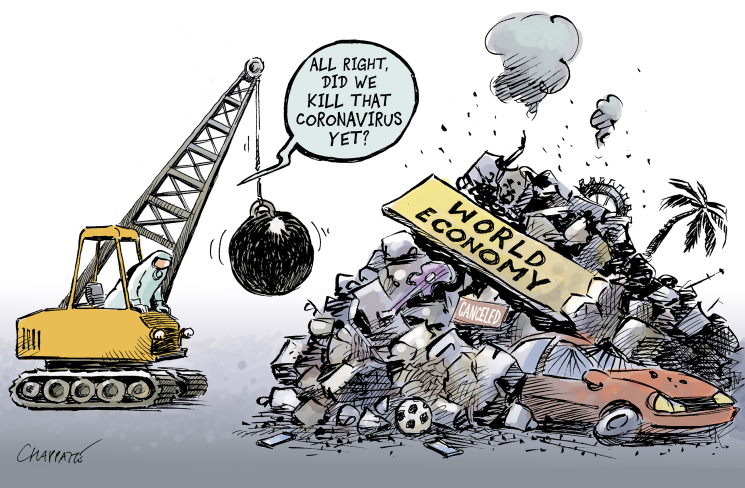
Covid Panic and Social Devastation from Following an Epidemic Model

After this fiasco, one would assume people would start paying more attention to the predictions of various mathematical models. In fact, the opposite happened. In the fall of 2019, a virus began to spread from Wuhan, China, which was named SARS-CoV-2 after its older siblings. His older siblings were pretty nasty, so at the beginning of 2020, the whole world went into a panic mode.

If the infection fatality rate of the new virus was comparable to its older siblings, civilization might really collapse. And exactly at this moment, many dubious academic characters emerged around the world with their pet mathematical models and began spewing wild predictions into the public space.

Journalists went through the predictions, unerringly picked out only the most apocalyptic ones, and began to recite them in a dramatic voice to bewildered politicians. In the subsequent “fight against the virus,” any critical discussion about the nature of mathematical models, their assumptions, validation, the risk of overfitting, and especially the quantification of uncertainty was completely lost.
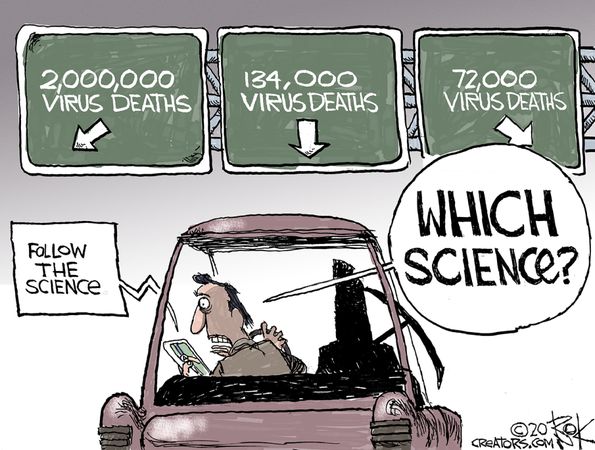
Most of the mathematical models that emerged from academia were more or less complex versions of a naive game called SIR. These three letters stand for Susceptible–Infected–Recovered and come from the beginning of the 20th century, when, thanks to the absence of computers, only the simplest differential equations could be solved. SIR models treat people as colored balls that float in a well-mixed container and bump into each other.

When red (infected) and green (susceptible) balls collide, two reds are produced. Each red (infected) turns black (recovered) after some time and stops noticing the others. And that’s all. The model does not even capture space in any way – there are neither cities nor villages. This completely naive model always produces (at most) one wave of contagion, which subsides over time and disappears forever.

And exactly at this moment, the captains of the coronavirus response made the same mistake as the bankers fifteen years ago: They mistook the model for reality. The “experts” were looking at the model that showed a single wave of infections, but in reality, one wave followed another. Instead of drawing the correct conclusion from this discrepancy between model and reality—that these models are useless—they began to fantasize that reality deviates from the models because of the “effects of the interventions” by which they were “managing” the epidemic. There was talk of “premature relaxation” of the measures and other mostly theological concepts. Understandably, there were many opportunists in academia who rushed forward with fabricated articles about the effect of interventions.

Meanwhile, the virus did its thing, ignoring the mathematical models. Few people noticed, but during the entire epidemic, not a single mathematical model succeeded in predicting (at least approximately) the peak of the current wave or the onset of the next wave.

Unlike Gaussian Copula Models, which – besides having a funny name – worked at least when real estate prices were rising, SIR models had no connection to reality from the very beginning. Later, some of their authors started to retrofit the models to match historical data, thus completely confusing the non-mathematical public, which typically does not distinguish between an ex-post fitted model (where real historical data are nicely matched by adjusting the model parameters) and a true ex-ante prediction for the future. As Yogi Berra would have it: It’s tough to make predictions, especially about the future.

While during the financial crisis, misuse of mathematical models brought mostly economic damage, during the epidemic it was no longer just about money. Based on nonsensical models, all kinds of “measures” were taken that damaged many people’s mental or physical health.

Nevertheless, this global loss of judgment had one positive effect: The awareness of the potential harm of mathematical modelling spread from a few academic offices to wide public circles. While a few years ago the concept of a “mathematical model” was shrouded in religious reverence, after three years of the epidemic, public trust in the ability of “experts” to predict anything went to zero.

Moreover, it wasn’t just the models that failed – a large part of the academic and scientific community also failed. Instead of promoting a cautious and sceptical evidence-based approach, they became cheerleaders for many stupidities the policymakers came forward with. The loss of public trust in the contemporary Science, medicine, and its representatives will probably be the most significant consequence of the epidemic.

Demolishing Modern Civilization Because of Climate Model Predictions

Which brings us to other mathematical models, the consequences of which can be much more destructive than everything we have described so far. These are, of course, climate models. The discussion of “global climate change” can be divided into three parts.

1. The real evolution of temperature on our planet. For the last few decades, we have had reasonably accurate and stable direct measurements from many places on the planet. The further we go into the past, the more we have to rely on various temperature reconstruction methods, and the uncertainty grows. Doubts may also arise as to what temperature is actually the subject of the discussion: Temperature is constantly changing in space and time, and it is very important how the individual measurements are combined into some “global” value. Given that a “global temperature” – however defined – is a manifestation of a complex dynamic system that is far from thermodynamic equilibrium, it is quite impossible for it to be constant. So, there are only two possibilities: At every moment since the formation of planet Earth, “global temperature” was either rising or falling. It is generally agreed that there has been an overall warming during the 20th century, although the geographical differences are significantly greater than is normally acknowledged. A more detailed discussion of this point is not the subject of this essay, as it is not directly related to mathematical models.

2. The hypothesis that increase in CO2 concentration drives increase in global temperature. This is a legitimate scientific hypothesis; however, evidence for the hypothesis involves more mathematical modelling than you might think. Therefore, we will address this point in more detail below.

3. The rationality of the various “measures” that politicians and activists propose to prevent global climate change or at least mitigate its effects. Again, this point is not the focus of this essay, but it is important to note that many of the proposed (and sometimes already implemented) climate change “measures” will have orders of magnitude more dramatic consequences than anything we did during the Covid epidemic. So, with this in mind, let’s see how much mathematical modelling we need to support hypothesis 2.
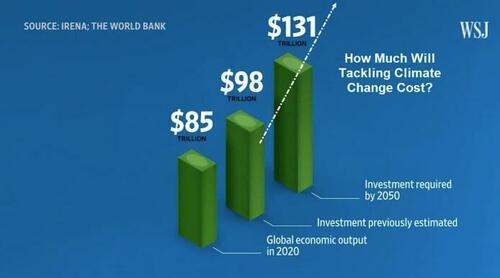
Yes, they are projecting spending more than 100 Trillion US$.

At first glance, there is no need for models because the mechanism by which CO2 heats the planet has been well understood since Joseph Fourier, who first described it. In elementary school textbooks, we draw a picture of a greenhouse with the sun smiling down on it. Short-wave radiation from the sun passes through the glass, heating the interior of the greenhouse, but long-wave radiation (emitted by the heated interior of the greenhouse) cannot escape through the glass, thus keeping the greenhouse warm. Carbon dioxide, dear children, plays a similar role in our atmosphere as the glass in the greenhouse.

This “explanation,” after which the entire greenhouse effect is named, and which we call the “greenhouse effect for kindergarten,” suffers from a small problem: It is completely wrong. The greenhouse keeps warm for a completely different reason. The glass shell prevents convection – warm air cannot rise and carry the heat away. This fact was experimentally verified already at the beginning of the 20th century by building an identical greenhouse but from a material that is transparent to infrared radiation. The difference in temperatures inside the two greenhouses was negligible.

OK, greenhouses are not warm due to greenhouse effect (to appease various fact-checkers, this fact can be found on Wikipedia). But that doesn’t mean that carbon dioxide doesn’t absorb infrared radiation and doesn’t behave in the atmosphere the way we imagined glass in a greenhouse behaved. Carbon dioxide actually does absorb radiation in several wavelength bands. Water vapor, methane, and other gases also have this property. The greenhouse effect (erroneously named after the greenhouse) is a safely proven experimental fact, and without greenhouse gases, the Earth would be considerably colder.

It follows logically that when the concentration of CO2 in the atmosphere increases, the CO2 molecules will capture even more infrared photons, which will therefore not be able to escape into space, and the temperature of the planet will rise further. Most people are satisfied with this explanation and continue to consider the hypothesis from point 2 above as proven. We call this version of the story the “greenhouse effect for philosophical faculties.”
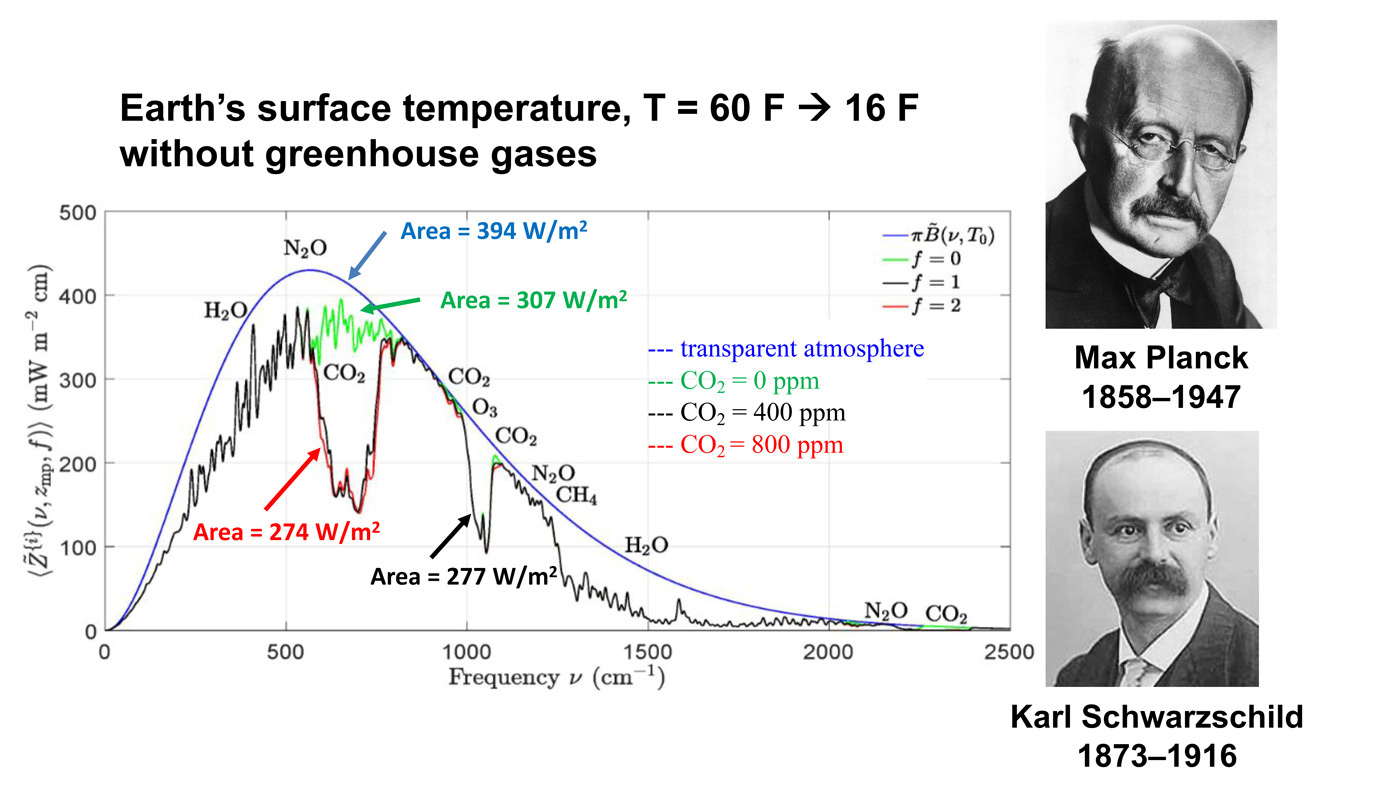
The important point here is the red line. This is what Earth would radiate to space if you were to double the CO2 concentration from today’s value. Right in the middle of these curves, you can see a gap in spectrum. The gap is caused by CO2 absorbing radiation that would otherwise cool the Earth. If you double the amount of CO2, you don’t double the size of that gap. You just go from the black curve to the red curve, and you can barely see the difference.

The problem is, of course, that there is so much carbon dioxide (and other greenhouse gases) in the atmosphere already that no photon with the appropriate frequency has a chance to escape from the atmosphere without being absorbed and re-emitted many times by some greenhouse gas molecule.

A certain increase in the absorption of infrared radiation induced by higher concentration of CO2 can thus only occur at the edges of the respective absorption bands. With this knowledge – which, of course, is not very widespread among politicians and journalists – it is no longer obvious why an increase in the concentration of CO2 should lead to a rise in temperature.

In reality, however, the situation is even more complicated, and it is therefore necessary to come up with another version of the explanation, which we call the “greenhouse effect for science faculties.” This version for adults reads as follows: The process of absorption and re-emission of photons takes place in all layers of the atmosphere, and the atoms of greenhouse gases “pass” photons from one to another until finally one of the photons emitted somewhere in the upper layer of the atmosphere flies off into space. The concentration of greenhouse gases naturally decreases with increasing altitude. So, when we add a little CO2, the altitude from which photons can already escape into space shifts a little higher. And since the higher we go, the colder it is, the photons there emitted carry away less energy, resulting in more energy remaining in the atmosphere, making the planet warmer.

Note that the original version with the smiling sun above the greenhouse got somewhat more complicated. Some people start scratching their heads at this point and wondering if the above explanation is really that clear. When the concentration of CO2 increases, perhaps “cooler” photons escape to space (because the place of their emission moves higher), but won’t more of them escape (because the radius increases)? Shouldn’t there be more warming in the upper atmosphere? Isn’t the temperature inversion important in this explanation? We know that temperature starts to rise again from about 12 kilometers up. Is it really possible to neglect all convection and precipitation in this explanation? We know that these processes transfer enormous amounts of heat. What about positive and negative feedbacks? And so on and so on.

The more you ask, the more you find that the answers are not directly observable but rely on mathematical models. The models contain a number of experimentally (that is, with some error) measured parameters; for example, the spectrum of light absorption in CO2 (and all other greenhouse gases), its dependence on concentration, or a detailed temperature profile of the atmosphere.

This leads us to a radical statement: The hypothesis that an increase in the concentration of carbon dioxide in the atmosphere drives an increase in global temperature is not supported by any easily and comprehensibly explainable physical reasoning that would be clear to a person with an ordinary university education in a technical or natural science field. This hypothesis is ultimately supported by mathematical modelling that more or less accurately captures some of the many complicated processes in the atmosphere.
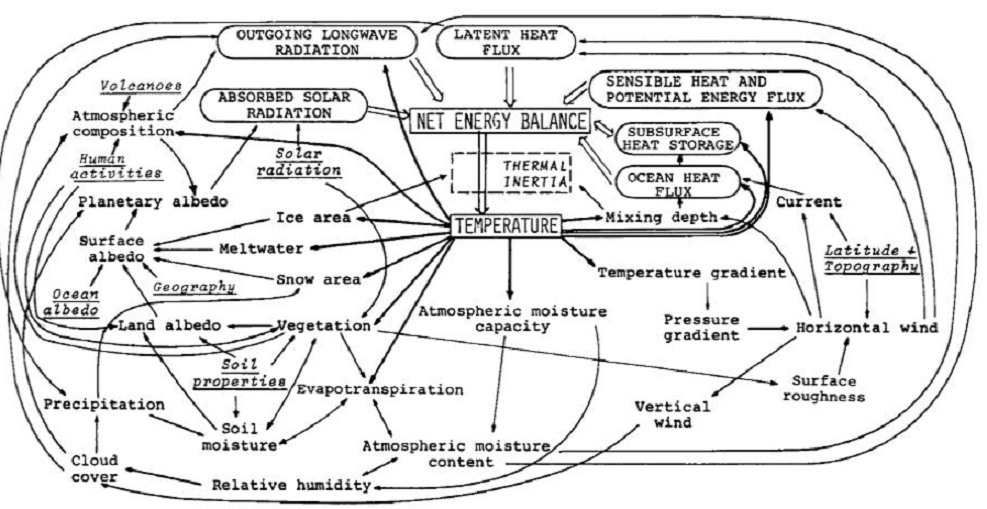
Flows and Feedbacks for Climate Models

However, this casts a completely different light on the whole problem. In the context of the dramatic failures of mathematical modelling in the recent past, the “greenhouse effect” deserves much more attention. We heard the claim that “science is settled” many times during the Covid crisis and many predictions that later turned out to be completely absurd were based on “scientific consensus.”

Almost every important scientific discovery began as a lone voice going against the scientific consensus of that time. Consensus in science does not mean much – science is built on careful falsification of hypotheses using properly conducted experiments and properly evaluated data. The number of past instances of scientific consensus is basically equal to the number of past scientific errors.

Mathematical modelling is a good servant but a bad master. The hypothesis of global climate change caused by the increasing concentration of CO2 in the atmosphere is certainly interesting and plausible. However, it is definitely not an experimental fact, and it is most inappropriate to censor an open and honest professional debate on this topic. If it turns out that mathematical models were – once again – wrong, it may be too late to undo the damage caused in the name of “combating” climate change.

Beware getting sucked into any model, climate or otherwise.

Addendum on Chameleon Models

Chameleon Climate Models
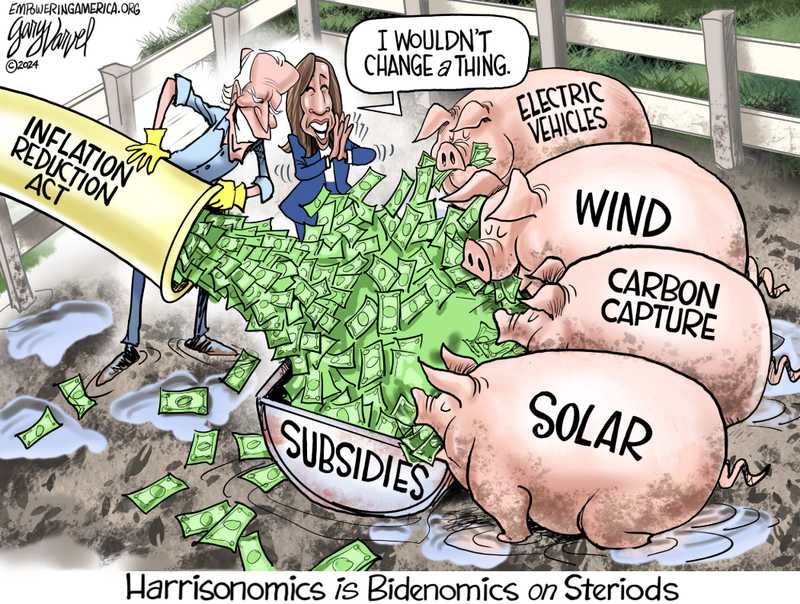
Footnote:  Classic Cartoon on Models