Trump Converts, Running for Pope

h/t Judith Curry

From A-CNN comes this report:

“In shocking news first reported a week ago, businessman Donald Trump has converted to Catholicism and has now declared his candidacy for Pope. Today’s announcement coincides with critical statements Pope Francis made about Mr. Trump not being a Christian. Mr. Trump just held a rally outside of New York City. Although video is not available, A-CNN has just acquired the audio transcript which we are providing below:
Thank you….thank you. You know, when I first started this campaign, people didn’t believe me. First they said, he’s not converting, he’ll never convert. Then I converted. Then they said, he’ll never get baptized, he won’t want the water to mess up his hair. But then I got baptized. Then they said he won’t get confirmed, and I got confirmed. And then they said he’d never run for pope. Well here I am, and I’m running for Pope; and I’m doing very well I must say.

The whole article (here) is a hoot, but here are my favorite parts from the speech “transcript”:

Trump takes Francis to task for ignoring the real problem

You know, it’s a sad thing to say, but the Church is in such bad shape; terrible shape under Francis. The Catholic Church doesn’t win anymore. We just don’t. When is the last time Catholics won anything? Lepanto? When was that, the 1500’s? We don’t win anymore. But, let me just say, Under a Trump papacy, we are going to win again. We are going to win so much. We are going to win so much you are all going to be sick of winning, ok? But right now, it’s terrible. Just the other day, I see the Pope is praising Martin Luther. Martin Luther! Can you believe it?
(Boos)

Our Pope is over there praising Martin Luther; meanwhile millions of Hispanics are converting to Protestantism in Latin America. It’s true. We are losing millions and millions of people to the Protestants and our Pope does nothing. He does nothing. And I have nothing against the Protestants. Many of them are good people. I employ thousands of Protestants. I used to be a Protestant. But their leaders are just too smart for our leaders. We have people in power in the Church today who have no idea what they are doing. They are incompetent. All our leaders do is “dialogue.” We don’t convert anymore, we “dialogue.” What the hell is dialogue? Excuse me, but shouldn’t we be converting these people? If we have the Truth, why aren’t we converting them? But we don’t convert, we “dialogue”, and we lose millions and millions of these people to Protestantism. They are saying if the head of the Catholic Church thinks it’s ok to be Protestant, why convert? Why do we need to convert? Let him convert. Let the Pope convert. That’s what they’re saying. They’re laughing at us. There is no respect there. No respect. When I’m Pope, they are going to respect us again, let me tell you.
(Cheers, applause)

Trump says traditional practices have been abandoned

You ever notice today that all the nuns dress like Hillary? When did that happen? When did nuns start dressing like Hillary? It’s scary. It’s really scary. Anyway, you have some layperson up there and they read the Gospel and say some words and do this and that and then they hand out the Communion that the priest already consecrated. The priest isn’t even there, he just consecrated the hosts. So in other words, he’s disposable. But then they’ll say, but he can hear confessions. He can hear confessions, but who goes to confession? Who goes to confession nowadays? When the Pope says “Who Am I to Judge” who goes to confession?
(Boos)

That is why when I’m Pope we are going to make the priesthood great again.
(Cheers, applause)

We are going to make the priesthood so exclusive. I tell you. So exclusive and so special, you have no idea. We are going to have the best priests, the brightest priests. They will be lining up to enter the seminaries. And the seminaries will be the best seminaries, let me just tell you. No more dopey professors. The seminaries are a mess today, they’re a disgrace. You might as well have Bernie Sanders running our seminaries that’s how bad they are. They’re filled with dopey professors from the 60’s. Their brains are burnt from whatever they smoked. Who knows what they smoked back then, God only knows what they smoked. But they’ll be gone, I promise you, they’ll be gone.
(Cheers, applause)

Trump will make the Mass great again

So anyway, that was my first experience at Mass, folks, and I almost left to tell you the truth. This Mass was bad, I almost left, but then someone told me that this was the “New Mass.” Apparently there was an “Old Mass” and now there is a “New Mass” it’s called the Novus Ordo have you heard of it?
(Boos)

That is apparently what I attended, but I had no idea, I thought it was just the Mass. That it had always been the Mass. But no, this form of the Mass was apparently made up in 1969 by a Pope Paul VI. Sort of like by executive order, if you want to know the truth. He put it in like Obama, even though he had no consensus for it, he puts it in anyway and there you go. Well, I have to tell you folks, under a Trump papacy we are going to repeal and replace the Novus Ordo.
(Wild cheers, applause)

Francis has taken his eye off the ball and follows modern fads

Maybe we go back to Latin. I’m a big fan of the Latin. When we used Latin we were number one. We went to English and now the Muslims outnumber us. They kept Arabic they go to number one, we ditch Latin, we go to number two. I’m just saying. Are there any Trads in the audience? Where are my Trads? Are there any Trads here?
(Cheers, applause)

I have to say that I love the Trads. Under this pope, the Trads get treated like second class citizens. He calls them, what’s the word? “Neo-Pelagians.” “Neo-Pelagians,” you believe that? By the way, why is the Pope always calling us names? He’s always calling us names. He never calls the Muslims names, the Protestants names. But he calls us names. He’s really not a very nice guy in my opinion, ok? He’s actually sort of a nasty guy. Isn’t calling a whole group of Catholics Neo-Pelagians, kind of nasty? And, by the way, did you see the papers today? Today he said I’m not a Christian because I want to build a wall to protect our country’s border? Can you believe it, folks? Just unbelievable.
(Boos)

Trump will keep his focus down to earth

I think we should also maybe build a wall around the Vatican so the pope can’t get on an airplane again, let me tell you. Too many interviews on the airplane. Way too many interviews.
(Cheers, applause)

And isn’t this the pope who’s always talking about the greenhouse gases and the carbon footprint and harming the earth? But yet he keeps flying all over the world on these big 747’s belching all kinds of pollutants all over the place. Why? To give interviews? Do you want your pope flying around giving interviews or making the Church great again? I’d be at the Vatican every day making us win again, let me tell you.

(Cheers, applause)

Uncensored: Canadians View Global Warming

A woman walks past a map showing the elevation of the sea in the last 22 years during the World Climate Change Conference 2015 near Paris. A new study asked 5,000 Canadians their opinions on the cause of climate change. (Stephane Mahe/Reuters)

As a Canadian living near Montreal, I was of course curious about this survey:
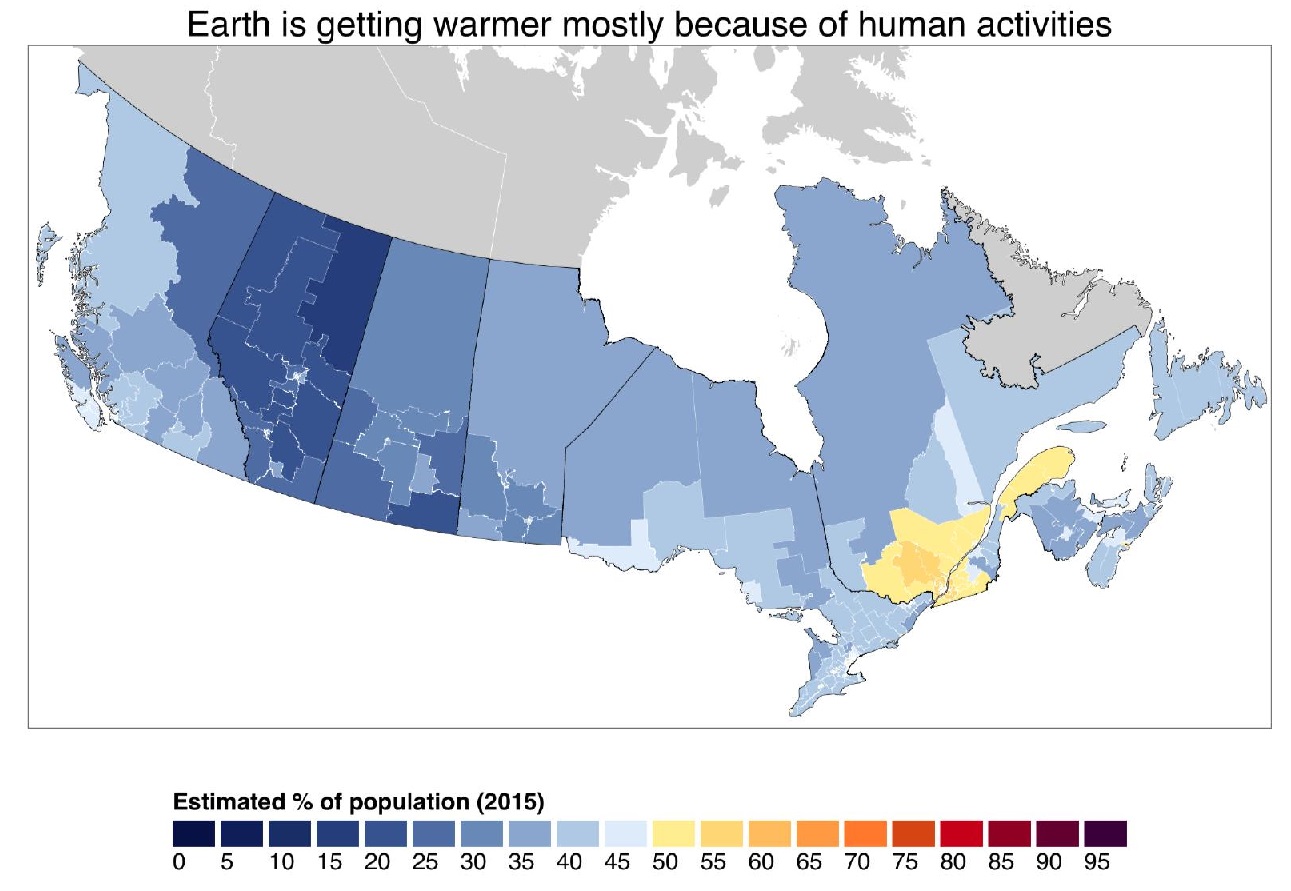
The distribution of climate change public opinion in Canada
Mildenberger et al. 2015 (here)

CBC created some controversy by switching headlines on its report of the findings.
First the title was:
Climate change: Majority of Canadians don’t believe it’s caused by humans
Then it changed to:
Canadians divided over human role in climate change, study suggests

I’m wondering what really was learned from this survey.

What Was Asked and Answered

With any survey, it is important to look at the actual questions asked and answered. While we do not have access to specific responses, the script for the telephone interviews is available. The first two questions asked about global warming (not climate change).

Survey Questionnaire

1. “From what you’ve read and heard, is there solid evidence that the average temperature on earth has been getting warmer over the past four decades?”
Yes
No
Don’t Know (volunteered)

2. [If yes, solid evidence] “Is the earth getting warmer mostly because of human activity such as burning fossil fuels or mostly because of natural patterns in the earth’s environment?”

Human Activity
Natural Patterns
Combination (volunteered)
Not sure / Refused (volunteered)

The finding reported in the Study:

Our results reveal, for the first time, the enormous diversity of Canadian climate and energy opinions at the local level.

At the national level, 79% of Canadians believe climate change is happening but only 44% think climate change is caused mostly by human activities.

So the 79% who said there’s solid evidence of warming the last 40 years got a followup question: mostly caused by human activity or mostly natural? Slightly more than half said mostly human, thus a result of 44% believing both that it is warming and that humans are mostly to blame.

Now some people were unwilling to decide between mostly human and mostly natural, and volunteered that it was a combination. This fraction of respondents was recorded as partially human caused, and they added 17% to bring the number up to 61%. The remaining 39% combines people who don’t accept evidence on warming and those who think warming is mostly natural or are uncertain about both issues.

From having done opinion surveys in the past, I suspect that many who were uncertain between human or natural causes didn’t want to say “don’t know”, and instead said it was a “combination”. Thus the group counted as “partially human-caused” is a soft number.

My suspicions are reinforced by a question that was asked and not included in this report: “How much do you feel you know about global warming?” Typically about 25% say they know a lot, 60% say they know a little, and the rest less than a little. As we know from other researchers more climate knowledge increases skepticism for many, so it is likely the soft number includes many who feel they really don’t know.

This process does determine a survey result about the size of the population who believes warming is happening and mostly caused by humans.  Everything else is subject to interpretation, including how much is due to land use, urbanization or fossil fuel emissions.  The solid finding is displayed in the diagram below:

Canada Survey Mostly HumanYes, the map shows I am living in a hotbed of global warming believers around Montreal; well, it is 55%, as high as it gets in Canada.

Responses on Carbon Pricing
Now consider the script for the last two questions on policy options

3. “There is a proposed system called cap and trade where the government issues permits limiting the amount of greenhouse gases companies can put out. If a company exceeds their limit, they will have to buy more permits. If they don’t use all of their permits, they will be able to sell or trade them to others who exceed their cap. The idea is that companies will find ways to put out less greenhouse gases because that would be cheaper than buying permits.

Do you strongly support, somewhat support, somewhat oppose or strongly oppose this type of system for your province?”

Strongly support
Somewhat support
Somewhat oppose
Strongly oppose
Not sure / Refused (volunteered)

4. “Another way to lower greenhouse gas emissions is to increase taxes on carbon based fuels such as coal, oil, gasoline and natural gas. Do you strongly support, somewhat support, somewhat oppose or strongly oppose this type of system?”

Strongly support
Somewhat support
Somewhat oppose
Strongly oppose
Not sure / Refused (volunteered)

And the finding is (from the report):
Despite this variation in core beliefs about climate change, we find widespread public support for climate policies. Support is greatest and most consistent for emissions trading. . . The overall pattern is clear: there is majority support for emissions trading in every Canadian district.

We find larger variation in support for a carbon tax across the country. At the national level, support for carbon taxation at 49% is just below a majority, with opposition at 44%.

Now here is the underlying motivation for the survey: to determine the level of support in the Canadian population for government action to increase the price of carbon-based energy. Not surprisingly, people who mostly know only a little about this like the sound of companies footing the bill for policies, more than the government raising my taxes. With a little more knowledge they will understand that cap and trade increases the cost of energy within all of the products and services they use, and therefore raises the price of pretty much everything. It is a hidden tax completely without accountability.

I described in some detail how this is already at work in Quebec by virtue of the province joining California’s carbon market: https://rclutz.wordpress.com/2015/04/15/quebec-joins-california-carbon-market/

Conclusion

No one should be surprised that those conducting this survey think they know the correct answers and want the population to agree with them. The sponsors include numerous organizations advocating for carbon pricing:

Thanks to the Social Sciences and Humanities Research Council of Canada, the Fonds de Recherche du Québec – Société et Culture, the Skoll Global Threats Fund, the Energy Foundation, and the Grantham Foundation for the Protection of the Environment for financial support. Funding for individual survey waves was provided by the Ministère des Relations internationales et de la Francophonie, the Public Policy Forum, Sustainable Prosperity, Canada 2020, l’Institut de l’énergie Trottier and la Chaire d’études politiques et économiques américaines.

And as we have seen with virtually all marketing-type surveys, opinion-makers know that conducting surveys is itself an intervention to raise awareness and concern about the issue


Laughing at Climate Change

Update Aug. 26. 2016

I just realized that BBC has blocked the viewing of the video, so I have added the transcript below.

A humorous look at why the global warming campaign and the triumphal Paris COP make sense.

Yes Minister explains it all in an episode from 2013.

h/t to Peter S.

This is an all-too-realistic portrayal of political climatism today.

https://rclutz.wordpress.com/2015/12/26/post-truth-climatism/

Update Aug. 26

Yesterday I realized that BBC had blocked the viewing of the video.  So I sought and found the subtitles for Yes Prime Minister 2013, Episode 6, “A Tsar is Born”.  That final episode for the series began with the dialogue in yesterday’s post Climate Alarms LOL.

Today I provide the dialogue that formed the episode conclusion, and which was the content of the blocked video.

The Characters are:

Sir Humphrey Appleby
Cabinet Secretary

Jim Hacker
Prime Minister

Claire Sutton
Special Policy Adviser

Bernard Woolley
Principal Private Secretary to the Prime Minister

(Dialogue beginning at 20:16 of “A Tsar is Born”)

Humphrey I have returned with the answer to all your problems.
Global warming.

Jim I thought you were against it?

Humphrey Everybody’s against it, Prime Minister.
I suddenly realised that is the beauty of it.
We can get a unanimous agreement with all of our European partners
to do something about it.

Jim But how can we do something about
something that isn’t happening?

Humphrey It’s much easier to solve an
imaginary problem than a real one.

Jim You believe it’s real?

Humphrey Do you? I don’t know.

Jim Neither do I. Haven’t got the faintest idea!

Humphrey But it doesn’t matter what we think.
If everyone else thinks it’s real, they’ll all want to stop it.
So long as it doesn’t cost too much.
So the question now is, what are we going to do about it?

Jim But if it isn’t happening, what can we do about it?

Humphrey Oh, there’s so much we can do, Prime Minister.
We can impose taxes, we can stiffen European rules about
carbon emissions, rubbish disposal.

We can make massive investments in wind turbines.
We can, in fact, Prime Minister, under your leadership, agree to save the world.

Jim Well, I like that!
But Russia, India, China, Brazil, they’ll never cooperate.

Humphrey They don’t have to. We simply ask them to review their emissions policy.

Jim And will they?

Humphrey Yes. And then they’ll decide not to change it.
So we’ll set up a series of international conferences.
Meanwhile, Prime Minister, you can talk about the future of the planet.

Jim Yes.

Humphrey You can look statesmanlike.
And it’ll be 50 years before anybody can possibly prove you’re wrong.
And you can explain away anything you said before by saying the computer models were flawed.

Jim The voters will love me!

Humphrey You’ll have more government expenditure.

Jim Yes. How will we pay for it? We’re broke.

Humphrey We impose a special global warming tax on fuel now,
but we phase in the actual expenditure gradually. Say, over 50 years?
That will get us out of the hole for now.

Bernard The Germans will be pleased.
They have a big green movement.

Claire And we can even get the progs on board!

Bernard As long as they get more benefits than everyone else.

Jim My broadcast is on Sunday morning.

Humphrey You have a day to get the conference to agree.

Jim That’s not a problem.
The delegates will be desperate for something to announce
when they get home.
There is one problem.
Nothing will have actually been achieved.

Humphrey It will sound as though it has.
So people will think it has.
That’s all that matters!

(Later following the BBC interview, beginning 27:34)

Bernard Oh, magnificent, Prime Minister!

Humphrey I think you got away with it, Jim,
but the cabinet will have been pretty surprised.
We’ll have to square them fast.

Jim Bubbles!

Humphrey We’re not there yet.
After that interview, you’ll need to announce some pretty impressive action.

Jim An initiative.

Humphrey Yes.

Claire A working party?

Humphrey Bit lightweight.

Bernard A taskforce?

Humphrey Not sure.

Jim Do we have enough in the kitty?

Claire It could be one of those initiatives that you announce
but never actually spend the money.

Jim Great. Like the one on child poverty.

Bernard Maybe it should be a government committee?

Jim Well what about a Royal Commission?

Humphrey Yes!
It won’t report for three years, and if we put the right people
on it, they’ll never agree about anything important.

Jim Right! A Royal Commission!
No, wait a minute, that makes it sound as if we think
it’s important but not urgent.

Claire Well, what about a Global Warming Tsar?

Jim Fine! Would that do it?

Humphrey No, I think it might need a bit more than that, Prime Minister.
It’ll mean announcing quite a big unit, and an impressive salary for that Tsar,
to show how much importance you place upon him.

Jim No problem. Who would it be?

Humphrey Ah, well, it can’t be a political figure.
That would be too divisive.
It has to be somebody impartial.

Jim You mean a judge?

Humphrey No, somebody from the real world.
Somebody who knows how to operate the levers of power,
to engage the gears of the Whitehall machine,
to drive the engine of government.

Jim That’s quite a tall order.
Anybody got any ideas?

Humphrey… Could you?

Bernard Oh!

Humphrey Yes, Prime Minister.

The End.

Footnote

CO2 hysteria is addictive. Here’s what it does to your brain:

Just say No!


Post-Truth Climatism

This particular realization started by clicking on an article discussing how fact-checking has become irrelevant in today’s politics.
The Limits of Fact-Checking: Calling Trump (and others) out for their lies doesn’t seem to make a difference. What’s going on? (Politico here).

Trump is exhibited as the primary example: the more his comments are rated as lies, even pants-on-fire lies, the more popular he becomes. But other politicians, including Hillary, are also cited for saying false things and refusing to renounce them.

A further analysis by Michael Kinsley ( here) suggests that a candidate or an elected leader and his followers know they are playing a game, and winning depends on having the more compelling narrative, never mind the “truth.” In fact, these falsehoods are not even concerned with any “truth,” they are just making up stuff that sounds good to an audience. In other words, they are not lying, they are bullshitting. Insiders know it and are OK with it, while much of the public is naive and therefore gullible.

As it happens Harry Frankfurt of Princeton gets to the heart of the matter in his provocative essay, On Bullshit, he says:

It is impossible for someone to lie unless he thinks he knows the truth. Producing bullshit requires no such conviction.

Someone who lies and someone who tells the truth are playing on opposite sides, so to speak, in the same game.

The bullshitter ignores these demands altogether. He does not reject the authority of the truth, as the liar does, and oppose himself to it. He pays no attention to it at all. By virtue of this, bullshit is a greater enemy of the truth than lies are.

Now the parallel with climatism is obvious. The Paris COP was striking in the sheer volume of claims that were stated as truths without any attempt to provide proof or even admit the need for any. Climatism is now unconnected to facts, evidence or logical argument. It explains why both political and climate fact-checkers are widely ignored.

Frankfurt warns:

The bullshitter may not deceive us, or even intend to do so, either about the facts or about what he takes the facts to be. What he does necessarily attempt to deceive us about is his enterprise. His only indispensably distinctive characteristic is that in a certain way he misrepresents what he is up to.
This is the crux of the distinction between him and the liar.

I believe Science Matters because actual scientific understanding does inform us about the future and what we need to do to prepare. But in the present environment, bullshitting is the order of the day, and we live in the twilight of Post-Truth discourse.

More from Frankfurt:

The contemporary proliferation of bullshit also has deeper sources, in various forms of skepticism which deny that we can have any reliable access to an objective reality and which therefore reject the possibility of knowing how things truly are. These “anti-realist” doctrines undermine confidence in the value of disinterested efforts to determine what is true and what is false, and even in the intelligibility of the notion of objective inquiry.

For more on the degradation of objective truth (AKA the Revenge of the Humanities) see:

https://rclutz.wordpress.com/2015/11/05/objection-asserting-facts-not-in-evidence/

https://rclutz.wordpress.com/2015/07/06/warmists-and-rococo-marxists/


Talking Climate


One thing revealed by the recent US Senate hearing was the importance of the two basic arguments forming the alarmist position:

1. “Ninety-seven percent of scientists agree: climate change is real, man-made and dangerous.” (Obama tweet)

2. “There are multiple lines of evidence that show the climate system is changing.” (Dept. of the Environment, Australia)

These two zingers must be met by equally brief, pointed replies.

97% Agreement

I concede that most climate scientists think there is a problem, but 97% of all scientists is an exaggeration.

The first claim of 97% came from a survey sample of 77 climate scientists who said “Yes” to 2 statements: “It has warmed since 1850.”; “Human activity has contributed to the warming.” That survey questionnaire was deliberately not sent to those known to be skeptical: scientists not employed by government or universities; astronomers; solar scientists; physicists; meteorologists.

dz97_consensus_myth

More inclusive surveys with more pointed questions show much more diverse opinions. Most scientists agree it has warmed since 1850, the end of the Little Ice Age. Geologists have evidence that the earth was warmer than now during the Medieval Warm Period, more warm during the Roman Warm Period, warmer still in the Minoan period. So the overall trend is a cooling over the last 11,500 years.

Most agree that human land use, such as making dams, farming, building cities, airports and highways, all affect the climate in those locations. The idea that rising CO2 is causing dangerous warming is controversial, with dissenters a large minority.

Multiple Lines of Evidence Climate is Changing

All of the measures are “glass half-empty, glass half-full.” And no one has evidence separating human and natural climate changes.  (Quotes below from Australia Dept. of Environment here)

Example 1: Air Temperatures
Air temperatures have increased globally, by around 0.85 degrees Celsius since 1880, with most of the warming occurring since the 1970s. All three major global surface temperature records show that the Earth’s atmosphere has warmed since 1880.

This is true and unsurprising emerging from the Little Ice Age. Over the last 150 years there has been a steady increase overlaid with a sine wave of 30-year warming and cooling periods.  From 1979 to 1998 the warming coincided with the rising rate of CO2, but the correlation is not seen in the periods before and since those two decades.

Example 2: Sea Levels
Global sea levels have risen at an average rate of 1.8 millimetres per year over 1961 to 2003. This rate risen to around 3.2 millimetres per year from 1993 to 2012.

Sea levels have been rising with the Little Ice Age recovery, and tidal guages show no increase in the rate in recent years. The 3.2 mm comes from the GRACE satellite system which is still being calibrated and not yet reliable, according to researchers.

Example 3: Extreme Weather
Extreme weather events include heatwaves, bushfires, tropical cyclones, cold snaps, extreme rainfall and droughts.  There is increasing evidence that the frequency and intensity of many extreme weather events  are changing.

The number and strength of extreme weather events by any statistical measure have been unusually benign in recent decades. The IPCC concluded that no causal link is proven between warming and extreme weather

Example 4: Rainfall Patterns
Rainfall patterns are changing around the world. Research shows the global water cycle is intensifying with a warming climate, which means wet areas are likely to get wetter and dry regions are likely to be drier in response to climate change.

Global rainfall varies about 5% from one year to another, so if it is drier in one place, it is wetter somewhere else. The IPCC working group said there is currently no way of predicting which places will get more or less rainfall long term.

The other notions of ocean acidification, Arctic Ice melting, etc. are likewise inconclusive and subject to interpretation, as other posts here and elsewhere point out.

Conclusion:

We simply do not know our climate system well enough to predict what will happen. Our ignorance should not be an excuse for fear and irrational actions.

Future periods are likely to be colder as well as warmer, and cold is the greater threat to human life and prosperity. To prepare for the future we should invest in robust infrastructure and ensuring reliable affordable energy. We should also focus on real and present environmental problems such as actual air pollution which kills thousands of people every day.

Animal Farm & Climate Change


Animal Farm2

George Orwell’s Animal Farm is a masterpiece of a simple story suggesting so many realities of societies. Among many things, it shows how a basic dichotomy mobilizes people (or creatures) for social or political action. The image above expresses the heart of the story whereby some animals took power over the others out of fear of humans.

Consider another dichotomy:    Producers Good, Parasites Bad.

Bumper Sticker

Bumper Sticker

People who are astounded by Donald Trump’s candidacy are overlooking how widely and deeply felt is this distinction between those who produce and those who take, and not only in the Tea Party but far beyond. The power arises from the emotional investment in the branding, no matter how illogical or mistaken it may be. Those who don’t feel it, don’t “get it.” Add in the envy of someone so rich he can say anything unbounded by Political Correctness, and Trump becomes a force to be reckoned with. It remains to be seen whether his followers are voters beyond being fans.

As for Climate Change, it seems to me at its heart lie two intertwined dichotomies:
                            Carbon Pollution Bad, Clean Air Good
                         Runaway Warming Bad, Stable Climate Good

The first notion is that carbon dioxide is a pollutant making the air dirty. Since CO2 is neither visible nor toxic (plants depend on it), it requires a second assertion that more CO2 causes runaway warming upsetting the stability of our climate system. That is, by adding CO2 from burning fossil fuels, we are destabilizing the climate system and bad things will happen as a result. Interestingly, at demonstrations the negative side is quite explicit, but the affirmative side requires some interpretation.

Some of us are astounded that sentient carbon-based life forms could be so disparaging of their own composition, but there is more than a whiff of anti-humanity in this movement. And the idea that we humans can fix the climate in a favorable state boggles the mind.

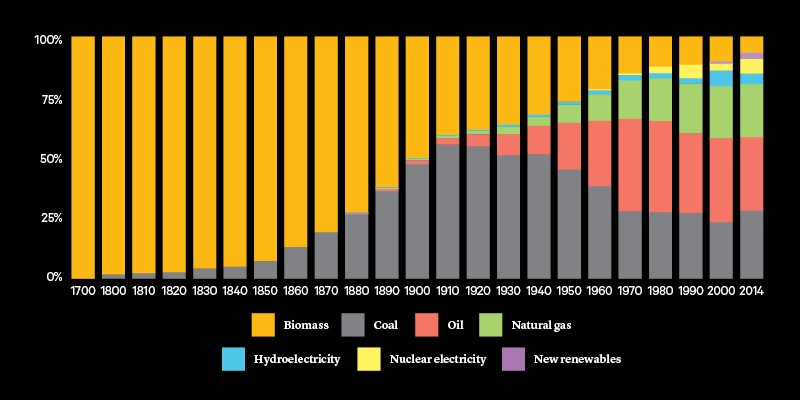
How all this plays out can be seen in an excellent interview with Bill Gates. Of course, he is a very lucid person and a genuine philanthropist of the first order. He has educated himself deeply on the history of energy as shown by this:

Share of Fuels in the Global Energy Mix Across Modern History

Gates goes on to say this:

What’s amazing is how our intense energy usage is one and the same as modern civilization. That is, for all the great things that happened in terms of human lifestyle, life span, and growing food before 1800, civilization didn’t change dramatically until we started using coal in the U.K. in the 1800s. Coal replaced wood. But the wave of wood to coal is about a 50- or 60-year wave.

If it was just about economics, if we had no global warming to think about, the slowly-but-surely pace of these transitions would be okay. If you look at one of these forecasts, they all say about the same thing: What you look at is a picture that’s pretty gradual, with natural gas continuing to gain at the expense of both coal and oil. But, you know, 1-percent-a year-type change. If you look at that from a greenhouse-gas point of view—if you look at forecasts—every single year we’ll be emitting more greenhouse gases than the previous year.

The title of the article is We Need an Energy Miracle because Bill Gates is one who worries about global warming. He has accepted at face value the dichotomies of climate change, and so those blinders shape his investment plans and priorities.

He actually has a lot in common with Bjorn Lomborg, who supports the Gates energy innovation initiative. But Lomborg sees things more clearly (here responding to comments by Arnold Swartzenegger):

Power generation, traffic and industry – which is mostly fossil fuel driven and likely what you were thinking about – in total cause 854,000 air pollution deaths. Added to the 560,000 deaths from indoor air pollution caused by coal, this constitute only 20% of total air pollution deaths or about 3,900 deaths each day.

This matters for two reasons. First, it is disingenuous to link the world’s biggest environmental problem of air pollution to climate. It is a question of poverty (most indoor air pollution) and lack of technology (scrubbing pollution from smokestacks and catalytic converters) – not about global warming and CO₂. Second, costs and benefits matter.[vi] Tackling indoor air pollution turns out to be very cheap and effective, whereas tackling outdoor air pollution is more expensive and less effective. Your favorite policy of cutting CO₂ is of course even more costly and has a tiny effect even in a hundred years.

Conclusion
It is likely that future periods will be both colder and warmer than the present. Preparing for that means investing in robust infrastructure and in reliable affordable energy.

I agree with Lomborg. It’s important to make an energy transition and take the time to do it right. So far we are wasting time and money on the illusion that we can ensure favorable weather by reducing fossil fuel emissions.

Greatest COP OUT Ever

Definition of Cop Out

n. An excuse designed to shirk responsibility;
n. Refers to taking the easy way out of a sticky situation. Placing blame on something else to make things easier for yourself is a cop out

Synonyms: pretense, dodge, pretext, fraud, alibi

Within the thousands of laudatory media reports of the Paris climate agreement, there are frequently embedded paragraphs such as this:

Scientists who closely monitored the talks in Paris said it was not the agreement that humanity really needed. By itself, it will not save the planet. The great ice sheets remain imperiled, the oceans are still rising, forests and reefs are under stress, people are dying by tens of thousands in heatwaves and floods, and the agriculture system that feeds 7 billion human beings is still at risk. here

I was struck by the list of calamities that used to be labeled as “Acts of God.”

Definition of Act of God
n. a natural catastrophe which no one can prevent such as an earthquake, a tidal wave, a volcanic eruption, or a tornado. Acts of God are significant for two reasons: 1) for the havoc and damage they wreak, and 2) because often contracts state that “acts of God” are an excuse for delay or failure to fulfill a commitment or to complete a construction project. Many insurance policies exempt coverage for damage caused by acts of God, which is one time an insurance company gets religion. here

Now insurance companies have been well-served by that excellent cop out. My father-in-law always said insurance policies were like umbrellas that won’t open when it rains. Probably that bit of folk wisdom prompted one insurer to come up with this logo:

What Paris Agreement Means

With the momentous agreement in Paris, there is now a universal cop out for all elected officials at every level of government. Why wouldn’t they all sign up? It’s a get-out-of-accountability card. Because whatever bad thing happens on your watch, it’s the result of “climate change”.

Having a drought in California? The climate did it, caused by everyone burning fossil fuels, so not the government’s fault. Never mind the lack of attention and funding for the water storage infrastructure, including the neglect by first time elected Gov. Jerry Brown of his father’s, Pat Brown’s California Water Project to provide water security. No, in his second mandate, Jerry Brown addresses the problem by setting up a carbon market, so they can sit back and collect indulgences carbon offsets while waiting for El Nino to come through.

Worried about flooding in Florida or New Jersey? Climate change causes it, so everyone is guilty and no one is accountable. Never mind that people foolishly build on flood plains, or on subsiding coastlines, or locate New Orleans below sea level between the Gulf of Mexico and Lake Pontchartrain. If only we reduce our CO2 emissions, these disasters will never happen again.

So I go on? Wildfires in old growth forests where people have built homes so that controlled burning of underbrush is not done. It’s climate change, not bad forestry practices.

No wonder such rejoicing at the conclusion of COP 21. Raise your glasses of kool-aid and recite together the IPCC Creed:

We claim for ourselves the authority,
On behalf of all needy countries,
To collect Other People’s Money,
For a solution that won’t work,
To solve a problem that doesn’t exist.
If we keep the Fear alive,
We will surely meet again and again.

Truly, it is the Greatest COP OUT Ever.

Countries claiming compensation from users of fossil fuels.

A Teenager Looks at Climate Change

Teenager's View

This is a guest post by my grandson, William Desormeaux age 17, consisting of an English translation of his essay in French to fulfill a philosophy class requirement.  The words and thoughts are entirely his own, based on his own research.  I added the images.

For a few decades, many people have given their opinions about climate change. Some are concerned by this phenomenon, while others try to prove that these changes do not actually have impact. The first group can be called warming alarmists and the second warming skeptics. For other individuals who are not part of these groups, the following question arises: Should we act against climate change? In my opinion, alarmists exaggerate much too much on the problems. In fact, the conditions of the Earth have already been worse, humans are not actually responsible for these changes and measured results contain errors.

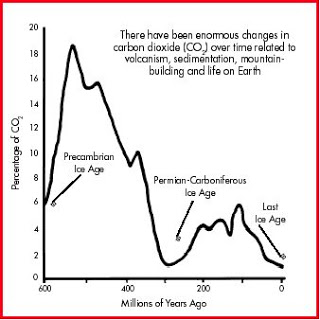
carbon_dioxide

First, I do not believe that we should act against climate change because the situation of the Earth, in respect of carbon dioxide has already been much worse. Indeed, according to Ian Plimer, Professor of geology at the University of Adelaide, several millennia ago, Earth had a rate of carbon dioxide 1000 times higher.1 Carbon dioxide is a greenhouse gas and alarmists say that it is bad for the environment. It is true that it has an impact on our planet. On the other hand, when we look at the statistics of Ian Plimer, we realize that the Earth has already included much more of this gas and survived. Moreover, plant life depends on carbon dioxide and grows bigger and faster in higher concentrations than we have today. In short, although the concentration of greenhouse gases increases, it remains that it has been much higher without damage caused to our planet.

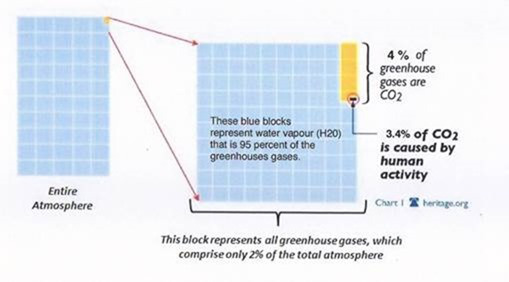
Greenhouse gases diagram

Secondly, in the same vein, I am not convinced that we actually have the possibility of acting against climate change since we are not responsible. Indeed, again according to Ian Plimer, human activities are responsible for only 3% of carbon dioxide emissions in the atmosphere.2 If we take a moment to analyze these figures, we can quickly see that even if we succeed in halving our emission of carbon dioxide in the atmosphere, there would still remain 98.5% of the gas that “pollutes our planet”. Further, I consider that all the sacrifices that we should take just to halve our emissions will do nothing to save the Earth. So, 98.5% means that climate changes are part of a natural cycle, and we shouldn’t be overly preoccupied about this issue.

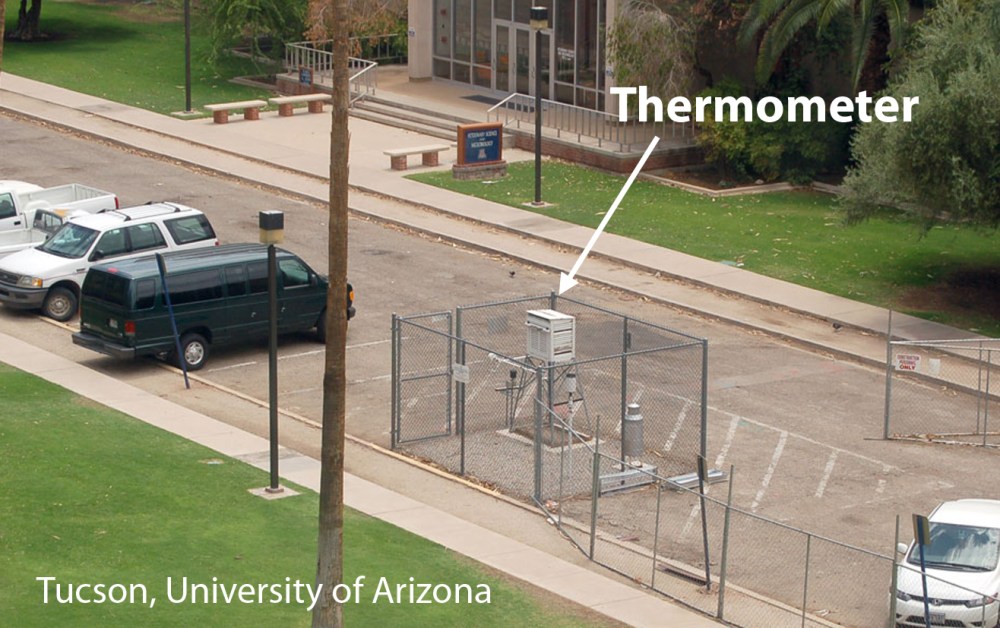
tucson_arizona-labelled

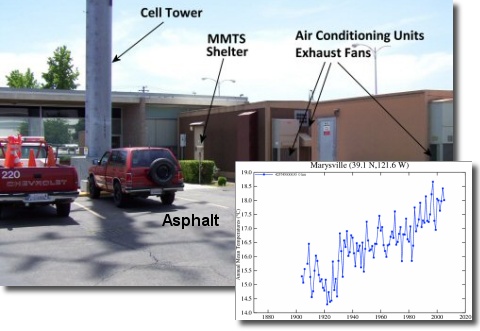
Thirdly, the results recorded by meteorological stations are not completely reliable. Indeed, according to Anthony Watts, Chief Meteorologist of KPAY-AM radio, 89% of stations recording temperatures do not respect National Weather service standards.3 This statistic shows that some results used by alarmists are erroneous. It is easy for people to believe that the temperature is rising when different weather stations do not meet standards. For example, some of these stations have been found in the middle of parking lots, an area where heat is absorbed. So, in this way, the displayed temperatures are higher than they should be. Thus results promoted by alarmists are not typical since there are only 11% of stations that are adequate. Finally, I do not believe that action must be taken against climate change since published temperatures are misleading. In this way, it is easy to make global warming look worse than it is.

marysvilleca_ushcn_site_small

In conclusion, I am convinced that we should not take action against climate change. Several experts like Mr. Plimer and Mr. Anthony Watts have convinced me that these changes have already been worse, that they are not the fault of humans and that they are exaggerated by alarmists due to poor data collection. In addition, I believe skeptics’ thoughts are less taken into account by the population since they are less disclosed by the media. Among other things, it’s much more interesting for them to mention that a phenomenon such as climate warming may disrupt our lives than to share with readers that everything is normal. Finally, although I myself pay attention to my planet, by recycling and taking public transit frequently, I’m not convinced that it is crucial to act against climate change.

1 http://pcc15.org/the-ten-questions/question-1/
2 http://pcc15.org/the-ten-questions/question-1/
3 http://pcc15.org/the-ten-questions/question-10/