Movement for Sensible Climate Policy

Many of us are blogging to draw attention to knowledge and information dismissed or suppressed by legacy and social media as “misinformation”, simply because the thoughts and ideas are rational and reasonable rather than alarmist. Tom Harris reminded me in his recent comment that we have many many colleagues speaking out in the public square sharing our concerns.  So let this post introduce a valuable resource in this fight for reasonable climate understandings and policies, namely CANADIANS FOR  SENSIBLE CLIMATE POLICY Join the Movement for Responsible and Sensible Climate Policy.

The home page summarizes why this mission is important and what is at stake and the path forward.

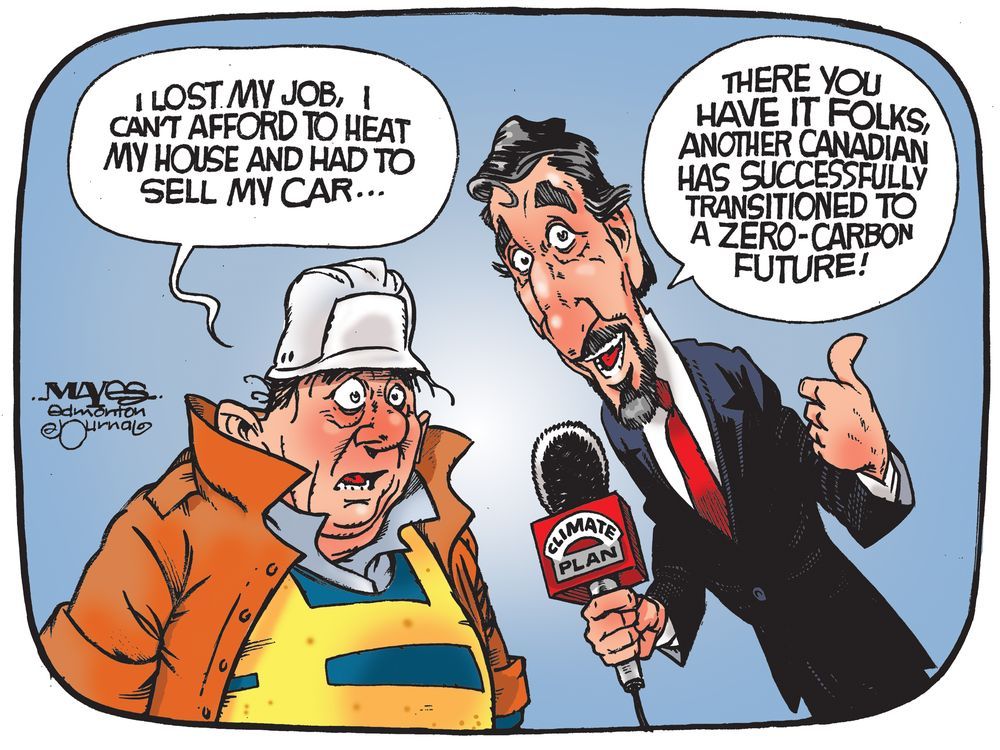
Climate Activism is BIG business

The Green Budget Coalition in 2024 is made up of 21 of the leading Canadian environmental activist organizations publicly lobbying for $287 billion in government spending on their causes.

That is 62% of the total federal tax revenue.

According to public data, in Canada alone these organizations control billions in funds, raise and spend millions on PR campaigns and employ hundreds of staff to achieve these objectives. Globally, the climate activism industry controls trillions of dollars and has armies of advocates. This politicisation of public policy impacts every Canadian.

Even when done with the best intentions, power without oversight isn’t peace, order or good government. To advocate for the best policy, we encourage a range of views, even the controversial ones. We dare to question, to be wrong and to explore all sides of complex issues.

What matters is adopting sober, reasonable and sensible policy in the interests of all Canadians.

Our Concerns

Strange Math

Carbon dioxide gets a lot of attention compared to the many other environmental concerns. Every bad weather event gets assigned to it. The main player in the greenhouse effect remains water and clouds. A changing climate may be unpredictable but that does not mean abnormal.

With prosperity comes costs which must be balanced against the benefits. Strange does not mean unexplainable. Proclamations of doom and crisis are always suspicious.

Odd incentives

Big Oil, corporate interests, corrupt politicians, conspiracy theorists, corporate PR firms and paid skeptics. These are all boogeymen for why, despite general popularity and political backing, there remains a dire crisis with minimal progress.

What if the crisis is exactly because the incentives are designed to perpetuate a cycle? What if the problem isn’t bad intentions or ethics but a social mission over funded to irreverence which needs to be called out as ineffective?

Motivated Reasoning

Motivated reasoning is choosing only the good parts of a story while ignoring the rest because it is what we want to believe. It is quite common in everyday life. When it comes to climate change, calm, pragmatic discussions are rare with many complex and passionate explanations and perspectives.

Those complex explanations may well be accurate, but any analysis of climate change must acknowledge the issue has emotional and personal implications for many Canadians.

Outsourced Problems

When speaking unpopular opinions, one’s intelligence, integrity and ethics will almost always come under fire. When speaking popular opinions rarely is there such scrutiny. It’s human to deeply care for our environment. Why don’t we see the mass implementation of responsible governance, moderation & sustainability? Why so much green washing? Why are 9/10 solutions just shifting our problems into other people’s lands.

Transporting environmental destruction from Canada to Qatar, China or Nigeria is not ethical or effective. If being sustainable was easy or obvious someone would have done it long ago.

Little Accountability

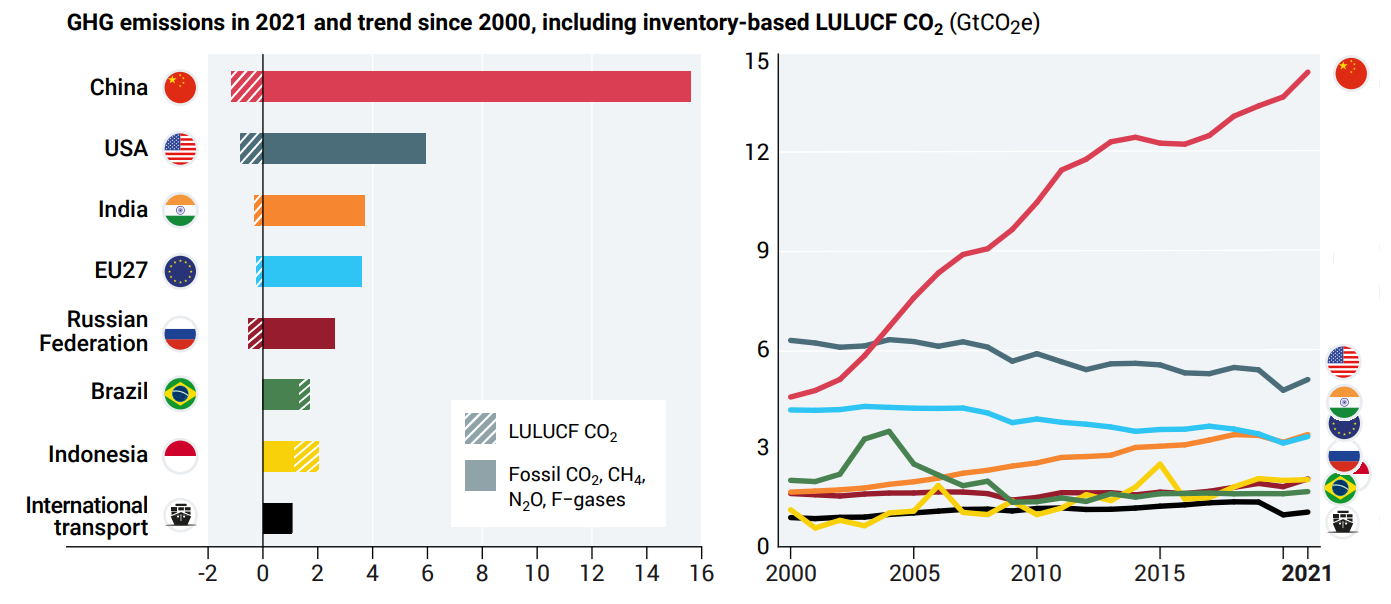
Spending must be within context. Canada is estimated to produce about 2% of the worlds total CO2 emissions with our higher emissions per capita being within expectations for an oil producing nation. Alberta accounts for much of this higher status. The Federal government revenue was $447 billion. A provincial government like Ontario was $179 billion.

A hundred billion or trillion dollar public effort to reduce a rounding error in emissions isn’t just another project, it’s a significant financial commitment with long lasting implications.

Boomers

Your generation has enjoyed a splendid life because of the sacrifices made by your parents during and after WW2. Post war, jobs were easy to find, economies expanded throughout the developed world and Boomers “Never-had-it-so-good.” In retirement your lifestyle was far better than any previous generation enjoyed.

Now, you have a choice, you can either watch economic hardship unfold while passing on huge debts to the next generations or speak up and blow the whistle on the biggest waste of capital the world has ever seen.

Non-Boomers

You are inheritors of a huge debt by the leadership of today. Do you want to spend your life in bad economic times? Do you want your children to live through the same hardships as you stand to inherit? How much time have you invested in thinking about what the Net Zero at 2050 policies cost? Can humans in fact control climate? Is the financial sector pushing that agenda biased? Are the alternative energy jobs long-term or busy-work?

Decide for yourself. Make your thoughts known.

Course Correction

Cost-Benefit Accounting

Alberta and Saskatchewan’s embrace of lower-regulation, pro-petroleum and chemical development is a source of concern to many Canadians. Yet, this comes with benefits to those same groups including massive subsidies to public spending, foreign investment, increased buying power and lowered cost of living in all provinces.

A sensible climate policy transcends politicisation, it works for those who are pro-petroleum or anti-petroleum, left or right wing, those who see increased carbon as beneficial or those seeking net-zero. Sober energy policy improves lives by balancing concerns and offering pragmatic decisions which achieve universal objectives.

Open Discussion

The journalists spread the word and the activists too, the science becomes “settled” and 97% of climate scientists agree. Your life could get a little easier, just don’t listen to skeptics, realists, opponents, the scientists not surveyed, friends, brothers, sisters, cousins, or uncles. An agency will sort the details and inform you of the correct and proper truth.

Never, a sensible climate policy comes from open inquiry, where facts and data are the observations in agreement and the debate is about the meaning and impacts of that data. Experts will breakdown confusion, answer questions and offer clarity.

Prioritize the Everyday Canadian

Climate change policies and activism have a track record of growing budgets, increased powers, and increased access to new technologies and insights. Show us the benefits. Show us the increases in quality of life. Show the practical applications and decreased risks and dangers.

A sensible climate policy is measurable, and though perhaps driven by fear and concern, increased attention and effort means more tangible results.

Maximize Well-being

In cost-benefit analysis, choices are made between conflicting values. Energy and climate policy can be framed as altruists against economics. It can be framed as common good against special interests. It can be framed as differing scientific views.

A sensible climate policy will be driven by maximizing well-being and benefit to society.

Ensure Accountability

Climate policy is often ignored except by special interests. The tale of energy companies against the activists is contradicted by the funding patterns which see energy companies actively funding, hiring and promoting climate change activists. In the energy business “green energy” is just another opportunity.

A sensible climate policy must have checks and balances. Lobbying can benefit everyone in a marketplace of ideas but as a monopoly, everyday Canadians will never be served.

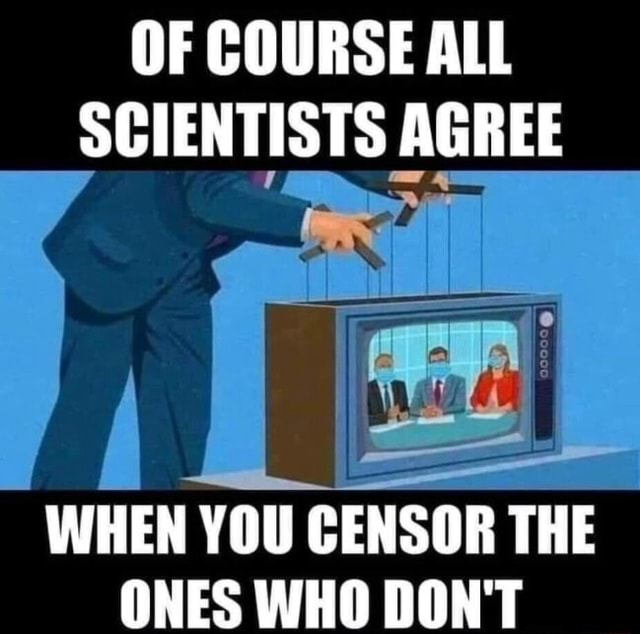
“Misinformation” Means “Shut Up”

Daniel B. Klein reveals the power play currently destroying our civil discourse in his Brownstone article Misinformation is a Word We Use to Shut You Up. Excerpt in italics with my bolds and added images.

Writing at Discourse, published by the Mercatus Center, Martin Gurri describes “disinformation” as follows:

The word means, ‘Shut up, peasant.’ It’s a bullet aimed at killing the conversation. It’s loaded with hostility to reason, evidence, debate and all the stuff that makes our democracy great. (Gurri 2023)

That is from Gurri’s excellent piece, “Disinformation Is the Word I Use When I Want You to Shut Up.” The piece prompted the present essay, the title of which is a variation on his.

With such titles, Gurri and I are being polemical, of course. Not all usages of “disinformation” and “misinformation” come from people intent on shutting someone up. But a lot are. The “anti-misinformation” and “anti-disinformation” projects now afoot or in effect are about shutting up opponents.

In 2019 the Poynter Institute for Media Studies published “A Guide to Anti-misinformation Actions around the World.” There you survey examples of anti-misinformation and anti-disinformation projects and policies, which have no doubt soared further since 2019.

The policing of ‘information’ is the stuff of Naziism, Stalinism, Maoism, and similar anti-liberal regimes. In my title “Misinformation Is a Word We Use to Shut You Up,” anti-liberals are the “We.” To repress criticism of their dicta and diktats, they stamp criticism as “misinformation” or “disinformation.” Those stamps are Orwellian tools that anti-liberals wield in the hope of stamping out Wrongthink—for example, on:

  • climate,
  • election integrity,
  • origins of the Covid virus,
  • therapeutics such as Ivermectin and Hydroxychloroquine,
  • effectiveness of masking,
  • effectiveness of the Covid injections,
  • safety of the Covid injections, and
  • effectiveness of lock-downs.

“Anti-misinformation” could be deployed in keeping with whatever the next THE CURRENT THING might be, with associated slogans against, say, China, Putin, Nord Stream, racists, white supremacists, MAGA Republicans, “deniers,” et cetera. And then, of course, there’s all that “misinformation” disseminated by “conspiracy theorists”.

In speaking of “policing,” I mean government throwing its weight and its coercion around against “misinformation” or “disinformation.” And, besides government coercion, there are allies. These allies often enjoy monopolistic positions, stemming either from government handouts, privileges, and sweetheart deals, as with broadcasters, universities, and pharmaceutical companies, or from having cornered certain network externalities, as with certain huge media platforms. Allies of various sorts sometimes do the bidding of the despots because they themselves are threatened and intimidated. The ecosystem leads to their debasement.

To support governmental policing of “information”
is to confess one’s anti-liberalism and illiberality.

Even worse, it is to flaunt them. The motive is to make and signal commitment to anti-liberalism, in a manner parallel to how religious cults set up rituals and practices for making and signaling commitments (Iannaccone 1992). Vice signals vice, the ticket in some spheres to promotion and advancement.

Also, vicious action spurs more of the same to defend against exposé and accountability for past wrongs. In protecting their rackets, the wrongdoers verge upon a downward spiral.

When despots label opposition “misinformation” or “disinformation” they abuse language. They invoke presuppositions built into the word information, presuppositions that are false. When despots label opposition “mis-” or “disinformation, they are, at best, objecting in the interpretation and judgment dimensions of knowledge, or, at worst, they are speaking in a way that has abandoned civil engagement altogether, instead using words as instruments of wickedness.

Defence offered by Facebook in Stossel defamation lawsuit.

Usually, what people argue fervently over is not information, but interpretations and judgments as to which interpretations to act on. What is being labeled and attacked as “misinformation” is not a matter of true or false information, but of true or false knowledge. The projects and policies now afoot styled “anti-misinformation” and “anti-disinformation” are dishonest, as it should be obvious to all that those projects and policies would, if advanced honestly, be called “anti-falsehood” or “anti-falseness” or “anti-foolishness” or “anti-untruth” campaigns. But to prosecute an “anti-falsehood” campaign would make obvious the true nature of what is afoot: The persecution and silencing of Wrongthink. In misrepresenting matters of interpretation and judgment as one of “misinformation,” they misrepresent the nature of their projects and dodge the responsibility to account for how they judge among vying interpretations.

In ordinary private-sector affairs, outside of politics and outside of
heavily governmentalized affairs, lying at the level of information
is naturally checked and counteracted.

Again, the “information” implies reference to working interpretations. Getting things rights should not be difficult or tricky—issues there are all within the working interpretation. Sure, mistakes are made; but such mistakes are readily and easily corrected.

Liars about information lose the trust of their voluntary associates, whether those voluntary associates are friends, customers, trading partners, or employees. If liars lie about simple features of their products or their services, they could be subject to law suits from their trading partners, to public criticism, and to rival exposé by competitors. In ordinary private-sector affairs, everyone has reputational incentives not to lie systematically, and especially not to lie about information, and most of us have strong moral incentives within ourselves against lying. We dread the disapproval of “the man within the breast”—an expression Adam Smith used for the conscience.

So, you might ask: If private actors without government privileges and immunities scarcely spread false information dishonestly and programmatically, is disinformation really a thing? Before addressing that question directly, let’s turn to the Godzilla of programmatic lying.

Propaganda: Government’s programmatic lies

It is government, especially, that lies programmatically. The lying can be at the level of information, but it usually makes more sense to say that its lying is at the level of interpretation: The government promotes interpretations—for example, The Covid virus came from nature—, interpretations that it, the government, itself does not particularly believe. It lies about the virus having come from nature, as it lies about many other big interpretations. It propagates big lies.

And it lies with confidence. Government is the only player in society that initiates coercion in an institutionalized way. Its coercion is overt. What’s more, it does so on a colossal scale. That is the most essential feature of government. Every government is a Godzilla, and we must learn to live with our Godzilla and mitigate the destruction it wreaks.

The traditional term for government’s programmatic lying is propaganda—a word that once did not necessarily imply falseness (instead meaning simply ideas propagated), but is now generally used in that necessarily-pejorative sense. The falsehoods of propaganda are typically lies, in that the propagandizers usually do not particularly believe the claims they propagate.

Government can lie programmatically because it does not depend on voluntary participation for its support. It subsists on coercion, including restrictions on competitors and opponents, and takings from taxpayers. Organizations in heavily governmentalized settings can also lie programmatically. Crony private-organizations sustain large programmatic lying only when they enjoy privileges, immunities, and protections from the government.

Base humans tend to weaponize things

But aren’t governments accountable to checks and balance, divisions of power, and the rule of law? Haven’t we learned to tame Godzilla, to chain down Leviathan?

It is true that the government of a rule-of-law republic, checked by an honest media, might be quite limited in its programmatic lying. But that’s not how it is today, where dissent is being tarred as “mis-” and “disinformation,” and where the legacy media is morally base in the extreme. Today, regimes are increasingly despotic, and despotic regimes are much less checked and limited.

The rule of law means, first and foremost, the government
living up to the rules posted on its own website.
Governments today don’t do that.

Law is applied politically, that is, with extreme partiality, upon a double-standard. Laws are selectively enforced and punishments are selectively meted out. Despots avail themselves of show trials, kangaroo bodies, and galleries filled with stooges. The “anti-misinformation” agenda is misrule.

Despotism despoils checks and balances. Despotism centralizes power formerly divided. It destroys the independency and autonomy that, theoretically, branches and units, divided and balanced, had once enjoyed. Despotism usurps powers once distributed and balanced. Despotism is unbalanced power.

Under a despotic regime, the coercive institutions unique to government become weaponized by the despots and their allies. They turn them against their opponents. But weaponization is itself always somewhat constrained by cultural norms. The existence of government implies the existence of a governed society, and the existence of society implies the existence of some basic norms, for example against theft, murder, and lying. David Hume famously pointed out that the governed always vastly outnumber the governors, and hence government depends on “opinion”—if only the opinion to acquiesce to those governors.

The contested claims go far beyond information

The despots tend to invoke certain organizations as the definitive, authoritative sources of “information.” They say, in effect: “The CDC, the WHO, the FDA says the mRNA injections are safe and effective, so anything that suggests otherwise is misinformation.” The farce here is pretending that everyone’s working interpretation consists of the dicta of some such particular organization. Never has an organization or agency had such a Mount-Olympus status for determining, throughout society, working interpretations of complex matters, and particularly not an organization with the foul characters and track-records of the CDC, WHO, FDA, and similar highly governmentalized organizations. The similitude to the Soviet Union under Stalin is obvious.

Despotic contempt for our circle of “we”

Again, what is labeled and attacked as “misinformation” or “disinformation” is not a matter of true or false information, but of true or false knowledge. Recognizing that knowledge, not merely information, is at issue is a matter of common decency.

The dignity of sincere discourse involves an openness, in principle a universal openness, to other human “we’s” and their pursuits upward in wisdom and virtue. As we can see, the chief facets of knowledge—information, interpretation, and judgment—operate both behind and ahead of our current position in the spiral. Trying to shut us up is to show a despotic contempt for our way of weaving through the phases of knowledge. It is contemptuous towards the development of the many loops within which our sense-making has made a home and now operates.

By weighing interpretations and making judgments, we establish certain beliefs as fact, to predicate our further conversation. Those beliefs reflect a “we” with those beliefs. Meanwhile, in the wider world, different “we’s” are forming and are addressing the public at large, representing different sets of belief, different ways of making sense of the world. We might call a “we” a distinct sense-making community.

The sincere human of any one of these communities is eager to learn from other communities. The sincere human has certain commitments which make it belong to the sense-making community it belongs to, but it is not wedded to that community. In fact, the entire population of that community—that is, the set of people who currently share that way of sense-making—may remake their community’s way of sense-making. Those who learn from other communities may become leaders of intellectual change within their own community.

Thus, sincere humans favor the freedom of speech and the norms of frank and open discourse for all communities. Besides favoring that freedom, they welcome engagement across communities, for all the reasons given earlier.

The “anti-misinformation” despots show contempt for communities at odds with their dicta and diktats. Not only are the members of the “anti-misinformation” community unwilling to engage in civil debate, but they promulgate “anti-misinformation” propaganda so as to intimidate their adversaries, to crush dissent.

I have explained that the “misinformation” characterization of the disagreement is false. The anti-liberals are presupposing that it is a matter within the information dimension of knowledge, when clearly the disagreement involves contentions in the interpretation and judgment dimensions. Under pretense of combatting misinformation, they are really just stomping on adversaries. As I said at the outset, it is akin to Naziism, Stalinism, and Maoism, regimes that likewise showed despotic contempt for sense-making communities at odds with their own. “Anti-misinformation” projects are a sham, just as “anti-racism” projects are a sham.

Concluding remarks

The “anti-misinformation” projects are obvious miscarriages of civility, decency, and the rule of law. We must rediscover the norms of openness, tolerance, and free speech that dignify humankind. Science depends on confidence, and confidence depends on those liberal norms. Those norms are the parents of good science, healthy sense-making, and civil tranquility. There are two roads here, namely:

    1.  Freedom —> openness —> confidence —> truth-tracking —> dignity;
    2. Despotism —> concealment —> diffidence —> bad science —> serfdom and servility

Let’s get back to the right road.

Energy Realism Marching Ahead

Holman W. Jenkins, Jr. reports at WSJ on observing the Irresistible March of Energy Realism.  Excerpts in italics with my bolds and added images.

The publishing gods have smiled on French energy historian Jean-Baptiste Fressoz. His book, whose U.S. edition is coming out in August, is already getting wide notice. Its French title essentially means “there is no transition.” Mr. Fressoz tells a podcaster he’s even happier with the English title, “More and More and More.”

Energy sources are additive and symbiotic, he writes. Coal, oil, gas,
wood, nuclear and renewables all grew together, they didn’t replace each other.

An increase in coal provided steel piping to enable oil and gas production. More wood than ever was consumed to support British coal mines. The world’s biggest maker of wooden barrels at one time was John D. Rockefeller. A car in the 1930s consumed more coal via its required steel than it would consume in fossil fuels in its lifetime.

In the U.K. today, a single wood-burning electric plant consumes more wood than Britain’s entire 18th-century economy and yet accounts for a small fraction of Britain’s current energy output. The only transition has been to more energy consumption.

As this column has pointed out, subsidies for green energy, adopted globally by the Obama imitators in lieu of carbon taxes, only end up subsidizing more energy use, including copious fossil energy to make batteries, wind turbines and solar panels.

In a blue moon, honest greens will admit as much and argue that when green energy has been sufficiently built up with government aid, the U.S. will lead the nations to introduce carbon taxes.

The faulty assumption here is that phasing out fossil energy will be any easier in 50 years when the world is consuming twice as much energy and half is still fossil energy, producing the same emissions as today. A likelier outcome: When the green subsidies stop, as inevitably they must, the result will be a burst of emissions as the formerly subsidized users shift to fossil energy to stay solvent.

The Trump election poses a special puzzle for domestic U.S. automakers: How much of their $110 billion investment in electric vehicles to write off? In the absence of subsidies and mandates, what’s the natural market for EVs and, importantly, what kind?

The Rube Goldberg effect of U.S. policy has led to heavily subsidized status pieces for high-end consumers, whose large batteries are mainly used to haul around their large batteries.

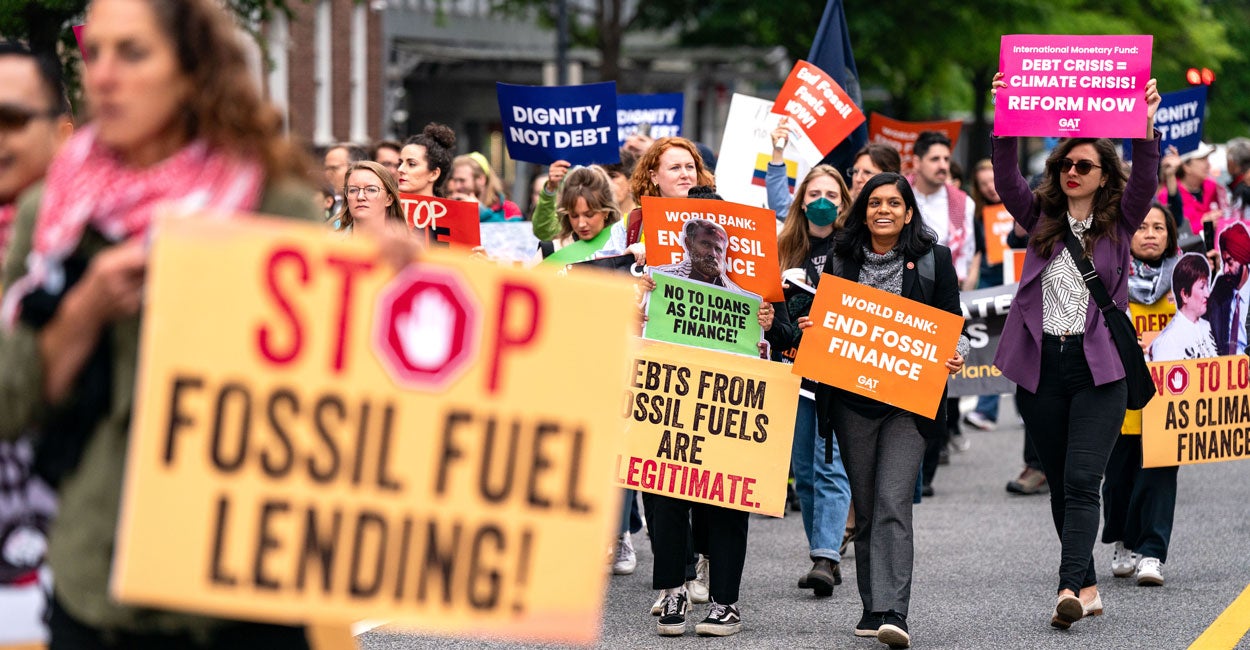
These are net losers for the stated goal of reducing CO2 emissions. Unknowables loom. An Oxfam report finds up to $41 billion in World Bank climate spending, backed by U.S. taxpayers, unaccounted for. This is only the beginning. What happens when voters realize not billions but trillions doled out to the green-energy lobby have had no effect on atmospheric CO2 levels or climate?

Meanwhile, hard to find are detailed climate or emissions projections that don’t effectively assume successful efforts to stabilize warming at the putative 1.5 or 2 degree Celsius levels.


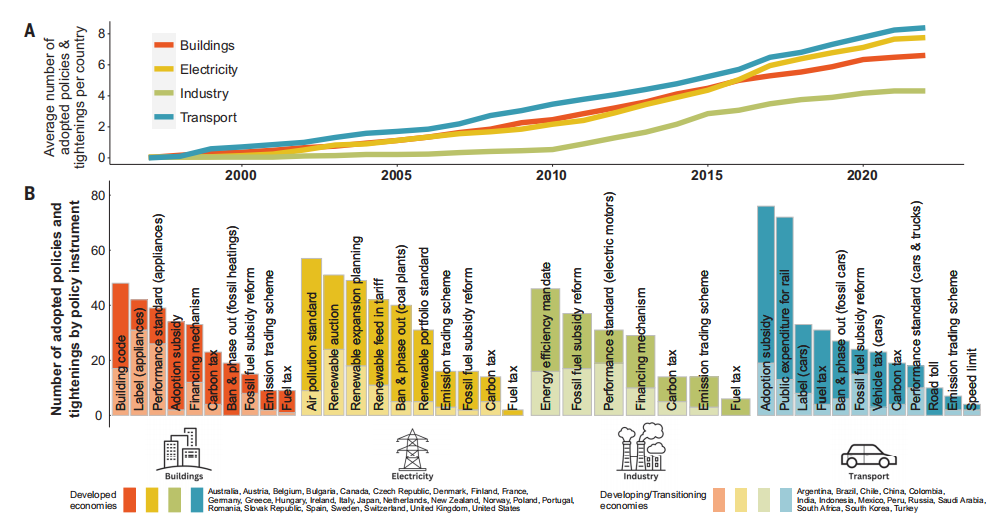
These efforts at stabilization aren’t happening. In the peer-reviewed journal of the American Association for the Advancement of Science, a study finds that of 1,500 “climate” policies announced around the world, a mere 63, or 4%, produce any reduction in emissions.

Mr. Fressoz, in the “Decouple” podcast, delves into the fascinating 1970s. Governments everywhere, along with the oil industry, well recognized the CO2 problem. The British government of Margaret Thatcher realized its emissions were becoming too small a share of the total for reductions to make a difference. A U.S. panel calculated that even a heroic U.S. effort would delay warming only by a few years.

A Chinese representative warned a 1979 conference that by 2000, his country intended to burn more coal than the world’s then-annual total.

Our path—unavoidable adaptation—was laid down long before today’s believer-denier debate, a language effectively developed and deployed to promote climate pork, not meaningful climate action. Last year, by one accounting, global emissions topped 40 billion tons for the first time. I suspect carbon taxes may yet be adopted, albeit for fiscal reasons. Solar geoengineering, using particulates to adjust the amount of sunlight landing on Earth, is probably in the cards at some point.

In Chris Wright, the Liberty Energy CEO, Donald Trump has nominated to head the U.S. Energy Department a determined evangelist for energy realism. This is why I introduced him to readers earlier this year.

Mr. Wright, founder of a fracking services company, believer in climate change, enthusiast for nuclear energy, is the antidote to what Mr. Fressoz calls the “troubling” politics of climate change, which has consisted entirely of false promises.

Mr. Trump isn’t the climate outlier you think. Any U.S. presidential race in the past 40 years was a contest of two versions of doing nothing about climate change. The only difference: Certain versions of doing nothing were a lot more expensive for taxpayers than others.

Energy Realism from Next US Dept. Head

Last year Chris Wright dished out climate and energy realism in an interview on CNBC Squawk Box hosted by Andrew Ross Sorkin.  Now he is to be appointed Secretary of Energy in the coming Trump administration.  Here are his candid and unvarnished views from inside the energy industry.

For those who prefer reading below is a transcript lightly edited from the closed captions in italics with my bolds and added images. AS refers to Sorkin’s questions and CW to responses from Wright.

AS: President Biden conceded last week that the U.S is going to be needing oil and gas for as he says at least the next decade as the country transitions to Renewables. But our next guest says that we are not in the midst of an energy transition and claims the so-called climate crisis is overblown. Last month he railed against what he called an alarmist move away from fossil fuels in a video on LinkedIn. The Microsoft owned company removed the post citing misinformation, only put it back up days later.

So let’s talk right now to Chris Wright–Chairman and CEO of Liberty Energy, North America’s second largest fracking company Chris good morning to you.

Reaction to the State of the Union

AS: Let’s start with your reaction after watching the State of the Union. President Biden makes the statement twice actually. The first time he says we’re going to need fossil fuels for a while. Later he follows up with: We’re going to need it for something like a decade or so. There was laughter in the chamber, certainly from the GOP, but it very well might have been both sides of the aisle at that point.

CW: Yeah, likely it was. Of course it’s great to see an acknowledgment the world run on oil and gas and we need that. But to throw out a decade, it’s just an absurd time frame. We’re not going to meaningfully change the demand for oil and gas one way or the other in the next decade. And I think politicizing energy and opposing infrastructure is standing in the way of Today’s Energy System before we’ve built a new Energy System. There’s just no upside in that.

Realistic timeline for energy

AS: When you think about the timeline, what do you think is a realistic timeline to the degree you think there is one.

CW: It’s multiple, as we’ll talk about that. The Energy Information Administration is our government agency that projects forward demands for varied energy sources, They have in 2050 roughly flat demand for oil and gas as what we have today; maybe it rises a little bit the next decade or two, maybe it comes down a little bit in the next decade or two after that. Maybe that’s true, but I think you’ll see no meaningful change of our hydrocarbon system in the next three decades. I’m all for investing in new energy sources: nuclear has a great future if we could regulatorily issue a permit. We haven’t issued a new permit for a nuclear plant in 50 years.

There’s great new things we can bring; but standing in the way
of what runs the world today just isn’t productive.

Nuclear energy

AS: I’m a big fan but it’s quite unpopular talking about nuclear energy. Usually when I say something on the air it causes some kind of strange firestorm. Do you think there’s any realistic chance we have nuclear energy in the United States in the next decade?

CW: I think probably not in the next decade. Nuclear will have a Renaissance right now, but it more likely starts overseas where there’s a less onerous and less fear-driven regulatory system. I think we’ll see small modular reactors come. What’s great about nuclear is they bring not just electricity which is the only place wind and solar can play. Electricity is less than a quarter of global energy. Process heat that you need for manufacturing is just critical, and nuclear could bring process heat as well as electricity. Today it’s just fossil fuels that bring processed Heat.

SEC disclosure

Rough Seas for Captains of Industry

AS: Chris, I wanted to ask you two big big other questions. One regards the SEC pushing for more disclosure for companies around ESG and and in particular their plans around climate and energy. It
may get softened a bit, in part because of the comments that have come back to them. What is your sense of what the SEC was proposing and where you think they’re going to land?

CW:  Well what they proposed is totally nuts. And I wrote a long comment letter on it. A lot of public company CEOs won’t do that, But it’s just making an enormously complicated expensive reporting thing so people can sue us because they think we didn’t quite properly estimate our scope three emissions. Those are emissions from the products we produce when someone else burns them on the other side of the world or on the other side of the country. No one can really account for that.

Why are they doing that? They’re doing it so this Administration can signal they’re against fuels. Again that’s just unproductive.

LinkedIn censorship

AS: Your LinkedIn post went down tell me what happened. People talk about censorship all the time, who should be the Arbiter of Truth and all of that.

CW: Yeah it was crazy. I made a sort of an amateur video just talking about energy climate transition with just some basic data so you can get background on it. And it was taken down as misinformation. I hit the appeal the decision button, and they came back and said it violated their spams and scams policy.   I posted it again it’s taken down again from misinformation. Then upon appeal they said sorry, on further review it didn’t violate their policy. That’s probably not LinkedIn but people complaining because I’m not talking the climate alarmist narrative. For LinkedIn to go along and take that down is just a symbol of where we are today, unfortunately.

Oil and Gas Industry Productivity

AS: When we finally hit Peak production again, we haven’t yet since 2019. So there’s a lot of finger pointing on why that is. I mean fracking had its own problems when there was a slow period. When we try to reopen from a pandemic we can’t get the workers that we need for the you know for the whole oil and gas industry. But add in ESG and add in President Biden’s pitch: Read my lips, I will end the fossil fuel industry.” How much do you think ESG and that type of of rhetoric scared away producers? Is ESG a positive or negative for society?

AS: I think from an investor movement it’s a negative. Of course we should care about the environment and the societies we operate in. And of course company and government should be aligned with the owners of businesses, that’s a very real point. The other point is of course that’s what businesses do in a free Society. If you’re not a great member of society, if people don’t believe they’re part of something bigger than just getting a paycheck, you’re going to have trouble getting workers.

So the idea is right but it’s really become sort of a top-down thing: if you’re admitting greenhouse gas emissions you’re bad, if you’re reducing them or shrinking your business there you’re good. And then of course a top-down check box list to decide if we’re socially virtuous or not. These are bad ideas. Investors should care about ESG but it shouldn’t be like a third party imposing a scorecard to tell me who’s virtuous and who’s not.

On the on the margin it has indeed reduced Capital to our industry which absolutely raises the cost of capital on the margin. We produce less oil and gas because of it and the main impact of that is higher oil and gas prices.


Washington State Votes Against “Electrify Everything”

Gas stoves are the thin edge of the wedge.


Update November 18, 2024

From the Olympian: WA natural gas measure I-2066 set to pass.

The sponsors of Initiative-2066, the Washington ballot measure that aims to expand access to natural gas in the state, have declared victory as votes have continued to trickle in from last week’s election. Early results showed the ballot measure holding a slim lead, which has slowly grown in the days since the election. As of Monday, Nov. 11, there are 51.64% of votes counted in favor of the measure, compared to 48.36% against it, according to the Secretary of State’s office. With approximately 274,171 votes left to be counted, I-2066 leads by a 112,203 vote margin. In order for the measure to fail, over 70% of the remaining votes would need to go against the initiative, leaving it all-but-guaranteed of a victory.

No on I-2066 has conceded the race, although it’s exploring possible legal challenges to the measure. The campaign claims that I-2066 is misleading, since it implies that Washington has a natural gas ban in place when it doesn’t. Additionally, the campaign said it’s looking into the possibility that the measure violates a section of the state constitution that asserts that “no bill shall embrace more than one subject.”

Results won’t be official until they’re certified by Washington’s 39 counties on Nov. 26 in and are sent to the Secretary of State, who has to certify them by Dec. 5.

Background Post

Megan K. Jacobson explains the fight and what’s at stake at msn A Washington State Revolt Against the Gas-Stove Grabbers.  Excerpts in italics with my bolds and added images.

Environmentalists have waged a campaign against natural gas, but users of this efficient, low-emission fuel are fighting back. A wide range of industry groups are backing Washington state’s Initiative 2066 to protect the right to choose natural gas.

By 2030, Washington is supposed to reduce carbon emissions to 45% below 1990 levels—one of its many overlapping climate goals. The state’s most recent energy plan declares that the cheapest route to meeting Olympia’s climate targets is to switch many uses of oil and gas to electric sources. Last year the Building Code Council amended the state energy code to make it prohibitively costly to install gas appliances in new buildings. In March the Legislature passed a law allowing the state’s largest natural-gas and electricity utility, Puget Sound Energy, to pass the costs of going green onto consumers and mandating the utility files a plan “to achieve all cost-effective electrification of end uses currently served by natural gas.”

To the Washington Hospitality Association and the Building
Industry Association of Washington, Initiative 2066’s cosponsors,
this sounded like an economic wrecking ball.

Anthony Anton, CEO of the hospitality association, says 84% of the restaurateurs he represents rely on natural gas. Remodeling to go electric is a “massive cost at a time where operators just can’t afford it,” he says. Some say the quality of their product would suffer, as some cooking methods, such as stir-frying, are difficult to perform on lower-heat electrical stoves. Most of the association’s members are very small businesses with substantial debt from Covid lockdowns.

The building association worries the new energy code will raise the state’s already high housing costs, locking out potential buyers. The code requires that new buildings meet a certain environmental “score.” Without the points from an electric heat pump, a builder will have to make up the difference with other green measures that run between $15,000 and $20,000 in a single-family home. “Every time they raise the price $1,000, it prices out another 500 Washington families,” says Greg Lane, the association’s executive vice president.

Dozens of varied industry groups support Initiative 2066. Each has its own reasons. The Washington Denturist Association worries about the expense of switching from propane- or gas-based equipment and a lack of reliable power. Most members are small businesses and it’s a good path for immigrant dentists whose credentials don’t carry over to the U.S.

The Washington State Tree Fruit Association (of which my paternal grandfather’s company, Apple King, is a member) is concerned about rising costs of refrigeration to keep produce fresh. A sudden power outage could be catastrophic for the state’s apple industry. Trade regulations for its top two export markets require that fruit be constantly refrigerated at a specific temperature for as long as 90 days.

The state’s cheapest energy plan would almost double electricity demand in Washington by 2050, putting an unprecedented strain on the grid. The only real option is to increase wind and solar generation, since the state’s plentiful hydroelectric capacity can’t do more without potentially threatening salmon. Wind and solar tend to falter in Washington in the winter, when energy demand peaks.

Consumers would also suffer in Washington’s green utopia. Everything from a haircut to a ballgame would become more expensive as the price of electricity rises. Climate advocates argue that Washingtonians will recoup their costs over time thanks to efficiency gains. But a 2021 report from Home Innovation Labs estimates that recovering the cost of a heat-pump installation could take 47 to 49 years. It’s worse for existing gas customers. The Building Industry Association of Washington estimates that switching from natural gas to electricity in a single-family home would cost as much as $70,000. Heat pumps also tend to fail in the sort of frigid weather that hits rural Washington in winter.

Proponents of electrification insist that technology will improve over time. But if they’re really confident that green energy will be the best option for consumers and businesses, then Initiative 2066 is no threat. Washington voters should ask why climate advocates still see it as one.

Trump WH Focuses Energy Governance

Yesterday I posted on Repurposing US Energy Agencies. Today comes the news of Trump announcements consolidating energy governance in a WH National Energy Council chaired by the newly appointed Secretary of the Interior, ND Governor Doug Burgum.  While there is not yet much detail on how this will function, some reports suggest the organizing logic of this approach. This article is from the North Dakota Monitor Trump names North Dakota Gov. Burgum to combined Interior, energy role.  Excerpts in italics with my bolds and added images.

North Dakota Gov. Doug Burgum will serve as Interior secretary and chairman of the newly formed National Energy Council, President-elect Donald Trump announced Friday.

The new council will consist of all departments and agencies involved in the permitting, production, generation, distribution, regulation, transportation of “ALL forms of American Energy,” Trump said in the announcement.

“This Council will oversee the path to U.S. ENERGY DOMINANCE by cutting red tape, enhancing private sector investments across all sectors of the Economy, and by focusing on INNOVATION over longstanding, but totally unnecessary, regulation,” Trump wrote.

Burgum, who is completing his second term as governor, has railed against what he sees as government overreach and bureaucracy under the Biden administration, especially on energy policy. He frequently calls for industry innovation rather than more regulation. Burgum said at an energy industry conference in Bismarck in May:

“We have to turn this around, not just for this industry, not just for North Dakota, but for national security, for peace in the world,”

Trump also said in his statement that his administration will “undo the damage done by the Democrats to our Nation’s Electrical Grid, by dramatically increasing baseload power.”  In addition, Trump said Burgum will have a seat on the National Security Council.

The $18 billion Department of the Interior manages federal natural and cultural resources, with about 70,000 employees.

The department includes 11 agencies: the National Park Service, U.S. Fish and Wildlife Service, U.S. Geological Survey, Office of Surface Mining Reclamation & Enforcement, and the bureaus of Indian Affairs, Indian Education, Land Management, Ocean Energy Management, Reclamation, Safety & Environmental Enforcement, and Trust Funds Administration.

“Serving as Interior Secretary is an opportunity to redefine and improve upon the federal government’s relationship with tribal nations, landowners, mineral developers, outdoor enthusiasts and others, with a focus on maximizing the responsible use of our natural resources with environmental stewardship for the benefit of the American people,” Burgum said.

North Dakota is the nation’s third largest oil producing state, with some of the production coming from federal lands on the Fort Berthold Indian Reservation. North Dakota also has large amounts of coal, wind energy and biofuel production.

When asked Tuesday about the potential for an “energy czar” position, Burgum told North Dakota reporters that the nation needs a more coordinated approach to energy policy.  He said an “energy czar” would be able to do more than a lone Cabinet secretary because other agencies, such as the U.S. Army Corps of Engineers, Environmental Protection Agency and Bureau of Land Management, among others, all affect the nation’s energy policies.

U.S. Sen. Kevin Cramer, R-N.D., acknowledged that some environmentalists will not be happy with the direction the Trump administration’s policies on federal lands. Cramer said having Burgum in that role should ease some concerns.

“Doug’s a good conservationist,” Cramer said. “It’s not a ‘Drill, baby, drill’ attitude, it’s a, ‘Utilize the resources of the federal government for the benefit of the country and its people,’” Cramer told the North Dakota Monitor. “He delivers the message beautifully and I think he can go a long ways in sort of calming people down.”

An article at Politico explores how this structure might function Interior nominee Burgum to head new National Energy Council.  Excerpts in italics with my bolds.

Burgum, a self-made multimillionaire, had been wary of taking on a role of “energy czar,” according to people familiar with his thinking, and instead had sought a position that came with formal power. This role atop the new council will combine the authority of the cabinet position with the broad reach across the top other agencies.

David Goldwyn, chair of the energy advisory group at the Atlantic Council think tank and a former State Department official in the Obama administration, said combining the two roles for Burgum showed how much influence he would have in the administration, but it could also could stretch him across the broad energy portfolio.

The energy council could be a more institutionalized version of initiatives by earlier White Houses to create an all-of-government approach to coordinating policy, but it could also lead to tension between Burgum and other department heads.

“Anytime you establish a policy coordination body at the White House, there will be natural tension with principles in agencies,” Rapidan’s McNally said. “It’s like herding cats a little bit, but it should minimize tensions so you either get to consensus or tee up pros and cons for the president to make a decision.”

The dual role idea won plaudits from North Dakota GOP Sen. Kevin Cramer, a Burgum ally, who said he had been wary of limiting him to a czar position.  “But when you have a council made up of confirmed people and one of those confirmed people heads it, … it’s a brilliant idea,” Cramer said. “There is a synergy you gain by organizing it this way that you don’t get if you have a bunch of silos.”

Trump has made clear that a focus of his second administration would be to complete permitting reform that has struggled to gain bipartisan traction in Congress during the Biden administration. Fossil fuel companies and renewable energy companies alike have complained that critical infrastructure they need to get fuel and electricity to market takes too long to win federal approval.


Repurposing US Energy Agencies


Mark Krebs writes at Master Resource DOE Efficiency Standards: Consumer Time? Excerpts in italics with my bolds and added images.

“The Deep State is cancer-like in nature. Like cancer, it must be rooted out before it metastasizes—as it would have if subject to another four years of a Harris (Obama 4.0?) Administration.”

“It’s time to go big. Scrap DOE and part-out whatever missions are worth saving.  And whatever missions are deemed worth saving should be saved only with thorough scrutiny of zero-based budgeting.”

Our March 2017 post, DOE’s EERE: Reform Ideas for Secretary Perry, stated that while “a trace of consumer focus still exists,” the department’s heavy bias was towards society-wide electrification under the guise of “Net Zero”.

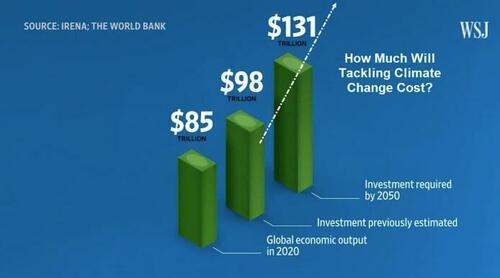
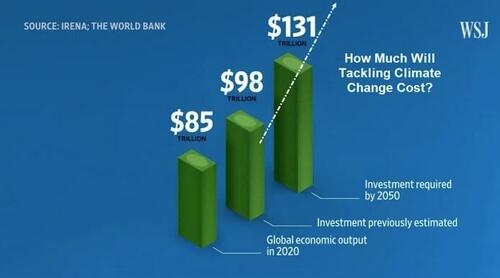
Whatever trace of consumer focus may be remaining within DOE is not worth salvaging. In fact, eliminating the pipe dream of an all-electric society would likely save US citizens $18 to 29 trillion in capital costs alone. Other analysts have estimated far higher cost inflation, while others conclude that total electrification cannot be accomplished at any cost.

Real Reform Opportunity

The incoming Administration can and should do far more than just trim back the overgrown greenery; it should serve the legitimate interests of the American citizenry and American prosperity. However. details in our previous recommendations (EERE Reform: Brouillette’s Turn (‘deep decarbonization’ threat still alive)), are worth reviewing by the incoming Trump Administration if for no other reason than to document historical mistakes and avoid them going forward. Regardless, our old recommendations are no longer sufficiently ambitious in terms of best serving the American public and drastically reducing the National Debt’s deadly inflation.

But how should we move forward for “deep reform” versus the meager results from before? After all, the incoming Trump 2.0 Administration much better understands the depth and breadth of the Deep State and its joined-at-the-hip “Uniparty” cohorts. The options range from modest “reform” to scrapping DOE and parting out its truly vital missions to other Federal agencies or private sector competition.

Given we the people hold the House, and lead the Senate, this is a unique opportunity that must be exploited to the full extent feasible. After all, the world has fundamentally changed since DOE was formed to address certain issues: low supplies and scarcity, coupled with cartel behavior by foreign actors. Today we have robust supplies that mainly just need regulatory relief.

Deep State Foe

Clausewitz was all about winning. If Trump is too (he is), rearranging DOE’s “deck chairs” is just a short step across a large chasm. The Deep State cancer would likely just go into a four-year remission only to return with a vengeance with a return of another Democrat Administration down the road someday.

Ultimately, the choice comes down to serving the Deep State/Uniparty or serving the legitimate best interests of “we the people.” There is no “live and let live” middle ground as the present Biden (mis)Administration has abundantly demonstrated in words and deeds. Nor is there sufficient funding for “all electric” or even “all the above” energy policies.

Appliances Just the Thin Edge of the Wedge

We can’t afford the self-indulgence of environmental virtue signaling.  We need only to pursue energy policies that objectively and comprehensively focus on economic least-cost planning (and bidding) so we can avoid the looming reality of economic collapse. And yes, there is still room for objective energy efficiency; if it is market-based (as opposed to “big brother” dictates to throw money at an illusionary problem). There is even room for least-cost environmental progress. As RFK Jr. knows, soil regeneration is one of these.

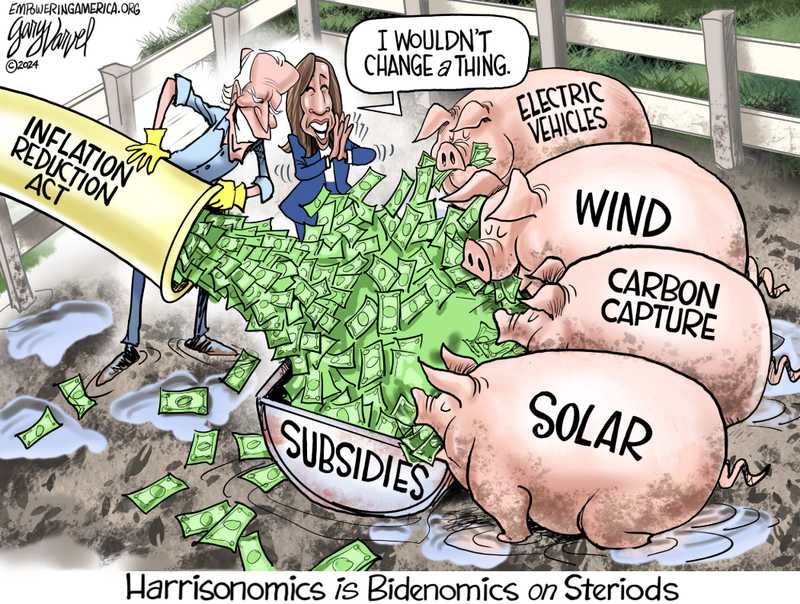
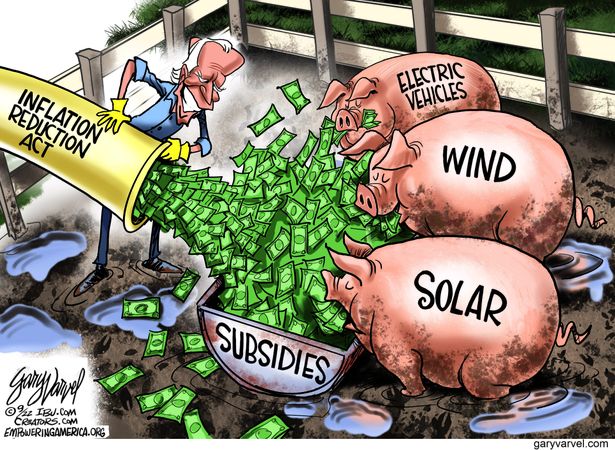
It is imperative that the Trump 2.0 Administration achieve and demonstrate tangible and substantial results for energy consumers as soon as possible. Immediate actions should include clawing back the tragic Inflation Reduction Act, an all-you-can eat funding buffet for a myriad of parasitic “clean energy” zealots. These zealots have already received enough (unwitting taxpayer) IRA funding to plague “we the people” for decades to come.

The most efficient tactic (but not necessarily easiest) would be to simply eliminate DOE departments that oversee such funding. And along with that, repeal equally corrupted legislation that authorized DOE’s regulatory mission creep, such as the obsolete Energy Policy and Conservation Act of 1975 (EPCA) and self-serving, loophole riddled revisions thereof.

In short and in closing, DOE is not worth trying to salvage, because its cancer culture is immune to modest political reforms and intervention. Thus, like a junk car, part out what can be safely and economically salvaged and eliminate the rest. Assuming control of the House and Senate, this is, for the first time, entirely doable; given the will to persevere. So let’s declare victory over the gas lines of the 1970s and move on to overcoming House and Senate resistance for dramatically reducing the economic threatening cholesterol of excessive spending.

Addendum 1

In the spirit of the quote above, government needs structuring to safeguard the evidence (data, research) from predetermined policy ends and tunnel vision.  One suggestion in this direction was ignored but deserves consideration.  Dexter Wright wrote at American Thinker How to Abolish the Department of Energy.  Excerpts in italics with my bolds and added images.

It has been said by almost every conservative candidate running for office this year that they would like to abolish the Jimmy Carter government legacy, the Department of Energy (DOE). Back in the 1970s when the Department of Energy was created the Carter Administration claimed that 20% of the nation’s energy needs would be supplied by solar energy by the year 2000. Needless to say that didn’t happen. So today we have a Department of Energy that provides energy to no one.

The question is how can we get rid of the DOE? The answer lies in the history of the U.S. Coast Guard. The Coast Guard is made up of the best parts of three different services that no longer exist; the Revenue Cutter Service, the Light House Service, and the Life Saving Service. These services were combined efficiently to create the modern Coast Guard.

Similarly, there are activities that operate within the DOE that are worthy of preserving such as the national laboratories at Los Alamos, NM; Oak Ridge, TN and Sandia National Laboratory in Albuquerque, NM. These National Laboratories perform scientific tasks that are not only vital to national security but also, in some cases, are mandated by arms reductions treaties.

There are also activities within other departments and agencies that focus on science such as the National Weather Service (NWS); but for some reason, the Weather Service is stuck in the Department of Commerce (DOC). Contrary to popular belief we do need the Weather Service because all of the data that is collected and analyzed by NWS is then distributed to the media for their broadcast and dissemination.  But it is clear that the NWS does not need to be in the Department of Commerce.

Believe it or not, even the Environmental Protection Agency (EPA) does scientific work, it just doesn’t use the data that is collected and analyze for policy development. I’m not really sure what it does with the data other than suppress it.

The way to deal a death blow to all of these departments and agencies is to
cull out of these bureaucracies all of the useful scientific parts and place
them in a new department, the Department of Science and Technology.

This new department would eliminate the need for the EPA, the DOC and the DOE. Even agencies like NASA could be included so that there would be cabinet level representation and so that rocket scientists would not be relegated to teaching math to third world nations.  Ideally the new Department of Science and Technology would provide unbiased data for policy makers to ignore rather than the biased flawed data that they ignore now.

Addendum 2

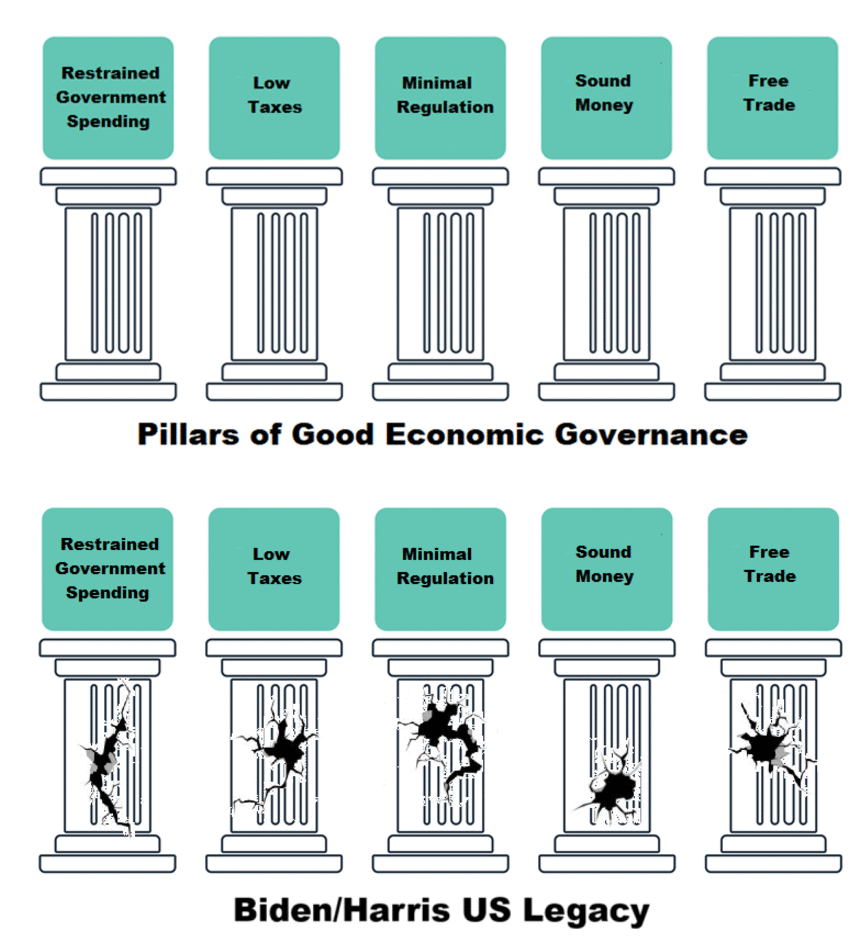
The scope of reform goes far beyond energy agencies, since the Biden/Harris regime dictated a “whole of government” response, embedding fear of CO2 into the full slate of programs. And thereby, the enormous deficit spending covered by freshly printed money threatens the economic viability of the republic.  So the consolidating and downsizing of the whole governmental beast is required. Jeffrey Tucker of Brownstone Institute writes  A Plan to Tame Inflation.  Excerpts in italics with my bolds and added images.

Elon Musk summarizes: “The excess government spending is what causes inflation! ALL government spending is taxation. This is a very important concept to appreciate. It is either direct taxation, like income tax, or indirect via inflation due to increasing the money supply.”

Inflation is a wicked beast that cannot be controlled directly. On the campaign trail, Trump spoke often about how it was the throttling of the energy sector that kicked off inflation. That is only partially true in the sense that the soaring price of oil and gas grew the costs of transportation. It was also a symptom rather than a cause. Plus, the price of oil and gas is actually not high right now in real terms.

Yes, the plan of “drill baby drill” is necessary and should happen but it cannot fix the existing problem of inflation much less do much to forestall a second wave. Nor is there a viable fix in the idea of price control, even when it is masked as “anti-gouging” legislation.  There is nothing government can do to directly control prices, much less force them from going up given the deep structural problems.

There are ways to mitigate against the problem, or at least minimizing them. You can have a look at how Javier Milei did it in Argentina. He took the problem of massive hyperinflation and converted it to low inflation in a year. His is a case study. The answer is:

♦  End debt creation by dramatic spending cuts;

♦  Curb the actions of the central bank; and

♦  Inspire economic growth through deregulation and agency elimination.

First, the end of debt creation is essential. Every time Congress authorizes more spending than is in the bank, the Treasury has to float debt to make it happen. That is the statutory obligation. What that means is that Congress needs to pass a balanced budget, ideally right away.

That comes down to the commission created by Elon Musk: the Department of Government Efficiency or DOGE. It is not an official department. It works as an outside advisory team. That’s excellent. They will likely push for a “Twitter-style” solution of firing 4 in 5 government workers to reduce costs directly.

That’s a start but it is not enough. There also must be sweeping elimination of agencies, each of which can save tens of billions and possibly a trillion or more in total. That needs to happen immediately. It can happen through executive order or through legislation. One way or another, the spending in excess of revenue has to stop.

Second, if the Treasury stops the T-bill tsunami, the Fed will not be called upon to sponge up the excess with money creation. You can look at the charts over the last year and see how the Biden/Harris administration was spending and working with the Fed to promote more economic illusion going into the election. That was the whole point of the rate cuts. That really must come to an end. 

Third, Trump needs to fire up the wealth-creation engine of the American economy through dramatic, sweeping, historic levels of regulation torching plus the shock and awe of full agency elimination, same as in Argentina. The Trump team needs a list of 100 agencies to eliminate immediately but that should just be a start. Another 100 should be on the chopping block. Without all the regulatory clogging that they cause, investment will soar. 
Tax cuts–income and capital–will assist here too. The crucial point is the focus on boosting supply and jobs as a way of outrunning inflationary forces. Here again, the financial press will scream about the economy “overheating” but that metaphor is worn out. The effect of economic growth on inflation is exactly the opposite. Economic growth can bury the effects of price increases. 
There is not a lot of time, and it is a bargain that the Trump administration will surely lose if it does not act decisively and quickly. The debt creation and money creation must end and the economic growth through agency elimination and deregulation must become the top priority. All of this has the added advantage of making Trump more popular with the people who elected him. 
There is no incompatibility between political success and economic rationality. In this case, the incoming Trump administration is very fortunate: they go together. 

Top Ten Reasons Trump Won

The best list comes from an independent overseas observer. David Farrar of New Zealand wrote two posts at his Kiwiblog.  Below are excerpts of the highlights, in italics with my bolds and added images. (H/T Jim Rose). His extended discussion with many examples can be accessed at this link 10 Reasons Why Trump Won.

Overview

Before I cover the ten points, I will cover an important point by way of an introduction as it overlays all these reasons and that is that a big reason why Donald Trump won and won convincingly is because of a series of unique skills that Trump brings to the table. For his opponents they are character flaws but to his supporters they are features not bugs:

* His phenomenal resilience in the face of a wall of overwhelming hostility and opposition from the his opponents, media, governing elites (some from his own party). . . Any other candidate would’ve given up.

* His work ethic. Trump thrives on an average of only 4 hours sleep a night and has energy that belies his age. Trump held 80 rallies since the US Labor Day.

* His personal wealth not only helped top up his campaign during fund-raising lulls but he was able to pay millions to a large team of lawyers to defend himself in the various court cases.

* His phenomenal political instincts combine with a great sense of humour. Trump is a genuinely funny guy, but he also responds to events on the fly with the aplomb of the most seasoned pol.

* Much is made of Trump’s aggression, his inartful speaking style and partisan, personal barbs at his opponents. To millions of Americans, sick of being lectured to and abused by governing elites, Trump abrasiveness and forceful personality is seen as essential to getting the job of draining the swamp done. Media and governing elites all over the globe hate Trump for this trait but tens of millions of voters see him as the last hope to actually get things done, break some eggs, crack heads in Washington DC and to stand up to the Putin’s, Xi’s Khamenei’s and Jung Ill’s of this world.

1.Harris and Waltz were poor candidates

Rather than turning to its bench of seasoned, experienced, media-savvy operatives, the woke DEI obsessed Democrat elites felt the optics of skipping over the sitting Vice President Harris as a woman of colour would be too devastating to the liberal base of the party and so they opted for Kamala in the hopes that their superior war chest and wall to wall favourable media coverage would cover for her manifest deficiencies. The gamble didn’t pay off because her failings couldn’t be hidden. They include:

* She ran an awful campaign for the Democratic nomination in 2019/2020 with faltering debate performances and a grab bag of far left policy positions that became frequent fodder for Trump campaign ads.

* She came across as scripted and inauthentic with her every public word crafted by her handlers. . . Teleprompters were used in seemingly ‘spontaneous’ town halls, questions and questioners were screened and known in advance and every voter interaction was choreographed, often poorly.

* Her few interviews, almost exclusively on Democrat friendly venues like CNN and The View, went poorly.

* She talked confidently of what she would do as President to solve the big problems like the cost-of-living crisis and the border crisis and when confronted as to why she hadn’t done anything about these pressing voter concerns over the almost 4 prior years as VP, she descended into yet more word salad circular answers.

* Her rallies were the definition of astroturf. Unlike Trump’s huge rallies that were packed to the gunnels with ordinary unscreened voters, Kamala’s rallies were often by invitation and held in locations small enough to create an illusion of a large full crowd. Many had paid attendees who, crisscrossed the country as professional rally attendees.

* The Harris campaign tried to run on joy, “brat summer”, happy vibes and a New Way Forward when she was an integral part of the poorly run Biden Harris Administration.

* Vice Presidential picks are usually not too impactful with the top of the ticket hoping to do no harm with the pick. In this election, Trump’s selection of JD Vance enhanced his candidacy and Harris’ choice of Tim Waltz diminished hers. . .Waltz proved to be almost as bad in interviews as Harris, being stumped a few times. And the mismatch between him and Vance became painfully obvious during the single VP debate that was one of the most one-sided debate victories in favour of Vance of this type of contest in a generation.

2. “It’s the economy stupid.”

The massive printing of money that began with Covid and accelerated with all the Green New Deal spending boondoggles had the predictable effect of driving up inflation. The Biden Administration’s war on traditional energy (cancelling the Keystone XL pipeline, cancelling new oil and gas leases on Federal land and the EV mandates) all had the effect of scaling back the massive domestic energy boom under Trump’s first term causing a rise in energy prices, a process accelerated by the war in Ukraine and the uncertainty in the Middle East. This had the effect of driving up grocery prices in leaps not seen since the high inflation of the ‘70’s and a substantial increase in prices of petrol at the pump. . . increasing numbers of Americans were struggling to make ends meet and suffered a decline in their standard of living.

The American dream of home ownership for the rising generation became a more distant and unreachable goal. For the first time since the formation of the Republic in the 18th century, Gen Z became the first generation of young American adults to face a country less prosperous and with fewer economic opportunities than the previous generation. . . We had a race between an incumbent (Harris) and a challenger who had recently been President in the previous term and the economic juxtaposition proved to be electorally damaging for Harris.

3 . The weeping sore of the open border = rising crime

This was a hot button issue that sailed somewhat under the radar for the first two years of Biden Harris until the cumulative numbers of illegal immigrants crossing the border reached a critical mass in cities and towns across America. For many years, the problems of illegal immigration were largely confined to the border states of CA, AZ, NM and TX. Trump worked hard to seal the border with a raft of policies: ending catch and release, the ‘stay in Mexico’ policy for asylum seekers, no benefits for migrants and building sections of a border wall. The net effect was, by the end of his Presidency in 2020, that the US had the lowest number of illegal border incursions in a generation.

Biden ended all that on almost Day 1 of his Presidency reversing a raft of effective Trump Executive Orders essentially throwing open the border. Asylum seekers could enter and then be given a court date years hence and then be released with no repercussions for failing to appear.

The impact of this steady stream of illegals, many being young men of military age, into many more northern cities led to pressure on resources usually only seen in border states, a very visible presence on streets and in places like parks and swimming pools but most significantly, because of zero vetting of unsuitable migrants, a surge in violent crime that saw a string of high profile rapes and murders of innocent usually women at the hands of criminal illegals who had been previously convicted of serious crimes in their home countries. . .The straw that broke the camel’s backs was the reports of violent Venezuelan gangs taking over whole apartment complexes in middle class suburbs like Aurora in Denver Colorado and other cities like LA and Seattle and of organised Chilean gangs of professional thieves robbing wealthy homes in Scottsdale, Arizona.

Trump and Vance hammered these huge negative impacts of illegal immigration relentlessly at every opportunity and the promise of a mass deportation of illegals beginning with the high-profile criminals wreaking havoc across cities and towns across America. At first the Democrats tried to gaslight the electorate that there was no border crisis, then they tried a bait and switch with RINO Republicans on a border bill that was amnesty lite and offered only a minuscule improvement in numbers of illegals.

And then blame Trump and the GOP for not properly securing the border until Harris, finally sensing the electoral damage the open border was causing her party, became all bullish and strong on the border vowing to do as the new President what she never did as Biden’s VP despite being appointed by him as the Border Czar. It was too little too late and Trump’s extreme sounding solution to the problems caused by illegal migrants began to resonate with more and more voters.

4. Trump is winning the cultural war

The Democrat Party and liberal elites are obsessed with abortion and trans gender rights. Many liberal and never-Trump commentators made much about how pro-choice Democrat candidates in the 2022 mid-terms and subsequent special elections overperformed, and this signaled somehow the overturning of Roe v Wade was the secret sleeper issue that would propel Kamala to victory. The problem was the left, as they often do, over egged the abortion pudding with a drumbeat of inflammatory rhetoric. . . Pro-choice candidates and media would then straight up lie repeatedly about all three of these points: they banged on endlessly about Trumps’ planned abortion ban, they mischaracterized the overturning of Roe v Wade, and they denied that pregnancies were terminated weeks prior to birth or even after birth. Trump drained the venom out of the abortion stinger such that it was not the decisive factor in 2024 that it was in 2022.

The left’s obsession with trans rights was personified by Harris when she bragged that when she was Attorney General of California, she arranged for the State to pay for trans gender surgeries for inmates. As more and more biological men who benefited from male puberty chose to transition and compete in women’s sports and to invade women only spaces like bathrooms, changing rooms and refuges, gradually this became the pointy end of the cultural war between traditional views on sexuality and the progressive left. . . The New York Times just reported that the most potent and effective of all the political ads that the Trump campaign ran was the one where Harris bragged about trans gender surgery for prisoners and illegals with the tag line Harris: They/Them – Trump: You!

The 2024 election gave voters the opportunity to use their silent majority electoral muscle to end what America by an out of touch elite. A vote for Trump was seen as a vote for a return to sanity and normalcy in the cultural wars.

5. The impact of a free Twitter

In the run up to the 2020 election and in its aftermath, the Democrats and governing elites were able to augment their overwhelming sympathetic support of the mainstream broadcast media with indirect ability, through the intervention of the FBI and other government agencies, to silence the voices of critics through the major social media platforms: Facebook, Instagram, Twitter, You Tube, Tik Tok and Snapchat. This meant that information that might be politically damaging to the left (such as the release of Hunter Biden’s laptop just prior to the 2020 election and the accusations of fraud in the same election) could be ruthlessly suppressed. The cutting edge of this suppression was Twitter 1.0 because it was the social media space most frequented by the politically active and influential media, celebrity and businesspeople. . . This was election interference at its most effective and sinister because post 2020 election polling showed that, had the truth of the laptop been allowed to disseminate and not be blocked by mainstream and social media, a significant minority of Biden voters might have changed their vote.

When Elon Musk bought Twitter in the summer of 2022, he not only fired the woke compliant left leaning management team but 75% of the whole work force and repositioned Twitter 2.0, renamed “X”, as a more neutral public square on social media. He engaged the services of prominent left leaning journalist Matt Taibbi who he allowed to pour over the files and, in a series of posts called the Twitter Files, revealed the extraordinary efforts undertaken by the Biden campaign then Administration to suppress any information critical of things like the Biden family corruption, Hunter’s laptop and 2020 election fraud as all this was deemed as dis or misinformation. Musk spent time removing the various algorithms that were embedded to screen for ‘misinformation’ and he restored the accounts of high profile Biden critics like Trump and even controversial figures like Alex Jones.

A raft of high profile conservative influencers who were suspended from Twitter were restored then allowed to tweet and post without restriction through the run up to the 2024 campaign. Twitter/X became the favoured platform for numerous releases of information that were restricted or never covered by the other social media platforms and the MSM.

Breaking news of a controversial nature that would either be ignored by legacy media or suppressed by all other platforms can now be done freely on Twitter where, contrary to the naysayers that predicted that Twitter 2.0 would fail, it has increased its reach and viewership even more since becoming a genuine free speech platform. Musk’s decision to liberate Twitter has had a profound impact on the type of dialogue that could be had in the run up to the 2024 election and it became impossible for Harris and the Democrats to silence their critics in the way they were successfully able to during the 2020 election.

6. Greatly improved Republican ground game

There are four areas where Republican efforts more closely matched or even exceeded those of the Democrats whereas in all four, GOP campaigns in 2020 were significantly outspent and outsmarted:

Media spending. Trump was outspent by Clinton by 3:1 in 2016 and by Biden 5:1 in 2020. Whilst Trump closed the gap in 2020 somewhat with free publicity from his controversial statements (something that is called earned media), the volume of Democrat material disseminated to voters was vastly more in 2020. In 2024 this gap was significantly narrowed to the point where, allowing for Trump’s natural publicity seeking antics, it is fair to say there was virtual parity for the first time in many election cycles,

Ballot harvesting. There are legal variations as to the extent of ballot harvesting that can be done depending on relevant state law but regardless of that, in 2020 Republican campaigns engaged in zero ballot harvesting. That changed dramatically in 2024. Both the formal Trump campaign and various offshoots such as Charlie Kirk’s Turning Point Action and Scott Pressler hired hundreds of young people across most of the swing states to actively chase ballots. This was encouraging low propensity voters to register and vote early in states that allowed it and the chasing of high propensity voters on election day to ensure they voted. Each used sophisticated Apps that fed from real data from state election offices that identify voters yet to cast a vote by party affiliation where allowed. These groups wrung out 10,000’s of votes many of them from people who had either never voted or rarely voted. The most dramatic example of this was Pressler’s efforts just in Pennsylvania where he and his team registered 180,000 Amish! The Amish traditionally don’t vote but regulatory overreach by the Democrat administration in Pennsylvania in seizing and destroying raw milk so upset the Amish that they were propelled into political activism and voted en mass for Trump.

Campus outreach. Charlie Kirk, as a young 30-year-old articulate and knowledgeable debater, had for years visited large university campuses across America but in the run up to 2024, he ramped up his efforts. Often all it involved was setting up a TPUSA tent and advertising that he was there to answer any questions from student voters with a particular emphasis on Harris or non-committed voters. Kirk’s exchanges are legendary and as the swell of support for Trump grew, these events attracted thousands of students each time and Kirk gave away 1,000s of MAGA hats each time at literally hundreds of events over the years. Exit polls show that Trump made huge inroads into the Gen Z vote and won a plurality of Gen Z males, and this result was largely because of Charlie Kirk’s efforts, and this campus outreached was barely matched by the Democrats.

Defensive lawfare. Trump’s campaign in 2020 ran out of money 3 weeks out from the election for anything other than his huge rallies. Media advertising almost dried up and there was no money to pay lawyers to defend the vote from illegal actions by mostly Democrat election officials at the state and county level. In contrast, in 2024 a vast sum was spent recruiting hundreds of lawyers and hundreds of thousands of poll watchers and these lawyers were judiciously deployed in battleground states and were phenomenally successful. Various incidents cropped up in the weeks leading up to the election and on the day itself from shutting down early voting lines too early, to deliberately malfunctioning machines to barring Republican poll watchers. The lawyers were specific to each states’ election laws and swiftly intervened and the threat of legal action was often enough to get a behaviour change and when legal action made it to court, the well documented evidence was almost always sufficient to have a capricious and incorrect ruling or procedure overturned or aligned with state law. .  .Whilst there was undoubtedly fraud in places on November 5th, this time it was far less impactful because of the aggressive defensive lawfare waged by the Trump campaign.

7. The fall of legacy media and the rise of alternative media

Donald Trump began labeling the mainstream media as fake news pretty early into his 2016 campaign. Since then, he has gone a step further and often called the MSM “the enemy of the people”. It has been known for many decades that the world’s legacy media generally have a liberal left leaning bias. For many years institutions like the big 3 US networks, Canada’s CBC, Britain’s BBC, Australia’s ABC and NZ’s TVNZ and RNZ journalists tried hard to hide their biases and reported the news in a more neutral and professional way.

But as time has gone by and as journalism schools have been churning out more and more ideologically activist and more overtly political graduates, the newsrooms of legacy media globally have become more openly biased and more nakedly partisan. Parties and politicians from the right are subjected to more slanted coverage, more hostile questioning and way more investigative scrutiny whilst favoured candidates and parties on the left increasingly face limited scrutiny, soft ball questions and outright suppression of news stories that might make them look bad.

But when Donald Trump came onto the political stage, he provoked a veritable firestorm of MSM opposition that has intensified and not abated. The MSM have rushed to cover hoax after hoax that initially made Trump look bad (I covered a bunch of these here). The US corporate media peddled the lies that Trump only won in 2016 with the help of Russia, they gleefully published lies of the 51 Democrat friendly intelligence experts who claimed Hunter Biden’s laptop was Russian disinformation and they lied about the origin of Covid and pilloried and banned people who said the virus originated from the Wuhan Institute of Virology. All these lies were eventually uncovered and debunked, but the media have continued to peddle any lie that makes Trump look bad. In the current Presidential campaign, this is but a sample of the massive anti-Trump pro-Kamala skewering that has occurred on MSM outlets:

* During the ABC sponsored debate between Trump and Harris, ABC executives agreed in advance to limit certain types of questions to Harris and stayed away from all ‘no-go’ topics as suggested by the Harris campaign. Trump was only asked questions of concern to Democrats and was subjected to attempts at real time fact checking by the moderators whilst ABC agreed in advance to no fact checking of Harris. It was obvious to even the most nonpartisan observer that Trump was debating not just Harris but the moderators as well.

* Harris’ 60 Minutes interview reached a new low of the MSM putting their thumb on the scales when they replaced a long rambling word salad nonsensical answer that Harris gave to a question posed about the administration’s response to the Gaza war with a more simple and rational answer that she gave in another part of the interview. That is extreme journalistic malpractice AND election interference that will have profound repercussions for CBS once Trump changes the partisan makeup on the FCC and FEC.

* The MSM are notorious for amplifying outlier polls that favoured Harris. Perhaps the most egregious example of this was the famous Des Moines Register poll by Ann Seltzer, considered by many as the gold standard of polls. Whilst Seltzer had a prior track record that has been pretty accurate, any polling expert could’ve told you that a poll showing Harris up 3 in Iowa when all other polls had Trump up by 7 to 10% (and the fact that Trump won Iowa by 11% and 8% in 2016 and 2020 and eventually won in 2024 by 13%!) was a dramatic outlier. But in the heat of the campaign with Trump tied in national polls and slightly up in swing state polls, the prospect of a hidden Harris blue wave was too tempting to pass up and so this poll was blasted from legacy media rooftops (and was even given prominence from our esteemed site owner Mr. Farrar perhaps because of his well-publicised disdain for DJT). The pollsters who picked Trump’s eventual result were ignored and even scoffed at. The pushing of outlier polls is a deliberate conservative voter suppression tactic engaged in on a regular basis by the MSM.

People aren’t stupid, they can see this bias and they react accordingly.

What has been the impact of the media’s descent from neutral, a-political, down the middle reporting to slanted, ideologically driven coverage and outright hostility to the GOP candidate for the most powerful office in the world?

* Gradual but accelerating ratings and subscription declines – more on that later.

* Decline in profitability – MSM newspapers like the Washington Post have laid off hundreds and look at the closing of TV3 and layoffs at TVNZ and Stuff in New Zealand.

* Slump in public trust as indicated in polls that show the MSM polling worse than Congress.

* A widespread belief that the MSM are biased against Trump and protecting Kamala has inevitably led to a rise in viewership of alternative media.

Into the void left by the increasing partisan legacy media has stepped a variety of conservative commentators who have been able to rack up substantial views and social media impressions that have come to swamp who views the legacy media. Many of the people I am about to mention have podcasts and shows that they broadcast from their websites, Twitter, Rumble and even mainstream social media platforms that regularly match and exceed even the major network news shows and far exceed equivalent shows on CNN and MSNBC. The biggest players on this list have audiences that vastly outstrip even the biggest MSM shows or podcasts.

Trump became very adept at using new media despite his age. His youngest son Barron, who is an 18-year-old college student in New York, mingles with all the big conservative Gen Z and Millennial influencers from the so-called Manosphere including Theo Von, the Nelk Boys, Adin Ross, Andrew Schulz and Shawn Ryan. Trump appeared on all their shows each with millions of views and came across as natural and funny to huge audiences of disaffected young males. Of course, the grand poohbah of the Manasphere is former UFC executive Joe Rogan whose centrist Spotify show has the biggest reach of any podcast in the world, each with an average viewing audience of 16 million. Trump’s famous 3-hour unscripted riff with Rogan where Rogan asked whatever questions he wanted (and Trump answered without ducking and diving) garnered across Spotify, You Tube and Twitter almost 100 million views! These appearances helped propel Trump to dominating the under 30 male vote in a way that Harris couldn’t come close.

The net effect of all of this: the Trump hating MSM are losing their grip on the narrative. Whilst they still have some influence, they are increasingly becoming a liberal echo chamber religiously watched mostly by left leaning true believers whilst Independents and right leaning folk are consuming their news from alternative sources that increasingly have a far greater reach then the legacy media. This played a vital role in Trump’s victory and his decisive win will only accelerate this decline unless the MSM return to their roots in reporting unbiased straight news and let go of the politically slanted advocacy that poses for news.

8. The proliferation of global conflicts

Trump is the first President in 40 years to not commence a new war. Reagan invaded Grenada, Bush 1 fought the Gulf War, Clinton attacked the former Yugoslavia, Bush 2 invaded Iraq and Afghanistan, Obama toppled Gaddafi and Biden has sent hundreds of billions to fund Ukraine. Trump withdrew troops from Iraq and laid the plans (that were massively cocked up by Biden) for an orderly withdrawal from Afghanistan. Trump negotiated and signed the Abraham Peace Accords ushering unprecedented diplomatic rapprochements between Israel and various Arab nations. Trump defused the escalating nuclear tension with North Korea all while getting NATO countries to pay their fair share of military expenditures.

More significantly is what Putin didn’t do during Trump’s 4 years. Under Obama he invaded Crimea and Georgia and under Biden, he invaded Ukraine. Putin made no territorial incursions under Trump. There was relative stability in the Middle East from 2017 to 2021. There is no way Hamas would’ve attempted their brazen infiltration into southern Israel under Trump and yet their actions under Biden have sparked the most prolonged and bloody conflict in Gaza and such tension and military retaliatory action with Iran as to see the whole region on the brink of war.

Biden’ poor handling of the Ukraine war, for a while, saw the very real threat of US and NATO boots on the ground in an escalation of the war between Ukraine and Russia. And if that isn’t enough, the Chinese also sensed Biden’s weakness and have threatened the sovereignty of Taiwan in a way that Xi never remotely attempted when Trump was in power.

The supreme irony in all this is that in 2016, the Democrats said that Trump would plunge the US into global wars and that his warmongering would lead to an unstable world. The truth was the opposite happened – Trump presided over a period of relative peace and only used US military muscle selectively to quickly destroy the ISIS Caliphate in Syria and Iraq, a task that eluded Obama for 8 years. It is Biden and his weakness as a leader that sees the world on fire and on the brink of something akin to WW3 and it is Trump who was and will be again the candidate for peace. The prospect of America’s sons fighting in the midst of a Slavic conflict thousands of miles from home was a motivation for some voters to hold their nose and vote for the man who sends mean Tweets.

In the two days since Trump was elected, Zelenskyy has called him, Putin has scheduled a call, Hamas is saying it will end the war, Qatar has asked Hamas’ leadership to leave and I’m guessing the Chinese won’t be trying any drills where they encircle the whole island of Taiwan any time soon.

9. The RFK Jr – Tulsi Gabbard coalition

I covered the positive political impact of RFK Jr’s endorsement here. Trump has brought into his inner circle three high profile Democrats: JFK Jr from the closest America gets to a political royal family, Tulsi Gabbard who once was deputy chair of the Democrat National Committee and ran for the Democratic nomination for President in 2020 and Elon Musk who publicly backed and donated to Democrat politicians for years. Each of these people brought key constituencies to Trump’s cause and, perhaps more importantly, they gave permission for centrists and moderate Democrats, disgusted by their own party’s decent into left wing identity politics but turned off by Trump’s bombastic and at times arrogant persona, to vote for Trump.

Joe Rogan (and many others) made the case that voting for Trump is not just about Trump but you’re voting for Tulsi, for RFK Jr and for the thousands of political appointees that will implement the policies that resonate with an actual majority of voters. Trump drove the Cheney’s, Mitt Romney and Adam Kinzinger to support Kamala and in exchange, he got Kennedy, Musk and Gabbard. I think that’s an awesome winning exchange and in the end, so did voters.

10. The lawfare and the assassination attempts against Trump backfired.

I covered this topic more extensively in these two posts. In summary, Trump’s opponents thought they had him on the ropes with all the various indictments when in actual fact, the politically motivated lawfare against Trump worked in his favour. When Fulton County District Attorney Fani Willis insisted Trump be arraigned in person at the County Jail in a seedy inner city part of Atlanta, Trump’s defiant mug shot became a viral sensation but, much more significantly, it helped cement Trump’s record level of black male support that helped propel him to victory in Michigan, Pennsylvania and Georgia. The footage of thousands of poor blacks lining the streets to the jail to cheer Trump as he exited the arraignment went viral in the African American community.

I don’t need to overstate the political impact of the two assassination attempts, most particularly the July 13th attempt at the rally in Butler, PA. The photo of a bloodied Trump with his raised pumped fist under a huge American flag ranks up there with the shot of Churchill’s VE Day speech to a monstrous crowd in London, the flag raising at Iwo Jima, John Kennedy Jr saluting his Dad JFK at his funeral, the fleeing Vietnamese refugees from the My Lai massacre in 1968 or the lone protestor holding up the tanks on Tiananmen Square. Trump’s pugnacious and defiant response reinforced his image as the ultimate alpha male in the eyes of millions and, whilst not intended nor sought after, became a major electoral plus for him.

Conclusion

Whilst the electoral magnitude of Trump’s victory is not on the same scale as the two Reagan victories in 1980 and 1984 (489 to 49 and 525 to 13) nor the Nixon 1972 49 state sweep, nonetheless it will go down as one of the greatest comebacks in US political history given the unique nature of Trump and his experiences. His defeat in 2020 was shrouded in controversy with allegations (credible IMO) of election fraud that were of a magnitude that, in his mind and in the mind of many supporters, cost him the election. The events of January 6, 2021, came to overshadow and dominate Trump’s prospects with unprecedented levels of negative publicity aimed at Trump as his opponents sought to blame him for the events at the Capitol that day. He faced two impeachments, he was the subject of two Special Counsel enquiries, he was indicted 94 times on politically motivated charges (many of which will now melt away now that he has won and the rest will be reversed or die in appellate courts), the state of New York tried to bankrupt him and seize key properties, he has faced the most unrelenting media opposition of any politician, he faced two assassination attempts that came close to succeeding, frankly any other person would’ve given up. He faced a wall of negative media coverage of his campaign and fawning sycophantic coverage of his opponent, and countless attempts yet again at electoral fraud and he faced down the lot AND WON and won convincingly. It is a feat that may never be equaled in the annals of US political history!


Alberta: “CO2 Gas of Life, Not Pollutant!” Media Outrage Ensues

Actually I discovered this news by way of Desmog whose report was in the spirit of Greta’s reaction to disbelief in CO2 hysteria.  Alberta Conservatives Pass Climate Denial Resolution 12 to Celebrate CO2 Pollution.  Excerpts in italics with my bolds.

UCP pledges to abandon the province’s net zero targets,
and remove the designation of CO2 as a pollutant.

UCP members voted in favor of a resolution to “recognize the importance of CO2 to life and Alberta’s prosperity.” Credit: Danielle Paradis [Participants numbered over 6000]

Alberta’s United Conservative Party has passed a resolution to rebrand carbon dioxide — the chief gas whose overabundance in Earth’s atmosphere is causing the climate emergency — in a brazen display of climate science denial that harkens back to the 1990s fossil fuel industry playbook.

Resolution 12, which falls under the “environmental stewardship and emissions reduction” area of the policy discussion, will “recognize the importance of CO2 to life and Alberta’s prosperity.” 

In approving the resolution, the UCP resolved to abandon the province’s net zero targets, remove the designation of CO2 as a pollutant, and further “recognize that CO2 is a foundational nutrient for all life on Earth.”

“We must prioritize policies that protect our economy and our way of life. CO2 is an essential nutrient for mass, driving growth and boosting plant production. According to the CO2 Coalition, higher CO2 levels have led to healthier crops and improved food security worldwide,” said a UCP member speaking in favour of the policy who cited the notorious CO2 Coalition

The resolution passed by a wide majority. 

Background

I searched in vain for any news report citing reasons favoring such a resolution.  Instead, the journalists repeated the activist mantras, like lemmings impervious to any POV not proscribed by the canon.  Before getting into that content, let’s remember that this political party is faithful to its constituents.

In 2015 Canadians were asked for their candid views of global warming/climate change.  The two principle questions were:

1. “From what you’ve read and heard, is there solid evidence that the average temperature on earth has been getting warmer over the past four decades?”

2. [If yes, solid evidence] “Is the earth getting warmer mostly because of human activity such as burning fossil fuels or mostly because of natural patterns in the earth’s environment?”

The responses were quite diverse, to the pollsters’ surprise, yet Trudeau claimed the results justified his push for a carbon tax and other measures to regulate and reduce CO2 emissions.  Buried in the supporting documents, and ignored by him and the media was this finding:

This process did determine a survey result about the size of the population who believes warming is happening and mostly caused by humans.  Everything else is subject to interpretation, including how much is due to land use, urbanization or fossil fuel emissions.  The solid finding is displayed in the diagram above.  Yes, the map shows I am living in a hotbed of global warming believers around Montreal; well, it is 55%, as high as it gets in Canada. Yet Trudeau went on to impose his anti-hydrocarbon agenda despite most of the nation opposed to the idea. More to the point, that dark blue province in the west is none other than Alberta.  Clearly, their common sense skepticism of climate alarm is not a recent position. [For more on that survey see Uncensored: Canadians View Global Warming]

The Offenses Taken by Warmists from Alberta’s Resolve

1. Media reports repeated the claim that CO2 is a pollutant because it has caused rising temperatures.  For example, from Desmog:

Carbon dioxide is the gas principally responsible for exacerbating the greenhouse effect, the consequence of which is global warming. Whereas carbon is a foundational building block of life on Earth, carbon dioxide is an asphyxiating gas whose atmospheric proportions are so high they’re disrupting the normal function of the carbon cycle.

That reference to “greenhouse effect” ignores the fact that changes in CO2 follow changes in global temperatures on all time scales, from last month’s observations to ice core datasets spanning millennia. Since CO2 is the lagging variable, it cannot logically be the cause of temperature, the leading variable. It is folly to imagine that by reducing human emissions of CO2, we can change global temperatures, which are obviously driven by other factors. [See Mid 2024 More Proof Temp Changes Drive CO2 Changes]

It also exaggerates the importance of the trace gas CO2 upon planetary heat transfers dominated by H2O.

The asphyxiating  label denies scientific knowledge about the properties of CO2 in our environment.

2. Advocates also disputed that CO2 is the “gas of life”, claiming that CO2 diminishes rather than enriches plant life.  For example, again from Desmog:

In the “rationale” section of the resolution, the United Conservative Party document argues that “CO2 is a nutrient foundational to all life on Earth.”

While plants need both light and carbon dioxide to thrive, the over-supply of CO2 in recent decades is leading to plants being deprived of their nutrients. One biologist was quoted in a 2017 Politico article describing this as akin to “the greatest injection of carbohydrates into the biosphere in human history,” and that injection is diluting the nutrients in the food supply.

Firstly, there is no doubt more CO2 is good for plants.  That’s why operators of greenhouses for growing them add CO2 up to three or four times our present 420 ppm.

Experiments have confirmed the botanical principle of limiting factors. At present concentrations, rising CO2 always increases plant productivity unless another factor is sub-optimal and constrains growth. The researchers, aided and abetted by the media are spinning this to say more CO2 is not good for plants. In reality, the lack of phosphorus or other nutrients is not the fault of CO2, and will not be enhanced by somehow reducing CO2. [See CO2 Destroys Food Nutrition! Not.]

3. And media reports added the fear of extreme weather events, attributing them to CO2 emissions.  Again from Desmog:

As the principal driver of the climate crisis and global warming, increasing CO2 levels will exacerbate droughts, wildfires, and floods, among other disasters, in turn resulting in loss of life and major disruptions to global supply chains. The consequent economic disturbances and their aftereffects will worsen the affordability crisis and result in increasingly negative economic outcomes for all, not just Albertans. Rather than stimulate Alberta’s agricultural sector, climate change will destroy it, and the evidence this is already happening is quite clear.

This is again the doomsday litany that rising CO2 will destroy life as we know it.  None of the data support that narrative.  Just one of many examples of facts vs. fears is the above showing how droughts and flooding have always happened.  These events are within the past range of variability and have not increased with rising CO2.  Rather than show more such graphs, this video is a brief realistic summary of our climate circumstances.

Summary

Albertans are wise and courageous to take their position, and have many experts who share their understanding.


Washington State Revolt Against “Electrify Everything”

Gas stoves are the thin edge of the wedge.

Megan K. Jacobson explains the fight and what’s at stake at msn A Washington State Revolt Against the Gas-Stove Grabbers.  Excerpts in italics with my bolds and added images.

Environmentalists have waged a campaign against natural gas, but users of this efficient, low-emission fuel are fighting back. A wide range of industry groups are backing Washington state’s Initiative 2066 to protect the right to choose natural gas.

By 2030, Washington is supposed to reduce carbon emissions to 45% below 1990 levels—one of its many overlapping climate goals. The state’s most recent energy plan declares that the cheapest route to meeting Olympia’s climate targets is to switch many uses of oil and gas to electric sources. Last year the Building Code Council amended the state energy code to make it prohibitively costly to install gas appliances in new buildings. In March the Legislature passed a law allowing the state’s largest natural-gas and electricity utility, Puget Sound Energy, to pass the costs of going green onto consumers and mandating the utility files a plan “to achieve all cost-effective electrification of end uses currently served by natural gas.”

To the Washington Hospitality Association and the Building
Industry Association of Washington, Initiative 2066’s cosponsors,
this sounded like an economic wrecking ball.

Anthony Anton, CEO of the hospitality association, says 84% of the restaurateurs he represents rely on natural gas. Remodeling to go electric is a “massive cost at a time where operators just can’t afford it,” he says. Some say the quality of their product would suffer, as some cooking methods, such as stir-frying, are difficult to perform on lower-heat electrical stoves. Most of the association’s members are very small businesses with substantial debt from Covid lockdowns.

The building association worries the new energy code will raise the state’s already high housing costs, locking out potential buyers. The code requires that new buildings meet a certain environmental “score.” Without the points from an electric heat pump, a builder will have to make up the difference with other green measures that run between $15,000 and $20,000 in a single-family home. “Every time they raise the price $1,000, it prices out another 500 Washington families,” says Greg Lane, the association’s executive vice president.

Dozens of varied industry groups support Initiative 2066. Each has its own reasons. The Washington Denturist Association worries about the expense of switching from propane- or gas-based equipment and a lack of reliable power. Most members are small businesses and it’s a good path for immigrant dentists whose credentials don’t carry over to the U.S.

The Washington State Tree Fruit Association (of which my paternal grandfather’s company, Apple King, is a member) is concerned about rising costs of refrigeration to keep produce fresh. A sudden power outage could be catastrophic for the state’s apple industry. Trade regulations for its top two export markets require that fruit be constantly refrigerated at a specific temperature for as long as 90 days.

The state’s cheapest energy plan would almost double electricity demand in Washington by 2050, putting an unprecedented strain on the grid. The only real option is to increase wind and solar generation, since the state’s plentiful hydroelectric capacity can’t do more without potentially threatening salmon. Wind and solar tend to falter in Washington in the winter, when energy demand peaks.

Consumers would also suffer in Washington’s green utopia. Everything from a haircut to a ballgame would become more expensive as the price of electricity rises. Climate advocates argue that Washingtonians will recoup their costs over time thanks to efficiency gains. But a 2021 report from Home Innovation Labs estimates that recovering the cost of a heat-pump installation could take 47 to 49 years. It’s worse for existing gas customers. The Building Industry Association of Washington estimates that switching from natural gas to electricity in a single-family home would cost as much as $70,000. Heat pumps also tend to fail in the sort of frigid weather that hits rural Washington in winter.

Proponents of electrification insist that technology will improve over time. But if they’re really confident that green energy will be the best option for consumers and businesses, then Initiative 2066 is no threat. Washington voters should ask why climate advocates still see it as one.