Railway Workers Built Canada Not Elites

Canadian troubadour Gordon Lightfoot celebrated in song the building of the transcontinental railfoad which bound together far flung provinces into a nation.  He described the working men whose manual labor and physical energy produced the foundation for Canadian economy and society.

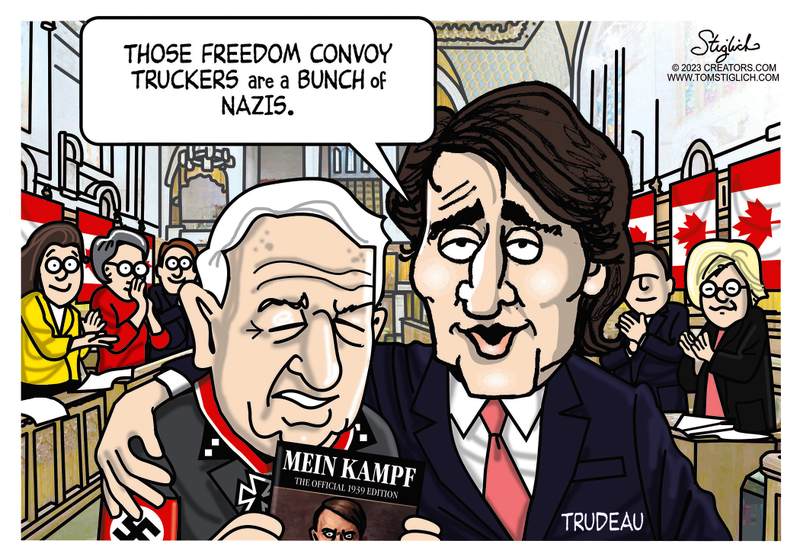
I am reminded of a tour some years ago in the Roman Colosseum where the guide pointed out the features explaining the grandeur of the monumental structure.  At the end, he concluded: “This was all done in just eight years.  Remember, these were Romans, not Italians.”  In the same vein, I would say to Justin Trudeau, “Remember Canada was built by working men, not by woke weenies.”

Postscript: 

In 1880, the Canadian government contracted the Canadian Pacific Railroad to construct the first all-Canadian line to the West Coast. During the next five years, the company laid 4,600 kilometers of single track, uniting various smaller lines across Canada. Despite the logistical difficulties posed by areas such as the muskeg (bogs) region of northwestern Ontario and the high rugged mountains of British Columbia, the railway was completed six years ahead of schedule.

The transcontinental railway was instrumental in populating the vast western lands of Canada with settlers and providing supplies and commerce. Many of western Canada’s great cities and towns grew up around Canadian Pacific Railway stations.

So five years to build the railway, eight years to build the colosseum.
Trudeau’s been in office eight years and we’re still waiting
for permits to build needed energy infrastructure.

Climate Doomsters in Driver’s Seat

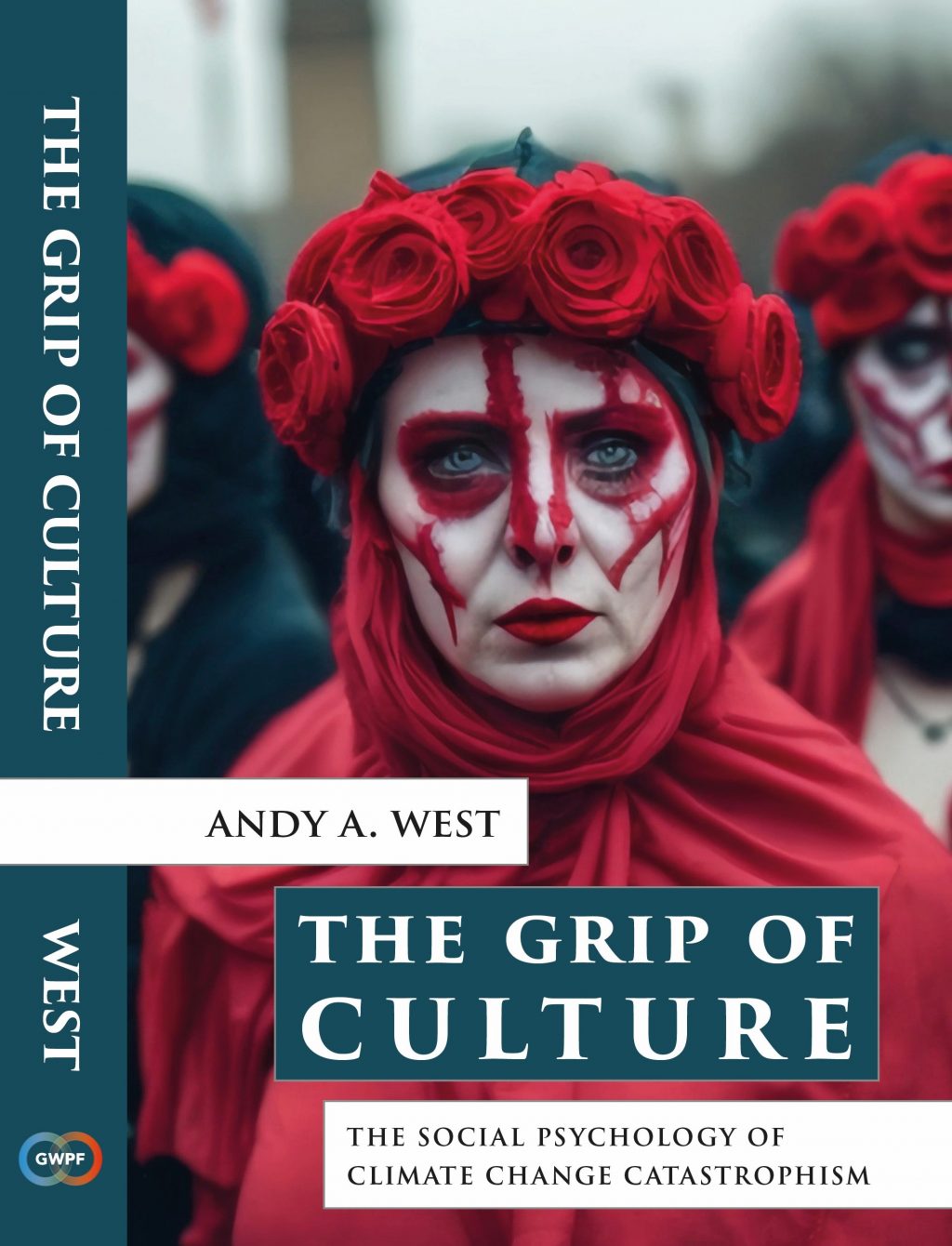
Joe Oliver wrote at Financial Post We are in the grip of climate-change catastrophism.  Excerpts in italics with my bolds.

The climate-change movement is a powerful cultural entity. It does not affirm or negate the reality of its core narrative, which is for science to decide. Culture does, however, explain the power and prevalence of the narrative, the political and societal responses to it and the apparent willingness of many people to incur immense cost to avert a supposed existential threat, without proof of either its existence or our ability to alter its impact. In a new book available from the Global Warming Policy Foundation, The Grip of Culture: the Social Psychology of Climate Change Catastrophism, Andy A. West, who works for the Philosophy Foundation in London, provides an academic analysis of the phenomenon. Its lessons have particular relevance to Canada’s climate obsession.

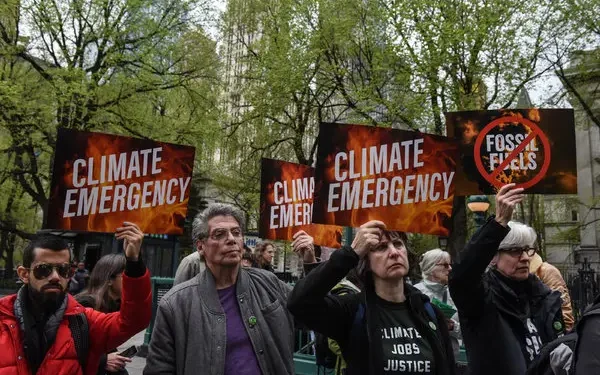
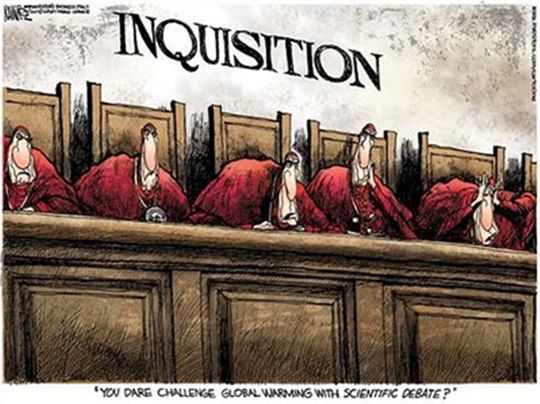
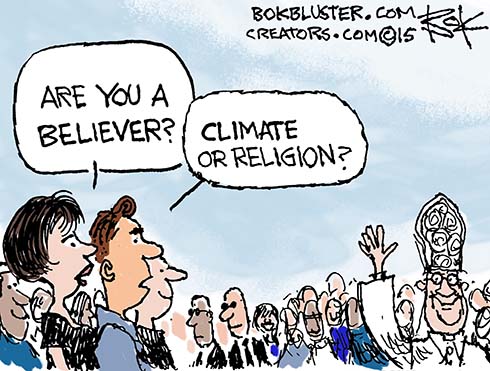
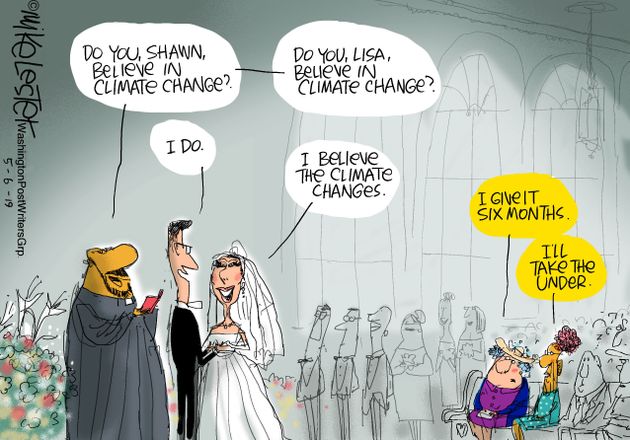
As we know, the overarching climate narrative is that human GHG emissions have created a climate emergency that calls for urgent and extraordinary action, without which the consequences for humanity will be catastrophic. In many ways, its cultural characteristics parallel religions and ideological movements, starting with an unshakable foundational belief impervious to contradictory evidence, and extending to incessant incantations from politicians, mainstream media, thought leaders and environmentalists.

The faithful are reassured by groupthink, while apostates or sinful skeptics,
i.e. “deniers,” are vilified, penalized and ostracized.

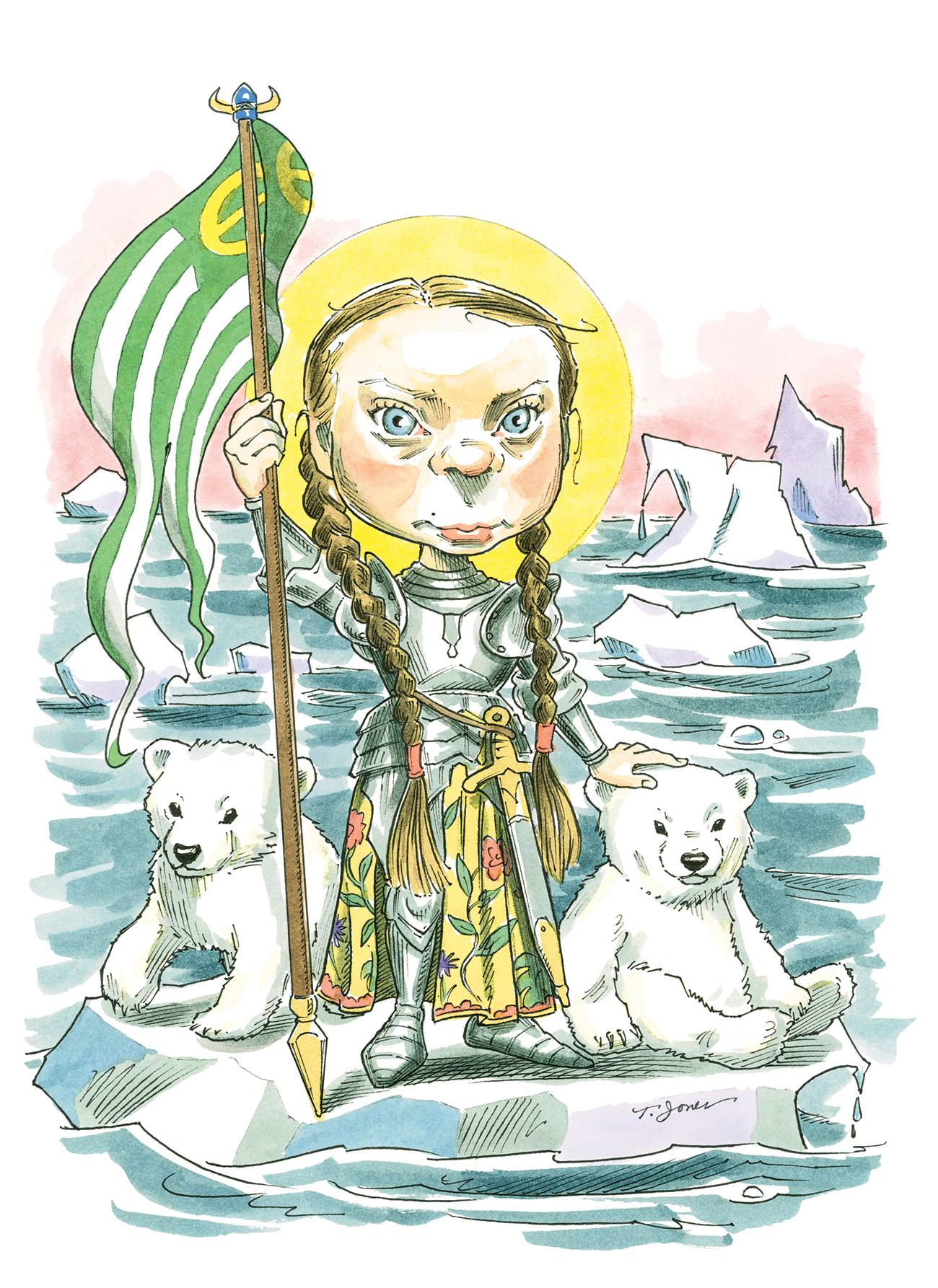
Environment and Climate Change Minister Steven Guilbeault’s veiled threat to charge Premier Scott Moe of Saskatchewan criminally if he violates federal coal regulations evokes Thomas of Torquemada, Grand Inquisitor of the Spanish Inquisition — though so far absent the burnings at the stake. The movement has its high priests and priestesses — Al Gore, Justin Trudeau, Greta Thunberg, King Charles and Mark Carney, none a scientist — who convey certainty to the multitudes.

Core principles and a multitude of subsidiary tenets are validated by exaggerated interpretations of scientific studies, as well as anecdotal evidence and conveniently chosen statistics that reinforce the sacred text. For example, the end of the Little Ice Age is invariably the starting point for calculating a global temperature increase — which is like a government calculating its effects on economic growth by starting at the trough of the last recession. Confirmation bias is provided by influencers, including uniquely unqualified Hollywood stars, who propagate the doctrine of the faith. Fear is employed as a powerful motivator and is inculcated from childhood. Apocalyptic doom is preordained for collective disobedience and salvation promised for devotees and repentants who comply with onerous strictures, many of which have no practical utility.

The instinctive response from climate alarmists to public hesitancy is that “the science is settled,” the facts are overwhelming and the need so urgent they can’t waste time quibbling with ignorant or malevolent naysayers who in any case are probably racist, misogynist, far-right conspiracists.

Climate alarmists have a fundamental problem, however, which may help explain their stridency. The complexity of climate science is not settled, as Steve E. Koonin, a physicist and former undersecretary for science in Barack Obama’s Department of Energy, explained in his 2021 book, Unsettled. Other prominent scientists agree, although they are a distinct minority.

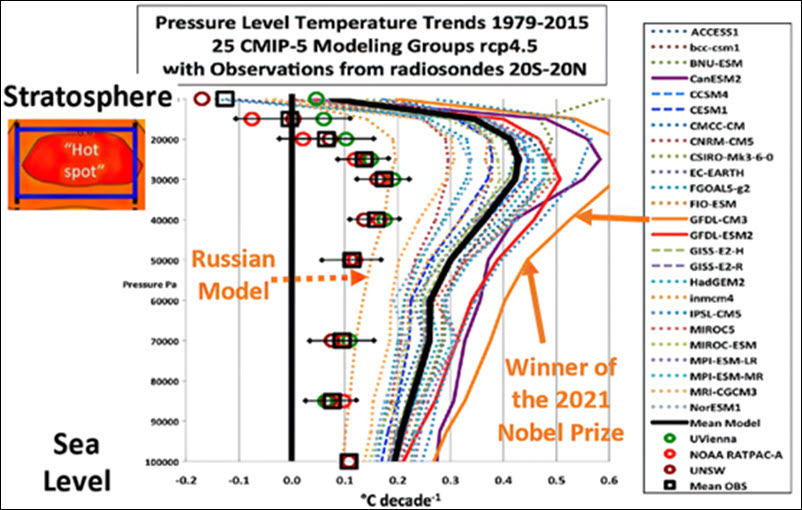
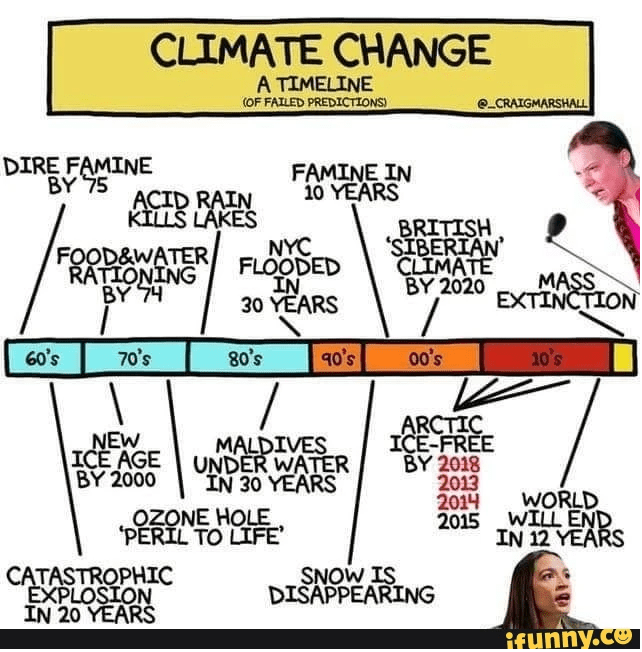
Nor is climate apocalypse supported by the UN’s Intergovernmental Panel on Climate Change (IPCC), even though its conclusions go farther than the scientific studies on which it allegedly relies. Proffered evidence is based on models that have consistently run hot. Yet the conventional consensus is to accept at face value the predictions of people who have been consistently and spectacularly wrong and who, if they were around in the 1970’s, were more than likely to have issued dire warnings about an impending ice age, like Paul Ehrlich and Kenneth Watt, as well as newspapers and journals like Time, Science Digest, The New York Times and Newsweek.

Barring a miraculous technological innovation, there is
virtually no chance of reaching global net zero by 2050.

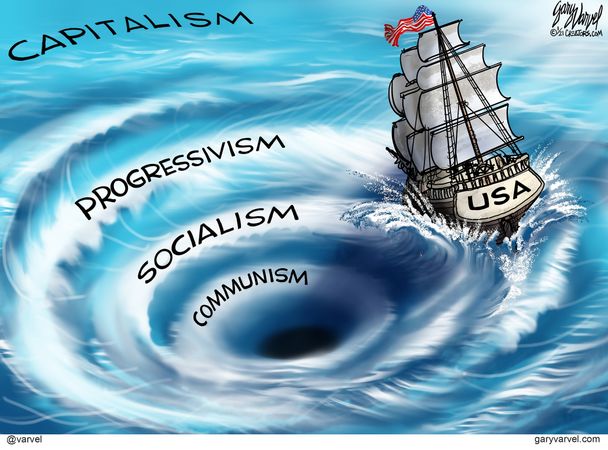
Two-thirds of GHG emissions come from poorer countries that are deliberately increasing their use of fossil fuels, while the developed economies, including Canada, have consistently failed to reach the targets they have set themselves. And it takes centuries for excess carbon dioxide to disappear from the atmosphere, so any partial reduction in anthropogenic emissions would only slow their increase, not prevent it or eliminate them. Nevertheless, McKinsey says $275 trillion may be spent on the doomed gesture, disproportionately hurting the least advantaged and weakening the West in what may actually be an existential struggle with an expansionist communist China.


Andy West writes that culture can be a great unifier of societies and even civilizations. But because it is not based on reason, it can also be extraordinarily destructive: witness the calamities perpetrated by communism and fascism. So it is uncertain where climate catastrophism may lead or what negative feedback could potentially provoke a counter-reaction. Last year’s European energy crisis did undermine support for it, even if green activists claimed it proved we need more of the renewable energy that had in fact made the continent more vulnerable to higher prices and inadequate supply.

Zeitgeists do change. When people have to choose between food and heat and when the poorest countries are deprived of the affordable energy they desperately need to raise themselves up, then practicality and guilt may eventually change people’s beliefs. That they haven’t yet done so demonstrates the power of culture in the face of logic, morality, self-interest and the facts.

Addendum:  

Retraction of Paper Saying There is No Climate Emergency Illustrates How Dependent Climate Activists Are on Scaremongering by Chris Morris at Daily Sceptic.

The recent cancellation of Alimonti et al shows clearly that catastrophising bad weather events and attributing them to a collapse of the climate is now the main weapon deployed to scare populations into embracing the Net Zero agenda. Of course, reference is still made to global warming, but most recent rises seem to owe more to frequent upward retrospective adjustments of temperature, rather than any significant natural boost. Perhaps we should not be surprised by this turn of events. In a short essay titled ‘The New Apocalypticism’, the science writer Roger Pielke Jr. noted: “For the secular millenarian, extreme events – floods, hurricanes, fires – are more than mere portents, they are evidence of our sins of the past and provide opportunities for redemption in the future, if only we listen, accept and change.”

The climate is collapsing all around us, shout the headlines – they require we ignore the data, the historical record, even common sense. When all is said and done, the Earth is not actually boiling! Well Professor Gianluca Alimonti and three other Italian scientists didn’t ignore the past data, much of it in fact from the UN Intergovernmental Panel on Climate Change, and they found little change in extreme weather events. They published a paper concluding that there was certainly not enough to justify the declaration of a ‘climate emergency’.

A year later, the publisher Springer Nature bowed to the demands of a group of activist scientists and journalists led by the Guardian and Agence France-Presse and retracted the non-conforming paper. An addendum was proposed and sent to four reviewers for comment. Three reviewers argued for publication. The fourth stated that typical readers were not climate experts and “editors should seriously consider the implications of the possible publication of this addendum”.

We own climate scienceboasted UN communications flak Melissa Fleming at a recent World Economic Forum disinformation seminar, and we partner with Google to keep our version at the top of the search list. What a great service these climate experts provide in telling us what to think and see as we unsophisticated rubes struggle towards the path of true enlightenment!

For the distinguished climatologist Dr. Judith Curry, the Alimonti affair is “why I no longer publish in peer-reviewed papers”. She described the behaviour of the journal editors as “reprehensible” in retracting a widely read climate paper just because it contained “politically inconvenient conclusions”. She is right of course – the Alimonti affair is another shocking scientific scandal that casts further doubt on the climate science peer-review process.

But then, Dr. Curry is merely a scientist in all this
–she doesn’t own the science.


Little Tin Gods


The audio track is a song for our times: Little Tin Gods by Don Henley from his album End of the Innocence.

“A new age is dawning
On fewer than expected
Business is usual”
That’s how the headline read
Some shaky modern saviors
Have now been resurrected
In all this excitement
You may have been misled

People want a miracle
They say “Oh Lord, can’t you see us?
We’re tryin’ to make a livin’ down here
And keep the children fed”
But, from little dark motel rooms
to “Six Flags Over Jesus”
“How are the mighty fallen”
So the Bible said

You don’t have to pray to a little tin god
Step out of the way for a little tin god
You might fear the reaper, you might fear the rod
But you never have to get down on your knees
You don’t have to holler, “please, please”
No, you never have to get down on your knees
For a little tin god

The cowboy’s name was “Jingo”
And he knew that there was trouble
So in a blaze of glory
He rode out of the west
No one was ever certain
What it was that he was sayin’
But they loved it when he told them
They were better than the rest

But you don’t have to pray for a little tin god
Step out of the way for a little tin god
You might hate the system, hate the job
But you never have to get down on your knees
You don’t have to holler, “please, please”
No, you never have to get down on your knees
For a little tin god

Throw down a rope from heaven
And lead the flock to water
The man in the middle would have you think
That you have no other choice
But to wander in the wilderness
Of all the upturned faces
If you stop and listen long enough
You will hear your own small voice

But you don’t have to pray to a little tin god
Step out of the way for a little tin god
You might fear the reaper, fear the rod
But you never have to get down on your knees
You don’t have to holler, “please, please”
No, you never have to get down on your knees
You don’t have to holler, “please, please”
You never have to get down on your knees
For a little tin god


Culture War Facturing Canada (Updated)

Update Below Adds Context from Angus Reid and Links to Series of Reports, Some Upcoming

Bruce Pardy writes at National Post Woke wolves dominate the culture war ecosystem — for now.  Excerpts in italics with my bolds and added images.

Canada is unravelling. Culture wars are making the country stupid, poor and fractured — and according to Angus Reid, these fractures have produced five distinct groups.

Last week, the Angus Reid Institute released a study on the bubbling, sometimes boiling, political conflicts in Canada. The study characterized five culture war factions that comprise the country: the “zealous activists,” the “quiet accommodators,” the “conflicted middle,” the “frustrated skeptics” and the “defiant objectors.” They make up the political ecosystem, which is why they are perhaps best recast as members of the animal kingdom.

Zealous Activists Behave as Wolves

“Zealous activists,” according to the Angus Reid study, make up 17 per cent of the population. They are ardent social progressives who believe that cancel culture is about “accountability.” I think of them as wolves. They travel in packs. These are woke mobs pushing the social justice revolution. They hunger to rip to shreds the reputation of anyone who defies progressive agendas.

Although they sometimes attack big targets, wolves prefer to hunt the vulnerable. They dress in sheep’s clothing, pretending to protect the weak and the downtrodden. But when the weak or downtrodden step out of line, wolves turn on them without a moment’s hesitation. Wolves appear to be more numerous than they really are, perhaps because they howl incessantly. They are proud virtue-signallers. Some truly believe in the cause, but activism is also a means to professional and social standing: they compete with one another for status within the pack.

Quiet Accommodators Resemble Sheep

Just over one quarter of Canadians are “quiet accommodators.” Like wolves, they are progressives, tending to agree with safe spaces and trigger warnings — but they lack the intensity of a predator. Let’s call them sheep. They are the foot soldiers of the culture wars; they believe in social justice dogma because that is what they have been fed. They crave approval and belonging.

Some sheep don’t understand social justice ideology beyond catchphrases and knee-jerk reactions, but they know those very well. Sheep can be found in positions of authority, where they enthusiastically enforce woke policies. They can be primary school principals, CEOs and even premiers. They seek to preserve their status by supporting the “correct” attitudes; in doing so, they willingly follow wolves, failing to understand that wolves are their greatest threat.

Conflicted Middle Act Like Ostriches

Ostriches don’t actually put their heads in the sand. They mostly lay their heads in the grass, preoccupied with staying well fed.

The “conflicted middle” makes up 18 per cent of the population. They are ostriches who keep their heads close to the ground, divided on culture wars and politics. Ostriches are ambivalent about social justice agendas and cultural revolutions; they comply to avoid any unwanted attention. Like sheep, ostriches seek to preserve their professional or social status. Unlike sheep, who want to belong, ostriches obey to avoid trouble. They tend to abhor politics and prefer not to think about ideology, even when ideology won’t leave them alone. Ostriches just wish the whole thing would go away.

Can you spot the leopard hidden in the grass?

Frustrated Skeptics Lurk Like Leopards

Nineteen per cent of Canadians are “frustrated skeptics.” They view culture wars as tiring and unproductive. Imagine them as leopards, aware and poised, but camouflaged against the scrubby savannah. Leopards object to woke agendas but keep their opinions to themselves. Some feel vulnerable in their jobs or social relationships. Others hide their opposition strategically, believing they can resist more effectively from the inside. Like ostriches, leopards are careful not to provide wolves with a reason to attack. Unlike ostriches, leopards are not ambivalent, but are waiting for the right moment to pounce.

Defiant Objectors Roar Like Lions

A fifth of Canadians are “defiant objectors.” They oppose cancel culture, safe spaces and censorship. These are the lions, who openly roar in disapproval at the progressive transformation of their society. Lions are the only animals in the kingdom who say “hell no” out loud. Some have prominent public profiles, but most lions are simply fearless ordinary people. They sometimes gather in prides, like the truckers and their supporters, but they are naturally inclined to be independent. When lions roar, wolves howl that they are bigots, populists, or members of a fringe minority with unacceptable views.

Missteps are dangerous in a culture war. The pack will devour those who commit wrongthink. The most susceptible are sheep and ostriches, who, despite submitting to the regime, are apt to utter inconvenient truths. Social justice ideology is tricky. It contains incoherent positions, changes the meanings of words and constantly moves the target. “My body, my choice” is a rallying cry when it relates to abortion, but racist and misogynist when it applies to vaccine mandates. Sheep and ostriches must navigate an ever-shifting landscape of rules and political correctness.

Leopards can misstep and blow their cover, but sometimes that works out for the best. Once revealed, they may find that they were meant to be lions after all. Lions can’t misstep, at least in the sense of accidentally outing themselves. Out is where they mean to be.

An activist minority is setting the agenda in Canada, but only
for as long as Canadians allow it. Be a lion.

Footnote:  A Pride of Lions Roaring in the Streets of Ottawa

Exclusive footage from LifeSiteNews in Ottawa shows thousands of pro-family Canadians formed near Parliament Hill, rivaled by an estimated 350 counter-protesters.

Pro-family Canadians flood Ottawa, other cities for Million Person March against LGBT indoctrination

According to LifeSite’s John-Henry Westen, who was on the ground at the Ottawa march, there was a noticeable number of children present on the pro-family side of the protest, with very few if any children present on the pro-LGBT side. Westen also estimates that the pro-family side outnumbered the pro-LGBT side by roughly ten to one.

Video footage from Toronto and Calgary posted to social media by True North shows thousands of pro-family citizens gathered in protest against LGBT indoctrination in both cities.

Counter-protesters were expected at the events after leaked video footage of a Zoom call appeared online last week showing unions leaders encouraging their members to oppose the pro-family efforts.

Update: Detailed Findings from Angus Reid

The website for this project is Canada and the Culture Wars: In the first of a multi-part series, Canadians weigh in on the nation’s divided discourse

Part One: Defining Canadians’ cultural mindsets


Topical Reports

Canadians say we’re changing how we talk to each other,
split over whether it’s a good or bad thing

The first release focused on Canadians views of the culture wars, how we talk to each other, as well as conflict mitigation, censorship, and “cancel culture”. Depending on where they sit on the spectrum of cultural mindsets, Canadians can view these issues as important, informative, exhausting or even unnecessary.

Example:

Gender Identity:  More than half say male or female;
one-third say that’s too limiting, others unsure

The second release covered  Gender Identity – including topics such as gender fluidity and gender neutral language.  Also Transgender Issues – how do Canadians say they would react if their child showed an affinity for a gender other than the one they were assigned at birth?

Example:

These forthcoming studies will put a spotlight on:

Climate and the Economy – how should Canada move forward in energy development? Do Canadians support or oppose a wealth tax?

Colonialism and Indigenous Issues – addressing topics such as the legacy of Canada’s colonial history and residential schools

Race and Ethnicity – including topics such as privilege, cultural appropriation, equity, discrimination and racism

Canada’s Animal Farm Culture War Factions

Bruce Pardy writes at National Post Woke wolves dominate the culture war ecosystem — for now.  Excerpts in italics with my bolds and added images.

Canada is unravelling. Culture wars are making the country stupid, poor and fractured — and according to Angus Reid, these fractures have produced five distinct groups.

Last week, the Angus Reid Institute released a study on the bubbling, sometimes boiling, political conflicts in Canada. The study characterized five culture war factions that comprise the country: the “zealous activists,” the “quiet accommodators,” the “conflicted middle,” the “frustrated skeptics” and the “defiant objectors.” They make up the political ecosystem, which is why they are perhaps best recast as members of the animal kingdom.

Zealous Activists Behave as Wolves

“Zealous activists,” according to the Angus Reid study, make up 17 per cent of the population. They are ardent social progressives who believe that cancel culture is about “accountability.” I think of them as wolves. They travel in packs. These are woke mobs pushing the social justice revolution. They hunger to rip to shreds the reputation of anyone who defies progressive agendas.

Although they sometimes attack big targets, wolves prefer to hunt the vulnerable. They dress in sheep’s clothing, pretending to protect the weak and the downtrodden. But when the weak or downtrodden step out of line, wolves turn on them without a moment’s hesitation. Wolves appear to be more numerous than they really are, perhaps because they howl incessantly. They are proud virtue-signallers. Some truly believe in the cause, but activism is also a means to professional and social standing: they compete with one another for status within the pack.

Quiet Accommodators Resemble Sheep

Just over one quarter of Canadians are “quiet accommodators.” Like wolves, they are progressives, tending to agree with safe spaces and trigger warnings — but they lack the intensity of a predator. Let’s call them sheep. They are the foot soldiers of the culture wars; they believe in social justice dogma because that is what they have been fed. They crave approval and belonging.

Some sheep don’t understand social justice ideology beyond catchphrases and knee-jerk reactions, but they know those very well. Sheep can be found in positions of authority, where they enthusiastically enforce woke policies. They can be primary school principals, CEOs and even premiers. They seek to preserve their status by supporting the “correct” attitudes; in doing so, they willingly follow wolves, failing to understand that wolves are their greatest threat.

Conflicted Middle Act Like Ostriches

Ostriches don’t actually put their heads in the sand. They mostly lay their heads in the grass, preoccupied with staying well fed.

The “conflicted middle” makes up 18 per cent of the population. They are ostriches who keep their heads close to the ground, divided on culture wars and politics. Ostriches are ambivalent about social justice agendas and cultural revolutions; they comply to avoid any unwanted attention. Like sheep, ostriches seek to preserve their professional or social status. Unlike sheep, who want to belong, ostriches obey to avoid trouble. They tend to abhor politics and prefer not to think about ideology, even when ideology won’t leave them alone. Ostriches just wish the whole thing would go away.

Can you spot the leopard hidden in the grass?

Frustrated Skeptics Lurk Like Leopards

Nineteen per cent of Canadians are “frustrated skeptics.” They view culture wars as tiring and unproductive. Imagine them as leopards, aware and poised, but camouflaged against the scrubby savannah. Leopards object to woke agendas but keep their opinions to themselves. Some feel vulnerable in their jobs or social relationships. Others hide their opposition strategically, believing they can resist more effectively from the inside. Like ostriches, leopards are careful not to provide wolves with a reason to attack. Unlike ostriches, leopards are not ambivalent, but are waiting for the right moment to pounce.

Defiant Objectors Roar Like Lions

A fifth of Canadians are “defiant objectors.” They oppose cancel culture, safe spaces and censorship. These are the lions, who openly roar in disapproval at the progressive transformation of their society. Lions are the only animals in the kingdom who say “hell no” out loud. Some have prominent public profiles, but most lions are simply fearless ordinary people. They sometimes gather in prides, like the truckers and their supporters, but they are naturally inclined to be independent. When lions roar, wolves howl that they are bigots, populists, or members of a fringe minority with unacceptable views.

Missteps are dangerous in a culture war. The pack will devour those who commit wrongthink. The most susceptible are sheep and ostriches, who, despite submitting to the regime, are apt to utter inconvenient truths. Social justice ideology is tricky. It contains incoherent positions, changes the meanings of words and constantly moves the target. “My body, my choice” is a rallying cry when it relates to abortion, but racist and misogynist when it applies to vaccine mandates. Sheep and ostriches must navigate an ever-shifting landscape of rules and political correctness.

Leopards can misstep and blow their cover, but sometimes that works out for the best. Once revealed, they may find that they were meant to be lions after all. Lions can’t misstep, at least in the sense of accidentally outing themselves. Out is where they mean to be.

An activist minority is setting the agenda in Canada, but only
for as long as Canadians allow it. Be a lion.

Biden Nanny State Coming At You

Mark Krebs exposes federal shenanigans in their war on home appliances in his Master Resource article Update: DOE Appliance Minimum Efficiency Standards.  Excerpts in italics with my bolds and added images.

“It started with gas cooking.  It will end with getting gas out of homes and business entirely, If they can. Basically, what we’re witnessing is the energy equivalent of ethnic cleansing. I’ve been saying this for years but now it should be obvious.”

The U.S. Department of Energy (DOE) under the Biden Administration has significantly accelerated the pace of minimum appliance efficiency rulemaking. With this acceleration, there has been a marked decrease in DOE’s analytical quality and transparency. The purpose of this update is to summarize:

  1.  Energy Conservation Standards for Consumer Conventional Cooking Products

2.  Energy Conservation Standards for Consumer Products; Boilers

3.  Energy Conservation Standards for Consumer Water Heaters

Note: In DOE-speak, the term ‘consumer’ means non commercial/industrial, or just residential.

Part 1: Consumer Cooking Products

On April 27, 2023, MasterResource published DOE vs. Gas Cooking: A Review of Critical Comments. On August 2, 2023, DOE reopened the docket with a “Notification of data availability and request for comment (NODA) with comments due September 1. More than 100 comments were filed.

Some commenters viewed the NODA and relatively short (30-day) comment period as a violation to the Administrative Procedures Act codified by 5 U.S.C. § 551(5)–(7) and the DOE’s “process rule” codified by 10 CFR 430 Appendix A to Subpart C. One such commenter making this case was the Institute for Energy Research (IER).

Other comments privided detailed content in opposition of DOE’s proposal for consumer cooking products.  My comments addressed what has changed since DOE determined (in 2019) that additional efficiency mandates for gas cooking appliances is not justified. In short, Biden happened. With that change, DOE resorted to a longstanding bias that any amount of net positive cash flow (greater than zero) on average was sufficient economic justification. I cited AHAM’s press release “Gas Cooking Appliances Remain at Risk Despite New DOE Data” for this NODA that succinctly justified what that amount now is:

“The revised data reduces consumer savings to just 9 cents per month.

I contend no one would freely elect to invest in anything with that kind of return-on-investment (ROI). Additionally, 9 cents per month is far less than the uncertainty range within DOE’s economic calculations.  Besides, DOE’s economic calculations typically low-ball increased maintenance costs and over-inflate fuel costs (among many other biased input assumptions).

What else has changed is that DOE cost-effectiveness now includes highly controversial benefits from reduced climate change allowed by grossly inflated social cost of carbon (SCC) avoidance and health benefits from improved indoor air quality (IAQ).

Part 2: Consumer Boilers

On September 12, 2023, DOE held a public webinar to go over its proposal for increased minimum efficiencies for residential boilers. A 59-page slide deck for that meeting is here. (If you have never read one of these slide decks, I urge you to do so. It’s a relatively painless way of getting familiar with the ‘administrative state’ going about its business of picking winners and losers.)

There were many participants representing manufacturing interests that would be adversely impacted by DOE’s proposal, and they were quite vocal about it (in a professional way of course).  But why would manufacturers want to litigate? DOE would put some of them out of business. 

Part 3: Consumer Water Heaters

On September 13, 2023, DOE held a public webinar to go over its proposal for increased minimum efficiencies for residential water heaters that lasted 3 hours. A 74-page slide deck for that meeting is here. There were nearly twice as many participants on line compared to the number of webinar participants the day before for consumer boilers; and many of the participants represented water heater manufacturers, some of which would be devastated if DOE’s proposed mandates were finalized.

One manufacturer that stood out in this regard was Rinnai America. Rinnai is the sole manufacturer of non-condensing tankless water heaters in the U.S. Rinnai’s President stated, as I recall, that DOE’s proposed ban of non-condensing water heaters would shut down Rinnai’s new factory that cost $70 million. That, of course, would devastate the many involved.

Conclusions

DOE has been (ostensibly) ‘improving’ appliance efficiency for nearly a half-century. The low hanging fruit is long gone. In many cases, DOE is doing more harm than good and using unfair tactics to maintain control and reward its minions. What we have now is relentless self-serving “mission creep” of the administrative state and its “useful idiots” that forces consumers to fund the erosion of viable energy alternatives. The passage of the Inflation Reduction Act is greatly aiding and abetting this forced transformation away from free market forces.

DOE doesn’t care what it costs to litigate. After all, DOE has the backing of the Department of Justice for such matters. In my opinion, DOE has strayed too far from any redeeming virtue that may have originally existed from the 1975 passage of EPCA. It’s past time for Congress clean up the mess it created by enacting EPCA and the numerous ambiguous loopholes that gives undeserved deference to the administrative state to interpret. A valid question is whether EPCA (and DOE for that matter) should be salvaged or scrapped.

Biden’s DOE wants to eliminate alternatives to electricity. 

This fixation became apparent to all with their planned elimination of gas cooking and ran head-on with consumers that hold gas cooking near-and-dear. Consumer preferences for gas cooking was and is a major obstacle to control via societal electrification overall. As this article hopefully conveys, it started with gas cooking. It will end with getting gas out of homes and business entirely, If they can.
Postscript:

The Department of Energy (DOE) quietly promoted a top adviser to Energy Secretary Jennifer Granholm to a senior role overseeing home appliance regulations after he failed to clear Senate confirmation.

The DOE announced last week that Jeff Marootian was appointed to be the principal deputy assistant secretary of the agency’s Office of Energy Efficiency and Renewable Energy (EERE). The appointment came days after the White House withdrew his name from consideration to lead EERE as the office’s assistant secretary.

While Marootian’s nomination failed after Senate Energy and Natural Resources Committee Chairman Joe Manchin, D-W.Va., opposed him over the Biden administration’s crackdown on natural gas-powered stovetops, his appointment last week makes him the effective chief of the DOE’s EERE office.

More complete discussion on appliance war at Fox: https://www.foxnews.com/politics/experts-warn-biden-admins-water-heater-crackdown-hike-prices-reduce-consumer-choice


Social Justice Sendup

Long before BLM flash mobs, calls to “Defund the Police” and ultra-liberal prosecutors blind to BIPOC misdemeanors or even felonies, Bluesman R.L. Burnside dropped his song “Nothin’ Man,” a satirical sendup of the sappy social justice mindset. (Closed captions are an option.)

R. L. Burnside (1926-2005) Blues Hall of Fame

Ironically, Burnside Street is a major thoroughfare of Portland, Oregon, one of the cities most damaged by social justice politicians. East Burnside Street and 122nd Avenue is the most dangerous spot of the most dangerous neighborhood when it comes to shootings. (2023)

Don’t Buy “Planetary Boundaries” Hype

Latest diagram from Stockholm Resilience Centre

The usual suspects are beating on their “planetary boundaries” drum to scare up submission to Zero Carbon restrictions.  Remember these are the same climate justice warriors pushing the notion of a new geological era named “Anthropocene”.  For example, cue the following:

Six of nine planetary boundaries now exceeded–Phys.org

Humans Have Crossed 6 of 9 ‘Planetary Boundaries’–Scientific American

Earth is now outside most of the “planetary boundaries” under which human civilization emerged–TechSpot

Six out of 9 planetary boundaries breached, Earth increasingly becoming uninhabitable for humans–MSN.com

Humanity deep in the danger zone of planetary boundaries: study–YAHOO!News

Etc., Etc. Etc.

Background

In 2009, a group of 29 scholars published an article in Nature, advancing an approach to define a “safe operating space for humanity” (1). The group argued that we can identify a set of nine “planetary boundaries” that humanity must not cross at the cost of its own peril. Since this 2009 publication, the concept of planetary boundaries has been highly influential in generating academic debate and in shaping research projects and policy recommendations worldwide. At the same time, the concept has come under heavy scrutiny as well, and many critics have taken the floor contesting the broader framework as well as its implementation and interpretation. Partially because of this critique, the original proposition of nine planetary boundaries has undergone various reformulations and updates by their proponents and an emerging network of scholars specializing in planetary boundary research.

The original 2009 paper in Nature suggested nine boundary conditions in the earth system that could, if crossed, result in a major disruption in (parts of) the system and a transition to a different state, which is likely to be hostile to human prosperity. The proposed planetary boundaries included:

♦  climate change,
♦  biodiversity loss,
♦  the nitrogen cycle,
♦  the phosphorus cycle,
♦  stratospheric ozone depletion,
♦  ocean acidification,
♦  global freshwater use,
♦  land use change,
♦  atmospheric aerosol loading, and
♦  chemical pollution.

For each of these planetary boundaries, one or more control variables were identified (e.g., atmospheric carbon dioxide concentration), which in turn were assigned with numerical boundary values at a “safe” distance from dangerous levels, or where applicable, “tipping points” in earth system processes (1).

Eventually, the framework should allow for quantification of threshold parameters, as a guide also for political responses. For some planetary boundaries, the group in 2009 suggested that the current state of knowledge was too uncertain to allow for quantification. Yet, for other earth system processes, the group felt confident enough to suggest a specific boundary value. In this endeavor, they erred on the side of caution and a strict interpretation of the precautionary principle: Where they saw remaining uncertainties, the group suggested the lower values for the boundary that they identified.

They concluded that three planetary boundaries had been crossed already.

On climate change, for instance, the boundary value proposed was 350 ppm, which had been passed long ago in the second half of the twentieth century. Regarding biodiversity, the current extinction rate is more than 100 extinct species per million species per year, whereas the suggested boundary was 10 extinctions. As for the nitrogen cycle, humans remove today approximately 121 million tons of nitrogen per year from the atmosphere, whereas a safe rate would be a maximum of 35 million tons. In these three areas, therefore, this analysis suggested that humankind had pushed the earth system past planetary boundaries and possibly dangerous levels, into a new—and unknown—world.  Source: The Boundaries of the Planetary Boundary Framework: A Critical Appraisal of Approaches to Define a “Safe Operating Space” for Humanity.  Annual Review of Environment and Resources October 2020

We don’t know how long we can keep transgressing these key boundaries before combined pressures lead to irreversible change and harm.–Johan Rockström, co-author and Centre researcher

Critics of the Planetary Boundaries Framework

Leaving aside those who want the boundaries to be tighter and harder than presented, let’s hear from critics challenging the whole enterprise. Shortly after the invention of “planetary boundaries,” Breakthrough Institute published a thorough critique of the notion and the framework.  Planetary Boundaries: A Review of the Evidence.  Linus Blomqvist (2012)

The planetary boundaries hypothesis – embraced by United Nations bodies and leading nongovernmental organizations like Oxfam and WWF – has serious scientific flaws and is a misleading guide to global environmental management, according to a new report by the Breakthrough Institute. The hypothesis, which will be debated this month at the UN Earth Summit in Brazil, posits that there are nine global biophysical limits to human development. But after an extensive literature review and informal peer review by leading experts, the Breakthrough Institute has found the concept of “planetary boundaries” to be a poor basis for policy and for understanding local and global environmental challenges.

KEY FINDINGS

♦   Six of the “planetary boundaries” — land-use change, biodiversity loss, nitrogen levels, freshwater use, aerosol loading, and chemical pollution — do not have planetary biophysical boundaries in themselves.

♦   Aside from their impacts on the global climate, these non-threshold “boundaries” operate on local and regional, not global, levels.

♦   There is little evidence to support the claim that transgressing any of the six non-threshold boundaries would have a net negative effect on human material welfare.  The full report is linked below:

A new report from the Breakthrough Institute highlights scientific flaws
of the “planetary boundaries” hypothesis

Planetary Boundaries as Power Grab–Giving Political Decisions a Scientific Sheen–Roger Pielke Jr. (2013)

When the cover of the Economist famously announced Welcome to the anthropocene’ a couple of years ago, was it welcoming us to a new geological epoch, or a dangerous new world of undisputed scientific authority and anti-democratic politics?

The basis for the power grab by the experts – really old wine in new bottles – is the fashionable idea of planetary boundaries which holds that there are hard and fast ecological limits within which human activity must be constrained. The concept is much contested scientifically — such as in this excellent review by my colleagues at The Breakthrough Institute.

A real-world example of the implications of the planetary boundaries political philosophy is vividly seen through the issue of global energy access. Future global development, at least in the short term, necessarily will involve trade offs between expanded use of carbon-emitting fossil fuels and the expansion of energy access to the world’s poorest. The planetary boundaries advocates, consist with their hierarchical values framework, call for “universal clean energy” and recommend development targets focused not on measuring expanded energy access, but rather carbon dioxide emissions (here in PDF).

In other words, expanded energy access to the world’s poorest is deemed acceptable
only if it first satisfies the demands of planetary boundaries – in other words,
the political demands of the scientists couched in the inviolable authority of science.

An major recent critique was: Planetary Boundaries for Biodiversity:  Implausible Science, Pernicious Policies  by Montoya, Donohue and Pimm. Trends in Ecology and Evolution (2018)

The notion of a ‘safe operating space for biodiversity’ is vague and encourages harmful policies. Attempts to fix it strip it of all meaningful content. Ecology is rapidly gaining insights into the connections between biodiversity and ecosystem stability. We have no option but to understand ecological complexity and act accordingly.

How best should environmental science articulate its concerns, set research agendas, and advise policies?One solution embraces the notion of planetary boundaries [1] arguing that global environmental processes very generally have ‘tipping points’. These are catastrophes involving thresholds beyond which there will be rapid transitions to new states that are very much less favorable to human existence than current states. The associated notion is that humanity’s ‘business as usual’ can only continue so long as it remains within some ‘safe operating space’.

We show that notions of planetary boundaries add no insight into our understanding
of the threats to biodiversity and ecosystem functioning, have no evidence to support them,
are too vague for use by those who manage biodiversity, and promote pernicious policies.

Fatally, the boundaries framework lacks clear definitions, or it has too many conflicting definitions, does not specify units, and fails to define terms operationally, thus prohibiting application by those who set policy or manage natural resources. Moreover, recent reviews indicate that tipping points occur only rarely in
natural systems [6], while policies related to boundaries are unlikely to be evidence based. A need for operational definitions to aid managers is self-evident [7].

At the heart of the problem are terms such as ‘planetary boundaries’, but also ‘sustainability’, ‘health’, ‘harmony’, and others, that are emotionally appealing but rarely, if ever, defined. They all speak to the urgent need to understand how human impacts change ecosystems, when at best we aspire to protect only
half of it. We must set policies and establish management for the vast tracts of land and sea that we do not protect. Fatally, those who do so often use language that does not borrow from the existing knowledge about ecosystem processes, nor readily translates its aspirations to those who study them [7].

See Also:

Planetary Boundaries as Millenarian Prophesies  Malthusian Echoes

The identification of the planetary boundaries is dependent on the normative assumptions made, for example, concerning the value of biodiversity and the desirability of the Holocene. Rather than non-negotiables, humanity faces a system of trade-offs – not only economic, but moral and aesthetic as well. Deciding how to balance these trade-offs is a matter of political contestation (Blomqvist et al, 2012:37). What counts as “unacceptable environmental change” is not a matter of scientific fact, but involves judgments concerning the value of the things to be affected by the potential changes. The framing of planetary boundaries as being scientifically derived non-negotiable limits, obscures the inherent normativity of deciding how to react to environmental change. Presenting human values as facts of nature is an effective political strategy to shut down debate.

Beyond Planetary Boundaries by Michael Shellenberger, Ted Nordhaus, and Linus Blomqvist (2012)

There are useful implications for environmental change science that can be drawn from where planetary boundaries went wrong. First, any pragmatic framework on environmental change must look at benefits and costs. Some of the hypothesis’s authors have said that their motivation was to provide a useful framework for helping global leaders manage environmental change. We applaud and support this motivation. But for any environmental change framework to be useful, it must seek to understand not only the costs of change but also its benefits.

One of the implications of this is that simply measuring variance from Holocene baselines is a highly misleading metric of human sustainability. Since so much variance from the Holocene has been good for humans, future environmental change cannot be assumed, as planetary boundaries does, to be negative for our welfare.


Londoners Vs. ULEZ Cameras

Background: 

Remember that the World Bank recognizes personal mobility as the defining characteristic of the Middle Class.  Also recall that as Aristotle stated, the Middle Class is the social buffer against tryanny by the elite and slavery of the poor.

Finally, be informed that C40 is a global network of mayors of the world’s leading cities that are united in action to confront the climate crisis. It was founded in 2005 as C20, and has since expanded to its current network of 96 cities, including London.  More at Daily Sceptic The Green Globalists Behind Ulez – and What They Have Planned Next  (Of course our virtue signalling Montreal Mayor Plante is all in on imposing ULEZ here.)

Freedom Fighters Take to the Streets of London

Within this context comes the report that Londoners are conducting an organized attack on the ULEZ cameras placed to enforce fines for people straying from their home neighborhood. The Remix News article is Hundreds of ULEZ cameras destroyed by vigilante group following wider London roll-out.  Excerpts in italics with my bolds. H/T Tyler Durden

The group intent on disrupting London Mayor Sadiq Khan’s green vehicle tax
has received some political support despite its criminal activity.

Hundreds of Ultra Low Emission Zone (ULEZ) cameras have been vandalized by a vigilante group that opposes the controversial scheme, which extended across wider London this week and charges road users for traveling in non-compliant vehicles.

The scheme is part of London Mayor Sadiq Khan’s green agenda to enhance the air quality across the U.K. capital; however, many critics of its extension into London’s suburbs consider it to be a regressive tax and cash grab that will hit working families the hardest.

A vigilante group known as the Blade Runners has been targeting newly installed cameras across the capital in a bid to disrupt the implementation of ULEZ as much as possible, and hundreds of cameras have already been hit.

Prior to the roll-out, which came into force on Tuesday, around 500 cameras had been marked as out of action or damaged, according to a map the vigilante group promoted. Many of the cameras targeted were located in London’s southeast with 156 of the 185 cameras around the districts of Sydenham and Sidcup being hit, as well as 18 of the 22 cameras installed in Bromley.

The camera map, published on a popular anti-ULEZ Facebook page, allows users to update it when a camera has been rendered out of action. The black pins represent cameras that are now missing or damaged.

In the southeast town of Orpington, just two of the new number plate recognition cameras were in working order on the day of the ULEZ expansion after vigilantes smashed, spray-painted, or cut the wires of 14 cameras on a single road.

Video footage and photographs of disruptors vandalizing the cameras have been published on social media, much to the delight of those critical of the scheme.

One camera was even installed just meters from a crematorium in order to
pick up funeral-goers, a camera that was swiftly taken care of by locals.

Despite their criminal activity, the vigilantes have received political support, including from a former Conservative Party leader and cabinet minister, Sir Iain Duncan Smith, who insisted he was “happy” for Londoners to fight back because “they are facing an imposition that no one wants and they have been lied to about it.”

“A lot of people in my constituency have been cementing up the cameras or putting plastic bags over them,” he said. “The actions you are seeing show how angry people are at what is being imposed on them. Sadiq Khan has gerrymandered all the information – people have had enough.”

Last November, Khan announced the extension to the scheme, which had previously been reserved for central London, to all London boroughs despite overwhelming opposition to the plan.

It is the latest in a continuous assault by Khan on motorists, following the installation of Low Traffic Neighbourhoods (LTNs), extensive road-narrowing, and the excessive expansion of 20-mph zones.

When he was heckled at a public event back in March over the ULEZ roll-out, Khan suggested that those who opposed the plans were “far-right,” a remark that was met by derision and booing from the Question Time audience.