Facebook Censors BMJ Under Guise of “Fact-checking”

BMJ (British Medical Journal) publishes more than 70 medical and allied journals.  They report unwarranted censorship by Facebook in an article Facebook urged to act over incompetent “fact check” of BMJ investigation.  Excerpts in italics with my bolds and added images.

Editors ask Mark Zuckerberg to correct errors relating to The BMJ’s Pfizer vaccine trial investigation

Editors at The BMJ are urging Facebook to correct a “fact check” of a recent investigation that they say is “inaccurate, incompetent and irresponsible.”

In an open letter to Mark Zuckerberg, Fiona Godlee, outgoing editor in chief, and Kamran Abbasi, incoming editor in chief, say this matter “should be of concern to anyone who values and relies on sources such as The BMJ for reliable medical information.”

They also urge parent company Meta to reconsider its investment in and approach to fact checking overall following other examples of incompetence.

On 2 November, The BMJ published an investigation into poor clinical trial research practices at Ventavia, a contract research company helping carry out the main Pfizer covid-19 vaccine trial.

It was based on dozens of internal company documents, photos, audio recordings, and emails provided to The BMJ by a former employee of Ventavia, and it raised serious concerns about data integrity and patient safety.

The article went through The BMJ’s usual high level legal and editorial oversight and peer review.

But beginning on November 10, readers began reporting a variety of problems when trying to share the article and were directed to a “fact check” performed by a Facebook contractor named Lead Stories.

Godlee and Abbasi say they find the “fact check” performed by Lead Stories to be “inaccurate, incompetent and irresponsible.”

For example, it fails to provide any assertions of fact that The BMJ article got wrong, it contains a screenshot of the article with a stamp over it stating “Flaws Reviewed,” despite the Lead Stories article not identifying anything false or untrue in The BMJ article, and it published the story on its website under a URL that contains the phrase “hoax-alert.”

Cochrane, the international provider of high quality systematic reviews of the medical evidence, has experienced similar treatment by Instagram (also owned by Meta).

The BMJ complained to Lead Stories, “but they refused to change anything about their article or actions that have led to Facebook flagging our article.”

The BMJ has also complained to Facebook, requesting that Facebook immediately remove the “fact checking” label and any link to the Lead Stories article, “thereby allowing our readers to freely share the article on your platform.”

The editors say they hope Facebook will “act swiftly” to correct the error relating to The BMJ’s article and to review the processes that led to the error. They added a general call for parent company Meta to reconsider its investment in and approach to fact checking overall.

“Rather than investing a proportion of Meta’s substantial profits to help ensure the accuracy of medical information shared through social media, you have apparently delegated responsibility to people incompetent in carrying out this crucial task.”


Diversity Industry Covers Up Failed Affirmative Action

screen-shot-2021-07-09-at-12.17.46-am
Heather Mac Donald explains the origins and preoccupations of Diversity, Inclusion and Equity (DIE).  Whoops, I mean Diversity, Equity and Inclusion (DEI)  which is now an academic degree you can acquire.  Her Quillette article is Almost Four Decades After Its Birth, The Diversity Industry Thrives on Its Own Failures.

The diversity business originated in 1984, when R. Roosevelt Thomas, a Harvard business school graduate, founded the American Institute for Managing Diversity at Morehouse College. Corporations had been practicing affirmative action for years, but the women and minorities whom employers had hired to meet equal-opportunity obligations weren’t advancing up the career ladder in acceptable numbers. Thomas came up with a novel explanation. The problem wasn’t that preferentially admitted recruits were underqualified; the problem was that their supervisors didn’t know how to “manage diversity.” It was those supervisors who needed remedial training—lots of it—not the affirmative-action beneficiaries themselves.

Managerial expectations about merit and performance often reflected cultural prejudices, Thomas and the consultants who followed him insisted. “‘Qualifications’ is a code word in the business world with very negative connotations,” a consultant with the professional-services firm of Towers Perrin (as it was then called) said in 1993. If minorities don’t meet existing employment criteria, then corporations need to expand their definition of what it means to be employable, said Alan Richter, creator of the 1991 board game, The Diversity Game. Promptness, precision, and a cogent communications style were among the attributes that diversity advisors deemed likely expendable.

A lucrative new consulting practice was born, its growth driven by a constant churn in terminology. “Valuing diversity” was different from “managing diversity.” Each newly spawned phrase came with a cadre of high-priced tutors. Lewis Griggs currently offers video trainings in such subjects as “Communicating Across Differences,” “Supervising and Managing Differences,” and “Creating, Managing, Valuing, and Leveraging Diversity,” with each video purporting to contain specialized content appropriate for different parts of an organization.

“Diversity” was eventually joined by “inclusion.” “Equity” was then added, thus yielding today’s DEI (Diversity, Equity, and Inclusion) triumvirate (sometimes also going as “EDI”). The most cutting-edge organizations have lately appended a “B” (for Belonging), as at the Juilliard School in New York City. Distinguishing these terms is a core function of diversity training—and now, at Bentley, of diversity scholarship. The university’s new DEI major, the Chronicle of Higher Education reports, will help graduates understand the “nuances of and differences between diversity, equity, inclusion, and justice.”

Even by 1993, half of Fortune 500 companies had a designated diversity officer, and 40 percent of American companies had instituted diversity training. Diversity conferences were occurring regularly, attracting government and business attendees. And yet many reporters, academics, corporate consultants, and activists still insist that managers not only fail to “value diversity,” but remain complicit in creating a dangerous environment for women and racial minorities.

Example: Levi Strauss & Co., which was recognized on Forbes’s list of “Best Employers for Diversity” in 2019. The company itself boasts: “In the 1960s, we integrated our factories a decade before it was required by law. In the early 1980s, we joined the fight against HIV/AIDS early on. Furthermore, our president and CEO, Chip Bergh, was one of the first company leaders to join the CEO Action for Diversity & Inclusion™ [in 2017], and has been on the front lines of efforts to protect Dreamers knowing that diversity and inclusivity makes our company better and our country stronger (after all, Levi Strauss himself was an immigrant).”

And yet the situation for minority employees at Levi Strauss is still so dire that the company has been hosting racially segregated healing sessions with professional mental health experts. As the Washington Free Beacon recently reported, its chief executive for DEI is trying to provide a “safe space for employees to express themselves” without feeling “triggered.”

Bentley University itself has yet to yield dividends from its longstanding diversity efforts. The school has been “working for decades on issues, challenges, and opportunities” pertaining to diversity, according to its Office of Diversity and Inclusion. Over 900 faculty and administrators have attended two-day diversity retreats; numerous committees, departments, and offices have focused on improving the school’s “diversity climate.” Bentley even has its own diversity consulting outfit, the Center for Women and Business, which advises employees and managers on such diversity pitfalls as being a mere “performative ally” of oppressed colleagues (as opposed to an active ally).

And yet, despite this effort, a Bentley Racial Justice Task Force recently found that the campus still did not understand how “race and racism” operate at the university. So difficult is it to be a diverse member of Bentley that the task force, formed in July 2020, began with a moment of “restoration,” providing to all “those who had been traumatized” at the school a “time to heal” and a time to “process the pain of racial injustice.”

One of Bentley’s biggest failings, according to the task force, has been its “false confidence” in “objectivity and meritocracy.” These are the norms of a “historically and predominantly white institution (HWI/PWI),” per the task force members. Typical of HWIs/PWIs, Bentley does not pay sufficient attention to the “systemic inequality” that such white norms engender. Equally dismaying, many students and professors apparently would rather study subjects other than racism, the task force lamented, thereby betraying their “lack of understanding about why the study of race is critical to the creation of a full academic experience.”

Diversity industry proponents would argue that white supremacy is simply too ingrained in America’s institutions to be rooted out within a mere three to four decades of diversity work.

But another possible reason why diversity training has not met its stated goals is that the field is intellectually bankrupt: Its practitioners peddle empty verbiage to fix a problem that is largely imaginary. I asked Bentley’s press office what the difference is between “diversity, equity, and inclusion.” The answer was a dodge: “Rather than give students one particular view of diversity, equity, inclusion and justice, Bentley’s DEI major encourages students to compare and contrast approaches to diversity, equity, inclusion and justice from across disciplines and perspectives and show how they intersect with one another.” Other questions—how the school defines a “real discipline,” what are the core texts of this new discipline, and why Bentley’s decades of diversity work have not lessened the school’s purported racism—were ignored entirely.

Bentley sociologist Gary David says that “more and more studies have shown” that diversity training and DEI perspectives make “good business sense.” But this oft-asserted claim rests on a few studies of dubious experimental design, lacking control groups. The one thing diversity trainees reliably learn is how to answer post-training survey questions “in the way the training said they ‘should,’” reports sociologist Musa al-Gharbi. As for actually changing behaviors in a diversity-approved direction, the training is not only ineffective, it is often counterproductive, according to al-Gharbi.

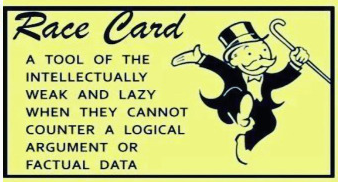
race-card

Far from being institutionally racist, Bentley University, like virtually every other American college today, is filled with well-meaning adults who want all their students to succeed. Corporations, law firms, Big Tech, and government agencies are bending over backwards to hire and promote as many underrepresented minorities (i.e., blacks and Hispanics) as possible. If the number of those minorities in a college or business organization is not proportional to their population share, that underrepresentation is due first and foremost to the academic skills gap. Mention of the skills gap is taboo in diversity circles, but it is real—repeatedly documented by the National Assessment of Educational Progress exams, the SAT, the LSAT, the GREs, the GMAT, and the MCAT—and it is consequential.

Hiring based on any extraneous selection criterion inevitably lowers the average qualifications of the resulting employee group. Hiring based on race entails a particularly significant deviation from a meritocratic ideal, since the only reason why color-conscious hiring is implemented in the first place is that merit hiring often fails to produce a critical mass of black and Hispanic employees. In essence, the diversity conceit is a perpetual motion machine: If underqualified diversity hires are promoted out of diversity pressure, resentment and obfuscation follow. If they hit a glass ceiling, accusations of bias are inevitable. In either situation, a diversity consultant is waiting in the wings to teach managers that their expectations and standards are racist.

The increasing power of college diversity bureaucrats over academic affairs since the 1990s has been stunning. Diversity vice-chancellors oversee faculty hiring searches, mandate quotas regarding whom search committees may interview, and sometimes even mandate quotas regarding whom they must hire. Chief inclusion officers track departmental race and sex demographics, pressuring department chairs to correct diversity deficits. Associate provosts for diversity coordinate campaigns for required courses on identity and grievance within the curriculum. Deans of inclusion teach students to recognize their place on the great totem pole of victimization. Vice presidents for equity monitor campus speech, on the lookout for punishable microaggressions. Senior advisors on race and community lead crusades against faculty who have allegedly threatened the safety of campus victim groups through non-orthodox statements regarding race and sex.

Now that the fictions underpinning this enterprise are being enshrined as an academic discipline, the possibility that the university will return to its status as an institution dedicated to the unfettered search for knowledge—and even, dare one say it, objectivity and meritocracy—will grow yet more remote.

university lightening

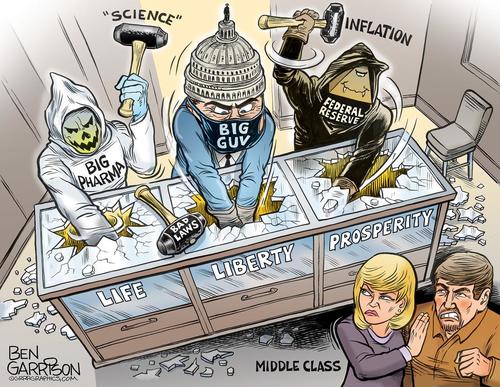
Big Bullies Public Smash and Grab

Ben Garrison explains his image at zerohedge The Smash and Grab Big Government Criminals are Looting Our Country.  Excerpts in italics with my bolds and some added images.

We’ve all seen the recent crime sprees taking place in the Democrat-controlled big cities. Acting in concert, flash mobs showed up to smash glass counters, steal the jewelry inside, and then make a quick getaway.

They are nothing compared to the smash and grab criminals controlling our country.  I’ve drawn three here, but there are many more.

The corporate media, for example. They smash and remove the truth and leave lies behind.

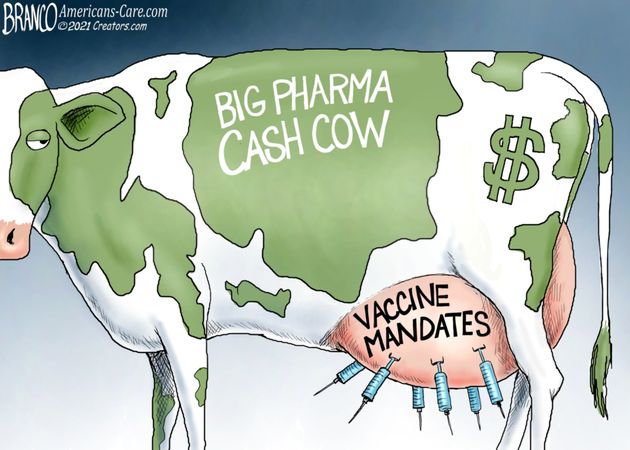
Big Pharma is unaccountable and irresponsible. It claims to own science, but what they really own is greed. Pfizer rakes in over $200 million taxpayer dollars per day for their dangerous and ineffective injections. The corporate media does not say a word about those injured or dying from the so-called vaccines. They don’t mention that thousands who are fully vaccinated not only contract Covid, but also die from the Chinese bioweapon.

Big Government makes laws in order to grow their own power as well as to enrich themselves. The so-called “Patriot Act” is a good example. It had nothing to do with patriotism. It had everything to do with stealing our liberties. Big Guv does this as a matter of routine. It keeps taking until it encounters resistance. Unfortunately they rarely get much push back. Too many people still think Big Guv is on their side and out to do good things for citizens. Nope. Big Guv is more concerned in getting reelected and growing more wealthy as it starts new wars. The latest may be against Russia. Yes, Big Guv wants to use US Troops and even threaten global nuclear war in order to protect the borders of Ukraine. Meanwhile, our southern borders remain wide open.

The Federal Reserve is an expert smash and grabber. It steals by means of currency creation at the flip of a switch. It is spent by the top of the pyramid and those at the bottom pay the hidden tax by means of inflation. The IRS makes sure it finishes the job of wealth confiscation, thereby making the working class poorer.

The criminal government gets away with it because they own a monopoly on force. Try and resist and they will send armed functionaries to arrest you. Resist arrest and you could be murdered. Included in the government mob are Big Pharma and The Federal Reserve. The politicized FBI does as it pleases, too. The CIA has been rogue almost from the start.

They will all continue until they are stopped. They will only stop when there is nothing left to grab. When that happens we will have no freedom, no privacy, and no dignity. We will own nothing and live in a technocratic dictatorship unless the war mongers decide to destroy all life on Earth first by means of a nuclear war.

The time to push back against this tyranny is now.

Two sides of the same coin.

How Liars Figure Fake Covid News

Ted Noel, MD explains in his American Thinker article Multiple Logical Fallacies Elevate COVID Vaccines Over COVID Treatments.  Excerpts in italics with my bolds and added images.

Monday morning, as I did my morning bicycle ride (I live in a safe neighborhood), I listened to Breitbart News host Alex Marlowe interview John Nolte, another Breitbart personality about COVID vaccination hesitancy. By the end of the interview, they’d wandered through several logical fallacies that need to be exposed so people can accurately balance vaccines versus treatments.

Marlowe and Nolte quoted data purporting to show that Washington state counties that Trump won have much higher COVID death rates than counties that Biden won. Vaccination rates are blamed for the difference. Marlowe went on to declare that it’s been proven that Ivermectin is a “dewormer” and should be removed from the conversation. These factoids are so illogical for a so-called conservative outlet that we must have a short refresher.

Figures Don’t Lie, but Liars Can Figure

The key offender here is something called “relative risk.” If there’s a one in a million chance of something happening, that’s a minuscule absolute risk. If it goes up to two in a million, it’s still a minuscule absolute risk that you really won’t get bothered about. But that same difference can be presented as a 100% increase in risk or a doubling, which sounds really awful.

When it comes to COVID, the overall rate of death is in the tenths of a percent in the most vulnerable population. Headlines about Republicans killing off their voter base are simply scaremongering in the decimal points using relative instead of absolute risk. The real rate of death under age 50 for COVID is “indistinguishable from zero” according to the weekly British monitoring service.

Figures Don’t Lie, but Liars Can Figure (Part 2)

Let’s suppose that David Leonhardt is presenting accurate data from Washington State and that red counties are seeing excess deaths. Let’s discount the “overtesting” issue because it is likely the same in all areas. Let’s also assume that the “vaccines” do offer some degree of protection, even though data clearly shows that such protection fades rapidly, with new variants making them even less effective. So, what’s happening?

Here we’re seeing the Fallacy of the Excluded Middle. The loud voices refuse to accept that there’s an option beyond “vaxxed or not vaxxed.” In this case, Marlowe’s blithe “dewormer” comment shows that he’s committing a different logical fallacy, the Appeal to Authority. He has accepted the FDA’s false warning that “you are not a horse, etc.” so you should not take Ivermectin, an extremely safe drug with a wide range of antiviral effects.

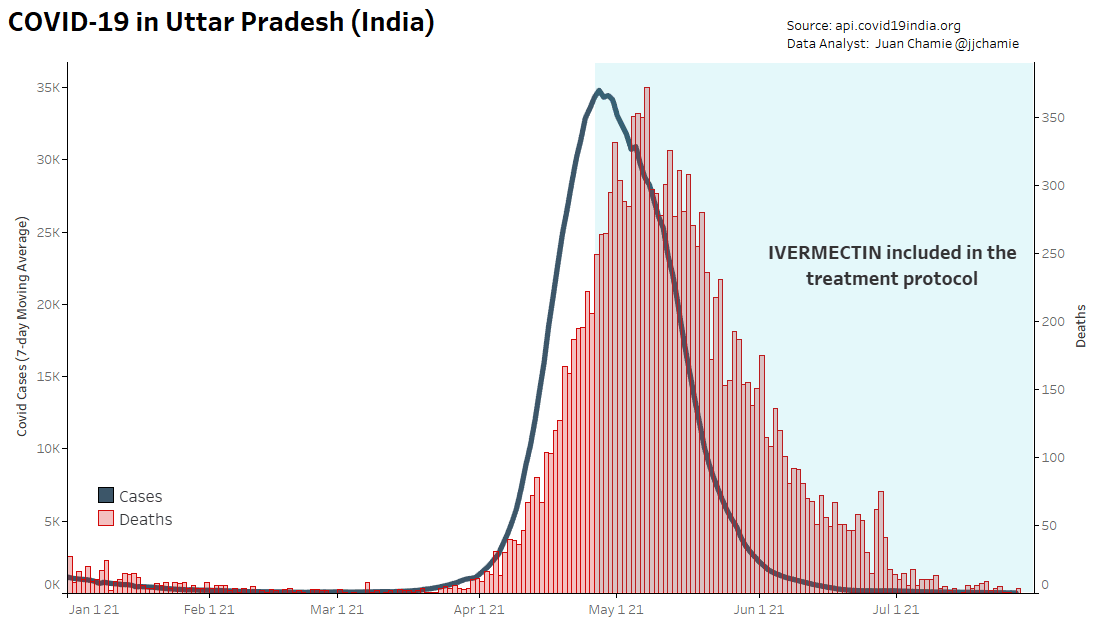
Randomized controlled trials have proven that IVM reduces COVID deaths even better than the vaccine. The state of Uttar Pradesh in India used IVM to wipe out COVID for 241 million people. But those people in Washington’s red counties were ruled by Dark Lord Inslee, making IVM and HCQ unavailable. No medical discussion can be complete without these alternatives.

Liars Can Force You to Behave How They Want You to Behave

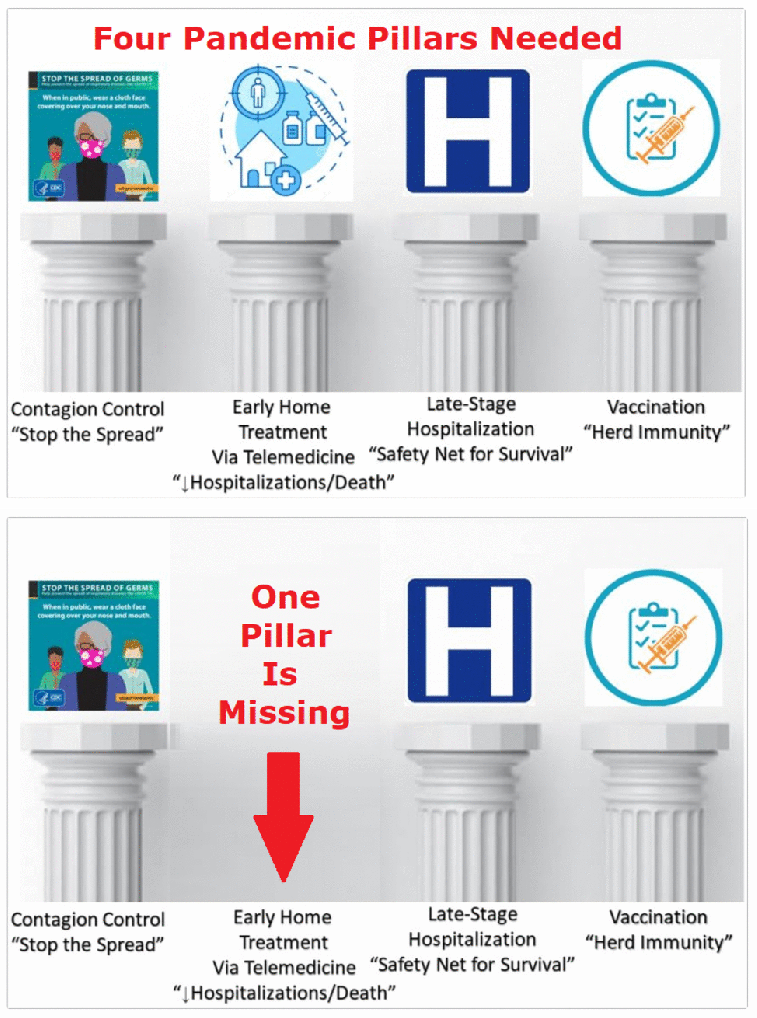
As I’ve noted, for you to exercise an option to seek alternative treatment, you must have a physician who is willing to prescribe such medication. But most of those doctors will refuse because, under the dictatorial rule of officials such as Governor Inslee, such prescribing is likely to get that doctor’s license to practice medicine revoked. With such a Sword of Damocles overhead, few prescribers will go near IVM or HCQ. That means they can talk vaxxed or not vaxxed as if those are the only possibilities.

Runny Nose Coronaviruses, Four in Circulation for Decades.

Omicron

This virus is mutating according to Muller’s Ratchet. That is, it’s getting easier to catch, and less likely to make you really sick or dead. It’s affecting young children more than earlier variants. Any benefit of the vaccine is unknown. At the same time, there’s no reason to suspect that IVM and HCQ would not be effective against it.

In other words, Omicron is just one step of COVID-19 becoming another variant of the common cold. Or it may have simply swapped some of its genetic sequence with a common cold virus. That might explain why it’s showing up all over the world at once.

Masks Don’t Help

I feel like I’m beating a dead horse here, but facts are facts. We have dozens of surveillance studies that show that the general public wearing masks has no effect on the transmission of airborne viruses. You either have an easy-to-breathe-through cloth diaper that doesn’t filter or an expensive disposable diaper that filters but that you breathe around. Neither one has any useful effect. A recent study supposedly shows that masks work, but it has so many (scientific) holes that it simply doesn’t hold water.

COVID is a Mild Disease (if you treat it!)

COVID is one of those mild diseases that sends sick people over the edge because they don’t need much of a shove. But for healthy people to die of it, they must be kept away from effective drugs like IVM and HCQ. Having prevented treatment, the Quixotic Quislings of Quarantine can then claim that COVID is far worse than it actually is.

With any of the proven protocols for those drugs, COVID is no worse than the flu. But the billions available in the COVID lottery are so large that it’s hard for anyone to remember that the task of a doctor is to treat the sick, not to keep them away from treatment because they didn’t get a shot that is less effective than the $8 India spent.

Parting Thoughts

The COVID pandemic is a man-caused disaster, and I’m not talking about how the bug was created. In the earliest days, we didn’t know how to treat it but within a couple of months effective HCQ protocols were available. Those protocols, though, contradicted the bureaucrats at NIH/CDC/LSD who were married to their own approach of lockdown, distance, and vaccinate – unless you are one of the elites. They were the smartest people in the room, and anyone who contradicted them was the spawn of the devil.

We have extremely effective protocols that anyone who gets sick should be able to use, but those bureaucrats can punish anyone who prescribes one of them. In short, we are in a concentration camp from sea to shining sea. America the Beautiful is now COVIDia the Rapacious. We are cannon fodder at the command of those who know nothing but do not care.


CV19 Lockdowns: High Pain/Gain Ratio

Douglas W. Allen published a study Covid-19 Lockdown Cost/Benefits: A Critical Assessment of the Literature in the International Journal of the Economics of Business. September 29, 2021. H/T Raymond  Excerpts in italics with my bolds and some added images

Abstract

An examination of over 100 Covid-19 studies reveals that many relied on false assumptions that over-estimated the benefits and under-estimated the costs of lockdown. The most recent research has shown that lockdowns have had, at best, a marginal effect on the number of Covid-19 deaths. Generally speaking, the ineffectiveness stemmed from individual changes in behavior: either non-compliance or behavior that mimicked lockdowns. The limited effectiveness of lockdowns explains why, after more than one year, the unconditional cumulative Covid-19 deaths per million is not negatively correlated with the stringency of lockdown across countries. Using a method proposed by Professor Bryan Caplan along with estimates of lockdown benefits based on the econometric evidence, I calculate a number of cost/benefit ratios of lockdowns in terms of life-years saved. Using a mid-point estimate for costs and benefits, the reasonable estimate for Canada is a cost/benefit ratio of 141. It is possible that lockdown will go down as one of the greatest peacetime policy failures in modern history.

Overview

The term ‘lockdown’ is used to generically refer to state actions that imposed various forms of non-pharmaceutical interventions. That is, it is used to include mandatory state-enforced closing of non-essential business, education, recreation, and spiritual facilities; mask and social distancing orders; stay-in-place orders; and restrictions on private social gatherings.

‘Lockdown’ does not refer to cases of ‘isolation,’ where a country was able to engage in an early and sufficient border closure that prevented trans-border transmission, followed by a mandated lockdown that eliminated the virus in the domestic population, which was then followed by perpetual isolation until the population is fully vaccinated. This strategy was adopted by a number of island countries like New Zealand.1 Here I will only consider lockdown as it took place in most of the world; that is, within a country where the virus became established.

The report begins with an examination of four critical assumptions often made within the context of estimating benefits and costs. Understanding these assumptions explains why early studies claimed that the benefits of lockdown were so high, and also explains why the predictions of those studies turned out to be false. Then I examine the major cost/benefit studies in roughly chronological order, and focus on the critical factor in these studies: distinguishing between mandated and voluntary changes in behavior. Preliminary work on the costs of lockdown is reviewed, and finally a simple cost/benefit methodology is used to generate several cost/benefit ratios of lockdown for my home country of Canada.

In no scenario does lockdown pass a cost/benefit test; indeed, the most reasonable estimates suggest that lockdown is a great policy disaster.

Discussion

Over the course of the Covid-19 pandemic, there has been no public evidence that governments around the world have considered both the benefit and cost sides of their policy decisions. To my knowledge, no government has provided any formal cost/benefit analysis of their actions. Indeed, the steady press conferences and news releases almost entirely focus on one single feature of the disease. Although the focus of government announcements has changed over the year, from ‘flattening the curve’, number of Covid-19 deaths, number of Covid19 cases, hospital capacity, and variant transmissions (especially the delta variant), there has seldom been any official mention of the costs of the actions taken to address these concerns.

The counterfactual number of cases/deaths

If lockdown reduces the transmission of the virus, the natural question to ask is ‘by how much?’ In other words, ‘but for the lockdown’ what would the level of infection/transmission/deaths be? What is the counterfactual to lockdowns?

Early in the pandemic the Neil Ferguson et al. (2020) model appeared to drive many lockdown decisions and was widely covered in the media. Figure 1 reproduces a key figure of that paper (Table 2, p. 8), and shows the results of various types of lockdown on occupied ICU beds. The symmetry, smoothness, and orderly appearance of the functions is a result of the mechanical nature of the model. This type of figure is found, in one form or another, in most papers based on a SIR model.

Figure 1 ICU projections from ICL model.

In Figure 1 the black ‘do nothing’ line is the counterfactual, while the other lines are various types of lockdowns. The harsher the lockdown, the ‘flatter’ the case load, with the blue line being the strongest lockdown. The difference between the black line and another line is the benefit of that particular lockdown in terms of cases delayed. Clearly the exponential growth of the ‘do nothing’ counterfactual leads to enormous differences, and makes lockdown look better.

Given the prediction that lockdowns would lower deaths by one-half, the authors made a dramatic recommendation: ‘We therefore conclude that epidemic suppression is the only viable strategy at the current time. The social and economic effects of the measures which are needed to achieve this policy goal will be profound.’ (Ferguson et al. 2020, p. 16). In retrospect it is remarkable that such a conclusion was drawn. The authors recognized that the ‘social and economic effects’ would be ‘profound,’ and that the predictions were based on the ‘unlikely’ behavioral assumption that there would be no change to individual reactions to the virus. However, given the large counterfactual numbers, presumably they felt no lockdown cost could justify remaining open.
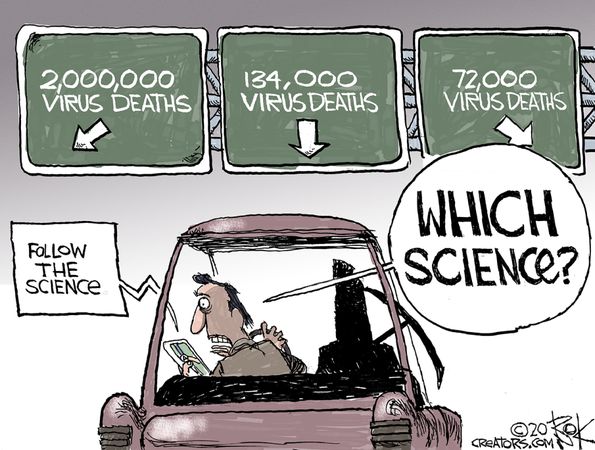
Problems with the ICL model were pointed out immediately:

i) the reproduction number (Rt) of 2.4 was too high;
ii) the assumed infection fatality rate (IFR) of 0.9% was too high and not age dependent;
iii) hospital capacity was assumed fixed and unchangeable; and
iv) individuals in the model were assumed to not change behavior in the face of a new virus.

All of these assumptions have the effect of over-estimating the counterfactual number of cases, transmissions, and deaths.

The exogenous behavior assumption

A major reason for the failure of SIR models to predict actual cases and deaths is because they assume no individual in the model ever changes behavior.9 The implication of ignoring individual responses to a viral threat are dramatic. Atkeson (2021) used a standard SIR model (with exogenous behavior) that included seasonal effects and the introduction of a more contagious variant in December 2020 to forecast daily U.S. deaths out to July 2023. The results of this standard model were typical: the model made apocalyptic predictions on deaths that were off by a factor of twelve by the summer of 2020. However, he then used the same model with a simple behavioral adjustment that allowed individuals to change behavior in light of the value of Rt. The new forecast of daily deaths based on this single addition completely changed the model’s predictive power. The model now tracked the actual progression of the daily deaths very closely.

The fact that individuals privately and voluntarily respond to risks has two important implications. First, it influences how any counterfactual outcome is understood with respect to the lockdown. When no voluntary response is assumed, models predict exponential caseloads and deaths without lockdowns. If lockdowns are imposed and cases coincidently fall, the actual number of cases is then compared to a counterfactual that never would have happened.11 Therefore, not accounting for rational, voluntary individual responses within a SIR model drastically over-states any benefit from lockdown.12

Second, any empirical work that considers only the total change in outcomes and does not attempt to separate the mandated effect from the voluntary effect, will necessarily attribute all of the change in outcome to the mandated lockdown. Once again, this will over-estimate the effect, and quite likely by an order of magnitude.

The assumed value of life

Economic value is based on the idea of maximum sacrifice. Thus, when it comes to the value of an individual’s life, this value is determined by the actual individual. In practice, what is measured is the marginal value to extend one’s life a little bit by reducing some type of harm, and then use this to determine a total value of life.

One problem with using the VSL for estimating the benefits of saving lives through lockdown is that it measures the total value of life based on a marginal value. Thus, using a VSL (which is based on observing ordinary people not at the point of death) as a measure of the value of a life of someone about to die, is likely to provide an over-estimate of the value of the life.

In many Covid-19 cost/benefit studies, however, there is another more serious problem with how the VSL is used. Namely, it is often assumed that

i) the VSL is independent of age, and
ii) that the VSL is equal to around $10,000,000.

Both of these claims are not true.

Figure 2. Age related estimates of VSL

To assume that the VSL is constant implies that individuals are indifferent between living one more day or eighty more years. Figure 2 shows more reasonable estimates, with the value of a child being seven times the value of an 85 year old. The VSL of $2,000,000 for an 85 year old is based on the assumption that life expectancy is still ten years. For someone who is 85, in poor health with multiple serious illnesses, the VSL would be much lower.

An issue with lockdown costs

It is common in cost/benefit studies to only use lost GDP as the measure for the cost of lockdown. That is, the reduced value of goods and services caused by lockdown is the only cost of the lockdown considered. For example, US GDP over 2020 fell by 3.5%. If 100% of the fall in GDP (approximately $770 billion) is attributed to the lockdown (that is, the virus directly had no effect on production), then compared to the presumed ‘22 trillion’ dollar savings in lives, lockdown seems like an excellent policy.

This type of comparison, however, is entirely inappropriate.

The VSL is based on the utility of life, and therefore, the costs of lockdown must also be based on the lost utility of lockdown. It has been understood from the very beginning of the pandemic that lockdown caused a broad range of costs through lost civil liberty, lost social contact, lost educational opportunities, lost medical preventions and procedures, increased domestic violence, increased anxiety and mental suffering, and increased deaths due to despair and inability to receive medical attention. If the value of lockdown is measured in utility, then the costs of lockdown must be measured in the same fashion. Excluding the value of lost non-market goods (goods not measured by GDP) grossly under-estimates the cost of lockdown.

Other Costs

Lost educational opportunities. Lost, delayed, or poor education leads to reduced human capital that has life long negative consequences.

Additional effects of school closures. Closing schools creates isolation for children, which is known to increase the risk of mental health conditions.

Increased deaths expected from unemployment. Life expectancy depends on wealth levels. McIntyre and Lee (2020) predict between 418–2114 excess suicides in Canada based on increased unemployment over the pandemic year. 

Increased deaths from overdoses and other deaths of despair. Lockdowns disrupt illegal drug channels, often resulting in a more contaminated drug supply. Lockdowns also increase human isolation, leading to increased depression and suicides.

Increased domestic violence. Chalfin et al. (2021) found that much of the increased domestic violence is related to increased alcohol which increased during lockdown.

Lost non-Covid-19 medical service. In the spring lockdown hospitals cancelled scheduled appointments for screenings and treatments (e.g. London et al. 2020; Garcia et al. 2020), this created fear among individuals who required emergency treatments. Woolf et al. (2020) estimate that in the U.S. about 1/3 of the excess deaths over 2020 are not Covid-19 deaths. 

The opportunity costs of lockdown are widespread across societies, and everyone has faced some type of lockdown consequence. These costs are often non-market and in the future, making them difficult for third parties to measure. They are also unevenly distributed onto the young and the poor who have been unable to mitigate the consequences of lockdown.

These characteristics contribute to the lack of attention given to them, and stand in sharp contrast to Covid-19 case loads and deaths that are measured, highly concentrated, and widely reported.

In light of the nature and measurement problems associated with the costs of lockdown, as of July 2021 no true, standard, cost benefit study has been conducted. All efforts have rested on assumptions and guesses of things not yet known. It will still take time for a systematic, ground-up, attempt to determine the total lost quality of life brought about by lockdown. Even though such studies do not exist, there is still weight to the economic logic that, with negligible benefits and obvious high costs, lockdown is an inefficient policy.

Four stylized facts about covid-19

Atkeson et al.’s (2020) paper ‘Four Stylized Facts About Covid-19’ was a watershed result that appeared six months into the pandemic. Using data from 23 countries and all U.S. states that had experienced at least 1000 cumulative deaths up to July 2020, it discovered important features of the progression of the virus across countries that cast serious doubt that any forms of lockdown had a significant large impact on transmission and death rates.

In particular, they found that across all of the jurisdictions there was an initial high variance in the daily death and transmission rates, but that this ended very rapidly. After 20–30 days of the 25th death the growth rate in deaths fell to close to zero, and the transmission rate hovered around one. Not only did Atkeson et al. find a dramatic drop and stability of the death and transmission rates, but the spread in these rates across jurisdictions was very narrow. That is, across all jurisdictions, after 20–30 days the virus reached a steady state where each infected person transmitted the virus to one other person, and the number of daily deaths from the virus became constant over time.

Atkeson et al. speculated on three reasons for their findings. First, unlike the assumptions made in the SIR models, individuals do not ignore risks, and when a virus enters a population people take mitigating or risky actions based on their own assessments of that risk. Second, again in contrast to the classic SIR model where individuals uniformly interact with each other, actual human networks are limited and this can limit the spread of the virus after a short period. Finally, like other pandemics, there may be natural forces associated with Covid-19 that explain the rapid move to a steady state death and transmission rate.

Voluntary versus mandated lockdown channels

There are, by my count, over twenty studies that distinguish between voluntary and mandated lockdown effects. Although they vary in terms of data, locations, methods, and authors, all of them find that mandated lockdowns have only marginal effects and that voluntary changes in behavior explain large parts of the changes in cases, transmissions, and deaths.

A reasonable conclusion to draw from the sum of lockdown findings on mortality is that a small reduction (benefit) cannot be ruled out for early and light levels of lockdown restrictions. There is almost no consistent evidence that strong levels of lockdown have a beneficial effect, and given the large levels of statistical noise in most studies, a zero (or even negative) effect cannot be ruled out. Maybe lockdowns have a marginal effect, but maybe they do not; a reasonable range of the decline in Covid-19 mortality is 0–20%.

An alternative cost/benefit methodology

Professor Caplan (2020) has suggested a thought experiment that provides a solution for the cost measurement issue. Rather than attempt to measure a long list of costs and add them up, Caplan proposes a method that exploits our willingness to pay to avoid the harms of lockdown. If lockdown imposed net costs of $1000 on a person, then that person would be willing to pay up to $1000 to avoid lockdown. Caplan, however, poses the matter in terms of time rather than dollars.

Professor Caplan’s thought experiment addresses the total costs of all covid prevention as perceived by each person living under it, and therefore is an appropriate utility based cost measure to hold up against the value of lives saved through lockdown: X is the number of months a person is willing to pay to avoid lockdowns, other things equal.

For any random individual, X could take on a wide range of values. For some this past year has been horrific, and perhaps they would have preferred it never happened. Perhaps they suffered violence or abuse that was fueled by frustration and alcohol while locked down during a long stay-at-home order. Or perhaps they lost a business, a major career opportunity, or struggled over a long period of unemployment and induced depression. For these people, X equals 12 — they would have paid 12 months of their life to have avoided this past year. Others might have been willing to pay even more.

For the vast majority of populations, Covid-19 was not a serious health risk. Lockdowns provided no benefits and only costs. Thus, for the vast majority, X likely takes on a value in the order of a few months.

As of March 2021 the pandemic had lasted one year, and by assumption the average Canadian had lost two months of normal life due to lockdown. The population of Canada is 37.7 million people, which means that 6,283,333 years of life were lost due to Canada’s lockdown policy. This number of years can be converted into ‘lives’ using average life expectancy.

The average age of reported Covid-19 deaths in Canada over the first year of the pandemic was 80. In Canada an average 80 year old has a life expectancy of 9.79 years. This means that the 6,283,333 million years of lost life is equivalent to the deaths of 643,513 80 year olds. As of March 22, 2021 Canada had a total of 22,716 deaths due to Covid-19 (or 222,389 lost years of life).

Conclusion

After more than a year of gathering aggregate data, a puzzle has emerged. Lockdowns were brought on with claims that they were effective and the only means of dealing with the pandemic. However, across many different jurisdictions this relationship does not hold when looking at the raw data.

A casual examination of lockdown intensity and the number of cumulative deaths attributed to Covid-19 across jurisdictions shows no obvious relationship. Indeed, often the least intensive locations had equal or better performance. For example, using the OurWorldInData stringency index (SI) as a measure of lockdown, Pakistan (SI: 50), Finland (SI: 52), and Bulgaria (SI: 50) had similar degrees of lockdown, but the cumulative deaths per million were 61, 141, and 1023. Peru (SI: 83) and the U.K. (SI: 78) had some of the most stringent lockdowns, but also experienced some of the largest cumulative deaths per million: 1475 and 1868.

These unconditional observation puzzles are resolved by the research done over the past year. The preconceived success of lockdowns was driven by theoretical models that were based on assumptions that were unrealistic and often false.

The lack of any clear and large lockdown effect is because there isn’t one to be found.
 

No US Legal Precedent for CV19 Vaccine Mandates

Harvey Risch and Gerard Bradley write at Brownstone Institute Covid-19 Vaccine Mandates Fail the Jacobson Test.  Excerpts in italics with my bolds and added images.

We are facing, in other words, questions about how best to integrate our perennial commitment to freedom with our equally long-standing concern for public health, in this time of crisis.

Americans are a freedom-loving lot. It is our founding ethos and we have defended it across the world on numerous occasions. At the same time, we have a strong tradition of social altruism and dedication to the common good, especially in times of crisis.

Now that the Covid-19 pandemic has been with us for close to two years and vaccines for almost one, we have learned that the vaccines work to a degree and that they have both known serious risks and theorized potential risks.

Over the last few months, Americans have been increasingly facing demands that they be vaccinated or revaccinated—from governments, schools, employers, shopkeepers, even relatives.

During the pandemic, the courts have rightly relied upon a century-old precedent of the Supreme Court in mandate cases, but they have gravely misunderstood and misapplied that precedent to uphold draconian and unjustified Covid-19 vaccine mandates.

At times of national emergency, government’s overriding goal must be to protect the population while removing the cause of the state of emergency. This means that certain laws, regulations, and policies may be temporarily suspended to accomplish these tasks. For example, if the army needs your car to transport soldiers to the front line, so be it. In particular, during the 1902 smallpox epidemic, the U.S. Supreme Court in Jacobson v. Massachusetts, 197 U.S. 11 (1905) ruled that the State of Massachusetts could compel residents to obtain free vaccination or revaccination against the infection, or suffer a penalty of $5 (about $150 today) for noncompliance.

In authoring the majority opinion in Jacobson, Justice John Marshall Harlan argued:

(1) that individual liberty does not allow people to act regardless of harm that could be caused to others;
(2) that the vaccination mandate was not shown to be arbitrary or oppressive;
(3) that vaccination was reasonably required for public safety; and
(4) that the defendant’s view that the smallpox vaccine was not safe or effective constituted a tiny minority medical opinion.

The Supreme Court in Jacobson repeatedly invoked the “common good” of the polity as the principle of sound constitutional thinking about the public health emergency of the day. Just so—then and now. The Court did not, however, equate the “common good” with a reflexive preference for some collective interest over each person’s rights, or with automatic deference to the latest asserted findings of “the science.”

In this context, for the government to assert that its constitutional obligations (as described in Jacobson, for example) are satisfied only “because a government agency says so” would be self-serving and wholly inadequate. Such reasoning would not satisfy the burden of proof; rather, the government would need to demonstrate the relevant, full, non-cherry-picked scientific evidence to make the case.

Now let’s consider the four criteria upon which Jacobson relied in deciding that the smallpox vaccine mandate in 1905 passed constitutional muster, and use them to evaluate today’s Covid-19 vaccine mandates.

(1) Individual liberty does not allow people to act regardless of harm that could be caused to others.

What seems apparent is that this criterion is addressing the compelling interest in limiting people from acting to spread the infection. In Constitutional law a “compelling interest” is a necessary or crucial action rather than a preferential one; for example, saving the lives of large numbers of people at risk.

In fact, the federal government has already set a de facto threshold for this level. Annually, approximately 500,000 Americans die from tobacco-related diseases. Yet, the federal government has never acted to curtail tobacco use in any meaningful way. This implies that 500,000 deaths per year is not large enough to trigger a compelling government interest.

Thus, it seems that any truly “compelling” interest can only apply to high-risk individuals, who are definable and comprise a small minority of the general population. Furthermore, the lives of such individuals can often be protected by known existing and available pharmacologic and monoclonal antibody interventions (see criterion (3) below), which means that there may be a less-than-compelling interest for universal vaccination even among them.

Additionally, we know now, and both Drs. Anthony Fauci and Rochelle Walensky have stated publicly, that fully vaccinated individuals can become infected and transmit the virus to others. A number of such outbreaks have occurred in diverse locales. Thus, there is no apparent compelling interest in mandating vaccination for low-risk individuals specifically in an attempt to reduce infection transmission to high-risk people—just as there is no compelling interest in mandating vaccination to reduce infection transmission to low-risk people.

Just to be clear, government compelling interest inheres in prevention of serious outcomes such as hospitalization and mortality. But we assert that that there is no such compelling interest in Covid-19 case occurrence. The overwhelming majority of cases recover.

Prevention of Covid-19 cases is at most a desirable policy goal and not a compelling interest.

As has become increasingly apparent, natural immunity following Covid-19 infection is stronger in repelling subsequent viral outbreaks than vaccine-based immunity. (Thus, prevention of Covid-19 case occurrence per se is actually counterproductive in ending the pandemic.)

(2) The vaccination mandate is not shown to be arbitrary or oppressive.

Covid-19 vaccine mandates imposed by the federal government and some state governments require vaccination by all adults except those requesting medical exemptions or religious exemptions. Criteria promulgated by the CDC for medical exemptions however are extremely limited, essentially involving only severe life-threatening allergic reactions as demonstrated from taking the first vaccination of the two-dose mRNA series. Religious exemption requests appear to have met variously capricious responses by vaccine mandate reviewers, and some states have prohibited religious exemptions altogether, in violation of (as Justices Gorsuch, Thomas, and Alito argued and as we would maintain) constitutional guarantees of religious liberty.

The one quite irrational consideration of all vaccination mandates to date is that the mandates ignore people who have had Covid-19 and thus have natural immunity. There are now more than 130 studies demonstrating the strength, durability and wide spectrum of natural immunity particularly versus vaccine immunity.

Some arguments have been put forward asserting that antibody levels may be higher in vaccinated people than people recovered from Covid-19, but antibody levels per se do not translate into degree of immunity. Antibody levels in vaccinated people decline appreciably starting at four months post-vaccination, whereas antibody levels in Covid-19 recovered stay roughly constant during those months. Other assertions have been that asymptomatic or mild Covid-19 infections may not produce strong natural immunity; however, these claims have been shown to be scientifically unfounded. Empirical population studies on reinfection/breakthrough infection demonstrate that natural immunity is as strong or stronger than vaccine immunity.

Finally, natural immunity can be documented by having ever had a positive Covid-19 PCR, antibody or T cell test, regardless of current status of those tests.

Similarly, Covid-19 vaccine mandates for children are unwarranted because children almost entirely get infected from their parents or other adults in the household, and infrequently transmit the infection to their classmates, teachers or uninfected household adults.

Normal healthy children do not die from Covid-19, and the 33 children aged 5-11 years estimated by the CDC to have died from Covid-19 between October 3, 2020 and October 2, 2021 all had chronic conditions like diabetes, obesity, being immunocompromised (e.g., after cancer treatment) that put them at high risk, and even these numbers are much lower than childhood deaths from traffic and pedestrian accidents, or even being hit by lightning. Covid-19 in children is almost entirely an asymptomatic or mild disease typified by fever and tiredness and resolves on its own in 2-3 days of rest. Thus, vaccine mandates for children are unwarranted.

In sum, a policy requiring vaccination of people who are either already immune or of no consequence either for their own health or for spreading the infection is arbitrary. It is oppressive in inflicting a medical procedure on people who do not need it for themselves or for others. Such a policy would even fail the “rational basis” test which so many courts have applied perfunctorily.

(3) Vaccination is reasonably required for public safety.

Vaccination in theory prevents personal infection and disease, as well as transmission of infection to others. The government’s interest is almost entirely in the latter. We now know that the Covid-19 vaccines in the real world don’t prevent transmission all that well.

Further, public safety is enhanced by use of medications for early outpatient treatment that safely allow increase in population natural immunity. An extensive body of studies has accumulated over the last 18 months showing that various approved but off-label medications dramatically reduce risks of Covid-19 hospitalization and mortality when started in ambulatory patients within the first five days or so of symptom onset.

Meta-analyses of hospitalization and mortality risks calculated by the first author are shown in the figures on the next page for two drugs, hydroxychloroquine and ivermectin. Additional thorough discussion of standards of evidence of randomized and nonrandomized drug trials, as well as on a number of small trials that failed in the adequacy of their study designs and executions, is posted here. These analyses show that numerous drugs and monoclonal antibodies are available to treat ambulatory patients with Covid-19 successfully, making vaccination a choice for dealing with the pandemic, but not a necessity.

(4) The vaccine has a long popular, medical, and legal history of being regarded as safe and effective.

This criterion decisively distinguishes Jacobson and the smallpox vaccine mandate from what is happening today. Jacobson did not accept dissenting testimony about vaccine safety or efficacy because the vaccine at that time had been a staple in society for almost 100 years.

The genetic Covid-19 vaccines have no such information, have every indication that they are orders of magnitude more harmful, and even the FDA still classifies all three in use in the US as experimental, which means that their EUA designations have only required showing that they may convey some benefit and need not be harm-free, i.e., have not been established as safe and effective, let alone known as such for decades or longer.

According to the VAERS database, to date some 19,000 deaths have been associated with the Covid-19 vaccines, of which more than one-third occurred within three days of vaccination. In this one year of Covid-19 vaccination, this number is more than double the number of deaths from all other vaccines over more than 30 years combined in the VAERS data. It is also more than 150 times the mortality risk of smallpox vaccination, 0.8 per million vaccines (Aragón et al., 2003).

The VAERS database also identifies more than 200,000 serious or life-threatening non-death events to date, and this number is almost certainly at least 10-fold undercounted because of the work, difficulty, impediments and lack of general knowledge involved in filing adverse event reports in the VAERS system. Many of these adverse events portend lifelong serious disabilities. But two million serious or life-threatening events is well more than the damage that would have been caused by even untreated Covid-19 occurrence in the same 200 million vaccinated Americans, especially given that two-thirds of them have strong natural immunity from having had asymptomatic or symptomatic Covid-19.

These numbers indicate that these severe events caused by the vaccines very likely outnumber serious Covid-19 outcomes that would have occurred in the same individuals had they not been vaccinated. As well, those numbers would be dramatically lower with general availability of the suppressed but effective treatment medications for early ambulatory patient use.

With regard to efficacy, the three US Covid-19 vaccines showed great promise in their original randomized trials results. However, as these vaccines have been rolled out in hundreds of millions of doses to the general public in the “real world,” their performance has differed from what was originally described.

Thus, if vaccination were to be the only method of combating the pandemic, it appears that vaccinations repeated indefinitely at 6-month intervals would be required, and even that may not be all that successful in reducing spread substantially. There are no vaccination programs for other general diseases in the US that require such a high frequency of compliance. Even influenza, which has a substantial annual mortality, has an annual revaccination frequency, is only perhaps 50% effective over the flu season, is not mandated.

A careful reading of Jacobson shows that it is not just an automatic consideration allowing the government to do what it wants when a pandemic emergency has been officially declared. In a pandemic, courts look to Jacobson for precedent as an apparent direct fit, but even so must evaluate the evidence for satisfying all of the Jacobson criteria.

As we have shown, Covid-19 vaccine mandates do not satisfy any of the required criteria in Jacobson, let alone all of them.

The question to be addressed then is why a pandemic infection with approximately 1/20th the natural mortality risk of the previous smallpox pandemic would be subject to the grievous penalties of loss of employment, loss of medical care, loss of necessary activities of daily life, and mandate of vaccines that unlike in the previous pandemic have no long-term safety data. Given that none of the Jacobson criteria have been met, the infringements and demands of the government and its public health agencies have not been justified according to law. This is the argument that must be made as to why the proposed vaccine mandate is an unwarranted overreach inconsistent with established public health policy and law.


Covid/Climate Prigs Are Out to Spoil Your Days

Christopher Gage writes at Oxford Sour Bay of Prigs.  Excerpts in italics with my bolds.

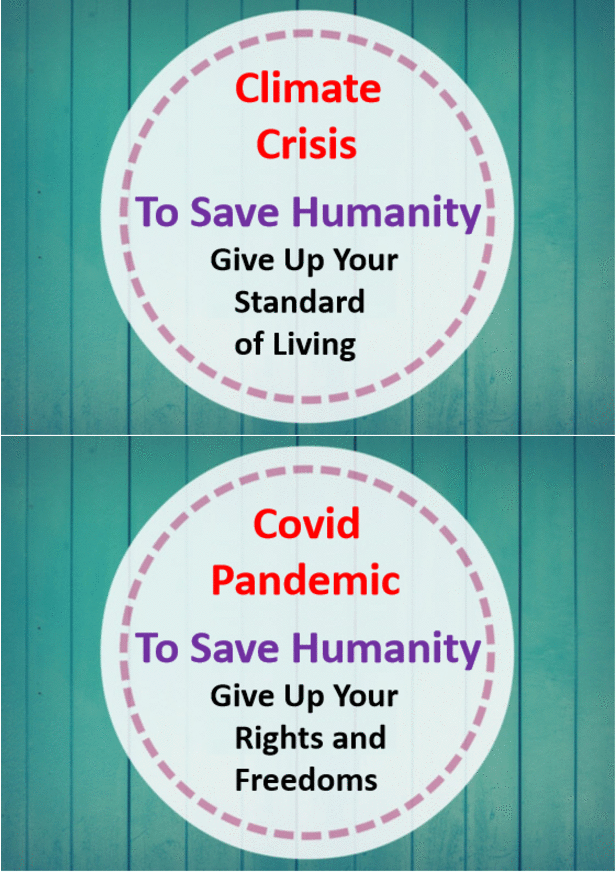
Enamoured by lockdown, the puritans wish for a perma-pandemic in which no-one, nowhere, will be happy.

Not content with dying their hair green and punching steel through their nostrils, progressives here in Great Britain have proposed something rather more exquisitely demented than their usual fare.

The Independent, a kind of Guardian for actors manqué and Cluster B personalities, those who suffer from fictitious ailments of which ‘the doctor doesn’t know what’s wrong,’ asks, ‘Should Everyone Have a Personal Carbon Quota?’

Helpfully, the newspaper lays out exactly what a Carbon Quota would entail.

It begins: “Your home, sometime in the next decade. You click the heating on and receive an app notification telling you how much of your carbon allowance you’ve used today.

“Outside in the drive, your car’s fuel is linked to the same account. In the fridge, the New Zealand lamb you’ve bought has cost not just pounds and pence but a chunk of this monthly emissions budget too.

“Welcome to the world of personal carbon allowances – a concept that is increasingly gaining traction among experts as a possible response to the climate crisis.”

Curiously, this all sounds like one’s entire life would be recorded and regulated and monitored and meddled with by politicians who’ll punish or praise, all in pursuit of a vague utopia. Sounds familiar.

According to my Carbon Quota, I could live happily and healthily, provided I die next Tuesday at noon.

If I were to stay on this planet and offend Mother Nature with my presence, I’d have to limit myself to half a cigarette per day, a slither of ribeye per week, and one soupçon of red wine per month. Such a paltry regimen would dissolve around 90% of my personality.

Besides, Tuesday is no day to die. Especially before the 4 p.m. happy hour.

Perhaps, I could time it just right. I’ll prop up a stool in my favourite dive bar, and impart everything I’d like to say but avoid saying in fear of social ostracization.

I could say that there is a biological reason why women aren’t funny. I could say that, on balance, the British Empire was a good thing, and that anyone whinging about ‘cultural appropriation’ seldom has any culture worth appropriating. I could say, with conviction, that the Jews obviously don’t secretly run the world because if they did, the world would be far closer to utopia than it is now. I could suggest that those who play music on public transport, indeed—in public—should be hung, drawn, and quartered for the benefit of the gene pool. I could say all this before shuffling off into the light.

(If my girlfriend—whose people have won a fifth of all Nobel Prizes despite being 0.2% of the world population—objects, then I’m sorry… I’m saving the planet, darling.)

You can define the confidence of a culture by the pettiness of its laws.

I’d rather shuffle off than live in a world in which one’s social status is tied to one’s ability to pretend falafel is edible, to one’s withering body. I’d rather that than live in a world in which the prigs and puritans, those weird kids from school with ‘Free Da Weed’ Sharpied on their hemp rucksacks, have won the final victory over everyone else. A world in which every consideration is now suffixed with ‘to save the planet.’

We shouldn’t feign surprise. A stubborn one-third of any population harbours latent authoritarian tendencies. All they need is a little nudge and a wink from someone in a lab coat or a pinstripe suit.

Over the last twenty months, we’ve given them plenty to chew on. We’ve sacralised Crab Mentality—that depressingly human tendency to pull down others into the soup of conformity. For many, this pandemic has been the time of their lives. They’ve enjoyed grassing on neighbours, posting their vaccine statuses, their three-mask chic. Don’t mention that sensible Sweden got it right. Don’t mention that lockdown only delays the inevitable, to great human cost. Don’t mention the fatal link between obesity and Covid deaths.

They’d love life in Austria, where the government has mandated a Western first—forcible vaccination for every citizen.

What a time to be alive. This pandemic has valorised negative personality traits. Back in the Old Normal, high neuroticism combined with high agreeableness meant you’d spend your days siphoning your biography for ‘trauma’ to weaponize against the world. Now, it’s a plus. Like Woke intellectuals, the neurotics mistake their personal problems for societal problems.

I assumed a majority of Britons would, like me, rather chew on a glass vial labelled ‘Wuhan Institute of Virology,’ than consider medical apartheid. Nope.

According to YouGov, six in ten Britons support the introduction of a ‘papers, please’ society—vaccine passports.

That’s despite vaccines blunting Covid’s ability to hospitalise and kill, but not its ability to spread—rendering vaccine passports both pointless and poisonous.

Of course, the usual disclaimer applies just in case anyone of a progressive bent is reading: I’m not saying it’s Nazi Germany, but it’s quite clear how totalitarian regimes slip into power with little resistance.

A recent survey in The Economist made for terrifying reading: forty percent wanted masks forever; a quarter wanted to shut down nightclubs and casinos; another third wanted socially-distanced pubs and clubs and theatres; a hefty rump wanted a 10 p.m. curfew, and one-third said anyone coming into this country should be quarantined, like a dog, for ten days. And they wanted all this lunacy indefinitely, Covid or not.

Perhaps that explains why the eco-loons can air with confidence the drudgery they wish to impose upon everyone else. Not a day goes by without some middle-class Insulate Britain bobo blocking the motorway or making ‘demands’ upon the government to act on the ‘climate crisis’.

What nobody asks is how any of this nonsense would make any difference given that Great Britain contributes less than one percent of global carbon emissions. Those who follow The Science don’t cotton on when last week’s gospel morphs into this week’s heresy.

What happens when we reach Net Zero and the weather doesn’t change? I can only guess… ‘That wasn’t real Net-Zero. Real Net-Zero has never been tried.’

They don’t ask such obvious questions because the answer is obvious: they don’t care about all that. As Mencken wrote, they’re governed by the haunting fear that someone, somewhere, may be happy.

That’s the problem with do-gooding. There’s always more good to do.


How Voter Fraud Is Revealed in 35 US States

Jay Valentine reports on the behind-the-scenes canvassing organizations documenting widespread fraud in the 2020 elections.  Surprisingly, even in states carried handily by Trump, there were large numbers of illegal ballots counted in state and local races.  His article at American Thinker is Meet the Technology That’s Uncovering 2020’s Voter Fraud.  Excerpts in italics with my bolds and images.

Were You a Phantom Voter?  Now You Can Find Out.

The search for phantom voters is over. Phantom voters are sitting next to you at the restaurant or standing next to you at the bank. They are your friend and neighbor. You may be a phantom and not know it.

Phantom voters, the definition, is morphing from fake voters hiding in UPS boxes to people who advanced computer models predict will not vote.

Don’t get me wrong — there are thousands of phantom voters living in churches, R.V. parks, cemeteries, homeless shelters, hotels, and virtual mailboxes. It’s just that there are as many, perhaps more, who live active, healthy, honest lives on voter rolls. They just don’t know they voted.

You’ve heard the stories, denied by the mainstream press and almost every secretary of state: “there is no significant voter fraud.” Why not say that? There is no way you can check.

Now there is.

After the 2020 election results stopped in the middle of night and vote trajectories magically changed when they fired up again, thousands of people, just like you, didn’t buy it. They formed armies of canvassers in 35 or more states. They did something that has not been done at scale in the history of the country: they started checking voter rolls.

They did more. They filed Freedom of Information Act (FOIA) requests at unprecedented levels. Secretary of state offices, once a murky sinecure, had to answer real questions about what was going on.

Here’s what popped out.

Leftists are different from you and me. Unlike us, they care that every vote is cast, and if you do not cast your vote, they will do it for you. And they did. At scale.

In one midwestern state, voter rolls costing tens of thousands of dollars were bought by a billionaire leftist every month for over a year. Why would someone buy a list that doesn’t change much?

Voter lists show people who move. They show people who never or seldom vote.

The white hat canvassing team built a query for one state: “voters who voted in 2020 who never voted before.” Guess what! 265,000.

In the same state, thousands of people came forward with stories that when they showed up to vote, they were told someone had voted for them. Get the picture?

In a southwestern state, in its second largest city, there was a 21-day daily tabulation of cast ballots. Once a ballot is cast, it should not be changed. Not here.

When the millions of cast votes across over 21 snapshots were compared, thousands of ballots had been altered. Some were minor alterations, like a slight name change. Others were more interesting — like when someone voted in person, but his vote was later changed by an absentee ballot.

It gets better.

Those FOIA requests are mining gold. Our midwestern state has documents showing that the state election organization gave online access to a leftist group for weeks during the voting. Citizens had to pay over $20,000 for one shapshot of the voter roll. Leftists could, and did, access it online throughout the process. For free.

And access it they did. Witness statements are being gathered, lots of them, that in the largest city, election officials were trading cell calls about how many votes were needed, and someone was then providing the phantoms to meet the quota.

They knew the names of the phantoms — they had direct access to who voted, who didn’t, and who was likely to never show up.

This is not exclusively a blue-state phenomenon.

In a deep red state, canvassers found more traditional phantoms.

There were the 21 people at the fraternity house. Nothing to see here — until they sorted them by age. All these kids were active voters, many voted, and their age range was from 115 to 57. Some frat house.

These red-state canvassers went deeper. They showed that the phantoms did not vote en masse in the 2020 presidential election. Phew! Feeling better. But wait. They vote in droves in state, county, municipal elections.

Aha — here was another interesting pattern, never seen before.

This deep red state that voted for Trump by double-digit margins did not call out its phantom army when it could not move the needle. When local, state elections were up, well, those people voted — even the 21 at the county jail and the 41 registered at the Recreation Commission.

In earlier American Thinker articles, we created the phrase “sovereign fraud.” That means your government is in on it.

As more than 35 state citizen organization now are using the most advanced search and big data technology to look into voter rolls, and cross-check them with churches, R.V. parks, fictitious street locations, they are concluding the office of secretary of state is corrupt, incompetent, or often both.

Let’s take incompetent.

In about every state, there are voters old enough to have fought in the Civil War, and they still vote. In one state, there are voters — a bunch of them older than Julius Caesar — the Roman guy.

States have voter rolls with multiple people using the same voter ID. When pressed, they have some screwy excuse that it’s a sequencing anomaly. At least one state adds every new voter to the end of its voter ID sequence, as one would expect. Except when it doesn’t. These people have numbers that skip by two and later ten, and they insert voters there, not at the end.

There are hundreds I have personally seen, thus thousands in every state — examples of 16 people, with different last names, living in that one-bedroom, 876-square-foot house. Really?

Let’s go to corrupt.

Secretaries of state, when pressed to cough up those voter rolls, after the confiscatory price is paid, change the data in such a way that it cannot be searched with traditional technology. Tough luck for them; our canvassing friends have search technology five generations ahead, so it gets done.

Canvassers in 35 or more states are digging, and the more they find, the more relentless they become. We are pleased to provide technology that runs a thousand times faster than anything available to any secretary of state or leftist voter fraud group.

These canvassing organizations are the Minutemen of this generation. They come from every background, organize with no central leadership. They blindly figured out how phantom voting was happening, and they are forcing states to audit their voter rolls.

They aren’t blind anymore. They are organized. They have resources and technology, and things are about to change in a big way for phantoms.