CEOs Fear Their Woke Employees

An article at AMAC explains Chief Woke Officers Take Over Corporate America.  Excerpts in italics with my bolds.

Mitch McConnell tried to warn them. He said that “If I were running a major corporation, I would stay out of politics” and stop “behaving like a woke parallel government.”

Yet corporations continue to preach endlessly about “systemic racism” and “equity,” and their actions are more indicative of left-wing activist groups than a legitimate business.

What gives? Why do Chief Executive Officers usually run their lives like sensible business people but run their companies like Chief Woke Officers?

It boils down to one simple truth: they’re afraid of the people they hire.

They look out at their company, and who holds the real power? Overeducated, Rachel Maddow-watching, walking HR departments—often actually working in HR.

Woke radicalism has gone mainstream by seizing the once bland world of Human Resources at the innermost layer inside organizations. Now, they’re subverting institutions from within.

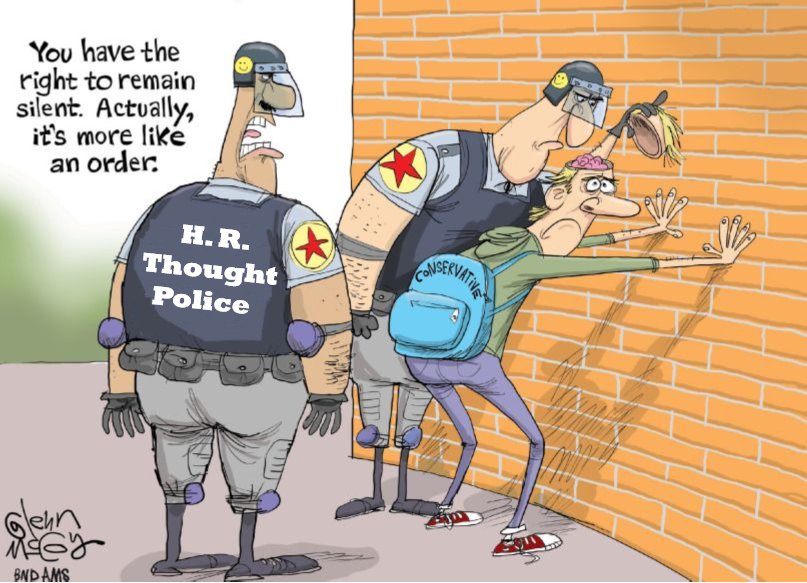
As a result, even middle-of-the-road personnel policies today include statements on “equity,” “inclusion,” and even “anti-racism” as standard-issue boilerplate. Far from the traditional HR responsibilities of hiring, firing, and training personnel, today’s HR departments are the woke police of corporate America, enforcing rigid adherence to leftist ideology. Any dissent, even from corporate leadership, is not tolerated. Ever fearful of being tried in the court of public opinion, CEOs and other executives, ostensibly the most powerful people in the company and some of the most powerful people in the country, submit.

CEOs, always more concerned with investor-relations and long-term projects than HR policies, now face a choice.

Do they stand up for what they probably know is common-sense, and fire the mouth-breathers more suited to running a freshman seminar on protest art than running a company?

Or do they take the easier road—surrender to the enemy within, keep cashing their checks, and hope the woke mob cancels someone else?

We’ve seen their answer. Again and again and again. They cave.

Yet while purging companies of radical activists would likely lead to some short-term backlash on Twitter and in the media, it would undoubtedly lead to a healthier business environment in the long-term – and better the lives of employees who just want to earn a living without being unwillingly co-opted into progressive political activism. Unfortunately, thus far, executives have shown a complete unwillingness to do so, apparently content to cede their companies to leftists as long as they can continue collecting a large paycheck.

Woke liberals and the HR departments they run have taken over companies. Now, with CEOs in their grasp, they’re taking over America.


Steyn’s Situational Sensibility

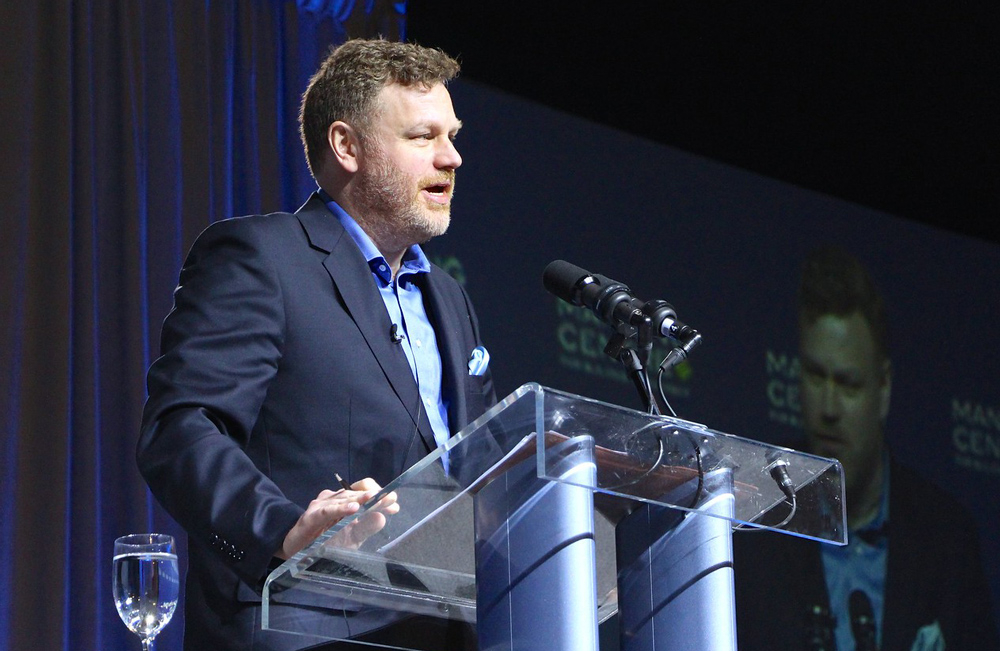
Key points expressed by Mark Steyn in his address at Gatestone Institute A Hinge Moment of History.  Excerpts in italics with my bolds.  Complete text of address is at the link above.

I have lived in countries that have real domestic terrorism movements…. Any country blessed enough not to have a domestic terrorism movement should not be inventing one.

We are living in a blizzard of lies.

[W]e are more dependent on a handful of woke billionaires to tell us what reality is. They are far more open than ever that they get to determine what are the agreed facts. Google made an explicit announcement about this recently. They said that sometimes they would put warnings on things that are factually accurate because, even though they are true, they do not think it is in society’s interest for people to be seeing it.

[N]ow you will be banned or deleted or blocked or silenced simply for disagreeing with the official version of events. For example, the Great Barrington declaration, which was written by three of the most prominent epidemiologists in the world from Harvard, Oxford, and I think it was Stanford. That was basically deleted from YouTube, banned from Facebook, simply because it contradicted the WHO, CDC official version of events.

It is just groupthink enforced by a cabal of woke billionaires, who have more power than anyone else on the planet.

The other thing that emerged during this year very quickly is that we are at a hinge moment of history. We were told a generation or two back that, by doing trade with China, China would become more like us. Instead, on issues such as free speech, we are becoming more like China.

American companies are afraid of offending China. American officials are afraid of offending China. We are adopting Chinese norms on issues such as free speech and basic disagreements with the government of China.

We’re living in the early stages of a future that is the direct consequence of poor public policy over the last couple of generations. We are not even aware of that….

Right now, we are witnessing a non‑stop continuous transfer of power to a country that is serious about using that power. This is China’s moment. Take it as someone who grew up, in large part, in a great power in decline. There’s no real explicit handover day. People, in hindsight, expect to pinpoint the day that the baton was passed…. My great worry is that actually, the transfer to China has already happened. The baton has already been passed. We just haven’t formally acknowledged that yet.

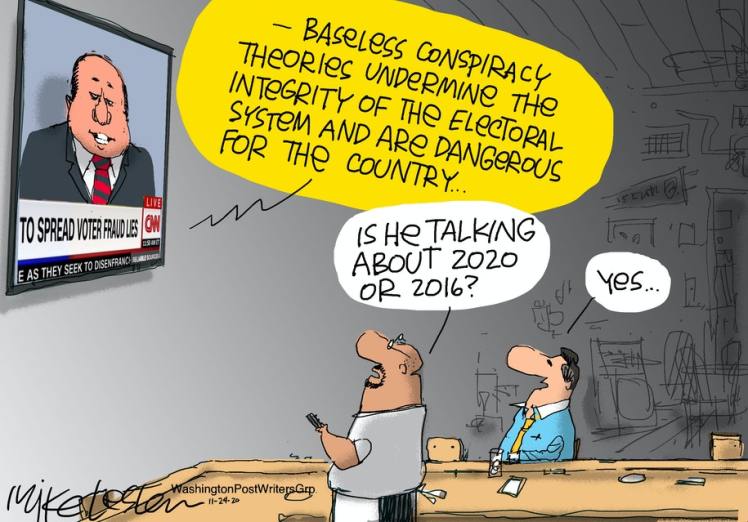
I’ll say it straight out loud. I do not think that Joe Biden “won the election.” I don’t think it is a question of “widespread fraud.” I think the way the system works with the Electoral College, you only need actually to spread fraud in six key cities in six key states.

I would like some of these genius jurists, including [US Supreme Court Chief Justice] Mr. Roberts and his colleagues, to then give us a figure on what is the acceptable level of fraud in American elections. Denmark, in its history, has never actually had a plausible accusation of any kind of electoral fraud. As we know, in the United States, in cities like Philadelphia, this is a tradition that has long roots and goes back 150 years.

If you have no basic election integrity, essentially, all the other issues are irrelevant.

Big Tech has essentially wrecked the internet.

Now Facebook is working with state power. The first place these Big Tech guys learned to do this was with China…. I’m in favor of breaking these companies up as soon as we can.

Right now, in the United States we worry because Facebook is canceling some actress or pop star. In Australia right now, Facebook is trying to cancel an entire country. We have left it far too late to take serious moves against these people.

Standard Oil was broken up because of its control over the oil business. Facebook and Google and Apple have far more control over their business than Standard Oil did 110 years ago. The difference is that their business is knowledge and the access to knowledge, which is more important even than oil.

I take Iran seriously. Not so much because of the Iranians, but because of the promises and the expectations in places like Sudan that Iranian nuclear technology will basically be shared with some of the most lethal basket-case states on Earth. Iran is in some sense like Russia and China. These are all, in a certain sense, great civilizations that have become perversions of themselves in a relatively short time.

What we ought to be trying to do is connect the Iranian people with their great glorious past, which actually is a platform on which you can build a future.

At some point, if we’re not prepared to stand up… My whole thing, in all the years, is that Western civilization is sliding off a cliff and most citizens of most Western nations are not even aware of it.

There is a moral component that we are overlooking. We live in an insane world where moral narcissism attaches to whether or not you rampage around some statue of a Confederate general who died 150 years ago. The fact that you’re rampaging around the Confederate general while wearing shoes made by child labor somehow does not impact on your moral virtue at all.

We are the civilization that built the modern world. If you do not like us, we can go back to what it was 500 years ago. Basically, the world functions because of the world we built.

The war on the past is straight out in 1984, straight out of Orwell: Who controls the present, controls the past. Who controls the past, controls the future. If you blow up the past, you make social engineering so much easier because there is nothing to go back to.

I try to restrain myself from seeing obvious metaphorical geopolitical symbolism in trivial events, but that story the other day about how China was making US diplomats undergo COVID anal swabs had too much symbolic power for what China has basically done to the entire planet to let it go.

The big change over the last year is that these issues are no longer abstractions. Everyone in the Western world has had some familiarity with the core meaning of Western liberties, whether you are talking about freedom of speech, freedom of movement, freedom of association, freedom of religion, they have all become very real, even for people living the most quiet and uncontroversial lives. We have states, a few weeks ago issuing orders on who you were allowed to spend Christmas or July 4th with.

Twin Failed Projects: Afghanistan and Climate Change

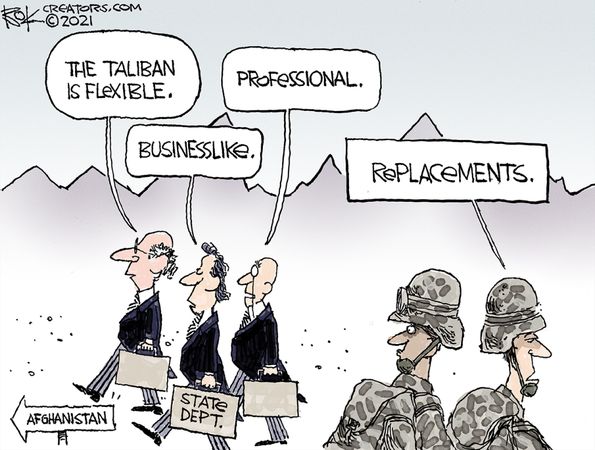
Rupert Darwall explains the similarity in his Spectator article Afghanistan and climate change: the West’s twin failures. Excerpts in italics with my bolds and some added images.

Both have the same cause: a failure to accept reality

The West’s humiliation in Afghanistan has an older brother: climate change.

As siblings, the two share characteristics, most obviously an inability to confront unwelcome facts. In Afghanistan, there was a large constituency led by the Pentagon invested in the mantra of proclaiming progress in the fight against the Taliban. Climate has its own industrial complex of NGOs, climate scientists, renewable energy lobbyists profiting from the energy transition, eager helpers in the media, and politicians posing as world saviors.

Energy experts tell us renewable energy is cheaper than building new fossil fuel power stations. If they’re right, why did China build the equivalent of more than one large coal plant a week last year? Its slave labor camps help produce materials for Chinese solar panels, which make them the cheapest in the world. This led the Biden administration to ban their importation. In 10 years, India — a country more susceptible to Western fads — increased the amount of electricity it generated from coal nearly six times faster than from wind and solar. In 2020, fossil fuels accounted for almost 90 percent of India’s primary energy consumption.

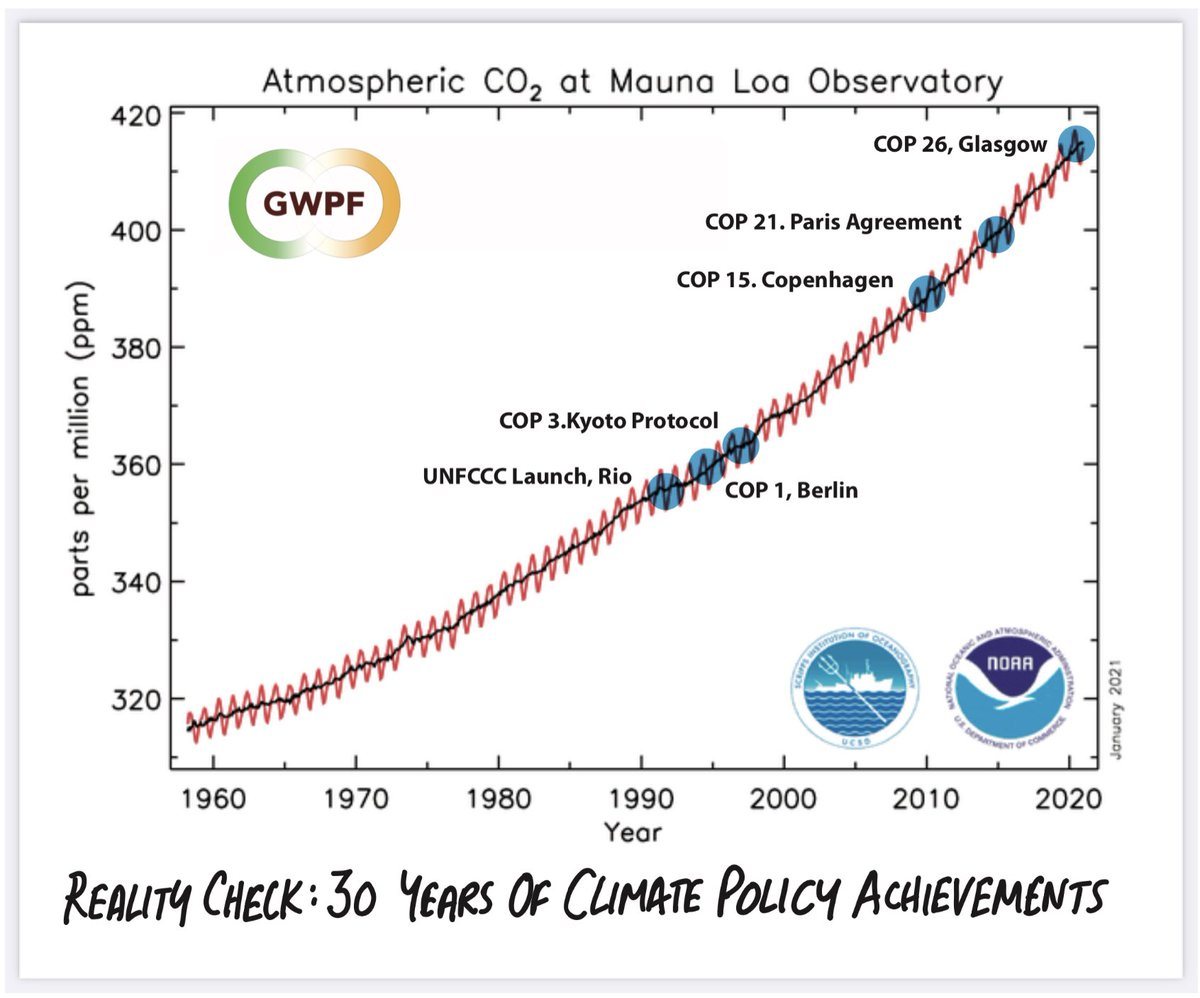
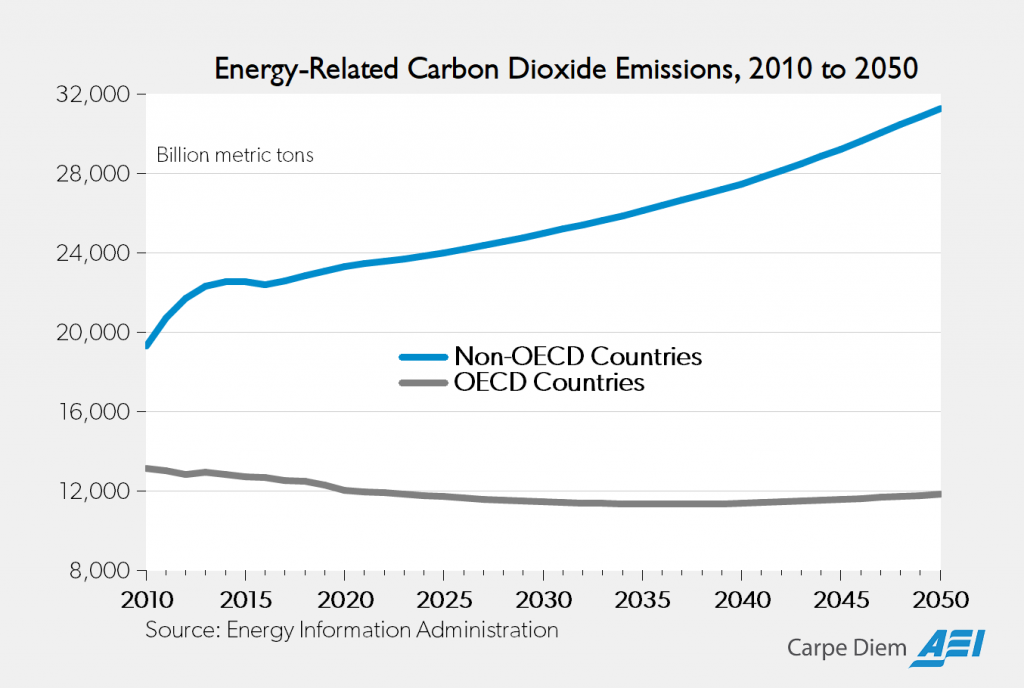
These facts help explain the biggest fact of all. The first 20 years after the 1992 United Nations Framework Convention on Climate Change saw carbon dioxide emissions rise 60 percent. From 2012 to 2019, they rose a further 5.4 percent. However this is dressed up, it’s failure. Meanwhile, the West’s energy emissions have been more or less flat for nearly three decades and on a downward trend since 2007. Emissions from the Rest of the World account for all the growth in global emissions, suddenly accelerating in 2002 from an average of around 1 percent a year to nearly 5 percent a year in the 12 years until 2014.

As a matter of simple arithmetic, the West’s declining share of global emissions means that whatever it does or doesn’t do is of diminishing relevance to the future of climate change. The West’s solipsism of ‘we’ — as in ‘we must act’ — is a profound self-deception.

Foolishly, the West swallowed the claims of small island states that they would sink beneath the waves unless the rise in global temperature was kept below 1.5°C above pre-industrial levels. This was how ‘pursuing efforts’ to meet the 1.5°C limit ended up in the Paris agreement. As the Intergovernmental Panel on Climate Change (IPCC) later confirmed, there was no scientific basis for this. ‘Observations, models and other evidence indicate that unconstrained Pacific atolls have kept pace with S[ea] L[evel] R[ise], with little reduction in size or net gain in land,’ the IPCC said. Instead, the IPCC argued that the 1.5°C target and net zero emissions by 2050 — a target set by the IPCC and not in the Paris agreement — provide the opportunity for ‘intentional societal transformation’.

Stamped all over the West’s two decades of failure in Afghanistan are the words ‘societal transformation’.

‘It has been the hubristic belief that Western values should be universally applied that has led to the folly of nation-building in Afghanistan,’ Sir Christopher Meyer, Britain’s former ambassador in Washington, has written. Climate involves a double dose of hubris. Western politicians expect other countries to turn their backs on the development paths that made the West wealthy. Yet the same politicians seek to transform their own societies in ways that will make many people — especially the middle class and working families — poorer without having won an honest, democratic mandate to do so. They will thereby invite a populist backlash.

Realism disappears on the shoreline of climate change on the presumption that other nations share the Western belief that climate transcends geopolitics.

It wasn’t a pretty sight when John Kerry, Biden’s climate envoy, met China’s gimlet-eyed realists earlier this month. In a blunt statement, they told Kerry that Washington should correct its ‘wrong policies’ on China if the US wanted a dialogue on climate. The requirement to appease China could not have been clearer.

In all likelihood, Kerry will probably get off more lightly than Boris Johnson and the British government, the hosts of this year’s UN climate conference in Glasgow. They naively built up expectations that the talks would produce a deal to save the planet. It showed great ignorance of three decades of UN climate diplomacy: there was never going to be a deal to cut emissions at Glasgow. The last time that happened was at the Kyoto climate conference 24 years ago.

The UN climate convention was a product of a different era. Nato’s Afghanistan operation occurred at the apex of the America’s unipolar moment. The short era of George H.W. Bush’s new world order is over. We live in a time of renewed great power rivalry. China and Russia act in ways Otto von Bismarck would recognize. Of the great powers, they are the principal winners from the West’s humiliation in Afghanistan and they are the biggest winners from the Paris agreement. China keeps its coal-based economy while America runs down its oil and gas industries, only recently having become the world’s largest producer of hydrocarbons.

As Europe phases out coal, so too does it becomes more dependent on the Kremlin for natural gas. The lessons of Afghanistan and climate are the same: the West won’t be defeated by its enemies, but by its refusal to see the world as it is.

Exposed: Ballot Trafficking in Georgia and Arizona

Ballot Drop Box in Georgia, USA

Exclusive — True The Vote Conducting Massive Clandestine Voter Fraud Investigation

True The Vote organization has spent the last several months since late last year collecting more than 27 terabytes of geospatial and temporal data—a total of 10 trillion cell phone pings—between Oct. 1 and Nov. 6 in targeted areas in Georgia, Arizona, Michigan, Wisconsin, Pennsylvania, and Texas. The data includes geofenced points of interest like ballot dropbox locations, as well as UPS stores and select government, commercial, and non-governmental organization (NGO) facilities.

“From this we have thus far developed precise patterns of life for 242 suspected ballot traffickers in Georgia and 202 traffickers in Arizona,” True The Vote’s document says. “According to the data, each trafficker went to an average of 23 ballot dropboxes.

In other words, what the document says is that True The Vote was able to take cell phone ping data on a mass wide scale and piece together that several people—suspected ballot harvesters—were making multiple trips to multiple drop boxes, raising potential legal questions in a number of these states.

From there, the document continues, True The Vote gathered surveillance video on the drop boxes in Georgia and is attempting to gather similar such surveillance video from other states. The document states that True The Vote has obtained one full petabyte of surveillance footage on drop boxes—two million minutes of video—which it says is broken into 73,000 individual video files. The group is expected to begin releasing some of these videos, which purportedly show the same people going multiple times to the same drop boxes, in the coming weeks.

“We are building out video stories and have compiled videos of individuals stuffing ballot dropboxes with stacks of ballots, individuals depositing ballots in multiple dropboxes, unauthorized coordination between government workers engaged in the exchange of ballots, and several other tranches of video that capture unusual patterns such as the wearing of gloves to deposit ballots, taking pictures of ballot deposits, etc.,” True The Vote’s document says.

As for states other than Georgia, True The Vote’s document says that the status of such surveillance video is as of now unclear. “Video availability in other states is undetermined; open records requests submitted consistently since January continue to be met with conflicting communications and stalls,” True The Vote’s document says.

The group says also that it has at least three teams of analysts combing through the raw data and the surveillance video seeking out individual stories and other trends, and that it has been in contact with federal and state law enforcement in various states on what it has found and determined already.

There are several reasons why this revelation about True The Vote’s effort is significant. First and foremost, these revelations come amid several ongoing so-called “audits” in a number of states like Arizona nationally—the results of the Arizona audit are imminently expected—and other efforts by some allies of former President Donald Trump to continue the push for illuminating what happened in the 2020 presidential election. Most of the aforementioned have either not been fruitful, or perhaps have even damaged the former president’s cause by either not being factual or by being incomplete in their nature or for other reasons which cast doubt on their credibility. This self-described effort from True The Vote could change the discussion by providing proof—complete with cell phone data and surveillance video—of allegedly illegal activity that could lead to much more drastic action by law enforcement or political leaders in these various states.

These revelations could be coming amid a renewed push from national Democrats in Washington, DC, to pass some form or another of a federal election takeover plan – whether it be HR1, S1, or a new push for the John Lewis Voting Rights Act, which was HR4 in the last Congress. So far this year, such efforts by Democrats have failed and stalled out in the evenly-divided U.S. Senate as the filibuster has prevented their passage.


Biden Wrong, SCOTUS Right re Texas Fetal Heartbeat Law

The best discussion comes from Josh Blackman’s article at Newsweek The Supreme Court Could Not ‘Block’ Texas’ Fetal Heartbeat Law | Opinion. Josh Blackman is a constitutional law professor at the South Texas College of Law Houston and the co-author of An Introduction to Constitutional Law: 100 Supreme Court Cases Everyone Should Know. He explains why the ruling is more about overinflated expectations of judicial authority than about the issue of abortion itself.  Excerpts in italics with my bolds.

On Wednesday, the U.S. Supreme Court declined to intervene in a challenge to S.B. 8, Texas’ new abortion law. This unique statute empowers private citizens to sue those who perform or facilitate abortions. President Biden ripped the 5-4 decision, charging that the conservative justices followed “procedural complexities” “rather than use its supreme authority to ensure justice.”

© Kevin Dietsch/Getty Images A person walks on the steps of the U.S. Supreme Court on September 02, 2021 in Washington, DC

Biden is wrong. The Court has no sweeping, majestic power to “ensure justice.” Indeed, it is a myth that courts can “strike down” laws at all. Rather, judges have a very limited power: to enjoin specific government officials from enforcing laws against specific litigants. The judiciary cannot simply erase statutes from the book. And when the government plays no role at all in enforcing a statute—as with S.B. 8—courts cannot “block” that law from going into effect.

In future cases, the courts can assess the constitutionality of S.B. 8. For now, the Supreme Court was right to reject the premature challenge.

In recent years, abortion laws in Texas have all met a similar fate. At each session, the conservative legislature imposes a suite of new restrictions on abortion. But before the law even goes into effect, Planned Parenthood and other abortion providers sue the Texas attorney general. Federal judges in Austin agree, and prevent the attorney general from enforcing the law. And as the litigation drags on for years, all the way up to the Supreme Court, the law remains a dead letter.

But this session, Texas tried something new. S.B. 8 allows private citizens to sue those who perform abortions. The government itself is expressly barred from enforcing the law.

With a clever flip, S.B. 8 spiked Planned Parenthood’s playbook. It is now impossible to sue the attorney general, because the attorney general cannot enforce the law. The law can only be enforced by millions of Texans. And there is no way to know in advance who would sue which abortion providers. So Planned Parenthood tried a different strategy: It sued Judge Jackson of Tyler, Texas, who might one day hear a case involving S.B. 8.

This suit never made any sense. Judges do not enforce laws. They can only adjudicate specific disputes between plaintiffs and defendants. If a Texan actually sued Planned Parenthood for performing a seven-week abortion, the judge would have to dismiss that suit. After all, S.B. 8 expressly stipulates that citizens’ suits must comply with Roe v. Wade. And you don’t sue a judge to stop him from hearing a case in the first place. You let him decide and then appeal, if need be.

Despite these problems, a federal judge in Austin still ruled that Planned Parenthood could sue Judge Jackson. The Austin court was poised to block Judge Jackson from even accepting a case emanating from S.B. 8. But the U.S. Court of Appeals for the Fifth Circuit promptly put that federal court’s proceedings on hold. Planned Parenthood then filed an emergency appeal to the Supreme Court.

This appeal was doomed from the start. Because Planned Parenthood only sued one judge, the Supreme Court could only have issued an order against that single jurist. No other judge in Texas was a named party to the case. An order against Judge Jackson would have been meaningless for Planned Parenthood, as all other judges in the state would have been able to accept suits based on S.B. 8. The abortion rights group was stuck.

Late Wednesday evening, the Supreme Court split 5-4. The majority opinion was joined by Justices Clarence Thomas, Samuel Alito, Neil Gorsuch, Brett Kavanaugh and Amy Coney Barrett. The conservative quintet recognized that Planned Parenthood likely could not prevail. The justices explained that “federal courts enjoy the power to enjoin individuals tasked with enforcing laws, not the laws themselves.” In short, the justices cannot erase S.B. 8 from the statute books. They can only prevent a specific person—in this case, Judge Jackson—from hearing a case involving S.B. 8 against Planned Parenthood and other groups. That’s it. Even then, the Supreme Court recognized that the suit against Judge Jackson was on shaky ground, as “it is unclear whether” he “can or will seek to enforce the Texas law against” the abortion clinics.

The Supreme Court could not, as President Biden suggested, exercise “supreme authority to ensure justice could be fairly sought.” No such power exists. In this case, the Court could only enter an order against one state judge—and that judge had no role in actually enforcing the law. The justices were absolutely correct for declining to intervene.

Indeed, this case should have been unanimous. Alas, it was not. Chief Justice John Roberts and the Court’s three progressives each wrote separate dissents. Chief Justice Roberts would have “grant[ed] preliminary relief to preserve the status quo ante.” But a remedy to preserve the status quo ante would be impossible in this case, which only concerned Judge Jackson. Roberts wrote that he would “preclude enforcement of S.B. 8 by” Judge Jackson. But, again, Judge Jackson cannot actually enforce the law in the first place. The chief justice, usually a stickler for procedure, was willing to invent new procedural rules to stop what he saw as an “unprecedented” law.

Justice Sonia Sotomayor made similar mistakes in her own dissent. She said the “Court should have stayed implementation of” S.B. 8. But courts cannot block laws. Courts can only prevent specific parties from enforcing the law against specific litigants. None of the dissenters had any clue how to actually stop S.B. 8—not even Justice Elena Kagan, a brilliant former civil procedure professor. She had bupkus. Indeed, Chief Justice Roberts acknowledged that Texas “may be correct.”

Why, then, did the dissenters offer a remedy that simply could not be granted? This quartet endorsed President Biden’s mythical account of the Supreme Court.

At least three of the four dissenters deeply felt that this law was substantively unjust, so there must be a way to stop it. But not every alleged wrong has a remedy in federal court. In time, actual Texans will file suit against abortion clinics, and those who fund the organizations. And the courts can then decide, at that time, if those suits are consistent with Roe v. Wade and its progeny.

But for now, the Supreme Court was right to stay on the sidelines.

Footnote:

Regarding the delusion of judicial authority for social engineering, do read Francis Menton’s expose of the same mythology running rampant in Europe with respect to global warming/climate change (not to mention genderism and diversity).  More On European Climate Change Litigation: These People Are Crazy

And once again Team Biden acts to divide and destroy anything they touch.  How prescient was I when creating this image a year ago.


Biden Has the Destructive Touch

Victor Davis Hanson explains in his American Greatness article The Drossy Touch of Joe Biden.  Excerpts in italics with my bolds and images.

A cognitively challenged Biden is pulled in every direction, by left-wing politicos collecting their debts,
by his own spite, by his trademark narcissism, and by his hatred of all things Trump.

Almost everything Joe Biden has touched since entering office has turned to dross. None of his blame-gaming, none of his distortions, none of his fantasies and unreality can mask that truth.  

The Afghan Catastrophe

Seven months ago, Afghanistan was relatively quiet—with about 10,000 vestigial NATO troops, including 2,500 Americans, anchored by the Bagram Airfield. They were able to provide air superiority for the coalition and Afghan national army. With air power, NATO forces, if and when they so wished, could have very slowly and gradually withdrawn all its remnant troops—but only after a prior departure of all American and European civilians, coalition contractors, and allied Afghans.

The transient calm abruptly imploded as soon as Joe Biden recklessly yanked all U.S. troops out in a matter of days. Many left in the dead of night, leaving no one to protect contractors, dependents, diplomats, and Afghan allies. In Biden’s world, civilians protect the last Western enclave while soldiers flee.

Three weeks ago, Joe Biden and a woke and politicized Pentagon were assuring us that Afghanistan was “stable.” Now the country is reverting to its accustomed premodern, theocratic, and medieval chaos. It will likely soon reopen as the world’s pre-9/11-style terrorist haven—an arms mart of over $50 billion in abandoned U.S. military equipment. Thanks to the president of the United States, terrorists and nation-state enemies can now shop for arms and train there without hindrance.

The NATO coalition-builder Biden also dry-gulched his European allies, whose soldiers outnumbered our own. The humanitarian “good ole Joe from Scranton” deprecated the thousands of Afghan military dead who had helped the Americans. The families of the American fallen and wounded of two decades were all but told by Biden that the catastrophe in Kabul was inevitable—no other way out but chaos and dishonor.

Why did he not tell us that earlier, when he was vice president, so many dead and wounded ago?

“Get over it,” was Biden’s messaging subtext. If Americans want to hear the blame game, he told us to scapegoat Barack Obama, or all prior presidents, or especially Donald Trump, or the intelligence services and military, or the Afghan army, or we naïfs who somehow think things are a mess right now in Kabul—or anything and everyone but Joe Biden.

The Inflation Fiasco

In January, Biden inherited a rebounding economy that was fueled by $1 trillion in stimulatory federal red ink. Given natural pent-up consumer demand, why did Biden need to print yet another $1 trillion, seek to green-light another $2 trillion for “infrastructure,” and raise even higher unemployment compensation to the point of discouraging employees from returning to work?

At the same time, he has alarmed employers with braggadocio threats that higher capital gains, income, payroll, and estate taxes are all on the way. More lockdowns only further eroded small businesses. The result was price inflation of all the stuff of life—homes, lumber, gas, food, appliances—as well as historic shortages of everything from cars and houses to the work of contractors and electricians. Any increase in wages due to labor shortages was soon erased by spirals in the consumer price index.

So, what was Biden thinking or, rather, not thinking? By paying workers not to work he would be evening out the ancient score with employers? Did workers need a vacation from the quarantine? Printing money was a way to spread the wealth—and diminish what the rich possessed? Was a $2 trillion deficit and $30 trillion in aggregate debt a way of bragging to Trump that he doubled the Trump red ink in less than a year? Would he pile up more debt than both Barack Obama and George W. Bush in half the time?

The Border Disaster

Biden took a secure border, along with increasingly legal-only immigration, and then destroyed both. He stopped construction of the border wall, encouraged an expected 2 million illegal entries over the current fiscal year, promised amnesties, and resumed “catch and release.” He did all that at a time of a pandemic, exempting illegal aliens from all the requirements of COVID testing and mass vaccinations that he had hectored his own citizens about getting. With planned mass amnesties and millions more invited to cross illegally in the next three years, was Biden seeking to found a new American nation within the now passé old American nation?

Did he believe that Americans did not deserve their citizenship and newcomers from south of the border were somehow more worthy? Did he see the 2 million new residents as instant voters under new relaxed rules of balloting? Did he think in a labor-deprived economy they would supply nannies, gardeners, and cooks to bicoastal elites? We strain to imagine any explanation because there is no logic to any.

Energy Insufficiency

Biden did his best in just seven months to explode the idea of American self-sufficiency in natural gas and oil. He canceled the Keystone Pipeline, froze new federal energy leases, put the Anwar oil field off limits, and warned frackers their end days were near.

So, what drove Biden? Did he object that motorists were saving too many billions of dollars per year in decreased commuting costs? Or was the rub that we had slashed too many imports of oil from the volatile Middle East and no longer would launch preemptive wars? Or perhaps the transition to clean natural gas instead of coal as a fuel for power generation had too radically curtailed carbon emissions? Did Biden feel that Middle East producers, the Russians, or the Venezuelans could better protect the planet while extracting oil and gas than could American drillers?

The Race Calamity

Biden blew up race relations by greenlighting the new hunt for the mythical “whiteness” monster. Were a few buffoonish white rioters who stormed the Capitol the tip of the spear of a previously unknown massive white supremacy movement, the most dangerous, he swore, since the Civil War?

Biden took affirmative action and the Civil Rights-era “disparate impact” and “proportional representation” ideas and turned them into disproportionate representation and reparations on the cheap. Biden made it acceptable to damn “whiteness,” as if all 230 million white Americans are guilty of something or other in a way that the other 100 million “nonwhite” are not.

The Crime Explosion

After Biden entered office, violent crimes ignited from the embers of the 120 days of mostly unpunished looting, arson, and organized violence in the streets of America’s major cities during summer 2020. Under Biden, jails were emptied. Federal attorneys and emulative local DAs exempted offenders. Police were defamed and defunded. Punishing crime was considered a racist construct.

The result is that Americans now avoid the Dodge City downtowns of most of America’s crime-ridden blue cities. They accept that any urban pedestrian, any driver after hours, any commuter on a bus or subway can be assaulted, robbed, beaten, raped, or shot—without any assurance that the media will fairly report the crime, or that the criminal justice system will punish the perpetrators. In Biden’s America looters prance into drug stores and walk out with shopping bags of stuff, under the terrified gaze of security guards who guesstimate at least they did not steal more than $950 of loot.

So why does Biden so willfully exercise this destructive touch that blows up anything he taps?

There are several possible theories:

1) Biden is non compos mentis. He has no idea of what he is doing. But to the degree he is alert, Biden listens—sort of—only to the last person with whom he talks. And then he takes a nap. When Afghanistan blows up or inflation roars or the border becomes an entry door, his eyes open, and he becomes bewildered and snarly—like an irritable and snappy Bruce Dern waking up in “Once Upon a Time in Hollywood.”

Biden has no clue about the actual destructive implementation of his toxic policies, and no concern upon whom these destructive agendas fall. He vaguely assumes a lapdog left-wing media will repackage every Biden incoherence as Periclean, and every daily “lid” as Biden’s escape for presidential research, deep reading, and intensive deliberation. Biden appears to be about where Woodrow Wilson was in November 1919.

2) Or is Biden a rank opportunist and thinking he will ride woke leftism as the country’s new trajectory? He resents his prior subservience to Obama, and now feels he can trump past signature leftist administrations as the one true and only socialist evolutionary. He is not so much the manipulated as the manipulator.

Biden fantasizes himself as a hands-on dynamic leader who bites at reporters, snaps from the podium, and issues his customary interjections. He is therefore “in command” for four or five hours a day. He enjoys acting more radical than Elizabeth Warren, Kamala Harris, Bernie Sanders, or “the squad.”—and especially being far more leftwing than his old and now passé boss Barack Obama. Joe is in control and that explains the dross touch. For the first time in his life, such an incompetent has complete freedom—to be powerfully incompetent. Biden is then not demented as much as delusionally running things.

3) Biden is unfortunately what he always was: a rather mean-spirited plagiarist, liar, and nihilist, from his Clarence Thomas character assassination infamy and Tara Reade groping to his foul racist talk and his monumental habitual grifting. His disasters are the same old, same old Biden trademark, performance-art screw-ups.

Biden likes the idea of conservative outrage, of chaos, of barking at everyone all the time. Biden accepts that no omelets can be made without broken eggs, and sort of enjoys screwing up things, as Robert Gates and Barack Obama both warned. “Wokening” the Joint Chiefs of Staff, encouraging hundreds of thousands to pour across the border, and abandoning our NATO allies in Afghanistan—who cares when tough guy, brash-talking Joe on the move jumbles stuff up? The disasters in the economy, foreign policy, crime, energy, and racial relations? Biden is just shaking things up, stirring the pot, baiting people to watch Mr. “Come On, Man” in action, as he blusters and preens and leaves a trail of destruction in his wake.

4) Biden is nothing much at all. He’s just a cardboard-cut out, a garden-variety Democratic Party hack, who is against anything conservatives are for. He assumes he will undo all that Trump did, on the theory it is simple and easy for him in his lazy, senior moments. And he is tired anyway of thinking much beyond such Pavlovian rejectionism. A closed border is bad; presto, open borders are good. Improving race relations is bad; deteriorating relations must be good. Energy independence bad; dependency good. Biden works on autopilot in his minimalist day job: just cancel anything that Trump did and worry nothing about the effects on the American people

5) Biden is a hostage of both the Left and Hunter Biden. His task is to ram down a hard Left agenda, in the fashion of a torpedo that itself blows up when it hits the target. The Left ensured the base would not bolt in 2020. So, he owes them. Biden, more or less, signed his presidency over to the squad, Nancy Pelosi, Bernie Sanders, and the Obama holdovers. They hand him a script; he tries to read it; and they follow up with the details. He is the old “Star Trek’s” tottering John Gill.

The Left may hope their own nihilist agenda sort of works. When it inevitably does not, then Joe, the delivery man, is blamed: so much more quickly, then, will be Biden’s necessary exit. They kept their part of the bargain by getting the basement denizen elected. Now he keeps the deal by handing over the presidency. Biden’s utility had about a six-month shelf life.

Now ever so slowly the leaks, the West Wing backstabbing, the furrowed anchor brows, and the unnamed sources will gently ease him out with 25th Amendment worries (e.g., “Perhaps President Biden might find taking the Montreal Cognitive Assessment of some value after all, for his own benefit, of course.”) Kamala Harris is not so inert as we are led to believe.

A cognitively challenged Biden then is pulled in every direction, by his own senility, by left-wing politicos collecting their debts, by his own spite, by his trademark narcissism, and by his neanderthal hatred of everything Trump was and did.

The problem for America is that theories one through five are not always mutually exclusive, but more likely force multipliers of the present insanity. At some point, some brave congressional representative or Senator will finally have to say to Biden, in the spirit of Oliver Cromwell and Leo Amery:

“You have sat too long here for any good you have been doing. Depart, I say, and let us have done with you. In the name of God, go!”

What’s in a Name? Power.

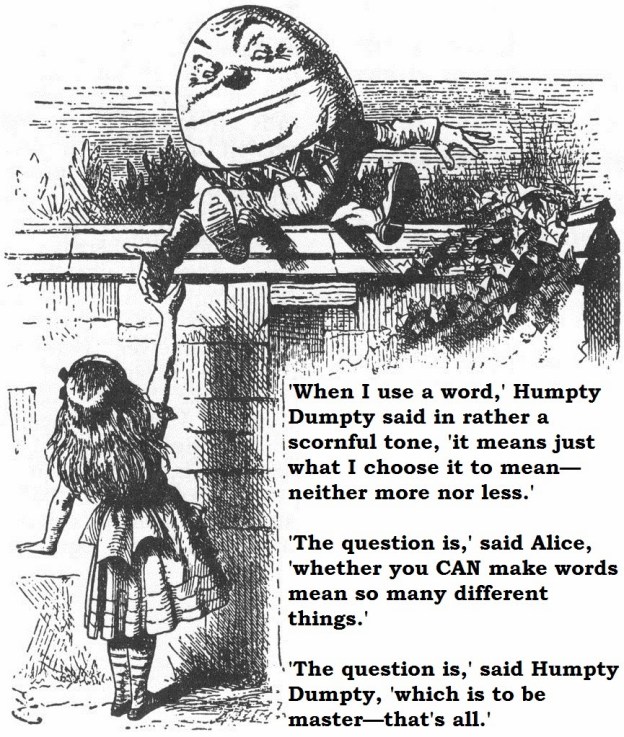
5a1johntennielhumptydumpty

Johathan Turley writes at The Hill The FBI comes up empty-handed in its search for a Jan. 6 plot. Excerpts in italics with my bolds and images.

It may be true, as Confucius said, that “the beginning of wisdom is to call things by their proper name,” but it can also be the end of politics. For politicians, labeling controversies is often more important than addressing the controversies themselves. Even well-defined terms used in legislation must change to fit political needs, such as like “infrastructure.” When its real meaning proved too restrictive, Sen. Kirsten Gillibrand (D-N.Y.) simply tweeted, “Paid leave is infrastructure. Child care is infrastructure. Caregiving is infrastructure.” Done.

sbr040921dapr20210409024516

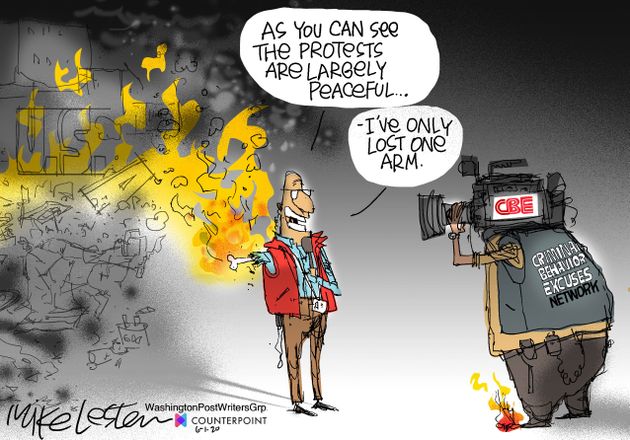
The same is true with labeling political violence. When protests by Black Lives Matter and other groups turned violent last summer, some media employees were expressly told not to refer to “rioters” but rather “protesters.” Riots causing massive property damage were described by CNN as “fiery but mostly peaceful protests.”

mle200601c20200601035617

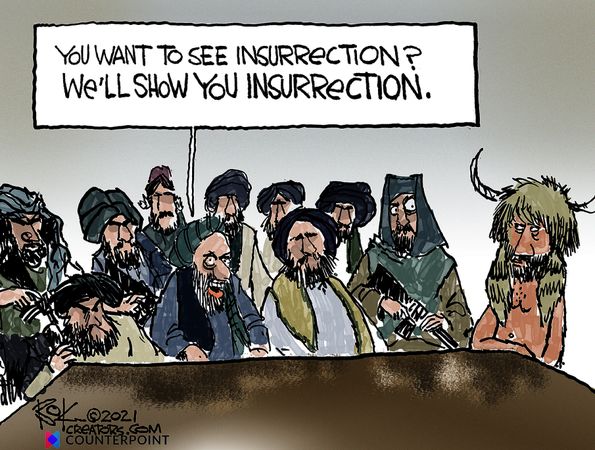
Conversely, the Jan. 6 attack on the Capitol could not be just a riot, let alone a “fiery” protest, but only an “insurrection.” Many in the media continue referring to “the insurrectionists” rather than the rioters. National Public Radio even ran a running account of the “Capitol insurrection.” The term was further driven home by House Democrats by impeaching former President Trump for “incitement to insurrection” despite undermining any chance for an actual conviction. Members of Congress such as Rep. Eric Swalwell (D-Calif.) are still in federal court claiming a conspiracy of “armed and organized insurrectionists.”

The characterization of the attack as an insurrection served myriad political and personal purposes. First, it painted anyone associated with challenging the 2020 election results as supporting sedition and the country’s overthrow. Second, if this was a protest allowed to turn into a riot, there would be more questions about the failure to properly protect the Capitol.

8b424037f1f7ba6306049bbb00dbb8f52051d3d8361bcec421388a60ad31126e

It is easier to excuse a response to an insurrection than a violent protest. That point was expressly made by former U.S. Capitol Police Chief Steven Sund, who insisted, “This was not a demonstration. This was not a failure to plan for a demonstration. This was a planned, coordinated attack on the United States Capitol.”

Despite the adoption of the term by many in the media, there has been a growing disconnect with the actual cases in court. Indeed, a new report from Reuters disclosed that the FBI has apparently struggled to support the account of a coordinated “insurrection” on Jan. 6. Reuters’s FBI sources said that, despite months of intense investigation, they could find “scant evidence” of any “organized plot” and instead found that virtually all of the cases are “one-offs.” One agent explained, “Ninety to 95 percent of these are one-off cases. Then you have 5 percent, maybe, of these militia groups that were more closely organized. But there was no grand scheme with Roger Stone and Alex Jones and all of these people to storm the Capitol and take hostages.”

In other words, they found a protest that became a runaway riot as insufficient security preparations quickly collapsed. While there clearly were those set upon trashing the Capitol, most people were shown milling about in the halls; many took selfies and actively described the scene on social media.

More than 570 people have been arrested, but only 40 face conspiracy charges. Those charges are often based on prior discussions about trying to enter Congress or bringing material to use in the riot; some clearly came prepared for rioting with ropes, chemical irritants and other materials. Those cases, however, are a small group among the hundreds charged and an even smaller percentage among the tens of thousands of protesters on that day.

cb081821dapc20210817054522

After five months of dragnet arrests nationwide, a few reporters have noted that no one was actually charged with insurrection or sedition. The vast majority of people face charges such as simple trespass. For example, the latest guilty plea is from San Francisco real estate broker Jennifer Leigh Ryan, who posted an account on social media of how “we’re gonna go down and storm the capitol.” She pleaded guilty this week to “parading, demonstrating, or picketing in a Capitol building” and faces a maximum sentence of six months in prison and a fine of $5,000.

Yet the characterization of the “insurrection” has continued as a virtual article of faith for those reporting on or writing about Jan. 6. Moreover, the treatment of many has remained severe, if not draconian by design. Justice official Michael Sherwin proudly declared in a television interview that “our office wanted to ensure that there was shock and awe. … It worked because we saw through media posts that people were afraid to come back to D.C. because they’re like, ‘If we go there, we’re gonna get charged.’ … We wanted to take out those individuals that essentially were thumbing their noses at the public for what they did.”

stg071921dapc20210718064517

That “shock and awe” included holding people without bail and imposing “restrictive housing” for no obvious reason. That includes some of the most notable figures from that day, such as Jacob Chansley (aka Jake Angeli), better known as “Chewbacca man” or the “QAnon shaman” for the distinctive horned headdress he wore during the riot. Angeli, 33, is not accused of attacking anyone while parading around the Senate floor in his bear skin. He always insisted he was not trying to overthrow the nation with his decorative outfit and spear-topped flagpole. While the government did not find that he engaged in sedition, it did learn that he has an array of mental illnesses, including transient schizophrenia, bipolar disorder, depression and anxiety. Yet he has been held since the riot and is charged with six crimes, including violent entry, trespass and parading, which collectively could yield up to 28 years in prison.

There is a fair distinction between those who tried to stop the certification of a presidential election and those who burn police stations or businesses during protests.

Yet there remains a striking contrast in how other riots are characterized or prosecuted. Most of those arrested for violent protests after the death of George Floyd saw their charges dropped by state prosecutors. For months, rioters sought to burn federal buildings or occupy state capitals and in some cases seized police stations and sections of cities or even a city hall. They were not declared insurrectionists; they were rioters before being set free after brief arrests.

Many of us remain disgusted and angered by the Jan. 6 riot — but it was a riot. It also was a desecration. These people deserve to be punished, particularly those who went with an intent to try to enter the Congress. The question is whether you can have an insurrection without anyone actually insurrecting. That Zen-like question may find its way into the hearings of some pending cases.

Calling these people “rioters” does not minimize what they did — or undermine the legitimacy of their punishment. However, there is wisdom and even the chance for resolution when we “call things by their proper name.”

Jonathan Turley is the Shapiro Professor of Public Interest Law at George Washington University.

For a tutorial in winning the naming game, see “I am Non-racial”

sk071821dapc20210716084507

Socialists Command, Failures Ensue. Here’s why.

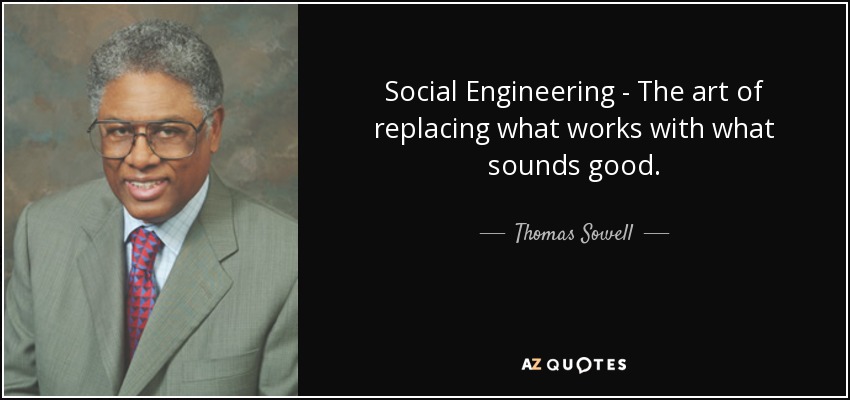
quote-social-engineering-the-art-of-replacing-what-works-with-what-sounds-good-thomas-sowell-133-50-80We are witnessing again politicians attempting to command social outcomes, which in market societies not only fails but makes matters worse.

An insight is provided by an observer of the “Blue State Model” example of NY under Cuomo and DeBlasio.  At AMAC newsline Cuomo Might Be Leaving Office, But His Failed Blue State Model Remains.  Excerpts in italics with my bolds.

Following a sexual harassment scandal that captured the attention of the nation over the past several months, New York Governor Andrew Cuomo announced Tuesday that he will resign as governor, effective two weeks from yesterday. But while New Yorkers may finally be rid of their creepy, handsy governor, the legacy of Cuomo’s disastrous policies will unfortunately continue its negative impact on the Empire State and weigh down attempts at economic recovery and growth.

Ironically, if Cuomo had prioritized working with small businesses, eliminating bureaucratic red tape, and removing onerous taxes, he could have had more small businesses and lower costs. But he instead chose to move in the opposite direction and, as is usually the case, more government involvement in private industry created a nightmare for companies and consumers.

One law in particular from earlier this year is a perfect case study, not only in Cuomo’s dreadful governing record, but in the bullying, Big Government, Blue State model that he so vividly represented. On April 16, 2021, Governor Cuomo signed legislation to impose price controls on high-speed internet. Under this bill, providers were only allowed to charge $15 a month to low-income residents, regardless of the cost of providing service. Governor Cuomo celebrated the law, stating, “This program – the first of its kind in the nation – will ensure that no New Yorker will have to forego having reliable home internet service and no child’s education will have to suffer due to their economic situation.

Almost immediately, the law was challenged by representatives of the telecommunications industry. They asserted that it was grossly illegal and that the state has no legal basis that would permit them to set or regulate the price of internet access.

Cuomo’s office was defiant. They immediately declared, “If these companies want to pick this fight, impede the ability of millions of New Yorkers to access this essential service, and prevent them from participating in our economic recovery, I say bring it on.” The infamously pugilistic Governor made it clear he wasn’t backing down – a trait that would again haunt him during his trial by media over sexual assault allegations a few months later.

In June, a federal court found merit in the industry’s challenge and temporarily banned the measure from being instituted. In the proceedings, it was revealed that the ban and its justification were almost ludicrously ill prepared and planned. When the state was challenged as to how it could legally set the price of a private industry service, they insisted that they weren’t actually setting the price at $15 because providers were free to charge less than $15. Additionally, the $15 price point wasn’t based on any research or knowledge. Even a cursory understanding of the telecom industry would reveal that many providers pay more than $15 per person in taxes and fees alone.

Needless to say, the judge wasn’t buying Cuomo’s argument. Within a matter of months of signing the bill, the state of New York abandoned it and chose to discontinue the case. The decision surprised few insiders. Some analysts theorized the Cuomo plan was mere “political theater.” They alleged that it was an attempt by the Governor to appear tough on corporations while accomplishing very little.

While Cuomo attempted to portray himself as standing up against “big business,” the truth is far more complicated. Many of the fiber optic cables laid across the country are not placed by large corporations. There are a number of small providers who specifically service areas that large providers ignore due to perceived inefficiency and cost. Currently, hundreds of thousands of homes are serviced by these small providers.

These companies had to spend millions of dollars and countless hours fighting Cuomo for their very survival. Additionally, although they technically won the battle, the legacy of the law could lead to a major chilling effect in which providers will be hesitant to provide low-cost fiber optic cables, out of fear they will be financially ruined should a future court rule in favor of a more cunning and well-prepared administration. In effect, Cuomo’s attempt to make internet access more ubiquitous and affordable would have made it more restricted and expensive.

Mercifully, with the three-term governor on his way out, New Yorkers will have a chance to pursue a different direction under hopefully more capable leadership. Unfortunately, however, the failed progressive model that tale exemplifies remains stubbornly in place in Blue State capitals across the country.

cg5bba871baa5aa

Of course the same Blue State model of governance has produced a mess in California, resulting in a recall campaign against the perpetrator, Gavin Newsom.  Meanwhile at the US federal level, 2021 has seen political command behavior on steroids, and social and economic destruction unprecedented in such a short period of time.
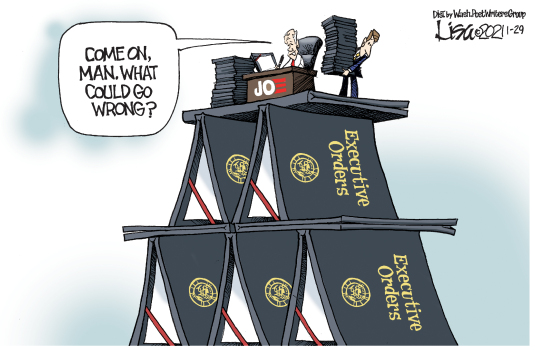
Lisa Benson cartoon

A deeper discussion of failed progressive administrative behavior is from a previous post reprinted below.

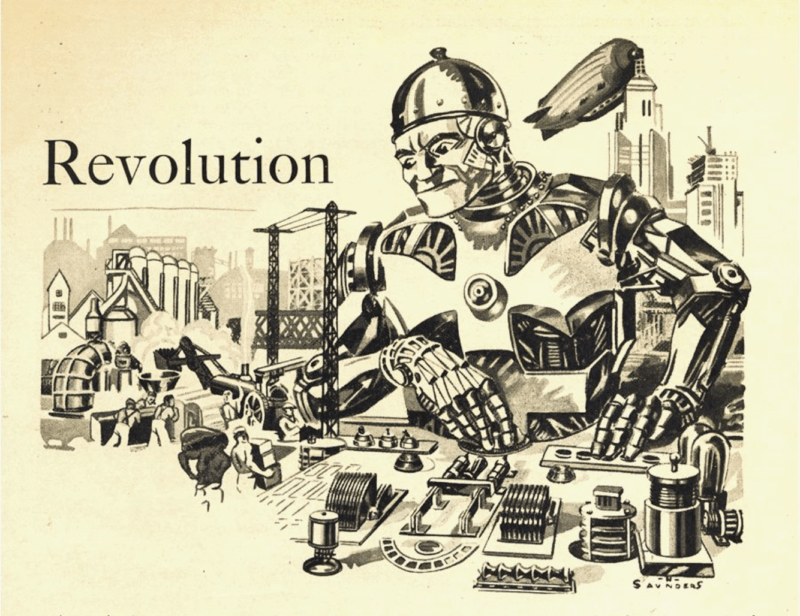
Why Technocrats Deliver Catastrophes
technorats-magazine-e1624833565281

Mark E. Jeftovic writes insightfully on the ways technology backfires when applied by bureaucrats in his article Why the Technocratic Mindset Produces Only Misery and Failure. H/T Tyler Durden at zerohedge. Excerpts in italics with my bolds.

Technocrats have the most fundamental aspect of reality backwards

Saw this article come across, come across my news alert for “Transhumanism”. In it Dr. David Eagleman talks about how not only can we augment human senses with fantastic new abilities (like to “see” heat and electromagnetic patterns), but how we’ll even be able to build machines that think too.

There is a line in his thinking that one can glean from the article: on one side of the line are enhancements and augmentations to the human experience which are startling and amazing and which will transform our societies: even more radical life extension will be in the cards quite soon (for those who can afford it).

Where Eagleman crosses into technocratic thinking is when he veers into the idea of being able to build thinking machines. The logic is that because we’ll be able to increasingly bioengineer our own living bodies, it means we should also be able to bioengineer a mind into machines using the same principles.

I think this is wrong and it’s the same theoretical mistake that leads directly to technocratically inspired catastrophes.

Yes, we continue to build on technological advancements, but we also commit a lot of unforced errors that inflict incalculable misery on humanity. These errors may manifest as policy blunders, economic crises and worse. Most recently, for example, we seem to have gotten ourselves into a global pandemic because a bunch of technocrats funded some gain-of-function experiments in hopes of preempting the next pandemic. Do you see the dynamic here?

Over the years a lot of thinkers have pointed out that technocratic policy tracks, devised by centralized groups of experts within an elite managerial class, often bring about the very conditions they were impaneled to obviate.

• Raising minimum wages increases unemployment.
• Holding interest rates to zero creates economic instability and increases wealth inequality.
• Forcing green energy initiatives creates systems with lower energy efficiency and higher carbon footprints.
• Banning guns increases gun violence.
• Censoring “hate” speech fosters more hatred and polarization.

It’s almost as if the managerial class has no awareness of second-order effects. When they inexorably come to pass they are often blamed on the very people who were counselling against the initial policy in the first place.

Thus, financial meltdowns are blamed on runaway free markets and capitalism gone wild. Global warming (if it truly plays out along prognosticated lines) is blamed on industries who are most rapidly transitioning toward greener energy anyway (like Bitcoin mining).

Climate change is another theme that exemplifies the technocratic dynamic: As a society we’re going to transition off of fossil fuels no matter what anybody thinks about the environment because we’re already past peak oil, and peak demand will probably flatline around 100M bpd and start coming down from there in a secular downtrend, for a variety of reasons (prolonged economic malaise and the ascent of green energy).

Yet the most viable pathway toward transitioning away from fossil fuels, nuclear (and in this I include Thorium), is currently relegated as problematic by technocrats and ideologues.

casper-landfill-2-e1624827835334

It all seems backwards and for a long time I’ve been positing a fundamental root cause of this backwardness. The premise is: We have the mind/matter equation completely backwards in the way we think about how the world works.

Conventional thought is that what we experience as consciousness is something that emanates from the brain. Like steam from a kettle. This is also the core assumption of AI. If we build something that resembles a brain, it’ll think. It’s a kind of Frankenstein approach that Eagleman alludes to in his article.

That won’t work and AI will never be achieved as long as the mechanistic, material reductionist worldview persists. Yet, technocrats put a lot of faith in AI, and they think models derived from AI are or will be superior to anything we can figure out on our own because they were outputted by machines with a bigger/faster/hardware brains.

It is completely… wrong.

I think that what we experience as matter are energy patterns that emanate from an underlying, and conscious sub-strata of reality. This is basic quantum theory. Quantum theory can be problematic because it opens the door to all kinds of New Age Woo Woo, which may not even be entirely wrong at its core, but is prone to deeply flawed implementations (like anything, I guess).

People, and probably most living things, have a sense, an intuitive awareness of this sub-strata of reality. Our mythology and sacred texts are probably the stories of sometimes being more attuned to it and sometimes less so. The late British writer Colin Wilson wrote at length on the consciousness of the Egyptians of the upper kingdom, possibly over 7500 years BC. Their consciousness and language was pictorial not linear. It may even be possible (my extrapolation, not his) that the demarcation point between conscious awareness between individuals was blurred somewhat. 

So what happened?

Into this awareness came religions. Organized structures that would begin to dictate the basis on which members of society were to comprehend and approach this Great Sub-Carrier. Priesthoods evolved – the first monopolies. Religions. Hierarchies. Rulers. Subjects.

One of the earliest forms of social deviance was heresy: approaching the Divine Sub-Carrier from a direction outside the religious structure. Can’t have that.

This dynamic is as old as humanity. It could even be argued that historical progress is the story of the public coming to realize that the monopoly thought structure they were in was flawed or obsolete and then society moving on to the next one. The elites of the day would endeavour to halt the progression or when that failed, co-opt whatever came next.

Then new elites would erect a new orthodoxy that placed them directly in the nexus of what was unknowable and what the rabble thought they needed to know in order to perform their primary function of ….servitude.

Today the great sub-carrier is best described by science, not religion. But again, the priesthood is saying that all knowledge of the sub-carrier should come through them. That’s Scientism. That’s Technocracy. Management by Experts.

The last two years of life on earth are a foretaste of a full blown technocracy. Follow The Science™, plebes.

Only our elites can fathom how to approach and extract knowledge from The Great Externality, but this time they’ve made things even worse because they have it exactly backwards. They think the Great Externality doesn’t even exist. It’s for flakes and Bible bangers. The technocratic priesthood holds that material reality is near completely understood and that our minds are side effects of chemical reactions in our brains.

They hold that if only we can crunch enough Big Data and calculate out all the models we’ll be, like God (who doesn’t exist), able to fix everything and eliminate all bad outcomes, for everybody, everywhere. We may even be able to eliminate death, and we could upload our consciousness (which is an illusion) into the cloud and live forever.

Because of this backwardation, we will always be careening from one catastrophe to the next, and most of them will be of our own making. We collectively suffer from an illusion that we are in control.

But we are not in control. We’re a pattern. A dance. A cycle. Waveforms. Vibrations. What we as humans do specifically well, which is our superpower and has led to our technological advancement which could conceivably continue on a trajectory that makes humanity an interstellar phenomenon, is adapt.

What technocrats can’t understand, or admit is that we can’t control what is going to happen. Either on an individual scale of people thinking in ways they’re not supposed to think, or geological, cultural, geopolitical or cosmic scales. We can’t get interest rates right, we can’t get everybody to agree on whether it’s “Gif” or “jif” and somehow we’re going to change the trajectory of the climate? Achieve immortality? Crank out a Singularity?

That is highly unlikely and in trying to preempt theoretical bad outcomes we typically bring about horrible actual outcomes.

The lab leak from the Wuhan Institute of Virology, if it occurred and it is looking increasingly likely that it did, was the result of gain-of-function studies on bat coronaviruses. They didn’t do it as a bioweapon. It’s not a global conspiracy to institute a Great Reset (all that talk is opportunism more than planning).

They were trying to figure out how to plan for a future global pandemic that may catch humanity off guard and cause incalculable damage. What did they accomplish? They unleashed a global pandemic that caught humanity off guard and caused incalculable damage. Soon to be compounded by global, de-facto compulsory inoculations with experimental vaccines that have a distinctly politicized impetus behind them.

That same dynamic is applied to economics (its where the .COM crash and Global Financial Crisis came from), and social policy (the Woke movement), to climate is all the same technocratic mindset that doesn’t understand the order of reality (mind, then matter) but even worse thinks it knows it.

We’re stuck with that for awhile because the technocratic mindset is incapable of introspection or entertaining the possibility of being wrong about anything. The only move it knows is to double-down on failure.

The antidote to all this is massive decentralization on a global scale, which has the added benefit that decentralization by definition, is not something that gets decided from the top (it never is). It just happens, even in spite of the people in the centre of power who may feel something about their gravitas melting away.

That’s what has started to happen. A global opt-out. The Great Reject. As sure as the Reformation gave way to the Enlightenment despite the protestations of the Church, we’re headed into a world of networks and the sunset of nations. All the while the propagandists of the old order shrieking that in this direction lies certain doom.

The Enlightenment arose from an increase in the level of abstraction, structurally the universe changed from the Ptolemaic worldview (the world as the centre of all existence) to the Heliocentric solar system.

Now we’re experiencing a similar shift away from static top-down hierarchical structures as the natural shape of civilization and toward shifting, impermanent, overlapping networks.

Footnote:  Another Example of Technocratic Adventurism

From American Thinker The Grave Perils of Genetic Editing.  Excerpts in italics with my bolds.

A company called Oxitec, based in the U.K., is piloting a program using gene-/information-modified mosquitos to eliminate the invasive female Aedes aegypti mosquitoes in the Florida Keys. The mosquitoes potentially spread diseases such as Dengue fever and Zika.

Dr. Nathan Rose, head regulator of Oxitec, said mosquito-borne diseases are likely to worsen as a result of climate change. According to the CDC, in a ten-year span between 2010 and 2020, there were 71 cases of Dengue fever transmitted in Florida. In essence, the experiment is being conducted for fear of climate change causing a drastic increase in incidence of Dengue fever. In the Fox article, Rose states that Oxitec will first experiment in Florida, collect data, then “go to the U.S. regulatory agencies to actually get a commercial registration to be able to release these mosquitoes more broadly within the United States.”

Don’t think the Florida Keys just opened their arms with a great big bear hug to this experiment. No, there were pushback and questions. In fact, Oxitec had been pushing this experiment to Key Haven and Key West for years, only to be rejected. Many other places have also declined this experiment. When it was conducted in Brazil, it initially seemed to work, but in the end, the mutated mosquitos transferred mutations to the general public. Thankfully, gene drive was not used in the Brazil experiment, for this type of gene manipulation cannot be reversed and can wipe out a species over time.

Evidently, Oxitec has created a second-generation “friendly mosquito” technology, where new male mosquitoes are programmed to kill only female mosquitoes, with males serving and passing on the modified genes to male offspring for generations. Yes, they are programmed to kill. Oxitec CEO Grey Frandsen announced in 2020 that Oxitec looked forward to working with the Florida Keys community to “demonstrate the effectiveness of our safe, sustainable technology in light of the growing challenges controlling this disease-spreading mosquito.”

Let’s hope the Florida mosquitoes experiment is truly a necessity and not some type of climate-change fear-mongering “sustainable” technology based on speculation.

Climate Hysteria is a Global Psy-Op

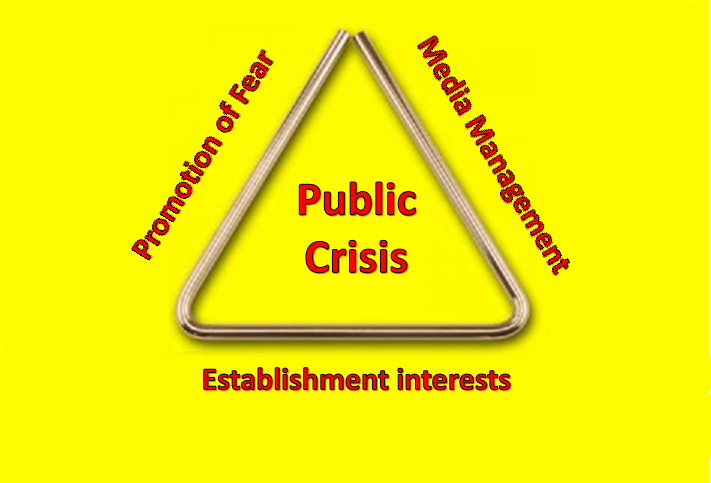
Iron triangle Crisis

Iron Triangle of Public Crises

Alasdair Macleod writes at Goldmoney The problem with climate change politics. Excerpts in italics with my bolds.

Climate change bears all the hallmarks of a state-sponsored crisis, useful to shift attention from other political failures. But the absence of financial accountability which characterises government actions also introduces behavioural errors.

The absence of a profit motive in any state action exposes the relationship between governments and their electors to psychological factors. We all know that governments use propaganda and other tools to manage crowd psychology and influence their electorates. What is less understood is that governments themselves are misled by a crowd psychology in its own ranks which contributes to policy failure.

This article does not question the climate change debate itself. Instead, it examines the debate in the context of the psychology driving it. The release of government-sponsored propaganda on climate change in the form of a unanimous IPCC report predicting the end of the world as we know it is the latest example of a political and bureaucratic phenomenon, making the timing of this article highly relevant.

Six psychological factors

 In Chapter 6 of Desrochers & Szurmak’s work, they identify six distinct psychological factors which we will take in turn to enhance our understanding of the psychology of climate change. I list them under the following headings:

♦ The iron triangle of crisis
♦ The psychology of entrenched arguments
♦ Motivated reasoning
♦ The core theoretical theme
The anointed elite and
♦ Optimism and pessimism

The Desrocher and Szurmak reference is to their book Population Bombed.  My synopsis with links is Control Population, Control the Climate. Not.

The iron triangle of crisis

Even from before the time of Malthus, there have been political influencers and activists who have promoted pessimistic assumptions about uncontrolled population expansion, and the ability of the planet’s resources to feed them. Despite these fears being subsequently proved to be unfounded they continue to prevail among those who don’t need to pursue profits for a living. It is a bias to which politicians and their advisers are especially vulnerable.

The public naturally expects its elected representatives’ unbiased endeavours when bringing national threats to its attention. After all, it is arguably a primary function of government to protect its population from dangers, real and potential. There are government departments tasked with assessing dangers to society, their likelihood, and in their event how government should respond. These are tasks that require unbiased research. But political guidance from the top is rarely neutral, seeking to influence outcomes.

And we now find that climate change science has become heavily politicised.

Climate change is the gift that goes on giving to politicians. It creates an impression of tackling the big issue of our times. And it is a source of crisis giving cover for failings over lesser priorities. Observing how Boris Johnson maintains his popularity through a combination of leading the world in the battle against climate change while seeking every photo opportunity possible and at the same time presiding over the Covid disaster has been a masterclass in practical politics. One is left wondering how vacuous his politics would appear without the prop of climate change.

On his watch, the politics of climate disaster have taken on a new life in the UK. Government spending plans angled at reducing carbon emissions has accelerated, as has the support and credibility given by state-funded scientists producing alarming forecasts. Radical environmentalism is not only embraced, but actively promoted through the media.

This trinity, this iron triangle of crisis as Desrochers and Szurmak put it, is therefore comprised of establishment interests, the promotion of fear, and media management. It focuses the public’s mind on a specific threat to the exclusion of others. It is a feedback loop of career and protectionism driven by the psychology of entrenched arguments, which is our next topic.

The psychology of entrenched arguments

A rational approach to absorbing and understanding new information would be to address it logically and without bias. Clearly, this does not happen. Our brains are still wired as they were in our hunter-gatherer days when our decisions were based on a choice of fight or flight. We therefore have a natural tendency to hold onto a protected position after it becomes untenable.

Imagine being part of a community of primitive cave-dwellers and fight or flight becomes a group decision. We will support each other in uncertainty well after a crisis point has passed, breaking ranks after flight has become the only option. It is survival by inward-looking mutual defence, not attack. It is the deep psychology behind groupthink, or the psychology of entrenched arguments. It leads to the cliff-edge of crisis.

Researchers from Cornell University have examined the phenomenon.[iii] They found that “participants prefer to learn information from in-group sources and agree more with in-group members on moral and political issues”. This takes groupthink into persistence territory after the flight option has long passed, and existing views become defensively entrenched. Awareness of the true situation becomes compromised through self-ignorance of the flaws in the group’s knowledge and judgement. It even has a name: the Dunning-Kruger effect.[iv]

To this self-ignorance can be added a group’s overestimation of its understanding of controversial issues, leading to the illusion of “understanding bias”. The more members of a group who debate an issue, the more understanding bias is reinforced. You see evidence of understanding bias in wider politics, particularly when opinions coalesce over time into different political ideologies. In America, the Democrats are as intellectually capable as the Republicans, yet the two parties have retreated into sharply differing understanding biases.

Entrenched arguments are reinforced by naïve realism. A naïve realist assumes he or she personally is both rational and unbiassed in the assimilation and assessment of the facts, and further assumes that those who do not reach the same conclusions are ignorant, biased or both. Naïve realism is the product of a false consensus, under which those that agree with the naïve realist are seen to be more rational than those that do not. Entrenched arguments and naïve realism become the driving force behind motivated reasoning.

Motivated reasoning

We naturally believe in scientific research, on the incorrect assumption that all those PhDs from top universities conduct experiments for the same reasons as we were taught at school in chemistry lessons. Unfortunately, the scientific community’s motivation, in both the natural and social sciences, is not so pure. Scientists are human and need to earn a living, which is far easier to do if they go with the general confirmation bias. In the post-education world, a scientist needs a paid position, recognition and to publish frequently in respected journals. Good ideas become suppressed and poor data to back bad ideas are too frequently the result of this motivated reasoning.[v]

It was best summed up by John Ioannidis, a professor of medicine at Stanford University:

“Scientists in a given field may be prejudiced purely because of their belief in a scientific theory or commitment to their own findings… Prestigious investigators may suppress via the peer review process the appearance and dissemination of findings that refute their findings, thus condemning their field to perpetuate false dogma. Empirical evidence on expert opinion shows that it is extremely unreliable.”[vi]

Admittedly, Professor Ioannidis was writing about research in the natural sciences, but the methods and empirical evidence extends to the social sciences as well. It describes well the research papers published by central banks and the economist professors in universities. It is also characteristic of the opinion silos in government departments.

Motivated reasoning, such as on climate change and political correctness, is all about building a core theoretical theme.

The core theoretical theme

One way in which experts refute opposing evidence is by sticking to a core theoretical theme. I recall email correspondence I had with a well-known financial journalist in 2016, which ground to a halt when he declared,

“In my view, the record global savings rate (27pc) is the root cause of our problems. Some way must be found to rotate this into consumption to rebalance the global economy.”

In other words, he adhered to a core theoretical theme common to neo-Keynesian economists. By expressing it as his view, he was obviously not prepared to debate why he held that the record global savings rate was the root cause of our problems. We are not judging whether it is correct, only that he holds it, he assumes it. He was signalling he will not be shifted, so further debate is pointless. This is true of all state-funded economics, which this opinion reflects. Numerous papers have been written to justify this stance. We have lived with this view since Keynes published his General Theory in 1936. As in Keynesian economics, a core theoretical theme has emerged in the climate change debate

But if Professor Ioannidis is right about empirical evidence showing expert opinion is extremely unreliable, and which appears to be confirmed in the fields of economics and monetary theory, it explains the closed minds to balanced debate in fields such as climate change. So long as a core theoretical theme is adhered to, it becomes almost impossible to overturn.

A determination to stick to the core Keynesian theme on the savings paradox is my journalist friend’s membership card for the anointed elite.

The anointed elite

Many of us want to belong, to make a difference, to enhance society. We know that to do so we must have influence and the best way to do that is to join and promote a cause that has the establishment’s support. And there is nothing like that comforting feeling of an open invitation into the parlours of the great and the good. Well-known figures in the media with this access use their fame and position to anoint themselves alongside the elite and continue to have a career for so long as they play the elite’s game.

The anointed elite was the description of the economist and political theorist, Thomas Sowell, Senior Fellow at the Hoover Institution, Stanford University. He came up with it in his pithily named 1995 book, The Vision of the Anointed: Self-congratulation as a basis for social policy.

Even though we may not recognise it at the time, we have all come across it: the independent expert frequently called on by the media for comment in a specialist field. These experts rely on being informed by government insiders. They adopt the expert mantle, but it is never made clear that they owe their media status almost entirely to their membership of a government-anointed elite and their support of the elite’s objectives. But if they are stupid enough to turn critic, they will be immediately unanointed and they know it.

It applies to ex-politicians and media correspondents alike. If, say, a correspondent for a national newspaper doesn’t play along, he risks being dropped from background briefings by the elite, while his confrères at other journals continue to be invited. “That journalist from the Daily Screech is unreliable. Best not include him in our off-the-record briefings.” The threat of exclusion is the surest way for the elite to ensure that its message is the one that prevails.

Optimists v. pessimists

The glass-half-full optimists and the glass-half-empty pessimists are not split evenly across two sides of an issue. In practice, the establishment and those with a position in society are protective and pessimistic about change because it is a threat to their established position, while commercially minded outsiders tend to take a more positive view.

Psychologists tell us that as humans we have two personalities. One half of us protects what we have, giving us a sense of location, property, and home. The other half is a traveller in search of new vistas, foreign relationships, and trade. Journalist and activist Jane Jacobs (of New York City and then Toronto) identified and described these two patterns of moral precepts as guardian and commercial syndromes.[vii]

According to Jacobs, we have a different mix of these characteristics as individuals, communities and even at national levels. The two syndromes show different characters, which is why some of us are adventurers and others home birds. Commercial relationships are outgoing, and honesty in business is rewarded, while guardians are protective, favour loyalty and support the establishment. Commercials shun force and come to voluntary agreements, while guardians shun trading and exert prowess. Commercials are collaborative, competitive and respect contracts, while guardians are exclusive, take vengeance and respect hierarchy. Commercials are open to inventiveness and novelty, while guardians expect obedience and discipline. And so on.

The commercials’ activities encompass work in making and trading, while the guardians are political leaders, administrators, educators, and upholders of the law. The two syndromes are a neat explanation for the different mindsets and social duties of the private sector compared with governments.

The consequences of climate change politics

The purpose of this article is not to enter the climate change debate but to examine the flaws in the process. Realistically, it is too late to question the line being pursued, having gone beyond any influencer’s control. It is common knowledge that the science is politically influenced by state funding. But it is not widely appreciated that the process of hyping up climate change into a full-blown crisis has become the consequence of a crowd psychology rather than a pursuit of the facts.

The political advantages of introducing legislative targets for climate policies in 2030 or 2040 is that they are sufficiently far away for current politicians to have dumped the problem onto their successors. Without carbon fuels and having subsidised unreliable wind and solar energy to the point where other energy sources, notably nuclear, are uneconomic, the cost of climate change politics threatens to be ruinous for economic activity in the future, threatening the tax base and therefore the expenditure of the governments which have thoughtlessly promoted it.

brain on climate alarm

This is your brain on climate alarm.  Just say NO!

Biden Drops the Ball in Afghanistan. How Many Fumbles is He Allowed?

TOPSHOT-AFGHANISTAN-CONFLICT

James Carafano writes at Daily Signal Don’t Blame Trump for Afghanistan’s Collapse. Blame Barack Obama. Excerpts in italics with my bolds.

President Joe Biden’s decision to withdraw abruptly from Afghanistan, without any discernable exit strategy, has plunged that nation into a bloody, ruinous chaos. After pleading with the Taliban to spare our embassy in Kabul, he has now redeployed 3,000 to conduct a hasty air evacuation of embassy staff.

At this stage, the only good that can come from this debacle is that our leaders might wake up and recognize that the Obama Doctrine of foreign policy is an abysmal failure and must be abandoned once and for all. Tragically, this lesson comes, yet again, at tremendous cost: widescale human misery and heightened threats to U.S. interests.

As we study what’s happened, let’s first dispense with the canards: that this fiasco was inevitable and that it’s all Donald Trump’s fault.

The reality is that, during Trump’s tenure and despite the Afghan government’s many imperfections, Afghanistan had made great strides. The government-controlled most of the country’s territory. There was real economic growth. Women could work. Children could go to school.

Further, the cost of fostering regional stability by maintaining a stable Afghanistan was well within reason. The U.S. was spending less in Afghanistan in a year than we used to spend in a week. American forces were training and advising Afghan forces. Our troops were not fighting wars and taking causalities. This was clearly sustainable.

And how, in heaven’s name, is Trump to blame for Biden’s disastrous decision to cut and run? Trump was negotiating with the Taliban, but there was nothing wrong with that. The negotiations were conditions-based, and Trump made clear the Taliban would be held accountable for their actions. Moreover, Trump’s team made sure that if, in the end, the Taliban proved untrustworthy, the remaining U.S. force had been sized and scoped to present a serious deterrent to the Taliban and be sufficient to protect U.S. interests.

Trump, in fact, handed Biden a problem mostly solved. All Biden had to do was negotiate a lasting settlement from a position of strength or maintain an economy of force presence in Afghanistan if the Taliban failed to deliver. Instead, Biden just decided to call it day and call the troops home regardless of what the Taliban did on the ground.

The Taliban’s offensive should surprise no one, given the conditions handed to them. Why would they not take advantage of Biden’s abandonment of Afghanistan? They knew full well the odds that this president would try to stop their orgy of murder, rape, forced marriages, and mayhem was near zero.

Of course, Biden will blame Trump. He will blame the Taliban. He can make all the excuses and spin all the narratives he wants, but a narrative can’t stop a bullet. This is a disaster. The situation did not collapse until he withdrew troops—and it is impossible not to conclude this happened because of what he decided.

Here is the bigger problem. This was not a one-off decision. This is part of a pattern of Obama-Biden foreign policy. And that should surprise no one since the current policies are being managed by much the same people.

In Iraq, after spending much time and effort stabilizing the country, Obama precipitously withdrew U.S. troops. It was like ordering firefighters who had extinguished a wildfire to not stick around after the wildfire in case the blaze rekindles. ISIS mushroomed overnight, creating the largest and most powerful terrorist state in modern history.

In Libya, Obama insisted on leading from behind. And once Gaddafi was gone from the picture, he ignored the spiraling decline in the security situation until our diplomatic facilities in Benghazi were smoking ruins.

This is the Obama-Biden playbook. Disengage in dangerous situations, and hope everything doesn’t go to hell in a handbasket. And when those fond hopes don’t pan out? Time to make excuses; shift blame; do anything but deal with the problem—unless there is absolutely no alternative.

In the face of America’s enemies, the default position of Obama-Biden foreign policy default is accommodation and appeasement. Unfortunately, the bad guys are not stupid. They had eight years to study the Obama playbook, and they know what to do with it: Exploit the deliberate self-weakening.

Biden is carrying on exactly the same foreign policy. Caving to Russia on Nord Stream 2. Refusing to confront China on the origins of COVID-19. Pleading with Tehran to let the U.S. back in the Iran nuclear deal.

No good will come of this.