Economic Freedom is the Way Forward, Reject Woke ESG Corporatism

Anthony B. Kim and Patrick Tyrrell write at Daily Signal Economic Freedom Is the Path to Healthy Environments, Social Progress, and Good Governance—Not Woke Corporatism.  Excerpts in italics with my bolds.

The left is trying to refashion how policy makers and private-sector leaders understand their roles by insisting that their actions must have an “environmental, social, and governance” focus. This agenda is frequently abbreviated to “ESG”—a buzzword that is now being heavily circulated online and in D.C. It’s also completely misguided.

The environmental, social, and governance agenda insists that policy makers and private-sector leaders see themselves as the stewards of a newly “woke” planet. In actuality, it is a way to force companies to take positions in the political arena on issues that may have nothing to do with the company’s actual business activities.

Economic freedom, not the environmental, social, and governance agenda, makes the world cleaner, safer, and better governed. It is not hard to find the economic damage that is inflicted by heavy-handed and misguided government policies, which result in lingering uncertainty, deteriorating entrepreneurial environments, and lower employment growth.

The true path to ensuring environmental, social, governance improvements lies in focusing on policies that enhance economic freedom. As documented in The Heritage Foundation’s annual Index of Economic Freedom, the linkage between economic freedom, individual liberty, and prosperity around the world is unambiguous.

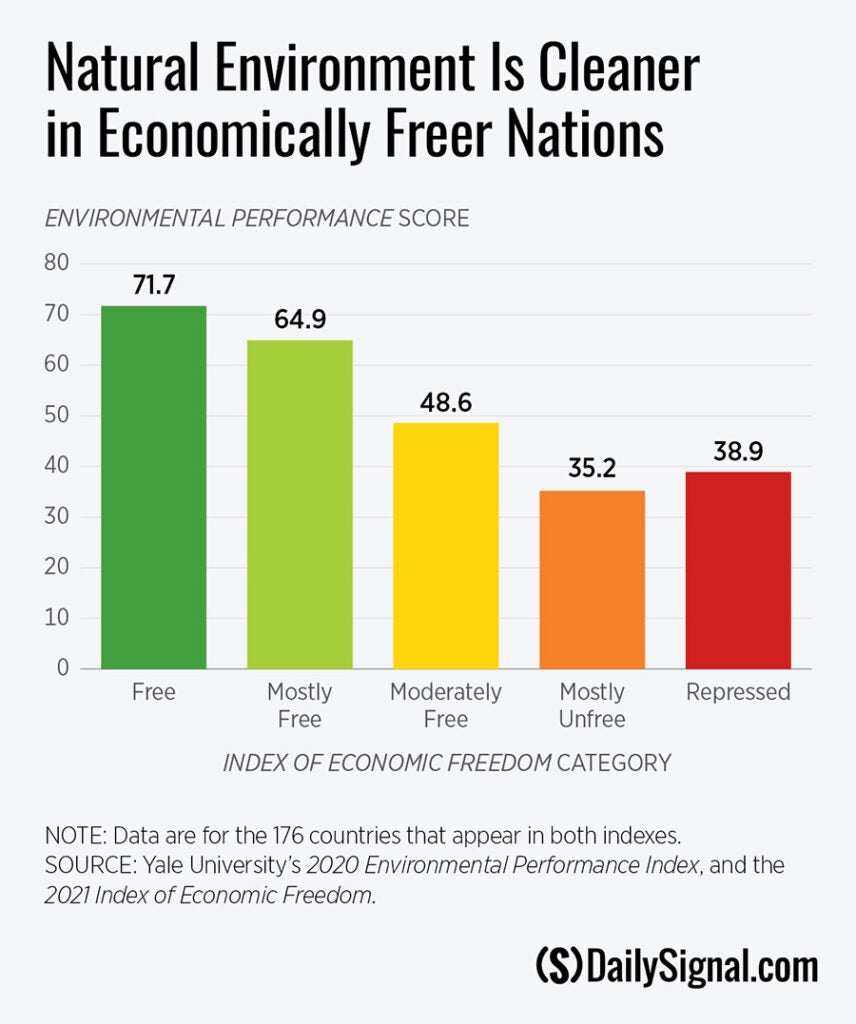
This prosperity is not just an end in itself. As the index catalogues, preserving and advancing economic freedom enables individuals, entrepreneurs, and companies to better care for the poor and their environments, create better health care and education systems, ensure an abundance of food and clean water, and solve many of the other societal problems that makes life better for a greater number people.

In countries around the world, economic freedom has been shown to increase the capacity for environmentally friendly innovation. The positive link between economic freedom and higher levels of innovation ensures greater capacity to cope with environmental challenges, and the most remarkable improvements in clean energy use and energy efficiency over the past decades have occurred not as a result of government regulation, but rather because of advances in economic freedom and freer trade.

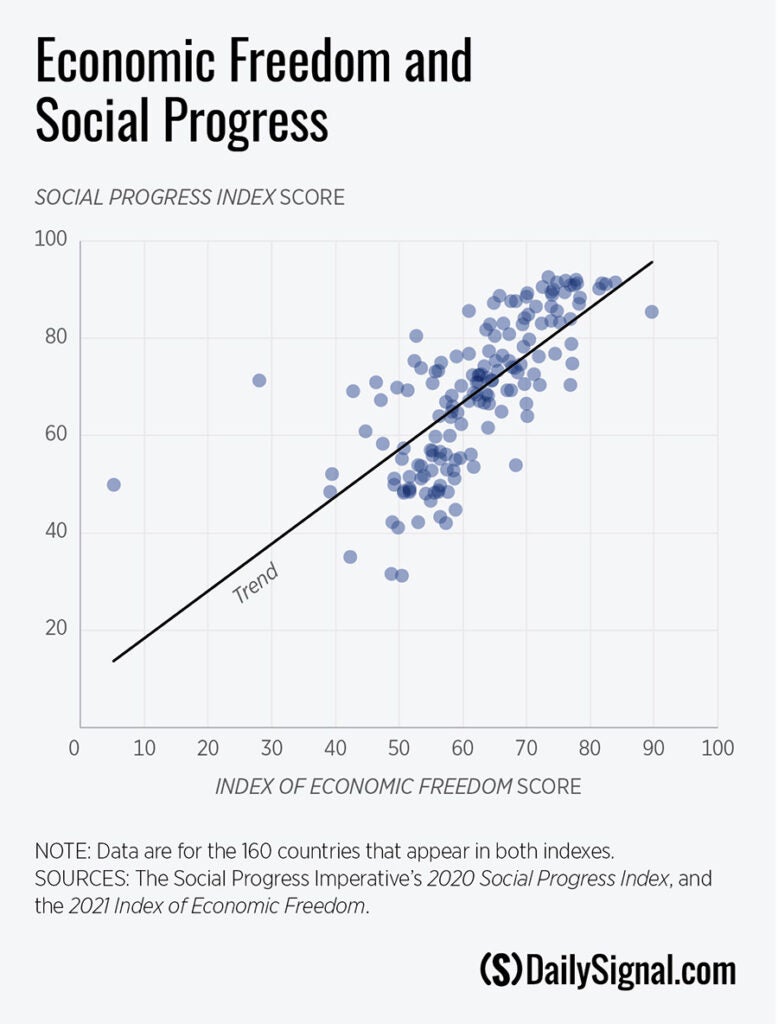
Equally notable is that countries that provide an environment that is conducive to social progress also largely embrace economic freedom. Countries that allow private-sector competitiveness to thrive free from government interference and open their societies to new ideas, products, and innovations have largely achieved the high levels of social progress that their citizens demand.

It is not massive redistributions of wealth or government dictates on income level that produce the most positive social outcomes.

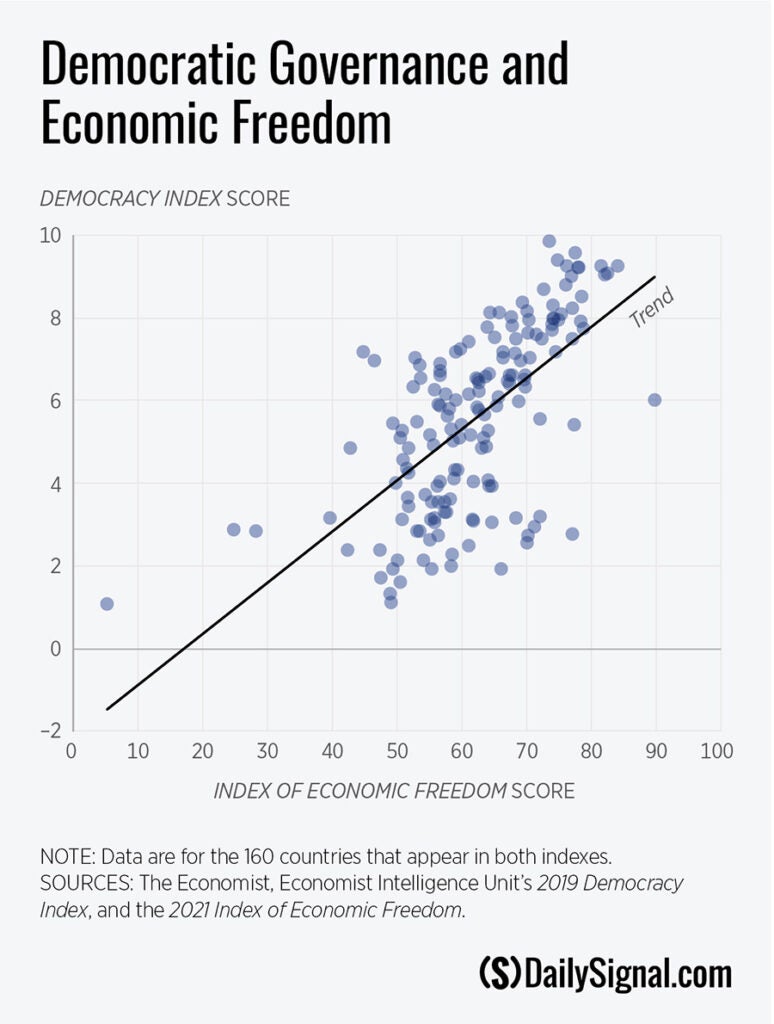
Greater economic freedom can also provide more fertile ground for effective and democratic governance. Undoubtedly, the achievement of political freedom through a well-functioning democratic system is a messy and often excruciating process, but the positive relationship between economic freedom and democratic governance is undeniable.

By empowering people to exercise greater control of their daily lives, economic freedom ultimately nurtures political reform by making it possible for individuals to gain the economic resources that they can use to challenge entrenched interests or compete for political power, thereby encouraging the creation of more pluralistic societies.

By building on what works, we can accelerate our progress in the face of even the most difficult challenges and chart ever greater success. The key to that is to advance the four pillars of economic freedom—the rule of law, limited government, efficient regulation, and market openness.

Real-world trends already reveal how to advance environmental, social, and responsible governance principles and results. Twenty-seven years of the annual Index of Economic Freedom provide compelling evidence that the pathway to such improvements is not with infringing on people’s economic freedom, but through allowing their economic freedom to flourish.

That responsibility is to advance free people and free markets.


Update: What is an “Invalid Vote” Anyway?

As explained in a reprinted post below:

A vote is an indication of preference cast by an eligible, registered voter.  It must be cast in the time, place, and manner prescribed by law.

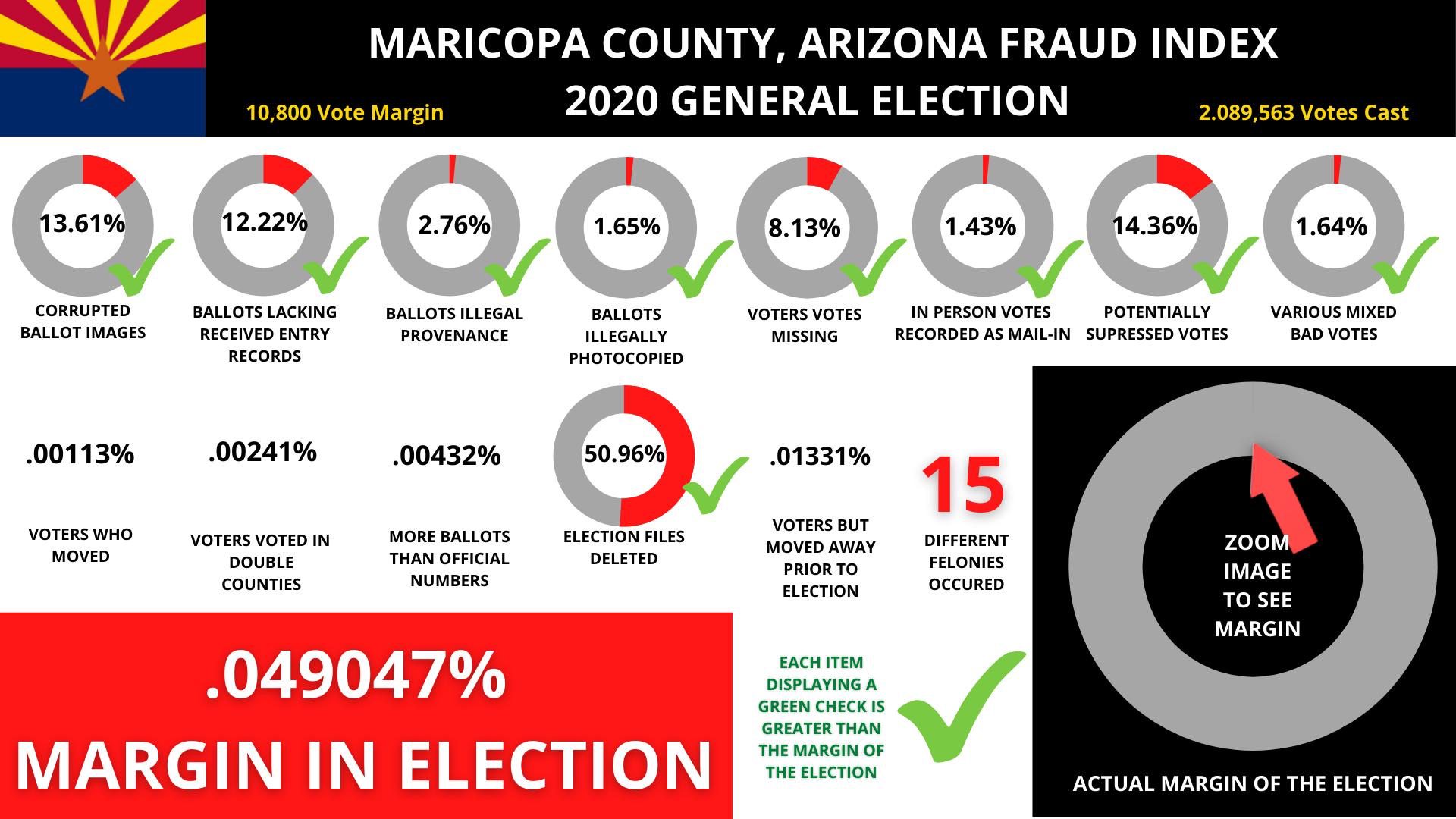
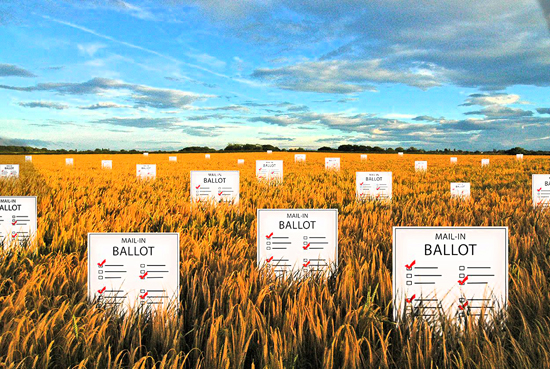
Thus a ballot cast claiming to be a vote is not in fact one to be counted if any of the conditions are not met.  The image above presents the many ways supposed “votes” failed to be valid votes in Maricopa County, Arizona, in the 2020 federal election.  The total count of ballots cast was 2,089,563 and Biden won by 10,800.  Each of the many circles depict the % of total votes that failed to meet a particular criterion.  If the top row circles are summarized, the total number of invalid votes in that county exceeded 700,000. Jovan Pulitzer explains why he made the chart:

I think people need to visually see all the errors, all the information that shows, hey, Maricopa at its worst literally should be decertified, at its best could easily be redone…

…I just charted out a very simple way to understand how bad is the bad. If they’re just pie charts, if you think here in this election was won on .049047%, right? It’s such a small margin that it could have swung any way…

…There are eight charts across the top, those are just the low hanging fruit that show this election has serious issues because any one of these would demand that it can’t be certified or it needs to be rerun. 

Background at previous post What is a Vote Anyway?

Ted Noel writes at Town Hall In the Arizona Audit, Words Matter.  Excerpts in italics with my bolds and added images.

This is one of those times when we wish that people would have used more circumspect language. Both the Arizona auditors and John Solomon committed a cardinal error that has allowed the Left to celebrate victory and ignore the fine print. Both note that Biden got more “votes” than Trump. That conclusion is incorrect, because it ignores the rest of the story.

A vote is an indication of preference cast by an eligible, registered voter.

It must be cast in the time, place, and manner prescribed by law. Anything else is not a vote. In Arizona, it is cast on paper ballots and read by machines. All the “accurate count” showed was that the machines counted the pieces of paper accurately. That’s all machines do. They do not count “ballots.”

The canvass did not answer the primary question, “How many of the pieces of paper were lawful ballots and how many should have been excluded because they were not lawful votes?” All the “accurate count” proves is that there was no outside effort to tweak the numbers by changing them by some direct internet chicanery. But it does not prove that Biden won. Or not. And that is the problem.  I won’t repeat all the details the auditors droned on through, but there are several key findings.

Over 50,000 “ballots” were unlawfully cast.

There were dead people, new addresses without re-registration, double votes, envelopes with no signatures, ballots received that were never sent out, and so on. Every one of those “ballots” were unlawful. They should have been rejected to remove them from the canvass. Since the margin between Trump and Biden was around ten thousand, this is far more than enough to cast doubt on the outcome. And then comes the drama.Maricopa County did everything it could to block the audit. If it was confident that it had done its job correctly, then one would expect that it would cooperate fully. Indeed, with the hand count matching the canvas, it seems that all should be well. But then we find that hundreds of thousands of election files were deleted from Maricopa County’s computer servers the day before the audit began. That smacks of guilty knowledge.

We also know that the servers allowed election data to be seen from the internet. Security was extremely lax, and even though it appears no votes were changed, other issues arise. Legally required signature matching on absentee ballots basically evaporated as the original tally went on.

Was someone watching from outside, then advising local officials on how to let unlawful ballots through to obtain the desired result?

At a bare minimum, the Arizona Presidential election was irretrievably tainted. The taint was large enough to make determination of the actual winner impossible. That’s why I wrote before January 6 that VP Pence should send several slates of electors back to their respective state legislatures for a final determination.

Those states, by repeated violations of their own state laws, did not hold elections. The processes they followed did not allow a tally of lawful votes.

The Arizona legislature should vote to decertify the electors for the 2020 election. This may have no legal effect, but if it leads two or three other states to the same conclusion, we may have a Constitutional crisis, and there are no guideposts for this trail. The Constitution simply did not foresee the compounding of raw power applied to prevent the proper administration of a Presidential election. The Supreme Court may deny cert based on the passage of time beyond the designated Electoral College date. Or it could decide to hear the case and ultimately find that Biden’s election is a nullity ab initio. Or something in between. Who knows?

What we do know is that we simply cannot declare who won the Arizona election with any degree of certainty. Even if that changes nothing else, it should give us a resolve to fix our elections so that they cannot be manipulated outside the law.

Pieces of paper with marks on them are not ballots until it is determined that those marks were made by a lawful voter in the time and manner prescribed by the legislature. Only after that bar is crossed for every ballot is it possible to have an election. Biden did not win the Arizona election because there was no Arizona election. It is impossible to truthfully say that he got more “votes” than Donald Trump. Nobody actually knows.


Vaccine Cult Strikes Again: No Pills Allowed

Matt Taibbi reports at substack The Cult of the Vaccine NeuroticExcerpts in italics with my bolds and added images.

Yesterday, I ran a story that had nothing to do with vaccines, about the seeming delay of the development of a drug called molnupiravir (see the above segment with the gracious hosts of The Hill: Rising for more). In the time it took to report and write that piece, conventional wisdom turned against the drug, which is now suspected of ivermectinism and other deviationist, anti-vax tendencies, in the latest iteration of our most recent collective national mania — the Cult of the Vaccine.

The speed of the change was incredible. Just a week ago, on October 1st, the pharmaceutical giant Merck issued a terse announcement that quickly became big news. Molnupiravir, an experimental antiviral drug, “reduced the risk of hospitalization or death” of Covid-19 patients by as much as 50%, according to a study.

[For Background see Why Merck Dissed Its Own Invention Ivermectin]

The stories that rushed out in the ensuing minutes and hours were almost uniformly positive. AP called the news a “potentially major advance in efforts to fight the pandemic,” while National Geographic quoted a Yale specialist saying, “Having a pill that would be easy for people to take at home would be terrific.” 

This is what news looks like before propagandists get their hands on it. Time writer Alice Park’s lede was sensible and clear. If molnupiravir works — a big if, incidentally — it’s good news for everyone, since not everyone is immunized, and the vaccines aren’t 100% effective anyway. As even Vox put it initially, molnupiravir could “help compensate for persistent gaps in Covid-19 vaccination coverage.”

Within a day, though, the tone of coverage turned. Writers began stressing a Yeah, but approach, as in, “Any new treatment is of course good, but get your fucking shot.” A CNN lede read, “A pill that could potentially treat Covid-19 is a ‘game-changer,’ but experts are emphasizing that it’s not an alternative to vaccinations.” The New York Times went with, “Health officials said the drug could provide an effective way to treat Covid-19, but stressed that vaccines remained the best tool.”

If you’re thinking it was only a matter of time before the mere fact of molnupiravir’s existence would be pitched in headlines as actual bad news, you’re not wrong: Marketwatch came out with “‘It’s not a magic pill’: What Merck’s antiviral pill could mean for vaccine hesitancy” the same day Merck issued its release. The piece came out before we knew much of anything concrete about the drug’s effectiveness, let alone whether it was “magic.”

Bloomberg’s morose “No, the Merck pill won’t end the pandemic” was released on October 2nd, i.e. one whole day after the first encouraging news of a possible auxiliary treatment whose most ardent supporters never claimed would end the pandemic. This article said the pill might be cause to celebrate, but warned its emergence “shouldn’t be cause for complacency when it comes to the most effective tool to end this pandemic: vaccines.” Bloomberg randomly went on to remind readers that the unrelated drug ivermectin is a “horse de-worming agent,” before adding that if molnupiravir ends up “being viewed as a solution for those who refuse to vaccinate,” the “Covid virus will continue to persist.”

In other words, it took less than 24 hours for the drug — barely tested, let alone released yet — to be accused of prolonging the pandemic.

By the third day, mentions of molnupiravir in news reports nearly all came affixed to stern reminders of its place beneath vaccines in the medical hierarchy, as in the New York Times explaining that Dr. Anthony Fauci, who initially told reporters the new drug was “impressive,” now “warned that Americans should not wait to be vaccinated because they believe they can take the pill.”

[Comment:  Pills are not second to vaccines in some medical hierarchy; they are equally essential and paramount for those who get sick, vaccinated or not.]

Since the start of the Trump years, we’ve been introduced to a new kind of news story, which assumes adults can’t handle multiple ideas at once, and has reporters frantically wrapping facts deemed dangerous, unorthodox, or even just insufficiently obvious in layers of disclaimers. The fear of uncontrolled audience brain-drift is now so great that even offhand references must come swaddled in these journalistic Surgeon General’s warnings, which is why whenever we read anything now, we almost always end up fighting through nests of phrases like “the debunked conspiracy theory that COVID-19 was created in a lab” in order to get to whatever the author’s main point might be.

As a student in the Soviet Union I noticed subscribers to what Russians called the sovok mindset talked in interminable strings of pogovorki, i.e goofball proverbs or aphorisms you’d heard a million times before (“He who takes no risk, drinks no champagne,” or “Work isn’t a wolf, it won’t run off into the woods,” etc). This was a learned defense mechanism, adopted by a people who’d found out the hard way that anyone caught not speaking nonstop nonsense could be suspected of harboring original thoughts. Voluble stupidity is a great disguise in a society where silence is suspect.

We’re similarly becoming a nation of totalitarian nitwits, speaking in a borrowed lexicon of mandatory phrases and smelling heresy in anyone who doesn’t.

This cult reflex was bad during the Russiagate years, but it’s gone into overdrive since the arrival of COVID. The CNN writer who thinks it’s necessary to put a disclaimer in the lede of a story about molnupiravir, of all things, is basically claiming he or she is afraid a theoretical unvaccinated person might otherwise read the story and be encouraged to not take the vaccine.

Except, if that theoretical unvaccinated person could be convinced by anything CNN said or did, they’d have already gotten the shot, because the network runs ten million stories a day directly imploring people to get vaccinated or die. News flash: the instinct to armor-plate even unrelated news subjects with layer after layer of insistent vaccine dogma is not for the non-immunized, who mostly don’t watch outlets like CNN or read the New York Times.

Outlets apply that neurotic messaging for their own target audiences, who’ve been trained to live in terror of un-contextualized content, which everyone knows leads to Trump, fascism, and death.

I’d be the last person to claim there aren’t dumb people out there in America, but at least the audiences of channels like Fox and OAN know that content has been designed for them. The people gobbling down these pieces by Bloomberg and the Times that have the journalistic equivalent of child-proof caps on every paragraph that even parenthetically mentions COVID really believe that content has been dumbed down for some other person. They think it’s someone else who can’t handle news that vaccines work and that there also might be a pill that treats the disease, without freaking out or coming to politically unsafe conclusions. So they put up with being talked to like children — demand it, even. Which is nuts. Right? It is nuts, isn’t it?


Dr. Richard Urso: End the Pandemic with Early Treatment

Drug Inventor Urso: Are We Underutilizing Early Treatment?

We cannot use a one-size fits all approach to fighting Covid

Dr. Richard Urso is a scientist, sole inventor of an FDA-approved wound healing drug, and the Former Director of Orbital Oncology at MD Anderson Cancer Center. He believes we cannot use a one-size-fits-all approach to fighting Covid.

“We are not going to vaccinate our way out of this,” he said. “There’s no reason to not use anti-inflammatories against inflammatory disease. I used steroids in March and people were saying, ‘Why are you using steroids for inflammatory for this viral disease?’ And I said, ‘Because it’s not a viral disease.’”

Urso says mass lockdowns and waiting for a vaccine never made a lot of sense to him. He calls for a multi-pronged strategy includes targeted vaccination programs, but also early treatment and prevention measures.

“Early treatment should have been part of the equation. I’m not against all those other things. Contagion control is important. Washing our hands. Things like that. They’re all important. Do we need vaccination programs? Absolutely. Do we need early treatment programs? Absolutely. So we have basically put the cart before the horse. The tail is wagging the dog. Early treatment should be a mainstay for everything.”

Background from previous post 3000+ Doctors Declaration for Medical Rights and Freedoms

Update October 7, 2021 Presently 10,000+ medical practitioners have signed the declaration

By Debra Heine writes at American Greatness Over 3,000 Doctors and Scientists Sign Declaration Accusing COVID Policy-Makers of ‘Crimes Against Humanity’. Excerpts in italics with my bolds and images.

More resources are available at Global Climate Summit

A group of physicians and scientists met in Rome, Italy earlier this month for a three day Global Covid Summit to speak “truth to power about Covid pandemic research and treatment.”

The summit, which was held from September 12 to September 14, gave the medical professionals an opportunity to compare studies, and assess the efficacy of the various treatments that have been developed in hospitals, doctors offices and research labs throughout the world.

The Physicians’ Declaration was first read at the Rome Covid Summit, catalyzing an explosion of active support from medical scientists and physicians around the globe. These professionals were not expecting career threats, character assassination, papers and research censored, social accounts blocked, search results manipulated, clinical trials and patient observations banned, and their professional history and accomplishments altered or omitted in academic and mainstream media.

The document, reprinted below in its entirety, sprang from that conference.

Thousands have died from Covid as a result of being denied life-saving early treatment. The Declaration is a battle cry from physicians who are daily fighting for the right to treat their patients, and the right of patients to receive those treatments – without fear of interference, retribution or censorship by government, pharmacies, pharmaceutical corporations, and big tech. We demand that these groups step aside and honor the sanctity and integrity of the patient-physician relationship, the fundamental maxim “First Do No Harm”, and the freedom of patients and physicians to make informed medical decisions. Lives depend on it.

We the physicians of the world, united and loyal to the Hippocratic Oath, recognizing the profession of medicine as we know it is at a crossroad, are compelled to declare the following;

WHEREAS, it is our utmost responsibility and duty to uphold and restore the dignity, integrity, art and science of medicine;

WHEREAS, there is an unprecedented assault on our ability to care for our patients;

WHEREAS, public policy makers have chosen to force a “one size fits all” treatment strategy, resulting in needless illness and death, rather than upholding fundamental concepts of the individualized, personalized approach to patient care which is proven to be safe and more effective;

WHEREAS, physicians and other health care providers working on the front lines, utilizing their knowledge of epidemiology, pathophysiology and pharmacology, are often first to identify new, potentially life saving treatments;

WHEREAS, physicians are increasingly being discouraged from engaging in open professional discourse and the exchange of ideas about new and emerging diseases, not only endangering the essence of the medical profession, but more importantly, more tragically, the lives of our patients;

WHEREAS, thousands of physicians are being prevented from providing treatment to their patients, as a result of barriers put up by pharmacies, hospitals, and public health agencies, rendering the vast majority of healthcare providers helpless to protect their patients in the face of disease. Physicians are now advising their patients to simply go home (allowing the virus to replicate) and return when their disease worsens, resulting in hundreds of thousands of unnecessary patient deaths, due to failure-to-treat;

WHEREAS, this is not medicine. This is not care. These policies may actually constitute crimes against humanity.

NOW THEREFORE, IT IS:

RESOLVED, that the physician-patient relationship must be restored. The very heart of medicine is this relationship, which allows physicians to best understand their patients and their illnesses, to formulate treatments that give the best chance for success, while the patient is an active participant in their care.

RESOLVED, that the political intrusion into the practice of medicine and the physician/patient relationship must end. Physicians, and all health care providers, must be free to practice the art and science of medicine without fear of retribution, censorship, slander, or disciplinary action, including possible loss of licensure and hospital privileges, loss of insurance contracts and interference from government entities and organizations – which further prevent us from caring for patients in need. More than ever, the right and ability to exchange objective scientific findings, which further our understanding of disease, must be protected.

RESOLVED, that physicians must defend their right to prescribe treatment, observing the tenet FIRST, DO NO HARM. Physicians shall not be restricted from prescribing safe and effective treatments. These restrictions continue to cause unnecessary sickness and death. The rights of patients, after being fully informed about the risks and benefits of each option, must be restored to receive those treatments.

RESOLVED, that we invite physicians of the world and all health care providers to join us in this noble cause as we endeavor to restore trust, integrity and professionalism to the practice of medicine.

RESOLVED, that we invite the scientists of the world, who are skilled in biomedical research and uphold the highest ethical and moral standards, to insist on their ability to conduct and publish objective, empirical research without fear of reprisal upon their careers, reputations and livelihoods.

RESOLVED, that we invite patients, who believe in the importance of the physician-patient relationship and the ability to be active participants in their care, to demand access to science-based medical care.


Why “Hispanics” is Wrong and Dangerous

This is an informed and timely perspective from a person attributed to be a member of the above “group” in order to join a socio-political US revolution.  Mike Gonzalez explains in an interview with Doug Blair at Daily Signal Why Hispanic Heritage Month Shouldn’t Be a Thing.  Excerpts of transcript with my bolds and images.

Overview

We’re in the first week of Hispanic Heritage Month, yet another 30 days of identity-focused celebration, following on the heels of Black History Month in February and Gay Pride Month in June.

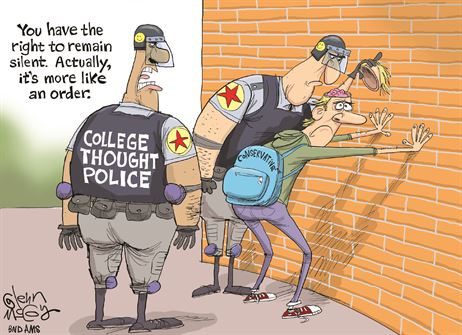
But although the ubiquity of the terms “Hispanic” and “Latino” might make it seem that they’ve always been there, Heritage Foundation senior fellow Mike Gonzalez contends that those terms were invented by Marxist activists attempting to persuade so-called Hispanics that they were oppressed.

“I’m very proud of [my heritage], but this amalgamation, this artificial label that is created, the officiality of it is what I’m opposed to, because I know that it is done on purpose and with malice aforethought toward the country of the United States,” Gonzalez says.

The veteran journalist and communicator joins “The Daily Signal Podcast” to discuss the Marxist history of terms such as “Hispanic” and “Latino,” and to detail the radical left’s plans to use identity politics to seize power.

Doug Blair: Our guest today is Mike Gonzalez, a Heritage Foundation senior fellow for foreign policy as well as the Angeles T. Arredondo e pluribus unum fellow. He is also the author of the new book “BLM: The Making of a New Marxist Revolution,” highlighting the Marxist underpinnings of the Black Lives Matter movement. Mike, thank you so much for joining us.

Interview

Blair: I wanted to have you on the show today to discuss Hispanic Heritage Month. You’ve done a lot of really fascinating research on terms like Hispanic and Latino and where they come from. So to start off, could you explain to our listeners a brief history of the invention of these terms?

Gonzalez: So, if by Hispanic Heritage Month we were celebrating what unites, actually, all the “Hispanics” in the United States, that is the founding by the Iberian kingdoms of Portugal, Spain of their lands, I probably wouldn’t have any problem with that. I think that we should learn more about Columbus’ exploration, his brave courageous trek across the ocean to join all of humanity finally together. Leif Erikson, a Viking, is said to have done it, but Leif Erikson was not interested in uniting humanity and forging new and permanent links as Columbus did.

If we mean that, then by all means. If we mean the wondrous actions of Junípero Serra in the West to bring the promise of salvation and Christ to the natives of that land; if we mean by no means all good, but still very brave exploration of Cuba, Mexico, Peru, etc. by Velázquez and Cortes and Pizarro, and looking at all aspects of it, looking at the good things they did and the bad things they did; then yeah, I would be for that kind of Hispanic Heritage Month.

What I’m not for is for the creation of a Hispanic category by leftists—well, the instigation of the creation—because the leftist activists in the ’70s were the ones who really went all out and prodded the bureaucracy, a very reluctant bureaucracy, I must add, who did not want to do it, starting in the late ’60s and culminating in 1977, when OMB, the Office of Management and Budget, finally created the Hispanic category.

And the culmination, I guess, would’ve been when it’s placed on the 1980 census for the first time, and this very large and growing group of Americans are hauled off and counted away from the other races that are recognized by anthropologists, not by leftist activists acting on the pay of the Ford Foundation.

So that is what I’m against. And the reason I’m against it, we can go into that later on, depending on what questions you ask, because it is very clear from the beginning that it is done in order to instill grievances in the members of this category in order to transform the country.
Blair: So what it sounds like you’re saying is that these terms like Hispanic and Latino were not naturally occurring. They weren’t invented by the communities that they were invented to describe. It sounds like these were pushed by leftist academics.

So with that being said, do you consider yourself Hispanic?

Gonzalez: So, opposition came not only from the bureaucrats, it also came from the grassroots. The grassroots wanted no part of this. They were the only people that were interested in doing this. And they were very adamant that Hispanic be created. … They always say, the activists, they hate colonization, but Hispanic and Latin America are both words that are used by colonizers.

I consider myself an American, to be honest. I consider myself a father, first of all; a husband; a Catholic, that’s an affiliation that’s very important to me; an American. I consider myself a Cuban American also, although that is less important than the other things I mentioned.

First, I’m very proud of the contributions of Cuban Americans to this country. . .Very proud of my family. I love my family. I love the history of my family, what it accomplished both in Cuba and in Spain before, because I have very recent ancestors, grandparents who are Spaniards. . .My immigrant grandfather, my immigrant five great grandparents, all of whom were poor, who came from Northern Spain and made it in Cuba.

So I’m very proud of all that, but this amalgamation, this artificial label that is created, the officiality of it is what I’m opposed to, because I know that it is done on purpose and with malice and aforethought toward the country of the United States.
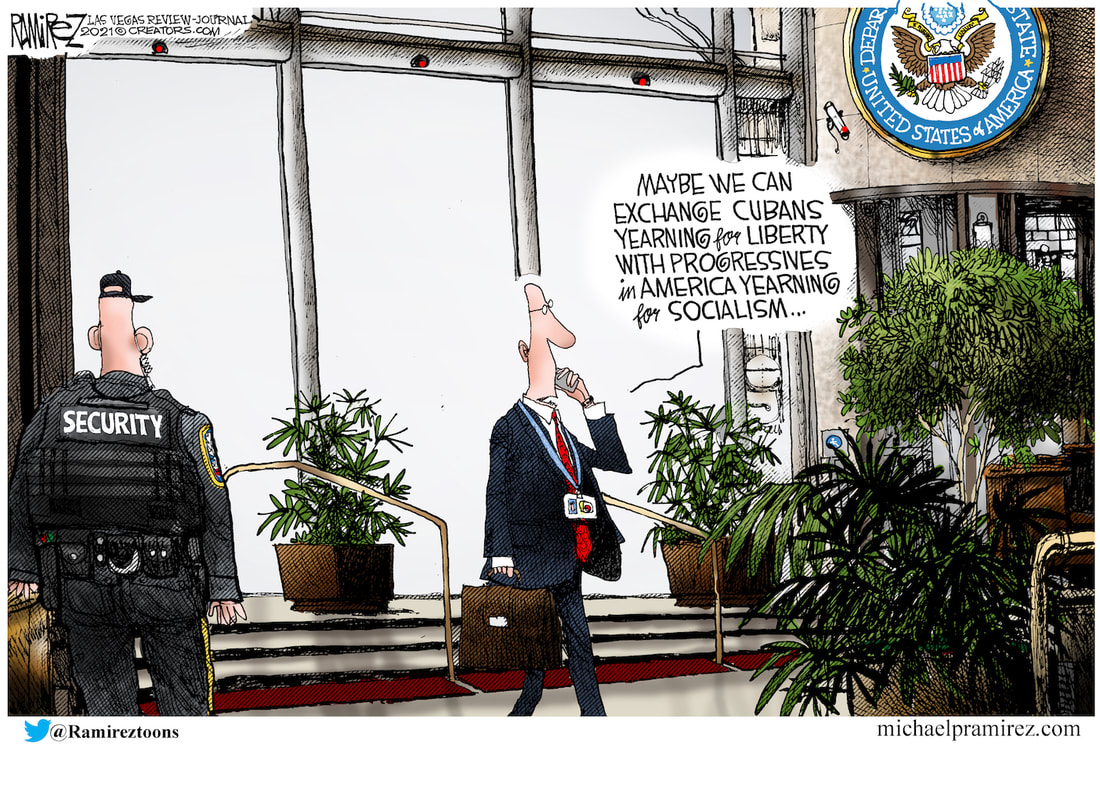
Blair: With that history in mind, and with the way you view yourself in mind, I’m curious, what are the views of the communities that these terms were invented to describe, South and Central Mexican nationals, on terms like Latino and Hispanic? Are these terms popular with them? And then further on, how have these terms been embraced by the wider American population? Is this something that they accept as well?

Gonzalez: Well … I don’t know 58 million of them personally. It’s funny, every time somebody says to me, “Hey, do you know this Cuban?”, it’s like, “Nah, there’s almost 2 million Cuban Americans. We don’t really know each other, all of them.”

Look, we can only look at the opinion polls. Pew Research, every poll that I’ve looked at—Pew is very good by the way. It’s center-left and the analysis is center-left, but if you look at the numbers that Pew puts out, I swear by them. And what they find is that between 20% and 25% uses Hispanic or Latino. The rest uses Dominican or Mexican or Puerto Rican or American.

So the Hispanic and Latino—I’d love to get into Latino, by the way, because that story is not known at all. And of course, Latinx, that term only known to NPR and [President] Joe Biden. I can tell you that nobody in Miami is having a cafecito thinking he’s Latinx, and nobody walks into a bodega in Manhattan thinking she’s Latinx. My goodness, my goodness.

Blair: Well, I’m really glad that you actually brought that up, because as radical leftists kind of continue their war on language, and as they decide that these terms are not far enough, Latino and Latinx are now these things. Chicanx, I’ve heard a couple of times. I mean, how does this evolution of identity-based language, like, Latinx, Chicanx, and all these other crazy ones, how does this play into the sort of Marxist underpinnings of the phrases themselves?

Gonzalez: By the way, I often tweet that I did the Ancestry test and I came back 55% Hispanix, 20% Portugex, 20% Irix, and less than 1% Indiax.

So what they do is they create these categories. … And they’re very open about this, by the way. If you listen to Maria Teresa Kumar, who is wonderful in her ability to just speak the truth, sometimes when she’s on Chuck Todd or doing a show with Nikole Hannah-Jones, she will say, “Look, it’s really, really hard.” She’s the head of Voto Latino. “It’s really, really hard to instill grievances into the members of these categories, because they’re not aware that they’re being oppressed.”

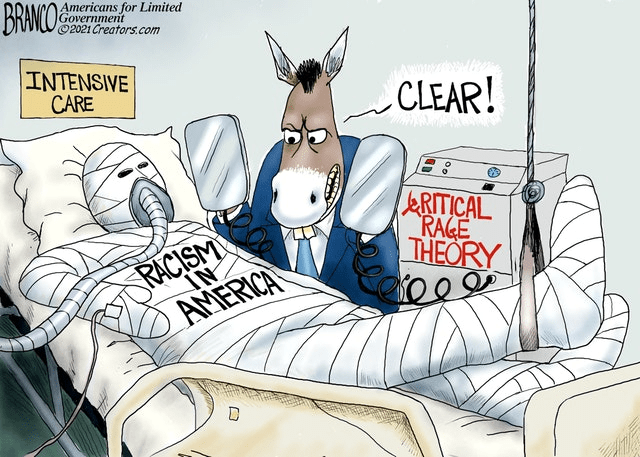
This is, of course, pure and classic critical theory and critical legal theory and critical race theory. They believe from the beginning that what happens is that the members of the population are not aware of their oppression.

[Max] Horkheimer, one of the godfathers of critical theory, writes in the 1930s that, “One cannot rely on the proletariat to overthrow the system because the proletariat will not understand that he’s suppressed. He has no idea that he’s suppressed.” His assistant, Herbert Marcuse, then writes in the 1960s that, “Liberation can only start with the consciousness of servitude.”

And so it is with these activists and the heads of these groups, who grab an immigrant from Uruguay or his progeny and say, “You might be happy here. You may have fought really hard to leave Guerrero, Mexico, and immigrate to this country, and you may think this is the land of opportunity and milk and honey, but you’re wrong. You’re enslaved. You’re oppressed. The dissatisfaction of your material needs through capitalism, even though you’re happy with your Wi-Fi and your split-level home, this is a very oppressive, superstructure.”

In fact, in order to apply for the incentives to do this, you get maybe a preference for a city contract, but in order to get a preference for a city contract, you must write down how you were discriminated against 30 years ago. You must never forget. And my goodness, you must never forgive.

So this is very well thought out, and it works if we let it work.

Blair: The question is now, why? What is the motivation here? Is it to bring a new Marxist world order? What is the end goal here?

Gonzalez: Oh, no, of course it is. It is exactly that. It’s liberation. And they say that.

By the way, notice how Marxists never really promise liberty or freedom, because they know they’re not promising liberty or freedom. What they’re promising is liberation because they believe in the oppressed/oppressor narrative. And so they say, “It’s liberation from oppression that we’re after.” And yes, very much so.

And the penny drops for Herbert Marcuse and he writes that, “It is in the ghetto population,” his words, “that you’ll have the revolutionary agents. They must continue to be guided by a communist, a Marxist intellectual class.” They need to have revolutionary consciousness, which he doesn’t believe they have, but they have revolutionary potential, and he sees that they can be prodded into violence.
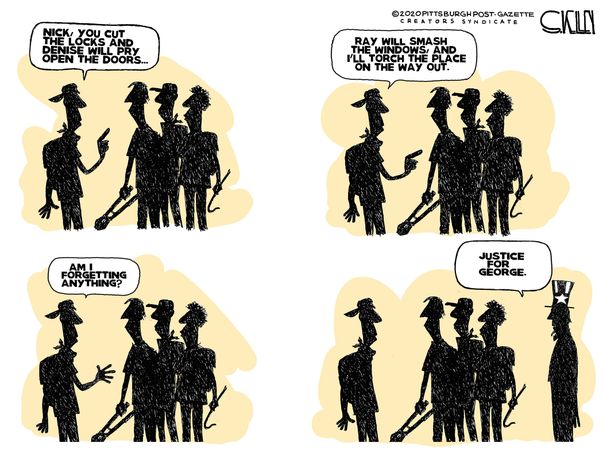
And you’re quite right, that the unique and exceptional suffering of black Americans, that suffering must be analogized to these new groups, which is wrong, it’s false. And it is in many ways just ugly because obviously, I or my family, my name is Gonzalez, famously, and nothing like what happened to African Americans happened to my family or to anybody named Gonzalez.

That’s not to say that people named Gonzalez did not experience discrimination, especially in Texas and parts of the Southwest. Earlier on in the last century, that was very real, and there’s very substantial evidence of it. And we know from the experience that they relate that that happened, but nothing ever approximates what blacks suffered in this country.
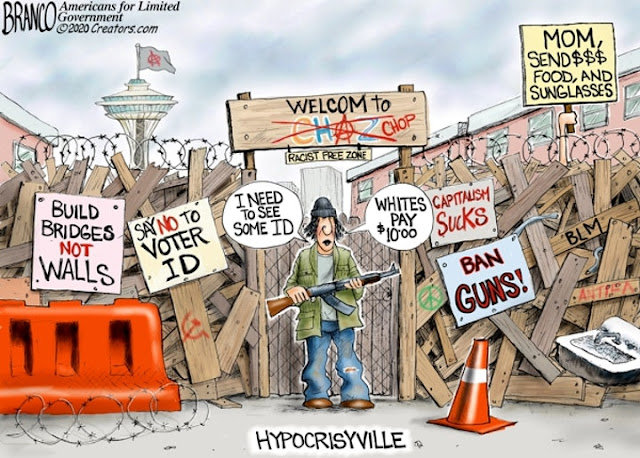
Blair: So we’ve seen some of the consequences of this kind of hyperfocalization or hyperintense scrutiny of race and identity on American politics and American social cohesion. What do you think are some of the most severe consequences of the left’s push to push everything through this lens of race, including Hispanic and black?

Gonzalez: Well, we see it today. I mean, all the polls tell us that Americans, a majority—a substantial majority, not just a plurality, but a substantial majority of Americans—today believe that race relations are the worst they’ve ever been.

We’ve had riots. 2020, we’ve had a spike in the murder rate of 30%—30%. That’s an extra 5,000 people dead in 2020, I believe mostly because of the riots and the instability, which took place mostly because of the instigation of the organization of the Black Lives Matter organizations, obviously, with an assist from Antifa, although Antifa does not have the organizing muscle or the cache or the money that Black Lives Matter has.

So we’ve seen the invasion of critical race theory into all aspects of our lives: how kids are being divided according to race; how white kids have been told that they’re racist and that they are oppressors and they have privilege and black kids are being told what Derrick Bell said, that they will never gain equality with whites, which is false and disgusting to say that to a black child. That’s a form of child abuse.

It’s also child abuse to tell a black child or a kid named Rodriguez that numeracy or literacy or punctuality or linear thinking or the use of reason are not things for them, that sitting in their desk and being quiet and following what the teacher says and paying attention and doing homework are white things.

My goodness. [These are] things that would’ve made the Grand Dragon of the KKK blush 20 years ago, and now is being repeated in our classrooms and we’re paying for it as taxpayers. We’re being trained in our places of work, under penalty of being fired.

This is all wrong and very wrong. And that’s the reason that the American people are rebelling against this.

Blair:  On that note, I’m curious, if we want to talk about issues relating to this specific subsect of people, is there a way that we can refer to these groups without using these sort of racialized terms like Hispanic or Latino? Does it make sense to talk about things, for example, like the Hispanic vote?

Gonzalez: No, that one makes absolutely no sense.

So, the largest group in America, largest nation of origin group, are Mexican Americans. I think they may be 38 million today. And it makes no sense whatsoever to talk about the Mexican American vote, just like it really makes no sense to talk about the German vote—that’s the largest group—or the Irish vote anymore. The Irish vote has been split now, I believe, since the ’60s.

The Mexican American vote in some parts like the Rio Grande Valley is going heavily conservative, heavily Republican; in the cities of Texas, especially among the young, it is going the other way. It’s going not just the Democrats or liberals, but heavily progressive. So I hesitate to talk about the Mexican American vote.

The Hispanic vote makes zero sense because you have Puerto Ricans voting differently in Florida than they do in Hartford or New York or Philadelphia; Cubans voting definitely massively one way in Miami and then that’s not the way they vote in Houston; the Mexican Americans voting in Houston or East LA.

There’s such an animal as the Cuban vote in Miami. That is part of reality. And if you are in that business, then you should talk about it and think of it that way.

I’m told that there’s even such a thing as the Irish vote in Boston. No longer do we have really the Dutch vote in the Hudson River Valley as we did in the days of Jackson, Andy Jackson.

Blair: So my final question for you is, do you think this fight against racial fragmentation and the left’s campaign to do this is a fight that conservatives are winning? And as a secondary follow-up, what are we doing well specifically and where do we need to shore up our defenses?

Gonzalez: I think conservatives have begun well by identifying the problem, talking about it, freezing it. I think the left has been caught by surprise.

By the way, the left doesn’t know what critical race theory is, obviously, or they’re just lying when they say that it is not critical race theory to talk about systemic racism. That is just a lie, that’s just ignorance.

I don’t blame them, but the majority is definitely against them. And they’re playing with fire.
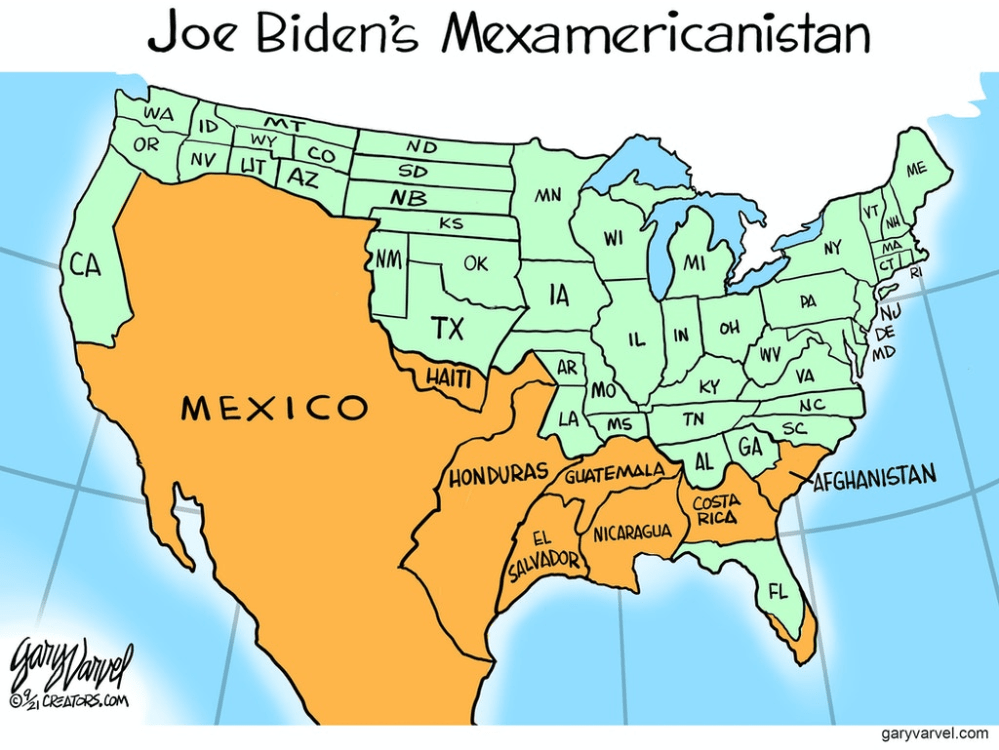


Climate Tyranny By Way of Criminal Law

Dr. Lucas Bergkamp writes at Real Clear Energy The Legal Doctrine of “Carbon Crimes”—Torturing Law and Reason to Rid the Planet of Climate Change Deniers.  Excerpts in italics with my bolds and added images.

Abstract

The climate movement has discovered criminal law as a tool for conducting climate politics. To complement civil lawsuits against states and corporations, the movement’s activists intend to invoke torture and a newly proposed crime of “ecocide” to target corporate executives, politicians, and others who stand in the way of their preferred policies. In pushing their agenda, these activists receive assistance from the judiciary—specifically, the European Court of Human Rights.

The use of criminal law to pursue climate politics is a further step in the radicalization of the climate movement and poses a threat to economic and political freedoms, the rule of law, and democracy.

If the movement is able to realize its plans, all those who do not support ambitious climate policies would have to fear prosecution and imprisonment. Conversely, threatening criminal sanctions against politicians and corporate executives will create powerful incentives to adopt ambitious climate policies and the dominant pro-climate narrative.

Lucas Bergkamp explains how criminal law, in the climate movement’s vision, should supplement civil and administrative law to eliminate any and all opposition to its plans for the realization of a climate utopia.

European government of judges

Over several decades, the European Court of Human Rights (ECHR) has evolved into a European government in itself. Based on doctrines designed to enable it to expand its powers at its discretion, the Court has enacted a series of mandates for new laws and policies for Europe. There is little democratic control over the Court’s role in advancing progressive politics. Once the Court has spoken, national parliaments are unable to undo its pontification because a human right trumps national law; national judiciaries are compelled to execute the Court’s judgments, even if their own national law provides otherwise.

While imposing its high moral demands on executive governments, the Court believes itself to be quite exempt from any moral or legal constraints. In a previous contribution, I discussed how climate change litigation before the Court has undermined the rule of law, the separation of powers, and democracy. In this article, I focus on the Court’s role in criminalizing the climate debate. Its reckless disregard of judicial impartiality, the right to a fair trial, and judicial restraint is another manifestation of the Court’s support for the progressive movement.

The rationale supporting criminalization

The argument for criminalizing “climate denial” typically boils down to the following argument articulated by Jeremy Williams:

Given what we know and have known for decades about climate change, to deny the science, deceive the public, and willfully obstruct any serious response to the climate catastrophe is to allow entire countries and cultures to disappear. It is to rob … the poorest and most vulnerable on the planet of their land, their homes, their livelihoods, even their lives—and their children’s lives, and their children’s children’s lives. For profit. And for power…. These are crimes. They are crimes against the earth, and they are crimes against humanity.

This emotional outcry is not only an impenetrable amalgamation of factual and moral reasoning but also assumes what must be proved. To prevent disaster, rationality needs to be brought back into the analysis. Unfortunately, as the ECHR demonstrates, we cannot rely on the judiciary to do so.
“Climate emergency”

The European Court of Human Rights, to which its president refers as the “European Climate Change Court,” has used the opportunity presented by the climate litigation that it invited to take the lead in criminalizing the climate debate. It has done so in a number of ways. First, the Court’s president and one of its vice presidents have declared publicly that “we are facing a dire emergency that requires concerted action by all of humanity” and that “we will face the collapse of everything that gives us our security.” Thus, the Court’s leaders have openly and unreservedly endorsed the climate movement’s alarmist rhetoric. They have done so not based on science but on alarmist declarations by Sir David Attenborough, a well-known biologist and climate activist.

Second, to prevent any argument on the facts, the judges added: “No one can legitimately call into question that we are facing a dire emergency that requires concerted action by all of humanity.” They also committed the Court to the cause: “For its part, the European Court of Human Rights will play its role within the boundaries of its competences as a court of law, forever mindful that Convention guarantees must be effective and real, not illusory.”

No right to a fair trial for deniers

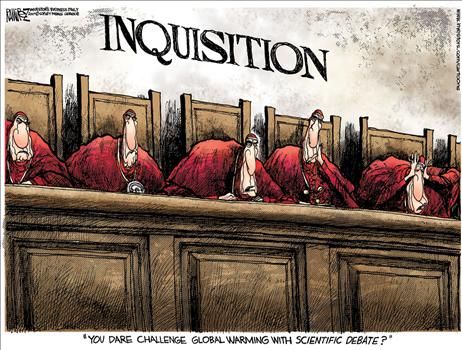
By issuing these warnings, the Court effectively closed down any debate on climate change and climate science before any trial has even begun. In doing so, it deprived defendant states of an important argument to defend themselves against allegations that their climate policies are inadequate to fight the alleged climate crisis. Before they could present the relevant scientific evidence showing that there is no such thing as climate emergency or climate crisis, the Court’s leading judges told the defendant states that they should not dare to deny.

By labeling any argument that there is no climate crisis “illegitimate,” these leading European judges, who should serve as examples of judicial impartiality, have endorsed the climate movement’s climate-denier rhetoric. This rhetoric is an inappropriate, unethical play on Holocaust denial. Simultaneously, and directly relevant to this contribution’s subject, the Court’s “illegitimacy” label also raises the specter of criminal prosecution.

There is no climate crisis

It is hard to think of any judicial conduct that shows greater partisanship and disregard for the principle of judicial impartiality than the conduct of these European human rights judges. The right to a fair trial, guaranteed by article 6 of the European Convention on Human Rights, has effectively been set aside for climate deniers. The question should be asked whether, given the opinions expressed by its leaders, the ECHR can legitimately rule in any climate case.

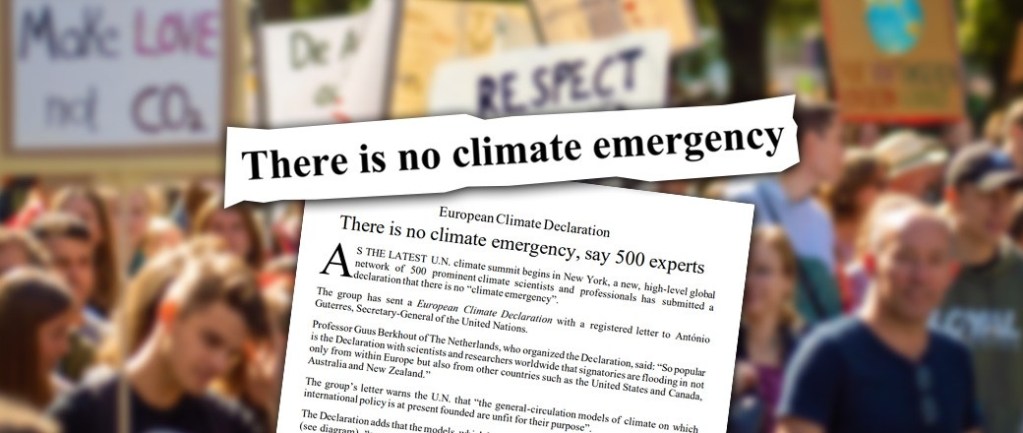
The Court’s denial of justice is all the more shocking in light of the science, which does not support the proposition that there is a climate crisis. The European Commission has stated: “The term ‘climate emergency’ expresses the political will to fulfil the obligations under the Paris Agreement.” In almost 4,000 pages, the recent Intergovernmental Panel on Climate Change (IPCC) AR6 report does not once employ the terms “climate crisis” or “climate emergency” because these terms do not belong to the scientific terminology (they occur only in a descriptive section on communication). Rather, they are political slogans, as the Commission suggested. To the point, the undefined “climate emergency” is an invention by activists.

Judicial threats

Corporate executives of companies deemed to be responsible for greenhouse gas emissions, politicians that do not support ambitious climate policies, and everyone else who advocates against the climate movement’s agenda would be exposed to criminal prosecution and imprisonment of up to 30 years. This is not a far-fetched interpretation of the relevant law but, as explained below, a fairly straightforward application. Obviously, the ECHR was well aware of what it was doing by slipping in “torture,” but it nevertheless felt comfortable proceeding in this manner.

Needless to say, the threat of life imprisonment is a very powerful disincentive. As an academic author for UNESCO put it:

Criminal sanctions are the most potent tools we have to mark out conduct that lies beyond all limits of toleration. Criminal conduct violates basic rights and destroys human security. We reserve the hard treatment of punishment for conduct that damages the things we hold most fundamentally valuable. Climate change is causing precisely such damage.

This seems to be exactly what the judges on the ECHR believe. Corporate executives will have to think twice about corporate climate policies and will be inclined to cave in to activists’ demands. Likewise, politicians skeptical of the current climate policies may feel compelled to give up their resistance. All other dissenters may also be inclined to choose personal security over honesty.

Economic freedom, political freedom, and freedom of speech would be obliterated.

Is this what the Court’s president means when he says that the European Convention guarantees must be “effective and real, not illusory”? The Court’s inexplicable decision to add torture to the charges in the first climate case only adds to the concern that human rights protect only those who endorse progressive causes, not those who have other political preferences.Ecocide

By invoking the crime of torture in the climate debate, the ECHR may also have intended to assist the efforts to get ecocide recognized as a crime. “Ecocide” refers to the “devastation and destruction of the environment,” but no official legal definition yet exists. For decades, greens have been trying to get ecocide recognized as an international crime—but so far, to no avail. In the last two years, however, due to the rise of the climate crisis narrative, they have made significant progress. There now is much activity aimed at persuading international organizations to legislate on ecocide.

In June 2021, an expert panel convened by the Stop Ecocide Foundation published a definition of “ecocide” intended to serve as the basis for an amendment to the Rome Statute of the ICC. Once the Rome Statute is amended to include ecocide, individuals suspected of having committed ecocide can be tried before the ICC.

Moreover, the Rome Statute applies equally to all persons, without any distinction based on official capacity; specifically, elected representatives and government officials are not exempt from criminal responsibility.

Thus, politicians, corporate executives, thought leaders, and anyone else can be subject to criminal prosecution if they express an opinion or pursue a policy deemed to be “anti-climate” that therefore may result in ecocide. In the fight against climate denial, this tool would be of incalculable value.

European Union “leadership”

The European Parliament has referred to ecocide in two recent reports and expressed the wish to recognize ecocide under EU law and diplomacy. To prepare the adoption of an EU directive on ecocide, the European Law Institute launched a project on ecocide. Taking advantage of the momentum, even before this project is finished, the ecocide movement is now pushing to get ecocide included in the EU Environmental Crimes Directive, which is currently being revised.

EU member states control a significant portion of the votes necessary for an amendment of the Rome Statute and can provide incentives to secure the additional votes necessary to get the crime of ecocide adopted. The consequences of such an amendment could be enormous if the ICC follows the example of the ECHR and jumps onto the climate activists’ bandwagon.

Climate change is ecocide

Make no mistake: while the definition of ecocide is broad and vague, the primary target of the ecocide movement is climate change. Civil liability law and human rights law give climate activists the tools to force governments and companies to comply with their demands, but this kind of litigation is expensive and takes time. The new crime of ecocide would give them a powerful instrument to shortcut the process by threatening criminal sanctions against corporate directors and officers, as well as reluctant politicians and opinion leaders, and to force them to change their ways.

Climate activists also believe that the term “ecocide” will have an emotive and stigmatizing effect that “causing climate change” does not have. As one author puts it:

The term “ecocide” sounds dramatic. It is more emotive than “contributing to pollution” or “increasing greenhouse gas emissions” or “investing in fossil fuels.” It communicates the gravity and urgency of the irreversible destruction being inflicted on the environment. It unambiguously casts major polluters as “villains,” perpetrators of a crime (emphasis added).

No protection

National laws do not protect the suspects. Under the proposed definition of the international panel, ecocide means “unlawful or wanton acts committed with knowledge that there is a substantial likelihood of severe and either widespread or long-term damage to the environment being caused by those acts.” Note that “unlawful,” which is broader than “illegal,” is the gateway to disregarding permits for emissions and compliance of activities and products with national laws.

The main trick is that this definition does not require any actual damage; knowledge of likely damage in the future is enough—which is a given, in light of the “settled science” set forth in the IPCC reports. Fundamental principles of criminal law are merely an afterthought, if they are on the radar screen at all.

Torturing human rights and criminal law

Needless to say, the ECHR’s suggestion that governments “torture” their citizens by implementing “inadequate climate policy” is both insulting to torture victims and unlawful. The inclusion of torture in a climate-policy lawsuit is the culmination of the Court’s progressive move away from a human rights adjudicator to a social policymaking institution. This activism has not only harmed the Court’s reputation as an impartial court of law but has also created serious problems for national legislatures faced with the often unhinged policy mandates imposed by the Court.

To be sure, we do have a torture problem, but it is not the European climate policymakers who are doing the torturing. Rather, the Court itself has tortured the law to fit its own ideology.

The Court tortured the European Convention on Human Rights until it confessed that it is a program for progressive politics. It tortured the right to life and several other human rights until they agreed to include within their scope a whole series of so-called positive obligations, which only the Court gets to define. Perhaps most egregious, the Court tortured the Convention until it gave the Court the right to waive essential requirements imposed by the Convention to eliminate any limits on its jurisdiction, which then allowed the Court to move forward with the first climate change case, which it so desperately wanted.The crime of climate change

The use of criminal law to pursue climate politics is a new chapter in the climate-litigation saga. Climate activists have discovered criminal law as a tremendously effective tool for climate politics. Governments and corporations can be subordinated through civil and human rights law, but to put pressure on corporate executives and politicians, criminal law is much more effective. Criminal law is the crowbar that pries open the doors to the boardrooms and the chambers where policy decisions are made.

What is remarkable is that the activists include not only the nongovernmental organizations that claim to “fight for the climate” but also Europe’s highest judges at the European Court of Human Rights. Are the limits on its authority really lifted by the self-declared crisis?

Lock them up!

In totalitarian states, political dissidents are controlled in three ways: they are removed from public life as a “danger to public order”; they are placed in psychiatric hospitals, since they suffer from mental illness; or they are imprisoned because they have committed crimes. The climate movement’s latest move pursues this third route of “delegitimization” and “denormalization” of its political opponents and those who disagree with the movement.

According to the climate movement, the alleged climate crisis would require urgent action to avert the impending catastrophe and save the planet and humanity. In its view, this requires that democracy, fundamental principles of law, and the limits of judicial power are set aside. In this struggle for survival, the climate movement has concluded that greenhouse gas emissions must be criminalized so that climate deniers can be locked up. Unfortunately, the ECHR has fallen victim to the emotional appeal of the movement’s rhetoric.

Threats to freedom

The climate movement’s strategy is clear: torture and ecocide must be part of its toolbox so that the sinners can be converted, deniers can be punished, and climate utopia can be realized. Inevitably, however, “climatism” results in the suppression of freedom and opens the path to climate totalitarianism. Ironically, the ECHR, which was created in the aftermath of the destruction of the Nazi totalitarian regime to act as a legal bulwark safeguarding individual liberty, has placed itself as the judicial enabler of this process.

See also Q&A Why So Many Climate Skeptics


How Progressives Took Democracy Hostage


Anthony J. Constantini explains in his American Mind article Democracy’s Progressive Police.  Excerpts in italics with my bolds and some added images.

Self-government is hostage to hostile captors.

While people generally welcome democracy in principle—men typically wish to govern themselves—liberal democracy, with its emphasis on sometimes very progressive individual liberties, has been welcomed less and less in recent years. Why? Because as leftist policies have grown more extreme, liberal democracy as a concept has transitioned from support for individual liberty to support for progressive politics, including the full legalization of abortion, full rights for a constantly growing list of sexual minorities, and a belief in multiculturalism as a master value. If a state adopts laws against progressive values, its leader is not merely labeled socially conservative, but is declared to be anti-democratic, even if he was elected democratically and passed laws legally.

Many shrug at these distinctions as merely academic. But all who care about the future of the West should oppose the forced merger of “democracy” and “progressivism.” Far from a matter of semantic disputation, this shifted definition of democracy is a threat to democracy’s survival.

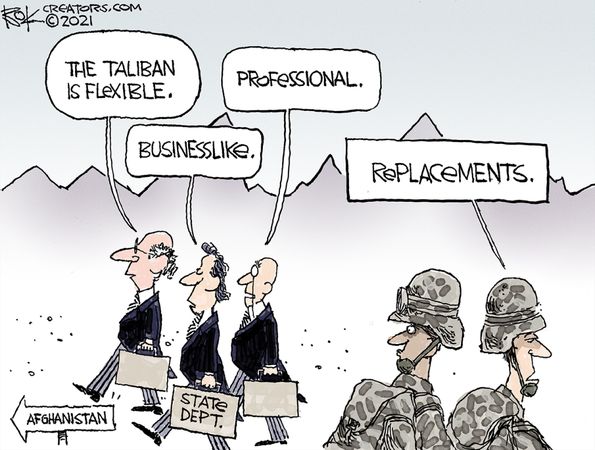
After the invasion of Afghanistan in 2001, the United States, using methods strikingly similar to the “civilizing” attempts of British and French colonists in the nineteenth century, established a liberal democracy in an attempt to graft Western values into the country. Had the U.S. opted instead for an electoral democracy with elementary protections based on the rule of law, and not attempted to force Western liberalism onto a culture which clearly did not want it, Afghans may, possibly, have been more willing to buy into the system. But a conservative Islamic democracy, with popular local support, was not the model preferred by the U.S. State Department.

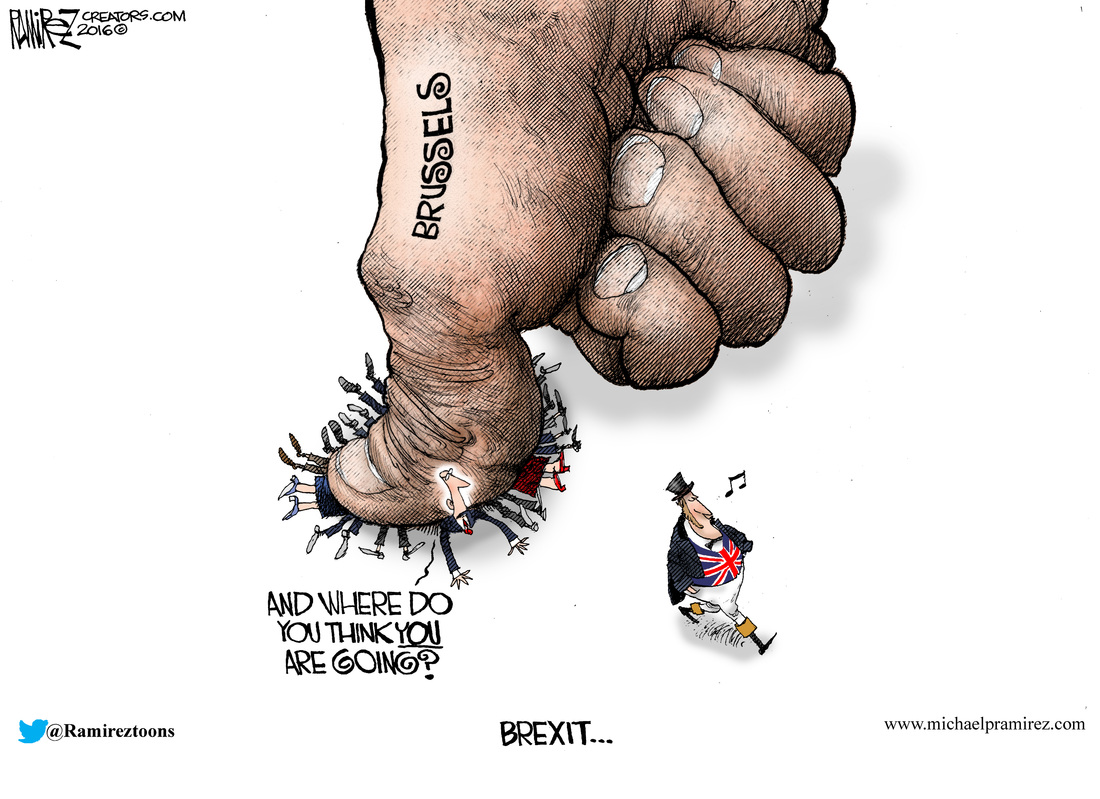
The European Union has acted ignominiously toward two of its more conservative members, Poland and Hungary. Poland’s ruling Law and Justice Party (shortened to PiS in Polish) has for years controlled the parliament and the presidency. Due to the party’s conservative policies, some in the opposition, along with progressive European Union bureaucrats, claimed that if PiS were to win the 2020 elections and stay in power it would be the last free election in Polish history. PiS went on to win the elections, but nevertheless, anti-PiS former Polish Prime Minister (and former European Union Council President) Donald Tusk returned to Polish politics to lead the main opposition party. If one believes that Poland just had its last free election, why would anyone wish to head the opposition? The only logical conclusion would be that Polish elections are still free and that those who claimed otherwise were merely trying to scare voters and drum up foreign opposition to a Polish government that insists on putting the interests of Poland above the demands of Brussels.

Similar games are being played against Hungary as well. The ruling Fidesz Party, led by PM Viktor Orbán, banned the dissemination to minors of materials relating to homosexuality. The backlash from liberal democrats was fierce. Dutch Prime Minister Mark Rutte even stated that Hungary should be expelled from the EU over the law. LGBT rights appear nowhere in the Treaty of Maastricht, the EU’s founding document, nor does any definition of “European” include maximal support for LGBT rights. Hungary went against Western progressivism, and as a result is no longer a true democracy in the eyes of progressives.

But the Fidesz Party has democratically won parliamentary majorities for over a decade, and many Hungarians who do not support Orbán are skeptical of LGBT rights. Orbán is counting on this and has announced a referendum on the law. It is likely the referendum will pass, democratically, by a sizable majority. If Orbán wins the referendum and liberal democrats still attempts to punish Hungary, then it will be indisputable that liberal democrats do not support “democracy” as most people understand it.

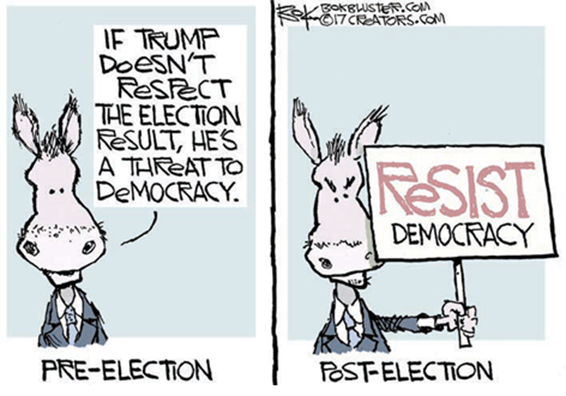
This same story has been repeated throughout the West. Italy elects a migrant-skeptical coalition government, and Brussels reacts by tut-tutting the Italians and implying that elements of fascism exist in the democratically-elected coalition. America elects an establishment-skeptical president, and Democrats spend four years delegitimizing the election. Progressives are trying the same thing in Hungary, but this time the hypocrisy is undeniable. When democracy gives liberal democrats power, they accept it. But when democracy produces policies which go against their ideology, they abandon democracy in a heartbeat and just keep the liberalism.

This substituting of definitions fundamentally misunderstands (or purposefully twists) what democracy is supposed to be, and how people see it writ large. When people hear “democracy” they think of the will of the people.

They do not understand that “democracy” is a term of art that refers to whatever policy Western progressives have cooked up at a given time.

By trying to merge the definitions of progressivism and democracy, liberal democrats could ultimately cause the collapse of democracy itself across the West. If liberal democrats malign democracies every time they vote conservatively and lambast citizenries for being “anti-democratic,” eventually those citizenries will no longer care. The West just watched this happen in Afghanistan, and we would be foolish to imagine such a collapse could not happen elsewhere.

If democracy becomes a byword for “progressive politics,” then people across the West will not just reject liberalism—they will reject democracy too.

Anthony J. Constantini is writing his PhD on populism and early American democracy at the University of Vienna in Austria. Previously he received an MA in Arms Control and Strategic Studies from St. Petersburg State University in Russia. In 2016 he was the War Room Director for the NRSC. He currently resides in Vienna.


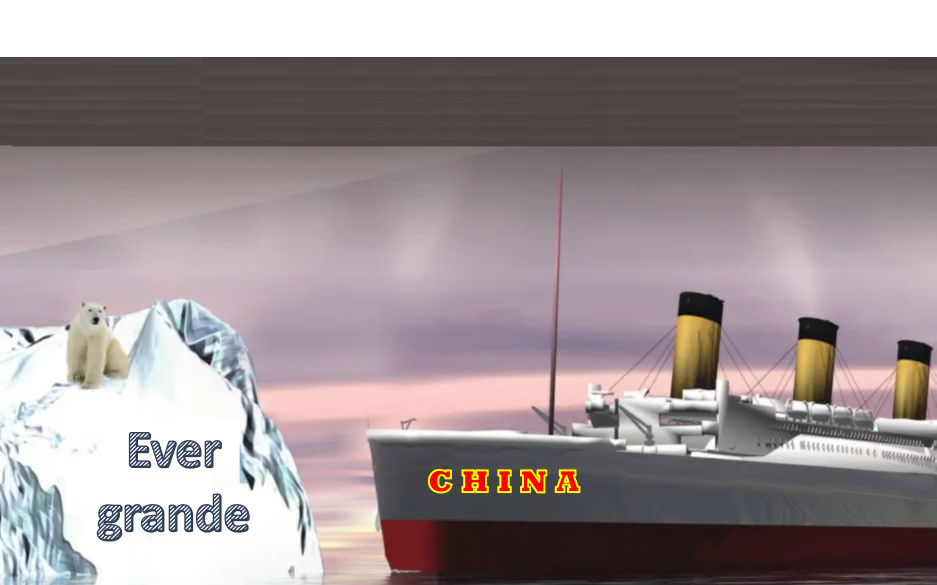
Will Evergrande Sink China (and others)?

Daniel Lacalle, PhD, economist and fund manager, writes at CD Media Evergrande Isn’t China’s “Lehman Moment.” It Could Be Worse Than That. Excerpts in italics with my bolds and added images.

The bankruptcy of the Chinese real estate company Evergrande is much more than a “Chinese Lehman.” Lehman Brothers was much more diversified than Evergrande and better capitalized. In fact, the total assets of Evergrande that are on the brink of bankruptcy outnumber the entire subprime bubble of the United States.

The problem with Evergrande is that it is not an anecdote, but a symptom of a model based on leveraged growth and seeking to inflate GDP at any cost with ghost cities, unused infrastructure, and wild construction. The indebtedness chain model of Evergrande is not uncommon in China. Many Chinese companies follow the “running to stand still” strategy of piling on ever-increasing debt to compensate for poor cash flow generation and weak margins. Many promoters get into massive debt to build a promotion that either is not sold or is left with many unsold units, then efinance that debt by adding more credit for new projects using unsaleable or already leveraged assets as collateral.

The total liabilities of Evergrande account for more than double its official debt figure (more than 2 trillion yuan). Evergrande’s financial hole is equivalent to almost a third of Russia’s GDP. Its annual revenues do not reach $70 billion, and it is more than debatable whether those revenues are real, since a relevant part comes from payment commitments whose collection is doubtful. Even if they were real, these revenues are not enough to address the bond maturities, which exceed $250 billion in the short term.

Evergrande is much more dangerous than it seems.

All the “Keynesian” solutions that you are hearing these days have already been implemented. Massive liquidity injections, low interest rates, full implicit and explicit support from the Chinese government … Let’s not forget that Evergrande was the largest issuer of commercial paper in China, $32 billion issued in 2020, a 390 percent increase from 2015, according to Reuters.

Evergrande represents less than 4 percent of the overall Chinese market but its model has been used by many Chinese promoters. The ten biggest real estate developers account for 34 percent of the market and aggressive leverage practices are widespread.

The real estate sector is huge in China. Its direct and indirect weight, according to JP Morgan, is 25 percent of GDP, more than double the size of the real estate bubble in Japan or Spain. The sector has been growing with an indebted model at 15 percent per year in the last three years. The Chinese government has introduced regulations to reduce the excess, but because it benefits from the increase in GDP and job creation, it has maintained a complacent position regarding the corporate debt model.

Chinese real estate companies, according to JP Morgan, have “reduced” their indebtedness to 92 percent of total assets from a monster 140 percent in 2018, with a profit margin of 9–13 percent. But those figures still show a larger and more concerning problem than what headlines imply. Most Chinese real estate developers have total liabilities of 50 percent to total assets, according to JP Morgan.  The problem is that the value of those assets and the capacity to sell them is more than questionable.

The implications of an Evergrande collapse are far greater than what investment banks tell us.

The first risk is a domino effect in a very aggressively indebted sector. There is also a significant impact on all those banks exposed to China and emerging markets, where China has financed ruinous projects in recent years. And there is also impact on global growth and countries that export to China, because the slowdown was already more than evident. Additionally, we cannot ignore the impact on the solvency of the financial system despite billions of dollars injected by the People’s Bank of China.

A Solvency Problem Cannot Be Solved with Liquidity.

The hope that the government will fix everything contrasts with the magnitude of the financial hole. Be that as it may, we cannot overlook the negative effect on those sectors highly exposed to real estate growth, infrastructure, electricity, services, and in the hundreds of thousands of citizens who have paid an upfront fee for flats that are not going to be built.

The problem with China is that the entire economy is a huge indebted model that needs almost ten units of debt to generate one unit of GDP, three times more than a decade ago, and all this catastrophe was already more than evident months ago. With total debt of 300 percent debt to GDP according to the Institute of International Finance, China is not the strong economy swimming in with cash that it was a couple of decades ago.

The market assumed that because it is China, the government was going to hide these risks. Even worse, the Evergrande collapse only shows a dangerous reality in several Chinese sectors: excessive indebtedness without real income or assets to support it.

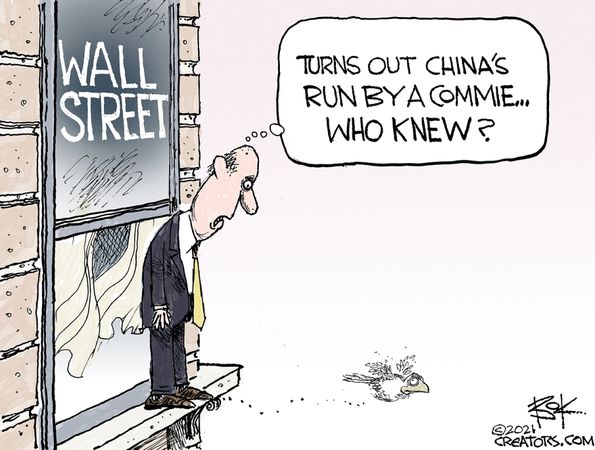
This episode comes at the worst possible time, after the government has launched a massive crackdown on large companies. International investors are already concerned about corporate governance and intervention in China and now the fears of credit contagion make the risk even worse.

Evergrande is not an anecdote, it is a symptom.


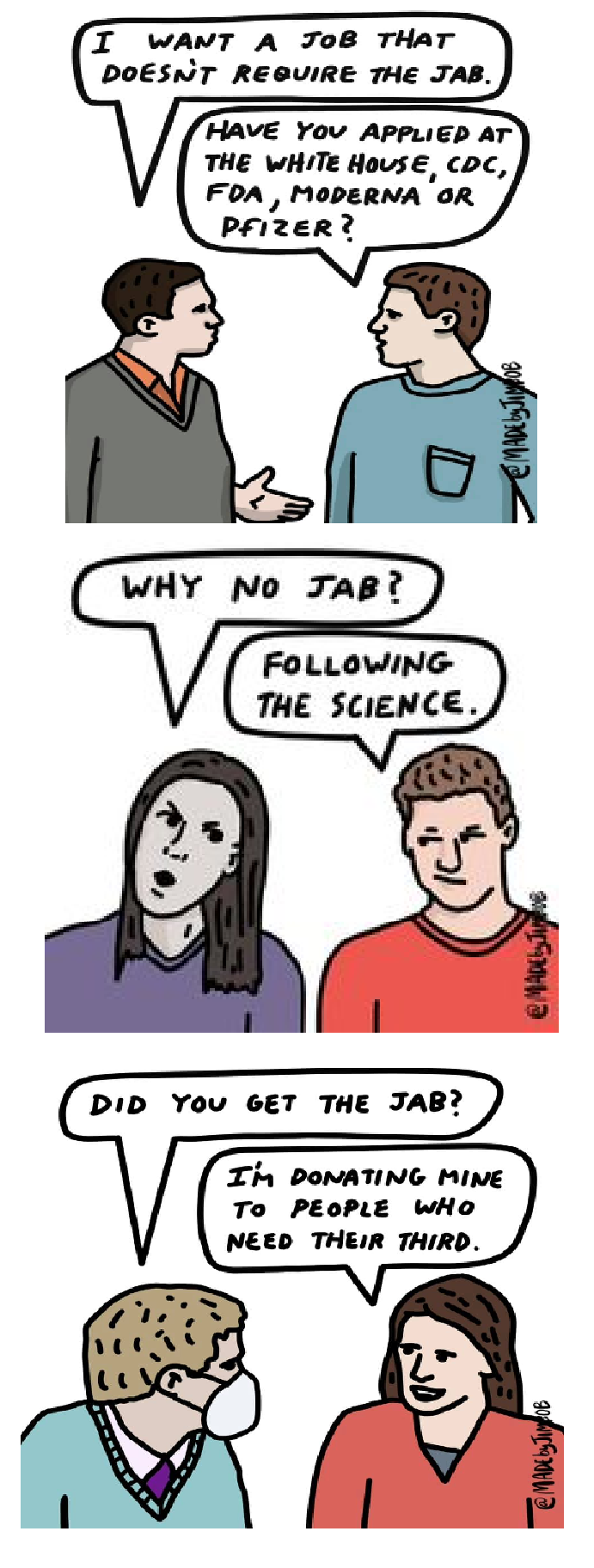
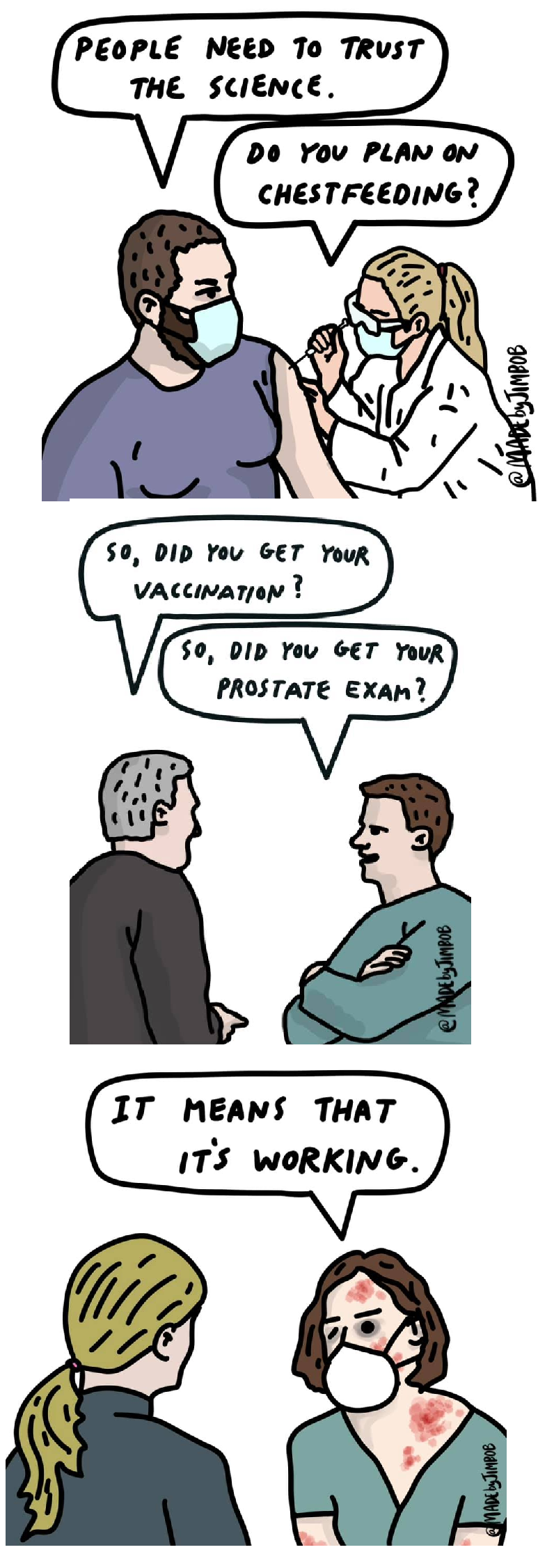
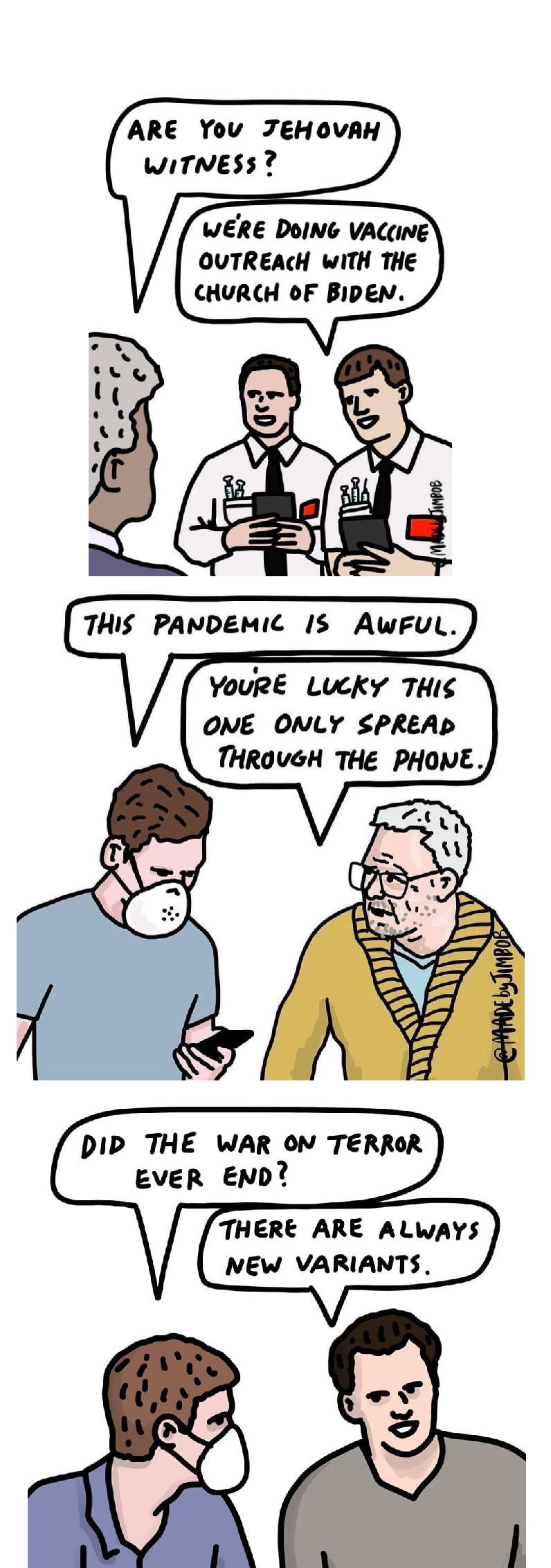
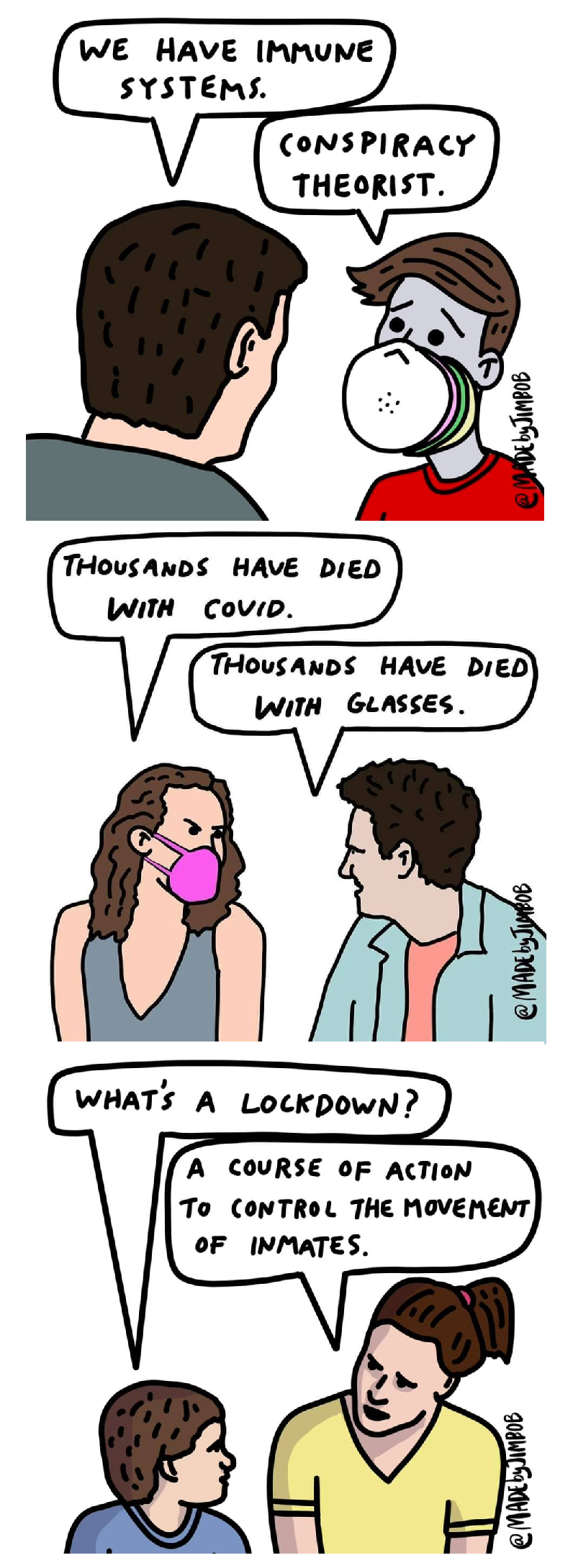
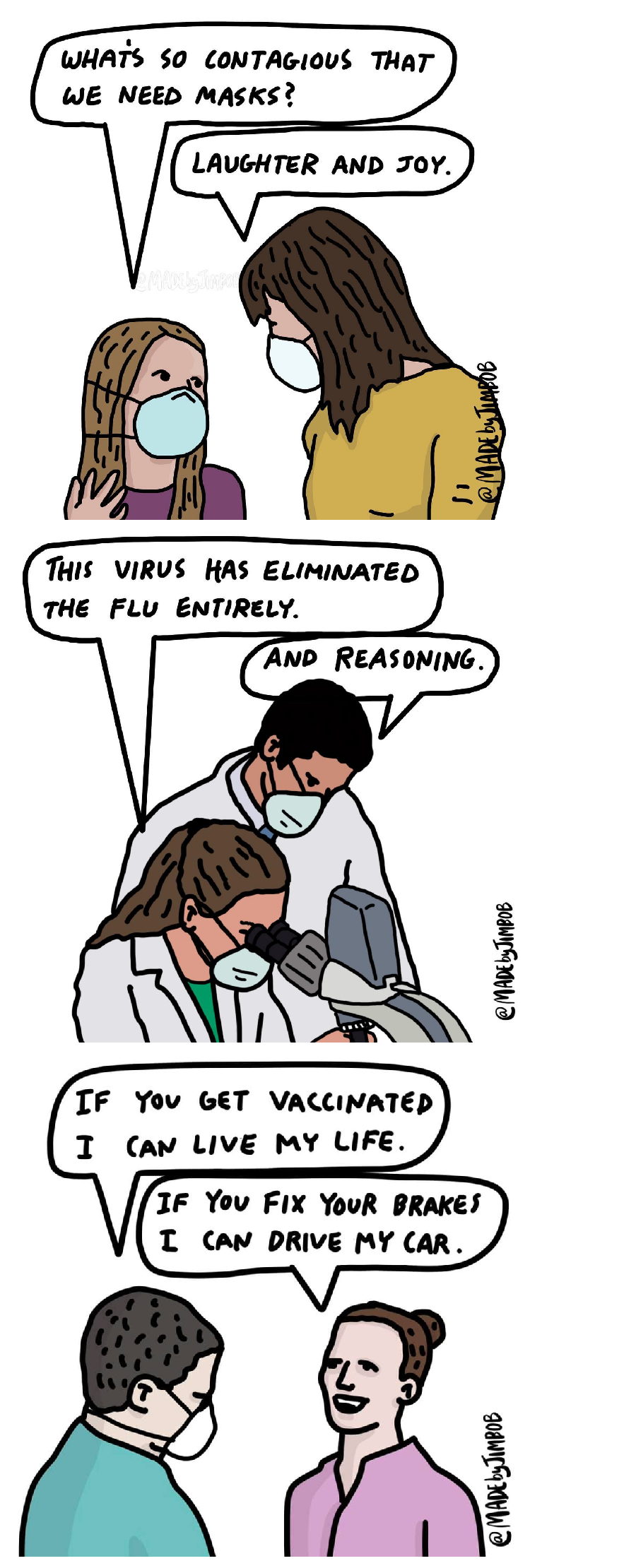
Covid Absurdies Madebyjimbob

This post was triggered by an article by Mike Solana at American Thinker Aborting reason. Some excerpts in italics with my bolds before jimbob takes over.

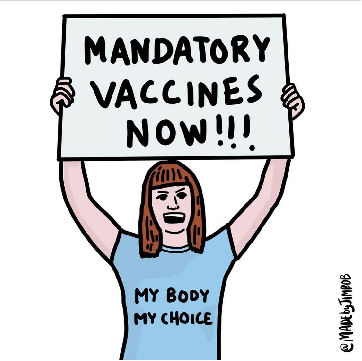
This month, as fate would have it, a controversial Texas abortion ban, shouted down from coast to coast with cries of “my body, my choice,” coursed a horrified media landscape just days before Biden introduced the concept of a national vaccine mandate. This is a very polite way of saying “forced medical procedures for almost everyone.” Across the ideological spectrum roles and rhetoric were promptly reversed.

Demands that a person’s right to their own body be honored were ridiculed and rebuffed by many of the same people who had in some cases just hours prior made impassioned arguments on behalf of a person’s right to their own body. It was an almost perfect cognitive dissonance, and it should have been enough, once illustrated, to jar even the most ardent partisan hack from their bullshit.Long story short, approximately zero partisan hacks were jarred from their bullshit. My body, my choice? Depends on who’s asking, and for what reason. But setting aside the committed idiocy of our loudest talking heads, the question at the heart of Biden’s mandatory vaccination is as old as the concepts of society and liberty: when personal freedom and social good enter conflict, what the hell do we do?

A subversion of liberty so significant as forcing someone to undergo a medical procedure they don’t want can potentially—if regrettably, and rarely—be justified. . . In addition, Americans are reluctant to trust what our institutional leaders have to say about the vaccine because Americans no longer trust our institutions. We especially don’t trust our political leaders or media. After the last few years, why would we?

Provided the vaccine hesitant aren’t literally crazy (they mostly aren’t), and the rest of us are pretty much safe (we are), there is no ethical justification for forcing anyone to undergo a medical procedure they don’t want. And until there is?

My body, my choice.

Forced vaccination at the scale of our entire country is presently an unjustifiable grab for power, and the thing about power? Sure, once a man gets a taste of it there’s never enough, and we should all expect more authoritarianism from this administration.


Leftist Bias More Evidence

Sally Satel reports at The Atlantic The Experts Somehow Overlooked Authoritarians on the Left. Excerpts in italics with my bolds and added images.

In February 2020, the Society for Personality and Social Psychology held a symposium called “Is Left-Wing Authoritarianism Real? Evidence on Both Sides of the Debate.”

An ambitious new study on the subject by the Emory University researcher Thomas H. Costello and five colleagues should settle the question. It proposes a rigorous new measure of antidemocratic attitudes on the left. And, by drawing on a survey of 7,258 adults, Costello’s team firmly establishes that such attitudes exist on both sides of the American electorate. (One co-author on the paper, I should note, was Costello’s adviser, the late Scott Lilienfeld—with whom I wrote a 2013 book and numerous articles.) Intriguingly, the researchers found some common traits between left-wing and right-wing authoritarians, including a “preference for social uniformity, prejudice towards different others, willingness to wield group authority to coerce behavior, cognitive rigidity, aggression and punitiveness towards perceived enemies, outsized concern for hierarchy, and moral absolutism.”

[Comment: They also noted;  “Still, relative to right-wing authoritarians (RWA), left-wing authoritarians (LWA) were lower in dogmatism and cognitive rigidity, higher in negative emotionality, and expressed stronger support for a political system with substantial centralized state control. Our results also indicate that LWA powerfully predicts behavioral aggression and is strongly correlated with participation in political violence. “]

Published last month in the Journal of Personality and Social Psychology, the Costello team’s paper is persuasive, to the point that you have to wonder: How could past researchers have overlooked left-wing authoritarianism for so long? “For 70 years, the lore in the social sciences has been that authoritarianism was to be found exclusively on the political right,” the Rutgers University social psychologist Lee Jussim, who wasn’t involved in the new study, told me in an email. In the 1950 book The Authoritarian Personality, an inquiry into the psychological makeup of people strongly drawn to autocratic rule and repressive politics, the German-born scholar Theodor W. Adorno and three other psychologists measured people along dimensions such as conformity to societal norms, rigid thinking, and sexual repression. And they concluded that “the authoritarian type of human”— the kind of person whose enthusiastic support allows someone like Hitler to exercise power—was found only among conservatives. In the mid-1990s, the influential Canadian psychologist Bob Altemeyer described left-wing authoritarianism as “the Loch Ness Monster of political psychology—an occasional shadow, but no monster. ” Subsequently, other psychologists reached the same conclusion.

The Trump era likely deepened psychology’s conventional wisdom that authoritarians are almost always conservatives; the insurrection at the Capitol earlier this year showed the urgency of understanding the phenomenon. And yet calls to de-platform controversial speakers and online campaigns to get people fired for heterodox views suggest that a commitment to open democratic norms is eroding, at least in some quarters, on the left. Much further along the authoritarian continuum, people purporting to be antiracist or antifascist protesters have set fires and committed other acts of violence since the summer of 2020. These acts stop short of, say, the 1970s bombing campaign by the far-left Weather Underground, but surely call the prevailing wisdom into doubt. (Supporters of revolutionary regimes overseas have demonstrated even more clearly that some people on the left try to get their way through intimidation and force.)

But one reason left-wing authoritarianism barely shows up in social-psychology research is that most academic experts in the field are based at institutions where prevailing attitudes are far to the left of society as a whole. Scholars who personally support the left’s social vision—such as redistributing income, countering racism, and more—may simply be slow to identify authoritarianism among people with similar goals.

One doesn’t need to believe that left-wing authoritarians are as numerous or as threatening as their right-wing counterparts to grasp that both phenomena are a problem. While liberals—both inside and outside of academia—may derive some comfort from believing that left-wing authoritarianism doesn’t exist, that fiction ignores a significant source of instability and polarization in our politics and society.

Ideological blind spots can indeed affect researchers with a strongly conservative or merely right-of-center outlook, but there just aren’t enough of them to matter. If academic psychology had more viewpoint diversity, the political biases that distort researchers’ work would all counterbalance one another. In American universities today, those biases generally point in the same direction. In psychology, the belief that only conservatives can be authoritarians, and that therefore only conservative authoritarians warrant serious study, has proved self-reinforcing over the course of decades.

As both left- and right-wing autocracies metastasize around the globe—a “pandemic of global authoritarianism” that has “persisted and deepened” over the past 15 years, in the words of the Stanford sociologist Larry Diamond—and as the speed of radicalization of recruits has hastened, the modest cadre of researchers interested in the subject will likely grow. By recasting left-wing authoritarianism in more specific terms—anti-hierarchical aggression, top-down censorship, and anti-conventionalism—Costello and his colleagues offer other researchers and the general public a new vocabulary for discussing antidemocratic attitudes on that side of the political spectrum.

See also Know-it-alls, Drama Queens & Control Freaks