Dubai, We Have a Problem: No Global Temperature Baseline Before 1900

An article in German presents the problem:  “Warmer than at any time since records began …” – The fraud with the reference period.”  LackmustestTester at reddit provides an English synopsis explaining the serious issue of global temperature records lacking prior to 20th century. Excerpts in italics with my bolds and added images. The original in German is here.

Temperature Records Lacking Before Last Century

Well, Copernicus, as an organization financed and probably also controlled by the EU, is one of those organizations that boast about data transparency. So we have obtained the data that Samantha Burgess refers to in her heat record letter, which you can get here, and counted out which measuring stations in which parts of the world are the basis for the global average temperature calculated for the years 1850 to 1900, which serves as the basis for the alleged increase of 1.46 degrees Celsius.

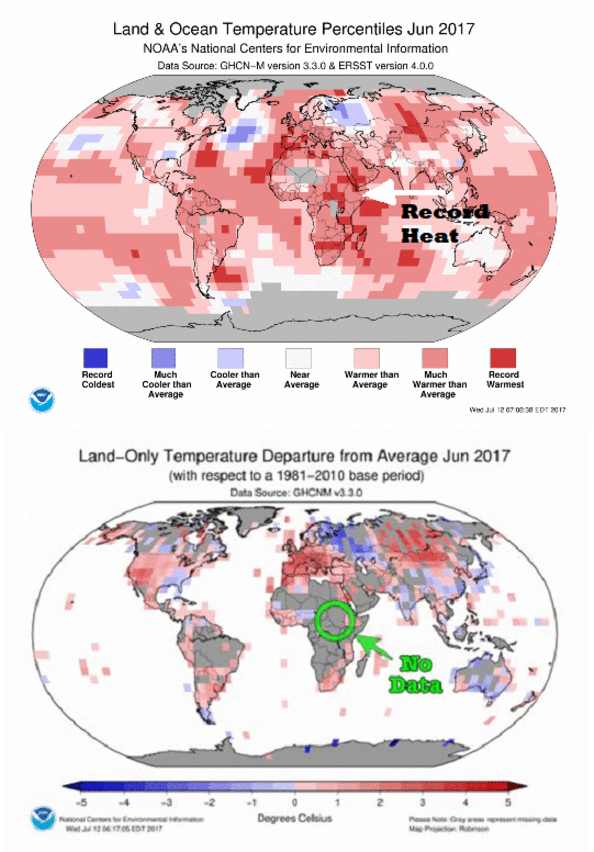
Well, let’s say right away that China and Southeast Asia are completely irrelevant for the global temperature from 1850 to 1900; neither China, Japan, India, Thailand, Indonesia and the Philippines, to name but a few, appear in the “reference period from 1850 to 1900” with even a single measurement date.

But that’s not all: the global temperature, calculated for the pre-industrial period from 1850 to 1900, which has become the basis for all claims about the significant increase in temperatures, does not include any data from not only Asia, it does not include any data for South America and Africa has shrunk to Algeria, Morocco, Tunisia and Egypt in the north, and South Africa in the south.

The earth temperature of the reference period 1850 to 1900 is essentially a North American temperature, which is primarily based on measurement data from the USA: 83.4% of the temperature data for the “global temperature” of the “reference period 1850 to 1900” for the northern hemisphere originate from the USA, 75.9% of all measuring stations on the basis of which the global temperature of the “reference period 1850 to 1900” is calculated are located in the USA, and just under 10% in Canada.

Not only to conceal this bias in the data basis, but also to
pass off the temperatures calculated for the “reference period
from 1850 to 1900” as “global temperatures” is fraud.

Another way to show the bias of the data, on the basis of which one can at best make statements about the USA and Canada, is to differentiate the measuring stations into those located in the northern hemisphere and those located in the southern hemisphere. The following figure shows, among other things, the result of this comparison.

Number and locations of the measuring stations used to calculate the reference period 1850 to 1900 – blue: NH, orange: SH, grey: only US, red: cumulative values

Just 9% of the measuring stations on the basis of whose data the temperature of the reference period 1850 to 1900 is calculated, as a measure of the pre-industrial temperature that is so important for the climate cultists, are located in the southern hemisphere and there they are mainly found in Australia, apart from a few scattered measuring stations in South Africa and two measuring stations in Sri Lanka.

The Earth’s temperature is obviously a temperature that can be
calculated independently of local temperatures in India, China,
Southeast Asia, South America and large parts of Africa.

If it is possible to calculate the Earth’s temperature for the period from 1850 to 1900 without taking large parts of the Earth into account, then the question arises as to whether it is possible to do without any measurement data at all, especially as their distribution over the years is very uneven: a total of 32 measuring stations form the basis for the global Earth temperature calculation for the years 1850 to 1859, with a further 62 from 1860 to 1869. As the figure above shows, the claim that the entire period from 1850 to 1900 is a reference period is simply fraudulent, as 77% of the measuring stations were only put into operation after 1890.

This is all a huge humbug that ultimately represents scientific fraud, and anyone who compares today’s data with the data from the reference period 1850 to 1900 and claims to be able to extract any information about the development of the global earth temperature from this is either out of their depth or a climate fraudster.

Footnote from Comments

The official record Copernicus uses goes back to 1940.

Additionally, it appears that at least the NH was just emerging from a prolonged cold period – the little ice age – which would assist in providing for the lower baseline temps. All in all, it seems silly to try and make such comparisons, and even when they are done we seem to run into ‘re-analysis’ of past temp data that persistently cools the past data sets, which of course make current temps seem warmer.

It’s not only NOAA doing these adjustments, German DWD does the same thing. They also placed new stations at inappropriate sites and reduced the number of stations.

Consider the Hot Air in recent claims like these:

Humanity has just lived through the hottest 12-month period in at least 125,000 years CNN

Earth posts hottest 12 months on record and probably 125,000 years Washington Post

This year is “virtually certain” to be the warmest in 125,000 years said E U scientists Reuters

The hottest temperature that our planet has experienced in something like 125,000 years Scientific American

Earth just had its hottest year on record — climate change is to blame Nature


UAH November 2023: Ocean Stays Warm, Land Cools

The post below updates the UAH record of air temperatures over land and ocean. Each month and year exposes again the growing disconnect between the real world and the Zero Carbon zealots.  It is as though the anti-hydrocarbon band wagon hopes to drown out the data contradicting their justification for the Great Energy Transition.  Yes, there has been warming from an El Nino buildup coincidental with North Atlantic warming, but no basis to blame it on CO2.  

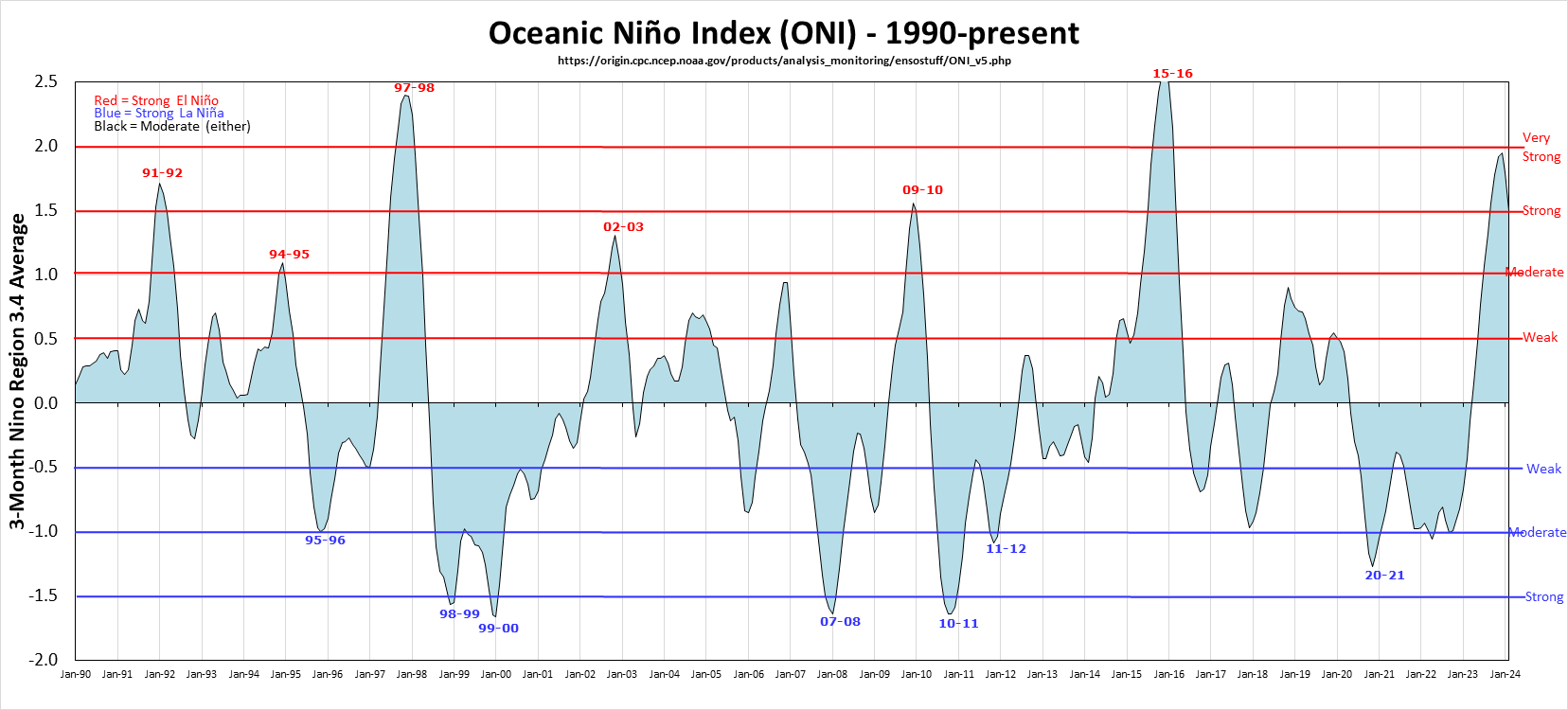
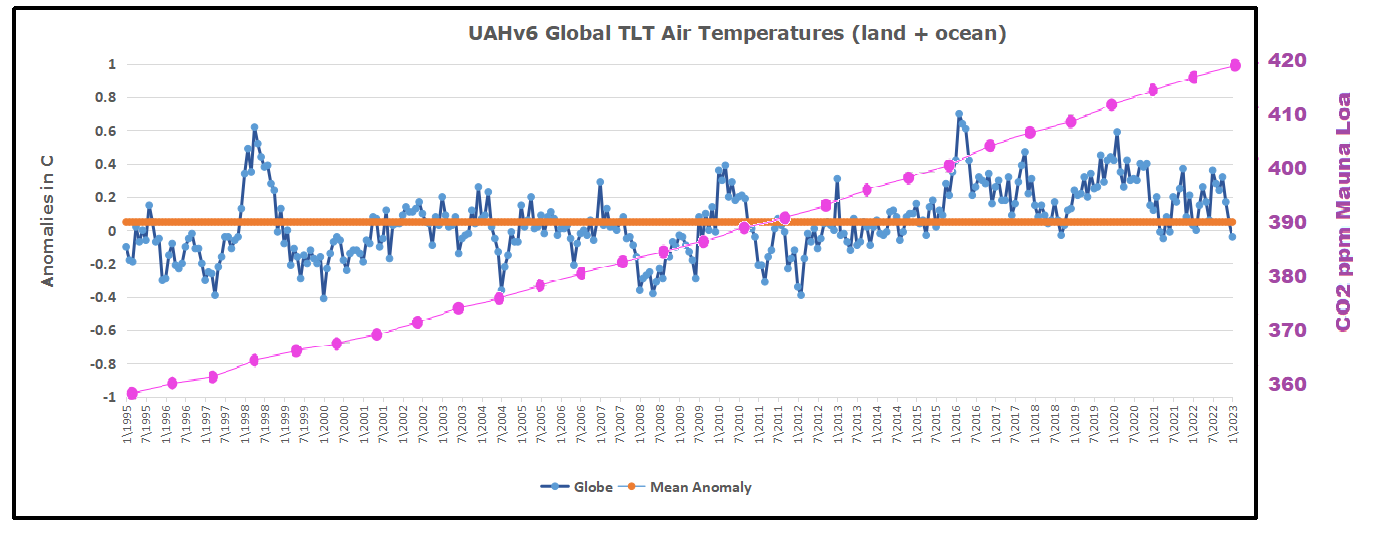
As an overview consider how recent rapid cooling  completely overcame the warming from the last 3 El Ninos (1998, 2010 and 2016).  The UAH record shows that the effects of the last one were gone as of April 2021, again in November 2021, and in February and June 2022  At year end 2022 and continuing into 2023 global temp anomaly matched or went lower than average since 1995, an ENSO neutral year. (UAH baseline is now 1991-2020).

For reference I added an overlay of CO2 annual concentrations as measured at Mauna Loa.  While temperatures fluctuated up and down ending flat, CO2 went up steadily by ~60 ppm, a 15% increase.

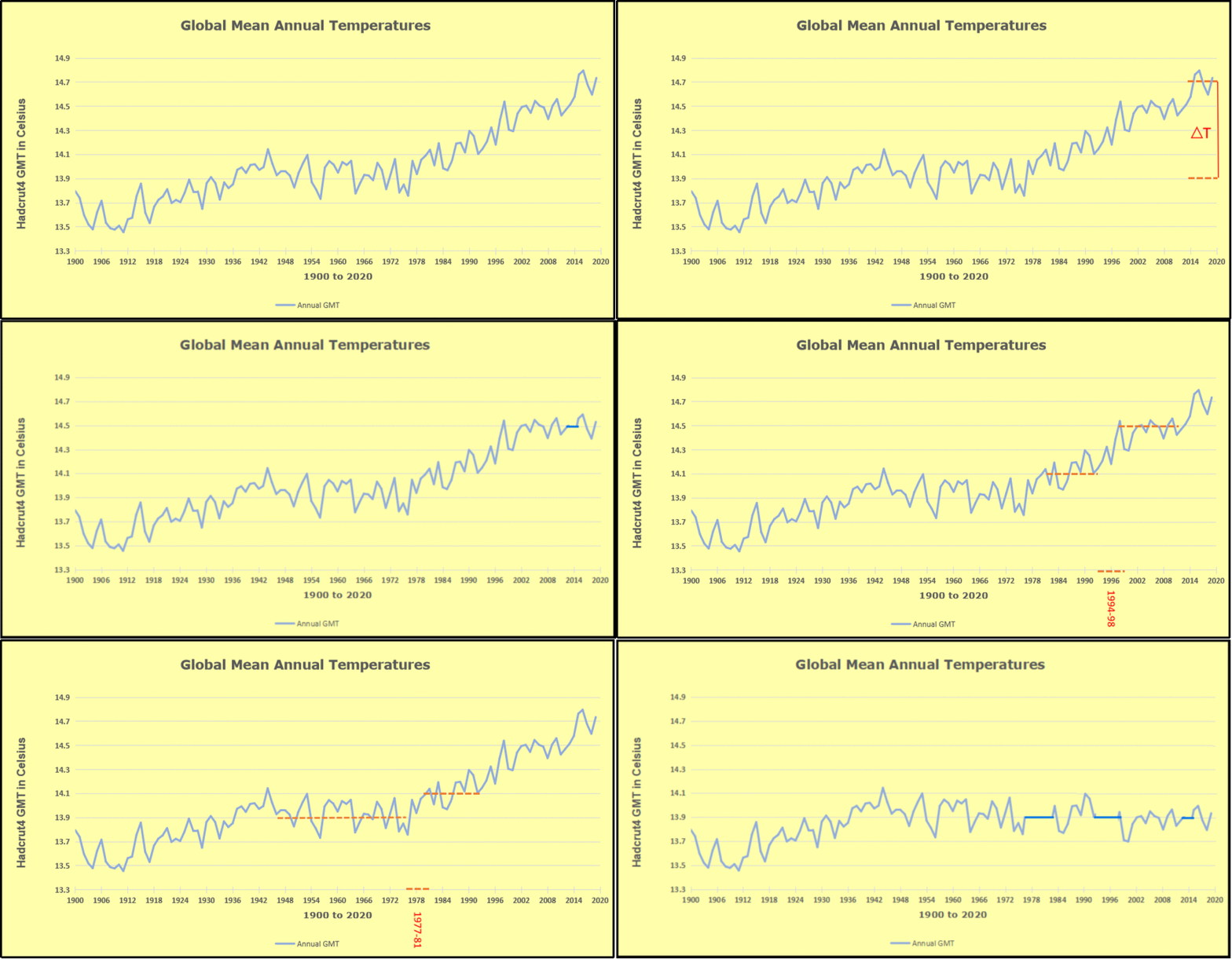
Furthermore, going back to previous warmings prior to the satellite record shows that the entire rise of 0.8C since 1947 is due to oceanic, not human activity.
gmt-warming-events

The animation is an update of a previous analysis from Dr. Murry Salby.  These graphs use Hadcrut4 and include the 2016 El Nino warming event.  The exhibit shows since 1947 GMT warmed by 0.8 C, from 13.9 to 14.7, as estimated by Hadcrut4.  This resulted from three natural warming events involving ocean cycles. The most recent rise 2013-16 lifted temperatures by 0.2C.  Previously the 1997-98 El Nino produced a plateau increase of 0.4C.  Before that, a rise from 1977-81 added 0.2C to start the warming since 1947.

Importantly, the theory of human-caused global warming asserts that increasing CO2 in the atmosphere changes the baseline and causes systemic warming in our climate.  On the contrary, all of the warming since 1947 was episodic, coming from three brief events associated with oceanic cycles. And now in 2023 we are seeing an amazing episode with a temperature spike driven by ocean air warming in all regions. 

Update August 3, 2021

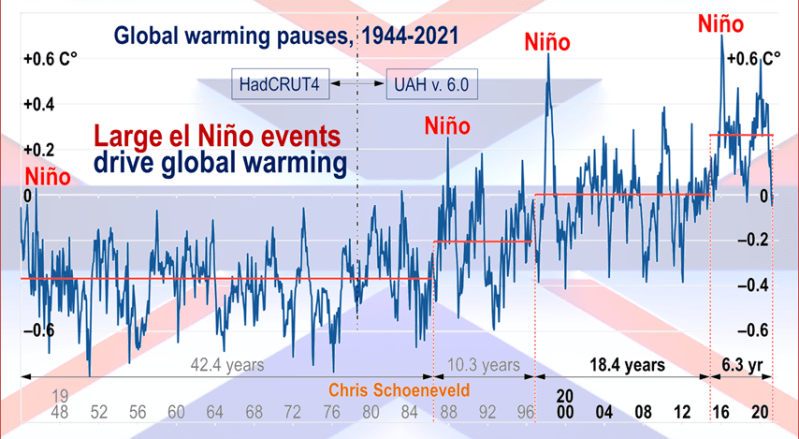
Chris Schoeneveld has produced a similar graph to the animation above, with a temperature series combining HadCRUT4 and UAH6. H/T WUWT

image-8


mc_wh_gas_web20210423124932

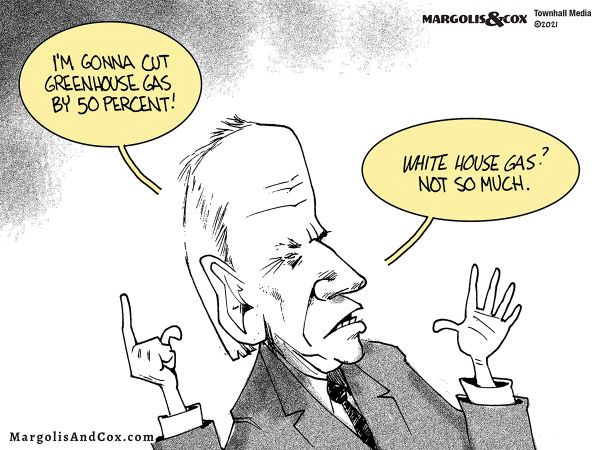
See Also Worst Threat: Greenhouse Gas or Quiet Sun?

November 2023 Ocean Stays Warm, Land Cools

banner-blog

With apologies to Paul Revere, this post is on the lookout for cooler weather with an eye on both the Land and the Sea.  While you will hear a lot about 2020-21 temperatures matching 2016 as the highest ever, that spin ignores how fast the cooling set in.  The UAH data analyzed below shows that warming from the last El Nino had fully dissipated with chilly temperatures in all regions. After a warming blip in 2022, land and ocean temps dropped again with 2023 starting below the mean since 1995.  Spring and Summer 2023 saw a series of warmings.  Now in November the high persisted due to another rise in ocean air temps in all regions, while land air temps cooled everywhere, most strongly in SH.

UAH has updated their tlt (temperatures in lower troposphere) dataset for November 2023. Posts on their reading of ocean air temps this month preceded updated records from HadSST4.  I last posted on SSTs using HadSST4 October 2023 Ocean Cooling Off.  This month also has a separate graph of land air temps because the comparisons and contrasts are interesting as we contemplate possible cooling in coming months and years.

Sometimes air temps over land diverge from ocean air changes.  November 2023 is notable for a dichotomy between Ocean and Land air temperatures in UAH dataset. Remarkably a new high for Ocean air temps appeared with warming in all regions, while Land air temps dropped with cooling in all regions.  As a result the Global Ocean and Land anomaly result remained little changed.

Note:  UAH has shifted their baseline from 1981-2010 to 1991-2020 beginning with January 2021.  In the charts below, the trends and fluctuations remain the same but the anomaly values change with the baseline reference shift.

Presently sea surface temperatures (SST) are the best available indicator of heat content gained or lost from earth’s climate system.  Enthalpy is the thermodynamic term for total heat content in a system, and humidity differences in air parcels affect enthalpy.  Measuring water temperature directly avoids distorted impressions from air measurements.  In addition, ocean covers 71% of the planet surface and thus dominates surface temperature estimates.  Eventually we will likely have reliable means of recording water temperatures at depth.

Recently, Dr. Ole Humlum reported from his research that air temperatures lag 2-3 months behind changes in SST.  Thus cooling oceans portend cooling land air temperatures to follow.  He also observed that changes in CO2 atmospheric concentrations lag behind SST by 11-12 months.  This latter point is addressed in a previous post Who to Blame for Rising CO2?

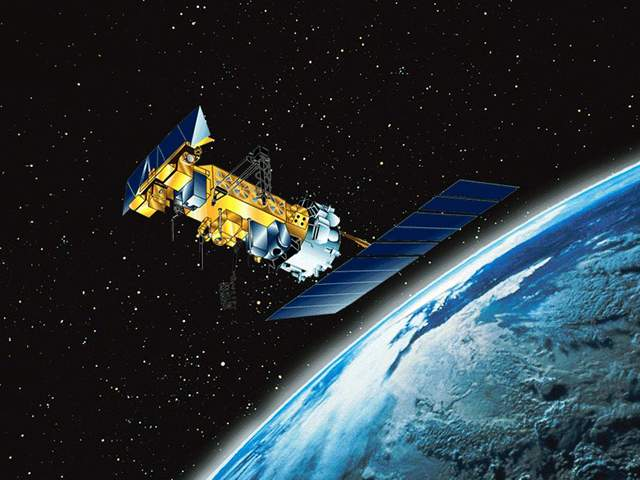
After a change in priorities, updates are now exclusive to HadSST4.  For comparison we can also look at lower troposphere temperatures (TLT) from UAHv6 which are now posted for November.  The temperature record is derived from microwave sounding units (MSU) on board satellites like the one pictured above. Recently there was a change in UAH processing of satellite drift corrections, including dropping one platform which can no longer be corrected. The graphs below are taken from the revised and current dataset.

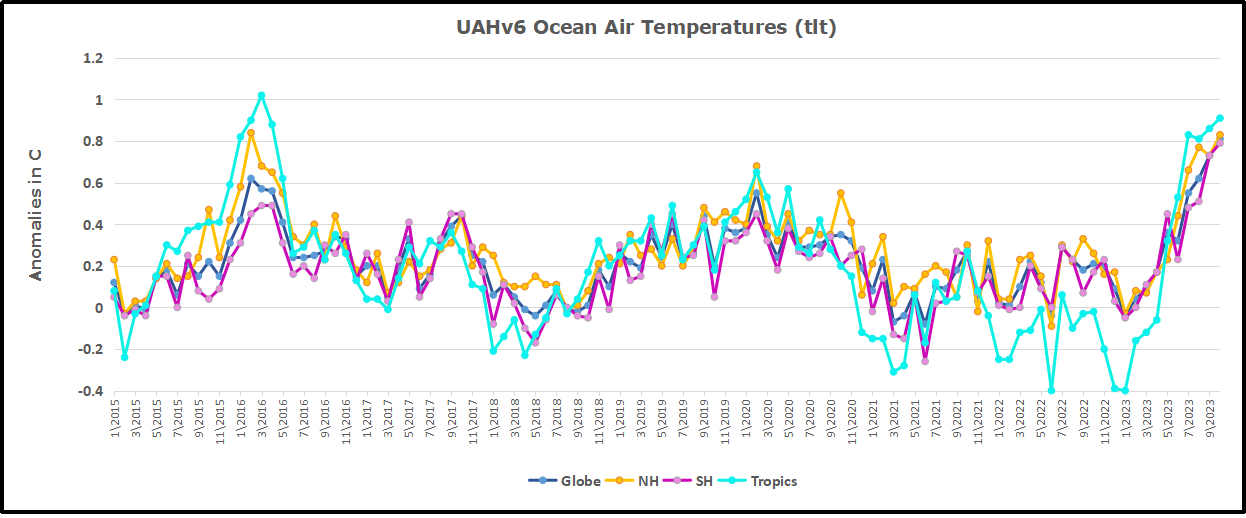
The UAH dataset includes temperature results for air above the oceans, and thus should be most comparable to the SSTs. There is the additional feature that ocean air temps avoid Urban Heat Islands (UHI).  The graph below shows monthly anomalies for ocean air temps since January 2015.

Note 2020 was warmed mainly by a spike in February in all regions, and secondarily by an October spike in NH alone. In 2021, SH and the Tropics both pulled the Global anomaly down to a new low in April. Then SH and Tropics upward spikes, along with NH warming brought Global temps to a peak in October.  That warmth was gone as November 2021 ocean temps plummeted everywhere. After an upward bump 01/2022 temps reversed and plunged downward in June.  After an upward spike in July, ocean air everywhere cooled in August and also in September.   

After sharp cooling everywhere in January 2023, all regions were into negative territory. Note the Tropics matched the lowest value, but since have spiked sharply upward +1.4C, with the largest increases in April to July, and continuing in Autumn 2023.  NH also warmed to 0.83C in the last 9 months, while SH ocean air rose about the same. Global Ocean air November 2023 now exceeds the 2016 peak by 0.2C, the main difference being the much higher rise in SH anomalies since June.  The strength of the El Nino will determine the pattern in coming months.

Land Air Temperatures Tracking in Seesaw Pattern

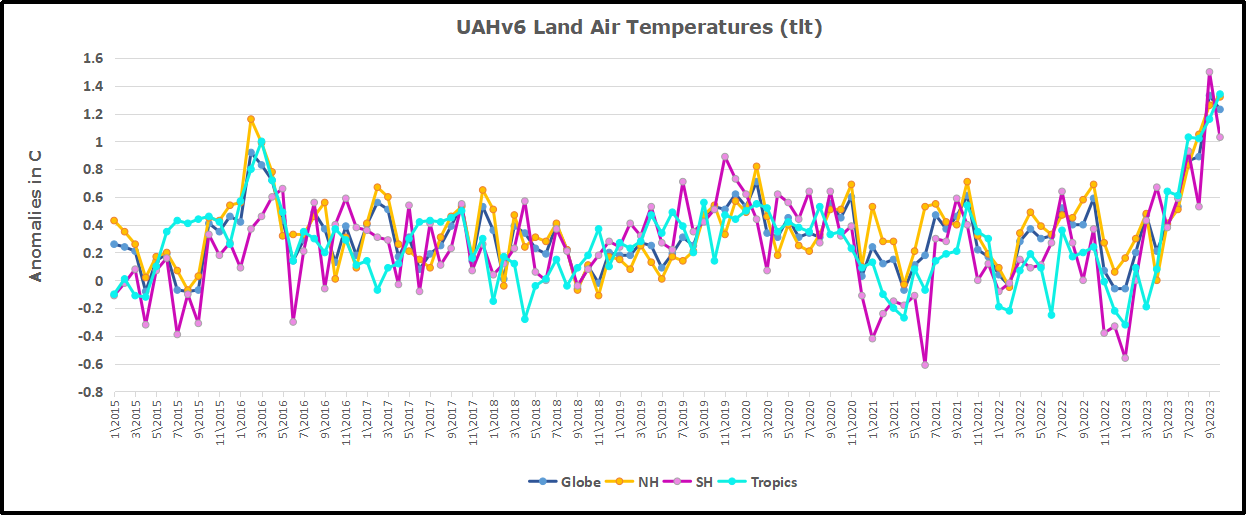
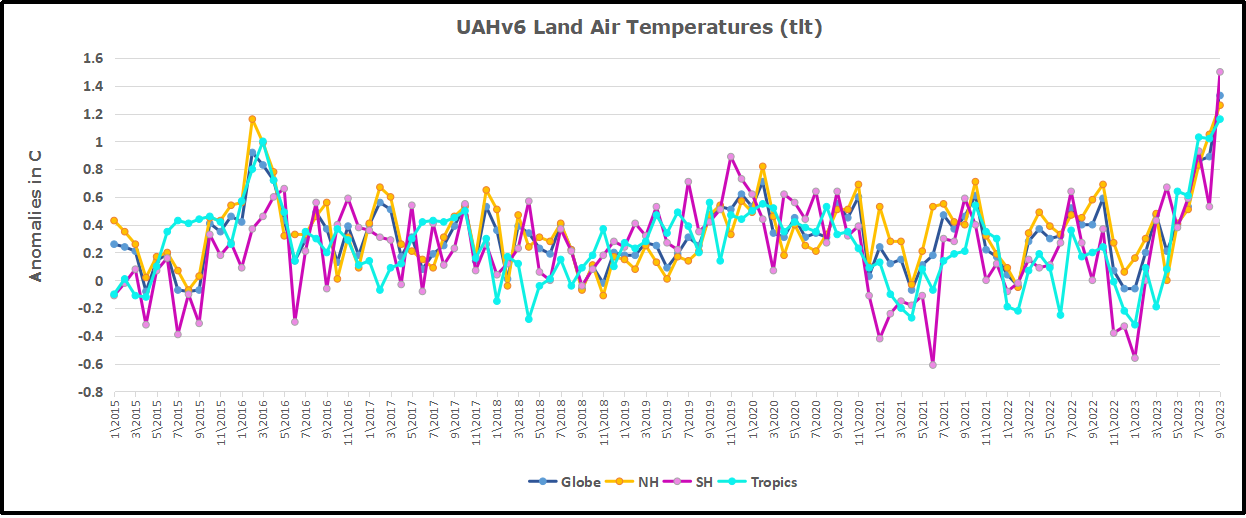
We sometimes overlook that in climate temperature records, while the oceans are measured directly with SSTs, land temps are measured only indirectly.  The land temperature records at surface stations sample air temps at 2 meters above ground.  UAH gives tlt anomalies for air over land separately from ocean air temps.  The graph updated for November is below.

Here we have fresh evidence of the greater volatility of the Land temperatures, along with extraordinary departures by SH land.  Land temps are dominated by NH with a 2021 spike in January,  then dropping before rising in the summer to peak in October 2021. As with the ocean air temps, all that was erased in November with a sharp cooling everywhere.  After a summer 2022 NH spike, land temps dropped everywhere, and in January, further cooling in SH and Tropics offset by an uptick in NH. 

Remarkably, in 2023, SH land air anomaly shot up 1.6C, from  -0.56C in January to +1.03 in October, then dropped to 0.7 in November.  Tropical land temps are up 1.6 since January and NH Land air temps rose 0.9, mostly since May.  Now in November NH land air temps are little changed and Tropical land temps down nearly 0.2C.

The Bigger Picture UAH Global Since 1980

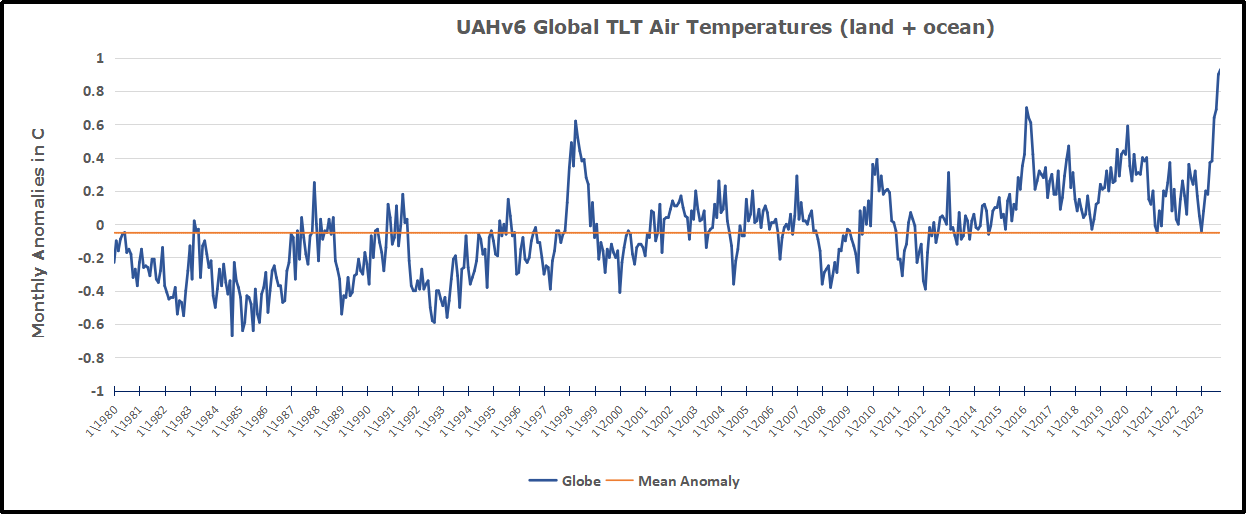
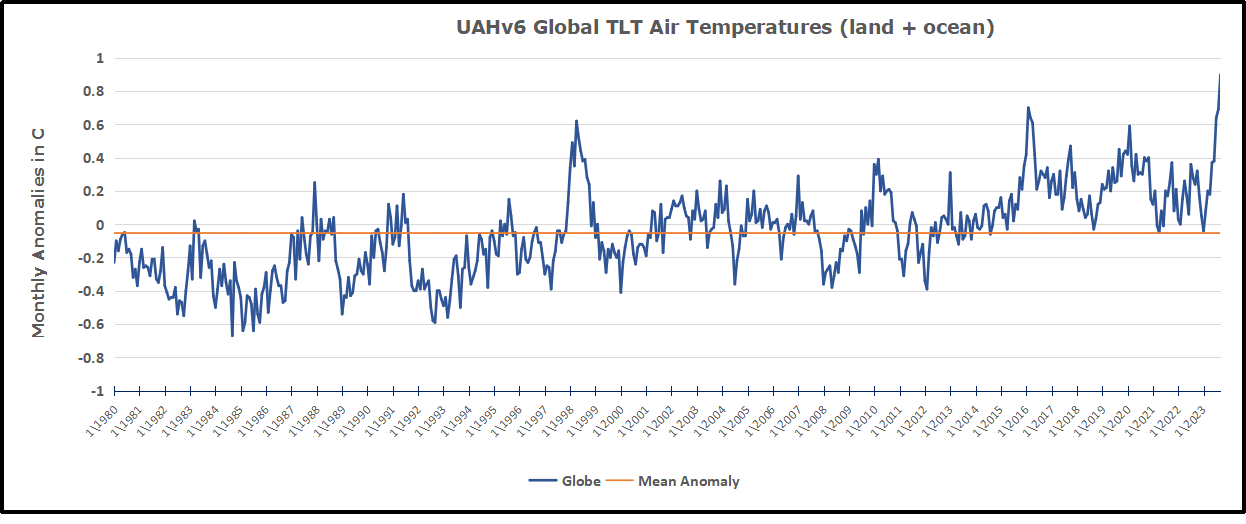
The chart shows monthly Global anomalies starting 01/1980 to present.  The average monthly anomaly is -0.05, for this period of more than four decades.  The graph shows the 1998 El Nino after which the mean resumed, and again after the smaller 2010 event. The 2016 El Nino matched 1998 peak and in addition NH after effects lasted longer, followed by the NH warming 2019-20.   An upward bump in 2021 was reversed with temps having returned close to the mean as of 2/2022.  March and April brought warmer Global temps, later reversed.

With the sharp drops in Nov., Dec. and January 2023 temps, there was no increase over 1980. Now in 2023 the buildup to the October/November peak exceeds the sharp April peak of the El Nino 1998 event. It also surpasses the February peak in 2016.  Where it goes from here, up or down, remains to be seen.

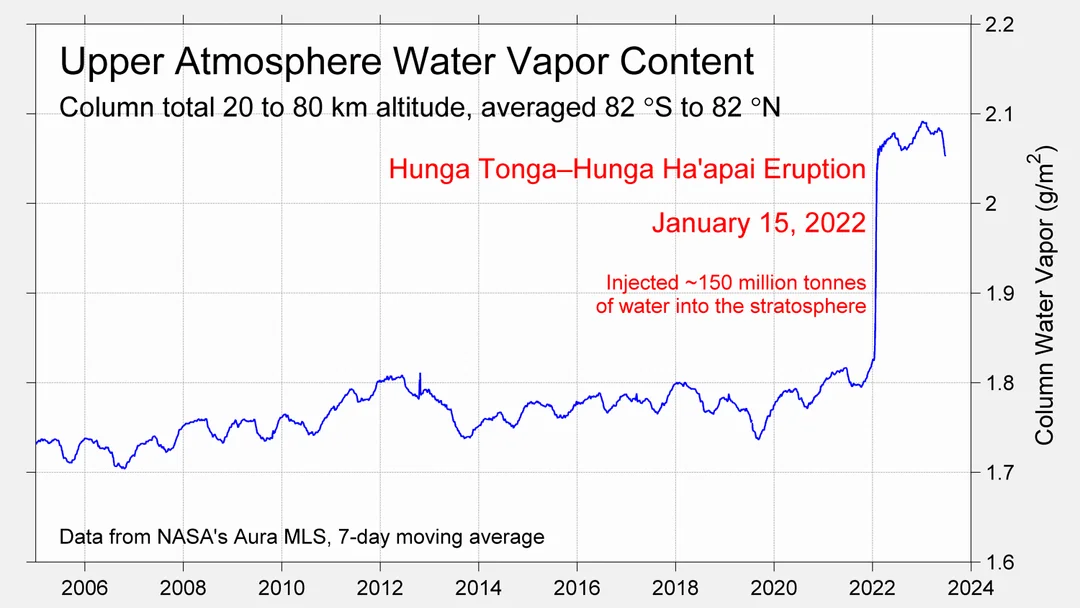
The graph reminds of another chart showing the abrupt ejection of humid air from Hunga Tonga eruption.

TLTs include mixing above the oceans and probably some influence from nearby more volatile land temps.  Clearly NH and Global land temps have been dropping in a seesaw pattern, nearly 1C lower than the 2016 peak.  Since the ocean has 1000 times the heat capacity as the atmosphere, that cooling is a significant driving force.  TLT measures started the recent cooling later than SSTs from HadSST3, but are now showing the same pattern. Despite the three El Ninos, their warming has not persisted prior to 2023, and without them it would probably have cooled since 1995.  Of course, the future has not yet been written.


UAH: Amazing Air Warming Spike October 2023

The post below updates the UAH record of air temperatures over land and ocean. Each month and year exposed again the growing disconnect between the real world and the Zero Carbon zealots.  It is as though the anti-hydrocarbon band wagon hopes to drown out the data contradicting their justification for the Great Energy Transition.  Yes, there is warming from an El Nino buildup coincidental with North Atlantic warming, but no basis to blame it on CO2.  
As an overview consider how recent rapid cooling  completely overcame the warming from the last 3 El Ninos (1998, 2010 and 2016).  The UAH record shows that the effects of the last one were gone as of April 2021, again in November 2021, and in February and June 2022  At year end 2022 and continuing into 2023 global temp anomaly matched or went lower than average since 1995, an ENSO neutral year. (UAH baseline is now 1991-2020).

For reference I added an overlay of CO2 annual concentrations as measured at Mauna Loa.  While temperatures fluctuated up and down ending flat, CO2 went up steadily by ~60 ppm, a 15% increase.

Furthermore, going back to previous warmings prior to the satellite record shows that the entire rise of 0.8C since 1947 is due to oceanic, not human activity.

gmt-warming-events

The animation is an update of a previous analysis from Dr. Murry Salby.  These graphs use Hadcrut4 and include the 2016 El Nino warming event.  The exhibit shows since 1947 GMT warmed by 0.8 C, from 13.9 to 14.7, as estimated by Hadcrut4.  This resulted from three natural warming events involving ocean cycles. The most recent rise 2013-16 lifted temperatures by 0.2C.  Previously the 1997-98 El Nino produced a plateau increase of 0.4C.  Before that, a rise from 1977-81 added 0.2C to start the warming since 1947.

Importantly, the theory of human-caused global warming asserts that increasing CO2 in the atmosphere changes the baseline and causes systemic warming in our climate.  On the contrary, all of the warming since 1947 was episodic, coming from three brief events associated with oceanic cycles. And now in 2023 we are seeing an amazing episode with a temperature spike driven by ocean air warming along with higher land air temps.

Update August 3, 2021

Chris Schoeneveld has produced a similar graph to the animation above, with a temperature series combining HadCRUT4 and UAH6. H/T WUWT

image-8


mc_wh_gas_web20210423124932

See Also Worst Threat: Greenhouse Gas or Quiet Sun?

October 2023 Update New Warming Spike Led by Tropics High

banner-blog

With apologies to Paul Revere, this post is on the lookout for cooler weather with an eye on both the Land and the Sea.  While you will hear a lot about 2020-21 temperatures matching 2016 as the highest ever, that spin ignores how fast the cooling set in.  The UAH data analyzed below shows that warming from the last El Nino had fully dissipated with chilly temperatures in all regions. After a warming blip in 2022, land and ocean temps dropped again with 2023 starting below the mean since 1995.  Spring and Summer 2023 saw a series of warmings.  Now in October a new high resulted from a major rise in ocean air temps in all regions, along with higher land air temps in NH and Tropics. 

UAH has updated their tlt (temperatures in lower troposphere) dataset for October 2023. Posts on their reading of ocean air temps this month preceded updated records from HadSST4.  I last posted on SSTs using HadSST4 September 2023 Ocean Warming Crests, Solar Coincidence? This month also has a separate graph of land air temps because the comparisons and contrasts are interesting as we contemplate possible cooling in coming months and years. Sometimes air temps over land diverge from ocean air changes.  For example in October 2023, a new warming high was driven by ocean air temps despite SH land temps dropping back down. The Tropics and NH showed warming in both land and sea air.

In October, as shown later on, Global ocean air reached a record high peak with all regions warming, especially Tropics. Land air temps rose in NH and Tropics, with a SH dropping down.   Thus the land + ocean Global UAH temperature is now exceeding the 2016 peak.

Note:  UAH has shifted their baseline from 1981-2010 to 1991-2020 beginning with January 2021.  In the charts below, the trends and fluctuations remain the same but the anomaly values change with the baseline reference shift.

Presently sea surface temperatures (SST) are the best available indicator of heat content gained or lost from earth’s climate system.  Enthalpy is the thermodynamic term for total heat content in a system, and humidity differences in air parcels affect enthalpy.  Measuring water temperature directly avoids distorted impressions from air measurements.  In addition, ocean covers 71% of the planet surface and thus dominates surface temperature estimates.  Eventually we will likely have reliable means of recording water temperatures at depth.

Recently, Dr. Ole Humlum reported from his research that air temperatures lag 2-3 months behind changes in SST.  Thus the cooling oceans now portend cooling land air temperatures to follow.  He also observed that changes in CO2 atmospheric concentrations lag behind SST by 11-12 months.  This latter point is addressed in a previous post Who to Blame for Rising CO2?

After a change in priorities, updates are now exclusive to HadSST4.  For comparison we can also look at lower troposphere temperatures (TLT) from UAHv6 which are now posted for September.  The temperature record is derived from microwave sounding units (MSU) on board satellites like the one pictured above. Recently there was a change in UAH processing of satellite drift corrections, including dropping one platform which can no longer be corrected. The graphs below are taken from the revised and current dataset.

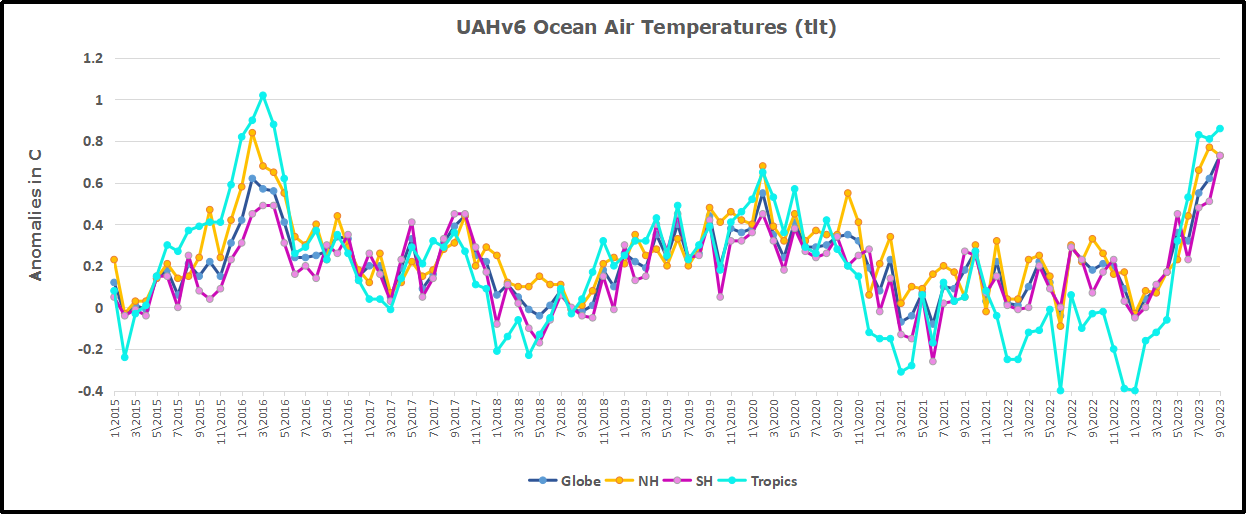
The UAH dataset includes temperature results for air above the oceans, and thus should be most comparable to the SSTs. There is the additional feature that ocean air temps avoid Urban Heat Islands (UHI).  The graph below shows monthly anomalies for ocean air temps since January 2015.

Note 2020 was warmed mainly by a spike in February in all regions, and secondarily by an October spike in NH alone. In 2021, SH and the Tropics both pulled the Global anomaly down to a new low in April. Then SH and Tropics upward spikes, along with NH warming brought Global temps to a peak in October.  That warmth was gone as November 2021 ocean temps plummeted everywhere. After an upward bump 01/2022 temps reversed and plunged downward in June.  After an upward spike in July, ocean air everywhere cooled in August and also in September.   

After sharp cooling everywhere in January 2023, all regions were into negative territory. Note the Tropics matched the lowest value, but since have spiked sharply upward +1.26C, with the largest increases in April to July 2023.  NH also warmed 0.7C in the last 4 months, while SH ocean air rose the same. Global Ocean air October 2023 is now exceeding 2016, the main difference being the much higher rise in SH anomalies since April.  The strength of the El Nino will determine the latter part of this year.

Land Air Temperatures Tracking Downward in Seesaw Pattern

We sometimes overlook that in climate temperature records, while the oceans are measured directly with SSTs, land temps are measured only indirectly.  The land temperature records at surface stations sample air temps at 2 meters above ground.  UAH gives tlt anomalies for air over land separately from ocean air temps.  The graph updated for September is below.

Here we have fresh evidence of the greater volatility of the Land temperatures, along with extraordinary departures by SH land.  Land temps are dominated by NH with a 2021 spike in January,  then dropping before rising in the summer to peak in October 2021. As with the ocean air temps, all that was erased in November with a sharp cooling everywhere.  After a summer 2022 NH spike, land temps dropped everywhere, and in January, further cooling in SH and Tropics offset by an uptick in NH. 

Remarkably, in 2023, SH land air anomaly shot up 1.5C, from  -0.56C in January to +0.93 in July, then dropped to 0.53 in August. In September SH shot up again to 1.5C.  Tropical land temps are up 1.48 since January and NH Land air temps rose 0.9, mostly since May. Despite SH land air dropping in October, the consolidated rise greatly exceeds the upward spikes peaking in  2016.

The Bigger Picture UAH Global Since 1980

The chart shows monthly Global anomalies starting 01/1980 to present.  The average monthly anomaly is -0.06, for this period of more than four decades.  The graph shows the 1998 El Nino after which the mean resumed, and again after the smaller 2010 event. The 2016 El Nino matched 1998 peak and in addition NH after effects lasted longer, followed by the NH warming 2019-20.   An upward bump in 2021 was reversed with temps having returned close to the mean as of 2/2022.  March and April brought warmer Global temps, later reversed.

With the sharp drops in Nov., Dec. and January 2023 temps, there was no increase over 1980. Now in 2023 the buildup to the October peak exceeds the sharp April peak of the El Nino 1998 event. It also surpasses the February peak in 2016.  Where it goes from here, up or down, remains to be seen.

The graph reminds of another chart showing the abrupt ejection of humid air from Hunga Tonga eruption.

TLTs include mixing above the oceans and probably some influence from nearby more volatile land temps.  Clearly NH and Global land temps have been dropping in a seesaw pattern, nearly 1C lower than the 2016 peak.  Since the ocean has 1000 times the heat capacity as the atmosphere, that cooling is a significant driving force.  TLT measures started the recent cooling later than SSTs from HadSST3, but are now showing the same pattern. Despite the three El Ninos, their warming has not persisted prior to 2023, and without them it would probably have cooled since 1995.  Of course, the future has not yet been written.


UAH: Amazing SH Land Air Spike September 2023

The post below updates the UAH record of air temperatures over land and ocean. Each month and year exposed again the growing disconnect between the real world and the Zero Carbon zealots.  It is as though the anti-hydrocarbon band wagon hopes to drown out the data contradicting their justification for the Great Energy Transition.  Yes, there is warming from an El Nino buildup coincidental with North Atlantic warming, but no basis to blame it on CO2.  

As an overview consider how recent rapid cooling  completely overcame the warming from the last 3 El Ninos (1998, 2010 and 2016).  The UAH record shows that the effects of the last one were gone as of April 2021, again in November 2021, and in February and June 2022  At year end 2022 and continuing into 2023 global temp anomaly matched or went lower than average since 1995, an ENSO neutral year. (UAH baseline is now 1991-2020).

For reference I added an overlay of CO2 annual concentrations as measured at Mauna Loa.  While temperatures fluctuated up and down ending flat, CO2 went up steadily by ~60 ppm, a 15% increase.

Furthermore, going back to previous warmings prior to the satellite record shows that the entire rise of 0.8C since 1947 is due to oceanic, not human activity.

gmt-warming-events

The animation is an update of a previous analysis from Dr. Murry Salby.  These graphs use Hadcrut4 and include the 2016 El Nino warming event.  The exhibit shows since 1947 GMT warmed by 0.8 C, from 13.9 to 14.7, as estimated by Hadcrut4.  This resulted from three natural warming events involving ocean cycles. The most recent rise 2013-16 lifted temperatures by 0.2C.  Previously the 1997-98 El Nino produced a plateau increase of 0.4C.  Before that, a rise from 1977-81 added 0.2C to start the warming since 1947.

Importantly, the theory of human-caused global warming asserts that increasing CO2 in the atmosphere changes the baseline and causes systemic warming in our climate.  On the contrary, all of the warming since 1947 was episodic, coming from three brief events associated with oceanic cycles. 

Update August 3, 2021

Chris Schoeneveld has produced a similar graph to the animation above, with a temperature series combining HadCRUT4 and UAH6. H/T WUWT

image-8


mc_wh_gas_web20210423124932

See Also Worst Threat: Greenhouse Gas or Quiet Sun?

September 2023 Update New Summer High Driven by SH Spike 

banner-blog

With apologies to Paul Revere, this post is on the lookout for cooler weather with an eye on both the Land and the Sea.  While you will hear a lot about 2020-21 temperatures matching 2016 as the highest ever, that spin ignores how fast the cooling set in.  The UAH data analyzed below shows that warming from the last El Nino had fully dissipated with chilly temperatures in all regions. After a warming blip in 2022, land and ocean temps dropped again with 2023 starting below the mean since 1995.  Spring and Summer 2023 saw a series of warmings.  Now in September a new summer high resulted from a major upward spike in SH, especially the land temps. 

UAH has updated their tlt (temperatures in lower troposphere) dataset for September 2023. Posts on their reading of ocean air temps this month preceded updated records from HadSST4.  I last posted on SSTs using HadSST4 Ocean Warming Crest August 2023, Solar Coincidence?  This month also has a separate graph of land air temps because the comparisons and contrasts are interesting as we contemplate possible cooling in coming months and years. Sometimes air temps over land diverge from ocean air changes.  For example in September 2023, SH land temps leaped upward almost unbelievably.

In September, as shown later on, Global ocean air reached a slightly higher peak led by SH, but with NH easing down. OTOH  Land air temps rose in all regions, with a SH rising dramatically.   Thus the land + ocean Global UAH temperature is now exceeding the 2016 peak.

Note:  UAH has shifted their baseline from 1981-2010 to 1991-2020 beginning with January 2021.  In the charts below, the trends and fluctuations remain the same but the anomaly values change with the baseline reference shift.

Presently sea surface temperatures (SST) are the best available indicator of heat content gained or lost from earth’s climate system.  Enthalpy is the thermodynamic term for total heat content in a system, and humidity differences in air parcels affect enthalpy.  Measuring water temperature directly avoids distorted impressions from air measurements.  In addition, ocean covers 71% of the planet surface and thus dominates surface temperature estimates.  Eventually we will likely have reliable means of recording water temperatures at depth.

Recently, Dr. Ole Humlum reported from his research that air temperatures lag 2-3 months behind changes in SST.  Thus the cooling oceans now portend cooling land air temperatures to follow.  He also observed that changes in CO2 atmospheric concentrations lag behind SST by 11-12 months.  This latter point is addressed in a previous post Who to Blame for Rising CO2?

After a change in priorities, updates are now exclusive to HadSST4.  For comparison we can also look at lower troposphere temperatures (TLT) from UAHv6 which are now posted for September.  The temperature record is derived from microwave sounding units (MSU) on board satellites like the one pictured above. Recently there was a change in UAH processing of satellite drift corrections, including dropping one platform which can no longer be corrected. The graphs below are taken from the revised and current dataset.

The UAH dataset includes temperature results for air above the oceans, and thus should be most comparable to the SSTs. There is the additional feature that ocean air temps avoid Urban Heat Islands (UHI).  The graph below shows monthly anomalies for ocean air temps since January 2015.

Note 2020 was warmed mainly by a spike in February in all regions, and secondarily by an October spike in NH alone. In 2021, SH and the Tropics both pulled the Global anomaly down to a new low in April. Then SH and Tropics upward spikes, along with NH warming brought Global temps to a peak in October.  That warmth was gone as November 2021 ocean temps plummeted everywhere. After an upward bump 01/2022 temps reversed and plunged downward in June.  After an upward spike in July, ocean air everywhere cooled in August and also in September.   

After sharp cooling everywhere in January 2023, all regions were into negative territory. Note the Tropics matched the lowest value, but since have spiked sharply upward +1.26C, with the largest increases in April to July 2023.  NH also warmed 0.7C in the last 4 months, while SH ocean air rose the same. Global Ocean air September 2023 is now matching 2016, the main difference being the much higher rise in SH anomalies since April.  The strength of the El Nino will determine the latter part of this year.

Land Air Temperatures Tracking Downward in Seesaw Pattern

We sometimes overlook that in climate temperature records, while the oceans are measured directly with SSTs, land temps are measured only indirectly.  The land temperature records at surface stations sample air temps at 2 meters above ground.  UAH gives tlt anomalies for air over land separately from ocean air temps.  The graph updated for September is below.

Here we have fresh evidence of the greater volatility of the Land temperatures, along with extraordinary departures by SH land.  Land temps are dominated by NH with a 2021 spike in January,  then dropping before rising in the summer to peak in October 2021. As with the ocean air temps, all that was erased in November with a sharp cooling everywhere.  After a summer 2022 NH spike, land temps dropped everywhere, and in January, further cooling in SH and Tropics offset by an uptick in NH. 

Remarkably, in 2023, SH land air anomaly shot up 1.5C, from  -0.56C in January to +0.93 in July, then dropped to 0.53 in August.  Now in September SH shot up again to 1.5C.  Tropical land temps are up 1.48 since January and NH Land air temps rose 0.9, mostly since May. The consolidated rise greatly exceeds the upward spikes peaking in  2016.

The Bigger Picture UAH Global Since 1980

The chart shows monthly Global anomalies starting 01/1980 to present.  The average monthly anomaly is -0.06, for this period of more than four decades.  The graph shows the 1998 El Nino after which the mean resumed, and again after the smaller 2010 event. The 2016 El Nino matched 1998 peak and in addition NH after effects lasted longer, followed by the NH warming 2019-20.   An upward bump in 2021 was reversed with temps having returned close to the mean as of 2/2022.  March and April brought warmer Global temps, later reversed.

With the sharp drops in Nov., Dec. and January 2023 temps, there was no increase over 1980. Now in 2023 the buildup to the September peak exceeds the sharp April peak of the El Nino 1998 event. It also surpasses the February peak in 2016.  Where it goes from here, up or down, remains to be seen.

TLTs include mixing above the oceans and probably some influence from nearby more volatile land temps.  Clearly NH and Global land temps have been dropping in a seesaw pattern, nearly 1C lower than the 2016 peak.  Since the ocean has 1000 times the heat capacity as the atmosphere, that cooling is a significant driving force.  TLT measures started the recent cooling later than SSTs from HadSST3, but are now showing the same pattern. Despite the three El Ninos, their warming has not persisted prior to 2023, and without them it would probably have cooled since 1995.  Of course, the future has not yet been written.


More Proof CO2 Global Warming is Bogus

More Proof That CO2 Climate “Control Knob” Is Bogus from C3 Headlines

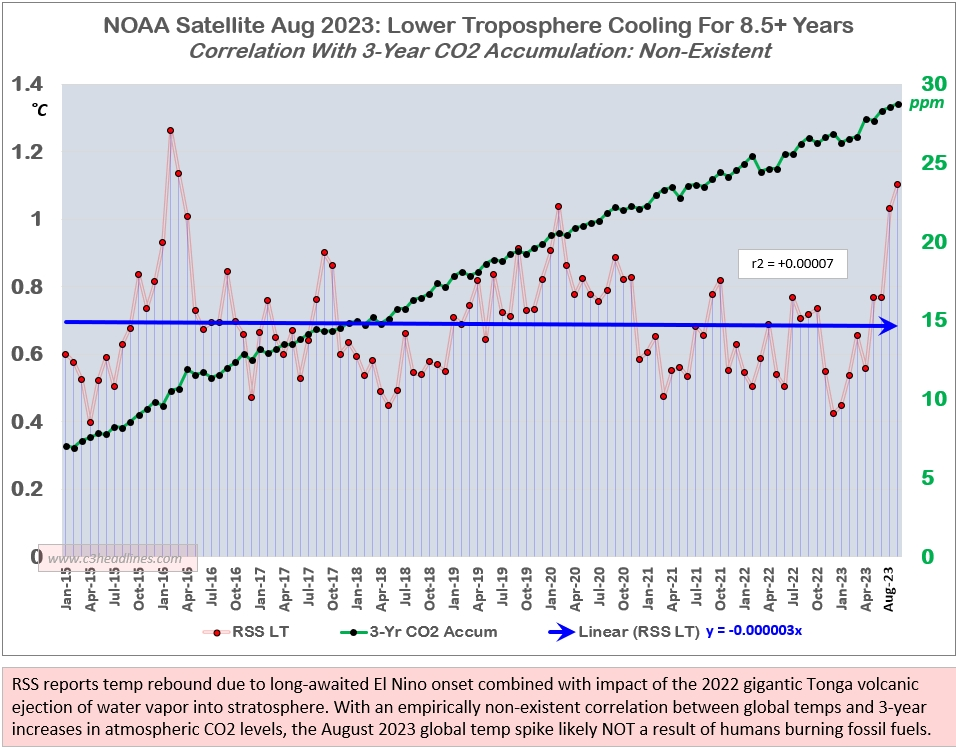
Remote Sensing Systems (RSS) published their August 2023 global lower troposphere (LT) dataset, and it validates that global temperatures have increased over recent months. However, the world remains in a very slight cooling trend since the start of 2015—over 8.5 years.

By combining the RSS data with NOAA’s CO2 data, it’s possible to calculate whether the past three years of rising atmospheric CO2 are causing LT temperatures to increase.

As this chart confirms, the monthly moving three-year CO2 increases
have zero correlation (R2 = 0.00007) with monthly temperatures.

It also affirms that the widely claimed “control knob” is nothing more than political science fiction.

Additional global and regional temp charts.

Notes: Excel used for all calculations and plotting.


UAH: El Nino Warming Peaks August 2023

The post below updates the UAH record of air temperatures over land and ocean. Each month and year exposed again the growing disconnect between the real world and the Zero Carbon zealots.  It is as though the anti-hydrocarbon band wagon hopes to drown out the data contradicting their justification for the Great Energy Transition.  Yes, there is warming from an El Nino buildup coincidental with North Atlantic warming, but no basis to blame it on CO2.  
As an overview consider how recent rapid cooling  completely overcame the warming from the last 3 El Ninos (1998, 2010 and 2016).  The UAH record shows that the effects of the last one were gone as of April 2021, again in November 2021, and in February and June 2022  At year end 2022 and continuing into 2023 global temp anomaly matched or went lower than average since 1995, an ENSO neutral year. (UAH baseline is now 1991-2020).

For reference I added an overlay of CO2 annual concentrations as measured at Mauna Loa.  While temperatures fluctuated up and down ending flat, CO2 went up steadily by ~60 ppm, a 15% increase.

Furthermore, going back to previous warmings prior to the satellite record shows that the entire rise of 0.8C since 1947 is due to oceanic, not human activity.

gmt-warming-events

The animation is an update of a previous analysis from Dr. Murry Salby.  These graphs use Hadcrut4 and include the 2016 El Nino warming event.  The exhibit shows since 1947 GMT warmed by 0.8 C, from 13.9 to 14.7, as estimated by Hadcrut4.  This resulted from three natural warming events involving ocean cycles. The most recent rise 2013-16 lifted temperatures by 0.2C.  Previously the 1997-98 El Nino produced a plateau increase of 0.4C.  Before that, a rise from 1977-81 added 0.2C to start the warming since 1947.

Importantly, the theory of human-caused global warming asserts that increasing CO2 in the atmosphere changes the baseline and causes systemic warming in our climate.  On the contrary, all of the warming since 1947 was episodic, coming from three brief events associated with oceanic cycles. 

Update August 3, 2021

Chris Schoeneveld has produced a similar graph to the animation above, with a temperature series combining HadCRUT4 and UAH6. H/T WUWT

image-8


mc_wh_gas_web20210423124932

See Also Worst Threat: Greenhouse Gas or Quiet Sun?

August 2023 Update El Nino plus North Atlantic Set Summer High

banner-blog

With apologies to Paul Revere, this post is on the lookout for cooler weather with an eye on both the Land and the Sea.  While you will hear a lot about 2020-21 temperatures matching 2016 as the highest ever, that spin ignores how fast the cooling set in.  The UAH data analyzed below shows that warming from the last El Nino had fully dissipated with chilly temperatures in all regions. After a warming blip in 2022, land and ocean temps dropped again with 2023 starting below the mean since 1995.  Now in August EL Nino has peaked with a major Tropical ocean air spike in concert with North Atlantic high temps.

UAH has updated their tlt (temperatures in lower troposphere) dataset for August 2023. Posts on their reading of ocean air temps this month preceded updated records from HadSST4.  I last posted on SSTs using HadSST4 World’s Oceans Warming July 2023. This month also has a separate graph of land air temps because the comparisons and contrasts are interesting as we contemplate possible cooling in coming months and years. Sometimes air temps over land diverge from ocean air changes.  For example in May 2023, ocean temps in all regions moved upward, while Tropical and NH land air temps dropped sharply. 

In August, as shown later on, Global ocean air reached a slightly higher peak led by NH, but with Tropics easing down. OTOH  Land air temps moderated, with a NH rise offset by a drop in SH. along with slightly lower Tropics.  Thus the land + ocean Global UAH temperature is now nearly matching the 2016 peak.

Note:  UAH has shifted their baseline from 1981-2010 to 1991-2020 beginning with January 2021.  In the charts below, the trends and fluctuations remain the same but the anomaly values change with the baseline reference shift.

Presently sea surface temperatures (SST) are the best available indicator of heat content gained or lost from earth’s climate system.  Enthalpy is the thermodynamic term for total heat content in a system, and humidity differences in air parcels affect enthalpy.  Measuring water temperature directly avoids distorted impressions from air measurements.  In addition, ocean covers 71% of the planet surface and thus dominates surface temperature estimates.  Eventually we will likely have reliable means of recording water temperatures at depth.

Recently, Dr. Ole Humlum reported from his research that air temperatures lag 2-3 months behind changes in SST.  Thus the cooling oceans now portend cooling land air temperatures to follow.  He also observed that changes in CO2 atmospheric concentrations lag behind SST by 11-12 months.  This latter point is addressed in a previous post Who to Blame for Rising CO2?

After a change in priorities, updates are now exclusive to HadSST4.  For comparison we can also look at lower troposphere temperatures (TLT) from UAHv6 which are now posted for August.  The temperature record is derived from microwave sounding units (MSU) on board satellites like the one pictured above. Recently there was a change in UAH processing of satellite drift corrections, including dropping one platform which can no longer be corrected. The graphs below are taken from the revised and current dataset.

The UAH dataset includes temperature results for air above the oceans, and thus should be most comparable to the SSTs. There is the additional feature that ocean air temps avoid Urban Heat Islands (UHI).  The graph below shows monthly anomalies for ocean air temps since January 2015.

Note 2020 was warmed mainly by a spike in February in all regions, and secondarily by an October spike in NH alone. In 2021, SH and the Tropics both pulled the Global anomaly down to a new low in April. Then SH and Tropics upward spikes, along with NH warming brought Global temps to a peak in October.  That warmth was gone as November 2021 ocean temps plummeted everywhere. After an upward bump 01/2022 temps reversed and plunged downward in June.  After an upward spike in July, ocean air everywhere cooled in August and also in September.   

After sharp cooling everywhere in January 2023, all regions were into negative territory. Note the Tropics matched the lowest, but since have spiked sharply upward +1.25C, with the largest increases in May, June and July 2023.  NH also warmed 0.6C in the last 3 months, while SH ocean air rose 0.5C since February. Global Ocean air August 2023 is now matching 2016, which had higher Tropics and NH peaks followed by cooling.  The strength of the El Nino will determine the latter half of this year.

Land Air Temperatures Tracking Downward in Seesaw Pattern

We sometimes overlook that in climate temperature records, while the oceans are measured directly with SSTs, land temps are measured only indirectly.  The land temperature records at surface stations sample air temps at 2 meters above ground.  UAH gives tlt anomalies for air over land separately from ocean air temps.  The graph updated for August is below.


Here we have fresh evidence of the greater volatility of the Land temperatures, along with extraordinary departures by SH land.  Land temps are dominated by NH with a 2021 spike in January,  then dropping before rising in the summer to peak in October 2021. As with the ocean air temps, all that was erased in November with a sharp cooling everywhere.  After a summer 2022 NH spike, land temps dropped everywhere, and in January, further cooling in SH and Tropics offset by an uptick in NH. 

Remarkably, in 2023, SH land air anomaly shot up 1.5C, from  -0.56C in January to +0.93 in July, then dropped to 0.53 in August.  Tropical land temps are up 1.3 since January and NH Land air temps rose 0.8. The consolidated rise resembles the upward spikes starting in September 2015.

The Bigger Picture UAH Global Since 1980


The chart shows monthly Global anomalies starting 01/1980 to present.  The average monthly anomaly is -0.06, for this period of more than four decades.  The graph shows the 1998 El Nino after which the mean resumed, and again after the smaller 2010 event. The 2016 El Nino matched 1998 peak and in addition NH after effects lasted longer, followed by the NH warming 2019-20.   An upward bump in 2021 was reversed with temps having returned close to the mean as of 2/2022.  March and April brought warmer Global temps, later reversed.

With the sharp drops in Nov., Dec. and January 2023 temps, there was no increase over 1980. Now in 2023 the buildup to the August peak exceeds the sharp April peak of the El Nino 1998 event. It is matching the February peak in 2016.  Where it goes from here, up or down, remains to be seen.

TLTs include mixing above the oceans and probably some influence from nearby more volatile land temps.  Clearly NH and Global land temps have been dropping in a seesaw pattern, nearly 1C lower than the 2016 peak.  Since the ocean has 1000 times the heat capacity as the atmosphere, that cooling is a significant driving force.  TLT measures started the recent cooling later than SSTs from HadSST3, but are now showing the same pattern. Despite the three El Ninos, their warming has not persisted prior to 2023, and without them it would probably have cooled since 1995.  Of course, the future has not yet been written.


Why Climate Models Can’t Be Right

Vic Hughes explains in his American Thinker article The Blunt Truth about Global Warming Models.  Excerpts in italics with my bolds and added images.

I may be one of the first scientists in the country to know that
predicting long-term temperatures is not possible.

Almost 50 years ago, while in grad school, I had a contract from an Army research lab to use a state-of-the-art models to predict long-term temperatures. I quickly realized that the goal of the project, to forecast accurately the temperature long-term, was impossible because small errors in data inputs could result in huge forecasts errors. Equally important was that errors compounded so quickly that it caused the error ranges to explode. The results were junk.

As an example, what good is a temperature forecast with an error range
of plus or minus one hundred degrees?

I give university speeches to scientists and tell them: if you ever see some data or forecasts, your first question has to be “what’s the error range?” If you don’t know the error range, the data are almost useless. It’s not coincidental that the Climate Mafia don’t highlight this problem

So what about modern technology solving these problems? These error problems are still true today. It’s not that the long-term temperature forecasts are wrong; it’s that they can’t be right. All global warming modelers know this, or they are incredibly stupid, or they just lie about it for money or power.

When the U.N. Intergovernmental Panel on Climate Change made even a pretense of being science-based, they used to admit it. From the 2001 IPCC Third Assessment Report:

“The climate system is a coupled non-linear chaotic system, and therefore
the long-term prediction of future climate states is not possible.”

The weather is a coupled, non-linear chaotic system. Chaos theory says very small changes in inputs can result in totally different outcomes. This concept is counterintuitive for most people. We intrinsically think that if you’re a little off at the beginning, you should be a little off at the end. Try that on a mountain trail next to a cliff.

The Climate Mafia know that this is true, but they still want money and power. They argue that even though you can’t make a real temperature forecast, they can create a completely bogus forecasting approach, where they take a bunch of different climate models that don’t agree (so much for settled science) and combine their outputs. They then say voilà: we have a correct prediction, and they use pseudo-statistics to get around the error problem. The way I visualize it is, if you take a bunch (an ensemble sounds more scientific) of wrong answers and then combine them, that is the right answer. Absurd.

Since your input data are critical to forecasting the Chaotic Future, fully understanding past temperatures is also critical. The Climate Mafia create the entirely bogus concept of an “average Earth temperature” to create a bogus base data set for their bogus models. The Warming Scammers like to use a garbage temperature history that starts about 1850. The Scammers say that their temperatures increased since 1850, just coincidentally at the end of a three-hundred-year cooling cycle, represent the rise of the industrial pollution age. In 1850, and even in 1950, only a small percentage of world’s population could even be considered close to industrialized. Look at India, Africa, and China then: almost medieval energy use patterns until really recently. Humans have been around in their current form for many tens of thousands of years. To say the weather since the 1850s is representative of anything from a statistical perspective is a joke.

So what kind of temperature data do we have since 1850?

With oceans and ice caps covering over 80+% of the world’s surface, we have virtually no reliable long-term data on any of that, other than the last few decades. Even then, you are talking about a relatively small number of measuring devises in all those places. (Do you check the weather a few hundred miles away to know if you need an umbrella?) How about the temperature trends in deserts, on mountains, in the middle of Africa, South America, Siberia — at sea level, a hundred feet elevation, a thousand feet elevation? The data are so bad in all of the Southern Hemisphere — half the globe — that there are only a few datasets even close to reliable since the 1850s. There are almost no real, reliable, and complete long-term data globally, and particularly none reliable enough to create model of a chaotic system entirely dependent on very accurate input data.


The concept of “average Earth temperature” is critical to their bogus forecasting, but because we think “average” generally means something useful, it gets a mental pass. As an example, describe the “average” human.

Let me offer a thought experiment. What is the average temperature
of your house within one degree?

How many sensors, with what degree of accuracy reading the temperature, how often, would you need to know the average temperature within one degree? One sensor won’t do it. Would ten sensors (a hundred? a thousand?) be needed to cover the ceilings, floors, six feet up, each corner of every room, near every doors and window and heat source, measuring the temperature every hour, minute, second for a period of years, to get an average temperature within one degree? How do you weight a gauge in a big room versus a small one, or in the ceiling versus the floor?

If we can’t even figure out the long-term average temperature of one building, it is complete hubris to think we can create accurate enough global temperature inputs to predict 100 years out.

I won’t even get into outright data fraud, like lowering the hot 1930s or selectively changing input locations to make the current temperatures look hotter. The data are bad enough on their own. Using faulty data to predict the future creates faulty forecasts. Garbage in, garbage out.

Perhaps the greatest part of the Global Warming Scam is that it requires a complete disregard for common sense. We all know that weather forecasters can’t predict next week’s weather within 1 degree, but the Scammers push the lie that they can predict the temperature a hundred years from now within a degree or two. That literally defies credulity.

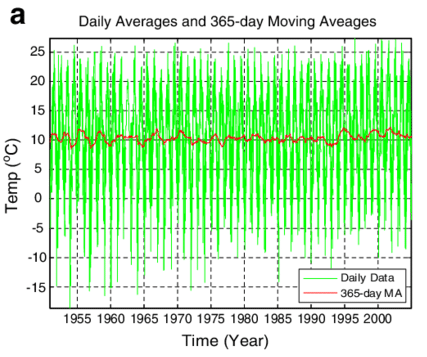
More importantly, say you had perfect data and a perfect model. How could we possibly know what impact that will have? Another thought experiment: How much will temperatures vary where you live today? Ten degrees? Twenty degrees? Thirty? How much does it vary in a year? For most of the U.S., that number might be 50 degrees, a 100 degrees. So plants and animals have adapted to 20-degree temperatures changes in a day or 100-degree temperature changes in a year.

Daily average temperature variability of Bolu City, Turkey, and its 365-day moving average.

Somehow a 1- or 2-degree temperature change in a hundred years
is going to take them out? That’s ridiculous.

Finally, when somebody offers me a forecast, my first question is, how right have your other forecasts been? We are now in the third or fourth ten-year period of the last forty years when the world is going to end in ten years. That tells you all you need to know about global warming forecasting.

The fact that any counter-narratives have to be censored is also damning. A final fact to consider is one my mother taught me at a young age: when the other side starts calling you names (deniers, anti-vaxxers), you know they have lost the argument.

And yet we should totally restructure society based on those impossible models. This was probably the greatest scientific lie in history, and people believed it. After that, selling the lie that even though mRNA vaccines have never worked in thirty years and generally killed all their test subjects but are now safe and effective for humans, including babies, after two months of limited testing, is child’s play. Joseph Goebbels, a proponent of the “Big Lie,” would be proud about both lies.

Before we restructure the world based on models, we must realize they can’t be right.

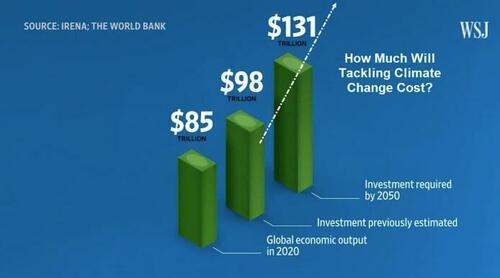
The blue background obscures these are estimates of TRILLIONS of Dollars.


Arctic “Amplification” Not What You Think

HT to Dr. David Whitehouse writing at GWPF regarding a recent study claiming Arctic Amplification is causing a wavey polar vortex, resulting in winter warming and cooling extremes.  His critique is Extreme cold snaps and global warming: A speculative explanation.

This post is challenging the notion of Arctic Amplification itself.  The term is bandied about with the connotation that man-made global warming is multiplied in the Arctic and responsible for weather extremes.

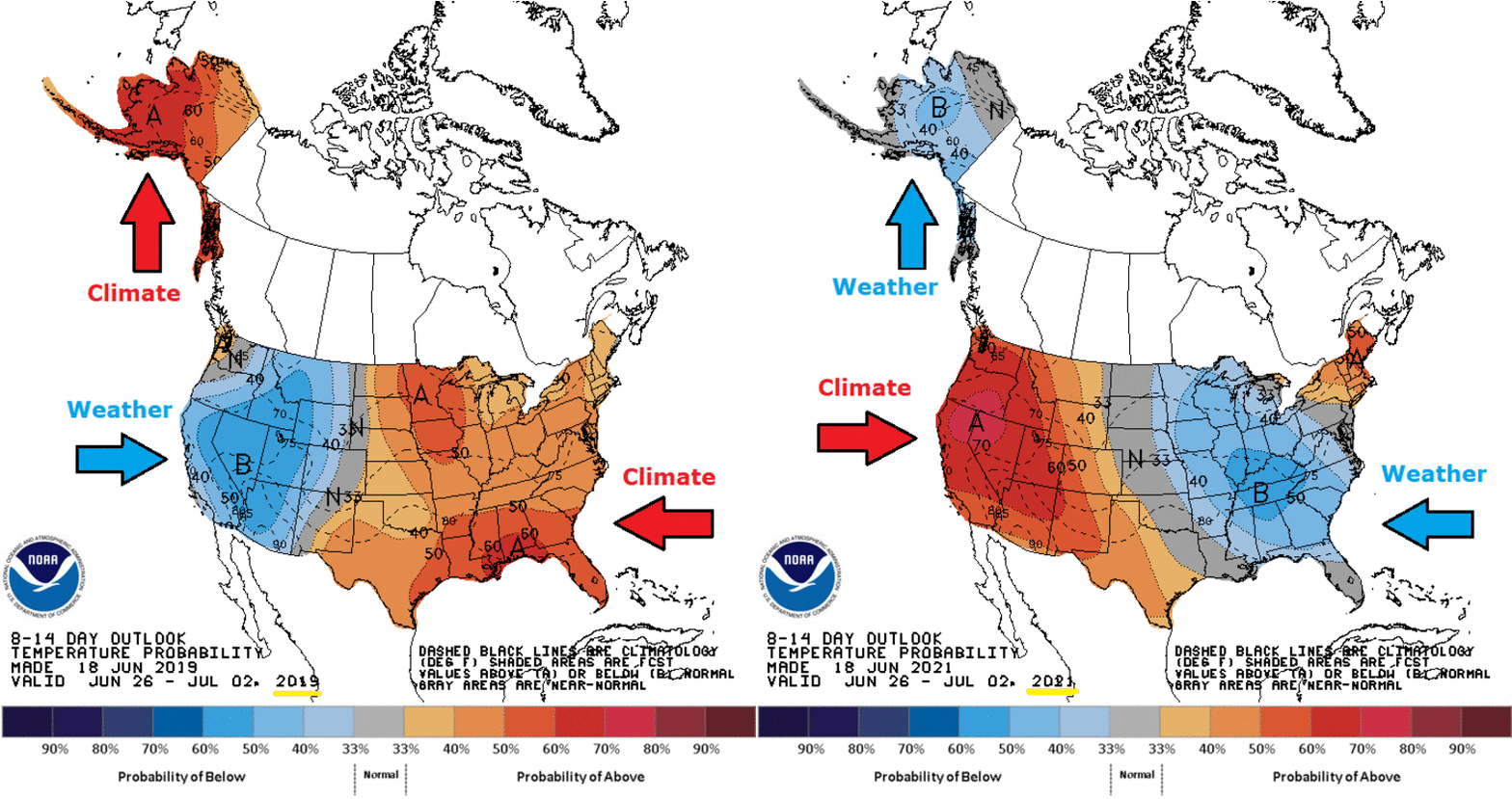
As the animation above shows, there have been in recent years alternating patterns of unusually cold or warm weather in the Northern Hemisphere.  There are several problems in the attempt to link these events to global warming/climate change, i.e. claiming causation from a slow increase in baseline global average temperatures.

  1. Arctic Amplification is an artifact of Temperature Anomalies
  2. Arctic Surface Stations Records Show Ordinary Warming
  3. Arctic Warmth Comes from Meridional Heat Transport, not CO2

Clive Best provides this animation of recent monthly temperature anomalies which demonstrates how most variability in anomalies occur over northern continents.

1. Arctic Amplification is an artifact of Temperature Anomalies

Beyond the issues with the measurements and the questionable adjustments, there is a more fundamental misconception about air temperatures in relation to “climate change.” Clive Best does a fine job explaining why Global Mean Temperature anomalies do not mean what people think. Below is my synopsis of his recent essay entitled Do Global Temperatures make sense? (link)

Background: Earth’s Heat Imbalance

ERBE measurements of radiative imbalance.

The earth’s temperature at any location is never in equilibrium. It changes daily, seasonally and annually. Incoming solar radiation varies enormously especially near the poles which receive more energy per day in summer than the equator.

The earth cools primarily by moving heat from hot tropical regions towards high latitudes where net IR radiation loss cools the planet, thus maintaining a certain temperature profile.

Key Point: GMT Anomalies Are Dominated by the Highest Latitudes

The main problem with all the existing observational datasets is that they don’t actually measure the global temperature at all. Instead they measure the global average temperature ‘anomaly’. . .The use of anomalies introduces a new bias because they are now dominated by the larger ‘anomalies’ occurring at cold places in high latitudes. The reason for this is obvious, because all extreme seasonal variations in temperature occur in northern continents, with the exception of Antarctica. Increases in anomalies are mainly due to an increase in the minimum winter temperatures, especially near the arctic circle. 

To take an extreme example here is the monthly temperature data and calculated anomalies for Verkoyhansk in Siberia. Annual temperatures vary from -50C in winter to +20C in summer. That is a seasonal range of 70C each year, and a year to year anomaly variation of ~8C is normal. The only global warming effect evident is a slight increase in the minimum winter temperatures since 1900. That is not due to any localised enhanced greenhouse effect but rather to an enhanced meridional heat transport. Temperatures in equatorial regions meanwhile have only ~4C seasonal variations, and show essentially no warming trend.

2. Arctic Surface Stations Records Show Ordinary Warming

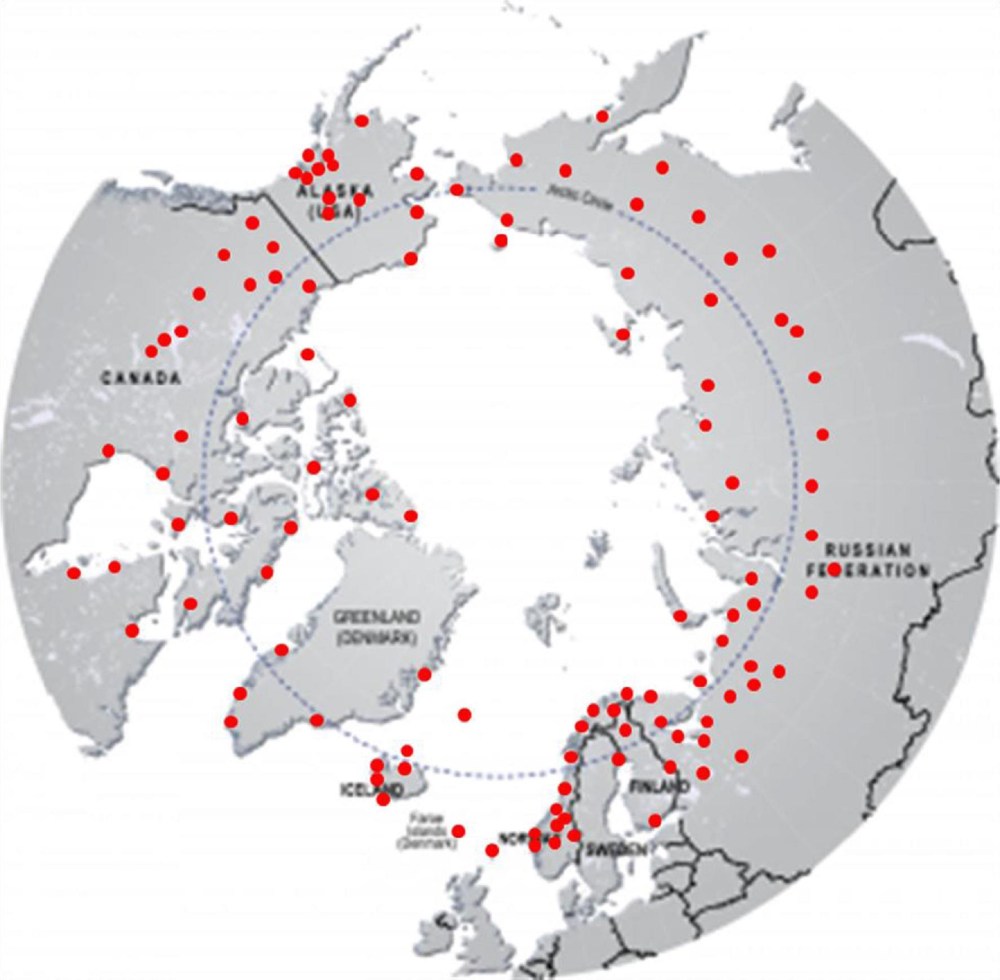
Locations of 118 arctic stations examined in this study and compared to observations at 50 European stations whose records averaged 200 years and in a few cases extend to the early 1700s

A recent extensive analysis of Northern surface temperature records gives no support for Arctic “amplification” fears.

The Arctic has warmed at the same rate as Europe over the past two centuries. Heretofore, it has been supposed that any global warming would be amplified in the Arctic. This may still be true if urban heat island effects are responsible for part of the observed temperature increase at European stations. However, European and Arctic temperatures have remained closely synchronized for over 200 years during the rapid growth of urban centres.

And the warming pattern in Europe and the Arctic is familiar and unalarming.

Arctic temperatures have increased during the period 1820– 2014. The warming has been larger in January than in July. Siberia, Alaska and Western Canada appear to have warmed slightly more than Eastern Canada, Greenland, Iceland and Northern Europe. The warming has not occurred at a steady rate. Much of the warming trends found during 1820 to 2014 occurred in the late 1990s, and the data show temperatures levelled off after 2000. The July temperature trend is even slightly negative for the period 1820–1990. The time series exhibit multidecadal temperature fluctuations which have also been found by other temperature reconstructions.

The paper is: Arctic temperature trends from the early nineteenth century to the present W. A. van Wijngaarden, Theoretical & Applied Climatology (2015).  My synopsis: Arctic Warming Unalarming

3. Arctic Warmth Comes from Meridional Heat Transport, not CO2

Key Point: Heat Distribution Changes, not Global Temperatures

Rising CO2 levels modify that radiation imbalance profile slightly. Surface temperatures in the tropics are not really warming at all. Any excess heat induces more clouds and more convection while surface temperatures remain constant. What really happens is that the meridional radiation profile changes. Slightly more heat is transported polewards so that hot places are shifting more heat to cold places which are doing the warming. If CO2 levels stop rising then a new temperature and radiation profile would rather quickly be reached. This is then called ‘climate change’ but any such changes are concentrated in colder regions of the world. The global ‘temperature’ itself is not changing, but instead the global distribution of temperature is changing.

Key Point: More Atmospheric Heat means Warming in the Coldest Places

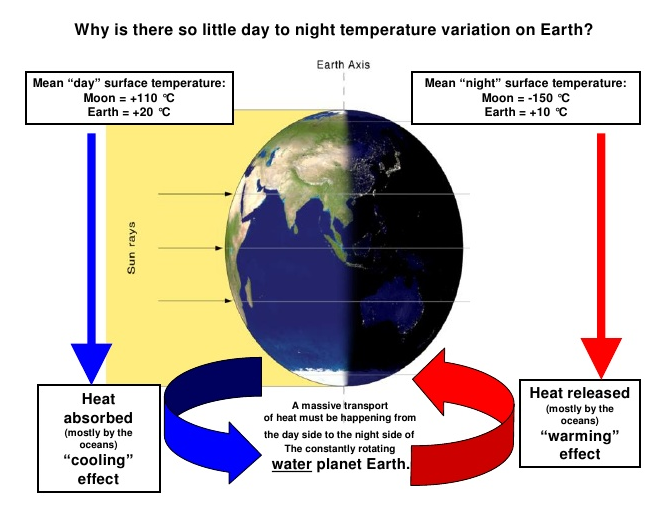
Temperatures at the poles during 6 months of darkness would fall well below -150C if there was no atmosphere, similar to the moon. Instead heat is constantly being transported from lower latitudes by the atmosphere and ocean and so that temperatures never fall much below -43C. If more heat is transported northwards than previously, then minimum temperatures must rise, and this is what we observe in individual measurements.

Long term changes in temperature anomalies occur mainly in northern continents in winter months. This is not because the earth as a whole is warming up but rather that meridional heat transport from the equator to the poles has increased and the largest effect on ‘anomalies occurs in winter. The average absolute temperature of the earth’s surface is unknown. Basing the evidence for climate change on the 150 year trend in global averaged temperature anomalies still biases the result towards higher latitudes where most of the stations are located.

Summary

When heat is released into the atmosphere from the oceans, it is transported toward the poles to dissipate into space. Places in higher latitudes are warmed, not by radiative effects of greenhouse gases in those locales, but by the incursion of warmer air from the equator.

What happens if more CO2 is added into the atmosphere? No one knows, but there are many opinions, a popular one being that more heat is retained in the atmosphere. But in that case, that additional heat will be shed by the planet in exactly the same manner: transport to the poles with slightly less extremely cold air at the higher latitudes.

Why in the world would we pay anything to prevent a little bit of warming in the world’s coldest places?

Clive Best takes the analysis further and relates to work by Christopher Scotese in a later post Fact: Future Climate Will Be Flatter, not HotterMore explanation at The Climate Water Wheel

Resources:  Bill Gray: H20 is Climate Control Knob, not CO2

No, CO2 Doesn’t Drive the Polar Vortex (Updated)

Quantifying Natural Climate Change

Update September 24, 2022 Richard Lindzen Weighs In

H/T Not A Lot of People Know That

London, 23 September – A prominent climate scientist has warned that the picture of climate change presented in the IPCC’s narrative is simplistic, ill-conceived, and undermined by observational evidence.
In a new 
discussion paper, Professor Richard Lindzen of the Massachusetts Institute of Technology (MIT) points out that the official picture, focusing narrowly on carbon dioxide as a warming agent, becomes implausible when applied to the details of the climate system.  According to Lindzen,

“If you are going to blame everything on carbon dioxide, you have to explain why, on all timescales, temperatures in the tropics are extremely stable while those in high latitudes are much more variable. The IPCC’s story is that small amounts of greenhouse warming near the equator are ‘amplified’ at high latitudes. But neither theory nor data support the idea of amplification.”

Instead, says Lindzen, this pattern – of stable tropical temperatures and fluctuating ones in high latitudes – is mostly a function of natural processes in the atmosphere and oceans; in other words, changes in oceanic and atmospheric currents that transport heat poleward while drawing varying amounts of heat out of the tropics.  These changes in transport affect the tropics, but they are not determined by the tropics.

“The changes in the earth’s so-called temperature are mainly due to changes in the temperature difference between the tropics and the poles – at least for major changes.  The changes in tropical temperature, which are influenced by greenhouse processes, are a minor contribution.”

Richard Lindzen: An assessment of the conventional global warming narrative (pdf)


UAH: El Nino Rescues Global Warming July 2023

The post below updates the UAH record of air temperatures over land and ocean. Each month and year exposed again the growing disconnect between the real world and the Zero Carbon zealots.  It is as though the anti-hydrocarbon band wagon hopes to drown out the data contradicting their justification for the Great Energy Transition.  Yes, there is warming from an El Nino buildup coincidental with North Atlantic warming, but no basis to blame it on CO2.  

As an overview consider how recent rapid cooling  completely overcame the warming from the last 3 El Ninos (1998, 2010 and 2016).  The UAH record shows that the effects of the last one were gone as of April 2021, again in November 2021, and in February and June 2022  At year end 2022 and continuing into 2023 global temp anomaly matched or went lower than average since 1995, an ENSO neutral year. (UAH baseline is now 1991-2020).

For reference I added an overlay of CO2 annual concentrations as measured at Mauna Loa.  While temperatures fluctuated up and down ending flat, CO2 went up steadily by ~60 ppm, a 15% increase.

Furthermore, going back to previous warmings prior to the satellite record shows that the entire rise of 0.8C since 1947 is due to oceanic, not human activity.

gmt-warming-events

The animation is an update of a previous analysis from Dr. Murry Salby.  These graphs use Hadcrut4 and include the 2016 El Nino warming event.  The exhibit shows since 1947 GMT warmed by 0.8 C, from 13.9 to 14.7, as estimated by Hadcrut4.  This resulted from three natural warming events involving ocean cycles. The most recent rise 2013-16 lifted temperatures by 0.2C.  Previously the 1997-98 El Nino produced a plateau increase of 0.4C.  Before that, a rise from 1977-81 added 0.2C to start the warming since 1947.

Importantly, the theory of human-caused global warming asserts that increasing CO2 in the atmosphere changes the baseline and causes systemic warming in our climate.  On the contrary, all of the warming since 1947 was episodic, coming from three brief events associated with oceanic cycles. 

Update August 3, 2021

Chris Schoeneveld has produced a similar graph to the animation above, with a temperature series combining HadCRUT4 and UAH6. H/T WUWT

image-8


mc_wh_gas_web20210423124932

See Also Worst Threat: Greenhouse Gas or Quiet Sun?

July 2023 Update El Nino plus North Atlantic Spikes Hit Summer Highs

banner-blog

With apologies to Paul Revere, this post is on the lookout for cooler weather with an eye on both the Land and the Sea.  While you will hear a lot about 2020-21 temperatures matching 2016 as the highest ever, that spin ignores how fast the cooling set in.  The UAH data analyzed below shows that warming from the last El Nino had fully dissipated with chilly temperatures in all regions. After a warming blip in 2022, land and ocean temps dropped again with 2023 starting below the mean since 1995.  Now in July EL Nino appears in a major Tropical ocean air spike in concert with North Atlantic high temps.

UAH has updated their tlt (temperatures in lower troposphere) dataset for July 2023. Posts on their reading of ocean air temps this month preceded updated records from HadSST4.  I last posted on SSTs using HadSST4 North Atlantic Warming June 2023. This month also has a separate graph of land air temps because the comparisons and contrasts are interesting as we contemplate possible cooling in coming months and years. Sometimes air temps over land diverge from ocean air changes.  For example in May 2023, ocean temps in all regions moved upward, while Tropical and NH land air temps dropped sharply. 

In July, as shown later on, Global ocean air jumpted upward led by rising temps in all regions, led by Tropics and NH.  Land air temps augmented this warming also with spikes in all regions.  Thus the land + ocean Global UAH temperature is now nearly matching the 2016 peak.

Note:  UAH has shifted their baseline from 1981-2010 to 1991-2020 beginning with January 2021.  In the charts below, the trends and fluctuations remain the same but the anomaly values change with the baseline reference shift.

Presently sea surface temperatures (SST) are the best available indicator of heat content gained or lost from earth’s climate system.  Enthalpy is the thermodynamic term for total heat content in a system, and humidity differences in air parcels affect enthalpy.  Measuring water temperature directly avoids distorted impressions from air measurements.  In addition, ocean covers 71% of the planet surface and thus dominates surface temperature estimates.  Eventually we will likely have reliable means of recording water temperatures at depth.

Recently, Dr. Ole Humlum reported from his research that air temperatures lag 2-3 months behind changes in SST.  Thus the cooling oceans now portend cooling land air temperatures to follow.  He also observed that changes in CO2 atmospheric concentrations lag behind SST by 11-12 months.  This latter point is addressed in a previous post Who to Blame for Rising CO2?

After a change in priorities, updates are now exclusive to HadSST4.  For comparison we can also look at lower troposphere temperatures (TLT) from UAHv6 which are now posted for July.  The temperature record is derived from microwave sounding units (MSU) on board satellites like the one pictured above. Recently there was a change in UAH processing of satellite drift corrections, including dropping one platform which can no longer be corrected. The graphs below are taken from the revised and current dataset.

The UAH dataset includes temperature results for air above the oceans, and thus should be most comparable to the SSTs. There is the additional feature that ocean air temps avoid Urban Heat Islands (UHI).  The graph below shows monthly anomalies for ocean air temps since January 2015.

Note 2020 was warmed mainly by a spike in February in all regions, and secondarily by an October spike in NH alone. In 2021, SH and the Tropics both pulled the Global anomaly down to a new low in April. Then SH and Tropics upward spikes, along with NH warming brought Global temps to a peak in October.  That warmth was gone as November 2021 ocean temps plummeted everywhere. After an upward bump 01/2022 temps reversed and plunged downward in June.  After an upward spike in July, ocean air everywhere cooled in August and also in September.   

After sharp cooling everywhere in January 2023, all regions were into negative territory. Note the Tropics matched the lowest, but since  have spiked sharply upward +1.25C, with the largest increases in May, June and July 2023.  NH also warmed 0.6C in the last 3 months, while SH ocean air rose 0.5C since February. Global Ocean air July 2023 is second only to 2016, which had Feb./March peaks followed by cooling.  The strength of the El Nino will determine the latter half of this year.

Land Air Temperatures Tracking Downward in Seesaw Pattern

We sometimes overlook that in climate temperature records, while the oceans are measured directly with SSTs, land temps are measured only indirectly.  The land temperature records at surface stations sample air temps at 2 meters above ground.  UAH gives tlt anomalies for air over land separately from ocean air temps.  The graph updated for June is below.

Here we have fresh evidence of the greater volatility of the Land temperatures, along with extraordinary departures by SH land.  Land temps are dominated by NH with a 2021 spike in January,  then dropping before rising in the summer to peak in October 2021. As with the ocean air temps, all that was erased in November with a sharp cooling everywhere.  After a summer 2022 NH spike, land temps dropped everywhere, and in January, further cooling in SH and Tropics offset by an uptick in NH. 

Remarkably, in 2023, SH land air anomaly shot up 1.5C, from  -0.56C in January to +0.93 in July.  Tropical land temps are up 1.25 since January and NH Land air temps rose 0.7.   The consolidated rise resembles the upward spikes starting in September 2015.

The Bigger Picture UAH Global Since 1980

The chart shows monthly Global anomalies starting 01/1980 to present.  The average monthly anomaly is -0.06, for this period of more than four decades.  The graph shows the 1998 El Nino after which the mean resumed, and again after the smaller 2010 event. The 2016 El Nino matched 1998 peak and in addition NH after effects lasted longer, followed by the NH warming 2019-20.   An upward bump in 2021 was reversed with temps having returned close to the mean as of 2/2022.  March and April brought warmer Global temps, later reversed.

With the sharp drops in Nov., Dec. and January 2023 temps, there was no increase over 1980. Now in 2023 the buildup to the July peak resembles closely the sharp July peak of the El Nino 1998 event. It is second only to the March peak in 2016.  Where it goes from here, up or down, remains to be seen.

TLTs include mixing above the oceans and probably some influence from nearby more volatile land temps.  Clearly NH and Global land temps have been dropping in a seesaw pattern, nearly 1C lower than the 2016 peak.  Since the ocean has 1000 times the heat capacity as the atmosphere, that cooling is a significant driving force.  TLT measures started the recent cooling later than SSTs from HadSST3, but are now showing the same pattern. Despite the three El Ninos, their warming has not persisted prior to 2023, and without them it would probably have cooled since 1995.  Of course, the future has not yet been written.


Heatless in Seattle Summer 2023

With all the media noise about “Global Boiling”, they must think we are all frogs in a pot on the stove (electric, no gas permitted).  And yet, what a difference a year makes in the US Northwest, as Cliff Mass reminds at his blog A Summer Without Extreme Heat in the Northwest.  Excerpts in italics with  added images.

With all the talk of heat waves in the media these days, it is fascinating to note that the Pacific Northwest has NOT had extreme heat this summer.  

No major heatwaves.   A lack of warm temperature records.

A really moderate, benign summer regarding high temperatures.  And the temperate weather is not over.

And more surprises…there is really little evidence over the past decades of increases in extreme July heat in our region.

Let me show you some data, to prove the above to you.

Just a reminder….the end of July is climatologically the warmest time of the year (see the climatology of SeaTac Airport, below).   By the end of August, solar radiation has declined so much that the temperatures inevitably decline.


A July Without Extreme Heat

Below you will find plots of the highest temperature in July over many decades for five local stations:  Olympia and Bellingham in western Washington, Wenatchee and Kennewick in eastern Washington, and Portland, Oregon.  I have plotted the July highs for the entire period of record and plotted a linear trend line for your reference.

Really interesting.   The high temperatures in July at these stations have been very average and FAR below record levels.  

Most of you have not needed AC this month.

Perhaps Shocking to Some
Now look at the trend of the extreme July temperatures above (brown lines) and you will notice something that is perhaps surprising:  there are no large increases in record July temperatures over many decades.
About a 1°F increase at Bellingham and Olympia, roughly .5 °F at Portland and Wenatchee, and a DECLINE of roughly 2 F at Kennewick over many decades.
The background global warming of mean temperatures is about 2F.  Our regional extremes are going up LESS than that.  
There is no local amplification of extreme temperatures as the planet slowly warms.
To bring home the message of the lack of extreme temperatures this July, below are the temperatures at Olympia and Wenatchee (blue bars showing observed highs and lows), with record daily highs shown by the red colors.
No daily high-temperature records were broken.  None. Nada. Zippo.

Finally, the moderate temperatures are not over.  

To illustrate, the latest 7-day forecast from the European Center ensemble (shown below) indicates cooler than normal conditions (blue colors) over and west of the Cascade crest (this is for the daily average temperature, NOT the high temperatures).
As noted in my previous blogs, the lack of extreme high temperatures is associated with a persistent atmospheric circulation pattern.  It also helps explain the lack of wildfires over the region.