Court Again Refuses to Legislate Climate Policy

Climatists again fail to get a judge to order their program and thus bypass lawmaking by elected representatives. Denise Lavoie reports at The Virginian-Pilot Virginia judge dismisses youth climate change lawsuit.  Excerpts in italics with my bolds.

RICHMOND — A Virginia judge on Friday dismissed a lawsuit filed on behalf of 13 young people who claim that the state’s permitting of fossil fuel projects is exacerbating climate change and violating their constitutional rights.

The lawsuit filed by Our Children’s Trust, an Oregon-based nonprofit public interest law firm, asked the court to declare portions of the Virginia Gas and Oil Act unconstitutional. It also seeks to find the state’s reliance on and promotion of fossil fuels violates the rights of the plaintiffs, who range in age from 10 to 19.

But Richmond Circuit Court Judge Clarence Jenkins Jr. granted the state’s request to dismiss the lawsuit, finding that the complaint is barred by sovereign immunity.

That’s a legal doctrine that says a state cannot be sued without its consent. The state argued that sovereign immunity prohibited the plaintiffs’ claims because they sought to restrain the state from issuing permits for fossil fuel infrastructure and to interfere with governmental functions. The judge did not rule on the merits of the plaintiffs’ constitutional claims.

The lawsuit is one of five filed by Our Children’s Trust in states around the country. Lawsuits in Hawaii and Utah are in the early stages, while a lawsuit it Montana is expected to go to trial next year. A federal lawsuit filed in Oregon in 2015 remains in litigation after the 9th U.S. Circuit Court of Appeals ruled against the plaintiffs last year. They have since asked to file a more narrow amended complaint and are awaiting a decision.

Jenkins ruled from the bench and dismissed the lawsuit with prejudice, meaning it cannot be refiled again in the same court. Their attorney, Nathan Bellinger, said they will promptly appeal the ruling to the state Court of Appeals.

Ten of the plaintiffs — accompanied by their parents — listened in court as Bellinger said the state is knowingly contributing to the climate crisis by continuing to rely on fossil fuels as its main energy sources and polluting the atmosphere with greenhouse gas emissions. He asked the judge to allow the case to proceed to trial.

The lawsuit alleges that climate change has contributed to health problems experienced by the plaintiffs, including asthma and heat exhaustion. Four of the plaintiffs have become ill after being bitten by ticks, a population that has increased due to climate change, Bellinger said.

It also claims that Virginia has violated the public trust doctrine, which says that the state has a duty to hold certain natural resources in trust.

“These courageous Virginia youths … are turning to the judiciary to protect their fundamental rights,” Bellinger argued in court.

Bellinger said the Virginia lawsuit is the first to leave out a request for an injunction to require the state to take certain actions or to submit a remedial plan. Instead, it asked only for a declaration that the continued permitting of fossil fuel projects violated the plaintiffs’ rights.

But attorneys for the state argued that the plaintiffs are attempting to usurp the role of the state legislature and impose their preferred energy and environmental policies on the state.

“Simply put, this action belongs two blocks over at the General Assembly and not before this court,” said Assistant Attorney General Thomas Sanford.

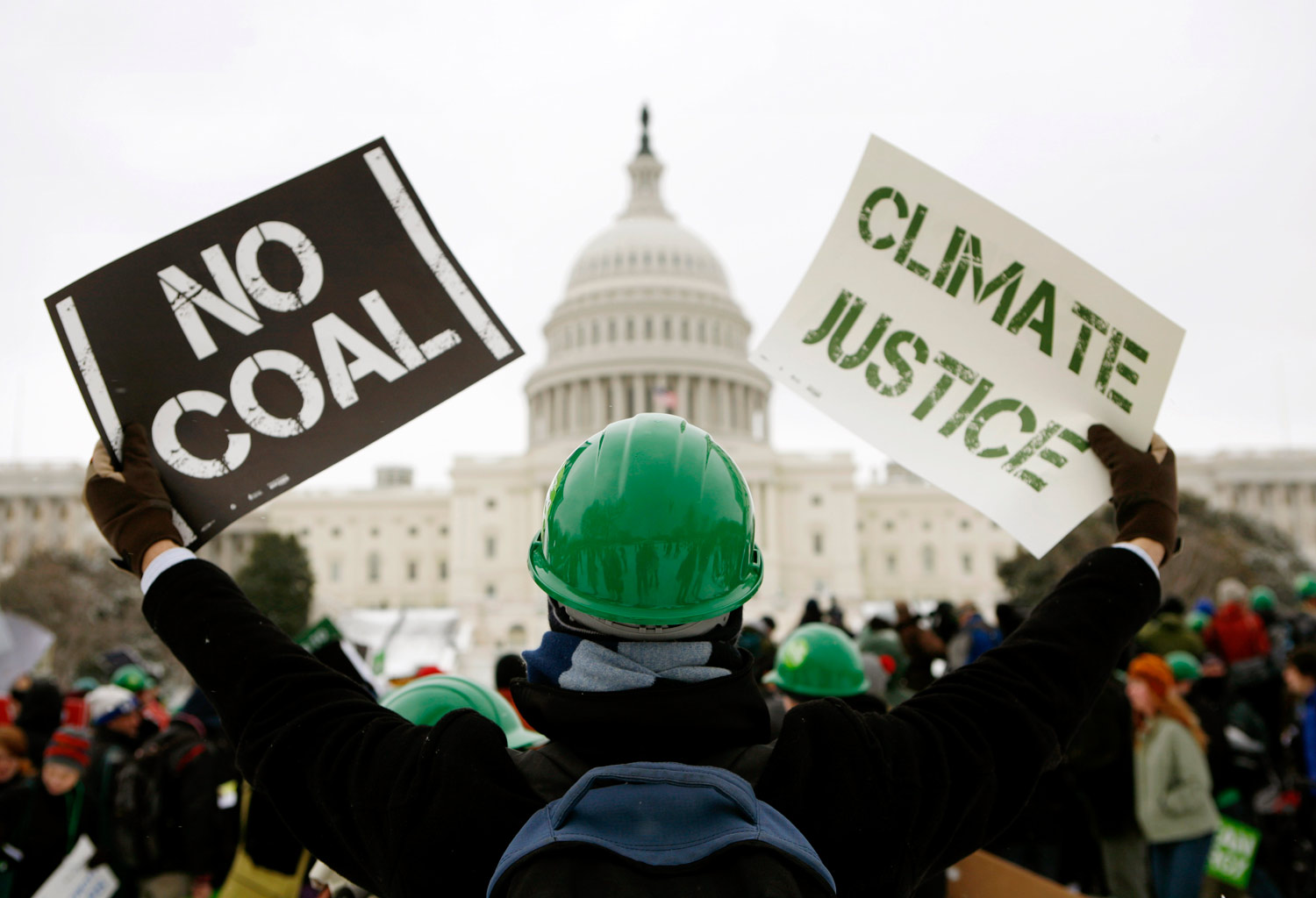
After the court hearing, several of the plaintiffs spoke during a news conference where they held a large banner proclaiming, “Climate Justice in our Courts NOW!”


Footnote:  The thing about ticks was creative, and reminded me of this:

Alarmists: Global Warming Destroys Good Bugs and Multiplies Bad Bugs


Cal Shows How Politicians Short Electrical Grids

A new book provides a knowledgeable and deft analysis of how a state can ruin its supply of electrical power to the people.  Katherine Blunt has published California Burning: The Fall of Pacific Gas & Electric and What It Means for America’s Power Grid.  A review summary is provided at American Conservative Behind the ‘Grid Emergency’.  Excerpts in italics with my bolds and added images.

A new book explains how California’s power system went so wrong.

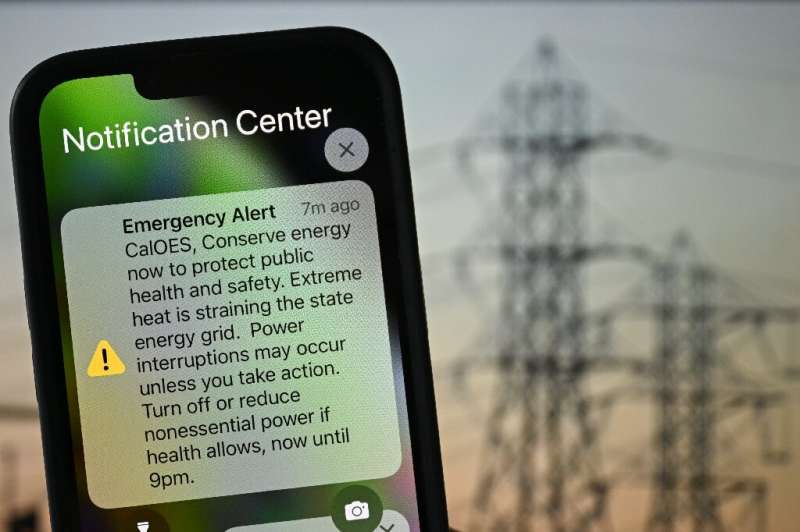
Reporter Katherine Blunt of the Wall Street Journal was lucky in the timing of her new book, California Burning: The Fall of Pacific Gas & Electric and What It Means for America’s Power Grid. Within 24 hours of its release, California declared a “grid emergency” and customers were warned to avoid using major appliances or charging electric cars between 4 and 10 p.m. in order to avert blackouts. It was a clear sign that the dysfunction detailed in Blunt’s book is an ongoing concern.

How did we get here? Or, more accurately, how did we get here again?

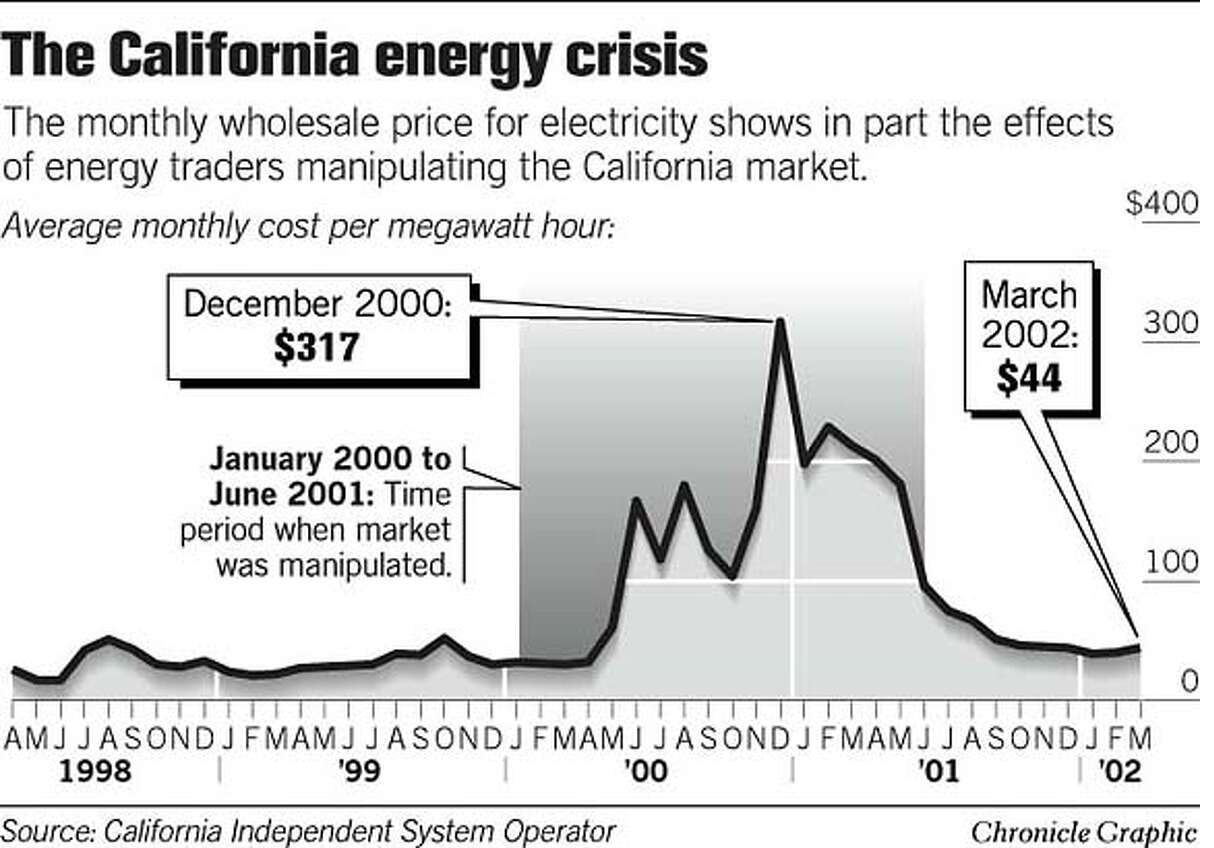
Reading about the California energy crisis brings on déjà vu in those who remember the last one, which wracked the state in 2000 and 2001. That episode also involved rising prices and rolling blackouts. It led to the downfall of a governor, the shuttering of the California Power Exchange, the state’s privatized electricity marketplace, and the bankruptcy of the utility company that serves northern California, Pacific Gas & Electric.

Now PG&E is fresh out of bankruptcy proceedings again, for the second time in less than two decades. The deeper problems with its grid have not yet been fixed. Why can’t California keep the lights on?

The two electricity crises had different superficial causes but the fundamental problem in both cases was the same. The ideological commitments of politicians and regulators blinded them to the depredations of parasitic actors who extracted huge amounts of money from the system and introduced instability that ultimately led to disaster.

In 2000, the ideology was privatization and the predator was Enron. To introduce market forces into what had been regulated monopolies, California broke up its utilities and separated electricity generation and transmission in the 1990s. Instead of a free market and lower prices, Californians got price spikes caused by the manipulations of traders. Blunt quotes from recorded phone calls where Enron employees told plant operators, “We want you guys to get a little creative and come up with a reason to go down.” The plant went down, on the excuse of a turbine inspection, and the price of electricity shot up just as Enron wanted. These kinds of schemes were common.

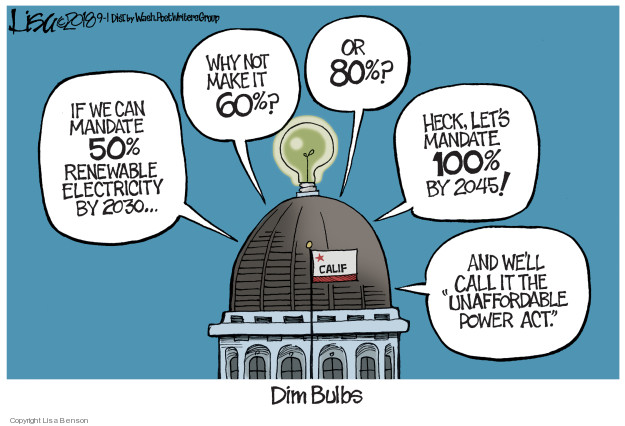
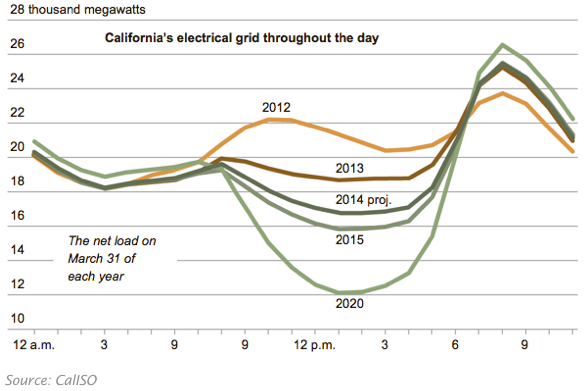
This time, the ideology that has captured politicians and regulators is climate change. California has been more aggressive than any other state in setting renewable energy targets, currently aiming to be 60 percent reliant on renewables by 2030. Unfortunately for its ratepayers, these renewable energy suppliers rely on billions in subsidies and still cost more per kilowatt-hour than other forms of energy. Solar and wind power are also irregular compared to more old-fashioned power plants. The result has been unreliable electricity supply and some of the highest power prices in the nation.

Of the two energy crises, the current one is more severe than that of twenty years ago because of the added factor of wildfires. More than a hundred people died and more than a million acres burned in these fires. The Camp Fire of 2018, sparked by a downed PG&E transmission line, was the deadliest in the state’s history and practically wiped the town of Paradise off the map. The Dixie Fire of 2021 was the state’s largest, destroying a total area bigger than Rhode Island.

There are two competing explanations for why the electricity crisis was more destructive this time around. Climate change is the explanation that Governor Gavin Newsom favors, and which Blunt hints at. It argues that hotter temperatures and extreme weather are overtaxing the grid and making disasters more frequent.

The problem with climate change as an explanation, though, is that California’s grid is struggling to achieve basic service levels even without extreme weather. Back in May, when California energy officials warned of rolling blackouts later in the summer, they predicted shortfalls even in the absence of heat waves or wildfires. The current heat wave, which led to last week’s “grid emergency,” is merely aggravating a problem that existed already.

Moreover, Blunt documents in detail all the ways that wildfires were caused not by extreme weather but by PG&E’s negligence. The fire that destroyed the town of Paradise was caused by a worn down iron hook, originally purchased in 1919, that broke and shed sparks onto dry brush. When investigators sought records of how often that part of the line had been inspected, they found no files at all prior to 2001—not unusual given PG&E’s spotty recordkeeping. (When a gas line exploded in 2010 and investigators sought records of pipeline conditions across the system, a PG&E employee responded, “God knows what is underground.”) Records after 2001 showed inspectors viewing the hook from the air and from the ground, but no one had actually climbed the tower to see it up close.

This leads to the second explanation for why California is less able to cope with electricity problems today, which is that it is further along in its ongoing Third Worldization. What it means to be Third World has no precise definition but it has to do with losing the capacity to keep basic things functioning. Standards slip, fewer people every year remember how to maintain legacy systems, and eventually those systems collapse.

South Africa’s electricity supplier Eskom was named the best power company in the world in 2001. Twenty years later, the company is plagued by rampant blackouts (known euphemistically as “load shedding”) as well as internal corruption and rate evasion. Last year, President Cyril Ramaphosa passed a new law allowing private companies to build their own power plants up to 100 megawatts (the previous limit was 1 MW). That was a solution for mining companies that were shuttering facilities where they could not count on regular power. Small businesses and residences already considered gas-powered generators a necessity for when load-shedding hits their neighborhood.

A telling episode in Blunt’s book is the search for a new CEO that PG&E undertook in 2016. One of the finalists was Nick Stavropoulos, who had performed an incredible feat in bringing the gas division up to industry standards after the 2010 San Bruno explosion, in the face of widespread employee demoralization after an unpopular CEO’s flat-footed reforms. Stavropoulos was going to work the same magic on the electricity division, which, if anything, needed it more.

Instead, the company went with a woman named Geisha Williams, born in Cuba, who became the first Latina to head a Fortune 500 company. Her resume was impressive on paper. On the other hand, a leaked email from a staffer at the California Public Utilities Commission referred to Williams as “senior vice president of bullshittery.” Stavropoulos was “bitterly disappointed” at being passed over, according to Blunt, and soon left the company. The board forced Williams to resign in 2019, as the company was on the brink of filing for bankruptcy.

California’s power brokers feel that they can focus on political goals, like diversity in C-suites and renewable energy targets, because they trust that the basic functioning of the system is guaranteed.

They take it for granted. But as the example of Eskom shows, this is not a safe assumption. A power grid works because people know how to make it work. If those people are sidelined or cast off, or if political priorities drown out their advice, the system can carry on out of sheer momentum for a while, even for years. But not forever.

Hope for Trudeau’s Exit

The conventional wisdom that Poilievre cannot win a national election is wearing thin. PHOTO BY JACQUES BOISSINOT /THE CANADIAN PRESS

The end of Trudeau’s regime in Canada can’t happen soon enough, but hope is on the horizon.  Joe Oliver writes at National Post Canada Liberals risk drowning in the Poilievre wave.  Excerpts in italics with my bolds.

As the Conservative leadership campaign approaches what now seems certain to be Pierre Poilievre’s coronation, progressives are unnerved by the huge crowds of all ages he is attracting across the country, which point to an expanding Conservative base. Predictably, the Laurentian elite and their media loyalists have dissolved into full-blown derangement syndrome, while providing cover for Liberal missteps.

Intriguingly, they are less protective of an increasingly unpopular prime minister.

The conventional wisdom that Poilievre cannot win a national election is wearing thin. Inflation, which people intuitively understand was created and exacerbated by government profligacy, is the public’s top concern. There is also widespread frustration with the government’s maddening incompetence and multiple ministerial missteps: Omar Alghabra for the airport debacles, Marco Mendicino, for misleading Parliament about the Emergencies Act, Karina Gould for mind-boggling passport delays, Mélanie Joly for an official inexplicably attending a Russian diplomatic party, Ahmed Hussen and Pablo Rodriguez for the Marouf scandal, Chrystia Freeland for favouring out-of-control spending over growth.

The prime minister’s charisma has faded with his team’s eroding credibility. Moreover, even die-hard Liberals are disillusioned by his own divisive tactics, hypocritical virtue-signalling, inability to deliver on priorities, tarnished brand abroad and, perhaps most important for them, 50 per cent disapproval rating.

The government is notoriously selective about treating people differently depending on their race, ethnic group, gender identity, sexual preference, age or country of origin.

The most obvious case in point is that despite Laith Marouf’s appallingly bigoted and anti-semitic comments he was paid half a million public dollars to provide anti-racism advice. The absence of even elementary due diligence is inexcusable. Worse, it took over a month for the responsible minister to act and even longer for the prime minister to comment, no doubt in part because he did not want to own up to his ministry’s incompetence but perhaps also because Marouf hypocritically presented himself as a supposed ally in its core mission.

Had a racial minority or Aboriginal person been called a bag of feces or threatened with a bullet to the head the PM would quite rightly have expressed outrage, likely in minutes. He was appropriately quick off the mark when Chrystia Freeland was subject to unacceptable verbal harassment. Which makes the delayed reaction from the government and many in the media in the Marouf case even more disconcerting. The Jewish community is understandably disheartened by the blatant double standard. As a matter of basic decency, not to mention fundamental philosophical principle, governments should treat people equally and not discriminate based on twisted notions about identity or victimhood politics.

Pierre Poilievre clearly understands the widespread and growing anger about the disdain, condescension and snobbery a progressive elite have for working and lower middle-class Canadians. He empathizes with resentment about nanny-state intrusions, the politicization of science and the often bizarre ideas of left-wing ideologues, woke capitalists and “expert” academics. He agrees with people who rail against a government that allows faceless bureaucrats to infringe on their agency, curtail their freedom and damage their standard of living with heavy taxes and burdensome regulations.

Critics are torn between claiming Pierre Poilievre has no policies and denouncing these non-policies as extreme. He is decried as a populist because he seeks public support (as if the Liberal default position on just about everything is not to swing with public opinion). The “Trump North” label has failed to stick because he has been consistently pro-choice, supports gay marriage and favours immigration.

Liberals loath Pierre Poilievre because they fear he will dismantle excessive government intervention in society and the economy, reverse tax-and-spend policies, encourage natural resource development, defend free speech and genuine diversity of opinion, decry woke-ism, defund the CBC and undercut elite influence.

But it is Pierre Poilievre, not Justin Trudeau, who reflects mainstream Canadian thinking about fundamental issues. He believes profoundly in personal freedom and is proud of our history.

In contrast, Trudeau has called Canada systemically racist and guilty of genocide. He proclaimed it the world’s first “post-national” state and declared “There is no core identity, no mainstream in Canada.” His far-left thinking manifests itself in a profligate government that creates more problems than it solves.

Trudeau’s cultish climate obsession has wrought enormous harm to jobs, growth, national unity and the economic prospects of Indigenous peoples. Yet it has not achieved a single national GHG target or impacted global warming even minutely — something that actually could be achieved if Canadian LNG replaced coal in energy-hungry Asia and Europe.

I expect Pierre Poilievre will reach out to his leadership rivals and their supporters the way Stephen Harper did as prime minister. He can easily do that without compromising conservative principles, policy priorities or authenticity. It would be the magnanimous and smart thing to do. He will then speak directly to Canadians about how he will represent their values and interests and pursue his vision for a prosperous, proud and fair country for everyone. No wonder Liberals are worried.


Bumpy US Road to EV Utopia

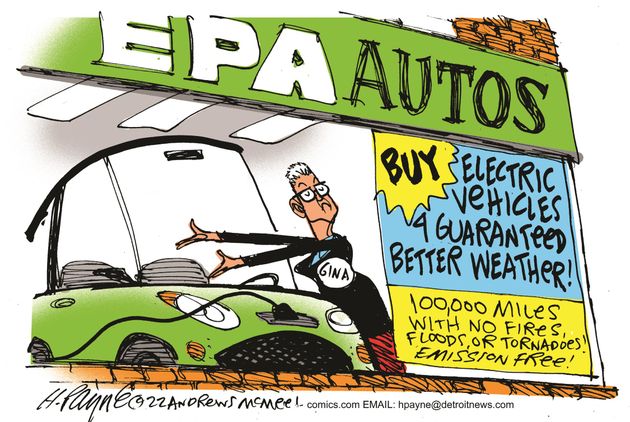
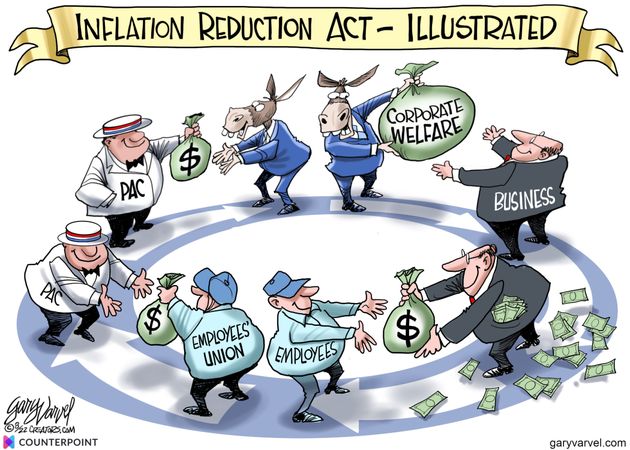
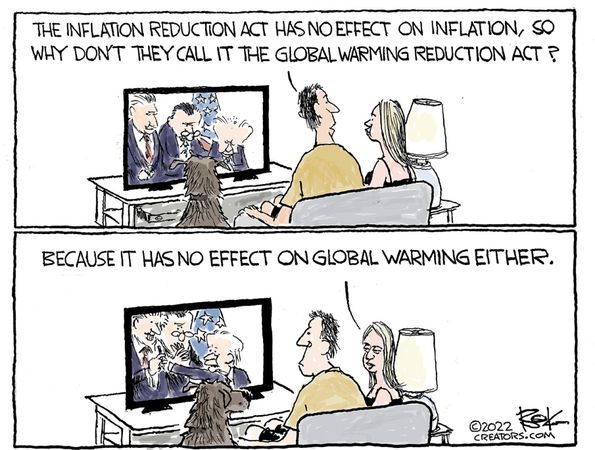
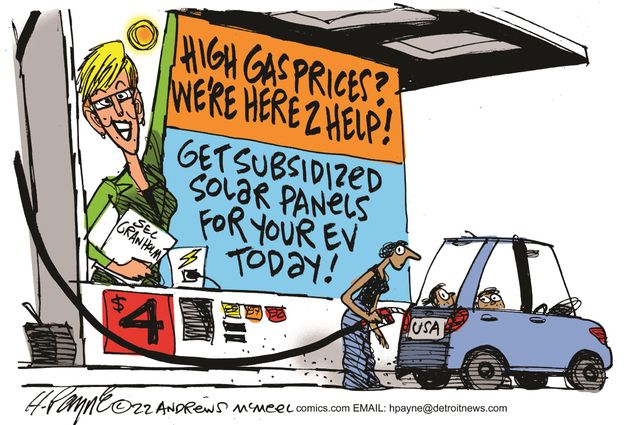
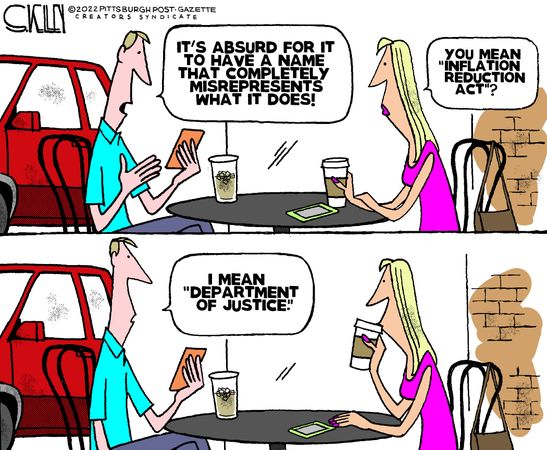
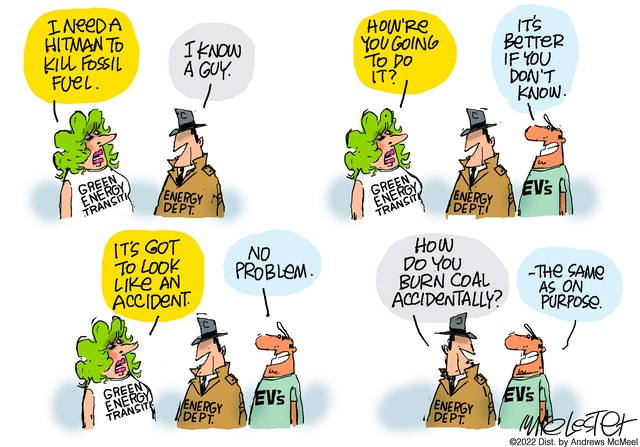
Bonner Cohen reveals land mines and pitfalls in the just signed climate law, the so-called Inflation Reduction Act.  Converting the US auto fleet to Electric Vehicles (EVs) just got much harder, not to say impossible. His Daily Caller article is Why Democrats’ Road to EV Utopia Got a Whole Lot Bumpier. Excerpts in italics with my bolds.

Aside from the new taxes, handouts to the well-connected, and price controls on certain pharmaceuticals, the bill’s “climate” provisions contain a slew of incentives crafted to promote electric vehicles (EVs). But the Byzantine structure lawmakers erected to govern the transition to the EV green utopia guarantees that things will get a lot bumpier than Bette Davis’s character could ever have imagined.

Let’s start with the handouts to the EV industry. U.S. taxpayers have been subsidizing the purchase of EVs for years. Under the new law, those subsidies will be extended through 2032. But only EVs below a certain price will qualify for the tax credits, and only buyers whose income is below a certain level will be eligible to take advantage of them.

Before the new law took effect, buyers could receive tax credits of up to $7,500 only if an automaker had sold fewer than 200,000 EVs, a threshold Tesla and General Motors crossed years ago, and one that other manufacturers are rapidly approaching. Now, only new electric-powered SUVs, vans and trucks that cost less than $80,000 qualify for up to $7.500 in tax credits.

EVs eligible for the tax credits, however, must be assembled in North America and their battery components must come from the U.S. or a handful of friendly nations. And, by 2029, the law stipulates that 100% of battery components are to come from North America. This is where life gets interesting.

Geopolitical Consequences

“Today’s battery and mineral supply chains revolve around China,’ the International Energy Agency (IEA) reported in July. “China produces three-quarters of all lithium-ion batteries and is home to 70% of production capacity for cathodes and 85% of anodes (both are key components of batteries). Over half of lithium, cobalt, and graphite processing and refining capacity is located in China.”

IEA projects that the global market for lithium will grow more than 40-fold by 2040, with demand for nickel, cobalt and graphite likely to be 25-times higher than it is today. Russia is home to about a fifth of the world’s high-grade nickel — a substance coveted by EV manufacturers for extending the range and power of batteries.

In other words, the raw materials essential to the EV transition are largely under the control of America’s geopolitical rivals. China and Russia are also the chief beneficiaries of the soaring costs of the commodities essential to power EVs. But the Schumer-Manchin bill seeks to shift the source of EV battery components to the U.S. or its allies.

Is this realistic? There is only one nickel mine in the U.S., and that Michigan operation is set to close in 2025. Two lithium mines have been proposed in Nevada, but they are encountering fierce resistance from tribal and environmental groups. On average, it takes 12 years for a mining project in the U.S. to clear all the permitting red tape and litigation before it can go into operation. Many projects never come to fruition.

As commodity prices increase, the prices of EVs — already higher than conventionally-powered vehicles — will rise accordingly. Most automakers have already announced plans to cease production of gas-powered vehicles by the middle of the next decade. They, too, will become more expensive as their numbers dwindle. Consumers, being force-fed EVs by government and automakers, will have to dig deeper and deeper.

The disruptions will go far beyond what people will have to pay for personal transportation. Ford just announced it is laying off 3,000 white-collar employees as part of the company’s transition to EVs. Blue-collar workers at Ford, and other automakers, will follow, because it takes fewer workers to assemble an EV (fewer parts) than a conventional vehicle.

Squeeze Play

Furthermore, the vast number of wind farms and solar arrays the Biden administration is planning for the country will require an enormous number of batteries to supply electricity when the sun doesn’t shine and the wind doesn’t blow. Those batteries will compete with EV batteries for the expensive raw materials they need to function, opening the door to shortages and higher costs.

The consumer of modest means will be caught in a squeeze play,
struggling to pay soaring power bills while trying to afford a new, or used, car.

“Even with the tax credits, EVs are impractical and unaffordable for most low-income households,” says Donna Jackson, director of membership development for Project 21, a network of black conservatives. “The real message to the poor and minority communities is take the bus.”

Indeed, the Democrats’ dystopian Inflation Reduction Act will only exacerbate America’s energy woes and cause incalculable hardship for those who can afford it least, low-income, minority families.

See Also West’s Obsession with EV Tech Puts China in World Driver Seat

Neo-Socialist Plan: High-Low, Two-Tier Society

Some socio-political scientists are starting to notice that today’s social engineering efforts are misleadingly described in terms of classical socialism or communism.  For example, Michael Anton writes at American Mind, Socialism and the Great Reset.  Excerpts in italics with my bolds and added images.

It has become increasingly common to hear those on what we may call the conventional Right claim that the main threat facing the historic American nation and the American way of life is “socialism.” These warnings have grown with the rise of the so-called “Great Reset,” ostensibly a broad effort to reduce inequality, cool the planet (i.e., “address climate change”), and cure various social ills, all by decreasing alleged “overconsumption.” In other words, its mission is to persuade people, at least in the developed West, to accept lower standards of living in order to create a more just and “equitable” world. Since the conservative mind, not unreasonably, associates lower standards of living with “socialism,” many conservatives naturally intuit that the Great Reset must somehow be “socialist.”

I believe this fear is at least partly misplaced and that the warnings it gives rise to, however well-meaning, are counterproductive because they deflect attention from the truer, greater threat: specifically, the cabal of bankers, techies, corporate executives, politicians, senior bureaucrats, academics, and pundits who coalesce around the World Economic Forum and seek to change, reduce, restrict, and homogenize the Western way of life—but only for ordinary people.

Their own way of life, along with the wealth and power that define it,
they seek to entrench, augment, deepen, and extend.

This is why a strict or literal definition of “socialism”—public or government ownership and control of the means of production in order to equalize incomes and wealth across the population—is inapt to our situation. The Great Reset quietly but unmistakably redefines “socialism” to allow and even promote wealth and power concentration in certain hands. In the decisive sense, then, the West’s present economic system—really, its overarching regime—is the opposite of socialistic.

It is unnecessary for our purposes here to recount Marx’s and Engels’s distinctions between the various forms of socialism. Suffice it to say that, in their account, all of those varieties constitute cynical or at any rate inconsequential concessions to the lower classes, intended to stave off the emergence of full communism and to preserve ruling class status and privileges. The “socialism” with which we are most familiar today—high and progressive taxation, a generous welfare state, nationalization of key services such as health care, an expansive list of state-guaranteed “rights,” combined with the retention of private property and private ownership of most means of production—Marx and Engels deride as “bourgeois socialism,” i.e., not only not the real thing but fundamentally closer to bourgeois capitalism than to true socialism, much less communism.

Yet there are ways in which this regime might still be tentatively described as “socialist,” at least as it operates for those not members in good standing of the Davoisie. If the Great Reset is allowed to proceed as planned, wealth for all but the global overclass will be equalized, or at least reduced for the middle and increased for the bottom. Many of the means used to accomplish this goal will be “socialistic,” broadly understood.
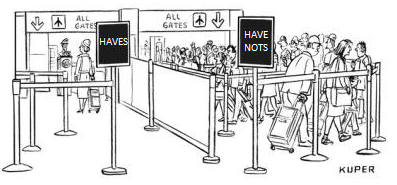
Neo-Socialist Class Warfare is Top-Down

James B. Meigs takes this further, showing how energy policies driven by carbon reduction mandates illustrate the process for imposing a two-tier society upon developed societies.  The lengthy essay is worth reading, while I will provide here only excerpts expanding on the theme of this post.  The City Journal article is The Green War on Clean Energy:  Radical environmentalists fight against the very technologies that would cut carbon emissions. Excerpts in italics with my bolds and added images.

Ted Nordhaus, founder of the eco-modernist Breakthrough Institute, is skeptical of the global climate-industrial complex” on display at COP26. “A climate movement less in thrall to fever dreams of apocalypse would focus more on balancing long-term emissions reductions with growth, development, and adaptation in the here and now,” he writes. The extremists of Extinction Rebellion and similar groups demand “system change,” by which they mean dismantling free markets, creating alternatives to existing democratic institutions, and deliberately reducing living standards through a process they call “degrowth.” The COP26 technocrats don’t advocate anything that radical, but they, too, envision a more centralized, less growth-oriented model for society. Under the COP26 paradigm, entire sectors of the economy—energy, transportation, manufacturing, housing—would undergo wrenching transformations.

According to this vision, markets are not adequate to manage the necessary transitions.

Instead, change must be driven through government regulation, supranational agreements between industry and NGOs, financial controls, and other top-down measures. Certain technologies—electric vehicles, say, or rooftop solar panels—must be heavily subsidized, while others—internal combustion engines, gas stoves—should be penalized or even banned. The use of fossil fuels should be curtailed by any means necessary, including pushing up prices by restricting drilling and pipeline construction. All policies must be geared to achieve “net-zero emissions” by 2050.

This is a staggeringly difficult goal, which would touch every aspect of modern life. Yet net-zero advocates too often reject or neglect the very policies most likely to help the world achieve it. As Nordhaus recently wrote in The Economist, the activist community “insists upon re-engineering the global economy without many of the technologies that most technical analyses conclude would be necessary, including nuclear energy, carbon capture and carbon removal.” In other words, green elites want to upend the lives of billions but show surprisingly little interest in whether their programs work. In some parts of the world, the climate lobby has already managed to enact policies that raise prices, hinder growth, and promote political instability—all while achieving only marginal reductions in emissions.

[See four-part series World of Hurt from Climate Policies]

The problem starts with the movement’s blanket opposition to fossil fuels. For example, most environmentalists viscerally oppose fracking and natural-gas pipelines. The Biden administration moved to curtail U.S. gas drilling within days of taking office (one reason U.S. gas prices have roughly tripled since Biden became president). But in fact, since natural gas emits nearly 50 percent less carbon dioxide than coal, it is one of our best tools to bring down emissions in the short term, while also benefiting the economy. Alex Trembath, deputy director of the Breakthrough Institute, writes: “The U.S. fracking boom of 2008 onward tempered inflation, created hundreds of thousands of jobs during the worst recession in a century, and, yes, reduced carbon emissions by displacing much dirtier coal-fired power.”

Eco-pragmatists like Trembath see natural gas as a “bridge fuel” that can ease the transition to lower-carbon energy sources. (Soon, carbon capture and storage [CCS] technology could make it feasible to harness the energy in gas while putting much less carbon into the atmosphere.) But most environmental activists argue that we must phase out natural gas as rapidly as possible, replacing it almost exclusively with wind and solar power. Wind and solar power can help reduce carbon emissions, as long as they are part of a mix of energy sources. But renewable-energy champions tend to gloss over the huge challenges of trying to power the grid primarily with such on-again, off-again energy sources.

Despite those obstacles, most green activists regard wind and solar power as something close to a climate panacea. So one would assume that environmental groups are lobbying hard to get these projects approved and built. Yet environmental activists often lead the way in opposing the construction of renewable-energy projects—especially when they’re slated to be built in their own backyards. In the U.S., environmental groups are currently fighting solar installations in Massachusetts, California, Nevada, Florida, and many other states. Wind-turbine farms face even more opposition: since 2015, more than 300 U.S. communities have rejected or restricted wind projects, according to a database maintained by energy author Robert Bryce.

Wind-power technologies kill thousands of birds yearly, like this red-tailed hawk. (C. M. BURGE/GETTY IMAGES)

The biggest roadblock that the green movement has thrown in front of cutting emissions is its long-standing opposition to nuclear energy.

Leading environmental groups, including the Sierra Club, the Natural Resources Defense Council, and the League of Conservation Voters, have been fighting nuclear power since the 1970s. “When you are in the environmental movement, you are just automatically anti certain things,” Zion Lights told me. “And nuclear power is the biggest bogeyman.”

But what if nuclear research and plant construction had continued to advance at the pace seen in the 1970s? One Australian researcher concluded: “Had the early rates continued, nuclear power could now be around 10 percent of its current cost.” That cheap, clean power would have made the use of coal—and, in many cases, even natural gas—unnecessary for power generation. In turn, this hypothetical nuclear revolution would have eliminated roughly five years’ worth of global emissions from fossil fuels and prevented more than 9 million deaths caused by air pollution. Most green activists today would see such numbers as nothing short of a miracle. Yet it was environmentalists who led the campaign to halt the rollout of the cleanest, and greenest, of all power sources.

Despite hints of progress, the nuclear industry remains in a vise: on one side, nuclear plants face pressure from activists and politicians; on the other, they are financially squeezed by renewable energy, which receives comparatively massive subsidies. Not surprisingly, U.S. nuclear facilities are closing at a rate of roughly one per year, with several plants likely to shut down over the next five years. And groups, including the Union of Concerned Scientists, have begun lobbying against regulatory approval for the next generation of designs, including small modular reactors and other concepts. Despite ample evidence that these advanced reactors will be dramatically safer than today’s (already quite safe) nuclear plants, UCS opposes them—partly because their small size and low risk “could facilitate placement of new reactors in BIPOC [black, indigenous, people of color] communities.” The U.S. Nuclear Regulatory Commission recently pleased these critics when it rejected an application from Oklo Power—one of the most promising nuclear startups—to build a test version of the company’s groundbreaking micro-reactor.

In New York’s Hudson Valley, the environmental nonprofit Riverkeeper has an impressive history of protecting the Hudson River habitat. But it also spearheaded the campaign to close Indian Point, the nuclear plant that provided 25 percent of the electricity in the New York City region. Advocates for closing the plant promised that renewable energy would easily replace the power lost. In addition to new wind and solar projects, they pointed to a planned underground transmission line that would carry renewable hydro power from Quebec to the metro region. Then-governor Andrew Cuomo promised that the closure would result in “no new carbon emissions.”
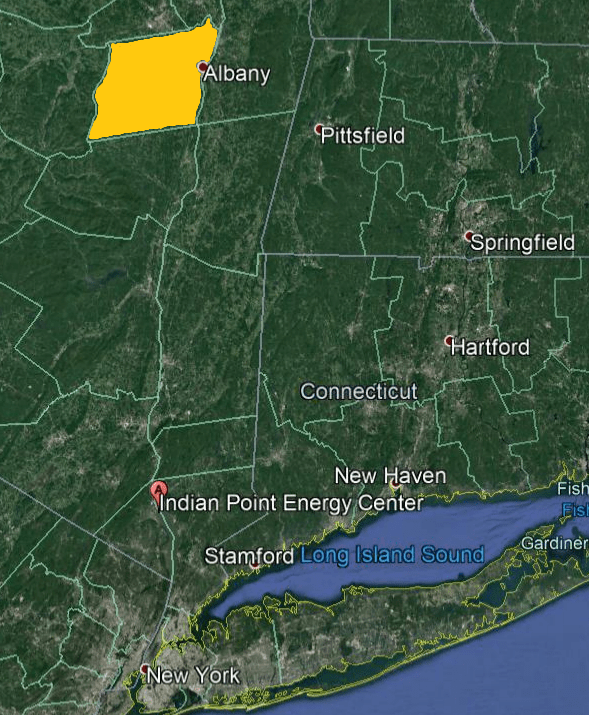
Replacing Indian Point nuclear power plant would require wind farms on land the size of Albany County NY.

But when Indian Point shut down for good in April 2021, all the wind and solar facilities in New York State combined were producing less than a third of the power churned out by that single plant.

So, just as in other regions where nuclear plants have closed, grid operators turned to natural gas to fill the gap. Statewide grid-related CO2 emissions shot up by 15 percent. Analysts warned of potential blackouts. Electricity prices rose, too, jumping 50 percent for New York City residents. Then Riverkeeper executed a brazen maneuver: with Indian Point now closed, the organization began lobbying New York’s Public Service Commission against the proposed power line from Canada that it had previously supported. The group announced that it had “the courage to take a second hard look at this project.” Many clean-energy advocates were outraged. Jesse Jenkins, a respected energy analyst at Princeton, took to Twitter to say that he found it “incredibly frustrating to see environmental groups who allegedly see climate change as a ‘crisis’ regularly and actively opposing solutions.”

The list goes on. Time and again, climate visionaries propose sweeping transformations of our way of life in the name of reducing emissions. But then they fail to build—or even actively oppose—the infrastructure necessary to make that dream a reality.

Environmental radicals like the members of Extinction Rebellion might say that this is a good thing: our society is too rich, too energy-hungry; we must be taught a lesson in austerity. Even supposed moderates sometimes echo that message. Conservatives never forgot Obama energy secretary Steven Chu’s 2008 comment that “we have to figure out how to boost the price of gasoline to the levels in Europe.” Even as he tries to reassure Americans about today’s stratospheric gas prices, President Biden optimistically describes the price surge as part of the “incredible transition” away from fossil fuels.

Today’s economic and geopolitical crises may be an opportunity for climate activists to dial down the catastrophism and focus on policies that actually reduce carbon—without destroying our standard of living.
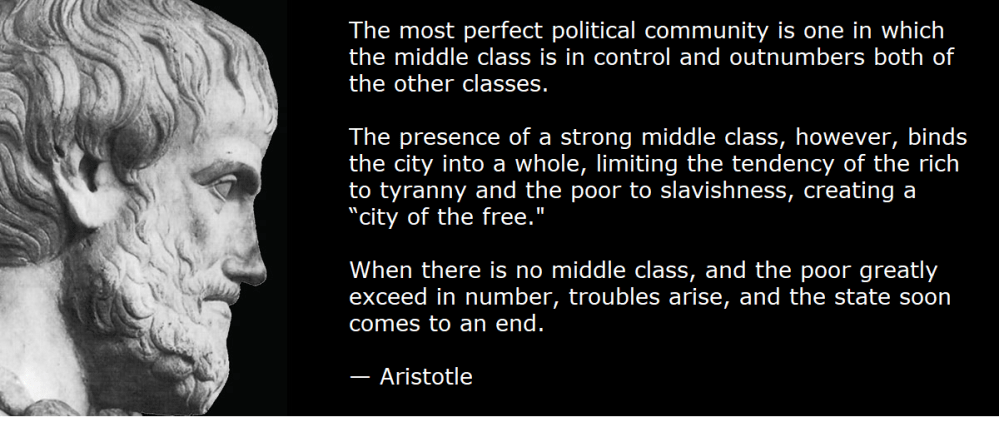
See Also Elites Escalate War Upon the Middle Class

Footnote (just for fun)

Electric Car Obsession


Times Square Billboard

World Economic Forum Urges Public To Eliminate Ownership Of Private Vehicles

The World Economic Forum is advocating for the abolition of “wasteful” private vehicle ownership for the planet’s greater good as the organization attempts to advance its “Great Reset” agenda and transform the world so that the average person will “own nothing.”

“We need a clean energy revolution, and we need it now,” states a WEF’s July 18 article titled, “3 circular economy approaches to reduce demand for critical metals.”

“But this transition from fossil fuels to renewables will need large supplies of critical metals such as cobalt, lithium, nickel, to name a few. Shortages of these critical minerals could raise the costs of clean energy technologies,” the forum continues.

The unelected globalist group recommends the public “go from owning to using” by implementing “vehicle sharing initiatives” to decrease mass reliance on critical metals.

“The average car or van in England is driven just 4% of the time. While most already have a personal phone, 39% of workers globally have employer-provided laptops and mobile phones. This is not at all resource efficient,” the WEF states. “More sharing can reduce ownership of idle equipment and thus material usage.”

The WEF recommends the public abandon use of the vehicles they own and instead opt to share a ride by “car sharing and links to an article published by Tree Hugger to that details what “car sharing” entails.

Banning private ownership in its entirety is essential, according to the WEF.

“A design process that focuses on fulfilling the underlying need instead of designing for product purchasing is fundamental to this transition,” the WEF continues. “This is the mindset needed to redesign cities to reduce private vehicles and other usages.”

Earlier this month, the WEF also published a position paper claiming gas prices must increase to save democracy.

Policies must be implemented to increase the prices of alternatives to green energy, the WEF argues in the July 11 article.

See Also The Illusion of Eco Cars

If That Tesla Battery Could Talk


Trudeau Government Out Of Service

The view from National Post is Trudeau fiddles, while the federal government crumbles around him.  Excerpts in italics with my bolds and added images.

The Trudeau Liberals are failing to deliver even the most basic government services

Prime Minister Justin Trudeau visits children at the Okanagan Boys and Girls Club childcare centre in Lake Country, B.C., on July 18. PHOTO BY ARTUR GAJDA/REUTERS

The federal government is broken — but you wouldn’t know it from following the summer adventures of Prime Minister Justin Trudeau.

It’s no secret that the prime minister loves photo-ops, but he usually manages to at least tangentially connect them to some sort of issue. War in Ukraine? Time for a heavily photographed European tour. Outrage over residential schools? Someone find him a teddy bear and a well-lit place to kneel.

But his latest string of photo-ops don’t even bother with rhyme or reason as he tours the country seemingly at random, for no real purpose, doing basically nothing. One day he’s playing camp counsellor in the woods, the next he’s all smiles and no mask on a sightseeing train. Next thing you know, he’s picking cherries and chumming it up with fruit growers in British Columbia.

So far, no one’s been able to figure out quite why he’s doing this. He hasn’t used the trips to make any policy or funding announcements, wasn’t in town for fundraisers and the notion of a fall election seems absurd even by Liberal standards.

It’d be great if the media could ask him during one of his many photo-ops, but he’s forbidden journalists from posing questions. He wouldn’t want anything to distract from his carefully curated tableaus, and reporters have a pesky habit of wanting to talk about things other than children’s stories and fruit.

Meanwhile, across Canada, people are literally camping outside Service Canada locations in attempts to secure passports. Airports suffer from rampant flight delays and cancellations, lost luggage, long lines and staff shortages.

Pilots can’t get certified or re-certified because, according to Dario Matrundola, president of Canadian Flyers Aviation College, Transport Canada “completely dropped the ball.” In Quebec, hundreds of court cases are being postponed due to a shortage of judges.

Emergency rooms are closing due to staffing and capacity issues. Both hospitals in Saint John, N.B., hit capacity last weekend, forcing some residents to drive over an hour to receive emergency care. In Montreal, a children’s hospital was recently forced to turn away patients.

The immigration system is backlogged with over 2.7 million applications in the queue. We have stopped taking new applications to resettle the Afghans who helped our Forces and now face persecution from the Taliban.

Many Indigenous communities still don’t have potable drinking water. The federal government’s idea of solving what many believe is a housing crisis is to spend public money on building a paltry 260 new homes — a bad, government-centric response that helps almost no one.

The ArriveCAN app is glitching and ordering vaccinated travellers into quarantine. If you live in the downtown core of many Canadian cities, it’s impossible to miss the growing numbers of people sleeping, eating and even defecating on the streets.

And that’s just the tip of the iceberg. Where is the Liberals’ new China policy that they’ve been promising since 2019? Or someone to fill the ambassador to China role that’s now been vacant for over six months? Is anyone even enforcing our Russian sanctions (when the federal government itself isn’t breaking them)?

It’s becoming harder to find areas of government that aren’t in crisis than ones that are. Chaos and dysfunction are seemingly everywhere. The Trudeau Liberals are failing to deliver on even the most basic government services.

Ironically, it’s the same politicians and political staffers responsible for these failures who can’t seem to fathom why voters are losing trust in Canadian institutions. They view frustration with government “gatekeepers” as unfounded and dangerous, rather than the predictable result of their negligence and general apathy toward average Canadians.

Canadians are frustrated that they cannot receive even basic government services in a timely manner, and that their vacation plans are being disrupted, after over two years of complying with coronavirus restrictions. But the Liberals can’t see that because they’re too busy patting themselves on the back for their supposed moral authority, and Trudeau doesn’t want to hear it while he tours the nation’s summer camps.

It’s often Conservatives who are accused of wanting to let government services erode, in order to usher in privatization. But under the Liberals, those services have all but collapsed.

If the left believes that big government is the solution to the problems that plague our nation, they couldn’t be doing more to undermine their own ideology. Rather than demand change, Liberal supporters seem determined to defend and deflect, sacrificing their party’s credibility to serve Trudeau’s cult of personality.

What Canada needs right now is for the prime minister to start demonstrating a real commitment to getting the federal government working again. That means focusing on real, tangible results, rather than taking an extended vacation. School children may be out for the summer, but as our head of government, Trudeau does not have that same luxury — especially when his government is in such a state of disarray.


US Feds Directing Big Tech Censorship? Discovery Begins.

Adam Mill explains in his American Greatness article Is the Government Directing Big Tech Censorship? Excerpts in italics with my bolds and added images.

Details in a case filed in a federal district court suggest government-directed censorship on social media and the most comprehensive interference in a domestic election in the history of the nation.

We’ve heard it a thousand times: “The First Amendment doesn’t apply to private social media platforms.” That statement, however, presumes the private company’s independence from government action. But what if the social media platform defers censorship decisions to the government itself? Can the government circumvent free speech protections by using a cut-out to censor citizen speech critical of its policies or preferred political candidates?

An explosive case filed in the Federal District Court of the Western District of Louisiana may shine a light on the federal government’s role in Big Tech censorship.

On July 12, U.S. District Judge Terry A. Doughty (appointed by President Trump in 2017) granted permission for plaintiffs to conduct discovery into whether federal agencies violated the First Amendment rights of Americans by allegedly directing social media platforms to censor disfavored viewpoints and content. These topics include, “Speech about the lab-leak theory of COVID-19’s origin, speech about the efficiency of masks and COVID-19 lockdowns, and speech about election integrity and security of voting by mail.” More importantly, these agencies stand accused of working with social media companies to suppress, “The Hunter Biden laptop story prior to the 2020 Presidential election.”

If true, the government-directed censorship constitutes the most comprehensive interference in a domestic election in the history of the nation.

According to plaintiffs, the alleged government-sponsored tech censorship is ongoing. Plaintiffs filed a “Motion for Preliminary Injunction,” requesting an order prohibiting government defendants from, “taking steps to . . . encourage, pressure . . . any social-media company or platform to censor, suppress,” etc., “. . . any speaker, content, or viewpoint expressed on social media.” The attorneys general for the states of Missouri and Louisiana brought the lawsuit against various federal agencies on behalf of residents of each of these states.

The government opposed the lawsuit arguing that the states lacked standing to challenge government efforts to suppress speech on social media platforms. The court denied this challenge noting the states have standing because the laws and constitution of each state guarantee their residents free speech. The court noted that the lawsuit alleged injuries which, “are ‘imminent’ and allegedly ‘on-going,’ due to allegations of social media suspensions, removals of disfavored viewpoints, and censorship.” Federal agency suppression of citizen free speech, if proven, violates the laws and constitutions of those states.

The plaintiffs seek to force the federal government to reveal “the identities of federal officials who have or are communicating with social-media platforms about disinformation, misinformation . . . or any form of censorship or suppression of online speech,” in addition to “the nature and content of such federal officials’ communication with such social media platforms.” The plaintiffs have also asked for permission to “serve third-party subpoenas,” on selected social media platforms seeking, “similar information about the identity of federal officials who communicate with them, and the nature and content of these communications.”

Anticipating bad-faith objections and legal gymnastics to obstruct discovery, the plaintiffs further requested the court to rule on all objections. The court found, “the requests are reasonable,” and that, “Missouri and Louisiana have shown good cause for expedited,” discovery to aid in the resolution of the requested preliminary injunction. The court granted permission to the plaintiffs to serve the federal agencies with written discovery and third party subpoenas on “up to five major social-media platforms,” regarding the alleged coordination between the government and the platforms to censor and suppress speech. The judge then granted a mere 30 days for the federal agencies to respond.

What’s more, the court informed the federal agencies that it would promptly rule on any attempts to thwart the requests. The court even established a schedule for ruling on the preliminary injunction.

In October 2020, immediately after the release of the Hunter Biden laptop stories, the Daily Mail reported Facebook told Congress that it censored the information after the FBI told the platform that the information came from a “hack and leak” Russian disinformation campaign. The New York Post, which exclusively reported on much of the information, fiercely contested this claim—providing a detailed account of how a computer repair store owner legally obtained the laptop. Indeed, the Daily Mail published copies of a receipt bearing Hunter Biden’s signature which appeared to confirm the Post’s account of the origins of the story.

While the public has known about a letter signed by more than 50 former intelligence officials characterizing the laptop story as Russian disinformation, this is something different. A confirmation that current government officials helped censor the story would represent a significant development in the saga. As noted by the Epoch Times, the media coverup of the Hunter Biden laptop story likely impacted the election outcome. If, as the plaintiffs allege, the social media companies acted at the direction of federal agencies falsely disputing the authenticity of the laptop, such a scandal would raise serious questions about the fairness of the 2020 election.

Footnote on Free And Fair Elections

Those who monitor elections internationally evaluate whether the process was both “Free” and “Fair.”  A free election is one in which all voters have unfettered access to all messaging by all candidates.  Violations include silencing opposition by putting them in prison or by destroying their media.  A fair election is one in which each eligible voter has one and only one vote counted.  Pieces of paper with marks on them are not ballots until it is determined that those marks were made by a lawful voter in the time and manner prescribed by the legislature. Only after that bar is crossed for every ballot is it possible to have an election.

Abortion Should Be Safe, Legal and Rare

Now in the US, it will up to lawmakers state by state to decide what if any limits to put on abortion procedures.  Why it matters is suggested by the image above.  The unborn has already his/her own heartbeat typically detectable by week six or seven, and by 12 weeks the rate reduces to a sustainable level for the rest of the pregnancy.

So the Supreme Court affirmed the Mississippi state law that prohibits abortion after 15 weeks.  Women in Mississippi have the right to choose to end their pregnancy in the first trimester, but after 15 weeks the unborn has a right to life.  There are many ways to practice birth control–abortion should be a last resort in extreme circumstances.

Much Ado About Marine Heat Waves

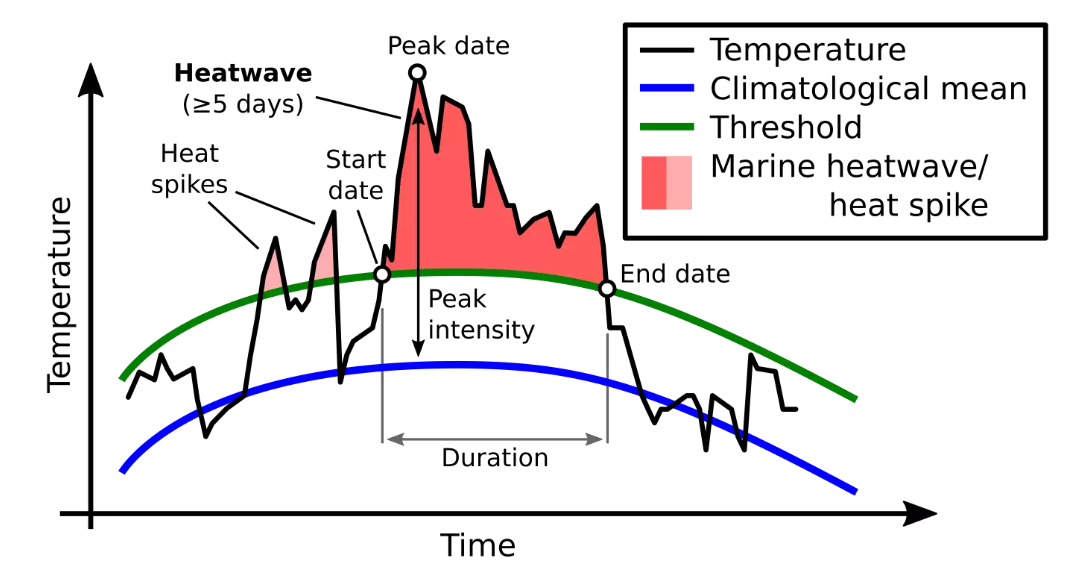
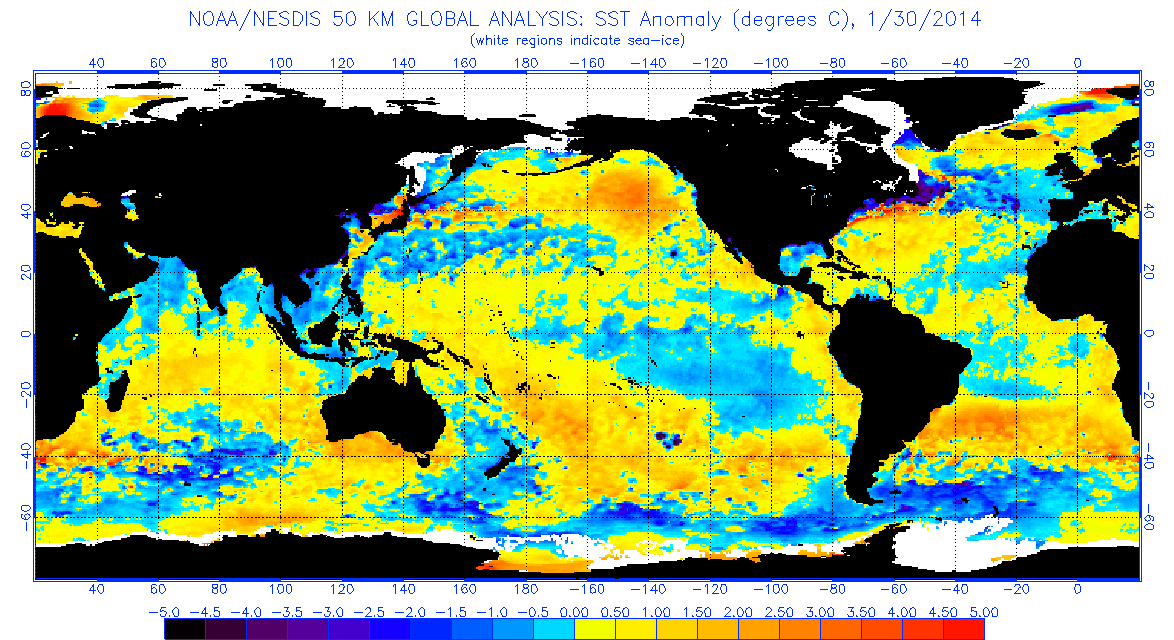
The latest promotion of this scare was published this week at Nature by Barkhordarian et al. Recent marine heatwaves in the North Pacific warming pool can be attributed to rising atmospheric levels of greenhouse gases.  This post will unpack the reasons to distrust this paper and its claims.  First the Abstract of the subject and their declared findings in italics with my bolds.

Abstract

Over the last decade, the northeast Pacific experienced marine heatwaves that caused devastating marine ecological impacts with socioeconomic implications. Here we use two different attribution methods and show that forcing by elevated greenhouse gases levels has virtually certainly caused the multi-year persistent 2019–2021 marine heatwave. There is less than 1% chance that the 2019–2021 event with ~3 years duration and 1.6 ∘C intensity could have happened in the absence of greenhouse gases forcing. We further discover that the recent marine heatwaves are co-located with a systematically-forced outstanding warming pool, which we attribute to forcing by elevated greenhouse gases levels and the recent industrial aerosol-load decrease. The here-detected Pacific long-term warming pool is associated with a strengthening ridge of high-pressure system, which has recently emerged from the natural variability of climate system, indicating that they will provide favorable conditions over the northeast Pacific for even more severe marine heatwave events in the future.

Background on Ocean Warm Pools

Wang and Enfield study is The Tropical Western Hemisphere Warm Pool Abstract in italics with my bolds.

Abstract

The Western Hemisphere warm pool (WHWP) of water warmer than 28.5°C extends from the eastern North Pacific to the Gulf of Mexico and the Caribbean, and at its peak, overlaps with the tropical North Atlantic. It has a large seasonal cycle and its interannual fluctuations of area and intensity are significant. Surface heat fluxes warm the WHWP through the boreal spring to an annual maximum of SST and areal extent in the late summer/early fall, associated with eastern North Pacific and Atlantic hurricane activities and rainfall from northern South America to the southern tier of the United States. SST and area anomalies occur at high temperatures where small changes can have a large impact on tropical convection. Observations suggest that a positive ocean-atmosphere feedback operating through longwave radiation and associated cloudiness is responsible for the WHWP SST anomalies. Associated with an increase in SST anomalies is a decrease in atmospheric sea level pressure.

Chou and Chou published On the Regulation of the Pacific Warm Pool Temperature:

Abstract

Analyses of data on clouds, winds, and surface heat fluxes show that the transient behavior of basin-wide large-scale circulation has a significant influence on the warm pool sea surface temperature (SST). Trade winds converge to regions of the highest SST in the equatorial western Pacific. The reduced evaporative cooling due to weakened winds exceeds the reduced solar heating due to enhanced cloudiness. The result is a maximum surface heating in the strong convective and high SST regions. The maximum surface heating in strong convective regions is interrupted by transient atmospheric and oceanic circulation. Regions of high SST and low-level convergence follow the Sun. As the Sun moves away from a convective region, the strong trade winds set in, and the evaporative cooling enhances, resulting in a net cooling of the surface. We conclude that the evaporative cooling associated with the seasonal and interannual variations of trade winds is one of the major factors that modulate the SST distribution of the Pacific warm pool.

Comment:

So these are but two examples of oceanographic studies describing natural factors driving the rise and fall of Pacific warm pools.  Yet the Nature paper claims rising CO2 from fossil fuels is the causal factor, waving away natural processes.  Skeptical responses were already lodged upon the first incidence of the North Pacific marine heat wave, the “Blob” much discussed by west coast US meteorologists.  One of the most outspoken against the global warming attributionists has been Cliff Mass of Seattle and University of Washington.  Writing in 2014 and 2015, he observed the rise and fall of the warming blob and then posted a critique of attribution attempts at his blog.  For example, Media Miscommunication about the Blob.  Excerpts in italics with my bolds.

Blob Media Misinformation

One of the most depressing things for scientists is to see the media misinform the public about an important issue.

During the past few days, an unfortunate example occurred regarding the warm water pool that formed over a year ago in the middle of the north Pacific, a.k.a., the blob. Let me show how this communication failure occurred, with various media outlets messed things up in various ways.

The stimulant for the nationwide coverage of the Blob was a very nice paper published by Nick Bond (UW scientist and State Climatologist), Meghan Cronin, Howard Freeland, and Nathan Mantua in Geophysical Research Letters.

This publication described the origin of the Blob, showing that it was the result of persistent ridging (high pressure) over the Pacific. The high pressure, and associated light winds, resulted in less vertical mixing of the upper layer of the ocean; with less mixing of subsurface cold water to the surface. Furthermore, the high pressure reduced horizontal movement of colder water from the north. Straightforward and convincing work.

The inaccurate press release then led to a media frenzy, with the story going viral. And unfortunately, many of the media got it wrong.

There were two failure modes. In one, the headline was wrong, but the internal story was correct. . . In the second failure mode, the story itself was essentially flawed, with most claiming that the Blob off of western North America was the cause of the anomalous circulation (big ridge over West Coast, trough over the eastern U.S.). (The truth: the Blob was the RESULT of the anomalous circulations.) That the Blob CAUSED the California drought or the cold wave in the eastern U.S. These deceptive stories were found in major outlets around the country, including the Washington Post, NBC News, and others.

Blob Returns,  Attribution Misinformation

When the Blob returned 2020-2021, Cliff Mass had cause to again lament how the public is misled.  This time misdirection instigated by activist scientists using flawed methods.  His post Miscommunication in Recent Climate Attribution Studies.  Excerpts in italics with my bolds.

This attribution report, and most media stories that covered it, suggested a central role for global warming for the heatwave. As demonstrated in my previous blog, their narrative simply does not hold up to careful examination.

This blog will explain why their basic framing and approach is problematic, leading readers (and most of the media) to incorrect conclusions.

For the heatwave, the attribution folks only examine the statistics of temperatures hitting the record highs (108F in Seattle), but avoid looking at the statistics of temperature exceeding 100F, or even the record highs (like 103F in Seattle). There is a reason they don’t do that. It would tell a dramatically different (and less persuasive) story.

In the attribution studies, the main technology for determining changed odds of extreme weather is to use global climate models. First, they run the models with greenhouse gas forcing (which produces more extreme precipitation and temperature), and then they run the models again without increased greenhouse gases concentrations. By comparing the statistics of the two sets of simulations, they attempt to determine how the odds of extreme precipitation or temperature change.

Unfortunately, there are serious flaws in their approach: climate models fail to produce sufficient natural variability (they underplay the black swans) and their global climate models don’t have enough resolution to correctly simulate critical intense, local precipitation features (from mountain enhancement to thunderstorms). On top of that, they generally use unrealistic greenhouse gas emissions in their models (too much, often using the RCP8.5 extreme emissions scenario) And there is more, but you get the message. ( I am weather/climate modeler, by the way, and know the model deficiencies intimately.)

Vaunted Fingerprinting Attribution Is Statistically Unsound

From Barkhordarian et al.

Unlike previous studies which have focused on linking the SST patterns in the North Pacific to changes in the oceanic circulation and the extratropical/tropical teleconnections2,12,17,18,20,24,26, we here perform two different statistical attribution methodologies in order to identify the human fingerprint in Northeast Pacific SST changes both on multidecadal timescale (changes of mean SST) and on extreme SST events on daily timescale (Marine Heatwaves). Evidence that anthropogenic forcing has altered the base state (long-term changes of mean SST) over the northeast Pacific, which is characterized by strong low-frequency SST fluctuations, would increase confidence in the attribution of MHWs27, since rising mean SST is the dominant driver of increasing MHW frequency and intensity, outweighing changes due to temperature variability1,2.

In this study, we provide a quantitative assessment of whether GHG forcing, the main component of anthropogenic forcings, was necessary for the North Pacific high-impact MHWs (the Blob-like SST anomalies) to occur, and whether it is a sufficient cause for such events to continue to repeatedly occur in the future. With these purposes, we use two high-resolution observed SST datasets, along with harnessing two initial-condition large ensembles of coupled general circulation models (CESM1-LE28,29 with 35 members, and MPI-GE30 with 100 members). These large ensembles can provide better estimates of an individual model’s internal variability and response to external forcing31,32, and facilitate the explicit consideration of stochastic uncertainty in attribution results33. We also use multiple single-forcing experiments from the Detection and Attribution Model Intercomparision Project (DAMIP34) component of Coupled Model Intercomparison Project phase 6 (CMIP635).

From Barkhordarian et al. References


The IPCC’s attribution methodology is fundamentally flawed

The central paper underpinning the attribution analysis was assessed and found unreliable by statistician Ross McKitrick’s published evaluation. Excerpts in italics with my bolds.

One day after the IPCC released the AR6 I published a paper in Climate Dynamics showing that their “Optimal Fingerprinting” methodology on which they have long relied for attributing climate change to greenhouse gases is seriously flawed and its results are unreliable and largely meaningless. Some of the errors would be obvious to anyone trained in regression analysis, and the fact that they went unnoticed for 20 years despite the method being so heavily used does not reflect well on climatology as an empirical discipline.

My paper is a critique of “Checking for model consistency in optimal fingerprinting” by Myles Allen and Simon Tett, which was published in Climate Dynamics in 1999 and to which I refer as AT99. Their attribution methodology was instantly embraced and promoted by the IPCC in the 2001 Third Assessment Report (coincident with their embrace and promotion of the Mann hockey stick). The IPCC promotion continues today: see AR6 Section 3.2.1. It has been used in dozens and possibly hundreds of studies over the years. Wherever you begin in the Optimal Fingerprinting literature (example), all paths lead back to AT99, often via Allen and Stott (2003). So its errors and deficiencies matter acutely.

Abstract

Allen and Tett (1999, herein AT99) introduced a Generalized Least Squares (GLS) regression methodology for decomposing patterns of climate change for attribution purposes and proposed the “Residual Consistency Test” (RCT) to check the GLS specification. Their methodology has been widely used and highly influential ever since, in part because subsequent authors have relied upon their claim that their GLS model satisfies the conditions of the Gauss-Markov (GM) Theorem, thereby yielding unbiased and efficient estimators.

But AT99:

  • stated the GM Theorem incorrectly, omitting a critical condition altogether,
  • their GLS method cannot satisfy the GM conditions, and
  • their variance estimator is inconsistent by construction.
  • Additionally, they did not formally state the null hypothesis of the RCT nor
  • identify which of the GM conditions it tests, nor
  • did they prove its distribution and critical values, rendering it uninformative as a specification test.

The continuing influence of AT99 two decades later means these issues should be corrected. I identify 6 conditions needing to be shown for the AT99 method to be valid.

In Conclusion,  McKitrick:

One point I make is that the assumption that an estimator of C provides a valid estimate of the error covariances means the AT99 method cannot be used to test a null hypothesis that greenhouse gases have no effect on the climate. Why not? Because an elementary principle of hypothesis testing is that the distribution of a test statistic under the assumption that the null hypothesis is true cannot be conditional on the null hypothesis being false. The use of a climate model to generate the homoscedasticity weights requires the researcher to assume the weights are a true representation of climate processes and dynamics.

The climate model embeds the assumption that
greenhouse gases have a significant climate impact.

Or, equivalently, that natural processes alone cannot generate a large class of observed events in the climate, whereas greenhouse gases can. It is therefore not possible to use the climate model-generated weights to construct a test of the assumption that natural processes alone could generate the class of observed events in the climate.